IMMIGRATION RAIDS THREATEN GEORGETOWN LOCAL BUSINESSES, CAUSE STAFF SHORTAGES
By Sophia Jacome
THE FIVE DEADLY SINS OF STRANGER THINGS 5
By Elizabeth Adler
J ANUARY 23, 2026
The mask is off on U,S, imperialism, What are you going to do about it, Georgetown? EDITORIAL BOARD 10 e2itorials
4
features Georgetown students with dietary restrictions face obstacles when finding a meal
ELAINE CLARKE
6
voices
Ode to an elevator
PHOEBE NASH
7
voices You have letter mail
MADELEINE SWEET
8
0e1s Immigration raids threaten Georgetown local businesses, cause staff shortages
SOPHIA JACOME
halftime leisure
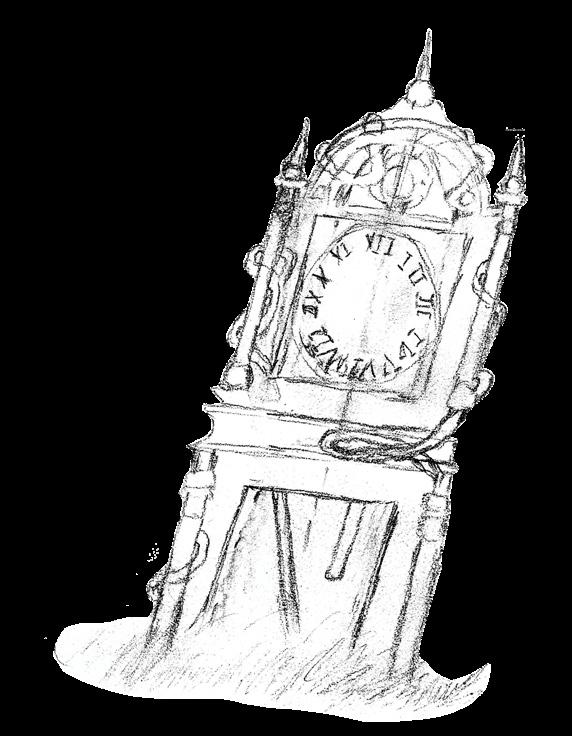
The five deadly sins of Stranger Things 5
ELIZABETH ADLER
“In an age of digital communication, the letter has almost become obsolete. There’s an undeniable utility in an email, text, and call. However, our nowconstant availability and ease of communication can lead people to be careless and unintentional as they try to stay in touch.” PG
Editor-in-Chief — Eddy Binford-Ross
Managing Editor of Content — Sydney Carroll
Managing Editor of Operations — Imani Liburd
i0ter0al resources:
Exec. Manager for Staff — Chih-Rong Kuo
Exec. Editor for Resources, Diversity, and Inclusion — Elaine Clarke
Asst. Editor for Resources, Diversity, and Inclusion — Renee Pujara
Editor for Sexual Violence Advocacy, Prevention, and Coverage — Olivia Fanders
Social Chairs — Aaron Pollock, Justin Higgins Archivist — Eileen Miller
0e1s:
Executive Editor — Aubrey Butterfield
Features Editor — Alexandra Risi
News Editor — Sophia Jacome
13
halftime leisure From La La Land to Brexit: 10 things turning 10 in 2026
HALFTIME LEISURE
14
halftime s,orts Georgetown students tackle fantasy football punishments
VINCE GUDE AND JULIA MAURER
15
halftime s,orts Five queer athletes out on the field
EILEEN WEISNER
us
Asst. News Editors — Justin Higgins, Sehr Khosla, Julia Carvalho, Basia Panko Asst. Features Editors — Sophie St Amand
I am so excited to welcome you to The Georgetown Voice’s first issue of 2026. If we haven’t met yet, I’m Eddy, the 2025-26 editor of this fabulous little newsmagazine, and I cannot wait to share our coverage with you.
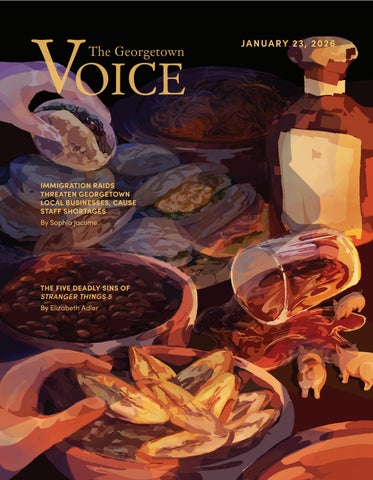
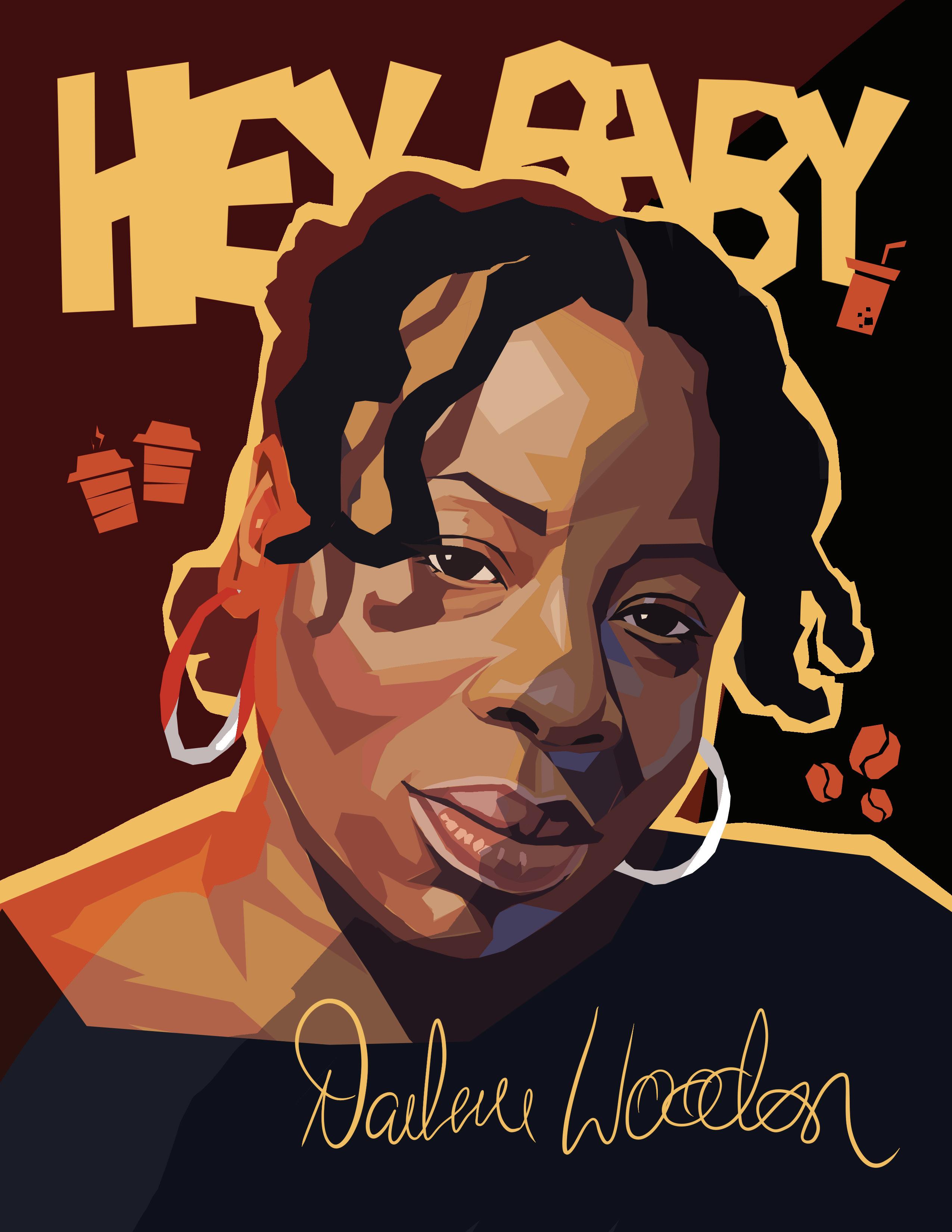
First, I want to highlight the incredible work of our designers, including the back cover with its portrait of the lovely Darlene from Whisk and page 10 with a poignant depiction of imperialism by Design Editor Paige Benish. Our designers are undoubtedly critical to making the Voice what it is.
Turning to our writers, I am so proud of the breadth and depth of coverage that you will find in these pages. Our news section has heartbreaking reporting on how immigration enforcement has impacted our neighborhood’s businesses, the Editorial Board wrote a timely piece on how Georgetown can ensure it doesn’t contribute to U.S. imperialism, and the opinion team produced a beautiful article about why you should make time to write letters to your friends. Our reporters have tackled topics that are deeply important, but also challenging to write about, with such empathy and consideration. I hope you learn and feel as much as I did reading the articles in this issue.
As I wrote in my first letter from the editor in September, my goal for the Voice is that we continually recognize that our journalism is community journalism, meant to serve and uplift our campus, our neighborhood, and the people who call it home. Journalism, at its best, shines light on what is going well in our communities, uncovers where our systems are failing us, and provides a place for people’s voices to be heard.
Through all of this I have a challenge for you, dear reader: continue to be curious about things happening on our campus, in the District, and around the world.
Game: Guess which one of our managing editor's teeth needed a root canal!
Our coverage will extend beyond the intersection of 37th and O Streets, because we recognize that we do not live in a bubble on the Hilltop. We belong to both the city and the students. We hope you will engage in that content with as much passion and enthusiasm as you bring to our on-campus news.
In light of that, I welcome your engagement on social media, on our website, through our print edition, and in my inbox. If you have any thoughts about this issue, our coverage online, or anything going on around Georgetown’s campus, I’m just an email away: editor@georgetownvoice.com.
In the meantime, I am so excited to share this issue—and the next six—with you this semester!
Until next time,
Eddy Binford-Ross Editor-in-Chief, Fall 2025 & Spring 2026
Agony Aunt’s Advice Column
How do I become someone who wears a beret, but like, in a chill way?
Dear Reader,
I’m feeling anxious that I haven’t found “my people” yet. Everyone around me is getting in these super-close friend groups (and honestly some people are being weirdly possessive of “their people” and “the dynamic”). I don’t want to a) jump into a group I don’t totally vibe with because I’m scared of not having one, b) force myself into a group that doesn’t want me, or c) be alone. What should I do?
I, too, have wondered how to style a beret. But before I begin, I feel obliged to tell you that the following advice comes from someone who rewatched Lady Bird (2017) during Covid-19—specifically the Thanksgiving scene where she’s wearing a black beret while getting high in the kitchen with her friends. I then promptly ordered a beret online, knowing full well I could never, ever, pull off a beret. When it arrived in the mail several days later it looked worse than I could have imagined.
— Fretting Freshman
Ohhh, buddy. This is a real pincher of a problem and you might not like the answer I’m going to give you, because it means you are going to have to be lonely, uncomfortable, and nervous sometimes (maybe a lot of the time). But hopefully you will also take heart when I tell you that the problem may not be as big as it probably feels to you now.
I am tempted to write off beret-fever as a pandemic side effect, but that would be medical misinformation. There is something alluring about the beret. So I guess the first piece of advice I’d give is to question why you want to join the legions of beret-wearers. Are you trying to emulate a specific style icon or aesthetic? Are you trying to be a trend-setter? Or are you just plain bored with your life and think Paris is a good idea (D.C. isn’t all that different)? Or maybe I’m psychoanalyzing a little too much and you just think berets look cool. Regardless, identifying why you want to style a beret and placing it within the greater context of your style goals creates a landscape in which the beret can thrive. It is, after all, only one component of a complicated outfit.
Read the rest of Agony Aunt's advice at https://georgetownvoice.com/
Georgetown students with dietary restrictions face obstacles when finding a meal
BY ELAINE CLARKE
W
hen Isabel Carr (CAS ’26) was a freshman at Georgetown, eating at Leo J. O’Donovan Dining Hall sent her to the hospital twice.
Tree nuts, milk, and eggs can cause Carr to go into anaphylactic shock, so she spent most of her time eating at Plant Power and True Balance, the vegetarian and allergen-safe dining stations.
During Carr’s first year, Georgetown’s dietician had pointed to the allergyspecific station as a safe place and emphasized that the entirety of Leo’s was tree nut and peanut-free. Carr felt comfortable that the choices she had were safe.
However, one morning, an hour after eating breakfast, Carr found herself in class sweaty, itchy, and swollen.
“I started having a full-blown allergic reaction, and people didn’t know what to do—I was losing consciousness,” Carr said.
After Carr excused herself from class, her friend called GERMS, and she gave herself an EpiPen. The pair spent the rest of the day in the hospital.
After a second incident led to another hospitalization, she applied for accommodations and got a reduced meal plan, among other adjustments.
Carr is one of many Georgetown students who struggles with eating on campus due to their dietary restrictions. Students who are vegetarian, follow kosher or halal, or have allergies or intolerances said that they run into daily obstacles as they look for food they can eat.
Dining at Georgetown is currently managed by Aramark, a food services company that serves over 275 colleges and universities. Aramark manages all meal options on campus, including Leo’s, Epicurean, Royal Jacket, and Crop Chop. Georgetown’s current contract with Aramark is set to expire in 2027 and a university spokesperson wrote to the Voice that they are “currently conducting a Request for Proposal process to solicit proposals from food service providers for moving forward after the expiration.”
In light of the impending contract expiration, many students with restrictions have called on Georgetown not to pursue a renewal with Aramark.
“For how much money that we pay to go here, it is really disappointing that Georgetown is unable to accommodate,” Fatima Anjum (CAS ’28) said. “Confining students to one station where the food is bad, I don’t understand how the university does not see that that is inaccessible.”
Anjum is a student with celiac disease, a condition that causes one’s immune system to treat gluten as a threat and attack the intestines after consumption. Though Anjum has been able to navigate eating on campus with celiac with no hospitalizations, there are only a few guaranteed safe spaces to eat.
Since being diagnosed with the condition in sixth grade, Anjum has not eaten gluten—until this year at Georgetown.
Although she mainly cooks, between classes, Anjum sometimes finds herself in a rush and goes to the dining hall for lunch. Earlier this year, she decided to eat tacos from the Halal Station at Leo’s—not an exclusively gluten-free location, but all the ingredients that day were labeled as gluten-free.
After she sat down, Anjum said her intuition told her something was off. After taking a few bites, she realized the tortilla was labeled wrong. It was not a corn tortilla, but flour.
“I know that I was taking a risk by eating at another station, but I was taking a risk of cross-contamination, not a risk of literally consuming flour,” Anjum said.
Anjum ended up sick for two weeks after consuming those two bites of gluten. Although she did not need to go to the hospital, most of her time was spent in bed, missing class.
Since the incident, Anjum has attended Dining Committee meetings, monthly conversations held by GUSA between students and Hoya Hospitality administrators.
When she brought up the challenges of restricted eating, Hoya Hospitality administrators told Anjum she needed accommodations to address her specific dietary needs. Currently, those accommodations ensure Anjum has her own kitchen.
“If [students] have to constantly be cooking in their own apartment, that takes away that time where it's for socializing, where people would decompress at the end of a nice day at Leo's,” Anjum said.
At the same time, she is still required to have a partial meal plan, meaning that she is paying for both groceries and dining hall food that she often can’t eat.
Anjum pointed to other schools, such as UMass Amherst, that provide their gluten-free students with more options. At Leo’s, Anjum has to eat dairy-free and egg-free, although she is only allergic to gluten.
“As much as I think that they try to say that there are options, it’s a clear equity issue,” Anjum said. “Georgetown really shoves it in their face that their chronic illness is theirs and it is their problem.”
Dining Committee member Sienna Lipton (CAS ’27) has also had difficulties getting accommodations for her celiac disease. She attempted to get off the meal plan that has been required for all students living on campus since 2021. Currently, she has a 7-weekly plan that she usually uses to get coffee in the morning rather than for actual meals.
“Last year, they made me do 14-weekly, and that felt like too much,” Lipton said. “I actually remembered challenging them, and they were like, ‘That’s just the lowest we can do for sophomores. Sorry.’”
In a comment to the Voice, a university spokesperson said that the Academic Resource Center, which makes accommodations for students with disabilities, has an individualized process that takes into account the specifics of each request made.
Last semester, through the Dining Committee, Georgetown opened a new Stress Less Zone in Leo’s that offers more
DESIGN BY PIA CRUZ
options to gluten-free students, such as a fridge with gluten-free food. Lipton believes it is a start, but that conversations about accommodating students at committee meetings are mostly circular, due in part to administrative turnover in Hoya Hospitality.
In a comment to the Voice , a university spokesperson said that the university is committed to providing students with healthy, fresh, and nutritious meals.
“The University can meet the vast majority of students’ dining needs— including disability-related or religious dietary requirements—through its extensive dining options, or through reasonable accommodations,” the spokesperson wrote.
Not only have students with allergy restrictions expressed difficulties eating on campus and receiving accommodations, but students with religious restrictions have faced similar challenges.
Maahir Kasliwal (SFS ’28) is Jain. As part of his nonviolent religious practices, Kasliwal is restricted in what he eats. He does not eat meat and certain vegetables, such as root vegetables like onions or potatoes.
Freshman year, Kasliwal tried to eat at Leo’s Plant Power station, but he found the food to be highly processed and very repetitive.
Kasliwal explained that crosscontamination was a strong concern for his family. At restaurants, his parents would request their dishes be cooked separately. When he explained this concern to Hoya Hospitality, however, they told him there was only so much they could do.
“You’re forced to accept that there will be contamination from other utensils or dishes,” Kasliwal said. “So I just had to accept that and let go of my own cultural upbringing to eat the food that was available to me because it's already such limited options.”
Kasliwal now has religious accommodations to reduce his meal plan and have access to a kitchen.
Other students with religious restrictions face similar limitations on campus. When student Michael Busch (SFS ’27) transferred to Georgetown from Rice University, he reached out to Hoya Hospitality and was assured he would be able to maintain his kosher diet.
But since transferring, Busch found the kosher options slim.
Leo’s only offers hot kosher dinners Monday through Thursday at the Kosher Cart, a non-permanent space in Leo’s. For breakfast and lunch, they have a small fridge behind the salad bar with the same wraps and muffins every week.
Most of these options disappear quickly, Busch said, due to demand. As for other spaces on campus, Busch said that he often finds their kosher fridges empty.
Along with the majority of kosher options being cold, Busch said there have been multiple instances in which employees misunderstood what a kosher diet entails. Once, an employee gave Busch a chicken, bacon, and cheese burrito from the kosher fridge, an item that goes against the diet by mixing meat and cheese.
Now, Busch is completely off the meal plan, which required him to prove that campus dining did not have adequate options and to coordinate his request with the campus rabbi. During this process, he said that the administration made him feel as though it was entirely his “responsibility and fault.”
“I feel that there’s a lack of sort of empathy in the administration and within the dining hall,” Busch said. “If all of the students that eat strictly kosher get exemptions, this is a sign that we need to change something, but I didn’t really get that impression.”
At Rice, Busch said they didn’t have any kosher-specific facilities on campus, but he was still able to have three guaranteed kosher meals a day through an app ordering process, which Busch says was a “very reliable” system.
“The food was definitely sufficient. I felt like it was a full meal,” he said.
For Muslim students at Georgetown, the university offers a halal-diet specific station at Leo’s. However, students have had to advocate for more clarity on what was halal elsewhere, according to Meriam Ahmad (SFS ’26), former chair of the Dining Committee.
“Coming to campus and realizing, ‘Oh, it's not only the Halal Station that's halal. What else is halal?’” Ahmad said. “That was the real puzzle that I had to go through, because it’s very confusing when the university doesn’t label something as halal meat or non-halal.”
One tool students can look to is the Halal Guide, a document currently run by students like Ahmad. Students update the guide regularly, based on conversations with administration.
A university spokesman said in a comment to the Voice that Hoya Hospitality will begin labeling meat as halal in spring 2026, after meeting with “members of Georgetown’s Muslim community to reach a common definition of halal.”
Ahmad said that these labels are important not only for halal students to know what they can eat, but to show prospective students “that this is a university that supports Muslim students.”
Ahmad believes that some important progress has been made, but that Hoya Hospitality should “be upfront” about their limitations, especially when it comes to what they can provide to students with restrictions. She also hopes they continue tracking student engagement.
The dietician on campus, Amanda Pierce, stressed accessibility “requires active communication and accountability with students.”
“We have feedback channels including QR codes on the tables, regular meetings with students for nutrition consultations, weekday availability at Leo’s, and regular meetings with the Student Dining Committee as well as other student groups so we can continuously improve offerings based on their experiences,” Pierce wrote in a comment to the Voice . “I believe we offer a diverse variety to accommodate needs such as halal, vegetarian, vegan, and allergy-friendly choices.”
Pierce wrote that her ultimate goal is “to create a dining environment where every student is safe, respected, and confident that their dietary needs will be safely met.”
Anjum, one of the students with celiac disease, believes that, although Georgetown works to navigate dining restrictions with stations like True Balance, “there is still so much inequity.” There are days when she “starves” on campus, Anjum said.
“Before coming to college, I really took for granted how much easier it was to just eat and go about my day,” she said. “There’s nothing worse than being at an academically rigorous institution and not eating.”
Ode to an elevator
BY PHOEBE NASH
DESIGN BY MAGGIE ZHANG
W
alking through the front gates of campus has a certain movie-like feel. Many Hoyas can vividly recall the first time they saw the towering edifice of Healy Hall, walked through the (likely falling) balloon arch, and finally made it to their “home on the Hilltop.”
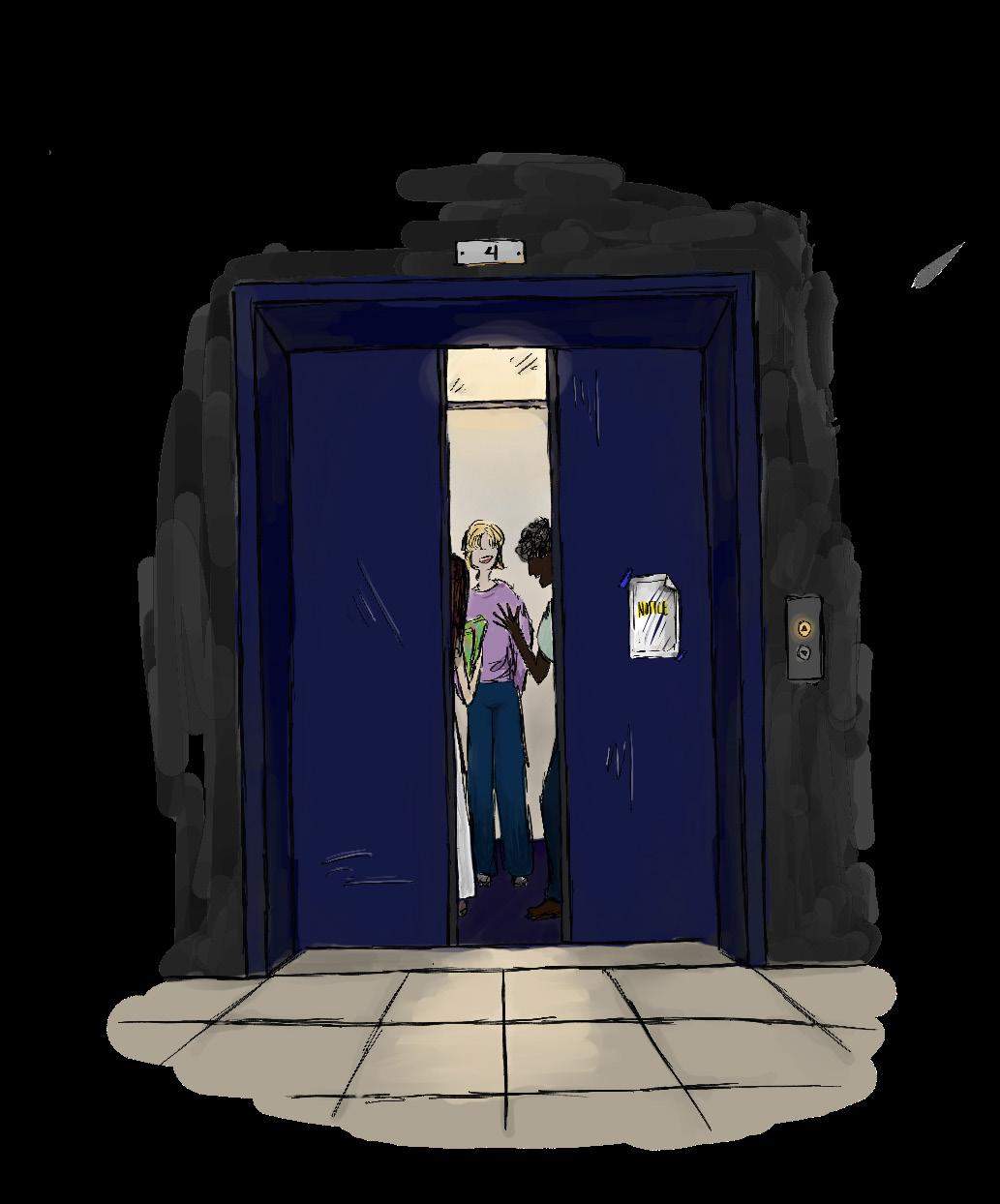
However, unknown to many, a secret other entrance to campus life exists: the Leavey elevators. Nestled between a ghost town credit union and cold weather tabling spot, the elevators are unassuming. It’s never quite clear if you’ve hit the button correctly, which door will be the first to open, or if they will ever even come. Nevertheless, eventually your golden chariot awaits, and you’re zoomed—and by zoomed, I mean slowly and clunkily pulled—to the wonderful world of student journalism.
Avoid walking too far down the hallway, unless you’re looking for the bathroom or something to wipe with. Instead, go straight ahead, and you’ll find the overly decorated office of The Georgetown Voice. But this isn’t an ode to the most awarded publication on campus—it’s about the elevators, of course.
Even before arriving at their destination, the unassuming Leavey elevators become an unexpected beacon of community.
After meetings, we fight with the doors to pack entire sections into the too-small space. Once piled in, we take pictures and giggle before dispersing across campus for the night. On our final production night of each semester, the Voice ’s GroupMe is populated with texts requesting the elevators to be called when access is restricted at midnight. With each of those messages is someone asking to be pulled into the beloved traditions that come with the semester’s close. These elevators are important, even if inconvenient. They were the face of our recruitment campaign, after all!
On my latest jaunt to the office, I noticed something posted beside my beloved ride: a construction sign, something I’ve become all too familiar with after only three semesters on campus. Starting now and continuing, at least in theory, until the end of the academic year, the Leavey elevators are “undergoing a full modernization.”
Upon arriving at the meeting, I brought up the death of these beloved elevators. I'm being dramatic. They're not really dying, or even going away by any means. And their phased construction means we’ll never be forced to take the stairs (that don’t go directly to the fourth floor, might I add). But, they’re losing their dangerous charm— the somewhat endearing threat of having to spend the better part of an hour trapped with whoever else dared to take the ride.
In an attempt at manic remembrance, I turned to fellow Voice-rs to recall thoughts, feelings, and favorite memories about the Leavey elevators.
According to Assistant Sports Editor Stella Linn (CAS ’27), the sports section once rode the elevator up, down, and back up for a member of the section who didn’t quite make the closing of the doors. Leisure Editor Lucy Montalti (CAS ’28) likes how the doors open before fully making it to the floor. Executive Manager for Staff Chih-Rong Kuo (CAS ’27) recalls said doors opening in the middle of two floors, forcing her to climb up the floor while simultaneously discovering the inner workings of the elevator shaft. Surprisingly, they make Assistant Leisure Editor Ryan Goodwin’s (CAS ’27) top five
To me, as someone who was lucky enough to find a home along the elevator’s route, they represent the risk that my freshman year self dared to take. Waiting awkwardly too long for the elevators to arrive, I met the people who would become trusted editors, collaborators, and even friends. Included in squished selfies, my first year anxieties were quelled by this subtle reminder that just being there was enough. In this way, the elevator’s both uncertain and unpredictable hum mirrored my own feelings. Eventually, we would make it.
As crazy as an ode to an elevator may be, I am not the first to assign absurd meaning to a hyper-specific campus object. As I’ve overheard from tour guides walking backwards surrounded by a mob of overeager high schoolers and their parents, this campus is wrought with assigned meaning. We climb statues, avoid stepping on seals, and are loyal to our first year dorms (Darnall forever). These stories, myths, and traditions are the common threads that tie generations together.
At Georgetown, we pray for trees and boycott bars. Making things arguably too big of a deal is kind of our thing. And, if our student body is to be inevitably replaced every four years, we might as well find something to cling onto while we still can.
Sometimes, however, we must embrace change. I’ll be the first to admit this elevator needs a makeover—well, maybe second, after now-graduated Editor-in-Chief Connor Martin (CAS ’25) who got stuck in it more times than one can even imagine.
These elevators are a reminder to embrace the awkward joy of human connection. Rather than idealizing efficiency, the Voice has formed a community along this inconvenient and bumpy journey. As many try to replace genuine human connection with technologically powered and artificially generated convenience, it’s important to consider why I even cared to comment on a construction notice. In earnest, it points to a desperate love for community, manifested in rebelling against convenience through care. After all, if change is the only constant, the least we can do is remember. !
You have letter mail
BY MADELEINE SWEET
GRAPHICS BY MASHA MILLER; LAYOUT BY MAGGIE ZHANG
every day, looking for the birthday cards sent by my grandma and friends at home in Connecticut. I would bike to my apartment after class, rush to lock up, and cross the yard to stick my nose into the mail slot, trying to make out if PostNord— the leading postal service for Nordic countries—had made a delivery.
Receiving mail made me feel connected to a life I missed but was so far from. I wrote letters back to my friends and family, trying to find a way to convey my appreciation for them from afar and to share everything new in my world.
Ever since I was young, letter writing has been the best method for expressing myself. It has always been my way to take a step back, organize my thoughts, empty out my feelings, and calm down. There’s an earnestness in putting pen to paper; it proves that what you have to say is real.
When I came to Denmark, my access to letter writing changed. Sending a letter anywhere outside the country costs at least $7. Even in a city where the cost of living is expected to be high, I never
to communication as a letter. When I looked into it, I found out that the entire PostNord system will cease to deliver letters in 2026.
This piece of news shocked me, but the decline of letters is a universal phenomenon. In 2021, the U.S. Postal Service's annual survey reported that the average household receives about one personal letter every seven weeks, compared to once every two weeks in the 1987 survey. Similarly, around 37% of Americans said that they had not sent a letter in five or more years.
In an age of digital communication, the letter has almost become obsolete. There’s an undeniable utility in an email, text, and call. However, our now-constant availability and ease of communication can lead people to be careless and unintentional as they try to stay in touch. Texts are instantaneous, can be sent in mass quantities, or in haste. A study by Common Sense Media finds that, on average, young adults receive over 225 notifications a day. This influx of messages contributes to the lack of time and intention in our modernday communication. Reaching out via text doesn’t have to be meaningful or purposeful anymore.
By contrast, letters demand patience and thought. Virginia Woolf wrote, “Naturally, when a letter cost half a crown to send, it had to prove itself a document of some importance.” Sacrifice signifies value, and even if the letter doesn’t have a high monetary cost, writing will always require the sacrifice of time. The multistep letter-writing process forces us to slow down and consider. Putting pen to paper, stamping the envelope, licking it shut, walking to a post office, and waiting for its delivery shows care.
The handwritten component of a letter also increases its personal value. Studies have found that there’s a neurobiological benefit to writing by hand. Perhaps the tactile connection between our thoughts and words allows us to process our feelings and slow down, making letters
more memorable than a text sent in haste. Personality comes through in the folds of the paper, smudges of ink, and choice of cardstock. Words crossed out in human error provide subtext, something lacking in perfectly crafted versions of direct messages. The physicality of a letter makes it worth saving.
In addition to the value attached to a letter, your feelings can occupy a page without the recipient’s instant reaction or interruption. Therein lies the beauty of the letter—as Woolf reflects, it is “intimate, irreticent, indiscreet.” Letters encourage vulnerability; the distance in time and space between the writer and the recipient allows for directness. I think that’s why I’ve been able to enumerate my thoughts best in writing. I appreciate the space to sort through my feelings. There will be no phone ringing or instant reply the second I hit send. Letters have always felt relieving to me in this way. You’re safe when writing a letter; you don't have to look anyone in the eye.
Although one might expect a letter to contain a literary, emotional outpour, we shouldn't be deterred by the idea that letters have to be well-crafted poems or overly involved prose. In my life, letters have taken many forms: handwritten thank-you cards, postcards, or just a note in the margin of a book. I feel grateful when I receive mail, which is partially what keeps me writing letters. I cry reading birthday cards and keep a collection of the letters I’ve received with me at college.
Since my return to school this semester, I’ve felt compelled to continue this habit of letter writing and sending. There’s a blue box outside of Village B where you can drop your own letters. There’s also a real joy in hand delivering, something I am particularly excited about now that my friends aren't an ocean away. Write a letter, and you might even get one in return. There’s nothing like the excitement and suspense of the email subject line: “YOU HAVE LETTER MAIL.”
Immigration raids threaten Georgetown local businesses, cause sta shortages
BY SOPHIA JACOME
DESIGN BY SHABAD SINGH
On a quiet September morning in Georgetown, as families walked the cobblestone streets with coffees and shopping bags in hand, a popular local restaurant was opening for the weekend rush. But their best dishwasher, who started working at the restaurant when it opened years ago, didn’t show up for his shift.
Thirty minutes later, his manager was growing frustrated as the dishes piled up. But because the dishwasher had never called out sick or arrived late, the manager decided to forgive his tardiness.
After two hours had passed, the dishwasher’s worried co-workers called his family. When they picked up, his family said that U.S. Immigration and Customs Enforcement (ICE) officers detained him on his way to work and that they were not aware of his whereabouts.
The star dishwasher was the first of two workers from that restaurant that ICE detained on their way to work in September. He was in ICE custody for two months before being deported in November, leaving his wife and three children behind.
The business manager, who requested anonymity for himself and the business due to fear of ICE and potential retaliation against other employees, said the other workers have been devastated by these absences.
“There was a lot of fear,” he said. “People cried. People stopped driving into work.”
One of the manager’s “runners,” an employee who brings food to and from tables, was so afraid after her co-worker’s detention that she decided to return to her home country.
“She has a kid, and she didn't know what would happen with kids, so she preferred to go back home,” he said.
These deportations and the fear surrounding them happened amid the Trump administration’s renewed crackdown on immigration. On Aug. 11, the Trump administration issued a “crime emergency” order in D.C., triggering increased presence of officers from federal law enforcement agencies, including ICE, resulting in a surge of immigration-related arrests.
According to statistics tracked by the Deportation Data Project, ICE made a total of 88 arrests in D.C. from January to July 2025. But from Aug. 1 to Oct. 16, arrests skyrocketed to 1,148, including 667 arrests made in the 30-day period after the crime emergency was declared.
Georgetown was one of the first neighborhoods to see an ICE presence when the White House declared the emergency. Georgetown business owners have since reported ICE coming into their businesses, requesting their employees’ legal work status.
The Voice spoke to fourteen businesses in the Georgetown neighborhood. Each of them reported being impacted by ICE activity in the D.C. area, through staffing shortages, a decrease in customers, or having their own employees directly detained.
Mayor Muriel Bowser’s office declined the Voice’s request for comment on continued ICE raids and their impact on businesses in the District.
Widespread impacts on immigrant workers
Ale, an employee at two Georgetown restaurants, said that he has observed a chilling effect caused by the ICE raids; several of his co-workers and friends have taken days off of work to hide in their homes out of fear of ICE detention. Ale requested to go by a shortened version of his name to protect his identity, due to fear of ICE retaliation.
“We see a lot of impact on our community because a lot of people are scared to go to work,” he said. “No one is prepared to go back to their country.”
While Ale’s workplaces in Georgetown have never been raided by ICE, he said that most people he knows can name a business in the area that has been raided.
His co-worker’s brother has remained in ICE detention for over two months after a raid on a restaurant’s kitchen in Foggy Bottom, an area near Georgetown that is home to George Washington University. Ale said that the co-worker knows little about the conditions his brother is facing, having received only one call from him.
“He's so worried about it, because that's his brother,” Ale said. “They were doing everything together. He almost cries every time he talks about him.”
Ale said that around 10 of his friends from Venezuela, who all worked as drivers for food delivery services, were detained while driving their motorcycles to make deliveries and were ultimately deported. Now, with delivery drivers avoiding work, delivery times at his workplaces have slowed significantly.
“When we make the food for deliveries, it stays right there for over 30 minutes, waiting for somebody to pick it up,” he said. These issues experienced by Ale’s restaurants are widespread. Reports of delivery drivers being detained suggest that they are being specifically targeted by ICE officials during routine traffic stops by the MPD. Restaurant owners have noticed a decrease in available delivery drivers, leading to a spike in delivery costs on apps like Uber Eats and GrubHub, according to reporting by The Washingtonian
Georgetown’s local businesses struggle
Immigrant workers’ fear of coming into work has had consequences for owners operating Georgetown’s businesses.
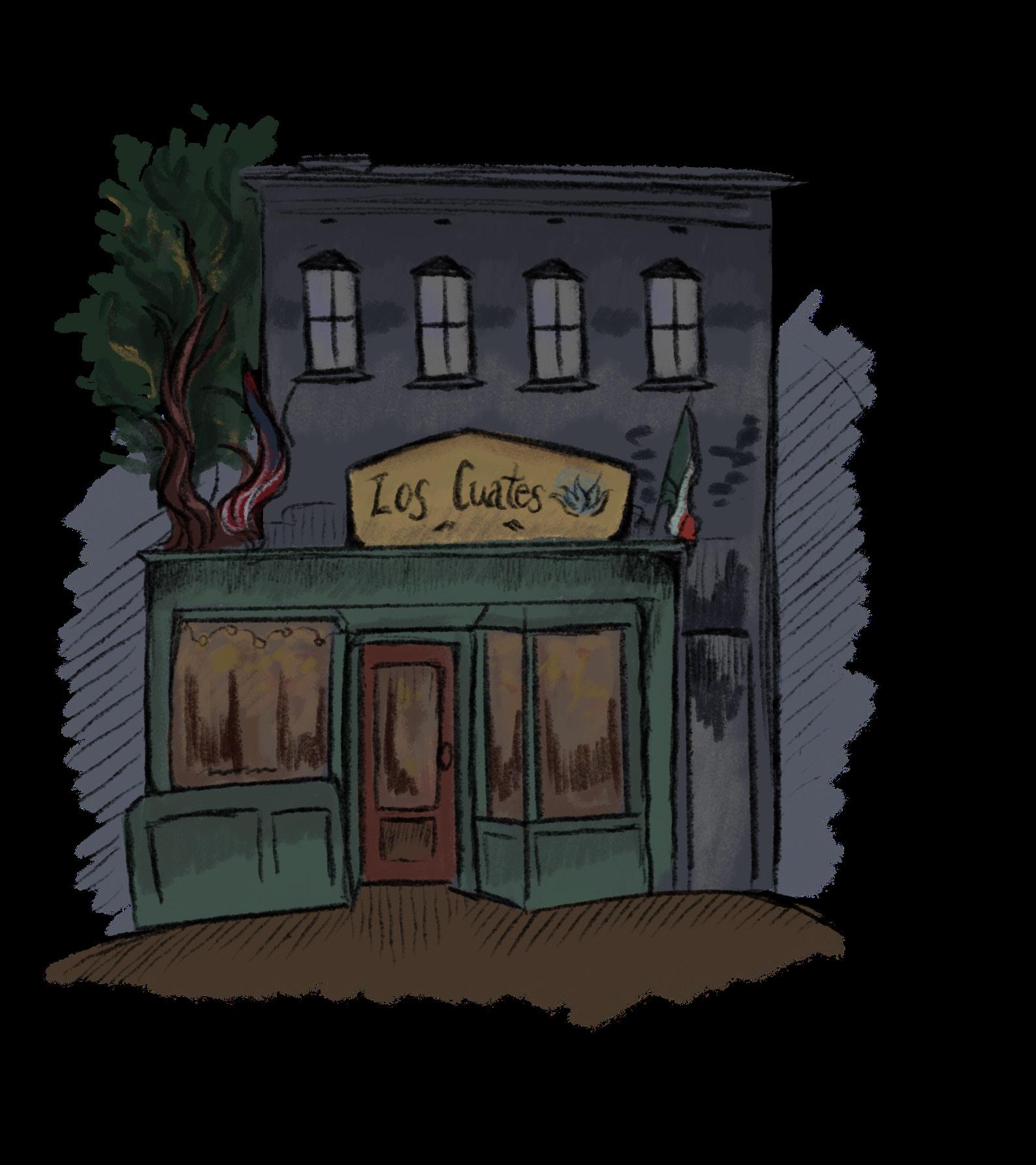
Los Cuates, a Mexican restaurant and Georgetown staple since 2008, is operating without a head chef as a result of labor shortages caused by the immigration raids, said Owner Sergio Kehl. Kehl has had to spend time in the kitchen himself with three fewer employees than usual.
“It's not the same as having somebody who can perform as a chef,” Kehl said. “We cook the food as best we can, but it's not the same.”
Even if Kehl had a fully staffed kitchen, business has declined since the federal law enforcement surge began in August, he said. Kehl’s biggest customer base was other immigrant workers with stable jobs, who not only make up part of Georgetown’s workforce but are also paying customers.
“With this immigration effort, we lost most of our customers,” Kehl said. “They're scared. Construction workers used to come here to eat all the time, and they spend a lot of money because they have a lot of work, but now we don't have that business anymore.”
Kehl also said that he has observed less business from tourists who visit the Georgetown neighborhood on trips to the District as well.
“It's hurting tourism,” Kehl said. “When you see people from ICE hunting on the street, basically, it's not good for the economy.”
The federal takeover and immigration raids have caused a decrease in tourism, according to reporting by CNN. Data collected by OpenTable, a restaurant reservation service, indicated a 2% decrease in reservations from July to August.
What Kehl is seeing at Los Cuates is not unique. Many of D.C.’s local businesses, especially restaurants, have been impacted by Trump’s law enforcement surge, according to the Restaurant Association Metropolitan Washington (RAMW), which provides legislative support and resources to D.C.'s restaurants.
A RAMW representative said that Washingtonians should support local restaurants as they face challenges to their daily operations.
“This is a time of real uncertainty for workers, families, and businesses across our region,” RAMW wrote in an email to the Voice. “Restaurants—already navigating thin margins—are directly impacted, yet as always, our community shows resilience.”
D.C.’s Department of Small and Local Business Development (DSLBD), which supports the development of District business, did not respond to the Voice’s
requests for comment on how it has supported Georgetown businesses amid increased immigration raids.
Fears of shutting down
According to Kehl, the combination of fewer customers and not enough workers has brought revenue down at Los Cuates by about 50%.
Kehl first realized how grave the situation had become for his restaurant when vendors came to check on his appliances in September. His washing machine service reported that Los Cuates’ dishwasher usage dropped by 1,300 cycles from August to September, and his Pepsi vendor said that soda purchases fell to half of their previous level.
“They told me everywhere is the same,” Kehl said. “They say this business is half of what it was before. The Pepsi company says people are not ordering. People are not doing well.”
With business down, Kehl said that he fears having to close his restaurant after 17 years of operating in the Georgetown neighborhood. Kehl has posted a GoFundMe page in hopes of raising $100,000 to keep his Los Cuates open.
“We don't have the sales to cover rent or basic bills like electricity, gas, water, cable,” Kehl said. “I don't think we're going to last very long this way.”
Kehl does not take this decision lightly. But after the pandemic left the restaurant industry vulnerable to economic downturns, immigration enforcement has been the last straw. Kehl hoped the economy would improve under the Trump Administration, but that has not been the case.
“We didn't see any improvement at all. Everything started getting worse and worse and worse,” Kehl said.
Continuing to work
For some migrant workers, there is no choice other than continuing to work.
While Ale understands the concern of his family, friends, and co-workers, he said he believes that he has no other option but to go into work to support himself.
“I'm doing nothing wrong. I have to go to work,” Ale said. “I do the right things in the United States. I have no criminal record. I've never been in trouble, I go to school, I work really hard. I cannot stay in my home and do nothing.”
Ale crossed the U.S.-Mexico border when he was 17 years old, entering through Texas. He said the fear of being detained by ICE pales in comparison to his journey across the Rio Grande.
“It is really, really, really hard to get to this country as an immigrant,” Ale said. “A lot of people die every day. I
used to have to hide when I was coming to the United States from border control, from police in Mexico, and I am not going to do that right here.”
Supporting their workers
To help their team feel more comfortable coming into work after their dishwasher was deported, the restaurant’s manager put in place several precautions to protect immigrant workers. The business enacted a new standard operating procedure that encourages everyone to remain calm in the presence of ICE, the manager said.
“They don't need to answer any questions. They don't need to show any proof of documents. Never run away, never go out of the store,” he said.
He said that they also put “private, employee-only” signs on the outside doors, but he is unsure whether ICE will comply with them.
Even so, the manager said he would do everything he could to protect his coworkers from deportation. After their best dishwasher was detained, his co-workers decided to take action, the restaurant manager said.
“We did a fundraiser to help him pay the lawyer,” the manager said. “We paid him through our sick days. We did everything we could to help him financially.”
Despite their efforts, the dishwasher was deported.
One sentiment remained consistent among the business owners: immigrant laborers deserve to remain part of our Georgetown community.
“They pay taxes, even though they don't get the tax back. They make the economy move because they work and live here,” the manager, whose business banded together to support their dishwasher, said. “They are wonderful people.”
The mask is off on U.S. imperialism. What are you going to do about it, Georgetown?
BY THE EDITORIAL BOARD | DESIGN BY PAIGE BENISH
The editorial board is the official opinion of The Georgetown Voice. The editorial board operates independently of the Voice’s newsroom and the General Board. The board’s editorials reflect the majority opinion of the board’s members, who are listed on the masthead. The editorial board strives to provide an independent view on issues pertinent to Georgetown University and the broader D.C. community, based on a set of progressive institutional values including anti-racism, trauma-informed reporting, and empathetic and considerate journalism.
To get a sense of our campus’s mood towards President Donald Trump’s violent attack in Venezuela, one needs to look no further than the student-run Philonomosian Society (also known as Nomos), which opened the spring semester debating whether abducting Venezuelan president Nicolás Maduro “further[ed] U.S. interests.” This topic is preposterously misguided and reflects the self-centered exceptionalism that dominates U.S. foreign policy and extends into the halls of Georgetown.
For too long, our university has trained legions of foreign service officers, government officials, and politicians to hold the imperial line. Imperialism—the violent imposition of a country’s power and influence beyond its borders—has defined American foreign policy for centuries. Trump’s regime exposes the rawness of American actions in Venezuela and
around the globe. In the face of his overt imperialism, we must reframe how we think about foreign politics. As Georgetown trains the next generation of politicians and State Department employees, it must lead this urgent shift away from Western-centric narratives.
Currently, Trump continues to see support for his actions in Venezuela and across the globe, despite the fact that they represent a flagrant disregard for international law and the separation of powers. As a school with both a robust undergraduate international law curriculum and one of the best graduatelevel international law programs in the world, Georgetown should be acutely concerned by the Trump administration’s active contempt for the principles of the field. As Georgetown students sit in lecture halls learning about historical empirical violence, they should also be taught about how their government is currently and unequivocally violating the laws that have governed the use of force for decades. In just the last six months, for example, the U.S. disregarded international law by launching deadly strikes on Venezuelan boats last fall and abducting Maduro in early January. Professors should give their students tools to recognize the parallels between historic violations of international law and those being committed by the Trump administration today. Without that awareness, these future international lawyers, politicians, foreign service officers,
and government employees may perpetuate the same cycles of abuse of laws and norms.
Beyond that, at this moment of aggressive U.S. imperialism, Georgetown’s administration must rethink who they platform in the lecture hall. Nearly all the required core classes in the SFS, such as Introduction to International Relations, are taught from a Western-centric perspective with only a lecture or two (if any) on other approaches to international relations. When this occurs, Georgetown and its professors are failing to give students the tools and diversity of thought they need to critically evaluate the U.S.’s actions on the global stage.
Georgetown must prioritize hiring academics who focus on anti-imperial scholarship and non-Western approaches to international relations. These professors should also be allowed to teach courses accessible to a wide range of students— classes that fulfill core requirements and are housed under or cross-listed with popular majors. There are certainly current professors at Georgetown who have this expertise; however, they are often relegated to teach in smaller programs to fewer students, rather than the 50-person rooms afforded to courses like International Security or the 200-person lecture halls for Introduction to International Relations. In doing so, Georgetown forces its students to actively seek out this content instead of exposing students to these schools of thought.
Yet, as we call on our campus administrators to act, we must also demand action from our peers. Many of our campus organizations operate under the assumption that U.S. interests justify all actions without bounds. While a debate among undergraduates held by a studentrun club may seem trivial at first glance, if students are galvanized to put U.S. interests above all else, there is little doubt in the mind of this editorial board that they will bring that same harmful mentality to the workforce and potentially positions of immense power. Nomos’s tone-deaf debate resolution on Venezuela was likely related to the event being co-sponsored by the Concord Group, a national security technology consulting club that itself trivializes American violence and funnels students toward the U.S. national security apparatus.
The lack of critique toward Trump’s violation of international law speaks to an attitude of American exceptionalism and entitlement that is evidently as strong as ever, including within the walls of Georgetown. We, as students, must reject the supposed “neutrality” of campus organizations that pass off loss of life and warmongering as trivial academic debate. Instead, we must show up for peers through engagement with anti-imperial ideologies and frameworks in both our coursework and extracurriculars. This might include attending or organizing protests, joining student groups pushing for change on and off campus, enrolling in classes that center non-Western voices, and challenging our peers to decenter American imperialism.
Again and again, the U.S. and its citizens have failed to learn their lesson from atrocities in Iraq and Vietnam, cataclysmic regime changes in Chile and Guatemala, and countless unwarranted brutalities around the world, relegating these moments to supposed flawed strategy rather than human depravity. Georgetown and its students must actively work to ensure that we do not perpetrate and support these same cycles of violence, contrary to Trump’s actions.
The U.S.’s history of shamelessness can be easily traced back to its founding. The lack of cultural consensus on the horrific legacy of Christopher Columbus, North America’s great butcher, is an indicator that there continues to be no accountability or recognition of the violence upon which the U.S. was founded. Georgetown itself
fails to take a stance on America’s original sin of colonialism, referring to Indigenous Peoples’ Day (formerly Columbus Day) as a “Mid-Semester Holiday” on its academic calendar despite Washington officially changing the name four years ago.
Beyond the hilltop, many current Georgetown students were raised in a world where, both politically and culturally, U.S. imperialism has been front and center, especially in the aftermath of Al-Qaeda’s attacks on Sept. 11, 2001. This reality should sit at the forefront of our minds as we engage in our studies. The perceived threat of terrorism laid additional groundwork for invasions abroad and heightened Islamophobia and state-perpetrated violence across the U.S. in the name of security interests. As Americans reeled from the shock of 9/11, the Bush administration stoked fears of supposed weapons of mass destruction in Iraq, while much of the media uncritically parroted the president’s claims without any independent investigation.
The uncomfortable truth is that the “war on terror” was a great victory for a handful of political and economic elites who used their power to trade lives for money. The results are underscored by the immense wealth defense contractors have accrued from U.S. defense spending since 9/11, and the generous kickbacks received by a swath of politicians in both the Democratic and Republican parties. As we sit at Georgetown, we must remember that violent U.S. imperialism created the world order we will ultimately inherit. This institution is training us to assume leadership in U.S. industry, foreign policy, defense, finance, and politics. Our studies can either set us up to unquestioningly perpetrate these same international abuses of power, or they can teach us how to challenge the systems that have blindly supported U.S. imperialism.
And while Venezuela is undoubtedly different from Iraq, it is the latest in a long line of examples of U.S. imperialism, supported uncritically by our executive branch. Through this attack on Venezuela, Trump’s invocation of the Monroe Doctrine, and an increasingly heavy-handed approach to foreign policy in which we attempt to seize control of the territory of Greenland, governed by our NATO ally Denmark, the Trump administration has laid bare its imperial ideal.
Without the veneer of good intentions, the U.S. certainly does not look like the
benevolent leader of a democratic and free world which it has long claimed to lead. Trump and his allies’ blunt words and brash actions speak to the country’s greedy chauvinism in explicit terms. This should feel deeply disturbing, yet it also presents an opportunity for people to seriously demand something different. The question becomes whether or not we will. Guiding all of this, we must remember that it is as little Trump’s responsibility to decide Venezuela’s future as it is ours; it is the people of Venezuela who have a right to determine their own governance.
While the U.S. spends trillions of dollars inflicting violence abroad, it leaves many Americans without reliable healthcare, housing, and basic amenities. Most Georgetown students will never experience this kind of insecurity, with 74% of students coming from the top 20%, according to a 2017 New York Times study, so it is easy to forget this. If we are to avoid the disastrous mistakes of our predecessors, we must connect the vast inequities at home to the calamitous policy abroad. Of course, that requires Georgetown to stop giving preference to the rich when reviewing applications, but it also demands reorienting the school’s and our individual priorities from implicit support for systems of oppression to interrogation and dissolution of those structures.
With the mask off, the U.S. no longer even has an imaginary claim to moral superiority over its rivals. There are no pretenses of adherence to international law or concern for human rights. It is long past time that the world, especially the U.S.’s allies, start treating it like the rogue state that it is. Nonetheless, change starts from within, and we have an opportunity to shift the narrative that the U.S. has long put forth, starting here at Georgetown. Long used to train servants to the imperialist cause, Georgetown—and the School of Foreign Service in particular—ought to make itself known not for its unflinching commitment to U.S. interests but for its unflinching commitment to international peace and justice. Georgetown administrators and students must rethink what ideals they platform in the lecture hall, during course registration, in assigned readings, in salaries, and more. If we really want to claim to be “people for others,” now is a decisive moment to match our words with our actions.
The choice is ours.
The ve deadly sins of Stranger Things
BY ELIZABETH ADLER
GRAPHICS BY MARIAM OKUNOLA; LAYOUT BY LUCY MONTALTI
The science fiction/thriller, global phenomenon TV series Stranger Things (2016-2025) has officially ended after almost 10 years of 1980s nostalgia, beloved characters, and, let’s just say, some pretty strange things. And, wow, did it go out with a bang. A painstakingly long, cringeworthy, plot-hole-riddled bang.
When you’ve crafted a beloved series like Stranger Things, expectations are high, as fans across the world tune in for what they hope will be the perfect ending to a show they’ve known and loved for the past 10 years. With the world watching, the Duffer Brothers fumbled. What once was a chilling story of mystery and human drama was reduced to a lazy ’80s adventure movie with a splash of truly stomach-turning, Marvel-esque dialogue. As I lament the loss of Stranger Things I once loved, I’ve identified the five deadly sins of its final season—listen up, Duffers.
Pacing
Imagine my surprise when I rushed to the TV on Thanksgiving, popcorn ready and excitement bubbling, only for… nothing to happen. Nearly every episode is over an hour, and barely any of the drawnout scenes contribute to the already poorly developed overarching plot. I would cite an example here, but I seriously cannot remember a single plot point from the first seven episodes.
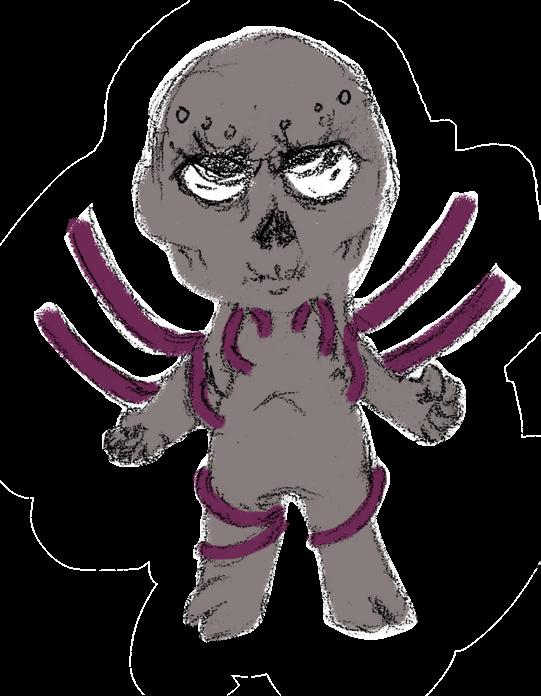
As each episode trudged on, I felt like I could hear Vecna’s clock echoing in my skull while the seconds passed painfully. Only one episode was redeemable—the two-hour finale was fairly thrilling and felt properly paced (with the exceptions of the five-minute final battle and the 40-minute epilogue). Overall, the Duffers would’ve found more success if they had shortened their episodes to normal TV episode length (not mini-movies) and thought a little more critically about how each scene would advance the overarching plot.
Acting
The majority of the actors seem stuck as their 10-year-old selves. While the actors themselves have aged significantly, their characters have the same awkward, childish
quirks and behavioral patterns that they had in Season 1.
Despite the four-year time gap, the actors haven’t developed any sort of nuance in their performances to indicate that their characters are growing up, making the high schoolers of Season 5 just larger copies of the original middle schoolers. These performances were once cute, but the characters aren’t 12 anymore. Even the older actors were phoning it in, and their dull performances made every poorly paced second drag longer and longer.
While much of the acting fell awkwardly flat, a few of the cast members stood out as quite remarkable amid their castmates’ blunders. Jamie Campbell Bower, the terrifying Vecna himself, delivered a chilling performance, eliciting both pathos and terror from the audience. Likewise, newcomer Nell Fisher played a convincing Holly, taking on her main character role with confidence.
Dialogue
Completely ditching the air of mystery that elevated Season 1, the Duffers embraced the sci-fi blunder of overexplanation. That beautiful seventh-grade English lesson “show, don’t tell” has been flipped upside down (haha) as the characters bombard the audience with detailed explanations of scientific concepts, painfully thorough plans, and nauseatingly “witty” one-liners. The heavy dialogue leaves no time for the plot to breathe or for the suspense to build. The script was fairly lifeless, coming across as AI-generated slop, or even worse, Marvel movie dialogue.
Inconsistencies
Inconsistencies are to be expected when you create a sci-fi show with such a complex plot, but leaving so many plot holes that you send your fanbase into mass hysteria is ridiculous. The audience trusted that the lingering mysteries throughout the series would all come to light in this final season, yet it seems the audience has a better memory than the Duffers themselves. From Will (Noah Schnapp) inaccurately recounting memories and set pieces changing colors to crucial questions about the Upside Down’s creation remaining unanswered, the final season was an inconsistent mess. If much of your audience entertains delusions that there must be some secret ninth episode to fix the plot holes and tie loose ends together, maybe you
should’ve been a little more intentional and detail-oriented when you crafted the final season.
Characterization
If the four aforementioned blunders weren’t enough to condemn Stranger Things 5, the Duffers sealed the deal by completely destroying beloved characters.
Eleven’s (Millie Bobby Brown) background, trauma, and character development were shoved to the side as she became a shallow, almost-robotic character whose only interest was defeating Vecna. Her deep connections with Mike (Finn Wolfhard), Hopper (David Harbour), and the other kids were disregarded until the pivotal moment of her sacrifice. Eleven’s self-sacrifice for the others’ safety was one of the most emotional parts of the season because of its focus on the deep relationships that the series spent a decade building, yet this complexity was only on screen for roughly 10 minutes.
The majority of Season 1’s allure came from its exploration of connections between its lovable characters. There was the strong, brotherly bond between Mike, Will, Dustin (Gaten Matarazzo), and Lucas (Caleb McLaughlin), the budding romance between Joyce (Winona Ryder) and Hopper, and the tumultuous relationships between the members of the Wheeler family. All these compelling dynamics remain untouched in Season 5, resulting in a finale that lacked ultimate emotional fulfillment.
Stranger Things took over the world 10 years ago because of its endearing characters and compelling mystery. As the show gained success, the Duffers sacrificed these core components of their show for a knock-off Avengers money grab. Let Stranger Things 5 be a lesson to future TV show creators—don’t let sloth seize you. Stay true to the ethos of your show, or you’ll bear the weight of a Stranger Things 5-sized sin on your conscience.
From La La Land to Brexit: 10 things turning 10 in 2026
BY HALFTIME LEISURE
DESIGN BY ELLE MARINELLO
The (height of the) Dab
By Ryan Goodwin
Although technically created and popularized in 2015—thanks to the Carolina Panthers’ Cam Newton—the dab reached its peak in 2016. From Musical.ly videos to political debates to songs like Milla’s “#Camdab” and iLoveMemphis’s “Lean and Dabb,” the dab dominated popular culture, drastically increasing one’s odds of getting smacked in the face by someone sneezedabbing. 10 years have passed, and no dance move since has quite matched the dab’s indelible cultural impact.
La La Land
By Elizabeth Adler
Damien Chazelle’s breathtaking film blends glamour, heartache, and ambition in a magnificent supernova of swirling colors and swelling symphonies. As Mia (Emma Stone) and Sebastian (Ryan Gosling) fall in love, they struggle to navigate their contrasting dreams of creative success in the “City of Stars.” A magical yet grounded exploration of the precarious relationship between romantic love and personal desires, La La Land took the culture by storm in 2016, earning critical acclaim and winning six (almost seven) Academy Awards the following year. Ten years later, La La Land remains a beautiful, timeless ode to “the fools who dream.”
The Great Clown Epidemic
By Alex Hwang
In fall 2016, “killer” clowns began appearing near schools or on highways, inducing widespread panic. This phenomenon made national news, inspiring clown hunts and YouTube hoaxes that had a chokehold on middle schoolers nationwide. This strange spike in coulrophobia (fear of clowns) marks arguably one of the worst events for the clown industry ever. Have you seen a clown at a kid’s birthday party since?
Grace VanderWaal
By Lucy Montalti
If we knew anyone’s name in 2016, it was Grace VanderWaal’s. When the quirked-up, cursive-singing 12-year-old walked onto the America’s Got Talent (2006-present) stage with a ukulele, thick bob, bangs, and a dream, the internet fell in love as preteens everywhere seethed with jealousy. Her viral audition—where her original song “I Don’t Know My Name” earned her the coveted Golden
Buzzer from Howie Mandel—was the best thing since Susan Boyle, amassing over 100 million views on YouTube and cementing her spot in the 2016 hall of fame.
#taylorswiftisoverparty
By Karcin Hagi
The complicated relationship between Kanye West and Taylor Swift burst into flames when West shadily name-dropped the singer in his song “Famous,” saying, “I feel like me and Taylor might still have sex / Why? I made that bitch famous.” After Swift made clear her distaste for the lyric, Kim Kardashian came to her thenhusband’s defense, releasing an edited and potentially illegal video of Swift seemingly approving the lyric over the phone. The hashtag #taylorswiftisoverparty trended on Twitter, signaling the public’s backlash towards Swift. The ordeal temporarily drove Swift off social media, planting the seed for her iconic 2017 comeback, Reputation. Fidget Spinners
By Ali Abubakr
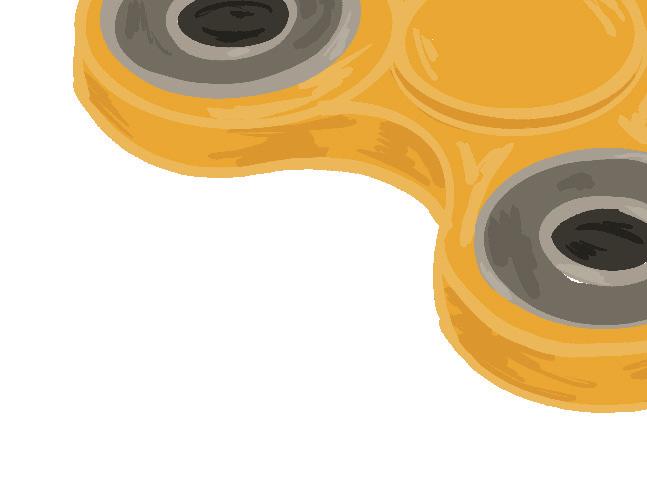
Fidget spinners rose to worldwide fame in late 2016, marketed mainly as stress relief for people with ADHD and anxiety (although this was backed by shaky science). They swiftly gained to popularity through a perfect storm of social media virality and expiring patents that allowed for mass production in China. As the toys swept the culture, they even faced bans in schools, inspiring many an act of middle school rebellion. Lemonade
By Joaquin Martinez
as one of the greatest albums of the 21st century by Rolling Stone, is undoubtedly the highlight of Beyoncé’s musical career—and not just because it introduced us to “Becky with the good hair.” The song “Daddy Lessons” marked her first foray into the country music genre, and subsequent backlash from institutions like the Country Music Awards inspired the creation of Cowboy Carter earning Beyoncé her first Album of the Year award at the Grammys almost 10 years later.
Bottomless Pit by Death Grips
By Quinn Ross
Ten years after the release of Bottomless Pit, we’re still waiting for another Death Grips song that hits as hard as “Ring A Bell.” Bottomless Pit is the experimental rap group’s most accessible project, with songs like “Warping,” “Eh,” and “Bottomless Pit” fitting into more typical rock and hyperpop genres. However, if you’ve seen Season 2, Episode 1 of Atlanta (2016-2022), you may recall Darius nonchalantly blasting an aggressive grindcore song on the radio. That song is none other than “Hot Head,” representing the beautiful chaos that is Death Grips.
“Pokémon GO (to the polls)”
By Aubrey Butterfield
The 2016 presidential election is infamous for many things, but what time has left behind is arguably the craziest attempt by a politician to appear relatable to their constituency— “Pokémon GO (to the polls).”The precursor to the summer 2024 brat-coconut treeexisting-in-the-context mania, “Pokémon GO to the polls,” was a rather confusing tactic by the Democratic Party to undermine thencandidate Donald Trump’s control of the media. Presidential nominee Hillary Clinton’s target audience? Apparently, 10-year-old me, among my Pokémon-playing peers. Now, as a Democratic voter, I guess Clinton was playing
Georgetown students tackle fantasy football punishments
BY JULIA MAURER AND VINCE GUDE
DESIGN BY KATIE REDDY
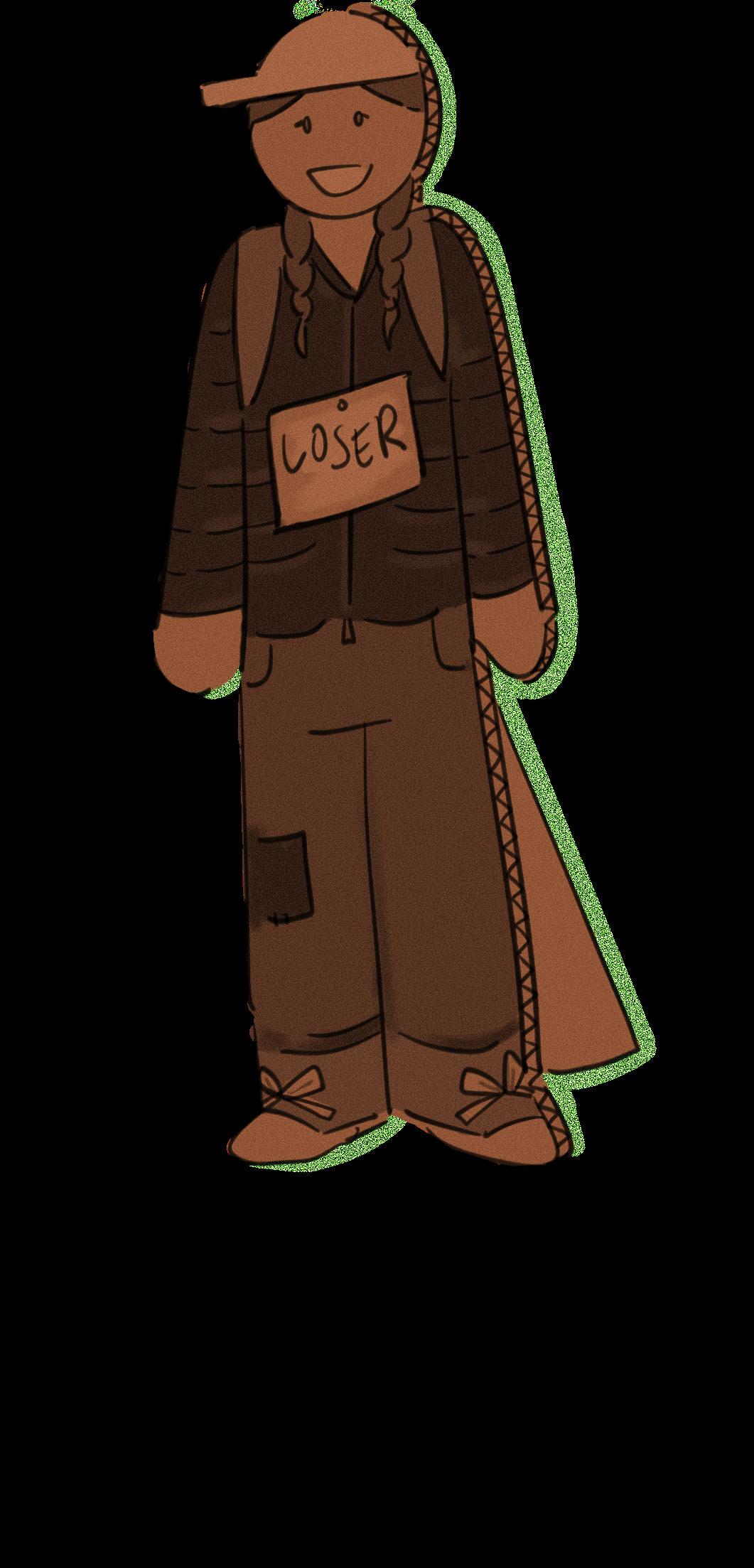
Charlie Panarella (CAS ’28) sported a homemade “I suck at fantasy football” shirt for nine-and-a-half hours on Jan. 17 as he walked laps through Leo J. O’Donovan Dining Hall. As soon as the doors opened on Saturday morning, Panarella began walking a literal marathon inside Leo’s as punishment for losing his fantasy football league.
the season or creative punishments for the ultimate loser of the league, like Panarella’s marathon in the dining hall.
Bad luck on Lau 2
Unlike Panarella, who (despite his loss) firmly believes that there’s more to fantasy
he climbed in the rankings, he shot straight down to last place, where he stayed for the remainder of the season.
Brady played no part in deciding the punishment for his league, because he was so confident he was going to win.
Panarella’s first-ever fantasy football loss is going to stick with him for a while, and maybe with anyone who went to Leo’s that day. However, his friends joined him in shifts during his nine-and-a-half hours in one of the most used buildings on campus— showcasing the social nature of fantasy football that Panarella loves.
“It’s a pretty positive culture, like, it’s just for fun,” he said. “The punishments are usually
He believes that fantasy football should be an activity done with friends, part of the reason he played in four fantasy leagues this year.
Panarella told the that while his punishment took all day, he would have agreed to it even if he knew he was going to lose.
Fantasy football allows superfans and casual watchers alike to build their own teams and compete against their friends, peers, co-workers, and classmates. Participants manage a group of players who earn individual points based on their real-life performances, and give their managers points in head-
Many fantasy leagues are social outlets for friend groups, some of which develop amusing activities throughout
“Last year I got second place, and I know nothing about football,” Traxler said.
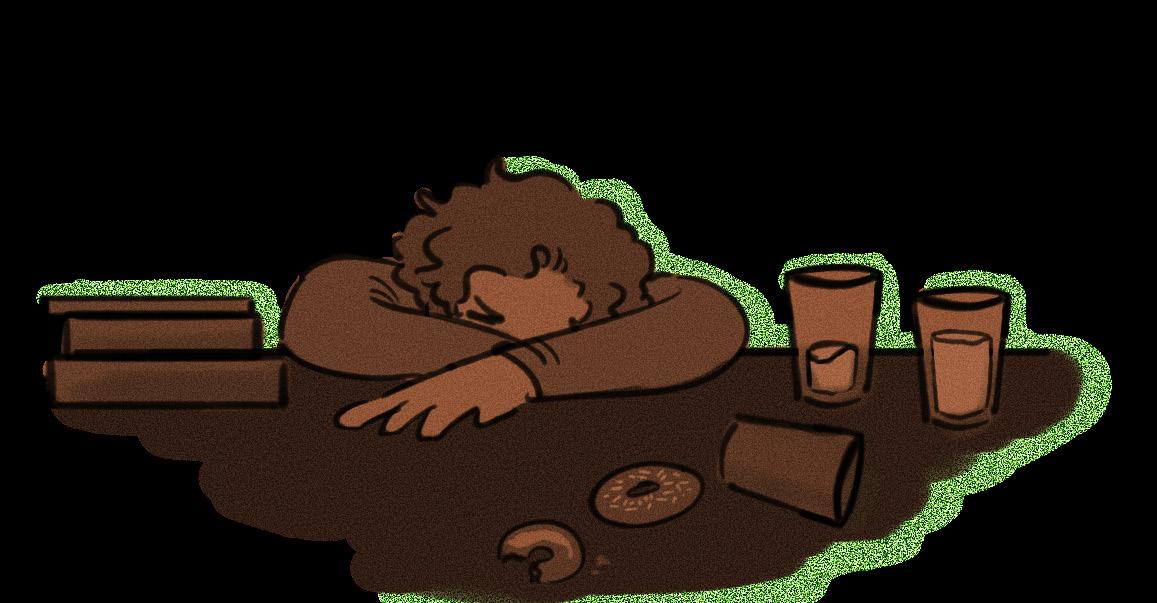
Unfortunately, her luck soured this year, leading her to the second floor of Lauinger Library. To pay for her loss, Traxler will have to spend 24 hours on Lau 2, with every slice of bread she eats reducing the time by an hour.
While an all-nighter in Lau may not be foreign to many Georgetown students, it is arguably not the worst part of the punishment.
“Simultaneously, my friend group has these cardboard cutouts of each other, and they are going to put [mine] up in Red Square,” Traxler said. “It is a photo of my first day of class, and they will say, ‘I lost fantasy football.’”
While her bad luck will put her in Lau for more time than most seniors plan on spending there all semester, Traxler nevertheless said that playing fantasy with her friends was worth it. She, like Panarella, would have agreed to the punishment even if she knew she was going to lose.
“I would play again for sure,” she said.
Milk mile(s)
The season started on a positive note for Ethan Brady (SFS ’28) when he won four out of his first five games. Unfortunately, his success quickly came to an end as the majority of his starters hit huge slumps or had season-ending injuries. Just as quickly as
“I didn’t even know what my punishment was until after I lost,” Brady said.
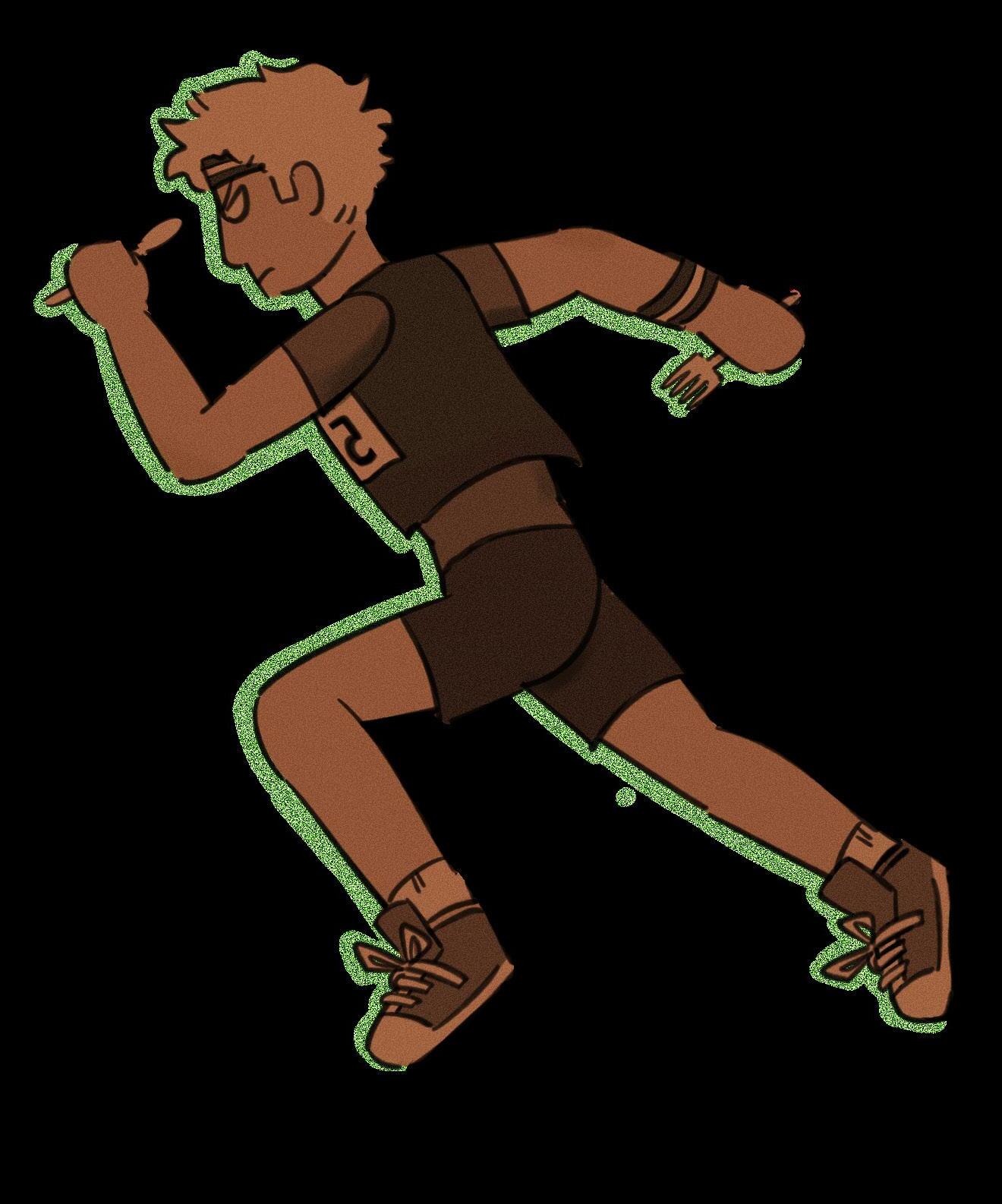
While the punishment date has yet to be announced, he will have 24 hours to fulfill a gauntlet of miles run, glasses of milk drank, doughnuts eaten, and hours spent in Lau in the interchangeable quantities of six, nine, 12, and 15. If he fails to do so, he must shave his head.
Brady drafted his team with the help of his friend from high school, whom he called his “quant.” Going into next season, he has two things in mind.
“I’ll be drafting my team on my own, and I want the punishment to be even harder because I know that I won’t lose,” Brady said.
All three of the losers agreed that they would certainly play fantasy football again, despite their intense punishments. For each of them, fantasy football is a way to bring people together in camaraderie or competition.
As Panarella said, “It’s supposed to be with your friends,” and even if you lose, “it will create a good experience for other people.”
Five queer athletes who are out on the eld
BY EILEEN WEISNER
DESIGN BY LUCY MONTALTI
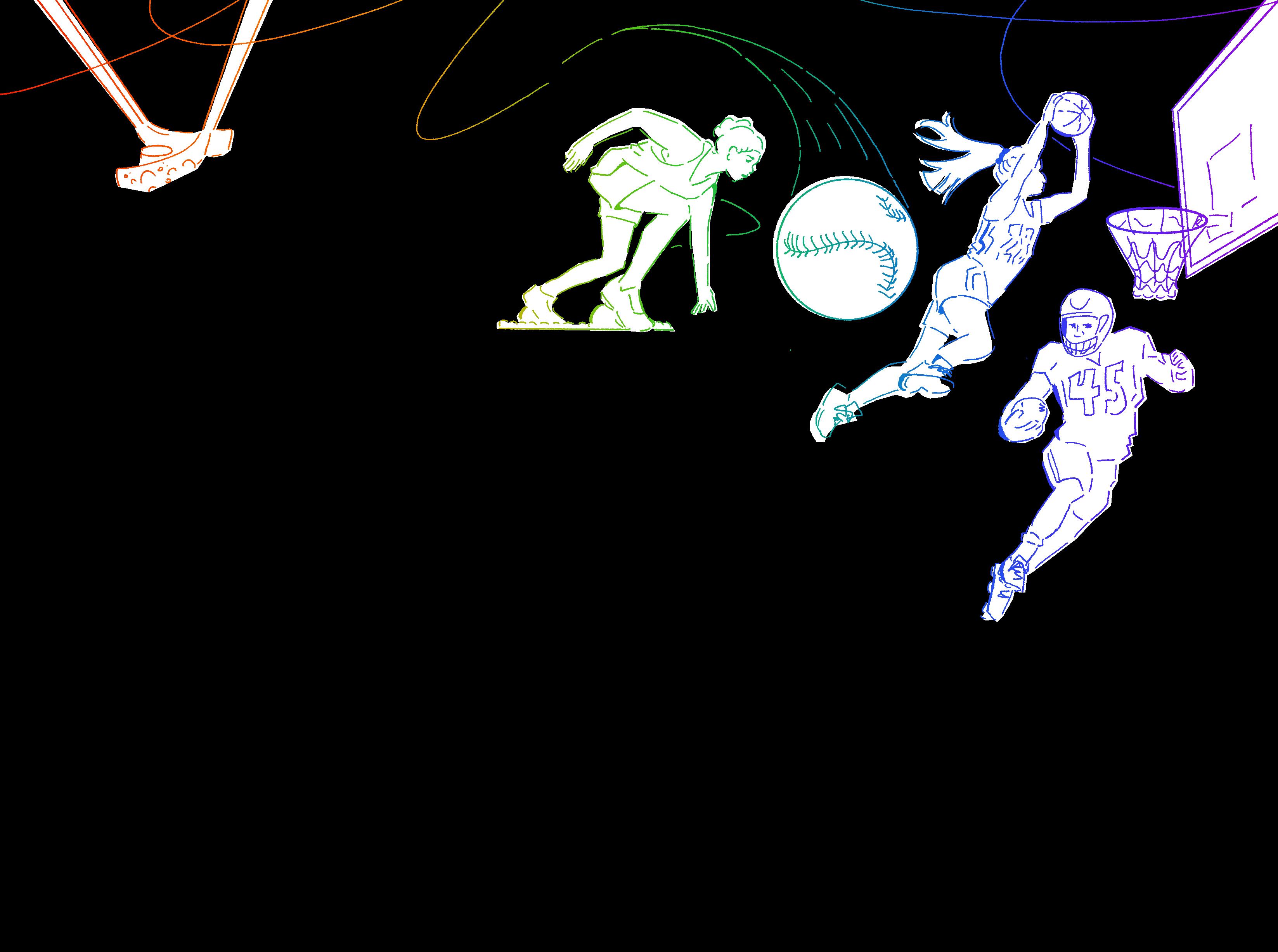
popular consciousness inspire this support and response, what about real-life queer athletes? In honor of Heated Rivalry, the Voice presents several non-fictional athletes who can serve as inspirations, because the only thing more “in” than #Hollanov in 2026 is being your true self.
Nikki Hiltz
Nikki Hiltz, the American 1500m record holder, finished seventh at the 2024 Paris Olympics and is a four-time national track champion. Hiltz identifies as transgender and nonbinary, sharing their experience undergoing top surgery after the Olympic Games online. They highlighted the confidence that genderaffirming care brought them and how it spilled over into other aspects of their life, including competition.
Transgender and intersex athletes openly competed in the Olympic Games for the first time in 2021 in Tokyo. The topic of transgender competition is still a point of contention globally, especially for transgender women athletes. Still, Hiltz’s willingness to share their journey underscores how far the professional sports
Carl Nassib
When he came out in 2021, Tampa Bay Buccaneers captain and defensive end Carl Nassib became the first openly gay player active in the NFL. A 2014 survey estimated that at least 23,000 football players have played on preseason, training, or regular season NFL rosters throughout the league’s history, yet only 16, including Nassib, have been openly gay or bisexual. Ideas of masculinity and homophobic stigmas surrounding the sport suggest why just one of the 16 players came out while actively playing.
Sheryl Swoopes
Sheryl Swoopes represents several firsts for the WNBA: she was the first-ever player signed to the league back in 1996, the first woman to have a Nike shoe named after her (the Air Swoopes), and, in 2005, she became the first active player of color to come out as gay. Over her career, she led the Houston Comets to the WNBA’s first four championship victories, later going on to win three league MVPs and three Olympic gold medals.
Jesse Kortuem
On Jan. 13, 2026, professional hockey player Jesse Kortuem came out as gay after Heated Rivalry inspired him to share his identity. He posted a message on social media regarding his decision, noting that while he had already been out to his family and friends, he had not yet felt safe enough to share with his teammates. Kortuem wrote that he struggled to reconcile the masculine nature of hockey and how it would mesh with his identity, but reported receiving positivity and love since the announcement. Kortuem’s story offers inspiration for the direction of the professional hockey community. Kortuem has not played for the NHL, which still has not had an openly gay player. The league has traditionally not been an ally to the LGBTQ+ community: in 2023, the NHL banned rainbow stick tape and Pride Night jerseys. The league has since walked back the ban, and multiple teams have mentioned Heated Rivalry on social media or on a jumbotron. The show’s popularity has brought them a new queer audience, and, as Kortuem wrote, “there is room for all of us on the ice.” #