First Year Seminar Program

Page 1


FIRST YEAR SEMINAR PROGRAM

The First Year Seminar (FYS) courses (BADM 1101) are designed for first-year students, including sophomore external transfer students, enrolled in Georgetown University’s McDonough School of Business. Offered in the fall semester, students can explore a variety of unique topics that range from does finance benefit society and critical thinking in the digital world to the ethics of financial reporting, future of work, and the impact of managing scarce resources. Unique aspects of the FYS courses include:

• Enrollment in each seminar is limited to 20 students, and prior knowledge of business or topics covered in the FYS courses is not necessary.

• The small class size allows students to develop a mentoring relationship with their faculty, embrace learning through seminar-based lectures, and engage in discussions with their peers.

• Each FYS course fulfills Georgetown University’s integrated writing requirement with an emphasis on strengthening students’ academic and business writing skills.

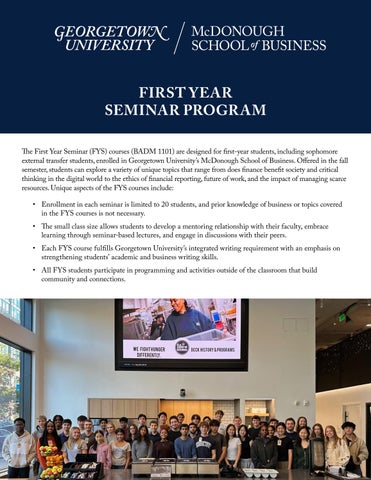
• All FYS students participate in programming and activities outside of the classroom that build community and connections.

Georgetown University McDonough School of Business

FIRST YEAR SEMINAR PROGRAM

THE FIRST YEAR SOCIAL IMPACT CONSULTING PROJECT

FYS students will have the opportunity to work with a local or international nonprofit organization and complete a Social Impact Consulting Project (SICP). Working in teams, the project allows students to develop strategic solutions that address current business challenges facing the organization. Faculty and advanced undergraduates coach each team, and finalists present their strategic recommendations to executives from the client organization.

The SICP also helps students develop and grow in a number of ways that are fundamental to Georgetown McDonough’s approach to learning. More specifically, through the projects, FYS students will develop:

• Knowledge about local and global organizations and the special challenges they face — operationally, culturally, financially, ethically, and strategically;

• Comfort levels with complexity, ambiguity, and uncertainty;

• An ability to structure open-ended, cross functional problems and solutions;

• Skills researching, analyzing, synthesizing, and articulating recommendations;

• Understanding of project definition, scoping, and management skills;

• The ability to operate as a high-performing self-managed team, using its diverse members’ strengths well; and

• Critical thinking and communications skills (written and oral, planned and impromptu).

FYS LECTURE SERIES

Students from each section meet as a cohort a few times during the semester. Students receive a business challenge from a nonprofit organization and learn about the importance of the nonprofit sector and its role in both the social and economic welfare of communities. Additionally, students attend a faculty lecture highlighting how to help solve client’s problems and effective ways to communicate solutions.

NONPROFIT PARTNER

Previous nonprofit partners have included DC Central Kitchen, So Others Might Eat (SOME), HOPE Worldwide South Africa, Martha’s Table, Evidence Action, 11th Street Bridge Park, and the Anacostia Business Improvement District Corporation.

HOW TO REGISTER

Registration for the Fall 2026 semester is available on July 24 for the incoming first-year students and on July 23 for sophomore transfer students. You can review all the available options for the fall courses on the Schedule of Classes and select one that most interests you and challenges your thinking.

CONTACT INFORMATION

For questions related to the FYS program or questions for your academic dean, please contact msbundergrad@georgetown.edu

FIRST YEAR SEMINAR OPTIONS

Cooking the Books: The Ethics of Financial Reporting

Selected Readings:S

We will discuss the impact of ethical (and unethical) financial reporting from the perspective of the major stakeholders – management, shareholders, and regulators. In addition, we will discuss the differences between the U.S. system and other systems around the world. We start the course by learning about Enron and WorldCom and the impact these two accounting fraud cases had on current regulations – especially the SarbanesOxley Act. We also will discuss the behavior of these corporate leaders, what they did right and wrong, and use what we learn to analyze issues in financial reporting today.

The course also will have at least two guest speakers – one from the U.S. Securities and Exchange Commission and a litigation consultant involved in accounting fraud cases.

Cynthia Cooper, Extraordinary Circumstances: The Journal of a Corporate Whistleblower | Paul Healy and Krishna Palepu, The Fall of Enron | V.G. Narayanan, Market and Regulatory Institutions | Popular press articles about financial reporting ethics and regulatory agencies around the globe.

Ambition: Finding Greatness

Selected Readings:

Do you want to be the best? Why? And what does it take? Are your goals the right ones? Should you change the world or yourself? How would you know? This class investigates ambition from multiple angles. We’ll look practically at what it takes to succeed — skills like time management, dealing with people, and developing conscientiousness. But we’ll also critically examine ambition’s pitfalls: how it relates to the Dark Triad, why it leads some to lie or exploit others, and how chasing status becomes a zero-sum game. The goal is to help each of us become the best version of ourselves, in the best sense of “best.”

David Foster Wallace, This Is Water | Angela Duckworth, Grit | Alain de Botton, Why You Will Marry the Wrong Person | Leo Tolstoy, The Death of Ivan Ilyich | Betsey Stevenson, The Paradox of Declining Female Happiness

Jason Brennan

FIRST YEAR SEMINAR OPTIONS

Behavioral Finance: How Biases Impact Consumer Financial Decisions

Selected Readings:

Consumer finance is a large segment of the U.S. economy as U.S. households hold over $100 trillion in financial assets and over $15 trillion in total liabilities. Given its size, a better understanding of behavioral finance has significant implications for those that plan to work in the consumer finance industry and for financial public policy. The course will focus on three main questions: 1) how much do “good” (“bad”) financial decisions potentially save (cost) consumers? 2) why do consumers make the financial decisions they do regardless of whether they are making “good” or “bad” financial decisions? and 3) what role can public policy and financial literacy play in helping consumers make better decisions?

Gary Belsky and Thomas Gilovich, Why Smart People Make Big Money Mistakes: Lessons From the Science of Behavioral Economics | Morgan Housel, The Psychology of Money

The Real Estate Game

Real estate is the single largest asset class in the world and incorporates nearly every field of business. Decisions associated with how real estate is developed, managed, and disposed have meaningful implications for our society and necessitates an understanding by today’s business student. This seminar contemplates various dimensions of real estate from the localized nature of an individual acquisition or development to the global capital flows that seek to invest in the asset class. Students will develop a strong understanding of real estate, the economics underpinning the demand and supply of space, and the various aspects of the field that result in the built environment. The course also will focus on the development and history of Washington, D.C., a leading global real estate market, and include a number of property tours throughout the city. Prominent guest speakers from the real estate industry will be featured.

Selected Readings:

David Ling and Wayne Archer, Real Estate Principles: A Value Approach | Berg, S, Grand Avenues: The Story of Pierre Charles L’Enfant, the French Visionary Who Designed Washington, D.C. | Edward Glaeser, Triumph of the City

Matthew Cypher and Ferdinando Monte

FIRST YEAR SEMINAR OPTIONS

Does Finance Benefit Society?

Fr. Quentin Dupont, S.J

Selected Readings:

Anyone considering a career in the finance industry should know that people are suspicious about finance. This negative feeling is even shared by finance experts. Throughout the semester, we will explore the causes for this rancor against one of the fastest-growing economic sectors of the past 50 years. We will learn about this debate from the perspective of finance academics and professionals, as well as from the Catholic and Jesuit tradition that informs Georgetown’s identity. Because money is ubiquitous, finance is an ideal setting to study the global nature of business. Students in this class will have to think at the scale of both the local and the world economy. Our readings, discussions and assignments aim at making each of you expertly informed financial managers who work for the common good.

M. Carney, Value(s), Building a Better World for All | R. Shiller, Finance and the Good Society | J. Tirole and S. Rendall, Economics for the Common Good | Excerpts from various academic articles on financial economics from leading scholars such as: M. Bertrand, A. Banerjee, E. Duflo, A. Edmans, M. Friedman, M. Giannetti, D. Jenter, J. Karpoff, S. Mullanaithan, M. O’Hara, T. Philippon, and T. Wang.

Global Supply Chains in a Turbulent World

Selected Readings:

This First Year Seminar examines how global competition has shifted from a “friendly” world of seamless integration to a fractured landscape shaped by pandemics, trade wars, technological disruption, and geopolitical realignment. Students explore how companies design, source, manufacture, and distribute products across borders — and why the real battle today is supply chain vs. supply chain (rather than company vs. company).

Using real cases, current events, and interactive discussions, the course analyzes global sourcing, outsourcing, nearshoring, procurement strategy, supplier relationships, and the growing role of digital technologies such as AI and automation. Emphasis is placed on resilience, coordination, and the strategic choices behind “who does what, where, and why.” Students gain practical frameworks to understand how firms compete in an uncertain global economy.

Victor Fung, William Fung, and Jerry Wind, Competing in a Flat World | Ricardo Ernst and Jerry Haar, Globalization, Competitiveness and Governability | Jerry Haar, Ricardo Ernst, and Santiago Gutierrez, Winning in the New Global Business Landscape

FIRST YEAR SEMINAR OPTIONS

Marketing on the Edge

Ronald Goodstein

The purpose of this course is to break out of the routine thinking that permeates most marketing companies. The idea is not to be different from competitors in the marketplace, but instead to be better. Better is defined as being different in a way that actually matters to customers and prospects. While simple in terms of thought, executing this concept has proven difficult for most firms because they are stuck in a routine that produces commodity thinking and price-war competition. Thus, this course examines how to approach marketing in a more innovative and effective manner with long-lasting results in terms of value creation and customer relationships.

Selected Readings (Must read at least one of the following):

David A. Aaker, Aaker on Branding: The Playbook to Building Strong Brands | Rob Biesenbach, Unleash the Power of Storytelling: Win Hearts, Change Minds, Get Results | April Dunford, Obviously Awesome: How to Nail Product Positioning So Customers Get It, Buy It, Love It | Robert Cialdini, Influence, New and Expanded: The Psychology of Persuasion | Kim Derrick Rozdeba, Rozdeba Brand & Co., The Branding Queens: Discover Branding Secrets from Twenty Incredible Women Who Built Global Brand Dynasties

Managing Scarce Resources

Selected Readings:

Competition for and allocation of scarce resources is a foundational theme in business, economics, international relations, and human behavior. While scarcity is often viewed negatively, it can have a range of positive effects on behavior and outcomes. From diamonds to Pop Mart’s Labubu, scarcity generates interest and increases valuation, forcing us to make trade offs, prompting more efficient use of resources, and sparking creativity. In this course, we will discuss strategies managers and consumers can use to leverage and cope with scarce resources. We will consider both the immediate and long-term effects of scarcity and examine when its effects on behavior tend to be positive vs. negative. Our writing will be inspired by our own experiences with scarcity, both in class and outside of class, as well as research and business cases.

Mullainathan, S., and Shafir, E. Scarcity: Why Having Too Little Means So Much | Ehrenreich, B., Nickel and Dimed: On (Not) Getting By in America | Hamilton, R. and Hosany On the Strategic Use of Product Scarcity in Marketing, Journal of the Academy of Marketing Science

FIRST YEAR SEMINAR OPTIONS

Psychology of Big Data

Jennifer Logg

Data analytics needs psychology. Generative AI is changing how people make decisions, but we cannot realize its full potential until we understand how people respond to algorithmic advice. You will leverage cutting edge experimental research from psychology and behavioral economics to generate your own research questions. Thus, you will take a psychological perspective to data analytics, the Psychology of Big Data. You’ll gain a competitive advantage by critically assessing evidence, developing your own questions, and communicating data-driven insights. We will cover three themes, 1) The Future of Work: Moneyball, 2) The Promise of Algorithms, and 3) Balancing Algorithmic and Human Judgment.

Selected Readings and Podcasts:

Moneyball | Kahneman, How to Overcome the High, Hidden Cost of Inconsistent Decision Making | Logg, Developing a ‘Theory of Machine’ to Examine Perceptions of Algorithms | O’Neil, Weapons of Math Destruction Podcast | Zaki et al., It’s Time To Teach Empathy And Trust With The Same Rigor As We Teach Coding | Logg, Algorithms as Magnifying Glasses

Data, Technology, and Critical Thinking in the Digital World

Gregory Lyon

Selected Readings:

Data and digital technology have reshaped how we communicate with friends, family, and colleagues, how we consume goods and services in the economy, how we learn about current events around the world, how leaders approach risk and uncertainty in global business, and much more. Where did these technologies come from? What are the ethical implications of new technologies? Are there any tradeoffs associated with technological development? How can we critically assess the value of new and emerging technologies and usefulness of data? This course examines these questions and more as students learn to think critically about past and emerging technologies and refine their analytical skills to be successful in a vibrant digital world.

Alan Turing, Computing Machinery and Intelligence | Brian Merchant, The One: The Secret History of the iPhone | David Sax, The Soul of an Entrepreneur | Cal Newport, Deep Work: Rules for Focused Success in a Distracted World | Sarah Frier: No Filter: The Inside Story of Instagram

Selected Films: The Inventor | The Social Dilemma

FIRST YEAR SEMINAR OPTIONS

Beyond the Bottom Line: The Science of Meaningful Work

Selected Readings:

Throughout our careers, many of us will and have asked the question: “Does my work reflect and fulfill who I am?” When we answer this question with a “yes”, our work is considered meaningful: it has personal significance and feels worthwhile. Yet changes in technology, especially the rise of generative AI, the increase of perfectionism and loneliness, especially in GenZ, and other societal trends, impact our ability to seek and find meaningful work. In this course, we seek to answer: What makes work meaningful (or meaningless) for workers? How is meaningful work created, regardless of profession, industry, or role? How does meaningful work impact productivity, satisfaction, engagement, and other key business and performance metrics? How does the advent of generative AI impact meaning and purpose at work? How we can make our own day-to-day work more meaningful regardless of where we work? This seminar explores the deep questions, contradictions, and research on meaning and purpose in the workplace.

R. F. Baumeister et al., Positive Psychology in Search for Meaning | R. Pacheco, Manage What Matters: A Leader’s Guide to Making Work Meaningful | V. E. Frankl, Man’s Search for Meaning: An Introduction to Logotherapy | Deloitte Global, Gen Zs and Millennials at Work: Pursuing a Balance of Money, Meaning, and Well-Being | B. Goštautaitė et al., Can You Outsmart the Robot? An Unexpected Path to Work Meaningfulness

The Future of Work

When most of you graduate, you will begin managing your careers under immeasurably different circumstances from your parents. Your experience will also dramatically differ from classmates who graduated just a decade before you. Remote working, artificial intelligence, data-driven recruitment and performance analysis, and the increasing power of social networks — these are examples of phenomena that will amplify or attenuate your professional trajectories, depending on your ability to understand them. No matter where you work, you will be asked to harness these developments in order to address challenges that organizations have grappled with for decades. For example, what is the source of the gender wage gap, and how can it be eliminated? What is the fairest and most effective way for professional service firms to hire college graduates? What are the consequences of remote work, and are they distributed evenly? Are resources allocated to new businesses fairly, and if not, how should this be addressed?

Selected Readings:

Lauren Rivera, Pedigree: How Elite Students Get Jobs | Caroline Criado Perez, Invisible Women: Data Bias in a World Designed for Men | Ta-Nehisi Coates, The First White President | John Carryrou, Bad Blood: Secrets and Lies in Silicon Valley | Eliot Sherman, Discretionary Remote Working Helps Mothers Without Hurting Non-Mothers: Evidence From a Field Experiment

Rachel Pacheco
E liot L. Sherman

FIRST YEAR SEMINAR OPTIONS

Consumer Influence and Autonomy in the Digital Marketplace

Selected Readings:

This seminar explores how companies use convenience, personalization, experiential rewards, and incentives to shape consumer choices and consolidate market power. Through readings, case discussions, and writing assignments, we will learn to harness digital tools to enhance autonomy instead of diminishing it. Key themes include maintaining market boundaries, identifying trustworthy providers, and evaluating the net impact of consumer relationships. As budding managers, participants will develop essential insights and skills for thoughtful product management in the digital age.

Cal Newport, Digital Minimalism | Jenny O’Dell, How to Do Nothing | John K. Galbraith, The Dependence Effect | Luc Wathieu, You Might Want This

Selected Case Studies: Apple Stores | Amazon | Spotify | TikTok | 23andMe | ChatGPT | Duolingo | PayPal Honey

Turn static files into dynamic content formats.

Create a flipbook