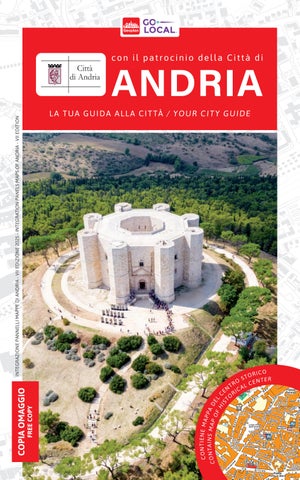
Andria 2025

Page 1


con il patrocinio della Città di

ANDRIA

LA TUA GUIDA ALLA CITTÀ / YOUR CITY GUIDE

S.S.170, km 21+500 - Dir. per Barletta 76123 Andria (BT) - Tel. 0883 591917 garageitalia.acivisaggio@alice.it www.garageitaliasoccorsoaci.it

Garage Italia ACI Andria soccorsostradaleandria

Contenuti / Contents

geoplan.it

Direzione e Amministrazione: / Management and Administration: Via San Giuseppe, 38/G - 31015 Conegliano TV - Tel. 0438 451997 - E-mail: geoplan@geoplan.it

Foto: Archivio Geoplan Srl/Archivio Comunale - Pag. 6 e 7: ©jakobradlgruber/123RF.COM Photo: Geoplan Srl Archive/Municipal Archive - Page 6 and 7: ©jakobradlgruber/123RF.COM

Si ringraziano:

Il Comune di Andria per la collaborazione fornita, e tutti gli inserzionisti che hanno consentito la realizzazione della presente opera.

La presente opera è reperibile in omaggio presso tutte le aziende inserzioniste, gli uffici comunali, gli enti di promozione turistica e presso le più importanti attività della zona.

Riproduzione anche parziale vietata.

La Geoplan S.r.l. non si assume nessuna responsabilità per l’utilizzo di marchi e slogan usati dagli inserzionisti. Tutti i diritti riservati a Geoplan S.r.l.

Special thanks:

The Municipality of Andria for their cooperation, and all advertisers who made it possible to produce this work. This work is available free of charge from all advertiser companies, municipal

Welcome Benvenuto

Grazie per aver scelto di aprire questa rivista. Ti invito a dare uno sguardo alla pagina accanto, sulla lavagna troverai il cuore del messaggio GoLocal:

Pensa Locale, Vivi Locale, Compra Locale.

Ogni volta che fai acquisti presso le attività del tuo territorio, stai contribuendo in modo prezioso alla crescita della comunità in cui vivi.

Scegliendo di #ComprareLocale, non solo sostieni l’economia della tua zona, ma aiuti anche a creare un impatto positivo che si diffonderà e moltiplicherà. Più le attività commerciali locali prosperano, più l’ambiente intorno a te fiorisce e si rinnova.

Sfogliando queste pagine, troverai alcune delle migliori attività del territorio, che abbiamo selezionato con cura, per offrirti prodotti e servizi di qualità che soddisfino ogni tua esigenza. Ogni inserzione è un invito a riscoprire il valore della tua città, e sono sicuro che saprai apprezzarlo.

Abbiamo un obiettivo comune: #PensareLocale, #VivereLocale, #ComprareLocale.

Per me è fantastico averti qui! Scopriamo insieme le eccellenze del tuo territorio.

Thank you for choosing to open this magazine. I invite you to take a look at the page next to this one, on the blackboard, you’ll find the essence of the GoLocal message:

Think Local, Live Local, Shop Local.

Every time you make a purchase from businesses in your area, you are making a valuable contribution to the growth of the community you live in. By choosing to #ShopLocal, you not only support the economy of your region but also help create a positive impact that will spread and multiply. The more local businesses thrive, the more the environment around you blooms and renews itself.

As you browse these pages, you will find some of the best businesses in the area, carefully selected to offer you quality products and services that meet your every need. Each advertisement is an invitation to rediscover the value of your city, and I’m sure you’ll appreciate it.

We share a common goal: #ThinkLocal, #LiveLocal, #ShopLocal.

For me, it’s fantastic to have you here! Let’s explore together the gems of your region.

parole sindaco

Una guida alla conoscenza di una città è una speciale chiave di ingresso ad un mondo conosciuto da chi lo abita e lo custodisce da secoli. Leggerne la storia, approfondirne miti e leggende, incuriosirsene, ripercorrendo parabole antiche, equivale ad aprire uno scrigno segreto, le cui chiavi sono gelosamente custodite dalla memoria di un luogo. Andria è una città italiana che rivendica con orgoglio un cammino millenario, fatto di dominazioni e vicende straordinarie che arrivano fino ai nostri giorni. Andria è “fidelis” al cuor di Federico II di Svevia, che ne eresse a poca distanza il simbolo della sua potestà imperiale. Ma è non soltanto questo. Ha conosciuto tempi di pace e prosperità, alternati alla miseria di guerre e carestie, rialzandosi sempre, come è testimoniato dalle vestigia architettoniche che ne impreziosiscono il centro antico, tra i più grandi per estensione dell’intero Mezzogiorno d’Italia. Ha sviluppato nel suo seno un paniere di bontà eccezionali, replicate quotidianamente da artigiani del gusto, che ne fanno conoscere i pregi in tutto il mondo. La città di San Riccardo guarda oggi al suo futuro con orgoglio e laboriosità. Ma, oggi, è soprattutto emblema di accoglienza, come è testimoniato ampiamente nel suo DNA. Ogni viaggiatore è, perciò, il benvenuto. L’augurio è che ne resti ammaliato per tutta la vita, coltivando un legame autentico con l’arte, il gusto e la bellezza che questa terra riesce sempre a trasmettere a chi le si avvicini con amicizia e curiosità.

Benvenuti

Giovanna Bruno Sindaco di Andria

A word the mayor

A guide to getting to know a city is a special key to a world known by those who have lived in and guarded it for centuries. Reading its history, delving into its myths and legends, becoming curious about it, retracing ancient parables, is like opening a secret treasure chest, whose keys are jealously guarded by the memory of a place.

Andria is an Italian city that proudly claims an age-old history, consisting of dominations and extraordinary events that extend to the present day.

Andria is “fidelis” (“faithful”) to Frederick II of Swabia, who erected a symbol of his imperial power a short distance away. But that is not all.

It has known times of peace and prosperity, alternating with the misery of wars and famine, always rising again, as witnessed by the architectural vestiges that embellish its ancient centre, one of the largest in the whole of southern Italy. It has developed within its bosom a breadbasket of exceptional goodness, replicated daily by artisans of taste, who popularise its merits all over the world. The city of San Riccardo looks to its future today with pride and industriousness.

But, today, it is, above all, an emblem of hospitality, as is amply demonstrated in its DNA.

Every traveller is, therefore, welcome.

We hope that you will remain enchanted by it for the rest of your life, cultivating an authentic bond with the art, taste and beauty that this land always manages to transmit to those who approach it with friendship and curiosity.

Welcome

Andria

Le origini

The origins

La storia ci racconta che Andria fu fondata nel 1046 da Pietro I il Normanno, in realtà non si trattò di una vera e propria fondazione quanto di una elevazione al rango di “civitas”, di una “villa” preesistente, costituita da numerosi casali distribuiti nei dintorni.

I normanni dopo la fondazione di Andria la cinsero di mura, rinforzate da 12 torri e assorbirono i casali adiacenti.

L’importanza socio-economica della villa Andre non doveva essere di poco conto se il normanno Pietro, la scelse fra i centri rurali dell’entroterra tranese per ingrandirla, fortificarla ed elevarla al ruolo di uno dei vertici del quadrilatero entro il quale strinse di assedio la filobizantina Trani. A tale scelta, dovettero presiedere criteri che tennero conto tanto della natura geografica: una modesta altura di 151 m fra le ultime propaggini delle Murge prospiciente la piana di Trani; quanto della sua idoneità a trasformarsi in breve tempo in un centro logistico e di acquartieramento.

Per ciò che concerne l’origine del suo nome è presumibile pensare che Andria

History tells us that Andria was founded in 1046 by Peter I the Norman. In reality, it was not a real foundation but rather an elevation to the rank of “civitas”, of a pre-existing “villa”, consisting of numerous hamlets distributed around the area. After the foundation of Andria, the Normans encircled it with walls, reinforced by 12 towers, and absorbed the adjacent hamlets.

The socio-economic importance of the Andre villa must have been no small matter if the Norman Peter chose it from among the rural centres of the Trani hinterland to enlarge, fortify and elevate it to the role of one of the apexes of the quadrilateral within which he laid siege to the pro-Byzantine Trani. This choice had to be based on criteria that took into account both its geographical nature: a modest 151-metre hill in the last foothills of the Murge facing the Trani plain and its suitability to be transformed into a logistical and quartering centre in a short time. As far as the origin of its name is concerned, it is conceivable to think that

abbia la sua derivazione dal termine “antrum” (grotta) ottenuto con la sostituzione fonetica nd con quella nt. Effettivamente nei secoli precedenti la sua fondazione il territorio di Andria era disseminato di insediamenti umani prevalentemente in grotta, e da sempre la città costituisce l’area a Nord di Bari più cospicua di siti rupestri. Con la dominazione sveva, Andria acquistò ancora maggiore importanza, poiché sappiamo quanto Federico II l’avesse a cuore, tanto da costruire nel suo territorio Castel del Monte, inserito nel 1996 nell’elenco dei beni Patrimonio dell’Unesco.

Nel Trecento terminata la dominazione sveva il regno meridionale fu conquistato dai francesi e Andria diventò Contea e poi Ducato con i Del Balzo. Sotto questa illustre famiglia la città ebbe lustro e decoro, si svilupparono i traffici ed il commercio. Inoltre, i Del Balzo si diedero alla ricostruzione di molte chiese andriesi danneggiate nel 1350 dagli Ungheresi e furono artefici dell’arrivo degli Ordini Mendicanti in città i quali diffusero cultura e spiritualità.

Dal 1820 in poi Andria ebbe invece palpiti e rivolte per la libertà, numerosi cittadini

Andria has its derivation from the word “antrum” (cave) obtained with the phonetic substitution of nd with nt. Indeed, in the centuries prior to its foundation, the territory of Andria was dotted with human settlements, mainly in caves, and the city has always constituted the area north of Bari with the most conspicuous cave sites. With the Swabian domination, Andria gained even greater importance, as we know how much Frederick II cared for it, so much so that he built Castel del Monte on its territory, which was added to the UNESCO World Heritage list in 1996. In the 14th century, when Swabian rule ended, the southern kingdom was conquered by the French and Andria became a county and then a duchy under the Del Balzo family. Under this illustrious family, the city enjoyed lustre and decorum, and trade and commerce developed. In addition, the Del Balzo family rebuilt many of Andria’s churches damaged in 1350 by the Hungarians and were responsible for the arrival of the Mendicant Orders in the city, which spread culture and spirituality. From 1820 onwards, Andria had struggles and revolts for freedom, and many citizens were tried and convicted. Its con-

Piazza La Corte

furono processati e condannati. La sua storia contemporanea si svolse intorno allo sviluppo della sua agricoltura e dei suoi commerci.

A metà del Novecento fu interessata da una violenta rivolta contadina scoppiata durante un discorso in piazza tenuto dal celebre sindacalista Giuseppe Di Vittorio a seguito del quale ci fu l’Eccidio delle sorelle Porro. Si manifestò in quel periodo, anche una crisi economica in seguito alla quale diversi abitanti furono costretti a emigrare. Nella seconda metà del Novecento si ebbe una ripresa economica favorita anche dall’inaugurazione nel 1965 della linea ferroviaria Bari-Barletta. Dal 2009 Andria fa parte della Provincia Bat, 12.000 ettari del suo territorio sono inclusi nel Parco Nazionale dell’Alta Murgia istituito nel 2004 e caratterizzato da distese di ulivi. Caratteristici i suoi prodotti alimentari tra i quali la Burrata Igp, i tenerelli prodotti dalla famiglia Mucci, l’olio extravergine di oliva e i vini DOC Castel del Monte e DOC Terra di Bari. Ricordiamo che nel 1851 l’artista Achille Vianelli realizzò un dipinto su grafite e ad acquerello nel quale ritraeva Piazza La Corte; l’opera è attualmente conservata presso il Metropolitan Museum di New York.

temporary history unfolded around the development of its agriculture and trade. In the mid-twentieth century, it was affected by a violent peasant uprising that broke out during a speech in the piazza by the famous trade union leader Giuseppe Di Vittorio, following which there was the murder of the Porro sisters. There was also an economic crisis at that time, as a result of which several inhabitants were forced to emigrate. In the second half of the twentieth century, there was an economic revival, also favoured by the opening of the Bari-Barletta railway line in 1965.

Since 2009, Andria has been part of the Province of Barletta-Andria-Trani, 12,000 hectares of its territory are included in the Alta Murgia National Park established in 2004 and characterised by expanses of olive trees. Its food products are characteristic, including Burrata PGI, tenerelli dragées produced by the Mucci family, extra virgin olive oil and Castel del Monte DOC and Terra di Bari DOC wines.

It should be noted that in 1851, the artist Achille Vianelli produced a graphite and watercolour painting in which he portrayed Piazza La Corte; the work is currently housed in the Metropolitan Museum in New York.

Piazza Vittorio Emanuele II, già Piazza “La Catuma”

AL VOLANTE NON DISTRARTI,

GUIDA E BASTA!

La ditta indeldesign realizza i tuoi progetti con formula chiavi in mano. servizi offerti

• Demolizioni

• Impianti

• Cartongesso e pitturazioni

• Progettazione idrici-elettrici

La indeldesign Impresa Edile, grazie anche all’esperienza decennale, garantisce professionalità, lavori a regola d’arte con materiali selezionati e all’avanguardia, operai specializzati e rispetto di tutte le norme e sicurezza nei cantieri.

La nostra Impresa Edile si occupa di eseguire lavori professionali in tutto il settore dell’edilizia, potendo affidare così a una sola impresa la realizzazione di qualunque lavoro edile, senza la necessità di dovervi confrontare con diverse figure. Fanno parte infatti del nostro personale tutte le figure necessarie sia per la realizzazione di opere edili sia per la parte tecnica come progettazioni, richieste permessi e DIA; inoltre disponiamo di personale specializzato in diversi settori come elettricisti, idraulici, pittori e manovalanza qualificata.

contatti ANTONIO GIUSEPPE

RICCARDO

Cell. 347 6271707

Cell. 340 5489849

Cell. 327 5968305

E-mail: indeldesign@outlook.it | Sede Legale: Via Villafranca, 34 f Riccardo Indelicato | 1 edil_indeldesign

Il centro antico

The

old town

Un gallo, un cane, una bandiera con una croce e due braccia che si incrociano sono i simboli segnavento che svettano sulla sommità dei tre campanili che caratterizzano il profilo del centro antico di Andria. In effetti è spesso definita come la città dei tre campanili, i quali appartengono alla Cattedrale, alla chiesa di San Domenico e di San Francesco. Il centro antico conserva tutt’oggi la configurazione ellittica impostata dai Normanni. Delle quattro porte d’ingresso, purtroppo ne rimane solo una, Porta Sant’Andrea. In esso è possibile ammirare la Cattedrale S. Maria Assunta, la Chiesa di San Francesco, quella di San Domenico, di Sant’Agostino con i suoi portali gotici, Palazzo Ducale e l’antico quartiere Casalino.

A rooster, a dog, a flag with a cross and two arms crossing each other are the windbreaker symbols that stand at the top of the three bell towers that characterise the outline of Andria’s old town. In fact, it is often referred to as the city of three bell towers, which belong to the Cathedral, the church of San Domenico and the church of San Francesco. The old town still retains the elliptical configuration laid out by the Normans. Of the four entrance doors, unfortunately, only one remains, Porta Sant’Andrea. Here, you can admire the Cathedral of Santa Maria Assunta, the Church of San Francesco, the Church of San Domenico, the Church of Sant’Agostino with its Gothic portals, the Palazzo Ducale and the old Casalino quarter.

Borgo Antico

La Cattedrale di Andria

Andria Cathedral

La Cattedrale di Santa Maria Assunta fu edificata nella seconda metà dell’XI secolo, ad opera di Goffredo d’Altavilla. Nel Cappellone di San Riccardo sono riposte le reliquie del Santo, presumibilmente primo vescovo di Andria, divenuto patrono della città nel 1858. Le parti più preziose di questa cappella sono i 26 bassorilievi degli stipiti laterali all’altare e dell’arco absidale che raccontano gli episodi della vita del Santo e contengono alcuni scorci dell’Andria quattrocentesca.

La Cripta della Cattedrale in origine era una chiesa paleocristiana, realizzata sul piano stradale roccioso dopo l’VIII secolo, prima dell’XI. Orientata alla bizantina, con l’abside ad Oriente e l’ingresso ad Occidente, possiede una pianta a due navate con colonnato centrale. Sono presenti anche due tombe che, secondo uno studio condotto dall’Università di Pisa nel 1994, contengono dei resti compatibili con quelli delle mogli di Federico II, Jolanda di Brienne e Isabella d’Inghilterra.

The Cathedral of Santa Maria Assunta was built in the second half of the 11th century by Goffredo d’Altavilla.

In the Chapel of San Riccardo are the relics of the Saint, presumably the first bishop of Andria, who became the city’s patron in 1858. The most precious parts of this chapel are the 26 bas-reliefs on the side jambs of the altar and the apsidal arch, which recount episodes from the life of the saint and contain some glimpses of 15th-century Andria.

The Cathedral Crypt was originally an early Christian church, built on the rocky road surface after the 8th century, before the 11th century. Designed in the Byzantine style, with the apse to the East and the entrance to the West, it has a two-aisled plan with a central colonnade. There are also two tombs that, according to a study conducted by the University of Pisa in 1994, contain remains compatible with those of Frederick II’s wives, Yolande of Brienne, and Isabella of England.

Cattedrale di Santa Maria Assunta in Cielo

Il Laboratorio Analisi Basile effettua indagini diagnostiche nei settori analitici:

• chimica clinica

• ematologia

• coagulazione

• microbiologia

• virologia

• dosaggi ormonali

• marcatori oncologici

• autoimmunità

• genetica

• markers epatitici

• biologia molecolare

• gravidanza

• allergie

• intolleranze alimentari

• breath test

• tossicologia

Effettua prelievi a domicilio e prelievi su bambini (“Prelievo con Sorriso”).

Mette a disposizione un completo servizio di assistenza infermieristica in sede o a domicilio.

Inoltre, si avvale della consulenza di medici specialisti e nutrizionisti che ricevono presso gli studi medici ubicati nella struttura stessa.

ORARIO AL PUBBLICO

Lun.-Ven. 07.15-13.30 / 15.30-19.30 Sab. 07.15-09.45

Laboratorio Analisi Basile

Viale Alto Adige, 25 - 76123 Andria (BT)

Tel. 0883 887965 7 info@analisibasile.it www.analisibasile.it f Laboratorio Analisi Basile

CIBO PER LA MENTE...

...acquista con la testa

Il Palazzo Ducale

The Palazzo Ducale

Nel 1308 il conte Bertrando Del Balzo e la contessa Beatrice d’Angiò, dopo essersi sposati, stabilirono la loro residenza ad Andria. La contessa aveva portato in dote la contea, e preferirono la città rispetto alla capitale del Regno. Venne così costruito un palazzo signorile accanto alla Cattedrale.

In seguito fu ingrandito e ricostruito dalla Famiglia Carafa che nel 1552 aveva acquistato Andria e Castel del Monte, e nel XIX secolo il palazzo passò alla Famiglia Spagnoletti che lo divise in due e ampliò la zona prospiciente Piazza Catuma (oggi Piazza Vittorio Emanuele II).

In 1308, Count Bertrando Del Balzo and Countess Beatrice of Anjou, after marrying, established their residence in Andria. The countess had brought the county as a dowry, and they preferred the city to the capital of the kingdom.

A stately palace was thus built next to the Cathedral.

It was later enlarged and rebuilt by the Carafa family, who had purchased Andria and Castel del Monte in 1552, and in the 19th century, the palace passed to the Spagnoletti family, who divided it in two and enlarged the area facing Piazza Catuma (today Piazza Vittorio Emanuele II).

Castel del Monte

Castel del Monte

Realizzato a metà del XIII secolo su committenza di Federico II di Svevia, è il simbolo per eccellenza di quel potere che egli aveva stabilito nel Regno di Sicilia, oltre ad aver realizzato una vera e propria rete castellare, impostata in precedenza dai Normanni.

Built in the mid-13th century on the orders of Frederick II of Swabia, it is the symbol par excellence of the power he had established in the Kingdom of Sicily, as well as having created a veritable network of castles, set up earlier by the Normans. These castles performed vari-

Questi castelli assolvevano a svariate funzioni: politiche, simboliche, di difesa, di controllo e di gestione del territorio.

Castel del Monte le esemplificava tutte. L’edificio è costituito da un corpo ottagonale, con una corte al centro, rinserrato ad ogni angolo da 8 torri, e riprendendo, quella che probabilmente era una tecnica di origine araba, l’acqua veniva raccolta dal tetto e convogliata nelle torri per l’approvvigionamento idrico.

La perfezione strutturale dell’architettura fornisce un esempio della varietà di stimoli culturali che furono all’origine della rinascenza federiciana. Nell’insieme essa si richiama alla tradizione orientale: araba, bizantina e crociata, alle novità gotiche e cistercensi del Nord Europa. Per questa motivazione Castel del Monte dal 1996 è Sito Unesco. Si trova in territorio andriese a 18 km dal centro abitato, nel Parco Nazionale dell’Alta Murgia.

ous functions: political, symbolic, defence, control and management of the territory. Castel del Monte exemplified them all. The building consists of an octagonal body, with a courtyard in the centre, enclosed at each corner by eight towers, and following what was probably a technique of Arab origin, water was collected from the roof and piped into the towers to provide a water supply.

The structural perfection of the architecture provides an example of the variety of cultural stimuli that were at the origin of the Frederician renaissance. Overall, it draws on the Eastern tradition: Arab, Byzantine and Crusader, Gothic and Cistercian innovations from Northern Europe. For this reason, Castel del Monte has been a UNESCO Site since 1996. It is located in the territory of Andria, 18 km from the town centre, in the Alta Murgia National Park.

Castel del Monte

Officina Meccatronica

Diagnosi Elettronica - Tagliando Certificato

Manutenzione Programmata - Ricambi Omologati

Ricarica Climatizzatore - Controlli Prerevisione

Via R. Lacarra, 2 - Andria (BT)

Cell. 339 7268265

www.lisocarservice.it

Liso Car Service - liso_car_service

Servizio Auto di Cortesia Via Goffredo Normanno, 56 76123 Andria (BT) Cell. 339 7299207 - 328 3180181

“Non

di Savino Sgarra

Via Montegrappa, 51 76123 Andria (BT)

Tel. 0883 890034 - Cell. 339 8266865

E-mail: newedison@virgilio.it New Edison

NUMERI UTILI USEFUL NUMBERS

Antiviolenza e Stalking

CCISS Viaggiare Informati

Comune - Centralino Unico

Corpo Forestale dello Stato

Emergenza Maltrattamento Minori

Tel. 1522

Tel. 1518

Tel. 0883 290111

Tel. 1515

Tel. 114

Guardia di Finanza - Pronto InterventoTel. 117

Mercato Ortofrutticolo

Numero Unico Emergenze

Servizio Pubblica Istruzione

Soccorso Stradale ACI

Telefono Azzurro

Tel. 0883 290342

Tel. 112

Tel. 0883 290297

Tel. 803 116

Tel. 19696

Unità di Crisi del Ministero degli Affari EsteriTel. 06 36225

ACI Roadside Assistance

Anti-Violence and Stalking

CCISS Viaggiare Informati

Child Maltreatment Emergency

Crisis Unit of the Ministry of Foreign Affairs

Department of Public Education

Fruit & Vegetable Market

Guardia di Finanza - Emergency

Municipality - Main Switchboard

Single Emergency Number

State Forestry Corps

Telefono Azzurro

Tel. 803 116

Tel. 1522

Tel. 1518

Tel. 114

Tel. 06 36225

Tel. 0883 290297

Tel. 0883 290342

Tel. 117

Tel. 0883 290111

Tel. 112

Tel. 1515

Tel. 19696

Pronto intervento immediato NOTTURNO E FESTIVO

Contratti CONDOMINIALI

SPURGO POZZI NERI

SPURGO VASCHE BIOLOGICHE

STURAMENTO CANALI E COLONNE

MONTANTI CON SISTEMA CANAL JET

VIDEOISPEZIONE

S.P.2, km 49+800 - 76123 Andria (BT)

Riccardo Cell. 368 7664239

Lorenzo Cell. 327 8861550

E-mail: info@ecologiatursi.it www.ecologiatursi.it

Ecologia TURSI - ecologiatursi

Prendersi cura della città in cui viviamo è un atto importante che parte da piccoli gesti quotidiani.

Attenzione: si invita a depositare il materiale in sacchetti o buste di plastica.

Le chiese rupestri The rupestrian churches

Il territorio carsico della Puglia, ricco di gravine, permise durante la dominazione bizantina (IX-XII sec.) l’escavazione di molti villaggi rustici che sorsero dalla roccia. Si può evidenziare tutt’oggi nella zona di Andria quello che doveva essere un vero e proprio complesso rupestre che comprendeva, oltre alle grotte utilizzate a scopo abitativo, le chiesi rupestri di S. Sofia (Madonna dell’Altomare), della Madonna dei Miracoli, di Gesù di Misericordia, il cui fulcro, presumibilmente, era costituito da S. Croce, che per le caratteristiche architettoniche, s’imponeva sulle altre in quanto ad importanza storica e artistica. Di notevole interesse sono gli affreschi superstiti all’interno delle chiese rupestri suddette, i cui soggetti attingono da un repertorio figurativo estremamente vario e sono testimonianza di una fede popolare che abitava nella società dell’epoca. Gli affreschi coevi alla realizzazione delle chiese presentano una influenza di matrice bizantina, mentre quelli realizzati successivamente, sugli affreschi antecedenti, sono influenzati dai nuovi modelli iconografici dell’Occidente medioevale.

The karstic territory of Apulia, rich in ravines, allowed during the Byzantine domination (9th–12th centuries) the excavation of many rustic villages that rose from the rock along the ravines, near watercourses and near the most important communication routes. It is still evident today in the Andria area what must have been a real rupestrian complex that included, in addition to the caves used for residential purposes, the rupestrian churches of Santa Sofia (Madonna dell’Altomare), Madonna dei Miracoli, and Gesù di Misericordia, whose fulcrum, presumably, was Santa Croce, which, due to its architectural characteristics, stood out from the others in terms of historical and artistic importance. Of particular interest are the surviving frescos within, the subjects of which draw from an extremely varied figurative repertoire and bear witness to a popular faith that inhabited the society of the time. The repertoire ranges from images of thaumaturge saints, to those of virgin saints, to depictions of the Madonna and Child and Christ. The frescoes coeval with the construction of the churches show a Byzantine influence, while those painted later on the earlier frescoes are influenced by the new iconographic models of the medieval West.

Chiesa Rupestre di Santa Croce ai Lagnoni - Affreschi

Il Museo del Confetto

The “Confetto” museum

Il Museo del Confetto “Giovanni Mucci” di Andria, originaria sede della fabbrica di confetti dove il fondatore Nicola Mucci, nel 1894, aprì il primo laboratorio, figura tra gli itinerari più dolci e curiosi della Puglia. Riconosciuto dal Ministero per i Beni e le Attività Culturali, membro del circuito “Locali Storici d’Italia”, non solo è diventato un punto di riferimento per gli andriesi, molto legati all’antica tradizione di Casa Mucci, ma anche per turisti, italiani e stranieri, provenienti da ogni dove.

Il Museo, frutto di una paziente e appassionata ricerca, custodisce un patrimonio di storia, sapere e tradizioni. Documenti preziosi, utensili, apparecchiature, reperti di archeologia raccontano la storia della produzione dei confetti, cioccolato e caramelle. Il percorso è supportato da un video della produzione attuale e culmina con la boutique che

offre la possibilità di degustare il ricco assortimento, tra cui i famosi “Tenerelli Mucci®” lavorati ancora oggi secondo ricetta segreta di famiglia.

The Museum of the Sugar Plum Mucci Giovanni (Museo del Confetto Confetteria Mucci Giovanni)” in Andria, the original headquarters of the confectionery factory where the founder Nicola Mucci, in 1894, opened the first workshop, ranks among the sweetest and most intriguing places in Apulia. Recognised by the Ministry of Cultural Heritage and Activities and a member of the ‘Locali Storici d’Italia’ circuit, it has not only become a point of reference for the Andrians, who are very attached to the ancient tradition of Casa Mucci, but also for tourists, both Italian and foreign, from all over the world. The Museum, the result of patient and passionate research, preserves a heritage of history, knowledge and traditions. Precious documents, tools, equipment, and archaeological finds tell the story of the production of confectionery, chocolate and sweets.

The tour is supported by a video of current production and culminates with the boutique offering the chance to taste the rich assortment, including the famous ‘Tenerelli Mucci®’ still made according to a secret family recipe.

Arco Piciocco - Centro Storico

Edilizia - General contractor - Impianti tecnologici

Lavori chiavi in mano

Impianti climatizzazione, idrici

Impianti elettrici civili e industriali, domotica

Quadri elettrici, cabine di trasformazione

Impianti antincendio, impianti antintrusione, TVCC

Impianti fotovoltaici

Via Antonio Meucci, 33 - Andria (BT)

Tel./Fax 0883 546773 - Sabino Cell. 368 3942198

generalimpiantimvm@gmail.com

RESTA CONNESSO AL TUO TERRITORIO!

La guida per scoprire le migliori offerte, attrazioni, luoghi e servizi.

Impianti Elettrici e Domotici

di Spiriticchio Michele

Montegrosso

Borghi

della Salute

Borghi della Salute (Health Villages)

A 17 chilometri dalla città di Andria sorge la frazione di Montegrosso, incastonata in una bellissima cornice naturalistica ai piedi delle Murge, rappresenta la porta Nord di accesso al Parco Nazionale Alta Murgia. Il 6 novembre 2021 si è celebrata l’adesione del Borgo di Montegrosso, alla rete dei Borghi della Salute. L’adesione al circuito dei Borghi della Salute rientra tra le iniziative poste in capo dall’Amministrazione per dare valore a comportamenti dei cittadini sani e giusti e per orientarsi ad una nuova cultura della salute, nella quale ogni persona diventa soggetto e protagonista del proprio benessere. Gode di una storia risalente ai tempi di Federico II, il quale assegnò al suo cavaliere Giovanni Quarto la foresta di Montegrosso in Terra di Bari, non lontana dal maniero di Castel del Monte. Al suo arrivo il milite vi trovò quello che è rappresentato su di un affresco del 1699: una torre con una foresta attorno e una piccola chiesa di San Pietro. Oggi la torre non è più visibile dall’esterno perché inglobata, verso la metà del 1800, nell’attuale Palazzo Ducale, ma è comunque possibile vederla internamente, accedendo al piano terra del palazzo. Il quale è

Seventeen kilometers from the city of Andria lies the hamlet of Montegrosso, set in a beautiful naturalistic setting at the base of the Murge, it represents the northern gateway to the Alta Murgia National Park. On November 6th, 2021, the accession of the hamlet of Montegrosso, to the network of the Borghi della Salute, was celebrated. The adhesion to the circuit of the Borghi della Salute (Health Villages) is part of the initiatives placed at the head of the Administration to give value to healthy and right behaviors of citizens and to orient to a new culture of health, in which each person becomes subject and protagonist of his own well-being.

It has a history dating back to the time of Frederick II, who assigned to his knight Giovanni Quarto the forest of Montegrosso in Terra di Bari, not far from the manor of Castel del Monte.

On arrival, the soldier found what is depicted on a 1699 fresco: a tower with a forest around it and a small church of San Pietro. Today the tower is no longer visible from the outside because it was incorporated, in the mid-1800s, into the current Palazzo Ducale, but it is still possible to see it internally by accessing the ground

frutto di un’opera di sistemazione databile attorno alla seconda metà del 1800, quando i duchi fecero costruire attorno alla torre l’attuale struttura, completamente in tufo, ottenuto dall’ipogeo.

Prima della ristrutturazione ad opera della Cooperativa Coloni di Montegrosso nel 2000, si accedeva al palazzo da una maestosa scala. Al primo piano si trovano tre stanze. Quella dei duchi, con un balcone che si affaccia direttamente su Piazza della Libertà. Un’altra vicina, e la terza al piano superiore della torre si conclude con una volta a crociera su pianta quadrata, dove è custodita la carta del feudo di Montegrosso. Con l’avvento del governo fascista e dell’Opera Nazionale Combattenti, tra il 1927 e il 1930, la Borgata conobbe il suo sviluppo divenendo il centro e il riferimento di tutte le contrade circostanti. Ciò fece di Montegrosso un vero e proprio centro rurale. E assieme alla Riforma Agraria furono costruiti dei magazzini per la conservazione dei prodotti e le prime case. Fu Mussolini in persona a posare la prima pietra per la costruzione della prima abitazione civile della Borgata in Via Condottieri. È importante sottolineare che l’attuale odonomastica della Borgata (Via Condottieri, Combattenti, Mutilati di Guerra assieme a Piazza della Libertà) è stata attribuita dallo stesso Mussolini e rimane

floor of the palace. This is the result of redevelopment work dating from around the second half of the 19th century, when the dukes had the current structure built around the tower, completely in tuff, obtained from the hypogeum.

Before its renovation by the Cooperativa Coloni di Montegrosso in 2000, the palace was accessed by a majestic staircase. On the first floor, there are three rooms. That of the dukes, with a balcony directly overlooking Piazza della Libertà. Another nearby, and the third on the upper floor of the tower ends with a cross vault on a square plan, where the map of the Montegrosso fiefdom is kept.

With the advent of the fascist government and the Opera Nazionale Combattenti veteran aid organisation, between 1927 and 1930, the Borgata underwent development, becoming the centre and reference point for all the surrounding districts. This made Montegrosso a real rural centre. And together with the Agrarian Reform, warehouses were built for the conservation of products and the first houses. It was Mussolini himself who laid the foundation stone for the construction of the Borgata’s first civil dwelling in Via Condottieri. It is important to emphasise that the current naming of the Borgata (Via Condottieri, Combattenti, Mutilati di Guerra together with Piazza della Libertà)

Borgo di Montegrosso

ancora oggi un segno tangibile della storia e dell’origine di questo borgo. Successivamente alla caduta del governo fascista, nel 1947 i beni di proprietà dell’O.N.C. furono affidati alla Cooperativa Coloni di Montegrosso, anche il Palazzo Ducale che nel frattempo veniva utilizzato dagli abitanti.

Nel 1950 iniziò l’edificazione della Chiesa di Santa Maria Assunta, voluta dal Venerabile Vescovo di Andria mons.

Giuseppe di Donna, inaugurata il 1 gennaio del 1951. La diocesi era già presente nella borgata tramite l’utilizzo di una chiesa sotterranea e probabilmente posta alle spalle dell’attuale Palazzo Ducale. Una testimonianza del sacerdote don Michele Carlone ci porta a conoscenza di un locale interno i magazzini, utilizzato prima della costruzione della Chiesa, che fu poi intitolato a Sant’Isidoro agricoltore.

Grazie all’Ente Regionale Sviluppo Agricolo Pugliese il Palazzo Ducale fu lasciato libero per andare ad occupare le civili abitazioni che vennero costruite.

Tutti i nuovi servizi, tra cui un ospedaletto, una farmacia, una scuola e un cinema, un ufficio postale e dei bagni pubblici, contribuirono allo sviluppo della borgata, e all’incremento della popolazione che affluiva a Montegrosso dalle contrade limitrofe.

was attributed by Mussolini himself and still remains a tangible sign of the history and origin of this village.

After the fall of the fascist government in 1947, the property owned by the O.N.C. was entrusted to the Cooperativa Coloni di Montegrosso, including the Palazzo Ducale, which in the meantime was being used by the inhabitants.

In 1950, construction began on the Church of Santa Maria Assunta, at the behest of the Venerable Bishop of Andria Monsignor Giuseppe di Donna, which was inaugurated on 1 January 1951. The diocese was already present in the township through the use of an underground church, probably located behind today’s Palazzo Ducale. A testimony by priest Don Michele Carlone brings us knowledge of a room inside the warehouses, used before the church was built, which was later named after St Isidore the farmer.

Thanks to the Ente Regionale Sviluppo Agricolo Pugliese (Apulian Regional Agricultural Development Agency), the Palazzo Ducale was vacated in order to occupy the civil dwellings that were built. All the new services, including a small hospital, a pharmacy, a school and a cinema, a post office and public baths, contributed to the development of the village and to the increase in the population flowing

Soltanto nel 2000 il Palazzo Ducale e la Chiesa di Santa Maria Assunta e Sant’Isidoro videro un’opera di ristrutturazione che portò a un grande e funzionale riutilizzo di questi beni.

Montegrosso è conosciuta come luogo di pace e di serenità da chi viene a visitarla, farsi una passeggiata, o ancora di più, da chi viene ad assaporare le sue prelibatezze culinarie.

Ogni stagione, Montegrosso, assume una caratteristica particolare e diversa, regalando emozioni uniche. Immersa, tra viti e uliveti, campi di grano con lo sfondo unico della Murgia rude e ricca, la città a ogni stagione si riempie di odori, colori e sapori sempre diversi.

I suoi abitanti mostrano sempre grande accoglienza per gli eventi pubblici come sagre, feste e rievocazioni, che vengono realizzate per le sue vie, e per la festa dei patroni, Santa Maria Assunta e Sant’Isidoro, il 15 agosto. Oltre alla grande accoglienza, da sempre si è cercato di rispettare e valorizzare il territorio attraverso la produzione di prodotti tipici: olio, miele e quelli caseari.

Montegrosso oltre alla sua storia è un’esperienza, una passeggiata all’aria pulita gustando le prelibatezze del territorio, e godendo del paesaggio che cambia e ti cambia ad ogni stagione dell’anno.

into Montegrosso from the neighbouring districts. It was not until the year 2000 that the Palazzo Ducale and the Church of Santa Maria Assunta and St. Isidoro underwent a renovation that led to a great and functional reuse of these assets.

Montegrosso is known as a place of peace and serenity by those who come to visit it, take a walk, or even more, by those who come to taste its culinary delicacies. Each season Montegrosso takes on a distinctive and different character, offering unique emotions. Surrounded by vines and olive groves, and wheat fields with the unique backdrop of the rugged and rich Murgia, the city is filled with ever-changing smells, colours and flavours every season. Its inhabitants always show a warm welcome for public events such as festivals, celebrations and re-enactments, which take place in its streets, and for the feast of its patron saints, Santa Maria Assunta and Sant’Isidoro, on 15 August. In addition to the great welcome, they have always sought to respect and enhance the territory through the production of typical products: oil, honey and dairy products.

Montegrosso, in addition to its history, is an experience, a walk in the fresh air tasting the local delicacies and enjoying the landscape that changes with every season of the year.

Paesaggi del Parco Nazionale dell’Alta Murgia

di Sgarra Riccardo

Assistenza Tecnica

Via G. Massari, 11 - 76123 Andria (BT)

Riccardo Cell. +39 348 4042339

generazionelettrica@gmail.com www.generazionelettrica.it

Generazione Elettrica - generazionelettrica

di Gina Leonetti

Via Ponchielli, 35 - 76123 Andria (BT) Cell. 389 9930139

Estetica Sun’s Day - sunsday_gina

Rivendita materiale edile - Carpenteria Rivendita e noleggio

di attrezzatura e ponteggi Rivendita di prodotti per pitture, smalti e vernici

Via Santa Maria dei Miracoli, 206 - 76123 Andria (BT) Tel. +39 0883 014469 - Cell. +39 388 1823229

E-mail: vendiamosrl@gmail.com - www.vendiamosrl.it f Vendiamo Frisardi Riccardo - i vendiamo_srl

Peruna vita più sana!

Via F. Cavallotti, 29 - 76123 Andria (BT) w Cell. 327 2271347 - f Alterego Pizza Boutique i alterego_pizzaboutique

Contrada Finizio - 76123 Castel del Monte (BT) Raffaella Cell. 333 2967432 (Ristorazione) Maria Cell. 320 9259050 (Masseria Didattica) info@agriturismoseicarri.com www.agriturismoseicarri.com f Agriturismo Sei Carri • 1 agriturismo_sei_carri CIN: IT110001B500074656

Turn static files into dynamic content formats.

Create a flipbook
Issuu converts static files into: digital portfolios, online yearbooks, online catalogs, digital photo albums and more. Sign up and create your flipbook.
Andria 2025 by Geoplan - Issuu