How the S-100 framework can enable true autonomy for USVs
Airborne Lidar mapping of Northern Ireland’s coastal zone
Designing the Dutch flagship RV Anna Weber–van Bosse Mapping and visualizing shipwrecks in high resolution
Director Strategy & Business Development
Durk Haarsma
Financial Director Meine van der Bijl
Editorial Board Huibert-Jan Lekkerkerk, Mark Pronk, BSc, Marck Smit, Auke van der Werf
Head of Content Wim van Wegen
Copy Editor Lynn Radford
Marketing Advisors Myrthe van der Schuit, Peter Tapken, Sandro Steunebrink
Circulation Manager Adrian Holland
Design Persmanager, The Hague
Hydro International is an independent international magazine published by Geomares. The magazine and related e-newsletter inform worldwide professional, industrial and governmental readers of the latest news and developments in the hydrographic, surveying, marine cartographic and geomatics world. Hydro International encompasses all aspects, activities and equipment related to the acquisition, processing, presentation, control and management of hydrographic and surveyingrelated activities.
Subscriptions
Hydro International is available on a subscription basis. You can subscribe at any time via https://www.hydro-international.com/ subscribe. Subscriptions will be automatically renewed upon expiry, unless Geomares receives written notification of cancellation at least 60 days before the expiry date.
Advertisements
Information about advertising and deadlines are available in the Media Planner. For more information please contact our marketing advisor (myrthe.van.der.schuit@geomares.nl) or go to www.geomares-marketing.com.
Editorial Contributions
All material submitted to the publisher (Geomares) and relating to Hydro International will be treated as unconditionally assigned for publication under copyright subject to the Editor’s unrestricted right to edit and offer editorial comment. Geomares assumes no responsibility for unsolicited material or for the accuracy of information thus received. In addition, Geomares assumes no obligation for return postage of material if not explicitly requested. Contributions must be sent to the head of content wim.van.wegen@geomares.nl.
To protect New Zealand’s coastline, LINZ has launched the 3D Coastal Mapping Programme. Over three years, this technically demanding initiative will capture elevation and seafloor data of up to 40% of New Zealand’s coastline.
As NIOZ prepares to bring its new flagship research vessel Anna Weber–van Bosse into service, the focus is shifting from construction to capability. Hydro International spoke with Gert-Jan Reichart, who has been closely involved from design to commissioning.
The deeper importance of S-100 lies in how hydrographic and maritime data can be structured and integrated for use by a wide range of software systems, supporting both human-facing applications and machine-driven decision processes.
This article examines how airborne Lidar bathymetry has been successfully used to survey the full coastal zone of Northern Ireland, representing the first bathymetric Lidar project of this scale undertaken in the UK.
This article describes several acquisition and processing settings used in wreck surveys by Flemish Hydrography, and their impact on the resulting data. In recent years, the survey methodology has been refined and enhanced.
For generations, hydrographers explored the oceans with a lead-line and a chart that was mostly empty white space. Over the past hundred years, however, ocean mapping has leapt from hand-cast soundings to multibeam sonars, satellites and airborne Lidar.
An overview of the four candidates nominated for the posts of SecretaryGeneral and Director at the IHO. During the next IHO Assembly, delegates of the Member States will elect who will represent hydrography at the highest level.
The Summer Weddell Sea Outflow Study expedition is intended to make decisive contributions to understanding a key area of the Antarctic ice-ocean system at a time of a profound transition whose effects extend far beyond Antarctica.
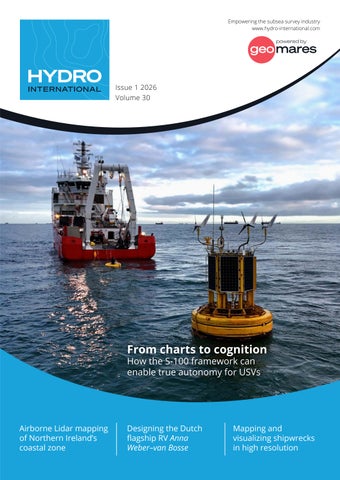
The photo on this issue’s front cover shows an Accurasea metocean buoy being deployed from the GEOxyz vessel Geo Ocean VII to collect wind data for future offshore wind farms. Previously, third-party multicat vessels were used for this work, but a dedicated in-house deployment procedure has now been developed, allowing operations to be carried out with GEOxyz’s own fleet. The project is part of ‘BeNeWakes’, a measurement campaign designed to collect high-quality data on long-range wake effects between offshore wind farms. Three buoys have been installed behind an existing wind farm to study how turbine wakes behave and to help determine how closely wind farms can be positioned without affecting neighbouring sites.
(Image courtesy: GEOxyz)
It is simply not adding up…
I sometimes end up in a discussion with students about ‘difficult’ exercises. I have always stated that adding and subtracting are possibly the most difficult things in hydrography. To be more precise, not so much the arithmetic operation itself, but rather when to do what.
Just recently, I found myself caught out with such an issue. As part of my ongoing Professional Doctorate (PD) research, I have built a ‘digital twin’ of a multibeam surveying system. This digital twin, or simulator, allows the user to determine the effect of various survey errors in relation to vessel motion and line planning (and keeping). The simulator uses a Monte Carlo approach rather than the stationary statistical approach used in, for example, AMUST which assumes a normal distribution for each contribution and then adds these statistically.
The simulator uses a different approach and computes true ‘sensor’ values using simulated vessel motion, tides, sound velocity profiles, a known digital terrain model (DTM) and other variables. It then models the various systematic and random error sources and applies them to the ‘true’ sensor values. Using these values, the simulator computes a point cloud, allowing the results to be compared to the original DTM. Errors can be switched on and off to estimate the effect of small errors which are often not well visible in data with large random errors.
This simulator is a (much more) advanced version of a simulator that ‘my’ Cat-A students build. This is one of the modules
that students find challenging, and which often leads to adding and subtracting issues. As a result, I have been looking at a series of incorrect (first attempt) implementations over the years. So one could say that I had been warned, right?
But no, during development I of course did structural tests with artificial (mostly flat) bottoms. Recently, I managed to implement a high-resolution (2.5cm) DTM of a real (rockdumped) bottom. This allowed more realistic tests including one for footprint errors. Amongst other things, the simulator has the option to switch the footprint computation of the MBES on or off. Very quickly, I realized that the values taking the footprint into account were significantly ‘lower’ than those without a footprint. Which, if you remember your underwater acoustics, should not be the case (hyperbolae, etc.). You already guessed it: somewhere deep in the code, a plus should have been a minus…
Which brings me to the reason for building this on/off option in the first place (other than that it is great for testing the simulator’s ‘round trip’). The issue I have been looking into is whether a multibeam echosounder uses the footprint in the same way that a singlebeam echosounder does (first return within the beam is registered as range). Based on (for now) circumstantial evidence, I believe that this is not true, and that the behaviour of an MBES is more of a ‘boresight’ measurement. This also makes one of the largest (theoretical) error sources described by Rob Hare and modelled in AMUST potentially invalid. If a multibeam manufacturer is reading this, do not hesitate to enlighten me further on the measurement method. To be continued!
Huibert-Jan Lekkerkerk technical editor, Hydro International info@hydrografie.info
RIEGL LiDAR for Airborne Topo-Bathymetry
Fast. Precise. Efficient.
40° FOV circular scan pattern up to 100 kHz measurement rate
>2 Secchi depths water penetration
5 MPx digital camera, IMU/GNSS, RIEGL RiLOC, and RIEGL software FULLY INTEGRATED
5.7 kg / 12.5 lbs (with camera & IMU/GNSS)
40° FOV elliptic scan pattern up to 200 kHz measurement rate
>2 Secchi depths water penetration
24 MPx digital camera, IMU/GNSS, RIEGL RiLOC, and RIEGL software FULLY INTEGRATED
40° FOV elliptic scan pattern up to 200 kHz measurement rate 10.3 kg / 22.7 lbs (with camera & IMU/GNSS)
extra full waveform analysis tools adjustable receiver field of view for operational flexibility enhanced performance and large operational envelope from 75 m AGL up to 500 m AGL flight altitude
>2 Secchi depths water penetration
>2.5 Secchi depths water penetration
An attractive portfolio tailored to every task in LiDAR bathymetry: coastline mapping, habitat observation and change detection, river and inland waterbody survey, detailed underwater infrastructure and object detection, hydro engineering, hydro-archeology, water reservoir monitoring
us at March 10 - 12, 2026
London | UK RIEGL booth R400
CHCNAV launches ADCP for rivers and inland waterways
The CHCNAV RiverStar 3600D (RS3600D), a compact acoustic doppler current profiler (ADCP), is now available. The RS3600D supports hydrological surveying, river discharge measurement, ecological flow monitoring and channel mapping across a wide range of water conditions, and is specially designed for high-precision current measurement in rivers and inland waterways. CHC Navigation (CHCNAV) is an ambitious developer of advanced mapping, navigation and positioning solutions. The RS3600D uses intelligent dual-frequency operation to support consistent profiling whether in shallow or deeper water. It combines an ultra-high-frequency 3,600kHz channel with a 1,200kHz band, helping operators adapt measurements to site conditions without changing instruments. In shallow and slow-moving water conditions, the high-frequency mode supports flow velocity measurements down to 1cm/s and reduces the near-surface blind zone to 5cm. This capability helps address environments where conventional profilers can be affected by signal noise and limited near-surface data. In addition to current profiling, the RS3600D includes a dedicated 600kHz vertical beam to improve depth measurement accuracy. The nine-beam configuration enables simultaneous acquisition of depth and velocity data, supporting efficient river cross-section surveying and bathymetric studies. The system supports a depth measurement range of 100m and improves bottom-tracking performance to help hydrographers build detailed channel profiles for hydrology and river engineering applications.
Besides mapping two million square kilometres of seafloor, Schmidt Ocean Institute has made two significant changes to advance the capabilities of RV Falkor (too). The shape of the ship’s bow has been radically changed, and the gold standard of autonomous underwater vehicles (AUVs) has been added to its technology suite. “There has always been a commitment from our organization to continuously improve what we can provide to the scientific community,” said Eric King, Schmidt Ocean Institute’s senior director of maritime infrastructure.
“We moved quickly to make these latest changes in response to lessons learned in our first two years of expeditions aboard RV Falkor (too), and we have never been better positioned to provide the best-quality data to scientists around the world.”
Over a two-month dry dock period in Talcahuano, Chile, the team reconstructed the bow of RV Falkor (too), transforming it from a bulbous bow more common on offshore commercial vessels into a streamlined, V-shaped bow optimized for science missions. The new bow significantly improves the precision and reliability of the ship’s sonar systems in capturing high-quality mapping data, even in challenging weather conditions. It can now capture high-resolution data at 6-11 knots (~7-13mph) and in swells exceeding 3m.
RV Falkor (too) following a bow reconstruction, which transformed it from a bulbous bow more common on offshore commercial vessels into a streamlined, V-shaped bow optimized for science missions. (Image courtesy: Misha Vallejo Prut / Schmidt Ocean Institute)
Shom selects RTsys micro-AUV for autonomous seabed survey operations
Following a seven-month competitive tender, the French Hydrographic and Oceanographic Service (Shom) has awarded a contract to French marine technology specialist RTsys for the supply of an autonomous underwater micro-drone (μAUV). The order, placed at the end of December, covers the NemoSens model and forms part of Shom’s broader modernization programme for hydrographic and oceanographic data acquisition, initiated in 2024. The procurement reflects Shom’s response to growing demand for timely, certified seabed data from both civilian and defence users, as areas of strategic interest continue to expand from coastal waters to deep-sea environments. Central to this shift is the increasing use of uncrewed systems – underwater, surface and aerial – alongside the renewal of the French Navy’s hydrographic fleet. The replacement of three coastal hydrographic vessels with two new-generation hydrographic vessels (BHNG), designed to operate in conjunction with drones, is expected to shorten data acquisition and processing cycles and improve operational flexibility. NemoSens is the first autonomous underwater micro-drone acquired by Shom and is scheduled for delivery in the first half of 2026. Equipped with a single-frequency sidescan sonar and a magnetometer, the system is intended to support high-resolution mapping of the continental shelf down to depths of 200m. This zone represents a commercially and strategically significant environment, supporting activities ranging from maritime infrastructure and resource management to defence and security operations.
Within Shom’s survey modernization programme, NemoSens is intended to support scientific and industrial seabed operations. (Image courtesy: RTsys)
The RiverStar 3600D ADCP. (Image courtesy: CHCNAV)
New Dutch partnership focuses on scalable autonomous maritime operations
Bringing unmanned operations closer to everyday deployment, Royal IHC and Demcon Unmanned Systems have entered into a strategic partnership aimed at accelerating the use of uncrewed and autonomous vessels across both civil and defence markets. The collaboration has begun with the joint development and integration of containerized Launch and Recovery Systems (LARS) solutions for uncrewed surface vehicles and uncrewed underwater vehicles. Designed for flexibility and ease of use, the solution allows operators to deploy autonomous and remotely operated vessels more efficiently and safely, using existing platforms and across a wide range of operational conditions. Both parties emphasize that the current containerized LARS solution is only the beginning of a broader collaboration. Royal IHC and Demcon Unmanned Systems share an ambitious vision for the future in which scalability, industrialization and sustainable deployment of autonomous systems are central. Their common goal is to lower the threshold for large-scale, safe and futureproof deployment of uncrewed surface vessels (USVs), uncrewed underwater vehicles (UUVs) and automation solutions. Royal IHC contributes its expertise as a high-tech system integrator and shipbuilder for complex and automated work vessels. Demcon Unmanned Systems adds its innovative technologies and experience in the field of remote control and autonomous uncrewed vessels. Together, they form a solid foundation for a clear vision of growth towards multiple smaller and larger autonomous vessels in the future.
Nigerian Navy and NIMASA move to deepen cooperation on hydrography and maritime safety
Efforts to strengthen maritime safety and unlock further economic potential in Nigeria’s waters are gaining momentum as the Nigerian Navy and the Nigerian Maritime Administration and Safety Agency step up their cooperation on hydrography, wreck removal and maritime security. The renewed focus emerged during a familiarization visit by the Nigerian Navy’s Western Naval Command to the headquarters of the Nigerian Maritime Administration and Safety Agency, where senior naval leadership highlighted the operational gains already delivered through close inter-agency collaboration. Rear Admiral Abdullahi Mustapha, Flag Officer Commanding Western Naval Command, pointed to the tangible security improvements achieved through the long-standing partnership between the Navy and NIMASA, describing the results as clearly visible across Nigeria’s maritime domain: “The longstanding and unwavering partnership NIMASA had maintained with the Nigerian Navy culminated in the current tranquility being witnessed within the Nigerian maritime domain, and it is a clear testament to the strength of this partnership.”
Collaboration on autonomous underwater sensing supported by UK Defence Innovation
A pioneering initiative to create a network of ocean robots designed to support submersible fleet operations has moved into its next phase. The project began this year after securing funding from UK Defence Innovation, previously known as the Defence and Security Accelerator. The collaboration brings together ZeroUSV, Oshen and MarineAI. As large uncrewed underwater vehicles are expected to take on a growing role within future naval fleets, maintaining awareness of their position and operational status is becoming a central requirement. The challenge lies in achieving this without relying on continuous high bandwidth communications that are detectable and potentially vulnerable. By deploying a constellation of Oshen’s robust C-Star vessels, the project creates a ‘passive acoustic network’ capable of picking up covert signals from platforms like the XV Excalibur. The solution channels level 4+ autonomous deployment, passive acoustic sensing and distributed communications into a cohesive system, to deliver a novel and scalable means to support and enhance submersible operations such as critical national infrastructure monitoring, defence operations and environmental monitoring. During the trials, ZeroUSV’s Oceanus12 will autonomously transport and launch a constellation of Oshen ‘C-Stars’ over an area of sea, to form a network of acoustic sensing that can pick up covert signals from XV Excalibur. MarineAI’s involvement will ensure the C-Star launch system is integrated with the GuardianAI suite onboard the Oceanus12.
The project investigates the use of Oceanus12 to position a limited number of surface vessels that operate in a passive listening mode, delivering mission assurance without disruption. (Image courtesy: MarineAI)
Royal IHC and Demcon Unmanned Systems have joined forces on scalable autonomous maritime operations. (Image courtesy: Royal IHC/Demcon Unmanned Systems)
The Nigerian Navy and NIMASA are deepening their cooperation on maritime safety and hydrography.
Seabed 2030 expands ocean floor mapping collaboration with Deakin University
The Nippon Foundation-GEBCO Seabed 2030 project has entered a partnership with Deakin University, linking Seabed 2030’s convening role in global ocean mapping with Australia’s marine and coastal science expertise, led by Deakin University. Deakin University is home to the Deakin Marine Research and Innovation Centre (MRIC), Victoria’s leading university-based marine research centre. The centre’s work supports marine resilience, biodiversity protection and informed responses to climate and coastal change across Victoria’s oceans and waterways. Its research activities include ecosystem restoration, sustainable seafood innovation, studies on climate impacts on marine organisms, and long-term coastal monitoring programmes that contribute to national and state observing networks. MRIC operates from campuses on Port Phillip Bay and in Warrnambool, located along the Great Ocean Road. This new partnership between Seabed 2030 and Deakin University enables the exploration of opportunities for collaboration that strengthen the scientific foundations of ocean floor mapping. This includes advancing understanding of coastal and ocean processes, enhancing environmental data and observations, and contributing to efforts that support sustainable ocean management. “Partnering with Deakin University brings essential research depth and innovation to our mission,” said Jamie McMichael-Phillips, director of Seabed 2030. “The mapping of the seafloor is fundamental not only to ocean science, but to sustainable marine economies, climate resilience and the future of ocean stewardship.”
Deakin Marine Mapping Group’s MV Yolla during open-coast multibeam sonar survey operations.
(Image courtesy: Deakin University)
Norbit introduces configurable Winghead X multibeam system
Norbit has expanded its multibeam echosounder portfolio with the introduction of Winghead X, a unified sonar platform that brings together the full feature set of the existing Winghead series in a single, configurable system. The new platform is designed to give hydrographic operators greater flexibility in how systems are specified and deployed, while reducing the need for multiple dedicated sonar units. Built on Norbit’s modular architecture, Winghead X supports high-resolution bathymetry and backscatter data acquisition, with a beamwidth resolution of 0.5 degrees. A core configuration is supplied as standard, with additional capabilities that can be enabled through software licensing rather than hardware modification. Available options include standard and long-range configurations, integrated or non-integrated GNSS/INS, and advanced processing features such as pitch and yaw stabilization. The system is designed to operate across a broad range of water depths, with a stated maximum operating range of up to 600m. Field trials conducted in coastal and near-offshore environments off Sardinia, Italy, were used to evaluate performance in depths ranging from shallow nearshore waters to intermediate offshore zones. During testing, frequency agility allowed operators to adjust performance to suit local conditions, using higher frequencies for detailed shallowwater mapping and lower frequencies to maintain coverage efficiency in deeper areas. Norbit’s curved array technology also enabled wide electronic beam steering, allowing coverage to extend towards the waterline without changes to physical installation.
Processed data acquired using Norbit’s Winghead X, showing multiple overlapping survey lines across a 60-100m depth range. (Image courtesy: Norbit)
Over a two-and-a-half-year period, an Argo float fitted with oceanographic sensors gathered nearly 200 ocean profiles during a 300km journey beneath the Denman and Shackleton ice shelves.
A robotic ocean float has collected the first-ever continuous measurements from beneath floating ice shelves in East Antarctica, shedding new light on how ocean heat may influence the stability of some of the continent’s most sensitive ice. Over a two-and-a-half-year period, an autonomous Argo float equipped with oceanographic sensors travelled around 300km beneath the Denman and Shackleton ice shelves. During its mission, it collected nearly 200 profiles of ocean temperature and salinity, including an eight-month period spent entirely beneath the ice – a region that has remained largely beyond the reach of direct observation. Ice shelves play a crucial role in controlling Antarctica’s contribution to sea level rise. As glaciers flow from land into the ocean, they form floating shelves that act as buttresses, slowing the discharge of ice into the sea. When these shelves thin or weaken due to melting from below, glaciers can accelerate, increasing ice loss. The new measurements reveal contrasting conditions beneath neighbouring ice shelves. The Shackleton ice shelf, the most northerly in East Antarctica, is currently not exposed to warm water capable of causing significant melting from below. By contrast, the Denman Glacier – which rests on bedrock well below sea level and has the potential to make a substantial contribution to global sea level rise – appears far more vulnerable. Warm water is already reaching beneath the ice, and relatively small changes in ocean conditions could sharply increase melt rates and trigger unstable retreat.
(Image courtesy: Pete Harmsen / Australian Antarctic Division)
How surveying challenging terrain will protect New Zealand’s coastal frontiers
The art of mapping the edge
By Stuart Caie, Land Information New Zealand (LINZ), and Sven Cowan, NV5
To protect New Zealand’s coastline, Toitū Te Whenua Land Information New Zealand (LINZ) has launched the 3D Coastal Mapping Programme. Over three years, this technically demanding initiative will capture elevation and seafloor data of up to 40% of New Zealand’s coastline. By supporting hazard modelling, infrastructure resilience and long-term planning, LINZ isn’t just mapping the coast – it’s mapping the country’s future.
New Zealand’s coastline is a dynamic frontier: wildly beautiful, economically vital and increasingly vulnerable. As rising seas, shifting landforms and intensifying storms reshape the nation’s shores, the stakes for communities, infrastructure and ecosystems grow higher. In response, Toitū Te Whenua Land Information New Zealand (LINZ) has launched a bold and technically demanding initiative: the 3D Coastal Mapping Programme. Over three years, LINZ and its partners will capture high-resolution elevation and seafloor data across up to 40% of New Zealand’s coastline.
This isn’t just a data collection exercise. It’s a complex, multi-year operation that bridges land and sea, and integrates diverse technologies. The effort navigates some of the most environmentally and logistically challenging terrain in the Southern Hemisphere – from highly turbid waters and steep topography to protected wildlife zones, all in unpredictable weather. The resulting detailed maps will support hazard modelling, infrastructure resilience and long-term planning.
Success factors
The success of the 3D Coastal Mapping Programme hinges on multiple factors. These include strategic collaborations with partners experienced in mapping complex geographies; flexible, multi-technology approaches to data collection; a strong focus on data quality and harmonization; and engaging with stakeholders throughout the process.
For example, NV5 Geospatial brings experience from remote projects in Alaska, Canada and the Caribbean – regions with similar terrain and environmental challenges. In mapping the South Island, the programme leverages a suite of complementary technologies – from aerial topobathymetric
Lidar and imagery for seamless land-to-sea coverage, to multibeam acoustic bathymetry by boat to fill Lidar gaps in deeper or more turbid waters. This multi-sensor approach ensures that even areas impacted by suspended sediment or dynamic seafloor movement are captured with high confidence.
To help facilitate efficient data acquisition and forecast conditions, NV5 works with hydrospatial services provider TCarta to obtain persistent satellite-derived bathymetry and water quality analytics. Then, NV5 can make real-time flight adjustments to accommodate weather, water clarity and prioritize data capture and processing in areas where LINZ’s stakeholders have a pressing need.
Aerial view of Wainui Basin, Nelson, New Zealand. (Image courtesy: Noah Edelson)
Aerial view of the South Island New Zealand displaying turbid sea conditions.(Image courtesy: Noah Edelson)
The 3D Coastal Mapping Programme: the foundation for a resilient future
New Zealand’s coastline is home to approximately 65% of the country’s population and supports critical infrastructure that underpins the nation’s economy and way of life. As climate change accelerates, understanding how the shores are changing has never been more important. This is why Toitū Te Whenua Land Information New Zealand (LINZ) launched the 3D Coastal Mapping (3DCM) programme in 2023.
Purpose and scope
The 3DCM programme supports the creation of detailed maps of vulnerable and populated parts of the coastline and adjacent sea floor, which amounts to nearly 40% of the coast. Significant infrastructure corridors and regions at higher risk of coastal inundation will be mapped, covering nearly 10,000km2. The data collected will address a critical gap in the understanding of coastal environments and will provide a baseline to monitor future changes from climate events and natural hazards.
Running through to June 2027, the programme is using Lidar technology to capture detailed topographic and bathymetric data, creating seamless coverage from 200m inland extending out to 25m below the waterline. This zone represents the dynamic interface between land and sea – an area that is particularly vulnerable to climate impacts and has been historically challenging to map.
Benefits for Aotearoa New Zealand
The value of this programme extends across multiple sectors and communities. Local and central government agencies will use the data to enhance hazard and risk modelling, improving the understanding of flood zones, tsunami inundation areas and long-term climate adaptation needs. This supports more informed infrastructure planning, ensuring roads, railways, cultural assets (such as marae) and essential services are positioned to withstand future coastal challenges.
The aquaculture industry gains access to precise seabed mapping, enabling better site selection and environmental management. Maritime operators benefit from updated nautical charts that enhance navigation safety – a core component of LINZ’s hydrographic responsibilities. Environmental managers can use high-resolution seafloor data to map and protect marine habitats and biodiversity. Emergency services will be equipped with accurate elevation models to develop effective evacuation routes and response plans.
Collaborative approach and open data
The success of the 3DCM programme relies on strong partnerships and stakeholder engagement. Since January 2025, specialist firms Woolpert NZ Limited and NV5 Geospatial have been contracted to map across the North and South Islands respectively. LINZ is working closely with regional councils, whose existing topographic Lidar coverage complements the coastal focus, creating a comprehensive elevation dataset covering over 90% of the country. Where turbid waters prevent Lidar penetration, the gaps are filled using multibeam echosounder bathymetry.
In keeping with LINZ’s commitment to data accessibility, this data is openly available as a single dataset called ‘New Zealand Coastal LiDAR 1m DEM’ (https://data.linz.govt.nz/layer/122508-new-zealand-coastal-lidar-1m-dem/) through the LINZ Data Service and the Open Data Registry. This ensures that communities, researchers and developers can integrate this information into their planning and decision-making tools.
Looking forward
As climate change continues to reshape New Zealand’s coastline, the 3DCM programme represents LINZ’s commitment to building national resilience through knowledge and preparedness. By creating a living record of the coastline, the organization is empowering future generations with the information they need to protect communities, support sustainable development and preserve the coastal ecosystems that define Aotearoa New Zealand.
Collaboration tools
The programme also employs collaboration tools to speed up quality assurance (QA) and quality control (QC) of the acquired data. NV5 developed QAURA, an Esri StoryMap platform for managing and consolidating Lidar information collected in the field. This tool supports visualization of project status and generation of preliminary raster products within one week of acquisition, enabling rapid review and consultation among project partners.
Stakeholder engagement is another cornerstone of the programme. For example, NV5 has set up a WhatsApp group to keep LINZ up to date on plans and last-minute changes to flights. This enables LINZ to communicate with local councils, indigenous communities, airports and media outlets, promoting transparency around flight operations and ensuring understanding of how the data is being collected and can be used. Moreover, weekly meetings reinforce robust QA/QC processes and harmonize new datasets with existing ones.
Tackling challenging environments
Mapping New Zealand’s coastline is no small feat. The South Island, in particular, presents formidable challenges for aerial Lidar collection. Data acquisition is complicated by high turbidity zones, like those along Otago’s coastline, as well as sediment-laden waters and surf zones. There are areas of steep topography and rugged terrain, particularly on the West Coast, not to mention black and dark sand beaches. These conditions directly influence how well bathymetric Lidar can penetrate the water column and return usable data. Despite these challenges, analysis of the point clouds and derived surface models shows that bathymetric Lidar has generally performed well across the South Island project areas. In regions not heavily impacted by sediment input, the results have even exceeded those from other projects with similar shoreline characteristics.
Environmental variability is a constant factor, however. Together, the technical and environmental considerations highlight the delicate balance required for precision coastal mapping – one that blends advanced sensing technologies with an adaptive, environmentally sensitive approach. Above all, it is important to understand the coastal system as a living, moving environment. For instance, suspended sediment has produced unique data patterns not previously observed in other programmes, and dynamic seafloor changes – particularly near river outlets – have introduced temporal differences between missions. In another example, the team intentionally flew the Taiaroa Head albatross colony area at different times to avoid disturbing the birds. The temporal variation this introduced was later minimized in the final model through careful harmonization of overlapping datasets.
The technology itself has proven resilient. When conditions are good, the results are consistently strong: clean bottom returns, well-defined intensity layers, and high-fidelity point clouds that translate into robust digital surface models (DSMs). In more challenging areas – such as the world-class surf zone at Dunedin – NV5 executed targeted infill missions to strengthen coverage. These infill flights have been largely successful thanks to ongoing dialogue with LINZ, whose local
Aerial view of Punakaiki, New Zealand. (Image courtesy: Noah Edelson)
QAURA data review dashboard by NV5 Geospatial.
View of Sandfly Bay, New Zealand. Topobathymetric model is coloured by Lidar intensity, topographic model is coloured by co-acquired aerial imagery. (Image courtesy: Chris Miwa)
About the authors
expertise has been essential for planning around surf zone features, sediment plumes and weather windows.
TCarta’s satellite services have also become an increasingly valuable asset, supporting mission planning and validating data coverage. These insights have already improved operational efficiency, and the team expects to expand their use even further in the future.
Mapping the future
In a world where coastlines are shifting faster than ever, mapping the edge isn’t optional – it’s essential. By embracing cutting-edge Lidar technology, collaborative partnerships and transparent practices, LINZ is setting a new standard for coastal mapping in complex environments. This initiative is more than a technical milestone – it’s a strategic investment in the future of New Zealand’s communities.
Stuart Caie leads the 3D Coastal Mapping Programme at Toitū Te Whenua Land Information New Zealand (LINZ). Originally from the UK, he has over 30 years’ experience in the hydrographic profession, delivering innovative approaches to mapping remote and complex regions. He joined LINZ in 2006 as a hydrographic surveyor, leading the National Hydrographic Survey Programme, mapping the seafloor to update the nautical charts for New Zealand.
Sven Cowan serves as a programme manager for NV5 Geospatial. He has over 20 years of experience in customer-facing positions within the geospatial information industry and has worked for multiple geospatial remote sensing organizations in various account management, technical services and customer experience roles. His current focus includes regional strategy, business development, relationship management and brand awareness.
View of Dog Island, New Zealand. Topobathymetric model is coloured by water depth, while above-ground areas are coloured by co-acquired imagery. A cross section (in yellow) demonstrates green laser coverage and depth from the shoreline. (Image courtesy: Chris Miwa)
View of Otago Harbour, New Zealand. Topobathymetric model is coloured by elevation, with the foreground coloured by co-acquired aerial imagery. (Image courtesy: Chris Miwa)
EXPANDING AUTONOMY AT SEA
How the S-100 framework can enable true autonomy for USVs
From charts to cognition
By Musa Animashaun and Elias Adediran
The maritime sector is entering what is often called the S-100 era. Much of the discussion so far has focused on compliance timelines and new product specifications. However, the deeper importance of S-100 lies in how hydrographic and maritime data can be structured and integrated for use by a wide range of software systems, supporting both human-facing applications and machine-driven decision processes. So which benefits does this bring in practice? As an example, rather than introducing fundamentally new navigational semantics compared to S-57, the significance of the new chart product specification S-101 lies in how chart data can be consistently integrated with other maritime datasets within a common framework. This shift is especially important for the development of autonomous and semiautonomous maritime systems.
Today’s uncrewed surface vehicles (USVs) are equipped with many sensors. They use GNSS, INS, radar, Lidar, cameras and onboard data processing to observe their surroundings. Despite these capabilities, most maritime autonomous systems still depend on human supervision, predefined routes or very cautious operating limits. One major reason is not the lack of data, but the difficulty of turning maritime information into structured inputs that can be used directly by navigation and mission software.
Why autonomy struggles with chart-based information
Human navigators combine many sources of information when making decisions. They use charts, tides, currents, traffic rules and local knowledge together. Traditional Electronic Navigational Charts (ENCs) based on S-57 contain structured digital features and attributes, and they are accurate and reliable. However, in operational practice they have been primarily deployed through ECDIS implementations that emphasize standardized portrayal and human interpretation, rather than broader machine-to-machine integration across multiple data domains.
For autonomous systems, using chart information outside this display-focused
environment is not simple. While a USV can identify features such as traffic separation schemes or restricted areas in S-57 data, the way this data is commonly implemented and accessed does not always provide standardized, machineready relationships or explicit links to other maritime information sources. This makes it harder to combine chart data with dynamic environmental data and operational rules inside a single decision process.
S-100 does not change the basic meaning of most chart features, but it does change how different types of maritime data can be modelled, related and delivered together. It provides a common framework that enables clearer relationships between objects, improved handling of temporal aspects, and consistent data structures across multiple product specifications. This makes it easier to use maritime data as direct input to navigation and mission software, rather than only as background information for display.
Figure 1: S-100 data layers and products within the S-100 framework. (Image courtesy: UKHO)
S-101 as part of a navigation knowledge system
S-101 is the new chart product specification within the S-100 framework. The features and attributes in S-101 are largely similar to those in S-57, but they are now part of a broader data environment that is designed to work with other S-100 products in a consistent way.
A USV using S-101 data can identify hazards, traffic lanes, restricted areas and depth limits, just as with S-57. The key difference is that S-101 is designed to operate within a multi-product S-100 ecosystem, allowing chart information to be linked more systematically with other standardized maritime datasets and processed together within different types of software systems, including – but not limited to –ECDIS. When combined with onboard decision-making and rule-based systems, S-101 can contribute to a broader navigation knowledge representation rather than acting solely as a display-oriented chart product.
For example, a traffic separation scheme can be treated not only as a chart feature, but also as part of a set of navigation constraints that influence route selection and vessel behaviour. Depth areas can be evaluated together with vehicle draft, expected squat and predicted water levels. This supports navigation that is based on operational limits and safety rules rather than fixed waypoints alone. This approach allows navigation to move towards constraint-based planning, where USVs can evaluate and adjust routes continuously using standardized and interoperable data inputs, instead of being followed rigidly once they are set.
Integrating S-100 layers for better decisions
The real strength of S-100 becomes clear when chart data is combined with other S-100-based products. Safe navigation depends not only on where hazards are located, but also on how conditions change over time. S-104 water level information allows clearance to be evaluated using actual or predicted tides. S-111 surface current data supports planning that considers drift and energy use. High-resolution bathymetry from S-102 supports under-keel clearance management more precisely, which is important for larger or heavily loaded USVs.
When these layers are used together, route planning becomes time dependent. In operational or pilot deployments where such data is available, a system can evaluate not only whether a route is safe, but also when it is safe and what operational cost it may involve. For offshore missions such as survey support, environmental monitoring or offshore wind operations, this can improve safety and efficiency and reduce the need for human intervention. Instead of cancelling or delaying a mission when conditions are poor, an autonomous system could adjust timing, route or operating speed to remain within safe limits while still meeting mission goals.
From navigation to mission-level reasoning
As S-100 data becomes part of onboard autonomy systems, charts and environmental data can support more than basic navigation. Autonomous systems can compare multiple route options while considering safety, legal restrictions, energy use and mission needs such as data quality or station-keeping accuracy. This is especially useful in busy or changing environments like ports, offshore construction sites and coastal waters.
Figure 2: Conceptual demonstration of S-100 layer integration supporting autonomous decision-making onboard an uncrewed surface vehicle (USV).
A USV can respond to changing conditions while staying within defined operational boundaries. Human operators still play an important role. They define mission goals, safety limits and acceptable risks. The autonomous system handles detailed execution within those limits.
Implications for hydrographic offices and data producers
As more systems rely on machine processing of maritime data, the role of hydrographic offices and data producers continues to change. In the past, success was measured mainly by how clearly information could be displayed to human users. Today, data must also be consistent, well-structured and suitable for automated use.
Small differences in how features are encoded or updated can have larger effects on autonomous systems than on human users. Clear definitions, reliable update cycles and good handling of uncertainty become even more important. Dynamic products also raise questions about how often data should be refreshed and how users can trust short-term predictions.
Nowadays, hydrographic offices are not only chart producers, but also providers of operational data used directly in navigation systems. This increases the need for consistent implementation of standards and close cooperation with system developers and regulators.
Challenges and realities of S-100 adoption
Although S-100 has been available for some time, real-world adoption has been slow. One reason is that global coverage of S-101 is still incomplete, and many regions continue to rely on S-57 data. This makes it difficult for system developers to depend fully on S-100 products in operational systems. Another challenge is the cost and complexity of updating production and validation systems. Hydrographic offices need new tools, new workflows and new training to support S-100 products. This transition takes time and funding, making it especially difficult for organizations with limited resources.
Certification and legal responsibility are also important concerns. When autonomous systems use dynamic data such as water levels
and currents, it is not always clear how this information can be certified for safety-critical use, or who is responsible if decisions based on predicted data lead to incidents. Regulators are still developing rules for maritime autonomous surface ships, and these rules are not yet fully aligned with technical data standards.
Onboard integration presents further difficulties. Offshore communication bandwidth, while improving with solutions such as satellite broadband, still needs to be managed carefully and can affect how frequently large data volumes are updated or transferred. Processing multiple data layers in real time also requires reliable computing systems and strong data quality checks to avoid using outdated or inconsistent information. These issues do not mean that S-100 is unsuitable for autonomy, but they show that the main barriers are not only technical standards. They also include infrastructure, regulation, trust and long-term investment.
Conclusion
Sensors allow autonomous maritime systems to observe their
About the authors
Musa Animashaun is a US-based FIG/IHO/ICA Category-A hydrographer with extensive offshore experience in the Gulf of Guinea supporting the oil and gas industry, and nearshore survey experience along the US East Coast supporting the offshore wind sector. He is also highly experienced with uncrewed surface vehicles.
Elias Adediran is a FIG/IHO/ICA Category-A hydrographer with over a decade of survey experience, and a graduate research assistant at the Center for Coastal and Ocean Mapping/Joint Hydrographic Center, University of New Hampshire.
A hydrographic perspective using multibeam echosounders
Mapping and visualizing shipwrecks in high resolution
By Samuel Deleu and Pieter Gurdebeke, Belgium
In order to ensure safe navigation, Flemish Hydrography (FH) uses multibeam echosounders to precisely determine the depth and shape of shipwrecks. After a detailed survey and processing of the data, results are presented in an online wreck database. In recent years, the survey methodology has been refined and enhanced to deliver the highest possible level of detail and reliability using the available in-house equipment, keeping pace with technological evolutions in the world of multibeam echosounders. This article describes several acquisition and processing settings specifically for wreck surveying and their impact on the resulting data.
Flemish Hydrography (FH), part of the Coastal Division of the Flemish Agency of Coastal and Maritime Services (MDK), serves as the Belgian Hydrographic Office and is a member of the International Hydrographic Organization (IHO). Among its key responsibilities is the charting of shipwrecks in the Belgian sector of the North Sea and in the tidal part of the Scheldt River.
To support this, FH has established a resurvey strategy that determines the sequence of wreck surveys. Prioritization is based on weighted parameters such as proximity to fairways, the date of the most recent survey, surrounding depths, wreck length and whether the site represents a complete wreck or only scattered remains. Based on these criteria, survey planning is carried out.
During routine multibeam hydrographic surveys, large areas are mapped with sufficient data to populate a 1x1m grid after processing. This approach allows larger objects and shipwrecks to be charted. Additionally, it is essential to use an accurate sound velocity profile during surveying, and to use correct patch values for the multibeam transducer(s). Moreover, to capture the finer details and characteristics of a wreck, the acquisition settings of the multibeam system must be optimized to achieve the highest possible resolution.
Several acquisition and processing settings specifically for wreck surveying are outlined below, including details of their impact on the resulting data.
Dimensional control
A dimensional control survey provides highly accurate information on the offsets of all survey equipment and reference points within a dedicated vessel reference frame. This survey is typically conducted using a total station or photogrammetry, and must be complemented by careful calibration of heading and attitude sensors. When performed correctly, this ensures confidence in the setup. Conversely, inaccurate dimensional surveys – for example, those relying on tape or rod measurements –introduce small errors that can result in incorrect seabed positioning. During wreck surveys, where multiple survey lines are sailed back and forth, such errors cause fine structures to misalign between lines of differing headings, leading to blurred details.
Line plan
Establishing an effective survey plan for each wreck is essential. Previous studies (Westley et al., 2019) have examined optimal strategies, but practical experience within Flemish Hydrography shows that the best approach is to sail lines along the central axis of the wreck, covering it with as many back-and-forth passes as
possible. Additional parallel lines spaced closely (5-10m) help capture vertical structures that may appear blurred in one line but are digitized in another. Sailing lines perpendicular or at an angle to the wreck’s axis tend to scatter seabed points in a less coherent manner, complicating interpretation. Moreover, it is advised to sail as slow as possible to maximize hit count and to sail straight survey lines. This is easier during good weather conditions.
Beam spacing
Most multibeam manufacturers provide the option to use equiangle or equidistant beam spacing or a high-density mix of both. For wreck surveys, equidistant spacing is clearly preferable, as it ensures evenly distributed points across the seabed. This is crucial since every detail of a wreck is significant. While repeated passes provide sufficient point density, equidistant spacing produces a more consistent and visually coherent seabed pattern compared to equiangle spacing, which concentrates points near nadir and sparsely distributes them toward the outer beams.
Frequency
It is commonly known that a higher frequency gives higher resolution. This improvement is not due to the number of recorded points, but rather to the narrower beam-opening angles at higher frequencies,
which enhance seabed detection accuracy within each beam. Several manufacturers now offer very high-resolution multibeam systems that are particularly advantageous for wreck surveys, as can be seen in Figure 1.
Backscatter, water column and extra detections
Both backscatter and water column data have been recorded and evaluated over multiple shipwrecks but did not deliver significant additional extra information. Backscatter is more effective over
large areas with varying sediment types, while wrecks are generally too small to reveal additional information. Water column data is promising, as several echoes in the water column can also be seen. This means that vertical structures appear more clearly than in standard bathymetry, but extracting meaningful new detections remains challenging. Advances in processing software may eventually provide effective workflows for these datasets.
On the Kongsberg EM2040 multibeam system, an ‘Extra Detections’ option can be activated which divides the water column into userdefined classes where new detections are digitized. In theory, this could significantly improve the mapping of vertical seabed structures. Tests have shown mixed results; upper classes often contain false echoes, while classes closer to the seabed contain potentially valid detections (see Figure 2). Some of these are clearly linked to real structures, while others are not, making the outcome uncertain. Further research is required, but the option remains promising.
Processing settings
During wreck surveys, most online filters should be disabled to maximize the number of detections, and false echoes may be mixed with real data depending on local conditions. As a result, meticulous manual processing is required (Figure 3), examining the wreck slice by slice. Unlike standard bathymetric data, which is nowadays processed automatically, wreck surveys demand manual interpretation to distinguish wreck structures from algae, nets or debris. Skilled surveyors are essential, although future integration of artificial intelligence into processing software is expected to automate these tasks.
Visualization
Gridding vs. point clouds
Bathymetric datasets can be presented as grids/meshes or point clouds. For detailed objects such as wrecks, point clouds are preferable, as they preserve the true position of points without
Figure 1: Shipwreck BE-115-256-03 Paragon. Difference between a survey with 400kHz (left image) and a survey with 700kHz (right image). Data recorded with an R2Sonic2024 multibeam system.
Figure 2: Shipwreck BE-129-128-01 MV Garden City. Difference between a survey without extra detections (upper image) and the same wreck with extra detections (lower image). Data recorded with a Kongsberg EM2040-04D multibeam system.
Figure 3: Shipwreck BE-108-235-01 HMS Basilisk. Difference between unprocessed (upper image) and processed (lower image) data. Data recorded with an R2Sonic2024 multibeam system.
Figure 4: Various options to present a shipwreck based on BE-117-249-01 Sperrbrecher 141. From top to bottom: shading but no gridding (AutoClean); triangulation (AutoClean); PCV (CloudCompare); EDL (CloudCompare); SSAO (CloudCompare). Data recorded with a Kongsberg EM2040CD multibeam system.
blurring caused by triangulation or gridding. Shading is also critical to give the results a type of 3D feel.
Several shading techniques were tested in BeamworX AutoClean and CloudCompare (open-source 3D point cloud and mesh processing software). The CloudCompare Portion de Ciel Visible (PCV) ShadeVis plugin produced the best results, while Eye Dome Lighting (EDL) and SSAO also proved useful (see Figure 4).
Colour scale
Choosing an appropriate colour scale is essential to represent wrecks both
effectively and naturally. Data must be presented fairly, without distortion, and remain universally interpretable – even in black and white – while being reproducible. Flemish Hydrography therefore adopted the Lapaz colour scale, one of the scientific scales developed by Fabio Crameri.
Foreseeable
technological evolutions
Multibeam manufacturers are introducing high-frequency systems with unprecedented point densities, achieved either through larger transducers with more elements, or through dual, quad and even octoswath configurations. At the same time, AI algorithms for data cleaning are being
Further reading
Flemish Hydrography: https://www. afdelingkust.be/en/flemish-hydrography Online wreck database: https:// wrakkendatabank.afdelingkust.be/ Crameri, F. (2023). Scientific colour maps (v8.0.1), Zenodo. https://doi. org/10.5281/zenodo.8409685 Westley, K., Plets, R., Quinn, R. et al.
Optimising protocols for high-definition imaging of historic shipwrecks using multibeam echosounder. Archaeol Anthropol Sci 11, 3,629-3,645 (2019). https://doi.org/10.1007/s12520-01900831-6
developed, which will also benefit high-detail wreck surveys. Monitoring and testing these technological advances is crucial for all multibeam users.
Conclusions
Shipwreck surveys require a tailored approach distinct from regular seabed surveys. Key considerations include: using the highest possible frequency, sailing slowly to maximize hit count, maintaining a low opening angle, disabling most online filters, applying accurate sound velocity profiles and patch values, using equidistant mode, processing data carefully, sailing as many lines as possible along the wreck’s
About the online wreck database
The online database contains all documented shipwrecks in the Belgian part of the North Sea and will soon be expanded to also include those located in the Belgian section of the Scheldt River. The website (see Figure 5) provides both a map view, showing the exact position of each wreck, and a list view with a detailed metadata table. Users can perform a custom search to display only the wrecks relevant to their interests.
Each wreck has its own dedicated page featuring all available metadata, historical records, multibeam images and an interactive 3D visualization module. Information can be filtered according to user preferences, and the complete dataset can be exported as a CSV file, making it easy to use in other applications.
longitudinal axis, only survey during good weather conditions, and maintaining straight survey lines. When these criteria are met, wrecks can be surveyed with exceptional detail, as can be seen in Figure 6. Lastly, surveyors should remain attentive to ongoing developments in hydrographic technology.
About the authors
Samuel Deleu studied marine geology at Ghent University. He has worked both in the academic world and in the hydrographic industry. Since 2013, he has been project manager and later on survey coordinator at Flemish Hydrography – Agency for Maritime & Coastal Services on a wide range of innovative hydrographic survey projects.
Pieter Gurdebeke holds an MSc (2012) and a PhD (2019) in Geology from Ghent University, where he worked on Quaternary coastal evolution. Since 2020, he has worked at Flemish Hydrography, initially focusing on oceanography before becoming acting director in 2024.
Figure 5: Overview of the main page of the online wreck database.
Figure 6: High-resolution multibeam image of BE-123-303-01 SS Samsip. Data recorded with a Kongsberg EM2040-04D multibeam system.
Hydro International presents the candidates
IHO to elect new secretary general and director
By Durk Haarsma, Hydro International
In this article, Hydro International presents an overview of the four candidates nominated for the posts of secretary general and/or director at the IHO Bureau in Monaco. During the next IHO Assembly in Monaco in April, delegates of the Member States will vote to decide who will be representing hydrography at the highest level.
A new secretary general and a new director will be elected during the next International Hydrographic Organization (IHO) Assembly, which will take place in Monaco from 19-23 April. So far, four candidates have been nominated for one or either of the two positions. Adam Greenland from New Zealand is nominated for the position of director. Rear Admiral Luigi Sinapi from Italy is aiming at either a second term as director or becoming the next secretary general, succeeding Mathias Jonas. Magnus Wallhagen from Sweden has applied to become secretary general, and Captain Burak Inan from Turkey hopes to be elected as director. We’ve included a short biography of each candidate, and we’ve asked each of them five questions in order to give the broader hydrographic community an idea of what they stand for. Firstly, we give the floor to the two candidates for the post of secretary general – Wallhagen and Sinapi –followed by the candidates for the director role. Sinapi has applied for both positions.
IHO elections
The four candidates for the positions of secretary general or director of the International Hydrographic Organization (IHO) are now known. In this exclusive Hydro International feature, each of them is introduced through a concise Q&A built around five in-depth questions. Three of their answers are included in this magazine; the full interviews can be accessed by scanning the QR code, which takes you directly to the complete article on our website.
This April in Monaco, Member States will come together at the IHO Assembly to select the next secretary general and director, roles that carry the responsibility of representing hydrography worldwide.
Questions to... Magnus Wallhagen
How do you foresee the hydrographic surveying profession developing over the next few years?
The number of methods used for hydrographic surveying has increased over the past decades. Multibeam surveying using crewed vessels is still the most common method, but with the additional technologies such as uncrewed surface vehicles, autonomous underwater vehicles, uncrewed aerial vehicles with Lidar, satellitederived bathymetry, crowd-sourced bathymetry and crewed airborne Lidar, the complexity of selecting the optimal technology is increasing.
A higher level of expertise will be required to determine the best combination of methods, but also a good understanding of the purpose of each specific survey. The requirements will vary depending on if the survey data will be used for navigation or for marine mapping. Post-processing of survey data will shift from manual post-processing to more automated processing using artificial intelligence (AI). All these automated methods will make hydrographic surveying more cost-effective, and the amount of data will increase, which is very positive overall, but it will require the hydrographic surveyor to fully understand what lies behind the algorithms.
How will the IHO continue to represent the interests of hydrographers if you are elected as secretary general?
Leading the Swedish Hydrographic Office, with 120-130 employees, has given me a deep understanding of the challenges and opportunities Hydrographic Offices face and what stakeholders expect. In this regard, I can truly say that the work of the IHO, through standards and other publications, capacity development and the work of the Regional Hydrographic Commissions, provides fundamental support for the Hydrographic Offices. I have also had the honour and privilege of working in several different IHO bodies and Regional Hydrographic Commissions for almost 20 years, both as chair and as Swedish representative.
About Magnus Wallhagen
Magnus Wallhagen has more than 30 years of experience with the Swedish Maritime Administration. He is currently the National Hydrographer of Sweden. Prior to taking up his current position, he was head of production at the Hydrographic Office for ten years. This has involved responsibility for hydrographic surveying, source and bathymetry management, chart production and the development of end-user products.
Since 2020, he has served as chair of the Hydrographic Services and Standards Committee (HSSC), the IHO’s technical committee, and is one of the IHO’s most influential figures in shaping the future of standards for digital nautical products. As chair of HSSC, he has driven the development of the S-100 standard for the next generation of nautical products, making them modular, upgradable and designed to meet the future needs of safe, efficient and sustainable maritime transport. These new standards lay the foundation for improved voyage planning, reduced emissions, increased automation and enhanced safety for both cargo and passengers.
In 2022, he was deeply involved in ensuring that the International Maritime Organization (IMO) included S-100 in its regulatory instruments. He also has extensive experience in regional cooperation and has chaired the Baltic Sea Hydrographic Commission, the North Sea Hydrographic Commission, and the Nordic Hydrographic Commission.
Based on these experiences, I am well equipped to represent the interests of hydrographers and Hydrographic Offices. In my leadership, I always focus on achieving goals and targets and I have a reputation for delivering results, but also for being able to engage others to achieve set goals. I am eager to take the lead and support the implementation of the new IHO Strategic Plan.
Good governance, efficiency and the will to build strong relationships are also core values for me as a leader. The word ‘together’ is important to me, because my leadership is based on cooperation and team spirit. All people have individual strengths. I believe that if we can leverage each other’s strengths, we can overcome our weaknesses and become much stronger together. Teamwork should also be the theme for all IHO bodies. Member States should be confident that the IHO stands strong and that we together can become even stronger to take on the challenges that lie ahead.
Which main goals would you hope to see achieved during your tenure as secretary general?
The IHO Assembly-4 is likely to approve the renewed IHO Strategic Plan for 2027-2032. If elected, I am fully committed to lead the IHO over the entire strategic period, which will offer IHO stability, continuity and long-term direction at a defining moment for the future of global hydrography.
The Strategic Plan contains three goals, which will be my priorities. Goal 1 is ‘Evolve and sustain hydrography to ensure safety and efficiency of modern maritime navigation’. Supporting Member States and IHO bodies in the implementation of the new S-100 standards will be a priority issue. S-100 is a basis for the e-navigation concept defined by the IMO. Strategic partnerships with other international organizations, such as the IMO, IALA, WMO and IEC, are crucial. In my current role as HSSC chair, I have an established network within these other organizations, which will be beneficial to the IHO. The benefits of S-100 include improved safety, optimized loading, optimized
shipping routes and just-in-time arrival, improved cybersecurity and an important step towards automated navigation.
Goal 2 is ‘Enhance and promote hydrography to advance science, benefit society, and support sustainable marine management’. Hydrographic data is also fundamental to stakeholders other than the maritime sector. Increased investment is needed to complete the GEBCO high-resolution global seafloor map, support integrated marine spatial data infrastructures, advance innovative survey methods and implement interoperable data standards. These efforts will enable a fundamental knowledge base and responsible management of our oceans and seas for the benefit of society.
Goal 3 is ‘Strengthen the foundation of the global hydrographic community through the implementation of a robust and dynamic technical infrastructure along with a highly qualified workforce’. The IHO is the driving force behind S-100 and thus also the focal point for e-navigation. The technical infrastructure around S-100 must be strengthened through the planned establishment of an IHO Infrastructure Centre in Busan, Republic of Korea. It is also important to understand the diverse conditions and priorities across IHO Member States. In partnership with the RENCs, and utilizing the IHO capacity building programme, the IHO should work in a structured manner to ensure that all Member States can provide basic hydrographic services. The transition to S-100 can be an enabler for Member States. I will be responsive to their specific needs and will work together with them to support improving hydrographic capabilities.
About
Luigi Sinapi
Rear Admiral Luigi Sinapi is a distinguished 58-year-old Italian hydrographer, scientist and naval officer whose career bridges military service, scientific expertise and international diplomacy. After graduating from the University of Pisa with a degree in Navigation and Maritime Science, he pursued advanced studies in Physics at the University of Lecce, International Diplomacy at the University of Trieste, and earned a master’s degree in Marine Geomatics at the University of Genoa.
During his 26-year naval career (1989-2015), Sinapi commanded multiple vessels including the survey vessel Mirto, frigate Zeffiro and destroyer Durand de la Penne, while serving in key positions within the Italian Navy General Staff. From 2015 to 2020, he led the Italian Hydrographic Institute (IIM) as director and national hydrographer, modernizing operations and advancing maritime safety, regional cooperation and Arctic research programmes.
Since September 2020, Sinapi has served as director of the International Hydrographic Organization (IHO), coordinating global hydrographic standards and leading initiatives in capacity building, ocean mapping and the law of the sea. Fluent in Italian, English, Spanish and French, he continues championing education and international collaboration in hydrography and maritime safety.
Questions to... Luigi Sinapi
How do you foresee the hydrographic surveying profession developing over the next few years?
Hydrographic surveying is entering a defining phase of fasttracked evolution, driven by rapid technological change and by the increasing expectations placed on marine data by society. In the years ahead, the profession will continue its shift from a predominantly platform-driven activity towards standards and a quality data-centred and knowledge-centred discipline. Autonomous systems, satellite-derived bathymetry, artificial intelligence, cloudbased infrastructures and cybersecurity will expand challenges and opportunities, while fundamentally reshaping professional roles, responsibilities and expectations. In addition, an increasingly volatile and unpredictable global geopolitical environment will significantly intensify marine activities, driving an unprecedented demand for accurate measurements, deeper knowledge and a comprehensive understanding of the bathymetry of both current and future waterways.
In this evolving ‘seascape’, hydrographers will increasingly serve as data integrators and custodians of complex marine information systems, ensuring quality and trusted data findability, accessibility, interoperability and reusability (FAIR). The relevance of hydrography will extend well beyond navigation safety, contributing directly to climate research, environmental protection, disaster risk reduction and sustainable ocean governance in the blue economy. This evolution underscores the need for continuous education, updated competencies, strong international standards, professional certification of hydrographers and networking so that innovation consistently translates into operational reliability and societal value.
How will the IHO continue to represent the interests of hydrographers if you are elected?
Representing the interests of hydrographers today requires clear leadership, strategic direction and a constant connection with the people in the global community in continuous actions to operational realities. If elected, I would continue to strengthen the IHO’s role as the authoritative global voice of hydrography supporting all Members States, by ensuring that the profession remains visible, credible and influential within international organizations such as the United Nations, IMO and IOC-UNESCO, amongst many others.
My experience as national hydrographer of Italy and, more recently, as director at the IHO during a particularly demanding period –including the COVID-19 pandemic – has reinforced the importance of frequent communication, transparency, respect, trust, quality and efficiency. During these years, the organization not only maintained its core functions, but also expanded its membership and advanced critical initiatives such as the governance and implementation of the S-100 framework. Drawing from this experience, the IHO must continue to lead, listen and adapt by providing robust standards, practical guidance and inclusive capacity-development programmes that directly support hydrographers worldwide, especially in countries that are developing their hydrographic capabilities.
Which main goals would you hope to see achieved during your tenure as secretary general or director?
My primary goal is to strengthen the IHO as a strategic, peopledriven organization, turning vision into measurable action and ensuring it remains modern, inclusive and operationally effective in an increasingly complex global environment. This includes focusing on highlighting the key advantages to complete the global transition to the S-100 framework, significantly advancing seabed mapping coverage, and further strengthening Regional Hydrographic Commissions as engines of cooperation and knowledge exchange.
Even more important is investment in people. Technology alone does not ensure progress; education, training and leadership do. Building on my experience in overseeing capacity-development programmes and guiding the organization through periods of growth and intensive change, I would prioritize hydrographic education, professional
About Adam Greenland
development and knowledge transfer. Ultimately, success would mean an IHO that leads with authority, supports its Member States with fairness and consistency, and ensures that hydrography continues to serve safety, efficiency, sustainability and international cooperation in an increasingly complex world.
Adam Greenland has served as New Zealand’s national hydrographer since 2010, bringing with him over 45 years of maritime and hydrographic experience spanning both hemispheres. His distinguished career began in the UK Merchant Navy at age 17, followed by 15 years as a hydrographic surveyor with the Port of London Authority. While working there, Adam co-developed the internationally recognized MSc in Geospatial Sciences (Hydrographic Surveying).
Since joining Land Information New Zealand, Adam has led award-winning initiatives including New Zealand’s first high-density ENC and the Pacific Regional Navigation Initiative which improved maritime safety across five Pacific Island nations. In 2017, he was the proud recipient of the Alexander Dalrymple Award for outstanding contributions to world hydrography.
Adam currently serves on the IHO Council representing the South-West Pacific Hydrographic Commission, and as vice chair of the Strategic Plan Review Working Group which co-developed the new IHO Strategic Plan 20272032. He previously chaired the SWPHC (2020-2023) and the FIG/IHO/ICA International Board on Standards of Competence for Hydrographic Surveyors and Nautical Cartographers (2017-2020). Adam’s leadership vision centres on three strategic themes: every nation matters, build a global workforce for the future, and evolve the IHO to meet emerging needs
Questions to... Adam Greenland
How do you foresee the hydrographic surveying profession developing over the next few years?
We’re at a pivotal moment for hydrography. The profession is evolving from traditional chart production to becoming essential infrastructure for the broader blue economy and sustainable ocean management. The S-100 digital transformation will fundamentally change how we deliver services. The IMO’s implementation timeline means we’re moving rapidly from static charts to dynamic, datacentric services integrated with vessel navigation systems. This isn’t just a technical upgrade; it’s reimagining how mariners and other maritime users interact with hydrographic information in real time.
Technology will dramatically expand our capacity. Automation, satellite-derived bathymetry and crowdsourced data are enabling coverage previously impractical to survey. Yet 75% of the global ocean floor remains unmapped, a gap that hampers everything from navigation safety to climate science to marine conservation. Initiatives like the Nippon Foundation and GEBCO Seabed 2030 project demonstrate the scale of ambition now possible.
Most significantly, hydrography’s role is expanding beyond navigation safety. Our data underpins marine spatial planning, climate adaptation, offshore renewable energy development and marine protected area management. We must adapt to serve these diverse uses while maintaining our core mission, requiring hydrographers who are not just technically proficient but also skilled collaborators across maritime, environmental and policy domains.
How will the IHO continue to represent the interests of hydrographers if you are elected as director?
The IHO’s strength lies in serving both the global community and individual Member States’ diverse needs. As director, I would focus on three interconnected areas: engagement, capability development and responsiveness.
First, ensuring all voices are heard, particularly from regions traditionally underrepresented in IHO leadership. As lead of the drafting group that developed a new IHO Resolution on Maximizing Active Participation in IHO Events, I’ve seen how practical mechanisms (hybrid meetings, strategic timing, technology solutions) can dramatically increase engagement. This isn’t about accommodation; it’s about ensuring the IHO benefits from diverse perspectives and that all Member States can contribute to our collective direction.
Second, strengthening the professional pipeline through enhanced education and training. My experience helping develop a Category A Hydrographic Surveying programme recognized by the FIG/IHO/ ICA International Board on Standards of Competence taught me the importance of maintaining rigorous standards while adapting to new technologies and expanding applications. The recently endorsed IHO Resolution on Inspire, Recruit and Maintain a Competent Workforce provides a framework for modernizing our approach to attracting and retaining talent in an increasingly competitive global marketplace.
Third, ensuring the IHO remains responsive to the evolving needs of our entire hydrographic community at all levels. Whether you’re
a surveyor collecting data in challenging conditions, a cartographer managing complex datasets or a national hydrographer setting strategic direction, the IHO must serve your interests. This requires strong connections with Regional Hydrographic Commissions, professional associations and practitioners addressing diverse challenges across our field.
Which main goals would you hope to see achieved during your tenure as director?
My tenure would focus on three interconnected goals building on the IHO’s current momentum while addressing emerging challenges Firstly, to successfully implement S-100 services worldwide while ensuring smaller nations have equal access to the benefits of digital transformation. This means not just technical deployment but creating support structures, funding mechanisms and collaborative frameworks enabling all Member States to participate. The new Infrastructure Centre will be instrumental, providing shared technical services that reduce the burden on individual nations. We must also develop innovative regional cooperation models and strengthen capacity development programmes that distribute both benefits and burdens equitably. Success means no Member State is left operating a parallel, outdated system while others move forward.
The second goal would be to build a diverse, skilled and inspired global hydrographic workforce. Having contributed to the development of the new IHO Resolution on Workforce and launched the Hydrographic Leaders Programme in the South-West Pacific, I’ve seen how targeted initiatives strengthen our professional pipeline. We need to expand these efforts globally, with particular focus on encouraging women in hydrography, supporting young professionals, and ensuring our workforce has both traditional surveying excellence and emerging capabilities in data science, digital systems and cross-sector collaboration. The IHO must become an attractive destination for the best global talent.
And as the third goal, I would elevate the IHO’s influence in global ocean governance. Hydrographic data and expertise are essential for addressing challenges from climate change to blue economy development, yet the IHO’s voice isn’t always prominent in key forums. The GEBCO Secretariat creation demonstrates the evolution needed (from data provider to policy influencer). By strengthening partnerships with the IMO, UN-GGIM, IOC-UNESCO and other international bodies, and by demonstrating hydrography’s value across the full spectrum of ocean challenges, we can ensure our expertise shapes global ocean policy and that the IHO is recognized as an indispensable partner in sustainable ocean management.
Captain (Navy) Burak İnan is an experienced naval officer and hydrographer with more than two decades of professional experience spanning hydrographic surveying, chart production and international cooperation. He currently serves as deputy director of the Turkish Naval Forces, Office of Navigation, Hydrography and Oceanography (TN-ONHO), Türkiye’s national hydrographic authority. His career brings together operational command at sea and leadership roles across different functions within the Hydrographic Office. He has represented his country in various capacities within the IHO, contributing to policy discussions, regional coordination and technical implementation. Building on this experience, he served as capacity building coordinator of the Mediterranean and Black Seas Hydrographic Commission (MBSHC), contributing to the planning and delivery of training activities and technical visits in support of Member States. He also served for a term as chair of the IC-ENC, contributing to cooperative governance and coordination.
Through direct engagement with Hydrographic Offices operating under resource and capacity constraints, Captain İnan has developed a practical understanding of the challenges faced by offices with more limited capacities. This experience has informed his focus on realistic, achievable and sustainable pathways for progress across the hydrographic community, including practical approaches that support operational S-100 adoption. He consistently seeks to bring forward perspectives that are not always prominent in international forums, encouraging broader engagement by Member States. His professional outlook is shaped by experience at the intersection of operational hydrography, regional cooperation and international governance.
Questions to... Burak İnan
How do you foresee the hydrographic surveying profession developing over the next few years?
In hydrography today, standing still is no longer neutral; it is a decision to fall behind. Hydrography is moving fast, and technology is expanding what is possible. Automation and digital workflows –already routine in many industries – are now an operational reality in hydrography. Used well, they remove repetitive work without
lowering standards, allowing hydrographers to focus on judgement, quality, risk and accountability – areas where human responsibility cannot be delegated.
With this shift, hydrographers will increasingly be core actors in the wider geospatial decision-making ecosystem. Yet that future depends on access. Unequal access will widen the gap.
About Burak İnan
How will the IHO continue to represent the interests of hydrographers if you are elected as director?
Representation is earned in the field, not written in meeting minutes. Hydrographers operate under very different national and institutional conditions. The IHO’s role is to shape priorities not only around abstract themes, but also around the practices and challenges of Hydrographic Offices.
This takes more than consultation; it requires sustained listening and an effort to understand different perspectives, not ignore them. Committees, Working Groups and Regional Hydrographic Commissions are practical listening-and-coordination platforms, turning field experience into clear priorities, guidance and outcomes. Hydrographers are best represented when the operational reality they face leads, and decisions follow.
Which main goals would you hope to see achieved during your tenure as director?
In today’s IHO, credibility is delivery. My priorities are clear: I want an IHO that converts decisions and standards into practical results more quickly. That calls for stronger delivery mechanisms and greater agility, as well as income beyond Member State contributions so the organization can act at the pace the community now requires. Project-based funding and targeted support can focus effort where it delivers the greatest impact for Member States, and can also strengthen delivery capacity through contracted support – helping Committees, Working Groups and the Secretariat turn decisions into timely outcomes. An IHO that supports Hydrographic Offices in their daily work with a minimum, accessible toolset can enable consistent S-100 implementation through practical guidance and long-term capacity building, so that no Hydrographic Office is left behind.
About the IHO
The International Hydrographic Organization is an intergovernmental organization that works to ensure that all the world’s seas, oceans and navigable waters are surveyed and charted. Established in 1921, it coordinates the activities of national hydrographic offices and promotes uniformity in nautical charts and documents. It issues survey best practices, provides guidelines to maximize the use of hydrographic data, and develops hydrographic capabilities in Member States. In January, the IHO welcomed its 104th Member State: Panama.
Discussions underway among IHO Member States at the 2023 Assembly. (Image courtesy: IHO)
A focus on flexibility, data and dialogue
Designing RV Anna Weber–van Bosse
By Wim van Wegen, Hydro International
As NIOZ Royal Netherlands Institute for Sea Research prepares to bring its new flagship research vessel Anna Weber–van Bosse into service, attention is shifting from construction to capability. During a visit to the NIOZ research institute on Texel, the westernmost of the Dutch Wadden Islands, Hydro International spoke with Gert-Jan Reichart, head of the Ocean Systems department. He has been closely involved in the vessel’s development, from the earliest design choices through to commissioning.
NIOZ coordinates research programmes that extend from the Wadden Sea to the open ocean. The RV Anna Weber–van Bosse was designed not simply as a replacement vessel, but as a platform intended to expand how multidisciplinary ocean research is planned, executed and shared. Rather than listing specifications, Reichart explains the ship through the opportunities it was designed to create and the new ways of working it enables.
Prioritizing working space and modularity
Every new research vessel is expected to open doors that were previously closed. For the Anna Weber–van Bosse, Reichart says, the key decision was to prioritize working space and layout rather than sheer dimensions. He points first to the enlarged aft deck. Much of its design was actually inspired by longestablished practices in the offshore industry, where deck layout directly determines what can be done safely and efficiently. For NIOZ, this translated into a vessel built around modularity and containerized laboratories.
Modularity is not just a design feature but an operational philosophy, with container labs central to how the institute works. They help to streamline logistics, in particular for long expeditions or campaigns involving equipment exchanges at different ports. But Reichart explains that the new vessel takes this concept much further. Containerized laboratories are prepared onshore, fully
equipped and tested, then installed as complete units. Instead of rebuilding laboratories at sea, containers can be swapped during port calls. The Anna Weber–van Bosse is configured to carry multiple layers of lab containers on deck, as well as additional units in the hold. Fixed onboard labs are intentionally compact, as most specialized work takes place in the containers. Once onboard, scientists can begin work almost right away. The result, Reichart says, is less time spent setting up and more time doing science.
Enabling parallel scientific workflows
The ship also accommodates significant larger scientific teams than its predecessor. While not every expedition will require the full capacity, Reichart stresses that the option itself is a very important one. Combined with the increased deck space, increased berthing allows research programmes to scale up when needed, instead of forcing teams to fragment their work across multiple voyages. According to Reichart, larger teams make it possible to combine disciplines and research questions within a single expedition. Instead
The Anna Weber-van Bosse during a test sailing off the Galician coast. (Image courtesy: Armon)
of choosing between sediment studies, water-column observations or biological work, activities like these can now be carried out in parallel.
Given the cost and logistical complexity of ship time, this ability to integrate multiple scientific programmes within one voyage represents a substantial gain in efficiency and scientific coherence. Reichart repeatedly returns to the cost of days at sea. “Days at sea are expensive. The more scientific programmes you can combine within a single expedition, the better. This ship really adds value because it allows different disciplines to work in parallel, so that research questions no longer have to be divided across multiple voyages simply because of platform limitations,” he says.
Beyond the size alone, Reichart highlights changes in how deck operations are organized. On earlier vessels, sediment sampling and water-column work typically took place from the same side of the ship, forcing teams to work sequentially. On the Anna Weber–van Bosse, however, operations can be distributed more flexibly across the vessel. While samples are being processed in the laboratories, the ship already can reposition or prepare for the next activity. Reichart is careful to note that not everything happens simultaneously, but the overall workflow is becoming more continuous, with fewer idle periods between operations.
A first mission that is also a full system test
When Reichart talks about the ship’s first scientific mission, he consistently frames it as both research and validation. Many of the onboard systems are new to NIOZ, he notes, and the early voyages will inevitably involve testing, calibration and fine tuning under real operating conditions. The inaugural expedition will continue ongoing research into past sea-level change in the North Sea using sediment records. This is a deliberate choice, Reichart says. The region provides
a familiar and well-studied environment, while still demanding the use of a wide range of sensors and sampling systems.
The mission requires the simultaneous operation of shallow-water and deep-water multibeam systems, sub-seafloor acoustic techniques and sediment coring equipment. According to Reichart, this combination will allow the vessel’s acoustic performance, sensor integration and data workflows to be exercised together, rather than in isolation. By coupling system testing with active sediment sampling, the expedition will hopefully ensure that validation does not come at the expense of scientific output.
“For us, the first expedition is not just about commissioning the ship. It is about using the ship as it is meant to be used. By combining system testing with ongoing research in the North Sea, we can evaluate the full measurement chain – from acoustic mapping to physical sampling and data integration – in real operating conditions, while at the same time producing scientific results that matter,” he comments. For Reichart, this approach reflects how the Anna Weber–van Bosse is intended to be used more broadly – not as a platform that alternates between testing and science, but as one where operational learning and scientific work progress side by side.
One vessel, multiple acoustic layers
Reichart describes the sensor configuration as a viable response to earlier compromises. Formerly, deep-water and shallow-water multibeam systems often had to be used separately. On the Anna Weber–van Bosse, both are installed on a permanent base. This allows the vessel to switch seamlessly between survey modes. For him, the addition of a dedicated shallow-water multibeam marks a qualitative step for hydrographic work in the North Sea, where earlier deep-water systems were largely unsuited to resolving fine-scale seabed features.
NIOZ representatives during a visit to see the Anna Weber-van Bosse under construction at Armon shipyard in Vigo, northwestern Spain. Gert-Jan Reichart is pictured on the far left. (Image courtesy: NIOZ)
Advance S-100 Workflows with ArcGIS
Integrate. Automate. Collaborate.
Transform your maritime and hydrographic operations with an AI-enabled system. By implementing Esri’s geographic information system (GIS) technology, organizations can seamlessly modernize workflows, automate chart production, and share authoritative data. Empower your team to make informed, real-time decisions with confidence and efficiency.
Visit link.esri.com/arcgis-maritime or scan the QR code.
Multiple acoustic doppler current profilers (ADCPs) and a broadband singlebeam echosounder further extend the ship’s capabilities, supporting both physical oceanography and biological research. By placing ADCPs on the drop keel that can be lowered several metres below the hull, Reichart explains, current measurements are taken below the near-surface mixing layer, thus reducing noise and improving data quality. For hydrographic and physical oceanography applications, this offers more stable and representative current profiles.
Acoustic integration has received particular attention. Multibeam systems are mounted in a hull-integrated gondola structure designed for managing water flow and minimizing bubble interference. The bow shape was selected to reduce air entrainment, although Reichart is clear that some effects will only become fully apparent once the vessel operates in a wide range of sea states. “There are always trade-offs in this kind of design. Some effects only become visible once you are at sea and start working in different conditions. That is when you really learn how the interaction between hull shape, propulsion and sensors affects your measurements,” he acknowledges.
Data that connects sensors and samples
When the conversation turns to data, Reichart’s focus shifts from volume to meaning. “For us, data is not just numbers coming from a sensor. It becomes valuable because it is linked to physical samples and to the context in which it was collected. If you can trace a sample back to a specific location, instrument and expedition, you preserve its scientific value for many years,” he explains.
The institute operates an internal data system that links measurements, samples and metadata across expeditions. A physical sample can be traced back to the cruise, station and sensor environment in which it was collected. Reichart describes this traceability as essential for long-term scientific value. On board, the vessel functions as a local data cloud. Scientific data streams are accessible throughout the ship, including in individual cabins. Researchers can follow multibeam maps or conductivity, temperature, and depth (CTD) profiles in real time and decide when they need to be on deck.
After each expedition, data is synchronized with shore-based systems and archived for long-term use, with open access where appropriate. Reichart is candid about emerging challenges. High-resolution video from remotely operated vehicles (ROVs) and other systems generates volumes of data that cannot simply be stored indefinitely. Addressing that issue, he says, requires new approaches to data reduction, compression and automated analysis. NIOZ is actively expanding expertise in this area, including the use of tools based on artificial intelligence (AI).
Automation and safety as quiet upgrades
While much attention has been directed towards sensors and data, Reichart also highlights changes in routine deck operations. Automation has been introduced not just for the sake of efficiency, but also for safety. CTD systems are now deployed and recovered using dedicated handling arms, rather than requiring crew to manually guide heavy equipment alongside the hull.
The capabilities of the Anna Weber-van Bosse far exceed those of the Pelagia, which has been the Netherlands’ ocean-going research vessel for the past three decades. (Image courtesy: Armon)
Piston coring operations have also been transformed. The new system supports sediment cores of up to 28m, handled by a hydraulic mechanism that transfers the core directly into deployment position. Reichart describes this as a fundamental shift away from older techniques that relied on complex rigging and manual intervention. For him, the reduction of operational risk on deck is as important as any gain in efficiency.
Robotics extending reach beyond the ship
The Anna Weber–van Bosse was designed from the outset to work closely with NIOZ’s Marine Robotics activities. Large ROV systems require significant deck space and specialist teams. Reichart describes the ship as a stable and flexible base for not only ROV operations, but also autonomous underwater vehicle (AUV) deployments and the use of gliders. Autonomous platforms extend the vessel’s reach even further. While the ship conducts survey work, an AUV can map additional areas in parallel.
Reichart is realistic about communication limits underwater. High-resolution datasets are usually only fully transferred once vehicles return to the deck, although gliders can transmit subsets of data when they surface. In the longer term, Reichart expects that some ROV missions will be supported by pilots working onshore, connected via modern satellite links. This would reduce the need to carry full operator teams during long transits.
DP2 to operate inside offshore wind farms
When asked about the dynamic positioning (DP2) capability, which is a bit unusual for a research vessel of this size, Reichart explains that it is primarily about being able to operate safely and effectively inside offshore wind farms. Those areas are taking up an increasingly large part of the North Sea, and at the same time they are coming with major research questions, particularly about their ecological impact. “With DP2, if one engine fails, you can still continue operating with the other. If you want to work within wind farm
areas, you need that level of redundancy,” he says.
The vessel is also equipped with a battery package as part of a hybrid propulsion system. The battery can be used for peak shaving, which according to Reichart means that the engines don’t have to be run at full power all time, and also serves as a backup when something goes wrong. Because of that hybrid setup, the engines themselves can be smaller and more energy efficient, while still providing the reliability needed for dynamic positioning. “When you are holding position under DP, the forces involved are considerable. I remember seeing the bow thrusters during construction and being struck by their scale; you could literally stand inside them. That really gives you a sense of the power required,” he states.
Data for maritime engineering as well as research
Beyond scientific research, Reichart notes that the Anna Weber–van Bosse is instrumented to collect data relevant to maritime engineering. Systems are in place to monitor propulsion behaviour, energy use and underwater noise, including the ability to observe propeller performance below the waterline.
Hull form, winches with active heave compensation and overall stability were tested extensively using scale models. Predicted vessel accelerations remained within design limits across a range of sea
and
A bird’s-eye view of the RV Anna Weber-van Bosse, which has a significantly larger deck than its predecessor, RV Pelagia. (Image courtesy: Armon)
A view of the stern of the Anna Weber-van Bosse showing the A-frame which, among other things, is used when raising and lowering measuring equipment
ROVs. (Image courtesy: Armon)
states, although Reichart emphasizes that real-world performance will ultimately be confirmed during sea trials.
The same holds true for the vessel’s acoustic performance. For hydrographic and acoustic measurements, Reichart emphasizes underwater radiated noise remains a critical factor. That is why the acoustics will be validated through dedicated testing rather than assumed from design alone.
As a result, the ship can function as a living laboratory for the maritime sector, generating real-world operational data alongside scientific measurements. For Reichart, this reflects a broader trend toward closer integration between marine science and maritime technology development.
A robust mid-size vessel for flexible deployment
Reichart is explicit that the Anna Weber–van Bosse occupies a deliberate mid-size niche within the international research fleet. It sits between coastal research vessels and the very large global platforms operated by several European partners, a positioning that was carefully considered during the design phase. He says that the vessel is large enough to support complex, multidisciplinary expeditions, including extended campaigns with substantial scientific teams, containerized laboratories and integrated robotics operations. At the same time, the vessel is small enough to remain adaptable and cost-effective, avoiding the operational and financial overheads associated with the largest research vessels. This allows it to be deployed more flexibly and more frequently.
This balance also shapes where the ship can operate. The Anna Weber–van Bosse is equipped with a light ice class, enabling it to work at the margins of ice-covered regions, provided conditions remain within defined limits. Reichart is careful to stress that the vessel is not intended as an icebreaker, nor as a replacement for polar-class ships. Instead, it is designed to work in demanding environments where resilience is required but full icebreaking capability is neither necessary nor practical. In his view, that positioning creates a highly favourable operational niche, as the vessel is robust enough to support research in regions such as the North Sea, the Arctic margin and more distant ocean basins.
Contributing to filling global observing gaps
Looking beyond the vessel itself, Reichart places the Anna Weber–van Bosse within a broader and increasingly uncertain global observing landscape. Access to research regions, he notes, has always been influenced by geopolitics, security considerations and funding priorities.
What concerns him more is the growing pressure on long-term ocean monitoring systems. Large parts of the global observing infrastructure have historically depended on a limited number of major contributors. As some of those commitments are reduced or withdrawn, gaps inevitably emerge in sustained observation and data continuity.
Reichart argues that this makes well-equipped, flexible research vessels more important than ever. Rather than relying on a single dominant monitoring framework, ocean science increasingly depends on distributed contributions from national institutes and international
About Gert-Jan Reichart
Prof Dr Gert-Jan Reichart is head of ocean systems at NIOZ, the national oceanographic institute and centre of expertise in the Netherlands for the ocean, sea and coast. His research is focusing on the ocean, with a particular emphasis on the role it plays in regulating and moderating the climate. Reichart has been closely involved in the development of the largest Dutch research vessel, the RV Anna Webervan Bosse, for the past decade. As part of the preparations, he sat down with scientists, ship engineers and potential crew members, and he visited shipyards together with the construction supervision team as part of the European tendering process. Everyone’s hard work has now culminated in delivery of the new Dutch ocean-going research vessel by Armon shipyard in Vigo, Spain.
partnerships. In that context, vessels such as the Anna Weber–van Bosse become more than national assets. Reichart sees them as essential nodes in a fragmented but interconnected observing system, capable of supporting targeted campaigns, filling regional gaps and contributing high-quality data to shared international datasets.
Enabling science rather than defining it
As the conversation draws to a close, Reichart returns to a theme that runs throughout his reflections on the new vessel. The Anna Weber–van Bosse, he points out, was not designed to prescribe the scientific priorities. Instead, its purpose is to enable research by giving scientists the operational freedom to pursue them. The expanded working space, modular laboratories, improved acoustic performance, integrated robotics and data systems are all means to that end.
Reichart concludes: “This ship is not meant to define the science. It is meant to remove constraints. By giving scientists more deck space, more flexibility, better data integration and the ability to combine different methods in a single expedition, it allows research questions to lead again, rather than the limitations of the platform. In that sense, the Anna Weber–van Bosse is designed to support the kind of collaborative and data-driven ocean science that is becoming increasingly important.”
The vessel’s success, Reichart argues, should therefore not be measured in terms of specifications alone, but in terms of the scientific combinations it makes possible. From sediment coring and watercolumn studies to autonomous mapping and long-term observation, whether in the North Sea or more distant regions, the Anna Weber–van Bosse is intended to support an ocean science community in an everevolving landscape.
Airborne Lidar bathymetry closes the data gap
Mapping Northern Ireland’s coastal zone
By Charles de Jongh and Bernt Larsen, Norway
The shallow nearshore coastal zone plays a critical role in coastal erosion processes, flood risk and ecosystem dynamics, yet it is one of the most difficult environments to survey. This article examines how airborne Lidar bathymetry has been successfully used to survey the full coastal zone of Northern Ireland, representing the first bathymetric Lidar project of this scale undertaken in the United Kingdom.
A Northern Ireland coastal erosion risk management study concluded that there was a lack of consistent nearshore data, required to reliably identify and map areas vulnerable to erosion and flooding. This lack of data was most pronounced in highly dynamic shallow coastal waters, which play a key role in erosion processes but remain difficult to survey.
In these shallow areas, vessel-based multibeam sonar surveys are often constrained by water depth, navigational safety and operational efficiency. As a result, coverage of the land-sea interface is frequently incomplete, leaving an unmapped transition zone between land and water, commonly referred to as the ‘white ribbon’ in coastal surveying. Airborne Lidar bathymetry (ALB) is a proven and efficient technology to address this challenge and close the gap. Using laser pulses, it allows terrain elevations both above and below the water surface to be measured in a single survey operation.
Against this background, the Northern Ireland Department of Agriculture, Environment and Rural Affairs (DAERA) commissioned a project using ALB to map the full coastal zone of Northern Ireland to a target water depth of 10m, covering approximately 700km² of coastal waters. This survey project represents the first ALB mapping project of this scale undertaken in the United Kingdom (UK). Following a tender procedure, the Norwegian company Field was selected to execute the survey.
Survey setup and planning
Field executed the survey by using a fixed-wing aircraft equipped with a CZMIL SuperNova bathymetric Lidar system developed by Teledyne Optech. This sensor was selected for its high laser power, supporting significant depth penetration, combined with advanced waveform processing that helps maintain reliable bottom detection in turbid and optically complex waters. In the context of Northern
Ireland’s environmental conditions, this configuration offered the greatest likelihood of achieving useful bathymetric coverage across a substantial proportion of the 0-10m depth range. In addition, a Phase One iXM-RS150F aerial camera was used to acquire 3cm-resolution RGB imagery simultaneously with the Lidar data. The imagery provides valuable contextual information on water clarity, seabed features and coastal morphology, and supports quality control, interpretation and integration of the bathymetric results.
In general, ALB surveys can be executed most efficiently in environments with clear waters and relatively calm wind and wave conditions. In contrast, the coastal waters of Northern Ireland are characterized by quite variable weather conditions, including frequent rainfall and periods of stronger winds, which limit the number of suitable ALB survey windows. Particularly turbidity, commonly expressed as water clarity, is a critical factor for ALB surveys, as suspended sediments in the water column directly reduce laser penetration and achievable depth.
Many nearshore areas in Northern Ireland, specifically the river deltas, have persistently high concentrations of suspended sediments, so it was clear from the outset that reaching the target 10m water depth everywhere along the coastline would be challenging. To address these environmental constraints and maximize the potential survey results, careful
Figure 1: Water turbidity in Northern Ireland.
attention was given to an advance assessment of local turbidity conditions. Satellite-based turbidity maps were used to assess spatial and seasonal variability in water clarity around Northern Ireland.
Turbidity conditions
Figure 1 shows average turbidity conditions for February and June, derived from satellite observations of the diffuse attenuation coefficient at 490nm (Kd490), based on the NOAA Star Ocean Color website. The colour scale ranges from blue (indicating very clear waters with low turbidity) to red (indicating highly turbid conditions with strong light attenuation). Based on both the theoretical depth penetration capability of the CZMIL SuperNova and Field’s practical ALB survey experience, only limited bathymetric penetration of a few metres can typically be expected in red areas, while green areas generally allow depths of around ten metres to be reached. Blue conditions, which are more typical of very clear waters such as those found in parts of the Mediterranean, can enable depth penetration of several tens of metres, but are not observed around the Northern Ireland coast.
Two conclusions can be drawn based on the patterns visible in the maps in Figure 1. First, water clarity along the coast is generally significantly better in June than in February, reflecting typical seasonal differences between winter and summer conditions. In winter, frequent storms generate higher wave energy, stirring up bottom sediments, while increased rainfall and river discharge further elevate nearshore turbidity. Second, the maps reveal a clear geographical variability. The northern coastline generally exhibits clearer conditions, while river estuaries such as Lough Foyle, Belfast Lough and Carlingford Lough remain more turbid throughout the
year due to continuous sediment input. These turbidity patterns provided a useful indication of where the target depth of ten metres was likely to be achievable and where coverage would be more limited. On this basis, the main acquisition campaigns were scheduled as far as possible during the summer period, when improved water clarity typically offers the best survey conditions in Northern Ireland.
In addition to sediment-driven turbidity, biological factors such as algal blooms were also considered. Algal concentrations can significantly reduce water transparency, and vary rapidly in both space and time. While difficult to predict in advance, bloom events were monitored during survey execution using near-real-time satellite imagery, including Copernicus ocean colour products. This allowed survey priorities to be adjusted where reduced optical water quality was observed. Tidal conditions were also considered during the survey. Although the tidal range in Northern Ireland is relatively modest, tidal currents can resuspend sediments and cause rapid changes in water clarity, particularly in shallow and confined areas. Periods with reduced tidal currents, such as neap tides, were therefore generally preferred. However, optimal conditions varied locally depending on bathymetry, sediment characteristics and vegetation, requiring flexibility during survey execution.
Survey execution
The airborne survey over Northern Ireland was executed through a series of separate acquisition campaigns (see Figure 2). The full coastal zone was initially surveyed during the summer of 2023, when conditions were most favourable for large-scale data acquisition. As anticipated during survey planning, the bathymetry
Figure 2: Images from the survey execution in Northern Ireland, including Field’s aircraft on the ground and also in the air, with both the pilot and the sensor operator visible.
of several areas, particularly shallow estuaries and persistently turbid nearshore zones, could not be fully covered in a single pass. These areas were therefore addressed through targeted gap-filling campaigns in 2024, in some cases requiring multiple reflights to improve bathymetric coverage and point density. The final reflights were completed during a mobilization in May 2025.
Product creation
The acquired Lidar and imagery data was processed to generate cleaned and classified topo-bathymetric point clouds, digital elevation models and depth contours, as well as high-resolution orthophotos. Together, these products form a comprehensive and highly detailed dataset of the coastal zone of Northern Ireland.
In addition to bathymetry, the delivered products include gridded Lidar return intensity and a separate classification of marine vegetation, both of which add significant value to the dataset. Lidar intensity supports the interpretation of seabed characteristics and spatial variability, while vegetation mapping provides insight into the distribution of submerged habitats such as kelp and seagrass.
Visualizing the coastal zone
The dataset forms a continuous topobathymetric elevation model, capturing elevations above the water surface and bathymetric depths extending beyond ten metres in many areas.
In some cases, local environmental conditions imposed limitations. For example, in parts of Lough Foyle (see Figure 3), particularly near the mouth of the River Foyle and around Londonderry, bathymetric coverage remains incomplete due to persistently high turbidity, which limited bottom detection despite multiple acquisition attempts. Even so, the resulting digital elevation models clearly depict the transition from dry land through the intertidal zone into subtidal channels, including sandbanks and channel features.
Under more favourable conditions, the combined Lidar and imagery data revealed
detailed underwater topography, with bathymetric penetration extending well beyond the 10m depth contour across much of the area (see Figure 4). The zone between the coastline and the sonar limit, the so-called ‘white ribbon’ area, is largely inaccessible to multibeam surveys due to shallow water depths and navigational constraints. Figure 5 clearly illustrates how airborne Lidar bathymetry fills this gap, providing continuous coverage across the land-sea interface and demonstrating the strong complementarity between multibeam sonar and airborne bathymetric Lidar for comprehensive coastal mapping.
Survey results
Following processing and quality control, approximately 85% of the Northern Ireland coastal zone was successfully mapped to depths of 10m or greater using airborne Lidar bathymetry. In clearer water areas, bottom detection frequently exceeded 25m, while in more turbid environments, such as Strangford Lough, achievable depths were typically limited to around 8m. A small number of localized data gaps remain, primarily within major estuaries and sea loughs, as well as in isolated rocky or kelp-dominated nearshore sections. In these areas, persistently elevated turbidity, strong tidal sediment transport, dense marine vegetation and/or dark, low-reflectance seabed materials limit laser penetration and reflection, even after repeated acquisition attempts under different environmental conditions.
Figure 3: Lough Foyle viewed from the northwest as a representative example of the survey results in the more turbid Loughs. Bathymetric Lidar data is displayed with overlaid aerial imagery, and the red contour marks the target depth of 10m.
Figure 4: Imagery of Cloughey Bay beach on the eastern coast, illustrating a typical example of the bathymetric coverage achieved.
Independent validation was carried out by the UK Hydrographic Office prior to final acceptance. Across all surveyed regions, the bathymetric data met the requirements of IHO S-44 Order 1b. The UKHO assessment confirmed good internal consistency and seamless integration across the land-sea interface and with adjacent multibeam sonar datasets.
Taken together, the results represent the most complete and consistent topo-bathymetric dataset acquired for the Northern Ireland coast to date. By effectively bridging the gap between terrestrial Lidar coverage and deeper-water multibeam surveys, the ALB dataset provides a robust foundation for coastal management, charting, engineering and environmental applications.
This successful project further demonstrates that airborne bathymetric Lidar surveys can consistently deliver reliable, highquality data across extensive coastal zones, even under challenging environmental conditions. Based on that, this project is likely to lower the barrier for future coastal Lidar bathymetry initiatives in the UK and in other regions with similarly variable weather and water clarity.
About the authors
Charles de Jongh is business development manager – airborne mapping at Field, where he focuses on the delivery of airborne bathymetric Lidar solutions. He holds an MSc in Cartography and Geographic Information Science and has more than two decades of experience in the marine geospatial sector.
Bernt Larsen is project manager at Field with an MSc in Geosciences. He previously served as technical manager for airborne sensor systems and, since 2017, he has managed numerous Lidar and imagery projects. He is Field’s subject matter expert in airborne Lidar bathymetry and has been project manager for most of Field’s airborne bathymetric Lidar projects.
Figure 5: The challenges in Carlingford Lough are similar to those observed in Lough Foyle, including persistently high turbidity near the mouth of the River Newry. This image shows how bathymetric Lidar data fills the gap. The yellow line denotes the coastline, the red contour marks the 10m target depth, and the white line indicates the landward limit of existing multibeam sonar coverage. Sonar data is shown in grey, with bathymetric Lidar data overlaid in colour.
Further reading
Baseline Study and Gap Analysis of Coastal Erosion in Northern Ireland, by the Department for Infrastructure (DfI) and the Department of Agriculture, Environment and Rural Affairs (DAERA), https://www.infrastructure-ni.gov.uk/publications/ baseline-study-and-gap-analysis-coastal-erosion-riskmanagement-ni
USV performance across inland, coastal and offshore domains
Autonomous surface platforms are increasingly embedded in modern hydrographic practice, not only because they reduce personnel exposure and vessel costs, but also because they enable consistent data acquisition in environments that differ greatly in scale, dynamics and risk. The suitability of an uncrewed surface vessel (USV) for a given application depends on how its size, propulsion layout, sensor integration capabilities, redundancy features and autonomy functions fit the local operational constraints. This article outlines how one USV platform approach with four USV models, ranging from shallow inland oriented systems to offshore vessels, performs in distinct maritime domains, and what this means for survey workflows, safety management and data quality.
Inland operational domain: the V1895 Inland waterways present a set of operational conditions defined by limited manoeuvring room, shallow water sections and frequent interactions with infrastructure. The V1895 platform has been designed to operate efficiently in such environments where narrow channels, locks, bridges and shallow banks require precise vessel control at low speeds.
Typical applications include:
• bathymetric and hydrodynamic surveys in canals, flowing rivers and floodplains
• harbour and infrastructural asset inspections
• environmental and water quality monitoring in regulated zones
Because inland areas usually allow for structured survey planning, workflows benefit from the vessel’s rapid deployment and short transit distances. Operators can complete multiple survey lines with minimal
repositioning time, and the vessel’s compact size allows continuous operations in confined areas. Safety considerations focus on collision avoidance, maintaining predictable behaviour around fixed obstacles, other waterway users, and ensuring reliable GNSS/INS performance in partially obstructed environments.
The platform’s ability to maintain stable low speed trajectories and undisturbed water underneath the sensors supports consistent and high-quality data, and reduces the need for corrective processing afterwards – an important factor in inland hydrography, where finescale detail is often required.
Open water and nearshore zone: the V3000
Nearshore environments combine characteristics of shallow inland waters and the open sea. Here, survey teams encounter dynamic wave conditions, variable sediment conditions, breakwater interference and areas with mixed traffic patterns. The V3000 model is suited to this transitional domain, offering a balance between endurance, manoeuvrability, stability and payload capacity.
One of the bigger USV vessels, still in development.
The V1895 USV in the harbour of Scheveningen.
Common operational uses include:
• port and harbour surveys
• construction pit or coastal structure inspections
• nearshore and open-lake hydrography
In this domain, workflows must accommodate changing weather windows and tidal variability. The V3000’s handling characteristics support smooth track-keeping with minimal crosscheck errors in moderate sea states, enabling survey lines to remain consistent even during short periods of increased wave action. Its payload flexibility allows integration of multibeam systems, Lidars, acoustic doppler current profiler (ADCPs) and many other sensor and sampling systems without compromising vessel stability.
Safety considerations shift from primarily obstacle-dense environments (inland) to a mix of moving traffic, variable visibility and interaction with coastal hydrodynamics.
Reliable control and situational awareness, supported by sensor fusion and redundancy, is essential, particularly during operations near breakwaters, work ships or dredging equipment. The platform’s proven operational record in these conditions reflects its ability to maintain data quality across changing hydrodynamic regimes.
Short-sea environment: the V5750
Offshore operations place far greater demands on stability, endurance and system resilience. Missions may last from several days to weeks, with survey lines extend across areas influenced by swell, current shear and weather variability. The V5750 is tailored to this environment, with increased redundancy in propulsion, energy systems and navigation sensors to ensure reliable function in more challenging sea states. Typical mission profiles include:
• hydrographic surveys for offshore renewable projects
• environmental and oceanographic monitoring
• inspection tasks around offshore wind farms or subsea infrastructure
Operational workflows in offshore settings depend heavily on mission continuity. Restarting operations after a halt may involve significant transit time. Redundant systems help ensure uninterrupted data acquisition, reducing gaps in survey lines and minimizing the need for costly return missions.
Safety considerations extend beyond collision avoidance. The vessel must handle larger waves, maintain heading and position during dynamic positioning tasks, and recover effectively from disturbances. Fault tolerant systems and self-righting hull characteristics contribute to risk reduction during highduration offshore deployments.
The V5750’s longer endurance also supports remote operations where crewed vessels are used sparingly or intermittently. This improves overall efficiency in offshore survey campaigns and supports multiplatform survey strategies.
Offshore-going: the V9975
At the highest operational tier are the offshore missions, where endurance, autonomy and long-range communications define vessel performance. The V9975 platform is intended for missions in which environmental variability, wave climate and operational isolation demand a self managing system.
Applications may include:
• basin-scale hydrography
• long-range environmental data collection
• climate research and autonomous observatory tasks
• multiweek monitoring campaigns in remote waters
Operational workflows at this scale focus on maximizing mission duration, ensuring
consistent data output and managing the vessel’s energy consumption across long intervals. Because direct human intervention is minimal during deployment, the platform must adapt to environmental changes over extended periods. Sensor-health monitoring, navigation adaptation and robust communication links are crucial.
Safety considerations reflect the vessel’s independence. Systems must withstand prolonged exposure to swell, saltwater corrosion, thermal variation and communication latency. The ability to handle faults autonomously or enter stable fallback states is central to risk mitigation.
In transoceanic hydrography, the role of a USV shifts from executing discrete surveys to functioning as a persistent data collection asset. The vessel’s operational reliability directly influences the longitudinal consistency of its datasets.
Cross-domain observations
Across these four environments, several operational themes emerge:
• Environmental scale dictates autonomy needs: inland operations require precision and repeatability, while offshore and transoceanic deployments require resilience and sustained situational awareness
• Survey efficiency improves with domainappropriate vessel design: platforms aligned with local hydrodynamics and mission duration reduce repositioning time and limit data gaps
• Safety profiles vary across domains: from tight-space collision avoidance to redundancy-driven offshore risk mitigation
• Workflow planning depends on endurance and reactivity: inland missions allow high operator oversight, while longrange missions depend on autonomous management of both navigation and sensor states
These distinctions help determine how operators choose platforms for specific hydrographic tasks and how mission planning can be optimized for data quality and continuity.
The V3000 USV at the North Sea.
The V5750 USV at the North sea.
How a century of innovation reshaped ocean mapping
From lead-line to Lidar: rediscovering exploration in hydrography
By Jeremy Kwok, University of Greenwich, UK
For generations, hydrographers explored the oceans with a lead-line and a chart that was mostly empty white space. Over the past hundred years, however, ocean mapping has leapt from hand-cast soundings to multibeam sonars, satellites and airborne Lidar. Hydrographers have always worked at the frontier of this change, acting as explorers whose discoveries rarely make the headlines but quietly reshape our understanding of the planet. It is worth rediscovering this more heroic side of hydrography, in which every new sounding or swath is part of a larger exploration story. These tools have turned the seafloor into a mapped landscape that underpins navigation, offshore industry and climate science. Yet most of the deep ocean remains unmapped to modern standards, and a new phase of exploration is now underway.
At the start of the 20th century, depth measurement still meant lowering a weight over the side and feeling for the bottom. Lead-lines and wire sounding machines produced accurate but sparse data, good enough for coastal approaches but inadequate for the deep ocean. Much of the seafloor between shipping routes lay as “unknown depths” on charts.
From rope to echo: the first acoustic revolution
That picture changed with the acoustic turn. Experiments in the 1910s and 1920s showed that sound pulses could be bounced off the seabed to measure depth. By the 1930s, singlebeam echosounders were being fitted to survey and commercial vessels. Instead of one sounding every few minutes, ships could now record a continuous depth trace beneath their track. The method was faster, safer and better suited to the long ocean lines needed for cables and transoceanic routes.
World War I and, especially, World War II accelerated this transition. Sonar became standard equipment on naval vessels.
As fleets searched for submarines and navigated convoy routes, they inadvertently collected huge archives of depth profiles wherever they went. When parts of these datasets were later released, they provided the skeleton of the first modern global bathymetric charts.
Cold War oceans: big science, big maps
In the decades after 1945, navies and universities teamed up to turn wartime soundings into a coherent picture of the seafloor. Funding from defence agencies supported long research cruises that combined echosounding, geophysics and seafloor sampling. The result was a new visualization of the deep ocean.
A landmark was the physiographic mapping work of Marie Tharp and Bruce Heezen, who compiled thousands of ship tracks into detailed maps of the Atlantic and other basins. Their mid-century images revealed a continuous global mid-ocean ridge system, deep trenches and flat-topped seamounts, helping to establish plate tectonics as the organizing framework for seafloor geology. At the same time, national hydrographic
offices continued their core task of coastal charting for navigation, progressively replacing older lead-line surveys with acoustic data.
By the late 1970s, projects such as the General Bathymetric Chart of the Oceans (GEBCO) had assembled global paper charts at reconnaissance scale. For the first time, mariners, scientists and policymakers could see a reasonably complete, if still lowresolution, picture of Earth’s underwater topography. Exploration had not ended, but it had changed: the focus shifted from locating entirely new mountain ranges and trenches to mapping them in ever finer detail.
The swath revolution: sidescan and multibeam
The next step was to move from lines of data to full coverage. Sidescan sonar, developed in the 1960s, allowed hydrographers to image wide strips of seabed texture, revealing wrecks, rock outcrops, sand waves and trawl marks. It quickly became a standard hazard-search and seabed characterization tool on continental shelves.
Multibeam echosounders extended this logic to bathymetry. First fielded on naval and research vessels in the 1960s and 1970s, multibeam systems send out fans of acoustic beams and measure depth across a broad swath beneath the ship. For the first time, surveyors could achieve 100% depth coverage rather than interpolate between widely spaced singlebeam lines. The result was a step change in the quality of hydrographic data: seafloor terrain models that resolved features at metre scale.
These advances aligned with the rapid growth of offshore industries. Oil and gas development in the North Sea, Gulf of Mexico and other basins demanded high-density mapping for pipelines, platforms and subsea infrastructure. Commercial survey companies, often working alongside national hydrographic offices, pioneered integrated geophysical-geotechnical campaigns and digital workflows. The same swath bathymetry and sidescan datasets also proved invaluable for marine science and maritime archaeology, turning many survey vessels into de facto exploration platforms.
New frontiers: satellites, Lidar and autonomy
Even with these tools, deep-ocean coverage remains patchy. Much of today’s global bathymetry grid still relies on satellite altimetry, which infers seafloor relief from gravity-induced bumps in the sea surface. This provides a vital broad-brush picture but cannot replace direct acoustic measurements.
Phillips, Rich Schneider and Bill Woodward leaning over the side of the USNS Kane during its 1968 maiden voyage along the Mid-Atlantic Ridge. The 285ft oceanographic and hydrographic research vessel was deployed to investigate the history of the Atlantic seafloor and support emerging evidence for continental drift, using early computer technology, hydrophones, underwater cameras and coring equipment. The expedition was led by Bruce Heezen of the Lamont Geological Observatory and included Marie Tharp and a multidisciplinary scientific team. (Image courtesy: AIP Emilio Segrè Visual Archives, Gift of Bill Woodward, USNS Kane Collection)
About
the author
Jeremy Kwok FRSA is a researcher with an interest in maritime and exploration history. He is a former hydrographer with global field experience in ocean exploration and mapping and holds an MSc in Hydrographic Surveying from University College London, UK.
In shallow coastal and reef environments, airborne Lidar has become a powerful complement to shipborne sonar. Aircraftmounted lasers can rapidly map coastal bathymetry and topography in a single pass, extending hydrographic coverage into areas too shallow, hazardous or time-sensitive for traditional vessels. Alongside this, autonomous underwater and surface vehicles now carry multibeam sonars into remote and ice-affected regions with reduced risk and cost.
These technologies are being harnessed by global initiatives such as Seabed 2030, which aims to assemble a complete high-resolution map of the ocean floor by the end of this decade. Progress depends on unlocking existing archives, coordinating new surveys and encouraging routine collection of depth data by ships of opportunity. In this sense, hydrography is rediscovering its exploratory role: each new swath of data not only improves safety of navigation and supports offshore development, but also fills in a previously blank patch of the planetary map.
Conclusion: exploration by survey
From lead-lines and hand-drawn soundings to multibeam grids and airborne Lidar, hydrography has been transformed by a century of technological change. The drivers have shifted over time –from telegraph cables and wartime strategy to offshore energy, environmental management and scientific discovery – but the core task remains the same: to turn an invisible undersea world into reliable, shared knowledge.
Yet the job is far from finished. Only a fraction of the global seafloor has been mapped to modern standards, and some of the most scientifically and strategically important regions, including polar seas and parts of the deep Pacific, remain undersurveyed. As new platforms, sensors and data-sharing models mature, hydrographers are once again at the leading edge of ocean exploration. The next great age of discovery will not be defined by planting flags on new coasts, but by quietly, systematically revealing the shape and character of the three-dimensional ocean that surrounds them.
Further reading
The Nippon Foundation–GEBCO Seabed 2030 press release (21 June 2025): 27.3% of the world’s ocean floor has now been mapped, seabed2030.org
Bill
Accelerating maritime innovation with automation, AI and GIS
Geospatial AI and smart workflows: redefining hydrospatial analysis
Hydrographic offices and maritime authorities are facing unprecedented challenges: growing data volumes, tighter timelines and increasing demands for accuracy and interoperability. Traditional workflows, while reliable, often struggle to keep pace with the complexity of modern hydrospatial environments. By integrating geospatial AI in a GIS, maritime authorities can advance their mission in supporting navigation, promoting resilience and advancing the blue economy.
Today, artificial intelligence (AI) and machine learning are emerging as transformative tools, driving smarter workflows that automate repetitive tasks, enhance quality control and unlock new applications. For example, AI assistants now play a role in help systems, documentation and code generation, using natural language to ask questions or guide software tasks.
Integrating geospatial AI with these technologies in a geographic information system (GIS) allows maritime authorities to move beyond chart production and toward true hydrospatial agency roles that support navigation, promote ocean and coastal resilience, and advance the blue economy.
The case for AI in hydrography Hydrographic data acquisition is evolving, with multibeam, Lidar and satellite imagery generating terabytes of data during a single survey. Manually processing this information is time-consuming and susceptible to human error. Beyond automating bathymetric data cleaning, modern workflows require analysis and identification of features and trends within data. Geospatial AI addresses
these challenges by enabling automated processes and predictive capabilities throughout the workflow.
Machine learning models can identify features such as wrecks, rocks and seabed anomalies quickly and accurately. Quality control processes – traditionally requiring extensive human review –are now streamlined through AI-driven anomaly detection and automated compliance checks. These technological advancements not only reduce operational costs but also accelerate the delivery of Electronic Navigational Charts (ENCs) and bathymetric surfaces. One excellent example of early automation capabilities that massively improve efficiency is Esri’s Custom Chart Builder. Introduced in 2016, it fully automates paper chart production in compliance with international standards. Hydrographic offices are using Custom Chart Builder to eliminate the traditional manual process to produce a paper chart, replacing a process that used to take months with an automated process that delivers results within minutes.
Smart workflows with GIS
Esri’s ArcGIS Maritime platform integrates geospatial AI into end-toend workflows, ensuring hydrographic offices adhere to international standards while innovating beyond traditional charting. Smart workflows powered by AI enable:
• Automated feature detection: Deep learning models identify objects from bathymetric grids and imagery, reducing manual digitization efforts.
• Quality control at scale: AI-driven validation ensures compliance with International Hydrographic Organization (IHO) S-100 standards and detects inconsistencies across datasets
• Data integration: GIS connects multibeam, Lidar and satellite data in a unified environment, enabling seamless analysis and visualization.
• Real-time insights: With AI-enabled GIS, organizations can monitor vessel traffic and environmental conditions in near real time, supporting operational safety and efficiency.
These capabilities transform hydrographic offices into agile, datadriven organizations capable of supporting marine spatial planning, port operations and environmental monitoring.
Figure 1: Automating detection of seabed features.
Real-world applications
AI-enabled workflows deliver tangible benefits across the maritime domain, including:
• Disaster response: Automated wreck detection accelerates postevent assessments, ensuring navigational safety after hurricanes or tsunamis.
• Coastal resilience: AI supports vulnerability assessments by analysing historical and real-time data, informing strategies for climate adaptation.
• Blue economy initiatives: Hydrospatial data enriched by AI enables sustainable fisheries management and offshore energy planning.
These applications demonstrate that AI is not just a technological upgrade, but a strategic enabler for maritime authorities seeking to expand their role in ocean governance.
New horizons
Geospatial AI in ArcGIS, when combined with ontology-based semantic databases, enables geospatial systems that are not only data-driven but also knowledge-driven. An ontology-based semantic database stores data together with an explicit, machinereadable model of domain concepts, relationships and rules (an ontology). This allows data to be interpreted, linked and reasoned about, based on meaning rather than just structure.
As mentioned above, in ArcGIS, geospatial AI is used to automatically extract, classify and enrich spatial data from imagery, sensor feeds such as bathymetry, time series and vector datasets. Machine learning and deep learning models detect features, predict patterns and identify anomalies. When these outputs are linked to an ontology-based semantic database – often implemented as a knowledge graph – the AI results are semantically grounded: detected features are mapped to well-defined concepts, attributes and relationships, rather than remaining isolated predictions.
ArcGIS Knowledge plays a key role by representing entities and relationships as a graph aligned with ontology concepts. The semantic database defines domain meaning – such as hydrographic features, infrastructure assets, environmental processes or S-100 concepts – while geospatial AI models populate, update and validate this semantic structure at scale. AI can also infer missing relationships, suggest classifications and support probabilistic reasoning that complements rule-based ontology logic.
This combination enables advanced capabilities such as natural language queries translated into spatial and semantic queries, cross-domain data integration, explainable AI results tied to explicit definitions, and decision support systems that combine prediction with contextual understanding. In marine, environmental and urban applications, this fusion supports safer navigation, smarter planning and interoperable geospatial ecosystems.
Outlook
The next frontier for hydrography lies in digital twins and autonomous systems, which will generate exponentially larger datasets and demand new processes and advanced tools, such as analytics and automation, to manage, interpret and leverage this data efficiently. AI will underpin these innovations, providing predictive analytics for ports, shipping lanes and coastal ecosystems.
The maritime industry stands at a crossroads. By adopting AI-powered workflows through platforms like ArcGIS Maritime, hydrographic offices can accelerate production, improve quality and unlock new capabilities. Human-AI collaboration will remain essential, with experts guiding models and interpreting results to ensure accuracy and trustworthiness. As hydrographic offices embrace these technologies, they will evolve into hydrospatial agencies that operate more efficiently and are capable of delivering insights that drive safety, sustainability and economic growth. It’s the future of hydrography: smart, automated and integrated.
Figure 2: GIS conceptual architecture infused with AI.
Figure 3: Utilizing AI to extract coastline data from imagery to improve the quality of Electronic Navigational Charts (ENCs).
Figure 4: Using ArcGIS Knowledge to migrate global supply chain disruption.
Polarstern expedition to study the changing Weddell Sea
Until early April, a multidisciplinary international research team will investigate the northwestern region of the Weddell Sea to study rapid sea-ice and ecosystem changes. The German research vessel Polarstern recently departed from Punta Arenas (Chile), marking the commencement of the Summer Weddell Sea Outflow Study (SWOS) international expedition. The expedition is intended to make decisive contributions to understanding a key area of the Antarctic ice-ocean system at a time of profound transition with effects extending far beyond Antarctica.
For a long time, the sea ice extent in Antarctica was observed to be relatively stable – unlike in the Arctic, where the summer ice extent has shrunk by around 12% per decade since satellite records began in 1979. Since around 2017, however, significant changes have been observed in the northwestern Weddell Sea: the summer sea ice extent has declined sharply, presumably as a result of warmer surface water.
The Weddell Sea is an area of central importance for the global climate and
ocean system, but one that can only be explored on site by research icebreakers such as the Polarstern due to challenging sea ice conditions. “The aim of SWOS is to investigate why sea ice in Antarctica has declined so sharply in recent years and how this is impacting the ecosystem,” states Prof Dr Christian Haas from the Alfred Wegener Institute, Helmholtz Centre for Polar and Marine Research (AWI), who is leading the current Polarstern expedition.
At the same time, the sea ice physicist reports that an unexpected situation has
arisen this year: “Ironically, there is currently an unusually large amount of ice in the western Weddell Sea, which may be a normal fluctuation without contradicting the trend. Consequently, it remains to be seen whether we will be able to penetrate deep into the south as planned – meaning that we will adapt our questions to the prevailing conditions en route and develop them accordingly.”
Global significance for oceans
The northwestern Weddell Sea is situated along the northward-flowing Weddell Gyre,
The Polarstern in the western Weddell Sea. (Image courtesy: Ilka Peeken)
which transports large quantities of different water masses and thick sea ice into the world’s oceans. In addition, icebergs calving from the ice shelf carry nutrients from the Antarctic continent into the ocean, where they impact on biogeochemical cycles. The region includes a deep shelf sea and the Larsen C Ice Shelf, the second-largest ice shelf in the Weddell Sea.
In spite of its global significance, actual knowledge of the Larsen Ice Shelf is patchy due to the year-round ice cover, often multi-year sea ice and the extreme weather conditions making it difficult to access. “It is currently unclear whether we will be able to reach the vicinity of the Larsen C Ice Shelf as planned,” says AWI Marine Biologist Dr Ilka Peeken, co-leader of the expedition. Since the northern part of the working area is less open than in previous years, the route planning will have to be adjusted flexibly. Nevertheless, Peeken adds, the expedition is a rare opportunity to penetrate a region that has hardly been studied directly to date.
Observations from seabed to atmosphere
The SWOS expedition aims to collect comprehensive observations for the first time from the seabed to the atmosphere along the northwestern Weddell Sea continental slope, on the shelf and in the vicinity of the Larsen C Ice Shelf. A wide range of modern and conventional measurement systems are being deployed, including helicopters to measure sea ice thickness, microstructure probes, CTD rosettes, various trawls and bottom sampling and observation devices, as well as autonomous platforms.
The focus is on the interactions between sea ice, ice shelves and the ocean, as well as their impacts on hydrography, nutrient balance and carbon fluxes. The research team is recording ecological processes in the ice and on the seabed, as well as ecological gradients depending on sea ice conditions. In addition, the regional sea ice thickness distribution and snow properties will be measured, water masses characterized and exchange processes between the shallow shelf and deep-sea basins investigated.
CTD Rosette with an integrated current meter being lowered through the Southern Ocean water column. (Image courtesy: Sandra Tippenhauer / Alfred-Wegener-Institut)
The research is taking place at a critical time, when the Antarctic climate system may be entering a phase of accelerated sea ice loss and increasing ocean warming. (Image courtesy: Ilka Peeken)
Need for in-situ assessment
“It is not possible to answer many of our questions by satellites alone,” explains Haas. “We need in-situ observations to understand the state of the sea ice, the currents and the biological communities in the water and on the seabed – as well as to be able to assess whether the sea ice could possibly disappear entirely in the near future.”
The results will be incorporated into ongoing long-term studies, while serving as future projections of the Antarctic system and thereby contributing to the further
development of Earth system models. The collected data will also be used to improve satellite-based sea ice observations.
Critical time for Antarctic climate system
The research is taking place at a critical time, when the Antarctic climate system may be entering a phase of accelerated sea ice loss and increasing ocean warming. “We are operating in a region that has been shaped by the earlier ice shelf collapses of Larsen A and B, as well as recent changes to Larsen C,” says Peeken. “It is precisely under these conditions that we have the opportunity
to obtain key data on biodiversity changes, ocean currents and sea ice conditions in the Weddell Sea.”
“I am very much looking forward to investigating the extent to which the ice in the northwestern Weddell Sea has changed. I first visited the region over 30 years ago, and seven years ago I was there for the last time with the Polarstern when the sea ice began to change,” recalls Haas.
For Peeken, the close interconnection between the disciplines is the most exciting aspect of the expedition: “Although this region is one of the most inhospitable on Earth, it is teeming with life. Investigating the contribution of the sea ice ecosystem to the carbon cycle is a particular highlight for me.”
Upon concluding the expedition, the Polarstern will embark on its return journey across the Atlantic. The voyage will be used for student training and is scheduled to wind up in Bremerhaven in mid-May.
Follow the progress
Download the ‘Polarstern’ app to follow the Polarstern’s route and find out news from on board. https://follow-polarstern.awi.de/
Children can post their questions for sea ice physicist Dr Stefanie Arndt and oceanographer Dr Sandra Tippenhauer here: Come on board!
Screenshot of the ‘Polarstern’ app, which allows users to closely follow the research vessel’s movements and the local conditions in near real time. (Image courtesy: Alfred-Wegener-Institut)
RV Polarstern during the latest Antarctic mission, where unusually low sea-ice coverage was observed. (Image courtesy: Susanne Kühn)
We proudly present our premium members, the ambassadors of tomorrow's hydrography!