

llison Wilson ilson@kArlovecmediA com
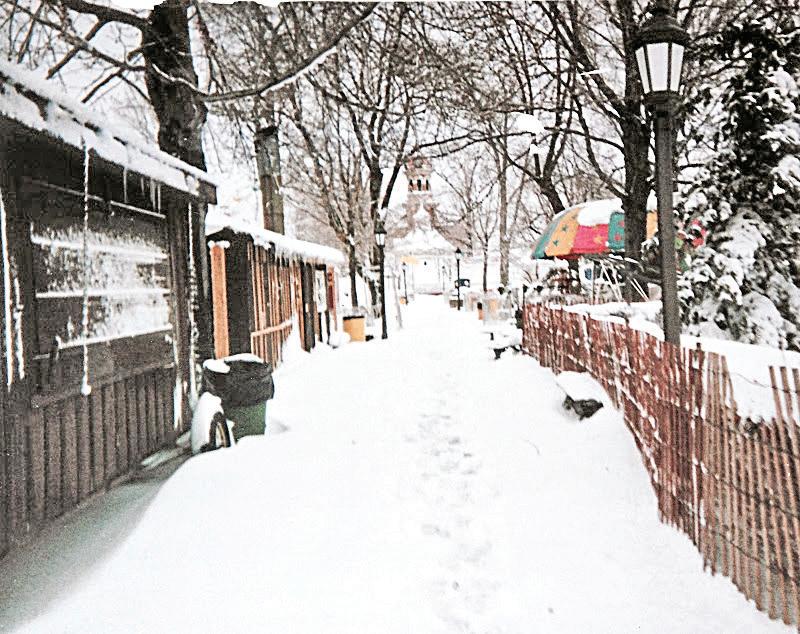
The Geauga County Maple Festival will officially become a centenarian this year, celebrating 100 years of bringing its sweet traditions and community spirit to the historic Chardon Square while giving a nod to its early days April 23-26.
Though this year represents the festival’s centennial, it is technically the 95th event. The festival was canceled for two years during World War II, once due to a poor syrup season and twice during the COVID-19 pandemic, said Maple Festival Director Jen Freeman.
“It was very barren early on,” she said, reflecting on the festival’s beginnings.
Early festivals featured historical syrup-making displays, music, oxen pulls, sheep-shearing contests, a twins contest, celebrations honoring couples married 50 years, a parade and maple stirs, she said.
“There wasn’t all the food and there wasn’t rides and all the stuff that goes on now,” she said. “It’s definitely evolved over the years.”
Some events, however, have remained constant, including the maple contest and lumberjack competition, which have been part of the festival since its inception, Freeman said.
“They used to just do basic cross-cutting and chopping and stuff like that,” she said.
There has always been some form of a pageant, Freeman said, while Entertainment Director Ron Spangenberg noted a syrup
See Festival • Page 4

from page 3
auction has also been a staple since the beginning.
The festival’s origins stem from a group of merchants who wanted their syrup to fetch a higher price, Freeman said.
“It brought folks to farmers, essentially,” she said. “Farmers could gather at one place up at the festival and sell syrup for a higher value and bring customers out to them.”
Organizers of the first festival expected a crowd of 2,000 to 3,000 people but were met with about 15,000 attendees, Spangenberg said.
“Then, they knew they had something,” he said. “And that’s why this festival is going all these years.”
Freeman credited volunteers and the community for sustaining the festival over the past century.
“There is something about the maple community,” she said. “It’s a tight-knit community, it’s well supported, even though there’s a bunch of people who make syrup, they’re not competitors, they work together for things, for the greater good.”
“We’ve lucked out with the volunteers. We’ve got just wonderful people,” Spangenberg added.
For many board members, involvement in the festival spans generations, Freeman said.
“Their parents and grandparents all were on the board, in syrup, and they grew up in that and they want to continue that tradition,” she said.
The festival also serves as an annual gathering for the community, Freeman said, noting many in the maple industry reconnect there each year.
“I’ve got a 12-year-old, he is crawling out of his seat, he doesn’t understand why they’re not setting up right now,” she said.
Many residents carry fond childhood memories of the event, Freeman said, recalling a local cashier who shared memories of
“I’ve attended most festivals since 1969. That’s when my family moved here,” Spangenberg said. “I have to say, it’s Chardon’s identity. Every year, every spring, the first festival of the year in Ohio happens in Chardon.”
As winter fades and warmer weather arrives, the festival offers a chance for people to get outdoors and gather, he said.
“I think that’s been the draw since the very beginning,” Spangenberg said.
This year’s festival will blend tradition with new additions and the return of past favorites, he said.
“We had a centennial committee going through all the festivals (in the) past to look for key notes,” Spangenberg said. “One of the things that came up was, in the beginning, there was a lot more stuff going on as far as contests.”
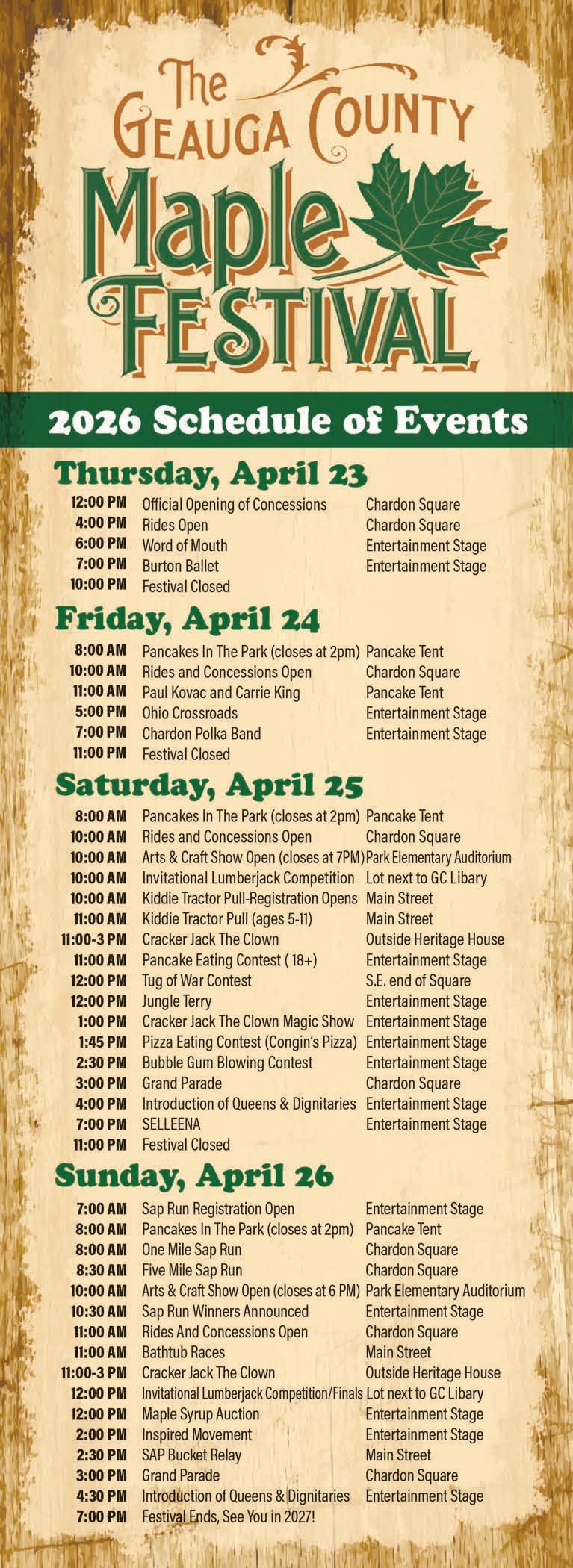
Among the returning events is a bubblegum blowing contest, which Freeman said she remembers from the 1980s. It is scheduled for 2:30 p.m. Saturday on the entertainment stage and will be open to children.
“That was a super fond memory of mine,” she said. “I encouraged that one to come back.”
Annual favorites such as pizza and pancake eating contests will also return, Spangenberg said.
New this year is a sap relay race, scheduled for 2:30 p.m. Sunday on Main Street, in which participants will run water from one end to the other, filling a sap bucket, Freeman said.
A scavenger hunt will also be held, with completed entries eligible for a prize drawing, she said.
The festival will feature a historical display by Jerry Tvergyak highlighting maple production in the region, Freeman added.
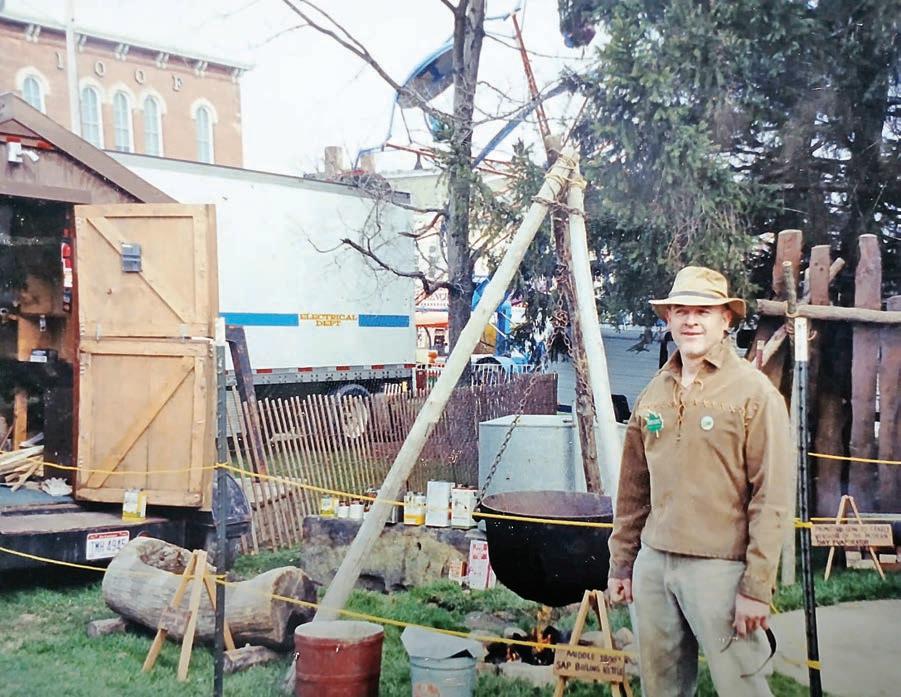
“People keep donating stuff to it if they find old stuff on their properties,” she said. “He’s got old sets of pans, he’s got an old cauldron there that he has a fire underneath, he shows the primitive method — which Native
See History • Page 5

from page 4
Americans would have used — where he heats up rocks and throws them into the liquid.”
In keeping with the festival’s 1920s theme, several musical acts will feature period-inspired performances, Spangenberg said.
Word of Mouth will open Thursday night with 1920s music. Paul Kovac and Carrie King will perform folk music Friday morning in the pancake tent. Friday evening will feature the Chardon Polka Band and bluegrass band Ohio Crossroads, which also plans to incorporate 1920s music, he said.
SELLEENA, a Pennsylvania-based band that frequently performs in the Cleveland area, will headline Saturday night, he added.
Burton-based clown Cracker Jack will
make his festival debut with a magic show Saturday afternoon and balloon-twisting on Saturday and Sunday, Spangenberg said.
Descendents of festival founder Art Carlson will serve as grand marshals of Saturday’s parade, Freeman said.
“Her daughter reached out to us and said who she was,” Freeman said, noting the family now lives in North Carolina. “And said that they’d love to come up for the 100th anniversary. They’re so excited to come up and do this.”
Returning staples include pancakes, maple stirs, live music, the parade, the lumberjack competition, kiddie tractor pulls and bathtub races, Freeman and Spangenberg said.
When asked what she is most excited about, Freeman replied, “All of it. The whole thing.”


By rose nemunAitis editor@kArlovecmediA com
The “Maple Syrup Capital of Ohio” will soon welcome the public to its historic Chardon Square’s for the annual Geauga County Maple Festival.
Behind the scenes, months of meticulous preparation ensure the event’s success.
The best of this year’s maple syrup was put to the test April 6 and 7 at Richards Maple Products in Chardon and will be auctioned on the final afternoon of the festival during the Blue-Ribbon Auction.
“This is one of the largest contests we’ve ever had,” contest Chairman Kevin Holy said. “We had over 150 total entries. There were 50 entries for the in-county producer class, and the remainder were out-of-county and hobby. The hobby class among the three grades is by far the largest we have ever seen.”
According to Geauga Soil and Water Conservation District’s “The Sustainable Sugarbush Conserving Ohio’s Sweetest Gift” booklet, sugar maple trees are among the longest-lived trees in the Northeast, serving as a testament to the festival’s deep-rooted tradition, local identity and natural bounty.
Each late winter and early spring, maple producers tap trees, collect sap and boil it down to create maple syrup and other products, according to the booklet. Syrup entries are judged in three color classifications — golden, amber and dark. Golden syrup is typically produced at the beginning of the season, while darker syrup develops later.
Judging the premier pours were members of the maple syrup judging committee:
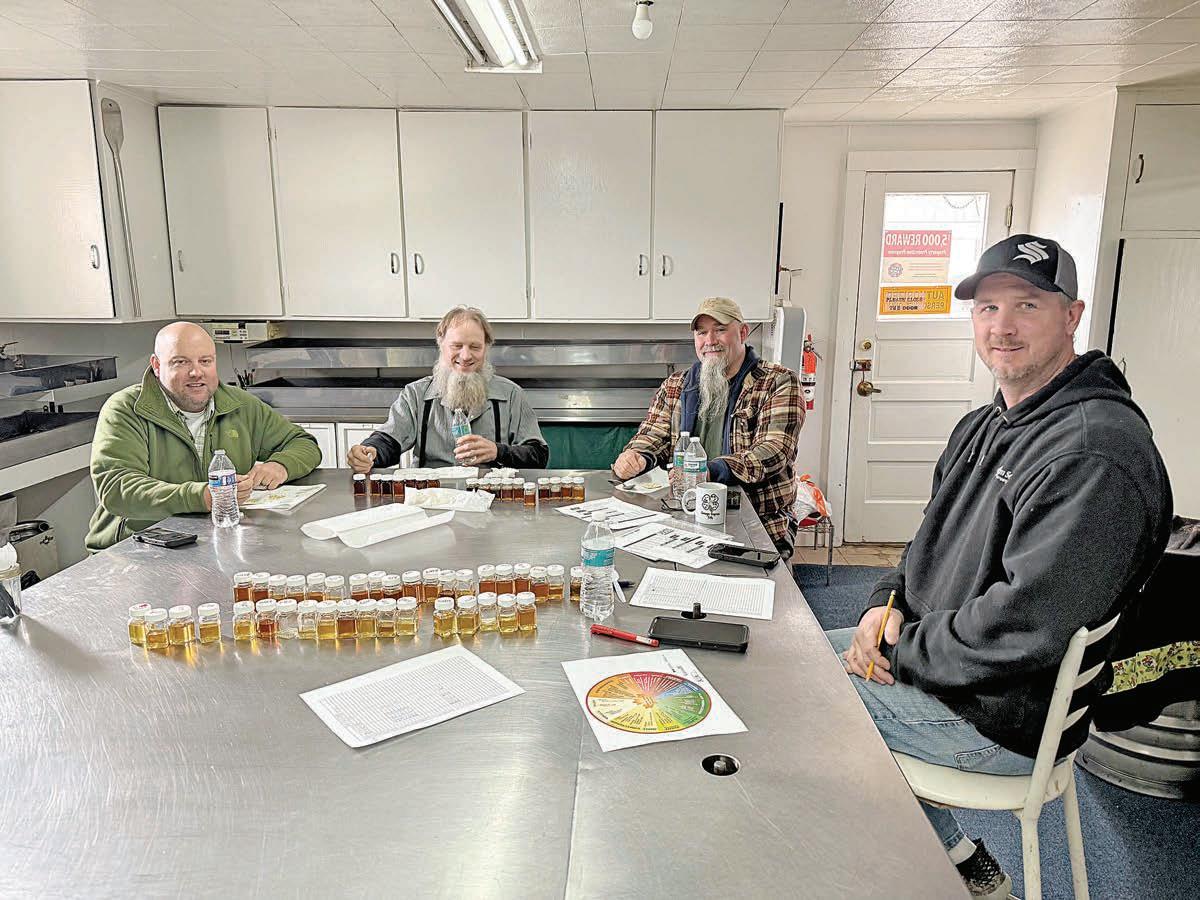
Miller, a 2018 inductee into the Maple Hall of Fame along with his wife, Linda, said the golden class stood out this year.
“There were many unique flavors this year in the contest, some were just better than others,” Rogish said. “The maple season had some big temperature swings, and I think that was represented in the syrup entries this year. A lot of hard work goes into producing maple syrup but at the end of the
Miller said overall, it was a solid season for maple sugaring.
According to Destination Geauga, Geauga County is the number one producer of maple products in the state.
“This year's maple syrup production countywide I would say was average at Seldom Seen Farm,” said Holy, owner of the farm. “We were above average and had a long season, tapping the first week in January and
some producers. We had a week of 70s which for maple syrup production, is less than ideal.
“The Blue-Ribbon Maple Syrup auction on Sunday is one of the best fundraisers for the maple festival, bringing in a lot of funds helping support the following year's festival,” he added. “The maple syrup contest and auction are also the key to the entire festival. I believe it helps people remember and be See Auction • Page 7

suBmitted
Even after Tax Day has passed, individuals and business owners who prepared their returns independently, whether using software or handling them manually, may find themselves second-guessing their filings. Questions about accuracy, missed deductions or compliance issues can create unnecessary stress.
A professional second review can provide clarity and peace of mind, and NMS Certified Public Accountants offers that reassurance, with convenient locations in Chardon, Mentor and Twinsburg.
NMS’s experienced team reviews completed tax returns to identify potential errors, uncover overlooked opportunities and ensure alignment with current tax laws. This post-filing service is especially valuable in a complex, ever-evolving tax environment, where even minor oversights can carry costly consequences.
A second look by a CPA firm is not simply about catching mistakes — it’s about optimizing outcomes. Tax codes change frequently, and deductions or credits may be missed by even diligent filers. NMS professionals bring a trained eye to each return, evaluating income reporting, filing status, deductions, credits and supporting documentation. If
from page 6
aware of why the festival began, it's a true celebration of maple.”
Holy said producers continue to improve their craft each year.
“It seems like every year they enter the contest, they learned one or two things that help them improve for the next year which in turn helps the producer make a better-quality maple syrup for the consumer,” Holy said. “I hope that people in Northeast Ohio realize how big and strong the maple community is in Geauga County. There are so many businesses that rely on maple syrup that keep our econo-
discrepancies are found, they guide clients through the amendment process efficiently and accurately.
For business owners, the stakes are often higher. Improper classifications, missed expenses or reporting inconsistencies can affect both short-term liabilities and long-term financial strategy. A post-filing review helps ensure returns meet compliance standards while supporting sound financial decision-making.
Seeking a second opinion after Tax Day is a proactive step, reflecting a commitment to financial accuracy and responsibility, not an admission of error. In some cases, amended returns may result in additional refunds or reduced liabilities; in others, they help prevent future audits or penalties by correcting issues early.
NMS Certified Public Accountants has built its reputation on personalized service, technical expertise and a client-focused approach. Whether reviewing a straightforward individual return or a complex business filing, their goal remains the same: accuracy, compliance and confidence.
If you’re still questioning whether your 2025 tax return was filed correctly, now is an ideal time to act. Learn more about post-filing review services at www.nms-cpa.com.
my thriving. Being that this is the centennial celebration of maple syrup and the Geauga County Maple Festival, my hope is that in 100 years, when we are all gone, the tradition will be continuing for a bicentennial celebration.
To help keep the maple festival thriving, we ask people to show their support Sunday at noon at the main stage for the auction.
As part of the sweet centennial, bidders will have 21 opportunities to take home some of Geauga County’s finest maple syrup, including the grand champion selection.
“Along with the syrup, the stir double bell and two of Bob Kolcum's hand-painted sap buckets will be up for auction,” Rogish said “These all will make excellent sweet centennial keepsakes.”




By les oBer
Whenever I would start complaining about the possibility of our maple season getting derailed for multiple reasons, my father would remind me, “Son you can make a lot of syrup in two weeks.” If he were alive today, I wonder what he would have thought of the volume of maple sap collected and syrup produced the first week of March 2026?
What made the 2026 season unique? First it was a season built on extreme cold weather and heavy snowfall. The season started later than previous seasons. The extreme cold froze the trees producing higher than normal sap sugar content. The extreme winter weather also produced above normal snow, providing adequate moisture for sap production.
vest what many are calling a bumper crop. Handling a large volume of sap in a short amount of time requires planning along with a little bit of luck with no breakdowns.
Another phenomenon that made this season unique was how quickly the temperatures went from below freezing to way above freezing. When you have multiple days above 50 degrees Fahrenheit and warm evenings, your maple trees begin to move toward bud break. This progression is measured by Growing Degree Days.

What really made this season unforgettable was the Maple Melt Down that followed.
The weather pattern that set up after the New Year launched a Polar Vortex resulting in severe cold and snow moving across the Great Lakes. The pattern continued until the end of February when advancing warm weather kicked off a major maple meltdown. This sets the stage for what could only be called a Sap Tsunami. The result was a flood run of unparalleled proportions.
The sap started flowing on the 26th of February; it ran for 36 to 48 hours straight without slowing down. The trees continued producing at a slower rate for another four days. Most of the producers had never experienced that kind of sap flow but were satisfied with the results. The big producers used their experience and their technology to har-
On March 1, the accumulated GDD was 15, in Burton. By March 13, we had accumulated 79 growing degree days. Silver Maples will break bud at 37 GDD and Red Maples will be fully budded at 48 GDD and Sugar Maples break bud at 114. Once the maple trees bud the season is over, but this often varies from one sugarbush to another. I cannot remember accumulating that many GDD’s in such a short amount of time this early in the season.
Even though the season started late and ended early, producers like James Miller in Middlefield Township made a half gallon of syrup per tap on 3,000 taps. Ray Gingerich in Ashtabula County produced a record 700 gallons of syrup in one run, for a single day personal best. His production on 18,000 taps surpassed 2025 season.
Down in Knox County Dan Brown said the season ended early but he was not disappointed.
The results are still coming in; most Ohio Producers were satisfied.
Les Ober is an OSU Extension Educator ANR Geauga County.








Breakfast foods like pancakes or French toast just aren’t the same without delicious maple syrup. Not all syrups in the grocery aisle are the same. In fact, some do not contain any maple at all. Pure maple syrup is a marvel of nature, and involves a multi-step process of getting this rich liquid from tree to table.
Sugar maple trees are the species responsible for producing the maple syrup consumers know and love. Alternative maple trees can be used, but industry experts say sugar maples produce the most flavorful syrups. According to the Massachusetts Maple Producers Association, maple syrup starts off as tree sap. Sugarmakers, as maple syrup producers are called, rely on a cultivated group of maple trees that they use for syrup, known as a sugarbush or maple orchard. This is where the syrup-making process begins.
Maple sap is mostly crystal clear water that is roughly 2 percent sugar. Sugarmakers visit the sugarbush in late winter/early spring for a sugaring season that lasts four to six weeks. The State of Vermont Pure Maple Syrup says a pattern of freezing and thawing temperatures — with below-freezing temperatures at night, followed by 40 to 45 F temperatures during the day — produces the requisite pressure within a tree to enable sap to flow when trees are tapped. It takes around 40 gallons of sap to make one gallon of maple syrup. Each sugar maple produces about 4 cups of syrup per tree, so sugarmak-
ers must gather as much sap as possible. The process begins with drilling a tap hole into each sugar maple tree. Then spouts are inserted into the holes to direct the sap into buckets or tubes that will deliver the sap to a collection tank at a sugar house or another collection area. According to Fort Rose Farm, a maple syrup farm in Canada, the sap is then placed into a reverse osmosis machine. It delivers pressure to pump the sap through a membrane to extract the sugar from the water in the sap. The sap then travels to an evaporator to boil off more water. As the water is removed, the product becomes thicker and more like syrup. The syrup is ready to draw off at 219 F, but it still needs to be filtered and potentially adjusted for density. It is then graded for flavor and color. Bascom, a maple syrup producer, says maple syrup made early in the season tends to be clear and have a delicate taste. As the season progresses, the syrup becomes darker and stronger in taste.
The MMPA says sap coming from the tree is approximately 98 percent water and 2 percent sugar. When the syrup is finished, it is only 33 percent water and 67 percent sugar. Maple syrup production is a labor of love, so a gallon of amber syrup generally retails between $35 to $45, states Bizfluent. Prices will vary depending on the grade of syrup and how well Mother Nature treated the trees that season.
Maple syrup is a product of nature. Although there is a short window of time for syrup production, the results are a sweet treat that makes breakfast, dessert and other meals that much more flavorful.

suBmitted
At Payne & Tompkins Design-Renovations, we don’t just remodel houses; we transform the way people live.
Our approach is rooted in a simple belief: a home should be a reflection of the people who live within its walls, crafted with a level of care that can only come from a team that treats every project as if it were their own.
What truly sets us apart isn't just the quality of our craftsmanship, but the heart behind it. We define our identity through Our Three Uniques:
Culture: Values | Family Atmosphere | Good people
PAYNE & TOMPKINS PROVEN PROCESS: Fit + Feasibility + Planning/Design + Creation = Great Spaces Good
DESIGN: Award-winning | In-house | Full-service design
We know that a major renovation can feel overwhelming. To ensure a seamless experience, we utilize the Payne & Tompkins Proven Process, a clear roadmap designed to eliminate stress and deliver stunning results: Fit + Feasibility + Planning/Design + Creation = Great Spaces. This formula ensures that we are the right partner for your needs, that your vision is structurally and financially viable and that every detail is meticulously planned. The result is consistently
"Great Spaces" that function as beautifully as they look.
Design is the "soul" of our work. As an award-winning, in-house, full-service design firm, we handle every aspect of the creative journey. Our clients benefit from a cohesive vision where designers and builders work side-by-side, ensuring that the "Creation" phase stays true to the original "Design."
Our work is fueled by a set of non-negotiable Core Values that dictate every decision we make:
Relentless in the pursuit of greatness: We never settle for "good enough."
Be authentic: We value honesty and transparency in every interaction.
We go together: We are a team, and we win or learn as one.
Committed to the client experience: Your peace of mind is our priority.
Build it like it’s your own: This is our gold standard for quality control.
When you choose Payne & Tompkins, you aren’t just hiring a contractor; you’re partnering with a team of dedicated professionals committed to bringing your dream home to life with passion, precision, and a personal touch.
Payne & Tompkins is located at 10690 Mayfield Road, Chardon, Ohio. To learn more, visit www.payne-tompkins.com.
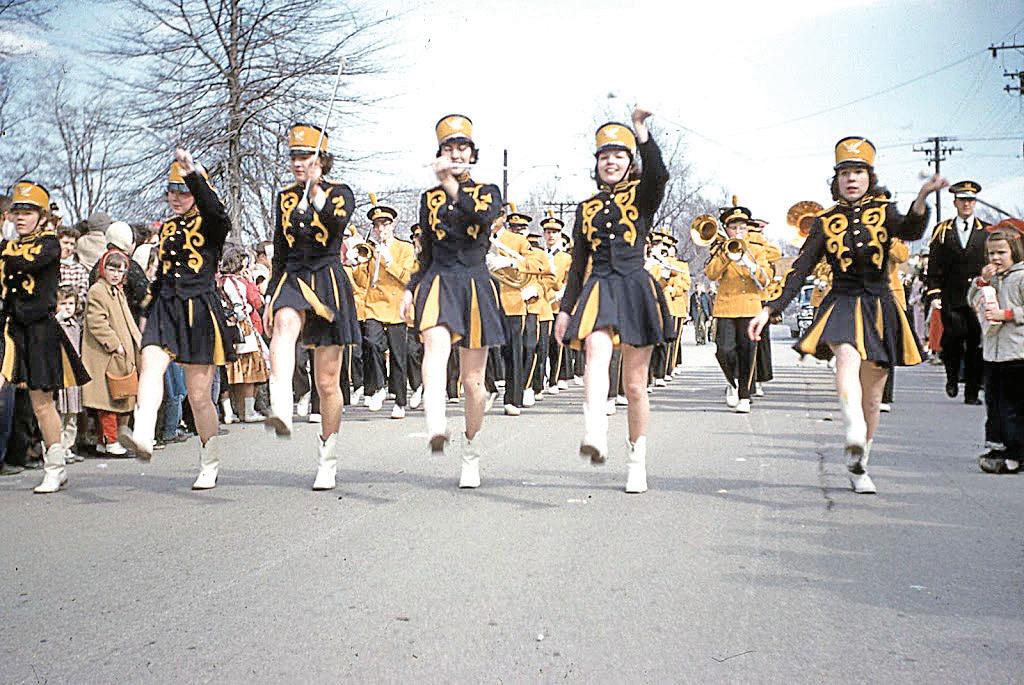
The Maple Festival features two Grand Parades on Saturday and Sunday at 3 p.m.
This year's theme is “A Sweet Centennial” as the first Maple Festival was held in 1926.
The parade showcases many local companies, city officials and other city groups.
The local high schools dance team and cheerleaders participate, as well as the King and Queen of the Maple Festival and other state festivals.
Most of the rides are not in operation during the parade.
Come line the streets of the square while those participating throw candy or other goodies to the crowd.
Saturday's Grand Marshal will be Gina and Junta Misch.
Sunday's Grand Marshal will be Katharine Huntley from 19 Action News.



By rose nemunAitis editor@kArlovecmediA com
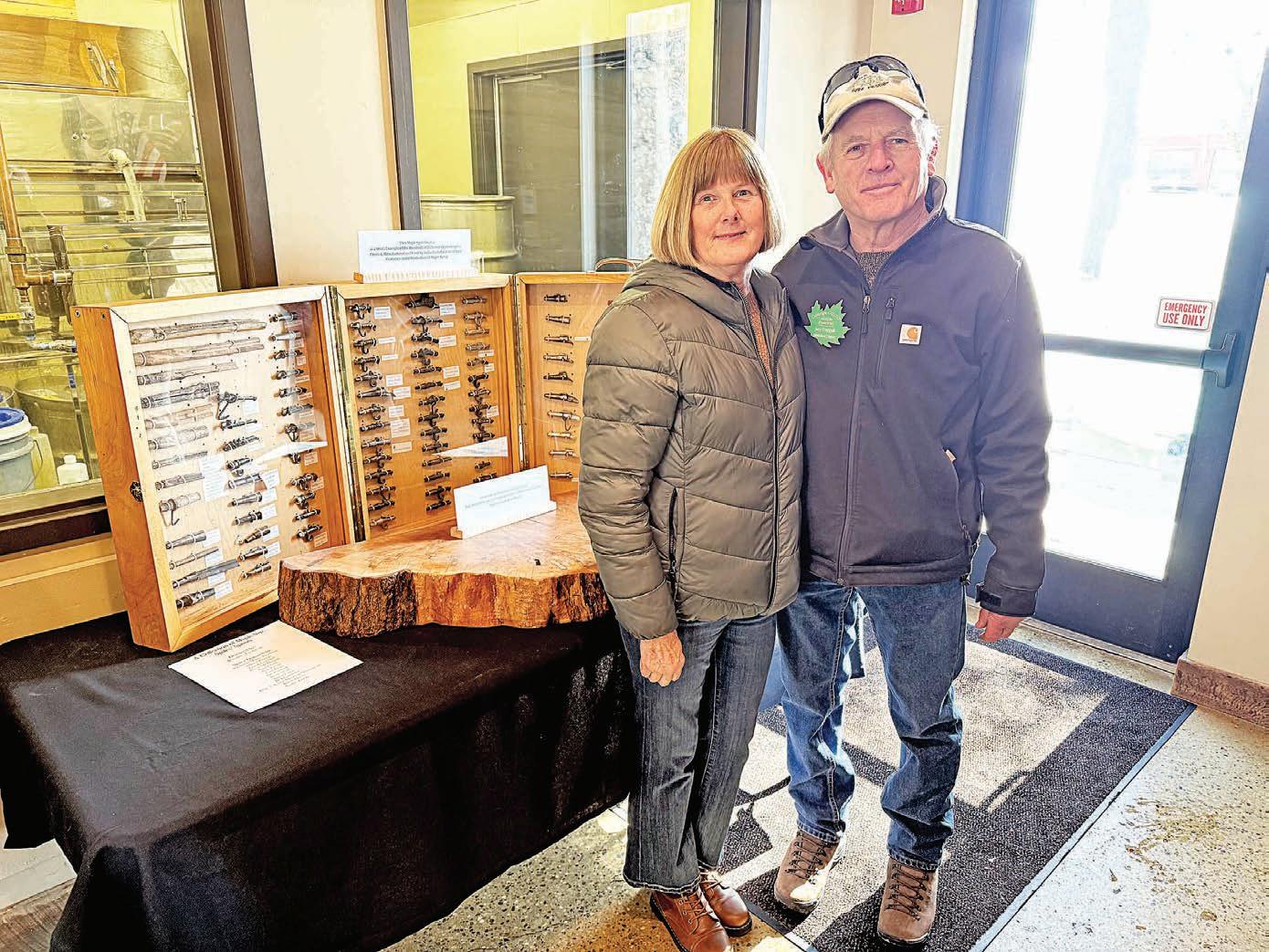
Chardon resident Jerry Tvergyak has de voted his life to preserving the history of ma ple sugaring in Geauga County and beyond.
His enduring legacy will be recognized with one of the industry’s highest honors as a 2026 inductee into the Maple County Produc ers Hall of Fame during the centennial cele bration of the Geauga County Maple Festival.
“To be selected from a list of very quali fied nominees, is quite an honor,” said Tver gyak, a lifelong Geauga County resident. “I also discovered that I was chosen by past maple hall of fame inductees, who are still liv ing. This, to me, is so extra special. Besides, being able to be a part of the celebration of the centennial of the Geauga County Maple Festival is wonderful. I am humbled after see ing so many great individuals who have been chosen before me.”
Tvergyak’s passion for maple sugaring began at an early age, rooted in family tradi tion. At just 7 years old, he watched his older brother, Mike, boil syrup on a flat pan in their backyard — a moment that sparked a lifelong enthusiasm for the craft.
“I am blessed to one of nine siblings who all live here in northeast Ohio,” Tvergyak said.
He now joins his brother, Mike, of Char don, who was inducted into the maple hall of fame in 2022. Both credit influential men tors, including Ed Soubusta and the Richards family, for shaping their knowledge and ap preciation of the craft.
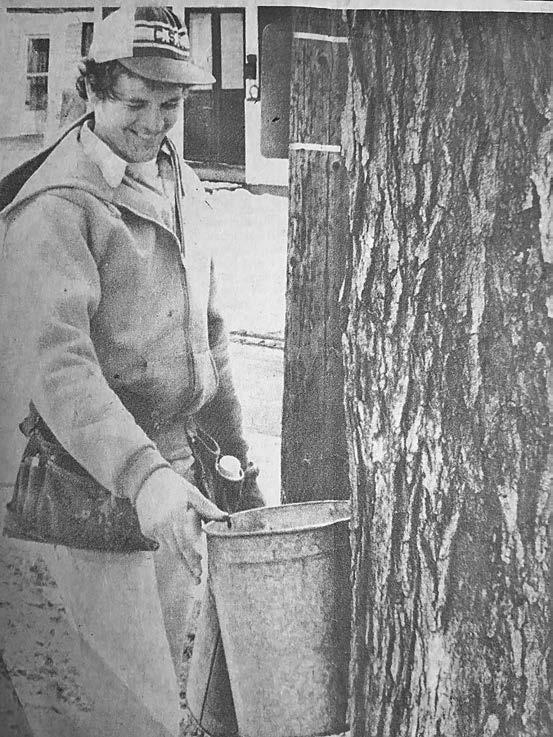
“I always remember Paul Richards carry

SUBMITTED
from page 12
Maple Products, the Geauga Park District, The Holden Arboretum, the Great Geauga County Fair and numerous maple-related initiatives.
In 2002, Tvergyak helped reestablish the maple history display at the Geauga County Maple Festival — now a popular attraction visited by thousands each year. The exhibit features his personal collection and festival memorabilia, offering visitors a glimpse into the region’s rich maple heritage.
“Being part of the preparation for the maple festival is always exciting,” Tvergyak said. “I have been involved with the maple festival for so many decades. The maple sugaring season just gets in your blood. I work with a great group of directors and committee people who are all dedicated to making this event special every year.”
He and his wife, Lisa, enjoy maple syrup year-round — on pancakes, French toast, scrambled eggs and even in beverages.
Tvergyak is also a proud stepfather of three children who grew up in Chardon attending the maple festival. Today, they, along with their spouses and eight grandchildren, continue the tradition of returning each year.
“I would not trade any of my huge family for the world,” Tvergyak said. “Eleven family members are also involved with the Geauga County Maple Festival in various roles.”
Tvergyak said maple sugaring represents something deeply rooted in American history. “It is also a 100% pure natural product discovered by the Native Americans,” he said. “How more appropriate, then, to celebrate this tradition, especially during the centennial of the Geauga County Maple Festival and the 250th anniversary of the United States of America.”


He said he is especially looking forward to connecting with visitors during the festival.
“Lisa and I will be at the history display every day from Thursday through Sunday,” Tvergyak said. “I feel privileged to have had and to continue to have the opportunity to educate and enlighten thousands of visitors at the Geauga County Maple Festival and Northeast Ohio Syrup Producers Association building at The Great Geauga County Fair, on the history of maple sugaring. It is such a passion of mine. I am honored to be selected as the Geauga County Maple Producers Hall of Fame Class of 2026.”




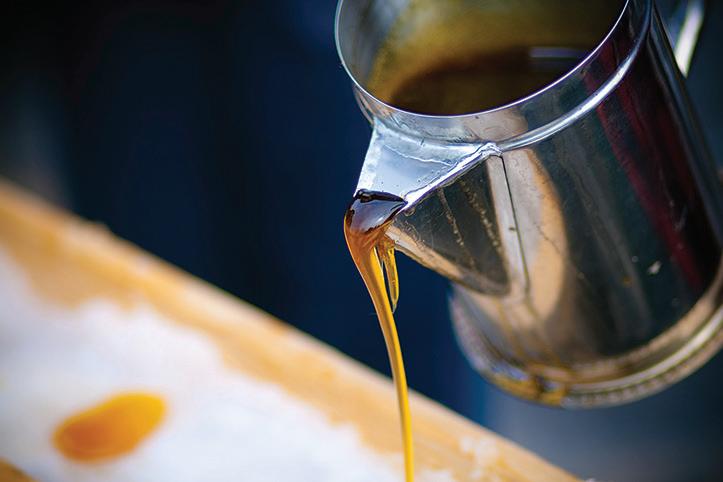
Maple syrup is the sweet nectar of maple trees. Legend has it that maple syrup was first discovered centuries ago by Native Americans during a time when food was scarce. Native Americans, as the legend goes, noticed a squirrel drinking “water” from a maple tree, and that squirrel had a lot of energy. They determined that this substance was the source of the squirrel’s good health and began to rely on what would later come to be known as maple syrup.
Maple syrup is no longer categorized as a beverage, but there is much to learn about this popular pancake topping. The following facts can shed a little more light on maple syrup.
Maple syrup has some nutritional value
Although it may seem like a sweetener, maple syrup is rich in the mineral manganese, which promotes healthy bones and connective tissue. Maple syrup also contains riboflavin and calcium.
Perhaps healthier than honey
When stacked up against honey, maple syrup may be the superior sweetener. It has fewer calories per serving, fewer carbohydrates, less sugar, more calcium, and a lower glycemic index, according to Maple from Canada. For those concerned about nutrition,
maple syrup may be a better option than honey when consumed in moderation.
Maple syrup comes in different colors
There are four grades of color for maple syrup that also are known as classifications: golden, amber, dark, and very dark. The colors develop as the maple harvesting season progresses. Golden syrup is produced from the sap collected at the very beginning of the season. Dark maple syrup is produced later and very dark comes last.
Only three trees give maple sap
While there are many different types of maple trees, only the red maple, black maple and the sugar maple trees provide the maple sap (water) that is required for the production of maple syrup. Frigid temperatures followed by springtime conditions help the sap in these trees to flow, says Maple from Canada. Therefore, maple syrup is produced exclusively in places where these trees thrive.
40 to 1 ratio
It takes 40 gallons of maple sap to make a single gallon of maple syrup. Often it takes three healthy maple trees to produce that gallon. Is it any wonder that maple syrup is so coveted?


Courtesy of Maple Producers of NE Ohio
Maple syrup is healthy for you!
Pure maple syrup is high in antioxidants! It’s also full of minerals like riboflavin, zinc, magnesium, calcium and potassium. Only 52 calories per tablespoon!
Are the Trees Hurt by Tapping Them?
No, while there is a small hole where spile is inserted; the trees are resilient and heal very quickly. Many producers use the same trees for decades!
Through the year, maples convert starch into sugar. The sugar mixes with water absorbed by the tree roots. Cold nights make the tree suck the sap upwards. The warmth in the day lets the tree release the sap - the sap flows down and comes out of the tap.
It takes approximately 40 gallons of sap to make 1 gallon of maple syrup! The sap that comes out of the maple tree is made up of water and sugar. The sugar is much lower than the water. When the syrup producers boil, they are boiling the water out of the sap and leaving the sweet maple sugar!
Maple Grades
Maple syrup has four different grades. Try them all to see what you like the best!
Golden Maple Syrup with a Delicate Taste
Pure maple syrup in this class has a light to more pronounced golden color and a deli-
cate or mild taste. It is the product of choice if you prefer a lighter colored maple syrup with a delicate or mild taste.
Amber Maple Syrup with a Rich Taste
Pure maple syrup in this class has a light amber color and a rich or full-bodied taste. It is the product of choice for prefer sweet rich flavor.
Dark Maple Syrup with Robust Taste Color
Pure maple syrup in this class has a dark color and a more robust or stronger taste than syrup in lighter color classes. Hearty robust flavor.
Very Dark Syrup with a Strong Taste Color
Maple syrup in this class has a very strong taste. It is generally recommended for cooking purposes but some may prefer it for table use.
There are many different kinds of trees in the forest, but the sweetest tree is the sugar maple. The sap from this tree is used to make pure maple syrup. Sugar maple trees are unique to North America and grow naturally only in the northeastern United States and southeastern Canada.
The traditional season to make maple syrup in NE Ohio extends from early February until late March. This is called “the sugaring season”. Freezing nights and warm, sunny days are necessary for the maple tree to yield sap, a colorless liquid with a light, sweet taste (2%-4% sugar). Maple syrup producers, also referred to as sugarmakers, collect this maple sap, and through boiling, the maple taste and amber color are formed
100% pure NE Ohio Maple Syrup is the finest, most wholesome maple syrup there is!


By rose nemunAitis editor@kArlovecmediA com
A momentous celebration in Geauga County is about to begin, marking a century of treasured tradition filled with love, laughter and maple syrup in the heart of Chardon Square.
One of the most anticipated and long-standing customs during the four-day Geauga County Maple Festival is the auction of local artist Bob Kolcum’s hand-painted sap buckets during the Blue-Ribbon Auction on the entertainment stage April 26.
Kolcum, of Hambden Township, has been creating painted visual historical narratives for the festival for nearly 30 years. Each of his collectible pieces tells a timeless story, evoking maple sugaring nostalgia while remaining meaningful to each new generation.
“It has been a great honor and privilege to be part of Geauga County’s and the maple festival history,” Kolcum said.
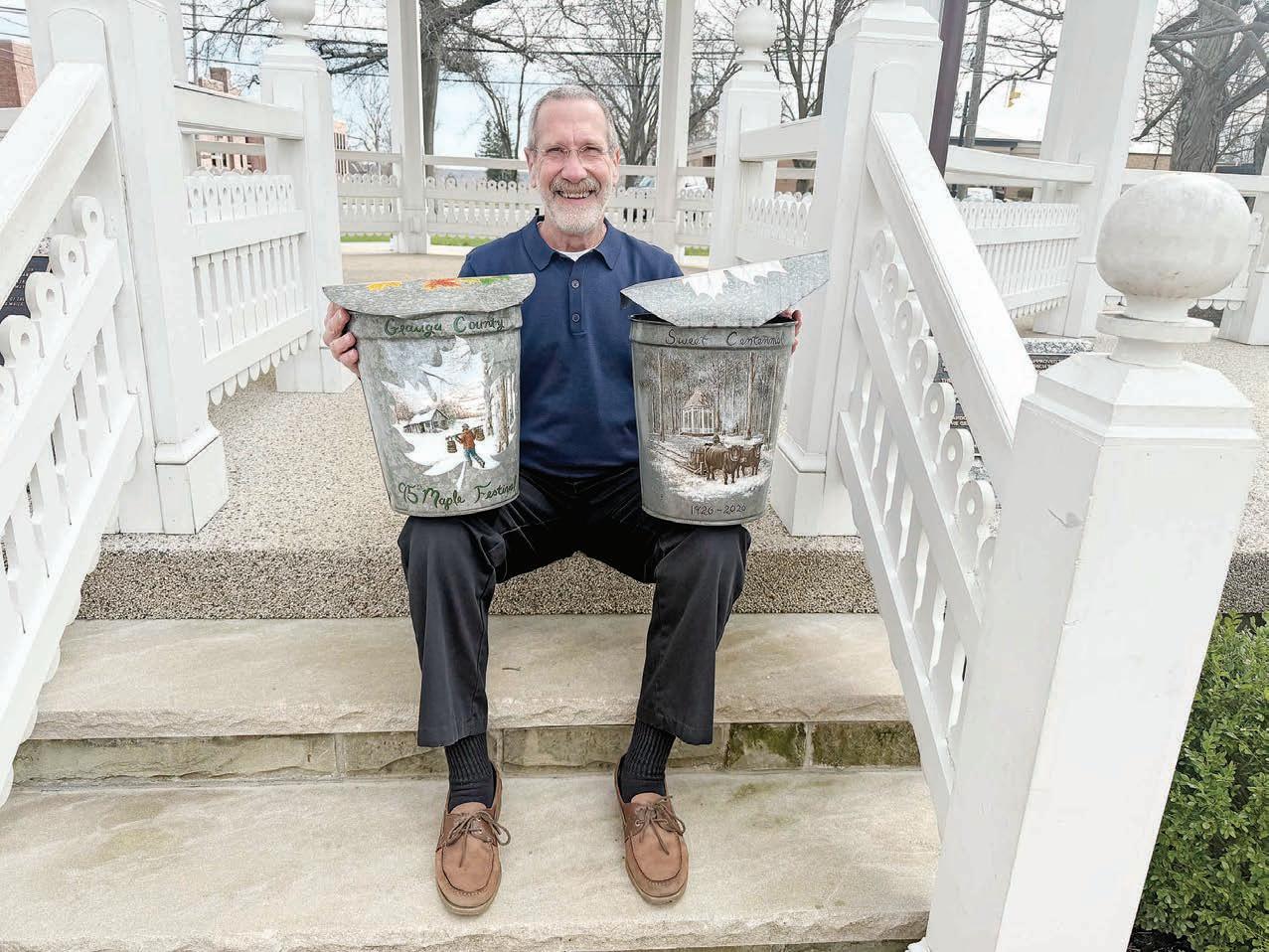
The artist created two sap buckets for 2026.
This year’s Ceremonial Tapping Bucket for the 95th festival depicts an earlier method of sap collection, showing three men working a sugarbush, gathering sap hauling it manually in large wooden buckets.
“This scene is also done in the shape of a maple leaf, to make this year’s 95th commemorative bucket a little more special than other years,” Kolcum said.
The Centennial Bucket commemorates the first Geauga County Maple Festival, held in 1926. The festival paused during World War II and the COVID-19 pandemic, but is
still honoring a century since its inception this year.
“This bucket depicts a scene on Chardon Square, which I did monochromatically in browns to give it an antique look,” Kolcum said. “It shows the old bandstand, a man boil ing sap the original way, in a large open kettle and an oxen team used to pull the collecting sled.”
Early painted sap buckets were simple copper vessels featuring serene scenes of a sugarhouse and a tapped tree.
“They would sell for hundreds of dollars until the 75th bucket sold for $1,000 (pur chased by Joe Bolan, a builder in the coun ty),” Kolcum said. “I then started painting more involved scenes to keep the demand up. I started adding horse teams that were used to collect sap and adding some local wildlife. This kept them selling for $1,000s until the 90th, which sold for a record $8,000 (Purchased by former Osso’s restaurant). Hopefully again this year, we have more gen erous people who are ready to help the maple festival’s functions in the future.”
Kolcum said he enjoys supporting the fes tival and preserving its traditions through his work.
“It’s an honor to be part of this yearly tradition in Geauga County and to be a part of the 100th ceremony is an added bonus,” Kolcum said. “I hope to be doing the buckets when we celebrate the (actual) 100th maple festival in five years.”
He also reflected on the county’s rich his tory.
“Geauga County has a lot of local and
See Artist • Page 17

stAff report
Nestled in the heart of Geauga County, Mary Yoder’s Amish Kitchen has long been a place where friends, families and neighbors gather around the table to enjoy hearty meals and genuine hospitality.
Known for its welcoming atmosphere and comforting, home-style cooking, Mary Yoder’s offers guests a chance to slow down, connect and savor traditions that have been passed down through generations.
A highlight for many visitors is the opportunity to enjoy real maple syrup served upon request with breakfast favorites. Whether poured over fluffy pancakes, golden waffles or French toast, it’s a simple touch that brings a true taste of the season to the table.
Mary Yoder’s is perhaps best known for its Breakfast Buffet and All-You-Can-Eat Amish Dinner Buffet, both filled with comfort food favorites such as sausage gravy and biscuits, broasted chicken and mashed potatoes. Guests can enjoy everything from farm-fresh eggs and crispy bacon in the morning to
from page 16
national history, from the Underground Railroad, The Union Chapel, to then-Sen. John F. Kennedy making an appearance at the maple festival — and to have a legacy in that is beyond words,” Kolcum said.
Kolcum fondly recalled attending the festival on opening day as a child in the 1960s, when it cost 25 cents to test the rides.
“Also, I pushed in the bathtub races, with the county auditor, at that time, Tracy Jemison, who sponsored a tub used to push, back before high school athletes were recruited to push,” Kolcum said. “It’s not easy.”
Looking back, Kolcum said he never imagined he would play a role in the festival’s
homestyle dishes served throughout the day. No visit would be complete without stopping by the bakery. From cream pies to fruit-filled favorites, Mary Yoder’s pies have become a signature staple, drawing visitors from all over. Alongside the bakery, the gift shop offers a charming selection of home décor, locally inspired goods and seasonal items, perfect for taking a little piece of Amish Country home.
Open Monday through Thursday from 6 a.m. to 7 p.m., and Friday and Saturday from 6 a.m. to 8 p.m., Mary Yoder’s welcomes guests throughout the week for breakfast, lunch and dinner.
On the last Saturday of each month, the restaurant also hosts a popular Steak Night, featuring a 14 oz. ribeye steak served with a baked potato and side salad for $31.99.
Whether you’re visiting for the Maple Festival or simply passing through, Mary Yoder’s Amish Kitchen offers more than just a meal, it offers a place to gather, share and enjoy the simple comforts of good food and warm company.
centennial celebration.
“Bob Kolcum has always done an excellent job hand painting the ceremonial tapping Sunday sap buckets,” auction emcee Bob Rogish said. “This year’s bucket, along with the sweet centennial bucket he painted, will have a great historical meaning as we celebrate a century since the first Geauga County Maple Festival.”
The annual maple syrup auction, held at noon Sunday at the entertainment stage, gives bidders the chance to take home top-quality Geauga County maple syrup bottled in commemorative jars bearing the Sweet Centennial logo.
From the Centennial Bucket and Ceremonial Tapping Bucket to the stir double bell and grand champion syrup, bidders will have the opportunity to bring home a lasting piece of festival history.



Maple syrup is a sugary staple of breakfast foods and desserts made primarily from the sap of the sugar maple species of maple trees. Syrup production involves a process of tapping the trees, collecting the sap, evaporating the water, and filtering the syrup to the final product. Maple syrup production is de pendent on nature and the weather during the sugaring season, which is why maple syrups vary in color and taste. Maple syrup made early in the season is generally light in color and more deli cate in flavor. Maple syr up made towards the end of the season is dark and rich. These disparities are why syrups are categorized into “grades.”
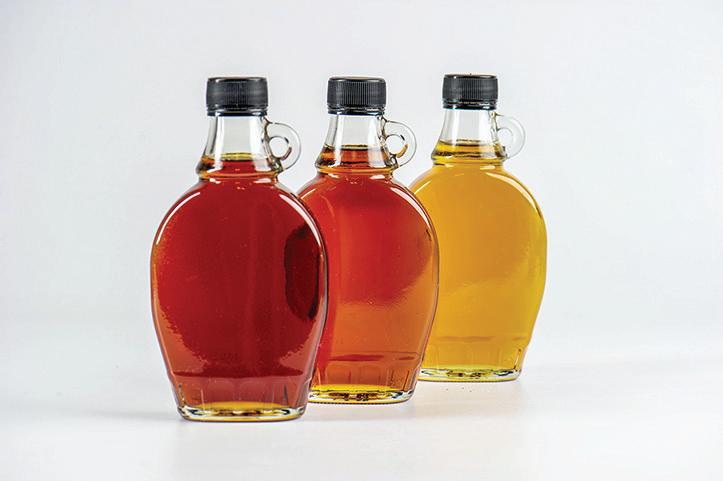
Before 2014, pure maple syrup was graded using three letters: A (light), B (dark) and C (very dark). Perhaps stemming from the grading system used in schools, people mistakenly thought A syrup was of better quality than C syrup. However, the only differences

in maple syrup grades came down to color and taste — the quality and purity was identical across the grades. Therefore, Vermont, the state that produces the most maple syrup in the United States, adopted less confusing guidelines for maple syrup grading. All syrups would be lettered “A,” but more descriptive coloring names and flavors would be added. This system eventually was adopted by the USDA in 2015 and across Canada, and is as follows:
• Grade A Golden Color/Delicate Taste Maple
• Grade A Amber Color/Rich Taste Maple
• Grade A Dark Color/ Robust Taste Maple Syrup
• Grade A Very Dark Color/Strong Taste Maple Syrup
The lighter the color and flavor the more ideal for pancakes, waffles and ice cream toppings. Grade A Dark Color lends itself to meat glazes, cookies and brewing. The darkest grade is usually reserved for commercial manufacturing purposes, such as in baked goods and sauces.
Eating contests return to the Maple Festival.
Think you've got what it takes? It’s time to loosen those belts and bring your appetite because our Pancake and Pizza Eating Contest is back at the Maple Festival.
Warning: Things may get messy … and competitive really quick.
The festival is looking for the bravest (and hungriest) participants to take on stacks of pancakes and slices of pizza for ultimate bragging rights.
Sign-ups are first come, first serve an hour before each event.
Limited spots available. Once they're gone, they're gone.
Visit the Maple Festival's website to sign the waiver, view the rules.
Saturday 11 a.m. for pancakes. Saturday 1:45 p.m. for pizza.

ohio mAple producers AssociAtion
North America is the only place in the world that maple syrup is produced. In the United States there are 12 maple producing states and each year Ohio is ranked 4th or 5th in maple production. The maple industry contributes $5 million to the state’s economy each year. In 1840 Ohio was the largest maple producing state, as recorded by the U.S. Agricultural Census.
Some additional interesting facts about Ohio maple:
• Approximately 100,000 gallons are produced each year by 900 producers.
• There is room for growth: Ohio’s demand for maple products is currently greater than the state’s production.
• During the Civil War, maple sugar was
used by the abolitionists in Ohio to protest cane sugar produced by slave labor in the South.
• Ohio’s maple syrup is a “Super Food” that has many health benefits naturally provided by antioxidants, minerals and vitamins.
•The Lifesaver was originally sweetened with maple sugar created in Garrettsville, OH.
How did the maple industry get its start? Interestingly, maple production is one of the few agricultural activities not brought to the Americas by European settlers. Native Americans are widely recognized as the first to discover the sweet stuff dripping from broken branches of cuts in the bark. The sweet sap was boiled down in hollowed out logs by placing hot rocks into the sugary solution.




If you’ve visited Chardon Square, you’ve likely seen the steam rising from the Her itage House — and Robert Freeman is the man behind the evaporator.
As the official maple producer of the Geauga County Maple Festival, Robert holds the unique distinction of being the only per son making and producing syrup right here in the heart of the festival and good Ole Chardon Square.
For Robert, maple isn’t just a seasonal hobby — it’s a lifelong calling. He has been producing syrup on the Square since 1993, following in the footsteps of his father, Jim Freeman.
In a testament to their mastery of the craft, both Robert and Jim have been induct ed into the Maple Hall of Fame, with Robert receiving the honor in 2020.
Robert’s dedication to the industry is unmatched. He has held every single board position for the Maple Festival and remains one of the most passionate advocates for our local history.
By t he Numbers:
• 100 percent local: Every drop of sap is sourced right here in Geauga County.
• Family Owned: A proud family-operat ed business built on heritage.
• The Operation: Managing 50 acres of woods with a 4,250-tap tubing system.
Making syr up is truly in Robert’s blood.
When you stop by their booth during the festival this year or get a maple stir, you ar en’t just getting a bottle of syrup or an ordi
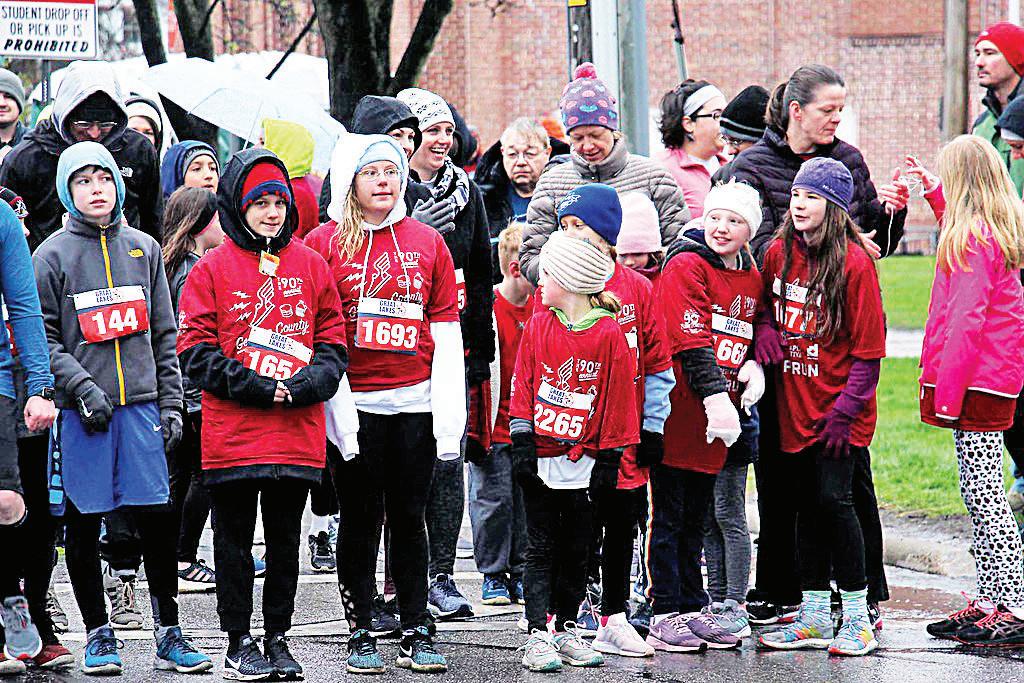
The Sap Run is a highlight of the local festival, attracting participants of all ages
The Sunday event begins at 8 a.m. for the 1-Mile run and 8:30 a.m. for the 5-Mile
Pre-registration is $30 for the 5 and $15
You can register the morning of the event at the Main Stage.
This exciting event promotes community health and camaraderie while celebrating the spirit of the festival.
Event Highlights:
Race Options: Participants can choose between a family-friendly 1-Mile fun run or a more challenging 5-Mile race, catering to both casual runners and seasoned athletes.
Scenic Route: The courses wind through picturesque local landscapes, providing a
beautiful backdrop for the run and showcasing the charm of the community.
Community Involvement: Runners often participate in teams, encouraging friendly competition and support among friends, families, and coworkers.
Post-Race Festivities: After the races, participants and spectators can enjoy food, entertainment, and activities at the festival, making it a full day of fun.
Awards Ceremony: Prizes are awarded to the top finishers in various age categories, along with medals for all participants, fostering a sense of achievement. Awards are given at the Chardon Smile Center Main Stage on Main Street after the races are complete!
Sponsored by DBC Remodeling & Construction, Junction Auto Family, Chardon Smile Center, Western Reserve Hone and Pella Windows & Doors.

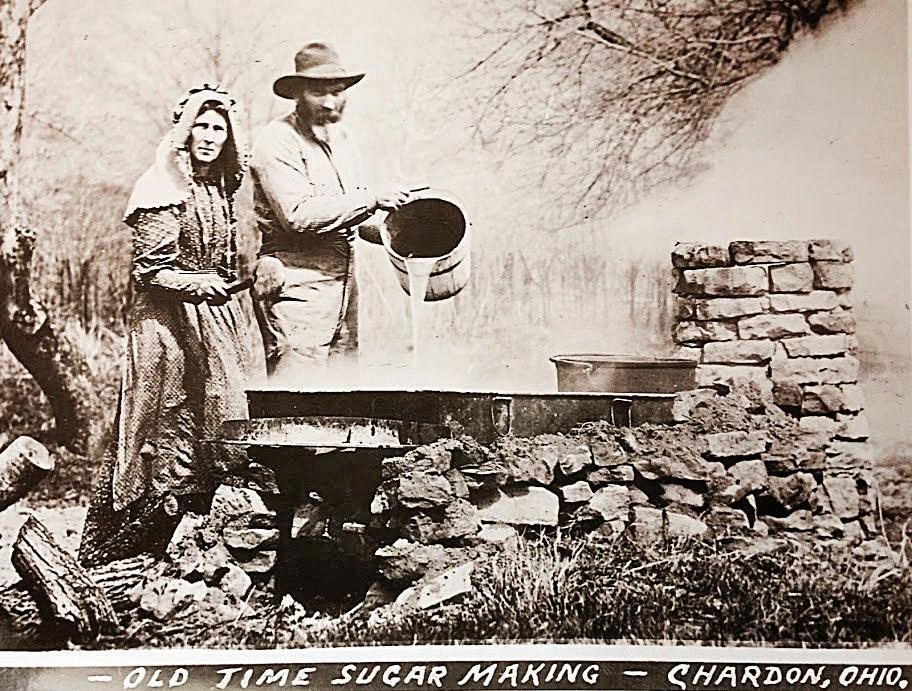
The Maple Festival was founded in 1926 in an attempt to market Ohio syrup in competition with Vermont syrup, and now this traditional sweet soiree hosts the largest maple contest in the state of Ohio.
The festival was the idea of Art Carlson, a local merchant on Chardon square, who wanted to increase awareness — and the price — of Geauga’s maple syrup. At the time, maple syrup sold for 50 cents a gallon.
When Carlson told some friends about his idea they started planning the first Geauga
County Maple Festival.
The Geauga County News announced that Chardon was going to “treat the general public to a good old fashioned maple sugar eat.”
The event featured free dishes of maple syrup, a sugar camp, tapped trees, a maple products display and ox team gathering sap.
Festival planners expected 5,000 visitors and worried over the April ice storm. Over 15,000 people attended, and now the festival is an annual tradition.

The maple tree can be referred to as the King of the Forest. Maple trees can grow just about anywhere in the world but the King rules around the Great Lakes and eastern Canada. It is here that it provides a unique, truly American product, maple syrup.
In the fall the maple tree, along with other hardwoods, bursts into an explosion of color. The leaves on the trees become brilliant red, soft yellow or vibrant orange. Slowly the leaves fall and winter arrives. With the arrival of spring, magic starts in the tree.
The maple tree is an amazing natural sugar making factory. In a simple explanation, the tree uses energy from the sun – solar energy – to make a sweet, watery liquid called sap. Sugar mixes with water that the tree’s roots have absorbed from the ground to make the sap.
This sap flows through the tree and feeds it and helps it to grow and stay healthy. This process stops in the fall but begins again in
the spring when the sap begins flowing once more.
There are many kinds of maple trees, but the sugar maple produces the most sap. There are other high sap producing maples include the black maple, red maple and silver maple. Maple trees produce sweeter sap than other trees, and there is more of it and it runs for longer periods of time. This is where the warm days and cold nights of spring help in the process.
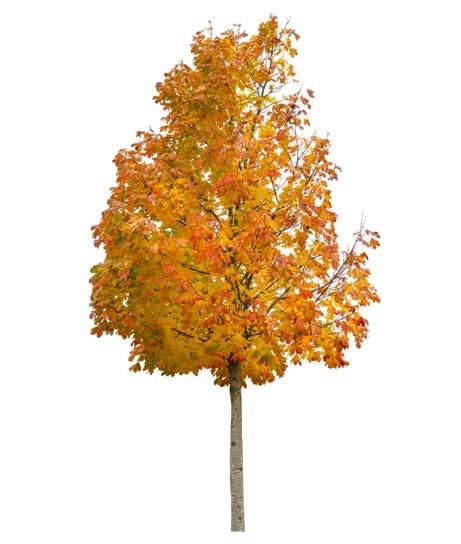
It takes about forty to eighty years for a maple tree to grow big enough to be tapped for sap collection. The size of the trunk determines the number of taps that will be made to keep the tree healthy.
So the next time you take a walk in the woods look up and see the maple tree spread out protecting you. Enjoy the lovely colors of fall knowing that when it awakens in the spring it will be busy making you maple syrup.
• Before returning maple syrup to the refrigerator, rinse the cap in hot water and wipe the top of the jug so the cap will be easier to remove the next time.
• Maple syrup can be stored in the freezer for long lengths of time. Put in clean container and seal tightly.
• Should maple syrup develop a bit of mold in the top, remove the mold and bring the syrup to a boil. Put in clean container and seal tightly.
• When substituting maple syrup for sugar in cooking, use only three-fourths the amount of maple syrup as sugar in the recipe.
• Warm it up! To make your maple syrup go farther on pancakes, warm the syrup up first so it thins out. Heat syrup in a saucepan over low heat, and then spoon it out. You can also warm in the microwave on high for 30 to
60 seconds.
• It doesn’t hurt to have a “special” pitcher to use when enjoying syrup on your food. They can add a splash of color to the table setting and make a routine breakfast special.
• Maple syrup can be added to grits, steel-cut oats or any breakfast cereal.
• Besides tasting good, pure maple syrup offers some nutritional benefits. It has only about 50 calories per tablespoon, it contains calcium, potassium, magnesium, manganese, phosphorus and iron. It also has trace amounts of B2 (riboflavin), B5 (pantothenic acid), niacin and folic acid. What it does not contain is cholesterol.
• Maple syrup has a way of bringing out the best in meats. To enhance the flavor, add maple syrup to glaze used on ham, pork, chicken or fish.



By BrAndon lichtinger editor@kArlovecmediA com
The Maple Producers of NE Ohio hosted their first workshop April 11 on grading maple syrup, inviting local producers to learn how to improve quality and identify off-flavors.
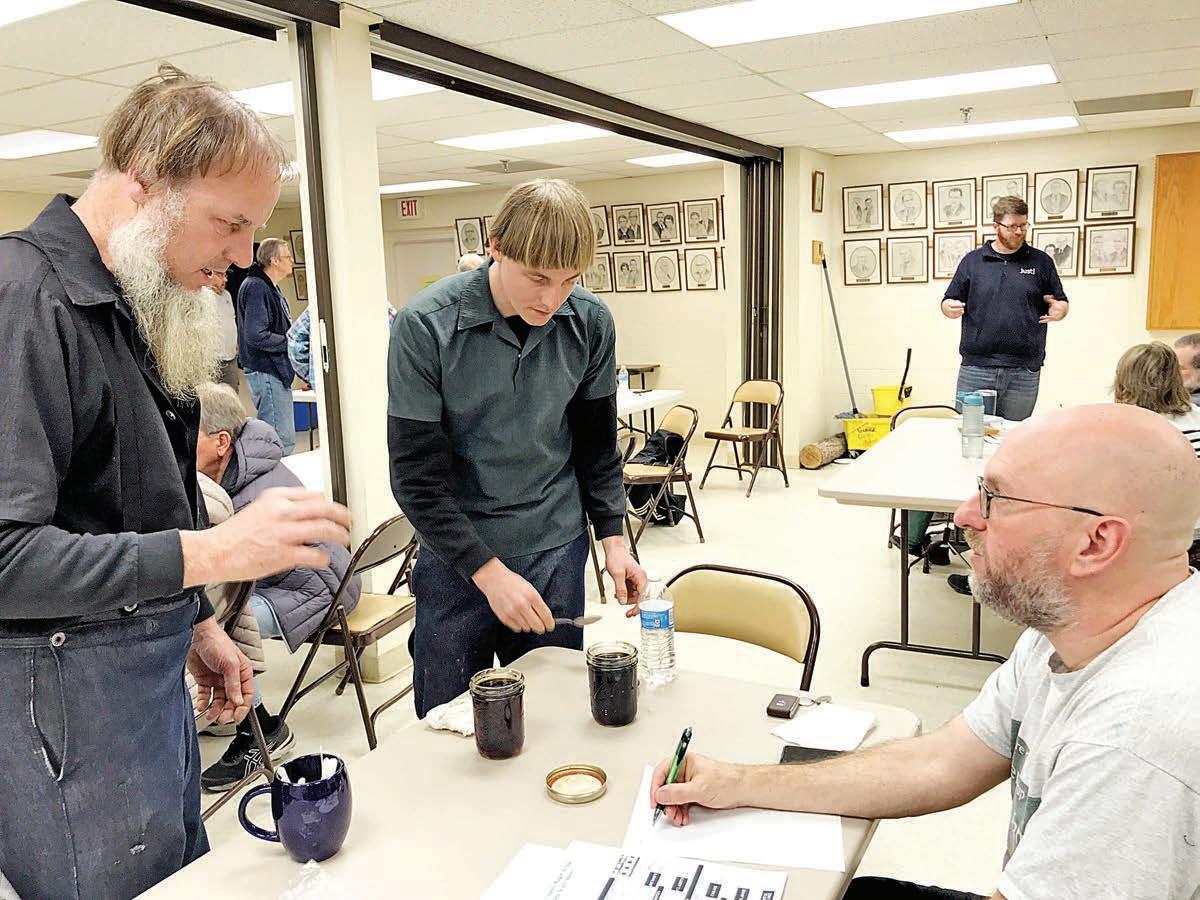
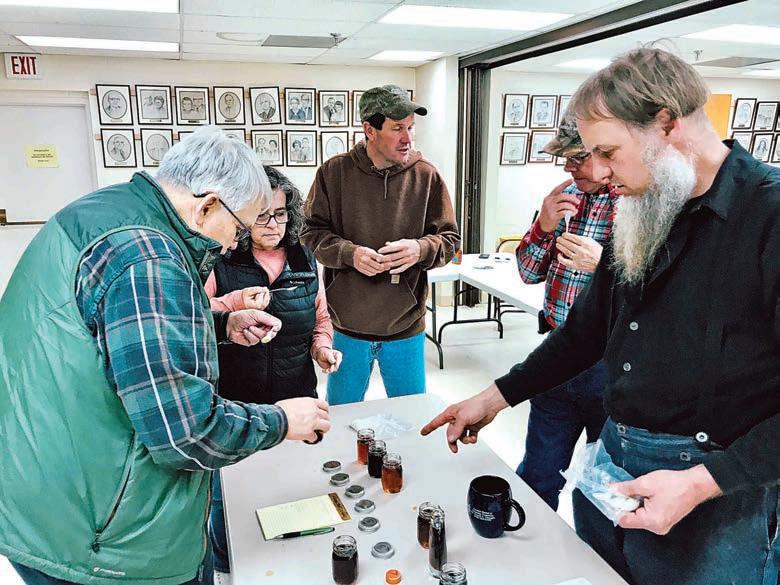
Titled “Making the Grade: A Guide to Making Quality Syrup,” the session was held in the Patterson Center basement at the Geauga County Fairgrounds, where MPNEO members shared tips for maple syrup tasting and assessing to producers of all experience levels. Attendees were encouraged to bring half-pint samples of their syrup for evaluation.
About 20 participants from the area — ranging from neophytes to seasoned producers — attended, including individuals who have judged syrup at events such as the Geauga County Maple Festival and The Great Geauga County Fair.
MPNEO President Tom Salo welcomed the group and explained the motivation behind the workshop.
“This is our first year doing this,” Salo said. “We’ve done confection classes and ‘Maple 101’in the past, a few of us judge here and we got into a lot of off-flavor syrups (while judging syrup). Today, we’ll get into how some of those flavors come around.”
Salo emphasized the importance of collaboration among producers.
“The hard part is when you’re making it yourself, you’re not tasting anybody else’s
See Workshop • Page 25
syrup. You’re tasting only your own,” explained Salo. “When you start tasting other people’s syrups, and it’s like, ‘Oh wow, this is different!’”
MPNEO Secretary Dave Gauch said education and connection are central to the group’s mission.
“The mission of Maple Producers of NE Ohio is primarily education of ourselves, other producers and the public on quality maple syrup, so a session like these fits right in with the education on the flavors and so forth. I have some experience making off-flavor syrup, so I’ll fit right in,” Gauch said to a round of laughter.
Throughout the workshop, presenters maintained a humble spirit and lighthearted tone while openly discussing mistakes and lessons learned in syrup production, as well as seeking advice from fellow producers.
Gauch said networking with other producers has been invaluable.
“It’s been very beneficial to me, learning the process,” he said. “I’ve been making syrup now for 25 years. I can call any of these guys if I have a question.”
Also in attendance was Les Ober, an Ohio State Extension educator in Geauga County with 28 years of experience in maple production. He emphasized how all producers, from hobbyists to high-yield syrup makers, benefit from collaboration and sharing techniques
“ We like to see that,” Ober said. “I’ll tell you, some of the best producers in this county started in ‘the hobby.’ I always say, ‘the hobby’ is where you’ve got to start.”
Participants ranged from beginners Jim
and Cindy Hagopia, of Kirtland, who tapped two trees this past winter, to Amy and Bill Belew, who run a second-generation operation with more than 1000 taps.
“It’ll be addictive,” said presenter James Miller, a veteran syrup contest judge, with a laugh.
“We do have a 12-step program, so if it starts taking off, we can get you signed in for that,” Tom Salo quipped.
Presenters Salo, Miller and Fred Ahren explained the purpose of syrup grading and demonstrated tools used to assess quality. Grading is required for contest entries and commercial sales, and it helps producers better understand their product and address flavor issues.
Miller shared scoring sheets used at the

Geauga County Maple Fest. Syrup is evaluated based on clarity, color and flavor, along with sugar content measured in degrees Brix. Color grades range from golden to very dark, with additional scoring for clarity and taste.
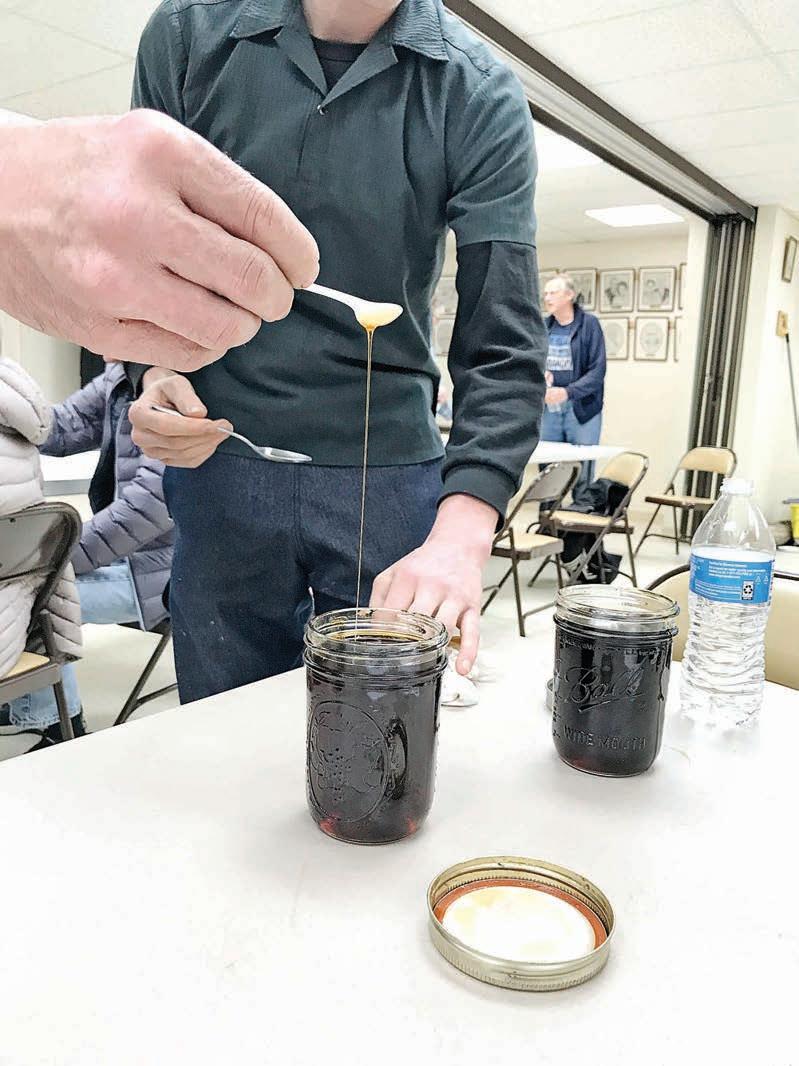
Demonstrations included both basic and advanced tools, such as temporary grading kits, color reference jars, refractometers and digital hydrometers. Salo and Miller also discussed their own trial-and-error experiences.
Group member Matthias Lee, who has been making syrup for three years, highlighted the balance between tradition and technology, emphasizing the importance of remaining open to new methods.
“People have been doing this without a whole bunch of technology for hundreds of
years, so there are many, many ways of doing it ‘right enough’ and the last 15% to 20% of improvement is perfecting your methods, things like that,” said Lee. “You’re still going to make syrup. But if you want to get it graded, enter it in a fair, that’s where you need to be a little more precise. That’s where you might decide, instead of just measuring by temperature, maybe I’ll use a refractometer to see what the actual sugar content is. Maybe instead of temporary grading kits, you’ll use a digital grader.”
“It’s really just about refining the method, not that you’re right or wrong,” he added
Bringing some levity with humor, Salo enumerated common pitfalls in syrup production, including testing the syrup before it has properly cooled, making it late in the season when trees have budded and shifting temperatures wreak havoc on sap, as well as contamination from outside flavors.
“If it’s late season, you might start getting off flavors — dirty pans, turning buddy, sugar sand,” Salo said. “There are so many different variables that can throw off your flavor. Don’t clean muskrat or skunk furs in your sugarhouse. I’ve had skunk syrup before. It’s not good. Syrup is a delicate item and will pick up any flavors that are around, mold, mildew. We stress cleaning everything and clean materials with just hot water. Soaps have different flavors and scents. Those will go right into your syrup.”
Participants later tasted each other’s samples and a variety of intentionally flawed syrups, including “sour sap,” “buddy” syrup and “salsa syrup” stored in a reused jar.
Nate Ogden of Ogden Maple Farm brought two dark syrups and shared a lesson
See Quality • Page 26

from a previous competition.
Last year, his syrup was disqualified from The Great Geauga County Fair for its Brix score, he said.
“It wasn’t technically syrup, it was sugar water,” Ogden said. “We tested it hot with a digital hydrometer. That reaffirmed what our
problem was. We trusted it hot and misread it. It’s helpful information.”
Miller and his son, Toby, tasted Ogden’s syrup and remarked that while it tasted good, its flavor was not representative of its dark color grade.
New producers John and Melissa Hagopian brought their new syrup in a glass food container with a rubber lid.
“ We learned we have a lot of work to do,” John said. “We stored it in a container that

was a regular food container, so it picked up a lot of other flavors.”
“It’s garlic maple syrup,” Melissa joked.
In addition to their own syrup, attendees were invited to taste samples of off-flavored syr ups, including “sour sap,” “buddy” syrup and “salsa syrup” (syrup stored in an old salsa jar).
Salo closed t he workshop by encouraging continued learning and comparison among producers.
“The good thing about the contests is, it tells you where you’re at,” he said. “If you’re going to enter it into a contest, taste it, test it. Find someone else making syrup, compare it to that. If you’re only tasting your own and you’re doing the same thing, you’re going to get used to it. Taste it, test it and compare it to others.”
Gauch encouraged membership in the organization, noting the value of accessible expertise.
“If you’re a member, you know these guys, you can call them, it’s not a cold call,” he said. “If you’re having a problem with your syr up, they’ll say, ‘Bring a bottle and we’ll walk through it.’ It’s $25 for a small producer mem bership, it’s money well-spent in my opinion.”
Salo also pointed to the progress newer members like Lee have made in their produc tion since joining MPNEO.
“The neat thing to know about them is that they took the class one year and then the next festival season, they’re standing there holding a ribbon next to the rest of us,” Salo said. “It’s really cool to see that this is working. We’re getting the information out to people and we're producing a great product and that’s what it's all about. And then, just the camaraderie of working together.”
trees and it says winter is almost over.”
Roseum said he hopes to see the organization continue to grow and foster collaboration.
“I’d like to see people make the very best syrup that they can,” he said.
Maple Producers of NE Ohio can be reached through their website at mpneoh. com. Quality from page 25
For Roger Roseum, of Chester Township, who has tapped 133 trees for 30 years, maple production is also about heritage.