





























































































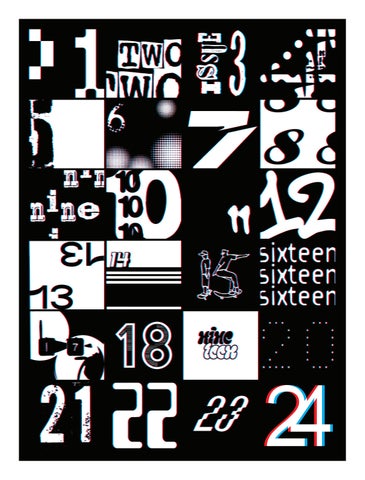
In a space that celebrates bold visuals and loud creative expression, we chose to look closer. At the details, the words, the things that we sometimes overlook. What we found wasn’t quieter creativity, but deeper creativity. The kind that only reveals itself when we take the time to really examine what’s in front of us.
24 Pages has always been about showcasing the creative voices across Grand Canyon University. This issue challenges you, and us, to experience those voices in a new way. We leaned into writing, into the weight of each word, the rhythm of the sentences, and the stories that unfold when you read each line.
And yet, this issue is far from simple.
Through typography and 3D design, these pieces take on a new life. Words become something that you don’t just read, but something you feel, and something you move through with intention.
Sometimes we think creativity has to be loud to be meaningful. That it has to demand attention. But this issue is saying something else.
Sometimes we have to look closer.
To sit with what’s in front of us. Examine it. And let it speak to us.
Because when we do, we realize it was never meant to be ordinary in the first place.
So with the third issue of 24 Pages, we invite you to slow down. Take your time. And look a little closer.
There’s more than meets the eye.
Your Editor, Owen Ekstrom
EDITOR: OWEN EKSTROM
PROJECT MANAGER: MARY EDWARDS
PROOFER: OLIVIA BARTON
WEB: BRYN MILLER
FACULTY ADVISER: CHRISTOPHER MURPHY
FEATURED STUDENT WRITERS:
KEIRA JOHNSON (PG.4), RYLEE JONES (PG.6), TABYANA JENNINGS (PG.8), EMILY ASSINK (PG.12), ELIZA GARNER (PG.14), ANNA WAY (PG.16), HANNAH WEST (PG.19), OWEN EKSTROM (PG.21)
FEATURED STUDENT DESIGNERS: ELI RINEY (PG.4), ERIN POWELL (PG.6), NATALIE SHEPHERD (PG.8), SHANNON SIRIANI (PG.12), MADISON LAND (PG.16), SAMUEL PATTERSON (PG.18), BROOKLYNN VINCENT (PG.20), EMMA GROVE (PG.22)
SPECIAL THANKS TO THE STUDENTS OF THE DDN 312 ADVANCED TYPE CLASS (PG.2);
SPECIAL THANK YOU TO FACULTY FOR REVIEW: ASHLEY JO GEORGE, ALLISON KING, PAIGE LOCK, EUGENE PAK, JORGE PORTILLO, TROY POTTGEN, SHEILA SCHUMACHER
This year has and will be a year of firsts for me First (and only) time getting married.
My first real graduation. My first apartment My first real job. And one thing I can’t help but think about are the things that I am missing out on by those happening. What if I hadn’t gone so fast through college? What if I hadn’t fallen in love at the ripe age of 18? What if I had slowed down and taken my time growing up instead of rushing it? What if?
In Sylvia Plath’s “The Bell Jar,” she writes, “I saw my life branching out before me like the green fig tree in the story. From the tip of every branch, like a fat purple fig, a wonderful future beckoned and winked.
One fig was a husband and a happy home and children, and another fig was a famous poet, and another fig was a brilliant professor…
I saw myself sitting in the crotch of this fig tree, starving to death, just because I couldn't make up my mind which of the figs I would choose. I wanted each and every one of them, but choosing one meant losing all the rest, and, as I sat there, unable to decide, the figs began to wrinkle and go black, and, one by one, they plopped to the ground at my feet.”
Growing up, especially as a girl, you are taught that your happiness will come when you sacrifice it for others. That will bring you joy. But what if you could have both? Why did Plath think she could only grab hold of one fig? Why couldn’t she get more? After all, the Lord blessed us with two hands
The average person is lucky to live through 70 summers. That is 70 summers of eating peaches when they are ripe. That is 70 summers of beach weather and time when the sun beams enough to burn skin
An average life gets around 25,567 mornings. That is only 25,567 cups of morning coffee, 25,567 days of kissing your loved one’s good morning, and only 25,567 mornings of actually doing something. In the grand scheme of things, that is a tiny number. So, why are we so worried about what fig we should choose when we have a whole bucket to fill? Choose to write, choose to run, choose to leap. From the wise words of Roman poet Horace, “Carpe Diem, quam minimum credula postero.” Or “Seize the day, trusting as little as possible in tomorrow.”
It simply is never promised to be there.
Written
Tabyanna Jennings




staring ahead into the heat waves that ripple across the blue desert sky like great lakes. He trudges forward.
The young man has forgotten how long he’s been wandering. He recalls, however, why he left home. He wanted more; he yearned for a world that he felt he had to see. It had not gone well with his parents, and he begins to feel a twinge of regret worming its way up his throat as the sun beats ever strong down onto his sunburnt skin.
It was wonderful at first. He climbed the highest peaks, adrenaline coursing through him amidst the frigid temperatures and incessant wind that stung his cheeks. He dove into crystal blue waters, feeling the soft sand beneath his toes. He rode horses and donkeys through the deepest jungles in the earth, drinking the purest water. He explored the darkest caves, stood on the edges of the world, felt the draw of adventure tugging at his soul.
And yet he finds himself quite lost, a desert ahead of him. He lost his map two days ago, so he relies on a dusty old compass which seems to fail most of the time. He doesn’t remember where he was wanting to go, he only remembers where he has come from. But what is he doing out here in a desert? He doesn’t know.
The young man trudges forward. He has spent his water supply and no food is left in his pack. Just in the past few hours it seems to have gained ten more pounds, the weight burning on his back.
Although, amidst the heat waves that play tricks on his tired and weary mind, an oasis appears. Palm trees jut out of the endless sands like
little beacons to call the young man in. His legs move a little faster. Oasis means rest, it means water and food and rejuvenation. Perhaps he can recall why he travels with this burdensome pack in a hot desert.
When he reaches the oasis, he thinks his eyes deceive him, for there is a travel-trailer parked underneath a small crop of palm trees that sway in the hot breeze, two chairs set out near the small pool of clear water just to the right of the trailer.
The young man is quite confused as he walks up to the trailer, licking his dry and cracked lips. Someone lives out here, in this terrible place? He wonders curiously, dropping his pack and filling up his flask. The water is ice cold, as if he draws it from a glacier instead of a desert.
“I did not offer my water to you,” a voice says from behind the young man, who turns abruptly to face a middle-aged man wearing an apron, hands dusted with flour.
The young man quickly apologizes, though half-heartedly. “I am sorry, I was just so thirsty.”
The baker offers him a warm smile. “It is alright. What is mine is yours and what is yours is mine.” He gestures into the small trailer, awning flapping in the wind that rustles the palm leaves. “Would you like to come inside? I have just made a fresh loaf.”
The young man opens his mouth to oblige, though something in him doesn’t trust this strange figure living in the desert. He shakes his head, wanting to be off. “I must continue, but if you are offering food I would not turn down the offer.”
The baker’s smile falters slightly, though he nods, entering the trailer and returning after a couple minutes with a warm loaf of
bread wrapped in a white cloth. “This bread will satisfy your every hunger, should you believe it to be so,” the baker says before handing the young man his loaf. The young man takes it with a frown, unsure of what the statement means.
He tucks the bread into his pack anyway, careful not to smush it, and continues on his way.
***
We are prone to wander. An innate desire burns in us to never stay in one place, to move from one place to another in search of something.
What do the travelers seek? What do they search for, that they devote so much time moving, seeing, experiencing bits and pieces of the world, perhaps even spending a lifetime on the move? Is it to feel the rush of adrenaline as they bungee jump off a 300-foot bridge over rushing waters? Is it to feel the frigid temperatures at the top of the earth or the deep colors of coral reefs? To touch sands of a country thousands of miles from their home, or to trek through the deep jungles of the world?
TIME, DO THE TRAVELERS FIND WHATEVER IT IS THAT THEY SEEK?
***
The young man is far from content. His thirst is not quenched, his hunger not satisfied. Despite the brief rest in the strange oasis, his throat is drier than before, and despite the baker’s comment, the young man downed the bread within hours, every bite seeming to continue his hunger instead of satisfy it.
He has made it out of the desert, to his utter relief. Though instead of
dreary, hot sun, an uncomfortable mist obscures his vision as he travels through rolling hills. How many days it has been since the desert, he doesn’t remember.
He runs into something and curses quietly to himself, realizing he has run into a grapevine, hitting the wood the grapes curl and grow around. A vineyard?
“Welcome, Traveler!” A cheery voice greets him. A middle-aged man, looking oddly similar to the baker, smiles up at the young man, tipping his hat in greeting as he carefully plucks any stray weeds from the vineyard.
The young man can’t help but ask, “why are you out here in this dreary weather? Surely there are other days to prune the bushes.”
The winemaker continues smiling, trimming the vines near him. “I always tend to the vineyard; without me they would not bear fruit.” A sparkle shines in his eyes. “You are weary, traveler, and your burden heavy. I can give you rest.”
The young man shifts uncomfortably, adjusting his pack so it sits better on his shoulders. This pack isn’t a burden, he thinks stiffly. It is my life, everything I need on my journey. Though he pauses to himself.
But where am I journeying to?
He shrugs off the strange feeling, similar to the one that had manifested in the oasis and politely declines the winemaker’s offer. He must be off, he says. To move on, to see more.
He only moves a couple of steps through the hilly vineyard before the winemaker calls out again. “You would decline rest? Why do you continue carrying your burdens when rest awaits you here, when I can offer you anything you’ve wanted?”
The young man stops, and anger boils in his stomach. Why, he does not quite know. But he whirls around, brushing wet locks of hair out of his eyes and shivering slightly from the rain. “I don’t need anyone’s help,” he snaps. “I don’t need it and I don’t want it. I can make it on my own, I always have. So, thank you, but if that’s all you have to offer me then I must decline.” The winemaker only watches him go, quietly standing amidst the falling rain.
Why do we turn from help? Even if we are hurting, if we are visibly torn both on the outside and on the inside, why do we shrug off anyone that offers a hand to us?
Perhaps we are secretly ashamed. We do not want help, we often say. We can do it ourselves; we’ve got it from here. Help means weakness, it means lowering down to a level where you must rely on others to assist you.
We decline the soft hands of a Good Samaritan while we bleed out on the stone floor.
The young man collapses.
He has gone weeks without any contact with anyone. At first, he felt rejuvenated after leaving the vineyard. A spark of adrenaline, perhaps, that helped him along the way for quite some time. He ran through fields of wildflowers, through valleys, over creeks and singing with the eagles. He believed he could fly. That he could do anything. Be anyone.
But it didn’t last. A fleeting moment of joy and happiness, and a little bit of adrenaline left in him led him up a mountain pass to reach the lush fields and opportunities awaiting
him on the other side. But he had overestimated himself. He had trusted that his experiences had proven that he can conquer the world.
He lies in the snow, his pack covering him. Smothering him. His cheeks sting from the biting cold that chills his bones. His fingers are black from frostbite, his hair hangs in icicles in front of his eyes. He cannot get up even if he tried, because his pack is too heavy, weighing him down. He couldn’t even shove it off, much less stand on his numb legs.
For the first time, since the months (or has it been years?) since he left home, fear clutches at his heart. He trembles in the terribly cold wind as snowflakes whirl in front of his face, hunger tearing at his stomach like a lion tears into its meat and his throat is as dry as the desert he once walked.
Am I going to die? He thinks to himself. The young man, lying in the snow at the top of a mountain, supposedly at the top of the world, cries. His wails are carried away by the whistling of the wind, his tears freezing once they leave his eyes.
Then he hears it. A musical tune, a sweet melody, carried up to the young man by the storm. The young man cranes his head, trying to hear the sound more clearly. He opens his frozen eyes, and they look up at a man. A middle-aged man, dressed in shepherd’s clothes carrying a curved staff.
And the man looks just like the baker and the winemaker.
The shepherd smiles, a face so kind as he kneels down in front of the young man. “There you are,” he says softly, voice so clear amidst the screams
of the wind. “My lost sheep.” In a moment, the storm calms. The shepherd looks towards the sky as it clears, warm sunlight landing on the young man’s skin. His fingers return to a normal state, he stops trembling. An unexpected tear slides down his face, unfrozen from the sun. “I know your face,” he says, his voice scratchy from unuse.
The shepherd shakes his head. “You do not know me yet. You have seen me, but you do not know me the way I know you.”
The young man frowns, pulling himself to his knees, relishing the warm sunlight. “But I met you in the desert, and in the vineyard. You were somehow both of those men.”
“But you do not know me,” the shepherd says. “When I offered you a meal, you only wanted the food. When I offered you rest, you declined it, assuming you could continue on your own.”
“But I did!” The young man exclaims. “I have done so many things; I have seen so many places…” his voice trails off. But why did he want to do those things?
The shepherd smiles. “What are you searching for, my little sheep?”
The question buries itself deep in the young man’s heart. He suddenly feels small, so insignificant as he kneels at the top of the world with the strange shepherd. “I don’t know,” he finally says. “I don’t remember.”
“You are lost,” the shepherd says. “Your soul searches for the wrong things, things that will never satisfy your hunger.”
The young man fidgets with the straps of his pack, worn clothes clinging to his frail body. “What will?” He whispers.
The shepherd smiles, reaching out a scarred hand and bringing his forehead to the young man’s.
The young man, a mere boy, laughs with his sister as they play in the endless fields of their home, the sun bright and the sky blue and promising as it shines down on them.
His parents bring them in for dinner, a home-cooked meal as they talk of their days.
The shepherd, the winemaker, the baker, he watches them. He picks them up when they fall, he brushes away their tears.
He watches when the young man runs away from his home, searching for a purpose to his life that he won’t find. The shepherd always watches, he is always with him, offering an invisible scarred hand to help, even though the young man turns him away at every turn.
“You’ve always been there,” the young man says, feeling once more the warm sunlight. The shepherd smiles, helping him up to his feet.
“I never leave a sheep behind, nor do I let weeds overtake the vineyards. What you search for you will never find, but only because it has been right in front of you your whole life.”
The young man finally understands. He takes off his pack and doesn’t look twice before tossing it off the cliff, watching it tumble into the unknown below.
“I’M READY TO GO HOME,” HE SAYS.
The shepherd smiles, his face lighting up the mountain brighter than the sun, his arms open wide to welcome in his lost sheep.
by
There was once a shy girl, timid and small
Who sought solace in expressing her creative soul
Through books and art, ink and words
Her heart bled and unfolded in the tales that she wrote
Each story was a journey that inspired and healed
Every phrase guiding those who drew near Enriched with words of love, peace, and kindness
Embracing her creative passions
Although a young woman, a quiet, introverted soul, her spirit still glows
Now a faithful and humble servant, driven by faith in the Lord
For He guides her like a compass, steady and true Honoring Him by answering the call He placed upon her, too
An aspiring author whose dream is to change the world
To allow God to use her writings to heal wounds and mend souls
To spark hope, kindle dreams, to uplift, and be a light
That is like a lantern shining to guide them to Christ
She is a creative soul, dancing with words like whispers
Traveling through life’s sweet yet bitter rainstorms
Sketches drawn; her life pictured with every stroke
A canvas full of memories, love, and cherished chapters
She reflects on the moments spent with God, family, and friends
Her life lived in love, faith, and artistry
Growing, learning, and sharing His love Wherever He so pleases
Masterpieces continue to be carefully created as she continues to craft her life on beautiful pages
With each stroke of her pen or the typing of her fingers
For she is the artist, the dreamer, the creative thinker
A unique, complex, and rare spirit, where her life
It may seem ordinary, mundane, and unusual
Unknown, unseen, unheard, but in the hearts of
Those she inspired, she is an empowering spirit
So here’s to the journey that has just begun, a story
Still being written and shaped by God
May she continue to write, think, and dream
While He continues to use her as a voice and vessel
competition competition conversations conversations
So tr y ever y thing. So tr y ever y thing. changes, changes, challenges.changes, challenges. challenges. about yourself. about yourself. about


“Look at You”
Keira Johnson
When reading “Look at You,” I was struck by its simple loveliness. The touching admiration of a sister for her sisters was palpably pure in the poem, and I was inspired to accentuate that awed and blissful mood. I used Lettersoup’s Apparat, a friendly sans serif (with a high x-height for legibility), to match the poem. I curved the lines into the shape of a butterfly as a representation of beauty and growth, and I carefully sized, placed, and “3D-ified” the text such that each word would flow captivatingly into the next. I encourage you to look at the piece from about an arm’s length away. Be immersed in it. Read the poem slowly with the glasses on, and try to slip your hands under the text to see how it almost feels possible. Let the words wash over you, and be reminded of someone you are proud of.
- Eli Riney
“25,567 Mornings”
Tabyana Jennings
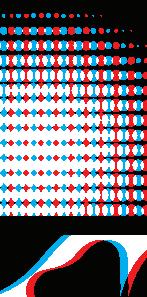
25,567 Mornings by Tabyana Jennings explores how we perceive our future and the tendency to dwell on life’s many “what ifs.” It reflects on how easily we can become caught up in imagining alternate paths, while gently reminding us that we are given just one life to live. 25,567 mornings to wake up and begin again. This concept is brought to life through a design which incorporates nearly 25,567 dots across the spread. Each dot represents a single day, a quiet visual reminder of the average time we have to spend. Together, they invite a simple but powerful question: how will you choose to live them? Carpe diem. Seize the day.
- Natalie Shepherd
10 6 4 pg:
“How to Rekindle the Flame”
Rylee Jones
Burnout can leave someone with the chaos of worry and anxiety. It is not delicate or pretty, it is rough and sharp. Rekindling your flame, or finding that spark, can ease the anxiety and be more calming. When you know what you want to do and find inspiration, things seem to flow seamlessly. Through designing this literature piece, I wanted to capture the battle between burnout and rekindling your flame.
- Erin Powell
8
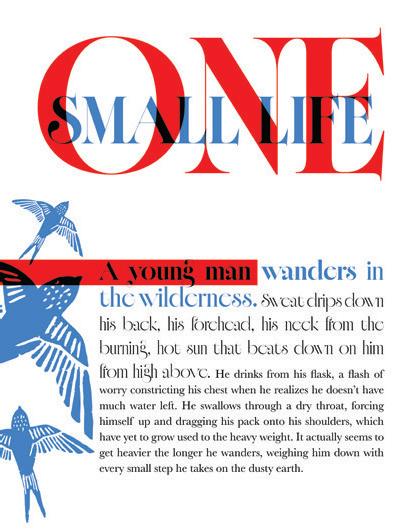

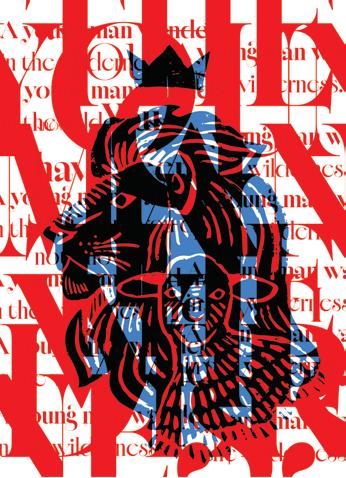
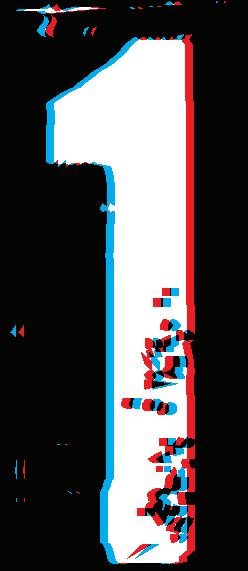
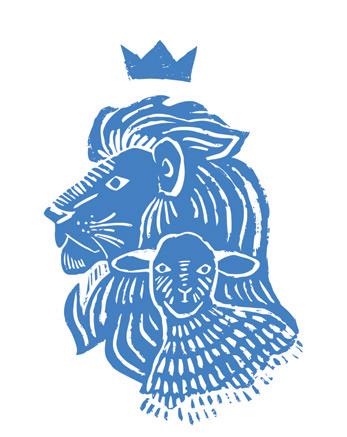
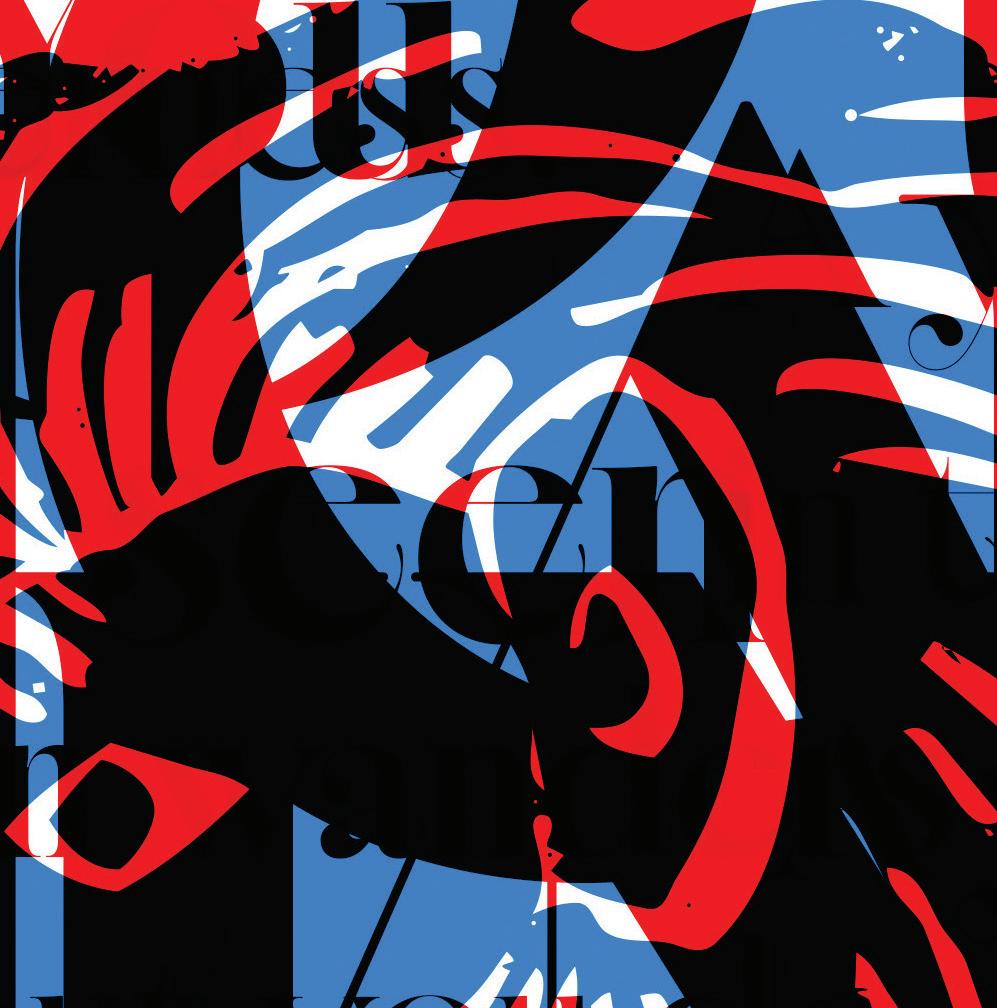
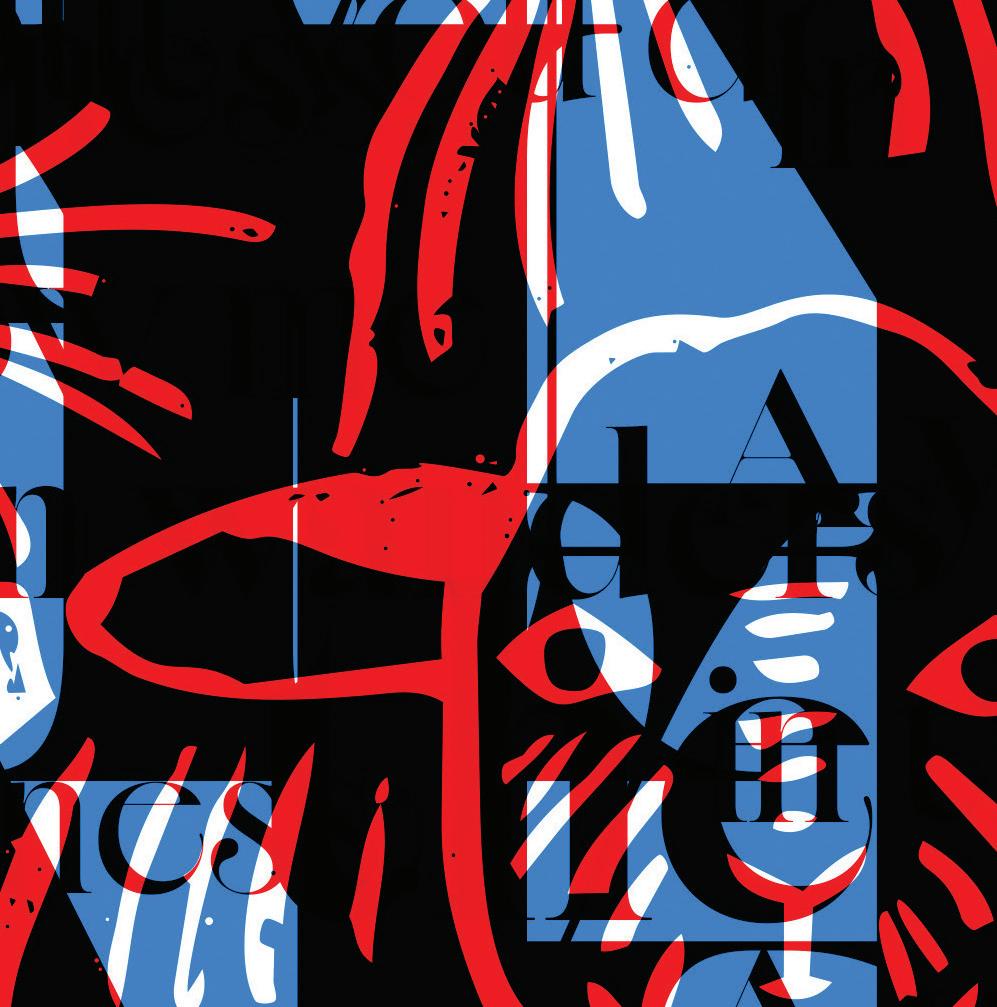
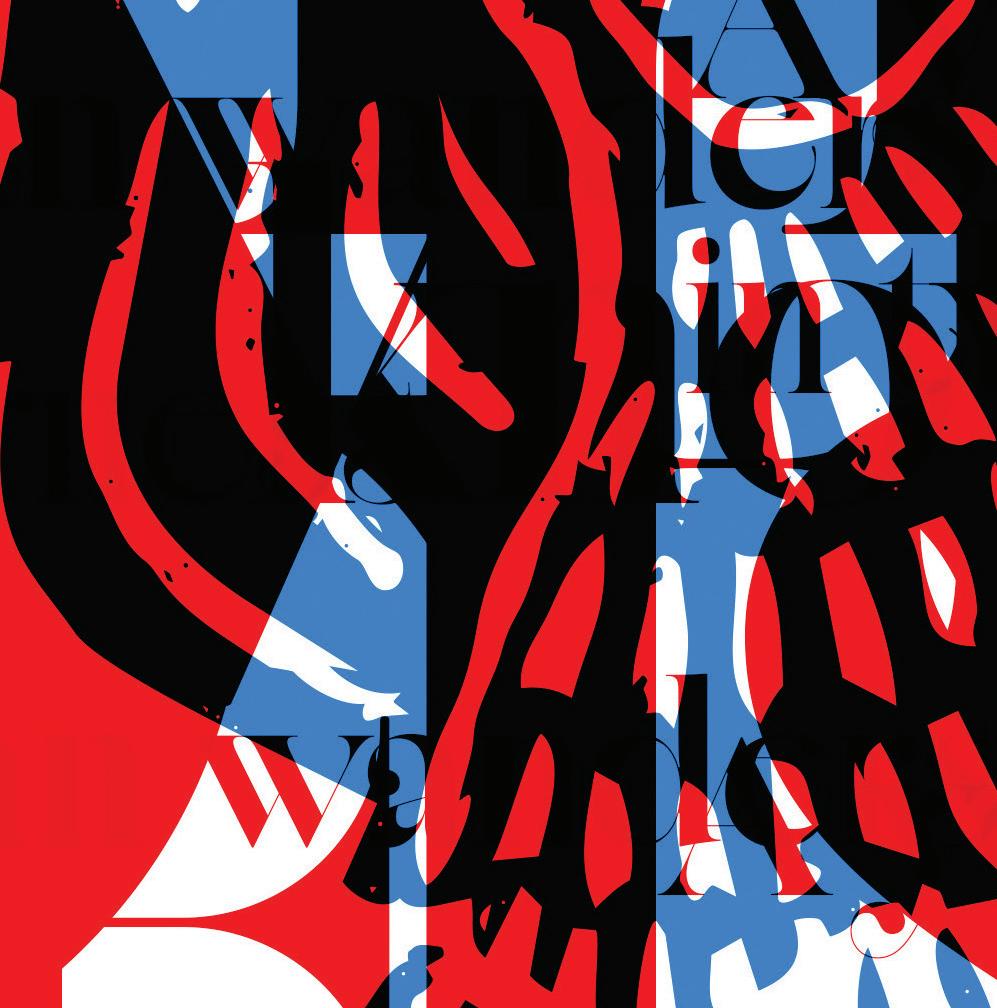
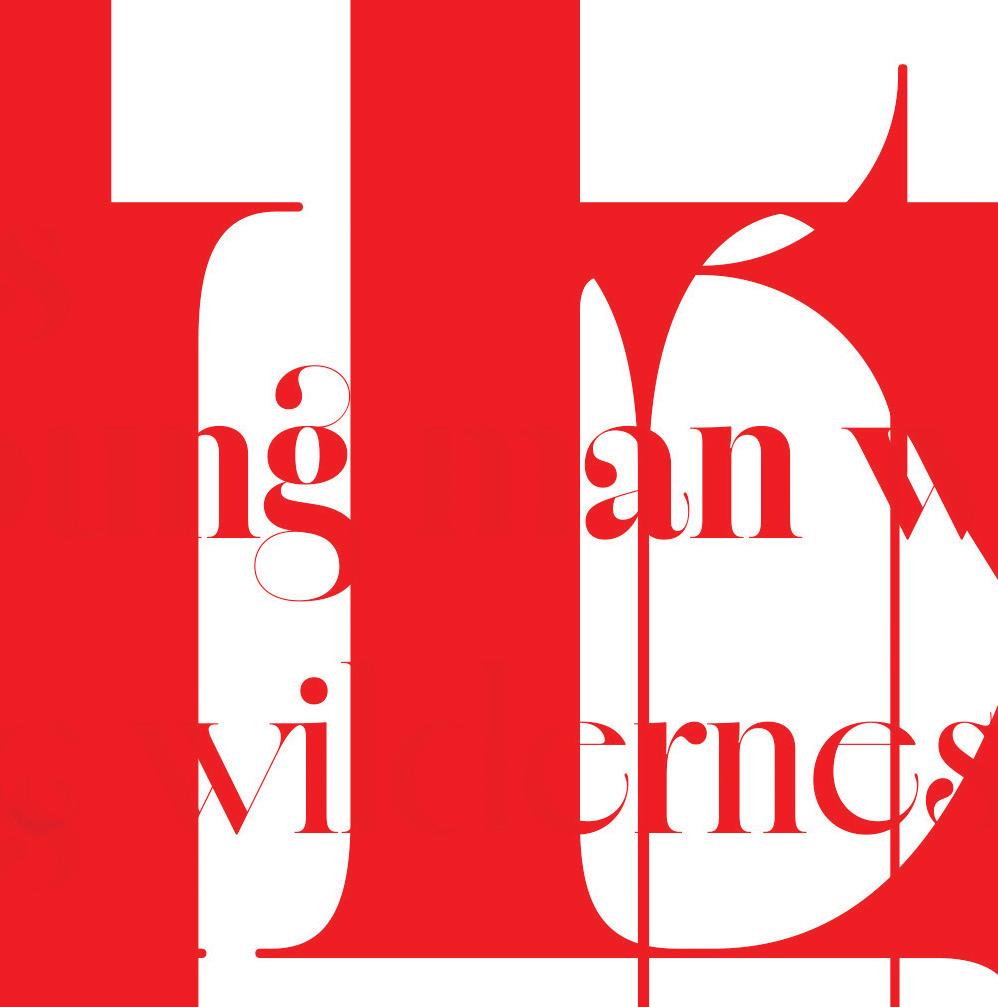
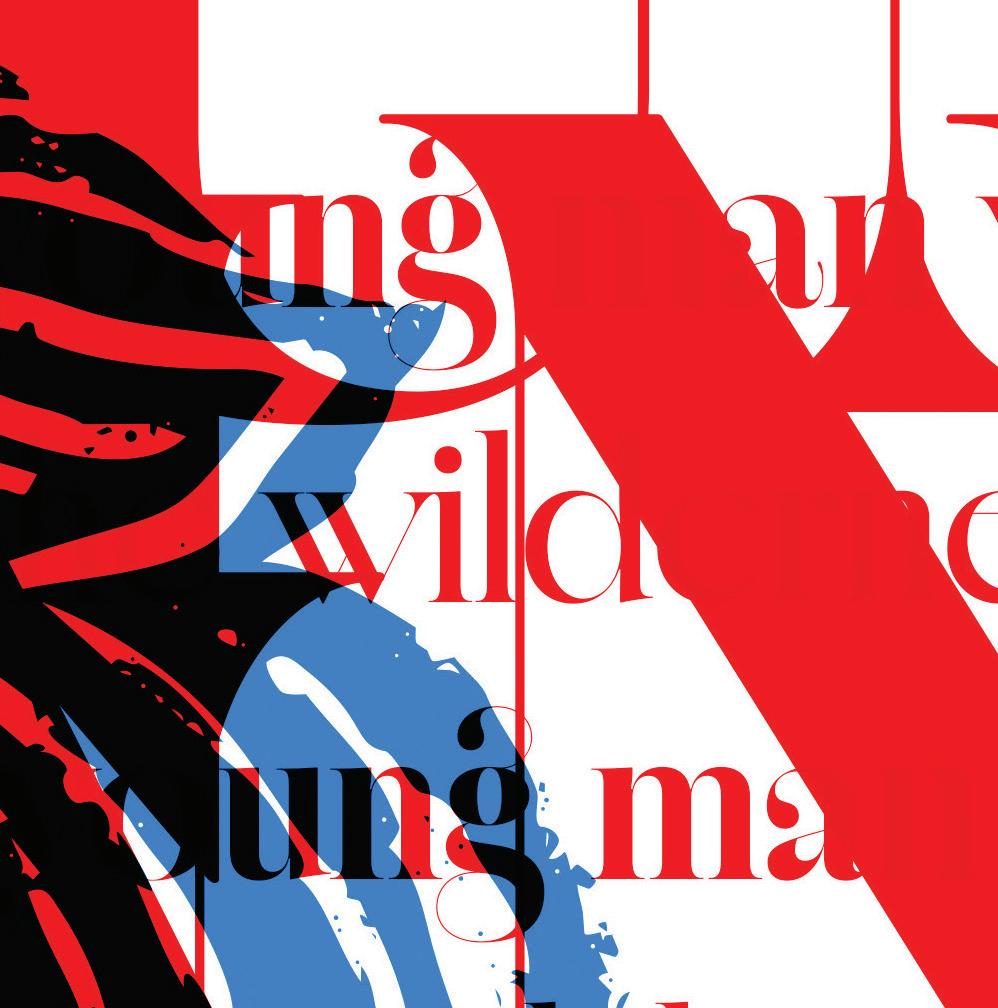
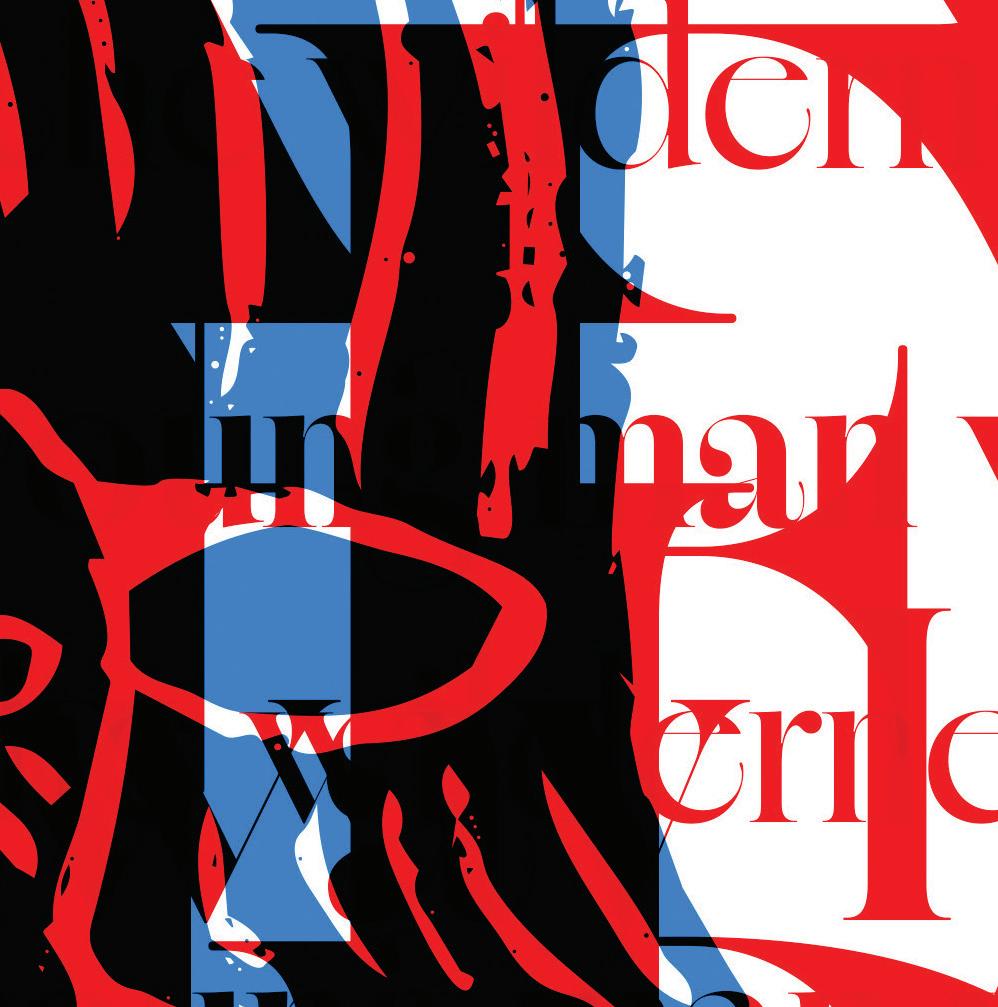
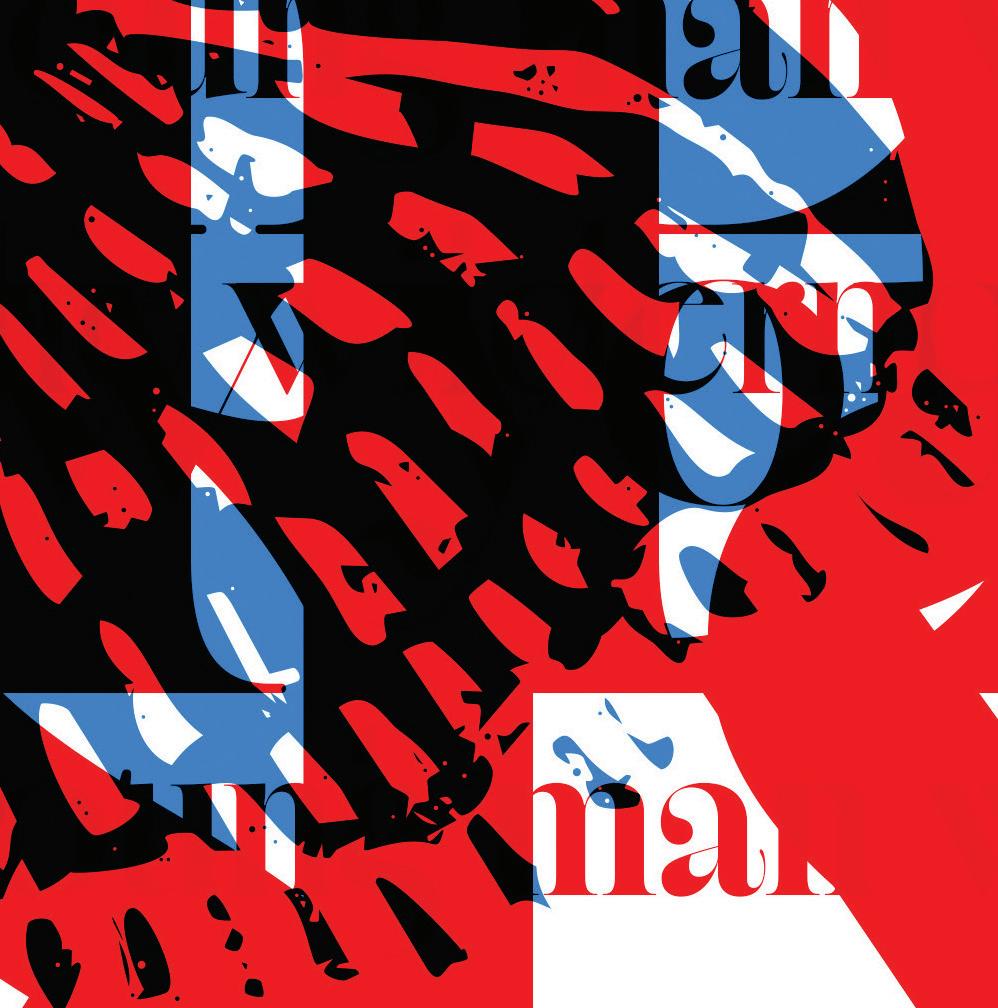
This powerful piece tells the short story of one man’s search for meaning. From the artwork to each line of text, the design is carefully crafted to mirror the symbolism within the narrative. The title emphasizes the word “One” to remind the viewer that even among millions of people, God still cares deeply for the one and continually pursues a relationship with us. The first spread illustrates sparrows flying across the page (birds symbolizing freedom), reflecting our main character finding freedom after the weight of his heavy burden and endless search for purpose is lifted. Finally, the lion and the lamb symbolize Christ and His sacrifice on the cross so that we could find true freedom. Like the artwork itself, the story moves from mystery to meaning, where what first appears abstract and confusing becomes clear when seen with new eyes. I hope you will read this short story with tear-filled eyes, as I did, as another reminder of Jesus’s love for us.
- Shannon Siriani
“Life of a Writer”
Eliza Garner
This poem really showed the dreams and aspirations of the writer, which I loved. It was about what her writing will evolve into as she keeps honing her skills, comparing her work to a lantern that is a guide or a compass. The piece has a sense of optimism for her artistry. I wanted to reflect that optimism in my design, along with the depth and process she goes through to create her writings. The design represents creative optimism that this piece evokes. Using typography as more than just something to read, by isolating parts and pieces of the letterforms to create something that can only be explained by feelings.
- Madison Land
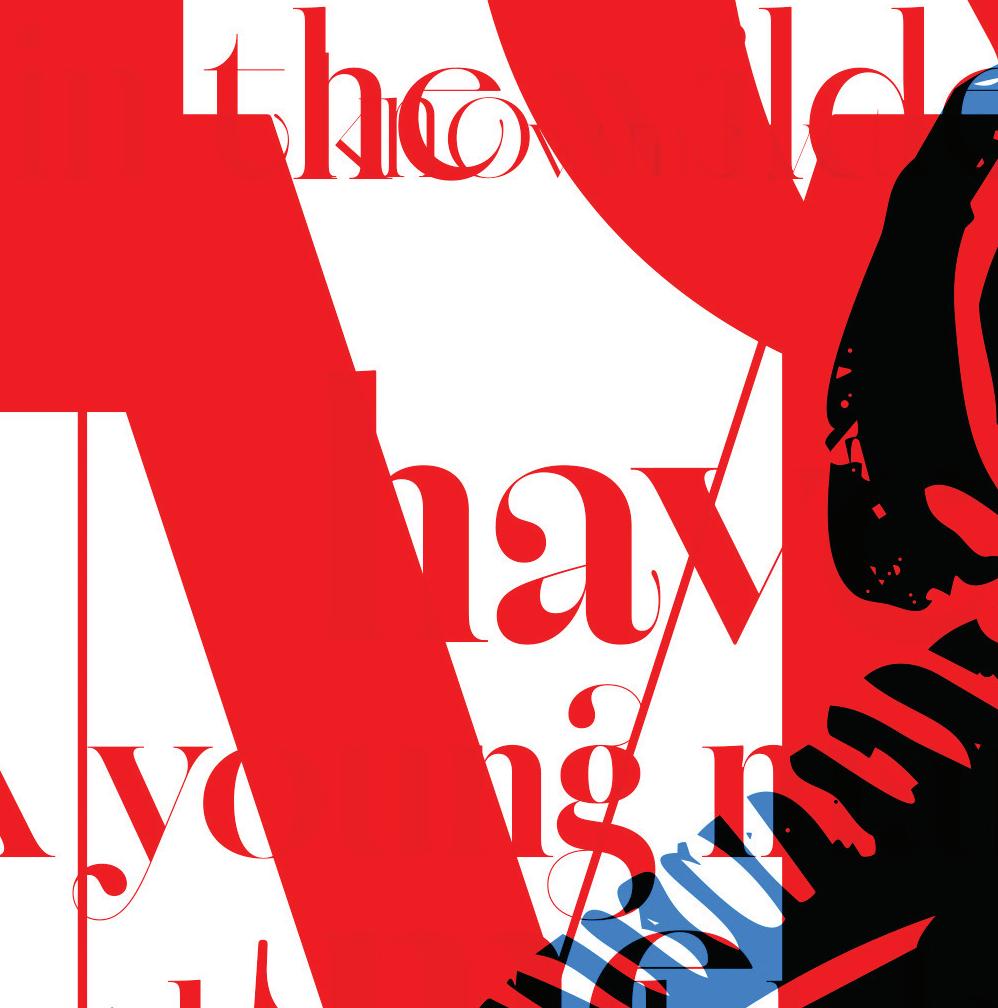
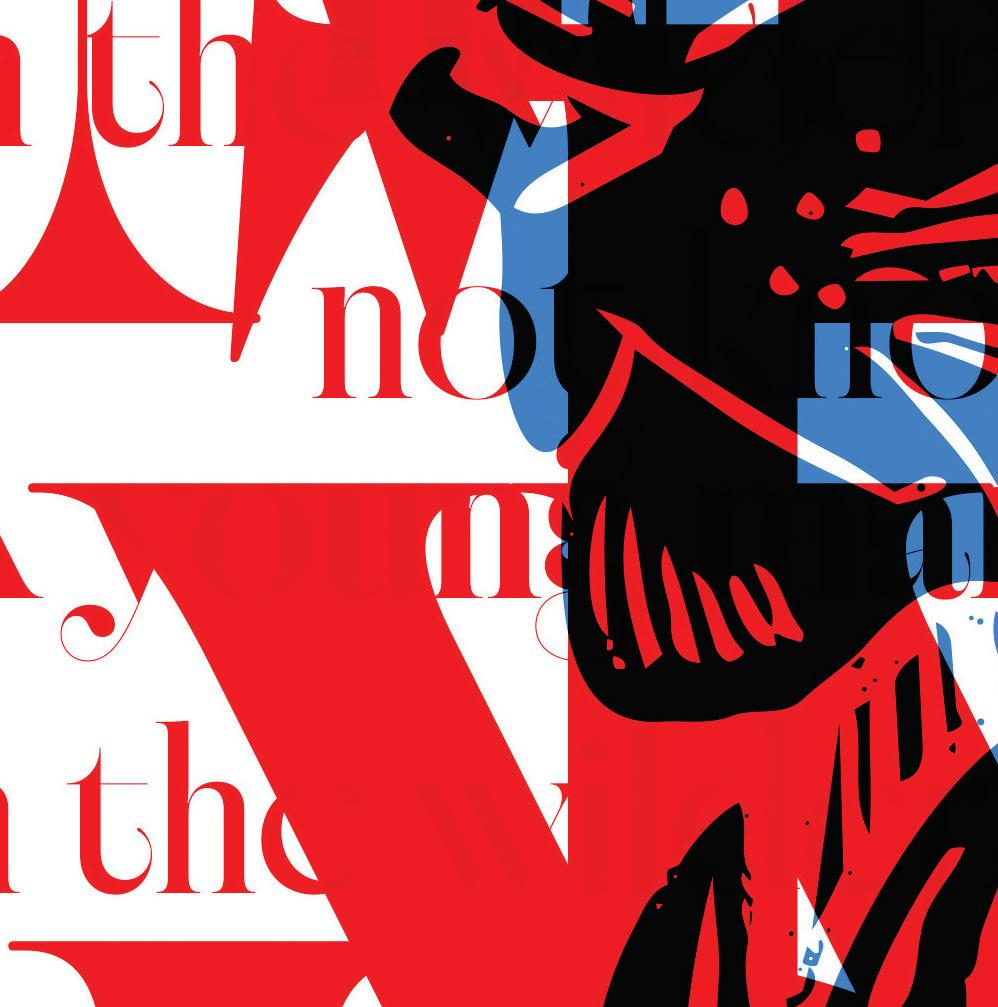
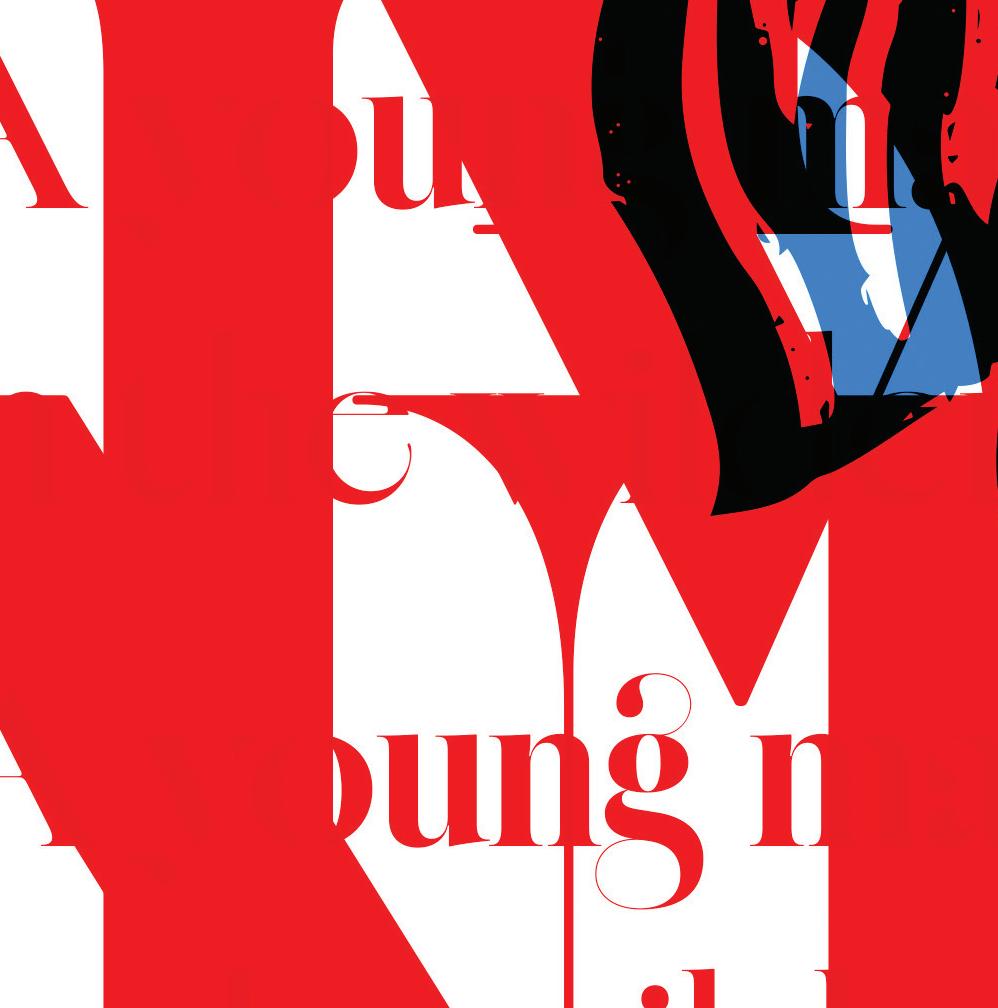
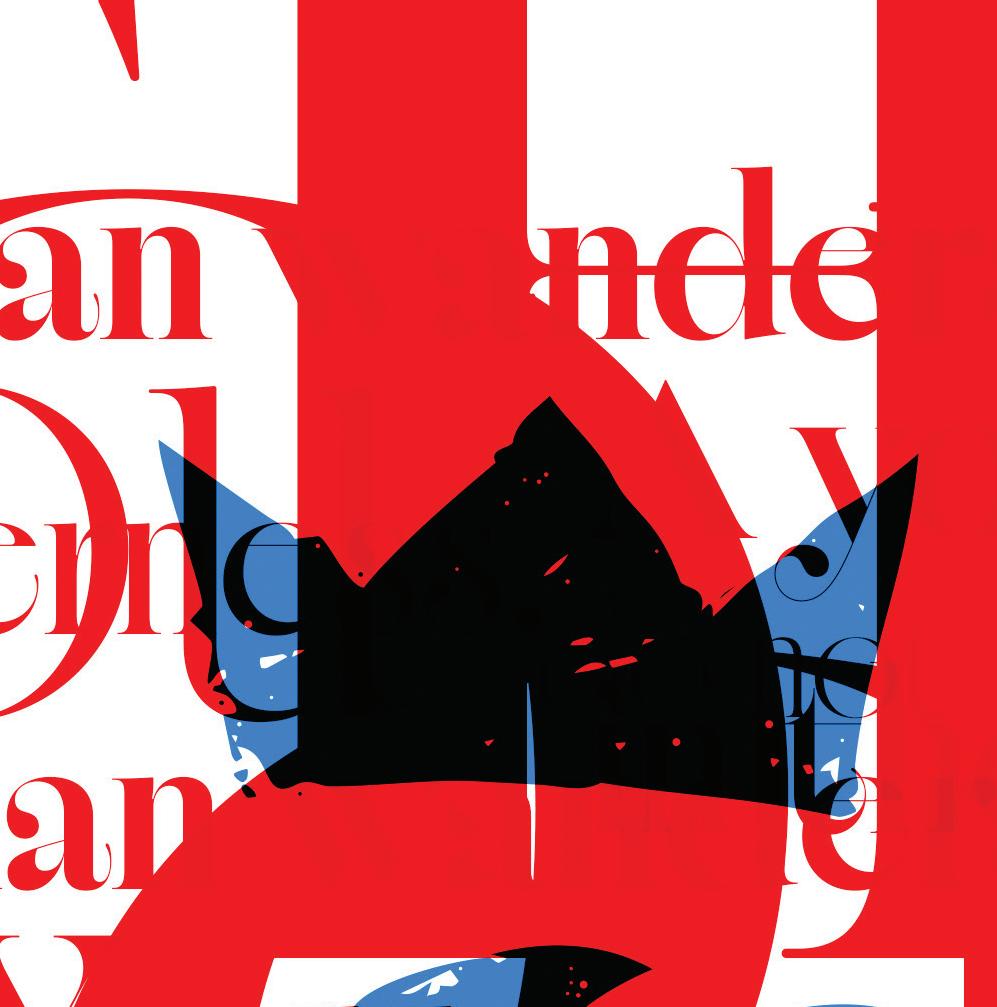
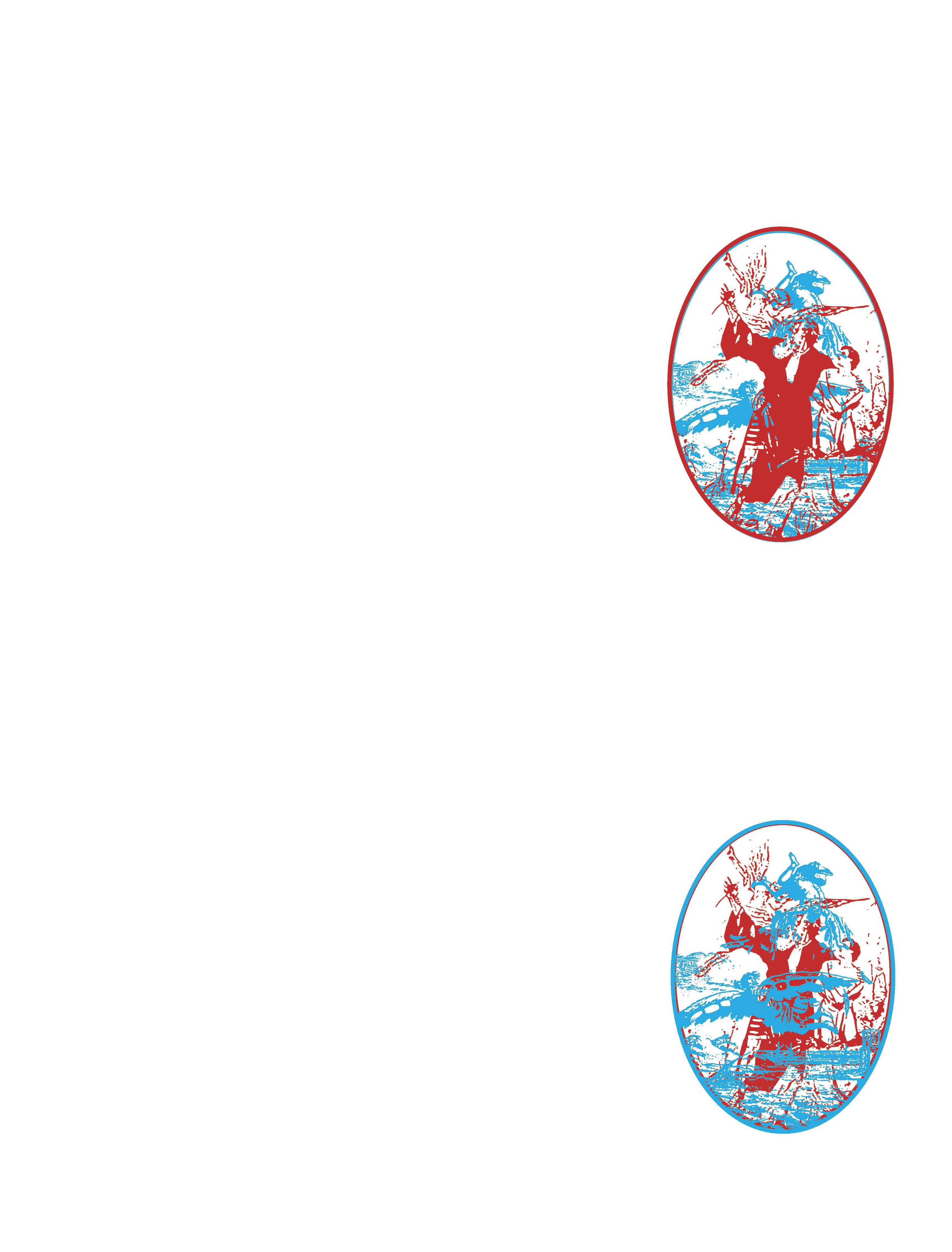
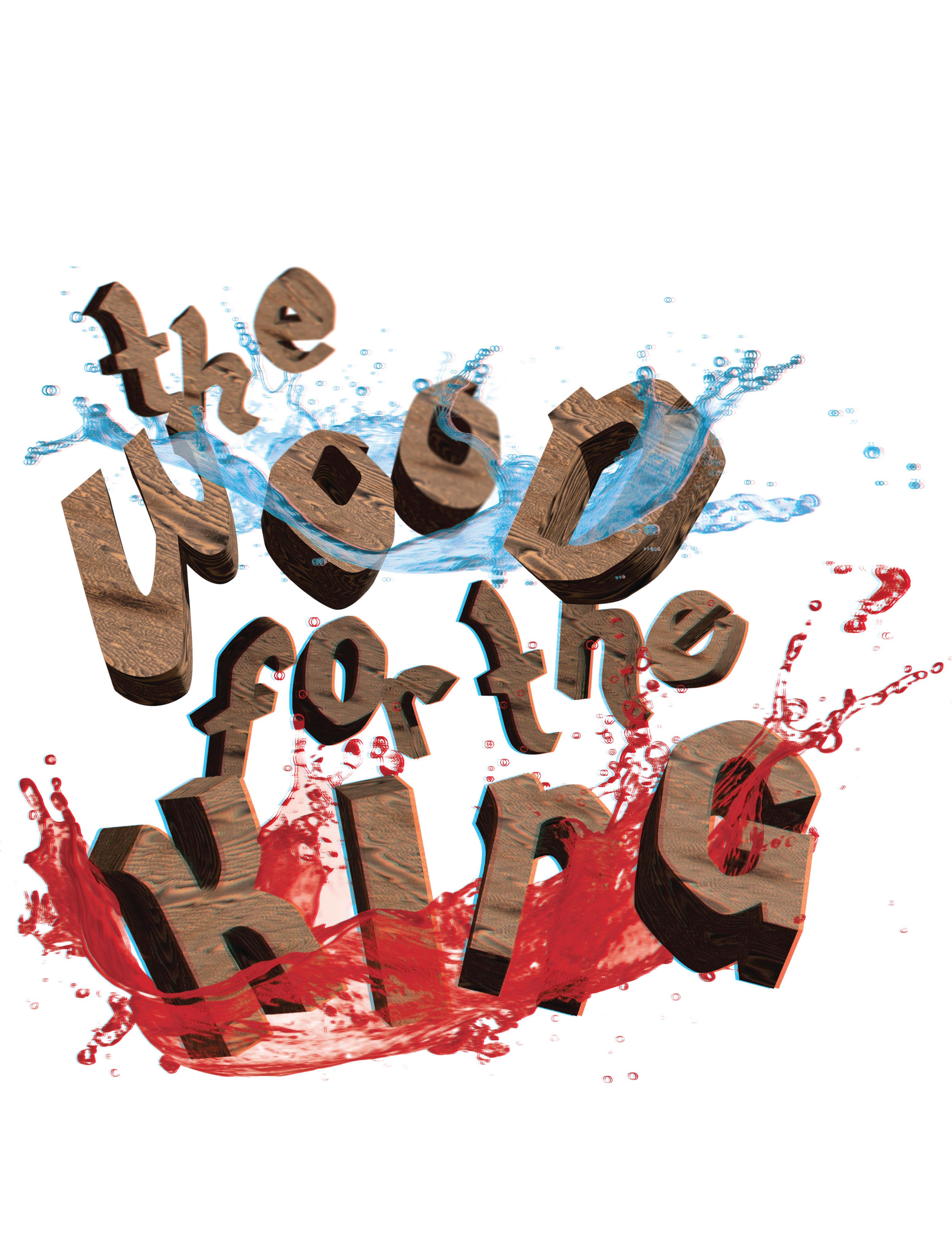
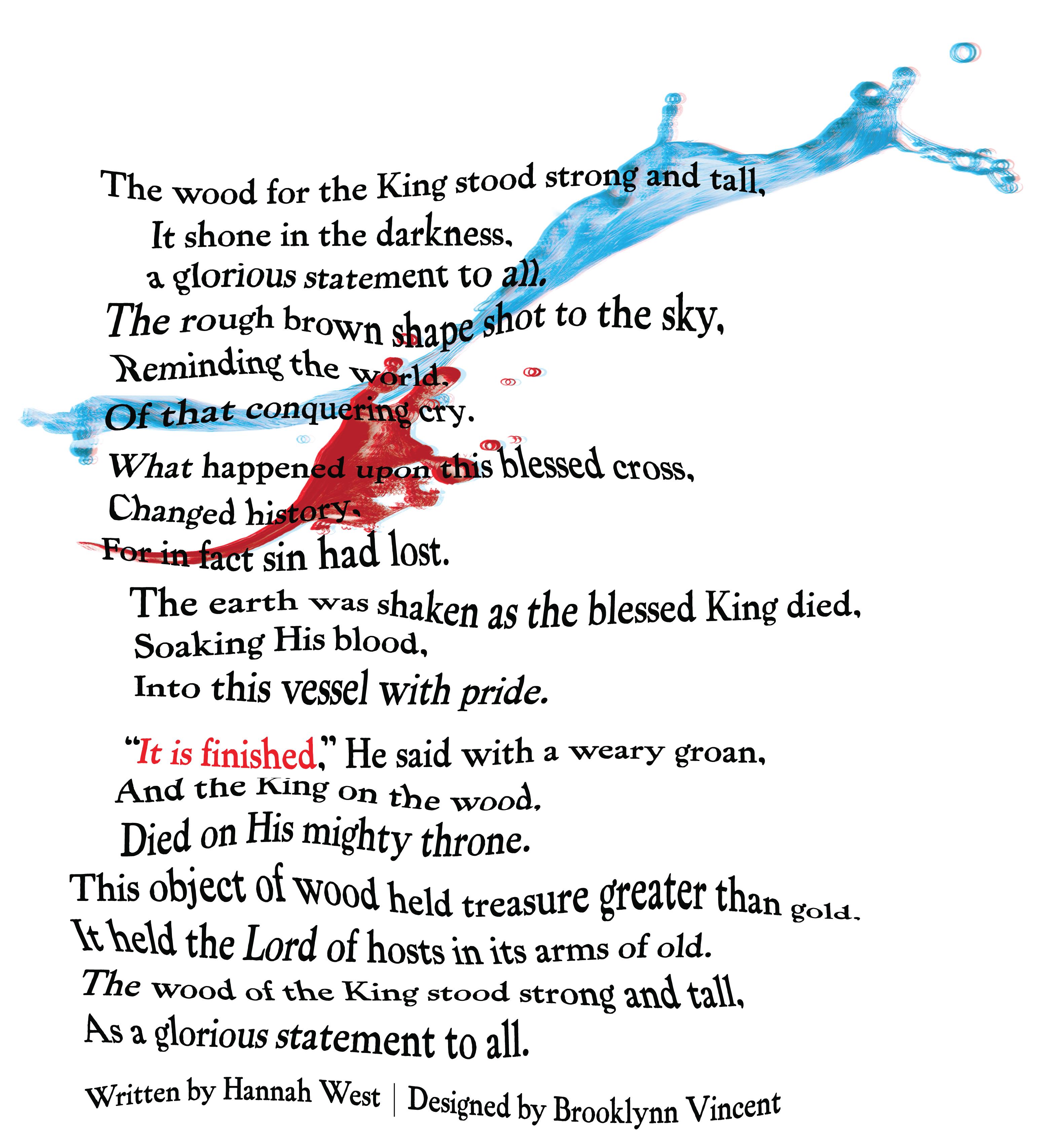
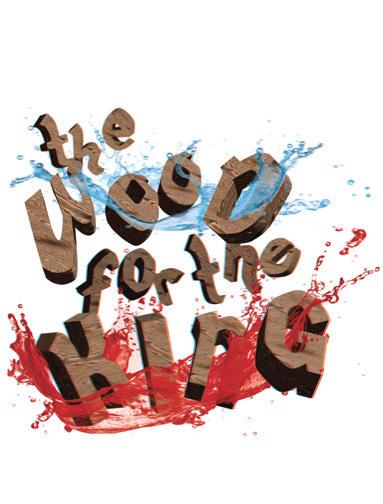
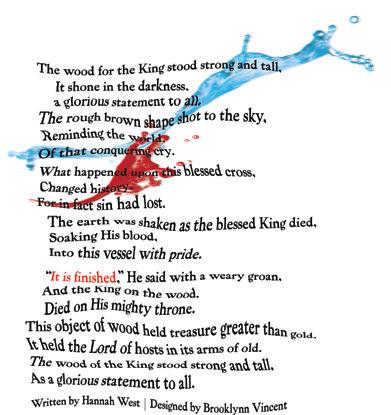
The layout for The Wood for the Lord is designed to highlight the hope and heavy weight of Jesus’s sacrifice. Specifically focusing on the symbolism of the wood, the wooden texture highlights the rough and painful vessel for Jesus’s death. The splashes of blue and red, however, reference the blood and water that flowed from Him. Through the use of 3D glasses, the wooden title emerges toward the viewer, emphasizing the cross’s presence as something inescapable. Ultimately, the piece invites viewers to reconsider the familiar story of Jesus’s sacrifice with a renewed perspective.
- Brooklynn Vincent
“Abraham & Isaac // Daedalus & Icarus”
Anna Way
In her piece, Anna explores the parallels of the Abraham and Isaac story and the Daedalus and Icarus myth in a way that gives thought to how their character differences led to their different outcomes. I wanted to further explore the comparison between characters while keeping the poems original progression. By breaking the text in columns, one for each character, the story is still read left to right, while each column allows the unique personality of each character to stand out. The fathers columns are in all uppercase, while the sons are all lowercase. The result is a piece of text that requires you to slow down and give more consideration to how the similarities and differences between the pairs unfold the story.
- Samuel Patterson
- Emma Grove 18 20 16 14
“Dear Freshman Me” Owen Ekstrom
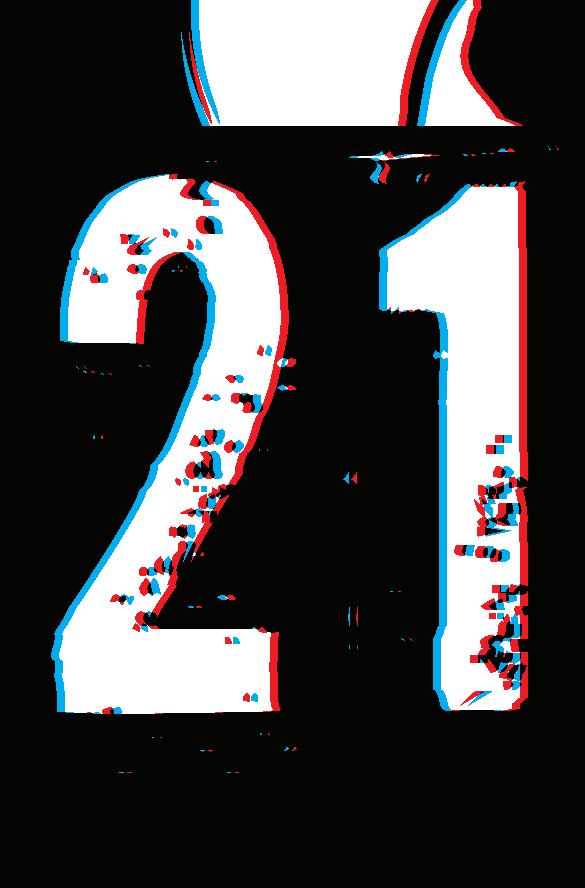
Dear Freshman Me by Owen Ekstrom reflects on his college experience while offering advice to his freshman self. The piece functions as a mirror, inviting readers to reflect on their own college journeys. The feeling of closure strongly influenced my design approach. I chose an end-credit style to evoke the feeling of a story or chapter of life coming to a close. The bold typography and emphasis on certain words reinforce the piece’s central message and ensure its impact remains clear, even for readers who may only skim the page. Ultimately, the design is meant to leave readers with a sense of reflection and fondness for all that they have accomplished.