GCE Magazine is an official business publication of GCE Global Limited.
Published and owned
GCE Global
7 Bell Yard, Holborn, London, WC2A 2JR , England +44 20 3835 5877 (England)
Creative and Editorial Direction
GCE Pink
7950 NW, 53RD Street, Suite 337 Miami, FL 33166, USA.
For direct inquiries, contact:
+1 313 434 2635 (USA), Email: ingrid@gce.pink
All strategic oversight, publishing rights and corporate responsibility remain under GCE Global Limited. No part of this publication may be reproduced, distributed or transmitted in any form or by any means without prior written permission from the publisher. The opinions expressed by contributors are their own and do not necessarily reflect the views of GCE Global Limited.
As we stand on the threshold of 2026, it is impossible not to look back at the year we have just concluded with a profound sense of pride. 2025 was not merely a year of growth for GCE Global Solutions; it was a year of definition. We solidified our presence in over 132 countries, not just as participants in the global market, but as leaders driving the conversation on ethical business transformation and digital strategy.
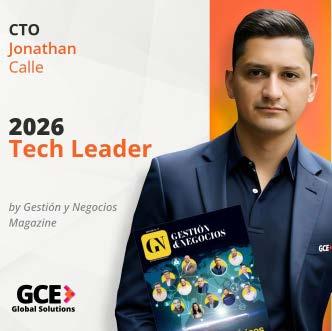
From the historic skies of Mexico, where GCE Aero participated in the first passenger drone flight, to the strategic halls of the United Nations and the World Summit AI in Canada, we have demonstrated that innovation is not a buzzword for us—it is our operating system. We celebrated talent, with our own Daniel Rojas recognized at the Forbes Under 30 Summit, and leadership, with our CTO Jonathan Calle named a 2026 Tech Leader for his pivotal role in our digital evolution.
But if 2025 was about expanding our reach, 2026 is about consolidating our vision. This year marks a decisive moment for the GCE brand and our service ecosystem. The theme of this edition, “2026 AI Frontiers: The Future is Now,” is a reflection of this maturation.
We are moving beyond the adoption phase into a period of deep integration, where the “Augmented Firm” becomes our standard operational reality. In these pages, we explore how Artificial Intelligence is evolving from a tool of efficiency into a partner in strategy, while never losing sight of the “Ethical Algorithm”—the human conscience that must govern our digital progress.
CEO LETTER
In the spirit of this consolidation, I am pleased to share that GCE Global Solutions has formally acquired Payroll Advisers into our core operations. This alignment is a natural progression for our corporate group, strengthening our global reach and unifying our high-quality standards under one seamless umbrella. By harmonizing Payroll Advisers’ specialized expertise with our own AIpowered platforms like GCE Payroll NEXUS, we are not just adding a service; we are refining our ability to deliver robust, scalable, and intelligent workforce solutions across borders.
This is consolidation in action: simpler, stronger, and more effective for you.
As we navigate this transformative year, our commitment remains steadfast: to empower your growth with the perfect equilibrium of human expertise and algorithmic power.
Welcome to a year of strength, unity, and futureforward thinking.
Andrés Mauricio Rojas Díaz CEO of GCE Global Solutions
GCE Global Solutions Scales International Workforce Services
Strategic acquisition of Payroll Advisers optimizes cross-border hiring and global payment solutions.
“By combining human expertise with our AIdriven Platforms for Payroll and EOR, we provide instant clarity on global variables and financial commitments, ensuring every international expansion remains viable and operationally sound from day one. - Jonathan Calle.
GCE Global Solutions has achieved a milestone in geographic coverage, now reaching 235 countries. This acquisition is a strategic move to build a unified global platform for Employer of Record (EOR) and Smart Global Payroll.
By integrating Payroll Advisers, GCE transforms into a central operational engine for crossborder workforce management. The strength of GCE’s infrastructure lies in standardized excellence across all global disbursement channels. By unifying EOR processes, the firm turns regulatory management from a hurdle into a controlled variable. This evolution allows for sustainable growth, ensuring that local tax withholding and statutory benefits are managed before they impact the client’s bottom line.
“The integration allows us to provide the end-to-end international payroll solution the market demands,” says Pamela Bravo, Commercial Partnership Manager. “We have removed operational barriers so companies can focus on talent while we manage compliant employment.” This synergy allows boutique firms to scale globally without the massive overhead of traditional expansion.
Scaling a workforce is no longer about geographic limits, but about the precision of your operational infrastructure. Innovation remains the core driver of this growth. Jonathan Calle, CTO leading the technological front, emphasizes that this move is about more than expanding services.
“By combining human expertise with our AI-driven Platforms for Payroll and EOR, we provide instant clarity on global variables and financial commitments, ensuring every international expansion remains viable and operationally sound from day one.” to scale globally without the massive overhead of traditional expansion.
Scaling a workforce is no longer about geographic limits, but about the precision of your operational infrastructure. Innovation remains the core driver of this growth.
“Our goal is to make borders invisible for our clients’ growth. Global payroll is now an automated and secure function.
- Andrés Rojas.
Jonathan Calle, CTO leading the technological front, emphasizes that this move is about more than expanding services. “By combining human expertise with our AI-driven Platforms for Payroll and EOR, we provide instant clarity on global variables and financial commitments, ensuring every international expansion remains viable and operationally sound from day one.”
Executive Insight: Leading the Global Shift
Andrés Mauricio Rojas Díaz, CEO of GCE Global Solutions. Architect of international expansion and digital solutions for global human capital.
Standardizing Certainty We aren’t just adding countries; we are adding certainty. Integrating Payroll Advisers standardizes global payroll processes across 235 territories. Clients can now activate EOR services knowing that fiscal compliance is identical in London, El Salvador, or Mexico. We maximize operational agility for every partner.
The Augmented Intelligence Edge Technology is our efficiency engine. Our global payroll calculator integrates legal variables in real-time, transforming disbursements from a slow administrative task into an instantaneous data flow. We have eliminated human error in complex local benefit calculations, providing the precision that modern finance directors demand.
Growth Without Friction We provide speed without risk. By strengthening our Employer of Record infrastructure, companies hire talent legally in days without establishing local entities. We handle the administrative and regulatory burden while the client maintains strategic control. This is the ultimate equalizer for modern global growth.
AI Trends 2026: Law and Accounting in Transformation
For
the Lawyer: The Architect of Litigation Strategy
You are the one who feeds the specific case variables and judicial precedents into simulation engines to generate multiple tactical paths. You don’t just see data; you decide which AIsimulated argument has the highest probability of breaking a deadlock in court and authorize the final legal strike.
The billable hour is dead, replaced by algorithmic certainty. In 2026, value is no longer in the labor performed, but in the strategy defined and the results authorized.
As the final arbiter of legal and fiscal truth, your workload has decreased, but your responsibility has intensified. Survival now requires extreme executive efficiency: you are the human signature that validates machine logic.
Daily operations have shifted from drafting to orchestration. You now direct autonomous agents that execute grunt work 24/7. Success depends on mastering the prompts that govern complex discovery and tax simulations.
For the Accountant: The Director of Fiscal Intelligence Your role has evolved into setting the strategic
boundaries for “living” financial models. You deliver the precise directives—risk thresholds, global market variables, and ethical constraints—that force the AI to reveal the safest paths for a merger or investment.
Strategic Agility: The Boutique Advantage
The traditional pyramid has collapsed. Boutique firms now operate as lean networks of orchestrators selling foresight, not just labor.
By adopting specialized automation, these firms deliver elite-tier results without the bureaucracy or the heavy overhead of legacy giants.
Infrastructure is now a proactive asset. Affordable agentic systems manage complex research and reconciliation in the
background. This allows experts to focus on high-stakes strategy while the machine handles the volume, turning operational speed into a primary competitive edge.
The Scaling Catalyst
In a market governed by algorithmic certainty, the success of a boutique practice depends on its ability to scale intelligence without scaling overhead.
The 4 Pillars of the Modern Boutique
Contextual Synthesis: Instant extraction of strategic cores and critical risks from massive, unstructured datasets.
Regulatory Watchdogs: Precision agents monitoring real-time shifts to protect and alert specific client portfolios.
Knowledge Engines: Transforming firm-wide experience into a live library of winning logic and instant precedents.
Value-Based Pricing: Transitioning from the billable hour to high-margin fees rooted in direct business impact.
Artificial intelligence has ceased to be a mere promise of the future, becoming the driving force that redefines our present reality.
This journey toward the technological frontier has been propelled by a series of critical breakthroughs that marked a point of no return in the capacity of machines to process, reason, and act autonomously.
Commanding the Machine: Foundational Facts of the AI Revolution 5 1
In this section, titled “5 Foundational Facts of the AI Revolution,” we analyze the chronology of scientific milestones that enabled the transition from simple predictive algorithms to sophisticated autonomous agents. From the discovery of scaling laws in 2020 to the explosion of native multimodality, we explore how each phase has laid the groundwork for a more human-centric, efficient, and resilient digital ecosystem, radically transforming the way organizations manage their knowledge and operations.
The Discovery of “Scaling Laws” (2020)
OpenAI researchers published a study proving that AI performance is mathematically predictable. By increasing data, computing power, and model size, intelligence scales automatically.
Impact: This justified multi-billion dollar investments and shifted AI from a “language game” to a “reasoning science.”
The Advancement of RLHF: Human Alignment (2022)
The introduction of Reinforcement Learning from Human Feedback (RLHF) allowed AI to stop predicting random words and start following specific instructions. This was the key that unlocked ChatGPT.
Impact: It allowed machines to align with human utility, making them safe and reliable for corporate environments.
The AI revolution has transcended data processing to become a science of reasoning. From predicting words in 2022 to full autonomy in 2025, we have evolved from digital assistants into strategic collaborators capable of executing complex real-world actions.
GPT-4 and the Professional Reasoning Threshold (2023)
With GPT-4, AI surpassed the 90th percentile in professional bar exams and math olympiads. It evolved from a creative toy into a high-precision technical tool.
Impact: This validated AI for use in critical sectors like legal and accounting, where accuracy is mandatory.
Native Multimodality: Seeing and Hearing (2024)
New models like GPT-4o and Gemini 1.5 Pro began processing audio, video, and text simultaneously in real-time. This created a single “brain” that understands the world in an integrated way.
Impact: It enables the orchestration of global meetings and the analysis of physical documents with zero latency.
The “Autonomous Agents” Revolution (2025)
The industry shifted from “Chat” to “Action.” Agentic systems now plan, execute complex tasks across the web, and correct their own errors without human intervention.
Impact: This is the foundation of the Nexus platform: the transition from digital assistants to fully autonomous digital workers.
The 5 AI Engines Defining 2026
In 2026, AI is no longer a tool. It is your core infrastructure. Elite firms no longer sell labor. They sell strategy and results authorized by humans. Orchestration is the new standard.
1. Google Gemini 3: The Research Engine
Google Gemini 3 handles everything at once. It processes text, video, audio, and code simultaneously. It delivers deep research in seconds. Professionals use it to simulate markets and understand complex data. It turns massive datasets into clear insights.
2. Manus: The Autonomous Agent
Manus is Meta’s breakthrough agent. It does not just talk; it acts. It executes tasks independently across WhatsApp and Instagram. It manages workflows and client interactions alone. Humans now act as supervisors of the result, not the process.
3. OpenAI: The Expert Copilot
OpenAI provides adaptive copilots for the modern office. These systems learn your firm’s specific logic. They function as your institutional memory. They don’t just draft text; they back decisions with data. Every move is supported by your total firm expertise.
4. Harvey AI: The Legal Synthesis
Harvey AI is the gold standard for high-level legal work. It understands strategic intent, not just keywords. It extracts the “strategic core” from thousands of documents. It finds hidden risks and inconsistencies in minutes. It is the engine that turns raw data into legal directives.
5. vLex Vincent: The Global Scout
vLex Vincent is the ultimate regulatory watchdog. It tracks real-time changes across 235 jurisdictions. It ignores the noise. It only alerts you when a change impacts your specific portfolio. Compliance remains automatic and stays in the background.
Interview with JONATHAN CALLE
Andrés Rojas: Historically, the technology department was the support for the business. Today, under your leadership, it is the heart of our strategy. What has that metamorphosis been like, from managing infrastructure to orchestrating the intelligence of the entire company?
Jonathan Calle: For many years, technology was seen as the team that fixed problems: servers, emails, systems that stopped working. That was important, but it was reactive. The big change happened when we stopped asking, “How do we maintain this?” and started asking, “How do we use technology to grow?” That shift moved us from maintenance mode to innovation mode.
Technology is no longer just support; it is the brain that orchestrates our intelligence and shapes the future of business.
Today, technology connects every area of the company. It helps us understand data, predict risks, improve decisions, and even design new services. Instead of just supporting the business, we help shape where the business is going. That is what I mean when I say technology became the brain, not just the hands.
Andrés Rojas: Many companies see AI as a cost-saving tool; we see it as a growth one. How do we ensure that technology not only “Optimizes” processes, but also opens new revenue streams that were previously impossible?
Jonathan Calle: Saving costs is the easiest way to explain AI, but it’s not the most powerful one. The real opportunity is using data to discover patterns we couldn’t see before.
CTO at GCE Global Network
When you understand your customers better, when you predict needs before they appear, you can create new services and new value.
For us, it’s about asking better questions. Instead of “How can we automate this task?” we ask, “What new problem can we solve now that we have this intelligence?” That mindset turns AI into a growth engine, not just an efficiency tool.
Andrés Rojas: In such a saturated global market, how has our technological architecture become our greatest competitive advantage over other players in the sector?
Jonathan Calle: Many companies operate with disconnected systems. Marketing has one platform, Finance another, Operations another. When information is fragmented, decisions are slower and less accurate. We designed our architecture to be integrated from day one.
Because everything talks to each other, we see the full picture in real time. That allows us to move faster, adapt faster, and offer smarter solutions to clients. In a crowded market, speed and clarity become a huge advantage, and technology makes that possible.
Andrés Rojas: I am very interested in the collateral impact. How has AI transformed the way the Marketing department understands the customer, or how Finance predicts risk, thanks to the tools you have implemented?
Jonathan Calle: In Marketing, AI helps us go beyond demographics. We don’t just see “who” the customer is, we understand behaviors, patterns, and signals that show what they might need next. That makes communication more relevant and more human.
In Finance, AI gives us early warnings. Instead of reacting to problems, we can detect trends that signal risk. It doesn’t replace financial expertise, but it gives the team better visibility and stronger decision support.
people instead of isolating them.
Andrés Rojas: For the companies reading us who still hesitate to take the leap: what is the most tangible benefit a CEO can expect when their CTO manages to extend access to AI at all hierarchical levels?
We have evolved from simple infrastructure management to orchestrating the very intelligence of the company. By integrating AI into every department, we transform fragmented data into a growth engine, allowing us to predict risks, discover new revenue streams, and shape the future of business through innovation.
Jonathan Calle: The most visible benefit is better decision-making at every level. When information is not locked at the top, teams move with more confidence and autonomy.
It also creates a culture of innovation. When employees feel empowered with smart tools, they don’t just execute tasks, they propose ideas. That energy transforms the organization from the inside.
Andrés Rojas: There is a global debate about job displacement. In our experience, how has AI served to amplify human talent rather than replace it?
Jonathan Calle: The fear that AI will replace people usually comes from seeing technology only as automation. But in reality, what we have experienced is different.
Andrés Rojas: It is often said that technology isolates. However, it seems that our solutions are connecting areas that did not previously talk to each other. What do you think is the technical secret to achieving that organic cohesion?
Jonathan Calle: There’s no magic secret, it’s about shared data and shared language. When all departments work with the same information and clear dashboards, collaboration becomes natural. People stop arguing about numbers and start discussing solutions. Technology should simplify communication, not complicate it. When systems are transparent and intuitive, they connect
AI removes repetitive, mechanical, and timeconsuming tasks, the kind of work that consumes hours but does not necessarily require human creativity. That gives our teams something very valuable: time to think, analyze, and build stronger relationships with clients.
What we’ve seen is that when AI takes care of the routine, people naturally move toward highervalue work.
Our analysts become strategists. Our support teams become advisors. Instead of replacing talent, AI raises the level of what humans can contribute.
The focus shifts from “doing tasks” to “solving problems.”
And that’s where real value is created.
Andrés Rojas: How are we preparing the workforce in non-technical departments to become “expert users” of these new digital capabilities?
Jonathan Calle: The key is not turning everyone into programmers, it’s helping them feel confident using intelligent tools.
We focus on practical learning. We show real examples of how AI can help them answer emails faster, analyze data more clearly, or prepare reports with better insights.
When people see direct impact in their daily work, technology stops being intimidating.
We also promote a culture of experimentation. We encourage teams to test, ask questions, and even make mistakes while learning. The goal is not perfection, but curiosity.
Over time, this builds digital maturity. And when nontechnical teams become comfortable with AI tools, they start proposing new ideas on their own, that’s when you know transformation is real.
Andrés Rojas: While Artificial Intelligence processes data on massive scales, human intuition interprets complex contexts. What is the precise limit between the algorithm’s recommendation and the point where the ethical and strategic judgment of the leader must prevail?
Jonathan Calle: AI is incredibly powerful at detecting patterns and analyzing probabilities. It can show us what is likely to happen based on data. But it does not understand human impact, long-term reputation, cultural sensitivity, or ethical
consequences the way a leader does. Data can show trends, but it cannot define values.
The limit is clear for us: AI informs, leaders decide. When a recommendation affects people’s lives, company reputation, or long-term strategy, human judgment must take the final step.
Technology provides clarity, but responsibility always remains human. That balance is essential for sustainable growth.
Our competitive advantage lies in an integrated architecture where every department speaks the same language. By democratizing AI at all levels, we eliminate fragmented information, empowering teams to move with speed, clarity, and the confidence to turn strategic insights into real-world solutions.
supervision. That will dramatically increase operational speed and precision.
Another major transformation will come from deeper data integration. Companies that connect their data across departments and across countries will gain a much clearer view of their operations.
Predictive analytics, real-time dashboards, and intelligent automation will stop being “advanced tools” and become the new standard. Those who adapt early will have a clear advantage.
Andrés Rojas: We are moving from reactive AI to predictive and autonomous AI. How close are we to technology being able to suggest the company’s next big strategic move?
Jonathan Calle: We are already seeing early versions of this. AI can simulate market scenarios, detect customer behavior changes, and identify opportunities faster than traditional analysis.
It can highlight where growth might happen or where risk is building. That’s extremely valuable.
Andrés Rojas: If we look toward the horizon of the next five years, what emerging technologies are on your radar today that will transform the industry as we know it?
Jonathan Calle: In the next five years, we will see a strong shift toward autonomous systems, tools that not only analyze but also act within defined limits. AI agents will be able to manage workflows, monitor risks, and even optimize processes in real time without constant
However, strategy is more than data. It includes vision, culture, and long-term purpose. AI can suggest possibilities based on patterns, but it cannot define ambition. We are close to having AI propose strategic options, but choosing the direction will always require human leadership.
Andrés Rojas: Sustainability is key for us. How is your department helping our global operations to be not only smarter, but also more environmentally responsible?
Jonathan Calle: Technology plays a direct role in sustainability. By operating in the cloud,
reducing physical infrastructure, and minimizing paper-based processes, we significantly lower our environmental footprint. Remote collaboration tools also reduce travel and energy consumption.
Beyond that, data helps us optimize resource use. When processes are efficient, waste decreases. When decisions are smarter, energy and time are used more effectively. In many cases, efficiency and sustainability go hand in hand. Smart companies are often greener companies.
Andrés Rojas: For customers who trust our services, security is non-negotiable. How do we build an AI that is powerful but, above all, ethical and transparent?
Jonathan Calle: We start with strong data governance. That means clear rules about how data is collected, stored, and used.
Transparency builds trust. Clients must know what happens with their information and how decisions are supported by technology.
We also design AI systems with accountability in mind. There must always be human oversight. Ethical AI is not just about avoiding bias, it’s about ensuring fairness, protecting privacy, and maintaining clear responsibility.
Power without control creates risk. Power with transparency creates trust.
AI automates the routine, elevating humans to strategic architects.
Andrés Rojas: What is the biggest lesson you take away from this transformation process that you think any global company should apply today to avoid becoming obsolete?
Jonathan Calle: The biggest lesson is that technology alone does not transform a company, mindset does. You can invest in
the best tools in the world, but if your culture resists change, innovation will not happen.
Transformation starts with leadership encouraging curiosity and adaptability.
Another lesson is that speed matters. The market is evolving quickly.
Companies that experiment, learn, and adjust continuously will stay relevant.
Those that wait for perfect conditions often fall behind. Progress favors the bold, not the hesitant.
Andrés Rojas: Finally, if you had to define the technological DNA of our company in a phrase that inspires our partners and clients, what would it be?
Jonathan Calle: “Our technology doesn’t replace people, it empowers them to think bigger, act smarter, and create opportunities that didn’t exist before.”That is the essence of who we are. We believe intelligence should elevate human potential, not limit it.
GCE EVENTS
AIFOD GENEVA WINTER SUMMIT 2025(January):
Through its presence at this high-level international forum, GCE reinforced its commitment to ethical innovation and sustainable development frameworks. The summit provided an opportunity to engage with global policymakers, industry leaders, and multilateral institutions shaping the future of artificial intelligence governance and inclusive economic transformation.
Airmobility MexicoFirst Drone Fight Latin America (March):
This milestone event underscored GCE’s forward-looking vision in advanced mobility solutions and emerging aviation technologies. By actively supporting innovation in autonomous transport, the organization continues to contribute to the evolution of regulatory, technological, and infrastructure ecosystems across Latin America.
World Summit AI Canada (April)
Participation in this internationally recognized platform reinforced GCE’s dedication to empowering next-generation leadership and fostering entrepreneurial vision. By connecting with global changemakers and industry disruptors, the organization continues to expand its innovation-driven ecosystem and strategic global presence.
Summit Equilibrium (September)
The summit enabled high-level exchanges on emerging AI applications, governance frameworks, and scalable digital solutions. Through this engagement, GCE continues to position itself at the forefront of responsible AI integration, supporting organizations in navigating complex technological transitions with strategic clarity.
Global Compact Congress (August)
GCE joined over 1,000 leaders at the 16th Global Compact Network Colombia Congress to accelerate strategic alliances for a sustainable future.
By engaging with corporate leaders, sustainability experts, and policy influencers, GCE reaffirmed its commitment to responsible business practices aligned with global ESG standards.
The congress strengthened collaborative pathways that support long-term value creation, ethical governance, and measurable impact across emerging and established markets.
Forbes Under 30 Summit (September):
Internal synergy: GCE Group gathered at Summit Equilibrium to align its strategic vision and celebrate milestones in digital transformation.
This internal leadership forum reinforced crosssector collaboration, operational alignment, and shared growth objectives across the organization.
By consolidating strategic priorities and celebrating measurable progress, GCE strengthens its unified approach to innovation, scalability, and long-term institutional excellence.
UNLEASH Paris (October)
Through its participation, GCE deepened strategic conversations around workforce digitalization, data-driven talent management, and adaptive organizational models. The event strengthened international connections within the HR innovation ecosystem, reinforcing GCE’s role in shaping forward-thinking people strategies aligned with emerging global trends.
GPA Payroll Symposium Dubai (November)
By presenting advanced payroll integration capabilities, GCE reinforced its position as a strategic enabler of operational efficiency and compliance excellence. The symposium further strengthened alliances with regional and international partners within the evolving global payroll landscape.
Drone Innovators Forum MX (November)
By contributing real-world operational insight, GCE positioned itself as a key participant in the advancement of autonomous aerial mobility frameworks. The forum provided a platform to engage regulators, technology developers, and infrastructure partners working to accelerate safe, scalable urban air ecosystems across the region.
GR Industry Awards 2025 (November)
This recognition reflects the organization’s sustained commitment to inclusive talent strategies and highperformance recruitment solutions. Participation in the awards platform reinforces GCE’s visibility within the global HR and talent acquisition community.
Tech Leadership Colombia
This distinction highlights GCE’s continued investment in technological leadership and scalable digital infrastructure. Under strategic executive direction, the organization advances innovationdriven platforms that support operational excellence and long-term competitive positioning.
Global Leadership
CEO Andrés Mauricio Rojas Díaz has positioned GCE Global Solutions as a powerhouse in 132 countries, blending augmented intelligence with a purpose-driven vision for ethical business transformation.
Under his leadership, the organization has strengthened its international footprint through strategic expansion, technology integration, and cross-border operational excellence. By combining innovation with governance and long-term value creation, GCE continues to consolidate its presence as a globally competitive consulting group with Latin American roots and worldwide impact.
“
Latin American leadership is not only ready to compete on a global stage, it is ready to redefine how business is done, with purpose, ethics, and strategic vision.
— Andrés Mauricio Rojas
The Legal Renaissance
There is an understandable fear when discussing Artificial Intelligence: the idea that algorithms might eclipse human judgment.
However, what we are experiencing in the 2026 global market is, in reality, a renaissance of our capabilities.
In the complex world of corporate law, AI has not arrived to take our seat, but to clear the path of technical obstacles and give us back our most precious asset: the time to think.
By delegating mechanical tasks to algorithms, we act as a cognitive exoskeleton. This allows legal professionals to reclaim their roles as strategists, focusing on empathy, ethical judgment, and complex solutions that no machine can replicate.
Freeing the Mind, Empowering Talent
For decades, legal departments and their collaborators were trapped in oceans of documents, repetitive tasks, and mechanical reviews that exhausted the creative spirit.
Today, AI acts as a cognitive “exoskeleton.” By handling massive data processing and routine risk detection, it allows professionals to reclaim their roles as strategists and mediators.
The benefit for the collaborator is profound: less fatigue from monotonous tasks and more space for empathy, ethical judgment, and the resolution of complex problems that no machine can replicate.
A Tool for Human Excellence
The companies that thrive today are those that have understood that technology is a talent multiplier, not a substitute.
AI accelerates processes— reducing response times and minimizing human error—but it is human vision that directs that speed toward a purpose.
This efficiency does not seek to eliminate roles, but to evolve them; it allows small teams to achieve global milestones, democratizing access to corporate justice and allowing people to focus on what truly matters: building relationships and designing the future.
In conclusion, AI is the bridge toward a more human way of working. By delegating the mechanical to algorithms, we are giving ourselves permission to return to what we were always meant to be in the business world: architects of solutions and guardians of integrity.
In this new model, AI handles execution at scale, allowing legal professionals to focus on judgment, strategy, and accountable decision-making.
Outsourcing Legal AI Mastery
In 2026, outsourcing is no longer just a cost-reduction strategy; it is the foundation of an agile business model that allows global companies to access specialized talent in every corner of the planet. However, this flexibility brings with it an intricate labyrinth of regulations
The question is no longer whether we can use Artificial Intelligence to manage the legal complexities of outsourcing, but how we can do so ethically and within the “legal borders” that AI itself helps us define and respect.
The Real-Time Legal Map
For an outsourcing firm, every new cross-border contract is a miniature treaty.
Labor laws, data privacy regulations (such as Europe’s GDPR or California’s CCPA), tax regulations, intellectual property rights, and social security requirements vary drastically.
Navigating this manually is unfeasible. This is where AI emerges as the indispensable co-pilot.
Specialized AI tools act as “legal cartographers”: they analyze thousands of legal texts, precedents, and regulatory updates across multiple jurisdictions in real-time.
They provide outsourcing legal teams not just with a guide, but with predictive analysis regarding the risks associated with each country.
This allows them to draft service contracts and labor agreements that comply with local law, protecting both the client company and the subcontracted worker.
Smart Borders, Human Ethics However, the “permitted use” of AI within these borders is not unlimited.
The key lies in human supervision. AI can identify a local legal requirement for a notice period or a non-compete clause, but it is the legal professional who must ensure that this information is applied fairly, transparently, and ethically.
AI turns legal borders into navigable bridges, transforming lawyers into architects of global strategy.
Data Privacy: AI is crucial for ensuring that the personal data of subcontracted workers is handled according to the laws of both the country of origin and the country where the service is provided. AI systems audit data flows and alert for potential breaches.
Labor Equity: Although AI streamlines contract drafting, it cannot replace human judgment in adapting those contracts to exceptional circumstances or in negotiating fair conditions that respect the worker’s dignity, beyond the letter of the law.
Transparency: Outsourcing companies must be transparent about how they use AI, especially when evaluating candidates or determining contractual terms, to build trust with their clients and collaborators.
The Future of Global Collaboration
AI does not eliminate legal borders, but it does make them more understandable and manageable. For global outsourcing, it means safer, faster, and, paradoxically, more human expansion.
By relying on AI for the complex and routine, legal professionals can elevate themselves to the role of global strategy architects, ensuring that every talent expansion is not only legal but also a step toward a fairer and more efficient future of work.
Legal Borders Without
The
Borderless Ambition: A New Strategic Paradigm
In the global labor market of 2026, talent has officially shed its geographical constraints; the professional excellence of a firm is no longer defined by its physical headquarters, but by its ability to integrate the world’s best minds into a single, cohesive mission.
We have entered an era where the primary competitive advantage for any corporation is its capacity to scout, hire, and retain top-tier specialists, regardless of their location on the map. However, this “borderless dream” carries a staggering reality: the need to navigate the labyrinthine labor, tax, and social security frameworks of nearly two hundred sovereign nations.
The concept of a borderless company is no longer constrained by compliance complexity. By integrating human expertise with AIdriven legal translation tools, the role of the legal professional has evolved from manual research to strategic advisory, enabling more structured and efficient connections between global talent and opportunity.
Historically, this regulatory mountain was a barrier that only the largest conglomerates could climb. Today, the alliance between human curiosity and Artificial Intelligence has leveled the playing field, allowing agility to coexist with strict, unwavering compliance.
Navigating Regulatory Ecosystems with Technical Precision
Every nation is a unique legal ecosystem where a standard hiring practice in one territory can be a critical compliance risk in another, leading to unforeseen liabilities and reputational damage. This is precisely where AI has fundamentally restructured the legal workflow.
Instead of legal departments losing weeks to the manual “excavation” of foreign labor codes and regional amendments, teams now utilize sophisticated systems that function as “real-time law translators”.
These intelligent platforms do not override the lawyer’s expertise; rather, they provide a high-fidelity, constantly updated foundation of data. By automating the technical crossreferencing of international statutes, AI ensures that every contract is not just legally sound, but culturally and locally precise.
The Mitigation of Transnational Risk: Beyond the Contract
Expanding into new territories is not merely a matter of signing a document; it involves managing a complex web of “collateral risks” that are often invisible during the initial onboarding phase.
From intellectual property protection across different jurisdictions to the subtle nuances of local benefits and mandatory contributions, the margin for error is razor-thin.
The implementation of a “Legal Co-pilot” allows for proactive risk detection, flagging potential regulatory shifts before they become active liabilities.
This predictive capability transforms the legal department from a “cost center” into a strategic unit that secures the company’s global assets.
By having a digital eye on the world’s changing statutes, firms can pivot their global strategy in days rather than months.
The Legal Evolution: From Researcher to Cultural Architect
For the legal professional, this technological leap is nothing short of a liberation from the mundane.
By delegating the exhaustive monitoring of shifting global regulations, tax amendments, and social security updates to an intelligent “co-pilot,” the lawyer is finally free to focus on the human dimension of the workforce.
They are evolving from reactive compliance researchers— historically buried in the “excavation” of codes—into proactive strategists of corporate culture and architects of organizational integrity. With the technical burden of
“manual research” removed, legal experts can now dedicate their intellect to designing wellness policies that transcend borders, fostering genuine inclusion across diverse latitudes, and ensuring that the company’s core values are woven into every agreement.
They are no longer just guardians of the rulebook; they have become the visionary architects of a global community, humanizing the contract through empathy and strategic foresight.
A Paradox of Personalization
Ultimately, Artificial Intelligence has achieved something paradoxical: it has made global hiring significantly more personal.
In the global landscape of 2026, we have mastered the art of scaling the regulatory mountain by aligning human curiosity with artificial intelligence. Our ‘Legal Co-pilot’ does more than navigate complex tax and labor codes; it strips away the mechanical noise of compliance to reveal the individual behind the resume, allowing us to build deeper, more secure, and profoundly more human connections between world-class talent and global opportunity.
By stripping away the administrative noise and automating the routine, technology allows us to stop looking at candidates as a series of regulatory risks and start seeing the individual behind the resume.
In today’s interconnected business environment, technology does not replace the professional; it provides the essential tools to build stronger, more resilient, and more human bridges between global talent and the opportunities of tomorrow.
As we automate the mechanical, we give ourselves permission to return to our true essence in the business world—focusing on relationships, ethical judgment, and the design of a future where talent truly has no borders, and opportunity knows no limits.
Legal Pillars
The year 2026 finds us immersed in an era where companies no longer compete solely for markets, but also for the best talent, regardless of where they reside. This landscape has radically transformed the legal labor field, which must now be as agile and global as the workforce itself. Artificial Intelligence is not an option but a necessity, and its effective use is defined by five fundamental keys.
1
Prioritize Automated Global Compliance
AI must be your “compass” for navigating complex international labor laws. Use AI-powered platforms to monitor and update, in real-time, local regulations regarding hiring, salaries, benefits, and terminations in every country where you operate. This allows you to draft legally compliant contracts from the very beginning, mitigating the risks of fines and litigation that were previously almost inevitable.
2
Liberate Your Legal Experts from Monotonous Work
The greatest value of AI is its ability to take on repetitive, high-volume tasks. Implement tools that automate document review, the classification of contractual clauses, and the detection of potential risks in labor agreements..
3 4
Ensure Data Privacy and Ethics with AI
In a world of digital borders, the protection of employees’ personal data is critical. Utilize AI systems to help audit and guarantee that worker information is handled in accordance with regulations such as GDPR or CCPA, regardless of their location. AI can alert you to potential privacy violations, but always under the supervision of a legal professional who ensures transparency and respect for individual rights.
Foster Transparency and Trust
When integrating AI into your legal processes, be transparent with your collaborators and clients. Explain how technology facilitates efficiency and guarantees compliance without replacing human decision-making. This builds trust and helps demystify AI, showing it as a tool that improves safety and equity in the global workplace.
5
Invest in Human Upskilling
AI does not just optimize processes; it redefines roles. Train your legal teams to be “collaborators” with AI. Teach them to interpret the insights that technology provides, to ask the right questions, and to use the tools strategically. This upskilling ensures that the legal professional remains at the forefront, becoming an architect of solutions that merges legal wisdom with technological efficiency.
The New Legal Frontier: AI as a Strategy, Not Just a Tool Redacción
In conclusion, AI within the global labor legal sphere transcends its role as a mere tool; it has evolved into a fundamental work philosophy. When implemented with strategic vision, it acts as a force multiplier for human capacity— securing institutional integrity while paving the way for a borderless, more equitable, and highly productive future for global talent.
The New Legal Finance Ally &
A Technological Metamorphosis
In the last decade, the accounting and finance outsourcing sector has evolved from a mere data processing factory into the epicenter of a technological revolution.
Artificial Intelligence is not designed to replace expertise, but to reallocate professional focus away from repetitive tasks. By delegating routine execution to technology, legal and finance leaders can concentrate on strategic priorities, innovation, and consistent regulatory integrity across international operations.
This shift allows global firms to reclaim their most valuable asset: the time and creativity of their brightest minds.
The New Heart of Global Finance
For outsourcing firms managing international portfolios, AI has been the catalyst for unprecedented efficiency.
Thanks to Machine Learning algorithms, tasks that once consumed weeks—such as massive bank reconciliations or detecting anomalies in cross-border transactions—are now executed in seconds with mathematical precision.
This transformation provides global companies with real-time visibility into their financial health.
Decisions are no longer made based on last month’s reports; they are driven by this morning’s data.
AI enables simultaneous fraud risk mitigation and cash flow optimization across multiple currencies, a feat humanly impossible at such a scale without technological support.
A Human-Centric Approach:
Putting the Collaborator First However, the most significant impact isn’t found in the servers, but in the collaborator’s seat. By automating data entry, the finance professional evolves from an “operator” into a “strategic consultant.”
Burnout Reduction: Fewer repetitive tasks mean a lower cognitive and emotional load for the team.
Professional Empowerment: Collaborators now interpret insights, advise on market trends, and design growth projections.
Real Connection: By delegating the numbers to the machine, outsourcing teams can focus on understanding the specific culture and objectives of their global clients.
AI in accounting is not a cold line of code; it is the tool that allows empathy, ethical judgment, and strategic creativity to return to the forefront of the finance table. In this new global market, technology is the engine, but human talent remains the pilot.
Artificial Intelligence does not arrive to replace the expert, but to liberate the brilliant mind from the tyranny of mechanical tasks. By delegating the routine to technology, we allow human talent to reclaim its essential role as the strategic pilot of global finance, ensuring both creative innovation and absolute legal integrity across every international transaction and organizational decision.
TRENDS The 2026
If 2024 was the year of experimentation and 2025 the year of regulation, 2026 is the year of execution. In today’s global market, Artificial Intelligence has ceased to be an isolated tool, becoming “invisibly” integrated into every contract, litigation, and strategic decision.
For companies and their legal departments, these are the five trends setting the pace for success this year:
1
Agentic AI: From Chatbots to Active Collaborators
We no longer simply ask AI where a law is located; we now deploy AI Agents. These systems do not just respond—they “act.” They can monitor changes in a country’s official gazette, evaluate how they affect existing contracts, and automatically draft a proposed amendment for the lawyer to review. This marks the transition from reactive to proactive technology.
3
Governance and Ethics by Design
With regulations like the EU AI Act in full effect, leading companies in 2026 no longer view ethics as a hindrance, but as a competitive advantage. The current trend is Auditable AI: systems that allow for exact tracking of why a legal decision was made, ensuring there are no hidden biases and complying with the highest global transparency standards.
AI handles the complexity of global data so that human intuition can drive the most critical strategic decisions.
2
Predictive Justice and Outcome Modeling
Thanks to the massive analysis of historical data, AI now allows for predicting the probability of success in litigation with astonishing precision. This trend is enabling legal teams to stop being seen as a cost center and start acting as financial risk managers, deciding based on data—rather than just intuition—when it is better to settle and when to go to trial.
4
Ambient AI and
“Click-less”
Workflows
AI has become “ambient.” It is no longer necessary to open a separate application; intelligence is embedded in word processors, email, and document management systems. It suggests clauses as you write and organizes corporate knowledge automatically, allowing legal professionals to stay in the “flow of work” without technical interruptions.
The trends shaping 2026 indicate that AI is not replacing legal expertise, but to provide the speed and precision that the modern world demands.
Organizations that thrive are those that understand that the key is not adopting the most technological functions, but building the solid foundation for a harmonic collaboration between data and human judgment.
The future of Global Accounting
By 2026, traditional bookkeeping models have largely been replaced by data-driven accounting architectures, giving way to an era where the “Strategic Data Architect” has replaced the manual processor. In this hyper-connected economy, accounting has transitioned from a historical record-keeping function to a real-time predictive engine.
The modern accounting department no longer looks in the rearview mirror to report what happened; instead, it utilizes a sophisticated digital nervous system to dictate what will happen next. This structural shift is driven by the full integration of Artificial Intelligence into the daily fabric of financial operations, a shift that has redefined the very concept of fiscal transparency and corporate agility.
The most significant shift in this new paradigm is the arrival of the continuous, cognitive reconciliation process, which has effectively dismantled the century-old ritual of the fiscal close.
For decades, the “month-end close” was a period of high stress and manual labor that often yielded data that was already outdated by the time it reached the board of directors. Today, AIdriven engines perform perpetual reconciliation across global banking systems, decentralized ledgers, and multiple currencies
85%
of leading firms have eliminated traditional monthly closes through continuous AI auditing, shifting hundreds of human hours toward highlevel strategic advisory.
simultaneously. These systems possess the cognitive ability to understand the complex context behind every transaction, resolving discrepancies the moment they occur without human intervention.
This evolution has birthed a “Continuous Close” culture, where an audit-ready, highfidelity financial statement is available every single morning, allowing organizations to pivot their global strategies with a level of speed and confidence that was previously unimaginable in the corporate world.
Navigating the global tax labyrinth has also been transformed from a reactive administrative burden into a proactive competitive advantage for the modern firm.
In an era where nearly two hundred nations constantly adjust their fiscal policies to adapt to digital economies, the role of AI as a real-time “Tax Navigator” is indispensable. These systems automatically adjust provisions, calculations, and filings based on the latest legislative amendments in every jurisdiction where a company operates, from European VAT shifts to emerging digital services taxes in Asia.
By automating the hyperlocalization of tax requirements, accounting teams have virtually eliminated the risk of human error in complex areas such as transfer pricing and cross-border compliance.
This ensures that the organization remains a flawless global citizen, maintaining total integrity without the friction of manual oversight or the existential threat of unforeseen regulatory liabilities.
Beyond simple compliance, the financial integrity of the modern firm is now guarded by predictive expense management and microscopic anomaly detection that operates at a scale beyond human capability.
Expense tracking is no longer a passive exercise in categorization; it has become a proactive shield against resource leakage and corporate waste.
Advanced algorithms now analyze spending patterns across entire global structures,
identifying “micro-anomalies” that human eyes would inevitably miss—such as subtle, recurring billing discrepancies, non-compliant spending patterns at the edge of the organization, or hidden inefficiencies in supply chain invoicing.
This constant, invisible vigilance saves millions in potential losses and ensures that every single dollar spent is in perfect alignment with the company’s long-term strategic goals and internal ethical policies.
This technological leap is powered largely by Natural Language Processing (NLP), which has finally unlocked the massive value hidden within unstructured financial data.
Much of a company’s financial “truth” historically lived in the “dark data” of vendor contracts, legal agreements, and
By2026
firms integrating AI into their ledgers have seen a 400% increase in ‘Strategic Output’ per accountant, as professionals shift from manual data entry to high-stakes decision architecture.
thousands of physical receipts.
In 2026, intelligent systems can “read” and interpret these documents with the same nuance and professional skepticism as a human expert, automatically extracting liabilities, accruals, and payment terms directly into the ledger.
This removes the final bottleneck of manual data entry, ensuring that the books reflect real-world obligations the very moment a contract is signed. This synchronization between the legal word and the accounting figure creates a level of operational transparency that serves as the ultimate foundation for investor trust.
Ultimately, the most profound impact of this revolution is the liberation of the human professional from the mechanical. With the vast majority of repetitive tasks now handled by intelligent agents, the accountant has been elevated to a role of ethical stewardship and value architecture.
Modern accounting teams spend their intellect analyzing the “why” behind the figures, providing deep insights into business health, sustainability reporting (ESG), and long-term value creation.
In this new global market, while the machine provides the mathematical precision and the raw processing power, it is the human professional who provides the strategic purpose and the ethical judgment that drive the world’s most successful organizations forward into an uncertain but promising future.
2026 Strategy Agent The age of the
In the global financial ecosystem of 2026, the operating dynamics of corporate leadership have undergone a structural shift that has redefined the very essence of corporate leadership.
If 2024 was defined by cautious curiosity and 2025 by the chaotic rush of implementation, then 2026 stands as the definitive year of operational autonomy. Global enterprises have moved beyond treating Artificial Intelligence as a mere query tool or a digital assistant; they have integrated it as a core proactive strategic force that executes high-stakes actions to define and defend market positioning.
This transition marks the historic end of technology as a passive servant and the birth of a proactive digital intelligence that anticipates global volatility and navigates regulatory complexity with a speed that defies traditional human management structures.
The most disruptive change in this new paradigm has been the systematic death of historical data as the sole beacon for corporate direction.
In 2026, administration and finance departments no longer operate under the fog of the past; they exist within a model of infinite visibility where the very concept of a “monthly close” has become an archaeological relic of the pre-digital era.
Agentic AI—intelligent systems that do not merely suggest corrections but autonomously execute reallocations and currency hedges—has enabled what we now call the “Living Balance Sheet.” Today, financial statements breathe in real-time, updating every microsecond across global subsidiaries.
This allows CFOs to detect a capital leak in an Eastern European branch or a sudden investment opportunity in a burgeoning Southeast Asian market the exact moment it occurs, rather than waiting for thirty days of manual reconciliation to reveal a lost chance.
This transformation has triggered a profound metamorphosis in the human hierarchy of global finance and outsourcing.
The modern financial office is now a hybrid ecosystem where “Digital Employees”— autonomous agents capable of managing the transactional bureaucracy of accounts payable, international tax adjustments, and intercompany settlements—operate with a staggering 99.9% precision rate.
Liberated from the crushing weight of mechanical data entry and repetitive verification, these professionals have redirected their intellect toward the most complex frontiers of the business.
Their daily focus has shifted toward ethical governance, ensuring that algorithms remain free from subtle market biases, and toward cross-border strategy, where they interpret the delicate geopolitical nuances that even the most advanced AI projections might overlook.
Ultimately, the verdict of 2026 is clear: Artificial Intelligence has not cooled the world of finance; it has made it more agile, more secure, and paradoxically, more focused on the weight of human judgment than ever before.
99.9%
The financial collaborator of 2026 is, more than ever, a high-level strategic architect. precision in transactional management has been achieved by autonomous agents in 2026, effectively eliminating the risk of human error in cross-border financial bureaucracy and allowing for a ‘zero-friction’ global expansion.
Furthermore, in this hyperconnected and often unstable era, Artificial Intelligence has transformed financial management into an exercise in absolute institutional transparency, effectively turning trust into the most valuable currency on the global market.
For corporations operating across dozens of jurisdictions, the adoption of AI-based continuous auditing has drastically reduced friction with international regulators and local tax authorities.
In a world where software can calculate every possible permutation of a global budget in milliseconds, the strategic intuition, the emotional intelligence, and the ethical compass of the financial leader have become the most expensive and sought-after assets in any organization.
We have reached a point where the machine provides the map and the relentless engine of speed, but it is the human pilot who provides the ultimate purpose, the cultural empathy, and the final decision that turns a simple data point into a lasting corporate legacy.
65%
However, this has not led to the displacement of the human professional; instead, it has forced an aggressive elevation of the role toward the apex of value creation.
Technology now acts as an invisible but impenetrable digital seal of guarantee; when financial figures are processed, validated, and monitored by auditable and explainable systems, investor confidence skyrockets.
This systemic integrity allows firms to access cheaper capital and enter emerging markets with a level of regulatory “soft landing” that was simply impossible when compliance was a manual, errorprone process.
of a financial leader’s time in 2026 is now dedicated to ‘HumanOnly’ strategic tasks—such as ethical governance and geopolitical negotiation—a massive shift from the 20% average seen just three years ago.