INNOVATIONS IN DISEASE DIAGNOSTICS
An innovative method for detecting frailty Frailty is related to getting older. It describes how our bodies gradually lose their in-built reserves, leaving us vulnerable to sudden changes in health triggered by seemingly small events such as a minor infection or a change in medication or environment. Frailty brings greater risk of falls, cognitive decline and disability. It makes people more likely to need GPs, hospitals and long-term care. Our current ways of measuring frailty are not useful for detecting its early signs. FRAILMatics is a multidisciplinary project, established in September 2020, to improve methods for detecting subtle early signs of frailty. By identifying people in the early stages and improving their resilience, we will achieve better outcomes for patients and healthcare providers. We use the latest supercomputers to analyse vast numbers of measurements of mild physiological stresses across cardiovascular, movement and brain-health systems. Analysis can show subtle but reliable signals of SCHOOL OF MEDICINE RESEARCH STRATEGY 2021-2026
vulnerability. The study will help us develop medical devices to identify frailty at an early stage.
“More accurate and earlier detection of frailty will help doctors care better for older patients.”
on patients at Mercer’s Institute for Successful Ageing (MISA) in St James’s Hospital, Dublin. FRAILMatics will advance the science of frailty and achieve considerable savings by reducing avoidable health complications.
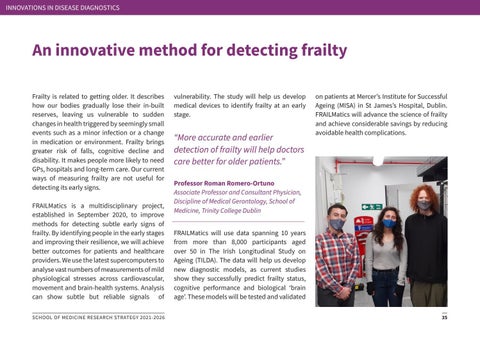
Professor Roman Romero-Ortuno Associate Professor and Consultant Physician, Discipline of Medical Gerontology, School of Medicine, Trinity College Dublin FRAILMatics will use data spanning 10 years from more than 8,000 participants aged over 50 in The Irish Longitudinal Study on Ageing (TILDA). The data will help us develop new diagnostic models, as current studies show they successfully predict frailty status, cognitive performance and biological ‘brain age’. These models will be tested and validated 35