All photographs and visual materials included in this guide are used for non-commercial, educational purposes only. Image sources include publicly accessible archives and digital collections, including the Library of Congress, Digital Public Library of America (DPLA), the Smithsonian Institution, PBS, YouTube, and Museum of Fine Arts. Where applicable, copyright and licensing information is credited to the appropriate rights holders. This guide is intended for classroom and curriculum-based instruction and not for resale or commercial distribution.
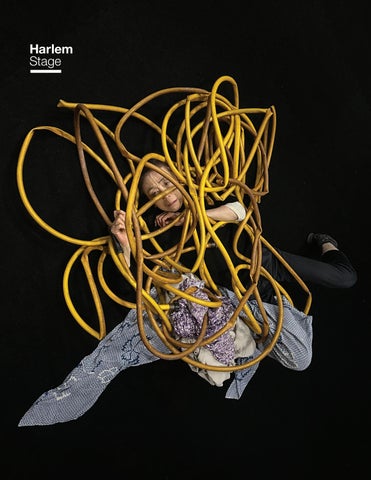
Eiko Otake is a movement-based, interdisciplinary artist. After working for more than 40 years as Eiko & Koma, she now performs as a soloist and directs her collaborative projects.
Photo of Eiko Otake by DonChristian Jones
Frances Davis Arts Education Program
IGNITING ARTISTIC FREEDOM
An Educational Spark
Select Sections written by Steff Reed
Edited by Bethany Cintron
About Harlem Stage
By Dr. Indira Etwaroo
Harlem is our home. The world is our stage.
Founded in 1983, Harlem Stage is a dynamic hub of artistic innovation, dedicated to empowering performing artists of the Global Majority at every stage of their journey. It serves as a beacon of artistic freedom for New York City, the cultural capital of the world. Guided by its North Star— Harlem is our home; the world is our stage—Harlem Stage is a platform where adventurous and daring creation knows no bounds: a stage to create fearlessly with new works; to present boldly through theater, dance, music, spoken word, film, and literature; to educate endlessly, engaging learners of all ages; to question relentlessly the ideas that shape the human experience; and to engineer equity in an artistic landscape that has long underinvested in performing artists and communities of the Global Majority.
The Global Majority, as a term, is used instead of People/Artists/Communities of Color to center language that resists historic silos and monolithic approaches to cultural identification. In addition, terms for the select communities of the Global Majority are imperfect at best in fully representing the diversity that exists within each sub-category of racial/ethnic identification but are used mainly for the purpose of articulating and embracing an intersectional approach to our work. Communities of the Global Majority comprise the approximately 85% of the global population. People of the Global Majority (PoGM) refers to Black people, Indigenous people, Brown people, Latinx peoples—particularly Indigenous and Afro-Latinos—Pacific Islanders, Native Hawaiians, the Inuit communities/Alaska Natives, Native Americans, Arabs, Western Asians/Middle Easterners with dark skin, North Africans, Southeast Asians, South Asians, East Asians, Africans with dark skin, and biracial and multiracial people who are mixed with one or more of the above, and people and groups who can’t access white privilege.
I wish I knew how it would feel to be free I wish I could break all the chains holding me
This resounding anthem performed by the late, renowned pianist and Civil Rights activist Nina Simone speaks to a piercing sentiment keenly felt and experienced by artists of the Global Majority. The anthem addresses the inherent conundrum wherein the mere act of creative artistic expression—a cornerstone of democracy—does not spontaneously translate to a sense of freedom for artists or institutions of the Global Majority in a world rife with longstanding and contemporary reverberations of slavery, colonization, and systematic and structural rules of order that oppress one group over another, limiting opportunities, resources, and the ability to imagine a world where ALL people can flourish.
At Harlem Stage, our work stands at a precipice of query and possibility that has the potential to radically challenge and deepen the relationship between arts leaders, artists, and audiences of the Global Majority. Our vision for Harlem Stage is to be the global stage for performing artists of the Global Majority who dare to assert the artistic freedom that gives birth to new ideas and, thus … a new world.
We are unparalleled in our mission-driven focus, grappling with the complexity, intersectionality, diversity, and beauty of artists who are of the pluralistic experiment that is the Global Majority (85% of people across the globe). Harlem Stage collaborates with artists, institutions, changemakers, and visionaries from around the world to amplify transformative stories and ideas that inspire, educate, and foster global connection and cultural understanding. The New York Times has called Harlem Stage “an invaluable incubator of talent,” and pianist and MacArthur “Genius” Fellow Vijay Iyer has stated, “It is shockingly rare that artists of color are invited to become full participants in the national conversation, to respond to today’s world, and to offer a glimpse of tomorrow. Harlem Stage stands out as one of the only presenters in the U.S. that makes this their goal.” Iyer is one of thousands of artists over our 42-year history who understand that Harlem Stage is not just a performance space; it is a time machine launching artists into limitless possibilities from the past and present into the future. MacArthur “Genius” Fellows Kyle Abraham, Bill T. Jones, Jason Moran, and Cecil Taylor have also found a home away from home at Harlem Stage, underscoring our role as a groundbreaking force in the arts. Harlem Stage continues to build a legacy of experimentation, innovation, and equity, ensuring that today’s artistic voices shape the world of tomorrow.
At Harlem Stage, we believe that the arts have the transformative power to shape young lives, but also lifelong learners of all ages to ignite critical thinking, and give voice to underrepresented and disadvantaged youth and community members from New York City and beyond. Our Educating Endlessly program is designed to provide thousands of students annually access to life-changing artistic experiences, bold conversations, resources for deep personal reflection, and creative expression. By offering students a chance to see themselves reflected in the arts, we empower them to understand their identity, individual freedoms, and resilience.
Through free student-only matinees at Harlem Stage, in-school residencies, immersive writing and performance workshops, we bring middle school, high school, and college and university students of all ages into direct contact with professional artists and performers. Our program sparks exploration, creativity, and the courage to confront tough, real-world topics—racial equity, environmental justice, immigration, gender equality, war zones, and the rights of the LGBTQ+ communities, and more—engaging students in stories that amplify themes of social justice, identity, and the power of art to enact real social change.
Artistic Freedom Within a Democracy
By Steff Reed
“An artist’s duty, as far as I’m concerned, is to reflect the times.” — Nina Simone
Throughout history, artists have often reflected the realities of the world around them. Whether through music, painting, literature, theater, dance, film, or performance, art has served as a mirror to society—helping people to process experiences, to ask difficult questions, and to explore the human condition.
Today, the role of the artist remains as vital as ever. In times of social and cultural transformation, artists contribute to public dialogue by encouraging critical thinking, sparking imagination, and helping communities make sense of complex issues: from the devastations of September 11 to the outcomes of political elections to conflict zones across the world to LGBTQ+ rights and so much more. Art offers insight into our past, helps us contextualize the present, and brings us together to envision a shared future.
Billie Holiday’s “Strange Fruit,” exposed the horror of racial violence in the late 1930s; James Baldwin’s exploration of American identity from the 1950s through the 1980s; and Lorraine Hansberry’s dramatizations of Black life that debuted in 1959 to document injustice and invite audiences to imagine alternatives. Whether through music, visual art, theater, or literature, artists have historically contributed to the social fabric by capturing the emotional and intellectual dimensions of their time.
Toni Morrison reminded us that, “Art is dangerous... it has impact, it can effect change.” Morrison spoke to the historical targeting of artists by oppressive regimes and emphasized that, “Those people are artists. They’re the ones that sing the truth.”
Artists are truth-tellers. Toni Morrison’s reflection underscores the vital role art has played—and continues to play—in preserving truth and protecting freedom of expression. Artists offer insight into our collective humanity and shine a light on both challenges and aspirations. In this spirit, artistic institutions, like Harlem Stage, have the opportunity to create environments where artists and audiences alike can reflect on difficult realities, while imagining new possibilities.
Restrictions on freedom of expression, such as censorship or limitations on access to artistic works, present challenges to democratic values. The freedom to create and share art is closely tied to the freedom to think, to question, and to participate meaningfully in civic life. Artistic institutions, like Harlem Stage, have long played a vital role in the cultural and civic life of societies.
At its best, art is a unifying force—bridging generations, backgrounds, and perspectives. Artistic institutions play an important role in nurturing this work, providing opportunities for collaboration, and supporting spaces where dialogue and imagination can thrive. In every era of history, artists have helped us make sense of where we’ve been and where we’re headed. Today’s arts institutions continue that tradition by fostering environments that support thoughtful storytelling, and lighting the way forward with creativity, community, and courage.
“I want to help show my people how beautiful they are. I want to hold up the mirror to my audience that says this is the way people can be ...”
— Alvin Ailey
Alvin Ailey, 1955. Part of the Carl Van Vechten (1880-1964) collection
The author Toni Morrison. Edinburgh, Scotland, 2004.
Artistic spaces foster open discussion, provide emotional resonance, and connect people across lines of difference. Through exhibitions, performances, workshops, and educational programs, they help audiences of all ages develop critical thinking skills and engage with multiple viewpoints. In doing so, artistic institutions are uniquely positioned to support this freedom by creating platforms for inquiry, dialogue, and discovery.
As civil rights leader Ella Baker once said, “Give light and people will find the way.”
By making room for reflection, critique, and collective imagination, art institutions help ensure that art remains a vibrant and relevant part of democratic society. As public discourse grows increasingly complex, and as education systems and cultural sectors face heightened scrutiny and shifting policies, the role of artistic institutions becomes even more critical. They are sites where communities can come together to share stories, to grapple with ideas, and to shape a shared future.
In short, artistic freedom is deeply connected to civic life and democratic vitality. Supporting artists and the institutions that nurture their work ensures that society continues to protect and uplift creative voices, and affirm a collective commitment to truth, complexity, diversity, and human dignity.
Race in America: Past, Present, and Future
By Steff Reed
Preserving narratives that illuminate the complex relationship to race in the United States—past, present, and future—is critical to understanding the country’s ongoing struggles with inequality, oppression, and the longstanding fight for justice. History is not simply a record of the past; it is a guide. As historian Robin D.G. Kelley affirms, “Our history has always been contraband” (Kelley, Freedom Dreams, 2002). This quote underscores the enduring efforts to suppress or erase histories that challenge dominant, mainstream narratives—and the urgent need to preserve and uplift those narratives.
The formation of the United States was shaped by two foundational acts of violence: the genocide and displacement of Indigenous peoples and the enslavement of African peoples through the transatlantic slave trade. Between 1525 and 1866, approximately 12.5 million Africans were forcibly taken from their homes mainly from the western region of America; about 10.7 million survived the Middle Passage and were sold into slavery in the Americas (The Trans-Atlantic Slave Trade Database, Emory University). These systems relied not only on physical domination, but also on cultural erasure and narrative control—suppressing languages, traditions, and stories that affirmed Indigenous and African humanity.
The experiences of Indigenous peoples are central to this historical narrative. Long before European contact, Indigenous nations thrived across North America with complex social, political, spiritual, economic, and familial systems. Colonization brought waves of violence and dispossession. The Indian Removal Act of 1830, signed by President Andrew Jackson, forcibly displaced tens of thousands of Native people from their ancestral homelands, leading to the deaths of approximately 4,000 Cherokee on the Trail of Tears (U.S. National Archives). This violence continued through the late
Born in Slavery: Slave Narratives from the Federal Writers’ Project (19361938) that contains more than 2,300 first-person accounts of slavery and 500 black-and-white photographs of former slaves.
19th century with events such as the Wounded Knee Massacre in 1890 where U.S. troops killed over 250 Lakota men, women, and children (Voices of Wounded Knee, Library of Congress). The government’s cultural assimilation policies—including the establishment of boarding schools like Carlisle Indian Industrial School sought to strip children of their languages, identities, and traditions (Richard Henry Pratt, 1892, “Kill the Indian, Save the Man” speech).
Despite these efforts, African and Indigenous communities found ways to resist. Oral storytelling, drumming, song, and spiritual practice served as vehicles for survival and remembrance. Cultural memory became a form of resistance—an assertion of identity and agency in the face of dehumanization. These enduring practices are themselves acts of cultural survival and protest.
Movements like the American Indian Movement (AIM), established in 1968, brought Indigenous voices to the national stage through protest and political advocacy. In more recent years, resistance at Standing Rock against the Dakota Access Pipeline has reignited public awareness of Indigenous land and water rights. Across time, these movements have affirmed that Native people are not relics of the past, but active agents shaping the present and future of justice in America.
Every generation of Black Americans has encountered systemic racism—from slavery and segregation to voter suppression and police violence. Yet, every generation has also built movements, created culture, and reimagined freedom. Philosopher Cornel West describes Black Americans as “a people who have been historically hated on, terrorized, and brutalized, yet continue to produce love warriors” (Democracy Matters, 2004). These “love warriors” have used art, education, journalism, and activism to resist erasure and affirm Black life. In doing so, they have provided the language, images, and actions that continue to inform contemporary struggles for justice.
Journalist Ida B. Wells risked her life to document the truth of lynching in the late 1800s. W.E.B. Du Bois introduced the concept of “double consciousness” in The Souls of Black Folk (1903), capturing the duality of Black
Support the American Indian Movement Campaign rolled out between 1968 and 1980.
identity in a white-dominated society. James Baldwin, in essays and speeches throughout the 1950s through the 1980s, laid bare the hypocrisies of American democracy. These figures, and many others, are part of a long tradition of truth-telling that has kept the historical record alive. Their work reminds us that confronting injustice requires both intellectual clarity and moral courage.
Art has always played a central role in that tradition. African American contributions to music, literature, visual art, and performance have profoundly shaped American identity. From spirituals and blues to hip hop and spoken word, these art forms reflect both the joys and sorrows of Black life and American Culture. The Harlem Renaissance of the 1920s showcased the brilliance of Langston Hughes, Zora Neale Hurston, Duke Ellington, and others who used their art to celebrate Black life and critique systemic racism. Alain Locke’s The New Negro (1925) framed the movement as a new cultural moment of self-determination and artistic assertion. These artistic movements offered alternatives to the dominant narratives and validated the full humanity of Black communities.
The Great Migration (1910–1970) brought more than six million African Americans from the South to urban centers in the North and West, sparking new cultural and political movements. “The [Great Migration] was a defection,” shared Isabella Wilkerson, The Warmth of Other Suns, “a seeking of asylum within the borders of one’s own country.” This migration helped shape Chicago blues, Motown, and urban Black art scenes. The Civil Rights Movement of the mid-20th century drew strength from cultural expression. Billie Holiday’s “Strange Fruit” (1939), adapted from Abel Meeropol’s poem, is among the earliest examples of protest music to reach national attention. The speeches of Dr. Martin Luther King Jr., the writings of Baldwin, and the images captured by photographers like Gordon Parks gave voice and vision to the movement. Art was not a backdrop—it was central to the message.
Following the Civil Rights era, the Black Arts Movement (1965–1975) emerged as an artistic arm of Black Power, advocating for cultural sovereignty and political transformation. Artists such as Amiri Baraka, Sonia Sanchez, and Audre Lorde used poetry, theater, and essays to advance liberation and challenge white supremacy. Works like Baraka’s “Black Art” (1965) and Lorde’s “Sister Outsider” (1984) remain vital texts for understanding art’s role in social justice movements. Their work advanced the belief that artistic expression and political activism are not mutually exclusive, but deeply intertwined.
In the 21st century, the Movement for Black Lives and #BlackLivesMatter—founded in 2013 in response to the killing of Trayvon Martin—has become the largest civil rights movement in American history, with an estimated 15 to 26 million participants in 2020 alone (The New York Times, 2020). Artists such as Kendrick Lamar (“Alright”), Beyoncé (“Freedom”), and Ava DuVernay (“13th, When They See Us”) continue the legacy of politically engaged art. These works resonate with the urgency and clarity of earlier generations. Today’s artists carry forward a legacy of art that makes it a powerful tool for political consciousness and social change.
In this context, the role of artistic institutions and educators remains crucial. As James Baldwin wrote in “The Creative Process” (1962): “The role of the artist is exactly the same as the role of the lover. If I love you, I have to make you conscious of the things you don’t see.” bell hooks echoes this in Teaching to Transgress (1994),
declaring that “the classroom remains the most radical space of possibility.” This underscores the responsibility of institutions to be more than presenters of art—they must be spaces that foster inquiry, dialogue, and growth.
Today’s landscape—marked by information overload, political polarization, and cultural censorship—requires institutions to act as stewards of truth and imagination. By grounding their work in primary sources, lived experience, and community voice, educators and artists can challenge historical erasure and cultivate critical thinking.
Preserving these narratives is more than an academic exercise—it is an act of remembrance, a form of resistance, and a commitment to building a more just and equitable future.
Beyoncé Knowles performed her single “Formation” at the Super Bowl 50 halftime show during Super Bowl 50, February 7, 2016. (https:// www.youtube.com/watch?v=SDPITj1wlkg) Screen capture from NFL
YouTube Channel for Fair Use Act.
Kendrick Lamar performs at Super Bowl LIX at Caesars Superdome on Feb. 9, 2025 in New Orleans, LA. (https://www.youtube.com/ watch?v=KDorKy-13ak). Screen capture from NFL YouTube Channel for Fair Use Act
Learning Resources
The following resources are designed to support continued learning and exploration of the concepts discussed in this guide. Whether you are a student, educator, or just someone interested in learning more, these materials offer deeper insight into the historical, cultural, and artistic themes covered in our programs. This section includes books, articles, videos, and online tools that expand on key discussions, provide context, and inspire further critical thinking.
Text
For Colored Girls Who Have Considered Suicide/When the Rainbow Is Enuf — Ntozake Shange
Sweat —Lynn Nottage
Fires in the Mirror — Anna Deavere Smith
Twilight: Los Angeles, 1992 —Anna Deavere Smith
In the Blood — Suzan-Lori Parks
The America Play —Suzan-Lori Parks
Topdog/Underdog — Suzan-Lori Parks
Pipeline — Dominique Morisseau
Blood at the Root — Dominique Morisseau
Dreaming in Cuban — Cristina García
Mugabe, My Dad and Me — Tonderai Munyevu
The Children of Willesden Lane — Mona Golabek
How We Fight for Our Lives: A Memoir — Saeed Jones
Tell My Horse — Zora Neale Hurston (On Afro-Caribbean culture & performance)
The Deep — Rivers Solomon (Inspired by a song from Clipping)
How Long ‘til Black Future Month? — N.K. Jemisin
Octavia’s Brood: Science Fiction Stories from Social Justice Movements — Ed. adrienne maree brown & Walidah Imarisha
Afrofuturism: The World of Black Sci-Fi and Fantasy Culture — Ytasha L. Womack
Binti — Nnedi Okorafor
The Warmth of Other Suns: The Epic Story of America’s Great Migration — Isabel Wilkerson
Caste: The Origins of Our Discontents — Isabel Wilkerson
Locking Up Our Own: Crime and Punishment in Black America — James Forman Jr.
The New Jim Crow: Mass Incarceration in the Age of Colorblindness — Michelle Alexander
Policing the Black Man — Ed. Angela J. Davis
We Want to Do More Than Survive — Bettina L. Love
The Revolutionary Theatre — Amiri Baraka
Black Acting Methods: Critical Approaches — Ed. Sharrell D. Luckett & Tia M. Shaffer
Theatre and Race — Harvey Young
Theatre of the Oppressed — Augusto Boal
Unfinished Business: Notes of a Chronic Re-Reader — Vivian Gornick
Notes from a Black Woman’s Diary — Kathleen Collins
Emerging Poets of the 21st Century — Mahogany L. Browne
The Case for Reparations — Ta-Nehisi Coates (The Atlantic)
Letter from a Region in My Mind — James Baldwin
The Black Arts Movement — Larry Neal
The Uses of Anger: Women Responding to Racism — Audre Lorde
Freedom Dreams: The Black Radical Imagination — Robin D.G. Kelley
Anthem: Social Movements and the Sound of Solidarity in the African Diaspora — Shana L. Redmond
Pedagogy of the Oppressed — Paulo Freire
Teaching to Transgress: Education as the Practice of Freedom — bell hooks
Media
“Art Is Dangerous” — Toni Morrison https://www.youtube.com/watch?v=h3hhoyTbP6A
“A Litany For Survival” — Audre Lorde https://www.youtube.com/watch?v=3IfDLEb_n4w
“Art is our magic weapon” — Amiri Baraka https://www.youtube.com/watch?v=0N-FlmNEmR8
“Art is a weapon against you” — Amiri Baraka https://www.youtube.com/watch?v=ZhzFSqbOXHA
“Cultural Criticism” — bell hooks https://www.youtube.com/watch?v=zQUuHFKP-9s
“Race, Gender, Class in the Media” — Stuart Hall https://www.youtube.com/watch?v=FWP_N_FoW-I
“Wars Are Won by Teachers” — Prof. Jason Stanley https://www.youtube.com/watch?v=DoOrkNbNctI 13th (2016) — Ava DuVernay https://www.youtube.com/watch?v=krfcq5pF8u8
I Am Not Your Negro (2016) — James Baldwin, Raoul Peck https://www.youtube.com/watch?v=2PaAbmRJ9bQ Freedom Riders (2010) — Stanley Nelson https://www.youtube.com/watch?v=bKuj--AlyxM
Podcasts
Code Switch — NPR (Race, culture & identity)
Still Processing — The New York Times (Pop culture & social issues)
The Moth — Real-life storytelling performances
Black History Year — Untold Black history stories
This American Life (Selected Episodes) — Storytelling and personal narratives
A Portrait of Billie Holiday. Carnegie Hall circa 1946 and 1948
Music
Black Is King — Beyoncé
The Electric Lady — Janelle Monáe
When I Get Home — Solange
African Giant — Burna Boy For Broken Ears — Tems
“Mississippi Goddam” — Nina Simone
“Strange Fruit” — Billie Holiday
“Hell You Talmbout” — Janelle Monáe
“Be Free” — J. Cole
The Color Purple (Broadway Cast Recording) — Cynthia Erivo, Jennifer Hudson
A Strange Loop (Original Broadway Cast Recording) — Michael Jackson
1. How can I set boundaries to prevent burnout while advocating for change? What spiritual, artistic, or communal practices can help me stay grounded in my purpose?
2. Share a time you related to a story told in a film, music video, play, song, etc.? What was the story about? Why did you relate to the story?
3. “Some people think I am… but I am really…
4. “A letter to my future self in a free world”
5. “The last time I felt powerful was...”
6. “Describe freedom without using the word ‘free’”
7. “If my identity were a color, texture, or sound, it would be...”
8. “How does art make you feel seen, and what stories do you wish were told more often?”
9. “What is a tradition or cultural practice that makes you feel powerful?”
Banned Books and projected banned books
Let This Radicalize You — Mariame Kaba
We Do This Till We Free Us — Mariame Kaba
Freedom Is A Constant Struggle — Angela Davis
Elite Capture — Olúfẹ́mi O. Táíwò
Youth To Power — Jamie Margolin
Micro Activism — Omkari Williams
Links to hotlines, information about rights, places to learn more
1. Immigration Support: National Immigration Detention Hotline: For individuals detained by U.S. Immigration and Customs Enforcement (ICE), this hotline provides free and confidential support. Detained individuals can Dial 9233# from facility phones, available Monday through Friday, 11am to 11pm (EST).
2. 988 Suicide & Crisis Lifeline – Dial 988 for free, confidential mental health support available 24/7
3. NAACP Legal Defense Fund: The Legal Defense Fund (LDF) is America’s premier legal organization fighting for racial justice. Using the power of law, narrative, research, and people, LDF defends and advances the full dignity and citizenship of Black people in America. Call (212) 965-2200 or visit: www.naacpldf.org
4. Legal Aid Society – Cop Accountability Project: The Cop Accountability Project (CAP) of the Criminal Defense Practice’s Law Reform and Special Litigation Unit empowers organizations and communities across New York City to hold police accountable for human rights violations. CAP focuses on increasing transparency and strengthening New York’s systems of accountability for police misconduct. (NYC) Call 212-577-3300 or visit: www.legalaidnyc.org
5. American Library Association Banned & Challenged Books – Access reading materials and report censorship visit: https://www.ala.org/bbooks
Bios
Steff Reed (author) is a musician, organizer, and scholar whose work bridges art, activism, and healing. A proud Black man and compassionate leader, he models emotional vulnerability as a form of strength and community power. His scholarship explores how music and cultural resistance inspire social change, rooted in Marxist theory, Black radical feminism, and liberation theology. With over 20 years of experience, Steff is a GRAMMY-nominated educator and Billboard-charting artist, recognized by Rolling Stone, NPR, AFROPUNK, VIBE, and Humans of New York. Steff is currently a graduate student at Union Theological Seminary pursuing a Master of Sacred Theology (STM) degree where he is continuing his research in cultural resistance, Black social movements, and social transformation.
Bethany Cintron (editor) is an educator and arts administrator committed to the transformative power of storytelling, art, and community. As the Community, Education, and Social Initiatives Manager at Harlem Stage, she drives arts programming that uplifts the voices of artists of the Global Majority and centers students as critical thinkers and cultural producers. Bethany holds a B.A. in Communication and Education Studies from DePauw University, where she graduated summa cum laude and was awarded the Posse Foundation Leadership Scholarship. Her work bridges performance, education, and activism, driven by a belief that young people deserve access to histories, tools, and spaces that empower them to imagine and build a more just world.
Boston’s Post Office Square Protest, 1970
HARLEM STAGE SUPPORTERS
Harlem Stage Supporters
Thanks to the dedication and generosity of our Harlem Stage supporters, we are able to set untold stories free from across the globe and tell these stories to communities around the corner and around the world. We especially want to thank:
The Supporters of Harlem Stage’s 2024-2025 Season, including:
The Diana King Memorial Fund Presented by the Charles and Lucille King Family, Ford Foundation, Lambent Foundation/Tides Foundation, Howard Gilman Foundation, The Thompson Family Foundation, Jewish Communal Fund, The Pierre and Tana Matisse Foundation, Bloomberg Philanthropies, Altman Foundation, Leonard and Robert Weintraub Family Fund, Rockefeller Brothers Fund, Ruth Foundation for the Arts, Samuels Foundation, Hearst Foundations, Jerome Foundation, West Harlem Development Corporation, Mertz Gilmore Foundation, MacMillan Family Foundation, Mellon Foundation, Francena T Harrison Foundation Trust, Louis Armstrong Educational Foundation, Joseph and Joan Cullman Foundation for the Arts, Con Edison, Miranda Family Fund, Broadway Cares/Equity Fights AIDS, Columbia Community Service, Lucille Lortel Foundation, TDF TAP Plus, and Metzger-Price Fund, Inc.
Additional support is provided, in part, by public funds from the Office of the Manhattan Borough President, Mark Levine; New York City Department of Cultural Affairs and Commissioner Laurie Cumbo; City Councilmembers Shaun Abreu (District 7) and Yusef Salaam (District 9); New York State Council on the Arts and Executive Director, Erika Mallin with the support of the Office of the New York State Governor, Kathy Hochul and the New York State Legislature; and the National Endowment for the Arts.
Harlem Stage established the endowment in 1999 with a leadership gift from the visionary family foundation, The Leonard and Sophie Davis Fund and its MLDauray Arts Initiative. The endowment continues to serve as a critical support for Harlem Stage, providing the financial support to sustain and grow the Frances Davis Arts Education Program, Educating Endlessly, which has reached hundreds of thousands of students and life-long learners over Harlem Stage’s 42-year history.
The author James Baldwin during a visit to the Netherlands in 1965.
HARLEM STAGE BOARD OF DIRECTORS
Ronald K. Alexander
JoAnn K. Chase
Hugh Dancy and Claire Danes
Dr. Indira Etwaroo
Angela Glover Blackwell
Alisha Johnson Wilder and Todd Wilder
LaChanze
Courtney F. Lee Mitchell – President
Channing Martin
Larry McRae
Jamila Ponton Bragg
Rebecca Robertson
Mark Thomas – Vice President
Tamara Tunie
Heather Wagoner
Blair Washington
Michael Young – Secretary
HARLEM STAGE TEAM
Dr. Indira Etwaroo, CEO & Artistic Director
CENTERS OF EXCELLENCE
COMMUNICATIONS TEAM
Deirdre May, Chief Content Communications Officer
Theodora Kuslan, Senior Director of Marketing
Katie Burk, Graphic Designer
Deniz Kofteci, Digital Media Manager
Hollis King, Photography
Nina Flowers, Public Relations
Squire Media & Management, Public Relations
Walker International Communications Group
PROGRAMMING & PRODUCTION TEAM
Miriam Sierra, Director of Programming & Production
Saúl Ulerio, Technical Director
Bethany Cintron, Community, Education, & Social Initiatives Manager