Thank you so much to everyone who made this a fantastic semester, including the following, who helped assemble the magazine!
Isabelle Bernard Melania Frye
Josephine Halushka Elizabeth Thompson
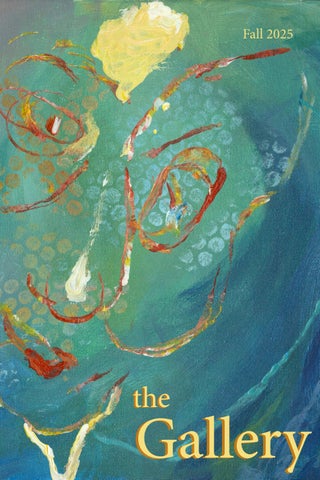
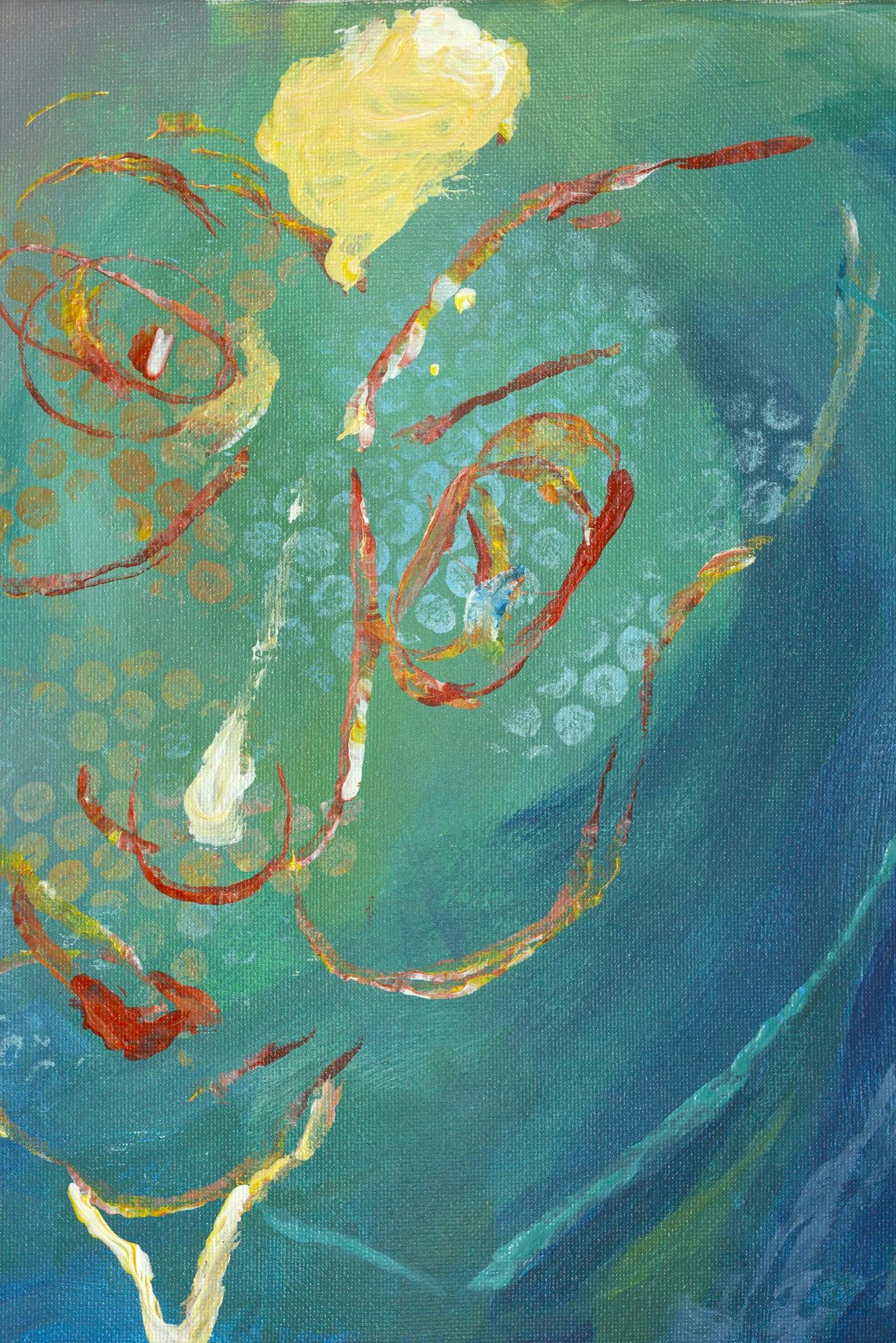
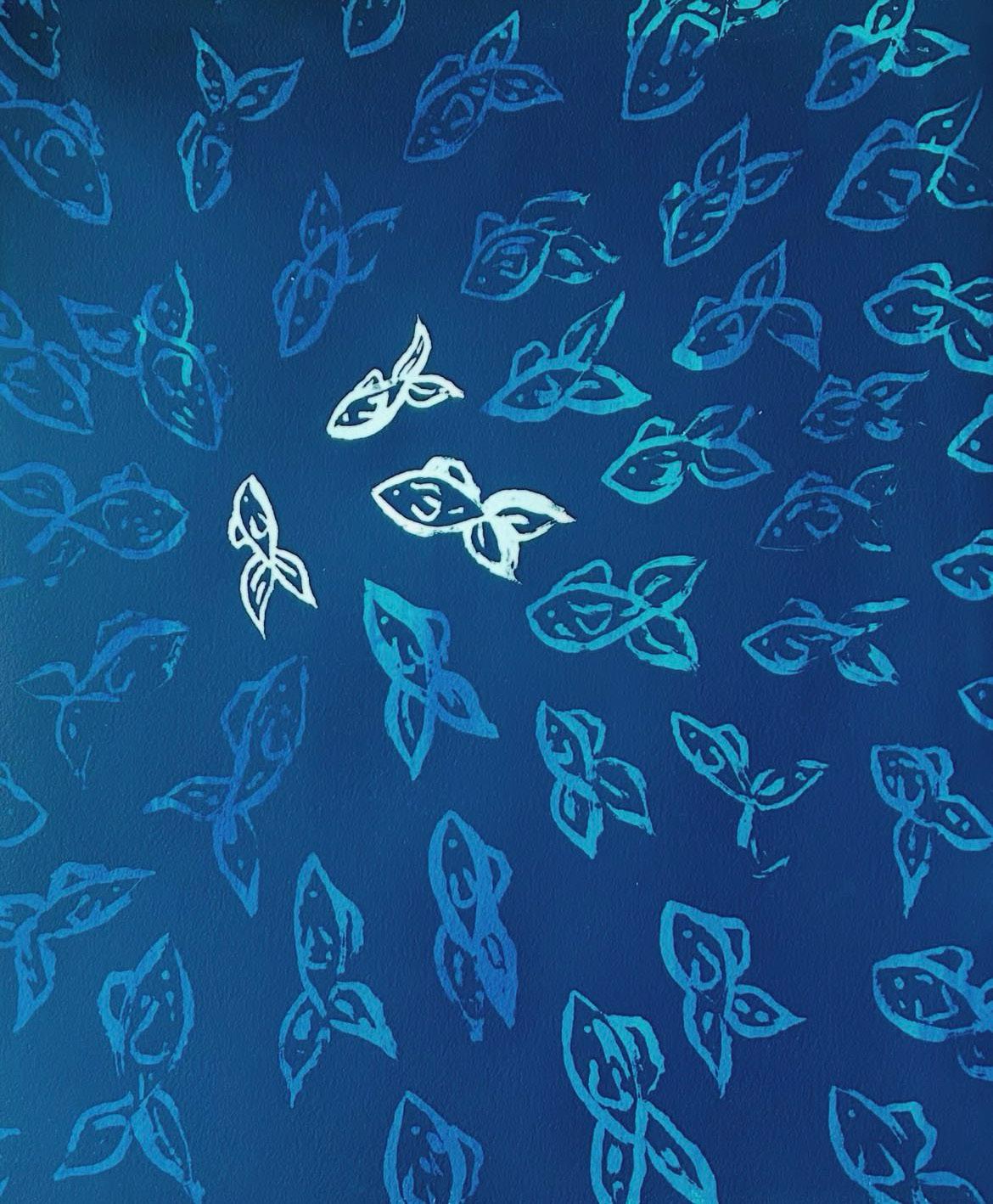
Cover Art
Egg on My Face
AubreyAaron seethefullworkonpage30
Contents
The Earth moves on and so must we
pathetic october
Birth Prairie
Shoe Gum
Red Orioles
Bonefish for dinner
harpy love shriek
Caramel Eyes (Sestina)
A Cold Summer
Winnipesaukee at Dusk
Back Home - on the Kitchen Floor
Self Portrait Monoprint
My love says I have something
An Ode to Morning (A Mourning Song)
Pele Consumes Uncle Sam
Resurgence
The Causeway in my neighbor’s backyard Egg on My Face
Family Recipies
Ancestor Ascending
Poem from the Tomb of a Sumerian King
To Flood and Flame
Recovery
What She Stole
The Artist’s Eye you made new york my home
Pete’s in July June
Turtles on a Lily Pad
My Mother is a Fish salt, sand, and bodies. a dream, encaged Outliers
Parabaloid No. 3
Mars foreplay touch charlotte
My Bower
Matoaka Nightmares black hole
Contributors’ Notes
Editors’ Note
Elena Murphy
Elizabeth Walker
Gray Rzeszot
Greyson Fisher
Hunter French III
Arden Pentlicki
Ash Pyle
Josephine Halushka
Icarus Landaker
Natalie Jebraili
André Adams
Daisy Maxwell
Anna Longley
Neil Dongre
Carter Danto
André Adams
Lucy Loudon
Hunter French III
Sophie Nguyen
Aubrey Aaron
Lucy Loudon
André Adams
Ash Vetter
Carter Danto
Anna Longley
Phoebe Robertson
Aubrey Aaron
Melania Frye
Jane Morgan
Jane Morgan
Isabella Tian
Daisy Maxwell
Elizabeth Walker
Anna Longley
Rebecca Graber
Lauren Mullaney
Elizabeth Thompson
Meghan Shelley
Dativa Eyembe
Melania Frye
Isabella Thompson
Anna Longley
Kendall Pade
The earth moves on and so must we.
I tell myself this as I look at late August leaves, bright green and dappled with sunlight, and feel a breeze of late September. The seasons seem to rebel against my own desires. I don’t want them to change, especially not so early. I dare not cross the threshold of the backdoor when unbidden, but the pleasant air entices me.
Maybe Autumn feels called the same. All I feel is a pit in my stomach warning against the irregularity and reminding me of the anxieties that Autumn recalls.
Autumn often teases my mind; it brings forward old memories tainted with the taste of fear, bitter but faint. Yet it also reminds me of the scent of childhood,
which is not dissimilar from that of fallen leaves gathered in disorderly piles, prime for jumping into; the odor is crisp and full of the Earth. It brings to mind dead things and new discoveries; melancholia and joy. I shrug off the thoughts and move back to the present. I find myself to have been moving all along. The planet pushes me onward in an unstoppable cycle of days, weeks, months, years. Powerlessness creeps up out of the pit in my stomach and slithers up my spine to rest on the crown of my head. Its weight is uncomfortable
but not unfamiliar. The planet moves beneath my feet, urging me toward a conclusion only it knows. Or maybe it doesn’t know. Could it know? Am I written in the stars? Pre-ordained? Or was
yesterday’s breakfast as much as a surprise to the universe as it was to me? We move together regardless.
pathetic october
walking, the leaves crunch without completion. the air is heavy with moisture. the sky edges towards rain.
midnight, i’m going home.
dusty red jacket like a red solo cup-tossed to the creek, it bobs between the rough banks and cut-backs, meandering through lateral sandbars, the phis of pebbles and gravel, a conglomerate. outside a bar streetlight is pooling. a current to swirl and suck away.
yellow/bitter/jaundiced light. autumn dusk whistles while I open my front door. it’s beautiful and i’m still angry.
— Elena Murphy
— Elizabeth Walker
“Birth”
They say give birth
Like it’s something tangible, something you can get under your nails
So I’m asking you, Give me birth
I’ll claw myself into your womb
Viscera and blood I’ll teeth my way through layers of flesh
Goring myself into you, Digging hooves into the supple tenderness of your most sacred place
I will thrash with reckless abandon, Til there’s nothing left of you, Sopping placenta and chewed upon gristle
Blood slicks through my hair, a dull sheen of desperation and threat thick and heavy, hardening into a flaking crown
I will make my throne between your licked clean bones I will settle into the softness of sundered flesh and soak my chapped hands in your remnants
And I will lay in wait, Until there is the exodus Where you rid yourself of me
Give me birth, I plead, I demand
Give birth to me
- If I take your life, will I be granted resurrection?
— Gray Rzeszot
Prairie
“This is my Prairie”
Rubber gasket and steel wheels coax the hiss of commuter trains and mammolithic concrete apses: a church, with no proper name.
We cattle in marble-white crypts-silent carriages. Feel it breathing. Deep outtake: air through steam vents, a distant roar. The wheeze of grease against metal. Crypts carry cattle underground to not offend the walking world.
The subway completes another loop. The iconic metal and blue liposuctioned seats hiss, rattle, shake, and jerk with shrieks! When doors come apartamong them, diluted by windows, cut apart by the slash of silver speeding to a stop stands us: Cattle.
Our book bags and silhouettes hung lame.
We make no sound. No effort at humanity.
People mutter and trace thumbs. Trading conversation for Drake, we pack in silence.
The odd noise, a surprise, words are uncommon. Eyes catch souls and glance away, fearing connection in trains speeding apart. We are not mendown here. We are cattle.
And upon the escalators and elevators we emerge: suits and lunch boxes and enveloped lives; AirPods and headphones undoneour passengers forgotten. The cattle are shed. The trains race away. Like angels, man ascends from darkness.
Greyson Fisher
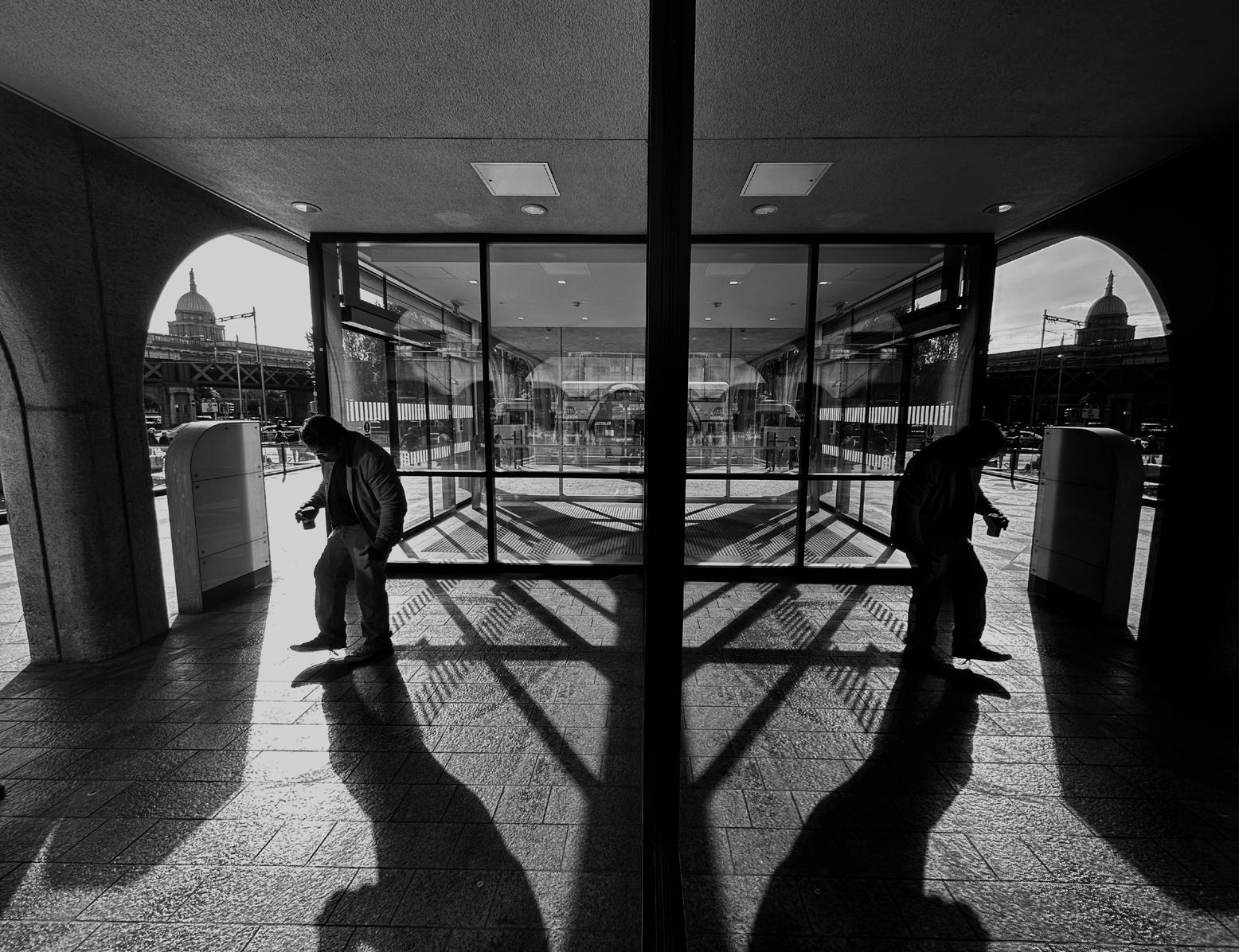
Hunter French III Shoe Gum Photography
Red Orioles
by Arden Pentlicki
The farmhouse was as stubborn and Polish as Nana. Though she no longer had many guests, stubbornly indeed the house retained its coir doormat, its plentiful wine rack, its well-dressed guest rooms. The oak floorboards clung to the spiced scent of bigos and a whole roll each of makowiec for me and Bazyli and our father many Christmases ago. Stubborn. Even this early in the morning, all in darkness, the house grasped for awakeness. They used to rise early, when grandpa was alive, to milk the goats and cows and collect the chicken eggs. They used to have a rooster to wake them.
Nana didn’t keep cows anymore, and I knew nobody in the house would awaken until the sun had settled above the clawing tips of the treeline, until the hens had already started their restless preening. Only then would anyone emerge and melt down the stairs to my mother serving cured meats and curdled dairy, kielbasa and kefir and Wonder Bread and orange juice.
Sasha thumped her tail against the hardwood in the kitchen for me when I crept downstairs, but she did not move. I stepped around her quietly out onto the porch, though there was no stopping the slam of its screen door. I shivered immediately, regretting my choice to forego socks. There was something biting about night on the farm. Even in August, it chilled me more deeply than any winter at home, its damp air releasing the humid thickness of the city smog that clung to me. I wrapped my sweater tighter around my knees as I crouched on the second stair of the porch and waited for Bazyli to emerge.
I’d heard many stories on this porch, of constellations and old fables. Nana used to hold me on her lap here and point to the birdfeeder in her garden for one legend. The version she knew back in Poland spoke of firebirds made of bright flames, but here in Maryland, she told it to me with the orioles. Some years, she’d say, the orioles were soft and yellow, mischievous things who gave riddles of guidance to clever heroes. Other years, they were bold red. They brought swords to soldiers in battle and set fire to the wind before tricky travellers; they lost a little life with every red feather they shed.
The sharp breeze shifted. From the gravel driveway, Bay’s car rumbled to a sputtering start, the headlights cutting across the open field. A single gunshot of its engine sent the birds roosting in the barn flying out, a thousand swallows in a dawn gray murmuration. Each of their tails forked in the same sharp angles as the flock’s whole. When I stood to face him, he was staring me down from next to the driver’s side door. I caught the familiar flash of a lighter from the pocket of his worn gray jeans, glinting in the cold moonlight before his hands shoved over it.
I felt unprepared going to him then, as I was, in my sweater and sandals, my red-polished toes exposed to the morning dew. I didn’t know where he was going. But I resolved that it didn’t matter, and I knew it truly didn’t, not really. I’d get in just the same, and we’d be back before the sun was fully up, we’d sit at our hen-patterned placemats and eat kielbasa and kefir and we’d be silent, and we’d catch each other’s eye and know that all we had spoken of in the Fairlane belonged to some other world. He would know I shared his sinking feeling; we had lived the same life.
My feet were wet from the grass and then dusty with gravel. Bay slammed the door closed behind him as he swung back into the car, leaned over to the passenger’s door, clicked the handle and pushed at it a few times until it swung open. I grabbed it. He hunched back over the wheel and produced a pack of cigarettes from his sleeve. I watched the swallows fall into the trees, the beat of their wings melting away into the distant rustle of the pines, and got in the car.
The roads were dead empty and dark. Even the fields lining the country road were bare, the summer harvest nearly finished. I kept my eyes fixed forward, careful not to look at him, not to speak. I had a feeling that if I did, he would make up his mind to drop me on the roadside and tell me to walk home. If he did that, I knew I’d listen, just to see what it was like.
Instead, I looked around the car when I got restless. Little dents dimpled the window frame where it had been shimmied open when he locked his keys inside, and the brown leather seat was sun-bleached pale yellow just under my thighs. Wrappers and cans riddled the backseat: Magic Middles and Hostess pudding cakes and two jugs of A&W that looked emptier than the case of cheap beer tucked halfheartedly behind the driver’s seat. Bazyli had always had the sweet tooth between the two of us. I drank my orange juice watered down, and I didn’t like chocolate except on Bay’s birthday. Mom made him a great cake.
I dared glance over. Bay drove with one hand on the wheel, the other twirling a smoking cigarette stub between his long fingers. The pack still rested on his thigh—Marlboro 100s. I knew he smoked, but I never knew his brand. The sweet, heavy scent of them was beginning to fill the cab.
“Yours doesn’t open,” he announced, and my heart skipped a beat when I knew he’d caught me staring. He had cracked his window down to let out the smoke, and I had barely reached for the handle of mine. My jumpiness bothered me, and I didn’t reply. In my head, the silence between us had always been one of shared knowing, but now, it just felt unfamiliar, delicate.
“You’re almost out of gas,” I said instead. My voice felt scratchy.
“You never see me get stranded, do you?” he grumbled, clearing his throat after. He turned without signalling.
But I did. I had watched him from my bedroom, hooded in fog or snow or rain, creeping out the garage almost every night for three years. I had felt his headlights cut through my unshuttered window; they had woken me countlessly with the long shadows they cast across my ceiling and floor until I no longer closed my eyes to sleep before I had seen them and listened for his engine pulling away into the road. There were sleepless nights where I just listened for him to come home, restless nights where I pulled my little loveseat over to the window and pulled aside the muslin curtains and just watched the empty road. He would drive for miles and miles until the little Fairlane ran out of gas, until he was stranded and had to walk those miles and miles back. I’d see him creep through the side door with grass-stained knees, and I’d hear him in the kitchen beneath me stealing our father’s keys and a canister of gasoline. He would drive out again and back again and park Dad’s car again at the same untouched right angle on the right hand side of the driveway. Then he would walk out again, slower now, back onto the road and he’d disappear into the fog or the snow or rain for hours more. He must have kept driving further, pushing the boundary deeper until he finally pulled back into the driveway with just a few shadows still plastered on my ceiling and just enough in the tank to take him to tomorrow. I looked at the yellow gas meter again and realized—that car must always be running on empty.
Bay finished his first cigarette—first that I’d been present for, at least— and tossed the stub out the window towards one of the grassy fields rolling by. He drove steady on for a few more minutes, but the fingers on his smoking hand tapped restlessly, rapidly against the window frame, and his lips pursed and parted against themselves in unconscious discomfort. Finally, he slowed the Fairlane to a stop in the dead middle of the road. I’d’ve complained, but our solitary drive thus far had confirmed there was no one around. He fumbled with his lighter, clicking it at the new cig in his mouth with a hand cupped around it. The pop of that silver lighter was the only sound for a while. At last it caught a spark.
I watched as he leaned out the window frame and took a long draw from the cigarette. When he exhaled, I inhaled a deep breath of its smoke. He didn’t seem like he was planning on driving again any time soon. Eventually, after a few more draws of his cig, Bazyli held the pack out to me. I drew one long thing from the little box and felt it with my mouth and my fingers, unlit. G
Bonefish for dinner
Sit at the table, tracing grains Cherrywood and stained fingertips by wild strawberries that taste bitter this time of year but better than stale conversation.
Let the rolls grow hard and butter soft. Count the ticks between bites, seconds, no seconds, stay in your seat and roll peas to the dog.
Porcelain plates, the tangy shriek of a knife. Causing goose flesh to erupt, pinpricked; Use the splintered bone as a toothpick,
Clear away dishes, lingering smell — Not quite unpleasant, noticeably different. A neighborhood cat meows outside.
— Ash Pyle
harpy love shriek
dear creature, loved one, wretched being, how long till the spray of heaven falls to beard our cheeks how long till sunshine shivers to behold us as we comb the beach for doomed shells, fractured coral reefs, sand dollars bleached and dry as bone, we hold each other’s milk teeth to our chests and brine breath wavers hesitant to meet us on the shore this realm of drown and ruin is afraid of us, appalled at the way we dig our claws into sand grayed under our grinning shadows, frightened by the sour salt in the back of our throats, sharp sting sweeter for two razor beaks curved like the cresting wave of an arm arced to catch a seagull in flight, pinning its wings to its sides, mouths cavernous and wide we caw in devilish efficiency i would break you before i lost you to the sea and you would do the same for me o monster, monstrous, mine.
— Josephine Halushka
Caramel Eyes (Sestina)
In my dream you told me that tomorrow our world would end in salt. Our eyes would no longer hold the tears they wished were lost yet stuck to us like caramel.
Your eyes were the color of caramel as I sat with you thinking of the yesterdays lost and all the tomorrows our eyes will never behold while our world drowns in salt.
Your voice drizzled salt, no longer honeyed like caramel as I tried to hold what little I had left of you–your body already left to tomorrow, my body not yet ready to be lost
You told me you would hold me whenever I got lost that you would dry out the salt in my eyes, replace it with caramel so that tomorrow
would be the sweetest tomorrow my hands could tastes, my tongue could hold–you would give me your caramel. Would you still find me if I was lost?
My face dripping salt to be with you
once more tomorrow. I know you’re lost to dreams I’ll always hold and cherish in salt–your caramel eyes and you.
— Icarus Landaker
A Cold Summer
I laced Your face With my kisses. But July was no place for us to stay. So goodbye! You went away, For that was our fate, On that warm sweet frosty cold frosty summer day
—Natalie Jebraili
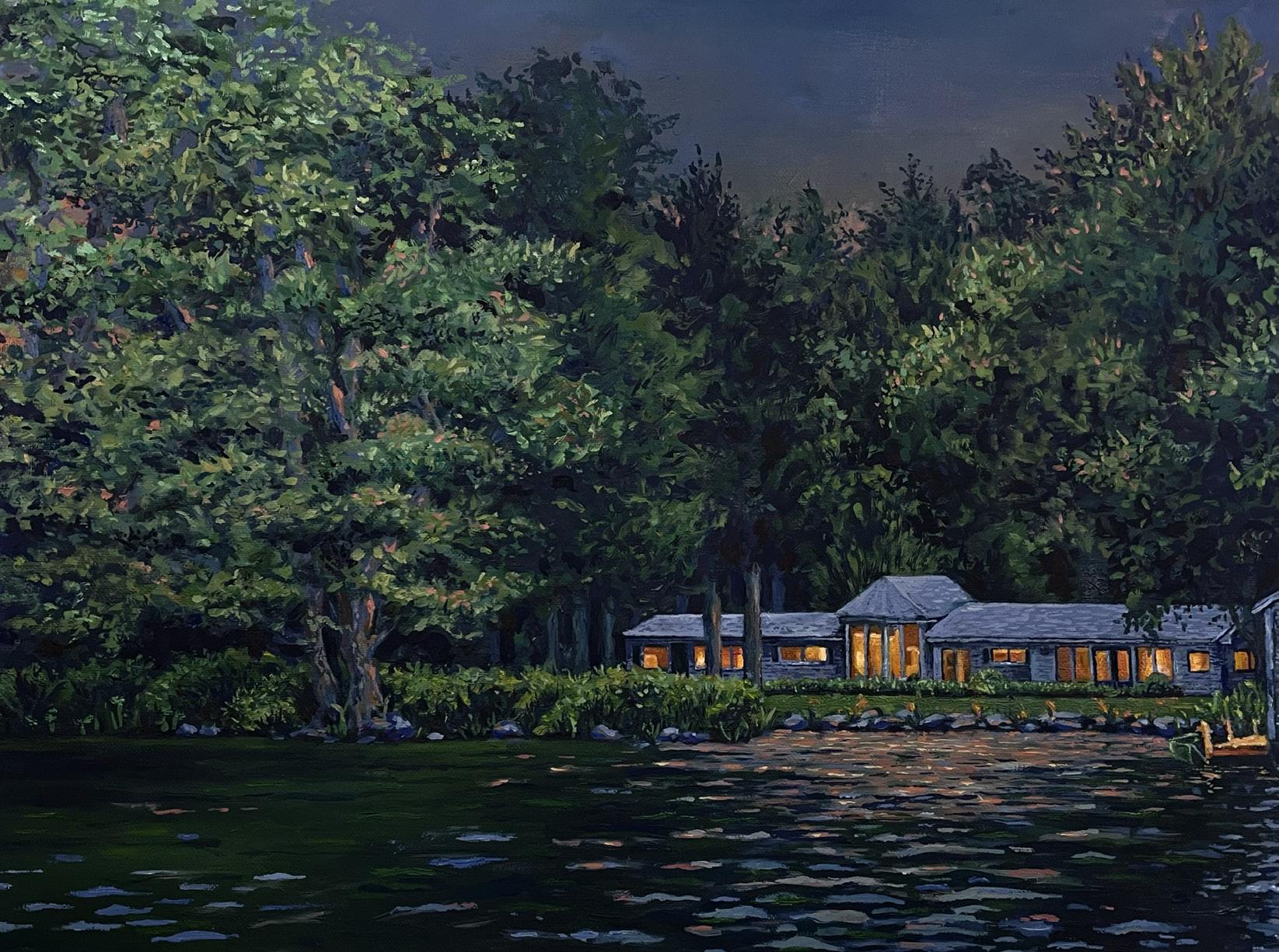
Jane Morgan Winnipesaukee at Dusk Oil on Canvas
Back Home - On the Kitchen Floor
I used to lie on my back on the kitchen floor after softball practice, or to make a show— inspired teenage tantrum, protestor before a row of tanks, life on the line in the comfort of my own home
The kitchen tiles are cold now that I am gone now that I bear the sweat upon my back and play different games sharp-tongued arguments of the unloved, far from home ready to pounce on every word: a salt in my wound, righteousness morphed, protest ignored
If I laid down on the kitchen floor right now, at my ripe age, they wouldn’t ask why I’d wait for the tanks forever line, unanswered sweat gone dry
— Daisy Maxwell
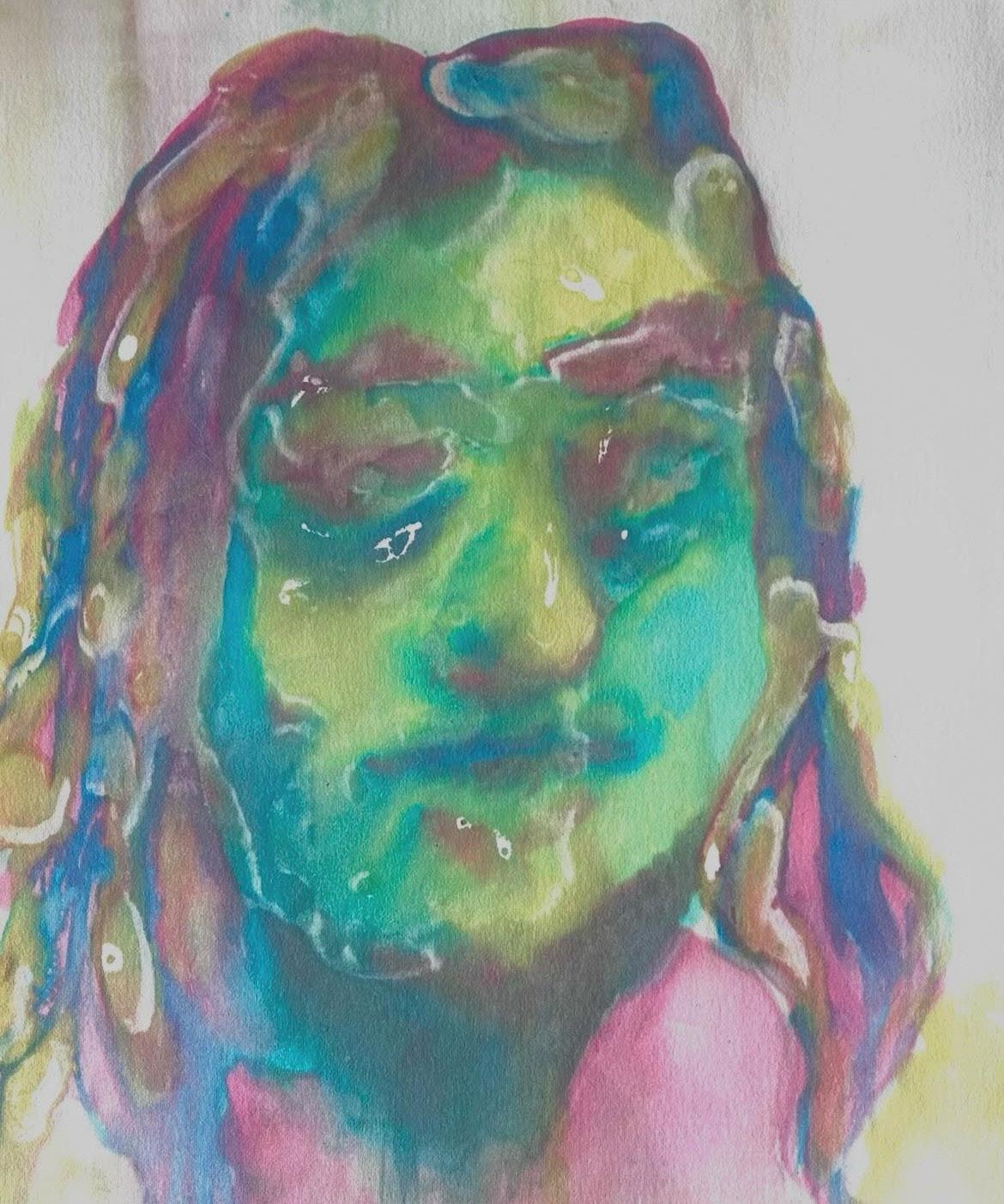
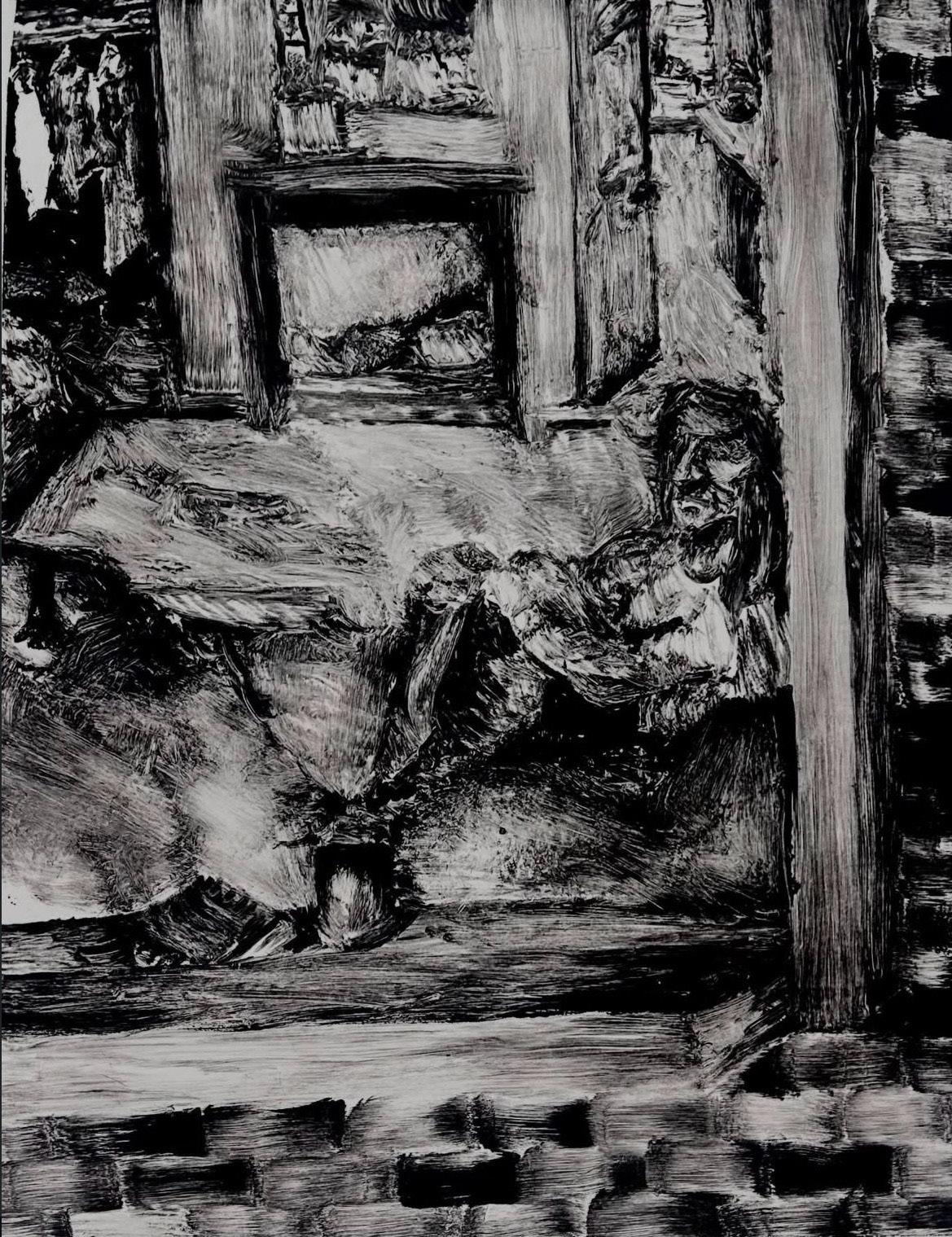
Anna Longley Self Portrait Monoprint Monotype
My love says I have something
My love says I have something that I need to tell you do you understand I say yes I understand
She says I looked away with far-away eyes today for a reason you know and I say yes I know
Because I do not feel for you she says the way you feel for me I say I see
But then she says I do not want to lose you even though I do not love you and I say oh and suddenly
I feel the icy coldness of her uncurled hand on mine
Well you were good to me I say even though you never loved me
And she says nothing
Then I nod to my old friend (she is more beautiful than I am)
And she says I would still like to be with you as my friend don’t you know and I reply it will be so
though there is nowhere that we will go and nothing that we will do
— Neil Dongre
An Ode to Mourning (A Mourning Song)
The wind a-whistlin’ ‘round the wire burst forth and forged the flyin’-fire,
With thick’ned thrums the thrones a-broke an’ loos’d the oxen’s nightly yoke.
Such was the force of floral flute how lustf’ly Nature plucked her lute
For Nature nurtures newborn babe an’ suckle‘em sweet on song and stave.
Oh! mornin’ muses’ mountaintops form clamorin’ choirs w’ callin’ crops, whose lyric-pray’r yields seeds to sow; they’re born in mornin’ dew to grow.
I call for kin to come and play a-joinin’ in the warmin’ day.
The birth of life and flower-bloom a-heraldin’ in their comin’ doom.
But not anon their time a-comes, so pound upon the heartbeat drums!
An’ one by one until it’s done, outlastin’ e’en the settin’ sun,
We dance and sing w’ Nature’s song and laugh when Death appears ere long.
— C.S. Danto
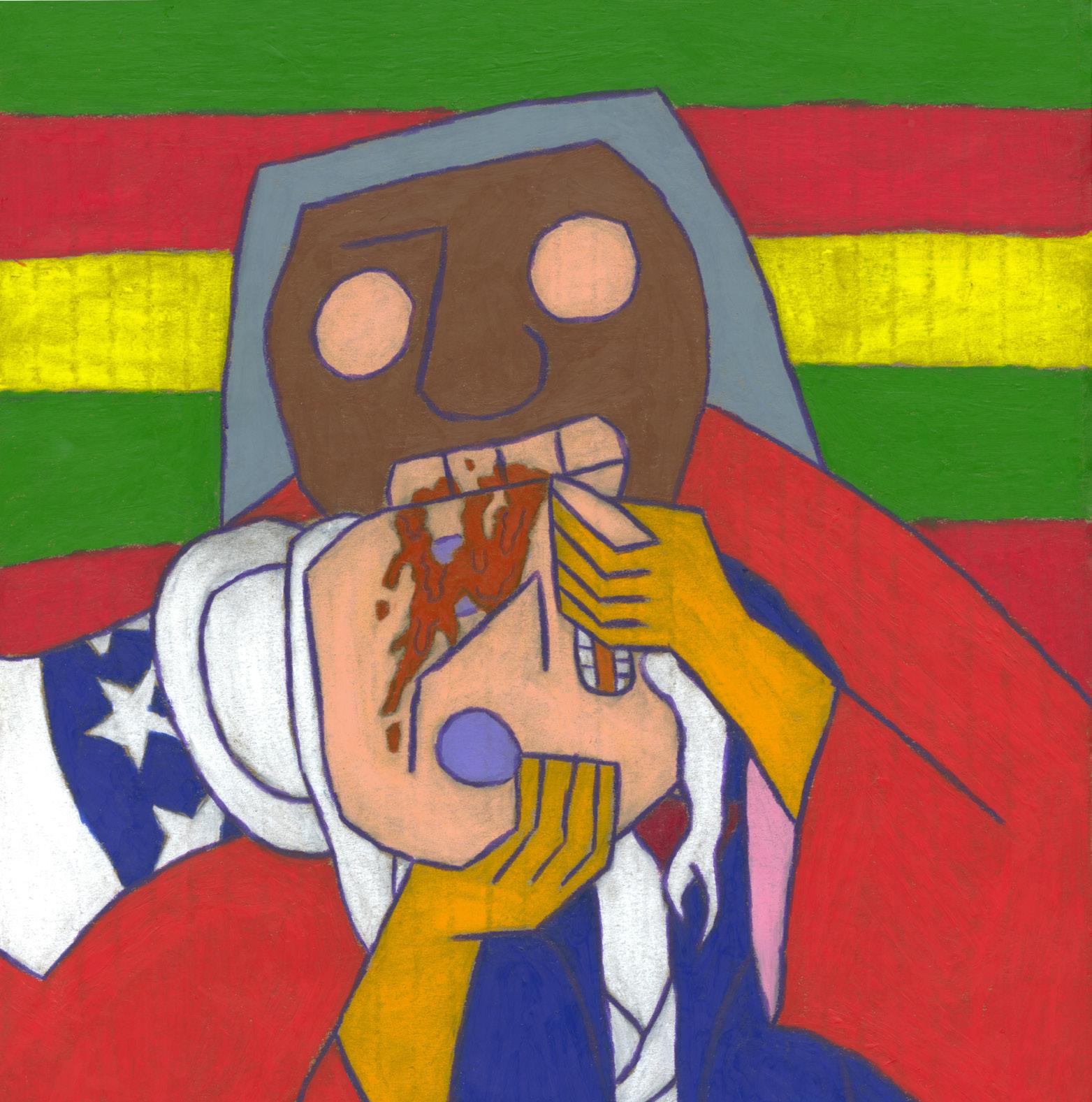
Pele Consumes Uncle Sam
Wax Crayon On Cardboard
André Adams
Resurgence
The spongy rock floats cradled in the delicate hands of Cliodhna or maybe it was Pele her breath smoldering the stony stomata
A goddess carves the pores that allow the rock to dance on the fish-belly white of the seafoam bobbing up and down for years Yet she finds herself in the middle of the sea alone
The current hums in her ears her lungs, her skin, her soul filling with water she cries to her mothers as their distant whispers roll across the tides the wind whistles through her hollow skin Mama she calls but her lips melt with the squall sand stinging her eyes the brine whipping through her ribs barnacles gripping at her toes But still on another shore
Freja looks at her with seaglass eyes Picks her up kisses her grey fingers speaks her name bails water from her heart
Until she floats once more.
— Lucy Loudon
The Causeway
I would live there at the edge of things Where the unshorn grass gleams and shimmers bright Among the calm church of it all,
Counting there the sheep tainted green And red at the head and neck, the hands and feet— Where must your shepherd be, then?
There in the sage green pews my heart Stings, the glassy seas reflect majesty As I look down on them in the veiled dawn.
That glass, stained in bright southern stars Come North where strange familiarity Calls like blips of code to three magicians
That calls now to me, that message, A truth which makes grand beauty always so A shepherd to find for us sheep to know.
Here in this land I will take Communion. Perhaps I will in time remember this Common truth, known to every such place yet Known to few.
Perhaps I would dwell in the sage If I knew my age to return From its ugly, muddled retreatings. I would live there at the edge of things Were I not confident in finding it Wherever we go to show to you.
—
Hunter French III
the neighbor’s backyard: a moment
flop down, soft bounce, carelessly splayed limbs on smooth nylon, twigs, helicopter seeds a bouncing mat held by bouncing springs feeling a gentle, caressing breeze. I stare up at the canopy of rustling trees, blye sky, transcendental shades of green branches of crinkling leaves sigh so serene singing the sweet sound of swishing psithurism. like light passing through a prism it all refracts brilliant in my memory a random, perfect, sepia-tinged moment, a thousand sparkling jewels in a treasury.
— Sophie Nguyen
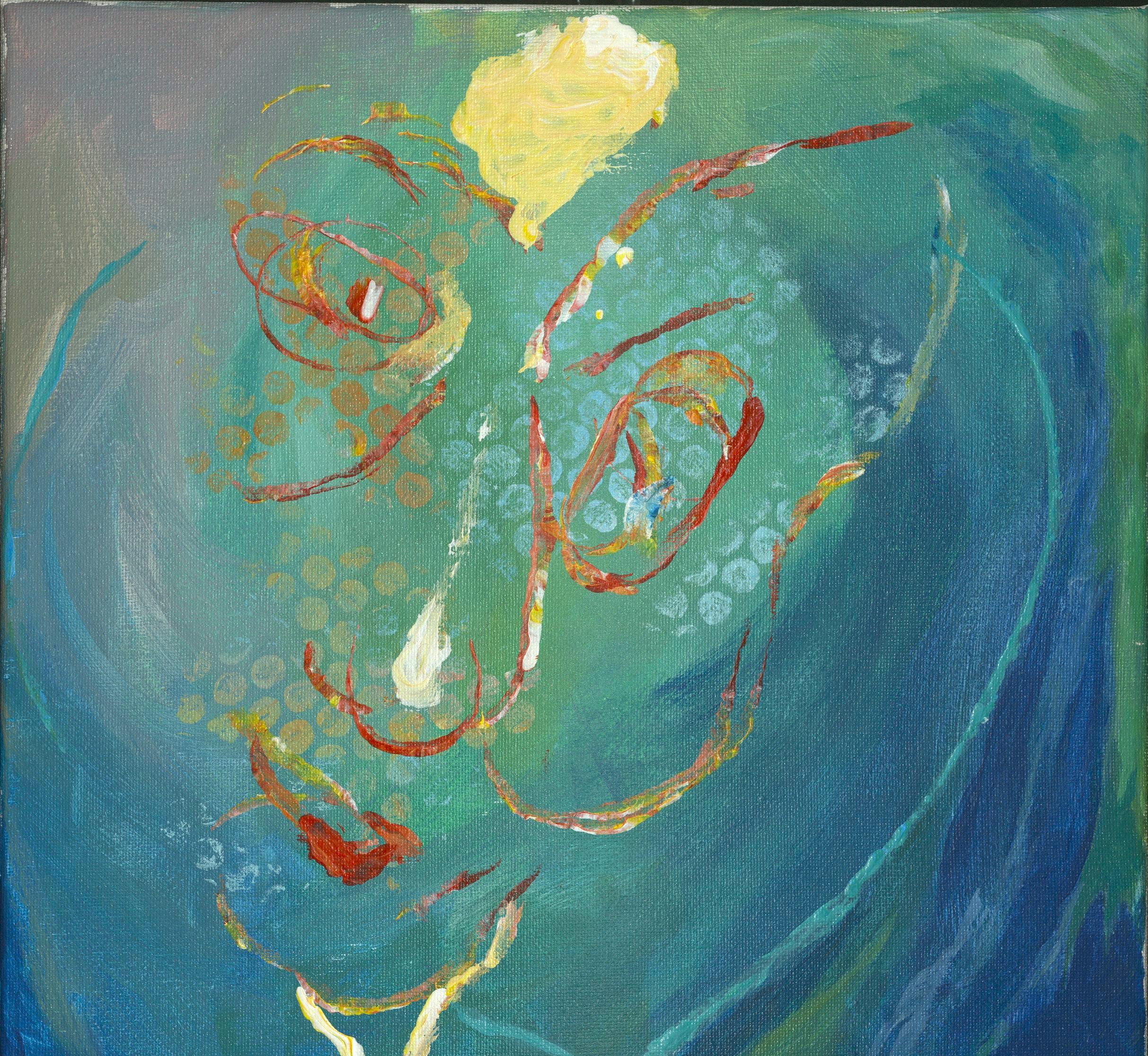
Aubrey Aaron Egg on My Face
Acrylic on Canvas
Family Recipes
by Lucy Loudon
Untermenschen: the German word for racially or culturally inferior.
A crisp autumn air swept beneath the boots of Nazi soldiers, crossing the border from Germany into Poland. Poland was assaulted, unable to stand up to the great power before her. Both countries mainly held a population of “white” Europeans, yet Poland was seen as “dirty” or “other”. For years, Poland had suffered under the assumption that her people were subhuman and unfit to rule themselves. In 1918, she finally freed herself from colonial rule under successive empires, yet she fell once more in the invasion of 1939.
Decades later, she falls in my own home.
On my mother’s side, my great great grandmother, Helen Krause Lau, immigrated from Germany in the early 1900s, following her love for a man named John Witt. Once on American soil, the vision of assimilation into American culture overtook her. She spoke little German, losing her mother tongue to find a place in her new home. Shame bubbled within her, rising to a rosy shad on her cheeks from the sideways glances in the grocery store or on the street when she needed to translate for her parents. This was especially so with the rising anti-German sentiment throughout the World Wars.
When her own daughter was born, Grace Lau, she only spoke German at home. In hushed voices, away from the looks of their neighbors, they maintained their roots. Over the years, Grace’s mother tongue dissolved into a few lines and phrases, and the language completely crumbled away when her daughter, my grandmother, Judy was born.
Maybe it was a way to avenge the culture of my great grandmothers. Or perhaps a way to feel closer to her mother. Regardless, my grandmother Judy, our family’s matriarch, has made sure our heritage endures. Diligently, she protects the image of a German lineage, the one she remembers from her own grandmother and mother.
On New Year’s we eat pork with sauerkraut and German potato salad for good luck. When I am sick, my mother makes me German potato soup. My grandmother makes German dumplings from the scribbled down recipe on a crumpled sheet of notebook paper. On Christmas, my aunt makes nusstrudel, but the name has unraveled to German nut roll.
One day, my mother was rummaging through old recipes and pulled out a notecard.
“Kolaczki? Aren’t these Polish? I loved when we used to make these...” my mother falters when she sees the face of my grandmother.
We are not Polish,” my grandmother says. The words drop like acid from her tongue.
My mother pauses, the room falls silent. She holds the card up to see it better in the kitchen light. It’s written with the same barely legible handwriting and minimal directions of the other family recipes. She had remembered the cookies when she was younger, a light pastry filled with jam, and dusted with powdered sugar. When she ate them, they crumbled over her lips and fingers, coating her skin in a dusty white.
Last summer, my mother attempted to make those cookies she remembered from her childhood. But she had failed. The directions were too vague. They came out of the oven, but when she ate them, tears came to her eyes. They weren’t the same as the ones she remembered, but I didn’t know any different.
Perhaps it was a need for my grandmother to remember her mother. She was German. She was American. But was she descended from Poles who tried to find their way to Germany then America? As she lost her German, had her family once lost their Polish? Were they Poles whose identity was stolen from them among the anti-eastern and anti-Polish sentiments of the 1900s? While clinging to the image of her mother, my grandmother has strangled our family identity with the twisted knots of time.
In trying to find a new identity, they had lost theirs. A part of my family is forgotten because they were seen as less. For their desire for safety, for acceptance, Poland fell in Germany, and again in America.
When my mother offers me a plate of sauerkraut and bratwurst, the tang of vinegar is sharp in my nose, bringing tears to my eyes. I poke at the cabbage as its juices ooze across the porcelain plate. It soaks the sausage and makes my bread soggy, consuming everything in its path.
My grandma still whispers “We are not Polish.”
But my mother finds mentions of Polish and Russian relatives in her memoir. What she can write, she cannot speak.
She still diligently makes the recipes with gnarled, arthritic fingers.
Poland has been silenced by the stubborness of my family. Poland has fallen in my own home.
Untermenschen.G
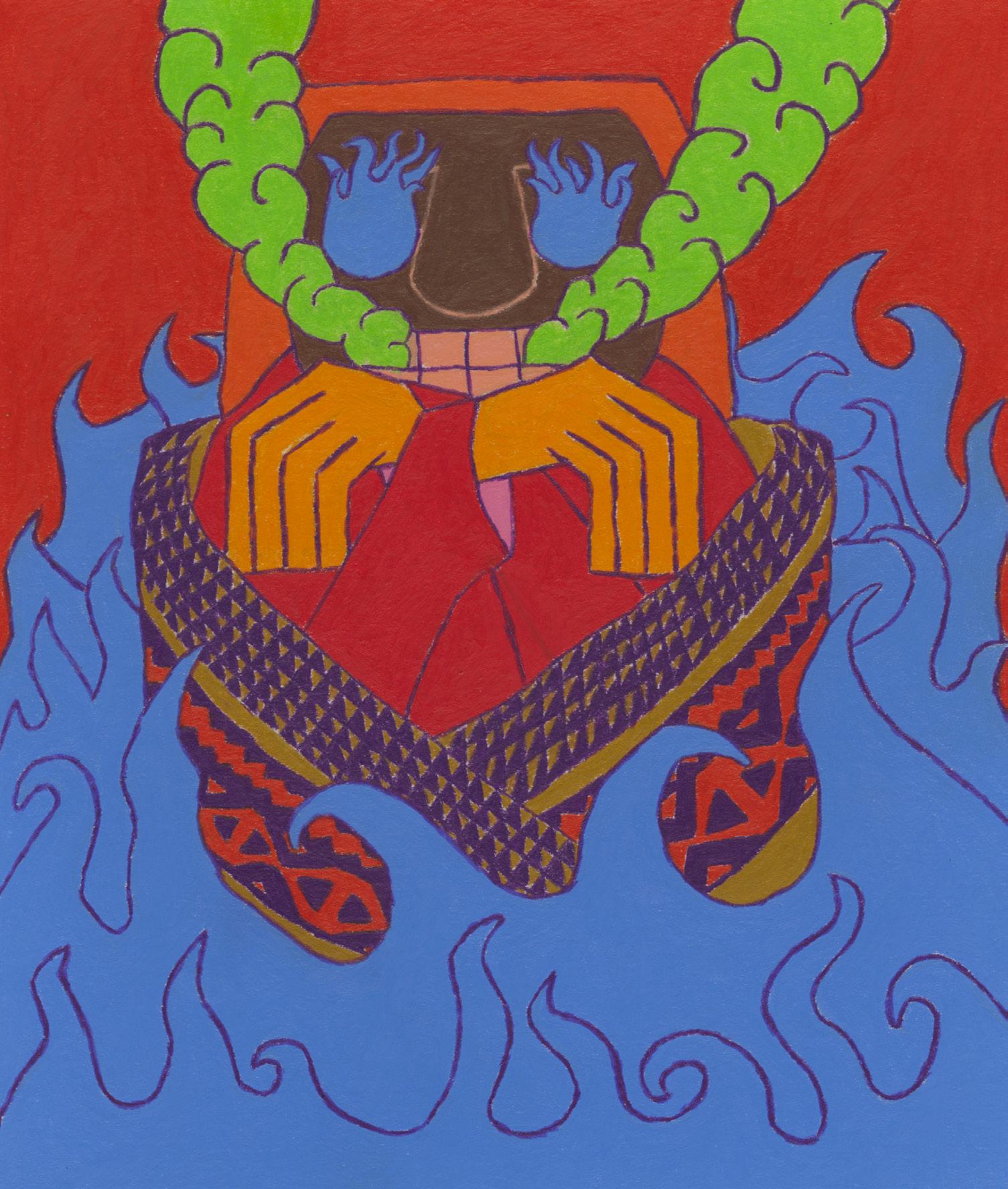
Ancestor Ascending Wax Crayon
André Adams On Paper
Poem from the Tomb of a Sumerian King
I’ve grown to love you since the day when [here the stele is damaged, likely stemming from a caustic seal Derived from onion paste and hearts of palm], but on And on, I reckon that the wilds never won A beauty as refined as you, an orchid born Of nacre hue and [here the stele again is torn and damaged from the flooding of the Tigris in Its transport from old Ur to new Akkad] the sin That brought us here together, under trees Of purple petals, it was like a summer breeze, In instant which was preordained a thousand years Before the [here my correspondents in Algiers Believe some men from Gutium shot arrows through A portion of the text] and time will start anew, The Sun will glimmer and eschew all notions that Our love was ever thought untrue and [here a rat Of middle Babylon, escaping into rooms of royals, likely died partaking in the tomb’s Tableau of apple seeds, atop the stele] the reeds Lay out a history of all our shared misdeeds Extending past our mortal lives, beyond the gate Of Heaven [here it’s said that Darius the Great Himself delivered blows upon the stele, in joy And celebration of his conquest] as a boy, Such beauty as is found in you incited fear But now I can enjoy eternity with [here It’s said that Alexander, looking to outdo His predecessor, left a large residue Of vandal marks along the stele] I have believed That our one love of love could only be conceived By those above I name in reverie, the high And mighty [here the names of gods which all decry The monotheist cause were crossed and duly changed By those first scions of Islam and rearranged Into the names of only one] we stand as one Together overlooking on our people’s future son,
We are that son, we are in equal piece and part Through [here a British student of archaic art, Astute though drunken, dropped the brittle stele and let It tumble down a flight of jagged stairs] but set The jagged record straight, for as I concentrate On writing this old ode I see that I am late In every subject that I choose; I match the past, But let the future run its misty course, we may not be the last.
To Flood and Flame
The skies let slip the reins restraining steer and down the water-oxen swiftly bore; the tides, in tim, arose beyond the piers to crash upon the stony mountain shore. For forty days and forty nights they rage denying mortal men the opportunity to save the precious hist’ry of that age from falling into dark eternity. Jehovah cast the world to wat’ry hell to birth the race of learned men anew, but Alexandria to fire fell and lost to us that wisdom we once knew. What comes of knowledge lost to flood and flame if we, like them, will suffer soon the same?
— C.S. Danto
— Ash Vetter
Anna Longley Recovery Monotype
What She Stole
by Phoebe Robertson
Olive Downing had seven scars. Two from the rusted gate below the branches of the silver birch. Three from the tabby cat that liked to wind its fur-matted form between her legs. One from the kitchen knife, whose blade had cut through skin as easily as beetroots. And one from the boy who lived on Scott Lane.
Olive hopped down from the ledge of her window, landing roughly in shoes creased from the number of times she had made the jump. A pebble on the oil-stained pavement imprinted itself onto the soft skin of her palm, and Olive winced, flicking it away.
Her heart pounded against the walls of her chest as she scurried down the streets of East London. A strong wind whipped at the scraggly elms whose broken roots clung to the dying stretch of road. Following the path dozens of street rats had made before her, she slipped into the third alley past the butcher’s shop. Narrowly avoiding the unsavory drip from the pipes above, Olive rapped five times against the soft, rotted wood of the door. She chewed the inside of her cheek as she waited, liking the way it sent a fresh wave of pain through her, waking her back up.
Two minutes later, the wad of cash sat heavy against her thigh, making her feel off balance as she forced herself to slow to a walk. Whitechapel’s tourists paid her no mind as they swarmed the kitschy souvenir shops that clogged her route home. Olive’s mobile vibrated in her other pocket, and she had to suck back down the startled breath crawling up her throat.
She flipped it open to see the caller, taking a breath before easing herself into a smile. “Hey, Mum.”
“Livy? Where are you? I told you your brother was coming back tonight.”
Olive chewed on her lip again, picking up her feet as she passed the butcher. “Oh, right. Of course,” she replied, wincing when she tasted blood in her mouth. “I was just grabbing a book I needed for my paper.”
Her mother sighed. “Well, be quick with it. There’s still a pile of laundry sitting on the steps too.”
Olive made a hard turn at the local bookshop. She actually did need a book for her paper. It was due tomorrow, and all she’d written was the date.
“And did you put the pudding back in the fridge?” her mother was asking. The poor reception made her voice especially crackly. “It came out stodgy last time.”
Olive reassured her that yes, she would be back soon, and yes, she would put away her laundry, and of course she put the dessert in the fridge. Once inside, she managed to hang up and began thumbing through the store’s selection. This is worth 20% of your grade, she muttered to herself. You couldn’t have started sooner?
But of course, she couldn’t have. She’d been busy.
Eventually, Olive found a worthy-looking book of poems and before making her decision, quickly thumbed through the meager contents of her wallet. Nine quid and a single shilling. Just enough for the book then. She didn’t dare touch her left pocket.
Content with her choice, Olive rounded the corner of the poetry section and paused, her eyes flitting down the next aisle.
This is where she’d found him all those weeks ago with his nose stuck in a book of Robert Browning—hair spun from yellow and messy from rain.
He’d put up a good fight—better than the others. He’d been quicker. He’d seen what was really going on.
Behind the corner shop on his street, he’d managed to cut her—deep—right across her chest.
It wasn’t until she’d had her own knife just inches from his skin that Olive had realized she knew him. He went to her school. They’d had class together. They’d been just seats apart in the library.
So, when she’d taken his heart, she’d cried a little, if only to make herself feel better.
Olive didn’t like stealing, but it wasn’t like she had a choice.
With a shuddering breath, Olive blinked herself back to the present and walked up to the counter. The cashier, oblivious to the nervous way Olive was scanning the store, hummed along to the Gorillaz song playing off the radio.
“Brilliant day today,” the cashier said cheerfully. Her name, Meg, was written in metallic Sharpie across her name tag.
“Brilliant,” Olive agreed a little too earnestly, drumming a finger against her thigh.
The song faded out on the radio, moving to sports commentators discussing last night’s match. The Three Lions had finally beat those blasted Germans in qualifying.
Much to Olive’s disappointment, Meg twisted the volume knob down, clearly not interested in hearing about football. Meg gave her a smile, her heavily glossed lips stretching wide, and bagged up the book. As Olive passed the cashier the few quid, her hands felt alarmingly slick. On an impulse, she wiped them across her pants—just sweat.
With the bag in hand, Olive moved swiftly out the door, retracing her steps back to her family’s flat. She hurriedly kicked off her shoes at the door and raced up the steps, grabbing her mound of clothes on the way up.
“Livy?” her mother called from somewhere near the kitchen. “Is that you?”
“Yep!” Olive hollered, balancing on one foot as she used the other to scoop up a fallen sock. “Just got back!” And then she was off again, catching her bedroom door right before it slammed in her rush. Olive dumped out her book and fished the money out of her pocket. She’d counted it earlier, but she checked once again.
As she moved swiftly through her room, Olive caught her reflection in her mirror. Stilling, she saw her cheeks were flushed. Her face often grew red of its own accord. But sometimes it didn’t.
Beetroots, her brother called them as he wiped pink stains from his fingertips. Olive pried herself away from the mirror and crouched down to slide the shoebox out from under her bed. She lifted the lid and added to her stash, listening to the satisfying thud as it hit the bottom. Her hand stilled though as it grazed another object lying in the box. Hesitantly, she picked it up, running a shaking finger over the cream-colored button. She’d taken it from him that night as a reminder of what she’d done. The first two times she’d done it, she’d been able to leave. She’d been able to separate herself from the crime.
It was just for a short time. Just for a little more money. Just so she could leave one day.
But that night, a part of Olive had melded itself to the boy, and she was scared to leave it there with him. It was her conscience, her soul, that had fractured. And the boy from Scott Lane didn’t deserve to be stuck with that part of her. So the button was her penance. Perhaps, one day, she would be able to move on.
For now, though, she stared at the button. And then rapidly tossed it back into the box when she realized how long she’d been looking at it.
All right, stop faffing about, Olive, she thought with a shake of her head. Get on with your paper.
With a sigh, she plopped down at her desk. Olive reached over to power on her PC, and as the screen blinked to life, she flipped through the poetry book. As she mused over the first few poems, she heard a door open downstairs and voices ensue. That was probably her brother.
Olive’s heart pounded faster as she forced herself to focus on the words in front of her. And then a small slip of paper tumbled from the book’s pages and fluttered onto her lap.
Olive furrowed her brow as she carefully unfolded the note, and with a sickening jolt, her stomach plummeted as she read its words. I want it back.
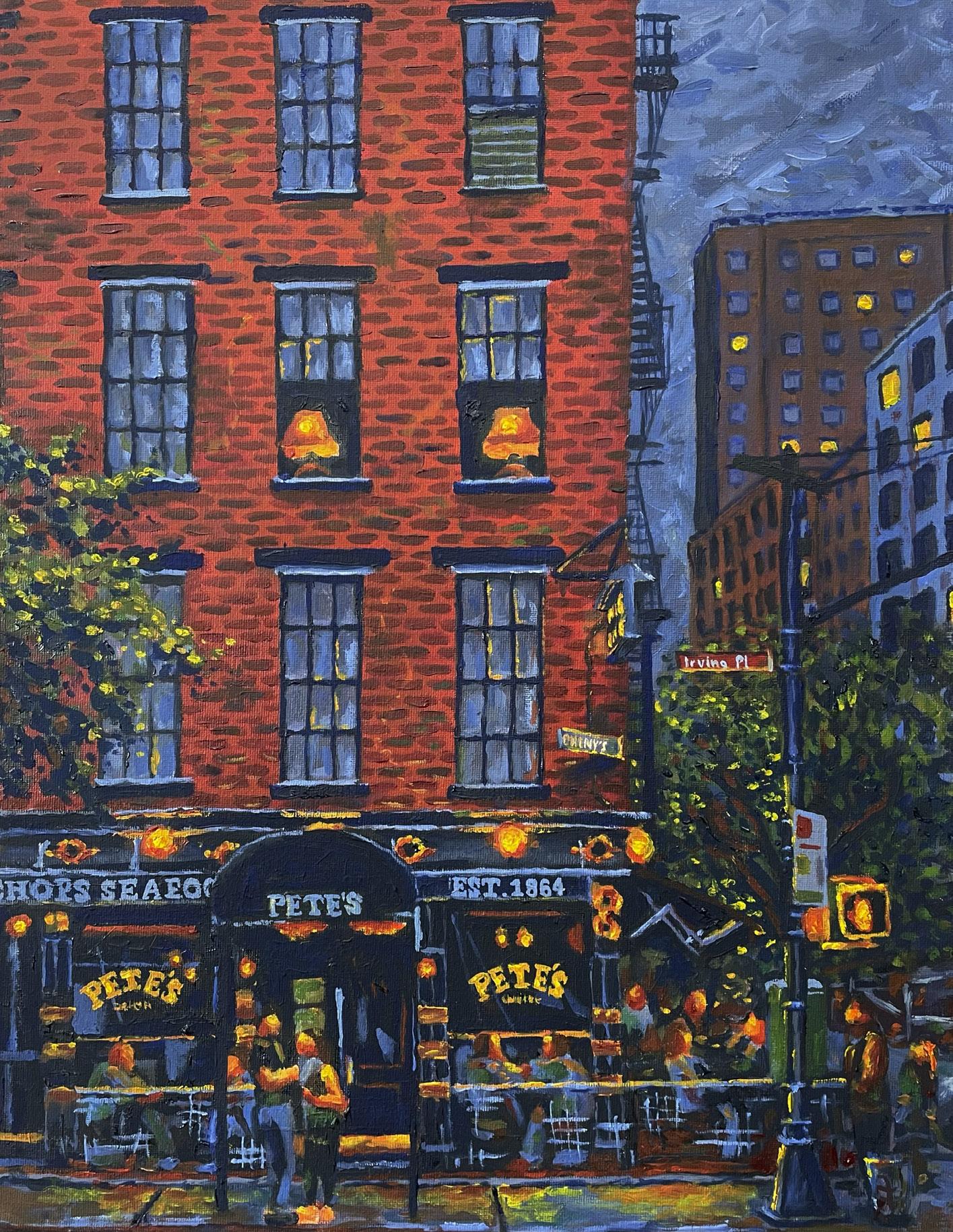
Pete’s in July
Jane Morgan Oil on canvas
you made new york my home
Jim Croce
there’s a rustic sort of feel in the old rock songs you like I like them to be rigid and clean, or scratchy and dirty I like the calm earthy mix of music you have, however I like how you made me love this stage of my life enough for me not to want to leave it the cold grey (dead) Massachusetts winters something about shaker shingles, a red door, peeling white paint on a cape cod home’s wood trim the funkiest accent around the stink and the drink of Boston hydrangeas and little ponds and the way the sun will touch your skin through the piercing wind at the beach everything will shift for me I’ll lose you pray it not be permanently you want me to come back to Plymouth I’d never say it, but I just might might spend millions on an old colonial with thick white pillars and a decaying front porch and scrub pines in the yard we’ll wear thick sweaters and our socks will be bunched up at our ankles
then we will burn in the summer as Canobie comes to life fresh mac n cheese and pirates and my best friend something about this state rejects my soul but something contains such an inherent poetic beauty I can’t help but feel like an old fisherman with a bushel of bay scallops sat atop his blue countertops living the profound sadness of this flora and fauna (but I love the cicadas)
and maybe there’s something (dead) about our relationship maybe I killed it an old dusty travel agency there used to be exotic, tropical, Hawaiian flowers the shiny vitality of greenery the thick gooey taste of warm chocolates and coconut flakes but that’s gone now because I’m an ungrateful bitch (his words, not mine) I take a warm pink love and rub my moldy soul onto it until it’s grey, purple, undone shoulders shivering with the cold never again seeing a real island Jamaica, Bahamas, Cape Verde colonial and stranded stuck in traffic on the sagamore bridge never crossing back onto the cape (never crossing back into the good phases of our love).
— Melania Frye
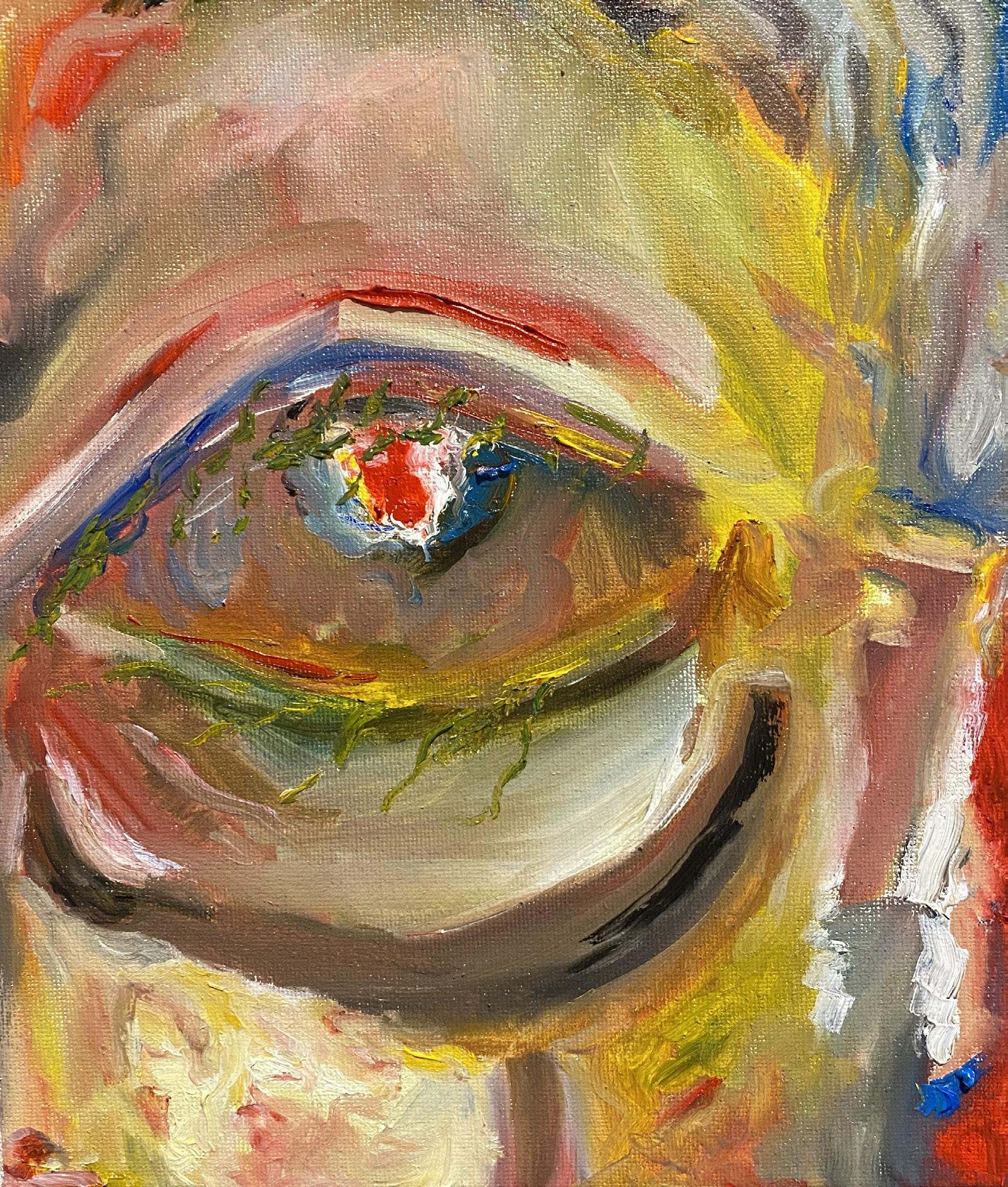
The Artist’s Eye
Aubrey Aaron Oil on canvas
When the street signs start whispering, you’re close. Turn left at the station to glide into a grange where time is plucked from orange trees and melted into jam that sticks on your fingers and bursts into butterflies on your tongue.
Mother stores the pink flush of each hour in the bathroom cabinet and sprinkles yellow seconds into marmalade jars wrapped with twine. Blue she kneads into sourdough and green she weaves into ribbons that fasten my sister’s endless hair.
If you don’t press purple between the pages of a novel, it rots, so remember to preserve pride and pansy before you shutter in.
I toss my spare breaths to the ducks. That’s how they grow strong, father says, even though mother says ducks are a nuisance and can’t tell a sack of meat from a memory. Bright and squawking one day, distant flecks of paint the next.
At night we cup pools of twilight in our hands and watch a thousand inky beetles trickle down our arms and shins. When the sky is in a giving mood, mother pierces pieces of the moon that taste like honeydew and soak up juice like bread.
Sister stabs hers like a pirate while father’s crumbles to dust in his mouth, spewing puffs of gold across the table.
When time folds itself into accordion shapes, we slide through the gaps, syrup-fingered and laughing. When it loosens its pockets and spills like quicksilver, one trip summons the station where minutes scatter like sparks.
On one side, I skate on rails of wet lightning.
On the other, mother sweeps moon-crumbs into a tin and calls them tomorrow.
— Jane Morgan
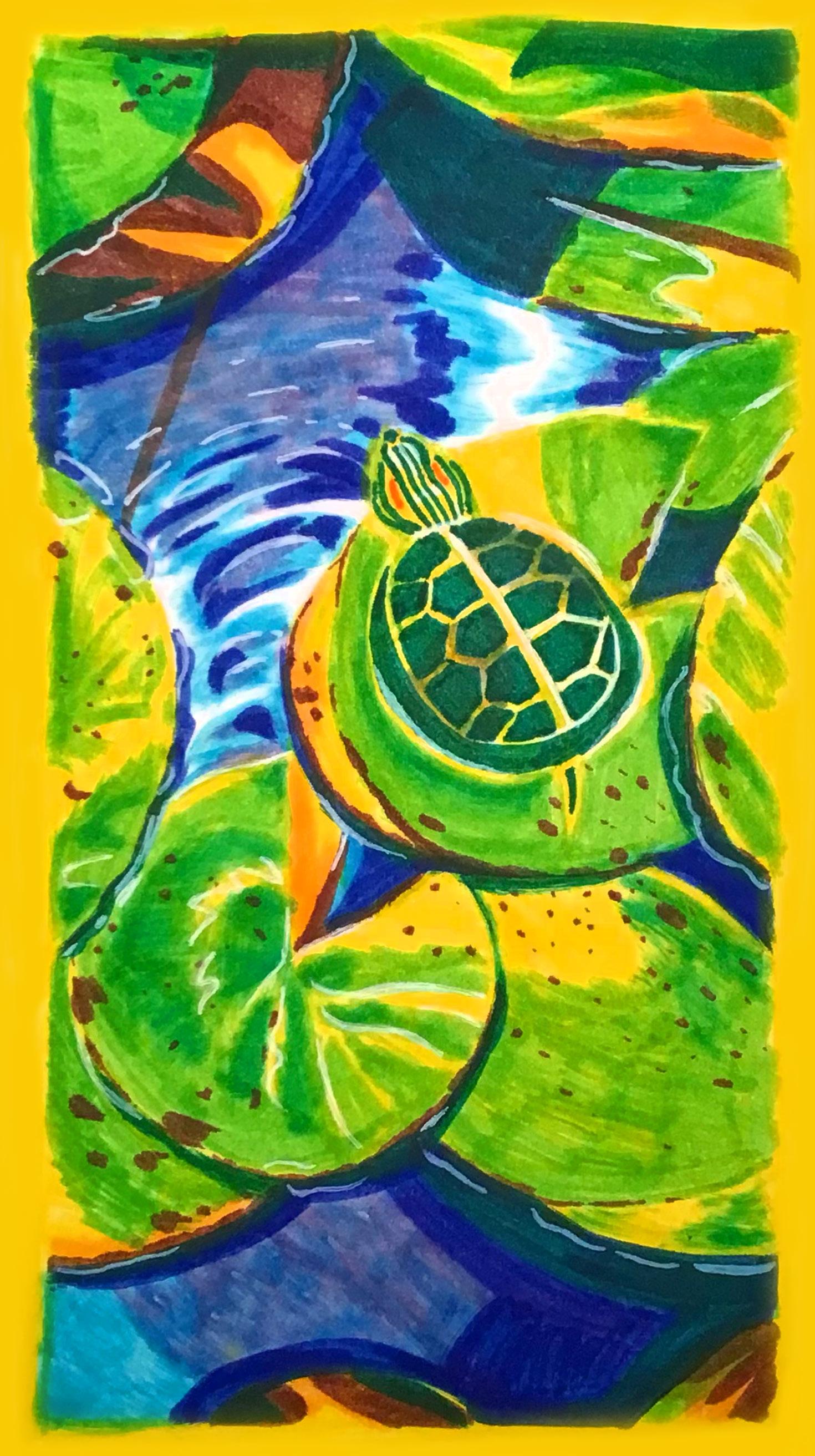
Isabella Tian Turtles on Lily Pads Marker on Paper
My Mother is a Fish
ethereal white fabric-composed dress hugs her aging skin, loose folds of time brittle bones, sharp lines arms– once absolute– now morphed to pectoral fin
clear water mirrors dizzying sky, echoes the ripple left by her final jump bubbles taper, disappear, well-practiced erasure–nature’s own– of skilled dive to down below
forest in lake, heaven in hell, inversions of grandeur beguiling precipice not for me, the lasting–mortal pull to the sensible, otherworldly call down
foreign creature in luscious land adventure begs youth to return my mother’s identity rekindled, herself again fortified by water, undeterred
— Daisy Maxwell
salt, sand, and bodies.
by Ash Pyle
The air around me is thick with water and brine, the ocean swirls and tumbles at my heels; my hair is knotted beyond repair. I press onward, the gale plastering grit to my cheeks and lips. I will be scraping sand from my scalp and crunching it between my teeth for days. But like my temporary footprints, the sea and I will eventually become separate entities again.
My littlest toe lands close to a pufferfish, washed up and deflated. Its mouth is open and its eyes are intact, much to my surprise. The eyes are usually the first to go, removed and devoured by the insects and scavengers that happen upon it before even the decay sets in. It leers foggily, and I fight the urge to reach out and touch it. The dark lines along its back are beautiful; I try to imagine it under the waves, swimming leisurely through bright fire corals and zoanthids. It would blend in so well, likely invisible to the naked eye–it feels wrong that I can see it so clearly now, crusting over at my feet. Grandma’s old plastic strawberry-picking basket thumps into my thigh with a gust of wind, the prettiest shells from farther back on the beach clattering at the bottom. I hesitate, then tip the bucket, scallops and augers falling into a pile next to the pufferfish. A fly buzzes indignantly, disturbed from its spot at the gills. I shoo it away. It will come back once I am finished.
My fingers are cold but begin to arrange the shells in a circle around the carcass. The sun, half hidden by clouds, has not yet evoked a fishy stench, so I breath through my nose and feel the sticky air slide down my throat. My work is methodical; I consider placing a whelk on its head, but the mockery of a hat feels disrespectful. I finish my organizing, satisfied. Stepping back to admire the makeshift memorial, I hook the basket handle around my wrist. I would not shed tears even if I felt I could. There is already too much salt here. But my distant grief is the most this pufferfish would have had, so I allow myself to feel accomplished. There are no prayers said. The ocean wails behind me, rising.
a dream, encaged
& before, i was in the middle of an ocean— barely afloat on a torn tent, trying to paddle with a vacuum-sealed cube of wet sand.
& I lay in a bed of pearl— opalescent infinity, & its somehow caging— my soul, fluttering, a moth between windows.
& funny thing is, I have the power of gods— it could all be over in a snap, I could be in a void with wind of my choosing, childish & all mine
& yet i do not, (moralistic?) a masochistic, moralistic angel within me enjoys those bars & loose shackles— metaphysical & otherwise.
& now, I choose the level of restriction to avoid self-destruction, i myself, undergo waves of rarefaction, —life is not the beach, but the mercurial ward of poseidon.
— Jia Patil
Outliers
Anna Longley Monotype
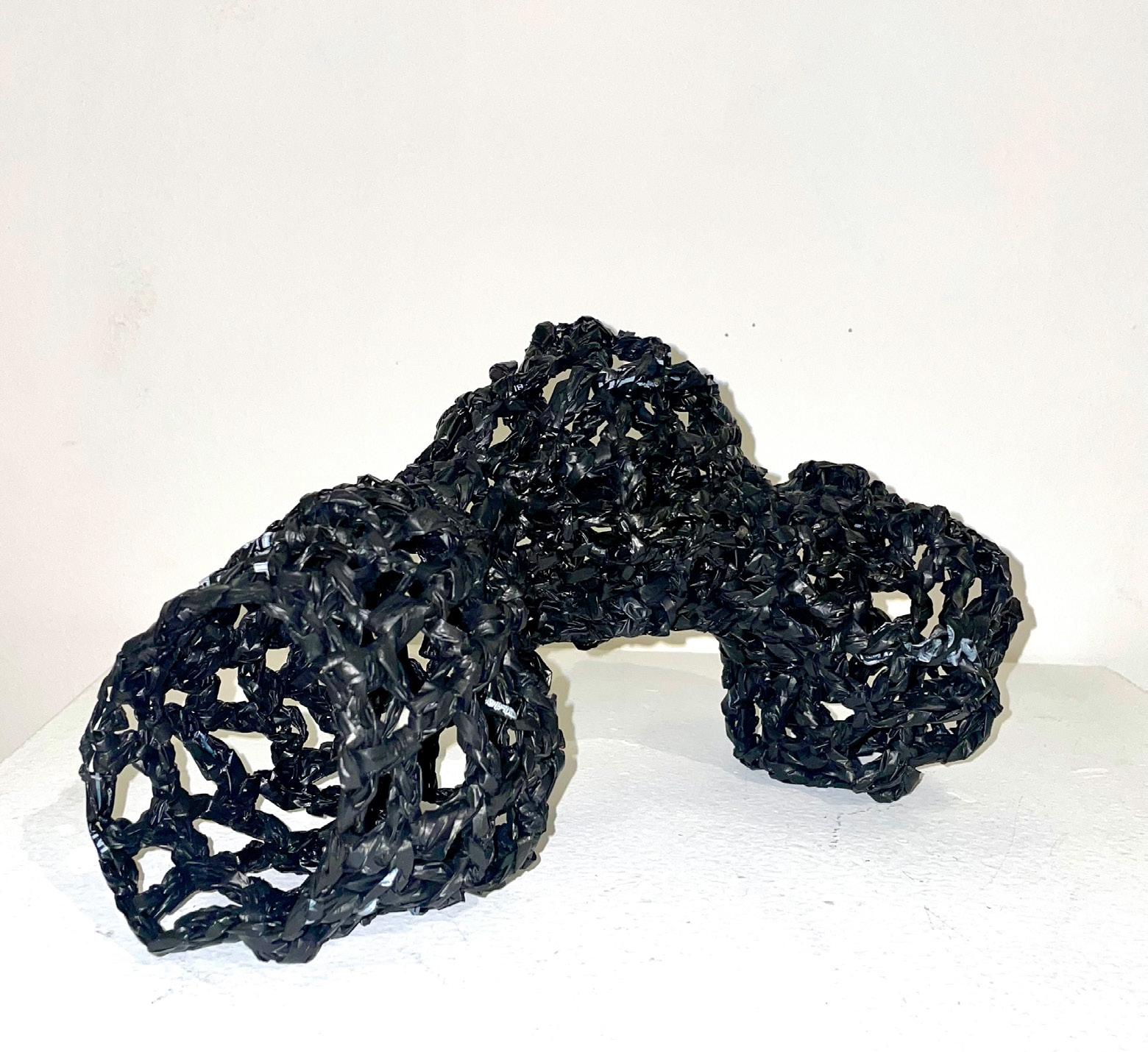
Sculpture (plastic bags)
No. 3 Isabella Thompson
Mars
The year I turned seventeen
I found myself attempting to become enthralled by calculations
While formulating narratives in the margins of physics problems
Imagine, if you will, that you are traveling to Mars
(The blood-red plains, the sparse atmosphere,
The two moons above the horizon like unblinking eyes)
State how long it takes to make the journey
For ten points
(In some distant century it takes only a few hours
It is hardly an inconvenience
But leaving everything behind is its own catalyst for anxiety
It is not about the duration of the journey
It’s about permanence)
Show your work
All answers must be given to exactly three significant figures
And explain what is meant by “percent uncertainty”
(What happens when you reach Mars and you’re Still unsure of which path you plan to pursue?)
And identify sources of error
(The voyage to Mars is only part one of your overall expedition
The rest is living your new life
Will what you pictured in your head play out
In reality?)
Draw a conclusion
(I may not have one, yet
But this isn’t what they’re asking)
(I don’t have one answer to this
I have thousands
Of words upon words upon words)
(I have a story about the planet to write)
(Which I cannot write here)
(I may have to complete this one on the soil of my new home)
(I heard that once you reach Mars
You do not have to attempt to become enthralled by calculations
If contemplating the permanence of that path alarms you)
(I heard that once you reach Mars
Your narratives can leave the margins
Of physics problems
And live again in the pages of notebooks and magazines)
foreplay
— Elizabeth Thompson
back to the basics, our foreplay is a shared porch-cigarette and how we pass The Beatles back and forth on fingertips
you almost remind me of someone from another time, i don’t say your name because it too easily becomes his
there’s something in you i recognize, messy morning kiss, rough pawing at my bangs, always looking for my face, across the crowd and off a platform
you come from good people you don’t know the half of it
still, it scared me when i dreamed of you on the train ride home
— Meghan Shelley
touch
there’s a place in the space of my hand that has a long memory. it remembers slow spreads over skin between my fingers. and the pause. and the eruption of bright, desperate holding. and the creasing. and the pink. and the melting of red warmth. it knows something about love before i do.
— Dativa Eyembe
Charlotte
could this blossom into love? the rhythmic turning of the air purifier back and forth and back and forth and should I or should I not? yet I did a small lie lives deep down within there’s a broken wire somewhere in the purifier and it usually slows down by the nights end so I’ll wake up dripping in sweat, gripping the dirtied sheets my eyes are burning an oasis dots my vision pinpricks of a shore of the sun setting over the backdrop of my driveway of a cottage and fields and perhaps a lake it’s a bit blurry, on the windowsill a spider if it were you I’d let it stay I’d herd the flies or mosquitoes or gnats into the bedroom and offer them to you I’d hope to sustain you and your good health forever and for your joy, the golden light of the sun through the mottled glass I’d never dust again
Let the headaches come, the tissues pile up atop my desk
Anything to keep you there, and content I’d need a microscope to see you closely I’d miss your freckles Too often compared to stars, to me they are the sand The sand that dries me out beneath the hot sky I’d miss your smile, your necklaces, everything I’ve come to love without ever touching or feeling Your familiarity has limits For now
Eventually I hope to know every bent leg, every curve, the way every kind of light reflects off of your eyes, As you lay upside down beneath the window, Asleep in your web.
— Melania Frye
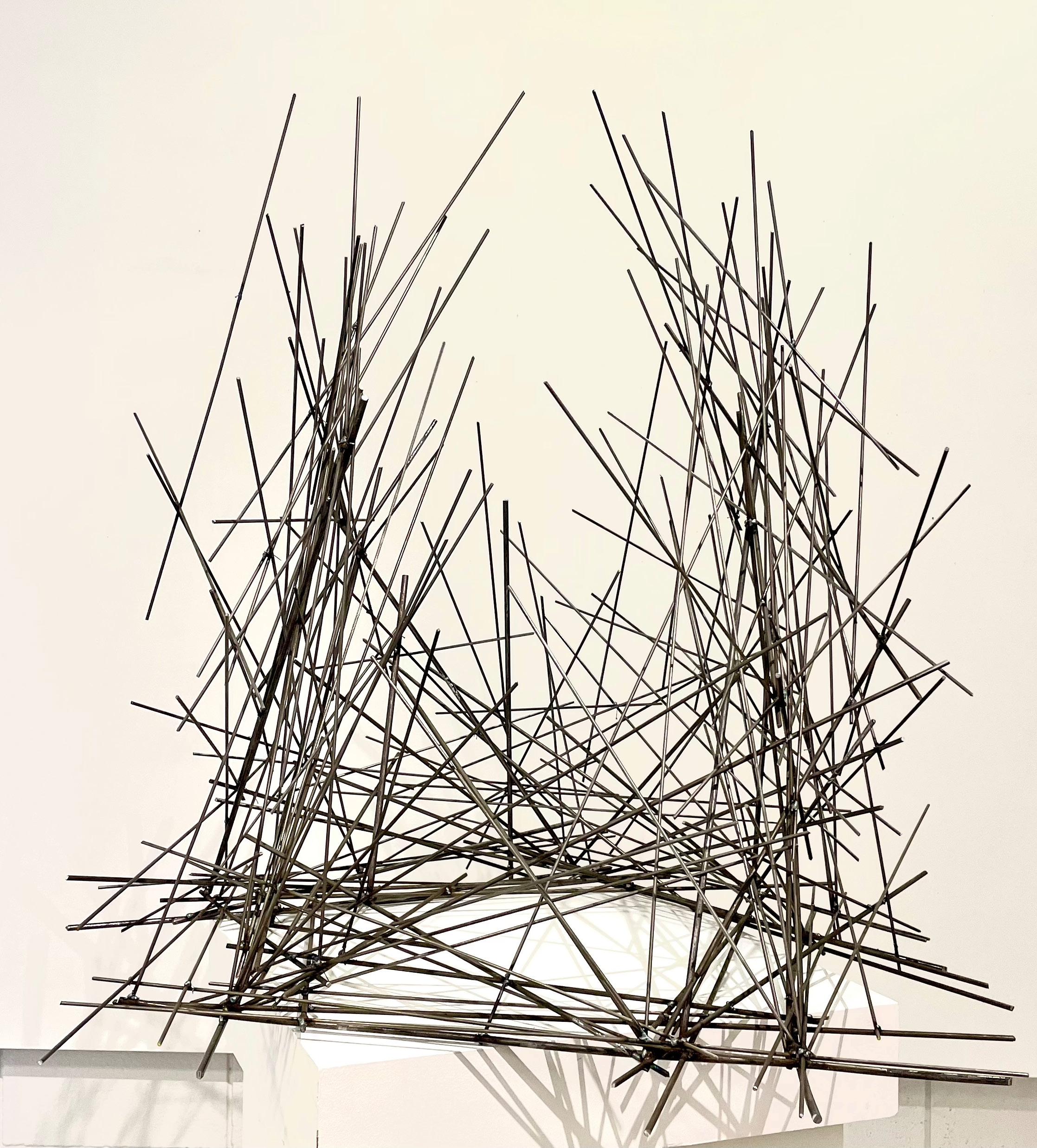
Isabella Thompson My Bower Sculpture (steel)
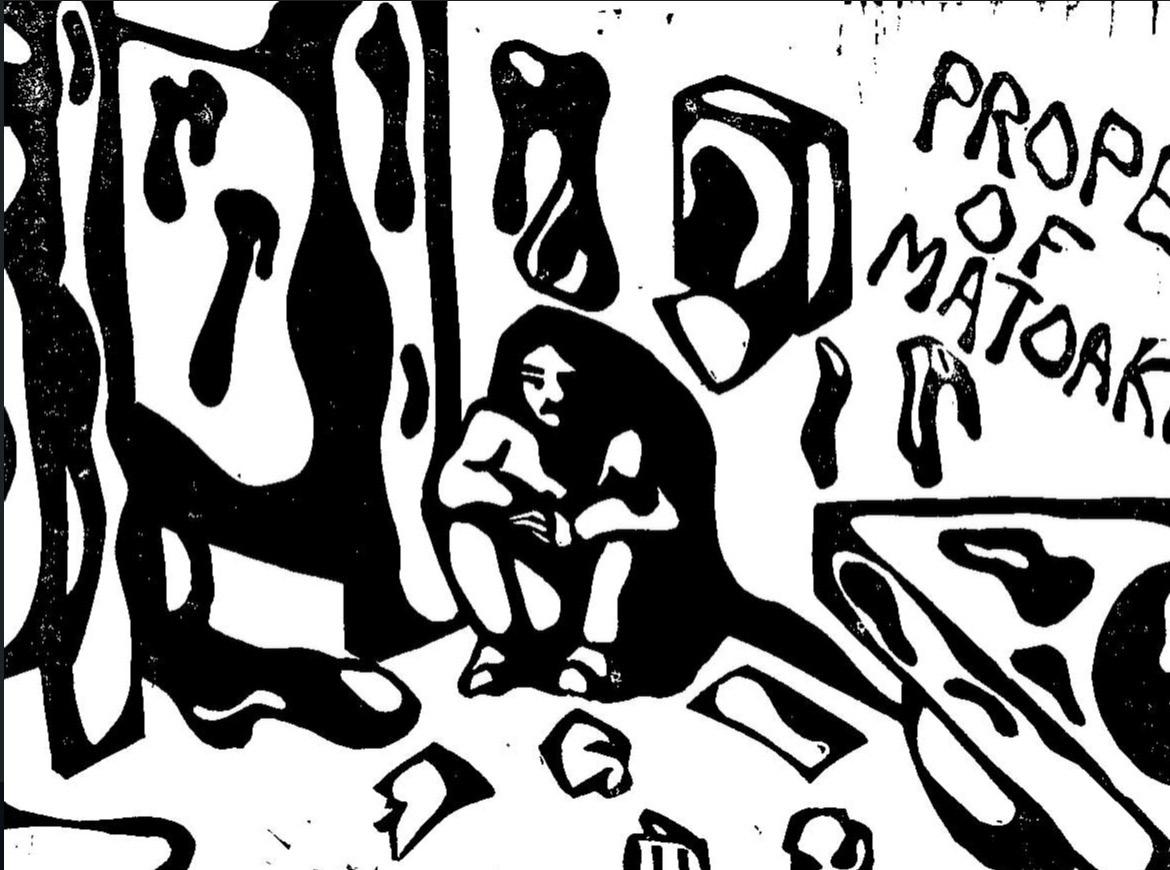
Anna Longley Matoaka Nightmares Monotype
black hole
small hands distress the stars from their lost perch and slide like tears of young throughout the sky distracting worlds of souls who stop to search —is who I lost now come to rectify?
her light inhales it all. one breath before the darkness comes to stay. disguise the world with warped light, and expose the old war that’s full of forgotten things. what furled
too long in hiding upsets infinite and breathing catches against the strain of time the stars, reborn, appear to grow and split before very atoms are redefined
woken up, inside out and upside down existence chokes on its name, now unbound
— Kendall Pade
André Adams is a Black-Hawaiian artist and art historian at William & Mary studying for his bachelors in Art History (2026). His art can be described as NewOceanism which can be read about online in his recent digital art exhibition, which you can find on his Instagram @Crayonmythos.
Arden Pentlicki (‘28) is The Gallery’s biggest fan! She looks forward to writing and editing many more editions before working in the publishing industry.
Anna Longley is a senior at William & Mary majoring in studio art. They love printmaking more than life itself.
Ash Pyle (‘26) is proud of all these talented artists and authors, and will always be an advocate for any submitted photos of an animal <3.
Ash Vetter was placed inside a vat of quicksand when you opened this booklet. By the time you read this bio, the sand will have already finished consuming the young, aspiring writer.
C.S. Danto is a senior and a poet, and as such they are meditating on endings, beginnings, and the journeys between.
Dativa Eyembe (’26) reminds you that you are more than your labor.
Elena Murphy (they/them) is an English major and Creative Writing minor in their senior year at W&M who is deeply fascinated by the written word and every form it comes in. They are always working on something creative, whether in short or long, finding inspiration in the fantastical as well as the everyday.
Elizabeth Thompson is a freshman with an ever-changing list of potential majors that currently includes history, classics, and philosophy. At the moment, she is probably reading a book, drinking tea, or working on her next Gallery entries.
Gray Rzeszot is a senior who spends a majority of their time enjoying the simple pleasures of life, like their cat Maxwell, and their fiancee Ellie.
Greyson Fisher is a junior at the college of William & Mary studying history and business. He splits his free time between classes, volleyball, flying planes, and Model UN. He has been writing since the seventh grade and is actively seeking agents to publish both nonfiction and fiction. His goal in life is to export escapism.
Notes
Hunter French III is a junior studying English at W&M. His love for Creative Writing led him to a Fall 2025 semester abroad in Dublin, Ireland where he created his work included in The Gallery.
As a 3D studio art major, Isabella Thompson is exploring mathematical pattern making through her abstract sculpture practice. The forms she creates are inspired by mythological symbols centered around birth, death, and rebirth.
Jia Patil is a first year, majoring in neuroscience and minoring in psych on the pre-med track. she writes poetry to express overwhelming emotion, unanswered questions or simply recall perfect moments and consuming dreams. she hopes to inspire people to slow down occasionally and admire their own thoughts, from time to time :)
Josephine Halushka (‘26) is an English major and Classics minor with a soft spot for all things folk and fantastic.
Lucy Loudon (‘26) is a Biology major and Creative Writing minor on the preveterinary track from Columbus, OH. Her interest in writing originally stems from her parents who have always encouraged her vast, though sometimes odd, imagination. She likes to write about vulnerable moments of the human experience while often using imagery from both nostalgia and the natural world.
Meghan Shelley is a junior pursuing a joint degree with the University of St Andrews. You can read more of her poetry on her substack, @ballisticonthebench.
Melania Frye (she/her) is a freshman interesting in majoring in English and Biology. She wishes to pursue a career in journalism, while cultivating her love for poetry and artwork.
Natalie Jebraili (she/her) is a freshman who inherited her love of poetry from her Grandpa and her Mother. She writes to articulate her observations and honor emotional connections.
Neil Dongre (he/him/his) is a Philosophy & Psychology double major, and a junior at W&M. He’s been writing creatively since quarantine, and he hopes that you enjoyed his work! You can find other publications of his work in past issues of the Gallery, as well as in the current 2025 Nova Bards Anthology.
Phoebe Robertson is a sophomore studying English. She loves writing fiction and hopes to help other publish their books someday.
Editors’ Note
Hello Gallery People,
We hope you have enjoyed this Fall 2025 Edition of The Gallery. As members of The Gallery since the very beginning (fall semester of our freshman years), we are so honored to now be your Co-Editors-in-Chief. We are incredibly grateful to all of our writers and artists who submitted their work. The Gallery could not exist without the brightness, ingenuity, and heart of the William & Mary student body. Thank you for trusting us to find a home for your work. We believe that it is in great company.
This semester, as always, presented many challenges in regards to what pieces would and would not be featured. We received so many unique and creative pieces, forcing us to be painstakingly selective, even when we did not want to be. That is why we want to thank all of our submitters, not just our contributors, especially as creating and sharing art feels more urgent now than ever.
Wrapping up this fall semester has been bittersweet, but we are so excited to continue our role with The Gallery as we move into 2026. To all of our readers, thank you always for your time and attention. We hope that you continue to find inspiration, both in this issue, and everywhere else.
— Ashleigh (Ash) Pyle and Sydney (Syd) Shoulders Co-Editors in Chief, The Gallery
Colophon
The Gallery Volume 39 Issue 1 was produced by the student staff at the College of William & Mary and published by Carter Printing Co. in Richmond, Virginia. Submissions are accepted anonymously through a staff vote. The magazine was designed using Adobe Indesign CC and Adobe Photoshop CC. The magazine’s 54, 6x9 pages are set in Garamond. The titles of all the pieces are Derivia. The text on the cover is set also in Garamond.