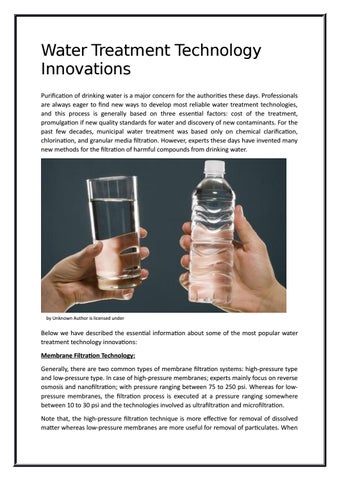
Water Treatment Technology Innovations Purification of drinking water is a major concern for the authorities these days. Professionals are always eager to find new ways to develop most reliable water treatment technologies, and this process is generally based on three essential factors: cost of the treatment, promulgation if new quality standards for water and discovery of new contaminants. For the past few decades, municipal water treatment was based only on chemical clarification, chlorination, and granular media filtration. However, experts these days have invented many new methods for the filtration of harmful compounds from drinking water.
by Unknown Author is licensed under
Below we have described the essential information about some of the most popular water treatment technology innovations: Membrane Filtration Technology: Generally, there are two common types of membrane filtration systems: high-pressure type and low-pressure type. In case of high-pressure membranes; experts mainly focus on reverse osmosis and nanofiltration; with pressure ranging between 75 to 250 psi. Whereas for lowpressure membranes, the filtration process is executed at a pressure ranging somewhere between 10 to 30 psi and the technologies involved as ultrafiltration and microfiltration. Note that, the high-pressure filtration technique is more effective for removal of dissolved matter whereas low-pressure membranes are more useful for removal of particulates. When
it is important to remove both types of contaminants, it is better to apply two-stage membrane filtration combing both methods. Ultraviolet Irradiation Technology: This technology is primarily preferred for the wastewater treatment industry; it is basically a disinfection process that works on the germicidal effect of UV rays within 250 to 270 nm wavelength range. In this filtration method, water is allowed to flow through a narrow region surrounded by a series of UV lamps. When the microorganisms come in contact with UV light, they get inactivated, and pure water is passed ahead to the outlet. This technique is generally applied to large scale treatment plants. Advanced Oxidation Technology: In this process, hydroxyl radicals are used for oxidation of inorganic and organic impurities in the water. Although, there are numbers of methods to execute this filtration process; the most commonly used ones are ozone, UV irradiation with the addition of hydrogen peroxide and ozone with the addition of hydrogen peroxide. It helps in the oxidation of various synthetic organic chemicals, manganese, sulfide iron, color, compounds are leading to odor and taste. Ion Exchange Technology: Ion exchange technology is commonly used in the field of environmental and chemical engineering. It is applied for water softening, as well as for various industrial applications to get fully demineralized water. The primary compounds that can be removed with this method include chromate, fluoride, lead, radium, barium, selenium, arsenic, and nitrate. Biological Filtration: The technologies listed above are based on chemical and physical processes; but sometimes, it is also important to follow the biological filtration process to meet quality goals. These types of methods are essential to eliminate micro-organisms from water. Experts recommend this technique for ozonated waters that have higher biodegradable organic matter concentrations. Even after these methods, many researchers are still working on the development of new techniques that can ensure a better quality of drinking water. The main idea is to design a water filter system that can keep human beings safe from harmful health issues.