22 POLITICS
Tryweryn: 50 years on
Drowned village remembered as a significant moment in Welsh history
Rory Wade
T
his month marks 50 years since the North Welsh village of Capel Celyn was flooded to create the Llyn Celyn reservoir, to provide a water supply to Liverpool. It was an event marked as one of the most significant in Welsh History and as a symbol of the sometimes strained Welsh-English relationship. In 1956, a private bill sponsored by the Liverpool City Council was brought before Parliament to develop a water reservoir from the Tryweryn Valley – which would include flooding Capel Celyn. Due to the Act of Parliament, Liverpool City Council would not require planning consent from the local Welsh authorities and went ahead with their plans. This caused great opposition across the country with many seeing the flooding as an attack on the Welsh language and culture, given that Capel Celyn was one of the last remaining exclusively Welsh-speaking communities in the country. 35 out of 36 Welsh MPs opposed the bill (the other didn’t vote) and the villagers waged an 8 year campaign to try and stop the flooding. Eurgain Prysor Jones – a former Capel Celyn villager who was just two years old in 1955 when news first broke that her community was earmarked as a site for the new reservoir – recalled her memories of protesting against the flooding in the streets of Liverpool for a new BBC documentary (Tryweryn: 50 Years On), “The reception we had in Liverpool was awful. People were spitting at us and throwing rotten tomatoes at us. It was an awful disappointment.” Despite the fierce and restless opposition, the valley was flooded in 1965 to create Llyn Celyn. The village, the post office and chapel with a cemetery were all lost underwater.
Twelve houses and farms were also submerged and 48 people out of the 67 who were living in the Valley lost their homes. “At the end of the day, the eventual consequence was written before it was started”, added Prysor Jones, reflecting over the failure of the protest to prevent the flooding of her home. The effects of the flooding created a new surge in support for Welsh nationalism with membership for Plaid Cymru doubling and their first MP elected in the year following the opening of the Llyn Celyn Reservoir. There were also further powers given to Wales such as the creation of The Secretary of State for Wales and The Welsh Office. However some of the nationalist reactions took a violent turn with the militant group Mudiad Amddiffyn Cymru (Movement for the Defence of Wales) forming in response to the flooding. In 1963 MAC claimed responsibility for the bombing of the dam construction site – which led to the one year imprisonment of one its founders Emyr Llewellyn Jones. They were also behind explosions at other dams, pipes carrying water to Liverpool, the Welsh Office building and even the Temple of Peace and Health in Cardiff. Since the 1960s the group has been inactive. In 2005, Liverpool City Council issued an official apology for the “hurt of 40 years ago” and the “insensitivity by our predecessor council” over the drowning of the Tryweryn Valley and Capel Celyn. The apology was welcomed by the then-Welsh First Minister Rhodri Morgan and Plaid Cymru’s Parliamentary leader Elfyn Llwyd who said the apology “should be accepted in the fulsome way it is being offered.” Nonetheless the apology was not accepted by all of Wales – “I think
nothing of it, it is just a way to say goodbye and sweep it all under the carpet” said Betty Watkin-Hughes, whose family was forcibly removed from Capel Celyn. “They can keep their apology and start doing what’s right for the people who are left.” To mark 50 years since the opening of the Llyn Celyn reservoir hundreds marched across the dam site on the 17th of October, led by Plaid Cymru’s former leader Dafydd Wigley and the parties new MP Liz Saville Roberts. The anniversary was recently raised in Parliament on the 14th of October by Mrs Saville Roberts who said: “Since the flooding of Capel Celyn, there has been a significant development in Wales’ national
consciousness, but her resources remain in the hands of a neighbouring country, there have been no developments to make a repeat of this sad event illegal.” “The UK government, in producing the Wales Bill, must now give the people of Wales full control of their natural resources. Never again should the people of Wales be forced out of their communities against their will, against the will of the country and those who represent us. “I hope the people will join us on Llyn Celyn Dam to mark this poignant reminder of why Welsh land, Welsh culture and Welsh communities cannot be allowed to be so drastically undervalued ever again.”
A week in the Senedd with Carwyn Williams
“
Thomas mentioned modern slavery, and the good work the anti slavery coordinator is doing
”
First Minister’s Questions Fracking has been a forgotten topic that was brought back to the Siambr last week, with Plaid’s Llyr Gruff ydd questioning whether there really is a moratorium on fracking in Wales. The First Minister however insisted that it was in place, but made it clear that this is a temporary position. Leanne Wood called last Tuesday
a “sad day” in the history of steel production and indeed manufacturing in Wales. She criticised the Welsh Government for not doing anything about the situation. Carwyn Jones said the Government was working closely with Tata Steel, and that the future at their plant was now looking better, but not great, due to difficulties in the global industry. The Welsh Government are
also writing to the UK Government about energy prices, saying that they are far too high, especially for a successful industry, but of course there are other manufacturing industries in Wales to concentrate on as well. In this new digital age, it’s essential to take advantage of being able to connect, and this is the string Kirsty Williams pulled. She quoted a GoOnUK report that outlined up to 40 per cent of adults in some parts of Wales don’t go online. The Minister said that other surveys showed different results, and that this is an issue of age, with 99 per cent of young people getting online but this drops to half in the over-65 range. Gwenda Thomas mentioned modern slavery, and the good work the anti slavery coordinator is doing. More victims are being recognised thanks to increased awareness, with over 2,000 people trained to identify the signs of slavery.
Microchip dogs by April Assembly Members last week agreed to implement new regulations meaning every dog over eight weeks old will need to be microchipped from next April. Similar rules are also being passed for England and Scotland, and have been in force in many other countries. The Welsh Conservatives, however, said that it is a shame that it has taken so long for Labour to legislate in this area. Plaid deal with Labour Plaid Cymru have struck a deal with Labour on the a new law to allow voluntary mergers of local authorities in Wales. Plaid members abstained on the vote, allowing it to pass. The bill, however, seems to be pointless, as there are no potential mergers on the table, and no decision on forced mergers will be made until after next year’s election.
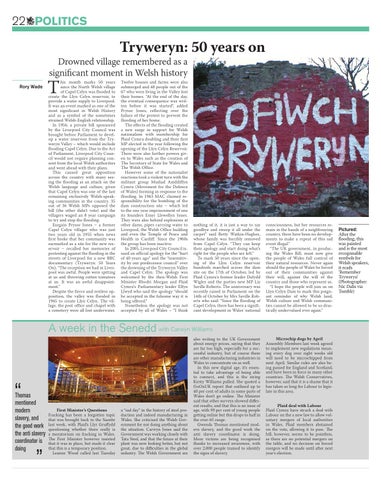
Pictured: After the flooding, this was painted and is the most recognisable symbols for Welsh speakers, it reads ‘Remember Tryweryn’ (Photographer: Nic Dafis via Tumblr)