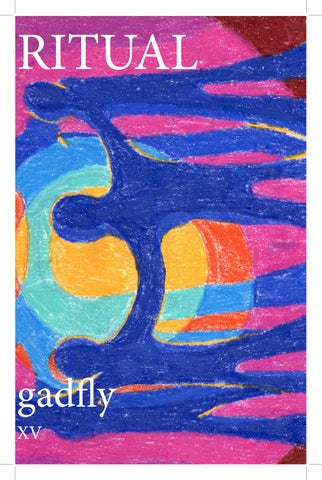
RITUAL
Editors
Editors-in-Chief
Eitan Zomberg & Ray Knapick
Managing Editor
Joseph Said Kwaik
Chief Articles Editor
Iris Wu
Chief Columns Editor
Daniel Knorek
Chief Interviews Editor
Maddy Fine
Discussion Coordinator
Nayantara Narayanan
Art Director
Anna Bruhn
Communications Director
Mim Datta
Editors
Articles Editors
Anthony Hu, Ashling Lee, Daniel Nitu, Kelly
Sung, Sebastian Verrelli, Tai Nakamura, Telvia Perez
Columnists
Yongjae Kim, Brittany Deng, Xavier Stiles, Aharon Dardik, Meryem Anderoglu, Mingqing Yuan, Dominique Cao, Ishaan Bhattacharya, Giovanni Zantoni, Solomon
Akaeze, Cia Zhou, Fiona Hu
Interviews Editors
Pascale Sarva, David Jia, Gabriel Tramontana
Visual Artists
Angela Tang, June Yang, Sabina Vu, Theo Weiss, Jamie Rain Kim, Keira Lee
Letter from the Editors
LOST KEYS
Jacqueline Traenkle, edited by Tai Nakamura
Achille Varzi: Parts and Wholes
Pascale Sarvo
Knowledge Claims are Rituals of Power, Not Communication
Aharon Dardik, edited by Sebastian Verrelli
Rituals of The Dissolving Self: Liminality as Political Technology
Nayantara Narayanan, edited by Daniel Nitu
On the Feasibility of Free Will
Solomon Akaeze, edited by Tai Nakamura
Of Ritual and Law(禮法之間): The Devolutionary Ladder and the Performative Scaffolding
Hung Pan (Eric) Li, edited by Anthony Hu
The Uncanny: When Repetition Loses Its Home
Dominique Cao, edited by Anthony Hu Qingming?
Mingqing Yuan edited by Anthony Hu
Chris Baer on Consciousness, Art, and the Universe Maddy Fine
Intuition and Divination: Resolving the Epistemic Tension of Secular Tarot
Lilly Lees, edited by Sebastian Verrelli
Emerging Single From Hell: A Feminist, Satanic Undressing of Single’s Inferno
Brittany Deng, edited by Tai Nakamura
Becoming One: The Beauty of Dionysian Communion in Midsommar
Cia Zhou, edited by Ashling Lee
We are Still Witches
Fiona Hu, edited by Sebastian Verrelli
Mosh, Merch, Meme: Underground Rap Aesthetics as Liturgy
Ishaan Bhattacharya, edited by Ashling Lee
Bergsonian Duration and the Urban Image
Yongjae Kim, edited by Kelly Sung
Subculture and Simulacra
Suliman Albahrani, edited by Telvia Perez
Ritual is something of a loaded term, etymologically. Origin ating, as so many English words do, in Latin and Middle French, the word has a historical, and today popular, implication relating to religion and religious practices. But when we discuss the broad idea of rituals, it becomes clear that this implication does not preclude the consideration of habits or practices as ritual which are not related to religion, or indeed that expressly reject religious authority. In the university environment, it seems clear that commencements and graduations are rituals which, while they may contain theistic elements, need not, and in many instances do not.
Once we recognize the significance of ritual as a description of practices which go beyond simply those things specifically related to the practice of religious rites, the concept seems to encompass much more of our lives. If graduation is a ritual, is attending class? It seems to carry the familiar markers of ritual—an established procedure, assigned roles for participants, rules of decorum, and a collective goal. The academy is full of rituals in this
Letter from
sense, and in developing this issue, we thought about the ways that our own work was a ritual in this context. Gadfly meetings have an established procedure, assigned roles, rules, and a goal (namely, the creation of this issue). If our work is a ritual, what is its relationship to each of us and our diverse academic and personal interests?
In this issue, we asked our columnists, interviewers, editors, outside contributors, and artists to consider the idea of ritual; in their own lives, in their philosophical interests, and beyond. In an interview with Gadfly’s own Pascale Sarva, printed in this issue, Professor Achille Varzi expressed hope that, while many fields consider the idea, philosophy has something unique to offer to the discussion of ritual. In this issue, our dedicated and creative contributors provided many different manifestations of that hope.
Opening the issue, Jacqueline Traenkle confronts questions of home, connection, and the self in a visceral and imaginative work, titled LOST KEYS. Traenkle implicates each of us in a subversive and arresting
the Editors
dialogue which demands an awareness of our own places in the destructive rituals of our lives.
Pascale Sarva’s interview, Achille Varzi: Parts and Wholes, broadly explores the idea of ritual. Varzi asks whether we are, in some meaningful sense, part of the rituals we partake in. Through the examples of solving his father-in-law’s sudoku puzzles, weddings, and teaching philosophy, Varzi describes the unavoidability of rituals, the parts of a ritual that make it whole, and crucially, how to avoid the transformation of a ritual into an oppressive thing. Varzi further proposes that philosophy can give us greater insight into the nature of ritual by decomposing its epistemology into a two-part exploration—by viewing it through a first and third person experience, Varzi gives us a unique framework to unpack the nature of the ritual.
Aharon Dardik’s Knowledge Claims are Rituals of Power, not Communication flips the script, not engaging epistemically with rituals, but rather, treating epistemic claims as rituals in themselves. Dardik, using the philosophical works of Fricker,
Quine, and Williamson, explores how speech acts—regardless of their veracity—serve to reify the existing political order. Dardik argues that, much like a ritual, these speech acts serve a social function that runs deeper than their surface, transforming the world, stripping epistemically underprivileged groups of their capacity to define.
Nayantara Narayanan’s Rituals of The Dissolving Self: Liminality as Political Technology too delves into the political sphere. Narayanan’s piece explores Durkheim’s notion of collective effervescence, exploring how rituals—in the forms of chanting and marching— cause individuals to lose themselves in a crowd, inducing a phenomenological state not dissimilar to ego death. This, Narayanan asserts, orients their wills and actions in line with the collective—a collective headed by individuals who exploit this malleable state to advance their political interests.
Solomon Akaeze’s On the Feasibility of Free Will makes an even broader claim, critically engaging with the debates around free will, to deny its feasibility in a wide
context. Using the concepts of Foucauldian discourse analysis and Machiavelli’s fox-like prince, Akaeze argues that free will is stripped by coercive forces, and identifies one form this takes in our modern world.
Hung Pan (Eric) Li’s Of Ritual and Law (禮法之間): The Devolutionary Ladder and the Performative Scaffolding explores political dimensions of ritual through Lao Tzu’s concept of the Devolutionary Ladder. By critically engaging with the ideas of Confucius, Lao Tzu, Xunzi, and the legalist school, Li argues that ritual can and should act as a middle ground between an anarchic and a totalitarian political path.
Mingqing Yuan’s Qingming? brings us to a specific, tangible instance of ritual qua ritual, exploring his experience celebrating Qingming Jie with his family and making offerings to his grandfather—despite a familial religious skepticism as to the function of the ritual itself. Using the works of Quine and Dennett on their theories of belief and desire, Yuan deconstructs his broad skepticism into distinct questions, deriving a concrete view of the value of the ritual for himself, and for us.
Dominique Cao’s The Uncanny:
When Repetition Loses Its Home explores the nature of the uncanny. Starting with an exploration of Freud’s relationship to the concept, Cao takes us through the divergent perspective offered in analysis of Malay ritual practices. In putting magic, science, repetition, belief, and the uncanny in conversation, Cao offers a different way of understanding their relationship, and a deeply insightful view of how to understand modern rituals.
Maddy Fine’s Chris Baer on Consciousness, Art, and the Universe explores ritual through the lens of psychedelic therapy. Discussing William James, semiotic theory, and art, Fine and Baer explore the infinitely vast sea of consciousness together, offering a nugget of insight into a barely effable topic.
Lilly Lees’s Intuition and Divination: Resolving the Epistemic Tension of Secular Tarot seeks to investigate a very peculiar kind of ritual—one in which no sincere belief in the explicit utility of the ritual itself is expressed by its practitioners. Lees’ piece explores the concept of tarot reading as a wholly secular ritual, and applies the fact of the subconscious beliefs of its practitioners in its predictive privilege to suggest
that it fits within a Jamesian framework, and can be regarded as epistemically unproblematic by virtue of it possessing substantive utility.
In Emerging Single From Hell: A Feminist, Satanic Undressing of Single’s Inferno, Brittany Deng engages with a less controversial topic—Satanism. Deftly exploring the world of the dating show Single’s Inferno through the works of Adriana Craciun, Deng engages with the feminist interpretations of the character of Satan in Milton’s Paradise Lost as a kind of allegory for female genius. Deng argues divergent models of femininity within the show, and within Milton, ultimately exacting a persuasive and prudent argument about what the different strategies used by two contestants illustrates.
Fiona Hu’s We Are Still Witches also engages with subversiveness and femininity, centering around the notion of the reclamation of witchcraft as an explicit feminist identity. Hu links the scorn held for witches during the period of the early modern church to its obsession with imposing rituals onto women. In the modern day, Hu discusses the ritual magic of makeup, and the ways that controversy and conversation around it mirror the condemnation of witchery in
earlier periods.
Cia Zhou’s Becoming One: The Beauty of Dionysian Communion in Midsommar shifts the concept of ritual to that of paganism as practiced by the Harga in Ari Aster’s Midsommar. Zhou explores the rituals of the Harga, arguing that the film’s potency is derived from its depiction of Nietzsche’s concept of Dionysian Spirit triumphing over a liberal ontology which alienates and isolates. Meticulously unpacking the structure of Midsommar’s rituals, Zhou establishes the understandable appeal of embracing a state of ritual absorbtion in a hopelessly alienating world.
Ishaan Bhattacharya’s Mosh, Merch, Meme: Underground Rap Aesthetics as Liturgy explores a uniquely modern form of ritual, diving into the practices of hiphop subcultures that, he argues, constitute a form of religious community. Using the work of Durkheim, Debord, and Barthes, Bhattacharya explores the origins of these communities, explains their function in our society, and even elucidates how members of these communities become not just fans, but members of a bona fide clergy.
In Bergsonian Duration and the Urban Image, Yongjae Kim
explores an altogether different kind of ritual. Set within an anecdote about photographing Seoul, Kim explores how Henri Bergson’s idea of quantitative multiplicity manifests itself in a single image of an ironworker who chased him off, believing him to be a redevelopment official. Kim argues that the ironworker’s reaction constitutes not just an attempt to resist the perceived imminent threat of the demolition of his neighborhood, but also the refusal to be reduced into a discrete, momentary individual, rather than the being extended across temporality that he actually is.
Rounding out the issue, Suliman Albahrani’s Subculture and Simulacra too engages with a subculture—that of the punk community—but seeks to challenge the idea that certain subcultures can, in the contemporaneous age, actually be said to meaningfully persist. Using the works of Baudrilliard, Albahrani argues that the internet and the economic conditions of the day allow the aesthetics of a subcultural community to be appropriated without the concurrent rituals that gave their objects substance in the first place, rendering authentic subcultural communities few and far between.
Here at The Gadfly, The ritual of our work is one which is repetitive, nearly meditative at times. Each week, we gather together in discussions and meetings to engage in collaborative thinking and work. But in considering the ritualistic elements of this time together, we have come to appreciate the responsibility of recognizing our goals, and of being intentional with our practices. In each of these pieces, the personal, political, spiritual, and cultural implications of ritual are considered expansively and carefully. We are incredibly grateful for the heartening work of each and every person who contributed to the production of this issue, and for the lessons they teach us about the opportunities, and the pitfalls, of ritual. As outgoing editors-in-chief, we are eternally grateful for the lessons and insights which all of our contributors have provided in this issue, and in the ritualistic work they have done every day to create it.
Best, Eitan Zomberg & Ray Knapick
LOST KEYS
Edited By: Tai Nakamura
Jacquelin e Traenkle
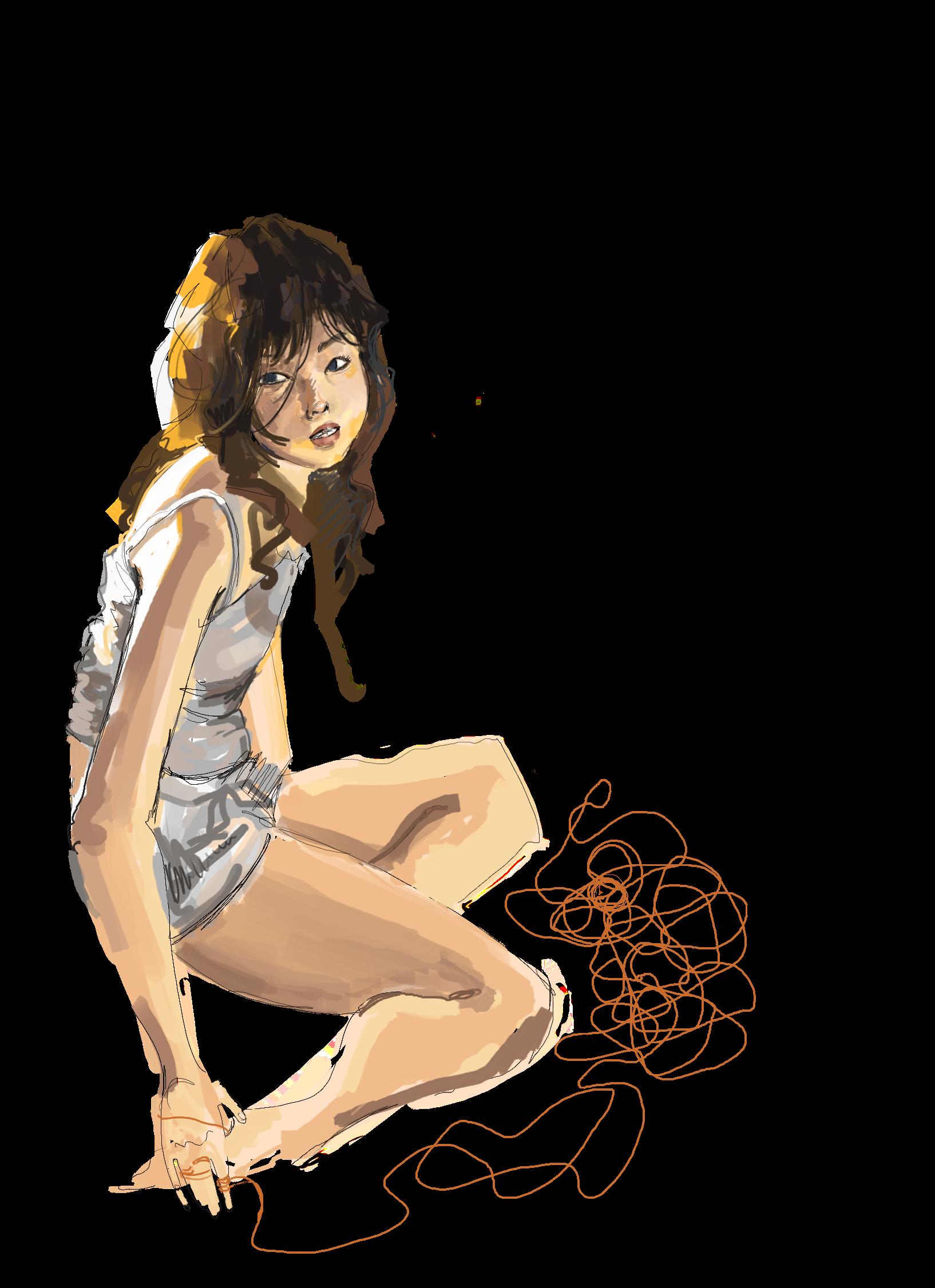
LOST KEYS
If found, please return to 546 Viitostie, Kainuu
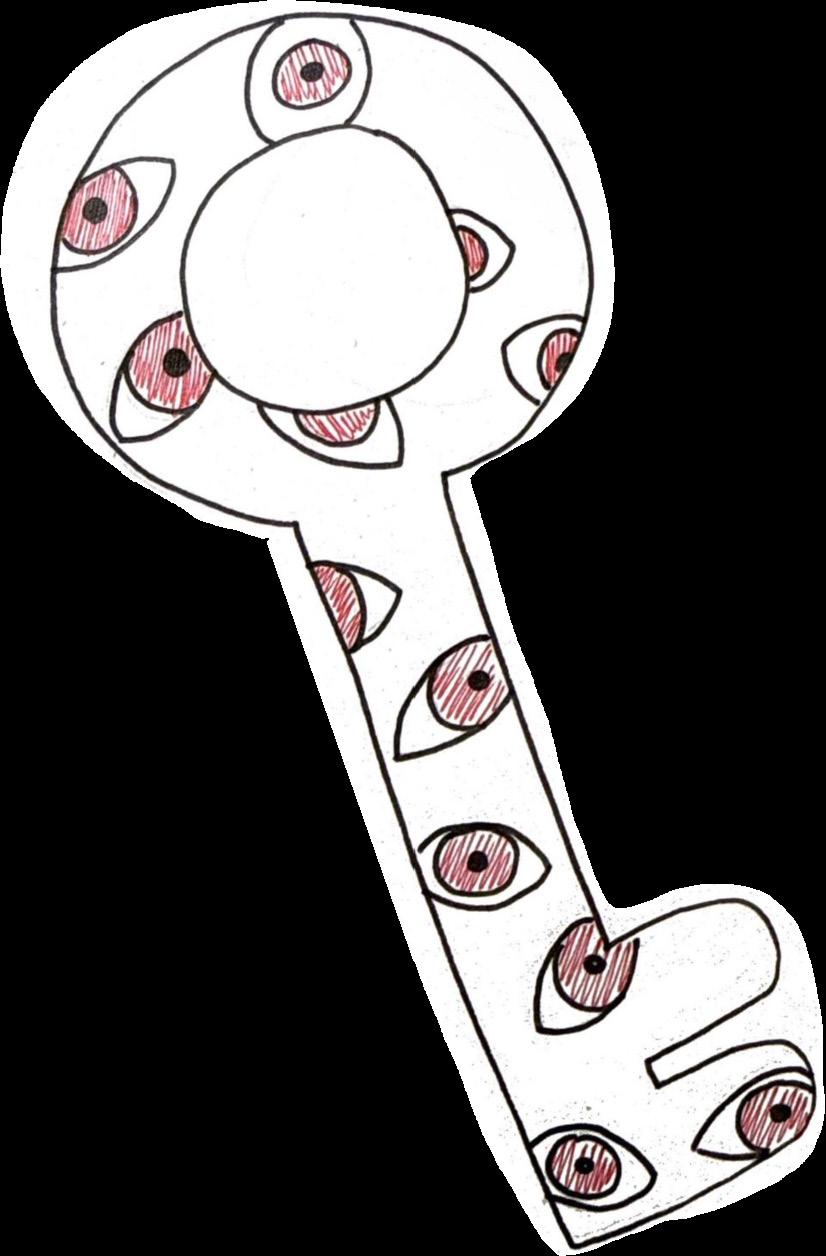
I’m looking for my keys. I seem to have lost my keys. Have you seen them? Don’t ask where I had them last. If I knew that, I wouldn’t be asking you. Whatever. I lost them 10 years ago anyway—what’s another 50 more to me? Nothing. Exactly. Now you’re catching on. I like this.
I like that you’re silent. I like that you listen. I like your glossy eyes and bored face, unafraid to show me your genuine indifference to my story. The weight of your stresses pulls down your eyelids to a half-closed blank stare, puffing your eye bags into inflatable safety rafts floating above the sea of your uncried tears. Look at me. It’s so easy to pretend I’m worthy of your attention by mimicking the loquacious speech patterns of “intellectuals.” Like only long and complicated sentences deserve airtime, even if they’re full of bullshitted nonsense.
You know, it’s just so refreshing to have someone listen to me—no acting, no playing, no pretending. No forced grins of appeasement or false nods of encouragement. Just a tired
soul awaiting my words of no value. How kind of you to just listen to a human being, not for a LinkedIn connection, not for an Instagram follower, not for a letter of recommendation, not for another name to pull out from your pocket when your feelings of inadequacy require you to supplement your value from another’s name.
No, no, no, none of that bullshit. We’ve asked Alexander to step out of our light, and now it’s just me and you: the down-to-earth duo.
And people wonder why humanity is crumbling? Ha. Look around folks. If it’s rare to listen to another human without an incentive, humanity is not crumbling—it’s already disintegrated. That is, if it ever actually existed as more than a talking point.
What am I even fucking saying? Sorry, where was I? Oh, yes, yes. I lost my keys.
I lost my keys when I was 10. One second I was holding them, and then—don’t interrupt me. The next thing I knew, they were up my ass. Weren’t expecting that, were you? Look, I like your silence. I like our connection. But you know nothing about me. You don’t know what I’m
going to say, so stop trying to fit my story into a conglomeration of everything you have ever read. I don’t have to follow those guidelines, so stop expecting I will. Okay? Your expectations are making me sweat. Just listen, please, and don’t expect. I just want you to listen.
I lost my keys when I was 10. The keys to my little wooden box. I kept it hidden in the lowest drawer of my sticker-speckled nightstand, under my collection of baby teeth (most of which were mine) and wilted fourleaf clovers. I remember only opening the box once a month as a little ritual of my own, carefully turning the key and lifting the lid just a hair, peering inside for a split second to make sure she was still in there.
But after I lost my keys, I was never able to open it again. I was never able to see her again.
Look. Look. Maybe I do remember where I had them last, and maybe I’ll tell you, but you have to listen. No interruptions, you hear me? Okay. Fine. Take a seat.
My jaw smacked the ground, an audible crack reverberating through my membranes— mitochondria shaking in fear, rough ERs clutching their pearls,
golgi losing their packages— and for a millisecond, they held hands in a cellular prayer.
I was alone, my conscience and I, as we watched the tragedy unfold, helplessly bound in the metaphysical domain of thought.
The red curtains descended, melting on stage and gushing out of the cracks of my teeth, spilling seamlessly around my distorted, limp limbs. Like a kindergartner’s human sketch: skinny, unnaturally bent, and aggressively drawn in Crayola #C62D42. So much passion in the white-knuckled crayola grip of a kindergartener—squeezing, smashing, and snapping colored sticks all the while wide smiles slung across their slender slim, silver, slimjims—
Do you have a slimjim? I forgot to eat lunch, and I’m craving some plasticky processed meat. Preferably jalapeno, please. I don’t like when people say my taste buds are too “white,” so I’ve purposefully been putting myself through pain….. Okay, wait, why the fuck am I still alliterating? Sorry, I guess I’m just a faucet of poetry or whatever.
But um yeah, the spicy slimjim, you have that?
Okay, thanks, I’ll get back to my
story. Where was I?
Oh, right, right, right. Blood, gore, horror, trauma, blah blah got it. Okay, deep breath.
The dust gathered in dark clots around my thick crimson blood, greedily engulfed by its dry grasp. I found myself enamored by its color—how beautiful a pigment I innately create, simply by existing. It seemed almost tragic that such beauty is eternally hidden behind such an ugly, wrinkly, beige, waxy blanket of flimsy flesh. I almost wanted to peel my hangnail along the side of my arm, across my stomach, and down my legs, unraveling myself and letting the skin give way to
the burgundy waves of a red sea, splashing out of my disgusting cadaver and covering my remains in a sweet, full-bodied 1994 Cabernet Sauvignon from the French vines of Bordeaux.
Drunk on my artwork, I stared in a daze, watching as the wind rippled off the surface of my sea... but a little ivory ice cap caught my eye: a lone incisor. Instinctively, my mouth curved into a crooked, gap-toothed grin.
“A new hiding stone,” the phrase slipping out with a faint, unmistakable lisp.
I took a private pleasure in the thought that my precious box would be shielded by pieces of myself—protected by an intimate, bespoke armor of enamel. I was willing to pull out all of my teeth for that box. Willing to pull out all of my grandpa’s two teeth for that box. Willing to swallow it whole, letting it rest upon my plump intestines with iron abs stronger than those of Prometheus.
I lay there, content in my thoughts and in the dull, soothing ache of my bleeding gum, watching dust eddy and unravel above me. Trails of a hot coffee’s vapor elegantly twirling around itself— a bored finger caressing a frizzy curl, seeking the comfort of silky,
rhythmic uniformity.
Through its shifting veil, small seams of baby blue opened and closed, gentle assurances that the sky still existed somewhere beyond the haze. My eyes settled on a cluster of distant dark shapes, throbbing faintly as they circled, speaking to me in an anemic Morse code.
Slowly deciphering the message between shallow, whistly breaths and violent coughs, their edges sharpened, the blur resolving into a softened luminosity: a golden ribbon resting on a little girl’s long, flamingo-thin neck, its weight dragging her head toward her chest in an unnatural crescent curve. Her shoulders and spine folded inward, quivering with the effort of remaining upright.
An amorphous black figure slide beside her fading lines dripping of gold and flesh—one hand frantically scooping her yellow taffy back into her penciled outline, the other squeezing and molding her frame to keep the floppy flub inside. Again, and again, and again, the arms flew around the girl like a gust of wind swirling a pile of leaves or a cloud engulfing the sun.
I watched as the figure’s breath quickened, lungs contracting,
fatigue expelling—
Until a shriek brought the world to a halt. Silenced floated through the air and brushed the frail figure with a gentle gust. The fragmented limbs surrendered to a graceful collapse.
Broken beings now eye level. Like cellophane, their arms wrapped around her, drawing her close in an embrace of failure, allowing her to rest her downy, chick-soft blond hair against their broad shoulder, arms tightening around her small frame. The last of the little girl’s golden hue dripped from her fingertips, and they fused into a single dark silhouette, expanding and contracting with the girl’s quick, shallow breaths.
As the dust settled and their edges sharpened, more detail came into focus from the comfort of my blood-soaked pillow, and I realized the girl was staring directly at me.
We froze inside that mutual gaze, blank and unblinking:
Conjoined Heartbeats
Syncopated
We lingered there, suspended in a shared agony, having arrived at a sickening realization: we had both lost our keys.
The world suddenly seemed to fold inward. I tried to gasp, to pull air into my lungs—
— I gently lifted my chin from my mother’s shoulder, pulling back, meeting eyes, and watching as her face sagged with age and eyelids dropped with fatigue; the youthful moisture of hope evaporated from her eyes, and what remained was a face I could barely now recognize. I turned my head towards the finish line, its white surface stamped with size-five Nike footprints and creased like my mom.
Everywhere, bright smiles gleamed, sunlight flashing almost violently off salivapolished teeth—but I couldn’t help notice the dropping flesh surrounding these incisors. Wrinkly faces stared at me with such contorted expressions—the weird kind of pain like a funny bone hit by your nurse’s reflex hammer. An uncontrollable reaction that dissociates you. And it was with this thought that I realized: I, too, was smiling.
That race was the last time I ever saw my keys. So, I told myself I would never race again.
And yet here I am, still racing to get away from the race.
Funny how that works, right?
Maybe one day, when things slow down, and I’m no longer surrounded by accolades of comparison, clubs of exclusion, and disparaging, capitalist triangulation disguised as warm recognition—I can go back to that dusty dash and find my keys buried below layers of dirty, dried crimson blood, beside a little pearly white incisor.
But whatever. Who gives a shit about anyone’s keys? How can anyone give a shit when they’ve lost their own?
Never mind. I shouldn’t have said anything. Doesn’t matter anyway.
Let’s remain in our narrow towers of curated loneliness and watch history rehearse itself again and again. Let’s keep racing toward the stars until the air thins to nothing, until we forget what we were chasing in the first place.
—-
This is stupid.
But seriously, if you find my keys, please send them to me.
Anyway.
Achille Varzi: Parts and Wholes
Pascale Sarva
Achille C. Varzi is a Professor of Philosophy at Columbia University, where he has been a part of the Department since 1995. He completed his undergraduate studies at the University of Trento, then earned his Ph.D. in philosophy from the University of Toronto. His career research lies in logic, metaphysics, and the philosophy of language and literature. He has made notable contributions to philosophical logic, including work on vagueness, supervaluationism, and formal semantics, as well as to metaphysics, particularly in the areas of Mereology, causation, events, and more. His most recognized works include Holes and Other Superficialities (1994, coauthored with Roberto Casati), an exploration of the realist ontology of common sense and naive physics, and his 2021 book Mereology (coauthored alongside A. J. Cotnoir), published by Oxford University Press.
GADFLY: What led you to philosophy? Was there a moment, a professor, etc. that specifically got you interested?
Yes: not a person, not a teacher, but a birthday present. During my second year at college, three friends gave me a book by Robert Musil, called The Man Without Qualities. In chapter 4, the title says, if there is a sense of reality, there must also be a
sense of possibility. The main character is Ulrich, who has a very strong sense of possibility to the point that he doesn’t do anything, because by selecting one possibility out of many, we are killing all the others.
So anyway, I got interested in this, and I asked myself, what discipline is in charge of our sense of possibility? I know that history, physics, biology and sociology are, in various ways, about reality, but possibilities? Philosophy.
A lot of your work over the years has been about logic and mereology, which is the assumption of parts and wholes. Can you expand on this perspective?
There are many attempts to provide a model of our reality. But either they are abstract models, or they are models based on the idea that we identify some structural relations which apply across the board. And it turns out that part-whole variations, mereology, seem to organize pretty much anything there is. Be they artifacts or living creatures, small or large. And in fact, I convinced myself that mereology applies also across all sorts of other categories of things. It’s not just objects, but also events. For example, a
theater play comes with Act I, Act II, Act III. A baseball game is divided into innings. So large things composed of smaller things, large events composed of smaller events. Whether these parts are temporal or spatial, the main idea is that this is a really foundational notion.
And I’m very interested in that kind of question. And then, of course, also how it relates to the way in which different people form a group, a community, a collective. And the way in which our own relations might be shaped by how we understand them. If we’re part of something larger than us, and we recognize one another as different parts of the same whole–that means a lot. If, by contrast, we think we’re all just atoms with no connection to a larger whole, then of course, that’s a different world.
So more on the ideas of parts and wholes. You have your idea of the unrestricted sum, where two very unrelated ideas can still compose a whole. So if you could explain that a little bit?
So first of all, there’s the question: under what conditions do things compose something? You can say, for example, the top half and the bottom half of my body form a whole because they’re connected and they’re functionally related.
And you might say that the four legs of the chair, its seat, and its back form a whole. So here the condition seems to be that they’re homogeneous and causally connected. But the question is a general one.
For example, take this glass, your nose, and the moon. Do these three things form a whole? Most people would say no, of course. But the answer to the question ‘under what conditions do things form a whole’ could be: ‘under any condition.’ That’s called mereological universalism, where there’s no restriction on composition. And then we owe an answer to the question, well, what about that weird thing you’ve just described, a glass and nose and the moon? And I argue, ‘Well, maybe that’s not interesting to us’. Maybe until now, no one ever mentioned it. But we shouldn’t have ontological discriminations by only welcoming in our reality those things that we like, or those things that we find useful.
Do you think reaching that conclusion requires a certain degree of absurdity—by having to accept the idea that my nose and the moon form a whole together?
I think we can learn a lot from welcoming strange things, and
this applies to concepts. The strange can not only be beautiful and funny, but also incredibly instructive. There is a famous line from Shakespeare when Hamlet tells his friend Horatio, “There are more things between heaven and earth, Horatio, / Than are dreamt of in your philosophy” (Act I, Scene V). That’s exactly the point I think we should connect to the sense of possibility.
My next question for you discusses boundaries. Obviously things can get blurry when the lines you’re drawing between these parts aren’t so distinct. So where do boundaries lie?
Boundaries can be very blurry and fuzzy, and I think it’s important to keep that in mind. I personally think that the fuzziness of a boundary is typically in our heads more than in reality. That’s why we have state borders, etc. Some people may feel very strongly about, say, a national border. And sometimes, if you live on an island, you think that the border is a natural border. And in the 19th century, or in the 18th century, for that matter, people used to use a rhetoric of these boundaries being drawn by the hand of God or by nature, Capital N. And then you look at
the boundaries of Wyoming or of Colorado, and you realize those have clearly been drawn by us.
So the question is, are there really any mind-independent or generally objective boundaries? And my answer to that tends to be in the negative. We draw boundaries all the time. It’s very important to realize that those boundaries have been drawn by us. Because that allows us to, if necessary, redraw them, as we do with some concepts. We have redrawn a number of concepts in recent years by resetting the boundaries. This is a familiar, and sad, example: people say, for example, homosexual relations go against nature. That’s exactly the problem. It’s very convenient to pretend that the world has the boundaries that correspond to your preferred way of classifying things. But just because it’s convenient doesn’t mean it’s true.
So my next question is more related to the ritual theme, whether rituals can be a real world example for this parts and wholes discussion.
First of all, rituals are important. I have small, simple ones, such as making myself an espresso every morning. Larger rituals may involve other people, for example, birthday celebrations.
So now there’s an interesting distinction here. I don’t know if other people talking about rituals here have referred to it, but the complexity of the structure of the ritual is, to some extent, mereological, ie, parts and wholes. For example, a wedding has a few temporal parts, some spatial parts, and it’s organized.
And then there’s the notion of participation in the ritual. Now it’s not obvious that the participants in a ritual are part of a ritual. And I think it’s important to think here about both,the parts and the participants.
There’s something interesting about how the different parts of a ritual, and their individual meanings, change once they become a part of the whole.
The genealogy of a ritual is very important. Let me give you an example first. Every morning, my father-in-law, Thomas, sends me a sudoku. He’s almost 96 but he still takes the time, using contemporary technology, to take a photo of the sudoku on the paper, the actual paper, then sends me an email with the photo of the sudoku. And then, of course, I get back to him every morning, except for Sunday. Initially, this was not a ritual. Initially we only talked about sudoku: he knows that I teach
logic, and asked me if I find solving a sudoku easier given that I’m a logician. He lives in Europe, I live here, and when he sent me the sudoku the next day, I did it. That developed into a ritual. How? Why? I don’t know, we don’t know.
Of course, once you have a ritual, it can become rigid, and it might even become oppressive. In this case, luckily, no. But the point is, sometimes rituals develop out of nice interactions. I think unfortunately, often structured or official rituals take over informal ones, and they become rigid. They might give you the impression of helping, because we find life easy if we just follow the rituals. But in the end, deep down, they’re not necessarily good.
Notice also, the essential dependency of the participants, such as this one with my fatherin-law. It has to be Thomas and
I. If tomorrow, you start sending me sudokus, that’s a different ritual. It’s not the same ritual as this one precisely because of how it developed, depending crucially on the participants being the ones they are. In some cases, however, it’s not like that. Think of a wedding: there must be some person who’s in charge of the ceremony and makes it official. It doesn’t matter who that person is, so long as it’s a person of a certain type. It’s very important to figure out, what are the crucial elements of a ritual, and what are the incidental ingredients?
Do you think the oppressive potential of rituals makes it important to break down into parts?
Yes, I think that’s one nice way of putting it. We tend to see rituals as large integral wholes, and we play our part. But I think try to keep in mind that they are not given units; they do have a structure which reflects their origin and how they came into being. This thinking can help us take what’s good about them, and resist what’s bad about them. What’s good, I mentioned, is a sense of being part of a larger group. If you and I are involved or engaged in a certain ritual, there’s a sense of solidarity, a sense of togetherness, a sense of
community. That’s very good.
The bad thing is that we might then forget our purpose, the reasons why we’re doing that. And end up just following the ritual blindly. And so in order to remind ourselves that we are engaging in a ritual, it’s important to always keep in mind that it’s not a black box. It’s got a structure, an organization. It’s got different participants, for instance. So it’s not only the part-whole structure, but also the participant-whole structure.
Many of our readers of the Gadfly have sat in your very classrooms, taken your very courses. How has the experience been for you on the other side, teaching these classes semester by semester, ritualistically?
I’ve been here since ‘95, and I have learned much more from my students than what they have learned from me. I love teaching. And the reason why I love teaching is that it’s enriching. There is a ritual dimension in teaching. Because teaching is, to some extent, a performance. We have to admit that. And so there are visual ingredients in that way you lecture.
I’ve been teaching so many different courses here at Columbia. Two of them, of
course, are almost every year, like Logic and Metaphysics. But otherwise, I taught all sorts of things. A seminar on thought experiments, for example. When it’s the same class repeated, of course, the subject matter is roughly the same. The rituals, however, evolve, and so I think I try to have rituals that go against the expectations of students.
We are all people who participate in rituals, whether it’s sudoku or going to class every day. How might we apply the idea of parts and wholes to our own rituals?
I think we need to perhaps distinguish here between how to apply the idea to the understanding of a ritual, and how to apply the idea to the creation of a ritual. In both regards, there’s something to be learned by thinking part-whole theoretically. In the first sense, it is only by looking inside the structure of a ritual that we can engage with it in a non-blind, non-passive way. When it comes to the creation of a ritual, the structure is, to some extent, a powerful structure. In some cases, one develops just out of a routine, eventually turning into a ritual. Sometimes, though, rituals are literally created and structured intentionally. I think that thinking in terms of it as a
structure—the ritual whole and its component parts—can be extremely helpful and fruitful.
Now, more generally, there’s a pair of different perspectives when it comes to rituals. One is the external perspective. So you’re looking at it, you’re analyzing, you’re studying a certain ritual, but you’re not taking part in it. The ritual begins this way, then goes on that way, and it has such and such participation.
The other way is the first-person perspective: I’m not looking at a ritual out there. I’m actually part of a ritual. And from inside, I try to understand the structure of it. There’s no reason to think that the two perspectives will deliver the same picture. And so I think it would be good to have both pictures. We can learn a lot from that, because from the inside, we might be blind towards certain things. But from the outside, we have only a partial perspective, kind of neutral. You don’t get the feeling.
So both would be great, first and third person. I think that’s where philosophy can contribute something, as opposed to anthropology, sociology, or whatever disciplines study rituals so beautifully. I mean, there is even a field called, I think, ritual studies. So obviously there
are all sorts of interesting studies coming from those disciplines. But if you want a philosophical take on it, I offer these two perspectives, together with the structural tools that we have been discussing throughout. I would hope that we can learn something by studying ritual through philosophy, as opposed to say, anthropology.
Anything else you’d like to add?
You might want to say that the very possibility of working for a better world, is a function of our ability to imagine other possible worlds, other ways this world could be. Now rituals, in that sense, are a combination of a good thing and a bad thing, and being aware of that is perhaps the most important thing. Not rituals like playing sudoku with your father-in-law every morning. That’s an easy ritual. Going to class is more interesting. But you know, there are rituals in sport, in politics, in religious communities, and those rituals can be in the law, and those rituals can be so formalized that we don’t realize how they might block us.
Very, very important: another sense in which they may be oppressive is that they are responsible for many biases
that we have. So they can be oppressive cognitively, they may generate biases that we then have a hard time overcoming.
I want to propose a Foucauldian question for you; do you think that there is any capacity for rituals to not be oppressive?
I don’t mean that rituals are bad. Sometimes they’re not, but they can be bad and oppressive, and so self-awareness is absolutely crucial. Otherwise, we’re all like those people—this is very typical in this country—who see a line on Broadway, and then join the line. Because they say, “Well, if there’s a line, it must be something nice, something important,” whether a good donut shop or good movie or whatever. It’s because once you join the line, you feel part of something. It’s so comforting, it’s so pleasant to join a ritual. But once you stop thinking? I don’t want to stop thinking.
I wouldn’t say that every ritual is or can be oppressive. I think some rituals are just nice routines that we happily engage in together. Likewise, I don’t want to think of a whole as being, so to speak, oppressive towards the parts. Aristotle said that we are social animals. The connectivity, the whole to which we belong, the community, is very important.
And then it can be great. But when it becomes ‘we are against them’, then it’s bad. By virtue of belonging to this whole, we think we have a privileged role in this world, and a perspective that “they” are not as good as “us”. This immediately opens the possibility, not only of oppression towards us—the participants in the ritual—but the others, perhaps, which is even worse. All of that is dangerous.
We’re always engaging in rituals, almost everything we do, from handshaking to funerals. What we have to understand is what we’re doing when we engage in these things.
Knowledge Claims
are Rituals of
P
ower, not Communication
Aharon Dardik
Edited By: Sebastian Verrelli
It is well established that knowledge is distinct from mere belief. Knowledge, in some way, must be grounded in truth, whereas mere belief can be false. The precise process by which a belief is granted enough truth grounding, by justification or some other means, remains hotly contested, and even the greatest epistemologists of our time struggle to posit with confidence what knowledge is. Yet, this trouble with developing a rigorous account of knowledge does not deter people from claiming knowledge quite frequently and with casual aplomb. The assertion “I know that,” be it uttered or implied, is one of the few phrases it seems to be impossible to live without. I know that the cheese counter is in the back of the grocery store. I know that I went to bed before midnight yesterday. I know that the capital city of New York is Albany. Whatever ought to be the distinction between belief and knowledge, a feature of language as common as knowledge claims must serve some function.
This paper seeks to briefly explore the exact nature of that function. First, I will investigate the view that claiming knowledge is a communicative act designed to instruct others about truths to which the claimant has access. Next, I will raise two difficulties
for this view: the problem of skepticism, combined with Timothy Williamson’s position that knowledge is not luminous, and observations from W.V.O. Quine’s naturalized epistemology. Instead, I suggest that knowledge claiming is a power-accumulating act. In particular, claiming knowledge of a given proposition p serves to limit the ability of others to act in ways motivated by not-p. I support this argument over the communicative view by exploring how knowledge claims are used to privilege or repress certain standpoints and perpetuate hermeneutic and testimonial injustice. Finally, I explore the ramifications of knowledge claiming about matters where the claim is demonstrably false but are nonetheless influential because they originate from and uphold powerful institutions.
According to David Armstrong, knowledge is a success term: when one knows a proposition p, p is true. A knower is therefore a reliable believer, the knowledge signaling to its possessor a truth in reality, as said in Armstrong’s The ‘Thermometer’ View of Knowledge. A common conclusion to draw from these features of knowledge is that the utility of a knowledge claim is primarily as a truth-bearing communicative
act. By referring to a belief as knowledge, the claimant seeks to communicate to others the truths they possess. When thenPresident George W. Bush gave his 2002 Cincinnati speech about the threat of Iraq, he said, “I have asked Congress to authorize the use of America’s military.” This proposition (p = George W. Bush asked Congress to authorize the use of America’s military) is a piece of true information that was helpful context for the greater speech. As a result, he implied that he knew it to be true and faithfully communicated it to the audience. However, not all speech is simply communicative. Speech can also be used to act with force, such as when one makes a promise. A promise is not just communicating information about intent; it is a ritualistic act that binds the speaker to their word. One cannot break a promise and simply say that they mispredicted their future behavior, for the original promise-utterance asserts the logical constraint characteristic of a promise upon the speaker. Much of speech is ritualistic in this way, acting as a powerful social force, not just sharing information. In perhaps the quintessential example of a contemporary ritual, marriage depends on speech acts as a necessary component for the ritual to take effect.
There are compelling reasons to believe that knowledge claims are not able to effectively serve a primarily communicative function, but do serve a ritualistic function in our social world. First, Barry Stroud provides a skeptical argument for rejecting the notion that ordinary empirical knowledge is attainable at all, which would prevent knowledge from being possessed and therefore communicated. If you do not know that a given proposition q is false, and another proposition p precludes q, then you cannot know p. For example, if I see a yellow bird, “I must be able to rule out the possibility that it is a canary if I am to know that it is a goldfinch,” as Stroud writes.
However, this argument relies on epistemic transparency, the position that knowledge is a luminous condition. When a condition is luminous, one knows the condition if they possess it: if one is p, one also knows that they are p. For example, physical pain is a luminous condition: if one is in physical pain, it is impossible to be unaware of that pain. However, Williamson argues that this is not the case for knowledge itself because “our powers of discrimination are limited.” If a subject knows p, this does not mean that they know that they
know p. Knowledge may be a mental condition, but not all mental conditions are luminous. For example, one can desire something without knowing that they desire it. Williamson continues his argument in regard to our limited understanding of our own mental states, but I am interested in a different limitation: the inability of a human subject to conclusively access external reality. Truth is a necessary component of knowledge, the truth of nearly any given proposition is external to the subject’s mind, and the subject only has access to their internal mental states. Therefore, knowledge is not luminous and the skeptical conclusion is weakened without epistemic transparency. The subject is not able to know that they know, or what they know, but they can still know things.
However, following the skeptic’s reasoning while rejecting epistemic transparency creates a modified argument that refutes one’s ability to verify knowledge. If you do not know that a given proposition q is false (because your powers of discrimination are limited), and another proposition p precludes q, then you cannot know that you know p. However, you can know p as long as q is false. A subject may see a yellow
bird in their yard, and with its color serving as a non-lucky justification, come to the belief that the bird is a goldfinch. If this is true, one could say the subject has knowledge that they have a goldfinch in their yard. However, because they do not know that the bird is not a canary, they cannot definitively know that they know that the bird in their yard is a goldfinch. Rather than accepting Stroud’s argument as an argument against the subject’s ability to obtain knowledge, I believe that after accounting for the rejection of epistemic transparency, it becomes a compelling argument against the subject’s ability to verify their knowledge.
Knowers, therefore, do not need to be aware of whether their beliefs are knowledge, and most often are not. In cases where one knows p, that does not entail that one knows that they know p. This rejection of epistemic transparency puts great duress on the communicative utility of knowledge claims. If truth is inaccessible to the claimant, and possessing knowledge does not come along with the claimant knowing that they possess knowledge, there would be no functional difference between claims of knowledge and claims of confidently held belief. If knowledge claims
were communicative in nature, they would have no function beyond linguistic flourish. “I know there is a goldfinch in my yard” communicates the same information as “I am confident in my belief that there is a goldfinch in my yard.”
Ironically, holding a communicative stance for knowledge may even run the risk of making one’s knowledge claims more obfuscatory. Quine’s naturalized epistemology draws on scientific developments to aid epistemological thought. Because of psychological discoveries of the 20th century, Quine rejects the view that empirical observations are neutral at first and conceptually influenced only after the information has been absorbed. Instead, the concepts, theories, and biases we hold inform the way we perceive information in the first place. There is no neutral way to engage in empirical observation. Therefore, under the communicative theory, not only would knowledge claims be indistinguishable from belief claims, but the assumption that knowledge claims are communicating truths may also distract from the subjective methodology from which their belief is inevitably derived.
Both my objection based on
naturalized epistemology and my objection based on the rejection of epistemic transparency can be resolved by an alternative theory of the purpose of knowledge claims. Claiming knowledge is not a communicative act, but an accumulative, power-laden act. Claiming knowledge grants a particular power to the claimant over the audience: claiming to know that p empowers the claimant to restrict the actions of others when those actions are motivated by a proposition that excludes p. Returning to our yellow bird, saying “I know that bird is a goldfinch” is a speech act that delegitimizes the interpretations of others that the bird may be a canary, or some other type of bird. This power is the result of making a knowledge claim about the shared truth of the external world, as opposed to merely one’s internal mental state. The audience is pressured to conform their own expressions of knowledge and belief alike to be consistent with the claimant’s proposition. To have a different interpretation than the claimant requires contesting their power over the shared world. Contrast this with the similar case of the claimant saying “(I know that) I sincerely believe that bird is a goldfinch,” which restricts the audience from contesting the claimant’s view of their own mental state, but has far less
power over their own beliefs and the shared external world. At the same time, the belief claim communicates the information just as well as the knowledge claim, or communicates it with even greater accuracy due to its acknowledgement of the limitations raised by naturalized epistemology.
While the goldfinch example is a low-stakes case, knowledge claims are wielded ubiquitously and with far more power by social groups, communities, and institutions as an integral part of upholding or challenging the current systems of power. This process is well articulated in the conceptual frameworks of standpoint epistemology and Miranda Fricker’s work on
hermeneutical and testimonial injustice. Based on Quine’s naturalized epistemology, standpoint theory details the ways in which one’s access to knowledge is shaped by one’s oppression or lack thereof, specifically regarding knowledge of that oppression. When a person in a position of social power makes a knowledge claim about oppression, their bigoted beliefs or privileged ignorance may lead them to leverage that knowledge claim to perpetuate oppression. For example, in a conversation between a white and black person, the white person may say something like “Steve is a good guy, I know he’s not a racist.” By making this knowledge claim about their belief, especially in conjunction
with their position of racial privilege, the white person limits the ability of the black person to share their own, epistemically advantaged, beliefs. The white person’s knowledge claim controls what the black person can express while avoiding a power struggle with their more racially privileged conversation partner. This knowledge claim is a harmful outcome of white supremacy in and of itself. In addition, as these knowledge claims become endemic to oppressoroppressed and oppressoroppressor interactions, they further reinforce the myths that uphold white supremacy and other systems of oppression by using the privilege they already have to defend the institutions of privilege generally.
Even in the absence of a contesting claim, depriving an individual or group of the ability to make a knowledge claim still reduces that individual or group’s power because knowledge claims are empowering. Fricker describes this process as “hermeneutical injustice,” in which the dominant power structures deprive marginalized groups of the hermeneutical resources to obtain “appropriate understandings of their experiences.” Fricker recounts the story of Carmita Wood, who was unable to
describe the unwanted sexual behavior she and other women had experienced in their workplace at Cornell University in 1975. She and other women pursuing similar legal action at the time would later invent the term “sexual harassment” to describe this “distinctive social experience,” which did not have a phrase associated with it before. The male-dominated workplace and society did not consider sexual harassment something important enough to describe, and patriarchal systems benefited from the inability of victims to share their experiences. Before coining the term, the inability of Wood to write on her unemployment insurance form that she was being sexually harassed led to her claim being denied.
Once these experiences are described, dominant groups still resist the new vocabulary’s use, often through delegitimizing practices such as mockery or building a culture that is hostile to their use in knowledge claims. Fricker describes this process of undermining these claims as testimonial injustice, a prejudice of “credibility deficit” directed at marginalized identity groups. This prejudice creates and upholds biases against the credibility of knowledge claims made by marginalized people.
For example, sexual harassment testimonies are frequently doubted by their audiences, and victims are often encouraged to shift from making knowledge claims to making weaker belief claims. Further, knowledge claims made by marginalized groups are undermined in general, with social attitudes and remarks such as “there’s female intuition, and then there are facts.” These credibility deficits and hermeneutic lacunae are disruptive to our ability to reliably communicate with each other through knowledge claims, yet they are pervasive in ordinary speech. By contrast, their existence is easily explained by the theory that knowledge claims are powerful speech acts. In cases where the knowledge claims made by unjust power structures are blatantly false, the power-accumulative theory is particularly evident. Consider the claim Bush made in the speech quoted earlier: “We know that the [Iraqi] regime has produced thousands of tons of chemical agents.” As we now know, this claim and variations of it were known to be false by members of the Bush administration at the time but were repeated to delegitimize opposition to the Iraq War. Many congressional Democrats ended up authorizing the war based on accepting Bush’s knowledge
claims. Some remarked twenty years later that “the vote was premised on the biggest lie ever told in American history,” as the Associated Press’s Mary Clare Jalonick reported in her article “Twenty Years On, Reflection and Regret in 2002 Iraq War Vote.” Many who voted against authorizing the war did so because they believed that the evidence provided by the Bush administration was not strong enough, but they would have voted in favor of the war if it were. In this case, deceptive knowledge claims limited the ability of their audience to resist the war effort, backed up by the existing political power and authority of the executive branch when contested. Due to the power of the knowledge claim to restrict their opposition, the Bush administration was able to start a war that murdered hundreds of thousands of people.
Rituals of The Dissolving Self:
Liminality as Political Technology
Nayantara Narayanan
Edited by: Daniel Nitu
“The chief characteristic of the mass man is not brutality and backwardness, but his isolation and lack of normal social relationships.”
— Hannah Arendt, The Origins of Totalitarianism
Iam standing on a street that has been flattened by thousands of feet, and the crowd around me is chanting and moving like it has formed its own collective organism, engulfing me in the sound. Bells are ringing, flowers are being thrown, people are shouting; I open my mouth and realize that some of the sound is coming from me. It is the inauguration of a well-known Prime Minister, and the people are consumed by their devotion: eyes are closed, bodies are contorting, fables are being told of the rise of a great nation, ordained by the divine. For a few moments, everyday worries fade away- there is no longer the separate, self-defining individual, but a small piece of something much larger.
The surrender of the self into something larger has long been a topic within the political sphere. Arendt, for example, in Origins of Totalitarianism, writes of how people, when seeking relief from isolation, are drawn into crowds and movements that promise to absorb them, to lessen their burdens of
judgement and singularity, and create a new version of them. It is in this liminal window, when the agentic, singular “self” dissolves, that one is most suggestible. This then becomes a site of political contestation; as Arendt discusses, totalitarian power learned very quickly that coordinated masses that have internalized their political message are perhaps the most useful tool in gaining that power. The question of who defines the limits of this new person, who is now more compliant and willing to accept instruction, and the nature of this liminal state is paramount to
On Self-Dissolution and Liminality:
“Ego death” is an imprecise term for a precise family of experiences. It encompasses states in which consciousness remains vivid while the ordinary sense of being a bounded, narrating “I” loosens or vanishes, and the subject becomes unusually receptive to new interpretations and identifications. Classic Buddhist thought frames this in terms of anattā, the doctrine that there is no enduring, substantial self behind the flux of bodily and mental events. Philosopher Mark Siderits, in his work on Buddhist metaphysics and personal identity, reconstructs
this view as a kind of metaphysical deflation: persons are “empty,” useful designations for streams of causally connected processes rather than entities with an inner core. Meditative practice methodically observes sensations, feelings, and thoughts as impersonal occurrences, undermining the reflex to treat them as “mine.” The aim is not nihilistic erasure but a lucid awareness in which clinging to a solid “I” relaxes and compassion toward others, likewise empty, becomes possible. The self dissolves as an imagined metaphysical center, yet experience remains sharp, since there was never an “owner” of this flux to begin with. For our purposes, Buddhism offers a precise vocabulary and set of practices for loosening identification with the everyday “I,” and shows how the self can be weakened without destroying consciousness; this process can be used for introspection and meditative practice, but can also be imitated by institutions, to soften egos in order to reshape them.
This threshold between the “I” and the “we” has been used across disciplines to explain how exactly consciousness becomes reorganized around a new center, as a result of this liminal, highly suggestible phase.
Contemporary psychedelic and clinical research attempts to operationalize terms like “ego dissolution,” as losing oneself into the universe, or being free of one’s “ego.” Neurocognitive models suggest that psychedelics or hypnosis temporarily relax the brain’s high-level, selfstabilizing predictions, leading to high-entropy states in which habitual models of one’s own self lose their grip, and alternative patterns imprint instead. The therapeutic implications are enormous: this can shake people loose from rigid conceptions of shame or failure. Once people then feel less attached to their rigid conceptions of themselves, therapy, with careful preparation and integration, can now reknit the loosened self around less pathological stories., This interval, where the usual story of self is suspended and new ones can take root, can also be used as a tool; by inducing it, an institution can re-code new rules into a person, and essentially fuse them with their political narrative.
On Collective Effervescence and Social Engineering:
Beyond the inner threshold of solitary ego death, sociologist Emile Durkheim’s notion of collective effervescence can illustrate the effects of this break
of self within social settings and communal ritual. In The Elementary Forms of Religious Life, he describes moments when a group comes together in dense physical proximity, chanting, moving, and focusing attention on shared symbols, until a kind of “social heat” arises. Individuals feel carried beyond their everyday concerns; they experience themselves as part of a single, surging “we.” What matters in these episodes is both the belief and the bodily synchronization of gestures, voices, and affects. It is not just the mediator’s solitary ego that loosens, but also the ordinary, role-bound identity of the workday and the household,
which is now temporarily eclipsed by a charged sense of belonging to the group. The subject feels simultaneously small and exalted, and is no longer consumed by their individual personalities, which dissolve into the enormity of the crowd and the feeling.
Durkheim emphasizes that this heightened state does not stay in the air. It condenses around totems such as flags, emblems, sacred objects or leaders, which come to stand for the group’s own power felt in effervescence. The symbol reflects back the intensity of the gathering. Later, when people encounter the totem outside the ritual it can weakly
echo back the original collective high. The self has been rewritten with the values of the group in mind, which emerges as durable, internally-motivated allegiances. Within the context of a rally, a pilgrimage, a mass celebration, there is a fundamental difference from a solitary “ego death.” The “we” into which individuals dissolve has been pre-scripted by organizers, complete with symbols, enemies, and narratives; the new self is now captured by a concrete community, creed, or leader.
Ritual as Disciplinary Technology, and the Management of a New Self:
What, then, is the move from individuals lifted into a charged “we” into a new, institutionally scripted “we” that feels like who they really are? Michel Foucault, in Discipline and Punish, helps identify this shift through describing how armies, schools, and factories organize bodies in space and time: lining them up, drilling movements, prescribing gestures, until people literally embody patterns of attention and obedience. The rituals of marching, saluting, chanting, and repeating slogans become technologies for turning the fleeting plasticity of ego-thinning into a durable identity change. The body “remembers” how to
respond long after the moment of effervescence has passed.
In this view, the rally or ceremony is the front end of a longer process. The experience of this “peak” opens a threshold in which ordinary self-boundaries loosen; disciplinary forms then move in to imprint specific habits and reflexes. Foucault calls this subjectivication: power “makes” individuals into certain kinds of selves by binding them to norms and truths they feel as their own. In political cults, public declarations of loyalty, oaths, and slogan chanting work this way. They do not just express allegiance, but help constitute a self that experiences this allegiance as their inner conviction, and later polices themselves in its name,
Weaponized ego death in practice and the Phenomenology of the Changed Self:
Fascist mass politics and propaganda offer a clear historical example of weaponized ego-thinning. Leni Riefenstahl’s 1935 documentary, Triumph of the Wind, is a meticulously staged record of the Nazi Party rally in Nuremberg. In her 1975 essay “Fascinating Fascism,” American writer Susan Sontag argues that Riefenstahl’s work embodies “fascist aesthetics:”
the glorification of power, discipline, physical perfection, and eroticized submission to the leader. In the film, the torches, marching columns, aerial shots of endless ranks, and monumental architecture produce a kind of collective effervescence for which the only outlet is identification with Hitler and the movement he commanded. For a few hours, individuals are lifted beyond the smallness of private life; afterward, their brief transcendence of self becomes fuel for the political apparatus that engineered it. Hannah Arendt’s “mass men,” formed out of isolated individuals who seek relief in a movement that promises to alleviate their burdens, find themselves abdicating their independent judgement to a totalizing movement.
Contemporary personality cults recycle these techniques with different stylistic veneers. The Trump rally, for instance, often feels closer to a carnival than a martial parade at times: bawdy, norm-breaking, full of jeers, calland-response, and in jokes. Here, philosopher Mikhail Bakhtin’s notion of the “carnivalesque” is helpful: carnival here is a temporary inversion of hierarchy and license for transgression. Though at first glance this looks like liberation from discipline,
it functions in terms of transcendence; within the ritual solace of the rally, supporters are invited to freedom from “political correctness” and ordinary moral restraint within a movement that scripts what they are allowed to say, and shapes their identity.
From the inside, though, none of this appears as “discipline” or “subjectivication;” people do not live rallies, pilgrimages, or high-demand meetings thinking “my ego has been dissolved and reformed.” What they feel, instead, is a fundamental shift in their self: lighter, a part of something larger, less alone, more fused with the group. The intimacy of this fusion with the group, from a Freudian perspective (Group Psychology and the Analysis of the Ego), occurs via a libidinal identification where each member identifies with the others because all are oriented toward the same leader, who occupies the place of the ego ideal. In such a configuration, the standard one strives to live up to is no longer an internalized parent or impersonal norm but the figure of the leader as imagined exemplar. Phenomenologically, this produces a distinctive form of cognitive outsourcing. Judgments feel less like the product of private deliberation and more like natural extensions of what “we” (and especially
the leader) already know. Doubt registers less as rational scrutiny and more as disloyalty to the person one has, in effect, become.
Conclusion:
Versions of this phenomenology surface across contexts: in fascist spectacles, revivalist meetings, revolutionary parades, and contemporary populist rallies. It is common to hear afterwards that people feel heard at last, as part of something bigger than themselves. The danger does not come fundamentally from longing for this shift, which is widely human, but the fact that the forms into which we pour our malleable selves are not neutral; some “we’s” authorize obedience and cruelty, while others may encourage responsibility and mutual care.
This is why ego thinning cannot be treated as either a purely private spiritual episode or a simple pathology, but as a tool that is used with intention: a structured way of loosening the usual grip of the ego so that something else can take hold. Institutions compete to script those movements, whether through spectacles, liturgies, ads, or even therapeutic settings. The question is not whether or not we will sometimes cross that threshold - most of us will - but who is waiting on the other side.
Critical awareness of the machinery matters, but it is not an inoculation. Knowing that rallies, liturgies, and spectacles are designed to move bodies and soften boundaries does not prevent them from working; often, participants enter with eyes open, precisely because they crave the self-forgetting they offer. What such awareness can do is sharpen the questions we bring to those experiences, and our insistence that any “larger than self” we are invited to merge with be open, revisable, and answerable to those that it claims to include.
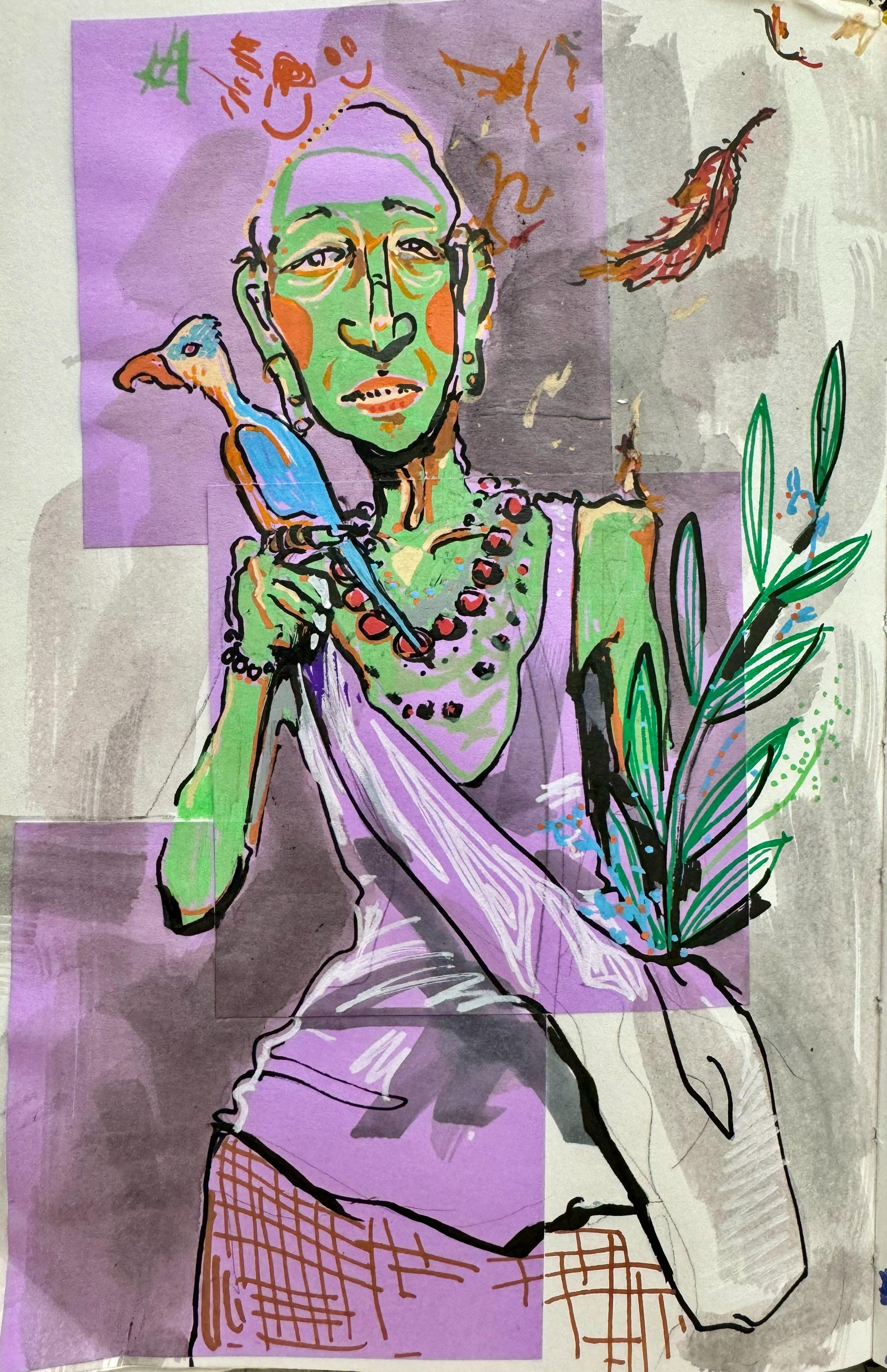
do you get to choose?
On the Feasibility of Free Will
Edited By: Tai Nakamura
Solomon Akaeze
I. Introduction
Free will. Does it exist? This question has plagued the minds of philosophers and theologians alike for millennia. But what, if any, significance does this ideological debate have in relation to the current moment?
There is a long standing philosophical tradition of questioning the extent to which a Freedom of Choice, i.e. ‘free will’ exists in the world. This ‘free will’ conceptually entails the ability to, totally and completely of one’s own volition, make choices oriented towards effecting change, in one’s life or the world around them, based entirely on one’s individual desires. Argumentation within this tradition typically entails a debate between affirmative and negative positions. The affirmative position posits that there does indeed exist such a ‘free will’ as possessed by a subject—able to be exerted in order to enact, or attempt to enact, change in the world or the subject’s life. This position holds that there exists no real extra-subjective force that deterministically drives the decisions and cognitive occurrences that a subject engages in and experiences. The negative position maintains that there exists no such ‘free will’
and that, instead, there exists some sort of extra-subjective deterministic force, beyond the bounds of a subject’s own volition, directing the behavior, choices, and even meta-cognitive occurrences of a subject.
In this piece I engage with the position of the negative interlocutor, exploring the potential reality that—counter to contemporary intuition— there is truly, and perhaps in a greatly frightening way, a substantive extra-subjective force beyond general capabilities of perception that indeed directs one’s behavior and very conceptions of the world. Thus, we are effectively robbed of freewill as we understand it.
II. Philosophical Context
To understand how such a scenario could function in reality, we must turn to the synthesis and function of Power as theorized by Michel Foucault. I will summarize his position on the ways in which human behavior is directed by pervasive extra-subjective forces. In his poignant piece The History of Sexuality he recounts how societal conceptions regarding sex have changed throughout history—detailing how sexuality was progressively inscribed with a sense of transgression,
effectively becoming a taboo subject. Foucault describes this process of inscription as something caused directly by what he names ‘discursive practices’; i.e. an amalgamation of practices people engage in, which are oriented toward objects and concepts in the world. The theory holds that these discursive practices, collectively designated as ‘The Discourse’ and constituted by things such as labeling, describing, and performance, effectively coalesce into what Foucault describes as ‘Power’. This Power then acts onto a subject-cognizer, augmenting the ways in which they conceive of these aforementioned objects and concepts—hereafter designated as extra-subjective particulars—and thus the ways in which they engage with them. This is all to say that Power as derived from an aggregation of discursive practices works potently to shape one’s subjective conception of what is true, and thereby which amongst the extra-subjective particulars can be considered knowledge. This process inscribes onto these extra-subjective particulars an epistemic, ontological, and axiological value which necessarily shifts over time in relation to the shifting of these discursive practices.
According to Foucault, this metapsychological phenomenon impacted the concept of sexuality drastically. He asserts that a shift in the discursive practices regarding sexuality as led by the 17th century Church effectively exiled sexuality beyond the rigid bounds of religion into the realm of the transgressive, deviant, and reprehensible. This is to say that in proliferating a shift in the ways sexuality was discussed and described, the Church was effectively able to materially change the ways in which sexuality existed and was understood in the minds of the larger population. This distinction of material change is important, as the significance of this argument lies within the fact that this extra-subjective, metapsychological force is able to enact materially significant change in the minds, behavior, and lives of individuals— endowing it with its danger. This radically changed the ways people engaged in sexuality, a change constituted by increased chastity and sexual repression in comparison to previous eras.
With this example, Foucault draws a profound conclusion about human nature: the very way in which one understands the world is vulnerable to extrasubjective manipulation. It follows frighteningly, that so too
is one’s behavior in the world.
One may be inclined to close this worry by asserting that even if this phenomena exists, and operates as described, it is highly unlikely that the conditions necessary for such a proliferation of discursive practice will be met in order for this epistemic and ontological shift to even occur. However, as described by Foucault, this phenomena
can best be understood as intrinsically linked with societal structure—deeply interwoven into the “few great political and economic apparatuses” that dictate the structure and function of society. It seems to follow therefore, that it is impossible to escape this extra-subjective manipulation so long as one exists in a society.
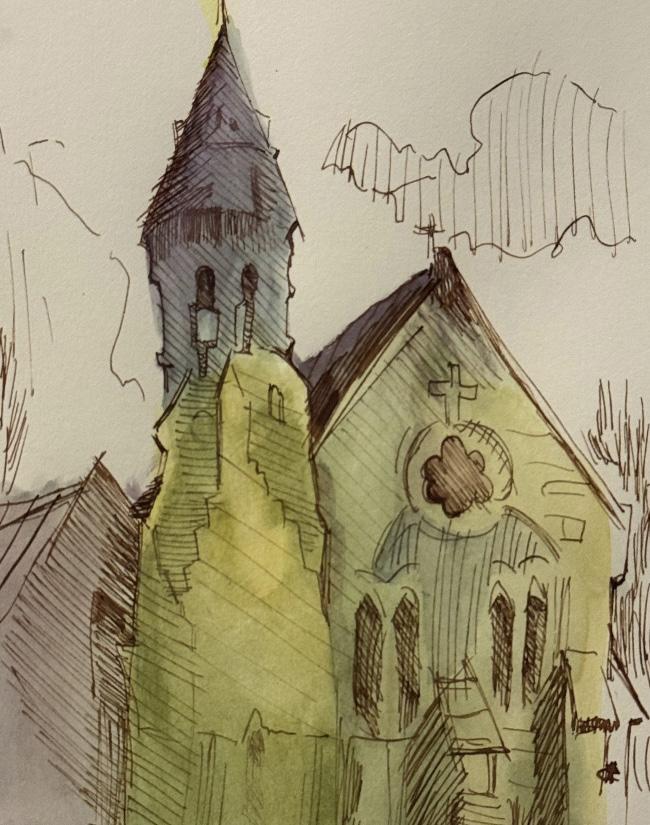
Machiavelli also gives us a clear logical apparatus by which to understand how concentrated extra-subjective power, instantiated in a leader, can causally direct one’s behavior via shifting their relationship to extra-subjective particulars. In The Prince, he explains in depth how exactly such a leader is able to render subjects vulnerable to manipulation—instructing would-be leaders on how to penetrate and restructure the cognitive architecture, and thus behavioral patterns, of those he rules.
He instructs the prince to behave like “both the lion and the fox”: the lion to frighten away wolves, the fox to recognize traps. The fox, crucially, is not subordinate to the lion but rather its precondition. Force, applied without the prior manipulation of perception, operates only at the level of behavior—it arrests an action without touching the faculty that generates it. Machiavelli understands that durable political control cannot rest on compulsion alone, because a subject who obeys only under duress retains, in the interior of his mind, the conceptual resources for resistance. Take for instance the example of the enslaved person. Simply forcing a person into enslavement via coercion
does not effectively subdue said person into unquestioning and unwavering servitude, as slave revolts and other forms of resistance remain both plausible and probable. An enslaver, wishing to truly oppress and retain an enslaved person, must therefore create circumstances under which the enslaved person becomes a willing participant in their own oppression—warping their orientation toward their own enslavement, and thereby creating an unwavering subservient subject. The prince’s true ambition, as Machiavelli instructs it, must therefore reach deeper—into the very epistemic and cognitive conditions under which subjects form beliefs, assign value, and conceive of what is possible. To govern men is therefore, at its philosophical foundation, to govern the very ways in which they interpret, and therefore react to, the world. It is here that Machiavelli’s famous decoupling of esse and videri—of being and appearing— reveals its full philosophical weight. The prince need not be virtuous; he need only appear so. This is a precise epistemological claim: that the subject’s reality is constituted not by facts but by appearances, and that the prince who controls appearances therefore controls reality itself, as it is lived and cognized by those beneath him. The subject
does not encounter the prince’s deception as deception—because the apparatus functions precisely by displacing the subject’s capacity to perceive it as such. Manipulation of a subject, to be effective, must be epistemically invisible; it must present itself as the natural order of things. What Machiavelli is thus prescribing is a method of cognitive governance—a deliberate, architectonic intervention into the way subjects think, such that their thoughts arrive at conclusions favorable to a leader’s continued dominion.
Through Machiavelli’s instruction and Foucault’s reasoning, a bare truth becomes evident: it is more than possible for extrasubjective forces, whether as pervasive as The Discourse, or fixed to the machinations of a singular leader, to restructure the cognitive and epistemic functions of individuals and thereby direct their behavior. In so doing, robbing them of free will.
Given this, the central question thereby becomes: In what ways, systemic, systematic, and/ or discursive is our presumed cognitive and behavioral freedom i.e. free will, extrasubjectively manipulated contemporarily?
III. Proposition
Given that we understand ‘free will’ to be the ability for one to totally and completely of their own volition make decisions positioned towards effecting change in their life, or the world, entirely based on their individual desires. I argue that to then understand this process of choice-making as subject to extra-subjective forces, capable of directing its constituency and conclusion, is to therefore understand this extrasubjective power as effectively able to remove one from their state of free will. This is to say that under a world view in which this metapsychological phenomenon exists and operates as described—free will is effectively impossible. At least, so long as one remains in a society and is thereby subject to what Foucault describes as the great economic and political apparatuses, and Machiavelli’s prince.
IV. Implication(s)
Our mission therefore turns to locating which entities are exerting this metapsychological effect on the cognitive architecture of the contemporary individual. This knowledge is integral to synthesizing a subsequent plan of action, i.e. a path to regain ‘free will’.
These entities must meet the following criteria in order to be considered significant in the cognitive restructuring of a subject such that they are no longer engaging in free will: i. This entity must not be readily and presently known, on the basis of one’s general capabilities of perception, as a manipulative force by the general populace. ii. This entity must have the power to traverse human, i.e. material, and extra-human realities—this meaning an understanding of this entity as fully composed within material reality is not effective in diagnosis.
Premise (Social Media):
I argue that social media functions as one example, amongst many, of an extrasubjective power that imperceptibly restructures the cognitive architecture of the populace, in that it directs individuals to engage in behavior favorable to its agenda. Social media, seen primarily as a tool for connection, communication, and amusement amongst the general population is, at worst, posited as perniciously addictive. Yet, it is to be understood as having a huge deterministic impact on the behavioral patterns of individuals—take for instance algorithms. The algorithm, as the operative mechanism of social
media, functions as precisely the kind of extra-subjective force our criteria demand. Consider the first criterion: that the force must not be readily and presently known, on the basis of one’s general capabilities of perception, as manipulative by the general populace. The algorithm satisfies this condition, presenting itself as a neutral and obliging servant—a mere curator of one’s preferences; not declaring its interventions into one’s epistemic life. When a subject encounters their feed, they do not experience it as an imposition, but as an expression of themselves from within. The content appears as though organically selected and intuitively appealing—herein lies its danger. What the subject experiences as self-expression and autonomous preference is, in reality, a meticulously engineered environment constructed to produce specific patterns of engagement, belief, and desire. This is precisely what Machiavelli identifies as the condition of effective cognitive governance: that manipulation, to function durably, must be epistemically invisible, presenting itself not as an external directive but as the natural order of things. The algorithm does not feel like a prince issuing commands; it feels like a reflection of oneself.
And it is for this very reason that it governs so completely.
Conclusion:
Having established that these extra-subjective manipulative forces function as deceptively discreet and widely pervasive, it follows naturally to me that one’s foremost aim should be to become aware of these extrasubjective forces and pursue escape from their influence. What the foregoing analysis makes evident is that the greatest threat to human free will is not the one that announces itself openly. It is the one that arrives wearing the face of nature—of preference, of intuition, of the self. These forces are therefore dangerous not despite their invisibility, but precisely because of it. And it is this invisibility that must first be addressed.
I argue awareness then is the precondition of liberation. Recognizing the function of cognitive governance as it acts upon oneself, is the only way that one begins to circumvent its influence. This demands of the individual a disposition of perpetual critical vigilance toward the institutions they inhabit and the practices they engage in: a willingness to interrogate not only what one thinks, but the conditions under which one has come to think it.
The alternative to this is a quiet and total subjugation—one in which the subject remains convinced of their own freedom while their desires, beliefs, and behaviors are authored entirely elsewhere. To live unexamined, in this light, is to exist with a lack of true agency. It is to surrender the self.
Of Ritual and Law
(禮法之間):
The Devolutionary Ladder and the Performative Scaffolding
Hung Pan (Eric) Li
Edited By: Anthony Hu
“故失道而后德,失德而后仁,失仁而后义,失义而后礼。夫礼者,
“It was that when the Dao was lost, its attributes appeared; when its attributes were lost, benevolence appeared; when benevolence was lost, righteousness appeared; and when righteousness was lost, propriety appeared. Now, propriety is the attenuated form of lealheartedness and good faith, and is also the commencement of disorder”1
Introduction
Every Columbia student who has taken Literature Humanities has likely questioned why Achilles had to drag Hector’s body around the tomb of Patroclus three times. And why must there be some kind of funeral game in the Iliad, Odyssey, and the Aeneid? Why must Abraham sacrifice Issac at Mount Moria? Indeed, every ancient civilization, from the Greco-Roman to the Chinese, has some kind of behavioral code—they are, as we label them, rituals.
Rituals, of course, take many forms beyond burnt offerings in the Torah. The modern world is not so different. Praying is a ritual—it symbolizes your submission to God. The Pledge of Allegiance is a ritual—it symbolizes your allegiance to the state. Even handshaking—it
symbolizes your friendliness. We could, of course, trace their historical origins: the handshake, for instance, is a “ritual gesture”—“open, weaponless hands stretched out toward one another, grasping each other in a mutual handshake.”2
Of course, there is no reason why rituals must be universal. They are contingent upon the culture that constructed them. They can be ceremonies for the high and for the low, formal or informal, some seems reasonable and some seems questionable. Handshaking itself would not have made sense in much of the world in the 19th century, for its roots are Assyrian and it was exclusively popular in the West beginning in the Victorian Era. In Qing China, kowtowing to the emperor was considered an essential part of court ritual. When the British emissary refused to recognize it, diplomatic unpleasantries immediately arose.
From the above, we can see several defining characteristics of ritual by looking precisely at what it is not.
1) Ritual includes, but is not limited to, ceremony. Rather, it implies a social convention that
is internalized by the population as a proper rule to follow. This internalization is constructivist. That is, a ritual is valid only insofar as the culture recognizes it as such; this is why the Qing’s rules of kowtowing made no sense to the British.
2) While a ritual could historically trace its origins to some practical benefit, it doesn’t have to derive its power from said benefit. One would still shake hands in the current world, even if the need to prove one is “not holding a weapon” is eliminated.
3) Rituals cannot be coercively enforced, in which case they cease to be rituals. For something to be a ritual, it must be de jure voluntary, even though it is de facto compelled due to shame and societal expectation. If everyone is forced to shake hands, the handshake ceases to be meaningful as a ritual.
Combining these three characterizations, our working definition could be: ritual is a social convention invented to compel voluntary conformity to a behavioral expectation. The natural question is: why do we need rituals? Why do we engage in them if we know that these are largely instrumentally important as symbols? Indeed, a Chinese monk named Ji Gong
used to say:
Wine and meat through the intestines pass, while the Buddhas and Patriarchs within my mind remain.4
If the internal substance is pure, why does the external form matter? Instead of shaking hands, why can’t we just be friendly? Why do we pray if we truly believe in God? Why do the Pledge of Allegiance if you are genuinely patriotic? Isn’t doing all these things showing that one is not completely genuine?
I argue that ritual is necessary precisely because humans cannot be genuine. We must be performative because, deep down, everyone knows they are flawed, and therefore needs to signal their intention to comply with certain standards. It follows that, as we have established, the importance of ritual is derived, not from its practical function, but rather its signaling of conformity—the need to meet certain societal expectations that society requires yet is unwilling to impose by coercion. As such, ritual is not simply a catalog of appropriate etiquette or a code of conduct for gentlemen, but the tragic, necessary firewall against the tyranny of Law or Anarchy.
The Devolutionary Ladder
How are rituals formed? We find the answer in the “Devolutionary Ladder” of the human condition in Lao Tzu’s Dao De Jing at the opening of this essay. Similar to a reversal of the “Ladder of Love” in Plato’s Symposium, Lao Tzu claims that at the beginning, humans were born in harmony with the Dao and nature. Then humanity lost the Dao (Way)—that unconscious, perfect harmony in which goodness was not only effortless
and we did it, but we now did it consciously. When virtue faded, we invented Benevolence (Ren). When love was no longer enough to bind us, we codified Righteousness (Yi). And finally, when we could no longer agree on what was right, we settled for Li—ritual. As Lao Tzu famously noted, this was the “thinning of loyalty and faith,” the moment society admitted it was sick and reached for medicine.
The historical reality of Lao
it roughly 130 times longer than World War I. This era was defined by the progressive decay of the “rules of war” and the near-total destruction of traditional rituals.5
From Lao Tzu’s perspective, then, the question he had to answer was precisely why this happened. How had ritual— both in its formal definition of social convention and its substantive form in terms of rules—been lost, and why had people started to kill each other?
The “Devolutionary Ladder” is his answer. There must be some reason why people believed in something in the past and no longer do, and why this decline is unidirectional. Since time and society are the only variables, the answer is obvious: society was the culprit. As society degrades, it relies progressively less on natural, internal motivation and more on artificial, external incentives. Ritual is the ultimate band-aid before a descent into chaos, for it is completely artificial, and thus most alienated from the natural goodness of humanity.
Lao Tzu was not unique in his proposition, geographically or temporally. There are plenty of parallels in the Western world, in the verses of the Bible, in St. Augustine, and in Rousseau. Humans were created in the image of God, and since God
is perfect, humans must be created perfect.6 More explicitly, St. Augustine stated in the Confessions that evil has “no substance at all,” but simply the result of deviating from God, “for our God made all things very good” Classical Christian theology, then, held that humanity was created good but corrupted itself through Original Sin. Enlightenment thinkers, such as Rousseau, would still concur with the decay but substitute Original Sin with society. For instance, in the Discourse on the Origin of Inequality, Rousseau stated that a “man in a state of nature” does not have “any desire to hurt” their fellow creatures, for this “man [remains] a child”.8 Even the mechanism of devolution itself has Western parallels. Consider Machiavelli, who stated the governments “are good in themselves but so easily corrupted that they too come to be pernicious”—“principalities easily become tyrannical; the aristocracies with ease become a state of the few; the popular is without difficulty converted into the licentious”– and “no remedy can be applied there to prevent it from slipping into its contrary”.9
Although there are some superficial resemblances between Western thinkers and Lao Tzu, the Devolutionary
Ladder is entirely unique. While Western authors generally identify either an origin of innate goodness or a mechanism of societal decay, these ideas are often made mutually exclusive. St. Augustine and Rousseau would argue that human nature is fundamentally good and that there is decay, yet these metaphysical assertions are merely tools for their specific advocacy. St. Augustine relies on the Original Sin to defend Christian theology, and Rousseau relies on this specific characterization of the state of nature to justify the social contract. Noticeably then, the mechanization of the decay is shadowed by their proposal to fight it: whether through God or through the general will. On the other hand, Machiavelli provides a clear mechanism for societal decline but makes no assertion of innate human goodness. Lao Tzu provides a distinct framework: a clear starting point and a stage-bystage process of devolution with an almost teleological end state. From his perspective, we either voluntarily retreat to anarchy, or we end up in a Hobbesian state of nature.
This makes Lao Tzu particularly lethal in a society that, at least in theory, has a revealed preference for a rigid “order of things”
where everyone belongs to their proper station. Indeed, the Confucian school’s main contribution was formalizing and standardizing this social hierarchy into a “proper system.” But if Lao Tzu is right that human beings started out as good and harmonious but naturally decayed into evil and chaos, then Confucian ritual is nothing more than a farce. Logically, Lao Tzu’s radical solution of returning to an anarcho-primitivist state makes perfect sense: if society is the corrupting force, then society must be removed. The Devolutionary Ladder can only be climbed back up through a literal return to nature, because any attempt of climbing back is already a symptom of lost virtue. No societal amendments are possible because society is the issue. Obviously, Confucius could not accept this outcome. How, then, would the Confucian school strike back to justify the existence of society?
From ritual to Law
Confucius himself was clearly aware of the limitations of rituals, but he insisted that ritual at least guarantees “moderate prosperity”.10 But his answer is vague– he didn’t explain why anyone would have motivation to pursue this so-called “moderate prosperity” That
answer came from Mencius, who wrote that the point of ritual is to: “Seek for the lost mind, and nothing else.”11
According to Mencius, ritual has the capacity to “reclaim the goodness.” In a manner similar to Platonic epistemology, Mencius claims that ritual is akin to prayer aid: “learning” rituals is synonymous with “recalling virtues. Mencius disputes Lao Tsu’s conception of human limitations: can human beings climb up the Devolutionary Ladder at all, given that humans are born “good”?12
However, the Devolutionary Ladder is not necessary to defend the value of rituals.
What if, as Xunzi, the last “Great Confucian Master” of the period, proposed, humans are born evil? Xunzi dismissed everyone, including Confucius and Mencius, as being too idealistic about the nature of humanity: “Human nature is evil; the good in people is artificial.”13 It is, indeed, almost uncanny how Xunzi and Thomas Hobbes both reached the conclusion that selfishness and the preservation of life lead to perpetual war and conflict: “Competition… Diffidence [Fear/Mistrust]... Glory… condition which is called
Warre… of every man, against every man.”14
Xunzi did not make this case to dismiss Confucius—he made it to rescue him. He diverges from Hobbes regarding the solution too; instead of insisting on an absolute sovereign, Xunzi believed that while it is hopeless to depend upon human nature, one could still “reform” it. The mechanism to do so is, precisely, ritual. Without it, as Lao Tzu had predicted, the state would fall into anarchy.
But neither Confucius, Lao Tzu, nor Xunzi realized that there was an alternative—not necessarily a better one—to anarchy. It was precisely the Hobbesian Leviathan, or in ancient China, the Legalist School. Believing that ritual had clearly failed in the Warring States Period, they proposed a system resembling Hobbes’s Leviathan. The supreme Sovereign, they argued, is necessary to impose order through the sheer violence of Law (Fa). In the words of Han Feizi, who is, ironically, Xunzi’s student: ritual is a futile attempt to “control an unruly horse without reins or whip.” Its downfall lies in its insufficiency. Since “people are naturally arrogant in the face of affection but obedient when confronted with authority,” states must have
“laws strict and punishments severe.” An ideal world would be one where “official troops enforce public law, search for evildoers,” and the common man would “finally become frightened, change his conduct, and alter his behavior.”15
Ritual as Scaffolding
Perhaps, instead of inviting a Leviathan, the better solution would have been setting out a system where people can negotiate, where they could “vent” through ritual. This is, indeed, what Machiavelli stated: without an outlet, the population would “have recourse to extraordinary modes that bring a whole republic to ruin.”16
In this light, the use of ritual in maintaining the state requires a delicate balance. Anything less than that, given the Original Sin of humans, creates anarchy. Anything more, and we are reduced to totalitarianism backed by legal violence. Ritual, when introduced through means such as tradition or education, provides a way to compel compliance and conformity without resorting to bloodshed. Granted, living in a society governed by ritual can bring a certain melancholy. It requires, on the one hand, a constant admission that we are imperfect
creatures who need artificial rules and bows to keep us from devouring each other; on the other hand, being continually suppressed by these rules can be tiresome. But it is a Machiavellian middle ground because it suppresses conflict—no conflict is necessary if we just resolve it through ritual—and thus ensures a Kantian “perpetual peace”. To be brief, ritual is preferable because it involves no coercion. It establishes a “standard that is supposedly universal” and provides a way to “attack” others through social channels without physical repercussions. Otherwise, it would be the case that “formerly we suffered from crimes; now we suffer from laws.”17
One is right to point out that a society based on ritual is naive. Ritual relies entirely on people’s consciences and the belief in the power of convention and norms. It is a rather fragile system. Even when later dynasties openly claimed that society was “guided by rituals,” it was, in reality, “ruled by laws.” The moral of Chinese history is that when ritual falls, the result is not liberation but the wall of Legalism. While “soft” containment via shame and social pressure sounds dystopian, as it forces everyone to perform like an actor with a script, the alternative appears far
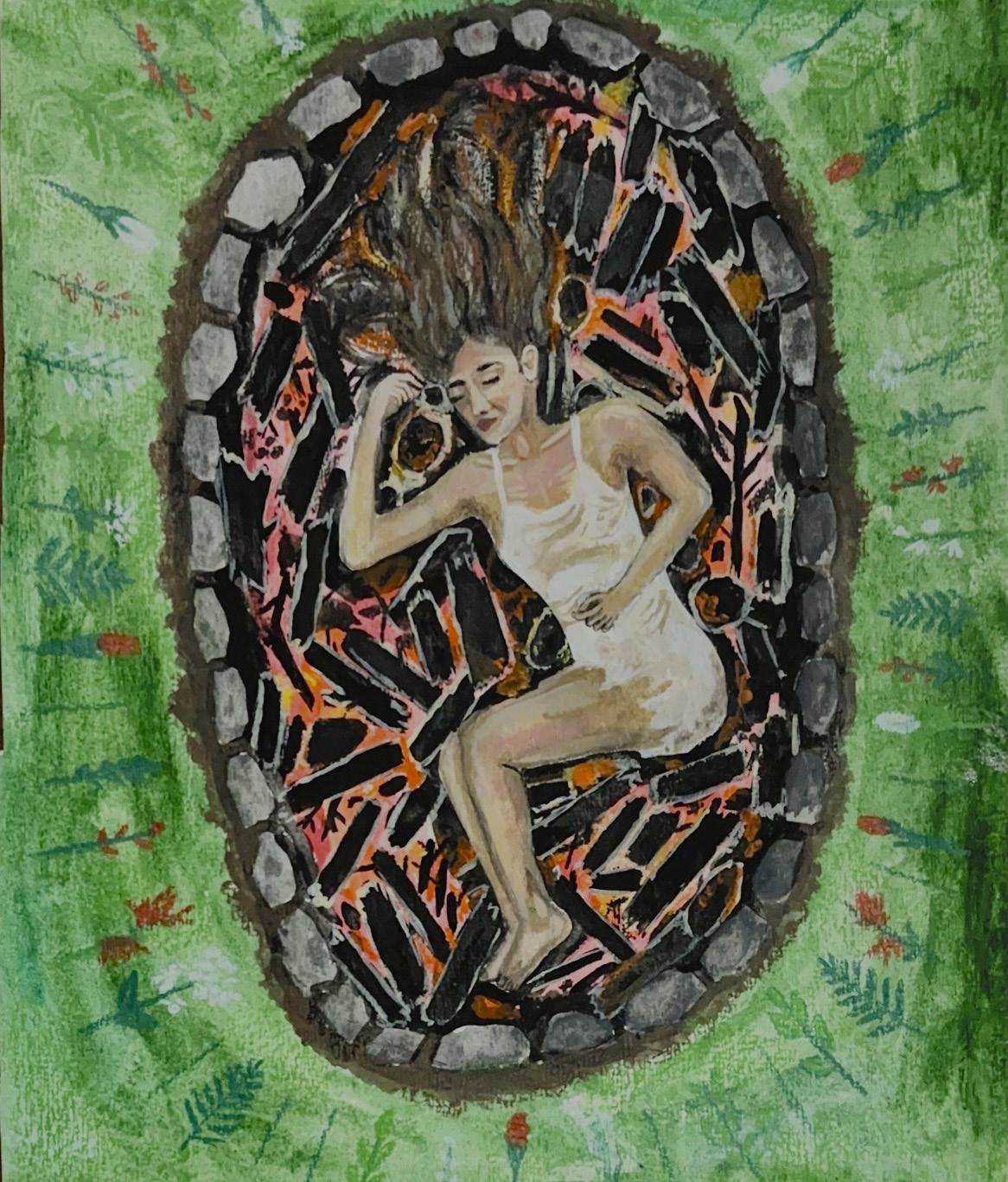
worse. When we are “liberated” from rituals, we fall further into Legalism, moving from a world where one has to police oneself (and trust others to police themselves) to one where we trust no one but external means to impose social standards—via violence.
Ritual is a wall. It looks ugly. It blocks the way. But it appears to
be the only thing preventing the encroachment of the “ultimate enemy”—the Leviathan.
The question I leave for the reader is this: Are you willing to take a leap of faith that perhaps Lao Tzu was wrong, and that we can climb back up the Devolutionary Ladder? I will leave you with the rest of Ji Gong’s quote.
“Wine and meat through the intestines pass, while the Buddhas and Patriarchs within my mind remain. But worldly, if imitating me, are like those entering demons’ path”
Endnotes
[1] Lao Tzu, Dao De Jing, chap. 38. Unless otherwise specified, translation in this text is a combination of open-source translation (by James Legge) or the author’s own work.
[2] “What Is the Origin of the Handshake?,” History Channel, https://www.history.com/ articles/what-is-the-origin-of-thehandshake.
[3] For those looking for more provoking examples: For instance, the Qing Manchu soldier hung up ham on the doorway and licked it before leaving his house to project the illusion of wealth and status. This is a relatively well-documented cultural trope, referring to the practice of qiong jiangjiu (穷讲究) (lit. “being poor yet obsessively fastidious about manners”). For those interested in more, here’s a brief summary: https://news.sina.cn/zl/2015-0712/zl-ifxewnia9050038.d.html?vt=4
[4] “Did Jigong Urge Meat-Eating & Wine-Drinking?,” The Daily Enlightenment, September 2014, https://thedailyenlightenment. com/2014/09/did-jigong-urgemeat-eating-wine-drinking/
[5] Consider the following historical example: Battle of Hongshui, where Duke Xiang of Song (宋襄公), a
staunch defender of rituals, faced the State of Chu. Despite his ministers’ begging, the Duke refused to strike while the enemy forces were vulnerable as they crossed the river, as attacking an unformed army violated the ritual—a kind of protointernational law of war. The result was tragically predictable: once the Chu soldiers were fully assembled, the Song army was outmatched and swiftly crushed. See Zuo Zhuan, Ziyu Lun《子魚論》.
[6] Matt. 5:48.
[7] Augustine, Confessions, bk. 7, chap. 12.
[8] Jean-Jacques Rousseau, Discourse on the Origin of Inequality, pt. 1.
[9] Niccolò Machiavelli, Discourses on Livy, bk. 1, chap. 2.
[10] Confucius himself would likely agree with Lao Tzu that natural internal motivation is superior to external incentives. The Confucian school would also likely agree that there was, indeed, a better time. According to the Book of Rites (Liji), Confucius fully supports the idea that the past was superior to the present. He even agrees that there was a devolution: as the Era of “Great Harmony” ended, everyone became self-centered, only caring about their own families. It is then that rituals came in. It is ritual that sets up the hierarchy between the
ruler and the ministers, establishes filial relationships, etc.
[11] Mencius, Gaozi I 《孟子·告子上》
[12] I leave that question to the reader, but it suffices for now that it is a comparative choice between believing that a world in which one returns to the most primitive stage is preferable and living in a flawed, ritual-dominated world.
[13] Xunzi, Xunzi, chap. 23, “Xing E” [Human Nature is Evil] 《荀子· 性恶》.
[14] Thomas Hobbes, Leviathan, chap. 13.
[15] Han Feizi, Han Feizi, “Wu Du” [Five Vermin] 《韓非子·五蠹》.
[16] Niccolò Machiavelli, Discourses on Livy, bk. 1, chap. 7.
[17] Tacitus, as cited in Michel de Montaigne, Essays, bk. 3, chap. 13, “Of Experience.”
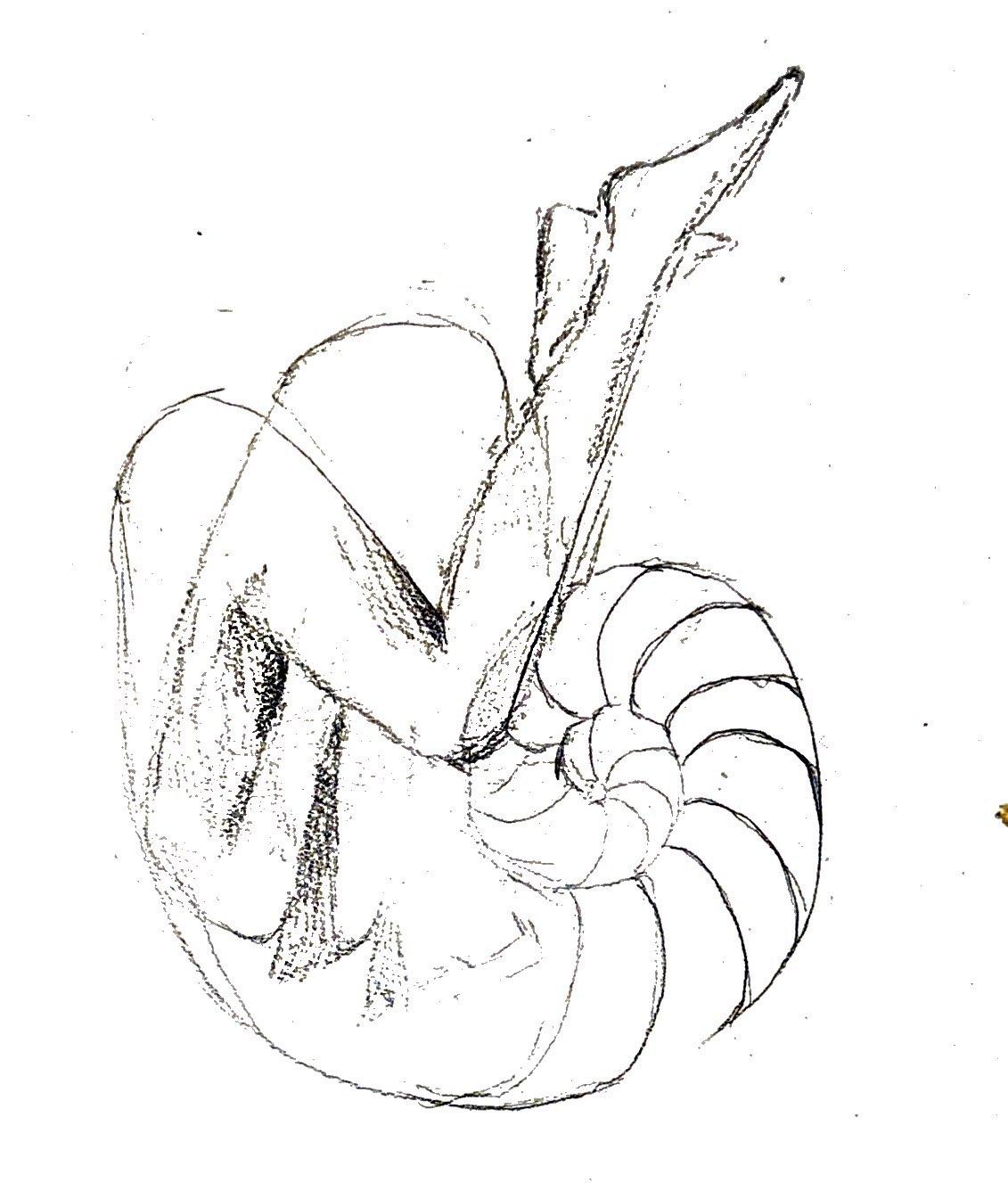
L O S E S I T S H O M E T H E U N C A N N Y :
W H E N R E P E T I T I O N
Edited By: Anthony Hu
Dominique Cao
I. Freud’s Home, Split Down the Middle
Iused to crawl up and down the stairs of my first house like a dog. My knees dragged across the carpet’s rough seams; my fingers traced the rigid borders of the rug until sensation dissolved into a dull, electric numbness. I don’t want to forget about it, so I keep a small remnant of this now fractured image neatly tucked away in the back of my mind like a dirty Polaroid in the pocket of a pair of old jeans. It comes back to me in the form of dreams. Crawling up the stairs again, the carpet once white but yellowed with time, ascending carefully toward a landing that feels familiar yet frustratingly unreachable. In these dream sequences, never once have I managed to crawl up without inevitably misstepping and tumbling down the stairs, curling into some infantile helplessness, concussing myself to a rude awakening.
In this house, the first house I remember living in, I had an affinity for the floors. I would wake in the middle of the night and slide quietly beneath the bed, folding myself into the narrow darkness, arms wrapped tightly around my knees, drawn to my chin. There, suspended between sleep and waking, I
traced the wooden panels with my fingers, lingering over their uneven grains, relishing with a strange delight in their hesitant curves, their asymmetrical fractures. What were my fingers chasing then? The infinity of running lines? The impossibility of stability? The arbitrariness of inanimate objects? The uncertainty of foundations?
Whatever it was, I still find myself repeating the same ritual. How I would force my fingernails between the methodical etches and crevices of my dormitory’s wooden floors, as if trying to draw meaning from texture. As if trying to trace myself back into remembrance.
I remember almost nothing else about that first house. Perhaps I lived there too briefly for memory to settle. I do not remember leaving. Only the floors remain, as if the house itself withdrew while its surfaces persisted, desperately, relentlessly, waiting to be touched again.
I recently read Freud’s The Uncanny, which opens with the psychoanalyst blocking the most convenient reduction of the phenomenon, namely, that the uncanny is merely what is unfamiliar. Against Jentsch’s appeal to “intellectual uncertainty,” Freud insists that
“something has to be added,” since the uncanny belongs to “that class of the frightening which leads back to what is known of old and long familiar:” an intimacy whose antiquity returns only in an unwelcome register. The path to this claim is philological, and this philology already functions as a metaphysics of domestic space. Heimlich (usually rendered “homely”) is, for Freud, a concept torn down its own seam. It denotes warmth, enclosure, and security—“walls,” “quiet,” “intimate” —but also the covert and withheld, those “Heimlich places” that “good manners oblige us to conceal.” The home is therefore not the opposite of secrecy but its quiet accomplice, a shelter that does not dispel concealment but makes it possible. From this internal fissure, Freud derives the structural condition of the uncanny; namely, it arises when what properly belongs to the house, what has always been “within,” refuses the obligation to remain concealed. Heimlich “develops in the direction of ambivalence, until it finally coincides with its opposite, unheimlich.” The uncanny is not simply the foreign intruding upon the domestic; it is the domestic turning itself inside out, the degeneration of the home’s own logic of concealment.
If the home is internally divided, then the modern subject is too. The uncanny is thus produced when something once psychically established returns after being excluded from acceptable modern consciousness. Freud distinguishes (at least analytically) two pathways through which the uncanny is produced. First, rather characteristically, the reappearance of repressed infantile complexes. Second— and this is the argument I pursue—the reactivation of supposedly “surmounted” animistic beliefs: magic, spirits, the omnipotence of thoughts, the sense that intention can leak into objects and patterns experienced.
II. Italy, or: Repetition as the Theft of Will… The Double, or: Meeting Oneself as Intruder…
Freud’s most honest evidence is an autobiographical vignette and, in its way, exquisitely unheroic. Wandering in an unfamiliar Italian town, Freud repeatedly attempts to leave a district that unsettles him; each time, without intending it, he finds himself returned to the same place. The experience produces what he describes as “a feeling which [he] can only describe as uncanny,” generated not by any threatening object but by involuntary repetition
itself. What disturbs him is the sense that chance has acquired intention. Movement ceases to feel self-directed; agency appears displaced into the environment. To me, this episode is significant in the narrative form. Freud recounts the experience retrospectively, imposing explanatory mastery upon an event originally marked by disorientation. The essay thereby splits its authorial voice with the dyad of the analytic narrator who interprets and the wandering protagonist who experiences helpless recurrence. Conveniently, this internal division reproduces one of the uncanny’s central motifs, the Double. Freud becomes simultaneously observer and observed, theorist and symptom. Here, the uncanny arises when repetition appears autonomous, as though governed by forces external to conscious intention yet inseparable from the perceiving agent. Such moments revive animistic assumptions about fate or hidden agency precisely because modern subjects lack authorized frameworks wherein repetition can be collectively interpreted. The experience thus oscillates between rational explanation and symbolic attribution without settling into either. It can be accounted for as chance, as misdirection, as the trivial geometry of streets;
yet it is felt otherwise—as though the repetition itself were saying something, as though the pattern bore intention, an animistic impulse to treat recurrence as the trace of agency rather than accident. What is missing, however, is any shared framework that can stabilize such symbolic attribution. In other words, the experience lacks ritual, a collectively sanctioned form that would render repetition intelligible as meaningful action rather than private disturbance.
Drawing on the fellow Austrian psychoanalyst Otto Rank, Freud delineates Doubling as originating from “an energetic denial of the power of death,” a narcissistic guarantee of survival. Yet once this developmental phase is surpassed, the Double reverses its meaning: “from having been an assurance of immortality, it becomes the uncanny harbinger of death.” The same structure that once secured identity naughtily returns as a threat because it belongs to an earlier psychic organization disavowed but not extinguished. Freud’s railway-compartment anecdote is almost cruel in its precision. Sitting alone, Freud suddenly perceives “an elderly gentleman in a dressing-gown and a travelling cap” entering through the adjoining door; only
after a moment of irritation does he recognize that “the intruder was nothing but my own reflection in the looking-glass of the compartment door.” Far from attributing the unsettling to misrecognition alone, Freud accredits it to the affective force preceding recognition; he experiences the figure first as an alien presence, an unwanted other occupying his space. This scene thus renders visible the mechanism described by Rank’s theory. The double emerges as a perceptual disjunction in which the subject encounters himself as externally given. But such division is not yet uncanny. It becomes so only when the relation is estranged, when the observed self appears as an autonomous other, displacing agency beyond the subject’s control. Freud’s aforementioned Italian episode clarifies how repetition and doubling converge within this structure. His involuntary return to the same street effectively doubles the space itself; the environment mirrors his movements against conscious intention. In both cases, the world behaves as though animated by an agency independent of the subject’s will. Hence, the Double is no longer confined to the body; it extends into a spatial and narrative form.
What is pivotal to understand
here is that without ritualistic frameworks capable of interpreting repetition as meaningful action, recurrence appears instead as loss of autonomy. Modernity experiences patterned return as anxiety because it has relinquished shared practices for managing symbolic recurrence. The uncanny is frightening because it is known too well, somewhere in us, having returned in a form that modern consciousness recognizes yet cannot rationalize. As such, the uncanny is neither fully modern nor premodern. Rather, it is the involuntary enchantment induced when modernity encounters the residues of what it has repressed but never fully assimilated, thereby slipping the mind into a temporary trance. In this interval, animistic thinking does not return as doctrine—that is, as an explicit belief in spirits or magical causality—but as a mode of experiencing patterns as if they were intentional, of reading ritual repetition as the trace of agency rather than an uncanny accident. The subject does not believe that the street is guiding them, or that the reflection is alive; yet the experience unfolds as though it were. To the extent that the modern subject knows while nonetheless feeling otherwise, it presupposes a temporary suspension within
the very spell it professes to have outgrown with time.
III. Skeat’s Counter-Archive: Magic With Ritual
In Malay Magic, the anthropologist William Skeat presents a cultural system in which animistic assumptions remain ritually organized. Experiences Freud would likely dub uncanny appear within Malay ritual practice as intelligible and manageable processes. For example, Skeat’s account of the semangat (Malay conception of the human soul) reads like an ontology of Doubling. The semangat is a “thin, insubstantial human image,” a miniature counterpart, “about as big as the thumb,” ordinarily invisible, able to depart
temporarily in “sleep, trance, disease,” and permanently in death. It is “vapoury, shadowy, or filmy,” yet not so intangible that it cannot produce effects: it may cause “displacement on entering a physical object.” It can “fly” or “flash” rapidly, and is addressed, metaphorically but with ritual seriousness, “as if it were a bird.” The Malay semangat, described by Skeat as capable of leaving the body during illness, is summoned through incantations that explicitly frame the body as its dwelling:
“Hither, Soul, come hither! Hither, Little One, come hither! Hither, Bird, come hither! Hither, Filmy One, come hither!”
In Malay soul-calling charms like such, the body is figured
explicitly as a “house” for the soul, complete with “houseladder,” “house-floor,” and “roof-thatch.” Illness is explained as the consequence of the soul’s absence; the house’s architecture deteriorates because its inhabitant (soul) has wandered. Accordingly, healing is a ritual of re-domesticating personhood. It calls the soul back up the ladder and into a body once again fit to be lived in. Hence, while Freud theorizes the home as a hidden structure of concealment and repression, Malay magic anticipates the soul’s movement across the threshold, the permeable membrane between the exterior and the interior.
The same can be said for Skeat’s account of the Tiger Spirit séance, a Malay shamanic healing rite invoking a tiger-associated spirit through controlled possession, where possession is engineered as a public event. The ceremony begins with an administrative rule: the number of participants “should never, in strictness, be an even number,” since the avoidance of evenness prevents closure, ensuring that the ritual field remains open to mediation. Additionally, the participating members must remain constant across three consecutive nights, since variation would be “to court disaster.” By establishing continuity before any spirit is
summoned, such prescription binds those present into an invariant social configuration. The ritual thereby secures what might be called a stability condition for agency-transfer. Such transference is not a literal transfer between entities; rather, it is emblematic of a socially regulated re-attributional repetition, appearing not as an accidental recurrence (vis-àvis Freud) but as a regulated return, ensuring that each night unfolds within the same recognizable frame. The staging is equally architectural. Skeat describes a scene arranged with almost diagrammatic precision. The patient’s bed is enclosed by a mosquito curtain; three decorated water jars crowned with wax tapers; a censer glowing with embers; betel implements; and a vessel filled with artificial flowers and ornaments—the taman bunga, or “pleasure-garden,” explicitly designed to attract the spirit. Fringes of plaited fronds and fresh yam leaves seal and later reveal points of entry and exit, so that permeability itself is materially enacted. Contrary to common modern representations in art and media, possession (understood here as the ritual attribution of the medium’s bodily actions and speech to an external spirit-agency) is neither ominously spontaneous nor
chaotic. The medium’s ordinary personality gradually yields as another agency takes precedence, speech emerging through his body as the utterance of the spirit rather than the individual self; remarkably, this transformation is deliberately inducible, initiated and sustained through prescribed gestures, rhythms, and procedural discipline.
The climax of this seance encapsulates how agencytransfer is rendered public through ritualized performance. After prolonged tremors, the Pawang (a traditional Malay shaman) rises “upon its hands and feet,” emitting a “startlingly life-like growl,” leaping with feline movements, and rapidly licking up ritual rice. Even the act Skeat describes as “powerfully nauseating,” in which the possessed healer slowly licks the patient’s body, functions within the rite as evidence that the excess of the performance marks the temporary displacement of ordinary personhood. The community’s excitement, raised “to fever pitch,” confirms possession as a collective act of recognition rather than a private psychological rupture. During the performance, feral episodes are juxtaposed with moments of calm, while repeated dagger thrusts verify the absence of hostile spirits, and the healer’s
veiling and unveiling marks controlled transitions between human and spirit registers. After a final sequence of regulated convulsions, the Pawang returns to ordinary consciousness, and the ceremony closes, the transferred agency carefully withdrawn and social equilibrium restored. What appears here as a necessary, staged return sharply contrasts with Freud’s Italian episode, in which his repetition of the same street was against his intention and consent. Freud’s modern subject becomes the object of an unknown itinerary, but the Pawang’s passage into and out of possession thus dramatizes the very fact that ritual does not eliminate the dynamics Freud names (e.g. doubling, displacement, necessary return) but instead proffers them as livable by choreographing their appearance through a clear trajectory with a beginning, middle, and end. Ritual releases repetition from the shackles produced by the shock of fate and grounds it in the cadence of a craft.
IV. The Modern “Othering” of Magic… Ritual Without Belief, Belief Without Ritual
The tension between Freud’s account of the uncanny and Skeat’s ethnographic description
of Malay ritual practice finds its crux when situated within modernity’s inherited understanding of magic itself, an understanding structured by exclusion. Anthropologist Marcel Mauss writes in his A General Theory of Magic that within dominant Western intellectual history, magic was long interpreted through an evolutionary schema as a deficient stage of thought, a form of proto-science destined to be superseded by religion and ultimately displaced by rational knowledge. The magician becomes socially legible precisely as one who crosses boundaries, and thus those “feared and suspected” are “lumped together as magicians… in those backward areas where magic still has a hold.” Throughout this language of backwardness, magic is historicized, spatialized as elsewhere, and assigned to the “stranger,” a term Mauss notes was used literally to refer to sorcerers in Vedic India.
This predetermined framework hardened into common sense. Indeed, magic, religion, and science were separated into discrete domains, with magic relegated to the irrational remainder of mysticism, the antithesis against which modern rationality defined itself. Social organization increasingly aligned
with processes of rationalization, in which mystical standards of action are supplanted by technical, computational, or scientific standards; bureaucratic institutions, in turn, internalized the idiom of “objective” science as a prophylactic against practices branded as enchanted. Modernity conflates ritual with rationality (think Weber’s account of bureaucratic rationalization), a move pregnant with perversion insofar as it preserves ritual’s repetitive, procedural form while evacuating its symbolic and communal meaning. What Freud thus confronts can be extrapolated beyond a psychological difficulty to a constraint at the level of epistemology itself. It is clear that animistic modes of thought endure, even as the rituals once capable of containing and interpreting them have been stripped of intellectual legitimacy.
I am not suggesting that Indigenous ritual offers a corrective to modernity, nor that one form of ritual ought to prevail and replace another. The point is, what appears to us as the natural, self-evident structure of life (our routines, disciplines, ordered repetitions) is only one way of binding action to meaning. That we are
comfortable within it does not exhaust the myriad idiosyncratic possibilities of ritual as such. What, then, are we missing? It is certainly not repetition; perhaps it is belief. The ritual needs a soul. Order degenerates into monotony and necessity when it is no longer animated by enchantment, no longer capable of bearing meaning beyond its own execution. While detailing Balinese séance performances, American anthropologist Clifford Geertz observes that rituals for the Balinese are not only “models of what they believe” but also “models for the believing of it,” such that faith is not a priori but comes into being through enactment. In this sense, belief emerges from the very act of repetition. We need, then, to attach a “home” to our discipline. Perhaps something akin to hauntology; a nostalgia found in the remembrance of our core values so that what we do means something. Such nostalgia incarnates into a desire to recover the conditions under which repetition could feel like return—the sense that our actions once led us back to something we may easily settle into, something our own. It is the need to remember the origin of meaning itself, not as a fixed point in history, but as a structure of orientation, a way of being situated within the world
such that our gestures, however small, refract something larger than themselves… humanity?
It should be clear by now that between Freud’s bewildered subject wandering mechanically through the streets of Italy and Skeat’s disciplined, faithful practitioners lies not a difference of superstition and reason, but of ritual and its absence.
Minqing Yuan

Qingming?
Edited By: Anthony Hu
Qingming Jie follows the lunar calendar and falls on April 4th, 5th, or 6th each year. It is a traditional Chinese festival during which families gather to perform rituals to commemorate their ancestors. For me, the ritual begins the day before Qingming, when my cousins, uncles, and aunts scattered across the country return to our hometown, where my grandmother still lives.
When day breaks on Qingming, the adults wake up to cook a large breakfast. When they are ready, they wake the kids up and line us up in front of my grandfather’s portrait on the wall. Below is a table with offerings we make to him: meat, rice, vegetables, fruit, alcohol, and incense. In front of the table, joss money is burning on the ground. We take turns kneeling and bowing, silently expressing our longing and remembrance. Then we climb the hill behind the house for about fifteen minutes to where my grandfather is buried. We sweep the tomb, pull out weeds, remove faded artificial flowers, and replace them with new ones. We light incense and burn more joss money, along with papiermâché imitations of real objects. The idea is that the money and objects we burn can reach the afterlife, where my grandfather is living. Qingming concludes by
having lunch at the house. The next day, we all head back for work or school.
I always thought Qingming was tedious as a kid. My family did not own a car, so the Qingming trip was filled with crowded buses, long transfers, slow trains, and bumpy roads. I would get carsick and have headaches, and sometimes I would feel sick or exhausted for the entire following week. But then, given the importance of the ritual, the trouble seemed all worth it – if we didn’t do it, what would my grandfather eat on the other side? How would he have money for things he needs? What if he, a tailor when he was alive, needed materials in the afterlife too? And then a more selfish fear would follow. What if my kids don’t do it for me when I die? Wouldn’t that be scary, penniless in the afterlife? So partly out of curiosity, partly out of preparation, I asked my dad, “What happens when I die?” “Nothing,” he said, “When you’re dead, you’re dead.”
I don’t remember if my dad ever answered my follow-up question, “Then why are we doing it?” But looking back, it would be reasonable if my dad never did, for that was at least two questions disguised in one. The first one is a descriptive
question, “What was the motivation behind what we did?” whereas the second is a normative one, “Should we keep doing it in the future?”
We’ll start with the descriptive half. A first attempt at this question might be the Freudian move – that some actions are caused by unconscious beliefs or desires. The perfect example is from the sitcom Friends, when Ross says, “I take thee, Rachel” instead of “Emily” when he was getting married to the latter. A Freudian explanation would say that, deep down, he wanted Rachel. We can try to apply the same logic to my father: Maybe the trouble and effort suggest that he has an unconscious belief that there is an afterlife, even if he denies it explicitly.
What bothers me about this Freudian move is that ritual behavior feels like cheap evidence for belief. Take the aforementioned Ross example. Suppose he did say, “I take thee, Emily.” Are the Freudians happy with that as evidence of his desire for Emily? Not necessarily, for they may now say that he just suppressed his desire for Rachel very well. The problem is twofold. Firstly, people with the same belief or desire can perform different actions. You and I can both believe that going to the
gym is good for one’s health, yet only one of us actually visits the gym. This shows that belief does not entail action. On the other hand, people performing the same action can be motivated by different beliefs or desires. You and I can both go to the gym, but one of us for health, the other for appearance. This shows that action does not entail belief. In any case, we cannot be sure that behavior and belief correspond well enough to deduce one another.
Daniel Dennett offers a more disciplined approach. He suggests we think about behavior using belief-desire pairs. An example would be this:
Belief: My dad believes that the offerings reach the afterlife
Desire: My dad desires that my grandfather receive the offering
Predictable Behavior: My dad makes the offering
According to Dennett, if we know what someone believes and what they desire, we can predict what they will do. In this simplified scenario, my dad’s behavior is deemed predictable from his belief-desire state. His framework establishes a one way entailment: While we still cannot deduce the belief-desire
pair from action alone, we can deduce the action from the belief-desire pair.
This might seem like the less interesting direction of entailment. After all, beliefdesire pairs are unobservable, and actions are what we actually have. What we want, ideally, is the reverse direction. Given what my dad did, what did he believe? However, Dennett’s framework is not for nothing. If a beliefdesire pair entails an action, then the absence of that action entails the absence of that pair. Similarly, every action we observe lets us exclude all the pairs that would not have produced it. And if we observe enough actions, the set of candidate pairs gets smaller and smaller. We may not be able to deduce the true motivation
directly, but we can work towards it by eliminating what it cannot be.
Now with Dennett’s help, we can attempt to answer the descriptive question. Suppose the question is “What is my motivation behind honoring Qingming?” The observable action is that I travel for Qingming. That already excludes all the beliefdesire pairs that would not result in me traveling. Say it narrowed down to three:
Pair 1) Belief: I believe my dad believes that the offerings reach the afterlife; Desire: I want my dad to be happy
Pair 2) Belief: I believe if I don’t go, my dad will whip my ass; Desire: I don’t want my ass
Pair 3) Belief: I believe this is a ritual that unites my family; Desire: I want my family to stay united
By asking my dad the question about afterlife and getting an answer that there’s no afterlife, I could exclude Pair 1. Now that I am old enough to not get whipped but still honor Qingming, I can exclude Pair 2. In a simplified scenario where these are the only surviving pairs, I can say that Pair 3 is my true motivation.
With the descriptive question out of the way, we can focus on the normative one. But in order to answer that, we must first make a disambiguation of what “should” means. What should the company do to maximize profit? What should I do to get better grades? What should Ross say to not upset Emily? Those common “should” questions share the same characteristics of having the target already set—whether that’s maximizing profit, getting a better grade, or not upsetting Emily—and looking for a method to better achieve the target. They are what I would call “technical questions” which I will address towards the end.
However, there is another reading of “should” we are also interested in here, on what the target ought to be. Ought the company to be maximizing its profit? Ought I aim for better grades? Ought Ross not upset Emily? They are what I will keep on calling “normative questions.” You might say, this is easy, of course Ross ought not to upset Emily, because he wants to marry her. But then you have fallen into the trap, since you have turned the question into a technical one again. A simple follow-up question to make the equivocation obvious is, ought Ross marry Emily? And then if you say, of course he ought, for he does not want to end up alone. Then ought he not want to end up alone? The chain of questions go on forever. The ought question is not simple, but I will attempt to give my answer in the following paragraphs.
Remember how we answered the descriptive question? We had a very large set of possible belief-desire pairs, and through actions we were able to exclude some of the possibilities until there remained only the true motivation. We are at a similar position now. We have a very large set of options for what the target ought to be, and if we have a way to narrow the options, we can hope to find
the true target. I argue that we can exclude the options that are infeasible. Think about all the targets out there, most of them are logically possible, but within there are many infeasible ones. A target to travel faster than light is logically possible but not physically feasible given the physics in our world. A target to experience what it is like to be a bat is logically possible, but psychologically infeasible given our biology. If we can find out what targets cannot be feasibly achieved, and if I am right about what cannot be ought not be, then we can narrow the options of what ought to be.
To make this idea work, I borrow something from W.V.O. Quine’s theory of beliefs. He proposed that our beliefs work like a web. Beliefs that sit at the edges are easy to update; beliefs that sit closer to the core are hard to update. An example of an edge belief could be: I believe the bus comes at 8am. And if it doesn’t, I will update that with a new belief “I believe the bus does not come at 8am” without any trouble. An example of a core belief could be: I believe the apple will fall if I drop it. And if it doesn’t, I will have a lot of trouble updating that into “I believe the apple won’t fall if I drop it,” for it requires an overhaul of everything I have learned about gravity.
The key insight is that targets— the things we think we should aim for—are beliefs too, and they sit in the same web. A descriptive belief looks like “it is raining outside.” A normative belief looks like “I should not murder.” Both are part of the web, both can sit closer to the core or at the edges. And we can say that a target is not feasible if it cannot be incorporated into our web if it challenges the system too much. For example, if I already have a core belief that “I should not murder.” Then it is not feasible for me to fit “I should murder” into the web since it requires rearranging nearly every other belief I hold, thus “I should murder” cannot and ought not be a target I aim for.
There exists, however, a serious concern that this normative answer may fall susceptible to ad hoc patches and moral relativism. Suppose that someone believes that being late is wrong. When they are late, they might patch their web-of-beliefs by creating a new belief: it is okay when I am late. As such, one may preserve both the belief that being late is wrong and that they themselves committed no wrong. Alternatively, suppose someone believes that leading people on is immoral. When their best friend does it, however, they can offer
the following patch: they weren’t really leading anyone on, or it’s complicated, or it’s okay when they do it. If coherence is the standard, it starts to look like anything can be justified as long as we are willing to patch enough. Moreover, an antimoral-relativist may question, under this framework: Ought not a serial killer stop killing since they cannot fit that coherently into their web-of-beliefs? Ought not a dictator stop waging wars? Ought not an abusive partner stop their violence?
These two objections would be more vicious if we could will feelings away. Fortunately, although logically one can form the web however they want, it is psychologically not the case. This is because, internally, there are raw reactions that cannot simply be willed away: guilt, shame, empathy, and disgust, just to name a few. Some beliefs just cannot be incorporated into our web of beliefs psychologically. One demonstration is when some movie characters are faced with the choice to kill somebody – when despite the logical possibility of “writing it off,” they cannot psychologically bring themselves to adopt that ad hoc patch.
As for the serial killer, dictator, or abusive partner case, although
they do not face any internal constraints for incorporating some horrible targets, they face external constraints on the world pushing back: there may be consequences from the legal system, societal reputation, and love and attention, things we naturally avoid or seek that put constraints on how one can form their web of beliefs.
Following the true motivation we found in the descriptive question and having them form a web-of-beliefs, I can eliminate all the normative beliefs that are infeasible to adopt within, giving a negative answer: those eliminated ought not be the target. Let’s say, after narrowing down the options, the only feasible targets are:
Target 1: I should prioritize my health
Target 2: I should honor family traditions
I can answer the normative question by saying that what ought to be the target lies within the two, without knowing which one is the case.
Moreover, after examining which one fits into my web-of-beliefs better, I can also give a technical answer on what I should do given the target. The answer is
not permanent. Maybe when I am having a fever, my physical and psychological states arrange my web-of-beliefs a certain way, making Target 1 the easiest to incorporate into my web. In this case, knowing that I will get more sick if I go, the answer to the technical question would be that I should not go. Maybe when I am feeling perfectly well, Target 2 is the easiest to incorporate into my web. In this case, knowing that I wish to honor my family’s tradition, the answer becomes that I should go.
This conditional answer to the technical question may sound unsatisfying. But this might just be a feature of technical problems rather than a defect. Think about a simple question “Should I go out this Saturday evening?” Your answer is going to be conditional on what day this question is asked. If you wake up from a hangover Saturday morning, the answer is likely no (unless you think the best way to beat a hangover is to stay drunk). However, if you are asked this question after an uneventful week, the answer may well be yes. It is perfectly fine to answer technical questions differently given different situations. After all these analyses, I finally have disambiguated my follow-up question for my dad, “Then why are we doing
it?” into a descriptive question, a normative question, and a technical question, and found all the tools required to answer them. Looking back, I don’t think he could have answered it. But now I can, and so can you.
Chris Baer on Consciousness, and
Consciousness, Art,

Maddy Fine
Christopher Baer is a contemporary artist living in Washington, DC. He co-founded Sunstone Therapies, which conducts clinical trials of psychedelic therapies in medical settings. He also works in leadership training as CEO of the Mandala Institute. He has a BFA from the Rhode Island School of Design.
GADFLY: First of all, how did you get into leadership and psychedelics as your life path?
I think it started long ago. As a younger person—probably your age, in my early twenties—I began to get what some would call felt sense: knowing the universe was more than what science had been able to deduce. And as a lot of people say, no surprise… but I didn’t really know what to do with this feeling. It was pretty uncomfortable to know that there was a lot more that we didn’t have a language for, yet also comforting. Anyway, I looked for doorways to explore this bigger picture, and as I began to gain a better feel for it myself, I wanted to share it with others. So later when my career got going, leadership development became a kind of Trojan horse to expand minds in corporate America, but naturally there were limits to the topics on the table. Nonetheless it was about helping people deepen and grow to lead other people.
Around the same time, I began to view growth and healing as two sides of the same coin, and for the “healing” side I began to look down the psychedelic avenue. One may call it “consciousness medicine”, which is a kind of profound psychosocial healing. Back in 2020, no medicalized framework for it existed (and still doesn’t really). A few physicians and I decided to venture into that territory, alongside researchers, academics, and private drug companies. Audaciously and naïvely, we began to explore how to integrate psychedelic therapies into modern medicine.
In our conversations, you’ve referenced higher order theories of consciousness. How does this inform your work in leadership?
Let’s first call out that we ‘live’ in language, limited by the signifiers and signified. Everything has to be somehow crystallized into words limited by their interpretation. Starting there, we have a word called consciousness, and as such, what we refer to as consciousness lives beyond the word “consciousness,” itself right? So, absent of being in a direct experience of pure consciousness, we create models to talk about it, which is what we’re doing here.
From the pathways to explore consciousness—like meditation, contemplation, psychedelics, near-death experiences—people anecdotally corroborate similar things across times and cultures. That there is something much bigger than myself, that I am part of that profoundly enormous thing, and that I am but a participant or witness to this bigger unfolding thing. Which can make us wonder: is “myself” actually the universe’s vehicle to experience itself? People return from Burning Man all lit up and saying similar things. But long before that, we had prophets and mystics from all over the world pointing to it. Consciousness is ubiquitous. It is reality.
So how does this connect with developing leaders? By helping leaders experience and grasp our deeper and broader interconnectedness, we have the potential to do less harm, be more creative together, look beyond zero-sum wins, and deal with conflict more constructively. Better leaders, better world.
Eastern Buddhist ideals of letting go of the self?
Ego-death is such a loaded modern term. When we hear ego-death, it has this unhelpful masculine connotation: “I’ve got to slay my ego! It must go!” I don’t think that idea does people much good; a more useful idea is ego dissolution—a gentle letting go of the identity we use here to get around on Earth. Allowing the ego to peel off gently and with compassion, honoring those pieces of the self as they fall away and opening up to some ever-present larger thing.
You touched earlier on semiotics; do you think the increasing complexity of our signifiers is pushing young people outside of the postmodern world, and towards mystical solutions?
You touched on how Western spirituality draws on Eastern mysticism in service of this project. How would you contrast a Western psychoanalytic conception of ego-death, or Freud’s oceanic feeling, with
Maybe so. There’s a phrase I’ve heard used by academics: ‘we suffer every word we know.’ Our minds are so awash in concepts as we try to live in a postmodern space. I sometimes say, ‘we live only north of the neck,’—the heart is often forgotten as a seat of wisdom, and our bodies are dragged along like puppets by the mind.The body is our oldest animal to be honored, not to be turned into an aesthetic beast to serve the appetite of the mind. But instead it gets looksmaxxed
into serving the appetites of our social feeds. That feels sad.
But that’s just how I view it. The postmodern conundrum is that our young people have to swim in these waters, and some of them are wondering how to free themselves from the hall of mirrors. I hope they can.
I’m thinking now of William James’ theories of consciousness… is the goal of psychedelic ego dissolution a reconnection with pure experience, instead of these false notions of what surrounds us?
Perhaps. When academic institutions began doing studies with psilocybin for terminal
cancer patients to alleviate endof-life anxiety and depression, many patients reported moments of pure merged experiences. So much so that the universities developed a measurement tool called the Mystical Experience Questionnaire (or MEQ-30). It’s a series of questions that try to measure the intensity of particular feelings or experiences, some that are difficult to describe using conventional terms. I thought that was telling that science needed a new instrument for psychedelic mystical experiences in the research setting.
Our mind is so often lost in the future, trying to project or get what we want, or be who we want to be. Or it’s in the past, as in missed opportunities or
regret. But the direct experience is the now’ We’re in this pocket now, experiencing this moment together. That can definitely feel expansive, oceanic and nourishing, but we need to take responsibility for our consciousness (what goes in or out) to allow it. The cool thing is the infinite present is always beckoning.
[Pause] Wow.
What was that that just happened?
Sometimes you just have nothing to say.
Exactly. Did you just notice that moment? Just for a second as things slowed down? What a psychedelic guide or good therapist attempts to do is allow somebody to have that felt sense of deep presence. It’s about creating a container that holds the moment, inviting someone into the direct experience. In that moment, we can find a fleeting sense of being fully a part of something larger, which can unburden us.
There’s a tradition of psychedelic experiences being associated with religious and mystical experiences, as you’ve been touching on. How do you think that impacts the
way psychedelic therapies are viewed by the medical establishment?
Retrofitting something as expansive as the Universe into the Western medical model is not easy. We’re talking about a massive and inductive way of experiencing healing, as opposed to a reductive “take two of these and call me in the morning” idea.
What it frequently reduces to are the banal, practical questions of what insurance will pay for, or even just ‘how does this work.’ It’s a shift from “is my headache gone,” to “is my trauma gone? Or is it healed? And if so, now who am I?” Maybe we’re not even able to ask the right questions yet, which is a metaphor for the magnitude of where we are now. And when some outcome happens, how does the medical and insurance establishment measure it, pay for it, and who pays, and how much?
I want to finish by asking about your art: you make these very nice, very colorful, abstract pieces that are actually all around us right now. I’m curious, how does your personal philosophy influence how you create your art?
I had what some people call a spiritual experience—and
what I’m about to share sounds absurd, so forgive me—but I had this moment where I got to see and experience things from a much larger perspective: it felt like what it looked like before the Universe was made. In the moment, my voice merged some larger voice and some words came out. It/I said, “I can no longer be the seed. I must now bloom, and the seeds of what I am must go everywhere, and all possibilities must be permitted to happen. And yet I will also bring all outcomes home to resolution, because they’re all me.”
That seared me when I saw it. I howled in pain from the overload, and had PTSD for a year. It was way, way too much for me to witness, and yet it didn’t kill me, and I’m still here.
For me, part of the function of art is in processing that, but not as ‘psychedelic’ art, but as art that speaks to the spirituality I experience in approachable forms. So the work is less about being sensational, and more to be as simple as possible.
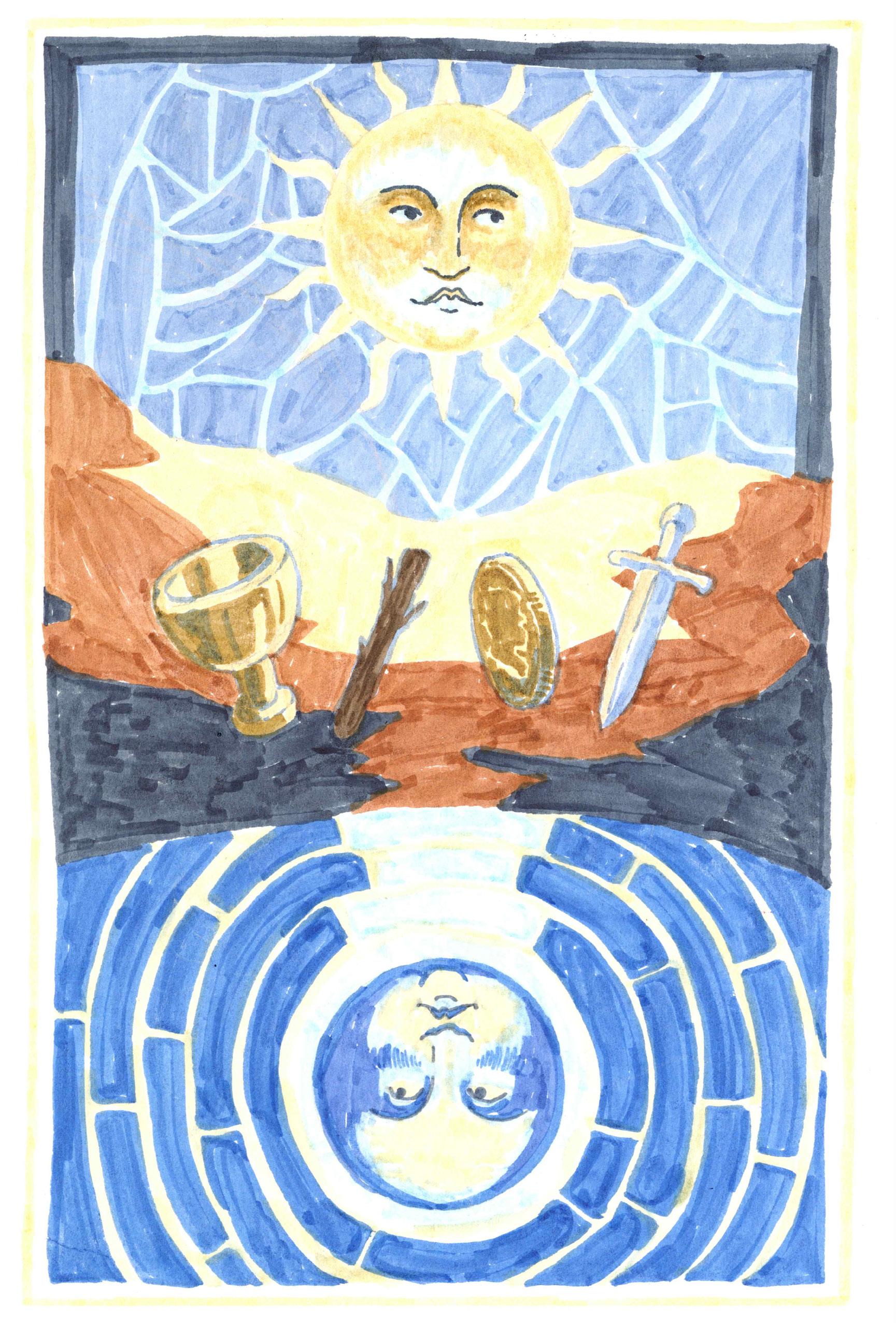
Intuition andDivination: Epistemic TensionResolving the of Secular Tarot
Lilly Lees
Edited By: Sebastian Verrelli
“I know it’s fake, but I can’t help but feel as if it is real.”
It is often the case that one will assert a belief, while simultaneously acknowledging that they feel its opposite. This is true with many superstitious and occult practices. One may acknowledge that knocking on wood will not affect the outcome of a situation, while nonetheless feeling compelled to do it. When asked why they are behaving as if their superstition is true, they will cite that they feel as if it is true. In these cases, the person has a contradictory intuition, which I classify as a subconscious belief. Unlike a conscious belief, in these cases, the subconscious belief asserts itself through action - not conscious assent. This entails a genuine epistemic tension. I examine the case of secular tarot practice as an illustration of this tension and argue that the epistemic tension, while real, is not necessarily problematic, as it is justified by the utility of the practice.
What is tarot?
Tarot is a system of divination aimed at offering insight into a question or situation by means of a (typically) magic ritual or practice. Insights are gained by drawing blindly from a deck of
78 cards; the meanings of those cards are then interpreted by their symbolism, orientation, and placement. Tarot, however, did not originate as a divination tool. As argued by Farley (2009), the cards most likely emerged in 15th century Italy as a card-game.1 The playing cards were later reinvented by occultists in the late 19th and early 20th century as a divination tool.2 Notably, the now culturally iconic symbolism in the Rider–Waite–Smith (RWS) deck was fabricated in the early 20th century to directly reference Jungian archetypes, whose ideas were increasingly influential in occult circles at the time.3 During the 1980s, cards were used in secular settings by therapists as introspective tools. Thus, the origins of tarot are largely secular.
The cards from the RWS deck have become the ones we associate with tarot today, consisting of 22 major arcana and 56 minor arcana cards. Whereas the major arcana represent the overarching themes in the querent’s life, the big important questions, the minor arcana provide detail on how those big themes unfold practically. Consider someone conducting a reading about a job application. When laying out their spread, they draw “Death,” which typically represents new beginnings and transformation,
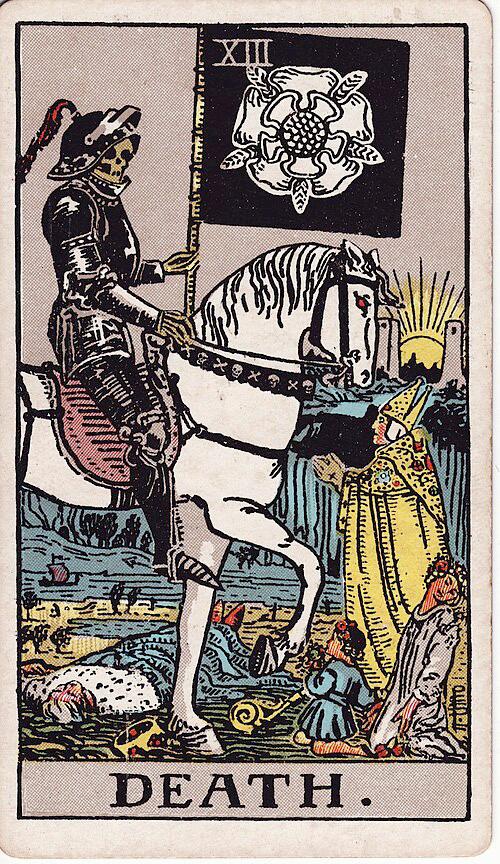
and the “Eight of Pentacles,” which typically represents a period of hard work and diligence that leads to results.
In the context of this specific reading, the major arcana card may indicate that the result of the job application will lead to some sort of big life change, whereas the minor arcana card indicates that positively transformative change requires diligent, sustained effort.
In secular tarot, readers believe that the tarot cards do not hold predictive privilege. The cards drawn are completely random, similar to the orientation of dust on a table, and the orientation and symbolism does not contain a specific meaning for
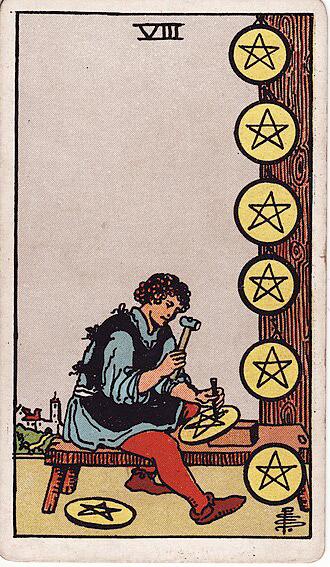
the reader to divine. Instead of a divine force, it is the reader’s subconscious intuitions that guide their interpretations of the cards. Under this view, reading tarot allows access to our subconscious, facilitating introspection and providing a novel way of interpreting a situation. Importantly, the insight gained has nothing to do with the cards’ unique power; instead, it is the product of the reader’s interpretative work, with the cards acting as mere prompt. However, in many cases secular tarot readers will report feeling as if the cards uncannily predicted something, or more broadly engage with the cards in a way that seems to imply some feeling of potential predictive privilege. It is those cases I wish
Epistemic Tension
Acting as if a proposition is true does not necessitate belief that it is true. An actor can pretend they are Hamlet without believing they are Hamlet. This does not seem to entail any contradiction between belief states, as our action is consciously chosen to achieve some end, without the impetus for that action being a commitment to the negation of our belief.
However, unlike acting, the practice of secular tarot reading forces readers to engage with conflicting epistemic commitments. Both the actor and the secular tarot reader know, respectively, that they are not their character and that the cards do not have predictive power.
Yet unlike the case of acting, where pretense is a means to an end, in order for the tarot reader to perform an effective reading, pretense is insufficient. It is the tarot reader’s intuition that the cards are predictably privileged that enables them to effectively draw meaning from the cards. I define intuition as the feeling that the cards are potentially privileged, which I qualify as a subconscious belief.
If I did not on any level feel that the cards were significant, then engaging with them would be futile. Why not divine from the writing on the back of my bottle of soap, or the orientation of marbles in a jar? By including symbolism that intentionally calls back to culturally familiar archetypes, tarot cards uniquely appeal to our teleological minds in a way that other random objects don’t. This allows us to feel as if the cards hold meaning that is personally relevant. Further, by ritualizing the practice— by speaking to them, storing them with a crystal, or lighting candles before a reading—we endorse their significance. The efficacy of our reading is enabled by leaning into the intuition that we are divining, even though this directly conflicts with our belief that we are not. Secular tarot can be likened to method acting, where an actor immerses themselves so deeply into the inner life of a character that they come to believe they are the character, even if they know they are not. Both the method actor’s act and the secular reader’s reading are involuntarily legitimized by their false intuitions.
To clarify what is meant by false intuition, consider the following case. Sam knows that monsters do not exist. If he were to be
asked whether monsters exist, he would assert that they do not. However, when Sam returns home to find that his housemates have turned off all the lights, he gets a feeling that a monster is behind him, and so he runs upstairs. He knows that there is no monster, and if asked in the moment he would assert “I am not being chased by a monster.” Yet, if asked why he is running, he would state, “I am afraid there is a monster behind me.” In this case his propositional belief contradicts the intuition that motivates his action. Similarly, although the tarot reader does not believe that the tarot cards are predicatively privileged, their subconscious intuition to the contrary enables them to draw meaning from the cards.
Establishing the Tension
One way to resolve this epistemic tension is to say that because Sam and the secular reader do not behave in accordance with their stated beliefs, they do not really believe what they claim to. Therefore, there is no contradiction between their stated belief and the belief that motivates their action.
However, Sam’s behaviour does not resemble that of someone who genuinely believes that monsters are chasing him. He
doesn’t scream for help or run to the kitchen for a knife. Sam’s belief that monsters do not exist impacts his behaviour, and therefore is still present. Likewise, a secular tarot reader’s belief that the cards are not predictively privileged influences how they use the cards. For example, a secular reader would be unlikely to use the cards to divine this year’s lottery numbers, or to predict tomorrow’s dining hall menu. They would also be unlikely to base an action on the result of a reading if it contradicted what they already thought, e.g quitting a job they liked due to a reading signalling a foreboding consequence of staying. Thus, the secular tarot reader does, to a certain degree, believe that their cards do not hold predictive power.
By this same logic, one cannot deny that Sam, to a certain degree, believes that monsters do exist, for this belief also influences his behavior. I propose that Sam’s belief in monsters and the secular reader’s belief in predictively privileged tarot exist as subconscious, low-credence beliefs. There is a part of them that feels as if the propositions could be true—that monsters do exist, or that tarot could be predictively privileged—but this belief lacks comparative influential power.
Therefore their other higher credence views—that monsters do not exist and that tarot is not predictively privileged—restrict the extent to which their lowcredence beliefs can influence their actions. As the beliefs exist as sub-conscious dispositions that are activated by specific conditions (the dark in the case of Sam, or ritualised elements in the case of the tarot reader) the way in which they impact the agent’s behaviour is not voluntary.
One could say that this tension is irrational, and therefore some sort of epistemic fluke. Sam’s fear of being chased by monsters is a leftover from childhood, and a secular tarot reader’s commitment to the cards is a weakness of human psychology. However, this seeming contradiction may be permissible if we appeal to the utility of our subconscious contradictory beliefs in facilitating worthwhile ends. In Sam’s case, this tension may not be useful—perhaps he would be better off not running away in the dark. However, in the case of tarot, the epistemic tension could be of use.
William James and the Utility of Belief
Gardiner (2024) argues in reference to tarot that “valuing the activity creates the value”
and that “thinking that the activity isn’t valuable can inhibit the user from generating the activity’s values.”4 Developing this value in the case of secular tarot entails a subconscious belief in tarot’s predictive privilege. This creates an epistemic tension that, upon first glance, seems irrational, as the secular reader rejects that there is no predictive privilege, presumably citing a lack of evidence.
However, holding beliefs that we lack sufficient evidence for can be epistemically permissible, as argued by James (1903), so long as they have sufficient utility.5 He states that a hypothesis does not have to justify its position as a belief with positive evidence, arguing that we are justified in holding sufficiently useful beliefs even in spite of a lack of positive evidence for those beliefs.6 It is important to note that this hypothesis is only a candidate for belief if it seems to us like a genuine possibility. This means it must be superficially coherent with our other beliefs, but, more importantly, it must also appeal to our intuitional states. It must make an “electric connection with your nature.”7 The contradictory case of the secular tarot reader is not completely covered by James’ criteria. The belief that the cards are predictively privileged
does seem to create an “electric connection” with the nature of the secular reader. However, the secular reader’s belief that the cards are not predictively privileged is not just a result of a lack of evidence for, but a presence of evidence against, the predictive privilege of the cards. But it can provide grounds to understand why the previously outlined case is epistemically permissible, as tarot reading, and therefore the belief in tarot, does provide utility. James restricts adopting conscious beliefs to hypotheses with a lack of evidence against them, he also explicitly rules out contradictions between conscious doxastic states. But, if the secular readers’ subconscious intuition in the cards predictive power, and conscience belief to the contrary, are evaluated as distinct epistemic categories, the issue of contradiction does not persist.
The secular reader’s belief in tarot is not a conscious doxastic state, but a subconscious intuition. This is of practical importance because it means their belief does not influence their actions or contradict their broader set of hypotheses in the way a conscious doxastic state would, and therefore does not generate an epistemically or practically problematic contradiction. This
allows the secular reader’s intuition to be constrained by their belief that tarot is not predictively privileged, enabling the secular reader to believe in tarot, but to only act on their reading in a way that does not contradict or undermine their broader naturalistic convictions. This effectively sequesters the belief into a sandbox, protecting our broader set of beliefs.
If evaluated as a subconscious intuition, the presence of evidence against secular tarot is also not a problem. When applied to conscious beliefs, holding a belief that contradicts evidence means the evidence is not playing the correct epistemic role—it is inert. Therefore, it makes sense to restrict cases to those that do not contradict evidence. However, the evidence is not inert in the case of secular tarot. It manifests through vindicating the belief that restrains the impact of the subconscious intuition on the tarot reader’s actions.
So long as the subconscious belief stays in the sandbox, James’ criteria does seem to apply, and therefore resolves the epistemic tension in secular tarot. The reader can then selectively enter the sandbox to play with their intuition by creating rituals around tarot, such as breathing exercises, shuffling cards, and
laying out spreads in a particular manner. In this way, it is only while they are practising tarot, that their belief is temporarily “alive” as an intuition, even though it may not be present as a conscious possibility. This is similar to how the presence of the monster is “alive” to Sam, only when he is in the dark and alone. Sam’s fear of the monster has no personal utility, so is still epistemically problematic under this view. However, this is not the case for tarot.
Secular tarot is not epistemically problematic, as it has established utility. Scholars have argued that Tarot can be a valuable therapeutic and decolonial tool, with books like Red Tarot (Marmolejo, 2024) exploring how the cards can facilitate communal, as well as personal, introspection.8 Tarot has also been proposed as a tool for trauma work, as it requires readers to actively participate in building the interpretations, enabling individuals to take agency over re-telling their story and life narrative.9 Gardiner (2025) also argues that tarot has immense epistemic utility. By being used in diological settings, tarot can help us ask and openly receive otherwise difficult or taboo questions. Tarot is not just a “random question generator”the nature of the questions asked
are direct reflections of how you choose to interpret the cards, and therefore serve as reflections of your intuitions.10 For those who have been alienated from their intuitions by societal gaslighting or trauma, this can be immensely useful.
The Enduring Importance of the Sandbox
However, leaning too heavily into a false intuition may lead it to break outside of the sandbox, rendering it epistemically problematic. Gardiner (2024) gives the example of a reader whose bias against individuals in positions of authority leads them to consistently read cards with symbols of authority figures (e.g, the emperor or queen of cups) negatively.11 Through the view of tarot proposed by this paper, by leaning into the intuition that the cards are predictively privileged, the reader may inadvertently reinforce their belief that all authority is bad, causing the non-problematic false intuition that was previously constrained by the readers consciously held belief to cause irrational conscious beliefs. This would violate the non-contradiction principle and render it epistemically problematic.
False intuitions not sufficiently constrained by beliefs risk being
epistemically counterproductive, for example, by reinforcing confirmation bias or encouraging cognitive inflexibility. Gardiner (2025) proposes the idea of “flipped reading” as a solution, a practice where the reader interprets each card and its inverse meaning during the reading.12 This highlights the non-privileged nature of the cards whilst also encouraging readers to step outside of familiar thought patterns. While this is only one practical intervention, it is an indication that the broader solution to this issue demands that the reader’s conscious belief restricts the causative power of their intuition, rather than eradicating the intuition itself.
Endnotes
[1] Farley, Helen, A Cultural History of Tarot: From Entertainment to Esotericism (2009), 18.
[2] Farley, A Cultural History, 93.
[3] Farley, A Cultural History, 121.
[4] Gardiner, Georgi, “Tarot: A Table-Top Art Gallery of the Soul” (ASA Newsletter 44, 2024), 3-4.
[5] James, William, ed. Trace Murphy, The Will to Believe: and Other Writings from William James. (Image Books, 1995).
[6] James, The Will to Believe.
[7] James, The Will to Believe, 2.
[8] Greenberg, Yvan, “Imaginal research for unlearning mastery: Divination with tarot as decolonizing methodology” (Anthropology of Consciousness, 2023); Cohen, L. and RCT, C., “Diasporic mysticism, psychology, & tarot: A path to decolonizing intuitive development” (2024); Marmolejo, C. Red Tarot: A Decolonial Guide to Divinatory Literacy. (North Atlantic Books, 2024).
[9] Semetsky, Inna. “When Cathy was a little girl: the healing praxis of Tarot images” (International Journal of Children’s Spirituality, 2010).
[10] Gardiner, Georgi “Purism and Pluralism: The Brilliance of Tarot and the Breadth of Epistemology” (Routledge, 2025).
[11] Gardiner, “Tarot.”
[12] Gardiner, “Purism and Pluralism.”
Emerging S i n g le
Hell
Feminist,Satanic a Undressing of Single’s Inferno
Brittany Deng
Edited By: Tai Nakamura
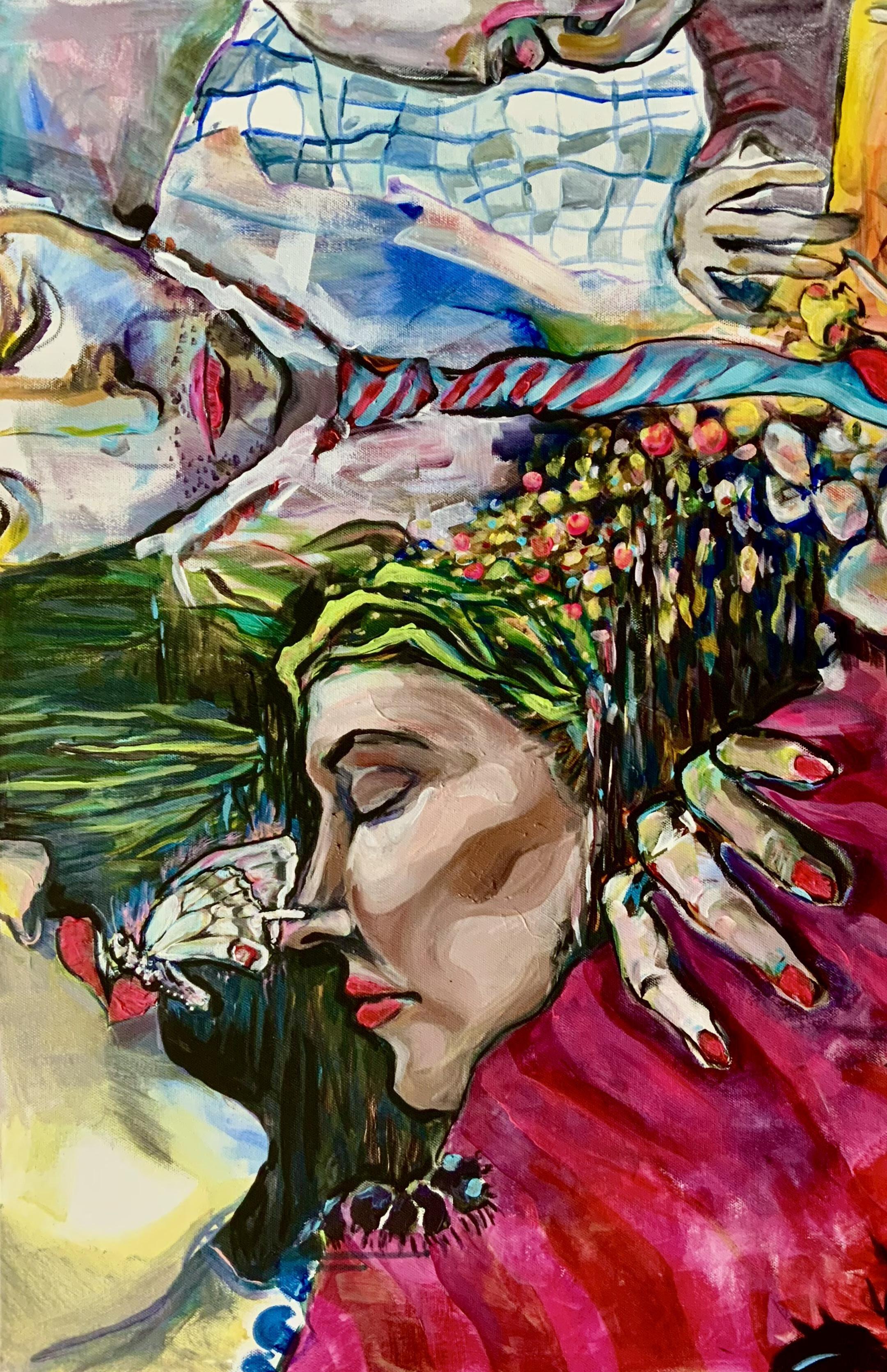
At first, a dating show packed with abdominal muscles hardly seems to display radical nineteenthcentury Romantic Satanist feminism. A Korean reality television show, Single’s Inferno has attracted international fame for its fiery premise: placing hot, confident singles together on a secluded island. To escape Inferno, the singles must win a private date in Paradise; but to achieve this desired date, the singles must either choose each other or dominate an array of physical competitions. Through repeated rituals of competition and Paradise, forbidding contestants to share details of their age or job outside of Paradise, Single’s Inferno decomposes the contestants’ extreme confidence into anxiety, self-doubt, and insecurity over whether their desired person will leave Inferno with them.
Translated as Solo Hell in Korean, Single’s Inferno’s depiction of suffering bears great resemblance to Dante Alighieri’s Inferno. Throughout the nine rings of Hell, Dante witnesses how Hell reduces its victims to almost irrecognizable wretches, punishing those who usurped more power and pleasure for themselves than God intended. Single’s Inferno is not so different. Its vast success lies in
why viewers enjoy watching the contestants go through Hell: because they are high-status, visually optimized, and simply more perfect than most.
Contestants first materialize atop a long, meandering path down the island, forming a majestic entrance of billowing gowns and hulking shoulders. Each of them begins the show with an impenetrable aura–which makes their ritualistic degradation so fascinating. It forces them to confront a defining dilemma: the trade-off between love and fame. Whether to pursue someone who provides emotional security, versus someone who ignites the heart; this tension between preserving self-image and yielding to desire shapes the contestant’s identities.
In her article Romantic Satanism and the Rise of NineteenthCentury Women’s Poetry, literary scholar Adriana Craciun explores how women writers like Wollstonecraft framed Satanism as female rebellion against patriarchal or political restraints. She connects several feminist texts that, in order to construct their feminist-Satan narrative, reference The Lost Pleiad: The Pleiades, or Seven Sisters, are a star cluster. However, one is often invisible: Merope, banished for marrying a mortal instead of
a god. This fallen star imagery echoes Lucifer (the “morning star”); Satanism—often tied to sins, lust and greed—was reformed by nineteenth-century female authors to represent feminist consciousness and ambition.
It is not difficult to conceptualize Satanist elements within Single’s Inferno. In surprising contrast to Korea’s conservative culture, where a singular interaction between K-pop idols of opposite sexes may cause absolute scandal, contestants on Single’s Inferno are encouraged to express sexual desire and attraction. It unabashedly emphasizes how each contestant is either sexily jacked or taut or curvy, luring viewers with Satanic hints of lust, greed, and sexual surrender. The ability to express desire, however, is nevertheless gendered.
I aim to illustrate the contrast between two prominent Season 5 contestants who represent opposing female archetypes: Kim Min-gee and Kim Go-eun. Mingee is an athlete with dense bangs and fierce black eyes; Go Eun is a model with catlike, almondshaped eyes and a fashionable bob. While Min-gee initially won the most first-impression votes, Go-eun ended the show with the most suitors fighting to be her
partner. I believe the reason lies in their contrasting personalities: Min-gee is hot-headed and straightforward in pursuing her romantic desires, while Go-eun is considerative and evaluative. This difference determined their ability to optimize within the love-fame dichotomy.
In the pursuer-and-pursued narrative that often characterizes heterosexual courtship, Mingee’s assertiveness relegated her to the role of the pursuer. Few men on Single’s Inferno were willing to be the pursued, and Min-gee’s boldness exposes her to vulnerability and even suffering. On the other hand, Go-eun does not seem to assert her own desires, but rather evaluates the options who present themselves before her. She allows them to project their desires and assumptions onto her while denying them knowledge of her interior. This mystery allures the zealous, conventionally masculine suitors who happily adopt the role of the pursuer.
In her article, Adriana Craciun illustrates the connection between Satan and female self-expression. Drawing inspiration from John Milton’s epic Paradise Lost, in which he depicts Satan’s fall from Heaven, Craciun explains that Romantic
feminist authors interpreted Milton’s Satan as a symbol of the “outcast female genius, hurled from the celestial sphere for having claimed equality.” In her novel The Wrongs of Woman, Mary Wollstonecraft’s heroine is imprisoned in a madhouse, yet defiantly references Satan: “my mind is freed, though confined in hell itself.” Wollstonecraft identifies Satan’s dilemma with that of women: “To be weak is miserable, doing or suffering,” Satan declared to his fallen comrades. Wollstonecraft declares the lowest human state to be passivity and powerlessness, hence redefining Satan to symbolize strength, not evil.
The authors Mary Robinson and Charlotte Smith built upon Wollstonecraft’s interpretation of Satan, tying Lucifer’s image to the female struggle
for intellectual recognition. Depictions of such imagery of fall and exile dominate several female narratives, most famously the fall of Marie Antoinette. A suffering mother and systemic victim, Marie Antoinette is simultaneously “the fallen Lucifer who aspired to ‘a throne / Where boundless power was thine, and thou wert rais’d / High (as it seem’d) above the envious reach / Of destiny!’” wrote Smith. Robinson built upon such parallels of fallen queen, fallen Satan, and fallen woman poet, uniting herself and Marie Antoinette by their “shared fate as unabashed female genius, ‘hurled from the most towering altitude of power’”. Likening herself to Milton’s Satan, she pursued the “proud supremacy of worth.”
Alongside female poets’ social exile was the trade-off they faced
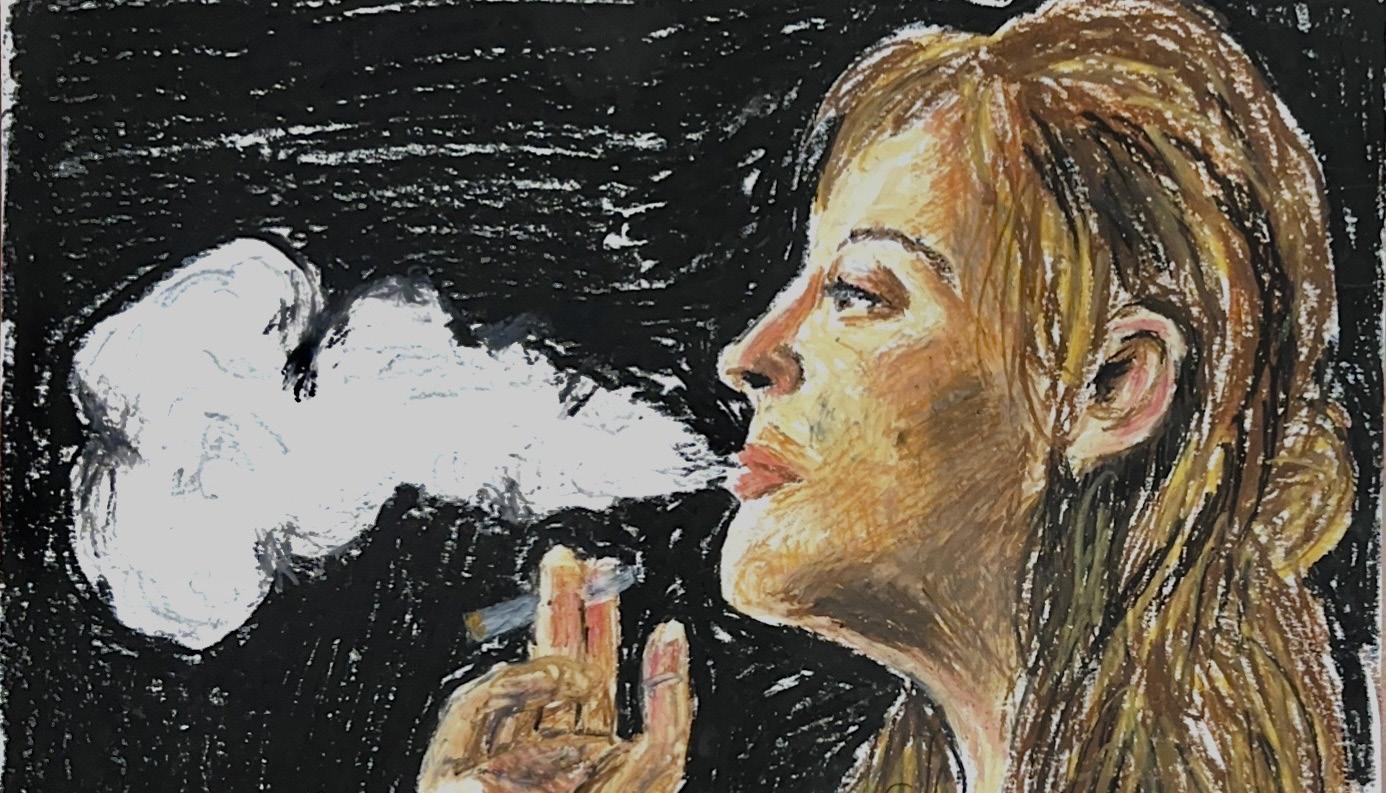
between love and fame. The myth of the Lost Pleiad depicts such conflict: A star fallen from the heavens, she traded divine status for love with a mortal man. This continues the narrative of fallenness, as Craciun made clear: “The Satanic fall through intellectual pride became feminized as the Fallen Pleiad, losing her celestial purity through love of mortal masculinity.” Unlike many on Single’s Inferno, who attend the show just for fame, Kim Min-gee similarly relinquishes “celestial purity” in order to surrender to a “love of mortal masculinity”. Through her willingness to engage in rawness, Min-gee loses the protective shroud of mystery that enables Go-eun to enchant her suitors. Within the hellish environment that Single’s Inferno describes itself to be, Kim Min-gee’s refusal to be passive punishes her: she becomes vulnerable to the whims of the man she desires, while Goeun succeeds at the opposite–becoming the one whose whims others are subject to. Unlike Mingee, Go-eun’s perfection never wavers, never devolves.
However, viewers should hesitate before idealizing Goeun’s approach. On the eve of final decisions, when asked what they liked about her, Go-eun’s suitors struggled to provide
any intelligible answer. While they were initially captivated by her cat-like charm, they failed, over the course of seven days, to consider anything else for which they could articulate appreciation. Because Go-eun’s approach did not command space, she forfeited her ability to define the terms of her courtships. Go-eun even admitted her detached approach to be a protective mechanism: she describes herself to fall slowly but deeply, which in the past has made her vulnerable to being hurt. As a result, she withholds herself in order to protect against the feelings of love that make preserving one’s image and dignity nearly impossible.
On the other hand, Kim Min-gee did not allow the show’s loveor-fame rituals to define her choices. In this light, Merope’s fall need not be interpreted as a condemnation of female ambition. Rather, it represents a “retelling of the fall of the angels” in Paradise Lost–an expression of pride, intellectual and political rebellion. Rather than a “crippling denunciation of women’s fame”, feminist Romantic Satanism allows Merope to represent “a defiant meditation on the superiority of feminine love,” mirroring the “angelic rebellion”. It possesses the daring capacity to transcend
ordained boundaries because it does not shirk from the realm of mortal suffering. Hence, the Satanic rendering of these fallen figures empowers the narrative of “vanquished beauty” through “feminizing the angelic rebellion as a fall for love, making beautiful what appears as quintessentially masculinist.” Dispelling the oppressive trade-off between love and fame, feminist Satanism allows us to understand female self-expression as both noble and vulnerable in the subversive pursuit of its own ends.
Emerging from the depths of Hell, Dante’s last words read, “And then we emerged to see the stars again.” To him, the stars are an immortalized aesthetic that anchors his disoriented self in its existence. The instinct to interpret the stars as angels, then, reflects a broader urge to deem them embodiments of a perfection humans cannot attain. Such a designation is not unlike the Single’s Inferno contestants, whom audiences delight in perceiving as beings of divine (surgically guaranteed) beauty. The fallen star, then, represents a perfect being who has shed its perfection. In doing so, it frees itself from isolation and claims its place in the world. Kim Mingee managed to resist both the passivity that is romanticized as feminine attractiveness,
and the conformity through which celebrities maintain their public image. The symbolic consequences of her actions transcend the mere state of desiring a man, rather representing the triumph of feminine conviction and ambition over worldly order. By wrenching herself free from the known, the fallen star displays blazing proof that she is, in fact, alive.
Cia Zhou
Ed. Ashling Lee
The Beauty of Dionysian
Communion in Midsommar
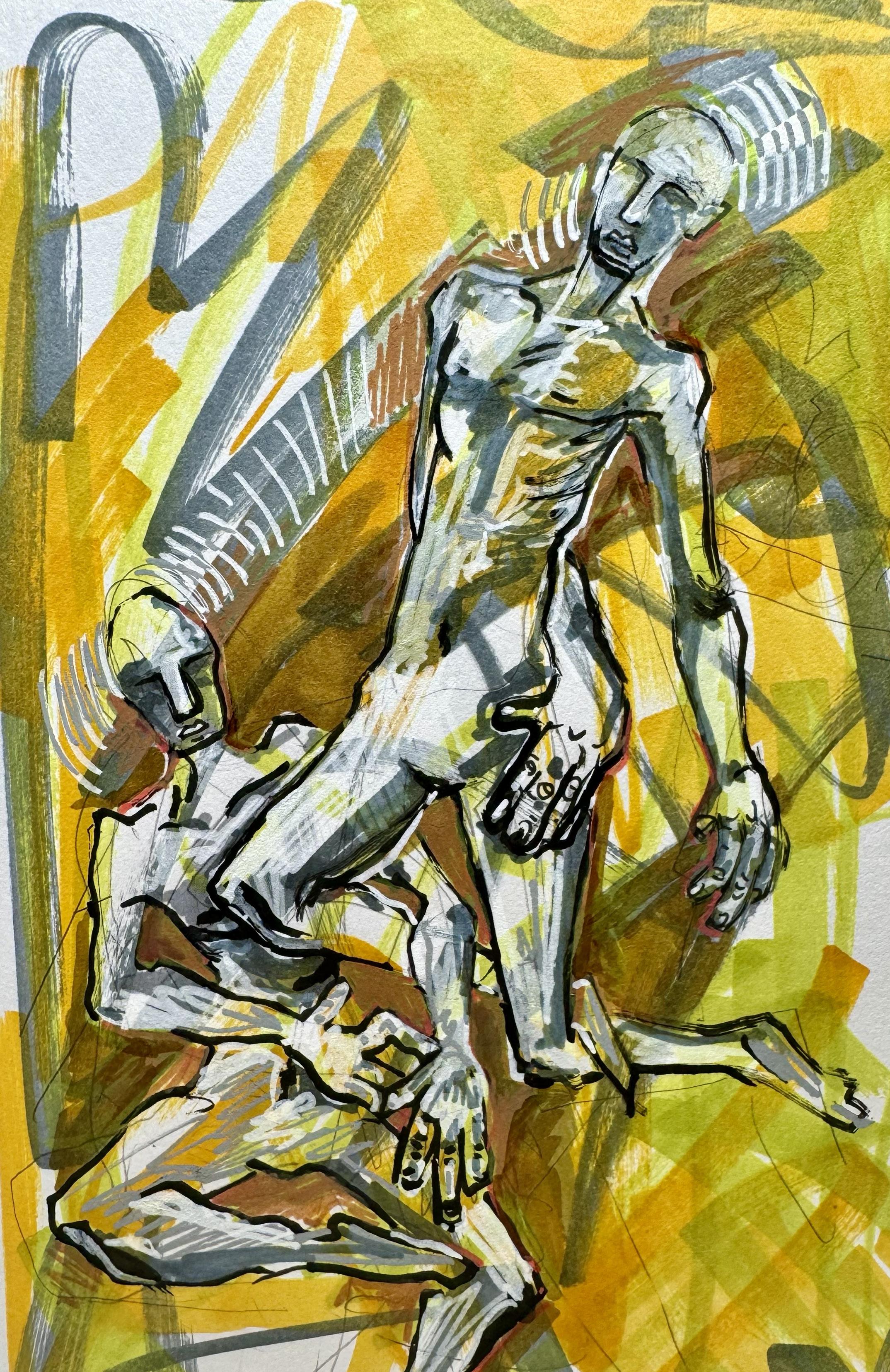
Ari Aster’s Midsommar is often read as a breakup folk horror film: a story about grief, emotional neglect, bad men, and the intoxicating feeling of finally being chosen. That reading keeps the film at the level of psychology, as if Midsommar were mainly a revenge fantasy in flowers. What the film stages is more philosophically unsettling than that. It is not only a story about manipulation. It is a story about the seduction of surrender.
Read through Nietzsche, Midsommar becomes a drama of the Dionysian: not ecstasy as liberation, but ecstasy as the gradual unmaking of the individual self.
In The Birth of Tragedy, Nietzsche distinguishes between the Apollonian and the Dionysian. The Apollonian state names form, boundary, proportion, the reassuring sense that the self is coherent and self-possessed. The Dionysian state undoes that security. It belongs to intoxication, frenzy, dissolution and the collapse of the distinction between self and other. Under its force, one no longer stands apart from the world as a separate subject. One is pulled back into collectivity, rhythm, body, force. The self stops feeling like a boundary and starts feeling
porous.
This is the deeper logic of the film’s death cult, the Harga. Their “paganism” matters less as a belief system than as a method of life. The commune does not really persuade the protagonist Dani into accepting a new worldview. It erodes the very conditions under which belief would still be the central question. What the Harga produce is not conviction so much as absorption. Their rituals, communal meals, synchronized gestures, cyclical chants, choreographed grief, altered states, ecstatic dance: All of it works to wear down private interiority. Their world is organized so that individuality begins to feel thin, lonely, and eventually unbearable.
That is why the horror of the film cannot be reduced to the familiar idea of an evil cult preying on a vulnerable woman. The more unsettling possibility is that the cult offers Dani something that modern life has failed to offer her: the feeling of being held by forms larger than herself. At the beginning of the film, Dani is marked not only by grief but by the privatization of grief. Her suffering is radically her own. Her family is dead. Her relationship is disintegrating. Her need is excessive, awkward, difficult to place. Her boyfriend Christian’s
failure is not simply that he is a bad boyfriend, though he is. It is that he cannot bear witness to suffering without experiencing it as an inconvenience. He is emotionally evasive, selfprotective, permanently detached. He stays near Dani while leaving her entirely alone. What he represents is a familiar cruelty of modern intimacy: making someone suffer as an individual.
The Harga do something far more disturbing because it is also far more seductive. They refuse to let suffering remain private.
When Dani breaks down, they do not soothe her in the thin language of reassurance. They mirror her. They cry with her, howl with her, breathe with her, repeat her anguish until it becomes collective sound. The scene is grotesque, almost absurd, but it is also the first time in the film that Dani’s pain is fully answered. The commune does not ask her to regulate herself into coherence. It receives grief at the level of the body. For perhaps the first time, she is not carrying pain alone.
This is what makes Midsommar more unsettling than a simple critique of irrationalism. They are frightening because they answer a desire modern life
keeps producing: the desire to no longer be a discrete self at all.
Liberal personhood flatters us with the language of autonomy. We are told that freedom means sovereignty, that dignity depends on individuation, that moral life requires the independent subject who chooses for herself. Midsommar asks what happens when that version of selfhood stops feeling like freedom and starts feeling like exposure. Dani’s isolation is not incidental to the film; it is its condition. She grieves alone, doubts alone, chooses alone. Even her relationship becomes another site where selfhood means containment, where she must remain legible, reasonable, manageable. Her pain has to stay within acceptable limits.
Again, the Harga offer the opposite. They offer a world in which no feeling belongs to one person for long. Everything is ritualized, distributed, metabolized by the group. Sex, aging, death, mourning, celebration: Nothing remains fully private, nothing is merely personal. In that sense, their paganism operates as an antiliberal ontology, dissolving the individual into the collective. And this dissolution arrives in the form of care.
That is the central perversity of Midsommar. The film understands that domination is most powerful when it no longer feels like domination. Dani is not won over by doctrine. She is converted by affective relief. The commune gives her what Christian never could: responsiveness, recognition, containment, ceremony. It takes anguish and turns it into participation. Here the Dionysian is not just chaos or ecstatic violence. It is also the relief of no longer having to bear the weight of being a separate self with separate pain.
For that reason, the ending resists the easy feminist triumphalism often attached to it. Dani’s final smile is too often read as straightforward empowerment. She chooses herself, chooses female community over male betrayal, chooses liberation over heterosexual misery. But that reading risks mistaking absorption for freedom. By the time Dani “chooses” Christian as sacrifice, the subject capable of making a fully free moral judgment has already been undone. The May Queen ritual does not crown autonomy. It marks the completion of her Dionysian incorporation. That smile matters because it remains ambiguous. It is relief and release. But release
into what? Certainly not into independent agency, but instead into a world in which belonging has displaced conscience as the source of value.
This is what gives the film its philosophical force. Midsommar does not simply depict violence. It stages the ethical ambiguity of a form of healing that destroys the self it heals. The Harga offer genuine relief from loneliness, but only by erasing the interior distance from which refusal might still be possible. They create a form of life in which judgment no longer feels necessary because shared feeling has become morally sufficient. To be absorbed is, within their world, to be justified.
The film’s paganism is therefore most unsettling not as an exotic religious other, but as a fantasy already latent within modernity itself. In a world of exhausted subjects, failed intimacy, and privatized suffering, the desire for dissolution begins to make sense. The longing to disappear into ritual, rhythm, collectivity, and shared feeling is not simply irrational. It is the shadow desire of a self worn down by the demand to remain distinct, coherent, and alone.
That is why Midsommar lingers. Its horror is not just that Dani is
deceived. Its horror is that the surrender feels deserved. The commune does not tempt her with pure illusion so much as answer a real wound. What the film exposes, finally, is not only the danger of pagan ecstasy, but the fragility of the liberal individual who imagines herself above it. Under enough grief, enough loneliness, enough abandonment, dissolution can begin to look less like death than like mercy.
WE ARE STILL WITCHES WE ARE STILL WITCHES
Edited By: Sebastian Verrelli
WE ARE STILL WITCHES WE ARE STILL WITCHES
Every morning, thousands of women wake up and go through the rhythmic steps of their makeup routine. It starts off with foundation, then blush, then mascara (or if you’re feeling wild, you start with mascara). This process mirrors one of rituals—rituals that witches perform. In early modern Europe, hundreds of women were persecuted under the premise of practicing witchcraft, and the core of such persecutions was the alleged tie between the “ritual” and the devil. Such persecution stemmed from beliefs that Eve sinned first, implying that all women are more sinful than men. In other words, the persecution of women as “witches” is a form of punishing women for a sin that they did not even commit— punishment as a means of control. Feminists in the 1970s, with knowledge of the practices’ punitive origins, started to reclaim witchcraft, embracing a spiritual feminism that stemmed from the critiques of patriarchal structures within religions. Yet, women are still persecuted for being witches even today. A prime example of this was in 2010, when Julia Gillard became Australia’s first female prime minister and endured constant sexist remarks during her term. Thus, through the mass persecution and massacre
of “witches,” patriarchal oppression still scrutinizes the rituals of women—a scrutiny that women should reclaim as liberation.
In Germany, Pope Innocent VIII wrote an order that allowed men to prosecute witches, and two Catholic monks wrote a treatise titled Malleus Maleficarum, which suggested that the Devil “can possess a human being to do forbidden and unspeakable things which the human brain could not even glimpse” while focusing on the intrinsic sinfulness of a woman’s nature. According to the text, women were more likely to be “possessed” because it is already in their nature to allow the Devil in. Indeed, the monks in Malleus Maleficarum wrote, “when a woman thinks alone, she thinks evil,” suggesting that a free and independent woman is a witch—and her actions must be witchcraft. Therefore, if a woman strays from her social role—looking after kids, cooking meals, housework—then she must be a witch because the opposite of her role would be “child-rearing,” “poisoning,” and “infanticide.” Therefore, it is dangerous for a woman to break the social norm, as she has the chance to rewrite what it means to be a woman, and therefore is accused as a witch to be
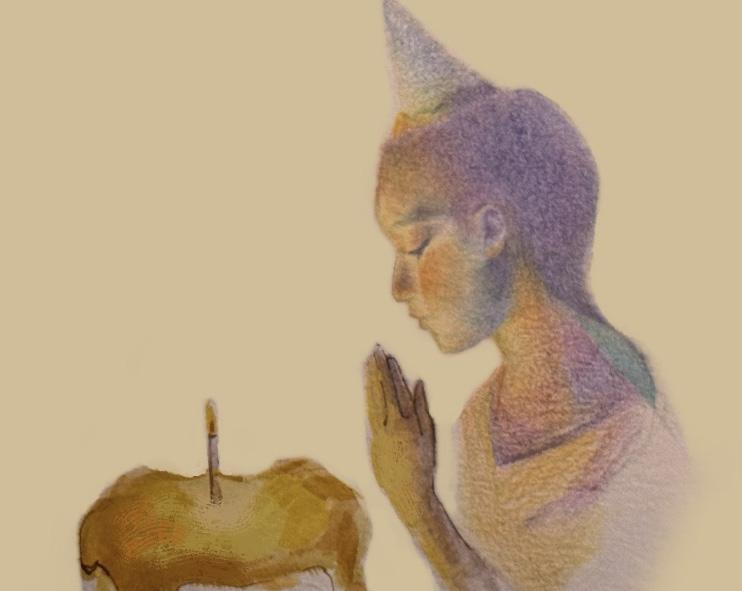
subdued from such an uprising. As Masniew, a Ph.D student at Jagiellonian University, writes, “witchcraft accusations were targeted on rich widows, intelligent middle-aged women, rebellious wives or females not bringing offspring.” All of these women were persecuted for their status as a way to be punished for holding power. Once the dynamic shifts, men would neither control women nor control the offspring needed to continue society. Therefore, the witch hunt was a persecution to prevent women from breaking the patriarchy.
In the 1970s, many feminists started to reclaim the identity of the witch, embracing the
rebellious nature of their sisters; this act of reclamation proved critical in progressing the feminist movement. Activists were questioning who was allowed to have knowledge, specifically, which gender was allowed to hold knowledge. Indeed, Kwaschik, a professor of Modern History at the University of Konstanz, writes that “The witch legitimized the quest for alternative ‘buried knowledge,’ representing herself as a persecuted knowledge culture that produced and disseminated knowledge about the female body and female health, in unity with nature” (174). Witches, as activists, are not “sinful” women, but rather are big sisters to aid women through an
institution that praises “ritual” while excluding the female body. There is no better example of this phenomenon than in “modern science.” Think about it. The inherent “ritualistic” aspects of every experiment: setting up your stands, measuring the exact amount of chemicals you need… It’s almost like you are making a potion. In fact, Kwaschik even notes how modern science “emerged as an ‘implausible cosmology of mechanical philosophy’ dependent on ‘occult forces.’” Science is dependent on historical magic— and crucially, a field primarily dominated by men and ignores the subjugation of women that engaged in said historical magic. The exclusion of the female body causes women to go outside the “normal” magic, and go to the original source of magic for advice: a witch. Thus, feminist witchcraft is born: a movement that celebrates the persecuted and rebellious female identity while aiming to take down the male-dominated medical system and the medical system used as an instrument of patriarchal reproduction. Through this narrative, Verbeek, a member of the Department of Religious Studies at the University of Vienna, writes how the movement declared “women as historically being healers and medicine being a heritage of
women…this feminist discourse, referring to witchcraft, resulted in the establishment of women’s health centers, respective magazines, self-help groups, etc.” Witchcraft has worked its magic, finding a way for women to escape the hypocritical nature of a society that co-opts and celebrates when men embody the very same potion-making, healer roles, yet punishes women for doing the same.
Now, women still perform rituals daily that get scrutinized by men. Let’s go back to the ritual of makeup. Some might argue that this is not a ritual and not magical at all. And yet, makeup is a mask, as a way for us to convey beauty, expressions, and status. In an analysis of The Love Witch, Lomax, a writer for Frames Cinema Journal, writes that “makeup’s ability to transform and accentuate facial features connects it to theatrically and sexualised femininity … Because of this, the wearing of visible makeup has—at frequent points in history—been deemed socially unacceptable with its use veiled in secrecy and connected with feminine wiles, magic potions, and witchcraft.” Makeup is a way for women to shape-shift; a magic ritual that allows us to transform. To this day, women are scrutinized from wearing makeup.The “looksmaxxing”
community on Tiktok comments “makeupcel” –implying they are not beautiful without makeup— on the videos of many women who just enjoy the magical ritual of makeup. These comments suggest that these rituals, just like the ritualistic and exaggerated makeup of the Love Witch, are evil, meant to deceive men from what a woman truly looks like. At the same time, the men in the looks-maxxing community promote eccentric rituals like “tinted sunscreen” or “bone-smashing,” processes that stem from the same occult rituals and witchcraft that women have practiced for hundreds of years. It becomes clear that women are still the subject of co-opting from men stealing their magic, and must look back to their sisters for guidance, even to this day.
Mosh, Merch, Meme: Underground Rap Aesthetics as Liturgy
Ishaan Bhattacharya
Edited By: Ashling Lee
Every liturgy has its vestments. Some traditions prefer robes, incense, and stained glass; others prefer black leather, blown-out flash photography, and cryptic Instagram stories. Underground rap fandom may seem trivial beside organized religion, but a cursory comparison misses something important. Even though their creeds are not explicitly written as doctrine, these hip-hop fandoms are held together not only by taste but also by signs treated with special significance and rituals one learns to perform.
Certain contemporary rap scenes can be best understood not merely as audiences but as quasireligious communities organized around aesthetic practice. The Opium collective (Playboi Carti, Ken Carson, Destroy Lonely, and their orbit) offers one example: a vampiric, goth, and punkinspired cosmology of blackedout glamor and aggressive theatricality, where Balenciaga boots meet gothic cathedrals and a nihilistic outlook. Feng, a young artist from the budding underground rap movement in the UK, offers a softer but no less coherent world of 2010s internet nostalgia, where washed-out 2016 Instagram filters and low-resolution iPhone 5 flash photography
become an aesthetic homeland for adolescent freedom. In both cases, fandom becomes ritualized through dress, slang, memes, concert behavior, and above all, the Internet’s relentless circulation of images. The fan proves devotion less by private feeling than by public participation in the liturgy of a style.
Despite its contextual distance from modern underground rap, French sociologist Émile Durkheim’s 1912 book The Elementary Forms of Religious Life, which analyzes the sociality of religion, explores ideas that can actually be applied to this phenomenon. Religion, defined by Durkheim, is “a unified system of beliefs and practices relative to sacred things” that binds its adherents into “one single moral community.” This definition powerfully shifts our attention from supernatural belief to shared practice around “sacred” things, which, for Durkheim, are not simply things people admire. The sacred is whatever a community sets apart from ordinary life as specially significant, treats with reverence rather than casually, and uses to regulate conduct and mark the boundary between insiders and outsiders.
Through this lens, underground rap fandom is not religious
because fans literally worship rappers. It is religious because it produces sacred objects and signs, as well as communal rites. If Durkheim explains why these communities resemble religion, French literary theorist Roland Barthes’ 1957 book Mythologies helps explain how their sacred signs come to mean more than themselves. In the chapter “Myth Today,” he argues that myth is not a thing but a “system of communication” and a “mode of signification,” meaning that ordinary cultural materials can come to carry an entire social worldview. In underground rap fandom, then, outfits, poses, filters, captions, and circulated images do not merely express admiration for an artist; they transform style into a shared language of belonging. Barthes also insists that myth is “chosen by history,” not rooted in the “nature” of things, which helps explain how aesthetic codes could feel urgent and selfevident to a particular youth culture rather than universal.
Several rituals follow from this exclusive treatment of aesthetics as sacred. There is the uniform: the outfit, the hair, the filters, and the specific stances for Instagram. For example, in line with their invocation of early 2010s internet culture, Feng fans have adopted the “soft grunge”
look popular on Tumblr between 2011 and 2014, using old iPhones to capture snapback hats, Vans Authentic shoes, oversized flannel shirts, acid-wash skinny jeans, and peace signs. They have also taken up the lost art of posting daily on Instagram in an era of carefully calculated, quarterly posts. There is also the sacred terminology of the group: in-jokes, slogans, and tonal cues. Feng fans invoke his name as a versatile noun and adjective, changing February to “Fenguary” and replacing expletives with “What the Feng,” symbolizing their community linguistically. There is even a pilgrimage: the show is not simply entertainment but a sacred, exclusive space for communal thrashing and the sweat of the mosh pit, which is a medium for enacting belonging. Opium artists, with their overblown bass and belligerent lyrics, often reference mosh pits in their lyrics and draw fans to overpacked venues, where they follow the cue to “open” the mosh pit up before converging together.
What is novel here is not the existence of ritualized fandom (similar phenomena can be observed in 20th-century rock movements, for example), but the extent to which the Internet has become its liturgical
infrastructure. In French theorist Guy Debord’s The Society of the Spectacle, the idea of spectacle is defined not as a “collection of images; it is a social relation between people that is mediated by images”—which is how these fanbases now cohere. Instagram, TikTok, Discord, fan pages, archive accounts, meme accounts, and repost networks do not merely publicize a preexisting community. They constitute the very medium in which the community recognizes itself.
This idea transforms ritual from an occasional event into a continuous condition. In an older musical culture, one might regularly attend concerts, buy CDs, and wait in anticipation. In the contemporary underground rap scene, the rites never
stop. Fans become archivists, clipping lost Instagram lives and screenshots, recording a coherent picture of an artist’s visual grammar. Playboi Carti’s rare, often-deleted, and hyper-curated Instagram posts are neatly archived by @playboicartiarchive on Instagram, which includes post dates, captions, and music added in captions.
There is also constant exegesis. By decoding arcane captions, studying deleted posts, tracking snippets, and comparing eras, fans read visual shifts for signs of doctrinal change. Carti’s artistic evolution is tracked using descriptive labels like “Blonde Carti,” tying visual aesthetic markers to points in time within the trajectory of both the artist and fandom, as well

as moments of specific stylistic consistency (“Blonde Carti” in particular refers to the highpitched vocals and high fashion Carti experimented with while recording the second version of his album Whole Lotta Red from 2019 to 2020).
Fans even become gatekeepers, policing those who arrived “too late,” those who dress the part without understanding it, and those who discovered the artist only after the algorithm did. The term “new gen” (derogatorily placing people in a “new generation” of fans) is now a hallmark of TikTok and Instagram comment sections in cases where someone mispronounces, dresses out of alignment with the uniform, or displays any other failure to cohere with the strict codes of the fandom.
The digital fan is not merely a spectator. They are clergy, missionary, and inquisitor at once. In that sense, these fandoms were never just part of a scene. They are specific liturgies, ones without a church, but no less structured by belief, ritual, and the need to belong.
Bergsonian Duration and the Urban Image
Yongjae Kim
Edited By: Kelly Sung
Each of us carried two cameras around our necks as we ran across a narrow web of ironworks. Earlier that afternoon, we had been photographing Sewoon Plaza and the old alleys of Euljiro, districts known since the sixties for their dense network of small workshops and hardware stores, now standing against the shadows of high-rises.
Moments after we captured an image of an ironworker buffing a metal rod in his workshop, we were met with an enraged shout, followed by a sprint through these streets. Our cameras struck against our chests as we ran across concrete alleys, climbing stairs and footbridges, ducking through passageways, and slipping into increasingly narrow alleys until the man finally fell behind.
Catching our breath, my friend, who had spent more time documenting the old Seoul than I had, told me that such reactions are common in these neighborhoods. The workers often mistake street photographers for redevelopment officials scouting the area, especially in a city like Seoul, where every old apartment is redeveloped before their life expectancies, and ironwork districts like those in
Euljiro constantly face threats of demolition. In this context, the attempt to capture a fleeting instant through a camera feels inherently paradoxical. It is because to photograph a truly contemporary moment of Seoul is to silence the philosophical clash over the nature of the captured moment itself.
In his 1889 essay “Time and Free Will”, French philosopher Henri Bergson criticizes our tendency to treat lived experience as if it were composed of discrete, spatialized moments in time. Nowhere in his essay does he mention photography directly, but contemporary urban photography can be understood as an expression of this tendency; it translates the continuous flow of consciousness into a sequence of fixed images, projecting onto the external world a structure that properly belongs only to our inner experience, and in doing so, risks distorting the very conditions under which free will is lived.
Seen in this light, photographing the ironworker becomes an instance of what Bergson calls quantitative multiplicity. The camera fixes the present within a homogeneous, measurable 3:2 space, separating and arranging the ironworker’s movement into discrete units. Put side by
side as frames of a slide of film, each movement captured in an image is portrayed as a series of immobile points, without potential for spatiotemporal extension. This collection, then, serves a purely systematic interest where each bit of the city is treated as a collection of static, yet ambiguously juxtaposed parts.
Within this same framework, however, the ironworker in question exists in duration (la durée). For Bergson, a qualitative multiplicity is where the past, present, and future are not juxtaposed like frames in a film, but “several conscious states are organized into a whole, permeate one another, [and] gradually gain a richer content.” In this duration, there is no mere succession of snapshot-events nor a mechanical causality. Since the ironworker’s ongoing actions are saturated with several conscious states (decades of memory, interactions with other conscious states, and the communities he finds himself in) they are not predictable effects of a temporal or spatial cause, but expressions of one’s own mobility within this duration in flux. But when the camera tries to capture him, it tries to disjoin the ironworker’s free movement in both time and space, forcibly reducing heterogeneous
durations into an immobile photographic medium.
Bergson’s qualitative multiplicity is, then, both a rejection of a spatialized conception of time and a rehabilitation of freedom as an element of the lived experience itself. While Kantian philosophy, for instance, confines causal necessity to appearances while locating freedom in the noumenal realm— thereby rendering freedom as inaccessible within experience itself—Bergson distinguishes time and space by suggesting duration as an element of a continuous, qualitative inner life in which past and present interpenetrate rather than exist as discrete, externally, and mechanically related units of spatialized time. It follows that both the expression and the preservation of freedom do not require positing a noumenal domain beyond experience, but consists in the way it emerges from the continuous structure of non-spatial structure of duration itself.
This relationship between the photographer and the photographed extends as a metaphor for the city as a whole. Bergson’s view shows how a worldview in which one sees and thinks of the world in static and separable
parts can encourage the urban photographer to reduce duration into discrete units. Similarly, redevelopment projects rely on the same worldview. By treating the city as both perceptually and preceptually divisible— and thus its divided parts easily replaceable—redevelopment projects overlook the freedom and experience complexly intertwined in each space-time they seek to remove. And if any single part of a city could easily be defined as a fixed present that can, at any time, be labeled the past, it is tempting to think that any one part could easily cease
to exist without distorting the holistic picture.
The ironworker’s anger is, therefore, both an intuitive refusal of the photographer’s attempt to isolate a ‘now’ into a static image and a rational resistance to the threats of redevelopment. For the workers who endure in these workshops as living continuities of a rapid social and economic transformation, urban photography appears an act to catalogue the present as a spatialized record of the past; and once a life is cataloged, it can be archived, and what is archived can be cleared away. So, beyond the scope of the viewfinder, the camera’s promise of preservation carries an irony of forgetfulness.
Bergson’s distinctive account of duration as the continuous and irreducible movement of past and present, may not ever have been intended to be framed through urban photography. More than a century later, however, Bergson’s philosophy takes us on a skeptical journey to reconsider the meaning of the photographic art. Despite what many urban photographers might believe as being doctrinal to their projects, Bergsonian philosophy points to a possibility where photography and preservation could be antagonistic, especially in an age where photographic
documentation has become so effortless a pursuit. Each time we intentionally or unknowingly conflate individual Bergsonian durations into homogeneous frames, we may be threatening the life of another ironworker, by trying to preserve a life that cannot essentially be captured.
Afterall, no single image can exhaust the layered temporality that gives a city its coherence, for its life unfolds as overlapping experiences of our inner lives, each layered upon a free-flowing continuum of lived time and lived space.
Subculture and Simulacra Suliman Albahrani
Edited By: Telvia Perez
The aesthetics of punk subculture were originally the residue of its congregation, what remained after the gathering itself dissolved. The perpetually vexed sentiment, the abrasive sonical style of the music were necessities that preceded the aesthetic. The distressed jumpers, the safety pin, the leather jacket studded by hand in a flat above the shop — these ornamentations emerged as byproducts of a practice that did not yet know itself as a practice. The punk aesthetic developed without self-consciousness, shaped by the conditions of the room, the economy of the participants, the music that was playing. It did not look at itself from the outside and ask what it signified. It simply was, and because it simply was, it could evolve — mutating across decades and geographies precisely because no one had codified it into a reproducible template. The act of dressing was the sacrament, performed not as a signal to outsiders but for the people in the room who understood the symbols because they genuinely mirrored their sensibilities.
This essay argues that modernity has degraded subculture to a
pervasive and unexamined form of simulacra. Jean Baudrillard defines a simulacrum as a copy without an original, an image that no longer refers to any reality but circulates as its own self-sustaining sign. “The simulacrum is never what hides the truth,” he writes in the opening pages of Simulacra and Simulation. “It is truth that hides the fact that there is none.”
Subculture today does not conceal an authentic underground beneath its commercialized surface. It conceals the fact that the authentic underground — in the form that once generated the aesthetic — no longer exists. Two forces have produced this condition, each constituting its own degradation of the original: the advent of the digital age, which severed subculture from the necessity of physical congregation, and the rise of mass corporatization and globalization, which absorbed the now-rootless aesthetic into the commercial cycle of the commodity. What was once ritual became vanity — and what was once lived experience lost even the memory of what it had replaced. II.
Punk did not begin as a style, but as a set of material conditions. Vivienne Westwood and
Malcolm McLaren’s shop at 430 King’s Road — which cycled through the names Let It Rock, SEX, and finally Seditionaries — was not a fashion house but a stage for provocation. The clothes sold there were not designed to be replicated at scale. They were confrontational, deliberately provocative, stitched with slogans and imagery intended to disturb, and they found their audience not through marketing but through proximity. McLaren managed the Sex Pistols, who wore Westwood’s designs on stage, and to encounter either the clothing or the music you had to walk into the shop, know someone who had, or attend one of the early performances at venues so small and so chaotic that the boundary between performer and audience was barely legible.
The symbols that emerged from this milieu were indexical. The safety pin did not signify rebellion in the abstract. It signified a specific rebellion, born from specific economic and cultural conditions in mid-1970s London, among people who could not afford or did not want the restrictive uniform of the British aristocracy. Sid Vicious’s hair was an act of social illegibility performed within a community that valued illegibility as a form of refusal against mainstream
respectability. None of these were conceived as transferable style elements. They derived their meaning from the gathering the way a crucifix derives its meaning from the faith that consecrates it.
Its dependence on locality is what made subculture generative. When punk crossed the Atlantic, it did not arrive as a replicable template. Instead, it was filtered through the Bowery and CBGB — Manhattan’s decaying downtown club scene, itself a product of the city’s economic crisis — and what emerged looked and sounded different from its London antecedent precisely because the material conditions were different. When punk subsequently reached Tokyo in the early 1980s, it mutated again, bearing the fingerprints of Japanese street culture and a society with its own distinct relationship to conformity and deviation. Each local iteration of punk was genuine because it was generated by its own gathering. The image reflected a profound reality.
III.
When the channels of subcultural transmission shifted from the physical to the digital, what was lost was not access to
information but the structure of participation. In the old order, the ritual preceded the aesthetic. One entered the community first — through a club, a concert, a friend who pulled one into a basement show — and the aesthetic followed as a consequence of belonging. These were physically embodied acts. The symbol was not selected, but rather inhabited.
The internet degraded subculture by virtue of being an all-encompassing vector that reversed this sequence entirely. Baudrillard articulated the general structure of this inversion when he wrote that “the territory no longer precedes the map, nor does it survive it. It is nevertheless the map that precedes the territory.” The aesthetic now arrives before the community, if the community arrives at all. But the deeper transformation is not merely one of sequence. Digital circulation shattered the very concept of a subculture into an infinite catalogue of individuated microaesthetics, each one consumable, combinable, and disposable. What the internet produced was not new subcultures but a new mode of relating to aesthetic identity altogether: not community but taxonomy. Thousands of micro-aesthetics, each with a suffix, surface and recede with each algorithmic cycle. These hyper-aware fragments of visual identity are selections, operating on the terms of consumerism rather
than the congregation. This is not to say that a genuine community cannot form online. Niche forums and small servers defined by sustained interaction rather than visual consumption can produce something close to the old ritual, precisely because they retain the structure of congregation even without physical proximity. But these are the exceptions, not the general outcome of digital platforms. Today, the dominant mode of engaging with subcultural identity is curation of aesthetic signifiers, not physical participation in the acts that produced them.
Baudrillard described the objects of the hypermarket — the large-scale consumer space that replaced the traditional market — as no longer being commodities but tests that “interrogate us,” where “we are summoned to answer them, and the answer is included in the question.” The same structure governs aesthetic identity today. One does not generate an identity through friction with a local community — that is, through the slow process by which individual idiosyncrasies feed into a collective visual language. Instead, one selects from a pre-assembled menu. The identity is fully formed before the individual encounters it, and the individual’s role is not
to contribute but to adopt. One need not have any proximity to the conditions that produced the aesthetic, nor any stake in the conflicts from which it emerged, to wear it as one’s own.
The result of this curatorial mode of identity is a hyperindividuation that masquerades as belonging. A person can identify with several aesthetic categories simultaneously, curating a portfolio of visual identities. But curation is not participation. The curator stands outside the thing being assembled, selecting and discarding. The participant stands inside it, shaped by it. Prior to the internet, subculture demanded that you bring your own body, your own city, your own material conditions into the room and let the collective aesthetic be altered by your presence. The micro-aesthetic, masquerading as subculture, demands only recognition and adoption.
IV.
The first degradation of subculture was digital: the severance of the aesthetic from the ritual that produced it. The second is commercial. Once the aesthetic circulates freely, the commodity seizes it.
Baudrillard’s account of how
images deteriorate is instructive to understand how this seizure operates. He outlined four successive phases of the image. In the first, the image reflects a profound reality. In the second, the image masks and denatures that reality — still referring to something real but distorting it, simplifying what it once faithfully depicted. In the third, the image masks the absence of that reality — persisting even after the thing it referred to has disappeared. In the fourth, the image bears no relation to any reality whatsoever: it has become its own pure simulacrum. The trajectory of punk’s central symbols follows this schema with uncomfortable precision. The safety pin at Seditionaries in 1977 reflected a profound reality: class resentment, material deprivation repurposed as aesthetic confrontation, a community’s refusal to participate in the visual codes of mainstream respectability. As punk spread through the late 1970s and 1980s, the safety pin masked and denatured that reality — becoming shorthand for rebellion in the abstract, still gesturing at nonconformity but no longer requiring the specific conditions of its origin. By the 1990s and 2000s, the safety pin masked the absence of that reality. The punk venues and basement shows were gone. The
ritual had dissolved. But the image persisted, offering the appearance of a subculture where the substance had already departed. Today, the safety pin on a fast fashion jacket bears no relation to any reality whatsoever. It is its own pure simulacrum.
Perhaps no brand illustrates the terminal stage of this process more precisely than the high fashion brand Enfants Riches Déprimés — “Depressed Rich Kids.” The clothing faithfully reproduces the torn fabrics, safety pins, and confrontational graphics of early punk, priced at thousands of dollars and sold to the exact economic class that punk defined itself against. It is not parody, nor irony in any productive sense. It is the simulacrum operating at full transparency: the sign openly announces its severance from its referent, and the announcement changes nothing, because the referent was never the point. The nostalgia for punk’s raw conditions is carefully cultivated in every distressed seam and hand-scrawled slogan. The aesthetic has been fully inverted. What was born from deprivation is now luxury, and what was born from congregation is now consumed in isolation. Baudrillard wrote that “when the real is no longer what it
was, nostalgia assumes its full meaning” — and it is precisely this nostalgia, this sentimentalism directed at conditions one has never inhabited and would never choose to inhabit, that sustains the simulacrum. It is not continuation but collection.
The commodification of subcultural aesthetics is not unique to punk. It is the general process by which any subculture’s symbols, once detached from the gathering that produced them, become raw material for the market.
Baudrillard observed that “if at a given moment, the commodity was its own publicity, today publicity has become its own commodity.” The same inversion has overtaken subculture. Punk was once its own advertisement: you encountered it by being there, in the room, at the show. Now the symbol has become the subculture itself. This replacement is not carried out exclusively by corporations. The digital age incentivizes appropriation at every level. A smaller artist who adopts the visual and sonic grammar of a scene they have no connection to is carried by its momentum, and the accelerated trend cycle ensures that even aesthetics only a few years old are already available for extraction from
their original context. A label may hesitate to adopt an entire aesthetic outright, but the individual artist is rewarded for doing so. The result is a cultural economy in which the distance between an original aesthetic and its copy shrinks to near zero, and the copy circulates with no memory of, or obligation to, what it replaced. Globalization distributes the same commodified aesthetic uniformly across markets, flattening the regional variations that once testified to subculture’s dependence on locality. The cross is worn without faith. The sign circulates, but the church that consecrated it has been demolished.
V.
Subculture — not merely punk, but subculture as such — has become simulacra. Not because the people who wear its symbols are ignorant or superficial, but because the structural conditions that once made those symbols meaningful have been systematically dismantled. The ritual has been emptied. The gathering has been rendered unnecessary. The aesthetic, stripped of its origin, circulates as a commodity that refers only to itself: a prayer recited without a God.
And yet pessimism may itself be a symptom of limited perspective. The very forces that dissolved mainstream subculture into simulacra may have, inadvertently, revealed which subcultures were real to begin with. The subcultures that remain intact are not fewer. They are more resistant. Their structures demanded what digital circulation could not provide — physical presence, geographic specificity, anonymity born from necessity rather than branding, participation that could not be simulated because it carried genuine risk. Consider a subculture defined by illegality, whose participants obscured their faces not as aesthetic choice but as operational requirement, whose central act required a body in motion in a specific place and could not be reduced to a mood board without losing everything that made it what it was. Such subcultures persist not because they retreated from commodification and digitality but because their composition was impermeable to them. If simulation is constituted by the ease of reproduction, these subcultures survived by being irreproducible.
Regardless, even the most resistant subcultures eventually generate their own sentimental
echo. The archetype is imitated, the music adopted, the gestures extracted and circulated by people who were never in the room. The simulacrum arrives late, but it arrives. The difference is only that the original persisted long enough to be recognized as such, long enough that the copy still carries, however faintly, the memory of what it replaced. Ritual was subculture’s animating force. Its loss is what transformed subculture from a living practice into a circulating image. But where ritual persists — in the acts too dangerous to trend, the scenes too local to export, the communities too bound to their conditions to be uprooted — subculture persists with it. The temple still stands. It is only that fewer people know where to find it.
Cover by June Yang, interior by Keira Lee
Achille Varzi: Parts and Wholes
Cover by Keira Lee, interior by Angela Tang
Knowledge Claims are Rituals of Power, Not Communication
Cover by Angela Tang, interior by Jamie Rain Kim
Rituals of The Dissolving Self: Liminality as Political Technology
Cover and interior by June Yang
On the Feasibility of Free Will
Cover by June Yang, interior by Angela Tang
Of Ritual and Law(禮法之間): The Devolutionary Ladder and the Performative Scaffolding
Cover by Sabina Vu, interior by Theo Weiss
The Uncanny: When Repetition Loses Its Home
Cover and interior by Jamie Rain Kim
Qingming?
and
by Theo Weiss
Chris Baer on Consciousness, Art, and the Universe
Chris Baer, cover and interior from the Home and Invitation Series, respectively
Intuition and Divination: Resolving the Epistemic Tension of Secular Tarot
Cover by Theo Weiss
Emerging Single From Hell: A Feminist, Satanic Underessing of Single’s Inferno
Cover and interior by June Yang
Becoming One: The Beauty of Dionysian Communion in Midsommar
Cover by June Yang
We are Still Witches
Cover by Keira Lee, interior by Angela Tang
Mosh, Merch, Meme: Underground Rap Aesthetics as Liturgy
Cover by Sabina Vu
Bergsonian Duration and the Urban Image
Cover by June Yang, interior by Jamie Rain Kim
Subculture and Simulacra
Cover by Theo Weiss, interior by June Yang