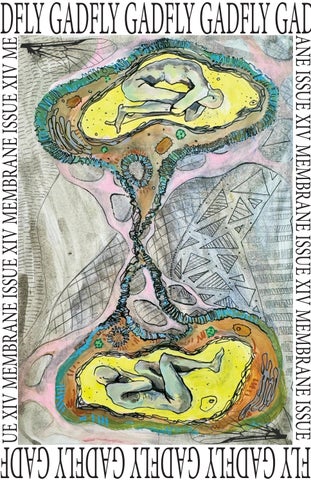
Bhattacharya, Giovanni Zantoni, Matthew Lombardi, Solomon Akaeze, Cia Zhou, Ava Lattimore, Fiona Hu, Lila Mae Zahmoul
Interview Editors
Yoav Rafalin, Elsa Debreu, Maddy Fine, David Jia, Gabriel Tramontana
Visual Artists
Angela Tang, Artemis Edison, Jimmy Liang, June Yang, Mim Datta, Sabina Vu, Theo Weiss, Yuxi Rui
A Defense of Obscurity, or Stones from Other Hills: Translating Judith Butler
Juntao Yang, edited by Tai Nakamura
Creating Meaning in the Face of Erasure
Nayantara Narayanan, edited by Telvia Perez
Organic States: Rethinking the Nature of Sovereignty
Finn Witham, edited by Anthony Hu
Towards a New Eroticism
Dominique Cao, edited by Anthony Hu
The Nature of Mystery and the Limits of Knowledge
Aharon Dardik, edited by Iris Wu
Philosophically, Men Should Pay on the First Date: Deconstructing the Myth of 50-50
Brittany Deng, edited by Sebastian Verrelli
To What Shall I Liken the World
Xavier Stiles, edited by Tai Nakamura
Against the Intrinsic Value of Truth
Mingqing Yuan, edited by Anthony Hu
Palliative Care: At the Membrane Between Life and Death
Matthew Lombardi, edited by Kelly Sung
Language: An Innate, Permanent Membrane
Giovanni Zantoni, edited by Priya Aggarwal
Open Relationships as Existential Experiments
Cia Zhou, edited by Kelly Sung
Restoring the Real: An Embodied Approach to the Attention Economy
Lila Zahmoul, edited by Ashling Lee
Dance as a Membrane: The Definiton and Dissolution of Identity Through Movement, with Andre Lepecki and Jason
Rodriguez
Elsa Debreu
Joanna Stalnaker on Endings and Enlightenment
Maddy Fine
Collective Futures: Contextualizing Coöperism through Contemporary Civilization with Bernard E. Harcourt
Yunah Kwon
I want to be Beautiful: A Look into Plastic Surgery from a Baudrillardian Lens
Fiona Hu, edited by Marly Fisher
Letter from
The Gadfly is, for official purposes, a magazine. But unofficially, it’s a lot more — it’s a collective of writers, editors, and creatives, a community through which ideas are debated and built upon. The membrane that separates what Gadfly is and what it isn’t is malleable. Gadfly is spatially diffuse; 716 Philosophy Hall is our official meeting place, but even in regular meetings, sections emanate down the late-night halls of the Philosophy building. Every editor, artist, and columnist at Gadfly takes their work to their homes, and the libraries across our community, as they work to create this magazine. Interview editors work with professors and professionals in numerous spaces across and beyond campus, and when Gadfly’s articles section solicits submissions from outside of the University, writers across the country submit their work to cross the membrane, and become a part of Gadfly. In weekly discussions, which are open to the
Columbia community writ large, the membrane that demarcates Gadfly becomes most permeable — and this permeability allows for some of the most thoughtful and provocative thought the Gadfly community develops throughout the course of the entire year.
As a campus philosophy magazine, we are constantly aware of the issue of exclusivity, and the rigid barriers which can prove impassable for scholars, students, and thinkers who find the journey to the inside of the membrane which is the formal practice of philosophy, impossible. At Gadfly, we value a plurality of ideas, and we seek to challenge our intellectual and aesthetic impulses in every issue, and in every discussion. While we maintain the membrane which separates Gadfly in many ways — we decline submissions, we accept a limited number of editors, artists, and columnists — we work every day to think about ways of changing,
the Editors
of growing or shifting, in order to continue the work of engaging with our community. What makes Gadfly what it is its malleability, its embrace of the challenging, the unknown and the ununderstood.
In this issue, we asked the Gadfly community to consider the idea of a membrane. We wanted the interpretation of this theme to be broad, and we found a multiplicity of interpretations, interdisciplinary connections, and creative explorations of the theme we thought resonated so strongly with the project of Gadfly.
Juntao Yang’s A Defense of Obscurity, or Stones from Other Hills: Translating Judith Butler accomplishes this goal by exploring the meaning of words - what they mean as they pass over the membrane of distinct languages, and how they change meaning as they cross over the threshold. Using their experience
translating Judith Butler into Chinese, Yang issues a defense of Butler’s complex and often arcane writing, positing that Butler’s diction is necessary to adequately express the phenomenon Butler wishes to describe without reifying our capacity to engage and describe the world. Exploring the works and ideas of Adorno, Benjamin, Deleuze, Brecht, and Hall, Yang explains how the lack of clarity used in Butler’s work and the crypticity of critical language as a whole transforms language itself into a membrane across which ideas permeate, allowing us to transcend our reality and give rise to new ideas not otherwise accessible with the hegemonic language we possess without it.
Whereas Yang’s uses the concept of the mysterious -- arcane critical language -- as itself an inherently illuminating mechanism that allows us to generate ideas that permeate through the membrane of language, Aharon Dardik’s The Nature
of Mystery and the Limits of Knowledge tackles the problem of mystery itself, exploring four distinct epistemological approaches through which different scholars have treated it and arguing for the acceptance of the fourth and final one, which asserts the necessity of mystery when it comes to discovering new truths - it, as Dardik puts, provides the method by which ignorance transforms into knowledge. In this way, mystery serves as the membrane through which all truths must pass over in order to be realized.
Mingqing Yuan’s Against the Intrinsic Value of Truth too explores the nature of truth - though whereas Dardik’s exploration of it at the very least implies an inherent value to its discovery, Yuan explores it from an axiological perspective that seeks to blow it apart. Developing counterfactuals set in the movie Lady Bird, Yuan explores the notion that knowing, contrary to our intuition, is not in all cases beneficial - and in so doing, bursts the epistemological membrane.
Finn Witham’s Organic States: Rethinking the Nature
of Sovereignty deals with a more tangible, less abstract subject - the reality of states, characterizing them as living membranes that extend their borders and grow via conquest. Touching on the works of J. L. Austin and Giorgio Agamben, Witham argues for the notion that Lockean theories of statehood misfire, and fail to provide for an adequate descriptor of the reality of interstate violence.
Yunah Kwon’s interview Collective Futures: Contextualizing Coöperism through Contemporary Civilization diverges from the macroscopic state entity by focusing on individuals as they exist in communities - speaking directly to Bernard E. Harcourt’s and his theory of coöperism. Throughout the course of this this interview, Kwon and Harcourt put the latter’s ideas into conversation with Foucaultian, Marxist, and Woolfian ideas, and elucidates on his vision for a society essentially characterized and dominated by democratic cooperation - envisioning a reality in which individuals operate conjunctively to form communities, that, much
like the membranes of cells, grow to address the problems around them without relying upon the body of a macroscopic state to coordinate their action.
Nayantara Narayanan’s Creating Meaning in the Face of Erasure: Cognitive Dissonance and Membranes within Ourselves shrinks the membrane, centering on the self rather than an abstract concept or state, though the question she deals with in her work is no less dire. Narayanan’s work centers on the pressing question of how we navigate the world, centering the epistemic problems brought about by the fear of the social erasure of one’s identity. She asserts that the cognitive membrane created by this sense of identity ossifies in response to the fear of erase, and pieces together the works of Fricker, Schopenhauer, Chomsky, and Sartre to develop a process that allows us to keep this membrane porous and dynamic, one which keeps our abilities to engage critically with the world from stagnanting.
Dominique Cao’s Towards A New Eroticism too explores the membrane as a locally
individuated notion. Whereas Narayanan’s approach suggests that we preserve the membrane, focusing on barring it from becoming impermeable, Cao argues that we ought to burst it. Cao takes Georges Bataille’s notion of eroticism - in which we, via the transgressive erotic action, transcend ourselves and the established orders that constrain our actions to the mundane, ordinary lives we live - and builds on it to center his idea on the notion of an epistemological membrane. Cao, urging us to defy the perfectionist and exhausting norms of our era, here calls for us to allow our own selves to rupture under the sheer wonder of the vastness of knowledge, to create for ourselves a life in which our minds are not used purely for techne, but to submit wholly to curiosity and to rediscover learning as a pure form of joy.
Giovanni Zantoni’s Language: An Innate, Permanent Membrane too engages with an epistemological membrane, but whereas Cao’s work centers on the individual blowing apart the membrane, Zantoni discusses the constraints
on the cognitive membrane in relation to language. Through the lens of the works of Chomsky, Nagel, Humberto Maturana, and Lera Boroditsky, Zantoni explores the notion that our cognitions are inherently bounded by language, exploring how various languages induce distinct effects on the cognitive states of their speakers.
Lila Mae Zahmoul’s Restoring the Real: An Embodied Approach to the Attention Economy explores the body as a membrane that encases and mediates the mind. Starting from her experience of the disorientation brought about by doomscrolling and the state of physical detachment that the attention economy induces, Zahmoul explores Merleau-Ponty’s idea of the individual as an embodied subject already existing in the world to ameliorate the alienation from the self induced by modern technology. Zahmoul’s synthesis of Merleau-Ponty’s ideas, she argues, allows us to avoid the inane blather such technologies produce, and enables us to not simply preserve the body as a regulatory membrane, but to
actually serve as a roadmap for a free society.
Elsa Debreu’s interview Dance as a Membrane: the Definition and Dissolution of Identity through Movement with Professor Andre Lepecki (a scholar of performance and dance studies at NYU) and Jason Rodriguez (a professional voguer within the ballroom scene) explores the body as well, this time exploring it through the lens of dance, taking it as a form of action that externalizes the individual and allows it to pass through the membrane of the self and permeate throughout the rest of the world. Throughout the course of the interview, Debreau, Lepecki, and Rodriguez discuss the relation between the dance and body, debating if, how, and to what degree dance can be held to be internal to the dancer, grounding the conversation in the theories of Foucault, Heidegger, and Freud.
Matthew Lombardi’s Palliative Care: At the Membrane Between Life and Death explores the membrane of life and death itself. Lombardi roots his work in his personal experience
with the medical system as the family member of an ill individual, specifically orienting it around the notion of palliative care, and calls for a radical philosophical reframing of the concept of healing as a whole. Using the writings of Foucault, Weil, and Heidegger, Lombardi issues a philosophical defense of palliative care against the current hegemonic system of medicine, and argues for an application of the basic principles of palliative care to all, even those who are not physically ill.
Fiona Hu’s I Want to be Beautiful: A Look into Plastic Surgery from a Baudrillardian Lens too engages with philosophy in a medical context, exploring plastic surgery through Baudrillard’s theories of semiotics. Hu argues that such procedures, originally intended as a corrective under extreme circumstances, have warped and distorted into a cultural ethos that seeks to annihilate reality, to become signs that are wholly abstracted from their original objects. In this way, Hu argues,
we have slaughtered the membranes that are our bodies - they are dead, no longer projecting beauty without undergoing so much distortion that they lose their original form.
Brittany Deng’s Philosophically, Men Should Pay on the First Date: Deconstructing the Delusion of 50-50 too deals with the concept of the perversion of reality, though Deng’s work focuses directly on a particular mode of social interaction - the first date. Deng argues here that the implicit expectation some men have of splitting the bill ought to be regarded as a form of moral gaslighting, whereas the notion that men should be expected to pay the initial bill is the rational product of patriarchal social conditions. Using the work of Kate Manne, Deng characterizes sociological conceptions of gender equality as a sort of membrane, wherein the implicit expectation of a shared bill brings about a state of affairs in which women’s emotional and domestic labor passes through unhindered while men’s responsibilities are selectively blocked,
preserving the façade of equality.
Maddy Fine’s interview On Endings and Enlightenment with Professor Joanna Stalnaker on her recently published book The Rest is Silence explores the Enlightenment in a retrospective capacity; it too takes a feminist approach to the topic of membrane, keying in on the thoughts of Madame du Deffand, a once well known salon hostess and pessimist philosopher. Her fear of death and her attempts to grapple with led her to conceive of perception of the notion of death as a gradual process through which one moves through the progressive membrane of boredom, which she regards as “the foretaste of nothingness,” a sort of precursor to death. Madame du Deffand’s fear of death - spurred on by her lack of belief in God and her belief in the experience of death as a paradoxical sort of preview of oblivion - is a notion explored by other scholars of the Age of Enlightenment; Stalnaker and Fine talk at great length about Voltaire, Hume, and the Comte du Buffon, just to name a few.
Xavier Stiles’s To What
Shall I Liken the World? is a piece that, much like Fine’s, explores the nonbeing of the self - but whereas Fine and Stalnaker discuss du Buffon’s idea of the individual fading away as they die, Stiles operates from a tradition that categorically denies that it ever existed at all. Citing the works of Dōgen and Thich Nhat Hanh, Stiles explores the Zen Buddhist doctrine of dependant origination and the inevitable consequence that it reaches - the whole rejection of a unitary, monolithic self - and calls for us to reject individual egoism. This view, as per Stiles, ought to push us towards a view of the world that accepts the truth of interbeing, one in which self is no longer a rigid, isolated entity but a wholly porous membrane, continuously interacting with and permeated by the world around it.
Cia Zhou’s Open Relationships as Existentialist Experiments too explores the porous membrane in a social capacity, though Zhou’s work keys in on a very specific and perhaps more controversial form. Zhou’s piece investigates the underlying philosophy of
Simone de Beauvoir’s relationship with JeanPaul Sartre, exploring the notion of their relationship as being essentially representative of Beauvoir’s writings, and arguing that open relationships allow for a unique degree of freedom that closed ones do not.
The writers, editors, artists, and creatives who have made this issue possible have challenged and explored myriad ideas and disciplines. This work buttresses, just as much as it destabilizes, the deepest questions of what makes the Gadfly. By engaging critically with institutions, conventions, language, the self, and more through the lens of the membrane, this issue attempts the difficult work that defines our magazine, and our community.
Every issue of the Gadfly serves as both a body of work, and as a marker of the end of another semester. The membrane which demarcates the Gadfly as a magazine and a community, grows, morphs, and shifts with each iteration. We humbly thank the contributors and
thinkers who have defined this issue - and this period of the Gadfly - as we look to its future.
Best,
Eitan Zomberg & Ray Knapick
A Defense of Obscurity, or Stones from Other Hills: Translating Judith Butler
Juntao Yang
Edited by Tai Nakamura
As a writer and a researcher, my most restless moments come when communication clogs. The air tightens, the body itches, and I am desperate to open a passage. I long to understand and to be understood, to reach a fluency that could pierce the membranes between languages, cultures, and minds. This desire is hardly mine alone, yet it has a peculiar consequence: clarity becomes a fixation, an obsession, as if meaning were a pane of glass that could be smoothed in a single stroke between two ends. The goal begins to look obvious—eliminate the fishbone that might catch in the throat during exchange and translation. But the discomfort persists, and moments of failed expression seem only to multiply in an age of ever-smarter translation tools. Sentences start to burn, blur, and give off a sour smell; strange words rub against habit, their coarse grain keeping me awake at night.
This is precisely the touch of the membrane—a metaphor that constantly haunts the discipline of media studies where I am situated. The medium, as a membrane, is an entity between two things, “a thin, practically invisible kind of tissue... that both separates and connects distinct domains, permeable
and impermeable at the same time.”1 The membrane controversially implies or presupposes that the world consists of two sets of objects or subjects, while it participates in mediating their onto-epistemological tension. However, as a third party, the membrane is both necessary for the task of perception and potentially hinders utopian immediate access to the real thing. In other words, it is considered essential for the act of mediation, yet in its long history, it has also been seen as a nuisance that needs to be improved to be as neutral, invisible, and non-interfering as possible. As we can realize, language is always a membrane: it excludes the environment, filtering in only what the system needs for survival; its verb forms are “enclosing,” “shielding,” and “filtering”.2 Thus, the ideal of eliminating it always lingers, demanding attention.
In my own experience, this mix of desire, anxiety, and linguistic burden came to a head as I translated essays by Judith Butler into Chinese. Butler—so often a recipient of the notorious “Bad Writing Award”—already signals a difficulty of transmission. Translating Butler makes me uncomfortable: terms like sex and gender refuse smooth equivalence, and these hard
terms seem to exceed the local language’s carrying capacity. In a way, this is an intentional difficulty, as Butler has always aimed to play with the internal tensions of language and the stubbornness of its boundaries: in 2003, she published “The Value of Difficulty,” an (ironically) clearly structured and elegantly worded defense of the “obscure” and the “unclear,” which, in a different key, revisits this very obsession with clarity and fluency. There, Butler stands with Adorno (and, indeed, the literary modernists), whose view is that since language—especially reactionary traditional language—has already prescribed a hegemonic scheme for understanding and describing the world, making us ventriloquists for language through “common sense,” critical language must deploy alternative, novel vocabularies to challenge, disrupt, and set itself at a distance from everyday usage.3
However, although Adorno correctly identified the power of alienated language to break through the multiple blockades of hegemony in cultural traditions and everyday vocabulary, Butler notes that in his correspondence with Benjamin he also sanctified the clarity of totalizing interpretive frameworks and theoretical abstrac-
tions (deployed against the totalizing culture industry) in ways that could become toxically authoritative. He downplayed metaphors that are not limpid, that detour and delay—precisely those figures Benjamin regarded as “theory in the strictest sense.” Like Benjamin, Butler laments that Adorno never grasped how metaphor is the means by which concepts are realized; in this respect, he reverted to the position he criticized.
Regardless, from this starting point, Butler explores a paradox dear to the left: “mass-accessible” language often turns out to be the very idiom through which rulers secure hegemony. The pursuit of clarity and universality can itself congeal into a new hegemony—the utopian ideal of no membrane alienates itself into a fascist state that rejects the foreign. In this sense, “obscurity” becomes an ethical posture of respecting the other’s unknowability—and thus their unmasterability. I suggest we accept a counter-intuition here: a sentence that reads too easily often sands down the friction the theory depends on. A line that resists domestication slows, hardens, even feels impolite—and that is where critique begins.
For me, Butler’s article is an
important warning: be wary of reading and writing that move too smoothly, and be wary of demands and limits that blunt the provocations of language. This article asks us to understand that: clear language means language that is already familiar. This language weaves the methods by which we describe the world; therefore, it is, in fact, the grammaticalization of ideology. We establish our relationship with the world by acquiring vocabulary and grammar; in other words, we are constructed by language—Interpellated, as Althusser would say—as subjects.4 When we use fixed language, it means we can only see and describe predetermined perspectives of the world, and these limited perspectives are precisely what those in power want us to see. The key questions are: Where does the signifying chain break? And how can it be skillfully broken?5
An important case is evidently the translation of “gender” and “sex.” Modern Chinese (and some Indo-European languages) cannot directly translate these two concepts, 6 leading to many peculiar, even bizarre, translations in different versions. Yet it is precisely this alienation or invention of terms—this fishbone in the throat, this discomfort— that makes us truly notice their
distinction and constructedness. This is a Brechtian alienation effect.7 More importantly, this also makes us reconsider the metaphor of the membrane, but no longer as an antagonistic barrier. Instead, it shifts attention to its porosity: a dynamic mechanism of differentiation, internalization, and self-reference, which allows partial penetration at the ambiguous boundary, complicating communication with elastic resistance, and allowing heterogeneity to enter language itself, embedding division and barriers within it, transforming it into a generative site. The porous version of the membrane allows for the imagination of a medium that neither isolates from difference nor flows unimpeded in assimilation, but rather negotiates coexistence in difficulty, or, an ethical proposal for practicing listening in vulnerability.8
This paradoxical posture holds a dangerous productivity, or—if one turns to a more unstable lexicon—a seductive force of creation. We need “stones from other hills”—forgive me for using an uncomfortable, foreign term to make this very point— tā shān zhī shí(他山之石), a Chinese idiom that names how rough material from elsewhere grinds and sharpens what is at hand. It is precisely this foreign,
resistant, and even awkward language that provides the abrasive needed to tackle hard problems. And this stone—let me guess, a porous volcanic rock generated in the earth’s breathing-like geological process—penetrates the boundaries of things. In fact, when Benjamin, on the rugged landscape of Naples’ coastal cliffs, sought out the interpenetrating, layered architecture growing upon it and the surprising lives of its inhabitants, he approached the same porosity we jointly pursue with the same geological mindset.9
When parts of the contemporary left assume that mass or common-sense language constitutes the proper “mass line,” we may need to return to queer
theorists and even literary modernists to imagine a queering of language and thought at a time when political speech is being flattened and vulgarized and an obsession with clarity and communicability grows by the day. In fact, as I briefly mentioned earlier, a utopian imagination of total transparency and perfect cleanliness—an effort that seeks to purge impurities and purify its contents—has often become fertile ground for imperialism and fascism. Consider the Trump administration’s self-proclaimed “immune system” of exclusionary political operations, and how its sprawling walls are built upon an imagined regime of shared language, profitable circulation, and seamless exchange. Here, the membrane is
sealed and rigidified, the ideal of no obstruction is converted into a refusal of understanding, whereas understanding is always difficult, dialogical, and asymmetrical, unfolding over time.
This makes me increasingly believe that our moment’s crisis partly stems from such a fixation on clarity: it powers a machinery of exclusion and conversion that forges untranslatable moments—pains still in formation, grievances that evade classification, exceptions that demand to be heard, and lexicons cast out as non-kin— into polite, well-behaved language fit for an orderly system. When a language expected to be “universal” establishes hegemony, it signifies the peak of this paranoia. Of course, I agree that a single hegemony does not exist, but the word “hegemony,” in the sense used by Hall, signifies a certain cultural and linguistic dominance, even if it is temporary and domain-specific.10 To challenge the fabric of hegemony in a specific domain, we must introduce and generate strange, new, and therefore revolutionary languages from the subtle pores of the membrane.
These languages are first and foremost languages of resistance, existing in corners, even
outside the system: they are the languages of the poor and lowly, of slaves, of the mad, of the resentful. It is not that language is inherently critical, but that rejected languages reveal the fissures in the system, and the failures of the metaphors they seize. Standing on the side of the language of resistance, like Butler, gives us the opportunity to grasp this critical potential— these resistant, marginalized, and uncomfortable languages disrupt the seemingly seamless membrane of hegemonic language. This is what de Certeau called the “guerilla tactics” of everyday discursive practice.11 The key is to discover the non-everyday languages that are subtly excluded yet always loom at the edge of our vision.
The system is not seamless, and the language system is no exception. It is through the system’s inherent loopholes and fissures that we can possibly escape. Therefore, beyond the languages of resistance, there are also anonymous languages, which are precisely the chaotic infinity that leaks through the membrane. Although it seems to come from another world, it steals legitimate forms from within the system (existing codes and grammar). Thus, it is not completely incomprehensible like garbled code, allowing
us to approach understanding through great effort and guiding us to see the boundlessness beyond the system. Furthermore, I believe that even garbled code and glitches are still beneficial for critique, as they indicate where the system fails, thereby undermining its assumed validity and authority.12
These languages, leaked through the porous membrane, sometimes even transcend our control, making it seem as if they are speaking themselves through our bodies. I do believe that we are, to some extent, ventriloquists for our language. It is not that we speak language, but that language pre-stages our actions, our thought patterns, and our analytical postures. Therefore, to some degree, we discover a true generation, where language not only escapes the control of hegemony, but even our own control. We certainly understand that this would be a language that makes us uneasy, because it is clearly difficult, hard to explain, ambiguous, and metaphorical. The immense energy they contain, which makes even us feel uncertain, can indeed shake the foundations of familiar and everyday language. These emergent, unruly languages also prevent critical language from becoming jargon within a discipline, or even part
of everyday language hegemony. As Deleuze argued that the philosopher’s job is to constantly create new concepts and new grammars, 13 a permanent revolution of language is also a necessary, continuous rebellion and transgression, so that in this constant dynamic, language does not return to rigidity.
One final point must be considered, a potential criticism: If any clear attempt to describe and represent the other is an offense, then what we should do is not use confusing language to describe the other, but rather resort to complete silence, because no matter how obscure, a definition is still a definition and will “harm” the other. I think this is indeed the case: I believe silence is a better virtue than the obsession with clarity. However, Queer language has its own function, chief among them being disruption—it tells us that outside the membrane, other possibilities exist. Therefore, critical language is sometimes not an arrow pointing to its signified; on the contrary, it may be a latent metaphor, a mysterious force, a subtle intervention, oscillating between two ends, heralding what is to come. Perhaps, I must admit, critical clarity exists, but to continue using familiar language is to submit to a hostile agenda, a geo-
political move that transforms a living membrane into a wall or barrier. This rhetoric itself implies that everyday language is a flat street on which people walk freely. But this is not the case. The deceptiveness of this very notion is what Butler wants to address—some people are not allowed on the street, and some destinations are unreachable by any street. For this, we must trudge through the mud. Critical reflection is indeed difficult, but this is precisely the purpose of a humanistic education. The current era’s rejection of the liberal arts is precisely an attempt to eliminate the opportunity for people to be “trained.” We must rise up and resist. To choose difficulty is not to celebrate obscurity for its own sake, but to affirm—as Butler argues—the very terrain where thought can remain unfinished and therefore alive. We must find another path.
Endnotes
1 Van den Boomen, Marianne. Transcoding the Digital: How Metaphors Matter in New Media. Amsterdam: Amsterdam University Press, 2014.
2 Strate, Lance. “On the Binding Biases of Language and Other Media.” In The Arts and Play as Educational Media in the Digital Age, edited by K. Forsfelt and P. Örtenholm, 191–206. Stockholm: Stockholm University Press, 2017.
3 Baudry, Jean-Louis, and Alan Williams. 1974. “Ideological Effects of the Basic Cinematographic Apparatus.” Film Quarterly 28, no. 2 (Winter): 39–47. https://doi.org/10.2307/1211632.
4 Althusser, Louis. 1971. “Ideology and Ideological State Apparatuses (Notes Towards an Investigation).” In Lenin and Philosophy and Other Essays, translated by Ben Brewster, 85–126. New York: Monthly Review Press.
5 Lacan, Jacques. 1966. “The Insistence of the Letter in the Unconscious.” Yale French Studies, no. 36/37: 112–47.
6 de Lauretis, Teresa. 1987. “The Technology of Gender.” In Technologies of Gender: Essays on Theory, Film, and Fiction, 1–30. Bloomington: Indiana University Press.
7 Brecht, Bertolt. 1964. Brecht on Theatre: The Development of an Aesthetic. Translated and edited by John Willett. New York: Hill and Wang.
8 Zeković, Miljana. 2025. “On Slow-
ness and Spatial Ecology: Reflections from the Montenegrin Pavilion.” e-flux Architecture, June 18, 2025.
9 Benjamin, Walter, and Asja Lācis. 1978. “Naples.” In Reflections: Essays, Aphorisms, Autobiographical Writings, edited by Peter Demetz, 167–76. Translated by Edmund Jephcott. New York: Harcourt Brace Jovanovich.
10 Hall, Stuart. 1981. “Notes on Deconstructing ‘the Popular’.” In People’s History and Socialist Theory, edited by Raphael Samuel, 227–240. London: Routledge & Kegan Paul.
11 de Certeau, Michel. 1984. The Practice of Everyday Life. Translated by Steven Rendall. Berkeley: University of California Press.
12 Russell, Legacy. 2020. Glitch Feminism: A Manifesto. London: Verso Books.
13 Deleuze, Gilles, and Félix Guattari. 1994. What Is Philosophy? Translated by Hugh Tomlinson and Graham Burchell. New York: Columbia University Press.
Creating Meaning in the Face of Erasure
Nayantara Narayanan
Edited by Telvia Perez
Isit across from a woman on the subway. Mid fifties, eyes smudgily lined with kohl, blending into her dark circles. Her eyes are glazed over, and she seems not to notice the train rocking her back and forth. I create a story for her- on her way to a dead-end job, taking care of an unappreciative family, losing her “wholeness” little by little. As I watch her, her face transforms into mine but older- an image of myself in a few decades, lost in her service to others, forgotten by the world around her. I feel a sudden, visceral fear- one as intrinsic and old as life itselfthat my story, my life, my innermost self would become invisible, unimportant even to myself, overwritten by shifting social criteria. This fear gives way to a primal need we all have - to craft a sense of meaning when the world threatens to erase us or consider us unimportant, shifting our self perception to meet the inherently discordant idea that we are, among other people, considered unworthy of being remembered, understood, or acknowledged. I argue that when this sense of meaning is created, it creates a powerful cognitive membrane around
it, wherein this erasure hardens into a shield, rejecting anything that threatens the identity created in response to societal erasure. The way we respond to that, interrogate it, and practice organized inquiry, then, is how we come to understand and overcome our biases.
How, then, does this erasure happen? Miranda Fricker, in “Epistemic Injustice: The Power and Ethics of Knowing” discusses the harm that is done when somebody is wronged in their capacity of knowing their own lives or experienceswhen they are not given adequate credibility, respect, or understanding for their claims and lived experiences. The harms of this denied credibility, based on politics, power, and marginalization, are crucial to understanding the experiences of those who consider themselves “erased,” She explains two key forms of epistemic injustice: testimonial and hermeneutical.
Testimonial injustice occurs when a person’s word is discredited, doubted, or dismissed due to
prejudice, often based on gender, race, disability, and/or other marginalized identities. Consider the woman on the subway, now perhaps at a job, being refused more paid time off when she describes her difficulties with raising children- being laughed out of the room for complaining about a perceived biological duty, not recognized as a credible witness to her own experience. Hermeneutical injustice is, in some ways, more sinister, since it occurs when people lack the language to make sense of their own experiences, having never been allowed by collective social frameworks to develop the resources to communicate them. Here lies a central connection between moral value, knowledge, and power- not having the power to understand and communicate your own experience allows there to be less moral value placed upon it, even within yourself. The sense of “erasure” becomes internalized, further cemented by socially shaped memories and dominant socio-political frameworks that inform what is important, and what is devalued.
Frederic Bartlett’s theory of reconstructive memory argues not only that memory is socially shaped rather than fixed, but also discusses how memories build atop one another. He postulates that memory is constantly reshaped by personal, cultural, and social frameworks that influence what is remembered and given room to speak. Notably, these dominant narratives are internalized, even by those they are built against, who often are not given the tools to recognize and communicate their experiences outside of it. Like a membrane, memories too can become porous, absorbing what dominant stories allow inside. The reconstructive nature of memory means that injustice and enforced silence become embedded, not just in history, but in self perception. While memory and deconstruction of one’s experiences within such systems can certainly be a form of resistance and reclaiming the narrative (whether through memoirs or activism through oral history), this “erasure” does have a tendency to permeate quite deeply.
It is incredibly easy, in the face of this socially constructed epistemic injustice, after having one’s pain ignored or disbelieved in whatever way, to slip into cognitive dissonance as a protective shield- a cognitive membrane, so to speak. What begins as social erasure hardens into an inner shield- a refusal, or inability, to confront one’s own pain and the factors that caused it. Often, the way to bring some sort of meaning to the pain caused by this systematic devaluing of one’s story, is to try to bring oneself back into the fold, so to speak, of importance and acceptance. In order to regain a sense of socially approved importance, one creates a “borrowed identity,” that borrows from social norms and values and helps reestablish a sense of meaning in a world that denies your authentic experience legitimacy. When one becomes attached to this identity, any threat to it causes them to double downfor that cognitive membrane to become a wall.
Arthur Schopenhauer’s notion of the “thing in itself” serves at the heart of his exploration and
critique of borrowed identity, and the role of external factors underlying our sense of self. Schopenhauer’s “thing in itself,” borrowed from Kant, essentially argues that beneath all appearances, there is an ultimate and unknowable essence that underlies all phenomena- what we will, in this case, interpret as an authentic self. It is atop this essence that individual identity is built, shaped by social constructs, norms, and hierarchies, which Schopenhauer sees as socially mediated “phenomena-” roles created from values we consider socially important. This “borrowed identity,” I would argue, is shaped by a desire to exist securely in a world of ever shifting norms and requirements- a shield used to regain autonomy in a society that denies you importance if you do not play along with its fabricated conditions.
There is a sense of importance and security associated with this “borrowed identity” that forms what is essentially a cognitive membrane, protecting that constructed sense of self from any threat that may
challenge it. When there is some kind of perceived threat to this identity, that cognitive membrane hardens, and one doubles down on that identity, even if it may ultimately harm them. Let us take an example: the story I created for the woman in the subway, extended.
There is a girl who, from the age of six, once her sense of self started to become built, is informed both explicitly and implicitly what her place in the world is. She watches her brothers being given preference over her when it came to education and his opinions and experiences being given importance. She watches her grandmother, her mother, and eventually herself being relegated to domestic tasks, whether in the kitchen, cleaning the home, or providing silent uncomplaining emotional support to the men in their lives. She spends her whole life having her sense of autonomy and agency swept under the rugs, and following the social norms she was given- marrying who she was told when she was told, dedicating herself to building a family, unpaid and unappreciated domestic labor. There is no real way
out of the discomfort she feels without breaking the existing social laws and hierarchy, and facing the consequences and resulting ostracization, and she was never given the tools or resources to either communicate her experience and have it taken seriously. As a way to deal with this, she constructs an identity around it- viewing herself as a feminine ideal, adopting ideas of biological determinism, learning that this is what she was made for. She internalizes this identity, and clings to it, even if it is one that causes her harm.
When she has a daughter, she continues to teach what she has now internalized as her identity and purpose- values like dedicating oneself to the home over individual ambitions or opinions that would not get taken seriously anyway, marrying early and starting a family. When her daughter begins to deviate from and question these norms- going to college, marrying late, prioritizing a career- she reacts defensively. She says that it is to protect her daughter from a world that will not take her seriously, to protect her from the social consequences of
deviations- all of which are true. A large cause of this, though, is a hardening of that cognitive membrane around that borrowed identity which, when threatened, she defends passionately. This mechanism comes to play when any internalized belief is threatened - an immediate sense of defensiveness.
At what point does that “thing in itself” become completely enshrouded by the borrowed identity, with its deep associated feeling and the cognitive walls that are built around it? And how does one reach back into oneself and come to terms with that identity as a construction? Schopenhauer suggests “honest solitude” as a solution- taking on the uncomfortable process of facing one’s insecurities, illusions, and wounds. This could be through self reflection, writing, or any similar critical engagement with the world around you and with your “inner world,” as a way to break through that hardened cognitive membrane. The woman retreats into a solitude of sorts, away from the structures that inform her borrowed identity, and learns
of a world beyond them. She interrogates her world and beliefs, and reaches, albeit in a deeply individual way, a more authentic version of herself. But this excludes a crucial aspect of the building of a self, and that is the social. The path inward doesn’t obliterate our need for fellow witnesses; even honest solitude is shaped by the world we leave behind.
Noam Chomsky, in his exploration of “self bias” in a broader body of work on propaganda and ideology, addresses how the internalization of the interests of broader social powers lead to a filtration of narratives within one’s own mind to align with them. He discusses our cognitive tendency to interpret information, judge situations, recall memories, and create narratives in a way that favors one’s own self, perspective, or group (whose social interests we have internalized), and we are prepared to defend itoften by villainizing those who threaten it. On a group level, this tendency could materialize as national, institutional, or cultural biases. Individually, it could mean self-censorship when one’s thoughts deviate
from the existent norms these groups establish, or minimizing harm caused by your own group or perspective.
While Chomsky’s analysis focuses on behavior occurring at the broader political scale, this framing is also useful when exploring how identity and the individual self are constructed socially, the way our individual meaningmaking aligns with social and political interests and power, and our defensiveness when our internalized narratives are threatened. Even the knowledge and media we consume clings to the cognitive membrane formed by predominant narratives, slowly making it more impermeable.
When we do begin to unpack these narratives, we run into another problem. Even if, in one way or another, one becomes aware of their biases or the implications of their constructed identities, it is easy to call into the “peril of bad faith” a way to avoid confronting reality as it is, essentially by adopting convenient falsehoods and rationalizations. This could look like convincing oneself
that external circumstances, roles, or inherited frameworks are absolute and unchangeable, denying one’s agency and capacity for choice.
The idea of the “peril of bad faith” is rooted primarily in existentialist philosophy, particularly in the work of Jean-Paul Sartre, whose discussion of “emotional armor” is relevant to our discussion of cognitive membranes formed by Chomsky’s “self bias,” in that they protect the self from the discomfort that comes with making choices in a world that is inherently hostile in its meaninglessness, and therefore requires some meaning-making (whether this be through the denial of one’s own agency or the internalization of popular narratives). Refusing to face the truth of one’s agency in a situation undermines true autonomy and Schopenhauer’s “thing in itself” by creating a false narrative (or “borrowed identity”) leading to self deception on both a broader institutional level (as Chomsky explored) and a more personal one. It is an easy pitfall to fall into, especially
when interrogating your constructed identity- one can become overwhelmed by the magnitude of personal responsibility and disillusionment felt, especially when doing so alone, in “honest solitude.”
Where do we go from here? There are certainly ways to rise above these pitfalls. The practice of “intellectual self defense,” as Chomsky conceived of it, provides some answers- critically engaging and interrogating mainstream narratives, being aware of manipulation, scrutinizing one’s own beliefs. When considering broader group norms and challenges and the issues that arise with “honest solitude” and the perils of bad faith, I find that one of the most important methods of intellectual self defense is the practice of organized inquiry. While certainly important, genuine independent thought can be difficult alone, and engaging purely with people with your perspectives and holding the same narratives and biases can lead to echo chambers and a further hardening of the cognitive membrane. It is engaging with different perspectives and experiences, and
taking part in a collective investigation of a system that leads to the most striking change. Resistance to our hardened cognitive membranes and the fabricated social code begins in dialogue - in naming what was previously silent, in sharing memory not as undeniable truth, but as a witness. The woman on the subway starts to ask questions; why must domestic labor always fall to her? Do arguments of biological and social necessity really hold up? Are her narratives necessarily the right ones? She begins discussing this- not just with other women like her, but with people who do not hold the same narratives and internalized beliefs as she does- and she listens. She is finally given the tools to understand and interrogate her long held beliefs, and to communicate her experience. As one understands one’s contexts and beliefs outside of their own echo chamber or doubts, they are able to ask the questions that always seemed unanswerable. Defenses lower, cognitive membranes relax, and slowly, the layers fall away.
Organic States: Rethinking the Nature of FinnSovereignty Witham
Edited by Anthony Hu
An organized political community—a state— can be thought of as a semipermeable membrane extending over a specific geographic area. Much like cells, states throughout human history have been organic and fluid; spawning, expanding, metastasizing, contracting, and ultimately dying in a never-ending cycle on Earth’s surface.
The cellular innards of state-membranes are more complex: who is in and who is out? What is the constitution of a state-membrane’s ruling nucleus? How should the various organs and peoples within a state-membrane be organized? Since its inception in antiquity, much of political thought has been focused on these thorny questions. To speak of sovereignty was to speak of the sovereign within the state: who they were, by what means they ruled, and towards what ends. Yet, all the while, from the moment Homo sapiens first forayed beyond their place of origin, it was taken as a given that organized groups of people existed in a dynamic and unsettled relation to one another, with state-membranes dividing and shrinking here, fusing and growing there.
Thus, while the agent of sovereignty within states remained a
matter of perennial contention, an implicit right of conquest was recognized in interstate relations. The territory a state was capable of holding—ultimately by offensive and defensive martial means—was considered the extent of its membrane and the area of its sovereignty. I call this the Naturalistic Conception of Sovereignty: a positive and intuitive account which defines a sovereign state by its ability to hold territory across the dimensions of space and time, ultimately by martial means. It was not until early modernity that the injection of new visions of sovereignty into political thought complicated this account. The advent of liberalism in the work of 17th Century English philosopher John Locke fractured the relationship between theoretical legal sovereignty and reality.
Locke’s Second Treatise of Government is a systematic redefinition of the origin, function, and law of state-membranes; an extension of his rebuttal to Biblical defenses of monarchy in the First Treatise. Since antiquity, it had previously been understood that—regardless of who rules within a state—humans inevitably organize themselves into communal structures that operate as quasi-organisms. As Aristotle notably declares in his
Politics, “man is a political animal” because “the city-state is prior in nature to the household and to each of us individually.” Our lives begin in dependence to our mothers and families and, from this moment on, we are molecularly bonded to others. Like our primate cousins, we survive in nature only by organizing ourselves into protective cells.
Yet, Locke—radically redefining the state of nature—flips this conception on its head. Where Aristotle found phenomena in nature, Locke finds rights. He conceives of nature as a state of “perfect equality,” where “men [have] perfect freedom to order their actions and dispose of their possessions as they think fit... without asking leave, or de-
pending on the will of any other man.” Thus, while Locke recognizes that all land is originally held in common, he asserts that “every man has a property in his own person” and—because “this nobody has any right to but himself”—the “labour of his body, and the work of his hands, we may say, are properly his.” For Locke, then, land only comes to be held by any human if it is removed “out of the state that nature hath” left it in and thereby becomes “property.”
Shattering the state-membrane, Locke turns people into a set of autonomous atoms, each with their own idiosyncratic claim to only that land they have turned from wilderness to cultivated property. For him, all claims to land are necessarily dependent on the labor of a proprietary
individual, not the community’s protection.
Whence, then, comes the state for Locke? Again inverting the notion of political animality, he writes:
“Men being, as has been said, by nature all free, equal, and independent, no man can be put out of this estate and subjected to the political power of another without his consent. The only way whereby anyone divests himself of his natural liberty and puts on the bond of civil society is by agreeing with other men to join and unite into a community for their... living one amongst another in a secure enjoyment of their properties, and a greater security of any that are not of it.”
Locke’s state—far from being a living entity unto itself—becomes a contract, numbers on a piece of paper, an account of who owns what. Here, he develops what I call the Liberal Conception of Sovereignty, whereby a state is defined as sovereign over its territory if and only if said territory is constituted of legitimately owned property and, further, if and only if said state exists as a contractual relationship among its proprietors.
Compared to the prior Natural-
istic Conception of Sovereignty, Locke’s Liberal Conception has radical consequences for the understanding of interstate relations. Where the right of conquest was previously implicit, Locke writes, “the aggressor, who puts himself into the state of war with another, and unjustly invades another man’s right, can, by such an unjust war, never come to have a right over the conquered.” Because his sovereign state can only comprise property, Locke denies that an aggressive state actually gains sovereignty over conquered territories: Stolen property is no property at all.
Herein lies the fatal flaw in Locke’s Conception, which draws conclusions from premises that are not factual statements, but normative assertions. That a man ought to have the right to the fruits of his labor does not mean that he does maintain ownership of his property in the case of theft or invasion. That a conquering state ought not to have the right to rule conquered territories does not mean that said state does not possess de facto political control over them.
Instead, the Liberal Conception contains a series of something philosopher of language John Langshaw Austin would later
label “performative utterances”: sentences that hold no truth-value in themselves, but instead are declared in order to modify reality in some normative way. Austin’s classic example of a performative in law is the utterance “‘I do’” in a marriage ceremony. This performative depends on a pre-existing “procedure”—here marital ceremonial convention and contract law—that is “executed by all participants correctly [and] completely.” The problem with performatives is that they only obtain if this occurs: In the case where one partner says ‘I do’ and the other says ‘I don’t,’ or when the state fails to properly enforce the marriage contract, the utterance ‘I do’ no longer has the force of actually marrying two people. As Austin states, “the utterance is classed as a misfire because the procedure invoked is not accepted,” as “persons other than the speaker” do not execute the conventions.
Thus, when Locke identifies, as a “law of nature,” that “no one ought to harm another in his life... or possessions,” he utters performatives. Asserting a ‘right to life’ misfires unless someone is actually able to continue surviving and defend themselves or be defended against mortal threats. Asserting ‘rightful property’ over some land misfires
unless the purportedly rightful owner actually is the person in possession of that area.
The trouble with the Liberal Conception of Sovereignty, then, is that history is littered with violations of its performative definitions. The existence of a state-membrane does not actually depend on how its population uses its territory. It does not depend on the normative value of its systems of governance and wealth distribution. Nor does it depend on how its territory was acquired. In short, the Liberal Conception purports to define what state sovereignty is when, in actuality, it defines what it ought to be.
By contrast, our earlier Naturalistic Conception concords with reality: a state can only be called sovereign over some territory T if it both (1) exercises its political authority over the entirety of T; and (2) can hold and defend the entirety of T against the martial threats of any other state.
Why, though, in defining sovereignty, should we use this positive evaluation? Shouldn’t we just adopt the Liberal Conception of Sovereignty, and then agree to agree on it? Not if we care about truth: Because humans are alive and kinetic
and animal, we never all agree. Thus, saying it does not always make it so. No normative laws are inscribed in the infinite, mindless superflux of nature. Ultimately, Locke’s core fallacy is this very conflation of normative law with natural law. Far from being an inherent given, any utterance which depends not on its being true, but on its being agreed upon and carried out, can only hold within a system of human law.
To understand why this is the case, it is necessary to consider the way law actually functions. When a state establishes some performative law—say, the right to property—a procedure must exist over and above those subject to that law to settle disputes as well as to prevent violations or rectify them should they occur. In cases of chronic violations—say, a repeated trespasser or burglar—the state must exercise force to maintain the law. Thus, any state must necessarily be able to both establish and enforce its own law.
It is because of this capacity to determine the law that the Naturally Sovereign state, in order to ‘exercise political authority’ over its territory, must exist above and beyond the law. As political philosopher Giorgio Agamben—expanding on the work
of Carl Schmitt—illuminates in his 1998 book Homo Sacer: Sovereign Power and Bare Life, “The paradox of sovereignty consists in the fact the sovereign is, at the same time, outside and inside the juridical order... the sovereign is truly the one to whom the juridical order grants the power of proclaiming a state of exception and, therefore, of suspending the order’s own validity.” Drawing on the atavistic Roman punishment that designated a criminal homo sacer—a “sacred man” who could be killed with impunity but was prohibited from being used for ritual sacrifice—Agamben explains that the state, by virtue of its power over law, decides who is subject to the legal order and who is not. While full citizens may participate in legal and political life (what Agamben calls bios or “qualified life”), those who are not, like the homo sacer, are thereby subjected to zoe or “bare life.” Those within a condition of bare life are in the state of exception: They are not subject to the law of the state, but they are nevertheless still subject to the state, as they exist within the bounds of the state-membrane.
The epitome of bare life is the condition of interstate conflict or war. When two states war over the same territory, they
each suspend their own laws; neither respecting the rights of enemy combatants they otherwise afford to their own citizens, nor prosecuting their own combatants for what would otherwise be criminal violations. When state X advances into the territory of state Y during the course of a war, it thereby becomes sovereign over that portion of Y, not by exercising law, but by subjecting that area to bare life via extralegal force.
This reality conclusively demonstrates the fallaciousness of defining sovereignty by law or right. Any normative legal right can only be upheld inside a state-membrane, where the Naturally Sovereign state creates and defends the conditions for its execution. This does not mean that all Lockean liberal rights—performatives though they may be—are necessarily invalid. Indeed, Aristotle himself recognized that, while the territory of a state is fundamentally held by the state itself, a well-ordered state should establish laws such that private property rights are protected, in order to prevent the abuse of common property. But no right is valid, no performative fires, unless the state—as lawmaker and final arbiter—makes it so.
Thus, all prior attempts to
impose the Liberal Conception of Sovereignty through international law—most currently in the Charter of the United Nations—misfire because there exists no state-membrane which, by encompassing the entire Earth, could universally enforce its law. For now, the world remains multicellular. Because of this, border conflicts—raging around the globe to this day—prove time and again that the natural reality of state sovereignty defies normative definition.
Locke wrote that his definition of sovereignty had rendered it “impossible that the rulers now on earth...[should] think that all government in the world is the product only of force and violence.” But on the interstate level, force is the rule where neither law nor word obtains. Thus, if we are uncomfortable with the dynamic Nature of Sovereignty, we cannot read laws into nature but must instead be honest about the means by which human law can actually be brought to bear on reality. Until then, as always, states will continue to collide and fuse and fragment.
Life roils on.
Towards a New Eroticism
Dominique Cao
Edited by Anthony Hu
“The whole business of eroticism is to strike to the inmost core of the living being, so that the heart stands still.”
(Bataille, Eroticism, 17)
I. Preamble
Despite having once crafted a harrowing pornographic tale wherein sacred objects and bodily fluids become indistinguishable, French philosopher Georges Bataille paints here a surprisingly tender portrait of Eros as an embodied pursuit of an ever-receding object of desire, surrendering to what both animates and eludes fulfillment. For Bataille, the human skin is not merely the boundary of the torso but the living membrane through which the self brushes ephemerally against the world. In our present age, however, this ancient yearning has been hollowed out and repackaged by capitalism.
Today, in an epoch saturated with both homogeneity and narcissism, what we have lost is precisely this Bataillian intensity: the capacity for the world to stop our hearts. By rendering Bataille as its chief provocation, this paper aims to reclaim such vitality. I insist that we must reclaim the erotic not somatically but rather through the philosophical act of breaching
the membrane of individuality. To be erotic is to be a lover of the world; it is the willingness to submit to what we do not truly understand so as to understand more; it is the trembling at the edge of the self, a dissolution that opens us toward continuity with the universe.
II. Eroticism & Capitalism
The modern capitalist vision of Eros draws deeply on its classical roots. In Plato’s Symposium, Eros encapsulates a longing that stems from lack, for “it is through his lack of good and beautiful things that he desires those very things he lacks.” It is a hunger for completion through the vision and ultimate possession of the form of Beauty itself. As such, what begins as admiration spontaneously degenerates into acquisition, in which the lover seeks to go beyond merely beholding beauty and internalize it as part of the self. Aristophanes’ myth of the split halves—often sentimentalized as the archetype of romantic unity—introduces a similar idea. Beneath the charm of the story lingers the old dream that love will return us to ourselves, that the beloved exists not to unsettle us but rather to make us feel more whole.
In this sense, Platonic Eros car-
ries an undertone of self-interest reminiscent of modern dating culture. Desire becomes the attempt to secure what lies beyond one’s limits; it is to make the external internal, to dissolve distance through ownership. Indeed, I have often found myself desperately searching for fragments of my personality, shared habits, tastes, and anxieties while pursuing sexual and romantic connections, as if recognition could substitute for intimacy. Perhaps it is a subtle form of self-validation to be seen by someone who reflects me, for identity feels safer than the vulnerability of encountering actual difference.
Cultural theorist Byung-Chul Han expounds on the aforementioned claim in The Agony of Eros (2012), where he contends that “Capitalism is eliminating otherness wholesale to subordinate everything to consumption. Eros, however, represents an asymmetrical relationship to the Other.” Here, the symmetry/ asymmetry dyad becomes especially salient. Through the compulsive comparison that fuels modern capitalism, the pressure to compete drives us toward assimilation. Encounters within capitalist structures are transformed into acts of consumption, collapsing the distance that makes desire possible. Han’s
Eros, however, thrives on asymmetry, the recognition that the Other is irreducible to the self, a stance that inherently resists the homogenizing pull of commodification. Hegel, too, conceives of the erotic encounter as an act of surrender, writing in his Lectures on Aesthetics that Eros is a movement of “giving up the consciousness of oneself, forgetting oneself in another self.” The encounter with what is radically unfamiliar (the Other) thus becomes a kind of gift that demands the relinquishment of ego and the humility to be transformed by profound difference. Furthermore, Freud, in one of my favourite works, Civilization and Its Discontents, frames Han’s critique of sameness and Hegel’s dialectic of surrender in a compelling anthropology of pessimism, positing that civilization itself is a “social contract” founded on repression. To live together and obtain transactionally valuable assets of civilization—such as safety and security, basic goods, rights, and legal regulation—humans must renounce their instinctual aggression and submit to collective norms through the “sublimation of instinctual drives,” or the turning of pleasure impulses to socially productive and communal ends. In today’s world, divergence is domesticated under the guise of civility.
III. Bataille and the Erotics of Transgression
To begin our reorientation of eroticism, we must return to Bataille, who, in his Eroticism: Death and Sensuality, locates the human condition in what he calls discontinuity, a state of irreducible separation, of
“individuals who perish in isolation.” Each person exists in a physical and psychic membrane of individuality, a barrier that gives the self coherence while severing it from the world. For Bataille, it is precisely this discontinuity that gives rise to both our individuality and our existential suffering that actu-
alizes the need for eroticism. He argues that through erotic experience, we attempt to pierce the membranes that separate us through acts of transgression, achieving “a fleeting sense of unity with the other.” In sexual or emotional ecstasy, the self momentarily dissolves. The illusion of separateness falters; we approach what Bataille calls “a primal continuity linking us with everything that is.” Continuity is a condition of boundless experience in life itself. In this sense, eroticism ought not to be conflated with hedonism or sexual excess. Preferably, it is a confrontation with finitude through an encounter so extreme that it shakes the very order of a rational polis. The erotic lover, in the act of surrender, loses seriousness, stability, and reason. By moving from the discontinuous to the continuous, they violate the membrane of civilization that upholds individuality and moral restraint, returning them—however briefly—to the chaotic, primal movement of life that precedes a societally constructed order.
It follows, then, that rationality itself functions as a membrane, a thick barrier erected to shield humanity from the raw continuity of existence. Through various institutions, be it moral, economic, or intellectual,
humans construct structures of seriousness and self-control that insulate us from the chaos of life’s expenditure. However, in doing so, we estrange ourselves from the pulse of being, replacing participation with protection, vitality with order. I see this seriousness play out in today’s achievement society, dominated by a culture of ability, where mastery is key, and everything is relevant insofar as it presents itself as an initiative and a project; simultaneously, one that impedes access to love or anything that wounds or incites passion.
It is within this tension that Bataillian eroticism manifests itself as the threshold of the membrane between order and chaos. Eroticism exposes the fragility of the boundaries that reason erects. It is the moment when the discontinuous self quivers before the continuous, when containment gives way to excess. To be “irrationally” erotic, in Bataille’s sense, is to crave what cannot be possessed. It is to court dissolution. It is to risk being thwarted by what lies beyond comprehension. The erotic act thus becomes the human gesture toward continuity. It is the daring attempt to cross the membrane that both sustains and confines us without any promise of ever even entire-
ly transcending it.
IV. Towards a New Eroticism
Consider an encounter with an idea that unravels us. Why can’t that be the erotic destabilization of an epistemological membrane? I find that human beings are profoundly limited. There comes a point at which one exhausts what can be known about a particular person. But the realm of knowledge itself is effectively infinite. There is always more that exceeds one’s grasp, more forms and modalities of understanding to pursue. One may reach the limits of knowing an individual, but never the limits of knowing as such. Nothing arouses me more than learning something new. And nowhere, I think, can Bataille’s notion of the erotic come more vividly to life than in the space of intellectual discovery. In a society that overglorifies perfection and exhaustion, I propose that to think erotically is to let thought lose its composure. It is to allow the membrane of the self to rupture under the pressure of wonder, letting go of society’s rational demands and curtailments in the process. This New Eroticism ought to be the pursuit of knowledge as a form of ecstatic risk.
Bataille once offered an illumi-
nating analogy that reframed my understanding of the relationship between the physical and metaphysical dimensions of desire. “Physical sexuality, always accompanying eroticism,” he writes, “is to it what the brain is to the mind.” Erotic life, then, is not reducible to the biological impulse. Rather, it is its spiritual extension. Just as the mind transforms the raw material of neural activity into thought, eroticism transforms the instinct to reproduce into the desire to transcend oneself. Both belong to the same reality, but unfold on different planes, the former grounded in the flesh, the latter in consciousness. Under this thought paradigm, the serious self is the one who strives to maintain mastery over the world. It is the scholar who works, plans, and produces within the safety of reason. This self seeks to organize experience into a linear—and historically masculinized—narrative of progress delineated by achievement after achievement, with enlightenment as the final destination. Authentic learning, by contrast, is not the conquest of truth but the surrender to its strangeness. To think erotically is to relinquish control.
We inhabit a political climate where knowledge polarizes more than it brings togeth-
er. Therefore, we must allow thought to be seduced, surprised, and even undone by what exceeds comprehension. Knowledge, like desire, is never complete. It is a continuous movement, a restless appetite. There is always more we do not know. The thinker who refuses to take herself too seriously understands that every insight only expands the horizon of the unknown. To love knowledge, then, is to crave the enigmas that perpetually escape one’s grasp.
What separates the human erotic from mere instinct is the awareness of its loss. The Bataillian Eros does not fulfill oneself; instead, it seeks to shatter oneself. Equivalently, the true philosopher breaks open the membrane that confines the mind to finesse and the body to use. She thinks erotically by risking her conceptual integrity; she dares to entertain even the most controversial of thoughts; she dares to step beyond comprehension into the lived immediacy of experience. Therefore, Eroticism, in its philosophical sense, marks the fall of the serious, working self into the exuberance of life. To think erotically is to rediscover learning as play, as risk, as joy. As a thinker and a lover, I believe there is no time when studying erotically is
more crucial than now. To study erotically is to probe the very conditions of human existence, where freedom reveals itself in surrender and where thought becomes a form of transgressive love that eradicates our selfhood.
In a time where the membrane between self and world has become too impermeable, Bataille reminds us of our most pivotal task: to create a future where curiosity moves freely and understanding begins not with truth but with feeling. And what could be more insatiable than the moment we are seduced by something we do not fully understand?
The Nature of Mystery and the Limits of Knowledge
Aharon Dardik
Edited by Iris Wu
Far too much ink is spilled discussing what we know. Granted, the known is powerful; it produces highly prized research papers, essays of comparison and close analysis, and grounds endless debates over hyperspecific knowledge. The known can be understood and controlled. The unknown, by contrast, is unpredictable, dangerous, and fearsome. Perhaps in an effort to be useful, many spend their time and attention on the far smaller corpus of what we do know, rather than what we do not. Yet, what we don’t know far outweighs what is known. Our knowledge is a tiny bubble, surrounded by a sea of lack-of-knowledge. This lack of knowledge, or ignorance, encompasses all we don’t know, including what we have false beliefs about, or no beliefs at all. While much of our ignorance isn’t something of which we are aware, and therefore provides us with little to discuss, the fine dividing line between knowledge and lack thereof is the sensation of lacking knowledge. This awareness of our own ignorance is the essence of mystery. Mystery is a type of ignorance, the subset of the ignorance we are aware of, what we know that we do not know. For our bubble of knowledge, mystery is the
membrane: the border between the known and unknown, the mouth of the infinite expanse of ignorance.
The encounter with ordinary mystery is a ubiquitous phenomenon. Mystery is so basic to our daily experience that it recedes into and helps form the background for our thoughts. We navigate mystery without its prompting cognitive analysis any more than does the floor beneath our feet. From wondering what time it is, asking for directions, or inquiring about someone’s health, any time we know what it is we do not know, we are experiencing mystery. However, the pervasiveness of mystery does not mean that everyone relates to it identically.
I believe that philosophers have broadly taken one of four positions addressing the relationship between mystery, knowledge, and ignorance. These positions go progressively further in revealing the nature of mystery, each subsequent position recognizing greater and greater limits on knowledge. The first position is that of the Eliminationists, who believe all mysteries have the potential to be solved. The second is proposed by the Irreconcilabilitists, who
maintain that any perspective granting access to knowledge necessarily shrouds the other side in mystery. The third position comes from the Transcendentalists, who think there is some knowledge that is completely inaccessible to us, and therefore mystery is an inherent facet of our world. The fourth position is that of the Foundationalists, who argue that knowledge of any kind must be grounded in a basis of mystery where there are no facts at all. For a Foundationalist, mystery is not knowledge that is hidden, but a place where there is no knowledge at all. They reject the notion that mystery is part of ignorance and describe it as a distinct phenomenon within epistemology.
As I delineate these positions, I also hope to articulate the ways in which the positionality of mystery contextualizes its role as a membrane between knowledge and ignorance. I argue that while mystery is composed of the unknown, it is an integral component of the creation and cohesion of knowledge. Mystery provides not just the border between knowledge and ignorance, but also the method by which ignorance transforms into knowledge.
In Meditations On First Philosophy, René Descartes grapples with the oft-ignored ubiquitous presence of mystery in the world. He employs a skepticism towards every possible belief, an approach that bordered on heresy in 17th century France. Descartes tries to demonstrate what he believed to be certain, inarguable truths, such as the cogito ergo sum (I think therefore I am) proof of his own existence and his argument for the logical necessity of the existence of a benevolent God. Mystery, which he felt in great force through his skepticism, was a threat to his ability to live securely within a life of knowledge. If he did not know the basis for his beliefs, or if that basis was not certain, none of his beliefs could be certain enough to be considered knowledge absent of any ignorance. By the end of Meditations, he is no longer concerned about the mysteries that plagued his thought, namely, the prospect that his assumptions about the world could be erroneous, because through his inquiry he was able to banish mystery from the fundamentals of his philosophy. Perhaps some things remained mysterious, but not the bases of his dearly held beliefs. In this sense, Descartes conceives of mystery as a perhaps-benign
aberration disrupting his world, which is made of the known. To the structure of his experience, mystery is a weakness, an ailment that can be vanquished and eliminated through the procurement of knowledge.
This view has become foundational in the modern Western world and offers its adherents a straightforward framework for relating to mystery. A mystery is a hole in knowledge. I do not know what time it is, so I look at my watch and see that it is midnight, and the mystery of the unknown time has been solved. Once I become aware of the fact that I am ignorant of X, it remains a mystery until I learn X.
While Descartes takes this approach to its logical conclusion in his need for certainty, it is a view that stretches back to Socrates in ancient Greece, who spoke of learning as the process of transforming ignorance into correct ideas. In the dialogue Meno, Socrates and Meno discuss what it means to learn something. Socrates proposes that learning is truly a process of recollection, a process of being guided to the existent, true ideas. Mystery in this Socratic dialogue acts as an intermediate state between
being unaware of an obfuscation in one’s knowledge, and the clarification of that obfuscation via pedagogy. The world is fully defined through factual information, and mystery, as well as ignorance in general, is simply when those extant facts are hidden to us.
This position is complicated in what is arguably the most famous parable in all of philosophy, Plato’s allegory of the cave. In the Republic, a man is chained inside a cave with others for his whole life, exclusively watching shadows on the cave wall and believing this to be the totality of reality. One day, he is freed into the light. At first blinded by the light, his eyes slowly adjust to see brighter and brighter things, until eventually he is able to look at the source of the light, the sun itself. The world outside the cave exists and is fully visible, if only the man can allow his eyes to adjust. Mystery is a personal, subjective limitation, one’s unique inability to see something that is there, and resolving mystery is an achievable process of having the truth revealed to him. However, in the final part of the narrative, when the man returns to the cave to try to tell the others about the light outside, he finds that his exposure to the sun has
made him blind to the shadows in the dark of the cave. Unable to reassume the ignorance of the now-solved mystery, he fails to enlighten his compatriots in the cave, who assume he’s gone mad.
For Plato, while the mechanism of eliminating mystery remains the same as what Descartes would employ, the allegory of the cave informs us of a limitation: when true knowledge is gained, the ability to perceive falsehood is lost. This irreconcilability is a form of mystery because the man is necessarily aware of the lost falsehood. Therefore, it is not only the men chained in the cave but also the enlightened man who possesses an incomplete
and limited perspective. Mystery is unavoidable; the realms of knowledge may be discoverable yet irreconcilable. Your bubble of knowledge can move, even growing as it does so, but it cannot simply expand. By definition, it is impossible to know everything, even with unlimited time and resources; Gaining significant knowledge in one area entails the loss of knowledge in another. For Plato, the extent of the knowledge one can possess is tied to the subject and therefore the possibility of eliminating mystery is a fantasy. Plato’s characterization of this limitation proposes that an understanding of truth is irreconcilable with the knowledge required to navigate a space built on
falsehood, even though these spaces exist and there is utility in being able to navigate them. It is this phenomenon that makes it difficult for people to teach what they have learned, because learning things causes us to lose epistemic access to our ignorant state. One cannot simultaneously know something and know what it’s like to genuinely not know it. Irreconcilable mystery, therefore, is a necessary facet of human experience.
Thomas Nagel demonstrates irreconcilable mystery between true notions as well. In Nagel’s What is it like to be a Bat? he explores what it would mean to try, truly, to answer the title’s question. A bat has a neurology and a perception that makes its experience of the world necessarily different from a human’s, and as a result, while one can potentially imagine what it would be like to become a bat themselves, it is impossible to conceive of what it is like for a bat to be a bat. This problem of other minds illustrates the limitations of our ability to obtain certain types of knowledge, even if the bounds of mystery are something we can clearly articulate. We know that “being a bat” is a true state, but we also know that this is a truth to which we will
never have access. There are some types of knowledge that are irreconcilably mysterious: categorically, they are truths that cannot be known together. A human might know what it is like to be a human, and a bat may know what it is like to be a bat but “the knowledge of what it is like for a human to be a human and what it is like for a bat to be a bat” is mutually exclusive: unknowable to a single being.
The distinction between what is within the realm of potentially complete knowledge and what is necessarily an irreconcilable mystery, both in Plato’s cave and Nagel’s bats, is not random. According to Gabriel Marcel, these matters all share an aspect in common: they are attempts for human beings to use their own faculties to understand themselves. Decades later, Michel Foucault would provide a detailed analysis of the limitations of knowledge that result from this. In The Order of Things, Foucault observes that “Man” is both an object of knowledge that can be studied and analyzed, while simultaneously being the thinker doing the studying and analyzing: leading him to call “Man” a transcendentalempirical doublet. Here, empirical refers to what is
observable, measurable, and subject to analysis within the world, while the transcendental refers to the conditions that make observation, measurement, and analysis possible.
There is an inherent instability in attempting to reconcile these roles. Because the thinker is both subject and object, a unified, detached perspective is impossible. Like Plato’s escaped prisoner returning to the cave, one cannot understand the person as a simultaneously full subject and object. The crux of the problem lies in the fact that the transcendental and empirical dimensions of “Man” are not merely distinct but mutually disruptive. The transcendental aspect presupposes a vantage point outside of and prior to the empirical world, one that provides the conditions for knowledge and the criteria for meaning. Yet, the empirical aspect presupposes humans as finite, contingent beings within the world, subject to the very conditions they seek to define. When these two perspectives converge, the result undermines the coherence of both. “Man” is asked both to be defined by the conditions they set, as an empirical object, while simultaneously being the transcendental subject setting
the conditions by which they are defined. This paradox precludes any possibility of the thinker being able to access any sort of truth of the matter, stuck with the limitations of attempting to use an internal framework of thought to analyze oneself. This incompleteness of selfreferential questions is not a flaw but a fundamental property of self-reference, as such questions inherently exceed the scope of the framework attempting to resolve them. Cognitive scientist Douglas Hofstadter analogizes the attempt to observe a self-referential question as if from the outside to a system attempting to step outside itself to analyze its own axioms— it is logically impossible.
While Foucault concludes that our notion of “Man” is a cognitive illusion, the contradiction demonstrating that the concept is incoherent, Gabriel Marcel embraces this epistemic limitation as a transcendental mystery in On the Ontological Mystery. Marcel sharpens the explanation of why questions concerning Man are distinctly mysterious compared to empirical questions. A “problem” is a typical question that is external to the thinker and fully resolvable through thoughtful analysis and
empirical observation. If a thinker can remain detached from the problem, there should, theoretically, always be a method to reach a full answer. This detachment, however, is crucial to keep an inquiry possible. In order to get a comprehensive understanding of a problem, the thinker must be fully separate from the question. For example, scientific experimentation can show that a biological membrane allows small molecules through but not large ones. This experiment can be repeated by anyone to get the same results. The process
of discovery has nothing to do with the thinker. A robot, alien, or simply nature itself can just as easily be the conductor of the experiment and the results would be exactly the same.
However, not all questions can be explored while maintaining full detachment. In a Marcelian mystery concerning the nature of Man, the question posed is about the thinker themselves in some way. Like in Foucault’s concept of “Man,” Marcel draws attention to how questions that are self-referential expose the simultaneous roles the
thinker plays in their own thought process. Questions such as “Who am I,” “What is death,” or “What does it mean to love” cannot be approached with the detachment necessary for empirical problems, and therefore remain transcendental mysteries, the questions of philosophy that are constantly asked but for which any answer will be necessarily incomplete. A human cannot fully answer any question about what it means to be human. Marcel sees our inability to detach from ourselves as the reason questions involving the self endure as mystery.
Immanuel Kant brings a claim of even greater magnitude. For him, the inherent limitations in human faculties are not present only in self-referential questions concerning the nature of “Man,” but any questions that seek to describe things in the world as they are. In his Critique of Pure Reason, Kant argues that human beings are ignorant of objective knowledge of the external world. Rather, the knowledge human beings have is limited to their experiences of the external world. For Kant, the world is not directly accessed with the senses. Instead, a person receives impressions from reality and then uses their cognitive faculties to
process these impressions into a coherent representation of the world. Even though this representation is based upon the world itself, one cannot assume that the world and its representation are the same: the two remain categorically distinct. Human cognition provides access only to the structured appearance of things, while the ultimate nature of reality remains a mystery.
Kant and Marcel’s position of transcendental mystery is a step further than Plato and Nagel’s irreconcilable mystery. Rather than knowledge being limited by a subject’s identity or history, knowledge is, by definition, such that there exist certain topics that no subject can fully grasp. Some information is simply impossible for anyone to ascertain even if there is a fact of the matter. Definitionally, Marcel argues that one cannot solve problems in which they are entangled, and Kant demonstrates that we cannot gain full access to objective reality, only our representation of it.
Mystery, therefore, would not only cover and obscure knowledge, but would demonstrate an uncrossable gap between the completely knowable, and that which will
always contain an element of the unknown. No amount of study of Marcelian problems can give one a complete understanding of the mysterious, nor can one get a complete understanding of objective reality from our perceptions in a Kantian framework. There is a limited “knowable,” a space one can inhabit comfortably, expand through empirical inquiry, and understand. Beyond that limit lies the mysterious, a real realm with real information that subjects are necessarily ignorant of.
This delineation invites us to question the Transcendentalist assumptions about the nature of the mysterious. If it is unknowable, why be so confident that there is some hidden truth at all? In On the Genealogy of Morals, Friedrich Nietzsche takes aim at the Transcendentalist assumption that there is a world of true facts that exists independently behind our perceptions. Instead, he argues that knowledge is produced through the relation between the world and the individual’s perspective. This theory of Perspectivism argues that there is no such thing as reality “in itself” about which one can make factual claims, only facts about our perspective of reality. Every
perspective is embodied and personal; a neutral perspective is impossible because there are no truly neutral observers. Therefore, one’s ability to speak of something as true and false must be evaluated within the interplay of various perspectives, not as a correspondence to an objective way that things are. This does not mean that reality simply exists in the mind of the subject either; Perspectivism emphasizes the relation between the subject and world as the seat of knowledge. There is stuff out there, but it is impossible to make it coherent “reality,” subject to factual claims, from a hypothetical neutral lens. Knowledge about the world emerges from a relation between it and the subject’s physical, emotional, and cultural context.
Martin Heidegger embraces this line of reasoning and then reflects on the consequences of this position. Our experience of truth cannot be understood as that of surveyors, external viewers who are looking to discover truth out in the world, and match our beliefs to have them correspond to what we find. Rather, truth is relational, and outside of the meeting between the subject and the world, reality is a mystery. This mystery is not because
the knowledge is hidden, but because it is not even there in any meaningful sense. It is this framework that Heidegger used to define truth as unconcealment (Aletheia) in his work, Origin of the Work of Art. Truth, in being unconcealed, always retains an aspect of intrinsic concealment that remains irreducible. Reaching truth is not a process that completely clarifies what was hidden, but rather one that allows a glimpse of what is otherwise concealed, like a rock that juts out of the earth. The process of thinking itself helps us grasp at a part of that mystery and deepen our relationship with it, but does not stop it from being mysterious: the mystery is foundational. Anything we are able to glean through artistic expression or philosophical reflection may be true, but it is not complete: the human subject remains ensconced in mystery. Truths are unconcealed, but they are never exhausted. The well of mystery which truth is drawn from is unfathomably deep.
Knowledge for these Foundationalists comes from the meeting of the subject with the foundational mystery of reality. Ignorance is the opposite of knowledge, while mystery occupies a third position of neither knowledge
nor ignorance as something that cannot be subjected to epistemic inquiry. Rather, our ability to experience and meditate upon what we do not know is what allows us to know anything in the first place. Theologian Erich Przywara advocates for this understanding of mystery as more than just the absence of knowledge, but the dynamic condition of possibility. When one seeks to reduce the human experience of the world down to its most elementary and original starting point, one does not find the certain knowledge of Descartes, “I think therefore I am,” cogito ergo sum. Instead, one simply reaches the point at which their experiences return to their source, which is mystery: a reductio in mysterium. Only from this point of connection with mysterious reality (for Przywara, with God) can knowledge even begin to emerge. Knowledge and mystery are not contrasting, but complimentary structures. The mysterious nature of complex reality is responsible for humanity’s ability to produce so much knowledgeable work. Our small bubble of knowledge is not in defiance of the sea of mystery, but reliant on it.
Philosophically,
men
should pay on the first date:
deconstructing
the
DELUSION
of 50-50
Brittany Deng
Ed. Sebastian Verelli
Men should pay on the first date, but not because they’re “natural providers.” Rather, it is because our reality is a perversion of nature: patriarchy. And it is an ideological crime, which I define as moral gaslighting, to deny the patriarchal context in which male-female dating occurs.
Contemporary heterosexual dating is a social contract that inherits centuries of patriarchal practice. In her book The Tragedy of Heterosexuality, scholar of feminist and queer studies Jane Ward unravels the historical essence of heterosexual coupling: “men’s ownership of women (their bodies, their work, their children).... Women were men’s property, slaves, and laborers, and women produced heirs to whom men could pass on their lineage and possessions.” For American sexologists, the concept of “mutual likeability” emerged only within the last two centuries–a “dramatic rupture” in the way that men had perceived women for centuries. Thus, oppressive gender roles have always permeated the male-female paradigm. Though marriage is now romanticized as the utmost act of love, its institutional benefits—tax advantages, health insurance, inheritance rights—echo its pa-
triarchal origins. The first date, then, is a site where centuries of gendered ideals converge, a prelude to the narrative of the labels girlfriend or boyfriend, marriage, and a nuclear family. While expecting men to pay may perpetuate stereotypes, I propose that the first date is itself a gendered essentialization, in which two people evaluate each other’s ability to fulfill gender roles. Thus, for women, evaluating a man’s financial stability is not shallow, but the rational product of a social order that has long rendered them vulnerable.
Even though society no longer ideates marriage as the preservation of property, this ideology endures through covert practices that render women emotional property. In The Logic of Misogyny, philosopher Kate Manne unravels how misogyny is not necessarily a unilateral hatred of women, but rather the resentment a man harbors when a woman refuses to provide the emotional services to which patriarchy entitles him. Even in intimate environments such as friendships or relationships, misogyny makes it so that “women cannot simply be human beings but are positioned constantly as human givers when it comes to the dominant men who turn
to them for various kinds of support.” By nature, gendered socialization trains women to expect less, absorb more, and suffer social penalties for noncompliance, internalizing their needs to make space for others. This sociological reality yields tangible consequences: the orgasm gap, in which women learn to prioritize male pleasure over personal comfort, or the fact that before the 1970s, marital rape—sexual intercourse with one’s spouse without the spouse’s consent—was legal in every U.S. state.
The exploitation of women’s labor does not remain internal—it carries physical costs. According to the Organisation for Economic Co-operation and Development, unpaid labor includes childcare, eldercare, cooking, cleaning, shopping, and other domestic tasks— work that is culturally expected and statistically devalued. Its true global worth is estimated at $10.9 trillion as of 2020— more than double the size of the global tech industry. The toll exacted from women is all-consuming, ravaging not only their psychological well-being but also their physical health. I offer a non-statistical example: the popular “alpha-male” figure Andrew Tate once hosted a feminist guest on his podcast.
During the conversation, he advocated for the notion of “50-50” (the even division of a couple’s financial contributions). She laughed in agreement, only her understanding of 50-50 meant that the man provides financial support to the woman. Tate was aghast. She asked, if he didn’t have a girlfriend, wouldn’t he simply hire a maid? He agreed—and was instantaneously confronted with how his idea of equality callously assumed girlfriends as built-in maids with guaranteed services. The very idea of a 50-50 split is delusional. It has never stood, because the stakes of dating are higher for women: entering a relationship entails the risk of exploitation by gendered scripts. Equality cannot be reduced to women exercising financial independence; it requires dismantling the subtle but pervasive structures through which patriarchy continues to extract physical and psychological labor from women.
In her book Gaslighting, Kate Manne defines moral gaslighting as the act in which “someone is made to feel morally defective—for example, cruelly unforgiving or overly suspicious—for harbouring some mental state to which she is entitled.” Through weapon-
izing morality, the gaslighter renders their victim afraid to disagree while maintaining a guise of benevolence. Manne illustrates this with the experience of Debra Newell: She falls in love with John Meehan, a con artist disguised as an anaesthesiologist with convictions for rape and theft. Even as Debra harbors doubts toward him, he feeds her lies and declarations of love designed to make her feel guilty for doubting him. He gaslights her by exploiting her fear of moral failure, making her rational judgments secondary to her obligation to validate him. His manipulation relied upon both a “moral stick”— accusing Debra of doubting him—and a “moral carrot”— praising her as a good, understanding partner. On a subconscious level, he exploited how Debra’s socialization as a woman made her disproportionately concerned with pleasing others, especially men.
The argument that women hypocritically undermine equality by expecting men to pay is a form of moral gaslighting: a selective discourse that falsely assumes heterosexual dating to be inherently equitable, positioning both participants to receive the same benefits. Indeed, the expectation that men pay reflects inequality, precisely
that women’s reliance upon men for financial security is a direct symptom of patriarchal domination. The expectation that men pay is justified not by some infantilizing belief that women are passive trophies to be bought, but rather that women are entitled to value the demonstration of a man’s ability to provide in exchange for their expected labor. However imperfect, this expectation merely reconciles the inequality preceding it, representing the norms internal to patriarchal discourse. A contrary argument risks moral gaslighting because it frames this expectation, an inevitable product of patriarchal practices, as a moral shortcoming on women’s behalf. Assuming a position of moral authority, it isolates women as moral agents who are obligated to represent the agenda of equality, implying that failure to do so signifies inferior character.
This appeal to morality makes women afraid to disagree, offering instead “some positive moral status which incentivizes her to accede to the gaslighter’s preferred narrative.” Here, the cool girlfriend or pick-me-girl trope emerges: Certain women achieve social mobility by flaunting their ability to demand less space in comparison to other women, “to be loving,
supportive, and ‘cool’ wives and girlfriends.” By casting women’s expectations to be valued as a moral deficiency, the argument against men paying invalidates the unequal stakes that women face in society. But, by desiring men to pay, don’t women participate in their own objectification? In the first few minutes of the popular television drama Scandal, Harrison Wright says, “On blind dates I like to buy a woman dinner ‘cause it makes her more likely to either sleep with me or give me a second date.” His conflation of men’s money with women’s trust and bodies is certainly problematic.
However, we should not undermine women’s capacity for decision-making. It is possible that a woman also seeks casual sex; as long as she does not feel that sex defines her moral value, consenting to it does not necessarily dehumanize her— although I do consider Harrison a miserable individual for the way he perceives women. In this scenario, the man offers his capacity for security as a display of his character, and the woman evaluates him. In this inherently objectifying space, a woman’s right to evaluate is one of her most powerful means of exercising control. The danger of objectification,
then, lies only in failing to detect this dynamic.
By enforcing their own standards, women exercise an agency that subverts the patriarchy’s demand for their subservience.
The emergence of incel and redpill communities exemplifies this: Hordes of modern men experience existential crises of masculinity because the mere fact of being a man no longer entitles them to a woman’s emotional and physical services. This itself indicates progress toward gender emancipation.
Opponents of men paying take various approaches: In the worst-case scenario, some postulate that, having been wholly emancipated from inequality by the 19th Amendment (surely!), women are no longer disadvantaged and instead abuse this expectation to exploit men. This instinct to deem women shallow or unjustified in their expectations reeks of both ignorance and the pernicious desire to usurp the female perspective. In the best-case scenario, critics and feminists themselves argue that women disempower themselves by subscribing to this expectation. However, in an act of epistemic violence, one draws the curtain upon reality itself by refusing to recognize that the average heterosexual woman
may have good reason to value a man’s financial stability. My argument that men should pay does not mean that women cannot–simply, perhaps radically, that women are entitled to put their needs first.
The essential question becomes not why men should pay, but why this expectation exists. I could list the obvious stakes women face, such as the classic dilemma of family versus career, amplified by the lack of federally guaranteed paid maternity leave. I could also list those that make stomachs churn: When a growing girl first senses the weight of adult eyes upon her body; when she learns that entire industries— pornography, human trafficking—exist due to massive demand for the sexual dehumanization of women; when she encounters the prevalence of gendered violence through cases like People v. Turner and learns that justice is not a law-enshrined human right, but something dangling in the hands of a callous judge on a county court. Though extreme cases do not represent the average experience, women have myriad justifiable reasons to understand heterosexuality as a fraught site of violence and exploitation, warranting constant fear for one’s safety and
dignity. Hence, the claim that expecting men to pay violates equality is a form of moral gaslighting that filters out that which it prefers not to confront. I concede that this expectation fails to achieve emancipation from gendered categories; however, emancipation first requires survival. To survive is to uphold agency, even if it means submitting to structure out of necessity. While this expectation may not embody our ultimate ideals, societal progress may be approached through practical means. It is unlikely to manifest, however, in the preservation of a man’s dinner bill.
shall i liken
to what
to What Shall I Liken
the World
the world
Xavier Stiles
Edited by Tai Nakamura
You have never seen the full reflection of a mirror. Better yet, you have never seen anything in three dimensions.
A mirror, to a good approximation, is a flat, 2D surface. It takes incoming light and reflects it at almost the same angle as the angle of incidence. Because of this, the mirror is simultaneously reflecting the light from every angle, reflecting it over 90°, and sending the image back out. Any given observer sees the 2D reflective plane of the mirror and only the light coming in at an angle appropriate to reach their eyes. This is a 2D slice of a larger image—a cross-section, if you will. Moving slightly in any direction shows the viewer a slightly different image, although the translation between them is continuous. By definition, a continuous series of 2D cross-sections produces a 3D image, like how an infinite number of circles can be stacked to create a sphere. To answer the infamous childhood question of what a mirror sees (or its true reflection), the mirror produces a full 3D image that it projects back.
You, however, can only see a singular one of these slices. Each of your eyes views a 2D
slice of the mirror with a slight parallax from the other. In fact, this is true in any instance. Closing one eye causes you to lose depth perception; your eyes provide you with only a 2D image of the world. Even the parallax that your brain uses to imagine a 3D space is your brain working with nothing more than a child’s thaumatrope. While sight is only one of five external senses—and others, such as touch, can render in 3D—it is a prime example of the fallacy of perception.
All of this is to say: do not trust your physical senses.
To study the buddha way is to study the self. To study the self is to forget the self. To forget the self is to be actualized by myriad things. When actualized by myriad things, your body and mind as well as the bodies and minds of others drop away. No trace of realization remains, and this no-trace continues endlessly.
So reads the famous line of 13th-century Japanese Zen Master Dogen Zenji’s Genjo koan (translation by Kazuaki Tanahashi). Here Dogen refers to what has come to be a fundamental idea of Soto Zen prac-
tice: shinjin datsuraku, “dropping off body and mind.” This idea is vastly more complicated and subtle than we shall fully explore here, but simple dregs of it will suffice. To Dogen, the purpose of Buddhist practice was to cast off the body and mind as all sentient beings are inherently imbued with buddha-nature, the belief that the fundamental nature of a sentient being is buddha-nature, just that the mind and body obstruct it by clinging to impermanence.
This builds upon the older Buddhist concept of pratītyasamutpāda, frequently translated as “dependent origination.” Often, the metaphor of Indra’s Net is used to convey the concept: Imagine a net or web consisting of an infinite number of gems. In each gem, there is a reflection of every other gem. In that, it contains the reflections thereof, ad infinitum, until each piece in the net contains the infinite multitudes of the infinite number of subjects. While each gem exists uniquely, its form is perfectly tied to all others. In the same way, the reflections of others constantly impact and shape us as each small action ripples across the fabric of humanity. It is a live butterfly effect. This is the root of Dogen’s “dropping off body and mind”: a call for
us to see this interconnectedness and defeat the notion of a monolithic, separate notion of self, by letting the limited perspectives of the body and mind fall by the wayside.
Thich Nhat Hanh, a 20th-century Vietnamese Zen Master, crafted the word “interbeing” for this concept. In a brief poem, he writes, “If you are a poet, you will see clearly that there is a cloud floating in this sheet of paper. Without a cloud, there will be no rain; without
without trees, we cannot make paper.” Each step is inseparable from those before, connected causally, but more importantly, through their interdependence. Something cannot have the quality of “paper” without the quality of having descended and depended upon the tree, rain, cloud, wind, and so forth until all things are tied together.
This is interbeing.
To put up walls between ourselves and any other is to ignore that we cannot truly exist without everything around us being too. This is like arguing that our two hands are not connected: even at the loss of one, their very concept is defined by their mutual be-
ing. However, it is difficult to real-ize this: to both perceive it and to understand it. On a social level, Individualism, Egoism, Objectivism, and similar schools of thought play leading roles in Western society, all of which take completely different stances than that of interbeing. In a 1928 campaign speech and in reference to post-World War I politics, eventual president Herbert Hoover remarked, “We were challenged with a choice between the American system of rugged individualism and a European philosophy of diametrically opposed doctrines of paternalism and state socialism… The undermining of the individual initiative and enterprise through which our people have grown to unparalleled greatness.” This is the origin of the phrase “rugged individualism.”
Today, we are engulfed by the hundred years of this thought, and by the century before it, with figures like Friedrich Nietzsche and Ayn Rand, to the American Dream’s commandment to “pull yourself up by your bootstraps.” We often find ourselves stumbling through beliefs that espouse the need to follow our singular interests, not sufficiently investing in the remembrance that no interest arises without context, and no
context exists alone. It is not that they seek to see the full image in the mirror, but rather, they posit that the small fraction we can see is everything, and that it is true. Nearly any form of individualism imagines the gems of Indra’s Net as opaque, not containing all others within it — even if they are all connected, they are not mutually dependent.
Once again, like the mirror, no singular reflected image is the full perspective. While a given perspective, one that you can see at a given time, does exist, it is not alone. This is like an “individual.” Limiting oneself to seeing just this ignores the completeness that exists there, as pretty as the singular image may be. All images flow continuously between each other, and even the smallest twitch shows the eyes a new one. At even the smallest quantum levels, the reflected light wiggles and the constituent atoms of the mirror vibrate, rejecting objectivity on any level.
Against the Intrinsic Value of Truth Mingqing Yuan
Edited by Anthony Hu
Many of us grow up learning and believing that truth is inherently good. We are praised for honesty and punished for lies; rewarded for discoveries and frowned upon for fabrications. As a result, we come to treat truth—and the search for it—as something valuable for its own sake.
This intuition seems reinforced by the story of the titular character in Greta Gerwig’s 2017 film Lady Bird. Lady Bird is a seventeen-year-old from Sacramento who longs to be loved by her mother—a mother who hides her affection behind rules and criticisms. This concealment leads Lady Bird to believe she is unloved, which clashes with her desire to be loved, creating a tension that unsettles her adolescence. Things change when she leaves for college and discovers letters her mother wrote but never sent, revealing that she was loved all along. After reading these letters, she finally feels at peace.
At first glance, Lady Bird’s story appears to support our status quo intuition that truth is inherently good. Her belief about her mother’s feelings did not align with her desire to be loved until the truth emerged through the letters. It seems that truth
worked its magic to solve her long-hovering emotional conflict.
However, this magical picture is only coincidental. Imagine a counterfactual scenario where, instead of a pile of loving letters, Lady Bird accidentally packed her mother’s diary, which, if she found out and opened, would read lines such as “I wish she had never been born.” If truth alone did the magic of healing, then the content should not matter. Yet our intuition says otherwise. In the counterfactual scenario, it’s more conceivable that Lady Bird would not feel relieved by the truth, but rather be devastated by it. This is because the truth no longer bridges the gap between her belief and desire but pushes them as far apart as possible.
In the original scenario, truth seems good. In the counterfactual scenario, it looks bad. So what, then, is truth’s actual nature? Can we still call truth inherently good when it begins to harm?
Aristotle helps us think about this. In the Nicomachean Ethics, he distinguishes between instrumental goods and intrinsic goods. Instrumental goods are things that are valuable only for achieving something else:
a strategy is good for victory; medicine is good for health. Their values are only conditional; when a strategy starts to lose or medicine starts to kill, they become the opposite of good. By contrast, intrinsic goods are supposed to be valuable for their own sakes. One good contender for being an intrinsic good is what Aristotle calls eudaimonia—a concept of true happiness. Another good contender is the central object of analysis of this essay—truth.
However, through examining the counterfactual scenario above, truth belongs to the instrumental side, since its value depends on helping us achieve something else, such as aligning our beliefs with our desires. The simple conclusion is this: If truth must serve any further end to count as good, then it is not good in itself.
A defender of truth’s intrinsic value might argue that our evaluation of truth’s goodness might not reflect its actual goodness. In particular, even painful truths are valuable because they help us grow. Learning that her mother never loved her might prevent Lady Bird from repeating the same harmful actions with her own children, or might resolve the self-blame caused by an ambiguous perception
of affection. In this view, truth is good because it brings longterm benefits. Truth, then, becomes some kind of medicine: It is bitter now, but capable of healing in the long run.
However, truth then becomes yet another instrumental good, working towards long-term growth via short-term suffering. In this case, truth remains good because of what it does, not because of what it is. If truth’s value depends on its long-term effects, then it ceases to be good if those effects turn out to be harmful.
So far, by introducing a story about Lady Bird and a counterfactual scenario, and running them through Aristotle’s definition of instrumental and intrinsic goods, I have shown that truth is only instrumentally good, whether for short-term alignment or long-term benefit. But going beyond the film into real life, this assertion seems unsatisfactory because it is counterintuitive to what we were taught and what we believe. If instrumental value is really all truth has to offer, then why does it feel as though it is intrinsic good?
One explanation is that humans have the power to assign value to things. Existentialist thinkers
have long argued that much of life’s meaning is created rather than discovered. Fishing, collecting stamps, reading books, travelling—any hobby can feel intrinsically meaningful once we choose to treat it that way. Truth can acquire its apparent importance in the same fashion. In this case, truth’s value would be parasitic on our value-giving power, not inherent to itself. We can bestow that value, and we can just as easily withdraw it. Some might ask: “this is cool and all, but why is that a problem?” We aren’t giving value to something harmful like violence. Truth seems safe. So what’s the issue?
The issue is that treating truth as intrinsically valuable creates artificial hurdles to aligning our beliefs with desires, which was
responsible for Lady Bird’s inner peace. Usually, alignment can be achieved in two ways: 1. By moving belief to match desire, or; 2. By moving desire to match belief. However, if we were to put truth on a pedestal—treating it as something valuable for its own sake—then we could no longer say we don’t want it, even when it starts to hurt us. We are also prohibited from forming false beliefs to preserve inner coherence, since doing so would violate our commitment to truth. What we are left with is a narrow set of options: accepting when truth happens to align with all of our desires—like the original Lady Bird story—or changing our desires when truth doesn’t. And that is not always possible.
Consider a white lie, a well-intended falsehood meant to show kindness. If both care and truth are treated as having intrinsic values, we end up with an unresolvable conflict. In some situations, if we lie, we violate truth; if we don’t lie, we violate care. However, this dilemma emerges only if we cling rigidly to the idea that truth is an intrinsic good. If we recognize that truth is merely instrumentally valuable, the contradiction never arises. Instead, we are given the freedom to choose what is the most suitable thing to say in
each given situation.
One intuitive, and perhaps relatable example, is going off to college for the first time. Imagine Lady Bird having a hard time finding her place in the new school (Easter egg: she goes to Barnard College in the film). It is easy to conceive that she only tells her siblings and/or parents how hard things are because she wants some support. And when the holiday season comes around, she might conveniently omit the truth and say everything is fine toat her grandparents because she doesn’t want them to worry. We need only take that intuition a step further to see how truth is not always valuable, even intuitively.
Treating truth as having an intrinsic value imposes a universal demand that not everyone can or should be expected to meet. It is a gift for the sighted to enjoy the view; it is a curse when the blind are held to the same standard. We live in a world where people differ in what they prioritize: some prize harmony, others kindness, and others honesty above all else.
When truth is elevated to a non-negotiable virtue, it pressures everyone to conform to a single normative ideal—even when that ideal conflicts with
their own needs, relationships, or ways of living. This pressure would make sense if truth were truly non-negotiable, like the prohibition of murder. However, if truth is merely an instrumental tool, mistaking it for an inherent good leads to unnecessary moral conformity.
Those who prefer kindness, love, and helpful fiction are not automatically doing anything wrong even if truth is violated in the process; they are merely choosing the values that best support their lives.
I do believe that truth often aids our goals; that, perhaps, is the reason why its value often feels so intrinsic and unchallengeable. But I have also shown in this essay that such regularity begins to break down when we look closely. This does not mean we cannot continue to treat it as if it were intrinsically valuable, but we should be aware that we don’t have to.
Matthew Lombardi Palliative Care: At the Membrane Between Life and Death
Edited by Kelly Sung
In the winter of 2024, a close family member of mine was diagnosed with two independent forms of cancer. I spent nights scouring the internet for every experimental drug and clinical trial imaginable, convinced that if I read enough, I might stumble upon the cure. Amid the flood of medical innovation, one question haunted me: What happens to someone when there is no cure? Palliative care, the specialty focused on symptom management and support in these cases, is too often a forgotten corridor of medicine. In a culture focused on progress and longevity, have we overlooked the importance of quality of life for those in the shadow of mortality? Perhaps what palliative care needs is not pity, but a philosophical reframing.
With the growing control humanity has gained over illness, we often inaccurately liken death to a failure of care rather than a natural conclusion. This is not to say we should hamper efforts for further progress. Rather, we must not let this medical growth cloud the vision of care as a whole. In his The Birth of the Clinic, French philosopher Michel Foucault articulates his idea of the “medical gaze:” the act of seeing the patient not as a person,
but as a body to be examined, measured, and corrected. As a result, the power dynamic shifts such that the care provider becomes the person of authority, while the patient is the subject of a case study. Within this gaze, death is not a human event but an interruption in the project of mastery. Death becomes medicalized while the patient’s will and dignity become secondary to the pursuit of resolving another case. Recognizing this, palliative care is by no means a passive state of being. It actively resists this notion of medical gaze by placing the comfort, dignity, and holistic wellbeing of the patient at the forefront. This restores the subjective dimension to care that is often suppressed, acknowledging that healing and curing are not necessarily one in the same.
Our aversion to palliative care stems from the same fear Foucault described: the terror of what cannot be controlled. Much like the medical gaze, society as a whole emphasizes visibility and dominance. This leaves little room for the immeasurable and irreversible, placing the dying patient in a space beyond what medicine is seemingly equipped to handle. This truth is frightening, so the state of being is ignored
and avoided at all costs. Using language emphasizing victory and survival, notions of acceptance and stillness become second-rate. This is exactly why reaffirming the legitimacy of palliative care is so necessary. It challenges these stringent societal views that place life’s value in pure duration. And the
implications of this shift can deeply impact both patient and provider.
From the Stoics to the existentialists, philosophy has long wrestled with death. Whether through the Sisyphusian choice
to continue living defiantly or the theological decision to prepare for another life to come, there is no doubt purpose and authenticity to be found in facing our own end. If there is an endless (albeit understandable) chase for the “next treatment,” especially in cases where the individual is placed in serious discomfort, there is never a true acknowledgement of life’s limited nature.
In his book Being and Time, German existentialist Martin Heidegger argues along these lines, noting that we must realize we are “beings toward death.” Though Heidegger draws distinction between death in society and the physical state of death, in both cases the inauthentic man imagines death as a distant reality that happens to others; the authentic man accepts finitude and lives deliberately because of it. This in turn connects him deeply with the human reality surrounding us. Failure to recognize this deprives us of the chance to live authentically at all.
In a simple sense, Heidegger’s carpe diem philosophy is what lets us be ourselves. Though this philosophy does not expose novel insight on existence, it is interesting how even medical
spaces that see death daily treat it so distantly. For this reason, institutions of palliative care are what allow beings toward death to live lives of contentment and genuineness. Patients who face these truths in comfort and peace often rediscover the importance of presence and connection, generating a space of authenticity rather than simply surrender. Life is reclaimed while acknowledging its limitations.
In this same vein, we can also understand palliative care through its impact on the caregiver. In broad strokes, palliative care is that very rebellion against the oppressive medical gaze. However, in a deeper sense the position of care provider is reinforced through the innate charity that is hospice care. In her letter to poet Joë Bousquet, Simone Weil asserted there is no greater form of generosity than our attention. The way we listen and care for those around us is the greatest example of magnanimity possible. This attentiveness is extended to palliative care, in which providers offer their full presence without the promise of fixing, nor changing the status quo. Instead of attending to a disease, there is an attention to the comfort and experience of the patient, met
in their authentic human selves. As such, palliative care is not an abandonment of suffering, nor a surrender of concern. It merely redefines the rules by which our society plays such that victory is really the restoration of connection.
When I was first aware of my family member’s illness, I searched for control. But in the long, bright corridors of the hospital, I began to see that healing can exist even without remission. The nurses who whispered kindly, the doctors who stayed past their shifts, the quiet breathing beside me–these moments became proofs of care more potent than any drug. Palliative care is not meant to fix. Rather, it is a very real expression of care that does not turn away as the promise of recovery fades. It provides authenticity that rescues patient and provider alike from the fallacy that medicine’s only purpose is fighting loss. Sitting at the membrane between life and death, palliative care reminds us that healing is not just for the dying, but for all of us who live in the shadow of nonexistence. Sometimes, the greatest act of care is simply sitting still and looking mortality in the eye.
L a n g u a g e
:
an
innate,
permanent
Me m b r a n e
GIOVANNI
ZANTONI
Edited by PRIYA AGGARWAL
Giovanni Zantoni Ed. ?
What does it really mean to perceive? Thomas Nagel’s famous question “What does it feel like to be a bat?” tells us that consciousness is limited by the body through which it perceives the world. We can picture ourselves as flying and being upside down, but cannot fully grasp what it really feels like to be in the world “as a bat.” For Nagel, the subjective ordeal is always dependent on the body: no part of the body can be excluded from the experience of perception.
However, Nagel’s argument about the body can be extended to the case of language. Language is the membrane through which the world becomes thinkable, revealing the world while simultaneously limiting the forms of experience that we can access. Just as we can only know and feel the world through the senses, we can only claim to understand it with the use of language. Language acts as a membrane, a vibrant, semi-permeable interface that connects and separates the mind from the world.
An instance of this is provided by Stanford-based cognitive scientist Lera Boroditsky’s study on the different ways in which English and Mandarin speakers conceive of time through metaphor. She acknowledges that English fundamentally uses horizontal metaphors, such as people “look
forward” to the weekend and leave the past “behind.” Mandarin, instead, uses “vertical” metaphors: shàng (“up”) for earlier events and xià (“down”) for later events, so to say that March comes before April, they say that March is above April. Boroditsky’s discovery, thus, seems to suggest that the “form of intuiting time” changes according to the linguistic mediation used, thus showing that the language used to think about time acts as a “membrane” to thoughts that differ based on the language. The metaphors we employ while discussing time change the way we discern the relations between different temporal points, and indeed, English and Mandarin offer different metaphors and linguistic expressions to discuss their passing, as shown above.
To further expand the relationship between language and the cognition of the world, Humberto Maturana, a prominent Chilean biologist and philosopher, defines cognition as an activity through which a system gets and maintains itself through its own organization. “Living systems,’’ he says, “are cognitive systems, and living is a process of cognition.” Each organism creates a reality that is significant according to its own structure. Cognition is not the passive reproduction of an independent reality, but rather a constant self-production of a “domain of significance”. This means that an organism does
not read everything in the world, but just as much as is necessary for its survival. Thus, language evolves as much as it is necessary for the survival of the species within that environment. According to this perspective, cognition is operationally closed yet dynamically open, meaning that we can only perceive what our system permits, but our interactions can change the system’s connection to the world. The same principle, thus, can be true for language: it is a closed generative system (a grammar) that still develops through its use, contact, and translation, yet it participates as a “sixth” sense to the formation of an individual’s “system of cognition”, and thus to their epistemological understanding of the world around them. If the body helps to sense and feel, language assists in the process of thinking and knowing; Thus, as the senses act as membranes to our experiences,
language is a membrane to our “cognitive systems,” with all its possible limitations as well. Language, indeed, can choose the meanings from the disorder that are compatible with its own structure.
Maturana’s conclusions lead to Noam Chomsky’s theory of universal grammar, as such theory in itself describes language as similar to an operationally-closed, dynamically-open system. A philosopher and linguist, Chomsky argues in Knowledge of Language that there is an innate pre-wiring in the human mind that establishes the parameters of what types of languages the world will ever have. Chomsky’s assertion is that, even though no two languages are alike, they spring from a common cognitive architecture, a membrane common to all. This is the property that linguists refer to as architectural innateness: the brain is susceptible
quickly than others, thus laying the ground for all possible linguistic worlds. There is then the possibility of generating an infinite number of sentences, but only within the syntactic logic of our kind. The same goes for imagination: we can think of countless worlds, but only within the confines of the linguistic membrane. Each language paints a different picture of cognition, and every such picture is determined by the biological and cognitive structure that supports language at all, a membrane-like universal grammar.
So, the linguistic barrier that we live with is not a dead wall: it has life. It is the sense of belonging, the ever-present force that is changing and is being changed by human experiences. The experiments by Boroditsky provide a striking example of this: When English-speaking people are taught to think about time in terms of vertical metaphors (up for the future and down for the past), their cognitive patterns temporarily become very similar to those of the Mandarin speakers. Their “bodily-linguistic gesture” changes as they experience time in a different way because they express it differently.
In conclusion, there may be inaccessible criteria for us beyond our grammar. However, they will always be unspeakable and so to
us, unthinkable. Maturana argues that the cognitive system’s closure has a good consequence by making the system coherent. If all of these linguistic systems are mixed up with no agreed boundaries, there is simply no world to exist in. Language shapes the way we think, as speaking one language rather than another does affect our perception and understanding of the world: it acts as a thin membrane, permeating cognition with an enclosed system that makes us think no further than our linguistic abilities.
Open Relationships as Existential Experiments
Cia Zhou
Edited by Kelly Sung
Ever wonder what the sharpest minds of the 20th century did off the page? Besides chain-smoking Gauloises, mainlining caffeine, and losing umbrellas on the Left Bank, they also kept an open relationship. Simone de Beauvoir and Jean-Paul Sartre made what she later described in her memoir The Prime of Life as a pact of “essential love” at the center and “contingent” loves at the edges: a relationship they believed would “endure as long as we did,” even while leaving room for “the fleeting riches to be had from encounters with different people.”
The arrangement was more than gossip; it was a philosophical wager that truth would hold a core together even as desire wandered. This wager rested on a view Beauvoir spells out across her work: that love has no moral need for exclusivity; that jealousy is less a primal instinct than a cultural training in possession; and that a relationship is serious not when it fences out others but when each partner remains transparently invested in the other’s becoming. If that sounds like a lifestyle hack, it wasn’t. It was an existential experiment, or so they said. Sartre’s headline, existence precedes essence,
means we aren’t born with a ready-made role (“spouse,” “soulmate,” “the one”); we become what we choose, within conditions we didn’t choose. An open relationship, in that light, isn’t a loophole. It’s one way of living with freedom’s drag: there are no guarantees, only choices you must own.
Beauvoir gives the ethical justification for that risk in The Ethics of Ambiguity. We are, she writes, ambiguous beings—part facticity (our bodies, limits, circumstances), part transcendence (the projects we author). There’s no moral algorithm, only acting in situations and answering for effects. The measure, she insists, is whether one’s project wills my freedom together with the freedom of others. A freedom that denies another’s must itself be denied. Recognizing another’s freedom isn’t a limit on the self, but it’s rather the condition for it.
Read their pact through that lens and it starts to make sense.
For Sartre and Beauvoir, essential love was the shared project: the daily pages across café tables, the edits in the margins, the rent, the illness, the politics. These were their acts of maintenance: truth-telling, and the promise to repair. Contingent loves were experiments at the
edge: affairs and fascinations that might enrich their bond, or strain it. On a good day, transparency honored each partner as a subject. On a bad day, “honesty” became theater. Information became leverage; confessions timed to wounds or to laundering. For them, the mechanism didn’t decide the morality; the use did.
Beauvoir’s demand is deceptively simple: will your freedom together with the freedom of others. Don’t reduce a person to a function or a keepsake. Read openness through that line, and its ethical promise sharpens. It de-idolizes the form and re-centers the people. Instead of treating “relation-
ship” like a shrine that must be defended at all costs, openness treats the bond as a project two subjects keep remaking. That’s Beauvoirian through and through: no sacred forms, only lived commitments answerable to how they shape real lives. It enlarges the world. Beauvoir writes as if the moral question were: “Does your action make the world more discoverable for others?”
Practiced well, openness does exactly that: it multiplies points of contact, friendships, intimacies, solidarities, without turning any of them into furniture. It trains generosity over possession. And for Beauvoir, that generosity is a duty that
follows from the fact that one’s freedom only becomes real by recognizing the other’s as equally absolute. Possession collapses the other; openness rehearses recognition. As if to say, “I don’t own your desire. I meet you where you are and ask what we can make of it.” That curious, non-instrumental posture is the opposite of using a person as a “moment.” It’s how freedom ripens alongside freedom.
Existentially, love is not a noun to be guarded but a verb to be maintained. Openness builds maintenance into the design: regular check-ins, re-choosing, revisions. That rhythm respects time’s work on us. We aren’t who we were last year; good love gives that fact a place to land.
Let’s say that an open relationship is a membrane. It protects the center and also breathes; healthy skin is semi-permeable and heals when nicked.
Openness works when the membrane is living: when the breathing feeds the core and the core feeds the world.
Final note: The author is nowhere responsible for the complications in your relationship after you show your partner this column.
Restoring the Real: An Embodied Approach to the Attention Economy
Lila Mae Zahmoul * Edited by Ashling Lee
Recently, I have become interested in how long hours of doomscrolling make me feel detached from my body. There is a specific sensation I get when I have been scrolling for a while and I finally snap out of it. The realization that time has gone by, that it is dark outside and I didn’t even notice, that I missed lunch and now I’m hungry. This lack of attending to my physical needs creates a backlog of things I now need to take care of. Also, there is a certain fatigue and disorientation that overcomes you after doomscrolling for too long. It’s kind of like stepping out of a movie theatre during the middle of the day: your body wants to rest, but you don’t really feel any reason to; you feel tired, but not from being too active, rather from being too lethargic and sluggish.
The fact that the technology embedded in our lives prioritises attention capture over our own needs is hardly anything new. In 2017, Netflix’s CEO Reed Hastings said their biggest competitor is not another streaming service, it’s sleep. Of course, it was not always like this. However, now the modern-day mediation of every aspect of our lives by technology serves only the interests of the attention
economy. In his work Stand Out of Our Light, advertiser–turned–philosopher James Williams explains how the process of converting attention, this “eyeballs on screen” time, into money was initially limited only to digital advertising, but—due to its profitability— became the default business model for the digital services themselves. As such, the goal of maximising engagement is not merely embedded into the design of the advert that wants me to buy a new face mask. Rather, the algorithmic construction of Instagram itself is designed to keep me on the app, and the content produced by digital creators aims to keep me on their page. Since the beginning of this century, persuasive design in this sense has become industrialized to such an extent, Williams argues, that there is no analogy sufficient—not in religion, nor totalitarian propaganda, nor any force in between—that compares to the “monopoly of the mind the forces of industrialized persuasion now hold.”
The result of this information velocity is disorientation. For me, this sense of being bombarded by my technologically mediated world called for desperate change.
I began going on long walks, leaving my phone at home and just walking, with no aim in mind, and no music to listen to. I found that, even when I would spend two or three hours walking, I never got the same sense of disorientation or of time flying by. There is a continuity in interacting with your physical environment, a logical progression of things that makes sense to the body. This world in which my form takes up space, in which I have to intentionally move my legs to get from point A to B, it all makes sense in a way that navigating the online world does not.
What I began to realise on these walks was that being back in my body gave me a sense of control, of being able to regulate what I experienced. When your Instagram feed captures your attention for a few hours, you are robbed of the ability to choose what you are about to experience. Of course, when you go on a walk, you do not choose to see what happens either: you could walk past a cute dog, or a jazz band, or a pigeon’s excrement could fall on your head. We have never been able to control our surroundings. Yet, when you go on a walk, you do choose what you are
doing in a way that cannot be said for online spaces. Even simply putting one foot in front of the other or stopping to let a car drive by: you have agency. When you doomscroll, however, this agency is eroded by the persuasive forces of the attention economy which exploit our cognitive vulnerabilities revealed by decades of decision-making research and psychology. It is not a question of whether or not we agree to doomscrolling for an hour. These persuasive forces do not simply grab our attention, over time they enable habits that are in dissonance with our actual desires and values. The body, and the presence it brings, severs the persuasive influence of the attention economy on our actions, on our response to one stimuli or another. The body is the regulatory membrane through which we exercise agency over our conscious experience. Online, this membrane dissolves, and we lose control.
When I discovered French philosopher Maurice MerleauPonty’s phenomenology, I found my initial ideas grounded in a broader philosophical conversation about consciousness that took place decades before
our world became inundated with technology. In his Phenomenology of Perception, Merleau-Ponty understands the subject as an embodied being already existing within the world. Bodies are the only constant in our “perceptual field,” a “necessary condition” for our perception of the world, and the entity that the world “ceaselessly bombards and besieges subjectivity just as waves surround a shipwreck on the beach.” His idea of embodiment existing prior to any kind of analysis or thought about the world furthered my understanding of the body as a sort of membrane, tasked with regulating that ceaseless bombardment of subjectivity.
Furthermore, Merleau-Ponty understood our perception of the world to be transcendent, in that we open ourselves up to things in the world, which we are distinct from, and therefore which transcend ourselves. This means that experience consists of our interactions and engagement with the world and others, rather than simply a set of sensory information. It is this transcendent aspect of perception that is crucial to understanding our experience as one defined by intersubjectivity. The embodied subject does not
simply exist in the world, they are in constant conversation with it, responding, adapting, adjusting. This is even more clear in our interactions with others. When two embodied beings interact with one another, they influence each other’s projects in such a way that they might come away slightly different than when they came in.
The necessity of the embodied interaction with others should not be overlooked simply because we seem to cope well enough with the online world. The fact that one can get so lost online—and I do mean “lost” in a physical sense—to the point of forgetting their body and losing a sense of what reality is, speaks to the money and research invested in undermining the regulatory membrane that is our bodies.
But the stakes regarding this being “lost” are extremely high when we consider what happens to society as a whole. In her book How To Do Nothing, Jenny Odell references Italian philosopher Franco Berardi’s two notions of “connectivity” and “sensitivity” regarding the circulation of information. Berardi says that “connectivity is the rapid circulation of information
among compatible units,” but he emphasizes that it leaves the units unchanged. Sensitivity however, “involves a difficult… encounter between two differently shaped bodies” and can lead to the bodies changing. However, online platforms “favour connectivity… since the difference between connectivity and sensitivity is time, and time is money.” They promote the kind of aggression, confusion and political hysteria we are increasingly seeing and feeling as we grow more interconnected online.
The fact is, these technologies encourage us towards meaningless chatter and away from the kind of nuanced discourse that seeks out real change. Merleau-Ponty’s ideas of intersubjectivity, then, are a guide for a free society, not just a peaceful mind. For MerleauPonty, intersubjectivity is an embodied relation. Gesture, body language, two people dancing—all of these illustrate the way we, being embodied as we are, shape each other and then become shaped by each other. But before we can continue to shape others in the way Merleau-Ponty imagined, we need to begin to exist with others in a meaningful way again, and this requires that we actively make space and silence
for our bodies to ‘recalibrate’, for the membrane to build back up. A recalibrated body is grounded in a way that makes it easy to meaningfully take part in our shared experience with others—in the slow negotiations of meaning between bodies, in the continuous conversation and commitments we hold together. Time, silence, and above all, physical space allow for the transcendence of our individual lives into a harmonious whole, where we share and find joy in the projects of others.
Membrane: the Definition and Dance as a
Dissolution of Identity Through Movement
with André Lepecki & Jason Rodriguez
Elsa Debreu
André Lepecki is a scholar of Performance and Dance Studies and a Professor at New York University. His work examines choreography, embodiment, and the ways performance intervenes in social and aesthetic fields. Jason Rodriguez is a voguer within the Ballroom scene, an actor, and a vogue professor. The purpose of this discussion is to confront theory and practice in order to understand how dance—taken as a praxis that brings someone’s inner world to the oustide—functions as a kind of membrane. This interview was conducted by Elsa Debreu and edited for brevity and clarity by Maddy Fine.
Gadfly: To begin this conversation, I think it would be useful for us to have a common understanding of two central concepts: presence and the body. For Freud, the body is a site of desire and repression. For Heidegger, presence is a temporal, situated condition. For Foucault, both are a product of social and institutional technologies of power. How would you personally define presence and the body?
Professor Lepecki: You will find this surprising: when the first dance manuals were written, in the 16th century, the words “body” or “movement” were rarely, if at all, used. If you
read them, you will find the word “action,” you will find the word “gesture,” but you won’t find the words “body” or “movement” as signifiers that hold all these ideas together. So to dance under the conditions of having a body, and to dance under the conditions of being able to capture movement, is in itself a historical transformation.
This transformation occurred when choreography started to be codified. There’s a French dance manual, a Socratic dialogue between a dance master (Monsieur Arbeau) and a dance student (Capriol), called Orchesography (1589). The story goes like this: Capriol comes to Monsieur Arbeau and asks why dance is so disqualified in the hierarchy of the arts. Monsieur Arbeau responds that it’s because people die, and when they die, their dances die with them. So, Capriol asks Monsieur Arbeau to write his dances in a book. That way, when his master dies, “in the isolation of his chamber,” says Capriol, he would be able to open the book and dance with his master. So, the dance manual literally becomes a time machine. The dancers are dead, but I can dance with them if I open the choreographic book and start moving just as they once moved.
The beginning of choreography is also the beginning of an understanding of what we call interiority. A dancer needs not only to learn how to make different positions, but must also be open to being possessed by the spirit of those who are dead. Spirit is animus, animus is animation, animation is movement. So what’s moving me? It’s not my body, but someone else who entered me so that I can dance. That’s where the question of inside and outside becomes important. Can we really say that the body is singular if its boundaries extend to integrate other people’s bodies? Can we really say that it has a bounded, or hermetic, relationship to the outside?
Jason Rodriguez: In defining presence and the body, to stick to one body figure is to limit the expansion of the dance form. It’s not about me or them; it’s about the dance. It’s not about the individual; it’s about the space, the dance, the culture. When you’re voguing, you’re in a 360 degree space of community, so part of it has to become unconscious. And I think there’s a plus in being unconscious, because then ancestors can tap you to get you into the movement. Dance forms are ancestral. The moves we do in a New Way class, someone has
done them before us. So you have to allow ancestral energy to take over.
But there’s still space for your confidence, your self-expression. You still have to be conscious and confident in the choices of movement you make. Half the helix is not you—the movement you’ve practiced has been done by other bodies before you— but the other half is you, the choices you make through those movements. You’re performing to your community, but you’re bringing something forward as an individual. Yeah, you’re here, you’re doing the stands in front of all these people. But what are you doing? You still have to display confidence and selfexpression.
You’ve both just described dance as something that moves through the dancer, rather than something the dancer fully owns. In Chorégraphie ou l’Art de Décrire la Danse, choreographer Raoul Feuillet brings this idea further, suggesting that the very meaning of these movements escapes their intention. Do you agree?
Jason Rodriguez: A voguer does own the meaning of their dance, because voguing is a result of oppression. It is a dance form
that, back then, enabled people to embrace the identity that the world wouldn’t let them embrace. It allowed people to be what, in that time period, they couldn’t be. It was about showing the world that you could do it no matter what they said: you could be a model, you could be a dancer. At the time, there wasn’t space for folks in our community to participate in such careers. It’s not exactly a fuck-you moment, but it’s a way to show that people in our community, regardless of what they’re attracted to sexually or how they identify, have that talent. Voguing allowed people to show their talent. So it’s really a dance form that is rooted in confidence and selfdetermination.
It’s rooted in survival, even. It’s rooted in survival because it’s a dance created by queer people of color at a time period in which they could not exist. And you have to be confident to survive. People who are not confident aren’t going to survive. You need to be confident that you’re going to live another day. Here’s what went down: drag queen Crystal LaBeija was at a drag pageant in the ’60s. There, she was treated unfairly because of racial bias. So, she created her own space for Black and Brown queer
folks—the House of LaBeija. Because that’s where Crystal LaBeija came from, at first, ballroom competitions were heavily inspired by pageantry. Over time, the aesthetic shifted toward high-fashion modeling with participants striving to embody the look and style of models. The fusion of fashion and performance eventually gave rise to voguing - a dance form that bridges the worlds of dance and fashion.
Professor Lepecki: Many years ago, there was a doctoral candidate at NYU in performance studies, also a dancer. Her name is Victoria Anderson. One day she said something that I hear a lot in rehearsals: “You know, I did the right steps today, but I didn’t feel like I was dancing.” Meanwhile, from the audience’s point of view, her dancing looked absolutely perfect. So there is a gap between what the performer thinks they express when they are dancing, and what they actually express.
This reminds me of a beautiful text by Kleist called On the Marionette Theatre (1810). It’s a three-page-long conversation between a narrator and a dance master, where the narrator asks the dance master whether he saw just how delightful the
puppets in a puppet theater in the town square were. The dance master answers that puppets are way better dancers than humans—they have no self-consciousness. This means that their center of gravity is always aligned with their physical form. With humans, our center of gravity is sometimes displaced because we are too self-conscious. There is a gap between the desire for full expression and the capacity for full expression, in such a way that you can say, “Today, I did not dance,” or “Today, I danced” - even though I was always doing the right steps.
But if a dancer can say “I didn’t dance tonight,” or if a dancer can decide on the meaning of their dance, then there must be some kind of embodied individuality at play. Doesn’t that contradict the earlier suggestion that the dancing body is not an individual, bounded self?
Professor Lepecki: Each person creates their own way of dancing, yes. But our individual way of dancing does not result from our being bound. It results precisely from our unboundedness. When different bodies are traversed by the same thing, they react in different ways.
There is thus an individuality without the individual being an autonomous self. Individuation arises through relationality, not separateness.
Jason Rodriguez: The difference is this: in ballet class, you start at the bar, you go from slow to medium to fast. Ballet formats the individual for them to be able to dance a predefined choreography. In vogue, we don’t do that. When I teach a vogue class, I might come up with an entire choreography only to end up changing it completely once I look at who’s in the room. Beginners, people who have never moved in the way we move, need to be able to embody the dance too. So the focus isn’t on any single dancer or any fixed choreography. It’s on the dance itself.
Voguing revolves around five elements (catwalk, duckwalk, hands performance, floor performance, and dips), but these elements are only here to guide you. They give you a structure of movement, but then at some point you have to season it to your liking. There’s comfort of structure, but you have to be open and confident and piece these things on your own; you put the five elements in your body and then express and execute them how you like.
I want to explore the idea of individuality and identity a bit more. If we rely on Foucault, identity is a process of active becoming. He calls this process subjectification. In your view, is Foucault’s definition of identity relevant to the practice of dance?
Professor Lepecki: Modes of individuation incorporate all sorts of forces: ideological forces, cultural forces, forces of language… There’s all sorts of stuff going on—or rather, going in and out of the body. For me, the word subject names the one who, either by reluctantly succumbing to these forces of power or genuinely wanting to be alongside them, opts to be a properly constituted subject of power. If I want to be with Donald Trump, say, I must dress differently, I must talk differently, I must perform certain actions. And then there’s other possibilities, like a mode of subjectification in which you completely refuse the idea of the subject: I shall not be subject, I will not be subjected to the notion of subject.
The notion of identity is linked to colonial history; it is the colonial project to identify people according to their ethnicity, religion, gender, etc.
So in the ’50s or ’60s, a lot of artists and philosophers refused the notion of identity. And yet in the post-colonial and decolonial movements, the affirmation of identity is super important. This is because identity is not claimed to be a fixed reality, but used as a strategy against power. As long as my identity is divergent and in dissidence with the notion of the subject, as long as it is a performance that freaks power out because of its fluidity, I will then claim an identity, but one that I define as such as a member of a larger collective.
Jason Rodriguez: On the topic of identity in dance… Voguing contradicts norms because, again, it’s self-expression. No one can really tell you that your voguing is incorrect. I think you yourself tell everyone that it’s incorrect when your confidence depletes. You can’t say, like in ballet: “this is her role, this is his role.” We’re not specified like that in vogue. You can be whoever you want to be.
Sure, we have categorized styles of vogue: Old Way, which is very masculine, very Egyptian hieroglyphics; New Way, where you have these stretchy bodies, contorsions, longer, more precise lines; and Vogue Fem, where you exude feminine
energy. I think the reason for this categorization is that you want to see a specific group of people compete amongst themselves. It’s not that you’re telling them what they should look like when they go and walk in society tomorrow. It’s subcategorizing to see cohorts of talent, instead of putting people in a societal box. It’s like, I want these trans women together because I want to see their energy—not because I want to see them bake a cake. You want to specify the talent that you’re categorizing, not the social aspect of it.
Choreographer Susan Leigh Foster says that dance is “uniquely adept at configuring relations between body, self, and society through its choreographic decisions.” By practicing dance as a membrane, how can one expand and shrink the boundaries of one’s inner subjectivity without giving in to outer forces of subjection?
Professor Lepecki: How can the practice of dance help someone grasp the contours of their identity as a strategy? It’s important to understand that this membrane is not impermeable but porous. There are dances that are normative, that are made to reinforce
gender norms and all sorts of things, and there are dances that are critical. Randy Martin wrote a book, Critical Moves, that talks about how dance is aware of the fact that every step is a critical intervention into the world. It’s a big responsibility to be a dancer.
Taking these critical steps allows me to have a more elastic way of thinking about my identity. Every moment that I take a step, I have to think about what my action is going to bring to the world, and what the world’s reaction to my action is going to provoke in me. In that sense, my next action will be a response to the world, right? I must realize that my identity is constantly offering itself to experimentation! As a dancer, I know that I still don’t know what I’m capable of being. So instead of saying “My body is this,” I say, “Can my body do this? What happens if I try?” You start understanding potentials and dimensions of the body. Therefore, through the process of becoming something else, dance helps you become yourself.
Joanna Stalnaker on Endings and Enlightenment
Maddy Fine
Professor Joanna Stalnaker is the Director of Undergraduate Studies at Columbia’s French Department. Her research focuses on the literature and philosophy of the Enlightenment era. Her newly released book, The Rest is Silence, examines the writings of Enlightenment philosophers at the end of their lives to explore the era through a uniquely retrospective lens. This interview was conducted by Maddy Fine and edited for brevity and clarity by Elsa Debreu.
GADFLY: The salonnièrephilosopher Madame du Deffand “lies at the center of [your] book.” Could you describe her for our readers, and could you explain what places her as a counterweight to the more well-known male Enlightenment philosophers you also cover in the book?
Joanna Stalnaker: Before we jump into that, it’sOne of the interesting things about her is the fact that she came into my book really late. I basically had a book that was all about male figures until a good friend said to me, “Huh, didn’t women also die in the 18th century?” And that got me thinking.
Madame du Deffand was not a figure I knew especially well. What I knew about was this broader phenomenon of
women hosting salons. They would reunite philosophers, artists, poets, diplomats, and other kinds of political figures in their homes to share gossip, literary works, and political news. So, it was both sociable and intellectual. Madame du Deffand was one of the most famous of these women who hosted salons. She was very well known in the 18th century.
Unlike the philosophers that she hosted, she is considered a conservative figure by today’s scholarship, not someone who was moving in the direction of progress. I became intrigued by this paradox and started reading her correspondence with Voltaire and Horace Walpole. As I delved into those two correspondences, I became really interested in her negative, bleak views of life. Her overriding principle was basically that the worst thing that happens to us is that we’re born. She also had an obsession with ennui or boredom.
Nonetheless, she just has this curiosity and a restless questioning that I became interested in. My overall argument about her is that, in their correspondence, she pushes Voltaire to confront what it means to die when you don’t believe in the afterlife or that
you’ll be remembered after your death.
In chapter two, you describe how Buffon critiques European culture’s avoidance of death rituals. Do you think Enlightenment philosophers’ use of metaphors to talk about death could reflect this cultural aversion that Buffon noted? In contrast, how might Deffand’s straightforward approach to death constitute a kind of “radicalism,” as you put it?
In the Buffon chapter, we see him treating death through different methods, including statistical tables. He ends up taking a very reassuring conclusion: it turns out that when you’re 80 years old, you actually still have a good chance of living another year, so you shouldn’t be scared of death. His basic message was that, rationally, you shouldn’t have to be scared of death. The fear of death was deeply associated with the Catholic religion in France at the time, and philosophers wanted to free people from that fear. That could be seen as a way of facing death, but it could also be seen as a way of sidestepping it by going into the numbers game.
The thing about Deffand is that she just never accepted any kind
of illusions. Every time Voltaire would say to her, “Well, it’s just like falling asleep, it’s really not that bad,” she would come back with, “I’m terrified of death, but at the same time, I need to grapple with it.” That’s why I call her radical. Her radicalism lies in not having any illusions about what it means to die.
This fear of death comes up a lot. I was interested in how you talk about Voltaire’s Sophronime et Adélos, where the character expresses to their mentor: “I admit to you that I have not been able to force myself to see death with the indifferent eyes with which so many sages contemplate it.” You compare this exchange to Deffand privately seeking Voltaire’s counsel in her own struggles to confront her fear of death. How do you think our visceral human fears of death might complicate attempts to consider it objectively as a concept of philosophical significance? Having studied so many Enlightenment philosophers, do you think it is possible to prevent our own anxieties from coloring philosophical questions about death?
At the very end of his life, when he knew he was dying of intestinal cancer, Hume
wrote an autobiographical self-portrait. Because of this, Hume was known by his contemporaries as someone who was not afraid of death. He even makes various witticisms about death, talking about how he wants Charon to wait a little bit longer at the River Styx so that he could find out what the reception of his latest book will be.
In contrast, among all of the philosophers that I looked at, Deffand is the one who expresses the most visceral fear of death. But she didn’t call herself a philosopher. Voltaire actually asked her to write her philosophy of human nature down for him. He thought it would be better than all the philosophy out there. I don’t think it’s gallantry, I think it’s much deeper than that. I think this was an attempt to integrate the question of fear into philosophy.
There’s a certain number of philosophers of the period who acknowledge that. In the Discourse on the Origins of Inequality, Rousseau writes about the fear of death among men, and how it opposes people to animals, who have no sense of the future and no fear of death. The fear of death is a distinguishing characteristic of
humans, a passion, an emotion.
Does Voltaire’s encouragement imply an outlook that supports philosophical methodologies grounded in human emotion as opposed to a rationalist, objective, and empirical approach?
I think so. At the same time, Deffand is actually quite an empiricist, and that’s one of the reasons she can’t believe in God. She tries to believe in God because she thinks that might help with her fear of death. In her correspondence with Walpole, she says to him, “I’m trying to believe. I’ve even spoken with a priest. But I just don’t understand how I can believe in something that I don’t have information about through the senses.” In her case, there’s no separation between empiricism and passions in her way of thinking.
I also wanted to bring in ennui, which you discuss a lot throughout the book. You mentioned several times how Deffand characterizes ennui as the “foretaste of nothingness.” You also noted how this description could constitute a logical contradiction, since you can’t have a foretaste of the end of all sensation. How do you think other thinkers
might tackle that contradiction?
Do you think that the way the other Enlightenment philosophers are conceptualizing death allows for there to be a foretaste of it, or a precursor to it?
You can see a number of them grappling with the question of a “foretaste of nothingness.”
It’s not as explicit as Deffand, though. Buffon puts forth this idea that the fibers and bones in our bodies are hardening over time, with death being just the last nuance of that process. There’s a real emphasis on how gradual death is, as opposed to a moment in time. The foretaste is not death itself, but something leading to death.
So, Buffon views passing away as a gradual ossification... How do you think this very physical, almost medical, conception of death as an actual process might tell us more about how philosophers are conceiving life?
Buffon says we should be more aware of these processes in ourselves while we’re actually living. This goes against something that I mentioned before, when we were talking about the statistical table and Europeans’ avoidance of death
at the time. Buffon is criticizing that. We could see the statistical tables as a form of avoidance, but in another way, he seems to be really telling people to pay attention to this in their own lives.
When Rousseau writes the Discourse on the Origins of Human Inequality, he opens with a footnote that quotes Buffon. It’s a long quotation saying that we’re always trying to know about stuff outside of us, but that the only thing we can know is by turning within. So it’s very paradoxical that someone who had devoted 44 volumes to describing quadrupeds and the history of the Earth and all of these minerals, all these kinds of things, would say that actually, there’s a need to turn inward in the quest for knowledge. Self-knowledge is knowledge. That’s the introspective thread in philosophical thinking. But to think that someone who was working as a naturalist—who was so interested in the outside world—would think that as well is really interesting.
Your book is specifically concerned with pre-French Revolution perspectives and the end of the ancien régime. How does this standpoint recontextualize the Enlightenment?
When we think about the Enlightenment, we think about what it led to. There’s been a lot of arguments about this: modern liberal democracy, women’s rights, equality, but also environmental catastrophe, the domination of nature, and various forms of oppression. Whether you view it positively or negatively, you interpret the Enlightenment in terms of what it led to in the future. If your main goal is to see what it led to, you don’t think it ended. You think it’s an ongoing process. Instead, I aim to look backwards instead of forward; I think that really changes our view of what the Enlightenment is. We see things differently if we acknowledge that for these people, the writers I’m looking at, their lives were ending. If they weren’t necessarily thinking in terms of what was going to come after, if they were really looking back, what do we see when we look through their eyes?
This book is grounded in looking back, as opposed to this forward-looking tendency. It was important to me because I wanted to empathize with their sense of an ending, when they didn’t know a revolution was around the corner. I mean, it happens that the major figures who were participating in this
collective enterprise of what we now call the Enlightenment were all of the same generation, and they all died within a decade of each other. This “sense of an ending” was a generational phenomenon. It’s not just that they were thinking about themselves dying, but they were also thinking, “Our generation is coming to an end.”
Deffand sought pretty explicitly not to be remembered. She refused to share Voltaire’s letters because of this, and you apologize in the book for “disturbing her nothingness.” How do you think the certainty of her own lack of legacy affected her outlook and her writings?
Deffand was somewhat paradoxical: she’s a salon hostess, so she’s engaged in everyday forms of sociability and exchange that are ephemeral to some extent—a life that is not necessarily trying to be remembered, but that really matters. At the same time, she was very frustrated, I think, with what she seemed to characterize as the frivolity of her existence. And so then, how does this paradox affect our thinking about life? For me, it’s important to emphasize that these writers were trying to change the world. They were
trying to change society. But they didn’t take it for granted that their legacy or names would last.
I think that emphasis on fragility is important for our time today, because we’re seeing a lot of the values traditionally associated with the Enlightenment—truth, the fight against prejudice, science—come under attack. We know right now that the Enlightenment is fragile, or that some of those values are fragile, and at the time, they knew it too. I feel that there’s been some complacency regarding the impact of the Enlightenment— that it was just always going to be there for us—and now we have to go back and really think about it in a different way in order to understand what’s happening now.
To tie things out, let’s circle back to the very preface. You describe having “shaken death’s hand” in the words of Montaigne, after a personal experience of facing your own mortality. How did that change your approach to these philosophers’ theories of death? Did you find your attitudes towards any particular philosophies changed following that experience?
This is a really weird aspect
of the book. I was working on it for 15 years. I was much younger when I started, and when I would give talks on the topic, people asked, “Well, why are you working on this topic?” There was no biographical reason at that time for me to be working on it. The experience of having a brain tumor and an emergency craniotomy did change my views. But strangely—not to get too mystical—some of the things I was preoccupied with in the book, before I knew that I was sick, were linked to what happened to me.
There is a long chapter on Diderot’s brain and the question of the intermittence of how we forget intellectual projects. We drop them for a long time, and then we pick them back up. I had a period of about two years where I wasn’t myself. I didn’t know I had a brain tumor. I was lucky enough that Columbia doctors saved my life, and that there was a thread still in there that I could pick back up. So in a way, there’s a discontinuity in the writing, because I viewed things completely differently after this experience. But there is also a strange continuity.
In his art criticism, Diderot is very interested in how you have to lose yourself in order
to describe different painters, or, as an actor, how you have to lose yourself to take on different roles. But Diderot knows that losing yourself is also dangerous. I became very interested in the question of the loss of the self. It was already in the book, but that idea came back in a new way after my experience.
Co n t extualizing
Collective Futu r e s : Coöperism thro u gh
Co n temporaryCivilization
with B ernard E. Harcourt
Bernard E. Harcourt is the Corliss Lamont Professor of Law and Civil Liberties at Columbia Law School; founding director of the Initiative for a Just Society at the Columbia Center for Contemporary Critical Thought; and directeur d’études at the École des Hautes Études en Sciences Sociales in Paris. A distinguished critical theorist and legal advocate, he has published over a dozen books and edited volumes of lectures by philosopher Michel Foucault in French and English. His scholarship focuses on political, social, and legal theory, political economy, punishment practices, and critical philosophy. He was recently awarded the Norman J. Redlich Capital Defense Distinguished Service Award for his lifetime advocacy as a lawyer on behalf of individuals on death row. This interview was conducted by Yunah Kwon on Harcourt’s most recent book, Cooperation: A Political, Economic, and Social Theory (2023) which offers the blueprint for a society based on cooperation.
GADFLY: I wanted to focus our discussion today on your newest book, Cooperation: A Political, Economic, and Social Theory. I was wondering if you could begin by briefly describing the theory of cooperation and how it coheres within Marxism. Why did you choose to follow up last year’s
13/13 seminars on cooperation with a more focused, systematic reading of Marx?
Bernard Harcourt: The theory of coöperism is about developing a full-blown economic regime based on different forms of cooperative arrangements: from worker, consumer, and producer cooperatives to mutual insurance systems, mutual aid, credit union banking, and other forms of solidaristic exchange. I wasn’t thinking of coöperism as being a form of Marxism at all, and in the book, I take a somewhat antagonistic position towards forms of state-centric organization, including topdown socialism where the state plays a large role. I view coöperism as being bottomup—people coming together and cooperating with each other without asking the state to implement particular economic arrangements.
In fact, Marx, in a number of places—particularly in opposition to the national workshops that Louis Blanc proposed in the 1860s, in the period leading up to the Paris Commune—critiqued worker cooperatives as being remnants of a bourgeois mode of production and retaining a strong backbone of private property. Now, Marx changed
his opinion over time, but there are certain passages where he objects to worker cooperatives as still being “stamped with the birthmarks” of capitalism and too bound to notions of private property. In his later works, he embraces more of a common property model in the context of Russia and his letters to Vera Zasulich. Regardless, I think there’s tension between coöperism, which I’m proposing, and a regime that would fulfill Marx’s ambitions.
My decision to return to Marx’s texts in the 13/13 seminars was not really an outgrowth of coöperism. It’s not as if one leads to the other. It was more so that I felt, given the political situation we’re now facing, it would be helpful to reread some of those texts by Marx to see what could be of use as we think through the present.
In Discipline and Punish, Foucault criticizes Marx for obsessing over capital and wealth to the point of neglecting the system of discipline and punishment. I thought that systemic analysis, in particular, was imperative in examining how social relations perpetuate inequality and suffering, beyond focusing on a single material currency. How would you put Marx and
Foucault into dialogue with coöperism?
That raises the perennial question of how Foucault’s writings relate to Marx’s texts. There have been many brilliant critical thinkers who’ve taken very different positions. I’ve been most compelled by a reading of Foucault that places him in a constructive agonistic relationship with Marx—not in a way that displaces his ideas, but rather supplements them. You hear it very well in Discipline and Punish, where Foucault writes that it would be impossible to understand the accumulation of capital without understanding the accumulation of docile bodies. His theory of discipline is enmeshed with, but also provides additional resources for, Marx’s work.
It’s true that at different points in Foucault’s life, he had a different relationship to Marxism. As a young man, he was a member of the French Communist Party; one of his most important mentors in the early 1950s was Louis Althusser. His first book, which many have forgotten or set aside because it doesn’t conform to our image of his oeuvre, was a small book published in 1954 called Mental Illness and Personality. The last two chapters of that book are
a thoroughly Marxist analysis of alienation, where Foucault argues that the problem of human alienation is the result of exploitation and capitalism. What’s fascinating is that the word alienation in French (“aliéné”) means both mental illness or insanity for purposes of a criminal prosecution and, at the same time, the Marxist notion of alienation that comes out in the Economic and Philosophical Manuscripts of 1844. So, there was a time when Foucault was, one could say, Marxist.
There are other periods in his life where he directly opposes academic Marxism. You can understand his turn, for instance, to Nietzsche in 1953, but also in 1969, as a reaction against prevalent Marxism. But still, even then, in the beginning of the 1970s for instance, he used very Marxist language before moving away from it later. I call it marxisant in French, meaning it sounded very Marxist, especially in 1973. He published Discipline and Punish two years later, in 1975, and I think you find the most productive relationship between Foucault and Marx right there: he suggests that one must understand discipline and the way in which the 19th century tried to create docile bodies
in order to make sense of the Industrial Revolution and the accumulation of capital.
Now, you were interested in the triangle between coöperism, Foucault, and Marx. You’ll notice from the book that Foucault doesn’t make too many appearances in the text, but I think where his work plays the biggest role is connecting two concepts: the question of experience and the question of practices of the self. The question of experience was very formative for Foucault in the 1950s when he worked in existential analysis and psychiatry. Incidentally, that work is being published for the first time in English in the fall of 2025 under the title Binswanger and Existential Analysis. Practices of the self became very important for him after Discipline and Punish in the late 1970s.
I would say that the turn to bottom-up cooperative practices is a turn to practices of the self inspired by Foucault’s work, of individuals organizing themselves in their relation with others. It is also influenced by the experience, by an experiential model. The idea of coöperism is to democratically decide all aspects of our lives— our work, our living situation,
our consumption—and all of that requires attentiveness to practices of the self. That is the key idea of coöperism: we can do this ourselves. We don’t have to wait for anyone to set up a providential state to create these associations. It’s our own practices working together that can change the world.
So, putting this into conversation with Foucault, cooperation becomes a theory not just about forming communities or organizations, but at a micro level, about the discipline of the self and how we can engage in democratic practices to develop our independent opinions.
Completely. That’s important because the effort is really a practice of the self. It’s about creating forms of engagement by oneself with others, and not about simply demanding to change the way the state operates. It’s almost a revolutionary internal transformation of the self as one tries to transform all of one’s interactions and exchanges.
While reading Foucault, the interconnectedness of privacy and power in the “panopticon” metaphor stood out to me. It seemed like one couldn’t exist without the other. Is there ever
such a thing as privacy and private property in coöperism?
A lot of times, the only way one can achieve privacy is through private property, right? We achieve privacy by enclosing ourselves in our home, locking the door, keeping people out, or using personal cell phones. In other words, privacy is often associated with the exclusionary function of material interests, or what you might call private property. The two concepts are linked, which is reflected in the fact that it costs money to maintain privacy.
One of the interesting things about privacy—and this is something that I spent a lot of time thinking about in a book called Exposed—is that in today’s expository society, we expose ourselves so much on social media that the concept of privacy has changed completely. We use digital platforms and apps that scrape our personal data in exchange for them being free and costless to us. We are unwilling to pay the price necessary to maintain privacy because we want access to all the information, communication, and pleasure that’s available in the digital world.
Now, to bring this back to
coöperism, I would argue that coöperism provides a different framework to achieve the ends that the older notion of privacy was intended to protect. Coöperism offers a different path to fulfill the ambition of privacy, namely through selfdetermination, cooperation, and equality. A different system of exchange, a different economic system, would transform the role that private property plays in securing privacy in the context of capitalist society. Think of what privacy represents in Virginia Woolf’s A Room of One’s Own: the need for seclusion and controlling one’s space. Virginia Woolf needed that to flourish because of the forms of gender imbalance and disempowerment for women at the time, and that model fits well in a conventional capitalist society. In coöperism, by contrast, one might not necessarily need a room of one’s own to flourish in the same way that Woolf did. I think that the need for privacy, in the context of cooperation, would be replaced by forms of empowerment that happen through working with others in an equal, democratic, selfgoverning way.
It seems like through A Room of One’s Own, you’re defining core principles of human
flourishing. Woolf illustrates that these presumed notions of privacy and private property we’ve treated as fixed axioms are just pathways that can lead us towards creativity, freedom, and fulfillment. And in coöperism, you can reach those ideals without relying on the singular solution of private property. Is that correct?
That is entirely correct. What Virginia Woolf was reaching for by way of privacy in A Room of One’s Own was greater equality and an ability to be heard and read on equal standing with others. It might be possible to achieve those goals through other means like cooperation.
This reminds me of the idea of alienation. In the Estrangement of Labor, Marx explains that bureaucratic labor fuels both internal and external alienation, separating workers from the products they create, their creativity and self-fulfillment, and from each other. By using equal participation as a means to realize fulfillment, I understand that we’re trying to conceive of human flourishing beyond capital and private property.
I was curious about the origins of dirigisme, “a mode
of economic organization in which a centralized body plays a dominant directive role” (Harcourt pg. 107).
Cooperative organizations remind me somewhat of the Aristotelian polis, the selfsufficient community focused on fostering virtue and a good life for its citizens. In Contemporary Civilization class, we surveyed the evolution of political theory from elementary, abstract notions of human nature by Rousseau and Locke to critical contemporary works by thinkers such as Arendt, Foucault, and Dubois that reinterpret historical events and tease the subconscious. I wonder if coöperism takes a retrospective stance in its attempt to recall the roots of democratic human interaction and consequent fulfillment in a small polis. I was wondering if—after all these theses on capitalism, communism, socialism—the philosophy of coöperism nods back to archaic ideals of forming social order.
Interesting. I think you’re right that part of the vision of coöperism is to create smaller communities within which one works, lives, consumes, banks, and more. Those smaller communities, in which one has a voice and self-governs, bear
some resemblance to ancient notions of the democratic polis, as well as modern Rousseauian notions, perhaps, of a small self-governing city like Geneva. You’re entirely right that there is a family resemblance with those ancient and modern notions of self-governing smaller cities because in order to make it possible for everyone to have a say, it requires a more tight-knit community.
Now, that shouldn’t prevent us from thinking of ways in which it can be scaled up in novel ways. One of the best known worker cooperatives in the world is a Spanish consortium of cooperatives in the Basque Country called the Mondragon Corporation. It’s huge—the seventh largest industrial group in Spain. It has 74,000 worker cooperative members and is an industrial powerhouse making home appliances. Now, it operates through smaller cooperatives being part of a consortium working together. And in order to scale up, one needs to be creative in executing that union without losing the intimacy of self-government.
But it’s doable, even in New York City. One of the largest worker cooperatives in this country is called Home Health Care Cooperative. It’s a
cooperative of approximately 2,000 workers who are home healthcare aides. That’s a very sizable enterprise. So, the takeaway is not that coöperism needs to be limited to such a small capacity, but that we would need to think very deliberately about how to scale it up so that people maintain a sense of self that parallels what we talked about earlier in terms of privacy.
I recall you wrote in your book that there isn’t one set of specific directions, but rather a continuous challenge to figure out creative ways to allow cooperation to formulate. But I was wondering, it seems like cooperation between cooperatives will have to justify some sort of representative, delegatory model, inevitably leading to top-down decision-making structures. Even in Aristotle’s polis, there are hierarchies of communities with the lowest unit being the family. Along these lines, polarization and bipartisanship in the electoral system seem unavoidable in a republic such as the U.S. How do you see cooperation integrating into the American electoral process?
Well, one of the strengths of coöperism, I argue, is that it’s
possible for us to begin forging that path immediately, on our own, by creating cooperatives for food, workers, and housing. That doesn’t require any electoral politics. It also doesn’t mean that you abandon traditional politics. You can be as involved as you want in politics. The birth and growth of cooperation does not require that you engage in ordinary electoral politics, but it does not mean a retreat either. Were coöperism to grow, I could imagine people wanting to engage in political change to make cooperatives more attractive and easy to form. Fiscally, for instance, tax rates could be lower for cooperatives than they are for capital gains. I could also imagine a transformation of the traditional political sphere resulting from the expansion of cooperation. I could even imagine, later on, a transformation of constitutional institutions so that instead of having a Supreme Court to decide disputes, we would have a council of cooperatives. I wouldn’t want to delay coöperism because of political reality, and I wouldn’t want to give up on the idea because there are conflicts between the values of coöperism and present politics. My hope is that as coöperism grows, the values of cooperation will start to
dominate in the political realm.
You place economists, legal scholars, and historians into conversation. To name a few from your book, Thomas Piketty, Katharina Pistor and Matthias Schmelzer all offer unique viewpoints on unsustainable assumptions in economics, such as ecological problems with growth models and game theory that methodologically prefer individualism. You join their dialogue to explain the discrepancy between positive GDP growth charts that drive paternalistic government models and augmented inequality in society. Moving forward, I was wondering your thoughts on how scholars can better convene to pioneer critical research. More fundamentally, how can we reshape the role of education to support a coöperative society?
Part of the intervention in this book on coöperism is to challenge methodological individualism, which has had such a primacy in social sciences. It has warped our way of thinking about human action toward individualized, rational action models, instead of models built on cooperation and solidarity. This practice has had a lasting and devastating
impact on the social sciences today. So, education is an extremely important component to coöperism that could gear us toward collectivities as a basis for understanding human action and cooperation, rather than reducing everything to individual self-interest.
What this raises is an even larger question about the role of cooperation in the educational context. Here, I’ve been thinking more and more about how we could develop college or university cooperatives of faculty, staff, and students, and perhaps community members, that would replace the kind of universities that we have today. Now, you have to realize that tuition is exorbitant today.
Ouch.
Yep, you realize that. Well, unfortunately, we’re talking about $70,000 in the range now for one year of private college tuition, and law school tuition that can exceed $80,000. Now, that model is, I think, unsustainable for individuals, and so I’d like to think more about how we could try to transform our educational system into cooperatives so that students ideally wouldn’t have to pay tuition. Perhaps tuition could be replaced by a
membership fee that faculty would pay to participate in a professor-worker cooperative, from which they would also receive a salary and membership distributions. Alternatively, in a student cooperative, those membership fees could be something that one would redeem at the end when matriculating.
Surprisingly, there aren’t any educational institutions today that exist as student or faculty co-op universities in America. Universities with externship programs, like Northeastern, are called co-ops, but they are not really cooperatives in this sense. There are some cooperative universities in other countries, like Colombia and Kenya, but they are mostly geared towards learning how to work in or manage a cooperative. Mondragon has its own cooperative university, but that is mostly tied to its cooperatives.
I’d like to conceive a cooperative college where you get a liberal arts education, which is much more difficult, as it’s not tied to any particular trade or profession. But, I think, the place we need to be most imaginative is in rethinking higher education, and I’d like to rethink it along these lines of coöperism.
Fiona Hu
Edited by Marly Fisher
I want to be Beautiful: A Look into Plastic Surgery from a Baudrillardian Lens
They broke my nose, and sewed it together—piece by piece, bone by bone. The cold knife meticulously ripped the skin off my face; my sinews and bone reflect against the sharp scalpel. The blood, dripping down the metal, stains the white tablecloth I lay upon. Red covers the gloved hands stabbing apart my ugly nose. My face, bandaged. My nose, casted. My eyes, bruised. For the next week, I cannot eat. I cannot move. I sit still, worried my bandaged face will face the kiss of death—a simple bump— that ruins my new sculpture. But all is well: the next month, I will be reborn, like a phoenix from the ashes, and I will no longer be ugly. I will become a new human—not just any human, a beautiful human. I tore my face apart to become a fantasy—not just any fantasy, but a sign to those around me that I am beautiful. In a world full of humans, I will achieve the sign of “beauty.” Beautiful like a movie star, I will do anything. I will destroy my membrane and reconstruct my body for the entertainment and pleasure of society around me. I will be beauty.
***
In a world full of desires, our reality reduces to binary sig-
nals that are images of what we have perceived as real. In Baudrillard’s Simulation and Simulacra, Baudrillard details the four stages of signs: 1) the sacramental order, 2) the order of maleficence, 3) the order of sorcery, and 4) the simulation. In the first stage, the sign is a faithful image of what it is trying to reflect. In the second stage, the sign is an unfaithful copy, where the sign will not faithfully reveal reality to us but can hint at the existence of obscurity. In the third stage, the sign pretends to be a faithful copy, but it is a copy with no original representation within reality. Finally, in the fourth stage, the sign is pure simulacrum, with relation to reality whatsoever.
Our membranes are dead due to the alteration of our bodies through injections, bone-breaking surgeries. Within the plastic surgery industry, we often engage in charity cannibalism—as media scholar Bernadette Wegenstein writes, we enjoy the process of tearing apart our bodies for the sake of beauty. What was originally a field intended to aid those with complications has morphed into a gory act of self-violence to uphold societal expectations on beauty. We have shifted the original meaning of such an
act, replacing the meaning of plastic surgery with an attempt to match aesthetics. Such a shift kills our reality, forming a simulation of what we believe the meaning of plastic surgery should be. Indeed, Wegenstein writes:
For Baudrillard, “we have murdered the real.” The Bazinian dream (of experiencing the real via convincing and truthful images that replace the “real real”) leaves us in a desert of subjectivity—the “desert of the real,”as Morpheus says in The Matrix. It is no longer a symbolic murder, as with the Nietzschean murder of God in the nineteenth century, but is now an extermination of the real, where nothing is supposed to be left behind, not even a corpse.
We are beyond Baudrillard’s Stage 2 and are now at Stage 3, eliminating those who do not fit between. We desire to create a sign that does not have an original. We do not want anyone to be aware of the previous signs of beauty, so we must make a map—a map that will be 1:1 to reality, where we will blur the lines between simulation and reality. On this path we shall continue to Stage 4, where the hyperreal society does not even resemble the previous sign, the previous human form. We shall modify our bodies to the
point of no return—to where we are no longer recognizable as human. To be beautiful is to be unachievable. Through the process of plastic surgery, we aim to destroy our past selves, with such a reality made possible by “the new media revolution…to move more and more seamlessly and ever so simultaneously from one media reality to another,” as Wegenstein continues. In the process of achieving such an identity, we draw inspiration from our feeds—Facebook, TikTok, Instagram—to then move into “reality” (if such a reality does exist). The demarcations between reality and social media have been swirled to establish our standards, especially when we scroll and continuously see the ideal body 24/7.
Take the case of “Instagram Face.” A phenomenon in which several influencers appear to have the same facial features. They even have the same curated vibe—perfection—with nothing out of place. Indeed, they have managed to craft the perfect button nose, the perfect bronzed skin, the perfect full lips. Such a sign is all over Instagram, with over millions of users seeing the same faces as they scroll. Their appearances have leaked into our reality by setting the beauty standard.
We are now in a hyperreality, where ordinary faces you see day-to-day are no longer beautiful. In an attempt to meet this new standard, we engage in altering our bodies to fit such a reality—an unattainable beauty.
Social media generates signs of beauty, warping our understanding of what is beautiful. Through such distortion and mass pervasiveness of these signs, we engage in plastic surgery, hoping to make ourselves more beautiful. We engage with “classical violence”, purposefully breaking our noses to achieve a fantasy. We find this violence entertaining, as such acts achieve beauty. Although our signs of beauty still resemble humanity, our signs are starting to lose such original meaning, as so much alteration has to be done to our bodies to achieve such a look. Indeed, when we step outside, we no longer find beauty in the faces around us—unless they alter their appearance. Beauty no longer exists, our reality has been warped.
P.S. — I still want a nose job.
Art
A Defense of Obscurity, or Stones from Other Hills: Translating Judith Butler
Cover by Liam Jiang, interior by Theo Weiss
Creating Meaning in the Face of Erasure
Cover by Artemis Edison
Organic States: Rethinking the Nature of Sovereignty
Cover by Angela Tan, interior by Sabina Vu
Towards a New Eroticism
Cover by Sabina Vu, interior by Mim Datta
The Nature of Mystery and the Limits of Knowledge
Cover by Artemis Edison, interior by Sabina Vu
Philisophically, Men Should Pay on the First Date: Deconstructing the Myth of 50-50 Cover by Sabina Vu
To What Shall I Liken the World Cover by Theo Weiss, interior by Yuxi Rui
Against the Intrinsic Value of Truth
Cover by June Yang, interior by Angela Tang
Palliative Care: At the Membrane Between Life and Death
Cover by Sabina Vu, interior by Angela Tang
Credits
Language: An Innate, Permanent Membrane
Cover by June Yang, interior by Angela Tang
Open Relationships as Existential Experiments
Interior by Angela Tang
Restoring the Real: An Embodied Approach to the Attention Economy
Cover by Jimmy Liang
Dance as a Membrane: The Definiton and Dissolution of Identity Through Movement, with Andre Lepecki and Jason Rodriguez
Cover by June Yang
Joanna Stalnaker on Endings and Enlightenment
Cover by Theo Weiss
Collective Futures: Contextualizing Coöperism through Contemporary Civilization with Bernard E. Harcourt
Cover by June Yang
I want to be Beautiful: A Look into Plastic Surgery from a Baudrillardian Lens