

the staff
Hazel Grosell | Editor-in-Chief
Alyssa Dopico | Managing Editor
Melissa Gonzalez | Adviser
Olivia Simon | Copy Editor
Lily-Jade Lecoultre | Business Manager
Milegny Salas | Social Media Manager
Samantha Sears | Photo Editor
Arwen Law | Features
Hailey Martinez | News
Alicia Fajardo | Opinion
Natalia Quick | Sports
Ciara Burton | The Scene
Emilia Kohnstamm | Insight
Isabela Duarte | Online Editor
Stacy Urbina | Online Editor
Adriana Garcia
Angel Garcia
Anthony Flores
Brianna Osorio
Carolina Planes
Celia Sime Lanang
Elena Buda
Isabella Villela
Juan Chavez
Kenneth Lara
contributors
Cavaleon
Charm Department
Perla Guitierrez

Maria Sandoval
Melina Morales
Mia Chacin-Vera
Rachel Velez
Rafaelle Fenot
Savannah Serpa
Siena Cernuda
Siena Van De Graaf
Sophie Aguilar
Valentino Alvarez
Vivian Romero
Alexandra Carvajal
Adelaide Schoeni
Cristhofer Moncada
INTERESTED IN ACCESSING MORE CONTENT?
Scan the QR code to view a digital collection of old highlights issues.
We want to hear from you! Tell us your thoughts on a topic in highlights by sending an email titled “Letter to the Editor” to highlightscghs@gmail.com. We reserve the right to publish any letters sent.
h highlights
from the editor-in-chief
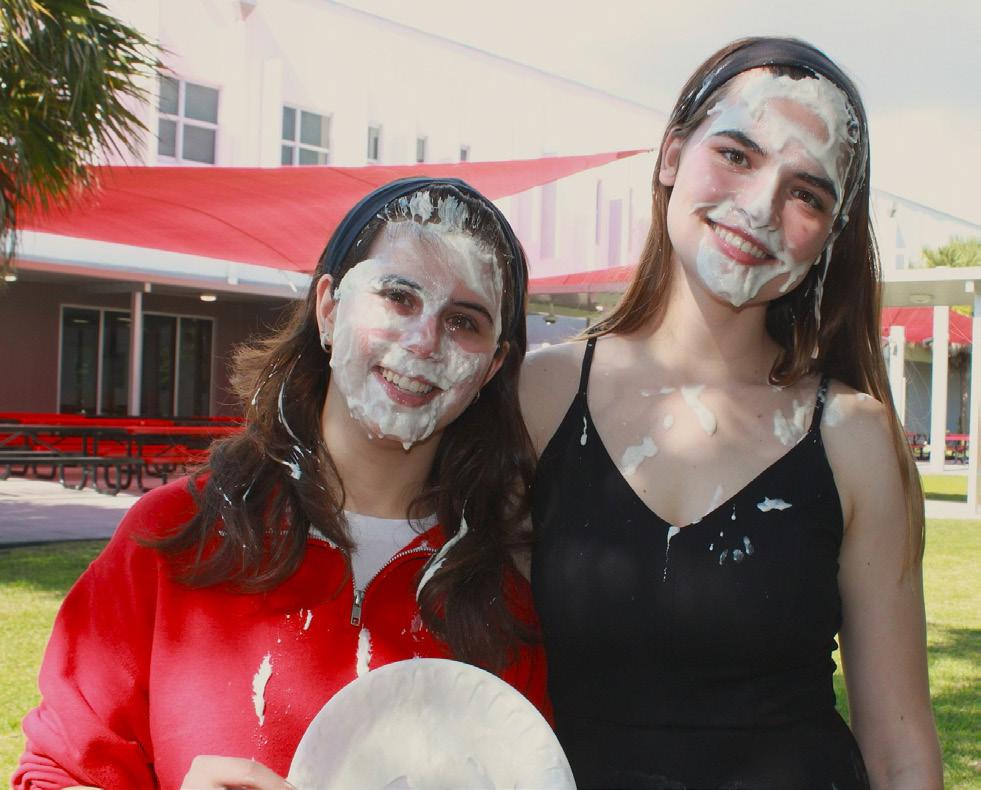
Heralding in the new year with an opportunity for the staff to pie my Managing Editor and me in the face, Issue 3 has been a lesson in gratitude. In just 32 pages, writers and editors alike managed to feature the full scope of campus culture: legendary alumni like Build-A-Bear founder Maxine Clark and equally innovative high school entrepreneurs; our student body’s collective love for “spice” books; future-forward courses; athletes and their preferred hype music; budget bites in Miami; and the cherished “shower thought,” arguably the creative spark behind such a well-rounded campus.
But this content did not just spawn into existence. My staff chased down interviewees, ventured through local streets to find the perfect cheap meal, and spent valuable time compassionately documenting their experiences for fellow Cavs. They deserve to celebrate their wins—even if it means I end up with a lot of whipped cream in my hair.
This whole process is one of the “highlights” of my life— pun intended. Issue 3 marks a halfway point for my staff, and the beginning of the end of my time with them. Deeply committed to unearthing each niche on campus, highlights has become that niche for me. What matters is that I’m proud, grateful, and eager to see what 2026 has in store for all of us.
To my publication family: I’ll ruin a perfectly good outfit any day for your pie-ing whims. And to Gables: thank you for cultivating our creative spark.
Kudos to 2026, a beautiful new era!


winter wins
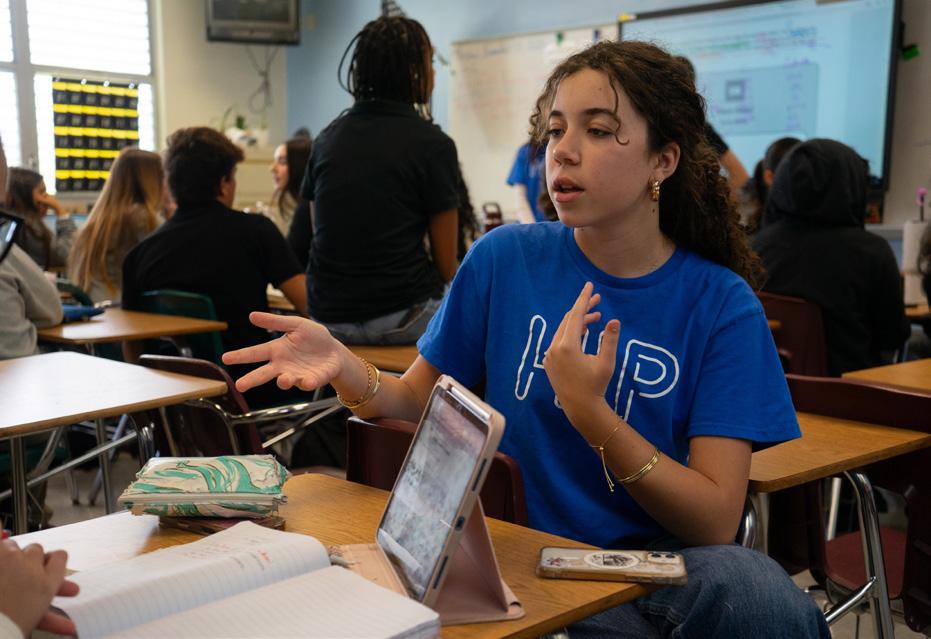
SPEAKING SIMPLY, junior Amelie Delvat tutors a fellow French student in conversational etiquette during the Nov. 17 French Honors Society meeting.
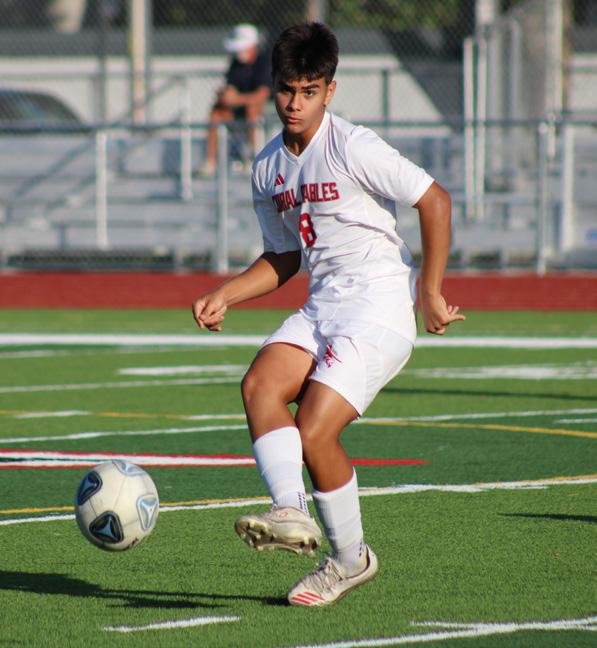
WITH A FINAL SCORE OF 3-0, junior Thiago Peseda passes the ball to a Gables teammate, resulting in a Cavalier win against American Senior High School on Dec. 3.
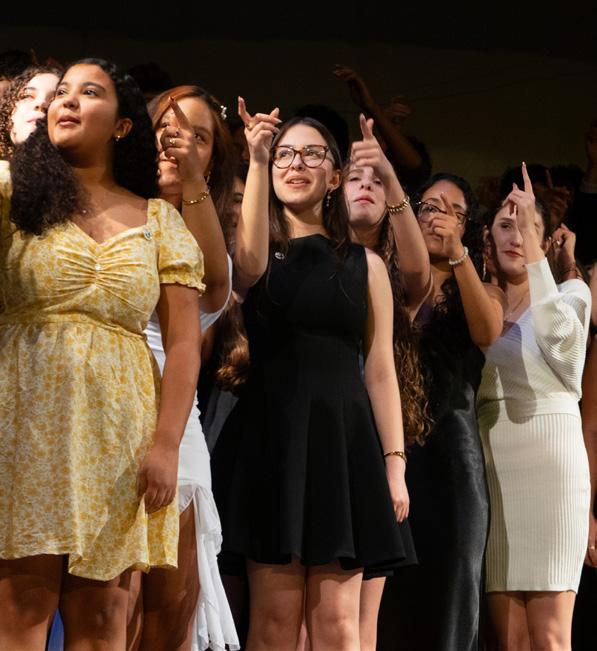
TO CONCLUDE THE IB PINNING CEREMONY, junior Jenniffer Fundora sings Gables’ Alma Mater with her classmates, celebrating their official entry into the program.
publication policy
highlights is the official student-produced newsmagazine at Coral Gables Senior High School published and produced by highlights staff members. highlights has been established as a designated public forum for student journalists to educate and inform their readers on issues of concern to their audience and dissemination of news and ideas to the entire school community. As the producer of a scholastic publication, highlights subscribes to the responsibilities set forth by the National Scholastic Press Association Code of Ethics for scholastic journalists and advisers. According to Miami-Dade County Public School Policy, student media is not subject to prior review by administration or district personnel, and, as such, all content is determined by and reflects the views of the student staff members only. highlights welcomes reader feedback. All letters should be addressed to highlightscghs@gmail.com with the subject line “Letter to the Editor.” highlights reserves the right to publish any letter sent.
features
NAILS AT GABLES
Cavalier entrepreneurs enter the beauty industry, blending artistry with business management.

10-11
Widespread appraisal of popular, sexually suggestive novels hinders Florida schools’ book distribution.
UBER ROBOTICS
New Cartken delivery bots crowd Miami’s throughways, expanding food delivery’s availability.
15
19
FAKE TURF FIASCO

Moments of mental renewal stimulate creativity, resisting brain fog in today’s mindfulness deficit. sports opinion
As MDCPS considers adding synthetic grass to high school fields, environmental and safety concerns surface. 23 the scene BUDGET BITES
Inexpensive restaurants nearby allow students to enjoy an easy, and delicious budget bite.
28 COVETING SHOWER THOUGHTS
Kenneth Lara/highlights
Kenneth Lara/highlights
Valentino Alvarez/highlights
Bear-y charming
Both Build-A-Bear and the Charm Department are entrepreneurial endeavors headed by previous and current Gables students
ISABELA VILLELA | STAFF WRITER
MELINA MORALES | STAFF WRITER
FROM A MULTI-MILLION DOLLAR company to a thriving student-run business, Build-A-Bear Workshop and the Gables Charm Department share one important connection: their Gables roots. United by creativity, entrepreneurship and community spirit, these initiatives showcase how Cavaliers continue to transform their vision into extraordinary success stories.
The idea for Class of 1966 alumna Maxine Clark’s nationwide brand was born when she took her friend’s children to a toy store that had run out of Beanie Babies. Determined, the kids suggested they could simply make their own plushies at home. That offhand comment was the lightbulb, illuminating a whole new business concept for Clark.
The idea quickly evolved from a mere fallback plan into an immersive escape where customers created teddy bears that could talk, have a scent and even have a heartbeat.
“When we’re children we always go on field trips, and it’s always the most fun day,” Clark said. “We’re always inquiring—you don’t necessarily want to be a baker or go to a farm and be a dairy farmer, but you learn about it and it just adds to your wisdom.”
Before she became the founder and CEO of Build-A-Bear, Clark was a Cavalier, walking the same halls as today’s students. During her time at Gables, Clark served as the editor-in-chief of highlights, where she developed the leadership skills and creative confidence that flourish in her career today.
Clark credits her time at Gables, particularly the teachers, for sparking her curiosity and encouraging her to take risks in the career field.

Build-A-Bear Workshop, founded on Oct. 27, 1997, in St. Louis, Missouri, has established over 400 stores and sold more than 160 million stuffed bears.
Source: CNN
“Everything that you accomplished in a place like this was meaningful because [the school] is highly competitive,” Clark said. “Smart people go to school here and great teachers that are really dedicated to young people teach here; you are only here for four years, so you’ve really got to soak it up.”
At Build-A-Bear, customers can design their own stuffed animals, personalizing everything from the stuffing to the accessories. Clark’s business model encourages empathy through the creativity and connection promoted by personalizing something meaningful.
Clark learned these principles early in her education, particularly during her time in highlights. Within a few years, Build-ABear became an international brand, bringing happiness to communities everywhere.
At Build-A-Bear Workshop, the “Heart Ceremony” is a special event where guests wish on a satin heart and place it inside their stuffed animal to symbolically bring it to life.
Source: Build-A-Bear Workshop
CAPTURED NOSTALGICALLY, Maxine Clark, future founder of Build-A-Bear Workshop, calls the printer while serving as editor-in-chief of highlights in 1966.
Even after stepping down from her executive role at Build-A-Bear, Clark’s passion for helping others to develop their dreams has never wavered.
Through her ongoing mentorship, Clark remains connected to her roots: a proud Cavalier inspiring future innovators.
Today, she remains committed to giving back to the Gables community by developing free search apps for out-of-school programs — such as summer camps and after-school enrichment — supporting funding for womenowned businesses and constantly recognizing the lasting impact teachers had on her success.
“I knew I wanted to make a difference in this world — I didn’t want to be an anonymous person,” Clark said. “One thing about journalism is that it teaches you that you can be known.”
The entrepreneurial spirit that once guided Clark now thrives in a new generation of Cavaliers, led by the Head Administrator of the Business Department, Niki Brown, and the students who formed the Charm Department team.
Design by Arwen Law/highlights
Courtesy of the Cavaleon
THE CHARM DEPARTMENT IS AN innovative student-run initiative that focuses on crafting and distributing customizable keychains, pins and charms. By tailor-making products that represent a wide range of interests, this awardwinning team ensures every student can find an accessory that reflects who they are.
Beginning the iniative in 2022, the Charm Department honed in on producing affordable charms that celebrate individuality throughout the student body. The team utilizes efficient and afforable 3D printers from Bambu Lab that works primarily with PLA and PETG filaments to ensure their products are both biodegradable and heat-resistant.
Over the course of three years, they partnered with a variety of businesses, including BlackRock, Nicklaus Hospital and Special Olympics, which subsequently gave them the opportunity to host Hoops 4 Hope. The event consisted of two basketball teams made up of Gables students with intellectual disabilities. It was hosted in collaboration with the Best Buddies club at Gables — part of the non-profit organization dedicated to fostering friendships with all students.
Hoops 4 Hope was not only a successful event but also an example of how collaborations like this expand Charm Department’s influence and community reach while promoting inclusivity, diversity and friendship with every charm sold.
The Charm Department’s evolution extends beyond crafting unique charms, also developing the personalities and skills of the dedicated team members who make such an impact possible.
“I think I’m better at working as a team; that’s something really big,” senior and Charm Department CEO Aimee Lagerweij said. “At first, I used to just do everything myself, but I learned that you actually have a team that can stand behind you; I don’t have to do everything myself.”
The Charm Department team measures its success not just in sales but in the tangible feeling of connection and confidence they instill in others. Their work with external organizations, such as the Special Olympics, further solidifies this mission, proving the emotional value of their products beyond the school halls.
“When we worked with Special Olympics, we went to their Race for Inclusion. We made little pins, and it was just nice to see how people felt wearing pins — stronger and like they were more in a community,” Lagerweij said.
This growing impact depends on the dedication of its student board, who have developed unity within their own ranks and driven the department’s ongoing success.
For instance, Lagerweij and junior and 3D designer Aaron Levy have found satisfaction
in mentoring new members and helping them come out of their shell.
“My favorite part of being the sponsor is that I see the students grow and embrace the opportunity to compete on a world stage,” Brown said. “You know, it’s remarkable how they grow in their business or understanding and become better citizens in the community.”
As Charm Department evolves, the team is currently developing a dedicated website to
transform their business model. While their operations previously relied on limited seasonal drops, this digital storefront will ensure their customizable products are accessible yearround.
“Building our own website is a huge step because it moves us past seasonal drops and makes our work accessible to the community year-round,” junior Levy said. “We’re also really looking forward to reaching out to more local businesses; it’s an opportunity to show how our work can stretch beyond the school campus and help solve real-world needs.”
Despite facing their own hardships, whether it is organizing finances or competing a national level, the team embraces every obstacle as an opportunity to grow. Recognized for their award-winning initiative, their pride shines through in every pin sold.
h
JOYFULLY UNITED, the Student Services Department Chair Beatrice Pedroso, Assistant Principal Richard Martinez, Principal Anthony Balboa and Physical Education Coach Haiji Ingraham celebrate Hoops 4 Hope, an event organized by the Charm Department to strengthen community bonds.
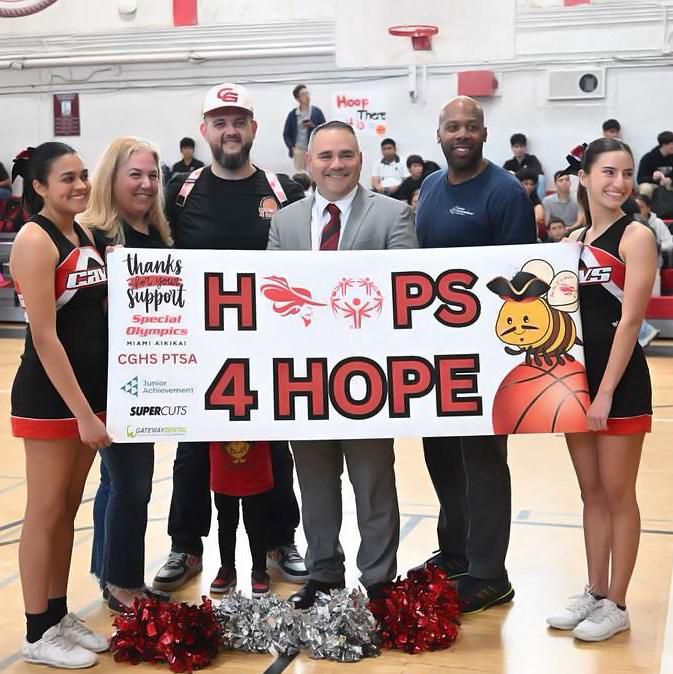
Courtesy of the Charm Department

PLAYFULLY POLISHED, these polka dot nails by senior Alexandra Carvajal bring a fun, retro twist to a classic manicure.
DELICATELY DETAILED, these pink flower nails by junior Perla Gutierrez showcase her attention to floral artistry for one of her clients.

Between classes and extracurriculars, Gables students turn
Beauty in

Business
CELIA SIME LANANG | STAFF WRITER RAFAELLE FENOT | STAFF WRITER
ALREADY WAKING UP EARLY and studying late into the night, a growing number of students now incorporate an additional responsibility into their schedule: running their own businesses. From designing acrylics to waxing brows, junior Perla Gutierrez and senior Alexandra Carvajal are defining entrepreneurship by launching nail art businesses before graduation. Balancing classes and side hustles is a challenge, but, for these Gables entrepreneurs, it is made worthwhile by new streams of revenue.
Getting into nail artistry three years ago, Gutierrez used her dissatisfaction with her salon’s designs as motivation to launch nailssbyPearls, where she serves as the owner and CEO. As time progressed, Gutierrez fell in love with the creative process, finding it to be a powerful form of self expression. What began as a moneymaking hobby soon bloomed into a fullfledged enterprise.
Inspired by TikTok, Instagram reels and Pinterest, Gutierrez honed her artistic abilities. Gutierrez’s favorite nail design is the classic French tip because she has perfected the style, mirroring the growth, precision and personal improvement she has achieved during her journey.
“Advice I would give to anyone who wants to start a small business is to just start,” Gutierrez said. “Don’t overthink it — make that first step and little by little it will flow and everything will come together.”
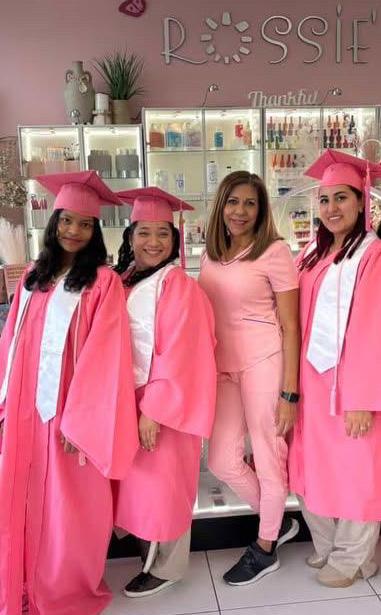
Driven by her determination to further explore her passion, Gutierrez’s first step was to get licensed by enrolling in Rossie Nail Tech School.

Courtesy of Perla Gutierrez
Design by Arwen Law/highlights
Courtesy ofAlexandraCarvajal
Courtesy of Perla Gutierrez
PROUDLY ACCOMPLISHED, junior Perla Gutierrez (far left) stands with her peers at graduation from Rossie Nail Tech School, celebrating the start of her journey in the nail industry.

Ready to Book a Nail Appointment?
Visit their Instagram!

@nailss.bypearls

@_glamour.aesthetics_
Surrounded mostly by older students from the ages of 25 to 60, Gutierrez was one of the only teenagers enrolled. The course lasted about two months, holding classes every Saturday from 8 a.m. to 5 p.m. and culminating in a requirement of 270 work hours. At the end of the program, Gutierrez completed a final exam that determined whether she was ready to step into the world as a licensed nail technician.
“I have learned through entrepreneurship that I have more patience than I originally thought,” Gutierrez said. “I knew it was gonna be a slow process, and I learned that I just have to trust it and take it step by step.”
When she first stepped into the world of nail art, Gutierrez was unsure how to proceed. However, she quickly found support within the nail tech community and began charging for her work. Gutierrez gained a large part of her clientele through word of mouth, and she recently expanded her reach by starting an Instagram account to
HALLTALK
The highlights staff records what they overhear students talking about in the hallway.
showcase her designs. Gutierrez gradually learned to manage budgeting and finances, demonstrating growth as both an artist and entrepreneur. After growing her business, the base price for most of her work is around $45.
An aesthetic artist committed to client empowerment, Carvajal is the business founder, owner and CEO of Glamour Aesthetics. Carvajal is a dedicated beauty specialist with a talent for helping others feel confident in their own skin. Her journey in the beauty industry began in 2022, starting with nail services and gradually expanding her skill set to include waxing, skincare and more.
For Carvajal, pursuing nail artistry has been a prominent part of her life for a long time. The craft has been a tradition that has run in her family for generations. Back in Cuba, Carvajal’s aunts and father earned a living through nail artistry.
“When I started doing nails myself, it felt like I was keeping that tradition alive in my own way,” Carvajal said. “At first, it was just a fun thing to do, but the more I practiced, the more I realized it was something I wanted to build my life around.”
Carvajal’s love for beautification has grown alongside her ambition, driving her to develop a wide range of skills and include a multitude of services. Today, Carvajal provides full-body waxing, pedicures and manicures for whoever is interested, as well as precise brow cleanings and waxes.
“Doing nails takes real patience, training and focus,” Carvajal said. “It’s not just painting — it’s building structure, shaping and making sure everything lasts. There’s a lot of love and effort behind every set.”
While family heritage grounds her passion, Carvajal also draws inspiration from many other places. Social media platforms like Pinterest and Instagram are strong contributors to her inspiration, helping her develop her own style. It is with these platforms that communities like the nail industry can thrive, with members helping each other flourish and innovate collaboratively.
“Doing nails means connection and creativity,” Carvajal said. “It’s not just work to me — it’s art and tradition. Every time I do someone’s nails, I feel proud that I’m continuing what my family started. It’s also how I express myself and help other people feel confident.”
Balancing school and work is extremely difficult, so Carvajal manages her busy schedule by prioritizing school and academics. Although maintaining this balance can be challenging, school has taught Carvajal many useful skills, including organization and communication, both of which help her manage clients and plan content.
“It’s hard sometimes, but I make it work by planning ahead,” Carvajal said. “I’ve learned how to manage my time and stay focused.”
As Gutierrez and Carvajal continue to grow their businesses and skills, they inspire others to pursue their dreams early on and prove that age is no barrier to achieving a h
STRINKINGLY POISED, senior and nail artist Alexandra Carvajal stands with style, known for her standout nail designs and creative flair.

“Why don’t you act like your hairline and take a few steps back?”
“The lion actually concerns himself with too much.”
“It is not procrastination if I plan to panic later.”
Celia Sime Lanang/highlights
“This hallway is longer than my attention span.”
“If common sense were a currency, we would be in a recession.”
“The best gift for Christmas would be to sleep for over eight hours.”
Design by Arwen Law/highlights

GEOMAPPING the future
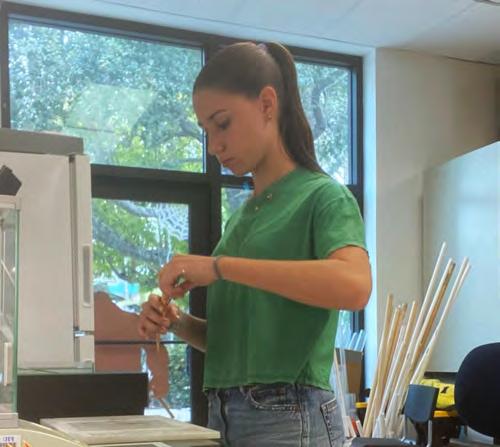
TThrough her internship at FIU, senior Adelaide Schoeni contributes to geomapping technology that supports the preservation of the Everglades
HE
STUDY
OF THE environment is a delicate and urgent matter that must be handled with responsibility.
At Gables, senior Adelaide Schoeni takes on this challenge by conducting fieldwork in a prairie region of the Everglades. For her research, she collects GPS data using Trimble R8 rovers, gathering samples of different grass species and inputting the data back at the lab.
After writing her International Baccalaureate Extended Essay on grass distributions, Schoeni developed a strong interest in the topic and independently reached out to the professor leading a lab at Florida International University.
“I’ve just always loved being outside and hiking, and so I want to take care of the wild places of our world,” Schoeni said.
Despite its vast protected status, the Everglades has been placed on the “World Heritage in Danger” list due to threats including decreased natural water flow, nutrient pollution and urban development. DID YOU KNOW
Source: National Geographic
After receiving a response, she met with the professor on Zoom and secured an internship that would propel her environmental passions.
Through her internship, Schoeni finds fulfillment in contributing to the success of the scientific community. She finds it gratifying and worthwhile to assist her mentor with his PhD thesis, which Schoeni describes as the most laborintensive and challenging aspect of her internship. Schoeni’s teachers have played a significant role in
encouraging her to take on her role and answering any questions she had about the process. Her current Biology teacher, Eric Molina, who supervises science themed extended essays, especially assisted Schoeni in pursuing the internship.
“She has been one of the top students I have ever taught,” Molina said. “It has been a blessing being her teacher.”
As the club president of Green Gables, Schoeni has gained readiness and responsibility that support her internship, as well as providing an outlet for her to promote environmentalism at Gables.
“As the president of Green Gables, Adelaide is very determined, efficient and a person of action,” Green Gables sponsor Florence Rouit said. “Especially in Florida, she’s making a great impact; many environmentalists are needed to protect the environment.”
Inspired by her internship, Schoeni aims to dedicate her career to the environment, whether through scientific inquiry or green business innovation.
“In the future, I’m debating going into research, where I write papers and lead a lab to collect data, or going into sustainable entrepreneurship,” Schoeni said.
Schoeni’s passion for environmental science, nurtured by influential teachers and hands-on internship fieldwork, has set her towards making a lasting impact. Whether through her leadership in Green Gables or her contributions to wetland research, Schoeni remains deeply committed to protecting wildlife and inspiring others to do the same.
h
ANTHONY FLORES | STAFF WRITER
Courtesy of Adelaide Schoeni
GABLES NEWS IN BRIEF
IB Pilots Online Testing
For the upcoming testing season, the International Baccalaureate Program plans to begin implementing digital exams, marking the program’s first steps in the transition toward fully online exams. These exams will be taken on laptops or desktop computers within IB schools and are supposed to mirror the already existing paper-based tests.
“I am concerned about the technical and hardware logistics of using digital devices,” IB coordinator Diana Van-Wyk said. “It is inevitable. As long as the teacher and students work together in this transition, we can make sure our students can test in the best possible environment we can provide.”
Charter School Expansion
At a news conference in Miami, CEO and founder of Success Academy Charter Schools Eva Moskowitz, alongside Gov. Ron DeSantis, Education Commissioner Anastasios Kamoutsas and Florida International University president Jeanette Nunez, announced that Success Academy is expanding its network into Miami. Success Academy plans to open its first Miami schools in the 2027-28 school year.
“Equity benefits could include access to specialized programs, smaller class sizes and innovative teaching neighborhoods,” College Access Plan advisor Sofia Sanz said. “However, some pitfalls include creating a two-tier system where public schools are underfunded or marginalized, potentially leaving the most vulnerable students behind.”
Teachers Must Self-Report
Senate Bill 1374 now requires educators to self-report to their employers within 48 hours of being arrested for a felony or certain misdemeanors. This law was passed by the Florida legislature and signed by Gov. Ron DeSantis earlier this year, taking effect on July 1, 2025. According to Orlando Weekly, if this law were to be violated by an educator, they could face suspension or have their teaching license revoked. The law acknowledges that notification of an arrest is not an admission of guilt.
“I believe that the new bill is useful given the responsibility that we have to our students and to our community,’’ Assistant Principal Richard Martinez said. ‘‘It is imperative that those that are giving instruction and are guiding the youth have a strong moral compass and are willing to abide by the same rules and regulations that we expect our students to abide by.” h h h
Design by Hailey Martinez/highlights
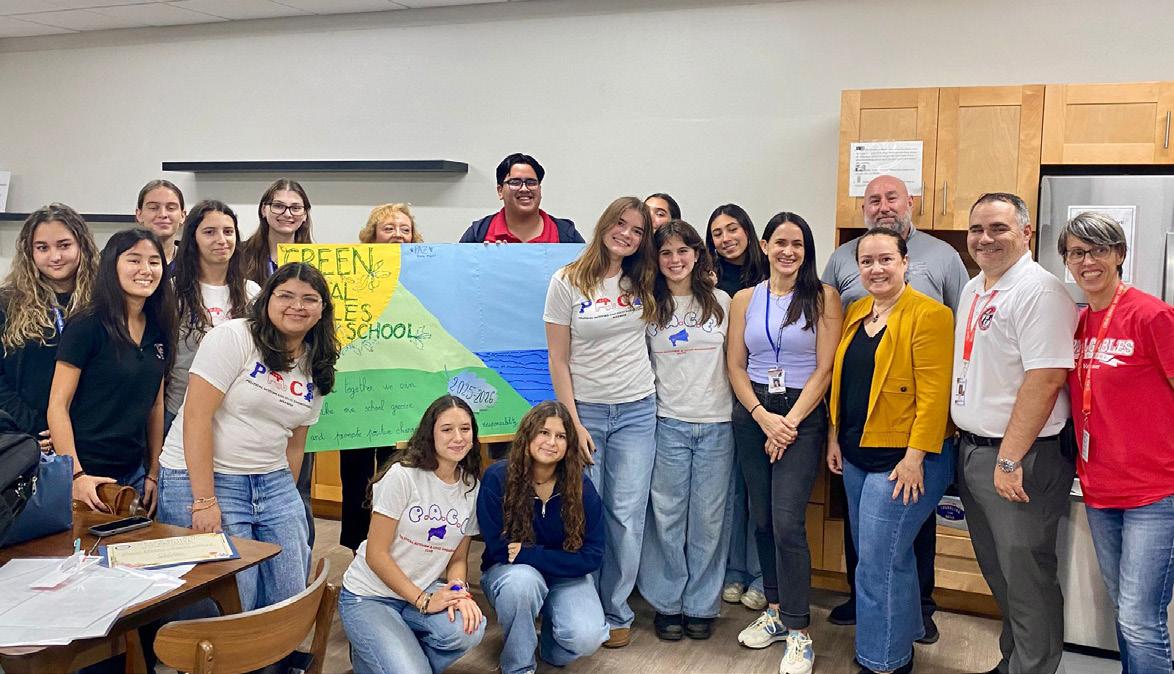
Congratulations to Gables for earning the Green School of Promise accolade from Miami-Dade County Public Schools. Anita Chevalier, Head of the Green Team for the Parent Teacher Student Association, submitted the application that led to the recognition. The school gained the accolade through green efforts such as implementing recycling bins and saving energy, driven by the collaboration between Cavaliers. The PTSA, Green Gables, Gables Wellness, the Garden Project, the athletics departments and PACE worked alongside one another to achieve this accomplishment.
Upcoming Dates




Congrats,
MIA CHACIN-VERA | STAFF WRITER
Hazel Grosell/highlights
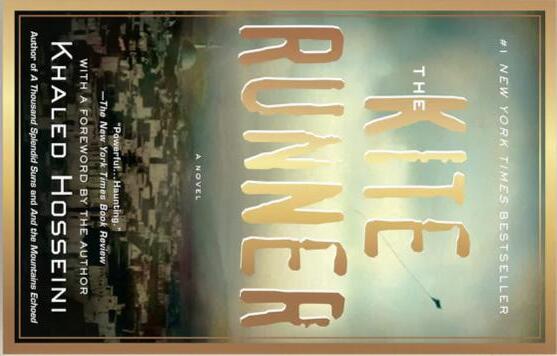
ANEW WAVE OF BOOK BANS swept through Florida public school districts as the 2025-26 school year commenced, with many titles being pulled from the shelves under directives to remove material deemed pornographic.
In the wake of state pressure, schools across the state have begun proactively reviewing novels, hoping to anticipate banned material.
The Florida Board of Education first threatened legal action against Hillsborough County, claiming that they failed to censor books labeled offensive, which led to the subtraction of over 600 texts in the district alone. According to The Guardian, counties across the state, in attempts to avoid the same consequences, have followed suit.
At several Miami-Dade and Broward high schools, the recent removals have made libraries feel noticeably emptier. Titles like “Heartstopper,” “The Summer I Turned Pretty” and “They Both Die at the End” were among those taken off shelves.
These removals are prompted by guidelines that deem any book depicting or describing sexual conduct as inappropriate for the high school grade group, according to the BBC.
“The way I see it, sex is still a part of life,” freshman Cayden Acevedo said. “Treating it like it is some horrible, shameful thing to see in media like books doesn’t help anyone.”
Reports from PEN America and district records state that at least eight Florida counties, including MiamiDade, have
“The Kite Runner” is banned because of its mentions of sexual violence, offensive language, themes of homosexuality and graphic violence.
removed nearly 732 books since the end of summer. The process was catalyzed by new legislation requiring schools to review all material to ensure that it is of appropriate content.
To achieve these mass appraisals, schools enlist certified media specialists, state-credentialed educators responsible for managing school libraries that must pass the Florida Teacher Certification Exam, to ensure that every book on campus meets specific guidelines and is recorded before being made available to students.
The appraisal process is riddled with delays and confusion, as districts and schools interpret what qualifies as “harmful” differently without standardized criteria, as per the Miami Herald.
In Miami-Dade County, most of the books being pulled off the shelves are only temporarily gone, pending administrative review rather than facing permanent removal.
“It’s important to remember that reading a library book is a choice,” Gables media specialist Laura Hernandez said. “If you don’t want to read it, don’t read it. Assigned

“The Picture of Dorian Gray” was banned for its perceived immoral and perverse subject matter.
books are different, so at that level the nuances are different,”
The district assures that the process is meant to comply with state laws while allowing quality educational tools to remain in the classroom, as per Online Sunshine.
Florida districts have removed hundreds of books from classrooms under updated
ALICIA FAJARDO | OPINION EDITOR
SIENA CERNUDA | STAFF WRITER
Florida has state in book three consecutive 2,304 instances DID YOU
Source: PEN
Design by Hailey Martinez/highlights
Still, the ripple effect is felt in classrooms and libraries across South Florida. Some media specialists, according to PEN America, report the review process has slowed their ability to circulate and distribute books to students, while others
been the No. 1 book bannings for consecutive years, with instances of bans.
PEN America
describe an atmosphere of heightened caution.
“The Florida statute’s purpose is to ensure that books that are in the public school system should be appropriate for the age group they serve.
If someone raises a concern with one of the books in our library then I would review it, and if it were still contested, then it would go to the district.
That is not really a big problem here. Our public is openminded and trusts the people they put in schools to check the books
thoughtfully,”
Gables media specialist Laura Hernandez said.
The removal of popular titles from school shelves has not significantly reduced student interest in reading, but it has changed how they access books.
Informal reading groups and online communities have become primary spaces for discovering restricted works.
Social media platforms such as TikTok host discussions, providing

“The Bluest Eye” was banned because of its graphic depiction of child sexual abuse, incest and racism. The novel contains a scene of sexual assault.
recommendations and digital copies of novels that are unavailable through traditional means.
“They say books are inappropriate, but we see way worse stuff on the Internet all the time,” junior Naomi Alon said. “Being able to find better resources online, like books, allows students to process and understand the information in a healthier way.”
Some students have turned to e-book platforms or digital reading subscriptions to continue following the series they began prior to the removals.
In certain communities, students and educators have taken a more active role by attending “banned book” events.
These awareness-raising programs highlight the books targeted for removal and are hosted by bookstores such as Miami’s own Books & Books.
The review list varies from district to district, but many include contemporary young adult novels like “The Perks of Being a Wallflower,” historical fiction novels like “Beloved” and even classic literature like “The Color Purple,” long considered to be a crucial part of the education system.
“Banning books that talk about these horrible events does not stop them from happening,” junior Khya-Maree Mcconney-Wharton said. “It just makes survivors of them feel even more ashamed and alone.”
Educators and advocacy groups, including the American Library Association, have warned that the ambiguity and lack of clarification in Florida’s new review rules may prompt overremoval.
Notably, Miami-Dade chose to temporarily remove a number of books before reviewing them as a precaution to avoid potential state penalties, as reported by PEN America.
h
“The same thing happened with
Design by Hailey Martinez/highlights



Design by Lily-Jade Lecoultre/
The price of speed
Electric scooter use has seen a recent surge among students, raising safety concerns
Written by Copy Editor Olivia Simon. This article reflects the opinions of the highlights 2025-26 staff.
SINCE THEIR INTRODUCTION to Miami’s streets in 2018, electric scooters have become an increasingly common sight across the city. Compared to Ubers or car payments, e-scooters are a cheap alternative at an average price of about $400, as per Forbes. However, rising accident rates have led to increased safety concerns, emphasizing the inadequacy of current e-scooter regulations.
These benefits have surged e-scooter use, but this trend has unfortunately led to a rise in accidents and hospitalizations. On a national scale, injuries rose 45% annually from 2017 to 2022, according to ERideHero, highlighting the cost of their accessibility.
Additionally, accidents on an e-scooter can be incredibly severe because riders have little protection. Riders over 16 years old are not required to wear a helmet, according to Florida law. Stricter enforcement could encourage safer habits and reinforce a culture of public safety.
When the City of Miami banned rental e-scooters in 2022, it led to a significant decrease in related injuries, dropping from 2.8% to 1.8% of all hospital cases, as per a PubMed study. This suggests that minimal oversight of e-scooter use directly contributes to increased danger.
“I respect e-scooters as long as they follow the traffic laws, but most of the time they
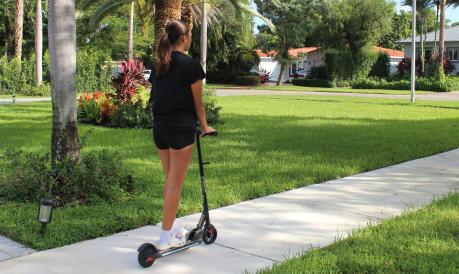
A
CONVENIENT
MODE
OF TRANSPORT, sophomore Jazmin Martinez’s s personal electric scooter allows her to get home after school quickly and efficiently.
aren’t safe enough to be on the road since they can’t signal what they’re doing,” senior Lucas Aparicio said. “Especially at night, I’ve had to swerve to avoid them because of the low visibility, so more risk control is definitely needed.”
Their status as micromobility devices means they do not need to be registered with the DMV or receive rigorous safety inspections before being retailed, according to Florida
DID YOU KNOW
E-scooters on average cause 115 accidents per million trips, as opposed to cars causing 8 accidents per million trips
Source: UCLA
Highway Safety and Motor Vehicles. The absence of registration makes it difficult to hold reckless riders accountable, allowing dangerous behaviors like speeding to go unchecked.
However, this lack of regulation also makes e-scooters more accessible, particularly for high school students. Since no license is needed to drive one, according to Miami-Dade
80% more electric scooter riders have been in accidents from 2023 to 2024.
Source: ERideHero
County, students of any age or immigration status can operate them freely. This provides a reliable method of individual transit to people who could not otherwise access it.
“I take my e-scooter sometimes because it’s really my only way to get here,” junior Cristina Hernandez said. “There’s no bus route near my house and it’s quick and reliable so I don’t have to rely on my parents every morning.”
This form of transportation is being integrated in campuses across Florida for its convenience, promoting the use of e-scooters and mopeds. The University of Florida has created designated parking and drop-off areas for e-scooters, improving accessibility.
“I feel that [e-scooters] are a little threatening for student safety because some students ride it without regards for others, especially with the e-bikes as well, cutting up and down traffic,” School Resource Officer Kyle Gerts said. “Get out of the road, make sure you’re wearing helmets, and make sure we’re following the same safety precautions that vehicles follow.
While electric scooters offer convenient transportation for students who lack reliable car or public transit access, their growing presence has introduced serious safety concerns for riders, pedestrians and drivers alike. This convenient mode of transportation should be regulated more strictly.
h
83% of e-scooter accidents occured on urban intersections.
Source: U.S. Consumer Product Safety Commission
Design by Alicia Fajardo/highlights
Olivia Simon/highlights
Silencing streaming Nationwide, polarization and censorship is shaping modern media

CAROLINA PLANES | STAFF WRITER
TODAY, something as leisurely as watching a film has become an act of defiance. On March 13, 2025, local theater O Cinema underwent eviction threats following the screening of “No Other Land,” a documentary critical of Israeli policies. This disproportionate backlash reflects a broader trend: as the U.S. becomes more politically divided, creative spaces become targets for political agendas, leaving the content they platform vulnerable to scrutiny.
“It’s wrong that some people go to such lengths to protect their personal interests,” junior Alessandro Frutos said. “You see it online all the time — people stepping on other’s free speech just to keep their pockets full.”
The trend extends beyond O Cinema. Across the country, once-neutral spaces for commentary, such as late-night TV and news outlets, are navigating unprecedented scrutiny. The message was clear when late-night host Jimmy Kimmel was taken off air for commenting on President Donald Trump’s reaction to the murder of Charlie Kirk and when “60 Minute” segments were torn apart online due to bias instead of accuracy; audiences’ political alignment has overridden objectivity.
tolerate being wrong, to allow ideas to clash and flow rather than be curated for comfort and safety.
“People love talking about their right to speak their mind and their freedom of speech, yet, when it comes time to actually speak, they don’t,” sophomore Sabrina Urzais said. “What’s the point of that?”
The effects come to light in everyday conversations. Debates are replaced by rehearsed talking points, each side clinging to pre-packaged ideas rather than formulating opinions. According to media psychologist L.J. Shrum, the line between informing and entertaining is now so blurred that it is impossible to consume information without being conditioned.
When scrolling through social media feeds, politics are absorbed through clips of commentators, with influencers tailoring their content for likes and views while overlooking accuracy.
DID YOU KNOW
Bantam Books, Inc. v. Sullivan found that pressuring book distributors not to sell certain works based on their titles was unconstitutional.
Source: PBS
The pattern extends past television screens. In Gables, classrooms, galleries and community spaces face the same scrutiny, with teachers second-guessing what topics to cover, students hesitating before sharing opinions and even school events sparking debates before they even happen. What was once a community grounded in respect is now a place where expression is judged for political alignment rather than meaning.
Freedom of expression is often spoken about as a right granted by the First Amendment, yet many forget it is also a responsibility. It demands the courage to
Media is a mirror that reflects not just society, but divisions present within it.
According to a 2024 Pew Research Center survey, 77% of Americans say news organizations favor one side when covering political issues while only 22% believe they remain partial. This perception shapes what audiences’ choices.
“The current political environment presents a formidable challenge to student journalists and their advisers,” former highlights adviser and advocate for journalism freedom in Miami Dade County Brenda Feldman said. “I encourage the next generation to advocate for student press freedom by asking the tough questions and accurately reporting the results.”
O Cinema’s struggle echoes the mass silencing of modern media, where truth quietly surrenders while loyalty shouts louder. What began as one theater’s controversy now feels like every screen’s reality.
When headlines become manifestos and screenings become statements of defiance, media ceases to illuminate. The danger is not in loss of speech, but in obedience of it.
h
VOLUME
DOWN LANDMARK
CENSORSHIP THROUGH THE YEARS
2025: Comedian Jimmy Kimmel is pulled off the air for making light of the death of public speaker Charlie Kirk.
Source: The Guardian
1975: FCC v. Pacifica Foundation establishes federal power to censor radio content
Source: The Guardian
1954: The Comics Code of Authority is created, banning words like “terror“ and “horror“
Source: Comic Book Legal Defense
1930: The Hays Code is implemented, in an effort to promote “moral” content in films.
Source: UCLA
1927: The Radio Act is passed, regulating stations to “serve the interests of the public.”
Source: Britannica
Design by Alicia Fajardo/highlights
Robots take over Gables
At the cost of freedom, delivery robots offer a convenient way to get takeout

HAILEY MARTINEZ | NEWS EDITOR
THROUGH the throngs of pedestrians and the haze of Miami heat, an invasion has begun: one with allterrain wheels, a squat, shiny body and two cloying, glowing eyes. These troublesome delivery bots have crowded Miami’s streets, seemingly determined to get in as many people’s way as possible.
The big question is, where exactly did this army of robots come from? According to Refresh Miami, the robots arrived through a partnership between Uber Eats and Cartken, a robotics company, to expand food delivery accessibility.
“I remember first seeing them around two years ago; they really seemed to have appeared out of nowhere,” junior Janisbel Rodriguez said. “I was really surprised. I didn’t really know what they were but they did look really cute.”
While their blinking eyes and quirky human names may seem cute, these tiny, tireless tormentors bring a new kind of obstacle to morning commutes. No one has figured out how to teach them sidewalk etiquette yet. Despite this, many still love these mini-fridges on wheels. For what they lack in public decency, they make up for in benefits.
According to Keego Mobility, they are
more efficient than their human counterparts since they can work much longer hours and have no need for breaks once deployed.
“It’s really cool to see how much technology has advanced, and seeing the robots around makes me think about what the future might be like,” junior Paloma Morales said. Their appearance also contributes to their charm. With how social media has portrayed them, they have managed to worm their way into the public’s heart. They appear to be earnestly trying their best to undertake the odyssey of delivering French fries and sushi. That said, the jury is still out on whether their glowing eyes have a second function of hypnotism, or if their innocent demeanors are a distraction from their replacement of human workers.
“They seem so innocent and simple; they always look like they are trying to get their job done quickly and effectively,” junior Mia O’Brian said. “I remember seeing one ask or signal for help — it had a voice asking someone to help it since it had gotten stuck.”
Through countless videos showcasing the bots’ supernatural ability to get stuck on anything and everything, they have managed to ignite a frenzy in the hearts of some people while sparking hatred among others. But, what is the bots’ ultimate goal? Taking over Miami of course, one puppy-eyed cooler on wheels at a time.
Alicia’s Archive
The unlikely tale of Julia Tuttle, the mother of Miami
Alicia Fajardo | Opinion Editor
Julia DeForest Tuttle wasn’t just a landowner or a dreamer. She was the driving force behind the founding of Miami, earning her the title “Mother of Miami.” In fact, she remains the only woman credited with founding a major American city.
Born in 1849 in Cleveland, Ohio, Tuttle first came to Florida after inheriting land near the Miami River. At the time, the area was a remote, mosquito-filled wilderness. But Tuttle saw potential where others didn’t. She envisioned a bustling city in South Florida — if only she could convince someone to extend America’s vast railroad network that far south.
Her opportunity came after a devastating freeze struck most of Florida in between 1894 and 1895, sparing only the tropical southern tip. Tuttle sent orange blossoms to railroad tycoon Henry Flagler as proof of the region’s potential. She offered him land and a persuasive case: bring the railroad to Miami, and a new city could thrive. Flagler agreed. In 1896, the Florida East Coast Railway reached the area, and Miami was officially incorporated later that year.

Sadly, Tuttle died just two years later, in 1898, never seeing the full fruits of her labor. For many years, her contributions were overlooked, but today, her legacy is recognized across the city she helped create.
Julia Tuttle’s story is one of vision, resilience, and determination, a bold reminder that all it takes is one woman to shape the course of a city’s history.
Dollars, driving and decision-making
Encouraging students to take on the adult world, Florida schools offer financial literacy and driving classes
WITHOUT PRIOR GUIDANCE, driving or managing expenses can feel like speeding blindly onto a highway. Instead of focusing solely on academic skills, schools are redirecting attention toward real-world courses that emphasize responsibility, safety and independence through newly required financial literacy and driver’s education classes. These classes are an invaluable facet of a wellrounded education, equipping students with skills and real-world knowledge.
Thanks to the 2022 L. Hukill Financial Literacy Act and the 2025 Driver License Education Requirement, teens can gain a sense of financial independence that will help them manage their lives beyond school grounds. Although some students see these classes as burdens on top of their already packed schedules, they provide essential lessons for adulthood.
Financial literacy focuses on the economic side of life by helping students learn how to manage, save and invest their money strategically. This class teaches students the essentials of making thoughtful financial decisions early in life, which, according to CFPB, helps lead to higher credit scores, lower late payments and a lower risk of moneyrelated stress in the future. By learning about income taxes, budgeting and how to create checking accounts, students have the chance to break cycles of poor financial decisions.
“I didn’t want to spend all my money, so [I] used the budgeting techniques that I learned to split up the cost in an efficient way,” Academy of Finance sophomore Marcus Borghi said. “Students can be very immature with how they use their money. This economy is built on people that spend their money
“ Students gain financial lessons that most people don't learn until years after graduating, giving them a real advantage in real-life decision-making.
Jhon Diaz, AOF sponsor
wisely, which is why these classes are so important.”
Critics argue that mandating financial literacy courses is unnecessary and repetitive, claiming that budgeting and spending habits can be learned independently at home or through real-life experience. Some students also contend that these classes oversimplify
opposable thumbs
-
Serpa, Staff Writer
Staff Writer

ELENA BUDA | STAFF WRITER
SAVANNAH SERPA | STAFF WRITER
complex financial systems and take time away from core academic subjects or careerfocused coursework. With already demanding schedules, opponents believe that adding another graduation requirement places pressure on students without guaranteeing long-term impact.
“This class is necessary for students so that they may be able to learn within a community with like-minds on how to begin having a successful career and beginning of adulthood,” junior and AOF representative Rachel Francisco said.
Unfortunately, poverty afflicts many students in Miami-Dade. According to a 2002 ERS study, 924,000 Floridian students have experienced financial hardship. This might have been mitigated if personal finance classes had been implemented earlier. Mastering the basics of saving, investing and spending wisely prepares students to make smarter financial choices that strengthen their long-term wellbeing.
“Students gain financial lessons that most people don’t learn until years after graduating, giving them an advantage in real-life decisionmaking,” AOF sponsor Jhon Diaz said.
By emphasizing essential life skills early on, these mandated courses secure a treasure trove of practical knowledge for young adults. Like financial literacy, driver’s education empowers teens to act responsibly in realworld environments.
The other newly mandated course, driver's education, was implemented on Aug. 1, 2025. The law, Senate Bill 994, establishes a more robust course that covers topics beyond basic traffic laws, including attitude, awareness and decision-making behind the wheel. The law was primarily enacted to improve road safety and reduce crash rates involving teen drivers.
“[Driver’s education] should be required,” Driver’s Education teacher Hajji Ingraham said. “A lot of the kids are taking the online test with AI and not even studying. Students are taught the rules of the road and expectations of being a safe and defensive driver.”
The driver’s education course starts once the teenager enrolls with their school or an online provider. Once approved, they receive coursework like lessons, quizzes and study sheets. After completing the lessons, they must take a final multiple-choice exam, either inperson or online, and receive a score of at least 80% to pass. Once the exam is submitted, an email will be sent to Florida Highway Safety and Motor Vehicles for review.
Beyond the classroom, the benefits of driver’s education are tangible. According to the CDC, around eight teenagers get into car crashes every day in Florida. With proper guidance on driver’s safety and the rules of the road, many of these accidents may not have occurred.
Completing a state-approved driver’s education course in Florida also provides insurance discounts for teens’ parents. According to DriversEd, many insurers provide up to a 15% decrease after a teen customer completes the class. This is a major benefit because, as per Florida Today, Florida has the third-most expensive annual costs for car insurance, so even a small discount can make a big difference for disadvantaged teenagers.
According to ALL STAR Driver Education, most courses will teach teens how to change a tire and locate important parts on the vehicle. This knowledge can help them in emergency situations, and these skills can also help parents save money on vehicle repairs.
“[Driver’s Education] does help prepare you for the real world,” senior Andre Assin said. “It gives you the opportunities to know about the rules and guidelines of driving and will definitely prepare you to drive on the road.”
These two courses teach valuable lessons that go beyond the classroom. Both subjects give students skills they will use for years to come. Learning how to budget money and drive responsibly helps prepare teens for independence and society, making valuable investments in teenagers’ futures. By making these courses mandatory, Florida may be setting a model for education that values not just test academics, but readiness for life.
Design by Alicia Fajardo/highlights h
GEARING UP FOR THE FUTURE
MAKING CENTS LESSONS THAT PAY OFF
Students taking finance classes are three times more likely to budget and save.
Source: FINRA
As of 2025, only 23 states require financial education.
Source: PBS
SMART MONEY IS A STRONG START
Students with financial education save 20% more of their income by age 25.
Source: National Endowment For Financial Education
of American adults were unable to answer basic financial literacy questions when asked. 35%
Source: TIAA Institute
of teens nationwide have said they would enroll in financial literacy courses. 68%
Source: IFAC
DEADLY DRIVES
47% of nightime highway accidents were singlevehicle collisions by drivers aged 16-19.
Source: Partners for Safe Teen Driving
PRACTICE PAYS OFF
Teens who have taken driver's education courses are 75% more likely to pass their license test on their first try.
Source: CDC


SPORTS BRIEFS
Engaging Educators at the Summit 2026
This year’s Extra Yard for Teachers Summit, organized by the College Football Playoff Foundation, honors teachers’ dedication while reimagining education nationwide. For 15 years, the CFP has gathered educators from all grade levels to discuss ideas on how to better improve their state’s education system. The summit was held at Florida’s Fillmore Miami Beach on Jan. 17, 2026, with support from the Miami Host Committee.
The CFP aims to elevate academic instruction by providing educators
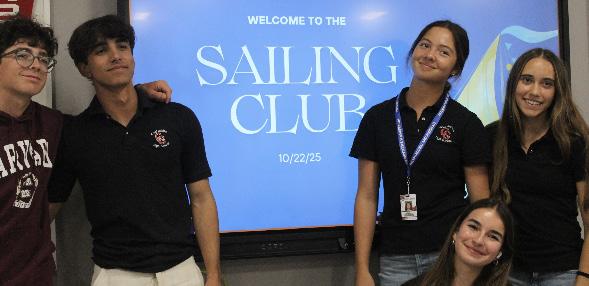
Sail and Serve at Gables
As new clubs at Gables continue to form, two unique sports — sailing and pickleball — have joined the variety of after-school activities available for Cavaliers. While not an official team, a group of underclassmen, led by freshman Kailee Moore, started the Gables Sailing Club to invite students onto the water. Though this club does not offer practices, their goal is to encourage students to learn and be active in this growing sport.
In addition, the new Gables Pickleball Club was created this year by junior Erik Del Valle and senior Cooper
resources, as well as focusing on recruitment and professional development. The CFP uses their visibility and influence in athletics nationwide to connect sports and educational impact, emphasizing the dedication and leadership required in both fields.
“I’m sure there are teachers that have impacted their players in certain ways or have guided them through school,” Teaching Academy leader Patricia Passwaters said. “This is their way of giving back to those teachers.” h
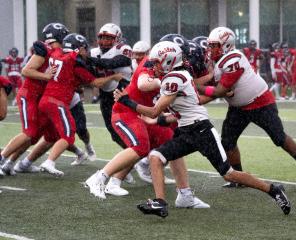
athlete spotlight

Piedra. Motivated by their joint passion for the sport, the pair organized and planned the club’s debut.
“It’s a club for fun,” pickleball club sponsor and coach Alysia D’Alamberte said. “It keeps us healthy, it gets everyone together [and] builds camaraderie for all Gables kids.”
By introducing sailing and pickleball, Gables fosters an environment where students can discover new interests, connect with their peers and explore diverse ways to stay active.
CRISTHOFER MONCADA, 12 Sport: Cheerleading Accomplishments: Moncada is a member of the Gables varsity cheer team, placing first in Cheer, third in Sideline Cheer and fourth in Camp Routine at the Universal Cheerleaders Association’s summer camp.
upcoming events
CIARA BURTON | THE SCENE EDITOR
SETTING SAIL, the Gables Sailing Club hosted its first club meeting on October 22, inviting students interested in joining the club.
Courtesy of Cristhofer Moncada
Maria Sandoval/highlights
Fake turf fiasco
As natural grass becomes harder to maintain, artificial options are being considered for fields, sparking debates

NATALIA QUICK | SPORTS EDITOR
IAMI-DADE County Public Schools has reintroduced the topic of implementing synthetic turf on high school sports fields. Since Miami-Dade County first initiated the installation in 2015, community parks have undergone construction for the implementation of this new grass. Tropical Park, the field frequently used by Gables sports teams, is included among these revamped grounds.
Now, conversations are emerging about extending these renovations to other MDCPS high school sports fields, including the one at Gables. On account of these discussions, parents, faculty and student athletes have raised concerns regarding the safety and effective operation of this turf.
While the transition from natural grass to synthetic turf sounds appealing at first glance, the ecological effects are far from minor. Made from petroleum-based plastics, man-made turf is non-biodegradable and a contributor to long-term plastic pollution. As the materials degrade, harmful microplastics are released and commonly washed away by rain, ending up in rivers and oceans.
As noted by the University of Florida’s Institute of Food and Agricultural Sciences, the use of artificial grass increases stormwater runoff and expands the amount of waste in landfills.
Furthermore, due to the scorching Miami heat, artificial grass contributes to heat buildup, reaching temperatures of 120 to 180 degrees Fahrenheit. As per research conducted by the University of Plymouth, this immense heat can release harmful toxins into the atmosphere, creating severe health problems, such as heatstroke, for players.
“Artificial turf does not bring an oasis of freshness as the natural grass in our urban areas,” Parent Teacher Student Association and Head of Green Team Anita Chevalier said. “To reduce greenhouse emissions, our planet needs a field to absorb more CO2. The turf does not absorb either the heat or the CO2, but natural grass will do the job.”
However, it is not just the environment
that is negatively affected by the adoption of artificial grass. Student athletes also face increased health and safety risks. Lying underneath the layer of synthetic grass is most commonly a base of compacted materials such as crushed stones or gravel, causing an absence of the natural cushioning real grass provides.
According to the National Library of Medicine, this lack of a softened surface leads to a higher possibility of athletes injuring themselves during a game or a practice. This firm foundation placed beneath the plastic grass blades escalates the possibility of obtaining ACL tears, skin abrasions and several other alarming injuries.
“I play on the girls flag football team, and every time we have an away game where there is artificial turf, even with our cleats, there is always more slipping and falling,” sophomore flag football player Stephanie Gregg said.
As a consequence of the intense heat build up, blisters and burns are a major concern for athletes. These conditions not only make practices and games more physically taxing, but also highlight worries regarding long-term exposure to heat and synthetic materials.
In addition to health and environmental concerns, the financial costs surrounding turf implementations merit careful considerations. While many may argue that fake turf is more budget-friendly than maintaining natural grass, it is simply not true. The upfront cost of the installation is usually about $1 million per soccer field, according to the Miami New Times.
“The cost is much too high,” former Gables athletic director and MDCPS athletic advisory committee member Harold Cole said. “The cost would be over $300,000 per school, and Dade County is not going to put that much money into high school athletics.”
Synthetic turf is not a long-term solution as it must be removed and replaced after 8–10 years, adding to the total cost of the operation. Ultimately, although artificial turf may seem like an easy fix for sports fields, it unearths several concerning issues. As MDCPS and Gables consider their choices, it is apparent that natural grass offers a safer and more eco-friendly option for high school sports fields.
31% of plastic in the ocean is microplastics sourced from artificial turf.
Source: ScienceDirect h
$1M is needed to install a full synthetic turf field.
Source: Safe Healthy Playing Fields
13,000 fields in the United States had artificial turf in 2020.
Source: National Collaboration Centre for Envrionmental Health
Game Day Playlist
Before stepping on the field, Gables athletes find confidence and composure through a variety of music genres
KENNETH LARA | STAFF WRITER
WHEN PREPARING FOR a game, the music a player listens to is extremely important, as it can help dictate the energy and drive of their nearing match, influencing an athlete’s psychological state. According to the National Library of Medicine, certain types of
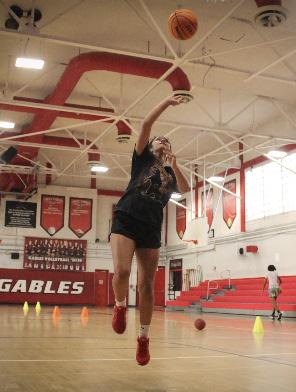
PROPELLING TO NEW HEIGHTS, the Gables girls basketball team practice their jumps shots before a match.
music can lower stress hormones and increase stimulant hormones to elevate an athlete’s energy and concentration, all of which help players mentally prepare for a game. Genres from hip-hop to rap create a motivating, uplifting experience with their high tempo beats. This enables athletes to warm up their
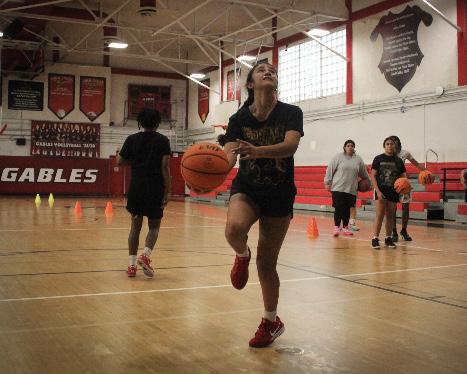
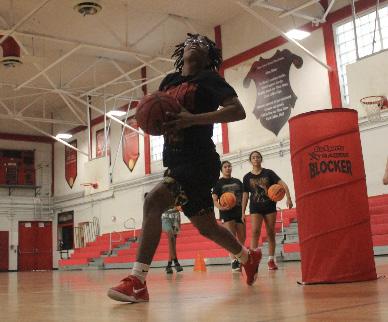
mind and body in tandem. On the other hand, athletes may listen to genres such as R&B, jazz or the blues when easing into a nervewracking game or recovering from a difficult moment. Behind every Gables athlete is their soundtrack, characterizing each moment on and off the field.
Hit Different by SZA
“Can’t hold me down, I’m moving different.”
SZA’s chill, confident R&B vibe sets the tone as the girls basketball team settles into their game day routine with the track “Hit Different.” The song’s smooth yet driving rhythm provides a focused, collective team motivation that prepares them for action. The distinct R&B sound is used as a tool that shields them from outside distractions, helping them build a strong mental fortitude.
“We need something upbeat to get motivated for practice. The music helps us focus, cutting the gym silence and replacing it with an engaging feel,” senior and varsity basketball player Jasmin Abu-Zaraybah said.
Serving as more than just motivation, these tracks are the unifying force that bring athletes into a state of confidence and concentration. The team’s energy is now brought together to prepare for the tension that comes with the first whistle.
NUEVAYoL by Bad Bunny
“Yo estoy
en la mía, no tengo adversario.”
Bad Bunny’s “NUEVAYoL” perfectly invokes the feeling of drive and determination that soccer players need. Matching the sport’s robust nature, the track unleashes a high-tempo beat that pulses with energy, encouraging a hyperfocused environment.
“It really gets me pumped up,” junior soccer player Melangie Santiago said. “The beat helps me stay focused and gives me the energy I need before playing.”
The track’s unique blend of classic Puerto Rican salsa and aggressive modern dembow, a raw and energetic genre that originated in the Dominican Republic, fuels the intense focus needed to manage the speed of a soccer match. The exhilarating rhythm ensures the team is fueled not just by adrenaline but a cohesive force preparing them to dominate the game.
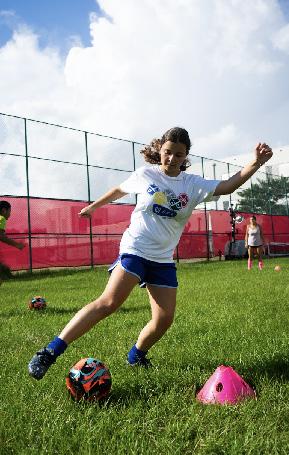
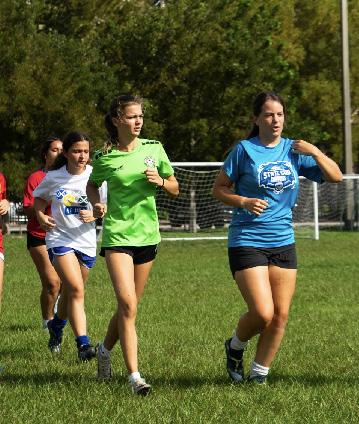
PROACTIVELY PRACTICING, the Gables girls soccer team performs practice drills ahead of their season.
Kenneth Lara/highlights
Kenneth Lara/highlights
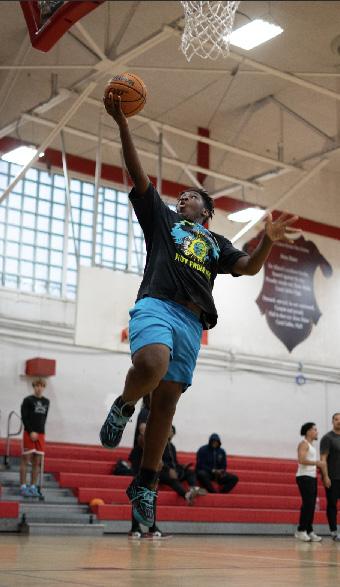
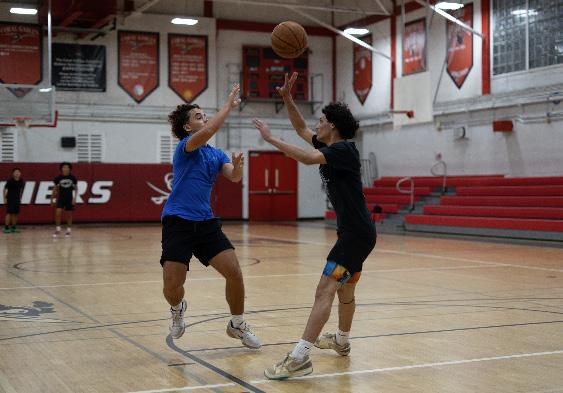
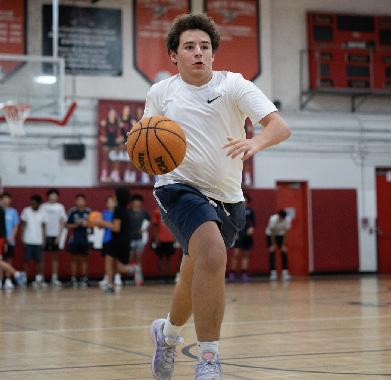
ON THE COURT, the Gables boys basketball team perfects their ball control.
INTENSIVELY
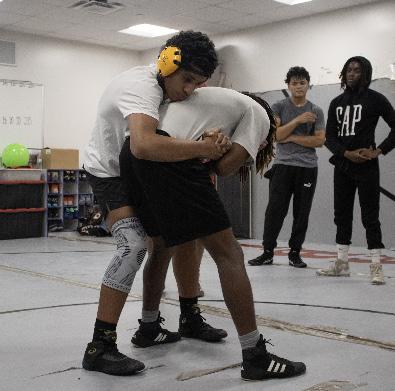
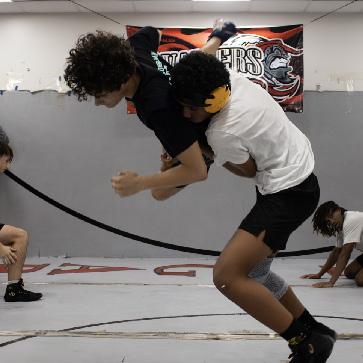
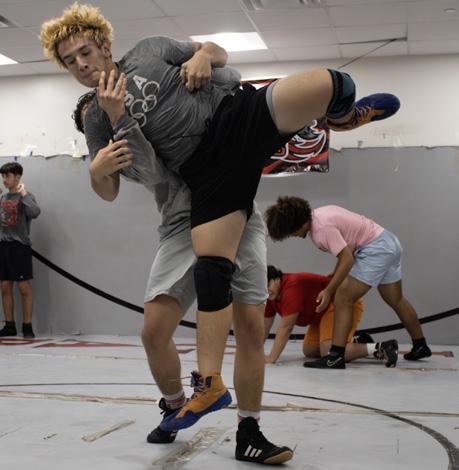
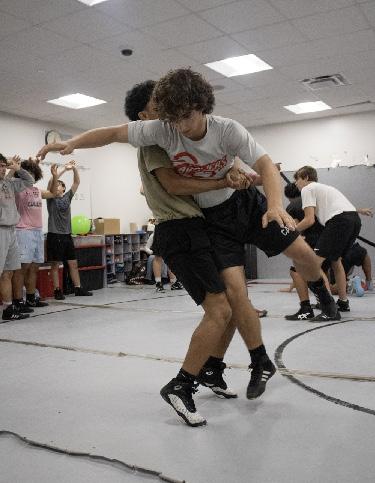
TRAINING, the Gables wrestling team brawls on the mat to better their skills.
Fragile by Laufey
“THE SOFT CANDLE GLOW, THE MUSIC SO SLOW.”
The basketball court’s intense nature calls for a calming feeling induced from a leisurely track. As pre-game nerves build up, the boys basketball team utilizes Laufey’s “Fragile” as a tool to relax and decompress. The track’s calming nature helps the athletes maintain a cool head, regulating their emotions to a controllable level. Mirroring the lyrics’ soft and calming nature, the song creates an internal space of tranquility amidst the court’s chaos. This measured pace is key for enhancing the players’ vision, according to a PBS News study; it allows them to accurately make split-second decisions that can be the difference between a win and a loss.
“I like to be relaxed before a game,” senior basketball player Marco Molinet said. “The music calms me down and puts me in my perfect zone.”
The composure found in these notes allows the players to skillfully control their own emotions. Being in control on the court means being in the best place to win the game.
HOTEL CALIFORNIA by THE EAGLES
“we are all just prisoners here. of our own device.”
Walking up to the wrestling mat to face an opponent demands steadfastness and confidence. Classic rock perfectly complements the prematch mentality a wrestler needs to perform well. The timeless atmosphere of The Eagles’ “Hotel California” ignites this focused intensity. The track expresses how the only barriers for an athlete are the ones they build in their mind. The aggressive rock melodies cut through these thoughts and push an exciting adrenaline rush.
“I need music that fits the mood,” junior and varsity wrestler Miguel Casanova said. “It fuels and amplifies my emotions before a match.”
The music sharpens the players’ intensity, turning any nervous anticipation into competitive drive. The mood and drive of the music can be used as a tool to amplify exsisting emotions within a wrestler. Whether training independently or preparing for a match, different music genres transform a wrestler’s mental freedom into the weapon they use to win.

Kenneth Lara/highlights
Kenneth Lara/highlights
Strategic showdown highlights
compiles four different chess puzzles designed to sharpen strategy and challenge brains
OLIVIA SIMON | COPY EDITOR
CHESS IS A STRATEGIC BOARD game in which two players compete to capture each other’s king. In chess, a “check” occurs when the king is directly threatened by an opponent’s piece, while a “checkmate” happens when there are no moves to prevent their king’s
capture, ending the game.
Chess puzzles provide scenarios that sharpen problem-solving skills, with solutions containing the next best move. This is demonstrated in the Gables Chess club, where Cavaliers compete to enhance their strategic skills.


“My favorite part about the chess club is the people it helps you connect to,” sophomore Nicholas Beh said. “A simple shared passion can bring new friendships not only in school, but around the community.”
The following puzzles test chess abilities. In one move, check the opposing king.
h


Design by Olivia Simon/highlights
the scene
Thad’s Pizza serves a familiar slice to customers who grew up on pies from the
Miami legend
ANTHONY FLORES | STAFF WRITER
N A QUIET PLAZA NEAR
Dadeland, a Miami pizza legend crafts masterpiece pies for the same families that grew up on his cooking.
For 45 years, Thad Winiecki was the chef behind the pizzas at Miami’s Best Pizza, and he now has a place of his own at 8016 SW 81 St. Thad’s Pizza is open from Tuesdays to Thursdays from 12 to 2:30 p.m., offering dinner from 5 to 8:30 p.m. On Fridays and weekends, hours remain the same for lunch, but extend from 5 to 9 p.m. for dinner. His pizza has been well loved for decades; returning customers and a quickly growing new crowd are happy to see him doing what he does best.
“It’s delicious and is a centerpiece for my family to enjoy together,” customer Julia Black said. “It helps make new memories, remind us of old ones, celebrate happy times, or be there in hard ones.”
Winiecki’s love for pizza began by accident; after the economic difficulties caused by the Detroit car industry’s collapse, Winiecki sought new opportunities in South Florida and took a job making pies at Little Caesars,
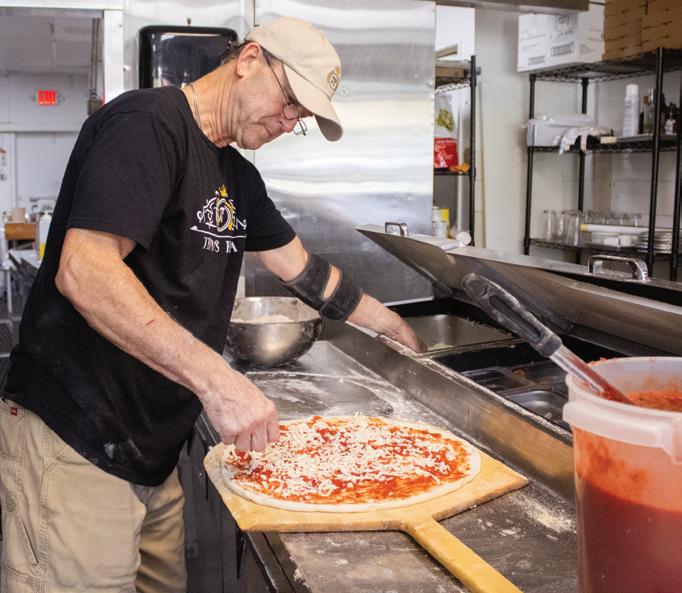
SLINGING DOUGH near the front counter, Thad welcomes every customer to his new pizzeria.
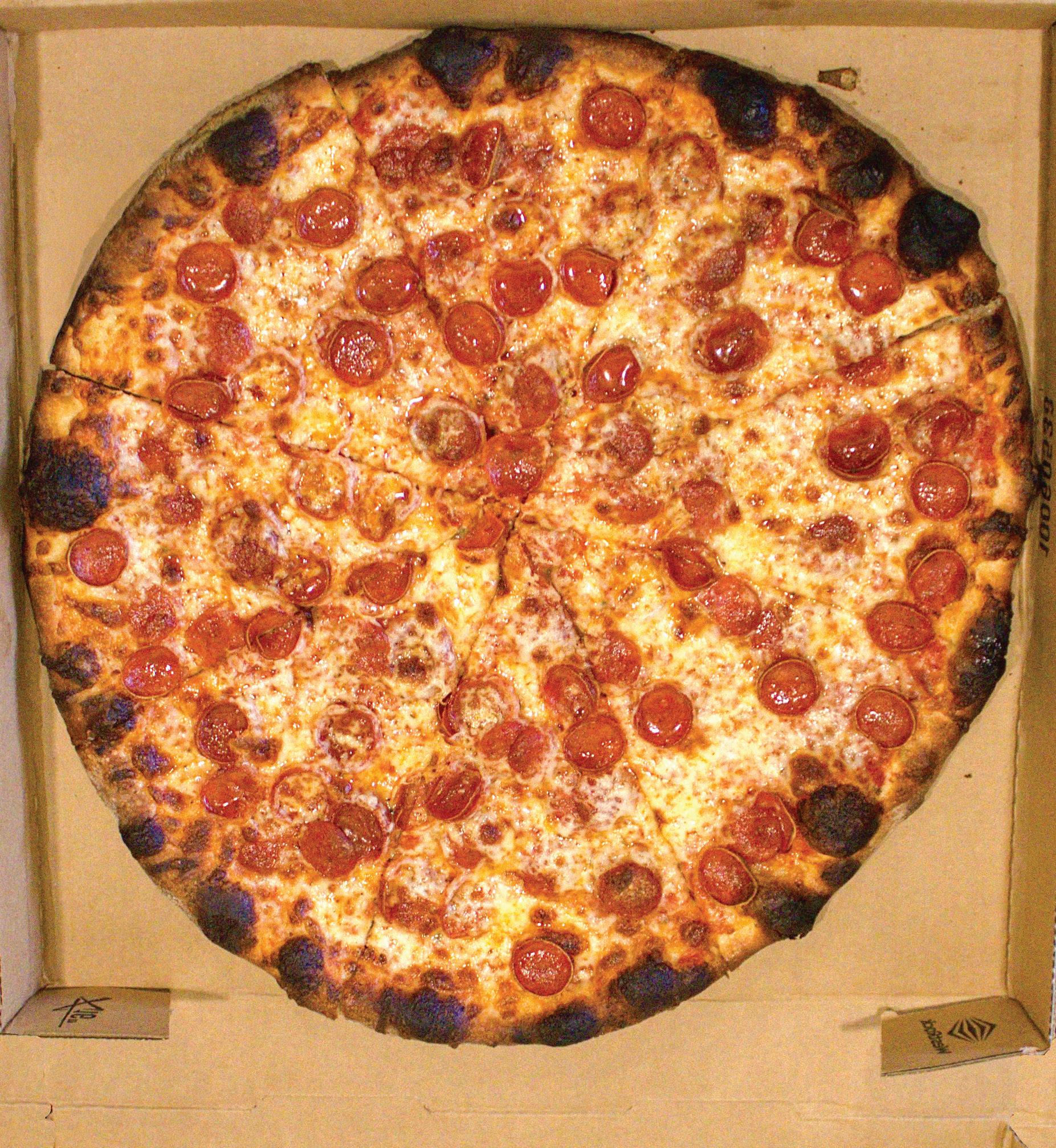
THAD’S PIZZA
which later came to be known as Miami’s Best. After four decades with Miami’s Best , Winiecki left in search of new possibilities. Opportunity struck with a pop-up at his current location, which eventually became his own restaurant: Thad’s Pizza. He now runs the restaurant alongside his daughter Joanna and son Thelvius, and is grateful for the chance to spend time together while providing for his family.
“What makes it very special is that it supports my dad,” Joanna Winiecki said. “He’s a great guy; a very, sweet, genuine person.”
Thad’s Pizza combines Detroit and New York-style pizzas, inspired by the menu of Miami’s Best that he wrote in 1995. Offering whole pies from $10 to $20 and slices starting at $6, Winiecki developed his menu from his most famous toppings to bring a twist to old-fashioned pizza flavors. After decades of experience listening to customers’ favorite toppings, Winiecki enjoys experimenting with popular and unique ingredients like pears and prosciutto.
Despite Thad’s quiet launch, familiar customers from Miami’s Best began to discover Winiecki’s new pizzeria and word spread quickly. The generations of families visiting this pizzeria make the environment more welcoming, while the steadily growing wall of customer family photos is a testament to the community he has built.
Though he loves pizza, for Winiecki, the fun lies in the people. He treats each of his customers with respect, always greeting newcomers and regulars alike with a smile even while pulling a sizzling pie from the oven.
“I was able to reignite this dynamic with the family and friends, and I’m back, that’s what’s important,” Winiecki said. “What’s exciting for me is to be back for my families, my kids and my friends.”
When running a restaurant, Winiecki believes that treating all people well is just as important as, if not more important than, a good menu. This value is ever present at Thad’s, affirmed by the “MEAN PEOPLE SUCK” sign crowning the photo wall.
Design by Ciara Burton/highlights
“Too Good To Go”
This app functions as a food waste reduction platform.
The app works with local restaurants to sell leftover food items to its customers at half price.
“Too Good To Go” is a beacon for students with a low budget, allowing them to enjoy restaurant food within their own price range.
How to use:
- First, download and sign up.
- On the homescreen, there will be options for foods, distances and price ranges.
- use the search and map view to facilitate the experience.

Chug’s Diner
This location’s cozy decorations and ample indoor and outdoor seating compliment the meals served on their typical diner menu.
“[The atmosphere] is warm, lively and full of character. You’ll hear music, laughter and the sound of espresso machines all day,” manager Ambar Varas said.
Chug’s Diner is open from 7:30 a.m. to 3:00 p.m. from Monday to Wednesday, 7:30 a.m. to 10:00 p.m. from Thursday to Saturday and 7:30 a.m. to 7:00 p.m. on Sundays.
Located on 344 Main Highway, this graband-go spot is only a seven-minute drive from Gables, creating the perfect place for students
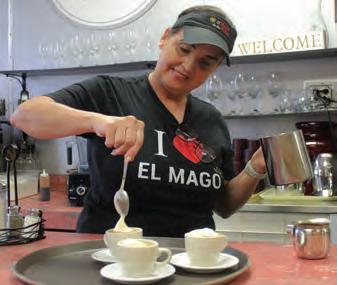
DEDICATED SERVER Irene Pena prepares traditional Cuban coffees with a welcoming smile.
Eating on a budget
Local restaurants offer delicious, inexpensive meals for consumers
BRIANNA OSORIO | STAFF WRITER
SIENA VAN DE GRAAF | STAFF WRITER
INEXPENSIVE
FOOD IS NOT easy to come across in Miami, but local dining options allow students to enjoy themselves on a budget.
Customers hoping to experience some classic Miami cuisine will be easily satisfied at local joints like El Palacio de los Jugos and El Mago De Las Fritas, which offer a diverse menu with fair prices, yet do not always get the recognition they deserve. Yard House and
to hang out and dine any time of the week.
“It’s not a super popular brand, which makes it nicer because I love going to smaller, residential restaurants,” sophomore Rachel Francisco said.
The main thing setting this place apart from any regular diner is its affordable meals, more precisely the “Chef’s Breakfast,” which is offered for only $10. This meal combination includes white rice, three eggs, sazón completa and herbs.
Although students cannot go there for breakfast on weekdays, it provides a perfect weekend brunch to enjoy on a sunny morning.
El Mago De Las Fritas
El Mago De Las Fritas offers a familiar and inviting feeling, specializing in the meal that is their namesake: fritas. This Cuban-style hamburger is known for its flavorful meat patty and the crispy fries pressed between their traditional bread rolls.
“People always comment on the ambiance, even though it is only a little hole in the wall,” daughter of the owner Martha Cardenas said.

This homey location is open Monday through Saturday from 10:30 a.m. to 8:00 p.m. Situated at 5828 SW 8th St., it is a great place to meet up and relish a homestyle meal.
While the original and simple “Frita Tradicional” includes just one patty for $6.50,
FAR TOO FLAVORFUL, the
includes three eggs, white
and a multitude of seasonings.
place rather than a bigger company with larger prices; it makes a difference in the long run,”sophomore Leah Amondo said.
Offering varieties of their specialized Cuban-style fritas, including their Confundida, a pulled pork sandwich, this location flourishes with color and life behind it, perfect for a day out.
Design by Ciara Burton/highlights
Siena van de Graaf/highlights
Siena van deGraaf/highlightss
Chef’s Breakfast
rice


El Palacio de los Jugos
Open from 7 a.m to 9 p.m everyday, El Palacio de los Jugos is a small, family-owned restaurant that prides itself in serving a variety of homemade Cuban foods.
Meals, fruits and desserts are available for fair prices, ranging from $1.78 to $12.99.
“I love Cuban food, that’s why I always go there,” Gables alumna Cynthia Deleon said. “The prices just make it worth it.”
Found on 1545 SW 27th Ave., the restaurant’s sign, distinguished by its bright red letters, catches passersby’s attention. A Miami-Dade bus stop can be found in front of the restaurant, allowing students to enjoy their food without the need for personal transport, increasing efficiency and accessibility.
Surrounding the entrance is a market with rows of fruit, including mango and apples.
Yard House
Yard House offers a “Happy Hour” special that cuts prices in half for select items, a favorite among Cavaliers. This promotion runs Monday through Friday from 3 to 6 p.m., creating an opportunity to provide students with a satisfying meal at an affordable price.
Found at 358 San Lorenzo Ave, only a five-minute walk from Gables, Yard House offers ample space for large groups ranging from club boards to celebrating sport teams. With school ending at 2:20 p.m., students have the perfect window to chat with friends then head out to grab a table for Happy Hour.
All pizzas are half off, which lowers the regular $16.99 pepperoni pizza to about $9. The “Classic Sliders,” originally priced at $14.49, are the most popular go-to meal option

Alongside fruit, the market sells desserts ranging from ice cream to rice pudding.
In the middle of the market, customers line up in front of buffet-style stations to build their plates.
The “Croqueta Preparada,” a sandwich made with cuban bread, melted cheese, turkey slices, pickles, shoestring fries and a croqueta nestled in the center, is sold for only $8.99.
“It’s the most popular dish,” sophomore Amanda Garcia said. “It is the number one thing that my family and I devour.”
Only a seventeen minute drive from Gables, this longstanding establishment gives
customers community while allowing them to enjoy Cuban-styled food for fair prices.
THE CROQUETA PREPARADA, a sandwich that leaves customers with a lasting taste, is offered for $7.99.

for students. The meal brings four classic sliders with a patty and melted american cheese.
“The Happy Hour here brings twice as many customers,” Yard House waitress Elizabeth Garcia said. “I do not see the prices increasing soon, corporate keeps it to our original roots.”
The “Chicken Nachos are served with grilled chicken, beans, cheddar cheese and customers’ preferred choice of sauce. At only $8.25, the amount of nachos they serve is enough to satiate a party of five, and such a large portion is a great deal for students who go out to eat with their friends.



THE CLASSIC SLIDERS, the go-to option for students looking for a quick bite, are served for only $7.25.
Design by Ciara Burton/highlights
Brianna Osorio/highli
Brianna Osorio/highli
Grand Ave.
Chug’s Diner
Yard House
El Mago De Las Fritas
El Palacio de los Jugos
Soup season
From broths to stews, these Miami restaurants serve up comfort in a bowl
ADRIANA GARCIA | STAFF WRITER
RACHEL VELEZ | STAFF WRITER
SOUP: A HUMBLE DISH WITH a not-so-humble reach, spanning a variety of different styles and flavors from every corner of the world. For most people, soup is associated with nostalgia and healing. It is one of those foods that shows up in every country in some form or another — from chicken noodle to miso to lentil.
Coral Gables houses a variety of restaurants that bring their own culture’s unique perspective to different dishes. Many of these recipes are passed down from grandparents to parents, bringing something personal to each bowl.
Here, the perfect simplicity of soup acts as a canvas for the city’s multicultural flair. From

broth to cream bases, classic soups take on a new life in Gables when acclaimed chefs and restaurants place their own spin on them.
With flavors hailing from all over the world, restaurants such as Chef Sucre Cafe, Birdie Bistro and The Globe Cafe cater to loyal customers through their “Soup of the Day,” bringing homeyness to the bustling cityscape.
In a cultural hub like Miami, having fresh, homemade bowls of soup is one way local restaurants set themselves apart from chains, offering warmth and quality in every spoonful.
THE GLOBE CAFE
Family-owned since 1997, The Globe Cafe is a cornerstone of downtown Coral Gables dining, located at 377 Alhambra Circle. Known for its old-world charm and inviting atmosphere, the Globe has long been a favorite

STEAMING SOUPS only enhance the warmth created by the red velvet stairs, soft light and conversations in The Globe Cafe.
THE CLAM CHOWDER, PUMPKIN AND TOMATO BISQUE SOUPS are all made by mixing a variety of cultures and ingredients.


among locals looking for comfort food served with European flavors.
Inside, the cafe features arched windows, tiled floors and a long wooden bar that give the space a timeless, Parisian café feel. Vintage paintings hang on the walls, and live jazz nights bring the place to life with music and laughter, adding to what makes it such a wellloved spot.
The Globe’s “Soup du Jour” is $8 and rotates weekly, giving customers something new to try each time they visit. Their soup of the day option means receiving anything from a creamy tomato bisque to a hearty chicken noodle soup.
“The Globe has this timeless feel to it — like it’s frozen in the best way possible,” senior Gabriel Bravo said. “Their French onion soup is unbeatable. It’s the kind of dish that makes you slow down and just enjoy being there.”
The tomato bisque offers a rich yet smooth taste with roasted tomatoes and fresh basil, while the chicken noodle is warm and classic, filled with tender chicken and vegetables in a homemade broth. For only $8, the chilled Spanish gazpacho provides a refreshing reprive from the Miami heat without sacrificing an
ounce of comfort and flavor. The French onion soup is the perfect way to satisfy savory cravings, for only $9.
Each soup smells enticing and tastes homemade, pairing perfectly with the café’s sandwiches and salads.
“[The tomato bisque is] creamy and comforting without being too heavy,” senior Israel Candia said.“The atmosphere is cozy, and the staff always provide friendly, attentive service. It’s a place I come back to because it feels like a second home.”
The Globe Cafe’s charm comes from its ambiance, feeling effortlessly classic and vintage like a slice of Miami that never modernized.
Customers can enjoy the experience of dining somewhere that breaks out of the monotonous mold many cafes in Miami follow.
During lunch hours, The Globe fills up with locals and office workers grabbing a quick bite or catching up over coffee. By evening, the pace slows and the crowd shifts to neighbors and friends unwinding to live jazz and easy conversation. In addition to everyday dining, The Globe is available as a cozy venue for private parties and weddings.
Rachel Velez/highlights
Rachel Velez/highlights
BIRDIE BISTRO
Birdie Bistro, located in the heart of Coral Gables’ Granada golf course at 2001 Granada Blvd., is owned and operated by Rita Tennyson.
Many Gables students are familiar with the bistro because of its proximity to the school, located less than two miles away. It has become a go-to place for students seeking a warm bite after a long day of class.
A highlight of their menu is the rotating Soup of the Day, which holds a special place among their offerings.
The bistro’s staff works diligently to create a feeling of community through their interactions with other staff members and the customers within the restaurant. The location’s open layout helps emphasizes the cozy and welcoming environment between the workers and customers.
The top items on the menu are their soups, priced at $6 for a cup and $8 for a bowl.
Their clam chowder is an authentic and tasty take on a dish often overlooked in South Florida. Its authenticity comes from its creamy New-England style base, prepared in-house with fresh clams, potatoes and cream rather than from prepackaged mixes, a testament to Birdie Bistro’s dedication to serving customers with care.
The soup’s flavor is rich but balanced, allowing the taste of the clams to shine through.
While, as a northeastern dish, it is an uncommon soup in Miami, Birdie Bistro brings the dish to a South Floridian audience.
“I first heard about Birdie Bistro from friends,” junior Luz Guillen said. “I come here often because their clam chowder soup is so comforting and delicious. It really feels like home.”
The variety of the Soup of the Day option allows for diversity in flavors and dish origins alike, introducing customers to new flavors without straying far from home.
At Birdie Bistro, locals and Gables students can go to taste delicious soup from a multitude of cuisines. The restaurant prides itself in creating authentic style cuisine that brings their customers back to their origins.
For a lot of people, that is what soup is all about: comfort and familiarity.
CHEF SUCRE CAFE
Co-owned by Antonio Sucre and Lisandra Alvarez, Chef Sucre Cafe sits in a small corner building off Miracle Mile at 475 Biltmore
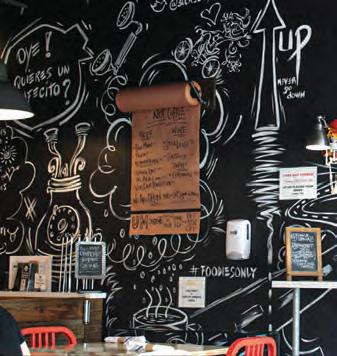
THESE DECORATIVE DRAWINGS
in Chef Sucre Cafe represent their restaurant’s commitment to creativity, both in soup and interior design.
Design by Ciara Burton/highlights

The highlights Staff’s Grilled Cheese Recipe
First, heat a nonstick skillet on medium. Then, spread mayonnaise on one side of each slice of bread.

After, add two ounces of shredded American and cheddar cheese on the mayonnaise side of each slice.
Next, add butter to the skillet, swirling it around until melted.
Place the sandwich on the skillet until it is golden brown — four minutes tops. Finally, flip the sandwich, add a bit more butter and brown the other side.


Way, Suite 104B. The food blends French, Italian and Latin comfort dishes, mixing flavors that are both familiar and refreshing.
Sucre studied at Johnson & Wales and Le Cordon Bleu. After eight years cooking at several well-loved Miami restaurants, he has built a spot that feels stylish, friendly, warm and personal.
A small chalkboard near the register lists daily specials in bright chalk, and the steady hum of the espresso machine mixes with the chatter of regulars.
The chalk-style art that covers the walls includes Spanish quips that showcase the local culture and alludes the menu’s many culinary inspirations. The smell of butter, garlic and fresh bread fills the air, giving customers a preview of the restaurant’s tempting menu items all while the attentive service amplifies the neighborhood charm.
“It’s my go-to restaurant whenever I’m sick or stressed because it’s so homey,” senior Kate Kuryla said.
Every Soup of the Day is made fresh and offered alongside sandwiches and empanadas that are perfect to dip in or simply accompany


each bowl, making it an ideal lunch stop. No matter the flavor, each soup is priced at $12 and accompanied with either half a salad or half a sandwich, guaranteeing a well rounded meal for a reasonable price.
One standout staple in Sucre’s repertoire is the Creamy Butternut Squash Soup, a flavorful helping of comfort in a bowl.
Hailing from 19th century North America, it is made with roasted squash, onions and a touch of coconut milk for sweetness. A dash of nutmeg and spice keeps it warm, inviting and rich without feeling heavy. While simple, this soup exemplifies Sucre’s ability to curate the perfect flavor balance in a dish.
“Our main inspiration is to create a life of purpose — doing something meaningful every day that we love,” Alvarez said. “Chef Sucre is about homemade, artisanal food with a humble touch, served in a warm, welcoming atmosphere.”
Sucre’s dedication to their craft, always aiming to make the most delectable dishes they can while building a community in their café, is reflected in their flavors and the environment.
Rachel Velez/highlights h



Hazel Grosell/highlights
Model: Emilia Kohnstamm/highlights
In a world filled with constant noise, silence becomes a creative tool; stepping away from distractions naturally unlocks a flow of ideas


minute daily mindfulness excercises decreased anxiety by 12.6% more for those who utilized them versus those who did not. of the variance in a person’s mindfulness can be explained by their creative capacity.

THE “AHA!” MOMENTS encountered during the postproductive period of calm are all too familiar for many. Though often mistaken for spontaneous inspiration, these instances are actually the result of an intricate internal process. One of the most common examples of this phenomenon is the “shower thought” — the unexpected burst of insight that arrives while rinsing off, long after one has stopped consciously thinking about a problem.


18% 50%
Taking a shower provides the brain a breather and an ideal opportunity to revisit lingering questions and approach worries from a new perspective. The National Institutes of Health found that cold showers increased the subject’s release of dopamine — a chemical messenger in the brain linked to pleasure and reward — by 250%. Warm showers reduced plasma cortisol — a hormone that plays a crucial role regulating stress response — concentrations by 34%. When dopamine levels are high and cortisol levels are moderate, our brains are more likely to make novel connections and find patterns where they normally would not.

performance drop can occur when students “overhustle” without rest and experience cognitive fatigue.
Design by Emilia Kohnstamm/highlights
a make-or-break audition for the future. In a culture that glorifies hustle, students find themselves caught in a relentless cycle of pressure and perfectionism. Although some might dismiss the persistent strain, constantly pushing to maximize productivity actually hinders creativity and overall performance.
To combat this, implementing moments of rest such as participating in wellness activities, enjoying third spaces and practicing mindfulness helps the brain reach a state of incubation, in which ideas light up and evolve.
“One time when I had to step away from work to solve a problem creatively was when I was approaching my Extended Essay outline,” senior Lucia Astorga said. “I was really stuck. My friend and I went outside, took a walk and talked about our essays and life casually. Eventually, we ended up talking about what we wanted to write about, giving each other insights and ideas, which helped me devise a new plan on how to write the 4,000 word essay.”
“ Wizards is an escape.It lets me step into a new environment and take on a whole new identity. That way I can truly relax...
Phoenix Lozano, 12
Beyond showers, the brain requires extra reset. Mindful disconnection is essential to balance “grind” periods of focused work with moments of reflection and recentering. By taking breaks, the quality and originality of work improves, as it is approached with a clearer headspace.
Of course, this type of brain stimulation is not exclusively limited to showering. During simple activities like journaling, walking or even washing dishes, the mind enters a relaxed but engaged state. According to a study done by the American Mindfullness Research Organization, overthinking is deterred during these activities, while free-flowing thought that allows new ideas to surface is encouraged. Actions that promote internal reflection and investigation, even by just allowing the mind a moment of quiet, can be essential in the development of ideas and understanding of perspectives, inspiring further productivity down the line.
As a high school student in 2026, every GPA point and extracurricular can feel like
At Gables, certain clubs that focus on relaxation and recreation rather than solely academic objectives can also promote this novel spark.
“Wizards has helped me so much in being able to just get away from everything,” senior and Wizards co-president Phoenix Lozano said. “Wizards is an escape. It lets me step into a new environment and take on a whole new identity. That way, I can truly relax and enjoy the things that I enjoy while being myself without having to worry about anything.”
In recognizing that productivity thrives on periods of renewal, students can redefine school life — not as a measure of how much they can endure, but of how effectively they can think, imagine and grow.
VIVIAN ROMERO | STAFF WRITER
The University of Southampton
A 2024 study by Meghana et. al
HARNESSING CREATIVITY UNDER PRESSURE

Experiencing the “shower thought” phenomenon is more coveted now that inspiration is becoming more infrequent.
Psychologists have long explored how creativity is steadily stifled, advocating that being free from external pressures is increasingly important to the development of free thinking. These outside forces contribute to an internal struggle: defining success in a society where constant motion is idolized and rest is dismissed as a waste.
WHAT WAS YOUR MOST RECENT SHOWER THOUGHT?


Academically, the pressure to perform can transform schools, which should be institutes of learning, into stages of constant judgment. This circumstance comes from what scientists call “social-evaluative threats.” According to the NIH, high social-evaluative threats — when individuals feel that their abilities, actions or values are being judged by others — decrease creative performance.
Simultaneously, low-judgement environments have been found to increase creative performance. For students, every academic responsibility can feel like a high socialevaluative threat, leading to burnout, which is the physical or mental collapse caused by overwork or stress. Under the constant pursuit of precision, creativity cannot thrive.
“I find that there are days where everything gets to be too much, and it’s like I just don’t want to think anymore,” sophomore Gianna Molina said. “All the academic pressure gets to me, and I just don’t have the head for anything else.”
School is an important foundation and source for knowledge for future preperation. Still, an analysis by Psychologs on pyshcological barriers to learning discusses that when students fear failure or embarrassment, they shift from openended exploration and learning to rigid problemsolving exclusively focused on results, believing that originality is only valuable if it meets external standards of excellence. In academic environments, this confusion can be costly.
It is important for students to understand that a dip in motivation is natural and not a sign of failure. Motivation is an emotional drive ignited by interest, curiosity or passion. Discipline, on the other hand, is the fuel that keeps it running. The perfection-driven culture of modern life incorrectly reshapes how students understand motivation itself, leading people to confuse the two values.



Senior Gianna Figueroa “My most recent shower thought was that technically the youngest photo of you is the oldest one taken of you.”


When discipline supports motivation, students can reach a balance between preparation and engaged relaxation — a pattern that sustains performance without burnout.
As explained in the Componential Theory of Creativity, when a task is enjoyed and not enforced, creativity is at its highest. If academic demands are not countered with breaks, the experimentation and spontaneous mental wandering that often leads to breakthrough ideas will be limited. This is not just theory — it is lived experience, echoed in the frustrations of artists with “art block” and writers with “writer’s block.” It is a natural part of the creative process and can even be caused by various factors outside of stress like self-doubt or a lack of inspiration.
“Many believe that stress fuels creativity, [reflected in] the saying ‘I work best under pressure,’” creative arts therapist Lauren Amigo said. “While mild challenges can boost focus, chronic stress actually restricts imagination and emotional nuance. Another misconception is that creativity must look effortless or inspired; in truth, it’s nurtured through self-compassion, patience and emotional regulation.”
When students learn to step away without guilt, they give their minds the freedom to reframe.



Junior Siara Ortiz “When I was showering I realized that on a question on my quiz that I was stuck on, I was only one step away from getting the right answer.”





DISTRACTION: A HELP OR A HARM
While mindful breaks can serve as positive distractions that promote the development of novel thinking, alternative distractions can encourage the exact opposite.
Many students are all too familiar with the chronic desire for stimulation, blasting music, watching Netflix and typing away at homework all at once. This chaotic mix is appealing and may feel like the only opportunity for relief from endless schoolwork. However, this sensory overload only creates the illusion of productivity.

“A

According to a Harvard Gazette analysis, a mechanism of forgetting is interference, where new memories disrupt the recall of older ones or vice versa. This is why in reality, no memory is retained from either activity because the brain cannot fully engage in so many things at once.

thought I had was how people are trying to be nonchalant to attract attention, when the whole point of being nonchalant is to not attract attention.”

As constant stimulation is praised through pop culture trends and endless content feeds, staying “plugged in” feels like a necessity. Distraction becomes a form of performance, not relief. In a study by Science Direct, students reported “availability stress,” or feeling pressured to respond quickly and to keep in touch through their phones.
People multitask and prioritize being online not out of choice, but out of fear of falling behind socially.
Design by Emilia Kohnstamm/highlights
Junior Justhin Landaverde
shower
While offline, one loses the opportunity to gain access to a shared language of humor, emotion and context. As examined by the NIH through research on distraction, this digital duress can distort focus by constantly demanding attention, making it difficult to stay on task or truly disconnect without just rejoining another space characterized by expectation and observance.
“When students disengage from constant digital input, they reclaim mental stillness and space for original thought,” creative arts therapist Lauren Amigo said. “Social media’s rapid stimulation keeps the brain in reactive mode, leaving little room for subtle internal associations to form. Social media is also a space that urges us to constantly compare
ourselves to others rather than finding beauty in originality and uniqueness. Unplugging fosters curiosity, presence and authentic creative voice.”
Negative distractions, especially those related to social media, leave behind a sense of emptiness and guilt, reinforcing stress instead of reducing it. This pattern dulls curiosity and weakens self-discipline, replacing growth with passive consumption.
This is not to say all types of distractions are bad. When distraction is a healthy, conscious pause, like going for a walk or taking a short social media break, it nurtures creativity and wellbeing. As long as the promise of “one more video” or “one more episode” is
kept, digital consumption can be a beneficial decompression method.
“Taking time to relax and interact with others has given me new ideas and ways to solve problems, not only academically but also in situational issues,” senior and Wizards copresident Ashlee Hernandez said. “Being able to take a break from reality allows people to find new perspectives.”
It is the avoidance of tasks that actually creates no true result. Learning to balance short, restorative breaks with mindful focus helps maintain not only academic performance but also emotional balance and genuine creative potential.
from the editor
Lack of inspiration while suffocating under the heavy burden of stress is something that unfortunately, I’m not unfamiliar with. Whether it is writing, designing or drawing, at times I just cannot find the spark. But as a junior balancing academic and extracurricular responsibilities, I have come to value mindful breaks in between my periods of dedicated production.
For me, a walk is the ultimate reset. Listening to the sounds of chirping birds and rustling leaves brings me an all encompassing calm that organizes my jumbled thoughts. For friends, a casual conversation, moment of meditation, or even a shower has a similar effect.
Instead of letting the weight of sports, academics, jobs and social situations prevent us from growing, in recognizing how to redirect this negative energy, we can work towards creating inspired and comprehensive outputs.
Sincerely,
Emilia Kohnstamm Insight Editor
Design by Emilia Kohnstamm/highlights
CAVALIER CALM
If life came with a pause button, students would probably click it more than a couple times throughout the day. Mindful rests are exactly that. Although incorporating these breaks is not as easy as the press of a button, they can be more rewarding. When teens treat these pauses not as extras, but essentials, emotional stability and executive function flourish.
“Activities like dance and acting help me recharge — they give me a mental break and peace of mind while also helping me to improve at that ability,” junior Giovanna Campos said. “As a Gablette and member of troupe, I often run to dancing and acting as a way to disconnect with the stress and pressure of school.”
At Gables, balancing productivity with mindful breaks does not have to be a solo pursuit — it is already woven into the campus culture. For those craving community and calm, the school has extracurricular offerings such as Gables Wellness’ yoga and meditation activities and their presentations on stress and emotional management, which allow for relaxation and reflection.
Similarly, Wizards, separated into four classrooms, offers videogames, board games, movies and Dungeons and Dragons, indulging students in the fantasy and imaginative realms of entertainment. Interact also participates in engaging community service with crafts such
as card decorations and gift wrapping. Offering fun bonding games involving key theatrical abilities and occasional workshops, Gables Players helps students hone their vocal, acting and dance skills. All serve as an environment for students to disconnect from the academic environment in a healthy, stimulating way.
“Going around the rooms at Wizards, everyone is doing their own thing,” Lozano said. “Either something they enjoy, or roaming around and talking with people that they enjoy.”
Even the physical layout of the school supports this balance: the library’s tucked-away corners are perfect for focus, while Gables’ umbrella-shaded seating areas outside invite casual hangouts and breathers while in school.
Extracurricular classes like art, dance, cooking and fashion can promote creative sucesses even within a classroom, offering the student body a chance to express themselves through a variety of mediums. They demonstrate that productivity cannot be so narrowly defined.
The pressure of high school responsibilities, academic, social or otherwise, can lead students to mistakenly prioritize constant execution over their health and well-being. To improve performance without sacrificing wellness, implementing recreational breaks in the daily routine is essential, as it grants access to a clearer and more inventive state of mind.