
Member Best Practices

Introduction
Welcome to the Georgia 811 Member Best Practices Manual. This guide is designed to support members by outlining essential policies, procedures, and expectations to help ensure the safety and success of all stakeholders involved in the damage prevention process.
As a member of Georgia 811, you play a vital role in protecting underground utility infrastructure and ensuring safe excavation practices. This manual serves as a comprehensive resource. It offers the tools, contacts, and information necessary to manage your responsibilities. These include locate request response, service area maintenance, and communication with excavators.
Inside, you will find key information on our contact center hours, holiday schedule, liaison directory, locate request types, service area mapping, notification processes, Positive Response guidelines, and access to valuable resources like ThoughtSpot.
Please refer to this manual often, and do not hesitate to reach out to our Member Services department if you need support.
Thank you for your continued commitment to safety and your partnership with Georgia 811.
About Georgia 811
Georgia 811 is a nonprofit corporation dedicated to preventing damage to Georgia’s underground utilities and promoting public safety. We function as a communication system, connecting our member utility companies with professional excavators and homeowners who are planning mechanized digging activities such as excavation, tunneling, grading, boring and demolition. Everyone should contact 811 before starting any digging project, big or small, to help protect underground utilities and keep communities safe.
History
In 1968, a tragic natural gas incident claimed the lives of seven children and two adults at a daycare in Hapeville, Georgia. Georgia 811, originally doing business as the Utilities Protection Center, was formed in response. Housed at BellSouth, seven founding members including Atlanta Gas Light, BellSouth, Georgia Power, Colonial/Plantation/Transco Pipelines and Clayton County Water Authority began the process of creating a call center to help coordinate the locating of underground utility lines when digging was to occur in seven metro Atlanta counties. In 1974, the first locate requests were processed.
Mission Statement
Georgia 811 will be an industry leader in promoting safety and preventing damage to underground and overhead facilities through high-quality education and notification services.
safe excavation practices.
Core Values
Safety:
Safety stands as our paramount core value, embodying an unwavering commitment to the prevention of harm and the preservation of well-being for individuals and communities alike. Safety is embedded in every aspect of our operations, as we diligently strive to educate the public on safe digging practices, safeguarding lives, property, and the environment.
Quality:
Quality serves as the cornerstone of our unwavering commitment to excellence. We are devoted to delivering precise, reliable, and current information to the public concerning safe digging. Our dedication to quality extends to the efficiency and effectiveness of our services, ensuring the provision of valuable resources and guidance that contribute positively to the safety of excavation activities.
Integrity:
Integrity forms the ethical backbone of our organization, guiding our operations with honesty, transparency, and accountability in all interactions. In the context of educating the public on safe digging, integrity translates to providing unbiased and impartial information, fostering trust among stakeholders, and upholding the highest standards of ethical conduct.
Strong Relationships:
Building and nurturing strong relationships constitutes a fundamental core value guiding our interactions with the public, partners, and stakeholders. Strong relationships empower us to better serve the public, creating a network of support and cooperation.
Clear, Effective Communication:
Clear, effective communication serves as a foundational element of our mission to educate the public on safe digging practices. We are committed to delivering information in a manner that is easy to comprehend, accessible, and relevant. Emphasis is placed on the importance of clarity, precision, and timeliness in our communication efforts, ensuring the public receives accurate and actionable guidance for safe excavation practices.
Quality serves as the cornerstone of our unwavering commitment to excellence. We are
Georgia 811 Holidays
The Georgia 811 offices will be closed for the following holidays:
• New Year’s Day
• Birthday of Martin Luther King, Jr.
• Memorial Day
• Independence Day
• Labor Day
• Thanksgiving Day
• Day After Thanksgiving Day
• Christmas Eve
• Christmas Day
Any such holiday that falls on a Saturday shall be observed on the preceding Friday. Any such holiday that falls on a Sunday shall be observed on the following Monday. If Christmas Eve falls on a Friday, it shall be observed on the preceding Thursday. If Christmas Eve falls on a Sunday, it shall be observed on the following Tuesday.
Contact Information
Administrative Office
770-623-4332
Monday – Friday
8:00 a.m. – 5:00 p.m.
Georgia 811 Contact Center
Dial 811 or 800-282-7411
HelpDesk@Georgia811.com
Monday – Friday
7:00 a.m. – 6:00 p.m.
Available 24/7 for all locate requests except Designs and Large Projects.
Member Assistance
Georgia 811 provides members with comprehensive support through two key departments: the Member Services Department, which assists with membership-related needs, and the Liaison Department, which delivers outreach and education across the state.
Member Services Department
770-623-5786 MemberServices@Georgia811.com
Monday - Friday
7:00 a.m. – 4:00 p.m.
The Member Services Department provides direct support for all membership-related needs. This team is the primary resource for members who require assistance with account management, technical support, or general questions. Key areas of support include:
• Member sign-up and onboarding
• Assistance with service area map updates
• Positive Response assistance
• Member database updates
• ThoughtSpot account management & assistance
• General membership inquiries
By offering responsive and knowledgeable assistance, the Member Services Department ensures members have the tools and information needed to meet their obligations and remain in compliance with GUFPA requirements.
Liaison Department
Georgia 811 Liaisons are dedicated to outreach and education. Their primary focus is promoting safe digging and excavation practices under Georgia law to members, excavators, and the general public.
Liaisons conduct special training sessions, deliver educational presentations, and actively participate in industry events.
In addition, Georgia 811 maintains a Member Outreach Program in which each liaison contacts members annually. This one-on-one engagement provides members with an opportunity to discuss their specific needs, ask questions, and receive personalized guidance to support their business operations.
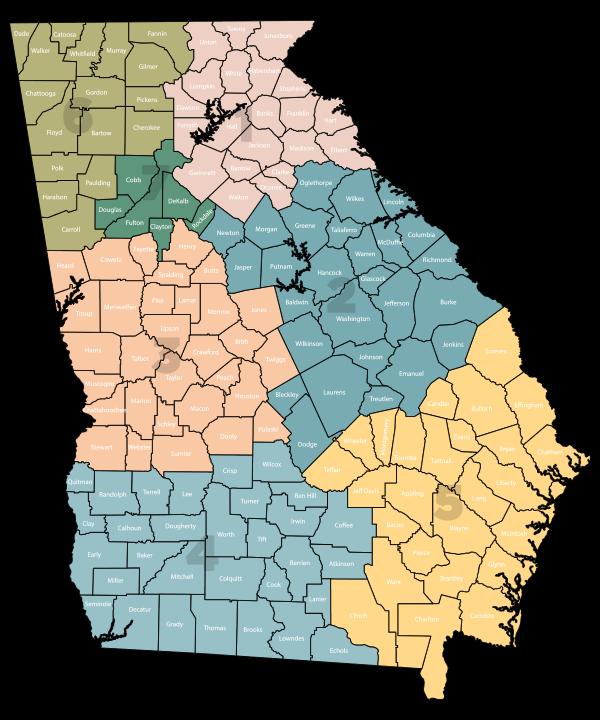
Each Liaison Manager is assigned to a specific geographic area within Georgia, ensuring localized support and accessibility. Members can identify their assigned liaison by consulting the regional map and contact list provided by Georgia 811.
Liaison Directory
Liaison Director: Holly Files

404-538-6648 hfiles@Georgia811.com
Region 1: Becky Kinsey

404-375-6209 bkinsey@Georgia811.com
Region 2: Brendan Cote
404-644-5447 bcote@Georgia811.com
Region 3: Terry McLaurin
770-715-8644 tmclaurin@Georgia811.com
Region 3 & 4: O’tania Jenkins
678-218-8522 ojenkins@Georgia811.com
Region 5: Brendan Cote
404-644-5447 bcote@Georgia811.com
Region 6: Terry McLaurin
770-715-8644 tmclaurin@Georgia811.com
Region 7: Salie Johnson
770-286-1886 sjohnson@Georgia811.com
3 6
4
2
5
Georgia Underground Facility Protection Act
(GUFPA)
The Georgia Underground Facility Protection Act (GUFPA) is a state law designed to safeguard underground facility infrastructure by regulating excavation activities and requiring coordination between excavators and facility owners/operators. The law outlines specific responsibilities for facility owners and operators to ensure safety, prevent service disruptions, and reduce damages to underground facilities.
Who is Considered a Facility Owner/Operator under GUFPA?
A facility owner/operator is any entity that owns or operates underground infrastructure. Under the Georgia Underground Facility Protection Act, an "underground facility" is defined as:
Anundergroundorsubmergedfiber,conductor,pipe,orstructureused orinstalledforuseinprovidingtrafficcontrol,trafficmanagement, electricservice,orcommunicationsservice,orincarrying,providing,or gatheringgas,oiloroilproducts,sewage,wastewater,stormdrainage, water,orotherliquids.
All underground facilities are considered to extend to the connection to the customers’ facilities. However, this definition does not include sewer laterals or publicly or privately owned railroad facilities.
Examples of entities that are considered facility owners/operators include:
• Gas and Oil utilities
• Electric utilities
• Telecommunications and fiber optic providers
• Water, sewer, or storm drainage utilities
• Traffic control and traffic management system operators
These entities are legally required to become members of Georgia 811, the state's 811 center.
Key Requirements for Compliance for Facility
Owners/Operators
Membership with Georgia 811
All facility owners/operators must be active members of Georgia 811 to receive notifications of excavation activities in areas where they have underground facilities.
Maintaining Accurate Mapping
Owners/operators are responsible for providing accurate and up-todate service area maps to Georgia 811. These maps define the boundaries where they own or operate facilities and allow Georgia 811 to issue notifications correctly.
Responding to Locate Requests
Facility owners/operators must respond to excavation notices by:
• Marking the location of their underground facilities within the legally required timeframe
• Providing a response through the Positive Response Information System (PRIS), indicating whether the area is clear or has been marked.
• Using standardized response codes to communicate status and actions taken
Failure to respond appropriately may result in regulatory action or fines.
Locating and Marking Facilities
When marking underground utilities, owners/operators must comply with the Public Service Commission (PSC) Marking Standards Rule and GUFPA, which include:
• Correct use of American Public Works Association (APWA) Color Code
• Clear markings using waterbased paint and flags
• Identifying the type and location of the facility
• Ensuring accuracy and visibility
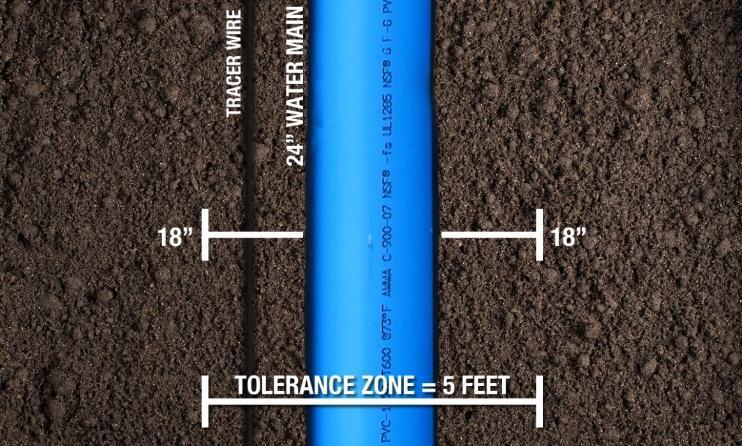
• Ensuring marks are accurate and placed within the designated tolerance zone. The tolerance zone, as defined in O.C.G.A. § 259-3(38), extends eighteen inches from each outer edge of the facility and is measured from the outer edge of the facility itself, not from the location of the marks.
Damage Reporting and Investigation
If a facility is damaged:
• The facility owner/operator shall respond as soon as possible to repair the facility and document the incident.
• Report and Document Probable Violations: If utility facilities are damaged due to a probable violation, the facility owner/operator should promptly investigate, document the facts, and submit the findings to the PSC using the required form found on their website.
Why Compliance Matters
Compliance with GUFPA and PSC Rules helps utility owners/operators:
• Prevent service interruptions and costly repairs
• Avoid liability and regulatory penalties
• Ensure public and worker safety
• Build trust with excavators and other stakeholders
Regular Review of GUFPA Regulations
Members should routinely review the GUFPA regulations, PSC rules, and any updates to ensure ongoing compliance. Staying informed about changes helps in adapting practices accordingly and avoiding potential violations.
High Voltage Safety Act
The High Voltage Safety Act is a state law that establishes specific requirements for anyone performing work near overhead high-voltage electric lines. It applies to lines carrying more than 750 volts and is intended to protect workers, the public, and critical utility infrastructure from the serious hazards associated with accidental contact. The Act requires advance notification to Georgia 811 during regular business hours at least 72 hours in advance before work begins, excluding weekends and holidays. This process ensures that the owner or operator of the high-voltage lines can identify the work site, assess potential risks, and implement appropriate safety measures. By requiring coordination in advance, the law helps prevent accidents, delays, and service interruptions while promoting safe and efficient project execution.
Key Requirements
Notice of Work
The party responsible for the work must notify Georgia 811 during regular business hours at least 72 hours, excluding weekends and holidays, before beginning work.
The notice must include sufficient information to identify the work site and scope:
• Tract or parcel of land
• Type of work to be performed
• Name, address, and contact information of the party responsible for the work
• Anticipated start and completion dates.
Safety Measures
Upon receiving notice, the owner or operator of the high-voltage lines must coordinate with the person responsible for the work to establish appropriate safety precautions. These may include de-energizing and grounding the lines, relocating facilities, or installing protective barriers, coverings, or other safeguards.
Work may not begin if any person, equipment, structure, or tool could come within ten feet of an overhead high-voltage line unless the required protective measures are in place.
Why It Matters
Overhead high-voltage lines present serious hazards, including electrocution, fire, service disruptions, and significant property damage. Following the prescribed procedures mitigates these risks.
Advance coordination enables utilities to plan and implement protective measures efficiently, reducing the likelihood of delays, unsafe conditions, and incidents.
Compliance ensures accountability and clearly defines responsibilities when work is performed near critical electric infrastructure.
Interaction with Other Laws
The High Voltage Safety Act is distinct from, but complementary to, the Georgia Underground Facility Protection Act, which governs work near buried utilities.

Membership
Georgia 811 Membership is required for any facility owner or operator. Defined in GUFPA, a “Facility owner or operator” means any person or entity with the sole exception of a homeowner who owns, operates, or controls the operation of a utility facility.
Member Financial and Administrative Responsibilities
Membership at Georgia 811 comes with important financial and administrative responsibilities that help ensure a smooth and efficient experience. Proper financial management, access to billing data tools, accurate record-keeping, and timely responses to system requests all play a role in maintaining good standing and avoiding unnecessary costs. By staying proactive in these areas, members can maximize the value of their membership, streamline operations, and contribute to the overall effectiveness of the Georgia 811 system.
• Remain in good standing with payments per Georgia 811 Bylaw 3.8: Any member who shall be in arrears in the payment of any installment of fees, periodic dues or assessments more than 60 days after their due date shall not be in good standing and shall not be entitled to vote as a member.
• Sign up for ThoughtSpot so you have access to your billing dashboard.
• Make sure to update accounting contact information when things change in your organization.
• Keep your service area maps accurate to avoid excess billable locate requests.
• Respond to PRIS on time to avoid late notice fees.

Membership Database & Administration
All members must inform Georgia 811 of any changes to their membership details, including but not limited to; company name, address, contact information, locate request phone numbers, locate request delivery output methods, and online account access.
Member Contact Information
Members must provide Georgia 811 with the following required contact information:
• Person of Record
Receives official business communications from Georgia 811, including contracts, board member voting, and other important notices.
• Main Point of Contact
Serves as the primary contact for general membership inquiries, locate request questions, and concerns.
• GIS - Mapping Contact
Responsible for maintaining the company’s Service Area Mapping and will be alerted if the member is missing from a locate request.
• Delivery Issues Contact
Oversees any concerns related to locate request delivery.
Members must provide telephone numbers that will be displayed on the following locate requests:
• Normal
• Design
• Overhead • Damage
Emergency • Large Project Meeting
• Large Project Excavation

Locate Request Delivery Output
The output refers to the designated destination where locate requests and notifications are sent. Georgia 811 provides the following output delivery options:
Email:
• Default method of notification.
• Ensure proper email settings to avoid redirection to junk mail folders.
• Whitelist Georgia 811 to receive notifications in your inbox. For help, we recommend contacting your company’s IT personnel.
HTTP Web Service:
• Sends package content to an HTTP endpoint.
• Requires software on your end to accept HTTP requests.
• Contact Member Services for more information.
End of Day Audit – A nightly summary sent at midnight that includes all locate requests sent to the output the previous day.
Service Area Map Management
A Service Area Map is a digital map submitted by a Georgia 811 member that defines the geographic boundaries where the member owns, operates, or maintains underground and/or overhead facilities. This map is used by Georgia 811’s notification system to determine when to send the member locate requests for excavation planned within or near those boundaries.
Georgia 811 requires all members to maintain an accurate and up-to-date Service Area Map outlining the locations of their underground and/or overhead facilities. Accurate maps are essential for proper notification and damage prevention.
How Often Should Maps Be Reviewed?
Recommendation: Members should review their Service Area Maps at least twice per year. To support this, Georgia 811 sends out reminder messages twice annually prompting members to review and verify the accuracy of their maps.
When Should Maps Be Updated?
Members are responsible for updating their maps whenever changes to their infrastructure occur, including but not limited to:
New Facilities or Infrastructure Installed
• Update your map at least 15-30 days before the infrastructure is installed.
• This includes conduit, which is considered part of the facility and must be installed in a locatable manner.
• Mark new facilities immediately upon installation, particularly in areas where ongoing excavation activity is expected.
• Early updates help ensure that notification coverage is in place before excavation occurs and will eliminate the possibility of a damage.
Acquisition or Sale of Infrastructure
• If you acquire or sell any part of your system, update the map accordingly.
• Notify Georgia 811 if ownership or operational responsibility for an area change.
Abandoned Facilities
Facility owners/operators must maintain accurate records, keep abandoned facilities locatable, or remove them. Information on abandoned underground facilities should be provided in response to locate or design requests whenever possible and must remain shown on the Service Area Map. Known or exposed abandoned facilities and sewer laterals must be treated as live until confirmed otherwise. Why Accurate Mapping Matters
Failure to keep maps current may result in:
• Missed excavation notifications near your facilities.
• Unmarked utilities at dig sites, which may cause:
• Delays, service disruptions, or damages.
• Injuries or even fatalities.
• Fines or penalties under Georgia and federal law.
Under GUFPA, if visible and obvious evidence of an unmarked underground facility or sewer lateral exists and the facility owner or operator fails to comply with the law, the excavator must attempt to designate the facility prior to excavation. In such cases, the facility owner or operator is strictly liable for the actual costs of the excavator’s designation efforts and any associated downtime, not to exceed $100.00 or the documented actual costs, whichever is greater, for each locate request.

Locate Request & Notification Information
Georgia 811 locate requests are numbered with a date code, a hyphen, and then a serial number. The date code is YYMMDD, and the serial number is a six-digit serial number. Example: 250131-001001 (for a locate request created January 31, 2025).
Locate Request Types
Normal
Standard 30-day locate request used for routine excavation requests.
Cancel
Issued when an excavator submits a cancellation request. This process includes:
• Adding a system response: "Cancel" to the original request, indicating it has been canceled.
• Creating a new Cancel notice that references the original locate request.
Notification Types
Damage Notification
Design
Used for requests related to planning or designing future projects.
Overhead
Request for overhead protection when work will take place within ten (10) feet of high voltage electric lines.
Large Project Meeting
A meeting notice to coordinate work related to large projects.
Large Project Excavation
A locate request specifically for large excavation projects.
A notification to report damage to underground facilities.
Emergency Notification
Issued when urgent excavation is required. Georgia Law states that an emergency means:
• A sudden or unforeseen occurrence involving a clear and imminent danger to life, health, or property.
• The interruption of utility services.
• Repairs to transportation facilities that require immediate action.
Large Projects
A Large Project is a specialized type of locate request used for excavation projects that cover large areas, multiple addresses, or long distances, typically greater than one mile. They require extended coordination between excavators, utility facility owners/operators, and locate technicians.
These locate requests fall under the PSC Large Project Rule, which outlines specific procedures for planning and executing complex excavation activities while ensuring safe utility locating practices.
Key Features of a Georgia 811 Large Project:
• Scope:
• Any contiguous geographical site or area that exceeds one (1) linear mile
• Any contiguous geographical site or area that will require an excavation or more than ninety (90) days
• Any contiguous geographical site exceeding ten (10) addresses, buildings, or lots/areas
• Any large properties of 100 or more acres
• Coordination Required:
• Involves mandatory pre-work meetings between the excavator and utility members before locates are performed.
• Encourages segmenting the work to manageable areas for utility marking.
• Timeframes: Typically allows more lead time than standard 3-day locate requests to coordinate and complete locates.
You may find more information regarding Large Projects on the Georgia811.com website.
Marking Standards Rule
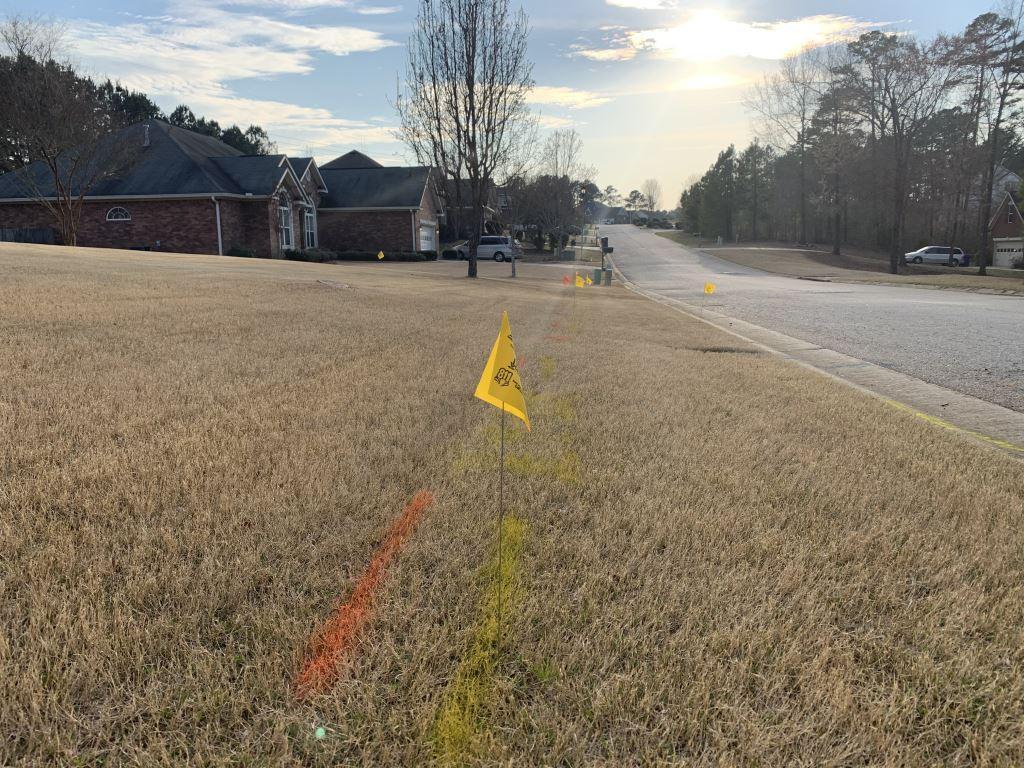
The PSC Marking Standards Rule outlines how all underground facilities must be marked in the field. This rule promotes consistent utility marking throughout the state, providing excavators with a clear and uniform understanding of field markings.
One of the key components of the rule is the white lining requirement. If the location of blasting or excavation cannot be clearly defined with such particularity as required by O.C.G.A. §25-9-6(b), the person doing the work must mark the area with white paint, flags, or stakes. This makes it easier for locate technicians to accurately identify and mark underground utilities.
The Marking Standards Rule benefits both locate technicians and excavators, offering guidance that reduces miscommunication, increases marking accuracy, and ultimately minimizes damage to underground facilities.
Facility operators should ensure that newly installed facilities in areas of active excavation are marked upon installation to indicate their presence. Newly installed facilities can be damaged, and safety can be compromised if the facilities are not marked. Marking facilities upon installation gives notice to other excavators of the newly installed facilities that may not otherwise be marked in response to a locate request.
Access the Marking Standards Rule.
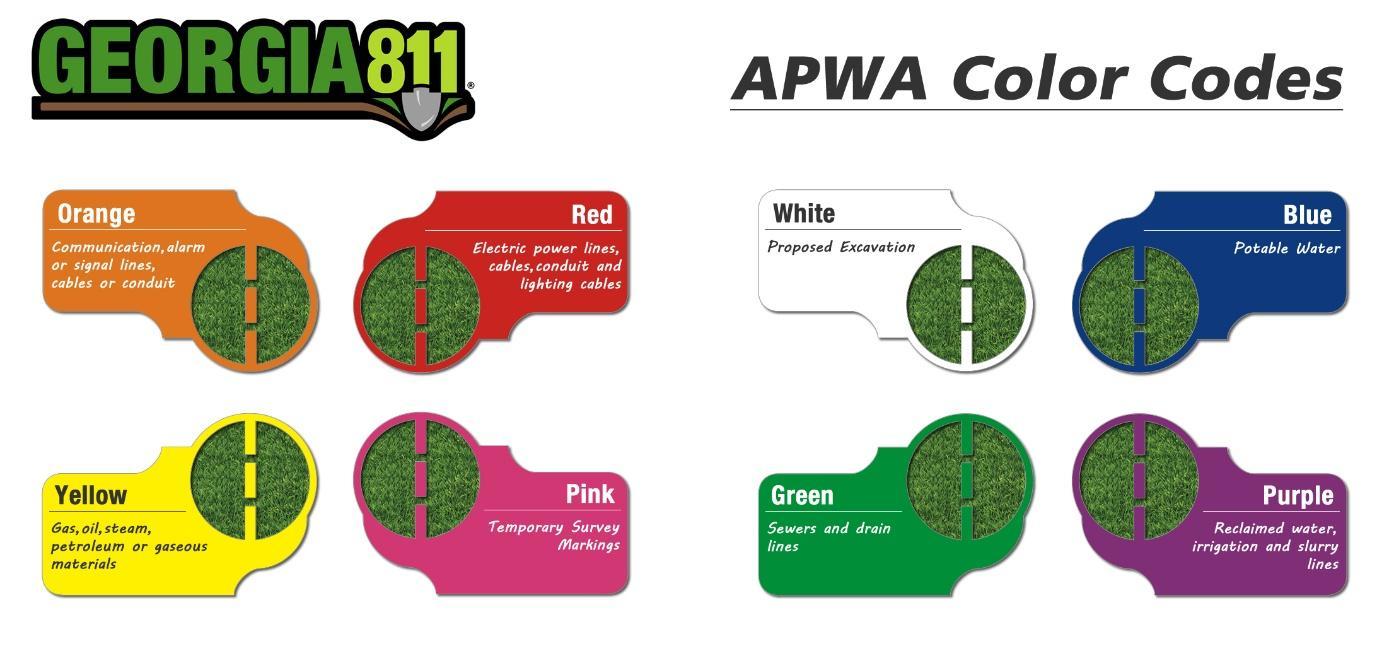
APWA Color Code Requirements
The use of American Public Works Association (APWA) color code is required under the Georgia Utility Facility Protection Act and the PSC’s Marking Standards Rule. These nationally recognized color codes provide a consistent system for identifying the type of underground utility present and ensure clarity for all stakeholders involved in excavation activities.
Why It Matters
Following the Marking Standards Rule helps to:
• Promote safety by reducing damage to underground utilities
• Ensure uniform marking practices across the state
• Assist excavators in interpreting markings correctly
• Prevent service interruptions and costly repairs
• Avoid civil penalties from the PSC
APWA Color Code
The American Public Works Association color codes are nationally recognized standards for marking different types of underground utilities. These colors ensure clarity and consistency for all parties involved in excavation.
Marking Standards Module in Damage Prevention Training
Georgia 811’s Damage Prevention Competent Person Training includes a detailed module on Marking Standards, which explains proper marking procedures, color code use, and white lining requirements. Participants gain a practical understanding of how consistent markings support safe excavation and compliance with PSC rules.
Positive Response Information System (PRIS)
PRIS is an automated system serving multiple functions.
• It allows the Georgia 811 utility member to respond to each locate request providing information on whether underground facilities are present or not present.
• It allows the excavator to check the responses to their locate requests.
• It shows additional system responses (i.e., Additional Requests, Late Notices, etc.).
In accordance with GUFPA, utility owners/operators are required to respond to locate requests submitted through PRIS.
Response Codes
Response Codes and Definitions can be found on our website:
• Positive Response Codes
• System Responses
Members can respond to locate requests by using the Georgia 811 Online Ticketing System or Mobile App. Contact Member Services to request access.
Responding to Locate Requests
As a Member of Georgia 811, it is your legal responsibility to respond to your locate requests using PRIS. Failure to respond to PRIS will result in a late notice fee for your company. To avoid this fee, you must respond on or before the “Response By” date that is provided on each locate request.
You mustsubmit a response for the following request types:
• Normal
• Large Project Meeting
• Large Project Excavation
• Design
• Late Notice
A response is not required, but it is helpful and appreciated for the following:
• Emergency Notification
These request types should not receive a response in PRIS:
• Overhead Requests
• Damage Notifications
• Cancel Request
Extraordinary Circumstances
Periodically there are reasons a Georgia 811 Member needs to invoke Extraordinary Circumstances to alert excavators that they are unable to mark their underground facilities in accordance with the law. This means that the affected member will respond to PRIS using 3J to notify the excavator of their circumstances.
To declare Extraordinary Circumstances, the member must meet the criteria as described in the Georgia Underground Facility Protection Act: § 25-9-3 (17).
“Extraordinary circumstances” means circumstances other than normal operating conditions which exist and make it impractical or impossible for a facility owner or operator to comply with the provisions of this chapter. Such extraordinary circumstances may include, but shall not be limited to, hurricanes, tornadoes, floods, ice, and snow, and acts of God.
For more information visit our website here.
Member Reports & Ticket Data
Member Reporting Tool - ThoughtSpot
Free access to the member reporting tool ThoughtSpot allows Georgia 811 members to access powerful insights at their fingertips. This software platform delivers detailed ticket and response data through three interactive dashboards, packed with tables and visualizations. With ThoughtSpot, exploring and understanding your ticket information has never been easier; helping you make smarter, datadriven decisions with confidence.
ThoughtSpot Benefits:
• View Ticket Totals
• Monitor Late Notices
• Positive Response Details
• Billing Data
• Damage Data
To request access, click here and complete the sign-up form.
ThoughtSpot Training:
Georgia 811 offers a free self-paced training course that will provide an overview of what you will see once you have access to the system. Sign up for training here.

Use of Ticket Management Systems (TMS)
Ticket Management Systems (TMS) are valuable tools for organizing, tracking, and responding to 811 locate requests. However, to maintain legal compliance, ensure excavator safety, and uphold transparency, their use must follow strict guidelines.
Proper Integration and Configuration
• Ensure that any TMS used by your company or a locate contractor is fully integrated with Georgia 811’s systems.
• All relevant PRIS codes must be available within the TMS.
• PRIS codes must be submitted through the Georgia 811 PRIS system—not just stored or noted within internal systems—as excavators do not have access to TMS comments.
• Provide thorough training to all locate staff and contractors on the proper use of TMS platforms.
• Use dashboards, alerts, and tools like ThoughtSpot to manage ticket due times, monitor late responses, and track key performance metrics such as ticket volume, response dates, and no-show incidents for improved visibility and oversight.
Auto-Response Functionality
While auto-response features can improve efficiency, they must be used cautiously and only in accordance with legal and procedural requirements.
• Do not allow TMS systems to auto-respond to:
• Large Project Meeting and Excavation Notices
These notice types require direct coordination with the excavator and often involve complex planning that cannot be addressed through automated responses.
Predictive Analytics and Risk-Based Auto-Response
Some ticket management systems offer predictive analytics features designed to assess risk and automate ticket responses. While these tools may offer operational efficiencies, they must not be used to replace required human review or to determine whether or how to respond to locate requests.
Important Compliance Considerations:
• Predictive analytics or automated risk modeling should not be used as a substitute for proper ticket evaluation and timely response. These tools may support decision-making but do not replace your obligation to designate your facilities according to GUFPA.
• Facility owners and operators remain legally responsible for each ticket, regardless of automation tools in use.
• Ticket response decisions must be based on actual review of the ticket detailsnot on automated or algorithmic determinations of risk.
Facility owners/operators should avoid using predictive analytics to drive automated ticket responses. Doing so may result in non-compliance with state law, increased liability, and potentially unsafe digging conditions.
Maintain Human Oversight
Even with automation, human review and management remain critical.
• Assign personnel to routinely audit TMS-generated responses for compliance and accuracy.
• Implement safeguards to override or flag improper auto-responses to locate requests and additional requests.
• Train staff to recognize when manual handling is necessary, especially for nonstandard or complex locate requests.
By configuring TMS tools properly and adhering to these best practices, members can enhance operational efficiency without compromising legal obligations or public safety.
Members Using a Locate Contractor
To ensure compliance, safety, and effective communication with Georgia 811 and excavators, facility owners/operators using locating contractors must follow the best practices outlined below.
Definition of a Locate Contractor
A Locate Contractor is a company or individual hired by a facility owner/operator to perform underground utility locating services on their behalf. These contractors are responsible for marking the presence of underground utilities in response to 811 locate requests.
Member Responsibilities:
• Clearly identify and register all authorized locate contractors with Georgia 811.
• Ensure contractors are properly trained, qualified, and compliant with Georgia 811 procedures and applicable federal and state laws.
• Establish contractual expectations regarding response timelines, marking standards, access to utility maps or records, and documentation.
• Understand that in the event of a violation, the member, not their locate contractor, will be held responsible and subject to civil penalties by the PSC.
• Ensure that locate contractors:
• Respond to locate requests within the legal timeframe
• Accurately mark utilities using the appropriate APWA color codes and in accordance with PSC marking standards
• Enter PRIS codes in the Georgia 811 system - not just in their internal TMS, as TMS notes are not visible in PRIS
• Have completed the Georgia 811 Damage Prevention Competent Person Training
Liability and Accountability
Even when using a locate contractor, the facility owner/operator retains full legal responsibility for timely and accurate locates.
To reduce liability exposure:
• Require all locate contractors to carry appropriate insurance.
• Include performance expectations and legal obligations in contracts.
• Maintain detailed records of locate request responses, markings, photos, GPS data, and timestamps.
• Conduct regular performance audits to ensure ongoing compliance.
Use of Ticket Management Systems
When using a locate contractor, ensure that any TMS follows the guidelines outlined in the UseofTicketManagementSystems(TMS)section above.
Members are responsible for verifying that their contractors:
• Use a Georgia 811-integrated TMS with proper PRIS code submission
• Provide trained personnel to manage and review ticket activity
• Maintain compliance with GUFPA and Georgia 811 Positive Response requirements
Locate Contractor Transitions: Advance Notification Required
Changes in locate contractors can disrupt service and communication. To minimize these risks:
Notify Georgia 811 at least 30 days in advance of any changes in locate contractors. Include the following:
• Name of the new contractor
• Effective start and end dates
• Primary contact information
• List of system member codes or service areas affected
Work closely with Georgia 811 to coordinate a smooth transition and prevent any gaps in locate response coverage.
Communication with Georgia 811 – Locate Contractors
Some members utilize locate contractors to manage locate responses. Without proper coordination, this can lead to miscommunication or missed notifications for excavators.
To ensure proper communication:
• Report all locate contractor relationships to Georgia 811
• Provide:
• The locator’s contact information
• A description of the relationship and scope of responsibilities
• A clear explanation of how locate requests and responses will be managed
• Confirm that all Positive Response entries are submitted to the Georgia 811 system, not just handled internally
By following these best practices, members can help ensure accurate locates, legal compliance, and a safer digging environment for all parties involved.
Damage Investigations
Conducting thorough and timely damage investigations is a critical responsibility GUFPA. These investigations play a vital role in maintaining compliance, identifying the root cause of damage, protecting company assets, and ensuring public and worker safety. Below are key guidelines and best practices for managing damage investigations effectively.
• Protect Your Company from Liability
Every damage incident has the potential to lead to costly legal exposure. A welldocumented investigation helps establish the facts surrounding the damage and can serve as a crucial defense if liability is disputed. Promptly gathering evidence, photos, and witness statements can prevent misinformation and protect your organization from undue responsibility.
Identifying the root cause of the damage allows for improvements to policies and procedures, helping to prevent similar incidents in the future.
• Reduce the Risk of
PSC Civil Penalties
Noncompliance with the PSC damage investigation and reporting requirements may result in civil penalties up to $15,000 per incident. A thorough investigation demonstrates due diligence and a proactive safety culture, both of which are viewed favorably in the event of regulatory review or hearings.
• Investigate All Damages Promptly
All utility damages, regardless of perceived severity, should be investigated as soon as it is safe to do so. Early investigation ensures critical evidence is preserved and enables faster resolution. Delays can lead to lost details, increased risk, and non-compliance with reporting timelines.
An investigation of any damage shall be initiated by the end of the next business day following the completion of repairs. Additionally, all repair invoices shall be sent to the excavator within 90 days of completing the repair.
• Refer to the Damage Investigation Training
All personnel responsible for responding to or assessing damages should be familiar with Georgia 811's Damage Investigation Training. This training outlines standardized procedures for evaluating damage scenes, collecting evidence, interacting with excavators and property owners, and documenting findings in accordance with GUFPA.
If you haven’t completed the training or need a refresher, contact your Georgia 811 Liaison or request Liaison Training here.
Reporting Damages
PSC Reporting Requirement for Facility Damage Under GUFPA
In accordance with the rules established by the PSC and the Georgia Underground Facility Protection Act, all underground facility owners/operators are subject to a mandatory damage reporting requirement when a probable violation of GUFPA has occurred.
The PSC Rule
Rule Summary:
All underground facility owners and operators must report any damage to their facilities that is believed to be the result of a probable GUFPA violation, to the PSC within 30 days of the date the damage is discovered.
Key Points of the Requirement
• Who Must Report:
All owners and operators of underground facilities in Georgia, regardless of utility type (e.g., gas, water, electric, telecom)
• What Triggers a Report:
Any damage to an underground facility that appears to have occurred due to a probable violation of GUFPA, for example, excavation without proper notice, failure to maintain marks, or lack of care while digging.
• Deadline for Report:
The report must be submitted within 30 calendar days from the date of discovery of the damage, not the date of occurrence.
• Reporting System:
Reports should be submitted through the Georgia PSC's online reporting portal or as directed by the Facilities Protection Division.
• Supporting Documentation:
Reports should include all relevant details such as:
• The location and nature of the damage
• A detailed sketch of the damaged area, including all measurements taken from nearby permanent structures or objects, and locate request number (if applicable)
• Circumstances of the incident, including the size of the damaged facility and severity of the damage (e.g., cut in half, punctured, nicked, coating scraped off the pipe/cable)
• Photos, site notes, and investigation results
Purpose of the Rule
• To enable the PSC to track and investigate potential violations of GUFPA
• To promote accountability and reduce preventable utility damage
• To support enforcement actions when necessary to improve safety and compliance
Best Practices for Compliance
• Implement internal processes to track all facility damages and determine whether they may involve a GUFPA violation.
• Ensure field crews and supervisors are trained to flag potential GUFPA-related incidents.
• Assign responsibility within your organization to submit PSC damage reports on time.
• Retain copies of submitted reports and documentation for audit purposes. By adhering to these principles, your organization can ensure regulatory compliance, support safe excavation practices, and significantly reduce legal and financial exposure.
For questions or support, reach out to Georgia 811’s Liaison Department.
Educational Opportunities for Utility Members
Georgia 811 offers a robust suite of free educational programs and resources aimed at promoting safe digging practices, enhancing stakeholder knowledge, and ensuring regulatory compliance. These opportunities are designed for utility members, contractors, locators, excavators, and the general public - helping reduce damages and foster a statewide culture of safety and awareness.
As a Georgia 811 member, you have exclusive access to training and educational tools that can benefit your team, your contractors, and the communities you serve.
Core Educational Offerings
• Customized Training for Utility Members
The Georgia 811 Liaison Department schedules member outreach meetings and offers scheduled training sessions tailored to the needs of the member.
Topics may include:
• Understanding Georgia’s Dig Law
• Marking Standards
• Damage Investigations
Available formats:
• In-person at your facility
• Virtual sessions
• Online Learning Resources
• Responding to locate requests in PRIS effectively
• Large Projects
• High Voltage Safety Act
• Lunch and learns or safety meetings
Utility members can access a wide variety of digital learning content, including:
• E-learning modules (ideal for onboarding new employees or contractors)
• How-to guides and manuals for Georgia 811 tools and systems
• Safety videos, PSAs, and tutorials
Visit Georgia811.com for more information on training and resources.
Georgia 811 Outreach Efforts
Purpose
Georgia 811 conducts extensive year-round outreach and education initiatives to promote safe digging, prevent utility damages, and fulfill regulatory requirements. These efforts are designed to:
• Educate homeowners, contractors, and professionals about the importance of using 811 before digging
• Reinforce safety and compliance messaging across various demographics and industries
• Support utility members’ own outreach goals and compliance programs
Key Components:
Statewide Advertising Campaigns
Georgia 811 invests in multi-channel public awareness campaigns that run throughout the year, with peak focus during major observances like National Safe Digging Month (April) and 8/11 Day (August 11).
Channels Include:
• Radio & TV ads (including major network stations and streaming services)
• Billboards and digital signage
• Online banners and video ads
• Social media campaigns (Facebook, Instagram, Twitter, LinkedIn, and YouTube)
• Streaming platforms (Spotify, Pandora, etc.)
• Print ads in magazines, newspapers, and trade publications
All campaigns reinforce the “Contact Before You Dig” message and are often geotargeted to high-growth or high-risk areas.
Community and School Outreach
Georgia 811 provides free, engaging utility safety education across the state through its Digger Dog Program and other outreach initiatives.
• Digger Dog Program: A 45-minute interactive presentation designed for 2nd and 3rd grade students, led by Digger Dog, Georgia 811’s mascot. The program teaches children the importance of underground utility safety in a fun and memorable way.
• Community and Classroom Engagement: Georgia 811 reaches thousands of students and families annually through Digger Dog’s school visits, community events, and online classroom resources, including downloadable activity books.
These programs, supported and sponsored by Georgia 811 utility members, help educate the next generation and foster a lifelong culture of safe digging.
For more information visit the Digger Dog webpage.
Contractor & Industry Outreach
Georgia 811 actively engages with excavators, contractors, and utility professionals through:
• In-person and virtual damage prevention meetings
• Lunch and learns and toolbox talks
• Presentations and booths at trade shows
• Educational videos, webinars, and newsletters
These efforts help ensure compliance with Georgia law and reinforce the importance of proper locate requests and safe digging procedures.
National Safe Digging Month (April)
Each April, Georgia 811 coordinates a month-long campaign to raise awareness about underground utility safety. Activities often include:
• Enhanced digital advertising
• Member-partnered outreach events
• Social media toolkits for member use
• Governor proclamations and municipal awareness partnerships
• Special public events with Digger Dog and local utilities
Members are encouraged to amplify messaging and co-host events during this time and will find resources on the Safe Digging Month page.
811 Day (August 11)
August 11 is National 811 Day, and Georgia 811 commemorates it with a statewide push to promote the 811 message. Examples of outreach include:
• Partnering with media outlets for interviews and press coverage
• Launching high-visibility campaigns and contests
• Coordinating with utility members to post 811 signage, wear branded gear, or distribute materials
• Sharing impact statistics and testimonials from the field
Georgia 811 members can access resources at the 811 Day webpage.
Damage Prevention Summits
Georgia 811 hosts Annual Damage Prevention Summits - one-day events offering training, networking, and educational sessions for utilities, locators, contractors, and regulators. Multiple Summits are held each year covering various DOT regions. Information is available on the Damage Prevention Summit page. The event is open to utility members, contractors, municipalities, and other safe digging stakeholders.
RP1162 Excavator Awareness Campaign
Georgia 811 offers an RP1162 Excavator Awareness Campaign tailored for natural gas providers to fulfill federal pipeline safety regulations and promote safe excavation practices. This initiative aligns with the guidelines of the American Petroleum Institute's Recommended Practice 1162 (API RP1162), which mandates pipeline operators to develop and implement public awareness programs targeting key stakeholder audiences, including excavators. Each participating Georgia 811 gas member pays a percentage of total campaign costs based off annual ticket count.
As part of the campaign, Georgia 811:
• Distributes educational material to excavators statewide about the presence of underground pipelines, the importance of using the 811 service before digging, and recognizing and responding to gas emergencies.
• Conducts a follow-up survey to assess excavator damage prevention understanding.
• Provides service-area specific data to participating gas members so modifications can be made to best educate the excavating community.
How Georgia 811 Utility Members Can Share the Safe Digging Message
Promoting the 811 message is essential to protecting underground infrastructure, ensuring public safety, and maintaining compliance with state and federal regulations. As a Georgia 811 member, your organization plays a crucial role in helping spread the word about contacting 811 before digging.
Customer Communications
• Bill Inserts & Envelopes: Include short messages or infographics about 811 in monthly statements. Georgia 811 can provide a homeowner handout for utilities to share with their customers.
• Email Newsletters: Add a call-toaction: “Remember to contact 811 before you dig – it’s free, it’s easy, and it’s the law.”
Social Media & Digital Outreach
• On-Hold Messages & Voicemail: Include reminders in phone recordings or after-hours greetings.
• Website Banner or Safety Page: Display the Georgia 811 logo, graphics available at the Georgia 811 website, or link to www.Georgia811.com.
• Use Georgia 811’s free social media toolkits for National Safe Digging Month (April) and 811 Day (August 11).
• Share videos and graphics from Georgia 811’s YouTube channel and website.
• Tag @Georgia811 and use hashtags like #CallBeforeYouDig and #811Safety.
Branding and Co-Marketing
Add the Georgia 811/811 logo or free Safe Digging Partner Decals to:
• Company vehicles and equipment
• Employee uniforms and safety vests
• Jobsite signage and fencing
• Email signatures, brochures, and company forms
Logos and brand assets to share can be downloaded at: Georgia811.com
Using the Georgia 811 and National 811 Logos
Both the Georgia 811 logo and the national 811 “Contact Before You Dig” logo are powerful, recognizable symbols of underground utility safety and damage prevention. As a Georgia 811 utility member, you have the ability - and are encouraged toincorporate these logos into your outreach, education, and customer communications to amplify the 811 message.
Permitted Use for Members
Georgia 811 grants its utility members broad and flexible use of both logos to promote safe digging. As a member, you are encouraged to use them:
• At your discretion for educational and promotional purposes
• In print and digital formats
• Co-branded with your company logo, when appropriate
• Without needing case-by-case permission (so long as used in good faith for public awareness and not altered beyond recognition)
Logo Guidelines and Best Practices
While use is flexible, Georgia 811 asks the following to maintain consistency and professionalism:
• Do not distort or stretch the logos
• Maintain clear space around the logos so they are legible
• Avoid placing the logos on busy or clashing backgrounds
• Do not alter colors; use approved versions only (full-color, black, or white)
• Follow all guidelines outlined in Common Ground Alliance’s 811 Graphic Standards Guide, available at www.CommonGroundAlliance.com/811-logo. If in doubt, use the versions provided directly from Georgia 811’s website.

How to Access the Logos
Utility members can easily download official, high-resolution logo files directly from the Georgia 811 website.
On the Logos page, you will find:
• Georgia 811 logo (full color, black, white)
• National 811 logo (standard, horizontal, white versions)
• Multiple formats: PNG (transparent), JPG, and EPS for print
If you require a specific size, format, or co-branded design, you may contact the Georgia 811 Corporate Communications Department (info@Georgia811.com) for assistance.
Thank you for Keeping Georgia Safe and Connected