Sarah Gerber | FXFOWLE
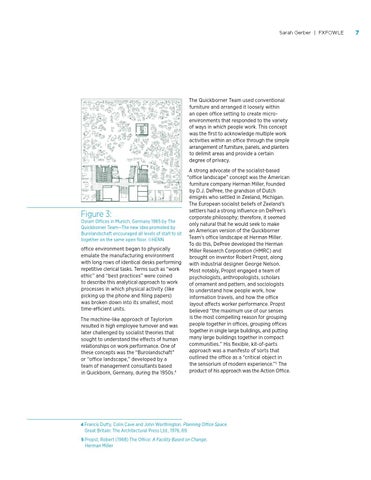
The Quickborner Team used conventional furniture and arranged it loosely within an open office setting to create microenvironments that responded to the variety of ways in which people work. This concept was the first to acknowledge multiple work activities within an office through the simple arrangement of furniture, panels, and planters to delimit areas and provide a certain degree of privacy.
Figure 3:
Osram Offices in Munich, Germany 1965 by The Quickborner Team—The new idea promoted by Burolandschaft encouraged all levels of staff to sit together on the same open floor. ©HENN
office environment began to physically emulate the manufacturing environment with long rows of identical desks performing repetitive clerical tasks. Terms such as “work ethic” and “best practices” were coined to describe this analytical approach to work processes in which physical activity (like picking up the phone and filing papers) was broken down into its smallest, most time-efficient units. The machine-like approach of Taylorism resulted in high employee turnover and was later challenged by socialist theories that sought to understand the effects of human relationships on work performance. One of these concepts was the “Burolandschaft” or “office landscape,” developed by a team of management consultants based in Quickborn, Germany, during the 1950s.4
A strong advocate of the socialist-based “office landscape” concept was the American furniture company Herman Miller, founded by D.J. DePree, the grandson of Dutch émigrés who settled in Zeeland, Michigan. The European socialist beliefs of Zeeland’s settlers had a strong influence on DePree’s corporate philosophy; therefore, it seemed only natural that he would seek to make an American version of the Quickborner Team’s office landscape at Herman Miller. To do this, DePree developed the Herman Miller Research Corporation (HMRC) and brought on inventor Robert Propst, along with industrial designer George Nelson. Most notably, Propst engaged a team of psychologists, anthropologists, scholars of ornament and pattern, and sociologists to understand how people work, how information travels, and how the office layout affects worker performance. Propst believed “the maximum use of our senses is the most compelling reason for grouping people together in offices, grouping offices together in single large buildings, and putting many large buildings together in compact communities.” His flexible, kit-of-parts approach was a manifesto of sorts that outlined the office as a “critical object in the sensorium of modern experience.” 5 The product of his approach was the Action Office.
4 Francis Duffy, Colin Cave and John Worthington. Planning Office Space. Great Britain: The Architectural Press Ltd., 1976, 69. 5 Propst, Robert (1968) The Office: A Facility Based on Change, Herman Miller
7