changes by the 15th of the month preceding the month of issue Please do not telephone address changes Email changes to changes@fw rj.com, fax to 352-241-6007, or mail to Florida Water Resources Journal, 1402 Emer ald Lakes Dr ive, Clermont, FL 34711
Membership Questions
FSAWWA: Casey Cumiskey – 407-957-8447 or fsawwa casey@gmail com
At l a n t i c B e a c h i s a s m a l l co a s t a l m u n i c -
i p a l i t y i n n o r t h e a s t F l o r i d a n e a r Ja c k -
s o nv i l l e . T h e p r i v a t e l y - o w n e d S e l v a
M a r i n a C o u n t r y C l u b ( S M C C ) , w h i c h i n -
c l u d e s a 1 4 6 - a c re g o l f co u r s e , i s l o c a te d c l o s e
t o t h e At l a n t i c B e a c h Wa s t e w a t e r Tr e a t m e n t
F a c i l i t y ( W W T F ) , a 3 . 5 - m i l - g a l - p e r- d a y
( m g d ) f o u r- s t a g e b i o l o g i c a l n u t r i e n t re m ov a l
( B N R ) p l a n t Wh i l e t h e c o u n t r y c l u b a n d
d r iv i n g r a n g e w e re w i t h i n t h e At l a n t i c B e a c h
c i t y l i m i t s , t h e g o l f c o u r s e p r o p e r t y w a s l o -
c a te d i n Ja c k s o nv i l l e
T h e s o u r c e o f i r r i g a t i o n w a t e r f o r t h e
g o l f co u r s e w a s a t i d a l l a g o o n t h a t t r ave r s e d
t h e S M C C p ro p e r t y T h e h i g h s a l i n i t y o f t h i s
w a t e r w a s p r o b l e m a t i c f o r S M C C , a n d o v e r
t h e y e a r s i t a t t e m p t e d t o n e g o t i a t e w i t h t h e
Ci t y to prov i de re cl a i m e d w a ter for i r r i g a t i on .
T h e Ci t y w a s a l s o i n te re s te d i n p rov i d i n g re -
c l a i m e d w a te r Un f o r t u n a te l y, S M C C a n d t h e
C i t y w e r e u n a b l e t o a g r e e o n a n a c c e p t a b l e
p r i c i n g s t r u c t u re a f te r s e ve r a l a t te m p t s .
L i ke m a ny g o l f c o u r s e s , t h e e c o n o m i c
d o w n t u r n o f 2 0 0 8 h i t S M C C h a r d , a n d b y
2 0 1 2 , i t w a s l o o k i n g a t w ay s t o o p t i m i z e t h e
p r o p e r t y At t h a t t i m e , S M C C e x p l o r e d t h e
co n ce p t o f a d d i n g a n e w s i n g l e - f a m i l y h o u s -
i n g d e v e l o p m e n t o n t h e p r o p e r t y a n d u p -
g r a d i n g t h e c o u r s e . Ho w e v e r, t h e b r a c k i s h
qualit y of the lago on water ma de it unsuitable
f o r g row i n g h i g h - q u a l i t y t u r f
T h e S M C C ’ s co n s u m p t ive u s e p e r m i t ( C U P )
a l l ow e d i n s t a l l a t i o n o f u p to 1 0 s h a l l ow w e l l s f o r i r r i g a t i o n T h e re w e re co n ce r n s a b o u t t h e
vo l u m e o f w a te r av a i l a b l e a n d t h e co s t co mp a re d to re c l a i m e d w a te r.
T h e Ci t y a s ke d J Co l l i n s E n g i n e e r i n g As -
s o c i a t e s L LC ( J C E A ) t o co n d u c t a co m p a r a-
t ive s t u d y to d e te r m i n e t h e
s t - e f f e c t ive n e s s o f u s i n g w e l l s ve r s u s t h e co s t o f co n s t r u c t i n g
a re c l a i m e d w a te r f a c i l i t y
Re s e a r c h s h o w e d t h a t t h e t e n s h a l l o w
w e l l s wo u l d n o t p ro d u ce s u f f i c i e n t w a te r a n d
a d d i t i o n a l w e l l s wo u l d n o t b e co s t - e f f i c i e n t .
Donna Kaluzniak, CEP, is the former utility director with City of Atlantic Beach and now owns H2O Writing in Jacksonville Beach, and John E. Collins Jr., P.E., is with J. Collins Engineering Associates LLC in Jacksonville.
T h e re s u l t o f t h a t s t u d y, “ Ev a l u a t i o n o f
Options for Long-Ter m Ir r ig ation Water Sup-
p l y f o r S e lv a Ma r i n a Co u n t r y C l u b,” s h ow e d that a minimum of 25 wells would be required
A re v ision to the CUP would also be needed. A n u
Continued on page 6
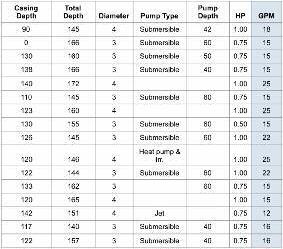
2 Flows from Existing Shallow Wells in Area
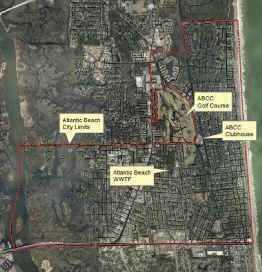
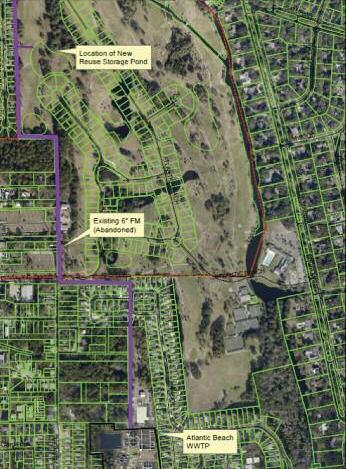
Figure 1 Atlantic Beach Wastewater Treatment Facility and Selva Marina Countr y Club
Figure
from page 4
o Re l o c a t i o n a n d u s e o f a n e x i s t i n g a b a n -
d o n e d t a n k
o Using half of the plant’s exist ing chlor ine
co n t a c t t a n k
o C o n s t r u c t i n g a n e w c h l o r i n e c o n t a c t
t a n k
S O p t i o n s f o r d i s i n f e c t i o n , i n c l u d i n g :
o C h l o r i n e g a s
o S o d i u m hy p o c h l o r i te
o U l t r av i o l e t l i g h t
S Re c l a i m e d t r a n s m i s s i o n ro u t e s , i n c l u d i n g
u s e o f a n e x i s t i n g a b a n d o n e d f o rce m a i n
The preliminar y recommendat ion for the most cost-effe c t ive op t ion for prov iding long-
te r m i r r i g a t i o n w a te r to t h e g o l f co u r s e w a s a
re cl a i m e d w a te r f a c i l i t y l o c a te d a t t h e W WT F, u s i n g hy p o c h l o r i te d i s i n f e c t i o n .
Cu l t u r a l a n d
G r e e n s p a ce Pr e s e r v a t i o n
Atlantic Beach is a cul-de-sac cit y To the east of the City is the Atlantic Ocean, to the west is the Intracoastal Water way, and to the nor th is Ha n n a Pa r k a n d t h e May p or t Nav a l S t a t i on , b ordere d by t h e S t Jo h n s R iver e s t u a r y T h e
Ci t y i s s h a de d by a b e a ut i f u l t re e c a n opy of co a s t a l o a k s a n d o t h er h a rdwo o d s . T h ere i s a
strong sense of communit y and desire for cultural and env ironmental preser vation
T he Atlant ic B ea ch Cit y Commission and m a ny c i t i z e n s c o n s i d e r e d t h e 5 5 - y e a r- o l d
c o u n t r y c l u b t o b e p a r t o f t h e l o c a l c u l t u r e
a n d h e r i t a g e . Ma ny c i t i z e n s w e r e c o n c e r n e d
t h a t t h e g o l f c o u r s e p r o p e r t y w o u l d b e s o l d
a n d d e ve l o p e d u n d e r Ja c k s o nv i l l e ’ s b u i l d i n g
re qu i rem en t s , w h i ch wo u l d m e a n t h a t a h i g h -
d e n s i t y d e v e l o p m e n t o f a p a r t m e n t s o r c o n -
d o m i n i u m s c o u l d b e b u i l t o n t h e p r o p e r t y.
T he building s would also b e al lowe d to exce e d
At l a n t i c B e a c h’s 3 5 - f t h e i g h t l i m i t
Id e a s o n w ay s t h e Ci t y co u l d h e l p to ke e p
f ro m l o s i n g t h e g o l f co u r s e a n d co u n t r y c l u b
w e r e d e b a t e d , i n c l u d i n g a n o p t i o n t o p u r-
c h a s e a n d o p e r a te t h e g o l f co u r s e a n d a m e n i -
t i e s . T h a t o p t i o n w a s r u l e d o u t d u e t o f i s c a l
c o n c e r n s , a n d S M C C ’ s l a c k o f d e s i r e t o s e l l
t h e g o l f co u r s e
At t h e s a m e t i m e , S M C C w a s e x a m i n i n g
i t s o p t i o n s . T h e S M C C , w h i c h w a s r e n a m e d
t h e At l a n t i c B e a c h C o u n t r y C l u b ( A B C C )
j o i n e d w i t h d e v e l o p e r s At l a n t i c B e a c h Pa r t -
n e r s ( A B P ) t o c o m p l e t e l y r e b u i l d t h e g o l f
co u r s e , c l u b h o u s e , a n d a m e n i t i e s . T h e co u r s e
w o u l d b e r e d e s i g n e d a n d u p g r a d e d t o a
c h a m p i o n s h i p g o l f co u r s e a n d 1 7 8 h i g h - e n d
s i n g l e f a m i ly h om e s wo u l d b e bu i l t w i t h i n t h e
co u r s e .
H a v i n g r e l i a b l e , h i g h - q u a l i t y i r r i g a t i o n w a t e r w a s i m p e r a t i v e f o r t h e p l a n t o m o v e
f o r w a r d a n d A B C C o n c e m o r e a p p r o a c h e d
At l a n t i c B e a c h a b o u t p r o v i d i n g r e c l a i m e d w a te r
At l a n t i c B e a c h c i t i z e n s w e r e f u l l y s u p -
p o r t i v e o f A B C C ’ s p l a n s ; h o w e v e r, t h e C i t y
c o m m i s s i o n c o u l d n o t a p p r o v e f u n d i n g t o
b u i l d a r e c l a i m e d w a t e r f a c i l i t y t h a t w o u l d
b e n e f i t a p r i v a t e b u s i n e s s . T h e c o m m i s s i o n
w a n te d to f i n d o p p o r t u n i t i e s w h e re t h e Ci t y
wo u l d o b t a i n a b e n e f i t i n re t u r n f o r s p e n d i n g
a p p rox i m a te l y $ 1 4 m i l l i o n to co n s t r u c t a re -
c l a i m e d w a te r f a c i l i t y.
A f t e r n e g o t i a t i n g w i t h A B C C / A B P, a n
a g re e m e n t w a s re a ch e d : At l a n t i c B e a ch wo u l d
d e s i g n , co n s t r u c t , o p e r a te , a n d m a i n t a i n a re -
c l a i m e d w a te r f a c i l i t y a n d d i s t r i b u t i o n m a i n
t o t h e g o l f c o u r s e p r o p e r t y. T h e r e c l a i m e d
w a t e r f a c i l i t y w o u l d b e d e s i g n e d t o p r o v i d e
w a te r f o r t h e g o l f co u r s e , co m m o n a re a s , a n d
re s i d e n t s . In re t u r n , A B C C / A B P wo u l d :
S Prov i de a l l of t h e reu s e d i s t r i but i on a n d i r-
r ig at ion piping for the golf course and subd iv i s i o n .
S Pro v i d e a 2 . 5 - m i l - g a l ( M G ) re u s e s t o r a g e
p o n d o n t h e g o l f co u r s e
S Prov i d e a re c re a t i o n a n d g re e n s p a ce co nser vat ion ag reement. The ag reement would e s s e n t i a l l y p r e v e n t a ny f u t u r e a d d i t i o n a l
b u i l d i n g c o n s t r u c t i o n o n t h e p r o p e r t y i n
p e r p e t u i t y
o Us e o f t h e u n d e ve l o p e d p ro p e r t y i s l i mi te d to o n l y l ow - i n te n s i t y re c re a t i o n a l o r
co n s e r v a t i o n u s e s
o A n a t ive t re e c a n opy mu s t b e m a i n t a i n e d a f te r d e ve l o p m e n t o f t h e g o l f co u r s e .
o No fur ther subdiv ision of the land is p er-
m i t te d
S Wo r k w i t h At l a n t i c B e a c h t o s u p p o r t a nn e x a t i o n o f t h e g o l f co u r s e p ro p e r t y i n t o t h e At l a n t i c B e a c h c i t y l i m i t s
T h e A B C C / A B P p rov i d e d f o r a d d i t i o n a l
e nv i r o n m e n t a l p r o t e c t i o n s d u r i n g t h e i r d e -
s i g n a s w e l l :
S No r t h F l o r i d a e co l o g y i n te g r a te d i n to t h e
g o l f co u r s e d e s i g n
S Wa t e r- c o n s e r v i n g d e s i g n f o r t h e g o l f co u r s e
S D r i p i r r i g a t i o n f o r m o s t c o m m o n a r e a l a n d s c a p i n g
S Pro v i s i o n o f co n s t r u c t e d n e s t i n g s i t e s f o r o s p re y s
S C l u b h o u s e a n d h o m e s a r e c o n s t r u c t e d w i t h s m a r t te c h n o l o g y a n d w a te r- a n d e ne r g y - co n s e r v i n g f e a t u re s
At l a n t i c B e a c h
Re c l a i m e d Wa t e r Fa c i l i t y
The reclaimed water facilit y was desig ned to prov ide an annual aver age daily amount of 0 . 5 m g d o f re u s e to t h e g o l f co u r s e a n d re s idential customers. Included in the project were c h e m i c a l s to r a g e a n d f e e d f a c i l i t i e s ; c h l o r i n e contact piping , and wet wells; a reuse pumping station w ith hydropnuematic tank; an elec t r ical building; and inst r umentation/sup er v isor y co n t ro l a n d d a t a a cq u i s i t i o n ( S C A DA ) i n teg r ation
In o rd e r to s ave co s t s , a n e x i s t i n g a b a nd o n e d 6 - i n . f o r c e m a i n w a s d i s i n f e c t e d a n d u s e d t o p r o v i d e r e c l a i m e d w a t e r t o t h e g o l f
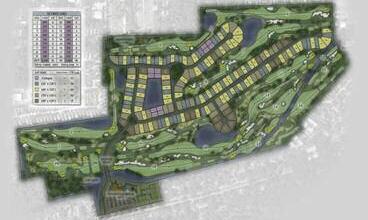
Figure 3 Atlantic Beach Countr y Club Layout Continued
co u r s e s to r a g e p o n d . A 1 2 - i n . re u s e m a i n w a s
co n s t r u c te d u p to t h e g o l f co u r s e f o r t h e re s -
i d e n t i a l d e ve l o p m e n t F i g u re 4 s h ow s t h e e x -
i s t i n g 6 - i n . f o rce m a i n .
Pr o j e c t C h a l l e n g e s
S ch e d u l e L i m i t a t i o n s
B o t h t h e Ci t y a n d A B C C / A B P h a d a n i n -
c re d i b l y t i g h t s c h e d u l e O n e o f t h e m a j o r f a c -
to r s w a s t h a t A B C C / A B P n e e d e d to co m p l e te
t h e g o l f c o u r s e c o n s t r u c t i o n i n t i m e f o r t h e
g row i n g s e a s o n In a d d i t i o n , w h i l e A B C C h a d
a dv i s e d t h a t i t wo u l d n e e d u p to 4 0 0 , 0 0 0 g a l
p e r d a y ( g p d ) o f r e u s e w a t e r u n d e r n o r m a l
co n d i t i o n s , t h e y n e e d e d u p to 1 M G p e r d ay
f o r t h e g row - i n p e r i o d
T h e Ci t y a p p rove d t h e e n g i n e e r i n g co n -
t r a c t i n May 2 0 1 3 . T h e p ro j e c t h a d to b e d e -
s i g n e d , p e r m i t t e d , a n d b i d , a n d a
co n s t r u c t i o n co n t r a c t aw a rd e d by Nove m b e r
2 0 1 3 . T h e Ci t y w a s re q u i re d to co n s t r u c t t h e
f a c i l i t i e s a n d d e l i v e r r e c l a i m e d w a t e r b y
Ma rc h 2 0 1 4
In o rd e r to a cco m m o d a te t h e s h o r t t i m e -
l i n e a n d p r o v i d e t h e e x t r a r e u s e n e e d e d f o r
g r o w - i n , t h e p r o j e c t w a s d e s i g n e d a n d c o n -
s t r u c te d i n t wo p h a s e s
T h e J C E A a n d C i t y s t a f f m e t w i t h t h e
F l o r i d a D e p a r t m e n t o f E nv i r o n m e n t a l P r o -
te c t i o n ( F D E P ) to g e t t h e co n ce p t u a l d e s i g n s
f o r t h e t wo p h a s e s a p p rove d T h e F D E P w a s
ve r y h e l p f u l a n d a cco m m o d a t i n g i n a l l ow i n g
t h e C i t y t o d e s i g n a n d c o n s t r u c t t e m p o r a r y
r e u s e f a c i l i t i e s t h a t c o u l d b e u s e d f o r t h e
g row - i n p e r i o d w h i l e co n t r a c to r s co m p l e te d
t h e p e r m a n e n t re u s e s y s te m .
P h a s e O n e : T e m p o r a r y F a c i l i t i e s
In t h i s p h a s e , F D E P a l l ow e d t h e Ci t y to
d e d i c a te h a l f o f t h e e x i s t i n g c h l o r i n e co n t a c t
t a n k f o r t h e t e m p o r a r y re c l a i m e d w a t e r s y s -
t e m A s p a r e s u l f u r d i ox i d e f e e d l i n e w a s
p u r g e d a n d re u s e d a s a c h l o r i n e f e e d s y s te m
f o r t h e h i g h - l e ve l d i s i n f e c t i o n s y s te m .
A l a r g e p u m p w a s i n s t a l l e d t o p u m p
r e u s e w a t e r t o t h e g o l f c o u r s e s t o r a g e p o n d
t h ro u g h t h e ex i s t i n g a b a n do n e d a n d d i s i n f e c -
t e d f o r c e m a i n . I n s t r u m e n t a t i o n , i n c l u d i n g
t h e c h l o r i n e a n a l y z e r a n d t u r b i d i m e t e r, w a s i n s t a l l e d i n a te m p o r a r y co n t ro l p a n e l i n s i d e o f a w o o d e n b ox m o u n t e d b y t h e c h l o r i n e co n t a c t t a n k . T h e F D E P r e q u i r e d a h i g h e r c h l o r i n e re s i d u a l o f 1 8 m g / L v s 1 0 m g / L i n o rd e r to p r o v i d e t h e h i g h - l e v e l d i s i n f e c t i o n i n t h e s m a l l e r c h l o r i n e co n t a c t t a n k
Continued on page 8
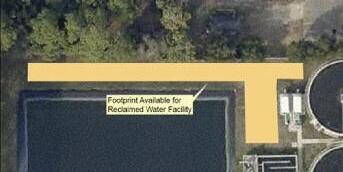
5 Area Availablefor Reclaimed Water Facility
Figure 4 Location of Existing Force Main
Figure
P h a s e T w o : P e r m a n e n t F a c i l i t i e s
T h e p e r m a n e n t f a c i l i t i e s i n c l u d e d t h e
e l e c t r i c a l b u i l d i n g ( w i t h p ro p e r co n t ro l p a n -
e l s f o r t h e i n s t r u m e n t a t i o n ) , ch l o r i n e co n t a c t
f a c i l i t i e s , a n d a hy p o c h l o r i t e s t o r a g e a n d
p u m p i n g f a c i l i t y T h e re u s e p u m p i n g s y s te m
c o n s i s t e d o f t h r e e p u m p s w i t h v a r i a b l e f r e -
q u e n c y d r ive s a n d a hyd ro p n e u m a t i c t a n k to
m a i n t a i n p re s s u re i n t h e d i s t r i b u t i o n s y s te m .
A n o f f - s i te co n t ro l v a lve w a s i n s t a l l e d o n t h e
g o l f co u r s e to h o l d p re s s u re i n t h e re s i d e n t i a l
d i s t r i b u t i o n s y s t e m a t t h e s a m e t i m e t h a t
re u s e w a te r f l ow s to t h e s to r a g e p o n d T h i s i s
a m o d u l a t i n g v a lve t h a t v a r i e s t h e a m o u n t o f
f l ow t o t h e g o l f co u r s e p o n d o r d i s t r i b u t i o n
s y s te m b a s e d o n d e m a n d .
T h e Ci t y com p l e te d t h e en g i n e er i n g , p er-
m i t t i n g , a n d bi d pro ce s s a n d aw a rde d a con -
t r a c t to S awc ro s s Co n s t r u c t i o n i n Nove m b e r
2 0 1 3 , a s re qu i re d ; h owe ver, s t a r t of con s t r u c -
t i o n w a s co n t i n g e n t o n A B C C / A B P ’ s f i n a l
c l o s i n g o n t h e p ro p e r t y s a l e Wh i l e At l a n t i c
Beach was ready to proceed w ith const r uc tion,
t h e Ci t y h a d to w a i t to i s su e a n o t i ce to pro -
c e e d ( N T P ) u n t i l t h e p ro p e r t y s a l e b e t w e e n
t h e co u n t r y clu b a n d t h e de ve l op er w a s f i n a l
a n d a l l p a r t i e s were l e g a l ly re a dy to pro ce e d .
T h e A B C C / A B P c o m p l e t e d i t s l e g a l r e -
q u i r e m e n t s i n Ja n u a r y 2 0 1 4 i n s t e a d o f No -
ve m b e r 2 0 1 3 , a n d t h e S awc ro s s w a s i s s u e d a n
N T P i n Ja n u a r y.
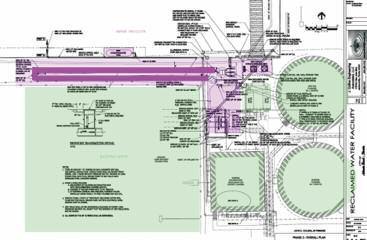
Figure 6 Final Siting for Reclaimed Water Facility/Chlorine Contact Pipe Continued from
T h e C i t y c o m p l e t e d c o n s t r u c t i o n o f
p h a s e o n e a n d s t a r t - u p o f t h e re u s e s y s te m a t
t h e s a m e t i m e t h e g o l f co u r s e co m p l e te d co n -
s t r u c t i o n o f i t s re u s e p o n d a n d b e g a n g r a s s -
i n g t h e g o l f co u r s e . T h e Ci t y p rov i d e d a l l o f
t h e r e c l a i m e d w a t e r n e e d e d t o s u c c e s s f u l l y
s t a r t a n d co m p l e te t h e g row - i n p e r i o d
S p a ce L i m i t a t i o n s
B e c a u s e t h e re c l a i m e d w a te r f a c i l i t y w a s b e i n g b u i l t a t t h e e f f l u e n t e n d o f t h e W WT F,
o n l y a s m a l l a m o u n t o f l a n d w a s a v a i l a b l e
T h e r e w a s e s s e n t i a l l y n o r o o m t o i n s t a l l a
s t a n d a r d c h l o r i n e c o n t a c t c h a m b e r s i z e d t o
a l l ow h i g h - l e ve l d i s i n f e c t i o n p e r co n t a c t t i m e
( C T ) c a l c u l a t i o n s . T h e re f o re , a c h l o r i n e co n -
t a c t p i p e s y s te m w a s d e s i g n e d . A 3 6 - i n . d i a m -
e te r l i n e d d u c t i l e i ro n p i p e w i t h a s e r p e n t i n e
de s i g n w a s u s e d for a ppropr i a te ch l or i n e con -
t a c t a n d m i x i n g t i m e . E f f l u e n t f r o m t h e
W WT F f i l te r s i s d ive r te d to a w e t w e l l w h e re
so dium hy p o chlor ite is a dde d T he water then
f l ow s t h ro u g h t h e c h l o r i n e co n t a c t p i p e a n d
e n t e r s a s e c o n d w e t w e l l w h e r e t h e c h l o r i n e
l e ve l i s m e a s u re d .
T h e r e c l a i m e d w a t e r f a c i l i t y, i n c l u d i n g
t h e l o c a t i o n o f t h e c h l o r i n e co n t a c t p i p e i n -
stal lat ion, is lo cate d in a nar row st r ip of prop-
e r t y a d j a ce n t to t h e e f f l u e n t s to r a g e p o n d
Bu d g e t
Ut i l i t y b u d g e t s a re a lw ay s t i g h t , a n d t h i s was esp ecial ly t r ue due to the nature of hav ing
a n a g re e m e n t w i t h A B C C / A B P to e n s u re t h e
C i t y w a s n o t s a d d l e d w i t h a n u n d u e f i s c a l
b u rd e n
Cit y and JCEA staff prepare d a cost-share
g r a n t a p p l i c a t i o n f o r t h e p ro j e c t . T h e p ro j e c t w a s aw
. Johns River Water Management D ist r ic t Also, to m e e t t h e s t r i c t b u d g e t , a q u i c k - v a l u e e n g in e e r i n g r e v i e w w a s c o m p l e t e d a f t e r t h e b i d
a n d n e g o t i a t e d w i t h t h e co n t r a c t o r. T h i s re -
s u l te d i n
Re s u l t s
T h e W W T F w a s c o m p l e t e d i n t i m e t o
m e e t a l l o f t h e re q u i re d d e a d l i n e s a n d u n d e r
b u d g e t . T h e p ro j e c t c o s t s w e r e $ 1 5 1 , 5 2 8 f o r
e n g i n e e r i n g a n d $ 1 , 2 5 1 , 0 3 2 f o r co n s t r u c t i o n .
F u n d i n g f r o m t h e C i t y w a s $ 9 6 0 , 5 6 0 a n d
$442,000 from SJRWMD T he phase-one tem-
p o r a r y f a c i l i t i e s wo r ke d w e l l a n d F D E P m a d e
a l l ow a n ce s f o r Ci t y s t a f f to t a ke h o u r l y re a d -
i n g s o f ch l o r i n e a n d t u r b i d i t y, i n s te a d o f co n -
t i n u o u s re a d i n g s , a s l o n g a s t h e p u m p s w e re
s e t t o a u t o m a t i c a l l y s h u t o f f w i t h a ny e x -
ce e d a n ce s
T h e A B C C w a s v e r y p l e a s e d w i t h t h e
q u a n t i t y a n d q u a l i t y o f t h e re c l a i m e d w a t e r, and the championship golf course was g row n-
i n a n d re a d y f o r p l ay by t h e o p e n i n g d a te
P h a s e - o n e f a c i l i t i e s w e re u s e d u n t i l s u b -
s t a n t i a l c o m p l e t i o n o f t h e p h a s e - t w o i m -
p r o v e m e n t s T h e p h a s e - t w o f a c i l i t i e s w e r e su b s t a n t i a l ly com p l e te i n Novem b er 2 0 1 4 a n d connec ted to the resident ial reuse dist r ibut ion
m a i n s p rov i d e d by t h e d e ve l o p e r. In a d d i t i o n t o r e c l a i m e d w a t e r f o r r e s i d e n c e s a n d c o m -
m o n a re a s , A B C C i s u s i n g re u s e to w a te r t h e n e w c l ay te n n i s co u r t s .
C o n s t r u c t i o n o f t h e n e w A B C C c l u b -
h o u s e i s co m p l e te ; re s i d e n t s a re p l ay i n g g o l f
a n d t e n n i s , a n d b e a u t i f u l , e nv i r o n m e n t a l l y -
e f f i c i e n t h o m e s a r e b e i n g b u i l t . T h e e n t i r e
1 6 6 - a c r e s i t e w i l l b e p r o t e c t e d f r o m f u t u r e
h i g h - i n t e n s i t y d e ve l o p m e n t f o re ve r, a n d At -
l a n t i c B e a c h , A B C C , a n d Ja c k s o nv i l l e a r e a l l
s u p p o r t i n g a n n e x a t i o n o f t h e p ro p e r t y. T h e p r o j e c t w i l l s a v e u p t o 1 8 3 M G o f g ro u n dw a t e r e a c h ye a r ; i n a d d i t i o n , e f f l u e n t d i s c h a r g e d t o t h e S t . Jo h n s R i ve r w i l l b e r ed u ce d by t h e s a m e a m o u n t . T h i s w i l l re d u ce t h e a m o u n t o f n i t ro g e n a n d p h o s p h o r u s d i sc h a r g e d t o t h e r i v e r b y u p t o 4 , 8 7 0 p o u n d s e a c h p e r ye a r. S S
Cocoa’s Water Tank
W ins 2015 Tank of the Year
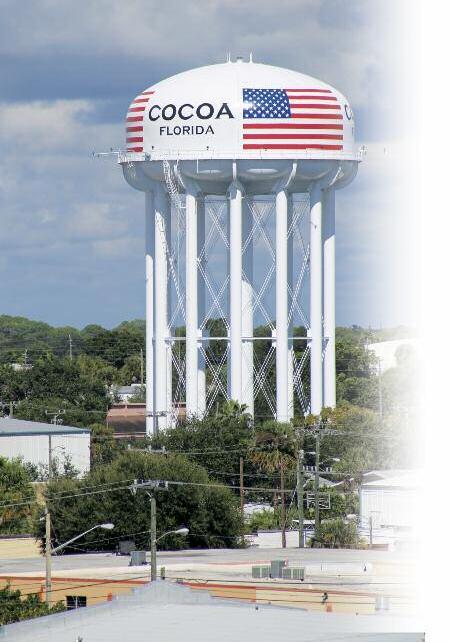
The Tank of the Year is a national water storage tank competition presented by Tnemec Company Inc., and the 2015 award was presented late last year to the City of Cocoa’s iconic 156-ft-tall structure The tank, which features three 25-ft-high American flags, was recently repainted as part of a resurfacing project started in 2014. The flags were originally painted on the tank in 1976 by a Greek immigrant to celebrate the nation’s Bicentennial. When the recent resurfacing project came up for approval to the city council, it was determined that the flags would remain on the tank.
“ The City of Cocoa values its histor y, and the flags are an impor tant par t of that histor y and proudly remain displayed on our tank,” said Henr y Parrish, mayor of Cocoa. “We are honored to make histor y once again by becoming the 2015 Tank of the Year to display to the nation our patriotic pride.”
The tank was built in 1957 to supply drinking water to the National Aeronautics and Space Administration’s space program. The 1.5-mil-gal (MG) tank is used to maintain constant pressure in the distribution system, which supplies more than 22.7 MG of drinking water ever y day to approximately 80,000 customers in central Brevard County, including the Kennedy Space Center, Por t Canaveral, and Patrick Air Force Base.
Cocoa’s tank was one of the twelve top-voted tanks in the online voting polls, along w ith another local tank in Plant City that won in the contemporar y categor y w ith its 500,000-gal pedestal water tank More than 20,000 online votes were cast Voting on the top twelve, a panel of water tank enthusiasts chose the City of Cocoa’s tank based on its ar tistic value, significance to the community, and the challenges encountered during the project.
The water tank was featured on the cover of the Januar y 2016 Tnemac water tank calendar. Established in 1921, Tnemec is one of the largest privately held companies in Nor th America specializing in industrial coatings for steel, concrete, and other substrates for new construction and maintenance. S S
Operators: Take the CEU Challenge!
Members of the Florida Water & Pollution Control Association (FWPCOA) may earn continuing education units through the CEU Challenge! Answer the questions published on this page, based on the technical articles in this month’s issue Circle the letter of each correct answer There is only one correct answer to each question! Answer 80 percent of the questions on any article correctly to earn 0.1 CEU for your license Retests are available
This month’s editorial theme is, Energy Efficiency and Environmental Stewardship Look above each set of questions to see if it is for water operators (DW), distribution system operators (DS), or wastewater operators (WW) Mail the completed page (or a photocopy) to: Florida Environmental Professionals Training, P O Box 33119, Palm Beach Gardens, FL 33420-3119
Enclose $15 for each set of questions you choose to answer (make checks payable to FWPCOA) You MUST be an FWPCOA member before you can submit your answers!
Earn CEUs by answering questions from previous Journal issues! Contact FWPCOA at membership@fwpcoa.org or at 561-840-0340. Articles from past issues can be viewed on the Journal website, www.fwrj.com.
Wastewater Ephemeralization: Achieving Better Treatment with Less Energy and Chemicals
Alber t Bock
(Article 1: CEU = 0 1 WW)
1. In converting to facultative biosolids stabilization, digester aeration was controlled by
a blower timers
b nutrient ammonia and phosphorus-level feedback.
c. dissolved oxygen concentration feedback.
d pH
2 Prev iously practiced conventional aerobic biosolids stabilization resulted in
a. improved biosolids hydrolysis rates.
b reduced digester biosolids liquid phase phosphorus concentration
c reduced alkalinity levels
d. higher biosolids pH.
3 Under the real-time pr icing model for electr icit y, plant operations staff reduces energy cost by
a. pressing biosolids only every other day.
b using super v isor y control and data acquisition (SCADA) to shut down lift stations during peak pricing periods
c. switching all electric motors from fixed speed to variable frequency operation.
d shutting dow n selected equipment through the peak pricing periods
4. The facultative digester process reduces sludge production because
a chemicals are no longer needed for phosphorus precipitation
b it hydrolizes more solids
c. more biosolids are removed in the biological nutrient removal (BNR) process
d a greater concentration of biosolids is retained in digester inventory
5. Process changes described in this article have reduced carbon emissions by
a 3 mil kilowatt-hours (kWh)
Replacing Membranes to Save
Energy: The City of Vero Beach Water Treatment Facility
C.
Rober t Reiss, Christophe Rober t, and Rob Bolton (Article 2: CEU = 0.1 DS/DW)
1. Performance projections provided by the membrane suppliers assumed no permeate back pressure on the first stage because
a the skids presently have energy recover y equipment
b performance goals could not otherwise be met
c. proposed feed water pumps could not develop sufficient pressure.
d existing skids lack back pressure capabilities
2 In the single-element testing phase, recoveries from 15 to 85 percent were selected in order to simulate
a anticipated changes in full-scale skid recoveries that would be required
b anticipated changes in feed water quality over time.
c. the effect of changes in air and water temperature
d water quality at the front and back ends of a full-scale skid
3. Which of the following ty pe of hybrid configurations was recommended for all four systems?
a Tighter membrane first stage, looser membrane second stage
b. Looser membrane first stage, tighter membrane second stage
c Looser membranes, both stages
d. Tighter membrane, both stages
4 Comparing single-membrane test results to membrane permeate water quality projections,
a test water quality was better for all elements tested, at all parameters.
b. test water quality was worse for all elements tested, at all parameters
c one element tested better for all parameters than projected
If paying by credit card, fax to (561) 625-4858 providing the following information:
b 2,000 tons
c. 20,000 cu ft
d. 700 kWh/mil gal
d. three elements tested better for all parameters than projected.
5 Of the three manufacturers able to provide 8 5-in diameter elements, most were not
a. Underwriters Laboratories (UL)-certified.
b National Sanitation Foundation (NSF) 61certified
c presently in production
d. made of material suitable for use in potable water production.
Wastewater Ephemeralization: Achieving Better Treatment with Less Energy and Chemicals
Alber t Bock
Si n ce 2 0 0 9 , t h e 7 - m i l - g a l - p e r- d ay ( m g d )
Militar y Point Reg ional Advanced Wastewater Treat ment Facilit y (MPAWTF), ope r a te d by B ay Co u n t y Ut i l i t y S e r v i ce s a n d co - ow n e d by B ay Co u n t y, Ci t y o f C a l l aw ay, Ci t y o f Pa r ke r, a n d Ci t y o f S p r i n g f i e l d , h a s been wor king to improve its wastewater t reatment plant p er for mance and energ y efficiency to o f f s e t f u t u re e n e r g y p r i ce i n c re a s e s a n d co m p l y w i t h t h e n e w e s t re g u l a to r y F f f l u e n t p er mit requirements
T h e f a c i l i t y p ers on n e l i m p l em en te d n e w and innovative process technolog ies, in combination w ith energ y conser vation prog rams and pro cess changes, so that the facilit y could address the upcoming challenges in the industr y. This ar ticle prov ides an over v iew of the newly installed technolog y and process control strateg ies that deliver a more consistent and cost-effective wastewater treatment plant operation. The turnkey accomplishments of the technolog y and operating procedures include improved effluent results, enr iched biosolids treatment, chemical savings for phosphorous removal, and significantly reduced aeration rates for the operation of the treatment facility Their implementation improved the treatment plant performance and effluent quality results considerably, while also reducing energ y and chemical
requirements in the treatment process. This concept is known as wastewater ephemeralization.
E n er g y a n d ch em i c a l re du c t i on prov i de s multiple economic and environmental benefits, including reduced air pollution and greenhouse gas emissions, and results in reduced operating costs, which saves money for the utilit y
Wi t h p u m p s , m
ay, s e ve n d ay s a week, MPAWTF is one of the largest consumers of energ y in Bay Count y The hig h le vel of energ y and op er ating costs is w hat led the utilit y to make the energ y and process improvements in the wastewater t reat ment plant infr ast r ucture and operations, which guarantees the utilit y customer qualit y ser v ice at a reasonable cost t
ments
Star ting in 2009 Bay Count y Utilit y Ser v-
erg y efficiency improvements and new op er ating technolog ies, and e valuated alter natives to minimize r ising energ y and chemical costs for the wastewater t reat ment plant op er ation
T he MPAWTF wastewater ephemer alization projec ts included:
S O p er at ing one biolog ical nut r ient removal (BNR) t r ain instead of two BNR t r ains
Alber t Bock is wastewater operations super visor with Bay County Utility Ser vices in Panama City.
technolog y
S Elec t r ical cost reduc tion by chang ing from fixed power usage r ate to real-time pr icing (RTP)
S Alternation of BNR aeration control, changing aer at ion from dissolved oxygen to ammonia cont rol
Wastewater Ephemer alizat ion
Pro je cts O ver v iew
O p er at ing One Biolog ical Nut r ient Remov al
Tr ain Inste ad Of Two
T h e M PAW
ains o n - l i n e .
The aer ation blowers for the t reat ment plant process w ith two BNR trains on-line were op er ated in a lead-and-lag configur ation and cont rol led by the residual dissolved oxygen (DO) concentration Ty pically, in the afternoon, during the daily high flows under this configuration, the lag blower came on-line as a backup for the lead blower and contributed to a significant increase in energ y usage and demand
A s t u dy con du c te d i n 2
h owe d t h a t the operation of MPAWTF would be more costef f i c i en t , w h i l e a l s o i m
performance, by only operating one BNR basin until the average daily flows exceed 4.2 mgd.
Eliminat ing Convent ional
Aerobic Digest ion Pro cess: Int ro ducing Facultat ive Biosolids
Stabilizat ion Te chnolo g y
Militar y Point Regional Advanced Wastewater Treatment Facility
and discont inue d the convent ional a erobic dig e s t e r p ro c e s s . T h e n e w d i g e s t e r t e c h n o l o g y ch a n ge d t h e d i ge s ter op er a t i on f rom con t i nu -
o u s ly r u n a er a t i on c ycl e s to ef f i c i en t nut r i en t -
con t ro l l e d d i ge s ter a er a t i on , w h i ch prom o te s f a c u l t a t i ve b i o s o l i d s s t a b i l i z a t i o n e nv i ro n -
m e n t s a n d re d u ce s t h e d i g e s t e r a e r a t i o n r u n
t i m e s by g re a ter t h a n 8 0 p ercen t T h e d i ge s ter aer ation cycles are str ictly controlled by the di-
g e s t e r n u t r i e n t a m m o n i a a n d p h o s p h o ro u s
l e ve l s , w h i ch a re m e a su re d by a nut r i en t a n aly zer s ys tem .
T h e p re v i o u s co nve n t i o n a l a e ro b i c d i -
g e s te r s t a b i l i z a t i o n p ro ce s s i nvo lve d l e n g t hy a er a t i on t i m e s , re su l t i n g i n h i g h en er g y co s t s
a n d s l ow bi o s o l i d s hyd ro lys i s r a te s . T h e con -
ve n t i o n a l a e ro b i c d i g e s t i o n p ro ce s s a l s o reduced the digester pH and alkalinit y le vels and t r iggered the release of large amounts of phosp h o ro u s f ro m t h e a e r a te d d i g e s te r b i o s o l i d s .
Co n s e q u e n t l y, d i g e s te r s i d e s t re a m p h o s p h orous concentr ations, often exceeding 250 mg/L P O 4 - P, w e re re t u r n e d to t h e m a i n s t re a m w a s tew a ter t re a t m en t p l a n t du r i n g de c a n t i n g and biosolids dewater ing
The hig h phosphorous retur n lo ads from the aerobic digester units over lo aded the biolog ical BNR phosphor us removal process and re q u i re d t h e d a i l y a p p l i c a t i o n o f a l u m i n u m s u l f a te to m a i n t a i n t h e e f f lu e n t p h o s p h o ro u s concentrations below the acceptable regulator y le vels The addition of alum for phosphorous remov al also cause d a pH lower ing and alkalinit y scaveng ing of the BNR mixed liquor due to the proper ties of the chemical. This required t h e a d d i t i o n o f a n o t h e r c h e m i c a l ( l i m e ) to restabilize the BNR pH le vels
T he new fa cultat ive digester pro cess te chn o l o g y re du ce s t h e s o lu bl e ph o s ph oro u s conte n t o f t h e d i g e s te r b i o s o l i d s l i q u i d p h a s e by over 90 p ercent, comple te ly w ithout the use of ch em i c a l s . T h e pro ce s s prov i de s over 8 0 p ercen t i n a er a t i on p ower co s t re du c t i on , a s we l l a s s av i n g s i n ch em i c a l co s t for ef f lu en t ph o sph oro u s rem ov a l a n d s lu d ge de w a ter i n g . T h e i m prove d bi o s o l i d s hyd ro lys i s r a te s prov i de a f a s ter re du c t i on of t h e or g a n i c bi o s o l i d s cont e n t a n d re s u l t i n re d u c e d s l u d g e h a u l i n g co s t s .
Electrical Cost Reduction by Changing Energy Rate to Real-Time Pricing Rate Structure
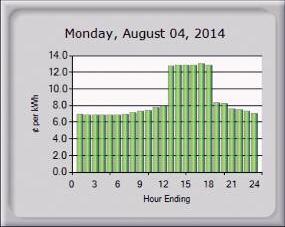
In 2 0 1 3 B ay Co u n t y Ut i l i t y S er v i ce s a n d Gu l f Pow e r Co m p a ny co n d u c te d a s u r ve y to i nve s t i g a te f u r t h e r e n e r g y co s t re d u c t i o n options. Gulf Power int roduced Bay Count y staff to i t s RT P p ro g r a m , w h i ch g ive s B ay Co u n t y the option of pay ing the ac tual energ y cost of e l e c t r i c i t y a t a ny g iven t i m e , i n s te a d of b ei n g charged a consistent energ y r ate charge under
co n t r a c t . T h e e n e r g y RT P
customer hour by hour for the electr icit y usage according ly B ay Co u
e quipment and pro cess se c t ions that are
process. The study showed that the RTP model
the RTP
under the model With the change of the util-
Continued on page 20
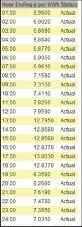
Figure 1 Hour-by-Hour Real-Time Pricing Power Usage Charge
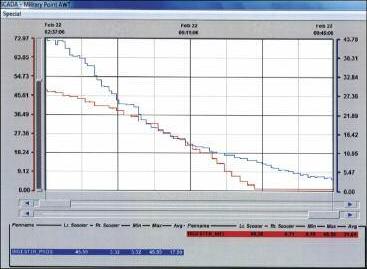
Figure 2 MPAWTF Facultative Biosolids Stabilization Process SCADA Trend Char t: Ammonium and Phosphorous Reduction During Digester Aeration Cycle
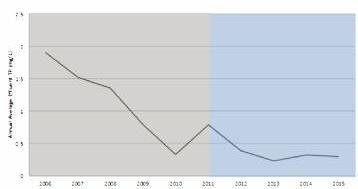
Figure 3. MPAWTF Annual Average Ef fluent Total Phosphorous Concentrations Before and After Implementation of Facultative Biosolids Stabilization Process
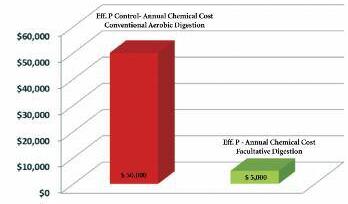
Figure 4. MPAWTF Digester Operation: Annual Chemical Cost for Effluent Phosphorous Control Before and After Implementation of Facultative Biosolids Stabilization Process
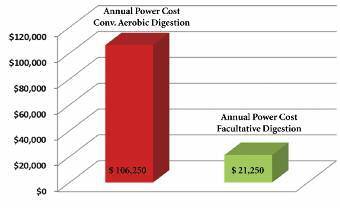
Figure 5. MPAWTF Digester Operation: Annual Power Cost Savings Before and After Implementation of Facultative Biosolids Stabilization Process
Continued from page 19
i t y p ow e r p r i c i n g m o d e l to RT P i n O c to b e r 2013, Bay Count y wastewater staff reduced the need of hig h power usage throug hout the daily c r i t i c a l - p e
u re 1 )
peak high-energ y pricing tariffs two days in advance and plans the t reat ment plant op er ation a cco rd i n g l y T h e u
tur ned off and put on standby until the cr itic a l - p e a
passed
The point sources include:
S Biosolids dewater ing process
S Digester aer ation
S Taking basins off-line
S Re jec ting pond retur ns
Alter nat ion of Biolog ical Nut r ient Remov al Aer at ion Cont rol: Chang ing Aer at ion From
Dissolved Oxygen to Ammonia Cont rol
In 2 0 1 4 B ay Co u n t y Ut i l i t y s t a f f co n t i nu e d w i t h i t s e n e r g y co n s e r v a t i o n e f f o r t s a n d
e v a l u a te d t h e B N R a e r a t i o n p ro ce s s co n t ro l s t r a te g y. T h e p re v i o u s B N R a e r a t i o n p ro ce s s co n t ro l m e t h o d w a s b a s e d o n m a i n t a i n i n g a residual D O of 1 8 mg/l to 2 0 mg/l at al l times after the first BNR aer ation zone.
T h e s t u d y t h a t w a s co n d u c t e d s h ow e d s i g n i f i c a n t p ower co s t s av i n g s a n d t h a t l on gter m e conomic b enefits were a chie ve d by conve r t i n g t h e w a s t e w a t e r t re a t m e n t p l a n t aer ation control from residual D O to the more e f f i c i e n t a m m o n i a co n t ro l A m m o n i a - co nt ro l l e d B N R op er a t i on pre c i s e ly e v a lu a te s t h e re qu i re d a i r dem a n d a n d t re a t s t h e i n com i n g n i t ro g e n a n d b i o c h e m i c a l ox y g e n d e m a n d ( B O D ) l o a d s m o re co s t - e f f e c t ive l y t h a n co nve n t i o n a l D O co n t ro l . In a d d i t i o n to e l e c t r ic a l co s t s av i n g s , a m m o n i a - co n t ro l l e d B N R operation includes other wastewater treatment p l a n t pro
t ter h a nd l i n g of t h e B N R B O D a n d a l k a l i n i t y i nven tor
Wastewater Ephemer alizat ion Pro je ct Results
O p er at ing One Biolog ical Nut r ient Remov al Tr ain Inste ad Of Two Tr ains By op
, MPAWTF was able to op er ate the facilit y w ith only one aer ation blower and a reduced quantit y of BNR mixers and internal recycle pumps.
kilowatt-hours (kWh). The total annual power
u s a g e co s t s av i n g s ave r a g e d a p p rox i m a te l y $23,000
Eliminat ing Aerobic Digest ion Pro cess: Int ro ducing Facultat ive Biosolids
Stabilizat ion Technolog y
The newly introduced facultative biosolids stabilization process changed the control of the digester aer ation from continuous aer ation to
n u t r i e n t - co n t ro l l e d a e r a t i o n p a t te r n s . T h e pro ce s s pre c i s e ly m on i tor s t h e a m m on i a a n d
p h o s p h o ro u s l e ve l s o f t h e d i g e s te r b i o s o l i d s and adjusts the aeration rates according ly (Fig-
u re 2 ) . T h e p ro ce s s te c h n o l o g y p rov i d e s t h e
u t i l i t y n u m e ro u s b e n e f i t s i n o p e r a t i o n a n d
m a i n te n a n ce co s t s av i n g s a n d a c h i e ve s i mproved p er for mance results in biosolids t reatm e n t a n d d i g e s te r s i d e s t re a m q u a l i t y, w h i c h
d i re c t l y i m p a c t s t h e w a s te w a te r t re a t m e n t
p l a n t B N R to t a l p h o s p h o ro u s i nve n to r y a n d , resp ec tively, the effluent phosphorous concent r ations.
T h e n e w f a c u l t a t ive bi o s o l i d s pro ce s s redu ce d t h e s o lu bl e ph o s ph oro u s con ten t of t h e d i g e s t e r s i d e s t re a m re t u r n f l ow s b y o ve r 9 0
p ercent to less than 10mg/L w ithout the use of p h o s p h o r u s re m o v i n g c h e m i c a l s T h e h i g h
p h o s p h o ro u s re m o v a l r a t e o f t h e d i g e s t e r
p ro c e s s co n s e q u e n t l y m a i n t a i n s t h e B N R
ph o s ph oro u s i nven tor y con cen t r a t i on s a t l ow l e ve l s
Since 2011 MPAWTF was able to discontinue the daily chemical feed for effluent phos-
p h o r u s re m ov a l a n d m a i n t a i n e d e f f l u e n t p er mit compliance below 0 3 mg/l (annual av-
e r a g e P ) a s s h ow n i n F i g u re 3 . T h e a n n u a l chemical cost sav ings for effluent phosphorous removal aver aged over $45,000 (Figure 4)
T h e f a c u l t a t ive d i g e s te r p ro ce s s te ch n o log y also reduced the over al l digester aer ation
t i m e by m o re t h a n 8 0 p e rce n t , re s u l t i n g i n a s u b s t a n t i a l re d u c t i o n i n t h e d i g e s te r p ro ce s s energ y costs, w ith sav ings of more than 80 percent. The process reduced the annual digester p ow e r u s a g e by ove r 8 0 0 , 2 1 9 k Wh , w h i c h i s e q u iv a l e n t to $ 8 5 , 0 0 0 i n p ow e r co s t s av i n g s (Figure 5).
The facultative anoxic digester t reat ment e nv i ro n m e n t p rov i d e s m u c h f a s te r b i o s o l i d s hyd ro l y s i s r a te s t h a n t h e p re v i o u s o p e r a te d aerobic digester process and results in a 30 percen t f a s ter re du c t i on of t h e or g a n i c bi o s o l i d s co n te n t T h e i n c re a s e d d i g e s te r b i o s o l i d s hydrolysis r ates prov ide cost sav ing s in poly mer usage and sludge disposal.
The combined sav ings for power costs and chemicals for phosphorous removal alone exceed $130,000 per year, w ith improved effluent ph o s ph oro u s w a ter qu a l i t y re su l t s . T h e l on g -
Electrical Cost Reduction by Changing Energy Rate to Real-Time Pricing Rate Structure
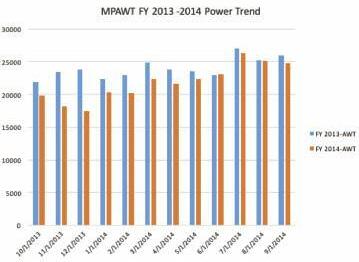
The MPAWTF exp er ienced an aver age of 9.26 percent power cost reduction since opera t i n g u n der t h e RT P pr i c i n g m o de l a n d h a s
for load sharing that calls for only operating the essential equipment necessar y for the wastewater treatment process dur ing the hig h power usage rates. Since implementation of the RTP energ y m o de l , B ay Co u n t y Ut
d approximately $26,000 a year in electrical costs.
Continued on page 22
Figure 6 FY 2013 Under Fixed-Price Contract and FY 2014 Under Real-Time Pricing Contract, Month-to-Month Power Cost Reduction
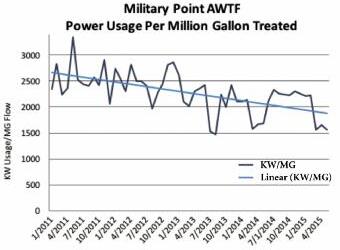
7 MPAWTF Power Usage (kWh) per MG Flow Treated
Figure
Additional benefits of the energ y plan are:
S Gu l f Pow e r E n e r g y Co m p a ny h a s e xce s s gener at ing capacit y that al lows the elec t r ic company to utilize its most efficient power gener ating plants
S The new rate plan allows Bay Count y Utilit y Ser v ices to see the most expensive power per io ds two days in a dv ance, w hich prov ides en o u g h p l a n n i n g to s h i f t s om e e qu i pm en t usage dur ing lower-cost p er iods
The monthly power cost reduc tion p erformance under the RTP model is shown in Figure 6
T h e M PAWT F a l s o i m p l em en te d e l e c t r ical lo ad and demand management in Oc tober
2 0 1 3 T h e f
reduced electr ical demand charges. The available b a ck u p c a p a c i t y
t p l a n t a l l ows B ay Co u n t y s t a f f to com for t a bly shift the op er ation of hig h horsepower equipment w ithin lower power usage p er iods. Point sources for elec t r ical demand management include:
S Biosolids dewater ing process
S Digester aer ation
S Taking basins off-line
S Re jec ting pond retur n flows
Alter nat ion of Biolog ical Nut r ient Remov al Aer at ion Cont rol: Chang ing Aer at ion From Dissolved Oxygen to Ammonia Cont rol
Since the installation of the new ammonia sensors for BNR aeration control, MPAWTF exp er i en ce d a s i g n i f i c a n t re du c t i on of p ower usage costs. The power usage for BNR aeration w a s re du ce d f rom 8 6 5 k Wh / m i l g a l ( M G ) treated to 690 kWh/MG treated and is equiva-
lent to approximately $22,000 in annual power cost sav ings.
The BNR is op er ated w ith a residual ammonia concentr ation of 1 0 mg/L after the first a
nit rogen removal results, conser vation of BNR alkalinit y, and pre vents BNR over aer ation
Summar y of Results
won the fol low ing plant op er ation awards:
S 2012 Flor ida Depar tment of Env ironmental Protec tion Op er ations Excel lence Award
S 2012 Runner-Up for Flor ida Water and En-
Award
S 2013 Winner of Flor ida Water and Env ironment Association Ear le B Phelps Award
S 2013 Flor ida Depar tment of Env ironmental Protec tion Op er ations Excel lence Award
S 2015 Runner-Up for Flor ida Water and Env i ro n m e n
As
Award
The utilit y staff demonst r ates economical a n d e f f e c t ive m e t
to
i
ve i m p rove d wastewater effluent and biosolids performance re
cost conser v at ions Energ y and chemical cost sav ing s today are a ver y impor tant par t of the d a i l y p l a n
t i n g ro
i
e . E n e r g y co nsumption and the hour-to-hour energ y pr ices are continuously monitored by MPAWTF plant p ersonnel
Monthly op er ating repor ts document the en er g y con su m p t i on a n d t h e p er for m a n ce of the new process projec ts With the implemen-
tation of the energ y improvement projects, Bay Count y Utilit y Ser v ices was able to re verse the increasing power costs for its wastewater t reatment plant op er ation
The histor ical t rend char t in Figure 7 demonst r ates the power cost sav ing s that MPAWTF exp er ienced since the implementation of the new process implementations after 2011. The blue trend line illustrates the actual energ y usage per MG treaded. The new process implementations reduced the power usage from 2,700 kWh/MG to less than 2,000 kWh/MG
T h e w a s te w a ter t re a t m en t p l a n t s t a f f i s trained and skilled to identify the energ y consu m p t i on r a te s of t h e w a s te w a ter t re a t m en t process sections and treat the wastewater to the most effective and reasonable cost to the customer, while at the same time meeting stringent Class III surface water permit requirements
Bay County Utility Ser vices identified further energ y conser vation measures that include the replacement of the existing plant halogen lighting with light-emitting diode (LED) fixtures and installation of var iable frequency dr ives ( VFDs) All future equipment replacements will be evaluated based on their energy efficiency and cost-effectiveness to provide the facility with the most energ y-efficient infrastructure.
S i n c e t h e i m p l e m e n t a t i o n o f t h e n e w pro ce s s ch a n ge s , M PAWT F re du ce d
usage by an estimated 1,700,000
Utilit y Ser v ices to reduce chemicals and power co
Alber t Bock per for ms a system check on the digester nutrient analyzer system
Lloyd Kadlec, shift lead operator, at the SCADA computer checking the biological nutrient removal ammonia reduction per for mance
FWPCOA TRAINING CALENDAR
U LE YOU R
Course registration for ms are available at http://www.fwpcoa.or g/for ms.asp. For additional infor mation on these courses or other training programs of fered by the FWPCOA, please contact the FW&PCOA Training Of fice at (321) 383-9690 or training@fwpcoa.or g.
You are required to have your
To Be Held to a Higher Standard
WThomas King President, FWPCOA
e are the caretakers of the most impor tant natur al resource on the planet No matter what your politics or religion, the need for water makes us equal No matter what role you play in the family of utility caretakers, you are held to a higher standard
Those of you who are in charge of a water treatment system have the responsibility to fulfil l that role w ith the upmost inte g r it y If you manage or are on a crew that takes care of a sewer collection system, you must perform your duties in a manner that protects the water table and aquifer You should protec t ag ainst spil ls, and if they do occur, take measures to contain the wastewater and prevent it from entering the stor mwater system or sur face waters. If you work in the water reuse discipline, stand guard and maintain quality standards that you can be proud of. Good maintenance is the key to good op er ation be v ig ilant in the wor k you p erform
I am hear tbroken when the news is filled w ith politicians who take the low road for their ow n political gain I wonder, as I am sure some of you do: where were the exper ts? Where were the water system champions who should have adv ised these politicians? The Flint River water crisis is an example of not looking at the details of the water supply, treatment, and distribution systems. Whether the decision to not use corrosion inhibitors was a budget issue or just a blunder is less impor tant to me than why the utility team did not stop it.
According to CNN repor ts, it’s stil l not clear who made the decision not to use controls to protec t the cit y ’ s pip es from the cor rosive water, or why a granulated activated carbon filter, which would have reduced the need to add chemicals to the water that also ate away at the pipes, wasn’t used as recommended But citizens are conv inced that these decisions were made not out of mere incompetence, but deliberately, w ith an eye to reducing costs
Chemical tests could have predic ted the corrosion in the pipes that is now being blamed
for endangering the health of thousands of vulnerable Flint residents by elevating lead levels in their water supply Certainly there was an awareness of the lead pipes that were par t of the dist r ibution system in the cit y. The families of many utility personnel had to be among those affected, so there is cer tainly more to the stor y than we are being told I would hope that many of those in the know spoke up. We al l know there is a line you do not cross in the criticism of a path your utility is about to follow, but at the ver y least you should speak the truth
I am still an idealist when it comes to our profession and the commit ment I belie ve we should have to fulfill our roles w ith integrity I am not naive enoug h to say that al l the water system operations people I know are w illing to r isk losing their jobs over demanding that the cit y officials take the high road; I do, however, believe in you, as people who chose a profession to make a difference while also making a liv ing. At some point dur ing our careers, we (hop eful ly) be g in to understand the impor tance of our roles in the protection of the env ironment. We are all par t of an industr y where how we do what we do is so impor tant
This brief tirade on idealism does not stop w ith management or politicians. You cannot hold others to a hig her standard than the one you live yourself Saying things like “How could they?” is more credible when you are doing your best. Do not be caught up in the wave of apathy that over takes wor kers w ho are consumed by the thoughts that the utility they work for does not deser ve their best effor t. It is not the city or utility you work for, but the future of water supply itself
There is no new water ; the water we drink today was around w hen dinosaurs r uled the wor ld ( Yeah, get over it; al l of our dr inking
water has been throug h both ends of animals many times.) Where the water supply may be finite, the population continues to grow and that increases the impor tance of our work and the need for v igilance in our duties
Hope on the Hor izon
There is a great hope on the horizon. I have met many utilit y wor kers young and not so young who want to make a positive difference I’m impressed by some of our new instructors who teach from a fresh perspective and have a passion to make a positive difference in the utilit y field There are scores of new op er ator trainees taking courses and sitting for the state exams each year. Our profession is att r ac ting young and talented workers who are themselves idealistic enough to challenge the way things are for the way they could be.
The courses these professionals take are taught by some of the best people I have known I am proud to be e ven a smal l par t of the FWPCOA family. At the ver y first meeting I attended as a region director, I was hooked The room was full of exper ts in all the disciplines of utilit y op er ations. Bil l Al lman, Lee Cr aft, Ar t Sae y, Ray Bourdner, Al Montelone, and Rim Bishop were some of the ke y inst r uc tors and leaders of the organization at the time I was inspired by the way the y ear ned the resp ec t of their students and fellow members. I wanted to be part of that club of instructors; they were like a utility “Rat Pack ”
Remember that FWPCOA is dedicated to the t r aining and better ment of al l p ersonnel working in the utility field The leadership and core t r aining team sp end hours of their free time w riting and fine-tuning courses as volunteers
As I moved throug h the org anization in different roles, I was even more impressed by all of its members. I have enjoyed the time I have sp ent in each of these endeavors and would hig hly recommend to anyone out there to get involved, because the rewards of being par t of something where the product is so much bigger than the sum of its par ts has been a wonderful experience.
I am by no means done and w ill continue to suppor t this organization to the best of my ability From the bottom of my hear t, thanks to al l the past, cur rent, and future members of FWPCOA. S S
Replacing Membr anes To Save Energ y at Cit y Of Vero B e ach Re verse Osmosis
Water Tre at ment Facilit y
C. Rober t Reiss, Christophe Rober t, and Rober t J. Bolton
The City of Vero Beach (City) currently owns and operates a 3.3-mil-gal-per-day (mgd) reverse osmosis water treatment facility (ROWTF) that was constructed in the early 1990s using 8.5-in. diameter pressure vessels. The facility currently operates a single 2-mgd reverse osmosis (RO) skid containing 8 5-in membrane elements that were installed in August 2003 The City contracted with Reiss Engineering Inc. to assist with the replacement of the 10-year-old membranes as recent improvements in membrane technology have resulted in more efficient membranes requiring less pressure for the same rejection performance However, with the industr y now standardized on the 8-in diameter element, locating manufacturers willing to fabricate lower pressure, 8.5-in. diameter membrane elements was uncertain This article presents the steps taken to evaluate and select a replacement membrane for the ROWTF and the associated benefits to the City of Vero Beach
Membrane Availability
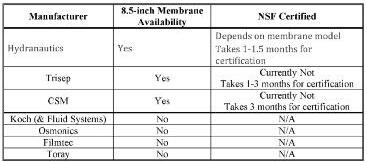
Seven membrane element manufacturers/ suppliers in the United States were contacted to determine whether 8.5-in. diameter membranes were available Out of the seven manufacturers/ suppliers, only three indicated that they could
supply the membrane elements: Hydranautics, Trisep, and CSM.
In addition to being able to provide 8 5-in membrane elements, it was necessary to have NSF 61 certification from the National Sanitation Foundation (per 62.555-320(3)(b)1.a. Florida Administrative Code (F A C ), any equipment, chemicals, and materials, such as RO membrane elements that are in contact with drinking water, must be NSF 61-certified) Of the three manufacturers that confirmed the ability to provide the needed elements, most of their membrane elements that would be appropriate for this brackish water application were not yet NSF 61-certified; only a few membranes from Hydranautics are NSF 61-certified, while the majority of the membranes from Hydranautics and the other manufacturers are not (See Table 1 for summary)
The representative from Hydranautics stated that the NSF certification could be attained, but would take four to six weeks; the representative of CSM stated that the NSF certification may take three months. In addition, the CSM membranes would not be wet tested prior to shipping, which would lead to testing the membranes after they were installed in the full-scale skid In the event that the replaced membrane elements do not meet membrane performance requirements, CSM would have to replace the noncompliant membranes
C Rober t Reiss, Ph D , P E , is president and client ser vices manager, and Christophe Rober t, Ph D , P E , is project manager with Reiss Engineering Inc in Winter Springs Rober t J Bolton, P E , is water and sewer administration division director with City of Vero Beach
Membrane Projections
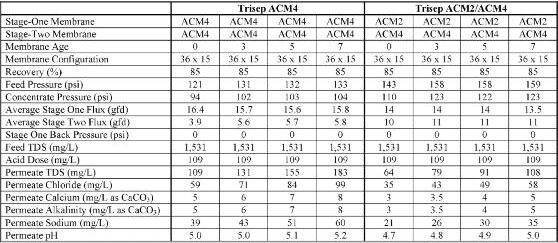
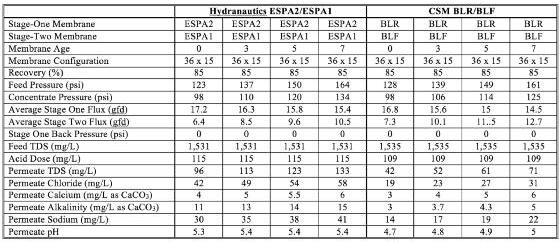
From the three membrane manufacturers/suppliers in the U S that have capabilities to prov ide the membr ane elements, se ver al membranes were evaluated throug h a desktop analysis. Membrane projections utilizing manufacturer’s software were completed to predict the water quality and pressure requirements for each selected membrane model and identified configuration. The projections were based on a 2-mgd skid (36x15 ar ray configuration) using the worst raw water quality, which is total dissolved solids ( TDS) of approximately 1,500 mg/L For the membrane projections, the raw water pH was adjusted to 6 0 standardized units (SU) by the addition of sulfur ic acid, as currently pr ac ticed at the plant. In addition, the projec tions were made w ithout apply ing p ermeate back pressure on the first stage, as there are no capabilities to do so on the existing skid. Only low-pressure RO membr anes that re jec t enoug h chlor ide were selected, since the chloride concentration goal in the permeate was established at 60 mg/L or less (year 0). The results are presented in Table 2
Trisep Membrane Projections
Out of the five Trisep membrane configurations that were evaluated, the ACM4 configuration and the hybrid ACM2/ACM4 membrane configur ation were v iable options to meet the water quality goals w ith relatively low pressure requirements The advantage of the hybrid system is that the flux is better balanced between both stages compared to the use of ACM4 membr ane in both stages; howe ver, the hybr id sys-
Table 1 Membrane Availability and NSF 61 Cer tification
tem requires approximately 20 more pounds per sq in. (psi) of feed pressure. The ACM2 and SB20 membranes were not fur ther evaluated as these membranes would reject too much hardness and alkalinity and exceed the feed pressures of the ACM2/ACM4 membrane configuration. The ACM5 membr ane would meet the water qualit y goals; however, the flux is sig nificantly unbalanced between stages one and two.
In order to b a l a n ce t h e pro du c t i on b etween stage one and two, a piping/valve modification would be required to apply a permeate b a ck pre s su re of a pprox i m a te ly 5 0 p s i i n t h e
first stage of the membrane configuration. Another option to balance the fluxes included ins
stage back pressure) and recover the energ y of the concentrate to boost the feed pressure to the second stage The Cit y is not intending to modi f y
embrane was not recommended. As such, only the AC M 4 a n
configurations from Tr isep were considered for fur ther evaluation.
CSM Membrane Projections
Three membrane configurations from CSM were evaluated, and the hybrid BLR/BLF configuration was the most viable option that met the water quality goals and pressure requirements. The projections evaluating the BLR membranes alone had higher pressure requirements compared to the hybrid system and rejected too much calcium hardness and alkalinity ; therefore, they were not evaluated further within this study The BLF membrane met the water quality goals, but without back pressure in the first stage, the flows
Continued on page 28
are significantly unbalanced between the two membrane stages Therefore, the BLF membrane was also not considered for further evaluation.
Hydranautics Membrane Projections
Three membrane configurations from Hydranautics were evaluated, and similar to the CSM membranes, this hybrid configuration was the most viable option compared to the ESPA1 or ESPA2 configurations Out of the three options, the hybrid ESPA2/ESPA1 system resulted in a better flux balance.
Desktop Summar y
Based on the computer projections of performance, the following membrane configurations were deemed feasible for further evaluation at bench scale (single-element testing):
S Trisep ACM4
S Trisep ACM2/ACM4
S CSM BLR/BLF
S Hydranautics ESPA2/ESPA1
For each configuration, the projected feed pressure requirement is within the existing highpressure pump capacity (445 ft TDH–192 psi), as the maximum projected feed pressure for the se-
lected membrane configurations would be 165 psi after seven years. In addition, the estimated pressure requirements are for the worst expected raw water quality; therefore, it is anticipated that the feed pressure would be lower under normal operation of the ROWTF when using average water quality The high-pressure pumps are equipped with variable frequency drives (VFDs), and consequently, the City has the capability to adjust the feed pressure, ultimately reducing electrical consumption upon installation of the new membranes
Blended Water Quality Projections
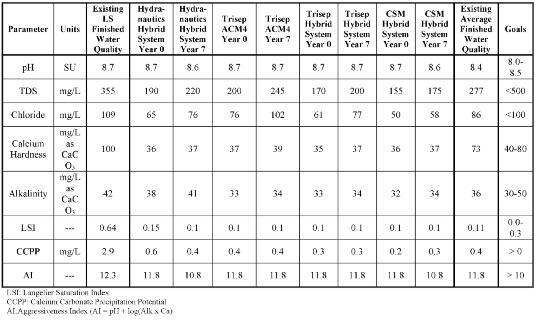
For the four membrane configurations selected, a desktop blending analysis was performed to evaluate the water quality of the finished water after blending the ROWTF permeate with the lime-softened water treatment facility (LSWTF) filtrate. The following criteria were used:
S A blend ratio of 2:1 for RO permeate to LSWTF filtrate This ratio would be used when the ROWTF is expanded (as part of a separate project). Currently, the ratio of RO permeate to LS filtrate is 1:2
S An estimated 80 percent removal of carbonic acid from the permeate stream through the degasification process (degasification is used to
remove the sulfide in the permeate but will also remove carbonic acid). This removal of carbonic acid resulted in an increase of pH of 0.70 9 SU in the permeate
Table 3 presents the projected blended finished water qualit y, as well as the existing finished water quality and the finished water quality goals. As expected, the TDS and chlor ide concentrations in the finished water would be lower than the concentrations cur rently obser ved, while the blended alkalinit y would be similar The main difference in the projected versus the current water quality would be the calcium concentration, as it is projected to be significantly lower than the current concentration As previously evaluated, a recommended option to increase the calcium concentration in the finished water includes decreasing the lime dose at the LSWTF in order to increase the calcium concentration in the LSWTF finished water. It is important to note that these calculations were made at a 2:1 ratio for RO/LS, which would correspond to the ratio that will be used once the ROWTF is expanded. Until expansion of the ROWTF, the finished water quality would be similar to the existing finished water quality
Continued on page 30
Single-Element Testing
Based on the desktop evaluation, the four selected membrane configurations for singleelement testing were:
S Hydranautics hybrid system ESPA2/ESPA1
S Trisep ACM4
S Trisep hybrid system ACM2/ACM4
S CSM hybrid system BLR/BLF
The six membranes were tested in a singleelement unit to confirm the relative pressure requirements and the rejection capabilities For each
test, the pressure was recorded and permeate samples were collected to analyze specific parameters in order to evaluate the membrane performance
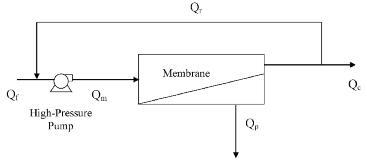
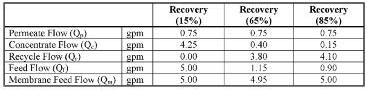
Each membrane was tested at multiple different recoveries, and recoveries from 15 to 85 percent were selected in order to simulate the water quality of the front end and the back end of the full-scale plant, respectively In each set of conditions, recycling of the concentrate was required to maintain minimum flow across the membrane (Figure 1) The operating conditions for the tests described are presented in Table 4 Samples of the permeate stream were collected for laborator y analysis of membrane water quality
For each test, feed pressure, as well as per-
meate, feed, and concentrate conductivities, were regularly monitored to determine whether the system reached steady state, which is when the permeate conductivity reading is within 5 percent of the previous conductivity reading. Pressure was also monitored and stayed consistent during the whole specific test
Single-Element Testing Results
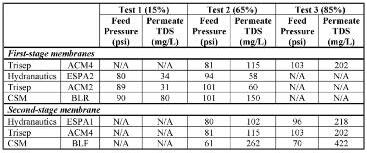
This section presents the results obtained during the single-element testing and assesses the performance of the membranes in terms of pressure requirement and water quality. As described earlier, the feed pressure and conductivities were monitored for each test until steady state was achieved. The final feed pressure and TDS, calculated based on field conductivity measurements, are presented in Table 5 Note that the feed pressure values are not representative of the expected full-scale pressure since the test was performed on a single element. However, because each membrane was tested under the same operating conditions, the relative differences in pressure and water quality are the basis of membrane selection for bidding
Pressure Requirements
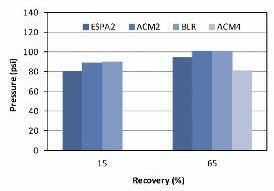
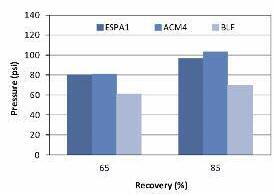
For each of the three manufacturers considered for this installation (supplying 8 5-in membrane elements), a hybrid system was the recommended alternative, with a tighter membrane in the first stage and a looser membrane in the second stage In addition, Trisep provided a fourth alternative, consisting of ACM4 membrane in both stages. For the four first-stage membranes (ACM4, ESPA2, ACM2, and BLR) two recoveries (15 percent and 65 percent) were tested The pressure requirements for each membrane at each recovery are presented in Figure 2; the Trisep ACM4 requires 14 to 20 less psi than the other three membranes at 65 percent recovery
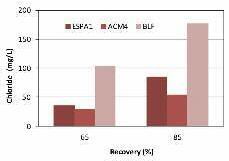
For the three stage-two membranes (ACM4, ESPA1, and BLF) two recoveries (65 percent and 85 percent) were tested The pressure requirements for each membrane at each recover y are presented in Figure 3, which shows that the CSM BLF requires approximately 20 percent less psi than the other two membranes at both recoveries tested The Hydranautics ESPA1 and the Trisep ACM4 had similar pressure requirements. The stage-one membrane pressure requirement will drive the overall pressure requirement of the system for the selected configurations in this analysis. Therefore, based on the stage-one pressure results, a system using only the ACM4 membranes would require the lowest feed pressure, and the Hydranautics membrane configuration would result in the lowest feed pressure among the three hybrid systems
Continued on page 32
Table 5 Bench-Scale Study Results
Table 4 Bench-Scale Study Operation Settings
Figure 1. Single-Element Unit Flow Diagram
Figure 2 Stage-One Membrane Pressure Requirements
Figure 3 Stage-Two Membrane Pressure Requirements
Figure 4. Stage-One Membrane TDS
Figure 5 Stage-Two Membrane TDS
Figure 6 Stage-One Membrane Chloride
Figure 7. Stage-Two Membrane Chloride
Based solely on pressure requirements from the single-element unit testing, the membrane configurations are ranked as follows:
1. Trisep ACM4 in both stages one and two
2. Hydranautics ESPA2 in stage one and Hydranautics ESPA1 in stage two
3 Trisep ACM2 in stage one and Trisep ACM4 in stage two
4. CSM BLR in stage one and CSM BLF in stage two
Water Quality
The water quality of the permeate produced from the tested membranes was evaluated and then compared to the projected water quality from the membrane projections.
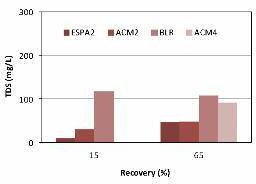
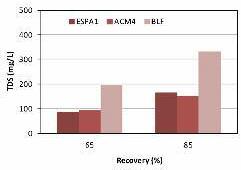
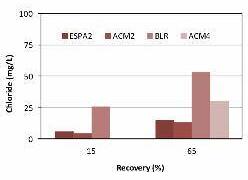
The permeate TDS for each membrane at each recovery is shown in Figures 4 and 5 As seen in both figures, the stage-one ESPA2 and ACM2 membranes and the stage-two ESPA1 and ACM4 membranes show similar performance in terms of TDS The CSM BLR/BLF membranes have the lowest TDS rejection. The permeate chloride is shown in Figures 6 and 7 The same observations made for performance in terms of TDS rejection are also valid for chloride rejection.
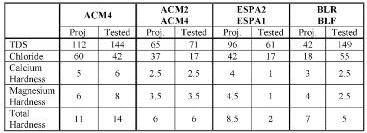
The water quality from each single-element test was compiled to predict the water quality of the full-scale system The water quality was calculated using a weighted average of the water qual-
ity from both stages The predicted water quality from the testing was then compared to the projected water quality from the membrane projections The results are presented in Table 6
From Table 6, the predicted water quality from the projections and the observed water quality from the testing are relatively close, with the exception of chloride for both Trisep membrane configurations. Both Trisep configurations revealed that calculated chloride rejections (calculations based on water quality results from tests at different recoveries) were better than predicted from the software. For the Hydranautics system, the observed water quality from the testing was better than expected from the projections However, for the CSM system, the opposite was obser ved: the predicted water quality from the membrane projection was better than the calculated water quality observed during testing
The discrepancy between water quality predicted from the membrane projection and from the actual testing could be explained by the fact that the one membrane tested may not be a representative average of the associated membrane model Past experience with the CSM membranes showed that calculated water quality had been relatively close to the projections. A recent pilot study using CSM membranes (BLR/BLF hybrid configuration) performed in south Florida is an example where the actual water quality observed was very close to the projections.
From the water quality results, the CSM BLR membrane has the lowest salt rejection, and as shown in the previous subsection, has the highest pressure requirement Therefore, the CSM membrane configuration was not recommended for bidding. Single-element testing results are summarized as follows:
S All four membrane configurations tested met the water quality goals.
S The Trisep ACM4 membrane configuration requires less pressure than the other membrane configurations
S The CSM BLR/BLF membrane configuration produced the worst water quality at the highest pressure among the four membrane configurations tested.
S The hybr id membrane configurations from Tr isep (ACM2/ACM4) and Hydr anautics (ESPA2/ESPA1) resulted in similar results in terms of water quality and pressure requirements.
Based on the pilot study analysis, it was recommended that the City pre-approve the following membrane configurations for bidding on the membrane replacement project:
S Trisep
• ACM4 in both stages
• ACM2 in stage one and ACM4 in stage two
S Hydranautics
• ESPA 2 in stage one and ESPA1 in stage two
Energy and Cost Savings
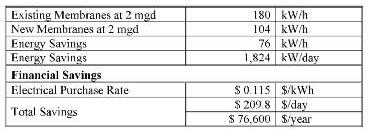
A return on investment for the existing train, when using new membrane elements, was also performed prior to actual bidding. The energ y savings were estimated to be approximately $76,600 per year (Table 7) in operating the existing train after replacing the existing membranes. Assuming a cost of $540 per membrane, and therefore, a total of $193,000 to replace the membranes in the existing skid, the payback period for the membrane replacement investment would be approximately 2 5 years The payback period is significantly sooner than the life expectancy of the membrane elements of seven to 10 years.
Summar y
The City has bid the membrane replacement project, with bids received from both Hydranautics and Trisep Based on an analysis of the capital costs and operating costs, Trisep ACM4 membranes were selected The membrane replacement project was completed in August 2015 The detailed assessment of options for replacing the City’s 8.5-in. elements has assured continued life for the existing RO skid, while providing significant cost savings to the City S S
Table 6 Predicted Water Quality From Membrane Projections and From Testing
Table 7 Energy and Financial Evaluation for the Existing Train
Unintended Consequences to Water Quality When Changing Water Sources
TKim Kunihiro Chair, FSAWWA
he exp ec tation of most dr inking water customers is prett y simple: safe, clean, color less, and g reat-tasting water e ver y time the y turn on their faucet For water professionals, water quality is quite a bit more complicated We star t w ith finding an abundant, good-qualit y source water, w hether it’s from groundwater or surface water. Then, we design a t reat ment facilit y to remove any detec table contaminants, disinfec t it, pump it throug h clean pip elines, and deliver it to customers’ homes w here the y often take it for g r anted until something goes w rong.
Recent e vents in Flint, Mich , concer ning its water quality remind us that things don’t always go as planned. Also, regulations and monitoring don’t solve all treatment problems if the data obtained from this monitoring is not properly analyzed, or other factors, such as financing, come in to play. I am not going to pretend to understand the details behind the lead crisis in Flint, Mich , but a little bit of research into the histor y of water supply in that cit y points out the decision making that lead to the crisis.
Flint was exp er iencing sig nificant water shor tages in the 1950s in a post-war economy as the cit y t r ied to supply sufficient water for both its citizens and the industrial activ ities for the automobile manufacturing that drove its job creation The city administration members analyzed alternatives to save water in the factories and extended the conser vation lessons learned to their homes They also made the connection that, by conser ving at the factories and at home, they could save on treating wastewater, reduce
waste streams to the rivers, including the Flint River, and reduce pollution
Even after these water-sav ing effor ts were made, public works officials hired consultants to study the issue of water supply and wastewater t reat ment. The y found that, in droug ht years, they were going to be significantly shor t on their needed water supply, so the y investigated the possibility of a pipeline to Lake Huron and also purchasing water from Detroit.
Flint’s expenditures to self-supply would be something between $40 and $100 million over the 40-year projections evaluated, but the estimated cost to purchase treated water from Det roit was less than $10 mil lion over a similar timeframe Self-supply is often the first choice for a water utilit y, al low ing autonomy for the utility and more control over future costs, and perhaps more assurance for the best water qualit y by hav ing more cont rol over the op er ator and maintenance staff. After much political back-and-for th, the decision was made to purchase water from Detroit as the primar y water source in the mid-1960s
Fast for ward to 2014 w hen, after fac tor y closing s and changes in the economy, Flint made a decision to stop purchasing water from Detroit and to star t self-supplying treated water from the Flint River. This decision was apparently made by a state emergency manager It was to be an interim solution until it could negotiate a new purchased water agreement.
Shor tly after the new supply went into ser v ice, customers noticed They complained of taste and odor issues and there were many total coliform occurrences that lead to boil-water notices. Confidence in the water supply and the water supplier were already low, and then physicians determined that lead was being detected in the bloodstreams of children at much hig her le vels than nor mal The t reated water supply from the Flint River appeared to be more corrosive than the Detroit source, and as many any of the ser v ice lines in Flint are old and con-
tain lead, they began to corrode and release lead into the water
After much national publicity, Flint subsequently changed its water source back to Detroit in October 2015, but it’s not know n how long it w ill take to stabilize the corrosion and get lead levels back to a safe level at the tap.
Water professionals know that water chemist r y and maintaining water qualit y is much more complex than just H2O. If Flint, like al l community systems in the United States, is subjec t to the U S Env ironmental Protec tion Agency’s Lead and Copper Rule, which was established in 1991 and rev ised in 2007, how does something like this happen?
The rule requires sampling at a frequency of e ver y three years. Per haps sampling at the minimum frequency is not appropr iate for a new source if problems cannot be found before they show up in the customers’ taps No regulation seems to be p er fec t and to address e ver y issue. Often, as in the case of this rule, changes are made after the data is analyzed to make the regulation more effective
Major improvements to the rule in 2007 attempted to do a better job in helping utilities determine the best approach to corrosion control treatment, and also to expedite the removal of lead ser v ice lines and their replacement w ith lead-free mater ials The EPA has issued guidance documents to assist utilities and encourage them to wor k w ith pr imacy agencies pr ior to source water changes. Because of the issue in Flint, regulator y changes are sure to come to enhance the rule
In a cash-strapped utility, lead ser v ice line replacement is not v iable w ithout funding assistance This is a realit y for many water providers that need to prioritize funding and be able to take appropriate actions to always prov ide safe water to consumers
Fur ther consequences of the events in Flint have been the national-le vel fallout. President O bama declared a state of emergency and EPA
FloridaSection
published a memo to all of its regions on more effective corrosion control to respond to a crisis like the one in Flint.
The Flint dilemma was the subject of contentious hearings in Congress before the House Oversight and Government Reform Committee In Februar y, the issue affected passage of a comprehensive energ y bill when a senator in Michigan vowed to hold up the bill unless Flint gets the financial aid it has requested to solve its water problems. The funding mechanism is under debate, including the possibility of using state re volv ing lo an funds, or p er haps funds from the Water Infrastructure Finance and Innovation Act. This act, however, was designed to provide funding for long-term infrastructure replacement projec ts, not for disaster relief and grants.
The Flint situation underscores something that all water professionals should pay attention to Our first job is to protect the communities we ser ve; when we consider funding , our customers and our water quality should be the top priority As water prov iders, we should not take any thing for g r anted. The financial decision makers should be wel l infor med about water quality, water sources, and the costs for proper t reat ment and infr ast r uc ture replacement before they make changes and prioritize funding. We can educate each other, our boards, policy decision makers, and our customers that water quality takes more than pumping H2O
You can find out so much more about lead in dr inking water from AWWA at www awwa org The association has established a lead resource community link on the website to prov ide insig ht and guidance on cor rosion control and lead management Guidance is also available to help utilities discuss water qualit y issues and lead w ith consumers at DrinkTap.org.
You can also keep up w ith what the best of the best in drinking water treatment are doing in Florida. Par ticipate in the upcoming regional dr inking water tastes tests that are happ ening throughout FSAWWA regions in March:
S Re g ion II: Tuesday, March 8, 11:30 a m2 p.m., JEA Conservation Center, Jacksonville
S Re g ion IV: March 11, 11 a m -1:30 p m , Weeki Wachee Springs State Park
S Region XI: March 17, 11:30 a.m.-1 p.m., City of New berr y Municipal Building
S Region X: March 18, 10 a m -12 p m , Peace River Water Treatment Facility, Arcadia
These regional events w ill culminate in the statew ide Best Drinking Water Competition to be held at the Florida Water Resources Conference on Tuesday, April 26, at the Gaylord Palms Resor t and Convention Center in Kissimmee S S
Dept. of Interior Creates Natural Resource Investment Center to Increase Water Funding
U.S. Secretar y of the Interior Sally Jewell has announced that the department will establish a Natural Resource Investment Center to spur par tnerships w ith the private sector to develop creative financing oppor tunities that suppor t economic development goals, while advancing the department’s resource stewardship mission
At a White House Roundtable on Water Innovation, Jewell stated that the Center w ill use market-based tools and innovative public–private col labor ations to increase invest ment in water conser vation and cr itical water infr astructure, as well as promote investments that conser ve impor tant habitats in a manner that advances efficient p er mitting and meaning ful landscape-level conser vation.
“Given increased development pressures, climate impacts, and constrained budgets, the Interior is pursuing innovative approaches with private-sector organizations to help accomplish our balanced land management and conser vation mission,” Secretar y Jewell said “As a former chief executive officer, I am confident the private sector can play a meaningful role in working with us to advance the goals of smart development alongside thoughtful conser vation ”
The Center will work closely with the private sector and others to identify innovative ideas and financing options for projects that conserve scarce water resources and protect species habitat
The Center will focus on three objectives:
1 Increase investment in water conser vation and build up water supply resilience by facil-
itating water exchanges or transfers in the United States.
2 Increase investment in cr itical water infrastructure–both major rehabilitation and replacement of existing infrastructure and new infrastructure needs–by developing new financing approaches and helping to execute project ideas
3. Foster private investment and suppor t wellst r uc tured mar kets that advance efficient permitting and effective landscape-level conser vation for species, habitat, and other natural resources.
The Center is par t of President O bama’s Build America Investment Initiative, which calls on federal agencies to find new ways to increase investment in ports, roads, water and sewer systems, bridges, broadband networks, and other 21st-centur y infrastructure projects, and Pay for Success, an initiative that seeks to employ innovative new strategies to help ensure that the essential ser v ices of government produce their intended outcomes. The infrastructure improvements are facilitated by building par tnerships among federal, state, local, and tribal governments and private-sector investors. The U.S. Departments of Transportation and Agriculture and the Environmental Protection Agency have also created centers in response to these initiatives
The Center will harness the expertise of the depar tment’s bureaus, including the Bureau of Reclamation, U S Fish and Wildlife Ser vice, Bu-
reau of Land Management, National Park Ser vice, Bureau of Indian Affairs, and United States Geological Sur vey, and will tap external privatesector experience to deliver on its objectives
The Center will model its water efficiency and transfer efforts in part on the successful initiatives of the Central Valley Project (CVP) in California The CVP improves operational flexibility and water supply reliability through expanded use of voluntary water transfers Individuals or water districts receiving CVP water can transfer all or a portion of their water to other California water users or a water agency, state or federal agency, tribes, or private nonprofit organizations Through this program, between 300,000 and 400,000 acre-ft of water is transferred in a typical year, allowing high-value agriculture and cities to maintain deliveries through scarcity
To promote increased investment in critical water infrastructure, the Center will also work to develop new financing approaches and engage with nonfederal partners to make investments that build water supply resilience. These could include storage, pipelines, canals, and investments in efficiency that help to stretch and better manage scarce water supplies and sustain river ecosystems
One recent example of this approach is the Warren H. Brock Reservoir in California. To respond more effectively to the changing conditions on the river, Reclamation and stakeholders in Nevada, Arizona, and California collaboratively constructed this storage facility to conserve water and maximize the use of available water supplies. The Bureau of Reclamation conducted env ironmental compliance, oversaw construction, and integrated the project into its operations in the Lower Colorado River system, and the project was completed in roughly two years.
The Center will also identify opportunities for private-sector investments in important habitat conservation needs on public and private lands One creative example is demonstrated in a partnership among Interior, Barrick Gold of North America, and The Nature Conservancy to enhance habitat in Nevada for the greater sage grouse. The agreement allowed Barrick to accumulate credits for successful habitat improvement projects on its private ranchlands In return, the company receives assurance from the Interior that the credits can be used to offset impact to habitat from planned future mine expansion on public lands
The Department of the Interior manages approximately 20 percent of the land in the United States, and is the largest wholesale water provider in the country The Department is establishing the Center under its existing authorities.
MChlorine Update 2016
Doug Prentiss Sr
ost of you using elemental chlorine in your disinfection process have probably already been notified by your supplier of some of the new safety improvements for ton containers and cylinders The new emergency response kits are a significant improvement over prev ious ones, and if your staff is doing emergency response, the cost of the kits are not as much as a couple of air packs
What prompted this written update was not the new kits; it was actually a preview of a brand new training DVD from the Chlorine Institute. As a member of the national Water Environment Federation Safety Committee, I was inv ited to prev iew a beta version of the v ideo and make comments
After getting a chance to look at the information, I was ver y pleased by what was presented. All workers who handle, store, or process elemental chlorine should know the information contained in this training package Working with chlorine safely is based on a solid understanding of the chemical, and this training shows that. Clear visuals and excellent graphics provide operators and maintenance personnel with the keys to working safely in and around chlorine containers, cylinders, and process equipment
I don’t have a release date of the video and changes may still be made during this beta-test process, but the foundation of the information is
on target and will enable workers to understand potential hazards and prevent unwanted occurrences. Check the Institute’s website at www chlorineinstitute org for the latest training information
Also available from the Institute is an updated version of the v ideo, “Handling Sodium Hypochlorite Safely,” which has revised information for workers using sodium hypochlorite For those of you who are technical trainers, there is an Institute-sponsored CHLOREP® team training, scheduled for April 25-29 at the Mississippi State Fire Academy in Pearl, Miss Again, check the website for details.
So many new training materials are becoming available; the new emergency response kits really are better, and vendors are doing more quality control than ever All of these are good things for those of you using elemental chlorine
Another positive step is the move to dr y scrubbers for process systems using elemental chlorine For many years, sodium hydroxide scrubbers were the normal go-to devices to capture chlorine releases. The problem was the hydroxide itself posed a hazard to workers and really only provided a positive factor in protection of the public For workers, it’s a hazard and has to be changed, tested, and maintained.
Personally, as a safety person, I have seen many more injuries from exposure to hydroxide than to elemental chlorine, so the move to get rid of hydroxide and move to a pellet-based material instead of sodium hydroxide is a w in for workers and the public Ultimately, a system that is not dangerous to maintain is going to function better over of a long period of time. Generally, the public is better protected by systems that can be maintained at a high level of preparedness, and dr y scrubbers allow for that without posing serious hazards to the maintenance workers
I used to only see the dry scrubbers at power plants, but the prices have come down, and more importantly, the technology has been accepted by environmental regulators Dr y scrubbers benefit ever yone, with fewer hazards to anyone handling the materials.
While not new, the last item on my hit parade of important chlorine safety equipment is the cylinder recovery vessel designed for chlorine cylinders.
This recover y vessel has been around for
years and can stop any leak anywhere on a cylinder. That’s a pretty bold statement, but it’s a fact. When a leaking 150-lb cylinder is slid into the recover y vessel and the door is properly closed and secured using the proper gasket, the vessel w ill contain any leak within the recovery vessel. It also has an exterior feed device on the dome of the vessel so the gas can be bled off into an appropriate system and safely handled.
The problem with the vessel is the weight to move it around and the location or placement of the unit or units until needed. For fire personnel, just making room on a truck for anything new is a real discussion, so the addition of a coffin to a response truck may not be the slam dunk we might expect. I know of one progressive utility that bought two; it gave one to the fire department and kept one for its water wells that was used on a route truck, along with self-contained breathing apparatus (SCBA) and suits.
If you ’ re using 150-lb cylinders and allowing the oldest style welded foot ring cylinders to be delivered to your sites, having a cylinder emergency recovery vessel only makes sense. There is nothing in the new or old Emergency Kit “A” that will stop a leak at the weld of a foot ring The
emergency recover y vessel is the only thing that will stop a leak at the foot ring or anywhere on the bottom of the cylinder The bump bottom cylinders are the best, and even the machine welded ring is much better than the welded foot ring. It is only the efforts of the suppliers to inspect and hydrostatically test the cylinders that prevent the leaks from happening more often at the bottom. The hydrostatic testing done once ever y five years actually tests the cylinders at higher pressures than the ton containers, but a lot can happen during five years, so suppliers inspect cylinders before each shipment and so should you
The recover y vessel also works on liquid leaks and is a wonderful tool. Like everything else, its gaskets must be renewed, its bolts and hinges kept clean, and it needs to be decontaminated after each use
The Chlorine Institute has many publications and pamphlets, some of which are designed specifically for water and wastewater operators, and I encourage those of you using elemental chlorine to take advantage of the Institute’s many years of good stewardship and experience by providing workers who handle this product with the
latest industr y standards and equipment.
This May, Destin Water Users Inc. is hosting the only three-day chlorine class I have planned at this point in our state If you have someone who could benefit from such a class, get in touch w ith me at doug prentiss@w indstream.net or Judd Moose, chair of the FWEA Safety Committee, at jmooso@dwuinc com; we are always happy to have other trainers or responders participate in this technical training.
So yes, I have really hit the brakes and slowed down the pace of my training, but I still maintain my contacts and interest in chlorine training. I am for tunate that I still have the physical skills and abilities to do the things I enjoy While family is first now, those of you who I have worked so closely over the years and developed friendships with know I will still be there for you
My life now is like the joke of the old bull and the young bull standing on the top of a hill looking down into a meadow below them. I am like the old bull; I take my time now and enjoy each step of my journey, anticipating my arrival
Doug Prentiss Sr is an FWEA Safety Committee member (photos: Doug Prentiss Sr )
Cer t ific at ion Boulevard
Test Your Knowledge of Wastewater Disposal
Roy Pelletier
1. What ty pically happens to the chlorine demand of reclaimed water when the nitrite (NO2) concentration is elevated?
a. The chlorine demand doubles for each pound of nitrite oxidized
b The chlorine demand is cut in half for each pound of nitrite oxidized.
c. The chlorine demand is unaffected by nitrite concentrations
d The chlorine demand is multiplied by more than five for each pound of nitrite oxidized.
2 Which chemical is ty pically not used to adjust effluent pH (between 6.0 to 8.5) before being discharged to a surface water outfall?
a. Lime b. Alum
c Sodium hydroxide d Caustic soda
3. What is the detention time of a reclaimed water storage tank if the tank volume is 2.5 mil gal (MG) and the flow entering the tank is 9 75 mil gal per day (mgd)?
a. 6.15 hours b. 164 hours
c 1 23 hours d 3 90 hours
4. What ty pically happens to the oxidation reduction potential (ORP) value of reclaimed water when the ammonia concentration drops from 4 mg/L to 0.5 mg/L?
a The ORP value increases
b. The ORP value decreases.
c. The ORP value is fairly unaffected by the ammonia level
d Ammonia at any level w ill cause a ty pical ORP probe to fail.
5 Which chemical is more commonly used to dechlorinate effluent follow ing disinfection w ith chlorine?
a Sulfuric acid (H2SO4)
b. Sodium hy pochlorite (NaOCI)
c. Sulfur dioxide (SO2)
d Ferric chloride (FeCL3)
6. Given the follow ing data, what is the equivalent percent total solids?
• 10 ml of sample
• Tare weight of filter paper is 1.8873 grams
• Final weight of filter paper after dr y ing is 2 2255 grams
a. 2.2 percent
c 3 4 percent
b. 1.3 percent
d 4 3 percent
7. What is the final effluent total suspended solids ( TSS) value if the plant influent TSS is 225 mg/L, and the TSS percent removal is 98.9 percent?
a 7 6 mg/L
b 2 5 mg/L c 6 7 mg/L
8. Which formula is used to calculate the circumference of a circular tank? a.
9. Given the follow ing data, what is the pressure equivalent expressed in bar delivered by this effluent pump?
• Pump discharges 1,500 gal per minute (g pm)
• Total dynamic head ( TDH) of 155 ft
a 4 56 bar
b 67 11 bar
c. 14.7 bar d. 2.88 bar
10 What is the volume of reclaimed water in 38 in. of a storage tank w ith a diameter of 100 ft?
Check the Archives
Are you new to the water and wastewater field? Want to boost your knowledge about topics you’ll face each day as a water/wastewater professional?
All past editions of Certification Boulevard through 2000 are available on the Florida Water Environment Association’s website at www fwea org Click the “Site Map” button on the home page, then scroll down to the Certification Boulevard Archives, located below the Operations Research Committee.
Answers on page 62
Readers are welcome to submit questions or exercises on water or wastewater treatment plant operations for publication in Certification Boulevard Send your question (with the answer) or your exercise (with the solution) by email to: roy.pelletier@cityoforlando.net, or by mail to:
Water Tr ansmission and Energ y/Stor age O pt imizat ion Study
Kimberly Machlus
The Florida Keys Aqueduct Authority (FKAA) authorized Atkins Global to update and calibrate the Innovyze InfoWater hydraulic model of its water transmission system ( WTS), which was prev iously done by Atkins (formerly PBS&J) in 2009 As part of this effort, an extensive amount of WTS background data were collected and compiled, including water meter records and connections to a transmission system consisting of pressure-reducing valve stations (TAP), spatial disaggregation of service area water demands, booster and distribution system pump station historical log charts, booster and distribution system pump station super v isor y control and data acquisition (SCADA), and a pump station energy cost summar y.
An updated hydraulic model was developed exclusively for the FKAA WTS, including parallel sections of transmission mains from Florida City to Key West, five major booster pump stations (BPS), and all TAPs located along the transmission system. The model was originally created in steady state; the updated model was enhanced by making TAP water demand assumptions to develop an extended period simulation of 24 hours along the WTS. A discussion of how var ying diurnal demands were applied to different kinds of TAPs is presented
The local water distribution systems, including storage tanks and small booster pumps, were not modeled as par t of the WTS and are simulated by the TAP demands The updated FKAA WTS model was initially calibrated utiliz-
ing two sets of data: a period from Februar y 2-4, 2011, was considered an average-day supply-anddemand scenario; and during Memorial Weekend in May 2011, a condition reflecting some of the highest water demands recorded over the past several years was considered a maximum-day scenario Additional calibrations of the scenarios were performed to refine and update a few facilities based on November 2012 SCADA information provided by FKAA The calibrated hydraulic model was then used to evaluate optimal energy operating procedures and location of additional WTS emergency storage
Summar y of Water Transmission System Model Update and Calibration
The hydraulic model has been recalibrated and updated to represent the current water system operation and demand conditions based on recent water meter TAP data, SCADA, and log sheets supplied by FKAA
Water Demands
Two consecutive years (2010-2011) of TAP data, supplied per water meter, were used to update the WTS to current demands. The TAP water demands for the model have been updated to reflect the current lower average-day demands, as well as a lower peaking factor on the system. As a comparison, the 2005 annual average TAP demands included in the prev ious hydraulic
Kimberly Machlus is a project manager with Atkins Global in Orlando
model totaled 16.69 mil gal per day (mgd). The recent two-year TAP data resulted in an annual average demand of 15 05 mgd, which resulted in an annual average demand decrease of approximately 11 percent. This decrease is likely due to current economic conditions directly affecting population decreases and reduced water consumption per capita. In addition, FKAA’s water loss along the WTS was evaluated and applied appropriately to the model to account for the total production at the Florida City Water Treatment Plant (WTP) and WTS pressure losses. The WTS is segmented into five areas that extend from Key West to Florida City (Areas I-V) The TAP data also include demands for the United States Navy and the recent system privatization and modifications made by FKAA Table 1 summarizes the historical rolling annual average demand quantities for the years 2010 and 2011.
During this timeframe, it is estimated that the WTS experienced a total loss of approximately 10 percent, based on the difference between the average supply recorded at WTP and the average TAP demands The water loss is over approximately 125 mi, resulting in an average water loss of an estimated 12,000 gal per day (g pd) per mi. The WTP distributed an average daily flow (ADF) of 17 1 mgd and a maximum daily flow (MDF) of 20 2 mgd, under recent demand conditions. There is also a reported additional water loss of approximately 10 percent in the local water distribution system downstream of the TAPs, which FKAA continues to work on reducing through rev iew of meter accounting, meter testing, water audit programs, and other maintenance activities In 2011 and 2012, FKAA identified and repaired a WTS leak repor tedly contributing to a major portion of the WTS loss on North Roosevelt
Diurnal Demand Patterns
The WTS model consists of two different ty pes of connections that must be modeled appropr iately (at input nodes) to simulate the
Table 1. Florida Keys Aqueduct Authority Water Transmission System
var y ing water demands at the TAPs: 1) tank demands that are TAP connections that only directly fill a distribution system tank, and 2) TAP demands that are direct feeds into the distribution system ser ved by either a tank or no tank. Approximately 45 percent of the demand on the WTS consists of tank demand nodes, which directly supply a local distribution system general ly consisting of a tank and a smal l booster pump station. These TAPs have a more constant demand due to a more controlled filling rate of a distribution tank and do not follow a ty pical daily demand pattern as the nontank-supplied demands along the WTS Therefore, the tank TAPs were assig ned a unique diur nal patter n, including a nig httime p er iod w here the tanks are full. To develop this diurnal pattern for the tank demand during an extended period simulation, SCADA was prov ided for two distribution areas ser ved by tanks where tank-level data were recorded over 24 hours dur ing assumed average-day demands It was apparent from the SCADA that, from midnig ht to 6:00 a m , the distribution tanks were full and the small pump stations were off The low nig httime demand was being supplied by the smaller TAPs in the ser v ice area.
Figure 1 illustrates the tank diurnal demand curve assumed for the WTS model The nontanksupplied TAPs were reviewed by the service area to understand their contributions in the water distribution system. For the most par t, these TAPS are smaller meter connections that either feed isolated areas or supplement the area when the pump stations are off at night or meet a local peak demand. Since some are controlled by pressure, it makes it difficult to accurately simulate unless the local distribution system is fully added to the model. A diurnal pattern for direct demand nodes was estimated based on slightly adjusting the average demand above during the day (to model higher demands) and below average for nighttime, also shown in Figure 1.
The FKAA currently does not have remote flow metering of the TAPs and therefore cannot currently prov ide hourly demand patterns for each of the TAPs. Future installation of automated meter readers (AMRs) at the TAPs would prov ide valuable hourly flow data off the WTS and help in fur ther managing and optimizing pumping operations
Water System
Since the hydraulic model was created in 2009, the Key Largo pump station has been the major addition to the WTS, although the pump station is not currently in use due to a decrease in projected maximum-day system water demands This pump station includes two 700 horsepower (Hp) pumps, w ith a pumping ca-
Figure 1 Florida Keys Aqueduct Authority Water Transmission System Tank and Demand Node Diurnal Flow Patterns
Table 2 Florida Keys Aqueduct Authority Water Transmission System Booster Pump Station Operations
pacity of 16,660 gpm (24 mgd) and 291 total dynamic ft of head Additionally, the Marathon pump station has been upgraded to feature two new double suction pumps rated at 5,500 g pm (7 9 mgd) and 280 total dynamic ft of head
The new pump curves have been imported into the current model to reflect current-day operation. The FKAA has replaced approximately five mi of the 36-in pipeline between MM 93 and MM 98 with a similar size pipeline Previously, this pipeline constrained operations of the WTS by limiting the discharge pressure at the WTP. Several shor t sections of the parallel 18-in pipeline have been permanently abandoned.
As mentioned prev iously, two sets of log sheets were supplied by FKAA: one set was logged data from three days in February 2011, which was used as an example of average day booster pump station operation and controls; and the second set of log sheets supplied was from three days in May 2011, which was an example of maximumday booster pump station operations and controls. The log sheets were used to understand the var ying suction and discharge pressure for a 24hour period for each booster pump station during each demand scenario. Table 2 summarizes a daily average of the booster pump station opera-
tion, based on system controls as provided on the log sheets
Super v isor y Control and Data Acquisition
The FKAA has implemented a detailed SCADA system for managing pump operations for the entire WTS and continues to expand and make refinements to further reduce energy costs. The SCADA system records numerous pieces of data and information at the booster pump stations, including electrical use, flow rates, efficiencies, pressures, motor speeds, etc. The FKAA has developed the programming to estimate hourly and daily energy costs to assist the WTS operators in decision making. In the future, it will be valuable data for FKAA to implement SCADA at the major TAPs supplying tanks to even better understand WTS operations. A few distribution tanks have been connected to the SCADA system. The SCADA was supplied by FKAA for a seven-day period for each WTS booster pump station to incorporate into the hydraulic model for the pur poses of hydraulic and energ y calibr ation The fol low ing discusses the SCADA that was used to assist in calibrating the pump stations in the model.
Continued on page 44
Calibration
As previously mentioned, the log sheets noting hourly system pressures, metering facilities, and pump operations were used to assist in calibrating the model for a three-day period in Februar y 2011 and May 2011. The hydraulic model calibration consisted of an evaluation of the pump station operations, storage tank filling rates at tank TAPs, and diurnal demands at other TAPs (junctions). Continuity checks were performed at junctions to ensure that continuity of flow was maintained
Pump station operations were compared to SCADA for seven days in November 2012 supplied by FKAA to verify and calibrate the hydraulic model. As part of this planning effort, an energ y analysis was conducted for the major water booster pump stations to estimate annual energy costs and compare them to actual costs The energ y module feature of the hydraulic model was utilized to calibrate the FKAA WTS hydraulic model to power consumption, based on the available power schedules and historical usage data. Table 3 shows a daily average of flows through each of the booster pump stations and average pressures following SCADA calibration
Utilities
There are three utilities that currently prov ide the WTS electricity to power the booster pump stations: the WTP is ser ved by Florida Power and Light (FP&L) and the areas along the Keys ser ved by Florida Keys Coop and Key En-
ergy Services The new calibrated energy model was therefore used to predict power consumption on the WTS under various pumping and demand scenarios
The FKAA provided electric utility bills for the WTS booster pump stations; the estimated utility and rates are provided in Table 4 The actual utility rate schedules are fairly complex and include variable and fixed charges; for the purposes of this study, average kilowatt-hour (kWh) costs were estimated for each utility based on the historical data The FKAA operations staff continues to review and work with each utility to better understand pricing structure to ensure that the system is performing at the most optimum system cost.
The largest kWh cost is billed by Key Energy Services, which supplies the Ramrod pump station, but it is not usually operated under average demand conditions, similar to the Key Largo pump station. Based on limited billing data for the Key Largo pump station, the average kWh cost is high due to the infrequency of operation In the months that the pump station is run consistently, an average $0 13/kWh was estimated; the months that the pump station is run in peak events, a cost of $0.33/kWh was estimated. This high kWh charge is assumed to be due to running the booster pump station during electric utility peak-hour demand charges
Annual Costs
Based on the energy cost data provided and reviewed, the annual booster pump station costs are approximately $1.74 million for the WTS. The average-day scenario in the hydraulic model
was simulated utilizing the energy module during an extended period of 24 hours for the pump operations calibrated in previous steps The model predicted an annual average booster pump station energ y cost of $1.73 million. The Florida City and Marathon pump stations did not include a full year of data; for these pump stations, the total average data for the missing months was averaged from previous months. The model predicted slightly lower cost, which may be due to the missing monthly energy data for the Florida City and Marathon pump stations A summar y of estimated annual energ y costs for the three major booster pump stations under average annual demands is as follows:
S Florida City pump station : $1.18 million
S Long Key pump station: $280,000
S Marathon pump station: $300,000
The Key Largo and Ramrod pump stations were assumed off during average demands for cost-estimating purposes A more detailed monthly analysis could be performed that considers the few times these facilities operate; however, for this planning effort, the primar y focus was evaluating the Key Largo pump station and its future operations.
Model Simulations and Optimization Analysis
Current Conditions
The FKAA WTS is generally designed to operate and convey maximum daily demand (MDD) flows Local storage and distribution pumping can be used to meet peak-hour demands for a majority of the connections off the WTS; however, there are direct ser vice connections and TAPs ser ved by the WTS, with no booster pumping or storage that must be supplied with adequate pressure during MDD and peakhour demands. These customers may dictate the minimum operating pressure of the WTS
Based on the log sheets and discussions with FKAA staff, the current operating conditions are as follows:
S WTS: Maximum 240 pounds per sq in (psi) and minimum 70 psi (minimum 45-50 psi in Key West only)
S BPS: Maximum discharge 240 psi and minimum suction 50-70 psi
S WTS pipeline during MDD: Desired headloss =1 ft to 2.5 ft per 1000 ft; desired velocities = between 2-5 ft per second (fps)
During the timeframe rev iewed, the WTP distributed an average daily flow (ADF) of 17 1 mgd and a maximum daily flow (MDF) of 20 2 mgd, including unaccounted-for water. Table 5 summarizes the typical booster pump station op-
Table 3. Average Booster Pump Station Flow and Pressure
Table 4. Florida Keys Aqueduct Authority Electric Utilities
eration during ADF and MDF conditions Currently, FKAA does not operate the Key Largo or Ramrod pump stations during ADF or MDF conditions
The new Key Largo pump station was constructed in anticipation of an increased MDF of approximately 24 to 25 mgd, which made it necessary to construct an intermediate pump station between WTP and the Long Key pump station due to predicted lower suction pressures. At the time, the FKAA ser v ice area was experiencing steady increases in water demands associated with increased permanent and transient populations This trend has reversed in the past five years, due in part to a downturn in the economy and successful water conservation programs, and thus, FKAA continues to see reduced water use on the WTS system, including its recent fixes to reduce water loss
As a result, with the reduced water usage on the WTS and resulting increase in WTS pressures, FKAA is now challenged to maintain and operate the Key Largo pump station that is not currently needed to meet average or maximum day demands This station, with an estimated $7 million capital investment, potentially could become a stranded capital asset, until maximum-day demands rebound or significantly increase. As a comparison, existing maximum-day demands are only about 20-21 mgd, where about 23 mgd would warrant the use of the station. However, population forecasts still indicate that, at some time in the future, it is anticipated that maximum-day demands would increase to require the use of the station in the WTS.
One of the challenges for FKAA is to maintain the Key Largo pump station in a standby mode so the facility could be called upon at any time and also ensure future reliable operations when critical maximum-day demands are reached and require the pumping capacity One option for FKAA is that the WTS system could be re-operated by modify ing the high-ser v ice pump station w ith a lower head (at the WTP) and bring the Key Largo pump station on-line today. This opportunity is presented in the next section.
Florida City Water Treatment Plant and Key Largo Pump Station Re-Operation Scenario
The re-operation scenario consists of lowering the supply pressure at the WTP’s high-service pump station, which will lower the WTS operating pressure and then use the Key Largo pump station to increase the WTS pressures back to pressures currently experienced on the WTS between the Key Largo and Long Key pump stations. The benefit of re-operation includes maintaining the Key Largo pump station in a normal opera-
Continued on page 46
Table 5. Average and Maximum Day Pump Station Operation
Figure 2 Florida Keys Aqueduct Authority Water Transmission System Hydraulic Profile
Table 6. Florida City and Key Largo Pump Station Lower Head Operation
tional basis and reducing a high-pressure operation between WTP and the Key Largo pump station, thereby potentially reducing risks for pipeline failures and water loss. Furthermore, the opportunity exists to reduce energy costs as well.
Two energy scenarios were simulated utilizing the hydraulic model and energy module during an extended period of 24 hours. The first scenario includes the “base case, ” reflecting current WTS average-day pumping operations; the second scenario evaluates re-operations and lowering pressures at WTP high-ser vice pump stations and operating the Key Largo pump station
The re-operation of the Key Largo pump station would involve lowering the discharge pressure approximately 60 psi This could potentially be accomplished by remov ing pump stages to the desired head; however, this would result in a lowering of the design flow rate. Under re-operations, the Key Largo pump station would then be used to provide the required suction pressure at the Long Key pump station; the WTS operations would remain the same downstream of the Long Key pump station Figure 2 illustrates the hydraulic grade line for each of these scenarios
Table 6 presents the operating pressures for each pump station during both scenarios, with
the Key Largo pump station on and the base case when Key Largo pump station is not in operation.
The model predicts an average daily power consumption based on the current time-of-use schedules from the utility companies. Table 7 presents a comparison of operating the Key Largo pump station (Scenario 2) to current base-case operations (Scenario 1) The annual additional cost associated with operating the Key Largo pump station was estimated to be $71,175. Based on an average annual demand scenario and energy cost assumptions, there appears to be some savings of not operating the Key Largo pump station. In addition, this cost comparison assumes that the highservice pump station could be modified and re-operated. The analysis does not consider the annualized cost to fund pump modifications and upgrades at the high-service pump station
The FKAA has budgeted and is proceeding with high-service pump-station upgrades (with similar pumping units) due to the age and reduced efficiencies of several pumping units Once this project is completed, FKAA may see some sav ings associated w ith these improvements. A more detailed financial analysis and life cycle cost analysis would need to be performed between the two options prior to making a final decision. The extent and acceptance of lowering pressures at the high-service pump station would need to be further detailed, including capital cost estimates
Based on a preliminar y assessment, it is apparent that the FKAA’s ability to obtain lower electrical rates from FP&L (30 to 40 percent lower) favors continued use of the high-ser vice pump station under the higher head conditions. However, should FKAA have an opportunity to obtain lower rates from Florida Keys Corp , Scenario 2 may become more feasible. A sensitivity analysis was conducted comparing the energ y costs of the Florida City and Key Largo pump stations under Scenarios 1 and 2, as shown in Figure 3. The primar y goal was to determine the “break even ” electrical rate at the Key Largo pump station to make Scenario 2 comparable from an energy cost standpoint
Referring to Figure 3, Scenario 1 is shown in orange and represents the base-case costs, with var ying electrical rates from $0 065 to $0 11 (x-axis) The y-axis shows the total energ y costs at Florida City (high-service pump station), with the Key Largo pump station off As long as unit rates remain low from FP&L ($0 60 to $0 70), total pumping costs are around $1 million or less. The purple, blue, and green lines represent unit electrical cost variations from FP&L on Scenario 2 (lower pressure at the high-service pump station), w ith var iable unit costs from Flor ida Keys Corp. For example, the blue line assumes FP&L prov ides $0 08 unit cost for a low-head high-ser vice pump ser vice operation
Figure 3 Florida City and Key Largo Pump Stations Energy Cost Evaluation
Table 7. Florida City and Key Largo Pump Station Energy Analysis
Following the blue line along the x-axis, the impact of var y ing unit costs for the Key Largo pump station operations is shown At $0 11 costs, the total costs would be about $1 15 million (yaxis), much greater than the base case. If the Key Largo pump station could be reduced to about $0 10 in this option, the energ y costs would be similar for Scenario 1 and Scenario 2
One conclusion from this analysis is the sensitiv it y of var y ing elec t r ical r ates on both high-ser v ice and Key Largo pump stations Referring to the orange line in Figure 3, once unit costs exceed about $0.09 at a high-ser vice pump station, even at $0 11, the Key Largo pump station becomes favor able to op er ate under Scenario 2 assumptions. However, given the recent consistent lower electrical rates for high-ser v ice pump stations, it is apparent that the annual cost benefit for FKAA is to continue w ith current operations. A significantly lower rate would be needed at the Ke y Largo pump station of about $0 08 to make Scenario 2 a v iable option
Emergency Storage Analysis
The emergency back pump operation consists of the Stock Island back pump station, with its 20-mil-gal (MG) storage facilities (Stock Island and Desal tanks), although a 5-MG tank is currently out of ser v ice, and the Marathon Booster pump station, w ith its 3-MG storage tank. These facilities prov ide FKAA w ith the ability to back-pump into the transmission main in the event of an emergency along the transmission route from pipeline rupture or other failure The FKAA uses the Stock Island back pump station, the Marathon Booster pump station, the storage tank, and the emergency reverse osmosis (RO) treatment plants at Stock Island and Marathon, if necessar y, to back-pump water up the Keys toward the WTP, while maintaining pressures until an emergency scenario is resolved
The Stock Island back pump station includes one diesel horizontal split-case pump, rated at 2,450 gpm (3 50 mgd) with 170 ft of total dynamic head The back pump station has in the past been able to pump all the way to WTP and provides nearly 25 percent on an average-day demand As part of the emergency storage analysis, the WTS water demands were assumed to be 30 percent of average-day demands, which represents a likely condition under extreme water conser vation requirements Based on a back pump model simulation, the storage tanks can supply approximately 5.58 days of 30 percent averageday demands in current conditions
In order to evaluate WTS storage needs for emergency operations, a preliminar y storage evaluation was performed, consider ing both WTP storage needs and the location of storage by ser v ice area Currently, most of the FKAA-
treated water storage is at the Florida City WTP or at the end of the WTS Depending on the location and the extent of the emergency, there may be benefits to locating more storage in the middle of the WTS. An assumed storage goal of one average day of storage was assumed for WTP operations and the WTS system, respectively Table 8 summarizes a possible storage scenario by ser vice area that highlights the benefits of additional storage in the middle por tion of the WTS, such as at the Marathon pump station. For this analysis, the distribution tanks were included in the evaluation, since this storage would likely be used in an emergency
Several scenarios were evaluated for backpump operation to assess the benefits of additional storage along the WTS by service area:
S The first scenar io included an additional 3 MG of stor age at the Mar athon pump station, w ith storage totaling 6 MG at this location The model simulation concluded an approximate water supply during 30 percent ADD of 5.63 days.
S The second scenario included an additional 5 MG of storage at Stock Island, with storage totaling 25 MG at this location. The model simulation concluded an approximate water supply of 7 04 days
S A third scenario included 5 MG of new storage assumed at the Key Largo pump station.
The model simulation concluded an approximate water supply of 9 8 days
Referring to Table 8, Areas IV and V have the largest storage deficiency, which would suggest having new storage at either the Marathon or Key Largo pump station sites; however, the existing status of the Key Largo pump station would play into the decision to locate storage at that site It has also been repor ted that the existing 3-MG Marathon tank is to be in need of rehabilitation; one option for FKAA would be to replace the existing 3-MG tank with a larger tank on the site
Water Quality
A water-age scenario was simulated with the WTS model during average-day demands for an extended-period simulation of 10 days Initially, all water in the WTS is zero days old, and the simulation must be carried out until water has traveled to the farthest point in the WTS system and the storage tanks have reached equilibrium. Once equilibrium, with respect to water age, has been reached, a daily pattern is established, and carr ying the simulation out for additional days will not increase the age of water. Although no regulator y requirements exist for water age, general industry guidelines indicate that it should not exceed five days in the system to maintain good water qual-
Continued on page 48
Continued from page 47
ity The maximum water age in the WTS was 110 hours, or approximately 4.58 days at the end of the system in Key West This analysis does not include the age of water in the distribution system
Given the length of the FKAA WTS and travel time, the age of the water is well within the general industr y criteria for the WTS The Key West distribution model may want to be rev iewed for age of water or integrated w ith the WTS to better understand the water age at the end of the Key West water distribution system
Recommendations
Based on the study findings and technical analysis, the follow ing recommendations were made:
S The ability of FKAA to obtain lower electrical rates from FP&L favors continued use of the hig h-ser v ice pump station under hig hhead operations
S The Key Largo pump station should be kept in a standby mode and exercised periodically, as the facility will be needed when maximum-day demand increases toward 23-24 mgd on the WTS system or during an emergency scenario
S The FKAA should continue discussions with Florida Electric Corp regarding potentially obtaining lower energy rates and the standby mode of the Key Largo pump station.
S Should FKAA have an opportunity to obtain lower rates from Florida Keys Corp , Scenario 2 may become more feasible A preliminary engineering report would need to be conducted to evaluate improvements at the high-service pump station to convert to a lower-head operation and the need to operate the Key Largo to Ocean Reef distribution pumping.
S In order to improve emergency storage along the WTS, it is recommended that storage be located at the Marathon site to support Areas IV and V along the WTS. A preliminar y feasibility study for 4-6 MG of storage at Marathon is recommended, w ith consideration to replace the existing 3-MG tank.
S The FKAA should continue to expand SCADA and remote metering to the TAPs to better understand demand patterns off the WTS to further optimize water operations.
In summar y, it has been concluded that the re-operations of the high-ser v ice pump station is highly dependent on the utility electrical rates. It is impor tant for FKAA is to maintain the Key Largo pump station in a standby mode over the next several years, as this station w ill need to be utilized as maximum days approach to prov ide minimum pressure and minimum suction pressure of 70 psi
S S
WR3 Begins the Year Big With “One Drop of Water, Many Uses” FWEA FOCUS
Raynetta Curry Marshall
President, FWEA
The FWEA constantly strives to increase the value proposition for our members and volunteers This includes looking for ways to prov ide quality professional development oppor tunities throug h seminars and wor kshops, while allow ing more of our volunteers to par ticipate in deliver ing these e vents As par t of this process, we began discussions last year to combine
two of our technical committees that had a natural nexus: the Water Reuse Committee and the Inte g r ated Water Resources Committee These discussions concluded with the new, merged committee of Water Resources, Reuse and Resiliency, or as we like to refer to it: WR3
The WR3 is dedicated to prov iding technical education and professional de velopment programs in the areas of water reuse, integrated water resources, water supply, water conser vation, and resiliency. The committee hit the g round r unning w ith its inaugur al seminar, “One Drop of Water, Many Uses,” w hich was held in Januar y in Ponte Vedra Beach The seminar was a huge success and ver y well attended. The agenda covered a w ide range of topics and v iews relative to the use of reclaimed water and stor mwater as sources of water supply The keynote speaker was Sen. Wilton Simpson from Florida, who sponsored Senate Bill 536, which required the Flor ida Depar t ment of Env ironmental Protection (FDEP) to produce a repor t on the expansion of the use of reclaimed water, stormwater, and excess surface water in the state There were also sp eakers from FDEP, Depar tment of Ag r iculture, Depar t ment of Tr anspor tation, and three utilities: City of Altamonte Springs; Clear water ; and Wichita Falls, Texas In his ke ynote address, Senator Simpson highlighted some of the recommendations from the SB 536 report, “Expansion of Beneficial Uses of Reclaimed Water, Stor mwater, and Excess Surface Water,” released in December 2015. The recommendations regarding reuse included:
S Continued alternative water supply funding par tnerships are critical
S Conduc t statew ide education/out reach effor ts for reclaimed water, par ticularly indirect and direct potable reuse
S Consider mandator y reuse zones, tiered rates for reclaimed water, and long-ter m ag reements w ith end users.
S Include developing fer tilizer offset best management pr ac tices for ir r ig ation w ith reclaimed water and nut r ient content of reclaimed water in an annual reuse inventor y, and coordination among wastewater, consumptive use, env ironmental resource p ermitting, and water supply planning staff.
Next steps include comprehensive reclaimed water legislation for the 2017 legislative session.
A panel discussion on innovative water resources projects included (left to right) Ryan Matthews, FDEP; Russell Schreiber, Wichita Falls; JoAnn Jackson, City of Altamonte Springs; and David Por ter, Clear water
The WR3 cochairs, Lynn Spivey and Ricky Ly, address questions from the seminar audience
The FWEA Utility Council has had discussions with members of the legislature who have an interest in reclaimed water issues and will continue to be engaged with the upcoming legislation
Throug hout the United States, utilities have responded w ith water supply plans that best fit the needs of their indiv idual situations. There is no one answer that fits all situations and needs, and this was ev idenced in the three utility case studies prov ided by the seminar presenters
The Cit y of Wichita Fal ls, faced w ith emergency droug ht conditions and an unsustainable sur face supply or g roundwater supply, tur ned to direc t potable reuse from July 2014 until July 2015. The treated effluent from the Cit y ’ s wastewater t reat ment plant was fur ther treated thr u its re verse osmosis plant and blended at a 50/50 ratio w ith raw lake water. The blended water was then treated at the City’s water treatment plant
The Cit y of Clear water is cur rently investigating the use of indirect potable reuse by pur ify ing the water from its Nor theast Water Reclamation Facility and utilizing this hig hly t reated water to recharge the lower zone of the Floridan aquifer.
The Cit y of Altamonte Spr ing s is augmenting its reclaimed water piped to the City of Apopka w ith stor mwater t reated to reclaimed water standards. My own utility, JEA, w hose reclaimed water usage has increased from 1 million gallons per day (mgd) in 1999 to over 13 mgd in 2015, is committed to further developing our reclaimed water system, including increased reliability and investigating treating reclaimed water to hig her standards.
One common thread throughout all of the presentations was the importance of public education and outreach As we continue to move toward integrated water supply solutions, whether they include stormwater, indirect potable reuse, direct potable reuse, or a combination thereof, an educated and confident consumer is the key to achieving successful implementation
At FWEA, our committees and chapters engage leaders in the industr y to educate us all on the trends that we are obser ving in the water industr y as a whole As members, volunteers, or leaders in FWEA, we are committed to educating our membership, assisting in the development of sound public policy and the education of the general public at large To that end, I urge all of you who are reading this article to volunteer or otherwise engage with FWEA; your involvement makes the entire water industr y better S S
FWRJ COMMITTEE PROFILE
This column highlights a committee, div ision, council, or other volunteer group of FSAWWA, FWEA, and FWPCOA
S af et y Commit t ee
Affiliation:
Flor ida Water and Pol lution Cont rol Operators Association
Cur rent chair :
Pete Tyson, recently retired, safet y and t r aining manager w ith
Flor ida Ke ys Aqueduc t Authority.
Year group was for med:
The committee was formed prior to 1979.
Scope of work:
Althoug h the Safet y Committee is mostly know n for the annual safet y awards it presents, it also p er for ms other duties behind the scenes The committee responds to safet y questions and concerns, cr itiques new safet y t r aining classes or safet y se g ments thereof, and makes recommendations for additional safet y classes as needed.
Recent accomplishments:
The 2015 safet y awards The committee star ted receiv ing the award applications in early May and continued receiv ing them up to the June 1 deadline All applications were rev iewed and the final decisions were made the first week in July. Letters were then sent out to all applicants on July 7 and the award plaques presented at the August 12 awards luncheon in For t Pierce. The safet y commendation cer tificates were sent out to al l applicants on August 25 w ho did not receive an award plaque The committee had to make several hard decisions since many of the applications were ver y impressive and several were outstanding! In the end, it was a pleasure to see so many utilities put for th the time and effor t for a solid safet y program that keeps their employees safe
Cur rent projects:
The committee is now in the process of reviewing the safety award application form, process, and requirements to see if any adjustments are needed. Any updates and/or revisions will then be presented to the board for approval
Future work:
The committee will soon start gearing up for the 2016 awards. Memos w ill be sent out to al l re g ional direc tors requesting them to mention the safety awards at their monthly meeting s: remind the members that the deadline is June 1, the facilities do not have to be 100 percent free of accidents, and that the application for ms can be dow nlo aded from the FWPCOA website. In May, we w ill star t receiv ing the applications and the process star ts all over again
Group members:
• JoLynn Cates Re ynolds, compliance and planning manager, Florida Keys Aqueduct Authority
• Thomas L Morgan, assistant manager of op er ations, Flor ida Ke ys Aqueduc t Authority
• Brent L. Cr anne y, op er ations area manager/MK, Flor ida Ke ys Aqueduc t Authority
• Joseph D. Ivey, contract manager, Florida Keys Aqueduct Authority S S
Pete hard at work at his desk
The 2015 Legislative Year in Review
Last year brought victories for WEF and water agencies
TSteve Dye
he final months of 2015 were busy for the Water Env ironment Feder ation ( WEF; Alexandr ia, Va.) gover nment affairs effor ts in Congress Several major funding priorities for WEF and water were accomplished, and several significant policy goals were enacted into law.
Final FY16 Omnibus Appropriations Bill Restores Funding
In mid-December, the U.S. Cong ress reached a final agreement for the fiscal year (FY) 2016 budget for the feder al gover nment, the Consolidated Appropriations Act of 2016 The bil l prov ides $1.067 t r il lion in base funding , which includes $73.7 billion for overseas contingency operations, $7 1 billion in disaster aid, $1 5 billion for program integrity, and $700 million in emergency funding. (Read the Consolidated Appropr iations Ac t of 2016 at https://rules house gov/bill/114/hr-2029-sa )
Funding for all federal agencies is included in the bill, and it retains or increases the funding amounts for the agencies from FY 2015 The bill holds the U S Environmental Protection (EPA) at the FY 2015-enacted level of $8.139 billion. The Clean Water State Revolving Fund is funded at $1 394 billion and the Drinking Water State Revolv ing Fund is funded at $863 million, restor ing severe cuts proposed in 2015 in the draft House and Senate committee bills. The bill did not include funding for Water Infrastructure Finance and Innovation Act ( WIFIA) loans and loan guarantees, but it did include language directing EPA to continue to use administrative monies to establish the program
The bill was free of many of the policy riders that had been hotly debated in Congress, including any restr ictions on EPA in proceeding w ith the implementation of the Clean Water Rule and the Clean Power Rule.
In 2016, WEF w il l be advocating before Congress and the Administration for full funding for the SRF programs, as well as funding for the WIFIA prog r am to prov ide low-interest loans for infrastructure projects
Rider That Banned Combined Sewer Overflows and Wet Weather Bypassing Excluded
Also, in the FY16 Omnibus bill, a major effort to strip an unfunded mandate was successful. The Senate version of the appropriations bill that funds EPA included a rider that would have forbidden wet weather bypassing and combined sewer overflows (CSO) in the Great Lakes watershed The compromise language in the final bill will require some additional reporting for CSO events only, but it makes no changes to the Clean Water Act requirements or additional fines
The Senate's FY16 appropriations bill contained a policy r ider (Sec. 428 of S. 1645) requiring all CSO in the Great Lakes watershed to be eliminated, including overflows discharged in compliance w ith a CSO long-ter m cont rol plan (LTCP) or consent decrees. The r ider would have also required water resource recover y facilities ( WRRFs) to eliminate discharges of blended effluent that other w ise meet standards established in a WRRF's National Pollution Discharge Elimination System (NPDES) permit during peak wet weather events
A recently completed survey of Great Lakes WRRFs estimated the cost of compliance to the policy rider exceeded $72 billion in the region A coalition of cities, counties, and associations is aggressively lobbying Congress in opposition to this policy rider because it has the potential to be extremely costly, requiring massive infrastructure expansion, ratepayer increases, and reopening of consent decrees and/or LTCPs. More than 45 letters were sent to Congress from public agencies and organizations opposed to the policy rider, including WEF; the Water Environment Associations of Indiana, Michigan, New England, New York, and Ohio; and WEF members at agencies throughout the Great Lakes region
WIFIA Fix and Better Highway Stormwater Management
The highway reauthorization bill, known as the Fixing American Surface Transportation Act (FAST Act) that was enacted into law in December, included a fix to the WIFIA program that WEF helped create and a stormwater management provision that WEF helped draft
The fix removed a restriction on the use of tax-exempt financing on WIFIA-financed projects The WEF and other water associations have been advocating for the provision since the program was enacted in 2014.The program required that WIFIA can finance only up to 49 percent of a total project cost, and the remaining 51 percent could not come from a tax-exempt source, such as tax-exempt municipal bonds or private activity bonds This was limited by Congress in 2014 to keep the cost of creating WIFIA budgets neutral, with the intent of fixing it later. The restriction on tax-exempt financing was removed by the prov ision in the FAST Act that WEF and other water associations strongly advocated
Also included in the FAST Act was a stormwater management provision that WEF helped draft that directs metropolitan, nonmetropolitan, and statewide transportation planning agencies to “improve the resiliency and reliability of the transportation system and reduce or mitigate stormwater impacts of surface transportation,” and is among the list of items to be included when agencies are planning surface transportation projects that use federal funding
Rep Donna Edwards (D-Md ), who was a member of the conference committee negotiating the final bill, included the prov ision. Language similar to the prov ision was or ig inal ly de velop ed by Sen. Ben Cardin (D-Md.) w ith WEF staff assistance and was introduced as the Highway Stormwater Management Act as standalone legislation in 2014 and 2015 (S 518) On behalf of WEF, Dr. Dan Medina of Atkins Global (Epsom, U.K.) and Jim Gibson of Sanitation District #1 in For t Wright, Ky , par ticipated in a hear ing in May 2014 before the Senate Water and Wild life Subcommittee chaired by Sen.
Cardin. During the hearing, the WEF members testified on the importance of better stormwater r unoff management dur ing the sur face t r anspor tation planning process. Sen. Cardin introduced his legislation shor tly after the hearing.
The provision that Rep Edwards included in the bill is a significant step toward better stormwater management included early in the planning process of surface transportation bills. Currently, planning agencies that use federal dollars for projects are given eight criteria to consider during the planning process, such as increased safety, economic grow th, and intermodal connectiv ity The Edwards prov ision amends U.S. Code 23, Section 134(h)(1) and 135(D)(1), and w ill urge planning agencies to “reduce and mitigate stormwater impacts of surface transpor tation ” Planning agencies are not required to include these criteria in projects, but projects that meet more criteria will score higher. In 2016, WEF w ill be working closely w ith EPA to help complete the for mation of the WIFIA program and establish another federally backed source of low-interest financing WEF w ill also be working w ith the Federal Highway Administration to incor porate the stormwater management prov isions into the project planning process so that stor mwater management
costs are built into the federally funded highway projects and are not left to local agencies to address after a project is completed
Save the Date: WaterWeek 2016
The WEF invites everyone to attend the National Water Policy Forum, Fly-In, and Expo on April 11‒13, in Washington, D.C. Save the date and plan on joining your colleagues from around the nation to participate in the two-and-one-halfday meeting, which will feature congressional speakers, policy briefings, visits to Capitol Hill, and roundtable dialogues with key policymakers and experts on important regulatory and policy matters. The Forum, Fly-In, and Expo are hosted by WEF, the National Association of Clean Water Agencies, the Water Environment Research Foundation (WERF), and the WateReuse Association It will take place during WaterWeek 2016, held April 10‒15 Registration and more details about the event will be coming shortly The WEF Government Affairs Committee will also hold a full committee meeting on the morning of April 11 for committee members We hope to see you there!
Note: The information prov ided in this ar ticle is designed to be educational. It is not intended
to prov ide any t y pe of professional adv ice, including , w ithout limitation, legal, accounting , or engineering Your use of the information prov ided here is voluntar y and should be based on your own evaluation and analysis of its accuracy, appropriateness for your use, and any potential risks of using the information The Water Env ironment Feder ation ( WEF), author and the publisher of this ar ticle assumes no liability of any kind w ith respect to the accuracy or completeness of the contents and sp ecifical ly disclaims any implied war r anties of merchantability or fitness of use for a par ticular purpose Any references included are prov ided for infor mational pur poses only and do not constitute endorsement of any sources.
Steve Dye is the legislative director for the Water Environment Federation (WEF). In his government relations role, Steve represents the Federation before Congress, monitors key legislation and federal policies, develops and executes legislative strategies and proposals, and maintains WEF’s excellent reputation before public and private interests in the water sector He also leads the WEF Water Advocates Program, a grassroots program designed to mobilize and train WEF members to advocate before federal, state, and local officials S S
Michael F. Bailey, P.E. Cooper City Utilities Department
Work title and years of ser v ice
I have been the utilities director/city engineer for 11 years. Prior to that I worked for the City of Fort Lauderdale Utilities Department for 17 years. I was the assistant utilities director when I left there
What does your job entail?
I'm responsible for the operation, maintenance, and improvement of the City's water, sewer, and storm drain systems These systems consist of one 7-mgd nanofiltration water treatment plant, one 4 7-mgd activated sludge wastewater treatment plant, 180 miles of water distribution system with 11,760 active ser v ice connections, 153 miles of
FWRJ READER PROFILE
sewer and collection/transmission piping, and 81 sewer pumping stations I'm also responsible for rev iew ing, permitting, and inspecting all engineering construction in the City.
Education/training you’ve taken.
I have a bachelor of science degree in mechanical engineering from the University of South Florida and am a licensed professional engineer in the state of Florida Over 29 years in the field, I've taken numerous training and continuing education courses, including completion of the twoweek Water and Wastewater Leadership Center at the University of North Carolina at Chapel Hill.
What do you like best about your job?
Coop er Cit y is a smal l cit y (by south Flor ida standards) of about 32,000 people and I enjoy inter ac ting w ith them w hile prov iding hig hquality utility ser v ice (Cooper City's water won the Best Tasting Drinking Water Competition in Florida in 2011). I work with some of the best in our business, and the y each play a ke y role in maintaining the satisfaction of our customers
What organizations do you belong to?
The utility is a member of FSAWWA, Southeast Desalting Association (SEDA), Flor ida Stor mwater Association (FSA), and Southeast Florida Utility Council (SEFLUC).
How have the organizations helped your career?
I've been involved w ith FSAWWA for 28 years, and the connections I've made v ia that organization have definitely helped me in my career progression. I honestly don't think I would have achieved my career goals w ithout it.
News Beat
At a cerem ony re cen t ly h e l d a t i t s f a -
c i l i t y i n Ju p i t e r, t h e Ma x P l a n c k F l o r i d a
In s t i t u t e f o r Ne u r o s c i e n c e ( M P F I ) w a s
p re s e n t e d w i t h a n aw a rd b y t h e S o u t h
F l o r i d a Wa t e r Ma n a g e m e n t D i s t r i c t ( S F W M D ) to re co g n i ze t h e or g a n i z a t i on ’ s a ch i e vem en t of F l or i d a Wa ter S t a r ℠ cer t if i c a t i o n F l o r i d a Wa te r S t a r ℠ i s a p o i n t s -
b a s e d re co g n i t i o n p ro g r a m t h a t en co u r a ge s w a ter ef f i c i en c y i n a pp l i a n ce s , p lu m bi n g f i x t u re s , i r r i g a t i on s ys tem s , a n d l a n d s c a p e s .
“ The Max Planck Institute is commended for advancing water conservation in South Flor ida,” said Ter r ie Bates, SFWMD director of water resources. “Facilities that retrofit infrastructure to save water prov ide
lasting benefits to the state’s water resources. ”
To earn the certification under the program ’ s new criteria for existing buildings, MPFI implemented water-saving features in four categories: landscape and irrigation; heating, ventilation, and air conditioning (HVAC); indoor, such as water-saving faucets, toilets, and shower heads; and process water use, such as the amount used to make a product
“While the Institute is known for its cutting-edge brain research, its commitment to leaving a lasting legacy is reinforced through its state-of-the-art facility,” said Dr Matthias Haur y, MPFI’s chief operating officer “Our scientists are focused on creating a better and brighter tomorrow, and they are leaving their
What do you like best about the industr y?
As a mechanical engineer, I like the technical aspects of the water and sewer business and the constant improvements to the technology. What I like best, howe ver, about our indust r y is the high caliber and dedication of the people in our business, from utilit y op er ations to technical consultants to manufacturers, contractors, and vendors
What do you do when you’re not working?
Tr y ing to put three kids through college! I also tr y to squeeze in some saltwater fishing, travel, and tennis.
mark not only in our laborator ys, but also through the Institute’s conser vation and sustainability efforts We are proud to have received the Florida Water Star℠ certification, and we thank the South Florida Water Management District for its recognition of our efforts to improve Florida’s future ” Florida Water Star℠ was brought to the state by SFWMD in 2010. To earn the recognition, facilities must meet several water-efficiency criteria Statewide, approximately 20 commercial facilities, 10 communities, and 1,600 homes are now Water Star-cer tified.
The MPFI is home to a 100,000-sq-ft facility on six acres of Florida Atlantic University’s John D. MacArthur Campus, which received LEED-NC Gold cer tification in 2012. S S
Cooper City was the winner of the 2013 FSAWWA Region VI Best Tasting Water Award
For those applications where mixing requirements are the controlling factor, the AquaDDM® Mixer from Aqua Aerobics can reduce power costs, while delivering three to four times the mixing of any aerator of the same size The mixer is designed to provide maximum mixing efficiency. The ducted impeller of the mixer improves pumping efficiency and the integrated flow vanes and lower input torque eliminate the need for tank baffles The mixer establishes a powerful downflow mixing pattern that transports surface liquid downward and increases mass transfe Flow entrainment and regenerative flow create high reactor turnover rates for efficient mixing. Other benefits include:
S Low initial cost, and less expensive to install and maintain
S Motor options: explosion proof, hig h-efficiency, and Endura® Series
S No coupling s, gear boxes, or submerged bearings
S Suitable for most basin configurations
S Downflow discharge eliminates short-circuiting
S Standard mooring arrangements
S Directional flow option
S 3 to 75 Horsepower
For those aeration applications where the
New Products
mixing energy requirement is greater than the aeration requirement, the product will provide mixing more efficiently than a combined aeration/mixing device This may result in considerable energy savings, while providing greater flexibility of operation. The mixer can play a key role with activated sludge systems, anoxic systems, backmixing, biomass conditioning, biomass suspension, denitrification basins, directional mixing, equalization, neutralization, SBR systems, and storm flow basins. (www.aquaaerobics.com)
k
Aquat ic Infor mat ics Inc. has announced that its entire AQUARIUS solution suite is now available as a ser v ice hosted in a private cloud The ser vice allows the company to deliver, operate, maintain, and rapidly deploy new innovations, while providing customers with a reliable, secure, and scalable way to use its technology solutions. There are no capital costs for hardware, software, or information technolog y labor, reducing upfront expenses Deployment, updates, and data backups are managed by Aquatic Informatics, while users can gain fast access from a laptop or tablet. The advantages of the cloud are: S Secure and Private Data Environmental data
are highly valuable Hosting data on a private cloud keeps these valuable assets secure to the highest enterprise standards. With off-site data backups, customer data can be restored quickly in the event of a natural disaster
S No-Hassle Upgrades. The cloud is a fully managed ser vice. Since it is hosted in a private cloud, Aquatic Informatics can schedule updates at the convenience of each customer Users simply enjoy the latest features.
S Anywhere Productivity. Remote access over a virtual private network ensures anytime, anywhere productivity, whether users are in the office or on the road.
S Scalable Enter pr ise-Gr ade Platfor m The cloud scales easily to meet the needs of growing org anizations, as their team and monitoring networks expand.
S Reliable Software as a Ser vice With 99 9 percent planned system uptime, the cloud will be available when users need it to access, manage, and analyze their environmental data.
S Pay as You Go With monthly, annual, or three-year subscription terms, organizations decide how long they need to use the cloud, so upfront costs are reduced. (www aquaticinformatics com) S S
EQUIPMENT & SERVICES DIRECTORY
EQUIPMENT & SERVICES DIRECTORY
- 941-845-1030
Fax – 941-845-1049 prademaker@cecmotoru.com
• Motor & Pump Services Test Loaded up to 4000HP, 4160-Volts
• Premier Distributor for Worldwide Hyundai Motors up to 35,000HP
• Specialists in rebuilding motors, pumps, blowers, & drives
• UL 508A Panel Shop, engineer/design/build/install/commission
• Lift Station Rehabilitation Services, GC License # CGC1520078
• Predictive Maintenance Services, vibration, IR, oil sampling
• Authorized Sales & Service for Aurora Vertical Hollow Shaft Motors
Motor & Utility Services, LLC
C L A S S I F I E D S
P o s i t i o n s A v a i l a b l e
Utilities Treatment Plant Operations Supervisor
$55,452 - $78,026/y r.
Utilities System Operator II
$37,152 - 52,279/y r
Water-Reuse Distribution Supervisor
$55,452 – 78,026/y r
Apply Online At: http://pompanobeachfl.gov Open until filled.
Or ange Count y, Flor ida is an employer of choice and is perennially recognized on the Orlando Sentinel’s list of the Top 100 Companies for Working Families Orange County shines as a place to both live and work, with an abundance of world class golf courses, lakes, miles of trails and year-round sunshine - all w ith the spar kling backdrop of nig htly fireworks from world-famous tourist attractions Make Orange County Your Home for Life.
Orange County Utilities is one of the largest utility prov iders in Florida and has been recog nized nationally and locally for outstanding oper ations, efficiencies, innovations, education programs and customer focus. As one of the largest depar t ments in Or ange Count y Gover nment, we prov ide water and wastewater ser v ices to a population of over 500,000 citizens and 62 million annual guests; operate the largest publicly ow ned landfil l in the state; and manage in excess of a bil lion dol lars of infr astructure assets Our focus is on excellent quality, customer ser v ice, sustainability, and a commitment to employee development Join us to find more than a job – find a career.
We are currently looking for knowledgeable and motivated individuals to join our team, who take great pride in public ser v ice, aspire to create a lasting value w ithin their community, and appreciate being immersed in meaningful work We are currently recruiting actively for the follow ing positions:
Senior Engineer
Engineer I, II, III
Industrial Electrician I
$69,118.40 - $108,555.20 / year
$43,284 80 – $81,556 80 / year
$36,732 80 – $48,464 00 / year
Apply online at: http://orangecounty fl.net. Positions are open until filled
Utilities Positions
City of Haines City is accepting applications for Wastewater Operators, Plant Maintenance, Pipeline & Pump/Motor Repair and Lead positions Visit www.hainescity.com
City of Temple Terrace
Technical work in the operation of a water treatment plant and auxiliar y facilities on an assigned shift. Performs quality control lab tests and other analyses, monthly regulator y repor ts, and minor adjustments and repairs to plant equipment Applicant must have State of Florida D E P Class “A”, “B”, or “C” Dr inking Water License at time of application. SALARY RANGES: $16 59 - $24 89 per hour • w/”C” Cer tificate $18 25 - $27 38 per hour • w/”B” Cer tificate (+10% above “C”) $20 08 - $30 12 per hour • w/”A” Certificate (+10% above “B”). Excellent benefits package. To apply and/or obtain more details contact Cit y of Temple Terrace, Chief Plant Operator at (813) 506-6593 or Human Resources at (813) 506-6430 or v isit www templeterrace com EOE/DFWP
City of Wildwood Water Treatment Plant Lead Operator:
Looking for a licensed operator to join our professional team at one of the fastest grow ing cities in Florida. Must hold at least a Class “C” license. Valid Driver’s license a must. High school diploma or GED equivalent, plus Two (2) years technical training in biolog y, env ironmental science, chemistr y, or a closely related field (two year college deg ree prefer red) and Three (3) years of experience in a water utility as a super v isor/lead op er ator capacit y, or any equivalent combo. Pay Range: Class 113 ($16 83 – 26 09/hour) DOE Open Until Filled Visit our website for more information (www w ildwood-fl gov)
Water Plant Operator
The Coral Springs Improvement District is currently accepting applications for the position of water t reat ment plant op er ators. Applicants must have a valid Class C or higher water treatment license and experience in Reverse Osmosis/Nano Filtration treatment processes preferred however not required Position requirements include knowledge of methods, tools, and materials used in the controlling, ser v icing, and minor repairs of all related R.O. water treatment facilities machiner y and equipment. Must have a valid Florida drivers license, satisfactor y background check and pass a pre-employ ment drug screening test.
The minimum starting salar y for this position is $42,000 Salaries to commensurate relative to level of license and years of experience in the field
The Distr ict has excellent company paid benefits including a 6% noncontributor y investment money purchase pension plan, and voluntar y 457 plan w ith match up to 5% EOE
Applications may be obtained by visiting our website at www.csidfl.org/resources/employment html and fax resume to 954-753-6328, attention Jan Zilmer, Director of Human Resources
Class A, B and C operators
Veolia currently has openings for cer tified water operators in Tampa, FL (entr y level to lead positions). We are looking for Class A, B and C operators. Veolia offers competitive pay and benefit packages. Apply online v ia our website at http://tinyurl com/veolia62679
Lead Maintenance Tech
Veolia is cur rently seeking a Lead Maintenance Tech to suppor t operations at the Tampa Bay Surface Water Treatment Plant. This person w ill be expected to communicate w ith water treatment operators and other staff in order to ensure smooth operations of the plant and all associated equipment This person w ill be responsible for preventive and corrective maintenance. The selected candidate will be fully qualified to perform the most complex maintenance functions and may lead the work of others relating to mechanical, elec t romechanical, pneumatic and hydr aulic equipment
Other responsibilities w ill include:
- Ty pically spends 75 to 95% of time exposed to outdoor and sometimes inclement weather.
- Being on call after hours (nights, holidays, weekends)
- Being a team player who works well w ith others and has a good attitude about working
Job Requirements
- Minimum 5 years of experience in a municipal water treatment env ironment or other industrial/plant setting
- Minimum of a high school diploma or GED w ith preference given to candidates who have a degree in electronics or electrical repair
- Must have and maintain a valid driver license and safe driv ing record
- Must live w ithin a 30 minute response time to plant
- Ability to read, w rite, and comprehend instructions in Eng lish; perform basic mathematical calculations; read, interpret and record data from meters, gauges, scales, panels, computer consoles and other equipment
- Ability to diagnose problems (regardless of complexity), troubleshoot mechanical, electro-mechanical, hydraulic or pneumatic equipment and take corrective action
- Skills in electrical, mechanical, welding, and lathe/machining
- Abilit y to troubleshoot and repair a broad variet y of instrumentation throughout the water treatment plant Specific experience sought in Depolox, pH monitors, Ozone residual, Rosemount, PLC's and SCADA
- Ability to efficiently maintain, install, repair and calibrate all instruments and equipment which may include progressive cavity pumps, centrifuges, engines, generators, valves, bearings, seals, gates, mixers, gearboxes, conveyors, blowers, dr yers, chemical feed, odor control, disinfection equipment, vacuum filters and belt presses, cont rols, g auges, and meter ing de v ices w hich may include elec t ronic circuit r y, PLC's (Prog r ammable Logic Control units) and SCADA (Super v isor y Control and Data Acquisition) systems and other sophisticated equipment
Apply Here: http://www.Click2apply.net/gbgw6ty48n
Water Distribution, Sewer Collection, and New Construction Supervisor
The Utilities Commission, Cit y of New Smy rna Beach is seeking qualified applicants for a Water Distribution, Sewer Collection, and New Const r uc tion Sup er v isor in the Water Resources Depar t ment This is responsible technical super v isor y work in the construction and maintenance of water distribution, reclaimed water distribution and sewer collec tion systems. Visit www.ucnsb.org for a ful l job descr iption. Education/Experience: Valid Florida Class C, in both Water & Sewer Distribution Star ting Salar y : $30 80/hr/$64,064 00 annually
Qualified applicants may apply online at www.ucnsb.org or email resume to jobs@ucnsb org or mail resume to Human Resources, PO Box 689 New Smy rna Beach, FL 32170 EOE/DFWP
City of Deltona - Water Operator
Operates water and/or wastewater treatment process and facilities, controlling the variations of flow rates and processing methods. May direct work of other operators and trainees in accordance w ith FDEP regulations Position is subject to being on call and working after normal City work hours as well as on weekends and holidays.
High School Diploma or GED required At least one (1) year of related experience.
Valid Florida Driver's License For Operator I: a minimum State of Florida Class "C" water or "C" wastewater license, Operator II: "B" or "C" License, Operator III: "B" or "A" License.
BENEFITS: Full City Benefits to include Florida Retirement System, Paid Employee Health/Dental, accrued vacation, sick leave and more Submit completed Cit y of Deltona employ ment application to: Cit y of Deltona, Attn: HRD, 2345 Prov idence Blvd., Deltona FL 32725. Application available at www.deltonafl.gov
City of Wildwood
Wastewater Treatment Plant Operator: Looking for a licensed operator to join our professional team at one of the fastest grow ing cities in Florida Must hold at least a Class “C” license Valid Driver’s license a must Pay Range: Class 111a ($15.12 - $23.44/hour) DOE Open Until Filled . Applications online www.w ildwood-fl.gov or Cit y Hal l, 100 N. Main St, Wildwood, FL 34785 Attn: D Gibson Smith EEO/AA/V/H/MF/DFWP
City of Sunrise - Director of Field Operations
$78,758 99 - $108,570 59 Annually
The position involves management, administrative and super visor y work in the construction, repair, maintenance and plan rev iew of a municipal water distribution and sewer collection system. Incumbent is responsible for efficient and effective super v ision of water distribution, sewage collection/transmission and streets operations Emphasis of the work is on assisting in the development of plans for new construction and relocation of underground installations Plans, assigns and rev iews the work of repairers, mechanics, equipment operators and laborers engaged in the repair and maintenance of water distribution, sewage collection lines and ser v ices, and roadways and developing solutions to complex operating problems
EDUCATION
Graduation from an accredited college or university w ith a Bachelor's degree in civ il engineering, env ironmental engineering, business administration or a closely related field
EXPERIENCE AND TRAINING
• Five (5) years prog ressively responsible exp er ience in water and wastewater field operations and related facilities is required
• Three (3) years super v isor y experience required
• Registration as Professional Engineer (P.E.) is preferred
• Bachelor's degree may be substituted by seven (7) years of fulltime paid experience in water and wastewater field operations and related fields
• Valid state of Flor ida dr iver’s license w ith an acceptable dr iv ing record
Please apply online at www sunrisefl gov DFWP, M/F/D/V, EOE
For additional information: Director of Field Operations
Career Oppor tunity Development Project Manager
Toho Water Authority
This is your oppor tunity to work for the largest prov ider of water, wastewater, and reclaimed water services in Osceola County A fast-growing organization, Toho Water Authority is expanding to approximately 95,000 customers in Kissimmee, Poinciana and unincorporated areas of Osceola County You can be assured there w ill be no shor tage of interesting and challenging project work on the horizon!
As a De velopment Projec t Manager, you w il l have the oppor tunit y to manage private development water, wastewater, and reuse infrastructure design and construction projects To be considered for this position it is essential that you have a demonstrated ability to:
• coordinate w ith de velopment ow ners, eng ineers, cont r actors, and staff to ensure TWA requirements are met,
• prov ide outstanding customer ser v ice, and
• successfully manage and organize development project documentation and records
Toho Water Authority offers a highly competitive compensation package, including tuition reimbursement, on site employee clinic, generous paid leave time, and retirement 401a match. If you are a driven professional, highly organized, and looking for a career opportunity at a growing Water Authority, then v isit the TWA webpage today and learn how you can join our team! Visit www.tohowater.com to review the full job description and submit an employ ment application for consideration.
Career Oppor tunity PROCESS ENGINEER
Toho Water Authority
This is your oppor tunity to work for the largest prov ider of water, wastewater, and reclaimed water services in Osceola County. A fast-growing organization, Toho Water Authority is expanding to approximately 95,000 customers in Kissimmee, Poinciana and unincorporated areas of Osceola County. You can be assured there w ill be no shor tage of interesting and challenging project work on the horizon!
As a Process Engineer, you will have the opportunity to oversee the design, operation, control, and optimization of the water plant process. To be considered for this position it is essential that you have a demonstrated ability to:
• lead an energy management program at the water treatment facilities;
• manage project related cost, scheduling and integration; and
• identify potential cost sav ing s and take appropr iate ac tions to demonstrate and realize results
Toho Water Authority offers a highly competitive compensation package, including tuition reimbursement, on site employee clinic, generous paid leave time, and retirement 401a match If you are a driven professional, innovative, and looking for a career oppor tunity at a grow ing Water Author it y, then v isit the TWA webpage today and learn how you can join our team! Visit www.tohowater.com to review the full job description and submit an employ ment application for consideration
AWT Plant Tech I – City of Tampa
Minimum qualifications are graduation high school or GED with two (2) years of utility or industrial experience.
Apply Here: www.jobaps.com/Tampa
Water System Specialist
Salar y Range: $60,000. - $90,000.
The Florida Keys Aqueduct Authority is looking for an outstanding, detail oriented applicant w ith the follow ing qualifications: BS in Civ il or Env ironmental Engineering; supplemented by 2 y rs. experience in utility engineering design and construction, w/experience in reporting packages, databases (SQL etc ), using statistical packages for analyzing large datasets (EXCEL, SPSS, SAS), or any equivalent combination of education, training , and experience which prov ides the requisite knowledge, skills, and abilities to succeed in this position Strong analy tical skills w ith the ability to collect, organize, analyze, and disseminate significant amounts of infor mation w/attention to detail and accur acy ; adept at quer ies, repor t w riting and presenting findings. Knowledge of water supply, transmission, and distribution systems a plus Benefit package is extremely competitive! Must complete on-line application at www fkaa com EEO, VPE, ADA
BESH Engineering seeks experienced env ironmental engineer for all aspects of water and wastewater design, including treatment plants, pump stations, and col lec tion/t r ansmission/dist r ibution systems. Water and wastewater treatment plant design and permitting experience a plus, and experience with hydraulic modeling, specification writing, Autocad drafting, project bidding, construction oversight and project funding preferred Applicant must possess State of Florida E.I. w ith minimum 4 years experience. Florida P.E. a plus. Salar y commensurate w ith experience. Come join a great team! Drug Free Workplace and an Equal Oppor tunity Employer Please email resume to: info@besandh com
Utility Infrastructure Superintendent
The City of Casselberr y is seeking a Utility Infrastructure Superintendent responsible for the administrative, operational and maintenance duties associated w ith the Water Distribution and Reclamation Systems and Lift Stations
Requirements: A minimum of five (5) years ’ experience in water/wastewater industr y, lift station maintenance, utilities or related field, including a minimum of two (2) years ’ super visor y experience is required Must possess and maintain a valid Florida driver's license.
For additional infor mation reg arding responsibilities or qualifications and to apply, please v isit our website at www casselberr y org
Shift Supervisor, Water Plant, City of Port Orange
The City of Por t Orange inv ites applications for the Shift Super v isor position at the water treatment plant. A Class B operators cer tificate is required Interested par ties may apply at https: www por t-orange org
Water Plant Operator
The Utilities Commission, City of New Smyrna Beach is seeking qualified applicants for a WTP Operator w ithin the Water Resources Depar tment This is highly specialized work in the operations of a Class A Water Treatment Plant. Visit www.ucnsb.org for a full job description.
Education/Exper ience: Valid Flor ida Class C, B, or A License in Water Treatment. Star ting Salar y : C - $18.82/hr ; B - $20.39/hr ; A - $21.99/hr
Qualified applicants may apply online at www ucnsb org or email resume to jobs@ucnsb org or mail resume to Human Resources, PO Box 689 New Smy rna Beach, FL 32170. EOE/DFWP
“C” Water Plant Operator
The City of Lake Mar y is hiring a Class "C" Water Plant Operator. $31,158 - $48,651 w ith exc. benefits. Please v isit www.lakemar y fl.com for the requirements, job description and to apply EOE, V/P, DFWP
LOOKING FOR A JOB?
The FWPCOA Job Placement Committee Can Help! Contact Joan E Stokes at 407-293-9465 or fax 407-293-9943 for more information
Classified Advertising Rates - Classified ads are $20 per line for a 60 character line (including spaces and punctuation), $60 minimum. The price includes publication in both the magazine and our Web site Shor t positions wanted ads are run one time for no charge and are subject to editing ads@fwrj.com
Certification Boulevard Answer Key
1 D) The chlor ine demand is multiplied by more than five for each pound of nitr ite oxidized.
Nitrites (NO2) w ill consume about five times their weight in chlorine before a residual is detected However, nitrate (NO3) values have little to no affect on demand for chlorine in the disinfection process.
2 B) Alum
Water that is disinfected with chlorine, and then dechlorinated with sulfur dioxide, may require a chemical to stabilize the pH within the required 6 0 to 8 5 range A commonly used chemical for this application is sodium hydroxide, or caustic soda. Alum is acidic and would never be used for this application.
3 A) 6.15 hours
Detention time, hours
= tank volume, MG x 24 hr/day ÷ flow into tank, mgd
= 2 5 MG x 24 hr per day ÷ 9 75 mgd = 6 15 hours
4. A) The ORP value increases.
The ORP and ammonia are inversely propor tional to each other: when the ammonia level drops, the ORP value increases; conversely, when the ammonia level increases, the ORP value decreases.
5 C)
Sulfur dioxide (SO2)
Sulfur dioxide is the only chemical on this list that w ill effectively dechlorinate chlorinated effluent Others chemicals used for dechlorination are sodium thiosulfate and sodium bisulfite
6 C) 3 4 percent
TSS, par ts per mil (ppm)
= weight of suspended solids in grams x (1,000,000 ÷ ml of sample)
Weight of TSS
= Final w t - paper tare w t
= 2 2255 gm – 1 8873 gm = 0 3382 gm
TSS, ppm
= 0 3382 gm x 1,000,000 ÷ 10 ml sample = 33,820 mg/L (ppm)
225 mg/L - 222 525 mg/L = effluent TSS of 2 475 mg/L OR
100 percent - 98 9 percent = 1 1 percent
225 mg/L x 0 011 = effluent TSS of 2 475 mg/L
8 D) πd
Circumference is calculated as pi times the diameter, or πd Basically, you can take the diameter of any circle and w rap it around the circumference (the outer wall of the circle) 3 14 times If you have a calculator w ith a pi button, it ty pically displays 3 14159265359
9 A) 4 56 bar 1 0 bar = 14 7 pounds per sq in (psi) 155 ft TDH x 0 433 psi per ft of head = 67.115 psi ÷ 14.7 psi/bar = 4.56 bar OR 155 feet TDH ÷ 2.31 ft of head per psi = 67 099