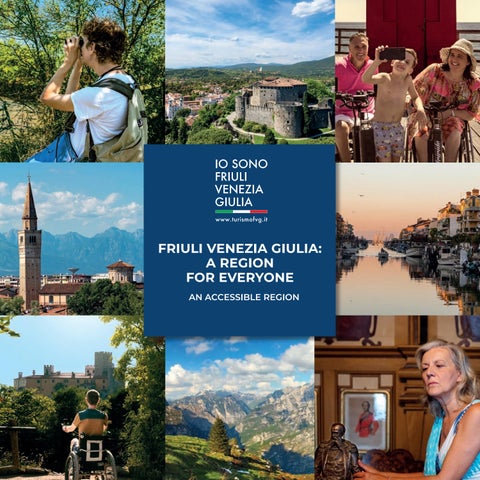
AN ACCESSIBLE REGION
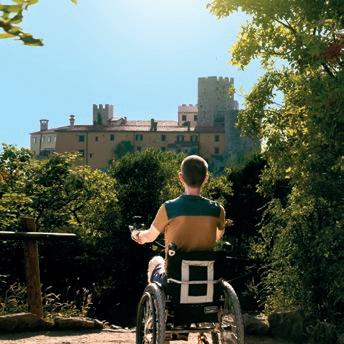
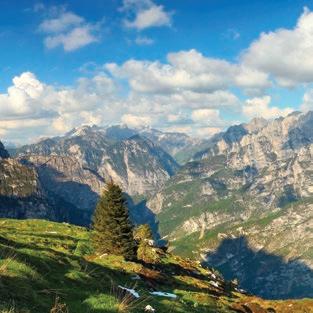
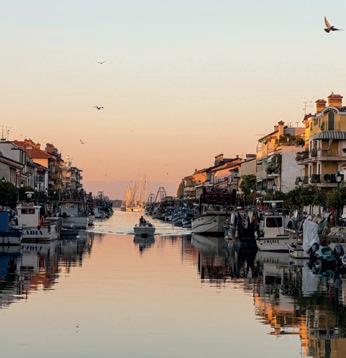
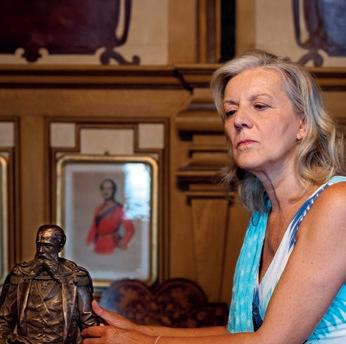
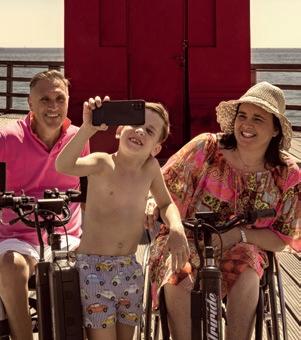
In 2012, PromoTurismoFVG embarked on a mission to verify the tourism potential of the Friuli Venezia Giulia region, aiming to establish it as ‘A Region for Everyone’. This naturally led to a close partnership with key regional bodies: the Regional Council of People with Disabilities and their Families, which legally represents the interests of those with disabilities across the region; the technical service CRIBA FVG (for information on architectural barriers and accessibility); and the Associazione Tetra-Paraplegici del FVG. This collaborative approach ensures we offer experiences that are truly accessible to all, as they are rigorously verified by highly-qualified technicians and personally tested by people with a diverse range of disabilities and specific needs.
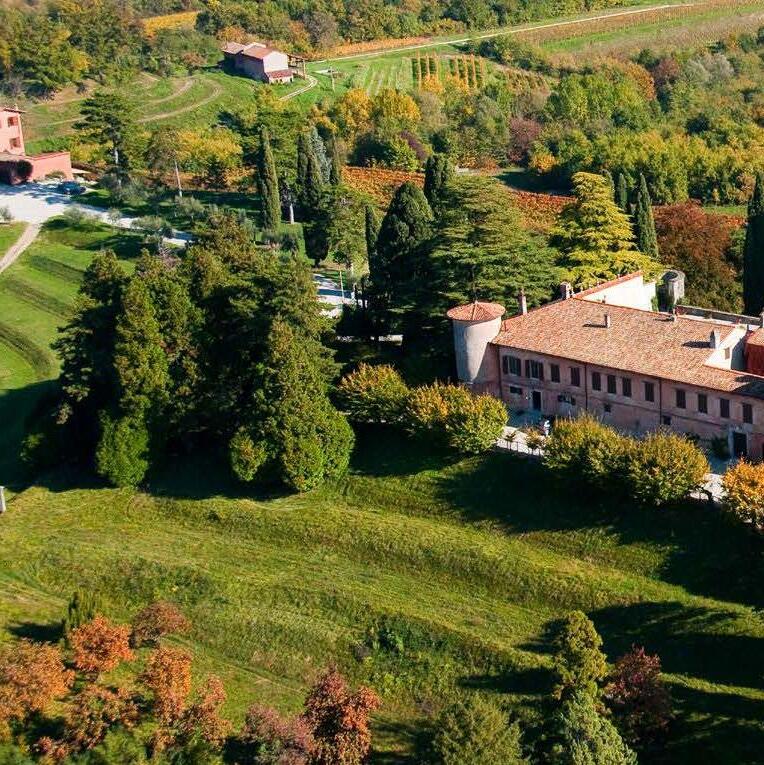
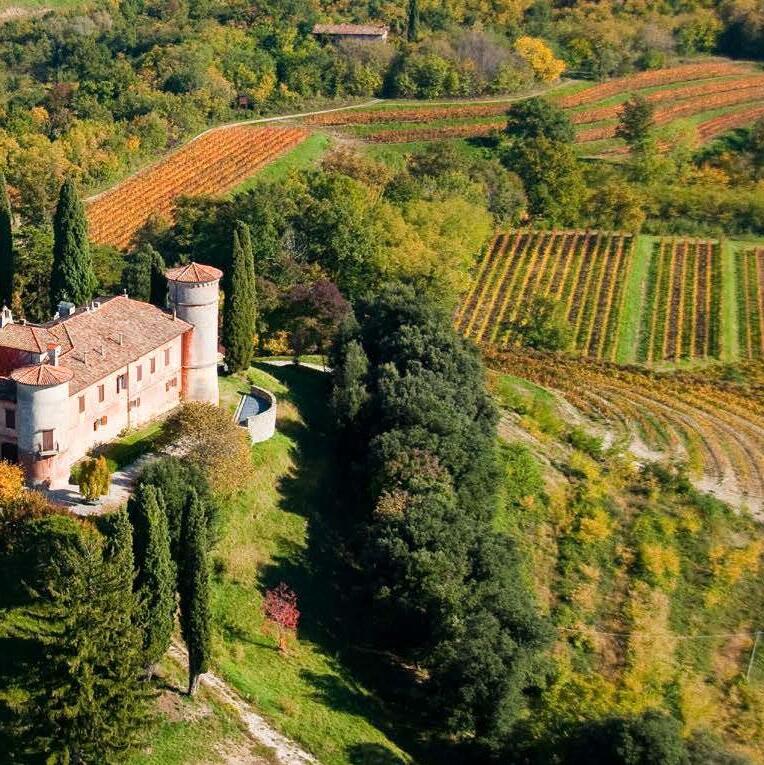
The project’s main objective is to identify and overcome all types of barriers, ranging from the architectural and sensory to the informative and cultural, across the entire region: from the mountains to the sea, and from bustling cities to breathtaking natural areas, culture and gastronomy. Our ultimate goal is to ensure every visitor, whatever their specific needs, can truly be a welcomed and valued guest.
This agile guide is designed to help you discover accessible places, itineraries and visitor experiences across the Friuli Venezia Giulia region.
For further information and technical details, please visit the regional website dedicated to accessible tourism: www.friuliveneziagiuliapertutti.it/en/
12. Muggia
14. Trieste
16. Duino
18. Monfalcone
20. Staranzano
22. Grado
24. Lignano Sabbiadoro
26. Marano Lagunare
30. Winter mountains
32. Summer mountain
40. Natural areas
48. The “FVG in movimento 10.000 passi di salute” project
50. Garden and theme park
58. Accessible routes in cities of art
72. Top museums
82. Accessible routes in The Most Beautiful Villages of Italy
92. A whole land to savour!
94. Route of wine and food
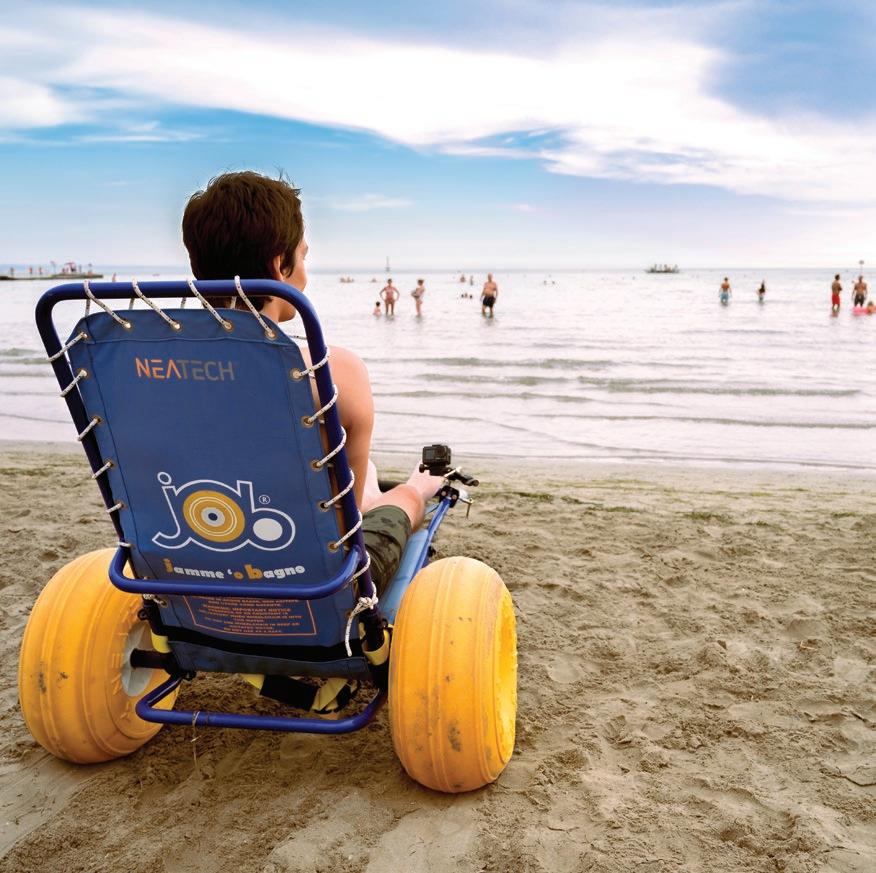
With funding from the Presidency of the Council of Ministers – Ministry for Disability, the ‘A-MARE IL MARE’ project involved eight coastal municipalities (Duino-Aurisina, Grado, Lignano, Marano Lagunare, Monfalcone, Muggia, Staranzano and Trieste).
Crucially, this initiative allowed for a significant enhancement of hospitality and accessible tourist services along the entire Friuli Venezia Giulia coastline.
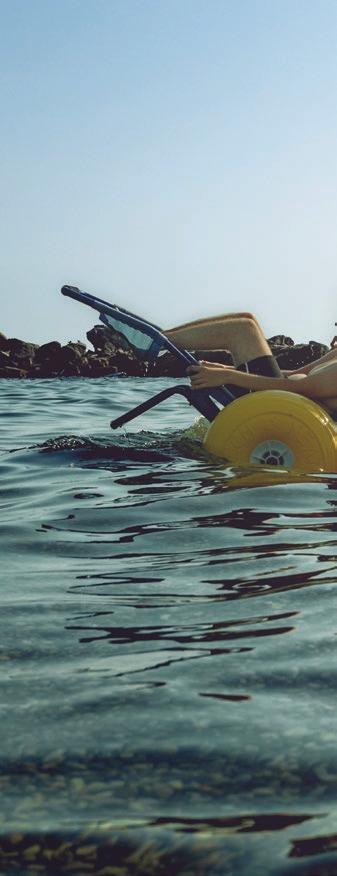
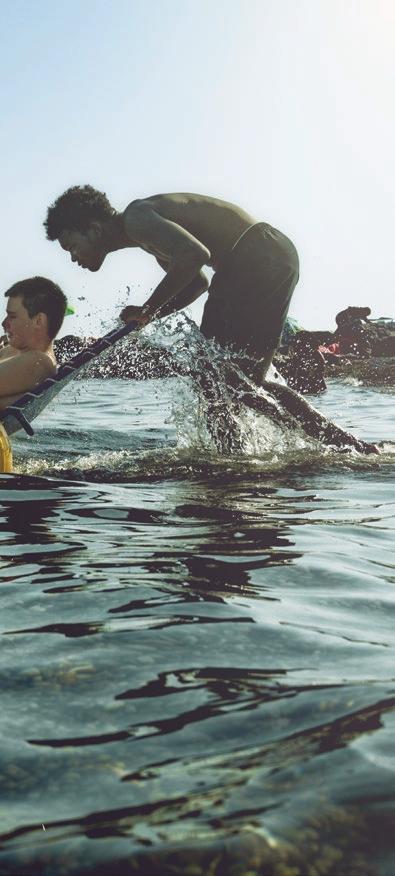
The project engaged municipal authorities, voluntary associations, people with disabilities and tour operators, who performed mapping, training and field testing and purchased specific materials and equipment.
The selected bathing establishments were equipped with raised sunbeds, sand & sea chairs, floating chairs and walkways leading directly to the water. They were also provided with large, accessible cabins to be used as changing rooms.
In addition, some of the municipalities were equipped with a range of specialised vehicles to facilitate outdoor and nature excursions for all.
This new equipment includes: tandems (some with passive pedalling), bikes designed for transporting wheelchairs, and muscular and electric tandems, all complete with helmets and padlocks.
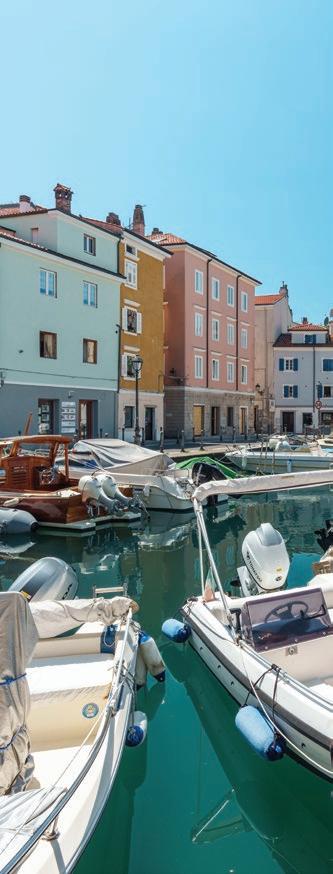
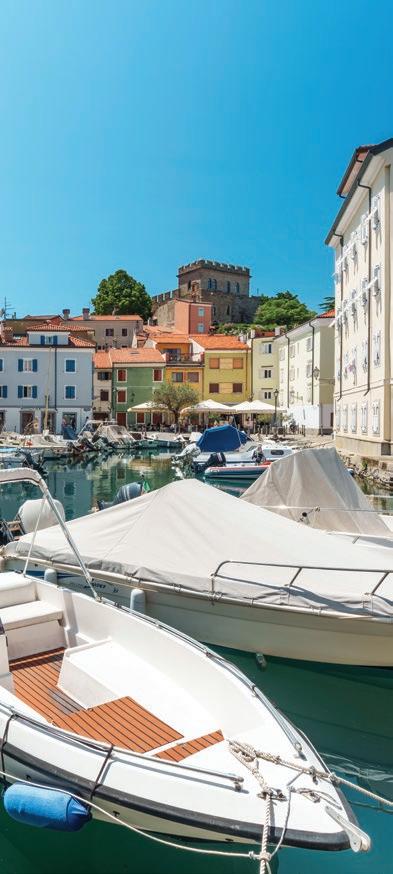
In the last stretch of Italy, the coastline seems to fold inward, revealing the picturesque Bay of Muggia. This distinctive location develops from its small harbour, originally established before 1000 AD, to the charming village itself. Here, you’ll discover Venetian-style calli (laneways) and piazzas, alongside the beautiful 13th-century Cathedral and Town Hall.
The Venetian atmosphere is not only evident in the architecture: the dialect, customs and culinary traditions also reveal an intense past shared with the republic. It is framed by seven kilometres of coastline and a crown of hills that offer panoramic views over a vast area, encompassing both Italian and Istrian territory.
The remains of the protohistoric castellieri (fortified settlements) of Santa Barbara and Muggia Vecchia provide evidence of a Roman and medieval past. These include the Basilica of Muggia Vecchia, dating back to the 9th century.
• At the various bathing establishments across the Gulf, you’ll find floating chairs and sand & sea chairs available for easily reaching the water. Other amenities include accessible changing rooms and raised sunbeds.
• Side-by-side tandem bikes available, free of charge, for easy excursions in the surrounding area.
• The Ugo Carà Museum of Modern Art is an indepth look at the artistic development of this important local artist.
• Possibility of excursions across the Gulf, as well as a motorboat transfer service to Trieste.
• The Lungomare (seafront) of Muggia is a path that runs along the coast of the Gulf of Trieste offering breathtaking views and a relaxing atmosphere.
• At the Porto San Rocco beach there is a mobile structure for access to the sea.
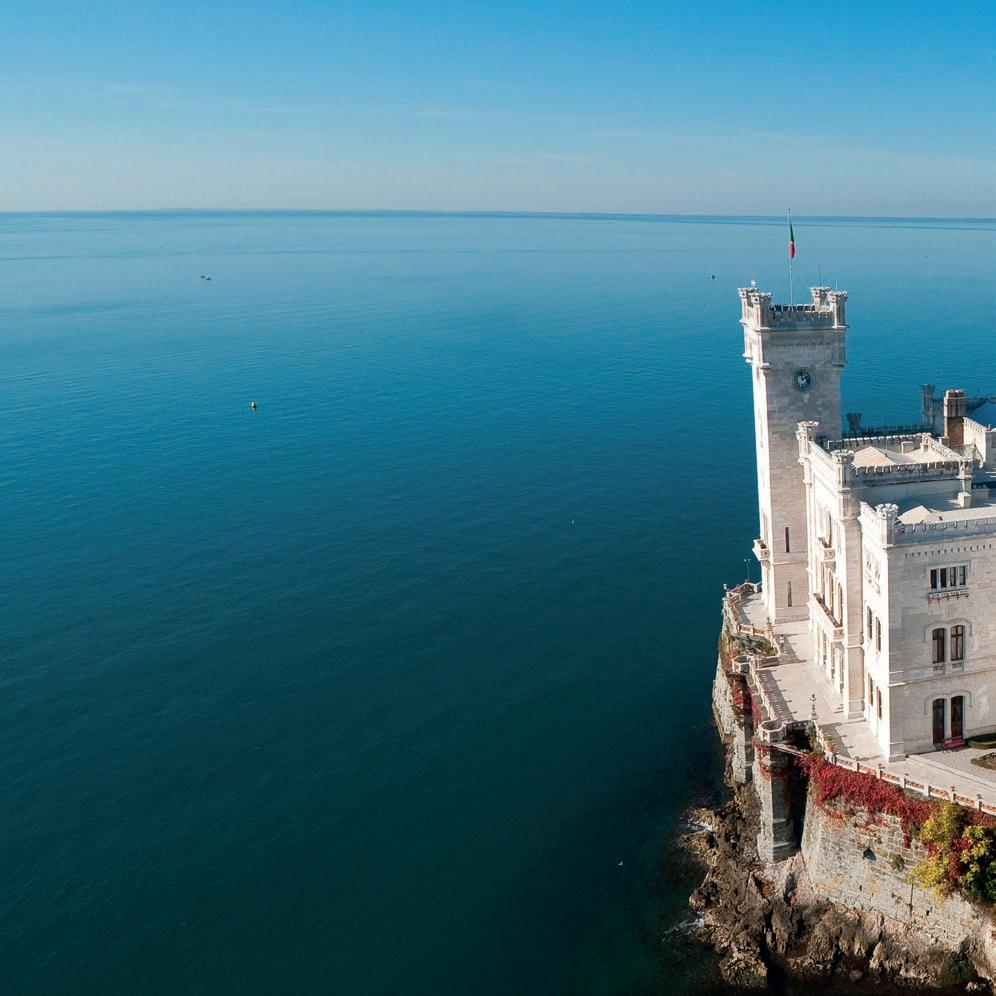
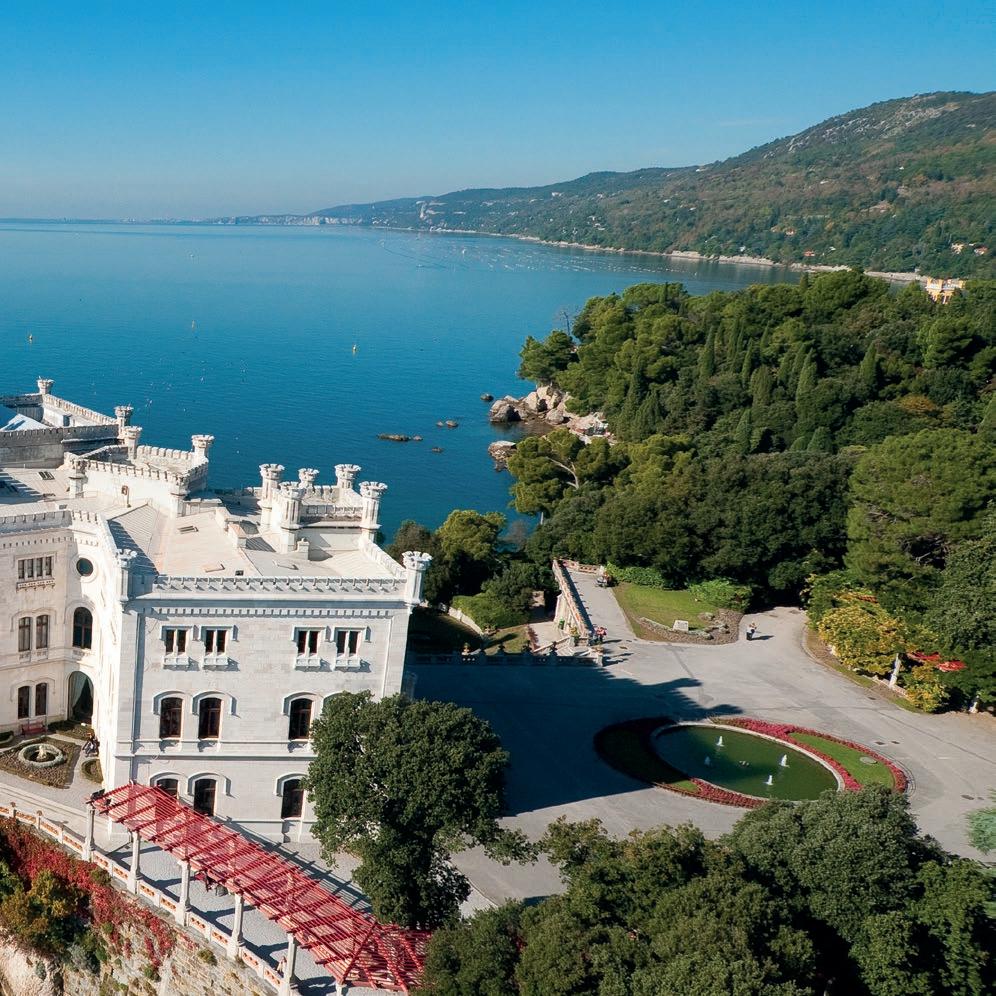
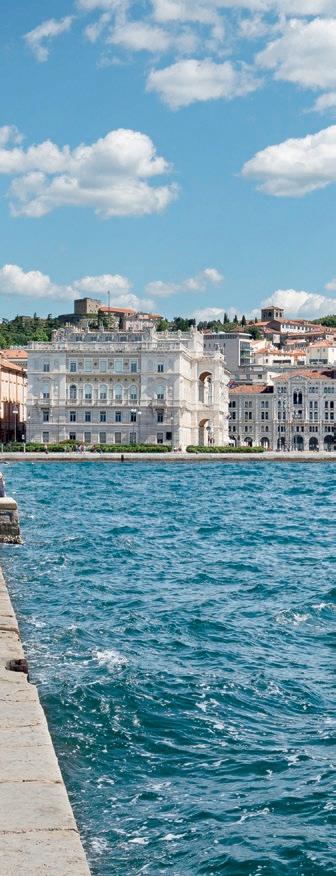
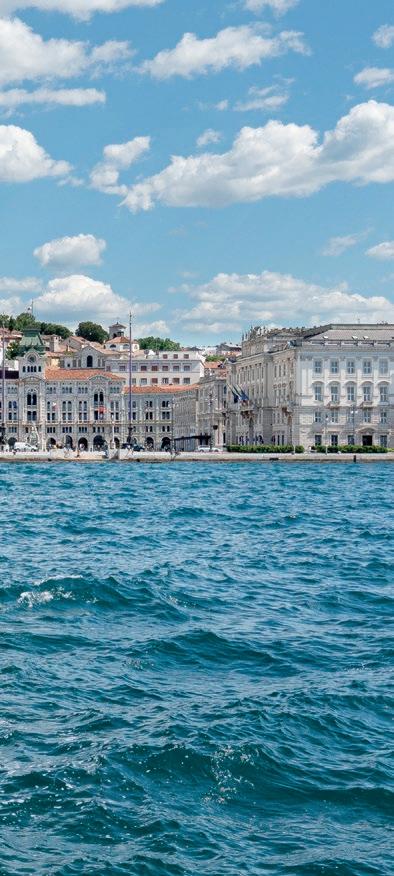
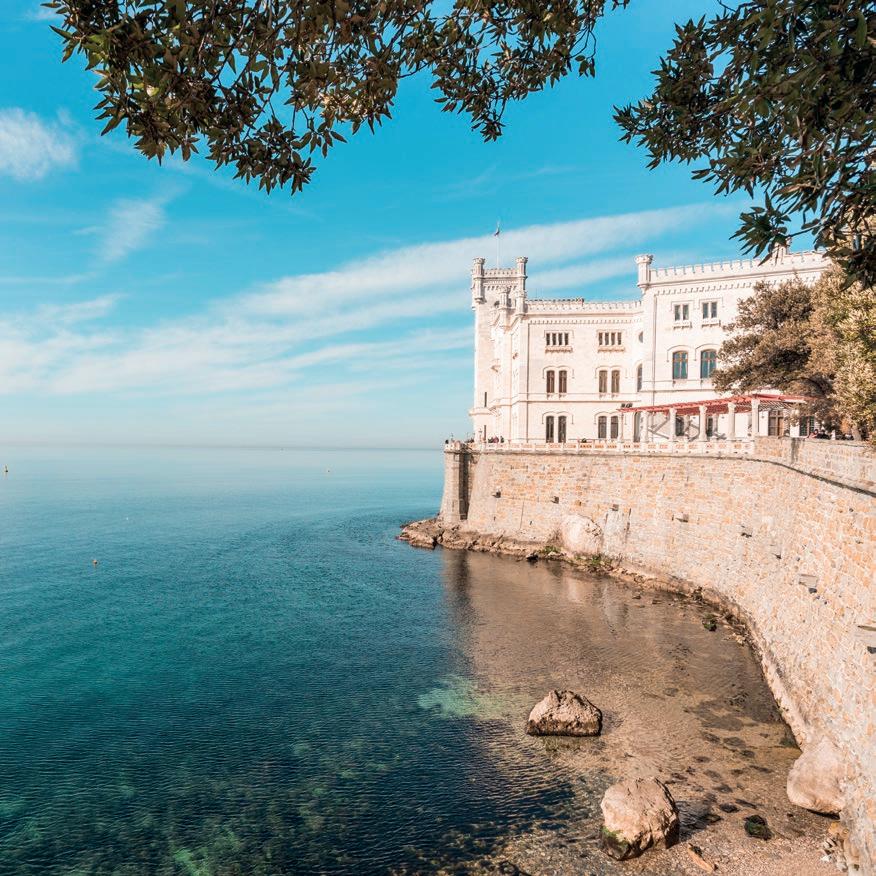
The most cosmopolitan city in Italy, with a Hapsburg history and a Mediterranean soul. Descending from San Giusto Hill, with its beautiful Cathedral and Roman-era remains, you can wander through the medieval city until you reach Piazza Unità d’Italia. This is the vibrant heart of Trieste, surrounded by stunning historic buildings and majestically overlooking the sea, complete with the Molo Audace pier. The view includes monuments, churches and the impressive Miramare Castle in the distance.
The city also proudly maintains a rich coffee tradition. As a free port for coffee importation since the 18th century, Trieste is still home to magnificent literary cafés which were once the favoured haunts of great authors such as James Joyce, Italo Svevo and Umberto Saba. Visiting one of these cafés is a ritual not to be missed, where you can learn how to order an espresso in the local dialect.
A city rich in culture, literature, fashion and science, Trieste is also defined by the sea. Its entire gulf is lined with historical bathing establishments, as well as both equipped and free beaches.
• At the various bathing establishments across the Gulf, you’ll find floating chairs and sand & sea chairs available for easily reaching the water. Other amenities include accessible changing rooms and raised sunbeds.
• Cultural experiences await in the city’s many museums, which offer enhanced accessibility through dedicated aids, typhlo-didactic materials and specially-trained staff.
• Historical theatres offering inclusive guided tours and performances with Italian and English surtitles.
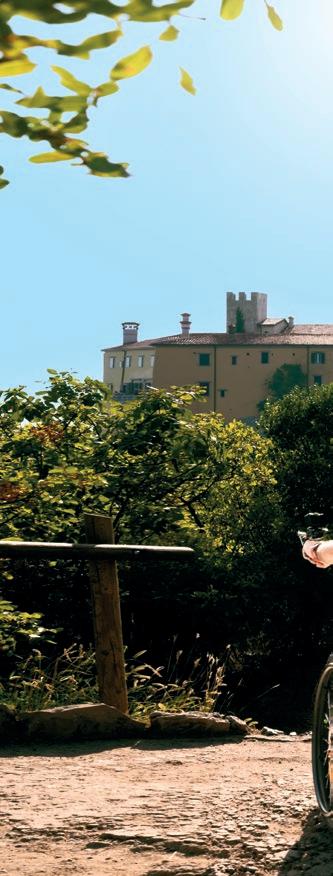
From the top of a cliff, the enchanting village of Duino has dominated the sea for centuries and long inspired poets and writers, including D’Annunzio, Mark Twain and Rilke, who were captivated by the spectacular views embracing small bays and picturesque harbours.
The Castle of the Princes von Thurn und Taxis is an iconic and unmissable sight, celebrated alongside its elegant gardens and the ruins of the oldest castle – which, by tradition, was dedicated to the Sun God. Equally famous is the large white rock that recalls the melancholic story of a castellan who took her own life for love: the renowned ‘Dama Bianca’ (White Lady).
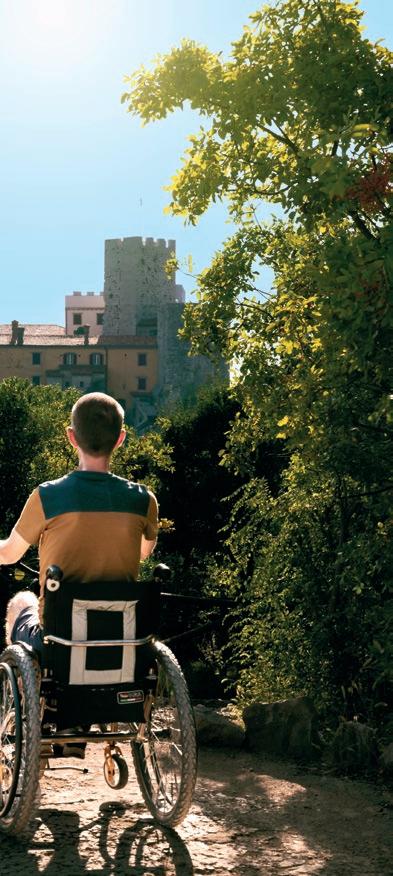
• At the various bathing establishments, you’ll find floating chairs and sand & sea chairs available for easily reaching the water. Other amenities include accessible changing rooms and raised sunbeds.
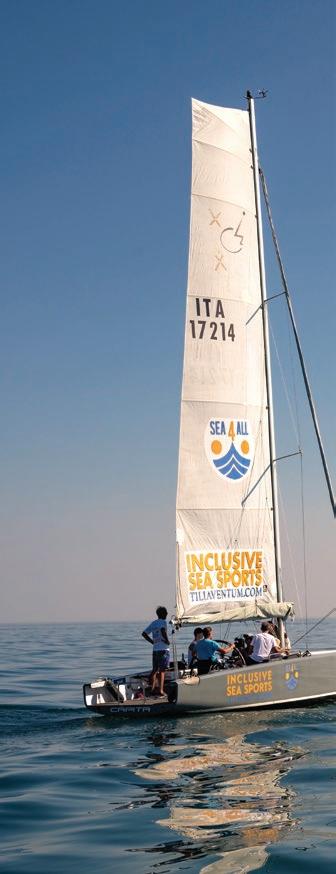
• Possibility of practising or approaching sailing4all with specialised instructors trained in teaching people with disabilities.
• Routes to discover the picturesque Fisherman’s Village and the Church of San Giovanni in Tuba, with a perfect blend of culture, evocative scenery and panoramic views across the tranquil coastline.
• The path named after the famous Bohemian poet Rainer Maria Rilke is an easy walk through the Falesie Nature Reserve, rewarding visitors with breathtaking views of the sea and surrounding coast. From the entrance to Duino, an accessible pathway leads directly to a beautiful panoramic terrace.
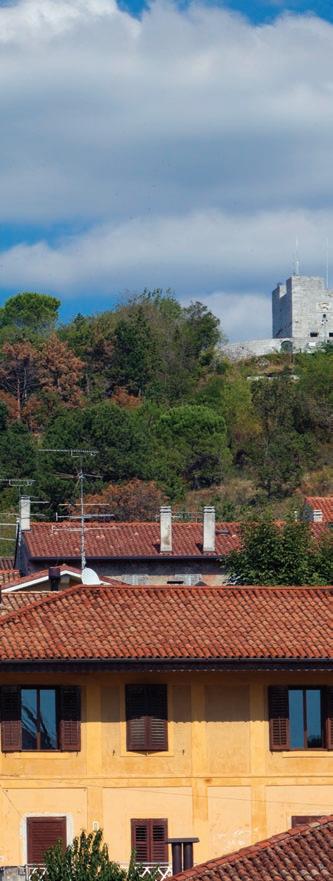
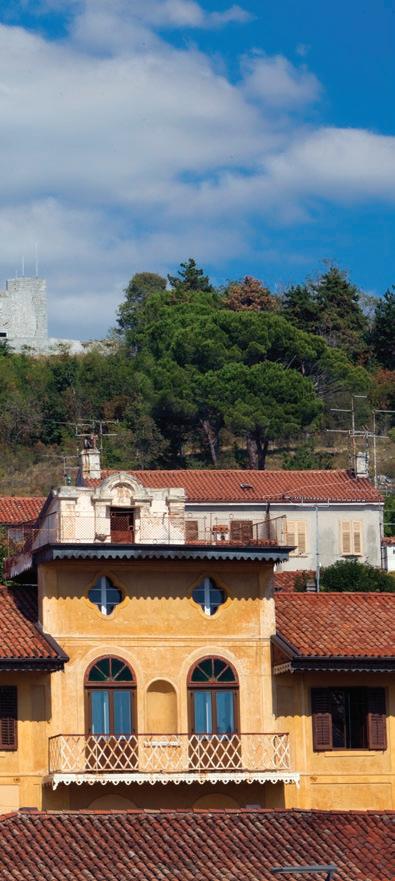
Monfalcone is not only an important industrial centre for shipbuilding, but also a city with a rich historical heritage.
The fortress that dominates the top of the Karst stands as a powerful symbol of the city’s medieval past. Nearby, the Great War Theme Park recalls the intense battles fought here between 1915 and 1918.
In the city centre, the Medieval Museum, with its preserved city walls and historic houses, brings these ancient origins to life. In contrast, the Municipal Gallery of Contemporary Art, housed in the beautifully restored old covered market, is now one of the largest exhibition spaces dedicated to contemporary art in the entire Friuli Venezia Giulia region.
• At the various bathing establishments of Marina Julia, you’ll find floating chairs and sand & sea chairs available for easily reaching the water. Other amenities include accessible changing rooms and raised sunbeds.
• Side-by-side tandem bikes and special bikes for transporting wheelchairs are available free of charge, making it easy to enjoy rewarding excursions in the surrounding area.
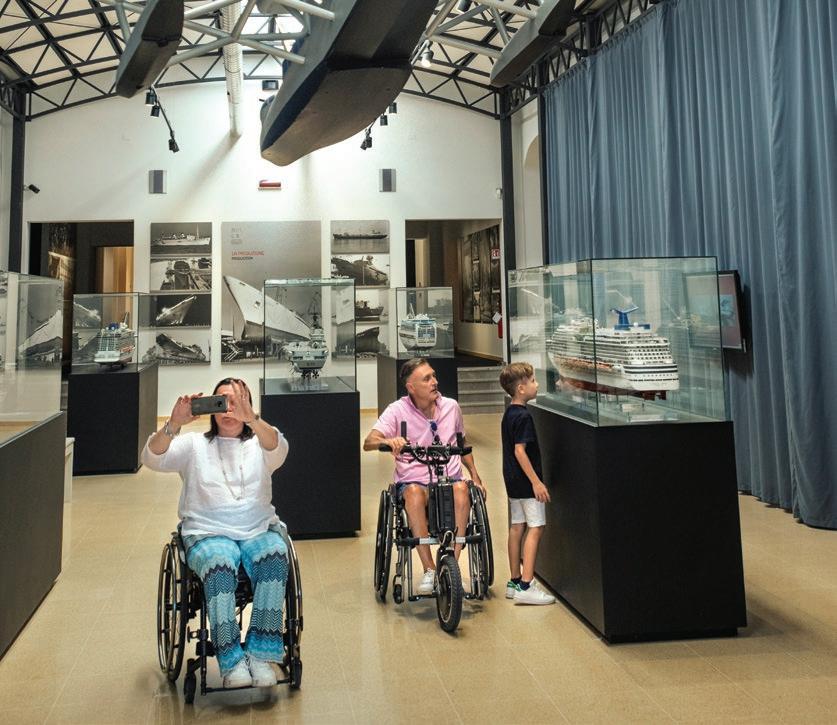
• Located right next to the active shipyards where the world’s most impressive cruise ships are built, the Monfalcone Shipbuilding Museum (MuCa) vividly tells the story of both the shipyard and the city.
• Take a fascinating tour of the Workers’ Village of Panzano to see the characteristic industrialstyle houses, which offer a glimpse into a simple yet hard-working way of life.
An ancient rural village located in the lower Soča area dating back to Roman times, it offers a fascinating variety of landscapes: the sea, canals, the Karst plateau, and countryside rich in biodiversity.
It is home to one of the most important nature areas in the region: the Soča River Mouth Nature Reserve with the Cona Island Park. This reserve of outstanding ecological importance covers an area of 2,338 hectares, 1,154 of which are in the marine area, including the municipalities of Staranzano, San Canzian d’Isonzo, Fiumicello and Grado.
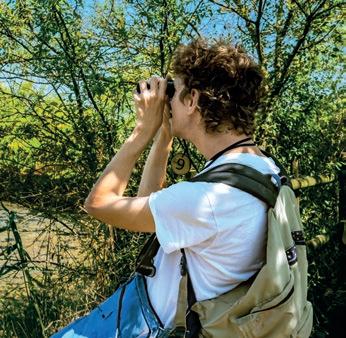
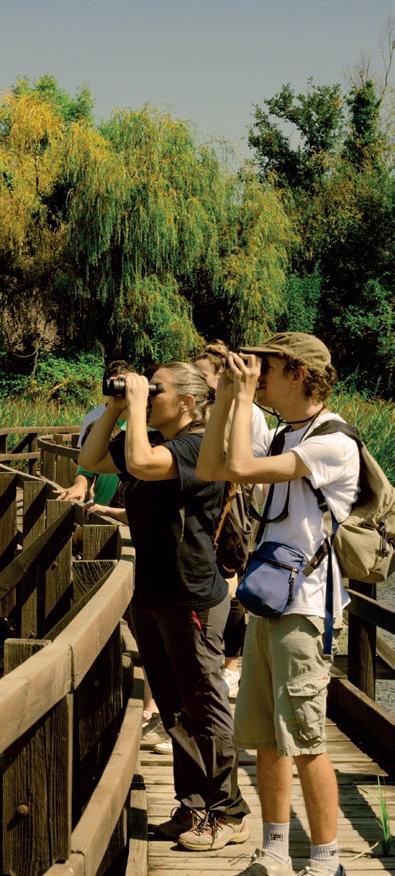
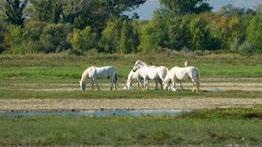
Established in 1996, the reserve is recognised as one of the best birdwatching areas in Italy, hosting numerous species of both resident and migratory birds. The area is preserved through continuous environmental action and also entrusted to the animals themselves, such as the Camargue horses that live freely in the reserve and help keep the vegetation under
• The Museo Digitale della Bonifica - Idrovora Sacchetti (Digital Land Reclamation Museum) is dedicated to the history and techniques of agricultural land reclamation in the region. It was one of the water-pumping plants that drained extensive marshes in the 1930s.
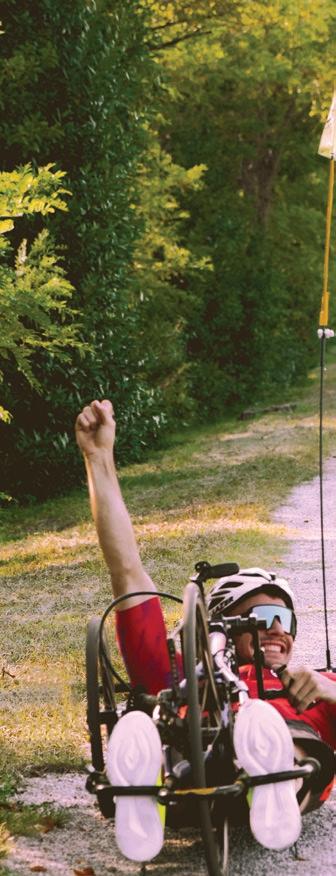
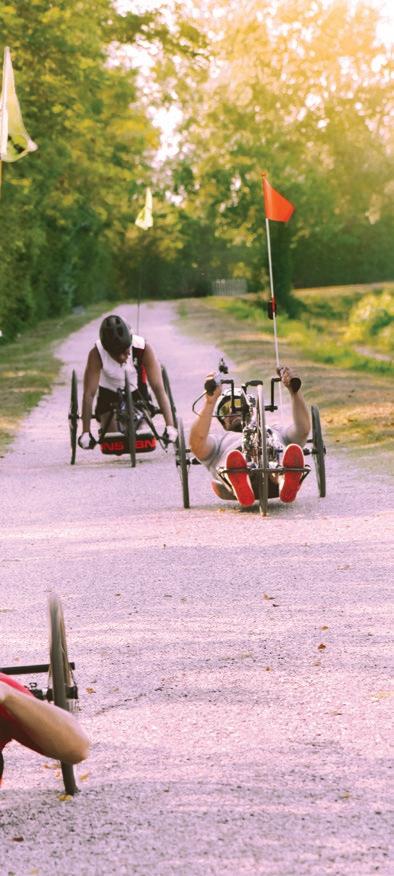
• Tandem bikes and side-by-side tandem bikes available, free of charge, for easy excursions in the surrounding area.
• Cycle routes through the area’s stunning natural landscapes, catering to both beginners and experienced cyclists. Highlights include the new ‘Mar e Tiaris’ cycle path.
Connected to the mainland by a narrow strip of land, the town of Grado boasts an old town centre reminiscent of Venice, with small squares and narrow streets, overlooked by rows of picturesque fishermen’s houses. The island also features a maze of islets that form its picturesque lagoon, offering a richly coloured scenery with the green of the lush vegetation and the blue of the Adriatic Sea.
Campo dei Patriarchi, in the old town, is dominated by the Basilica of Santa Eufemia and the adjacent Basilica of Santa Maria delle Grazie, the oldest in Grado. The city is known as the sunshine island, thanks to its three kilometres of south-facing beaches, which enjoy the sun’s rays from morning to evening. In addition, the unusual microclimate ensures year-round sunshine.
In the past, Grado was part of the domains of the Austro-Hungarian Empire and was much loved by the Habsburg aristocracy, who, from the 19th century, came to the island for the baths and the highly-valued marine spas that still today are the ideal place to regenerate body and spirit.
• At the various bathing establishments, you’ll find floating chairs and sand & sea chairs available for easily reaching the water. Other amenities include accessible changing rooms and raised sunbeds.
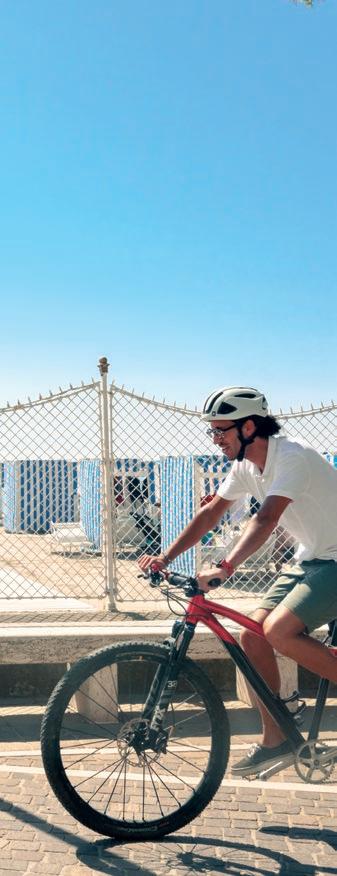
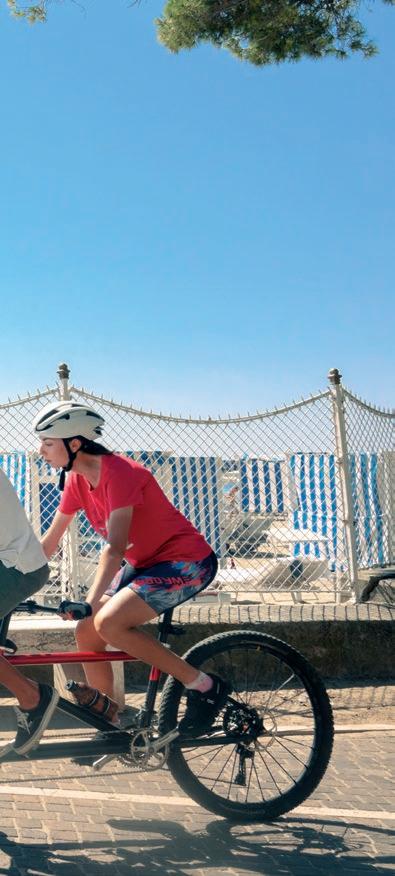
• Tandem bikes, side-by-side tandem bikes and special bikes for transporting wheelchairs are available free of charge, making it easy to enjoy rewarding excursions in the surrounding area.
• Tourist tour to explore the historical, cultural and natural beauty of the town, including the historic centre, the lagoon and its various viewpoints.
• Green oases in the surroundings (such as the Soča Mouth Nature Reserve and the Cavanata Valley Nature Reserve) and in the city (such as the Parco Delle Rose, a venue for meetings but also for concerts and shows for young and old alike.
• Historic Marine Spa offering thalassotherapy and heliotherapy treatments since the early 19th century.
• Possibility of motorboat excursions in the lagoon and a stop at the Sanctuary of the Madonna di Barbana.
A seaside resort perfectly situated halfway between Venice and Trieste, it boasts 8 kilometres of fine, golden sand and calm waters. Its commitment to environmental protection is proven by holding the prestigious Blue Flag award for many years running.
But Lignano Sabbiadoro has three distinct personalities. Sabbiadoro is perfect for shopping and nightlife, Pineta is the place for a quiet country holiday, and Riviera is a relaxing area with a rich vegetation of maritime pines.
The Marano Lagoon, opposite the town, is an unspoilt expanse of lagoons, canals and islets with typical fishermen’s huts that even Ernest Hemingway fell in love with sixty years ago. Lignano’s traditional nightlife and the fashionable shops and boutiques make it a popular destination for young tourists and shopping lovers.
On the other hand, Lignano is an ideal destination for family holidays thanks to its child-friendly accommodation with special services, lively beach entertainment and calm sea with shallow waters.
• At the various bathing establishments, you’ll find floating chairs and sand & sea chairs available for easily reaching the water. Other amenities include accessible changing rooms and raised sunbeds.
• A range of mapped and signposted routes that promise unforgettable experiences: the ‘In the scent of resin’ and ‘At the mouth of the Tagliamento’ trails, as well as picturesque paths like ‘In the colours of the sunset’ (along the lagoon embankment) and ‘The path of thought’ (along the beach).
• Green oases such as Hemingway Park, San Giovanni Bosco Park and theme parks such as Junior Park and Punta Verde Zoo Park.
• Possibility of reaching nearby Marano Lagunare by motorboat and of making lagoon excursions by pontoon boat.
• Tandem bikes, side-by-side tandem bikes and special bikes for transporting wheelchairs are available free of charge, making it easy to enjoy rewarding excursions in the surrounding area.
• Possibility of practising or approaching different sports such as sailing4all, sup4all, sitKite4all.
The Torre Millenaria dominates the horizon of Marano, a small town in an isolated location. It was once surrounded by defensive walls and protected from the open sea by a cluster of islands and islets, including Martignano and Sant’Andrea (the latter also known as the ‘Island of Shells’).
Subordinated to the Venetian Republic from the 15th to the 18th century, Marano cleverly maintained its local autonomy: even today, the locals proudly claim Marano as the only Friulian village where Venetian is still spoken. In addition to creating a unique linguistic and cultural fabric, Venice also left a lasting architectural imprint on Marano. The historic centre is a maze of intertwining calli (narrow streets) and piazzas. The houses overlook the streets, creating shared spaces for meeting and working outdoors. The buildings themselves tell the city’s story through their basreliefs, stone faces and coats of arms.
• Side-by-side tandem bikes and special bikes for transporting wheelchairs are available free of charge, making it easy to enjoy rewarding excursions in the surrounding area.
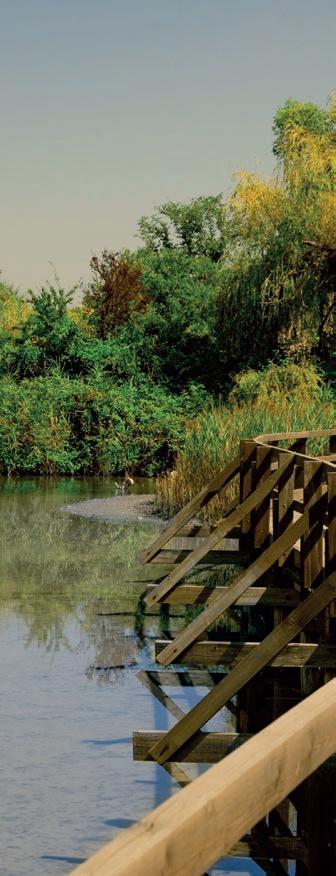
• Possibility of excursions by motorboat to discover the lagoon landscapes in the Stella River Mouth Reserve or transfers to nearby Lignano Sabbiadoro.
• Itineraries in the historic centre, the Lagoon Archaeological Museum or the Canal Novo Valley Reserve to learn about the ancient history of this picturesque village.
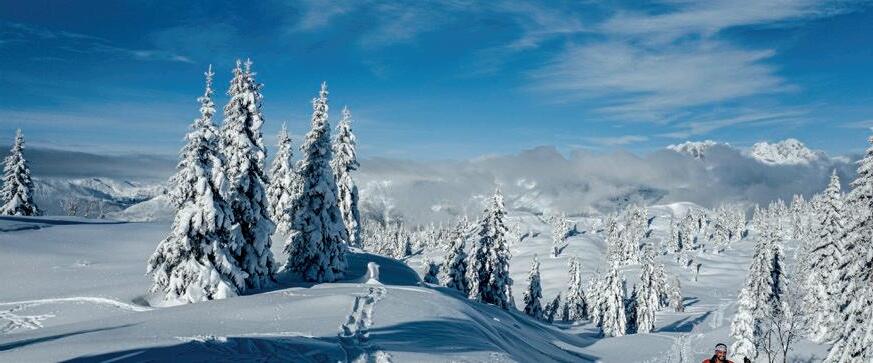
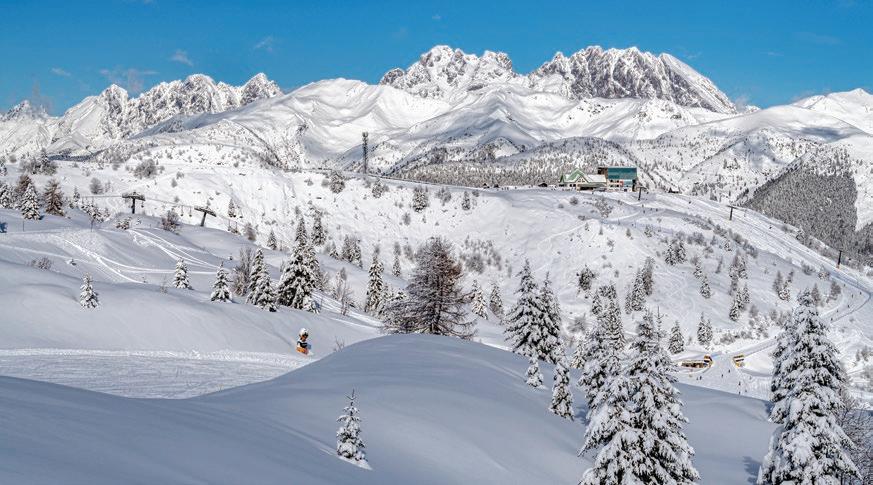
The mountains of Friuli Venezia Giulia, stretching across the Friulian Dolomites, Alps, and the Carnic and Julian Prealps, offer superb skiing. You’ll find well-maintained, uncrowded slopes with programmed snow, all serviced by modern, fast and safe lifts, set within a truly evocative and unspoilt natural environment.
• Piancavallo: the westernmost ski resort in the region.
• Forni di Sopra: in the enchanted landscape of the Friulian Dolomites.
• Ravascletto-Zoncolan: in the magical mountain valleys of Carnia.
• Sella Nevea: for skiing between Italy and Slovenia.
• Tarvisio: in the far north-eastern corner of Friuli Venezia Giulia.
• Sappada/Forni Avoltri: the charm of the High Dolomites.
Just one skipass to ski in all the mountain centres managed by PromoTurismoFVG. Discounts for categories: Baby, Junior, Senior, Over 75 and People with Disabilities.
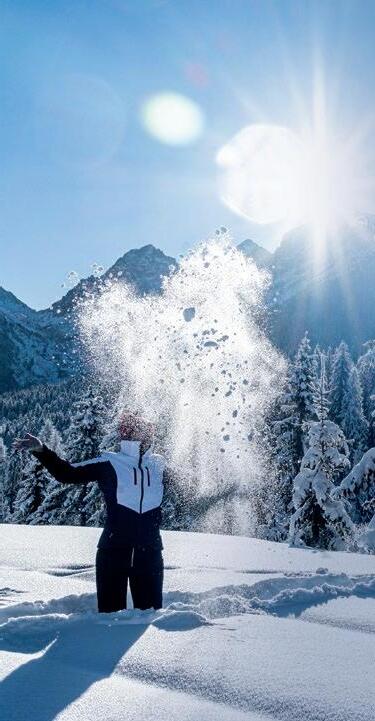
The mountains of Friuli Venezia Giulia are therefore the ideal place to start any alpine discipline, guided by the professional instructors at the Ski Schools located in all our resorts.
All of these schools employ instructors registered with the Regional Ski Instructors’ Register of Friuli Venezia Giulia, who are fully qualified to teach people with disabilities. Activities offered for people with disabilities include downhill skiing, cross-country skiing, snowboarding and telemark skiing.
For information and bookings:
Board of Ski Instructors
Friuli Venezia Giulia
Italian Association of Ski Instructors
Friuli Venezia Giulia – Italy
Tel .0432.204142
www.maestriscifvg.it
info@amsi.fvg.it collegio@maestriscifvg.it
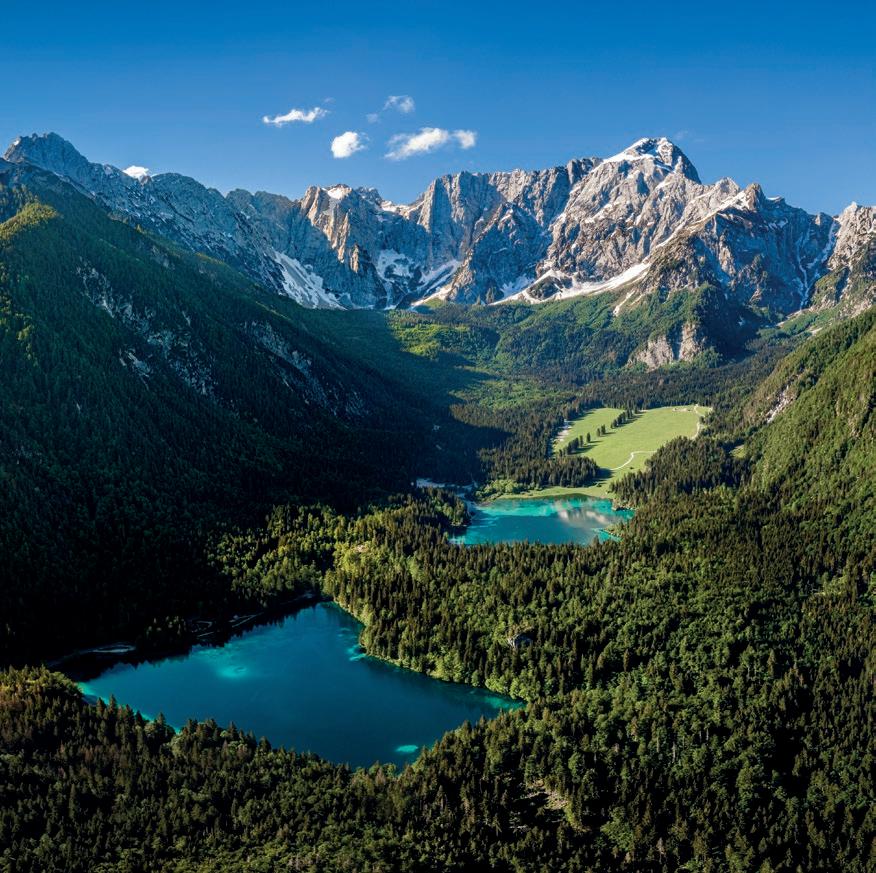
The Julian Prealps Regional Nature Park is characterised by a mountain range that includes the Monte Canin massif to the east, home to the region’s only glacier. This area’s specificity comes from the meeting point of three different biogeographical zones (ie Mediterranean, Lycian and Alpine) which together give rise to extraordinary biodiversity. These areas gained park status due to their great interest not only in geology, nature and landscape, but also in history and culture, as they contain special features difficult to find elsewhere. This protected area, along with the Alba Valley Nature Reserve, forms the heart of the Julian Alps MaB UNESCO Biosphere Reserve. The Visitor Centre in Prato di Resia, which is the Park’s headquarters, allows guests to learn about the area through exhibition displays that reproduce the different natural environments (the river, the undergrowth, the meadow and the mountain). The centre is obstacle-free and visually impaired guests can touch various objects and use
multimedia sound content (such as animal cries, nature sounds, everyday noises and stories) to support their visit.
Near the information centre in Pian dei Ciclamini in Lusevera, you will also find the ‘Sentiero per Tutti’ (Trail for Everyone), which covers about 600 metres and is equipped with wheel beaters, guide ropes and gentle inclines that make it usable even for wheelchairs. There are also specially designed educational installations for the visually impaired that provide information about the area.
Julian Prealps Nature Park Authority
Piazza del Tiglio, 3 - Fraz. Prato
33010 Prato di Resia (UD)
Tel. +39 0433 53534
www.parcoprealpigiulie.it
info@parcoprealpigiulie.it
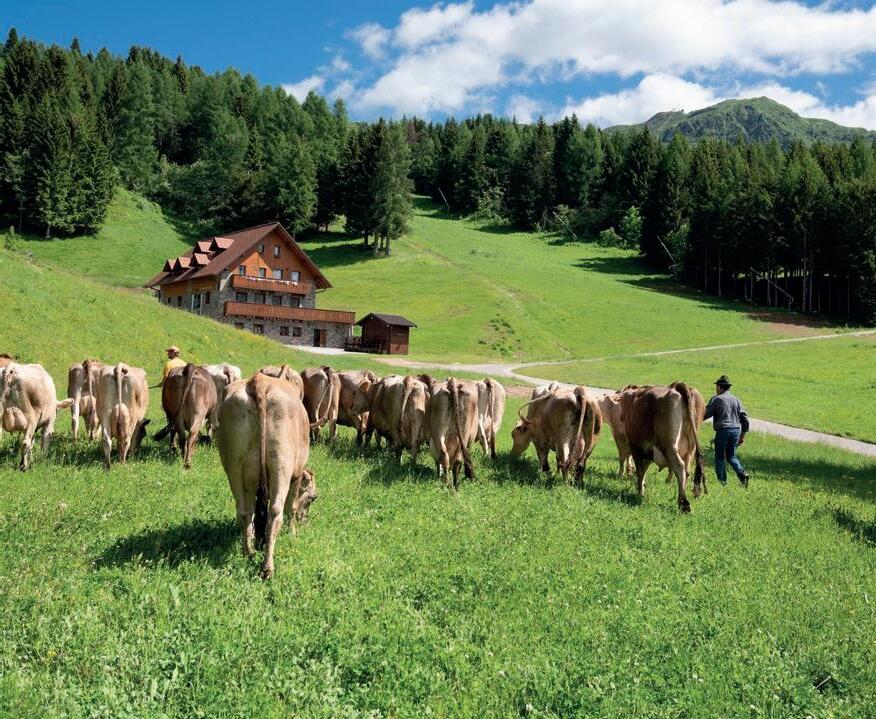
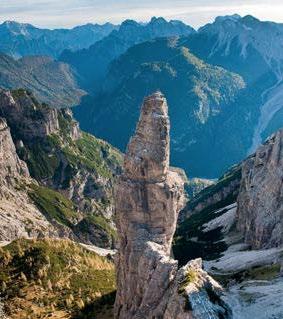
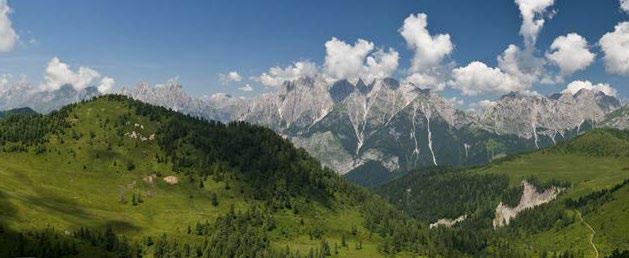
The park is located on the mountain ranges enclosed between the Tagliamento and Piave rivers, overlooking the western Friulian plain. The Dolomite peaks, a UNESCO World Heritage Site, and the splendid natural scenery make this area a true paradise. The absence of asphalted roads and built-up areas guarantees the park a very high degree of wilderness: it is easy to encounter groups of roe deer, chamois and red deer, to see grouse and capercaillie take flight as you pass or to observe young marmots chasing each other.
Of great importance is the biodiversity (extremely varied flora and fauna), which is favoured by the significant differences in altitude, the special geographical position and the climate.
The Visitor Centres of the Friulian Dolomites Nature Park are all accessible to persons with motor disabilities. Visually impaired guests can touch various objects and use multimedia sound content (such as animal cries, nature sounds, everyday noises and stories) to support their visit.
Friulian Dolomites Nature Park
Autority
Via Roma, 4 33080 Cimolais (PN)
Tel. +39 0427 87333
www.parcodolomitifriulane.it info@parcodolomitifriulane.it
• Visitor Centre of Cimolais (Pn) exhibition “La fauna del parco”
• Visitor Centre of Erto e Casso (Pn) exhibitions “Vajont: immagini e memorie” and “La catastrofe del Vajont - uno spazio della memoria”
• Visitor Centre of Claut (Pn) exhibition “Museo Casa Clautana”
• Visitor Centre of Poffabro (Pn) exhibitions “L’arte casearia e l’alpeggio nel territorio del parco” e “In mont: le malghe del Parco”
• Visitor Centre of Barcis (Pn) exhibition “La riserva Naturale Forra del Cellina”
• Visitor Centre of Forni di Sopra (Ud) exhibition “La vegetazione del parco”
• Visitor Centre of Forni di Sotto (Ud) exhibition “Le tipologie forestali del parco”
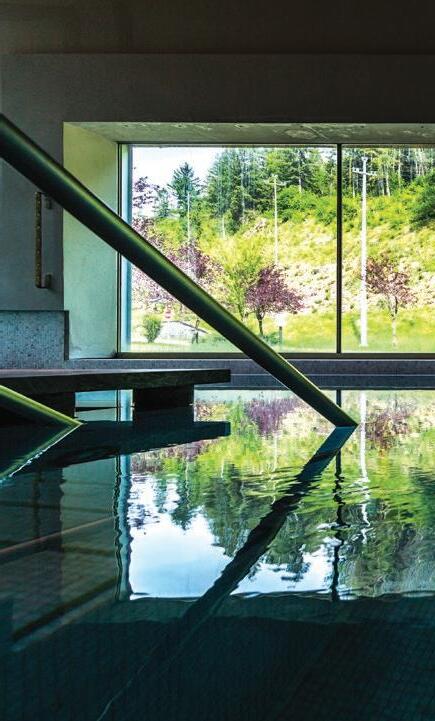
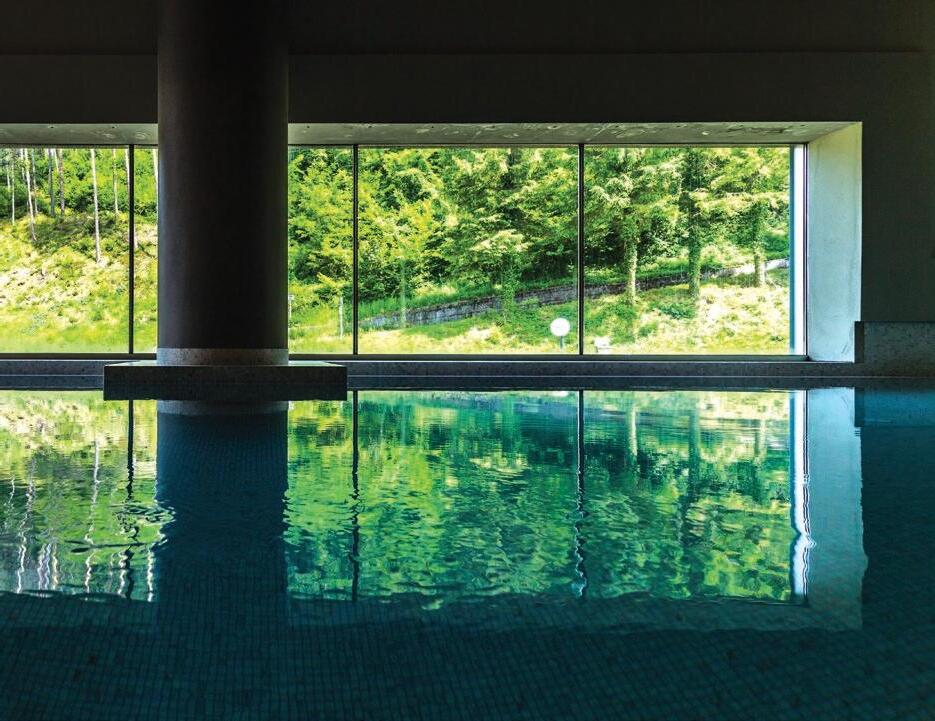
The modern spa in Arta Terme, located just a few kilometres from Tolmezzo, offers health packages and a variety of treatments, ranging from thermal water and mud therapies to rehabilitation and physiotherapy. All treatments are underpinned by the beneficial properties of the mineral water that flows from the Pudia spring, a source known and used since antiquity. Guests can also enjoy a traditional sauna, biosauna, Turkish bath, Kneipp path, thalassotherapy, emotional shower and Scottish shower.
The Arta Terme Baths are fully accessible to people with motor disabilities; the pools are equipped with a lift and grab bars on the sides.
Terme di Arta Via Nazionale, 1 33022 Arta Terme (UD)
Tel. +39 0433 929320 www.termediarta.it info@termediarta.it
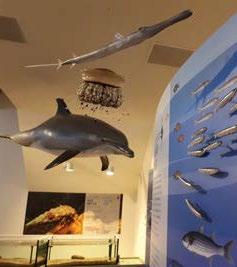
An oasis of marine biodiversity on the outskirts of Trieste, nestled at the foot of Miramare Park and Castle, this area is the heart of a Biosphere Reserve recognised by UNESCO for the harmonious coexistence of Man and Nature. It was officially established in 1986, becoming the first marine protected area set up in Italy, alongside that of Ustica. The Marine Biodiversity – Immersive Museum of the Miramare Marine Protected Area, housed in the former stables of Miramare Castle, features an itinerary dedicated to the marine and coastal biodiversity of the Gulf of Trieste. It offers a lively and accessible layout for both adults and children, complete with educational, experiential and tactile activities: tablets provide visual indications of the different fish in the protected area and some drawer displays offer tactile information. Additionally, there are paths and instructions using Augmentative and Alternative Communication for the ‘Tu pulisci il mare’ (You Clean the Sea) game. The museum has two floors, which are connected by stairs fitted with an accessible platform stairlift. An accessible toilet equipped with grab bars is also available inside the museum.
Marine Biodiversity – Immersive
Museum of the Miramare Marine
Protected Area:
Viale Miramare 34151 Trieste
www.ampmiramare.it/en/home-inglese/ info@ampmiramare.it
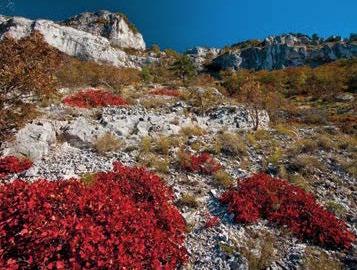
The reserve encompasses a valley sharply carved by the Rosandra-Glinščica stream. As a contact zone between the Alpine area and the sea, it hosts numerous animal species, including those typical of both Central European and Mediterranean ecosystems. The area is also a preferred route for the Bora wind descending from the hinterland to the coast.
Visitor Centre
Bagnoli della Rosandra-Boljunec, 507 34018 San Dorligo della Valle-Dolina (TS)
www.riservavalrosandra-glinscica.it/en info@riservavalrosandra-glinscica.it
Due to the ground features and existing gradients, the paths within the reserve are currently difficult for people with motor disabilities to negotiate, even when accompanied.
The Visitor Centre, however, is obstacle-free and equipped with an accessible toilet (measuring 180×180 cm) complete with grab bars.
The Doberdò and Pietrarossa Lakes Regional Nature Reserve is located on the western edge of the Karst plateau. It is defined by two Karst depressions, partially filled with lakes and separated by a ridge.
Lake Doberdò is one of the few examples of a Karst lake in Europe, with its water level varying according to the flows of the Vipava and Soča rivers. The Gradina Visitor Centre is a museum where guests can learn about the historical and natural aspects of the reserve and the Karst.
The museum’s access and interior spaces are level and barrier-free. The presence of multimedia aids and the ability to touch many of the exhibits ensure the exhibition can be enjoyed by people with sensory, relational and cognitive disabilities.
Gradina Visitor Centre Via Vallone, 32
34070 Doberdò del Lago
info@rogos.it
Inside the bar/restaurant next to the museum, you will find a dedicated accessible toilet, measuring 315×220 cm and equipped with a folding grab bar next to the toilet bowl.
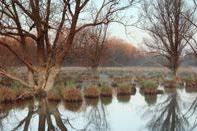
Freshwater marshes alongside vast saltwater wetlands, reed beds, forests and grasslands: the Soča River Mouth Nature Reserve provides an ideal habitat for numerous animal species, particularly resident and migratory birds. Unsurprisingly, it has been recognised as the best area in Italy for birdwatching. The pride of the Reserve are the Camargue horses, which live freely and help control the growth of the grasslands.
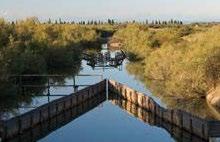
The route within the reserve is accessible to people with motor disabilities in the section between the Visitor Centre and the Marinetta Observatory. It mostly has a natural beaten earth or grass surface, with a few bridges made of wooden planks that have gaps of up to a few centimetres; therefore, the presence of an accompanying person may be required for the route.
Isola della Cona Visitor Centre 34079
Staranzano (GO)
www.parks.it/riserva.foce.isonzo/ Eindex.php inforogos@gmail.com
The Visitor Centre, however, is obstacle-free and equipped with an accessible toilet (measuring 180×200 cm) complete with grab bars. Inside the centre, you will find ‘tactile pools’ for exploring molluscs, stones and other objects, as well as a large tactile model reproducing the natural area, complete with small animals and stuffed birds for sensory visits.
Located in the easternmost part of the Grado Lagoon, the reserve can be reached from the town not only by car, but also via scenic cycle paths accessible to all types of vehicles.
This area is internationally valued as a true birdwatcher’s paradise, having once served as a fishing valley: numerous species of water birds live among the salt marshes and small beaches, finding ideal conditions here for stopping and nesting.
The paths within the reserve are flat and primarily have a natural surface of beaten earth, fine, shallow gravel or grass. There are a few small bridges made of wooden planks with gaps of up to a few centimetres; therefore, people with motor disabilities may require an accompanying person to navigate them.
Visitor Centre Via Grado, 1 34073 Grado (GO) www.parks.it/riserva.valle.cavanata/ Eindex.php urp@comunegrado.it
The Visitor Centre is accessed via a ramp with an 8% gradient. Next to the centre, there is a toilet for people with disabilities, measuring approximately 180×180 cm, though it does not include grab bars.
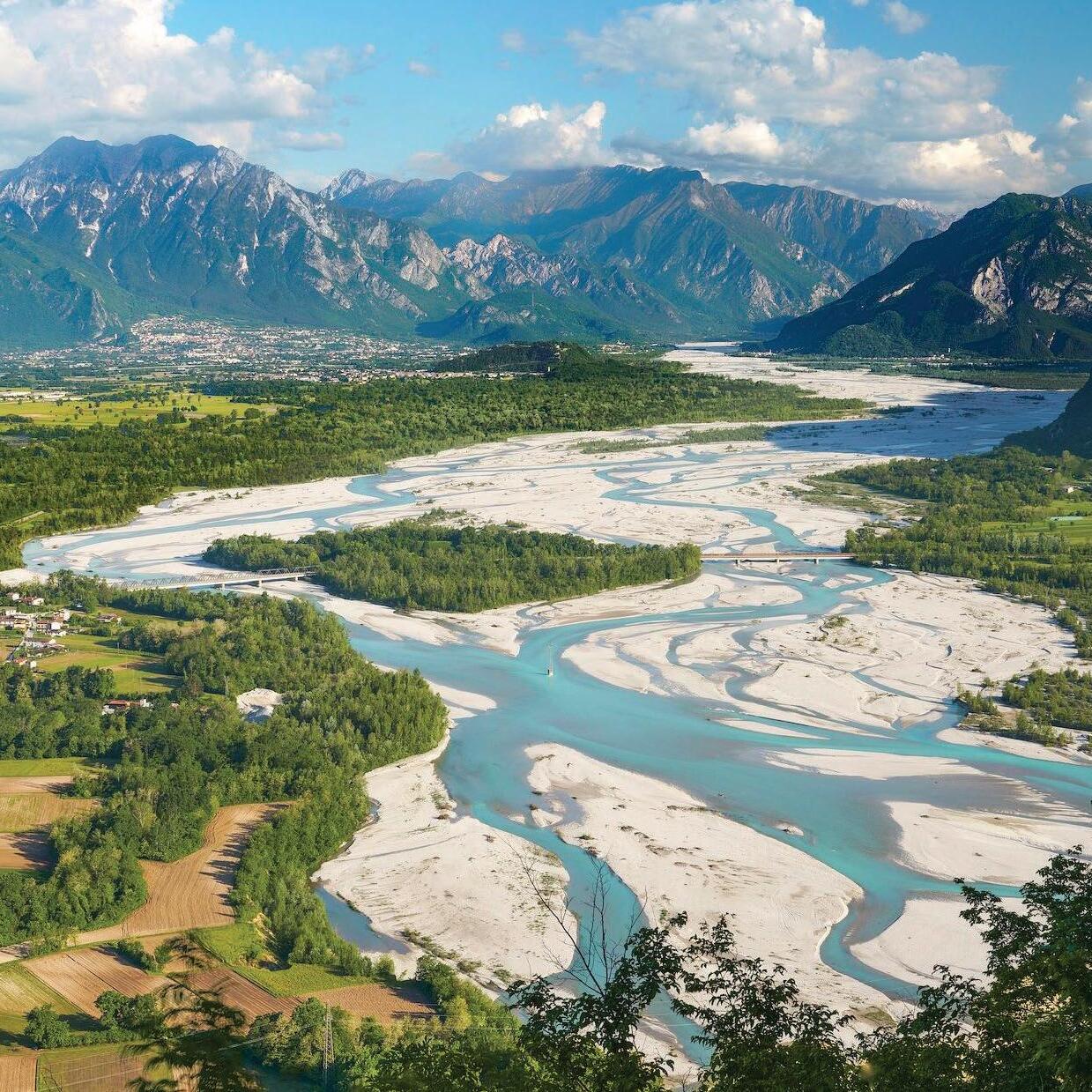
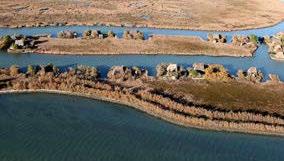
The Stella Mouth River Regional Nature Reserve stretches across the Marano Lagoon. You can reach it via the Stella River delta using special tourist motorboats (accessible to people with disabilities), allowing you to travel inland as far as Precenicco and Palazzolo. At the extreme mouth, you’ll discover a spectacle of rare beauty: a village of traditional fishermen’s huts.
The Reserve is comprised of a former fishing valley, from which it takes its name, alongside a lagoon area and some arable land. The Lagoon Visitor Centre has been established here, allowing you to observe the diverse birds and animals of the lagoon environment.
The paths within the reserve are flat and mainly have a natural surface of beaten gravel or grass. There are a few small bridges made
Municipality of Marano Lagunare –Natural Reserves Office “Valle Canal Nuovo” and “Foci dello Stella”
Via delle Valli, 2 33050 Marano Lagunare (UD) www.visitmaranolagunare.it/en/ info@visitmaranolagunare.it riservenaturali@visitmaranolagunare visitmaranolagunare.it
of wooden planks with gaps of up to a few centimetres; therefore, people with motor disabilities may require an accompanying person to navigate them.
An accessible toilet is available in the entrance building. It is generously sized (250×250 cm) and equipped with grab bars.
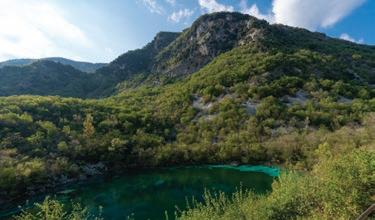
The Cornino Lake Regional Nature Reserve stretches between the municipalities of Forgaria nel Friuli and Trasaghis in a natural setting of ineffable beauty. For nearly twenty years, this has been the site of an international project for the conservation of the griffon vulture.
From the numerous observation points, you can admire the many animal species that inhabit the area, especially the spectacular sight of griffon vultures in flight during the morning hours. The area adjacent to the Visitor Centre also features a few aviaries and a terrarium.
The Visitor Centre is accessible by car to people with disabilities. The centre is spread over two levels, connected by internal stairs or external inclined ramps. However, the external path is partly paved with unpolished cobblestones and concrete blocks, which may present an obstacle for people with motor disabilities.
Visitor Centre Via Sompcornino, 81
33030 Forgaria del Friuli (UD)
www.riservacornino.it/en/ centrovisite@riservacornino.it
Near the entrance to the Visitor Centre, you will find a dedicated accessible toilet, measuring 210×140 cm and equipped with a folding grab bar next to the toilet bowl.
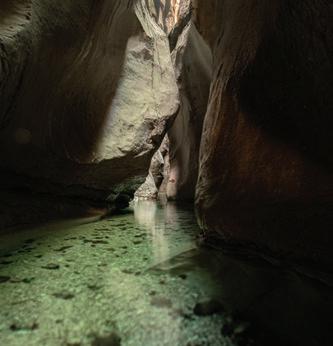
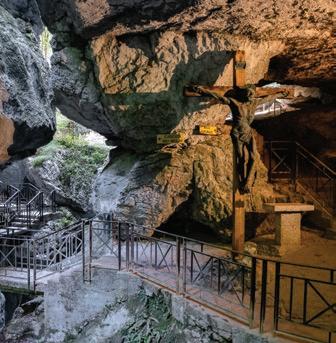
The Pradis plateau is located over 500 metres above sea level, in the heart of the Carnic Pre-Alps, and is characterised by hundreds of karst caves along a deep gorge carved out over thousands of years by the Cosa stream. In addition to their natural beauty, the Pradis Caves are known as an important archaeological site, as they were inhabited during two phases of prehistoric settlement.
The accessible route for people with visual impairments winds its way from the ticket office to the Grotta della Madonna and the gorge, along a nature trail enriched with tactile 3D reproductions of fossils and archaeological finds. Each installation is accompanied by an audio track that can be activated via georeferenced TAGs. There are also tactile floor surfaces, handrails equipped with tactile terminals and guide ropes. Accessible toilets and refreshment points are available and signposted, as are rest areas equipped for visitors to enjoy the nature of the geosite in peace.
Pradis Caves
Via Pradis di Sotto, 33090
Clauzetto (PN)
Tel. 0427 80323
Cell. 366 1687906
www.grottedipradis.it
The Pradis Cave Museum has created an innovative circular route with 16 stations, connected by a LOGES orientation system with tactile-plantar signage installed on a floating floor, so as to preserve the original Pradis stone. Each station includes a TAG with audio description, combined with tactile reproductions of archaeological finds at 14 stations, for cognitive and sensory exploration. The entire route is enriched by an ambient sound track, with natural and ancestral sounds accompanying the immersive experience.

THE ‘FVG IN MOVIMENTO.
10.000 PASSI DI SALUTE’ PROJECT
According to the WHO (World Health Organisation), a daily walk of 10,000 steps contributes to improving physical health and general well-being, including psychological well-being, helping to prevent many heart and pulmonary diseases, along with overweight, obesity and diabetes. This simple activity requires no particular athletic training: walking is easy and accessible to all, can be practised outdoors, anywhere, with great freedom of time and place, and is even more enjoyable in fine weather.
It is in this spirit that the ‘FVG in Movimento. 10.000 passi di salute’ project was launched. Since 2018, it has promoted health through physical and motor activity and the discovery of the region along the 120 routes of the 132 municipalities that have joined.
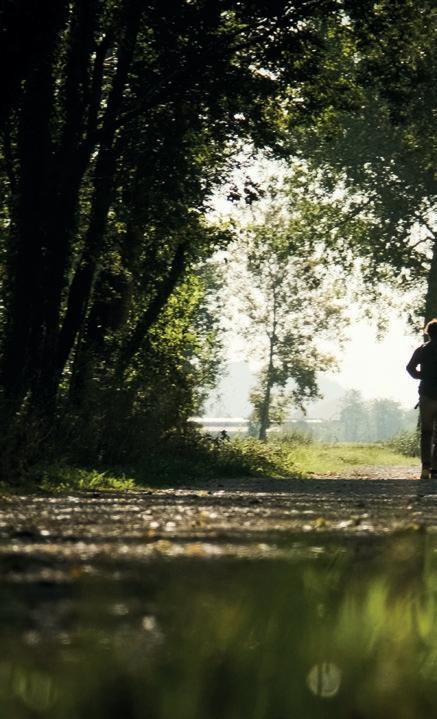
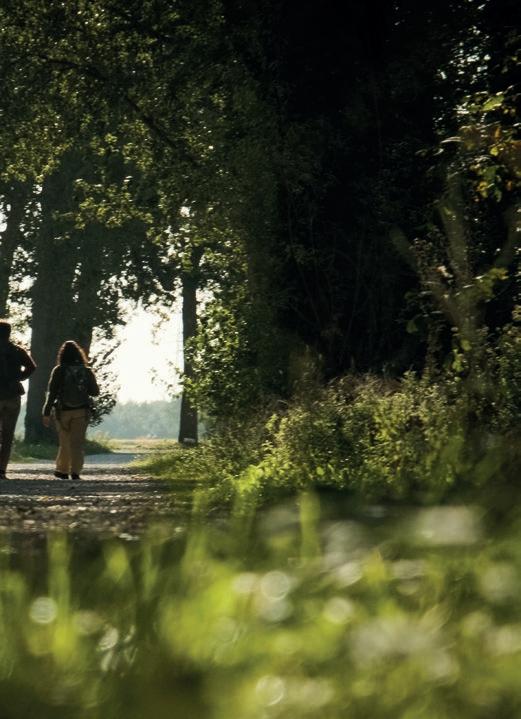
The itineraries cover the entire region: from the sea to the mountains, amidst hills and vineyards, among villages and towns. This is an opportunity to discover history, art, nature and local traditions and production. All of this is facilitated by illustrative signage and signposts along all routes that indicate the degree of difficulty and accessibility.
To discover the most accessible routes, visit: www.friuliveneziagiuliapertutti.it/en
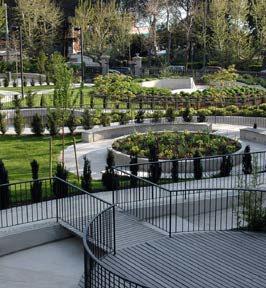
The garden of the Rittmeyer Institute in Trieste is unique in Italy for its size, design and functions. This open space covers more than 6,000 square metres and was specifically created to be used independently by the blind and visually impaired.
The selection of materials, furnishings, walking surfaces and plant species was all carefully designed to guide visually impaired guests along a route that ensures high levels of safety and accessibility, including for those with motor disabilities.
The entire area is divided into two zones:
• The front garden. This area is split into thematic sections designed for a sensory experience: the garden of touch, the garden of sounds and the garden of fragrances.
• The back garden. This section features currant bushes, strawberry, peach and cherry tree seedlings, alongside a variety of vegetable, aromatic and flowering plants. There is also a playground area for children, a picnic area and a special, innovative structure: a mobile panel maze.
Rittmeyer Institute in Trieste Viale Miramare, 119 34136 Trieste
Tel. +39 040 4198911
www.istitutorittmeyer.it info@istitutorittmeyer.it
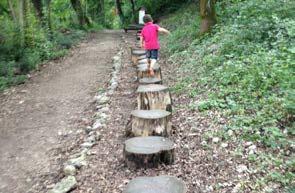
The San Floriano Nature Park is located in Polcenigo, one of the most beautiful villages in Italy, within the province of Pordenone. This natural oasis spans about 65 hectares and serves multiple purposes, ranging from education to organic food production.
Over the years, cultivation and breeding practices have been focused on educational and demonstration aims, with the main objective of recovering local fruit and vegetable varieties and breeding minor or endangered animal breeds. The park also features a tactile path that runs for about 900 metres entirely immersed in nature, designed to be walked strictly barefoot across surfaces of mud, hay, corks, gravel and many other natural elements.
Inside the park, there are two guesthouses/ restaurant areas, an educational hall and several buildings used as dwellings or multi-purpose
Controvento Social Cooperative Località colle San Floriano, 2 33070 Polcenigo (PN)
Tel. 0434 749678
Cell. 331 8913299 www.parcosanfloriano.it info@parcosanfloriano.it
areas; one guesthouse is equipped with an accessible toilet and can be reached via a wide gravel path or by using your own vehicle.
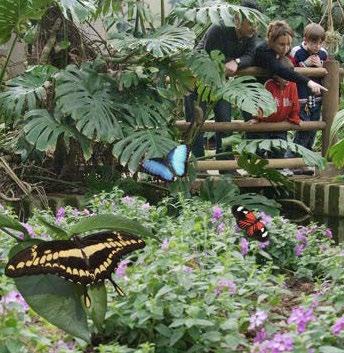
It is a corner of tropical forest right here in Friuli Venezia Giulia. This is the largest exhibition of live butterflies and insects in Italy, featuring 1,000 square metres of heated greenhouses alongside an equal amount of
The Butterfly House in Bordano Via Canada 5 33010 Bordano (UD)
Tel. +39 0432 1833 633
www.bordanofarfalle.it/en info@bordanofarfalle.it
exhibition and workshop space. More than 100 species of butterflies fly freely across the three large greenhouses, which perfectly reproduce the habitats of the African Jungle, the Southeast Asian Forest, and the Amazon, alongside numerous plants and many other animals. The visit route is completely barrier-free. Workshops or thematic routes for people with disabilities can also be booked.
The Punta Verde Zoo Park in Lignano Sabbiadoro is a 10 hectare natural haven where nature is respected, defended and protected. It is home to 1,000 animals of 150 different species from all over the planet, all of whom are cared for, well looked after and pampered. The Zoo Park’s proposal for people with disabilities goes by the motto: ‘Nature belongs to everyone’. This is a sensory workshop that allows guests to discover the natural world through the five senses, by touching, smelling, listening to and meeting zoo animals up close.
The Punta Verde Zoo Park is on a flat area and presents no obstacles for people with motor difficulties. However, a few areas have slopes that may require the help of an accompanying person (these areas are highlighted on the map, which can be downloaded from the zoo website).
Via G. Scerbanenco 19/1 33054 Lignano Sabbiadoro (UD)
Tel. +39 0431 428775
www.parcozoopuntaverde.it/enù info@parcozoopuntaverde.it
Accessible amenities are available throughout the park, including accessible toilets, picnic areas with priority seating for people with disabilities and a wheelchair rental service. Guests with Autism Spectrum Disorder can also access the ‘Sensory BAG’, which contains useful items to support relaxation and attention.
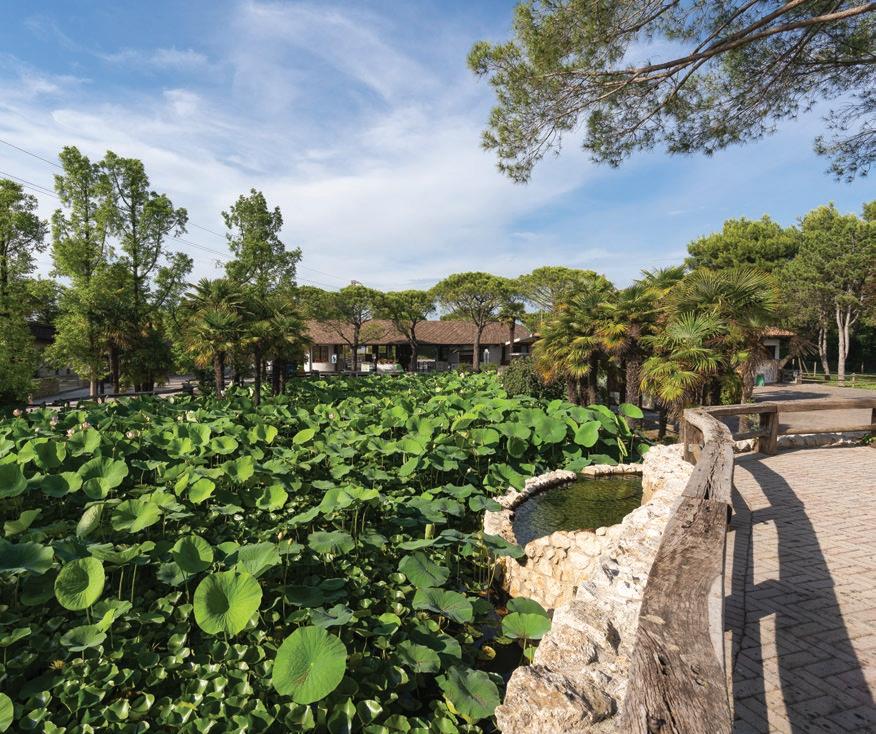
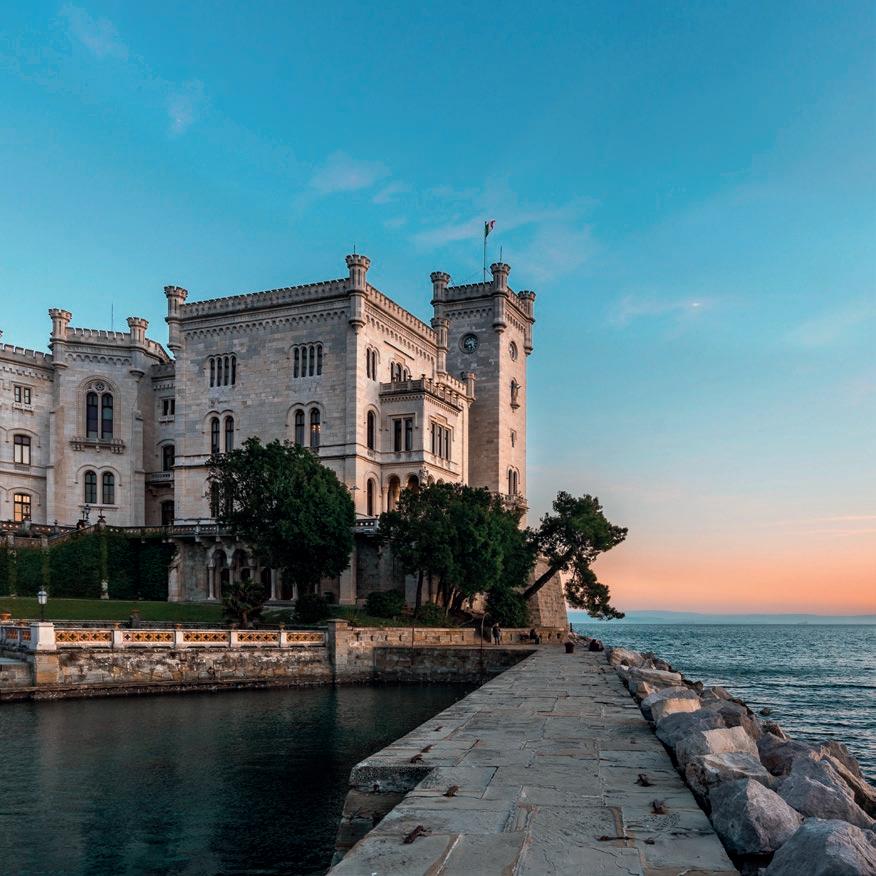
Discover the history and art of Friuli Venezia Giulia through itineraries to the most iconic places and locations in the region, either on your own or by choosing one of the guided tours scheduled throughout the year.
The planned routes in the city are mostly accessible, but as they are in an urban environment, some spots may present obstacles due to steps, slopes or unforeseen obstructions.
Therefore, we recommend having an accompanying person to assist with such situations.
A free LIS (Italian Sign Language) interpreter service is available upon request, in cooperation with ANIOS – Associazione Interpreti di Lingua dei Segni Italiana.
Maps of the itineraries in the cities of art and all details are available at www.friuliveneziagiuliapertutti.it/en
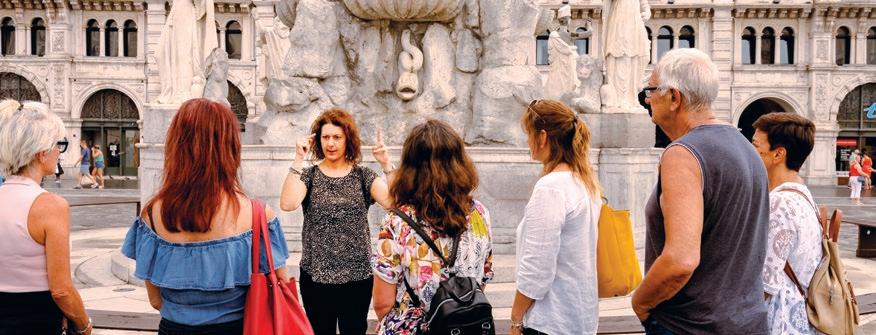
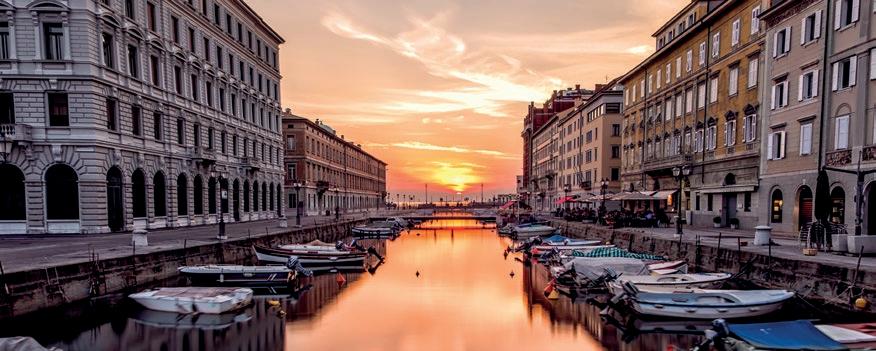
Suspended between the Karst and the sea, Trieste is an incredible tapestry of interwoven histories: Neoclassical, Art Nouveau, eclectic palaces overlooking the sea, the Viennese atmosphere of its elegant cafés and Piazza Unità d’Italia – a magnificent gateway to the blue and a keeper of the connection between the Italian, German, and Slavic worlds. Unusual architecture, churches and places of worship testify to the city’s peaceful multi-faith heritage, alongside quotes from the great writers and poets who loved it and immortalised it in their masterpieces.
Reserved and elegant, yet also cheerful and sociable, this city is painted in the colours of Gianbattista Tiepolo (1696-1770), the famous Venetian painter who left behind works of rare beauty.
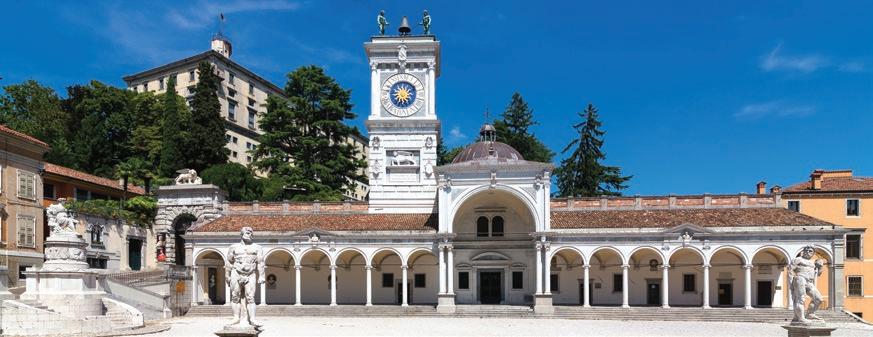
Piazza Libertà, with its splendid Loggia del Lionello, is known as the most beautiful Venetian square on dry land.
But the city’s soul is also found in the old town’s streets, full of magnificent palaces, alongside the irrigation ditches, in its lively little squares, and in the typical taverns, where the ritual of the ‘tajut’ is inescapable.
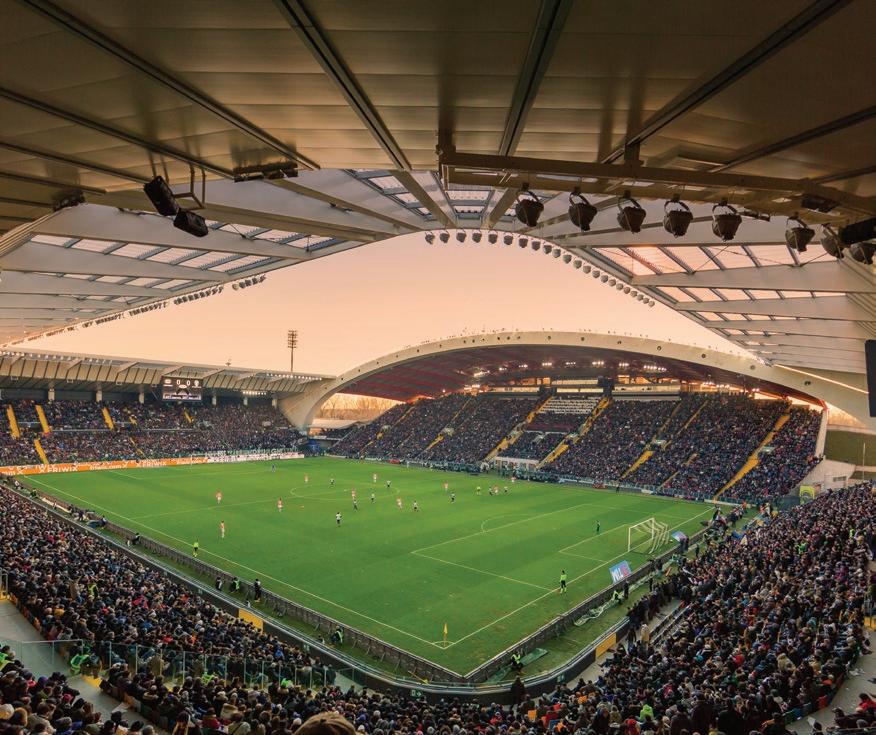
Friuli Venezia Giulia is home to Udinese, the club that has played in Serie A for twentyfive years non-stop. The team is also one of the first in Italy to own its stadium – one of Europe’s most modern sports facilities.
Thanks to an agreement with Udinese Calcio, you can book an exclusive tour through areas usually only seen by staff: the team changing rooms, the gym where Udinese players train, the press room where the coach meets journalists, the mixed zone for players’ postmatch TV interviews, the tunnel they take to the pitch and, of course, the football pitch itself.
Outside the stadium, a parking area is fully reserved for people with disabilities. The tour takes place inside the stadium, which is on several levels connected by two lifts (door width 110 cm, cabin 180×200 cm). All indoor areas are linked by wide paths without obstacles. Across the various accessible areas, there are three toilets suitable for people with motor disabilities, featuring side transfer space to the toilet, front access to the washbasin and grab bars.
Stadio Friuli
Piazzale Repubblica Argentina, 3
33100 Udine
Reservations and tickets
Infopoint PromoTurismoFVG - Udine Piazza I° Maggio, 7
33100 Udine
Tel. +39 0432 295972
info.udine@promoturismo.fvg.it
Now a UNESCO World Heritage Site, it was a strategic trading point with the Danube countries and the East, one of the Roman Empire’s largest cities, and later a patriarchal seat pivotal in Eastern Europe’s evangelisation. It is an evocative route through the key sites of one of Italy’s most important archaeological and early Christian areas.
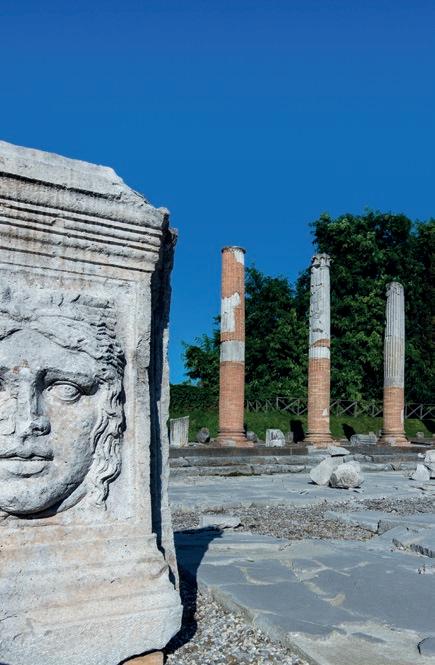
Not to be missed is: the Basilica of Aquileia, accessible to people with all disabilities thanks to the ‘Basilica per Tutti’ (Basilica for Everyone) project. It offers resources and materials for sensory and intellectual impairments, including: a guide and map in simplified language, a guide and map in AAC (Augmentative and Alternative Communication) and a video with audio description, subtitles and LIS translation.
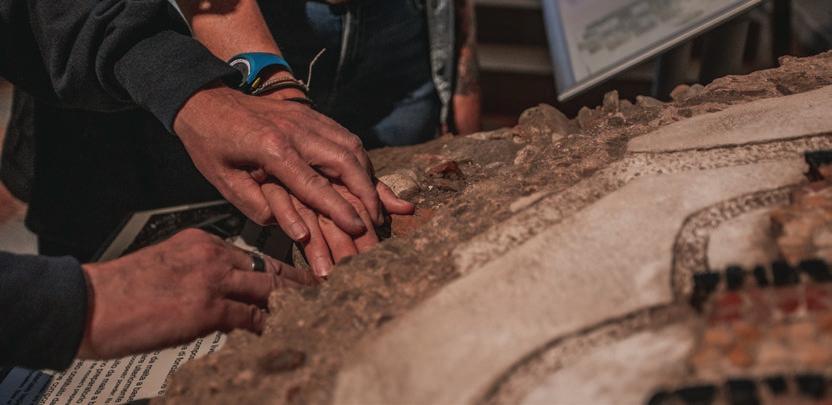
The MAN – National Archaeological Museum of Aquileia is fully accessible for people with motor disabilities. By appointment, it offers guided tours, interactive routes and hands-on workshops for individuals and groups with physical and/or cognitive impairments, as well as tactile routes based on both original exhibits and copies.
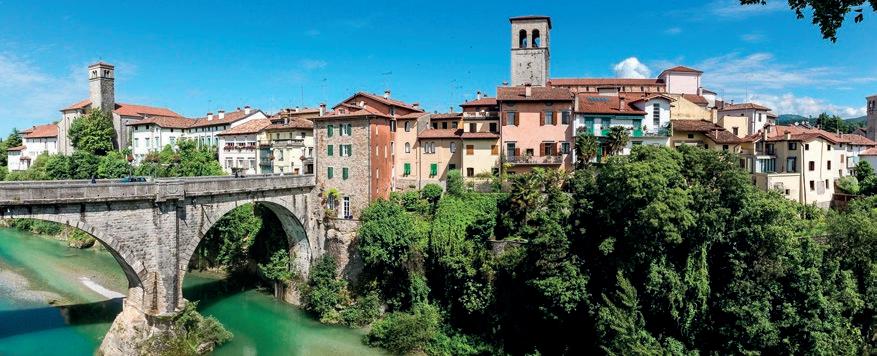
Founded by the Romans as ‘Forum Juli’ (the origin of the name ‘Friuli’), it was the capital of the first Longobard duchy in Italy, experiencing alternating rule by Romans, Franks, the Patriarchate of Aquileia and the Venetian Republic.
The cosy squares and cobbled streets reveal ancient artistic gems and one-of-akind treasures like the exquisite Longobard Temple, the impressive Ratchis Altar and the intriguing Devil’s Bridge.
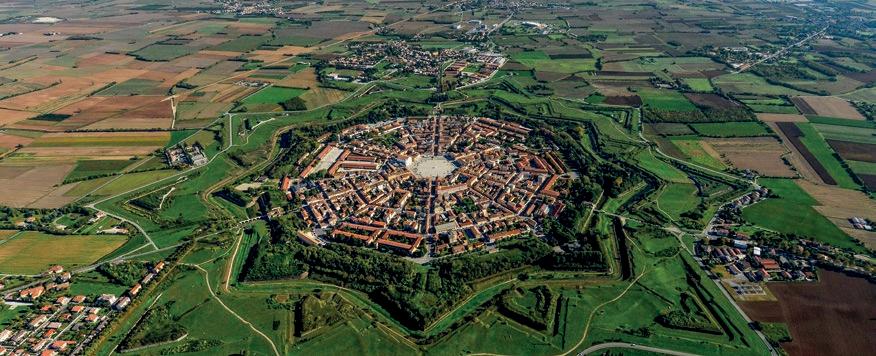
Built as a fortress by the Venetian Republic from 1593 for defence, it is now a UNESCO World Heritage Site.
From the hexagonal Piazza Grande, the core of city life and a former parade ground where the Provveditore della Serenissima (Venetian
administrator) gathered his soldiers for drills, to Porta Cividale, one of the three city gates, you can admire part of the three rings of fortifications, made up of bastions, curtain walls, a moat, counter-scarps, ravelins and Napoleonic lunettes.
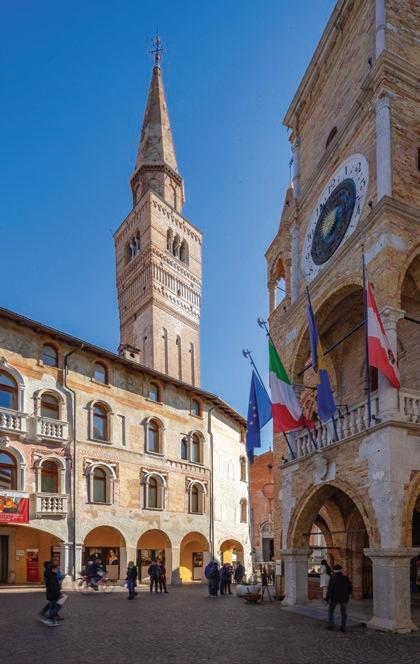
An elegant city that captivates with its beautifully frescoed façades, earning Pordenone the Latin nickname urbs picta (the painted city).
The Venetian influence is apparent in the bell tower of St Mark’s Cathedral, inside which you can admire altarpieces and frescoes by Friuli’s greatest Renaissance painter, Giovanni Antonio De Sacchis, known as Il Pordenone.
His masterpieces are housed in the adjacent Palazzo Ricchieri Art Museum.
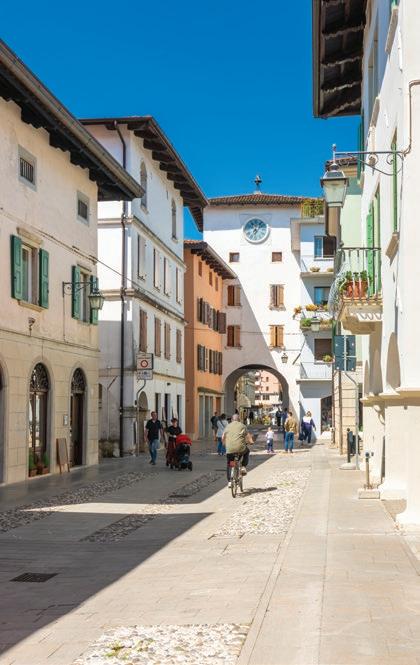
Known as the City of Mosaics due to the Friuli School of Mosaics, a renowned international institution promoting art through study, research, experimentation, new technologies and collaborations with leading contemporary artists.
The historic centre is rich and elegant, featuring the Castle with the refined frescoes of the ‘painted palace’ and the Cathedral (dating back to 1284 in Romanesque-Gothic style), which contains two paintings by Antonio De Sacchis, Il Pordenone.
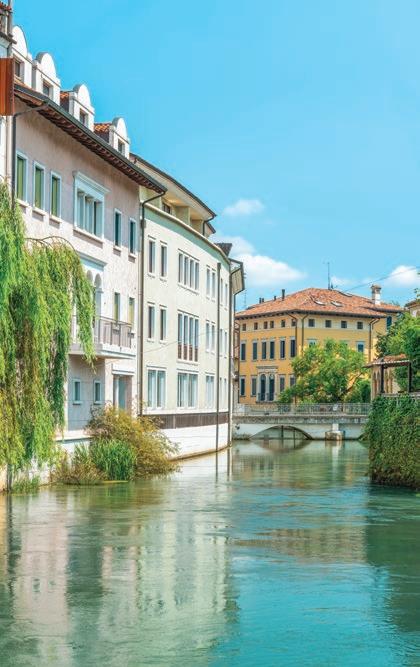
A gateway to Friuli, with elegant Venetian architecture reflected in the calm, clear waters of the Livenza river. Its historic centre is full of treasures: the San Gregorio hamlet and the 16th-17th century grace of the noble palaces in Piazza del Popolo, the Loggia Municipale, the S. Nicolò Cathedral, the Chiesetta della Pietà and the 16th-century Palazzo Ragazzoni with its magnificent frescoes.
Every August, the town comes alive for the traditional Sagra dei Osei (Festival of the Birds), one of Italy’s oldest festivals, which combines a bird market/show, exhibitions and singing competitions.
The European Capital of Culture with Nova Gorica in 2025, Gorizia retains traces of its rich Hapsburg past in its palaces and gardens.
Yet, Gorizia is primarily a symbol of the troubled history of 20th-century Europe. A frontier town, it was only annexed by Italy in 1918, and after the Second World War, it lost a section of its outskirts to what was then Yugoslavia.
The ‘Gorizia Wall’, now commemorated in Piazza Transalpina, was a symbol of the Cold War separation between Western and Eastern Europe.
Archaeological Museum of Aquileia
MuCa - Shipbuilding Museum in Monfalcone
MUTAT - The Tactile Museum for Everyone
‘Silvia Zenari’ Civic Museum of natural History
Immaginario Scientifico Science Centre
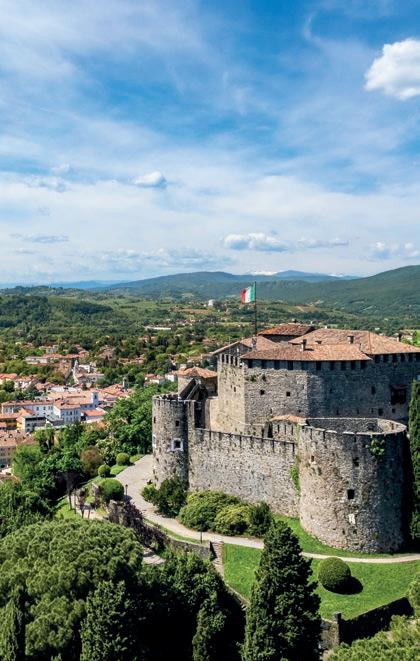
Housed on the ground floor of the Castle’s east wing, it reopened with a new layout in 2013. The tour covers six rooms, exhibiting artefacts ranging from Magna Graecia vases to Protohistoric, Roman and early medieval burial finds from Friuli. The visit continues upstairs with five rooms dedicated to in-depth study of various archaeological themes.
The museum building is accessible to people with motor disabilities and is equipped with a lift. ‘Equal Opportunities in Culture’ has been the guiding principle for the Archaeological Museum of Udine’s exhibitions and public activities since 2014. The Museum was one of 14 partners (including Poland, Germany, Austria, Croatia, Slovenia and Italy) in the European project ‘COME-IN! (Cooperating for Open access to Museums – towards a widEr INclusion).
The Archaeological Museum features a multisensory route, supported by an inclusive app
Castle Museums
Piazzale del Castello, 1 33100 Udine
Tel. +39 0432 1272591 civici.musei@comune.udine.it www.civicimuseiudine.it/en
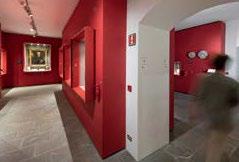
that offers a route in Italian for the blind and is available in Italian, English, German and French.
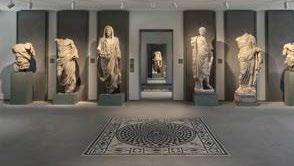
The Archaeological Museum of Aquileia houses remarkable artefacts dating back to Roman times, all from excavations carried out on site. Among the most valuable pieces are a Venus of the Medici type, a 1st-century BC Head of an Old Man, a rich collection of glassware, amber objects, engraved semi-precious stones and the numismatic collection. The adjacent garden houses the lapidary section, featuring architectural material, epigraphs, stelae, mosaics and funerary monuments.
The museum building is accessible in all its parts to people with motor disabilities and is equipped with a lift. The museum staff are available to run guided tours and themed routes for people with sensory and cognitive disabilities. Tactile routes based on original exhibits can also be offered to groups or individual visitors. Smartphones are now available free of charge at the museum ticket office for all visually-impaired and blind visitors. These devices have bespoke software installed,
Via Roma 1 33051 Aquileia (UD)
Tel. +39 0431 91035 museoarcheologicoaquileia.beniculturali.it/en museoarcheoaquileia@beniculturali.it
connected to beacons in the exhibition rooms. The devices allow independent movement along the museum route and feature audio descriptions in Italian and English for 11 exhibits. The audio descriptions also guide and facilitate tactile exploration of the original items, ensuring a complete and rewarding visitor experience.
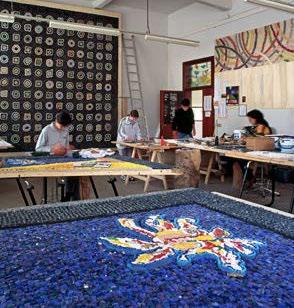
This exhibit features mosaic works and sketches produced by the Spilimbergo School of Mosaics since its founding in 1922. A world-renowned training centre, the Mosaic School maintains an artistic tradition likely dating back to Roman times, as evidenced by archaeological finds still visible across the region (Aquileia, Cividale del Friuli, Trieste, etc.).
The Friuli School of Mosaics promotes art through study, research, experimentation, new technologies and collaborations with leading contemporary artists.
The museum building is free of architectural barriers. It is on several levels, connected by a lift (cabin 100×230 cm), and has two accessible toilets reserved for people with disabilities, measuring approximately 180×180 cm and fitted with grab bars.
Friuli School of Mosaics
Via Corridoni 6 33097 Spilimbergo (Pn)
Tel. +39 0427 2077 www.scuolamosaicistifriuli.it/en info@scuolamosaicistifriuli.it
MuCa is housed on the ground floor of the former workers’ hotel in Panzano Village, the ‘company town’ that grew up around the shipyard in the 1920s, an initiative of the first owners, the Cosulich family.
The museum tells the story of the shipyard and the city through a route divided into sections: over a century of history illustrated using contemporary language and the latest multimedia technology. Located next to the shipyards, which still build some of the world’s most beautiful cruise ships, and set in the charming surroundings of the ‘garden city’ of Panzano, the museum provides an immersive experience in a living, productive industrial reality.
The museum has a private car park with reserved spaces for people with disabilities. Access to the building is via stairs or a 6 m ramp with a gradient of approximately 10%. The interior has staggered levels connected by ramps,
MuCa - Shipbuilding Museum in Monfalcone
Via del Mercato 3 Panzano 34074 Monfalcone
Tel. +39 0481 494901 www.mucamonfalcone.it/en info@mucamonfalcone.it
except for two rooms accessed via platform stairlifts. An accessible toilet is available, featuring side transfer space to the toilet and front access to the washbasin. The museum staff are available to run guided tours and themed routes for people with disabilities.
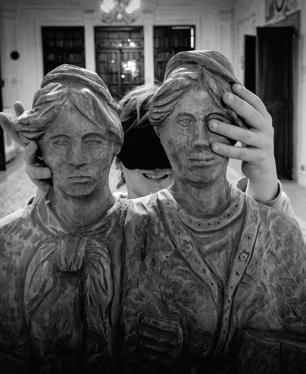
MuTAT is the museum where the sense of touch allows everyone to discover art in the dark.
Face-to-face with the work, learning to ‘see with one’s own fingers’, visitors can experience a new perception of space, time and sensation. The collection is updated periodically and includes reproductions of famous paintings and original sculptures by both sighted and blind artists.
Mutat via Antonio Altan, 83/3
33070 San Vito al Tagliamento – PN
Cell. +39 376 2801694
www.mutat.it
info@mutat.it
MuTAT is located in Palazzo Tullio Altan, a prestigious 18th-century building made accessible. The works are displayed for adults and children to touch, standing or sitting, in the dark or simply with eyes closed. The captions are simple, easy to read in size and contrast, and incorporate braille writing. Captions and guides are also available in audio format, which can be activated using QR codes or NFC tags placed next to each work and identified by touch. A portable tactile map illustrating the museum layout and spaces is available at the reception desk.
Personalised visits led by volunteers can be arranged by appointment.
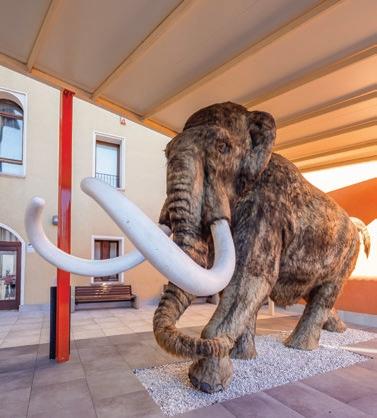
Located in the 16th-century Palazzo Amalteo, in the heart of the city centre, the Museum of Natural History is a special space brimming with surprises and holds significant natural history collections of local and national interest. From the animal world, with insects, birds and mammals, to the world of minerals of a thousand origins and consistencies, like crystals and iridescent gems. But the real star of the museum is right there: a splendid, over three-metretall reconstruction of a woolly mammoth, which ideally welcomes visitors from the garden.
The route is accompanied by high-visibility signage and visual-tactile maps. Multimedia devices allow access to content in audio format (to aid visually-impaired visitors), in LIS (Italian Sign Language), in Easy-to-Read format, in AAC (Augmentative and Alternative Communication) and through augmented reality experiences.
Silvia Zenari Civic Museum of Natural History
Via della Motta, 16 33170 Pordenone
Tel. +39 0434 392950 museo.storianaturale@comune.pordenone.it
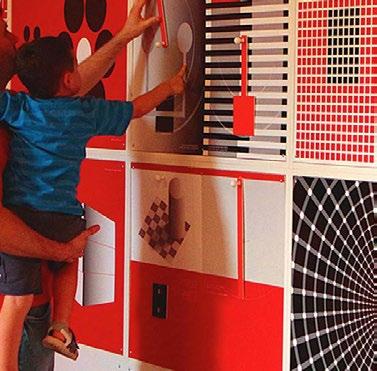
The Immaginario Scientifico in Trieste is an interactive and experimental science museum. The spacious late 19th-century building houses over 100 colourful, interactive exhibits – all designed to be touched. These allow visitors to discover not only natural phenomena but also the most innovative scientific applications and the research conducted by Trieste’s science institutions. The 2,000 square metres of exhibition and workshop space feature panels in Italian and English explaining the various experiments and applications. It’s a place where science becomes fun, in a new-generation museum where the rule is definitely ‘Touching is strictly not forbidden’.
Thanks to the absence of architectural barriers, the Immaginario Scientifico centres also offer the ‘ImmaginAbile’ programme: museum tours and workshops for groups with disabilities, tailored to participants’ potential and abilities.
Immaginario Scientifico Science Centre
Porto Vecchio, Magazzino 26 34135 Trieste
Tel. +39 040 224424 www.immaginarioscientifico.it/en info@immaginarioscientifico.it
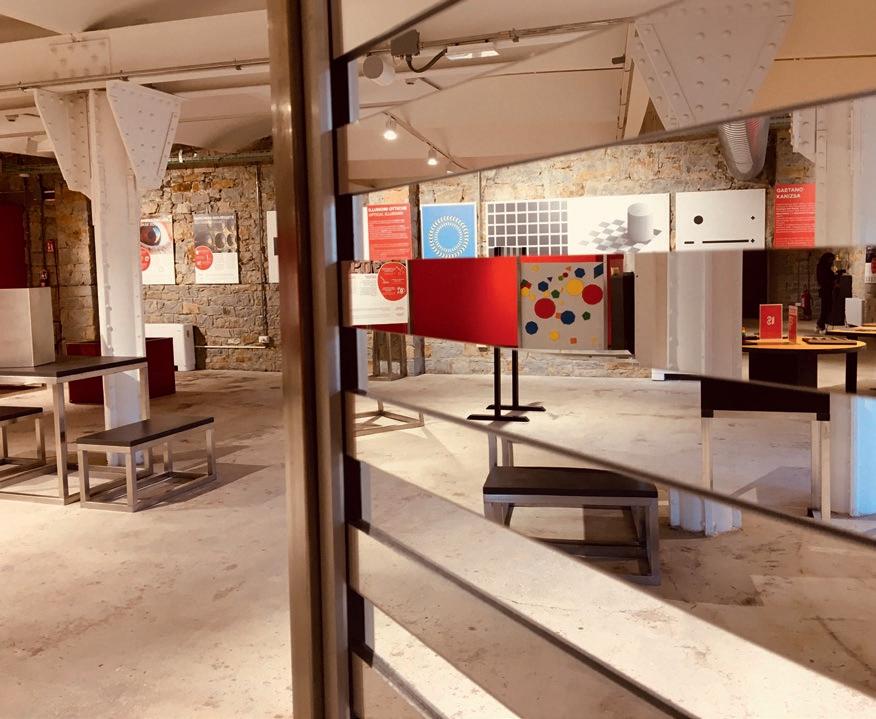
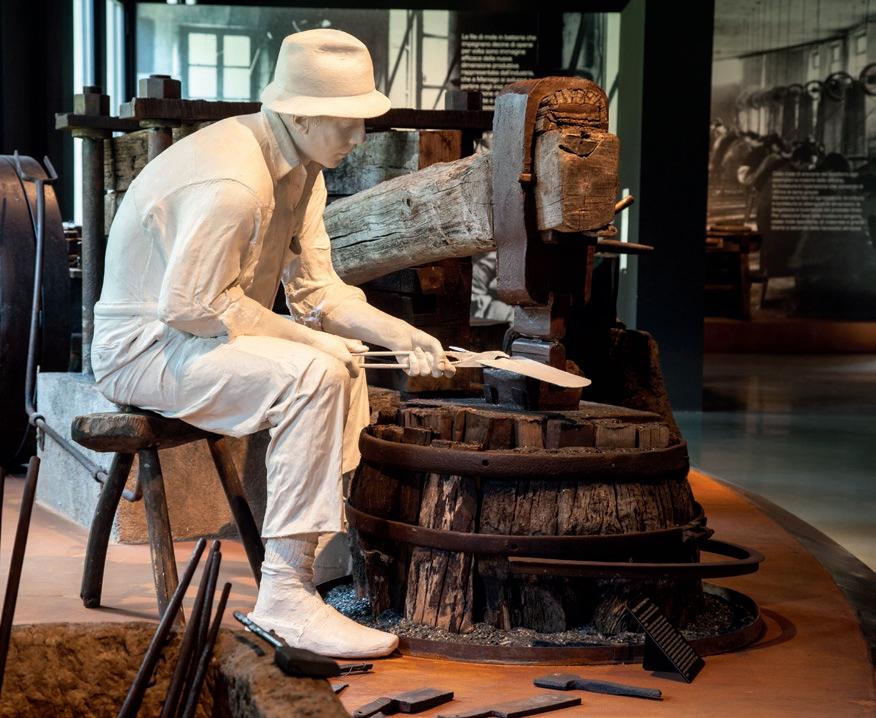
The museum is situated in a symbolic location for Maniago’s manufacturing history: the large industrial plant that began operating as Co.Ri. Ca.Ma. (Coltellerie Riunite di Caslino e Maniago) in 1907.
In a town that had housed small family-run workshops in every house and courtyard since 1453, this factory employed hundreds of workers until it closed in 1972. Purchased by the local council and restored from disuse, it has been the museum’s natural home since 2009.
It hosts a fascinating and effective route tracing the roots and development of local and industrial production of cutting items like scissors, penknives, table knives, surgical tools and other professional instruments. Today, around 70 companies in Maniago produce sharps; new areas of development include skate blades, industrial food blades, corkscrews and even swords and cutting weapons for collectors and cinema, alongside components for gas/steam turbines and aerostructures.
Knife and Cuterly Museum in Maniago
Via Maestri del Lavoro, 1 - Maniago
Tel. + 39 0427 709063
www.comune.maniago.pn.it coricama@maniago.it
INFORMATION ON ACCESSIBILITY
The MAFC is completely barrier-free. The first floor can be accessed via a lift located in the lobby. On the ground floor there are equipped toilets. For people with visual impairments, dedicated routes are also available with the possibility of tactile exploration of original objects.
Friuli Venezia Giulia boasts 10 towns included in the national circuits dedicated to Italy’s most characteristic and well-preserved villages. Visiting them offers a journey across the entire region, capturing its essence and the diversity that defines each area.
The region surprises with its ever-changing landscape and traditions: you will uncover a small world of secret castles, routes along waterways and ancient mills, historical re-enactments, and crafts that have never been forgotten.
Maps of the itineraries in the most beautiful villages in Italy and all details are available at www.friuliveneziagiuliapertutti.it/en
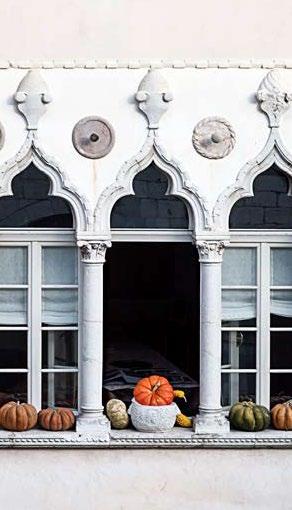
Of Roman origin, it was destroyed and rebuilt as a village of ‘pieris e claps’ (stones and pebbles). Its buildings developed around the churches of San Giorgio (south) and San Martino (north). The northern and southern cores expanded and merged between the 17th and 18th centuries. The village is also home to the fine 18th-century aristocratic residence, Villa Manin Guerresco.
A small gem of western Friuli, rich in history and valuable monuments. It features a splendid castle within a medieval village, the ancient Marian sanctuary – a Baroque artistic treasure, an old 15th-century parish church – and beautiful nature areas that blend harmoniously into a fascinating, untouched landscape. A land of poetic inspiration for great writers like Ippolito Nievo and PierPaolo Pasolini.
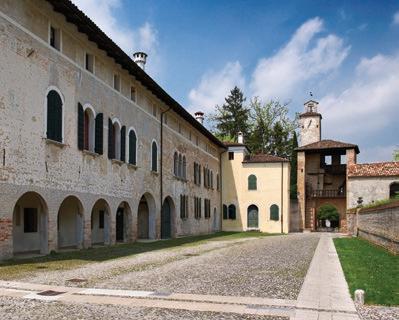
Standing on a hill north-west of Udine, it offers beautiful views of the surrounding hills and plain. The castle, now little more than a ruin, occupies a site inhabited since Roman times; only a few elements of the ancient fortifications survive, including fragments of the walls, the Borgo gate, the castle tower with the clock (now a bell tower), the ruins of the main tower, a small 14th-century house and the small church of San Michele Arcangelo.
A central European-flavoured gathering spot, surrounded by green spaces, this noble city assumed a crucial role from the 16th century onwards in the defence system established by the Venetian Republic against Turkish invasions. Indeed, the Serenissima strongly fortified it and between the 17th and 18th centuries it was transformed from a city into the Princely County of Gradisca.
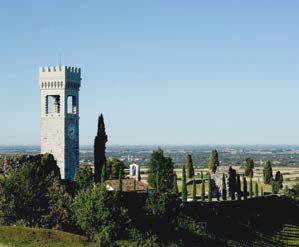
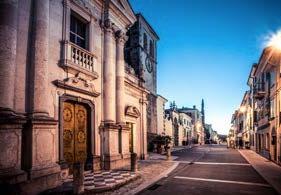
Of pre-Roman origin, it saw its greatest development thanks to the founding of the Benedictine Abbey in the early 8th century and the Longobard donation in 762, followed by many others. It suffered a devastating Hungarian invasion in 899 but was rebuilt and fortified from 960 onwards, taking on the appearance of a medieval castle with a defensive system of towers and moats.
It is located in an area of extreme natural and scenic interest between the Gorgazzo springs –crystal-clear waters flowing from a karst cavity, made atmospheric by light filtering through the rocks – and the wide, scenic Livenza river springs. Despite surfacing only a few dozen metres above sea level, these springs give rise to a substantial watercourse. Polcenigo is also rich in exceptional historical and artistic elements. It is home to the Museum of Cookery Art, commemorating generations of chefs who emigrated worldwide.
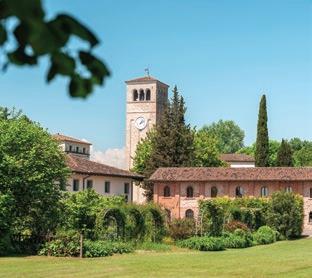
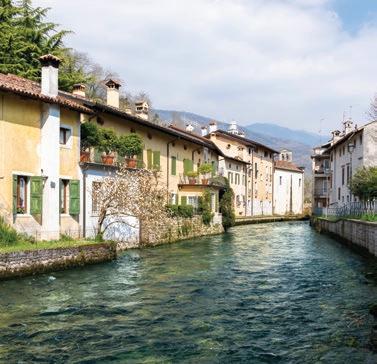
An open-air museum in the heart of the Colvera Valley, its ‘magic’ lies in the charming effect of the rough-cut stone and wooden balconies: straightforward, austere elements that also create a sense of intimacy and seclusion in the enclosed courtyards or along the long rows of 16th-17th-century houses. The beauty of the village lies in the humble stone pillars, stairs, balconies and arches, in perfect harmony with the surrounding nature.
This village in the municipality of Travesio preserves the remains of the medieval castle that overlooked the plain and the village below. In 1220, the village of Toppo comprised eight masi (family-run farmsteads); twenty-five were documented in the 16th century. The route to discover the village’s original buildings starts from Palazzo Toppo Wasserman, which began as a farmstead before developing into a 16thcentury country mansion.
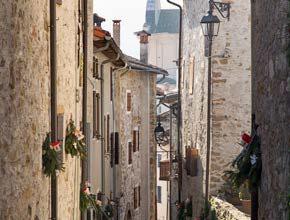
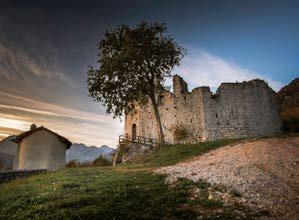
The village retains its medieval appearance of pretty alleys and old houses with arcades. The imposing castle dominating the square houses late Gothic and Renaissance frescoes and a valuable 18th-century wooden theatre. The Cathedral of the Santissimo Corpo di Cristo (named after the sacred relic it holds)
contains a monumental organ, the only example in Italy of 16th-century Venetian organ-making, enhanced by the beautiful artistic setting by Pordenone and Pomponio Amalteo.
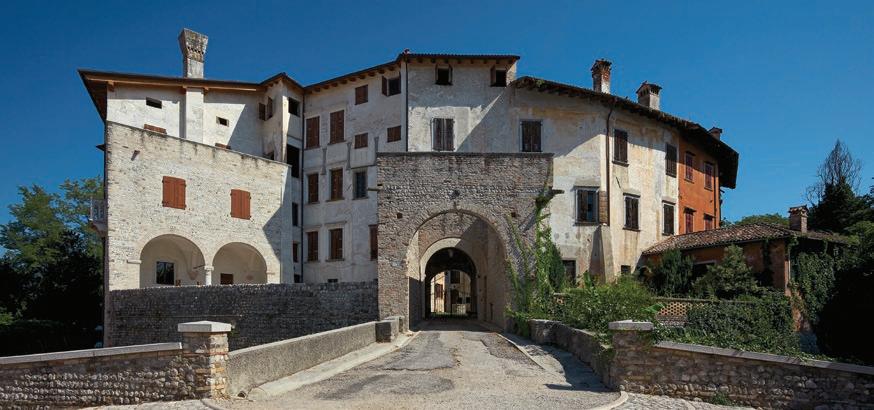
The ‘Borgo dei Borghi 2017’ (Village of Villages) winner is the best-preserved fortified village in Friuli Venezia Giulia, an extraordinary example of architectural and artistic restoration after the devastating 1976 earthquake. Rebuilt stone by stone, it preserves the great walls surrounded by a moat, the three access gates, the Cathedral of Sant’Andrea Apostolo (a significant example of Gothic architecture) and the Palazzo Comunale, which features 16thcentury frescoes by Renaissance painter Pomponio Amalteo on its rear wall.
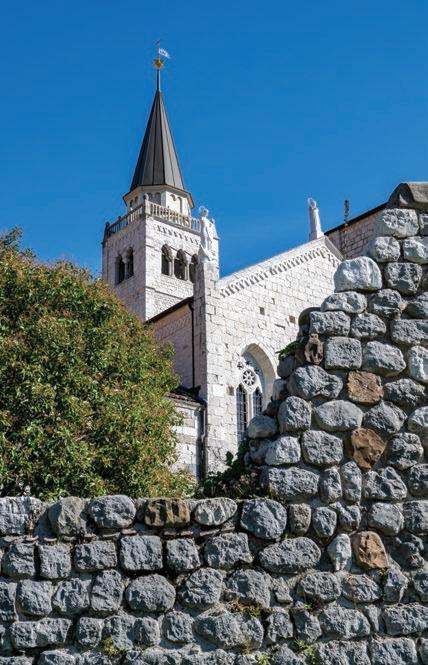
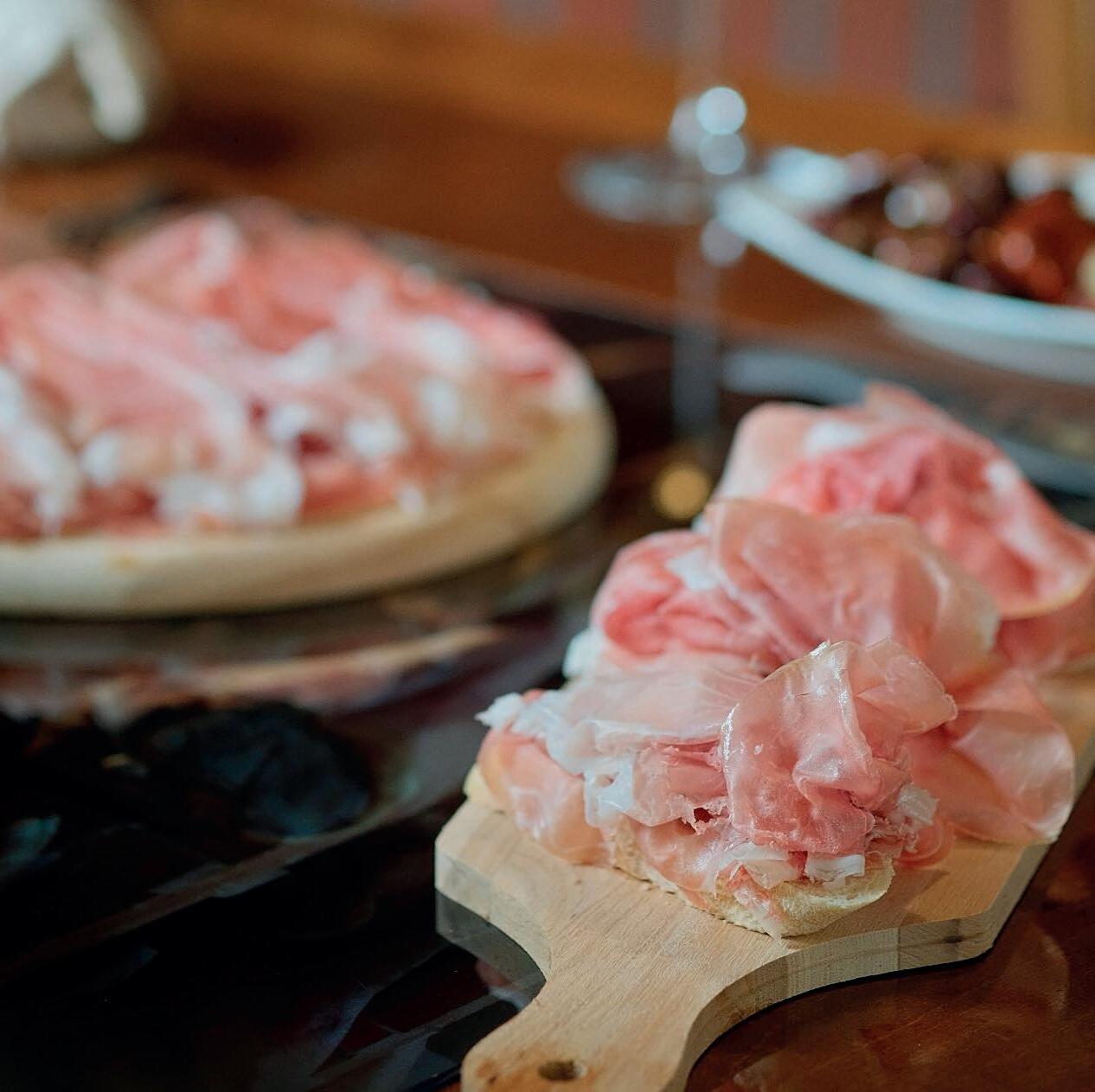
The food and wine of Friuli Venezia Giulia boasts products that are unparalleled in the world. You are spoilt for choice: whether you like savoury or sweet food, wines, beers or schnapps, your senses will have an unforgettable experience.
Friuli Venezia Giulia is a garden of delights for all lovers of fine food and wine to be discovered directly on the plate and in the glass. Indeed, the region is a vast vineyard nestled between the mountains and the sea, a haven that yields some of the world’s best white wines every year. This area of twenty thousand hectares is lovingly cultivated by 1,500 companies, producing eighty million quality bottles annually.
This exciting journey of taste can take many different routes, depending on the season, weather, desires and curiosity of each visitor.
You’ll love being surprised by special places and warm hospitality on a journey you’ll never want to end!
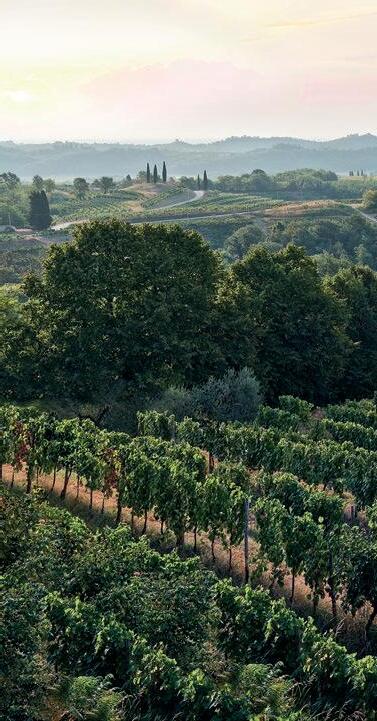
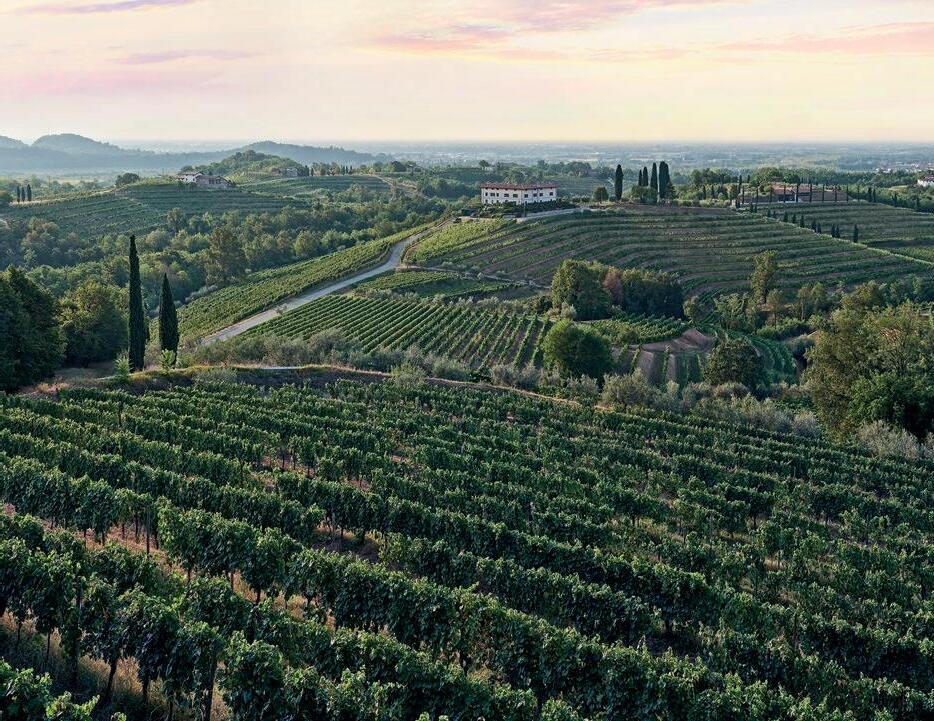
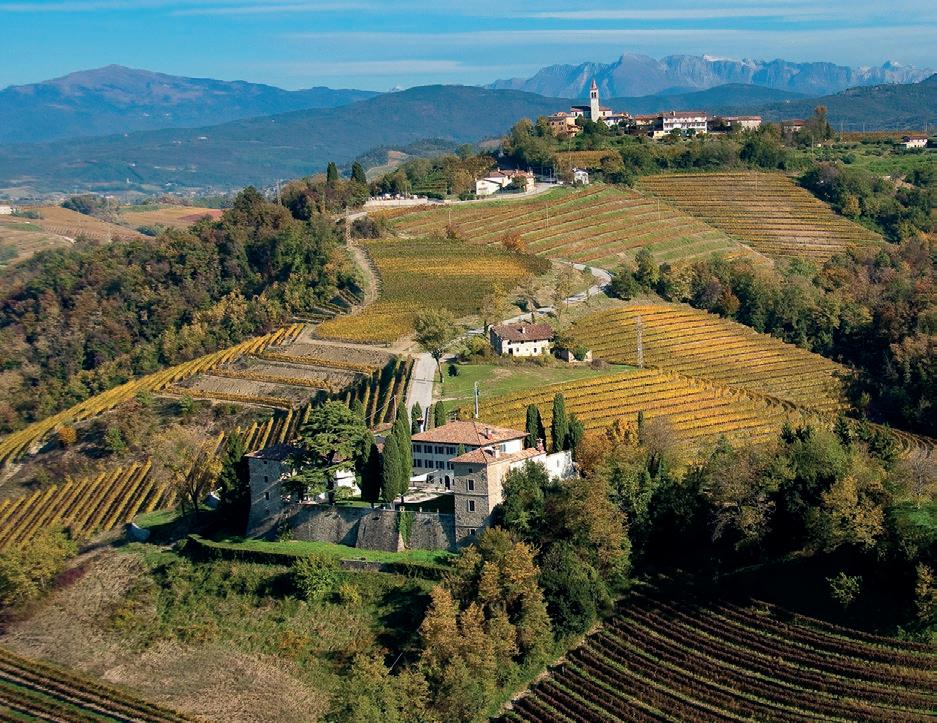
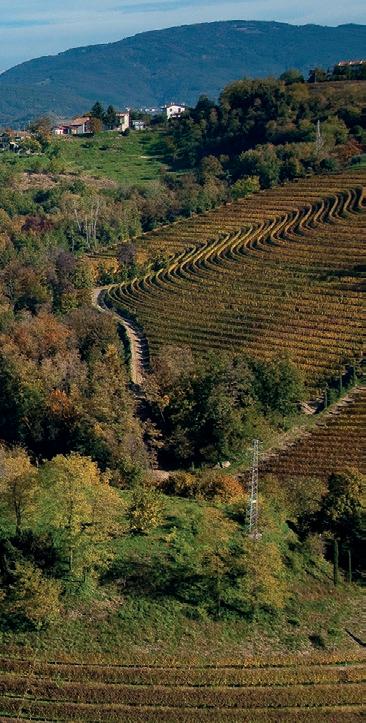
Six experiences to discover the region, meet the producers and learn about their methods.
A world of sensations, faces, flavours and ancient knowledge unfolds across a network of routes that cross the region seamlessly: from the Riviera to the Friulian Dolomites, from the Collio hills to the great Tagliamento river, from the Magredi grasslands to the Karst, and on to the gentle hills around San Daniele and Udine.
These valuable itineraries, all ready to be discovered, will follow the trail of fine food and excellent wines, taking you from Pordenone to Gorizia, from the Alps to the Soča, from Trieste to Aquileia, and from the Adriatic to Cividale to meet the people who create the unrivalled products, dishes and wines of Friuli Venezia Giulia.
Discover the accessible offers of the FVG Route of Wine and Food at www.friuliveneziagiuliapertutti.it/en
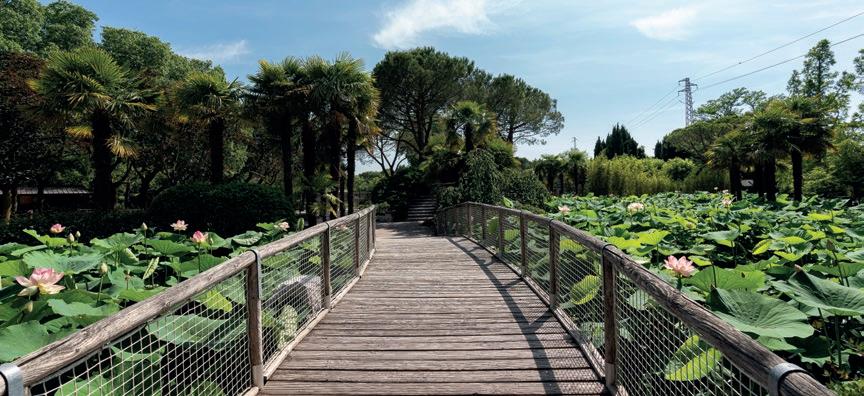
OFFICIAL PORTAL OF THE ACCESSIBLE TOURISM:
The information collected and shared on this portal allows everyone to assess independently which tourist facilities and services meet their specific needs, enabling them to enjoy to the fullest their visit to our region, whatever their requirements.
Each datasheet provides precise information on the accessibility of the facility, including the following information:
• Available ramps, lifts or stair lifts.
• Disabled bathrooms.
• Tactile routes or audioguides for people with sensory disabilities.
• Disabled parking nearby.
• Any reported architectural barriers.
You can filter places according to your needs, selecting the accessibility criteria most relevant to you or your group.
INTERACTIVE MAP:
A handy map allows you to locate quickly accessible points of interest in the different areas of the region.
To discover all the accessible resources and experiences in Friuli Venezia Giulia, visit :
www.friuliveneziagiuliapertutti.it/en/

The European Disability Card is a card-format document allowing people with disabilities to access public and private goods and services for free or at reduced rates.
The Card effectively replaces paper certificates and records proving disability status.
PromoTurismoFVG has signed the agreement with the Ministry for Disability and, within the scope of its activities and services, grants the following concessions to holders of the European Disability Card:
a) A 50% discount for the card holder on the ticket types listed below. This discount applies to the price in different seasons (High Winter Season – Low Winter Season – Summer Season) and within the respective age categories set out in the current price list:
- CARTAneve seasonal winter ski pass
- Daily winter ski pass
- Single and return pedestrian fares
b) A 50% discount for the disabled person’s accompanying person, if entitlement is specified on the card. This discount applies to the price in different seasons (High Winter Season – Low Winter Season – Summer Season) and to the ‘adult’ category price in the current price list:
- Daily winter ski pass
- Single and return pedestrian fares
c) Free access to guided tours organised by PromoTurismoFVG for the card holder and their accompanying person (if entitlement is specified on the card or an equivalent document).
d) Free admission to temporary exhibitions organised by PromoTurismoFVG for the card holder and their accompanying person (if entitlement is specified on the card or an equivalent document).
Arta Terme Infopoint
Via Nazionale,1 - 33022 Arta Terme (UD)
Tel. +39 0433 929290 | Cell.+39 335 7463096 info.artaterme@promoturismo.fvg.it
Aquileia Infopoint
Via Giulia Augusta, 11 - 33051 Aquileia (UD)
Tel. +39 0431 919491 | Cell. +39 335 7759580 info.aquileia@promoturismo.fvg.it
Cormons Infopoint
Piazza XXIV Maggio, 15 – 34071 Cormons (GO)
Tel. +39 0481 386224 | Cell. +39 335 7697061 info.cormons@promoturismo.fvg.it
Forni di Sopra Infopoint
Via Cadore, 1 - 33024 Forni di Sopra (UD)
Tel. +39 0433 886767 | Cell. +39 335 1083703 info.fornidisopra@promoturismo.fvg.it
Gorizia Infopoint
Corso Italia, 9 - 34170 Gorizia
Tel. +39 0481 535764 | Cell. +39 335 1084763 info.gorizia@promoturismo.fvg.it
Grado Infopoint
P.zza XXVI Maggio, 16 - angolo Portanuova, 26 34073 Grado (GO)
Tel. +39 0431 877111 | Cell. +39 335 7705665 info.grado@promoturismo.fvg.it
Lignano Pineta Infopoint (stagione estiva)
Via dei Pini, 53 - 33054 Lignano Pineta (UD)
Tel. +39 0431 422169 | Cell. +39 331 1435222 info.lignanopineta@promoturismo.fvg.it
Lignano Sabbiadoro Infopoint
Via Latisana,42 - 33054
Lignano Sabbiadoro (UD)
Tel. +39 0431 71821 | Cell. +39 335 7697304 info.lignano@promoturismo.fvg.it
Marano Lagunare Infopoint
Piazza Cristoforo Colombo - 33050 Marano Lagunare (UD)
Cell. +39 334 6835248 info.marano@promoturismo.fvg.it
Miramare Infopoint
Porta della Bora, adiacente all’ingresso del Viale dei Lecci
34121 Trieste
Cell. +39 333 6121377 info.miramare@promoturismo.fvg.it
Muggia Infopoint
Piazza Marconi, 1 - 34015 Muggia (TS)
Tel. +39 040 9571085 info.muggia@promoturismo.fvg.it
Palmanova Infopoint
Borgo Udine, 4 - 33057 Palmanova (UD)
Tel. +39 0432 924815 | Cell. +39 335 7847446 info.palmanova@promoturismo.fvg.it
Piancavallo Infopoint
(stagione invernale ed estiva)
Via Collalto, 1 - 33081 Piancavallo - Aviano (PN) Tel. +39 0434 655191 | Cell. +39 335 7313092 info.piancavallo@promoturismo.fvg.it
Pordenone Infopoint
Palazzo Badini
Via Mazzini, 2 - 33170 Pordenone Tel. +39 0434 520381 | Cell. +39 335 1516948 info.pordenone@promoturismo.fvg.it
Sappada Infopoint
c/o Borgata Bach, 9 - 33012 Sappada (UD)
Tel. +39 0435 469131 | Cell. +39 335 1085932 info.sappada@promoturismo.fvg.it
Sistiana Infopoint
Sistiana 56/B - 34011 Duino - Aurisina (TS) Tel. +39 040 299166 | Cell. +39 335 7374953 info.sistiana@promoturismo.fvg.it
Tarvisio Infopoint
Via Roma, 14 - 33018 Tarvisio (UD)
Tel. +39 0428 2135 | Cell. +39 335 7839496 info.tarvisio@promoturismo.fvg.it
Tolmezzo Infopoint
Via della Vittoria, 4 - 33028 Tolmezzo (UD)
Tel. +39 0433 44898 | Cell. +39 335 7747958 info.tolmezzo@promoturismo.fvg.it
Trieste Airport Infopoint
Via Aquileia, 46 - 34077 Ronchi dei Legionari (GO)
Tel. +39 0481 476079 | Cell. +39 334 6430667 info.aeroportofvg@promoturismo.fvg.it
Trieste Infopoint
Via dell’Orologio, 1 - angolo Piazza Unità d’Italia
34121 Trieste
Tel. +39 040 3478312 | Cell. +39 335 7429440 info.trieste@promoturismo.fvg.it
Udine Infopoint
Piazza I Maggio,7 - 33100 Udine
Tel. +39 0432 295972 | Cell. +39 335 1088307 info.udine@promoturismo.fvg.it
Project carried out with the contribution of the Presidency of the Council of Ministers – Minister for Disabilities
Presidenza del Consiglio dei Ministri
Ministro per le disabilità
Motorways:
A4 Torino/Trieste
A23 Palmanova/Udine/Tarvisio
A28 Portogruaro/Conegliano
A27/A4 Trieste/Belluno
www.triesteairport.it/en/
40 km from Trieste to Udine
80 km from Pordenone
130 km from Venezia
120 km from Lubiana
www.trenitalia.it www.italotreno.it
www.alpe-adria-radweg.com www.adriabike.eu
A. Cop
Archivio Bioma
Archivio Casa delle Farfalle
Archivio comune di Clauzetto)
Archivio Immaginario
Scientifico
Archivio Istituto Rittmeyer
Archivio MAN
Archivio Museo
Archeologico di Udine
PromoTurismoFVG
Strategies, Development, Operations for Tourism
Sede Marketing: via Aquileia, 46 34077 Ronchi dei Legionari (GO) info@promoturismo.fvg.it
G. Baronchelli
S. e E. Ciol
M. Crivellari
U. Da Pozzo
M. Di Lenardo
A. Durigatto
L. Esposito
F. Gallina
L. Gaudenzio
L. Ghersinich
M. Locatello
F. Marongiu
A. Michelazzi
M. Milani
N. Oletto
F. Parenzan
L. Petrussi
G. Scognamiglio
M. Valdemarin
M. Verin