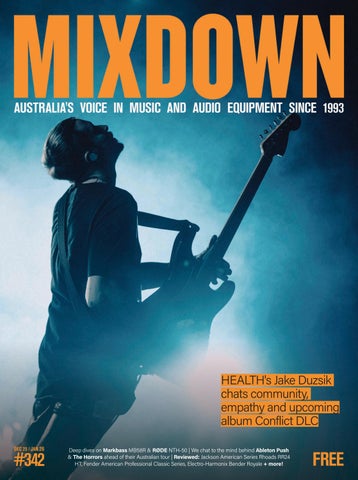
Mixdown 342

Page 1


Deep dives on Markbass MB58R & RØDE NTH-50 | We chat to the mind behind Ableton Push & The Horrors ahead of their Australian tour | Reviewed: Jackson American Series Rhoads RR24 HT, Fender American Professional Classic Series, Electro-Harmonix Bender Royale + more!

PROFESS I ON A L DJ PL A YE R

Expanded media support

Cloud and streaming playback, built-in Wi-Fi, NFC touchpoint, and USB Type-C port

Enhanced Hot Cue features with Touch Cue, Smart Cue, and Gate Cue

10.1-inch high-resolution touchscreen

Display up to 16 tracks, copy and paste to the search bar, and reorder tracks on-screen

Evolved reliability and usability

Rebuilt play and cue buttons and an expanded range of jog wheel tension adjustment

Global Tag List

Bring tracks from the cloud, streaming services, a USB drive, and PC/Mac into one playlist

New components and design take the CDJ’s sound to the next level

Giveaways

Product News

Tour News

Behind HEALTH’s success

The Horrors

Eric Gales

The mind behind Ableton Push, Jesse Terry

Rex, Eston and the Bass King legacy

In Focus: RØDE NTH-50

In Focus: Markbass MB58R

2025 Gift Guide

EDITOR

Anita Agathangelou

PUBLISHING DIRECTOR

Patrick Carr

DESIGNER

Kelly Lim

CONTRIBUTORS

Peter Hodgson, Tamara Issa, Benjamin Lamb, Brett Voss Christopher Hockey, Darcy Smart, Jacob McCormack, Elizabeth Acacia-Eyre

FOR ADVERTISING OR CONTENT PARTNERSHIPS advertise@mixdownmag.com.au

DISTRIBUTION distribution@furstmedia.com.au

ACCOUNTS accounts@furstmedia.com.au

PUBLISHER

Furst Media Pty Ltd

FOUNDER

Rob Furst

EDITOR'S NOTE

Every year around this time, I'm drawn to music with a 'Christmas' feel—the soft chime of bells in the mix, or the somehow festive sounds of the Yamaha PS-20 all over Beach House's Depression Cherry. We've all got our associations. This is mine, and it gets me into the holiday spirit every time.

The season has a way of making you appreciate craft—gifting something made with care, something built to last. Innovation, locally made gear, and the genuine care makers pour into their work thread throughout this issue. It's more than just "buy local", but knowing where your tools come from and who's putting their heart into building them.

While we're in the spirit of giving (and treating yourself), our curated gift guide covers every gearhead and musician in your life. Happy shopping, happy creating, and here's to the people who make the gear that makes the music.

DECEMBER 11 2.0.2.5.

LEARN TO DJ WITH ALPHATHETA

Mix, monitor and amplify your skills on the decks with AlphaTheta and Pioneer. Thanks to our friends at Jands, we’re offering one lucky reader the chance to win a DDJFLX2 DJ controller, AlphaTheta’s compact, 2-channel mixer. Along with a pair of Pioneer HDJ-CUE1 headphones and a pair of DM40D desktop monitors to practice with, you’d be hard pressed to start your DJ career off on a better foot.

Rehearse your mixes while monitoring transitions through your headphones, using the main speakers to gauge how everything sounds for the audience. The DDJ-FLX2 is compatible with various DJ applications and software, as well as music streaming services, so you’ll be up and running in no time.

Head to our Giveaways page and sign up for your chance to win.

Competition open to Australian residents only. Winners will be contacted via email and have three (3) days to respond or the competition will be re-drawn. Please note: all giveaways are only available to our Australian readers. By entering, you agree to receive marketing collateral from Mixdown and competition partners. For more info, check out our privacy policy.
Entries close midnight January 14th, 2025. Winner randomly drawn on January 15th, 2026.

Product News

The new Arturia KeyStep mk2: generative sequencing and expanded connectivity

CMI.COM.AU

Arturia has launched KeyStep mk2, an updated version of its compact controller and sequencer with generative sequencing tools, improved connectivity and a redesigned interface.

The 32-note keyboard now includes Mutate, Spice/Dice and real-time transforms for instant pattern variation. A bright OLED display and clickable encoder provide direct hardware control. Connectivity upgrades include USB-C, DIN MIDI I/O, assignable CV outputs, additional Mod 2 CV out, and a power switch.

The sequencer offers 8x more memory, unquantized recording, automation, undo, and pattern chaining. The arpeggiator adds generative modes for creating fresh melodies and progressions.

The mixer features seven 100mm capacitive touch faders with LED indicators, a 7-inch colour display, and 10 dedicated encoders for direct access to parametric EQ, compression, and effects. I/O includes 16 x 12 analog connections with combo XLR/TRS inputs, stereo outputs, and USB recording.

Built-in effects cover reverbs, delays, and compression, while the Alto Pro Mix Control App enables wireless mixing via Bluetooth LE from anywhere in the venue.

Epiphone teams up with Green Day's Mike Dirnt for signature Grabber G-3 bass

AUSTRALISMUSIC.COM.AU

Epiphone has launched the Mike Dirnt Grabber G-3, a signature bass celebrating the instrument that helped define punk rock's breakthrough, including its role on Green Day's landmark 1994 album Dookie.

The bass features a double-cutaway maple body, 34-inch scale three-piece maple neck, and choice of ebony or maple fretboard. Three Gibson G-3 pickups, handcrafted in Nashville, offer versatile humbucking combinations via a threeway toggle switch. Hardware includes a Leo Quan Badass II bridge, bone nut, and throughbody string anchoring.

Available in Silverburst or Natural finishes, each bass ships with a hardshell case.

Fender reunites with Johnny Marr for limited-edition Jaguar

FENDER.COM/EN-AU

Fender has released the Limited-Edition

Johnny Marr Signature Special Jaguar, a refined version of the guitarist's signature model that's been a best-seller since 2012. Built to mirror Marr's personal 1965 Jaguar, it features custom-wound Kent Armstrong lipstick pickups paired with Marr's personal wiring scheme for expansive tonal range. A custom gloss nitrocellulose black lacquer finish and vintagestyle tuners complete the classic aesthetic.

"The Jaguar has been central to my sound for nearly 15 years," said Marr. "This model feels classic but pushes players to explore new tones."

Lunacy releases Taps & Portals delay plugins designed with Benn Jordan

LUNACY.AUDIO

Lunacy has released Taps & Portals, a pair of creative delay plugins developed with producer Benn Jordan that push beyond conventional echo effects.

Taps is a multi-tap delay offering up to eight individual taps with independent pitch adjustment, tape emulation features, and smart feedback compensation that keeps levels manageable even at extreme settings.

Portals focuses on intricate feedback design within Lunacy's BEAM engine, building evolving delay networks with gate, delay, and feedback controls that can run free or sync to tempo.

Both include 50 presets each, plus 50 Parallax presets combined with BEAM's effects. Available in VST3, AU, and AAX formats for Mac and Windows.

Neumann announce VIS spatial audio app for Apple Vision Pro

NEUMANN.COM/EN-AU

Neumann has introduced VIS – Virtual Immersive Studio, a spatial audio app for Apple Vision Pro that lets producers control Logic Pro in three-dimensional augmented reality.

Instead of abstract 2D interfaces, users can now position sound sources in 3D space using hand gestures. Audio objects appear as visual elements in augmented reality, making mixing more intuitive and immersive.

VIS connects directly to Logic Pro on Mac and supports both loudspeaker and headphone monitoring. For headphone workflows, it includes RIME, Neumann's spatial audio plug-in supporting up to 7.1.4 playback with Apple Vision Pro's head tracking for realistic monitoring in any environment.

Warm Audio launches Tube Squealer and Throne of Tone overdrive pedals

STUDIOCONNECTIONS.COM.AU

Warm Audio has launched two overdrive pedals recreating legendary Japanese and British gain circuits: the Tube Squealer and Throne of Tone.

Tube Squealer features three selectable voicings—808, TS9, and TS10—each representing different eras of classic mid-gain overdrive. Modern additions include a mix knob for clean blending, pickup-voicing selector, and voltage booster for increased headroom.

Throne of Tone combines two British ampinspired circuits in a dual-sided pedal, each offering two voicings with low/high gain settings

plus boost, overdrive, and distortion modes. Independent presence controls and voltage doubling provide precise tonal shaping.

Voltage

Cable Co.

adds Grape colour to Vintage Coil guitar cable range

VOLTAGECABLECO.COM

Voltage Cable Co. has expanded its Vintage Coil guitar cable range with a new Grape colourway, bringing the total stock colours to eight.

Handmade in Windsor, NSW, each cable features ISO-COAT, a patented hermetic seal preventing corrosion, oxidation, and atmospheric attack. Built with 21 AWG oxygen-free copper and low capacitance (25–39 pF/ft), they deliver detailed sound with minimal high-end loss.

Premium G&H Bigfoot plugs and Cardas silver solder ensure clear signal transfer. Each cable includes a transferable lifetime warranty.

Gretsch and Abbey Road

Studios launch limited edition RS201 Studiomatic guitar

GRETSCHGUITARS.COM

Gretsch and Abbey Road Studios have created the Limited Edition Abbey Road RS201 Studiomatic, marking the first time Abbey Road's prestigious RS numbering has been awarded to a musical instrument. The RS201 designation places it alongside legendary studio equipment in Abbey Road's technical legacy.

Central to the collaboration is a built-in circuit inspired by the classic RS 97 Rumble Filter, originally designed by EMI engineers in

the '50s to remove low-frequency vibrations from recordings. This onboard filter allows players to roll off low-end frequencies on the fly, achieving recording-ready tone without external processing—solving the challenge of taming muddy low-mids whilst retaining clarity and warmth.

Built as a thin hollow-body with custom Filter'Tron pickups, the Studiomatic was developed through intensive collaboration between Gretsch and Abbey Road engineers, shipping components back and forth to meticulously refine each element specifically for studio recording.

Sydney Guitar Show debuts

March 2026 with 80+ brands and two days of performances

GUITARSHOW.AU/SYDNEY

The Sydney Guitar Show will make its debut on 7–8 March 2026 at Sydney Showground, bringing two huge days of guitars, gear, workshops and performances to Sydney.

Presented by the Australian Music Association, the event will feature over 80 major and boutique brands, including Fender, Gibson, Marshall, Ibanez, ESP, PRS, Cilia, Fenech and the launch of Mestric Guitars. Two stages of performances, a full workshop program, guitarmaking demos and family-friendly spaces round out the weekend. Super Early Bird tickets are on sale now until December 25. Kids under 12 attend free.

Split Enz, Earth, Wind & Fire and Sublime headline Byron Bay Bluesfest 2026

BLUESFEST.COM.AU

Split Enz will perform their first Australian show in more than 20 years at Byron Bay Bluesfest 2026, headlining the festival’s first artist announcement alongside legendary acts Earth, Wind & Fire and Sublime.

The 37th edition of Australia’s most awarded music festival takes place over Easter 11km north of Byron Bay.

TOUR DATES

ໞ 2-5 April: NSW

Of Mice & Men lock in May 2026

Australian tour:

“Get ready for the pits to open wide.”

THEPHOENIX.AU

Of Mice & Men are returning to Australia in May 2026, bringing their explosive live show alongside Japan’s metalcore prodigies Crystal Lake for what’s shaping up to be one of the heavier tours of the year.

“Australia holds a special place in our heart. The crowds there are unmatched in their passion and chaos,” says frontman Aaron Pauley. “After

the love we felt last year, we are stoked to return with a new show and tear the roof off once again. It feels like coming home with family. Get ready for the pits to open wide.”

TOUR DATES

ໞ 5th May: Magnet House, Perth

ໞ 7th May: Lion Arts Factory, Adelaide

ໞ 8th May: 170 Russell, Melbourne

ໞ 9th May: Manning Bar, Sydney

ໞ 10th May: The Triffid, Brisbane

Ella Hooper announces Summer Tour '26 with single “Growing Up Is Hard To Do”

ELLAHOOPER.COM

Ella Hooper kicks off 2026 with her Summer Tour '26, launching Saturday 10 January in Mansfield before hitting Tamworth, Sale, Archies Creek, Newcastle, Mangrove Mountain, Bathurst, Boyup Brook, Ocean Grove and Balnarring Beach. Festival slots include Queenscliff Music Festival, Boyup Brook Music Muster, Tamworth Country Music Festival, and Americana on the Bellarine. The tour coincides with her new Springsteen-inspired single Growing Up Is Hard To Do, a heartland rock anthem she promises "is going to go off live." Fresh from Killing Heidi's sold-out Reflector anniversary tour, Ella continues her country-Americana evolution.

TOUR DATES

ໞ 10 Jan: Music in the Vines at Delatite Winery, Mansfield VIC

ໞ 21 Jan: Tamworth Country Music Festival, Tamworth Hotel, NSW

ໞ 31 Jan: Live at the Bundy, Sale, VIC

ໞ 1 Feb: Archies Creek Hotel, Archies Creek VIC

ໞ 6 Feb: Stag & Hunter, Newcastle NSW

ໞ 7 Feb: Blues on the Mountain, Mangrove Mountain, NSW

ໞ 8 Feb: The Victoria Hotel, Bathurst, NSW

ໞ 13 Feb: Boyup Brook Country Music Muster, Boyup Brook, WA

ໞ 21 Feb: Americana on the Bellarine, Ocean Grove, VIC

ໞ 28 Feb: Peninsula Songriders Club, The Westernport Yacht Club, Balnarring Beach, VIC

Anthrax confirms four Australian dates for March 2026 tour

LIVENATION.COM.AU

Thrash metal legends Anthrax return to Australia in March 2026 for their first shows since 2019. The New York icons, part of thrash's "Big Four" alongside Metallica, Megadeth and Slayer, will deliver career-spanning sets across four cities. With over 10 million albums sold and four decades of uncompromising thrash, the band continues to prove why they remain one of metal's most vital forces.

TOUR DATES

ໞ 23 March: Fortitude Music Hall, Brisbane

ໞ 25 March: Hindley St. Music Hall, Adelaide

ໞ 26 March: Festival Hall, Melbourne

ໞ 28 March: Enmore Theatre, Sydney

Port Fairy Folk Festival announce third artist lineup for 2026

PORTFAIRYFOLKFESTIVAL.COM

Port Fairy Folk Festival has unveiled its third artist announcement for 2026, led by threetime Grammy winner Fantastic Negrito. The diverse lineup spans continents with Morocco's all-female gnawa ensemble Asmâa Hamzaoui & Bnat Timbouktou, Scotland's Dallahan, Catalonia's El Pony Pisador, Americana legend Jim Lauderdale and Hannah Cohen. Local acts include Feelds, Caisha Sprout, and The Southern Ocean Sea Band. They join previously announced headliners Iron & Wine, Kasey Chambers, Emma Donovan, and Willie Watson. The festival runs 6-9 March 2026 over Labour Day long weekend in Port Fairy, Victoria.

TOUR DATES

ໞ 6-9 March: Port Fairy, VIC

“We really respect our community”: Behind HEALTH’s success

HEALTH are always the first to poke fun at themselves. Their merch promotes “Sad Music For Horny People”, and their mantra of “YOU WILL LOVE EACH OTHER” is printed on free condoms handed out at shows. But behind the veneer of irony, HEALTH’s championing of modern industrial has created a global community far-removed from empty nostalgia and fetishising misery. It finds empowerment in empathy and refuses to be placid in the face of injustice.

Jake Duzsik, founding singer and guitarist, is fascinating in conversation. He flicks between utter reverence for music, and biting wit as a self-described “fucking luddite technological moron caveman.” I ask about his approach to vocal production, as his ethereal, androgynous voice is one of the core elements which sets HEALTH apart from its contemporaries.

“When the band started, it was one of those punk rock stories where ‘someone has to be the singer.’ I used to layer everything in a very shoegaze kind of Kevin Shields way, multi-tracked vocals and tucked them lower in the mix. As we’ve written songs that are more melody-forward, we just shied away from that quite a bit.

“Now, production-wise, it’s mostly just single track vocals with reverb and then I’ll layer it for a chorus so it’ll pop out more or something. But a lot of the affectation and the way I sing, that sort of gender-neutral androgyny... I can’t remember how many times, whether or not it’s in person or

on the internet, someone has said ‘I was sure that this was a female singer, that this was a woman, that this was whatever.’

“That’s just how my voice sounds, and it’s hopefully just a testament to the fact that more people are hearing the music. We’ve gotten a lot more exposure in heavy music communities, people that are listening to hardcore and metalcore and thrash and all these kinds of things. I think that they’re not used to hearing vocals like that at all, so they don’t know what the fuck to make of it, heads or tails.”

Intentional or not, Jake’s vocal style and lyricism don’t exist in a vacuum. Industrial, goth, and alt scenes are heavily populated by marginalised, queer, and neurodivergent people who see themselves in HEALTH. “It’s not something that we have curated or tried to take any ownership over. Because we really respect our community, especially our Discord which is so active. But the LGBTQ+ and particularly the trans faction of our fanbase is very supportive.

“Nothing is gendered or grounded. I want things to be appealing to anyone on a very emotional, empathetic level. There’s a lot of generally dysphoric, unhappy, struggling with existentialism and meaning (lyrics) that I have

“That’s just how my voice sounds, and it’s hopefully just a testament to the fact that more people are hearing the music.”

just had as a preoccupation my entire life. But I think that somehow those components, like the aggressive music, the goth scene, the industrial scene and the post-punk scene... It’s always been playing with the queer space and gender fluidity, and non-normative macho shit. Which is not, like, ‘metal’ y’know. We don’t present ourselves that way at all. All those things in conjunction with the lyrics and the vocal, I think, seems to create something that’s appealing in that way.”

For music entrenched in such dark themes, HEALTH’s tight-knit community provides aftercare, which dispels any notion of suffering being worshipped. The band has consistent messaging of “YOU WILL LOVE EACH OTHER” and “DON’T KILL YOURSELF” across most of its media releases. Jake finds this particularly important, considering the vulnerability of his writing and the current state of the world.

“When people were telling us that we had helped them through some sort of mental health crisis, the immediate reaction is imposter syndrome. You feel like ‘you can’t take my band that seriously.’ I mean I do internally, but after hearing it enough times you need to be respectful of it. Even though the songs are depressing lyrically, people are coming to see them as uplifting or somehow comforting.

“To me, the biggest thing is feeling seen and not feeling isolated or alone in those experiences. Because having had those kind of experiences myself, where you feel lost or hopeless, being able to commiserate with another human being who has had those same feelings is hugely therapeutic. I wanna write lyrics that I feel are true to me, but I think that it is important to juxtapose the bleakness with some form of humanism and empathy.

“No art is made in a vacuum. It’s a response to the environment in which it’s created, and the way that it’s viewed is also interrelated to the world state that you’re in. I know, like, there’s plenty of things that we have to be thankful for in terms of stability, having food and having shelter, but things are pretty bad.

“Especially in my country, they’re really bad. And they’re just getting worse. It’s terrifying. And then on top of that rise in authoritarianism and fascism, and suppression of human rights, there’s this concurrent phenomenon of our technology, our phones, destroying our brains. So, y’know, hard to think that those things don’t have a pretty significant effect on how people feel, and how they feel about music, and how they feel about having a place to go.”

Releasing December 11th, CONFLICT DLC completes the “Neo-Industrial Saga” started by RAT WARS in 2023. “It’s all the same sonic palette. In a weird way I would say that this record is just as sad, but more fun? It’s trying to simultaneously be melancholic as fuck, and also a party. Once this record’s done, that’s the door closing on the RAT WARS sonic universe.”

HEALTH's sixth album, Conflict DLC, is out Devember 11 via Loma Vista Recordings.

“You want a bit of uncertainty”: Nearly 20 years on, The Horrors are still keeping it interesting

It’s been 18 years since The Horrors arrived with their innovative, garagegoth LP Strange House. The genrebending outfit then undulated through a Mercury-nominated Primary Colours that boasted anthems such as ‘Mirror’s Image’ and ‘Who Can Say’. Follow-ups Skying and V continued the streak, racking up awards and critical praise.

Safe to say, The Horrors have defined the recent era of music, simply by provoking the boundaries of possibility in their musical craft. They played Dark Mofo in the depths of winter this year as a one-off show that marked their first tour in Australia since 2012.

The band is set to return in 2026, playing five headline shows in cities Meanjin/Brisbane, Warrane/Sydney, Naarm/Melbourne, Kaurna/ Adelaide and Boorloo/Perth. The tour will kick off in Meanjin on 10 April and conclude in Boorloo on Wednesday 15 April. Their Naarm show will fill the Northcote Theatre on Sunday 12 April.

They’re set to showcase tracks from their most recent album Night Life, which came to be from a new approach to the sonic craft and a new cohort of band members, centred around founders Faris Badwan and bassist Rhys Webb.

I spoke with Badwan about how Night Life is a representation of all that the band has been, fused with an expansive and explorative newness in their sound – a key ingredient to The Horrors' longevity.

“I suppose this album is just as much a

product of the time,” says Badwan. “With Night Life, we weren't just writing an album; we were also rethinking how the band would work. As Reece and I were writing the songs, we were picking up members along the way and figuring out how they would fit in The Horrors.

“But you know, The Horrors these days is really a new thing, because we've been the same members for nearly 20 years, and then we had this different challenge of having a whole load of questions that we maybe hadn't had to answer before.”

The new structure of the band had the opportunity to test out its dynamic in a live performance format this year, an experience that excited Badwan.

“We had such a good time playing in Australia for Dark Mofo. Being there as a group was fun. A big factor in why Joe and Tom left the band was because of the touring lifestyle. Not everyone wants to do that forever, which is understandable.”

Coming out to Australia affirmed The Horrors desire to play more shows and make up for their long absence.

“We hadn’t toured in Australia since 2012, which is really a crazy amount of time,” states Badwan. “We’ve made it a priority to be able to come back. I mean, the show itself at Dark Mofo was one of our favourites of the year. We were in this venue called The Odeon, which is an old theatre.”

Playing the Odeon shaped the band's approach to venue selection when booking their 2026 tour.

“With the venues in Australia, we always want to try and find places that look interesting. Sometimes it's possible, sometimes it isn't, but

we made it work with this upcoming tour. All the venues look pretty good, and some of them I've even been to before.”

This all comes with the band entering a new stage of life, a point where there’s an opportunity to acknowledge all that has contributed to their becoming thus far, as well as stepping into the newness of what lies ahead.

“I think it's cool to be aware of the stuff that you've gathered over the years. To be aware of that, and reflect upon it, but I think I’m most excited about what might happen in the near future. It would be so easy if it felt natural to do songs like the ones from our older albums, but it doesn't feel natural to kindly revisit a sound and just do that.

“It feels way more natural to figure out how we all can work together in our new dynamic and what that would naturally sound like. In some ways, it's kind of an easier task doing a new album because half the band is new, we just get in a room and see what raw materials we can get to mould something.”

It’s this intrigue and faith in the uncertainty that has propelled the band into the remarkable and complex project that became Night Life If you’re a fan of The Horrors, or you’re not yet familiar with their art, this upcoming tour will be the perfect way to connect with their music in a whole new way.

TOUR DATES

ໞ April 10: Princess Theatre, Brisbane

ໞ April 11: Manning Bar, Sydney

ໞ April 12: Northcote Theatre, Melbourne

ໞ April 14: Lion Arts Factory, Adelaide

ໞ April 15: Rosemount Hotel, Perth

Deconstruct your tone to an atomic level with the Atomic Cluster Spectral Decomposer.

Unlike any effect Electro-Harmonix has made before, this compact glitch and synth pedal breaks down your signal and interpolates it into a variety of musical and whimsical sounds. Using a unique algorithm to reduce the frequency resolution of your instrument, it creates a wide range of unique effects from rhythmic lo-fi glitch and auto-arpeggio tones to ambient synth pads and more!

Eric Gales: Letting go and letting it flow

Few players embody the pure joy and emotional depth of guitar quite like Eric Gales. Rooted in the blues but never confined by it, Gales weaves harmonic colours and rhythmic twists into something unmistakably his own. It's expressive, fearless, and effortlessly fluid.

As he prepares to visit Australia for his first-ever full national tour following several unforgettable festival appearances, Gales is riding the momentum of his powerful recent album Crown and the deeply personal A Tribute To LJK record, made in honour of his late brother Little Jimmy King. Both albums showcase the depth of a player who channels history, heart, and sheer feel through every note, and who plays with the kind of relaxed confidence that only comes from living and breathing music since childhood.

Gales’ guitar tone is so pure, so clear, and so full of detail and depth. Key to this sound is his signature Seymour Duncan Custom Shop pickups, a project that came to life through Seymour Duncan pickup guru Maricela ‘MJ’ Juarez. “That was MJ’s idea,” Gales says. “Seymour Duncan had been wanting to do a signature pickup with me for a while, and I just told her what I was looking for. She made it happen. They’re basically single-coil Strat-style pickups, but we dialled in something that really captures my sound.”

Anyone who’s seen MJ at work knows her gift. I tell Gales that MJ once built me a pickup based on the description “sounds like sunshine through a glass of beer and tastes like crème brûlée,” and she just said ‘Okay, I know how to do that.’ Gales laughs. “Yeah, that’s her. She just gets it!”

He was chasing a tone that occupied that “vintage Strat zone—fat, expressive, vibey,” he says. “I didn’t over-explain. I just said, ‘This is the sound I want.’ She sent a few options, I picked the ones that spoke to me, and that was it. Off to the races.”

That clarity and touch sensitivity extend through his entire signal chain, including his DV Mark “Raw Dawg” EG signature amp. Gales first encountered DV Mark amps in a recording studio and was immediately struck by their tone. He ended up recording his entire Middle of the Road album exclusively with DV Mark amps, which led to a collaboration with DV Mark founder Marco De Virgiliis to develop a signature head tailored specifically to Gales’ needs.

Now, with those tones under his fingers, Gales is preparing to bring them to Australian audiences on his first full national tour. “This will be my first actual tour there,” he says. “We’ll be playing a lot of material from the new record. The band’s sounding great, and I can’t wait to see how the Australian audiences respond.”

It won’t be his first taste of local crowds— Gales has already graced the stages at Byron Bay Bluesfest and the Broadbeach Festival. “The energy was beautiful,” he says. “It really set the stage for coming back with the full band for this multi-city run—spreading the music and good vibes all over.” I tell Gales Australia’s love of the blues runs deep, often blending with our pub-rock grit. He’s eager to tap into that shared energy. “That’s great to hear, man,” he says. “We can’t wait.”

Before he hits Australian soil, Gales will also appear at guitarist Nuno Bettencourt’s upcoming guitar camp, joining a lineup that includes Steve Vai, Matteo Mancuso, and Rick Beato. “Dreamcatcher—they organise a lot of those camps—reached out and said Nuno wanted me involved,” Gales says. “I said, ‘Absolutely.’ We got it all sorted just in time for the announcement. I’m looking forward to it—it’ll actually be the first time Nuno and I meet in person.” That’s surprising, considering both players came up in the early ‘90s. “Yeah, I’ve known about him since back then,” Gales says. “I’m looking forward to meeting and hopefully jamming with him. It’s a killer lineup.”

He’s quick to praise Nuno Bettencourt’s efforts to spotlight other players. “Absolutely. I’m honoured to be part of it,” he says. “It reminds me of Buddy Guy—he’s always wanted to see the

music live on. I’ve talked to Buddy about that. His wish is for the next generations not to let it die. The blues might not always be front-and-centre in the mainstream, but it’s always there. And it’s in good hands—guys like Kingfish and the younger generation are carrying it forward.” Gales doesn’t box himself in as a blues artist, though those roots run deep. “I pull from a lot of styles,” he says, “but blues and gospel are the foundation of who I am. Without that, something would be missing.”

For Gales, everything comes back to emotion. “I’m a very emotional player,” he says. “A lot of memories and feelings pass through me—things I’ve been through, people I’ve lost, random flashes that spark something deep. It all fuels the emotion behind the notes. Even when I’m just playing rhythm, it can get pretty intense.”

Improvisation is about surrender, he says. “When you reach that place where you don’t have to think—that’s magic,” he explains. “If I think too hard, I get in my own way. The best playing comes when I let go and just be.”

That instinct was there from the beginning, coming from a musical family and feeling encouragement from all around. “Honestly, from the moment I picked up a guitar at four years old, I knew I loved it,” Gales says. “My whole family played—music was everywhere—so it wasn’t something I had to question. It was just what I was meant to do.”

That sense of destiny fuels everything he does, including his recent Little Jimmy King tribute album, a deeply personal project honouring his late brother. “That record had been in my mind for a while,” Gales says. “It felt like the right time to honour him. It turned out impeccable, and I’m really proud of it.” Before wrapping up, I tell Gales that his brother would be proud. He pauses for a moment. “Thank you, brother,” he says softly. “That means a lot.”

As he prepares to bring his fiery tone and open-hearted energy to Australia, Gales is focused on one thing: connection. “I’m really looking forward to coming over, sharing the music, the vibes, and having a great time with everyone,” he says. “I can’t wait.”

DJ 300 PRO X CLUB

On-ear

NEW

Over-ear

MADE TO ADAPT

The DJ 300 PRO X CLUB gives you the flexibility your workflow demands: with a modular 2-in-1 system that lets you switch between on-ear and over-ear – depending on the environment, your setup or personal preference.

Foldable – Durable – Customisable Supplied with both size earpads, you’re ready to go!

The mind behind Ableton Push, Jesse Terry

Jesse Terry has been shaping how electronic musicians create for over a decade. As the mind behind Ableton's Push controller series, he turned ideas sketched out in Lego prototypes into one of the most influential pieces of hardware in modern production. We sat down with Terry to talk about Push's evolution from beatmaking tool to standalone instrument and the challenges of designing expressive hardware.

What was the original vision for Push 1, and how has that evolved through to the current iteration?

The first ideas for Push 1 came after we had done the APC40 with Akai Professional. I love the APC40 for clip launching and performance, but I really wanted something that worked well with Live’s drum racks. I originally was drawn to Live for the audio warping, but I missed the handson tactility of the MPCs and things I had started making beats on.

As I explored different ideas, I wanted to show samples, and I wanted it to be standalone, even from the beginning. But the realities of making a hardware product for real quickly showed me the importance of cutting the project into steps. If we had gone straight to what we wanted first, it would have taken more time and investment than was realistic, and it probably never would have happened.

I focused the first drafts of Push as a beatmaking tool for both playing and sequencing drum racks, to combine two of the great methods of previous hardware. One day, early on, our founder/CEO Gerhard (Behles) came to me and said, “it should also be able to create melodies and harmonies.”

While this was daunting at first and made me throw away a lot of work, I quickly saw how exciting it could be to make music with an isomorphic grid. And then the ‘aha’ moment came when I started to explore making it able to be diatonic – to fold out the wrong notes of the selected scales.

Over time, we tried to make sure that everything on Push worked without looking at your computer – while it was not yet standalone, it did help you to focus away from distractions.

When Push 1 came out, we thought we had a great new instrument on our hands with some

things that hadn’t been done before. Yet I was not satisfied with the display—I wanted to be able to see and manipulate samples. Push 2 dove deep into sampling workflows, and also utilised the new colour display to make our devices feel like real hardware, with custom UIs for many of our effects and instruments.

While making Push 2, we were beginning to think about how we could actually make this product standalone. We thought about writing everything from the ground up, and we thought about trying to port Live to Linux, so we could make it run on our dedicated operating system. At the same time, we wanted it to feel even more like an instrument. We were certainly influenced (again) by Roger Linn’s work with the Linnstrument and other products coming out with MPE.

We wanted to bring the expression, feel and nuance of traditional musical instruments to musicians who make music with electronic devices. Both the standalone feature and making our own expressive pads took many years.

“It shifts your focus from thinking about the machine to thinking about the music.”

When you were designing the first Push prototype, did you have any idea it would become such a cornerstone of electronic music production? What were those early days like?

I didn’t imagine this scale. I believed in the idea that there was a gap to fill, a desire among musicians for more direct, expressive control over Live. But whether it would become a “cornerstone"—that magnitude—was not a certainty. I guess I was quite driven by what I wanted back then, where now I try to think about what different user groups and personas are looking for.

Before release, we had been told by a retailer that the APC40 would sell a few thousand units a year, and then it was wildly successful, so we felt we had more we could do. There were only a few of us early on, and I had no idea how to make a prototype. It wasn’t as easy as it is nowadays, with 3D printers and maker spaces.

Our Lego prototype (and the software work our developers did to make it functional) helped to make our pitch to make the product. At that point, we went to our friends at Akai Professional to work on the hardware engineering, and an industrial design company called Made Thought to refine the looks.

Those early days were messy, exploratory, and full of trial and error. We were juggling firmware, UI prototypes, pad sensors, latency, vendor constraints, and manufacturing tolerances.

I remember early builds where the pads were inconsistent, or the encoders lagged, or buttons would double trigger. We were pushing boundaries in hardware, mapping it to software that was evolving too.

Push has always felt like it bridges the gap between hardware instruments and software controllers. How do you approach that balance when designing new features or iterations?

That is a central tension. On one side, you have the flexibility of software (patchability, upgrades, complexity). On the other, you have the constraints and delights of hardware (tactility, latency, fixed affordances, immediate feedback). Each new feature has to be weighed: does it keep the instrument feel, or does it pull you back into menus, into visual strain, into “looking” instead of “playing”?

In practice, we do this by prototyping early and often, with real users, real sessions. We try to build “fail fast” experiments: a candidate feature that might become a distraction, we put it on a prototype and see if users abort it. We observe whether people get stuck in menus, whether their hands leave the surface too often, and whether the cognitive load is too high.

We also respect hardware constraints. For instance, adding more controls is tempting, but every control adds cost and complexity. We need to balance what is up front and what might be deeper in a menu. When possible, we don’t want to hide everything behind layers; that kills the tactile immediacy.

How do you decide what stays and what goes when moving between Push generations? There must be features that don’t make the cut — how do you navigate those decisions?

When possible, we try to bring new features to older versions of Push. We feel a responsibility to make products that last a long time, as we know that keeping electronics out of landfills is the area we can have the most impact on sustainability. And we all hate planned obsolescence.

Some features can surprise us in their complexity - I remember adding support for 16 macros on Push 1 took us much longer than we expected to design and develop. However, adding new features to older hardware is not always possible, depending on the physical features of the interface. For example, we can’t display samples on the LCD screen of Push 1, and we can’t implement features that use the jog wheel, audio interface or expressive pads of Push 3 on Push 2 or Push 1.

Our goal is at least not to break older versions of Push, and when possible, to add functionality if it is not prohibitively expensive. It’s always a negotiation as Live continues to get new features with each update.

For someone who's never used Push before, what's the one thing you'd want them to understand about how it changes the musicmaking process?

It shifts your focus from thinking about the machine to thinking about the music. Instead of

clicking, dragging, and menu hunting, you stay in the moment, in your hands. Push invites you to improvise, to explore, to mutate ideas quickly. It makes the musical ideas more immediate—you hear the result as you press, and you stay in the loop with fewer interruptions.

It also reframes “editing” not as a separate pass but as part of creation: sliding pads, shaping with touch, turning knobs, tweaking modulation while notes play. It encourages you to make musical decisions earlier, to iterate fast, to play first, and fix later.

With AI increasingly capable of generating music and assisting with production, where do you see the role of hardware controllers and instruments heading? Does that shift change how you think about designing tools like Push?

I see a future where AI is a collaborator, not a replacement. The more capable AI systems become, the more valuable the interface becomes: how you guide, tweak, redirect, sculpt, and express.

While I originally wanted to be a professional musician, I make most of my living as an instrument maker. So perhaps it’s a bit easier for me to understand where music fits in my life. It is my meditation and how I relax, and I can’t really live without it and get grumpy when I don’t have time to make music. But I have lost production work to AI already, so I am very aware of how this would be for people who make their money from music primarily.

I’ve seen great ways to use AI to support making music. I use it for EQing, mastering, to get ideas for a different section of a song, or even to sample from. But we are here to make art. AI is supposed to help us be more creative, not be more creative than us. Hardware comes into this, as things like Push capture the feel of your playing—the micro adjustments of rhythm, tone and timbre. This is the kind of music I want to make and want to hear.

I heard a famous producer say recently: if you use AI to make music, jump in the river. If you use AI to make money from music, swim to the bottom of the river.

When designing Push or its successors, I think more about how to expose AI-assistive features in unobtrusive ways — suggestions, presets, “smart defaults”—but always allow override, always allow the musician to break rules. I try to envision: what if the system could suggest but not assume, could help without taking over.

In short, AI changes what “assistance” looks like, but I believe hardware controllers will remain central because they ground decisions in the physical.

Rex, Eston and the Bass King legacy: Inside Australia’s forgotten amp empire

There’s a particular smell old valve amps get after decades of sitting idle. Warm dust, that faint tang of previously overheated transformer, maybe a hint of nicotine and beer from gigs long forgotten.

Speaking over the phone with Joe Lamberti Jr about the amplifiers his father, the late Joe Lamberti Sr, once built in Melbourne under the Rex and Eston brands is like breathing life into those amps again.

To understand why these amps matter, you need to understand the man behind them.

In the 1930s, the Lamberti family migrated from Italy to Australia. Joe Sr, was about 11 at the time in a country that didn’t yet know it was about to fall in love with electric guitars.

After school, he pursued what was, at the time, the bleeding edge of modern technology: radio engineering.

“Back then, radio tech was like what people think of AI now,” Joe Jr tells me. “It was the wildest thing you could do.”

Joe Sr landed a job at Astor Radio in South Melbourne. This was deep in the era when valves ruled everything—radios, record players, PA systems—so the future amp builder was learning on the very gear that would shape his career.

After nearly a decade at Astor, he went into business with his brother, and in 1946—like so many post-war companies—they officially launched Lamberti Brothers. A retail arm called General Music followed, and behind it all lay their small but ambitious manufacturing division.

The guitars, banjo-mandolins and imported instruments kept the business running, but the amplifiers were Joe Sr’s passion.

“He wasn’t a guitarist,” Joe Jr reminds me. “He was a radio technician. To him, an amplifier had to amplify. Clean, reliable, over-built. He didn’t like amps that were distorted.” That philosophy would shape everything Rex and Eston ever produced.

The earliest Rex amps were tiny six-watt single-ended practice units. Joe Jr laughs at that now: “They probably weren’t even six watts.” They quickly expanded into radiograms, big home entertainment units with TV, record player and radio all built in, and eventually into a line of guitar and bass

amplifiers that would peak with the mighty Rex Bass King.

The 100-watt version was head-only and loud enough to be used as a PA. Like everything Joe Sr built, they were rugged. “The cabinets were solid. The chassis were thick. The switches were military-grade. Transformers were huge, made by Radar TV Replacements in Coburg. They just don’t die.”

When the Lamberti family officially closed the manufacturing operation in the mid-’70s, something strange happened: they simply locked the door and walked away.

“There were about a hundred amps left in the old workshop. Cabinets, chassis, vinyl, everything. They basically shut the doors around 1975 and didn’t reopen them until the ’90s.”

The reason is painfully familiar to anyone who knows Australian manufacturing history. At the time, wages were rising dramatically, and small makers suddenly couldn’t compete with imports. “My father always talked about it,” Joe Jr recalls. “‘You can’t make anything here anymore!’ He said it all the time.”

When the doors finally opened again around 1996, the room was a time capsule. Stacks of Bass Kings. Rolls of vinyl in weird psychedelic colours from long-defunct upholstery suppliers. Speaker cloth. Transformers. Handwired chassis stacked like bricks.

It was the kind of archeological discovery amp nerds dream about.

After Joe Sr passed away, Joe Jr began collecting and restoring the amps. Back then, you could pick up a Mascot, which was the little six-watt darling of the range, for about fifty bucks. Today, they crack a grand easily. The Bass Kings, meanwhile, have caught the attention of indie players, collectors, and anyone chasing that clean-but-full vintage Australian sound.

One of Joe Sr’s former technicians helped resurrect the line. Using leftover parts and newly wound transformers, they rebuilt a batch of Bass Kings, Mascots and Super 20s. These reissues weren’t nostalgia pieces but genuine continuations of the original lineage, just with better speakers and even tighter tolerances.

“They were absolutely incredible,” Joe says. “Real Jensen speakers, beautiful workmanship. I bought as many as I could to help him out.” A handful of these amps are still floating around the collector market, but most are tucked away in private studios or treasured by players who know exactly what they’ve stumbled upon.

Manufacturing took place in a row of Victorian terraces behind the Lamberti family’s main music store. It wasn’t a big operation, but it was an efficient one. More importantly, it was a family one.

“We were always involved,” Joe Jr says. “Dad would bring home rolls of wire and sit me and my brother down. ‘Cut a hundred lengths of this,’ he’d say. We’d strip the ends and bundle them up. Those went straight into the amps.”

Even late in life, Joe Sr couldn’t help himself. Someone would drop off a broken six-watt Rex with tremolo, and he’d disappear downstairs for nights at a time, digging through drawers of old components. “He’d fix it for nothing,” Joe says.

“He just loved it.”

If you work in a guitar shop long enough, you hear stories, meet collectors, and see the spark in a young guitarist’s eyes as they discover some obscure detail about a piece of gear made decades before they were born. Joe’s right: the younger generation wants the history as much as the sound. And these amps have both in spades.

They are relics of a bygone era, not because they’re outdated, but because they come from a time when Australia built things, hand-wired things, experimented boldly and backed local talent at every level of the supply chain. They tell the story of migration, family business, the rise of rock ’n’ roll, and a country coming into its musical identity.

Most of all, they carry the fingerprints of a man who believed an amplifier should be clear, powerful, beautifully made and built to last forever.

Turns out he was right.

In Focus: RØDE NTH-50

WORDS BY ANITA AGATHANGELOU

There’s something reassuring about gear that’s made locally, especially from a well-known, established brand like RØDE. The Australian company has built its reputation on designing and manufacturing professional audio equipment, and the NTH-50 Professional On-Ear Headphones keep that tradition going strong.

While many audio companies have long since moved production overseas, RØDE remains committed to local manufacturing, attention to detail and, most importantly, quality builds.

Evolving from Freedman Electronics, founded by Henry and Astrid Freedman in1967, RØDE has cemented its name as one of the most respected outfits in professional audio.

What started as a small operation in Sydney repairing and distributing audio gear has transformed into a global behemoth, earning its reputation through professional-grade quality and a relentless drive to innovate.

The company first gained traction through their NT1 and NT2 microphones, which became studio staples in the ‘90s. They offered professional-quality audio gear at prices that made sense for both commercial studios and home recordists—an ethos that has defined RØDE throughout the years.

Expanding beyond microphones into audio interfaces, wireless systems, and video production tools pushed RØDE into new territory, while staying true to its roots. The same, it can be said, for its impressive headphone range.

RØDE’s latest expansion into studio headphones is the on-ear NTH-50, joining the

over-ear NTH-100 in their monitoring lineup.

Engineered from the ground up by RØDE’s dedicated headphone innovation team in Germany, and manufactured locally in Sydney, these on-ear headphones are geared toward DJs, sound engineers and creators who require reliable monitoring in challenging environments.

The NTH-50 features a custom-engineered 40mm dynamic driver, housed in an innovative resonant chamber. While that might sound like a bunch of jargon, it’s a pretty important detail. This design delivers impeccable sound clarity, delivering accurate frequency response with ultra-low distortion. What you’ll hear is balanced sound that combines natural bass with detailed mid-range and crisp highs—delivering remarkable clarity across the entire spectrum.

Passive noise isolation rates -21 dBA, which translates to a huge reduction of external noise without active cancellation technology. This makes a world of difference while monitoring in loud environments and for preventing sound bleed during recording sessions.

High SPL capabilities also mean the NTH-50 can generate impressive volume when necessary. These headphones will still sound pristine when competing with stage volume, street noise, loud chatter—you name it.

Everyone knows that while sound quality is of the utmost importance, comfort matters too. No one wants sore ears.

RØDE has addressed this with a lightweight build and a contoured headband that includes an integrated fontanel (the soft spot at the top of your head) recess. This thoughtful approach distributes pressure evenly and adjusts to different head sizes while remaining comfortable for people who wear glasses. Premium memory foam padding lines the earcups, conforming to the shape of your ears while maintaining breathability to reduce heat build-up.

With the NTH 50s, RØDE continues to show its commitment to longevity. Masterfully crafted to withstand the rigours of daily professional use, its lightweight feel is complimented by premium aluminium faceplates and a scratch-resistant matte black coating, ensuring supreme durability through regular use. Colour-coded earcup identifiers also assist with quick orientation in low-light environments—a small detail that proves useful during late-night sessions and gigs.

The detachable cable features a locking connector with dual-sided attachment options, providing flexibility for different setups. A premium 1.7m double-coiled monitoring cable comes included, along with a storage pouch and 3.5mm to ¼-inch adapter for professional connectivity.

The new NTH-50s are fully compatible with the NTH-100 accessory range, including modular cable options, while the optional NTH-Mic can transform the headphones into a broadcastquality headset for podcasting, streaming and content creation.

The NTH-50s excel in situations where onear headphones make more sense than over-ear designs. DJs will benefit from the combination of isolation and the ability to quickly move one cup aside while maintaining the other. The portable form factor and reliable isolation works for sound engineers working in the field. Producers and mixers will value accurate monitoring without the bulk of larger over-ear designs.

RØDE’S commitment to quality continues to shine. With the NTH-50s, they continue to prove that high-quality audio gear can be designed and built locally while remaining competitive globally.

RØDE's NTH-50 Professional On-Ear Headphones are available now. Learn more at rode.com/headphones/on-ear/ nth-50

MON G3 SERIES
ANNY® SERIES
MAUI® G3 (MIX) SERIES
ICOA® PRO SERIES
ICOA® SERIES

In Focus: Markbass MB58R

There's a reason you see them in every backline across our great state. The Markbass continues to be a quiet giant in the world of the four-string, always being a versatile piece of gear and always managing to cut through the mix.

The Markbass story started in the eyes of young Marco De Virgiliis, the founder and mastermind behind Markbass, who entered the music world with an engineering background, working with advanced materials. This technical know-how is what’s helped Markbass stay at the forefront for so many years.

Markbass has long been the quiet giant in the bass world—instantly recognised by those who know great tone, lightweight builds and unmistakable Italian engineering. And now, with the MB58R series, that legacy has taken a massive leap forward. Players who adopt MB58R gear don’t just want volume; they want clarity, modern performance, and reliability without the weight penalty that used to define serious bass amplification.

For years, Markbass has been a go-to choice in Australia and around the world; there’s a reason why it’s the choice of bass legends like Marcus Miller, Joe Dart and Michael League. Bassists of all types have been switching over to the brand’s forward-thinking materials and designs. In an industry where cheap materials and mass production often overshadow innovation, Markbass still feels like a passionate specialist operating in a very big arena.

MB58R Cabs

The Markbass M58R Cab holds the key to any Markbass product, the neodymium magnets,

the most powerful one out there, making sure the best bass tone is achieved. The magnets are housed in an ultra-lightweight resin-based enclosure, making it easier to lug up any dodgy dive bar staircase into a green room. This material is engineered to reduce resonance without adding mass, allowing the cabinets to stay rigid and responsive even at high volume.

There are a few options out there for whatever you need. Whether you’re looking at the 1×12, 2×10 or 4×10 models, each cab is tuned for an efficient low-frequency response with focused mids and clear, controlled highs. Markbass tweeters—piezo or hi-fi, depending on the model—add definition without harshness. Despite their size and weight, these cabs deliver mammoth depth and intricate projection. The lightweight design doesn’t compromise output; instead, it allows the cabinet to maintain tight, fast transient response and consistent tone across any sort of playing environment.

MB58R Heads

The latest Little Mark and Marcus heads pair seamlessly with the MB58R cabinets. The former is named after Markbass pioneer and music icon Marcus Miller; a result of a collaboration between De Vigiliis and Miller. Like all Markbass heads, you’ll be set with natural sound, and strong punch and dynamics - but this time we’ve been treated with a new tone setting, with 5-band EQ on EQ1,

from Ultralow to High and on top of that, an Old School and Millerizer filters featured on EQ2, tailored from the man himself, allowing to obtain sounds you really can’t find anywhere else.

The Little Marcus also features a brand new bi-band limiter, which responds unlike many other limiters out there—it gives the high end of your playing a little bit more room to breathe, and allows for a more natural timbre.

The Little Mark sits in a similar world as the Little Marcus. Complete with a bi-band limiter, this head is built ergonomically, with all the connections and controls on the front panel, leaving the rear for speaker outs and power, making things a little bit easier and prettier. The head also contains a mute switch and a three-way rotary switch, the latter featuring options of a Flat, Scooped or FSW (Footswitchable) EQ options. As is the Markbass way, it’s all housed in an ultralight new chassis in ABS (V0), weighing only a couple of kilos, but able to withstand the biggest bass players out there.

Both these heads feature the staple of the Markbass world: lightweight construction and quality builds that can take all the intricacies of modern playing.

MB58R Combos

If you’re keen for something easier to manage, look no further than Markbass’s range of combos, coming in a variety of types to fit any budget. The Minis are stocked with a 1x12" Markbass classic ceramic speaker and a new piezo tweeter, showing Markbass know size doesn’t mean you’re left without anything. The Mini also only weighs around 10kg, which means there’s no need to dread your set up. Designed for players who want grab-and-go convenience, this combo delivers full-range bass tone with impressive low-end presence for its size.

On the other side of the coin, we’ve got the MB58R CMD 102 PURE, which features 2x10" Markbass Neodymium custom speakers delivering a tight low end and crisp, fat sound thanks to the new hi-fi tweeter.

The internal cabinet tuning keeps airflow smooth and eliminates unwanted vibration, even when running the combo hard. Add an extension cab, and the system scales effortlessly for rehearsals, small gigs, or full-band stages. The combos don’t end there. Check out the rest of the MB58R combo range here. The MB58R series represents Markbass’s most advanced offering yet. Giving us the best parts of their range, an ideal balance of tone, weight, and real-world reliability. Their focus is clear: reduce weight, improve efficiency, and maintain the clarity and punch the brand is known for.

But don’t be fooled. Lightweight doesn’t mean lightweight sound. Head out and try a MB58R and you’ll hear exactly why this series is becoming a new standard for modern bass players.

WORDS BY BENJAMIN LAMB

2025 GIFT GUIDE

PRODUCT: Warm Audio Foxy Tone BOX LE Red

DISTRIBUTOR: Studio Connections

RRP: $255

RECOMMENDED FOR: Guitar players pursuing warm, fuzzy tones... literally.

FEATURES:

The Warm Audio Foxy Tone Box is a faithful recreation of a famous fuzz circuit, known for its use of octave effects before the fuzz for ear-catching solos and sound. The Foxy Tone Box, especially cool in limited edition Red, features simple controls for Volume, Sustain and Fuzz, as well as an Octave Sustain toggle to turn the octave effect on and off. It's an iconic sound and a great tool for every player.

PRODUCT: ELFA Akai MPK Mini Mk4

PRODUCT: ELFA M-Audio M Track HD Producer Pack

P Electric Factory

RRP: $349

RECOMMENDED FOR:

FEATURES:

Budding producers, songwriters, engineers and musicians. The M-Audio M Track HD Producer pack includes everything you need to start producing and recording music.

The heart of the M-Audio M Track HD Producer pack is the M-Track Duo HD audio interface that employs two inputs and two outputs that connect via USB-C to your computer and DAW. Monitor your work with the M-Audio HDH41 monitoring headphones, the packs also including an M-Audio M100 studio condenser microphone. The pack includes M-Audio HDH41 monitoring headphones and an M-Audio M100 studio condenser microphone. Record latency free with the M-Track Duo HD’s ‘Direct Stereo/ Mono’ output toggle.

DISTRIBUTOR: Electric Factory

RRP: $179

RECOMMENDED FOR: Musicians and producers looking for an on-the-go solution without compromising on quality, playability or features.

FEATURES:

The Akai MPK Mini MK4 is just that—a mini version of Akai’s famed MPC workflow, with a built-in keyboard. Along with an updated keybed, the MPK Mini MK4 features eight push/turn rotary encoders and eight velocity and pressure-sensitive RGB backlit MPC pads.

The unit features a full-size MIDI output and ¼” TS sustain pedal input, connecting to your computer via USB-C.

PRODUCT: Neumann RIME Immersive Binaural Monitoring Plug-In

DISTRIBUTOR: Neumann

RRP: $189

RECOMMENDED FOR:

Recording, mixing and mastering engineers and those looking to dip their toes into immersive sound.

FEATURES:

The Neumann RIME Immersive Binaural Monitoring Plugin puts you into a virtual mixing room as a single source of truth. It's designed and calibrated from a purpose-built studio room that employed reference-quality Neumann equipment. The plugin, when coupled with Neumann headphones, allows you to immerse yourself in sound and check your mixes on systems up to 7.1.4.

PRODUCT: ELFA PRS Guitars

Rechargeable Clip-On Tuner

DISTRIBUTOR: Electric Factory

RRP: $65

RECOMMENDED FOR: Guitar and bass players of all types, levels, genres and ilks!

PRODUCT: Alesis Drums NITROAMP

DISTRIBUTOR: Electric Factory

RRP: $159

RECOMMENDED FOR: E-kit devotees and drummers practicing at home.

FEATURES:

Rechargeable Clip-On Tuners are an accurate and portable way to keep your instrument tuned. The battery-less tuner charges via USB and a single charge will last weeks, the strobe tuner design providing more accurate tuning than other display options, the LED screen itself being easy to read on all stages regardless of lighting.

FEATURES:

An electronic drum kit is a great tool for practice, songwriting, production and more, though the use of headphones to monitor your performance can be stifling. The Alesis Drums NITROAMP is 70-watt solution that mounts right onto your drum rack, allowing you to feel the great sound of your Alesis kit. Clean headroom and crisp, powerful sound is available via the TRS jack that connects directly to your Nitro drum module.

PRODUCT: Warm Audio Pedal 76 LE Blue

DISTRIBUTOR: Studio Connections

RRP: $449

RECOMMENDED FOR: Equally as good for bassists and guitarists.

FEATURES:

Studio compression is a staple, and what better way to tame those transients than on your pedalboard itself? The Pedal 76 features input and output controls to adjust how signal is being compressed, as well as to make up/ trim any gain after the compressor takes ahold, with further tweaking available via Attack and Release. The top panel of the pedal offers comprehensive I/O for sending and receiving world-class sound.

PRO AUDIO FOR ALL OF LIFE’S STAGES

The days of sacrificing sound system power and performance for portability are over. The JBL EON ONE Compact packs professional grade speakers, a full featured 4 channel mixer and Bluetooth control into our most compact battery powered PA yet, weighing in at under 8 kilograms. Whether you’re a singer/songwriter, DJ, presenter, fitness instructor, or you just want to enjoy amazing sound on the go, get ready to #PlayAnywhere with JBL EON ONE Compact.

PRODUCT: Neumann NDH 30 Headphones

DISTRIBUTOR: Neumann

RRP: $1229

RECOMMENDED FOR:

FEATURES:

Music producers, mixing and recording engineers who need a clinical and transparent way to monitor for editing, mixing and mastering.

PRODUCT: Neumann Miniature Clip Mic System MCM

DISTRIBUTOR: Neumann

RRP: $1349

RECOMMENDED FOR: Live sound engineers and close miking applications.

PRODUCT:

The NDH 30 headphones are an award winning set of open-back studio monitoring headphones. Built around a 38mm neodymium transducer, the NDH 30s reproduce every ounce of detail from 12 up to 34,000Hz with high-sensitivity, powerful sound for accurate and clear monitoring.

DISTRIBUTOR: Studio Connections

RRP: $269

RECOMMENDED FOR: Blues players, rockers, metal heads and tone aficionados.

FEATURES:

The Neumann Miniature Clip Mic System is an ingenious way to spot mic instruments, intended for use in live applications but equally viable for the studio. While harnessing an electret design, the MCM System provides a true, clear and transparent sound in a robust design, each layer of the design intended for optimal performance as part of the whole system. The tidy gooseneck design ensures optimal miking while keeping the mic out of the way.

PRODUCT: Warm Audio Throne of Tone

DISTRIBUTOR: Studio Connections

RRP: $399

RECOMMENDED FOR: Queens, Kings, and those in the pursuit of tone royalty.

FEATURES:

The Warm Audio Tube Squealer borrows from three screamin’ overdrive circuits, all packed into one pedal. Toggle between 808, TS9, and TS10 settings, and have total control over drive, tone and level, as well as a fourth knob to control the mix of the added sound. An additional pickup selection switch can help optimise the signal for your guitar. These circuits have been used extensively by guitarsists to add bite and snarl, while tightening up the low end of your tone, while retaining the character and dynamic.

FEATURES:

The Throne of Tone features two mid-gain circuits side by side, perfect for pushing an already driven amp, or dirtying up a clean sound. The pedal includes an input and output, as well as a send and return, allowing you to split the two sides of the pedal if you wish. It also features a switch between the two sides, allowing you to adjust which circuit comes first. Independent controls allow total tweaking, while a robust chassis is ready for stompin’, gig after gig.

DEFY

PRODUCT: Neumann-MT 48 Premium Audio Interface

DISTRIBUTOR: Neumann

RRP: $3549

RECOMMENDED FOR: The works—mixing, mastering, producing and recording.

PRODUCT: Gravity 4 Tier Keyboard Stand

DISTRIBUTOR: Link Audio

RRP: $649 (Extra arms also available for $49 a pair)

RECOMMENDED FOR: Piano, keys, and synth players, collectors... and hoarders.

FEATURES:

Don’t let the compact, tidy package fool you. The Neumann MT48 interface combines world-class AD/DA conversion with optical connectivity, USB-connection and GPIO (General-Purpose Input/Output)/MIDI. The unit itself features two low noise mic/line inputs accessible via combo 1/4”/XLR jacks, and four outputs available via your choice of 1/4” TRS or XLR. You can also adjust and monitor parameters via the built-in touchscreen.

PRODUCT: Fender Mustang Micro

DISTRIBUTOR: Fender Music Australia

RRP: $199

RECOMMENDED FOR: Players practicing on-the-go or silently.

FEATURES:

The Mustang Micro is just that; a micro version of Fender’s Mustang range of multi-fx and amplifiers, featuring Bluetooth. Choose from a range of 25 amp tones, from clean to high gain, and 25 effects models, all with adjustable parameters. On top of this, there’s 100 preset slots to modify, save and recall. An onboard tuner is a handy addition, and all of this controlled and adjusted by the integrated display.

FEATURES:

The Gravity 4 Tier Keyboard Stand is a robust and practical way to display and store your keyboards, keeping them ready for action anytime. A triangular base supports weight, while the angled tiers provide an ergonomic and comfortable platform for storage. Eight adjustable arms support four keyboards of different sizes and widths, with extra pairs of arms available if needed. The modular design allows the Gravity 4 Tier Keyboard Stand to accommodate different keyboards safely.

PRODUCT: LD Systems MAUI 11 G3

DISTRIBUTOR: Link Audio

RRP: $1699 or $2299 for the MAUI 11 MIX

RECOMMENDED FOR: Public address, performed music, parties, events and more.

FEATURES:

The LD Systems MAUI 11 G3 is a column-style PAT system offering 1460-watts peak-power and offering up to 125 dB max. SPL. A bass-reflex design offers balanced low-end, while six 3.5" full-range speakers provide clear mids and highs. The MAUI 11 G3 Mix is further augmented by a sixchannel digital mixer with control via an app.

SCAN ME

Distributed by

apps DJ multiple with Compatible

Choose from rekordbox, djay, and Serato DJ Lite

Smart CFX

Recreate complex and dynamic effect techniques with a single action

COM P A CT 2 -C H ANNEL DJ CONTROLLE R

apps DJ compatible via streaming Music

User-friendly features

Play tracks from Apple Music, Beatport Streaming, TIDAL, SoundCloud Go+/DJ, & more

Smart Fader

Mix music by sliding the crossfader for automatic volume, BPM, and bass control

Play music through your PC/Mac/mobile device or connect external speakers

Lightweight and compact

Take it anywhere you want to play and use USB bus power

PRODUCT:

DISTRIBUTOR: Link Audio

RRP: $279

RECOMMENDED FOR:

FEATURES:

While intended for use as a vocal microphone, the balanced and forward sounding design makes this also a great solution for any lead instrument or source.

PRODUCT:

The OMX-E is a dynamic, handheld microphone that features Audix’s proprietary VLM (very low mass) capsule technology. It shines on a vocal, its balanced sound offering consistent sound, even with varying mic techniques. The OMX-E arrives safely in an Audix branded pouch with a clip and thread adapter.

PRODUCT: PreSonus AudioBox GOTM Creator Bundle

DISTRIBUTOR: Link Audio

RRP: $279

RECOMMENDED FOR: Anyone who writes, produces, records or mixes music.

DISTRIBUTOR: Amber Technology

RRP: $5499

RECOMMENDED FOR: Gigging and professional bass players looking to extend their range with an extra string.

FEATURES:

The PreSonus AudioBox GOTM Creator Bundle includes everything you need to make music. A PreSonus M7 studio cardioid condenser microphone, complete with windshield and and mic adapter capture sound, and you can monitor it all on the PreSonus HD7 Professional Monitoring Headphones. The heart of the bundle lies in the AudioBox GO USB Audio Interface and six months access to Studio One Pro, so can starting creating right away.

FEATURES:

The Metro Line from Sadowsky are world-class instruments, built for pragmatism, reliability and function. The Metro Line M Vintage Bass is a five-string, long scale bass with a maple neck and fretboard, American Swamp Ash body and a classy, clear pickguard that protects and highlights the wood’s beautiful grain. The bass features a Passive Sadowsky Humbucker, coupled with enough control and electronics to shape and refine your tone even further.

PRODUCT: Electro-Harmonix Pico ATOMIC CUSTER

DISTRIBUTOR: Vibe Music

RRP: $379

RECOMMENDED FOR: Shoegaze players, ambient savants and synthesis gurus.

FEATURES:

This compact, Pico package from EHX is the Atomic Custer—a Spectral Decomposer that breaks sound down to its very essence, before augmenting it with harmonic information. This results in a lower bit-rate style sound that offers a synth-like tone from your guitar. Four simple controls adjust the Volume and Blend, while Atoms controls oscillations and Speed adjust how quickly those oscillations are refreshed.

NEW ROYALLY REIMAGINED GERMANIUM FUZZ

The Electro-Harmonix Bender Royale delivers furious, vintage fuzz tones with modern tonal tweakability. The classic 3-transistor germanium circuit growls from smooth saturation to splitting, trashy Fuzztone. The FAT switch creates a thick, meaty tone while the BIAS knob lets you dial in the sweet spot for the perfect amount of clip.

Available in Black or Limited Edition Orange Crush.

PRODUCT: Tone King Imperial Pre Pedal

DISTRIBUTOR: Amber Technology

RRP: $1199

RECOMMENDED FOR: Tone purists and tube devotees.

FEATURES:

PRODUCT:

The Tone King Imperial Pre Pedal is a faithful recreation of Tone King’s legendary MKII amplifiers of the '50s and '60s. Like the amplifiers, the Tone King Imperial Pre Pedal features reverb, tremolo, and a rhythm circuit alongside a lead circuit, powered by three 12AX7 tubes. Various I/O is available, including balanced stereo outputs, insert points and more. Finally, the Tone King Imperial Pre Pedal has internal cabinet impulse response that can be toggled on and off depending on your needs.

PRODUCT: NTH-50 Professional On-Ear Headphones

DISTRIBUTOR: RØDE

RRP: $170

RECOMMENDED FOR: Content creators, music producers, podcasters and more.

FEATURES:

DISTRIBUTOR: Kurt Jacobs

RRP: $1495

RECOMMENDED FOR:

Beginner saxophone players looking for a durable and high-quality instrument.

PRODUCT:

The NTH-50 Professional On-Ear Headphones are RØDE’s first offering in the on-ear field. Featuring custom-built 40mm dynamic drivers, the on ear design helping isolate the sound and provide comfort. A resonant chamber provides deep and balanced bass, while a contoured headband minimises fatigue.

FEATURES:

The Valencay CAS-22 Alto features a durable brass body and ribbed construction, finished in a beautiful gold. Mother-of-pearl key buttons and an engraved bell serve to refine the aesthetics of the sax, while the high F# key makes higher notes simpler, perfect for students and beginners. The CAS-22 Alto Saxophone is a great choice, bringing together Valencay’s legacy and expertise in the field.

DISTRIBUTOR: Kurt Jacobs

RRP: $3195

RECOMMENDED FOR: Intermediate and advanced players, or beginners looking for their first big upgrade!

FEATURES:

The Chenonceau 80 provides a warm and resonant tone thanks to being built from 85% pure copper. Featuring handcrafted details, consistent quality and a refined design. The High F# key provides easier access to higher notes, while Pisoni professional pads, Italian blue steel springs offer a refined experience, precise intonation and clear, concise tonality.

PRODUCT: Fender Tweed Wall Clock

DISTRIBUTOR: Fender Music Australia

RRP: $120

RECOMMENDED FOR:

The studio, the lounge or the kitchen—it's time to rock n' roll.

PRODUCT: WR-T1225-90AA Warwick TeamBuilt Thumb BO 5-String

DISTRIBUTOR: Amber Technology

RRP: $5899

RECOMMENDED FOR:

FEATURES:

Paying homage to Fender’s industry-leading tweed amps that have been amplifying music for almost a century, the Fender Tweed Wall Clock borrows the aesthetic of some of the most famous and widely used amplifiers in history. Featuring silent sweeping hands and a classy, numberless dial, this clock is battery-powered, includes a hook on the back, ready to keep you on time, while you’re practicing playing in time.

PRODUCT: Pioneer PDJ-DM-40D

DISTRIBUTOR: Jands

RRP: $299

RECOMMENDED FOR: DJs, producers, music enjoyers and the like.

FEATURES:

The PDJ-DM-40D is a desktop monitor system, driven by two 4” drivers and a 3/4” (19 mm) soft dome tweeter on each pair. The woofers are fiberglass, the Class D amplifier harnessing with DSP for a seamless listening experience. DECO convex diffusers also help to evenly and accurately disperse sound for an accurate sound.

FEATURES:

Intermediate, professional and serious bass players. Warwick’s Team Built sits below their Custom Shop/ Masterbuilt range. These are world class basses!

This Teambuilt range are professional, gigging and studio basses for the experienced player. World class construction and premium woods are tied together with ergonomic design and functional electronics to pull the best tone a bass guitar can offer. The Warwick TeamBuilt Thumb BO 5-String is a great example of Warwick’s focus on form and function, as is the entire TeamBuilt range.

PRODUCT: Pioneer PDJ-HDJ-CUE1

DISTRIBUTOR: Jands

RRP: $159

RECOMMENDED FOR: Those behinds the decks, musicians, engineers and producers.

FEATURES:

The HDJ-CUE1 headphones are Pioneer’s entry level headphones, though by no means lacking quality. Customisable to suit your style, they’re bolstered by dynamic drivers, as well as being built to last with a robust headband and ear cup design. Best of all, the ear cups are rotatable so they remain comfy on or off your head, or half on, half off.

PRODUCT: Boveda Starter Kit (Large and Small)

DISTRIBUTOR: CMC Music

RRP: Large $64.95 / Small $39.95

RECOMMENDED FOR:

Travelling musicians, players living in high humidity climates.

FEATURES:

Many of our most prized instruments are built from wood, a natural and changeable material that offers lively tone, resonance and musicality. Moisture, humidity and different climates can cause the wood in your instrument to expand and contract, and it doesn’t always bounce back to its original shape and design. The Boveda Starter kits, available in large and small sizes depending on your instrument, protect your guitar from such drastic changes, offering a two-way humidity control.

PRODUCT: beyerdynamic DT 990 PRO X Headphones

DISTRIBUTOR: Syntec

RRP: $399

RECOMMENDED FOR: Software-supported workflows, hybrid studio setups or mobile bedroom production.

FEATURES:

Featuring the new 48-ohm STELLAR.45 driver system, these headphones deliver high resolution sound reproduction. This allows for use with professional audio interfaces as well as mobile devices without compromising sound quality. Equipped with a lockable plug-n-play cable, soft earpads and headband padding, these are your the perfect companion for long sessions.

PRODUCT: beyerdynamic DJ 300 PRO X CLUB DJ Headphones

DISTRIBUTOR: Syntec

RRP: $379

RECOMMENDED FOR:

FEATURES:

DJs, music creators and anyone that wants serious sound, high isolation and freedom of movement during live gigs and music production.

On-ear or over-ear, these headphones offer a unique 2-in-1 system modular design. Simply swap the included ear pads for either configuration. A dynamic 45 mm driver delivers powerful, detailed sound with rich, defined bass. The foldable design with a left/right side lockable plug-nplay cable seal the deal!

PRODUCT: Kyser Capos

DISTRIBUTOR: CMC Music

RRP: $54.95

RECOMMENDED FOR: Guitar, banjo, ukulele and mandolin players—especially those who would love a little extra colour in their setup.

FEATURES:

Kyser capos are some of the most widely used and trusted capos on the market. Their range features capos for acoustic, electric and classical guitars, as well as smaller necked instruments including, but not limited to, banjo, mandolin and ukulele. Quick release springs and padded rubber capos ensure quick, easy and consistent fretting no matter your needs.

PRODUCT: Ernie Ball Instrument Care 3-pack with Microfibre Polish Cloth

DISTRIBUTOR: CMC Music

RRP: $54.95

RECOMMENDED FOR: Every single one of you—clean your guitar!

FEATURES:

The Instrument Care 3-pack with Microfiber Polish Cloth includes everything you need to keep your guitar or bass looking, playing and feeling its best. The fretboard conditioner helps maintain the wood of your fretboard, while the instrument polish itself is used to both preserve your guitar’s finish, as well as polish our dirt and marks from gigs. The string cleaner helps preserve string life and tone. It also includes a microfibre cloth, ideal for taking your instrument from not-its-best to spick-and-span.

PRODUCT: beyerdynamic MMX150 wireless Gaming Headset

DISTRIBUTOR: Syntec

RRP: $319

RECOMMENDED FOR: Social gaming, voice chats and music.

FEATURES:

40 mm drivers that deliver detailed and dynamic sound— that said, every type of game has its own unique sound stage. The MMX 150 wireless puts you in full control via the beyerdynamic app giving you sound customisation. A fast 5.3 Bluetooth connection and Low Latency round off the offering. You’re in control!

PRODUCT: beyerdynamic DT 270 PRO Headphones

DISTRIBUTOR: Syntec

RRP: $199

RECOMMENDED FOR: Everything from music production, recording and podcasting to giving your favourite tracks a spin.

FEATURES:

A low impedance of 45-ohms and a low weight of just 194 grams, these headphones are your new portable companions. A detachable cable that can connect to either side of the headphone and the supplied USB-C to 3.5 mm adapter makes these super compatible with mobile devices.

PRODUCT: DU-DCR-TBK Duesenberg Starplayer range

DISTRIBUTOR: Amber Technology

RRP: $4499

RECOMMENDED FOR: Indie rockers, blues breakers, and rockabilly rebels.

FEATURES:

Duesenberg produce some of the most stunning guitars on the market, and they play beautifully, too. Their Starplayer range is a fan favourite, with various pickup configurations, tremolo systems and finishes—there’s something for everyone. One of our favourite is the Starplayer in Transparent Black, with a chambered body, a P90 in the neck position and Duesenberg’s new Diamond Prestige Tremola unit.

PRODUCT:

DISTRIBUTOR: CMC Music

RRP: $695

RECOMMENDED FOR: Bassists of all levels, including those who are just dipping their toes in.

PRODUCT: Alpha Theta ATH-DDJ-FLX2

DISTRIBUTOR: Jands

RRP: $399

RECOMMENDED FOR: DJs (including beginners), producers and anyone who loves a party.

FEATURES:

The Markbass Yellow Series of bass guitars cover various sounds, shapes and designs, offering you everything you need, whether it's your first bass, or your tenth. Quality builds extend from the MB 4 Yellow JB, designed for smooth, jazzy basslines, through the MB 4 Yellow PB that handles low end with precision. The MB 4 Yellow Little Bass features a shorter scale for focused sound, and is perfect for those with smaller hands.

PRODUCT: Sydney Guitar Show

RRP: From $23 - $49.50

RECOMMENDED FOR:

FEATURES:

Guitarists and guitar enthusiasts of all genres, ages and levels! See all of your favourite Australian and international brands on display, and maybe even discover your new obsession.

FEATURES:

PRODUCT:

The Alpha Theta DDJ-FLX2 is a great portable DJ solution, and makes a great first step into the world behind the decks. Featuring everything you need to get started, the DDJ- FLX2 functions to play, mix, augment, trigger and monitor music for masses. Bus-powered by USB-C, the DDJ- FLX2 is compatible with rekordbox, djay, seratoLite and TraktorPlay, as well as various music streaming services.

Building on the success of the Melbourne iteration, the Sydney Guitar Show will feature over 80 brands, two stages of performances and workshops, and plenty of interactive experiences that'll get you strumming better than ever. Whether you're lover of all things guitar or just curious, this is one you won't want to miss.

DISTRIBUTOR: Australis Music

RRP: $749

RECOMMENDED FOR: Beginner and intermediate guitarists, students, and players seeking classic SG tone at an accessible price.

FEATURES:

The Epiphone SG Tribute Plus is Epiphone's latest addition to the popular Tribute series. Featuring a mahogany body with flame maple veneer top, the classic SG design delivers iconic rock aesthetics and tone. A fast-playing 60s SlimTaper Rounded C neck profile ensures comfort, whilst the tapered heel joint provides improved upper fret access.Two Epiphone humbuckers—a 650R in the neck and 700T in the bridge—deliver strong, full-bodied tone with ceramic magnets. The LockTone Tune-O-Matic bridge and Stop Bar tailpiece contribute to excellent sustain and easy adjustment.

British guitarist, songwriter, and producer Rabea Massaad has built a reputation on tone—not just "YouTuber bedroom tone", but thick, saturated, distorted tones that survive real volume, actual stages and full band mixes. So when he puts his name on a guitar, you can bet the design and technical decisions aren't just branding exercises, but the product of someone who has had to actually live with an instrument on tour and in the studio.

Out of the box, the figured maple veneer catches your eye immediately. The finish is definitely striking, though the matte finish won't be for everyone (personally, I prefer a bit more shine). That said, it's beautifully executed and feels premium to the touch. Whether you fall in love with the look comes down to personal taste, but if you want something that stands out on stage, this finish absolutely delivers. Playability is where this model really shines. The roasted maple neck is the standout feature here. Many modern metal guitars go extremely thin or coat everything in gloss, which can make the neck feel sticky. The Sabre avoids both pitfalls entirely. Movement across the fretboard is smooth and effortless, and the guitar doesn't feel flimsy in the slightest. The roasted maple adds stability and a dry, smooth texture that just feels right under your hand.

BRAND: Sterling by Music Man

PRODUCT: Rabea Artist Series Sabre

DISTRIBUTOR: CMC Music

RRP: $3295

REVIEW BY: Darcy Smart

Hardware-wise, the Sabre is all about practicality. Locking tuners keep tuning rock-solid through bends or tremolo abuse, while the modern tremolo system is closer to a well-set Strat bridge—smooth and reliable for vibrato or big dives, returning to pitch beautifully. It's not trying to be a Floyd Rose, and it doesn't need to be.

The electronics give the Sabre its own distinct character. The custom-voiced Alnico V humbuckers aren't just loud for the sake of it. The bridge pickup delivers a strong midrange focus that keeps riffs defined, especially with palm muting or stacked gain. It doesn't collapse into mush unless you really push it there with excessive external processing. The neck pickup is round without being muddy— cleans stay articulate, and slow melodic playing feels controlled rather than boomy.

Plugged in, this guitar sits perfectly in the heavy rock and metal territory. It handles thick distortion without choking and responds to dynamics impressively well—better than many guitars aimed at the same player base. Soften your picking, and it'll stay clean; dig in hard, and it'll growl back at you, rather than compressing everything into the same lifeless volume. For players who rely on feel and articulation, this is the difference between a serviceable instrument and something really special.

Comfort is excellent whether you're sitting or standing. Unlike some aggressively shaped bodies, there's no learning curve required to settle in and start playing. The Sabre sits naturally in your lap, doesn't dig into your picking arm and balances beautifully on a strap. It has some weight to it, but doesn't reach the shoulder-numbing territory that some metal guitars unfortunately inhabit.

What you don't get with the Sabre is pointless complication. It features two pickups, a coil split and a trem that behaves—that's it, and it absolutely works in its favour. There are no extra switches or unnecessary electronics cluttering things up. There's something genuinely refreshing about a guitar that focuses on the handful of functions most players actually use instead of chasing marketing bullet points and gimmicks.

Taken as a whole, the Sterling by Music Man Rabea Artist Series Sabre feels like something shaped by someone who has toured, recorded and worked with real gear long enough to know what matters. It's comfortable, stable and has a sound that suits heavy music without being a one-trick pony. There are no flashy gimmicks at play—just a modern instrument that handles demanding tones brilliantly and gets out of your way so you can play. This model carries a significant price tag, so it's best suited to

serious players who can extract the most out of its subtleties and highend components.

If you're looking for something that delivers crushing rhythm tones, keeps up with expressive leads and responds to how you actually play, the Sabre is absolutely worth serious consideration. You don't need to be a Rabea fan to appreciate it—just a player who values feel and substance over flash.

BRAND: Jackson

PRODUCT: American Series Rhoads RR24 HT

DISTRIBUTOR: Jackson Guitars

RRP: $5049

REVIEW BY: Darcy Smart

Jackson has unleashed another weapon-grade take on the iconic V with the American Series Rhoads RR24 HT.

If only the heaviest of Heavy Metal is your style, the buck stops with Jackson Guitars. For over 45 years, the Fender subsidiary has been creating some of the most consistently revered builds and shapes in the world, supported by the most famous Heavy Metal guitarists and bassists in the business, including Dave Mustaine (Megadeth), Mark Morton (Lamb of God) and Lee Malia (Bring Me The Horizon).

However, if you were to ask these luminaries or virtually any heavy metal guitar player about Jackson, the first thing everyone would mention would be the late Randy Rhoads and the iconic Jackson Rhoads Flying V. With this, Jackson Guitars has just added another jewel onto their already prestigious crown with the latest take on this classic design. The new American Series Rhoads RR24 HT is a sleek, expertly crafted model brought to life inside Jackson’s Corona, California factory, using only the finest materials and components available.

Out of the box, this thing is crazy. For a design that is this well-known and still widely used by guitarists, professional or otherwise, this latest take on the Rhoads V is a genuinely intimidating sight to behold, not in the least because it

looks like you could cause some serious damage with its infamous sharp edges.

Adding to its ultra-metal credentials is the gnarly-looking reverse headstock, which I think always helps exude a classic heavy metal power and basically screams, “No Posers Allowed”. Indeed, a guitar of this magnitude requires an experienced player to get the most out of what it has to offer and make the best use of its myriad details. The satin black finish on this particular guitar is absolutely immaculate (other finishes are available), as are its mother-of-pearl inlays and three-piece maple neck. This is a professional-level guitar, and there is no doubt that it not only looks the part but is likely already gracing large stages around the world.

Besides looking supremely cool, the American Series Rhoads RR24 HT boasts high-class components and materials, which ensure it also walks the walk in terms of sound and playability. In addition to its smooth and fast neck, the alder wood body helps give the guitar a balanced tonal character; bright, resonant and comfortably lightweight, useful for playing longer periods of time. Electronics-wise, Jackson has gone with a Seymour Duncan JB TB-4 in the bridge and a Seymour Duncan ’59 SH-1N in the neck. This setup has become a staple among rock and metal players, offering tight, articulate

distortion as well as warm, vintagestyle cleans if desired.

A simple three-way pick-up switch with volume knob and single tone control keeps the layout streamlined and stage-friendly. The Hipshot 6 fixed bridge provides excellent tuning stability and sustain, while Gotoh MG-T locking tuners make string changes fast and reliable. All hardware is finished in black, which adds to its menacing aesthetic, and it arrives strung with nickel-plated steel strings (.009–.042).

The American Series Rhoads RR24 HT plays exactly as you’d hope: fast, smooth and precise. The neck is thin and comfortable, and movement up and down the fretboard is quick and easy, with the satin finish adding to the feeling of effortlessness in playing across the neck. Sitting down with it takes some getting used to. I didn’t find the Rhoads shape particularly ergonomic in a seated position, and it took a moment to find the right angle. Once settled in, the guitar body feels balanced and supportive, but it really feels best when in a standing position.

The sound is huge and commanding, with plenty of weight behind every note. The Seymour Duncan JB bridge pickup provides a tight, aggressive bite with strong mids, while the ’59 neck humbucker brings a rounded warmth that balances the overall tone when required (if you’re like me, you’ll

tend to play your most biting riffs using only the bridge pickup) and is particularly useful when crafting a cleaner tone. It’s a versatile guitar that can handle classic and modern metal tones with ease, but is also rewarding when playing with clean tones, providing clarity and control in multiple settings.

The RR24 HT sounds powerful, focused, and after a quick tuneup using the fine-tuning pegs on the bridge, this serious player’s instrument is ready for all things hard rock and heavy metal right out of the box. From the stage to the studio and just playing at home, this guitar can take all you’ve got!

BRAND: Fender

PRODUCT: American Professional Classic Precision Bass & Jazz Bass

DISTRIBUTOR: Fender Music Australia

RRP: $2799 each

REVIEW BY: Tamara Issa

When we think of Fender, we think of vintage sounds, iconic design, and the unmistakable feel of a classic. But when Fender unveiled the first electric bass in the 1950s, it wasn’t “vintage” at all. It was a modern innovation that completely changed how music was played and recorded. Decades later, Fender continues to push forward without losing that timeless edge. It’s less about chasing nostalgia and more about the reintroduction of legendary designs for modern players with new balances and refinements.

The American Professional series was first launched in 2017, showing why Fender remains the number one choice for musicians across generations. Now, it returns with refreshed Precision and Jazz Bass models, built for the players of today. After unboxing both the P and J basses, I stood them side by side to admire their craftsmanship: the Precision in Faded Lake Placid Blue and the Jazz in Faded Firemist Gold. I was ready to test what Fender’s been perfecting for over 70 years.

The Precision and Jazz basses in the American Professional Classic series share the same DNA. Both have a modern C-shaped neck and the classic Fender alder body, known for its warm, balanced tone and punchy response. The wide vintage-style lollipop tuners glide effortlessly and hold their position well. Both models also feature a 9.5-inch fingerboard radius for smooth playability, along with Fender’s finger-lickin’ Greasebucket tone circuit, which slips off the highs without losing clarity. Everything about these basses feels solid, consistent, and ready for whatever you throw at them.

American Professional Classic Precision Bass

I expected the Precision bass to have more weight to it, but it sat comfortably against my body without any neck dive or awkward balance. The controls are dead simple: one volume, one tone. Easy to dial in, easy to control. The first notes I played on the brand new strings were bright, funky and a little bit cheeky, making it hard not to play the Seinfeld bass line (I did).

What surprised me most was how responsive and dynamic the Precision bass is. Dig in hard near the bridge, and you get grit and snap that cuts through without losing body. Lighten your touch and play closer to the neck, and you’ve got that smooth, rounded thump. Roll back the tone control, and the notes submerge warmly at no cost to clarity. After a few pot and play position adjustments, with a touch of palm muting, the familiar echoes of my flat wound Violin Bass emerged.

The Coastline ’60 split-coil pickup is the beating heart of this bass, and it absolutely nails the classic Precision voice. There’s a super sharp clarity to the highs, a warm and tangible texture to the midrange, and weighty authority to the lows without bottoming out of range. When you ride that root note, it lands exactly where it should and stays there.

American Professional Classic Jazz Bass

The bar was set pretty high so far, but if I know anything about mathematics and jazz, it’s that the addition of another pickup increases the amount of freedom of expression; hence, more jazz. The dual Coastline ’62 single-coil pickups open a world of experimental sonics. Each pickup has its own volume control; nothing game-changing in the world of bass, but here it lends just the right amount of dimensional movement to feel magical.

The narrower nut width (1.5″ versus the Precision’s 1.625″) makes the Jazz feel faster under my fingers. If you like to move around the fretboard, play melodic bass lines, or have small hands and short fingers (like me), then the slightly slimmer neck makes a real difference. Solo the neck pickup and you get a fat, warm growl that’s similar to the P-Bass, but with more articulation in the upper mid-range. Solo the bridge pickup, and suddenly you’re in sharp, aggressive territory that can almost step on a guitar’s toes. But blend them, and you’ll find a wide gradient of unique tones existing in the slightest of adjustments.

Absolutely ‘locking in’ as they say, I found a 3D airiness to the high end that allows space to breathe, and when you dig with your fingers or a pick, the attack is immediate and percussive with plenty of headroom. Taking it to the band, I walked my bass lines beneath the layers of guitar and drums, and every note punched through with perfect definition. It might take a few minutes to balance your playing style with the pickup’s expressive range, but to the victor go the spoils.

Precision or Jazz?

After messing around with both the Precision and Jazz bass, it was clear they’re not really in competition with each other. I found myself reaching for the Jazz more often, but that says more about my playing style than the quality of either instrument. If you’re a set-it-and-forget-it player, you’d probably reach for the Precision every time. If you like to experiment with tone and explore different sonic textures, reach for the Jazz bass.

Fender isn’t reinventing anything with the American Professional Classic series, and that’s exactly the point. These are refinements, not revolutions. They’ve taken two of the most iconic bass designs in history and asked a simple question: “What if we made these exactly what modern players need without losing what made them legendary in the first place?”. And with the latest Precision and Jazz bass models, it’s clear they’ve done exactly that.

BRAND: Electro-Harmonix

PRODUCT: Bender Royale

DISTRIBUTOR: Vibe Music

RRP: $419

REVIEW BY: Brett Voss

The Bender Royale is Electro-Harmonix's (EHX) definitive answer to the long-standing demand for a reliable, affordable, and highly flexible Tone Bender-style fuzz. While EHX has dominated the fuzz market for decades with the ubiquitous Big Muff Pi, the Bender Royale marks a distinct departure, stepping boldly into the world of 1960s British fuzz. Specifically, it tackles the legendary 3-transistor Germanium MKIII circuit, but updates it with a comprehensive approach to modern feature design.

It bridges the gap between vintage sounds and modern utility, offering players the ability to conjure everything from the dying-battery "velcro" sounds of garage rock to the smooth sustain required for soaring lead parts. The Tone Bender name is legendary, but it refers to a lineage of distinct circuits rather than a single pedal.

Originally developed in the mid-60s, Gary Hurst, an electronics engineer, designed a new three-transistor circuit that not only increased the voltage from 3V to 9V but also offered a significantly more powerful and aggressive sound than its American counterparts. This pedal quickly defined the sound of British Rock, finding its way onto pedalboards of legends like Jeff Beck and Jimmy Page. Since then, the distinct growl of the Germanium Tone Bender circuit has powered some of the most iconic guitar tones in history.

Kevin Shields (My Bloody Valentine) is perhaps the most famous devotee of the MKIII specifically. The pedal's ability to produce a massive, textured "wall of sound" with complex harmonic content became a cornerstone of the shoegaze genre, specifically on the album Loveless. Unlike vintage units that offered only "Level" and "Attack" knobs, the Bender Royale offers a comprehensive control set designed for sculpting your sound:

ໞ BIAS: This is the centrepiece for true fuzz purists. At the noon position, it provides standard voltage for a healthy, robust fuzz tone. Turning it clockwise over-biases the transistors for a louder, more open, and dynamic sound. Alternatively, turning it counter-clockwise "starves" the transistors of voltage. This creates a "dying battery" gated fuzz sound, where notes decay abruptly rather than fading out.

ໞ BASS & TREBLE: The original MKIII had a single tone knob that often sacrificed volume or midrange presence as you turned it. The Royale splits this into a dedicated EQ section. The Treble is an active shelving filter, allowing you to surgically cut harsh top-end frequencies without muddying the signal, while the passive Bass control lets you tighten up the low end for humbuckers, or beef it up to add body to single-coil pickups.

ໞ BLEND: A rare feature on vintage-style fuzzes, the Blend knob allows you to mix your dry signal back in parallel with the fuzz. This is invaluable for bass

players who need to maintain their fundamental low-end punch, or for guitarists stacking the fuzz with an overdriven amp who want to maintain note clarity and attack amidst the saturation.

ໞ FAT Switch: This switch instantly engages a boost in the low-mids and subbass frequencies. If you find that traditional fuzz circuits sound "thin" or get lost in a dense live mix, flipping this switch immediately thickens the tone, making it occupy more sonic space.

ໞ CLIP Switch: In GE (Germanium) mode, it emulates the classic, smoother, softer compression associated with vintage 60s units, which feels spongier under the fingers. Using the LED mode introduces a modern, silicon-style clipping character. It is significantly louder, crunchier, and offers more headroom and aggression, suitable for modern rock and metal.

In GE Mode with the bias at noon, the pedal nails the classic Tone Bender MKIII vibe with uncanny accuracy. It is chewy, midrange-heavy, and sustains beautifully, providing that specific harmonic feedback that adds life to the sound. It cleans up reasonably well when you roll back your guitar's volume knob, transitioning from a roar to a gritty overdrive— though it remains thicker and more aggressive than the "glassy" clean-up of a Fuzz Face.

It possesses that signature “honk” that allows lead lines to cut through a band mix far more effectively than the scooped mids of a Big Muff. The magic really happens when you start tweaking the parameters beyond vintage specs. Flipping to LED Mode and engaging the FAT switch turns the pedal into a doom-metal machine—massive, loud, and heavy enough to shake the floorboards. On the other end of the spectrum, dropping the bias to 9 o'clock creates a stuttering, gated synth tone. This setting eliminates sustain entirely, resulting in a specialised sound perfect for Jack White-style leads, industrial rock, or tight, rhythmic funk lines where you want zero background noise between notes.

A standout feature for live performance is the footswitch logic. If you hold the footswitch down (instead of a quick tap), the pedal engages only for as long as you hold it, instantly bypassing upon release. This is brilliant for adding quick bursts of fuzz to a specific lick, emphasising a drum fill, or creating a brief feedback swell without having to perform a clumsy "double tap" dance to turn it off.

Overall, this pedal hits the mark in many respects, though the standout features from this build include:

ໞ Versatility: It is rare to find a single box that covers vintage warmth, gated velcro textures, and modern high-gain fuzz so effectively.

ໞ The "Blend" Knob: This feature alone makes the pedal instantly usable for Bass, expanding its utility far beyond just electric guitar.

ໞ Price: It comes in significantly cheaper than boutique, hand-wired Tone Bender clones, making the sound accessible to working musicians.

ໞ Momentary Footswitch: An excellent, forward-thinking addition for creative performance and noise-rock applications.

The Electro-Harmonix Bender Royale is a great option for a modern player looking to add Tone Bender fuzz to their sound. It successfully removes the headaches associated with vintage gear and adds the features players actually use today, like EQ, blend and bias. If you want a fuzz that can survive a rigorous tour, sit anywhere in your signal chain, and cover 50 years of rock tones from the '60s to the present day, the Bender Royale is a fantastic starting point.

In 2013, Paul Reed Smith introduced the S2 line, a high quality, medium price point series designed to bridge the gap between their high end models and their entry level SE range. Since then, the S2 series has gone from strength to strength, introducing a wide range of guitars perfect for gigging professionals that want something of a high quality but not so fancy that it can't be taken out on the road.

BRAND: PRS

PRODUCT: S2 Special Semi Hollow (Lake Blue)

DISTRIBUTOR: Electric Factory

RRP: Expect to pay $4200

REVIEW BY: Christopher Hockey

The PRS S2 Special Semi Hollow is one such guitar and is a classic PRS in every way. From its double cutaway, semi hollow body shape, triple pickup design and quilted maple top to its iconic bird fret inlays, this model is quintessential Paul Reed Smith. Featuring a stunning transparent Lake Blue colour that reveals the texture of the Maple beneath, this guitar is stunning, and one would assume far more expensive than it is.

The Special SH’s body is constructed with a mahogany back and an asymmetrical Maple top carve. It has a single F-Hole, maintaining a versatile middle ground between solid body and hollow body design. The neck is also mahogany and sports a nicely balanced and familiar feeling ‘Pattern Regular' shape with a 25” scale length, sitting right in the middle of the two most common scale lengths of 2.5” (F style guitars) and 24.75” (G style guitars). The result is an incredibly balanced guitar that excels at versatility both in sound and feel.

The Special SH carries a Rosewood fretboard with 22 frets and has a fretboard radius of 10”. Once again PRS choose the middle road with their specs, favouring versatility over ‘picking a side’ as it were. 10” is a nicely balanced radius that is equally well suited for lead and rhythm work, ensuring that whether you’re playing cowboy chords or pulling Gilmour bends, you’ll feel right at home. Combining modern technology with vintage elegance, the Special SH’s headstock carries PRS Phase III locking tuners with wing buttons, providing super lightweight tuners that promote tone transfer for a louder, more resonant instrument.

The Special SH is specially designed to be not only a robust, roadworthy instrument but to offer a versatile tonal platform that exhibits warmth, clarity and resonance. Featuring a pair of 58/15 LT humbuckers in the neck and bridge positions and a PRS Narrowfield in the middle, this guitar delivers a myriad of tones from articulate single-coil sheen to thick, growling humbucking warmth.

PRS 58/15 LT “Low Turn” pickups are vintage-inspired humbuckers with exceptional clarity. Designed to capture the warmth of late ‘50s PAF humbuckers but with an extra kick of treble, these pickups are very opensounding with a healthy amount of midrange and a vintage timbre. The PRS Narrowfield on the other hand, takes the bright, spanky tone of a single coil and combines that with the full, no-hum sound of a humbucking pickup. The Narrowfield contains the same general components of a regular humbucker but in a smaller footprint, the narrower design capturing the vibration of a more focused section of the guitar’s strings, yielding a focused tone that is reminiscent of a powerful, full-sounding single coil.

So with two full size, beefy sounding pickups in the neck and bridge and a brighter, thinner pickup in the middle, the Special SH can tap into all sorts

of different sounds thanks to a very nifty circuit design. With a total of 12 different combinations, the SH features both a 5-Way pickup selector switch and two Mini-Toggle Coil Tap Switches. The result is a spectrum of options from the darkest, beefiest humbucker tones to the thinnest, brightest single coil tones and everything in between. Overall, this guitar sounds sweet, even, warm and open with tonnes of sustain and a pleasant airiness thanks to its semi-hollow construction. The pickups are fairly low output, so they remain nice and dynamic with a lively open tone that perfectly encapsulates the PRS sound.

Other features of this guitar include a PRS Patented tremolo for all your dive bombing needs, gleaming Nickel hardware, a high-gloss nitro finish that really helps the Lake Blue colour come alive, a set-neck construction for maximum sustain and resonance and of course Paul Reed Smith’s classic ‘Old School’ bird design fret inlays. From top to bottom, this guitar is every bit as pretty as you’d expect a top-of-the-line PRS to be, but with a simpler, more robust design and a much more accessible price tag.

With a smooth, effortless playing experience thanks to its super comfortable neck, the S2 Special Semi Hollow maintains tuning stability and delivers expressive performance across a range of musical styles with ease. Its exceptional sonic versatility and lovely semi hollow resonance result in a dynamic instrument that allows players to stretch out and perform to the best of their ability whilst maintaining a refined, sophisticated tone.

Overall, this guitar would make an excellent addition to anybody’s collection, from beginners to seasoned string wizards. Bridging the gap between cheap, entry-level models and super high-end luxury models is a difficult balance to strike for PRS, but they’ve nailed it here. Ultimately, this is a working musician's guitar, with a high fidelity sound versatile enough for a studio session and a tough enough build for the road. This is one for the wedding bands, the session players, the guitar teachers and the showbiz veterans of the world. People who need something of a professional quality that they are going to use, not just hang on a wall.

There is nothing ironic or punk rock about a Paul Reed Smith. They certainly aren't going to be winning the coolest guitar of the year award any time soon, but they are exceptional craftsmen, and they have their fan base, and that base is going to absolutely love this model. So if you dwell on the jazzier, more refined side of the guitar player spectrum and you’re looking for an accessible workhorse that is gorgeous to boot, the Paul Reed Smith S2 Special Semi Hollow could be the guitar for you.

BRAND: AlphaTheta

PRODUCT: DDJ-FLX2

DISTRIBUTOR: Jands

RRP: $399

REVIEW BY: Peter Hodgson

There’s something fascinating about watching someone take control of a room using little more than two decks, a laptop and an instinct for the perfect moment. As a guitarist, I’ve always been drawn to the physicality of playing an instrument, but I’m not a snob. I love watching DJs twist a few knobs and instantly change the emotional temperature of a crowd. For many musicians, though, the barrier to entry has always been steep: the gear was expensive, the software confusing, and the culture could feel like a closed shop if you weren’t already in it.

The AlphaTheta DDJ-FLX2 cuts through that wall like a hot knife through a USB cable. This compact, lightweight controller feels like a deliberate statement about what modern DJing should be: accessible, intuitive, affordable, and genuinely fun. And maybe, most importantly, it shows that DJing, curating, blending, warping and flowing music is something anyone can participate in. You don’t need a booth, a residency, or a nightclub’s worth of gear. You just need a laptop, a few favourite tracks, and a willingness to press play.

Out of the box, the FLX2 feels less like “DJ gear” and more like an invitation. It’s remarkably light, powered over USB-C, and small enough to slide under your arm on the way to a rehearsal room or house party. The layout is clean and grows naturally from the lineage of Pioneer/AlphaTheta controllers,

with the essentials right where your hands want to go: a pair of jog wheels, eight performance pads per deck, a simple mixer section with EQs, and a crossfader begging to be messed with. What struck me first was how un-intimidating it is. There’s no barrage of buttons, no cryptic workflow to decode, no sense that you need to pass some unspoken test before you’re “allowed” to touch it. You could hand this thing to a complete beginner and they’d be making a sound within minutes. And not just sound—music with movement, transitions with shape, mixes with intention.

The big headline features, Smart Fader and Smart CFX, are emblematic of AlphaTheta’s push to democratise DJing. If you’re new to mixing, the transition between songs can feel like a high-wire act— BPMs to match, levels to balance, EQs to finesse, all while anticipating where the energy of a set needs to go. Smart Fader essentially says, “relax, I’ll handle some of that for you.” When you move the crossfader, the FLX2 automatically adjusts tempo, volume and low-end content to keep things smooth. It’s like training wheels for transitions—and that’s not an insult. Even guitarists use tuners.

The Smart CFX knob applies a curated effect as you twist it, morphing the track with filters, echoes, delays and sweeps in a way that feels performative rather than technical. It’s simple, but it adds a sense of theatricality to transitions

that might otherwise feel static for beginners.

Are these features designed for seasoned club veterans? Probably not. But they’re perfect for the other 95% of people who just want to make music flow without being punished for not owning 15 years of DJ muscle-memory. And that’s the whole point.

The real magic trick is how seamlessly the FLX2 connects with music you already listen to. Depending on your software platform (Serato, rekordbox, djay and others) you can pull tracks directly from services like Apple Music, TIDAL, Beatport or SoundCloud. That means you don’t need a meticulously curated 500GB MP3 library to get started.

You can literally explore DJing using the songs you streamed on the train this morning. It feels a little like my early days of guitar, when I’d grab whatever you could find—a cheap Status Strat copy, a borrowed pedal, a tab from a guitar mag, and just start making noise. The FLX2 opens DJing in that same spirit: low cost, low pressure, low barrier to joy.

Let’s be honest: this isn’t a club-ready controller. The outputs are basic, there’s no mic input, and the jog wheels don’t have the heft of high-end models. You won’t find hardware meters or deep effects controls, and if you’re already playing gigs at Revolver or Sub Club, this isn’t replacing your main rig.

But expecting pro-level hardware at this price point is

missing the point entirely. The FLX2 isn’t trying to be that controller. It’s trying to get more people mixing music, full stop. It’s the gateway drug—the first pedal on your board that eventually leads to a lifetime of tone chasing.

In an era where creative tools are either blissfully simplified or intimidatingly over-engineered, the FLX2 sits in a sweet spot. It respects the craft of DJing while gently demystifying it. It doesn’t hide the fundamentals behind AI gimmicks, nor does it force newcomers through a gauntlet of technical precision before they’re allowed to have fun. It says, “You love music? Great. Come play with it.”

That’s the kind of ethos that builds new scenes, new musicians, new creators. It lowers the drawbridge to a world that has often felt locked behind expensive gear, niche knowledge and cultural gatekeeping. And for that, the FLX2 feels genuinely important.

The AlphaTheta DDJ-FLX2 isn’t a pro controller—and it never claimed to be. What it is, is a beautifully accessible entry point into the world of DJing. It’s affordable, friendly, portable and fun, and it does exactly what great musical tools should do: it empowers creativity rather than bottlenecking it.

BRAND: Fender

PRODUCT: American Professional Classic Jazzmaster

DISTRIBUTOR: Fender Music Australia

RRP: $2799

REVIEW BY: Christopher Hockey

A Jazzmaster both at its most simple and its best, the American Professional Classic series provides us with a perfected rendition of the legendary Jazzmaster design.

Precisely engineered and lovingly crafted in Corona, California, the Fender American Professional Classic Jazzmaster is a simple and refined guitar that was obviously produced with immense attention to detail. Smooth playability, a classic vintage aesthetic and high-quality components come together here in perfect harmony to create a gorgeous instrument perfect for both the road and the studio.

The American Professional Classic series aims to produce Americanmade instruments with vintage specs worthy of musicians working at a high level. With this beautiful sunburst Jazzmaster, they have certainly succeeded in that endeavour. Certainly a step up from the standard range, this guitar is clearly constructed with care, flawlessly smooth and rock solid in every way.

The Jazzmaster was first introduced in 1958, oddly missing the mark with its intended audience of jazz guitarists and instead finding its way into the hands of surf bands. Ultimately, it became most associated with alternative, indie and shoegaze groups who valued it for its unique circuitry, tremolo arm and noise-making abilities. Today it is known as the quintessential ‘left of the dial’ guitar, having been used by such beloved artists as Elvis Costello, Thurston Moore, J Mascis, Robert Smith and MJ Lenderman.

The basic specs of the Professional Classic Jazzmaster contain no big surprises. It has an alder body, a maple neck with the classic scale length of 25.5”, two soapbar style broad range single coil pickups and the Jazzmaster’s iconic adjustable “floating” tremolo tailpiece. The wood grain under the perfect 3 colour sunburst is beautiful, the three ply black pickguard looks just right, and the pickups and controls have a cool faded creamy hue to them. The fretboard is a luscious dark rosewood, and the headstock pays tribute to the ’60s with its vintage Kluson-style tuners and spaghetti-style logo. The maple neck has a lovely dark vintage tint that completes the look, giving this guitar a worn-in appearance without the need for artificial relicing.

Noticeably absent from this guitar, however, is the Jazzmaster’s elaborate and arguably convoluted rhythm circuit. Instead, it simply has a standard three-way pickup selector, a volume and a tone control, improving ease of use and cutting down on unnecessary circuitry. Whilst there are no doubt defenders of the Jazzmaster’s traditional and more involved setup, it’s fair to say that the majority of players find it overcomplicated and somewhat unnecessary, so its absence is welcome on a guitar designed to be played night after night.

Whilst the pups in this guitar may look standard, they are in fact specially designed Fender Coastline ‘65 Jazzmaster pickups. Based on Fender’s Pure Vintage designs, these pickups are slightly overwound for

a vintage tone with a bit of extra output and bite. The result is a classic Jazzmaster sound with just enough edge to push your amp and take on heavier and more modern sounds when necessary.

Also featured in this guitar is a Fender Greasebucket tone circuit, which allows you to roll off treble frequencies without sacrificing gain or adding any bass, making for a more articulate sound. As the standard tone circuits in Fenders can be somewhat ineffective at times, this is a great addition that helps elevate this model above being just a vintage throwback.

In the bridge position, the Coastline ‘65 pickup sounds warm and dynamic with a muscular midrange and a nice bit of top-end bite. Brighter and janglier than a P90 but with a nice, even frequency response, the extra winds on this pickup help give it a bit more punch than a standard set. Certainly beefier than a Strat or a Tele pickup, but still very articulate and glassy, the bridge pickup in this Jazzmaster sounds absolutely phenomenal and is particularly lethal in conjunction with a fuzz pedal.

The neck pickup sounds thicker and warmer with a healthy dose of low-end frequencies. The Greasebucket circuit really comes into play in this position as it allows even further treble roll off when necessary without adding more bass to what is already a fairly low-end heavy sound. You can’t really get a better rhythm guitar sound than a Jazzmaster thanks to its incredibly wide-ranging and even frequency response, and the neck pickup in this Coastline set just nails that broad, chewy tone.

Overall, this model perfectly captures the distinct tone you expect from a Jazzmaster but just with a bit of extra power and edge. These pickups sound incredibly articulate, and thanks to the Greasebucket circuit, they stay that way even when rolling back the tone. I don’t think anyone will miss the traditional Jazzmaster rhythm circuit in this guitar; all the sounds you could want from it are as easily accessible as ever, and the simplicity of the design really lends itself to both its aesthetic and ease of use. These Professional Classic guitars are, after all, designed for professionals, and who has time to mess with all those dials in the middle of a performance?

The Professional Classic Jazzmaster is a gorgeous instrument that has the vintage charm and iconic look of a classic ’60s Fender but with the power and versatility of a more modern guitar. With a perfect sunburst finish that encapsulates what Fender’s golden era was all about, it would be a lovely addition to any professional player’s collection.

The Jazzmaster design really is a work of art, and it’s no wonder some of the most stylish, discerning artists of all time have chosen it as their companion. This rendition would have looked right at home in any of their collections, and amazingly, it also has an accessible enough price tag to be in yours. With everything a classic, American-made Jazzmaster needs and nothing that it doesn’t, this simple yet elegant guitar is a high-quality piece of gear that could excel in the studio or last a lifetime on the road.

My Rig: Harvey Sutherland

Congratulations on the new record! You described Boy as "neurotic funk," and Debt is more focused on microhouse funk. How did your production approach change between the two albums? Did the sound evolve naturally as you were working?

Boy was definitely me trying to cram a lot of different influences together. This one is a lot more of a “genre” record, but it’s a sound that I kept coming back to, so I followed that instinct. Changes in my approach—just spending less time on it, no re-tracking synth parts over and over or second-guessing arrangements. Everything came together pretty easily until it was time to mix it.

Debt refers to the financial contortions of being an independent artist, but it also asks what we owe, and to whom, in a creative life. What does "debt" mean to you personally, and how did that concept shape the making of this record?

It’s a big, loaded word. I’ve been grappling with this relationship to debt, the feeling of owing someone / being owed / the ledgers of modern

relationships and transactional friendships, especially in the music business. Then this idea of consuming all this internet sludge, the constant scroll, that somehow all this time wasted would come back to bite me one day. It kinda forced me to just make stuff, be deliberate, use that precious time.

You mixed four of the ten tracks. What helps you decide which tracks to mix yourself, and how do you know when a track needs a fresh set of ears?

I had a few tunes that I really wanted Tom McAlister to work on—he has excellent attention to detail, and his club mixes for his Big Ever

project are so refined, so they felt right to send his way. Then I had my friend Tony Buchen mix all the vocal singles on his SSL, because I trust his ears on a vocal track more than my own! I mixed the rest using Tom and Tony’s mixes as the references, which gave me a bit more confidence in finishing them.

Could you walk us through the key pieces of gear you used while making Debt? Was there something that became central to the record's sound?

It’s an in-the-box record mostly; all the drums are programmed in Ableton, but I did a LOT of processing via my Moog DFAM and my Cadac 16ch mixer—sending parts out through the Moog filter, then dubbing them with outboard effects. Synths were mostly Prophet 5 and a Moog Matriarch. Then just plugins—I like sculpting basses and leads in Flechtwerk, and also using Autotune on everything.

How are you approaching these tracks live? Are you rebuilding them with more improvisation or live instrumentation, or staying true to the record?

The live show is super fun. I tried to make it a bit like my dub process and kinda manipulate the arrangements as we go, but then we’re playing most of the keyboard parts live and trading little ideas back and forth, switching up the setlist. I’ve focused a lot on making live visuals a big part of it, and it’s been cool to get all those visuals interacting really closely with what’s happening sonically.

WORDS BY ANITA AGATHANGELOU

AWAKEN THE DRAGON

THE CHLEO

Signature: Herman Li performance, PRS precision, now within reach.

Designed with virtuoso guitarist Herman Li of “DragonForce” , the SE Chleo delivers high-end playability in an accessible format. A carved maple and mahogany body pairs with a fast maple neck reinforced with carbon fibre rods for stability and comfort.

Specifications

Fishman® Fluence Omniforce pickups provide multiple voices per pickup, offering everything from articulate cleans to tight high gain tones. A Floyd Rose 1000 tremolo and PRS build quality complete a guitar made for speed, expression and reliability.

• Body: Solid body. Maple top with flame veneer. Mahogany back.

• Scale length: 25.5 inches. 24 frets.

• Neck: Multi-ply maple. Chleo profile. Carbon fibre strength rods. Ebony fretboard. 20 inch radius. Eclipse Dragon inlays.

• Hardware: Floyd Rose® 1000 tremolo. PRS locking nut. PRS designed tuners. Smoked black hardware.

• Electronics: Fishman® Fluence Omniforce Herman Li pickups. Push pull volume and tone. Five way blade switch. 9V battery.

• Strings: PRS Classic 9 to 46. Standard tuning.

• Colours: Charcoal Purple Burst. Mantis Burst. Orchid Dusk.

Charcoal Purple Burst
Mantis Glow Orchid Dusk

Turn static files into dynamic content formats.

Create a flipbook
Issuu converts static files into: digital portfolios, online yearbooks, online catalogs, digital photo albums and more. Sign up and create your flipbook.