furstMIXDOWN343_FA

Page 1


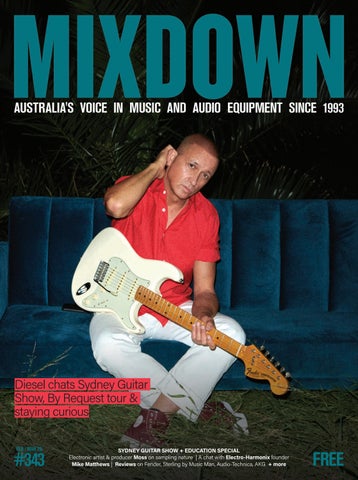
SYDNEY GUITAR SHOW + EDUCATION SPECIAL Electronic artist & producer Moss on sampling nature | A chat with Electro-Harmonix founder Mike Matthews | Reviews on Fender, Sterling by Music Man, Audio-Technica, AKG + more

Giveaways

Product News

Tour News

Diesel Of Mice and Men

Mike Matthews

Moss Factory Sound

Sydney Guitar Show

In Focus: Gold Tone Banjos

In Focus: Electro-Harmonix Effects Interface

In Focus: Warm Audio Retro 64

Product Reviews

Gretsch's new Jet Series Supercool

EDITOR

Anita Agathangelou

PUBLISHING DIRECTOR

Patrick Carr

DESIGNER

Kelly Lim

CONTRIBUTORS

Peter Hodgson, David James Young, Jamie Colic, Daniel Wright, Rob Gee, Lewis Noke-Edwards, Christopher Hockey, Paul Blomfield, Alasdair Belling

FOR ADVERTISING OR CONTENT PARTNERSHIPS advertise@mixdownmag.com.au

DISTRIBUTION distribution@furstmedia.com.au

ACCOUNTS accounts@furstmedia.com.au

PUBLISHER

Furst Media Pty Ltd

FOUNDER

Rob Furst

It's been a big couple of months in the gear-o-sphere. NAMM announcements of new and innovative gear came left, right, and centre, and the momentum hasn't let up since.

This is our Education and Sydney Guitar Show special—two themes that go hand in hand. We sat down with Diesel to discuss his four-decade career, his philosophy on staying curious, and his upcoming appearance at the inaugural Sydney Guitar Show. Electronic artist and Ableton Liveschool educator Moss chats about his Grounded series and sampling nature. We speak with Sydney Guitar Show CEO Alex Masso about what it means to build a community-focused event, and how facilitating connection, not just showcasing gear, is at the heart of what they're doing.

Education and community come together to make the music world more approachable, removing barriers so that more people feel empowered to play, create, and show up. Wherever and whoever you are, there's a place for you in this conversation.

EDITOR'S NOTE
Cover credit: Jesse Lizotte

Learn to DJ with AlphaTheta

Mix, monitor and amplify your skills on the decks with AlphaTheta and Pioneer. Thanks to our friends at Jands, we’re offering one lucky reader the chance to win a DDJ-FLX2 DJ controller, AlphaTheta’s compact, 2-channel mixer. Along with a pair of Pioneer HDJ-CUE1 headphones and a pair of DM-40D desktop monitors to practice with, you’d be hard pressed to start your DJ career off on a better foot.

Rehearse your mixes while monitoring transitions through your headphones, using the main speakers to gauge how everything sounds for the audience. The DDJ-FLX2 is compatible with various DJ applications and software, as well as music streaming services, so you’ll be up and running in no time.

Head to mixdownmag.com.au/giveaways and sign up for your chance to win.

Competition open to Australian residents only. Winners will be contacted via email and have three (3) days to respond or the competition will be re-drawn. Please note: all giveaways are only available to our Australian readers. By entering, you agree to receive marketing collateral from Mixdown and competition partners. For more info, check out our privacy policy.

Entries close midnight March 1st, 2026. Winner randomly drawn on March 2nd, 2026.

MON G3 SERIES
ANNY® SERIES
MAUI® G3 (MIX) SERIES
ICOA® PRO SERIES
ICOA® SERIES

Product News

TONECAT's Home of Tone: a family of boutique pedals with personality

TONECAT's Home of Tone isn't your traditional household, but it's a family all the same. Built in small batches in Melbourne, this collection of six boutique guitar pedals brings character-driven circuits inspired by classic tones and legendary players.

Daughter Luna offers Bluesbreaker-inspired overdrive with touch-sensitive response. Cousin Ziggy delivers chaotic Fuzz Face tones from tight electro fuzz to sonic collapse. Twins Max & Milo provide warm analog-voiced delay inspired by bucket brigade circuits. Grandpa Hugo brings a Tube Screamer-style mid-forward drive. Cousin Cosmo drifts with vintage '70s phaser modulation. Papa rounds things out with a transparent, clean boost.

Bundle deals include Adopt Twins (two pedals plus patch cable) and Adopt Trio (three pedals, two cables). Each pedal comes with a collectible card.

musicians who need portable audio without main power. The system packs a 10-inch woofer and 1-inch compression driver with a built-in 3-channel mixer handling mics, instruments, and Bluetooth streaming.

Battery life hits 12 hours per charge with tool-free swapping when needed. Up to 200ms of room delay allows distributed setups, whilst the new QSC Loudspeaker Control app (iOS and Android) provides deeper DSP control from your phone. QSC backs it with a 6-year warranty when registered within 30 days.

The CB10 arrives in Australia in early March.

Fender rebrands PreSonus

Studio One as Studio Pro 8 with native amp models and complete recording ecosystem

LINKAUDIO.COM.AU | FENDER.COM/EN-AU

AlphaTheta launches RMXIGNITE effector, the successor to the legendary RMX-1000

JANDS.COM.AU

AlphaTheta has finally unveiled the RMX-IGNITE, the long-awaited successor to the RMX-1000 that's been holding down DJ booths worldwide since 2012. This completely redesigned effector packs a 3-Band FX section where three large levers slam instant impact effects (Echo, Reverb, Juggle, Reverse, Solo, Stretch), while three knobs dial in smoother, gradual transformations (Tape Echo, Reverb, Drive, Filter, Ducker, Rhythm)—mixing up to six effects simultaneously across highs, mids and lows. The enhanced sampler comes loaded with 20 Loopcloud sounds, four backlit trigger pads, Overdub mode for building one-bar loops, and six Sampler Colour FX that manipulate samples independently from your main effects. Sound quality takes a big leap forward with 96 kHz/64bit processing and ESS Technology converters. PRO DJ LINK keeps everything locked with your CDJs, whilst digital send/return with DJM-A9 and DJM-V10 mixers needs just one USB cable for the whole setup.

Hercules launches two new wall-mounted guitar racks

QSC's new battery-powered speaker runs for 12 hours TAG.COM.AU

QSC has announced the CB10 Compact Battery-Powered Loudspeaker System, targeting mobile entertainers, DJs, and

Fender has made a significant play in the music production space, rebranding PreSonus Studio One Pro as Fender Studio Pro 8 and bringing the entire PreSonus recording interface range under the Fender banner. What you’ll get now is a unified ecosystem combining software and hardware for modern production. Studio One Pro becomes Fender Studio Pro 8, retaining its core features while adding native Mustang and Rumble plugins with 57 guitar and bass amp models, plus hundreds of effects exclusive to the platform. Updates include a modernised interface, a new channel overview for mixing, AI-powered audio-to-note conversion, Chord Assistant for songwriting, and the Studio Verb plugin. Hardware transitions see the Quantum and AudioBox Go lines become Fender Quantum Series and Fender AudioBox Go, with models ranging from compact 2×2 USB-C interfaces to professional 32-bit/192 kHz units. The PreSonus brand continues focusing on Eris Monitors, StudioLive Mixers and Air XD Loudspeakers.

ELFA.COM.AU

If you’re running out of floor space for your ever-growing collection, Hercules has your back. Their popular GSP hanger series now includes two new expandable wall rack systems that safely store and display two or three guitars with adjustable spacing. The GSP 402SB holds two guitars, while the GSP 403SB accommodates three, both using 275mm long-arm hangers with Auto-Grip System and Auto-Swivel AGS yokes that grip neck widths from 40mm to 52mm— covering electric, acoustic, classical and bass

TONECAT.LIFE

guitars. Adjustable spacing prevents instruments from bumping into each other, with each hanger supporting 7kg and 21kg total rack capacity. The expandable slatwall panel system (450mm panels) includes connector blocks for adding hangers or joining multiple racks as collections grow. The GSP 402SB ships with one panel, while the GSP 403SB includes two connecting panels for roughly 900mm wall coverage. High-strength construction and complete mounting hardware make these racks practical for home studios, rehearsal spaces or retail displays. Both models are available now.

Pete Wentz gets his own Sterling by Music

Man StingRay

CMCMUSIC.COM.AU

Fall Out Boy's Pete Wentz has teamed up with Sterling by Music Man for his first signature bass. The Pete Wentz Artist Series StingRay is a passive instrument built around an Alnico V humbucker that delivers vintage warmth and punch through a straightforward dual-control layout.

Visual touches include Wentz's custom Loon inlay, black hardware, and an anodized gold pickguard. The roasted maple neck features a 3+1 headstock for improved tuning stability, while the contoured body keeps things comfortable during extended sessions. Available in Black and Fiesta Red finishes through authorised Sterling dealers.

Score big savings on Casio keyboards and digital pianos

WINWITHCASIO.COM.AU

Casio Music Australia has launched a generous cashback promotion where musicians can claim up to $400 on selected instruments during this limited-time Back to School special running until 9 March. Simply purchase from an authorised independent music retailer, grab your unique SMS code from staff, then submit your claim

at winwithcasio.com.au within 30 days (final deadline 8 April 2026). Cashback ranges from $25 on entry-level Casiotones to $400 on the APS200. Eligible series include Casiotone, CDP-S, Celviano, Privia and Grand Hybrid models. Australian residents can participate (under 18s need parental approval), with one claim per person. Payment must be completed via cash or credit card during the promotional period.

Collings acoustic guitars just landed at Gladesville Guitar Factory

GUITARFACTORY.NET

Gladesville Guitar Factory has served players since 1972, and has now added Collings acoustic guitars to their lineup—a solid addition for anyone serious about tone and build quality. Built by master luthiers in Austin, Texas, Collings instruments are known for their clarity, craftsmanship and attention to detail. These handmade guitars have developed a strong following among professional players who appreciate traditional lutherie combined with modern standards.

Gladesville Guitar Factory specialises in acoustic, electric and classical guitars, effect pedals, folk instruments and repairs, making them a natural fit for stocking boutique instruments like Collings.

"Fluff" Bruce has teamed up with Warm Audio to create his first signature pedal built specifically for high-gain players.

The Fluff Drive takes the legendary '80s screaming overdrive platform that metal and hardcore players have relied on for decades and adds the mods modern rigs need. Available in teal (with limited white quantities), it's designed to slot effortlessly onto any metal pedalboard without endless tweaking.

Key upgrades include a tighter low-boost circuit for down-tuned guitars and extendedrange instruments, a flexible mid-enhance switch (pre or post gain stage), high/low noise gate for sustained leads or tight palm-muting, and 18V mode for increased headroom. JRC4558 op-amps and discrete transistors deliver that classic screaming pedal sound trusted by Gary Holt (Slayer), Isaac Hale (Knocked Loose), and Rob Barrett (Cannibal Corpse).

Markbass releases signature combo for gospel bass legend Andrew Gouche

CMCMUSIC.COM.AU

Markbass has shipped the MB CMD 151 GOG (Godfather of Gospel), a signature combo developed with bassist Andrew Gouche. The 1x15" combo features Gouche's new Little AG 58R amp head, designed around his playing style and tonal requirements.

STUDIOCONNECTIONS.COM.AU

After pushing thousands of pedals to their limits on his Riffs, Beards & Gear channel, Ryan

Delivering 300 watts through a custom neodymium speaker and piezo tweeter (expandable to 500 watts with an extension cab), the solid-state preamp offers warm, natural tone. A five-band EQ runs from ultralow to high frequencies, while the limiter control spans modern to vintage responses. Following Markbass' 58R design philosophy, all main controls sit on the front panel for easier setup. The MB CMD 151 GOG retails for $3,495.

Norwegian stoner rock outfit Slomosa set dates for first-ever Australia shows

THEPHOENIX.AU

Norwegian stoner rock outfit Slomosa are bringing their Tundra Rock sound to Australia for the first time this May. The Bergen four-piece blend desert rock influences with Black Sabbath-style heft, earning support slots with Mastodon and Helmet across Europe and the US. Their crushing riffs and catchy songwriting have landed them festival stages at Hellfest and Freak Valley.

TOUR DATES

ໞ 22 May: Max Watts, Melbourne

ໞ 23 May: Crowbar, Sydney

ໞ 24 May: Crowbar, Brisbane

Last Dinosaurs celebrate a decade of Wellness with reworked album and Australian tour

Brisbane indie trio Last Dinosaurs are marking ten years since their sophomore album

Wellness with Wellnxss, a reworked version of the record, dropping 13 February via Nettwerk. The anniversary release precedes an East Coast tour with California’s Bad Suns. Tracks like 'Apollo' and 'Wurl' have remained fan favourites, helping the band rack up 29 million streams in 2025 and stages at Lollapalooza and Corona Capital.

TOUR DATES

ໞ 19 June: Torquay Hotel, Torquay

ໞ 20 June: Northcote Theatre, Melbourne

ໞ 25 June: King Street Bandroom, Newcastle

ໞ 26 June: Metro Theatre, Sydney

ໞ 27 June: The Tivoli, Brisbane

Thundercat locks in four Australian shows this May

NICHEPRODUCTIONS.COM.AU

Los Angeles bassist, producer, and vocalist Thundercat is bringing his new album Distracted to Australia this May for four shows presented by Niche Productions and The Operatives. The long-awaited follow-up to 2020's It Is What It Is balances existential weight with signature humour, folding jazz-fusion virtuosity and elastic funk into introspective songs. Known for technical brilliance and spontaneous live performances, Thundercat's Australian shows promise rare moments of presence.

TOUR DATES

ໞ 8 May: Fortitude Music Hall, Brisbane

ໞ 10 May: Odeon Theatre, Hobart

ໞ 13 May: Hordern Pavilion, Sydney

ໞ 15 May: PICA, Melbourne

Men I Trust are bringing their dreamy Equus tour to Australia this November

LIVENATION.COM.AU

In Men I Trust, we trust. The Canadian trio are returning to Australia with their Equus tour, landing in November after taking their latest albums Equus Asinus and Equus Caballus around the globe. Australian-born, Vancouverbased artist Jack J is set to join on all dates. Tickets go on sale 11am local time on Friday 13 February, with presales running in the days prior.

TOUR DATES

ໞ 14 November: Forum, Melbourne

ໞ 17 November: Astor Theatre, Perth

ໞ 19 November: Fortitude Music Hall, Brisbane

ໞ 20 November: Enmore Theatre, Sydney

Mitski returns to Australia after seven years with a Sydney Opera House residency

SYDNEYOPERAHOUSE.COM

Mitski is making her long-awaited return to Australia with an exclusive four-night residency at the Sydney Opera House as part of Vivid LIVE. The Japanese-born singer-songwriter brings her emotionally charged catalogue and highly anticipated new album Nothing's About to Happen to Me after a seven-year absence from Australian stages. Known for her transformative performances, Mitski has built a devoted following from 2016's Puberty 2 through to 2023's The Land Is Inhospitable And So Are We.

TOUR DATES

ໞ 29 May, 30 May, 31 May, 1 June: Sydney Opera House Concert Hall, Sydney

Four decades into a remarkable career, Diesel is as inspired as ever

Putting the final touches on what will be his 17th LP (due for release later this year), Mark Lizotte—AKA Diesel—could be forgiven for coming across as a little bit jaded with the whole music business.

Photo credit: Jesse Lizotte

When it comes to the Australian rock bucket list, the man has ticked them all off: ARIA Awards, tours with the likes of The Angels, Rose Tattoo and Baby Animals, and even a stint as guitarist for his brother-in-law, Jimmy Barnes.

Despite his incredible success, though, Mark isn't looking to rest on his laurels. When we catch up with him, he's just returned from another successful weekend of shows on his 'By Request Tour', which he began in 2025, and added an extra 21 shows for 2026 in order to meet demand.

"There are all kinds of surprises in the show every night," he said.

"Sometimes I think 'Okay, I don't hear myself singing that song, but it's obviously a favourite of yours'—and then it really works. I try to keep it sort of like on the edge of the guardrails."

The 'By Request' tour means fans get to choose the setlist every night, off of two extended playlists they get to see beforehand.

"I am kind of controlling it to some degree," he admits.

"But the point of it is to perform the songs that I just don't play as much, and some of my covers—like the Rihanna song ('Stay')—have had a lot of requests, which I'm happy about, 'cause I do like singing that song."

Part of his current headspace is wanting to connect organically with fans; a key part of 'By Request' is sharing anecdotes fans have given about what the songs mean to them.

"I'll add a few anecdotes into the introductions to the songs because I figured if fans were comfortable enough to share them with me, then they're probably comfortable enough for me to share them with the room. Some of the stories have been very, very sensitive and very, very humbling," he muses.

Of course, being so available for his fans to share their emotional experiences with him means that, in between shows, rest is key.

But meeting so many people and hearing so many stories has him feeling philosophical.

"I come home, and I'm depleted,” he said matter-of-factly. "It's something that no one really briefs you on—I've just been running on adrenaline for three days, and historically, I think, we as musicians would never talk about this. We would think, 'What the hell is wrong with me?' and you would lean into all the wrong things, like substances or whatever.

"Now I feel like I've got tools, because I have lost enough people in my life to kind of know this is what happens on this planet.

"I think this idea of closure is such a ridiculous concept. It's like when you get a hole in your favourite pair of jeans, you have to go 'Okay, cool. I won't get upset about it. I'll make friends with that hole.’"

Mark is full of these kinds of life lessons.

He shares that after having had a nervous breakdown, he realised that by sweeping his problems under the rug, he'd created a bump that he eventually tripped on.

Seeing the music world through other people's eyes is a great way of staying fresh. „

He freely shares vignettes as if speaking with an old friend—and fans in Sydney will have a chance to hear this advice from him at his upcoming appearance at the Sydney Guitar Show.

Appearing in a stacked line-up including Plini, Tash Wolf, Hussy Hicks and more, guitar nerds and gear heads will get a chance to pick his brain for life—and guitar—lessons.

Of particular interest is a conversation he will mediate with Fender Master Builder David Brown, whose credits include working with Billy Joel's band.

"We're gonna talk about dream builds and probably try to recreate some old guitars that I used to have," Mark said excitedly.

"It's the kind of event that's perfect for guitarists of all ages to come out and get inspired watching pros play.

"I used to just go to music shops and would just noodle on everything until they would kick me out because I wasn't buying anything.

Watching other people play in real life was like my YouTube, and then going home and trying to replicate what I just saw—that was always the thing for me.

"You might not agree with everything a player is doing, but hopefully you'll still go 'Oh wow, what was that? That was cool. I wouldn't have thought of that. I'm gonna go home and rethink things.’"

There's no lack of fuel in the tank for Mark. Even when at home and trying to switch off from being a rock star, he still finds songs coming to him—often at inconvenient times.

"Song ideas don't usually come in the studio with my equipment in my hands," he laughs.

"I'll often be thinking how annoying it is that nothing's really popping into my head, but then I'll be having a nap on the floor for 10 minutes, just trying to shut down to kind of replenish myself, and then something just comes into my head. I'll also wake up in the middle of the night, or be out running—it's when I'm away from my desk, and then I urgently have to go back to my desk to make sure I've captured it.

"I've somehow remained curious, and if I had to advise anybody, it would be that: stay curious!

"I'm just a product of all the stuff that I've heard and all the stuff that I'm gonna hear, you know? No one is an island of absolute endless creativity—at least not in my mind anyway. I'm still intrigued by (songwriting), so I'll just keep hacking away at it!"

Mark closes our conversation by acknowledging the special place of teachers in his life and his desire to continue giving back to the scene that's been so good to him.

"Seeing the music world through other people's eyes is a great way of staying fresh," he said.

"I understand how people get so much reward out of teaching in that sense, because all this knowledge is just useless unless you pass it on.

"I feel like I've got a lot of stuff now. I've got a pretty decent skillset and am still building and learning myself, but if I don't pass it onto people around me, it's just nothing."

Sydney Guitar Show

ໞ 7-8 March, Sydney Olympic Park, NSW By Request Tour

ໞ Tickets and info at dieselmusic.com.au

“It’s remarkable that we’re still here”: Of Mice and Men are the most self-sufficient they’ve ever been

With their ninth album out in the world, Californian metalcore veterans Of Mice and Men seem borderline indestructible. After line-up changes that would completely derail other bands, they sound as energised and resilient as they ever have on Another Miracle—perhaps even more so now.

What exactly is their secret? “At this point in our career, we’re just trying to do what’s exciting to us,” says Aaron Pauley, who joined the band in 2012 as bassist and took over as frontman four years later.

“That’s the ultimate litmus test for us as a band. We feel like we have an understanding of what our audience has come to know so far, as well as what we want to get out of our own music. Our songs are very carefully curated, and we especially like to focus on the feeling. Each album is a journey we want to take listeners on, and at this point I feel as though we’ve really refined that process.”

Another Miracle was self-produced by the band themselves, marking the third record overall where they have undertaken this route, following 2021’s Echo and 2023’s Tether. While it was more a matter of necessity for Echo, given its creation was through COVID-19 lockdowns (or “quarantine” as it was known Stateside), the band took to the process so well that they continued with it even after restrictions lifted. Pauley, for his part, has even taken on both mixing and mastering duties. “We’ve gotten better and better at it with each album,” he says.

“You learn, and you glean something new from every process, and you’re always growing and learning how to improve things—which is really exciting. We’ve been lucky enough to work with some of the greatest producers in the world, and I think we learned a lot about time management from them.

“It’s good to have constraints and deadlines, because then you can ensure it’ll actually get finished. It’s on us as a band to see the vision from inception to fruition, and because we work really well together collectively, it’s actually a lot of fun.”

Although he performs solely as the band’s lead vocalist when playing live, Pauley still plays bass on Of Mice and Men’s studio albums. His models of choice are PRS Grainger basses, which he has played since he first started getting into bands.

“I have a four-string and a five-string, both of which I use for different tunings,” he explains. “I split my bass parts into two channels. On one of them, I use the Parallax [X DSP], and on the other one, I use a Darkglass Vintage Ultra V2 preamp. I blend the two in order to get that tone I’m after. There are a lot of ways of getting what you want to hear coming through, both as a bassist and as a producer, and that’s the fun challenge of it all.”

Of course, it’s one thing to approach an album from the perspective of being a musician—a vocalist and a bassist, in Pauley’s instance. However, it’s another entirely to also serve as a producer, mixer and mastering engineer. By then, you’re a player-coach, which leads one to wonder what one learns from such an involved process.

“It’s funny... You have to overwork yourself to realise you can’t be overly critical of minutiae,” says Pauley. “You can mess with EQ for hours on end, and it won’t change a thing about how anyone else listening will perceive the song. You’ve got to be really cognisant of where you’re expending your energy. Nobody’s there to warn you about burning yourself out. You have to intervene on behalf of yourself.”

Prior to the release of Another Miracle, fans were treated to some key tracks as singles. One was “Infinite”, which closes the album and offers both vintage metalcore riffage and a soaring, emotional vocal from Pauley. He particularly drives home the final lyrics of the song—and, by proxy, the album—by referencing Simon & Garfunkel’s 1970 classic “Bridge Over Troubled Water”.

“That’s a really important song to me,” he says. “I used to listen to that album driving around with my dad, and flipping that lyric for this song just made sense to me. Simon & Garfunkel are one of my favourite bands in the world, and I have no problem telling people. People who only listen to heavy music... to me, it’s one-sided, it’s onedimensional, and frankly, it’s boring.”

Another such song was “Wake Up”, which marked one of the biggest sonic departures in the band’s history. This was something Pauley was acutely aware of when the song was initially coming together in Another Miracle‘s creative process, but he and the band were so taken with the track that they simply didn’t care.

“That started from a loop made by Tino,” says Pauley, alluding to drummer Valentino Arteaga. “He’d been listening to a lot of Alanis Morissette, as well as a lot of shoegaze. He also added in that little acoustic guitar intro, and I was just smitten. We didn’t know how it was going to fit—it’s a far cry from what we’re known for—but soon, conversation turned to whether that mattered. A good song is a good song, y’know? It shouldn’t matter who’s playing it. It’s been killing it on US radio since, which has been such a bizarre phenomenon. We’ve never been a radio band, so that’s been surreal.”

To gain new experiences as a band some 15 years into their career is definitely a surprise—but, then again, with everything Of Mice and Men has been through, it should come as no surprise they’re still finding ways to adapt and evolve.

“It’s remarkable that we’re still here,” he says resolutely. “It’s a blessing to still be alive and doing this when a lot of friends didn’t make it. It’s a blessing that it still means something to people.”

TOUR DATES

ໞ 5 May: Magnet House, Perth

ໞ 7 May: Lion Arts Factory, Adelaide

ໞ 8 May: 170 Russell, Melbourne

ໞ 9 May: Manning Bar, Sydney

ໞ 10 May: The Triffid, Brisbane

Electro-Harmonix, Mike Matthews and the art of making noise

Certain names in the guitar world feel less like brands and more like geological features.

They've always been there, they've shaped the landscape, and you don't really question their existence; you just build your musical life around them. Electro-Harmonix is one of those names. And at the centre of it all is founder Mike Matthews: stubborn, funny, relentlessly practical, and still very much in the fight.

When I speak to Matthews, now 84, he is sharp, direct, occasionally blunt, and still animated by the same thing that's driven him since the late '60s: getting sounds into musicians' hands. He's not sentimental about it. He's not precious. And he's definitely not done.

"I've been doing this since 1968," Matthews tells me, casually dropping a number that would represent several lifetimes in most industries. "I was very aggressive in the beginning. I was in a hurry."

That hurry built Electro-Harmonix into one of the defining effects companies of the 1970s— and then, in the early '80s, nearly destroyed it. Electro-Harmonix famously went bankrupt, a time Matthews speaks about with a kind of cleareyed pragmatism. There's no self-pity there, just lessons learned.

When he restarted the company in the late '80s, it was with a very different mindset and an unexpected product focus. Matthews initially rebuilt Electro-Harmonix around Russian-made vacuum tubes. It was a smart move at the time, and for years, tubes represented a huge portion of the company's business. But history has a way of looping back on itself. Matthews noticed that the pedals he'd sold in the '70s were now commanding serious money on the vintage market.

Today, pedals account for roughly 65 percent of business, with tubes, heavily impacted by the war in Ukraine and shifting tariffs, making up a much smaller share than they once did.

"We're constantly battling through all these things," Matthews says. "Tariffs, wars, constantly changing conditions. You've just got to fight through it."

Matthews is refreshingly candid about the industry's scale: "The musical instrument business is not a big business."

Prices rise, freight gets harder, and everyone has to adapt. He treats this reality like weather: something you acknowledge and keep moving through. That adaptability is part of why ElectroHarmonix has lasted as long as it has. The company has never tried to be everything to everyone. Instead, it has focused on making pedals that are powerful but approachable.

"Some companies are trending towards these huge multi-effects units," Matthews says. "We like to make simpler pedals. Most people like them."

As a player working in a guitar shop, I see this daily. Pedalboards are intensely personal now—mosaics of analogue stompboxes, digital weirdness, old favourites and new experiments. Electro-Harmonix pedals don't dictate how you should play. They invite you to combine, experiment, and personalise.

Of course, with success comes imitation. Matthews is well aware that Electro-Harmonix designs, particularly the Big Muff, have been copied across the US, Europe, and China.

Some designs, he notes, have proven harder to replicate. The B9 and MEL9 pedals, which transform guitar signals into organ and Mellotronstyle sounds, remain unique achievements. The POG series is another standout, used by countless players across genres.

"If you really want to do something new," Matthews says, "it's got to be digital. There's not too much new you can do in analog except add features."

One exception to Electro-Harmonix's global dealer model is Australia, where the brand works exclusively with Melbourne-based Vibe Music. "Australia's so big," Matthews says. "Freight, service, repairs—it's complicated."

Vibe Music's Joseph Lamberti, whose father built the highly regarded Rex Bass King amplifiers,

is someone Matthews clearly respects.

"He came up early," Matthews says. "He can service and repair most everything. He does a great job for us."

There's a nice symmetry here. Australia, like the UK, once had to invent its own versions of American gear simply because we couldn't get the real thing. That DIY spirit still matters, and it's fitting that Electro-Harmonix, a company built on resourcefulness, values that so highly. Any conversation about Electro-Harmonix inevitably circles back to the Big Muff, whose origins trace back to Matthews' unlikely friendship with a young Jimi Hendrix.

While still in college, Matthews promoted touring acts, including Chuck Berry. One booking led to another, and eventually to Curtis Knight and the Squires featuring a guitarist named Jimmy James.

"That guy was Jimi Hendrix," Matthews says.

They became friends. Matthews visited Hendrix in his tiny Times Square hotel room and watched him develop his phrasing-based vocal style.

"He told me, 'I can't sing,'" Matthews recalls. "I said, 'Look at Jagger and Dylan. They don't sing— they phrase.'"

Hendrix took that idea and ran with it. When Hendrix became famous, Matthews wanted to give everyday guitarists a way to access that kind of sound. Working with Bell Labs engineer Bob Moog, Matthews helped refine a cascading gain circuit that carefully rolled off distortion at key points.

"That became the Big Muff," he says.

Like many players my age, my Big Muff awakening came via the '90s. Smashing Pumpkins, Dinosaur Jr., shoegaze walls of sound—all of it traced back to that box. Billy Corgan's version of the Big Muff, Matthews explains, was actually a different circuit. Corgan accidentally bought one and loved it.

"I personally didn't," Matthews admits. "But what matters is what sells."

That pragmatic mindset is central to ElectroHarmonix's longevity. Sales fund designers. Designers create new ideas. And financial stability allows the company to weather tough times.

Electro-Harmonix is now a legacy brand in the truest sense. People tattoo the logo onto their bodies. They build careers around its pedals. They form emotional attachments to pieces of metal and circuitry. Matthews is aware of and amused by it. "Have you seen all the tattoos? There are hundreds!"

Despite turning 84, Matthews doesn't dwell on age. "I don't really celebrate birthdays," he says. "To me, it's just another day."

That mindset makes sense. ElectroHarmonix isn't a nostalgia act. It's a working, evolving company—still releasing products, still surprising itself, still fighting through whatever the world throws at it. As Matthews signs off our conversation with a cheerful "rock and roll," it's clear that this isn't a man reflecting on a finished story. He's still writing it.

Photo credit: Mikiodo

Sticks and stones may break your bones, but did you know they can make great electronic music as well? Magandjin (Brisbane) based producer Moss McGregor—better known mononymously as Moss—is currently in the throes of his most ambitious musical project yet.

Moss is making acres worth of nature-based beats—and you can, too

Grounded sees him getting out amongst acres of bushland, and finding interesting sounds within nature to then transfer over to Ableton Live and create sample packs—not just for him, but for any beatmakers out there hoping for something quite literally off the beaten track.

"In the past, my process has been very clinical and surgical—I'm definitely a perfectionist," says McGregor. "Over the last year, I've been working on breaking out of that. Sampling nature has been really like inviting a kind of unpredictable chaos—whether it's wind noise, clicks and pops, or even the cicadas, that's gonna come into all the recordings. It can be humbling, but it's also a really cool process." As an example of how it's not as simple as pressing record and letting the magic happen, McGregor details which microphones

he's been using in order to capture material for his sample packs.

"I started off using a Rode NT-USB, which was plugged directly into my laptop," he says. "I was out there throwing rocks into the dirt, and dirt was splashing on my laptop. After that, I knew I needed to get a mobile mic and an interface for these recordings. I got an Olympus [LS-100], which is a lot like a Zoom, and I've used that ever since. I've also been using a contact mic recently [a JrF C-Series Pro+], made by this artist Jez Riley French, as well as a dynamic Yamaha YDM707."

Kicking off the project last month, McGregor has since found himself snapping twigs, tapping bark and even miking up his namesake around the property. All in the pursuit of the kind of unique sounds that you simply can't get from

“Creativity is a thing that transcends words, and sharing that with other people helps inform your own creativity and builds it too.”

want to focus on in the sound. It all depends on the idea, and what I'm making for the day."

Insofar as the desired effect is concerned, McGregor describes his sample packs for Grounded as "to make this weird hybrid of electric and raw acoustic." "I want to twist it and distort it as much as possible," he says. "It's cool to see how I can manipulate the recordings—I hit rocks together to add a transient to a kick drum, and I threw rocks at the ground and recorded their impacts to stretch out into 808s. I've made hyperpop drums with sticks and basslines out of trees. You've got to try and get out of the box every time."

McGregor is sharing his findings on Grounded every week across his social media accounts, as well as releasing the sample packs on his Patreon page. Despite being in the throes of a time where he believes social media has made it "draining to be a creative," McGregor has been excited to see how people have responded to his nature-based findings and the subsequent

a regular instrument. Being experimental, by definition, has of course meant a lot of trial and error on McGregor's behalf: "You're shooting in the dark, really," he says. "I'll put the contact mic on trees to listen to their groans, for instance. Trouble is, when there's no wind, you don't get any groans; you might be waiting a couple of hours just to capture something worthwhile. You're a witness to the sound, but that initial sound takes time. I'm not trying to focus too much on getting the right levels—as long as I'm not clipping, I'm not fussed."

Once he's back inside the house and in his studio with the audio to work through, McGregor takes the day's findings into Ableton Live and begins the arduous but rewarding process of digitally manipulating them through extensive editing sessions. "There's a lot that needs to be done in terms of saturation and driving the sound," says McGregor. "I'll run the recordings through Amp, Overdrive and then Compression. I use Soothe as well, in order to take out any frequencies that are a bit too piercing. The same goes for iZotope RX, which I use to take out any unwanted noise or clicks. A lot of what I'm doing is to add harmonics and EQ; to bring out what I

beats he's made out of them. Whether it's students taking his Liveschool masterclass and forging their own sounds ("some of them were really cooking," he adds), or simply some kind words from peers and supporters on his page, he believes that community is key when it comes to creativity and composition.

"Being a bedroom producer in this day and age can be very isolating," he says. "You're sitting in your room alone, throwing sounds at a wall. Having a community of like-minded people you can bounce those ideas off or draw inspiration from, it's just going to be a benefit tenfold. When I was at Liveschool teaching, the community focus there really impacted and improved a lot of people's production skills. Creativity is a thing that transcends words, and sharing that with other people helps inform your own creativity and builds it too. I think it's vital to have a community around these kinds of things, and that's why I'm out here trying to create my own."

Photo credit: Billy Zammit

Musician, engineer, or teacher—Factory Sound is in your corner

WORDS BY MIXDOWN

In 1994, a long-running Melbourne rehearsal studio officially transitioned into Factory Sound Sales, beginning with a modest retail offering of microphones and cables alongside the practice rooms. Their reputation for quality, service and expert guidance quickly spread, and Factory Sound evolved into a professional audio showroom in South Melbourne.

Fast-forward to today, and Factory Sound operates from both South Melbourne and North Parramatta, supporting clients across the country. Those humble beginnings proved to be a strong foundation—built on a genuine understanding of what musicians and creative professionals actually need.

While Factory Sound continues to support musicians, producers, and engineers, education has become a major focus of their work. For more than three decades, they've partnered with schools and learning institutions, providing practical, reliable solutions tailored to real-world teaching environments. They understand the unique pressures educators face and are committed to equipping both staff and students with the right tools, backed by ongoing support.

Education environments are notoriously challenging. From reverberant gymnasiums and windy outdoor assemblies to loud, high-traffic classrooms, systems need to be intuitive, robust, and dependable—not temperamental or overly complex. Factory Sound works directly with teachers, heads of department, school administrators, and students to design solutions built for daily use and long-term reliability. Their scope ranges from small system upgrades through to large-scale projects, including auditoriums, classrooms, gymnasiums, and site-wide bell and paging systems. Just as importantly, Factory Sound builds technically robust systems that are carefully curated into simple, user-defined interfaces, allowing staff and students to use them confidently without specialist AV knowledge.

Beyond education, Factory Sound supports the full spectrum of Australian audio needs, including hospitality, corporate, performing arts, sporting, and civic facilities. Across every sector, their philosophy remains consistent: supply quality equipment, design systems appropriate to the end user, and support clients for the long haul.

The inaugural Sydney Guitar Show on the weekend of 7–8 March is a chance to catch Factory Sound alongside more than 80 major and boutique brands. Swing by their stand to see pro audio gear up close and chat with a team that's spent decades supporting Australian musicians, educators, and creative professionals.

Whether you're working in education, running a studio, managing live sound, or upgrading a home setup, it's an opportunity to talk through real-world challenges with people who've almost certainly tackled them before. Factory Sound's presence at the show reflects their broader approach: be accessible, share knowledge, and deliver solutions grounded in real-world experiences.

More than three decades in, Factory Sound remains what it started as —audio-obsessed people who know their craft. They're a company firmly in your corner, whether you're on the main stage, running a school assembly, or working away in your home studio.

In Focus: Shure MV88 USB-C Stereo Microphone

The world of the digital creator is as fast-paced as the technology that drives it.

Even faster, at times. We are seeing hardware and software companies striving to keep up with the needs of the modern compact filmmaker, to get the most out of their potential and creativity. Let's face it—the innovations with built-in cameras in smartphones these days really make them more like compact video cameras, with a phone option included free of charge.

As video quality improves, the devices' audio limitations become more evident. Shure has stepped it up a notch and removed those woes with one simple microphone that only requires two actions. Plug in and record. This is the MV88 USB-C Stereo Microphone, and it is an absolute game-changer in the world of mobile video recording.

If you're sick of lifeless, tinny audio in your videos that captures more ambient noise and reverb than it does your subject, you are going to love the MV88 USB-C from Shure. Best of all, you don't need a bag of cables or to be an audio engineer to get good results. This has to be the simplest external microphone setup for a smartphone that I've come across, that still offers the functional features you need to achieve great audio in a range of settings.

Let's start with the installation process. First, you need to insert the MV88 USB-C into the USB-C port at the base of your phone. That's it. You're ready to go. It will snugly fit into position with the base sitting just out from the phone's chassis. This allows for phone cases or protective sleeves to be left on up to a certain thickness. If you have a bulkier case, you'll need to use a USB-C extender or take it out of the case. Either way, you're all set and you’ll have improved audio with your video right away.

It gets even better. You now have an adjustable stereo microphone attached to your phone, and as we know, stereo recording requires directionality with two microphones. With a capsule facing out of each side of the microphone casing, you can set up the direction with the casing, and rotate it 90 degrees both horizontally and vertically. That means, by inserting the device one way or the other into your phone's USB-C port, you have the option to record in any direction in a 360-degree field. This allows you to record a subject in front of the camera, or yourself from behind the camera and still get incredible audio quality from either position. Yet, the MV88 USB-C goes even further, because it isn't a single directional capsule; it's a stereo pair, so both front and rear can be captured on separate audio tracks, making the interview process even easier than ever before.

So far, everything we have mentioned is all just on the surface. It's

what can be achieved just by connecting and adjusting the angle of the microphone. However, Shure has gone well beyond this in what the MV88 USB-C can offer with the implementation of digital controls for your microphone, allowing you to adjust polarity options to suit the scene.

The obvious use is for stereo field recording, be it out in the natural environment or for live music recording. Here, you're able to adjust the depth of the stereo field to suit your recording position. This has a huge range of benefits for musicians wanting to record live video with incredible sound. Especially for ensembles or drum kits, where some spacing between the left and right field really brings a recording to life.

There's also a mono cardioid option, where the microphone is used as an end-fire recorder, picking up directly in front of the end grill, allowing for more directional audio capture. This is ideal for recording speeches, onesided interviews, or video presentations. Just about every YouTube creator will make use of this function as it allows them to angle the camera where they want, then point the microphone directly at their position for the best vocal recording.

When two people are speaking, the MV88 USB-C allows for a mono bidirectional capture, with both sides of the capsule recording separate audio tracks. This is the perfect setup for an interview process when one person is behind the camera, yet still requires quality audio capture. Adjusting the left and right balance afterwards allows for the levels on either side to be evened out, as one source is likely to be closer to the capsule than the other.

A final option of raw mid-side recording is one that will appeal to advanced users. This uses the side capsule to combine left and right into one audio channel, then it uses the end capsule to record the front signal into the other audio channel, resulting in an immersive sound that excels in live music recording.

These capabilities are enhanced by a range of additional features that help shape and clean up your audio recordings. A multi-stage high-pass filter is included, along with several compression presets for easily squeezing your audio. Probably the best feature for those recording YouTube videos is the real-time 'de-noiser' that takes out unwanted background noise at the press of a button. Even more features—including simplified presets for various instruments and vocal recordings—can be accessed in Shure's MOTIV Audio and MOTIV Video apps.

The MV88 USB-C can be as simple or as complex as you like with your mobile audio recordings. Either way, the results are amazing. Incredible audio quality, with a big bottom end, intricate high frequencies and a midrange that sounds like it's been recorded with a much larger microphone and a preamp. All of this comes from one compact device, which slides onto the end of your smartphone.

BRIDGING THE PEDALBOARDPLUGIN GAP!

EFFECTS INTERFACE HARDWARE PLUGIN

The Electro-Harmonix Effects Interface Hardware Plugin is a revolutionary piece of equipment, purpose built for making use of pedals and other physical guitar equipment with your DAW easy and seamless. Additionally, the Effects Interface breaks your favourite plugins out of your computer for use in your full guitar rig. Without a need for special converters or direct boxes, the Effects Interface handles your signal and delivers it with care between your hardware and software via a simple USB-C connection. Available now from your local Electro-Harmonix dealer. RRP $825

Sydney Guitar Show is expanding the conversation

The Sydney Guitar Show feels less like a new event and more like a long-awaited homecoming.

After years of building momentum in Melbourne, the Australian Music Association has taken a calculated leap north, bringing its flagship guitar event to a new city, a new audience and, inevitably, a new personality. According to AMA CEO Alex Masso, it wasn’t a reckless move, but a deliberate one.

“It was a bit of a gamble,” Masso admits. “We thought, let’s try it in a new city, a new market. It’s an industry event, so we’re always looking at where we can find different players and different people, and just bring this thing we’ve been doing in Melbourne to somewhere else.”

The early signs suggest the gamble has paid off. Exhibitor response has been strong. Public interest has been strong. The tone in Masso’s voice when he talks about it isn’t relief - it’s excitement.

“It’s going great,” he says. “The feedback we’re getting from exhibitors and the public has just been amazing.”

If you’ve been to the Melbourne Guitar Show in recent years, much of the Sydney layout will feel familiar. The programming structure,

room concepts and exhibitor mix draw heavily from the most recent Melbourne iteration at the Showgrounds. But this isn’t a copy-and-paste exercise.

“We’re starting with a similar model,” Masso explains, “but there are going to be things that are unique about each show. The venue shapes how you do things. The people around it shape how you do things. The community that gets involved will make it different over time.”

That’s the keyword: community. While the guitar show might technically be described as a consumer event, Masso sees it differently.

“We use terms like ‘trade show’ and ‘consumer show,’” he says. “But I really think of it as a community show. It’s where the guitar community, the players, the artists, the manufacturers, the retailers, the content creators, the kids, the parents, they all come together.”

That philosophy informs everything from the headliners to the pedal booths to the educational programming. One of the more interesting aspects of the Sydney Guitar Show’s programming is that it’s not built around a single towering headliner.

Instead, it’s designed for discovery.

“When people come to our show,” Masso says, “they’re not necessarily coming because there’s one person they’ve always wanted to see. They’re coming because they love guitars and guitar playing and music.”

That means you might wander into a room and find a blues band tearing it up. Or a bunch of kids onstage discovering their first taste of live performance. Or a workshop on songwriting. Or Grammy-winning guitarist Larry Mitchell casually dismantling the fretboard in a way that makes you rethink your life choices.

Mitchell, in particular, is a smart addition. He’s one of those players who doesn’t require a deep discography dive before you “get it.” He just walks onstage and it works. The vibe, the touch, the authority, it’s immediate. Masso agrees.

“He’s actually the only person we’ve got doing two different things: performing and running a workshop,” he says. “He’s a real guitar person. Guitarists know him. He does a lot of different stuff. And for our kind of event, that’s perfect. People will walk into a room and go,

‘Who’s this?’ and discover something.”

That sense of accidental discovery is built into the DNA of the show. It’s not about queueing up for a single act and then leaving. It’s about drifting, exploring, stumbling across something unexpected. If there’s one area that consistently generates buzz at these events, it’s the pedal section. Effects pedals are tactile, interactive and approachable. You don’t need to be a virtuoso to enjoy stomping on something and hearing the world explode into fuzz.

Masso says the AMA has been consciously expanding this area, particularly by highlighting Australian builders alongside international heavyweights. “We’ve been trying to get more Aussie builders involved,” he explains. “You might see Poly Effects pedals there, and Locky is right there talking to you about them. These people aren’t just brands, they’re there to talk.”

That accessibility matters. In an age where so much gear research happens via YouTube demos and forum threads, there’s something powerful about being able to ask the person who designed the circuit why they chose a particular clipping diode. And it’s not just about pedals any more. One of the most significant expansions at the Sydney Guitar Show is the introduction of a dedicated studio zone, a space focused on home recording, interfaces, software and production workflow.

“We’re adding this extra component, which is the studio,” Masso says. “It’s geared around home recording and pro audio gear: software, interfaces, recording equipment. We’re going to have presentations about reducing friction in your home recording setup. Just plug in and go.”

That phrase, ‘reducing friction’ might be the most important concept of the modern guitar world. Today’s players aren’t just buying guitars. They’re writing, recording, producing and releasing music from their bedrooms. The emotional momentum that comes from picking up a guitar can evaporate quickly if you’re fighting drivers, latency or a confusing DAW interface.

Addressing that reality acknowledges how people actually engage with music in 2026.

“It’s an important part of what people are doing with music,” Masso says. “Whether you’re professionally recording, doing demos, or just messing around at home, it’s part of your musical life. Bringing that in as a theme and giving it its own room is really exciting.”

And it reinforces the broader goal: get people making music.

“They’re coming because they love guitars and guitar playing and music.”

Another programming highlight is a Fender-presented panel celebrating the Telecaster’s 75th anniversary, featuring a Custom Shop Master Builder in conversation with Australian artist Diesel. Rather than a standard performance slot, it’s a deep dive into the custom guitar process: what artists look for, how builders interpret those needs, and how decades of playing inform taste.

“We don’t just need performances,” Masso says. “We love having talks, presentations, interviews. It broadens the program. It’s not just band after band.”

That variety gives the show a layered feel. You can watch a blistering solo in one room, then walk next door and hear a nuanced conversation about wood selection and pickup voicing.

It’s not unlike flipping through a great guitar magazine—except the pages are alive and occasionally very loud. Strip away the logistics, the exhibitor booths and the brand activations, and what you’re left with is something simpler: the guitar is an emotionally generous instrument.

“It’s very accessible,” Masso says. “You can start with it and go in so many different directions. You might become obsessed with classical music. You might write your own songs. You might jam with your mates. There’s not really a set path.”

That openness is part of why the guitar community is so diverse. Virtuosos and three-chord punks can occupy the same space. Bedroom

producers and touring session players can share a conversation. That’s what the Sydney Guitar Show is ultimately trying to facilitate.

“People show up, they’re meeting someone, they’re standing in front of the same guitar going ‘Whoa,’” Masso says. “It’s because it’s a community. We want people to come together in one location and just be into the same thing.”

In a time when so much interaction happens through screens, there’s something quietly radical about standing next to a stranger, both of you transfixed by the same instrument. You might walk in thinking you’re there to test-drive a new overdrive pedal. You might leave having discovered a new artist, a new recording workflow, a new classical technique or even a new friend.

Masso puts it simply: “We want people to walk away excited about making music.”

If Sydney responds the way Melbourne has over the years, this won’t just be an expansion. It’ll be the beginning of a second home—another gathering point for a tribe that, despite its arguments about tonewoods and trem systems, still shares one fundamental truth: We’re all here because we love the guitar.

Sydney Guitar Show takes place March 7–8 at Sydney Showground, Olympic Park.

In Focus: Gold Tone Banjos

Gold Tone Music Group's mission is clear: "To give a voice to their musical ideas through our fretted instruments."

The Gold Tone Music Group was founded in Titusville, Florida, by Wayne and Robyn Rogers back in 1993. Not only do the pair have strong roots in the US folk music scene dating back to the 70s, but they also served the local music community for years through their well-loved Strings N Things Music Centre, which first opened its doors in 1978.

1993 saw the introduction of Gold Tone Banjos, with Wayne designing and manufacturing the TB-100 Travel Banjo. "The Traveller" was initially sold via mail-order, and after a rave review in the esteemed Banjo Newsletter, banjo players all across the US wanted a slice of the action. Inevitably, demand boomed, giving the small family-run company immediate provenance.

Rapid growth was quick to follow, with dealers all over desperate to get their hands on Wayne's innovative designs. Gold Tone operated with an emphasis on providing well-priced, quality instruments for musicians of all skill levels, a mantra that holds true to this day.

In 2026, Gold Tone's range encompasses a plethora of fretted instruments from wood-bodied resonator guitars and mandolins to Weissenborn Hawaiian Steel Guitars and six-string Banjitars. They're still

built with the same love and care as they were when Gold Tone Music Group was just a small mail-order operation run out of a Titusville backyard.

No matter what your requirements are, something in the Gold Tone range will speak to you in volumes.

OB-150

The OB-150 strives to provide "Pre-War" appointments, authentic tone and superb playability all at a price that anyone can afford. No corners are cut when it comes to the OB-150, which sports a 3-ply maple rim and one-piece flange. Along with a high-quality brass flat-head tone ring.

If this wasn't enough, the instrument is adorned with a beautiful maple neck with a 12" radius fretboard adorned in an authentic style, meaning that the OB-150 delivers on looks and playability just as well as it delivers on sound.

CB-100 11" Open Back Banjo

The CB-100 is the clawhammer player's dream, offering every desirable feature at a price point that won't break the bank. Providing a vintage-designed maple neck with a scooped rosewood fretboard, a rolled brass tone ring and a Remo

the Dojo-DLX's beautiful cutaway curly maple body carries a very comfortable five-string Banjo neck and rosewood fretboard adorned with gorgeous decorative bindings that will go head-to-head with even the most premium in fretted instruments.

The Dojo-DLX's stacked humbucking pickup is also a godsend for stage performers, tied together with the instrument's wonderful parallel pull tailpiece.

Which in itself is an innovative design that works to provide even pressure along the biscuit bridge, situated upon a reverse cone resonator, a design which works to enhance the banjo's tonal resonance across the frequency spectrum.

AC-5 Composite Series Resonator Banjo

Fiberskyn head, this 4-string banjo is guaranteed to withstand even the most rigorous of gigging schedules.

Combine these features with a No-Knot Tailpiece, planetarygear tuning machines, and Gold Tone's own designed dowel stick that contains a hidden coordinator rod for quick and easy action adjustments, and it's hard to go past the CB-100 when it comes down to value for the hardworking musician.

OB-Bela

Fleck Signature Banjo

Virtuoso Bela Fleck's relationship with Gold Tone dates back years, during which he has had the company design a range of one-off custom instruments tailored to specific requirements he has as both a world-class player and performer.

The OB "Bluegrass Heart" allows anyone to play a professional-grade Banjo that matches up in feel and tonality to Bela's number 1 pre-war masterpiece Mastertone Pot Banjo. Adorned with premium features such as the 10" fingerboard radius, 11" Remo head, Mahogany Resonator with Concentric Rings, all bound together with an 11" 3-ply Canadian Maple Rim.

Rounded out with an Ebony fingerboard and Mahogany Neck, the OB-Bela Fleck is a prestige instrument that will appease even the most discerning of players.

Dojo-DLX

The perfect companion to intricate fills and enriched solo play,

The AC-5 is Gold Tone's answer to providing a high-quality entrylevel Banjo that doesn't compromise on providing excellent tone or professional-level playability. The AC-5's modern 11" composite rim and resonator ensure the utmost in robust durability while keeping the instrument lightweight and sounding excellent.

Whether you are just starting and are in the market for a student instrument or a working professional in need of a worthy travel Banjo, the AC-5 is definitely an instrument to check out.

Mastertone™ OB-Grandee: Orange Blossom Grandee Resonator Banjo

Built as a tribute to the legendary pedigree of banjos that were produced before the Second World War, the OB-Grandee is a throwback holy grail for the modern age. Boasting a premium-grade curly maple neck and resonator, along with premium-grade hardware, no expense has been spared in crafting a professional instrument that will last generations.

In all of its engraved and goldplated glory, the the OB-Grandee sports a maple neck with a luxurious ebony fingerboard adorned with beautiful heart and flower inlays. Additionally, a 14" maple resonator is complemented with an 11" 3-ply maple rim, providing gorgeous prewar tones of the highest standard.

Pair this all with a high-quality Gold Tone hardcase, and it's easy to see why people are still singing their praises for this illustrious brand after all these years.

DEFY

In Focus: Haze Guitar SDG828 12-String Hybrid

Why carry extra guitars to the gig when you can have it all in one?

We all know there's a place for both electric and acoustic guitars in many sets, and one of those usually gets left behind, forcing you to to clumsily fumble through a song with a sound that an EQ pedal really cannot recreate. That's where this new gem from Haze Guitar has you covered, with two great sounding guitars in one. This is where rock and folk music collide, and do so with no less than 12 strings in the process. Let's take a closer look and get familiar with the Haze Guitar SDG828 12-String Hybrid.

What we have here is, at its core, an acoustic guitar. Don't be confused by the presence of that humbucker at the bridge. You don't need to plug this guitar in, and you don't need an amplifier or PA system. You can simply pick it up and enjoy playing the SDG828 by itself. And any good guitar should be able to be enjoyed acoustically.

With a solid spruce and sapele back and sides, this guitar was meant to be played acoustically. It offers a folk body shape, so it is not as bulky as a traditional dreadnaught model. Haze Guitar has designed the SDG828 with the player in mind, and offers a comfortable feel under the right arm thanks to the reduced body depth. That said, it's only a couple of centimetres thinner than most dreadnaughts, so you still have plenty of depth to the sound, with a rich mid-range that comes to life with the 12-string design.

Yes, that's right—this is a 12-string! But it doesn't seem like one. All too often, a 12-string guitar can be a bulky instrument, with a neck that feels like a baseball bat, but not this one. Haze has made sure this is comfortable to hold, in both hands, with a neck that is very playable, and not as wide as you'd expect of most 12-strings. This

means you're not fatigued trying to hold down chords, either. This comes from an easy action that is offered on the SDG828. They're set up and ready to go when you get the instrument, however further adjustment can be made to suit your playing style with the adjustable bridge saddle that doesn't require a visit to the technician's bench just to change the height.

Of course, we need to talk about electronics, because surely that’s what got your attention in the first place. Let’s start with the piezo pickup. Mounted under the bridge, the piezo delivers that sharp, bright tone with rich bottom end that you'd expect. On the side of the body you’ll find the acoustic EQ and volume controls that manage this system. This handles the more traditional acoustic-electric sound, particularly when the SDG828 is running through a full-range speaker system. For that heavier rock sound, then we move to the humbucker that sits above the bridge.

Here we have a coil-tapped humbucker to give the guitar a bigger, rock sound. It brings to mind some of the classic hollow body electrics that offered 12-string models, where the pickup presents a gritty, raw sound off the strings as well as some airy resonance from the hollow chamber beneath the pickup. It's got a blues/rock/pop feel that will work well in so many applications. Especially with the added switching that is implemented.

Firstly, let's be clear, there is no blending

preamp built into the instrument. You have the choice of piezo or humbucker, but not the two combined. On the face of the guitar, there is a Volume and Tone knob, both of which have Push/Pull capabilities. Push the Volume knob, and it switches the output from the piezo to the humbucker. Here, you get the full tone of both coils for a full, rich sound. The Tone knob allows you to explore the full range of what this pickup has to offer. There's plenty of added bottom end that can be wound in or out of the humbucker sound.

If you're after a thinner, more cutting sound, then pulling out the Tone knob splits the coils and turns this into a single coil pickup, great for classic rock and blues sounds. Of course, this feature only has an effect on the magnetic pickup. It's not wired in to change the sound of the piezo. That comes from the controls on the side panel of the instrument. Just pull the volume knob back out to revert to the piezo pickup for that folk sound.

This really is an instrument designed to tackle a range of options all in one. As a 12-string guitar, it wants to be strummed, but can be used for lead picking just as well. It's a guitar that you won't want to put down, and it doesn't fatigue or fight against you like many 12-strings can. The combination of low action, slim neck and narrow nut spacing makes this a 12-string that wants to be played, especially with strings that are in a lighter gauge than usually found on an acoustic guitar.

The Haze Guitar SDG828 12-String Hybrid is worth considering if you're looking for something new to add to your guitar collection. And let's face it—which one of us ever stops looking? This guitar will tick several boxes in the range of sounds it is capable of, and as such, will prove a great option for the guitar player looking for something different, without breaking the bank on one instrument.

In Focus: Electro-Harmonix Effects Interface

Here we are, in 2026, and guitarists are still finding themselves in a quandary over how to easily navigate the world of DAW effects without losing tonal quality or disrupting their workflow.

Well, not all guitarists. There are the lucky ones who've discovered something new and are already moving into a new world of effects processing. The rest of you? Well, you're about to find out. Let me introduce you to the ElectroHarmonix Effects Interface.

What is it? An effects pedal? An audio interface? Some sort of digital voodoo? Well, the answer is yes. Just yes. It's all of that and a whole lot more. The best part is, you can play guitar connected to a computer, yet still feel confident wearing your old, moth-ridden Big Muff T-shirt without fear of reprisals from your all-analogue mates. Yes, this is the guitar interface with feeling. And if you're not entirely buying that, you can just hide it amongst the host of clunky old pedals on your pedalboard, and no one else will ever know the difference.

So, how does this effects interface work, and what is it going to bring to your guitar rig that you couldn't get from it previously? Essentially, this unit offers three distinct modes of working, or routing signals to achieve different results, depending on your current needs. We'll look at each mode individually in a moment—but what's important to note first is that ElectroHarmonix have removed the need for external audio interfaces, which end up balancing on the end of your amplifier, or getting trashed on the floor of the stage or studio. This is all built into a rock-solid pedal unit, so it makes sense to have

it mounted on your existing pedalboard where it can be utilised at any time.

Common sense would see it situated in the centre of the board; from there, you can wire it up for the different modes with a quick switching of cables between studio and stage use. It's not a unit that definitely has to go at one end of the signal chain, or the other. In fact, it has a use at both ends. Of course, if you're using a pedal switching system, then placing it at the end of the signal chain would work quite nicely, with the option to route back into the start of the chain when needed.

That option would be called upon for the first of the operating scenarios, when the interface is set to Hardware Plugin Mode. This is going to be a brilliant tool in the studio, where it allows you to route a signal from your DAW through the unit and any subsequent pedals on your board you might want to apply. What this means is you can record your guitar tracks clean and then feed them back through your pedals to allow for endless hours of tweaking and adjusting effects until you find the perfect tone. After all, it's nice to use a Tube Screamer plugin, but does it have the same tone as the one on your board that’s chipped, modded, and operating on the last few percent of an old 9-volt battery that's about to give up the ghost? The digital replica just won't deliver that same tone to your recording. But now you can have it, with clear A/D conversion that delivers all the tone and subtle nuances that your specific effects offer.

Of course, there are times when you want the consistency and clarity of digital effects on your side. That's when the second operating scenario comes into play, with Pedalboard Mode. In a nutshell, it's the same thing, except reversed. Here, you're able to integrate your DAW and its native effects into your pedalboard signal chain before it gets to the amplifier. So, in the studio,

or on stage with a laptop, you can harness the power of all those effects you've been hoarding in your plugins folder, and run your guitar straight through them. Again, the brilliant A/D converters mean you get crystal clear audio running in and out of the computer with imperceptible latency. It basically makes your laptop the most powerful multi-effects board you can find and still allows you to include all your pedals in the signal chain too. After all, how many distortion pedals stacked in a signal chain is too many?

But what happens when you just want to record all night, without the volume of your amplifiers keeping the entire neighbourhood up? That's when the third scenario is ideal, and switching into Audio Interface Mode delivers the perfect setup in a flash. Here, the effects interface operates like a conventional 2-in / 2-out audio interface for recording dual mono or stereo signals. That means you can take the output of the last stereo effect in your signal chain and patch that into effects interface to capture your creative moments late into the night, all the while monitoring from a set of cans or low-volume studio monitors. It also means that other instruments can be brought into the game, especially synthesizers, which would just love to take a detour through a pedal or two on the way into your DAW. And when you think of it like that, it begins to open up a whole new world of effects mangling possibilities—and that's even before we consider strapping a MIDI pickup onto the guitar.

If you've been chasing the perfect way to have your computer talk to your guitar, and have your guitar talk to your computer while inviting your effects pedal into the conversation, this is the social lubrication that you've been searching for. Have a look at the Electro-Harmonix Effects Interface for yourself, and you'll see just how much this unit has going for itself.

In Focus: Warm Audio Retro 64

When it comes to buying audio gear, there are few things more satisfying than finding a rugged, versatile, workhorse microphone that is going to have your back for whatever challenge the live stage throws your way. In the case of the Warm Audio Retro 64, it doesn't hurt for the microphone to have a bit of vintage charm in the looks department, either.

Since starting Warm Audio out of his Texas garage in 2011, founder Bryce Young's desire to put fully professional, high-quality recording equipment in the hands of aspiring musicians and engineers for an affordable price hasn't changed. The Retro 64 is the latest offering from Warm Audio and it is no exception to the company's endeavour to faithfully recreate the classic analogue recording gear that's delivered the biggest music hits.

Re-imagining a classic broadcast-style dynamic microphone design, the Retro 64 has an updated sound profile for the modern stage designed to reject noise and feedback while simultaneously delivering vintage styling.

The live music environment can be a tough, unruly and unpredictable beast whether you're in the familiar territory of your favourite hometown venue or taking your show on the road, having a durable microphone like the Retro 64 doing its job night after night delivering a tried-and-true sound can make all the difference. With its cardioid polar pattern and 300 Ohms impedance, the Retro 64 is designed to slot naturally and seamlessly into any contemporary front-of-house setup making it

a trusty new addition for any FOH engineer.

The Retro 64 solves one of the biggest live vocal mic problems by creating a trusted, mid-focused sound. Like the most tried-andtrue dynamic vocal microphones, Warm Audio has tuned the Retro 64's humbucking dynamic capsule to embellish the sweet spot in the upper-midrange while rolling off just enough highs to keep speakers from squealing. Talk about a real frequency sweet spot!

Looking at the frequency chart we can see this is a broadly responsive microphone with some slight attenuation just below 2 kHz where it begins to gradually enhance those sweet spot frequencies up until around 18 kHz where we see it roll off. On a female vocal you can hear the microphone effortlessly capturing those uppermidrange frequencies allowing the vocalist to cut through and shine prior to any EQ or compression being applied, which allows the vocal to hold a clear space in the mix from the beginning.

We can't underestimate how important it is for the vocalist to hear themselves in this way with clarity and volume free from harsh frequencies in the loudest of environments. The combination of noise rejection and the roll off of

feedback happy frequencies gives FOH and monitor engineers the peace of mind to be able to send a little bit more signal to the vocalist on stage when they need it without anticipating the dreaded squeal of feedback.

Live vocals are not the only application for the Retro 64, you can utilise this microphone for miking guitar cabs, toms and snares whether performing live or tracking in the studio. The microphone's excellent off-axis control comes in handy when close-miking a snare or tom and handling the inevitable bleed of the rest of the drum kit. In a home studio environment it can be a balancing act to get your guitar amp to a volume where it sounds at its best, but also keep it at a volume that your microphones can actually handle.

With a frequency response of 50 Hz – 18 kHz and a max SPL of 135 dB (THD<1%), capturing a consistent, controlled and articulate sound from loud sources like your guitar amp is not going to be a problem with the Retro 64. Showing further versatility, this microphone can also be used for miking acoustic guitars. It captures the best blend of bass, mids and treble when placed 15-30 cm from the 12th fret. In addition to live and studio sound, this microphone

is also completely capable of broadcasting duties given its classic broadcast-style design.

Any microphone that you're preparing to use night after night needs to be durable. The Retro 64's rugged construction and strong exterior is inspired by vintage broadcast microphones known for their hammer-like durability, some have said that these vintage microphones were strong enough to hammer nails into wood without harming the microphone. I don't know if I'm brave enough to put any microphone through those exact kinds of stress tests myself, but that level of durability is certainly worth aspiring to when designing a mic to take on the road.

It's not just the strong external construction that makes the microphone so resilient, added durability comes from the internal shockmount which keeps the microphone safe from drops, knocks and even journeys into the mosh pit. Weighing in at approximately 771 grams with a length of 19.05 cm and diameter of 5.08 cm this microphone has a lovely weight and feel like you would expect of most vintage inspired microphones.

Not only is the Retro 64 a reliable and durable companion on and off the stage, with its matte black finish it is also an eyecatching piece of gear. Looking like it was pulled straight out of the 60's, it adds an instant vibe that only comes with retro-inspired equipment. Included with the microphone is a hardmount and EVA foam case keeping it protected during transport. Like all Warm Audio gear, every Retro 64 comes with a 5-year warranty and is meticulously hand-tested and inspected by trained technicians in Austin, Texas.

Whether you're taking to the road or the studio, singing live or tracking a loud guitar amp, Warm Audio's Retro 64 might just be the perfect workhorse microphone you've been saving space for in your collection.

The KRK KREATE SERIES monitors bring amazing value and legendary KRK studio monitoring performance to musicians, engineers, producers, and content creators. Available in three sizes, these best-in-class two-way studio monitors are designed speci cally for the diverse needs of creative professionals.  KRK KREATE SERIES monitors provide the tools you need to reproduce every nuance of your sound with astonishing clarity and accuracy.

SCAN ME

BRAND: Fender

PRODUCT: California Standard Redondo™ CE

DISTRIBUTOR: Fender Music Australia

RRP: $449

REVIEW BY: Christopher Hockey

Quintessentially Fender, the California series of acoustics is a unique and timeless addition to the legacy brand's ever-expanding catalogue. Providing everything players look for in an acoustic guitar whilst drawing upon what makes Fender's classic electric models so specific and beloved, the California Standard Redondo™ CE is the perfect acoustic for a true Fender fanatic.

The Redondo™ is a Dreadnought, a classic shape known for its robust, deep tone and versatility, and features a generous cutaway for excellent fret-access. Adorned with a beautiful three colour sunburst finish and a six-in-line headstock, it is immediately reminiscent of a Stratocaster without looking out of place.

It's immediately obvious that this guitar features very resilient and sturdy construction despite being very lightweight, and its unique look is very easy on the eye. The Redondo™ features an all-laminate construction with a beautiful Spruce top and lovely Sapele back and sides that match perfectly with a walnut fretboard. The choice of tonewood here not only looks fantastic but works together to produce a truly excellent sound.

The classic dreadnought shape is super comfortable to play, and the neck on this guitar is spot on, with a nice, slim C shape that isn't at all cumbersome. The neck has a 25.5" scale length, a 12" fingerboard radius and carries 20 frets, a very familiar feeling and balanced guitar. Out of the box, the Redondo™ is set up very nicely, with a slick action and solid intonation.

Small details really add to the Redondo™’s simple but pretty aesthetic. A black body binding, inlaid dual-ring rosette and very nice faded pearloid dot inlays elevate this guitar's look. The 'Modern Viking' style bridge is a really cool shape and is made of walnut to match the fretboard, which is a nice touch.

The Redondo™ sounds exceptionally bright and sparkly with a definite emphasis on the top end. That's not to say the lows and mids aren't there; they are, but the notable characteristic of this guitar is its shimmering high-end presence and powerful projection. Equally suited to strumming or fingerpicking, the Redondo™ has a really snappy attack that cuts through without being shrill or unpleasant.

The Dreadnought body shape allows for some pretty serious volume and projection, which the Redondo™ certainly has, but its focused frequency range allows it to sit in the mix nicely with other acoustic instruments without blowing them away. Plugged in, the Redondo™ sounds fully defined and retains its sparkle thanks to high-quality Fender electronics. With a convenient onboard tuner and controls for volume and tone, the onboard preamp brings electric versatility for players who need to plug in to play live or utilise effects.

Sealed gear tuning machines ensure smooth and accurate tuning action, and the classic in-line design and Fender headstock shape provide the brand's classic look. The tilt-back design produces a very consistent break

angle on all strings for even response and string feel. Not many acoustic guitars have an in-line headstock, so though it may catch your eye at first, the familiar Fender aesthetic feels just like home and sets this guitar apart from the Dreadnought pack, which can be quite homogenous.

Most importantly, however, is the sound. The Redondo™ has a tight, controlled low end which balances nicely with a subtle, throaty midrange. The treble frequencies really shine through and bring focus to a snappy attack, and each note rings out like a bell. The notable brightness of this guitar adds a lot of character and never sounds harsh, even when really digging in with a pick.

The brightness also really helps with the clarity of fingerpicking, which has a tendency to sound a bit dull at times. For those who like to get a little adventurous on their acoustic, the Redondo™ also handles bends notably well, especially with a lighter gauge set of strings and is quite suitable for playing leads.

When electrified, the Redondo™ takes effects very well, so if you're a player who likes to incorporate some reverb, delay or even modulation into your acoustic playing, this guitar could be a good option for you. Fender has obviously paid attention to fine-tuning the onboard electronics to keep up with modern demands. The onboard tone and volume controls are nice and linear, opening up the possibility of tailoring your sound for the gig at hand.

All in all the California Standard Redondo™ CE is a great all-rounder acoustic for those who like a cutaway body and a bright, top-heavy tone. Due to its low price, it would also make an excellent first guitar for a beginner or anybody with a low budget, and there's plenty of bang for your buck. If you've got some more midrange-dominant guitars in your arsenal and need something a bit brighter, this is also a good choice for you.

With a very comfortable, slinky feel, a beautiful glossy appearance and rock-solid construction, I can't see the Redondo™ letting anybody down. From its classic sunburst finish to its lovely chocolate brown walnut fretboard to its iconic Fender headstock, the Redondo™ is undoubtedly a great-looking guitar for the price and has the loud, lively sound to match its good looks.

So if you have a modest budget and you're looking for a cutaway Dreadnought, the Redondo™ is a great choice for you. Whether you're practising at home or hitting the open mics, this is a solid guitar that won't let you down. If you're used to Fenders, all the better; the Redondo™ does a great job of referencing Fender's iconic past whilst carving out a new niche for itself.

With quality tonewoods, a comfortable playing experience and a bright, shimmering sound, the Redond0™ excels in both amplified and unamplified contexts and has a very versatile range. Fender hasn't always been known for their acoustics, but that seems to be changing with the California series and for good reason. Whilst they may stray from tradition in some areas, they're making quality acoustic guitars that are built to last. Definitely worth giving one a go.

12 STRINGS. INFINITE POSSIBILITIES.

BRAND: Fender

PRODUCT: California Standard Monterey

™ E

DISTRIBUTOR: Fender Music Australia

RRP: $449

REVIEW BY: Lewis

California is synonymous with a vibe: chill, carefree, and relaxed, with an air of clarity and a focus on the sweeter parts of life. Fender, a Californian company in both geography and spirit, brings this together in the California Standard Monterey™ E, a small-bodied acoustic, expanding their seemingly endless line of guitars. The California Series offers a huge range of body shapes, finishes, pickup options and wood components, offering something for everyone. Offering the Redondo down to smaller parlour-style guitars and even an acoustic bass, the Monterey is in good company.

In a world of big-bodied, boisterous guitars, the California Standard Monterey™ E makes a stand. The smaller body packs a punch sonically, but also makes it an ideal travelling guitar, as well as a studio secret weapon. The smaller body size focuses the tonality into a tighter space, providing a punchy and forward sound, perfect to accompany a folky vocal or country singer. A smaller upper bout provides added comfort and access to higher frets if needed, but you can bet your bottom dollar that just sweetly strumming chords will have you in bliss.

The California Standard Monterey™ E is an orchestra-style guitar, sitting somewhere between a parlour size and auditorium, projecting well and doing away with low-end rumble and mud due to its size.

It's comfortable in the hands and against the body, the acoustic quality resonating nicely against

you as you push and pull in your performance. The neck finish helps keep you grounded, the gloss finish with just enough stick to stay put— but not overtly grippy as to affect your playing. The small body size pushes the mids and highs to the fore, perfect for bluegrass pickin', folky strumming and acoustic noodling.

Natural Sapele is a gorgeous, warm finish, with the wood grains visible and striking beneath the clear coating. The walnut fretboard provides a warm yet delicate sound, adding to the body of the guitar's tone, while adding clarity to notes and chords—meaning each note within a chord can shine through. This guitar provides everything you need and nothing you don't: bright, snappy acoustic quality and a practical body size for comfort.

The guitar responded well dynamically, serving to level out the volume overall, as well as allowing you to really dig in here and there if needed. Sonically, nothing sounded blown out or conversely undercooked, whether played acoustically or amplified, the tone and timbre remaining constant no matter the style.

The California Standard Monterey™ E features a laminated sapele body and sides and is finished in gloss polyurethane. It features ivory binding and an inlaid dual ring rosette and a Modern Viking style bridge to complete the look, the bridge itself being oiled walnut to match the fretboard. 20 vintage-size frets litter the fretboard, the body connecting to the body at the 14th fret. The neck is a slim

"C"-shaped profile, coupled with a very comfortable 25.5" inch scale that'll feel very comfortable for Fender devotees. A Micarta nut and Die-Cast Sealed complete the solid, reliable build.

One handy addition is the electronics, featuring a volume, tone, integrated electronic tuner and low battery indicator light. The output jack is conveniently located on the bottom strap button, preserving acoustic integrity by not adding an extra hole for the output jack like on some other guitars.

The Monterey™ E did well to stay in tune throughout noodling and strumming, the matched wood of the fretboard and bridge doing their job to keep the strings at consistent tension as wood expands and contracts. The nut, made from Micarta, secured the strings and aided in stable tuning but provided its own unique, warm tonal quality as the strings resonated and vibrated through it. The die-cast tuners felt smooth, accurate and comfortable to tweak, though if I'm being honest, they barely needed to be touched!

The California Standard series overall builds on Fender's legacy of well-made guitars for all budgets and levels of expertise. No matter the model, Fender's worldrenowned designs tie together a level of expertise and forward momentum that results in guitars that bring together contemporary design philosophy and a legacy in the familiarity of a guitar that feels like home.

Fender's foray into the world of acoustic guitars isn't new,

but they're continuing to push boundaries as their famous electrics like the Tele and Strat have for almost a hundred years. Combining tried and true designs with forwardthinking additions, Fender knows guitars, and they keep their ear to the ground when looking to branch out. The California Standard Monterey™ E is clear evidence, succinctly bringing together form and function into a great-looking and sounding guitar.

The Monterey™ E is equally adept as a guitar to keep handy around the house for occasional strums, budding ideas when inspiration strikes, or as a studio, stage and recording tool thanks to the great-sounding pickup.

Acoustically, the guitar sounds great as well, so electronics aside, you've got a great-sounding instrument.

An orchestra-sized guitar is a great addition to any and every guitarist's collection, the unique colours available adding to its allure. The California Standard Monterey™ E should be your next guitar, because it might very well be mine.

SCAN FOR MORE

3-Band FX

Apply Lever FX and Isolate FX to the highs, mids, and lows independently

Sampler section

Layer 20 built-in samples – and your own – to build energy and shape your performance

Release Echo and return to the original track via an echo tail

PRO DJ LINK support

Sync BPM and grid info with CDJs, and use samples from CDJconnected USB drives/SD cards

Digital send/return

Connect via USB to the DJM-A9 or DJM-V10 mixer

Professional sound quality

BRAND: Gretsch

PRODUCT: Electromatic® Jet™ Club 1 Pickup

DISTRIBUTOR: Fender Music Australia

RRP: $759

REVIEW BY: Lewis Noke-Edwards

Single-pickup electric guitars are an icon in the rock and roll world. All tone, no complexity, and simple routing because it's all you need. The Gretsch Electromatic® Jet™ Club 1 Pickup is no exception to this rule, offering Gretsch's famed Jet body shape in a tidy, well-designed package. With a chambered mahogany body paired with a PureVolt™ Twin Six™ Humbucker, the Jet Club 1 Pickup is a machine built for tone, expanding the ever-affordable and accessible Electromatic line.

Gretsch's range of Jets has been played by artists from every genre, from softer soul and blues to hard rockers like AC/DC, The Living End and beyond. Most often featuring a chambered design, the Electromatic® Jet™ Club 1 Pickup builds on a stellar heritage, with a lot to gain from such a simple design.

In your hands, this guitar is reasonably light, despite the weighty choice of mahogany for both the neck and body. The chambered design serves two purposes here: alleviating the weight, but adding characterful chime to the midrange thanks to the added acoustic quality of a chambered body. Chambered differs from hollow and semi-hollow designs in that there are no sound holes (like F-holes) for the sound to bounce out of, so the acoustic-ness is a bit more mellow. It melds the solid-body sound with unmistakable brightness. The resulting tone is bright and vibrant, with a mellow snap to round it out. Even unplugged, this guitar sings, the resonance of the chambered body

both feeling and sounding great.

The neck is a 'Performance "C"' shape, sitting somewhere between thin, fast modern neck shapes and more vintage-correct U-shapes that require a bit more work to wrangle. This means the Electromatic® Jet™ Club 1 Pickup will feel equally comfortable for players of vintagestyle guitars and modern axes alike, allowing you to flit and fly around the board if need be. The whole guitar kept in tune well, resonated nicely, and the curves felt comfortable when nestled into my body while playing. Nothing was in the way, and I felt at ease, with good access to everything I needed and able to focus on my playing.

The neck itself makes fretting easy from tip to top, the cutaway providing great access to the upper frets, the neck shape providing comfy fretting for lower frets for our cowboy chord devotees. The addition of a GraphTech nut provides the snap and clarity of bone, albeit in a more sustainable way. Subtle binding on the headstock and teardrop pickguard adds to the experience, the Electromatic® Jet™ Club 1 Pickup being available in either metallic Steel Olive or Claret Burst.

Tonally, the PureVolt™ Twin Six™ Humbucker is punchy and gritty, cleaning up nicely and offering warmer, sultry jazz tones if needed. The placement in the bridge position makes it innately brighter than anywhere else, but rolling off the tone warms things back up, replacing most of the need for a neck pickup anyway! The single

pickup does away with the need for switching, featuring just a master tone control and master volume, the latter featuring a treble bleed circuit. Traditionally, pots used as master volumes don't roll down volume as you might expect, instead rolling off the treble at a faster rate than the rest of the frequency spectrum. Commonly found on Telecasters and the like, the treble bleed circuit allows more treble to bleed in as volume is rolled off, effectively retaining the tone and rolling off the volume in a more linear fashion. The treble bleed circuit accompanies the aforementioned master volume and master tone control. They're located on the face of the guitar with a LockDown™ Locking Bridge at one end and six Die-Cast Sealed, three-a-side on the larger style of headstock from Gretsch, usually reserved for Penguins, Falcons and larger-bodied acoustics in the range. The bound rosewood fretboard features classic Gretsch style in the Neoclassical thumbnail inlays, notifying you which of the 22 Medium Jumbo frets you're currently wailing on. The frets themselves, straight out of the box, were well set up, even and smooth, great for bends and vibrato. They're radiused to 12" for a modern feel, the 24.75" scale length of the guitar feeling familiar to players of single-cut guitars and other Jet-style guitars from Gretsch. All in all, the Electromatic® Jet™ Club 1 Pickup is a workhorse. The single pickup provides clarity and punch, and you won't be bogged down with complicated

wiring or switching, nor will you be lacking in the tone department. The chambered mahogany borrows the warmth and richness from the wood so widely known for its character, the chambered design helping to alleviate the weight while giving character to the wood and resulting in a unique sound.

Classic Gretsch design philosophy is combined with modern appointments in this no-nonsense addition to the Electromatic range, all comin' atcha in the Gretsch Electromatic® Jet™ Club 1 Pickup.

BRAND: Paul Reed Smith

PRODUCT: Swamp Ash Special

DISTRIBUTOR: Electric Factory

RRP: Enquire for pricing

REVIEW BY: Peter

Swamp Ash was one of the first woods to be used in solid-body electric guitar production. It's light, it's pretty, and it's known for a clear high end and slightly dipped midrange. Most guitar companies flirt with Swamp Ash from time to time, but Paul Reed Smith seems to really have fun with it across the model range, from the more affordable SE series on up. The Swamp Ash Special from PRS's Core range is a decidedly modern guitar that uses this traditional tonewood in a very showy fashion across a range of finishes that emphasise its grain and contrast.

But let's back up a bit because Swamp Ash isn't the only notable thing about this guitar.

The 'Special' designation lets you know that this guitar has a humbucker/single/humbucker pickup configuration. But in this case, PRS marketing refers to it as a humbucker/"single"/humbucker, the quotation marks drawing attention to the use of a noiseless Narrowfield single-voiced humbucker.

When combined with the five-way pickup selector switch and individual coil split mini switches for each humbucker, you've got a total of 12 possible pickup selections available on this instrument. That gorgeous Swamp Ash body—and the review unit's Jasper Smokeburst finish certainly serves that beautiful grain on a silver platter—features PRS's 'Violin' carve, giving it a three-dimensionality that serves ergonomic purposes as well as aesthetic ones.

The 22-fret bolt-on neck features a rosewood fingerboard, PRS's Pattern Regular neck shape, and elegantly designed bird outline fretboard inlays. At the top of the headstock, you'll find PRS Phase III locking tuners with lightweight wing buttons, one of PRS's more recent features aimed at promoting the smooth transfer of vibrational energy. They also look cool.

The neck is finished in Satin Nitro that feels like there's no finish at all, while the body is high-gloss Nitro. It's very shiny. PRS's patented tremolo is used here, and it's one of my favourite non-locking units for many reasons, chief of which is that the walls on either side of the bridge prevent lateral movement of the saddles, protecting you from tuning drift or weird oscillations and helping the saddles to sit nice and flat.

The pickups consist of 58/15 LT humbuckers and the Narrowfield middle pickup. These are all vintageinspired pickups, with the 'LT' standing for 'low turn.' This means there are fewer windings on the pickup coils compared to a hotter humbucker, and that means clearer high end, tighter bass, and more detail in your phrasing.

The finish options are Black Doghair Smokeburst, Jasper Smokeburst, McCarty Tobacco Sunburst, Scarlet Smokeburst, Vintage Natural and White Doghair Smokeburst. They all look great, but the Black Doghair Smokeburst is really calling to me—this week. Last week I was all about the Scarlet.

PRS has a habit of doing that to you. I'm glad I'm just reviewing and not buying because they make it a very tough choice. And then you realise there's the option of a maple fingerboard and the agonising decision begins all over again! Alright, time to play. I plugged the Swamp Ash Special into my IK Multimedia TONEX Pedal, which has plenty of really great models for clean and dirty sounds, including a Dumble, a Fender Bassman and Deluxe Reverb, and some nice Vox models. I also plugged into my Marshall DSL50 and an Ibanez TSA15 Tube Screamer 15watt combo amp with a Celestion Seventy 80 speaker.

I know it's a cliche to refer to a low-output pickup as 'articulate', but dammit, that's what it is. This guitar is all about detail. If you're a player who employs a wide dynamic range and lots of little fretting-hand phrasing tricks to really wring out some expressiveness from your guitar, you're going to love this instrument. The guitar itself responds differently depending on how hard you pick, of course, but the pickup conspires with the guitar's natural dynamism to really present your playing to the audience in its full range. That's another way of saying the guitar will retain more of what makes your playing distinctive. If your technique isn't quite together, you're going to hear every half-fretted note or timid pick attack.

There are plenty of PRS models with hotter pickups for players who

don't need the absolute clarity of this one, but really, the upshot is, if you're a virtuoso player or even just a very confident one who knows their own style, you have twelve whole ways to adorn it via those pickup switches.

The humbucking modes have a bright, lively bounce that pairs beautifully with the single-voiced Narrowfield pickup, and I particularly favour the neck humbucker for expressive lead lines. Flip to single coil mode for either pickup, and you'll get a lower-output, zippier, edgier voice. But a whole different kind of magic happens when you start combining either outer pickup in either of their modes with the Narrowfield. Here you can fine-tune the amount of depth, clarity and body of your sound.

Pile on the gain, and you suddenly have a more aggressive, powerful instrument that retains its clarity and definition. It has rich harmonic overtones and works beautifully with overdrive pedals. This is one of the most versatile guitars in the PRS lineup. It's dedicated to the nuanced, accomplished player who knows what they like about their style and wants to make sure the audience gets to hear it as intended. But it's not just a guitar for your audience. It's a guitar for you.

It's comfortable to play, it's built to an impeccable standard, and even just looking at it is going to inspire you.

As is the tried and true trajectory of Music Man's Sterling by Music Man line of guitars and basses, the Cutlass CT50 Plus seeks to give players more bang for the buck, providing not just a good instrument for new players, but a musical companion that can stay with you every step of the way from the first lesson through to the biggest of stages.

At this point, the Cutlass shape itself likely doesn't need any introduction, but just in case there is anyone who is unfamiliar, it has been a mainstay in Music Man's line of guitars for decades. Providing ergonomic playability, unparalleled comfort and professional tone all without batting an eyelash, the Cutlass is somewhat of a standard when it comes to demonstrating the perfect coalescence of vintage aesthetics and modern playability all in a tidy package.

The Cutlass CT50 Plus serves as an extension of the other Cutlass models featured in the current Sterling by Music Man line. A higher-end offering that offers some premium features that don't appear on the other models, but still comes in at a price that won't break the bank.

The Chalk Grey model that I have the privilege of testing looks fantastic, breathing a bit of contemporary flair into a model that finds its roots in the ‘70s isn't necessarily easy, but I feel that Music Man has managed to achieve this in a manner that is tasteful and in no way overbearing.

The body in this colourway

BRAND: Sterling by Music Man

PRODUCT: Cutlass CT50 Plus

DISTRIBUTOR: CMC Music

RRP: $2995

REVIEW BY: Jamie Colic

contrasts well against the instrument's roasted maple neck and fretboard. Pair this with all black hardware, pickups and plastics on this model, and you have what I would consider my favourite colour combo within a line that is universally pleasing aesthetically.

Poplar is the name of the game when it comes to this model's body wood, and as a tried and true choice for this type of instrument, it projects a clear and punchy acoustic tone. Bright and resonant without sounding thin or 'plinky'. Some poplar and maple combos can prove to be on the weightier side, but I never felt that the Cutlass Plus felt unwieldy or uncomfortable, even during extended play sessions.

The roasted maple neck adds a premium touch, with a familiar 12" fretboard radius and 22 medium frets. I found the Cutlass CT50 Plus' neck to feel substantial in my hand while avoiding the baseball bat trope that can make some neck carvings uncomfortable for extended chording, at least for me personally.

Fretwork on my test model was excellent, with no instances of sharp or uneven frets. I feel that Music Man has been making a concentrated effort on quality control when it comes to their Sterling by Music Man line, and for this I can only commend them.

Another feature that I quite admire about the Cutlass CT50 Plus is its pearloid block fretboard inlays, somewhat reminiscent of deluxe instruments from the '60s and '70s. They serve to add a touch of vintage class to an instrument that boasts

an otherwise relatively modern aesthetic.

The hardware package is rounded out with a quality Sterling by Music Man Vintage Tremolo and some non-branded locking tuners. All of which I found to be of suitable quality for an instrument of this price range.

Actually, I'd go as far as saying that I would confidently take the Cutlass CT50 Plus out for a stint on the road with my band without swapping out any of its stock parts. I found both the trem and tuners to perform without any quirks. Even with regular tremolo use, the Cutlass CT50 Plus held solid tuning. During my time with the guitar, I never encountered any string slippage at the tuners or within the stock nut.

The pickup configuration is a classic HSS setup, which will be perfectly applicable for just about any style you could throw at them. While manufacturer documentation doesn't disclose what magnets are used in these newly developed Modern pickups, I felt they struck a nice in-between balance between the raunchy ker-rang of ceramic magnets and the creamy warmth of more traditional Alnico variants.

The electronics are further aided by a handy Push-Push mid boost circuit incorporated into the volume pot, letting you dial in a nice lead boost at the push of a button. Often, these types of circuits can prove to be somewhat noisy or, at worst, unusable; however, I found the mid boost in the Cutlass CT50 Plus to be very nice indeed. The added benefit of a Push-Push

control as opposed to the more traditional Push-Pull means you won't be slipping off the pot or dropping your pick when it comes time to engage.

Kudos to Music Man for further enhancing a model that has already endured acclaim amongst working guitar players. As a model that has served players worldwide for decades, I feel like the Sterling by Music Man range will only aid in bringing the Cutlass to yet another generation of players, with the Cutlass CT50 Plus serving as the perfect realisation of this contention.

BRAND: Sterling By Music Man

PRODUCT: Darkray Bass

DISTRIBUTOR: CMC Music

RRP: $4650

REVIEW BY: Jamie Colic

Recently, Music Man have put considerable energy into their already successful Sterling by Music Man line, bringing a variety of revamped and classic models into the market.

From the get-go, the direction of the line has always been clear, with a definite effort put into bringing players high-quality guitars and basses at a price point that will fit even the most modest of budgets.

In essence, the Darkray bass fits this mantra effectively, and at first glance, it may not seem to be anything out of the ordinary. After all, the Stingray shape has been a mainstay in the Music Man range for decades and at this point, it can certainly be considered a tried and true classic.

However, Music Man have done something fresh and exciting with the Darkray. Working in conjunction with Finnish pedal and amplification behemoth Darkglass Electronics, the pair has collaborated on some specially developed onboard circuitry that will make the Darkray a nobrainer for bassists who have a penchant for modern rock and metal tones.

The Darkray itself leaves a striking first impression, with its "murdered out" all-black aesthetic; you can tell that this bass means business. It is also worth mentioning that Music Man have been kind enough to provide a classy gig bag with the bass, these days an accessory that a lot of manufacturers will omit regardless of price point.

The Darkray feels well-balanced, both in the lap and when hung from a strap, due in part to its Nyatoh body. The bass feels substantial but never overbearingly heavy, with this tonewood giving the Darkray a nice, warm and punchy tonality that would be well suited to a variety of modern playing styles.

The same can be said for the instrument's neck, with Music Man opting for roasted maple with an ebony fretboard. With a width at the nut measuring in at 32mm and 62mm at the 21st fret, the Darkray is a pleasure to play, a trait further enhanced by its contemporary 9.5" fretboard radius.

From fast single note lines through to hearty slaps and pops, the neck carve is the perfect compliment to the already familiar Stingray body shape. Never feeling either too thick or thin, I feel that Music Man have opted for a "goldilocks" carve that will appease a wide demographic of players regardless of what they may be used to.

But what is a nice neck if it isn't stable? Well luckily for us, Music Man have incorporated a dual action truss rod with adjustment easily accessible at the heel of the neck via a spoke wheel. No need to be desperately searching for the right wrench or a screw driver, as adjustments can be made on the fly without having to remove any pesky truss rod covers. Not that I ever needed to make any adjustments during my time testing the Darkray, as its baked maple neck stayed solid as could be.

The Darkray's hardware package is rounded out with a Sterling by Music Man-designed bridge and some no-name open gear tuners. Both of which I found to be of suitable quality given this bass's price point, the bridge itself makes for easy setup of intonation and action and feels great while playing. Similarly, the tuners work just as they should, with no slipping or tuning instability, even when playing the Darkray for extended periods during band rehearsals.

That leaves the electronics package, and let's face it: when it comes to this specific model, Music Man have set the stage for the electronics package to take centre stage. Even adopting part of the Darkglass name when christening this model with its namesake!

What we get here is a custom active 2-band preamp that features two blendable distortion circuits, Alpha "Distortion" and Omega "Fuzz. Blending of both circuits is easily controlled by onboard gain and blend controls.

What Music Man and Darkglass have really excelled at here is making these parameters easily accessible, all controlled by a simple 3-way switch with an LED ring indicator signalling what mode the pre-amp is set on.

Red is Alpha, whereas blue is Omega, and of course, the distortion circuits are bypassable, which provides preamp-only mode. If this wasn't enough, the Darkray possesses onboard controls for easy adjustment of volume, treble and bass.

The circuit itself sounds fantastic, I think Darkglass have really outdone themselves in providing most of what modern players would be seeking in such a well thought out and intuitive package. Not to mention how versatile this bass is, from raging fuzz tones all the way to pristine clean tones, I didn't have to spend much time with the Darkray to realise just how much of a Swiss Army knife it is when it comes to dishing out modern bass tones.

I think another profound aspect of the Darkray is just how much value it poses, especially to new players. Taking into account that the specially designed onboard Darkglass circuitry will eliminate much of what would be placed on a working player's pedalboard, the Darkray is a fantastic prospect for any players looking to build their first gigging or touring bass rig.

Hats off to Music Man for yet again stepping it up when it comes to the Sterling by Music Man range. Working with Darkglass on the Darkray is a big move, and one that I think will be celebrated by bassists of all skill levels as this model makes its roll out into music stores worldwide.

BRAND: AKG

PRODUCT: C114 Condenser Microphone

DISTRIBUTOR: MadisonAV

RRP: $479

REVIEW BY: Lewis Noke-Edwards

The AKG C414 is synonymous with worldclass studio recording. Even if you don't know it by model name, you'll recognise the golden grille. You'll recognise it after having had it recommended at audio schools and universities worldwide, and you'll recognise it from the mic cabinets of your favourite engineers. Much of AKG's catalogue shares this fame, from the C12 tube condenser, the D12 and D112 'egg' microphones, right through to smaller pencil condensers. But back to the C414, a tried and true design with a younger sibling following in its wake, the newly launched and very accessible AKG C114, one of AKG's first new mics in eight years.

The AKG C114 is a true condenser microphone, as opposed to an electret condenser, and as such provides much more accurate sound but requires phantom power. It has switchable polar patterns, much like the famous C414, allowing you to toggle between omni, cardioid and figure-ofeight patterns depending on your need. In the box you'll find a robust and weighty mic cradle; not so heavy that it's cumbersome, but enough to give you confidence that this mic ain't movin'. The cradle is easy to manoeuvre with multiple pivot points, securing the mic via a bottom thread around the XLR connection.

The C114 uses an edge-terminated capsule that harks back to AKG's legendary CK12 capsule— the very design that made the brand's name. This translates to best-in-class performance in both midfield and farfield applications, with a level of musicality that punches well above what you'd expect from an entry-level mic. Being a condenser, the C114 requires phantom power to operate its internal electronics, but will accurately reproduce sound sources from 20Hz up to 20kHz with a maximum SPL handling of 145dB. This high tolerance makes it great for drum rooms or overheads (or both!), offering a detailed, crisp and accurate image of the entire drum kit—a pair of these definitely wouldn't go astray. And speaking of pairs, AKG's manufacturing process is so refined, with such minimal variance between units, that any two C114s can be considered a matched stereo pair. For engineers hunting for overhead options under $1000 that punch well above their weight sonically, this is worth noting.

An especially low-noise floor makes it great for string and orchestral recordings that require detail and accurate imaging, while folky, singer-songwriter style recordings can benefit from a mic like this that captures an acoustic space just as well as the source it's pointed at.

Speaking of capturing sources, the adjustable polar pattern makes the AKG C114 a tried and true studio workhorse. In Omni settings, the mic will pick up everything at every angle, front to back and side to side in a circular pattern. Cardioid, a traditional polar pattern and very handy for more rejection, captures accurate sound at the front with a little extra on the sides, while the third and final polar pattern offers supreme rejection on the sides while accurately capturing the front and back of the mic. This can be used to great effect when stuck between a guitar and singer, for example, to capture the voice and guitar but reject the space around them, or as a trashy mic on a drum kit to capture the bottom head of a snare and the beater side of a kick drum.

Again, a pair of C114s really opens up a world of miking options, with cardioid and figure-of-eight patterns used to mic sources in Blumlein, MidSide, XY and more. Remember to check the phase and have fun.

Music aside, the C114 is equally as solid for speech, podcasting, talkback and more, offering detail and clarity, with unmatched isolation thanks to the included shockmount mentioned before.

The AKG C114 differs from the C414 in that it's a transformerless design, the C414's transformer adding a little more colour to the source. The advantage of transformerless design is the speed at which the transient detail of a sound is picked up and therefore recorded or amplified, while also producing a cleaner, less coloured sound.

In use, the C114 is stellar. Simple to set up and easy to get a great sound out of. Hell, even the back side of the mic in cardioid sounded decent. Up close on a source, the sound is detailed and true to source, hyping the high end beautifully without becoming harsh. Switch to Omni, the source slips back into the image, the acoustic environment shifting to be more present in the resulting sound. The figure-of-eight setting offers

the best of both worlds on something like an acoustic guitar—the detail and focus on the source itself, as well as some of the back of the mic and the room blended in.

It's worth mentioning that sustainability sits at the core of the modern AKG C-Series design. The mic bodies are crafted from 100% recycled PIR metal, and every aspect, from packaging to accessories, has been engineered for minimal environmental impact. It's rare to see this level of consideration at this price point.

All in all, the C114 follows in the footsteps of a huge array of world-class microphones from AKG. Its bigger brother, the AKG C414, is one of the most widely used and famous mics in existence, as are the D112 and C12 from AKG, a stalwart of pro audio in both the studio and live world.

With three polar patterns, a single C114 can offer a slew of different miking options, while a pair opens up a world of sonic opportunities, with stereo miking or more advanced dual miking options for different sounds and sources. The world is your oyster, but the C114 helps to open it up. Included is a robust cradle to help isolate the mic from rumble, bumps and more, providing a clean and clear result. Being a true condenser, the C114 offers world-class sound from a company known for both reliability and accurate reproduction of sounds. A real addition to anyone's mic locker.

BRAND: AKG

PRODUCT: C151 Condenser Microphone

DISTRIBUTOR: MadisonAV

RRP: $259

REVIEW BY:

A pencil condenser is an allrounder, a surefire hit for the tool belt of an engineer. A go-to, an every-person's mic, an ol' reliable. They are, as such, not only for their ability to transparently, clearly, and accurately capture sound and music, but also for being able to do so discreetly, their tiny footprint serving both sonics and practicality. Pragmatically, a smaller microphone is easier to position, and, in the case of the new AKG C151, the included clip is robust but easy to fine-tune for the perfect positioning. Sonically, the smaller capsule forces AKG to do away with extraneous circuitry, allowing for a fast and accurate transient response— ultimately resulting in the most transparent sound.

The new C151 from AKG follows a line of pencil condensers from AKG that are known worldwide, and trusted by the best for overheads on drums, and an accurate

reproduction of acoustic and orchestral instruments. Not only this, but for offering a great result when used to capture a great acoustic space, serving as room mics.

A wide frequency response allows the AKG C151 to capture every nuance from 20Hz up to 20kHz, with a huge SPL handling of 147dB at just 0.5% THD. The C151 is supremely sensitive to detail and articulation on either loud sources like drums or quiet sources like an acoustic guitar or even a vocal, with a very low signal-to-noise ratio. Weighing just 147g, the mic won't droop or shift on a mic stand, ensuring you'll maintain whatever phase and polarity relationship you've set up.

The C151 features a transformerless FET circuit, capturing transients in detail and responding quickly to input, all the while capturing a broad dynamic

range of sounds in a performance. Every ebb and all the flow is captured for recording or amplified for the audience. This moves me to my next point: the AKG C151 is equally adept in the studio as it is on the stage. Being a cardioid mic, the C151 offers great rejection behind the capsule, instead shifting its focus to what it's, uh... focused on.

This polar pattern assists in rejecting bleed and ambience on stage, and is great as a drum overhead for larger venues or for direct miking amplifiers to capture electronic keys, guitar amplifiers and more. The high SPL handling makes it a great candidate for explosive performances, offering a balanced, true-to-source sound for the masses.

Back to the studio, the C151 is equally adept as a podcast or gaming mic for play, streaming and more. Alleviate issues with cheaper mics and elevate a podcast with professional-sounding results via the C151, a professional-grade condenser.

I found the AKG C151 great for detail, and it captured a lot of detail. Doing away with a lot of 'colour' associated with transformers, I was left with a blank canvas to either saturate and compress in the mix, or on the way in. The mic quickly gained my trust as something to be relied on, moving it centimetres toward and away from a source offered a range of sounds, allowing me to fine-tune at the source for the best results.

Even a foot away, the mic seemed to bloom, allowing more room and ambience into the mix. The cardioid pattern does well to reject the back of the mic, but allows just enough side

information to provide a natural and pleasing sound.

The low end was crisp and trueto-source, not bolstered or overly hyped like with a tube condenser, and the high end was articulate and smooth, without adding harshness or overt detail to an already bright source. In a word, the C151 was honest.

What's more, the C151 is crafted from 100% recycled PIR metals, so along with the newly announced C114 condenser, you're helping reduce waste while preserving the audio quality of your recordings.

The AKG C151 is one of the latest mics in a huge legacy of world-class sound from AKG. Famous for pencil condensers like the C451 and even the ever-affordable P170, amongst many others, it's no wonder AKG has managed to produce such a refined and robust design. The C151 is built for the rigours of the studio and the stage, compact enough to remain out of the way, yet offering a larger-than-life sound with the transformerless FET design and cardioid polar pattern.

A pair of C151s are a great option for drum overheads, stereo rooms in an acoustic space, or as a spot mic on detailed sources like orchestral instruments, acoustic guitars or snare wires. A single AKG C151 can also serve as a mono room mic for a vocal, extra detail on a snare top or as a condenser on a guitar cabinet for balanced, accurate and dynamic sound. Proudly carrying the flag for AKG, the C151 is the culmination of years of audio legacy, all tied together in a tidy, compact package.

BenQ states: "If reading books needs good lighting, why not reading notes?"

When you consider that reading sheet music strains the eyes more than reading a book, you'd wonder why professional-grade piano lights aren't all over the market. Sheet music is typically printed in 7-9pt font—smaller and denser than the 10-12pt text found in most books—and yet pianists have historically made do with inadequate desk lamps, basic clip-on LEDs, or overheads that create uneven illumination and dark spots across keyboards.

BenQ's PianoLight Grand tackles the problem so many pianists have just learned to tolerate. That is, the lack of professional lighting solutions designed specifically for piano practice. Sure, basic music stand lights exist, but purpose-built floor lamps with concert hall-level technology are a rare find.

World-leading technology is where BenQ shines (pardon the pun), and their lighting expertise carries this ethos to the world of concert pianists. The PianoLight Grand is the flagship model in BenQ's piano lighting series and the world's first lamp specifically designed for grand pianos. It's no surprise that it has been awarded 18 patents worldwide.

Featuring third-generation STEREO-Light™ technology and purposebuilt design for grand pianos (though it works equally well with uprights and digital pianos), this lamp represents a solution to what is often overlooked in the world of music gear. With concert hall-level illumination, eye-care focused design, and thoughtful features like automatic sensors and zoning control, it's clear that BenQ are right on the pulse.

Upon opening the box, the first thing you notice is how well everything's packaged, with visual instructions for setup printed upon the inside of the box. It's worth noting, too, that the packaging is made from 98% recyclable materials.

Positioned beside your grand piano, the PianoLight Grand feels substantial without being cumbersome. At first glance, it immediately distinguishes itself from flimsy clip-on lights.

Feeling the material, the matte black aluminium construction has a premium quality that resists fingerprints, while the black and gold colour scheme looks classy.

Slimline, sleek, and simple, this light doesn't take away from the beauty of a grand piano, but rather, it integrates into the space as if it belongs there. And it does—it's not an afterthought accessory, but an essential part of the setup. It's clear why this lamp earned its 2024 Reddot Design Award on merit.

Setting up the lamp was simple and intuitive, and I didn't need to stop and start to check the instructions—honestly, the way it should be. The lamp's five-axis positioning system moves exactly where you need it, so you can find the sweet spot above your piano. I should mention, I don't own a grand piano (I wish), but instead an old upright, and despite the 'Grand' in the name, it worked perfectly for my setup. The controls sit within arm's reach, so I could easily adjust brightness or warmth mid-practice without breaking my flow.

The real test came while playing in the evening. This is when I typically dim the overhead lights and get into a kind of flow state of playing. A kind of turn-off-the-world philosophy, so it's just me and the piano. And so I did. Usually, I'd use one of the many lamps in the room for a warm, cosy glow, but really, it would do nothing to light up the keys. I imagine that for professional players working across the entire piano, squinting to read their music, this kind of poor lighting is a huge pain point.

This time, however, I kept my standard lamps off and used only the PianoLight Grand in the darkness, and that compromise disappeared. The lamp's third-generation STEREO-Light™ technology uses a specialised light

BRAND: BenQ

PRODUCT: PianoLight Grand

DISTRIBUTOR: BenQ

RRP: $899

REVIEW BY: Anita Agathangelou

cup and convex lens to cast even illumination across every key—what BenQ calls concert hall-level coverage. And they're not exaggerating. There are no bright spots, no shadows creeping across the lower register. Just consistent, clear light.

The lamp offers 14 brightness levels and 7 colour temperature settings, which might sound like overkill until you actually use them. When I focused on writing something new, I set it to a cooler, whiter light to keep me focused. When I switched over to just noodling, I dialled it down to a warm glow, and it still illuminated every key perfectly.

What I noticed most was the absence of eye strain. Normally, after a long session at the piano, there's that familiar tiredness behind the eyes—the kind that comes from your vision constantly readjusting between lit and dim areas. It feels remarkably similar to staring at a screen for hours. With this lamp, that fatigue just didn't show up. I could play longer, stay focused, and not feel like I'd been squinting my way through the evening.

BenQ includes both wide and narrow eye-care lampshades that install at different heights to reduce glare, which matters more than you'd think. We spend enough time staring at screens—too much, really—our eyes don't need harsh, direct light during practice as well. The result is softer, more comfortable illumination that doesn't sacrifice clarity.

The automatic dimming mode uses dual sensors to read the ambient light in the room and adjusts the lamp's brightness accordingly. During sessions that stretch from late afternoon into the night, the lamp adapts as the natural light fades. There’s no need to stop and fiddle with settings. It's another one of those touches that shows this lamp was designed by people who understand how musicians actually work.

Stability is important when you're positioning a light above an expensive instrument. The PianoLight Grand passes a stricter tip-over test than the industry standard, which gives genuine peace of mind. No one wants a lamp toppling down. The LED bulbs are tested to last up to 50,000 hours and are certified flicker-free with no harmful blue light, so there's no concern about replacing bulbs or damaging your eyesight during long sessions.

After using the PianoLight Grand for a few sit-downs at the piano, it became one of those things I didn't think about, which is the highest compliment I can give. It solved a problem pianists, both casual and professional, are always working around, without realising there was a better solution. Once you've used the PianoLight Grand, you wonder how you went without it. BenQ saw a gap in the market and filled it with something genuinely useful.

If you take your playing seriously, the PianoLight Grand is worth the investment. It's a professional tool that respects what you're trying to do.

BRAND: Palmer

PRODUCT: Monicon S

DISTRIBUTOR: Link Audio

RRP: $79

REVIEW BY: Anita Agathangelou

Sometimes the best studio gear is the simplest. Digital volume controls on laptops or audio interfaces can be imprecise, fiddly, or buried in menus, but Monicon S offers a precise, easy, hands-on solution.

For decades, musicians have been getting quality sound with Palmer, whether live or in the studio. "Be true to your sound" has always been the brand's guiding principle, linking years of know-how on tried-and-tested analogue circuits with modern digital technology. Basically, it's the best of both worlds. Palmer's focus is on purity of sound and ease of use, and the Monicon S volume controller absolutely nails both.

This compact device sits between your audio interface and active speakers via RCA inputs and outputs, taking over central level control. It's entirely passive, so you don't need a power supply (good news if you're running out of powerboard space), and there's zero latency. For small home studios, speaker setups or even gaming rigs, the Monicon S is your guy.

Right out of the box (or even by looking at the box), the first thing you'll notice is just how small it is—about the size of a computer mouse. It sits comfortably in your hand with an ergonomic feel. Perfect size for tight desk spaces and portable enough to bring wherever you need. The black powdercoated steel housing with wooden side panels looks sharp, and the soft, matte finish on the volume knob feels especially nice to use.

Don't let the size fool you into thinking this is a novelty piece of gear. The Monicon S is robust, and there's nothing flimsy about it. Engineered in Germany, the build quality suggests this unit can handle regular use without a problem.

For anyone who appreciates simple setups, this delivers. There’s no need to check instructions over and over, Google a question, or find a Reddit thread for answers. After connecting it between my interface and monitors via the stereo RCA input and output, it immediately took over level control.

Opening my DAW and testing it out, I found it to be useful in practice. Switching between files where compression made one mix significantly louder than the previous meant being able to turn it down immediately and adjust intuitively. Anyone who's had a loud master blast their ears after a quieter song knows the importance of fast volume control.

The large analogue rotary control allowed careful, accurate volume adjustment with a tactile, touch-responsive feel that digital controls can't

match. Turning the knob felt smooth with just the right amount of resistance, making fine adjustments easy without overshooting.

A completely passive design guaranteed latency-free, pristine sound without the need for external power. There was no detectable degradation in audio quality, which is exactly what you want from a device in your signal path.

The mono switch proved handy for checking mono compatibility while mixing, particularly when checking how the bass sat in the mix. It's a small feature, but it makes a noticeable difference.

It's worth noting that, unlike its siblings in the Monicon series—the larger, active Monicon L and XL models with XLR/TRS connectivity—the Monicon S is focused on RCA-only minimalism and lacks a mute button, headphone outputs, and multiple speaker switching capabilities. For what it's designed to do, though, it does it perfectly.

Palmer's Monicon S proves that stripped-back gear often works best. If you're an engineer, mixer or producer after precise volume control, a more tactile and reliable way to manage monitoring levels, or just want transparent, honest sound, the Monicon S delivers exactly what's needed. It's affordable, well-built, and does one job exceptionally well, which is exactly what good studio gear should do.

The demand for portable sound reinforcement systems is only increasing, and while many manufacturers have provided their own solutions to cater to this market, more often than not, portability will often be synonymous with some sort of compromise in either sound quality or design.

From underpowered systems through to clunky designs, it seems that no matter what approach is taken, bringing forth the perfect solution to consumer demand is often marred by some misstep in design or execution that leads to the product not being as good as it could be, or in worst-case scenarios, totally unusable in real-world applications.

Well, not anymore.

The QSC CB10 is a battery-powered loudspeaker that leaves no holds barred when it comes to delivering Professional Portable PA performance for the modern consumer. Not only does the CB10 excel in delivering professional-grade sound, but it also manages to do so in a portable package that doesn't skimp out on any of the important stuff.

The first thing I noticed about the CB10 was its compact size, measuring in at 18 x 12 inches. The speaker feels substantial without being a hindrance to handling and movement. As a matter of fact, the CB10 boasts a handy carrying handle at the top of its enclosure, providing a secure and convenient means of grabbing the system while on the go.

Along with its carrying handle, the CB10 incorporates a clever 30-degree tilt-back mechanism for easy floor deployment, as well as an inbuilt pole cup, making it extremely easy to mount the CB10 onto a stand.

The CB10 is not going to break your back while doing so, either, weighing in at a very reasonable 12kg. I feel like QSC has struck the perfect balance between making the CB10 light but not making it so light that it feels fragile.

Using Polypropylene in the construction of the unit's outer enclosure is a major contributor to both the unit's strength and weight, and I would have no reservations about bashing the CB10 around, as it's built to take abuse. A notion further accentuated by the unit's steel speaker grille.

The unit itself pushes an impressive 440 Watts of Class D power through both a 10” woofer and a 1” High Frequency Compression Driver with peak SPL measuring in at 127db @ 1 metre. The inclusion of a three-channel mixer makes the CB10 ideal for a variety of applications, including DJing, Outdoor events, musicial performances.

BRAND: QSC

PRODUCT: CB10 Compact Battery-Powered Loudspeaker System

DISTRIBUTOR: Technical Audio Group

RRP: $1599

REVIEW BY: Jamie Colic

Not only does the CB10 sound great, but QSC have also managed to pack it with a plethora of features that will appeal to the modern consumer.

The CB10's hardware connections cover basically everything you would want from a unit of this type, including 2 locking XLRS, a single 3.5mm TRS connection, 1 6.3mm TRS connection for an optional footswitch, a single XLR for mix output and a locking IEC cable.

I also loved the array of handy LED indicators situated on the backpanel of the CB10, where I found indicators for input signalclipping, battery charge, limiter, Bluetooth and power/standby functions.

Additionally, the CB10 packs 5.1 Bluetooth Audio with true wireless stereo. Pairing with the CB10 was headache-free, and the handy QSC Loudspeaker Control App gives full control over the unit and its integrated mixer, meaning I was up and running within a matter of minutes.

The Loudspeaker Control App itself provides both an attractive and intuitive user interface, providing a seamless experience on both Apple and Android devices. I was also very impressed to see the array of advanced features tucked away within the application itself.

From controlling input gain, digital reverb, inbuilt ducking, custom routing, footswitch functionality and much more, it's obvious that QSC have put a considerable amount of thought into what consumers would need and expect from a unit such as the CB10.

Another aspect of the CB10 that left a considerable impression on me was the unit's battery life. With the CB10 gaining a full 12 hours from a single charge, this is more than long enough to use for most events without needing to engage the use of the unit's included IEC cable, granting the CB10 unparalleled levels of portability.

Users also have the option of purchasing extra battery packs for the unit, which take around 4 hours to reach a full charge and are user-changeable. Combining a CB10 with a few extra battery packs would equate to literal days of portable power without the need to connect to a mains output.

All in all, the QSC CB10 is a must-see for anyone in the market for a portable sound reinforcement system in 2026. With so many options on the market it can be somewhat easy to get lost in the sea of products; however, the CB10 stands tall with a strong feature set, quality build, and stellar sound profile.

BRAND: Audio-Technica

PRODUCT: ATH-R30x Reference Open-Back Headphones

DISTRIBUTOR: Technical Audio Group

RRP: $219

REVIEW BY: Paul Blomfield

Open-back reference headphones make me feel like I'm eavesdropping on the mix. I feel a bit like a fly on the wall—I've snuck into the studio and I'm witnessing the raw tracks in the act of becoming a real, tangible song. I can hear nuance with such clarity, allowing me to tweak parts of the mix with such precision that listeners of the final published song will wonder how on earth everything sounds so cohesive and glued together. There are only two ways to get that feeling of being locked into the mix while still open to the ambience of the room around you. You're either listening through a set of sick studio monitors or you're rocking a pair of open-back reference headphones. The AudioTechnica ATH-R30x Professional Open-Back Headphones bring a refreshing honesty to that aesthetic. There's no hype or posturing about them. If you're chasing detail, transparency and mix-ready performance on a leaner budget, or if you just want to hear your mix without ego, this is the set to reach for.

Audio-Technica has been a mainstay in studios, broadcast booths and bedroom setups since

the late 1960s. They've earned their stripes by consistently delivering gear that sounds good, works hard and punches above its price point. Founded in Japan in 1962, the company started by designing phonograph cartridges. Over the decades, it launched products in the professional audio industry, etching its name across the faces of turntables, microphones, and headphones that found their way into studios, radio stations and stages across the globe. For many of us (including me), their M-series closed-back headphones— especially the M50x—were the first real taste of pro-grade monitoring. But not every job calls for vacuumlevel isolation. That's where the open-back R series comes in. They have a strong pedigree in open-back designs. The AT open-back models are aimed less at casual listeners and more at critical monitoring, mixing and mastering. In these contexts, sonic honesty trumps everything else.

The ATH-R30x come in a minimalist white box with clean black typography. On the front is a high-quality side-profile image of the left earcup. Inside, the headphones

are nestled in a wad of thick tissue paper and embedded in a notched cardboard platform. The only other thing in the box is the user manual, and all of the packaging appears to be recyclable, echoing a utilitarian philosophy of studio gear that's built to work with no fluff or frills.

Crucially, the ATH-R30x are extremely lightweight: exactly 200 grams on the dot, according to my kitchen scales. After a long session, my current set of pro isolation reference headphones makes my ears feel like they're being slowly shrink-wrapped, so sitting in the mix with the lightweight open-back ATH-R30x made me feel more equipped, less hindered and able to work for longer periods. Kind of like going for a run and swapping your trackpants out for a pair of rugby shorts. Making music can feel like a sport, right?

At the jack end of the neatly wound stereo cable is a gold-plated -inch stereo jack with a screwon gold-plated ¼-inch adapter. The other end of the cable splits off at a Y-branch 45cm below the headphones, each end joining neatly to the base of each earcup. The black steel grille over the open-back drivers gives off a modern industrial aesthetic. Twin headbands—a flexible plastic brace up top and a fabric-padded strap underneath— make for a snug and gentle fit. The velvet earpads are comfy enough to wear for hours, and the cups are large enough without feeling oversized. Even the L/R markings are clean and functional: a single white letter on a black background framed by brushed metal sliders. The sliders, incidentally, feature stepless adjustment, meaning you don't have to fumble around trying to find the 'click', but they're still tight enough that they won't shift out of position unless you tell them to. The ATH-R30x design borrows

from the DNA of its older siblings, the R50x and R70x. To my eye, it's a design that evokes the hollow, feather-light bone-structure of some industrial bird—a delicate black frame that seems to almost disappear into imperceptibility when you put it on your head.

The muscle of the ATH-R30x headphones comes from a pair of 40mm dynamic drivers, tuned to deliver a frequency response from 15 Hz to 25,000 Hz, more than enough range to capture sub-bass and high-end sparkle. In practice, that range feels less about extension and more about focus. The R30x don't hype the low-end or carve out the highs for flattery. They're reference headphones, so they give you the whole picture, warts and all, which is exactly what you want in the context of a raw mix. With an impedance of 36 ohms, you can plug these straight into your laptop or interface without needing a dedicated headphone amp, and the 92 dB sensitivity means they appreciate a bit of headroom to stretch out. Rated to handle up to 1,000 mW of input power, they stay clean and composed even when driven hard, which speaks to their durability and reliability in real-world settings. These headphones will tell you the truth before the mastering fairy-dust goes on.

If the ATH-R70x are the studio legend and the R50x are the ambitious all-rounder, the R30x is the quiet overachiever who shows up early, stays late, and doesn't expect any extra credit or praise. They're light, honest, comfortable and resilient—especially considering the price bracket. Audio-Technica has once again delivered a product that is premium without being precious, and surgical without being sterile. The ATH-R30x might just be the most transparent thing you can wear on your head.

BRAND: AlphaTheta SLAB Serato Studio

Controller

Well,

AlphaTheta

really come through with SLAB, the first controller made specifically for Serato Studio.

With that in mind, SLAB allows you to find a perfect integration between software and hardware for a more intuitive workflow. But let's not take my over-excited first glance as gospel. How about we have a closer look at this new piece of kit from AlphaTheta?

by a different colour, so you can see how each one is mapped out colour by colour as you scroll through the instruments.

Alright, let's get to it. First and foremost, we have to talk about initial impressions when you take the unit out of the box. It is a nicely built piece of kit. Fairly slimline in design, so it sits low and flat on your work surface.

While SLAB has a solid feel in construction, it's not unnecessarily heavy either. Then, the look. Well, it is unashamedly designed around the classic MPC desktop design, and why not? It's a work surface so many of us know how to navigate in our sleep, just about, so it already feels like a familiar piece of kit before you even turn it on.

Of course, what struck me as noteworthy right away was that the transport/master control section is on the left side of the workspace, whereas many would have expected it to be on the right. This is not a quiet attempt to throw fuel on the left-handed vs right-handed fire, but rather what appears to be a very clever understanding of how people work with these controllers. Let's face it, most of the user base is going to be righthanded, and as such will be triggering the pads with the right hand a lot of the time.

I know, when I use other controllers, I am constantly reaching over my right hand to access transport controls with my left. I am sure I'm not the only one doing this. And now, AlphaTheta has brought everything back into a place that has your two hands working side by side, rather than over the top of each other. It's the little things. But consider how many years you have worked around your hardware, and now the hardware is working with you.

The transport controls are dominated by the large rotary encoder dial and the large round Play and Record buttons. These are hard to miss and can easily be triggered without having to look for them. It brings a more DJ-like feel to the production process, keeping the flow going, rather than having you constantly looking for buttons that should be at your fingertips.

With this, Dial mode allows you to engage in a range of tasks like library scrolling, scrubbing, and even fine-tuning parameters in your plugins, with the aid of the Focus button. Additional control of extended parameters is found with the four rotary encoders running across the top of the unit.

Below these encoders, we have the ubiquitous array of 16 touch pads

To the left of the pads is a touch strip for adding dynamic adjustments to a range of parameters, in a way that just can't be achieved with the use of a rotary encoder. We also have a row of function buttons that allow you to switch the unit to different modes and bring up various functions on screen. All in all, there isn't a lot of clutter on the work surface, just the essentials to allow you to work with the software. Your focus remains, as it should, with the computer's screen where the magic is happening.

What AlphaTheta has set out to deliver with SLAB is an intuitive link between the musician and the software. With the incredibly high-powered ability of Serato Studio to create, mix and redefine sounds, SLAB speeds up the workflow, taking your hands away from the mouse and putting them into the mix.

It's easy to see how one can liken this to the ultimate drum machine. Built with the layout of the classic sampler and drum machine, but with the enormous resources of Serato Studio as the engine, SLAB takes the computer out of the equation and brings you further into the music-making process.

Sure, many of you will already be using Serato Studio with a host of other MIDI controllers. That's great, they all have their place, and I'm not suggesting you do away with any of them. We all have our favourites for certain processes.

The beauty of SLAB is that it can operate as a complete workstation on its own, for those who love a simple setup, or it can seamlessly integrate into a bigger studio configuration, complemented by keyboards and additional controllers. What you don't have to worry about, with either way of working, is having to map it out to talk to the software. SLAB was purpose-built for controlling Serato Studio, so it just lights up when they're together and works the way a dedicated controller should work.

I encourage anyone using Serato Studio to take a closer look at SLAB before you continue to struggle with your existing controller. Drop into your local AlphaTheta dealer this weekend and get your hands on one. Once you see it, feel it, and watch it in operation, I think you'll know what needs to be done.

Gretsch's new Jet Series brings 140 years of rock history to the next generation

The end of 2025 saw Gretsch squeeze a loud, energetic punk band into a small local venue. Fangz tore through the Duke of Enmore with relentless energy, launching the new Electromatic and Streamliner Jet Series with the intensity you only get in the kinds of spaces where punk lives.

The Jets cut through every second of chaos with clarity and bite, proving Gretsch guitars are meeting modern players exactly where they are. The bustling launch featured a Fangz custom-painted Electromatic Jet Club 1-Pickup model and a raucous performance from the band. It was an apt celebration for guitars that hono ur Gretsch's legacy while pushing it forward.

Gretsch guitars have soundtracked rock and roll for over 140 years, from Chet Atkins and Bo Diddley to George Harrison and Jack White. The brand's legacy spans rockabilly, British rock, country rock, hard rock, and punk—

always evolving alongside each generation of players. Now, after more than 140 years of building instruments for iconic stars and legendary guitarists, Gretsch is taking a different approach: making those iconic sounds accessible to more players.

Today's heavy rock players need guitars with high-output humbuckers for modern heavy tones, exceptional playability, and price points that won't break the bank. The Electromatic and Streamliner Jets deliver authentic Gretsch tone and design, built for artists who push musical boundaries. From post-punk revival to indie rock to experimental noise,

these guitars are ready to shred. Jason Barnes, VP of Gretsch Product, explains the philosophy behind the series: "What Gretsch has done for over 142 years is give players the instruments they need to create great music. With these Jets in particular, we simply drew from the many conversations, requests and comments received from artists and musicians over the years."

To support the launch, Gretsch created a series of six artist partnership videos featuring boundary-pushing musicians from around the globe, including Mother Vulture from the UK and Sydney's Fangz. Barnes describes what drew Gretsch to partner with these artists: "Quite simply, their respective energies. It's fair to say each group speaks for itself and projects a voice that is forward and raw."

The Electromatic Jet models feature PureVolt Twin Six humbuckers paired with Gretsch's Lockdown locking wraparound bridge. This delivers rock-solid tuning stability even during aggressive bending or quick string changes mid-set. Two body configurations handle different needs: the Electromatic Jet Club uses a chambered mahogany body for natural warmth and classic woody tone with excellent projection, while the Electromatic Jet adds a carved maple top for brighter attack and clarity on top of mahogany's sustain. Both feature comfortable Performance "C" neck profiles built for fast playing and rhythm work alike.

The Streamliner Jet lineup goes even harder. Specifically designed for modern rock, these guitars pack HotWire high-output ceramic humbuckers that deliver everything from crisp cleans to heavily saturated rock and metal tones. The pickups cut through dense mixes with punchy, aggressive sounds and exceptional clarity, which is exactly what you need

when competing with a loud band. These models also feature a Pitch-Perfect head angle and GraphTech NuBone nut for superior tuning stability during aggressive techniques like string bending and heavy vibrato. The mahogany neck's fast "C" profile feels right from the first chord. Body options include the Jet Club's mahogany construction for classic warmth, or the Streamliner Jet with a mahogany body and carved mahogany top for added depth.

Australia has a strong underground and DIY music scene across states (particularly the punk space), and the Jets represent something bigger than affordable access to a heritage brand. Barnes puts it simply: "The Jet has a big, bold sound with an unmistakable definition that unapologetically makes a statement and definitely leaves a mark." The Jet has been a staple of Gretsch's lineup since the early 1950s, shaping music history through every evolution of rock. Barnes is confident about their place in the company's future, stating, "They'll definitely be a centre point for the Gretsch line"—positioning these guitars not as budget alternatives but as core instruments built for the players writing rock's next chapter.

Gretsch is taking decades of design refinement, proven pickup configurations, and tried-and-true hardware, packaged at price points that work for players building their first serious rig or working musicians playing night after night. The Electromatic and Streamliner Jets honour the rich heritage of rock and blues that Gretsch has supported for decades, as well as emerging alternative and heavy artists. Judging by Fangz's performance at the Duke, they'll handle everything you throw at them, and then some.

"You can just do it": How Jamie built Supercool Pedals from scratch

Supercool Pedals is a small boutique pedal company based in Toronto, Canada.

With sounds and effects ranging from the super cool to the super practical, Supercool Pedals owner and pedal designer (and builder, marketer, researcher and ...) Jamie is bringing his own imagination to the market.

"There was no calculation to start getting into the business," explains Jamie. "It was just a hobby that started paying for itself."

"But it was legitimately looking down at my board at a certain point, and wondering 'Which of these pedals I can start replacing?', and 'What don't I like about these pedals, and what can I improve on?'"

Jamie continues, stating that his goal has always been to make pedals for himself, to make pedals he thinks sound good. He believes that if he can make himself happy, it'll generally ring true for other musicians as well.

"It's such a wonderful realisation," he beams. "Everything creative was done by someone who wanted to do it, and you can just do it. You can just kinda do anything yourself at the end of the day."

Jamie's philosophy extends far beyond pedals, and we chat about how anything creative needs to have some intent behind it, or it'll feel like a considered and calculated ploy.

Supercool Pedals had some humble beginnings, Jamie learning to repair his own

equipment because he didn't have the money to have it repaired, admittedly having a penchant for vintage, transistor-based stuff.

"The first [pedal] was a tape loop," says Jamie. "I really wanted a [Roland] Space Echo, and I missed the deals on those twenty years ago!" he laughs.

"I found this old schematic in a book. Basically, it was a little preamp loop that you could hook up into a Marantz three-head cassette tape deck. Basically turning it into a Space Echo-style thing."

After finding this and learning a bit from fixing his own pedals, he decided to have a crack at this tape loop. From here, Jamie learned more, made more mistakes, and ended up producing his own version of the DOD Overdrive Preamp 250 pedal.

"That's still in the lineup, actually. It's called the Supercool 800; it's a bit modified from where it began. It's also really similar to the DIY Distortion kits that I sell to students and stuff like that."

This schematic, being the genesis for his own journey, inspired Jamie to produce easyto-assemble DIY kits for others, inspired to help others pursue their own sounds, musical dreams and modifications.

The range from Supercool has expanded far beyond this, now offering multiple drives in the '77 Fuzz Blender, Barstow Bat and more, as well as modulation in the Zig-Zag Chorus-Vibrato, and more utility boxes like compression in the Spritz! and a buffer in the aptly named Buffula.

He's also quick to acknowledge that he's learning something with every single circuit. Jamie had no official electronic experience to begin with, though he explains that his family business is

cabinet making, so there's an element of assembly, design and troubleshooting in his blood, having grown up helping his dad.

Today, Supercool have a range of pedals that's expanding all the time. It's obviously evolved beyond simply filling gaps on his own pedalboard, though Jamie's ethos to design is simple: he scatters the releases and jumps between a pedal for his own satisfaction, a design he wants to do, and then the next release will be something for the market, either to identify a gap in people's boards or to satisfy demands and ideas from customers.

"For example, The Thneed was not a pedal I wanted to build at all. A friend had asked me 'Hey, can you build me a Klon?'"

Jamie initially refused, having some hesitancy to enter the world of Klon clones, dismissing it entirely.

"I percolated on it for a while, and I started playing Klons and didn't really like any of them. So I asked myself, 'What don't I like about it?', and eventually I realised it would probably sell really well. How many people own more than one Klon, y'know?"

Jamie had finally wrapped his head around the fact that if people love a circuit, they love its subtleties and differences, and The Thneed was born, admittedly deviating significantly from the Klon.

"I just released The Triniphase, which was really for me," he admits. "I was missing a phaser on my board, and I released that for me. The next pedal release I have to make sure is a bit more accessible."

While some of Jamie's designs are purely for him, they obviously have a market. The aforementioned Triniphase is a cool pedal, even just aesthetically it's reminiscent of an arcade game or synth-wave album cover, and has five colourful controls to adjust it. The Depth controls allow control between 4-stage and 8-stage phase effects, and the Length control adjusts LFO modes. Phase-based pitch shifting is controlled by the Mode switch, the two main knobs controlling Reso (aggressive or subtle feedback control of phasing effect) and Rate (to adjust the phase effect from subtle sweeps to near self-oscillation).

Speaking of aesthetics, Jamie makes a point to mention the packet of Camel cigarettes that inspired his artwork, a visual journey that carried on to his entire range, namely on the Supercool '77 Fuzz Lite pedal.

"I put as much effort into the art and designs as I do the circuit itself, so it all has to fall together synergistically at the end of the day. That's something that is brutally difficult to synthesize too," he says with a laugh.

Jamie pushes this further, saying that even pedals he's owned in the past need to speak to him artistically; from the design to the packaging to the sound itself.

"Right through, it needs to speak to me as a piece of art," he concludes.

Gear Rundown: Kim Gordon

WORDS BY MIXDOWN

In her autobiography, Girl In A Band, Sonic Youth bassist Kim Gordon delves into the life of an underground musician, exploring her experiences as an integral member of the influential noise rock outfit. Her playing formed the backbone of the band's near threedecade-long career, a pivotal cog in the redefining alternative rock machine.

Throughout its existence, she also faced the sexist undercurrents of the music industry head-on, making her stand in one of music's great underground forces all the more significant. As Gordon is set to release her third album PLAY ME on March 13 via Matador Records, let’s take a look at the gear behind her distinct sound.

BASS GUITARS:

Ovation Magnum I

In the early to mid-'80s, Gordon was wielding this sleek bass, belting out meaty, punk tones with its versatile setup: two pickups, a rosewood fretboard, four knobs for tone control, and a threeposition switch.

Gordon owned two of these at the time, the first of which is now hanging in the Rock & Roll Hall of Fame in Cleveland, Ohio.

B.C Rich Bass

Gordon bought this bass during the Goo era, using it throughout 1990–91. It makes appearances in the videos for 'Kool Thing', 'Disappear', 'Mildred Pierce' and 'Macbeth'.

According to the band's website, it ended up being sold to a school somewhere in Australia—a lucky someone may unknowingly be the owner of said bass.

Gibson Thunderbird IV

Gordon got her hands on a '76 model in 1988, utilising its bold drive for the recording of the band's seventh studio album Dirty (1992), the album tour, as well as more than a decade later for the recording of Sonic Nurse (2004).

AMPS:

Fender Bassman AB165

The bassist once used one of these vintage beasts to capture her desired grit and growl.

Ampeg SVT-4PRO

Another exponent of the ever-reliable Ampeg family, Gordon was using this amp in the mid2000s as Sonic Youth toured the world, playing big ticket events such as France's Rock En Seine Festival.

PEDALS:

ProCo Turbo RAT

From the early '90s, Gordon was smashing out loads of distortion, dirt and sustain with the significant output provided by this RAT upgrade. There's no hiding its use on Dirty, and it has occupied a regular spot on her board ever since.

Boss DD-3 Digital Delay

Around the time of Murray Street and in the album's 2002 tour, Gordon was using this longtime go-to delay, the pedal responsible for some of those more wistful and dreamy sequences on the record.

Electro-Harmonix Vintage Hot Tubes

This vintage Electro-Harmonix pedal has been used a lot throughout Gordon's Sonic Youth career, making appearances on her pedalboard between 1998 and 2009.

AWAKEN THE DRAGON

THE CHLEO

Signature: Herman Li performance, PRS precision, now within reach.

Designed with virtuoso guitarist Herman Li of “DragonForce” , the SE Chleo delivers high-end playability in an accessible format. A carved maple and mahogany body pairs with a fast maple neck reinforced with carbon fibre rods for stability and comfort.

Specifications

Fishman® Fluence Omniforce pickups provide multiple voices per pickup, offering everything from articulate cleans to tight high gain tones. A Floyd Rose 1000 tremolo and PRS build quality complete a guitar made for speed, expression and reliability.

• Body: Solid body. Maple top with flame veneer. Mahogany back.

• Scale length: 25.5 inches. 24 frets.

• Neck: Multi-ply maple. Chleo profile. Carbon fibre strength rods. Ebony fretboard. 20 inch radius. Eclipse Dragon inlays.

• Hardware: Floyd Rose® 1000 tremolo. PRS locking nut. PRS designed tuners. Smoked black hardware.

• Electronics: Fishman® Fluence Omniforce Herman Li pickups. Push pull volume and tone. Five way blade switch. 9V battery.

• Strings: PRS Classic 9 to 46. Standard tuning.

• Colours: Charcoal Purple Burst. Mantis Burst. Orchid Dusk.

Charcoal Purple Burst
Mantis Glow
Orchid Dusk

Turn static files into dynamic content formats.

Create a flipbook