The Dreaming Machine
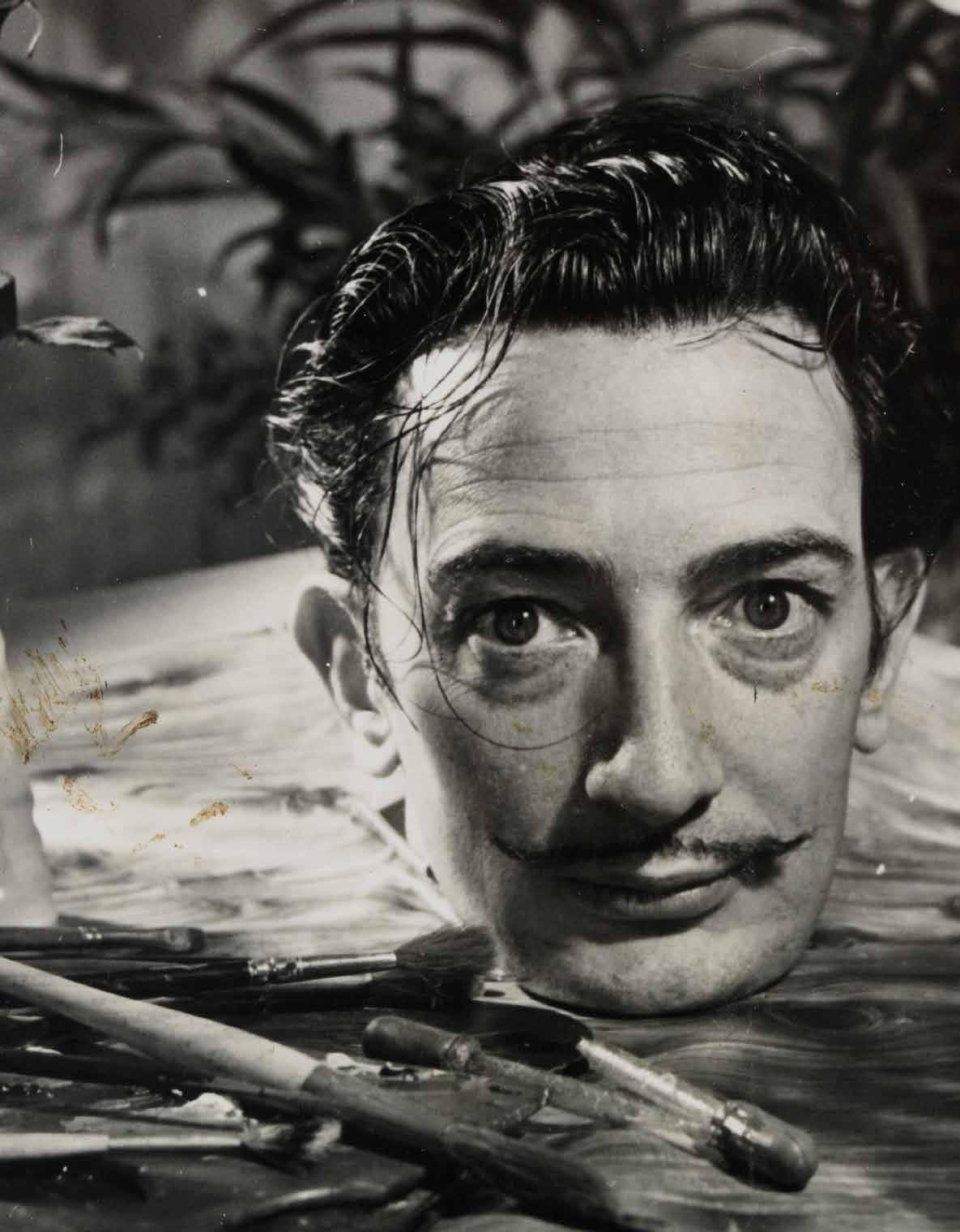
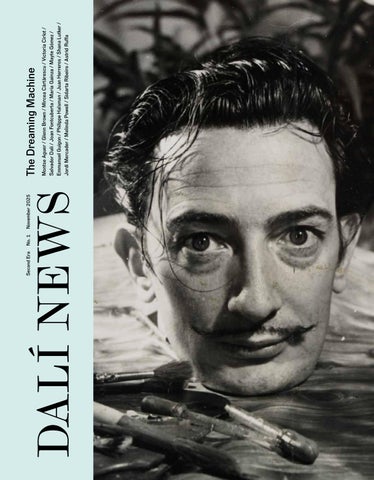
‘But, as in newspaper it is necessary to deal with so many things, and following a Catalan proverb, “si vols esta[r] ben servit, fes-te tu mateix el llit,” [if you want to be well served, make your bed yourself], I decided this time to write all that I should like to read in the papers about myself. In short, a paper where, instead of large headlines announcing mechanical catastrophies, there would be other headlines announcing the “quintessence” of Homeric breezes; instead of the melancholy shorthand of finance, of marriages without color and the births of future souls of purgatory, one should have shares of the cyclotomic exchange of the spirit, the couplings of “psicomorphologicocefales” bisexuals and the births of the completely viscuous “quintuplets” of my caprices. Instead of educational sections bordering upon mediocrity, sections of “deculturization” and confusion leading to the systematic cretinization of the masses. For our entire epoch is to be re-educated. Finally, instead of the atomic disintegration of matter surrounding an explosion, the sudden possibilities of integration materializing in the sublime and preeminently Catholic myth of the Resurrection of the Body. In any case, the dalí news will offer this incontestable originality over all the other existing newspapers. It will not contain a single bad news item, even those which are true, and will contain all the good news items, even those which are false’.
To mark the 80th anniversary of dalí news –the selfpublished newspaper created by Salvador Dalí during his American period– the Fundació Gala-Salvador Dalí is launching a new edition of this historic publication.
Jordi Mercader Miro
In 1945, Salvador Dalí decided to launch a newspaper, which he titled dalí news in order to avoid any misunderstanding: he wanted to express his thoughts without filters or obstacles, disgusted by the ‘mediocrity and deculturalization’ that he observed and by ‘the confusion that leads to the systematic cretinisation of the masses’. Here, as it so often did, Dalí’s sharp tongue bordered on the acidic, yet it had the virtue of warning of the dangers of a disconcerting tendency in mass communication.
The new publication had a short life, probably because it proved incompatible with the period of extraordinary artistic and intellectual creativity that Dalí entered into after the Second World War, but now, eighty years later, the Fundació Gala-Salvador Dalí has set out to re-publish dalí news In the absence of the master, we cannot aspire to follow the same path he began in New York, but we can create a periodical publication open to all branches of contemporary thought from within the fertile, critical, and innovative universe Dalí constructed with his painting and writing.
Salvador Dalí proposed that the Torre Galatea –which presides over the Dalí Theatre-Museum in Figueres today– be not only a place to appreciate his artwork but also a centre of knowledge, inviting the world to use ideas, dreams, science, art in creating and anticipating a vision of the future. In this respect, dalí news is a prime example of the Fundació Gala-Salvador Dalí’s efforts to further our founder’s intentions while, of course, adapting to a century that has dawned with many great initiatives –which would have stimulated Dalí’s insatiable intellectual curiosity– but also with challenges that he would have undoubtedly confronted, as he did with war, the misuse of technology, and the nuclear bomb.
Our new initiative has a clear spirit of continuity. dalí news will be published once a year, with a decidedly international vocation and a commitment to the exacting standards Dalí imposed on all his projects. Our aim is for those who write for dalí news and those who read it to share in our purpose with the utmost freedom. At the same time, we want dalí news to be a platform that encourages debate and controversy about culture, and about the ways culture increasingly intersects with other expressions of contemporary knowledge and understanding.
Each issue will have a central theme as its focus of research, reflection, communication, and debate. The first revolves around dreams and the role of consciousness, a crucial aspect of Dalí’s cosmology. We will pay very close attention to the responses of our readers, encouraging them to suggest the paths we should follow. The breadth and intellectual rigour of the reflections you will find here open up new ways to delve deeper into Dalí’s thought. This will allow us to explore today’s world and to predict, to the best of our ability, the challenges of tomorrow, working with the same independence manifested in Dalí’s art and writings.
Our hopes are that you find as many questions as answers in this new publication. We are convinced they will stimulate your curiosity about the role of art and culture in the reconfiguring of our lives, in our collective knowledge and our pursuit of happiness. And our dearest desire is, ultimately, that you –our readers–will join us in expanding the frontiers of knowledge.
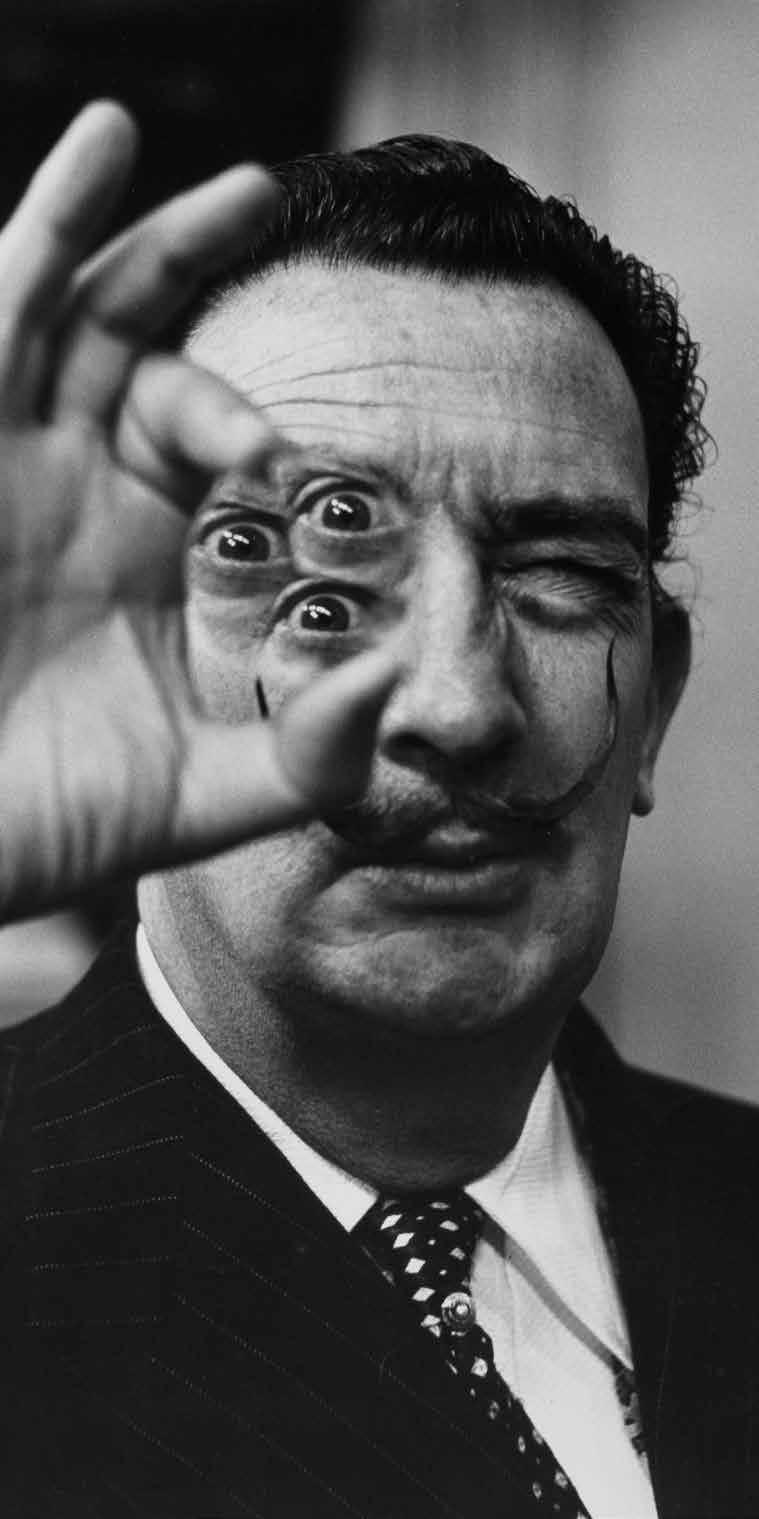
All last December the busiest gallery on Manhattan’s art-clogged 57th Street was the Carstairs, where a selection of new paintings by the irrepressible Salvador Dalí was on display. People came by the thousands, some to admire, a few to buy (at prices that might make a millionaire pause), and many just to look and to wonder how this ‘maddest’ of eccentrics continues to rock the boat of modern art. One answer was offered by Alain Jouffroy, a Paris art critic: Despite ‘this irritating mixture of audacity, genius, conformity, and boasting… Dalí maintains certain values above the flux; one would laugh less while listening to him if one remembered that each of his pleasantries plunges a sword into the heart of our history’.
On the following pages, Nugget offers four more (in the series of 12) predictions of the future as envisioned and rendered by Dalí, who answers those, particularly critics and fellow artists, who consider him a phony: ‘They’re jealous’.
photo by halsman
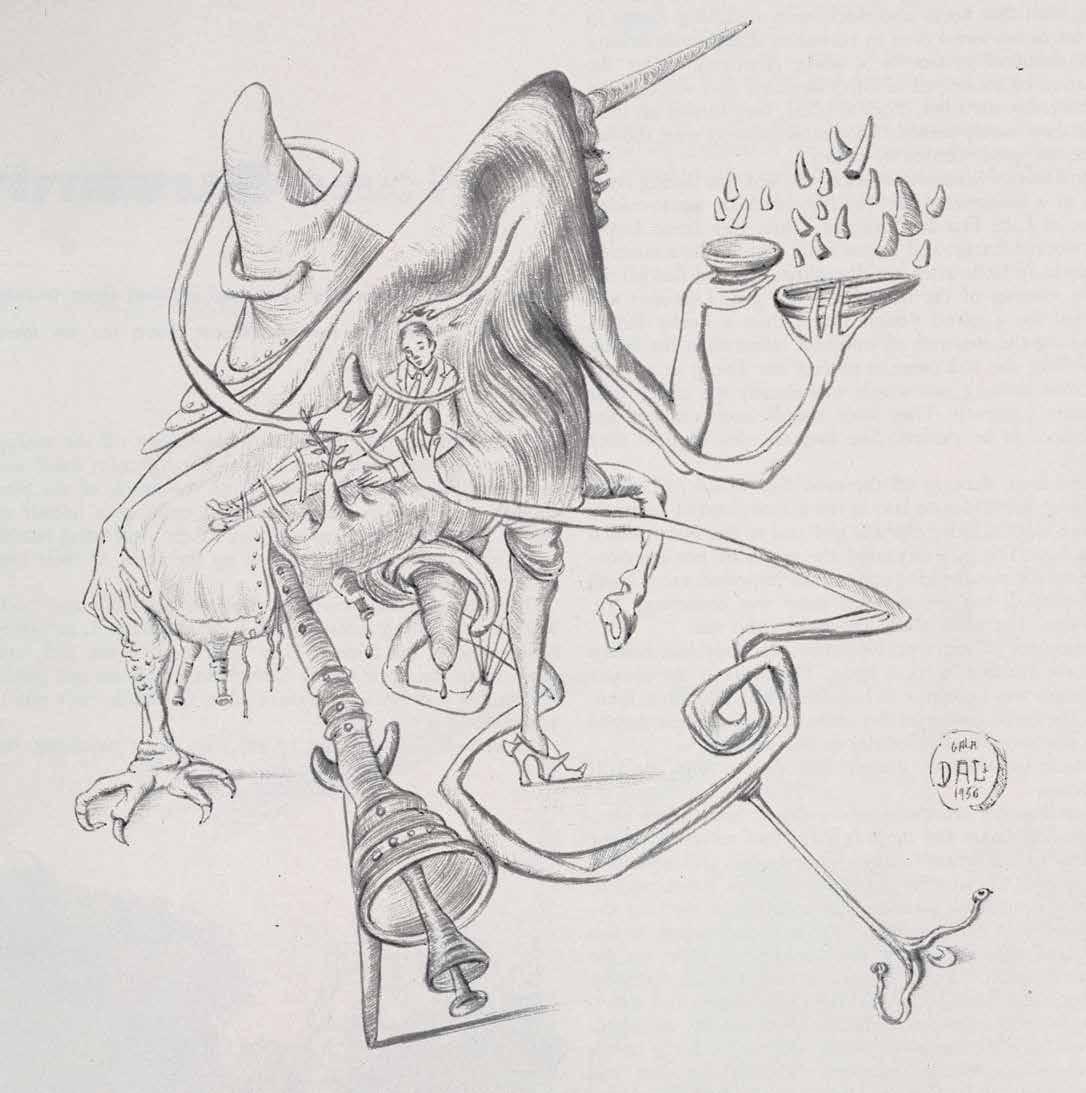
Every man will have an opportunity to avail himself of the ‘benefits’ of complex dreaming machines. In them, the subject will be shocked out of ordinary, mundane sensations. Surrealist dreams will run rampantly through his mind. Six minutes a day in a dreaming machine, and ‘little by little fantasy will be born in his soul’.
Salvador Dalí captured the dream world in a unique visual aesthetic through his Paranoiac-Critical method that consists of inducing mental states in which the irrational emerges with force, enabling the artist to ‘see’ unusual connections between objects and ideas. Thus, in Dalí’s visual and literary work –and, by extension, in surrealist works in general–the dream is not only a source of inspiration: it represents a deep desire to reveal what is hidden, to challenge ordinary perception, and to free the subject from the limitations imposed by reason.
From the preface to the first issue of La Révolution surréaliste, December 1924
Montse Aguer Teixidor
The interpretation of dreams
The publication of Sigmund Freud’s The Interpretation of Dreams (1899) marked a turning point in the history of psychology, psychiatry, and Western culture as a whole. Freud’s book gave rise to psychoanalysis, introduced key concepts such as the ‘unconscious’ and revealed the existence of internal psychic conflicts. The analysis of dreams ultimately offered a new field for the study of mental disorders and brought the dream world into closer contact with society in general by presenting the dream as a form of ‘wish fulfilment’ and, at the same time, as an unconscious mechanism for resolving conflict, whether recent or old. These ideas had a profound influence on the social sciences, philosophy, literature, and art of the twentieth century, and especially on the Surrealist movement, which adopted and adapted many of Freud’s theses. André Breton, in his Surrealist Manifesto (1924), argued that art should free human beings from the constraints of logic and morality imposed by reason, and conceived of the Freudian unconscious as an inexhaustible source of creativity. According to Freud, dreams are a direct manifestation of the unconscious. For the Surrealists, they represent a plane of experience different from that of conscious waking life: the other half of existence, the knowledge of which enriches and expands the life
1 Salvador Dalí, The Secret Life of Salvador Dalí Dial Press, New York, 1942, p. 167.
of the psyche. The dream thus ceases to be a void in consciousness and becomes a significant experience, one that allows the exploration and expansion of the inner world, a fundamental objective of Surrealism. In this sense, the human being is, for Breton, the ‘definitive dreamer’ (rêveur définitif).
The realm of dreams, imagination, and fantasy were all regarded as essential to achieving the full exercise of human freedom. This was and is one of the core tenets of Surrealism, understood not only as an artistic movement but also as an attitude towards life focused on the exploration of the internal images that are accessed through the flow of desire, and oneiric inspiration was therefore central to its praxis and ideology. For the Surrealists, living is dreaming, and dreaming is something we cannot renounce; far from being supernatural, dreaming is profoundly human. At the same time, questioning reality as it presents itself to us is an essential part of the Surrealist proposal. Objects are to be appreciated not for their everyday utility, but for their capacity to activate the imagination and make the ‘prodigious’ possible.
In 1922, Dalí moved to Madrid, where he had a room in the Residencia de Estudiantes. Of note among the books he read there was The Interpretation of Dreams ‘This book presented itself to me as one of the capital discoveries in my life, and I was seized
2 Translation from the French: ‘C’est peut-être, avec Dali, la première fois que s’ouvrent toutes les grandes fenêtres mentales’. André Breton [foreword], Dalí Galerie Goemans, Paris, 1929.
3 Jacques Lacan, De la psychose paranoïaque dans ses raports avec la personnalité Le François, Paris, 1932.
with a real vice of self-interpretation, not only of my dreams but of everything that happened to me, however accidental it might seem at first glance’. At this time he was just beginning his higher education and, as a budding painter, he was open to all influences and had a fervent desire to learn. The classes he attended soon disappointed him, but he continued to search for his own voice, a style that would characterise him, and this was none other than Surrealism.
The paranoiac-critical method
In 1929, Dalí joined the Surrealist group, where he found André Breton to be one of his first allies. In the words of the French writer and poet, ‘it may be, with Dalí, the first time that all the great windows of the mind open’,2 in reference, most probably, to the Paranoiac-Critical method of interpreting reality. Based on the psychoanalyst Jacques Lacan’s 1932 Diplôme d’État thesis, De la psychose paranoïaque dans ses rapports avec la personnalité 3 the painter developed ‘a spontaneous method of irrational knowledge based on the critical and systematic objectification of delusional associations and interpretations’.4 It was thanks to this system that there began to appear in his work the socalled ‘double or invisible images’, which he defined as ‘the representation of an object which, without the
4 Salvador Dalí, ‘The Latest Modes of Intellectual Stimulation for the Summer of 1934’ (1934). In Haim Finkelstein, The Collected Writings of Salvador Dalí Cambridge University Press, Cambridge, 1998, p. 254.
I have often imagined and represented the monster of sleep as an immense and very heavy head, with a single thread-like reminiscence of the body, which is prodigiously maintained in equilibrium by the multiple crutches of reality, thanks to which we remain in a sense suspended above the earth during sleep.
least figurative or anatomical modification, is at the same time the representation of another absolutely different object’.5
According to the classic theory, paranoid delusion has its basis is an error of judgment in the face of reality and, therefore, of a false interpretation, but Lacan sustained that the origin of paranoia lies in a hallucination. Interpretation and delusion, in his view, are not two consecutive moments but simultaneous.
The correspondences between Lacan’s thesis here and Dalí’s approaches are evident: the hallucinatory origin, the concurrence between interpretation and delusion, the creative power of paranoia, and the usage of repetitive structural forms, among others.6
In his search for inspiration, then, Dalí turned away from the documentary gaze of the scientist and focused instead on the interpretive vision of the paranoid. According to the painter, paranoids automatically project their subconscious thoughts –their phantoms, their obsessive idea– into the forms of objects. By focusing entirely on those features of a given object that allowed him to associate it with a phantasm, he was able to see only what he desired and to reconstruct the world according to his obsessive ideas. With this new procedure, Dalí sought to facilitate access to the images from the subconscious.
Surrealism, the dream and Dalí
If we analyse Dalí’s work, we can see how this ‘monster’ was present throughout his career in the broadest sense of the term: from painting and literature to sculpture –or, more accurately, the Surrealist object– and to his stage and film projects. Always in search of a world beyond what is visible, questioning norms and limits, the painter used resources such as optical illusions, the multiplication of perspectives, the strangeness of the world of known objects –unreal, ruinous landscapes, the casting of intense shadows– to capture enigma, mystery, the desire for immortality.
The film genre profoundly aroused his interest.
For Dalí, this language in motion, projected in a darkened room, represented an encounter with the unexpected, with wonder, free of predetermination or consciousness. It was, in his words, ‘the realm of dream with eyes open’. This was how he described Surrealist cinema, as it manifested in the films he created with Luis Buñuel, Un Chien Andalou and L’Âge d’or the result of their intellectual complicity and mutual influence: ‘But an absolutely Surrealist film, more clearly, a film in which the sole and exclusive intention was the strict planning of a series of dream images, or images that appeared in the brain of an individual, and if this realisation were carried out with absolute rigour, I believe that this film […] would be as anti-artistic as filming what the sage finds under the microscope’.
Dalí also had a deep devotion to the Surrealist object, which he felt had generated a new need for
reality. It was no longer a question of talking about the ‘marvelous potential’ of the unconscious: people want to touch the ‘marvelous’ with their own hands, see it with their own eyes and have proof of it in reality.7 This is apparent in the fact that, years later, in the 1950s, and in the context of a collaboration with Nugget magazine, Dalí included among his predictions for the future the creation of a ‘dreaming machine’.8
In Dalí’s literary output there are numerous references to dreams and the oneiric, many of them related to love and death: ‘The relationships between dream, love, and the sense of annihilation that is peculiar to each of these, have always been obvious. Sleeping is a form of dying, or, at least, dying to reality; better still, this is the death of reality. But reality dies in love as it does in the dream. The gory osmoses of dream and love occupy a man’s life in its entirety. During the day we unconsciously look for the lost images of dreams, and that is why, when we find an image resembling some dream image, it seems to us that we have known it before and thus we maintain that merely seeing it has already made us dream’.9 Dalí was referring here to the metaphorical interpenetrations between Eros, Thanatos and the dream in a text that appeared in his first book in French, La Femme visible (1930), in which there are evident references to Freudian psychoanalysis. These dreams were to persist in Salvador Dalí’s work, and above all in his last major creation: the Dalí TheatreMuseum in Figueres. Of note among the rooms of this great Surrealist object is Face of Mae West Which Can Be Used as an Apartment (c. 1974), a reinterpretation which can be viewed as a three-dimensional installation or as a two-dimensional image, depending on the viewer’s perspective. Dalí described this fascinating montage, with its oneiric and symbolic power, in terms that precisely underline the intention to materialise the dream: ‘Being a Phoenician, I preferred, instead of a Surrealist dream that fades and slips away a quarter of an hour after waking, to have a dream that could serve as a living room, that is, there is a nose with two fireplaces, a mouth called a saliva-sofa in which one can sit very comfortably; for the same price we have enough space above the nose to place a clock of supreme bad taste, the kitsch of Spanish art, and on either side of the nose, of course, the eyes, which are nebulous views of the Seine in Paris’.10
In this brief comment, Dalí reveals his intention to give body and permanence to the dream, to create a habitable space that would function within oneiric logic. Dalí’s surrealism is no longer merely an evocation or metaphor of the dream but its tangible incarnation in the exhibition space. Dream and surrealism share a profound essence. Both operate outside the limits of conscious reason and delve into the most hidden and most mysterious areas of the human psyche. Dreaming is, in this context, a profoundly surreal act. And creating from surrealism will inevitably imply adopting the free, ambiguous, changing logic of the dream.
5 Salvador Dalí, The Passions According to Dalí The Salvador Dalí Museum, St. Petersburg (Florida), 1985, p. 210.
6 Virgili Ibarz, Manuel Villegas, ‘El método paranoico-crítico de Salvador Dalí’, Revista de Psicología vol. 28, no. 2/3, 2007, p. 107.
7 Salvador Dalí, The Secret Life of Salvador Dalí op. cit. p. 313
8 Salvador Dalí, ‘Salvador Dalí predicts’, Nugget New York, 30/04/1957.
9 Salvador Dalí, ‘Love’ (1930). In Haim Finkelstein, The Collected Writings of Salvador Dalí Cambridge University Press, Cambridge, 1998, p. 190.
10 Comment made by Salvador Dalí in a NO-DO report broadcast by Televisión Española on 21 January 1975.
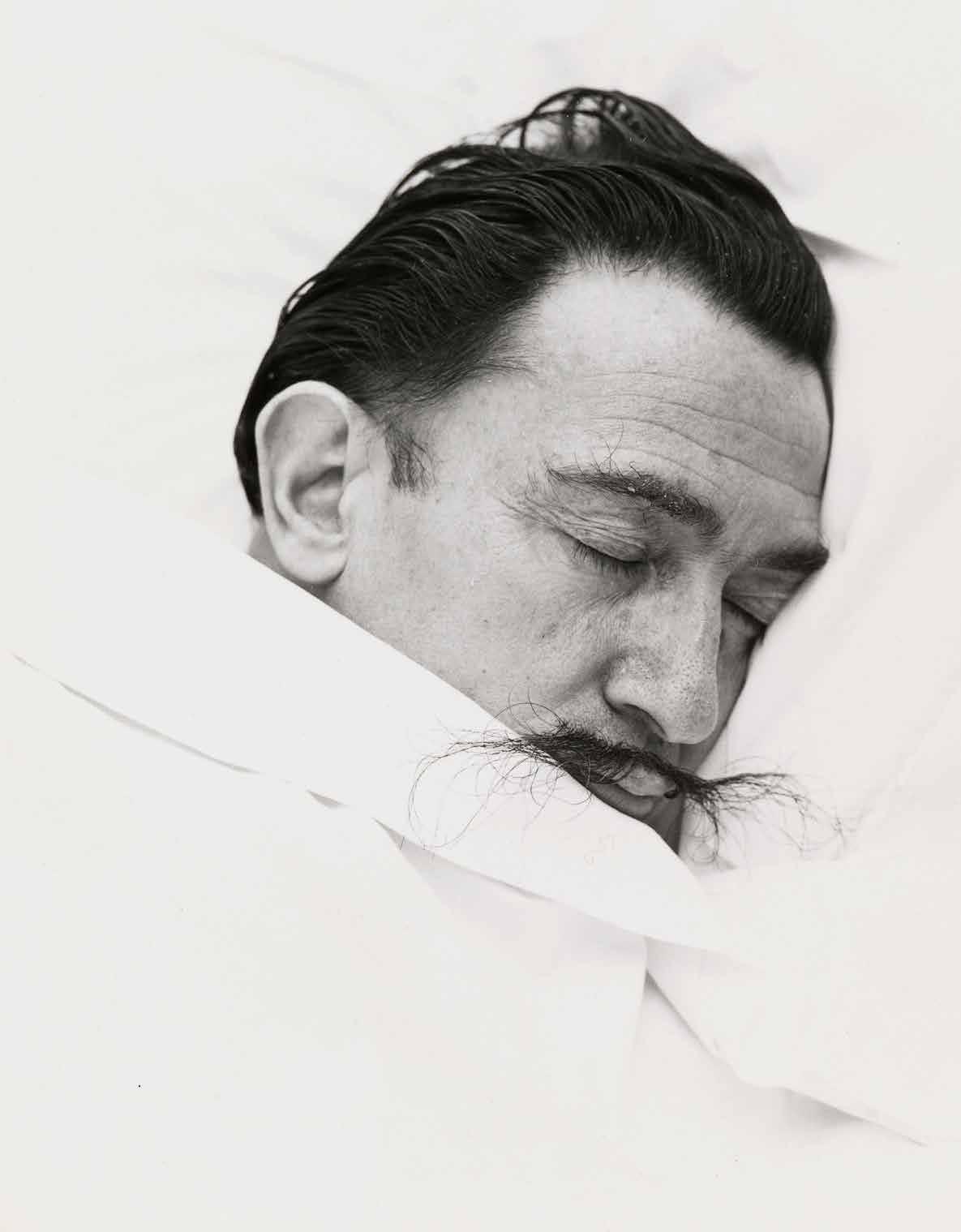
Astrid Ruffa
Astrid Ruffa holds a PhD in literature and is a researcher affiliated with the University of Lausanne (Switzerland). She is the author of Dalí et le dynamisme des formes [Dalí and the Dynamism of Forms] (Les presses du réel, 2009), as well as numerous publications on the Surrealists’ artistic, literary, and scientific imaginary. A specialist on the work of Salvador Dalí, she has collaborated with the Museo Nacional Centro de Arte Reina Sofía, among others.
In 1929, when Dalí joins the Surrealist movement in search of renewal, he plays an essential role in the ‘future resolution of these two states, dream and reality, which are seemingly so contradictory [...]’ that Breton desired. 1 In fact, Dalí argues that ‘we are constantly dreaming’, that the dream state continues ‘through waking life, with daydreams, fantasies, and deliriums’.2 Thus, the dream images that emerge from the subconscious take on a concrete character, automatically projecting themselves –according to the ‘Paranoiac-Critical’ activity first conceived by Dalí in 1929– onto the forms of objects in the outer world. Dalí elaborates this vision of dreaming by creatively appropriating the scientific discoveries of his time, allowing him to transcend both the subjectivity of the dream world and the objectivity of science.
Freud as seen by Dalí First, Dalí carefully studies Freud’s discoveries.3 From 1922 onwards, he familiarises himself with this new scientific theory, frequenting the vibrant cultural scene at the Residencia de Estudiantes in Madrid.4 As early as 1929-1930, Dalí takes up Freud’s idea that dreams fulfil suppressed desires and, as such, are a privileged means of exploring the subconscious. However, far from seeing this as a therapeutic tool to treat and cure psychological dysfunction, Dalí sees dreaming as a means to liberate subconscious forces and as a way of life. Broadening Breton’s focus, he also makes fully conscious use of dream’s sexual symbolism, as pointed out by Freud. In this way, Dalí develops an imaginary filled with violent erotic impulses, anxiety and perversions, far removed from Breton’s universe of ‘the marvellous’.5 To this end, he combines several psychological theories, such as those by Freud, Rank,
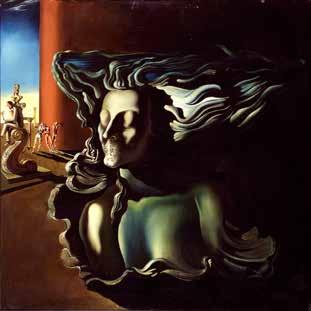
Wittels, and Kolnai.6 An example of this is the Medusa head with her serpent hair that Dalí painted in The Font (1930) [P248] and The Dream (c 1930) [P267], which for Freud symbolises the fear of castration.7 When Dalí substitutes a mouth with a swarm of ants shaped like a pubis, he seems to refer to Freud’s view of mouths as female sexual organs,8 and, in the case of the ants, to the reaction of disgust that according to Kolnai hides an unconscious attraction.9
Dalí also appropriates, while modifying their function, the Freudian mechanisms of displacement and condensation inherent to dreams, as well as the associative logic based on their ‘formal characteristics’.10 For Freud, this deformation of dreams allows one’s desires to be fulfilled and to elude censorship by remaining
in a latent state. Dalí, on the other hand, uses it to manifest inhibited subconscious desire. In The Dream, the emotional intensity tied to the castrating Medusa is shifted onto a Modern Style font: the Medusa head is visible in the outlines of this inobtrusive object and manifests itself there. In Invisible Sleeping Woman Horse Lion (1930) [P247], the figure in the foreground –inspired by, among other works, Der Nachtmahr (1781) by Füssli11– introduces us into a world of oneiric transformations that allow subconscious desires to manifest themselves. In addition to a sleeping woman, a lion, and a horse,12 there is an image of fellatio in the horse’s front quarters, as well as a headless nude in its hindquarters. In the background other condensed images are visible, such as a boat in the shape of a phallus and a hill/breast, everyday elements that bring to light the latent meanings Freud attributes to them.13 If dream thought can extend into the waking state and can manifest itself in objects perceivable to
1 André Breton, ‘Manifeste du surréalisme’ [‘Surrealist Manifesto’] (1924). In Manifestes du surréalisme [Manifestoes of Surrealism], Gallimard, Paris, 1996, p. 24.
2 Salvador Dalí, ‘Cinq minutes à propos du surréalisme’ (1930), a script for a documentary that was never filmed, translated from Obra completa vol. III, Poesía, prosa, teatro y cine Destino, Fundació Gala-Salvador Dalí, Sociedad Estatal de Conmemoraciones Culturales, Barcelona, Figueres, Madrid, 2004, p. 1064, 1070. Dalí uses these same words in ‘L’Amour’ (1930). In La dona visible Fundació Gala-Salvador Dalí, Ed. Andana, Figueres, Vilafranca del Penedès, 2011, p. 65 and in ‘New General Considerations Regarding the Mechanism of the Paranoiac Phenomenon from the Surrealist Point of View’ (1933). In Haim Finkelstein, The Collected Writings of Salvador Dalí Cambridge University Press, Cambridge, 1998, p. 262.
3 In 1930, Dalí explicitly refers to this in ‘Cinq minutes à propos du surréalisme’, op. cit. p. 1056-1061; ‘The Moral Position of Surrealism’. In Haim Finkelstein, The Collected Writings of Salvador Dalí op. cit. p. 222; ‘L’Amour’, op. cit. p. 67.
4 Ian Gibson was one of the first to point this out, in The Shameful Life of Salvador Dalí Faber and Faber, London, 1997, p. 115-116.
5 André Breton, ‘Manifeste du surréalisme’ [‘Surrealist Manifesto’], op. cit. p. 25-28.
6 On the importance of the approaches of Freud, Kolnai, Rank and Wittels in Dalí’s work, cf., Vicent Santamaria de Mingo, El pensament de Salvador Dalí en el llindar dels anys trenta Publicacions de la Universitat Jaume I, Castelló de la Plana, 2005, p. 83-95, 112-133, 243-265.
7 Sigmund Freud, Nouvelles conférences sur la psychanalyse (1915-16, 1916-17) digital edition by Jean Marie Tremblay, 2002, p. 17.
8 Sigmund Freud, L’interprétation des rêves [The Interpretation of Dreams] (1900), PUF, Paris, 1976, p. 308.
9 Dalí mentions Kolnai's theory in 1930 in ‘L’Amour’, op. cit., p. 68.
10 Sigmund Freud, L’interprétation des rêves [The Interpretation of Dreams], op. cit. p. 242-300, 432. These mechanisms refer to the displacement of the emotional intensity of an object onto another less disturbing object, as well as the condensation of various subconscious thoughts in a single object.
11 As Dawn Ades mentions in Dalí — La retrospettiva del centenario Bompiani, Milano, 2004, p. 132.
12 Salvador Dalí, ‘The Rotting Donkey’ (1930). In Haim Finkelstein, The Collected Writings of Salvador Dalí op. cit. p. 224.
13 Sigmund Freud, L’interprétation des rêves [The Interpretation of Dreams], op. cit. p. 306.
everyone, it is because Dalí associates the Freudian approach of dreams with Gabriel Dromard's definition of ‘interpretative delirium’, which he appropriates to elaborate his own ‘Paranoiac-Critical’ activity.14 In fact, Dalí sees paranoia delirium as a mode of perception characterised by the constant and automatic interpretation of objects according to subconscious desires, which allows them to be revealed. This is precisely what Dalí attempts to demonstrate to Freud, when he meets him in 1938: the possibility of inhibited unconscious ideas returning to a conscious state, beyond the deformations inherent to dreams, lapsus, etc.15
The dream, under the influence of physics, morphology, and entomology
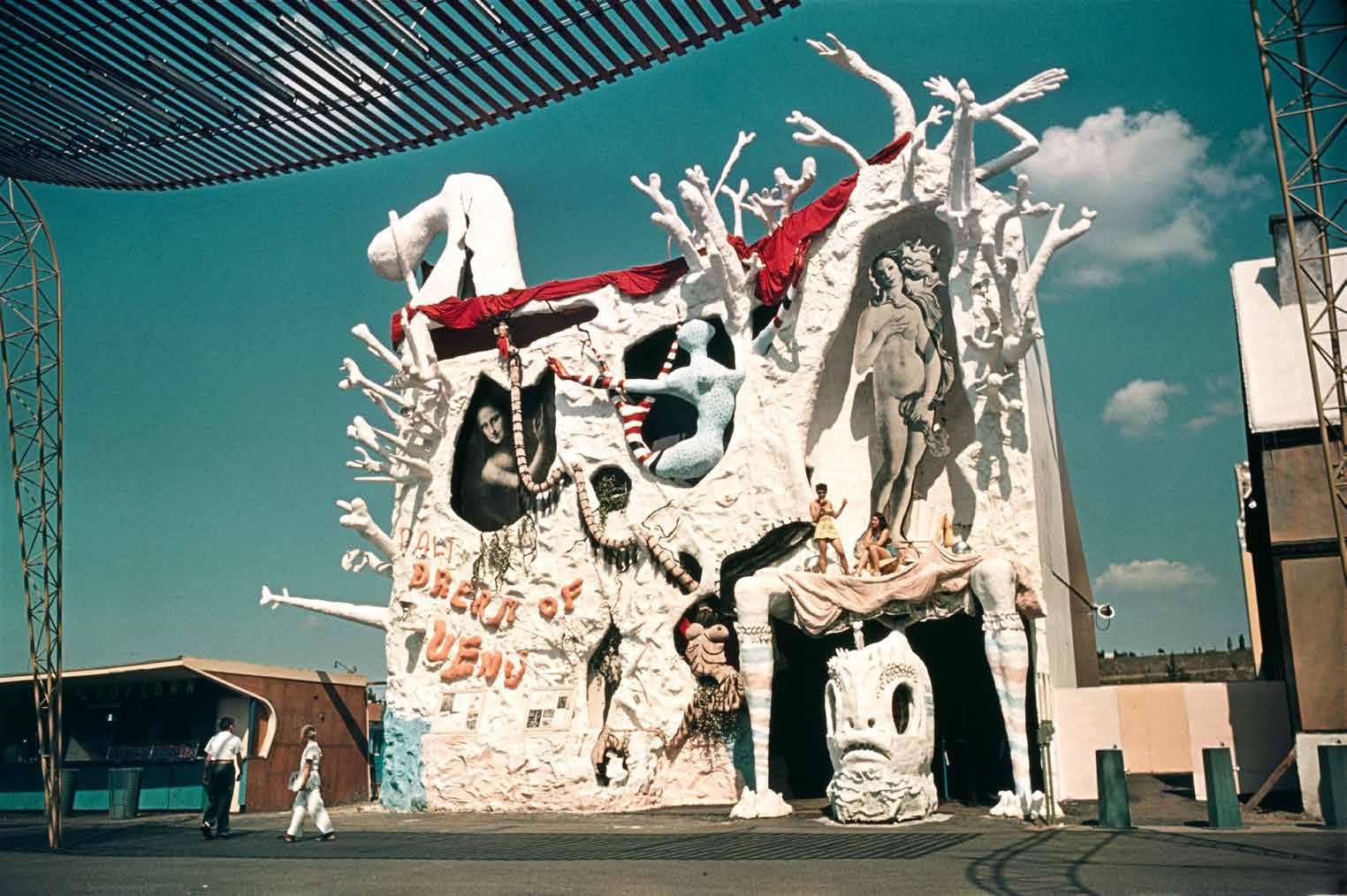
Within the Surrealist group, Dalí combines very disparate scientific fields and explicitly situates Surrealism between ‘art’s cold water’ and ‘science’s hot water’.16 The Dream of Venus pavilion, conceived for the 1939 New York World’s Fair, is a very good example. In it, Dalí integrates leitmotivs drawn from his imaginative scientific explorations carried out during the 1930s.
The pavilion is a dream one can see and experience. Visitors can enter a real building and explore various parts of the dream of Venus by wandering from one section to another. There they find all sorts of objects and costumed women who give way to living paintings and performances/freak shows.17 The entrance to the pavilion has clear sexual connotations subject to Freudian interpretations. In contrast with Botticelli’s Venus which stands above it, the arch of the entrance is made up of two spread legs, between which there is a monstrous fish with sharp teeth that serves as the ticket office.
The façade, with its numerous cavities and protuberances, is inspired by Modern Style architecture that Dalí had been reinterpreting since 1934, appropriating the notion of space-time in Einstein’s theory of relativity in an erroneous but creative way. Between 1930 and 1933, Dalí had already expressed his admiration for these buildings, whose ornamental details allowed for ‘oneiric interwinings’ and the solidification of desires.18 But beginning in 1934, Modern Style wavy walls become ‘aerodynamic [...], soft [...], imaginative, anxiety-ridden, perverted [curves]’ drawn from a psychic space-time. In fact, Dalí considers subconscious desire as a sort of psychic space-time19 that configures bodies in its image by printing its own curvature, dynamism, and voracity on them,20 which explains his interest in curved, soft, aerodynamic, cannibal objects and characters.
This imaginary also unfolds inside the pavilion.
The Dream of Venus (c. 1939) [P484] –a mural painted over four panels located in the space representing
14 Astrid Ruffa, ‘Dalí, photographe de la pensée irrationnelle’. In Études Photographiques no. 22, 2008, p. 100-117.
15 Salvador Dalí, André Parinaud, The Unspeakable Confessions of Salvador Dalí William Morrow and Company, New York, 1976, p. 121.
16 Salvador Dalí, ‘The Conquest of the Irrational’ (1935). In Haim Finkelstein, The Collected Writings of Salvador Dalí op. cit. p. 406.
17 Cf. e.g. the presentation of the pavilion in Dalí. Mass Culture Fundación ‘la Caixa’, Barcelona, 2004, p. 118-119, 123.
18 Salvador Dalí, ‘The Rotting Donkey’ (1930). In Haim Finkelstein, The Collected Writings of Salvador Dalí op. cit. p. 225; Salvador Dalí, ‘Concerning the Terrifying and Edible Beauty of Art Noveau Architecture’ (1933). In Haim Finkelstein, The Collected Writings of Salvador Dalí, op. cit. p. 195, 198.
Venus’s bedroom– reproduces the soft clocks of The Persistence of Memory (1931) [P265]. These watches now embody a soft, dynamic, and voracious space-time that destroys the bodies it acts upon. They seem to exert an even more corrosive action than in 1931: the mutilated tree is uprooted and has torn fabric in flaming tones wrapped around one end of a branch, echoing the flames devouring the giraffes; the wall is cracked and crumbling; the face of the ‘great masturbator’ is being gnawed on by ants.
In this painting we can also recognise two spectral women fashioned by this curved, active, and voracious space-time.21 Their physical dynamism is represented by the curvature of their backs as well as their clothing and hair –like snakes or needles– that sway in the wind. Their ghostly aspect is expressed in the shadows they project. Their destructive action is revealed through the devastated and devastating elements in similar tones: the remains of white bones with black shadows; the giraffes blackened by red and orange flames similar to the colours of the spectral figure beside them; the curved red lobster with its enormous, devastating claws.
Plunging the figures in The Dream of Venus into a crepuscular atmosphere, Dalí also refers to the notion of ‘atavism of twilight’, which he himself conceived of in 1932-1933 based on the poetic descriptions of JeanHenri Fabre. This entomologist, whom Dalí discovers thanks to Buñuel,22 often observes insects at dusk and describes in an elegiac tone the ancestral traits of their behaviour, harkening back to a primitive violence typical of a remote era. This is also the case of the green grasshopper, seen as ‘a belated representative of ancient customs’, and the praying mantis,23 described as ‘a ferocious specter chewing the brain of its captive’and as ‘a reminiscence of geological times’.
24 That is the basis for Dalí’s association of twilight, when one can hear the song of the insects, with the Tertiary period, characterised by the cannibalistic lovemaking of the praying mantis,by ‘immense tertiary birds’ of which only fossils remain, and by ‘geological cataclysms’, vestiges of which are the anthropomorphic rocks of Cap de Creus.
25
In The Dream of Venus, this ideas are represented in a particularly violent way with the two spectral women who resemble praying mantis, the remains of bones, and the animal carcass in the shape of a boat –which recalls Omnibus Royal Netherlands (1829), by Jean Grandville, and The Carcass (152030), by Agostino Veneziano.26 Dalí also depicts some anthropomorphic rocks, and the dark cavity on the right seems to trace the silhouette of an insect on its back. The entire landscape, suspended between night and day, suggests a crepuscular era, devastated by the
19 Salvador Dalí, ‘Aerodynamic Apparitions of “Beings-Objects”’ (1934). In Haim Finkelstein, The Collected Writings of Salvador Dalí op. cit. p. 209.
20 For Dalí, the curvature of space-time determines the shape of bodies, not their trajectory; its active nature makes bodies not only dynamic but also voracious. Cf., Astrid Ruffa, Dalí et le dynamisme des formes Les presses du réel, Dijon, 2009, p. 421- 464.
21 As Dalí defines them, for example in ‘The New Colors of Spectral Sex-Appeal’ (1934). In Haim Finkelstein, The Collected Writings of Salvador Dalí op. cit. p. 201-207.
22 Jean Michel Bouhours, ‘Sciences à la Residencia’. In Dalí Eureka Somogy, Paris, 2017, p. 19.
23 Fabre’s words quoted by Dalí in The Tragic Myth of Millet’s Angelus [written in 1932-1933], The Salvador Dalí Museum, St. Petersburg (Florida), 1986, p. 53.
fury of the subconscious deliriums, both erotic and political, of the impending Second World War.
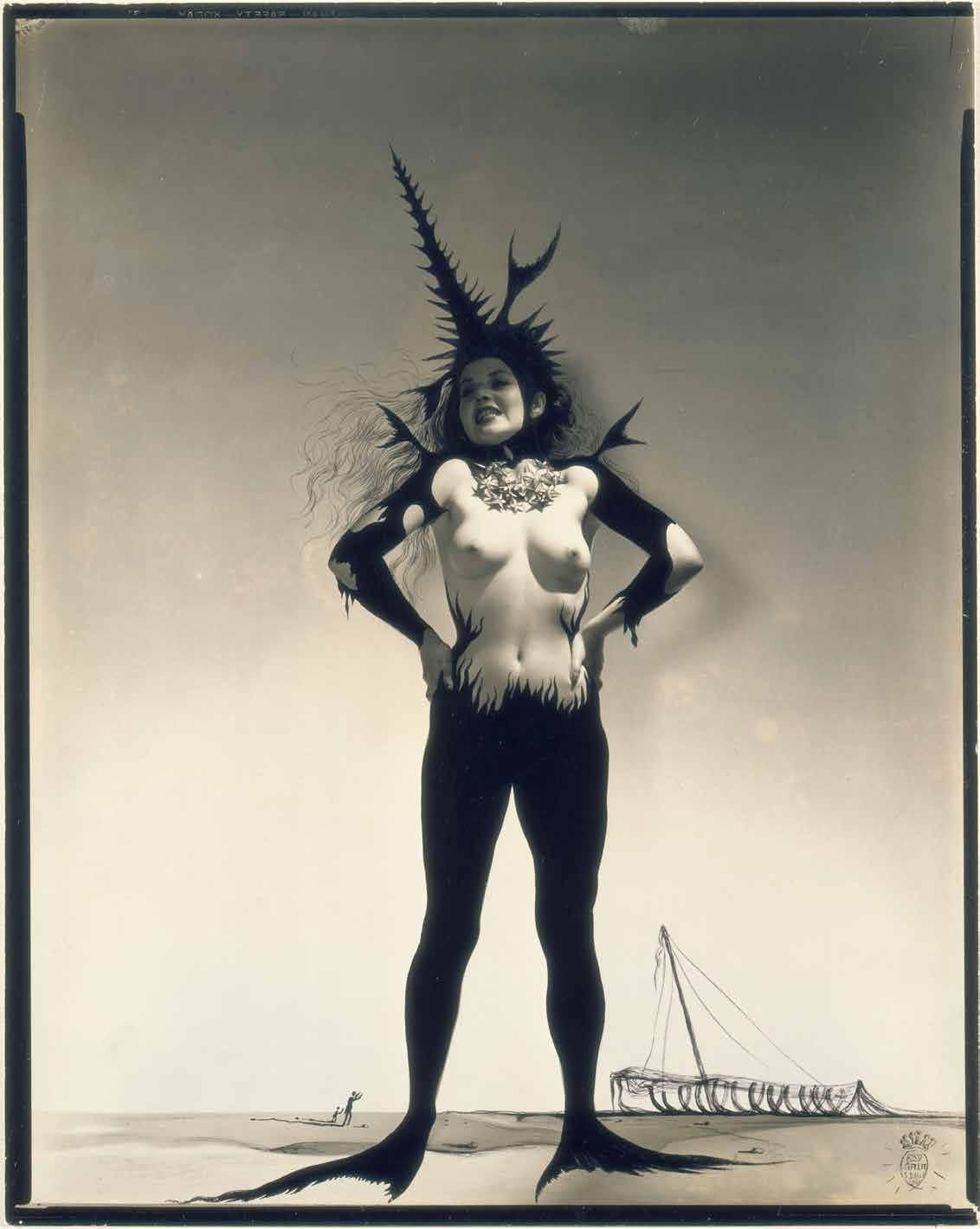
In the section of the pavilion devoted to the performance of mermaid-women in a pool, Dalí draws on Monod-Herzen’s principles of morphology to represent a devastating subconscious desire. Beginning in 1936, Dalí employs this scientist’s ideas –which inextricably link invisible exterior action with matter’s visible reaction–as a point of reference,27 and considers the skeleton of radiolaria an ‘extraordinary configuration’ derived from ‘mechanical actions exerted on the animal by the fluid that surrounds it’.28 As seen in a drawing,29 Dalí creates ‘living liquid ladies’ after the model of radiolaria: these mermaid-women are moulded by the water and combine spherical shapes (bare round breasts) and pointed shapes (the spicula) like the radiolaria. Their nature is atavistic and destructive, as demonstrated by their spikes and the animal carcass in the shape of a boat that Dalí integrates into a photo of a mermaidwoman.
Expelled from the Surrealists’ group, Dalí makes increasing use of scientific discoveries to materialise images drawn from irrationality, such as One Second Before the Awakening from a Dream Provoked by the Flight of a Bee Around a Pomegranate (c 1944) [P596] or the illustrations of the Alice’s dream in Alice in Wonderland (1969). However, his intentions and his scientific and artistic models evolved. Beginning in the 1940s, Dalí no longer proposes to ‘systematise confusion’, but rather to bring to light a unifying principle that connects all the elements of the cosmos.
Approaching dreams in the 21st-century, between Art and Science
Today, the intersections between art and science persist through the sustained attention given to dreams. Most scientists now recognise the creative and cognitive value of oneiric activity in resolving waking problems, a value the Surrealists had already asserted in 1924. Advances in neuroscience and experimental psychology have allowed scientists to reveal the cerebral mechanisms of dream activity and investigate the function of dreams in relation to waking activities.
30 The illogical nature of associations specific to dreams, as well as Freud’s idea that dreams recover the dreamer’s past, can now be considered proven: the sleeping brain, since it is no longer controlled by the prefrontal cortex (responsible for reasoning and understanding), associates lived experiences differently. However, sleep contains several phases and there is no evidence that dreams are more symbolic than waking thought or that they strive to fulfil inhibited desires, as Freud stated: dream functions are performed independently of any interpretation. In this regard,
24 Ibid., p. 117-118.
25 Ibid., p. 51.
26 Works exhibited by the Surrealists during the show ‘Fantastic Art, Dada, Surrealism’, The Museum of Modern Art, New York, 1936, p. 79, 101.
27 Cf., Astrid Ruffa, Dalí et le dynamisme des formes, op. cit p. 465-481.
28 Edouard Monod-Herzen, Principes de morphologie générale t. I. Gauthier-Villars et Cie, Paris, 1927, p. 2-3, 7, 105-106.
29 Cf., Salvador Dalí, drawing for the Dream of Venus, 1939, gouache and watercolor on paper, 41.5 x 57 cm, private collection, Barcelona. In Dalí. Mass Culture op. cit., 2004, p. 130.
30 Cf., e.g. the work of Sophie Schwartz and Lampros Perogamvros presented in ‘Fenêtre sur rêve’. In Le magazine scientifique de l’Université de Genève no. 152, March 2023, p. 16-23.
current scientific knowledge leads us to believe that dreaming allows us to explore alternative perspectives on a real situation, and even to solve problems.31 René Thom, the mathematician who received the prestigious Fields Medal and with whom Dalí exchanged ideas, connected his discovery of catastrophe theory with oneiric activity.
32
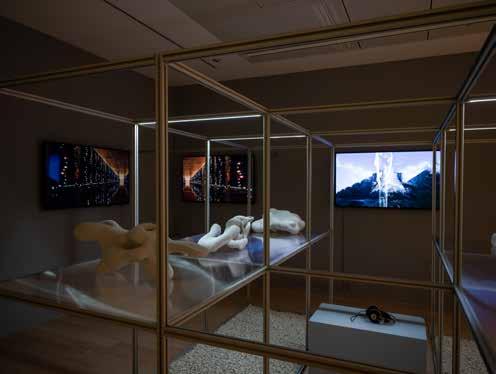
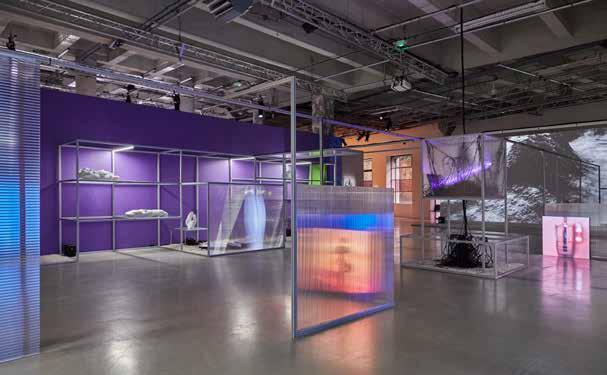
In parallel, some contemporary artists are inspired by scientific discoveries to create oneiric worlds according to an experimental method. The Dreaming Machine by Grégory Chatonsky, which uses generative artificial intelligence (GAI), is an inspiring example. The French-Canadian artist’s research began long before the popularity of GAI and the growing fever for this type of art, as seen in the exhibition ‘Artificial Dreams’ held in Paris in 2024.
In 1957, Dalí had already drawn a ‘machine for exploring dreams’ in order to foster the proliferation of surrealistic dreams and make a fantasy grow in the subject’s soul. Fascinated by cybernetics and the earliest computers,33 Dalí surely would have employed GAI to materialise his own dreams in the outer world, share them, and revolutionise thought. But Chatonsky’s method is different. To create Dreaming Machine (2014-2019), exhibited in 2019 at the Palais de Tokio and in 2020 at the Canadian Cultural Centre in Paris, the artist makes use of a scientific database of 20,000 human dreams: thanks to GAIs, new dream narratives are automatically generated, narrated, and illustrated. With sound and image sequences, the experimental device immerses the subject in the dreams of the machine, while also offering two images of data centres and sculptures in the form of fossils. Through generative AI’s calculations and statistical logic, Chatonsky presents an ‘alternative version of reality’ acting on our way of understanding the world. To that end, he seems to combine opposing concepts. The dreams, a recreation and summary of the dreams of others, are at the same time human and of the machine. Artificial intelligence becomes an ‘artificial imagination’ based on human imagination. It creates a limitless present made up of past memories (the human dreams) and announces a future without humans (the fossils): ‘The machine dreams up the human beings who may have disappeared’, 34 states Chatonsky. It is a trace of our humanity, to which it pays tribute.
Finally, contemporary explorations of dreams, carried out by scientists and artists, challenge the categorical distinctions between subjectivity and objectivity, reality and simulacrum, which underpin Western culture. This reconsideration is at the very heart of the method Dalí consistently defended through his entire life, endowing his work with a striking contemporary resonance and undeniable cognitive power.
Expelled from the Surrealists’ group, Dalí makes increasing use of scientific discoveries to materialise images drawn from irrationality. He had already drawn a ‘machine to explore dreams’ with the purpose of multiplying surrealist dreams and generating in the subject a ‘fantasy within the soul’. Dalí surely would have employed GAI to materialise his own dreams in the outer world, share them, and revolutionise thought.
Chatonsky, Second Earth installation at
Dalí,
31. During paradoxical sleep, brain activity is similar to an awake mind: the dream is experienced as if it were reality and moulds the cortical representations that nourish the human capacity to innovate. Cf., e.g. idem. Nicolas Deperrois et al. ‘Learning Beyond Sensations: How Dreams Organize Neuronal Representations’. In Neuroscience & Biobehavioral Reviews 2024; Adam Haar Horowitz et al. ‘Targeted Dream Incubation at Sleep Onset Increases Post-sleep Creative Performance’. In Scientific Reports 2023; Deirdre Barrett, The Committee of Sleep: How Artists, Scientists, and Athletes Use their Dreams for Creative Problem Solving Crown Books, New York, 2001.
32 René Thom, Apologie du logos Hachette, Paris, 1990, p. 90. On the relationship between Dalí and Thom, cf. Astrid Ruffa, ‘Dalí et la théorie des catastrophes de René Thom’. In Dalí Eureka op. cit. p. 156-166.
33 Cf., the investigations of Anna Pou, published as Dalí. Arte_ Ciencia_Cibernética Editorial Libelista, Barcelona, 2025.
34 Grégory Chatonsky, quoted by Stéphanie Lemoine in ‘L’intelligence artificielle s’infiltre dans l’art contemporain’. In Journal des Arts no. 542, 26 March 2020.
The dream object is the quintessence of the dream. In other words, the materialisation of the desire that is hidden within it or exposed in its particular language. The Surrealists made of the dream object a fetish and a work of art, as demonstrated by the objects that Dalí presented at several international exhibitions: the lobster telephone or the bust of a woman with ears of corn hanging from a baguette crowned by two Pelikan inkwells. In this article, Emmanuel Guigon, director of the Museu Picasso in Barcelona, traces the genesis and evolution of the dream object, taking André Breton and his dream of the wooden dwarf with a long white beard as the starting point and throughline of a fundamental artistic activity: dreaming to find.
Emmanuel Guigon earned his doctorate from the Sorbonne (France) and is a professor of art history there. He was a member of the scientific section of the École Pratique des Hautes Études Hispaniques Casa Velázquez in Madrid from 1987 to 1990. He is currently the director of the Museu Picasso in Barcelona. Until 2016 he was the director of the Musée des Beaux-Arts et d’Archéologie and the Musée du Temps in Besançon. Between 2001 and 2006, he was head conservator and director of the Strasbourg Musée d’Art Moderne et Contemporain and, from 1995 until 2001, he served as head conservator of the Institut Valencià d’Art Modern (IVAM) Centre Julio González in Valencia.
Surrealism
Signed by Jacques Boiffard, Paul Éluard, and Roger Vitrac, the preface to the first issue of La Révolution surréaliste in December 1924, affirms the adequacy of the Surrealist act and the Surrealist object: ‘Every discovery that changes the nature or the application of an object or a phenomenon constitutes a Surrealist fact’. This declaration-cum-programme also includes a photograph of Man Ray’s object, The Enigma of Isidore Ducasse. Ray wrapped a sewing machine in a blanket and tied the whole thing with string, an evident allusion to the famous chance encounter on a dissecting table of an umbrella and a sewing machine. The package plays with various resources, such as secrecy or preservation, but one question remains to be answered: is the wrapping a shroud or the costume of a ghost? The same preface explicitly states that ‘Surrealism opens the doors of dreams to all those for whom the night is miserly’ and the first pages of this first issue also include ‘dreams’ by De Chirico and Breton, still in the raw state of the report. A Surrealist butterfly from December 1924 bears the following inscription: ‘PARENTS! Tell your dreams to your children’. Almost every issue of La Révolution surréaliste from December 1924 to December 1929, dedicated a privileged place to sleep or dreaming. Published two months earlier by André Breton, the Surrealist Manifesto devotes special attention from the second sentence onwards to the objects of everyday life: ‘Man, that inveterate dreamer, daily more discontented with his destiny, has trouble appraising the objects he has been obliged to use, objects that his nonchalance has brought his way, or that he has earned through
his own efforts […]’. Surreality, equivalent to a kind of ‘absolute reality’, was capable of expanding our experience of objects and releasing their latent life. Breton also speaks of words whose meaning he has forgotten and of ‘the poetic consciousness of objects’ that he could ‘acquire only after a spiritual contact with them repeated a thousand times’. In 1929, ‘disturbing objects’ was the first of twelve definitions of Surrealism in the leaflet announcing a special issue of the Belgian magazine Variétés The 1938 Dictionnaire abrégé du surréalisme a compendium of quotations put together by André Breton and Paul Éluard, includes at least forty such objects and defines Surrealism as ‘old tin cutlery before the invention of the fork’. The evident delight in vulgarisation barely conceals the untimely and disconcerting intentions of the work. Surrealism, the highest state of subjectivity, immediately seized the dreamed object, and from out of it fashioned another, perpetual and changing.
A wooden dwarf
In 1918, the article that Breton dedicated to Guillaume Apollinaire confirms the entry into the scene of the problematic of the object. He quotes a long fragment from a novella by Paul Morand, Clarisse ou l’Amitié. Clarisse collects objects, all kinds of objects, from the very rare to old keys and doorknobs: ‘Small unimaginable objects, ageless, never dreamed of, the museum of a wild child, a madhouse cabinet of curiosities, the collection of a consul who has contracted anaemia in the tropics…’. She is surrounded by a thousand objects destined for uses other than those for which they were intended: books that open like boxes, pen holders, glasses, chairs that become tables, tables that transform into screens… Breton liked these fake, made-up or transvestite objects –‘this latent mockery of what is false’– that surround Paul Morand’s mysterious and beautiful protagonist. They remind him of the ‘idiotic paintings’ of A Season in Hell. Clarisse is the image of the modern woman with her inexplicable heterogeneous tastes. In the Introduction to the Discourse on the Paucity of Reality (1925), which commences with the word ‘wireless’, Breton questions the condition of language: ‘Are not our powers of speech essentially responsible for the mediocrity of our universe? […] What keeps me from scrambling the order of words, thereby making an attempt on the sham life of things!’ But the Introduction to the Discourse on the Paucity of Reality interests us above all because its author proposes to create and place in circulation a whole host of oneiric objects devoid of any utility or aesthetic value. In fact, the very first Surrealist object was born
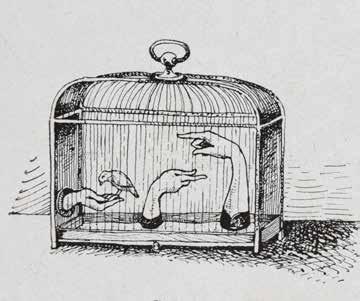
of a dream: ‘Thus recently, while I was asleep, I came across a rather curious book in an open-air market near Saint-Malo. The back of the book was formed by a wooden gnome whose white beard, clipped in the Assyrian manner, reached to his feet. The statue was of ordinary thickness, but did not prevent me from turning the pages, which were of heavy black cloth. I was anxious to buy it and, upon waking, was sorry not to find it near me’. And he adds: ‘It is comparatively easy to recall it. I would like to put into circulation certain objects of this kind, which appear eminently problematical and intriguing’. Breton sets out to materialise a dream object and presents the open-air market as a place conducive to the discovery of Surrealist objects. If we leave aside Marcel Duchamp’s readymade, this book seen in a dream, with its pages of black cloth and the little figure on the back, introduces for the first time the problematic of the Surrealist object. But doesn’t that wooden dwarf with the white beard have some connection to Freud?
Objet-fantôme
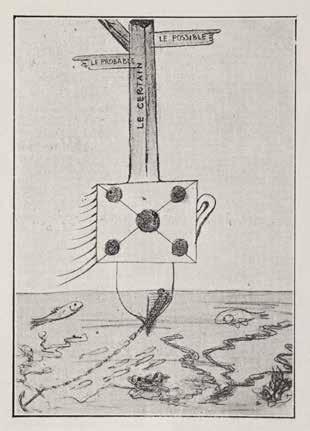
In 1927, as the middle section of an exquisite corpse Breton drew a sealed envelope with eyelashes (cils, in French) at one side and a handle (anse) at the other. Realising that the origin of the drawing was a ‘rather poor play on words’, he called it ‘silence-envelope’. He immediately became obsessed with this envelopephantom, this phantom object. Then he realised, as he noted in Communicating Vessels that the object with a handle was none other than a chamber pot. Furthermore, on looking again at the red wax seal in the middle of the envelope, he perceived it to be an eye painted on the bottom of the chamber pot. Communicating Vessels is a work focused on dreams. The title clearly declares that dreaming and waking life are two communicating vessels and there is no barrier between the two. On 5 April 1931, Easter Sunday, at six thirty in the morning Breton wrote down the dream in which he saw a parquet floor and furniture darkened by the urine of two girls. This was the true starting point of Communicating Vessels In his analysis of the long dream of 26 August 1931, Breton mentions the gift received by Suzanne Muzard on the day of her twentieth birthday: a bidet full of ‘suns’ or sunflowers.
Hypnagogic clock
At the beginning of his article ‘A Metapsychological Supplement to the Theory of Dreams’, Freud humorously describes what we do as we prepare to go to sleep: we strip ourselves of our ego at the same time as we remove our clothes, glasses, dentures, wigs and all the other objects that waking life imposes on us to adapt or to hide our flaws. The objects of which we denude ourselves before we succumb to sleep are the pledges left to reality as relics of the everyday; they are temporarily stripped of their function in order to enter the space of the dream. In Civilisation and Its Discontents, Freud offers a metaphor for the unconscious that could be applied to this schema when he alludes to the capitals and shafts of columns built into rural constructions in and around archaeological sites, which the local people had appropriated for their own use, perfectly indifferent to the ancient architecture. Archaeologists and art historians refer to this reuse as spolia (‘spoils’, ‘booty’ or ‘loot’), to designate the way in which we have used the old as the material –in the physical sense of the term– with which to make something new. The Surrealist is this ‘definitive dreamer’ who juggles with the small objects of their own existence.
Objects functioning symbolically
Dalí’s exhibition at the Pierre Colle gallery in Paris, from 26 May to 17 June 1932, featured two objects, Hypnagogic Clock and Clock Based on the Decomposition of Bodies, now lost but described by Josep Vicenç Foix in his article ‘Miscel·lània de Les Arts’ (La Publicitat, 25 May 1932). Of the first object, Dalí said that it ‘consisted of a gigantic loaf of bread placed on a sumptuous pedestal. I then attached twelve inkwells full of Pelikan ink to the back of the pedestal and in each inkwell I put a pen of a different colour. The second is constructed with two spoons two metres long and is almost entirely edible, as in addition to plaster it consists of melted tin, silver, wood, and other solid materials, pieces of bread, chocolate, and milk’. The following year, from 7 to 18 June, Dalí took part in the Surrealist Exhibition at the Pierre Colle gallery. There he presented his Retrospective Bust of a Woman: placed on a pedestal in the centre of the exhibition, this deliberately banal bust has two ears of corn as a necklace with an obvious ‘unpleasant’ symbolism, especially since they hang from a ribbon on which a male puppet dances. The figure’s forehead and mouth are covered in ants –reminiscent of the film Un Chien Andalou. The ‘retrospective’ woman wears a baguette loaf as a hat –which recalls L’Âge d’or– and which is in turn topped by a kitsch bronze: a small two-part inkwell which faithfully reproduces the stereotypical characters of Jean-François Millet’s Angelus The invasive presence of the ants and the underlying idea that the ink could spill onto the face refer to the fear of ‘pollution’. Dalí was later to say that by using a baguette he had ‘made that very useful thing, symbol of nutrition and sacred sustenance, useless and aesthetic. There is nothing simpler than making two symmetrical holes in the top of the loaf and inserting an inkwell in each one. What could be more degrading and aesthetic than seeing the bread stained with splashes of Pelikan ink?’
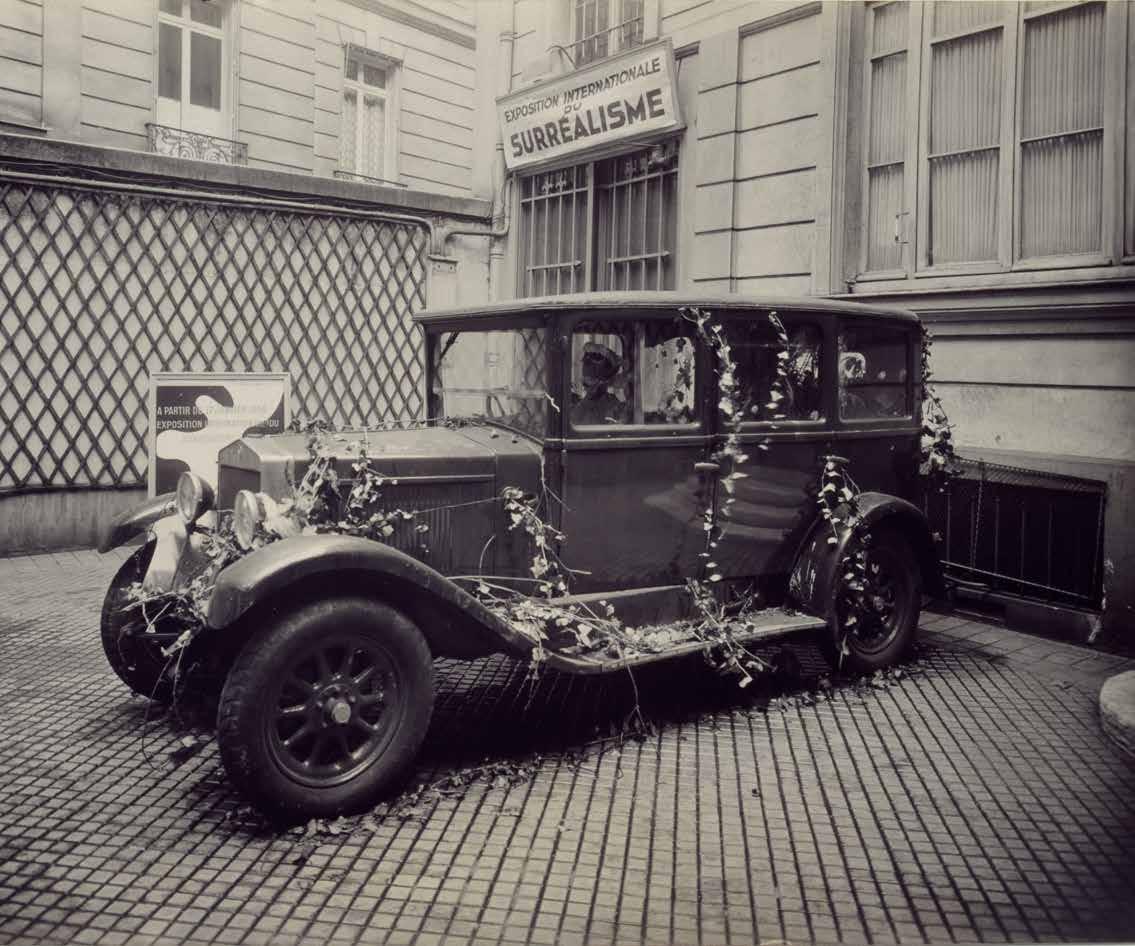
In the text in which he deals with objects that have a symbolic function, mixing prophecy and farce, Dalí proposes circulating into the waking world the disturbing objects seen in dreams. ‘Enormous automobiles, three times larger than natural size, are reproduced (with a meticulous attention to detail beyond that of the most exact reproductions) in plaster or onyx, to be enclosed, wrapped in women’s clothes, in graves whose location will only be marked by the presence of a thin wicker clock. The museums will at once be filled with objects whose uselessness, magnitude and bulk will make it necessary to construct, in the deserts, special towers to contain them. The doors of these towers will be skilfully erased and in their place an uninterrupted fountain of real milk will flow, which will be eagerly absorbed by the hot sand’. Following Duchamp’s Fountain Dalí established a kind of model of exhibition-environment which was to profoundly influence the evolution of Surrealism. In 1938, he was one of the organisers of the Exposition internationale du Surréalisme at the Galerie des Beaux-Arts in Paris, where he installed at the entrance his Rainy Taxi, a converted cab with a strange driver whose head was caught in the jaws of a shark. A system of pipes produced a violent downpour on the female mannequin with an imperturbable smile, seated in the back among verdant plants and two hundred snails from Burgundy, to which twelve frogs were meant to be added but they failed to arrive on time on the evening of the opening.
Baking a colossal loaf
On 15 May 1933, the last two numbers of Le Surréalisme au service de la révolution came out simultaneously. This fifth issue opened with the presentation of an ‘object painted on transparent glass’, The Large Glass, by Marcel Duchamp, accompanied by a text by the artist: ‘The Bride Stripped Bare by Her Bachelors, Even’. Also in the list of contents are four texts by Alberto Giacometti –‘Poem in 7 spaces’, ‘The Brown Curtain’, ‘Grass Charcoal’ and ‘Yesterday, Quicksand’– and an article by Roger Caillois, ‘Specification of Poetry’, which defines the object above and beyond its utility. ‘It is clear that the utilitarian role of an object never entirely justifies its form; in other words, the object always goes beyond the instrument. Thus, it is possible to discover in each object an irrational residue determined, among other things, by the unconscious representations of the inventor or technician’. Breton built on this idea in his introduction to the Odd Tales of Achim von Arnim, in the final issue of the magazine: ‘The object, conceived as the result of a series of efforts that progressively release it from non-existence to bring it to existence and vice versa, in fact knows no stability, between the real and the imaginary’. For his part, Yves Tanguy contributed ‘Life of the Object’, a drawing of a table set for dinner. Emerging from this telluric structure are phrases taken from a botany book, chopped up in such a way as to form a ‘poem skeleton’. Dalí’s contribution, one of the most lyrical and the most ‘vertiginously irrational’, envisaged the definitive paranoiac advent of the object, with the painter setting out first and foremost to transcend the ‘cannibalism of objects’ stage and, more generally, the symbolic stage of the earliest Surrealist objects by conceiving new ones, namely ‘psycho-atmospheric
anamorphic objects’. This final issue was mainly given over to the results of a survey on the irrational possibilities of knowing an object (a fortune teller’s crystal ball, a scrap of pink velvet), entering inside a painting (The Enigma of a Day by Giorgio de Chirico), living on a given date (in the year 409) and finally the beautifying of a city. The survey was presented in the form of a jointly filled-out questionnaire, to which each respondent had to respond quickly, in writing. Dalí, who did not take part in the first of these consultations (the one about the crystal ball), was very probably one of its principal instigators, as evidenced by his article ‘The Object as Revealed in Surrealist Experiment’, published in English in the magazine This Quarter in 1932: ‘Experiment Regarding the Irrational Acquaintance of Things: Intuitive and very quick answers have to be given to a single and very complex series of questions about known and unknown articles such as a rocking chair, a piece of soap, &c. One must say concerning one of
these articles whether it is: Of day or night, Paternal or maternal, Incestuous or not incestuous, Favourable to love, Subject to transformation. Where it lies when we shut our eyes (in front or behind us, or on our left or our right, far off or near, &c.), what happens to them when they are immersed in urine, vinegar, &c., &c.’
Dalí’s role was fundamental, in both the theoretical and practical realms. In this text, the Catalan painter proposed various experiments, such as describing orally, while blindfolded, ordinary objects perceived by touch alone. The descriptions of these would then be used to produce new objects, which were to be compared with the originals. Other proposals were likely to give rise to serious conflicts of interpretation due to their extreme irrationality. For example: ‘Having a colossal loaf of bread (fifteen yards long) baked and left early one morning in a public square, the public’s reaction and everything of the kind until the exhaustion of the conflict to be noted’.
Giraffe and Nosferatu necktie
It was long believed that the giraffe was a composite animal, the result of an extravagant confusion of species, resulting from a crossing of a female wild camel, an oryx, and a male hyena. A useless animal. Charles Fourier deduced that it was a creature of great spiritual elevation. We can see, he said in his Theory of the Four Movements, that ‘God has created nothing without a purpose, even the giraffe, which is supremely useless, but as God was obliged to represent all aspects of our passions, he had to use this animal to depict the complete uselessness of truth in Civilisation’. In Communicating Vessels, Breton associated the ‘Nosferatu necktie’ that he dreamed of on the night of 26 August 1931, with the entry on the giraffe in his school exercise book: ‘The tribe of Ruminants with hairy horns includes those whose horns consist in a prominence of the cranial bone, surrounded with a hairy skin which is
perfume throughout the whole of the wearer’s dress: it is to the appearance what the truffle is to a dinner party’. Art and the necktie, in short, are a marriage of discords, and the passion of unreason is the foretaste of the imagination.
Equation of the objet trouvé
Flea Market, there is a discrepancy: the equation of the found object is not in fact an equivalence. ‘What is delightful here is the dissimilarity itself which exists between the object wished for and the object found’, Breton wrote. The discovery is in fact a ‘rediscovery’: the object conjured up in the dream work and then lost is reinvented upon waking through specific work on the language: Cinderella’s glass slipper / Cinderella’s glass ashtray by way of the hypnagogic image.
continuous with that of the head and which is never shed; only one species is known, the Giraffe’. It was in this notebook that Breton recorded his notes on Freud’s The Interpretation of Dreams Breton gives this explanation: ‘Confusion with the hairy ears of Nosferatu […] [The] strange length of the giraffe’s neck being used here as a means of transition to permit the symbolic identification of the giraffe and the tie from the sexual point of view’. The giraffe is also present among the ‘Animals of the Family’ that Benjamin Péret presented in La Révolution surréaliste Dalí imagines it on fire and Magritte imagines it inside a glass (The Glass Bath, 1946). Charmingly, Cocteau finds (in The Cape of Good Hope) that it is rather the result of a cross between a wind vane and the Eiffel Tower.
Several questions arise. Doesn’t the tie as a Surrealist object escape conventional classifications? Does it not rather belong to a family of heterodox objects, such as mannequins, symbolically functioning objects, object poems, and so on? Should we not think of it as a hieroglyph?
In 1959, Mimi Parent created La Crypte du fétichisme for the eighth Exposition inteRnatiOnale du Surréalisme, EROS held at the Daniel Cordier Gallery, where she presented Masculin/Féminin: a necktie made of human hair (the artist’s own). Honoré de Balzac published a curious article in La Silhouette in 1830, ‘De la cravate, considérée en elle-même et dans ses rapports avec la société et les individus’: ‘Art and tie, these are two words that cry out to be paired […] because the tie, an expression as much of thought as of style, is often just as rebellious’. The story begins here, as the saying goes, with a somewhat polemical pairing. ‘A well-knotted tie is diffused like an exquisite
In a key text entitled ‘Equation de l’objet trouvé’, André Breton describes the circumstances of a visit to the Saint-Ouen flea market with Giacometti in the spring of 1934. The first object they picked out was a kind of metal mask that made them think of a ‘highly evolved descendant of the helmet, which must have allowed itself to be pushed into flirting with the domino mask’. After some hesitation, Giacometti, ‘usually very detached when it came any thought of possessing such an object’, decided to buy it. The discovery of this ‘remarkably definitive’ object of indeterminate use was to allow him to overcome the reluctance he felt at completing the face of a statue in which Breton was particularly interested. The title of this work refers precisely to what it does not represent: The Invisible Object (19341935). Shortly after Giacometti bought the metal mask, Breton discovered ‘a large wooden spoon, of peasant fabrication […] rather daring in its form, whose handle, when it rested on its convex part, rose from a little shoe that was part of it’. A few months before, ‘inspired by a fragment of a waking sentence “the Cinderella ashtray” and the temptation I had had for a long time to put into circulation some oneiric and para-oneiric objects’, Breton had asked Giacometti to sculpt a small slipper, which he intended to cast in glass and use as an ashtray. ‘In spite of my frequent reminders to him of his promise, Giacometti forgot to do it for me’. Between what Breton desired and what was ‘given’ to him at the
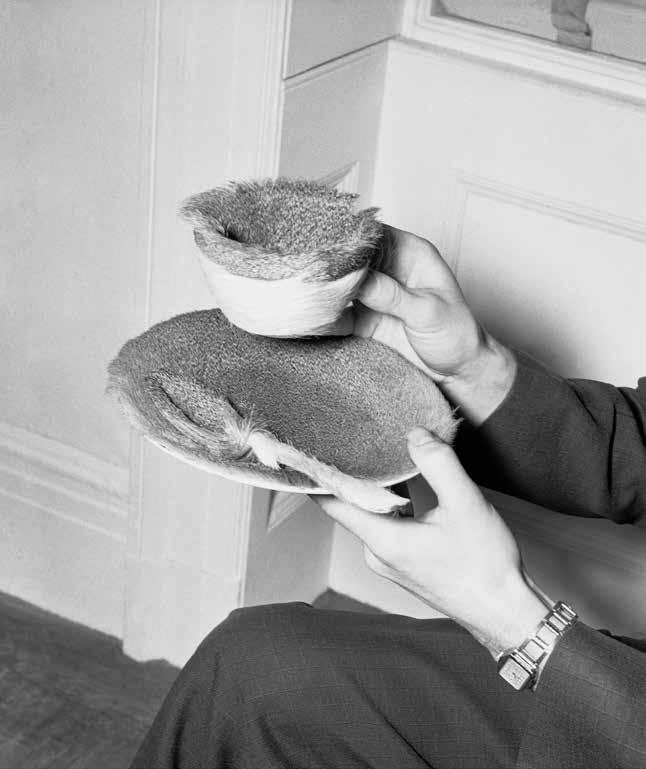
In ‘Crisis of the Object’, a key text published in Cahiers d’Art in 1936, André Breton reveals the stakes of the problems around the object: ‘Certainly I was prepared to expect from the multiplication of such objects a depreciation of those whose convenient utility (although often questionable) encumbers the supposedly real world; this depreciation particularly seemed to me very apt to release the powers of invention which, in terms of all we know about dreams, are magnified when in contact with objects of oneiric origin, truly tangible desires. But aside from the creation of such objects, the goal I pursued was no less than the objectification of the activity of dreaming, its passage into reality’. There is in fact no product of human activity, pristine or timeworn, found on the pavement or on a beach’s shore, that is not susceptible to recycling. What is beyond doubt is that an object is never identical to itself. It possesses an index of uncertainty that can be extended to any object, be it a hybrid of nails and a clothes iron (Man Ray), a mix of phonograph and leg (Domínguez), a collage of cup and fur (Méret Oppenheim), an amalgam of umbrella and sponges (Paalen), or a double articulation of telephone and lobster (Dalí). On a pedestal table, next to Dali’s mannequin decorated with small spoons,
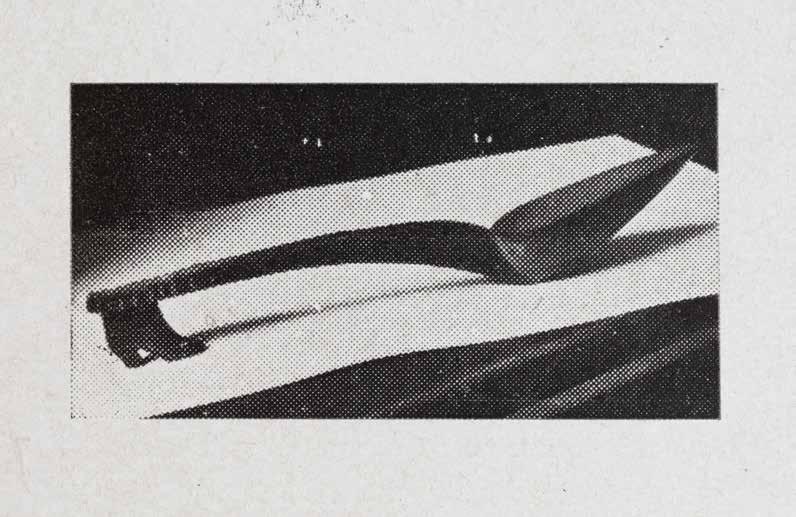
rests an aphrodisiac telephone with a lobster as the receiver. If we imagine a caller writhing in the grip of the earphone claws we will understand why Breton, in his Anthology of Black Humour says that this object pursues ‘to the point of its artistic conjuration the progression of the anti-punitive mechanism of cutting off an ear, for example, since Van Gogh’. Humour — which Aragon’s Treatise on Style sees as the negative condition of poetry and as resembling ‘the foresight of a rifle’ –precisely ‘does not know the name of all the everyday objects’, thereby delivering the object from its destiny of recognition and appropriation. It is a matter, then, of not knowing what the thing is for. And that, of course, would lead us to question the importance of the world of things and not to privilege their effectiveness over our sensibility.
Popular speech delights in deprecating the misuse of objects. It is said, for example, that one should not ‘put the cart before the horse’, ‘cast pearls before swine’, or ‘put all your eggs in one basket’. We laugh at those who break the rules, at the person who goes about things the wrong way, and at anyone who fails to understand ‘how things are done’. The misuse of objects, whether sacred or profane, is deeply ingrained in popular
consciousness and an invitation to general sanction. As a traditional French saying has it: ‘Those who pave their way with bread end up turning to stone’. In 1938, with the title Trajectory of the Dream Breton published an anthology in which oneiric texts by various precursors of Surrealism, from Paracelsus, Cardano, and Dürer to the German Romantics, were juxtaposed with stories and comments from the Surrealists themselves, such as Mabille, Alquié, Hugnet and others. The volume was illustrated with drawn dreams and collages by Tanguy, Masson, Ernst, Man Ray, Dalí, Domínguez, Seligmann, Matta… In this anthology in the form of a tribute to Freud, who had been forced into exile, Breton is the creator of a new genre of Surrealist objects; indeed, he never ceased to encourage their multiplication: ‘I have also been thinking for some time now about creating what seemed to me to be a rather enigmatic “object-proverb” conceived on the precept of “not putting the plough in front of the oxen”: it was a matter of harnessing two crayfish to a scale model of a plough (without forgetting to turn the plough around)’. The idea of the ‘object-proverb’ was later taken up by Daniel Spoerri for his ‘word traps’ series (exhibited in 1964 at Galerie J), an attempt to visualise stock phrases, proverbs and popular sayings. Thus, for example, the expression ça crève les yeux que ça crève les yeux, said of something so obvious that it pokes you in the eye, is represented by a mask
with the eyes pierced by scissors. Much the same goes for qui dort, dîne (to miss your chance), prendre les tableaux au piège (to catch paintings in a trap), tondre un oeuf (to be narrow-minded) or voir la paille dans l’oeil du voisin et non la poutre dans le sien (to see the mote in your brother’s eye and not the beam in your own), which are taken absolutely literally. We seem here to be in Gulliver’s Travels with the scientists on the island of Laputa carrying around in bags all sorts of heterogeneous objects to be used as words.
If you scratch yourself, you itch
In ‘The Passion Considered as an Uphill Bicycle Race’, Alfred Jarry had Christ the cyclist, ‘carrying the frame on his shoulder or, if you prefer, the cross’, make the gruelling ascent of Golgotha. André Breton created a symbolically functioning Surrealist object with a bicycle saddle and bell; Picasso made his Bull’s Head with an old saddle and handlebars. Méret Oppenheim was more expeditious: in 1952 she saw a photo in the magazine Schweizer Illustrierte of a swarm of bees covering the seat of a bicycle propped up outside a hair salon. She appropriated the photograph and published it in 1954 in the Surrealist magazine Medium. Twenty years earlier, Oppenheim had herself been photographed completely naked by Man Ray behind the wheel of a printing press, with her left hand and forearm covered in ink, to illustrate Breton’s idea of a veiled-erotic beauty in Minotaure
Lightning rod
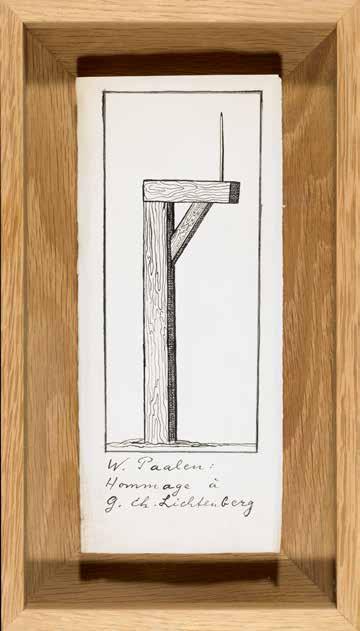
This is the title of the preface to the Anthology of Black Humour associated with this epigraph by Lichtenberg: ‘The preface could be titled: the lightning rod’. In 1938, on the occasion of the Exposition internationale du Surréalisme, the Dictionnaire abrégé du surréalisme reproduced several objects by Wolfgang Paalen (nicknamed ‘The Beaver of the Thirteenth Dynasty’), including his famous ‘Homage to Lichtenberg’, Gallows with Lightning Rod a full-size installation whose purpose was to prevent those condemned to hang from being electrocuted on the scaffold. For the Surrealists, dreamed objects were the perfect lightning conductors in a time of mounting tensions.
The Surrealist object as intruder
Where do we stand in terms of the object today? At present we are surrounded by objects both real and virtual, by transparencies or cognates large and small. The Surrealist object is a kind of interloper, capable of acting as a guide through the jungle of gadgets and devices of our technified, digitalised societies. For Breton and the Surrealists, the imaginary tended to become real, and it was not in vain that dream should rub shoulders with waking and desire cross paths with chance. The marvellous can be realised and come to pass. This is what we have attempted to explain with Georges Sebbag in a booklet in which poets and artists have been brought together to propose new arrangements or new connections between games, fetishes and Surrealist discoveries. (Emmanuel Guigon and Georges Sebbag, Sur l’objet surréaliste Les presses du réel, Dijon, 2013).
Victoria Cirlot
Victoria Cirlot is professor emerita at the Universitat Pompeu Fabra in Barcelona. Her scholarship has focused on chivalresque literature and mysticism, and on medieval and contemporary art, establishing dialogues between the Middle Ages and the 20th-century. Noteworthy among her books in this field are La visión abierta. Del mito del Grial al surrealismo [Open Vision. From the Myth of the Grail to Surrealism] (Siruela, 2010) and Imágenes negativas. Las nubes en la tradición mística y en la modernidad [Negative Images. Clouds in the Mystic Tradition and in Modernity] (Mundana, 2018).
‘Sleep is a veritable “chrysalitic” monster’, wrote Dalí. Indeed, dreams are a melting pot of images, some of them universal. Dalí’s incredible work with images (interiorisation, dream state, dreams) designed to have multiple associations leads Victoria Cirlot to analyse the presence of the syndesmos figure in his painting Lapis Lazuline Corpuscular Assumpta.
The work that Dalí named with the complex title Lapis Lazuline Corpuscular Assumpta (1952) [P670] –bringing together the Catholic church’s word for the assumption of Mary (assumptio), a term from the quantum physics he was fascinated by in that period (corpuscular from ‘corpuscle’), and apis lazuline which refers to the blue surrounding the representation– is reminiscent of an ancient iconographic schema that reached its splendour in the Middle Ages: the syndesmos figure, a term of Aristotelian origin that alludes to a ‘link’ or ‘bond’ used to designate a schema in which God the Father or Christ embraces the universe represented as a giant wheel that covers the entire body of God, or is God’s very body, with feet emerging from that wheel. In the Dalinian artwork, whose subject is the Assumption of Mary (depicted with Gala’s face), there is no wheel nor any cosmic embrace. The Virgin Mary’s hands are together in a praying posture. However, there remains a notable resemblance. Gala’s small feet, which rise above a sphere and conclude a strange body comprised of a crucifixion and an altar, are very similar to the feet of the syndesmos figure. In both cases, these feet serve to indicate that the wheel or what is between the face and the feet (in this case, the crucifixion and the altar) form a strange body. I will here attempt to comprehend whether there is any basis to this hint of a resemblance and, above all, whether examining the Dalinian artwork in relation to the syndesmos figure contributes to the significance of the Assumpta In order
1 See also: Montse Aguer, ‘Assumpta corpuscularia lapislazulina’. In Dalí. Todas las sugestiones poéticas y todas las posibilidades plásticas Museo Nacional Centro de Arte Reina Sofía-Centre Pompidou, Paris, 2012, p. 270-271.
to do so, I will first focus on the Assumpta and then on the syndesmos figure and its variants in the Middle Ages. My recent discovery of an author from the first half of the 14th-century has inspired me to continue this identification of the Assumpta as a syndesmos figure 1
What was Dalí’s understanding of his Assumpta? As a starting point, the best source is his own description of the painting. I will cite two versions: the first, in French, dated 28 March 1953 and published in the magazine Connaissance des arts on 15 July 1953; and the second, published just a few months later on 31 August (in the magazine Festa d’Elig), shorter than the previous one and written in Spanish. The first begins with a quote from Friar Luca Pacioli, a clear reference that focusses on his great interest in geometry and proportion, speaking immediately of the ‘metaphysical space of the Assumption’ that had to be octagonal, an allusion to the two octagons: the golden one that serves as the Virgin Mary’s nimbus, and the white one below her praying hands. All of these elements are located within a large (also octagonal) transparent dome and it is ‘through this octagon of sky where the body in the process of materialisation ascends, thus identifying it with the space of the Mother Church’. Transparency has always, or at least since the Middle Ages, been the
2 Henry Corbin, Spiritual Body and Celestial Earth. From Mazdean Iran to Shi’ite Iran Princeton University Press, Princeton, 1977.
way to express the quality of an ‘other world’ and it has been applied both to objects such as the holy grail (for example, in the manuscript BnF 120, folio 524v), and the dove, in other words, the Holy Spirit, in the scene of the Annunciation to the Virgin Mary (for example, in the Isenheim Altarpiece by Matthias Grünewald). This ‘other world’ is one in which the spiritual or the intelligible finds formal manifestation, in other words, the mundus imaginalis, an expression coined by Henry Corbin,2 an intermediate world between heaven and earth, which is where the Virgin Mary seems to be located in Dalí’s representation, between the earthly sphere and the exit through the cupola into the heavenly world of the unmanifested. Nevertheless, Dalí speaks of a trajectory towards a ‘materialisation’ (matérialisation), a space that, according to him, is associated with that of Mother Church. We will return later to this ‘materialisation’ and now simply confirm that Mary and Ecclesia were both identified, throughout the entire Middle Ages, as fulfilling the function of the spiritual brides of Christ. Dalí’s description of the painting continues, commenting that ‘in the centre, over an altar, soars the Christ of Saint John of the Cross’. He is referring to the Christ he himself painted a year prior to the Assumpta, in 1951, and that, according to him, originates from the drawing made by Saint John of the Cross held in a reliquary at the Monastery of the Incarnation in Ávila.3 The relationship between the crucifixion and the altar is common in medieval iconography. In the
3 On Dalí’s real sources of inspiration for this work, see Juan José Lahuerta, ‘Against realism. The politics of Salvador Dalí’s Christ of Saint John of the Cross’. In Anthropology and aesthetics, vol. 81/82, 2024, p. 212-228.
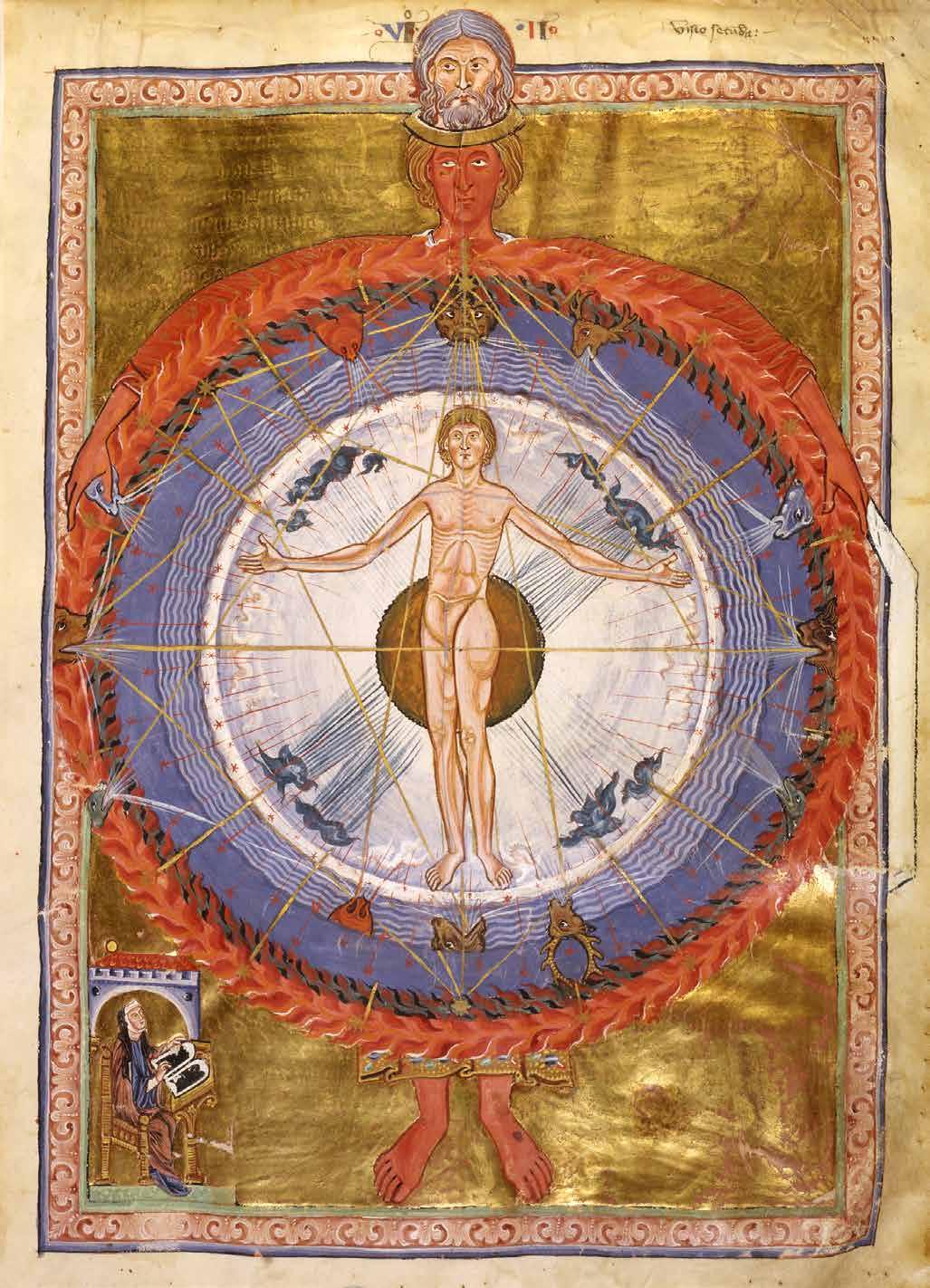
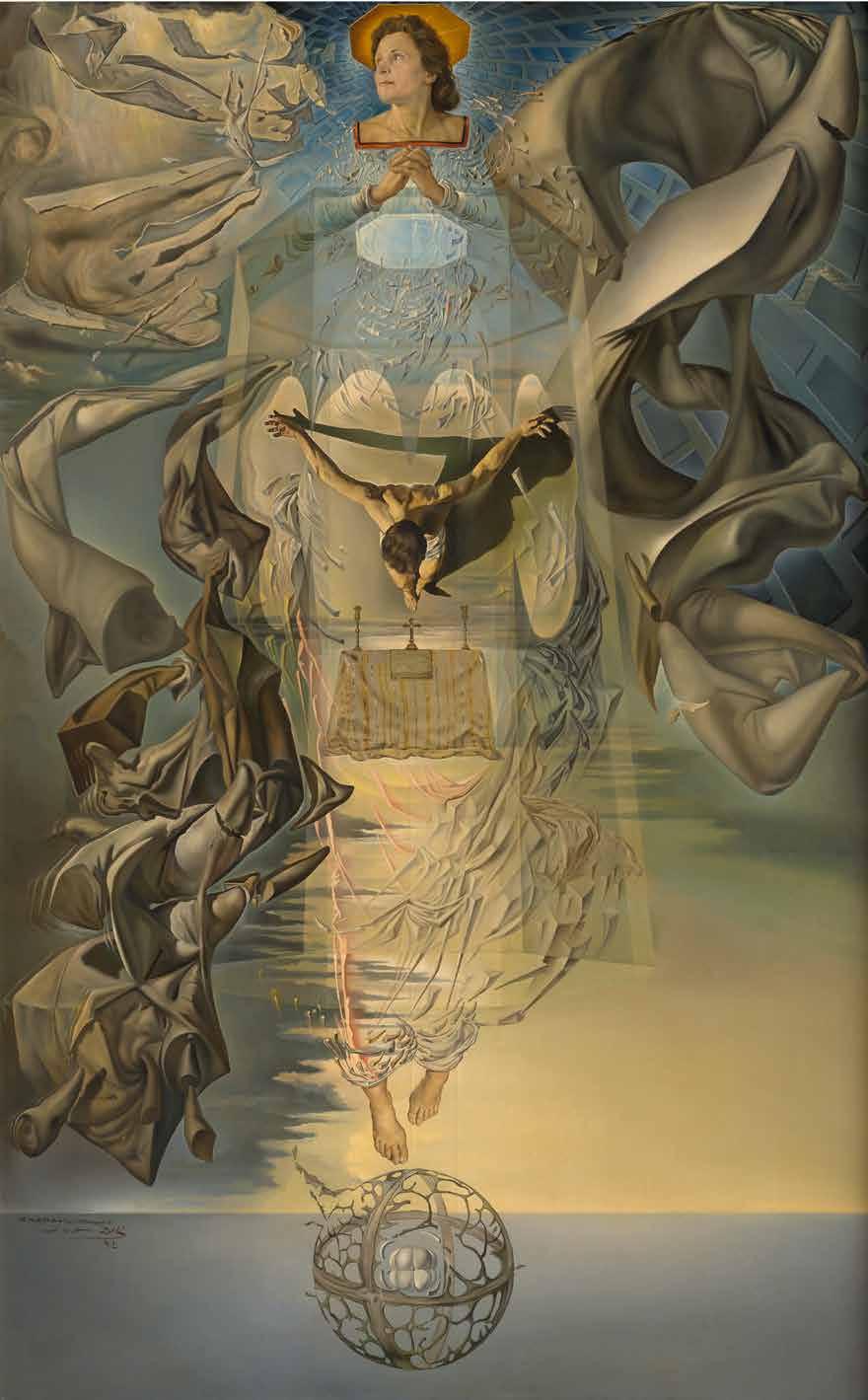
upper portion of a miniature in Scivias by Hildegard von Bingen, Ecclesia appears holding a chalice to catch the blood that emerges from the side of crucified Christ; in the lower portion we find the altar prepared for the sacrament of the Eucharist.4 Dalí focusses on Saint John’s Christ as opposed to Mantegna’s (he must be referring to the Dead Christ at the Pinacoteca di Brera in Milan), because his ‘offers the maximum contrast between the weight of his sacrifice and the ascensional dynamism of the Virgin’. Indeed, the positioning of the cross downwards subject to gravity contrasts with the upward ascension of the Virgin and, as he goes on to say, ‘is both the theological prerequisite and result of that sacrifice’. And that point leads him to the feet of the Virgin ‘that rise from a “radiolarian” (radiolaire) skeleton, which is the microcosmos’ most perfect image, in the centre of which gravitates a white, neoplatonic atom’. The vision of the Virgin’s body in ascension is interpreted by the artist from a concrete perspective predominant in the 1950s: atomic physics, which offers him an explanation to questions of religious faith. What body are we discussing? Dalí now introduces the fundamental term, the ‘glorified body’ (corps glorieux), and in his imaginary ‘the matter of the glorified body becomes fluid because it must pass through the body of Christ according to a process of reconstitution of its own atomic elements in the divine phenomenon of its ascensional dynamism’.6 Again, Dalí speaks of ‘matter’ to refer to the ‘glorified body’; earlier he described the ‘transit’ as a ‘materialisation’. The ascension is conceived here as ‘a process of reconstitution of its own atomic elements in the divine phenomenon of its ascensional dynamism’. Atomic physics reappears to explain what religion accepts as incomprehensible and miraculous. The ascension is a transformation of the body and its matter, ‘interatomic collisions of its own flesh’. We reach the face, and it is curious that Dalí declares ‘the face is real because it is Gala’s’ and continues with the psychoanalytical confession of his desire for ‘his wife to penetrate the house of his own father’.7 The description ends with a reference to the shapes that, like a mandorla, surround the Virgin’s ascension and are none other than ‘explosive-rhinocerotic shapes’ (explosive-rhinocérontiques), in other words, parts of a rhinoceros’ body that ‘explosively detach from its body and fly up to heaven’. The rhinoceros, a growing obsession for Dalí, is ‘the metaphysical animal par excellence’, but that does not keep him from fearing its ‘supreme black animality’, the horn that emerges from its ‘demonic mass’ (démoniaque masse) and points at heaven ‘with a finger gloved by God’ (de son doigt
4 Vida y visiones de Hildegard von Bingen Siruela, Madrid, 2023, p. 216-217.
5 Dalí coined the expression ‘nuclear mysticism’, which was the title of an article he published in The Scottish Art Review Glasgow, 21/06/1952, p. 28. Other important texts for understanding the shift Dalí made in terms of religiosity after his return to Spain from the United States in 1948 are ‘Mystical Manifesto’ (dated 15 April 1951) and ‘Reconstitution du corps glorieux dans le ciel’, Études carmelitaines June 1952, p. 171-172, with much commentary in the notes in Obra completa, vol. IV, Ensayos 1 Destino, Fundació GalaSalvador Dalí, Sociedad Estatal de Conmemoraciones Culturales, Barcelona, Figueres, Madrid, 2005. See also the catalogue Dalí atómico Fundació Gala-Salvador Dalí, Figueres, 2018.
ganté de Dieu). Its horn also ‘frees itself in the most exalted spiritual impulse of dematerialisation’ and Dalí concludes by saying that ‘this impulse will also be super-dynamic material scraps of a cape inflated like an immaculate linen rock in the shape of an 8 (which is finite space), the cape that was the Virgin’s shroud’.8
The second version, titled ‘Assumpta corpusculària’ clears up some of the questions raised by the first. In this brief text, Dalí does not use the cryptic language of the previous one but rather strives to be as clear as possible: ‘The Assumpta is the opposite of the atomic bomb. Instead of the disintegration of matter, we aspire to the integration, to the reconstitution of the real and glorified body of the Virgin in the heavens’. The ‘materiality’ or the ‘matter’ is understood here in the context of atomic physics and acquires meaning in the contrast between disintegration and integration, the latter being what Dalí conceived of as happening in the ascension to heaven. He goes on to criticise abstraction as ‘decorative art’ and alludes to his precursors (Seurat, Boccioni) in the relationship between art and nuclear physics, although pointing out that their experiments were ‘frankly puerile’ because they lacked the ‘divine breath of the theological and philosophical’. He concludes with the affirmation that nuclear physics (in uppercase and as the last word in the sentence) has meant ‘a new conception of matter’.
The two versions are complementary. While in the previous one, the ‘materiality’ of the glorified body was enigmatic, here it obtains all its meaning from the disintegration/integration opposition, and in nuclear physics, at least as Dalí understood it.
Folio 9v of the Liber Divinorum operum by Hildegard von Bingen is only one example, among many, of the syndesmos figure, which in medieval culture assumed the category of diagram, as shown by Anna C. Esmeijer.
This author defined the syndesmos posture as the gesture of embracing everything with extended hands, as a way of expressing reestablished harmony. She interprets it as a ‘cosmogonic gesture of creation. [...]
As posture of crucified Christ and sign of the crucifixion the syndesmos restores the balance destroyed by sin’.9
The syndesmos posture repeats the symbolism of the cross that, as indicated by the first exegetes, reaches every compass point, demonstrating Christ’s power to bring together, through the cross, the entire cosmos. Christ is thus syndesmos vinculum . However, the
6 As early as the editorial for the first issue of dalí news on 20 November 1945, he said: ‘Finally, instead of the atomic disintegration of matter surrounding an explosion, the sudden possibilities of integration materializing in the sublime and preeminently Catholic myth of the Resurrection of the Body’. In ‘Reconstitución del cuerpo glorioso en el cielo’, cit., we read: ‘The still unknown interatomic artilleries, aimed at the core, will reconstitute the organic matter, which will become gloriously identifiable from the tips of the fingers in prayer position to the smiling face, for which, just as she did in The Madonna of Port Lligat my wife will serve as the model. Only the help of the Holy Spirit and the total asceticism in which I wish to immerse myself, in isolation in Spain, will allow me to complete my work, but even if I fail, promise this one thing: it shall be marked with my blood, in the Spanish way, just as Nietzsche wanted’. Translated from Obra completa vol. IV, Ensayos 1, op. cit. p. 658.
difference between the crucifixion and the syndesmos position is clear because while both signify the power to encompass the whole cosmos, one emphasises the sacrifice, whereas the other is associated with the ideas of ‘concord’, ‘harmony’, ‘symphony’ that are always mentioned in treatises such as the Tractatus de quaternario, dated 1100. Esmeijer highlights the elements that make up the syndesmos position and gesture and mentions the wheel (rota) and the embrace.
The fact that the wheel/universe substitutes the body of God/Christ alludes to both the invisibility of God and the possibility of His visibility through creation, as posed by Petrus Pictaviensis in his Sententiae; in another work, Compendium historiae in genealogía Christi, the figure of Christ in the syndesmos position was used as a ‘visual thought’ to demonstrate that idea.10 Esmeijer also mentions the genre that particularly used that schema: the mappae mundi or globes, indicated by the wheel or circle, that reveal the Creator’s head in the upper part, His feet below, and His arms or hands emerging from the circle on the left and right. She cites as clear examples the famous maps in the shape of a T, such as the Ebstorf map and the Psalter world map held at the British Library (Add. 28681). In this manuscript the syndesmos figure is found on folio 9v, while on the recto Christ was represented with his arms lifted blessing with the right and holding up a world/ disc with the left; beneath this torso appears the world in a circle shape with two dragons below it, instead of feet.11 Esmeijer adds that the syndesmos position, as a sign of the establishment of harmony between the cosmos and the cosmocrator, can be adopted by other figures understood as harmonising principles, such as Sapientia or Philosophia The position can even be adopted by secular leaders, as we see with Queen Elizabeth of England in the book by John Case, Sphaera Civitatis published in Oxford in 1588, where the queen adopts the pose in one illustration.12
At this point it seems unlikely that Dalí’s Assumpta could have any relation to the syndesmos figure. As we stated at the outset, there is neither an embrace nor a wheel. But there are the small feet of Gala/Virgin. The feet of a large invisible body, where only the crucifixion and the altar can be seen, the Christ through which the body of the Virgin must be introduced fluidly in her final transmutation, as though it were an inverted birth. But we are in for a surprise, because contrary to what it may seem, the syndesmos figure can vary without losing its identity. Proof of this is found in the work of a priest who lived in the Trecento, in other words, in the period when mappae mundi
7 Gala was already the model for his Madonna of Portlligat cf., previous note; first version 1949, a sketch for which he presented to Pope Pius XII when he was granted audience with him on 23 November 1949…’, cf., Obra completa vol. IV, Ensayos 1, op. cit. p. 1151). The Leda Atomica is also Gala, cf., J. Carles Oliver, ‘Leda atómica de Dalí. Fotografía y pentagrama místico’. In Arte indiv. soc. 32(1), 2020, p. 79-95; as well as: Irene Civil, ‘Proceso de creación. Tras las huellas de Leda atómica’. In Dalí atómico, op. cit. p. 69-89, and Carme Ruiz González, ‘To become a classic’. In Dalí atómico, op. cit. p. 116-131.
8 For more on Dalí’s obsession with the rhinoceros, one must read his conference given at the Sorbonne on 17 December, 1955, cf., ‘The Phenomenological Aspects of Paranoic Critical Method’. In Salvador Dalí: a surrealist in Istanbul Sabanci University - Sakip Sabanci Museum, 2008, p. 375-381.
9 Anna C. Esmeijer, Divina quaternitas. A preliminary study in the method and application of visual exegesis Van Gorcum, Amsterdam, 1978, p. 97.
10 Ibid. p. 98.
11 Ibid. p. 99.
12 Ibid. p. 100.
The vision of the Virgin’s body in ascension is interpreted by the artist from a concrete perspective predominant in the 1950s: atomic physics, which offers him an explanation to questions of religious faith. What body are we discussing? Dalí now introduces the fundamental term, the ‘glorified body’ (corps glorieux), and in his imaginary ‘the matter of the glorified body becomes fluid because it must pass through the body of Christ according to a process of reconstitution of its own atomic elements in the divine phenomenon of its ascensional dynamism’. Again, Dalí speaks of ‘matter’ to refer to the ‘glorified body’; earlier he described the ‘transit’ as a ‘materialisation’. The ascension is conceived here as ‘a process of reconstitution of its own atomic elements in the divine phenomenon of its ascensional dynamism’.
containing the orthodox syndesmos figure proliferated. Anna C. Esmeijer notes that Opicinus de Canistris used the syndesmos schema in a very personal way, so that throughout his body of work –she mentions in particular the parchment panels– several highly interesting examples can be found, in which the feet take on special visibility.13 We are indebted to Sylvain Piron for his efforts to recover this strange character in a recent book with excellent reproductions. Despite those interpretations that only see madness in the Opicinus’s work, Piron, adopting Warburg’s idea of the ‘dialectic of the monster’, understands Opicinus more like a seismographer, in other words, as someone who absorbs a historical situation and is devastated by it, in his case by the contradictions of the Catholic Church of which he was part and participant.14 Based on the parchment panels in the Vatican Library (Pal Lat 1993), which combine autobiographical texts and drawings, most of which are nautical charts and maps, as well as figures that sometimes appear monumental and other times superimposed, it seems we are dealing with a ‘medieval art brut’ artist or a Surrealist painter in the sense described by Robert Desnos.15 In the twenty-seven extant panels, we can see at least six syndesmos figures: Christ appears with open arms and beneath him there is a large circle with the Virgin and Child in its centre (fol. 11v). Opicinus most often employed the oblong shape, resulting from two tangent circles and another in the centre of the two. Feet emerge from another circle (fol. 15v). The arms are not in an embrace but rather seem extended, separated from the body and with large hands (22v). Inside the oblong shape are various circles in which appear several faces (24r). Of note on folio 17r are large feet, one pointing to the left and the other pointing downwards. Piron states that ‘an entire book could be written about the importance and beauty of feet in the diagrams of Opicinus. Feet are traditionally a symbol of Christ’s humanity, but it is strange that he devoted so much attention to them, showing such care with how they curve and drawing them bent in a sign of humility’ (he is referring to fol. 15v.).16
Gala’s feet also received Dalí’s devotion: the left is raised while the right is extended, and perhaps the Gala/Virgin’s feet were also a sign of her humanity, already lost in a face about to pass to ‘the other side’. Dalí’s Assumpta seems to reflect the iconographic schema of the syndesmos adapted to another iconographic subject, the Assumption of the Virgin. The Assumption aroused great interest following Pope Pius XII’s definition of it as a dogma of faith on 1 November 1950, to the shock of many and joy of many others, including Dalí and Carl Gustav Jung, due to what Jung saw as the profound, centuries-old
desire of the masses, the integration of the feminine element into divinity, finally being accepted.17 However, I continue to wonder whether Gala’s feet are sufficient evidence that we are looking at the syndesmos figure, with no embrace or wheel. In this sense, Opicinus de Canistris seems a good example to place alongside Salvador Dalí, not because of any resemblance in his resolution of the figure, but because of the variants he introduced into the traditional iconographic schema. As such, there is an ‘iconic constancy’ that allows the transformed figure to be recognisable.18 I believe that in both Dalí’s and Opicinus’s works, the figure fulfils a similar function. When Carl Gustav Jung saw the drawings of Opicinus, he compared them to Tibetan mandalas.19 Perhaps the syndesmos figure was useful to both Opicinus and Dalí to centre on a soul in danger of losing its centre, as Jung used the mandalas to introduce his Red Book, and encourage patients to create them. I don’t believe that Dalí was familiar with Opicinus or folio 9v by Hildegard von Bingen, but given the quantity of images he absorbed, it is very possible that this iconographic schema was familiar to him. Additionly, Dalí did extraordinary work with images (interiorisation, dream state, dreams) designed to have multiple associations, as shown by his Paranoic-Critical method, which has many similarities with Jung’s active imagination method. ‘Sleep is a veritable “chrysalitic” monster’, Dalí wrote about his painting with that title.20 The syndesmos figure could offer –both to the priest from the Trecento and the Surrealist artist– concord and stability, which, as we have seen, were the figure’s primary meanings. Yet, beyond that, this iconographic schema allowed Dalí, in his highly personal usage of it, to make this painting the very incarnation of the glorified body, as ‘living and sensitive matter’, escaping the ‘servitudes of the earthly body’ by being ‘transparent, luminous, agile, subtle and impassible’. ‘Freed from its opacity and the opacity of the world, from its darkness and the darkness of the universe’, it could defy gravity as a ‘luminous wave’. ‘Body and spirit have left behind their split state’ to form ‘an intimate and superior unity’. These are the words of Michel Carrouges, who recognised in 20th-century art, particularly in poetry, the human aspiration to metamorphosis, which following the ‘death of God’ manifested as a demand for self-deification.21 From putrefaction to the glorified body: this is how I believe we can understand the process that led from The Stinking Ass (1930) [P225] to the Lapis Lazuline Corpuscular Assumpta (1952).22 When the Surrealists put a moustache on the Assumpta with clearly mocking intent,23 perhaps they did not realise that they were actually making a replica of the flight of Dionysus/ Ariadne in the famous fresco at Pompeii.24
13 Ibid. p. 100.
14 Sylvain Piron. Dialettica del mostro. Indagine su Opicino de Canistris Adelphi, Milan, 2016, p. 41.
15 Ibid. p. 20.
16 Ibid. p. 220.
17 Carl Gustav Jung, Respuesta a Job (1952). In Obra completa, 11, Trotta, Madrid, 2008, p. 745-755. He also reflects there on the adverse reactions to the declaration of the dogma of faith, particularly from the Protestants.
18 I’ve borrowed Hans Blumenberg’s expression that refers to a transformed myth that remains recognisable. In Work on Myth (1979), MIT Press, Cambridge, 1985, p. 149-150.
19 Sylvain Piron, Dialettica del mostro. Indagine su Opicino de Canistris op. cit. p. 39.
20 Salvador Dalí, ‘Le Sommeil’, Minotaure, no. 10, 1937, p. 26 and in Obra completa vol IV, Ensayos op. cit. p. 460.
21 Michel Carrouges, La mystique du surhomme, Gallimard, Paris, 1948, p. 91.
22 Salvador Dalí, ‘L’âne pourri’, Le surréalisme au service de la révolution no. 1, 1930, p. 9-12; facsimile in the collected magazines published by Editions Jean-Michel Place, Paris, 1976, p. 11: ‘Et nous ne savons pas si derrière les trois grands simulacres, la merde, le sang et la putréfaction, ne se cache pas justement la désirée “terre de trésors”’ [And we do not know if hiding behind the three great simulacra –shit, blood, and putrefaction– is the desired ‘land of treasures’]. See: Juan Antonio Ramírez, Dalí: lo crudo y lo podrido La Balsa de la Medusa, Madrid, 2002.
23 It appeared as the illustration to We don’t
Mircea C˘art˘arescu is considered one of the most important European literary voices of our century. A great admirer of Salvador Dalí’s work, as he has confessed to us, he offers us exclusively for dalí news this extract from the story collection in Romanian language Melancholia.
Mircea Cărtărescu was born in Bucharest, Romania, in 1956. He is professor emeritus at the Universitatea din București, a writer, and a journalist. His works have been translated into twenty-eight languages. He has won practically all the literary prizes in his country and numerous international awards, including the 2012 Berlin Prize for Literature, the 2016 Gregor von Rezzori Prize, the 2018 Thomas Mann Prize for Literature and the 2018 Formentor Prize for Literature. More recently, the prestigious Guadalajara International Book Fair awarded him the 2022 FIL prize. He was nominated for the International Booker Prize in 2025.
There was not even a wisp of wind. The night was vast, a dark pink sky from which fine snow was falling. The bridge was not slippery, and the depths below did not frighten the child. The long road across the city climbed steadily and the clumps of houses beneath continued to shrink, while now and then cars swept their headlights through the darkness as it snowed and snowed and snowed into the fresh chill of the night. People still existed, the boy told himself, for not only did cars and trams still roam through the labyrinthine streets, but through the illuminated windows you could make out adults and children moving slowly in their rooms as if through aquariums blurred by the slanting snowfall. Multicoloured lights shone from the windows of several houses, perhaps it was Christmas, and fir trees weighed down with baubles, ornaments and little lights, flickered in those rooms.
Just as it had from behind the apartment block, only twenty times longer, the arc rose slowly, reaching a peak beyond the city centre, with its squares and lonely statues, and then descending suddenly. The child had climbed for a long time; he was much higher than any building in the city when he finally saw where he was headed. The descending path brought him to one of the many windows of the largest department store in the city: the Concordia. The boy retained vivid memories of the few trips he had taken into the city, walking between his mother and father, raising his little hands very high so they could hold them, and one of those visits had been to this very store with its wide interior floors, full of dresses and suits, shoes and toys, and with crystal lifts that carried you up very smoothly, very slowly, so that it seemed you were standing still and the floors were descending to you, with their colourful
and exhausting wonders. The first floor was for men, the second for women, the last one for children. At the very top there was only furniture. He remembered the stiff mannequins, which always seemed seized by panic, like immobile invalids. Some had no heads at all, others had chipped noses or were missing a hand.
He remembered how he got lost among the skirt racks, burying his face in their patterns, slipping amid them so he was no longer visible. He would breathe in the scent of the fabrics until his mother found him and pulled him out. He also remembered stairs that went up and down, as well as their glossy, chipped marble steps.
The Concordia store was always teeming with people, more than the boy had believed existed in the entire world. He had once gotten lost there and screamed for minutes among those monstrous, elfin faces, with their tongues, bulging eyes, gnashing teeth, trying to free himself from the hands with claws and pincers that grabbed and held him. He was in a spider’s nest, a haunted cave, the air was full of painted lips and faces with holes instead of eyes. His mother had suddenly snatched him away, drenched in sweat, and only in her arms had he calmed down. He’d fallen asleep on the way home, clutching her neck tightly, rocked by the tram as they sat on its wooden benches, drifting into another winter, before his mother departed on the road of no return.
Now all the windows of the Concordia store were lit up, casting their colours onto the snow before them: violet, pale green, orange… But the boy got off on the top floor, very high above them, just beneath the pediment where the letter C was illuminated by a lilachued spotlight. He entered through the open window and walked among the silent pieces of furniture, their
walnut, oak, and birch shades like ponds gleaming under the strong ceiling lights. The whole floor was deserted, just like the rest of the store, as the boy would soon discover.
But at least it was well heated, as if it had been expecting him and knew that his hair and pyjamas were covered in snow, and that he’d been freezing on the immense arc of that circle stretched above the city. He passed mirrored wardrobes and cabinets with sliding glass doors, empty shelves, armchairs and chairs that no one had yet sat upon, heavy bookcases that held no books. The silence was complete, and the light so powerful and uniform that no object, not even his body, cast a shadow. Here, things existed only as themselves, sculpted in emptiness, settled in the forms they inhabited when there was no one there to perceive them. He approached the marble balustrade. Why were department stores so sumptuous, like the palaces in those books his mother used to read to him? What was the purpose of those empty spaces, as vast as the sky, that ceiling painted with scenes the boy couldn’t understand, those monumental staircases leading from one floor to another? The boy’s head barely rose above the sculpted balustrade, etched with leaves and flowers as translucent as salt, so he could only see the far edge of the last two floors from the central void of the store. He walked past the massive crystal lift shaft and saw its red plush interior with two cushioned benches, and the buttons on its brass panel. He slid the door open with just one finger and glanced into the central shaft, surrounded by the marble bands of the floors. At the depths, covering the entire ground floor, shimmered a sort of immense, colourful, boiling sea, but the boy could not yet distinguish any other shapes. He sat on
the bench and pressed the ebonite button with its rough edge like a moon crater. The lift began its extremely slow, smooth descent, until the boy gradually saw, far away, the floor with toys and children’s clothes, then the floor with handbags, high-heeled shoes, skirts and dresses and trench coats… Everywhere, mannequins with plaster heads and painted brown or blonde hair leaned perilously over the balustrade, their hands stretched out into the void as if they had witnessed a suicide falling onto the mosaic below and were now watching the bloodstain spread beneath the shattered, contorted body. The child stood on his tiptoes, holding the wooden cat in his left hand, and followed their gaze. Through the prismatic crystal of the lift’s windows, he saw what he had never wanted to see. The sight was more than his poor eyes, long darkened by sorrow, could bear.
It was his mother, laid out in the coffin of the vast store, her enormous figure filling the entire ground floor, lying wrapped in colourful foil like seasonal Father Christmases or Easter bunnies; his mother, with her arms by her sides like a glittering mummy, her face painted on the foil, so familiar, so delicate, and with a smile so enchanting that the boy felt his heart leap as it had on that endless evening when he’d waited for her to come, and night had fallen, and she had never returned. His mother’s eyes were open, transparent hazel like his, and her chestnut curls formed tendrils and ringlets, framing her perfectly rendered cheeks. Also painted on the crinkled, glossy foil were the green jumper she’d worn that final day, with its large casein buttons, gently rounding over her chaste breasts, the pleated skirt with a cherry-blossom pattern, and below her innocent, almost adolescent knees, the grey, cable knit socks. Her modest brown shoes with their clunky soles were painted on, too, as was her handbag, painted directly on her hip, with the golden clasp the boy used to snap open whenever his mother arrived laden with shopping bags, to find a pink-wrapped wafer or a box of mints inside. That flower at his mother’s side had never failed to bear fruit.
On the ground floor, the boy walked barefoot across the mosaic through the intertwining reflections and multicoloured flickers of the vast body, as if circling a colossal beetle with a green or blue metallic elytron, like the ones he had once seen on daisies and cupped in his palm to admire their sheen and their weight, until he could no longer hold back his tears.
He cried until his tears dried up, circling again and again the beloved body which, he immediately realised, was laid in a recess moulded to its exact shape, carved into the gleaming floor and lined with waves of satin. The large sheets of foil wrapped around his mother were torn in places, revealing the silver metal underneath, embossed with a pattern of lily flowers. From the barely visible gaps where two sheets of foil overlapped bloomed a scent of cocoa and vanilla. Finally, the child grasped the crinkled metal with both hands and lifted the piece over his mother’s hip, on the side not painted with a handbag, until, with the lines of the foil still imprinted on its brown surface, the chocolate’s hard, shiny curves were exposed. He
hadn’t eaten anything in weeks or years, but now he felt an overwhelming urge to sink his teeth into the chocolate shell, just as he used to gnaw at the ears of Easter bunnies or the head of Father Christmas, after half-unwrapping them. He laid his open palms on the brown hip and then touched it with his lips. It was sweet and very bitter, and his lips left a mark on the chocolate as if branded by a hot iron. He had been inside his mother’s belly for a long time, or so she’d told him, hanging from an inner branch, as if trees bore fruit in their own hollows. He had been no bigger than a pea, then had grown, elastic and compact, until he filled the soft, smoky glass of her belly, through which he had watched the endless passing of the sun and moon. He had seen, eclipsing them, the shadow of his mother’s fingers as she felt her womb and had heard, even then, the songs from the great radio with ivory keys, those hari nabil at roe vazalaa, nabil roe azul… or ‘govagna mag, zu de ne maghi… or floona siripi floona ke makkha’, nostalgic and muffled, like one might hear them from a bathtub, with the head submerged in water. Then one day, closing herself in the bedroom so no one would see, his mother had stripped off all her clothes and stood naked, her belly enormous, in front of the yellow vanity’s mirror, in the gentle heat of early summer. Her breasts were broad and streaked with blue veins, her belly button popped outward like a knot of woven flesh. She had taken hold of her stomach, on either side of the navel, pulled it apart and opened it like two shutters, revealing the rosy child inside the mother-of-pearl shell, curled up there, with his little head and spine, his heart visible through his translucent flesh. The same curled-up boy could be seen in the belly of the woman in the mirror, between the two wings of the opened womb. And the two children had floated, slowly, through the luminous air of the room, leaving their hollow nests behind, covered in a pearly membrane, and like astronauts in a starry cosmos, they drifted towards each other, still attached to their mothers’ bodies by thin, flexible cords. They stretched their arms towards one another and nearly embraced, almost shattering the barrier of the mirror, but their mothers stopped them, staring at each other with hatred and jealousy. Each pulled her child back into her arms and, with their belly still open, placed him at her breast, where the children, greedily drinking the waters of Lethe, forgot each other.
And now, smashing the left hip of the foil mummy with the blue cat’s tail and stiff paws, the boy carved a path through the thick chocolate crust and, through that gap, entered the depths of his mother who lay there mysterious, gloomy, like a goddess of solitude. She, who once stood as tall as the ceiling, filling the hallway with the scent of fresh air and bread exuding from her body, now lay sprawled, like a beached whale, on the mosaic floor of the Concordia store. How deep and dark the brown cave was! What a maddening scent of cocoa emanated from the smooth, hard walls! The domes of her womb and breasts seemed as vast as the cupolas of a sacred temple! The child walked along the spine, each vertebra sculpted in chocolate,
slipping between chocolate kidneys, pancreas, and intestines that seemed to have been carved inside that giant chocolate being, brushing now and then against smooth or crinkled surfaces. He climbed into his mother’s thorax where her lungs, like two delicate hands, raised her heart –the only thing alive and moving, the only part that throbbed uneasily– towards her rib vault. His mother’s heart resembled the tiny bird hearts she’d sometimes placed before him in a bowl, like little flesh strawberries. He stretched as far as he could to touch the tip of her heart, and when he did, he closed his eyes and made a wish.
Through the great arteries of the neck, he entered his mother’s skull and instantly curled up there, in the diffuse, amber light that filtered through her pupils, pushing through the foil and the dark chocolate where her brown eyes had been drawn. Looking up, he could see the dome of the skull and her face, so finely carved in chocolate that not even a statue sculpted in the most translucent marble could rival it. Her gaunt cheek, her lips, the straight nose he had inherited from her, even the small mole near her right nostril. It was his mother in negative, his mother’s mould, perhaps once used to create her unique being. He remained inside her chocolate body for an eternity, exploring it from end to end, travelling through the majestic tunnels of her hollow arms and legs, marvelling at her sugar candy glands, her real teeth, and the four hundred pearls clustered in her chocolate ovaries. When he finally emerged, having explored even the insides of her fingers, he could no longer tell if the brightly lit department store gleamed in the same night or if hundreds, or thousands, of nights had passed unnoticed. Just beneath the heart that tolled like a bell, he had left the little blue kitten with the human face, and he was already missing it.
He stepped through the revolving door on the ground level, out into the enchantment of the snowy city. He walked for a long time before reaching home, passing through squares with obscure statues and palaces with glowing windows. All the buildings were unfamiliar beneath the sullen pink sky from which the snow was falling. Everything was old, ancient, as if the child had lived other lives before, lives whose memories had somehow climbed inside him. A tram with a single headlight came swaying out of the misty depths of the street. It stopped beside him, and the step folded down, so the boy climbed into the freezing, completely empty carriage and sat quietly on a bench. As in those distant evenings when he’d dozed off on a tram in his mother’s arms, he fell asleep with his head against the window and awoke in another, equally strange part of the city. He got off at the next stop and walked along the wrought iron fence of a park for a long time. The houses here had terrifying stucco ornaments. He took another tram, then a trolleybus, all empty, brightly lit, the air inside colder than outside. Several times, he found himself returning to the outskirts, where the trams turned around at the terminus. Then he found himself again in the city centre, in the labyrinth of mighty buildings, crowding each other. Was he ever going to get home again?
‘Dalí is working’.
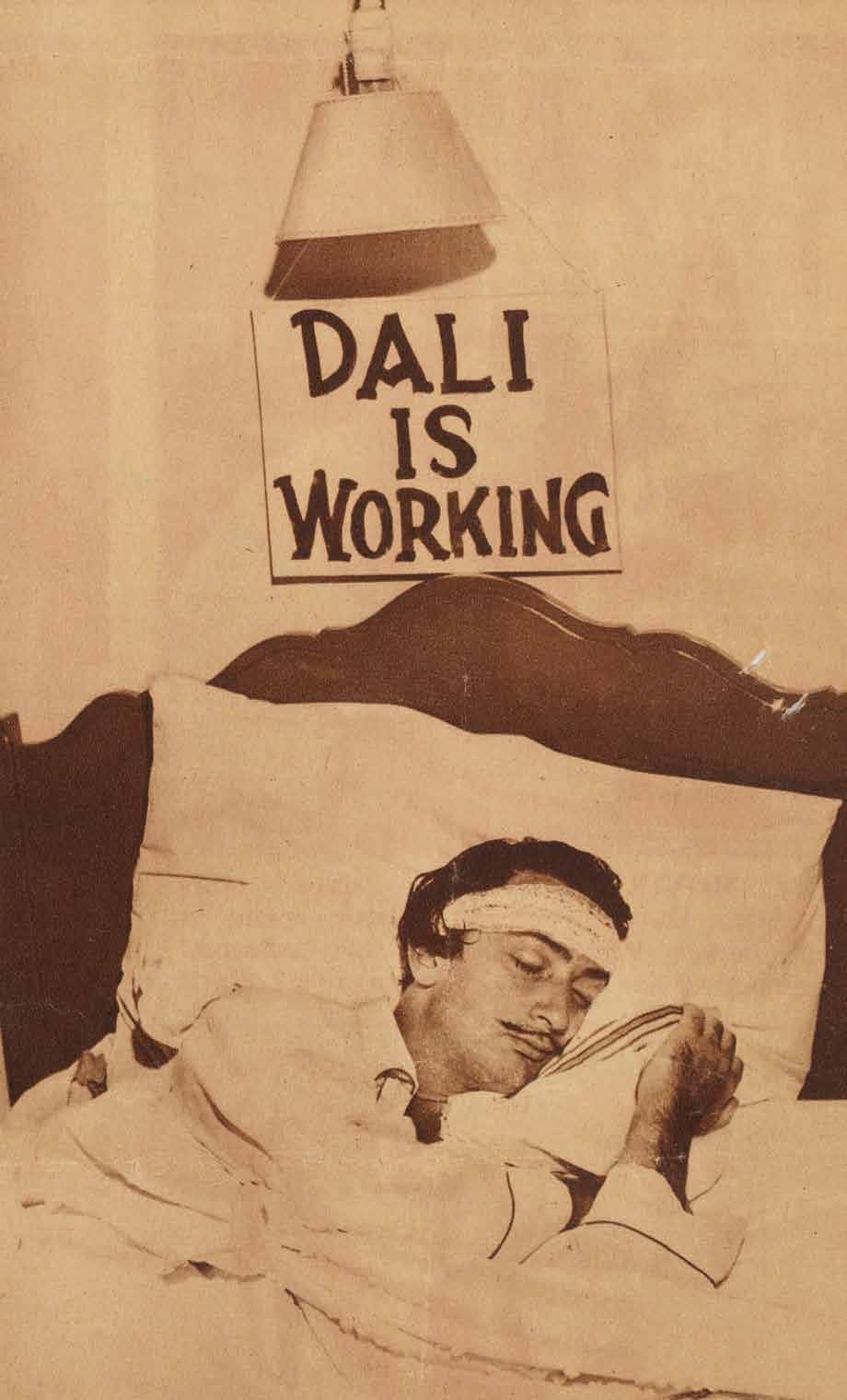
María Gainza was born in Buenos Aires. For more than a decade, she was a regular contributor to the magazine Artforum and the weekly supplement Radar of the newspaper Página/12 In 2014, she published her first novel, Optic Nerve (Harvill Secker, 2019), which was translated into more than eighteen languages. Her novel Portrait of an Unknown Lady (Penguin Random House, 2022) won the Sor Juana Inés de la Cruz Prize. She is also the author of Una vida crítica [A Critical Life] (Clave Intelectual, 2020), the volume of poetry Un imperio por otro [One Empire for Another] (Mansalva, 2021) and the short story collection Un puñado de flechas [Fistful of Arrows] (Anagrama, 2024).
The writer María Gainza received this assignment from dalí news right after returning from a trip to Venice that had been presided over by the figure of Salvador Dalí. A highly unlikely coincidence for someone who doesn’t remember her dream but does remember every detail of that trip filled with oneiric symbols.
1
Like a film star hounded by paparazzi, I pour out my heart on landing in Buenos Aires and declare: ‘In Europe I made peace with Dalí’. The very next day, the assignment arrives. The coincidence sends a shiver down my spine: an invitation from the Fundació GalaSalvador Dalí to contribute to their magazine. Rather like the predictive text on my cell phone, I answer automatically: no thanks. But that same afternoon I think it over again: the economic fluctuations in my country scare me, I have a living to earn and the improbable coincidence of being paid to write never ceases to amaze me. I accept. And so I launch myself, like a belle dame sans merci into recounting a journey in which the figure of Dalí was my guardian. A journey that stirred in me such tangled emotions that I could only express them through the techniques inherent in dreams: compression and ellipsis.
2
To avoid thinking about the journey ahead, on the night before, I went to a party. As I was waiting for a gin and tonic at the bar, a stranger –an artist– made me a prediction: ‘You’ll dream a lot in Europe’. I was going to tell him that I don’t dream, but I didn’t want to start the eternal conversation about something I already knew, namely that of course I dream, because all mammals –except the pangolin and the duckbilled platypus– have regular periods of REM sleep. It’s just that I can’t remember any of what I dream, and that makes me think I’m not dreaming, which I find intensely annoying because dreams are a kind of thought in the form of images that I keep losing. For a writer, it’s like having gold coins in a pocket
with a hole in it. I suffer from dream amnesia. It’s a real shame, because I know people who go to sleep hoping not for rest or solace but ideas for publishable, saleable stories. I have tried a thousand and one techniques: sleeping with my notebook next to me on the bedside table, jotting down a likely idea and slipping the paper under my pillow to ‘guide’ my mind along the right lines, eating melted cheese to prompt visions. But no go. At best, once in a while, a disturbing sensation on waking, a brief disorienting flash. End of story. I’m simply a person up to her ears in reality, a woman who doesn’t remember her dreams. I could have told the artist all this, but it seemed like too much information for someone I had just met. After all, confessing that you don’t remember your dreams is showing your weakness, exposing yourself, admitting you can’t connect in a fluid way with your own imagination.
3
‘Our dreams are a second life’, Nerval wrote. By dint of not remembering what I dream, I persist in believing that life is a second dream.
4
I boarded the plane, doped up but conscious; if I had to jump into one of the life rafts that the stewardess promised would open if we land in the ocean, I would remember the tip about ‘taking off your high heels’.
To while away the long hours that unite continents, I reviewed the film options offered by my screen. I tried a few comedies, but I realised that I wasn’t in the mood for humour; then I noticed that in the classics section there was a Hitchcock. Given that I
He often wondered if we were all characters in one of God’s dreams.
—Muriel Spark, Reality and Dreams 1996
was travelling on a Spanish airline, I assumed that the in-flight entertainment programmer had chosen it to promote –as if he needed promotion– the quintessential Catalan painter. Although that film was not in the film heaven of my youth, I pressed Play. In Spellbound, Anthony Edwardes (Gregory Peck) is the new director of a mental hospital in Vermont and Dr. Constance Petersen (Ingrid Bergman), a psychoanalyst there, falls in love with him at first sight. Peck is an empty shell, and Bergman is the liquor that flows through him. It is a coup de foudre, and although she soon realises that her new boss doesn’t even know who he is, she will defend him, even though she may be defending a murderer. This is when Dalí’s legendary scenes arrive to work their magic. Constance will cure Anthony’s amnesia by interpreting his dreams. I am unable to recall my own dreams, but I remember the dreams in the film perfectly, and yet I see no point in recounting them here. They are meticulously created scenes, charged with all the detail of the artist’s paintings. For Dalí, dreams were always hypervisual, razor sharp, as if he had never encountered an out-of-focus fragment wrestled from the night with brute force, which is the most I have ever achieved.
5 There is a letter from Dalí to the film’s producer, David O. Selznick, in which he says he will work for free if they leave his dream sequences intact. For someone so alert to the importance of making money, this shows how concerned he was about other people interfering with his dreams; after all, one of the great pleasures of dreaming is its unbounded freedom. There i3s another letter in which Selznick is anxious about how the the painter will judge him when he sees his dreams amputated. The tussle, as is usually the way, was won by the industry: of a sequence that originally ran to twenty minutes, just two survived uncut. I don’t know if that footage would have improved the movie, because, by definition, dreams are never complete, but when a film critic found the illustrated scripts with the discarded dreams at a garage sale in the 1970s, it emerged that the missing scene centred on a grand ball with pianos hanging from the ceiling.
6
I had the following discussion with my daughter when I got off the plane. She claimed that Hieronymus Bosch stole from Dalí. I told her that Bosch was born several hundred years before Dalí, and that any influence was likely to be the other way around. I flipped open my mobile and showed her the anthropomorphic forms of The Garden of Earthly Delights, the paradisal landscape in which the rock is also a face, a resource that Dalí quite possibly learned from Bosch. But she claims that she doesn’t care about the time chronology, that for her Dalí is better than Bosch and that this proves who copied whom. It’s a logic that tends in the other direction, I suspect.
7
In Buenos Aires I begin a relationship with a man, a scientist who specialises in snails and is a great fan of Bosch. My daughter knows all this and since she openly detests the presence of my new lover, I sense that her argument masks a deeper discussion. An aesthetic discussion with someone who is competing for her mother’s love. Bosch is a thief.
8
My nostrils are pricked by a smell I cannot define, though it clearly comes from the water. It is midday and we are on a motorboat, as if on a seahorse, swaddled in the wool blankets that the Italian boatman has given us, the icy wind in our faces, passing the masts sunk in the dark oilcloth of the water. Outlined in the background is an opera-like curtain with silhouettes of church domes and roofs. I am not lying if I say that I have longed for this trip for eighteen years. Venice is the dream of my life. We are going to the city of the eye and Mrs. Ramsay’s words in To the Lighthouse come into my head: ‘Everything seemed possible. Everything seemed right’.
9 Reality is a poor scriptwriter, but nevertheless I have to stick to what it presents me with. I step ashore on the dock feeling as if I’m floating, and sit down at the hotel reception to check in. The Italian concierge hands me a white envelope, which I suppose must contain the Wi-Fi password or the room service price list. I start to put it in my bag but she insists that I read it. I open it. Inside is a handwritten letter. Nobody writes letters these days. I have been whisked into the pages of a nineteenth-century novel. My brain takes a while to decipher the letter because I am not used to reading longhand… those three ellipsis points are equivalent to three milliseconds of stupor… three more. When I start to make sense of the letter, I read:
China, I have come to Venice.
I turn around with ‘immaculate intuition’, as Dalí would say, and, as if it were choreographed, the glass door of the hotel opens and he walks in, my lover, the snail watcher, the Bosch enthusiast. He has flown from Buenos Aires to surprise me. He has travelled 11,500 kilometres just to give me a surprise. I don’t know how he found out which hotel I was staying at. It’s a huge surprise, the biggest of my life, but, like Hitchcock, I hate surprises. My ideal would be a life lived according to a pre-established illustrated script. Since we have only known each other for a few months, he may not have perceived this little aspect of my personality. The Italian concierge, accustomed to scenes of amour fou in her city, smiles, probably expecting me to recite those lines of Christina Rossetti’s:
My heart is like a rainbow shell. That paddles in a halcyon sea; My heart is gladder than all these. Because my love is come to me.
But my mouth is dry and I’m closer to a stroke than to a lyric poem. My brain can’t cope with all this.
10
I walk around Venice with twin shackles clamped on my ankles: my daughter, with a face of sulphurous rage at having to share her mother; and my lover, disappointed because his surprise has not met with the expected joy. I am not one of those passionate womanthose passionate women who can throw everything overboard for love, and still less a wise
mother. I am as hypersensitive as a hummingbird and the situation is destroying my nerves. I don’t want to disappoint anyone, I can’t throw anyone overboard, even though I have thought about it. I am spellbound, enchanted: my mind is caught in a trap. A black cloak falls over luminous Venice, like when you pass under one of those marble bridges and the sky goes dark.
11
We arrived on February 16th, the beginning of Carnival, though I didn’t know it. The festivities begin today with the Water Festival. My lover, my daughter and I watch the parade from the terrace of my hotel, which is a few steps from the Rialto Bridge. I didn’t know that tourism could become like this, this plague. Carnival dates back to the Roman Lupercalia, ritual laughter launching these days of communal festivities in which the established everyday order was turned upside down. Coming down the Grand Canal now is a gondola with a giant rat and behind it a bunch of men got up as sumo wrestlers. I know they’re funny, but I can’t laugh.
12
We’re on a vaporetto on our way to see the Peggy Guggenheim collection. It’s probably true that theory precedes observation, but the first thing I see as we go in is a painting by Dalí: a chestnut-haired woman lying on the sand, and a boat stranded on the horizon. She is lying on her back and her head is covered in snails. To relieve the tension, to chat a little, I ask my lover if they look real or made-up. As the man of science that he is, he says it seems logical to him to assume that, given the positioning, what Dalí is illustrating is the cochlea of the middle ear, a structure similar to a snail shell, from which its name is derived. But then he relaxes and accepts the polymorphism of the world –which can at times be difficult for scientists but which he has been accommodating with surprising speed–and adds: ‘But it’s also possible that the painter was playing with both possibilities. Look at this pink one in the middle: there are some freshwater snails that resemble it, from the genus Biomphalaria legendary natural hosts of Schistosoma mansoni, a parasite that causes a horrible disease’. Then my daughter, who is pretending not to be listening though of course she heard him, says: ‘Maybe the woman is dying’.
13
As we are so near the Galleria dell’Accademia, I drag my little group off to see Giorgione’s The Tempest there. Bathed in a diffuse light, in sfumato greens and blues, a mother and her baby daughter are observed by a man, separated from them by a stream which might be a canal. Behind them are the walls of a city, and a storm with lightning like a snake falling from the sky. In the middle ground there are some strange tubes, a mysterious object borrowed from De Chirico, though of course the dates are all wrong. ‘Live’ you can feel the natural breathing of the painting, a pulsating disconnected mass of emotions, and although there are thousands of interpretations of this painting (as many readings as readers), I am inclined to regard it as a capriccio a fantasy closer to poetry than to history or myth. The woman looks at the viewer with concern; for a moment I feel I have entered the picture and am looking at myself.
14
As the vaporetto takes us back, the patchwork parade of Venetian façades hypnotises me. My eye is like a periscope; my body, the submarine. I ask my lover if there are snails in these waters. ‘Of course there are’, he says. ‘Don’t you see them?’ And he points to the walls. The protuberances on the stone sides of the canal that I had thought were pebbles or mud are snails; the walls of Venice have hundreds, thousands, millions of snails attached to them.
15
When Dalí met Freud, he said: ‘Freud’s brain is a snail. To digest his thought, you must extract it with a toothpick’.
16
‘Let’s go to the Palazzo Labia’, I suggest, ‘there won’t be anyone there’. The city in winter is dimly lit, and on our way we pass innumerable Russian families dressed in white marquise wigs, velvet capes, and baroque masks. We take a right then a left, then left, then right, through narrow alleys steeped in shadows; I think we’re going in circles, but the cold forces us to keep our hands in our pockets and no one wants to take out their cell phone. The crowds disappear when we turn into an alley and suddenly we’re just three silent figures walking in single file. What little Venetian drama am I getting into? Maybe I shouldn’t go any further. Deep down in my soul I feel that a part of me is no longer with my companions, even though life around me must continue to unfold.
17
If I had been asked for my password when I entered the Palazzo Labia, I would have said ‘Denmark’, as Fridolin did when he sneaked into the masquerade in Schnitzler’s A Dream Novel But today my pursed lips refrain from saying many things. Dalí remarked that the most amusing balls are those that people talk about without having been there. But he was there. On 3 September 1951, Carlos de Beistegui hosted a masked ball at his Palazzo Labia. He called it ‘the Ball of the Century’. It was a world recently emerged from World War II and the aesthetics were sensual, an atmosphere reminiscent of the Venice of the late eighteenth century, but empty. Celebrities, both local and internationally acclaimed, arrived in specially refitted gondolas, a far cry from the poor excuse for a carnival I had just witnessed. The Ball of the Century was inspired by Tiepolo’s Banquet of Cleopatra on the ceiling of the palazzo. According to Pliny the Elder, Cleopatra wanted to impress Mark Antony and promised that she would regale him with a sumptuous banquet, the most magnificent he had ever seen. As the feast went on, the Roman did not seem impressed and hinted to the Egyptian queen that he was bored. The haughty Cleopatra unhooked a large pearl, valued at five million sesterces, from her earring and commanded a slave to bring her a cup of vinegar. The Queen of the Nile dropped the pearl in the cup and waited for it to dissolve, raised the cup and drank it down to the lees.
18
‘It’s not likely that a pearl would dissolve so quickly, unless the vinegar was very acidic. I mean, not so much vinegar as hydrochloric acid, and very unlikely that Cleopatra would drink that,’ my lover comments. ‘It’s a myth’, I reply, ‘you have to speed up time for the story to take effect’.
19
We pass through a dimly lit gallery hung with dark canvases, door after open door revealing rooms filled with chessboards, bronze busts, velvet sofas, and ceilings covered in putti or battles (there is a point at which love and war become disturbingly similar). My daughter looks at her phone and I’m about to call her attention when she says, ‘I’d give the prize for best costume to these two’. Beistegui refused to allow photographers into the palazzo, but, thinking in terms of legend as he was, he commissioned a watercolourist to make a record of the party. Dalí and Gala wore stilts and long, floor-length tunics designed by Christian Dior, and their faces were hidden by upper-face masks of the kind found all over Venice during Carnival. And my daughter was right: it is a hypnagogic costume. I too was walking with the feeling that the floor of the palazzo had opened up and, if I peered down into it, I would see the depths of my unconscious.
20 When a foreign body gets inside an oyster shell, the oyster envelops it in crystallized calcium carbonate to protect itself. The pearl is the product of a defence mechanism.
21 I feel that waking and dreaming are essentially the same thing, except that they drink from different springs; but I can’t argue the case scientifically, so I turn to John Donne: ‘one might almost say, her body thought’.
22 That night, just the two of us in our hotel room, my daughter read me a Patricia Highsmith story on her phone. It’s called ‘The Snail-Watcher’. One day Peter Knoppert walks into his study and discovers that the snails he keeps there have multiplied exponentially until they cover every inch of the space. In desperation he opens an umbrella to try to dislodge them from the ceiling and they pour down on him like hailstones, knocking him to the floor and burying him. ‘It’s disgusting, isn’t it?’, my daughter says to me, satisfied.
23
24 Monturiol, the inventor of the submarine, was born in Figueres, the same small town as Dalí.
25 Dalinian snails. Who knows? They could be my lover and my daughter, amalgamated in the same image? For three days I think that if going to Venice was ‘the dream of my life’, then being here all together with my two loved ones must be the revelation of my deepest desires. Why do I find it so hard to reconcile these two worlds?
26
Since I started to write this text I have noticed, on waking, certain distant reverberations, as if thinking so much about the subject had suggested them to me. Of course, they last for a few moments and then I forget them. The dream life of the Marquis d’Hervey de Saint-Denys was so rich and abundant that he decided he ought to train for it like a gymnast. Perhaps I’m obsessing, but I feel quite enthusiastic about the idea of training myself to dream. Or, even better, making a machine with electrodes I can plug myself in to and record my dreams, so that many years from now I could screen the recorded material and watch my Venetian interlude in my own private microcinema. And to take full advantage of the investment, I would say that the ultimate achievement would be to create a dream that included a little story and a thought and ended in a pleasant sensation, and at the heart of it all an enigma that I would have to solve myself. But when I read what I have just written I think, no, no one invents gunpowder at this stage in the game: in The Invention of Morel, Bioy Casares imagined a machine along very similar lines.
27
Novalis tells this fable: one day two boys go out for a walk and find a snail on the road. Concerned that it might be crushed by a passing cart, they throw it into the bushes. But the snail reproaches them: ‘Why do you disturb our peace for no reason?’ ‘Comrades,’ the German poet asked, ‘with whom do we get angry when something untoward befalls us? With someone omniscient and wise? What fools!’
28
Some things are too delicate to be written down. I will only say that so many quintessentially Dalinian events in such a short time disturbed me. Towards the end of his life Nietzsche, who did not believe in coincidences, wrote: ‘Every “it was” is a fragment […] until the creating will says to it: “but this is how I wanted it!”’. Perhaps my mind is the oyster and Dalí the strange dust that has filtered in to reconfigure it.
‘How do snails reproduce?’ I asked my lover, looking at his forehead instead of his eyes because I felt guilty. He gave me a detailed explanation, but I only remember this part: ‘Their mating is quite unique, with a sensuality we don’t find in any other species in the animal kingdom’. In a few months, my lover was to set out on a research trip to somewhere in the middle of the Atlantic Ocean whose exact location he could not disclose to me, where he would weeks studying snails that live at a depth of four thousand metres. I find it hard to concieve that a ship with so much expensive equipment would be exclusively dedicated o the study of defenceless little animals. In fact they are very far from defenceless. I know there is one, the Conus geographus, which has a harpoon-like tooth connected to a gland with a very powerful poison and is known colloquially as the ‘cigarette snail’, because if you’re stung by one you have just long enough to smoke a cigarette before you die. I watch old YouTube footage of the ship’s unmanned submersible exploring the depths of the Howland Circle, though it shows only the arm, extended like a Dalí crutch, stirring up the sand and occasionally stopping to pick up a snail with its pincer-fingered hand. Sometimes the remote operator of the mechanical arm misjudges the pressure and crushes the shell.
Joan Fontcuberta
Mayte Gómez Molina
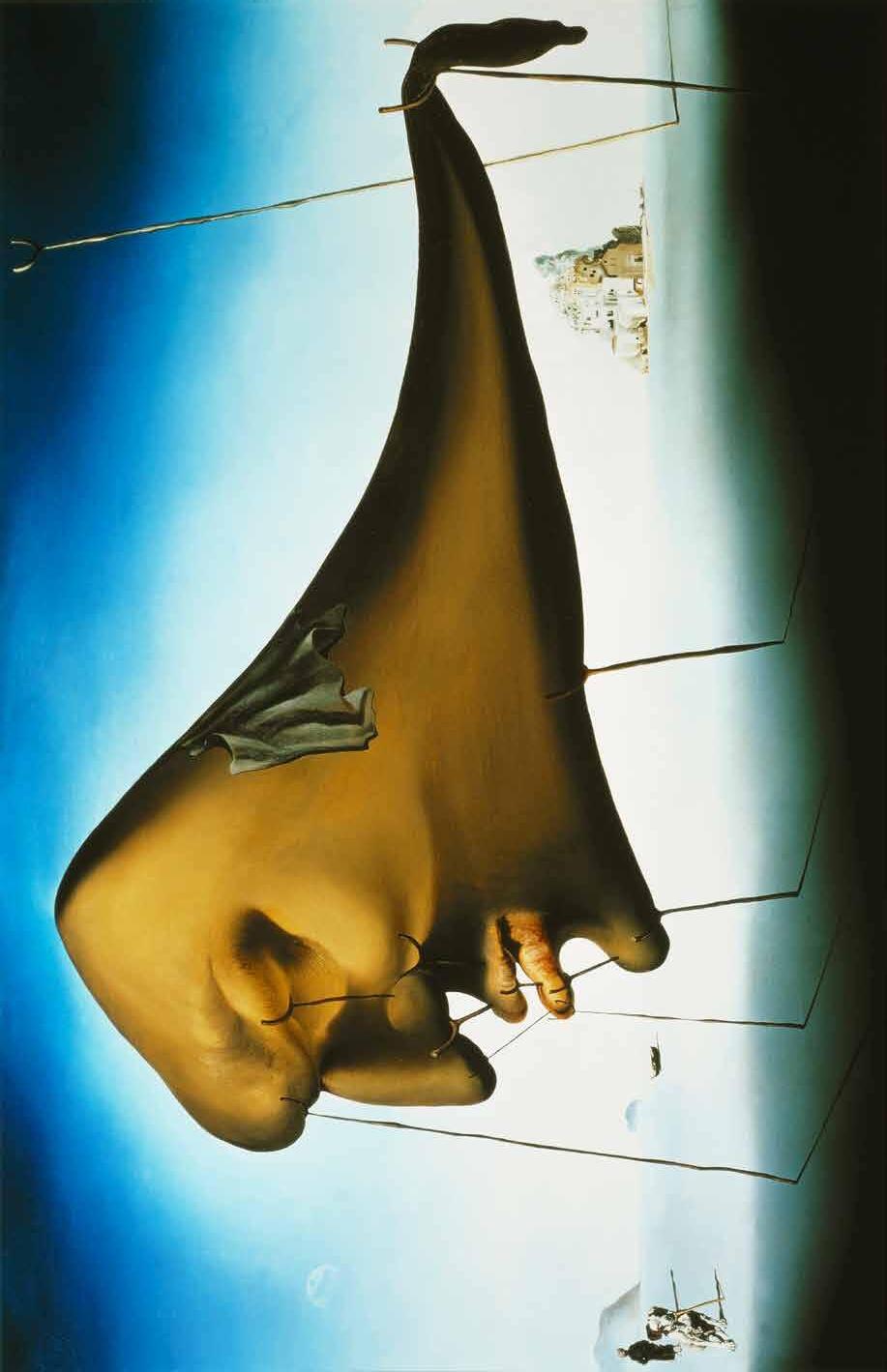
Glenn Brown
Glenn Brown is a contemporary British artist known for transforming existing artworks into detailed Surrealist paintings that blur the lines between homage and appropriation. His work has been shown throughout all of Europe and North America, with large exhibitions at the Serpentine Gallery, the Tate Liverpool, the Kunsthistorisches Museum in Vienna, and the Louvre. In 2022, he established The Brown Collection in London, a permanent space devoted to showcasing his work as well as curated dialogs with both contemporary and historical artists.
By Glenn Brown 30 October 2038
Sighting of large animal in English forest
Near a former World War II Royal Air Force base in Rendelsham, Suffolk, an extremely large creature moved around a forest, its black eyes scanning the surroundings. The unearthly animal caught the attention of numerous members of the public. Soron Llews, a dog walker, observed the creature having ‘three legs, a long neck and emitting haunting and mechanical sounds’. Numerous onlookers witnessed the creature gracefully moving through the forest before disappearing from sight.
Waldorf Thorews, a local fisherman, stated: ‘The animal was over 10 metres high. It should have been terrifying because of its size but I’ve never seen anything so beautiful in my life’. He further described the sounds it made as ‘part-animal, part-mechanical’ and added ‘I’m speechless. will never forget that haunting, melodic sound’.
Rendlesham Forest was made famous on the night of 26 December 1980 when numerous reports described lights descending from the sky and moving slowly through the ancient forest. Tracks that appeared to be from a threelegged animal or machine were later found. Since then, there have been numerous reports of strange events and sightings in the area.
Brown, a former art historian from the Tate Gallery, described the animal as bearing a strange resemblance to the head in Salvador Dalí’s 1937 painting Sleep. ‘It had no actual legs and appeared to be very heavy, but moved with incredible grace through the trees’, he said.
Police are still investigating the area and have appealed to the public to keep calm as there appears the animal poses no danger.
Joan Fontcuberta
Joan Fontcuberta has developed a multifaceted role in the photography world as a creator, teacher, critic, curator of exhibitions, and historian. He is a regular visiting professor at universities in Spain, France, the United Kingdom, and the United States, and a contributor to specialised publications. In 2013, he was awarded the Hasselblad Award and in 2022 he was distinguished with an honorary doctorate from the Université Paris VIII.
For the Surrealists, sleep was not simply a state of rest but an open door to the unconscious, a region free from the social, moral, and logical conventions that govern waking life. Inspired by the psychoanalytic theories of Sigmund Freud, the Surrealists saw dreams as a privileged source of inner truth and radical creativity. Beyond mere escapism, they constituted a tool with which to escape logical thought and access a deeper reality: As Éluard put it: Il y a un autre monde mais il est dans celui-ci ‘There is another world, but it is in this one’.
But how can dream images be externalised and shared? In Les Mains libres, Man Ray explained the simple genesis of his works: Le matin, quand je me réveille, si j’ai fait un rêve, je le dessine tout de suite –‘In the morning, when I wake up, if I have had a dream, I draw it immediately’. More sophisticated, Salvador Dalí claimed to practice a ‘Paranoiac-Critical method’, a way of inducing dream-like mental states to create images charged with symbolism and hidden meaning. Max Ernst used the technique of frottage to produce compositions that seemed to have emerged from a delirious mind, while letting nature represent itself. Access to new technological artifacts further facilitated the achievement of those goals, so that the camera, for the Surrealists, became a magical eye capable of revealing the invisible: Walter Benjamin wrote about its ability to bring out the optical unconscious and Brassaï referred to the possibility of making thought visible.
A century later we understand that the real ‘dream machine’ is the brain itself. We can stimulate it through a variety of behaviours, but it is the only organ in which dream activity is conducted. Today, that Dalinian impulse –manifested in works such as Sleep ( c . 1937)– to transport us to a world where the boundaries between reality and imagination fade away, finds a surprising parallel in the fields of artificial intelligence and neuroscience. Quite a few research teams are working on ways to literally visualise the images that form in the brain, translating patterns of neuronal activity into visible manifestations. The chimera of a machine capable of projecting dreams is no longer science fiction: it is beginning to be reality. One poetical path that pointed to this was the Memories Center project (2014-2015) by Canadian artists Grégory Chatonsky and Dominique Sirois, who designed a device that brought us closer to the perception of mental images. Working with a database of more than 20,000 dreams compiled by psychologists Adam Schneider and G. William Domhoff at the University of California, the software extrapolated graphic and narrative structures and then, using Google Image Search, captured images on the Internet that corresponded to the selected keywords. The
dream situations or events then appeared in the form of brief illustrated stories projected onto a screen with a text, generated using similar extractive and combinatorial software, which narrated the content of the dreams, creating a rudimentary dream photo comic.
Current research being carried out at Osaka University and MIT is using deep learning procedures to decode brain signals obtained with functional magnetic resonance imaging (fMRI). Visual information from our perception of our environment is encoded in the visual cortex as neuronal activity, which can be monitored, and with these techniques researchers have managed to reconstruct some of the visual images dreamed or imagined by the subject examined. The next step will be to record our dreams while we sleep and play them back to us on a screen when we wake up. Alert to these lines of research, some trail-blazing artists have been eager to experiment, such as the German artist Philip Schütte. Working with Professor Kendrick Kay from the Computational Visual Neuroscience Laboratory at the Center for Magnetic Resonance Research at the University of Minnesota, Schütte presented a project on self-representation at the FOAM Museum in Amsterdam and at the Ars Electronica festival in Linz in 2025. The self-portrait is a useful case study: the brain’s perception of itself throws open the Pandora’s box of the whole concept of creativity, raising ethical questions about the privacy of our cognitive black box. But above all, it turns the notions of conscious and unconscious upside down, or inside out.
Now, with the use of AI technology to process the vast quantities of data extracted with this research, synthetic models of brain activity that regenerate mental images can be created. The harvesting of this information by data mining, and its subsequently becoming available to the public, catapults us to another stage. Several episodes of the disturbing dystopian TV series Black Mirror created by Charlie Brooker, have delved into this nightmare, of which current daily life already gives us examples: for example, psychologists reveal a growing concern that many users of ChatGPT are suffering from states of psychosis with delusions induced by interaction with the interface. ‘Cinema’, says Andrés Hispano, ‘transformed the way we represent dreams by translating –almost always defectively– deliriums, drunkenness, and psychedelic journeys into images … For quite some time now, we have not known how to talk about or represent the oneiric beyond the framework created by film and the avant-garde’. Well, the time of generative AI has come: a revolutionary toy, of which Dalí would surely have taken an unexpected advantage.
Mayte Gómez Molina
When confronted with technologically produced images, we inevitably tend to think of the strange haze of dreams, with their liquid contours; the way that one image bleeds into another, like a drop of paint dripping from a brush to dilute in a glass of water. The manner in which images change on our screens –whether because they are being generated by a machine, in real time, or because they are endlessly uploaded by users from all over the world to swell the invisible empire of the internet– calls to mind the arbitrary fashion in which dreams take shape and, incomprehensible and stubbornly, organize themselves into narratives that end up seeming quite logical, at least while the dream lasts. When we sleep, the unconscious slips the strange threads of its stories through our closed eyes, making us its needle.
The viscous changes in the images produced or distributed by technology are reminiscent of dreams and their radical, capricious, even violent ellipses, through which you may find yourself instantaneously transported from your childhood bedroom to a canoe gliding down the Amazon. Given their apparent similarity, it could be argued that artificial intelligence and other forms of technology are, in effect, the dream machine that Dalí spoke of, which would enable us to have more complex dreams. The only problem is that this dreaming machine that we have created feeds on us, and not the other way around. It is a voracious ‘fantasy-consuming’ thing. And that is why believe that Dalí’s prophecy has indeed been fulfilled, but in an unexpected way: instead of a dream
machine, we have created a machine that dreams for us, one that instead of allowing us to dream better causes us to, more and more, dream identically.
It could plausibly be claimed that we already dream the same, if we accept the idea of a collective unconscious that subsists somewhere in our brain, the grey electric database of humanity. That said, while the root may be the same, each of us dreams with a different symbology and turns each dream into a personal interpretation of a world that predates language. What is disturbing about this flawed dream machine is that it dreams while we cease to do so; thus, far from making our dreams more complex and richer, it ends up simplifying them, and instead of dreaming that we are flying in the strangest ways, in our dreams we end up taking a comfortable commercial flight, to get from A to B more easily.
It is worth adding that we have failed to live up to Dalí’s prophecy not only in the sophistication of this machine, but also in the amount of time we dedicate to it. Dalí ventured that we would only need to use the dream machine for six minutes a day. I suggest that, when you finish reading this, you go to the settings of your mobile phone and see how long you have used your dream machine today and if, in that time, you have dreamed anything, or whether, instead, you have devoted your time to watching your machine dream. For my part, will do the same.
Shana Lutker
What does Salvador Dalí have for breakfast in the morning? A bowl of surreal!
As the sun rises, the newspaper is delivered gently to our front door or inbox as we sleep and the night’s dreams settle behind our eyelids. These reports of the previous day wait for us to awaken. Over coffee and cereal, we might scan our dream residue as we do the front page of the news. We take in what interests us, and remain blind to the rest. Sometimes we are not ready to see what is there. Most of the detail and content of these daily dispatches fades away by the evening, while some chosen aspects and themes gain more resonance, and coagulate into a broader narrative, becoming part of our history or identity. Both the newspaper and the dream are building blocks of our understanding of civilisation and self.
A description of a painting is something like a news report –digesting a painted image into words that can’t possibly embody the complexity of the viewing experience. Much is lost in translation, much is left out. The description is a new thing in itself, and often tells us more about the interpreter than about the painter.
One might begin writing about a description of a painting with some facts, invoking the news reporter to gain credibility. For example:
Dalí’s painting, Le sommeil also known as Sleep, was completed in 1937 and debuted in the 1938 Exposition internationale du Surréalisme and was part of Dalí’s 1939 exhibition at the Julian Levy Gallery in New York. At 51 x 78 cm (20 x 30 inches), it is of human scale, small enough to hold between your arms. The painting’s plane is dominated by a large, drooping mask of a face. Disembodied, it floats in silhouette, with yellowed skin. The head is suspended in space by a set of stilt supports. Precariously, the specimen sleeps, a somber slumber. The sky and foreground are covered in dark shadow, and a bright white light bathes the expanding horizon…
What if, at this point, the unconscious takes over? What if the writer, immersed in thoughts of the painting, falls asleep and dreams of the artwork? That is, in fact, what happened to me as I was writing this very text. What follows is this writer’s news report of a dream about Sleep:
Crowds create confusion as darkness falls
April 30, 2025, 2:57 a.m. PT
On a beach, there is a large gathering. A boardwalk leads to a crowded area of tables where I am among a group of artists who are emptying out their studios, making artful piles of objects and art supplies, getting rid of things. There are other people there, as if it’s a flea market. But the things are not for sale. I am sorting through piles of stuff, rediscovering objects and drawings. In one box, find a life-sized statue of a dog that begins to move when you pet it, and a large vase. I unearth a stack of drawing paper. On the top of the pile is large collage with images of many small drawings and paintings cut out and pasted onto it, the rectangles creating a large oval shape. I think: these look like Dalí’s paintings. And, indeed, they are small printouts of Dalí’s paintings. wonder: don’t remember making these, did I make them first, or did he? I am not sure.
It begins to get dark. There is lots of movement around this encampment of artists emptying out their things. It is time to go, but it is hard to move. So much stuff has accumulated on the beach, and so many people. Young artists, shuffling around. There are people going through my things, but no one seems to be taking anything. want to offer the dog sculpture to my friend Brian, an artist I went to art school with, because it looks like his dog who is named Deli. But I don’t ask him.
There is a boardwalk and I am trying to get onto it, but it is hard to walk. Perhaps I am holding a lot of stuff. I approach a cluster of people, and see a boy, 20 years old, in the center. He is stumbling, intoxicated. He is spraying his face with water from a spray bottle. He keeps spraying, and spraying. Standing in this group, completely soaked, eyes closed, face upturned, water running down his face. Someone who knows him calls out to him: ‘Hey, buddy, cut it out’. He keeps spraying. The water is splashing the other people. I start shuffling by him. He stumbles, and grabs my leg to steady himself. He looks up at me. I want to get away from him. He falls onto the ground, gently. wriggle my leg out of his grasp. He is lying down on the ground, face up, his eyes closing. He is wearing a backpack. As he falls asleep, he says: ‘I stole so many things for my house’. I glance at his backpack, which doesn't look very full. I wonder what kind of things, and whether should do something, tell the others. I feel uncomfortable, anxious, and I just want to keep walking.
I suddenly notice, very close to me and the boy, at the edge of the water, something moving swiftly through the air with a whoosh. It’s a rocket or a firework. A few seconds later, I expect an explosion of light, but it is muted and far away. Again, a second whoosh, and something shooting up into the air in another direction. Then, a flash of light, distant, and not scary. A third whoosh.
‘
’
When he was six years old, Ribeiro suffered recurring nightmares following the death of his father. A therapist taught him to be aware of his dreams and to dialogue with them. Later, when he was studying for his doctorate in New York, he found dreams to be an exceptional aid to adaptation and, from then on, he dedicated himself to researching them professionally. Today, at the height of an extensive career, he still regularly records his dreams. ‘When they are significant, I write them down and share them with my partner and vice versa, or with my children, when they are with us. We have a morning routine of asking each other “what did you dream about?” –and you have to show an interest. A lot of people don’t want to talk about their dreams because no one wants to listen. Listening, listening carefully, is an art. Sometimes, just by talking about it, explaining the dream, it becomes much easier to understand. It is like talking and listening to yourself. These are things I try to practice’. From Brazil, Dr. Ribeiro kindly ‘listened to’ and ‘answered’ our questions about the latest research on dreams and the attention (or lack thereof) paid to dreaming in our society.
An interview with Sidarta Ribeiro
dalí news
Neuroscience has advanced at a dizzying pace in recent decades, offering us a better understanding of how the human brain works and breaking with old paradigms, thanks to, for example, the discovery of neuroplasticity. Do you think that this characteristic, the ability of our neural network to renew itself and adapt or overcome physical limitations, is perhaps the most important discovery in the field of recent neuroscience?
sidarta ribeiro
The issue of plasticity was highly controversial in the 1970s because, up until then, many people believed we had a fixed number of neurons for life and that if you lost them, you lost them, and neurogenesis did not occur in the adult brain. Today, everyone knows that plasticity exists and its mechanisms are quite well known; the question is how to increase it. How can you reopen this window? And here we have an issue that I think is very important for surrealism in general: psychedelics. Psychedelic substances produce experiences similar to dreams, and open the same mechanisms of plasticity that dreaming does. In other words, they are like a proxy for dreaming and produce a change in neurons and synaptic connections that can increase creativity.
dn
In Dalí’s case, he said that he did not take drugs because he himself was the drug, that he had a hyperactive brain and no need for any substances.
sr A technique he often used was to go to sleep. In this way he extracted, from his brain and his own neurochemistry, all the psychedelia that is in the unconscious. There are several ways to access this inner world. It can be through a dream at night, through a daydream, or through delirium, through a psychedelic substance or cannabis, or by fasting, as some indigenous peoples do, or even through a fever. In other words, there are several ways to reach a place where the unconscious produces images. Once this door is open, it is a matter of collecting those images and working with them. However, I would say that the great issue for neuroscience in the 21st-century is ‘what is consciousness?’, because, although we all know or have an idea of what our consciousness is, there is no consensus among specialists. There are at least four major theories, maybe five, that are incompatible with each other. So, I think there will be a lot of activity in this regard over the next decade..
dn Without a doubt, these discoveries would not have been possible without the technology we have today. What tools do neuroscientists use in their research? What is the cuttingedge technology in this regard and what can we expect to be useful for this purpose in the coming years? Can AI play a role in this?
sr We use a lot of techniques and new ones are being invented every day. Much of the research is carried out with animal models that allow us to observe the expression of genes and which proteins are produced,
and we also film cells for hours, sometimes days… In observations in humans, a major technological change has been functional magnetic resonance imaging, which, although it does not give us a direct idea of neuronal activity, does offer an indirect dimension of it. Of course, these things have their limitations. They are huge, very expensive machines that do not allow the person to move inside… Currently, non-invasive, portable methods are being sought; that is, methods which allow a person to be studied while they are doing something and not motionless inside a machine. Artificial intelligence is changing everything on the planet; everything. Religion, cities, work, personal interactions… so, there is sure to be a lot of applicability in research. I view this with a degree of concern. It is a real wonder, but I also think that it is something which has consequences that we have not yet adequately mapped, especially in the younger generations. I am very concerned that the never-ending torrent of images we are subjected to, which keeps us from sleeping, is affecting our ability to dream.
dn
How did your interest in dreams arise and why do you think they are so important for the human race?
sr I started studying dreams when I was starting my PhD, in 1995 in New York. When I arrived there, I spent two months of winter in which I did nothing but sleep and dream; I couldn’t stay awake. It was a difficult period because I felt as if my body was sabotaging me. And, after those two months, I adapted quickly. I went from not understanding anything to understanding
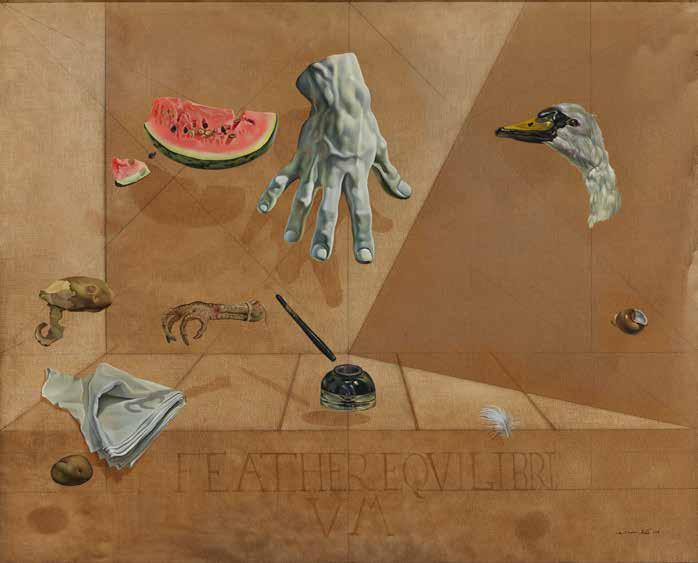
everything, and I realised that dreams had been the tool, the adaptive process. I wasn’t sabotaging myself; I was preparing myself. That’s why I decided to study this mechanism, although my interest in dreams had begun long before that, when I was small and had a period of recurring nightmares. My father died, and his death was very traumatic for me. I had nightmares for which I needed therapeutic support. Then, my therapist taught me how to have what we call lucid dreaming, that is, when you are aware of what you are dreaming. That was an important therapeutic tool and it later helped me with everything: it gives you the ability to look at yourself, and that expands your awareness
dn Could you explain to us, in a way that can be understood by a non-scientific reader, how a dream occurs in the brain?
sr When we sleep, the brain produces spontaneous electrical activity. Even though our eyes are closed and our attention is not focused on what is happening outside, there is a lot of endogenous activity in the brain. When this passes through neural pathways that represent memories, it reactivates them. In this sense, dreams are the reactivation of memories that are not reproduced exactly as they were registered when we were awake; instead, they are recombined according to the dominant emotion, whether it be a desire or a fear; and this is sets the course of the dream.
But of course, to say that dreams reflect the passage of electrical activity through neuronal networks, as memories that represent memories, is not the whole story. If the part of the brain that produces dopamine
random, anywhere in the world, ‘what did you dream about?’, very often –30-50% of the time, or more– they dreamt about things that happened to them recently, what Freud called ‘day residue’. Sometimes they are very significant, and sometimes they are not but, in either case, they are there. When you have a dream, let’s say, a week after the event that triggered it, the elements that reflect the recent past are still there, but others from the distant past also start to appear. What happens is a combination of a process of reverberation of recent memories and a reactivation of deep memories, and these tend to appear because of their emotional value. That is why, sometimes, you have a dream that does not seem to have much relation to your current situation, but if you look for the emotion it expresses, it may well resonate with you. This is where the key to understanding the dream is to be found. The content is less illustrative than the emotion; the emotion makes the content clear to you. There are people who want to avoid contact with their dreams, which is like not opening a letter you wrote to yourself.
dn
Dreaming is a common trait of the entire human species, but do we all dream in the same way?
is not activated, there is no dream, even if you are in the REM phase, which is the sleeping state in which, physiologically, you usually have the most vivid dreams. If you do not have dopaminergic activation of the ‘reward and punishment system’ –which is perhaps not a good name: it would be more accurate to call it a ‘search system’– there will be no dream even if there is electrical activity. The dream is the reactivation of memories together with the ‘search system’. So as a result, the narrative structure of a dream is usually as follows: I am there, in the first or third person, in a certain situation, a certain context, in a certain place with certain people and I want something. I want to go to such and such a place, to meet such and such a person, I want to look for such and such an object, and there is always an objective, a goal. The dream is about goal-directed behaviour, about actions or conduct with a bearing on certain goals. And that is exactly how we live life! It is all a matter of drawing up plans, large or small, and dreams have the same structure. Dreams have a continuity with waking life. In this sense, Sigmund Freud was absolutely right, and Carl Jung and Dalí were right.
dn Dreams have an important role in regulating our emotions. Why?
sr Because if we woke up in the morning as angry about something as we were the day before, we would not be able to go on… The same thing happens with the good things that happen to us: if we stayed anchored to them, they would paralyse us. Every day you have to reset and start again, and the dream has a lot to do with this emotional regulation. When you ask someone at
course, we were under very similar conditions of risk, and this conditioned our dreams. And there is also the issue of war, which is an increasingly looming presence in Europe. It is very interesting, and really quite striking, to consider the dreams that people were having in Germany just before the Second World War. In fact, both before the First World War and during the Second, many people in Germany had dreams –some of which were recorded by psychotherapists such as Carl Jung– that were quite premonitory. Dreams are simulations of what can happen and, when everyone focuses on something that is happening, this is reflected in dream images.
dn
Because sometimes they can also be linked to intuition, which is quite a primitive thing, although it often comes from intelligence, from being aware of things…
And if you think they do, do you believe they can really be deciphered? What messages do they give to us?
sr No, each of us dreams differently. Many people don’t remember what they dream, even if they have four or five sleep cycles each night, because that’s how we live: we don’t attach much importance to dreams, we don’t pay attention to them, and that’s why we don’t remember them. When you start to increase your awareness of your dreams, to make an effort before falling asleep to focus on your desire to dream and then, when you wake up, lie still in bed waiting for it to come back to you and write it down, that starts to improve. You can learn to do this, just as you can learn lucid dreaming. And you can also unlearn it; it is very common for people to have a rich dream life during childhood and adolescence and, when they enter adult professional life, their waking hours don’t leave them time to sleep and dream.
People dream according to how they live. Dreams reflect life. If a person lives in a beautiful place, with very good relationships, their dreams will usually reflect this, although they may present the opposite, even as a form of compensation. When a person experiences a situation of aggression, violence, insecurity, there is no doubt –and we have a lot of data on this– that it will be reflected in a tormented dream life, with recurring nightmares. In fact, one of the most pathognomonic symptoms of post-traumatic stress disorder –that is, the symptoms that most clearly identify the condition– is precisely recurring nightmares.
dn
Collective experiences can actually be reflected in common elements in each of us, can’t they? For example, this being a time of very great uncertainty –even threatening, in some ways– means that there tend to be certain recurrences.
sr Absolutely. This is something that became very clear, for example, during the pandemic, when all over the planet people’s dreams had so much in common. Of
sr Yes, and from becoming aware, by way of an oneiric or hypnagogic image, of various intuitions that are themselves subliminal, that do not reach the threshold of consciousness. In fact, in dreams the hypnagogic space –which Dalí was so interested in– is actually the point when you are most open to bringing all this set of influences together and generating something supraliminal, an image that expresses something of which you were not consciously aware, but was already obvious, like the profound political change that Nazi Germany was experiencing.
dn
So there is a direct relationship between sleep and dreaming, but is there also one between dreaming and our daytime capacity to imagine and create? The close relationship between art and dreaming seems to say that there is… Are these brain circuits related?
sr Yes, we have a really vast brain circuit that we call the default mode network. This network is activated when we dream, when we daydream while awake, when we construct autobiographical narratives, when we invent stories, when we go back to the past to explain something, when we imagine the future and even when we feel empathy. In other words, feeling someone else’s pain or putting yourself in the other person’s shoes is, in a way, a type of dream. And when you have slept badly one night, when you are sleep deprived, it affects this default mode network, and this means you generate less empathy. People become less sensitive to what is external to them and the interpersonal distance that they consider to be comfortable increases. So, quite literally, losing a night’s sleep is something that separates us socially. And a curious thing is that in our contemporary way of life there is almost no time for quality sleep and dreaming. The electronic devices that are invading the night are increasingly generating a society with low levels of empathy.
dn Do you regard dreams as serving a purely physiological function or do you think they have a meaning, as everything from psychoanalysis to the most ancestral traditions would suggest?
sr I think it is very clear: dreams have meaning and, more than that, they have meanings, there is not necessarily a single correct interpretation. As dreamers, whether through psychoanalysis, shamanic contact, or family and community contact, we can make an interpretation of a dream that will give us ideas of several possible meanings, and if some of these are useful to us, that’s fine, it’s the best we can achieve. What cannot exist is a key to interpreting dreams that does not refer to the dreamer. To understand a dream, it is necessary to understand the context of the person who is dreaming. Among some indigenous communities, such as the Xavante of central South America, people collectively interrogate their dreams each morning, all together. And there are groups that even have collective dreams, that is, several people having the same dream at the same time. All this leads us to expand the psychoanalytic perspective a little. Yes, dreams have to do with the dreamer’s desires and fears, but also with the desires and fears of all the other people, all the other entities, animals and plants of the dreamers’ spiritual world… In today’s Western world these things are not given very much consideration, but in other cultures –which are also contemporary– they are very present.
dn Salvador Dalí’s work also introduces the enigmatic, the dreamlike, the fantastic into reality. What does it suggest to you?
sr I have been fascinated by Dalí since I was a child, because a very dear uncle of mine –who died just last year, in fact– had reproductions of Dalí’s works all over the house. It made a great impression on me. And when I went to Europe for the first time, when I was eighteen, I visited Barcelona and Figueres. The Dalí Theatre-Museum made a real impact on me. I love Dalí’s work, and surrealism, and Buñuel… When I started giving classes and presentations, it was very natural for me to incorporate Dalí into what I had to say about dreams in art. Dalí, in a way, transformed the capture of hypnagogic and oneiric images into a method that, in fact, sometimes seems like material from a scientific study. He was playing with the language of science.
dn Do you think Dalí’s article in the magazine Nugget in which he refers to a ‘dream machine’, has ceased to be a prediction for the future and become a reality? What are your thoughts about his text?
sr I think his prediction is an absolute reality today. Right now, there are research laboratories and even universities and companies making machines like this, machines that provide certain stimuli to incubate a certain type of dream. It’s like going back to the time when dreams were incubated in the temples of Apollo and Asclepius and the gods of ancient Greece and Rome, but now with an electronic device that produces
The truest and best dream machine is the brain itself, protected from such excessive stimuli. If we could live in a society in which dreams were protected and in which we had ample opportunity to imagine without being subject to constant stimulus, we would dream much more. Nowadays, dreams are manifested on screens, and we are a bit hypnotised by all this. But I think there is still time to change course.
a certain repertoire of images, which allows you to orient or direct your dreams and program them to a certain extent. I think it’s all really fascinating. Dalí had this futuristic visionary vocation, but in my opinion, the truest and best dream machine is the brain itself, protected from such excessive stimuli. If we could live in a society in which dreams were protected and in which we had ample opportunity to imagine without being subject to constant stimulus, we would dream much more. Nowadays, dreams are manifested on screens, and we are a bit hypnotised by all this. But I think there is still time to change course.
dn
Finally, what is the most significant thing that you as a scientist have learned in your work on dreams?
sr
In terms of the research on dreams as such, one very interesting thing we have discovered here is that, just as we are falling sleep, the last images that reach the eye before it closes persist, reverberating in the brain at high frequencies, while images of many of our other memories start to be produced, competing with the new images but at lower frequencies. So there are two frequency bands, for recent and for older images, that act in our brain as we sleep. However, the most significant thing, from a social point of view, is that we have discovered that, in school, when you add a short nap to multisensory training in reading and writing, you can double the reading speed of children between the ages of five and six. This is something we’ve been studying for about three years now and are now replicating on a large scale, because learning to read and write is still a big problem in Brazil and other places around the world. From the point of view of social impact, this could be very important.
Melinda Powell co-founded the Dream Research Institute (DRI), London. She has served as vice-president of the International Association for the Study of Dreams and as director of the Help Counselling Centre. Author of The Hidden Lives of Dreams (Lagom, 2020) and Lucid Surrender: The Alchemy of the Soul in Lucid Dreaming (Archive Publishing, 2022). www.melindapowelldreams.com / www.driccpe.org.uk
For more than four decades, Melinda Powell has devoted her professional life to researching, interpreting, and guiding others through their dreams. Melinda lives near Oxford, where she writes about dreams and facilitates dream groups online. A lucid dreamer for decades, she has discovered that dreams may connect us to the transpersonal realm if we allow them to unfold, bringing transformative insights and creative inspiration.
dalí news
You have looked to your dreams for guidance both personally and professionally. This has led you to become a psychotherapist, dream guide, lucid dream specialist, author, and co-founder of the Dream Research Institute (DRI) in London. Do you have a unique ability to understand dreams, or is this something we all possess?
melinda powell
My dreams, especially lucid dreams, have shown me that waking life and dreams act in reciprocity. Dreams help us to realise our full humanity, and this potential is part of our birthright. But receiving this inheritance requires that we become attentive to our own ‘symbolic life’, as Carl Gustav Jung, the founder of analytical psychology, counselled. How might we cultivate a dream life? Like any relationship, this requires commitment. Prior to sleep, quieten the mind through meditation or prayer. Upon waking, write down your dreams in a dream journal, even fragments — an image, colour or feeling. Note the questions the dream prompts you to ask and the questions it might answer. How might the dream mirror the day’s events and emotions, and those from the past? Would you like to re-engage with a part of the dream?
My book The Hidden Lives of Dreams provides new ways to consider each of these questions. Such reflections also facilitate lucid dreaming, wherein we become aware that we are dreaming while yet in a dream. When you attend to your dreams, there is a reciprocal response from your dream life, your dreams become vivid and clear –more lucid. In my case, I have documented my dreams with a hermetic discipline, and, over time, they
have been a source of creative and spiritual sustenance, giving me inspiration and guidance.
We each will have a dream life unique to our personality and life experience. Yet, paradoxically, the more we reflect on our dreams and work with them, the more revelatory they become for each of us, both individually and collectively. We can see this paradox in the work of great artists like Dalí, whose idiosyncratic imagery, derived from his intensely personal and richly developed symbolic life, has universal import. When people view Dalí’s artistic renderings of dream-like innerscapes, which he called his ‘interior iconography’, they intuit that his vision holds an objective truth which speaks in a subjectively meaningful way.
The challenge is to bring our inner world into manifestation creatively. For me, this has meant cofounding the Dream Research Institute in London, working therapeutically as a dream guide, and writing about dreams to initiate readers into the mysteries of their inner world beyond the world of appearances.
dn
Art and imagination have always been closely linked to dreams. In your view, what is their relationship to dreams? Is our brain the ‘great dreaming machine’ that Salvador Dalí once predicted?
mp What, I wonder, would Dalí think of the many dream apps now available to improve dream recall and induce lucidity? Certainly, he would be intrigued to know that finding ways to induce lucid dreams –using light, sound, and electrical or chemical stimulation– is a growing enterprise. Nonetheless, research suggests
that mindfulness practice in waking life induces dream lucidity most effectively. Ultimately, we already have a dreaming machine –the human brain!
The following lucid dream of mine brought home this realisation to me — I attend a lecture where a man is talking about lucid experiences that are possible when a person is connected to a large black box…. I become lucid and say, ‘You don’t need this machine. All you need is your body, mind and heart’
Our dreaming mind serves to connect us to what some quantum cosmologists have called the ‘cosmic mind’, unbounded by the normal limitations of spacetime. This ‘extended mind’ theory argues that cognition reaches beyond the individual brain. In this sense, ‘such stuff as dreams are made on’ extends to the far reaches of the cosmos. Dreams open the door to the Imaginal World, the mundus imaginalis. This term, proposed by the French philosopher Henry Corbin, refers to a dimension of experience described by Islamic mystics as the alam al-mithal, in which the intellect and sense perception meet via the Imaginal Mind. As Jung enigmatically puts it: ‘The dream is a little hidden door in the innermost and most secret recesses of the soul, opening into that cosmic night, which was psyche long before there was any ego-consciousness…’. Ideas such as Dalí’s ‘dreaming machine’ can help us conceptualise a mode of consciousness that transcends the dualistic nature of the world as we perceive it.
dn
Dalí, like many Surrealists, placed great emphasis on dreams. How do you think Surrealism –and Dalí in particular– contributed to the exploration of dreams and their influence on society?
mp
Rather than elaborating on this in general terms, I would like to respond to this question by sharing how Surrealism has influenced my life. Although I studied Surrealism in art history at university, it wasn’t until I left the United States to live in Poland after the fall of the Berlin Wall in 1989 that the significance of the Surrealist movement struck me. My move to Poland was ostensibly precipitated by my desire to experience life in a former Soviet Satellite and to set up a Teacher Training College with the United States Peace Corps. In retrospect, my unconscious motivation stemmed from a need to move beyond the cultural constraints of my upbringing. At the time, my appreciation of Surrealism was purely theoretical. Although I recognised that Surrealist art mirrored Freud’s psychoanalytic approach, with the aim of liberating the individual from conditioned responses and societal constraints, I did not have a visceral understanding of what that truly meant.
In Poland, a copy of Dalí’s The Persistence of Memory (1931) [P265] hung in a colleague’s apartment. Set against the stark Soviet-style architecture, Dalí’s iconic vision of distended clocks felt especially bold, even brazen, a testimony to an original perspective free from monochromatic banality. The imagery could similarly free my perception from the limitations of reality –one of Surrealism’s aims. Later, when I lived in Zurich, Switzerland, I was able to see original art by Dalí and other well-known Surrealists, such as René Magritte and Max Ernst. I was stirred by the artists’ personal iconographies, which broke the bounds of consensus reality. Their masterful works re-ignited my desire to explore my inner world. While living in Zurich, I came across a Bible Dalí had illustrated in the early 1960s. Dalí’s illustrations breathed new life into familiar biblical narratives. His subtle shading and evocative colours moved me. These watercolours reflected an emotional depth and spiritual sensibility that felt constrained in Dalí’s earlier works. Years later, I purchased a signed copy of the print The Shepherd from Dalí’s series ‘The Song of Songs’ (1971) from a London art gallery. For me, this mystical vision of Hermes mirrors the illuminated landscapes of my lucid dreams. Around this time, I also began writing and speaking about dreams. Now, a decade later, while preparing my responses for dalí news a timely synchronicity occurred: a woman in my dream course spontaneously shared illustrations of the Tarot by Dalí to amplify her dream imagery. In a curiously ‘inquisitorial’ way, to use a Dalinian expression, the works of the Surrealists in general and Dalí in particular have signposted my life, instilling me with confidence to share my inner world.
dn Your understanding of the import of dreams extends beyond the artistic or psychological to the transpersonal. In your view, what do dreams connect us to beyond the individual unconscious?
mp Here, I am reminded of Dalí’s mystical insight in his book, 50 Secrets of Magic Craftsmanship (1948), when he advises the artist ‘…it is absolutely necessary that your “painter's hand” be guided by an angel’. This advice also applies to how we approach dreams. Notably, Sufism
teaches that an angel goes out before each one of us, both in life and dreams, to lead us into becoming the light of Spirit. Dalí stated a similar truth for the Surrealists when he said of his Paranoiac-Critical method that ‘this method works only on the condition of possessing a sweet engine of divine origin, a living core, a Gala. And there is only one’. This ‘sweet engine of divine origin’ would appear to be akin to the practice of loving devotion, the Eros at the heart of the creative impulse. For Dalí, his beloved Gala personified this higher love rather like the archetypal divine Sophia, who bestows her gifts of wisdom and beauty to those who love her.
From the transpersonal and alchemical perspectives, the paradoxical union of Dalí’s ‘irrational coercion’ and the ‘sweet engine of divine origin’ would be to couple heart and mind –intuition and reason– and so co-join our outer and inner sight lucidly. Carl G. Jung likened this sense of wholeness to the alchemical mysterium conuinctionis: mystical union with the Divine. Returning to the theme of celestial intelligence, I’ll conclude by noting that when Dalí became fascinated with quantum physics, he declared, in his Anti-matter Manifesto (1958): ‘Today the exterior world –that of physics– has transcended the one of psychology… It is with pi-mesons and the most gelatinous and indeterminate neutrinos that I want to paint the beauty of angels and of reality’. These words express the joy of the mystic’s soulawakening to a supremely loving, creative intelligence known through the illumined Imaginal Mind.
dn In your book Lucid Surrender you explore the relationship between dreams and alchemy — an area of great interest to Salvador Dalí. How do you link the process of dreaming to the alchemical process? Can dreams facilitate spiritual transformation in the same way that alchemy, as understood by figures such as Carl G. Jung, does?
mp European alchemists of the Middle Ages viewed alchemy as a Sacred Art in which the goal was ‘to spiritualise matter and materialise spirit’. Dalí’s single-minded ambition to materialise ‘concrete irrationality’, described in his Conquest of the Irrational (1935), shares resonances with this alchemical aim. In this sense, ‘conquest’, rather than meaning to vanquish the other, essentially means ‘realisation’. The artist ‘conquers’ that which is irrational or ineffable by bringing it into manifestation. Truly, in such a process, the artist’s power of ‘irrational coercion’ resides in knowing how to yield to that which calls for expression from within.
Importantly, in lucidity the dreamer can explore the nature of dreams consciously. Lucid dreams provide an alchemical laboratory for the exploration of our personal psychology and of transpersonal awareness. Prefiguring this vision of the transpersonal, in the 17th-century, the alchemist Heinrich Khunrath called the visionary dream space ‘The Theatre of Secrets’. Dalí’s own ‘secret methods’ and ‘magic craftsmanship’ echo this notion.
The alchemical axiom of correspondences between subjective experience and objective ‘reality’ –‘as above so below’– would ring true for Surrealists. For the alchemists, the spiritual world enlivens the material world, the human capacity for creative imagination mirroring that of the Supreme Creator’s theophanic
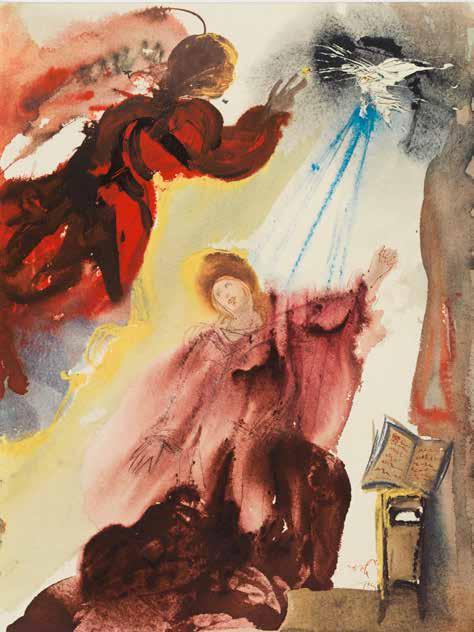
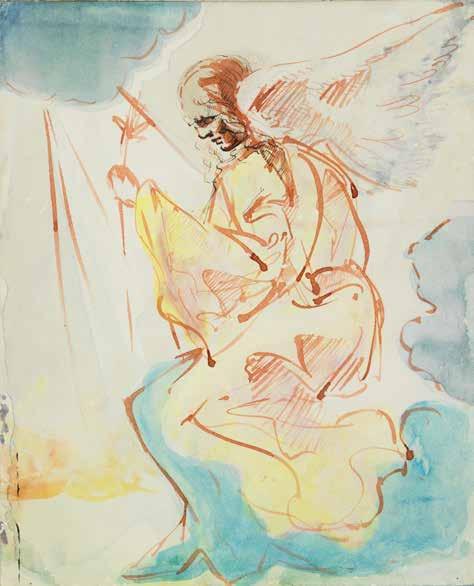
imagination. Khunrath’s words take on a Dalinian tone when he boldly states: ‘He who denies true dreams, speaks in a dream’.
Like a modern-day alchemist, Dalí, in his Mystical Manifesto (1951), describes a process of ‘dematerialisation and disintegration’ that unveils the ‘spirituality of all substance’. Here he brings yet another alchemical adage to the fore, namely, ‘Dissolve Matter and Coagulate Spirit’. In his later years, Dalí saw that the rending apart of physics and metaphysics by the specialisation of the modern scientific method required a new synthesis, which only the ‘militant mystic’ of art and dreams could provide. My experience is that numinous lucid dreams, which generally entail an encounter with living light, can put the dreamer in touch with ‘nuclear mysticism’. This spiritual illumination dissolves ego-constructs while simultaneously fusing the apparent opposites of rationality and the imagination. Such experiences radically expand our consciousness, making us aware of the essential unity behind the multiplicity of forms and transforming how we relate to both life and death.
‘Lucid Dream Alchemy’ views lucid dreaming through the twin lenses of alchemy and what I call ‘Lucid Surrender’™.
I draw on the teachings of Carl Jung, who understood alchemical imagery in dreams as symbolic of individuation, whereby a person’s outer life becomes creatively aligned with their authentic nature. My book Lucid Surrender: The Alchemy of the Soul in Lucid Dreaming extends Jung’s alchemical model to dream lucidity for the first time.
dn
You specialise in lucid dreaming. Would you say that an artist is a lucid explorer of both their personal and the collective unconscious? How can we tap into the creative potential of lucid dreams?
mp Absolutely, the artist is a lucid explorer! In dream lucidity, a balance is struck between sleeping and waking processes. In ordinary waking life, we perceive ourselves to exist in a single reality, bounded by space-time. However, in a lucid dream, we may find ourselves conscious of multiple dimensions of Being. I see aspects of this dream exploration in Dalí’s notion of ‘irrational coercion’ described in his Paranoiac-Critical Method. Although ‘Lucid Surrender’ –my own approach to lucid dreaming– sounds contrary to Dalí’s ‘coercion’, these apparent opposites share meticulous attention to rendering the inner experience with focused intent. Both require an active receptivity and reciprocity, a kind of Ricoeurian ‘second naïveté’ or ‘second immediacy’, that characterises Dalí’s artistic process. By consciously relinquishing ‘control’ in the lucid state, a sacred space emerges in which all forms of orthodoxy yield to the revelation of Divine Love. Lucid Surrender is not a technique or method. Rather it calls for surrendering the ego to transpersonal presence. Such surrender in dream lucidity requires not only psychological stamina but also soul stamina. We must first face our fears, what Jung called the ‘shadow side’ of the unconscious, the negative traits we project onto others both in life and in our dreams. Rooted in our instinctual nature, this shadow, when unacknowledged, can erupt from the unconscious with destructive force in the form of a projection that latches onto anything perceived as a threat, whether an individual, a community, nation, and, not least, the ‘unknown’. Jung showed
that by making the darkness in ourselves conscious, we become liberated from negative projections, the hallmark of the ego, freeing us to become complete and whole.
Similarly, Dalí’s aesthetic approach, described in his Conquest of the Irrational requires a certain soul stamina and willingness to explore the unknown, for he paints, with hyper-photographic realism, the ‘unknown imagination’. Dalí, as an oneiric explorer of the unconscious, unflinchingly gives ontological status to the seeming unreal and irrational, a hyper-lucid reality that is familiar territory to the lucid dreamer. How might we tap into dream lucidity? In addition to the reflective journalling and the mindfulness practice that I mentioned previously, another powerful way to develop lucid awareness is by re-visiting a nonlucid dream with the help of a dream guide. Working together, the dream can then be experienced anew in real time by meditatively re-entering the dream to explore the associations, emotions, and bodily sensations that spontaneously arise. I give examples of this process in The Hidden Lives of Dreams Becoming attentive to the Imaginal Mind while in the waking state helps us become more attentive to our dreams in sleep, thus potentially sparking lucidity. Furthermore, when returning to waking life after surrendering to lucidity, we bring with us a fresh sense of wonder at the miracle of life!
dn
Do art and dreams share a common spiritual purpose beyond the material and the psychological? Salvador Dalí was fascinated with mysticism, which he linked to the fundamental nature of matter, the atom. What is your perspective on the relationship between the biology of dreams and the revelatory experiences they offer?
mp Science acknowledges that the worlds of classical physics and quantum mechanics co-exist, though how they do so remains a mystery. Yet, in our dreams, particularly lucid dreams, these worlds seemingly combine as we effortlessly walk through walls, defy gravity and fly, travel at the speed of light or even faster, influence other objects from a distance, and change our form.
In his Mystical Manifesto Dalí makes the case that religious mystics, such as Teresa of Ávila, penetrate the ‘penitential chapels of the spiritual castle’, whereas ‘[t] he mystical artist must form for himself, aesthetically, through the fierce, daily, self-inquisition of a mystical reverie… a dermo-skeletal soul… in which the flesh of the soul cannot help but rise up to the sky’. The architecture of the artist’s mystical reverie can be compared with the cathedral of dreams that connects us to the sacred presence at the heart of creation.
From a neurological perspective, lucid dreaming has been mapped by using functional Magnetic Resonance Imaging (fMRI) and is now recognised as a specific brain state. In 2009, neuroscientists first documented connections between reflective awareness in lucid dreams and the gamma brainwave frequency of 40Hz, associated with profound meditative states, in contrast to the non-lucid dream state of the sleep cycle.
Yet, several thousand years before such research, the importance of reflective awareness in dreams was already well established within esoteric traditions. Tibetan
In his later years, Dalí saw that the rending apart of physics and metaphysics by the specialisation of the modern scientific method required a new synthesis, which only the ‘militant mystic’ of art and dreams could provide. My experience is that numinous lucid dreams, which generally entail an encounter with living light, can put the dreamer in touch with ‘nuclear mysticism’. This spiritual illumination dissolves ego-constructs while simultaneously fusing the apparent opposites of rationality and the imagination.
Buddhism, for example, developed a highly skilled practice of ‘dream yoga’, while the esoteric branches of Judaism, Christianity and Islam have also explored the revelatory aspects of reflective dreaming. More recently, both Jungian and transpersonal psychology share in this endeavour. In my book Lucid Surrender, I give a personal account of how this development can take place over time through the practice of dream lucidity. Extensive research on lucid dreaming now exists, largely about how the dreamer can control the dream. Research has also demonstrated lucid dreaming’s effectiveness in improving waking activities, from music making to gymnastics, while Hollywood films have brought lucid dreaming into popular culture. However, to view lucid dreaming merely as a means of controlling the dream narrative or enhancing a skill is to fail to comprehend the sublime depths of lucidity. The energy unleashed within the light of lucidity as a spiritual art is ‘nuclear’, touching every cell from the inside and setting off a chain reaction of cosmic ecstasy within the marrow that changes the dreamer. To sum up, all dreams provide a bridge between matter and spirit. Beyond that, lucid dreaming potentially offers the direct experience of soul-awakening. In relation to our dream life, we are all artists, painting on an inner canvas that enables us to see ourselves more clearly and thereby to draw on the inspiration needed to live fully.
Juan Herreros
Until the mid-20th-century, the ‘museum’ was usually a series of rooms dedicated to exhibiting art without any complementary programme. In recent decades, the museum has had to adapt to the multiplication of art formats and, particularly, to the new needs and dreams of society: democratisation, accessibility, participation, diversity, and multifunctionality. Juan Herreros, founding architect of estudioHerreros, explains the role of architecture in this revolution by way of his most recent projects.
We love museums. They have accompanied us for two hundred years, helping us to understand that we are not alone; that history, the humans and the non-humans who populate our planet and its geographies are diverse; and that this diversity is the greatest wealth in our lives. But, above all, museums have helped us to understand the past from which we come and to rewrite it as many times as necessary, to live with the contradictions of a turbulent present, which constantly disrupts the desire for peaceful and enriching coexistence; and to glimpse a desirable future, even though in some ways the prognoses are extremely disturbing. At the same time, the museum is always responsive to the demands of the times and makes an effort –sometimes an enormously complex effort– to adapt to the new equations of the succession of presents that it must attend to.
The first museums, those 18th-century cabinets of wonders, were not very large, and generally housed a collection associated with someone able to appreciate and bring together pieces of special value. Whether kings or merchants, fortunate travellers or cultured cognoscenti, their fundamental mission was to store –today we would say ‘to archive’– a collection assembled with diverse criteria in a permanent place dedicated to this purpose. We have here the two essential components that made up the word ‘museum’: the collection and the container. We might say, as an effective simplification, that without a collection and without architecture, there could be no museum. What happened next is
well known. Museums grew; and the palatial model of a succession of rooms, interrupted at intervals by some space of transition, inflection, or visual respite, was established as an indispensable support structure for the paradigmatic historical rite for the enjoyment of art: the visit. However, in the last quarter of the 20th-century this all changed. The formats of creative practice cast the static nature of the museum into crisis and the multiplication of activities parallel to the pure and simple tour of the collection dictated a quantitative leap in the speeds and vibrations of a programming that assumed the responsibility of democratising access to art in all its senses.
In this effort to align museums with the times, the largest institutions could rely on the potential of their reserve store of works and continue to bring in large numbers of visitors –both well-informed travellers and local residents– to offer them their collections and major exhibition events. However, the advent of the new century brought a greater need to forge connections with the local population of all ages and minorities, many of whom had not previously frequented the museum. We need only look at how many museums –such as the Dallas Museum of Art, the Art Institute of Chicago, the Brooklyn Museum– have
recently turned to architecture (and the first two to Spanish architecture) to carry out reforms designed to make their accesses, public areas, and non-exhibition programmes more welcoming –from education departments to research activity, from performance spaces to cinemas– and invite the complicity of a visitor who should be encouraged to feel completely at home in the city and the neighbourhood, without elitism and with the utmost consideration for the whole range of social groups that coexist in and share their space. A good indication of the vitality and transcendence of the new equations inextricably linked to the museum today is the fact that the International Council of Museums (ICOM), closely affiliated with UNESCO, has since 1974 revised the very definition of a museum five times since 1974. In 2022, after consultations and workshops, and arduous back-and-forth discussion of every word, it was agreed that there was a need to complete the previous definition of a museum dating from 2007 (‘a non-profit, permanent institution in the service of society and its development, open to the public, which acquires, conserves, researches, communicates, and exhibits the tangible and intangible heritage of humanity and its environment for the purposes of education, study and enjoyment’. To reflect the changing sensibilities of the time, they incorporated the following: ‘accessible and inclusive, museums foster diversity and sustainability’and ‘and with the participation of communities, offering varied experiences for education, enjoyment, reflection, and knowledge sharing’. The definition now invokes
a commitment to respect for others and the right to information, which is why it is not surprising that, despite being approved by an overwhelming majority, 40 countries (7.6% of ICOM members) voted against it or abstained.
These efforts to bring art and its programmes closer to everyone are welcome and, in our view, the definition only lacks a reference to the container: this desirable permanence and uses by visitors entails an architecture capable of transforming hermeticism into porosity and exhausting density into friendly embrace. But when reading this new definition, an inescapable reality emerges: namely, that if the sheer size of big museums gives them a role exercised on a global scale, which is imbued with a sometimes disappointing obsession with the number of visitors as the sole measure of success, it becomes necessary to extend the range of provisions of a whole host of medium-sized, small, and very small institutions in order to complete a panorama that cannot be sustained on the basis of large events alone but is able to subsist without the need to measure its status in simplistic consumer terms. And it is also necessary to recognise that, except for the franchises of the great museums in emerging countries that repeat the model of the mother house (Louvre, Guggenheim, Hermitage, Pompidou…), new museums on the scale of the Metropolitan in New York, the British in London, the Prado in Madrid, and so on are not likely to be created. This is good news, because new institutions are necessarily on a smaller scale and another type of museum facility is emerging: epicentres of coexistence and learning that share the aims of many art movements since Surrealism, namely the fusion of art and life. These aims were poorly served by the sacralisation of great art promoted by certain museums.
What we have today –or at least, what seems most interesting in the museum context– is the emergence of a different model of institution for which, again, it is not enough to enunciate manifestos with a deep social, environmental, or educational commitment or with the expertise of directors and curators. Rather, this model must be produced with the help of perfectly attuned architecture: more flexible in terms of spaces that are intelligible in their reading and management,
and which supports varied programming of audiences and formats. Thus, museum architecture has the potential to multiply visitors’ rituals of contemplation and involvement with art, and their capacity to read and deploy critical positions on our present. We are completely aligned with Dorothea von Hantelmann,2 who sees the erosion of theatre’s hegemony, since the Renaissance, as the paradigmatic space of ritual, and the importance of ritual as the place in which the established order is brought into crisis. According to her view, the new museums will be the ritual space of 21st-century societies, and as such, von Hantelmann calls for a new architecture.
1. The Munch Museum in Oslo: by and for the city and the citizens
It was with this idea in mind that, in 2008, we addressed the competition for the new Munch Museum in Oslo,3 which sought to give form to the museum of the future. Our response was based on the fact that Edvard Munch is above all a Norwegian artist, but at the same time has enormous global resonance. In other words, Munch is an artist for Norwegians and for art lovers all over the world, and both groups perceive and need him in different ways. Therefore, without renouncing the call for a significant architecture and the assumption of its status as a representative public building in a city with few monuments and even fewer instantly recognisable images, we understood the need to ensure room for the local population. Locals should not be displaced by tourists but, on the contrary, feel welcomed and appreciated as the driving force behind the society that made both Munch as a figure and the construction of such an ambitious museum possible.
For this reason, the building is articulated in two bodies. One is the lobby, in the form of a public square, which accommodates a series of programmes intended for local users: auditorium, library, research centre, cinema, education department, shop, and café, all grouped in what could be described as the base of the building.
The other body is the museum itself, developed vertically to occupy the smallest possible urban footprint and give back a sizeable amount of public land to the city, while emerging as a beacon in Oslo’s urban silhouette that marks a point of energetic condensation of urban culture associated with art. Our intention is none other than to offer this base to citizens, to situate them at the building’s centre of gravity, and have them come often, to include it in their daily lives, because of its compelling programming and because it is a good place to meet and to explore.
This museum for the citizens represents an effort –one we hope time will vindicate4–to give back to the locals what had, in many cities, been taken from them and offered to sporadic visitors. Furthermore, it so happens that Oslo is a notable case of a city with a vertical city hall, so that both buildings, facing the fjord, establish an aerial dialogue between politics –the art of coexistence– and culture –the supreme construction of the collective. And in this verticality, the Munch
Museum deploys its ascending system of circulations like a kind of transparent screen that allows the visitor to discover on each floor a different stratum of the city’s history — Viking port, medieval centre, modern city, industrial city... The museum redefines, through architecture, the ritual of the visit, transformed into a vertical itinerary interrupted by these watchtowers/ observatories giving access to neutral rooms open to any form of occupation. However, the Munch Museum, despite having succeeded in shifting the city’s centre of gravity towards the shore of the fjord, is only about a tenth the size of the Louvre; it ought to be classified as a medium-sized museum.
2. The Museo Malba in Buenos Aires: the museum as a domestic space
While designing the Munch Museum in Oslo, we had occasion to carry out a diagnosis of a smaller institution, the Malba Latin American Art Museum in Buenos Aires, and concluded that, although its rooms very generously met the desired standards of versatility and efficiency, to bring the museum closer to people, and especially to young people, it would be necessary to refurbish the lobbies and other non-exhibition spaces. The work here consisted in lightening the institutional burden around entering the building, obtaining information, using its cloakroom, attending its cinema or auditorium programming, using its library, browsing in its shop, or meeting a friend in its café.
The original centred, symmetrical, traditional scheme, with a sober but imposing materiality, lost all its former solemnity when it became a concrete-paved public square, typical of an outdoor space, occupied by architectural furniture in aluminium and plywood typical of the DIY culture. In a sense, the museum was transformed into a domestic space. People –especially the young and the old– immediately understood that the museum was reaching out to them, inviting them to enter. And the fact is that until very recently there was little understanding of the extent to which the act of entering an unknown lobby, buying a ticket, and penetrating a world in which a person risks feeling like an outsider can be elitist.
Given that, for decades, art had cultivated a pride in existing only for connoisseurs, while inadvertently erecting barriers to exclude outsiders, it is worth celebrating that this tendency has been exposed and


turned around. For this reason, despite their reduced dimensions, interventions as simple as the one we carried out for the Museo Malba –a private collection of Latin American art of the greatest interest, brought together by the patron of the arts Eduardo Costantini–and other similar transformative interventions by fellow architects all over the world open a door to the valorisation of institutions whose capacity to influence the construction of a lively, forward-looking society is extraordinarily powerful.
3. SOLO Collection: dissolving of the limits between exteriors and interiors
We had been working with the SOLO collection in Madrid for ten years on the design of its first headquarters and other projects when, in 2020, we were offered an unusual assignment: this time the remit was to design not a museum but a place where the incipient collection could grow as a driver of conversations and debates relating to the current state of art. The collection is heterodox and defines itself as purely experimental and in constant modification, so the space that houses it must be capable of being many things at once.
The implementation, whose name includes the initials of the street in which it is inserted (CSV: Cuesta de San Vicente) is in an industrial building of reinforced concrete with translucent skylights, colonised by architectures that parasitise it and inject it with multiple lives. The concept of interior and exterior is volatilised because every space is, in turn, the outside of an inside. Art emerges, disappears, and moves in a permanent curatorial game that seeks relationships and reactions between architecture and art and people. It is difficult to capture the project in a text, but we want to present it as a manifesto, as an idea of a dream museum in which nothing is what it seems or, at least, nothing is what it has always been. When we talk about the experimental content of art, we sense a reduction in the propositional load of the adjective as it is peacefully deposited in the terrain of what is new, but ‘experimental’ refers to experiment, to trial, to an
exploratory system in which error not only has a place but can engender greatness. And the experimental in art has not been characterised by seeking an experimental architecture to make it possible; or, to put it another way, it has been little inclined to trust that the architecture housing its experimentation might itself be an experiment. But this is SOLO and the debate it aims to open about the potential diversity of institutions associated with art, even though the more orthodox art world is sometimes resistant to certain innovations.
4. Malba-Puertos: the non-museum without circulations or hierarchies in which to be rather than to visit
In the creation of Espacio SOLO, Malba returned to the scene with a proposal very much in line with the debate on the impact of scaled-down cultural centres: the construction of a small enclave to store and display art in a peripheral place inhabited by a population that has never been offered art as an ingredient in their moments of leisure, contemplation, or learning. This is how Malba Puertos emerged, in the municipality of Escobar, just outside the border of the province of Buenos Aires. In less than two years of design and construction, the complex –in the form of three diaphanous transparent pavilions of 600 m2 each, placed as entrances and covered by a large roof of 3,000 m2 that generates three squares ready for activation–opened to the public. The premise is not governed by any programmatic convention. It contains a temporary exhibition hall that is also a meeting space and shop, a visitable art warehouse that is both a classroom and a café, a space that houses sculptural pieces by Tucumán artist Gabriel Chaile that is also an exhibition space focused on contemporary art linked to the crafts of indigenous peoples. All of this can be visited for free during the day and, when the sun goes down and the pavilions close, the curtains protecting the works from sunlight open up and the rooms can be looked into from outside by people strolling, chatting, or walking their dogs. The outdoor spaces sheltered from rain and sun are intensively programmed and function as stage, market, classroom, solarium, or playground, all within the scope of curatorial programming. The objective is to bring art to the leisure uses of a periphery that, despite its apparent impersonality, has a history and a need for points of contact and cohesion for its inhabitants.
Is it possible to imagine anything less solemn?
There is no itinerary, no ‘visit’, because there is no main door and the word ‘museum’ does not appear anywhere. Jesús Vasallo has defined it as a ‘non-museum’,5 in which turns the de-monumentalisation of the institution to help achieve a lightness of use that makes it highly effective as a means of stimulating an awareness of art, nature, and local history. Tania Pardo,6 director of the CA2M museum in Móstoles, on the outskirts of Madrid, has defined it as a museum ‘to be in’ and has observed, very perceptively, that it is a peripheral event that disrupts the capital’s capacity to absorb all around it, by offering itself to a public that perhaps hadn’t considered art as a potential means to learn more about themselves.
In light of these cases, we can say that the new museums are no longer prisoners of the orthodoxy invoked by their label and that a vocabulary is being built for a new generation of institutions with the aid of architecture as a crucial ally for those who want to try and do so. Obviously, a museum is primarily an institution rather than a building and it is the institution that must be guided by the principles and commitments itemised above. Yet it is equally evident that these objectives will not be achieved until the corresponding architectural types are revised, and it seems that the people most involved in the key concerns of the moment have realised this. These are people who have understood that if we have to go around the corner to get to the auditorium of a museum and literally enter from a back street, or go down to the basement to attend an event; if we do not know where people work, where the library is, how to find the education department or the restoration workshops which are usually reached by invisible routes, it is because we do not trust that architecture can achieve what the ICOM expert meeting concluded was the museum of our dreams.
Back in 2022, almost a year after the inauguration of the Munch Museum, we were saying that ‘museums want to be public squares’ and ‘the museum must be a part of the lives of the local people, who come there for far more than just to see an exhibition’. Today we know that a contemporary museum of any size will devote barely 20% of its surface area to exhibition space, once the technical and storage spaces are removed from the equation, and that the rest will be dedicated to research, education, auditoriums, artists’ workshops and the many other uses that make museums places with incredibly rich and complex programmes, which until very recently were hidden and minimised within secondary interior spaces.
We will only have museums to which we can apply the ICOM aspirational adjectives when the projects that support them embrace these purposes as an expression of a multigenerational collective dream, far removed from relying on spectacular images as the sole basis for their prestige.
‘I am walking with my mother and sister in the snow, which I am experiencing for the first time. I float on a magic carpet that crackles lightly beneath my step, but at the same time ceases to be immaculate. Soon we are out of Figueres and going on into a forest; and suddenly I stop: in the middle of a clearing, a magic object is there on the snow, as if waiting for me. It is a plane-tree pod, slightly split so as to reveal the fuzz inside. A single ray of sun, sneaking through the clouds, hits the yellowish fuzz like a tiny projector and brings it to life. I rush up, kneel down and, with all the care one would take to pick up a wounded bird, cup my hands to cradle the little pod. I bring my lips near the fuzzy slit and kiss it. I take out my handkerchief and wrap it up completely. I tell my sister I have just found a dwarf monkey, which I refuse to show her. I can feel the monkey moving in my hand inside the kerchief. My only desire now is to show my find to the little girl in the optical theatre. I know she is waiting for me at the fountain. I insist that my mother take us there immediately. She agrees. Soon, we bump into some friends, and she stops with them. I rush toward the fountain, and there –oh, ecstasy!– the little Russian girl with the troika is sitting on a bench waiting for me. She looks at me. My monkey is moving under my hand, in my pocket. It seems as though my heart is about to stop. I run off, back toward my mother. Then I start up again, but this time make a detour and watch the little girl from the rear. I kneel in the snow, motionless, my mind paralyzed. I can see and hear a man coming to the fountain to fill a jug, and the noise of the gurgling water awakens me from my dream. I take the pod out
of my pocket and with my penknife begin to peel it: it will be a gift for my love whom I will kiss on the nape of the neck as I hand it to her. But she suddenly gets up and goes to fill a small jug herself. My knees blue with cold, I arise and go toward the bench to put the fuzzy ball down there. All my limbs are trembling. At that moment, my mother appears. Very concerned about my condition, she wraps me in her shawl and says we must go right home. My teeth are chattering; I can’t utter a word. I would like to stay there, forever, holding on to my vanishing dream.
I discovered the way to relive the wonderful moments of my meeting with Galushka — which is what henceforth I shall call her. All I have to do is stare at the wet spot on the ceiling of Mr. Trayter’s classroom. I can transform real shapes at will, making them first into clouds, then faces, then objects. One might say that in my mind there is a projection-machine that radiates out through my eyes and follows my scenario on the ceiling screen. Whenever I wish, I can run it backward, correct some part of it, make a detail clearer, multiply bodies and situations to the point of orgy. First I make up Galushka’s sled with furs, then a battle of wolves galloping along, their ferocious maws foaming with rage. Soon the ceiling is no longer big enough. I take as my target the sleeping head of Mr. Trayter, and use his beard to weave an enchanted carpet, transforming that forest into a city sumptuously ornate with cupolas, towers, and crenellations; Galushka is its princess. My games can go on indefinitely; I am amazed at my own docile power, which like a gift from heaven reveals a whole world to me’.
Philippe Halsman Still Life with Dalí’s Head 1941
Halsman considered the mind to be an artist’s most important tool. On this occasion Dalí has become a still life with flowers and paintbrushes. Later, in 1948, they would again collaborate on this concept with more paintbrushes and less flowers.
Philippe Halsman was born in Riga, Latvia, in 1906. He moved to Paris in 1930, where he began his career as a photographer. In 1940, fleeing the Nazi regime, he emigrated with his family to New York. After years of dedication, his career took off in the early 1940s, with prestigious advertising awards, his first 101 covers for LIFE magazine, and his initial meeting with Salvador Dalí. Their 37-year collaboration and friendship would give rise to some of the most iconic Surrealist photographs of the 20th-century, such as Dalí Atomicus and In Voluptate Mors. Known as the star maker , Halsman was famous for his iconic portraits of celebrities and political figures, who appeared on the covers of the biggest magazines in the 1940s, 1950s, and1960s. Today, Halsman’s work continues to be shown around the whole and is held in many major museum collections.
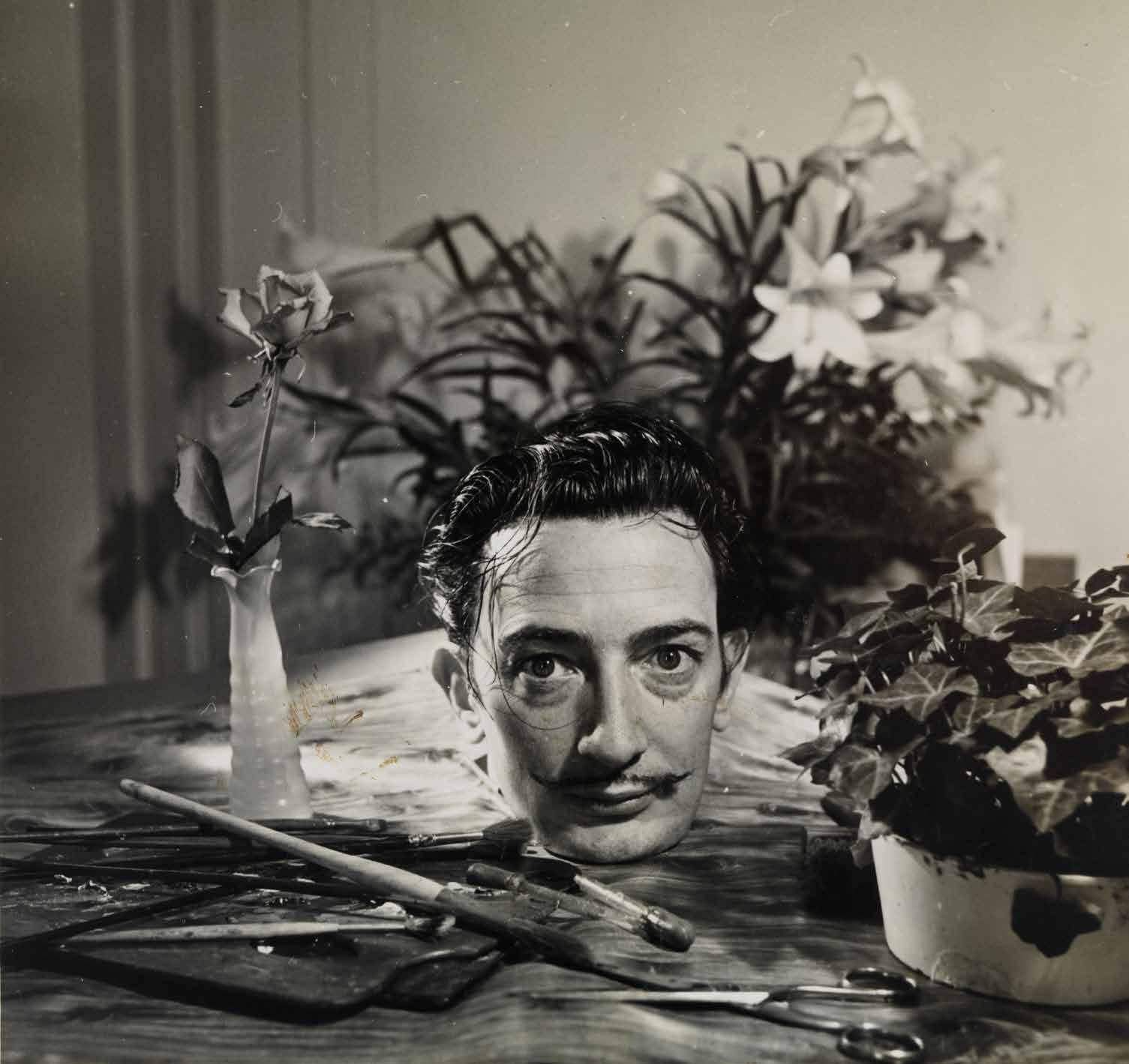
The design of this publication is based on the two issues of dalí news from the first era, published in New York on 20 November 1945 and 25 November 1947, respectively.
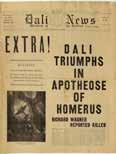
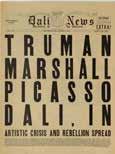
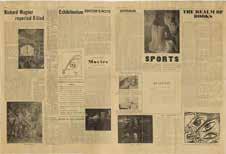
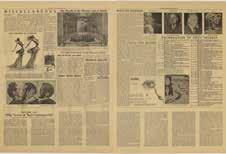
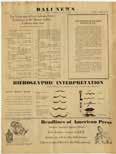
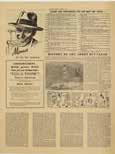
In 1957, the American magazine Nugget commissioned Salvador Dalí to create a series of ‘illustrated predictions’ about inventions that, in his view, were destined to be realised in the future. One of these was the ‘dreaming machine’, which served as the inspiration for this first monograph of the second era of dalí news Above these lines is a reproduction of the original publication from 30 April 1957.
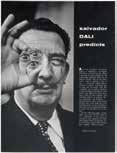
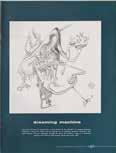
The works of Salvador Dalí are always identified by a number from the Catalogue Raisonné of Paintings which refers to the Catalogue Raisonné of Paintings by Salvador Dalí (1910–1983) available on the website of the Fundació Gala-Salvador Dalí (https://catalogues.salvador-dali.org/catalogues/en/catalogue-raisonne-paintings/)