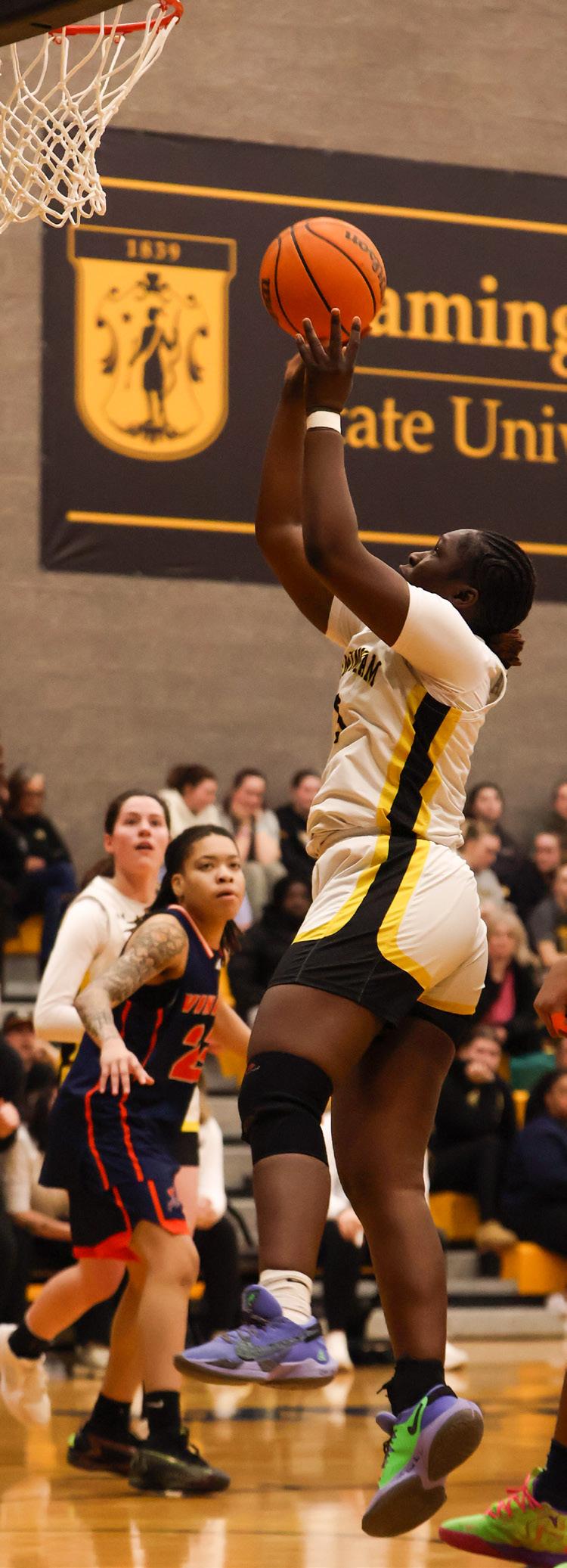
After a two-year championship game losing streak, the Framingham State Rams fought to snag the title, securing a down-to-the-wire 63-59 upset victory against the top-seeded Bridgewater State University Bears March 1.
The Rams entered this match seeded second out of eight teams in the MASCAC with an overall record of 16-10 and a record of 10-3 in the conference.
The Bears’ record exceeded this by two wins, one of which they earned against Framingham in their Jan. 24 matchup.
Following a difficult start to their season in November and December, during which they accumulated only four wins in 11 games, FSU fought to regain control of their season, steadily climbing through the ranks and eventually earning a place in the final.
By Bella Grimaldi News Editor
The new Chief of the Framingham State University Police Department, Philip Di Blasi, was officially sworn in on March 2 at a ceremony held at 10 a.m. in the McCarthy Center Forum.
Students were notified of Di Blasi’s appointment in an email sent by Meg Nowak Borrego, vice president of Student Affairs, on Feb. 26.
In an email to The Gatepost, Nowak Borrego said the vacancy was due to former Police
Chief Joseph Cecchi accepting another opportunity.
She said Cecchi’s last day at FSU was Oct. 31 and the job was posted on Nov. 10.
Martin Laughlin, FSUPD deputy chief, said he filled in as interim police chief until Di Blasi was hired.
Di Blasi included a message in Nowak Borrego’s email in which he said, “I am thrilled to serve as your new Chief of Police at Framingham State University, and I am truly fortunate and thankful to have this opportunity!” In an email to The
Gatepost, Di Blasi said he looks forward to supporting students, staff, and faculty on campus.
He said, “I am still very much in the learning phase, but it is important for me that the officers and staff of the Framingham State University Police Department remain visible and available to our community.”
He added he does not have any specific initiatives planned because he wants to observe the community first and find areas at Framingham State that could be improved.
By Sarah Daponde Arts & Features Editor
The Christa McAuliffe Center hosted NASA astronaut Bob Hines for a discussion on his flight training and space experience on Feb. 27 in the McCarthy Forum.
Irene Porro, director of the McAuliffe Center, introduced Hines, a mission specialist on NASA’s SpaceX Crew-4 mission, who spent six months aboard the International Space Station during Expedition 67 and 68.
Hines has served over 23 years in the United States Air Force as an instructor pilot, fighter pilot, and space pilot, said Porro. Over the course of his career, he has accumulated over 4,000 hours of flight time in 50 different types of aircraft.
“I always wanted to fly,” Hines said. He said getting to visit the Christa McAuliffe Center was special for him as someone who watched the Challenger disaster from his classroom.
“As much of a tragedy as it was, it also served as an inspiration for so many people - and I am one of them,” he added.
Adrien Gobin / THE GATEPOST
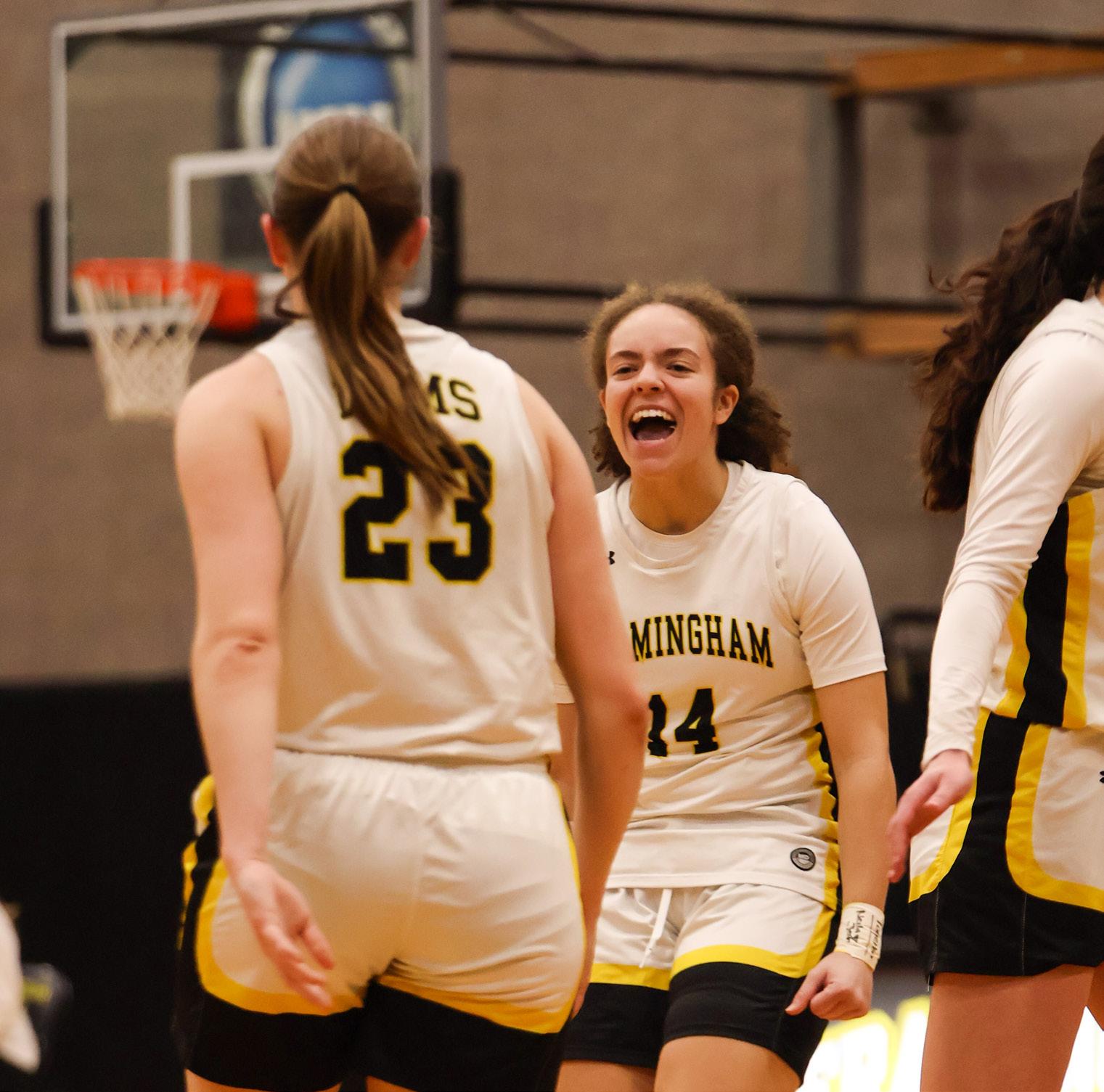
(Left) Jacqueline Schels high-fiving Ava Mckeon on their home court during the MASCAC Semifinal game against Salem State on Feb. 27.
Antonio Machado / THE GATEPOST
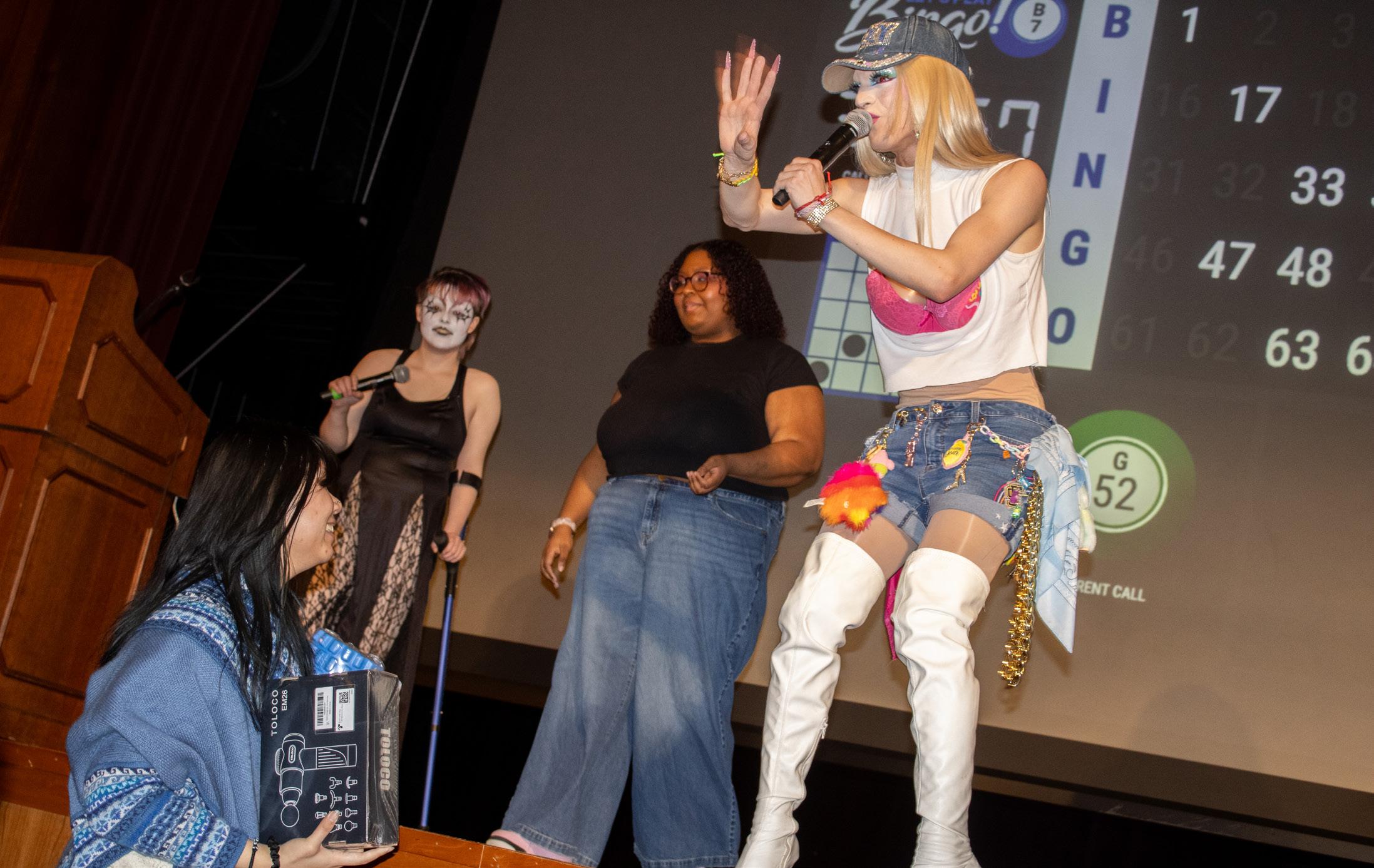
(Right) Drag Queen Kandy Khane handing out a prize to (left) Alyssia Pham at FSAB’s Drag BINGO event on March 4.
E ditorial Board
Editor-in-Chief
Sophia Oppedisano
Associate Editors
Adrien Gobin
Dylan Pichnarcik
Multimedia Editor
Antonio Machado
Copy Editor
Cole Johnson
News Editor
Bella Grimaldi
Asst. News Editor
Avery Slavin
Opinions Editor
Izayah Morgan
Sports Editor
Izabela Gage
Asst. Sports Editor
Taylor Kimmell
Arts & Features Editors
Francisco Omar Fernandez Rodriguez
Sarah Daponde
Photos & Design Editor
Alexis Schlesinger
Asst. Photos & Design Editors
Christy Howland
Onyx Lovely
Illustrations Editors
Marcus Falcão
Staff Illustrators
Rileigh Kelley
Tobias Cotton-Selman
Staff Writers
Zaynab Ahmed
Jesse Burchill
Kristel Erguiza
Julien Fernandez
Paul Harrington
Cole Johnson
Dan Lima
Kate Norrish
Wenchell Pierre
Nathan Piette
Andrew Ramirez
Staff Photographer
Dylan Sibley
Advisor
Desmond McCarthy
Asst. Advisor
Elizabeth Banks
Graduate Advising Asst.
Emma Lyons
100 State Street
McCarthy Center Room 410
Framingham, MA 01701-9101
Phone: (508) 626-4605
Fax: (508) 626-4097
gatepost@framingham.edu
Gatepost Interview Justine Bohl
Student Experience Finance Coordinator
By Avery Slavin Asst. News Editor
What is your academic and professional background?
I have a master’s of biochemistry and molecular biology from Clark University in Worcester. I lived in Worcester for a few years, thought I was going to be a big scientist curing cancer - and I really hated it. So, I completely pivoted and just found this entry-level job doing finances for clubs at Amherst College. It was the perfect thing that led me into this position as finance coordinator. I nannied, I waitressed forever, I bartended. It took me a really long time to fall into this. But I really like to show students that you don’t always end up doing what you majored in, and that’s totally fine.
What drew you to Framingham State?
Honestly, this team. When I interviewed, I got to meet all of these people that I get to work with every day, and it was just a no-brainer. I was so excited to join the team. Everyone’s on top of each other, but also very hands-off at the same time, so it’s just a really good dynamic. I actually forgot to mention that I have my teaching license from Framingham State because I was going to teach high school chemistry, which I did for a little bit and I really didn’t like it. But, I was familiar with Framingham. My best friend lives here, so I’m familiar with the neighborhood. Once I saw the position, I was really excited. I actually live in Amherst, which is quite the commute, but it’s been worth every second.
What do you like best about your role at FSU?
Definitely the team. I think we work together really well. I do the finance part, they do the event part, and we all just know what everyone is working on at the same time, which is really nice. Or, we’re working on the same thing, but different aspects, which is really cool. I wanted to be a teacher for so long, but I think classroom teaching wasn’t my thing. This feels like a different relationship. Still teacher-ish, but not head classroom teacher, which is very difficult. So, I still get to work with students. I still get to talk to them about my life and give them life advice and
Police Logs
Monday, March 9 8:47 Suspicious Activity, Corinne Towers Hall
stuff, but I’m also not their head teacher, if that makes sense. And, I get to do finance. I’ve always really liked math. I think the science and the STEM track took me away from math a little bit, but I’m glad that I found my way back to finance.
What are some of your favorite hobbies?
This is also why I like working with college students, because when I was a student, I felt like no one asked me about my hobbies. It was all like, “How are classes going? How’s school? How are your grades?” No one was encouraging me to pursue things outside the classroom. And now, I get to work with the extracurricular aspect and I’m always asking students like, “What do you like to do outside of the classroom?” Because that’s so important, too, and I’m really just now figuring that out in my old age. But, I listen to a lot
Tuesday, March 10 7:50 Elevator Hang Up Call Hemenway Hall
Correction
Wednesday, March 11 1:27
Assist Citizen, Church St.
of true crime documentaries and podcasts. I used to bake a lot, but I haven’t really baked that much recently. Arts and crafts - I just got a needlepoint kit, which I’m really excited to start. I like little one-off crafts, like those paintby-numbers and stuff. And, I’ve had a puppy for about a year and she just turned one. So, a lot of taking care of her.
What advice would you give to students?
Pursue your extracurriculars. Life is way more than just the classroom, and it’s really important to learn what you like, what you don’t like, and what kind of people you like to spend time with. I’m really just now learning that about myself.
CONNECT WITH AVERY SLAVIN aslavin1@student.framingham.edu
Wednesday, March 11 3:32
Suspicious Person, Horace Mann Hall
In the February 27 edition of The Gatepost, a front-page sports headline stated, “Women’s ice hockey defeats Amcats in program’s first playoff appearance.” This is incorrect. The correct headline should read, “Women’s ice hockey defeats Amcats in program’s first playoff win.” We apologize for this error.
Courtesy of Justine Bohl
SGA discusses allocations and deadlines at club representative meeting
By Avery Slavin Asst. News Editor
SGA held their first Club Representative Meeting of the semester, followed by a senate meeting, on March 10.
Vice President Shubham Valand presented the updated organization allocations for FY27, explaining some clubs have moved either up or down in their allocation groups due to factors such as the number of members, event participation, attendance at required Club Representative Meetings and organization officer training sessions, proper registration in Campus Groups, and the use (or lack of use) of current funding.
Treasurer Khoa Bùi said for events held throughout the remainder of this semester, every club will have the deadline of March 26 to submit funding requests and will have until April 3 to make purchase requests.
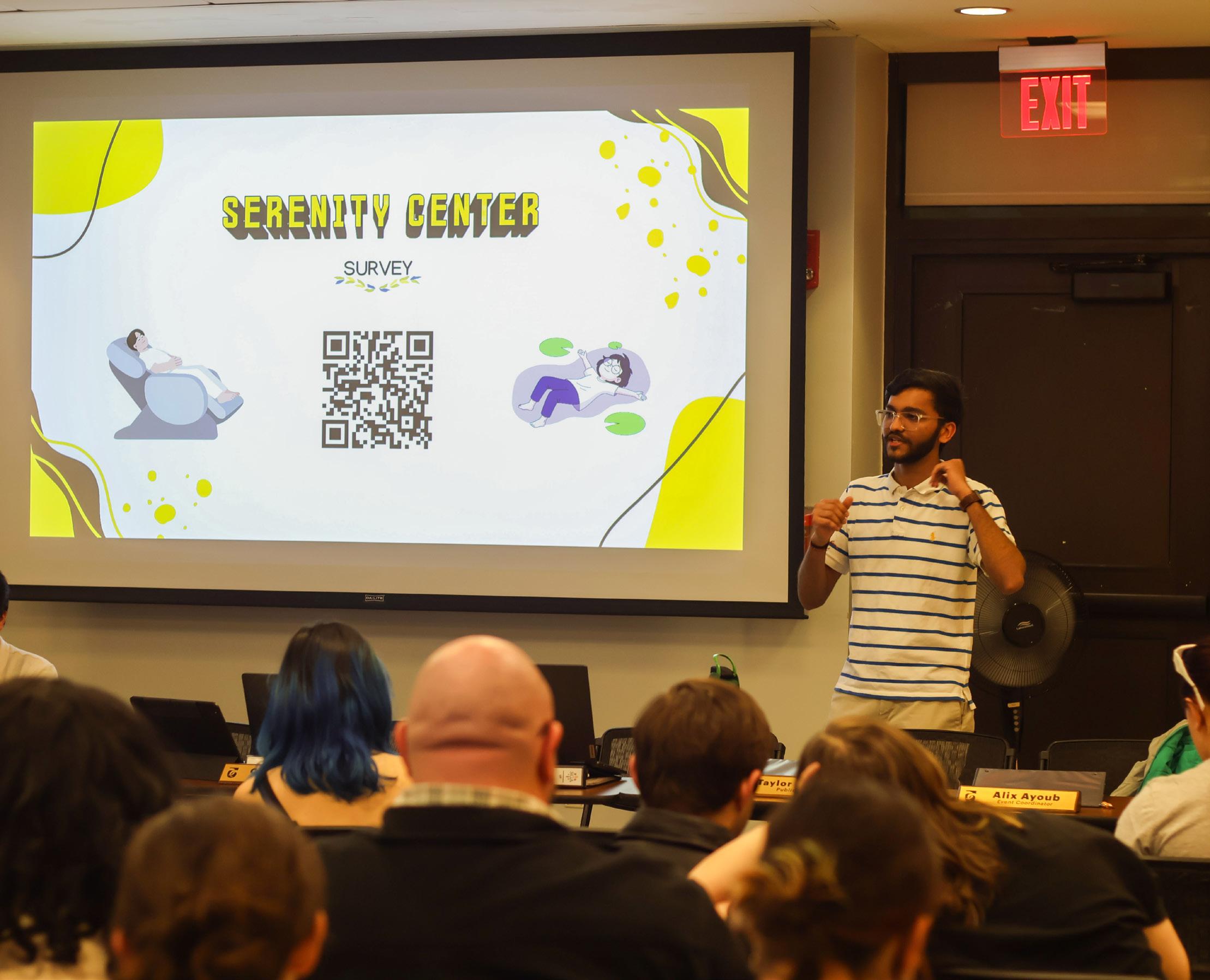
Valand then allowed members of the meeting to fill out a survey about a proposed new initiative of his called the Serenity Center, a place for commuter students to be able to relax in between classes, complete with massage chairs and napping pods.
President César Matos said, “Out of all the surveys and links and QR codes that we have given you, this is the most important one, because the more people we get [filling out] the survey, the more we’re able to go up to administrators and be like, ‘Look! We have this amount of people who are interested in having this on campus.’”
Club representatives made some announcements to the rest of the attendees before the meeting was concluded, including the Fashion Club introducing their second “Trashion Show,” FSAB encouraging students to join the general board for event planning, and Volunteers of FSU announcing an end-of-semester party.
Matos told the club representatives the next meeting they must attend will be the Administrators’ Forum, at which they will “communicate with all the administrators on campus.” SGA intends to collect as many questions and concerns as possible.
Matos added the administrators will do something a little different during this meeting, and ask questions to the students about how they feel about certain campus-related topics. This meeting will be held on April 7.
Following these announcements, SGA transitioned into their senate meeting.
After emphasizing some points discussed in the Club Representative Meeting, such as nominations for all SGA roles and the upcoming Administrators’ Forum, the senate heard from Matthew Wexler, treasurer of Aspiring Health Professionals (AHP), requesting funds for an event in early May.
AHP requested $1,080 for a CPR training event, which would cover costs of the instructor, the equipment, and the certification cards. It will be open to the general student body, but limited to 12 students.
The motion to approve the funding request passed unanimously.
SGA then began the process of appointing new senators, including Cameron Higbie, Bri Camilli, and Glanzer Mar, as well as the reappointment of Senator Cia Rosado.
Diversity and Inclusion Officer Ana Julia Ribeiro was also appointed as a senator after stepping down from her position. She said she would still be carrying out some diversity and inclusion orders of business until the end of the semester.
Senator Merlin Clive was appointed to the role of diversity and inclusion officer for the remainder of the semester.
All six were sworn in by Ma-
Sunday, March 15
Mostly cloudy with a high near 45.
Monday, March 16
Mostly cloudy with a high near 45.
tos.
The final order of business was to approve the name change of the Student Affairs Committee (SAC) within SGA to the Student Affairs Review Committee. Valand explained the reason for this change was there were multiple SACs throughout the University in individual departments, SGA, and in the Massachusetts State Government.
“As to not create any confusion, our Student Affairs Committee members have decided to change the name, but we still need approval from the senate to change the name to Student Affairs Review Committee,” Valand said.
Parliamentarian Grant Alleyne said he didn’t “see a point in changing the name,” as SACs were prevalent at other universities, too.
“Is there that much confusion between all these SACs if there’s other SACs in other student governments as well?” he asked.
SGA Advisor Rachel Spezia said not every student government has a SAC, and in this case, it is specific to Framingham State.
Matos added it was a branding issue as well, saying, “I want to make sure that when we’re referring to something pertaining to SGA, it’s very clear that it’s pertaining to SGA. Right now, when you say something is per-
Tuesday, March 17
Partly sunny with a chance of rain and a high near 45.
Wednesday, March 18
Partly sunny with a chance of rain and a high near 45.
taining to SAC, which one is it?”
Matos clarified the name change does not change the function of the SAC. It just encompasses more of what SGA does, which is reviewing items like their own constitution bylaws, other clubs’ constitutions, and any student concerns.
The motion passed unanimously.
As for officer reports, Matos announced a collaboration that SGA will be undertaking with Outing Club, referred to by Matos as the “Warren Center Takeover.
“I want it to feel like a celebration of everything SGA has been able to do [this year],” Matos told the senate.
The event will consist of kayaking, ropes courses, arts and crafts, and enjoying food and beverages together.
Matos said he wants to propose a new tradition for SGA to hold something like this in the Warren Center every year and expand the number of organizations with which they collaborate.
Events Coordinator Alix Ayoub announced the date for Spicy Bingo, which will be on April 16.
CONNECT WITH AVERY SLAVIN aslavin1@student.framingham.edu
Thursday, March 19
Partly sunny with a high near 40.
Friday, March 20
Partly sunny with a high near 40.
Adrien Gobin / THE GATEPOST
(Right) SGA Vice President Shubham Valand encouraging students to participate in Serenity Center survey.
Chief Di Blasi
Continued from Page 1
The Fall 2025 Food Establishment Inspection Report of Sodexo at the FSU McCarthy Center stated 10 health code violations.
This report was released to The Gatepost by the Framingham Public Health Department.
The inspection was conducted on October 16, 2025 by Inspector Rivera, Inspector Oram, Inspector Westerlind, and Inspector Hobbs.
Rivera said multiple inspectors conduct the inspection. “We kind of split up, and then a couple managers or chefs might follow another inspector, and then we divide and conquer.”
According to Rivera, all of the health and safety inspections conducted at Framingham State are unannounced.
The violations cited in the report were: one case of food being improperly separated and protected, two cases of food-contact surfaces; not cleaned and sanitized, one case of improper date marking and disposition, two cases of physical facilities not installed, maintained, and clean, two cases of adequate handwashing sinks not supplied and accessible, one case of proper cooling methods not used; adequate equipment for temperature control, and one case inadequate ventilation and lighting; designated areas being used.
According to Rivera, each violation falls into a category depending on the time frame it needs to be resolved.
He said the order of violation types is “priority, priority foundation, and core.” Priority is the violation category that allows the shortest amount of time to be corrected.
According to the 2013 FDA Food Code, priority violations must be corrected within 72 hours, priority foundation violations must be corrected within 10 days, and core violations must be corrected no later than 90 days after the inspection.
Rivera said, “Everything we do is based on the FDA Food Code” and the Massachusetts amendments to the 2013 FDA Food Code known as the Massachusetts Merged Food Code.
“I think there are opportunities to grow our programming and tailor it to what our community wants. While we are public safety professionals, I would very much be interested in learning what it is our community would like to [see] in terms of programming from FSUPD,” he said.
Laughlin said, “With Chief Di Blasi’s leadership and what he’s done in a mere two weeks, I think we’re on a good path.”
President Nancy Niemi said she believes Di Blasi will impact the FSU community by developing relationships on and off campus.
“What I know he has done in other schools and has said he’ll do here is knowing our community well - knowing our students, knowing our faculty and staff - and being a partner with the work that we do,” she said.
Di Blasi said he became acquainted with Framingham State and FSUPD when he worked as chief of police at MassBay Community College. “As the MassBay PD team and the FSUPD team began training together in some areas, I often
heard, and overheard, the officers talking about events, the students, and the University.”
He added, “The number one thing that stood out to me was how glowingly the officers spoke about FSU students. They also spoke about the supportive environment that is FSU, for both employees and students.
Laughlin said FSUPD built a good relationship with Di Blasi when the police departments trained together.
He added during the interviewing process, Di Blasi “interviewed with FSUPD and it felt like he built a good rapport right off the rip with them.”
Di Blasi said, “I loved my time as chief of police at MassBay, but when the opportunity arose to possibly work together with the officers and staff of the FSUPD, I strongly felt I had to apply.”
Niemi said with Di Blasi being hired, she looks forward to seeing “the continued and developing sense of camaraderie and teamwork within the police department.”
Di Blasi said he began his career at Suffolk University Police Department in 1994 and worked as assistant district attorney for Suffolk County in 2001 before returning to the Suffolk University PD until 2004.
Di Blasi then worked as lieutenant at Wellesley College’s police department until he was promoted to interim police chief and left to work at MassBay in 2022.
“I saw an opportunity, at MassBay, to reintegrate its police department into the community,” he said. “It was important to me that department members be visible, available, and supportive to all members of our community. It was even more important that our support was obvious through our actions and not just words and flyers.”
According to Laughlin, he and Nowak Borrego oversaw the process of filling the police chief position.
Borrego said there were seven other members on the search committee, including Jorge Ruiz, Framingham Police Department deputy chief; Michael Vinciulla, Ashland Police Department deputy chief; Karen Nicholas, FSUPD sergeant; Shawn Delensky, FSUPD K9 corporal and union member;
David Baldwin, director of Human Resources; Kianna Bauer, Title IX specialist in Human Resources; Benjamin Day, director of the Counseling Center; Charles Sachs, associate psychology & philosophy professor, and Nathan Piette, SGA senator and member of the SGA Safety Committee.
According to Nowak Borrego, the committee began reviewing applications on Dec. 1.
Before hiring Di Blasi, Nowak Borrego sent an invitation via email to students to attend open forum interviews for three candidates on Jan. 8, 9, and 20.
The email included copies of the candidates’ resumes and a link for the FSU community to provide feedback on the candidates.
Di Blasi said the hiring process “was extensive. … It began with an initial Zoom interview with a hiring panel. I was then invited to campus as one of the finalists to engage in a series of interviews, meetings, and a presentation to community members on President Obama’s Task Force on 21st Century Policing.”
Nowak Borrego said Di Blasi stood out from the other candidates because he “had a significant amount of progressive police experience in the higher education settings, including the chief level. … He has the experience we are looking for, and I feel he will work well with our community.
“As the direct supervisor of the FSU police chief, I am excited to work with Chief Di Blasi. He brings excellent experience, his references speak very highly of him, and I have already been impressed with his approach to working with people and his decision-making,” she said.
Sophomore Matthew Goldstein, a MassBay student and FSU resident, said Di Blasi “brought integrity with a welcoming face” to his role at MassBay.
Goldstein said he thinks FSUPD could grow their connection to the community by hosting more events, including meet and greets with Ramsey, the campus comfort care K9.
“This may include events tailored for students, educational approaches to student safety, and having public oversight committees to ensure commu-
nity perspective,” he said.
Framingham State junior Josh Gillen said he did not know who the previous chief was but thinks the hiring of Di Blasi is good.
He added he believes the police department has a good connection to the community because they are easy to contact.
Framingham State sophomore David Forgione said he thinks the University police department should hold more events that involve the community.
“Moving forward, I would like FSUPD to continue to keep students in the know. I think it’s beneficial for the community to be aware of the actions the police are taking and the moves they are making,” he said.
“I would like to get an opportunity to be around them more and learn what they’re doing on campus. I think everyone would benefit from hearing them speak more often,” said Forgione.
Framingham State junior Mac Johns said he didn’t know a new chief of police was hired.
Johns said in the future, he would like to see FSUPD “better assess where there are bad conditions for students around campus.”
He added he believes University police haven’t been as interactive with the community since his first year and he would like to see them talk with students more often.
Framingham State senior Alix Ayoub said she would like to see FSUPD interact with more students in the Framingham State community and deal with complaints better than they have in the past.
She said she thinks the University police department could improve engagement by hosting tables that feature the resources and support they provide.
Ayoub said, “Collaborations with student clubs and orgs or other departments could be a wonderful way to connect with a larger population at FSU.”
[ Editor’s Note: Nathan Piette is a staff writer for The Gatepost. ]
Gatepost Archives
IT to upgrade Wi-fi access points this summer
By Francisco Omar Fernandez Rodriguez Editorial Staff
The Information Technology Services department is well known for helping those with device problems, but they also work on Wi-fi connection and cybersecurity.
IT is preparing to upgrade the access points around campus this summer, according to Information Security Officer Corey Hobbs.
An access point expands a wireless network’s connection, allowing a large number of users to connect to an organization’s Wi-fi at once. Some access points also provide advanced security and help run guest-wifi services.
By keeping the access points up-to-date, IT maintains Wi-fi connection across campus.
IT is in the process of ordering new equipment for this update, he said.
Executive Director of Infrastructure and Operations Mike Zinkus said the University has 1,100 access points across campus.
They are located “from offices to classrooms to residence halls. Those are effectively the way that someone’s computer, tablet, phone, connects to the network, and those get routed back to central controllers,” Zinkus said.
Around 500 of those access points are old enough to be replaced, based on the five-year replacement cycle the University uses, he said.
“We have money allocated to hardware replacements every year, so that’s a continuous cycle,” Zinkus said.
He said bandwidth used to be directed to specific locations, such as academic buildings during the day, but over the past 10 years, bandwidth has become more available.
“I don’t think we’re in that state anymore because bandwidth is cheaper and much more available than it used to be,” Zinkus said.
Hobbs agreed that there should be enough bandwidth.
“At this time, there is currently no process or need to limit network resources and bandwidth to a certain part of the campus at any point during the day,” Hobbs said.
IT also keeps an eye on the University’s cybersecurity.
The University has an information security plan and a series of policies that are updated yearly, Hobbs said.
The security program covers several topics, “ranging from technical controls, to training, to personnel controls, to various arrays of other things we
do to try to prevent any form of cybersecurity incident,” he said.
The system is “as up-to-date as we can make it,” he said.
Cybersecurity has to constantly update because threats continue to evolve, he said.
“The people who are looking
reads them, are very good at reporting when they get phishing emails and spam emails,” Hobbs said.
A generative AI program, such as Copilot or Gemini, can find the highest-ranking people in an organization in less than a
students,” Hobbs said.
Sophomore pre-med major Abdallah Mohamed, who works at the IT desk, said it is important for everyone to be caught up on their cybersecurity training so they can identify threats.
Freshman psychology major
“At this time, there is currently no process or need to limit network resources and bandwidth to a certain part of the campus at any point during the day,”
- Corey Hobbs Information Security Officer
to gain - malicious actors looking to gain advantage over usare not taking any rests,” Hobbs said.
Zinkus said phishing is a notable problem.
“The big things right now, as far as email, are phishing, which is a general request to try to get something from somebody, whether it be their email or their password,” Zinkus said.
The newest method is “spear phishing,” which targets specific people in an organization, he said.
Hobbs said students in particular are good at reporting phishing.
“Students, specifically, I’ll say, because I’m the one who
minute, he said.
Zinkus said the two-step authentication that applications like Canvas and Microsoft require is industry standard.
An extra step, such as “a text message with a code - that makes it so much harder for somebody somewhere else in the world to try and pretend to be you or someone else,” he said.
Hobbs said the cybersecurity training for students is divided into two different areas.
“Student training is broken into two groups: a mandatory training for student employees, and a voluntary one (both having similar content) that’s made available to all
““The people who are looking to gain - malicious actors looking to gain advantage over us - are not taking any rests.”
- Corey Hobbs Information Security Officer
Danya Duvert, who works at the library front desk, said she was required to complete cybersecurity training both before and during the job.
Sophomore geospatial and data analysis major Alex Povoa said he likes that the University uses an authenticator because it helps protect against malware.
Junior finance major Yair Rachmany said learning to recognize phishing emails is important.
He said, “I have gotten a lot of phishing emails over the past year, and I always report my phishing emails and I learned how to identify those emails through these cybersecurity trainings.”
Sophomore English major Angel Marin-Caceres said being informed about cybersecurity is important because “hacking is really easy nowadays.”
Gatepost Archives
OPINIONS
THE GATEPOST EDITORIAL
Safety isn’t guaranteed, but community could be
Since President Donald J. Trump has returned to the White House, he has fundamentally altered and dismantled the federal government. He has changed policies regarding immigration and how the U.S. Immigration and Customs Enforcement (ICE) agents serve at his behest.
ICE agents have been overstepping their bounds, detaining legal citizens and regularly infringing on their rights.
Terrifying videos of masked agents tearing people away from their families, kidnapping people off the street, or killing people have circulated on social media and around the country, creating an atmosphere of dread.
These police-state tactics represent a new type of facism.
The United States has long been known as a melting pot - a blending of diverse cultures, languages, and people. The insistence from President Trump that the immigrants who make up our cultural mosaic no longer belong here is unconscionable.
Here at home, students who attend Framingham State actively see the benefits and joys of living in a multicultural community.
The City of Framingham is known as “home away from Brazil” due to its large Brazilian population. Estimates vary, but as of 2022, approximately 6,000 Brazilians reside in Framingham, according to The Boston Globe.
Last year, Alain Puma, Class of ’25, a former staff writer for The Gatepost, published “Making Framingham home: Brazilian community key to downtown’s economic revival,” in the May 9 edition. The article spotlights the many Brazilian immigrants whose establishments make up about 85% of businesses in downtown Framingham.
The entwinement of our campus with the City of Framingham is undeniable, as students regularly visit various Brazilian-owned cafés, some of which have become popular spots to visit after watching the Boston Marathon along Waverly Street. Framingham is a special and beautiful place to live.
The looming presence of ICE has brought fear and caused a repression of cultural celebration in Framingham.
Paroquia São Tarcísio, a local church, throws an annual Festa Junina in June. The cultural festival is a celebration of St. John the Baptist. There are food stands, live music, games, and the traditional quadrilha - all representative of Brazilian heritage. This type of gathering, embracing of others, and the education it provides should be celebrated, rather than threatened.
In 2025, the festival was called off due to threats to the church that ICE would be called to raid the event.
Brazilian community members are also fearful of voting in the upcoming Brazilian election. Those who live in the U.S. and have Brazilian citizenship are required by law to vote in Brazil’s election. One of the local polling stations in Massachusetts is at Paroquia São Tarcísio.
Members of the Brazilian community are considering skipping
this election and paying the subsequent fine to avoid the threat of ICE raiding polling places.
Community members should not have to be afraid to engage in exercising basic rights such as voting or celebrating their heritage.
This fear has also spread to our campus community.
Here at Framingham State, enrollment data indicates 24% of our population identifies as Hispanic or Latinx. Furthermore, Framingham State is a majority-minority institution.
Our campus is a vibrant place to live and work, and we emphasize the value of free thinking, art, expression, and diversity. Unfortunately, those values are becoming more endangered beyond the confines of this campus.
Even if we remain true to our shared goal of cultural acceptance, no one can guarantee the safety of students, faculty, or staff who may belong to the immigrant community.
Family and community are valued above all else in many immigrant communities.
The idea that “it takes a village” is an incredibly important value for immigrant communities. If family or friends are taken away by ICE, we can find family in each other and stop at nothing to fight for what is right - including getting them back.
Building a strong community is what combats fear, and caring for your peers, even if you don’t know them, is the first step toward ensuring your role as a proactive ally rather than a bystander.
Rally behind your peers. No one should be alone in an age of fear and turmoil.
If students have time and want to get involved, the LUCE Defense Hotline is looking for donations and volunteers to attend bystander training.
If you see ICE in the Framingham area, you can call the LUCE hotline at (617) 370-5023. Posting about ICE sightings on social media and sharing that information in those informal spaces is also incredibly helpful for immigrant communities.
If you see ICE on campus, call FSUPD at (508) 626-4911.
Framingham State’s SharePoint site features a page with immigration news and resource materials accessible to both students and faculty. These resources include recorded Know Your Rights training, links to legal services, and packets for emergency preparedness for immigrant families.
In addition, students should know that all records are protected by the Family Educational Rights and Privacy Act (FERPA) and cannot be shared without proper processing.
At the core of this issue are the human beings who are living in fear of losing their friends and family due to a corrupt government order.
As students on Framingham State’s campus, our safety is not guaranteed, but we can work together to guarantee a strong, loving, thriving community.
Campus Conversations
“What makes a good friend?”
By Izayah Morgan, Opinions Editor and Kate Norrish, Staff Writer
“A relationship that you have with a person. … You can talk about anything with them.”
“A sense of safety and community away from home. … Someone you can rely on for anything.”
Olivia Ostrander, freshman
“Showing up when it matters.”
“Just showing up and being there. … A reliable person.”
- Harriet Okyere, freshman
“Loyalty and love.”
- Jassiny Gervi, sophomore
“Being
- Emma Kendzulak, sophomore
- Nathan Rubyck, senior
- Haggai Mpulula, junior
Kristi Noem is gone, so what’s next?
By Izayah Morgan Opinions Editor
On March 5, President Donald Trump made headlines with the firing of his controversial Secretary of the Department of Homeland Security, Kristi Noem. This announcement, like many of Trump’s decisions, was made quickly, as Noem has faced an overwhelming mountain of criticism about her leadership of the department.
According to The New York Times, Noem was criticized for her and the Department of Homeland Security’s handling of non-immigration and immigration issues. The Times stated that it seemed she was slow to sign off on certain projects, which most deemed critical for national security.
However, there is reason to believe that her ultimate downfall in the public eye was the comments she made about the killing of Alex Pretti, a 37-yearold American intensive care nurse who was shot multiple times and subsequently died at the hands of two United States ICE agents in Minneapolis, Minnesota.
Pretti’s death sparked protests across the nation, especially since this tragedy took place quickly after the killing of Renée Good, who was also slain by an ICE agent.
According to The New York Times, hours after the shooting, Noem claimed that Pretti “had been attempting an act of domestic terrorism and claimed he had brandished a gun.” An initial review by U.S. Customs and Border Protection found these claims to be untrue and only highlighted Noem’s lack of integrity.
Trump didn’t just fire her be-
cause of her controversial actions - she was also bad optics.
Noem spent $220 million on ad campaigns encouraging immigrants to self-deport, and according to NBC, Trump “wasn’t thrilled,” as she told Congress he approved the expenditures. Not to mention her alleged affair with Corey Lewandowski, who serves as an unconfirmed special government employee.
And she bought a $70 million jet for her department with taxpayer money, according to NBC.
With her leadership coming under fire during congressional hearings, it was inevitable that it would be time for Noem to step down. With her departure, it feels like many Americans appreciate a long-deserved win.
However, it’s important to understand she’s not going away - just changing roles.
According to President Trump, she’ll be moving into the role as Special Envoy for The Shield of the Americas - a role that focuses on security in the Western Hemisphere.
Hopefully, a role that fits better than what came before.
Trump’s nominee to replace her is U.S. Senator Markwayne Mullin (R-OK), who has his own controversial history. He’s been in politics since he was elected to the House in 2012.
According to NPR, after the 2020 election, he voted against certifying election results and magnified the repeatedly debunked claims President Trump made about election fraud.
However, he did help police barricade doors during the Jan. 6, 2021, insurrection.
During the government shutdown in October, which was the longest in history, Mullin was among the minority who were trying to negotiate a path to re-
open the government. He told NPR last year that “we don’t always agree, but we can be friends. That’s the benefit right now because we trust each other and have candid conversations.”
Undoubtedly, he is a strong negotiator between party lines and can be bipartisan when necessary. Which again, according to NPR, has been confirmed by several of his colleagues.
Trump has picked Mullin, but he still must be confirmed by the Senate because thankfully - for now - we are still a democracy.
Mullin told reporters that he is going to earn everyone’s vote. He confirmed he is a Republican and conservative, but his job and that of the Department of Homeland Security is to keep everybody safe.
I hope he does his job better
than his predecessor. To my peers, colleagues, and everyone on the Framingham State campus, keep educating yourself on your rights as an American and as a human being. The population of the larger Framingham community is more diverse than ever, and our campus has now become a majority-minority campus.
Our community is strong, diverse, and here to “Live to the Truth.”
We are not illegal. We are Americans.
Compassionate advocates can change lives
By Dylan Pichnarcik Associate Editor
When I was young, I struggled in school.
I can remember struggling during lessons at times when my classmates did not. It was frustrating and made going to school a challenge.
It wasn’t until I was diagnosed with a visual impairment that my struggles started to come into focus.
To combat this newfound challenge, I was given prescription glasses. Beyond wearing glasses - which I do to this day - my disability is entirely invisible.
With this diagnosis, I gained access to accommodations through my school’s special services department - something many students have access to, which allows them to succeed alongside their classmates.
This should have been empowering. However, my school district’s application of these accommodations was at times not effective.
My teachers sometimes disregarded these accommodations and even told my parents that I wasn’t going to go far in life or that I wouldn’t succeed based on my progress compared
to my classmates.
At a young age, I felt the touch of stigma at a formative time in my life - a time where all children should be nurtured, accepted, and heard.
For me, this stigma was nuanced, primarily making asking for help anxiety-inducing, because I feared the responses of my teachers if I asked for the support I was entitled to. However, it also fostered a sense of hyper-independence, a trait I take pride in now - even if at times I need to remind myself it is OK to ask for help.
These experiences do not account for my entire academic career before attending college. However, enough struggle transpired that I feel I was negatively impacted during this time in my life.
Throughout my experiencesgood and bad - there was always one thing that I could count on.
As a part of my accommodations, I was assigned to meet weekly with a vision specialist who assisted students with visual impairments. Pamela Washburn - whom I still affectionately refer to as Miss Pam - was one of the most devoted educators I have ever come across.
She was tremendously knowledgeable in the fields of assistive technology, advocacy,
and instruction.
However, among all the skills Miss Pam taught me. I hold one close to my heart.
When systems fail, you adapt and do what you can for yourself to succeed.
By the time I moved on from elementary school, I was able to advocate for myself. At times when I was disregarded, I took matters into my own hands.
If one of my teachers failed to print a handout in a reasonable font size, I photocopied it myself to meet my needs.
There was even a point where I had access to one of the teachers’ lounges, where I could access a photocopier. Needless to say, I got many sideways looks from other teachers who did not understand why I was in their private space.
If I were assigned a seat away from a whiteboard or projector, I would ask to be moved - which was a reasonable accommodation put forth by the special services team.
With some practice, I was able to advocate for myself when necessary, even if I was hesitant.
These moments were uncomfortable, to say the least. I was forced to identify myself and face the stigma of being a student who struggled with a disability and had to identify
when my needs were not met by my teachers. I tried my best to avoid this at all costs by doing what I could for myself.
Students should not have to do this.
Perhaps my experience was unique, but I’m inclined to believe many students struggled in silence, fearful of identifying themselves and anxious about asking for help.
No child should feel this way.
A classroom should be a place of acceptance and encouragement, regardless of ability.
If a child has access to reasonable accommodations, provide them - discreetly. It is uncomfortable enough to live with a disability, and not everyone wishes to be open about it.
When I find myself struggling to ask for help, I’m reminded of my experience with Miss Pam. I was fortunate to have her as an advocate in my corner for so many years.
Tragically, she passed away before I graduated high school, but the lessons she taught me, the compassion she showed me, and the belief she had in my ability are something that I will carry forever.
Education needs more Miss Pams.
SPORTS
Women’s lacrosse overcomes Emmanuel College
James scores six goals in standout performance
By Izabela Gage Sports Editor
In their last game before heading to Florida for spring break, the Framingham State women’s lacrosse team secured a 10-6 victory over the Emmanuel College Saints March 9.
This win improves their earlyseason overall record to 2-3.
Emmanuel controlled the opening draw and struck first by finding the back of the net to give the Saints a 1-0 lead just 46 seconds into play.
The Rams’ defense absorbed early pressure as the Saints maintained possession and looked to extend their lead.
A 3-minute green card put Framingham down a player, but Captain Isabella DiMare, a senior goalkeeper, made two saves to keep Emmanuel from scoring during the advantage.
The Rams capitalized on a free position opportunity 5 minutes into the first quarter when sophomore Emma Kendzulak stepped up and buried the shot to tie the score.
Emmanuel continued to apply offensive pressure, but DiMare came up with another save to prevent the Saints from reclaiming the lead.
Sophomore Lily Malloy fired a shot wide before sending another shot to the net, which bounced off the post.
Following a ground ball pickup by sophomore Madeline Bosma, she tried to take the lead for the Rams with a shot that was saved by Emmanuel’s goalkeeper, Keira Walsh.
The Saints broke through the Rams’ defense and gained a 1-point lead with just over 5 minutes remaining in the quarter.
Less than 30 seconds later, freshman Jenna James netted a shot off a pass from freshman Kate McGovern to even the score 2-2.
Senior Kelley DeBellis won the following faceoff, and James almost took the lead for the Rams, but her shot ricocheted off the post.
After three shots by Emmanuel, two of which were wide, and one that DiMare saved, the game remained tied heading into the second quarter.
Framingham came out of the break with renewed energy. James struck again just over a minute into the second quarter, converting a pass from McGovern to give the Rams a 3-2 lead for the first time.
While Emmanuel continued to win draw controls, the Rams’ defense forced key turnovers to regain possession. Captain Lindsey Cox and Olivia Berggren, both juniors, played active roles defensively, disrupting the Saints’ offensive flow.
DeBellis tried to break through Walsh’s defense, but was unsuccessful.
The Saints attempted to clear their zone, but Kendzulak picked up the ground ball after a turnover. She tried to find the back of the net, but her shot bounced off
the post.
Emmanuel regained possession of the ball, but freshman Isabella Spaulding caused a turnover, and James extended the Rams’ lead 2 seconds later, earning her third hat trick of the season, once again finishing a setup from McGovern to push Framingham ahead 4-2.
Malloy converted on a pass from Captain Alessia Lye, a senior, to bring the score to 5-2 with just over 5 minutes remaining in the quarter.
DiMare remained steady in net, recording two saves to hold the Saints scoreless in the second quarter, and helping the Rams carry a three-goal advantage into halftime.
After a turnover caused by Bosma less than a minute into the third quarter, the Rams quickly capitalized when James scored on a man-up opportunity to extend the lead to 6-2.
The Rams continued to control the pace while limiting Emmanuel’s chances on the offensive end. The Saints were awarded a free position shot, but DiMare stood tall in the net, stopping the attempt.
Kendzulak added to the Rams’ lead with under 6 minutes left in the quarter, converting another free position opportunity to give Framingham a 7-2 advantage.
Emmanuel finally broke through 1 minute later, scoring on a man-up free position shot, cutting the Rams’ lead to 7-3 heading into the final quarter.
The Saints capitalized on a green card given to the Rams early in the fourth quarter, breaking through DiMare’s defense to put another point on the board.
Framingham answered a little over 2 minutes later when James continued her dominant performance, scoring again off a pass from McGovern to push the lead to 8-4.
The Rams stayed aggressive, and after DeBellis picked up a ground ball, Lye tried to find the back of the net, but it was saved by Walsh. James struck again only 16 seconds later, assisted by Lye, extending the Rams’ advantage to 9-4, tallying her sixth goal of the game.
Kendzulak added the final point for Framingham on another free position shot, giving the Rams a commanding 10-4 lead with under 8 minutes remaining.
Emmanuel attempted a late push in the closing minutes. The Saints scored twice in a minute and a half to cut the deficit to four.
However, the Saints’ rally came too late as Framingham maintained possession until the clock ran out and the Rams claimed the 10-6 victory.
James said, “We all just get really hyped and keep the energy positive. My teammates are always supporting each other, and that helps us stay focused and keep the momentum going throughout the game.”
James scored on six of her eight shots in the victory, earn-
ing her MASCAC Rookie of the Week March 9.
James said, “Finding those scoring opportunities really came down to my teammates. They always know where to be and how to move the ball, which helps put me in good positions to finish and get the ball into the back of the net.”
She said being recognized by the conference “means a lot. It motivates me to keep working harder every day. It pushes me to keep improving and to help my team continue to succeed throughout the season.”
McGovern tallied four assists. She said to make effective plays, she simply tries “to keep my head up and stay composed so I’m not rushing anything. I trust my teammates to be in the right spots, and I focus on the fundamentals so I can make the right pass when the opportunity is there.”
She added she is grateful for the opportunity to contribute to games, “especially as a freshman. It shows that the hard work I’ve been putting in is paying off. I just want to keep helping the team however I can.”
DiMare saved 10 of the 16 shots she faced. “I was just trying to stay calm and take it one shot at a time. When there’s a lot of pressure in the game, it’s easy to start thinking too much, so I focus on the simple things and trust my instincts.
“Once I make a save, I try to reset right away and move on to the next play. My teammates also help keep the energy up, which makes it easier to stay focused,” she added.
DiMare said the team is “focused on learning from every game and practice. We’re a younger team this year, so as captains, we try to keep everyone motivated and remind the team that the season is long and we’re still growing as a group. If we keep improving each week, the results will come.”
The Rams travel to Panama City Beach, Florida, to face the Hamilton College Continentals and the Ramapo College Ducks on March 16 and 18, respectively.
James said, “Going into Florida, we’re really focusing on moving the ball faster, working together as a team, and pushing each other to get better every day. If we keep improving and playing for each other, we’re hoping that will translate into better results before we head into conference play.”
DiMare said this trip is a great experience for the team. “We’ve been practicing inside a lot, so being able to get outside and actually play will make a big difference for us. It’s also a really good time for the team to bond and continue building our team culture, which is really important as we head further into the season.”
Adrien Gobin / THE GATEPOST
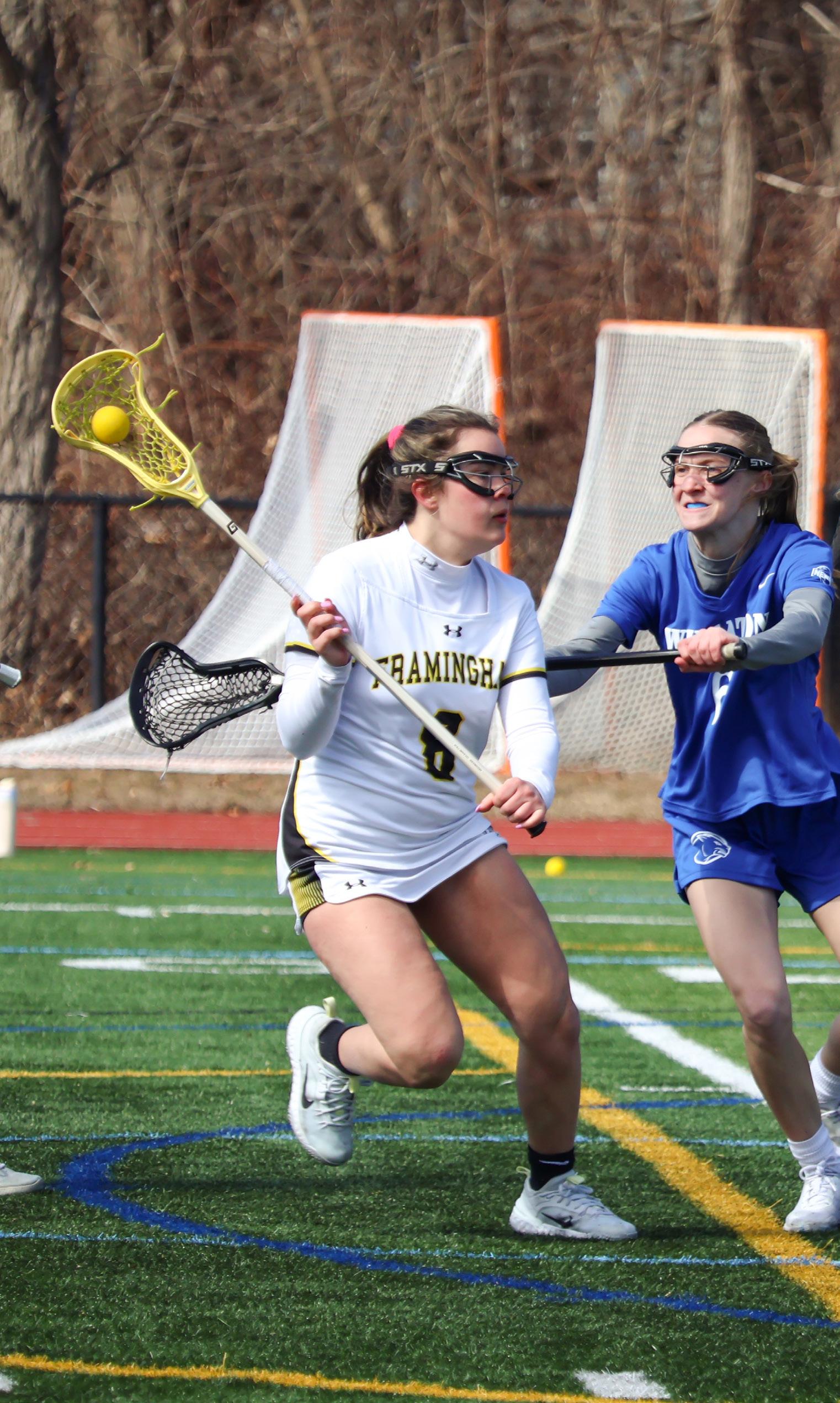
(Center) Emma Kendzulak running with the ball during the 2024-25 season.
MASCAC Champions
Continued from Page 1
After the team’s struggle to stay in the lead during the second half of their semifinal match against Salem State, Head Coach Walter Paschal said the Rams were grateful to advance and prove themselves in the final.
He added Framingham’s past matches against BSU this year had not resulted in a win. However, after a successful “practice on Saturday, probably one of the best of the year, we put ourselves in a position to be able to compete with them.”
Sophomore Jacqueline Schels said coming into the championship match, “the only goal was to win, and before the clock started, there were definitely added nerves because of how important the game was.”
Despite the distance from their home court, the Rams’ bench was crowded. Schels noted, “The Framingham fans were awesome, and I saw a lot of students who made the trip to Bridgewater. We definitely felt their support!”
Paschal added the boisterous energy from the bench, the fans, and the overall atmosphere inside Kelly Gymnasium boosted the morale of the players on the court. “We had probably half of the bleachers in front of our bench on the other side. It was a good amount of parents, relatives, friends, as well as the men’s basketball team.”
Paschal remarked that following the match, the softball team, which had been playing a scrimmage at Wheaton College, sent the team a video - the women crowded around a phone and celebrating as they watched the end of the game from the virtual stands.
Paschal said, “That’s one of the best things about Framingham, about the sports, especially on the women’s side. They support each other … especially when it’s conference semifinals and finals. When it comes to the playoffs, everybody does show up for each other, which is really nice.”
Freshmn Zaria Anderson said, “We defianitely brought a good amount of supporters. … The energy in the gym coming from not only our team, but the fans as well was unbelievable.”
A quick drive to the net by Bridgewater put the first points
on the board, but the Rams’ first push forced a foul by the Bears, which allowed Captain Abigail Martin, a senior, to tie the score with two free throws.
Defensive pressure from both sides kept the tie in place for the next five alternating possessions, but sophomore Faith Greene broke through for a lead-changing jump shot.
BSU quickly countered with a 3-pointer for the lead, but Schels capitalized on a pass from senior Kiara Cerruti, sending in a successful shot from behind the 3-point line.
A layup by the Bears sent the Rams on a 4-point run, with baskets from Greene and Anderson.
BSU forced a foul, making one of two free throws, but Framingham pushed ahead with a layup by Captain Kelsey Yelle, a senior, and 3-pointer by Schels
The Bears closed out the first quarter with a jump shot to bring the score to 16-10 FSU.
A 3-point jump shot by Schels opened the action in the second quarter, quickly followed by a layup from Cerruti.
Twenty seconds later, Bridgewater brought the ball to the net for a layup, and, in the following minute, scored on a jump shot.
The Rams and Bears played at an even pace - Framingham countering BSU’s 5 points with 7 of their own, all scored by Cerruti.
A layup by Yelle in the following minute brought FSU to an 11-point lead, but two layups and a free throw by the Bears worked to shorten the distance between them and the lead.
Facing two jump shots by BSU in the final minute of the first half, Framingham battled back in the form of a layup by Yelle and a free throw by Anderson.
Having caught up at the end of the second quarter, the Bears quickly overtook the Rams with a 9-point run, which Cerruti eventually disrupted with a jump shot.
Gaining momentum from the lead change, the Bears continued to rack up points, scoring two more layups before FSU could break through again.
A layup by Cerruti and a jump shot by Schels kicked the Rams back into high gear on both the offensive and defensive ends, holding the Bears to just 6 points for the remainder of the quarter.
Even with a jump shot by Greene and two layups and a 3-pointer by Schels, Framingham remained at a 50-48 deficit as the third quarter came to a close.
Schels said, “Bridgewater is a great team, so we knew they were going to go on a run at some point, but just making sure everyone knew to not let it impact us too much and keep playing really helped us make our final push.”
Sophomore Shaelagh Green said despite falling behind in the third, it was evident “how badly our entire team wanted this win. We worked so hard all season, and that really showed on championship day. … We all wanted to win for each other.”
A strong opening drive by the Bears forced a foul by the Rams for a BSU free throw.
A foul by the Bears just seconds later allowed Greene to find success on two opportunities from the free throw line.
The following minutes were, in Paschal’s words, a “seesaw,” as the teams battled to dominate the court.
A layup by Yelle turned the tide in favor of the Rams 52-51, but, after 2 minutes of impenetrable defense by the Rams, Bridgewater broke through to steal back the lead with a 3-pointer.
Two free throws by Greene returned the lead to FSU. Then, a layup by the Bears took it back.
The turning point arose when, with 2:38 left of the tournament final, Schels netted a lead-changing 3-point jump shot.
A strong defensive press by the Rams kept BSU’s next shot from sinking into the basket.
A jump shot by Greene and a free throw by Schels gave the Rams a 4-point cushion. Then, after a 30-second Bridgewater timeout, Greene forced a foul for a free throw.
BSU pressed into 3-point territory for one final basket, but it was not enough to overtake the Rams.
With 12 seconds on the clock, aggressive plays by Bridgewater allowed Anderson to sink two foul shots.
A Hail Mary jump shot attempt by the Bears failed to hit its mark, and the clock ticked down to zero, crowning the Rams the MASCAC Tournament Champions with a winning score of 63-59.
Paschal said the team’s excitement was palpable, knowing they had won the MASCAC tournament, beat Bridgewater on the Bears’ home court, and would get the chance to go to the NCAA Tournament.
Paschal said this would be FSU’s “fourth trip to the NCAA tournament since 2020, with different kids who have led the way each time. It’s special getting to play the number two team in the country.”
The Rams traveled to the University of Scranton March 6 for the first round of the Division III NCAA tournament, falling to the Royals 104-39.
Schels said despite the score, the team was excited for the chance to play. She said, “Just making the NCAA tournament in itself was a really cool experience that not many people can say they have done, so we were grateful for the opportunity. It was cool to face one of the best teams in our division.”
Paschal said he was “under no illusion what was going to happen, and I tried to get the kids to see this is not a punishment - it’s a reward to be in this tournament.
“Whatever happens, we’re not going to feel bad for ourselves. We’re not going to be upset about it. We’re just here to enjoy and play hard. … No matter what happens, we won’t let it take away from winning the MASCAC,” he added.
Green said making it to the first round of the NCAA was amazing. “It’s a once-in-a-lifetime experience for so many people, and being able to do it with my best friends made it truly unforgettable.
“Even though the game didn’t go our way, the small memories this group made in between the basketball games made me so grateful to be a part of it,” she added.
As the season ends, Schels said, “Overall, I think this year’s team was very special because of how close we were. Our captains, Abby and Kelsey, fostered a really important team culture that allowed us to do what we did, and we will miss them.”
Anderson said as a freshman, she can’t thank the seniors enough for their leadership and support during her first season with the Rams.
She said, “They are such big role models on and off the court, and I really looked up to them and took every opportunity I could to learn from them and their experience from their college careers.
“My teammates are singlehandedly the best people to be around. Everyone works so hard, and we all want to reach the same goal. … We had such a special group, and we got to capitalize on that by winning the championship together our way,” she added.
Stats sourced from fsurams.com and MASCAC.com CONNECT WITH TAYLOR KIMMELL tkimmell@student.framingham.edu
Adrien Gobin / THE GATEPOST
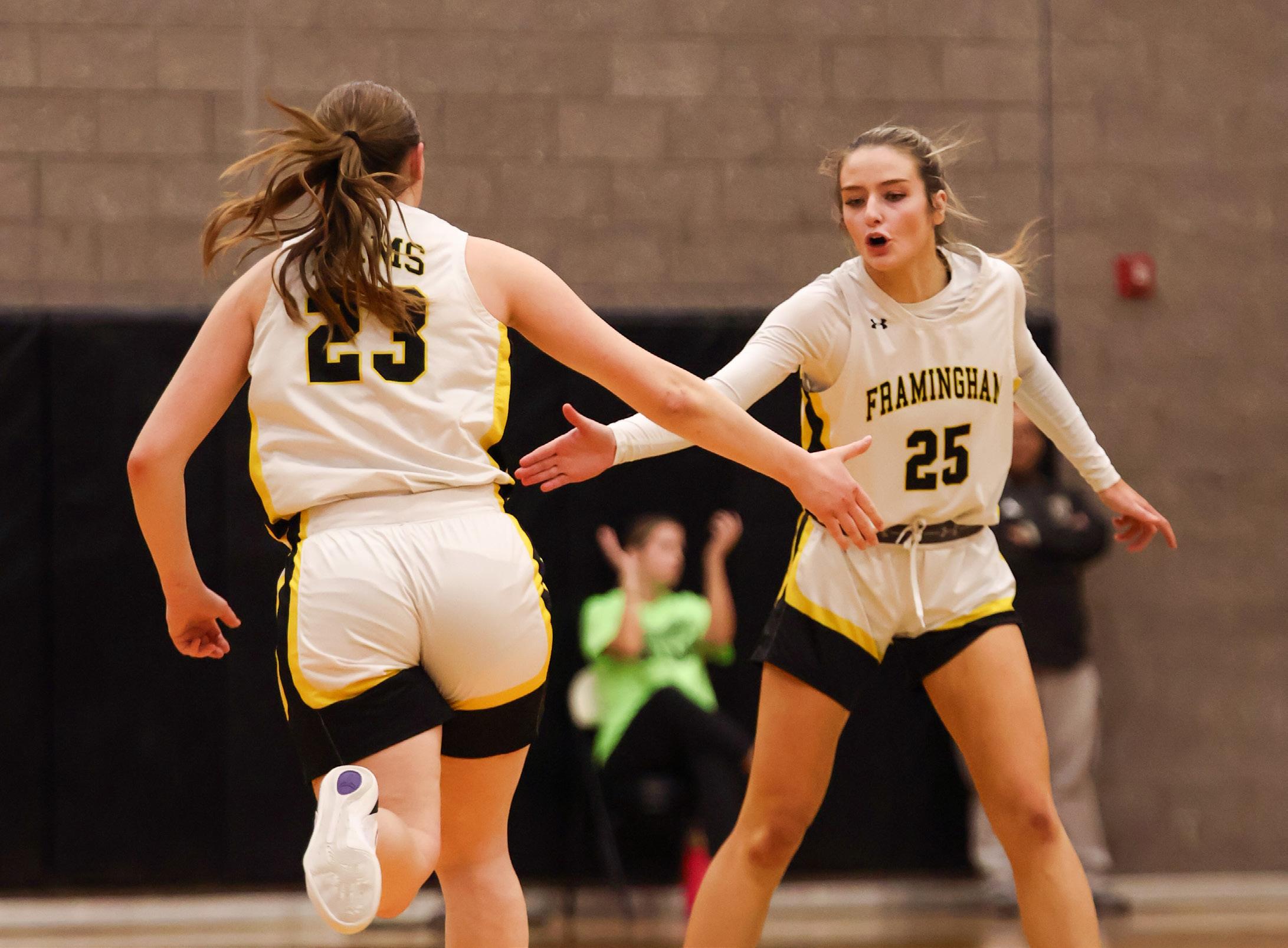
(Left) Jacqueline Schels and Zaria Anderson celebrating a point in semifinal win against Salem St. on Feb. 27.
Adrien Gobin / THE GATEPOST (Front) Faith Greene going for a layup in semifinal win against Salem St. on Feb. 27.
ARTS & FEATURES
Understanding engineering ethics surrounding the Challenger disaster
By Francisco Omar Fernandez Rodriguez Arts & Features Editor
The Christa Corrigan McAuliffe Center hosted the final event in the Challenger Series, “The Challenger Disaster: Communication, Culture, and Ethics,” over Zoom March 5.
The event was led by guest speakers Jennifer Braggin and Amy Hirschfeld from the Gordon Institute at Tufts University.
Braggin said she teaches engineering leadership, while Hirschfeld teaches technical and managerial communication.
“We both, in our curriculum, have used the lessons of the Challenger to influence future engineering leaders and particularly help them understand the impact of their choices, communication, and the application of ethics in their future careers,” Braggin said.
She was a first-grader in 1986, and saw the disaster in the classroom, she said.
Braggin said she remembers the “sadness and terror” on her teacher’s face when it happened, and how the teacher must have thought about how to explain it to the class.
Hirschfeld said she was a first-year student in college when the disaster occurred.
There were TVs in the dining hall in order to see the launch, and she specifically remembers the “complete silence in the room as we watched,” Hirschfeld said.
Throughout her 25 years of teaching, she said she has often used the Challenger as a case study.
Students sometimes point out that the disaster happened before they were born, but she
ultimately decided that the case is as relevant as ever, she said.
“It’s not just about technologies, it’s really about human behavior. And the engineering students of today are going to face some of the same ethical questions and work within some of the same cultures that the engineers and managers working on the Challenger did,” Hirschfeld said.
Braggin said the Challenger required the work of tens of thousands of professionals to complete.
To this day, engineering still requires communication and teamwork built on culture and ethics, she said.
They discussed what was the most important factor that caused the Challenger disaster, and Braggin said from an engineering standpoint, it’s easy to assume it was the failure of the O-rings.
She said it’s much more than that because of the sheer scale of different people and work cultures.
The “safety culture” was already ingrained in NASA, but it was not enough to overcome communication failures, she said.
Everyone involved in the Challenger were professionals, so Braggin asked the audience to share what they expected from professionals.
She said the public assumes professionals have enough training and decision-making skills to make important decisions while maintaining their own integrity.
When it comes to engineering professions, the code of conduct always emphasizes safety, she said.
Hirschfeld said there were
NASA Astronaut
Continued from Page 1
Hines was selected by NASA in 2017 as part of the 21st class of astronauts, who became known as the “turtles,” and began the several years of training required to go into space.
“That was obviously one of those life-changing moments, and a really cool opportunity,” said Hines.
Hines’ astronaut class included 11 other individuals with different disciplines, including Navy SEALS, scientists, engineers, and microbiologists, he said. Their training involved learning geology, T-38 flight training, Space Station operations, emergency responses, robotics, and Russian.
While flight training was “second nature” for him, Hines said he struggled with learning the Russian language.
He said they were required to learn Russian because the International Space Station is split into two segments, a U.S. segment and a Russian segment, which are manned by English-speaking astronauts and Russian-speaking cosmonauts.
“What we actually speak in
orbit is what we call ‘Runglish,’” added Hines.
He said they also had to be trained on “expeditionary skills,” which include social training required for isolated environments and working in small teams, such as conflict management and “just being a good person.”
Interpersonal skills are a part of the selection process to become an astronaut, Hines added. “It’s not about being at the top of your career field. It’s about how you interact personally, and the interview process plays a lot of that out.”
On April 27, 2022, Hines launched into space. It was the SpaceX Dragon’s fourth flight into space. He said his crew named the capsule “Freedom.”
As the pilot of the mission, Hines was joined by Kjell Lindgren, Jessica Watkins, Samantha Cristoforetti, and four Russian cosmonauts.
When they arrived at the International Space Station, the crew who were previously inhabiting the station went back to Earth. Hines said the Space Station has been continuously manned for around 26 years.
multiple organizations involved in the launch of the Challenger.
These included NASA, Marshall Space Flight Center, and Morton Thiokol International (MTI), she said.
The Marshall Space Flight Center is NASA’s field center that was responsible for both the space shuttle program and overseeing subcontractors, such as MTI, she said
MTI designed the solid rocket boosters containing the O-rings that failed, she said.
Braggin said the relationships among these organizations are particularly interesting, because while each of them has a vested interest in the success of the Challenger, they’re also under various pressures.
The complexity of their relationships as suppliers and recipients is similar to what’s seen today, she said.
Hirschfeld said a factor to think about is how, in some of these “power relationships,” sharing bad news can be risky.
“Somebody might be thinking about, ‘Will we lose our contract if we’re sharing too much bad news?’ or ‘Who will be responsible when something goes wrong?’” Hirschfeld said.
This influences what kind of communication the people involved are willing to make, she added.
One important audience that had an influence was the general public, she said.
As the first teacher selected to go into space, McAuliffe drew a lot of public interest, she said.
There was also a planned State of the Union on the evening of the launch, which was
supposed to focus on the success of the project, she said.
“There was a sense of national pride surrounding this project, and this launch in particular,” Hirschfeld said.
All of this impacted the decision-making and communication surrounding the launch, she said.
During the final teleconference, where the decision to launch was made, all of MTI’s engineers recommended delaying the launch, Hirschfeld said.
But then one of their vice presidents told the rest of the VPs to “Take off your engineer’s hat and put on your manager’s hat,” she said.
Then all four vice presidents agreed to launch and chose to ignore the engineers’ warnings, she said.
Hirschfeld said while it is easy to say now that the managers prioritized their reputation over safety, back then, communication wasn’t as reliable, and it’s possible the managers really didn’t understand the risk.
The shuttle had been flying for years with no problem, but on the day of the Challenger launch, the temperature was much lower than it had ever been before, she said.
“They really didn’t have anything that could prove something would go wrong. And I think the managers wanted proof that the engineers couldn’t provide because that situation had never happened before,” Hirschfeld said.
CONNECT WITH FRANCISCO OMAR FERNANDEZ RODRIGUEZ ffernandezrodriguez@student.framingham.edu
Hines and his crew spent six months at the Space Station, doing science “60% to 70% of the time.” Their everyday schedules were scripted in five-minute increments with tasks on a timeline.
Among their experiments, he said the most rewarding ones involved growing plants because they were able to see the progress themselves.
One of his favorite activities was looking out the Dragon’s window at Earth’s sunsets. He
said although they only lasted around seven seconds, they occurred 16 times a day.
“Just being able to see the planet from that perspective is an incredible privilege. It is constantly changing - the weather patterns are changing. The colors are changing as you go across the seasons. Every orbit is completely different,” he added.
Hines said looking down at the lights on Earth and knowing there were people there
Onyx Lovely / THE GATEPOST
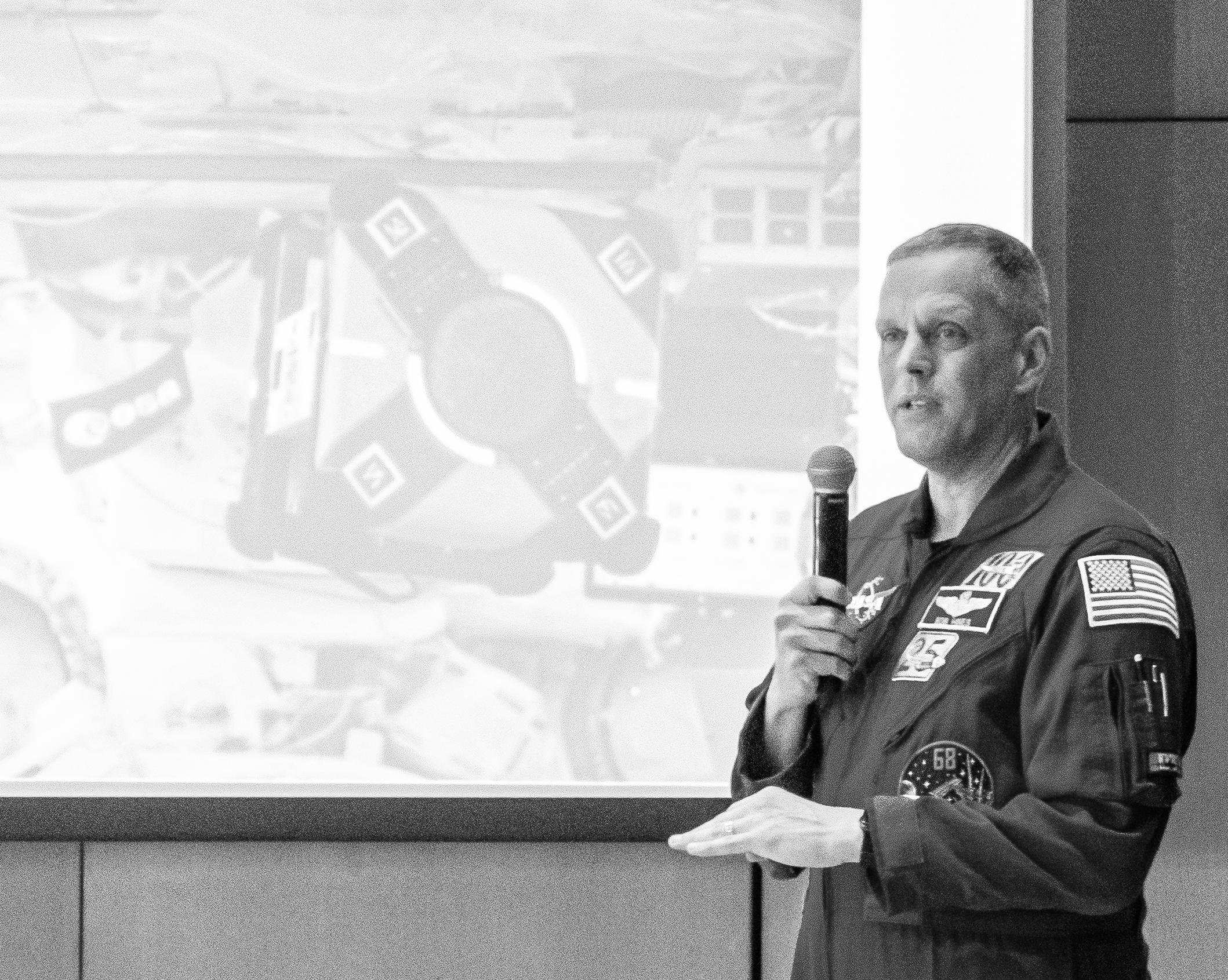
NASA Astronaut speaking about his experience in space the McCarthy Forum on Feb. 27.
NASA astronaut
Continued from Page 10
helped him “still connect with home.”
In addition to research, their schedules included an hour of cardiovascular activity to keep their hearts healthy, and strength training to reduce the effects of zero gravity on their bones. The physical movement also helped conserve their mind-to-muscle connection and coordination.
Once a week, Hines said the astronauts all got together for social events, such as throwing
makeshift birthday parties and picking movies to watch with the Russian crew members.
“You haven’t lived until you’ve seen an American Western that was made in Russia,” Hines added.
He said being in space is incredibly hard on the human body and mind, so it was important they kept themselves healthy.
“We are regular people,” Hines added.
He said he met his wife while he was in flight school, and they have three daughters.
Hines was born in Fayetteville, North Carolina. He grew up in a military family and went to 12 different schools between kindergarten and 12th grade, which he said challenged him academically.
He was a three-season athlete, running track and field and cross country, and also playing baseball. He graduated high school in Mountain Top, Pennsylvania, and a track and field scholarship brought him to Boston University, he said.
Hines said he was accepted to the Naval Academy, but he failed the eye exam he needed to join. “I had 20/30 vision.
The Book Report: “The Last Man”
By Kate Norrish Staff Writer
I find there is a sad phenomenon where great authors often have all their other works overshadowed by one magnum opus - Dante Alighieri’s “La Vita Nuova” is a fascinating perspective on obsession and depression, I’ve met people who consider Terry Pratchett’s “Nation” to be the best book they’ve ever read, and Mary Shelley has “The Last Man.”
The book stars Lionel, a quiet, philosophical man who is finally living a happy life after spending his childhood sheltering his younger siblings from the effects of poverty and abusive parents. Then a plague enters Europe, quickly leading to a mass war all over Europe, which his brother is drafted into.
Written in 1826, everything about this book feels like it was written far later than it was. It is arguably one of the first novels about the apocalypse, and is about the only survivor of a pandemic.
While Lionel is already a lonely, overworked figure at the beginning of the book, he now must learn to preserve his connections and sanity as society - and eventually his family structure - slowly falls apart. This is exacerbated by the fact that he has only just entered his 20s.
Normally, I find classic literature’s obsession with Greek mythology to be annoying and self-centered. While both Lionel and his sister are big fans
of Greek and Roman poetry, my boredom of hearing about it quickly left as it turned into them using it to desperately try to hold onto the world as they know it, even when it becomes abundantly clear that it will never exist again.
Like many knock-yoursocks-off good books, ‘The Last Man’ immediately overloaded my brain with emotion
most of the characters praise the values shown in the older books they read.
I feel it is especially important for people to recognize this work because “Frankenstein” is frequently the subject of misogynistic conspiracy theories. Many of these are about how Shelley couldn’t have written the genre-defining novel because she “doesn’t have
and complexities even in the first few pages. Mary Shelley is almost inhumanly good at including tons of information without confusing the audience, while leaving all the right elements up to interpretation.
For example, even though the book takes place in 2073, the characters live in a similar manner to a person in the year the book was written, leading to the obvious, disturbing question - why?
We are given tons of information that allows us to theorize as to why, for example,
any other writings,” or worse, “doesn’t have any other good writings.” Not only does this book disprove that, it establishes that this woman has an extremely distinct, earnest style.
The fictional plague is handled eerily, feeling less like the gothic horror at the time, and more like the existentialist literature of the 1900s. The scene where Lionel meets one of the victims of the plague for the first time sent images of the worst news stories from COVID swirling through my head, and
They said, ‘Oh, you can’t be a pilot.’ And I really wanted to be a pilot. ... I wanted to see if there was another path.”
He decided to join the Air Force instead, and passed his physical exam with 20/20 vision. “Divine intervention? I don’t know. It was like, ‘You’re just supposed to be in the Air Force, not the Navy,’” he said. His background of going on six-month deployments in the Air Force prepared him to go into space for an extended period of time, he said. “It felt almost exactly the same. The same little emotional rollercoaster.”
Hines said he returned to Earth on Oct. 14, 2022, as the Dragon splashed down in the Atlantic Ocean in the record-breaking time of four and a half hours.
Baseline tests were run on the crew upon their return to Earth, and they continued rehabilitation and research for the following two months. Hines said it took a week to be able to walk normally.
“It was pretty crazy to have that big of a repositioning in your life in that short period of time,” Hines added.
Hines discussed the future of space travel, including the upcoming launch scheduled to happen in April. The Artemis mission is focused on sending humans back to the moon. The launch in April aims to send a crew into orbit around the moon in a single lap.
Hines said going back to the moon is the first step toward going to Mars.
CONNECT WITH SARAH DAPONDE sdaponde@student.framingham.edu
placed me far deeper into Lionel’s depressing headspace than I thought was possible. As the book continues, the depressing mood suffocates Lionel and the audience more and more until it becomes a little emotionally difficult to read. Similarly, the pacing of this book is slow, to the point where it would be understandable for a person not to be able to get into it. However, I found the long descriptions of the characters’ environment to be creepily relatable, as they capture something I’ve been feeling lately - when terrible things are happening around you, and all you can do is live your life the best you can.
A great example of this is when Lionel and his family are traveling around the Mediterranean, only to see soldiers showing up more and more throughout their trip, internalizing the idea that the plague has caused a war.
The final chapter of this book is Mary Shelley - one of the best authors who ever lived, I believe - at her absolute best, and while the physical scene is extremely simple, there is so much under the surface that it’s overwhelming.
If you are a fan of political sci-fi authors such as Octavia Butler or want more Mary Shelley in your life, give “The Last Man” a shot. Let’s just hope one pandemic is enough for this century.
Tobias Cotton-Selman / THE GATEPOST
Onyx Lovely / THE GATEPOST
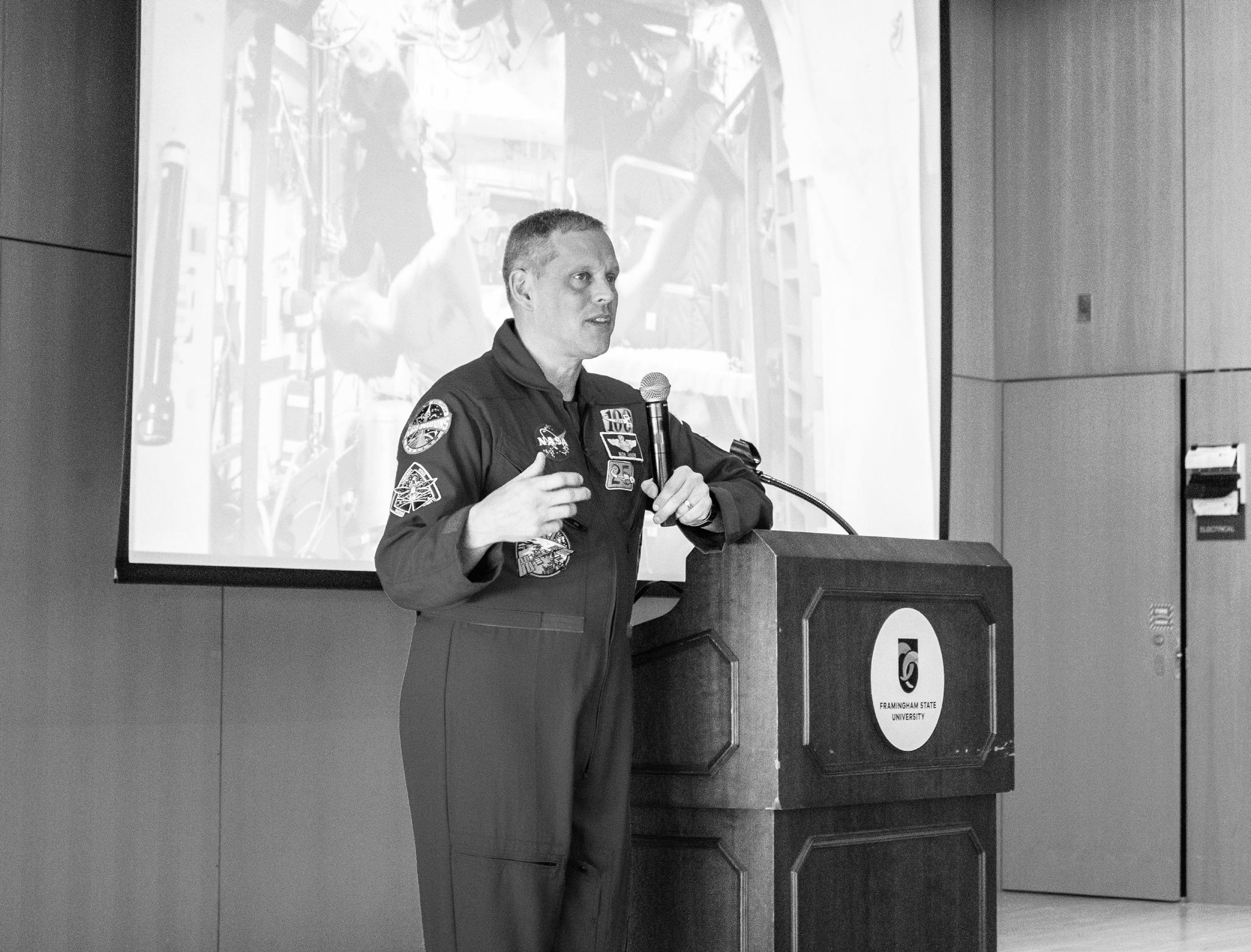
NASA Astronaut Bob Hines speaking about his experience in space at the McCarthy Forum on Feb. 27.
‘Star Trek: First Contact’ Resistance is not futile
By Jesse Burchill Staff Writer
“Star Trek: First Contact” is turning 30 this year, and as a long-time Star Trek fan, I decided to give it a rewatch.
The 10th film in the Star Trek franchise, “First Contact” is also the sec ond film of four that are based on “Star Trek: The Next Generation,” and is widely considered to be the best - the others are “Generations,” “In surrection,” and “Nem esis.”
The movie begins with Captain Jean-Luc Picard (Patrick Stewart), Com mander William Riker (Jonathan Frakes), Com mander Data (Brent Spin er), and the rest of the TNG crew manning the brand-new vessel, the En terprise-E.
When the Borg Collective, a hive mind of cybernetic be ings seeking to assimilate all organic life into their collec tive, begins another attack on Earth, the Enterprise crew gets involved in stopping the Borg’s plans.
Led by the Borg Queen (Al ice Krige), the Borg begin by launching an attack on Earth itself, engaging with Starfleet in orbit and launching a sec ondary ship. As the Enterprise takes pursuit of the ship, it cre ates and enters a time vortex, and Earth suddenly and rad ically changes - humanity is gone, and Earth is now populated entirely by Borg.
The Enterprise-E follows the second Borg ship through the still-open vortex to stop them. After the transport, the crew find themselves over 300 years in the past - it is April 4, 2063, shortly after the end of World War III.
It’s also one day before one of the most important moments in humanity’s history: making first contact with the alien Vulcans after Zefram Cochrane (James Cromwell) successfully pilots humanity’s first faster-than-light warp engine, which led to the formation of the United Federation of Planets roughly a century later.
It’s at this point that the crew learns of the Borg’s true plan: prevent first contact and assimilate humanity before it can rise to power across the galaxy. They swiftly work with Cochrane and his assistant Lily Sloane (Alfre Woodard) to stop the Borg’s plans, while the Borg Queen sees to it that the Enterprise crew is assimilated into her ranks.
The film is then divided into two parallel plotlines: fighting the Borg on the Enterprise, and ensuring that Cochrane’s flight succeeds on Earth.
The Borg were already intimidating in the original show, and now they’ve got the budget of a feature-length film to really hammer home how horrifying they are.
The makeup and practical effects for the Borg drones and the assimilated crewmates are as astounding as they are frightening. The drones look like something out of H.R. Giger’s work or the Hellraiser
they were in 1996.
Many of the Borg Queen’s scenes are in the film’s third act, but she is nonetheless a chilling antagonist in how callous she is to human life and how she manipulates Data into serving her by preying on his desire to experience humanity.
All the while, Alice Krige gives a very effective performance as a manipulative and ruthless monster, making the most of comparatively little screentime.
James Cromwell as Zefram Cochrane really sells the character’s doubts about becoming such a major figure in the history of humanity. When the crew finds him, he’s an alcoholic who created humanity’s first warp drive for the money - a far cry from the legend he’ll become.
His struggles to accept his role really humanize him, and once the Vulcans land at the film’s end, Cochrane takes the first steps to the historic role he’ll inherit by introducing the Vulcans to alcohol, music, and dancing. Cromwell gives him his most important trait: being believable as a conflicted character.
Alfre Woodard as Lily Sloan, brought up to the Enterprise early on for medical treatment, perfectly sells the “fish out of water” element of her character, especially regarding the Borg and the Enterprise’s native 24th century, and works as a strong emotional foil to Picard.
Patrick Stewart’s performance also stands out. Picard was assimilated by the Borg in
sees the Enterprise uncover a conspiracy within Starfleet regarding a planet whose inhabitants have harnessed its rejuvenating properties, effectively allowing them to live forever. As a result, they go against direct orders to protect the planet from the con-
TobiasCotton-Selman/
the show to be used as a weapon against Starfleet, and his trauma from the experience has stuck with him ever since.
This comes to a head in the third act when things get worse on the Enterprise, and Picard grows increasingly irrational and dedicated to hurting the Borg, risking his crew’s safety in the process.
When Lily confronts him in his office, comparing his vendetta to Captain Ahab’s, Picard smashes a starship display in fury and doubles down, only to realize that Lily is right and orders the ship’s evacuation. Stewart displays Picard’s anger and regretful realization perfectly.
Many Trek fans consider “First Contact” to be the best of the TNG-era films, and I felt this review wouldn’t be complete without some compare-and-contrast.
“Star Trek: Generations” was actually a crossover where Captain Picard met Captain James T. Kirk of the original series, where they teamed up to prevent the villain from destroying a star system as a means of accessing an interdimensional realm where the villain’s family is still alive.
While it was awesome to see Kirk and Picard meet and pass the torch, this also means that “First Contact” is the first TNG film to have the new crew front and center. Furthermore, “Generations’” pacing also felt more like an extended episode of the television show rather than a proper movie.
“Star Trek: Insurrection”
I feel like “Insurrection” just didn’t live up to its premise as well as it could. The way the story was executed felt too underwhelming for the concept of the Enterprise crew committing an insurrection against a malevolent Starfleet conspiracy, and it also had the same pacing problems as “GenPacing-wise, “First Contact” is the first to feel like a proper film, and it explains the threat posed by the Borg in a way that both Trekkies and first-time viewers can grasp without having to worry about watching the show. Furthermore, its story is much stronger and better-constructed than “Insurrection’s.”
The fourth and final TNG film, “Star Trek: Nemesis,” sees the Enterprise crew battle Shinzon, an abandoned Romulan-made clone of Captain Picard who has seized control of the Romulan Empire with malevolent plans for Earth.
There were parts of this movie that I enjoyed, but it’s pretty obvious that they were trying to rehash what made the acclaimed “Star Trek II: The Wrath of Khan” so successful. As a result, it can come off as a pale imitation at times and wastes the building blocks of its plot, as it was the first Trek movie to feature the Romulans in a significant capacity.
“First Contact” is very much doing its own thing instead of trying to repeat a previous Trek film, and as a result, does a better job of standing out on its own by building upon story elements from its parent show, while “Nemesis” doesn’t follow up as well on the show’s Romulan stories.
Ultimately, “First Contact” proves itself as a rock-solid installment in the larger franchise and proves its mettle as an enduring fan favorite.
23. Memento of an old flame?
24. Pains in the butt
25. “Taxi Driver” actress (... letters 2-5)
29. The old you?
31. Came to light
32. Croon or warble
35. ___ and flow
36. Pressed for time
38. Pair
39. Denial at a boot camp
41. Totally flip
43. Hydrocorti- sone cream target
46. $$$ dispensers
48. Texas Democrat in the House (... letters 9-13)
53. Accomplished
54. Singing group with mass appeal?
55. “Now this is living!”
57. Words affirming one’s grit ... or what 20-, 25- or 48-Across might say
62. See eye to eye
63. Prefix with “tip” or “cycle”
64. Pantheistic worshipper, say
65. Disinfectant brand
66. “I’ll be there in a ___!”
67. Assents from a congregation
DOWN
1. In the style of
2. Secret stash
3. What LinkedIn users might hope to land
4. Reindeer
5. Like people from Lagos or Abuja
6. Old flames
7. Poker contribution
8. Skate park fixture
9. Neural junctions
10. French ___ (coffeemaking devices)
11. Ignore something
12. Facilitates
13. Like Phoenix’s climate
21 Was ahead
22. Division of a volleyball match
26. “It’s the end of an ___!”
27. Not against
28. Brutus Buckeye’s sch.
29. October’s month number
30. “Succession” channel
33. Sister
34. Deity
36. Country between Syria and Iran
37. Wordlessly vocalizes a song
40. 401(k) alternative
42. Winter hrs. in Las Vegas
44. Word before or after “as”
45. Cymbals activated by a pedal
46. Low-pH
47. Purple boba flavor
48. “Gettin’ ___ Wit It” (1997 single)
49. Funky smells
50. ___ Dame
51. Asset for Mariah Carey or a rural landowner
52. “Geez Louise!”
53. Butt-___
56. Female chickens
58. Actor Briones
59. No. on a business card
60. College app stat
61. “Yo soy,” in English
Slimes and Smiles
Spread by Photo and Design
Editor Alexis Schlesinger and Assistant
Photo and Design
Editors Onyx Lovely and Christy Howland
Alexis Schlesinger / THE GATEPOST
Onyx Lovely/ THE GATEPOST
(Left) Mollie Grace Oravec and Abby Flanagan at Art Club’s Slime Party on March 12.
César Matos pretending to eat his slime at Art Club’s Slime Party on March 12.
Onyx Lovely / THE GATEPOST
Alexis Schlesinger / THE GATEPOST
Alexis Schlesinger / THE GATEPOST
Io Phillips showing off his slime at Art Club’s Slime Party on March 12.
(Left) Miranda Allicon, Emily Agnelli, and Kendall Winston at Art Club’s Slime Party on March 12.
(Left) Cia Rosado and Cameron Higbie at Art Club’s Slime Party on March 12.