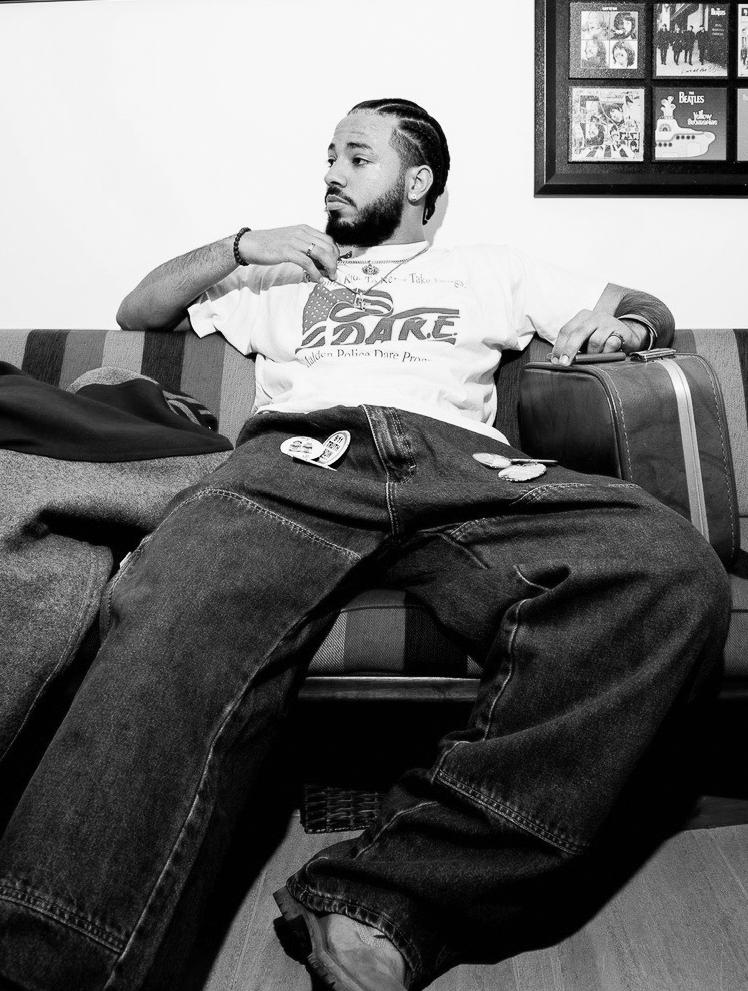
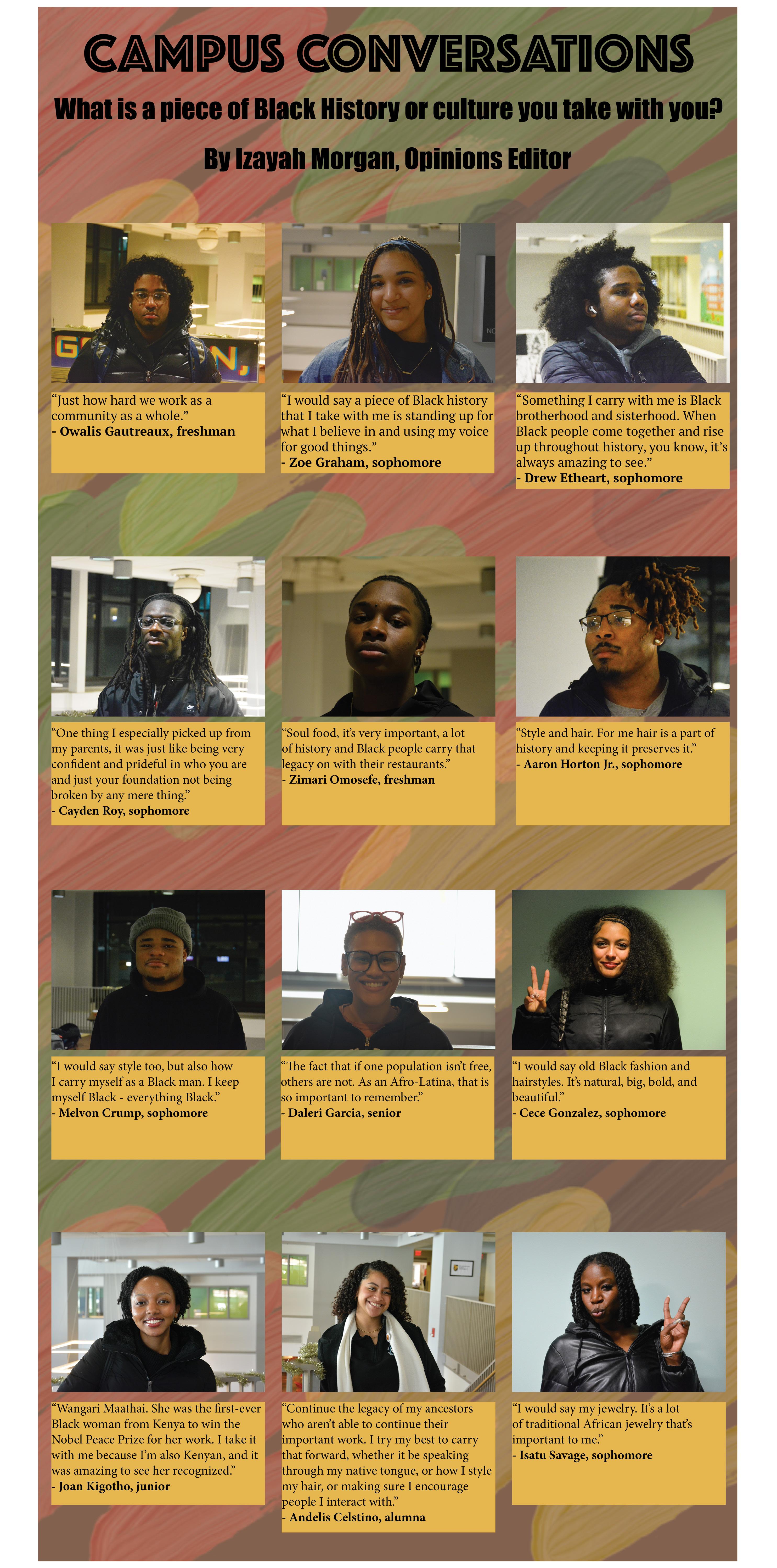
Struggle, but not in the way we think. Like, we fought through so much adversities just to get where we’re at right now. We’re still trying to propel ourselves ... and put ourselves in better positions, even though we’re in a system that’s made to keep us down. I feel like when it comes to Black history, people mainly focus on the negatives, which we can’t ignore. It’s a part of our blood. But Black history is not only that. Black history is beautiful. It’s the community we build. It’s the challenges we face together, and it also shows us how, no matter what, if we just come out together as a community, we can do anything. And finally, we have to come to the realization that we’re just as capable as our white counterparts.
What made you want to be BSU vice president?
Last year, I came in as a freshman. They accepted me with open arms. And I just found my place there. I found the community I was talking about - like my previous statement - where I met a lot of people. I met a lot of really good friends from BSU. So I just wanted to continue the tradition and create that for others.
Why is BSU important?
I feel like, especially in PWIs, there has to be a space where Black students could feel free and connected because, in my high school, I went to a majority Black school. I was used to seeing people that look like me every single day. And it’s a culture shock when you go to a PWI and then see people that look nothing like you. So that’s why I think Black student unions are important, because it creates a space for everyone to just come together and see your
own community, even though there’s not that many of you.
Who is a Black history figure you look up to?
I have two. In my eyes, Malcolm X is the G.O.A.T. - like, the greatest of all time. And then the next one is, I don’t think people have done their research on him, but James Baldwin. Baldwin was a civil rights activist and writer. If anyone has time, you could just search up some of his interviews and his debates on YouTube, and it’s like, he really speaks to the soul of Black folk.
What words do you want to leave with the FSU community this Black History Month? Always keep your head up. And you being here, being born, and being present, is proof that you can achieve anything. That’s what I want to leave people here with.
WITH DYLAN PICHNARCIK dpichnarcik@student.framingham.edu
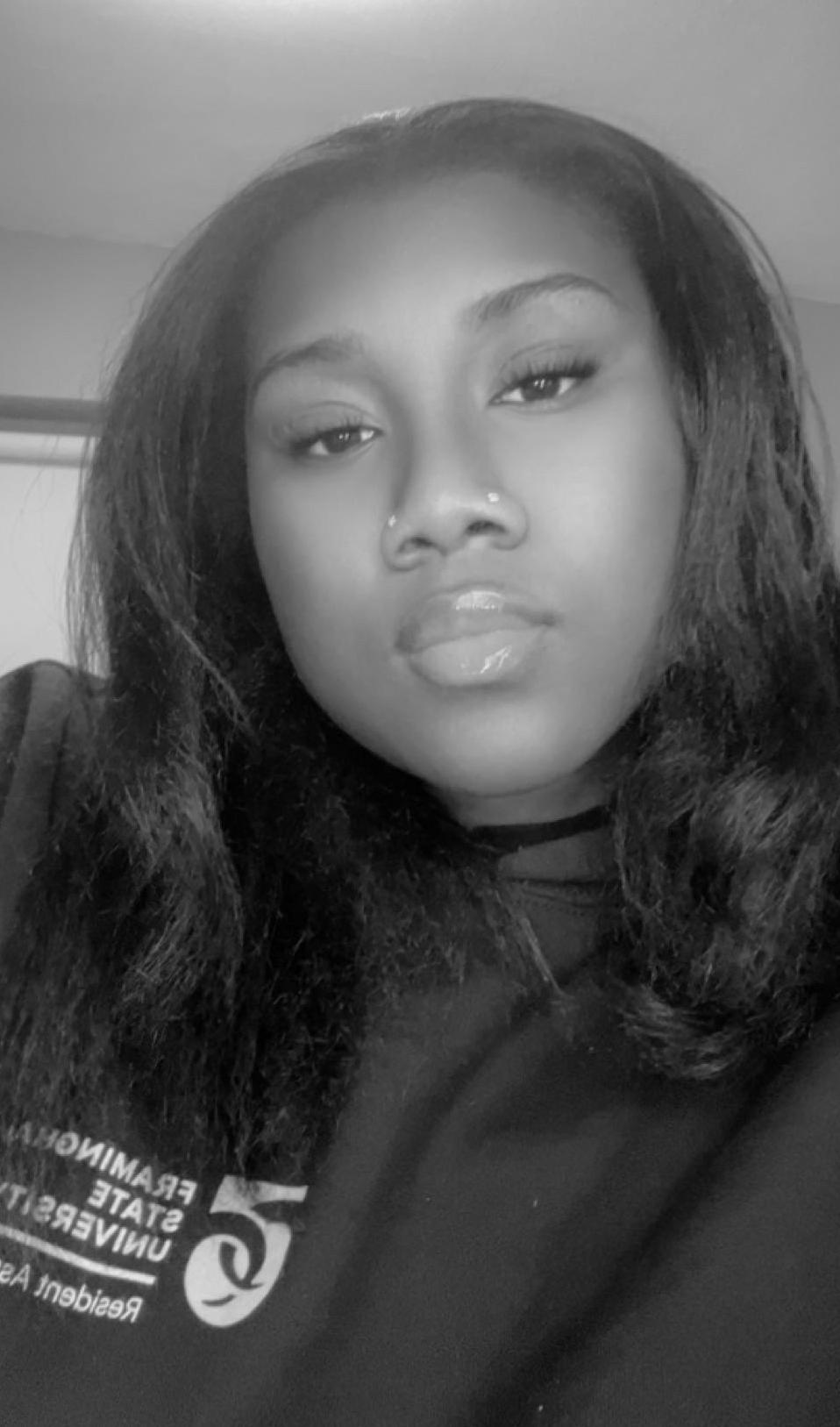
Courtesy of Angel De Leon
Framingham State named top university for women
By Bella Grimaldi News Editor
Framingham State University was named a top institution in the United States for Women by Newsweek magazine.
According to a press release from the University, FSU was ranked as 5th statewide, tying with Massachusetts College of Pharmacy and Health Sciences (MCPHS).
FSU is the only state university in the top five Massachusetts institutions.
Provost Kristen Porter-Utley said in an email to The Gatepost, “It is nice to be ranked 5th out of [the] 56 colleges and universities in the state of Massachusetts recognized for this distinction. We are second in the state for the Pay and Policy score, and this is a result of great work by our Human Resources Office and other institutional leaders.”
President Nancy Niemi said she hopes this communicates women are a part of the University’s identity and the “understanding that women’s education is extremely important and has been since we started 187 years ago.”
Nationwide, the University tied for the rank of 69th out of over 751 institutions.
Framingham State tied with MCPHS, Chestnut Hill College, and Concordia University-Saint Paul. Each of these institutions received an overall score of 72.1.
Niemi said Newsweek reaching out and recognizing the University values women is an “important marker.”
This is Newsweek’s first time releasing America’s Best Colleges for Women list.
Newsweek worked with Gender Fair to compile information about each institution and rank them.
Gender Fair is a rating system established in 2016 that seeks “to advance equality and accountability in organizations by measuring how they treat people - through their policies, leadership, pay, and parental support - and recognizing those that set the standard for fairness.”
The scores for this ranking are based on four categories: Leadership, Pay and Policy, Safety, and Opportunity.
According to Newsweek, the scores are based on data pulled from the U.S. Department of Education. This includes information from the Integrated Postsecondary Education Data System and the Campus Safety and Security Database.
Framingham State scored a 75 in the Leadership category, 78 in Pay and Policy, 94 in Safety, and 39 in Opportunity.
Porter-Utley said she would like to improve in the Opportunity category by ensuring women of all backgrounds are given the same advantages and are supported.
Niemi said since she has been at FSU, she has endeavored to build on an environment where women are powerful and can “harness what they learn and build their lives going forward.”
Jeffrey Coleman, vice president of Diversity, Inclusion, and Community Engagement, said it’s clear the leadership team at the University is different from other institutions because FSU has a majority of women on the
Executive Staff. Coleman said he believes the University can improve its ranking by continuing initiatives that foster “an environment that’s affirming and welcoming for individuals of all backgrounds and identities.”
The Newsweek website states, “The ranking identifies colleges that have established the structural elements necessary to foster education and employment for women. Only institutions meeting specific criteria for size and academic roles are included, ensuring the results reflect meaningful progress toward gender equity in higher education.”
Porter-Utley said, “Everyone at Framingham State has the opportunity to realize success, and the University works to amplify the excellence of our women students, staff, and faculty.”
Within each ranking, Newsweek also displays the level of reproductive health care accessibility in the state where the institution is located.
In the listing for each institution, there is a State Reproductive Status category where the accessibility is shown on a scale of 1 to 5.
According to Newsweek, a 5 means “Reproductive health services, including abortion, are allowed and protected under state statutes or constitutions. Additional laws and policies expand access to related care.” A status of 1 means, “Abortion is prohibited by law and subject to criminal penalties.”
Massachusetts institutions fall under a status of 4. According to Newsweek, this means, “Abortion is legal under state law, but access is subject to certain restrictions.”
Information in this category is based on data from the Center for Reproductive Rights.
Niemi said she has mixed feelings about rankings in general, but the University is taking advantage of this recognition because it identifies the impor-
tance of women in education.
Porter-Utley said, “With any ranking, we take it with a grain of salt and recognize the limitations of such an analysis while also appreciating our history of opening the doors of college to women at a time when many didn’t have access and how that shapes our current mission of access and accessibility.”
Dan Magazu, executive director of Marketing & Communications, said the University doesn’t have a relationship with Newsweek beyond the stories or rankings in which the magazine has included FSU in the past.
Magazu said there was no financial obligation or solicitation for this ranking.
According to Magazu, there is no cost to promote the ranking, but if the University wanted to display the Newsweek badge, there would be fees. The University will not be paying to use the Newsweek emblem.
He said Newsweek contacted him on Jan. 21 about the ranking.
“I didn’t even know it was a thing until they reached out and said, ‘Hey, we did this ranking and you guys are included.’ So sort of like a pleasant surprise,” he said.
Sophomore Brynn Danley said she was not aware the University is ranked highly for women.
She said, “I will say as a woman, I feel pretty safe to walk across campus alone at night.”
Junior Indigo Allain said, “As a woman, it makes me very happy knowing FSU was recognized as a top institution for women.
“It makes me feel appreciated and valued as a student,” she said.
Allain added, “I believe there’s always room for improvement and continuing to educate students and faculty on the importance of gender equality.”
Sophomore Elizabeth Rivers said she believes the recognition is “very accurate. We have a female president here at FSU, and I definitely feel the woman
power.”
She said, “I have never felt discriminated against, especially for being a woman. I have always felt inspired and empowered by other female upperclassmen as well as professors.” Rivers said she does not believe there are any ways the University could improve because the University provides many opportunities for women.
Sophomore Mya Secka said, “Especially given the history of how this was originally an all-women’s college, the fact that it still reflects today is an amazing sentiment and very empowering.”
She said the University’s history as a women’s college has been discussed in her classes, including the women who have made impacts at FSU.
She said one way the University could improve is by making the information on the University’s history more accessible.
Secka said, “I think it would not only educate the others about the school’s history, but keep the stories of the women that came here before us alive!”
Sophomore Emma Schor said, “I know FSU used to be an all-women’s college and it allows others to accommodate and recognize the needs of women. … It helps me be more comfortable that FSU understands womenespecially those who may be assigned female at birth but don’t identify as a woman.”
She said she believes one way the University could improve is by providing free menstrual products in bathrooms instead of charging for them in restrooms.
Gatepost Archives
Celebrating Black Alumni at FSU
By Avery Slavin Asst. News Editor
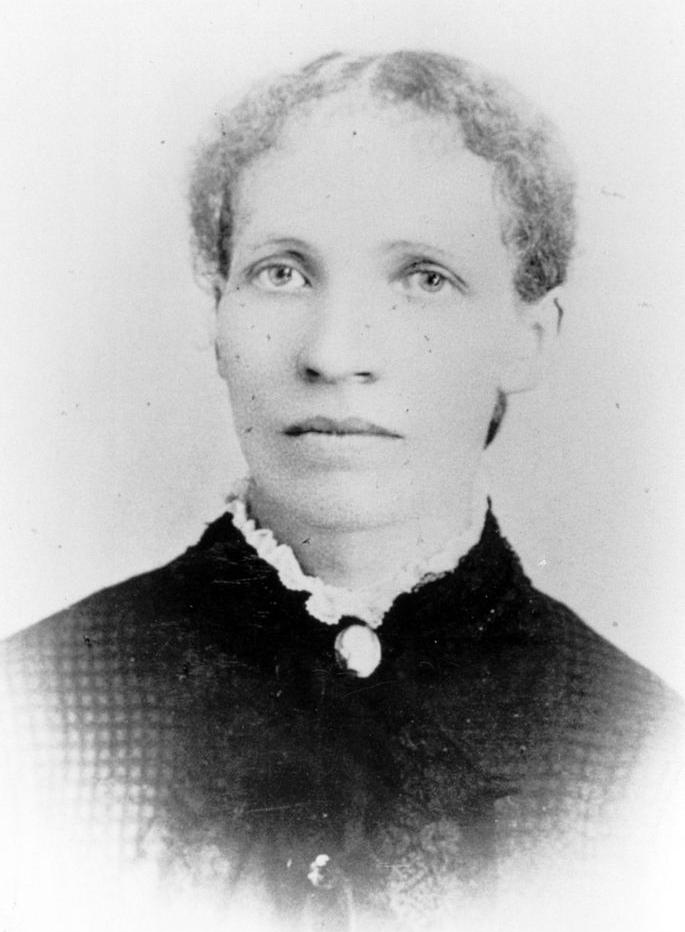
Six years ago, Framingham State formally recognized the first Black woman to graduate from the University, Mary Miles Bibb, by renaming what was then known as North Hall in her honor.
Miles Bibb Hall now serves as a reminder of the robust history of Black culture and community on campus.
Long before Mary Miles Bibb stepped foot on campus, Framingham State was established as the Lexington Normal School in 1839.
In the 1800s, a normal school was an institution that specialized in educating high school women graduates who wanted to become teachers. It tried to set a “norm” for how future students should be taught, hence the name “normal.”
The Lexington Normal School gave out what they called “certificates,” which would be the equivalent of diplomas now, to recognize students’ completion of the program.
In 1843, Mary Elizabeth Miles Bibb became the first African American to receive one of these certificates from what is now Framingham State.
She was one of the first Black women to teach, becoming an educator in Boston and Philadelphia after her time at the Lexington Normal School.
After the Fugitive Slave Act was passed in 1850, Mary Bibb and her husband, Henry, moved to what is now Windsor, Canada, for their safety. During this time, they became leaders of the Refugee Home Society, which helped formerly enslaved people become educated and established in the community.
In 1851, the Bibbs founded their newspaper, Voice of the Fugitive, which was directed toward freedom seekers and promoted emigration.
Two years later, the newspaper’s office burnt down. A few
months later, Henry died. However, Bibb continued her activism until her death.
The Bibbs were named Persons of National Historic Significance by the government of Canada in 2005, and as recently as 2021, Sandwich Town Park in Windsor, Ontario, was renamed the Mary E. Bibb Park.
In 2020, Framingham State renamed North Residence Hall to Miles Bibb Hall in honor of her.
Admissions Counselor Liv Beverlie was a part of SGA during the time of the name change, and remembers it being a “very intentional process.”
Beverlie said the name “Miles Bibb” was chosen specifically to separate Mary’s legacy from her husband’s.
“Most resources and historical things refer to her as Mary Bibb, which is her name, but Miles is her maiden name, and the reason we chose that is because typically, she is known as related to her husband and his activist work. While that is great, we didn’t want it to be named after her husband. We wanted it to be named after her because of her historical significance to the University as the first African American graduate,” he said.
The process of North Hall becoming Miles Bibb Hall was a seamless one, according to Beverlie. He said along with the topic being discussed during SGA meetings, it was also something the Board of Trustees was involved with as well.
“Everyone was on board, thinking it was a great idea and what not, so it wasn’t too hard to convince anyone. It was talked about by the senators, and then brought to the Board of Trustees, and then it just went from there and got approved,” he said.
Beverlie said it’s something the school is very proud of, as Framingham State’s student population becomes more diverse.
He said it’s important to “rec-
ognize where that all started, and that was with Mary Miles Bibb. Tying into our current goals of increasing our diverse population of students year after year, I think it’s important to also look back at our history and where it all started. She was a phenomenal person, and [with] her activism in terms of being a part of the abolitionist movement and education, it’s just important for us to recognize our history as we move forward and continue being a diverse and inclusive school.”
A few years later, in 1847, an African American by the name of Chloe Lee applied to the Normal School after it had moved from Lexington to West Newton due to space limitations, according to Colleen Previte, University archivist.
Cyrus Peirce, the first principal of the normal school, accepted her and saw the same potential in her as any other student, she said.
While she was accepted to the school, she was denied room and board until Horace Mann, the Secretary of the Massachusetts Board of Education at the time, opened up an extra room in his home for her, according to Previte.
Mann and his wife openly stood against segregation and followed traditional Christian values, such as “help thy neighbor,” and treated Lee like family until she graduated, according to historical records held in the University archives.
Today, two residence halls on campus are named in honor of both Mann and Peirce for their contributions to what Framingham State is today.
In 1881, Olivia Davidson graduated as one of six honors students. Davidson co-founded Tuskegee Institute in Alabama with Booker T. Washington, who later became her husband.
Washington was a leader in the African American community. On his own, he was one of the biggest advocates for change for the Black community in the South.
The two founded the institute as a way to provide higher education to Black people, which was one of the primary rights Washington advocated for, according to the archives’ historical records.
Davidson taught at the institute and held the role of vice president. She advocated for teachers to reach out to young Black girls and women in an attempt to make the next generation of the Black community stronger.
She worked hard teaching at Tuskegee until she died in 1889. She is remembered today as an essential leader who advocated for Black people’s access to higher education.
As for some more recent alums, Jeff Stetson, Class of ’73, was one of the first Black men enrolled at Framingham State, as the school enrolled women until 1964. He started as an English major, later switching to psychology. He was also SGA president during his time in college, Previte said.
Following graduation, he wrote a play called “The Meeting,” about a fictional meeting between Malcolm X and Martin Luther King Jr., taking place in a Harlem hotel room during the 1960s, according to Previte.
This play was televised on PBS’s American Playhouse and was produced for the public to watch in places like Canada, Nigeria, Kenya, South Africa, and the Netherlands. It received national awards, and Stetson went on to write a few novels, his most popular being “Blood on the Leaves.”
With a long history focusing on diversity and inclusion, Framingham State continues to honor and remember the alumni of color who have shaped the University’s community.
CONNECT WITH AVERY SLAVIN aslavin1@student.framingham.edu
Courtesy of the University Archives
Framingham State Alumna Olivia Davidson class of 1881.
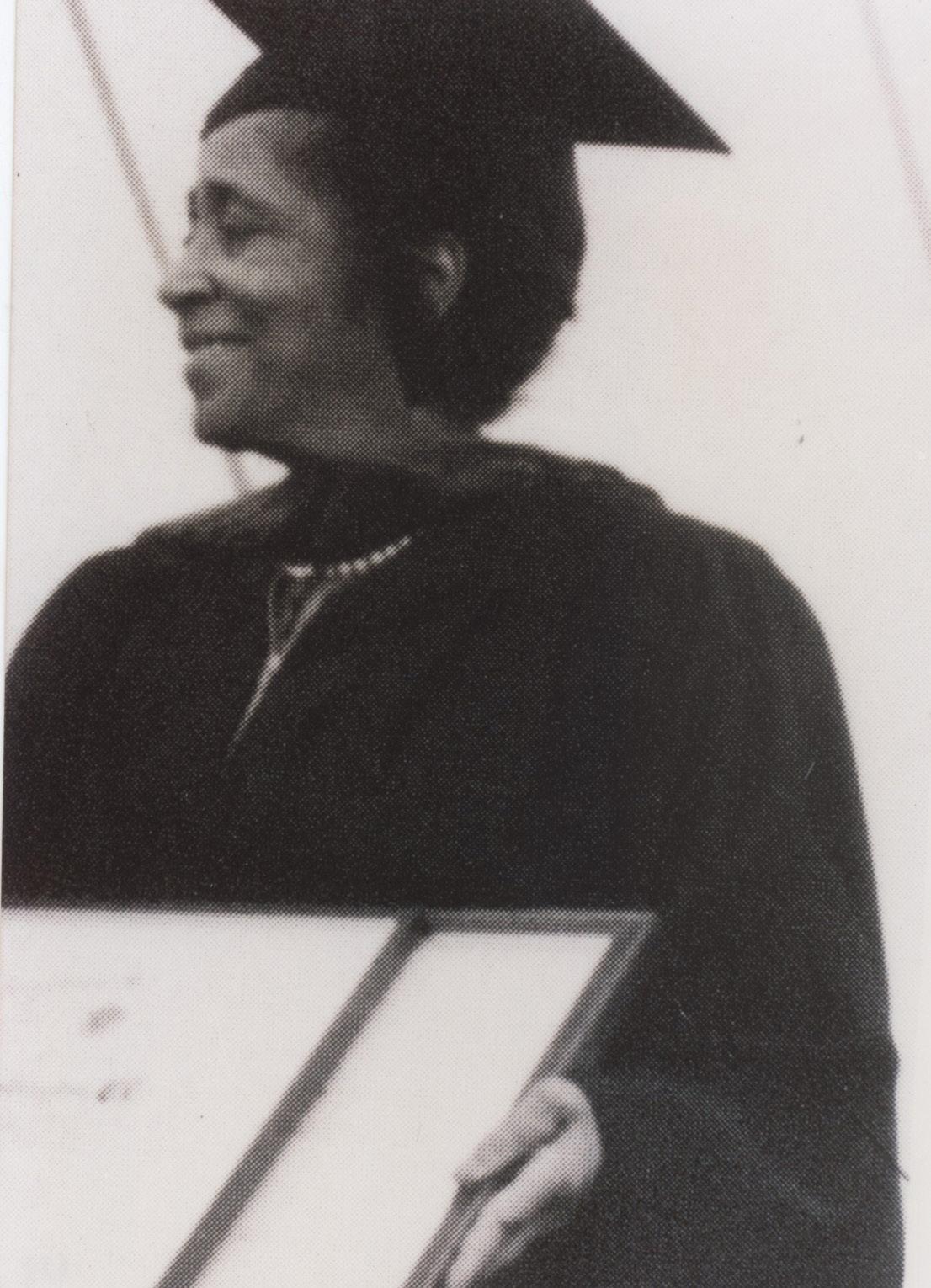
Courtesy of the University Archives Ella Griffin, recipient of honorary doctorate from Framingham State in 1985.
By Sophia Oppedisano Editor-in-Chief
By Dylan Pichnarcik Associate Editor
Lorretta Holloway, vice president of Student Success, was one of nine honorees at the City of Framingham’s 2nd annual Black History Month Honors on Feb. 17.
The event celebrates “contemporary leaders and historical figures with strong ties to Framingham” as well as those “whose contributions have shaped, and continue to shape, the Framingham community,” according to framinghamma. gov.
Holloway said she was initially “humbled” by the recognition because she is not from Framingham. “I know that there are lots of people who live and not just work in this community, but I was really honored,” she added.
A Framingham city employee who works in human resources
nominated Holloway because of her work in developing anti-racist curricula with Leadership MetroWest.
“In the last two years, I’ve just been doing all the workshops myself, and it’s evolved to become more of a focus on not just anti-racism, but just equity in general. That’s been really exciting to do that work,” Holloway said.
She added being recognized for that work, as well as her longevity and impact at Framingham State, was “really nice” and “really humbling.”
The event provided a “warm, nice space” in a time “when it’s just really dark and really hard, and typically very hard and difficult for people of color,” she said. “It was just really nice to be in a space where people were celebrating the Black community and our resiliency and our strength and the community care that we have. I was really happy to be there and very honored to be on the honoree list.”
In her recognition speech at
the event, Holloway said, “We’re living in a very dark time, and we have to acknowledge that. And we’re living in a world that seems to find our joy - our community’s joy - threatening. … I want us to take these moments and wrap them up for safekeeping, for our joy and our ability to retain it, to protect it, for the precious thing that it is.”
Holloway said Black History Month is a time to honor the “memory of the people who came before us.
“I wouldn’t be able to stand in that space on Tuesday night without the care that my mother gave me, and that my grandfather gave her. … [We] talk a lot about the ancestors and honoring the ancestors, and making sure that we’re standing on their shoulders, and that we’re not injuring those shoulders,” she added.
President Nancy Niemi said, “I can’t think of a person more deserving of just recognition for what she does than Dr. Holloway. Her DNA is social equity,
and she has been focusing on that since I’ve known her, but certainly long before any of us were around at Framingham State.” Niemi said Holloway is an extraordinary advocate for all students, particularly those of color or from underrepresented groups. She said those students gravitate toward Holloway because “She’s honest about the things that Framingham is doing, but honest about the things that they might be going through if they seek her out. … You recognize her as somebody who cares so very deeply.”
CONNECT WITH SOPHIA OPPEDISANO soppedisano@student.framingham.edu
CONNECT WITH DYLAN PICHNARCIK dpichnarcik@student.framingham.edu
OP/ED THE GATEPOST EDITORIAL
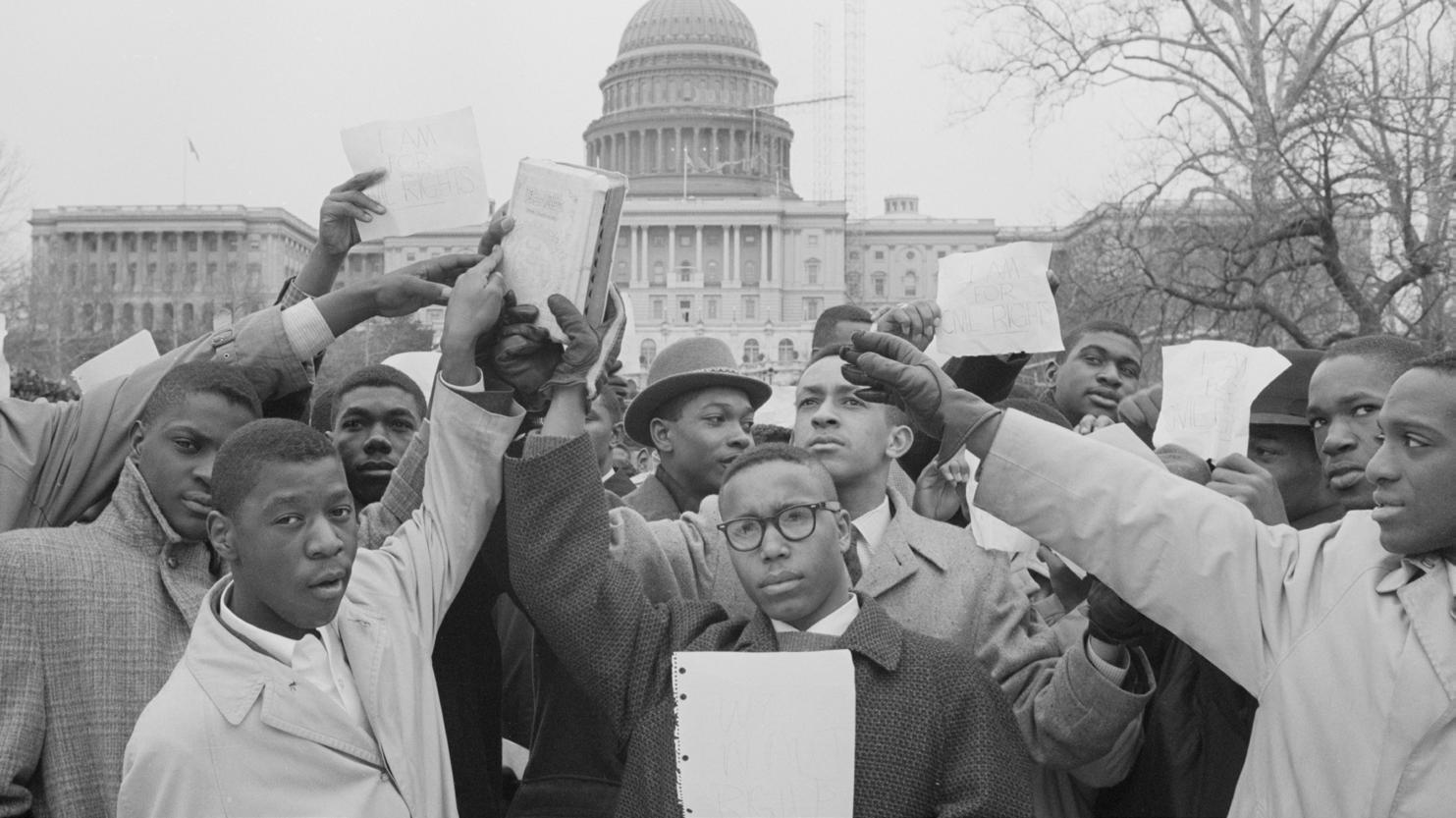
Black history is now.
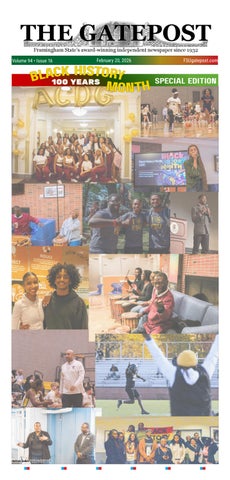
This February marks 100 years of celebrating Black History Month.
The Gatepost Editorial Board is elated to present this special edition of The Gatepost in honor of this monumental Black History Month.
As we continue to learn about and share Black history during February and look ahead to the next 100 years, it is crucial to understand why this celebration began.
Black History Month began as Negro History Week in 1926, when one of the first Black Harvard graduates, Carter G. Woodson, partnered with teachers, churches, and community members to begin sharing stories, culture, and experiences to combat the unceasing exclusion of Black people from American history, according to blackhistory100.org.
Woodson was inspired by the observation of Fredrick Douglass Day on Feb. 14 - a day schools were encouraged to study Douglass’s life. Negro History Week took shape under the same idea: schools and communities could participate in this “national week of study” to encourage people to engage with accurate and expansive education on Black history, with the ultimate goal of that education being passed down from generation to generation.
Fifty years later, in 1976, former President Gerald Ford officially recognized the expansion of Negro History Week to Black History Month.
Ford called upon Americans to “seize the opportunity to honor the too-often neglected accomplishments of Black Americans in every area of endeavor throughout our history,” according to history.com.
While Black History Month represents a designated time for Black history to take center stage in schools, community events, and national conversations, it is important to consider that many people do not receive much, if any, education about Black history outside of the month of February.
This month is an opportunity for celebration and remembrance, but we have a responsibility to continue to carry the objectives of Black History Month into the rest of the year.
At its core, Black History Month is a recognition and celebration of Black culture, stories, triumphs, and suffering, all of which are crucial elements of American history.
The roadmap of Black history is not linear - it is one of diverging routes that reflect hardships. Yet, this map has also led to joy, community, liberation, activism, and invention.
Over the past 300 years, America has witnessed the bravery and dedication of abolitionists and civil rights activists fighting for equal access in this country.
The evolution of music - from Rock ’n Roll, blues, jazz, R&B, and Hip-Hop - has changed the culture of the world.
Inventions as simple as the potato chip to something as tech-
nologically important as the three-light traffic signal can be attributed to the work of Black inventors.
Scientific and medical studies have become more inclusive, allowing for breakthroughs in knowledge about the experience of Black people who have historically been excluded from research and even proper care.
Black people have continued to shape the world as we know itfor good. Recently, the Civil Rights Movement has been reignited in the form of global activism.
This activism has continued to flourish in the form of the Black Lives Matter movement in the wake of the deaths of George Floyd, Breonna Taylor, Ahmaud Arbery, and countless other victims who lost their lives to racially motivated attacks.
Black history is far more than this short list of triumphs and tragedies. It is also about the future work we continue to do in light of those who paved the way for America and the world.
Our campus community has an opportunity to practice this idea and dive deeper into cultural curiosity through our coursework, our involvement, and our experiences.
The Center for Inclusive Excellence staff, including Jerome Burke, Emma Laurie, and their diversity peer influencers, undertake incredible work throughout the year to host events and diversity dialogues to get students involved in asking questions, hearing about different cultural experiences, discussing how the state of the country mirrors that of the past and how we can navigate the current moment to become more ethical and inclusive citizens.
Students continue to get involved in affinity groups such as the Black Student Union, Brother 2 Brother, and the Afro-Caribbean Dance Team, which are led by students Laila Jenkins, Raul Perez Santana, and Esther Casseus, respectively. They continue to undertake the necessary work of creating safe, comfortable spaces for Black students and anti-racist allies to gather and support each other through programming and fundraising events. The groups’ overall missions are to promote a sense of togetherness. Every interaction, no matter how small, presents an opportunity for students to practice openness, love, and understanding toward those who have a story or perspective to share that differs from their own.
Open and thoughtful dialogue is the first step toward dismantling biases, stereotypes, and prejudices that currently fuel division and hate toward Black people worldwide.
We are all pioneers of the next 100 years of Black history.
Carry the lessons and experiences of this month in your heart throughout the rest of the year, and recognize that we have continued opportunities to grow and learn.
Black history is then, now, and forever.
Marcus Falcão / THE GATEPOST
Why Black policing matters
A conversation with Officer Frimpong
By Izayah Morgan Opinions Editor
As a young Black man, I have always been wary of the police, and this line of thinking isn’t exclusive to me.
Black people have always been in conflict with the police. Back when slavery was prevalent, slave patrols were common to catch runaway slaves, primarily in the South.
Even after slavery ended, the police force was not necessarily kind to folks who look like us. Police violence and brutality still go on to this day. Mass incarceration has separated fathers from their families, and Black men from larger communities, because of the actions of racist police and policies.
These unjust practices often directly stem from the criminalization of drugs such as crack, which is similar to other “white party drugs” like cocaine. However, far harsher sentences are handed down to Black people in possession of this drug. Similarly, harsher sentences are handed down to Black individuals in possession of drugs such as marijuana.
Given all these realities, it makes sense why Black people would not trust the police in so many instances. Many times, in cases such as that of Framingham State Police Officer Andrew Frimpong, one’s reputation might be stained over the belief that they are betraying their race for wanting to go into law enforcement.
“It was almost kind of a sell-
By Antonio Machado Multimedia Editor
As division in the political landscape of America reaches new, modern heights, we look to art to find ways to connect with each other and spread love to those around us.
Music shapes the way we view and interact with the world. It is everywhere - in dining halls, stores, in our earbuds, in that silly TikTok video as faint background music, or sneaking into our heads as we desperately try to focus on an assignment. Music is everywhere.
Music is an art form deeply rooted in American culture and history, and it plays a fundamental role in our communities and daily lives.
The reason for that is simple - music is inextricably linked to Black history.
As we immerse ourselves in Black History Month, especially in a time as critical as this where any and every marginalized community is under duress, we must acknowledge and highlight the impact Black people have had on music and pop
out for a Black person to go into the police force after the Stephen Lawrence incident,” Frimpong said.
Frimpong spoke at length about his past and experiences in a feature written by my friend Dylan Pichnarcik published in the Jan. 30 issue of The Gatepost, titled “Andrew Frimpong brings kindness to community policing.”
During our conversation, we touched on George Floyd and how that was the catalyst for the Black Lives Matter movement. Frimpong reflected on a similar tragic incident, during the time he was in the UK, when Stephen Lawrence was brutally murdered by a racist group of white teens.
The way the case was handled exposed the systemic problem with policing in the UK.
However, the murder of Lawrence and his mother’s reaction inspired Frimpong. Lawrence’s mother, Doreen Lawrence, who had her child taken away from her and was mistreated by the justice system, decided to help carry the flag at the Olympic Games, which Frimpong believed showed her bravery and sense of hope.
“It took incredible humility to bear the flag of the country where your son was murdered. I couldn’t imagine,” Frimpong said. Both of these people were his inspiration to fight for a better world.
Frimpong and I quickly agreed that the logic for Black people to stray from professions in policing - while often
culture as we know them today.
The history of American music is an oxymoron. Black musicians played jazz in clubs that were only accessible to white people. Black R&B singers performed at sold-out venues throughout the Jim Crow South.
The banjo serves as the foundation for folk and country music, but those bricks were placed by the Black slaves who brought their instrument from Africa and were forced to teach its music to white people.
Call-and-response, a fundamental music technique and architectural blueprint of pop music, was woven in the fields through work songs, and it eventually became the first step to creating blues music.
Sister Rosetta Tharpe, a gospel and blues singer, introduced the distorted guitar and growled the first notes of rock ’n roll years before Elvis even looked at a stage. The genre as a whole was named after “My Baby Rocks Me with One Steady Roll,” a blues song by Trixie Smith - a Black woman.
Painted on the sheet music we hear every day are hundreds of years of Black history etching the staff. The convention of modern music was directed by Black people as they conducted symphonies of their pain - and though the oppressors heard and learned each and every note, they never listened.
Black influence and resistance never ended, though. In fact, it only fueled the fire to make the stars burn even brighter.
What we in the modern day define as a “Pop Star” was written by Black musicians who introduced spectacle into the world of music. Stardom today
coming from family or friends who might be trying to protect you from a profession that is not only dangerous, but has mistreated Black people for years - is flawed.
This stigma often overlooks that the person who chooses to wear the badge is often an officer just like Frimpong who is often the person of reason in tough situations. His background helping counsel young people allows him to always think about others and bring those experiences and perspectives to his work.
Frimpong spoke about the benefits of mental health workers riding with a police officer to respond to the numerous mental health-related issues that pop up, especially in a world where mental health is becoming destigmatized and more police are called to deal with mental health crises.
No matter the location on earth, it seems police and Black people are on opposite ends. However, I believe officers like Andrew Frimpong and the rest of the FSUPD help bridge that gap.
FSUPD focuses on community policing and it is a police
force that represents the campus community. This leads to the FSU community feeling more comfortable with calling FSUPD for help if they need it. Seeing someone who looks like us can help us feel safer and a part of this community.
Policing, like many fields including health, housing, and education, has excluded and mistreated Black folks for centuries. There is a completely legitimate question of whether one might want to go into a profession with a troubled racist past.
However, if we looked at every potential occupation that Black folks can get into, then we would have a tough time fitting in any occupation because so many professions have a historically racist past.
Nevertheless, Black policing matters, just like every other profession. If those in powerful professions such as policing, housing, and healthcare are not representative of the population of society as a whole, then what power do people from underrepresented groups, including Black folks, have?
None.
was built on the necessity of needing to be twice as good to get half as far.
Prince was a musical prodigy who blurred the lines of genre and gender - challenging gender norms and blurring the constraints of labels on music, becoming a pioneer of the “Minneapolis sound.” He brought fashion and theatricality to the forefront of music, becoming living performance art through his persona.
The Supremes’ Diana Ross essentially defined what a Pop Diva should be with her larger-than-life, glamorous stage presence. She pioneered the concept that a leading pop girl could be both a vocal powerhouse and a luxury brand.
Britney Spears would never exist without the influence of Janet Jackson, who redefined pop by using industrialized R&B to deliver poignant social commentary in her music, and capitalized on making captivating visuals through her dancing.
The “King of Pop,” Michael Jackson, created levels of performance mastery and stage command hitherto undreamt
of. He was a student and proud celebrator of each and every Black artist who came before him and is now studied by each and every aspiring artist since his passing. His utilization of his voice as an actual instrument within his music is part of the pop formula used by every artist today, and he essentially invented the concept of what a music video should look like.
And now, Beyoncé.
Another one in a long, long list of impeccable musicians who have completely restructured the way music is produced and stages are conducted. If Black music is a symphony of resistance through pain, Beyoncé has become its most formidable conductor, using her sound to shift the culture into acceptance of Black history. As we listen to the cries of suffering happening throughout our country, it is imperative to remember we all speak the same language - music - and clearly, we’ve all learned from the same teachers, all of whom honed their voices in the fires of resistance, and we can resist too, with the fire of our voices.
OK ladies, now, let’s get in formation
Gatepost Archives
Representation
By Izabela Gage Sports Editor
On any given day at the Framingham State athletic facilities, student-athletes are learning far more than how to run plays or execute drills.
For many, the lessons that stay with them long after graduation come from the people standing on the sidelines - the coaches whose leadership shapes not only how they compete, but how they see themselves and their futures.
For Black coaches in particular, that visibility can carry added significance.
While Black athletes remain highly represented on college rosters, the same is not always true for the coaching ranks.
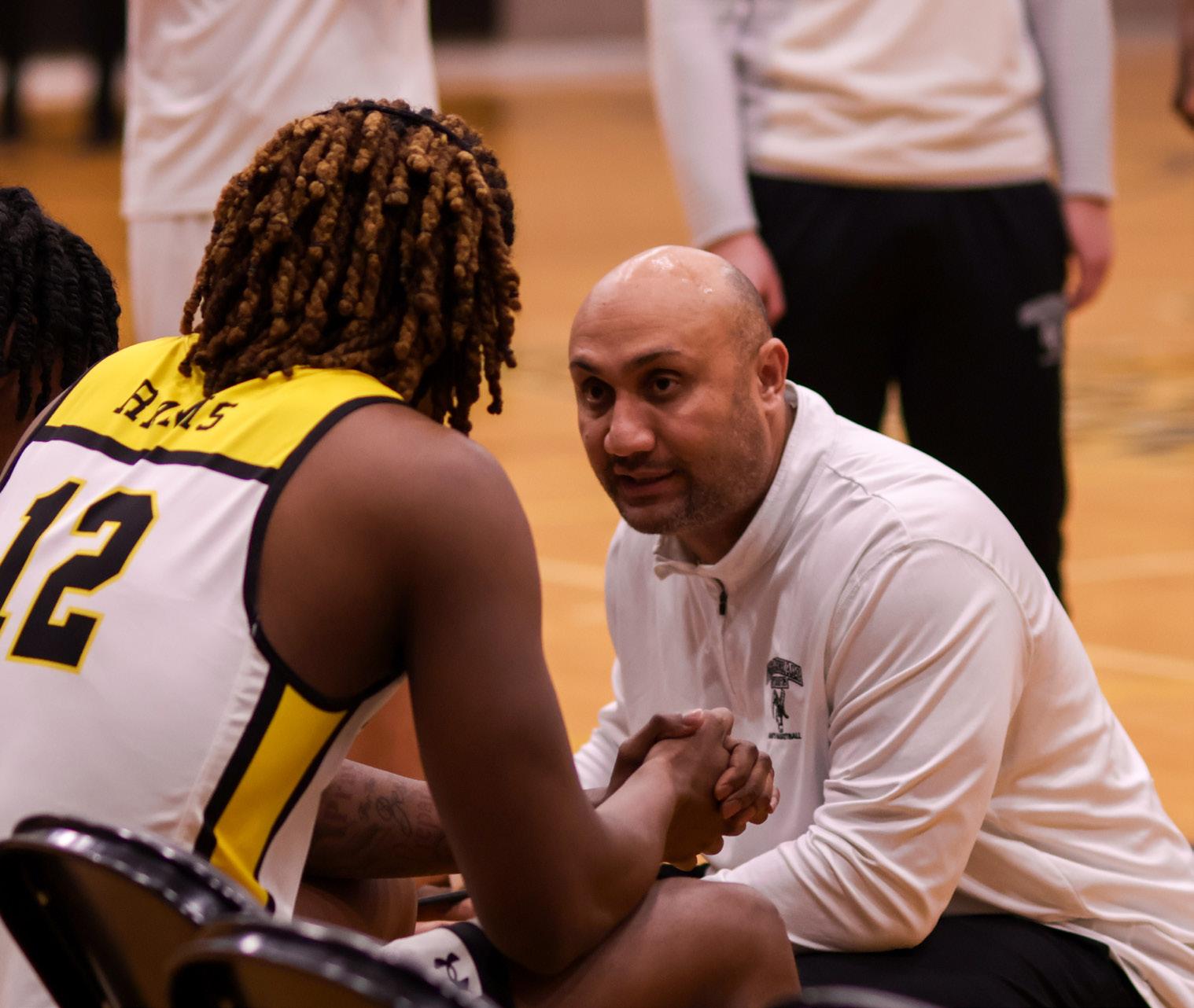
For Donald Morris Jr., head coach of the men’s basketball team, Black History Month “means a great deal. As a coach, it helps me always remember the people who came before me to pave the way for coaches of color.”
Even with the growth of diversity among players, Morris said leadership opportunities for Black coaches have not expanded at the same rate.
Morris said it’s “extremely important to have men of color on your staff. We have a limited number of head Black coaches across the country. Last I remember, from here to Pennsylvania, we only had 13 head men’s coaches in Division III. So it’s important that we have Black assistants so we can move them up the ladder. We have a plethora of Black players, but not enough Black coaches.”
Morris said when he became a head coach, “I was one of the youngest Black coaches in the country in Division III. I think that was due to people helping shape and mold me to find success.”
Now, he said he sees representation as an important part of how student-athletes understand their own futures.
“Being a Black coach in athletics means the world to me. It gives me the ability to show my son, daughter, and players, Black men in higher positions. If we don’t have kids and studentathletes seeing that, then they won’t think they can achieve
SPORTS
is a part of the game
that,” he said.
Morris said he doesn’t like to admit it, but he has seen “minimal change” in representation in coaching during his career.
He said, “We have many Black coaches who can lead men and programs. With so many young men of color playing, we should have more leaders. I also see Black coaches sit in assistant roles and never elevate.”
Morris said he has always believed “if you have a diverse workplace, it relates more to the real world. The world is full of different types of people and backgrounds. Not having that in a workplace doesn’t translate to what the world is. So, for us to move forward as a society, we must work on a reflection of what the world looks like and the people in it.”
Beyond strategy and wins, he said he focuses on the long-term impact athletics can have on his players.
Morris said, “I tell all my players that the lessons we learn on the floor and in practice must translate to life. In life, things won’t always work out how we want, but you must keep pushing forward.
“The biggest responsibility isn’t winning. It’s taking young men and making them better men, so they become great in their community, families, and society. We want to help them leave better than they did when they came, and we use basketball and those lessons to teach that,” he added.
He said he encourages players to reflect on what motivates them to put so much time into the sport they love, and who they work hard for, which highlights the values they share. “Kids of all colors and backgrounds realize they are all really the same. That’s whether rich, middleclass, or poor, they all want to be successful for the people they love who helped them get there.”
Morris said he tells all students in any situation, “Always educate yourself, keep learning, and expand your knowledge. Never put limitations on what you can do or accomplish.
“I came from a single-parent home most of my life. I was able to attain multiple degrees, start my own business as a minority man, and become a head coach. So, overcoming the odds is about
for Black coaches
how much more you are willing to work than the next person,” he added.
Morris said he hopes he can show his players “commitment is something you must have, whether you win or lose. It’s something you must have in all areas of life, no matter the outcome, the workplace, community, or family.”
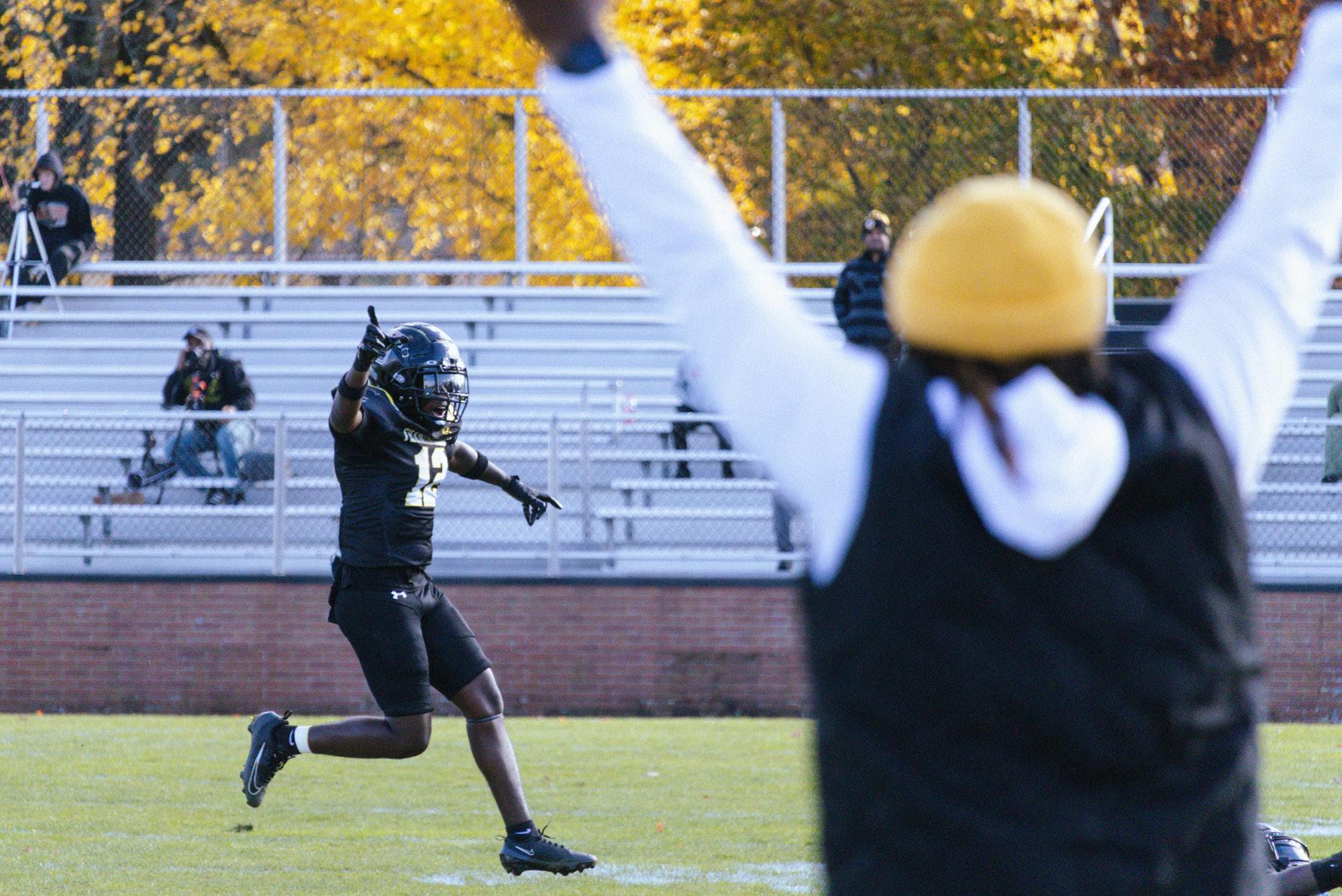
EJ Nichols, wide receiver coach for the football team, said Black History Month allows him to reflect on his role as a Black coach, adding it is “important to look back on how far we’ve come as a whole - not necessarily looking at color but giving opportunities to those who have not only knowledge of the game but also the desire to teach it.”
He credited his own path in coaching to the many people who influenced him along the way. “Some coaches I have had great experiences with, and some I have had bad experiences with. All in all, every coach impacted me and my growth and taught me valuable lessons that I still remember.”
Nichols said he is “blessed to have the opportunity” to work as a coach. “A lot of Black coaches came before me and have had a lot of success. Hopefully, one day, I can be up there with the greats.”
He said his coaching style focuses on connecting football lessons to everyday responsibilities. “Excuses are every coach’s pet peeve. I tell my guys they have to figure it out because just like their teammates and coaches depend on them, one day, their families will depend on them.”
He said what motivates him most is “the Framingham name, the competitive nature I have still burning inside me, the want to see guys progress and reach their full potential, and … the guys I played with in my last couple of years.”
Nichols is in his first year coaching for FSU, but he said he hopes to be remembered for his genuineness and love for the game, and as a “coach who vouched for them and had their back, all while holding them accountable and using a humble
but sturdy approach.”
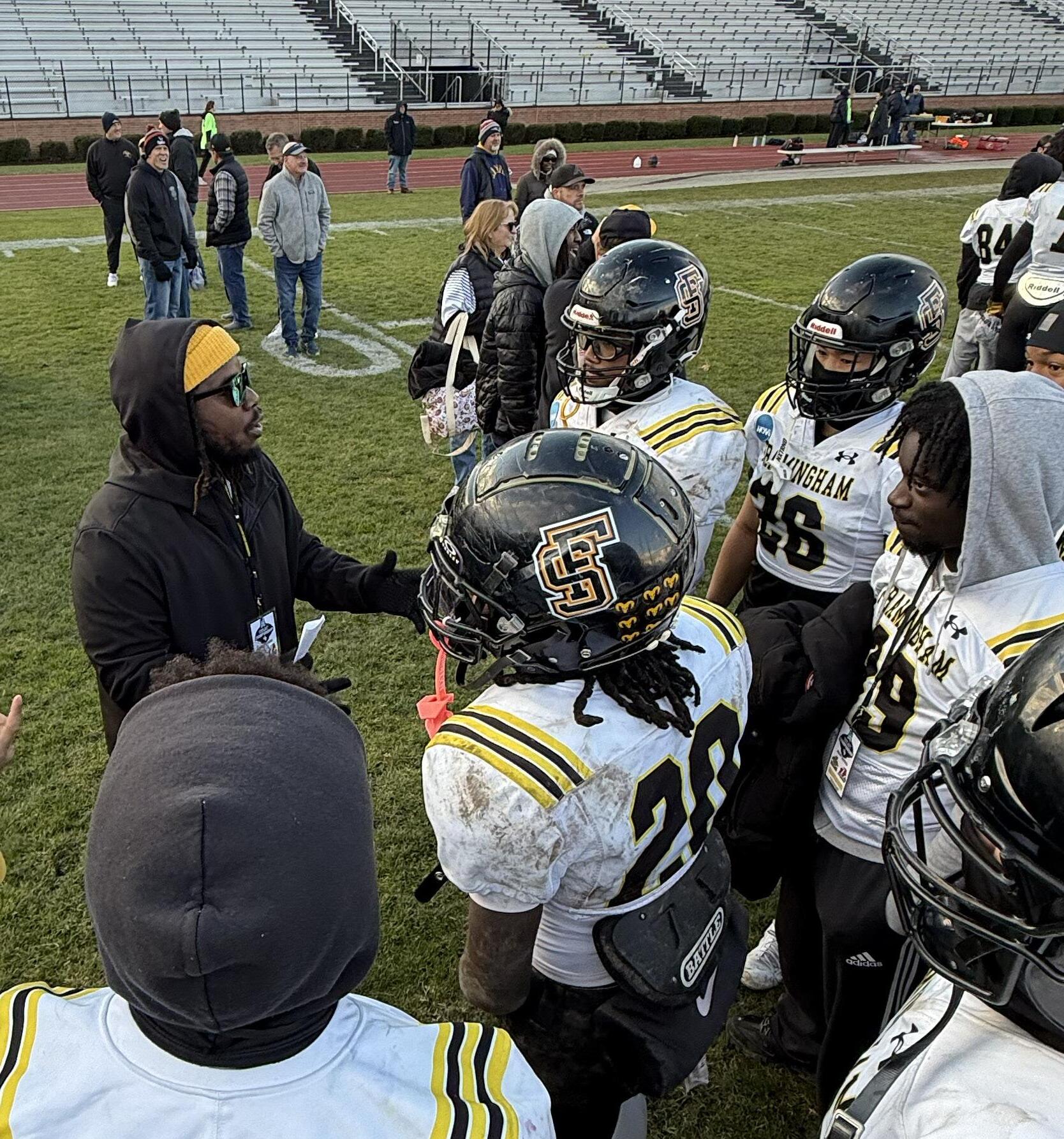
Lance Mitchell, running back coach for the football team, said, “Black History Month isn’t just about honoring the past - it’s about carrying it forward.”
Mitchell said, “As a Black college coach from South Florida, I see it as a reminder that I’m standing on the shoulders of people who fought for opportunities I now get to live out every day - the chance to lead, to mentor, and to compete at a high level.
“Personally, it pushes me to be intentional about how I show up. Professionally, it reminds me that my players are always watching. Representation matters. When they see someone who looks like them leading with discipline, integrity, and vision, it expands what they believe is possible for themselves,” he added.
Mitchell said he learned from Keith Byars and Cris Carter, who played for four and three different teams in the NFL, respectively. He said, “Being able to play and learn from men like that didn’t just inspire me - it showed me the blueprint. That’s when I knew coaching was bigger than football.”
Now working in college athletics, Mitchell said representation adds another layer to his responsibilities.
He said, “Being a young Black coach in college athletics today means carrying both purpose and pressure. I’m not just coaching the game - I’m representing possibilities for athletes who look like me and may share similar backgrounds.
“It means having to prove myself, often being over-prepared, and aware that my performance reflects more than just me. But it also means opportunity to lead differently, to mentor the next generation, and to help reshape what leadership looks like in this space. Most of all, it’s about pride, responsibility, and using my platform to make a lasting impact,” he added.
Adrien Gobin / THE GATEPOST
(Right) Head Coach Donald Morris Jr. speaking to his players on the sideline during the 2024-25 season.
Courtesy of Lance Mitchell
Black
coaches
Continued from Page 9
He said he has also seen how thoughtfully hiring new staff can influence team culture. “Over the past three seasons working with Coach TK, I’ve watched him intentionally hire former players and other men of color, creating a meaningful pipeline of opportunity.”
He said in his four years of coaching at FSU, “seeing that level of representation on his staff has given me a clear and powerful outlook on the importance of building diverse leadership within our program.”
Mitchell said his coaching extends beyond football funda-
mentals. “I try to teach my players discipline, accountability, and how to carry themselves as men. I want them to understand that how they show up in the classroom, at home, and in their community matters just as much as how they show up on Friday nights. … Football is the vehicle, but the goal is to prepare them for life.”
Mitchell worked as a Department of Children and Families worker, ran a foster care program, and now serves as a high school counselor. He said these experiences have helped him “understand that many young people need stability and guidance beyond the game. Coach-
ing isn’t just about football - it’s about mentorship, support, and helping them navigate life with confidence and purpose.”
He said his motivation to coach is “knowing I can be the person I needed when I was younger and someone who sees potential even before it’s fully realized. Watching athletes grow not just in skill, but in confidence and character, is what makes it all worth it.”
Mitchell said the story is still being written, but he hopes his players “remember how I believed in them on days they didn’t believe in themselves. I want them to carry forward the lessons of discipline, joy, resil-
ience, and love for the game, and one day pour that same energy into someone else, creating a ripple effect.”
He said, “Supporting diversity in leadership within college athletics requires systemic change, rethinking structures, investing in people, and holding institutions accountable. When done thoughtfully, these efforts not only create fairer opportunities but also strengthen programs by bringing broader perspectives, innovation, and credibility to collegiate sports leadership.”
CONNECT WITH IZABELA GAGE igage@student.framingham.edu
Women’s basketball massacres MCLA
By Taylor Kimmell Asst. Sports Editor
The Framingham State Rams outscored the MCLA Trailblazers in all four quarters of their Feb. 14 conference matchup.
This 94-35 victory improves the team’s conference record to 10-2 and their overall record to 14-9.
A 3-point jump shot by senior Kiara Cerruti 40 seconds in opened the scoring, with the first points going to Framingham.
A jump shot by sophomore Jacquelin Schels on the Rams’ next possession increased their early lead.
Over the next 3 minutes, despite failure to score on their end, Framingham maintained a steady defensive wall, preventing MCLA from sinking a shot.
A foul by the Trailblazers at the 6-minute mark allowed sophomore Faith Greene to sink a free throw, which was followed by a layup from Schels less than a minute later.
MCLA finally put points on the scoreboard when, around 5-anda-half minutes in, the Trailblazers broke through FSU’s defense for a jump shot.
Fouled on the next play, Schels scored on a free throw.
With 3 minutes left in the first quarter, the Trailblazers were able to score again, tallying a 3-pointer. Ten seconds later, Schels battled back with one of her own.
MCLA broke through again with a layup, but it was quickly followed by another layup from
Greene.
After the Trailblazers missed their next jump shot attempt, freshman Zaria Anderson got the defensive rebound, and the ball made its way down the court for a Schels 3-pointer.
MCLA made one more basket as the clock ran out in the first quarter.
A jump shot by MCLA kicked off action in the second quarter, quickly followed by a 3-pointer by Schels off a pass from junior Ava Mckeon.
Captain Kelsey Yelle, a senior, made a layup just 40 seconds later to bring the score to 22-11 in favor of the Rams.
A little over a minute later, Captain Abigail Martin, a senior, made a layup.
Four minutes in, Greene scored on a layup, followed by one from Yelle within 20 seconds of the first.
On Framingham’s next possession, Mckeon scored 3 points on a jump shot.
When FSU regained possession following two unsuccessful drives by MCLA, Greene brought the ball to the hoop for a jump shot.
Within the next 7 seconds, Anderson snagged the rebound when the Trailblazers missed a layup and brought the ball down the court for a Greene-assisted jump shot.
MCLA gained possession, their next shot bouncing off the rim for Martin to grab the rebound. She sent the ball to Anderson, who passed to Cerruti for a 3-pointer.
After the Rams committed
a foul, the Trailblazers earned three foul shots, all of which they were able to score on.
A 3-point jump shot by freshman Evi Higgins brought the score to 41-14 with 2 minutes and 40 seconds remaining before the half.
Anderson put the next points on the board for FSU with a 3-point jump shot.
MCLA broke through once more before the half, sinking a 3-pointer.
With 1 second left on the clock, Higgins scored a 3-point shot to increase the Rams’ lead to 47-17.
The Trailblazers were first to the net in the second half, scoring on a jump shot before Schels made a layup for FSU 8 seconds later.
Two minutes later, Greene scored again for Framingham, tallying points on a layup.
On their next possession, the Rams brought in more points with a 3-pointer by Schels.
Fouled by FSU 20 seconds later, the Trailblazers were given two foul shots, only making one.
Yelle brought the score to 5820 Rams in the following 30 seconds, scoring on two layups.
After she was fouled by an MCLA defender, Anderson sank one of her awarded foul shots.
The teams traded jump shots in the next 30 seconds, with one from Anderson coming from behind the 3-point line.
Shaelagh Green made a layup at the 4-and-a-half minute mark, and the Rams’ defense kept the Trailblazers at bay after the ensuing turnover.
Fouled by MCLA, sophomore Haleigh Cyrus stepped to the line for two foul shots, sinking both into the net.
Framingham kept on the offensive, with Yelle making a layup, Cyrus scoring on a 3-point jump shot, and Green netting a jump shot in the final 2-and-ahalf minutes.
A 3-point jump shot from Green opened scoring in the game’s final quarter, followed by a layup from Cyrus in the same minute to bring the score to 7822 Framingham.
Following an unsuccessful MCLA possession, Green capitalized on a defensive rebound and scored on a jump shot.
A 3-pointer by Higgins increased the Rams’ already massive lead, prompting a stronger press by the Trailblazers’ defense that prevented FSU from scoring for the next three possessions.
Sophomore Hailey Ring broke through MCLA’s wall of defend-
ers with a layup, restarting the action on the court.
MCLA tallied points on a jump shot on their next play, but the Rams followed closely with a 3-pointer by Higgins.
The Trailblazers capitalized on their next two possessions, scoring on a 3-pointer and a jump shot.
With 4 minutes to go, Cyrus was fouled by MCLA’s defense, allowing her to sink two foul shots.
The Trailblazers scored twice in the following minute with two 3-pointers to bring the score to 90-35, still overwhelmingly in favor of FSU.
With a minute left on the clock, Cyrus scored on a layup, and, after strong defense from FSU kept MCLA’s final drive scoreless, sophomore Bridget Trainor netted a jump shot.
The final 17 seconds ticked down, and the match ended with a startling 94-35 victory for the Rams.
Trainor said, “Having a lead to start the game helps the team grow in confidence and gives us momentum to keep building off it.”
Trainor added taking such a commanding lead early on in the match and building on it exponentially throughout the remaining quarters shows other teams in the conference that the Rams are ready to compete.
She said, “These games help us show the MASCAC what we are capable of and also grow our confidence in our ability to beat any team in the conference.”
The Rams fell to the Bridgewater State Bears 77-70 in a conference matchup Feb. 18, bringing their conference record to 10-3 and their overall record to 14-10.
FSU hosts the Anna Maria Amcats for their final conference match of the season Feb. 21.
Schels said with the regular season coming to an end, the Rams are proud to be coming into postseason play with the number two spot in the conference.
She said the team hopes to end their year off strong with a “big run in the playoffs.”
Trainor said, “Wrapping up the season, I think everyone has the same goal of winning the MASCAC and beating any team to get there.”
Stats sourced from fsurams.com and MASCAC.com
CONNECT WITH TAYLOR KIMMELL tkimmell@student.framingham.edu
Adrien Gobin / THE GATEPOST
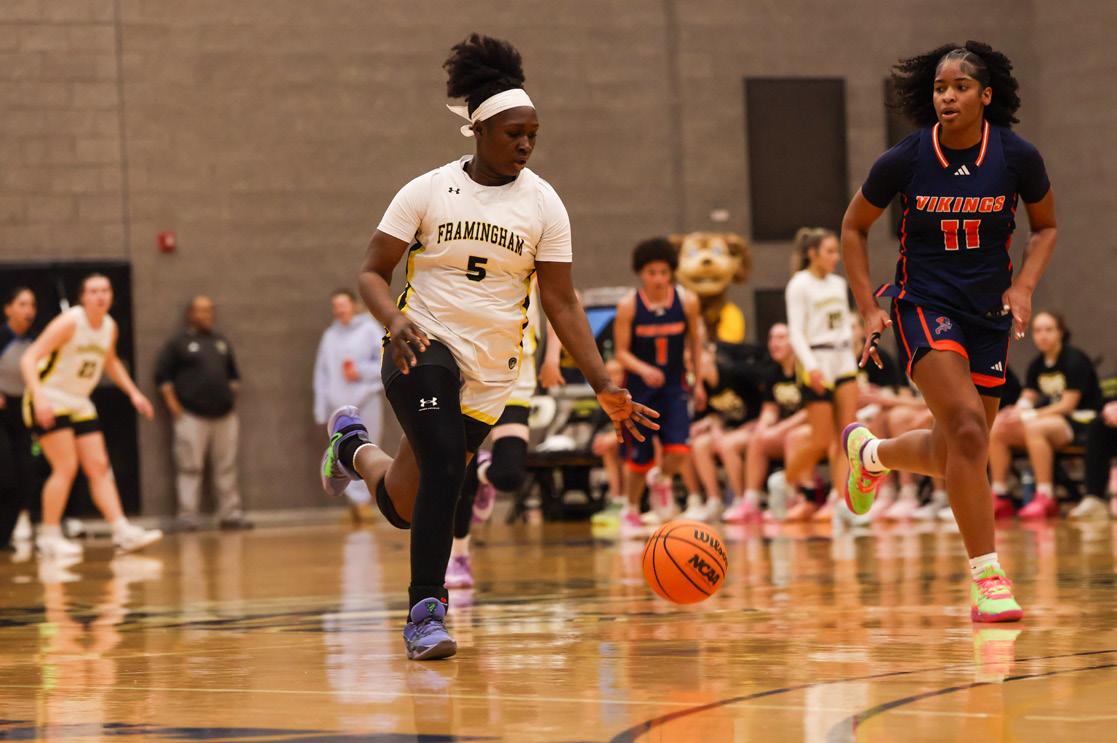
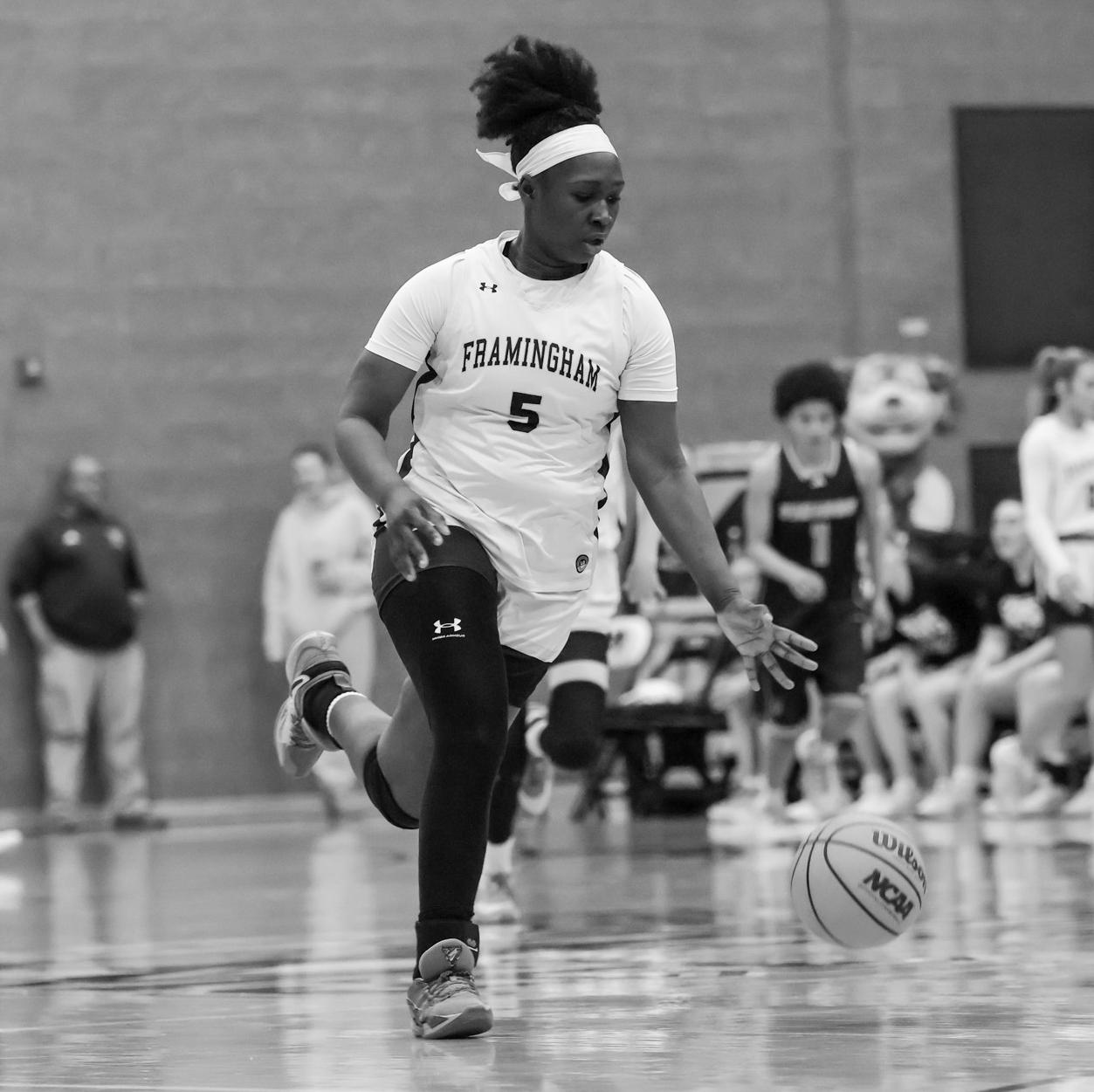
Faith Greene dribbling the ball in win against Salem St. on Feb. 7.
Men’s basketball defeats MCLA in overtime thriller
By Izabela Gage Sports Editor
After a tight contest for the After a tight contest for the lead, the Framingham State Rams were strong in overtime to come out on top over the MCLA Trailblazers 86-81 in home court MASCAC action Feb. 14.
This win evens their conference record to 6-6 and brings their overall record to 13-10.
Junior Lorenzo Washington said, “Being 6-6 in conference puts us right in the mix. It resets the mindset. Now, it’s about momentum and peaking at the right time. We know every game matters from here on out, so this win gives us confidence heading into the playoffs.”
The Trailblazers took the early lead after making a 3-point jump shot less than 30 seconds into the game.
After over a minute of uneventful play by both teams, junior Fallou Koite and Washington both made layups on consecutive Rams’ possessions. Washington was fouled by MCLA’s defense, earning another point for Framingham.
Trailblazer Colin Quinn made another 3-point jump shot to put MCLA ahead 6-5.
Junior Joshua Saint Jean earned 2 points for the Rams on a layup, but the Trailblazers responded with one of their own to keep the lead.
On the following play, Saint Jean was fouled, and he easily sank both free throws.
Less than 25 seconds later, MCLA scored on a jump shot to gain the lead once again, 10-9.
MCLA’s Jaxen Potter and Saint Jean both made layups, and senior Vondre Chase drained a 3-pointer, assisted by Washington, bringing the score to 14-12.
The Trailblazers did not let the Rams stay in the lead for long, scoring on a 3-pointer of their own only two plays later.
After unsuccessful drives from both teams, Saint Jean and Potter both scored on layups, and MCLA remained up by one.
Just over a minute later, junior Isiah Alexander made a steal before the Trailblazers fouled Koite, who made both free throws to take the lead.
Washington increased the margin for Framingham on the next play with a layup, bringing the score to 20-17.
A foul by the Rams gave the Trailblazers an opportunity to close the gap, but only one of the two awarded free throws resulted in a point.
Koite, assisted by junior Makyle Hayes, extended the lead on the next drive with a 3-point jump shot.
Framingham started to gain momentum, and Koite made another 3-pointer to put the Rams ahead 26-18.
Potter scored on a layup, putting 2 more points on the board for the Trailblazers.
Another foul by Framingham gave MCLA’s Craig Williams two free throws, both of which he made, to bring the score to 2622.
Saint Jean was fouled less than 30 seconds later, and he sank both free throws to take a 6-point lead.
Williams made another 2 points for the Trailblazers on a
layup, and after a Rams’ foul, MCLA shrank the deficit to 28-26 with two successful free throws. With 3-and-a-half minutes remaining in the first half, Saint Jean was fouled and made both free throw shots.
After a turnover by the Trailblazers, Alexander scored on a layup, extending the Rams’ lead to 32-26.
On the ensuing drives, Williams and Koite each earned 2 points on layups for their respective teams, bringing the score to 34-28.
MCLA worked to close the gap and scored on another layup, but a subsequent foul on Koite gave him two free throw attempts, both of which he made, preserving the Rams’ 6-point lead.
Williams made a 3-pointer for MCLA, and the first half ended with the Rams up 36-33.
Koite scored on a layup less than a minute into the second half.
After a missed layup by the Trailblazers, Saint Jean earned 2 points on one of his own.
MCLA tried to close the gap with a 3-point jump shot and a layup, but Alexander drained a 3-pointer to keep Framingham in the lead 43-38.
The next 2-and-a-half minutes were quiet for both teams until Chase sank another 3-pointer for the Rams. But the Trailblazers did not let it go unanswered, scoring one of their own only 11 seconds later.
On the next drive, Chase was fouled on a layup, and he made the free throw, giving the Rams an 8-point lead, 49-41.
Williams matched Chase’s effort with a layup for MCLA on the next play, but was fouled and made the awarded free throw.
The Trailblazers fouled Koite, and he converted both shots to points for the Rams.
Washington kept the momentum going, scoring on a layup and putting Framingham up by 9, 53-44.
Both teams didn’t put any points on the board for the next 2 minutes, until MCLA’s Colby Burleson made a 3-pointer. Alexander answered with one of his own, maintaining Framingham’s lead.
On the next drive, the Trailblazers scored on a layup, and due to a foul by the Rams, they earned a free throw shot, which was successful.
Washington worked the ball down the court, and from his pass, Saint Jean made the layup, bringing the score to 58-50.
Burleson made a layup for the Trailblazers, but graduate student AJ Thompson answered with one of his own on the Rams’ next possession, keeping an 8-point lead.
Just over a minute later, MCLA committed another foul, and Chase made one of his two free throws.
With 6-and-a-half minutes left in the game, Thompson gained possession off a rebound. He passed it to Washington, who moved the ball down the court before sending it to Saint Jean, who dunked it into the basket, making the score 63-52.
Quinn made a 3-pointer for the Trailblazers, and after a few uneventful drives from both teams, Williams was fouled and scored on both awarded free throws.
The Rams gained possession,
and Alexander connected a quick pass to Saint Jean, who went for a layup, putting Framingham up by 8 once again.
MCLA responded with a layup of their own by Williams, but Saint Jean kept the Trailblazers at bay with another dunk, assisted by Washington, on the following play.
Another 3-pointer by Quinn contributed to the Trailblazers’ comeback, but Koite drained one of his own less than 30 seconds later.
The Trailblazers scored on another 3-point shot, which kickstarted some renewed energy with just over 3 minutes left in the half.
MCLA’s Kamau Franks made two free throws, and on the next play for the Trailblazers, Quinn scored on a layup as he was fouled by Framingham. He then scored on the free throw shot, successfully tying the score 70-70.
Saint Jean earned two free throws on the Rams’ next possession, and he easily made both, but the Trailblazers made a layup 15 seconds later to tie it once again.
Hayes was fouled by MCLA, and he scored on one of the two free throws, reclaiming the Rams’ lead.
Quinn made another 3-pointer for the Trailblazers, though, gaining a 2-point lead for MCLA for the first time since the start of the game.
With 18 seconds left in regulation, Hayes made a clutch layup to tie the score once again, sending the game into overtime.
Williams scored on a layup 15 seconds into overtime, but Saint Jean was fouled 30 seconds later, and he earned points on both free throws, tying the score 77-77.
MCLA took the lead two plays later, though, as Framingham committed a foul and Franks scored on one of the two awarded shots.
Junior Domonick Victor made a layup, and Hayes scored two points on free throws after being fouled, giving the Rams the lead 81-78.
Hayes put two more points on the board on a layup, and the Trailblazers fouled Washington,
who made both free throw shots. With Framingham up by 7, Williams drained a 3-pointer in an effort to close the gap with 25 seconds remaining in the game. Washington was fouled once again, and he made one of the two shots to end the game with a score of 86-81.
Washington said, “We stayed disciplined. MCLA runs their sets well, so it was important for us to communicate and contest every shot. In overtime, we locked in even more defensively and focused on getting one stop at a time. Offensively, we slowed down, executed our plays, and trusted each other. We didn’t try to do too much - we just stuck to what works and stayed composed.
“An overtime win builds toughness. It shows we can handle pressure and finish games,” he added.
Koite said, “We know MCLA has good offense and they move a lot, so we had to stick to our principles and stay locked into what they do.”
Most recently, the Rams fell to the Bridgewater State Bears 7469 in another conference matchup Feb. 18.
This win brings their conference record to 6-7 and their overall record to 13-11.
The Rams host the Anna Maria Amcats for their last conference game of the regular season Feb. 21.
Washington said going into the postseason, the team is “focusing on consistency, details, and effort. The little things win games this time of year - rebounding, defense, and communication.”
Koite said the team’s goal is to earn a spot in the MASCAC Championship game.
Washington said, “We want teams in the MASCAC to know we compete every possession and we’re not an easy matchup. We’re building toward something bigger, and we plan to finish strong.”
Stats sourced from fsurams.com and MASCAC.com CONNECT WITH IZABELA GAGE igage@student.framingham.edu
Adrien Gobin / THE GATEPOST
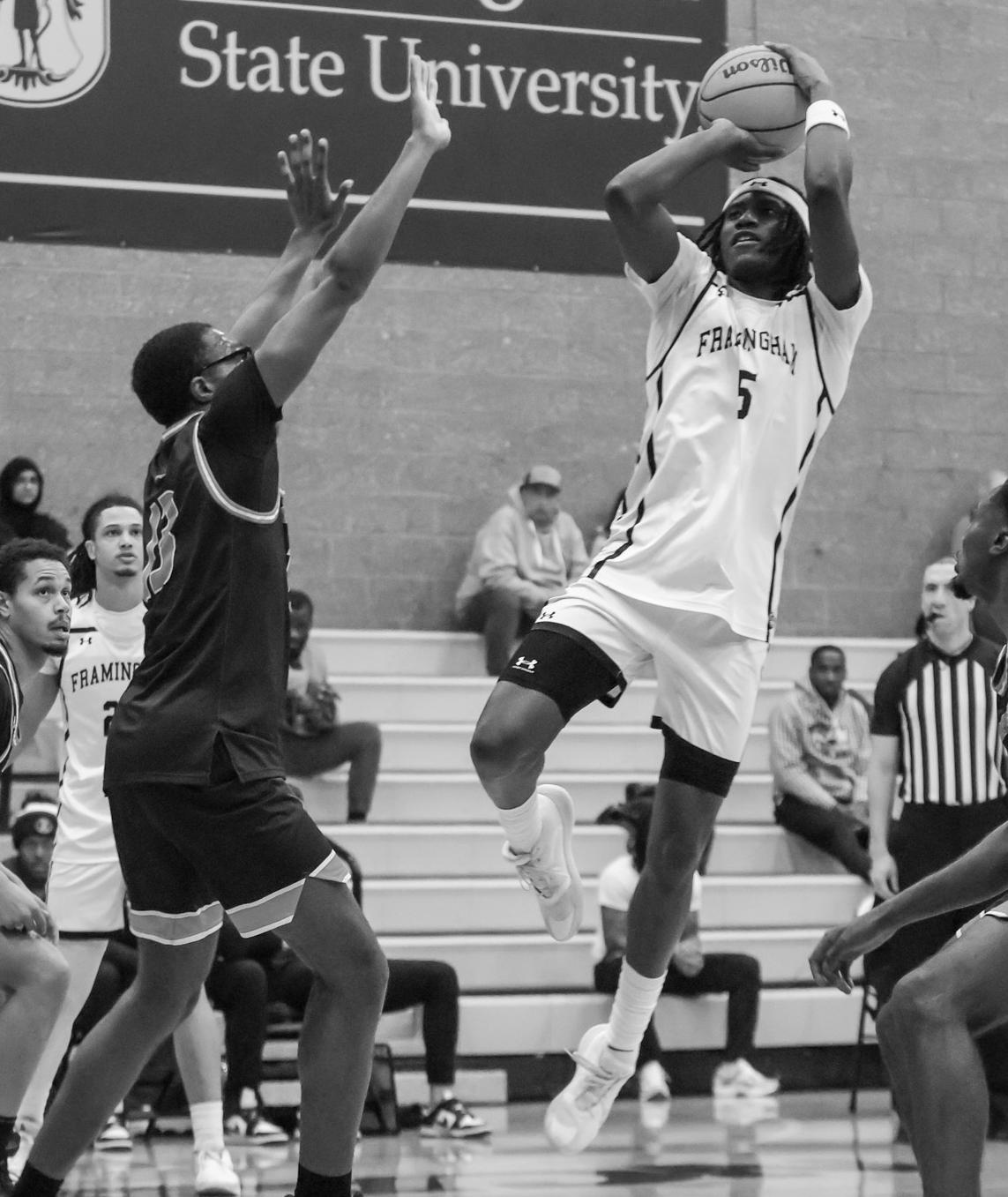
(Right) Fallou Koite going for a jump shot in loss against Salem St. on Feb. 7.
ARTS & FEATURES
Black Student Union is here to stay
By Sophia Oppedisano Editor-in-Chief
Senior Laila Jenkins knows exactly who she is.
While she describes herself as shy and softspoken, she said those traits only apply to herself. When it comes to others, Jenkins wants to advocate for them and ensure everyone is included to the best of her ability as a campus leader - no matter what.
Jenkins, a psychology major and president of Framingham State’s Black Student Union (BSU), arrived at Framingham State during her sophomore year after transferring from another state institution.
“I just felt like this place was way more comfortable than any other school I’ve been to,” she said. “I took a tour here on my own, and I just saw the campus, and it honestly just felt like home, and it was cheaper. … It just really worked.”
Jenkins was born in New York, but she was raised and attended school in Springfield. She said most of her K-12 experience was at predominantly white institutions (PWIs), and her first university experience was much the same.
“I never learned anything new about Black history or Black culture in school other than what my family taught me,” she said.
Her experience at Framingham has been a stark, refreshing contrast.
“The diversity on this campus, and actually seeing people that looked like me, was a real shock factor. Going from a PWI to [Framingham] was really very interesting. I didn’t know there were schools like this in Massachusetts,” she said.
She said her experience at her previous university was “unsettling” and riddled with experiences of microaggressions and classmates and faculty turning a blind eye to racism on campus.
she said. It was a lot of Hawaiian culture, but it was also a lot of just openness to other cultures, which I really love.”
Between her positive experiences in Hawaii and considering the lack of diversity and acceptance back at home, Jenkins decided it was time for a change, and Framingham State offered her new opportunities.
Before she even arrived on campus, Jenkins said she was looking at the Framingham BSU’s Instagram page and planning to join. “I just really loved all the events they were doing,” she said.
She started as an event coordinator - her passion for planning events, sorting out details, and making her ideas come to life lent itself to the needs of BSU at the time.
More than that, though, Jenkins said, “It’s just really important to me to be part of Black culture wherever I am. Whether it’s on campus, in the real world, or just on social media, it’s always important to me to advocate for people of color and create a community where everyone can decompress after school and finals and stuff.”
Affinity groups like Black Student Union are incredibly important resources for students to achieve a sense of belonging. Jenkins said it’s easy to feel like engaging in anti-racism or supporting Black businesses is isolating if the people around you are not also participating in making those changes.
“I feel like affinity groups show people that you’re not doing it alone, and you’re not alone in supporting others,” she added.
During her time as event coordinator, Jenkins worked for The Center for Student Experience & Career Development (EXP) and found that BSU was struggling to stay in good standing as a club on campus in accordance with EXP guidelines.
When she became president in the fall, Jenkins stepped into the spotlight and away from being a self-described shy, “off-to-the-side” kind of person. She was always focused on making an impact “from behind the scenes,” but now, her presidency has made her into “someone who people look to instead of someone who people have to find out about.”
As she found her footing in leadership, Jenkins said a Black leader who inspired her was Harriet Tubman.
She said, “She was a great leader, and she had a lot of guts to do things that I don’t think anyone would really just be open and willing to do. She definitely inspires me.”
“Use this month as a blueprint, and live your life in love and celebration.”
- Laila Jenkins Black Student Union President
Jenkins participated in BSU there as well, but both of her advisors, who were active in the Black community on campus, were let go. “I don’t know why. It was kind of just like, ‘You guys don’t have advisors anymore.’ They were really important to the culture and the Black community on campus, and for them to just be let go and not really talked about didn’t sit right with me,” she said.
After the loss of both advisors, Jenkins traveled to Hawaii for a semester. “There, it was just so much diversity,”
“I had a lot of knowledge about the background of the many things that go into clubs,” she said. Duties typically completed by BSU club officers were falling through the cracks, and Jenkins decided to step up to the role of president.
“I was open to it. I wasn’t like, ‘I will be president,’ but it was more like … even if it wasn’t me, I just wanted to guide whoever was president to make sure things were getting done. It would be horrible for a club like Black Student Union to end because of something silly, like not going to a meeting or not filling out forms,” Jenkins said.
Jenkins admires Tubman’s faith, her selflessness, and her heroism. “She could have just escaped and been free, but she went back and kept going back. I feel like that is really important to me, because that’s really who I am as a person. I’m not going to cross the finish line if everyone else isn’t.”
Jenkins said she is most proud of the direction she is guiding the club in. “We’ve tried to do more community-based things, like collabing with other clubs and being more open to other people. I feel like before, the club was very closed off. No-
body wanted to collab with us. Businesses didn’t want to work with us,” she added.
Overall, her vision for BSU is for the club to act as a resource for students. She said there are other clubs on campus that students can participate in that boost their resumes. “I would like BSU to be a club that does that for people of color, and just minorities in general. That’s my end vision.”
As she reflected on Black History Month, Jenkins said this month means “progression. We’re going in the right direction.
“In a world where it can feel like everything is declining and everything is going wrong - which it is, there are a lot of things that can be worked onI feel like Black History Month in itself is a time for everyone to pause on everything else that’s going on and look at how far we’ve made it. And just to create a mentality of what we can do if we all work together and we push back against oppression and discrimination,” she continued.
Above all, Jenkins said Black History Month signifies a time of appreciation.
“Even though I feel like Black people should be appreciated all the time, I feel like this month specifically, we can actually see that happening,” she said.
As for our campus community, Jenkins wants everyone to remember: “Don’t contain your love to just a month.
“Use this month as a blueprint, and live your life in love and celebration. Be curious in a respectful way about other cultures, be inclusive, and care about everyone,” she said.
CONNECT WITH SOPHIA OPPEDISANO soppedisano@student.framingham.edu
Courtesy of Laila Jenkins
ARTS & FEATURES
Coleman & Burke roll the DICE
By Dylan Pichnarcik Associate Editor
By day, Vice President of Diversity, Inclusion, and Community Engagement Jeffrey Coleman and Center for Inclusive Excellence Director Jerome Burke sit on planning boards and task forces promoting FSU’s commitment to diversity, equity, and inclusion.
put, and Coleman encourages further collaboration on events held in the CIE.
Along with student programming at the CIE, Coleman said a major highlight of the division is an academic calendar that includes all religious holidays that are observed during academic sessions.
Coleman said the calendar, created by the staff at the Hen-
ment.
Coleman said he is “always amazed by the creativity that comes out of the CIE. I think Jerome has done just a wonderful job of bringing out-ofthe-box thinking in the way we do not just diversity programming, but just student programming.”
He added when attending events at the CIE, he sees
themselves. So they are very good at continuously reaching out as part of the University community, both internally as well as externally, and making those connections.”
Senior Taimoor Khan, a diversity peer influencer in the CIE, said working at the Center has been “one of the highlights of my campus experience here.
“I think Jerome really em-
By night, the benefits of their work are on display in the form of events, talks, and trips that promote acceptance and a deeper understanding of the many cultures that make up the Framingham State community.
Coleman said his goal in working with inclusion and community engagement is to be aligned with the perspective of an undergraduate student.
“I think about what I was experiencing in college as an undergrad, and then some of the barriers I ran into, and then some of the ways that I learned to navigate those barriers and see how we could incorporate that in a routine way of doing things,” he said. “Even in our programming, that’s the lens that I take.”
He added he also thinks about skills students may need going beyond their time at FSU and how programming can provide these skills.
To that end, various events are held in the CIE, including diversity dialogues, educational conversations about social issues, and programming around heritage months.
Burke said the programs focused on heritage months are driven by community engagement.
Students and community members can vote on specific events they would like to see held, along with theme and program planning.
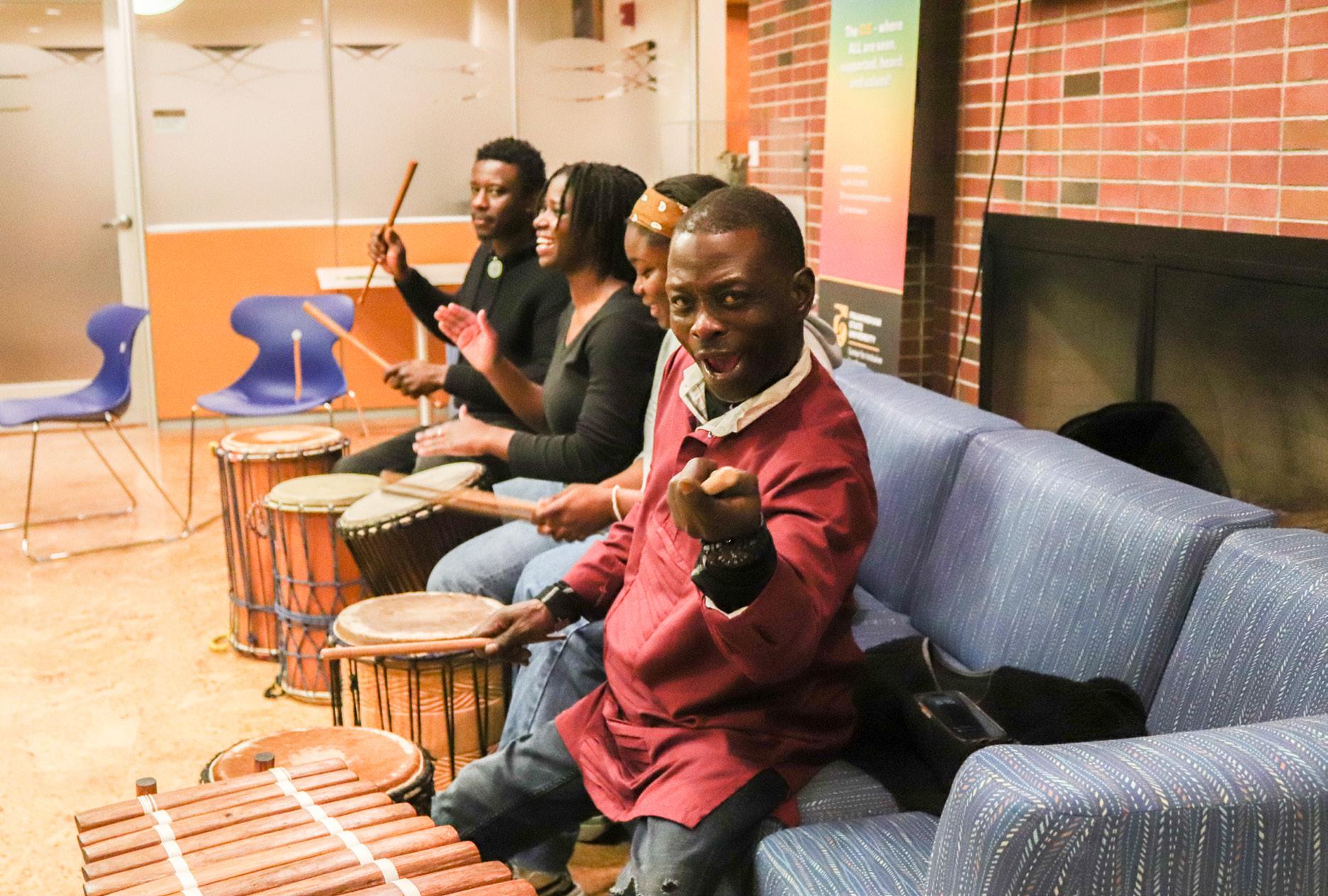
Burke said the events are also driven by collaborations with student affinity groups such as the Black Student Union, Brother 2 Brother, and the Afro-Caribbean Dance Group.
The CIE also partners with Residence Life staff and the Center for Academic Success and Achievement to meet students in spaces they are comfortable in and to provide resources.
Heritage month programs are also fueled by faculty in-
ry Whittemore Library, reflects all religious holidays throughout the year and is a resource for students to direct faculty to information concerning holidays they recognize.
The calendar is accessible through the division’s SharePoint site and can be used if a holiday interferes with a class’s coursework.
Coleman said if students are “in a class and there’s an exam or a paper due, then you can say to the faculty member, ‘Oh, I’m celebrating Ramadan, and I have to do a number of things to prepare for it’ and ‘I’m not really at the same place that I would be at to take an exam if I wasn’t fasting,’ or ‘if I wasn’t focusing on doing some some things for my religion.’”
Future initiatives planned by the division include an upcoming service trip.
The division and the CIE will be setting their sights on New Orleans for the upcoming spring recess with a service trip led by Burke.
He said there will be 10 attendees, including 7 students.
The project, in partnership with Hands On New Orleans, will focus on cultural immersion with students working to perform beautification and community assistance projects, all while enjoying the rich history and culture of the city.
Burke said the trip is designed to give back to students.
“Having this experience, they then think of FSU as an institution that cares about them, like, ‘I’m a junior. Hey, I have this experience. I’m staying here. This institution has invested in me. … You can think about this as something that you’re sharing with your family,” Burke said.
As two leaders of diversity, equity, and inclusion initiatives, Burke and Coleman work closely with each other to plan events and work toward promoting community engage-
students engaging and gets a “sense of appreciation” from their attendance. Events mean “a whole lot to the students. It energizes me because I’m like, ‘This is why we’re doing this work.’”
Burke said he appreciates Coleman’s detail-oriented approach to the goals of the division.
He added Coleman is also talented at planning ahead.
“Sometimes, it does take a lot with students. It’s always moving. … At the start of the semester, we can give a full list of things that we intend to do.”
President Nancy Niemi said she is encouraged by the work undertaken by the division and the initiatives put forth by Burke and Coleman.
“I really love it that the CIE seems to be becoming a place where students who are underrepresented in any way they feel that they define that find a home, a bit of a physical home, but really a sense of belonging within programming and the work that the CIE has created,” she said.
She added the work of Burke and Coleman is starting to shape the identity of the University. “Our identity, our living to the truth, our identity as being really anchored in social equity and justice. It is hard to do, because those are great concepts, but how do you put them into practice?”
Niemi said she admires Burke and Coleman’s “understanding that equity work is part of human work. That’s their being. That’s how they live. So that’s manifested in all the work that they create. So I really admire that about them. They’re wonderful human beings, and that’s one of the reasons why they are so successful at their positions. I think, too, they’re also just always willing to work together.”
She added, “They understand that they’re not islands unto
bodies the idea of, if you have an idea and you want to make it happen, he is that person that you will go to to get support from. Especially when I transferred here, I was looking to kind of create a space on campus for myself, and I came into this job by chance. I found it through Handshake, and I didn’t know that getting to work with Jerome was going to be such a great experience.”
Khan is also a member of the Muslim Student Association, and Burke has worked with them to create a prayer space on campus for individuals of all faiths.
He added heritage months are a great way to unify the student body. “I feel like getting to experience a different heritage is important for all students, and the CIE works really hard to bring events and programming to campus so that students can experience different heritages, different cultures, and different religions.”
Junior Yair Rachmany, a diversity peer influencer, said working with Burke in the CIE “is really inspiring. One of my favorite things about working for Jerome is getting to see behind the scenes of all the events that we create, and seeing it all come to life, and helping brainstorm ideas on how we can make the campus more inclusive.”
Senior Izayah Morgan, a diversity peer influencer at the CIE, said, “Jerome is one of the best bosses I’ve had. He’s very understanding, very accommodating, and just a great guy. Dr. Coleman is also a great guy. He makes an effort to show up for every single event we do, and you can definitely feel his presence, which is always appreciated.”
CONNECT WITH DYLAN PICHNARCIK dpichnarcik@student.framingham.edu
Dylan Pichnarcik / THE GATEPOST
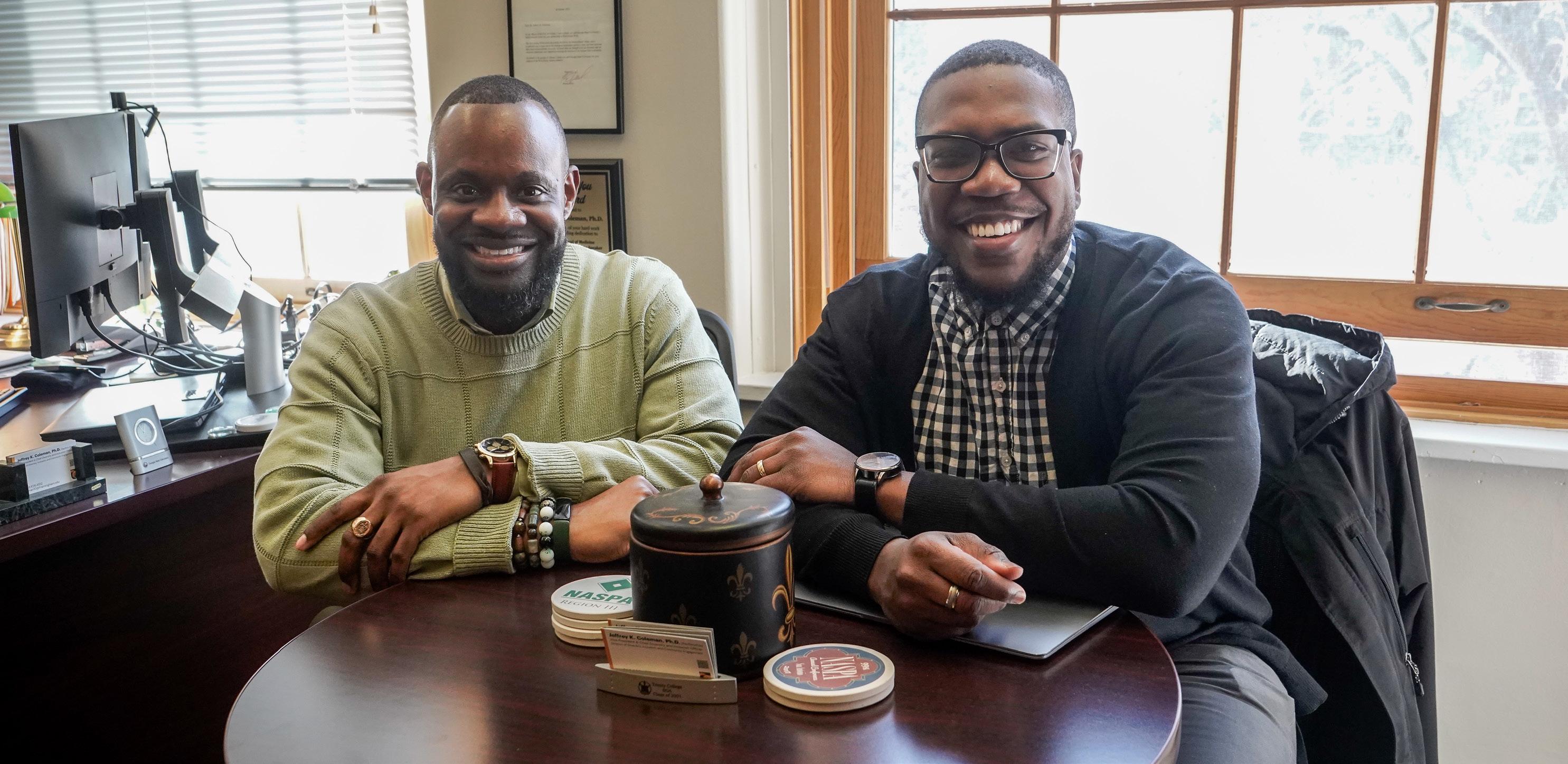
(Left) Jeffrey Coleman and Jerome Burke sitting at a desk in Coleman’s office.
MLK panel discusses justice, equity, and service
By Sarah Daponde Interim Arts & Features Editor
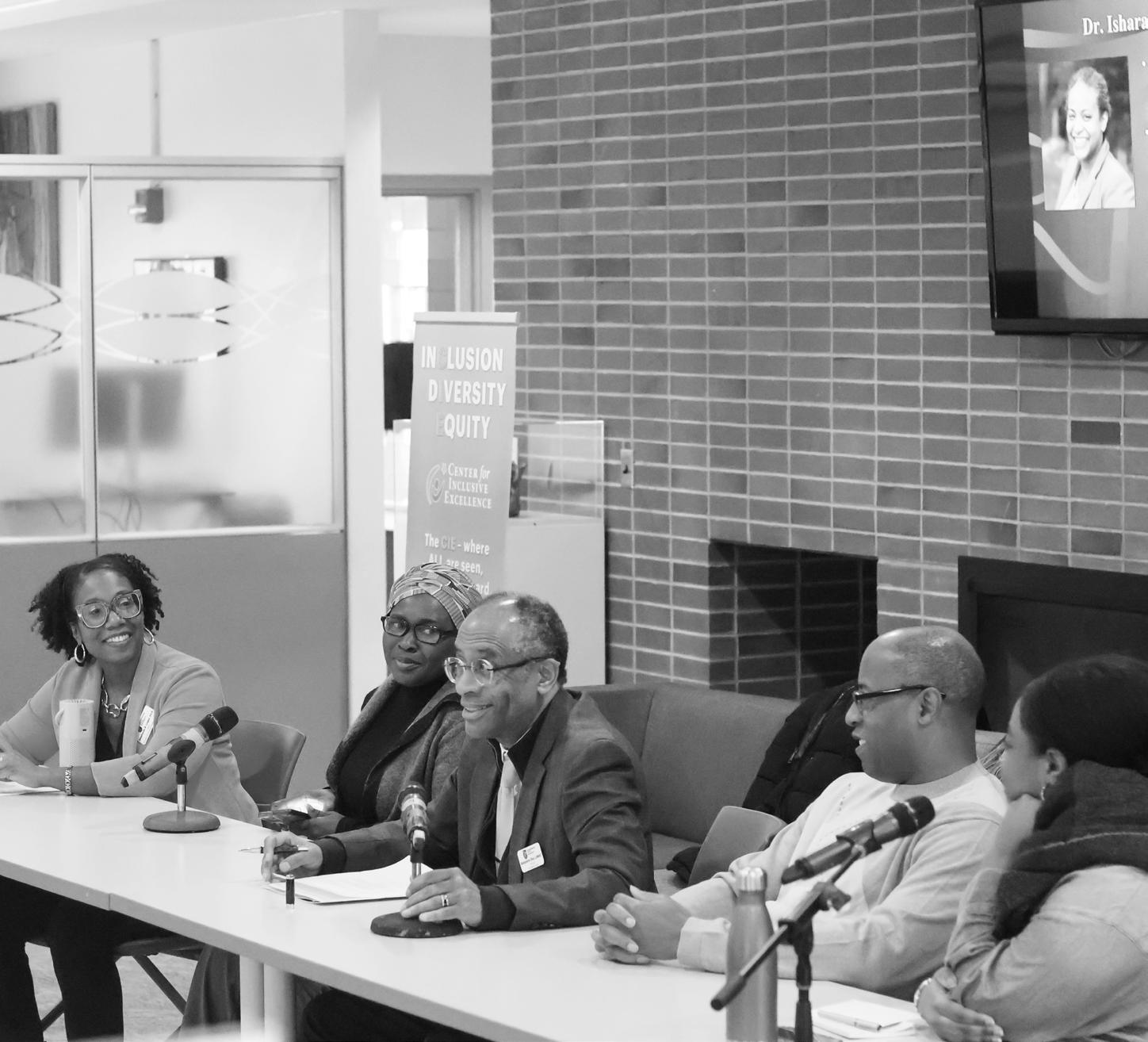
The Center for Inclusive Excellence (CIE) hosted a panel of FSU faculty and administrators to discuss the impacts of Martin Luther King Jr.’s teachings on their careers, identities, and personal lives on Feb. 18.
The panel included Stephanie Logan, dean of education and social services; Vivian Okyere, access services librarian at the Henry Whittemore Library; Benjamin Day, director of the Framingham State Counseling Center; David Baldwin, director of Human Resources; and Tatiana Johnson-Boria, a visiting lecturer in the English department.
Jerome Burke, director of the CIE, served as moderator for the event, which he called an “honor and a privilege.
“We will explore Dr. King’s work and his personal impact in our communities and lives,” said Burke.
Johnson-Boria said she recently reread King’s “Letter from Birmingham Jail,” and thought about how it impacted how she teaches.
“I’m also a writer and an artist, so I think a lot of what his work has influenced me to do is figure out how to harness language in powerful ways,” she said.
Baldwin said the first time he heard King’s “I Have a Dream” speech, he was deeply impacted, and has a picture hanging in his office with the speech written on the bottom, which he sees every morning.
“I try to live to that hope of
treating everyone with respect and kindness and compassion,” he added.
Day said he did not think he would be where he is in life if not for the work King did.
Okyere said King “didn’t knock all the walls down, but he punched a hole through, so I’m sitting here today, enjoying what he started.”
King taught her to have empathy for others and the patience to move forward through life, she added.
Logan said King taught her when a moment to make change opens up, it is important to “lean into it,” and step into the role.
“So when the door opens, the path opens, and I’m given an opportunity, I lean in - because you never know,” Logan added.
The panel shared their experiences with volunteer work, and how they make an effort to impact their community.
Logan said King’s teachings about class inequality and her experience working in classrooms inspired her to donate her time at a local food pantry. “No one in this country should be hungry,” she added.
Okyere said she tries to embrace others’ cultures and make everyone feel like they are included. She shared the quote, “The child who is not embraced by the village will burn it down to feel its warmth.
“Create the community where they feel heard, they feel loved, they feel they can voice what is on their mind,” she added.
Burke asked the panel what
Framingham State should be doing as an institution to keep King’s legacy alive.
Day said, “What kind of rights do you have if they can be taken away? … The struggle is forever. There is no retirement. There is struggle, and there is the need to always push, push, push.”
As an institution, he said it is important to maintain principles and beliefs, even if they are challenged.
Baldwin said, “We have a responsibility as an institution to not let the dream die.”
He said it is important to educate students on the past so they understand “how we got to where we are today, and how we were able to combat things
5 must-read books by Black authors
By Sophia Oppedisano Editor-in-Chief
When Carter G. Woodson established Black History Month 100 years ago, he declared, “We must give our own story to the world.”
Black authors have taken up Woodson’s call over the past 100 years and have been writing their stories for decades before it.
Novels and nonfiction works by Black authors are often overlooked by readers browsing for new titles, as many titles have been banned or stigmatized due to their content.
From classic literary fiction to informative nonfiction, here are five recommendations to add to your to-be-read list and engage with Black stories.
The Hate U Give
This one has been on my shelf for years. Angie Thomas’s 2017 novel focuses on Starr
Carter, a 16-year-old grappling with her identity as a poor, Black teenager attending a predominantly white, wealthy prep school.
Starr is split between her home life and her school life, code-switching between them and never feeling like her authentic self.
Her life is upended when she becomes the sole witness to the fatal shooting of her childhood friend Khalil by a police officer, pushing her to confront her identity and find her voice to protect herself, her family, and her community.
Thomas was inspired to write this novel after Oscar Grant was shot and killed by a police officer in Oakland, California.
“In my anger, frustration, and hurt, I only knew to do one thing - and that was write,” she wrote on her website.
“The Hate U Give” is a phenomenal exploration of young, Black identity in a white world as well as social justice and the poverty cycle.
Why Are All the Black Kids Sitting Together in the Cafeteria?: And Other Conversations About Race
This incredibly important work by Dr. Beverly Daniel Tatum highlights why Black students often stick together to cope with and adapt to a racially charged environment.
Tatum explores prejudice, critical-race theory, otherness, and white privilege as starting points for conversations about race in the 21st century and why Black children are
self-segregating at school.
The book confronts the narrative of white culture’s embrace of silence on the topic of racism and Tatum encourages readers to expand their sphere of influence, including with media like books.
She challenges readers to “unlearn” what they have been taught about race and how to confront biases and prejudices in their own lives to stop the cycle of learned, inherent racism.
The Color Purple
“The Color Purple” by Alice Walker has been adapted into a musical (starring Cynthia Orivo in the original Broadway cast) and two movies since its publication in 1982.
This literary classic follows Celie, a Black woman from the rural south, who narrates the story in the form of letter - most of which are written to God.
Celie’s story takes place over a 40-year span, during which she experiences tragedy, heartbreak, and a queer awakeningall of which lead Celie to seek solace in her female friendships.
Walker illustrates these friendships as places of peace, where women are able to tell their stories and lean on each other in a world all too willing to accept male violence.1
Cleopatra: A Novel According to Roman legend, Cleopatra was a villain - a seductress and political power player all too willing to levy her wiles on anyone who stood
from the past.”
Johnson-Boria said, as an institution, everyone should try to foster social awareness and have opportunities to protest for what they believe in.
Logan said everyone has a role, no matter what it is, in fostering collectivism and creating change.
She told everyone to “find their role.”
Okyere agreed with Logan. “I alone cannot do it all, but like you said, if we all come collectively together … we are able to forcefully knock down everything.”
CONNECT WITH SARAH DAPONDE sdaponde@student.framingham.edu
in her way.
Saara El-Arifi’s take, however, is a bit different. In her novel “Cleopatra,” El-Arifi gives Cleopatra a first-person narrative platform to tell her historically epic tale as a pharaoh.
When El-Arifi released the book in 2025, she wrote on her Instagram, “White men built her myth, and a Black woman will break it down. It is in that rubble that I put pen to paper.”
Cleopatra blooms from villainous antagonist to powerful, feminist icon with each stroke of El-Arifi’s pen.
Hood Feminism: Notes from the Women That a Movement Forgot Mikki Kendall’s collection of essays focuses on the feminist movement’s neglect of marginalized, poor women in favor of white-centric issues.
Her powerful essays contest that a lack of basic needs such as food, shelter, and freedom from violence are inherent feminist issues.
Each essay takes on a different issue and Kendall offers a call to action for the feminist movement at the end of each chapter to address the problem.
Kendall’s work is a call for reflection of privilege so feminists can embrace intersectionality.
Antonio Machado / THE GATEPOST (Left) Panelists Stephanie Logan, Vivian Okyere, Benjamin Day, David Baldwin, and Tatiana Johnson-Boria answering questions at the CIE.
Marcus Falcão / THE GATEPOST
Health and wellness class runs table on MLK’s beliefs on the right to eat
By Francisco Omar Fernandez Rodriguez Arts & Features Editor
The Food and Nutrition department and the Division of Diversity, Equity, Inclusion, and Community Engagement (DICE) hosted “The Right to Eat: Food Security, Service, and Dr. King’s Vision” on Feb. 18.
Marianella Herrera de Franco, Nutrition & Health professor, ran the table along with students from her Wellness for Life class.
She said it is one of the activities planned to highlight Martin Luther King Jr. this month.
“We want to highlight the right to food - the importance
of the right to food and health under the scope of the vision of Dr. Martin Luther King,” Herrera de Franco said.
The plan was to have informal conversations with people passing through the McCarthy Center lobby about MLK’s beliefs on the right to eat, she said.
She handed out sheets of paper with quotes from MLK and explanations on how he believed in the right to eat.
Then, she asked contributors if they think modern-day society is still struggling to meet these needs.
One sheet read that MLK
rejected the idea that charity alone could solve food insecurity, and this leads to the notion that it is the government’s obligation to do so.
The quote it focused on was “Charity is no substitute for justice withheld.”
Herrera de Franco also handed out corn crackers as snacks.
“In our daily life rush, you eat your breakfast, and you have these cookies, and then you eat them. You don’t even think about ‘Where is this food coming from?’” Herrera de Franco asked.
The same applies to chicken, pork, vegetables, and more, she
‘The Fall-Off’ is not yet
By Izayah Morgan Editorial Staff
J. Cole officially released his seventh studio album titled “The Fall-Off” this February. Ten years in the making, it was originally intended to be Cole’s last album and debuted at number one on the Billboard 200 chart, with 280,000 equivalent units earned in the United States, according to Luminate.
My history with Cole spans over a decade, with my mind distinctly remembering songs like “Work Out,” and “Wet Dreamz” - not really for my de mographic, but it didn’t stop my father from playing them on the way to school. These certified radio hits broke Cole into the industry, but to me, they didn’t come close to what I admired the most about him.
Introspectitive lyrics that age with you have been my favorite moments from Cole’s discography. My favorite al bum being “4 Your Eyez Only” an album which takes place from another man’s perspec tive, highlighting a life of love, poverty, crime, and introspec tion into the meaning of life.
It felt totally different to lis ten to as a teen compared to now as a young adult.
This type of album is what drew me to Cole as a child. His lyrics age like fine wine, and they helped me gain maturity and knowledge. I’m pleased to say that “The Fall-Off” gave me the same vibes.
with every listen. The album is split into two discs, 29 and 39, which divide the album into two perspectives - one during the “2014 forest hill drives” album era, and 39, his more mindful and mature age.
The introduction track, titled “29 intro,” is poetic and soft-natured until gunshots appear, signaling a return to the Ville, his nickname for his hometown.
The track “Safety” is arguably the most
more specifically died due to his and others’ homophobia. Cole has to wrestle with the fact that his and others’ bigoted ways caused one of his friends to leave home and live in Atlanta which eventually led to them contracting a deadly illness.
A deep quietness and realness sits with the listener, and reality hits when you come to realize that your decisions when you were younger have an impact on others. Which, sadly, sometimes you only realize when you gain age and perspective.
“The Fall-Off” is an album I’ve listened to multiple times now, and it only gets better
versial, but to me, it’s Cole at his most vulnerable. At the height of his career, when Cole returns home, he sees a lot around him has changed and those he once knew have died. One of them
added. “The world has enough to feed everybody. Why do we still have 3 billion people experiencing hunger across the globe? That is not fair, and Dr. Martin Luther King would be very angry too,” Herrera de Franco said.
One of her students, Wendy Rangel, a freshman pre-med major, said MLK always said food should be available for everyone.
“Some people have access to so much, and some people have access to so little,” she said.
The quality of the available food is also unequal, she added.
Maggie Reardon, a junior food and nutrition major, said she agreed with Wendy’s point and that it has become an inequality problem.
If someone doesn’t have access to food, it’s treated as if that’s just “too bad for you, when it should be a basic necessity, like Martin Luther King Jr. spoke for,” she said.
Adam Manter, a junior health and wellness major, read a card stating MLK rejected the idea that hunger was inevitable and that hunger comes from inequality.
He said he agreed with this, and the more time goes on, the more resources there are. He believes people are becoming more aware of this.
CONNECT WITH FRANCISCO OMAR FERNANDEZ RODRIGUEZ ffernandezrodriguez@student.framingham.edu
The song titled “Poor Thang” was arguably one of my favorite tracks on the album. Cole is introspective of pride, insecurity, and the environment that can lead toward the destruction of oneself and their community. The track flips to Cole uncharacteristically calling out someone with whom he had an altercation years ago, criticizing their fake performance of toughness and gangster persona. Overall, Disc 29 gave me a more old-school feeling about Cole and a return to his old mixtape era. Entering Disc 39, we again see a more refined version of Cole.
The pre-released single, “The Fall-Off is Inevitable,” was another track I enjoyed. Cole narrates his life in reverse - fame, love, fatherhood, and eventually all the way back to
his birth. It’s thought of, at least in online circles, to be a tribute to the New York artist Nas, who is known as Cole’s favorite and biggest inspiration.
My favorite track from the album, “Life Sentence,” sees Cole wrestle with fame, fortune, and the inevitable question: What do I want from my partner?
Eventually, he chose to marry his now wife and live with her.
The ending track, “Ocean Way (Bonus)” is a short one. Cole has a powerful line, which I think is relevant to how we experience life.
“It’s a losing game, but the more we lose, the more we gain” - is a poetic tribute to the career of J. Cole as a rapper, but also sums up the process of life.
A question circulating online is: Will he return to music?
The answer, to be honest, is up in the air, but “The Fall-Off” is inevitable, so let’s just enjoy the time we have left with him.
Rating: A+
Did you think I would give it anything less?
Adrien Gobin / THE GATEPOST
Nipmuc Tribe Member Shani Turner (right) leads a seed planting ceremony following Health and Wellness table.
Marcus Falcão / THE GATEPOST
la ‘Vie’
By Antonio Machado Multimedia Editor
“Is it coke? Is it crack? Is it meth? / What the f**k do she put in them hits” Doja Cat asked herself on her fourth studio album, “Scarlet,” and it seems as though she found the answer on her newest record, “Vie.”
“Vie” is a record about love - Doja loving someone, loving her life, loving her art, and loving the bad moments. It embraces every aspect of life and capitalizes on the spontaneity of not knowing what could happen next sonically.
After spending the better half of her previous album cycle alienating the general public by calling her previous works “cash grab music,” Doja found full artistic flexibility and freedom in “Vie” alongside Jack Antonoff.
Her versatility is her strongest suit. It’s why people have spent so much time trying to label her as either a rapper or a pop singer, but the answer has never mattered. Genre is arbitrary, and Doja makes sure to blur all the lines.
By all intents and purposes, “Vie” is an ’80s and ’70s disco-inspired pop album, but that doesn’t stop Doja from drawing influences from R&B, funk, soul, Hip-Hop, and modern pop. The record stays grounded in the past, but Doja makes sure to go back to the future when it calls.
Doja approaches every song at a 93-degree angle. It’s never what is expected, and her unpredictability makes each
and every track feel like such a thrilling ride.
Sampling the theme song of the 1982 show “Knight Rider,” “AAAHH MEN!” is one of the most unique experiences of the record. Every chorus varies from one another, and the verses make no sense at all. It’s theatrical, but never overbearingly so - she allows herself to maintain the earworm quality expected of her music while still bouncing off the walls.
Rarely on this record does she sound like herself. At times, it feels almost as though she were a rapper featuring on a pop artist’s track like it was the early 2000s. Sometimes, the rapper is Kanye. Sometimes, the rapper is Bizarre.
The Erykah Badu-influenced soul vocal stylings in “All Mine” are some of Doja’s best in her career. She floats above the kick drums in sheen falsettos, but her surprising vocal range isn’t the best part of the song - it’s when she suddenly delivers a career-best flow out of nowhere.
Contrastingly, she undercuts the sensual falsettos of “Lipstain” with vocal fry, halting the mystique for some unsuccessfully delivered bars - “Every girl’s a queen, but I’m the boss / We gotta mark our territory for them dogs, girl.”
The album excels the most when Doja opens up. Like any true wordsmith, when she swings her bars with honesty, they cut deep.
“Cussing you out, you the one I resent / Cussing you out, I delete and re-send / Sorry, I got three selves, one’s 12 / Sor-
ry, you gave me hell once felt / Sorry, honeymoon phase over now,” she raps on the Prince-inspired R&B cut “Couples Therapy”a rare breather from the more uptempo tracks.
“Gorgeous” could very easily be a Kanye track through Doja’s flow and delivery alone. The real similarity, however, is the vulnerability she demonstrates here.
Each and every line resonates as some of the most memorable within the record as a whole, as Doja explains her relationship with beauty and plastic surgery - “Then I got surgery ’cause of scrutiny.”
Love comes in many shapes and forms, and while the record may be about her partner, Doja makes sure to make it known that she loves herself throughout the album. It’s these moments of honest melancholy that allow songs like “Silly! Fun!” to succeed.
The track is wholeheartedly frivolous and childish, but it’s supposed to be that way. “Don’t be dramatic, let’s have (kids) / And buy a mansion and three cats and two garages worth of whips / This ain’t delusional, impulsive, don’t be rude, that’s so insulting.” There’s a “Planet Her” quality to it that is exacerbated by the dizzying, besotted production.
Doja repeatedly asks herself if a tiger can change its stripes throughout this record, and in “Vie,” she finds the answer to be a resounding “Yes!” Doja Cat has spent years asking who she is - rapper, pop star, or provocateur - and on this record, she stops looking for a label and starts finding a groove.
Rating: AShe has come a long way since “MOOO!”
CONNECT WITH ANTONIO MACHADO amachado4@student.framingham.edu
The Book Report: ‘The Secret of The Old Clock’
By Kate Norrish Staff Writer
This is a column about classic literature, and I have chosen to define “classic” as literature in the public domain. Well, public domain day has come around on Jan. 2, and we got “The Secret of The Old Clock” - the first book featuring Nancy Drew, folks!
Ya’ homegirl made her first appearance in 1930, as a classy 18-year-old woman whose adventurous streak begins right after her birthday, when she rescues a small girl named Judy from being hit by a car.
After delivering Judy to her sisters - who are raising her after the death of their parents - she is told about a robbery that the family recently experienced. Try as she might, Nancy cannot stop thinking about it, so she stops fighting it and puts her detective dancing shoes on.
The intense compassion that Nancy has, which spills over into intense passion when she makes new breakthroughs in the case, is infectious. She is pleasant and likable, and far more than a stereotypical cool ’30s teen.
It is also a vital skill in her investigation process. Sherlock Holmes has his deductive abilities, Miss Marple has a non-suspicious demeanor, and Nancy Drew has people skills. Frequently, people know she’s snooping, but tell her what they know just because she’s an obviously kind person who’s not going to do anything bad
with the information.
The books also portray her having a relationship with her father that is a little unusual in today’s adventurous teen stories. There is no tension between Nancy and her father, and him being a lawyer allows her to easily gain knowledge on the law for her detective work.
While I’ve heard that kind of relationship between parent and child was fairly typical in ’30s children’s books, today, it’s a refreshing change from child and teen characters having constant, strained relationships with their parents.
With that being said, this brings up the fact that Nancy is, in fact, a rich kid. She owns a convertible, her family has a maid, and she eats at nice restaurants several times throughout the book. However, as soon as I was beginning to find her lifestyle a little annoying, the book began to show some genuine political commentary on the subject.
Nancy meets several girls and women around her own age who have far lower incomes than she does, and comes to an understanding of the autonomy she has that these women do not. The mystery itself also discusses the forces that prevent these characters from exiting their circumstances.
While I was never the biggest Nancy Drew fan, only ever reading the first few books, I respect it for enduring enough amongst young girls to be read by me, my mother, and my grandmother when we were all around the age of 10.
It is also worth mentioning that this likely had some influence on your own reading material of choice as a kid. Serialized adventures in kids’ books where a bunch of authors write under the same pen name have become a staple in elementary schools. “The Babysitter’s Club,” “Warrior Cats,” and “Animorphs” all function under the same style of publication.
This book’s simplistic style originally felt a bit preachy, as characters are not afraid to just dump their life stories on this random teenager. While not realistic, Nancy’s likability makes it more believable, and I ended up getting absorbed in the little world this book presents where everyone just naturally trusts each other.
This is a series that understands girls. Like Barbie dolls, it runs on the philosophy that children - young girls, who had fewer opportunities in the 1930s especially - need to be introduced to the possibility of what they can do as teenagers and adults.
While there are flaws in this (I mean, did you spend all your time solving mysteries when you were 18?), I understand why that would be so freeing in a time when some thought society would collapse if too many women decided to wear pants.
Despite the simple writing style constantly betraying that this is a kids’ book, the nature of the mystery is surprisingly adult, centering around two sisters raising Judy, who are robbed of their money and will.
While the conversations about finances that this leads to are adult to the point of feeling Kafkaesque at times, Nancy and her friends’ and family’s goodwill make it enjoyable for adults, and, looking back to when I read this book as a kid, more understandable.
Prepare to be transported back to your time pretending to be an excited grown-up as a kid, and hold hands with Nancy Drew as you enter the friendly yet ominous world of “The Secret of the Old Clock.”