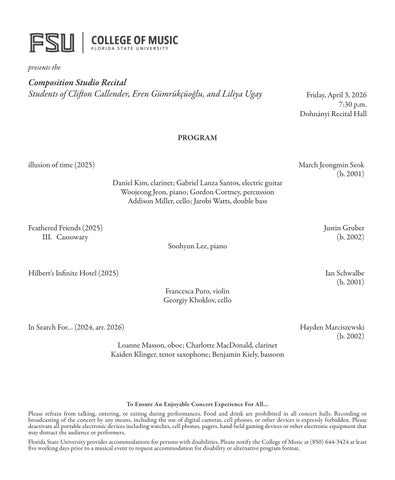

presents the Composition Studio Recital
Students of Clifton Callender, Eren Gümrükçüoğlu, and Liliya Ugay
PROGRAM
illusion of time (2025)
Daniel Kim, clarinet; Gabriel Lanza Santos, electric guitar
Woojeong Jeon, piano; Gordon Cortney, percussion
Addison Miller, cello; Jarobi Watts, double bass
Friday, April 3, 2026
7:30 p.m.
Dohnányi Recital Hall
March Jeongmin Seok (b. 2001)
Feathered Friends (2025)
Justin Gruber III. Cassowary (b. 2002)
Soohyun Lee, piano
Hilbert’s Infinite Hotel (2025)
Francesca Puro, violin
Georgiy Khoklov, cello
In Search For… (2024, arr. 2026)
Loanne Masson, oboe; Charlotte MacDonald, clarinet
Kaiden Klinger, tenor saxophone; Benjamin Kiely, bassoon
Ian Schwalbe (b. 2001)
Hayden Marciszewski (b. 2002)
To Ensure An Enjoyable Concert Experience For All…
Please refrain from talking, entering, or exiting during performances. Food and drink are prohibited in all concert halls. Recording or broadcasting of the concert by any means, including the use of digital cameras, cell phones, or other devices is expressly forbidden. Please deactivate all portable electronic devices including watches, cell phones, pagers, hand-held gaming devices or other electronic equipment that may distract the audience or performers.
Florida State University provides accommodations for persons with disabilities. Please notify the College of Music at (850) 644-3424 at least five working days prior to a musical event to request accommodation for disability or alternative program format.
Delta (2026) Gabriel Nair (b. 2007)
Micah Mazzella, soprano saxophone; Lincoln McMullen, alto saxophone
Luis Angel, tenor saxophone; Parker Button, baritone saxophone
Into the Woodlands (2024)
Aziz Ansari, soprano saxophone
Ryan Nguyen, trombone; Daniel Martinez, double bass
Justin Gruber
Lansky (2025)
Ian Schwalbe
Grant Keel, alto trombone
March Jeongmin Seok, piano
Collections (2026) Sergio Ramirez Guerrero (b. 2002)
Charlotte MacDonald, clarinet; Elizabeth Milan, violin
Addison Miller, cello; Woojeong Jeon, piano fixed media
Seok:
illusion of time
This piece essentially explores my thoughts on ‘alone time’. Time spent alone can only be remembered by me, and if I don’t remember it, no one else can. Sometimes, this makes me feel like I’m all alone in this universe, with intermittent attacks of extreme loneliness that are inevitable. It almost feels as though time has stopped, like a time vacuum.
– March Jeongmin Seok
Gruber: Feathered Friends
Feathered Friends for piano is a musical exploration of avian characteristics and behaviors, with each movement inspired by a different bird species. The cassowary-inspired movement has a mysterious and elusive quality, with dark, rhythmic motifs evoking the bird’s shy and secretive nature in the deep forest.
– Justin Gruber
Schwalbe: Hilbert’s Infinite Hotel
The mathematical concept of infinity can behave rather strangely. Infinity does not adhere to the same rules that finite numbers might. Hilbert’s Hotel Paradox is a thought experiment that demonstrates this unintuitive behavior. Hilbert invites us to imagine a hotel with infinitely many rooms, all of which are already occupied. Suppose a new guest arrives at the counter and requests a room. In a finite hotel, this guest would inevitably be turned away. But in Hilbert’s hotel, there’s no problem! Whoever is currently staying in room 1 simply needs to move to room 2, the guest in room 2 must move to room 3, and so on. Because every natural number n has a number n+1, there will always be another room to move into. After all is said and done, the new guest can take over room 1. Shockingly, even if an infinite bus with endless people shows up to Hilbert’s Hotel, they would still all be accommodable. The current guest in room n must simply move to room 2n, leaving all odd numbered rooms available. This paradox thusly demonstrates that an infinite set can contain one of its subsets.
I modeled the construction of this piece off of this idea–the music begins in room 1, which consists of just 1 eighth note. After many repetitions, we move to room 2, made of 2 eighth notes. This pattern continues, adding one eighth note per room, so that a full-length melody is constructed one piece at a time. The number of repetitions per room decreases as the size of each room increases. As the melody grows, the timbral interest within each measure changes. This piece begins like an empty black-and-white coloring book; as the rooms get bigger, more and more timbral “colors” are filled in, so that by the time a full melody is formed many different colors can be experienced. And of course, a few sudden surprises are thrown into the rooms at random to keep listeners on their toes.
– Ian Schwalbe
Marciszewski: In Search For...
In Search For... was originally written for the vocal quartet of two tenors and two basses. I have reworked it to fit a reed quartet because the combination of instruments works effectively with this style of music. It retains the playful and fugal aspect of the piece, while also contrasting the slow, chorale-like sections.
– Hayden Marciszewski
Nair: Delta
Delta was written to represent the idea of gradual change that is unnoticeable in any present moment. The title carries multiple meanings, referencing both the idea of a river delta, and the Greek letter Delta which, in mathematics, can be used to represent a change or difference in a quantity. The tonality of the piece shifts over time, similar to how a river will gradually deposit sediment until a delta is formed.
– Gabriel Nair
Gruber: Into the Woodlands
Into the Woodlands draws inspiration from natural sounds. The composition incorporates bird calls, water droplets, and wind rustles to create immersive sonic landscapes through various effects on the instruments. The music mirrors the flow of ecosystems, symbolizing the interconnectedness and resilience of life on Earth. The music encourages reflection and dialogue about environmental stewardship and sustainable practices. It serves as a call to action, inviting audiences to deepen their connection to the natural world and embrace a more harmonious relationship with the Earth.
– Justin Gruber
Schwalbe: Lansky
Meyer Lansky, the “Mob’s Accountant,” was one of the most influential figures in American organized crime throughout the 20th century. Born in present-day Belarus, Lansky fled to Manhattan in 1911 to escape rampant antisemitism in Eastern Europe. He quickly became a central member of the Jewish mob, and alongside his childhood friends Benjamin “Bugsy” Siegel and Charles “Lucky” Luciano, was able to build a wildly successful criminal empire. Lansky’s primary financial investments came in the form of illegal gambling operations, in which his influence spanned from Las Vegas to Miami and Cuba. During the rise of extreme antisemitism during World War II, Lansky was able to use his influence with the mob to break up pro-Nazi rallies in and around New York City. He even brokered deals between the United States Navy and the Italian-American Mafia that saw criminals helping to protect docks from German attacks.
This piece is a loosely programmatic composition which takes inspiration from some of the most notable events throughout Lansky’s life, including his relocation to America, the growth of his criminal empire, his signing off on the murder of his childhood best friend “Bugsy” Siegel, his sudden loss of all casino-based assets due to a regime change in Cuba, his exile to the Bahamas and later Israel, and his ultimately peaceful death with his family in Miami. By the end of his life, Lansky was almost entirely financially destitute in the eyes of the government–however, it is widely speculated that millions of dollars remained in offshore bank accounts in his name. His largely criminal life, occasionally shadowed by moral ambiguity, has created, to me, this incredibly dramatic and fascinating story.
– Ian Schwalbe
Guerrero: Collections
This piece is the first where I start exploring how electronics add to my musical composition. Composers before our era would first incorporate electronics with physical tape, cutting and gluing strips together in the same way we would splice audio together in a DAW. Inspired by this, the result is music that frequently moves through different genres and sound gestures. The sudden and jarring cuts become a part of the composition.
– Sergio Ramirez Guerrero