A Florida State University Advancement publication for alumni, parents and friends FALL 2025 Volume 17, Issue 2
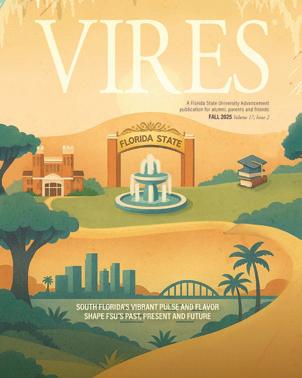
SOUTH FLORIDA’S VIBRANT PULSE AND FLAVOR SHAPE FSU’S PAST, PRESENT AND FUTURE
A Florida State University Advancement publication for alumni, parents and friends FALL 2025 Volume 17, Issue 2
SOUTH FLORIDA’S VIBRANT PULSE AND FLAVOR SHAPE FSU’S PAST, PRESENT AND FUTURE
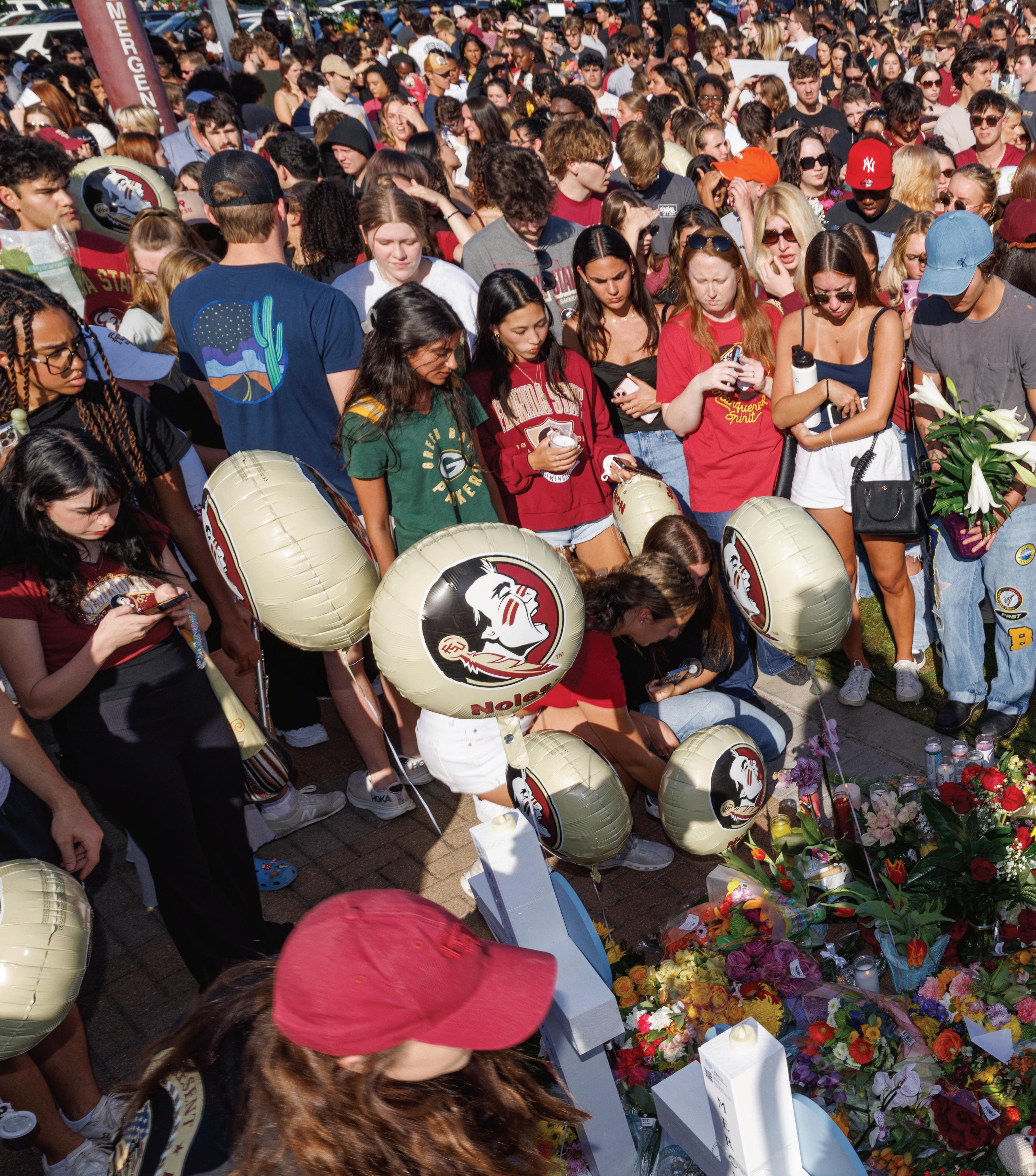
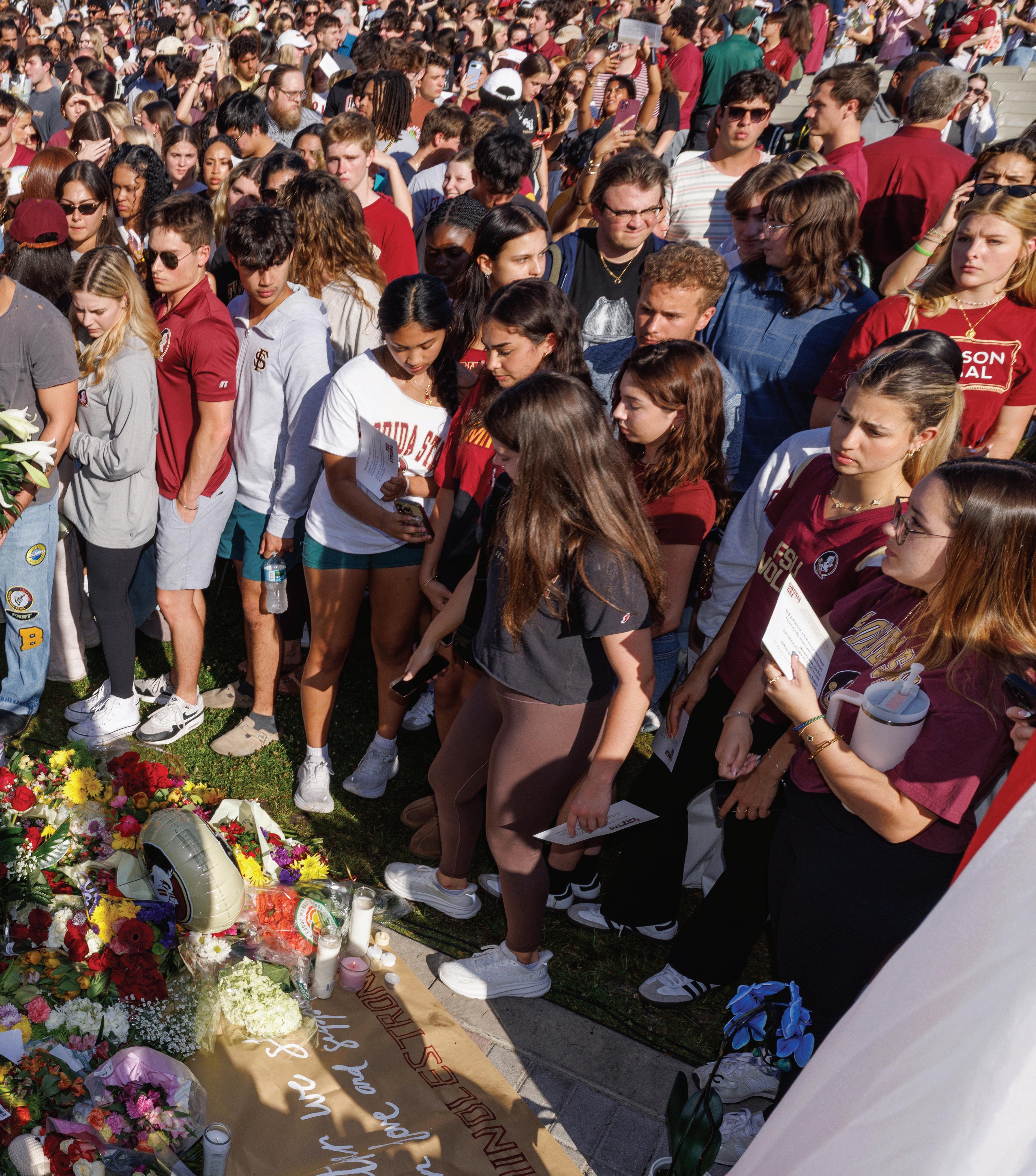
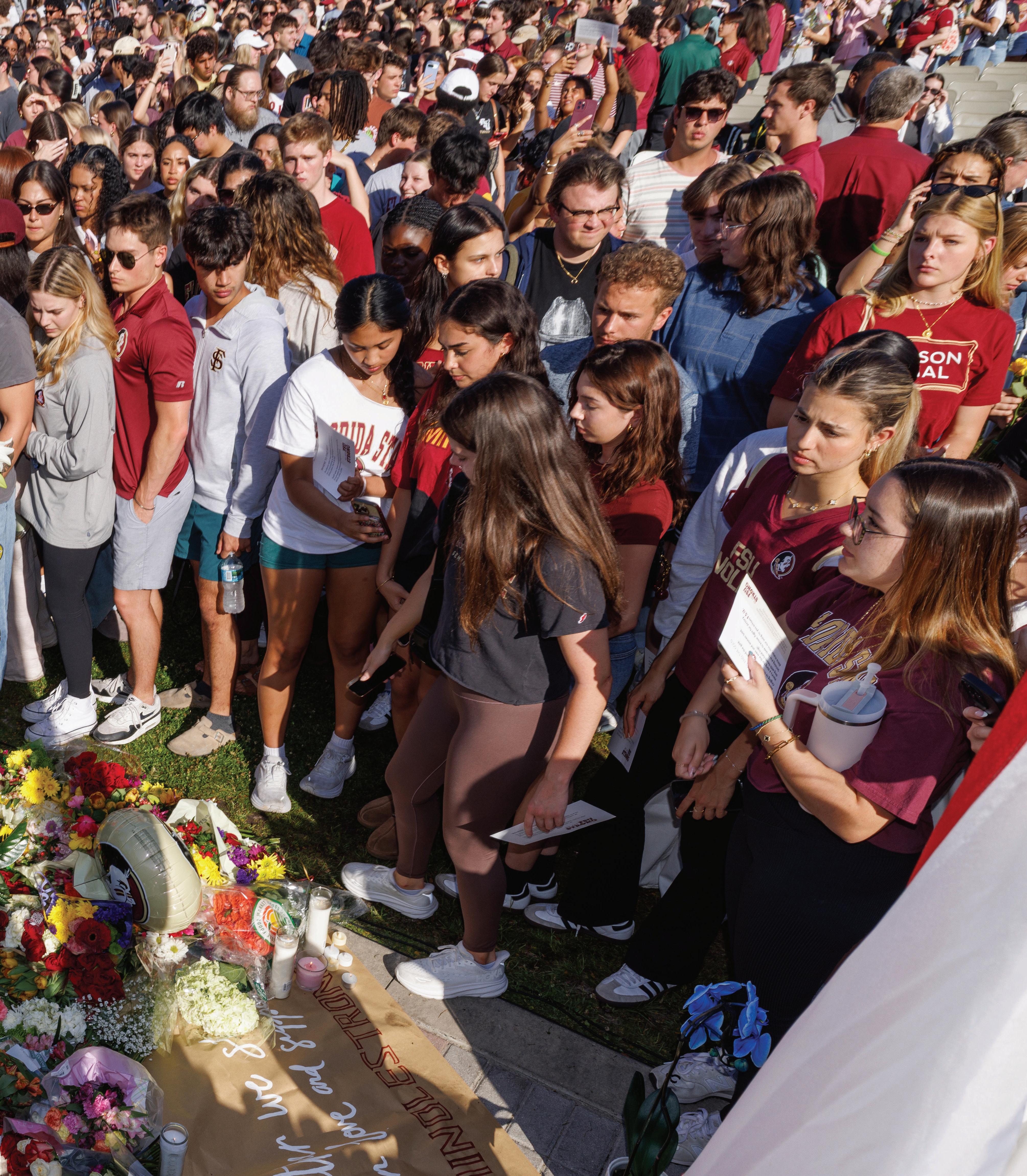
On April 17, 2025, tragedy shook our campus and deeply affected the Florida State University community. Though months have passed, the loss of Robert Morales (B.S. ’92) and Tiru Chabba remains heavy in our hearts. We honor their memory and invite you to learn more about them on page 71.
In the wake of this tragedy, the compassion and resilience shown by students, faculty, staff, alumni and friends have embodied the unconquered spirit of Florida State.
We are FSU Strong.
As our community continues to reflect and heal, resources are available at response.fsu.edu.
Fall 2025 Volume 17, Issue 2
An award-winning biannual publication from the Florida State University Division of University Advancement, which includes the Alumni Association and FSU Foundation. Named after the first torch in the university seal, VIRES represents strength of all kinds: physical, mental and moral.
PUBLISHER
Julie Decker
EDITOR-IN-CHIEF
Beth N. Pannell
DESIGNER
Lindsey Masterson @penandtool
CONTRIBUTORS
Hannah Akin (M.A. ’22)
Laura Bradley (B.A. ’13)
David Heller
Lilly S. Higginbotham (B.A. ’19)
Kenta Joseph (B.S. ’08) FSU Communications staff members
PHOTOGRAPHY
CineDOT Media
Bill Lax (B.S. ’90)
Ryan Register (B.S. ‘08)
Advertise alumni.fsu.edu/advertise
Contact Us vires@alumni.fsu.edu
Submit a Class Note alumni.fsu.edu/submit-class-notes
Stay Connected alumni .fsu.edu/stay-connected
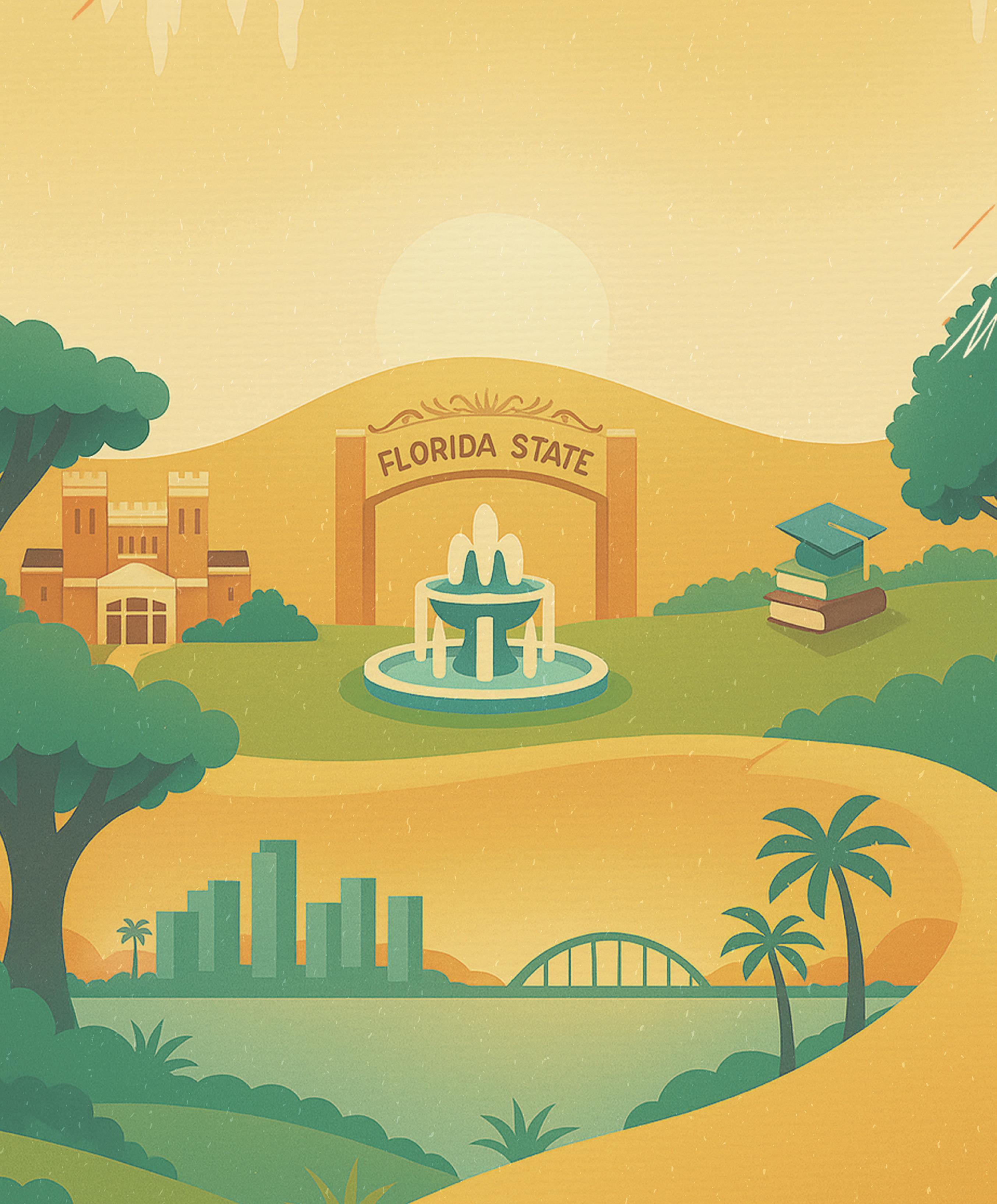
→ ON THE COVER: From student pipelines to cutting-edge research and alumni engagement, FSU’s deepening ties with South Florida are shaping the future of the institution and the region. Cover artwork by Lindsey Masterson.
The Moment
From the President
Social Snapshots Then & Now
FSU Impact Through Research University News
Athletic Highlights
Catching Up With 10 Questions
Traveling Noles
Seminoles Forever
Alumni Engagement Class Notes
Faculty Notes In Memoriam Final Frame
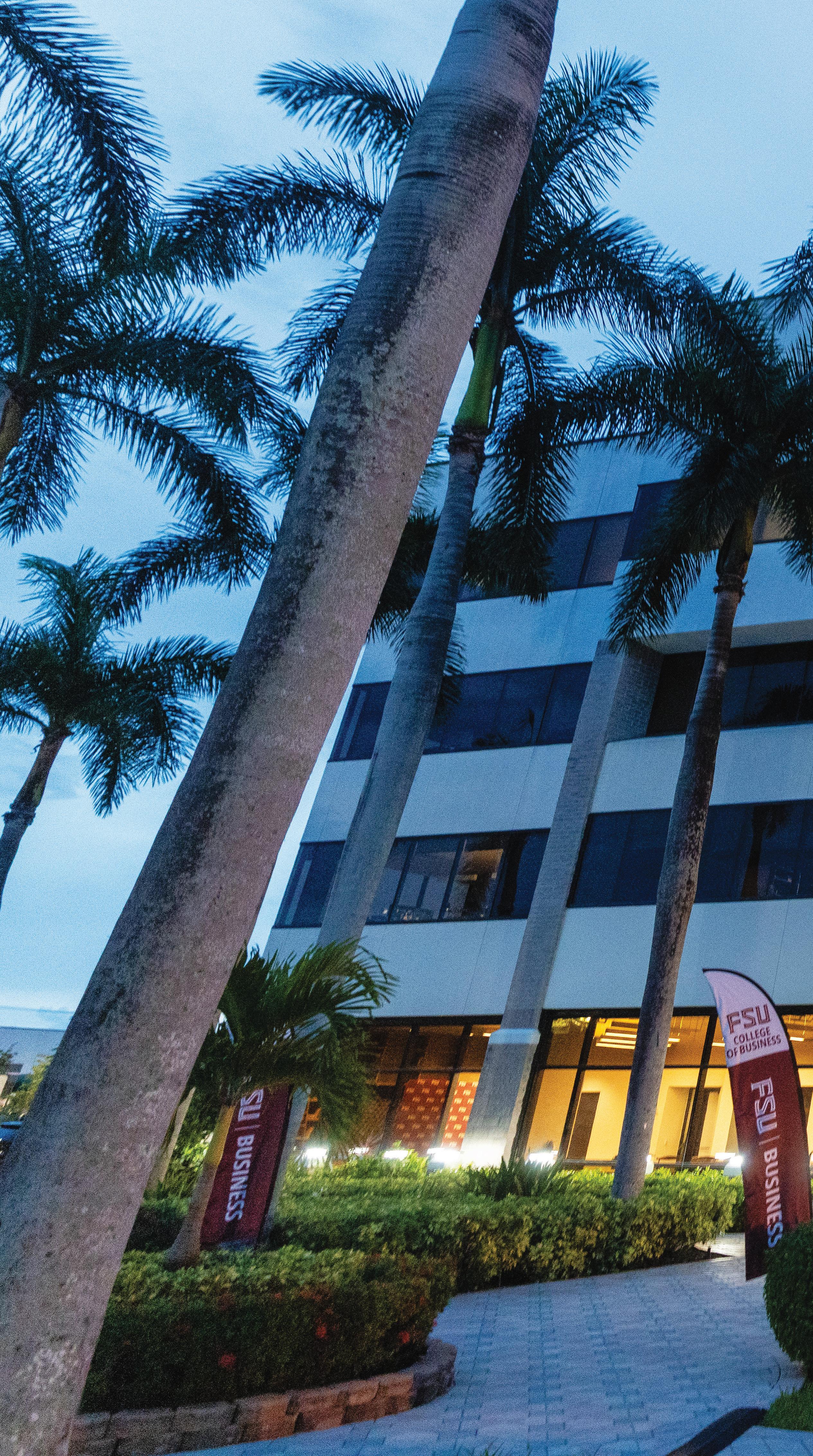
With expanding programs, strategic partnerships and a thriving alumni network, FSU’s relationship with South Florida is fueling innovation, opportunity and statewide impact.
By David Heller
From humble beginnings to tech entrepreneur, community leader and philanthropist, Tony DiBenedetto’s story is powered by mentorship, gratitude and a strong connection back to FSU at every turn.
By Beth N. Pannell
A scholarship connection leads Joyce and Bob Miles to deepen their commitment to helping students succeed.
By Beth N. Pannell
This past fall, Florida State University celebrated two extraordinary milestones that reflect our core mission — our commitment to education, innovation and making an impact on our community. These events, along with other stories in this issue of VIRES, highlight the vibrant life of our university and the momentum we continue to build.
Dear Alumni, Parents, and Friends,
The first milestone was a historic moment for FSU. We proudly renamed the College of Education, Health, and Human Sciences in honor of an exceptional alumna, Anne Spencer Daves. Anne spent 30 years shaping young minds as a fourth-grade teacher, and her extraordinary gift will bolster scholarships and ensure that future generations will have access to the highest quality education without incurring substantial debt.
Another exciting fall semester is underway at Florida State, and among the thousands of new students joining us are many from South Florida, a region that continues to shape the life of our university.
demonstrated during the week reflected the passion that propels our university every day.
These two milestones — the dedication of Anne’s College, as we’re calling it, and the success of Discovery Days — underscore FSU’s mission to inspire and empower individuals to make a difference in their communities and the world.
South Florida is also where many of our students begin their careers. Programs like Miami-Bound Noles connect students with alumni and employers in the region, and top companies in South Florida are among the largest employers of FSU graduates.
This issue of VIRES also highlights other exciting developments at FSU. We’re pleased to welcome Kevin Maynard as the new director for Opening Nights, our premier performing arts series that brings world-class artists to our campus and community and features outstanding talent from FSU. Kevin’s leadership marks the start of a dynamic chapter for Opening Nights.
Beyond South Florida, this issue highlights the generosity and spirit of our alumni, parents, and friends everywhere. You’ll meet Tony DiBenedetto, whose support fuels the CARE program, and Joyce and Bob Miles, whose scholarship is helping CARE students. This issue also recognizes Jim Miller, whose generosity made possible the dedication of the Dorothy Flory Holroyd Ensemble Room at the College of Music. First Lady Jai Vartikar and I were honored to attend the dedication ceremony.
You’ll also find coverage of our Homecoming events and the cherished traditions that celebrate the spirit and unity of the FSU family. From the parade to the alumni awards and the football game, Homecoming is a time when the positive energy and pride of our community are on full display.
You’ll also find a look at John Barnhill’s remarkable career in enrollment management as he nears retirement, and a “10 Questions” feature with Rob Liddell, assistant vice president for career services, whose work has shaped the career journeys of our graduates. Athletic highlights include the hiring of FSU alumnus and former basketball standout Luke Loucks as our new men’s basketball coach and the launch of women’s lacrosse in 2026 with Coach Sara Tisdale.
In addition, I encourage you to read the feature on FSU Panama City. For more than 40 years, this campus has served the residents of Northwest Florida by offering transformative educational opportunities.
At FSU, tradition and progress intersect. We honor our history while striving for excellence and innovation. Anne’s College embodies our heritage while looking toward the future. Discovery Days highlights ideas and research that are shaping tomorrow. Opening Nights and Homecoming capture the enduring sense of connection and pride that unites our FSU family and the community.
You’ll see updates on university achievements — from rising graduate program rankings to the national recognition of our faculty — and find ways to stay engaged, from FSU Comes to You events to the 15th year of FSU’s Great Give.
Thank you for all you do to represent the garnet and gold with pride, no matter where you are.
Thank you for being part of this remarkable journey. Your involvement — whether as alumni, parents or friends — makes all of this possible. Together, we will continue to shape an even brighter future for Florida State University.
Go Noles!
Go Noles!
More than 50,000 Florida State alumni live in Broward, Miami-Dade, and Palm Beach counties, making South Florida one of our largest alumni hubs outside Tallahassee and a vital part of our future. We appreciate the importance of this region and will continue to engage with our South Florida alumni, parents, and friends.
The Anne Spencer Daves College of Education, Health, and Human Sciences marks a first for FSU: It’s the first college named after an alumna. This recognition is a testament to Anne’s extraordinary generosity and devotion to her field and her alma mater. During the renaming ceremony, I reflected on how Anne’s gift comes at a pivotal moment in the history of the College of Education, Health, and Human Sciences. It was recently ranked sixth among all public universities in the United States by U.S. News & World Report. With Anne’s support, I’m confident that we will continue our rise as a national leader.
In October, we hosted Discovery Days, our second annual celebration of research, creativity and collaboration at FSU. This weeklong event engaged nearly 2,500 participants, both in Tallahassee and online, and showcased the entrepreneurial drive of our students and faculty.
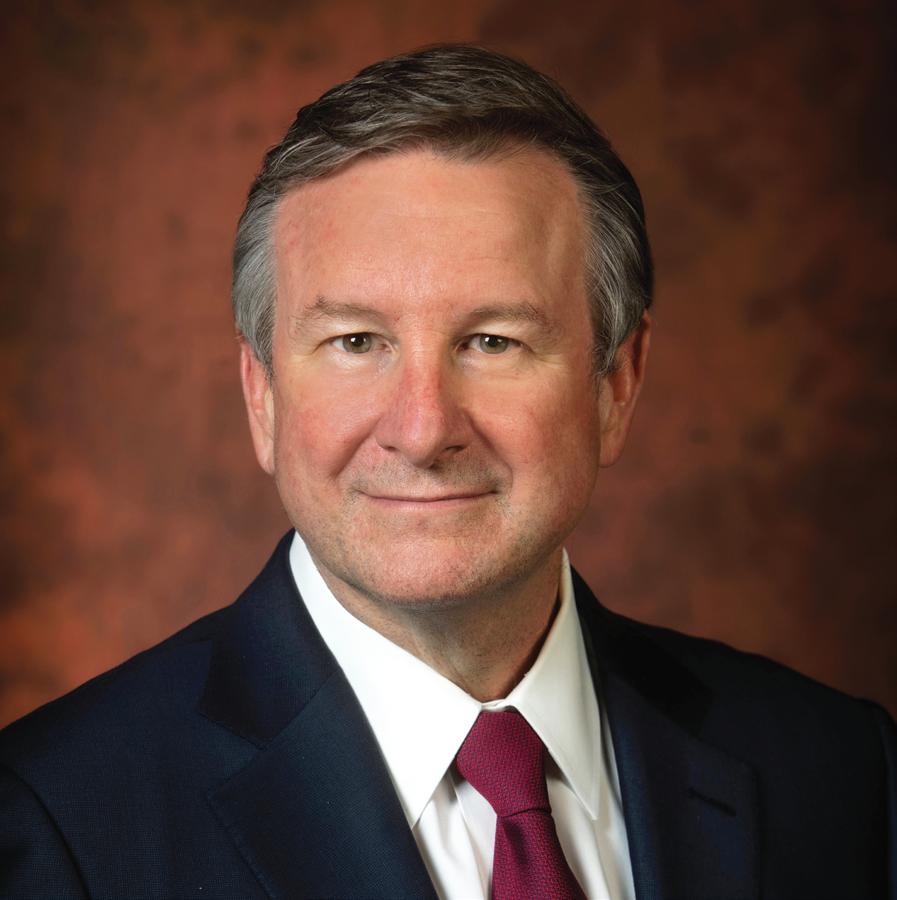
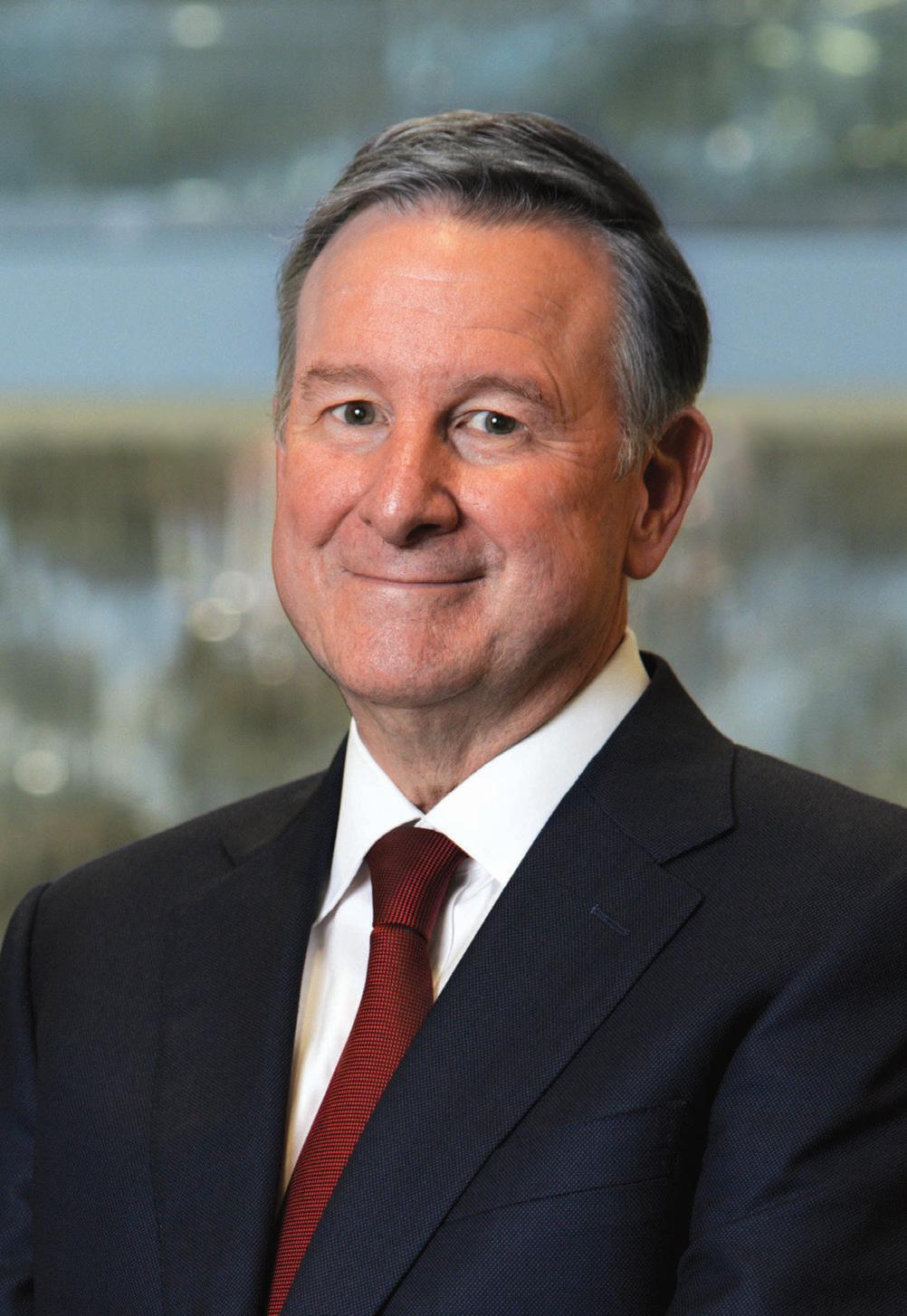
Richard McCullough President, Florida State University
Richard McCullough President, Florida State University
In this issue, you’ll read about how FSU is expanding opportunities in South Florida. Our new partnership with Miami Dade College gives thousands of students a direct path to Florida State. And this fall we celebrated the opening of our new FSU space in downtown West Palm Beach, thanks to the generosity of alumnus Ben Macfarland. Ben’s gift provides a home for executive education programs led by our College of Business, including offerings in alternative investments, and creates a gathering place for alumni, students, and community partners. It’s a strong signal of FSU’s growing presence in South Florida, and it’s only the beginning.
THANKS THEIR CORPORATE PARTNERS

Florida State’s innovative spirit was evident through groundbreaking research for pediatric rare disease therapies, student-led sustainable energy projects, and startups and discoveries that tackle real-world challenges. The energy


Florida State University
@FloridaStateUniversity
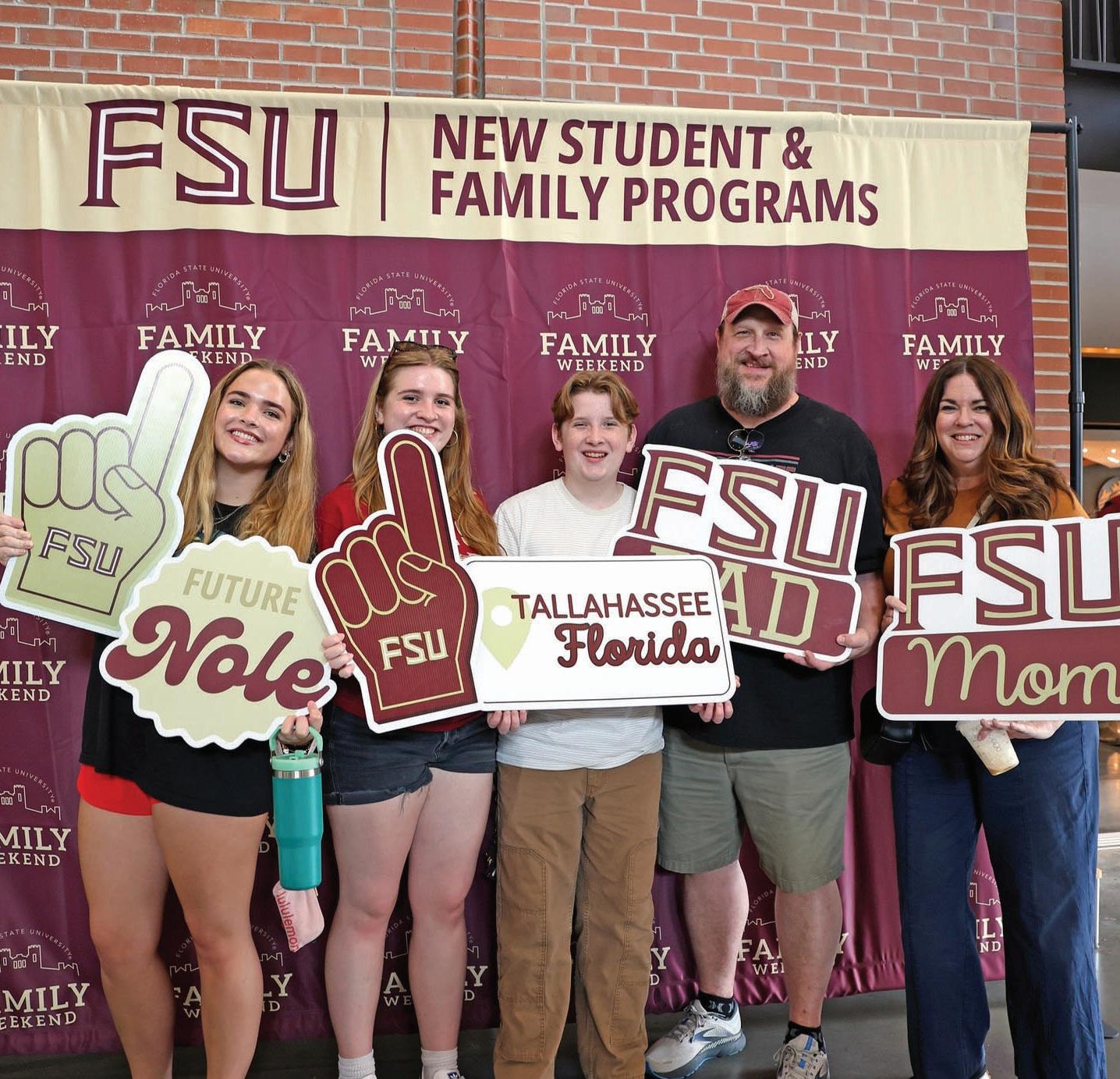
Family Weekend is off to a great start at Florida State! #FSUFamily
FSU College of Arts & Sciences @fsuartssciences
FSU Libraries @fsulibraries
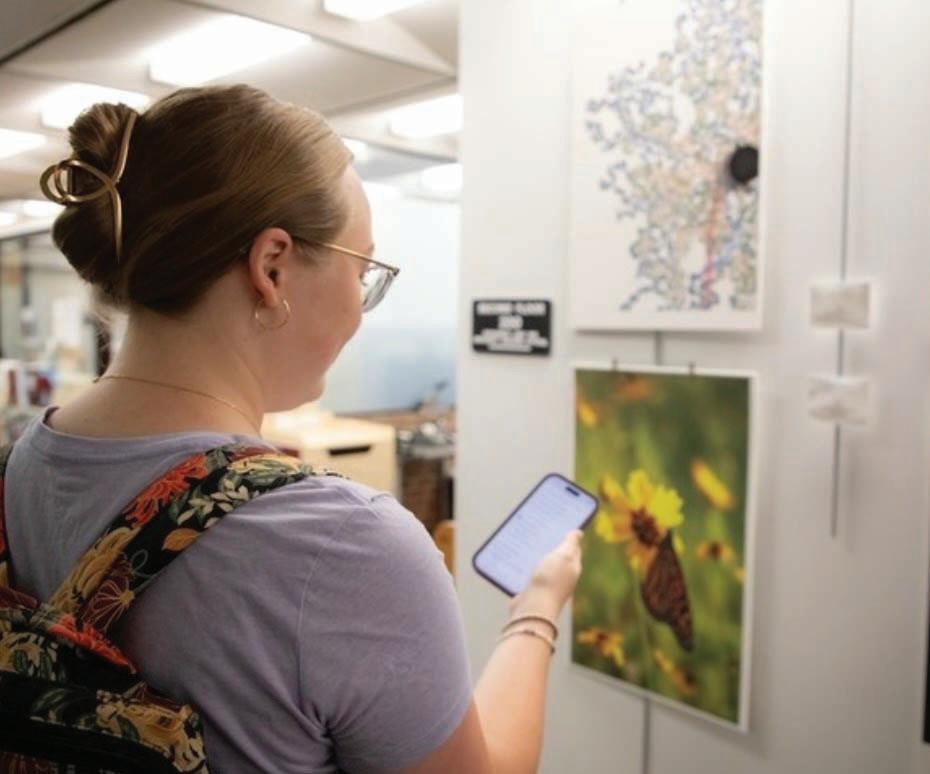
On Friday, we kicked off @floridastateuniversity’s Art in STEM exhibit in Dirac Science Library! The collection features 26 artworks created by students representing ecology, neuroscience, solid-state chemistry, deep-sea biology, geology, biomedical sciences and more! To learn more about ART in STEM — an annual collaboration among @gwis_at_fsu, @fsuartssciences and @fsulibraries — tap ‘News’ at the #linkinbio. To visit the exhibit virtually, visit: artinstem.create.fsu.edu
In our previous issue we published incorrect information in our article about Vice President Joe O’Shea (B.A. ‘08). We identified O’Shea’s deceased brother Robert (J.D. ’09) incorrectly. O’Shea’s brother, Dr. Jesse O’Shea (B.S. ’11, M.D. ’15), is currently an infectious disease specialist in Georgia. Our apologies to the entire O’Shea family for this error.
facebook.com/fsualumniassociation @fsualumni linkedin.com/company/fsualumni @FSUAlumni YouTube.com/FSUAlumni vires@alumni.fsu.edu
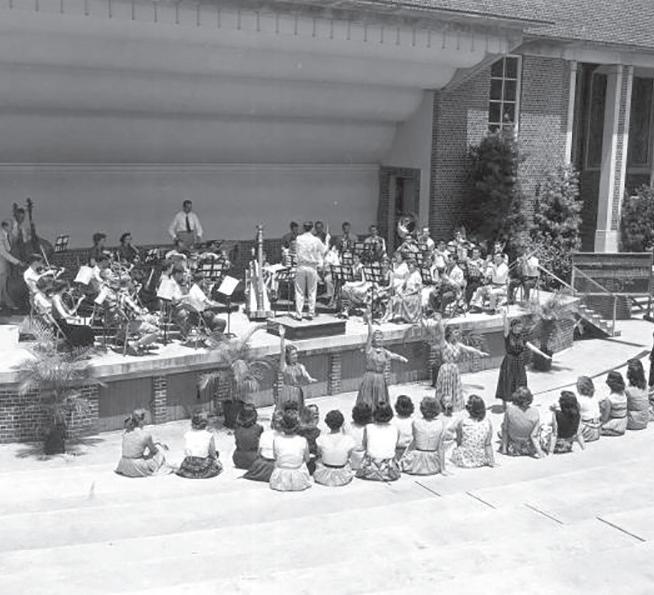
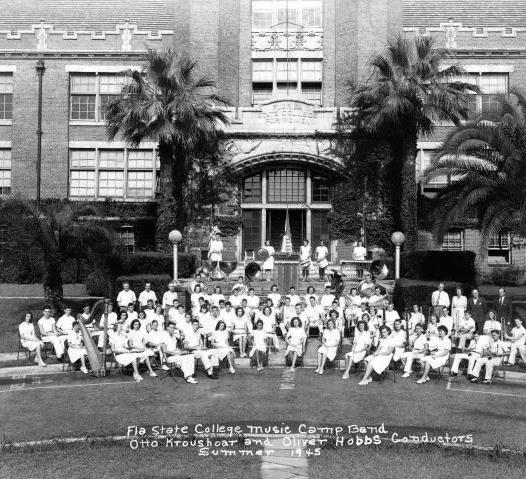
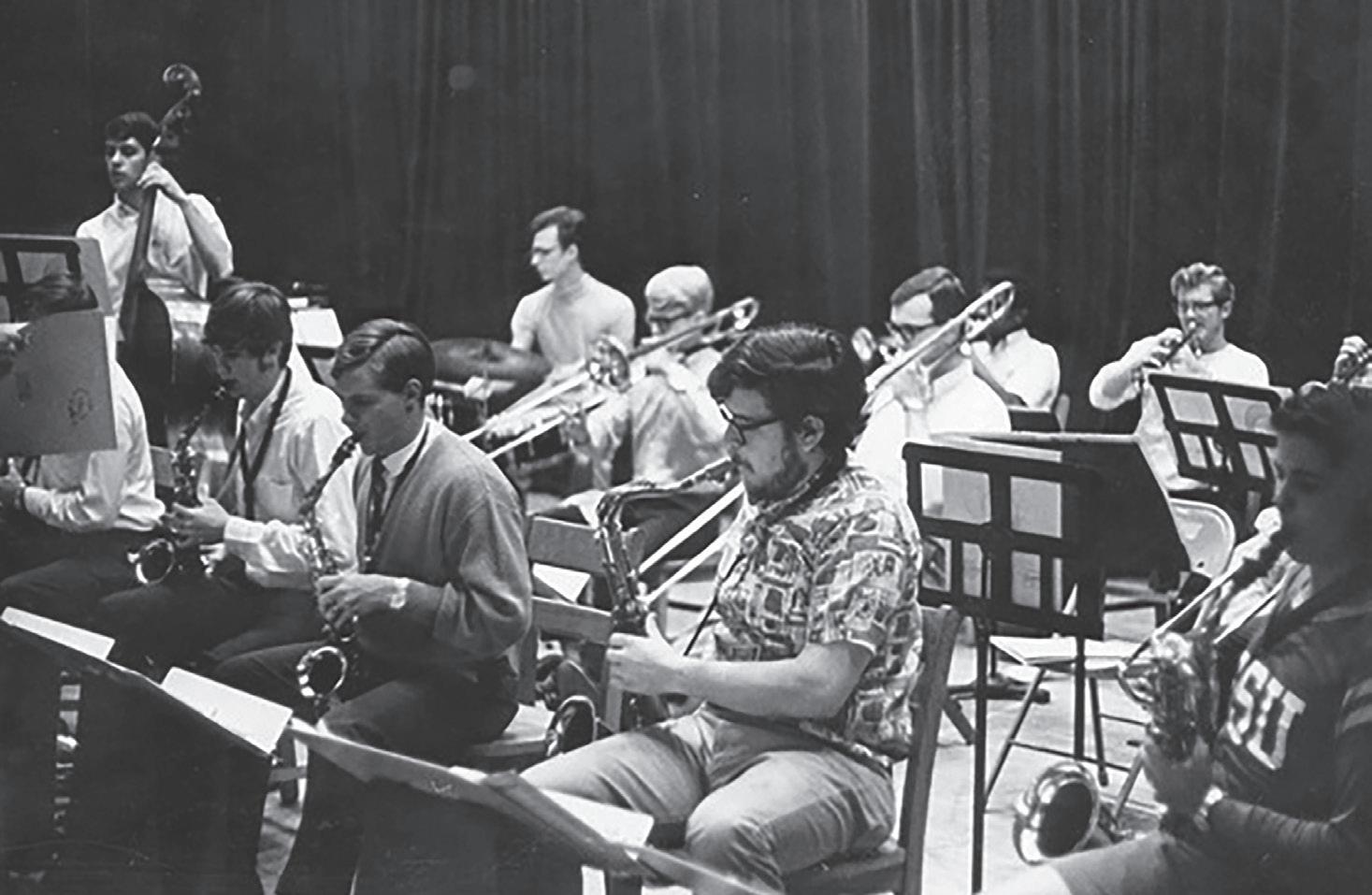
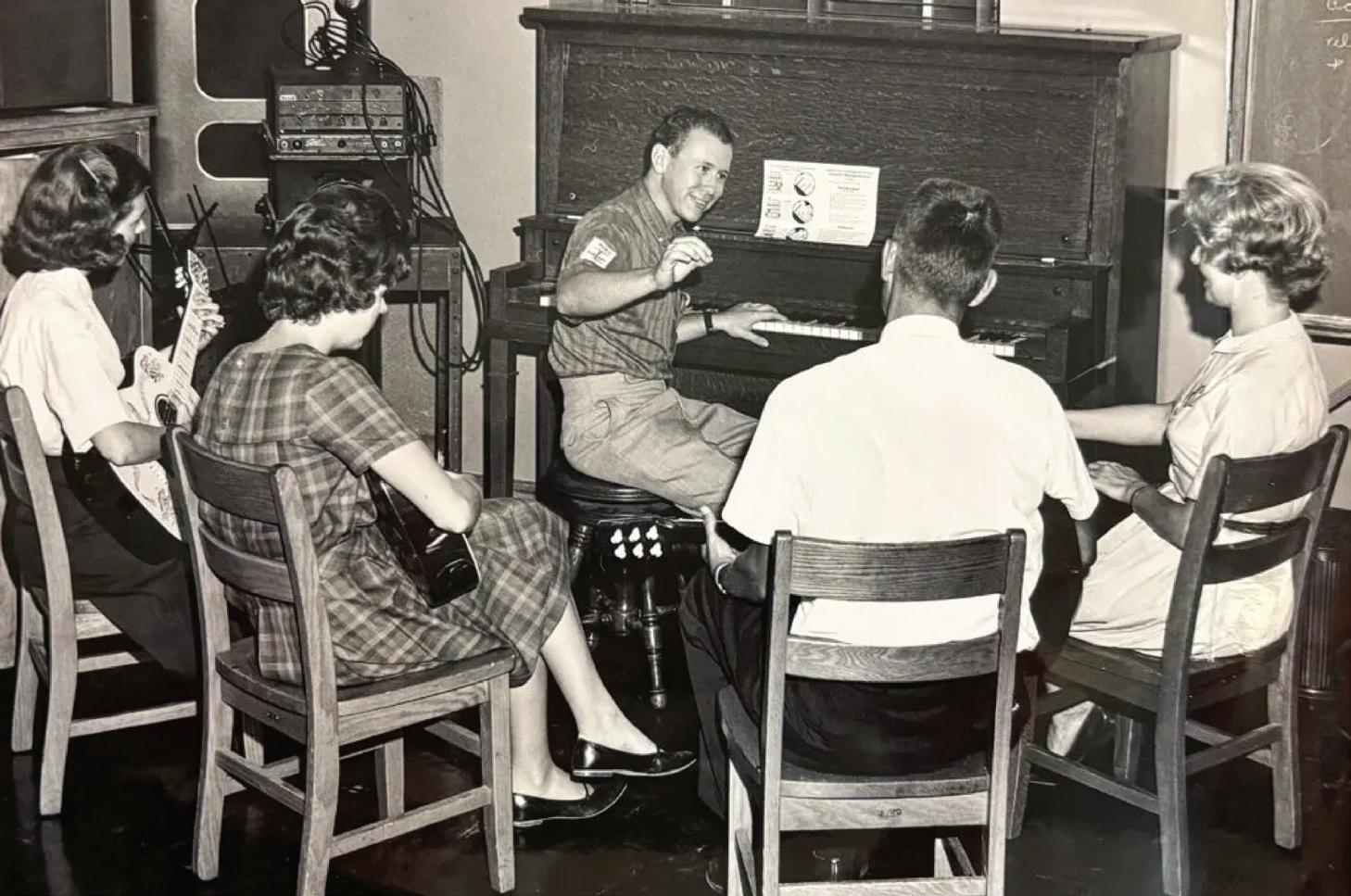
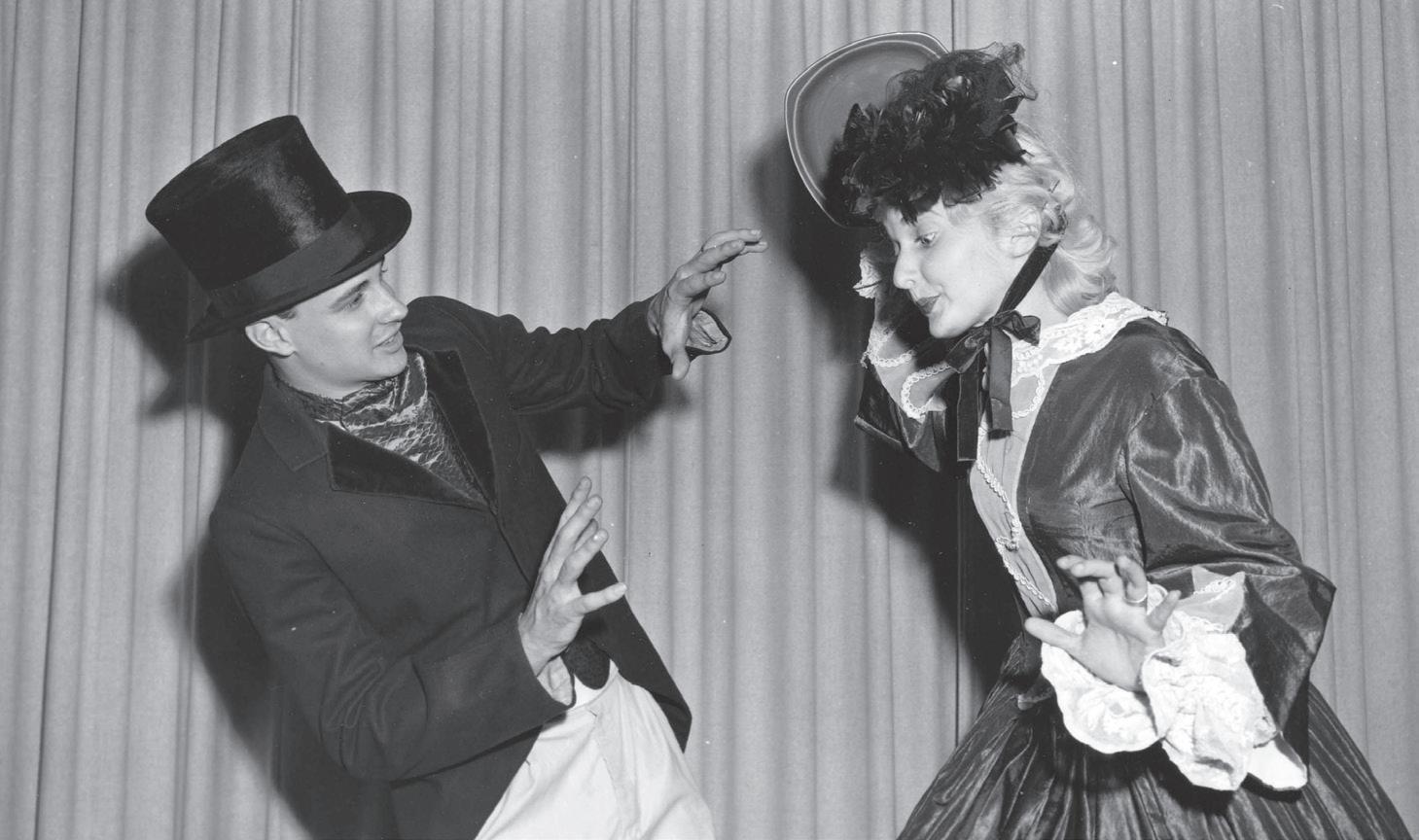
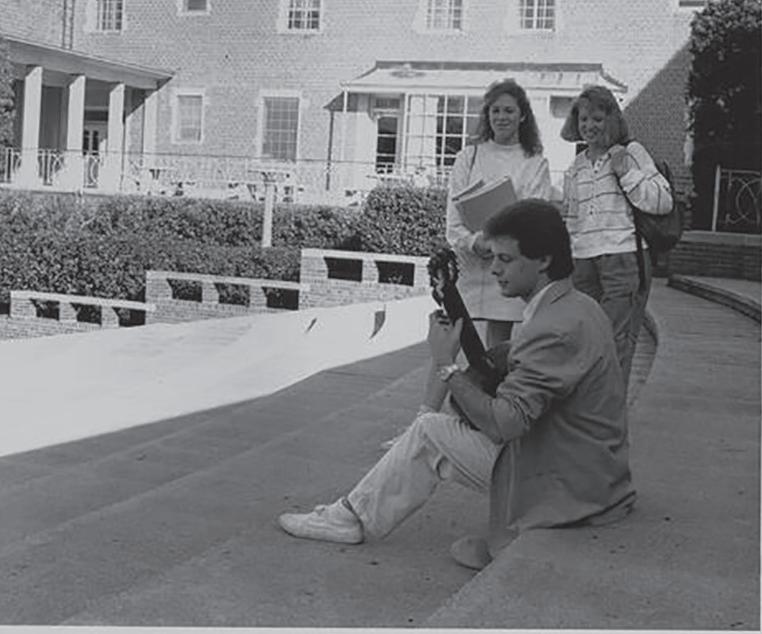
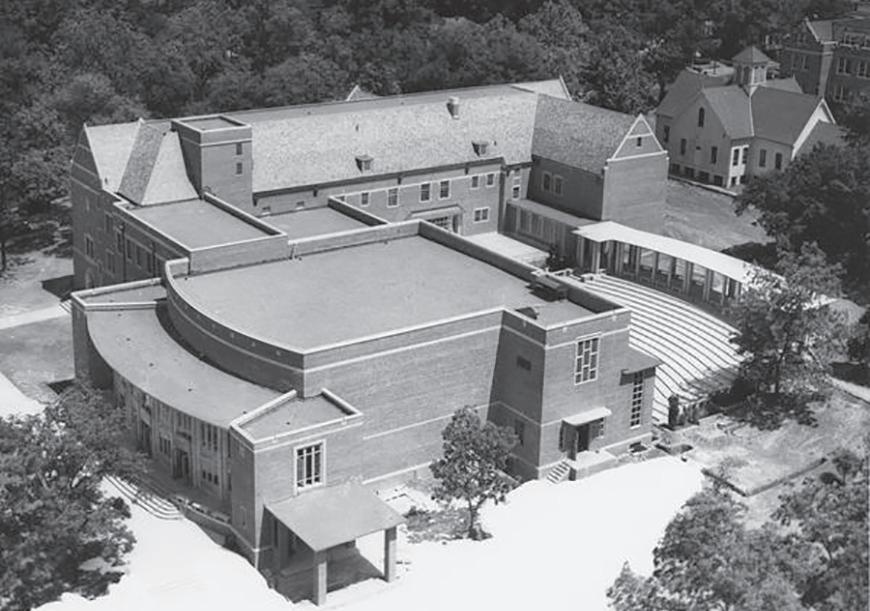
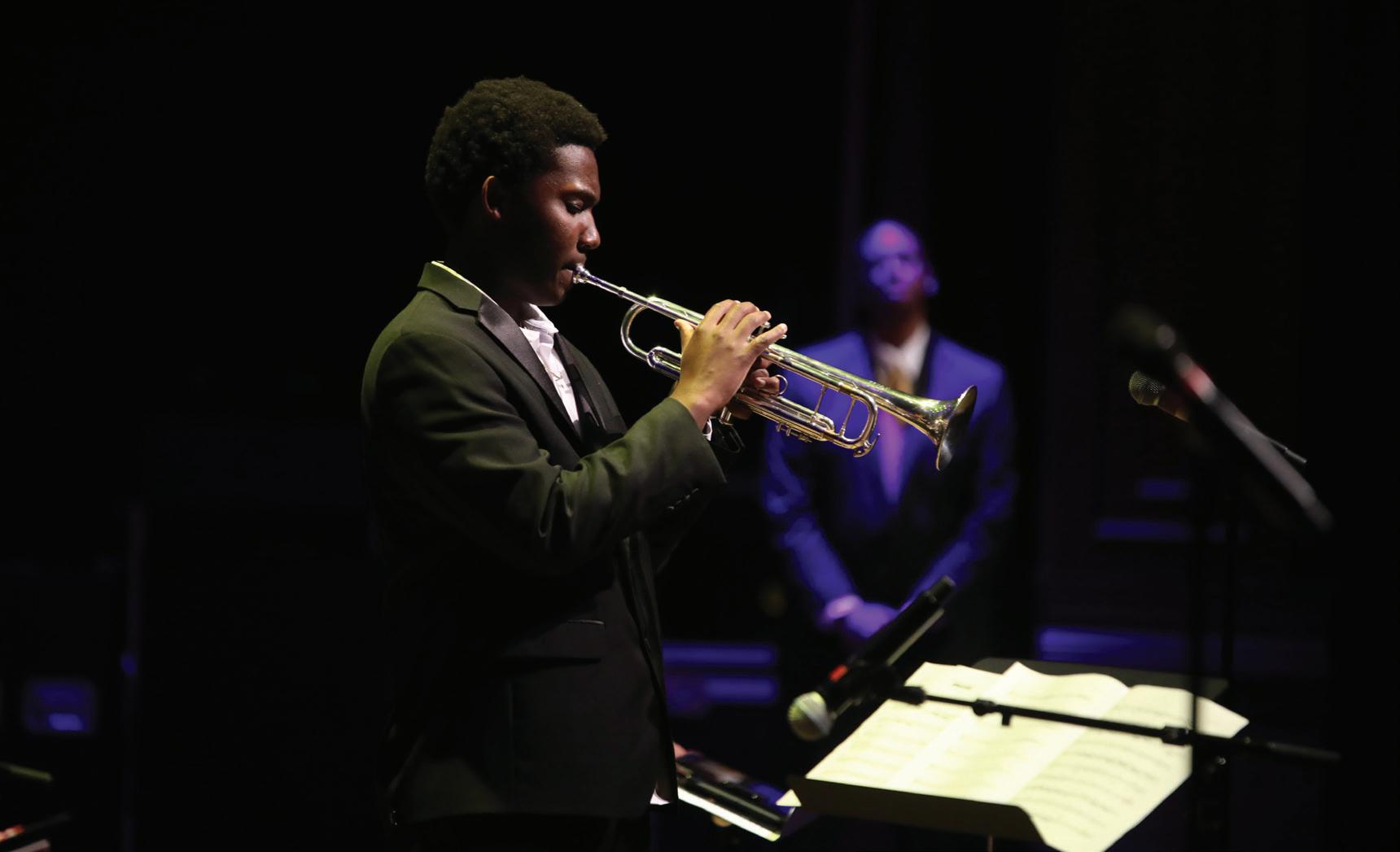
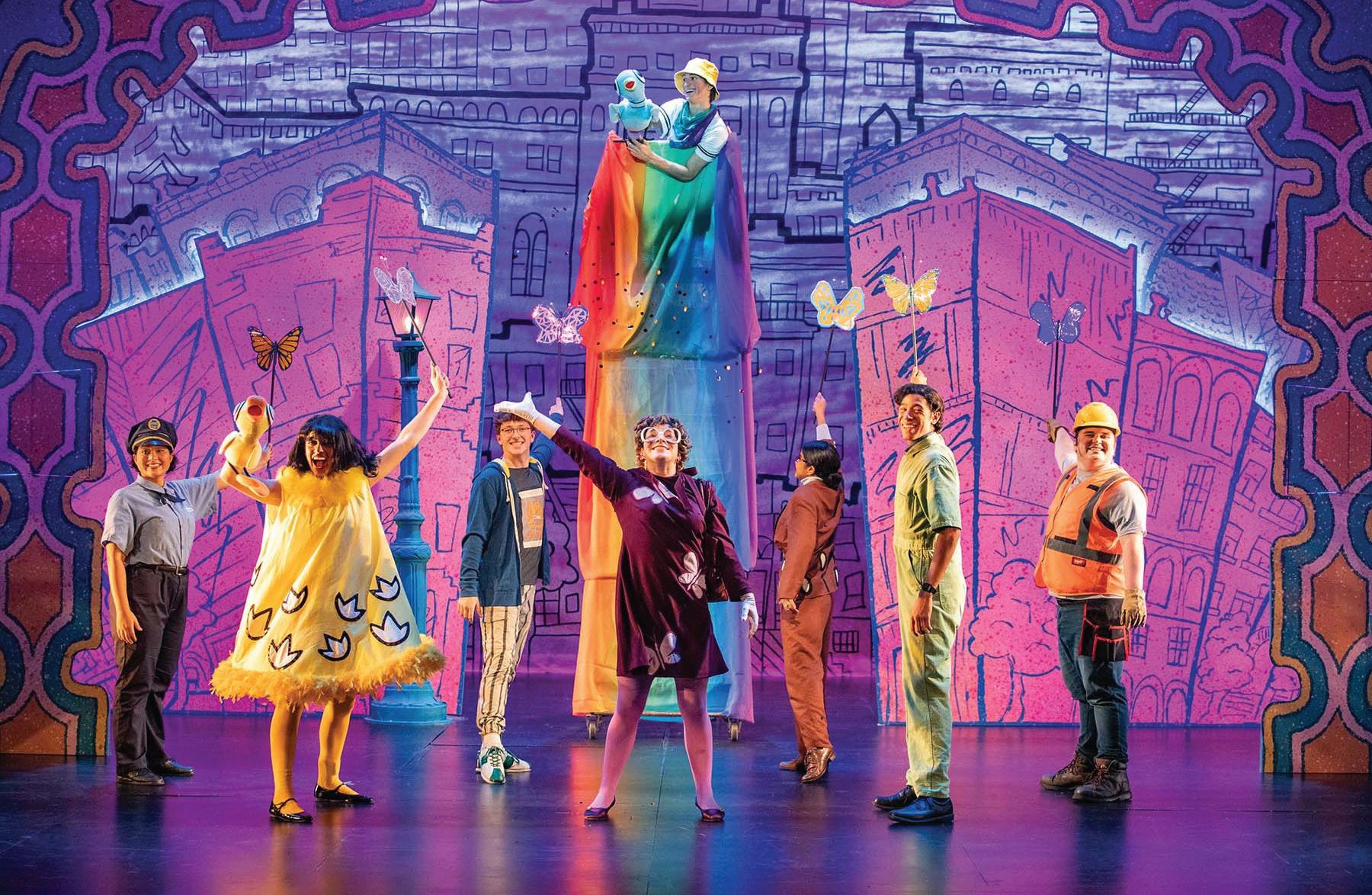
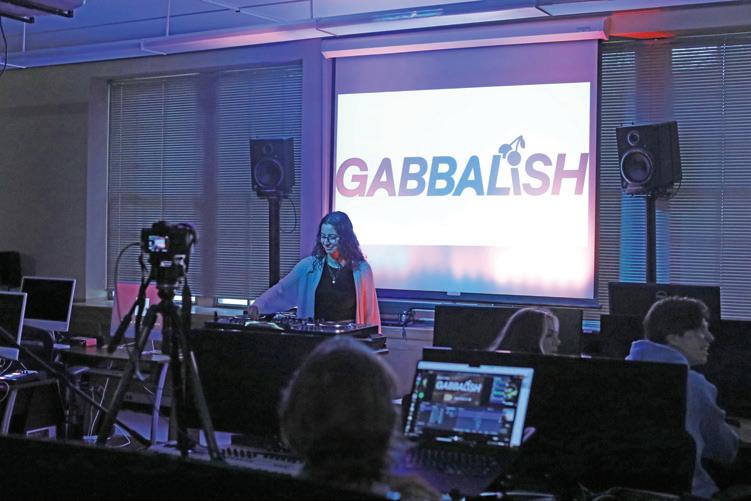
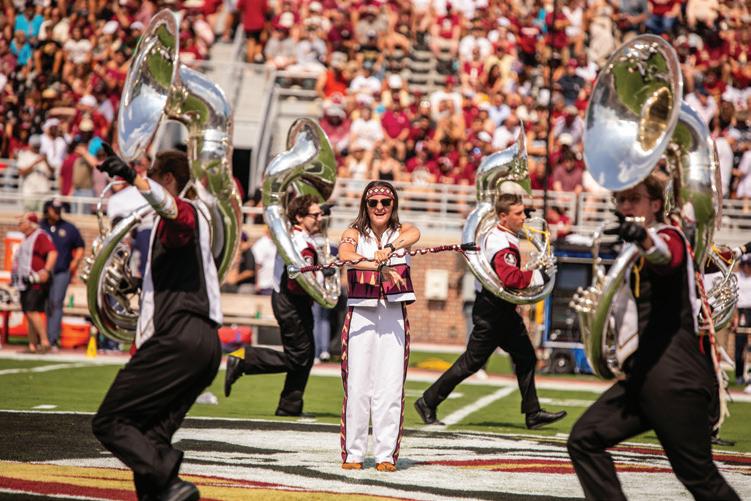
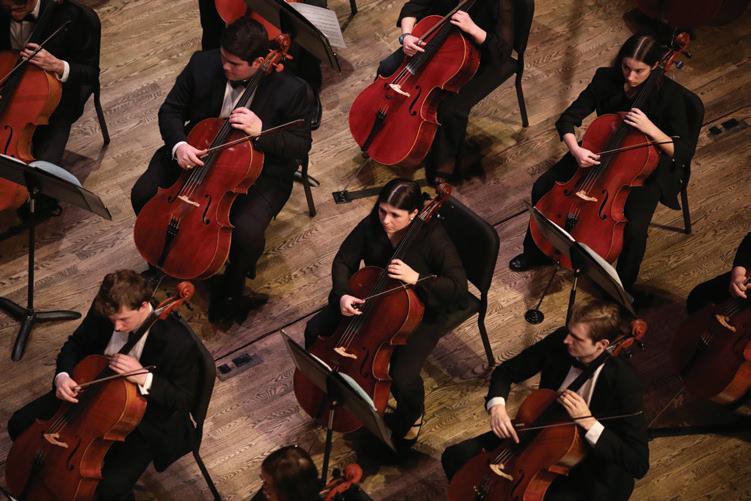
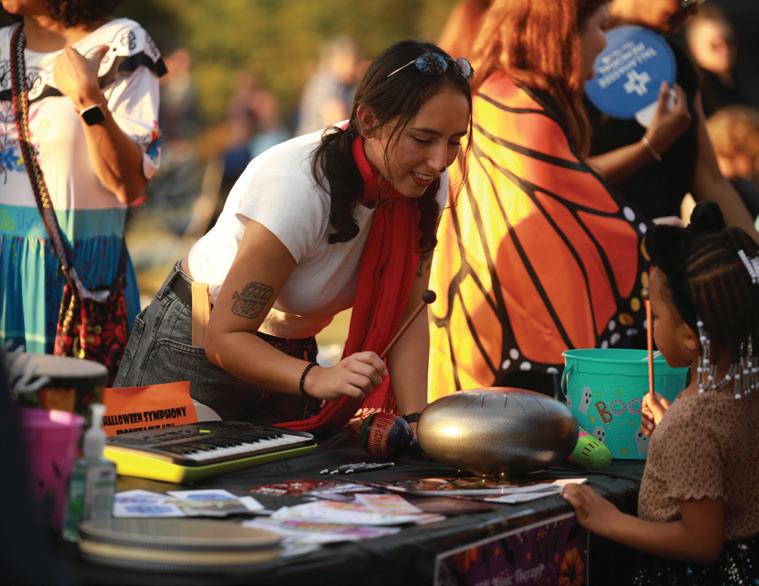
The Florida State University College of Music proudly marks its 125th anniversary season with a dynamic series of performances that celebrate musical excellence through both beloved classics and bold new works. What began in 1900 with a single teacher of vocal and instrumental music has evolved into one of the nation’s premier music institutions. This milestone year also marks the 100th anniversary of the University Symphony Orchestra. On March 25, 2026, the USO will honor the university’s origins as a college for women with a historic performance — an all-female orchestra led by a female conductor.
Another landmark of 2025 is the 20th anniversary of FSU elevating the music program to college status. While honoring its rich legacy, the College of Music is charting an ambitious future. This year, it launched the nation’s first degree in community music with enrollment for fall 2026, reaffirming its commitment to prepare musicians for the 21st century through the core values of excellence, community and experience.
We look forward to the next 125 years of innovation, artistry and impact.
By Holden Grace Wilkins (Class of 2026)
Researchers at Florida State University are helping to develop the next-generation technologies and breakthroughs that will have positive impacts on Florida and the world. In medicine, childhood literacy, weather forecasting, food safety and other fields, FSU researchers are providing expertise and solutions to help solve difficult problems.
Here are some of the ways FSU is making a difference:
1
MAGNIFYING IMPACT: THE NATIONAL HIGH MAGNETIC FIELD LABORATORY
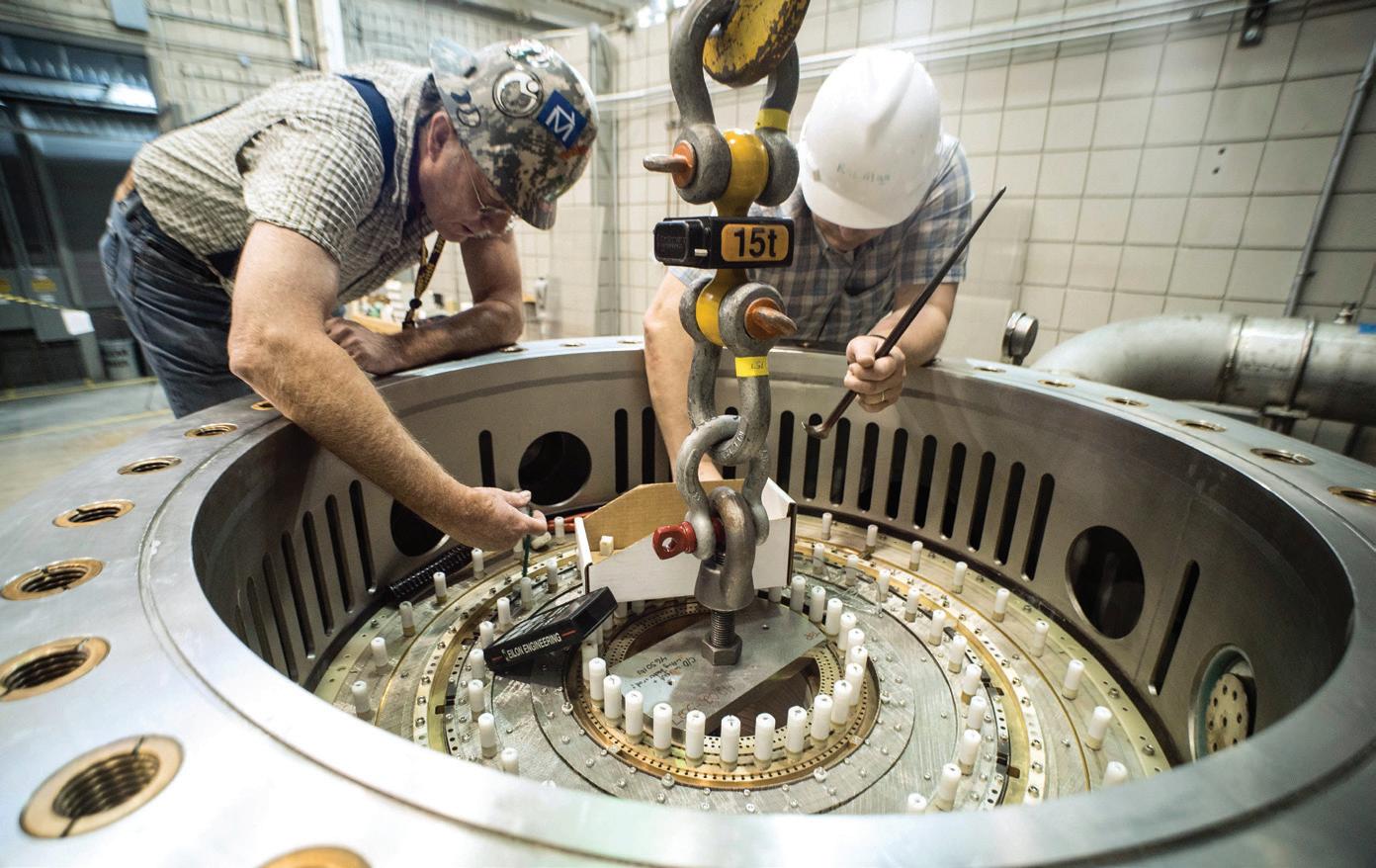
FSU is home to the National High Magnetic Field Laboratory, the largest and most powerful facility of its kind in the world. Each year, it hosts thousands of researchers whose work tackles critical questions in materials, technology, energy, health and the environment. With generous support from the Florida Legislature, MagLab scientists and engineers have developed a revolutionary process that would potentially extract $20 billion worth of previously untapped rare earth materials from phosphogypsum stacks across central Florida.

2
PIONEERING MEDICAL RESEARCH TO COMBAT RARE PEDIATRIC DISEASES
The Florida Institute for Pediatric Rare Diseases (IPRD), a key initiative of the FSU College of Medicine, is transforming the landscape of rare disease research, treatment and advocacy. Some of IPRD’s cuttingedge initiatives include establishing a whole-genome sequencing lab, expanding genetic counseling services and funding over 20 active research projects. With strong backing from university leadership, legislative funding and community partnerships, the institute is accelerating medical advancements that will improve the lives of children and families worldwide.
3
ENHANCING EXTREME WEATHER PREDICTIONS WITH INNOVATIVE TECHNIQUES
Researchers at the FAMU-FSU College of Engineering have developed Empirical Quantile Mapping with Linear Correction (EQM-LIN), a groundbreaking technique that improves the accuracy of extreme weather forecasts. Through integrating advanced statistical modeling with bias correction techniques, EQM-LIN enhances weather projections, aiding disaster preparedness. Initially focused in South Florida, this research is expanding statewide to help stakeholders identify flood-prone areas and protect vulnerable infrastructure.
4 EQUIPPING CHILDREN WITH A LIFETIME OF LITERACY
Since 2002, the Florida Center for Reading Research (FCRR) has been a driving force in advancing literacy through evidence-based research and innovation. By developing reading resources, assessment tools and interventions, FCRR supports learners of all ages, ensuring reading is accessible to all. Collaborating with educators, policymakers and researchers worldwide, FCRR’s efforts are transforming literacy education and improving learning outcomes.
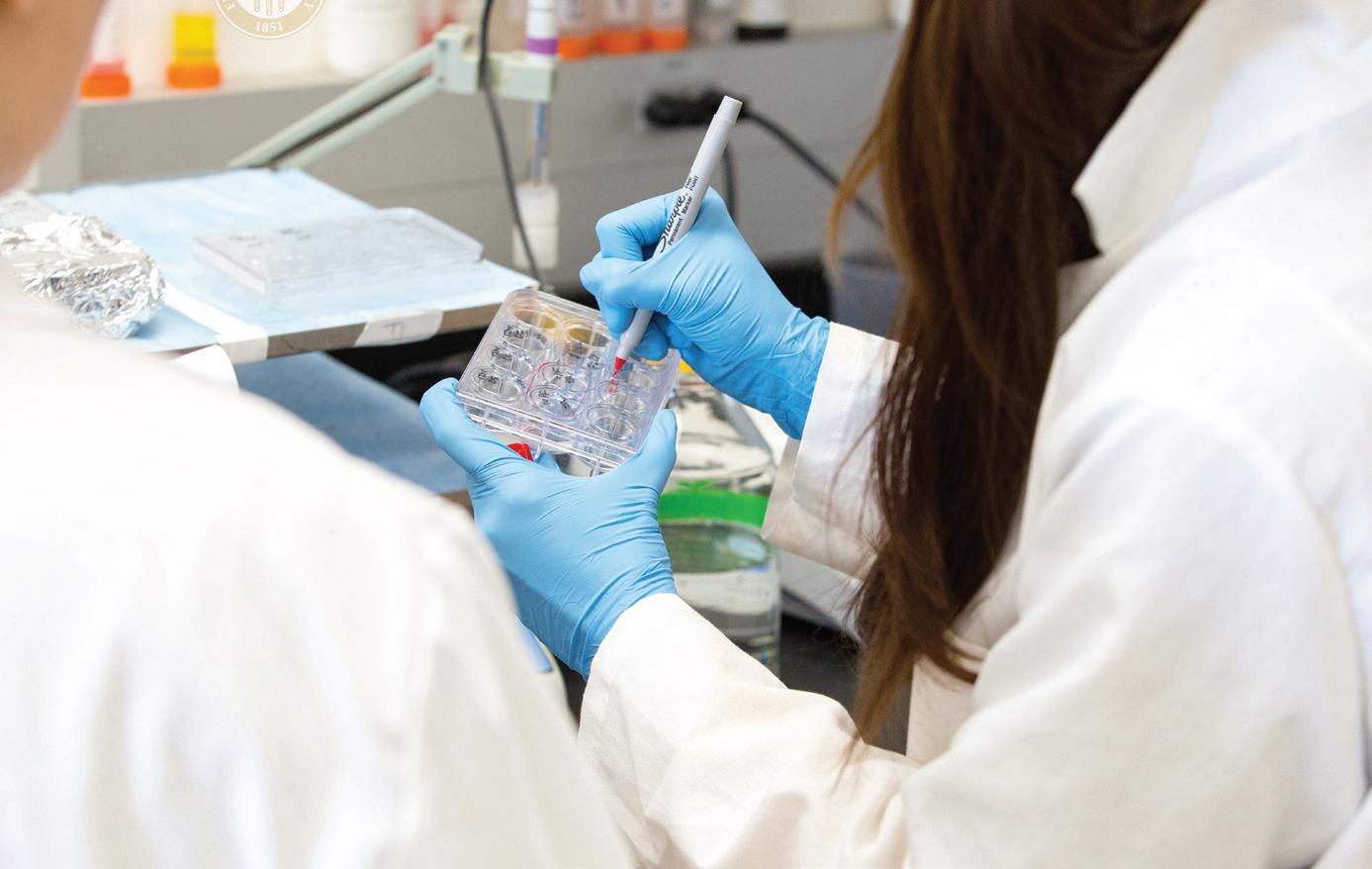
Researchers at the Anne Spencer Daves College of Education, Health, and Human Sciences are developing rapid, standardized tests for detecting foodborne pathogens. Offering unmatched speed and efficiency, these tests are invaluable for stakeholders such as food processors and testing labs. FSU research also helped to develop the RIGHTTest, a seafood identification tool used by SeaD Consulting to detect mislabeled shrimp. Innovations like these promote transparency and accountability, playing a crucial role in ensuring public safety in the food industry.
7
6
ADVANCING RESEARCH AND RESPONSE IN EMERGENCY MANAGEMENT
The Emergency Management and Homeland Security Program at FSU stands out for its leadership in preparedness, response, recovery and mitigation across diverse emergency scenarios. Its members actively contribute to the Florida Division of Emergency Management’s State Emergency Response Team (SERT) and the Florida Urban Search and Rescue (US&R) system, assisting in air operations and disaster response efforts, such as those following Hurricane Idalia. Beyond field operations, the department is nationally recognized for its cutting-edge research. A current study on information transmission within unmanned aircraft systems explores potential cybersecurity risks to U.S. infrastructure. As innovations in technology advance, this research plays a vital role in safeguarding government agencies and the public.

EXPANDING HEALTH CARE ACCESS AND RESEARCH
With the goal of improving access and innovation in health and health care in Northwest Florida, Florida State University has announced plans to build an acute care hospital in Panama City Beach. The planned hospital will be located in the same medical district and adjacent to a new medical office building that opened in July 2024 and currently offers primary care, urgent care, cardiology and pulmonary services. Beyond meeting community health care needs, the campus is distinguished by its commitment to advancing research in aging and digital health, ultimately enhancing the quality of life in this region and beyond.
8
RESTORING APALACHICOLA BAY
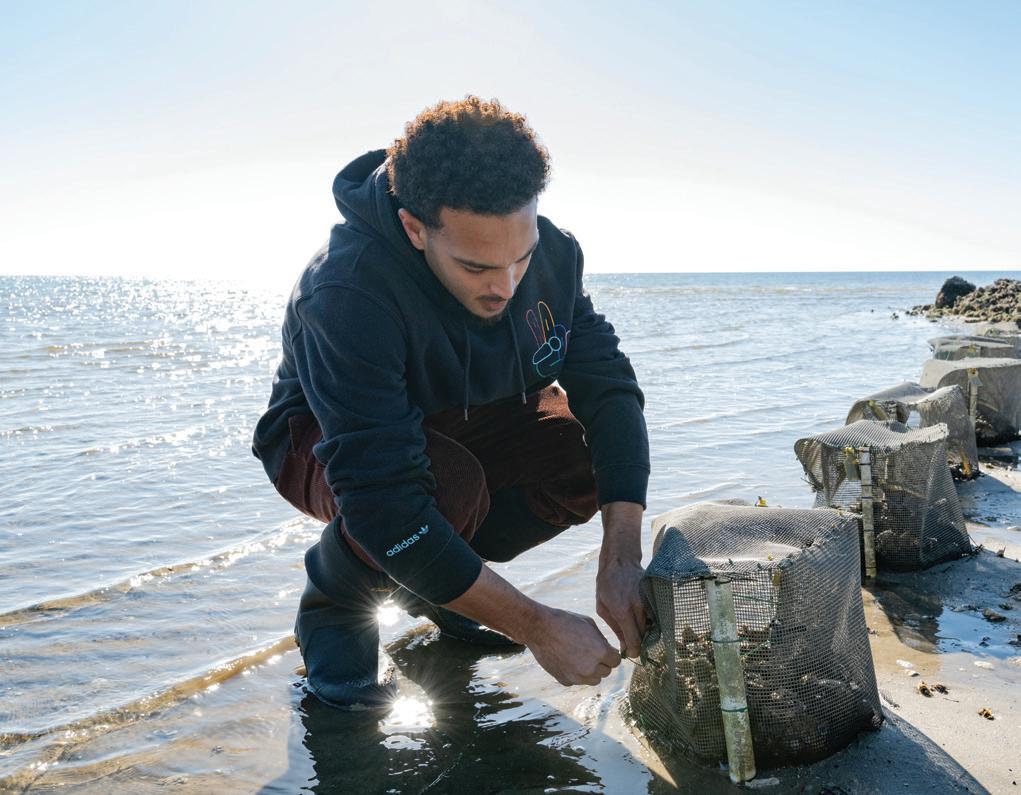
The Apalachicola Bay System Initiative (ABSI) was established at FSU’s Coastal and Marine Laboratory to help restore what was once a top fishery. After four years of research and stakeholder engagement, ABSI developed a community-centered restoration and management plan for Apalachicola Bay. This plan outlines five key goals supported by researchbacked strategies, serving as an “ecosystem roadmap” that the legislature is encouraged to adopt. Implementing this framework will restore the bay and foster a thriving economy.
9
OPTIMIZING AI TO ITS FULLEST POTENTIAL
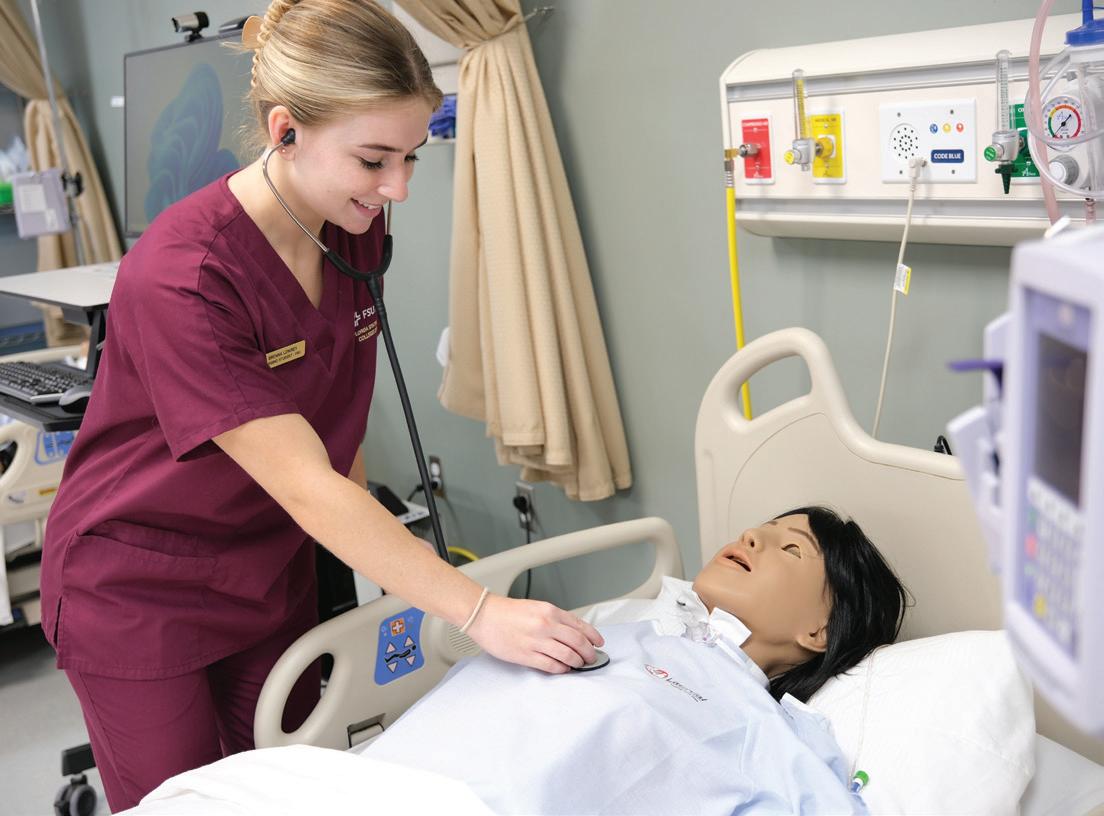
Recognizing the growth of AI, Florida State University is equipping future professionals with expertise in emerging technologies. The College of Nursing, for example, is the first nursing school in the nation to offer a concentration in AI Applications in Healthcare, bridging the gap between AI and nursing practice to improve patient outcomes and efficiency in health care delivery. At the College of Law, groundbreaking research explores the intersection of AI and law, reinforcing FSU’s leadership in legal education. Through integrating AI into coursework, FSU ensures students are prepared to succeed in an evolving world across all fields of study.
By Amy Farnum-Patronis
Twenty-one graduate programs at Florida State University are ranked in the Top 25 among public universities in the 2025 U.S. News & World Report’s edition of Best Graduate Schools, demonstrating the university’s excellence across multiple disciplines.
Notably, FSU’s graduate program in law, the College of Nursing’s Doctor of Nursing Practice, the College of Medicine’s primary care program, and the College of Business’ graduate studies in real estate ranked No. 1 among Florida’s public universities.
“These rankings reflect the incredible dedication of our faculty, the talent of our students and the strength of our graduate programs,” FSU President Richard McCullough said. “They are
The College of Law climbed 10 spots to No. 38 overall and is No. 17 among public universities. The College of Law shares this ranking with the University of Florida, Emory University, UC Irvine and Fordham University. FSU also ranks in the Top 25 among public universities in eight law specialties: environmental law (No. 8); contracts/commercial law (No. 13); criminal law (No. 14); tax law (No. 15); constitutional law (No. 16); business/corporate law (No. 17); health care law (No. 24); international law (No. 25).
“This is our highest ranking ever, and we are incredibly proud to see our efforts being recognized,” said Erin O’Hara O’Connor, dean of the FSU College of Law. “We have risen 18 spots over the past two years, which underscores the strength of our world-class faculty, our robust legal curriculum and our top-
a testament to our commitment to academic excellence and realworld impact. We are dedicated to sustaining this momentum and achieving even greater heights.”
Provost Jim Clark said these rising graduate program rankings reinforce FSU’s reputation as a top-tier research university.
“The success of our students and faculty shows that FSU is effectively preparing the next generation of leaders, innovators and scholars,” Clark said. “We’re proud of this progress and excited for what’s ahead.”
Programs in law, education, business, nursing and engineering are ranked annually by U.S. News, using data on enrollment, job attainment, faculty and other quality indicators.
notch student support services. I also want to acknowledge the university’s commitment to investing in our students’ success — we’re thrilled to see these efforts reflected in our rankings.”
The Anne Spencer Daves College of Education, Health, and Human Sciences graduate program in education ranks No. 10 among public universities and No. 18 overall. FSU programs ranked among the Top 20 public universities in specialties ranked by the publication: special education (No. 10); curriculum and instruction (No. 13); elementary teacher education (No. 17); secondary teacher education (No. 17); education administration and supervision (No. 18).
“I am extremely proud of the faculty, students and staff of Anne’s College and
the work they do to maximize human potential,” said Damon Andrew, dean of Anne’s College. “Our specialties, in particular, continue to shine, and that is a direct testament to the dedication and research impact of our world-class faculty.”
The College of Business’ MBA specialty in real estate secured the No. 1 spot in Florida, the No. 6 ranking among public universities nationwide and No. 13 overall. It’s a new high mark for the MBA specialty.
“This significant achievement can be traced to many factors, including our stellar MBA students and worldrenowned faculty members,” said Michael Hartline, dean of the FSU College of Business. “We are infusing every facet of the learning process with real-world experiences, from internships to corporate immersion experiences.”
The college’s specialized graduate studies in real estate — available to students pursuing a master’s degree in business administration (MBA) or finance (MSF) — focus on the high-demand area of real estate finance and investment.
The College of Nursing’s Doctor of Nursing Practice ranked No. 28 overall and No. 18 among public colleges. The DNP program ranks No. 1 among public and private institutions in Florida.
“The College of Nursing’s rankings affirm our commitment to excellence and innovation in doctoral nursing education,” said Jing Wang, dean of the College of Nursing. “Being ranked No. 1 in Florida is a testament to our faculty, students and staff who are driving bold advancements in patient care and health care leadership. With continued investments in our programs, research and clinical partnerships, these rankings will only rise, further solidifying our position as a national leader in graduate nursing education and innovation.”
The College of Medicine’s primary care program earned the highest designation in Florida among public medical schools. FSU earned a Tier 2 ranking in the publication’s new four-tier ranking system for medical schools.
“Having access to a primary care physician provides a foundation for healthy individuals and entire communities,” said Dr. Alma Littles, dean of the FSU College of Medicine. “This ranking underscores our commitment to serving the health care needs of Floridians — and we are proud that more than half of our graduates continue to live and work in this state.”
The FAMU-FSU College of Engineering is celebrating a noteworthy advancement in national recognition, climbing four positions to secure the No. 56
ranking among public engineering graduate programs with doctorate degrees. In addition, four of the college’s graduate engineering program rankings (biomedical, electrical, industrial and mechanical engineering) moved up on the list.
This upward movement demonstrates the college’s growing strength in research, teaching excellence and innovative approaches to solving engineering challenges. The distinctive partnership between Florida A&M University and Florida State University continues to create valuable opportunities for students and faculty alike, according to Suvranu De, dean of the FAMU-FSU College of Engineering.
“We’re building momentum through collaborative research initiatives and preparing graduates who are ready to make meaningful contributions to society,” De said. “As we continue investing in our people and programs, I’m confident we’ll see our national prominence rise even further in the coming years.”
This year, U.S. News also ranked the disciplines of speech-language pathology and library and information studies disciplines. These rankings are based solely on opinions of each program’s quality as rated by academic experts at peer institutions.
FSU’s Library and Information Studies program, housed in the College of Communication and Information’s School of Information, placed No. 12 nationally and No. 10 among public universities. The ranking is the best in the state.
The speech-language pathology graduate program in the School of Communication Science and Disorders, housed within the College of Communication and Information, ranked No. 14 among publics and No. 18 overall. The program is also the best in Florida.
“I’m deeply proud of our academic
programs and specialties,” said Michelle Kazmer, dean of the College of Communication and Information. “The rankings achieved by the programs in the School of Communication Science and Disorders and in the School of Information reflect the innovative courses of study, exceptional teaching and impactful translational research conducted in both schools. The sustained quality in these programs over time is extraordinary, and I am profoundly grateful to work with such brilliant and committed colleagues.”
Graduate programs within the College of Social Sciences and Public Policy also received recognition in this year’s rankings, which are based solely on opinions of each program’s quality as rated by academic experts at peer institutions.
The college’s specialty in local government management ranked No. 10 overall and No. 9 among public universities, while the leadership specialty ranked No. 16 overall and No. 10 among public universities. Housed primarily in the Reubin O’D. Askew School of Public Administration and Policy, the Department of Political Science, and the Department of Urban & Regional Planning, these programs train future leaders in policy and public service to the betterment of countless local communities, the state and nation.
“Once again, the college’s policy programs shine in national rankings of initiatives that are central to the functioning of American democracy,” said COSSPP Dean Tim Chapin. “Our public administration, political science and planning units produce graduates with the skills and intellectual foundations to be local and national leaders in government service and nonprofit organizations. Put plainly, the faculty, students and alumni of these programs help the nation to function, and I couldn’t be more proud of the work they do.”
By Jenny Ralph (B.S. ’21, M.S. ’22) and Suzan Kurdak
After the tornadoes passed, the damage came into focus.
In just half an hour, three twisters tore through Tallahassee on May 10, 2024, flattening trees, tearing roofs and shredding one of Florida State University’s most beloved landmarks: the Flying High Circus tent.
Since the mid-1960s, the FSU Flying High Circus has been the only collegiate circus to boast its own big top tent. The tornadoes left the circus without its iconic tent that had been visible for decades as a symbol of school spirit and tradition.
For nearly a year, the circus team trained in tight corners and made do without their signature space.
Now, with a new big top rising where the old one stood, the Flying High Circus is back.
“The circus is an integral part of FSU’s history, and the tent is a beloved symbol
on campus,” said Amy Hecht (B.S. ’01), vice president for Student Affairs, which oversees the circus. “The recovery process wouldn’t have been possible without the dedicated efforts of the circus team, leadership at FSU and a tremendous outpouring of support from the Tallahassee community.”
The circus had to replace everything that was destroyed, including the big top tent fabric, steel structures, seating and even concrete foundation. The 10.5-month recovery process has been a testament to the resilience and determination of the circus team.
“The entire process of tent replacement could not have been accomplished without the effort and expertise of our circus staff,” said Chad Mathews (B.A. ’98, M.S. ’03), director of the FSU Flying High Circus. “From the very beginning of the process with designing the upgrades, to the tent
and all the way to facilitating the delivery and conducting the installation, the unique talents, passion and proficiency of our staff was on full display.”
The fabric used for big top tents typically has a lifespan of around 10 years. The new tent is similar to its predecessor but is more durable and functional. The garnet exterior has been swapped for a new gold and cream one to create a cooler environment for those under the tent in the Florida heat. Ventilation at the top has been increased to improve airflow.
Other improvements include larger exits and unobstructed openings that will address issues with water intrusion and leaks that plagued the previous tent. The seating system has been replaced and remains modular to allow for future adjustments as needed, and the aerial rigging and truss grids have been replaced to ensure performers’ safety.
The swooping point motif, which elegantly slopes down from the cupolas, is unique to FSU, Mathews said. The design was created by a graphic designer in the former Oglesby Union Marketing Office.
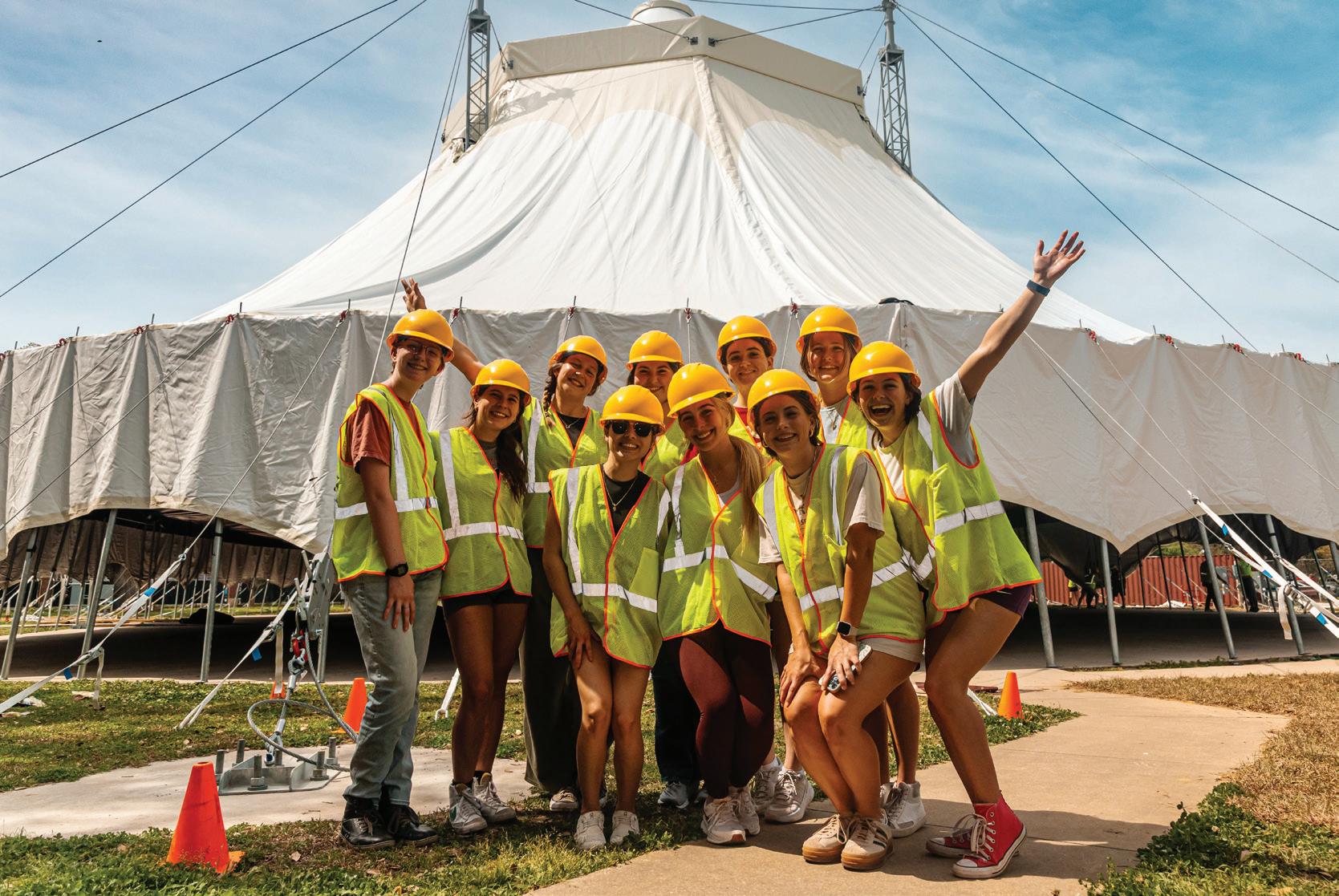
The new tent arrived by cargo ship on March 20, 2025, after being designed by Canobbio, a textile architecture company in Italy. FSU circus student performers donned hard hats and construction vests to help install the new tent’s poles and place the fabric. It’s a tradition for these students to take the tent down each fall semester and set the tent back up in the spring.
Student performers are now rehearsing under the big top once again.
“For my act, which is triple trapeze, we usually practice in the tent,” said Kira McClard, a behavioral neuroscience major whose acts include acrobatic jump rope. “With that, we get the experience with
the height and can kind of desensitize that fear response. Getting in the tent is something I missed, and the adrenaline rush of climbing up the rope all the way to the top and sitting and doing our tricks with a low fall or a high fall.”
The cost of the rebuild exceeded $2.25 million. The tent itself, including shipping costs from Italy, amounted to nearly $850,000. The new seating system was just shy of $250,000, and the replacement rigging components were over $150,000. The site improvements, which include the concrete floor and electrical upgrades, exceeded $1 million.
“The outpouring of support from the FSU and Tallahassee community, as
well as alumni, has been remarkable,” Mathews said. “People immediately wanted to help.”
Fundraising efforts included initiatives such as lemonade stands and t-shirt sales. Madison Social, Alumni Hall and the Garnet & Gold Store were quick to offer support. The circus team also sold sling bags made from the previous tent fabric.
More than $83,000 has been raised through ongoing fundraising efforts, with an additional $15,000 from this year’s FSU’s Great Give. These funds have been instrumental in replacing rigging and aerial truss grids to ensure the circus can continue to provide top-notch performances.
For the 2025-2026 school year, the FSU Circus is resuming normal operations. With the return of the Halloween show this fall, students are able to see the reward of all the work they put in to get here.
“It’s going to make our shows even better,” said Cooper Garrard, a psychology major whose circus acts include rola bola, juggling, stilts and flying trapeze. “Everything is just going to be that much better knowing that we helped put back up our brand-new tent in such a short amount of time.”
GIVE to the FSU Flying High Circus Expansion Project Fund at give.fsu.edu.
LEARN MORE about the FSU Flying High Circus and future performances at circus.fsu.edu.
By Bill Wellock
With recent hires in the College of Medicine and the College of Social Sciences and Public Policy, Florida State University has doubled the number of its faculty who are members of the National Academies of Sciences, Engineering, and Medicine, a prestigious organization that unites leading researchers from around the country.
“Florida State University is a leading research university and an excellent place to grow an academic career,” said FSU President Richard McCullough. “Our ability to attract these esteemed faculty members is a testament to that commitment.”
The National Academies of Sciences, Engineering, and Medicine, or NASEM, are private, nonprofit institutions that provide expert advice on some of the most pressing challenges facing the nation and world. Their work helps shape sound policies, inform public opinion and advance the pursuit of science, engineering and medicine.
The university now counts 12 NASEM members among its faculty, an increase from six just three years ago.
“These National Academy members want to be a part of FSU because the administration, faculty and students value their contributions and the opportunity to collaborate,” said Provost and Executive Vice President for Academic Affairs Jim Clark.
This year, FSU added National Academy members A. Stewart Fotheringham to the Department of Geography, Regan Bailey to the Department of Behavioral Sciences and Social Medicine, and Patrick Stover to the Department of Biomedical Sciences.
Fotheringham is the Krafft professor
of spatial data science and the director of the Spatial Data Science Center. His research focuses on the analysis of spatial data sets using statistical, mathematical and computational methods, which he applies to topics such as health data, crime patterns, migration and more.
Bailey is a professor in the Department of Behavioral Sciences and Social Medicine and co-director of the Institute for Connecting Nutrition and Health. She is a nutritional epidemiologist whose research is focused on promoting health through nutrition across the lifespan. Her research program uses best practices for characterizing nutritional status, improvement of dietary assessment and chronic disease risk using a life course approach.
Stover is a professor in the Department of Biomedical Sciences and co-director of the Institute for Connecting Nutrition and Health. He is known for his research on folate metabolism and its crucial role in human health. His work has helped uncover how folate, a B-vitamin, affects critical biological processes such as DNA synthesis, repair and methylation, and it has shown how folate deficiencies could lead to severe health consequences such as neuropathies, cancer and cardiovascular diseases.
Other recent additions include Sue Hassmiller (B.S. ’77, M.S. ’79), from the College of Nursing, and Manoj Shah and Longya Xu from the FAMU-FSU College of Engineering.
The number of National Academy members on the faculty is an important factor for institutional membership in the Association of American Universities, or AAU, a group of leading research universities.
NATIONAL ACADEMY MEMBERS AT FSU ARE WORKING ON GAME-CHANGING RESEARCH ACROSS CAMPUS:
NATIONAL ACADEMY OF SCIENCES
Greg Boebinger, Department of Physics, College of Arts and Sciences; director emeritus of the National High Magnetic Field Laboratory
A. Stewart Fotheringham, Department of Geography, College of Social Sciences and Public Policy
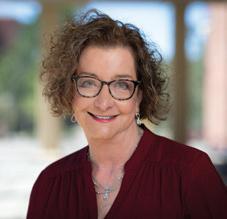
Laura Greene, Department of Physics, College of Arts and Sciences; chief scientist at the National High Magnetic Field Laboratory
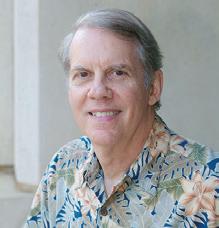
Steven Stanley, Department of Biological Science, College of Arts and Sciences
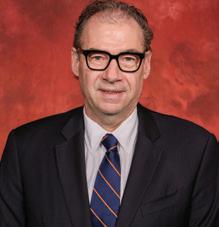
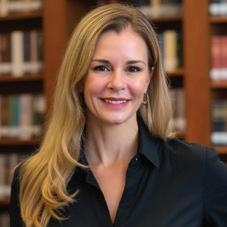
Regan Bailey, Department of Behavioral Sciences and Social Medicine, College of Medicine
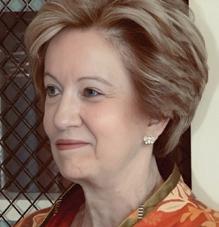
Barbara J. Culliton, College of Communication and Information
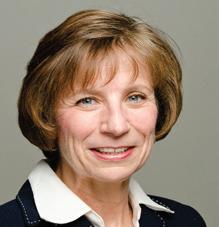
Susan B. Hassmiller
(B.S. ’77, M.S. ’79), College of Nursing
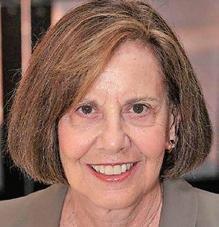
Jill Quadagno, Department of Sociology, College of Social Sciences and Public Policy
NATIONAL ACADEMY OF ENGINEERING
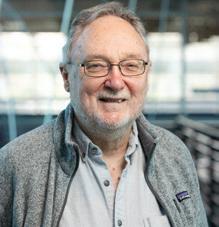
David C. Larbalestier, Department of Mechanical Engineering, FAMUFSU College of Engineering; chief materials scientist, National High Magnetic Field Laboratory
Manoj Shah, Department of Electrical and Computer Engineering; FAMUFSU College of Engineering
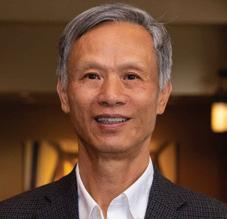
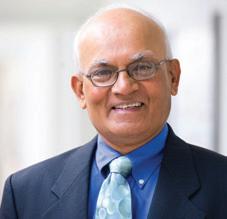
Longya Xu, Office of the Dean, FAMU-FSU College of Engineering
By Anna Prentiss (B.A. ’09, M.S. ’24)
Florida State University’s College of Motion Picture Arts (FSUFilm) retains its distinction as the fourth-ranked public film school in the nation while climbing to No. 14 in The Hollywood Reporter’s 2025 rankings of top U.S. film schools, up from No. 17.
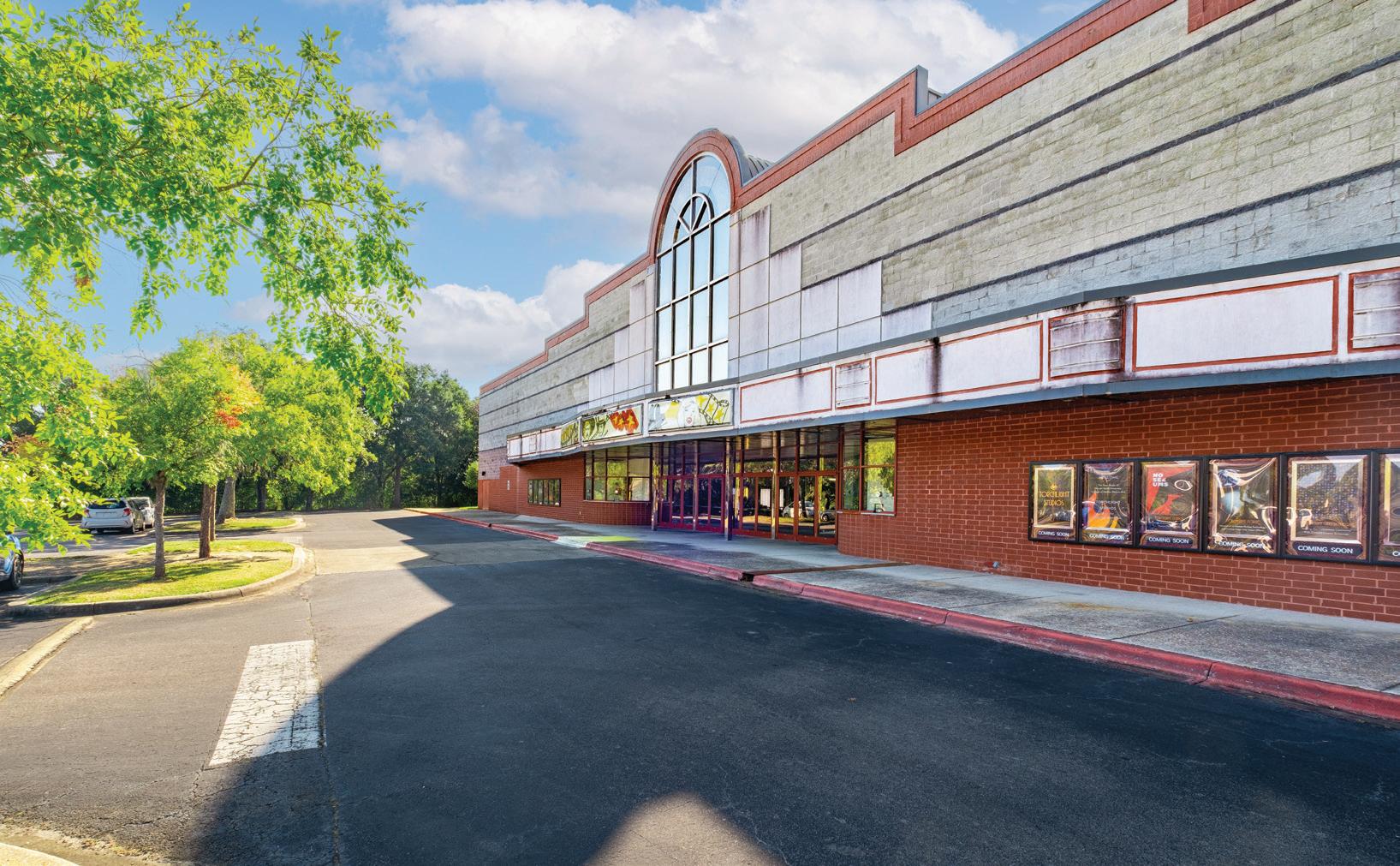
Two major developments contributed to the rise: the acquisition of a 43,242-square-foot facility — formerly Governor’s Square theater complex in Tallahassee — and the continued success of the college’s MFA Feature Film Program, now entering its third year.
“I feel certain our significant jump in the rankings this year is due to the extraordinary support we’ve received from the administration at FSU,” said Reb Braddock (MFA ’91), dean of the college. “We’ve fulfilled two longstanding dreams: we finally have a theater of our own, and we’re about to go into production on our third feature film. These are huge milestones for our program.”
The new facility will house the college’s Center for Cinematic Innovation, known as Torchlight Studios, relocating it from Midway, Florida, to the heart of Tallahassee. It will serve both academic and public cinematic experiences, offering students hands-on training and opportunities to showcase their work locally and globally.
The renovated space will support FSU’s growing graduate programs and include four theaters for screenings, a post-production facility, a dedicated soundstage for the MFA Feature Film Program, a 2,624-square-foot virtual production stage, two professional soundstages, production offices, scene shops and maker spaces for production design, storage for props and costumes, and a 5,796-square-foot event space for campus and community programming.
“When the film school was established in 1989 to prepare students for careers in the motion picture industry, it was given nearly every tool needed to become one of the greatest colleges dedicated to film education, except one — a movie theater
The new facility will house the college’s Center for Cinematic Innovation, known as Torchlight Studios, relocating it from Midway, Florida, to the heart of Tallahassee.
of its own,” Braddock said. “This visionary move transforms the Governor’s Square theater into a true center for film appreciation and production, with a strong focus on community engagement.”
FSUFilm’s MFA Feature Film Program allows graduate students to pitch and direct a fully financed, college-supported feature film during an optional third year of study. Secondyear students crew on the feature, gaining experience and credits before completing their capstone films.
“Getting to make a feature film while still in school is pretty unbelievable,” said Jack Gaffney (B.S. ’23), a current MFA student. “The Feature Film Program at FSUFilm gives you hands-on experience from start to finish. You’re not just learning how to make a film. You’re learning how to sell it, too. Traveling to Cannes and seeing the industry side of things firsthand is an experience I’ll never forget. And the whole time, you’ve got faculty and staff backing you up every step of the way.”
The program’s first feature, “Noseeums,” a Southern Gothic horror story set in the Florida Panhandle, is represented by Odin’s Eye Entertainment and premiered at FrightFest in London on Saturday, Aug. 23.
“Directing ‘Noseeums’ was a once-in-alifetime challenge that I wouldn’t take away,” said Raven Carter (MFA ’24). “It’s those challenges that have set me apart when it comes to leading teams and directing. The FSU feature program is a great opportunity to rapidly grow your capacity and mature as a filmmaker. I’m so excited that we’re going to FrightFest, and I hope the entire team feels proud and full of joy over this amazing accomplishment.”
FSUFilm continues to offer the lowest cost of attendance among top-ranked film schools, with no hidden fees and tuition that covers all production equipment and expendables, including access to industry-standard gear.
LEARN MORE film.fsu.edu.
By Hillary Speed
An international group that supports work-integrated education announced multiple awards honoring Florida State University’s success in preparing students for the workforce, including an inaugural award that recognizes a member of the faculty.
The Cooperative Education & Internship Association honored FSU with three awards:
• Best Practices Award – Experience Recognition Program
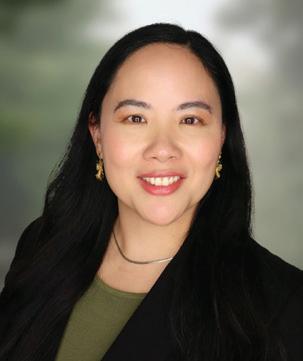
• Engagement Fellowship – Career Center Senior Assistant Director and InternFSU Program Manager Li Pon (B.A. ’09, M.A. ’11)
• Charles Kettering Award, which recognizes an outstanding internship employer – E. & J. Gallo Winery recognizing the contributions of Amanda Bussey (B.A. ’05), former sales recruiting manager for her leadership in supporting experiential learning opportunities within the company
FSU students pose during a job shadow day at the St. Johns County Clerk of the Circuit Court and County Comptroller in December 2024. FSU Shadow was one of many programs recognized by the Cooperative Education and Internship Association during its annual conference awards. Photo courtesy of the St. Johns County Clerk of the Circuit Court and County Comptroller.
The CEIA is a leader in workintegrated learning that provides opportunities for professional development while advocating for best practices in co-ops, internships and other forms of experiential education. The awards were presented at CEIA’s annual conference April 6–8, 2025, in Tucson, Arizona.
“It’s a privilege to acknowledge Florida State University’s enduring legacy and profound impact on the field of cooperative education and internships,” CEIA President Andrew Harper said. “I’ve witnessed firsthand FSU’s unwavering dedication to fostering high-quality work-integrated learning. Their longstanding commitment to CEIA, through board service, expert guidance and innovative presentations, has elevated work-integrated learning standards nationwide.”
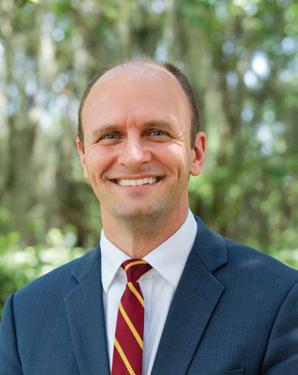
CEIA’s first-ever Faculty Champion Award recognized Vice President for Student Academic Success Joe O’Shea (B.A ’08) for his contributions to the promotion and advocacy of work-integrated learning by a member of the faculty.
Li Pon, senior assistant director of the
FSU Career Center and InternFSU program manager.
“We’re honored that CEIA recognizes FSU’s commitment to enriching the student academic journey through experiential learning,” O’Shea said. “Our work at FSU wouldn’t have been possible without outstanding students, faculty and staff at the university who believe in the power of experiential education and in making engagement
a possibility for every student, from every background.”
Work-integrated learning complements academic studies with practical, real-world experiences outside of the classroom such as internships, undergraduate research, community service engagement and global studies.
FSU’s commitment to workintegrated learning includes the “formative experience” graduation requirement, implemented in summer 2019 and continuing today, which ensures that all students get a chance to learn and engage outside the classroom.
Students find opportunities to complete the requirement throughout
the university, within their colleges and beyond through programs such as the Applied Politics & Policy Learning Experience, the Legislative Internship Program, classroom field experience, the sport management practicum, internships through various academic units and programs such as InternFSU and InternFSU: TLH, and production work for ESPN through Seminole Productions.
As a legislative intern, international affairs and political science double major Sofia Casas has gotten to work directly under a Florida state senator and her legislative aide in tracking pending legislation, coordinating schedules and handling constituent services.
“This position has given me the opportunity to engage firsthand with the legislative process and apply what I have learned in my political science coursework at FSU,” said Casas, who is from Miami. “Through my experience in this internship, I have discovered I have a genuine passion for local policy and am looking forward to pursuing a career in Miami-Dade politics after graduating.”
Joe O'Shea, FSU vice president for student academic success.
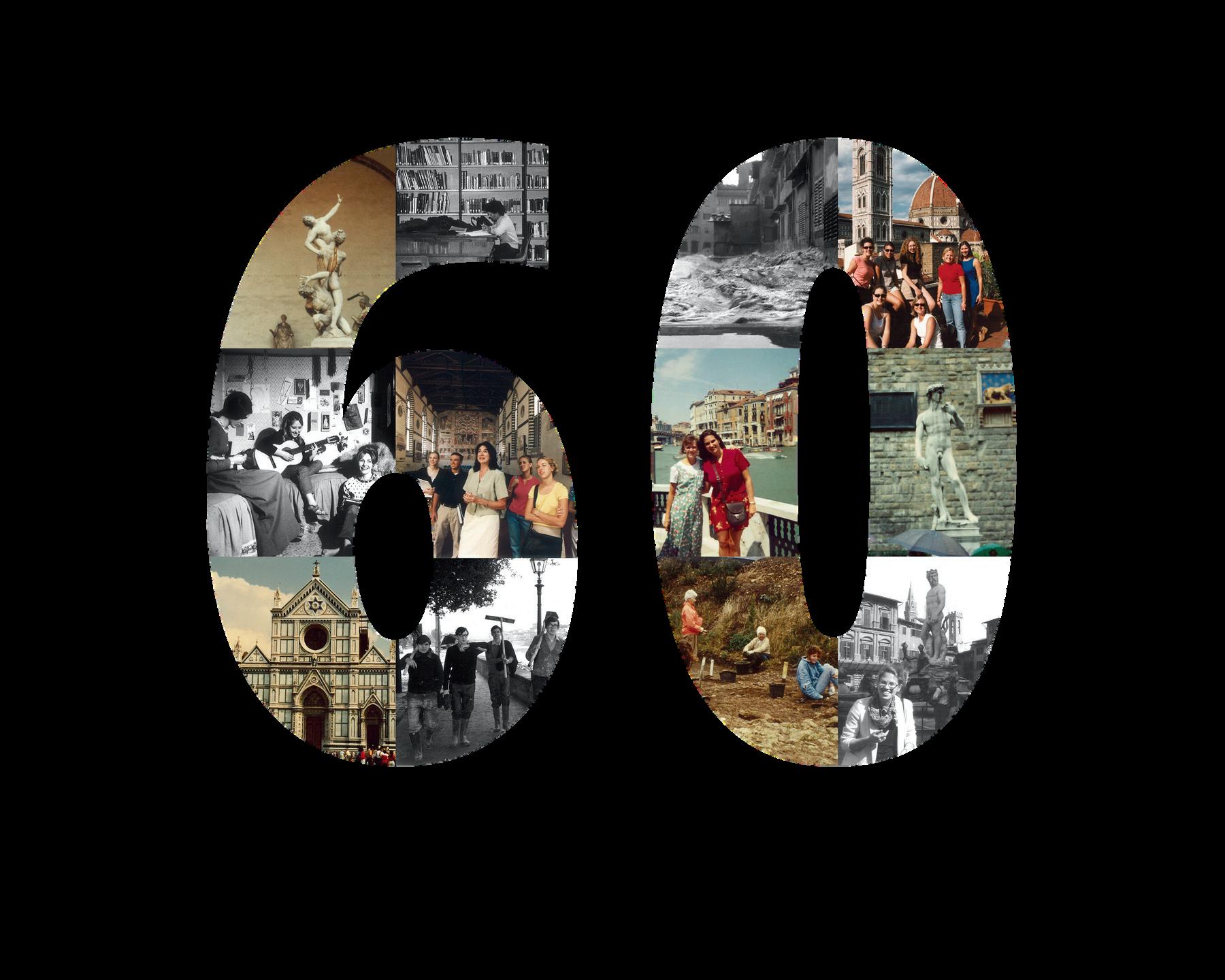

We’re celebrating 60 incredible years of memories and milestones at FSU Florence.
Mark your calendars for a celebration filled with joy, nostalgia, and camaraderie!
Date: April 13-17, 2026
Location: Florence, Italy
Scan the QR code for more information!
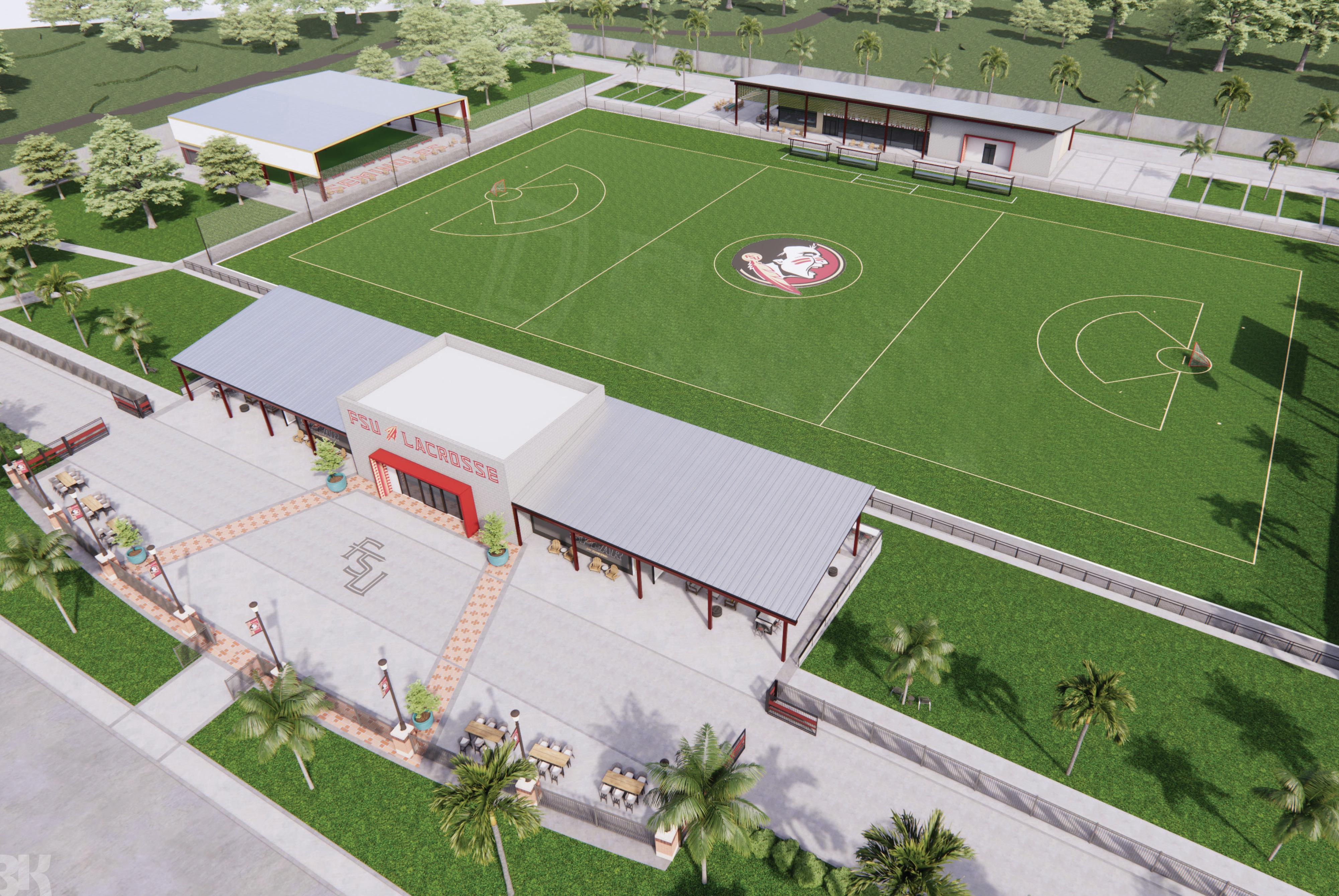
Florida State and Head Coach Sara Tisdale have welcomed 35 players for the program’s first season, including 17 with NCAA Division I lacrosse experience. FSU will play the first official game in program history on February 7, 2026, in its brand-new, lacrosse-only stadium.
“We are working diligently on the new lacrosse-only facility that will provide a best-in-class experience for our team and fans,” said Michael Alford, vice president and director of athletics. “The coaches and student-athletes have brought tremendous enthusiasm to our campus, and I can’t wait for our Florida State and Tallahassee communities to experience with them all the ‘firsts’ that are to come.”
LEARN MORE about the Florida State lacrosse program at Seminoles.com and follow them on social media @FSU_WLax and Florida State Women’s Lacrosse on Facebook.
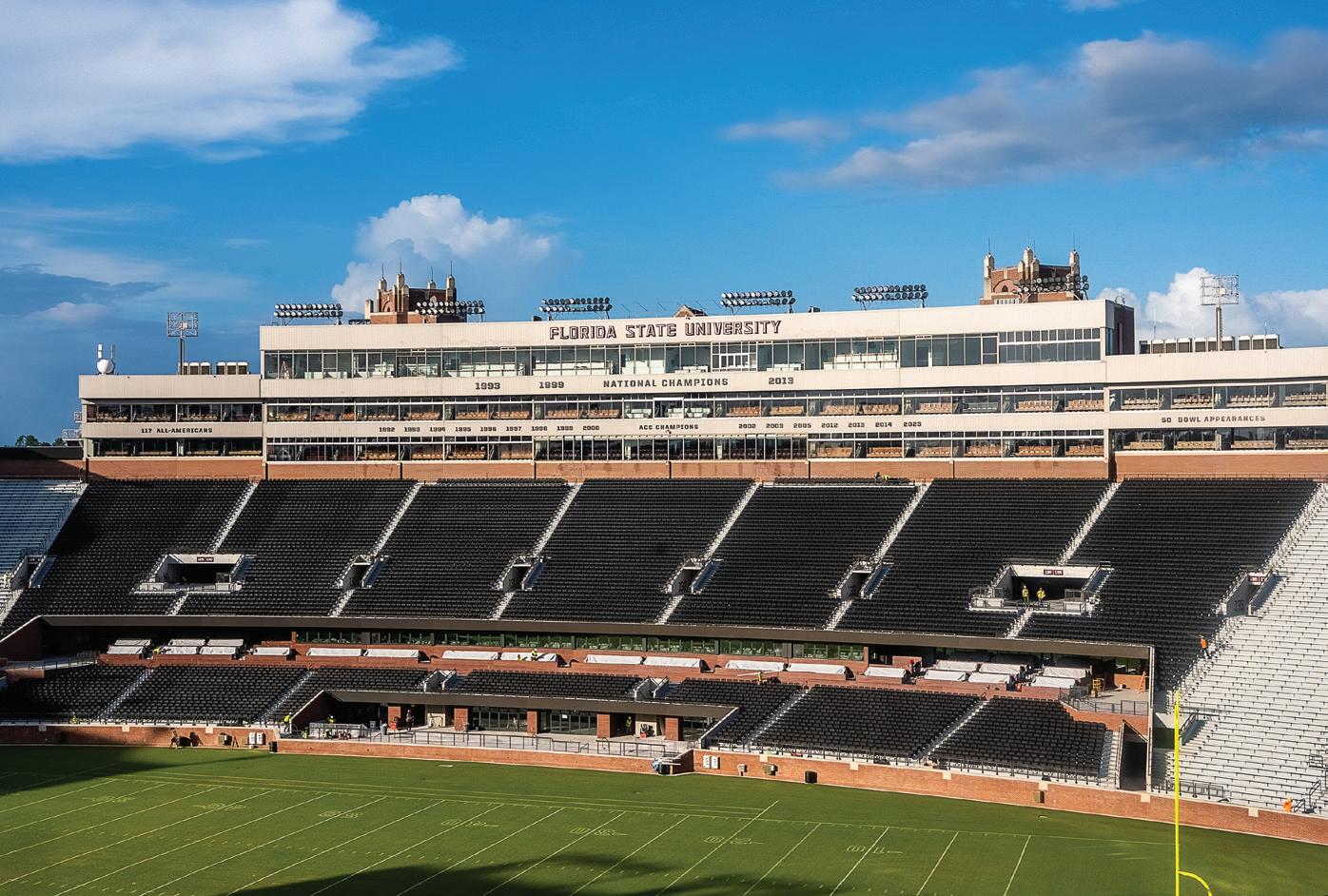
Florida State began renovations on Doak S. Campbell Stadium in the fall of 2023, and wrapped up this summer, just in time to welcome fans for the football home opener against the University of Alabama on August 30.
The project addressed key safety and code updates on the east side, including wider aisles, center handrails, improved lighting, 18-inch seats and upgraded ramps. Additional ADA-accessible seating was added to ensure compliance and comfort.
On the west side, the complete redesign introduced a variety of premium seating experiences, including chair backs for all regular season ticket holders. Concession facilities and restrooms were also rebuilt.
“We’re creating a space and environment for families, for friends, to come and enjoy Doak Campbell Stadium, the football program [and] make memories,” said Ben Zierden (B.S. ’98, M.S. ’01), senior associate athletics director for facilities and capital projects, in an online statement prior to completion.
LEARN MORE about tickets, events and investing in the FSU athletics tradition at boosters.fsu.edu.
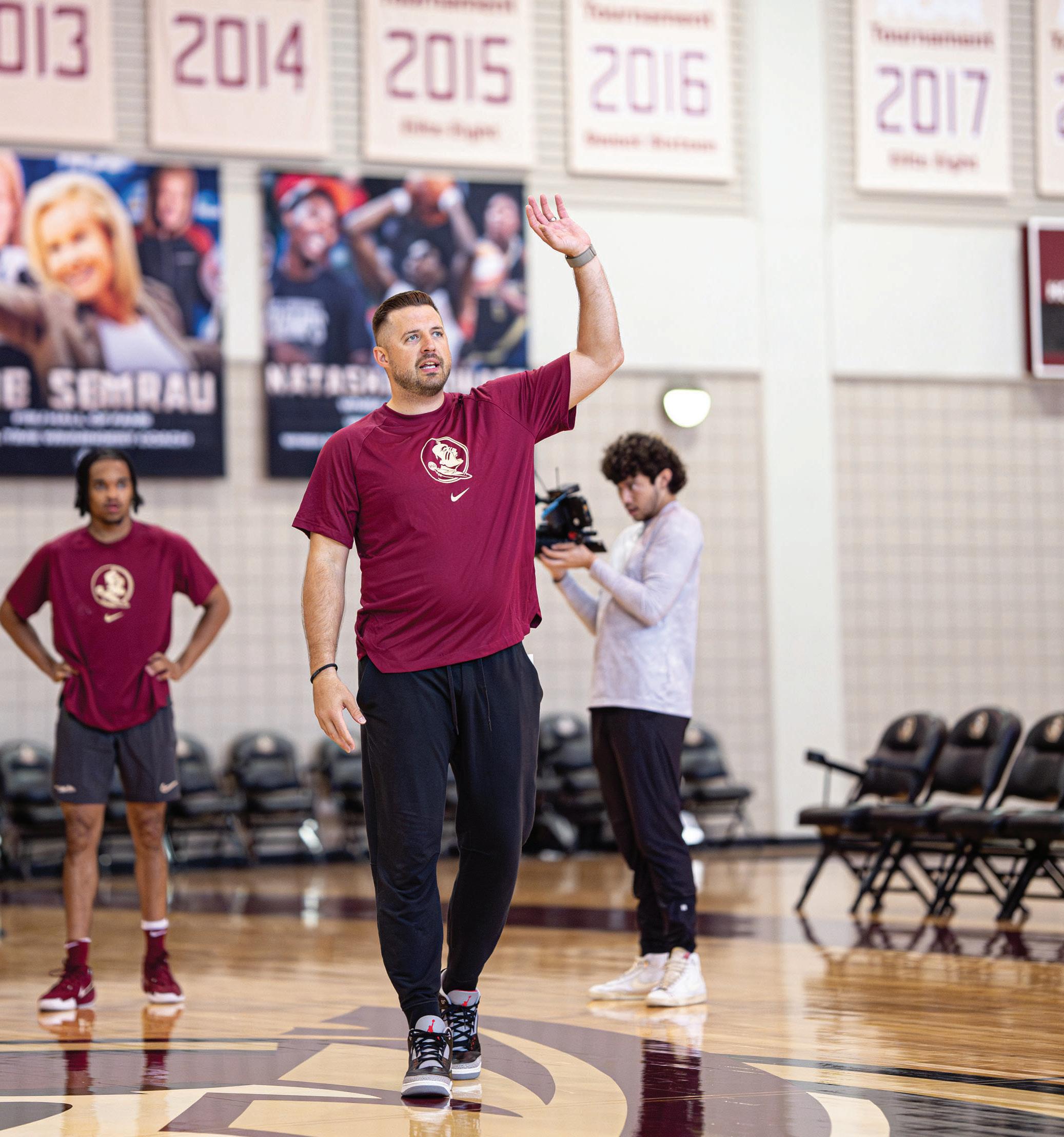
Florida State Hired Luke Loucks as Men’s Basketball Head Coach Courtesy of Florida State Athletics
Florida State has hired former player and two-time NBA champion Luke Loucks (B.S. ’11, M.S. ’12) as its men’s basketball head coach, FSU Vice President and Director of Athletics Michael Alford announced this spring.
“I’m excited to announce that Luke Loucks has accepted our offer to become the next head men’s basketball coach at Florida State,” Alford said. “Luke will bring a unique combination of qualities to our program, and I’m excited to begin the next chapter of our basketball history under his leadership. Throughout basketball at both the professional and collegiate levels, Luke has earned a reputation as one of the rising stars in coaching. Having been a key part of some of the best of what FSU basketball has been as a player, he also brings proven ability to develop players at the highest level of the sport.”
“I am thrilled to welcome Luke Loucks back to Florida State University
as our next head men’s basketball coach,” Florida State President Richard McCullough said. “Luke’s exceptional coaching ability, profound leadership skills, and extensive basketball knowledge make him the perfect fit to lead our program.
As a former Seminole, he understands the values and traditions that define FSU basketball. I am confident that under his guidance, Florida State will continue to achieve great success and uphold the proud legacy of Seminole basketball. Welcome home, Coach Loucks!”
Loucks brings a wealth of knowledge and experience in professional, collegiate and international basketball. He specializes in on-court instruction and player development and most recently served as an assistant coach with the Sacramento Kings after spending time on staff with the Golden State Warriors and Phoenix Suns.
“I am incredibly honored and excited for the opportunity to become the head coach for the Florida State men’s
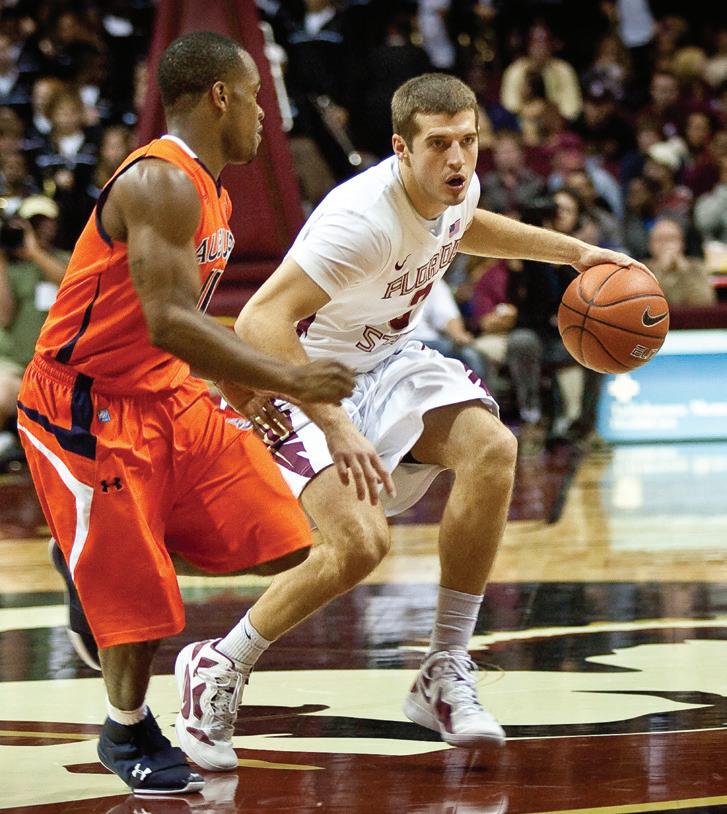
Above: Loucks helped lead FSU to the NCAA Tournament in all four of his seasons as a player, the first time in program history the Seminoles advanced to the NCAA Tournament in four consecutive years. Left: Loucks during summer 2025 practice sessions. Photos courtesy Florida State Athletics.
basketball team,” Loucks said. “FSU has a rich basketball tradition, and I look forward to building on the legacy of our previous coaches, especially Coach Hamilton. I’d like to thank the Sacramento Kings, Phoenix Suns and Golden State Warriors for providing me with a strong coaching foundation. I’m eager to build our coaching staff with the best and brightest basketball coaches in America. They will have characteristics that support and push me while helping me build and develop a competitive team year after year. We will have a standard that we stick to on and off the court that will help build a championship-level culture. I am privileged to have seen firsthand what winning feels like at Florida State, and I am hungry for more.”
By Laura Bradley (B.A. ’13)
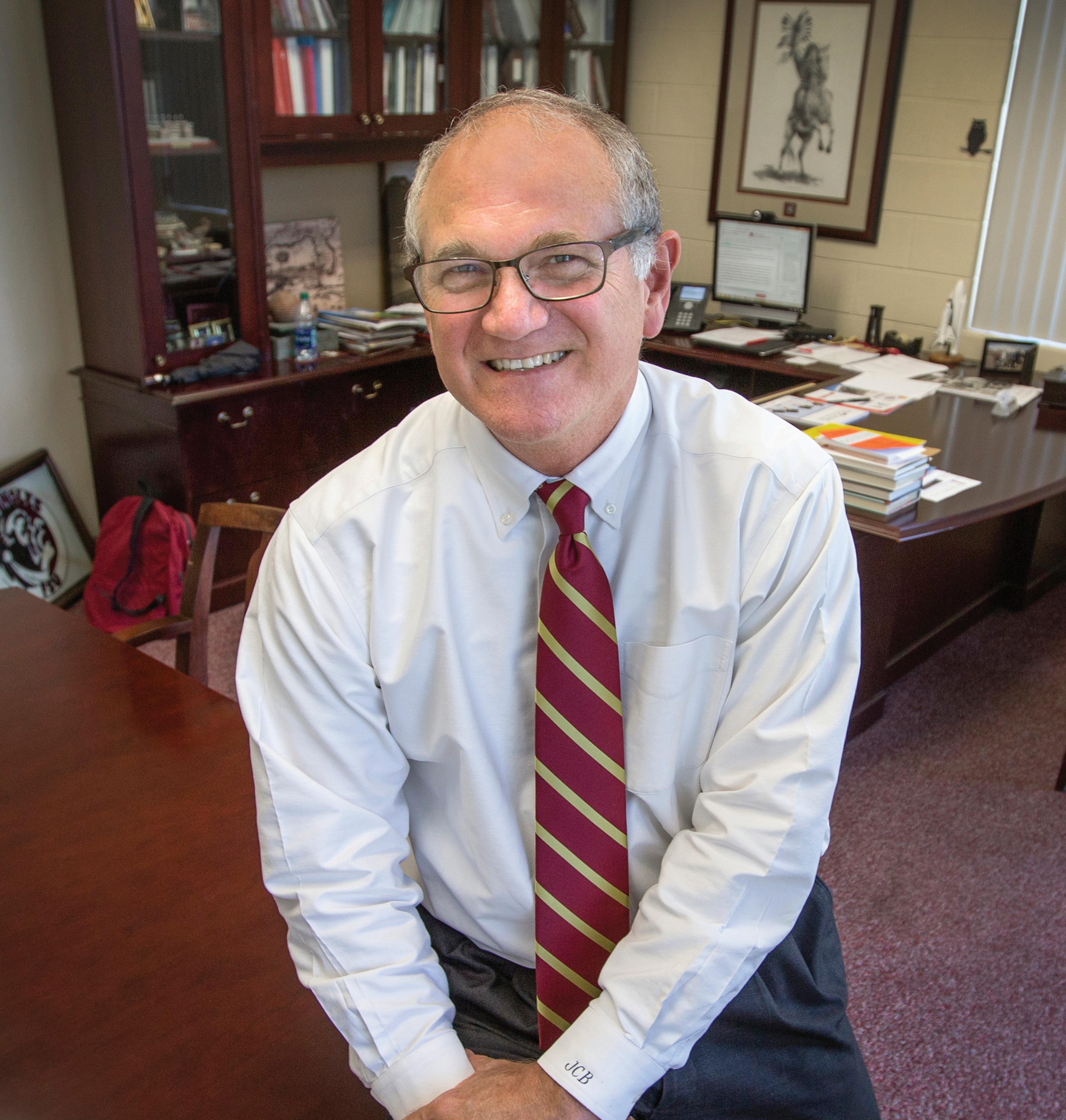
Throughout his career, John Barnhill has felt called to do one thing: to help people.
Barnhill (M.S. ’81) joined Florida State’s academic admissions team in December 1978 and will retire next June having supported thousands of students as they make one of the most important decisions of their lives. After 47 years at FSU, a funny thing has started to happen: some of the students he’s meeting have started to look very familiar.
“I’m servicing the children of students that I admitted,” Barnhill told VIRES during a recent interview. “That’s special.”
Barnhill’s path toward enrollment management began at Florida Southern College. There, he worked as a resident assistant and gave admissions tours while pursuing a degree in psychology. He then enrolled at Emory University’s Candler School of Theology with plans to become a minister but later changed course. After two years working in admissions at Andrew College in Cuthbert, Georgia, Barnhill came to FSU, where he earned a Master of Science in history and philosophy of education, while working full time in the admissions office spreading what he calls the “gospel of education.”
As he settled into Florida State, Barnhill appreciated the nurturing environment it creates for students. “It fit with exactly what I wanted to do,” he said, “which is to help people.”
Since then, Barnhill has risen through the ranks at FSU, from admissions officer to associate vice president for enrollment management. Along the way, he’s also received national and international
recognition, taking on leadership roles in higher education organizations — including becoming, to his knowledge, the only person to serve as a College Board trustee and a member of the higher education advisory boards for ACT and Cambridge Assessment International Education all at once.
Looking back, Barnhill is proud to have built a successful career in one place — and at an institution he really believes in. “This is my life,” he said. “I’ve been very lucky to have been able to stay in one place, and to build those relationships and never feel like a salesman. In my business, I think that’s critical.”
The field has changed a lot since Barnhill first began working. “There were no computers when I started,” he said, “so everything was paper based. We had rooms and rooms full of files.”
Technology has helped universities become more efficient, reach more students and process more applications, and these days, Florida State University processes more than 80,000 applications from freshmen alone. When Barnhill started, the number was closer to 5,000 freshmen applications.
No matter how much FSU has grown, Barnhill has helped ensure that its commitment to students has never wavered. When he first enrolled in college, it was the heyday of the “look to your left, look to your right” speech, which emphasized that some of the students in the room would not graduate. Now, he said, “I think that’s kind of run its course. Enrollment management has really embraced the idea that if we admit you,
then we are committed to your success.”
To that end, Barnhill has cherished the rapport he’s been able to build with students and their families — some of whom continue to reach out years after they’ve graduated. He recalled a recent visit from an FSU graduate, now a professor from the University of Georgia.
“He said, ‘You know, my mama still remembers your name,’” Barnhill said with a laugh. Another former Nole told Barnhill that he’d made such a strong impression on her late father that he’d insisted she call Barnhill if she ever needed anything while away at Florida State. Whenever he meets a fellow Nole (or one of their relatives) while traveling, Barnhill makes it a point to ask how they felt about their experience. “99.9 percent of the time,” he says, “They loved it.”
While preparing for his retirement, Barnhill has come to recognize that he’s in a unique position: he isn’t tired of his work at all. Even after all these years, it still doesn’t feel like a job. “I love what I do,” he said. “I work with wonderful people and still get to help kids, which is my passion.” Still, as he prepares to turn 70, it feels like a good time to step aside and pursue other interests, like volunteer work and spending more time with his grandchildren.
As he starts his new chapter, Barnhill said, he has one more priority on his list — one that should come as no surprise to those who’ve known and worked with him. “I just hope to have more time to do the things that I really enjoy,” he said. “And to find some way to keep helping people.”

By David Heller
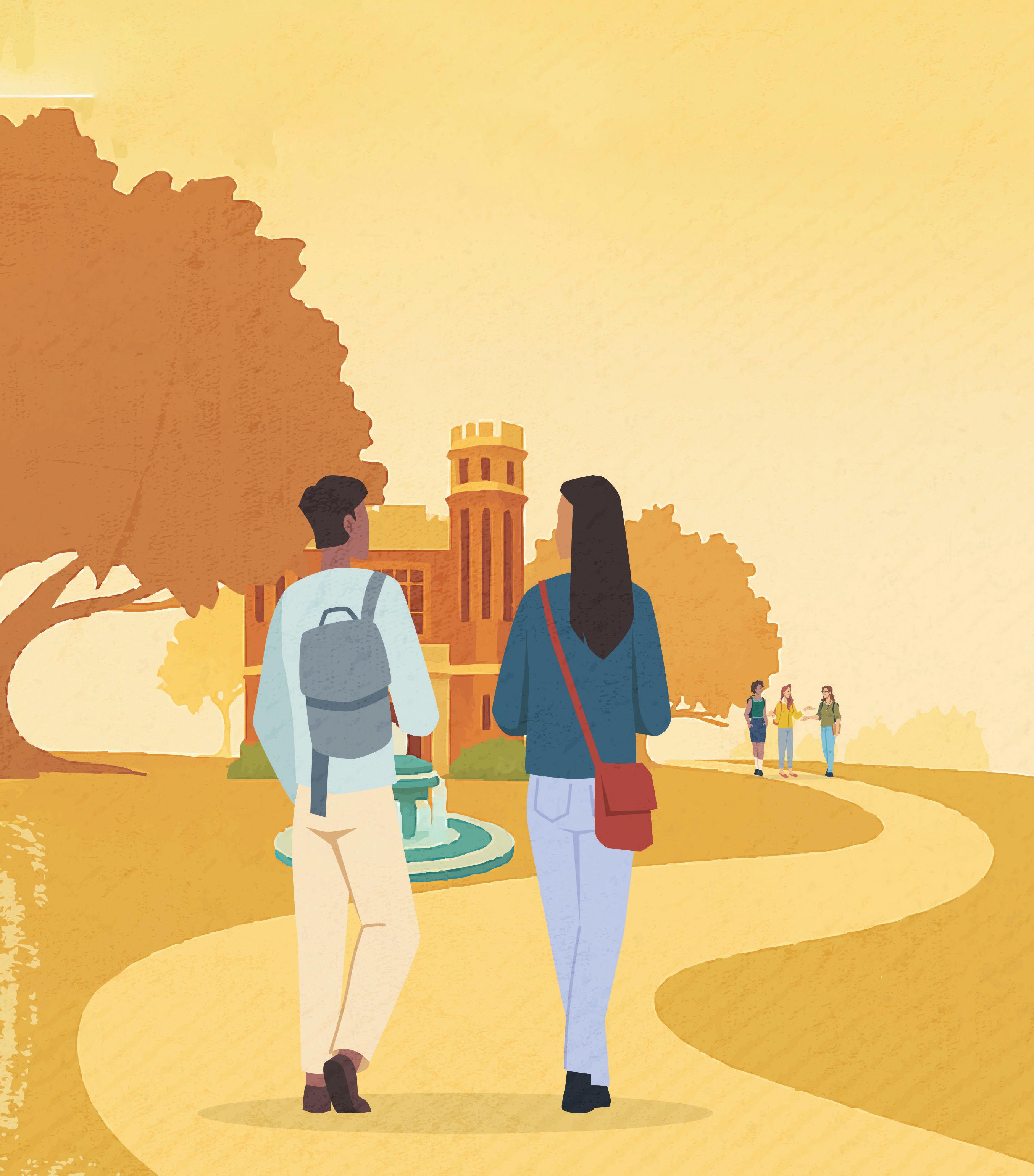
For generations, Florida State University has been building a dynamic relationship with South Florida’s tri-county region of Miami-Dade, Broward and Palm Beach counties. Now, FSU is strategically expanding its presence across the Gold Coast with new programs, research projects and a growing alumni network that all promise to strengthen this invaluable relationship in the 21st century.
Students from the 305, 954 and 561 infuse FSU’s campus with South Florida’s big, bold, sunny energy. Crunching the numbers on the student population over the past half century illustrates how South Florida’s vibrant rhythms have been welcome, consistent ingredients of the university’s cultural landscape.
Let’s take a quick trip back to the fall of 1960. FSU President Gordon Blackwell had just stepped into the job and a total of 9,000 students enrolled in classes. About 1,600 students came from Broward, Palm Beach and Dade counties (Dade was renamed “Miami-Dade” in 1997).
FSU’s enrollment had jumped 10% that year, and Florida was entering an era of explosive growth, particularly in South Florida. Dade, Broward and Palm Beach counties counted 1.5 million residents at the time.
By 1974, under the leadership of FSU President Stanley Marshall, the student population had doubled to more than 21,000 with about 4,000 — or 19% — from South Florida.
Over the next 50 years, as South Florida’s population eclipsed six million residents, the percentage of South Florida students enrolling at FSU remained strong. It climbed as high as 22% in 2020 with nearly 10,000 students from the tri-counties, even as the university’s overall freshman enrollment applications skyrocketed.
“Applications for freshman admission have increased 190% over the last 10 years, but selecting the ‘right fit’ student continues to be a priority, resulting in record-breaking retention and graduation rates,” said Hege
Ferguson (B.A. ’93, M.A. ’97), assistant vice president of FSU’s Office of Admissions.
Florida State received a record 86,000 applications for this year’s freshman class, and high-achieving South Florida high school graduates continued to choose FSU.
“The data shows that the enrollment patterns from that area have been remarkably consistent throughout the years,” Ferguson said. “FSU is committed to providing an excellent education at an affordable price, which resonates with Florida residents.”
FSU is committed to providing an excellent education at an affordable price, which resonates with Florida residents.
— HEGE FERGUSON (B.A. ’93, M.A. ’97), ASSISTANT VICE PRESIDENT OF FSU’S OFFICE OF ADMISSIONS
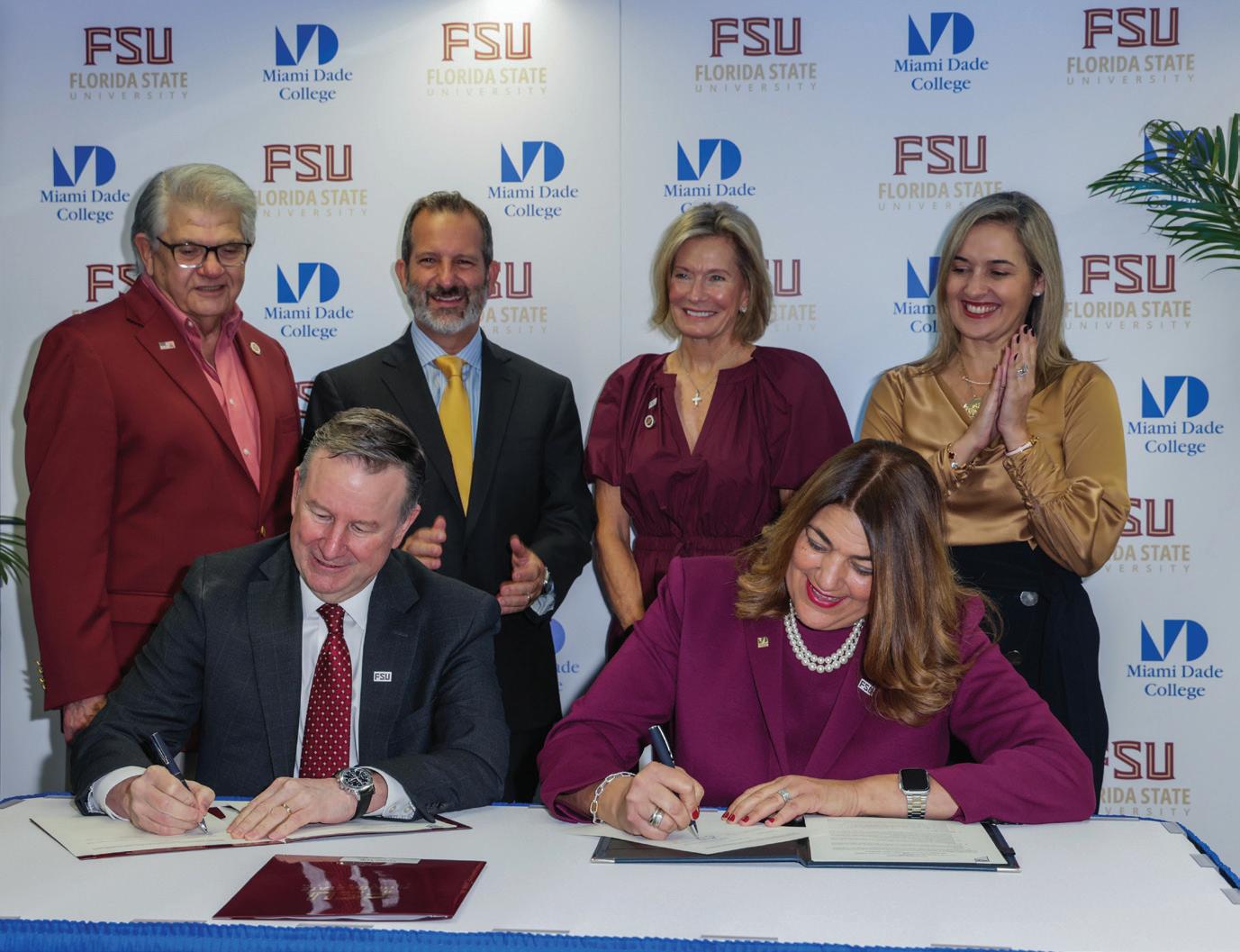
FSU President Richard McCullough and Miami Dade College President Madeline Pumariega sign an articlulation agreement to create clearer pathways and enhanced advising for MDC students to transfer to FSU.
Photo courtesy Miami Dade College.
The memories I’ve created here are ones I will never forget. Through the sport management program, I’ve been able to learn so much and take advantage of incredible opportunities that have helped me grow academically and personally.”
Miami Dade College President Madeline Pumariega said the MDC2FSU program has strategically identified pathways to disciplines at FSU that have earned national recognition for excellence.
“This partnership reflects our core mission: to create clear, empowering pathways that help students thrive and lead in their chosen fields,” Pumariega said.
That formula resonated with Lucas Santamarina, a 2025 Miami Dade College graduate. He took advantage of the school’s new pathways agreement with Florida State, the MDC2FSU program, signed by FSU President Richard McCullough and Miami Dade College President Madeline Pumariega in 2024.
The agreement created a seamless transition for MDC graduates who earn an Associate of Arts degree and want to transfer to FSU as juniors. The partnership offers tailored academic advice to students in a variety of fields, including cyber criminology, entrepreneurship and psychology.
Santamarina is excited to be at Florida State, pursuing a degree toward his dream job.
“I chose Florida State University because it has one of the best sport management programs in the nation,” Santamarina said. “My experience at FSU has been amazing.
MDC2FSU has generated positive results in its first year with more than 60 MDC graduates transferring to FSU during the 2024–25 academic year.
“The most popular majors are psychology and finance, among 28 other transfer majors," Pumariega said. "We are now focused on ensuring that our students know about the program early on in their journey so that the pipeline of MDC to FSU continues to strengthen.”
This new pipeline has transformed Miami Dade College into FSU’s second-largest feeder school behind Tallahassee State College, previously known as Tallahassee Community College.
Palm Beach collaboration space. Photo by Carrie Bradburn/CAPEHART.
President McCullough praised the new partnership when he signed the agreement.
“This agreement reflects our shared values and creates a smoother transition for MDC students to continue their academic journey at Florida State University,” McCullough said. “By collaborating with MDC, we are providing students with a solid plan for success at FSU.”
Pumariega is tracking metrics to assess outcomes: how many students are enrolling in the program, how they’re performing at FSU and whether they are earning degrees.
“We expect to see a surge in job placement rates and graduate school enrollments,” Pumariega said. “These outcomes will reaffirm that strong partnerships among sister institutions like MDC and FSU yield excellent results, both for graduates and the state economy. “
Pumariega views MDC2FSU as an innovative model that empowers the next generation of students. The partnership gives students access to high-demand career tracks, enhanced advising and academic maps tailored to their goals.
“It’s about removing barriers and expanding opportunity because at MDC, we believe opportunity changes everything,” Pumariega said.
She’s optimistic that providing this kind of strategic opportunity will equip students to shape Florida’s future economy.
“The impact on Florida’s economy is substantial,” Pumariega said. “MDC contributes over $7 billion annually to the state’s economy, supporting more than 62,000 jobs — roughly one in every 35 jobs statewide. By strengthening the talent pipeline and aligning our pathway programs with workforce needs, this partnership helps ensure that Florida remains competitive, resilient and ready for the future.”
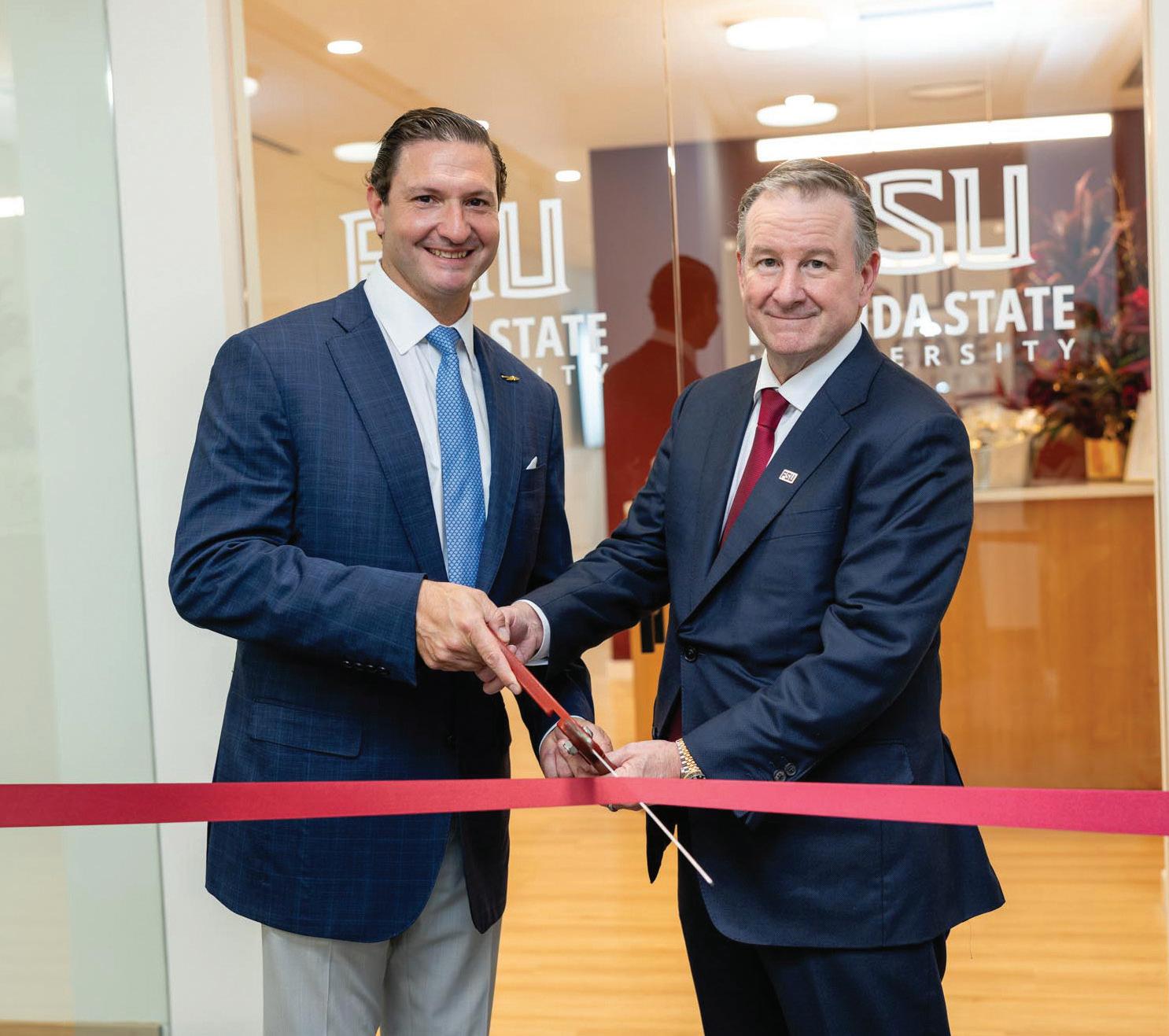
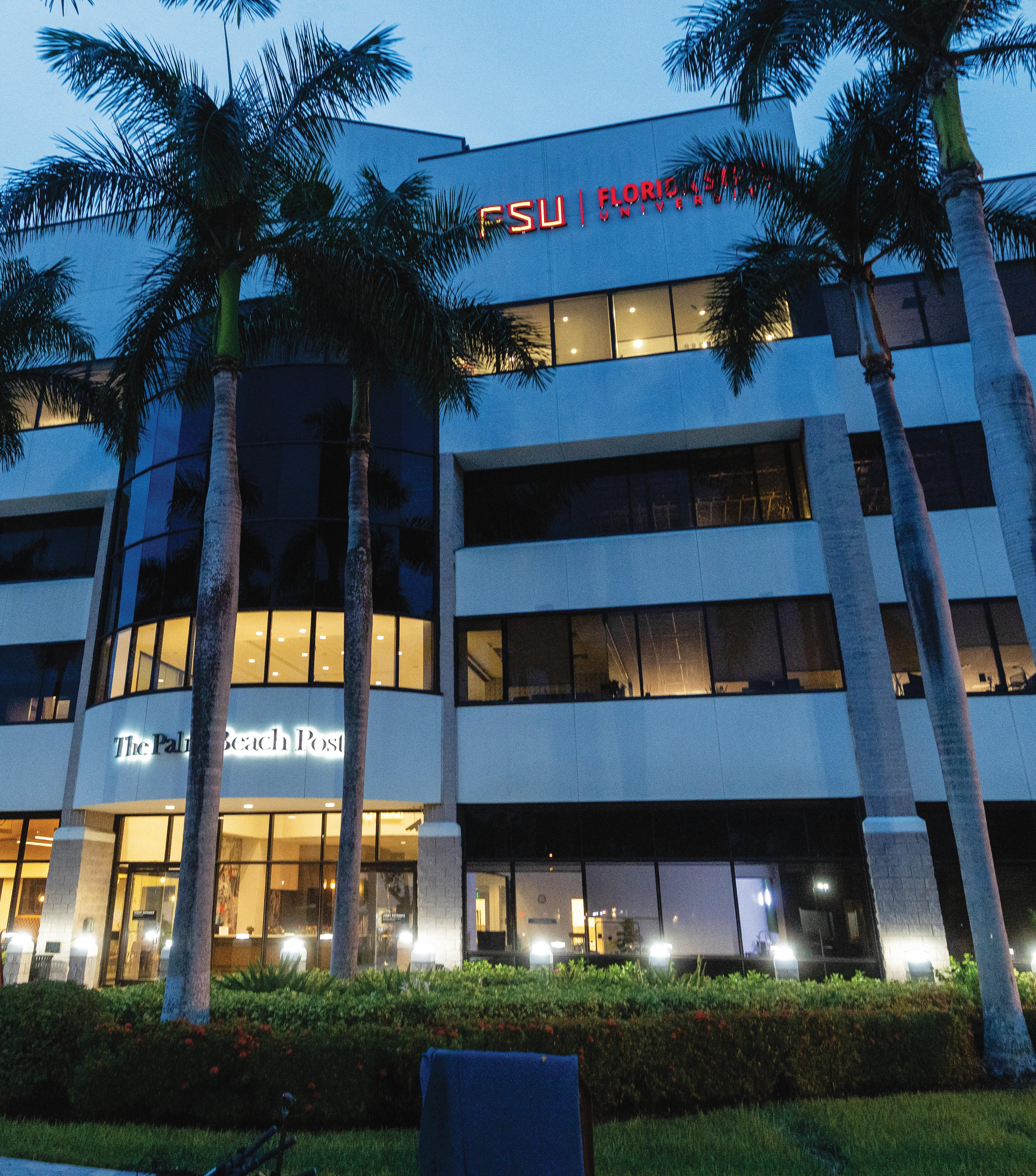
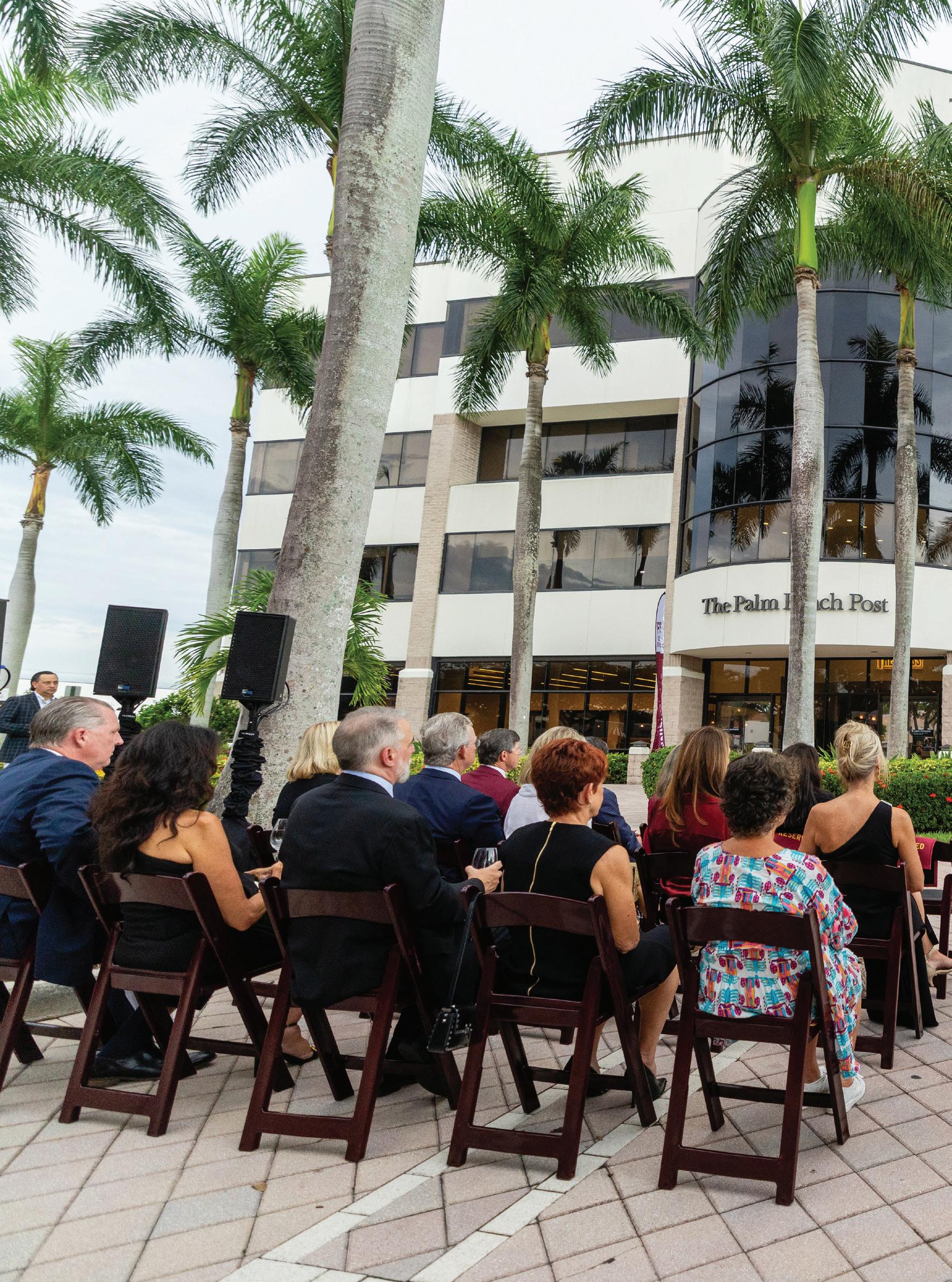
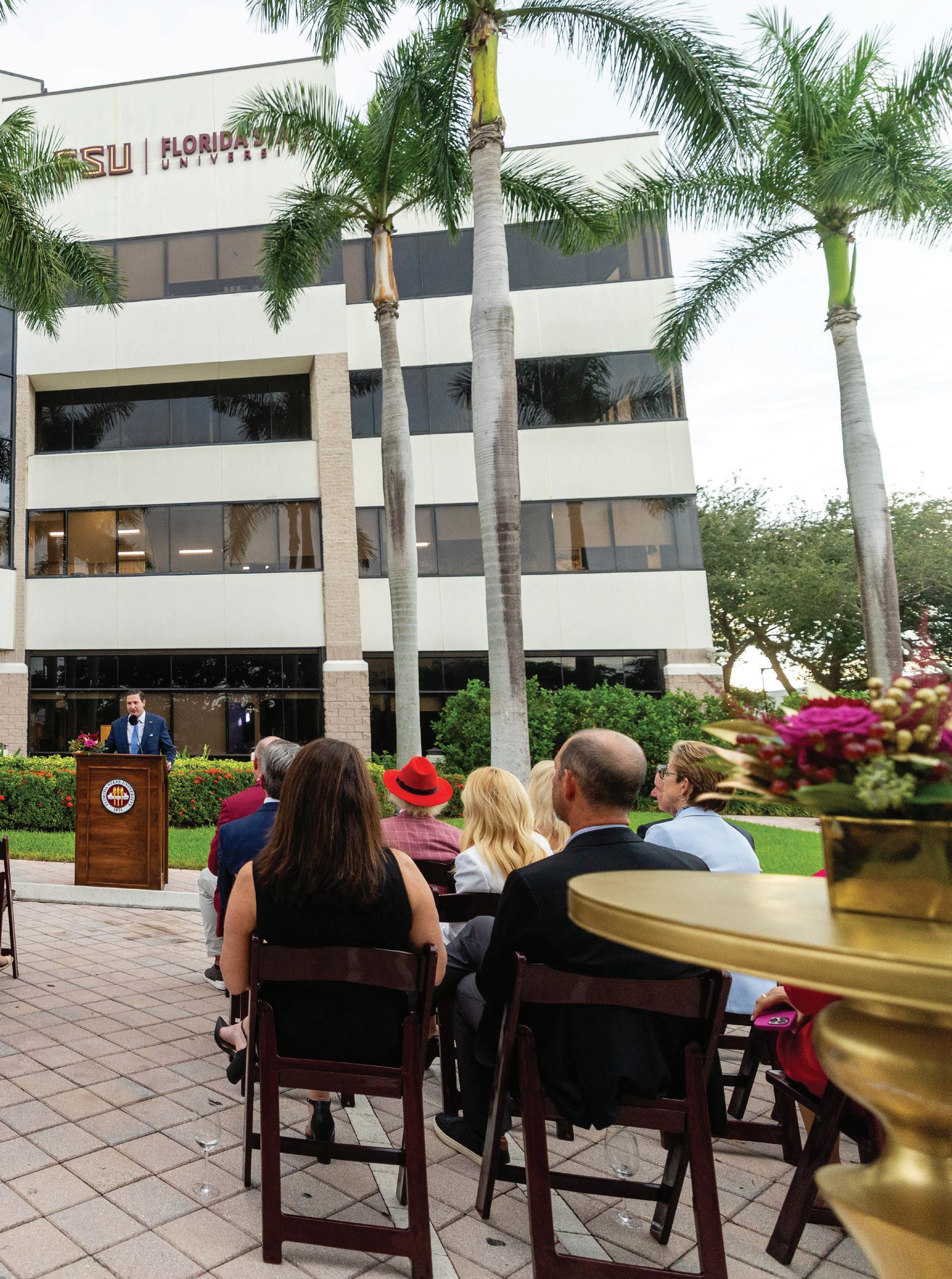
In September 2025, Florida State expanded its reach in South Florida with the dedication of collaboration space for continuing education at The Press building in West Palm Beach, thanks to alumnus and longtime donor Benjamin Shibe Macfarland III (B.S. ’03). He’s donating 2,900 square feet of commercial real estate and operational costs for three years as FSU works to extend its presence and partnerships in the region.
At the dedication, President McCullough said he expected the space to serve as a conduit for innovation, collaboration and opportunity.
“Ben Macfarland’s generosity and leadership have given FSU a presence in West Palm Beach,” McCullough said. “It’s the beginning of deeper connections with our alumni and friends, and a new chapter in bringing FSU executive education and programming to the heart of South Florida,” McCullough said.
Macfarland, a successful real estate
entrepreneur, is the founder and CEO of SROA Capital, which owns and operates self-storage facilities and other real estate investments in 32 states and the United Kingdom.
“Palm Beach County needs to continue to grow our higher education base and quality to service our finance and business community as it evolves into Wall Street South,” Macfarland said. “FSU launching a continuing education program in this area is a great start.”
FSU’s College of Business is launching its new executive education program in alternative investments at this location. The curriculum includes in-person programs in private credit and hedge funds. The official start of classes is set for January 2026.
“The grand opening of the Florida State University-West Palm Beach collaboration space marks a remarkable milestone — one that unites our two communities in celebration of executive education, investment, philanthropy and the burgeoning financial hub known as Wall Street South,” said College of Business Dean Michael Hartline.
Florida State University’s activities in South Florida extend far beyond educational offerings. FSU invests significantly in research projects in Miami-Dade, Broward and Palm Beach counties each year, including these promising efforts:

William Butler, Ph.D., professor and program director, Department of Urban and Regional Planning in the FSU College of Social Sciences and Public Policy, is developing ways for planners and policymakers to better anticipate the secondary impacts of changing weather forces.

“One of the manifestations of climate change hypothesizes that as coastal areas become more at risk of flooding from sea level rise and tropical cyclones, residents and businesses may begin to move to higher ground which is usually further inland,” Butler said.
“Currently, many higher elevation neighborhoods are occupied by lower income households who face gentrification and displacement pressures due to this changing real estate dynamic.
Michael Killian (B.S. ’03, MSW ’05, Ph.D. ’12), associate professor, FSU College of Social Work, co-directs the Initiative for the Advancement of Pediatric Transplant Health Research, a statewide partnership housed within the FSU Stoops Center for Communities, Families, & Children.
The initiative brings together FSU’s College of Social Work and College of Medicine, the UF/FSU Clinical and Translational Science Institute, Shands Children’s Hospital, and South Florida-based pediatric transplant teams from Joe DiMaggio Children’s Hospital, the University of Miami and Jackson Health Systems.
These collaborations aim to assist Florida’s high-volume transplant centers, particularly those serving children and families in Broward, MiamiDade and Palm Beach counties.
“These projects are improving how transplant teams across the state, particularly in South Florida, can use technology and data science to deliver more personalized, responsive care,” Killian said. “The findings are directly relevant to clinical decision-making, resource allocation and long-term graft survival. Importantly, it aims to serve these pediatric patients and their families.”

“I’ve led a team of researchers to understand what areas of MiamiDade County might be at risk for climate gentrification, what policies are in place to slow in-migration from the coast and protect affordable housing inland, and what policymakers, planners and community advocates are doing to try to address this challenge.”

The research of Heidi Kinsell, Ph.D., assistant professor, Center for Medicine and Public Health Policy & Practice in the FSU College of Medicine, helps communities implement evidence-based drug prevention strategies to address the drug overdose crisis in Palm Beach County.
Kinsell says the work has resulted in successful innovations, such as a public-facing overdose dashboard, educational programs, and enhanced provider engagement spanning health systems, public safety and community organizations.
“The Center for Medicine and Public Health Policy & Practice’s data-driven evaluation has strengthened public health responses to the opioid crisis and ultimately reduced opioid-related morbidity and mortality in the state,” Kinsell said.
THE SAFETY OF FLORIDA’S HIGH-RISE BUILDINGS AND BRIDGE FOUNDATIONS
Scott Wasman, Ph.D., assistant professor, FAMU-FSU College of Engineering, is leading research to improve design methods and construction techniques for structural foundations bored deep into South Florida’s geology, comprised mostly of limestone mixed with soil.
Wasman uses fiber optics — the same technology in many homes and offices — to measure how thermal stresses and temperatures deep underground affect large foundation piles constructed of concrete and steel, typically ranging in size from two to three feet in diameter and 60 to 150 feet in length.
The use of fiber optics is a promising new technological application in civil engineering because it’s not affected by environmental factors, so it can be used to make long-term measurements.
This research offers an unprecedented approach to improving building and bridge safety.
“Measurements like this are the first to be done in Florida and on South Florida limestone,” Wasman said. “It is anticipated that the findings will not only provide improved design methods and requirements for consideration of thermal properties in design of bored piles, but begin to identify the critical importance of thermal influence on Florida’s coastal bedrock for engineering infrastructure.”

Getting involved with a Seminole Club or Chapter is a great way to connect with fellow alumni and the FSU community through game watch parties, Seminole Service Days and Seminole Sendoffs for incoming students.

PROJECTIONS FOR SEVERE WEATHER AND CLIMATIC EVENTS
Ebrahim Ahmadisharaf, Ph.D., F.EWRI, assistant professor, FAMU-FSU College of Engineering, is collaborating with a team of researchers to develop new tools to better predict future extreme precipitation events across South Florida.
“Floods continue to damage our infrastructure and local communities,” Ahmadisharaf said. “Recent examples are heavy precipitation events in Miami and Ft. Lauderdale in 2023 and 2024. The research helps better predict precipitation and flood events, thereby better adapting and protecting our local communities and physical infrastructure against flood events.”

DEVELOPING AN ACTION PLAN TO BOOST RESILIENCE TO WEATHER IMPACTS
Tian Tang, Ph.D., associate professor, Jerry Collins endowed professor and program director, Askew School of Public Administration and Policy in the FSU College of Social Sciences and Public Policy, is developing climate action plans to reduce greenhouse gas emissions in South Florida. She hopes her work will help promote the health and economic well-being of communities.
“The action plans cover 109 municipalities across four counties, as well as the Miccosukee and Seminole tribal governments, representing a region of nearly 6.2 million people,” Tang said.
South Florida now boasts the largest number of FSU alumni statewide, following a significant surge over the past 40 to 50 years.
In 1980, the area was home to 11,000 FSU graduates, or 17% of all alumni across the state.
Now, more than 52,000 alumni live in Miami-Dade, Broward and Palm Beach counties, representing 20% of all FSU graduates in Florida.
Seminole Club of Broward County Vice President Christine Terribile (B.S. ’98) joined the club 18 years ago. She remembers going solo to a club event to watch an FSU game and the place was packed except for one seat.
“That one empty seat turned into volunteering at the next game, and I’ve been involved ever since,” Terribile said.
Her active involvement has led her to organize watch parties, FSU Night with the Florida Panthers and Seminole Sendoff for incoming new students.
“I simply enjoy sharing my love for all things FSU,” Terribile said. “While I’m an avid sports fan, the university represents so much more than just athletics. I truly enjoy being around people who share the same passion and pride for our alma mater.”
Seminole Club of Palm Beach County President Paulette Riedel (B.S. ’93) shares that enthusiasm, and she’s glad the club offers opportunities to give back to the community, too.
“I give back because I love the Noles!” Riedel said. “I went there. My brother is an alumnus, my daughter is an alumna, and now my niece is a current student!”
Seminole Clubs offer a way to continue to stay connected with FSU, whether you return to South Florida or embark on a career across the globe. The clubs are always looking for enthusiastic volunteers and their fresh energy. If you’re interested in South Florida Seminole Clubs, connect on social media by searching @BrowardNoles, @PBNoles and @MiamiSeminoles. Find a club near you at alumni.fsu.edu/clubs.
South Florida’s vibrant pulse is part of Florida State’s heartbeat. The dynamic relationship between the region and FSU flows both ways, transforming students’ lives, producing a pipeline of skilled graduates, expanding a network of accomplished alumni and inspiring vital research.
As one of the nation’s most diverse and distinctive cultural mosaics, South Florida’s influence strengthens FSU, and Florida State University responds in kind, both energizing and enriching the future.
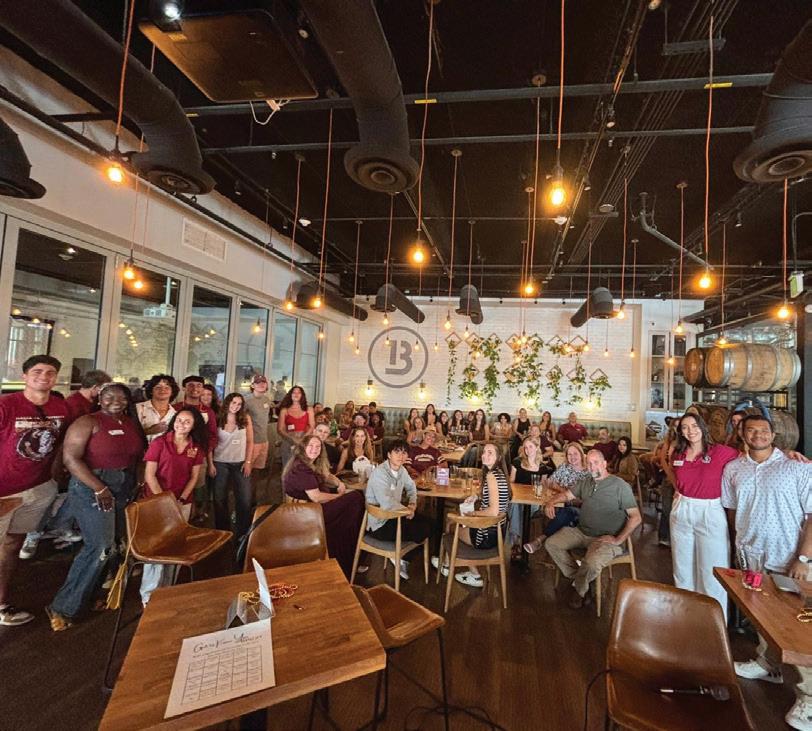
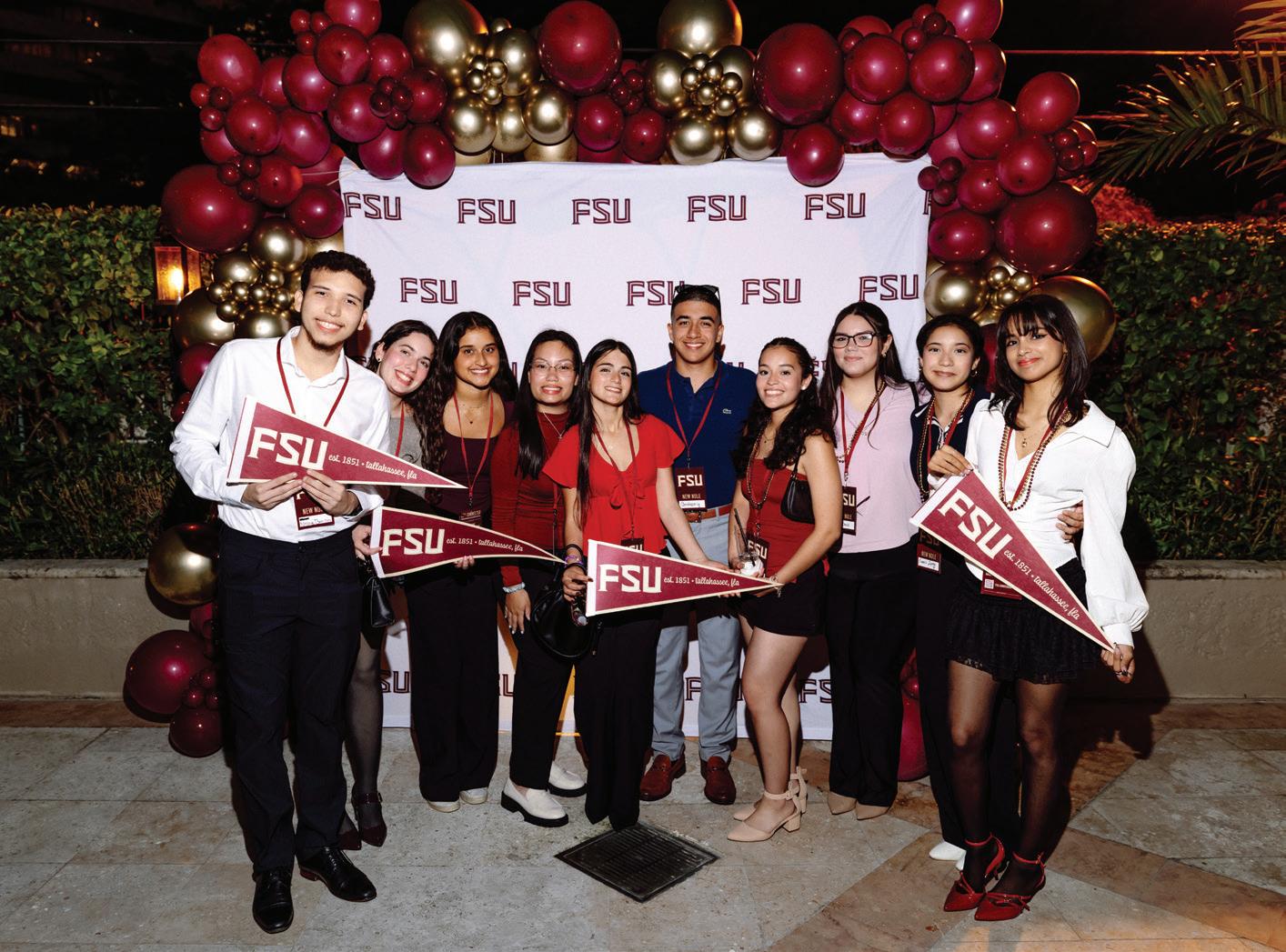
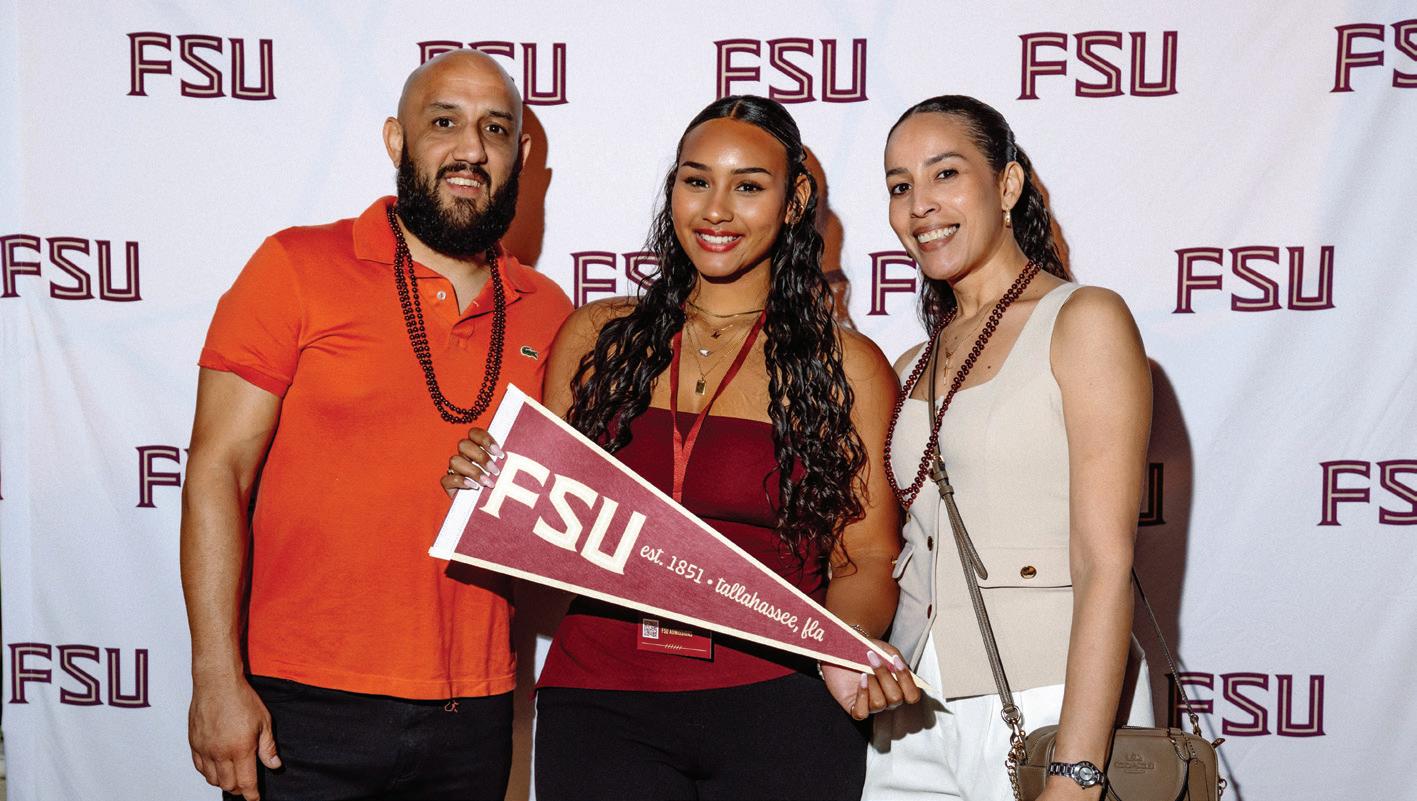
Right: Students and their families attended the Miami New Nole Reception for admitted students in April 2025.
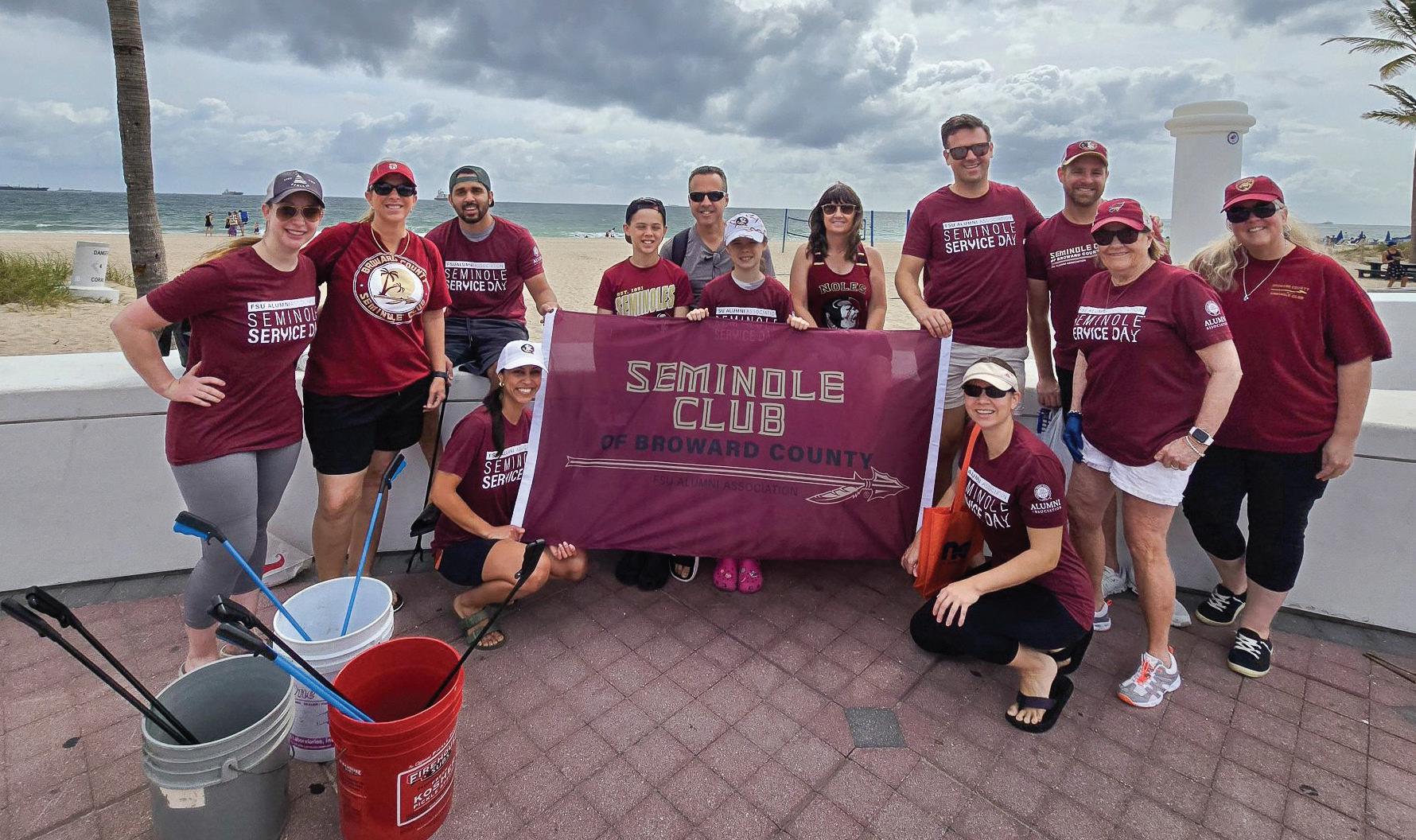
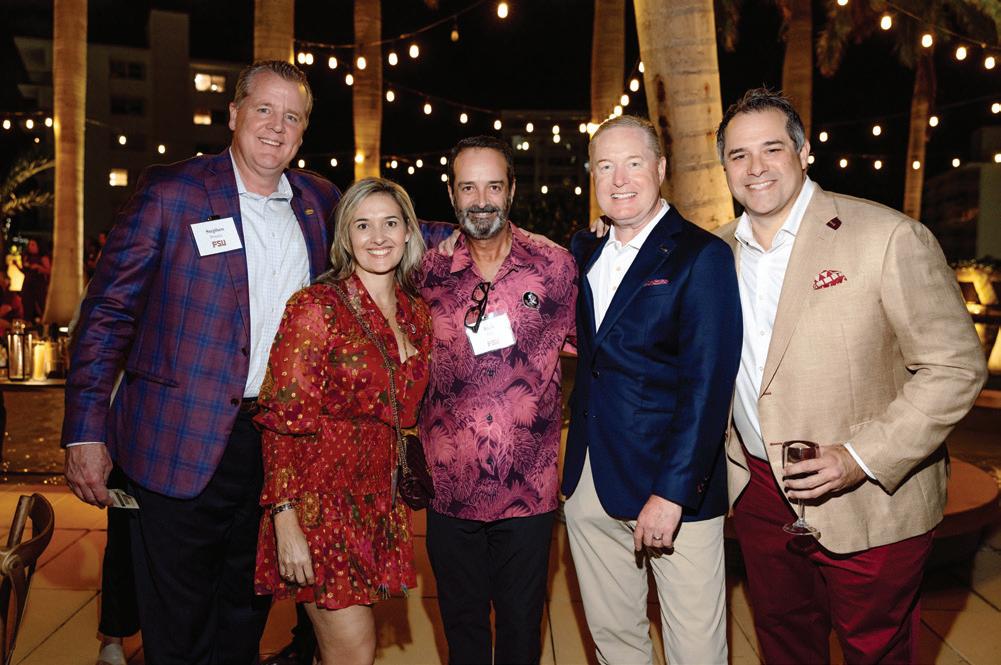
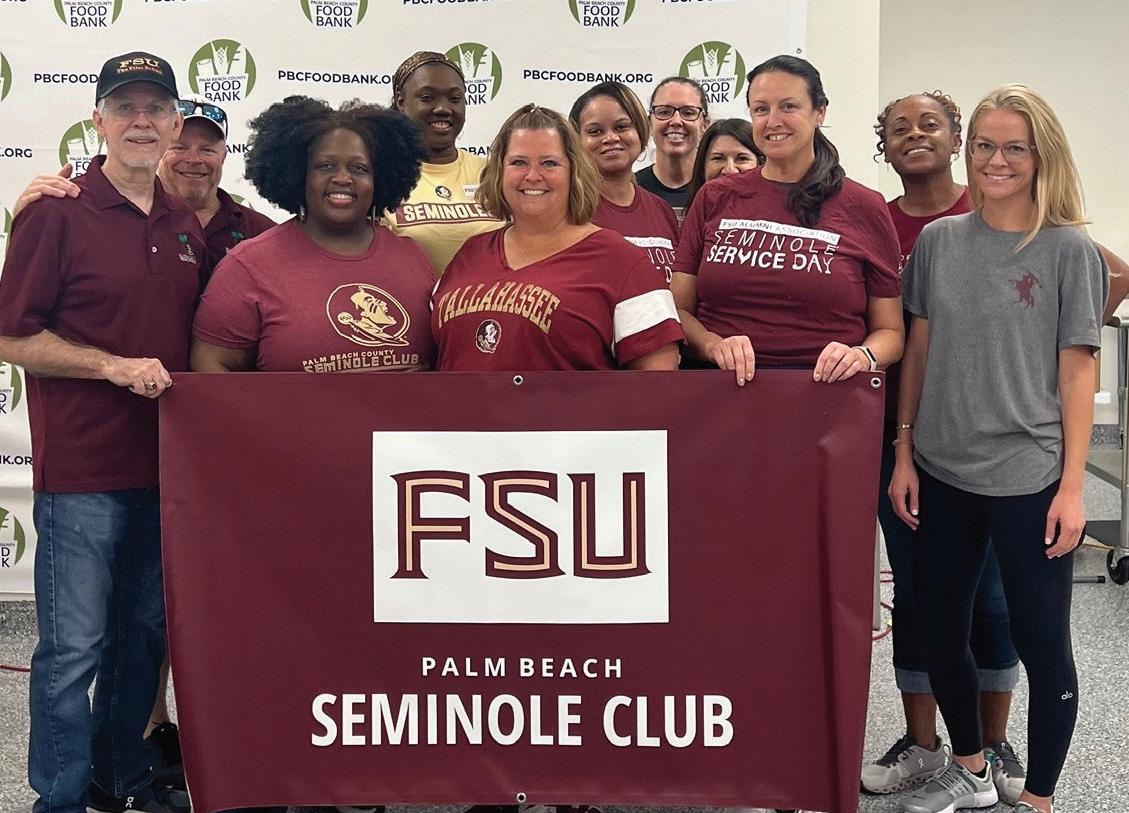
Below: Members of FSU leadership at the Welcome to Miami event in October 2024; Seminole Club of Palm Beach participating in Seminole Service Day.

"I honestly owe my career to the network because both of my hiring managers had ties to FSU. In addition to that, I love being around fellow Noles who want to show their pride in a city with other in-state alumni bases."
—MICHELLE COCA (B.A. '14, M.S. '15) PRESIDENT, SEMINOLE CLUB OF MIAMI
Rob Liddell (B.A. ’01) is leading efforts to prepare students and alumni for meaningful careers in a rapidly changing world. An FSU alumnus and parent of a current FSU student, Liddell brings both professional expertise and a personal passion for the university’s mission. From reimagining career fairs to strengthening alumni engagement and international partnerships, he is focused on equipping the Seminole community for lifelong success.
What inspired you to take the role of assistant vice president for career services at Florida State University in 2024?
As a proud alumnus, I recognize the unique role FSU played (and continues to play) in my life and the lives of those who join this special community. The FSU Career Center has served as a model in higher education in terms of our integration of theory-to-practice, academic integration and innovative engagement. As a parent, the opportunity to share FSU with my wife and children was a strong draw. Considering the trajectory of the institution, the invitation to join and accelerate this momentum was irresistible.
How does the FSU Career Center support alumni in their career development?
The FSU Career Center maintains an operating principle of centering relationships. We work diligently to engage students, faculty and staff within each of our academic colleges to acquire near-native understanding of student progression patterns and industry/field dynamics to proactively tailor our career readiness programming. We enjoy serving alumni as they continue to develop their professional careers.
What are some of the most exciting trends you’re seeing in the job market that FSU students and alumni should be aware of?
While some approach artificial
intelligence and technology-enabled productivity with trepidation and concerns of replacement, I prefer to frame this moment as an opportunity. Intelligent systems can be attuned to routinize certain tasks and augment capacity leading to accelerated discovery and impact. FSU students and alumni ought to value the creative thinking habits (collaborative, integrative and expansive) that are developed across the academic disciplines at FSU. Some of the trends I’ve been tracking pre-date the proliferation of large language models. Chief among these are roles that live at the intersection of disciplines, for example computeraided instruction, data science applied to marketing and consumer behavior, and research-practice partnerships and commercialization activities. In my view, there is a swinging pendulum in the workforce between the specialist and the broadly prepared generalist. Our society and organizations need both archetypes.
How is the FSU Career Center leveraging technology and virtual tools to expand access to career resources?
The Career Center prides itself on being comprehensive. While we invest generously in face-to-face career advising, employability workshops and in-person student-employer engagement, extending access through various modalities is an increasingly important consideration. Applications to review career documents (e.g., resumes, cover letters, CVs and networking profiles on LinkedIn) are available, as are focused
digital learning journeys (badges and pathways) and interview preparation coaching. One of the investments we’ve made recently is to revisit our website, career.fsu.edu.
Can you share a recent success story that illustrates the impact of the Career Center’s work?
In January 2025, Li Pon, the FSU Career Center’s senior assistant director for experiential learning, was able to travel to the FSU Republic of Panama campus to support career advising, industry engagement and partnership development. She was invited to participate by the FSU Republic of Panama campus and supported directly through our collaboration with FSU’s International Programs. In July, the FSU Career Center was able to offer our innovative FSU Shadow program internationally through the FSU Republic of Panama campus. Anissa Ford, senior assistant director of experiential learning, matched 21 FSU students with five Panamanian companies. This industry engagement helps students make more informed decisions about their career options while simultaneously growing their professional network.
What partnerships or collaborations are you most excited about developing—either on campus or with employers?
I’ll mention three…first, the FSU Career Center has partnered with several departments to acquire a data tool to visualize career outcomes across a much longer time horizon. Leveraging data about the early and current career moves made by FSU graduates will inform career advising going forward. A good number of students enter FSU with a specific career role in mind, but the path to acquire it can prove to be unclear. Following other FSU graduates through internship opportunities, to their first two full-time positions and then to their targeted role, helps highlight probable routes to career success.
Second, I am excited about the range of opportunities expanded in Washington, D.C., after FSU purchased
and will manage safe housing there that is within an easy walk of Capitol Hill and just off the metro line. FSU students will benefit from more options to intern within the federal government, large industry players, agencies, the arts, etc. beginning in January 2026.
Third, our employer engagement work is taking a noticeable step forward with Seminole Futures, FSU Career Center’s largest career fair designed for all majors. Our employer relations team has reimagined Seminole Futures into a series of engaging programs that kicks off with a notable alumni speaker and moves through career fair readiness activities to a couple of large-scale job and internship fairs, and concludes with meet-ups with hiring managers for more information sharing or interviews on campus. Our aims are direct: Equipped, Empowered, Employed.
How do you plan to engage alumni as mentors, employers or career speakers for current students?
One of the strengths of the Florida State community is our alumni. The Seminole Club of Tampa is an example of the fantastic groups of dedicated alumni who host and attend social events, help new graduates get acclimated to a new city, contribute to expanding FSU’s footprint and raise support for scholarships. Chances are excellent that there are alumni (and Seminole Clubs) who can serve in similar ways near you. Further still, the FSU Career Center is a great place for alumni to give back to the institution in terms of sharing their lived experiences on panels, through mentoring, or by advocating within their organizations for FSU to be “top of mind” for recruitment activities by hosting students for FSU Shadow, internships or career-level talent openings. If you are in a place to impact others or to influence your organization to engage with FSU for talent engagement, I would love to hear from you. Email me at rliddell@fsu.edu.
What advice would you give to alumni who are considering a career change or re-entering the workforce? I would offer encouragement.
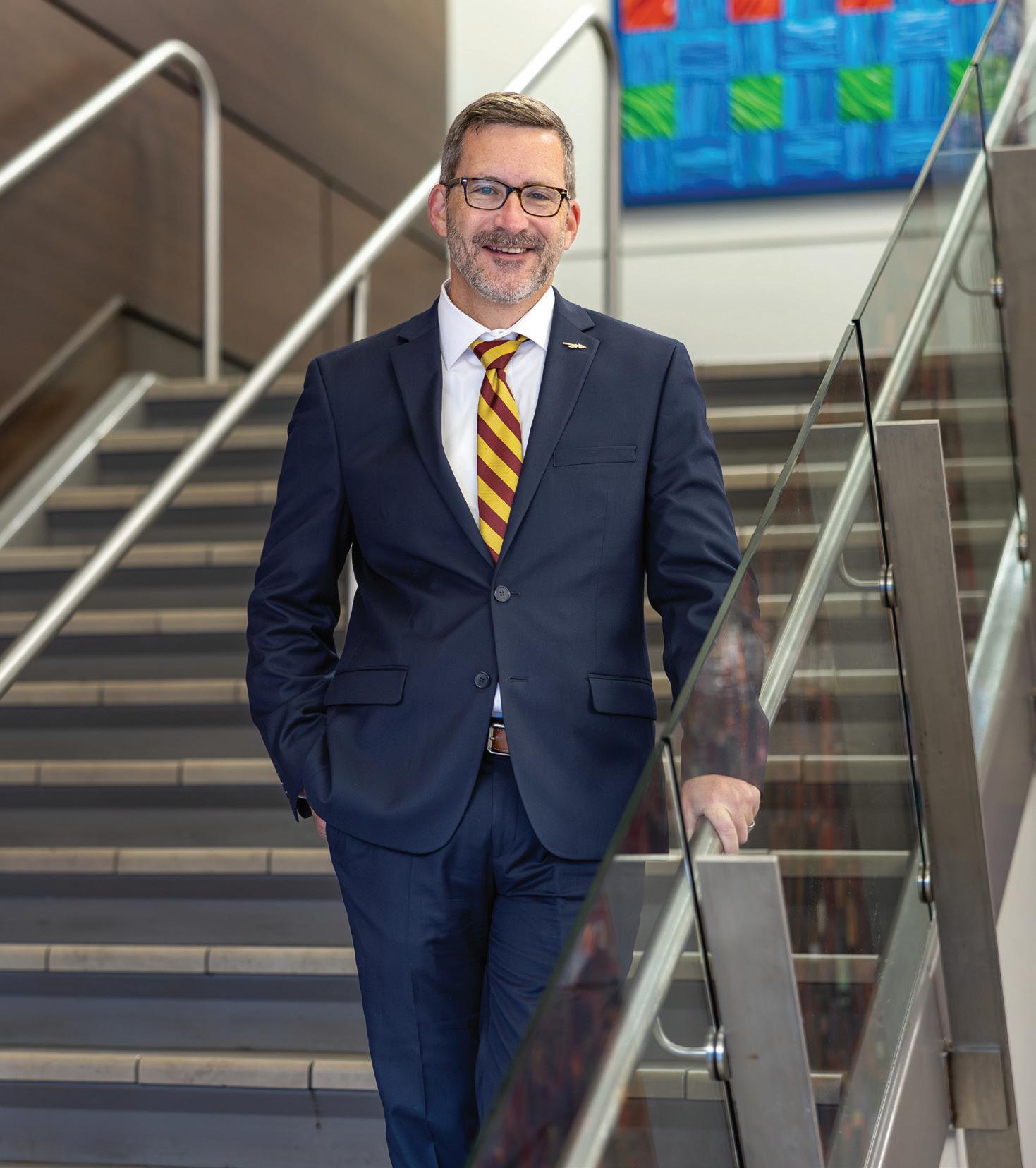
Contributing through a career role that excites you and invites your passion applies to fellow alumni as well as students. Deeply understanding the need for, or motivation to introduce, change is a primary place to start. Collecting information, action steps, a sizable group of supporters and accountability toward progress are important next steps. If you are contemplating these steps without the strength of the FSU community behind you — friend, you are taking the harder route.
What’s one thing you wish every FSU graduate knew about the Career Center?
I find the most challenging component of my work is the belief that it must be pursued alone — in self-imposed isolation. One’s network of support (peers, advisors, mentors, etc.) ought to be engaged, entrusted or enlisted much
earlier, more frequently and across a wider range of topics. The FSU Career Center’s purpose is to positively impact students, graduates and all others we serve through sustained relationships.
Is there anything else you’d like alumni, parents or friends of FSU to know about you or the Career Center?
I would encourage any individual facing a career decision to share your process with your network of support. Faculty, advisors, student affairs professionals, goal-directed peers and the FSU Career Center are all eager to share their perspective. They might not have a script to share. In fact, some might be most helpful to consult on your process based on what has worked personally or for other students. Inviting more viewpoints and connections between steps will require discernment and effort…but it will be worth it.
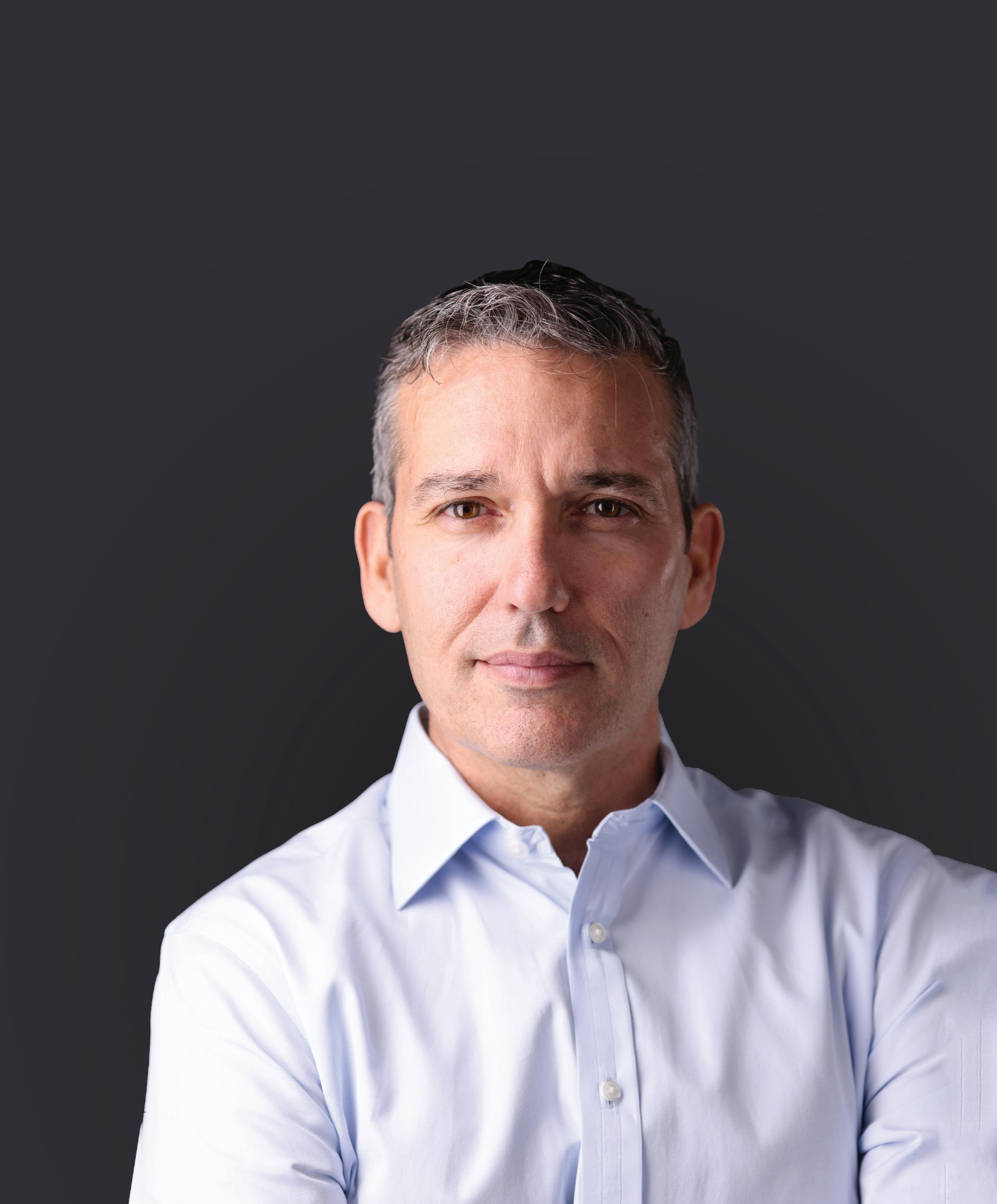
By Beth N. Pannell
From humble beginnings to tech entrepreneur, community leader and philanthropist, Tony DiBenedetto's story is powered by mentorship, gratitude and a strong connection back to FSU at every turn.
It was a simple but career-shaping question in seventh grade that put Tony DiBenedetto (B.S. ’87) on a life-changing trajectory. What do you want to be when you grow up?
DiBenedetto was raised by his grandparents and suffered the sudden loss of his grandmother at age 12. Taken in for the summer by a family friend, John Lilly not only asked that pivotal question — but when DiBenedetto said he was interested in going to space, Lilly explained that computers ran NASA and encouraged him to explore the relatively new technology.
“In 1977, I couldn’t tell you what a computer was,” said DiBenedetto. “It wasn’t prolific in our everyday lives, and I was like, ‘yeah, I’m going to get into computers.’ From seventh grade on, whoever would listen to me, I would say that I was going to do computers.”
He didn’t touch a computer until high school, when he was given an early TI99 computer and taught himself programming. But thanks to the encouragement and coaching he received over the next several years — sometimes from unlikely places — he never let go of that vision.
A spring break visit during DiBenedetto’s senior year of high school left a lasting impression. Although he considered playing baseball at a smaller school, that visit, combined with FSU’s programs in advanced math and computer science, ultimately drew him to Tallahassee.
As a first-generation college student who had experienced a challenging childhood and lived in about 15 different homes, DiBenedetto said he quickly found sources of support at FSU. His time at Florida State was shaped by advocates such as the Career Center’s Bob Reardon, Ph.D., and mentors such as Jeff Douglas and Pearly Rosier.
“He acted like I was his younger brother from the minute we met,” DiBenedetto said of Douglas, a staff member at the Student Disability Resource Center computer lab where DiBenedetto was assigned workstudy. “He was coaching me on all the dumb things I was doing and teaching me to be a young professional at 18.”
While Douglas was like an older brother, Rosier served as a mother or grandmother figure. DiBenedetto had to work to pay his way through school, so he also held a job at the Career Center where Rosier worked. She took him under her wing and parented him throughout his time at FSU and beyond.

DiBenedetto was part of the first class to graduate with a Management Information Systems (MIS) degree from the FSU College of Business — a program that combines business courses with technology. But his connection to FSU didn’t end at graduation.
His dream job at Arthur Andersen led him to recruit FSU students, and DiBenedetto continued this talent pipeline into Tribridge, a technology company he later co-founded with Brian Deming and fellow Nole Mike Herdegen (B.S. ’85, MBA ’91). Over the years, DiBenedetto helped recruit thousands of FSU students and maintained strong ties with then Career Center Director Myrna Hoover and the university’s career placement team.
“One of the cool things about my career is that I’ve been working with Florida State the whole time,” DiBenedetto said. “I can trace so many of the relationships I have through the university. My gratitude for Florida State is really at an 11 on a scale of 1 to 10.”
As a high school senior, DiBenedetto had a pivotal moment when he received several small scholarships during an awards night. Overwhelmed with gratitude for his guidance counselor and school community, he promised himself that one day, when he could, he would give back.
After college, DiBenedetto started to make good on the promise he made himself by volunteering with the YMCA, the Boys and Girls Clubs and other organizations focused on developing entrepreneurs and the startup community in Tampa Bay. Over time, those early efforts formalized into a nonprofit he launched in 2016 with FSU alumna Jennie Treby (B.S. ’95): Think Big for Kids.

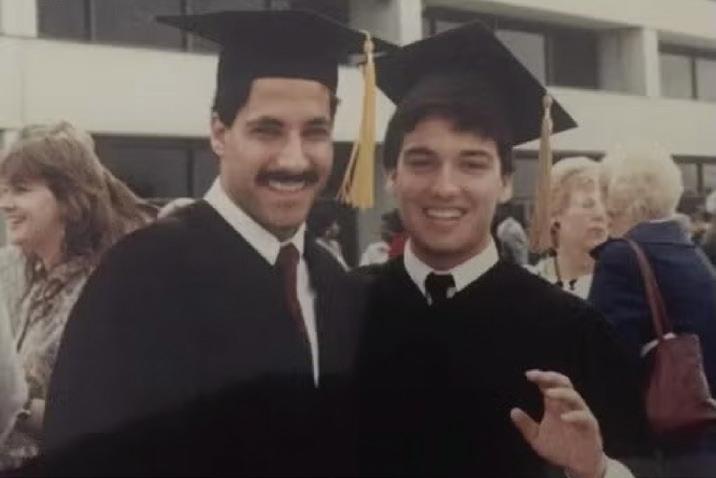
At that time, DiBenedetto was leading the sale of Tribridge and serving on several tech boards, where CEOs were discussing a growing talent shortage.
“I kept saying, ‘Why are we not looking inside of our own country at all the kids that aren’t going to college or these kids who don’t have help?’” DiBenedetto said. “We have a large percentage of the population that’s getting lost, and we have an opportunity to develop them.”
Think Big for Kids is a three-pillar program that starts in middle school and guides underserved youth through career exploration, mentorship and career readiness until they land their first job. The hands-on program helps disadvantaged kids move from living in poverty or struggling to make ends meet to earning a livable wage — serving as both a solution to the talent gap and a reflection of DiBenedetto’s deep gratitude for the mentorship he once received.
“A lot of people have asked me, ‘Why start the program so early?’ and that’s because they still have a lot of hope,” said DiBenedetto. “At age 12, 13, 14, they still believe they can do anything, and I wanted to tap into that energy a little bit.”
As of June 2025, Think Big for Kids has served more than 8,500 students in six cities and is on track to surpass 10,000 by the end of the year. DiBenedetto’s goal is to expand the program nationwide to reach hundreds of thousands — if not millions — of students.
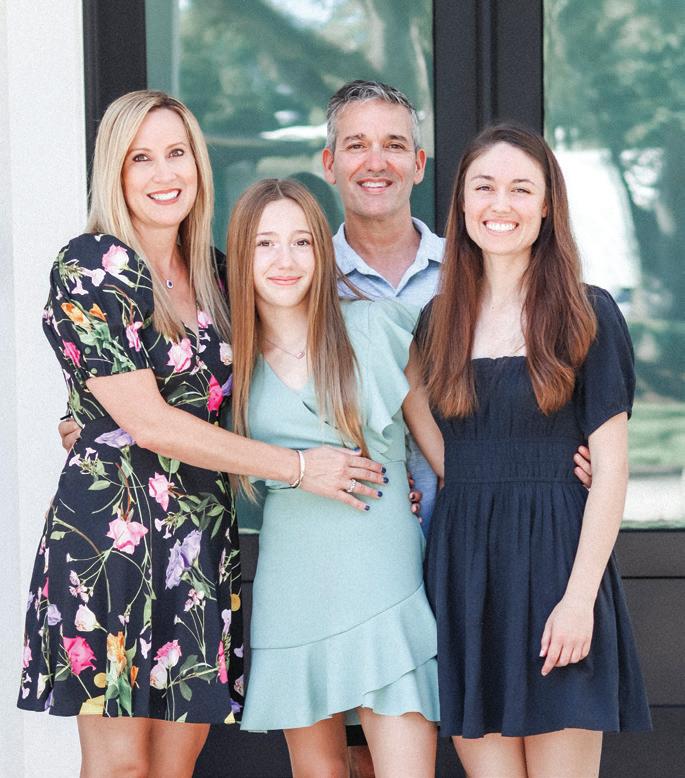
DiBenedetto pictured with his family at their Tampa home. From L-R are his wife, College of Business alumna Shannon, and their daughters Bella and Rachel. Photo courtesy of Tony DiBenedetto.
It creates a legacy that lasts multiple lifetimes.
-Tony DiBenedetto
DiBenedetto became CEO of Appspace in 2022 and continues to serve on the board of five technology companies.
In addition to founding Think Big for Kids, he is always seeking more ways to formalize his philanthropy.
In 2023, DiBenedetto and his wife, FSU alumna Shannon DiBenedetto (B.S. ’94, B.S. ’94), established the Anthony and Shannon DiBenedetto CARE Summer Bridge Endowed Fund. In 2024, they pledged $1 million to create the Think Big Endowment Fund at the College of Business, designed to encourage broader support for firstgeneration students.
These gifts support FSU’s Center for Academic Retention and Enhancement (CARE), which provides orientation, critical support and academic programming for first-generation students — those who often face the same challenges DiBenedetto once did.
“When I saw what Dr. [DeOnte] Brown was doing with the CARE program, I was like, ‘this is perfect.’ What happened to me informally has now become formal,” DiBenedetto said.
CARE students, the majority of whom are financially challenged and working through school just like DiBenedetto did, graduate at an 87% rate — significantly higher than the national average.
DiBenedetto encourages fellow alumni to support programs that matter to them. For him, the connection with CARE is deeply personal and impactful.
“I really encourage other people who love Florida State to give to the CARE program because the CARE program can work in all the different colleges — not just the College of Business.”
DiBenedetto is no stranger to professional recognition. His accolades include induction into the FSU College of Business Hall of Fame and the Ernst & Young Florida Entrepreneur of the Year® Award in Technology. Earlier this year, DiBenedetto received the prestigious Horatio Alger Award of Distinguished Americans, for which he is especially proud because it recognizes overcoming an obstacle, achieving a level of success and giving back — a combination that honors the full arc of his life story.
When asked about his accomplishments as an entrepreneur, DiBenedetto credited much of his success to building strong, collaborative teams and being comfortable with risk.
“I grew up completely in a risk environment. Things were always uncertain... but it made me super comfortable with two things, risk and communication.”
He also believes his ability to understand people’s gifts and help them grow has helped him succeed. Just as someone once saw his potential and pointed him toward a future he couldn’t yet imagine, DiBenedetto is now paying it forward.
By supporting FSU students through CARE and building a broader pathway through Think Big for Kids, DiBenedetto is investing in the next generation of dreamers, doers and leaders.
“We went the endowment route because we believe the CARE program is going to be helping kids for a hundred years. We’re going to be long gone, and that money will keep working for those students,” he said. “It creates a legacy that lasts multiple lifetimes.”
Sometimes, all it takes is one person believing in you, one piece of advice, one small opportunity, or one meaningful “thank you” to change a life.
GIVE TODAY to the CARE program at give.fsu.edu/care. Scan the QR code or visit advance.fsu.edu/dibenedetto to hear DiBenedetto talk more about engaging with and giving back to FSU.
FSU's Center for Academic Retention and Enhancement (CARE) provides preparation, orientation and academic support programming for students who are among the first in their family to attend college and may face unique challenges in college because of educational or economic circumstances.
Some of the students in Tony DiBenedetto's Think Big for Kids program are current CARE students! Meet two of them:
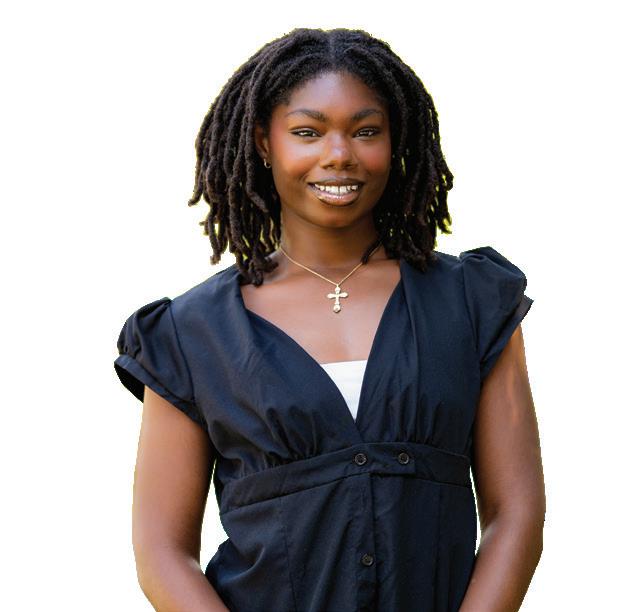
Intended major: International affairs, with plans to pursue a combined pathway toward a master’s degree in urban and regional planning
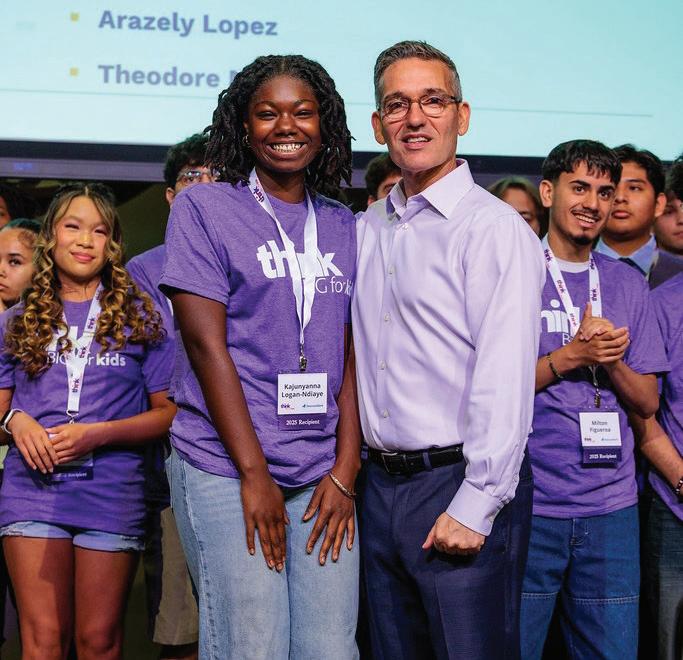
How has being part of both Think Big for Kids and the CARE program shaped your goals for the future?
Both programs have given me more than just resources; they’ve shifted my perspective on how I see my future. Think Big for Kids opened my eyes to career opportunities and the importance of mentorship, while CARE has provided the structure and community to thrive as a firstgeneration college student. Seeing and hearing success stories of people who started out just like me and went on to accomplish huge things makes my own goals feel 10 times more attainable.
What’s one piece of advice or support you’ve received through these programs that made a lasting impact?
One of the biggest lessons I’ve learned is that it’s not about who you know, but who knows you, and how your work and impact can open doors for others. When you do great things, people notice, and that’s often where new opportunities come from. It’s not just about advancing yourself, but about being recognized as someone who invests in others. That mindset has pushed me to step into leadership roles and always think about how I can give back, because I’ve experienced firsthand how others investing in me has changed my life.
How has being part of both Think Big for Kids and the CARE program shaped your goals for the future?
Think Big for Kids has supported me financially through the scholarship I received. It also provides resources and networking opportunities that are helping me prepare for long-term success. The CARE program has been equally impactful. As a first-generation student, I was nervous at first, but CARE made me feel right at home with the support of the staff and student ambassadors. It has given me valuable resources to grow my network, and overall, both programs have helped me grow as a person and become more academically successful.
What does it mean to you to be part of a program that’s designed to help students like you succeed?
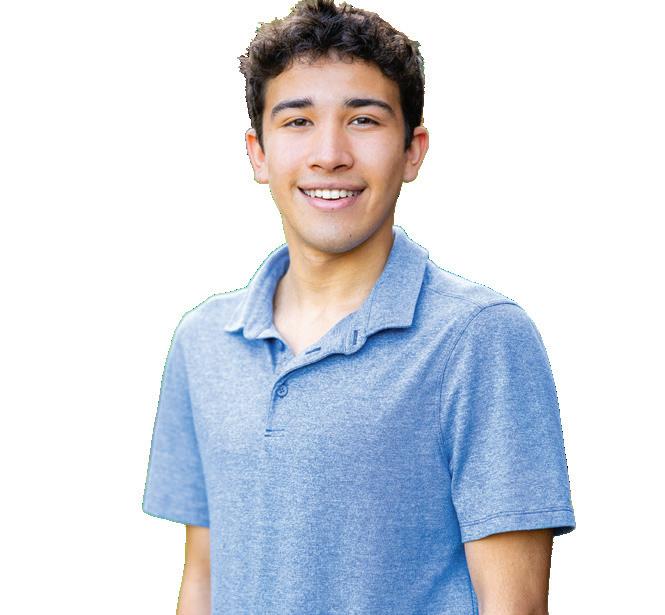
I’m blessed every day for the opportunities that Think Big for Kids and CARE have provided. To me, it’s not just about receiving support but also about being inspired to give back. One day, when I’m successful, I want to be part of the same mission of giving back to students to help them work toward their own success.
Intended major: Finance
By Beth N. Pannell
When Joyce (M.S. ’73) and Bob Miles established a scholarship at Florida State University, they hoped to help promising students pursue their goals. What they didn’t expect was how one of those students would open their eyes to another program doing life-changing work and inspire them to expand their giving even further.
The Mileses, both longtime FSU supporters, first met Jy’Shawn O’Neal (B.S. ’16) when he was selected as the recipient of their scholarship through what is now the Anne Spencer Daves College of Education, Health, and Human Sciences. They were immediately impressed by his drive, warmth and professionalism. “Jy’Shawn was just such an engaging young man,” Joyce recalled.
Later, they learned O’Neal was in the Center for Academic Retention and Enhancement (CARE) program, which supports first-generation and limitedincome students at FSU. Since Bob is a first-generation college graduate himself, the discovery struck a chord and prompted the Mileses to learn more about CARE’s mission. After touring the facilities and meeting staff, they decided to establish a second scholarship dedicated to CARE students.
For more than a decade, they’ve eagerly awaited news each year about who their scholarships will support. “Every time we get a letter about a new student,” Joyce said, “it’s like opening a package at Christmas.”
For O’Neal, who grew up in Quincy, Florida, the connection with Mr. and Mrs. Miles became one of many sources of encouragement that shaped his future. A family and child sciences major with a minor in education, he graduated from FSU in 2016 and went on to earn a master’s degree in counselor education-student affairs from Clemson University. Today, he’s back where his journey began, serving as project director of the Upward Bound Program in Jackson County, a pre-collegiate initiative within
FSU’s CARE program that helps high school students prepare for college.
“Being part of the Upward Bound Program for Gadsden County in high school and later a CARE student in college helped me tremendously in reaching my personal and academic goals,” O’Neal said. “Those programs connected me with mentors who have my best interest at heart.”
The Mileses have followed O’Neal’s progress ever since, checking in occasionally to celebrate milestones and offer encouragement. “We felt he understood that we were genuinely interested in him,” Joyce said. “Some students aren’t sure if we really want that connection, but he got it — we care about what he’s doing.”
When O’Neal returned to Florida after graduate school, Joyce encouraged him to look at opportunities at Florida State. “I told him, ‘You came up through CARE. This is your history. You can walk the talk,’” she said. Not long after, he applied for a position with CARE and got it. Now, he’s also pursuing an Ed.D. in educational leadership and policy at FSU.
“They’ve always checked in on my progress,” O’Neal said of his relationship with Mr. and Mrs. Miles. “They love to see students succeed and are committed to helping us reach our goals.”
For Joyce and Bob, that connection,
and seeing the results of their giving in real time, has deepened their commitment to supporting students. “We have planned gifts at Florida State and at Purdue, but those will happen after we’re gone,” Joyce said. “By giving while we’re living, we get to meet these students, see the difference our support makes, and hopefully inspire them to give back when they’re able.”
That ripple effect is exactly what CARE is all about. Founded to help first-generation students transition to and thrive at Florida State, CARE provides academic, financial and social support throughout their college journey. For many, it’s a lifeline — and a launchpad.
“First-generation students often lack financial support while in college,” O’Neal said. “Finances are one of the top reasons students can’t continue college, and scholarships like the Mileses’ help get students closer to their goal of graduating.”
O’Neal’s story embodies CARE’s mission and the lasting impact of generosity in action. In his work with CARE’s Upward Bound Program, O’Neal is now helping students find their own paths forward, just as others once did for him. “People like Mr. and Mrs. Miles are needed,” O’Neal said. “I appreciate them for their contributions to my education and to the countless others they’ve helped with their scholarships.”
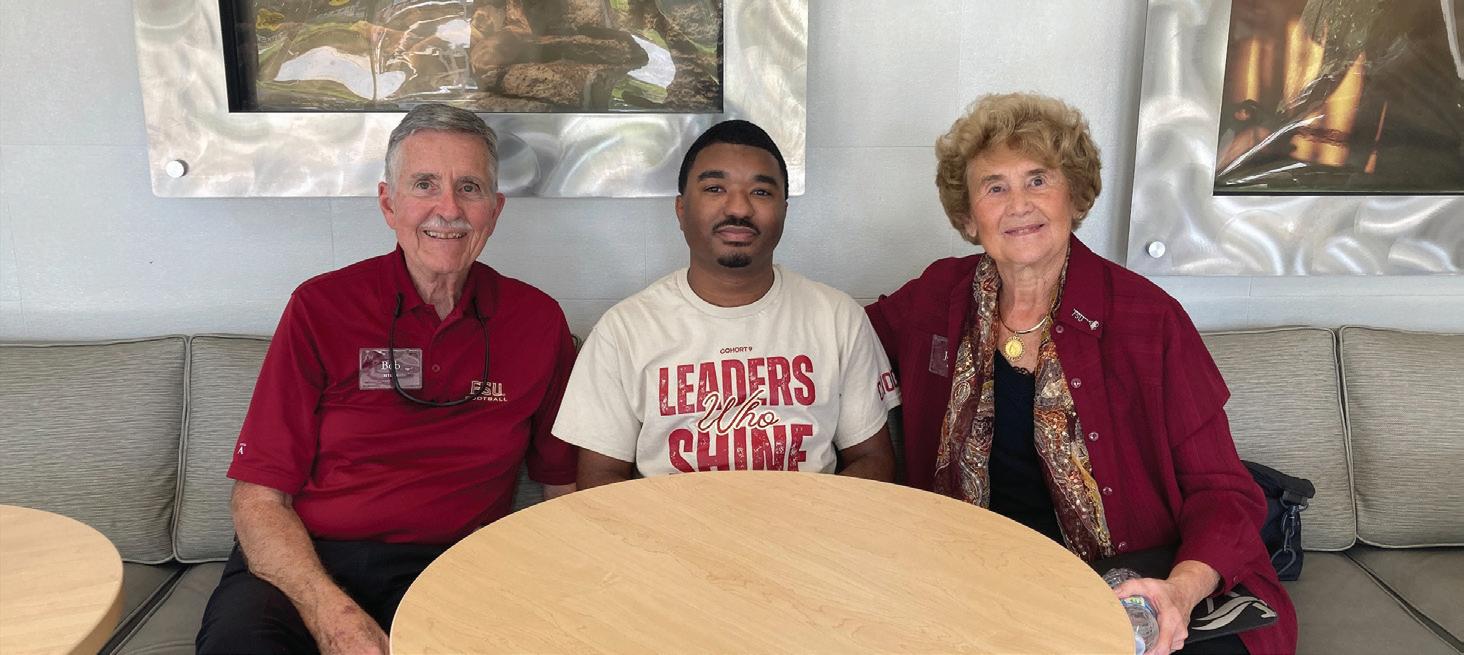
Since 2020, Florida State has had 42 student-athletes take part in the CARE program. There are currently six CARE student-athletes on active rosters for the 2025–2026 season. Here’s what they’re saying…
“The CARE program has helped me adjust to being a student athlete in many ways. Being a freshman and learning to balance my schoolwork along with my lacrosse responsibilities is definitely a challenge, but the CARE program offers many different workshop opportunities and individual meetings to help navigate any problems I might have.”
HANNAH TOOLE, PONTE VEDRA BEACH, FLORIDA
Women’s Lacrosse
“The CARE program has truly been a game-changer for me. CARE and athletics feel like two families working together to lift me up. There’s a real team effort between the CARE advisors and the athletic academic staff. They always communicate with me, check in, and work around my schedule to make sure I never fall behind. It’s more than support — it’s people who actually care about me as a person, not just an athlete.”
ZIANNA “ZEE” CURTIS, JACKSONVILLE, FLORIDA
Women’s Track and Field
“As an international student-athlete, college can sometimes be a lot with being so far away from home and having to balance classes with training and a meet schedule that includes traveling all over the country. The Summer Bridge Program was a great introduction to college as there was a way to meet new people who might be in the same situation as oneself. I really believe it helped a lot.”
MATHIAS CHRISTENSEN, COPENHAGEN, DENMARK
Men’s Swimming and Diving










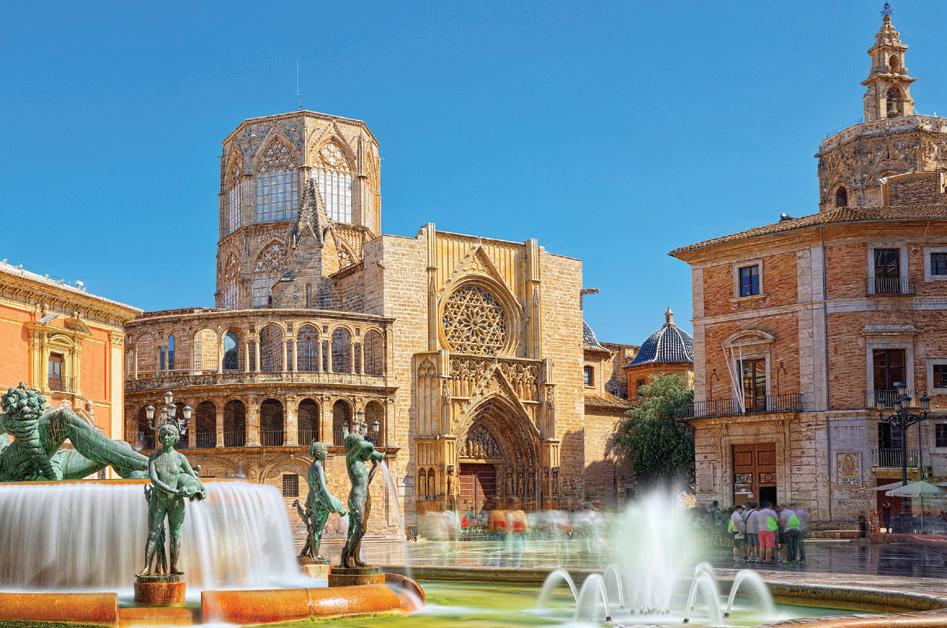
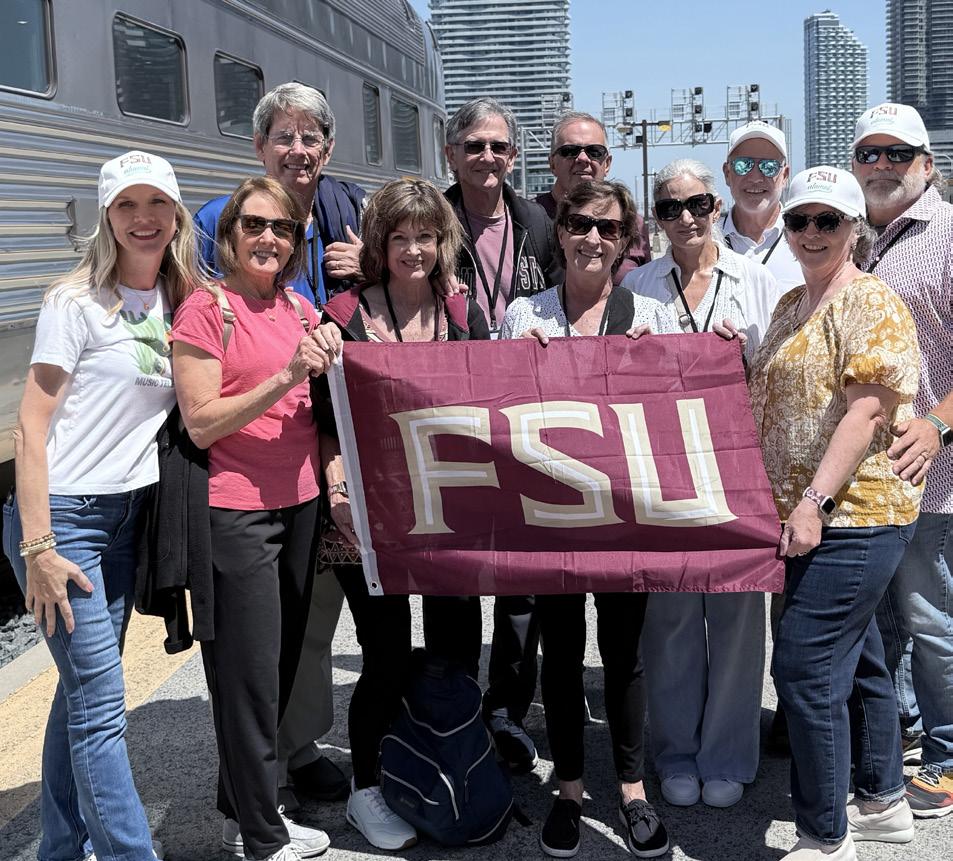
Embark on unforgettable journeys with the FSU Alumni Association as we invite you to explore culturally rich destinations designed exclusively for Florida State alumni and friends.
Our trusted travel partners take care of every detail, from planning to logistics, so you can focus on what matters most: relaxing, connecting and experiencing the world.
Each handpicked itinerary features world-class guided tours, iconic landmarks, authentic cuisine and immersive cultural experiences. Best of all, you’ll experience these moments with fellow Noles who share your spirit of adventure.
Join us and make memories that last a lifetime.
Explore the full 2026 Traveling Noles schedule! gonol.es/travelingnoles
Iceland and the Northern Lights February 7–15, 2026
Spain’s Classics March 20–31, 2026
Spectacular Scandinavia September 23–October 7, 2026
Iceland’s Magical Northern Lights October 12–18, 2026
Wonders of Thailand November 5–20, 2026
Italian Lakes and Swiss Alps by Luxury Train
June 16–25, 2026
San Juan Islands July 20–25, 2026
African Expedition by Private Train August 2–16, 2026
Canadian Rockies by Rail August 19–25, 2026
Bordeaux to Lisbon Ponant Cruise October 1–12, 2026
Cruise Spain, Portugal and Morocco October 16–25, 2026
Your event is as unique as you are, and it deserves the excellence you expect. Traditions Catering and Events has five unique event spaces, technologically advanced rooms, a variety of table décor options and high-end menus, offering a perfect setting for any occasion. Let our team of hospitality experts guide you every step of the way!
Traditions Catering and Events is your full-service caterer with a delicious locally sourced menu of options! Beyond that, our team is ready to assist you with invitations, floral arrangements, photography, bridal and special event attire, bridal party gifts, corporate gifts and more!
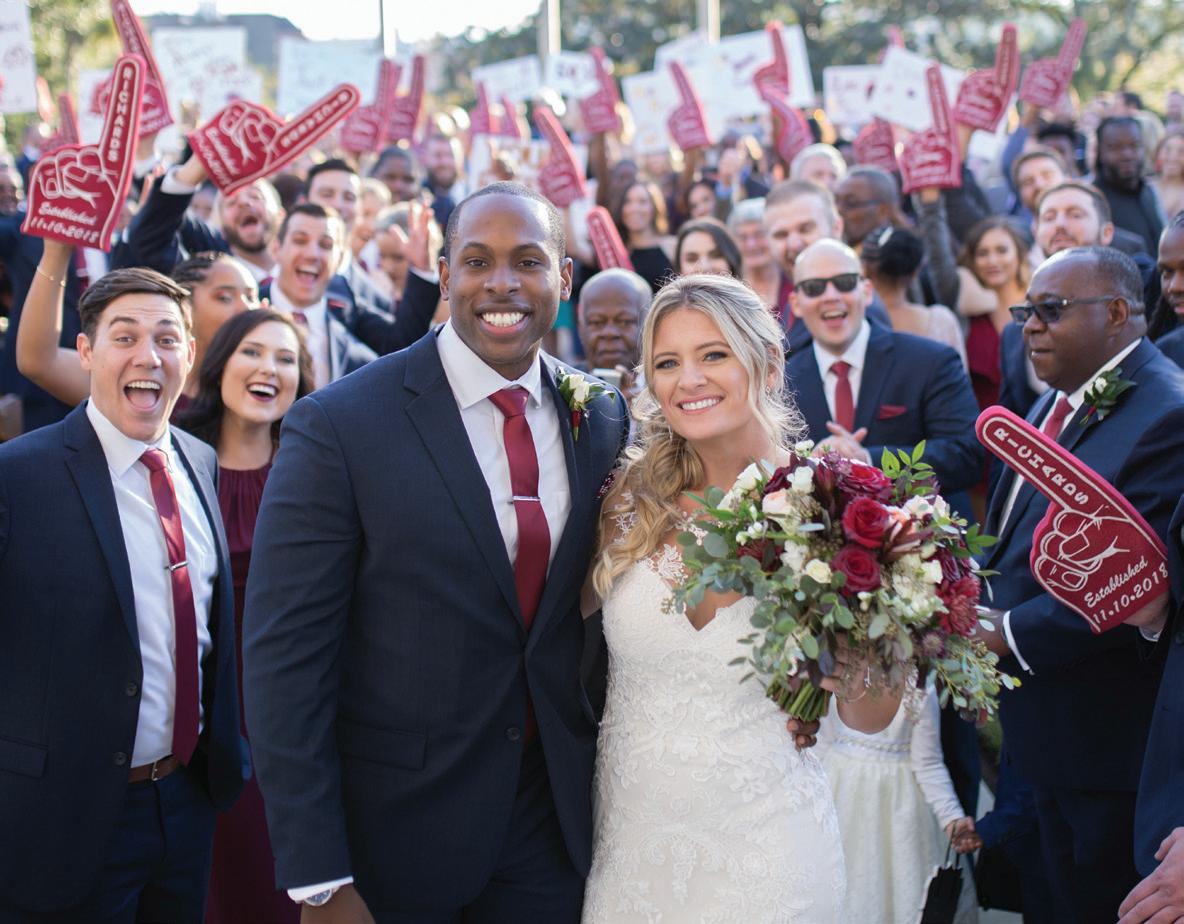
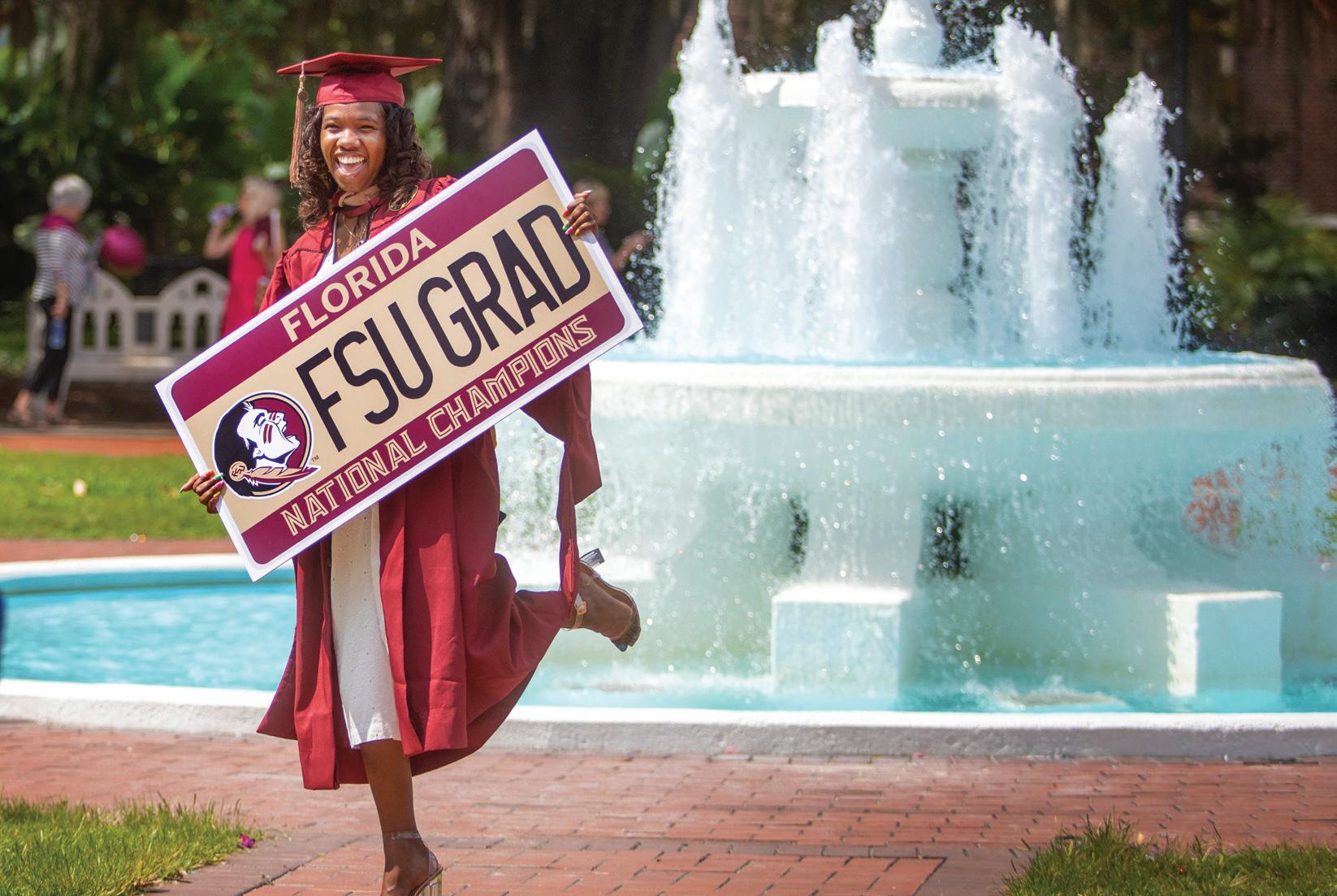
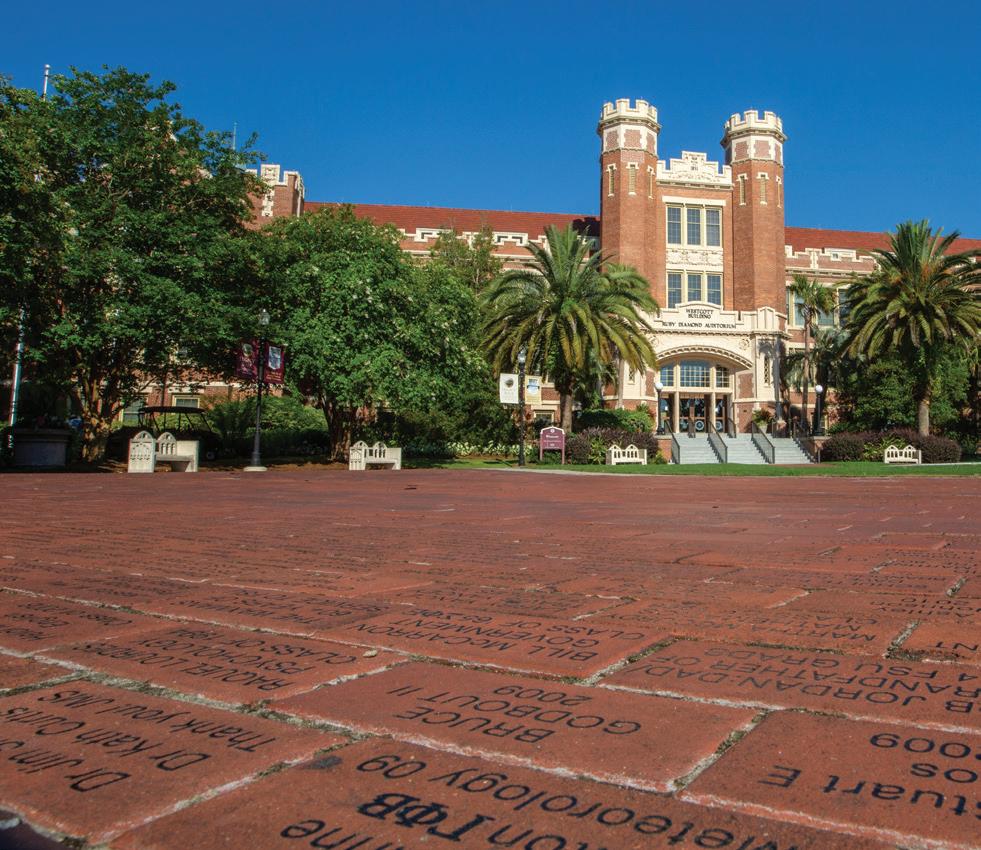
At Florida State University, every journey begins with opportunity, and every gift makes that journey possible.
Whether they’re finding support as first-generation students, exploring marine ecosystems or studying abroad in Florence, London and beyond, FSU students are turning their college experience into meaningful,
real-world impact because of you.
On March 4, 2026, the Seminole community will come together for the 15th annual FSU’s Great Give, our 24-hour day of giving. Your support helps open doors, fuels discovery and empowers the next generation of leaders.
Together, we turn passion into purpose and potential into greatness.
JOIN US for FSU’s Great Give on March 4.
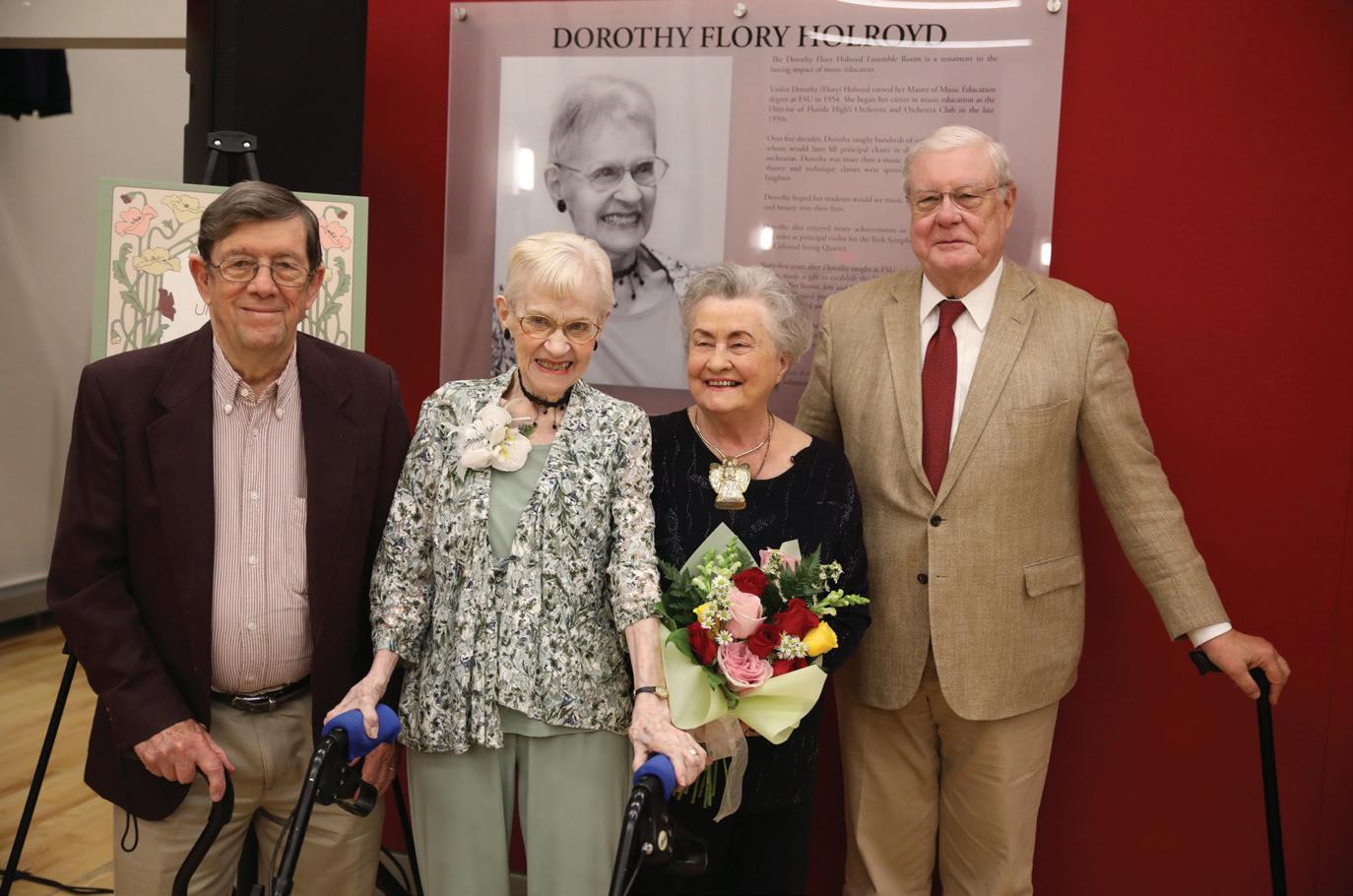
The Dorothy Flory Holroyd Ensemble Room stands as a tribute to Dorothy Flory Holroyd (MME ’54), a music educator whose vision and dedication left a lasting mark on her students. On February 28, 2025, the FSU
College of Music formally unveiled the newly renovated space, celebrating Holroyd’s enduring influence and the transformative gift from her former Florida High violin student, Jim Miller (B.A. ’61).
friends Jeanne and Robley Light in front of the display in the ensemble room named in her honor. Photo courtesy FSU College of Music.
“I am truly overwhelmed with this honor,” Holroyd said at the news of the gift in 2023. “I guess one never knows how much a teacher influences his or her students.”
Holroyd, now 95, is retired after a teaching career spanning five decades. The ensemble room ensures her impact will endure as a legacy for generations of musicians.
“As a music educator, part of my job here is to teach the future of music education,” said David Plack (B.A. ’92, MME ’95, Ph.D. ’06), director of athletic bands, during the unveiling ceremony. “I’m proud that our music ed majors who will be in this room will have a reminder of the impact they can make on their students. We’re going to ensure that all our students use this as a prime example of what teaching is all about.”
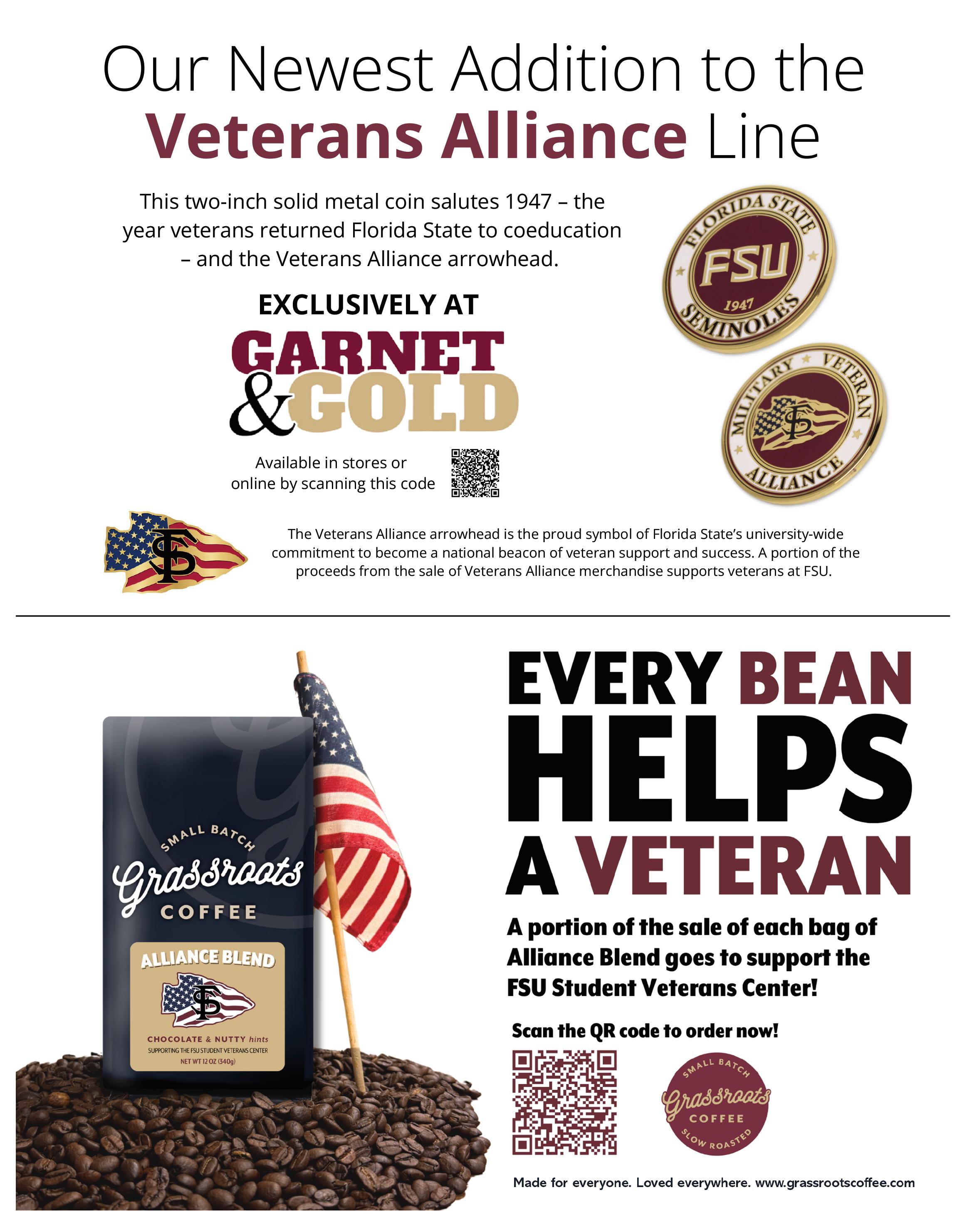
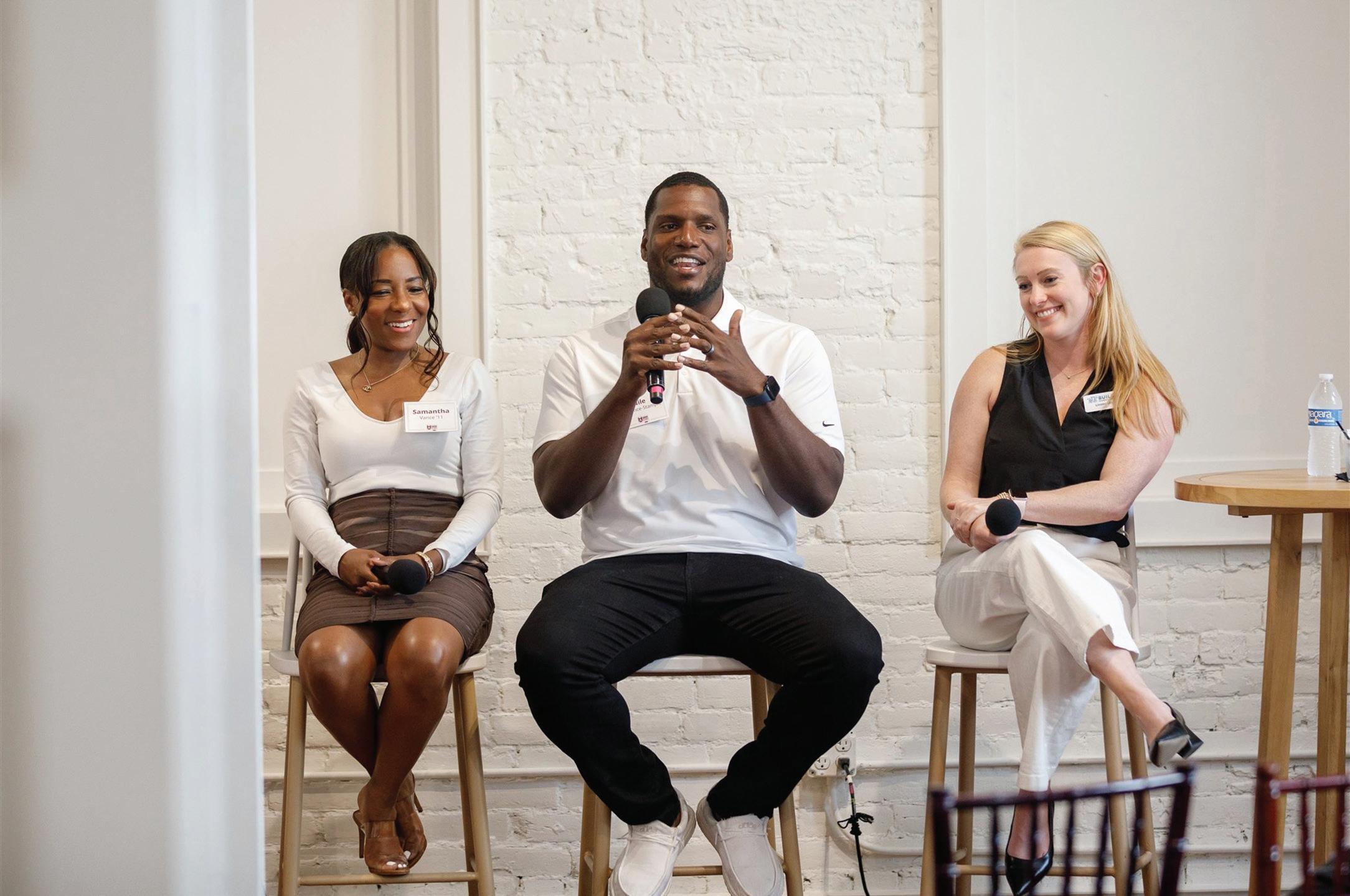
The Young Alumni Network at FSU, in partnership with the Jacksonville Seminole Club, hosted Young Alumni Weekend 2025 in Jacksonville, Florida, from June 13 to 15.
This fun-filled weekend featured professional development opportunities, insights into FSU Alumni Networks and Seminole Clubs, and activities designed to connect FSU young alumni.
The weekend kicked off at Ruby Beach Brewing with networking and a dynamic panel discussion spotlighting accomplished FSU alumni making strides in their careers. Saturday included a day trip to explore the charm and rich history of St. Augustine, followed by an evening mixer with the Seminole Club of Jacksonville. The weekend wrapped up on Sunday with a beach cleanup and brunch. Young Alumni Weekend was a memorable opportunity for recent graduates to strengthen their ties to the Seminole community and celebrate their shared FSU experience.
SAVE THE DATE! Join us July 17–19, 2026, for Young Alumni Weekend in Washington, D.C.
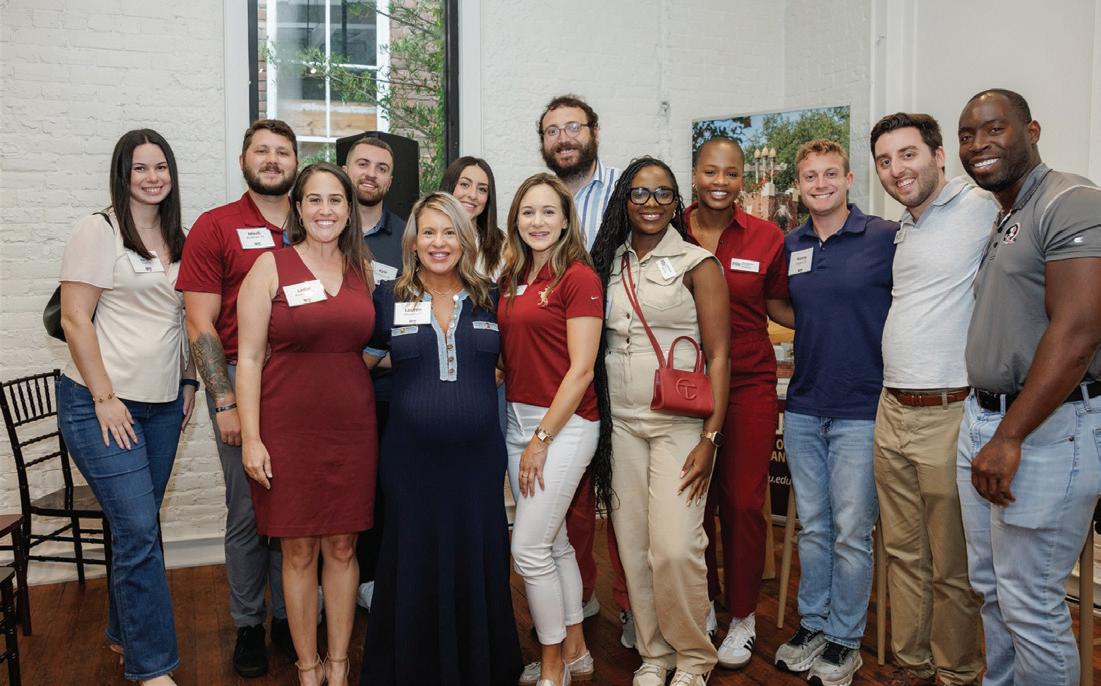
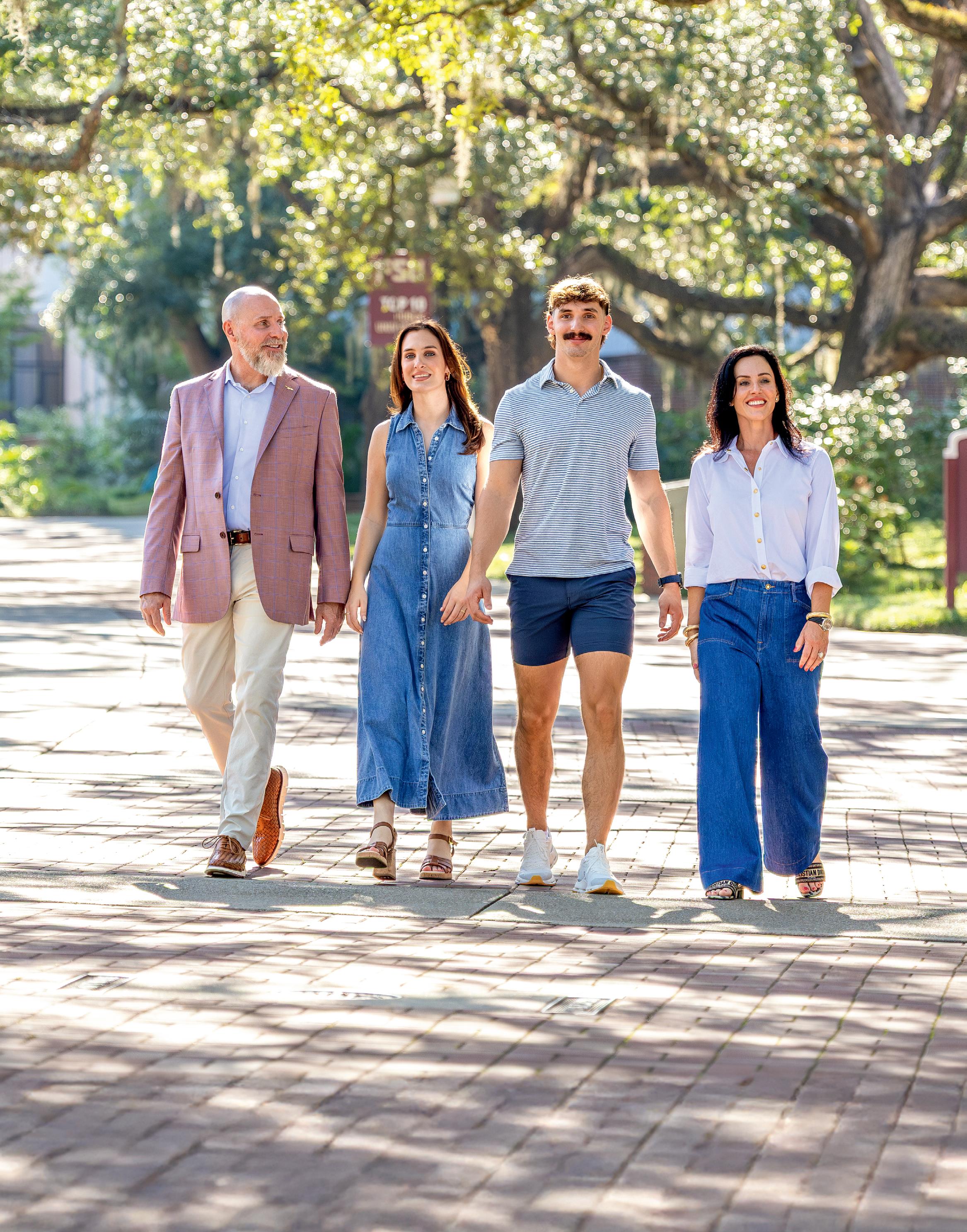
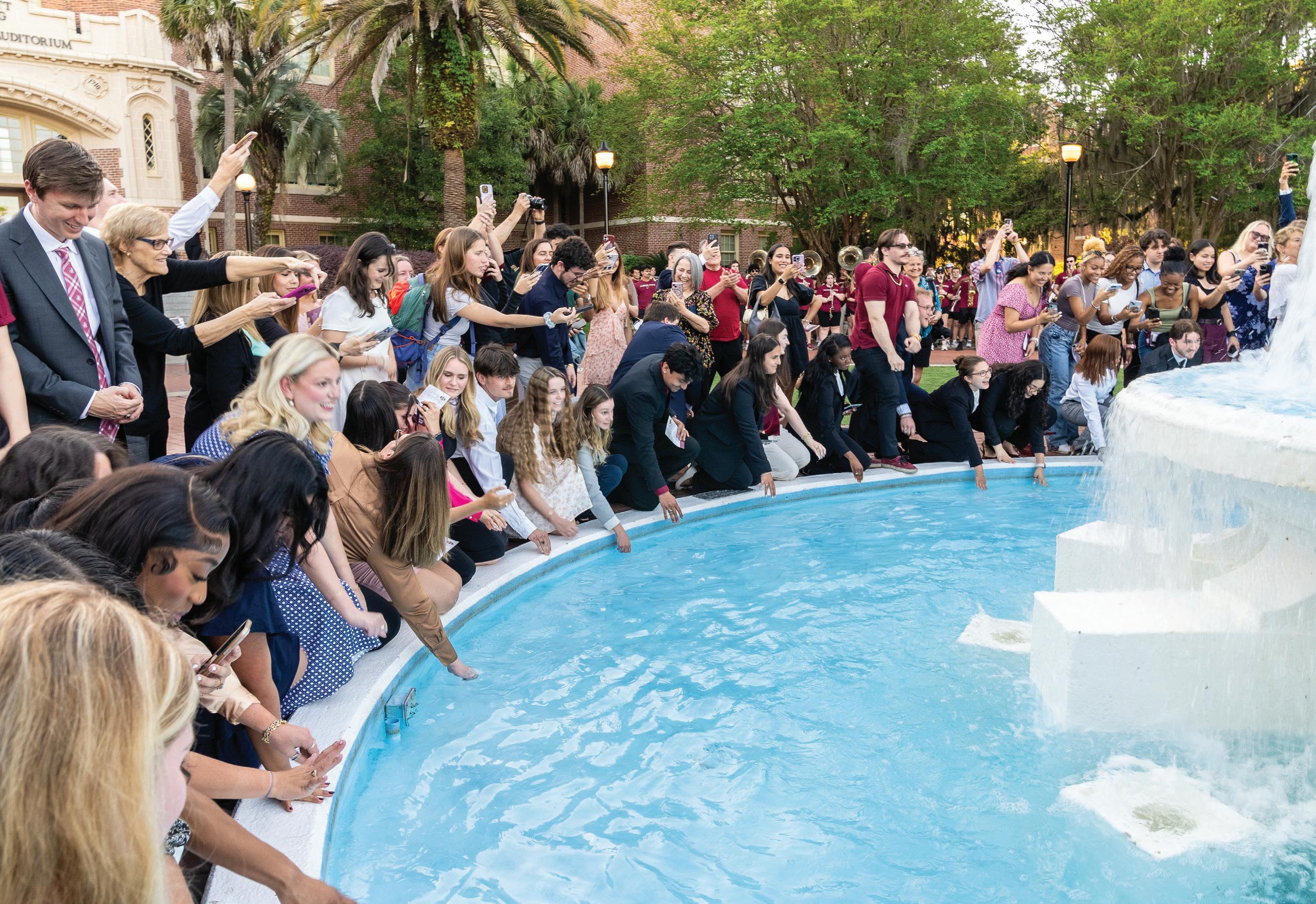
Students who have earned 60 or more credit hours are eligible to order the official FSU ring — a lasting symbol of their academic achievements and future success. This time-honored tradition connects students to Florida State and its global alumni family. Each spring, those who order rings are invited to the annual Ring Ceremony at Ruby Diamond Concert Hall. During this meaningful event, university leaders honor students as their names are called and rings are formally presented on stage. The celebration continues with the iconic ring pledge and ring dip traditions, where students mark their place in FSU’s legacy by dipping their ring in the Westcott Fountain at exactly 6:51 p.m. — 18:51 in military time — in tribute to the year FSU was founded. It’s never too late to commemorate your journey at Florida State with an official FSU ring. The 2026 Ring Ceremony will begin at 5 p.m. on Thursday, April 2.
LEARN MORE balfour.com/fsu
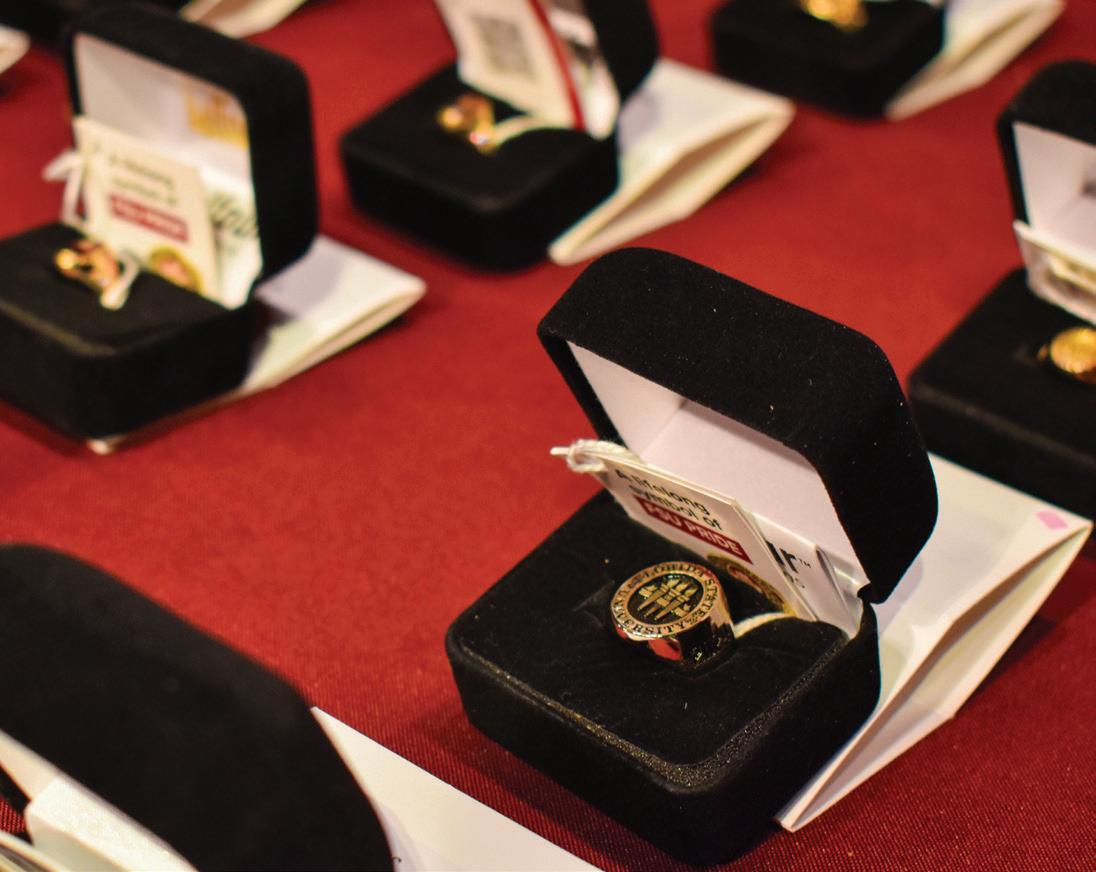
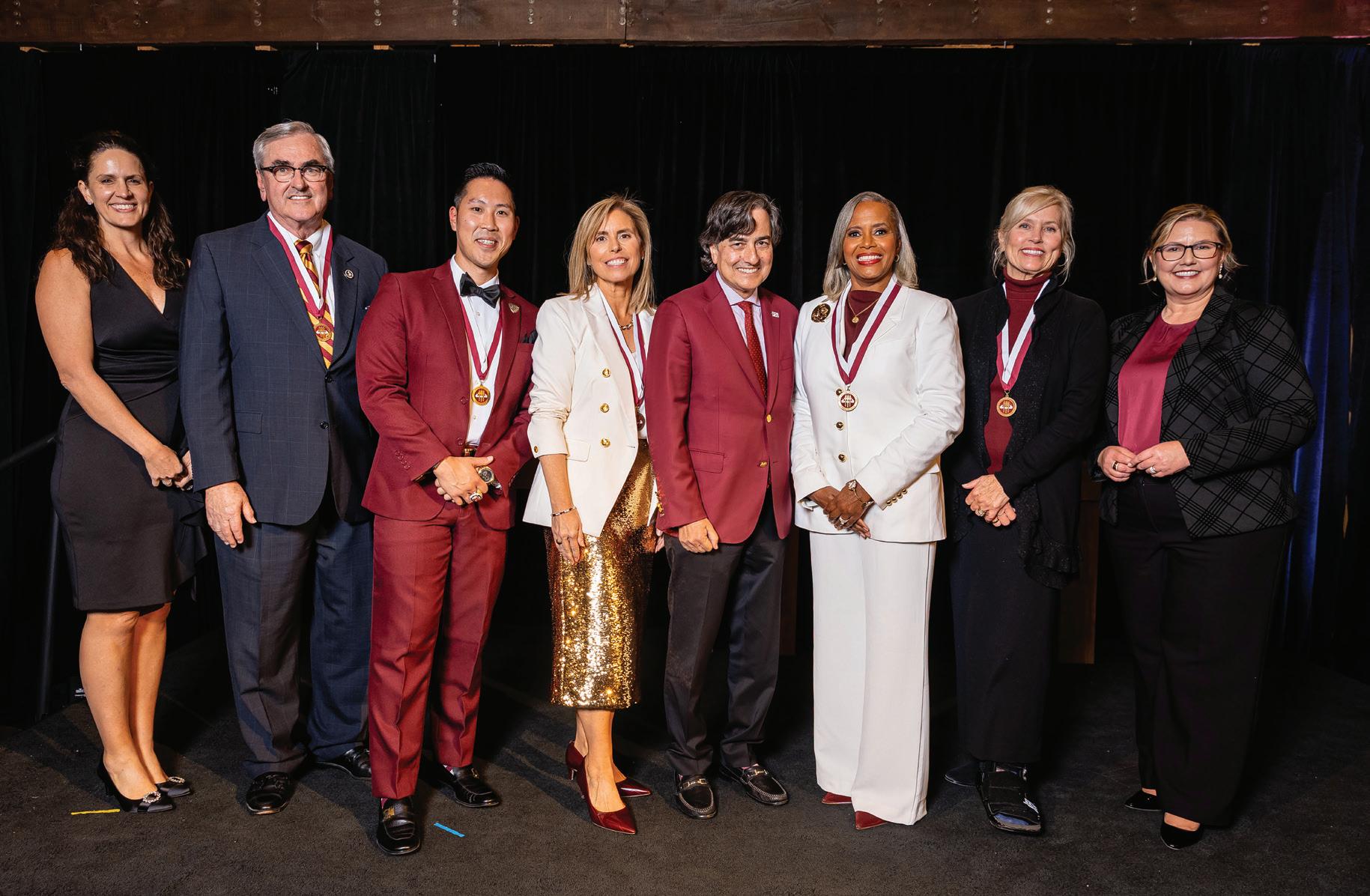

During Homecoming 2025, Oct. 31–Nov. 2, we welcomed alumni back to campus and recognized this year's honorees.
BERNARD F. SLIGER AWARD
Named for the 10th president of Florida State University, the Bernard F. Sliger Award is the single highest honor given by the FSU Alumni Association.
Guy Spearman (MSW ’75)
OF GOLD
The FSU Alumni Association’s Circle of Gold recognizes worthy individuals who, through their service and achievements, personify the university’s tradition of excellence.
Jennifer Tankersley Collins (B.S. ’93, J.D. ’96)
Dr. Andrea Friall (B.S. ’93)
Zach Heng (B.S. ’07)
Cricket Mannheimer (BFA ’81, M.S. ’94)
Bob Sasser (B.S. ’73)
THE INSPIRE AWARD
The Inspire Award recognizes graduates who have distinguished themselves as leaders within their industry and whose hard work and determination serve as an inspiration to current students and young alumni at Florida State University.
Ashlee Fontes (B.S. ’04, Ph.D. ’24)
Delores Spearman (B.A. ’98, M.A. ’08)
REUBIN O’D. ASKEW
YOUNG ALUMNI AWARD
Named in honor of former Governor Askew, this award is the highest honor bestowed upon young alumni by the FSU Alumni Association.
Lauren Albaum (B.M. ’11)
Kenneth Cagnolatti (B.S. ’21)
Terrence Williams Jr. (B.S. ’13, MPA ’14)
Five honorees were inducted into the Circle of Gold during Homecoming 2025. Pictured left to right are Vice President Marla Vickers, Honoree Sasser, Honoree Heng, Honoree Collins, Provost Jim Clark, Honoree Friall, Honoree Mannheimer and Associate Vice President Julie Decker.
The Grads Made Good award, presented in partnership with the FSU Circle of Omicron Delta Kappa (ODK), recognizes alumni who have made exceptional contributions in their community or field.
James “Chef” Barlow (B.S. ’95)
Larry Hogan (B.S. ’78)
Eduardo Pérez (B.S. ’89)
Leslie Webber (BSN ’99)
EMERITI HONOREES
Dean Marie Cowart
Susan MacManus (B.A. ’68, Ph.D. ’75)
Bob Mang (B.S. ’68)
Jim Riscigno (B.S. ’66)
President Emeritus John Thrasher (B.S. ’65, J.D. ’72), honored posthumously
Thank you to Guy and Delores Spearman for their generous gift in support of the Alumni Awards celebration.
If you know an FSU graduate who embodies the spirit and values of Florida State University, please consider nominating them for one of our prestigious alumni awards. The nomination period of the 2026 awards will open in January 2026.
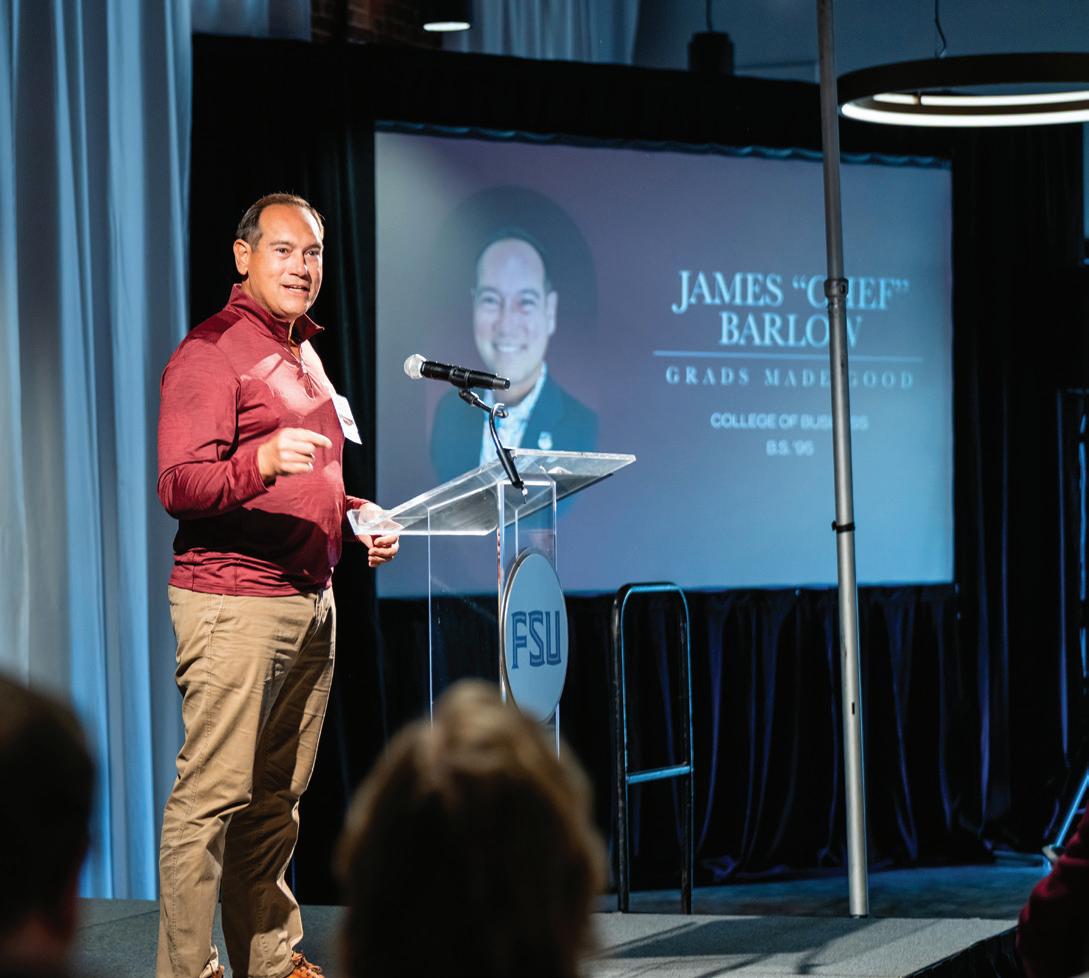
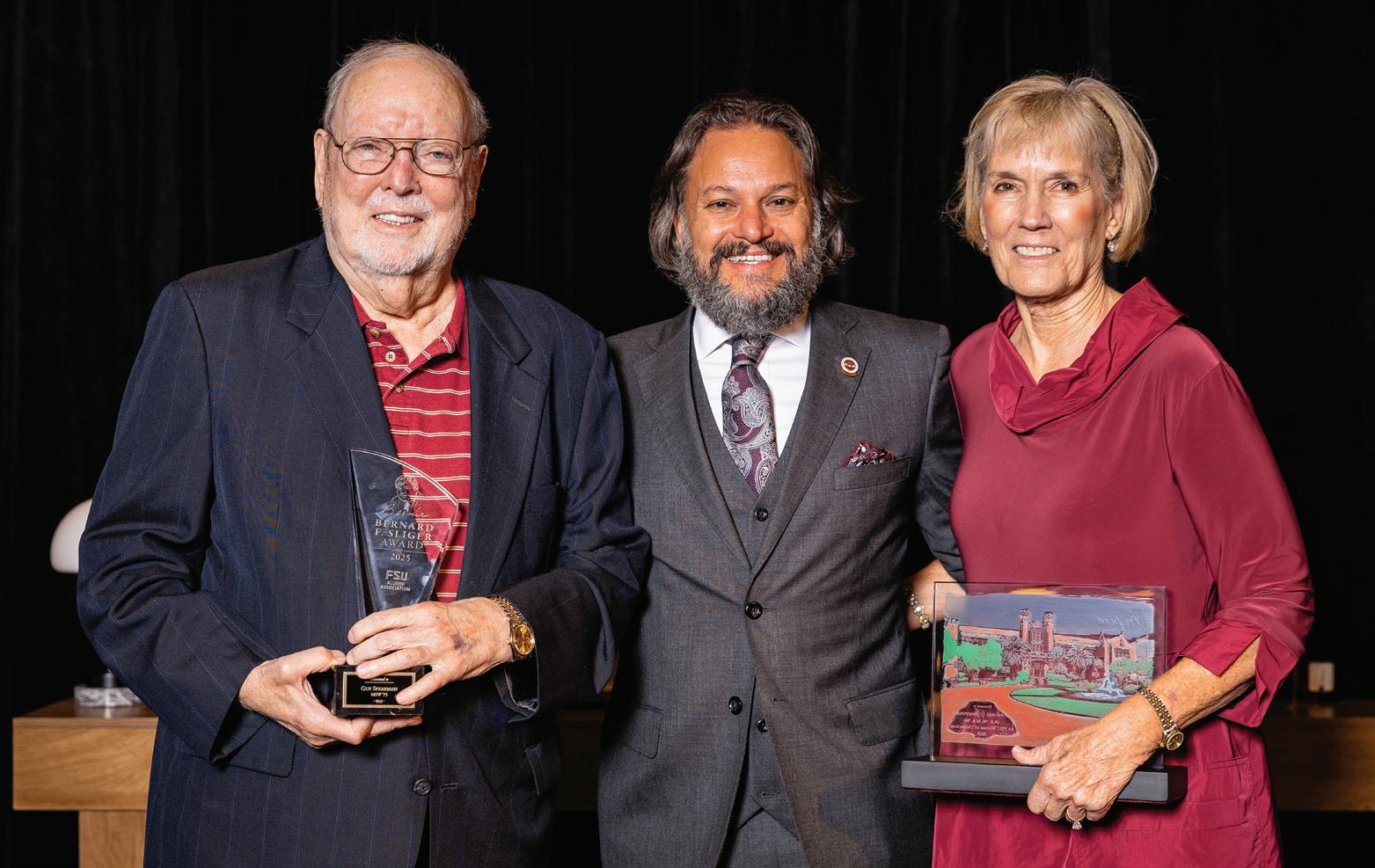
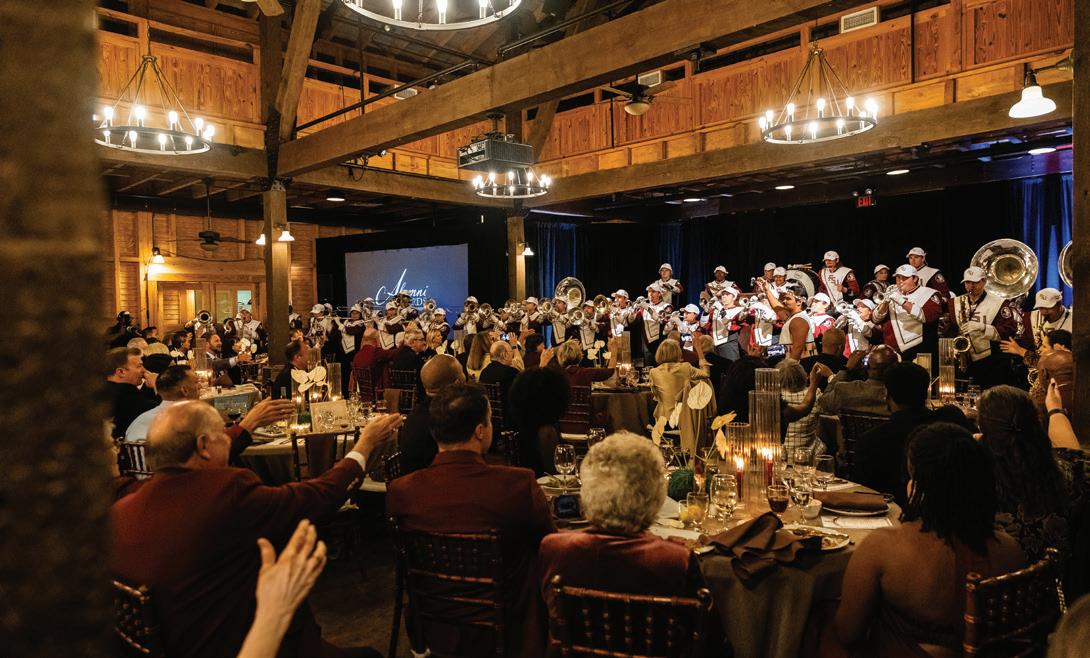
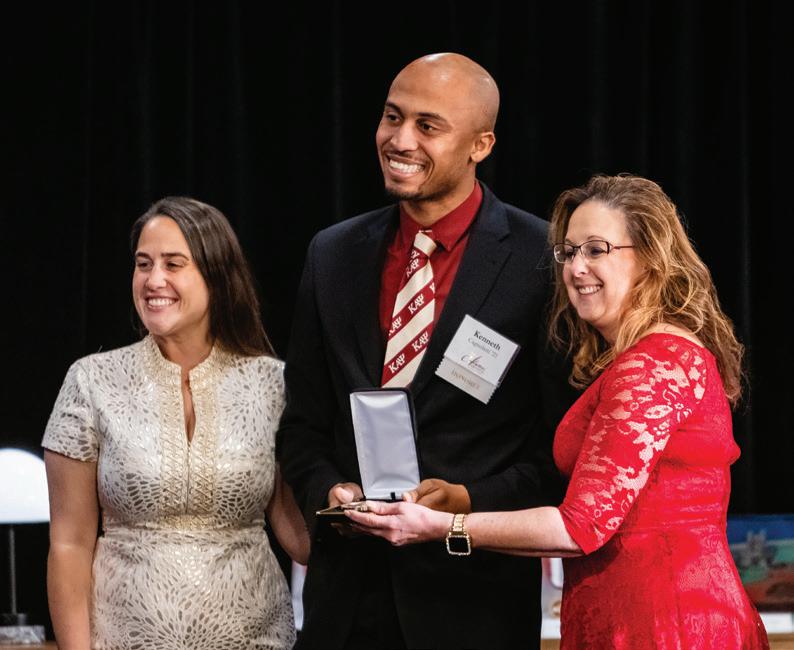
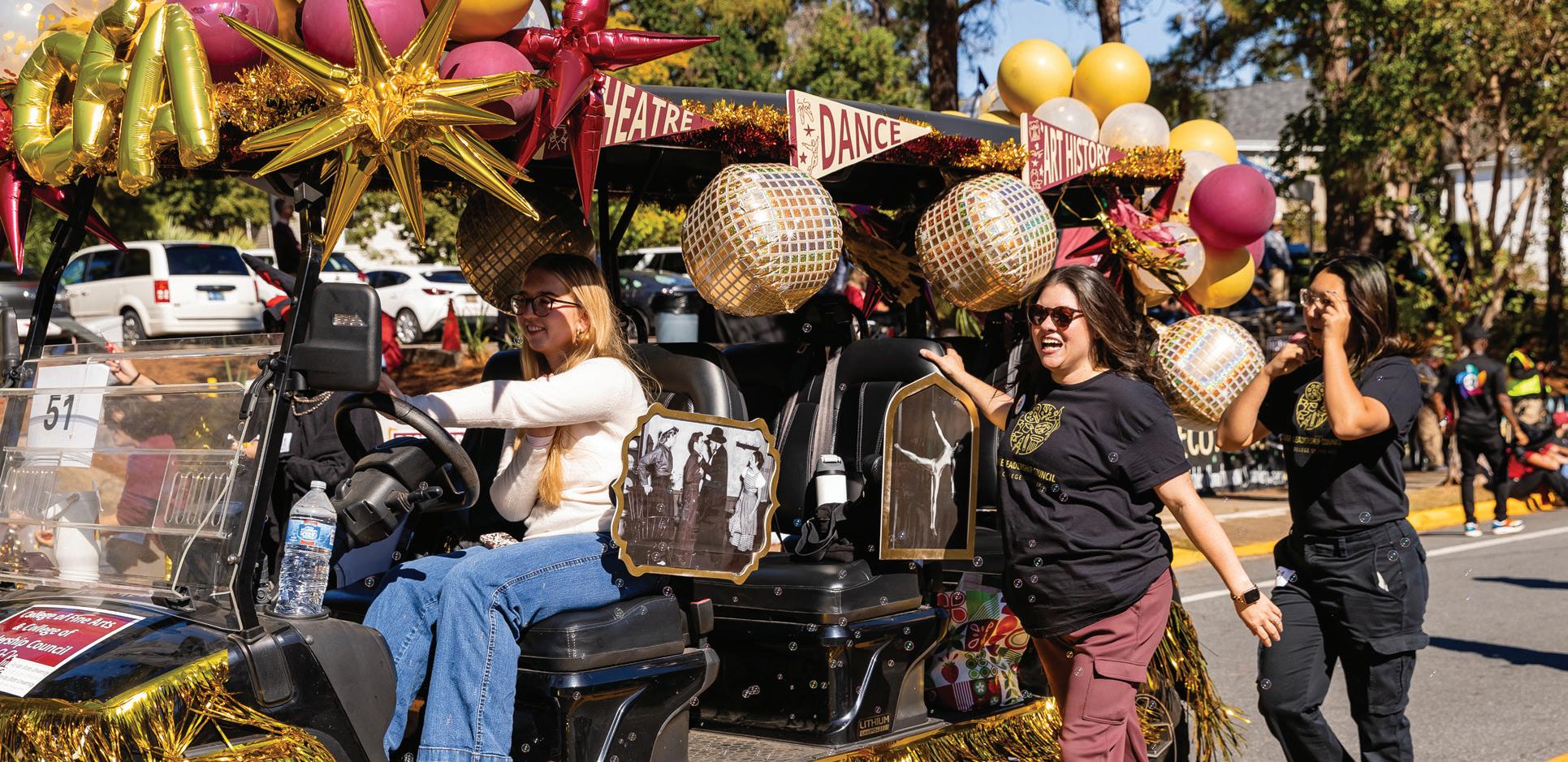
1. James “Chef” Barlow, a Grads Made Good honoree, gave his acceptance speech at brunch on Saturday, November 1.
2. The Bernard F. Sliger Award honoree Guy Spearman and Inspire Award honoree Delores Spearman, pictured with College of Social Work Dean David Springer.
3. The World-Renowned FSU Marching Chiefs made a surprise appearance at the conclusion of the 2025 Alumni Awards celebration.
4. Reubin O’D. Askew Young Alumni Award honoree Kenneth Cagnolatti (center) pictured with President of the Young Alumni Council Sadie Molinet and daughterin-law of Governor Askew, Christine Askew.
5. The Homecoming Parade is an integral part of the FSU Homecoming tradition and a highlight of Homecoming Weekend for both students and alumni.
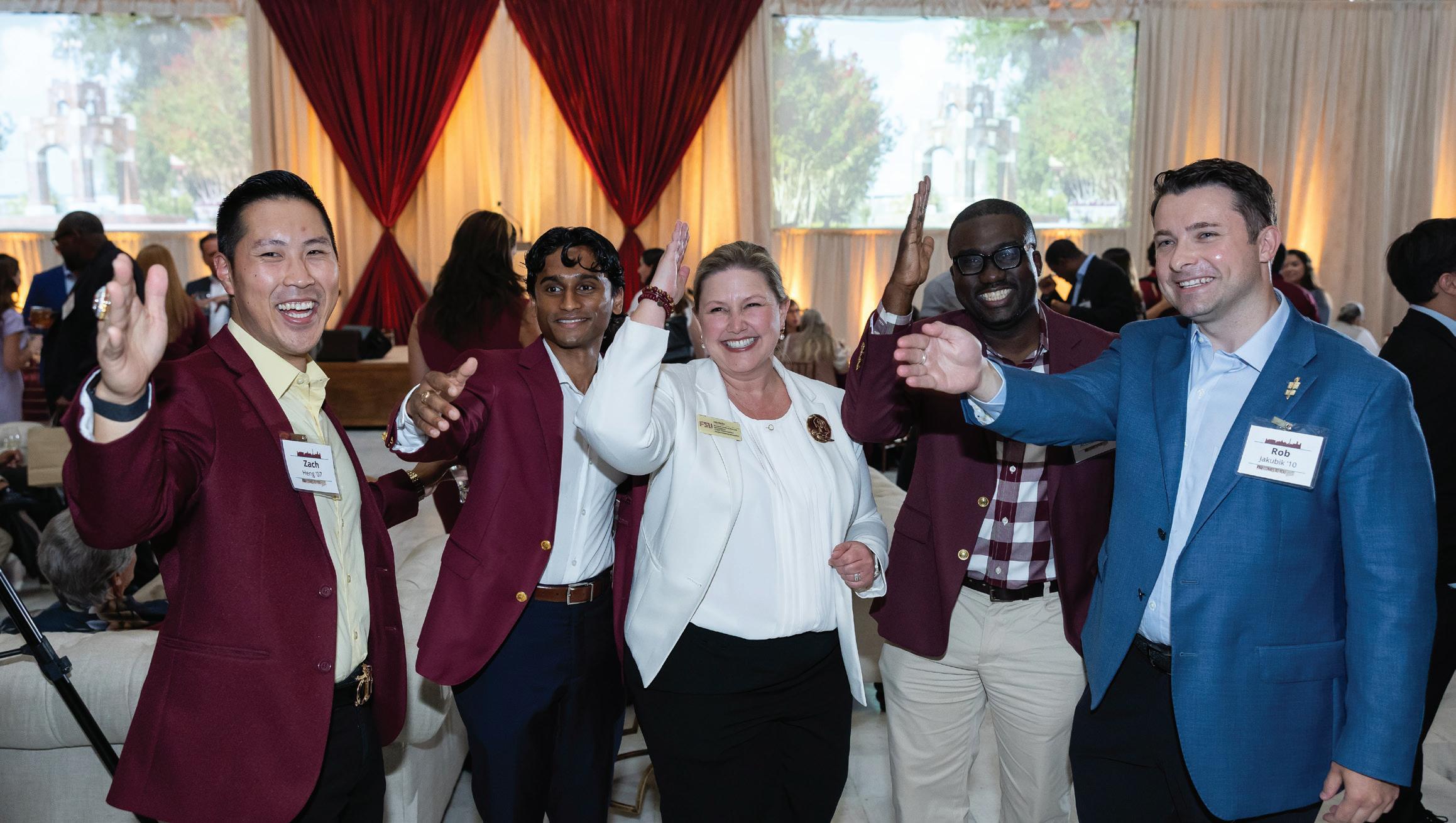
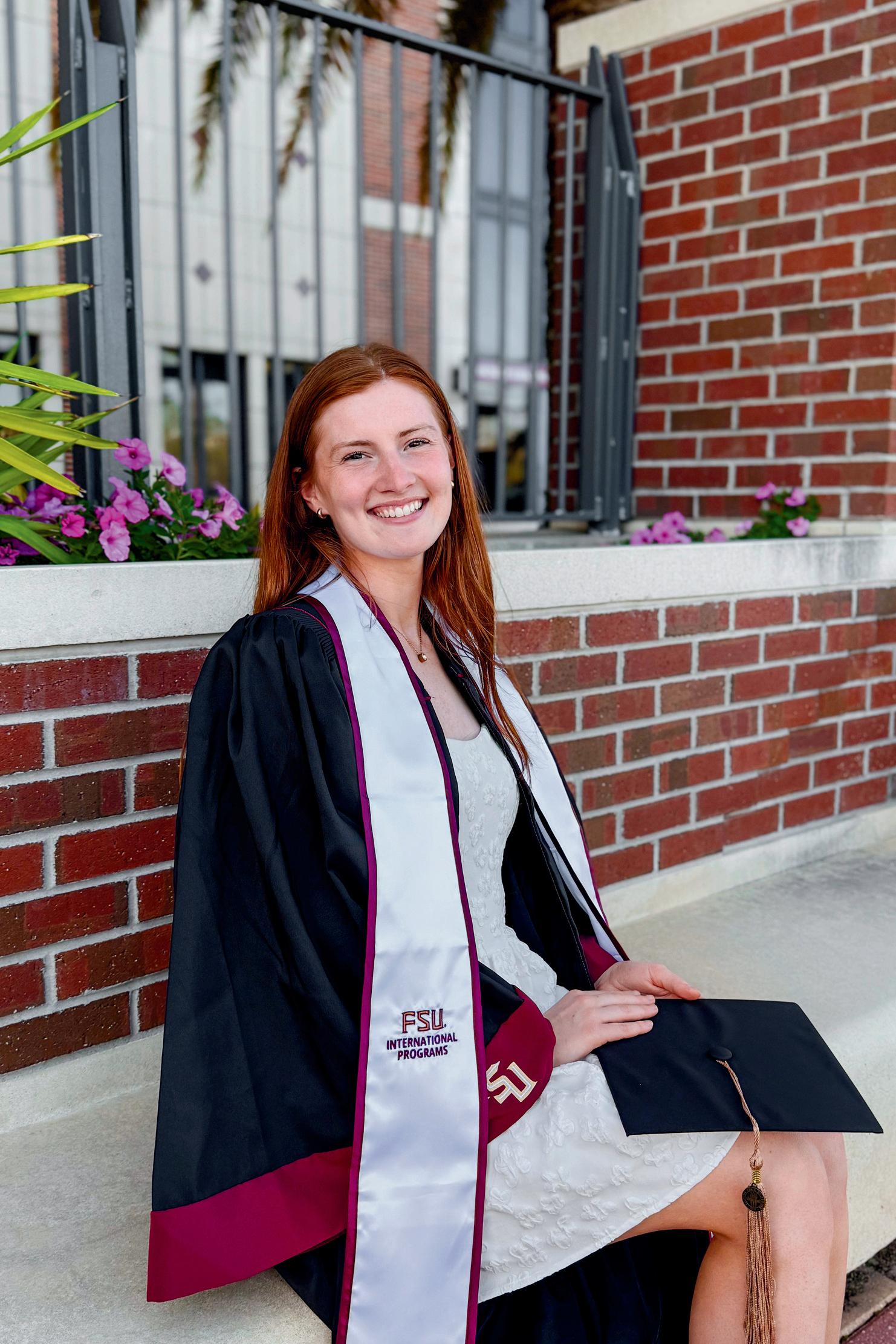
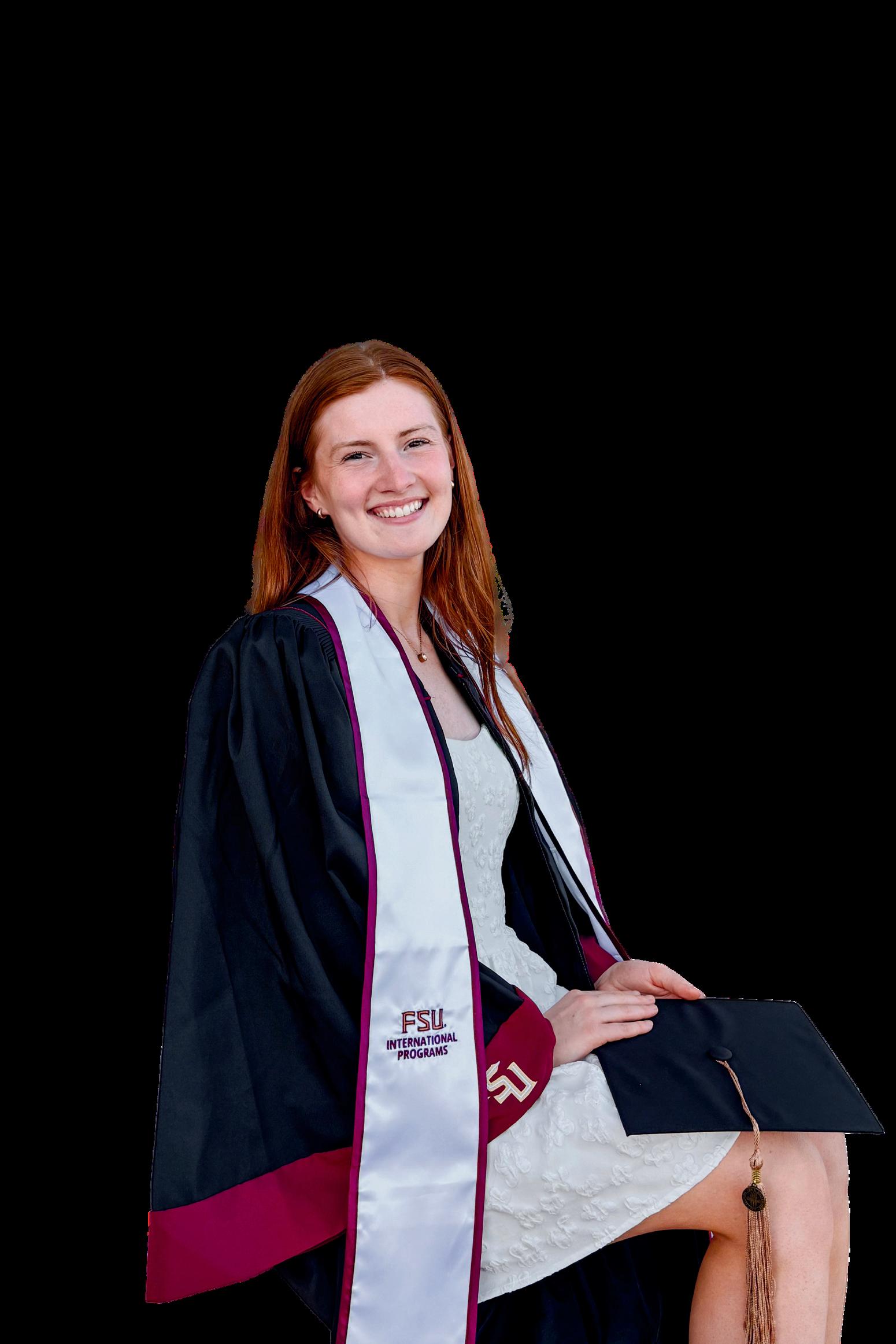
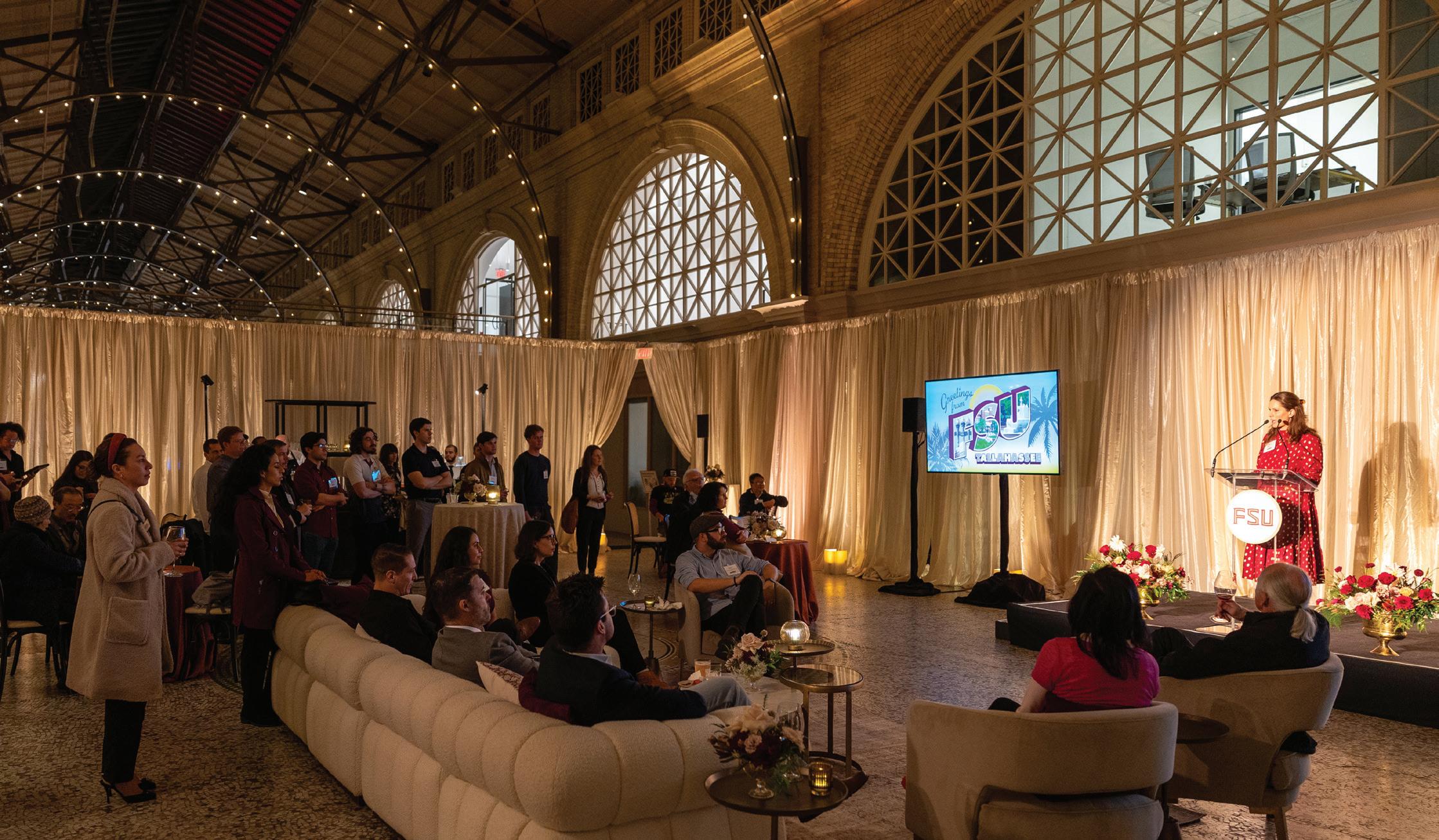
FSU hits the road again in 2026, and we’re coming to a city near you. Join us for an evening of connection and celebration with fellow FSU alumni, parents and friends. Discover the latest updates on campus, explore bold new initiatives and experience the energy of our growing FSU community, whose impact continues to expand across the globe.
Save the dates for our FSU Comes to You events in 2026.
NASHVILLE, TENNESSEE
February 10
DALLAS, TEXAS
April 7
HOUSTON, TEXAS
April 9
WASHINGTON, D.C.
June 16
CHARLOTTE, NORTH CAROLINA
June 23
VISIT gonol.es/FSUComesToYou for more information.
Celebrate your Seminole spirit with exclusive, award-winning California wines delivered right to your door. Each bottle features a unique FSU-themed label. Wine Club members receive quarterly shipments of red and white wines. Your Wine Club purchase supports events, programs and outreach of the FSU Alumni Association for current students and alumni. Sign up today, and toast to the garnet and gold! JOIN AT gonol.es/WineClub
APRIL 23–25, 2026
Volunteer leaders from FSU affinity networks and Seminole Clubs are invited to campus for an exciting weekend, April 23–25, 2026. The summit offers opportunities to build relationships with alumni and fellow volunteer leaders from across the country, while gaining tools, resources and strategies to enhance their volunteer leadership. Attendees will connect with FSU staff, collaborate on alumni engagement initiatives and immerse themselves in campus life.
LEARN MORE at gonol.es/VLSummit26 and contact Veronica.Houck@advance.fsu.edu with any questions.
Below: Leaders convened on campus for the 2025 Volunteer Leader Summit April 3–5; Right: Volunteer leaders speak with Dr. Andrew Frank, director of the FSU Native American and Indigenous Studies Center, after his presentation to the group.
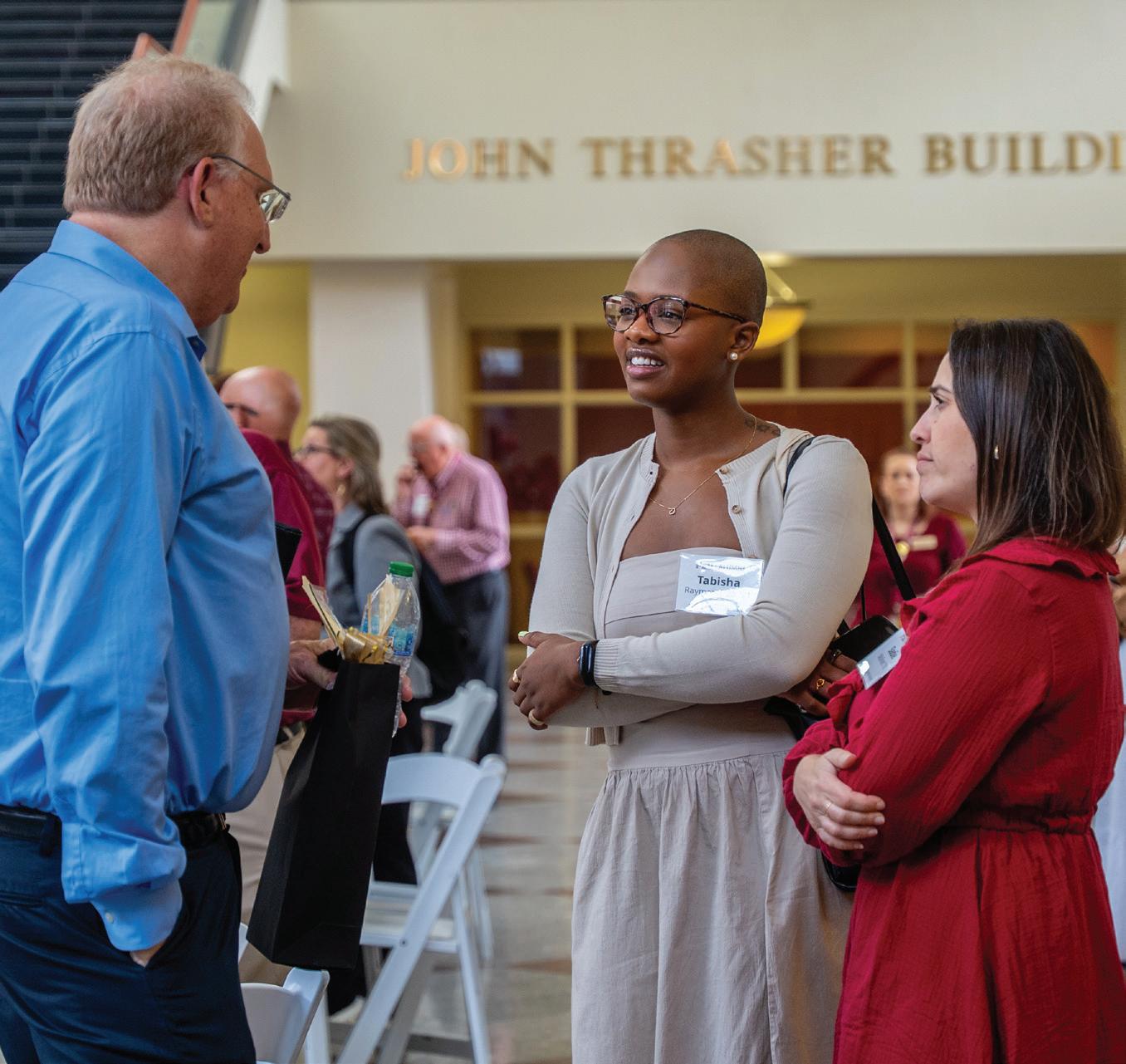
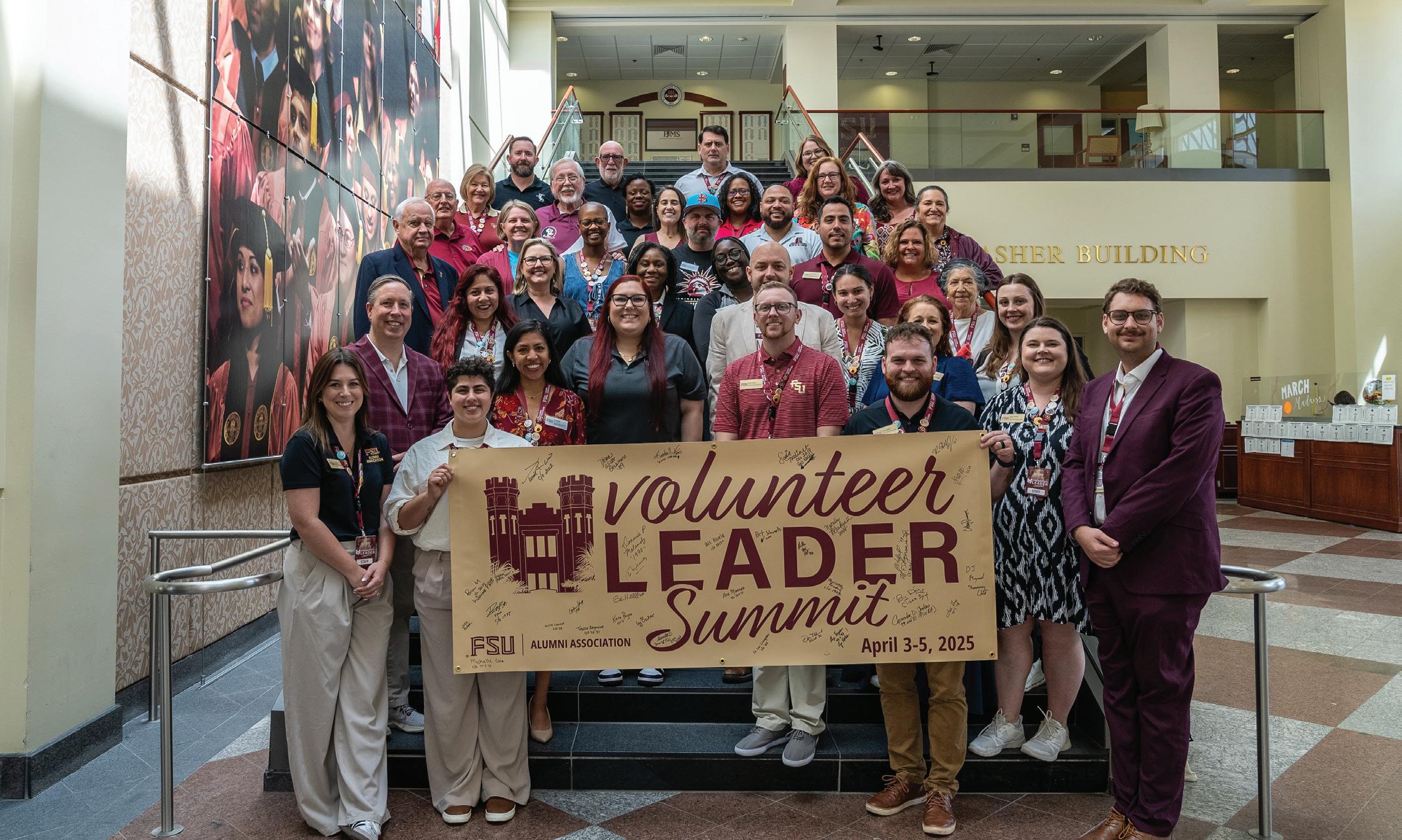
FEBRUARY 21, 2026
Seminole 100 recognizes the 100 fastest-growing businesses owned or led by FSU alumni during an annual celebration on FSU's campus. At the event, honorees learn their individual rankings, receive their awards and connect with fellow business leaders.
Mark your calendars and plan to join us for the 2026 Seminole 100 Celebration on Saturday, February 21.
LEARN MORE seminole100.fsu.edu
The Jim Moran Institute for Global Entrepreneurship at Florida State University was the presenting sponsor of the 2025 Seminole 100 Celebration. We thank JMI for their generous support, which helps make this prestigious event possible.
Interested in sponsoring the 2026 Seminole 100 Celebration or a different FSU event?
LET US KNOW at gonol.es/sponsorships
Equiturn Business Solutions, led by FSU alumnus Joshua Orlinsky (B.S. ’13), earned the No. 1 spot on the 2025 Seminole 100 list and celebrated with other honorees on February 22, 2025.
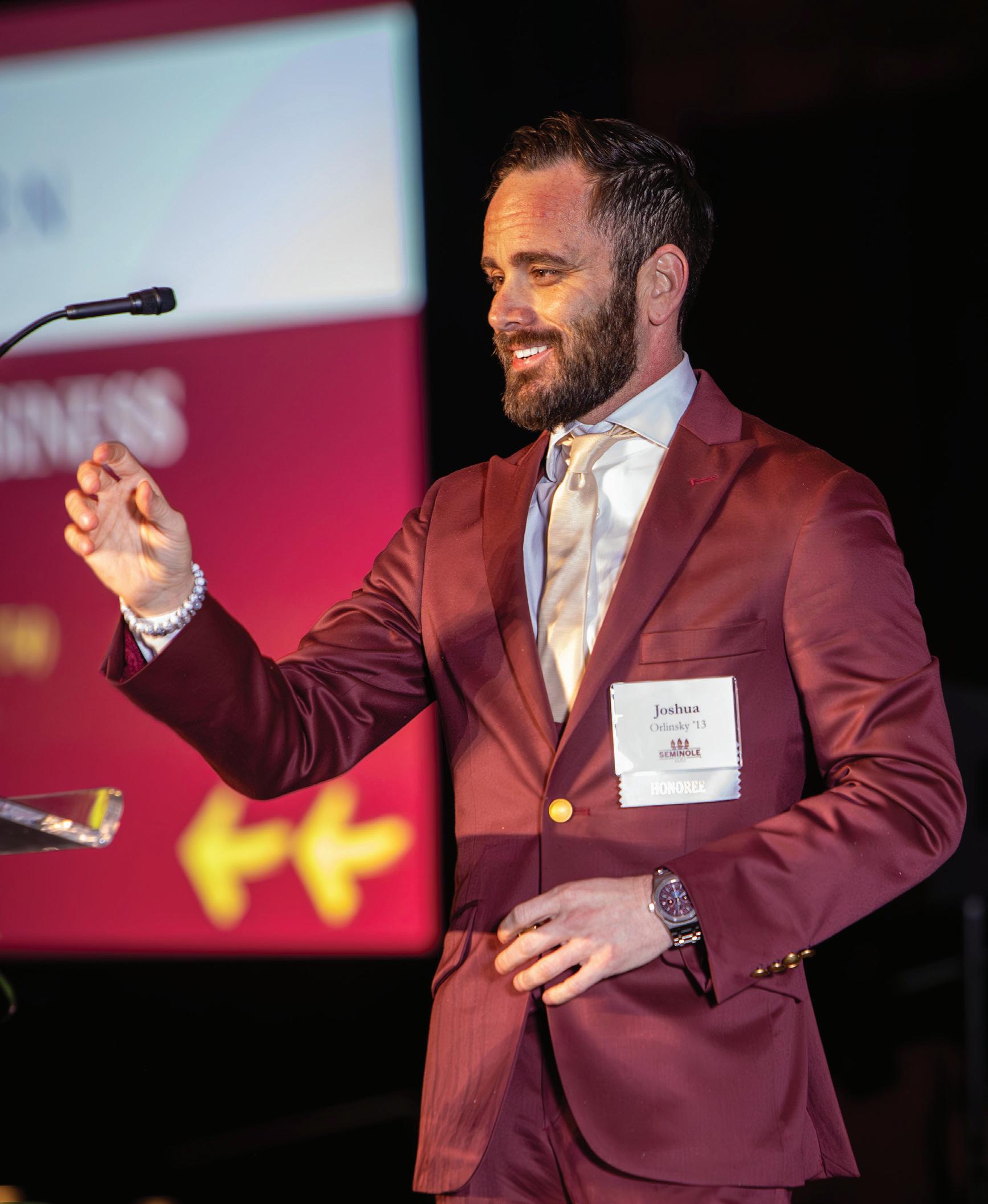

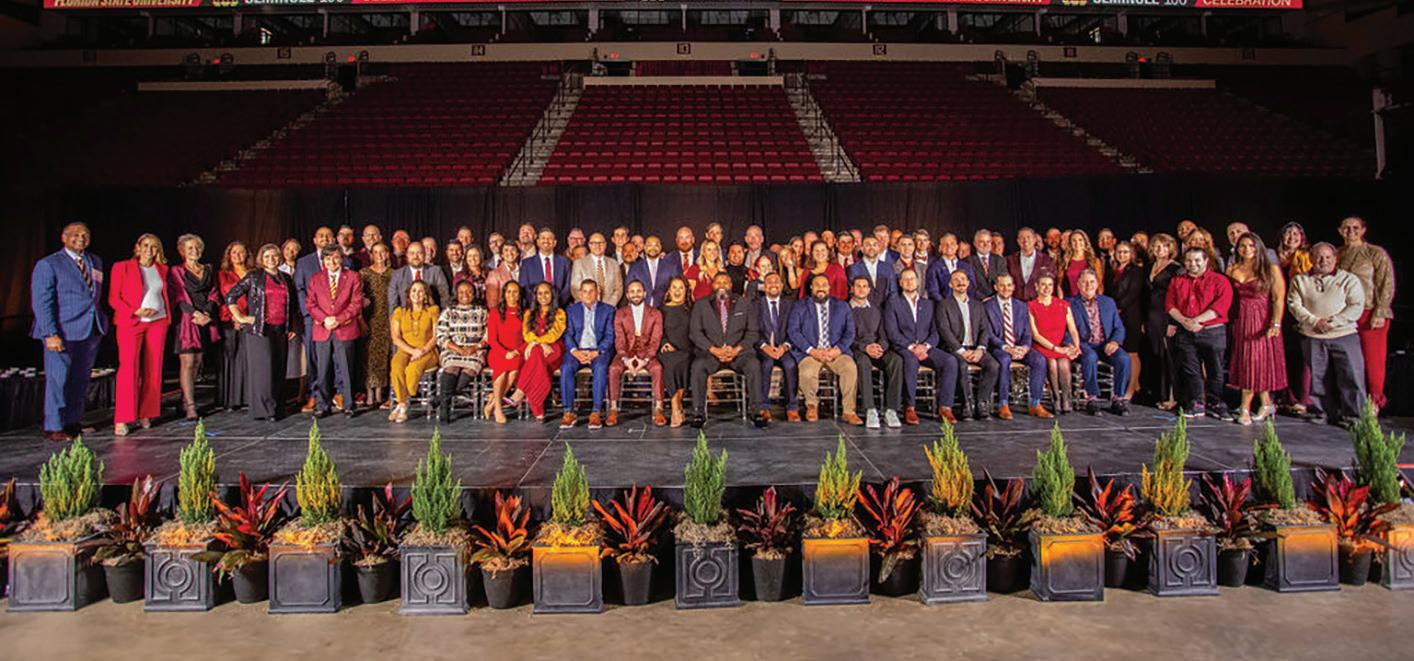

By Kenta Joseph (B.S. ’08)
Herneshia Dukes (B.S. ’08) has built a career on empowering others. As national director of Greenhouse E3, she leads executive coaching and development for CEOs of major charter education networks, helping shape the future of education leadership nationwide.
She is also the founder and principal strategist of I.D.E.A. Education Consulting, where she partners with nonprofits, school districts and networks to foster impactful growth and lasting transformation. In recognition of her influence, Dukes was recently selected for the prestigious Pahara Fellowship, a national program for top education leaders.
Dukes’ journey began in the classroom and evolved into a mission to create transformative learning experiences. She previously served as executive director of school leadership for New Orleans, designing citywide programs to support emerging and senior leaders.
“FSU shaped me in countless ways,” Dukes said. “It was where I first saw myself as a leader, thanks to mentors who believed in me and opportunities that stretched me.”
That foundation continues to guide her leadership style — one rooted in courage, humility, innovation and resilience.
Beyond her professional achievements, Dukes is a passionate advocate for Florida
State University. Effective May 1, she assumed the role of chair for Women for FSU, a dynamic network that was relaunched in spring 2024 and celebrates connection, impact and legacy. The group unites alumni who share a passion for FSU and encourages them to invest their time, talents and resources through mentoring, philanthropy and community engagement.
“There is a powerful base of women eager to support FSU’s mission,” Dukes said. “I see this role as an opportunity to channel that energy into deeper engagement and lasting impact.”
Her involvement with FSU spans more than a decade. Dukes served as president of the Young Alumni Network from 2017 to 2021, helping launch Young Alumni Weekend and reengage thousands of alumni. A 2008 FSU graduate with a degree in communication studies, she’s also a member of the College of Communication and Information Speaker’s Bureau and a frequent speaker on education reform and school leadership, including for TEDxFSU and the Student Alumni Association.
In 2015, Dukes received the Reubin O’D. Askew Young Alumni Award, the highest honor given to young alumni by the FSU Alumni Association. Named for former Gov. Reubin Askew, the award recognizes graduates whose achievements reflect the leadership and values he championed.
Dukes looks forward to expanding the impact of Women for FSU through mentorship, meaningful programming and celebrating individuals leading in their fields and communities.
“I’m excited to create spaces where women feel fully seen, valued and equipped to lead,” she said. “Looking ahead, I’m eager to see future generations of women connected to FSU redefine leadership, drive innovation and carry forward the legacy of those who paved the way.”
A proud member of Delta Sigma Theta Sorority Inc., wife, mother and philanthropist, Dukes continues to lead with purpose — honoring the investment FSU made in her and paying it forward to future generations.

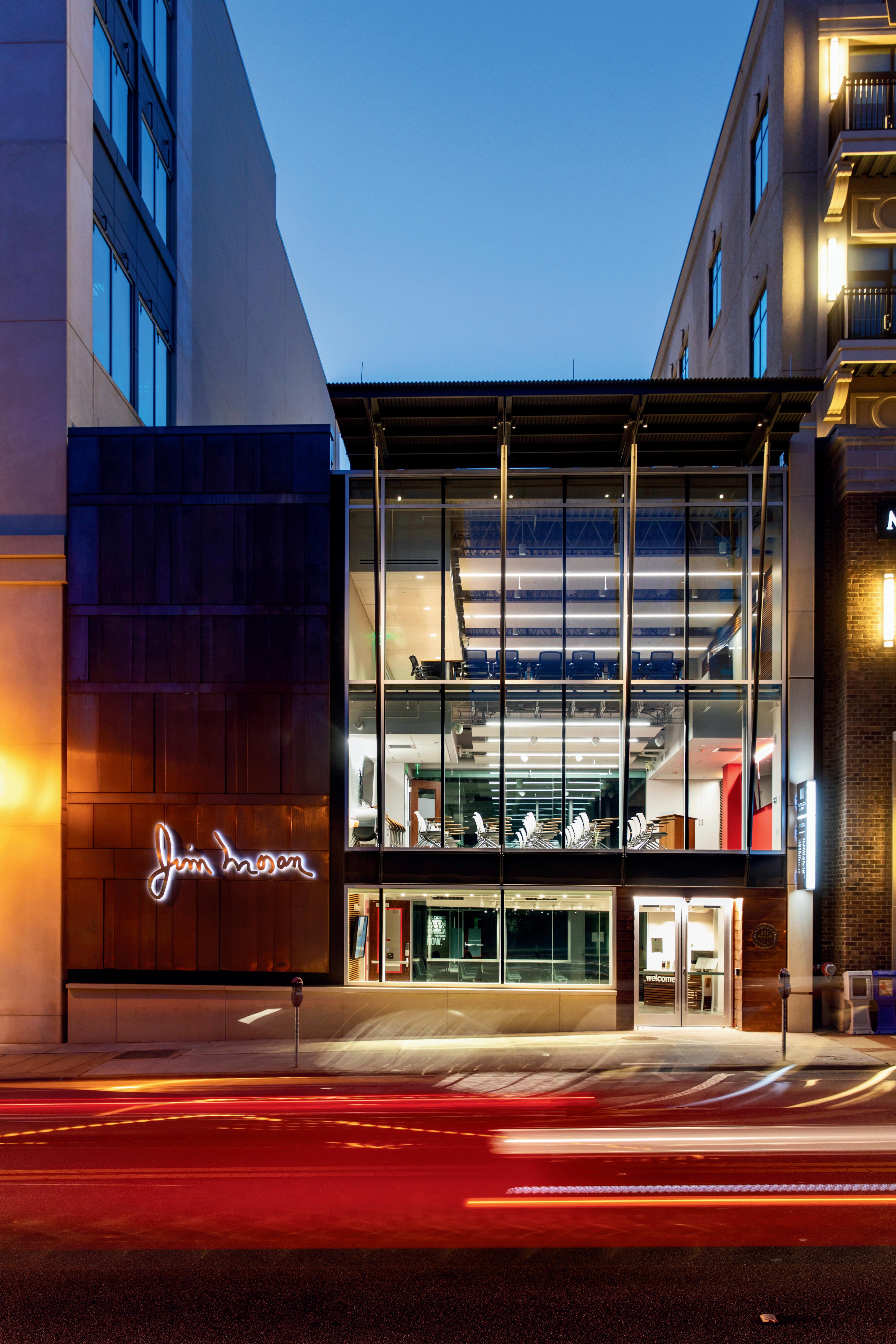
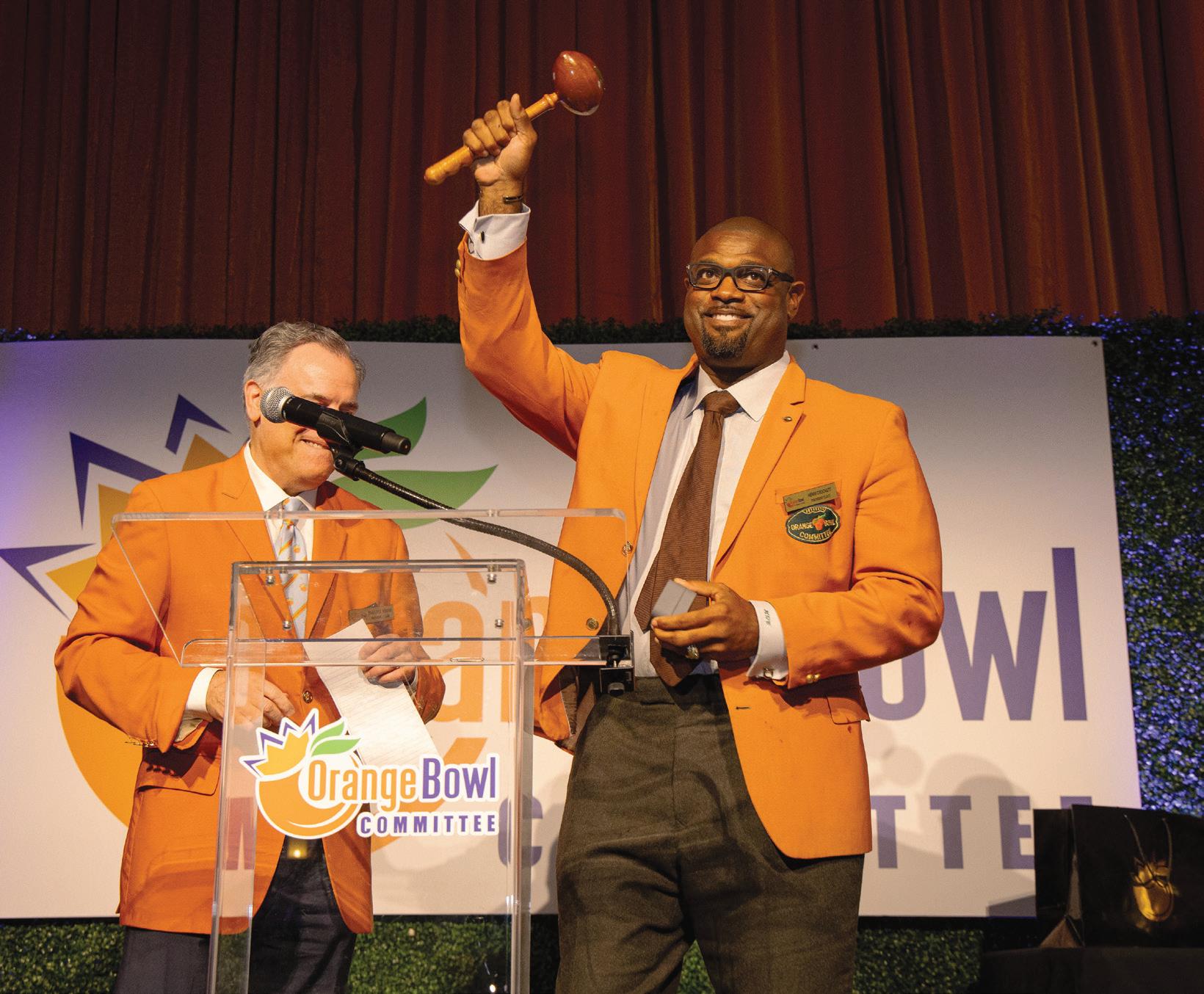
By Lilly S. Higginbotham (B.A. ’19)
Henri Crockett (B.S. ’96) has always understood the power of a big stage. As a linebacker for Florida State University, he helped lead the Seminoles to national prominence in the 1990s, appearing in the storied 1994 Orange Bowl game and competing at the highest level of college football. Now, nearly three decades later, Crockett returns to that stage in a new role: president of the Orange Bowl Committee.
Appointed earlier this year, Crockett made history as the first former Orange Bowl player to lead the volunteer-led organization. “It’s truly an honor and a full-circle moment,” he said. “The Orange Bowl isn’t just a game. It’s about legacy, community and impact.”
That legacy now rests in his hands as he leads the committee through a landmark
year. During his one-year term, the Orange Bowl will host both a College Football Playoff quarterfinal and the national championship, marking a pivotal moment in the evolution of postseason college football.
Crockett’s priorities are clear: elevate the fan and athlete experience, expand youth and education outreach in South Florida and continue strengthening the Orange Bowl’s reputation as one of the most respected institutions in college athletics. “We’re not just hosting games; we’re creating experiences that showcase the very best of South Florida,” he said. “Preparation is about teamwork — just like football.”
His leadership comes at a time of transition across the college football landscape, and he’s eager to make the most of his platform. “I want to make sure I’m
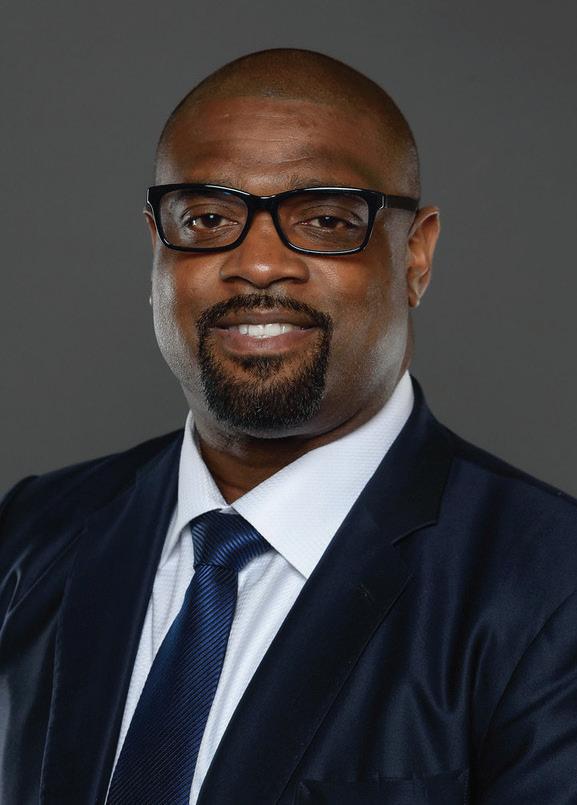
not the last former player in this role,” he said. “And I want to create more pathways for women — especially women of color — to lead in this space.”
The drive to lead and serve runs deep for Crockett. After eight seasons in the NFL, he co-founded the Crockett Foundation with his brother, Zack (B.S. ’94), to help level the playing field for underserved youth. “The foundation was born from a desire to give back,” he said. “We focus on literacy, STEM education and youth development, reaching thousands of students every year.”
Crockett’s time at Florida State, on the field and in the classroom, instilled in him the discipline, resilience and empathy that continue to shape his leadership today. “Playing for Coach Bowden taught me that leadership isn’t just about calling plays. It’s about lifting up the people around you,” he said.
He still remembers the energy of his own Orange Bowl experience. “Running out onto that field with my teammates, knowing the whole country was watching — it stays with you forever.”
Now, as he stands on another Orange Bowl stage, Crockett is focused on creating opportunities for others. “Your sport is a platform, not your identity,” he said. “Build something beyond the game. Find your ‘why.’ Give back. That’s how you create a life of purpose.”
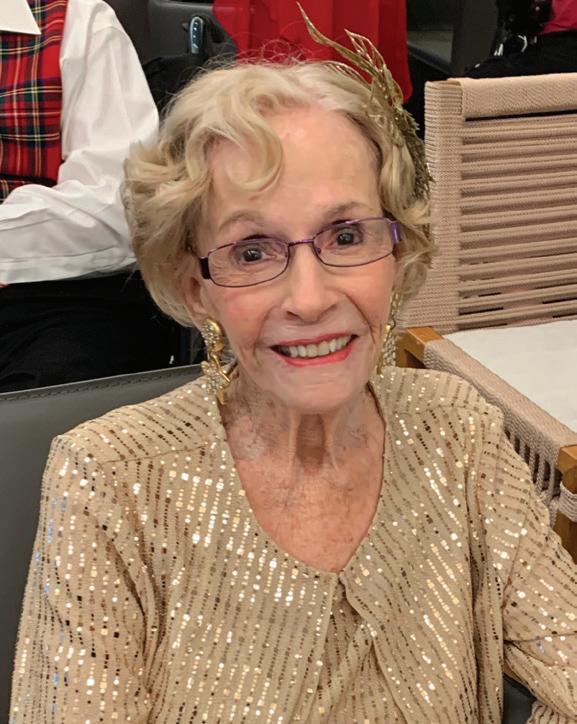
V. Elliott Smith (B.S. ’62, M.S. ’64) is publishing his third historical novel, “Alien Coast,” about the ill-fated Narváez expedition to Florida in 1528 and its dramatic impact on characters who try to reexperience thathistory in 1981. The story is primarily set in the Florida panhandle.
Carl Vollrath (Ed.D. ’64) released “FANTASY for Piano & Orchestra” with GRAMMY Award-winning record label Navona Records.
Dana Ackley (Ph.D. ’73) wrote “A Little Book to Save Humanity,” which was nominated for the Dayton Literary Peace Prize. The award commemorates the Dayton Peace Accords that brought the war and ethnic cleansing in Kosovo to an end. The talks happened in Dayton, Ohio, at Wright Patterson Air Force Base. The award, according to their website, “is the first and only annual U.S. literary award recognizing the power of the written word to promote peace. The Dayton Literary Peace Prize mission is to advance peace through literature.”
Jane Thomas Thompson (B.A. ’47) celebrated her 100th birthday on October 11, 2025. A proud alumna, Thompson played a pivotal role in shaping FSU’s identity. In 1947, as the university transitioned to co-education, she and her classmates helped select the Seminole as FSU’s symbol. Her daughter shared, “At that time, FSU was an all-girls college, and the girls were excited about the college becoming co-ed and that it would soon have a football team. They were aware of the University of Florida’s mascot, which was the gator, and knew they would compete against their home state rival. A ballot box was set up, and Jane and her friends encouraged other students to also vote for the name ‘Seminoles.’ As we know, this name won over other suggestions.”
Lonnie Groot (B.S. ’73, J.D. ’76) served as a judge in a round of the 29th Annual International Environmental Moot Court Competition at the Stetson College of Law in April. Eighteen teams from 12 countries competed. The competition commenced with a biodiversity lecture, and the theme was subsistence use and trophy hunting. Teams from Bangladesh, Brazil, Colombia, India, Ireland, Nepal, Pakistan, the Philippines, the Republic of Korea, Singapore, Ukraine, the United Kingdom and the United States competed in the international finals held at the law school’s Gulfport campus.
Ansley Abraham (B.S. ’74, M.S. ’76, Ph.D. ’82) was honored at the 2025 Institute on Teaching and Mentoring, held October 30–November 2 in Atlanta, following his retirement from the Southern Regional Education Board (SREB) earlier this year. Abraham’s career at SREB spanned over 40 years, and under his leadership, the Doctoral Scholars Program supported more than 1,300 doctoral scholars who graduated and have gone
on to positions in academia, government and industry.
Clyde Metcalf (B.S. ’75) was inducted into the 2025 Florida Sports Hall of Fame. Born in Sarasota, Metcalf returned to his high school alma mater in 1981 to serve as the head baseball coach. In the 41 seasons since, Metcalf has won 950 times, including two national championships (1989, 1994) and six state championships (1987, 1989, 1993, 1994, 1996, 2007). He also guided the Sailors to an astounding 14 appearances in the FHSAA Final Four. Thanks in part to having more than 200 of his players play college baseball, 70 have gone on to play professional baseball and 14 made it to Major League Baseball. Metcalf has reeled in several national accolades. In 1989 and 1994, he was named National Prep Coach of the Year by USA Today.
Donald Hinkle (B.S. ’77, J.D. ’80) was honored by the Southern Trial Lawyers Association with its prestigious 2025 War Horse Award in recognition of his exceptional career championing justice and

advancing public safety through the legal system.
Cheryl Marrs (BME ’78) retired after 42 years in education. Marrs was a music teacher in New Orleans for 16 years and after that returned to Florida, where she obtained an M.A. in elementary education from the University of West Florida. From then on, she taught in Florida, holding several different positions, which included serving as a middle school teacher and a resource teacher for math and reading for fourth and fifth graders, a gifted resource position for Leon County, a STEM teacher and a media specialist. Marrs is now enjoying retirement and doing volunteer work.
Yvonne Tedder (B.S. ’88) has been promoted to vice president of human resources at CSI Leasing, Inc. Tedder leads the company’s global HR strategy, overseeing talent acquisition, employee engagement, training and development, and compensation and benefits. Tedder joined CSI after serving as director of human resources at Precoat Metals. She holds a
master’s degree in human resources development and management from Webster University in addition to her bachelor’s degree in child development from FSU. Tedder also serves on the board of directors for The Bennett Project and on the HR committee for FamilyForward.
Michelle Burke, SHRMCP (B.A. ’89) was named director of postsecondary programs and partnerships at the Michigan Center for Adult College Success, an initiative of TalentFirst in Grand Rapids, Michigan.
Carol Frederick (B.S. ’89) is the author of “Enroute! Your Journey to Law Enforcement Leader,” a guide for aspiring law enforcement professionals. The book is available on Amazon.
Lisa Begue Carey (B.S. ’90) was inducted into the 2024 Coldwell Banker President’s Circle for sales production ranking in the top 4% of Coldwell Banker Realtors worldwide. Additionally, she was named the Tallahassee Alumnae Panhellenic 2024 Woman of the Year and was named to the 2025 Seminole 100 for business growth.
Jason B. Kaiser (B.A. ’94) was named co-market leader for the Orlando office of SRS Real Estate Partners, where he will help drive strategic growth across Central Florida for the commercial real estate firm.
Dr. Karin S. Hotchkiss (B.S. ’95) received a job promotion and is now chief medical officer at St. Joseph’s Children’s Hospital in the Baycare Hospital System in Tampa, Florida.
Jennifer Gail Stewart (B.S. ’95) has been promoted to vice president at global design firm HKS, Inc. As senior communications
project manager, Stewart leads multiple marketing platforms, ensuring firmwide brand consistency and quality control. She also trains and mentors marketing hires.
Maj. Tobin Rader (B.S. ’96) retired on May 1, 2025, after serving 20 years in the U.S. Army. He has accepted a semi-retired job in the Nashville area.
Rob Teel (B.S. ’96) will serve as the new CEO of Yardi Systems starting in January 2026. A 22-year veteran at the firm, Teel originally worked with multifamily clients and has led its global solutions business for the past 15 years. In that position, he has overseen the firm’s products for investment management, international and commercial property owners. Prior to joining Yardi Systems, Teel was a consulting manager at Accenture, where he led global systems projects for Fortune 100 organizations.
John Thacker (B.S. ’96) was appointed president of Chase Auto Private Label Captive Finance.
Nicole Astor (B.S. ’97) was promoted to manager of the chemistry section at the Georgia Bureau of Investigation’s (GBI) Crime Lab. Based at GBI Headquarters in Decatur, Georgia, Astor will oversee staff in the chemistry section at the GBI Headquarters Laboratory, as well as operations within the statewide chemistry discipline.
Gigi Rollini (B.A. ’97, MPA ’03, J.D. ’03), of the Florida Government Law Partners law firm, which specializes in Florida government and administrative law, has been elected the 98th president of the National Association of Women Lawyers. Rollini previously served as president of the Florida Association for Women Lawyers and Tallahassee Women Lawyers.
C.J. Maier (B.A. ’98) was elected chairman of the Central Florida Expressway Authority (CFX) Board. CFX is an independent agency of the State of Florida which operates and maintains a regional network of expressways for 3.5 million residents of Brevard, Lake, Orange, Osceola and Seminole counties and more than 75 million annual visitors to Central Florida. The governing board and CFX staff oversee a fiveyear workplan budget of $4.2 billion.
Alex Brauer (B.S. ’99) was recognized among the nation’s top commercial litigators in the 2026 edition of The Best Lawyers in America.
Lindsay Greene (J.D. ’99) was selected to serve as city attorney for Sanford, Florida. The Sanford City Commission voted unanimously on March 17, 2025, to appoint the Orlando firm of de Beaubien Simmons Knight Mantzaris & Neal LLP (DSK Law) to the role, with Greene serving as designated city attorney. The decision followed a competitive review of proposals from eight firms and interviews with five finalists. Greene brings extensive municipal experience to the position. A resident of Sanford, she previously served on the city’s Planning and Zoning Commission. Greene earned her bachelor’s degree from Cornell University in 1995 before graduating from FSU College of Law in 1999.
Laura Orr (B.S. ’99) was hired by WittKieffer, an executive search and leadership advisory firm, to lead the firm’s board
advisory practice. As a senior partner and global board advisory leader, Orr partners with boards to acknowledge their strengths, identify their opportunities and increase their impact.
Jenn Hobby Rivera (B.S. ’99) joined CURE Childhood Cancer as brand and communications director, bringing her award-winning media and storytelling expertise to support families facing childhood cancer. A longtime Atlanta radio personality and advocate, Rivera’s passion is deeply personal, as her daughter Reese is a cancer survivor. In her new role, Rivera will lead content strategy, produce a new podcast and amplify the voices of children and families impacted by cancer.
Denise Mayo Harle (B.A. ’02, B.S. ’02) joined the faculty at FSU College of Law as clinical professor and founding director of the new First Amendment Clinic.
Andrew Roberts (B.S. ’02) was appointed to the Advisory Council for the national nonprofit First Book, which is dedicated to furthering educational opportunity for children in low-income communities.
Michael Lortz (B.A. ’03, M.A. ’05) authored “Curveball at the Crossroads,” a novel inspired by blues folklore and classic baseball fiction. The story follows high school phenom JaMark Reliford, who makes a mysterious deal after a career-ending injury — a deal that gives him everything he wants but could cost him everything he loves.
Joe Karpf (M.S. ’06) was promoted to assistant deputy director of the Georgia Bureau of Investigation’s
(GBI) Division of Forensic Sciences. In this role, he will oversee select regional laboratories and departments at GBI Headquarters. Karpf began his career with the GBI in 2007 as a forensic scientist in the chemistry department. In 2015, he was promoted to assistant manager in the headquarters chemistry department and in 2021, was promoted to manager of the chemistry discipline statewide. Karpf is a member of the Clandestine Laboratory Investigating Chemists. He earned his Master of Science in analytical chemistry from FSU in 2006.
Jennifer Perrine’s (Ph.D. ’06) fifth book of poetry, “Beautiful Outlaw,” was selected for the inaugural Kelsey Street Press QTBIPOC Book Prize and was published on July 1, 2025.
Darby Price (B.A. ’06) released her debut book, a collection of prose poems titled, “All the Lands We Inherit.” Blending poetry and memoir, the manuscript was selected during the 2023 open reading period for Black Lawrence Press and was published in June 2025.
Photo by Kristine Boel.
R. Gregory Hyden (J.D. ’07) joined GrayRobinson in its Boca Raton office as a shareholder in its litigation practice. Hyden is an accomplished civil litigator focusing on probate and guardianship disputes, family law, homeowners’ association matters and local government litigation.
Myron Rolle (B.S. ’08, M.D. ’17) joined Nemours Children’s Health in Orlando as an attending pediatric neurosurgeon. In his unique, distinguished career, Rolle was a star FSU football
player, earned a Rhodes Scholarship to Oxford University, played in the NFL for three seasons, earned his medical degree from FSU College of Medicine, and completed his residency at Harvard-Mass General Hospital and a fellowship at Johns Hopkins All Children’s in St. Petersburg, Florida.
Valerie Wickboldt (B.A. ’08) was named chief strategy officer at ADELE, a full-service marketing, communications and branding firm with offices in Tallahassee and Thomasville, Georgia. In this role, Wickboldt will focus on elevating client impact, consulting on integrated marketing communications campaigns and aligning brand storytelling with long-term business growth. With nearly 20 years of experience in the private and public sector, Wickboldt served in several executive leadership roles spanning a variety of industries including nonprofits, associations, health care and government. Wickboldt is a Leadership Florida lifetime member and serves on the boards of The Economic Club of Florida and Big Brothers Big Sisters of the Big Bend, where she also mentors. She is a member of the Florida Public Relations Association (FPRA), an FPRA Image Award winner, was named a “Rising Star” by Florida Politics, a “40 Under 40” by News Service of Florida and one of Florida’s “Great Communicators” by INFLUENCE magazine.
Nicholas Kypriotakis (B.S. ’10) was elevated to shareholder in the Tampa office of Greenberg Traurig. An experienced transactional attorney, Kypriotakis focuses his practice on mergers and acquisitions, corporate
governance and joint venture and equity financing transactions. He advises corporate executives and investment firms across a range of industries, including technology, health care, consumer products and infrastructure.
Curtis “CJ” Leonard Jr. (B.S. ’10) was promoted to ACS senior manager at James Moore & Company’s Tallahassee office. Leonard has been with the firm since 2013. James Moore & Company, founded in 1964, is a national consulting firm offering a wide range of services including tax, auditing, accounting, human resources, technology and wealth management. The firm serves clients across industries including healthcare, higher education, government and nonprofit sectors.
Max (B.S. ’11) and Lindsey (B.S. ’11) Spanier, along with their team at Sloane Staffing, hosted the fifth annual Sloane Staffing Charity Golf Tournament benefiting the Golden Cub Ambassadors Club in April at Madison Green Country Club in Royal Palm Beach. The event supports the Nicklaus Children’s Health Care Foundation and its mission to enhance the health and wellbeing of children and families through impactful programs and services. This year, the tournament raised $35,500 for the Golden Cub Ambassadors Club. For the Spaniers, this cause is deeply personal as their son, Max Jr., was born with multiple
heart defects and is currently a cardiology patient at the Nicklaus Children’s Hospital, where he is awaiting heart surgery. The Spaniers’ journey has made them passionate advocates for pediatric health care, and through this tournament, they channel their strength into raising awareness and funds for others walking similar paths. The tournament has grown into a cherished local tradition — one that swings #ForeTheChildren and brings hope to countless families.
Andrew Ferguson (B.S. ’12) was promoted to audit senior manager at James Moore & Company’s Tallahassee office. Ferguson has been with the firm since 2018. James Moore & Company, founded in 1964, is a national consulting firm offering a wide range of services including tax, auditing, accounting, human resources, technology and wealth management. The firm serves clients across industries including healthcare, higher education, government and nonprofit sectors.
G.C. Murray II (J.D. ’12) was named one of the National Bar Association’s Centennial “Top 40 Under 40” lawyers, an award recognizing legal excellence and civic leadership. The honor highlights Murray’s extensive work in law, policy and nonprofit leadership.
Erika J. Barger (J.D. ’13), of Ormond Beach, Florida, recently published her first book, “Scholarship Hacks: Insider Tips
for Winning College Money.” The guide offers practical strategies for students and families navigating the scholarship application process and debuted as the No. 1 new release in College and Education Costs on Amazon.
Palina Woodhouse (B.S. ’13) received a Master of Public Health from Vanderbilt University in Nashville, Tennessee. For her thesis, she created a web-based high-risk lung calculator for clinicians.
Madison Johnson (B.S. ’14), co-owner of Posies Flower Truck, is helping grow the Floridabased mobile flower business into a blooming success across Tampa Bay, Sarasota and Winter Park. After joining her mother in this venture in 2022, Johnson applied her FSU education in retail merchandising and product development to expand the company into a 10-truck fleet with plans for national franchising. The business was featured on PBS’s “Start Up USA” for its innovative approach to mobile retail and community engagement.
Colin Milam (B.S. ’14) has joined GrayRobinson’s litigation practice as a senior associate. Based in the Boca Raton office, Milam draws on his diverse background in finance, public policy and trial advocacy to provide strategic, data-driven legal solutions for corporate entities and sovereign governmental bodies across Florida, specializing in
general liability defense and commercial litigation.
Charlie Peck (B.A. ’15) published his poetry collection, “World’s Largest Ball of Paint," last year with Black Lawrence Press.
James L. Doyle (B.S. ’17), of Winderweedle, Haines, Ward & Woodman, P.A., was recognized as a 2025 Florida Rising Star in the area of real estate.
Kindred Lubeck (B.S. ’18), of Artifex Fine Jewelry, collaborated with Travis Kelce to design Taylor Swift’s engagement ring. The stunning piece captured the attention of fans worldwide and marked a significant milestone in Lubeck’s career.
Jessica Pagliery (B.S. ’19) has joined the Miami office of Ogletree Deakins as an associate. Her practice focuses on employment law.
Jae Williams (B.S. ’21, J.M. ’23) was appointed press secretary for Florida Attorney General James Uthmeier. Additionally, Williams and his wife, who he met at FSU, moved back to Tallahassee with their one-yearold Nole.
Allyson Mall (B.A. ’22) was hired as marketing coordinator at Current Edge Solutions. In this role, she will be instrumental in planning and executing marketing initiatives, managing events, creating and updating marketing materials, and supporting the brand’s internal and external visibility.
Recent accolades of the faculty and staff at Florida State University
Farrukh Alvi, the Don Fuqua eminent scholar and professor of mechanical engineering and the senior associate provost for strategic initiatives and innovation has been elected as a fellow of the Royal Aeronautical Society.
Christian Bleiholder, an associate professor in the Department of Chemistry and Biochemistry, earned the American Society for Mass Spectrometry’s Ron Hites Award for his laboratory’s paper about developing a new method of analyzing human genetics that will help to more accurately understand and prevent disease.
Professor of Classics Andrea De Giorgi has been named a 2025-2026 Getty Scholar for his work in Roman archaeology, visual culture, the social history of Rome’s eastern provinces and ancient colonization.
Nancy de Grummond, the M. Lynette Thompson professor of classics and director of the FSU Archaeological Field School in Italy for the past 42 years, has earned the 2026 Gold Medal Award for Distinguished Archaeological Achievement from the Archaeological Institute of America.
Lucio Frydman, FSU’s National High Magnetic Field Laboratory chief scientist for chemistry and biology, has been named to the 2024 class of AAAS Honorary Fellows.
Associate Professor of History Will Hanley has been honored as the 2025 Mohamed Ali Foundation Fellow by Durham University to further explore the institution’s archives, historical manuscripts and rare documents on Middle Eastern and Islamic studies.
Ken Hansen (B.S. ’64), chemistry, has been awarded the James Corones Award in Leadership, Community Building and Communication from the Krell Institute; this honorific award is in recognition of his online media and in-person engagement to build community and encourage the public to join him in his passion for chemistry.
Zhe He, associate professor in the School of Information and director of the Institute for Successful Longevity has been named a fellow of the International Academy of Health Sciences Informatics.
Joseph Hellweg, an associate professor in the Department of Religion, has been appointed a fellow of the Yale Institute of Sacred Music, the premier center for the interdisciplinary study of sacred music, worship and the arts.
Yan-Yan Hu, professor of chemistry and biochemistry, has received the 2025 Agnes Fay Morgan Research Award from Iota Sigma Pi, an honor bestowed annually recognizing a woman conducting groundbreaking research in fundamental aspects of chemistry. Hu develops and applies state-of-the-art solid-state nuclear magnetic resonance, or NMR, methods for materials and biochemical research.
Lyndsay Jenkins, Michael and Jean Shahnasarian endowed professor in the Department of Educational Psychology and Learning Systems, has been elected as a fellow of the prestigious American Psychological Association.
President Richard McCullough is a member of the newest class inducted into the Florida Inventors Hall of Fame. McCullough was recognized for his discovery and development of a type of polymer known as regioregular polythiophenes and other breakthrough organic electronic materials, and for founding companies that have advanced the commercialization of printable electronics and reactive metal inks.
David March (B.S. ’04), psychology, has received the Rising Star Award from the Association for Psychological Science.
Judith Pascoe, George Mills Harper professor of English, earned the 2025 Distinguished Scholar Award from the Keats-Shelley Association of America in recognition of her careerlong excellence in scholarship on romantic-era British literature and culture.
Laura Reina, physics, has received the James W. Beams Award from the SE Division of the American Physical Society.
Rob Schurko, director of the Nuclear Magnetic Resonance and Magnetic Resonance Imaging Facility at the FSU-headquartered National High Magnetic Field Laboratory and a professor in the Department of Chemistry and Biochemistry, was elected a fellow of the International Society of Magnetic Resonance for his innovation in the field of solid-state nuclear magnetic resonance.
Robert Tomko Jr., associate professor of biomedical sciences, has been recognized with the university’s most prestigious teaching award for his dedication to fostering strong relationships with his students and building a learning community based on support, encouragement, clarity and honesty.
Liliya Ugay from FSU’s College of Music has been named the Distinguished Composer of the Year by the Music Teachers National Association.
Gwen Welliver (dance) has been named a 2025 Guggenheim Fellow.
Kathleen Wilson (B.S. ’78), College of Nursing, has been named a fellow in the American Academy of Nursing (FAAN).
Eleven FSU faculty members have been named as members of the Academy of Science, Engineering and Medicine of Florida:
Igor Alabugin, College of Arts & Sciences (chemistry & biochemistry)
J. Murray Gibson, College of Engineering (mechanical engineering)
Eric Holmes, College of Medicine
Helen Li, College of Engineering (electrical and computer engineering)
Richard Liang, College of Engineering/ High-Performance Materials Institute
Bruce Locke, College of Engineering (chemical & biomedical engineering)
Chris Patrick, College of Arts & Sciences (psychology)
President Richard McCullough
Joe Schlenoff, College of Arts & Sciences (chemistry & biochemistry)
Rob Schurko, College of Arts & Sciences (chemistry & biochemistry)
Angelina Sutin, College of Medicine (behavioral science & social medicine)
Andrew Askew, Ted Kolberg, German Martinez, Harrison Prosper, Rachel Yohay and Kurtis Johnson (M.S. ’04) have all been named laureates of the 2025 Breakthrough Prize in Fundamental Physics as part of the CMS Collaboration. Known as the “Oscar of the Sciences,” this award comes with a $3M prize; the collaborators have opted to donate 100% back to CERN & Society Foundation to offer grants for doctoral students from member institutes to spend research time at CERN.
Florida State University faculty who received FSU’s Developing Scholar Awards are: Elizabeth Cecil, College of Arts and Sciences; Yanshuo Sun, FAMU-FSU College of Engineering; Robert Tomko Jr., College of Medicine; and Aaron Wilber, College of Arts and Sciences.
FSU has four Fulbright Scholars for 2025–2026:
Kristin Dowell (art history) will go to Ireland.
Ying “Mai” Kung (nursing) will go to Taiwan.
Anke Meyer-Baese (scientific computing) will go to Hungary.
Vasubandhu Misra (M.S. ’94, Ph.D. ’87) (EOAS) will go to India.
Florida State University has bestowed the title of distinguished research professor on three outstanding faculty members for their exemplary research productivity and contributions to their fields: Matthew Goff, religion, College of Arts and Sciences, Qing-Xiang
“Amy” Sang, chemistry and biochemistry, College of Arts and Sciences, and Antonio Terracciano, geriatrics, College of Medicine.
Florida State University has awarded two outstanding scientists with the Distinguished University Scholar Award in recognition of their longstanding track records of research: Jan Jarosynski, research faculty, from FSU’s National High Magnetic Field Laboratory, and Xiaobiao Xu, senior research scientist at the Center for OceanAtmospheric Prediction Studies.
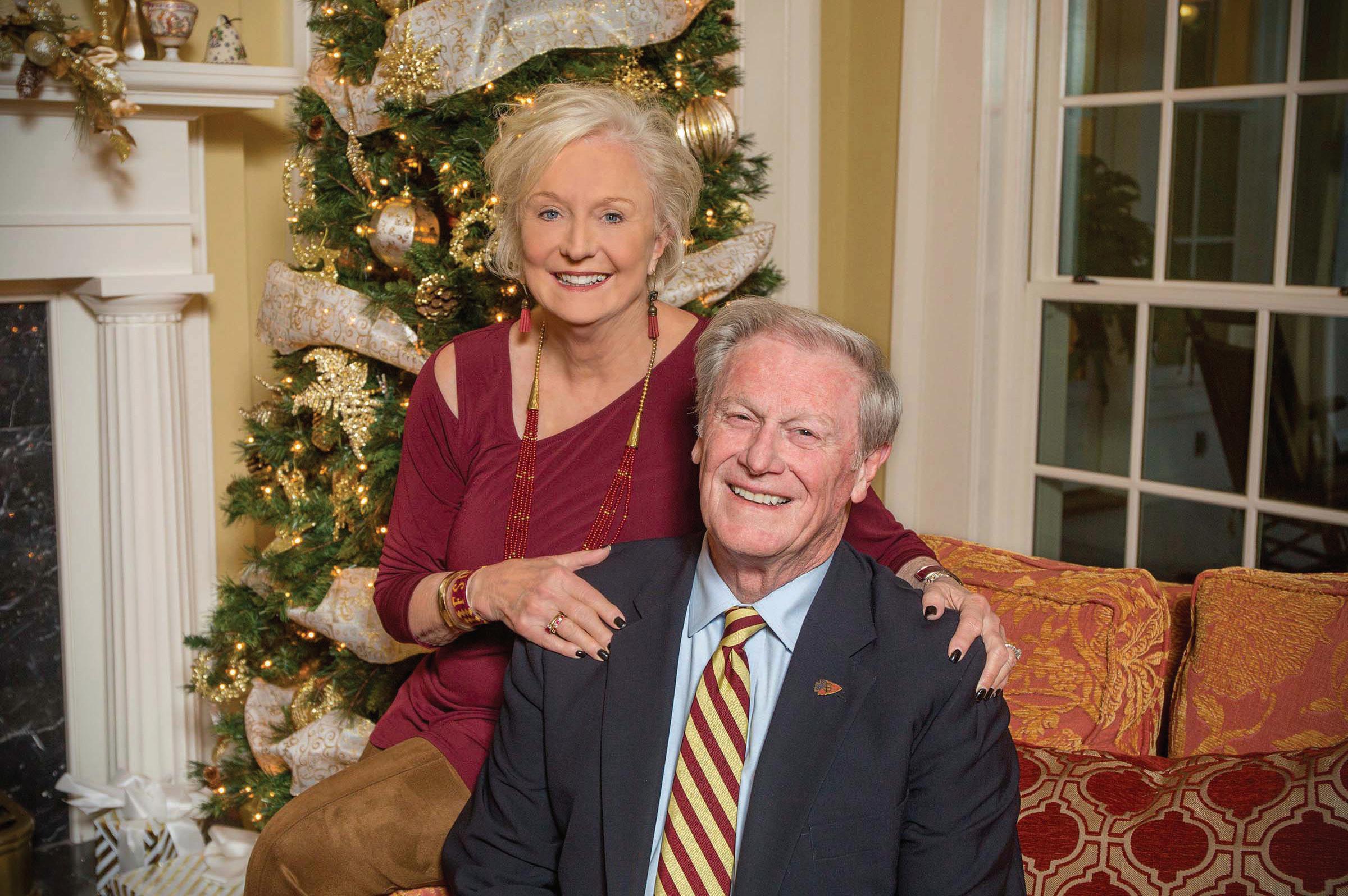
By Patty Cox
Florida State University has lost one of its most devoted champions.
President Emeritus John Thrasher (B.S. ’65, J.D. ’72), the university’s 15th president, leaves behind a legacy that continues to shape the institution he loved. His story is woven into the fabric of FSU, from his first days as a student in the 1960s to his years leading the university to new heights.
Thrasher first came to FSU in 1961 from Jacksonville. He was the first in his family to graduate high school and attend college. He earned a bachelor’s degree in business in 1965. After graduating, he joined the
U.S. Army where he received the Army Commendation Medal in Germany and was awarded two Bronze Stars for his service in Vietnam. He was honorably discharged as a captain in 1970. Thrasher then returned to his alma mater to earn a law degree with honors in 1972.
His career in public service began on the Clay County School Board and grew to the Florida House of Representatives, where he became speaker in 1998. Among his proudest achievements was shepherding legislation that created the FSU College of Medicine, a milestone that has had a lasting impact on health care in Florida. He later
served in the Florida Senate, chaired the Republican Party of Florida, and built a respected law career. He was named the first chair of FSU’s Board of Trustees in 2001 and served on the board until 2006.
When Thrasher returned to lead the university as president in 2014, he said it felt like a homecoming. Over the next seven years, he led FSU through an era of extraordinary progress. He championed student success and increased opportunities
Left page: John and Jean Thrasher pose for their annual holiday photo in front of the Christmas tree at the FSU President’s house in 2017; John Thrasher graduated with his bachelor’s degree in business from Florida State University in 1965.
Top right: President Thrasher leads students in the Warchant at Westcott Plaza in 2015. Bottom right: Celebration of Life service on Aug. 19, 2025. for first-generation and Pell Grant students. That focus fueled Florida State’s rapid rise in the national rankings as graduation and retention rates climbed to among the best in the nation.
Fundraising was another hallmark of his presidency. Under Thrasher’s leadership, FSU completed the ambitious “Raise the Torch” campaign, topping the $1 billion mark and transforming the scope of private support for Florida State. That success funded scholarships, endowed professorships, new facilities, and countless opportunities for students and faculty. The campaign also included a $100 million gift from Jan Moran and The Jim Moran Foundation, the largest in university history, to create what is now the Jim Moran College of Entrepreneurship.
What people often remembered most, though, was Thrasher’s presence. He had a gift for listening, for putting people at ease, for making others feel that their story mattered. Students saw him cheering at athletic events, faculty found him accessible and staff knew he valued their work. He led with approachability, and he never seemed to lose sight of what was really important: the people who made up the FSU community.
Even after his presidency, Thrasher continued to serve the university. He embraced a new chapter as a member of the faculty in the College of Criminology and Criminal Justice and as associate dean of government partnerships and professor in the College of Law, teaching a legislative practice course.
Through it all, his greatest devotion was to his family. He and his wife, Jean, were married for 60 years and built a partnership rooted in love and service. They raised three children — Jennifer, Jon and Julie — and delighted in their eight grandchildren. He credited Jean as his rock and constant source of strength. He often said his success came down to three things, “God, Jean and Florida State.”
His Celebration of Life at Ruby Diamond Concert Hall on Aug. 19 was filled with friends, family, colleagues, faculty, students, lawmakers and community leaders. Former Florida Gov. Jeb Bush, who delivered the eulogy, called Thrasher
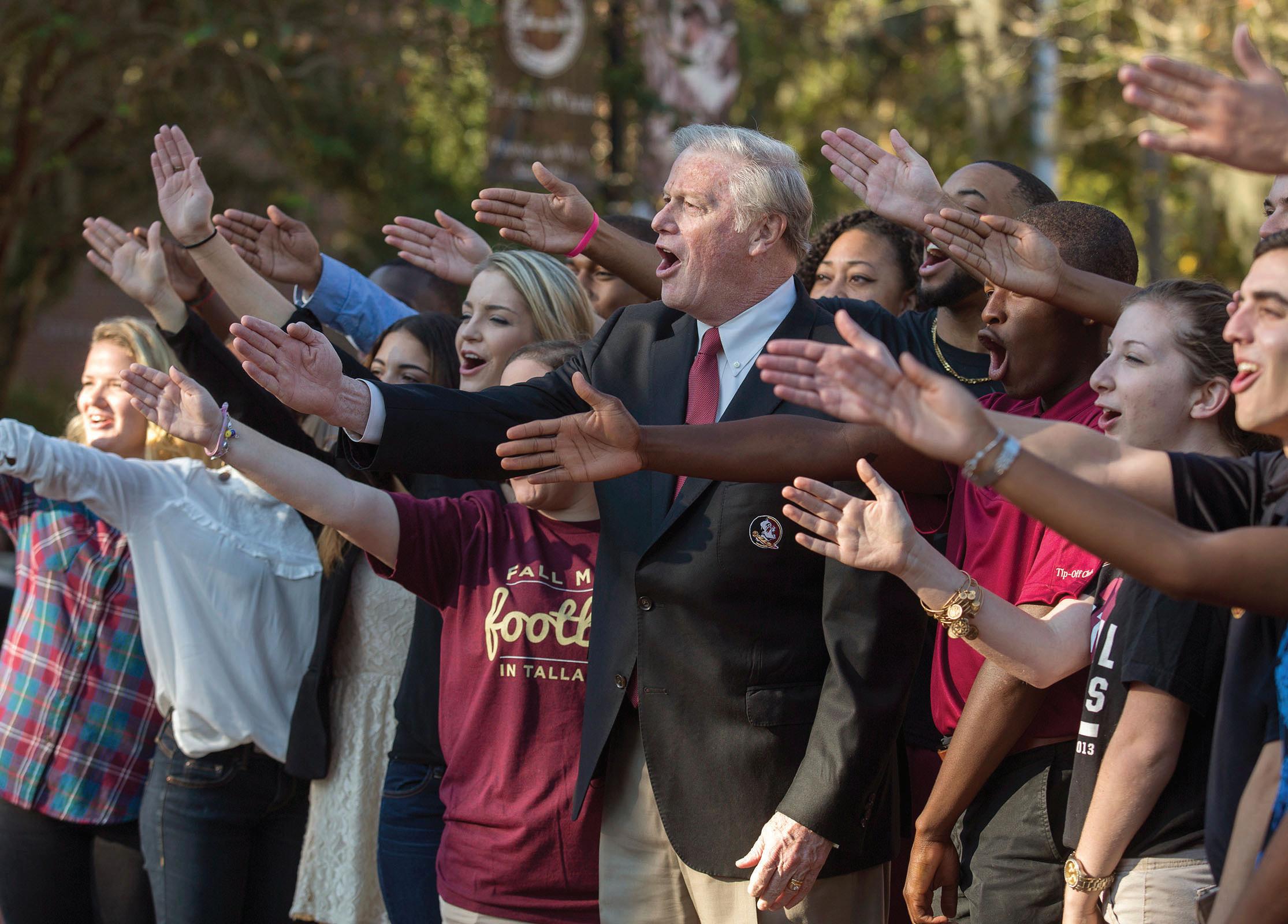
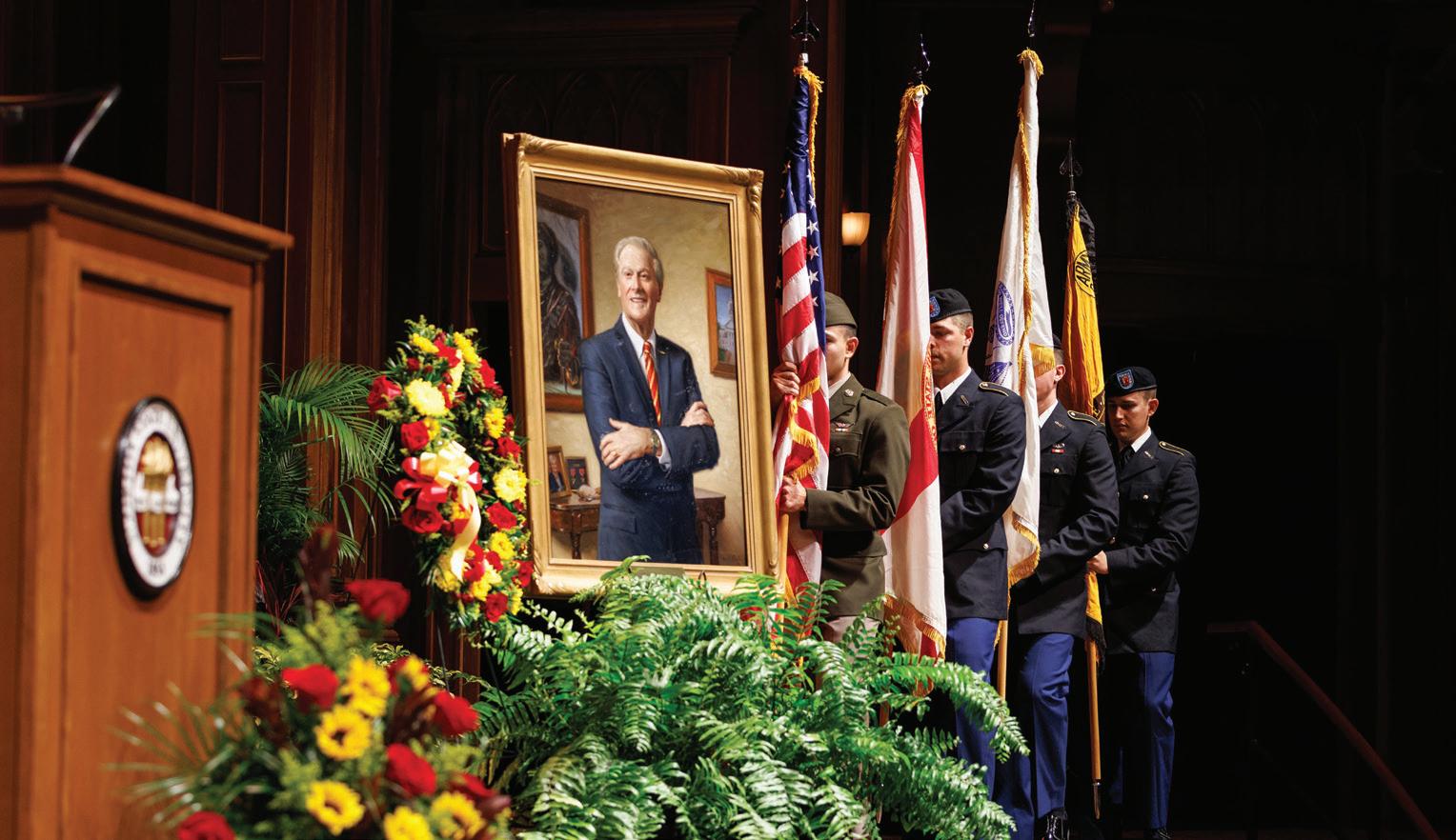
“the epitome of a servant leader” and shared stories that captured his humor and heart. FSU President Richard McCullough praised Thrasher’s wisdom, faith and the steady leadership that brought the university together.
The State of Florida also honored him posthumously with the Governor’s Medal of Freedom, one of its highest awards. At the university, scholarships and endowments now bear his and Jean’s names, ensuring that future students benefit from the
generosity and vision they inspired. John Thrasher’s life was defined by service to his country, to Florida, to his family, to his faith and to Florida State University.
His story will forever be part of FSU’s story, and his impact will be felt by generations to come.
Robert “Bob” B. Griffin Jr. (B.S. ’52) passed away on April 5, 2025. Griffin entered Florida State shortly after it became co-ed and was renamed Florida State University. Because there was no housing for men, the male students lived in former WWII Army barracks. Griffin was editor of the Florida Flambeau during his senior year and a member of The Collegians, the men’s glee club. Upon graduating, Griffin served as a lieutenant in the U.S. Navy, and after training in Pensacola, flew sea planes out of Bermuda. It was there he met his wife, Olga “Babs” Griffin, a native Bermudian. Bob’s 35-year career with Prudential Insurance Co. started in Jacksonville, Florida, and took him around the country with a final stop in Chicago, where he was director of group sales. A native Floridian, Griffin treasured his experiences as an FSU alumnus.
William “Bill” O. Cullom (B.S. ’58) and wife Caryl James Cullom (B.S. ’57), aged 93 and 91 respectively, passed away within a week of each other this summer. The pair were deemed inseparable since their marriage more than 69 years earlier. Bill was the former CEO of the Greater Miami Chamber of Commerce and played a key role in shaping Miami’s modern business landscape. His leadership helped establish the Greater Miami Convention & Visitors Bureau, the Coalition for a Drug-Free Miami, and the Beacon Council, MiamiDade’s economic development agency. He helped the city through Hurricane Andrew, with integrating new cultures after waves of immigration and with economic challenges following 9/11. A member of the Orange Bowl Committee since 1984, Bill was deeply committed to empowering South Florida’s youth through sports. Caryl, an elementary school teacher, devoted herself to raising two daughters and serving her community. She volunteered with the Junior League, Beaux Arts, Kendall United Methodist Church and Westminster Christian School. Her dedication to the Philanthropic Educational Organization, which supports women’s access to higher education through


scholarships, grants and loans, spanned Tallahassee, Miami and Burnsville, North Carolina. Bill and Caryl retired in 2003 to live on their dream farm in North Carolina until Hurricane Helene devastated their home in 2024, when they were evacuated to Winston-Salem, North Carolina, to live near their daughters Cheryl and Jennifer. The Culloms’ legacy of leadership, service and love will continue to inspire those who had the privilege of knowing them.
Savannah Seagraves Day (Ph.D. ’68) passed away in June at 98. After graduating from Appalachian State Teachers College, Day began her career teaching home economics to middle school students and continued her studies at the University of North Carolina at Greensboro, eventually earning a Ph.D. from FSU in the field of housing. Day also taught housing at Virginia Tech and was responsible for the development of their property management program. She influenced countless students before retiring from her position in 1990. Day dedicated her career to researching and improving housing solutions, particularly for the elderly, families with young children and lowincome households. She

worked with the Department of Housing and Urban Development in Tallahassee to help develop better living conditions and opportunities for those in need. Additionally, she was a dedicated researcher, contributing to numerous academic studies and publishing several articles, including work on Potty Parity, which advocated for equitable restroom access for men and women in public spaces. Beyond her academic career, Day had a love for genealogy and family history and authored one of the most definitive works on the Segraves family. She was a proud member of the Daughters of the American Revolution and an active member of Gray Memorial Methodist Church in Tallahassee. Day is remembered for her warmth, intellect and lifelong commitment to education.
Paul Harold Kurtz Jr. (M.S. ’77), whose resilience, intellect and compassion left a lasting mark on the university and beyond, passed away peacefully in his sleep on Sept. 4, 2024, aged 72. Blind since birth due to Retinopathy of Prematurity, Kurtz defied expectations throughout his life, becoming a pioneer in education, technology and
disability advocacy. After earning his bachelor’s degree in psychology from Florida Southern College, he came to FSU with his wife, Pamela Sue Clark, also a psychology graduate, to pursue their master’s degrees. Paul earned his M.S. in counseling, health and rehabilitative services in 1976 and served as acting director of Disabled Student Services. Kurtz’s career included work in rehabilitation counseling, computer systems administration and federal service. A passionate musician and community leader, he played trumpet in several bands and was active in church ministry and disability organizations. Kurtz is remembered not only for his professional accomplishments but also for his passion for music, his commitment to community service and his faith.
Charlene Bevis Reese (Ed.S. ’90), a dedicated educator and lifelong volunteer, passed away peacefully on March 1, 2025. She earned multiple degrees, including a specialist in education from Florida State University, and was deeply involved in numerous community organizations. Reese’s legacy of compassion and commitment to education touched many lives.

Robert Morales (B.S. ’92) tragically lost his life in the on-campus shooting on April 17, 2025. Morales, a husband, father, coach and cook, was a first-generation American born on March 14, 1968, the son of Cuban exiles. Morales was the devoted husband of Betty and loving father of Alicia.
Morales graduated from FSU with a degree in criminology, but fueled by his passion for cooking, he entered the restaurant industry. Morales was one of the original founders of Tallahassee’s Gordos Cuban Cuisine, which opened in 1996, and he became CEO of Black Bean Food Group in 2004.
While food was his love language, Morales also had a heart for football and mentoring young people as a football coach. He volunteered as a special teams coach at several local Tallahassee schools, including St. John Paul II
Catholic High School, Florida State University and Leon High School.
Since 2016, Morales had served as University Dining program manager at FSU, where he was the visionary behind menu and dining hall developments. Morales will be greatly missed by his extended FSU family.
“Robert was a remarkable man,” said Javi Borges (B.S. '97), chair of the FSU Alumni Association National Board of Directors. “His positive presence and kind heart were evident in Robert’s everyday actions. For all of us who moved up from Miami to FSU in the 90s, Robert and his beloved Gordo’s was a home away from home for us. His impact on our alma mater is a legacy that will endure for generations.”
Morales, who had battled kidney disease for many years, was the recipient of a kidney transplant in 2021. His obituary, published in the Tallahassee Democrat, said, “Please honor Robert’s legacy by doing something he would have loved: Support a local restaurant. Make a meal for someone you love. Volunteer in your community. Help someone. Mentor a young person. Register as an organ donor. The whiteboard in Robert’s office had these words written in his handwriting: ‘Do not strive to have your presence noticed, but your absence felt.’ Robert - your absence is deeply felt and always will be.”
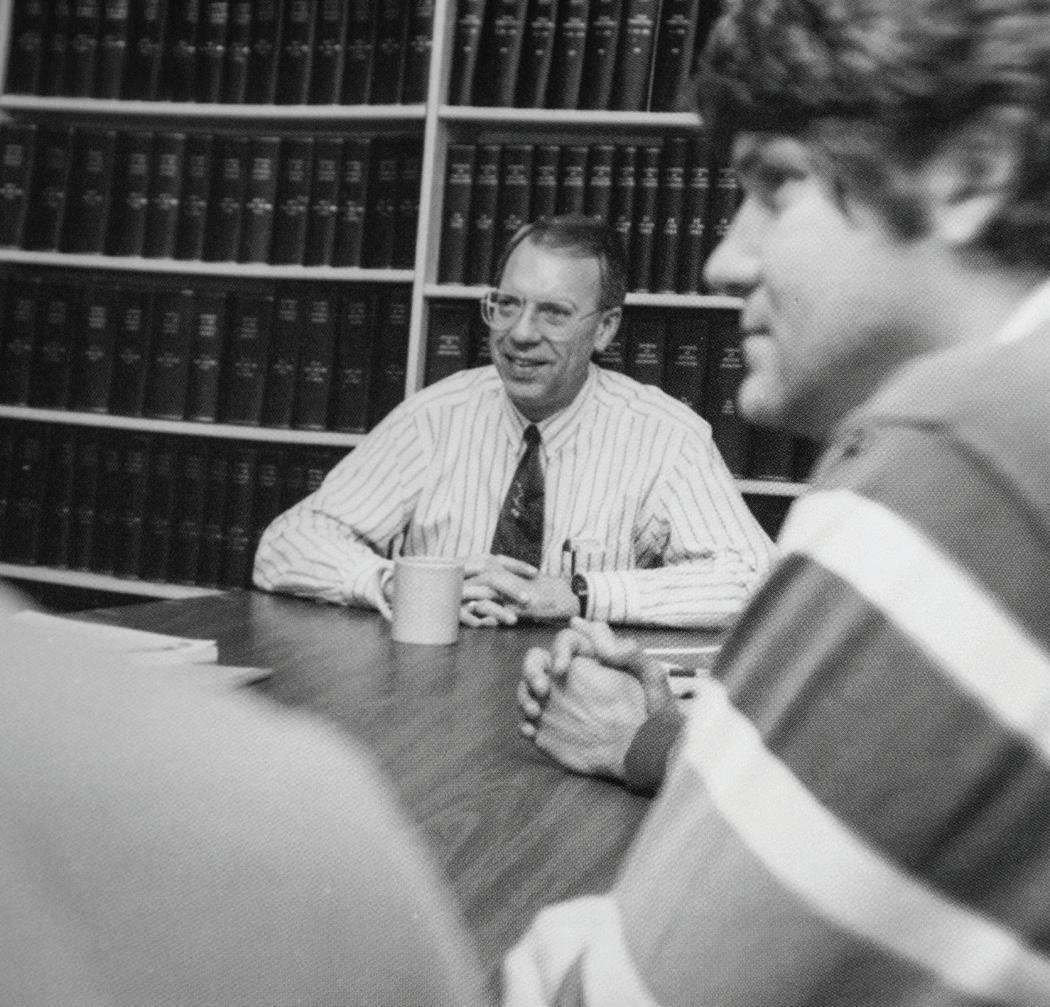
Robert Holton (M.S. ’70, Ph.D. ’71), a pioneering chemist whose synthesis of the cancer drug Taxol made the life-saving treatment available to patients around the world, died on May 21 at the age of 81. Holton and his team at FSU developed a groundbreaking semi-synthetic process to produce Taxol in 1989. The process enabled large-scale production of the drug and led to its commercialization by Bristol Myers Squibb. When approved in 1993, the National Cancer Institute called Taxol the most important cancer drug developed in the previous 15 years. More than a million patients have since been treated with the drug, according to the National Institutes of Health.
Tiru Chabba, of Greenville, South Carolina, was killed during the Florida State University tragic shooting on April 17, 2025. Chabba, 45, was a regional vice president at Aramark Collegiate Hospitality, a food and dining service provider for Florida State. He was visiting campus as an employee of Aramark, where he had worked for 22 years, rising in the ranks from student to manager. The FSU community mourns the loss of this valued colleague and friend.
Chabba was a 2002 graduate of Coastal Carolina University and earned a master’s degree in business administration in 2012 from The Citadel, a military college in South Carolina. He was a loving husband and father of two young children.

Holton joined FSU’s Department of Chemistry in 1985 alongside his wife, Marie Krafft, an internationally recognized researcher. Marie passed away in 2014, and the Krafft Professorship Program, which was established with royalties from Taxol’s success, honors her legacy.
In 1994, Holton’s team achieved the first total synthesis of Taxol, a major accomplishment in organic chemistry. He was elected a fellow of the National Academy of Inventors in 2018 and cofounded Taxolog, Inc. to develop and commercialize new taxane-based therapies. Holton retired from FSU in 2023.
“Dr. Holton’s extraordinary contributions to science saved countless lives,” said FSU President Richard McCullough. “Most scientists dream of having that kind of impact. His story has inspired generations of chemists to pursue drug development in hopes of improving lives through science and innovation.”

The FSU Flying High Circus returned under the big top for its 15th annual Halloween Show Series in October. While the circus hosted three soldout sessions during Family Weekend in September, the Halloween series marked the circus’ first full production since April 2024. Read more about the new tent and recovery after tornado damage on page 14.
Photo by Kaitlin Erica Simpson (B.S. ’11, M.S. ’25).
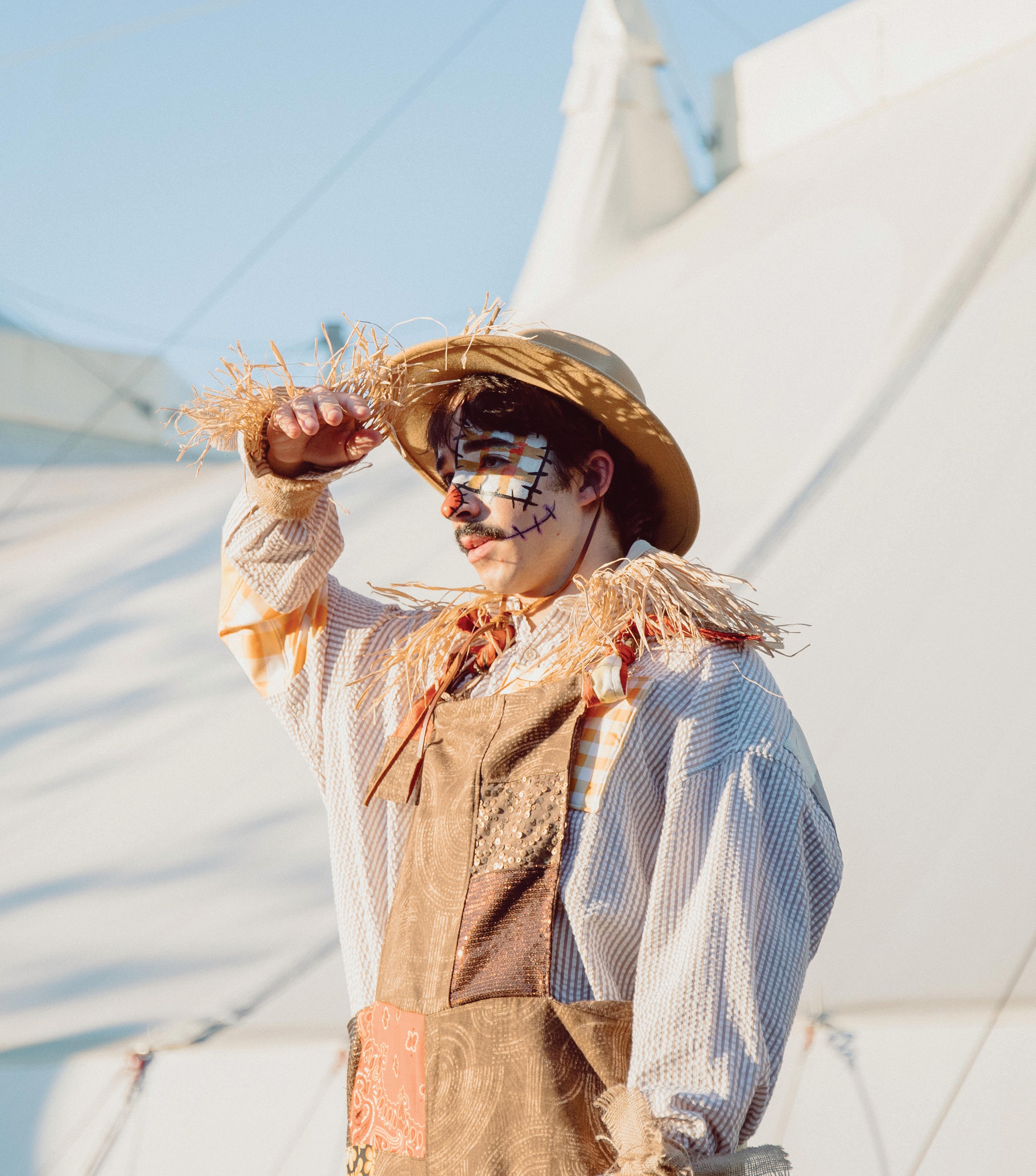
alumni.fsu.edu