OUTHERN S The Student Voice of Florida Southern College
Cuban-Americans’ stories of freedom How their backgrounds impacted their votes
Non Profit Org. US Postage PAID Permit 38 Lakeland, FL
FRIDAY, November 18, 2020 VOL. 136, NO. 5
FSC prepares to welcome students back in the spring Vanessa Alvarez Staff Writer
Photo provided by Jesus Jimenez
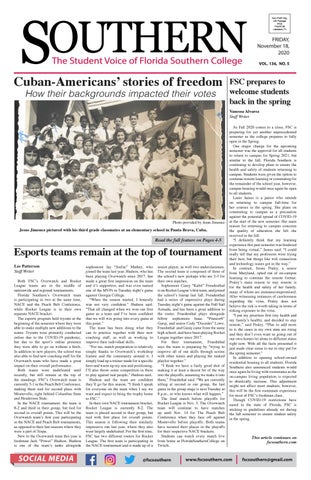
Jesus Jimenez pictured with his third grade classmates at an elementary school in Punta Brava, Cuba.
Read the full feature on Pages 4-5
Esports teams remain at the top of tournament Lee Patterson Staff Writer Both FSC’s Overwatch and Rocket League teams are in the middle of nationwide and regional tournaments. Florida Southern’s Overwatch team is participating in two at the same time, NACE and the Peach Belt Conference, while Rocket League is in their own separate NACE bracket. The esports program held tryouts at the beginning of the semester where they were able to make multiple new additions to the teams. Tryouts were primarily conducted online due to the COVID-19 pandemic, but due to the sport’s online presence they were able to go on without a hitch. In addition to new players, the school was also able to find new coaching staff for the Overwatch team who have made a great impact on their overall performance. Both teams were undefeated until recently, but still remain at the top of the standings. FSC’s Overwatch team is currently 5-1 in the Peach Belt Conference, making them tied for second place with Montevello, right behind Columbus State and Henderson State. In the NACE tournament, the team is 8-2 and third in their group, but tied for second in overall points. This will be the Overwatch team’s first year participating in the NACE and Peach Belt tournaments, as opposed to their last seasons where they were a part of Tespa. New to the Overwatch team this year is freshman Jack “Power” Hudson. Hudson is one of the team’s tanks alongside
SOCIAL MEDIA
sophomore Jay “Joefus” Mathey, who joined the team last year. Hudson, who has been playing Overwatch since 2017, has made a great first impression on the team and it’s supporters, and was even named one of the MVPs in Tuesday night’s game against Georgia College. “When the season started, I honestly was not very confident,” Hudson said. “That all changed when we won our first game as a team and I’ve been confident that we will win going into every game at this point.” The team has been doing what they can to practice together with their new coaching staff, as well as working to improve their individual skills. “For me, match preparation is relatively simple thanks to Overwatch’s workshop feature and the community around it. I simply load up a trainer made for a specific hero and warm up my aim and positioning. I’ll also throw some competition in there to play against real people,” Hudson said. Hudson and the team are confident they’ll go far this season. “I think I speak for everyone on the team when I say we want and expect to bring the trophy home to FSC.” In their own NACE tournament bracket, Rocket League is currently 8-2. The team is placed second in their group, but tied with first place for overall points. This season is following their similarly impressive run last year, where they also went largely undefeated. For the first time, FSC has two different rosters for Rocket League. The first team is participating in the NACE tournament and is made up of a
senior player, as well two underclassmen. The second team is composed of three of the school’s new pickups who are 2-3 for their own matches. Sophomore Casey “Kabit” Freudenthal is on Rocket League’s first team, and joined the school’s lineup last fall. Freudenthal had a series of impressive plays during Tuesday night’s game against the Full Sail Armada, and has been a great addition to the roster. Fruedenthal plays alongside fellow sophomore Isaac “Pranzor6” Garay, and senior Cody “Disorder” Lowe. Fruednthal and Garay came from the same high school, and have been playing Rocket League together since 2017. For their tournament, Fruednthal says the team is preparing by “trying to improve all of our skills through scrims with other teams and playing the ranked playlist together.” “I think we have a fairly good shot of making it at least a decent bit of the way into the playoffs, assuming we make it into them,” Fruednthal said. “We are currently sitting at second in our group, the last game in the group stage is next Tuesday at 8 p.m., so who knows what will happen.” The final match before playoffs for Rocket League is Nov. 3. The Overwatch team will continue to have matches up until Nov. 14 for The Peach Belt Conference when they face off against Montevello before playoffs. Both teams have secured their places in the playoffs for their respective NACE brackets. Students can watch every match live from home at FloridaSouthernCollege on Twitch.
@fscsouthern
As Fall 2020 comes to a close, FSC is preparing for yet another unprecedented semester as the college prepares to fully open in the Spring. One major change for the upcoming semester was the approval for all students to return to campus for Spring 2021, but similar to the fall, Florida Southern is continuing to develop plans to ensure the health and safety of students returning to campus. Students were given the option to continue remote learning or commuting for the remainder of the school year, however, campus housing would once again be open to all students. Lanie James is a junior who intends on returning to campus full-time for her courses in the spring. She plans on commuting to campus as a precaution against the potential spread of COVID-19 at the start of the new semester. Her main reason for returning to campus concerns the quality of education she felt she received in the fall. “I definitely think that my learning experience this past semester was hindered from being virtual,” James said. “I could really tell that my professors were trying their best, but things like wifi connection and technology issues got in the way.” In contrast, Jessie Praley, a senior from Maryland, opted out of on-campus learning to continue the remote format. Praley’s main reason to stay remote is for the health and safety of her family, many of whom are immunocompromised. After witnessing instances of carelessness regarding the virus, Praley does not believe the risk is worth taking in terms of risking exposure to the virus. “I put my priorities first (my health and my family’s health), and decided to stay remote,” said Praley. “Plus to add more to it, the cases in my own state are rising and they don’t even want us going out of our own homes let alone to different states right now. With all the facts presented it just made clear sense to me to stay put for the spring semester.” In addition to opening school-owned residential housing to all students, Florida Southern also announced students would once again be living with roommates as the on-campus living population is expected to drastically increase. This adjustment might not affect most students, however, this will be the first roommate experience for most of FSC’s freshman class. Though COVID-19 restrictions have eased in the state of Florida, FSC is sticking to guidelines already set during the fall semester to ensure student safety in the spring.
www.fscsouthern.com
This article continues on fscsouthern.com
fscsouthern@gmail.com
The Southern NOVEMBER 20, 2020
NEWS BRIEFS Merry Moclidays! CSI is hosting a Chirstmas event on Nov. 18 from 6:30 to 9:30 p.m. at the Badcock Garden and Ordway 162. The event will be socially distanced and will feature an ice sculptor, snow cones, mocliday shirts and more! The prizes will be distributed every thirty minutes in limited amounts.
Adopteen Workshop: Asian Adopteens in America The Asian and Pacific Islander Student Association is hosting an online workshop on Nov. 18 at 7 p.m. through Zoom. Amy Zhong will be leading the meeting about the experiences of Asian American adoptees. Everyone is welcome to join the event. The Zoom link is on Engage.
President’s Circle and Senate On Nov. 19 from 6 to 8 p..m. SGA will host president’s Circle where leaders of student organizations and SGA senators meet up. The meeting will be held on Zoom.
A Christmas Carol On Saturday Nov. 21 from 7:30 p.m. to 9:30 p.m. and on Sunday Nov. 22 2:30 to 4:30 p.m. the FSC Theater Department will perform the production written by Charles Dickens. Students can watch on the Festival of Fine Arts YouTube Channel.
Christmas Party (Virtual) The College Diabetes Network at FSC will be hosting a Netflix watchparty via Zoom on Dec. 5 at 8 p.m. The movie will be decided on Zoom, and information on how to join is on Engage.
2
Town Hall addresses concerns over COVID-19 safety Sophia Gonzalez News Editor Student concerns over on-campus adjustments and safety precautions in response to COVID-19 were the focalpoint of FSC’s first virtual Town Hall on Nov. 10. Students were concerned about issues that they have noticed this semester when it came to face masks and COVID-19 testing. “If someone is out mowing and they’re completely by themselves in the open air we’re not requiring that they wear a mask at that point,” Vice President of Finance Terry Dennis said. “It’s whenever you’re going to be in an interaction with other people and walking.” In terms of faculty members and some refusals to wear masks during campus tours, administrators urge students to report those incidents when they see them. Random on-campus testing is completely random, which is why there are some students that have been tested multiple times and others who have not been tested at all. If a student tests negative but has been in contact with someone who has COVID-19, they will quarantine for 14 days as per CDC guidelines. “CDC guidelines on that, you can test negative, but that does not mean that you don’t have the virus about to start,” Dennis said. “Even if you’re testing negative, they still strongly recommend and require that you go through 14 days of quarantine. It’s actually a longer period than if you tested
positive and you’re just waiting on the symptoms to go away.” All students need to participate in contact-tracing when required to do so. The COVID-19 Dashboard updates the student population about amount of COVID-19 cases at FSC. The updates usually occur on Monday and Wednesday. President Anne Kerr agreed that the Dashboard will now be updated three times a week – with the addition of Friday – and if there’s a large influx of cases, they will update the dashboard accordingly. “If we have some kind of major spike – they say on Tuesday we had some kind of major spike that was detected – we could always, of course, do an off-cycle update as well,” Kerr said. As for the safety of staff, professors will be able to teach remotely if they feel safer in doing so. “All full-time faculty who requested remote teaching were granted that ability to do so,” Academic Provost Brad Hollingshead said. There were some concerns over how the school will continue to follow FSCares protocol since it was announced that more students will come back next semester. Freshmen students living in freshmen housing will most likely not have to move out of their current residential halls, but students living in non-traditional freshmen halls will move after Thanksgiving. Freshmen will receive boxes from their RA’s and the school will move items for them. In order to maintain safety in public eating areas such as Tutu’s, the school will
provide additional outdoor seating. Administrators also talked about the influx of Zoom bombings, stating that it is not an issue unique to FSC, and that students should make sure to have an administrator monitoring who is going into each meeting. Director of Athletics Drew Howard reported that plans to continue sports in the Spring semester were laid out earlier in the fall semester when the cases were “flat.” “Now cases are going up, but hospitalizations are going down, so we’re really closely monitoring what’s happening in our area.” Howard said. “The SSC and NCAA we’re keeping a close eye on everything, and while we are planning to play sports in the Spring, we are constantly watching that, and no formal, final decision really has to be made any time soon.” It is still unsure whether intramurals will come back next semester, nor did Howard give an estimate of when students will be allowed to play intramurals again. “When it is safe to do those things, we’ll continue to do those things,” Howard said. Administration has also vowed to diversify campus staff and student population. The school sent out a survey to students and staff where results unanimously favored a more diverse campus student and staff population. “That is a priority. How we go about doing that, that’s the tough part,” Diversity Officer Wilhelmina Tribble said. “The one thing that we do know is that that’s something that favorably looked upon mostly everybody on campus.”
Holiday spirits remain high in COVID-19 era Jameson Champion Staff Writer
The ongoing COVID-19 pandemic has been responsible for many changes in the lifestyles of Florida Southern students, including the way we celebrate our Christmas traditions. Students at FSC this year will not be attending classes on campus this December, returning home after Thanksgiving break. Because of this, many of the commonly held Christmas events on campus have been cancelled or put on hold for updates surrounding the pandemic. “I can understand why they’re having students head home for the semester but I still believe that we should be able to stay on campus. I believe offering classes in-person gives a better environment than online,” sophomore Isaac Garay said. Despite this, Florida Southern has continued to try to keep the holiday spirit alive. On Oct. 30, the school began assembling the Christmas tree on Mr George’s Green. FSC will hold a holdia event called “Merry Moclidays!” on Nov. 18 where students will get holiday themed items, and the annual Winter Wonderland was moved to January. “I guess that’s a good thing because that gives a chance for people to come back, however, I don’t even think they should be having it at all. No social distancing equals a COVID hazard,” junior Tyler Glynn said. In response to the pandemic, the City of Lakeland’s annual Christmas parade was cancelled. Lakeland’s staple Christmas
Photo by Jameson Champion
The Christmas tree was assembled in October this year after reports that FSC would not put up the tree this year. event would have been held for its 40th year until the pandemic struck. The organizing committee cited the impacts that holding a large scale event would hold on the community in a post to the City of Lakeland’s website. Julie Townsend, executive director of the Lakeland Downtown Development Authority has stated that despite the cancellation of the Christmas parade other Christmas events will still be held in Downtown Lakeland. These events include a Holiday Walkabout on Dec. 1 and a holiday themed First Friday on Dec. 4. The city’s annual Snowfest is also scheduled to take place on Dec. 4 and 5, at the Lake Mirror promenade instead of Munn Park. The event involves a walk through snow covered streets in Downtown Lakeland
and has many activities like arts and crafts, a Santa’s workshop and a giant snow globe with Mr. and Mrs. Clause. The famous snow mountain, however, will not be present this year. Many students are preparing for their return home this semester, and with it preparing for their family’s holiday plans. Social distancing and mask guidelines have changed activities across the nations to prevent the spread of the pandemic. Christmas activities and family traditions are no exception this year as people make holiday plans. “I think many people’s plans may change, I know my family doesn’t plan on changing any plans, but even if they do change I think that Christmas spirit will remain with many of us this year,” Garay said.
3 The Southern NOVEMBER 20, 2020
FEATURES
Students returning to remote after Thanksgiving break Isabelle Hancock and Grayson Skweres Staff Writers
Starting Nov 30, the Florida Southern College community will solely operate in a remote fashion until the start of the spring semester in 2021. The first portion of the semester has been a mix of remote and in-person learning, but with students going back to join their families, the school decided not to have students return following the holiday. “Thanksgiving break begins on November 25, 2020, and all classes, with the exception of those in some graduate programs, will shift to remote instruction beginning on November 30, 2020,” the FSC website says. “ It is very important that faculty hold all classes through November 24, 2020. The Monday (11/23) and Tuesday (11/24) classes before Thanksgiving break must be in session.” For students who are already learning remotely, this is not much of a change, and the on-campus students seem to be on board with the decision, recognizing the need for safety. But as we move closer to all undergraduates going remote for the remainder of the semester, the on-campus students are curious about how the rest of their semester will be. Senior Blair Schoen attends classes on campus and is worried about the transition,
Photo by Isabelle Hancock
An example of an online learning classroom, which is what all of FSC’s students will have to work with in just a few days. but believes that the school has planned it well. “I already know it’s going to be bumpy, but I feel like the transition has been well planned by the school and we’re just going to have to be flexible,” Schoen said. The school is taking procedures that are put in place to keep students safe but also trying to give them the best education possible with the current circumstances. “I think it’s smart because there is a lot of opportunity for people to get the virus when traveling home and then spreading it to others if we were to go back on campus,”
junior Emma Shaddix said. Some students who have been taking remote classes all semester have found remote learning easier and more comfortable. For others, remote learning has been quite a challenge. Regardless, most of these students have found ways to get the most out of this difficult situation. “Something that helps keep me focused during my classes is playing music quietly in the background,” sophomore Morgan Shelton said. Shelton also gives some tips on note taking, something she says has been a
big help. “I think that it’s important for students to remember to take notes during class,” Shelton said. “[Y]our professor may not see your hand raised as easily anymore, so if you write down your question when you have it, you can remember to ask your professor after they’re done speaking.” Students aren’t the only people that have to make adjustments for the rest of the semester. Professors have to prepare to teach differently than they have for the first part of the semester. “I believe it is the best decision for the safety of our students, faculty, and staff,” Assistant Professor of Communication Dr. Katherine Loh said. “With two weeks of school left after Thanksgiving, moving to full remote learning allows students and faculty to concentrate on finishing out the semester on a strong and healthy note.” Loh cited the abrupt switch from inperson instruction to remote instruction last spring as signs for optimism that the change will happen smoothly this semester. “We have been preparing for this for a while,” Loh said. Students and instructors are more familiar with platforms like Zoom, Canvas, Slack, and Teams to complete work and communicate. This change may be stressful for some students but with tips and help from peers and professors, remote learning can be manageable.
Fall 2020 FINAL EXAM SCHEDULE NOTE: Exams are scheduled based on class starting time.
ALL EXAMS ARE TO BE ADMINISTERED AT THE TIME DESIGNATED* *Changes are permitted only for the reasons stated below and should be arranged between the student and professor
Graduating Senior Grades are Due before Noon Wednesday, December 16, 2020 Monday, December 14 #1
8:00am-10:00am
All MWF, MW, MF, & WF classes starting at 8:00 a.m.
#2
10:15am-12:15pm
#3
1:00pm-3:00pm
#4
3:15pm-5:15pm
#5
6:00pm-8:00pm
Rescheduled Exams All MWF, MW, MF, & WF classes starting at 12:15 p.m.
Includes only senior exams to meet Wed. noon deadline; exams for time conflicts; exams for times not scheduled
All MWF, MW, MF, & WF classes starting at 1:40 p.m.
All MWF, MW, MF, & WF classes starting at 3:05 p.m. and 3:40 p.m.
Tuesday, December 15 #6
8:00am-10:00am
#7
10:15am-12:15pm
#8
1:00pm-3:00pm
#9
3:15pm-5:15pm
#10
6:00pm-8:00pm
Rescheduled Exams All TTH classes starting at 8:00 a.m.
All TTH classes starting at 10:00 a.m.
All TH classes starting at 2:00 p.m.
Includes only senior exams to meet Wed. noon deadline; exams for time conflicts; exams for times not scheduled
All TTH classes starting at 4:00 p.m.
Wednesday, December 16 #11
8:00am-10:00am
#12
10:15am-12:15pm
#13
1:00pm-3:00pm
#14
3:15pm-5:15pm
#15
6:00pm-8:00pm
Rescheduled Exams All MWF, MW, MF, & MF classes starting at 9:25 a.m.
All TTH classes starting at 12:00 noon
Includes only exams for time conflicts; exams for times not scheduled
All MF classes starting at 10:50 a.m. and MW, MF and WF classes starting at 5:40 p.m.
All MWF classes starting at 4:30 and TTH classes starting at 6:00 p.m.
The Southern NOVEMBER 20, 2020
4
Cuban-Americans tell st “Socialism” scares By: Vanessa Alvarez Staff Writer
Editor’s Note: This feature tells the stories of our writer, Vanessa’s, immediate family that fled from Cuba.
President Donald Trump’s focus on Cuban-Americans in South Florida proved to be a successful force following election night, but many are questioning the reason behind this unexpected feat. America quickly placed the spotlight on Cuban-Americans in Miami-Dade County, Florida on election night after being a major contribution to Trump’s win of Florida’s 29 electoral votes. NBC News reported a drastic increase in support after 55 percent of Cuban-American voted for Trump in the 2020 election. According to NBC News, Trump’s support increased from 333,999 votes in 2016 to nearly 530,000 in this past election. Trump spent much of his campaign trail in 2020 targeting Latinos in South Florida through releasing Spanish advertising and hosting rallies in predominantly Cuban-American communities. Despite these efforts, polls show Trump’s most effective effort was painting President-elect Joe Biden as a socialist. True or false, the word “socialism” does not sit well with the Cuban-American community, specifically those who lived through or having connections to the Cuban Revolution and Cuban dictator Fidel Castro’s regime. Like many Americans, Cuban-Americans voted this election out of fear of returning to what they and their families once fled their homeland from.
Juana Jimenez, Rafaelina Alvarez and Marilyn Alvarez are
three-generations of Cubans who fled their homes, families and livelihood as a result of the political and social climate under Fidel Castro. It is stories like theirs that give insight why Trump won over Miami-Dade County and Cuban-Americans across the United States. Jimenez grew up during the 1920s in Bauta, Cuba, but left in the 1950s due to the rapidly deteriorating political and social climates. During her life in Cuba, she lived under the regime of two notorious dictators, Fulgancio Bautista and Fidel Castro. “They were both bad. Bautista was a dictator, but he never stole from the people. If you didn’t deal with drugs, you were fine. The people who had problems were the people who committed actual crimes,” Jimenez said.
Photos provided by J
Captions: (Top): The Jimenez family receiving a lottery their bank in the late 1950s, which was later lo government centralized the banks. (Middle): Jesus Jimenez’s father, Jose, pict center as a teenager in the 1930s. (Bottom): Jesus Jimenez, pictured third from t three workers at the resturant his mother owned This document was given to Van essa Alvarez’s grandmother, Rafae lina when she came to the United States thr ough the Freedom Flights.
5 The Southern NOVEMBER 20, 2020
tories of finding freedom How their lives influenced their votes
Jesus Jimenez
y prize from ost when the
tured in the
the left, with d in 1957.
Rafaelina Alvarez “When they say socialism, you remember what is in your country and what is right now in your country. Cuba is a poor country. There’s nothing there, nothing,” Alvarez said.
Juana Jimenez
Juana Jimenez grew up with her father and siblings who owned a grocery store in Bauta. She recalls selling basic necessities at the store until Castro’s regime began, which marked the government takeover. Their store was stolen from their family and deemed government property as officials began rationing basic goods such as soap and food from the Cuban people.
Rafaelina Alvarez grew up in the poor countryside of Batabano, Cuba where her father worked as a farmer for a landowner. She remembers her home being small, with two bedrooms for her parents and the five children, and one bathroom outdoors. The Freedom Flights brought Alvarez, who was eight-months pregnant with her first child, along with her husband and several of his family members to the United States. She would stay for 13 consecutive years before being allowed to visit her family for the first time.
noting a significant, negative change in the place she once called home. During her life in Cuba, she lived under the regimes of two notorious dictators, Fulgancio Bautista and Fidel Castro.
When Jimenez left in 1959 alongside her husband and two children, she left everything behind. Her home was confiscated by the government and she was not allowed back to her homeland for nearly 20 years. She remembers
“You couldn’t buy anything with Cuban money,” Jimenez said.
Marilyn Alvarez A first-generation American, Marilyn Alvarez’s love and admiration for America’s democracy comes from the hardships her parents faced as Cuban immigrants. The youngest daughter of Rafaelina Alvarez, who fled Cuba in 1965, she fears the idea of socialism and the potential threat it poses against America’s democracy. Her pride and admiration for the American Dream of prosperity, freedom and opportunity is fueled by the stories of brutality, regulations and fear her parents shared while growing up.
“Our whole lives we were brought up knowing what happened in Cuba, almost to the point that we didn’t experience it, but yet we did,” said Alvarez.
For audio clips, more photos and extended stories, visit fscsouthern.com. The Southern would like to give special thanks to the Alvarez and Jimenez families for sharing their stories and photographs with us. Congrats to Vanessa on her graduation, we wish you all the best!
The Southern NOVEMBER 20, 2020
6
Pandemicinspired flick stirs up controversy
Quarantine gives rise to ‘Among Us’ game
ENTERTAINMENT
Emily Starling Contributing Writer The movie “Songbird” introduces a more intense version of COVID-19, “COVID-23”, and is produced by “A Quiet Place”’s Michael Bay. On Oct. 29, the “Songbird” trailer arrived featuring “Riverdale’s” KJ Apa and Disney’s “Descendants” star, Sofia Carson. The film is one of the first movies to start shooting post-Coronavirus lockdowns. Per the movie description, Carson and Apa will be joined by costars Demi Moore, Jenna Ortega, Craig Robinson and Bradley Whitford. Songbird is set in 2024 with the world still in quarantine, only under a new strand of Coronavirus that attacks the brain. Those infected get aggressively torn from their homes and are forced into quarantine camps, referred to as “Q-Zones.”
“
“I would watch the movie for the plot line, but I don’t necessarily find it ethical.” -Avery Stadifer
The film is centered around Apa’s character, Nico, who is immune to the fictional Covid-23 virus and falls in love with Sara, who is portrayed by Sofia Carson. “It’s Romeo and Juliet but they’re separated by her front door and by the virus” director of the film Adam Mason said to “Entertainment Weekly.” “I would watch the movie for the plot line, but I don’t necessarily find it ethical,” freshman Avery Stadifer said. “COVID-19, a very real thing, is not something that should be romanticized on the big screen.” Soon after the trailer was released to the public, people took it to Twitter to express why they are not happy about the new pandemic-themed film, calling for Bay to “read the room.” Users expressed that the plotline seemed “too soon” given the current pandemic we are in. “Making a “dystopian horror movie” about a horror that is real and happening RIGHT NOW is so tone deaf,” one tweet read, receiving over ten thousand likes. On the contrary, some users tweeted that the film might be educational for the public to show how things could be. One user tweeted “Maybe it’s a good thing, maybe this extreme dystopia will scare some...people into realizing how bad it actually could get.” Another expressed that Songbird is “perfect timing” and continued on to state that the movie could serve as a “warning” to the public about what could happen if people did not follow proper COVID-19 guidelines. The recent teaser trailer stated that the movie will be “Coming Soon” with no confirmed release date in 2021.
Deanna Wright Staff Writer Murder mystery game “Among Us” skyrocketed in popularity during the coronavirus pandemic. The online multiplayer murder mystery game was released back in the summer of 2018 by the indie game company InnerSloth. This multiplayer game is about teamwork, but be careful who you really trust on board. Based on the 1986 Mafia party game, players are onboard a spaceship and play as astronauts. Players and their friends have the option to play online or over a local Wi-Fi to make sure you are put in the same game. The game needs at least four players to play, but can host up to 10 players at a time. Depending on how many players there are, at least one will become the alien imposter on board without the others knowing. As a team, the crewmates have to finish their task before the imposter kills and sabotages everyone. The more players, the more difficult it is to figure out who the imposter is. Some tasks include destroying asteroids cming towards the ship to fix wires in different rooms onboard. “I prefer basically any of the short tasks or the visible tasks,” junior Alex Perdue said. “So I can get them done before I get killed and so other crewmates can see I am not the imposter.” The game has had an increase in popularity for gamers and others with iOS or an Android. After multiple Twitch streamers and YouTube creators posted videos online about playing the game,
Photo by Noah Valletutti
FSC students play the popular game “Among Us” with friends during their free time. there was an influx in popularity. “Funny enough it was a decision based more on humor and wanting to understand all the memes and jokes being thrown around on social media and group chats that made me interested in playing,” senior Cameron Webb said. Depending on the settings that are set by the host, each player has at least one emergency meeting where players can discuss who they think the imposter is. These meetings also occur when a body is found dead on the spaceship, in which then the players discuss and can vote someone off the ship or skip due to there not being any evidence to who the imposter is. “One strategy is seeing who is quiet during the meetings or even someone who’s acting confused is a dead giveaway,” Perdue said. The game has been having multiple updates recently due to the large amount
of people using the server. This has caused the game to have many players kicked out while playing, and even telling players they can’t join the game due to the large number of people all trying to play at once. “Honestly, it gets a bit irritating sometimes because you make friends in some of the games,” freshman Libby Perdue said. “When you get kicked out then you have to join a new game and meet other people.” This influx has even caused someone to make a TikTok trend to a song someone created, based on the game. The major word, “sus,” that is used in the game, is said multiple times in the song. “‘Sus’ is short for suspicious and ‘imp’ is short for imposter,” Alex Perdue said. “We use these terms just to make the discussions in the meetings faster and simpler.”
so that fans didn’t miss anything and could get their money’s worth. The artist also included a recording of their fans from a previous Zoom and projected it for one of the songs during the concert. “It was a full production, extremely visually entertaining with props and a concept and all,” Lofty said.
Instead of selling by the parking space, guests were allowed to choose the zone of the parking area they wished to be placed in. Then, depending on when guests arrive, they will be directed to the next available parking space within the area. Bryan Scott, the Director of Concerts and Events for the Joy F.M. radio station, described the concert as being “a once in a lifetime” and that merchandise will be available for contactless delivery the night of the performance. “The Drive-In Model is working extremely well across the country,” Scott said. “I really believe that people want to get out of their homes and that they miss live concerts.” Amalie Arena, located in Tampa, Fla., has recently announced that it will be hosting one of the first in-person concerts since the beginning of the pandemic. Artist TobyMac will be performing on his “TobyMac Hits Deep Tour” in person, along with special guests Tauren Wells, We Are Messengers, Unspoken, Cochren & Co. and Terrian. The performances will be held on Feb. 19 and 20 at 7 p.m. “Over the summer we’ve safely produced multiple tours at drive-in movie theaters providing our fans with an outlet to continue enjoying live music, and we’re excited to keep that momentum going this spring,” said Dan Fife, CEO and Founder of Awakening Events in the press release announcing the event.
Concerts adapt to pandemic guidelines Faith Miller Staff Writer As multiple areas across the United States head into new phases in the process of reopening, the question of the return of events still hangs in the air. Even though the pandemic has caused several events to have been canceled or postponed into 2021, many venues and artists have found a way to still perform and provide events for fans. The methods include virtual opportunities, drive-in performances, and some venues are even scheduling to begin having in person concerts once again with social distancing and new safety measures being put in place. Sophomore Nour Lofty, attended a virtual concert on Oct. 17 for the band “Glass Animals.” She purchased her tickets through Ticket Master and was sent a specific code and link giving her to the concert.The event also included a merch section on the website that was accessible throughout the entirety of the event. “I believe that it was really well done,” Lofty said. “I loved the way they did it and thought that with live concerts not being an option right now, it was a fantastic alternative.” Even though the streaming quality was very good throughout the show, it “went down toward the end,” due to a high volume of comments. To make up for this, “Universal Music” gave attendants access to the stream for an extra 72 hours
“
“The Drive-In Model is working extremely well across the country. I really believe that people want to get out of their homes and that they miss live concerts.” -Bryan Scott, Joy F.M. Director of Concerts and Events
Another option a lot of artists have turned to is drive-in concerts. Popular Christian band “For KING & COUNTRY” has planned a concert to be held at several drive-in locations across the United States including “Silvermoon Drive-In” located in Lakeland. Even though tickets recently sold out, it is a great example of how drivein presentations are being handled. Tickets were being sold by the vehicle, allowing only six passengers per car.
7 The Southern NOVEMBER 20, 2020
ENTERTAINMENT
FSC’s ‘A Christmas Carol’ is a new take on an old classic Sarah Dube Staff Writer FSC is taking on Charles Dickens’ “A Christmas Carol” as their third and final show for the fall semester. As the first musical of this school year, “A Christmas Carol” has presented some unique challenges. Traditionally, the production is not performed as a musical. Director Jim Beck, along with the help of musical director David Foust, adapted classic Christmas carols and implemented them into the show. Senior Nic Jankowski has been involved in multiple musicals during his time at FSC and will be returning to the stage to portray the role of Bob Cratchit. His large involvement with the production has given him an up-close perspective with the unique process. “The most unique thing about our production of A Christmas Carol is that
“
“With the 6-foot safety mandate we try to uphold, we’ve had to spend lots of time getting creative with the choreography to keep it interesting yet safe.” -Nic Jankowski
the theatre faculty at FSC adapted it into a musical by using a combination of Christmas carols,” Jankowski said “Finding ways to incorporate timeless Christmas carols into the story has been a fun and interesting challenge that the
Photo by Nour Lofty
The cast of “A Christmas Carol” during rehearsal in the Buckner Theatre. cast and director have worked together on throughout the entire rehearsal process.” With the added musical element, “A Christmas Carol” has encountered several new challenges. Dance rehearsals with choreographer Scott Cook have been held solely over Zoom. “With the 6-foot safety mandate we try to uphold, we’ve had to spend lots of time getting creative with the choreography to keep it interesting yet safe,” Jankowski said. “Singing has also been a challenge. It’s difficult enough to project your voice in a mask, but singing adds a whole new level of troubles. Fortunately, we have found ways to work with both issues in ways that won’t hinder the enjoyment of the show.”
Unexpected solo album comes from drummer of 5SOS Sophie Talbert Staff Writer Ashton Irwin became the first member of Australian pop rock band 5 Seconds of Summer to release a solo project with the unexpected release of his album “Superbloom” on Oct. 23. 5 Seconds of Summer released their fourth studio album, “CALM,” on March 27 of this year. The group was scheduled to embark on their headlining world tour over the summer, but was postponed due to COVID-19. Irwin used this time to create his own solo project with his housemate, music producer Matt Pauling. Despite a solo release from Irwin, there is no tension with the other members of 5 Seconds of Summer. “I’ve always wanted to make a solo record, and so had everybody else in 5 Seconds of Summer,” Irwin stated in a recent interview with Rolling Stone Australia. “We’ve always publicly talked about it, we’ve always confronted each other, and we always knew that each one of us is a very different artist.” The lead single from “Superbloom” was “Skinny Skinny,” which demonstrated that Irwin’s solo work would differ from the pop sound expected of him. The stripped
down, folk-inspired rock song explores uncomfortable topics such as body dysmorphia and mental health. The mature and deeply personal lyrics establish Irwin as a strong and introspective songwriter. The rest of the album lives up to the precedent Irwin set for himself with his lead single. He sings about his struggles with depression and anxiety on “The Sweetness,” and challenges with sobriety on “Matter of Time.” Irwin continues to be vulnerable throughout the album, with the overarching theme of finding hope throughout hard times. “Superbloom” was met with commercial success and generally positive reviews from critics. In a review for “Spin,” Liza Lentini states that the album “is a bright lotus in a mud pile of a year.” Influenced by a wide array of artists including the Foo Fighters and My Bloody Valentine, “There’s a nod to ’90s grunge, but Ash has managed, against all odds, to reinvent a sound you think you know into something new and distinctly his own,” Lentini said. “The result is a melodic tapestry of decadespast influences, something you can’t quite put your finger on, and the delight is in the discovery.” Irwin’s bold solo debut is available now.
Sophomore Zachary Covell has become very familiar with the FSC stage and will be making another appearance in this show as the ghost of Jacob Marley. Having been involved in multiple productions this semester, both Covell and Jankowski have had a front row seat to the adaptations that have come this semester. “With ‘As You Like It,’ we were a much smaller cast and only had to rely on staging rather than interesting and unique choreography,” Jankowski said. “Because of that, it was much, much simpler to keep good social distancing while telling the story.” This semester has challenged FSC in so many ways, but the theater department staff and students have found ways to keep
their department going. “Theater right now is so strange, but so is life right now,” Covell said. “Overall, I’m just happy to be involved and to still be able to perform.” “A Christmas Carol” can be streamed on FSC Theater’s YouTube channel Nov. 21 and 22, or the encore performances on Dec. 5 and 6 at 7:30 pm.
Scan this QR code to stream “A Christmas Carol.”
OUTHERN S
The Student Voice of Florida Southern College Florida Southern College 111 Lake Hollingsworth Dr. Lakeland, Florida 33801 Always on fscsouthern.com 863-680-4456 fscsouthern@gmail.com
Editor-in-Chief
Jillian Kurtz
jilliankurtz98@gmail.com
News Editor
Sophia Gonzalez
sophiamcecc@gmail.com
Online Editor Features Editor Opinions Editor
Entertainment Editor Graphic Designer Advisor
Abby McHenry
abemchenry@gmail.com
Nathalie Moreno
morenonathalie78@gmail.com
Sam Odom
Grace Newton
samanthaodom2021@gmail.com
Christina DiGregory Mike Trice
gracearoni55@gmail.com
christina.digregory@gmail.com
mtrice@flsouthern.edu
The Southern is published as an E-Edition biweekly during fall and spring semesters of the academic year at Florida Southern College by students through the Communication Department. The Southern is unable to print a physical paper due to COVID-19, but is still available on fscsouthern.com. Opinions expressed on the opinions pages are not necessarily those of the department, the administration, the Board of Trustees or The Southern editorial board. Written and signed responses to views expressed on these pages, or relevant to other Florida Southern College issues, are encouraged and will be considered for publication. All members of the Florida Southern community — students, staff, faculty, administrators, trustees, alumni and other friends of the college — are invited to voice their opinion in and about The Southern. All material submitted is subject to editing for length, style and taste. All material must be submitted to fscsouthern@gmail.com to be considered. The Southern office is in the
The Southern NOVEMBER 20, 2020
OPINIONS
8
Oregon implements new tactics to combat drug problems
Emily Starling Contributing Writer The march towards drug reform took a huge step forward when citizens voted on Nov. 3 to make Oregon the first in the United States to decriminalize all drugs. Ballot Measure 110, otherwise known as the Drug Decriminalization and Addiction Treatment Initiative, reclassifies possession of small amounts of drugs as non-criminal Class E violations, as stated in the explanatory statement of the measure. Oregon’s new measure does decriminalize all drugs, however it should not be confused with the legalization of all drugs. The decriminalization of drugs simply means the removal of criminal penalties for the possession of small amounts of illegal substances, it does not make all drug offenses non-punishable. The measure notes that it only eliminates penalties for specified controlled amounts, anything else is still deemed to receive misdemeanor or felony charges which could also apply to those who allegedly possess enough illicit drugs to sell. Measure 110 mandates the establishment of addiction recovery centers that are patientfocused and evidence based to ensure that those trying to recover from addiction get a helping hand, rather than being pushed back into a lifestyle they are trying to escape. The facilities must provide medical treatments, health assessments, intervention plans, case management services, peer support and outreach 24 hours a day. The favoring of rehabilitation over incarceration for drug users, prevents recovering users from being labeled by employers, landlords
Voters at a polling place at Public School 59 in New York City on Nov. 8 2016.
senator for Delaware from 1973 to 2009. During his career, he created the Violent Crime Control and Law Enforcement Act of 1994, which was coined as the “1994 Biden Crime Bill.” This bill increased mass incarceration rates and imposed tougher sentences, increasing funding for prisons that ultimately contributed to the growth of the U.S. prison population from the 1990s through the 2000s. Today, Black communities are disproportionately affected by wildly different sentencing practices and drug enforcement laws that have stemmed from Biden and Reagan’s Anti-Drug policies. Research shows that Black men are incarcerated for all offenses at 8.2 times the rate of white men. The statistics explicitly show that Black Americans have a higher rate of incarceration for the same drug-related crimes that White Americans commit, demonstrating the racism that is woven directly into the nation’s criminal justice system. Nearly 40 years after the start of the War on Drugs in America, the new Oregon measure is a huge step in combating the overtly racist and carceral logic behind drug criminalization and is the forefront of a shift in this nation’s attitude about how to overcome the issue of drug abuse across communities. Oregonians have taken a historic step in recognizing that if a carceral approach to drug use is harmful, then it is harmful to the use of all drugs including ones categorized as “hard drugs” like cocaine, methamphetamine, heroine and more. To learn more about Ballot Measure 110, visit voteyeson110.org.
Mongan said in his opening defence of the ACA. Severability, the legal doctrine at the center of the case, takes a side by presuming Congress wanted statutes separate from the affected section preserved if not openly conflicted. In the words of Chief Justice John Roberts in Seila Law v. Consumer Financial Protection Bureau, it’s “a scalpel rather than a bulldozer.” Texas Solicitor General Kyle D. Hawkins, classed by Texas Review of Law & Politics amongst conservative all stars Justice Clarence Thomas and federalist activist Leonard Leo, led the 18-state effort (including Florida) through the Fifth Circuit Appeals Court to strike down Obamacare in its present form. “This case should be resolved on the basis of three operative provisions,” Hawkins explaining that the ACA should be killed: layman’s terms: The federal government has no right to command citizens to obtain healthcare it deems suitable. The erasure of the law’s penalty renders it unconstitutional. Because the law no longer bears a tax penalty, the remainder of the ACA should be inactive. These claims are not untrue. Schrödinger’s tax engages healthy skepticism considering that without the guise of Congress’s power to raise revenue, the individual insurance mandate is, in its leftovers, a naked command. A disrobed breach of power that would, in almost any other judicial review, be voided. On March 23, 2010, the ACA was ratified. Lawmakers at the time claimed
pandemic. Societal collapse considered, popularity is irrelevant. The Supreme Court remains the voice of the law and of the Constitution. Perhaps the Justices let it be known impending adversity does not always grant instantaneous exceptions to the rule of law. So if the court rules the ACA unconstitutional on the grounds of not appropriately exercising Congress’s taxing powers, so-be-it. The House and Senate relay the responsibility of quickly purifying its demerits on behalf of the dying. Whether or not Congress actually pushes through a revised health care law fitting within the provisions of the Constitution conclusively measures the electorate’s representation. However engrossing speculative fiction is at times, let’s not kid. Even the majority of conservative Justices on the Supreme Court know that the Constitution is not a suicide-pact. A constitutional repeal of the ACA would blindly engender American life with anguish and distress, worsening a mid-pandemic dependency on accessible medical care and a newly felt invisibility. Despite the Act’s exact constitutionality, a hardline dissent from the circumstances of our nation at present would, compellingly, rule society backwards. The conservative majority, notably key Justices Brett Kavanaugh and Roberts, portray themselves listless as G.O.P. counsel members mockup a haphazard and partisan theory of standing likely to backfire on their own states ill from the novel coronavirus.
and leaders and gives them the ability to pull themselves out of a cycle of drug related offenses. But how would this new measure help fight the modern war on drugs? During the presidency of Richard Nixon, a “war on drugs” was declared. According to The Drug Policy Alliance’s official website, the Nixon Administration “dramatically increased the size and presence of federal drug control agencies, and pushed through measures such as mandatory sentencing and no-knock warrants.” Nixon initiated the war on drugs in 1971 in order to criminalize the Black population. Nixon’s domestic policy chief, John Ehrlichman, admitted in a 1994 interview that the war on drugs implemented by the Nixon Administration was targeted towards Black Americans.
“We knew we couldn’t make it illegal to be either against the war or Black, but by getting the public to associate the hippies with marijuana and Blacks with heroin, and then criminalizing both heavily, we could disrupt those communities.” said Ehrlichman in the interview, reported by Harper’s Magazine. There is extensive history shedding light on the United States aggressive approach on the use and distribution of illegal drugs and remains a topic of debate. The 1980’s is really where incarceration rates for minority groups started to skyrocket, not only during the Reagan presidency where he largely influenced the expansion of the war on drugs, but also from President-elect Joe Biden. A big part of Biden’s extensive political career was when he served as a United States
Photo courtesy of Marco Verch/Flickr
SCOTUS considers the Affordable Care Act. Again.
Salvatore Ambrosino Staff Writer
The Supreme Court of the United States’ (SCOTUS) conservative majority appears willing to preserve the Obama administration’s landmark Patient Protection and Affordable Care Act (ACA), the most challenged statute in modern American history. The Nov. 10 hearing lays at stake the demolition of the ACA. In turn, the health insurance marketplace and America’s baseline in healthcare fear extinction. Justice Amy Coney Barrett’s confirmation stirred the pot amongst Democrats in Congress, impelling the worst nightmares of court ordered reversal. The ACA’s seventh challenge in nearly a decade prompts uninspired reactions from even conservative legal scholars opposing the statute as well as the deteriorating lawsuit questioning its constitutionality. The Trump administration’s latest strike on Obama-era policy preys on the Supreme Court’s 2012 5-4 ruling on Congress’s right to levy Obamacare as a tax. Since Congress’s 2017 decision to zero the individual insurance mandate’s tax penalty effective 2019, the mandate is no longer a tax, rendered unconstitutional. Republican respondents contend the existence of the ACA is so tied to the individual mandate’s punitive tax that all other programs in the 2,000 page law are to be struck from United States legislation as well. “It’s at odds with how Congress and the President understood the amendment,” Solicitor General of California Michael
the tax penalty, then $95 per adult, was an essential part to the marketplace reforms the statute set out to achieve. The enshrinement of this now inoperative language casually acts as high-ground for opponents. The question of California v. Texas must at first be considered through today’s scope and by the implications of its moral suasion. Former Solicitor General of the United States Donald Verrilli said the mandate was crucial at the time to create a new insurance market, with subsidies as “carrots” and the requirement to purchase or otherwise obtain insurance under threat of penalty as a “stick.” “It’s turned out that the carrots work without the stick,” Verrilli said, explaining to Justice Roberts that the policy’s underlying success was based on the individual’s thus proven desire to obtain affordable healthcare and that the penalty was no longer necessary. Since its introduction in 2010, an estimated 23 million U.S. citizens have been covered under the health care law, constituting the baseline for American health coverage, as well as nearly a fifth of the United States’ economy. The ramifications of an adverse ruling, at this point in time, would go beyond depriving Americans of coverage. Faulted revenue streams stretched thin over the recession have contributed to a reduction in health screenings, leading also to a reduction in revenue for the American healthcare system. Further, the American healthcare system is unlikely to cope with an influx of patients in latestage crises through a now mountainous