Stone fruit · Fruta de hueso · 40
Jerte: Quality, but with a delay Jerte: Calidad pero con retraso The harvest from the Valle del Jerte has been delayed for a few days, but the quality of the fruit has not been affected. Sin menoscabo alguno en la calidad de la fruta, la cosecha del Valle del Jerte, llega con unos diez días de retraso.
D
entro de lo que está siendo habitual en esta primavera, la cosecha de cerezas del Valle del Jerte (Cáceres) sufre un retraso de unos diez días respecto a lo que ha sido la media de los últimos cinco años. A finales de abril todavía había cerezos en flor en la zona alta de montaña. Sin embargo, y en palabras de la directora técnica del Consejo Regulador de la Denominación de Origen Cereza del Jerte, Pilar Diaz Flores, “las condiciones meteorológicas que se han dado, no indican ninguna merma de calidad y en volúmenes podemos hablar de una cosecha similar o ligeramente inferior a la del año pasado, en la que se alcanzaron los 6,5 millones de kilos.” La superficie total de las explotaciones inscritas se acerca casi a las 6.500 hectáreas.
A
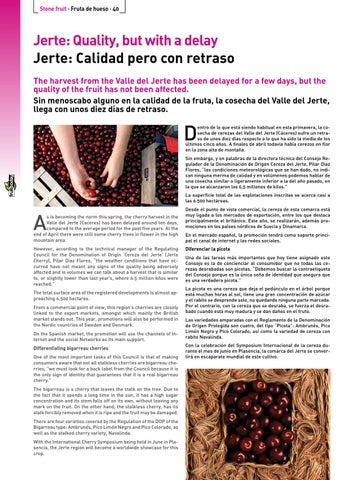
s is becoming the norm this spring, the cherry harvest in the Valle del Jerte (Caceres) has been delayed around ten days, compared to the average period for the past five years. At the end of April there were still some cherry trees in flower in the high mountain area. However, according to the technical manager of the Regulating Council for the Denomination of Origin ‘Cereza del Jerte’ (Jerte Cherry), Pilar Diaz Flores, “the weather conditions that have occurred have not meant any signs of the quality being adversely affected and in volumes we can talk about a harvest that is similar to, or slightly lower than last year’s, where 6.5 million kilos were reached.” The total surface area of the registered developments is almost approaching 6,500 hectares. From a commercial point of view, this region’s cherries are closely linked to the export markets, amongst which mainly the British market stands out. This year, promotions will also be performed in the Nordic countries of Sweden and Denmark. On the Spanish market, the promotion will use the channels of Internet and the social Networks as its main support. Differentiating bigarreau cherries One of the most important tasks of this Council is that of making consumers aware that not all stalkless cherries are bigarreau cherries, “we must look for a back label from the Council because it is the only sign of identity that guarantees that it is a real bigarreau cherry.” The bigarreau is a cherry that leaves the stalk on the tree. Due to the fact that it spends a long time in the sun, it has a high sugar concentration and its stem falls off on its own, without leaving any mark on the fruit. On the other hand, the stalkless cherry, has its stalk forcibly removed when it is ripe and the fruit may be damaged. There are four varieties covered by the Regulation of the DOP of the Bigarreau type: Ambrunés, Pico Limón Negro and Pico Colorado, as well as the stalked cherry variety, Navalinda. With the International Cherry Symposium being held in June in Plasencia, the Jerte region will become a worldwide showcase for this crop.
Desde el punto de vista comercial, la cereza de esta comarca está muy ligada a los mercados de exportación, entre los que destaca principalmente el británico. Este año, se realizarán, además promociones en los países nórdicos de Suecia y Dinamarca. En el mercado español, la promoción tendrá como soporte principal el canal de internet y las redes sociales. Diferenciar la picota Una de las tareas más importantes que hoy tiene asignado este Consejo es la de concienciar al consumidor que no todas las cerezas desrabadas son picotas. “Debemos buscar la contraetiqueta del Consejo porque es la única seña de identidad que asegura que es una verdadera picota.” La picota es una cereza que deja el pedúnculo en el árbol porque está muchas horas al sol, tiene una gran concentración de azúcar y el rabito se desprende solo, no quedando ninguna parte marcada. Por el contrario, con la cereza que se desraba, se fuerza el desrabado cuando está muy madura y se dan daños en el fruto. Las variedades amparadas con el Reglamento de la Denominación de Origen Protegida son cuatro, del tipo “Picota”: Ambrunés, Pico Limón Negro y Pico Colorado, así como la variedad de cereza con rabito Navalinda. Con la celebración del Symposium Internacional de la cereza durante el mes de junio en Plasencia, la comarca del Jerte se convertirá en escaparate mundial de este cultivo.