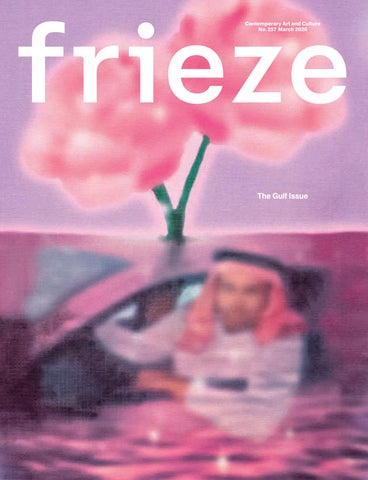
The Gulf Issue



Start here. You won’t be disappointed.
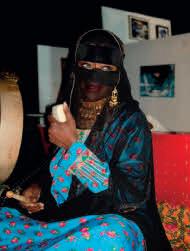
Networks: SINDBAD Collective Art hits the road
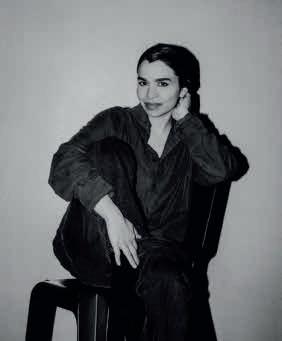
Profile: Alia Farid Landscape as studio
p. 19
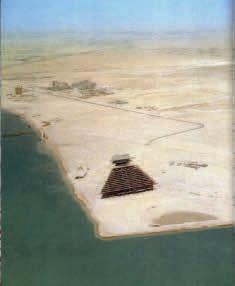
Roundtable: Gulf Futurism What comes next?
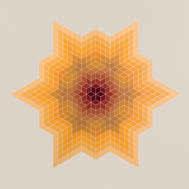
Interview: Dana Awartani The ethics of making p. 42
To Do:
MOHAMMAD ALFARAJ 15
One Take: M.F. HUSAIN by Carlos Valladares 16
NETWORKS
Joining forces
Connecting the Gulf with SINDBAD COLLECTIVE by Ahaad Alamoudi 19
Due credit: art and the burner phone by Ruba Al-Sweel 23
Rural modernity in Qatar by Samir Bantal 25
SUNNY RAHBAR on Dubai’s art spaces as told to Marko Gluhaich 26
MOHAMMAD ALFARAJ ’s visions of Saudi Arabia with Róisín Tapponi 29
FEATURES
Roundtable: Gulf Futurism Considering the region’s changing shape 42
Profile: ALIA FARID by Maru Pabón 54
1,500 Words: MONIRA AL QADIRI as told to Vanessa Peterson 62
Interview: DANA AWARTANI’s sacred geometry with Fawz Kabra 68
Essay: On Post-Western art collectives by Rahel Aima 76
‘Rays, Ripples, Residue’, 421 Arts Campus, Abu Dhabi 110
Postcard from Abu Dhabi by Chloe Stead 136

Alamoudi
exhibition

Mohammad Alfaraj is an artist, film director and writer. He was awarded Gold in the Emerging Artist category at the Art Basel Awards 2025. His work is on view at Taipei Biennial 2025, Taiwan, until March 29.

Monira Al Qadiri is an artist. Her work is on view at ARKEN, Ishøj, Denmark, until April 6; Perrotin, Dubai, UAE, from 2 March to 18 April; and Berlinische Galerie, Berlin, Germany, until August 17.
⟶ Networks: On the Road, p. 19

Ruba Al-Sweel is an artist. Her work is on view at the Diriyah Contemporary Art Biennale until 2 May.
⟶ Networks: Time to Reconnect, p. 23

Maru Pabón is a writer, translator and assistant professor of Comparative Literature at Brown University, Providence, US. She co-edited the volume Art and Politics Between the Arab World and Latin America (Brill, 2025).
⟶ Profile: Alia Farid, p. 54
⟶ Networks: Ancient Contemporaries, p. 29

Dana Awartani is an artist. Her exhibition, ‘Standing by the Ruins’ was on view at Towner Eastbourne, UK, earlier this year. She will represent Saudi Arabia at the 2026 Venice Biennale.
⟶ Interview: With Fawz Kabra, p. 68

Sunny Rahbar is a gallerist. She is co-founder of Bidoun magazine and The Third Line, one of Dubai’s first contemporary art spaces.
⟶ Networks: The Changing Landscape, p. 26
⟶ 1,500 Words: The Colour of Pearls, p. 62

Samir Bantal is director of AMO, the research and design studio at OMA, Rotterdam, the Netherlands. He co-led the research project which culminated in the exhibitions ‘Countryside: The Future’ (2020), at the Solomon R. Guggenheim Museum, New York, US, and ‘Countryside: A Place to Live, Not to Leave’ (2025) in Doha, Qatar.
⟶ Networks: Open Terrain, p. 25

Róisín Tapponi is a writer and film programmer. She is founder of Shasha Movies. Her debut novel Scene City is forthcoming this year from Verso Books.
⟶ Networks: Ancient Contemporaries, p. 29
The lives and work of so many of the artists featured in this issue –our first devoted entirely to the Gulf region – are defined by movement, whether across borders or between genres. ‘The Gulf’s social, cultural and economic systems have always been shaped by movement,’ 421 director Faisal Al Hassan tells us in a long roundtable devoted to Gulf futurism and the numerous changes occurring in the region now. In our columns section, Saudi Arabia’s SINDBAD Collective reflect on how their nomadic exhibition practice has reached new communities in Saudi Arabia and Bahrain; Samir Bantal writes about renewed interest in the nomadic terrains of the countryside; and filmmaker Mohammad Alfaraj speaks to Róisín Tapponi about depicting flight and flux in a part of the world undergoing immense transformation – culturally, politically and environmentally. The theme continues into the features section, with a profile of the artist Alia Farid, who grew up between Kuwait and Puerto Rico. ‘It’s all the studio,’ she tells Maru Pabón while surveying the landscape outside Kuwait City. In a gorgeous, probing ‘1,500 Words’, Monira Al Qadiri speaks about the transformative horrors of the Gulf War, her ten years in Japan and the vibrancy, the iridescence – comparable to pearls – of the ‘pre-oil world’. ‘That’s the colour of history in the Gulf,’ she writes. ‘People risked their lives for years to find [pearls] in the ocean.’ And in a long interview, Dana Awartani tells of the numerous ways terror, war and colonialism – such persistent global threats – have sought to erase the ‘multiple histories and communities’ which transcend the political borders of such an extraordinary region ∙
Andrew Durbin is editor-in-chief of frieze.
Art Department
Art Director
Lorenz Klingebiel
Senior Designer Amélie Bonhomme
Operations & Marketing
Content Operations Manager
Caroline Marciniak
Rosalind Furness (interim)
Marketing Director
Matteo Plachesi
Marketing Manager, Membership
Alejandra Llavona Abarrategui
Membership Services Executive
Chris Daniels
Distribution & Circulation Manager
Greg Frost
Senior Audience Editor
Hina Siddiq
Digital Content Coordinator
Stefania Tsivelekidou
Social Media Editor
Kimi Zarate-Smith
Social Media Assistant
Flossie Killingley
Contributing Writers
Christopher Alessandrini, Grace Byron, Louisa Elderton, Mariana Fernández, Gameli Hamelo, Zoë Hopkins, Emily LaBarge, Charlene K. Lau, Christina Catherine Martinez, Laura McLean-Ferris, Lisette May Monroe, Eric Otieno Sumba, Lou Selfridge, Lou Stoppard, Ana Vukadin, Christopher Whitfield, Jiwon Yu
At frieze, we receive hundreds of emails every day from artists, galleries and public relations companies around the world. Here, we share our favourite excerpt from the past month. Names have been redacted to protect the guilty, but they know who they are.

Editor-in-Chief
Andrew Durbin
Senior Editors
Marko Gluhaich, Vanessa Peterson & Terence Trouillot
Associate Editors
Angel Lambo & Chloe Stead
Assistant Editors
Sean Burns, Ivana Cholakova & Cassie Packard
Publishing & Events Manager
Claudia Kensani Saviotti
Production Assistant Lottie Gale
Picture Researchers
Brooke Wilson & Sarah Buxton-Leow
Chief Executive Officer
Simon Fox
Founders
Amanda Sharp & Matthew Slotover
Facebook & Instagram @friezeofficial
Membership frieze.com/membership
Subject: Radical Wood
Rooted in strength and sculptural simplicity, ‘Radical Wood’ explores the expressive potential of timber in interior spaces – from raw, elemental finishes to refined craftsmanship.
Whether through the richly grained surfaces or warm, wood takes centre stage as both structure and story in this exhibition. Echoes of this materiality carry through to timeless silhouettes and layered, elegant spaces – offering a palette that is grounded, tactile and enduring.
For further information and high-res imagery, please get in touch directly.
Commercial
Chief Commercial Officer Emily Glazebrook
Publisher Lisa Gersdorf
Head of Digital Media Sales, Global & Media Sales, Americas & Asia Pacific
Melissa Goldberg melissa.goldberg@frieze.com
Media Sales Manager, UK & EMEA
Rose Crosthwaite rose.crosthwaite@frieze.com
Andrew Cannon (interim) andrew.cannon@frieze.com
Media Sales Manager, Americas Charlotte Isaacs charlotte.isaacs@frieze.com
Commercial Lead, Brand Advertising
Morenike Graham-Douglas morenike.graham-douglas@frieze.com
Advertising Production Manager
Jennifer Ward
Media Sales Assistants
Dylan Naylor, Grace Harvey & Madge Yang
Offices
London
1 Surrey Street, London, WC2R 2ND, UK info@frieze.com +44 20 3372 6111
Berlin
Zehdenicker Straße 28, 10119 Berlin, Germany berlin@frieze.com +49 30 7675 80230
New York
247 Centre Street, 5th Floor, New York, NY 10013, USA +1 212 463 7461
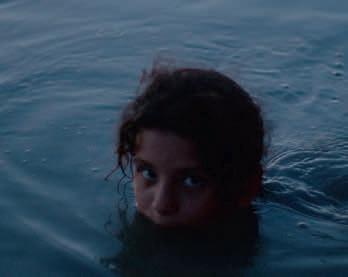
Cover Hawazin Alotaibi, Mirage, 2022. Courtesy: the artist. See: p. 23
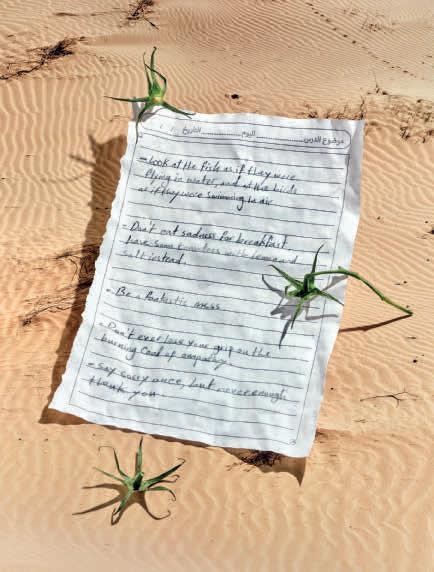
To Do: What’s on the agenda for the art world’s most booked and busy?
One Take: On the occasion of the M.F. Husain Museum’s opening in Doha, a look at his 1980 photograph of cinema hoarding in the streets of Chennai by Carlos Valladares
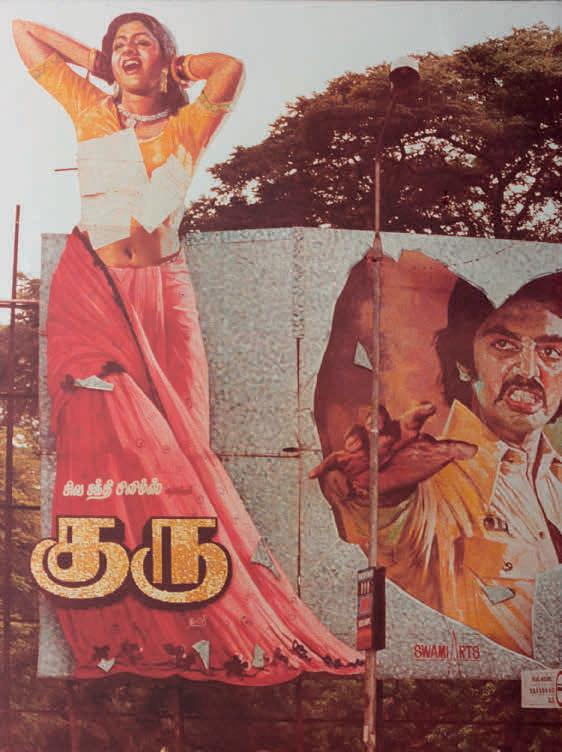
‘FILM’, SAID THE ARTIST M.F. HUSAIN to The Sunday Indian in 2010, a year before he died, ‘is the most powerful medium to articulate your ideas with force. It has actors, dialogues, songs, music and yes, colours.’ Right on. And, in his 1980s photographs of Chennai, he proves this assertion. Film, in these photographs, spills into the street to comment on the daily life – the foot-ballet, biking and breathing – that gives weight to necessary fantasies: song, action, desire. Indian cinema hoarding –oversized, brightly coloured and hand-painted posters that advertise coming attractions – is a marvel of urban vernacular architecture and a critique of everyday life. Its beauty comes across in this Husain photograph, in which a billboard
showcasing the Tamil film Guru (1980), starring Sridevi, grandly adorns a busy street. Sridevi folds her arms behind her head as she belts out a song to the heavens –and, incidentally, to a streetlamp. Her co-star in the film, Kamal Haasan’s titular Guru, cropped into a mangled heart shape, reaches out his hand as if to grab her, or to compel Chennai’s passers-by to continue driving those taxis, smoking those cigs.
One of my favourite cinematic visual gags comes in Nobuhiko Obayashi’s horror-comedy debut House (1977), in which the seven protagonists exit a bus to be greeted by a landscape topped with a babyblue sky and pillowy clouds. Then, Obayashi, in an axial cut, reveals that the scene is actually a painted
M. F. Husain, ‘Culture of the Streets’, 1981–82. Courtesy: Vadehra Art Gallery, New Delhi
backdrop, and an even more stunning landscape than the first emerges: snow-covered mountains, lush greenery, a sky coloured an even more profound blue. Profound, because it’s ‘real’.
I think of that moment in House when I see a complex photograph like Husain’s, with its nested frameswithin-frames, in which observable nature and the quotidian bustle of a city are asked to compete and harmonize with the ‘unreal’ – namely, a metres-tall woman advertising herself as the true guru. We believe this guru, for she is larger than us; we encounter a fantastical being, the star in our midst. A modern icon ∙
Carlos Valladares is a writer, critic, scholar and filmmaker. He has a column in Gagosian Quarterly and Art in America
Networks: SINDBAD Collective brings together generations of artists from around the Gulf, most recently in the back of a truck by Ahaad Alamoudi
SINDBAD COLLECTIVE formed in Jeddah, Saudi Arabia, in 2021, out of a need for a shared space. At the time, many artists still felt there was a gap in the growing arts scene for a flexible platform where they could test ideas or share early works without institutional pressure. So, we created one of our own, imagining an artist-led framework that tried to move beyond the conventions of the traditional exhibition. Very simply, we gathered to show work and see what could grow out of the act of gathering itself.
The first SINDBAD iteration took place in my studio. We expected a small crowd. Instead, nearly 500
people showed up. It was immediately clear that people were hungry for something communal, unfiltered and alive. For the second iteration, ‘SINDBAD: Land of Fragile Hearts’ (2022), we moved into Naqsh Art Studio. That show focused on vulnerability, on how artists hold, protect and sometimes reveal their own fragility. It unfolded at a moment when the region itself was undergoing visible shifts: people were moving, cities were transforming and conversations about belonging were intensifying. The works reflected that atmosphere. They ranged from the deeply personal to the playful, and our space became an environment
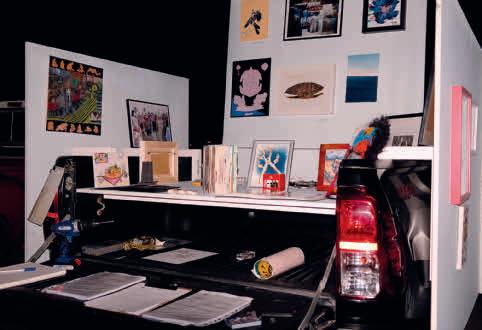
SINDBAD Collective, ‘SINDBAD: On the Road’, 2025, exhibition view. Courtesy: © SINDBAD Collective
in which visitors could sit with uncertainty and with the emotions of a region in motion.
The third iteration, ‘SINDBAD: I Can See Land’, occurred in Jeddah’s historic district as part of the Balad Al-Fann festival, where we launched an open call. The timing was intense: we launched on 7 October 2023, a moment that felt emotionally raw for many across the world. We questioned whether it was the right time to organize a show, but submissions poured in from people of all ages and backgrounds, and we discovered that people needed somewhere to process and respond to the events of that day. Despite the heaviness
We respond to the moment, its urgencies, gaps and atmospheres.
of the moment, the exhibition felt unexpectedly hopeful.
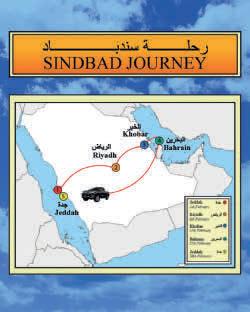
In early 2024, ‘SINDBAD: On the Road’ mobilized these ideas of collectivity and responsiveness by transforming the back of a truck into a travelling exhibition. We set off from Jeddah on a tour of the country, collecting artworks along the way. The exhibition format was subtle – three foldable pieces of wood that expanded from the back of the truck – yet it allowed us flexibility in travelling and meeting a mass audience across the country and beyond. At every stage of our journey, we received support from the arts community. We began in Jeddah, where Wasl Art Space welcomed the project and helped shape its first moment on the road. From there we travelled to Riyadh, where
Lammat by Aimes and Beast House in JAX District opened their doors, turning the truck into a gathering point for conversations and new contributions. In Khobar, the Bohemia cafe became a brief home base, shifting the atmosphere and inviting a different kind of intimacy. Across the causeway, in Bahrain, our host Al Riwaq Art Space in Manama reframed the project within a broader Gulf conversation. In Jeddah once more, we returned to Naqsh Art Studio, which supported a final moment of exchange before we continued to AlUla for The N.E.S.T., where we launched a publication, bringing together essays, poems, reflections and interviews, as well as the complete list of artists who contributed works during the journey.
We travelled with a small radio station and broadcast conversations, open mics, DJ sets and live reflections by artists and visitors. These encounters defined the exhibition along the way. In one city, a father approached us mid-installation and asked if we would include a drawing by his daughter. Hours later, he returned with her sketch of Hello Kitty and Kuromi. In another town, someone offered us a goldfish. We debated for hours whether we could responsibly care for a fish on the road. It ended up being the only artwork we didn’t carry from city to city, though we met the fish again at the final exhibition. These moments revealed the trust people placed in us, the willingness to offer artworks, stories, objects and memories. After the tour, messages poured in from cities we hadn’t reached: ‘No one ever comes here. Please bring SINDBAD to us.’
Those invitations reminded us that mobility is not just a format; it’s a gesture of care. Movement has always shaped SINDBAD. It allows the exhibition to meet people where they are, crossing not only geographies but overlooked social and cultural boundaries, too. Our philosophy is rooted in the belief that art is not a product but a process, an exchange that builds communities. We like to think of SINDBAD not as a fixed state, but as fluid in nature. Flux is instrumental to the way we work and think. We have never followed a fixed plan – we respond to the moment, its urgencies, gaps and atmospheres. We don’t yet know what the next step for SINDBAD will be, or whether it will take the form of a journey at all, only that the collective will continue to evolve with its context.
The truck was just one way of imagining how artists and communities might meet. Now, we are thinking of the multiple ways in which we can navigate borders. There are no limits. We think through the internet, through built and ephemeral infrastructures. But what really matters to us is staying responsive and allowing the work to remain open and alive, wherever it may go next ∙
3 May.
D a p h n e Wr i g h t
17–18 Golden Square, London W 1 F 9 J J
E x p e c t a t i o n s
Until 18 April 2026
J o h n R i d d y
D o r o t h y C r o s s
1 May– 20 June 2026
Biennale of Sydney, Australia
14 March– 14 June 2026
S h i l p a G u p t a
Hamburger Bahnhof – Nationalgalerie der Gegen wart
Berlin, Germany
27 March 2026– 3 January 2027
M a ł g o r z a t a M i r g a- Ta s
Kunsthal Charlottenborg, Copenhagen , Denmark
12 March– 16 August 2026
Talbot Rice Gallery, The University of Edinburgh, Scotland
7 March– 30 May 2026
R a q s M e d i a C o l l e c t i v e
Diriyah Contemporary Art Biennale, Riyadh, Saudi Arabia
Until 2 May 2026
D a y a n i t a S i n g h
Archivio di Stato, Venice, Italy
16 April– 14 August 2026
Museo Nacional Centro de Arte Reina Sofía, Madrid, Spain
J u a n U s l é
Until 20 April 2026
Transfer, transfer some credit from your heart, so I can top up my feelings with it. The service, the service in the pulse of my veins has been cut off, my love. Every time you reconnect, you bring the pulse of our bond back to life.
— ‘Saleh Al-Roushan’, as sung by Mohammed Taher in Arab Idol, 2011
WE HAVE PHONES BECAUSE we have language, and we have language because we’ve been initiated into a symbolic order whose main drive is a quest to affirm our own aliveness. To connect. To communicate. To engage in utterances and affirmations that capture our reality and construct meaning. Long before AI companions, burner phones offered the anonymity and impermanence that comes from disentangling the body from erotic projections. These cheap, prepaid SIM cards – often bought without a long-term contract and housed in disused devices – offered a mode of connectivity untethered from contracts, biometric identities and traceability.
In addition to proof of life, the Gulf Arab states’ history of telecommunication technologies has been tied to grander declarations around state sovereignty and a long lineage of discoveries and economic reforms that swung these states into an era of petromodernity. Oil was first discovered in Saudi Arabia in 1938. The first international phone calls followed in 1955, connecting the kingdom to the rest of the world. In 1983, the car radio telephone by Motorola started appearing on Saudi Arabia’s freshly cemented interstate highways. A girthy device wired into luxury saloons, it signalled the transmission of people and ideas into the future. Enter the personal mobile phone, introduced in early 1997, followed by the prepaid SIM
card, first issued by the Saudi Telecom Company (STC) in 2002. With the transformations and optimizations that have taken place in the years since, the phone and the prepaid SIM have together effectively reconfigured human anatomy, language and consciousness, becoming an extension of our hands, dreams and memories.
The Silicon Valley feudal lords of the cloud envisioned a globalized reality in which technology lumps the entire world into a single category, operating under one universal surveilling eye. But Hong Kong philosopher Yuk Hui pulls this dream back down from the sterile global cloud through his idea of ‘cosmotechnics’. Hui, in his eponymous 2021 book, argues that modernity is not onesize-fits-all and that diverse cultures conceive of, use and reinterpret technologies in different ways. Spinning the burner phone through
this conceptual framework allows us to see why this specific object staked its claim in Gulf material heritage and why it has gone on to serve as a recurring motif in a lot of new and speculative media art from the Arab world.
What was first a status symbol of petromodernity became a cipher through which information and intimacy are siphoned. The burner phone emerged as the first anonymous wallet: a vessel for contact and mobility, operating outside longterm contracts and fixed identities. It grew in popularity alongside the influx of foreign blue-collar labourers, increased surveillance and moral policing, giving it a dual role: as a tool of concealment and a vessel of courtship, rebellion and escapism. While in the past, burner phones meant cheap, dumb phones, in the Gulf region it is increasingly used to indicate a mode of use rather than a type of hardware. It signifies the ability to redirect visibility outside formal recognition. Behind a burner phone, you could be anyone. Today, as a migrant domestic worker, you can set up a TikTok account and have the world in the palm of your hand. You could build a fully-fledged love story in the cloud.
Farook, 23.11.23, 2023. Courtesy: the artist
Echoing this mode of use, a number of Emirati artists are increasingly using found footage in their works, including the likes of Anhar Salem, whose films incorporate crowd-sourced materials and are influenced by platform subcultures, and Hawazin Alotaibi, whose paintings portray images collected from social media platforms, as well as gauche WhatsApp GIFs and stickers. Rami Farook’s works document the feed as though in real time. In his series of paintings on canvas, titled 23.11.23, 29.11.23 and 28.11.23 (all works 2023), we ‘scroll’ through pixellated visions – from the serene sea melting into an imperceptible horizon along the coast of Gaza, to the photojournalist Motaz Azaiza, to joyous scenes of children with fists in the air, to images of mourners to selfies to objects – eyes moving bead-to-bead along this rosary of images ∙
2 May.
Networks: How will Qatar shape our planet’s future? by Samir Bantal
WHAT IF THE REAL STORY of our century is unfolding not in cities, but outside them? For roughly a century, the modern city has monopolized ambition. Opportunity, creativity and progress were assumed to live in density, in the vertical accumulation of people and capital on flat land. The countryside, by contrast, was what you left behind. A staging ground for nostalgia or, worse, decline.
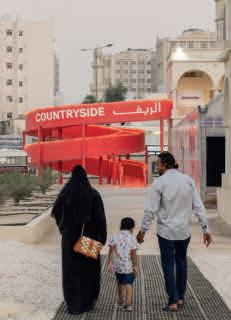
‘Countryside, The Future’, the OMA/AMO 2020–21 show at the Guggenheim Museum in New York, operated through discrete ‘global zooms’ – case studies scattered across continents. ‘Countryside: A Place to Live, Not to Leave’, now installed in Doha at the Qatar Preparatory School and National Museum of Qatar, proposes otherwise. The exhibition advances a single geographic thesis: ‘the Arc’.
The Arc describes a continuous band of predominantly rural, landlocked territory stretching from South Africa through East Africa, across the Middle East, through Central Asia and into eastern China. These are regions that historically thrived on fluidity. The Silk Roads, trans-Saharan trade routes, Indian Ocean networks, nomadic pastoral circuits: for centuries, this terrain operated through exchange and movement rather than fixed borders. Rigidity came later. Today, these regions are home to 80 percent of the world’s population. By 2100, they are still expected to account for more than 85 percent of humanity, with Africa surpassing Asia as the most populous continent. At the Arc’s hinge sits Qatar, the geographic and economic crossroads of this demographic transformation, a strategic coordinate between the continents that will direct our global future.
The backbones of modern cities, from mega-farms to fulfilment centres to solar farms and data centres, all desperately need flatness. Most of the Arc is mountainous.
The breathtaking landscape itself resists wholesale modernization. But resistance is not immunity. Climate instability, infrastructural ambition and extractive demand threaten what topography alone cannot protect. The territories will invariably change. The question is: on whose terms?
Large portions of Africa only exited formal colonial rule in the 1960s, with South Africa and its agricultural structure as one of its last bastions. Previously sabotaged attempts at envisioning African answers to Western order are finding new ground today. Central Asia’s rebirth redraws alliances with its historically important neighbours, after decades in which Soviet nuclear testing and extraction economies shaped borders and dispossessed populations. To speak of ‘tradition’ in the Arc requires acknowledging that tradition was interrupted, deformed, sometimes
invented wholesale by occupying powers. The Arc is not innocent countryside. It carries visible scars. The exhibition refuses to smooth this over, posing instead a material question: what must be repaired, and what must be continued?
The Gulf sits differently within the Arc. Qatar is not mountainous; it cannot rely on topography to resist. So it engineered its own terms. The young Gulf nations have reinvented tradition itself, rebranding the desert from desolation to destination. Inside the late-20thcentury cities, high-rise beachfront developments give way to lush new oases of lower-density housing. Cloud seeding makes the sky rain where water was never guaranteed – a demonstration of persistence: proof that a terrain once considered uninhabitable can be made into a place to stay.
Into this geography, a small device has arrived that scrambles prior assumptions. The smartphone has reached even the Arc’s most remote valleys. It does not preserve traditional life, nor does it erase it. It reroutes, recalibrates the fluidity that connected isolated regions. Shepherds coexist with coding schools installed in barns, training the next generation of ruralists in digital languages while maintaining ancient practices. Isolated communities access global markets, news, education. You no longer need to abandon the countryside to access opportunity; you need bandwidth.
OMA/AMO, Countryside: A Place to Live, Not to Leave, 2025–26, installation view, Qatar Preparatory School. Courtesy: © Marco Cappelletti Studio and OMA/AMO; photograph: Marco Cappelletti Studio
This produces new typologies, hybrid conditions that architecture has barely begun to theorize. Rather than an urban modernity diluted, this rural modernity is something else: networked, dispersed, adaptive. New prototypes for inhabiting the earth.
Perhaps the countryside, technologically enabled and culturally resilient, offers a more elastic model for inhabitation than the city ever did. From Doha, itself a product of hyperbolic urbanization, the Arc becomes newly visible – not as a chain of crises but as an arc of potential. Not a periphery, but a spectrum of futures. The countryside is not waiting to be abandoned. It is preparing for its own futures •
Samir Bantal is director of AMO, the research and design studio at OMA, Rotterdam, the Netherlands.
Networks: Sunny Rahbar reflects on the next generation of Dubai art spaces
WHEN I CO-FOUNDED THE THIRD LINE in 2005, there were only really two other galleries of note in Dubai: Green Art Gallery, exhibiting only modern, mostly Arab, artists; and the Majlis Gallery, focusing on non-contemporary art. But soon, other galleries started opening, and in recent years many international ones have moved here too, for instance from Turkey and Spain. Now we have around 30 galleries, which is a lot for Dubai.
I’m excited about a space called Bayt AlMamzar, located outside central Dubai – in fact, closer to Sharjah – in the childhood home of founders Gaith and Khalid Abdulla. Their grandmother used to live in the beautiful one-storey house, with its little garden, until she moved
away, and then it was just empty. The brothers were interested in the arts and wanted to turn the house into a residency programme and a space for exhibitions. They started in 2021 with very little funding, but it’s now the most important place for burgeoning artists and curators. In Dubai, we’ve had galleries before, but not spaces where curators can put on their first shows. And if you’re an artist, you need a community, you need studio space, and Bayt AlMamzar provides that through their year-long residency. They have introduced a writers’ workshop and created a library. Artists are hanging out there, having conversations.
Most galleries cannot support all of that. We can’t have as much experimental programming because
we also have to survive. When we first started, The Third Line had a lot more programming as there were not many other spaces offering it. But at the end of the day, we are not a non-profit; we don’t have that kind of support.
And while Bayt AlMamzar did not either, they set up a way for it to be funded. It’s very grassroots; many in the arts community here are involved. Individuals and galleries –including The Third Line – act as patrons and fund the space through a membership programme. I love it. It’s the first project of its kind in Dubai.
There’s also a number of young curators who are going outside the traditional art space and finding ways to do intriguing shows. Studio Salasil is a super interesting project run by two young women curators: Sara bin Safwan and Zainab Hasoon. They do shows and pop-ups at galleries and spaces like Bayt AlMamzar, where they held their inaugural exhibition in 2024: ‘Crystal Clear’, a powerful group show featuring many artists who had never shown in Dubai. The exhibition brought together works by Rand Abdul Jabbar, Ali Eyal, Mohammad Alfaraj, Rami Farook, Juline Hadaya, Dima Srouji and others, forming a quiet but charged dialogue across media and sensibilities. The show resisted spectacle in favour of proximity and attentiveness, allowing each work to unfold slowly through the domestic interiors of Bayt AlMamzar. The artists’ practices – rooted in memory, place and speculation – intersected organically, creating moments of resonance and tension that felt personal yet collective. Rather than offering fixed narratives, the exhibition invited reflection, emphasizing process and the subtle ways meaning is shaped through encounter.
Many of this new generation of curators and gallerists previously left Dubai to study abroad and have come back here wondering what they might do differently from our generation. And they are doing it. I’m very excited for all that is coming ∙
As told to Marko Gluhaich












Networks: With date palms and desert oases, the films of Mohammad Alfaraj depict a Saudi Arabia in flux Interview by Róisín Tapponi
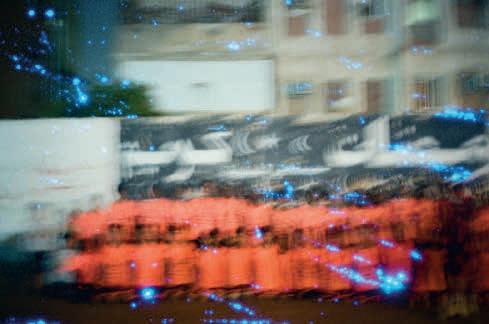
RÓISÍN TAPPONI You were born and still live in Al-Ahsa, which is a rural oasis in eastern Saudi Arabia. How did you arrive at making art?
MOHAMMAD ALFARAJ At a very young age, the moment I put my hands on a camera, I fell in love with it – the mechanics as well as the process of catching fleeting moments before they go away. It made me feel both safe and absolutely joyful about life. I remember feeling as though I could carry along moments, people, faces and places.
When I went to high school, I bought my first DSLR. I started by doing wedding and funeral
photography in the village. It was a nice income for a high schooler, though really just pocket money. But I was beginning to enjoy this idea of the contradiction between photographing weddings and photographing funerals.
I began joining small amateur photography groups in Al-Ahsa. We’d go out, take pictures and talk about photography in terms of composition, the rule of thirds, exposure –all the technical components that you’d study in a photography course. I learnt through the people in those groups as well as in internet forums. Then, in my second year at university,
I decided that I would keep working and taking photographs while studying [his BA was in applied mechanical engineering]. I didn’t know what it would lead to, but I knew I wanted to practise it more seriously.
I learnt by travelling, too – to the US, Europe, Egypt, Japan, Korea –later with support from the Saudi Art Council and Art Jameel. I was able to make an income from photography and documentary filmmaking, which helped me decide to pursue photography and art-making, not just as something I love to do but something I can live by, in every sense.
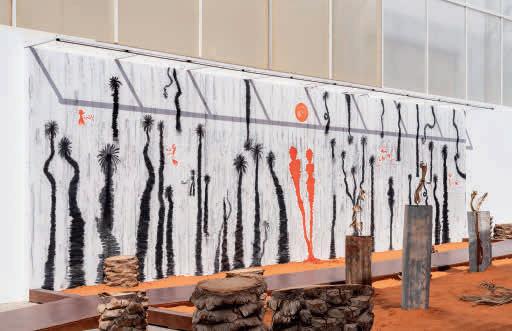
RT Your local environment features heavily in your work. I guess it also taught you a lot, too. What did the date palm teach you about making art? What did you learn from the land?
MA More than anything, the idea of being resourceful, of using whatever you have on hand to create what you want. You don’t need anything besides what is around you – that’s an agricultural and farming concept.
In Al-Ahsa, a lot of people make their resting shacks – arish – not only from palm leaves but also out of doors they find in the streets. It’s very poetic to make a shack, a resting place, a home, a shelter, from doors. It means that it can be opened from any direction.
The date palm also taught me to find metaphor in everything, which can be a bit delusional but makes looking at the world interesting.
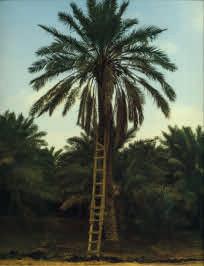
The palm tree is a tree, but it’s also a ladder that you can climb. It’s a bird when the leaves move in the wind.
Mohammad Alfaraj by Arabic literature and other things I read – novels, and the narrative structures of stories from religious texts like the Quran, where there’s a lesson to be learnt.
I always say that the leaves become wings and feathers, and have taken me everywhere in the world. My film
The Date Fruit of Knowledge [2022], which is based around a palm tree and a bird, took me to different places, most recently Japan but also Paris, Switzerland and Qatar. It taught me a lot, and it continues to teach me.
RT The film is about a little bird who wants all the world’s knowledge at once. Could you share more?
MA I write the stories for my films, but they are heavily influenced
The story features three characters – a bird, a dragonfly and a half human, half little insect – who live in a desert oasis. It’s about friendship and supporting each other. It’s about how achieving something too fast or too easily might not be satisfying. The film reflects what’s going on in the region, especially in Saudi, where there’s a lot of change happening. I hope it continues to grow at a pace where we can grasp what’s happening, rather than becoming so fast that we don’t know what we’re experiencing.
RT You draw from ancient and local traditions to produce very
This page
The whispers of today are heard in the garden of tomorrow, 2024, installation view, Diriyah Contemporary Art Biennale. Courtesy: the artist and Diriyah Biennale Foundation; photograph: Marco Cappelletti
Opposite page below ‘Seas are sweet, fish tears are salty’, 2025–26, exhibition view. Courtesy: Art Jameel; photograph: Sean Richardson
contemporary artwork. What is most ancient about the contemporary for you?
MA What’s ancient about the contemporary is this real emotional element, more than the intellectual: trying to express, understand or connect through an emotion or a feeling. That’s why, for me, storytelling and poetry will always be relevant because they speak about something that’s very essential and cannot be dated. How many times can a story be written about love or about freedom? Even if these stories have been written for thousands of years, we still need the affirmation they bring.
RT Your first institutional solo exhibition, ‘Seas are Sweet, Fish Tears Are Salty’, at Jameel Arts Centre in Dubai, just closed. It included your film Glimpses of Now, which you began in 2015 and is ongoing. The work is assembled from phone and handheld footage of daily life across Saudi. How has it evolved?
MA One of the main reasons for making that work, which will always be unfinished, is to have a living document of change and progress, of life just going by. At the beginning of the film, you see one of my nephews, and in the current version, you see him again at the end, but now he’s completely grown.
There’s also a video of some of my friends at the beginning of the film, where they are dancing on the beach in Jeddah, which wasn’t
even conceivable at the time we took that video. Now it’s completely different, thankfully. But the work documents certain changes that are very important to have a record of.
Even the way I shoot and edit the videos has changed with time. As well as documentation, the work is a reason for me to keep sharpening my filming and editing techniques.
RT You have a gallery in Paris, Mennour. You’ve developed a distinctive artistic language that appears to successfully translate globally, despite the hyperlocality of your practice. Do you feel like your art communicates what you want it to across borders?
MA When I’m making work, I don’t think about whether it will appeal to everyone. But as you said, using the ancient and the contemporary and their essential forms of expression is a way to transcend borders, language and cultural specificities.
I’m also attentive to the news and what we are seeing now around the world: the wars, the genocides, the economic mirages that some people are painting for us with cryptocurrency. It comes through me and then it goes into the work in hidden ways. But in general, I want the work to be understandable and based in a childish wonder that doesn’t know any language, any colour, any race at all.
RT What are you in the process of learning right now, as an artist or as a person?
MA I’m learning that empathy is an incredible gift. It’s a curse sometimes, but it’s an incredible gift, and it’s the essence of our humanity. I should cultivate it and grow it even more inside myself before reaching out to others.
RT What are you working on right now?
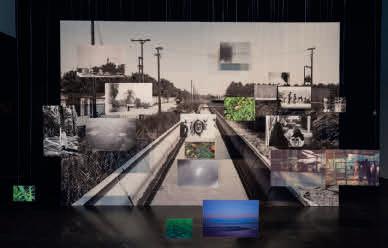
MA I’ve been experimenting with photography collages and trying to turn them into theatrical or stopmotion pieces. I’ve also been taking online courses in puppet-making, puppetry and stop-motion filming. Going to Taipei recently and seeing the puppet shows there was super inspiring.
I’m a bit performative and animated, in the sense that when I make films, I will make sound effects for it, narrate it with gestures and movements, like the way I speak sometimes. I’m trying to push myself even more in that direction: to be sillier, to be more ridiculous, playful and curious ∙
Mohammad Alfaraj is an artist, film director and writer. He was awarded Gold in the Emerging Artist category at the Art Basel Awards 2025. His work is on view at the Taipei Biennial 2025, Taiwan, until 29 March.
Róisín Tapponi is a writer and film programmer. She is founder of Shasha Movies. Her debut novel Scene City is forthcoming this year from Verso Books.

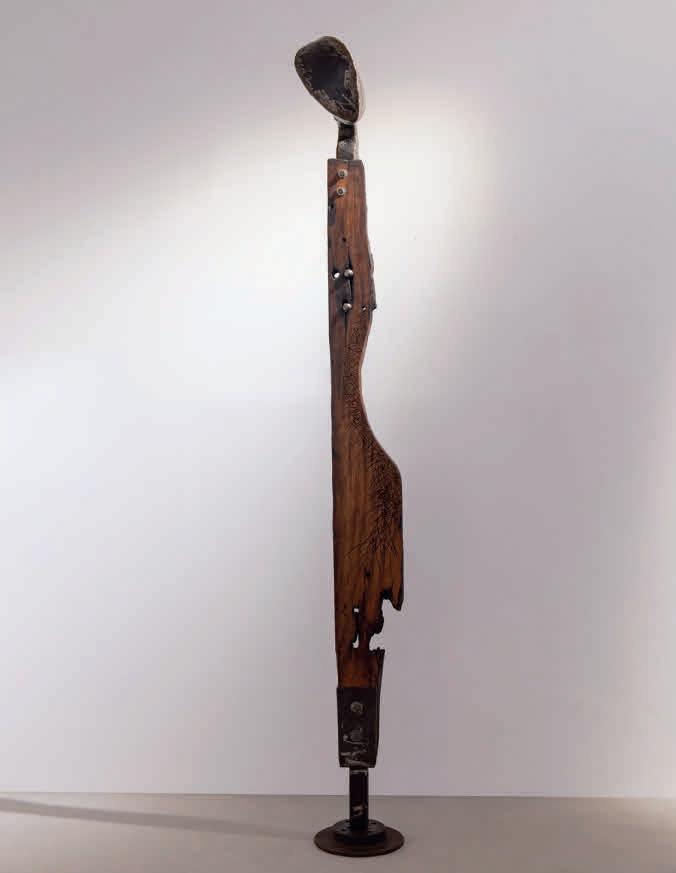
April - 16 May 2026
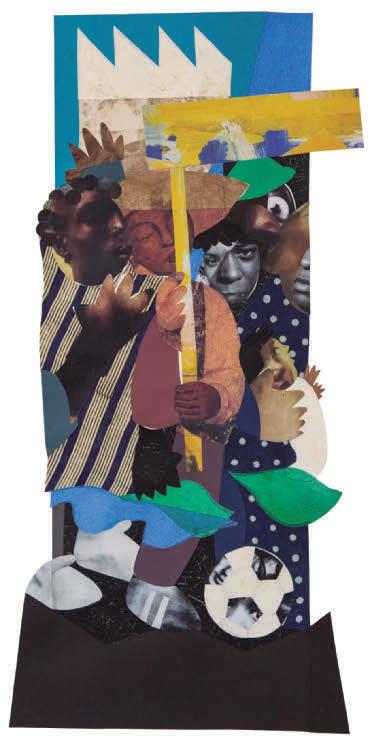
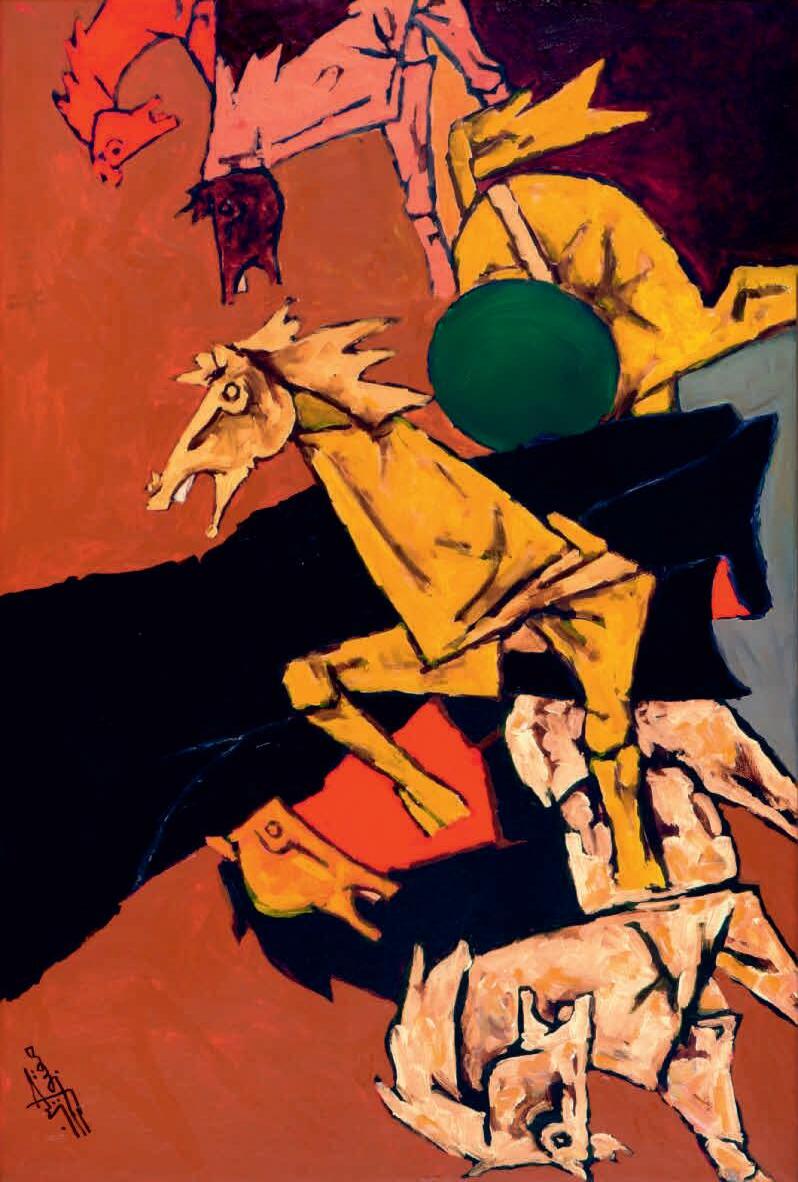
MAR 8–AUG 23


11 March29 May
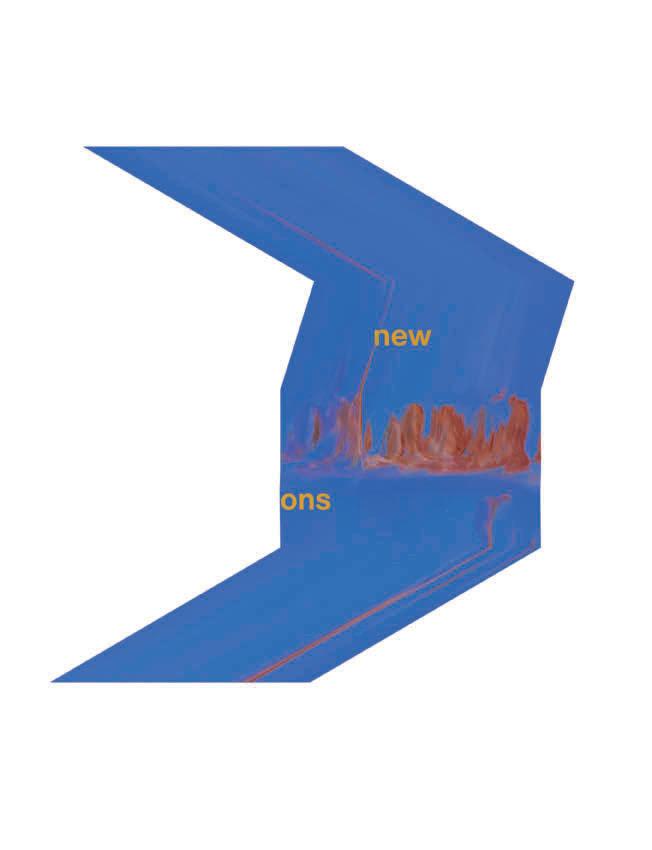

Roundtable: As the region continues to expand and transform at unprecedented speed, what would it mean to slow down and rethink ‘Gulf Futurism’? In this roundtable, artists, curators and gallerists consider two decades of accelerated development, shifting ecological systems, migration and rural-urban entanglements across the region
with Lulu Almana, Faisal Al Hassan, Sara Al Omran, Vyjayanthi Rao and Tau Tavengwa
FAISAL AL HASSAN To offer a foundation for our discussion, I’d like to start by asking each of you to reflect on the past 20 years from your own positionality and relationship to our shared landscapes. I’m interested in teasing out different perspectives on what has changed in our ecological systems, what has been lost or left behind in our anthropological networks and what new growth or beginnings you have witnessed. Maybe we can start with Sara.
SARA AL OMRAN We’ve noticed that there’s been a huge focus on cities as the primary sites where futures are imagined: whether in terms of leisure, economic development or cultural identity. The phrase ‘Gulf Futurism’, for me, carries an association with the vision shaped by the GCC collective and other artists and movements that emerged in the early 2000s – a vision in which cities were central to the imaginary of the Gulf.
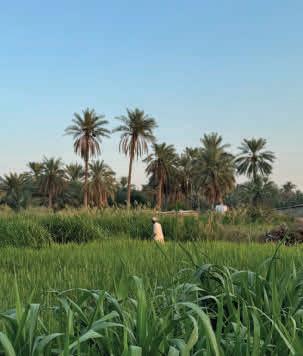
When Lulu and I began our project, Maghras, we wanted to shift the focus onto rural regions and question the assumed divide between rural and urban. The instinct was towards site-specificity. Maghras is situated in Al Ahsa, an ancient oasis in eastern Saudi Arabia. It’s recognized as the largest oasis in the world and is one of the oldest continuously inhabited civilizations in the region. This has meant looking beyond the built environment, towards cultural rituals and forms of expression, and the ways those practices root people to place. One thing that feels very present in the Gulf is the tendency to frame everything through the lens of resource: water as resource, oil as resource. For us, the work has been not only to acknowledge those realities, but also to understand water as culture – and as lived experience.
Previous page
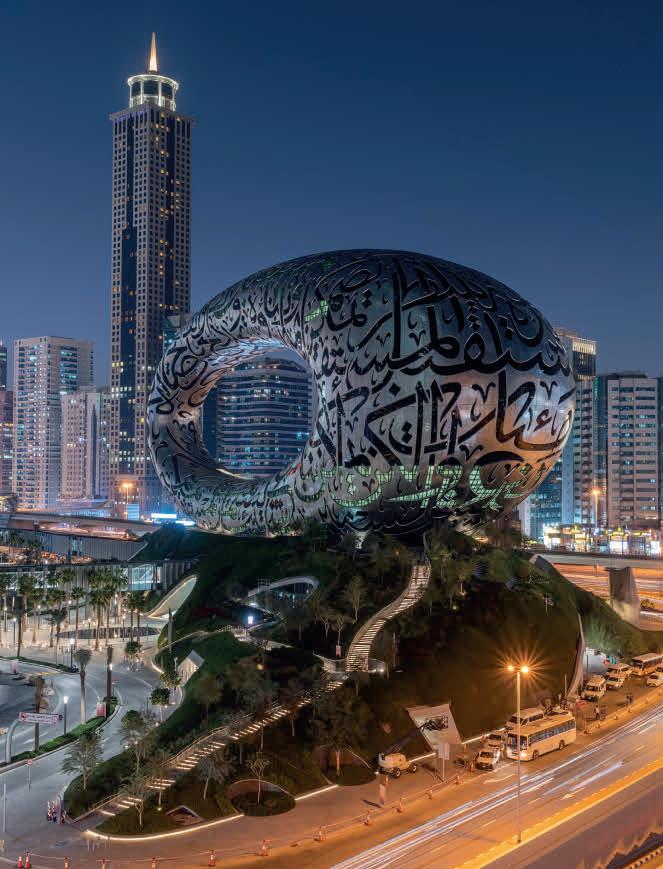
Courtesy: Museum of the Future
Opposite page Al Ahsa oasis.
Courtesy: Maghras
LULU ALMANA This interest in shifting the gaze from the city to the rural stems partly from the fact that the urban often carries more visible markers of ambition. It’s where spectacle happens. But what we’ve been thinking about is a move away from that spectacle, towards something more systems-based, community-based. There’s rarely any spectacle in looking at the rural landscape or the networks and social fabrics that sustain it.
FAH Vyjayanthi and Tau: your relationship to the region is, of course, quite different from Sara’s and Lulu’s, as neither of you are from the Gulf nor currently live here. But I’d like to pose the same question to you both, as curators of the upcoming 2026 Sharjah Architecture Triennial [SAT03 ‘Architecture Otherwise’]. How do you read the past 20 years? What impressions or shifts stand out most clearly from your perspectives?
VYJAYANTHI RAO I grew up in Mumbai, which was then called Bombay, and then spent most of my adult life in the United States. The US is a strange place because it was a centre of empire – and in some ways it continues to be – but it’s also the place where a lot of postcolonial scholarship was given a home. So to be in the company of amazing thinkers from the Global South was foundational for me, though it was always a marginal part of the academic system.
When the first edition of Sharjah Architecture Triennial was announced in 2019, I was fascinated by the fact that we could literally, physically bring that whole conversation to the region, which is surrounded by the Global South and is populated by migrants from all of these countries. That also presented an amazing opportunity to question the locations from which we think and theorize what is happening in these worlds. We don’t need the West in order to make ourselves legible to one another anymore.
Over the past 20 years – in the Gulf and globally –we’ve seen the rise of design, not just as a tool for imagining the future but as a framework for determining how the built environment operates in the present and projects forward. In parallel with this, and tied to the notion of spectacle, much of architectural culture has been preoccupied with producing iconic objects – buildings that signify particular ideologies of modernism and futurism, yet often have little relevance to lived realities. But architecture is everywhere; it shapes everything we do. So the questions become: what does architecture look like when you begin from the oasis? What does it look like when you start from the body? Or when you consider food systems and distribution rather than skylines and symbols?
TAU TAVENGWA For me, working on this triennial has been an education. The Gulf region is a place I’d previously known through the news or by passing through Dubai Airport.
Coming from the African continent, where cities have exploded and urbanization has accelerated dramatically over the last 25 to 30 years, and the scale of change has been faster than anything previously imaginable, what’s striking is how the image of the Gulf has shifted and how it has increasingly become a centre of culture and industry. Where people once pointed to London or New York, now they reference Dubai or Doha just as readily.
We’ve been thinking about a move away from the spectacle.
Lulu Almana
One thing that feels very present in the Gulf is the tendency to frame everything through the lens of resource.
Sara Al Omran
I think that’s a positive thing, but there are aspects of that shift that worry me. Most people’s image of the future of cities – at least from an African perspective – is now being heavily influenced by what’s happening here in the Gulf. There has also been a substantial increase in movement between the Gulf and the African continent, creating relationships and circulations that didn’t exist as visibly before.
What I find particularly fascinating, too, is the scale of Gulf investment in real estate and infrastructure across Africa. In many cases, templates for how to build and develop are being exported directly from the Gulf to rapidly growing African cities. But the patterns that are being replicated are not necessarily improvements on what has come before. This is my outsider’s view – one also shaped by the many conversations we’ve had with architects and artists, in putting together this triennial, around circulation: of people, of money, of ideas. The Gulf, with all its financial muscle, doesn’t seem to be doing anything that differently than, say, some random American investor, in terms of how it’s doing business on the continent – despite the excitement surrounding its ‘newness’.
FAH If I understand correctly, Vyjayanthi and Tau, what you’re bringing to the table with SAT03 is an anthropological take on infrastructure and city design, as opposed to an aesthetic position. Can you tell me a bit more about what you’re planning for this iteration of the triennial?
VR I have a confession: 2025 was the first time I spent any time at all in the Gulf. Like Tau, I’ve passed through it. But for anyone from South Asia, the Gulf has long been understood as a place of opportunity, not necessarily of futurity. Because of the history and scale of labour migration, it has been a place people travel to in order to seize possibility. In that sense, the Gulf shapes places far beyond its borders. And when our gaze collapses onto a single model – say, Dubai as the blueprint for the future – we overlook places like the villages in Kerala, India, where entire communities are marked by the Gulf. Many of these villages are devoid of working-age men because they are employed in the Gulf, yet the landscape is saturated with traces of their absence and return:
large, spectacular houses; shifts in land ownership; agriculture transformed from subsistence rhythms to capital-intensive modes. The presence of the Gulf goes way beyond the physical region.
In this sense, the triennial becomes not only a space to engage the people living here – whether Emirati or from elsewhere – but also an opportunity to think about the extended reach of the Gulf and the ways it shapes other geographies, economies and imaginaries. All this gets lost when we think about the cities of the Gulf as spectacles to emulate.
FAH We can’t talk about ‘Gulf Futurism’ without acknowledging migration and recognizing how the Gulf’s social, cultural and economic ecosystems have always been shaped by movement.
A question for all of you: on a local level, how do you see these migratory patterns or indigenous practices shaping our cities and communities? And on different scales – from neighbourhoods and schools to urban policy or cultural production – where do you see their influence most clearly?
VR One of the effects of migration on a global scale, not just in the Gulf, is that we’ve had to rethink how we define locality. It is no longer defined just by pregiven characteristics, like people who have lived in a place for generations or speak a certain language. Its character is tied to the actions that people engage in to produce the places and the world around them. This also means that we don’t assume permanence as a feature or fetishize certain attachments over others, but rather that we think of locality and culture as constantly open to change while remaining attentive to claims of social justice and reparation in a post-colonial world.
So one of the grounding premises of our triennial proposal was to think through how architecture as a whole can start producing much more hospitable landscapes that allow people to move through them with ease.
SAO Migration is also present in ways that extend beyond the stereotypical or most commonly cited examples of labour migration in the Gulf. In our context –in Saudi and in Al Ahsa – there’s significant internal migration from smaller cities and rural areas to Riyadh.
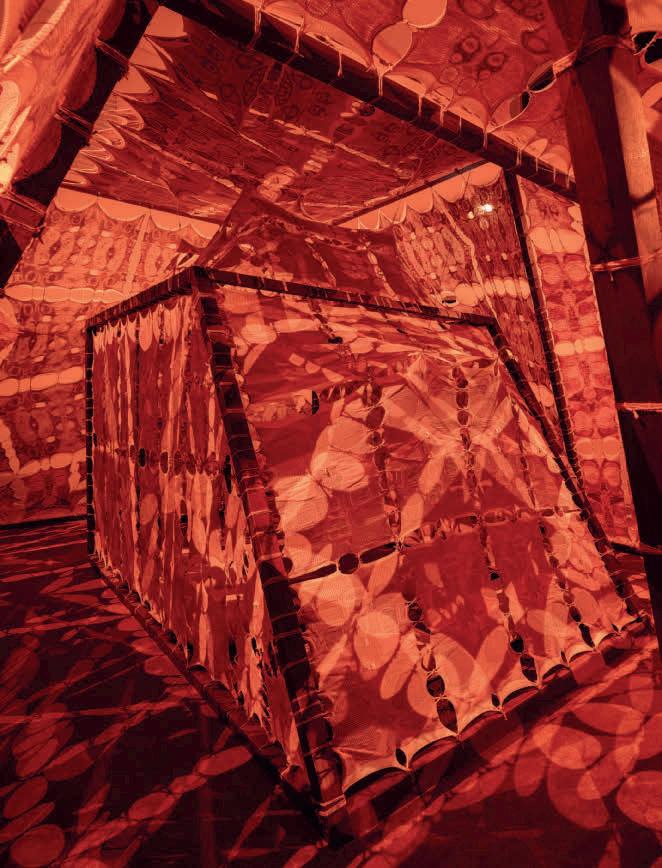
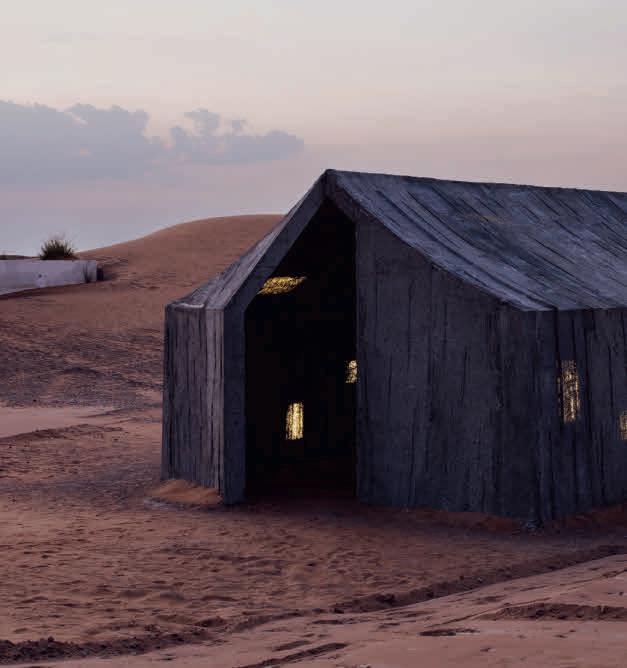
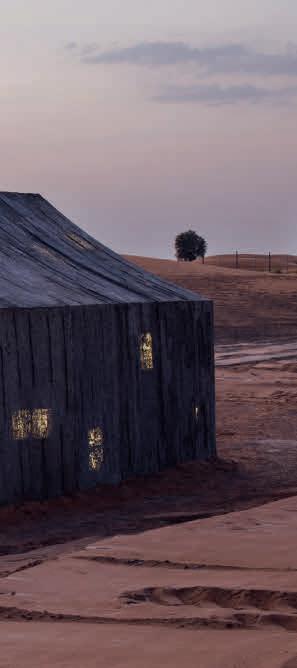
Most people’s image of the future of cities is being heavily influenced by what’s happening in the Gulf.
Tau Tavengwa
This pattern of disappearing men and shifting communities exists not only across borders, but within the country itself.
In our work – through conversations, programming and workshops – we’ve been thinking about how to expand the idea of presence: how to remain connected to a place even when you’re not physically there every day. For us, that’s become an important way of understanding belonging and continuity within a constantly shifting landscape.
FAH Sara and Lulu, perhaps you could speak a bit more about your work with Maghras. I was particularly interested in the project you presented at the Milan Triennale last year with Mohammad Alfaraj, Leen Ajlan and Tara Aldughaither [‘Maghras: A Farm for Experimentation’, 2025]. Could you share your thoughts on working with alternative or unrecorded knowledge systems, including indigenous practices and oral traditions? How might we learn from these systems and integrate them more thoughtfully so that they endure into the future?
LA Yes – and just to return briefly to something you mentioned earlier, because I was really struck by the question of how these ideas eventually materialize in the built environment: I think that architecture and design, especially in the Gulf in recent years, have been heavily burdened by the expectation that they must solve things. There’s an ecological, social and cultural pressure placed on designers to produce neatly packaged solutions to problems such as water scarcity, and the outcomes are often expected to be concise, clean and singular.
Working on Maghras shifted that for me. As Tau said earlier, it became an education – a process of moving away from solution-making altogether. Instead, it became about grounding ourselves in place and community, trusting that meaning, direction and outcomes would emerge over time rather than being predetermined.
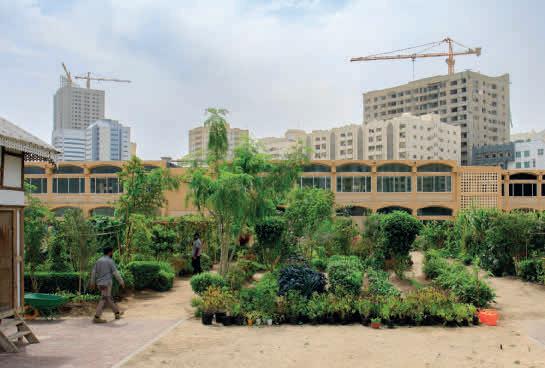
In practical terms, we’ve now been working on Maghras for about a year and a half. It began with situating ourselves physically in Al Ahsa and choosing to establish our base within a working farm in the centre of the oasis. We started with anthropological and ethnographic work. The very first person we brought onto the team was an ethnographer who helped us develop
methods of documenting knowledge through dialogue –listening and asking questions. Interviews with farmers, craftspeople and historians formed the foundation of our primary research. We layered this with archival investigation: working through national archives, media records and corporate archives documenting the infrastructural changes in Al Ahsa. Alongside that, we gathered cultural material – poetry, oral histories, storytelling, songs, myths – tracing how the landscape, and people’s relationship to it, has shifted over the last century.
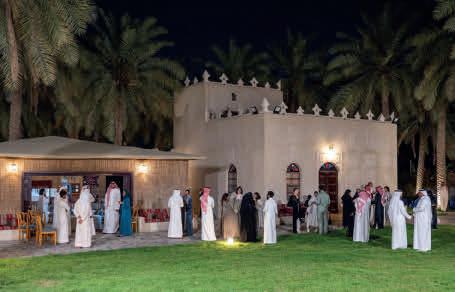
This research became a living, evolving body of knowledge. From there, we were able to develop a range of programmes. Over six to eight months, we transformed portions of the research into briefs for practitioners, who then designed workshops, public events and participatory formats. Eventually, this work led to collaborations with the artists you mentioned, Faisal, and culminated in the Saudi pavilion presented at the Milan Triennale.
SAO Maghras is part community space, part research hub, part farm – and all those elements are interconnected. We began with research, particularly focusing on the 1970s, when a major government-commissioned infrastructure plan – the Irrigation and Drainage Project [IDP] – introduced the first masterplan for Al Ahsa. The IDP replaced the oasis’s historic water canals, which for centuries carried water through winding, organic paths, with a new engineered concrete network stretching around 2,500 kilometres and laid out in a rigid grid.
But rather than focusing on the technical history of water systems, or on understanding Al Ahsa’s past – which is already well documented – we were more interested in the lived experiences of the communities affected by that transformation. Although the IDP was completed in 1971, the effects of that rupture are still unfolding today. From an urban perspective, one of the most visible consequences has been the conversion of farmland into residential neighbourhoods. The project damaged the area’s ecology, reduced water supply and significantly diminished arable land – which in turn made it easier to reposition agricultural plots as real estate.
All farms in Al Ahsa are privately owned. Through our research, we became interested in testing a different model: one in which the farm could operate as a public space. So we began exploring new purposes for farms, and what it might mean to understand the farm differently at this moment in time.
TT Listening to Lulu and Sara, I quickly recognize two themes that are also central to our work with SAT03: ecology and migration, along with the broader challenges that emerge from them, such as affordability and inequality.
For decades, architects have claimed a role in addressing or determining how we think about repairing these issues. Yet, in practice, the profession has become closely aligned with the production of – and turning things like housing into – assets. One reason housing has become unaffordable globally is because it’s treated as an asset class – and architects have been complicit in enabling that shift. So a key question for us is: what are the alternative ways of practicing architecture that don’t inevitably lead down that path?
As Sara and Lulu spoke, what resonated is their emphasis on process. We’re interested in these emergent practices taking place in different contexts – practices
Before we rush to answer what the future looks like, we need to question whether the concept itself is a given.
Vyjayanthi Rao
Opposite page Maghras, Maghras, A Farm for Experimentation, 2024, installation view, Triennale Milano, Milan. Courtesy: Maghras; photograph: Valentina Sommariva
that are deeply local, process-based and don’t involve parachuting in with some kind of expertise, delivering a very site-specific project and leaving. In the alternatives we’re looking at, as in the work Sara and Lulu are doing, it turns out that time is the project; relationships are the project.
How might this help us redefine what architecture is? What is the role of the architect? Our aim isn’t to provide an answer, but to convene people who have committed themselves to these long-term, alternative forms of practice.
FAH There’s also the audience: the people who are engaging with the work that you’re doing. For you, Tau and Vyjayanthi, how are you thinking about audience engagement as you prepare for the triennial?
VR That’s a really great question and something I’ve been thinking about a lot. I want to give an example. SAT03 is also building a farm on its premises – the Al Manakh bio-farm. What I found fascinating is that the farmers who are actively shaping it are a family from Balochistan in Pakistan – a group of brothers, cousins and other relatives. I find this remarkable. It seems like an incredible opportunity because they come from a climate not unlike the Gulf’s, and they’ve brought embedded knowledge and skills that apply directly to the soil here. Just watching them and speaking with them made it clear to me that these are the kinds of interactions we need to make visible.
In thinking about that landscape through the lives of the people who shape it, I see the triennial as a space that must invite the full spectrum of those who live in Sharjah or the wider region – not just architecture students or international visitors, who will inevitably come because these events already generate their own economy of mobility. We’re interested in ensuring that people who live here are part of it – and also in broadcasting the work beyond the limits of the triennial’s time and geography, to the places participants are coming from.
TT For me, the ideal audience for an architecture triennial – or biennial, for that matter – should be the users of architecture, not just the professionals. It’s not a trade fair.
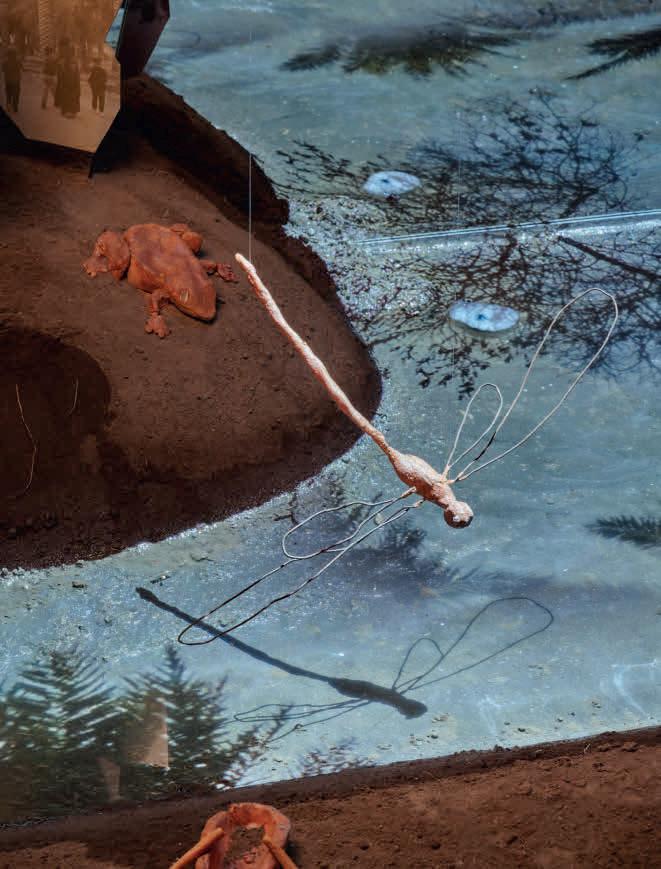
That’s a question we’ve been asking ourselves, especially because Sharjah – and the UAE more broadly –is extraordinarily diverse: in languages spoken, in the places of origin for the vast number of residents, in lived experiences. If we say the audience should be the users of the built environment, then how do we speak to the more than 200 nationalities and possibly 100 languages spoken here? And how do we meet people where they are?
FAH We started this conversation reflecting on positionality and perspective over the past 20 years. But I’d like to shift towards the future – and I’ll leave you with two questions: what does a collective future look like, by way of design? And what does ‘Gulf Futurism’ mean to you today?
VR Earlier, Lulu and Sara alluded to something important: when we talk about practices like architecture, certain categories quickly emerge: ‘climate change’, ‘the future’ and so on. These become conceptual tools that allow us to organize activity and frame issues as problems to be solved.
That mentality is something we need to unpack. Because once you reduce something to a problem –whether it’s climate change or the future – you also make it seem solvable or manageable. At the same time, there’s this idea in design thinking of ‘wicked problems’: those that, by definition, cannot be resolved neatly, or at all.
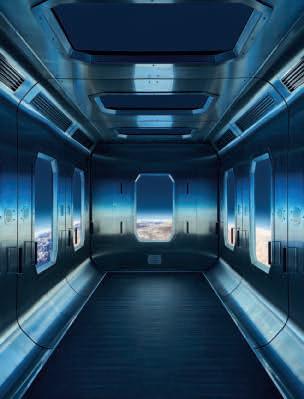
Before we rush to answer what the future looks like, we need to question whether the concept itself is a given. In Dubai, there’s the spectacular Museum of the Future; in Rio de Janeiro, there’s Santiago Calatrava’s Museum of Tomorrow. These buildings assert themselves as places you go to learn about the future, but what they offer is a very specific, curated version of it. That version is something we also need to rethink.
TT Often, we seem to talk about ‘the future’ as if we’re still in 1950s America. That mid-century imagination –The Jetsons, lunar colonies, all the stuff people like Elon Musk are always talking about. It persists, and I find it very old-fashioned. Flying cars, self-driving cars, mining the moon: to me, it’s absurd. Is our imagination really so limited that we’re still recycling ideas from that era?
FAH It’s an important point. We’ve essentially taken ideas from decades ago and applied them wholesale to the present.
LA Years ago, I visited the Museum of the City of New York. There was a section on the past and one on the future. I expected the future gallery to be full of plans and technologies. Instead, it was a wall of Post-its: people writing what they wanted for the city, socially, infrastructurally, imaginatively. It was a reminder that the museum wasn’t dictating the future; it was holding space for it. Many exhibitions now are doing something similar.
SAO In Al Ahsa, one of the most significant forces slowing residential development wasn’t a local initiative; it was the pursuit and granting of UNESCO World Heritage status for the oasis. That designation – an international framework, not one emerging from the community itself – became the most powerful mechanism for protecting the site.
There’s this constant interplay between local agency, international regulation, economic pressures and inherited models. Even when we work from within this context, we can’t escape the influence of these external structures shaping what becomes possible – or impossible – in the future •
The Gulf’s social, cultural and economic ecosystems have always been shaped by movement.
Faisal Al Hassan
Lulu Almana is a landscape architect and co-founder of Maghras. She is founder of Lulu Almana Studio.
Faisal Al Hassan is director of 421 Arts Campus, Abu Dhabi, UAE.
Sara Al Omran is co-founder of Maghras, a community space, research project and farm based in Al-Ahsa, Saudi Arabia.
Vyjayanthi V. Rao is an anthropologist, writer and curator. She teaches at the Yale School of Architecture, Connecticut, US, and will curate the third Sharjah Architecture Triennial, which opens this November.
Tau Tavengwa is a designer, editor, curator and founder of Cityscapes Magazine.
Profile: How growing up between Kuwait and Puerto Rico inspired artist Alia Farid’s investigation into the fiction of cultural borders by Maru Pabón
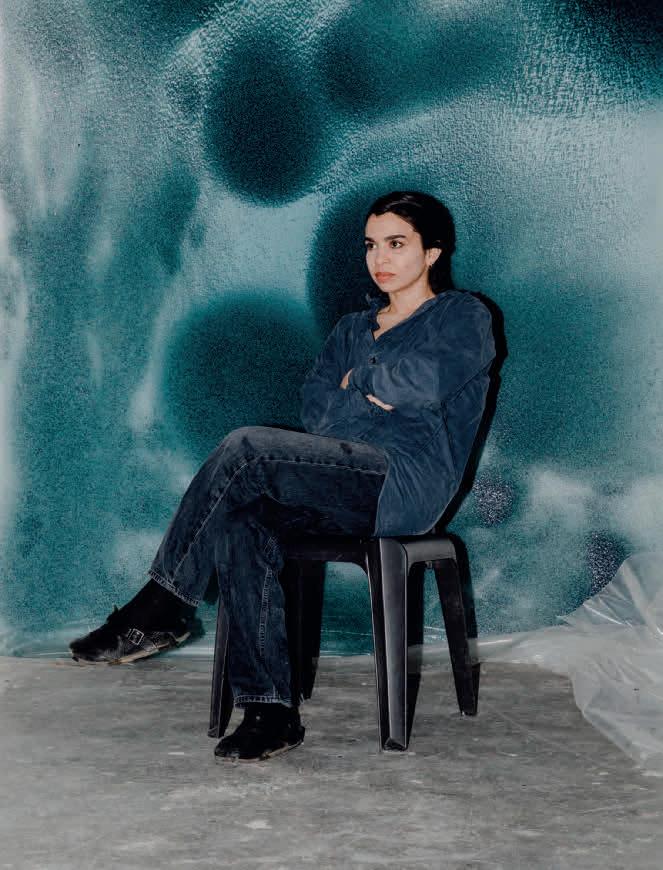
It would be easier if we were driving to her studio, Alia Farid admits to me, hands on the wheel of her white 70s Series Toyota Land Cruiser – if only there were a studio to drive to. We’re travelling along one of the longest marine bridges in the world as an oversized red sun dips behind the Kuwait City skyline. ‘It’s all the studio,’ she says with a half-smile.
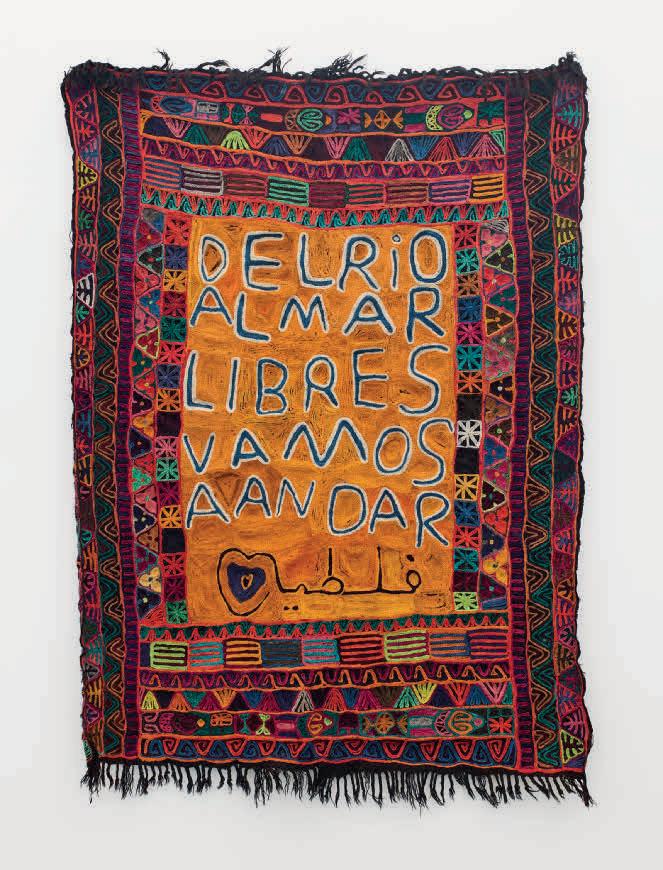
Farid wants to take me as close to the Iraqi border as possible. I won’t be able to cross into Basra and drive into Nasiriyah, the city in which she works with a cooperative of weavers to create tapestries portraying mosques from across the Caribbean and the menus of Arab restaurants in Puerto Rico, where I was born and raised and where she partly grew up. Still, Farid wants me to see enough of the neighbouring landscape that, by the time my trip concludes, I can attempt a particular imaginative exercise: to reconstruct the eastern coast of the Arabian Peninsula as a borderless whole, a region that precedes and, in the long sweep of history, will outlast the divisions between modern states.
‘The tapestries are landscape works,’ Farid tells me, explaining some of the ideas animating Elsewhere (2013–ongoing), her most ambitious social engagement project to date. In the Arab world, she says, there isn’t a tradition of landscape painting; place is mediated through tapestries and architectural motifs. But that’s only where Farid’s exploration of the relationship between the natural landscape and the form of the tapestry begins. ‘I’m interested in the information that can be gleaned from materials. What does the dye used to colour the wool tell us about the land at the moment it was made?’
The daughter of a Kuwaiti father and a Puerto Rican mother, Farid and her two siblings spent their childhoods shuttling between their home in Kuwait and the city of Ponce, on the southern coast of Puerto Rico, where their grandparents lived. The onset of the first Gulf War in 1990 forced the family to relocate to Puerto Rico for several years, where, as one of the few binational households directly affected by the war, they were the subject of sustained media attention. (Farid’s 2017 video work Theater of Operations (The Gulf War Seen from Puerto Rico) stitches together news footage of the war with clips from a proto-reality TV series that a local

Alia Farid
Previous page
Portrait of Alia Farid, 2024. Unless otherwise stated, all images courtesy: the artist and SfeirSemler Gallery, Beirut/Hamburg.
Photograph: Myriam Boulos
This page Theater of Operations (The Gulf War Seen from Puerto Rico), 2017, film still Opposite page Del Rio al Mar (From the river to the sea we will walk free), 2022–23, from the ‘Elsewhere’ series, 2013–ongoing, wool, natural and artificial colourings, embroidery by Sitt Salma, 2 x 3 m.
Photograph: Volker Renner
channel produced about her family.) When the war ended, part of the family went back to Kuwait, but Farid eventually decided to pursue her studies at the School of Plastic Arts and Design in San Juan.
Elsewhere grew out of Farid’s interest in documenting Puerto Rican mosques during her postgraduate years on the island. Since few of these structures were originally built as mosques, they have often undergone alterations that reshape the familiar elements of Islamic architecture. In 2022, Farid received a Creative Capital grant that allowed her to dedicate more time and resources to the project and expand its research focus beyond Puerto Rico. The outcome of this exploration is a series of tapestries that retranslate hybridized Arab-Islamic motifs as they surface not only in the architecture of Caribbean mosques, but also in everyday cultural artefacts: menus from Arab restaurants, the facades of Arab-owned pharmacies and the magazines of Syrian-Lebanese social clubs.
The first chapter of Elsewhere, which focuses on Palestinian culture in Puerto Rico, was presented at London’s Chisenhale Gallery in 2023–24, and tapestries drawing on sources from Cuba were shown at Art Basel Unlimited in 2025. Farid has already completed a body of work addressing the Dominican Republic, and future chapters of the project are planned for Trinidad and Tobago, Mexico, Venezuela, Colombia, Suriname and Guyana.
Discussing these new chapters with me, Farid emphasizes the project’s open-endedness and the growing material archive developing alongside the production of the tapestries. As she and her studio members dig up source images for the master weavers in Iraq, they are also accumulating a vast archive of printed matter: magazines, menus, travel documents, political fliers and records of Palestinian activism. Together, the tapestries and the archive bring into focus migratory routes and diasporic presences that have long fallen outside national narratives of mestizaje and creolization, the processes often said to anchor Latin American and Caribbean identities.
The day after we cross the Jaber Bridge, Farid takes me to Bayt al-Sadu in Kuwait City, a house museum dedicated to the preservation of the style of flat weaving practised by Bedouin women across the Arabian Peninsula. As we walk through the museum, Farid explains that sadu is used to make the soft interior walls that divide the inside of Bedouin tents into discrete quarters for men and women. Known as ibjad, these tent dividers are characterized by their vibrant colours and ornate geometric
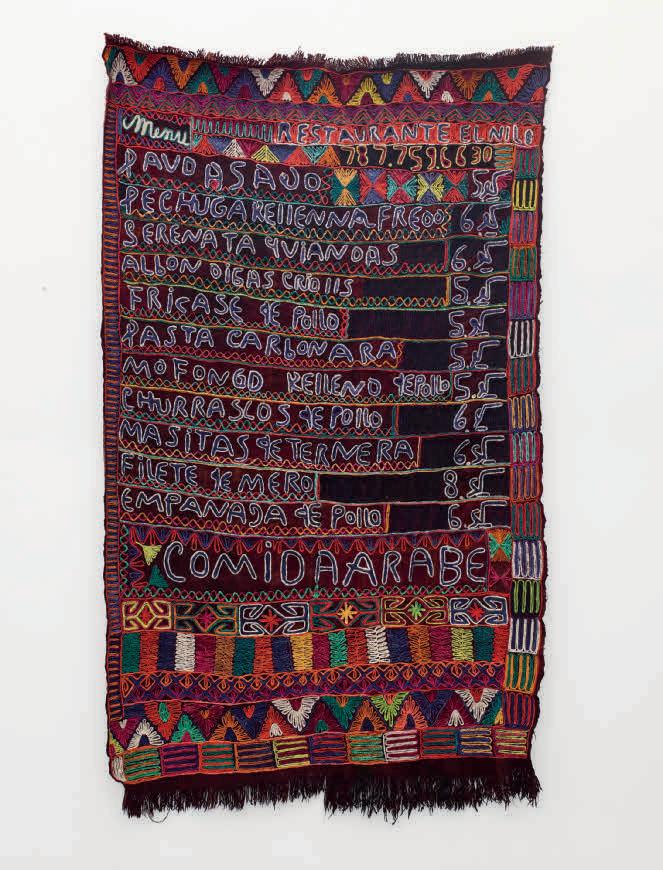
designs. Incredibly, I recognize some of their distinctive motifs from Farid’s tapestry depicting the menu of an Arab restaurant I grew up going to in San Juan.
It’s not surprising that our conversation spirals from discussing the textiles to reflecting on the descriptive language we’re using, given how often we shift between Spanish and English, with Arabic phrases scattered throughout. (Our turn to questions of language is also sparked by the term ibjad, which shares a root with the Arabic word for alphabet, abjadiyya.) Farid notes that she has always been fascinated by the tension between symbols as graphic forms and as carriers of semantic meaning, memory and tradition. We find a perfect example in the museum: a red, white and black ibjad, its borders adorned with a pattern of stacked dots – pictorial representations of date clusters, Farid explains. To us, the glyph also evokes the three dots above the Arabic letter ش (shin).
Of the three languages she speaks fluently, English is the only one in which Farid’s voice carries no traceable accent, no immediate identifier of place. I only realized this the first time I heard her speak Arabic, almost three years ago: we were navigating the Puerto Rican rainforest in another massive car, and she was chatting on the phone with one of the weavers in fast-paced Khaliji. I was disoriented – not so much by the jolt of seeing someone’s personality re-emerge in a new language, as by the confluence of the green canopies of my childhood and an accent shaped by a social world thousands of miles away.
Farid tells me she used to think that, compared to Arabic, her spoken Spanish was relatively unmarked. She was able to hold on to that fiction until the end of her time in Barcelona, where she pursued a master’s in a programme affiliated with the city’s Museum of Contemporary Art. ‘The students were debating who had the most intense accent. I expected everyone to say the Argentines or the Colombians, but they all pointed at me.’ Discussing her life between languages, Farid seemed ambivalent about how accents give away something of your identity that might be easily misconstrued or stereotyped. But accents also disrupt expectations and produce surprising aesthetic effects. Unravelling some of
Farid’s accent was shaped by a social world thousands of miles away.
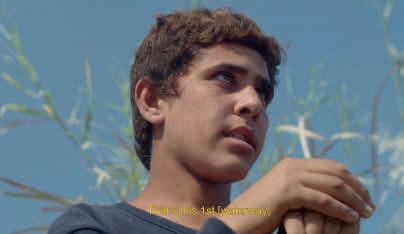
the newest Elsewhere tapestries in her apartment later that day, she excitedly points out places where the woven letters appear askew, almost as if they were halfway between Latin and Arabic script. On one of the menu works, circles that look exactly like the markers that indicate the end of an ayah in the Quran are used to separate the names of different dishes: hummus, yogur con espinacas
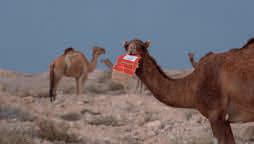
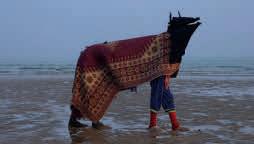
It was also in Barcelona, at a workshop taught by the Iranian director Abbas Kiarostami, that Farid met her friend and close collaborator Muhammad Al Mubarak, a Bahraini filmmaker. Since 2021, Farid and Al Mubarak have been crossing the Kuwaiti border to Iraq to visit communities in Chibayish, a town in the marshlands above the Shatt al-Arab, where the Tigris and Euphrates rivers converge. Before 2021, the last time Farid had been to Iraq was in 1990, when she transited through Baghdad airport, fleeing the war with her mother and brother. Al Mubarak had travelled to the country as a child, on pilgrimage with his family. Their first trips together were exploratory, but eventually their ideas coalesced in the possibility of making a film. The resulting work, Chibayish, was commissioned by the Whitney Museum of American Art and first screened during its 2022 biennial. Their collaboration has continued. When the curators of the 59th Carnegie International approached Farid for their upcoming edition, the artist recognized it as an opportunity to develop another work conceived with Al Mubarak. ‘While filming in Iraq, I’d been thinking of making things that were more sound- and music-based and [which I] wanted to explore with others. And so what I’ll be presenting at Carnegie is a record made with other artists whose work resonates with my own.’ The vinyl album features field recordings made by the artists in Basra and southern Iraq, as well as interpretations of khashaba – a music genre unique to southern Iraq – performed by musicians from Puerto Rico, Egypt, the Dominican Republic and elsewhere. It is another
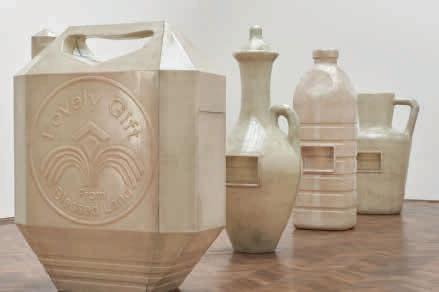
Beirut/ Hamburg and Henie Onstad Kunstsenter; photograph: Foto Julie Hrnčířová/Studio Abrakadabra
example of Farid’s remarkable ability to extend patterns of cultural translation in entirely new directions.
Over the next few days, we spend long stretches of time inside Farid’s Land Cruiser. Like Puerto Rico, Kuwait is a car country. Sitting in the passenger seat, I begin to grasp how central speed and motion are to her process. It strikes me that when humans relied on slower modes of transport, it would have taken many hours, even days to notice patterns: a shape here, the same shape some 200 or 5,000 kilometres away. Moving through space by car, the recurrence of forms becomes impossible to miss; you see the repetitions almost immediately. This is not an apologia for fossil fuels; rather, as Farid says, this is the reality of the landscape and the constrained ways we experience it. Her work is fuelled by the determination to find new ways of understanding the landscape despite and through those constraints.
Our longest drive takes us from Kuwait to Bahrain through Saudi Arabia. With every kilometre, the web of relations compressed within Farid’s tapestries and sculptures comes into sharper focus. Polluted salt marshes along sand dunes; sand dunes dislodged by oil refineries. The destruction of plant life. The vivid turquoise wool.
In Bahrain, we meet up with Al Mubarak and his brother Maitham, an architect, at a balaleet spot in the town of A’ali. Farid and Al Mubarak discuss their shared interest in the Dilmun burial mounds: a series of vast necropolises located near where the brothers grew up. When I ask about the sites’ scope, Maitham takes my phone, switches my Google Maps to the terrain layer and shows me an image of what looks like the moon, its surface studded with perfectly uniform craters. I later realize the concavities are an optical illusion: these landscapes are populated by thousands of earthen domes, containers of ancient history on the surface of the desert.
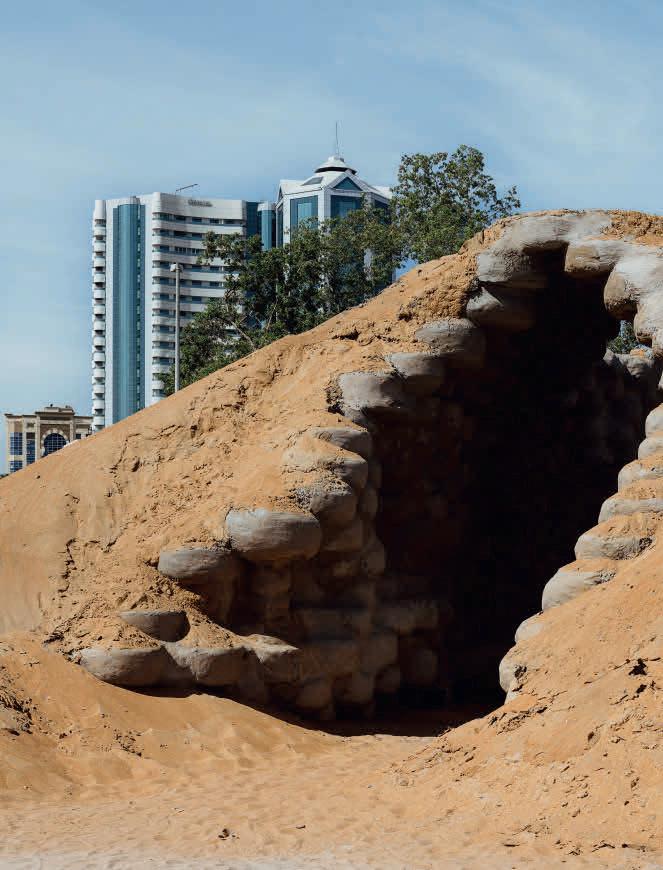
After breakfast, we head to a mound field to the west of A’ali. ‘They haven’t moved for 4,000 years,’ Farid says in awe while clambering up one of the structures. Remarkably, although the Dilmun burial sites are protected by UNESCO, access is not restricted or surveilled. The mounds are a feature of life in A’ali, Farid and Al Mubarak tell me, a striking but ordinary element of the environment. People walk across them all the time, children turn them into picnic spots. No Gulf state has sought to create a glorious prehistory for itself out of the Dilmun civilization.
Over dinner at a Mexican restaurant, it becomes clear to me that the mounds fascinate Farid because they represent a type of architectural endurance that resists traditional notions of monumentality. ‘We’re taught to think of forms as insular,’ she says, ‘as if they belonged to this culture or this nation state only. The fiction of a culture starting here and ending there is absurd.’ She adds: ‘Borders are replicated in the imagination, cutting off the connections that give forms meaning’ ∙
Speed and motion are central to Farid’s process.
Maru Pabón
1,500 Words
by Monira Al Qadiri
Tracing Gulf War afterlives through oil and cross-cultural aesthetics
Iwas born in Senegal. My father was a diplomat, but he quit when I was six months old and we moved back to Kuwait. There was a liberal, progressive atmosphere in 1960s and ’70s Kuwait, but everything shifted after the Iranian Revolution (1978–79). When my parents returned in 1983, they were still in that ’70s mindset. They were interested in communism and had even pursued their higher education in Moscow. After Russia, they moved to several African countries, so their mindset was very different from those of traditional families in Kuwait. Suddenly, they were transplanted into this conservative atmosphere, and they didn’t know what had happened. We were living in this strange liberal cocoon, inside a heavily religious, highly patriarchal society.
My mother was a huge advocate for women’s rights. She trained as a painter in Moscow, but in Kuwait her work was looked down upon for being figurative – if you draw, paint or make sculptures of people, it’s seen as promoting idolatry. So her work made her unique, but it also meant people thought she was very strange. That really affected me growing up – we were almost like outlaws or aliens within our own society. My mother is also a storyteller and a writer, so all the figures in her works have stories behind them, like fairy tales. As a child, these artworks were beautiful to me, but that’s not what the wider society was seeing. This storytelling aspect shaped my practice later in life, but in the beginning, as a kid growing up in her studio, I didn’t want to be like her. I thought: I’m going to do something different; I’m not going to be an artist like you.
When the Gulf War started in 1990, it was like the whole world was collapsing around us; everything we knew was disintegrating. But at the same time, I was seven years old and children have this amazing ability to adapt to new realities, to treat things as if they’d always been that way. In my mind, the war seemed like a video game, a very black and white reality with no nuance: we were the good guys and they were the bad guys. I also had a fascination with the warplanes in the sky – I thought what they were firing looked like
fireworks. My parents were living through hell, but I didn’t really understand what was happening; it became like a dream world to me. My oldest sister, who was 15 at the time, is still traumatized, because she was a young teenager, and that’s an impressionable time of your life. She still can’t talk about it. It’s strange to me that people in the same family, living in the same environment, could have such different experiences of the same event. No matter how much I read about that war – the facts and political analysis – whenever I think about or see images of it, I return to being that seven-yearold child. I can’t be objective about it.
Being confronted with dark, destructive images can be too horrible to comprehend.
In 1991, at the end of the war, the Iraqi military set fire to 700 oil wells in Kuwait. It was like living in a bubble covered in oil. The sky was black; the rain was black; the sea was black; our house was black. As a child, I thought it was visually stunning – but it was one of the worst man-made ecological disasters in history, and many people got ill because of it in the decades that followed. The sense of the sublime that exists in destruction, of finding beauty in tragedy and melancholy, is something that informs my work, and it started then.
There’s a rich history in the Middle East of finding catharsis in sadness itself – where sadness is seen as a noble emotion. It’s not like the Western psychiatric concept of sadness as a failing, where something’s wrong with you. I was always drawn to the idea of sadness as something to be celebrated, but didn’t have words to analyze why. It was the Japanese linguist Toshihiko Izutsu who deciphered this for me. His theory is that living in a very harsh desert environment allows people to enjoy even the difficult moments in life. It actually creates a different sense of self, a different emotional landscape.
My desire to escape – this extreme feeling of wanting to get out of this place – also began during the war. The outlet I found for that was Japanese cartoons dubbed in Arabic. I told my parents, ‘I want to go there,’ pointing at the TV, ‘I’m going to go there.’ And it actually happened. After the war I started teaching myself Japanese, and in 1999 I moved to Japan for art school and later my PhD. It was a crazy, formative part of my life.
Previous page
BENZENE FLOAT, 2023–24, installation view, ‘Chameleon’, ARKEN Museum of Contemporary Art, Ishøj, 2025–26. Courtesy: ARKEN Museum of Contemporary Art, Ishøj; photograph: Anders Sune Berg
This page
Behind the Sun, 2013, video still, commissioned by Beirut Art Center. Courtesy: the artist and Perrotin
Opposite page, above and below Holy Quarter, 2020, video still, commissioned by Haus der Kunst, Munich. Courtesy: the artist and Perrotin
The feeling – that overnight, this place could disappear – started with the Gulf War.
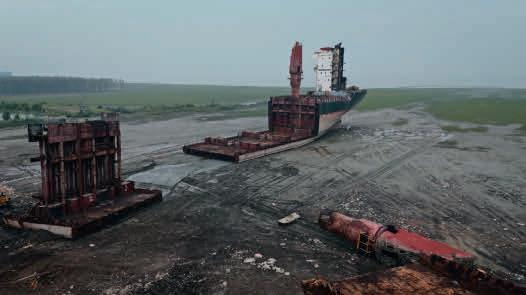
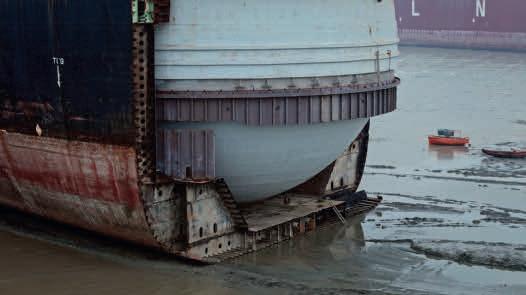
I’m attempting to imagine the Gulf from a future perspective, where oil has long become obsolete.
After ten years, though, I became extremely disillusioned with being in Tokyo. After graduating from art school, all my friends started working in big corporations and stopped being artists. I felt like a mutant at that point, in terms of my cultural identity – I didn’t know where I belonged. I started thinking about my own family history. In Japan, there’s an emphasis on ancestry, but it’s not like that in Kuwait. I think that comes from desert life: when someone passes away, you have to forget them, because the desert will never let you visit them again. In some cemeteries, there are no names on the graves – it’s considered bad luck to remember. I thought it would be interesting to take that idea back to Kuwait and think about the patriarch of our family: my grandfather, who was a singer on a pearl-diving boat. He’s an enigma in our family history, and I started thinking about him as my ancestor and tried to create a relationship with him somehow.
That preoccupation led into the work I’m doing today – trying to link the pre- and post-oil worlds through colour and form, through pearls and oil. It’s a biographical train of thought that I started exploring. I started thinking of oil as a kind of monster or alien that landed in the Gulf. It changed our lives in so many ways, yet it also feels like a temporary, transient project that’s going to collapse. That feeling – that overnight, this place could disappear – started with the war. At the same time, it projects this wonderfully melancholic, dystopian perspective on the future.
I think of the pre-oil world as iridescent, akin to the colour of pearls. That’s the colour of history in the Gulf: people risked their lives for years to find pearls in the ocean. People only find pearls valuable because of their iridescent colour that tricks your eye and changes with the light. I find it such a strange, arbitrary part of human evolution. Then, after pearls, it was oil – but as a source of wealth, it was much more obscene. So the idea in my work is that this iridescent colour shifts from pearls to oil, and it will shift to something else in the future. The colour itself is almost a sentient being – this genie with a different kind of power. That’s the mythology I’m trying to create.
I’m attempting to imagine the Gulf from a future perspective, where oil has long become obsolete, and I’m making monuments to eulogize this era before it ends. 500 years from now, people might look at these drills and not know what they are – perhaps they’ll think they’re ceremonial objects or crowns, or sea creatures. There’s this time-travelling element, where I’m jumping towards the future but also talking about oil, something that’s hundreds of millions of years old –so there’s also ancient geological time embedded within the work. I want my works to reflect on this era as a freak interval in history, where these strange people cultivated this substance and destroyed the world with it.
My work Holy Quarter [2020] is about the British explorer Harry St John Philby, who went to the desert looking for the ‘Atlantis of the Sands’, a mythical lost city called Ubar. He found black stones in the desert, and people told him that they were the pearl necklaces of the women who used to live in Ubar: they had been too decadent, so God punished them and burnt down the whole city, until only the black pearls of their necklaces remained. I really feel this is the story of the Gulf.
I want my works to reflect on the present as a freak interval in history.
I recently made a new film called Oh Body of Mine [2025], about disused oil tankers that get dumped on a beach in Bangladesh. I wasn’t able to film it myself, so I hired a local film crew, who went out for a day with a drone and filmed the ships. The location looks like a movie set from a dystopian science fiction film. I debuted the work at the Berlinische Galerie, and everybody thought it was made with AI. That response echoes what happened around the war in Kuwait: a lot of people didn’t believe that was real, either. Being confronted with dark, destructive images can be too horrible to comprehend. Our sense of reality is always distorted by our emotions.
From 2013 to 2018, I was part of a collective called GCC. It happened spontaneously: all of us arrived in Dubai at the same time for an art fair, all dressed in black. We were architects, artists, writers, curators, musicians and video artists. We took the name GCC from an official intergovernmental body called the Gulf Cooperation Council. We wanted to engage with the idea of the future in the Gulf, but not from our perspective –rather, from this ‘official’ perspective. What would the GCC imagine the future looking like? In the Gulf, your work can’t directly be about political or social subjects, or you might step on some toes and get in trouble. Humour was a weapon for us: if you engage with these topics in a humorous way, you can get away with a lot. Being in the collective informed my solo practice, too. It helped expand my view of being an artist – it expanded my world ∙
As told to Vanessa Peterson
Interview: Ahead of Dana Awartani’s presentation at the Saudi Arabia Pavilion for this year’s Venice Biennale, the artist speaks to Fawz Kabra about repair, craft and the ethics of making
‘When you’re working with craft, it requires your full attention and embodiment.’
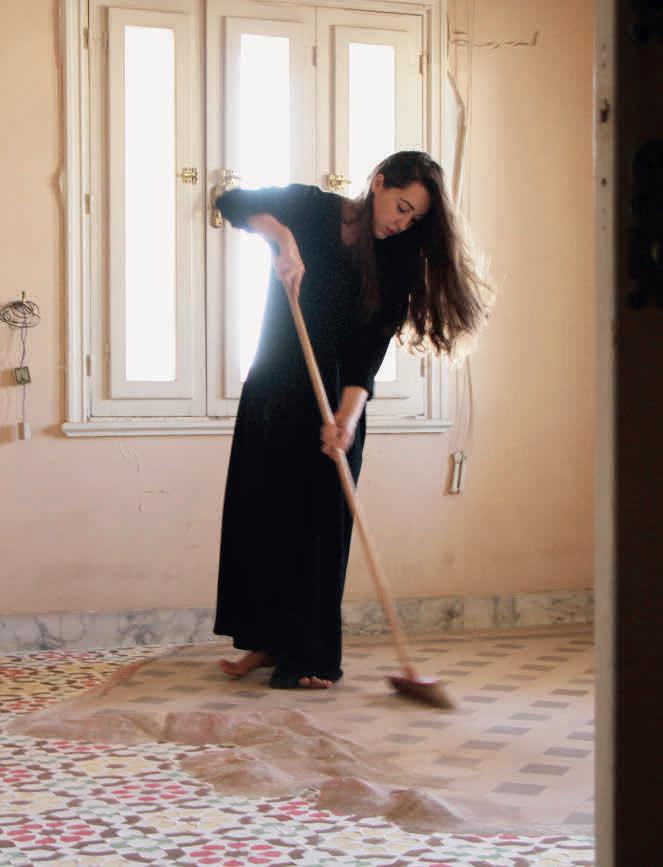
FAWZ KABRA Your work often involves physical gestures, such as laying bricks or tearing and darning silk, which you’ve described as acts of mending and continuity –stitching ruptures, as it were. How do these embodied processes shape your understanding of repair, both artistically and ethically?
DANA AWARTANI If we turn to some of my textile works that use darning as a craft form, such as the series ‘Come, let me heal your wounds. Let me mend your broken bones, as we stand here mourning’ [2019–ongoing] and the series ‘Let me mend your broken bones’ [2023–ongoing], they are all about repair, but also ancestry. Looking back, for example, at our grandparents’ generation: they used to repair their clothes. They wouldn’t throw a shawl away: they would mend it.
Central to my practice are the ethics and history of craft, and the knowledge behind that – a knowledge that has nearly died out in the Global North and is struggling to survive in the Global South. This includes places like Syria and Palestine, where forced displacement and conflict have led to the extinction of crafts and craftspeople, as well as places where modernization and machinery have taken over.
I see reverting to the handmade as an act of resistance against contemporary Western canons, because making something by hand is such a slow process in an art industry that constantly wants more inventory at ever higher speeds. When I work with craftspeople, I don’t say, ‘Okay, let’s make ten editions of this artwork.’ It would be unethical to ask that of them because it would be creatively numbing. When you’re working with craft, it requires your full attention and embodiment.
FK It sounds like the slowness of making is a political gesture for you.
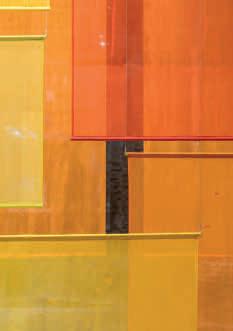
The thing I love about geometry is that it transcends borders and religions.
Dana Awartani
Previous page
I Went Away and Forgot You. A While Ago I Remembered. I Remembered I’d Forgotten You. I Was Dreaming, 2017, video still. Unless otherwise stated, all images courtesy: © Dana Awartani
This page Come, let me heal your wounds. Let me mend your broken bones (detail), 2024, darning on medicinally dyed silk, 5 x 13 x 3 m, installation view, ‘Foreigners Everywhere’, La Biennale di Venezia, 2024. Photograph: Venice Documentation Project
Opposite page Where the Dwellers Lay, 2022, sandstone and oxidised steel, 3 x 3 x 2 m, installation view, ‘Desert X AlUla’, Saudi Arabia, 2022. Photograph: Lance Gerber
DA It’s political, but also spiritual and meditative. After finishing my master’s degree at the Prince’s School of Traditional Arts in London, I went on to study with a master in manuscript illumination in Turkey. To practise that religious art form you must study for an ijazah [a licence that permits its holder to transmit a certain text or subject, particularly Islamic religious knowledge]. Like calligraphy, it’s steeped in spirituality. Before we could use a new pot of gold, for instance, we would read ‘Ayatul Kursi’ [the Throne Verse from the Quran].
I now find craft spiritual in its repetitive act. Whether you’re working with wood or ceramics, there’s a specific methodology to how things are done, and that really disconnects you from the rest of the world. Geometry, and how it relates to the arts, formed a core part of the curriculum on my master’s, and our professor used to tell us never to practise geometry if we were stressed or anxious, because it won’t work. It requires a certain focus and state of mind.
FK It’s wonderful that you mention this, as I was hoping to discuss how you use geometry as a structuring intelligence in your work. I’m thinking about how you employ geometric patterning – evoking the tiled floors found in Islamic architecture, for example – as an extension of a particular tradition and a system.
DA Geometry flourished during the Islamic Golden Age, even though it’s rooted in Greek philosophy. They took it and continued it, because as Muslims we don’t believe in iconography.
But the thing I love about geometry is that it transcends borders and religions, which is something I really identify with. As somebody who is Palestinian and Syrian, with Jordanian nationality, born and raised in Saudi Arabia, my cultural identity isn’t straightforward, so I was always asking myself, What is my culture? What is my identity?
FK The idea of repair is echoed in the way you think about buildings and ruins not just as physical forms, but as emotional and cultural vessels. In your work, you consider the built environment as a site of belonging and collective memory, such as in Standing by the Ruins [2019], an installation of compressed earth shaped into geometric tiles that recalls the destroyed architectural heritage of the Arab world. How do you approach translating these intangible histories in your work?
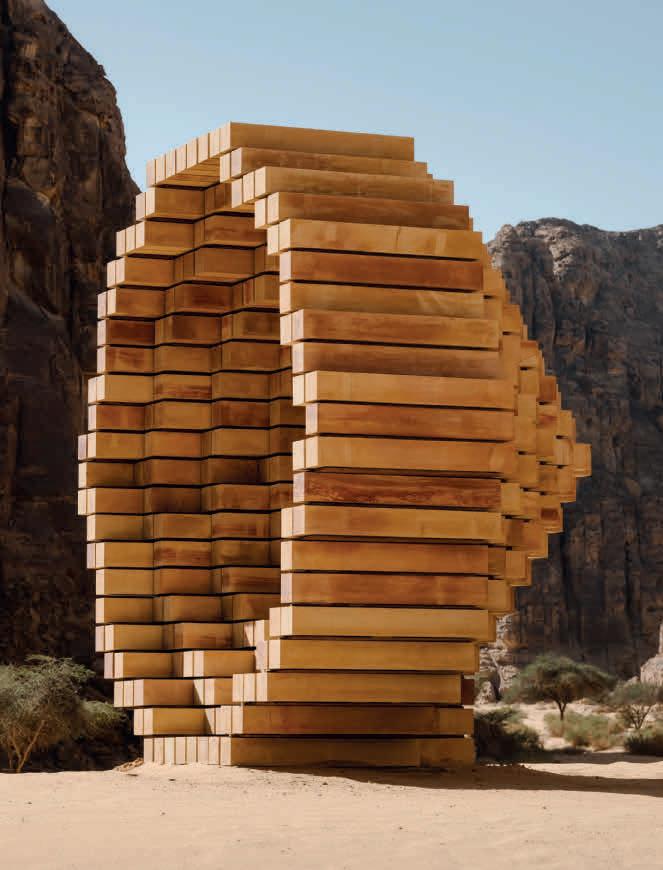
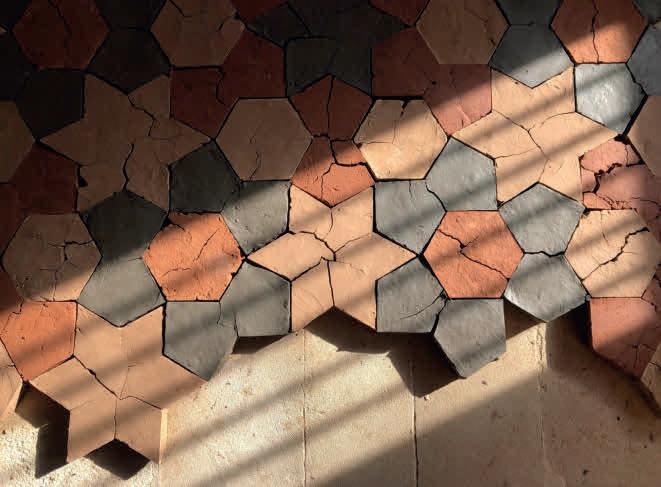
I look at the work as something that embodies a life beyond me and my practice –I’m just a transmitter.
Dana Awartani
DA This goes back to my education, which frames a lot of what I’m doing today. First, I did a bachelor’s degree in fine art at Central Saint Martins in London. I felt there that I was taught how to think critically, but I didn’t learn much about how to make things. Medium and materiality were not seen as important at all. Then, when I went to the Prince’s School, it was the opposite. They said: ‘We don’t care that you’re a contemporary artist. We don’t want to hear what you have to say.’ As I’ve mentioned, a lot of crafts are rooted in sacred arts, so as a craftswoman, you’re a transmitter of knowledge.
I found both of those approaches quite problematic because one is stuck in the past, and the other is rooted in a more Western, conceptual approach. Even in Saudi Arabia, where I grew up, we were never taught geometry, manuscript illumination or miniature painting. The first thing I learnt in high school was how to draw a still life, a bowl of fruit, which has nothing to do with Arab art history. All the things that are part of our history were simply not taught.
I’ve tried to fuse both experiences in my practice. How do you take these craft traditions and the intangible heritage that are part of our history and contemporize them so that craft isn’t stagnant or stuck in time, but becomes a way to create an evolution from the traditional to the contemporary?
FK I wanted to touch on how fragility becomes a language in your work. For example, in Standing by the Ruins II [2024] you leave the clay bricks unbound – their material is strong, yet they are fragile in their arrangement. What does this intentional usage of fragility allow you to communicate?
DA That series was inspired by the traditional adobe houses and mud structures found in Saudi and parts of Syria. People mix hay into the mud to solidify the structures, but I wanted to introduce intentional cracks, so there’s this balance between the perfection inherent in a lot of craft practices and something that disrupts it as well.
The title references a whole genre of Arabic ‘ruin’ poetry called Atlal, which is something that we’re unfortunately good at – ruins have been part of our history forever. The trope originated in the Mu’allaqat [‘Suspended Odes’] poems of the 6th century, but many modern poets still reference it today. I like to incorporate poetry into my titles, and I write them in the first person because I look at the works as something that embodies a life beyond me and my practice – I’m just a transmitter.
FK There’s a dimension of resistance in your choice of materials, which carry histories of displacement and colonial entanglement. How do you think about material provenance as a political gesture in your work?
DA The materials I work with are rooted in where they originate. For the stone carving series, When the dust of conflict settles [2023], I chose stone because so much of Syrian architecture is built from it. One of the major challenges in restoring Syria after the fall of the Assad regime [in 2024] is that there are so few craftsmen left –they have left or been killed.
For that project, I collaborated with the World Monuments Fund, who train Syrian refugees in Jordan in stonemasonry. Rather than parachuting in Western experts, the focus is on empowering and teaching locals – it’s about supporting crafts and thinking about
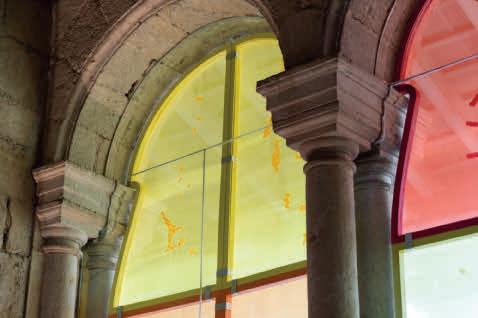
ethical ways of producing, and funnelling money not to factories or production houses but to communities and people.
The same thinking underpins my textile works. India has long been a centre of textile production, and for those works I was particularly interested in how chemical dyes – among the major pollutants of India’s rivers –represent an unsustainable and toxic mode of production.
At the same time, Ayurvedic medicine remains an active part of everyday life in India. Rooted in traditional knowledge systems, it has also given rise to natural dyes with medicinal properties. That history, and its continued presence, is what led me to work with these processes.
FK There’s a politics of care in your work on repair that can be seen even in your choice of materials. What distinguishes repair as a radical gesture for you?
DA If you look at the history of craft, it has often been used in political and social movements. For instance, the suffragettes in the UK used patchworking and stitching to create protest banners. In India, Mahatma Gandhi provides another powerful example. Before British colonization, India was the world’s largest exporter of handmade natural textiles. During colonial rule, the British deliberately dismantled the handloom industry, appropriated that knowledge and established industrial textile mills in northern England. Gandhi argued that one way to resist British occupation was to stop buying British cloth; instead, people should spin their own yarn and weave their own fabrics. This act of making was about reclaiming cultural heritage and economic independence.
If you look at places like Palestine, Syria and Iraq, whether it’s the Arab Spring or the current genocide in Gaza, you can see how conflict often involves cultural cleansing. It is about eradicating the history of the people, which is deeply connected to heritage and monuments. Buildings – whether places of worship, citadels or other structures – tell the story of a region. One way of removing a people is by erasing their histories, or parts of them.
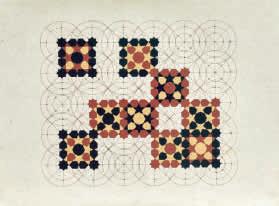
The Middle East contains multiple histories and communities, and those layers of complexity are often deliberately effaced.
Dana Awartani
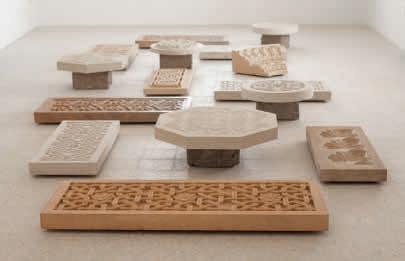
Above
Study Drawing, 2025, from
Below
When the Dust of Conflict Settles, 2023, hand carving on griesa, jerashi, madaba, hoota and gassimi stone, various dimensions, installation view, ‘Thinking Historically in the Present’, Sharjah Biennale 15, 2023. Courtesy: © Dana Awartani and ATHR
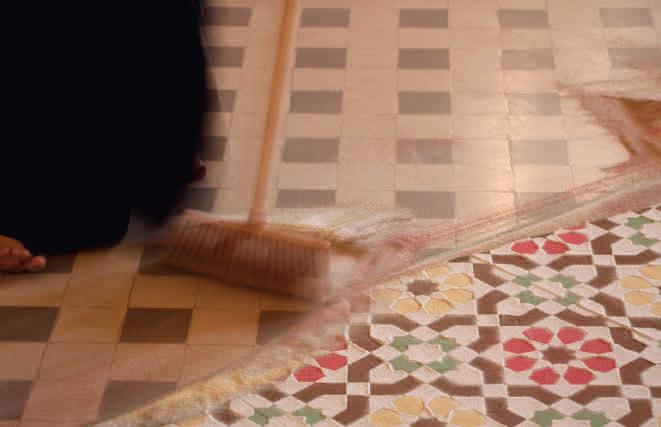
This is also evident in actions such as ISIS destroying ancient sites and artefacts in Iraq and Syria. Ultimately, this process attempts to homogenize the narrative of a region that is, in reality, far more diverse. The Middle East contains multiple histories and communities within its landscapes, and those layers of complexity are often deliberately effaced.
FK Hearing you speak about your work is very different from encountering it in person. I feel like there’s a stillness to your installations, even when they’re referring to the destruction and erasure of peoples, communities and the spaces that hold them.
gesture that would destroy it all at once. I eventually realized that the gesture of sweeping was a far more accurate reflection of what’s happening to our cultural heritage.
FK I wanted to end by asking about your selection as the artist who will represent Saudi Arabia at the upcoming Venice Biennale. Could you speak about what this opportunity means to you at this moment in your practice? What themes, questions or urgencies can we expect to see?
Above
I Went Away and Forgot You. A While Ago I Remembered. I Remembered I’d Forgotten You. I Was Dreaming, 2017, video still
DA When I graduated, I moved back to Saudi for ten years, and I found that screaming into your audience’s face wasn’t an effective way to communicate. I began to feel that gentle gestures could sometimes have a much stronger impact. For instance, when I was making I Went Away and Forgot You. A While Ago I Remembered. I Remembered I’d Forgotten You. I Was Dreaming [2017] – in which I assembled a geometric floor design made with locally sourced and dyed sand, based on traditional Islamic tiles, and then filmed myself sweeping it away –I spent a lot of time thinking about how to dismantle the installation. I asked myself whether I wanted a violent
DA I obviously can’t share too much at this early stage, but it’s definitely a continuation of my practice and my research up to now, including the idea of repair. I’m extremely honoured to represent the country I’ve called home and which gave my family political and financial stability. In Jeddah, where I’m from, we’re so diverse. A lot of people have a Palestinian, Syrian or Yemeni background because it’s the gateway to Makkah. I also don’t think they’ve ever had an artist from Jeddah represent the country, so I’m proud to be the first •
Essay: As international museums and projects proliferate across the region, Rahel Aima analyzes a wave of cultural institutions, collectives and artists who embody a collaborative, Gulf-first approach
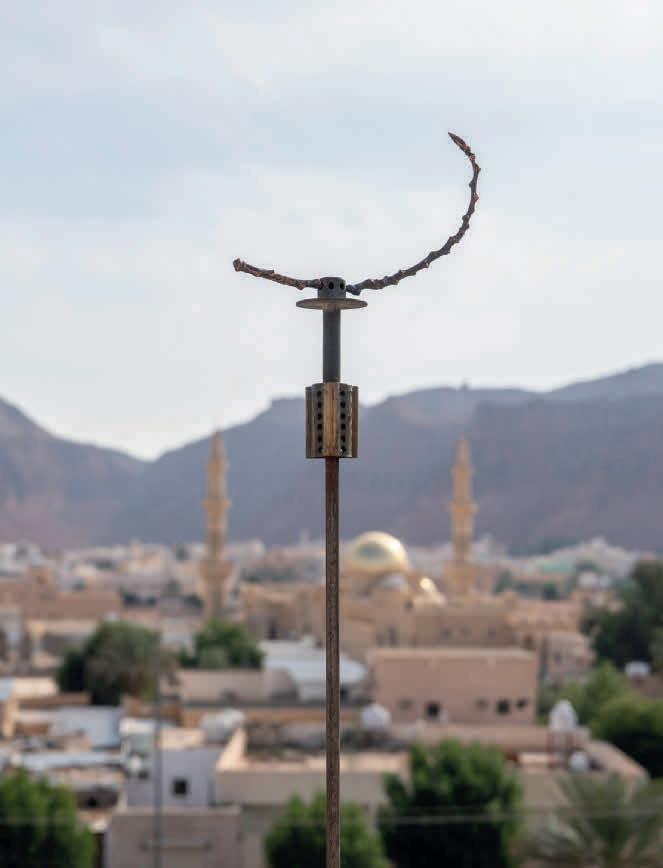
In recent years, the art scene in the Gulf region has seen the arrival of a series of international art-world power players. Art Basel launched a fair in Qatar in February; Frieze will take over Abu Dhabi Art from November; and over the past two years, in quick succession, Christie’s, Sotheby’s and Bonhams have all announced initiatives in Riyadh. In terms of institutions, Abu Dhabi is now host to the Louvre and the Guggenheim, while AlUla’s Contemporary Art Museum has been developed in partnership with Paris’s Centre Pompidou. In turn, many of these organizations are being buttressed by Gulf money, with Saudi Arabia contributing EU€50 million to the current renovation of the Pompidou and Abu Dhabi acquiring a US$1 billion minority stake in Sotheby’s. Art infrastructure is scaling up, too: Hasenkamp, a German logistics company, and ATHR, a commercial art gallery with three locations in Saudi Arabia, opened the kingdom’s first ‘museum-grade’ art storage depot in Jeddah last May, while the UAE and Qatar are also setting up their own art-specific storage and logistics facilities.
These major projects are being joined by a number of home-grown institutions focusing on modern and contemporary art. In addition to Riyadh’s Saudi Arabia Museum of Contemporary Art (SAMoCA), which opened in 2023, several more are planned for the near future, including the Art Mill Museum in Doha, Muscat’s Oman Cultural Center and the Dubai Museum of Art. Moreover, the Red Sea Museum in Jeddah, which opened in December 2025, is the latest of an estimated 20 museums scheduled to launch in Saudi Arabia with the aim of marrying regional heritage and contemporary art – including a National Museum of Palms and Dates in Al-Qassim and the Black Gold Museum in Riyadh. The Sharjah, Diriyah, Public Art Abu Dhabi and Islamic Arts biennials, meanwhile, as well as the Manar Abu Dhabi light art exhibition, will be joined this year by a quadrennial, Rubaiya Qatar.
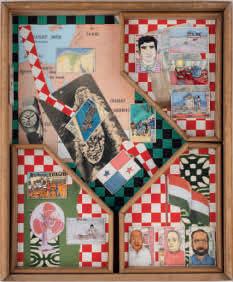
Governments cannot, and should not, stand in for a robust commercial sector or an arts ecology.
Previous page
Federico Arani, Antenna, 2025, installation view, electroplated copper, salvaged components from old oil lamps, steel, 165 × 4 × 20 cm.
Courtesy: The N.E.S.T (New Experimental Salon for Travelers); photograph: Lorenzo Arrigoni
This page
Bady Dalloul, Ever Given, Ever Waiting, 2023, pencil and crayon on paper, wood, 28 × 24 cm, Commissioned by Art Jameel.
Courtesy: The Art Jameel Collection; photograph: Full Special Studio
Opposite page above Mohammad Alfaraj, Face of the city, 2023, the Hayy Jameel Façade Commission. Courtesy: Hayy Jameel
Opposite page below Fiza Ghauri, Cloudbusting, 2025, installation view, Rainbow Valley, Fujairah. Courtesy: the artist and Low Hazard; photograph: Moza Almazrouei
Many of these developments are expected to arrive by 2027 and are the product of staggering amounts of government investment. Even as Dubai remains primarily market-driven, and the culture industry in the rest of the Gulf is inextricably imbricated with capital, there are national and city-level drives to diversify economies away from oil, shore up cultural tourism and rebrand on a global level. But the system of proposals and bids that Saudi Arabia relies on to award contracts means that artist and curator selection tends to run on national quotas and metrics such as key performance indicators (KPIs). In turn, the emphasis on commissioning new works – to be later acquired by the burgeoning museum apparatus – means that artists are very often making work for an event, rather than as part of an ongoing studio practice.
This necessarily affects the art that is supported, shown and made, as well as the narratives that are put forth and their political content. If, broadly speaking, we understand artists as being either primarily commercial or else on the biennial-institutional circuit (though the lines between these categories are increasingly blurred), the Gulf introduces a third category: the state-supported artist or curator. Among such practitioners, heritage narratives abound. This, in turn, has led to a remarkable phenomenon in countries like Bahrain, where the memory of the Arab Spring remains strong. With a relative dearth of support and opportunities to show work outside the Gulf, artists speak of making work not for now, or for their next show, but for a future that may be several decades away, or even for posthumous presentation.
Perhaps the most important dynamic at play here is a rising focus on Gulf-specific identity and a shift away from heavy reliance on international expertise – as already seen with the Jameel Arts Center in Dubai and Bahrain’s pedagogy-focused Al Riwaq Art Space – and towards an emphasis on the regional in both programming and hiring decisions, as has long been championed by the Sharjah Art Foundation and 421 Arts Campus in Abu Dhabi. What is considered regional differs from place to place. Outside its biennial, Sharjah Art Foundation primarily shows Arab artists, more recently expanding this remit to the Global South, while 421 provides a platform for chiefly UAE-based artists. The Jameel Arts Center reflects Dubai’s population and its
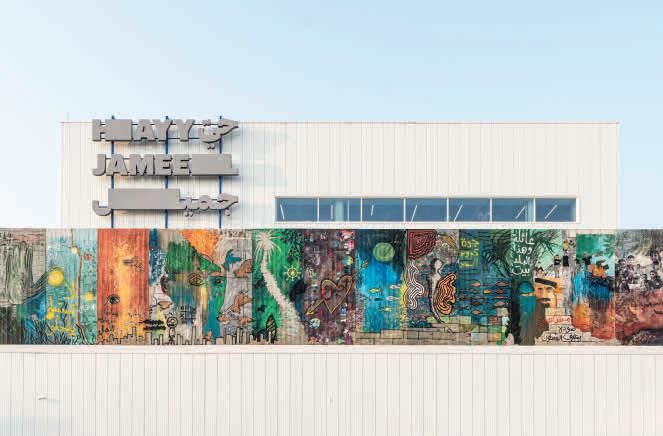
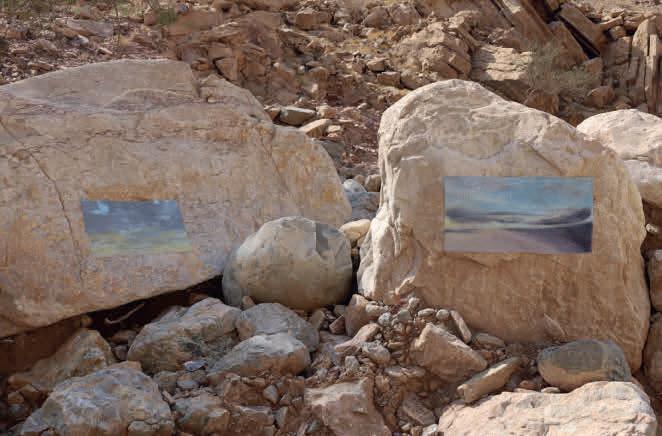
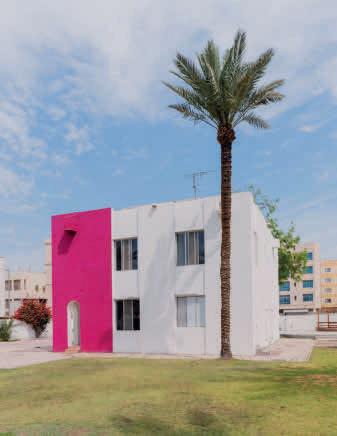
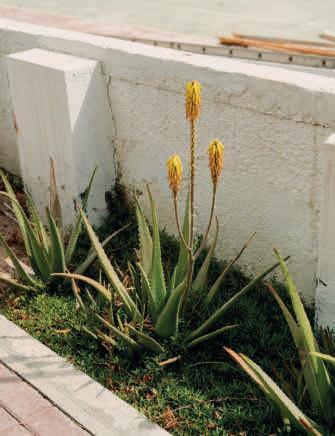
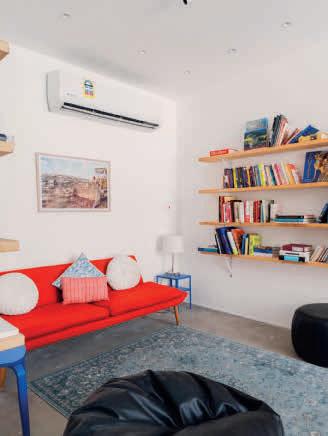
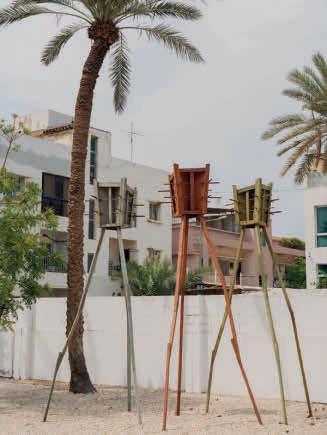
many diasporas, ranging from the Arab world and Iran to South and Southeast Asia, while its more communityminded sister institution, Hayy Jameel in Jeddah (which has recently launched a much-needed makers’ lab and fabrication space), looks to the Red Sea and the broader Indian Ocean region.
Against this backdrop, a number of much smaller, grassroots and often artist-led initiatives are beginning to take shape across the region. A lack of access to resources and affordable space for studios and exhibitions means that many of these groups operate primarily online. This is particularly true of young galleries like Bawa in Kuwait, Thaer Select in the UAE and Forat in Bahrain, who do not maintain permanent spaces, instead presenting roving exhibitions and participating in art fairs, mostly in the Gulf and Europe. Gallery districts like Dubai’s Alserkal Avenue and Riyadh’s JAX, where subsidies have historically been provided to artists and arts spaces, are becoming increasingly unaffordable as they transform themselves into lifestyle destinations. Some projects have transitioned to opening a permanent space, like Kuwait’s Hunna Art, as well as the UAE’s SWALIF Publishing House and MABNAI urbanism project, who have opened a shared space in Abu Dhabi under the name MamarLab. But on the whole, the peripatetic model allows for a nimbleness and risk-taking that the traditional gallery model cannot embody – and it shows in the work on view.
Similarly, there are a number of new artist-run collectives that follow an online-first, nomadic exhibition model. In the UAE, Low Hazard hosts mass road trips to one-day shows at outdoor locations around the country, such as ‘Cloudbusting’ by Fiza Ghauri in February 2025, a visit to which required an easy hike in Fujairah’s mountainous Rainbow Valley, roughly 90 minutes from central Dubai. What is especially remarkable is the way that Low Hazard upends the pervasive regional nostalgia for a reconstructed Bedouin past through its engagement with contemporary car culture, even as its projects recall pioneering conceptual artist Abdullah Al Saadi’s alfresco exhibitions in the 2000s, which he installed by the side of the road or in the desert, believing that the work is best shown in the context in which it is produced.
In recent years, Dubai and Riyadh have become the cultural centres of gravity in the region. As such, in places like Oman, where little governmental support is currently available, shows by groups and organizations like Zawraq Collective – founded in 2021 to support young artists – are especially crucial. In Bahrain, the photographic project Photos à la Chair, founded in 2017, works with a different artist every month to create a one-day outdoor installation and public gathering. Each session sees individuals photographed against a different backdrop, creating an ongoing series of portraits that not only archives the community, but also captures the evolution of the local art scene. Both these collectives have more recently extended their work to other countries within the Gulf Cooperation Council (GCC), with Zawraq launching its pan-Gulf Mukhawar Project, to be centred around the eponymous item of women’s dress, and Photos à la Chair expanding to include regional artists like Mohamed Ahmed Ibrahim and Rashed Al Shashai.
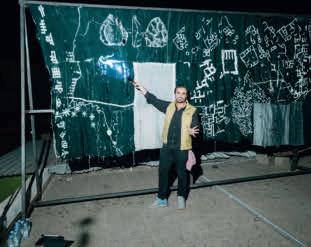
These collectives take a post-Western, Gulf-first approach.
Opposite page
Exterior and interior shots of Al Riwaq Art Space. Courtesy: Al Riwaq Art Space and Paulius Staniunas/All Is Amazing; photograph: Paulius Staniunas/ All Is Amazing This page Eduardo Cassina presenting his work _A Blanket for Dreaming (NEOM)_, 2024, knitted tapestry, phosphorescent and acrylic yarn, UV light, 8 × 2 m, installation view, ‘Anatomy of the Unseen’, The N.E.S.T (New Experimental Salon for Travelers), AlUla, 2025–26. Courtesy: The N.E.S.T; photograph: Lorenzo Arrigoni
Perhaps the most exciting of these art collectives is Al-Estiraha in Riyadh and Jeddah, founded in 2023 by artists Mbarak Madhi and Abeer Sultan. After the pair met on a residency, they wanted to get a studio together but found the cost – and access, given Riyadh’s sprawl and legendary traffic – prohibitive. The solution was an online co-working space, which quickly extended to a WhatsApp group and shared PDF library, with bi-weekly meetings and occasional crits. When they began talking about putting on their first exhibition, they zeroed in on ‘leftovers’ as a theme, to address a very Saudi phenomenon: work that was begun at a residency but couldn’t be continued without access to a studio; or those unrealized projects from would-be commissions that weren’t selected by an agency, or were changed into something so far from the original intent as to be unrecognizable. Being themselves wary of having their own works instrumentalized to fit curatorial or national narratives, Madhi and Sultan have been careful to emphasize a more collective, consent-based mode of exhibition-making. This spirit extends to the programming that accompanies each show, which includes talks, film screenings and listening parties, run in collaboration with local collectives in each city.

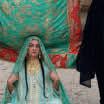

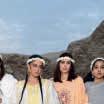
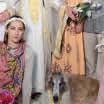


The emphasis on commissioning new works means that artists are often making work for an event, rather than as part of an ongoing studio practice.
In Saudi Arabia, a dearth of independent critical platforms and writerly support means that the most important art historical work is being done not by institutions or publications, but rather by independent collectives like Al-Estiraha, or curators such as Tara Aldughaither through her research platform Sawtasura. It might be strange to talk about lack in a country famous for its ample resources. But significant though the support available in places like the UAE and Saudi Arabia is, it is overwhelmingly aimed at emerging – synonymous here with young – and very early career artists. This creates a situation where artists, having raced through the requisite shows and/or biennials, emerge only to find themselves lacking in gallery representation and, as a result, falling off a metaphorical cliff edge. As such, artists are setting up grassroots platforms to address many of these gaps. This is undoubtedly healthy and points to a certain maturation: governments cannot, and should not, stand in for either a robust commercial sector or an arts ecology if these scenes are to have any chance at remaining sustainable.
Chief among these independent initiatives is Bayt AlMamzar (BAM) in Dubai, where Emirati brothers Gaith and Khalid Abdulla renovated their grandmother’s home to create a multidisciplinary art space that includes a gallery, artists’ studios and cultural programming, as well as a recently launched small press, BAMBAM!. I occasionally programme talks and craft workshops for BAM, and also co-direct a summer writing residency, where I mentor the writers. I have seen first-hand that this young institution provides artists and cultural workers with an unmatched offering: access to space, opportunity regardless of ethnicity and, most importantly, the chance to try things out and fail in public.
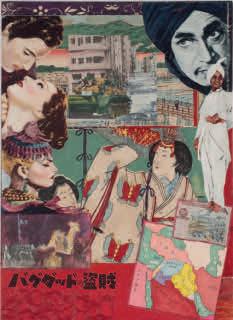
BAM is one of several such projects, run primarily by Gulf nationals, that are transforming their majalis (architecturally segregated living rooms) or their family’s istirahas (weekend homes) into arts spaces, as with The N.E.S.T., an apartment gallery in AlUla, Saudi Arabia. But a number of other collectives are also running studios out of rented spaces, like Studio Thirteen and 8th Street Studios in Dubai, as well as Abu Dhabi’s Al Reeshah and Studio Untitled – testament to the will of artists to make the model work.
It is important to remember, too, that these collectives extend an older tradition of artist-organized exhibitions that long predate the current period of enthusiastic governmental support. Groups like Bahrain’s Manama Group (1950s), Oman’s The Circle (late 1990s–2007), the Flying House in Dubai (2008–13), Shatta Collective in Abha and Jeddah (founded in 2002) and Formative Art Friends in the GCC (1985–95) were especially instrumental in buttressing regional art scenes and providing a discursive, critical space at a time when access to arts education abroad was asymmetric or wholly limited. In comparison, artists in Kuwait operated in a particularly vibrant scene in the latter half of the 20th century, notably including the still extant Sultan Gallery (founded in 1969), while in Qatar, artists largely orbited more formal arts institutions and galleries.
Yet, for all these collectives, funding remains a major obstacle, not least due to the strict laws around fundraising, designed to combat money laundering and the financing of religious extremism. In the UAE and Saudi Arabia, crowdfunding only recently became legal for licensed businesses, and it remains tightly controlled. One possible funding model is seen in Bayt AlMamzar’s Patrons’ Circle, in which a small group of collectors, dealers and other arts professionals (myself included) contribute a no-strings-attached AED 5,000 annually (about GB£1,000), to be dispersed as BAM sees fit, primarily supporting exhibitions, a fellowship and programming. In addition, a recent fundraising auction of donated works by Mohamed Ahmed Ibrahim, Farah Al Qasimi and others raised a remarkable AED 310,000 (about GB£63,000). As for government support, in the UAE the Ministry of Culture offers grants of up to AED 100,000 (approximately GB£20,000) to citizens working across various cultural fields, while the Dubai Cultural Grant further supports Emirati creatives (as well as individuals researching Emirati identity). A number of research and production grants are available to individuals and collectives – though not organizations – from 421, the Jameel Arts Center and Alserkal Avenue, among others.
The support is not only monetary, however: larger institutions also support shows in smaller spaces by loaning out screens, lighting and other technical equipment.
Ultimately, the backbone of all these spaces is the artists, curators and other community members who donate their artwork, time, expertise or just sheer muscle. While governments prioritize soft power, tourism and transforming the region’s image in the eyes of the world, these collectives take a post-Western, Gulf-first approach, coming together to build the kind of art scene they want to live in •



























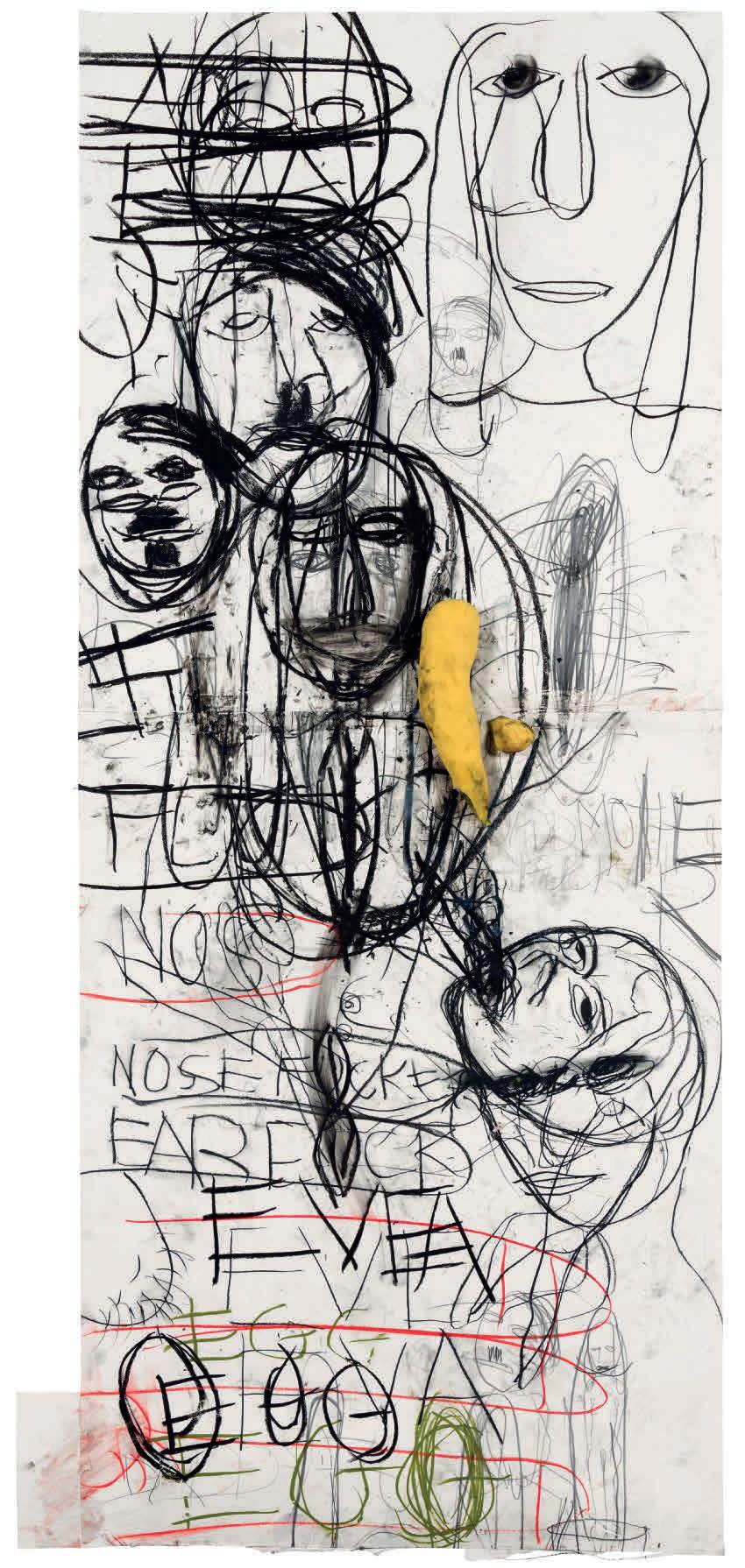
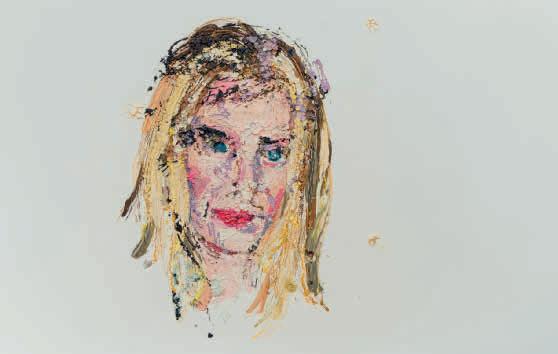
February 27–June 28, 2026
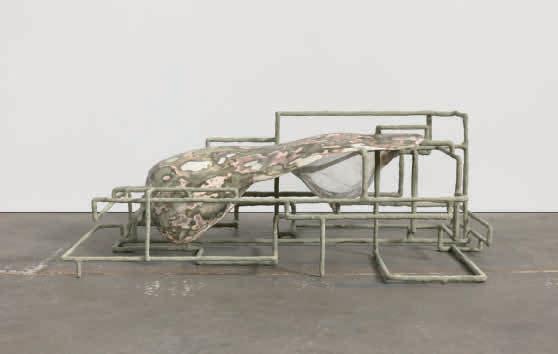
YALE UNIVERSITY ART GALLERY Free and open to the public artgallery.yale.edu

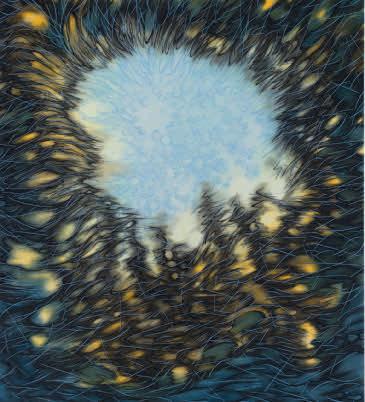
Galerie Urs Meile Beijing
Beijing, D10, 798 East Street, 798 Art District, No. 2 Jiuxianqiao Road, Chaoyang District, 100015 Tel. +86 10 576 260 51 www.galerieursmeile.com Instagram @galerieursmeileofficial Facebook @galerieursmeile
Pace Gallery
Hong Kong, 12/F H Queen’s, 80 Queen’s Road Central Tel. +852 2608 5065 www.pacegallery.com
Almine Rech
Shanghai, 27 Huqiu Road, 2nd Floor, 200002 www.alminerech.com
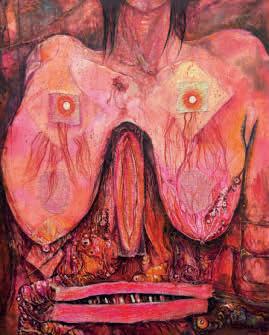
Hauser & Wirth
Hong Kong,G/F, 8 Queen’s Road, Central www.hauserwirth.com
Instagram @hauserwirth
Facebook @hauserwirth
Twitter @hauserwirth
Hong Kong, Shop 03-205A & 205B & 206, Second Floor, Barrack Block, Tai Kwun, No. 10 Hollywood Road www.massimodecarlo.com
Maria Lassnig
‘Self with Dragon’ through 28 February
White Cube
Hong Kong, 50 Connaught Road, Central Tel. +852 2592 2000 www.whitecube.com
David Zwirner
Hong Kong, 5-6/F, 80 Queen’s Road, Central Tel. +852 2119 5900 www.davidzwirner.com
Pace Gallery
Minato-ku, 1F; Azabudai Hills Garden Plaza-A, 5-8-1 Toranomon www.pacegallery.com
Galerie Sfeir-Semler
Beirut, Karantina, Street 56, Jisr Sector 77, Tannous Building, 4th floor
Tel. +961 1 566 550 www.sfeir-semler.com
Beirut, Boulos Fayad Building, Downtown
Contact the gallery for information.
Contact the gallery for information.
France-Lise McGurn through 13 March
Lily Stockman 23 March – May
Jean-Baptiste Bernadet ‘Vetiver (Shanghai)’ through 7 March
Vivian Springford through 7 March
Not Vital ‘Portraits’ 20 March – 16 May
Inside the White Cube: Shaqúelle Whyte ‘Nine nights; Strange fruit’ through 14 March
Contact the gallery for information.
Contact the gallery for information.
‘The Shade − Lawrence Abu Hamdan, Dana Awartani, Walid Raad, Marwan Rechmaoui and others’ through 28 February
Bayan Kiwan ‘Intimate Trespasses’ through 31 March
Barakat Contemporary Seoul, 58-4 Samcheong-ro, Jongno-gu, 03053
Tel. +82 2 733 1949 www.barakatcontemporary.com
Gallery Baton Seoul, 116 Dokseodang-ro, Yongsan-gu, 04420 www.gallerybaton.com
BB&M
Seoul, 10, Seongbuk-ro 23-gil 02879 www.gallerybbm.com
Contact the gallery for information.
Contact the gallery for information.
‘HANGING AROUND’
7 March – 11 April
Kukje Gallery
Seoul, 54 Samcheong-ro, Jongno-gu, 03053
Tel. +82 2 735 8449 www.kukjegallery.com
Lehmann Maupin
Seoul, 213 Itaewon-ro, Yongsan-gu, 04349
Tel. +82 2 725 0094 www.lehmannmaupin.com
Pace Gallery
Seoul, 267 Itaewon-ro Yongsan-gu, 04400 www.pacegallery.com
Lotus L. Kang
‘Chora’ 19 March – 10 May
Park Chan-kyong
‘Zen Master Eyeball’ 19 March – 10 May
‘Muted Rhythm’ through 28 February
Lee Kun-Yong
‘Body as Thought’ through 28 March
Thaddaeus Ropac
Seoul, 1-2F, 122-1 Dokseodang-ro Yongsan-gu, 04420
Tel. +82 2 6949 1760 www.ropac.net Instagram @thaddaeusropac
White Cube Seoul, 6, Dosan-daero 45-gil www.whitecube.com
Contact the gallery for information.
Etel Adnan & Seundja Rhee
‘To meet the sun’ through 7 March
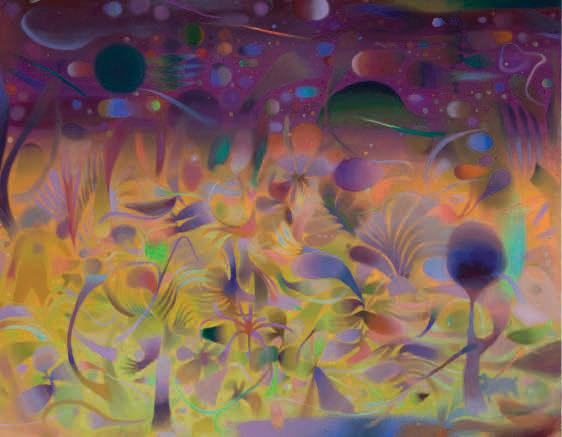
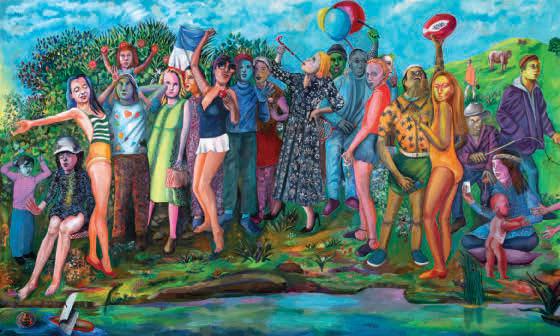
HALLE FÜR KUNST Steiermark
Graz, Burgring 2, 8010
Tel. +43 316 740 084
www.halle-fuer-kunst.at
@hallefuerkunststeiermark
@hallefuerkunststeiermark #HfkSt
Eva Ursprung ‘The Art of Surfacing’ through 19 April
Susanne Wenger ‘Àdùnní Olórìs à’ through 19 April
Neue Galerie Graz, Universalmuseum
Joanneum
Graz, Joanneumsviertel, 8010
Tel. +43 316 8017 9100 www.neuegaleriegraz.at Instagram @Joanneumsviertel Facebook @Joanneumsviertel #NeueGalerieGraz
Jojo Gronostay ‘The Elephants’ through 1 March
‘CAMUFLAJES’ through 22 March
‘Promotion Prize of the Province of Styria for Contemporary Fine Art’ through 6 April
‘Art Space Styria’ through 6 April
‘Extract’ through 1 November
‘Selection. Highlights from the Collection’ through 31 December 2028
Thaddaeus Ropac
Salzburg, Mirabellplatz 2, 5020
Tel: +43 662 881 3930 www.ropac.net Instagram @thaddaeusropac
Almine Rech Brussels, Abdijstraat, 20 Rue de L’Abbaye, 1050 www.alminerech.com
Templon
Brussels,Veydtstraat 13, 1060
Tel. + 32 (0)2 537 13 17 www.templon.com
Tim Van Laere Gallery Antwerp, Jos Smolderenstraat 50, 2000
Tel. +32 3 257 14 17 www.timvanlaeregallery.com
Alvaro Barrington through 21 March
Kumu Art Museum Tallinn, Valge tn 1, 10127 www.kumu.ekm.ee/en/
Minjung Kim ‘The Pulse of Ink, Paper, and Fire’ through 7 March
Robert Motherwell & Erik Lindman 11 March – 18 April
Contact the gallery for information.
Jonathan Meese through 7 March
Galerie Rudolfinum
Prague, Alsovo nabrezi 12, 110 00
Tel. +420 227 059 205 www.galerierudolfinum.cz Instagram @galerierudolfinum Facebook @galerie.rudolfinum
Galleri Bo Bjerggaard
Copenhagen, Sankt Knuds Vej 23C Frederiksberg, 1903
Tel. +45 33 93 42 21 www.bjerggaard.com
Kunsthal Charlottenborg
Copenhagen, Kongens Nytorv 1, 1051
Tel. +45 33 74 46 39 www.kunsthalcharlottenborg.dk
Sahej Rahal ‘Beyond the City of Time’ through 10 May
‘Spiegel im Spiegel: Encounters Between Estonian and German Art from Lucas Cranach to Arvo Pärt and Gerhard Richter’ through 12 April
‘Triumph of Galatea: Art in the Age of Artificial Intelligence’ through 9 August
Karin Luts ‘Pictures from Travels’ 20 March – 6 September
‘Conflicts and Adaptations. Estonian Art of the Soviet Era (1940–1991)’ Permanent
‘The Future is in One Hour: Estonian Art in the 1990s’ Permanent
Eva Schlegel through 28 March
Contact the gallery for information.
Minh Ngoc Nguyeˆ n, Collection Conundrum (II), 2023, on view at Museum of Contemporary Art Kiasma, Helsinki
EMMA – Espoo Museum of Modern Art
Espoo, Exhibition Centre WeeGee, Ahertajantie 5, 02100
Tel. +358 43 827 0941 www.emmamuseum.fi/en
Museum of Contemporary Art Kiasma
Helsinki, Mannerheiminaukio 2 00100
Tel. +31 0294 500 200 www.kiasma.fi
‘Draped – Art of Printed Fabrics’ through 14 March
‘InCollection: Antti Laitinen’ through 23 August
‘In Search of the Present’ 14 March – 7 February 2027
‘Collection Exhibition of Saastamoinen Foundation’ Permanent
‘Collection Kakkonen’ Permanent
Bryk & Wirkkala ‘Visible Storage’ Permanent
Sarah Lucas ‘NAKED EYE’ through 8 March
‘A Dream in Four Colours’ 27 February – 10 January 2027
‘We Who Remain – Sámi Art in Focus’ 27 March – 6 September
Serlachius Manor
Mänttä, Joenniementie 47, 35800
Tel. +358 3 488 6801 www.serlachius.fi/en
Instagram @serlachiusmuseums Facebook @serlachius
YouTube - Serlachius Channel (English translations) #serlachius #serlachiusmuseum
Stiina Saaristo
‘Always Happy – Retrospective’ through 12 April
Agnes Meyer-Brandis ‘As Trees Go By’ through 3 May
Milja Viita
‘People on Sunday’ through 3 May
‘Classic Works of Fine Art at the Manor’ Permanent
Mänttä, Serlachius Headquarters, R. Erik Serlachiuksen katu 2, 35800
‘Measured and Drawn’ through 1 March
Viljami Heinonen
‘Somewhere in Between’ through 30 August
Anssi Kasitonni
‘Below Zero Finnish Art Award 2025’ 21 March – 30 August
Hauser & Wirth
Paris, 26 bis rue François 1er www.hauserwirth.com
Sophie Taeuber-Arp
‘La regles des courbes (The rule of curves)’ through 7 March
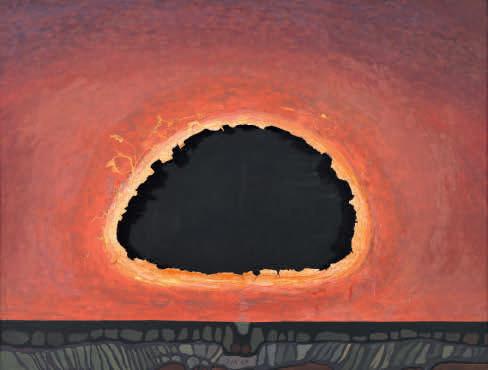
This page
Opposite page
Tobias Rehberger, Koloman Wallisch in glazed ducks, 2022, on view at Museum Angewandte Kunst, Frankfurt
Almine Rech
Paris, 64 Rue de Turenne, 75003 www.alminerech.com
Paris, 18 avenue Matignon, 75008
Emily Mason ‘Other Rooms, Works from 1959–2017’ through14 March
Larry Poons 21 March – 21 May
Jean Dewasne through14 March
‘Forming the Monochrome: Masters of Dansaekhwa’ 21 March – 23 May
Thaddaeus Ropac
Paris, 7 Rue Debelleyme, 75003
Tel. +33 1 42 72 99 00 www.ropac.net Instagram @thaddaeusropac
Pantin, 69, avenue du Général Leclerc, 93500
Templon
Paris, 30 rue Beaubourg, 75003
Tel. + 33 (0)1 42 72 14 10 www.templon.com
Paris, 28, rue Grenier Saint-Lazare 75003
Galerie Georges-Philippe & Nathalie Vallois
Paris, 36, Rue de Seine, 75006
Tel. +33 1 46 34 61 07 www.galerie-vallois.com #galerievallois
White Cube
Paris, 10 avenue Matignon
Tel. +33 1 87 39 85 97 www.whitecube.com
David Zwirner
Paris, 108, rue Vieille du Temple, 75003 www.davidzwirner.com
Staatliche Kunsthalle
Baden-Baden
Baden-Baden, Lichtentaler Allee 8A, 76530 www. kunsthalle-baden-baden.de
Galerie Buchholz
Berlin, Fasanenstrasse 30, 10719 Tel. +49 30 8862 4056 www.galeriebuchholz.de
Arnulf Rainer through 28 February
Erwin Wurm ‘Tomorrow: Yes’ through 18 April
Léonard Martin ‘Chef Menteur’ through 14 March
Abdelkader Benchamma ‘Signs and Wonders’ 21 March – 7 May
Martial Raysse ‘Recent Works’ through 14 March
Jitish Kallat 21 March – 7 May
Contact the gallery for information.
Theaster Gates ‘And Other Paintings’ 6 March – 4 April
Contact the gallery for information.
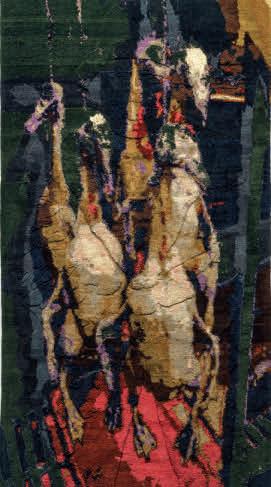
Neuer Berliner Kunstverein
Berlin, Chausseestraße 128-129, 10115
Contact the gallery for information.
Cologne, Neven-DuMont-Str. 17, 50667 Gili Tal ‘Soft and Bouncy’ through 14 March
Larry Johnson through 7 March
Tel. +49 30 280 7020 www.nbk.org Instagram @neuerberlinerkunstverein Facebook @NeuerBerlinerKunstverein
Berlin, Showroom, Chausseestraße 128-129, n.b.k, 10115
Sprüth Magers
Berlin, Oranienburger Straße 18, 10178
Tel. +49 30 2888 4030 www.spruethmagers.com
‘Memory Is a Strange Bell’ 14 March – 3 May
Nora Turato through 31 August
Katja Strunz
‘Future Collapses, Past Rises’ 14 March – 3 May
Kara Walker ‘Kara Elizabeth Walker presents Dispatches from A – and the Museum of Half-remembered Histories’ through 4 April
Gretchen Bender ‘Political Entertainment’ through 4 April
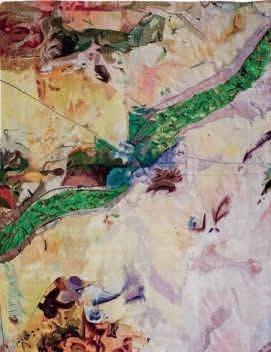
Noelle Mason, Ground Control (El Paso/Ciudad Juarez), 2014, on view at Museum Angewandte Kunst, Frankfurt
Pace Gallery
Berlin, Die Tankstelle, Bülowstraße 18, 10783
www.pacegallery.com
KAI 10 | ARTHENA FOUNDATION
Düsseldorf, Kaistrasse 10, 40221
Tel. +49 211 9943 4130 www.kaistrasse10.de
Instagram @kai10_arthenafoundation #Kai10ArthenaFoundation
Julia Stoschek Foundation
Düsseldorf, Schanzenstraße 54, 40549
Tel. +49 211 585 8840 www.jsc.art
Kunstsammlung
Nordrhein-Westfalen
Düsseldorf, K20 Grabbeplatz 5, 40213
Tel. +49 211 8381 204 www.kunstsammlung.de
Düsseldorf, K21, Ständehausstraße1, 40217
David Lynch through 29 March
Contact the gallery for information.
Museum Angewandte Kunst, Frankfurt
Frankfurt, Schaumainkai 17, 60594
Tel. +49 69 21234037 www.museumangewandtekunst.de
‘AI-Worlding. Artistic research on AI-generated world models’ through 26 April
‘Wool. Silk. Resistance.’ through 24 May
‘WDC-Hub’ through 30 November
Heidelberger Kunstverein
Heidelberg, Hauptstraße 97 69117
Tel. +49 6221 184086 www.hdkv.de
Marta Herford
Herford, Goebenstraße 2–10 32052
Tel. +49 5221 9944300 www.marta-herford.de
Instagram @martaherford Facebook @martaherford
Badischer Kunstverein Karlsruhe, Waldstraße 3, 76133
Tel. +49 721 28226
www.badischer-kunstverein.de Instagram @badischer_kunstverein Facebook @BadischerKunstverein
MASSIMODECARLO
Milan, Viale Lombardia 17, Casa Corbellini-Wassermann, 20131 www.massimodecarlo.com
Victoria Miro
Venice, Il Capricorno, San Marco 1994, Calle Drio La Chiesa, 30124
Tel. +39 041 523 3799 www.victoria-miro.com
Thaddaeus Ropac
Milan, Piazza Belgioioso, 2 www.ropac.net
Instagram @thaddaeusropac
Tim Van Laere Gallery
Contact the gallery for information.
Rome, Palazzo Donarelli Ricci, Via Giulia 98, 00186 www.timvanlaeregallery.com
Contact the gallery for information.
‘Cartographies of Growth –Katinka Bock in Dialogue with Lois Weinberger’ through 7 June
Nazanin Noori, Ryan Cullen, Prateek Vijan ‘ars viva 2026’ 14 March – 25 May
Anna Barham ‘delirious mantra’ through14 June
Galerie Sfeir-Semler
Hamburg, Admiralitätstraße 71, 20459
Tel. +49 40 37 51 99 40 www.sfeir-semler.com
‘Your Museum! Your Collection!’ Permanent
Anne Truitt ‘Pioneer of Minimal Art’ 28 March – 2 August
‘Land and Soil. How We Live Together’ through 19 April
‘K21 Global Art Award: Tadáskía’ through 30 August
Walid Raad through 30 April
Austyn Weiner through 28 February
Pietro Roccasalva 5 March – April
Emil Sands ‘Watchmen’ through 7 March
Contact the gallery for information.
Contact the gallery for information.
Kunstmuseum Liechtenstein
Vaduz, Städtle 32, 9490 Tel. +423 235 0300 www.kunstmuseum.li
Tony Cokes ‘Let Yourself Be Free’ through 1 March
‘Hilti Art Foundation: In Touch. Encounters in the Collection’ through 12 April
‘In the Context of the Collection: RELAX (chiarenza & hauser & co): What is Wealth?’ through 16 August
Eleanor Antin ‘A Retrospective’ 27 March – 27 September
Almine Rech Monaco, 20 avenue de la Costa 98000 www.alminerech.com
Hauser & Wirth
Peter Halley ‘Recent Paintings’ through 3 April
Monaco, One Monte-Carlo, Place Du casino, 98000 www.hauserwirth.com Instagram @hauserwirth Facebook @hauserwirth Twitter @hauserwirth Contact the gallery for information.
Astrup Fearnley Museet Oslo, Strandpromenaden 2, 0252 www.afmuseet.no
‘Grammars of Light’ through 10 May
Cristina Guerra Contemporary Art Lisboa, Rua Santo António à Estrela, 33, 1350-291 www.cristinaguerra.com/en/ Instagram @cristinaguerra_gallery Facebook @CristinaGuerra ContemporaryArt
Bowman Hal SOLO CSV Madrid, Cuesta de San Vicente, 36, 28008 www.bowmanhal.com
João Paulo Feliciano through 21 March
Tatjana Doll 26 March – 16 May
‘Paul McCarthy, A&E, Adolf/Adam & Eva/Eve, Drawing Sessions 2020 – 2022 with Lilith Stangenberg’ through 16 May
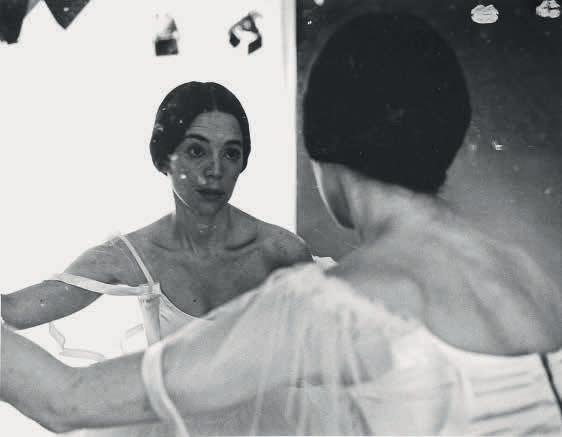
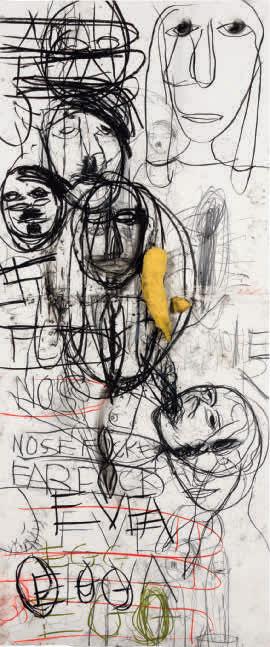
Hauser & Wirth
Menorca, Isla del Rey (Illa del Rei)
Mahon
www.hauserwirth.com
Instagram @hauserwirth
Facebook @hauserwirth
Twitter @hauserwirth
Bonniers Konsthall
Stockholm, Torsgatan 19, 113 90
Tel. +46 87 36 42 48
www.bonnierskonsthall.se
Malmö Konsthall
Malmö, St Johannesgatan 7, 205 80
Tel. +46 40 34 60 00
www.konsthall.malmo/se
Moderna Museet Malmö
Malmö, Ola Billgrens plats 2-4, 211 29
Tel. +46 40 685 79 37
www.modernamuseet.se/malmo
Moderna Museet Stockholm
Stockholm, Exercisplan 4, 11149
Tel. +46 8 5202 3500
www.modernamuseet.se/ stockholm
Contact the gallery for information.
Ingela Ihrman ‘Nocturnal Games’ 11 March – 14 June
CC Hennix through 17 May
Edi Hila through 12 April
‘Monogram–Robert Rauschenberg and the Moderna Museet Collection’ through 5 April
‘The Art of Collecting–Expanding The Moderna Museet Collection’ through 9 May
‘Yet Another Morning–Drawing in the Moderna Museet Collection’ through 10 May
‘The Subterranean Sky–Surrealism in the Moderna Museets Collection’ through 17 January 2027
Aargauer Kunsthaus
Aarau, Aargauerplatz, 5001
Tel. +41 62 835 2330
www.aargauerkunsthaus.ch
Kulturstiftung Basel H. Geiger I KBH.G
Basel, Spitalstrasse 18, 4056
Tel. +41 61 262 01 66
www.kbhg.ch
#kbhg
#kulturstiftungbaselhgeiger
‘More Light. Video in Art’ through 25 May
Mario Sala
‘Collection in Focus’ through 21June
‘Collection 26. Art from Switzerland’ through 5 July
‘Flowers to Art 26’ 3 March – 8 March
Contact the foundation for information.
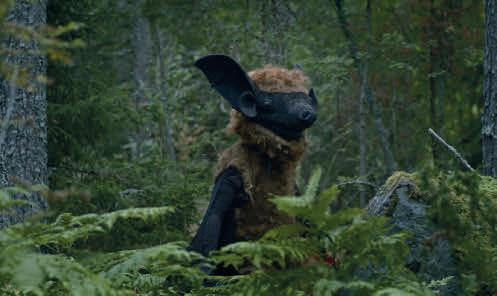
Ingela Ihrman, Augustimåne (Harvest Moon), 2025, on view at Bonniers Konsthall, Stockholm
Kunsthaus Baselland
Basel, Helsinki-Strasse 5, 4142
Tel. +41 (0)61 563 15 10 www.kunsthausbaselland.ch
Instagram @kunsthausbaselland #kunsthausbaselland
Fondation Beyeler
Basel, Baselstrasße 101, 4125
Tel. +41 61 645 9700 www.fondationbeyeler.ch #fondationbeyeler
Museum Tinguely
Basel, Paul Sacher-Anlage 1, 4058
www.tinguely.ch
Tel. +41 61 681 93 20
Eva Lootz through 3 May
Tamara Al-Samerraei & Mireille Blanc ‘Sounding the Interior’ through 3 May
‘Cezanne’ through 24 May
Oliver Ressler ‘Scenes from the Invention of Democracy’ through 1 March
Carl Cheng ‘Nature Never Loses’ through 10 May
Nicolas Darrot ‘Fuzzy Logic’ 5 March – 7 March 2027
Angelica Mesiti ‘Reverb’ 18 March – 30 August
‘La roue = c’est tout’ Permanent through 2026
Pace Gallery Geneva, Quai des Bergues 15-17 1201
www.pacegallery.com
Kunsthaus Glarus Glarus, Im Volksgarten, 8750 Tel. +41 55 640 25 35 www.kunsthausglarus.ch
Almine Rech Gstaad, Chalet Wilibenz Bahnhofstrasse 1, 3780 www.alminerech.com
Galerie Urs Meile
Zurich, Ankerstrasse 3, 8004
Tel. +41 (0)44 523 19 19 www.galerieursmeile.com Instagram @galerieursmeileofficial Facebook @galerieursmeile Zurich, Rämistrasse 33, 8001
Kunstmuseum Luzern
Lucerne, Europaplatz 1, 6002
Tel. +41 41 226 78 00 www.kunstmuseumluzern.ch
Contact the gallery for information.
Contact the gallery for information.
‘Still Life, Living Form’ through 22 March
Contact the gallery for information.
‘1 Raum, 1 Werk. Installationen aus der Sammlung’ 28 February – 8 November
Maria Pinin ´ ska-Beres ´ ‘Under the Pink Flag’ 28 February – 14 June
Brian Dawn Chalkley ‘Angels suffer too’ 7 March – 21 June
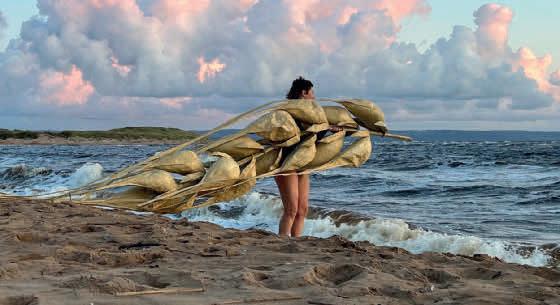
Ingela Ihrman, Den fertila halvmånen (The Fertile Crescent), 2024, on view at Bonniers Konsthall, Stockholm
MASI
Museo d’arte della Svizzera italiana
Lugano Via Canova 10, 6900 T +41 (0)58 866 42 40 www.masilugano.ch
Lugano, Piazza Bernardino Luini 6,6900
‘Self-Portraits from the Collection 1928–2021’ through 21 June
‘Sentiment and observation. Art in Ticino 1850–1950’ through 26 July
‘K-NOW! Korean Video Art Today’ 8 March – 19 July
Jean-Frédéric Schnyder ‘Painting 2024/25’ 15 March – 9 August
Kunst Halle Sankt Gallen
St. Gallen, Davidstrasse 40, 9000
Tel. +41 71 222 10 14
www.k9000.ch
Instagram @kunsthallesanktgallen
Facebook @kunsthallesanktgallen #kunsthallesanktgallen#khsg ‘Containers Love Disorder’ 7 March – 31 May
Hauser & Wirth
Zurich, Limmatstrasse 270, 8005 Tel. +41 44 446 8050 www.hauserwirth.com
Instagram @hauserwirth
Facebook @hauserwirth
Twitter @hauserwirth
Basel Luftgässlein 4, 4051
St Moritz, Via Serlas 22, 7500
Migros Museum für Gegenwartskunst
Zurich, Limmatstrasse 270, 8005
Tel. +41 44 277 2050 www.migrosmuseum.ch
Instagram @migrosmuseum
Facebook @Migrosmuseum fuergegenwartskunst #migrosmuseum
KOO JEONG A through 16 May
Alberto Giacometti ‘Faces and Landscapes of Home’ through 28 March
‘Disobedience Archive’ through 25 May
Dirimart Dolapdere Istanbul, Beyoğlu, Hacıahmet Mahallesi, Irmak Caddesi No: 1–9, 34440
Tel: +90 212 232 66 66 www.dirimart.com
Dirimart Pera, Istanbul, Beyoğlu, Meşrutiyet Caddesi No: 99 34430
Emma Stern ‘Champagne Problems’ through 1 March
Gregor Hildebrandt 10 March – 5 April
Berke Yazıcıoğlu ‘Helix’ 12 March – 26 April
Dirimart
London, 23 Princes Street, W1B 2LY
T: +44 20 3833 9155 www.dirimart.com
Ingleby
Edinburgh, 33 Barony Street, EH3 6NX
Tel. +44 (0) 131 556 4441 www.inglebygallery.com
Özlem Günyol & Mustafa Kunt 5 March – 11 April
Winston Roeth through 28 March
Charlene Scott ‘INSTALMENTS’ Opens 26 February
Almine Rech contact.london@alminerech.com www.alminerech.com
London Mithraeum Bloomberg SPACE
London, 12 Walbrook, EC4N 8AA www.londonmithraeum.com
Hauser & Wirth
London, 23 Savile Row, W1S 2ET www.hauserwirth.com Instagram @hauserwirth Facebook @hauserwirth Twitter @hauserwirth
Somerset, Durslade Farm, Dropping Lane, BA10 0NL
Leica Gallery London
London, 64-66 Duke St, W1K 6JD Tel. 020 7629 1351 www.leica-camera.com
MASSIMODECARLO
London, 16 Clifford Street, W1S3RG www.massimodecarlo.com
Maximillian Wölfgang Gallery
London, 17, Cleeve Workshops, Boundary St, E2 7JD www.maximillianwolfgang.gallery
No.9 Cork Street, FRIEZE
London, 9 Cork Street, W1S 3LL www.frieze.com/9corkstreet
Contact the gallery for information.
Mark Manders ‘Room with All Existing Words’ through 4 July
Takesada Matsutani ‘Shifting Boundaries’ through 18 April
Tetsumi Kudo through 18 April
Don McCullin ‘90’ through 12 April
‘Absentee by Sayuri Ichida’ through 19 March
Peter Schuyff through 7 March
Aaron Garber-Maikovska 12 March – 18 April
Contact the gallery for information.
Lehmann Maupin Freya Douglas-Morris 26 February – 28 March
Vadehra Art Gallery Hylozoic/Desires (Himali Singh Soin & David Soin Tappeser) 6 – 28 March
Pace Gallery
London, 5 Hanover Square, W1S 1HE
www.pacegallery.com
Sprüth Magers
London, 7A Grafton Street, W1S 4EJ Tel. +44 20 7408 1613 www.spruethmagers.com
Thaddaeus Ropac
London, Ely House, 37 Dover Street, W1S 4NJ Tel: +44 20 3813 8400 www.ropac.net Instagram @thaddaeusropac
Victoria Miro
London, 16 Wharf Road, N1 7RW Tel: +44 20 7336 8109 www.victoria-miro.com
David Zwirner
London, 24 Grafton St, W1S 4EZ www.davidzwirner.com
White Cube
London, 144 – 152, Bermondsey Street, SE1 3TQ Tel. +44 20 7930 5373 www.whitecube.com
London, 25-26 Mason’s Yard SW1Y 6BU
Contact the gallery for information.
Bernd & Hilla Becher through 28 March
Joseph Beuys through 4 April
Isaac Julien ‘All That Changes You. Metamorphosis’ through 21 March
Elisheva Biernoff ‘Elsewhere’ through 28 February
Klára Hosnedlová through 29 March
WangShui ‘Night Signal’ through 29 March
Sarah Morris 11 March – 9 May
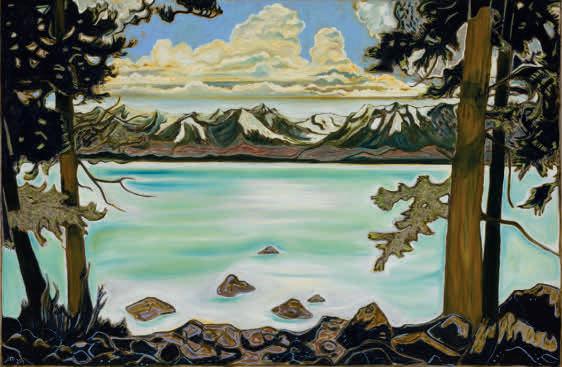
Canada
Daniel Faria Gallery
Toronto, 188 St Helens Avenue, M6H 4A1
Tel. +1 416 538 1880 www.danielfariagallery.com
MKG127
Toronto, 1445 Dundas Street West, M6J 1Y7
Tel. +1 647 435 7682 www.mkg127.com Instagram @mkg127
Museum of Contemporary Art
Toronto (MOCA)
Toronto, 158 Sterling Rd, ON M6R 2B7
www.moca.ca
Contact the gallery for information.
Almine Rech
New York, 39 East 78th Street, 2nd Floor, 10075 www.alminerech.com
Panya Clark Espinal ‘I Am Your Window’ through 14 March
Adam David Brown ‘Everything I Want...’ 21 March – 18 April
Contact the gallery for information.
New York,Tribeca, 361 Broadway, 10013
Galerie Buchholz
New York, 17 East 82nd Street United States, 10028 www.galeriebuchholz.de
Dylan Kraus ‘The Joys of Sacrifice’ through 14 March
Ali Cherri ‘Last Watch before Dawn’ through 28 February
Karel Appel & Gerasimos Floratos 13 March – 25 April
Youngju Joung 13 March – 25 April
Contact the gallery for information.
DON’T LOOK Projects
Los Angeles, 461 N. Western Ave, CA 90004 www.dontlookprojects.com
Grand Central Art Center
Santa Ana, 125 N. Broadway, 92701 Tel. +1 714 567 7233 www.grandcentralartcenter.com Instagram @grandcentralart Facebook @grandcentralartcenter
Ophelia Arc ‘Synnecrosis’ through 28 February
Conor Dowdle 7 March – 17 April
Carlos Viani ‘Next of Kin’ through 10 May
Matthew Suib ‘Cocked’ through 12 April
Dane Nakama ‘Dear Uncle Tani,’ through 12 April
Jon Rubin ‘The Stolen Dove’ through 30 June
Hauser & Wirth
Los Angeles, 901 East 3rd Street, 90013 www.hauserwirth.com Instagram @hauserwirth Facebook @hauserwirth Twitter @hauserwirth
Los Angeles, 8980 Santa Monica Boulevard, 90069
New York, 18th Street
New York, 542 West 22nd Street
Christina Quarles through 3 May
‘Destiny Is a Rose: The Eileen Harris Norton Collection’ through 26 April
Arshile Gorky ‘Horizon West’ through 25 April
Glenn Ligon ‘Late at night, early in the morning, at noon’ through 14 March
Louise Bourgeois ‘Gathering Wool’ through 18 April
Qui Xiaofei through 18 April
Lehmann Maupin
New York, 501 West 24th Street United States, 10011 www.lehmannmaupin.com
Pace Gallery
New York, 540 West 25th Street, NY 10001 www.pacegallery.com
Dane Hiʻipoi Nakama, ‘Dear Uncle Tani,’ 2025, on view at Grand Central Art Center, Santa Ana
Galerie Georges-Philippe & Nathalie Vallois
Contact the gallery for information.
New York, 510 West 25th Street, 10001
New York, 395 Broadway, 10013
Los Angeles, 1201 South La Brea Avenue, 90034
Billy Childish through 28 February
McArthur Binion 5 March – 18 April
Teresa Solar Abboud 5 March – 18 April
Wang Guangle
‘Delayed Gravity’ through 28 February
Richard Pousette-Dart ‘Geometry of Summer’ through 28 February
Gideon Appah
‘Beneath Night and Day’ through 28 February
Alfred Jensen
‘Diagrammatic Mysteries’ through 28 February
Lauren Quin
‘Eyelets of Alkaline’ through 28 March
New York, Madison Avenue 1018 Tel. (646) 476 5885 www.fleiss-vallois.com #fleissvallois
Sprüth Magers
New York, 22 East 80th Street, 2nd Floor, NY, 10075 www.spruethmagers.com
Los Angeles, 5900 Wilshire Boulevard, CA 90036
Templon
New York, NY, 293 Tenth Avenue Tel. +1 212 922 3745 www.templon.com
White Cube
New York, 1002 Madison Avenue NY 10075
Tel.+1 (212) 750-4232 www.whitecube.com
David Zwirner
New York, 537 West 20th Street NY 10011
www.davidzwirner.com
Sterling Ruby ‘Atropa’ through 28 March
David Salle 26 February – 25 April
Contact the gallery for information.
Cinga Samson 6 March – 18 April
New York, 34 East 69th Street, 10021 Elisheva Biernoff ‘Elsewhere’ through 28 February
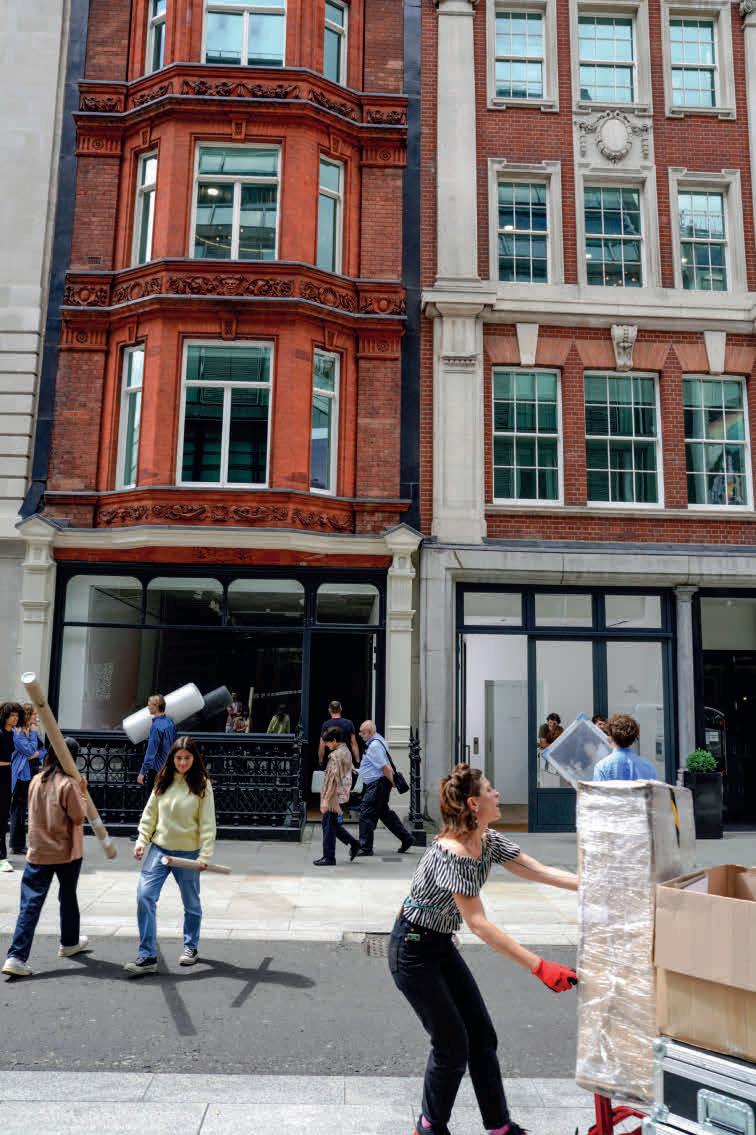
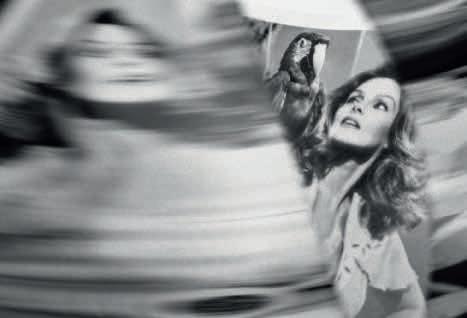
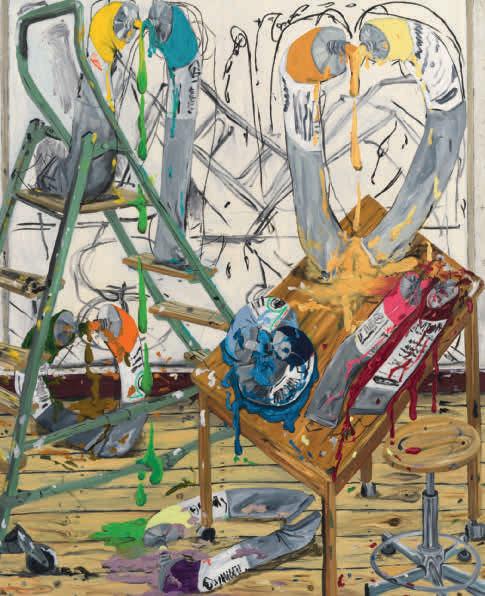
What paintings, then, could stand as totems for
the perversities of today?
Dena Yago, p. 133
Rays, Ripples, Residue 421 Arts Campus, Abu Dhabi, UAE 110
Ala Younis
NYU Abu Dhabi, UAE 112
Serge Attukwei Clottey Gallery 1957, Accra, Ghana 113
Archie Moore
Queensland Art Gallery and Gallery of Modern Art, Brisbane, Australia 114
Som Supaparinya
Jim Thompson Art Center, Bangkok, Thailand 115
The Great Camouflage Rockbund Art Museum, Shanghai, China 116
Behind the Counter Telegraph Gallery, Olomouc, Czech Republic 117
18th Rome Quadrennial Palazzo Esposizioni, Rome, Italy 118
Luciano Castelli
Kulturstiftung Basel H. Geiger, Basel, Switzerland 119
Beatrice Bonino Fondation Pernod Ricard, Paris, France 120
Libasse Ka Museum Dhondt-Dhaenens, Deurle, Belgium 121
Annika Kahrs Hamburger Bahnhof, Berlin, Germany 122
Lunita-July Dorn
Tanya Leighton, Berlin, Germany 123
Deviant Ornaments National Museum, Oslo, Norway 124
Richard Walker CORPUS, Cambridge, UK 125
Harold Offeh
Kettle’s Yard, Cambridge, UK 126
Jasleen Kaur Hollybush Gardens, London, UK 127
Joseph Yaeger Modern Art, London, UK 128
Lucy Raven Power Plant Contemporary Art Gallery, Toronto, Canada 129
Will Rawls
The Kitchen, New York, USA 130
Contours of Zero: Emerging Korean Artists in New York Space ZeroOne, New York, USA 131
Isaiah Davis King’s Leap, New York, USA 132
Jana Euler
Greene Naftali, New York, USA 133
Iiu Susiraja Gratin, New York, USA 134
Broken Column Museum of Mexico City, Mexico 135
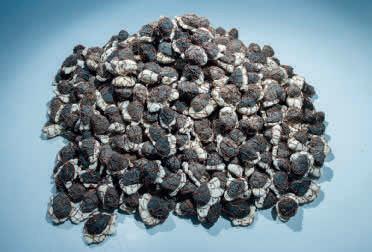
Rays,
421 Arts Campus, Abu Dhabi, UAE
For those unfamiliar with the UAE’s contemporary art scene, a pile of rocks might seem like an underwhelming opening to ‘Rays, Ripples, Residue’, an exhibition dedicated to the last decade of the country’s cultural production. For others, Fresh and Salt (2015) – comprising freshwater stones from the Caspian Sea and coral from Khorfakkan, bound together with copper wire – is instantly recognizable as a key piece of land art from the region. Created by Mohamed Ahmed Ibrahim, a member of ‘the five’, the group of Emirati artists who introduced conceptual art to the UAE in the 1980s, the work’s inclusion functions as both homage and red herring – momentarily suggesting a traditional survey exhibition before giving way to something much more creative.
Fresh and Salt opens the first of three distinct sections, each organized by a different local curator. Abu Dhabibased Munira Al Sayegh’s contribution, ‘Leading to the Middle’, proposes spheres of influence between Ibrahim, the late Kuwaiti Palestinian photographer Tarek Al-Ghoussein and a younger generation of artists working in the region. Fresh and Salt , for example, is placed alongside dense pen drawings of the sea by Latvian-born, UAE-based Adele Bea Cipste (such as Untitled [Seascape 1, Abu Dhabi], 2022), subtly suggesting that the current focus on ecology among Gulf-based artists and institutions was made possible through Ibrahim’s foundational experimentation.
While Ibrahim’s legacy is most readily legible through material and environmental concerns, Al-Ghoussein’s influence emerges through questions of place and belonging. On display are works from his series ‘Odysseus’ (2015–22), in which the artist photographed himself in staged scenes across a number of the emirate’s more than 200 islands. There’s an absurdity to these images: in one, he lies in an empty, kidney-shaped pool with only his legs visible to the camera (Abu Dhabi Archipelago [Jubail], 2015); in another, he mounts a yellow playground slide, his adult body far too large for the plastic frame (Abu Dhabi Archipelago [Ramhan], 2015).
Nearby photographic works by students and friends of Al-Ghoussein lack his deadpan humour but similarly attend to Abu Dhabi’s built environment. For Khaled Esguerra’s series ‘1501, 308 Al Hisn Street’ (2025), the artist documents his recently vacated apartment on Al Hisn Street. As with Al-Ghoussein, Esguerra’s body is the only signifier of life in an otherwise empty landscape.
If ‘Leading to the Middle’ suggests the interconnectedness of the UAE’s still nascent contemporary art scene, ‘Ghosts of Arrival’ – curated by Dubai-based writer and curator Nadine Khalil – confirms it. Al-Ghoussein appears again, but this time in a supporting role: his documentation of objects left behind in a Kuwaiti housing complex prior to its destruction (such as SS 9920, 2015–16), shown in the 2018 exhibition ‘Bait Juma’ (House of Juma), is included as a reference point for this section on self-initiated, artist-led projects. For Khalil, that show – co-curated by
Hashel Al Lamki and the Bait 15 initiative, staged in the latter’s artist-run house and featuring members of the Juma family, most of whom no longer make art –represents a time of artistic risk-taking before the proliferation of government-funded institutions dedicated to contemporary art.
Although her section includes a vitrine containing handmade invitations to the various projects presented here, Khalil avoids historicizing these endeavours. Instead, she critically reconstructs them, allowing for curatorial interventions that echo the spirit of experimentation whose disappearance she laments. Alongside works first exhibited at ‘Bait Juma’, for instance, is a curtain printed with a photograph of the Juma family and artist Isaac Sullivan, taken by Al Lamki. The translucency of the fabric, paired with the blue tinge of the print, evokes the ‘ghosts’ of the section’s title – a metaphor that, for Khalil, represents the sense of arriving somewhere only to feel that its most vital moment has already passed.
While ‘Bait Juma’ forms the kernel of this section, the other projects – including an artist-curated show in a restaurant and a series of day-long exhibitions in rented office spaces – are no less interesting. The latter initiative, ‘Office Run’ (2018–19), organized in Dubai by Mona Ayyash and Nadine Ghandour, is represented here by the new commission Partial Sea View (2025). A lyrical video essay about the longing for blue and green space, it is shown within a replica of a conference room, complete with swivel chairs and grey partition walls. It’s perhaps telling that both artists went on
to work at Dubai institutions (Ghandour at Jameel Arts Centre and Ayyash at Zayed University) – a reminder that independent projects such as these are by nature precarious and short-lived. That they are granted a second life here amounts to a quiet rebellion against how quickly these projects slip from view.
If the first two sections require detailed knowledge of the Emirati art world to fully untangle all the references and connections, the last – titled ‘SUN™’ and organized by New York and Sharjahbased critic and curator Murtaza Vali –is easy to understand for anyone who has set foot outdoors. My job is to look at the sunset (2023/25) – an entertainingly low-effort, delegated performance by Khalid Jauffer – sets the tone. For the piece, the artist agreed to take a daily iPhone photograph of the sunset for the duration of the exhibition – an easy task in Dubai but far less certain from his base in famously rainy London, which risked violating his contract.
Other pieces similarly find humour and inspiration in the reliability of the weather in the UAE. Lantian Xie’s SUNSHINE (2018) is a collection of identical water bottles arranged in rows on a trestle table. With their orange labels and lids, the display has a cheerfulness that masks a veiled critique of the consumerist nature of the artist’s native Dubai: the product boasts added vitamin D, a seeming absurdity in a region where the sun is omnipresent. When this
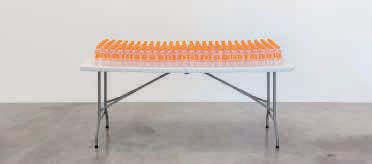
piece was first shown at Grey Noise, Dubai, in 2018, visitors consumed several bottles of water, mistaking the work for a hospitality table. Since then, the plastic has warped from exposure to heat, unwittingly turning the piece into a comment on capitalism’s contribution to climate change.
While our warming planet already affects us all, it is of more immediate concern to those who live in the UAE, which today experiences temperature highs in the mid-40s Celsius. Several of the works in this section hint at this concern: Charbel-joseph H. Boutros’s Birthday (2016), for instance, comprises a sheet of bleached-out newspaper onto which the artist has ‘printed’ his name using UV rays of the sun in Dubai.
This, combined with the deep oranges and pinks of Nima Nabavi’s round ink drawing Source Code (2025), is enough
to encourage even the most blasé visitor to reapply high-factor sunscreen before leaving the exhibition.
It is notable that ‘Rays, Ripples, Residue’ coincides with the tenth anniversary of 421 Arts Campus, one of the few independent spaces in Abu Dhabi, at a moment when the city’s cultural landscape is rapidly expanding around Jubail Island. Rather than positioning itself against these mega developments, the exhibition gestures towards another way of engaging with history – one that values attentiveness over monumentality. If the forthcoming Guggenheim Abu Dhabi will likely offer an encyclopaedic forward march through the region’s art history, ‘Rays, Ripples, Residue’ instead embraces flânerie: a personal, intuitive amble through the recent past that unsettles rather than crystallizes the canon.
— Chloe Stead
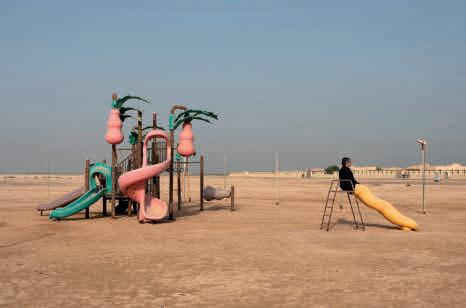
Ala Younis
NYU Abu Dhabi, UAE
Kuwaiti-born Jordanian artist Ala Younis’s 20-year survey at NYU Abu Dhabi, ‘Past of a Temporal Universe’, reads less like a traditional retrospective than as a portal for reimagining how knowledge is constructed. Translating dense historical and political research into spatial encounters, Younis bypasses our exhaustion with information overload. Her installations reintroduce urgency through embodied experience: objects, models and staged environments allow viewers to intuit the stakes before reading a single wall text.
Informed by her background in architecture and visual cultures, Younis explores the intersections of Arab geographies, history and lived experience. Her work draws from formal and informal records to attend to the intimate, often unseen lives behind official histories. Navigating industrial militarism, modern architecture and media, she approaches archives as a dynamic terrain shaped by exclusions, revisions and competing narratives. The exhibition brings together iconic installations, including Nefertiti (2008) and Tin Soldiers (2010–11), alongside new works, which function as invitations rather than didactic displays: nothing is laid out neatly; viewers piece together stories from fragments.
Two iterations of a single project form a central axis of the show: Plan for Greater Baghdad (2015) and Plan (fem.) for Greater Baghdad (2018). First shown at the Venice
Biennale, Plan for Greater Baghdad consists of a model and a constellation of visually compelling historical materials documenting Le Corbusier’s Saddam Hussein Gymnasium in Baghdad. Along two walls, documents, photographs and digital images trace the project’s ‘male’ genealogy, mapping the complex network of architects, planners and heads of state involved in the gymnasium’s 25-year evolution. Opposite, the 2018 iteration presents a ‘female’ counternarrative. Younis inserts women marginalized within these accounts – including Zaha Hadid, Fahrelnissa Zeid and Nuha al-Radi – alongside artists and researchers whose acts of documentation and preservation were integral to Baghdad’s modern development. Plan (fem.) for Greater Baghdad reframes found archival material to challenge the gendered historiography of the city’s architectural and political past.
The centre of the room holds the project’s physical manifestation: small male and female figurines encircle an immaculate white architectural model of the gymnasium, each figure carefully choreographed, frozen mid-gesture. Their identities and trajectories are illuminated through the surrounding montage, giving historical layers tangible form. Here, Younis explores how monuments are preserved, interpreted and mobilized as instruments of power.
‘High Dam’ (2015–25), her longest running series, forms the exhibition’s
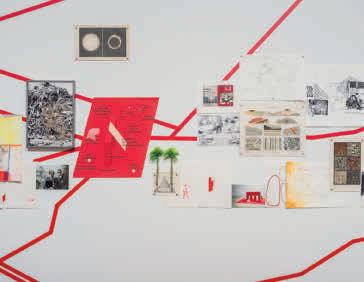
gravitational centre. Examining the Nile river’s Aswan High Dam – constructed under then Egyptian president Gamal Abdel Nasser with Soviet support and framed as a ‘modern pyramid’ – the work interrogates its elevation to national myth despite its construction submerging Nubian land and displacing entire communities.
At the entrance, High Dam (Modern Pyramid) (2019) commands attention with vermilion geometric forms. Initially obscure, the installation gradually yields its logic through a corresponding diagram: a central rectilinear block signifies ‘Nasser as dam’, symbolizing how the Egyptian leader positioned the structure as an emblem of national modernization. A steel mobile references edits of Youssef Chahine’s 1972 promotional film The People and the Nile; mountain-shaped panels represent soldiers deployed as extras, while other rectilinear forms denote performers and workers. Nearby, a map-style archival display traces key moments such as the 1968 relocation of the Abu Simbel temples, situating the dam within historical and cultural contexts.
Study Structure (2025), a recent research collaboration with historian Masha Kirasirova, examines Soviet–Arab relations and the dam’s visual framing as a symbol of progress during the Cold War. Viewers navigate hinged blue panels featuring collage-like visual essays composed from multiple viewpoints – Soviet and Egyptian, propagandistic and cultural, official and artistic. Meaning emerges through proximity and comparison, as we move between competing accounts.
Across the exhibition, Younis insists that archives are never inert: she assembles history spatially, inviting viewers to slow down, observe closely and engage the space through full sensory awareness – a rare and powerful way to experience history.
— Aisha Zaman
Ala Younis, High Dam (Concrete Poetry), 2023–25, graphite and coloured pencil drawings on paper, inkjet prints, etchings, lithographs, steel, plastic, adhesive tape, vinyl record, dimensions variable
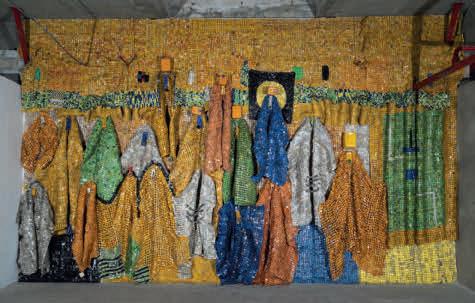
Serge Attukwei Clottey Gallery 1957,
Walk through the historic fishing district of Jamestown, Accra, on any given day, and chances are you will encounter a funeral. For Ghana’s Ga people, funerals are vibrant, joyous occasions; in a place where Christianity and indigenous practices coexist, death is celebrated alongside life. It may not be surprising, then, that Serge Attukwei Clottey’s dazzling exhibition, ‘[Dis]Appearing Rituals: An Open Lab of Now for Tomorrow’ – an ode to Jamestown – is full of ghosts. Uncanny apparitions lurk behind glistening portals or hang suspended from ceilings at each turn. These spectres, however, are not to be feared or mourned.
The exhibition title alludes to how life and death coalesce: as histories, traditions and rituals die out, they are reborn with each generation in new forms. Here, the ritual is Jamestown itself, a place continually negotiating its survival amid socio-economic, environmental and infrastructural concerns. As co-curator Allotey Bruce-Konuah notes, the ‘first wave of the death of Jamestown’ began in the 1960s, when Ghana’s main port was relocated to Tema, some 30 kilometres away. More recently, the 2020 harbour redevelopment led to the demolition of informal settlements and displacement of residents.
Cascading cellular sheets fall from the ceiling, forming undulating waves of
yellow, gold and bronze. Clottey’s signature monumental tapestries are formed by cutting the ubiquitous plastic jerrycans known in Ghana as ‘Kufuor gallons’ into small squares and stitching them together with copper wire – a practice the artist terms ‘afrogallonism’. Originally made for transporting oil and repurposed for carrying water and fuel, the vessels’ inclusion invokes migration, water scarcity, consumption and the climate crisis. Throughout the exhibition, light pours through the tapestries’ fissures, casting spectres that dance across the industrial concrete floor.
In the introductory room, Sea View (all works 2025) comprises walls punctured with portals, revealing cartoonish figures with elongated limbs and bulbous eyes (Dance Battle; Game Bois), inviting us to look but not get too close. These apertures speak to the layers of multigenerational creativity on which the artist builds: Clottey’s father is an artist, while the pastel, oil and charcoal drawings were made in collaboration with his young son. The room’s focal point is the glistening mosaic Sea Never Dries II, its just-legible titular affirmation – a common phrase written on local fishing boats – expressing both faith in the ocean’s abundance and its centrality to Jamestown’s communities.
In the centre of one large room, a black fishing net titled Spotlight hangs torn, like an eerie apparition: a repository of memories, secrets and stories past.
This sentiment is echoed in Memory Lane, a nearby bathroom-like space featuring urinals fashioned out of gallons. Visitors are invited to ‘whisper to the wall, confess to the cracks’ by writing on the black walls with chalk. The interactive element – central to Clottey’s practice – reminds us of the value of vulnerability and shared experience in the most unexpected of places.
A moment of repose arrives in the exhibition’s most immersive installation, Jamestown nshonaa (Jamestown Beach). You peel back a worn blue net; before your eyes can adjust to the darkened space, the soles of your feet are cushioned by soft sand, signalling a shift to the Jamestown shoreline. All the senses are summoned here; we cast our eyes onto a fishing boat and rusty corrugated metal shacks as the smell of smoke and sea – entwined in the fishing nets – hangs heavily in the air. We are mollified by the sounds of the tide lapping against the shore, played through a meditative film that wholly envelops and grounds the space.
‘[Dis]Appearing Rituals’ is so dynamic that you neglect to mourn what has passed. Here, Clottey boldly reimagines Jamestown not as a site of demise and decay but as one of fertile and perpetual renewal, at once alluring, hopeful and alive.
— Melissa Baksh
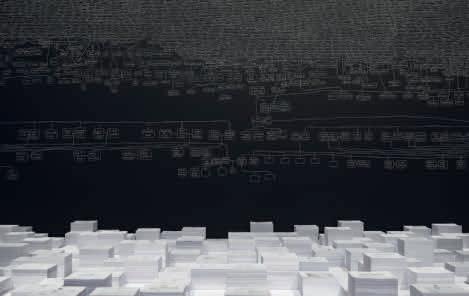
Queensland Art Gallery and Gallery of Modern Art, Brisbane, Australia
In a dimly lit room at the Queensland Art Gallery and Gallery of Modern Art in Brisbane, Archie Moore has painstakingly drawn an immense genealogical tree in white chalk on black walls. Starting simply with the artist, designated as ‘me’, the chart becomes a dense web as it ascends towards the ceiling. The work was shown in 2024 as part of ‘kith and kin’, Moore’s exhibition at the Venice Biennale, which garnered the Golden Lion for best national participation – the first time an Australian artist has received the accolade. Here recreated by Moore – who is of Bigambul, Kamilaroi, British and Scottish descent – the chart is an ambitious reorientation of time and history and an assertion of belonging. Reaching back over 65,000 years, it is a reminder of the past, present and future of First Nations Australians; bringing this installation to Brisbane is a crucial way to ensure these groups can see their histories represented through art. Despite extensive research into his family – a notion in Indigenous cultures that includes not just people but land, plants and animals – Moore was limited not only by temporal distance but by absences and omissions in written records. Thus, Moore speculated at times, inventing names and even including slurs used against Aboriginal people. Joining these are Kamilaroi and Bigambul kinship
terms – an act of preservation in itself and a rebellion against the decline of First Nations languages under colonization. Gaps punctuating the names evoke the violence and loss Indigenous people have faced since the British invaded in 1788, from the introduction of diseases to efforts to obliterate cultures and families.
Moore’s use of chalk – provisional, erasable, the stuff of school instruction –becomes here a tool for self-determination. Spanning some 2,400 generations, Moore’s genealogical tree asserts the endurance of Indigenous Australians as one of the earth’s oldest continuous living cultures. The viewer stands not before a chronology but within an ancestral map of collapsed time.
At the room’s centre, a dark, reflective pool and stark white table confer the impression of a memorial or shrine. The table is covered in tidy stacks of paper of differing heights; strained glimpses reveal that they relate to coronial inquests into Indigenous Australians who have died in police or prison custody since 1991. Totalling 557 reports, the number is overwhelming to behold. The viewer’s inability to read these documents due to the distance the pool puts between them and the table, as well as the fact that the names of the deceased are redacted, adds to the work’s weight. Interspersed among the reports are historical documents
tied to Moore’s lineage: government files, anthropological notations and bureaucratic paperwork illustrate the persistent imposition of classificatory and legal systems designed to regulate Indigenous existence. Suspended visually between the reflective water and the sky of ancestral names, the table becomes a sombre axis linking history to contemporary state-sanctioned catastrophe. The more the viewer leans in to read the documents, the more their own body becomes mirrored in the water. Without ascribing blame, the work asks visitors to locate themselves in relation to the colonial systems it so powerfully critiques.
Despite its personal specificity, ‘kith and kin’ gestures outwards, situating Moore’s familial narrative within global patterns of displacement, survival and resistance. Though deeply rooted in First Nations Australian histories, the work addresses our broader human connections across place and time and our shared vulnerability to the forces that attempt to define and limit us. Moore offers neither reconciliation nor closure. Instead, he acknowledges the infinite reach of ancestry and the ongoing struggle against the structures that seek to contain it. What emerges is a monumental act of remembrance and continued self-determination. — Annabel Keenan
Som Supaparinya
Jim Thompson Art Center, Bangkok, Thailand
In her research-based practice, artist Som Supaparinya combines visually layered video works with photography, tangible objects and storytelling to disrupt the process of historical amnesia and reveal the rhizomatic webs of critical moments that embroil communities and nations. Supaparinya’s solo exhibition ‘MO NUM EN TS’ showcases a video installation of the same name that examines the legacy of the Cold War in Thailand through materials produced by the United States Information Service (USIS). Propagandist in nature, the archival materials exalt Thailand’s rapid development during the 1960s and ’70s while foregrounding the country’s bilateral alliance with the US. Creating an audiovisual realm where archival materials interweave with landscapes and national infrastructures, Supaparinya invites viewers to reflect on how Cold War ideologies continue to shape collective perception and knowledge in Thailand under the guise of progress and development.
The space where MO NUM EN TS (2025) is installed resembles a military base’s command centre: the large screen mimics the grid of a CCTV monitor, while a wall is built out to evoke the sluice gates found in hydroelectric dams. The effect is one of control, intensified by the video’s
alternation between bird’s-eye views and wide shots of landscapes. Familiar from their use in military surveillance – and clearly visible in the topographic maps and aerial photographs of Cold War infrastructure, such as US Air Force bases and highways across Isan (Northeast Thailand), that Supaparinya extracted from both Thai and US archives and intersperses throughout the work – these camera angles conceal the desire to monitor beneath the pretence of objectivity.
At first glance, Supaparinya’s video installation might give an impression of archive-validated celebration, even nationalist bravado. Yet her compositional decision to collage multiple views into a single screen fractures these archives’ historical certainty: while together the images form a seemingly seamless shot, subtle dividing lines point to the Cold War’s ideological ruptures. In a quotidian shot of Thai and Lao vendors engaged in their work at the rambunctious Thai–Lao market by the Mekong River in Nakhon Phanom, a single vertical line persistently separates the two people on screen – alluding to the countries’ tense Cold War relations, marked by border skirmishes and ideological conflict.
Throughout the video, and especially towards the end, Supaparinya quietly amplifies this simmering tension. A montage of hydroelectric dams across Thailand, many of them named after Thai monarchs, such as Sirindhorn or Bhumibol – a tactic
devised by US construction companies to render the dams ‘sacred’ and therefore untouchable – is immediately followed by footage of civilian protests in 2003, decrying the ecological impact and human displacement caused by the Pak Mun Dam in Ubon Ratchathani. Of all the dams included in the work, Pak Mun is the only one without a royal title –achieved through a push by local communities to stake their claim against the imposed disruption of their environment.
MO NUM EN TS ends on a cliffhanger, revealing neither the fate of the dam nor that of the people affected by it. Supaparinya’s sentiment nonetheless remains transparent: if archives can lie, if control is a state’s default, then our search for historical truths and autonomous existence cannot be divorced from the view of the people. This quest for freedom also figures into a version of the artist’s earlier installation Paradise of the Blind (2016/25), a pop-up library of books that have been banned across Asia, here displayed alongside an installation in which bullets rain down on piles of shredded paper from photocopies of said books. Exposing how power manifests through the censorship of knowledge, together Supaparinya’s two works create a space for audiences to contemplate the ways in which memory, knowledge production and the natural landscape intertwine.
— Hung Duong
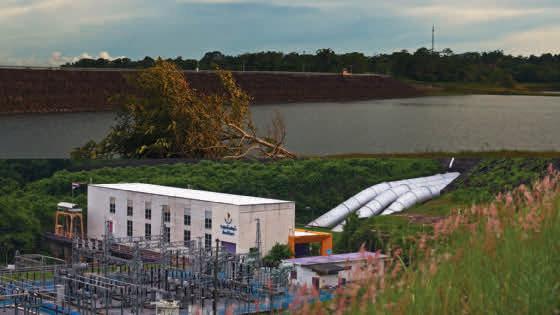
The Great Camouflage Rockbund Art Museum, Shanghai, China
In an iconic snapshot of the pair, Mao Zedong and W.E.B. Du Bois laugh together like schoolboys. Taken during Du Bois’s 1959 tour of China, it illustrates the enthusiasm for Afro-Asian exchange that animated mid-20th-century revolutionary discourse. However, the wall-mounted timeline of the era in ‘The Great Camouflage’, at Shanghai’s Rockbund Art Museum, also carves out space for undersung feminist pillars of Afro-Asian discourse, like the writer, composer and activist Shirley Graham Du Bois. In doing so, curators Kandis Williams and X Zhu-Nowell topple the monumental nostalgias that define both political and artworld remembrance of the era. Their bold commentary on the history and afterlives of Afro-Asian exchange stages a reckoning with the shortcomings of solidarity and the variability of the stakes at play.
But what are these stakes? The exhibition opens with a subtle exchange.
Chinese painter Hao Liang’s The Epitaph of Phaéthōn (2025), a portrait of the sun god Helios’s ill-fated son, allegorizes Chinese revolutionary aspiration. On the floor beside it is American artist Boz Deseo Garden’s après-coup 2 of 1,400 (2025), a sculpture comprising casts of two iron bars once used in slave ships to offset the lightness of the human cargo. In conversation, the works anchor the incandescent spirit behind revolutionary communism to parallel histories of revolutionary Blackness. Both pieces seem to assess the weight of something thwarted. However, Garden’s reflection on the burden that Black radicalism sought to shift grounds the show in an overarching consideration of the load that Black people still shoulder. It is in this direction that the scale of the exhibition tips. A distinct feeling emerges that, at its heart, this is a conversation about Blackness and the Black position in Afro-Asian exchange.
Accordingly, this show refuses the gung-ho optimism that colours much discourse on the subject; the exhibition’s
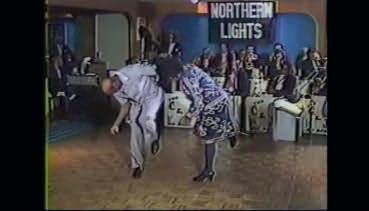
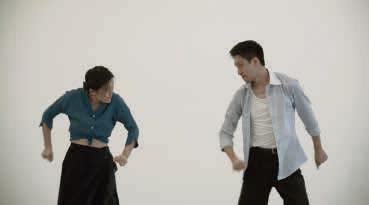
itch to reality-check is palpable. The most powerful gestures direct attention to the human shortcomings that undermine true solidarity. Hao Jingban’s Opus One (2020) is a film that sticks uncomfortably in the exhibition’s craw. It follows two Beijing dancers as they obsessively work to nail the swing dances of 1930s Harlem. The film explores how and why people rush to throw themselves into gestures that originate outside their own context, ultimately demonstrating how such processes sever Black people from their own cultural and political histories. In a moment of sheepish self-awareness, Hao’s subjects ask how Black folk from back in the day might feel about this interpretation of their cultural legacy. But what about Black folks now?
An installation devoted to Williams’s Cassandra Press picks up the query. Working to retrieve Black radical thought from the domain of deified historical figures and institutional canonization, Cassandra Press publishes ‘lo-fi’ readers and zines of experimental theory, here presented on their signature slanted bookcase. These books are the cornerstones of a larger initiative inviting incarcerated people, community organizers and schoolchildren into the conversation about the cultural and intellectual heritage of Blackness.
Indeed, the exhibition is a stage for a chorus of conversations. We hear a tone of frustration, but also the conciliatory and hopeful voice that answers it – like a comrade soothing a disheartened revolutionary. Amid this tapestry of dialogues, it’s no wonder that the show embraces the spirit of theatricality to make its most rousing points. British artist Onyeka Igwe’s film A Radical Duet (2023) fictionalizes an intergenerational encounter between two anticolonial, women activists. In a meeting full of men, Igwe’s protagonist, Sylvie (after the Jamaican dramatist and scholar Sylvia Wynter), pleads with the room to recognize the power of a play to reimagine the world anew. It is a long, heart-wrenching beat as she turns from face to face, begging someone to write with her. Only auntie agrees. It is the poignant heart of a show that puts its faith in overlooked heroines to redefine vital solidarities.
— Christopher Whitfield
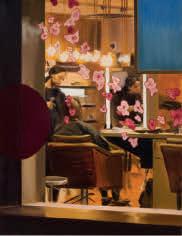
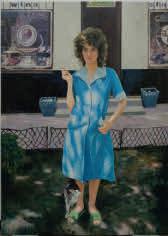
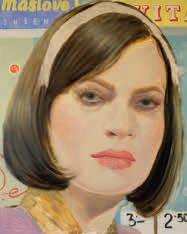
Telegraph Gallery, Olomouc, Czech Republic
Nostalgia in the post-communist, Eastern European context is a complicated terrain. Its remnants aren’t confined to the past but remain woven into everyday life – its infrastructure, architecture and political rhetoric – while its material culture circulates as a commodity, from retro tourism to curated ‘ruin’ aesthetics. This marketable Ostalgie often flattens history into familiar visual codes. Yet, nostalgia’s affective pull can also serve as a tool for negotiating the ideological and economic ruptures of the post-1989 landscape.
Within this shifting field, the image of the socialist female worker, poised behind the counter, can easily tip into a glossy, seductive, retro-nostalgic signifier, even though many of her conditions persist in today’s service economy. The artists in ‘Za Pultem’ (Behind the Counter), at Telegraph Gallery in Olomouc, examine this figure under a new gaze. Borrowing its title from a 1970s Czechoslovak TV series about the daily lives of supermarket employees, the exhibition brings together works by Paulina Olowska, Adéla Janská and Caroline Walker to consider what a feminist engagement with nostalgia might look like, unfolding as a study of visibility and power within the changing female service class. The installation is designed as a 360-degree environment, with paintings
suspended above piles of discarded steel kitchen appliances salvaged from a scrapyard. While I understand that this gesture aims for immersion – and it certainly looks cool – it doesn’t feel strictly necessary in this context: in a figurative painting show, the images speak volumes for themselves.
Olowska’s method is the most documentarian. Painting from vintage photographs of the 1960s and ’70s, as well as from stills from the titular TV series, works such as Cashier (after Yelena Yemchuk) and Polena (both 2025) restage cashiers and shop assistants with close attention to period detail – uniforms, restaurant interiors, shop displays. Yet, rather than sentimentalizing, it feels like Olowska wants to emphasize ambivalence: once embedded in the unremarkable flow of everyday visual culture, the women now return as aestheticized relics.
For Janská, the psychological charge of the figure becomes the focus. Her slightly claustrophobic backdrops in Saleswoman (after Evsej Evseevich Moiseyenko) and Ovoce & Zelenina (both 2025) loosely echo Olowska’s grocery-shop settings, but instead of realism, she treats these spaces as symbolic environments. In Za sklem (Behind the Glass) and Skleněné počasí (Glass Weather; both 2025), closeups of her glossy, doll-like figures fill the frame. Their expressions waver between seduction, scrutiny and warning. Here, the counter becomes a threshold where
gendered power play and everyday social codes are negotiated. There is a mythical register to these portraits: monumental and intimidating in scale, her figures –mostly modelled by friends – appear as unsung heroines whose image calls for a belated canonization.
Walker’s cinematically lit, painterly scenes of high-street shops, salons and restaurants in London introduce a late-capitalist Western counterpart. Her focus falls on gestures of labour – fetching food in Lunch Service II (2023), drying hair in Cut and Finish (2018) – rather than on individual faces, which remain largely abstracted. Often framed through windows, whose reflective surfaces become part of the composition – such as the floral stickers stretching across Glossing (2019) – these paintings reinforce a sense of urban voyeurism and alienation.
‘Za Pultem’ explores how images of women behind the counter circulate in collective memory and how easily they slip into myth. By critically restaging these figures while recognizing their nostalgic pull, the exhibition asks what desires and social fantasies they continue to generate – from socialist-era values of work, stability and familial cohesion to contemporary longings for past forms of community that feel more tactile and intimate. Ultimately, the show sharpens our view of the precarity and structural invisibility that continue to define service work today.
— Sonja Teszler
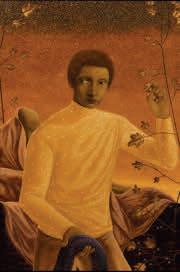
Palazzo Esposizioni, Rome, Italy
The 18th Rome Quadrennial, held at the city’s Palazzo Esposizioni, opens with sculptor Giulia Cenci’s secondary forest (2024), the show’s only stand-alone installation. Sparse, wiry branches bearing human and dog heads sprout from rusted earth, barely filling the alcove created by two white walls that don’t fully connect, affording a peek at the galleries beyond. This delicate introduction grew on me, though it marked a modest, somewhat tentative start to Italy’s pre-eminent survey of home-grown contemporary art, this year titled ‘Fantastica’.
Launched in 1931 to espouse Italian fascist cultural supremacy and rebranded in 1948 to signal a regime change, the quadrennial carries a complicated legacy. This year, five curators frame Italian art of the 21st century through five thematic chapters, focused around artistic independence, collective autarky, image culture, the body and self-portraiture – sections that intermingle in their shared concern with creative sovereignty, fascism’s enemy.
It’s better to forgo the map: these sections prove intuitive, even when unlabelled. Curator Francesco Bonami’s ‘Memory Full: A Room of One’s Own’ eschews a theme, instead suggesting a preference for market darlings like Cenci. Bonami’s artists are all isolated, yielding that distinctive art-fair-booth sensation of works on display for
purchase. Bea Scaccia’s opulent paintings, Shafei Xia’s ceramic tiger heads and Lupo Borgonovo’s tapestry-like ink drawings seem to suffocate in their white-walled enclaves, erected for the quadrennial. These vignettes are too brief to feel intimate, save for Jem Perucchini’s devotional portrait The Stranger (Dionysus) (2025), which glows in its velvety black cubicle.
Francesco Stocchi’s deliberately untitled section features an even higher concentration of renowned talents, yet the tone shifts: Stocchi conferenced with his nine artists to shape their presentation collectively, from flooring to wall text. Groans from Arcangelo Sassolino’s hydraulic steel claw, Hunger (2008), fill one space, its six appendages curling into precarious positions before collapsing with a crash so loud docents wear ear protectors. Quieter moments also enthral. Martino Gamper’s ‘seating choreography’, Sitzung (2023), positions chairs before works by five artists, including Pietro Roccasalva’s moody still lifes and a twopart pastel and charcoal abstraction by Lulù Nuti. Visitors sat and watched dancer Sofia Magnani twirl silently to music in her earbuds – one of many performances programmed for the run. Juxtaposed, these two sections illustrate what happens when artists, rather than egos, lead.
In Emanuela Mazzonis di Pralafera’s ‘The Time of Images: Images Out of Control?’, 11 photographers speak to our era’s visual deluge. Black and white snapshots from Andrea Camiolo’s series ‘The Manhattan Project’ (2022–ongoing) mimic found photographs from an abandoned American military base in Sicily
but are AI-generated based on Larry Sultan and Mike Mandel’s 1977 photobook Evidence. Meanwhile, Teresa Giannico’s colourful images Must Have. Essentials for a Creative Space and Must Have. Painting Collection (both 2025) appear AI-made. In reality, they document dioramas constructed from fast fashion advertisements for aspirational artist studios. Normally, I prefer sparse wall texts like those throughout this quadrennial. Here, the lack of context activates a hallmark of today’s globalized image culture: viewers must do their own research.
Alessandra Troncone’s section on ‘The Unfinished Body’ is the show’s flashiest. One gallery glows with an ad for Emilio Vavarella’s Lifeweave.app (2025), which invites users to submit saliva and purchase tapestries visualizing their DNA. Nearby, a speaker and microphone mounted on robotic arms spar and sniff each other in Roberto Pugliese’s Industrial Equilibrium (2024). Their arresting courtship gestures at homeostasis, but ultimately lapses into pareidolia.
Agnes Questionmark offers deeper resonance with life. Exiled in Domestic Life (2025) suspends a candy-coloured aquatic specimen from a chrome apparatus that supports seven video screens and a table featuring sketches and handwritten letters. The installation embodies Questionmark’s fantastical search for a sea monster, an allegory for her self-discovery as a trans woman. In a quadrennial rife with spectacle, this monument retains an earnest undercurrent. Excitement and substance, it insists, aren’t mutually exclusive.
— Vittoria Benzine
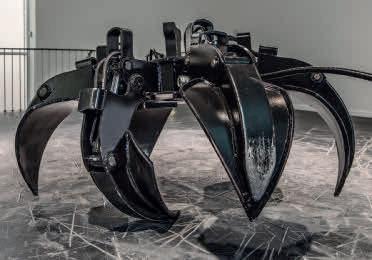
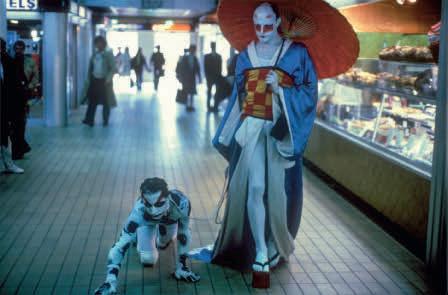
Luciano Castelli
Kulturstiftung Basel H. Geiger, Basel, Switzerland
Over a career spanning more than five decades, Luciano Castelli has continuously reinvented himself across painting, photography, sculpture, music and performance. Now 74, his exhibition ‘Whispers of Japan’, at Kulturstiftung Basel H. Geiger in Basel, brings together a slew of works that testify to his persistent gender mutability as well as an ongoing fascination with the Asian region.
At the centre of the first room is The Bitch and Her Dog (1981), presented as a video accompanied by two large-scale photographic prints. Staged on the streets of Lyon on the occasion of the Third Symposium of Performance Art, the work was realized with the German artist Salomé, Castelli’s collaborator in the avant-garde punk band Geile Tiere (Horny Animals), founded two years prior. Wearing heavy geisha-style make-up – faces painted white with patches of blood-red – the two performers adopt roles that are at once theatrical and opaque. One of the men, dressed in a blue kimono with wooden sandals and carrying a red umbrella, walks the other, whose body is painted in dalmatian-like black spots. Onlookers appear puzzled; some smile or take photographs, but their reaction seems nervous. Towards the end, ‘the bitch’ feeds ‘the dog’ what appears to be sushi with chopsticks.
Unlike VALIE EXPORT’s 1968 performance Aus der Mappe der Hundigkeit (From the Portfolio of Doggishness), in which she walked artist Peter Weibel on a leash down Vienna’s Kärntner Straße as a pointed inversion of sexist power structures, Castelli and Salomé’s interplay of dominance and submission, loyalty and servitude, is more ambiguous. Here, the dynamic of gender relations is neither fixed nor totally inverted; rather, it is continually refracted through attire, demeanour and public spectacle. Power circulates rather than settles; humiliation and agency are indistinguishable.
Throughout the exhibition, Japanese references serve less as acts of citation than as tools through which the artist reinvents himself. Scattered across the next room are eight large folding screens (The Japanese Paravents – Byōbu, 2024–25), commissioned specifically for the show. Their monumental structures were crafted in Tokyo and later mounted with over 90 of Castelli’s abstract works, rising taller than a human figure and spanning several metres in width. Painted in broad, gestural strokes on silk and Japanese paper, they emanate intense orange, yellow-gold and cobalt blue, offset by stark black and white. Known as byōbu (wind walls), these objects historically served to divide rooms and spaces; here they emerge as carriers of evocative compositions that unfold across multiple panels.
For Castelli, these landscapes – oscillating between seemingly abstract
Opposite page above Jem Perucchini, The Stranger (Dionysus), 2025, oil and acrylic on linen, 1.5 × 1 m
Opposite page below Arcangelo Sassolino, Hunger, 2008, steel and hydraulic system, 95 × 100 × 100 cm
This page Luciano Castelli & Salomé, The Bitch and Her Dog, 1981, performance view
lines and fleeting human figures – hark back to his early engagement with the neo-expressionist idiom of the Neue Wilde, which emerged in the 1970s and ’80s. This was an aesthetic marked by interest in non-Western forms, bold colours and rapid, broad brushwork that felt studied yet embraced imperfection. Above all, they all seem to echo the artist’s representation of themselves as a person in flux. Presented nearby is Dogs/Self-Portraits (1981), a massive canvas in dense patches of blue, black, red and yellow. Possibly the most abstract in this constellation, it offers no recognizable shapes or figures, yet its title suggests otherwise, drawing the painting back into Castelli’s ongoing project of self-mythologization.
Circling between earlier and recent works, ‘Whispers of Japan’ captures the essence of Castelli’s practice: a self-portrait that is constantly morphing. Surrounding the folding screens are large, untitled works painted directly onto the gallery walls in rough contours and bleached grey, producing fleeting outlines of a face from what seems a placid mountainous landscape. If Castelli’s work has at times been dismissed as grandiose, this exhibition insists on its coherence: a persistent investigation into identity and gender as something performed, negotiated and repeatedly undone.
— Krzysztof Kościuczuk
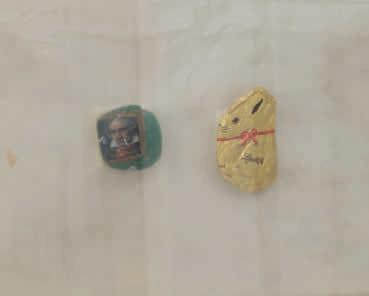
Fondation Pernod Ricard, Paris, France
A perished rose, still clinging to the pink blush of its youth, rests at the bottom of a plastic bag, itself long past its prime. The work, The Carrier Bag (2025), appears in Beatrice Bonino’s solo exhibition ‘In the main in the more’, which plays out across two white-cube rooms at the Fondation Pernod Ricard. Sculptures on pedestals, scattered sparsely across the gallery, share the same dusty, yellowed hues as their wall-mounted siblings.
The accompanying text describes the rose as coming from the Palaepaphos archaeological site in Cyprus, a detail emblematic of how Bonino approaches her materials as an archaeologist might, albeit one who attends to a different timeline. Her works preserve forgotten memories from the present day, resurrecting and isolating materials seemingly disposable in contemporary Western societies. The objects she employs – some teetering on the edge of disintegration –might seem frail if shown in isolation, but as part of Bonino’s precise assemblages they occupy an equilibrium somewhere between a recent birth and an impending demise.
Bonino’s works frequently employ the materials of preservation – acrylic boxes, glassine paper – rendering uncertain the distinction between ‘contents’ and
‘packaging’, as well as alluding to a given object’s monetary or cultural value. In Funny and Fun (2024), for example, a squashed Lindt chocolate bunny is laid to rest alongside a similarly distorted foil-wrapped confection bearing the face of the composer Ludwig van Beethoven. The two chocolates, both signifiers of taste or quality, are unceremoniously pinned abreast with a nail through their centres –as a lepidopterist might mount a butterfly – and covered in a layer of plastic, then encased in a neat acrylic box.
I’m reminded of the work of Jef Geys, particularly his ‘Bubble Paintings’ (2017) – earlier pieces that were newly dated and re-exhibited inside the bubble wrap from the previous show or storage container. Like Geys, Bonino uses wrapping and layering to enliven her objects, bestowing the materials she describes in the accompanying text as ‘precious trash’ with a value that feels intrinsic. We might now peer through the display case, willing the bunny’s golden wrapper to be 24-carat, or Beethoven’s image to be a period-correct, hand-painted miniature.
Bonino’s reverence for the residues of modern life might be seen as a critique of the capitalist mass production that fosters throwaway culture. We may arrive at such an argument, but the path is indirect:
This page
Beatrice Bonino, Funny and Fun, 2024, plastic, paper, chocolate and aluminium foil, 37 × 18 cm
Opposite page
Libasse Ka, Gueno’s Tree, 2025, oil on canvas, 2 × 1.5 m
we are first invited to confront our own fragilities through the sombre beauty of a length of paper, browned and curled at its edges (But Should Something Else Be Made Sacred, 2025), or a scrap of blemished ribbon (Which Is Ennui?, 2025), no longer the embellishment it once was.
Bonino and curator Catherine David have also included works by historical and contemporary artists known for exercising a similar approach to traditionally ‘poor’ materials. Two works from Matt Browning’s ‘Plastic Freedom’ series (2022–ongoing) – palm-sized, mirrored panels made from plastic bottles, heatshrunk in layers, one atop the other – are displayed among Bonino’s wall-mounted sculptures. On a nearby plinth, a pair of knitted nylon slippers by Marisa Merz Ω with the monolithic World Trade Center towers looming in the background.
While at first Bacher’s work may feel materially incongruous among the other objects, its documentation of something now disappeared emerges as vital, cutting to the core of what also makes Bonino’s practice so compelling. In Bonino’s hands, a fragile object’s evanescence feels not oppositional to the value of its existence, but rather one of its most enduring hallmarks.
— Ben Broome
Libasse Ka Museum Dhondt-Dhaenens, Deurle, Belgium
Muddied paint, washes of splotched oil, mediums mixing or refusing to mix, yellowing varnish coagulating over a trapped fly and a loose hair on stretched linen. There is no coherent subject matter to be seen in Libasse Ka’s painting Untitled (all works 2025), yet it is undeniably rich in substance. Scratched lines like tally marks dig into the skin of the background, and small spherical shapes of colour are shaded to perfection.
For his first institutional solo exhibition, ‘Notes on Shape Shifting’, the Senegalese-born, Brussels-based artist presents 19 oil paintings of varying dimensions, installed in a gallery space perforated by a glass atrium, at the
Museum Dhondt-Dhaenens in Deurle. His gestural strokes, heavy textures and all-over expressive intensity form the essence of each work. In the exhibition text, Ka’s methodology is explained as a culmination of his experimentation with the material properties of paint, exploring how, despite its chemical variations, paint sits on a surface, its behaviour guided and manipulated by layers of primer, or else by bare canvas.
The incessant physicality of applying paint – in which Ka scuffs, leaps over and tears into the surface – is central to this practice. In some works, the upper sections of the canvas have been rendered by the grain of a scrunched T-shirt. In others, sheets of pigment-covered plastic have been pressed into the surface, while nervous lines from chalky paint zigzag over the midsection, such as in Negotiations.
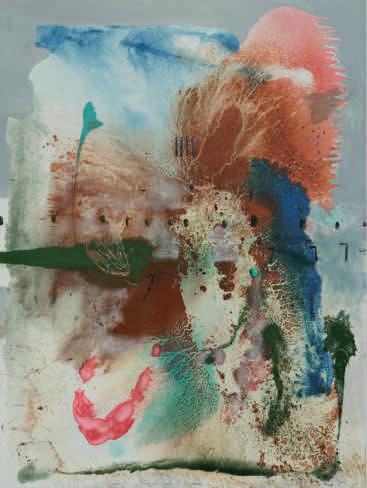
Ka often produces his larger works by dispensing with brushes (except for the occasional finishing touch), applying the paint instead with his fingers, different fabrics or directly from the tube. Painterly splotches, rendered globular through shading with medium, and whips of paint break the deadpan white of the primed canvas, reminiscent of a long scratch on a keyed car. In another Untitled work, a chalky yellow ground contains the squared impressions of a paint roller, and dense rust-coloured skeins drag swiftly down from the midline through gravity rather than brushwork. Everything appears in motion; nothing is fixed or final. The floating letters and vivid orange box in No Competition are pared back and airy, while Gueno’s Tree is anything but. Fizzing blues and pinks spread across the canvas, and a splash of splintering russet recalls the chromatic transformations of Dale Frank’s work.
A square Untitled painting appears to have been made with the transitory glow of the sun in the gallery in mind, its bare white becoming most operative when the natural light from the atrium interrupts its volatile surface. It is set between two tall, inch-wide windows; shafts of light strike the edges of the canvas. Deep green, red, black and blue splatters cluster at the centre against a pale, airy ground. Running up the left and right edges are two vertical yellow stripes, inch-thick, echoing Barnett Newman’s ‘zips’ and mirroring the light outside. In this way, light becomes an active collaborator with the canvas in the conveyance of the painting.
Exit Through a Window is stained with a thin turquoise wash, over which yellowing, glossy patches float, carrying the scent of linseed oil. Untitled bears the same odour but is surrounded by matte areas of clear medium with a sharp, pine-like sting, as if it were still wet. These smells serve as an index of process, narrowing the distance between the making of the work and the results hanging on the gallery walls.
Ka’s work is in flux. His approach seems to follow what Harold Rosenberg termed, in his essay ‘The American Action Painters’ (1952), the ‘arena in which to act’, whereby the canvas becomes an event. Painting is an adaptive system, capable of materially articulating many things. Ka’s experiments in recording the ways paint interacts with a surface are promising and, crucially, appear to be heading somewhere.
— Billy De Luca
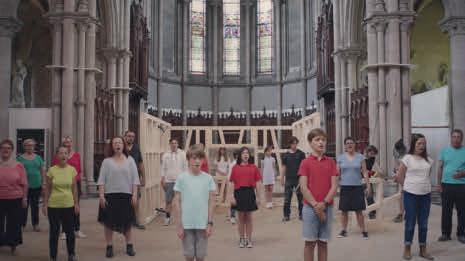
Annika Kahrs Hamburger Bahnhof, Berlin, Germany
Places and their various meanings are central to German artist Annika Kahrs’s practice. Over the past 15 years, she has made films and performances everywhere from warehouses to train stations, typically using music to explore their complex stories. So it feels only natural that ‘OFF SCORE’, the largest survey of Kahrs’s work to date, has a strong site-specific component: over the duration of the exhibition, several pieces will be shown across Berlin in specially selected locations.
Many other works, however, including three standout films from 2022–25, are displayed in the classical gallery space of Hamburger Bahnhof. Attempts to evoke the original settings – church pews, park benches, Gothic archways in the ribbed glass partitions between viewing areas – initially feel like diminished substitutes for the historically charged places where the films were recorded. If ‘a space consists not only of four walls but also its atmosphere,’ as Kahrs writes in the catalogue, how can that spirit survive translation into a screen-based exhibition format?
Kahrs’s answer lies in clever editing and close observation. Le Chant des Maisons (The Song of the Houses, 2022), for example, captures a group of children, teens and adults performing polyphonic singing and brass arrangements in a deconsecrated church in Lyon. Behind them, builders erect a wood-beam structure, occasionally joining the score
with rhythmically pulsing drills and screwdrivers. Lingering shots of architectural details anthropomorphize the dilapidated building. Raindrops dripping down stained-glass windows appear like tears, while religious statues surrounded by rubble and cables seem to vocalize the performers’ melancholic tones – cries of grief for their onceglorious home.
This sense of longing for formerly thriving public spaces threads through the films in ‘OFF SCORE’. In La Banda (The Band, 2024), an intergenerational orchestra processes through the sleepy streets of Olevano Romano. Empty shops and signs advertising apartments allude to population decline and economic stagnation in the Italian town. While they ultimately unite for a climactic melody overlooking the rolling countryside, the despondent musicians – oldest 80, youngest 8 – initially wander alone or in pairs, letting out discordant, birdlike calls for companionship on their flutes and horns.
Kahrs’s latest film, created especially for this exhibition, subtly suggests the digital age is partly to blame for such feelings of disconnection. A Cashier’s Opera (2025) is shot across four Berlin department stores: previously bustling social hubs now reduced to soulless interiors and deserted escalators, casualties of the contemporary preference for online shopping. The adolescent singers in bloodied clothing shuffling like zombies through Ring-Center II feel
a little on the nose. Yet moments of tenderness emerge: an opera singer performs in a vacant Lichtenberg store after a guided tour by a former worker who reminisces proudly about the people and products that once animated its floors.
All the films in ‘OFF SCORE’ are experienced through headphones that sense each viewer’s location and play audio corresponding to where they stand. This innovative approach not only solves the problem of overlapping sound in film exhibitions, it also amplifies the themes in Kahrs’s oeuvre. Once plugged in, I feel locked into a personal sound bubble, disconnected from other visitors.
The sense of device-induced isolation is magnified when I rush to catch the performance For Two to Play on One (2012) on the other side of the museum. A jovial piano duet drifts from within the room, inviting visitors to enter one at a time. Inside, the pianists stop, shuffle their sheet music and stare intently at the intruder. Why is this gaze so uncomfortable? Have we forgotten how to look one another in the eye without the crutch of a smartphone giving us an excuse to glance away? If Kahrs’s work is concerned with place, the pieces gathered here suggest we no longer know how to inhabit spaces fully. Above all, we’ve forgotten how to inhabit them together.
— Emily May
Tanya Leighton, Berlin, Germany
I have often wished I were a painter. Greedily eyeing propositions of colour, line, gesture, shape and space, I try in vain to transpose paint into words –rearranging language as a kind of pigment, hoping one may equal the other in some ill-begotten equation. The painter LunitaJuly Dorn seems to feel the same, though her covetous source is music, as intimated in the title of her current exhibition at Tanya Leighton, ‘Wenn man Musik malen könnte, wär die Welt ne schönere’ (If One Could Paint Music, the World Would Be a More Beautiful Place).
Think not of Wassily Kandinsky, who believed ‘music is the ultimate teacher’ and painted synaesthetic abstractions with colours corresponding to notes. Rather, Dorn’s large-scale figurative canvases have two main strategies: first, a syntax that recalls musical notation, with little stems dancing across the picture plane as patterns, as well as staves extending horizontally across the lower half of her compositions to evoke sheet music; and second, the more literal citation of her favourite song lyrics nestled within the staff.
Picked out against the monochromatic red field of The End/The Doors (all works 2025), two female figures gaze
directly at the viewer, one stooping as if to point at the opening verse from the band’s titular 1967 record. I am no fan of The Doors, and was barely able to endure my sister blaring them with teenage angst from her bedroom, so here I have to disengage from my cynicism towards coming-of-age clichés. But music taste aside, the painting carries a seductive rhythmic resonance, from the fast-paced brushwork of its ground – watery red acrylic applied with swift circular and linear gestures – to the burgundy flowers growing from the ground or drooping from the figures’ hands, to the bold geometric patterns of their tunics. The bucolic landscape in which they stand is delineated with thin outlines of cream paint, the only worked-up elements being their faces and hands, which themselves are formally distilled: a shadow lining the lips; fingers rendered flat in fleshy pink. The result is strange and dreamlike, and brings to mind a contemporary reimagining of Henri Matisse’s The Dessert: Harmony in Red (The Red Room) (1908). Symphonic repetitions dance between the eight paintings in the form of angel wings, which adorn some of the figures as well as tiny, hieroglyphic-like apparitions. A miniature vignette of two angels carrying a fallen friend is particularly imaginative in Wish You Were Here/Pink Floyd: divinity potent, even when scaled down.
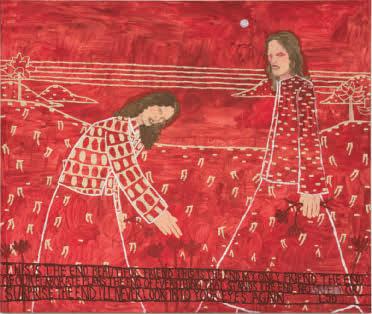
The faces in the paintings are always Dorn’s own: muted self-portraits defined by a simplicity that proposes a symbolic archetype. They are both her and everyone. Breathe (in the air)/Pink Floyd sees her with cigarette perched between lips and arms outstretched, ready for flight. The canvas’s canary-yellow ground peeks through great expanses of black and chocolate brown, which simultaneously scrub out and define details. There is a unique approach to layering in this work: the yellow ground fills the woman’s complexion, her facial contours defined by gentle, soft lines, while the hands are roughly approximated in this same yellow, overpainted atop black. The effect is apparition-like, as if she were drifting in and out of focus at the height of some Pink Floyd-esque acid trip.
Dorn’s canvases strike at different genres of painting: they are at once monochromes, Christian icons and self-portraits with a universal timbre. This active oscillation between the formal conceits of colour field painting and a more existential search for selfhood overtly holds the viewer’s attention. Yet the works possess a melancholy, too, that speaks to the unconscious space where we remain a mystery to ourselves. Whether we are painters, musicians or writers, there is a gap between self and medium that remains language-less, however hard we try to give it form.
— Louisa Elderton
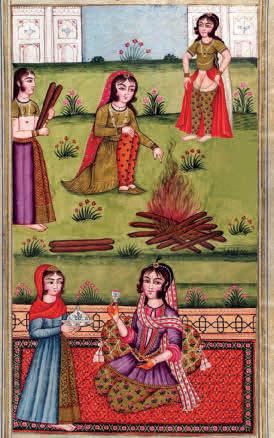
Nasjonalmuseet, Oslo, Norway
‘Deviant Ornaments’ at National Museum, Oslo, argues that expressions of same-sex desire can be found throughout the history of Islamic art – if only one knows where to look. A small but striking selection of sensuous, richly decorated artefacts demonstrate strands of desire encoded throughout centuries of courtly ritual and decor, while pieces by contemporary artists, working within a queer and Muslim context, offer a charged contrast between historical opacity and present-day transparency.
A drawing with delicate, flowing linework, attributed to Muhammad Qasim and dated around 1650, depicts a Safavid prince holding court, surrounded by functionaries and musicians. The male attendants dotted throughout the scene are all young and beardless, a recognized trope holding erotic connotations in Persian poetry and painting. Other objects within the exhibition are less straightforward
Kasra Jalilipour, The Dance, 2022, digital collage, giclée printed on archival paper, hand-embellished with paint, 20 x 12.7 cm
to read. For instance, a long men’s coat made in Iran between 1900 and 1930, densely patterned with florals, indexes the friction between European ideas of ornamentation as inherently feminine and Persian traditions in which it signified high social status.
Among the jewellery and decorative items, a fragment from an 11th-century Fatimid lustreware plate shows a man drinking wine with a male musician beneath a tree, framed by flowing Arabic calligraphy. That expressions of same-sex attraction are often indirect – and in many cases debatable – is interesting and unconventionally open-ended for a museum exhibition. It also serves as a reminder that current categories of sexuality are by no means universal. Archival absences around queer lives in Islamic contexts may reflect not only persecution and suppression but also practices and identity markers that diverge radically from contemporary LGBTQ+ discourse.
Many of the contemporary works reimagine the art and culture of the past.
Kasra Jalilipour’s ‘Queer Alterations’ series (2022–24) digitally edits illustrations from a historical Persian erotic manual to depict queer, trans and lesbian figures, presenting sex as a spiritual or transcendent act. Rah Eleh’s 3D-printed sculpture, Amorous Couple (2025), derives from a 17th-century Mughal sketch and features two female figures sitting face to face, one aiming a dildo-tipped arrow at her partner’s crotch. The exhibition’s wall text claims it as one of the few depictions of lesbians in Islamic art history, but leaves out the work’s obvious debt to Hindu art and its more permissive erotic conventions. The Mughals were Muslim, but they ruled a Hindu-majority population, and their court workshops drew on both Persian and Hindu artistic traditions.
Fake World (2011) by Taner Ceylan is a kitschy, photorealistic oil painting depicting a nude young man draped in gold fabric, Arabic script tattooed across his neck. The soft, glazed look of his skin and his generic, gym-toned good looks evoke softcore pornography or reality TV. The work feels misplaced in an exhibition that otherwise asks viewers to read queerness through ornament, coding, ritual and cultural friction.
Far more resonant is Dance after the Revolution, from Tehran to LA, and Back (2020), a video by Ramin Haerizadeh, Rokni Haerizadeh and Hesam Rahmanian. It traces the viral, pre-internet dance videos of exiled Iranian choreographer Mohammad Khordadian, whose instructional tapes – smuggled back into Iran on VHS – had a significant influence on dancing at weddings and parties, licensing more expressive, fluid styles that had previously been considered too feminine for men. A clear strain of camp runs through these entertaining clips, reminiscent of voguing and other dance styles that challenge the gender binary.
‘Deviant Ornaments’ may not offer an encyclopaedic queer history of the Islamic world, and its historical context is sometimes left thin. Its strength instead lies in its visual density, its abundance of pleasures enveloped in rich decor and intricate pattern and in the friction it stages between coding and disclosure, past and present. Here, faith, cultural belonging and queer life emerge not as contradictions but as intertwined in complex and often surprising ways.
— Nicholas Norton
Richard Walker CORPUS, Cambridge, UK
Staged at the recently opened CORPUS in Cambridge – a rare and welcome example of a serious commercial gallery in the English provinces – Richard Walker’s solo exhibition ‘All These Moves’ has a cloistered, intellectually searching spirit that feels appropriate to this university city. The Scottish painter centres his practice on his Ayrshire studio, which serves not only as a place of production but also as a recurring presence in his idiosyncratic, demanding yet deeply compelling paintings. If this suggests he is working in the tradition of, say, Gustave Courbet’s The Painter’s Studio (1855) or Henri Matisse’s The Red Studio (1911), then the truth is considerably more complex.
It is worth noting Walker’s process in detail. Having blacked out his studio windows, the artist – a former scenery painter for Scottish Opera – assembles ‘sets’ made from cloth, timber, cardboard, mirrors and stray detritus. Next, he illuminates them with multiple lamps and data projectors, which cast glowing, often digitally distorted images (film stills, found photographs, reproductions of paintings from art history and his own body of work) onto their surfaces and the surrounding space. Alone in this crepuscular environment, Walker then paints what he sees, working wet into
wet in oils and acrylics on modestly sized wooden boards, now and then making adjustments to his light sources and sets and completing each painting in a single, fiercely focused session.
Is all this process apparent from simply looking at his work? In short, no. Night (2024) is a landscape-format, putty-coloured monochrome within which is embedded an offset, portrait-format composition featuring a creamy ‘X’ against an espresso-brown ground, abutted by what looks like an abstracted depiction of an archaeologist’s specimen tray filled with excavated bones. Such a painting is impossible for the viewer to mentally reverse-engineer without prior knowledge of the artist’s very particular method. Yet this matters only if we misunderstand his purpose, which is surely to discover, in our image-saturated world, visions that feel authentically strange and to alert us to the fundamental instability of seeing.
Sink (2025), perhaps the most legible work in the show, seems to depict precisely what its title suggests, but the uncanny play of shadows over the porcelain and steel, plus an encroaching wash of bloody red, gives this unremarkable studio fixture a noir-tinged, nightmarish quality. In Dark (2022), two fields of black – matte on the left, glossy on the right – are bisected by a chocolatey vertical brushstroke that
tentatively suggests the edge of a door or window frame. An object seems to be coalescing against the richer darkness, picked out in filigreed white and yellow marks. Is it a gleaming brass monstrance? Some elaborate, cut-glass vessel? Maybe it’s nothing more than a scrambled image issuing from a beam, whose dimmer details have been absorbed into the artist’s set. In Plato’s Republic (c.375 BCE), Socrates describes a group of prisoners shackled in a firelit cave, whose only knowledge of the world comes from shadows projected on its wall. Walker, I imagine, would contend that these pitiable detainees have much to teach us about the nature of reality.
The show also features several large paintings, among them 1d (2021), composed of sections of jigsawed wood that have been individually painted, then assembled like marquetry. Also based on the artist’s studio sets, these works, though lacking the intensity of their smaller counterparts made in a single session, possess their own unsettling charge. The technique allows different painterly speeds and registers to inhabit the same image, in a manner that would be impossible on a uniform support. For Walker, it seems that painting – and indeed the act of seeing – is something that must be taken apart before it is put back together. — Tom Morton
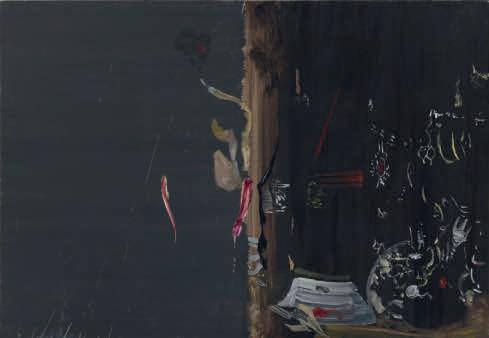
Harold Offeh
Kettle’s Yard, Cambridge, UK
At Kettle’s Yard, Cambridge, Harold Offeh’s first institutional survey in the UK showcases over 20 years of the artist’s practice. Beginning in the 2000s and meandering playfully towards the present day, ‘Mmm Gotta Try a Little Harder, It Could Be Sweet’ centres on Offeh’s video and performance works but also includes audio and installations.
The first thing we become aware of is Offeh’s voice, which pops and gurgles overhead in the entranceway. Mmm (2025), an audio track in which the artist vocalizes the show’s title (lifted from the Portishead song ‘It Could Be Sweet’, 1994), sets the tone for a display characterized by lightheartedness and pop culture references. Throughout, primary colours, soft edges and the imperative ‘PLAY’, printed on the walls and suspended above, guide the viewer in how to approach the work. The slapstick begins immediately.
Entering the first space, we are met by the film Haroldinho (2003), in which a smiling, nervous-looking Offeh, in the guise of the titular character (‘Little Harold’), performs the samba on the streets of Rio de Janeiro, where the
Ghanaian British artist was on a residency. Offeh repeats his intentionally amateurish dance on Ipanema beach, in a football stadium and, on one occasion, with a band. He is greeted with bemused expressions; some spectators join in, while others take pictures. The film is strange, absurd and a little silly. In the exhibition catalogue, Offeh notes how he uses humour to ‘bring people into the work, particularly those who feel intimidated by art and its discourse’. Through his vaudeville-like performance and costume – he wears a blue worker’s jacket with ‘Haroldinho’ embroidered in sequins on the reverse – he strives to reach out a hand to his audience.
Nearby, tall, sheer coloured curtains set off a central circular seating area, while further screens and photographs line the walls, documenting Offeh’s performances for the camera. In Smile (2001), he is grinning again – this time non-stop, to Nat King Cole’s 1954 rendition of the titular song; in Keep It Up, Keep It Up (2017), he continuously hula-hoops in public spaces in the manner of Grace Jones, whose lyrics to ‘Slave to the
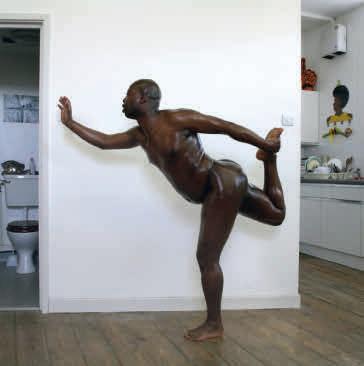
Rhythm’ (1985) give the work its title. Jones, a touchpoint for Offeh, appears again in Covers: After Grace Jones, Island Life, 1985 (Graceful Arabesque) from his ‘Covers’ series (2008–20), in which the artist attempts to recreate poses from album covers by Black musicians, seemingly in his kitchen or budget hotel rooms.
The exhibition is at its most compelling in the second room, which showcases Offeh’s community and socially engaged work. Here, the standout installation is Down at the Twilight Zone (2018), presented as three telephone booths. Visitors are invited to listen in as a group of elder queer Canadian men recount tales of going out, cruising and gay liberation in Toronto. It is an intimate offering, set alongside a similar piece, Stranger in the Village (2019), created during a residency in Japan. Here, Offeh uses James Baldwin’s eponymous 1953 essay to structure discussions of estrangement, combining the voices of settled migrants and members of the LGBTQ+ community in Mito with those of recent immigrants from Africa, creating a cacophony of perspectives on life at the margins of the city.
Offeh has dedicated much of his career to education and, as the exhibition attests, is deeply invested in communitybuilding and making art for everyone. There is even an area where children can create prints with paper and coloured stamps. It is abundantly clear that Offeh’s intention has always been to bring people from all strata into his art-making and to engage politically in the playful ways he knows best. In ‘Mmm Gotta Try a Little Harder, It Could Be Sweet’, he deftly balances levity and intellect with accessibility.
— Reuben Esien
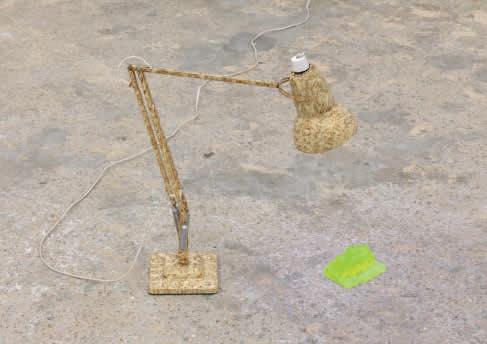
Jasleen Kaur
Hollybush Gardens, London, UK
Are we all too late to the party? That’s the nagging question as I enter Jasleen Kaur’s new show, ‘Boomerang’, at Hollybush Gardens. Helium balloons, Monobloc chairs and discarded phones, scarves, jackets and gloves are fast becoming a signature of her work. It’s one such balloon that greets us as we enter, hanging beneath the ceiling of the main entrance hall with a miniature boxing glove attached (Pride, all works 2025). Below this, mounted on the wall, is Untitled, a photograph of Kaur’s grandfather and uncle, presented in a resin case the colour of Irn-Bru, the former’s face obscured by a torn fragment of roti.
The people who inhabit Kaur’s work do so only by their traces. It’s an absence that calls to mind rooms across Britain, empty until the local Sikh community gathers inside them to worship: community halls and former pubs. It’s also a hollowed-out feeling that’s suggestive of immigrant households – places that only become sites of belonging and cultural expression after much effort, and which are swiftly abandoned when the children are forced to leave and find work. Meso is a pair of net curtains that hang from the ceiling of the main room, that
Platonic expression of white mistrust, neighbourly antagonism and surveillance. Its purview here, though, is no more than a concrete husk of a building and an assortment of objects that feels more like the abandoned deck of the Mary Celeste than a home.
‘Boomerang’ offers us something sombre, even mysterious. Its culmination is After Image: a vintage Anglepoise lamp placed on the ground, its surface appearing artificially aged due to the scumble finish. Its ultraviolet bulb flickers on and off, causing a tiny uranium-glass model of a mosque to fluoresce. An accompanying text tells us that this is a replica of the Babri Masjid in Ayodhya, India, which was demolished by Hindu nationalists in 1992.
Here’s where the exhibition’s title becomes clear, referring to the ‘imperial boomerang’ whereby colonial exercises in the periphery come back to haunt the metropole. Is the divide and rule tactic deployed by the British in India – in which Hindus and Sikhs received preferential treatment over their Muslim neighbours – not only haunting India today with the rise of prime minister Narendra Modi, but also being used to a similar effect to ostracize all brown people of Britain?
As the lamp blinks on and off – just as the destruction of the temple flickered in Kaur’s childhood imagination, hinting
at some dire situation further down the line – the only other sound comes from the occasional blare of Major/minor composition, two films that play on iPhones on the floor of the next room. To access them, we must walk under two lintels: one composed of cassette tapes and another, stacks of Gucci Rush perfume, beloved of teenage girls in the 2000s (Keystone II and Keystone I). These are rites of passage as we step into the antechamber, where the phones display footage shot by, or depicting, Kaur’s own children, walking in a nearby park or playing the piano, respectively. Above them is Kismet, an image of the Golden Temple in Amritsar, Punjab, displayed behind a sheet of textured privacy glass. From afar, it looks like an impressionistic painting, indistinct as it fades into memory.
Kaur is in her stride, confident enough to speak to us in visual puns that adopt Édouard Glissant’s concept of the opaque – beautiful because of their specificity to one stratum of society, while rejecting the tendency to perform for the committee. In a way, she’s creating a code: an art for people who will always, on some level, live inside the draughty function room, behind the mottled windowpanes and surrounded by the intoxicating scent of a Superdrug perfume.
— Nathalie Olah
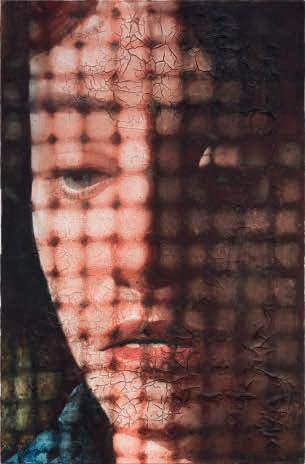
If you’re a regular at the Blue Posts pub on Bennet Street, St James’s, you may have noticed a change across the road: the 18th-century sash windows of the handsome Georgian townhouse opposite, previously shuttered, have been restored and a new door installed. Modern Art has moved in. The inaugural exhibition, ‘Polygrapher’ by Joseph Yaeger, features ten new watercolour on gessoed linen paintings, accompanied by a meta-fictional text consisting solely of the answers the artist provided to a lie detector test.
Standing before these paintings –inspecting the images, then the rough surfaces (with ‘studio debris’ listed as a material) and trying to decode the nonsensical titles – we are compelled to project our own stories onto them. You
This page Joseph Yaeger, Clean windows kill birds, 2025, watercolour, studio debris and photograph on gessoed linen, 130 × 86 cm
Opposite page Lucy Raven, ‘Murderers Bar’, 2025, exhibition view
to his painted blue face. Then there’s Fire that alters nothing: another face, another tight crop, this time stretched to three metres – a woman in profile, her mouth ajar in a moment that could be ecstasy, pain or both. Perhaps she has caught sight of the nude man hanging opposite in The subject is the act, his back to us, arms hooked behind him.
Yaeger first applies gesso, then white fixture, layer upon layer – sometimes ten layers deep – long before he even thinks about reaching for watercolour. Along the sides of the canvas, the gesso congeals and gathers like soft fondant slumping over the ed ge of a cake. Compared with earlier shows, the handling feels bolder, more deliberately unruly, as if he were stress-testing the material and technique to see how far it might be pushed. Previously, the gesso had been dragged left to right, as though the canvas were wrapped in bandages; or, in other works, lightly pockmarked into sculptured skins of hollows and protrusions – pockets of shadows where the watercolour would sluggishly seep and pool.
may feel that you recognize one of these faces, but Yaeger certainly doesn’t make identification easy. He sources material from film stills, but purposely avoids the poster images of identifiable stars, and the tight crop only heightens the ambiguity.
With the polygraph providing the show’s framework, each image becomes an alleged verity: a moment presented as evidence but riddled with omissions. The paintings’ obscured subjects – masked faces, shadowed, turned from view –compound that pervasive sense of uncertainty. They render the viewer a kind of interrogator, left to judge what to believe and what to treat with suspicion.
At first, I tried to read these works narratively: We come in with some of who we are (all works 2025), a little over a metre tall and in portrait format, shows an old man pursing his lips, the image cropped in
Here, the cracked surface over the woman’s forehead in Clean windows kill birds recalls the desiccation cracks of dried lake beds in the American West. The gesso has strained to breathe under the fixture, erupted and then settled into a skin of fractures. No thoughts but what we see, perhaps Yaeger’s most textured work yet, embeds staples and paint-tube lids – materials swept from the studio floor – directly into the picture plane. The effect underscores the friction in his method: the flicker of film or video pushed through a medium that insists on slowness, and the ongoing clash between watercolour and gesso – the tension arising from the gap between his intention and how much the surface pushes back.
As you spend time with these paintings, their beginnings as film stills fade, and the figures step forward as the protagonists of a new narrative, assembled in your own mind. Hyperspecific in mood, carrying a charged, claustrophobic anticipation, they start to work in concert, passing tension from one frame to the next – each painting operating as an emotional spike, a held breath, a faltering pulse – a choreography Yaeger has mastered, and which he uses to probe an image’s unstable claim to truth.
— Annabel Downes
Lucy Raven Power Plant Contemporary Art Gallery, Toronto, Canada
From the gliding perspective of a drone, we encounter the Copco Number 1 Dam on California’s Klamath River: a monumental feat of earthwork and environmental engineering. The hulking concrete mass holds back an entire lacustrine ecosystem on one side and oversees a mostly dry riverbed on the other. This infrastructure, along with its surrounding ecology, is the protagonist of Lucy Raven’s newest video installation, Murderers Bar (2025), a co-commission by the Vancouver Art Gallery and the Vega Foundation. The single-channel, 42-minute video is currently on view in an eponymous exhibition at the Power Plant Contemporary Art Gallery, Toronto, where it is displayed on a concave screen and viewable from
spare bleacher seating (as is characteristic of Raven’s installations). Aptly shot in portrait orientation, Murderers Bar narrates the moment at which our protagonist undergoes a life change.
The video shifts perspective and scale as a small raft ferries explosives through a tunnel into the dam’s core, where engineers proceed to deftly prepare and place them. We are panoramic again: the humans are mere dots on a cliff, watching the fruits of their labour from a safe distance.
An anticipatory silence, and then a deep boom: decades of accumulated water and sediment gush through, the force of a reservoir spilling out in an instantaneous release of brute pressure. Airborne again, we trace the river’s restored headwaters as they advance over the diminishingly dry riverbed, covering bends, crevices and rocks for the first time in a century. After
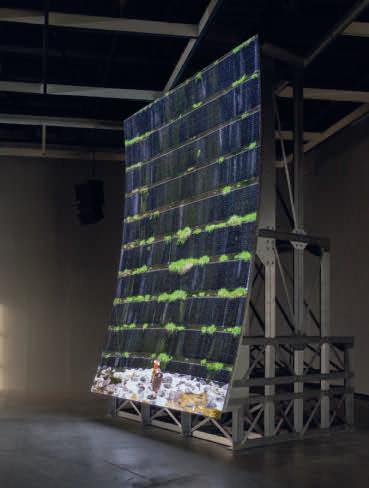
a few minutes, the waters are reunited with the Pacific Ocean. As riverine and oceanic waters merge into one vast, saturated frame, our sense of scale is again collapsed. Then, the video’s perspective turns and backtracks upstream, the camera skimming the revived river surface, punctuated by dips into the turbulent waters below.
Murderers Bar is the third and final instalment in Raven’s film trilogy ‘The Drumfire’ (2021–25), which explores how forceful applications of earth, air and water have created and recreated the landscape of the American West. Seemingly the most technically and geographically ambitious of the three, it homes in on the unjustifiable divide between construction and destruction, natural and artificial. Is the demolition of a dam not also the composition of a new landscape? Is the ‘renaturalized’ river and ecosystem not also synthetic?
When we finally glimpse the once dammed side again, the lakebed is drained, deformed, grotesque. The dam removal project, completed in 2024, was an effort to replenish salmon populations that formed a cornerstone of the regional food supply and thus restore the river basin ecology. It was the culmination of decades of negotiations between local Indigenous nations, state governments and several private organizations. Seen in this context, many will reasonably read into Murderers Bar a hefty constellation of messages concerning hubristic efforts to overcome nature in the physical and symbolic making of the American West, or the long-standing commingling of the fight for environmental justice and Indigenous rights. Or, perhaps most pertinently, the murkier aspects of efforts to right past wrongs.
Raven revels in the inherently unresolvable nature of such quandaries, avoiding a neat exaltation of repair and restoration, let alone a sense of justice or closure. Eschewing limpidity, she offers a muddier, sediment-logged case study of one of our many acts of human folly. Her unconventional portrait is made both more vivid and more complex by her decision to repeatedly alternate between spatial scales and perspectives; temporal and geographical visions of the dam; and river extent and ocean expanse. We cannot fully know the downstream effects of our latest experiments in the Klamath – or any act of environmental engineering – but we may adopt a critical, alert curiosity as we watch its future flow.
— Akiva Blander
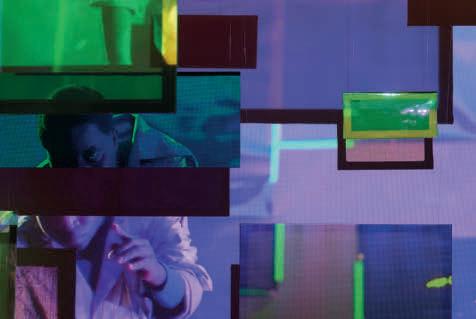
The Kitchen, New York, USA
The Latin sic marks the presence of an errancy that repudiates correction, a tear in the laws of the dictionary or the grammarian, the shudder of convention.
Will Rawls’s exhibition ‘[siccer]’ at The Kitchen, New York, takes its cues from the glitchiness that gives rise to [sic], reading for an anti-grammar of Black performance that contaminates and contravenes the jurisdiction of correctness, going with the rough grain of the impure and improper.
The fulcrum of the exhibition is the artist and choreographer’s titular 2023 film, which emerges from the join between the movement of Black bodies and their mediation by technologies of spectatorship. Rawls’s cast of movers takes to the screen, where they casually dance, sing, meander and muse. The unconcealed presence of a green screen within the film and the deployment of stop-motion, which animates bodies and their movement throughout most of the film, stridently announce the film’s mechanics of production. The cinematic apparatus stands naked before us, so honest about its contrivances that it can only be described as real
The green screen – that glaringly chromatic sign of the virtual – appears
behind those in the film, for whom it becomes a total environment: there is no ersatz backdrop laid upon it, only the backdrop of production itself. Thus emerges a metaphor for those omnipresent techniques which reduce and produce Blackness for a spectator.
‘I can’t really get out of here,’ announces a mover mid-film: live actors captured with stop-motion, they are entrapped in a perpetual condition of being perceived, continually rendered – through the hyper-present mechanics of cinema –for an observer.
This attention to the construction of vision explodes beyond the screen and into the gallery space. Our scopic field is divided and dynamized by myriad, variously sized green frames hanging from the gallery ceiling, constituting a matrix of portals through which our gaze may enter, lines of sight along which to travel. Yet the frames also disrupt the continuity that extends between our eye and the screen. Just as these devices intervene in the unity of our sight, stop-motion injects disunity into the film’s diegesis.
Rawls’s animation technique calls into question the continuity and fluidity presumed to inhere in motion, dispensing with any notion of film as a coherent, unified text. It also pointedly demonstrates the intensity with which bodies are mediated for the camera: their
This page Will Rawls, ‘[siccer]’, 2025, exhibition view
Opposite page Jungki Beak, is of Dumulmeori 2024-1, 2025, inkjet print with pigments extracted from fallen leaves and cosmos flowers, epoxy coating, acrylic sealed chamber with oxygen removal device, 99 × 71 × 16 cm
movement appears governed not by the animacy of muscle and breath but by the opening and closing of the aperture and by procedures of sequencing. At times, the stop-motion seems to race; at others, it lags, and the bodies move as if battling an immense wind.
Then there are the moments when the technology reveals its inner workings: we hear the serial click of a camera, see it capture a body vacillating between the cessation and renewal of movement, re-iteratively suspended at the knife-edge of inertia before setting off again. As the stop in stop-motion pierces every vector of action, every second of the body’s passage through space and time, movement seems to erupt in an open struggle against itself, with the friction of its imminent arrest.
On the one hand, the stop in stop motion reminds us that for Blackness, to move is to do so in relation to an oppressive superstructure that chases after your kinesis – to be at the mercy of an imposed immobility. And yet a freedom leaks from the agitated interstices between stop and motion, from the glitch that sparks this particular form of animation and its play with the laws of motion. Rawls scripts Blackness as an ongoing, recursive disjunction and discontinuity, a cut that upends the course of movement and its apprehension.
— Zoë Hopkins
‘Contours of Zero: Emerging Korean Artists in New York’ arrives at a moment when the visibility of Korean contemporary art in the US is being renegotiated across cultural, political and economic fronts. Korean cultural presence abroad has expanded noticeably in recent years, yet emerging Korean artists remain unevenly visible in the US, often routed through the broad category of ‘K-culture’ rather than recognized within contemporary art histories. Space ZeroOne, a new gallery with an emphasis on Korean art, has mindfully entered the fray. At a time when cultural exchange carries added symbolic weight amid US–Korea tension and tightening visa policies, the institution’s invocation of ‘zero’ suggests an open beginning with generative potential.
Of course, intentions alone cannot orient a new venue in a saturated field of emerging artist programming. The exhibition is strongest when individual
practices distil the dynamics that shape contemporary life: communication faltering under pressure, the fact of materiality itself in flux, the conditioning of attention by transnational experience. Many of the participating artists work across cities and countries (New York, Seoul, London, Copenhagen), a mobility that the exhibition registers as lived experience rather than thematic prompt. As a pragmatic introduction rather than a thesis, the exhibition sketches the outline of a curatorial vision; the works themselves point to where it might sharpen.
Among the New York-based artists, Jeenho Seo articulates this tension with visceral precision. Using thermoplastic mouthpieces cast directly from his own mouth and embedded with popcorn, rice, seaweed and tea powder, Seo turns the acts of eating and speaking into sculptural meditations on breakdowns in communication. In depends (2022), conceived amid the heated climate of pandemic-era identity politics, the artist confronts the paralysis of self-censorship – the sense that language might betray him before
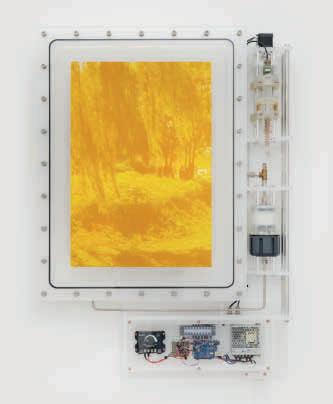
it reaches its audience. The hardened negatives of his oral cavity become relics of words withheld. Because the plastic softens in heat and stiffens when cold, the work captures the volatility of translation itself: language as something that shifts with tone, temperature and context. As viewers rotate a small box, the pieces within can shift or lightly fracture, making the fragility of articulation physically felt. Seo transforms silence into a resistant form, evoking diasporic precarity at the molecular level.
A comparable tension animates Khia Hong’s Doubt (2025), made on-site and positioned against the gallery’s glass facade in direct response to the architecture and the city beyond it. Composed of tangled wires, acrylic and PVC sheets, cardboard and USB cables, the assemblage hovers between construction and collapse. Several white, plaster-like bundles – reminiscent of medical bandages or improvised clinical supports – lend the work a bodily register, mirroring the emotional flux that can accompany diasporic life in New York. What appears fractured is not broken: Hong frames these entanglements as openings into alternate perceptual states, closer to quantum variability, where fragility becomes a generative structure rather than a flaw.
Impermanence is front and centre in Jungki Baek’s is of Dumulmeori 2024-1 (2025), a photograph printed with pigments extracted from fallen leaves and sealed within oxygen-free acrylic chambers. The intensive scientific process behind the work’s creation –grinding leaves into dye, stabilizing their hues in controlled environments – takes on a devotional character. The image documents both an act of preservation and that act’s inevitable failure; natural colour becomes a chronicle of disappearance. The show closes quietly, with Min Jung Song’s Scene (2022): a smartphone video accompanied by faint breezes from nearby fans. Its drifting narration and looping, endless rain evoke the rhythm of fleeting time: memory experienced as weather, endlessly returning yet never quite the same. The installation invites solitary viewing, offering a rare pause for reflection amid a dense show where artists navigate, from so many angles, the frictions of language, material and place.
— Eana Kim
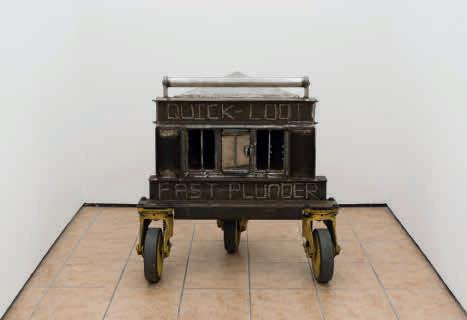
Isaiah Davis King’s Leap, New York, USA
Musicality permeates Isaiah Davis’s exhibition ‘Confessions of Fire’, titled after the 1998 debut album by American rapper Cam’ron. The show features two ‘covers’: a series of paintings on aluminium, 1999 (all works 2025), that recreate the numbers from the cover of Prince’s 1982 album of that name, and a restaging of the Confessions of Fire cover, featuring Davis, in the invitation image for the exhibition. In the press release, Davis describes how the original image – in which Cam’ron poses in leather overalls, a crucible of molten metal behind him – inspired his own self-fashioning and interests in leather, steel and Black masculinity.
Conjuring up shopping trolleys, safes and animal cages, Davis’s steel sculptures speak the language of light industry and urban improvisation. Featuring mechanisms like padlocks, chains and gates, they invoke private property – but the ‘privates’ here also relate to genitalia, seen in the phallic forms that protrude from tissue-box-sized wall works. For Davis, masculinity is a verse; its codes are fragile and fickle, belonging to no one gender in particular but serving as an energy. Ving Rhames is named after the actor who, in his most famous scene as the gangster Marsellus Wallace in Pulp Fiction (1994),
lets an indebted enemy off the hook –provided he never speak of Marsellus’s rape by a white man. Echoing the other wall-based works, the sculpture’s combined ball and chain suggests repression of the self, literally and metaphorically.
The prodigious weight of the freestanding sculptures is undermined by their movability. Quick, a steel cage made with I-beams and triangular plates that sits on heavy-duty yellow castors, is inscribed with ‘QUICK-LOOT / FAST-PLUNDER’: fulfilling the directive from God, in the Book of Isaiah, to take a piece of material and write the phrase on it. The work resembles the inverted hull of a ship, a portable safe or a battering ram.
Paul and Michael, which suggests a penis and an anus, recalls Robert Mapplethorpe’s Cock and Gun (1982), a photo in profile of the titular objects. Mapplethorpe’s objectification of anonymous Black models sits within the lineage of desire that Vincent Woodard describes in The Delectable Negro (2014), which Davis cites in his press release. The book tracks the homoeroticization and consumption of the Black male body during slavery in the US; for Woodard, the psychic lack in whiteness is satiated by a desire for the projected excess of Blackness.
Lyricism is contingent on intervals, just as sculpture is reliant on the spaces it
This page Isaiah Davis, Quick, 2025, steel and aluminium, 99 × 104 × 79 cm
Opposite page Jana Euler, On the way to the studio, 2025, oil on canvas, 2.8 × 2.1 m
is built around. A ‘theory of pause’, as Davis approaches it – initially drawing on the term’s use as homophobic slang – might entail anything from a social absence to a temporal shift, to structural instability. In his book In the Break: The Aesthetics of the Black Radical Tradition (2003), the poet-theorist Fred Moten has characterized ‘the break’ and ‘recesses between beats’ as places where Black social life exists, while also viewing the caesura more formally as a crucial moment of gathering around which aesthetic production is organized.
Davis is an artist sensitive to the way language is manipulable as a material. Wrenched from their original context in Prince songs, evocative lyrics are torched into metal in Slave, two triangular cages connected by chains. Prince was an artist who eluded his own stage name for a while, in favour of an unspeakable, gender-fluid love symbol. Davis’s voice consists of welds thicker than fingers, aggressive and angular forms, the permanent marks of intolerable heat and references to dispossession and plunder. What makes it so beautiful? Something delicate that begins in the mouth and ends in metal, like spitting bars.
— George Egerton-Warburton
Jana Euler
Greene Naftali, New York, USA
New ages come with new images to gild them. Whether in protest or adulation, images that take information and power as their subject must also contend with other forces in play: an era’s universalist ‘truthiness’, which, when created by those in power, curdles into moralizing allegory; and the material conditions of the ‘now’, which anchor the work to its time. Pablo Picasso’s Guernica (1937), with its cubist dismemberment, fit the ravages of the Spanish Civil War. Every era leaves a world that couldn’t have been made in another time. What remains are forms calibrated to its technologies and terrors, registering how ideology has travelled through it.
What paintings, then, could stand as totems for the perversities of today: the way screens contort the body as we plummet down online rabbit holes? What reflects the uncanniness of staring into the fun-house outputs of technologies average out human creativity into a collective hallucination? What image would feel at home in the court of today’s techno-utopian monarchists? The answer is probably More Morecorns (2025), Jana Euler’s painting of two unicorns with multiple horns – ‘morecorns’ – procreating on Route 66. A metallic storm gathers as a pink morecorn mounts its baby-blue mate. ‘More, more, morecorns’, you can imagine a real-life Logan Roy from Succession (2018–23) barking to the tune of ‘boar on the floor’.
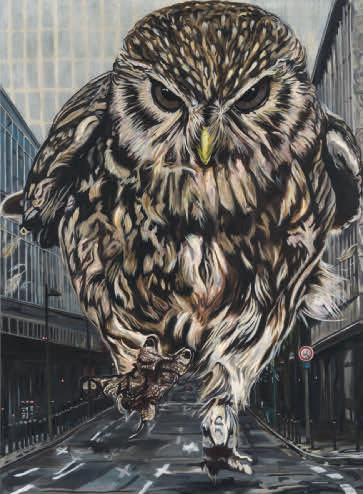
Euler’s paintings in ‘The center does not fold’ are the Guernicas we deserve. They take on dark fantasies of the technological sublime: smoothness made vulgar, buckling on impact with the embodied reality of being an artist today – stuck in a fleshy quagmire, grasping at how the creative act even happens. The paintings orbit creativity itself: canvases titled Creative Act (Spray can) and Creative Act (Paint tube) (both 2025) show the media – humble cans and tubes – after hours, feeling randy, begetting more of themselves in the biblical sense. Others circle AI. One shows pink and yellow horses making out against a black void, surrounded by brown parcels: The fantasy of a highly potent creative act with little participation of human mankind, and the sheer multitude of packages that fly back in return (2025). The ‘packages’ here represent the ubiquity of online purchases (and deliveries) and the training data behind generative AI, so casually mistaken for the creative act.
Dog Walking (2025) – a giant dog with Mary Tyler Moore hair and tiny legs – functions as Euler’s caricature of the grotesque distortions endemic to prompt-generated imagery. The uncanny lies in the comedic horror of the technological eye mistranslating our world. Much of the show reiterates this blunt point in paint: creation is an exertion of human will. It involves a body mastering itself and the material at hand. The maxim of the exhibition could be: there is a difference between prompting and painting. And isn’t it obscenely hilarious to be a body – an artist in a studio – confronting electricity-guzzling technologies and responding with a stubbornly oblique, human interpretation of it all? Is that enough? Does it have to be? As an artist lumbering down a city street, it feels only natural to imagine oneself as a six-storey-tall owl on a mission (On the way to the studio, 2025).
And what is the cost of all of this?
Euler spells it out. Where the energy comes from, connected (2025) is a close-up of an American electrical outlet. Nearby, five canvases depict dollar bills in various styles and degrees of abstraction. The bills look quaint, but their presence reminds us that the conditions of making are never isolated from capital. With cold hard cash on canvas, Euler shruggingly reminds us that it does, in fact, be like that sometimes. As the saying goes: 20 dollars is 20 dollars.
— Dena Yago
Iiu Susiraja
Gratin, New York, USA
Reviews of Iiu Susiraja’s 2023 survey exhibition at MoMA PS1, ‘A style called a dead fish’, fixated on the fact of the Finnish artist’s fatness in her self-portraits. In photographs that play on the history of painting – particularly male painters’ fascination with the abstraction of folds of white, extra-abundant flesh (Lucian Freud’s depictions of ‘Fat Sue’ come to mind) – the now 50-year-old artist is naked or else wearing a colourful dress or bathing suit, on display with various props, posing within domestic settings. The other element repeated in reviews is Susiraja’s deadpan expression, which the press materials for ‘Touchdown by Venus’, her show of 14 large-scale photographs and five videos at Gratin gallery in New York, attribute to a Finnish mien of expressionlessness and connect to the usual canon of women self-portraitists (who – with the exception of Catherine Opie and Laura Aguilar, who have also photographed their ordinary, excessive bodies – are not relevant here).
Susiraja’s inexpressiveness, rather than engaging with melodrama, is purposefully inscrutable, subverting the tired trope of the animated and grotesque fat comic. Her documented performances break down actions serially, playing on the torpor of an exhausted body while still rendering what Tina Post, in her study on deadpan
and Black representation (Deadpan, 2023), in a chapter on Buster Keaton, refers to as ‘lively thingness’. The props at play make light (in many ways!) of both the tropes of fatness and the handwringing messaging of the obesity ‘epidemic’, and also the expectations of portraiture, pushing against sublimity. The photographic works in the Gratin show, which overwhelm (in a good way) the white, clinical room in which they’re staged, date from 2025. They evince a prodigious output that is also ambivalently about slowness, about the house of the body within a claustrophobic room.
In the photographic series ‘Lift Up’ (2025), red balloons duct-taped to the artist’s nude form hold up various body parts (one gets a sense of being inside a tiny, horrible clinic, with a doctor-viewer scrutinizing every flaw). In the peekaboo ‘Marilyn Garden’ (2025) series, Susiraja, standing in front of a seemingly cheap wooden entertainment centre, wears a red dress with nothing underneath, a silk flower at the crotch; in ‘Flesh Painting’ (2025), she holds kitschy paintings cut with holes that her bulk pushes through. What Susiraja stages with class and the petit bourgeois European home is interesting, calling to mind Lauren Berlant writing in Cruel Optimism (2011) on impassivity in the context of political depression. The artist poses with the same spare wooden furniture in
‘Collection’ and ‘Dream Team’ (both 2025); she presses Lladró-like ceramic figurines between her breasts or pairs the flatness of her image on a television screen with her flat demeanour.
In the photographs, Susiraja becomes an object amidst other objects. But the Buster Keaton quality is at its height with Susiraja’s videos, displayed on iPad pedestals in the gallery (and posted on her Instagram). There is play with mechanized objects such as hot dogs on power drills in the hilariously named John Wayne (2020). Similarly mechanized are the photocopiers at the centre of the room that print out keepsake serial images of the artist in various stages of putting on pantyhose, One size fits all (2010), riffing on Hito Steyerl’s ‘poor image’. These skits, if you can call them that, are silent and still. They reference the expressionlessness of the TikTok tradwife, such as Nara Smith’s ASMR drone, especially when foodplay is involved: in Make Jam (2018), Susiraja smushes strawberries in a plastic bag between her breasts. (Martha Rosler’s deadpan gestures in Semiotics of the Kitchen, 1975, also come up here – the violence of the icepick.) The pleasure of this work lies in the refusal of transparency, despite the simplicity of the actions.
— Kate Zambreno
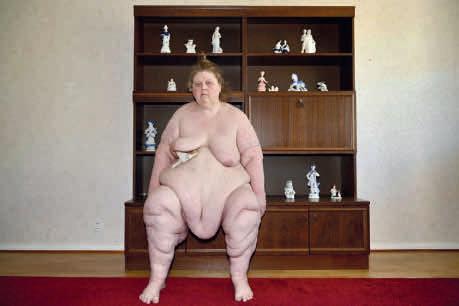
This page Iiu Susiraja, Collection, Below, 2025, fine art archival pigment print, 61 × 91 cm
Opposite page
Thomas Mukarobgwa, Sable Going Around, 1962, oil on board, 59 × 59 cm
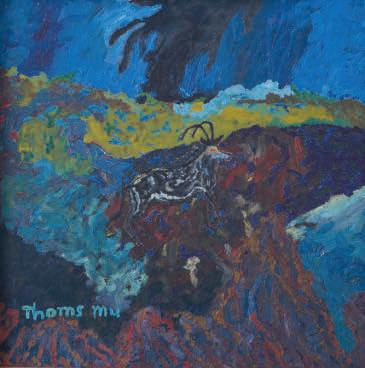
Intermittently defunct for the past 12 years, the Museum of Mexico City is now host to curator Francisco Berzunza’s exhibition ‘Broken Column’, featuring 62 international artists around the loose theme of rejection. Berzunza intentionally produced the exhibition without state funding, enabling him to include works critical of the Mexican government, such as its historic repression – or rejection – of Indigenous artists like Máximo Pacheco. An artist of Otomi heritage, Pacheco worked as a mural assistant to Diego Rivera for his monumental murals of the Mexican Revolution in the Ministry of Education (1922–28). Pacheco went on to paint several murals of his own in schools, but over the years they were destroyed during building demolitions. Some of the only remaining photographs of Pacheco’s murals are by Tina Modotti, on display in the exhibition and so restoring his forgotten legacy.
There is a revisionist instinct to ‘Broken Column’, which features artists who were rejected by the received art-historical canon. A suite of impressionistic, mythological
paintings by the Indigenous Shona artist Thomas Mukarobgwa, such as Sable Going Around (1962), address decades of neglect by Western art institutions and reposition his work within a broader art-historical conversation. Other works present people rejected by Mexican society. Daniela Rossell’s ‘So, Why Do You Complain?’ (2008–25) features unfinished paintings of people with mental illnesses and disabilities who were photographed for the tabloid TVNotas (the photos were conspicuously erased from the magazine’s official archive). These works arrive following a 20-year hiatus after her ‘Rich and Famous’ (2002) photo series of the Mexican aristocracy provoked public outcry in a country where 54 percent of the population had been living in poverty.
Ramón Saturnino’s don’t speak; don’t talk (2025) is a more contemporary rejection of Mexican politics. Composed of tall, black, frame-like structures modelled after police barricades, it recalls the border wall that Saturnino saw erected in his hometown of San Luis Río Colorado
in Sonora, at the US–Mexico border. The sculpture was conceptualized as an outdoor, site-specific installation in Mexico City’s Zócalo, where police erected barricades to block protesters camping in the square after the government failed to prevent the assassination of leftist mayor Carlos Alberto Manzo Rodríguez. When the local authorities banned Saturnino’s sculpture from being exhibited in the public realm, and therefore the museum’s courtyard, it was relocated to the galleries, where the work took on a largely apolitical, minimalist idiom. Here, a tension between institutional critique and ‘art for art’s sake’ is problematized. As it is now displayed, don’t speak; don’t talk explores formal relations of the modernist grid to the viewing body, relations that feel largely irrelevant to the context from which it was forcibly alienated.
What is the role of beauty in institutional critique? ‘Broken Column’ seems suspicious of beauty, positioning it as ancillary to liberation. Yet some works resonate more subtly on an aesthetic level rather than in their explicit political commentary. Berenice Olmedo’s Pneuma (2025), cast from prosthetic limbs and synthetic organs, is intended as a critique of the Mexican healthcare system, defunded by austerity measures, yet the hanging sculpture of gleaming, translucent orthotic plastic is grotesquely alluring: the viewer subconsciously recognizes themselves when their own form is reflected back as alien. It is indexically formatted to the human body – the prosthetics are moulded from the sockets of amputees – yet it appears simultaneously abstract. Attached to a motor, the sculpture – partly made from breast implant material –periodically inflates, mimicking human breath. Here, we respond to the ancient pleasure of mimesis, even when confronting the body at its most distorted (which can stand for the broken civic body, if you want it to).
‘Broken Column’ succeeds as a strong voice against sociopolitical and cultural rejection or neglect, at a time when virtually all of Mexico’s museum exhibitions are showing ‘beautiful’, abstract and apolitical art. But despite itself, the art of critique can be beautiful, too – a quality the show presents as worth protecting.
— Geoffrey Mak
Out of O ce: Is it so bad to want to be entertained? by Chloe Stead

THE FIRST ESSAY I WROTE as a student was in response to the prompt ‘Should art be entertainment?’ It was 2009, and a few years earlier, Carsten Höller had installed slides in Tate Modern (Test Site, 2006–7), spawning a veritable cottage industry of takes on the parkification of art institutions. I argued no. Two decades later, that battle has largely been lost, but I’ve so ened my stance. Is it so bad to want to be entertained?
Lately, I’ve been travelling to the Gulf, a region with a rich history of cra traditions and a much younger relationship to contemporary art. From the outside, it’s easy to conclude from the wave of recent
museum openings that it’s all a shrewd plan to attract tourists. On the ground, however, there appears to be a genuine e ort to embed contemporary art in civic life. is e ort is – you guessed it –largely centred on the idea that art can be a good time.
Manar, a public light art festival in Abu Dhabi, is a case in point: it boasts free entry and site-specific, mostly interactive or Instagrammable artworks: a ginormous KAWS figure cradling a luminous moon; a cluster of lights that gently sway in the breeze; a walkable tunnel of lasers and fine mist. Artistic director Khai Hori recently spoke about
his prioritization of experience: ‘If Manar becomes part of someone’s core memory, then we’ve done something right.’
While my own experience might not have been a formative one, watching visitors joyously explore the works on Jubail Island made me wonder whether a visit to Manar might act as a gateway to future, more demanding art encounters. But even if the experience stays, for now, as a digital image and pleasurable memory, all isn’t lost. Perhaps entertainment isn’t a dilution of art’s value, but one way it quietly takes root ∙
Chloe Stead is associate editor of frieze
Anish Kapoor