![]()


Start here. You won’t be disappointed.

Dossier: 25 Works The best of the 21st century – so far
Performance: Saidiya Hartman Discourse in motion

Essay: Around Singapore On an art tour with Tash Aw


Profile: Tau Lewis Handcrafted science fiction


Aw is a novelist. The South (Fourth Estate, 2025), his latest novel, was longlisted for the 2025

Camille Bacon is a writer. She is co-founder and editor-in-chief of Jupiter magazine.

Bisschops is a curator, researcher and writer. She is founder of the curatorial platform Performance Talks.
⟶ Essay: Across the Causeway, p. 60

Paige K. Bradley is an artist, writer and editor. She is the author of Drive It All Over Me (S*I*GVerlag, 2023). Her work is currently on view in the travelling survey exhibition ‘CUTE’ at Kunsthal Rotterdam, Netherlands.
⟶ One Take: After Coco, p. 20

Saidiya Hartman is a writer and academic. Minor Music, Hartman’s first stage adaptation, was commissioned by Hartwig Art Foundation and premiered at Internationaal Theater Amsterdam, Netherlands, in October.
⟶ Performance: Imagining the Otherwise, p. 27
⟶ Profile: Tau Lewis, p. 90

Aria Dean is an artist, writer and filmmaker. Her theatrical commission for Performa 2025 is on view at Abrons Arts Center, New York, US, from 20–22 November.
⟶ Performance: Dramatis Personae, p. 23

Rose B. Simpson is an artist. Her latest exhibition, ‘LEXICON’, is on view at the de Young, San Francisco, US, until 2 August 2026.
⟶ Interview: Rose B. Simpson, p. 52
⟶ Performance: Consider the Algorithm, p. 29

Natalie Diaz is a poet and educator. She is author of Postcolonial Love Poem (Graywolf Press/Faber & Faber, 2020), which won the Pulitzer Prize in poetry. She is a senior fellow at The New School Institute on Race, Power and Political Economy, New York, US.
⟶ Interview: Rose B. Simpson, p. 52

Miriam Stoney is an artist, writer and translator. Her installation Ideal Translations, a collaboration with Brunette Coleman, was on view at Tenderbooks, London, UK, in October.
⟶ Performance: Bring Down the House, p. 30


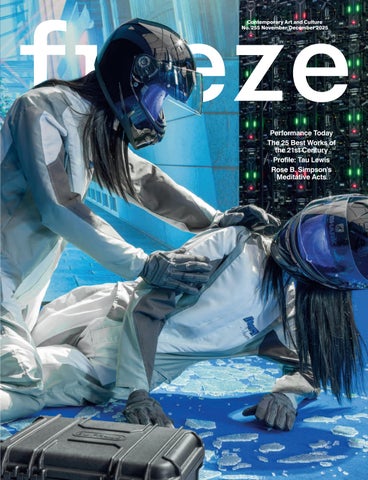
At frieze, we often like to close our year by taking stock of the moment and looking ahead – twin poles for this issue, our last of 2025. Ahead of New York’s Performa Biennial, our columns section looks closely at some of the artists revolutionizing contemporary performance. Aria Dean writes about building characters for her new play; Jeanette Bisschops looks at how the algorithm is shaping in-person performance; philosopher Saidiya Hartman describes the possibilities that unfold from endings; Miriam Stoney reflects on performance art’s return to the theatre; and assistant editor Cassie Packard profiles our cover artist, Ayoung Kim, whose visionary practice constructs a multiverse of astonishing worlds. In our features section, the theme of performance continues with a profile of Tau Lewis, whose Performa commission revisits ancient Sumerian poetry. We expand beyond the stage in an interview with Rose B. Simpson, who speaks to poet Natalie Diaz about time and materials as collaborators in her practice, while novelist John Banville goes behind the scenes at the Prado. Another novelist, Tash Aw, tours Singapore, discovering the artists invigorating the city-state’s art scene. Finally, a dossier created in collaboration with 200 writers, critics and curators reveals our list of the 25 best works of the 21st century so far – an astonishing survey of how artists have created meaning and beauty out of tremendous upheaval, violence and personal strife ∙
Andrew Durbin is editor-in-chief of frieze


Art Department
Art Director
Lorenz Klingebiel
Senior Designer Amélie Bonhomme
Operations & Marketing
Content Operations Manager
Caroline Marciniak
Rosalind Furness (interim)
Marketing Director
Matteo Plachesi
Marketing Manager, Membership
Alejandra Llavona Abarrategui
Membership Services Executive
Chris Daniels
Distribution & Circulation Manager
Greg Frost
Senior Audience Editor
Hina Siddiq
Digital Content Coordinator
Harry Jones-Martin
Web Assistant
Stefania Tsivelekidou
Social Media Editor
Kimi Zarate-Smith
Social Media Assistant
Flossie Killingley
Contributing Writers
Max Andrews, Edna Bonhomme, Ian Bourland, Fernanda Brenner, Brian Dillon, Will Fenstermaker, Jonathan Griffin, Juliet Jacques, Shiv Kotecha, Alvin Li, Andrew Maerkle, Tom Morton, Jaeyong Park, Rianna Jade Parker, Wilson Tarbox, Jeppe Ugelvig, McKenzie Wark, Simon Wu
At frieze, we receive hundreds of emails every day from artists, galleries and public relations companies around the world. Here, we share our favourite excerpt from the past month. Names have been redacted to protect the guilty, but they know who they are.
Editor-in-Chief
Andrew Durbin
Senior Editors
Marko Gluhaich, Vanessa Peterson & Terence Trouillot
Associate Editors
Angel Lambo, Sean Burns (interim) & Chloe Stead
Assistant Editors
Ivana Cholakova, Cassie Packard & Lou Selfridge (interim)
Publishing & Events Manager
Claudia Kensani Saviotti
Production Assistant
Lottie Gale
Picture Researcher
Brooke Wilson
Chief Executive Officer
Simon Fox
Founders
Amanda Sharp & Matthew Slotover
Facebook & Instagram @friezeofficial Membership frieze.com/membership
Commercial
Chief Commercial Officer
Emily Glazebrook
Publisher Lisa Gersdorf
Head of Digital Media Sales, Global & Media Sales, Americas & Asia Pacific
Melissa Goldberg melissa.goldberg@frieze.com
Media Sales Manager, UK & EMEA
Rose Crosthwaite rose.crosthwaite@frieze.com
Andrew Cannon (interim) andrew.cannon@frieze.com
Media Sales Manager, Americas Charlotte Isaacs charlotte.isaacs@frieze.com
Commercial Lead, Brand Advertising Morenike Graham-Douglas morenike.graham-douglas@frieze.com
Advertising Production Manager
Jennifer Ward
Media Sales Assistants
Dylan Naylor, Grace Harvey & Madge Yang
Offices
London 1 Surrey Street, London, WC2R 2ND, UK info@frieze.com +44 20 3372 6111
Berlin Zehdenicker Straße 28, 10119 Berlin, Germany berlin@frieze.com +49 30 7675 80230
New York
247 Centre Street, 5th Floor, New York, NY 10013, USA +1 212 463 7461
A FRIEZE PLAYLIST

Hey, good morning,
A bit of a different one here! Blast Theory has created Constant Washing Machine, an artwork that uses soap as a metaphor for integrating responsible AI practices into daily life.
As the soap dissolves, its etched language (representing AI policies) fades, symbolizing that while policies may evolve, the habits they inspire should persist. The artwork promotes iterative processes and adherence to FAIR principles for better data management, aiming to make responsible AI practices as routine as personal hygiene.
Is this of interest to you for anything? Thank you so much for considering this.
Best wishes, Leila
A selection of defining tracks from the last 25 years

Cover
Ayoung Kim, Ghost Dancers B (detail), 2022, exhibition view, ‘Many Worlds Over’, 2025, Hamburger Bahnhof, Berlin. Courtesy: Nationalgalerie Berlin; photograph: Jacopo La Forgia. See: p. 33
Gagosian
555 West 24th Street, New York
November 6 – December 20, 2025


To Do: What’s on the agenda for the art world’s most booked and busy?

One Take: A look at Sylvie Fleury’s devotion to luxury ahead of her new commission for Performa and an exhibition at Sprüth Magers, New York by
Paige K. Bradley
AN OPAQUE , lacquered case of sensuously curving angles which, when unclasped, reveals a compact quadrant of dazzling eyeshadows and highlighter – the lightest swipe of a fingertip can illuminate your look. Or: a small yet cumbersomely shaped black box with anywhere between one and four compressed mounds of variously coloured powders – you can rub them on your face. Two ways to say the same thing. I’m writing about the design of a Chanel compact. I’m writing about a Sylvie Fleury painting. To write about one is to write about the other. This is not about blurring boundaries, it’s about Fleury’s capricious, conceptual game of value: each is a gateway drug that deposits you as if through a trapdoor into industrially scaled desire, and it doesn’t matter which you got into using first. Feeding the bottomless aspiration of art or fashion is an enlivening tightrope walk – you could really ruin your life or become a legend.
In ‘Joy’, her 2019–20 solo show at Karma International in Zurich, Fleury included four acrylic on shaped canvas and wood paintings (Turbulent, Légèreté et expérience, Coral Burnt and Rose Pétale, all 2019) that we could say are ‘after Coco Chanel’ in the way that certain other paintings are credited as ‘after Rembrandt’. Proximity can make one minor. An artist can leverage it in a tawdry, desperate grasping after agency – or as a cunning, even satirical move against the very premise of stature.
Fleury has spent her career stalking the long shadow of fashion and luxury, even as art was being eclipsed by it. One of her earliest pieces, Coco (1991), is typical in its flick-ofthe-wrist bluntness: a pile of boxes for Chanel’s eponymous fragrance. A spicy, baroque blend of singed clove and decaying rose, Coco debuted in 1984, in a decade when aggressively enveloping scents reigned. If you were to add up the
Sylvie Fleury, Coco (detail), 1991. Courtesy: © Sylvie Fleury and Thaddaeus Ropac Gallery; photograph: Pierre Tanguy
retail value of each bottle that Fleury presumably bought in order to construct her artwork, why, you might have something close to the price of a painting by an ultra-contemporary emerging artist! Fleury was ahead of the curve, her influence wafting into the sensibility of a new generation that takes the frivolity of consumption seriously – think of Bruno Zhu or Jasmine Gregory.
In 1987, Barbara Kruger announced I Shop Therefore I Am and moved on without ever admitting her hauls, but Fleury has made a practice out of shamelessly tarrying in the reality of such a dictum. She deigns to acknowledge the consumer as someone like herself –someone like me, and someone beautiful like you ∙
Paige K. Bradley is an artist, writer and editor. She is the author of Drive It All Over Me (S*I*GVerlag, 2023). Her work is currently on view in the travelling survey exhibition ‘CUTE’ at Kunsthal Rotterdam, Netherlands.


Performance: Aria Dean on the challenges of crafting characters in her 2025 Performa commission

IT ALWAYS ANNOYS ME , personally and intellectually, when people talk about characters in movies and novels as embodying this or that value or principle. In the case of my own narrative work, and in the specific case of my play The Color Scheme (2025), I am always stressing out about this, especially when it comes to Black characters – since Black people are so easily and so often conscripted into symbolic operations. I am also obsessed with this because of my interest in the history of film theory and
experimental cinema, which have long tangoed with psychoanalysis and problems of realism – problems that also lead to investigating the materiality and structure of cinema and cinematic experience. When I work narratively, whether in film, performance or writing, I am always returning to the question of how to avoid presenting complete ‘characters’, in a literary-psychological sense, and simultaneously avoid creating completely transparent, allegorical characters, in the style of a morality play. When it came
Aria Dean and Filip Kostic, The Color Scheme set design, work in progress, 2025. All images courtesy: Aria Dean and Filip Kostic
to The Color Scheme, this problem revolved not just around dialogue and action, but around the question of the historicity of the characters: The Philosopher and The Poet. I did not want to make the characters in my play exactly historical; that is, I did not want them to be one-to-one representations of historical figures, in this case Alain Locke and Claude McKay. In doing so, they would either become heroes or people. They are either monumentalized themselves or are relatable, and therefore stand-ins for the viewer.
Already inspired by the form of the Platonic dialogue for this play for two actors, I approached writing The Philosopher and The Poet with the idea of ‘conceptual personae’ in mind – a notion introduced by Gilles Deleuze and Félix Guattari in their book What Is Philosophy? (1991). They write that, in philosophical dialogues, a ‘character’ functions either as ‘the author’s representative’ or as their antagonist, while ‘conceptual personae carry out the movements that describe the author’s plane of immanence, and they play a part in the very creation of the author’s concepts.’ Although their notion of the ‘conceptual persona’ might centre the author more than I’d like – The Philosopher and The Poet do not directly play a role in the creation of my ‘concepts’ – the figures do map the historical-theoretical ground to which my concepts are bound. They absolutely ‘indicate the dangers specific to this plane, the bad perceptions, bad feelings and even negative movements that emerge from it.’ Deleuze and Guattari might have in mind ‘personae’ that are a little more transparent than The Philosopher and The Poet will seem to the audience in their final manifestation; however, in my view, this is simply what happens when you hand a role to a performer. Things thicken.
The ‘conceptual persona’ was also useful in thinking through how to make something with characters and dialogue that is about both ideas and relations – structural and interpersonal. Here, ideas are not mere subtext: they at once make up the actual text and are the conscious occupation of the characters. I’m interested in people who can’t help but talk about ideas and who are attracted to others who do so as well. With this in mind, desire is wholly subtextual to the dialogue, yet it fills the stage and the frame, nearly crowding out the ideas in turn.
The dialogue is inspired by a conversation that occurred between Locke and McKay in Berlin’s Tiergarten in 1923, though we have no record of what was said. In the play, The Philosopher and The Poet discuss aesthetics, form and politics, with nationalism and 19th-century monuments as their access point for questioning politics’ role in

I’m interested in people who can’t help but talk about ideas.
emerging modernist artistic practices in the West, and art’s role in the formulation of a Black nationalist or diasporic consciousness. Neither man’s argument will be dazzling to the audience, by today’s standards. In fact, their positions might hardly seem to be ‘positions’ at all, depending on the discourse the viewer is steeped in. You might find The Philosopher’s fuzzy formalism towards a ‘Black aesthetic’ extremely obvious. The same could be said for The Poet’s firm insistence on intra-diasporic cultural-historical differences. We are not meant to be wowed; rather, I hope the viewer is attentive to the fallibility of both
positions and the underlying logic of each. The Philosopher and The Poet present two structures for thought, two attempts at method, in – I think – a dialectical relationship, each resting somewhere along the spectrum from liberalism to communism, formalism to realism. Finally, the formal and political question that knits all this together is the very simple one of how to represent history. It’s an overused and often misused piece of writing, but Walter Benjamin’s ‘On the Concept of History’ (1940) has been instructive for this project, especially the section that everyone loves: ‘To articulate what is past does not mean to recognize “how it really was”. It means to take control of a memory, as it flashes in a moment of danger […] In every epoch, the attempt must be made to deliver tradition anew from the conformism which is on the point of overwhelming it.’ So, the play will appear to have an interest in fidelity, in a historical realism. The Siegesallee boulevard that ran through the Tiergarten is arranged as it would have been in 1923, ‘reconstructed’, you might say, in Unreal Engine. The monuments are made from 3D models of the actual marble statues that lined its path, scanned at their present location in the Zitadelle Spandau. They’re presented in their actual, fragmented state (rendered virtually), having been damaged in World War II, subsequently buried underground by the Allied Forces, and ruined by the weather once unearthed. The dialogue, too, could appear to be reconstructed, but it’s actually historical-theoretical fiction. The scenography and the actors speaking the lines are captured by two cameras located in the wings and fed live to a large screen at the back of the stage, coming together to produce the form of illusion that we know as a ‘movie’. This movie’s primary subject is history, I guess, which is also sort of like what its characters hope to be or to become: subjects of history ∙


Performance: Saidiya Hartman on the minor musics and diasporic traditions behind her latest ‘performed discourse’
‘MINOR MUSIC at the End of the World’ is a performance in three movements, made in collaboration with actor André Holland, performer Okwui Okpokwasili, and artists Arthur Jafa, Precious Okoyomon and Cameron Rowland. It takes its inspiration from two of my essays, ‘The End of White Supremacy: An American Romance’ [2020] and ‘Litany for Grieving Sisters’ [2022]. I don’t think I would ever have come to the idea of it being a performance if not for invitations from others. The first came from the 92nd Street Y’s Unterberg Poetry Center, to have André read ‘The End of White Supremacy’. Hearing him read was an entirely different experience than reading my words on the page. It no longer felt as if they were solely mine. They became something else.
After seeing André read, Arthur and I thought, wouldn’t it be great to make a film of him reading the text? Then, Precious, knowing that Okwui and I are friends and collaborators, suggested we all work together. Even though writing is a solitary activity, we’re at the page with so many other thinkers. I joke that, when I wrote my book Scenes of Subjection [1997], I thought I knew something about performance – then I met Okwui. There was a deepening of what I thought I knew in the context of this longterm engagement with her practice. The second movement, ‘Dead River’, was written with her in mind.
‘Minor Music’ isn’t a play. It’s performed discourse. It’s important to say that. This is consonant with the African diasporic intellectual tradition, where poetry finds a place in critical writing. It’s alive, like Aimé Césaire’s Notebook of a Return to the Native Land [1939] I’m following in the path of many other artists who are trying to create thought in multiple domains. It’s not that I’m leaving my discipline and going into another. How do we make thought in multiple places, like the

stage, the performance, Arthur’s film, Precious’s beautiful petrified forests, the movement of Okwui?
The ‘minor music’ is the articulation of grief, endings, afterlives, opening, possibility. What is to emerge? What new arrangements might unfold at the end of this particular formation of world? In the 1920 story ‘The Comet’, W. E. B. Du Bois wrote about the strains of a minor music that resonate after the collapse of the world. He understood the beauty and promise of the minor. I think of the minor in relation to practices of becoming which don’t have the aspiration to be major or proper. There’s a kind of richness, vitality, plenitude and openness in it. There’s the weight of everything that has been lost, but certainly, for Black people in the diaspora, every beautiful thing we’ve made has been produced in the wake of loss.
The question to be considered is: how might this structure, based upon
Saidiya Hartman, dir. Sarah Benson, Minor Music at the End of the World (detail), 2025. Courtesy: Hartwig Art Foundation; photograph: Fabian Calis
violent extraction and accumulation, come to an end? For those who have been enslaved, colonized and dispossessed, those who have been subjected to genocides, we never stopped planning, imagining and plotting other visions of the possible. ‘Minor Music’ exists within that rich genealogy of imagining the otherwise.
Part of the work is about a radical act of affirmation, even in perilous conditions of utter negation. The wonderful potential and paradox of the performance space is what unfolds. There’s a way in which the performance exerts a pressure on the audience. But there’s no guarantee about the outcome. It’s not likely that people step into an art or performance space and are transformed. So, what does a performance do? It offers this incredible occasion for gathering, where something might happen or where we get to be in relation in different ways. The work is open. Enter if you can. If you cannot, so be it.
Our ways of knowing are produced and marked by particular formations of power, but they’re by no means eternal. A certain contingent set of events produced the world – a structure which is now so taken for granted that most of us can’t imagine a different set of arrangements. Another set of contingencies, ones that are as yet unforeseen, might change everything. The wretched of the earth welcome an end to the colonial order of being. There have been myths and prophecies of what will come after. ‘Minor Music at the End of the World’ offers no definitive answers, but inhabits the openness of the question, the moment of dereliction, the incompleteness of the not-yet, the interval of the in-between. In that, there’s possibility ∙
Saidiya Hartman is a writer and academic. Minor Music, Hartman’s first stage adaptation, was commissioned by Hartwig Art Foundation and premiered at Internationaal Theater Amsterdam, Netherlands, in October. As told to Vanessa Peterson

Performance: New York’s newest performance space foregrounds togetherness
by Jeanette Bisschops
FRIDAY NIGHT in East Williamsburg.
Young people line up on the pavement, waiting to get into Pageant. The crowd is not just young, it’s very young, with wardrobes ranging from medieval frocks to Y2K jeans. Once inside, they line up along the walls or squat down on the wooden floor. Pageant, a scrappy new space on the top floor of an inconspicuous building, has no lobby, no curtains to draw, no fancy lighting grid. The stage is often nothing more than a patch of floor, the performers closely surrounded by an audience consisting of their friends, colleagues and the performance-curious.
Founded by Sharleen Chidiac, Lili Dekker, Jade Manns, Owen Prum and Alexa West in 2022, in the wake of the COVID-19 lockdowns, Pageant was conceived as a much-needed community and artist-run haven for performance. It is as much a community as it is a venue: the programming responds directly to the people who show up to the events. ‘It’s hard to programme someone who hasn’t been in the space,’ West tells me this August, ‘Not in a gatekeep-y way, but because we have so few resources. You need artists who understand the limitations of the space and who can tailor their work to it. And these limitations breed exciting work.’
Pageant’s line-up falls somewhere between odes to traditional postmodern repertory and pure experiment. If historic New York venues such as Danspace Project, Judson Memorial Church and The Kitchen still seem immersed in the legacy of 1970s performance, Pageant feels different. For one, it’s not in downtown Manhattan. But it’s also plugged into the internet generation’s particular sense for image and mediatization – most of its performances seem equally aimed at the algorithm and a packed brick-andmortar room. The work reflects how today’s avant-garde is negotiating a cultural landscape saturated, and influenced, by digital media.

Where, historically, new generations of artists have often defined themselves through a refusal of the values and expectations of public consensus, the artists at Pageant fully integrate the reality that their audience moves through contemporary experience phone in hand. The attendance of established choreographers such as Sarah Michelson, who rose to prominence in the late 1990s and is known for banning photography during her performances, feels poignant. For many younger artists her work exists only through text, yet they increasingly invoke it in theirs, further complicating this generation’s relationship to image and aestheticization.
What is proposed is a new aesthetic and production paradigm. The artists aren’t asked to codify their work in writing or within institutional language. ‘Performance exists between an audience and a work,’ West says. ‘Without the attention of an audience, it doesn’t come alive. We’re here to provide that space
without all the administrative hoops.’ In a city where institutions tend to demand polished work and a fluency in art-speak, Pageant’s informality feels radical.
Its range is wide: one week might feature a rigorously rehearsed, highly technical dance work; the next, a deconstructionist magic show. When I last visited, the piece The Line is a Labyrinth (Mickey Reimagined) (2025) by artist Brooke Stamps embraced improvisation with a looseness and vulnerability rarely seen in the city’s tightly choreographed, mediated performance culture. I was reminded how the high level of mediatization in the New York art world often means that performers establish conditions to avoid failing or embarrassing themselves, leaning on a degree of polish, stylization and imagereadiness. Stamps’s performance reflected Pageant’s willingness to act as a platform, rather than implementing a curatorial rigidity. One outcome of this generosity and insistence on community-building is the cross-pollination it seems to encourage: often, its performers will turn up in other artists’ pieces elsewhere in the city. Nor is its location arbitrary: as rents across Manhattan soar, and young, ambitious artists move into neighbourhoods like Bushwick and East Williamsburg, it’s not surprising that the gravitational centre for experimental dance is shifting.
But what stands out most is how the artists at Pageant absorb these conditions into their work. Visibility isn’t about having one’s image circulate as online spectacle; rather, this mode of being together, online and off, becomes an invitation. It offers a place for others to recognize themselves, expanding the community – a survival strategy in a city where economic pressures make this nearly impossible. If the Judson generation’s radicality lay in refusal, the radicality of Pageant’s artists – devoted to their work, showing up for each other, building a scene that insists on togetherness – lies in their persistence ∙


Performance: The multidisciplinary practice of Ayoung Kim projects possible worlds and queers conceptions of time by Cassie Packard

CALL IT A GLITCH , a leak or a snag: what’s clear is that Ernst Mo has a problem. A gig labourer known as a ‘delivery dancer’, she traverses the pinched alleys and endless expressways of a speculative Seoul by motorbike. Making delivery after delivery, she adroitly executes the punishing choreographies invoked by platform capitalism’s algorithmic and logistical flows. Dancemaster, the artificial intelligence behind the chirpy courier app, sets her optimized routes, which range from impractical to impossible. Fortunately, she is a Ghost Dancer, capable of zipping from point A to point B at light speed.
But lately, she keeps running across her doppelganger, a delivery dancer from another possible world. ‘Every time you appear, time slows down, En Storm,’ Ernst Mo says. And it’s true: space-time is out of joint. Ernst Mo’s deliveries lag; her rating plummets; her account is suspended. The two spar – fighting, dancing – between boxes at a logistics centre, atop a rainy rooftop, on the asphalt of an open road, in a narrative that runs back over its own grooves. After Ernst Mo kills En Storm in combat, the duo momentarily appears astride a single bike; the plot keeps falling apart, breaking off, glitching.
Seoul-based artist Ayoung Kim created Delivery Dancer’s Sphere, a single-channel video combining live-action sequences and game engine simulation, in 2022 as food delivery services ballooned amid the COVID-19 pandemic. (The same year, she also released a game version, Delivery Dancer Simulation.) Since then, additional ‘Delivery Dancer’ universes have branched off in the form of interlinked projects: ‘I’m interested in the possibilities of transmedia storytelling. Different media offer different senses of agency,’ Kim told me when we spoke this summer. She compares her video about a futuristic Busan-turned-algal

biofuel hub, At the Surisol Underwater Lab (2020), to a VRChat version, Surisol Underwater Lab Guided Tour (2022), in which Kim, in the guise of a giant cephalopod, leads around an audience of avatars.
We met near the Guggenheim Museum, where, the evening prior, Kim held a performance lecture as part of the 2025 LG Guggenheim Award, granted annually to an artist working with technology. In November, she’ll return to New York to premiere a new ‘Delivery Dancer’ performance for the 2025 Performa Biennial, and to mount a solo show at MoMA PS1 that marks the US debut of her videos Delivery Dancer’s Sphere, Delivery Dancer’s Arc: 0° Receiver (2024) and Delivery Dancer’s Arc: Inverse (2024). Scenes, sequences and motifs are directly transposed or repeat with variation across these concatenated speculative fictions. Yet each iteration from the ongoing series has its own lore and subplots, almost as if Kim were producing fan fiction about her own work, or bootleg versions that degrade the authority of the so-called original.
Take her as-yet-untitled performance, slated to unfold at a New York venue resembling a logistics
facility. Kim drew inspiration from the pseudonymous Korean sci-fi writer Djuna (after Djuna Barnes, author of the 1936 lesbian novel Nightwood), whose short story ‘Square Dance’ (1997) follows human archaeologists who encounter a spaceship and, as if remotely puppeteered, are made to re-enact an alien trauma. ‘They perform the aliens’ actions even though their bone structures are incompatible –like a live motion-caption theatre,’ the artist tells me. In her piece, two Korean stuntwomen wearing motion-capture suits will perform as delivery dancers; their movements will also materialize on video screens, sometimes mapped onto nonhuman objects. The violent, intimate choreography was conceived with Cha-i Kim, a stunt coordinator for the Korean Netflix show Squid Game (2021–25), in which a wealthy elite orchestrates the gruesome murder of debtors as entertainment.
I’m interested in the culturally diverse ways that people have calculated time and the plural sense of temporality that comes with that.
Ayoung Kim

Video backdrops to the performance will draw on settings from other ‘Delivery Dancer’ iterations, including Delivery Dancer’s Arc: 0° Receiver, whose live-action scenes were conceived with the same stunt coordinator. In the three-channel video, the Delivery Dancer platform is a time-control device used by mysterious adversaries called Timekeepers to subjugate distant worlds. Ernst Mo is part of a resistance movement that hopes to stop the Timekeepers from ‘constantly reordering time on their own terms’, though En Storm – who has insider knowledge as a double agent – warns her that her efforts may ultimately be coopted. Set between an ultra-modern Seoul and a fretted terrain of craggy canyons, floating rock formations, M.C. Escher-style staircases and architecture inspired by the 18th-century Jantar Mantar observatory in New Delhi, the video flickers between live action, game engine simulation, 3D animation and video-to-video AI generation. Changing at breakneck speed, it conveys the possibility of other worlds – a ‘multiverse mythos’, as philosopher Reza Negarestani characterized another project by Kim in ‘Fragments on Cosmological Politics of Many Worlds’ (2018) – not only narratively but also aesthetically. Here, the two dancers’ gestures are aggregated from the movements of many performers; Kim, in her Guggenheim lecture, noted that ‘the geometric scan of the body became a dwelling for many bodies, as if too many inhabitants were living in a single subject’, akin to the way an individual may be represented by myriad virtual avatars.
Each ‘Delivery Dancer’ work revolves around the doppelgangers, whose names are anagrams of ‘monster’. In sapphic speculative fiction, it is not uncommon for stories about monsters or doppelgangers – transgressive creatures conventionally viewed as ill omens – to allegorize queer romance. Perhaps the frequent non-recognition of such queer subtext in readings of Kim’s work is attributable to – as Terry Castle put it in The Apparitional Lesbian (1995) – lesbians being ‘ghosted … by culture itself’. Yet Kim’s wallpaper installation Evening Peak Time Is
Back (2022), produced with webtoon artist 1172, affirms such a reading: it depicts the delivery dancers in the style of the Korean ‘girls’ love’ genre, which deploys amateur forms like digital comics and slash fiction as tools for queer world-building. Time’s tendency to skip, slow down or otherwise misbehave when the doppelgangers are together has resonances with ‘queer time’, a framework concerned with unyoking from the forward march of a ‘straight’ temporality. But more explicitly, the works reckon with time’s capitalist and imperialist dimensions. Consider Delivery Dancer’s Arc: Inverse, an installation featuring a massive sundial sculpture and a three-channel video with computationally randomized playback, first displayed on a jumbotron at the Asia Culture Center’s 2024 ACC Future Prize exhibition in Gwangju. The video is set in Timekeeper-controlled Novaria, a futuristic city-state with neither day nor night. When an ancient calendar is rediscovered, it seems that another time system could be reclaimed. A voice laments a ‘world that skips the leap months [where] time keeps moving faster and faster’, alluding to the widespread imposition of the ‘international standard’ Gregorian calendar, which opts for a leap day. It whispers, instead, of the intercalary month that keeps lunisolar calendars (like the Korean Dangun calendar) harmonized with the seasons.
‘I was interested in the culturally diverse ways that people have calculated time and the plural sense of temporality that comes with that,’ Kim says, adding that she researched pre-modern Maya, Polynesian and South Korean calendrical systems, among others. As artist Rasheedah Phillips explains in ‘Lines of Control: Navigating Tangled Timelines and Colonial Cartographies’ (2025), ‘the growth of global capitalism and the maintenance of global colonization by European nations over their colonized territories increasingly required clock and calendar time standardization’; she highlights that conferring global prime meridian status on Greenwich, London, in 1884 made Britain ‘the center of a global timekeeping system …


Above Ayoung Kim, Evening Peak Time Is Back (feat. 1172, Character Illustration), 2022. Courtesy: the artist; photograph: Youngmin Lee, Gallery Hyundai Middle and below Ayoung Kim, Delivery Dancer’s Arc: 0º Receiver, 2024. Courtesy: the artist and ACMI
reinforcing the notion that British customs and laws should be adopted by other countries’. Made using AI tools more often encoded with neocolonial mindsets, Kim’s combinations of speculative fiction and Asian futurism contest Western hegemony and the temporalities that underpin it – putting her in the company of such artists as Sophia Al-Maria (Gulf Futurism), Lawrence Lek (Sinofuturism) and Phillips with Camae Ayewa (Black Quantum Futurism). When the delivery dancers slow down time or turn to alternative calendars, their gestures throw sand into an imperialist clockwork. Put another way: they assert that other worlds are possible ∙

An exhibition by U5
Nov 4, 2025—Feb 15, 2026


18 Nov. – 3 Dec.
Modern Art
Contemporary Art and Editions
Palais Dorotheum Vienna +43-1-515 60 570 dorotheum.com


Estimate € 300,000–400,000
20 Nov. Jewellery & Watches 21 Nov. Decorative Arts 22 Nov. Old Masters 3 Dec. Photography (incl. The Margulies Collection) 4–5 Dec. Modern and Contemporary Art 12 Dec. Asian Art Jan. 2026 African and Oceanic Art (in Brussels) Cologne, Neumarkt 3 T +49–221–92 57 290 info@lempertz.com www.lempertz.com Brussels, 6 rue du Grand Cerf T +32–2–514 05 86 bruxelles@lempertz.com

FOR THE FIRST TIME AT AUCTION
PIERRE-AUGUSTE RENOIR
L’enfant et ses jouets - Gabrielle et le fils de l’artiste, Jean
FROM THE ESTATE OF JEANNE BAUDOT

ALSO FEATURING WORKS BY A. AYMÉ, A. L. BARYE, R. P. BONINGTON, E. BOUDIN, E. BERNARD, Y. BRAYER, P. BURY, CH. CAMOIN, J. P. CASSIGNEUL, E. DEGAS, A. DERAIN, R. DUFY, E. O. FRIESZ, G. GROSZ, R. HAINS, W. S. HORTON, M. J. IWILL, G. LAPCHINE, M. LUCE, A. MASSON, C. S. PEARCE, P. SIGNAC, L. SURVAGE, S. SZAFRAN AND IMPORTANT WORKS FROM ÉDOUARD MÉRITE STUDIO (1867 - 1941), ...
EXHIBITIONS
AUCTION HOUSE
CHRISTOPHE JORON-DEREM 46, RUE SAINTE-ANNE , 75002 PARIS
+33 (0)1 40 20 02 82 contact@joron-derem.fr Agreement CVV-2002-401
« Œuvres Choisies » Hôtel Drouot, Room 9 November 3 to 8, 2025 - 11 AM to 6 PM November 6 - 11 AM to 8 PM
-Before auction sale : Hôtel Drouot, Room 9
Saturday, November 22 - 11 AM to 6 PM
Monday, November 24 - 11 AM to 6 PM
Tuesday, November 25 - 11 AM to 12 PM
CONSULTANT
PASCAL PERRIN
+33 (0)6 88 89 71 07
pascalperrin.art@gmail.com


Interview: Following the opening of her exhibition at the de Young in San Francisco, writer and sculptor
Rose B. Simpson talks to Natalie Diaz about Indigenous education and collaborating with materials
‘To respect the material is to work in a state of consent, you have to be able to learn to communicate with it.’

NATALIE DIAZ I first knew you as a writer, when you were doing the MFA programme in creative non-fiction at the Institute of American Indian Arts in Santa Fe [IAIA]. I thought we could begin there and talk about education: what it means to you to have these different experiences of learning, both from elders and family – intergenerational knowledge – and through Native and Western institutions. How has that shaped some of the ways you move in the world as an artist, as well as a Native artist?
ROSE B. SIMPSON It’s fascinating, because my mom, who is also an artist, chose to raise me and my brother in the Santa Clara Pueblo [in New Mexico], and she wanted to return to ancestral ways of learning and being in relationship to place, land and community. So she pulled us out of tribal day school to be homeschooled. Her approach to education was very much like chopping wood to learn your fractions.
My brother was really into history, specifically military history, and we would go to the library and borrow all these books on the subject. While my mom worked in her studio, he would read his books out loud, and that was part of our lesson plan. We’d find what we were interested in and then teach her what we were learning.
In my community you learn by watching, by paying attention. If anyone has to tell you bluntly what’s going on, that’s a shameful moment. You should already know, just from observing. You look around and see what needs to be done, what other people are doing, and then mimic their behaviours. It’s on you to learn. My mom’s approach to homeschooling was also very much relational and


Western education almost feels like sugar: it doesn’t really feed you, but it’s fun.
Rose B. Simpson
Previous page
Rose B. Simpson, 2022. Courtesy: the artist, Jessica Silverman, San Francisco, and Jack Shainman, New York; photograph: Minesh Bacrania
This page
Two Selves (detail), 2023, ceramic, steel, grout, twine and hide, 187 × 48 × 56 cm.
Courtesy: the artist and Jessica Silverman, San Francisco; photograph: Addison Doty
Opposite page
Full Turn (detail), 2020, ceramic, twine, metal, concrete and leather, 189 × 34 × 36 cm.
Courtesy: the artist and Jessica Silverman, San Francisco
applied. I’m saying this because when she made it an option for us to go to school, it was very desirable to us. We both desperately wanted structure, especially my brother. He went to military school and I went to the Santa Fe Indian School.
I had a 100 percent attendance rate, because I saw school as a buffet of information: a place where people just tell you things and you get to learn, and they help you figure it out. That was miraculous to me. But I struggled with some of the simple rules, things like asking to use the bathroom, because it wasn’t a neural pathway I had built.
ND What were some of the biggest shifts you experienced in moving from learning at home to a place like the IAIA or the Rhode Island School of Design [RISD], where you earned a master’s in ceramics? Could you reflect on that part of your artistic education?
RBS My frustration with RISD was that many of the artists were conjuring up subject matter, and it was very conceptual. On the other hand, IAIA was a unique environment where it wasn’t about fishing for content, but more about how you tactfully convey your ideas. I saw Western education as a kind of shortcut to knowledge and expertise, because it’s not necessarily applied. It’s very heady, right? It’s disconnected from the body, in the sense that it’s quite different from learning on your own, hands-on. The privilege of growing up in a postcolonial, Indigenous thinking environment – and seeing Western systems of living and working as an option, but not as scripture – is that it encourages you to think about other ways the world might function, both spiritually and adaptively. Ideas of sustainable agriculture and the preservation of cultural systems that are based in an ancestral relationship to place become even more intriguing. Western education almost feels like sugar: it doesn’t really feed you, but it’s fun.
ND I teach on a writing MFA at Arizona State University, and that’s always the difficult part for students: when they sit down and think, ‘Well, what do I write about? I have to write about something.’ They’re looking for something profound – which, in a way, means you’re


looking in the wrong place. You’re doing too much with this disconnected ‘I’, this ocularcentric ‘I’, rather than an awareness of the other ways your body sees. It’s being obsessed with making a mark versus giving yourself the curiosity to understand how you’ve been marked, and how you therefore mark others as you move alongside each other in the world.
When people talk about Indigeneity, they often invoke the word ‘relationality’, but it’s not just reciprocity. It’s about responsibility – to your tribal nation, community, parent, sibling, child. I wonder if you reflect on this word ‘responsibility’. How do you think about your role, your gift, your responsibility as a maker?
RBS You said a couple of things that I think are key. One of those is the word ‘awareness’, which I think means listening or silencing oneself in order to receive instruction. I feel like self-awareness is an overused phrase right now, because of how the New Age spiritual movements have been a little too self-indulgent. I’ve found that the passion that I feel to create work, to return to the studio, is actually that of service and responsibility. It’s not lost on me that there are so many ancestors who are watching me sculpt clay. I’m being supported and guided by them – not on how to use the medium, but how to honour this skill that I was given in order to heal. It’s for something larger than myself.
ND We’ve had conversations about the importance of materials – especially when we strip away the word’s association with commodity or exchange. Etymologically, ‘material’ simply means the substance, the body, from which something is made. Could you speak about your relationship to materials – how you think about them, how you hold and carry them, not as resources you purchase and transform but as something you’re in relationship with?
Cruising is a meditative act that can make you more present in the moment.
Rose B. Simpson
RBS What I’ve noticed is that creating these ‘art beings’, as I call my sculptures – transforming them from their previous state into what they’ve been called to be, through my physical being – is very taxing. It takes a lot. I’ve just had a realization: maybe I make anthropomorphic forms because I need them to hold in their bodies what I can’t. I ask of them to carry this part of me. This idea that we use clay, we use steel or wood, is not how I think. I ask of the metal, I ask of the wood, I ask of the earth to change form with me to do this work, to be in service. I’m asking for the material’s collaboration. To respect the material is to work in a state of consent, and in order to get consent from something that is deemed inanimate, you have to be able to learn to communicate with it. I talk to my materials all the time.
ND I find your language of collaboration with materials so striking. You describe clay, steel and wood not just as resources but as co-labourers, bodies in their own right. It recalls older understandings of making –when writing, for instance, required ink drawn from animals or bone, reminding us that creation has always been embodied.
With that in mind, I’d like to turn to your exhibition ‘Lexicon’ at the de Young Museum in San Francisco. Could you talk about your two customized cars, Maria [2014] and Bosque [2024], which figure prominently in this project? I’m also interested in how the sensuality of working with clay translates to cars – how your making


It’s not lost on me that there are so many ancestors who are watching me sculpt clay.
Rose B. Simpson
self exists alongside them. And, finally, the car as both object and disruption: what it allows in terms of movement and freedom, especially in cruising culture in New Mexico, where the roads themselves become part of the work.
RBS Both Maria and Bosque were with me before they became what they are now. I already had a relationship with these cars before I painted them. They are beings. They are vessels. They hold energy and intention. They are very much someone. Anyone who has ever had a relationship with a car can understand that. Cars have character – you can see it, you can feel it – and the responsibility I feel for them is intense. I have to love and nurture them. I feel like the energy that we recently put into Bosque, to transform her from what she was to what she is now, was immense. She was my driving car.
I recently gave a lecture on art and ecology as part of the show’s programming. The cars’ designs reflect that idea. A ‘bosque’ is a riverbank woodland where water sustains life – where deer, elk, fish and eagles gather – and my 1964 Buick Riviera carries that name. I remember finishing Maria, bringing her home and thinking, there’s no way I made this car. She felt more beautiful than I could claim. Then I realized I was in service to her creation –she called me to realize her dream, and I had to grow to accept that truth.
I was at a meeting recently with a group of lowriders, and someone from out of town was like, ‘We’ll have a spot where people can sell their cars.’ One of the guys said, ‘Are you serious? Every single one of my cars is in my will to my daughters.’ The love and intention behind that is a lifelong investment in relationship, something carried across generations. It’s about cultivating an aesthetic practice and a way of living, rooted in family and community. It’s not about economic development or producing objects for sale.
ND That, to me, is an important disruption of what we call ‘art’. Your cars demand more of art: they’re functional, intimate and rooted in lived experience. What I love is that you can cruise them down the road – with your child, with a friend, on a date – or simply park and sit in the back. There’s a sensuality in that, tied to the lowrider and other car cultures you come from. Can you talk about how these works embody art as something utilitarian, a necessity for being, rather than a luxury?
RBS Lowriding and cruising has a specific aesthetic –whether you’re going really fast or low and slow – that is about taking care of each other. There’s this bond you have with a car, and it feeds into an aesthetic – a relational aesthetic. Performance is a moment that has two edges, similar to a museum or gallery wall, or a frame. A performance is saying, this is where it begins and this is where it ends, and what’s in the middle is special. What I was trying to define, in the context of Indigenous aesthetics, was the idea of performance as something that transforms a moment.
After studying relational aesthetics and performance art at RISD, I enrolled in an automotive science programme, because I found that cruising is a meditative act that can make you more present in the moment. When you’re sitting in a really beautiful car and driving through Española, New Mexico, on Good Friday, and everybody else is in their really nice car, and we’re all


so excited to see each other and so proud of what we have to show, it’s a transformative moment of relational presence. For communities that have been subjected to postcolonial violence, to disparities of all kinds, these moments are vital to survival.
ND Let’s talk about Behold, your monumental sculpture to be unveiled in January 2026 at SFMOMA, and what it means to create a work of this scale.
Opposite page
Counterculture, 2022, twelve dyed-concrete and steel sculptures with clay and cable adornments, 325 × 61 × 28 cm each, installation view, Field Farm, Williamstown.
Courtesy: the artist, Jessica Silverman, San Francisco, and Jack Shainman Gallery, New York; photograph: Stephanie Zollshan
This page
Preparatory sketch for Behold, SFMOMA.
Courtesy: the artist, Jessica Silverman, San Francisco, and Jack Shainman, New York
RBS That work has been a long time coming. It’s a monumental bronze of a mother figure with a child coming from her hip. The mother is looking out over the city, and the child is watching how she’s perceiving the world. It’s been a long process – and it should be. Not in a dogmatic way, but in terms of a deeper witnessing, holistically allowing in information from all our senses. To do that, we need to listen to all sides of the story. And in a world where information is being constantly pushed into our eyeballs, we’re going to have to begin to exercise our intuitive muscles in order to make informed decisions. That’s a lot to hold, but that complexity is fucking beautiful ∙
Essay: Novelist Tash Aw reflects on the future of Singapore through the works of artists Heman Chong and Ming Wong

As a child growing up in Malaysia, I didn’t know anyone who didn’t have family in Singapore. Distant aunts and cousins would visit us regularly. Some of them had only recently moved across the causeway in search of new jobs and had inevitably settled there. They’d bring gifts of beautifully packaged biscuits or electronics that we couldn’t get at home. They’d also bring stories of their lives, which could be summed up simply as: everything is better over there.
It’s impossible not to be dazzled by Singapore – not just by the glassy skyscrapers arranged neatly around Marina Bay but by the statistics that measure the performance-obsessed island nation: the highest GDP per capita in the world when adjusted for purchasing power parity, a 98 percent literacy rate, the world’s sixth safest country. Can numbers really tell us the story of a small, young country and its people?
Singapore celebrated its 60th year of independence this year, and with this landmark came a new set of statistics, more revealing and, to me, more moving. A child born in Singapore in 1965 had a life expectancy of 65; a child today can expect to live beyond 86. In reading tests conducted by the Organisation for Economic Co-operation and Development (OECD), Singaporeans over the age of 35 came close to the bottom of rankings, whereas 15-year-olds emerged at the very top. All this speaks not just of rapid progress in a short space of time, but of total change in which the act of transformation itself has become a way of life, even a kind of national aesthetic. Time takes on a different meaning; it is accelerated and collapsed. The body is caught up in this whirlwind of change, at once a participant and yet, somehow, held at a distance from it.


The arc of Singapore’s story is dramatic, almost cinematic.
Previous page
Ming Wong, Ascent to the Heavenly Palace (I-IV), 2015, photographic series, 1.1 × 1.7 m. Courtesy: the artist
This page
Ming Wong, Four Malay Stories, 2005, video stills. Courtesy: the artist
Opposite page
Singapore’s journey through independence entailed a particularly messy double separation, involving liberation, first, from its status as a British colony in 1959, and then, from its closest neighbour, Malaya, with which it had formed the new country of Malaysia in 1963. The union lasted only two years before Singapore was ejected by its sibling in a break famously described by its founding prime minister, Lee Kuan Yew, at a 1965 press conference as a ‘moment of anguish’. Two territories with a common history – shared cultures, languages, religions – detached into separate entities.
It was inevitable that this tumult would mark the country’s development, and indeed its transformations have been so urgent that they have at times assumed a magnificent fury – of the kind that Lee, an electrifying public orator, displayed in his early post-independence speeches. ‘We made this country from nothing,’ Lee said in 1965, ‘from mud-flats.’ A tiny nation, cast adrift, defies the odds to overshadow its far larger, more populous neighbour in just a few decades: the arc of the story is dramatic and tightly played out, almost cinematic.
Ming Wong, currently the London National Gallery’s artist-in-residence, was born in Singapore only six years after its definitive independence – which is to say, not long after its rise out of the mud-flats – but by the time he attended art school at Singapore’s Nanyang Academy of Fine Arts in the 1990s, the country had already become solidly middle class. His work is concerned with the fluidity and questioning of language and race, with how we inhabit the histories and cultures assigned to us – and how we free ourselves from them. Although his practice has expanded greatly to encompass different forms –a recent major work, Rhapsody in Yellow (2022), is a lavish, auditorium-filling ‘Lecture Performance with Two Pianos’ on the so-called ‘ping-pong diplomacy’ of the 1970s between the US and China – his principal medium is film, imbued heavily with the kind of theatricality more readily associated with the stage, and none of the realism or naturalism that cinema usually calls for.
The most fascinating work from the early period of his practice, Four Malay Stories (2005), is a four-channel video installation played on a variable loop (though, truthfully, I could spend several hours attempting to unravel the scenes). In the work, Wong plays 16 characters from four films starring the legendary actor, singer and director P. Ramlee, the principal figure in the golden age of Malay-language cinema, which spanned roughly


a decade from the mid-1950s – precisely the time of Singapore’s journey through independence. Whether comic or romantic, these films were characterized by their lyricism and expressive acting, always on the verge of melodrama. Their settings were laced with a sense of nostalgia, as if anticipating their own imminent demise: watching these films as a child, only 15 or 20 years after they’d been made, they seemed to me to have emerged from another era altogether, one in which people lived in a society of unimaginable gentleness, despite the strength of their passions. Perhaps it was precisely the unabashed nature of their emotional expression that lent these movies their quality of innocence.
On each of the four channels, Wong acts out scenes from a different P. Ramlee film. His costumes and make-up replicate the originals with the exacting detail that has come to characterize his later work. On one screen he plays a woman arguing with her lover; on another he is a Malay mother and her son-in-law; on a third, he plays a pair of warriors; on the last, all the characters in a love triangle. The hammy performances are curiously faithful to the tone of the originals; they are exaggerated, but not all that much.
All four films play at once, overlaid with an amalgam of soundtracks from P. Ramlee films. The music is dramatic and faintly menacing, and because at least four characters are speaking at the same time, the viewer only catches snippets of each conversation before being distracted by its neighbour. I’ve tried several approaches to following the films – concentrating on one individual channel for the duration of its loop, or flitting from one to the other in the hope that it will come together like a mosaic – but still I can’t grasp the whole. It’s as though
Ming Wong’s work is concerned with how we inhabit histories and cultures – and how we free ourselves from them.

I’m constantly being asked to listen to the language and how the words are delivered. Is that a Singaporean Chinese accent breaking through the otherwise flawless Malay? Everything is in flux; everything is in question. It’s telling that these films come from a time when territories, racial identity and language in the region were far less fixed than they are today. P. Ramlee was born in modern Malaysia and identified as Malaysian, yet his best work was made in Singapore, produced by multi-ethnic teams from both countries.
Wong’s solo exhibition for the Singapore Pavilion at the 2009 Venice Biennale offered examples of his widening interrogation of representation and identity. In Life of Imitation (2009), Wong’s double-channel riff on the 1959 Hollywood melodrama Imitation of Life by Douglas Sirk, a Black mother visits for the final time her mixed-race daughter, who has been trying to flee her true identity by ‘passing’ as a white woman. The scene takes place in a hotel room, the set of which Wong has recreated faithfully, and the two female roles are played by male actors drawn from Singapore’s three main ethnic groups: Chinese, Indian and Malay. Gender is performed here, rather than inherited, and so too is race. Like Sarah Jane, the main character, the actors slip in and out of their skins, inhabiting other realities. In Love for the Mood (2009), a three-channel installation inspired by Wong Kar-wai’s In the Mood for Love (2000), has a white actress playing both male and female leads, stumbling over her Cantonese lines, which the artist prompts off-camera. The effect in both films, where each channel is played at a slight disconnect from the other, is at once unsettling and riveting. The languages and accents get mixed up, and we don’t know where the voices are coming from, or even, sometimes, who is inhabiting which body.
Walking through Heman Chong’s sprawling retrospective, ‘This is a dynamic list and may never be able to satisfy particular standards for completeness’, at the Singapore Art Museum (SAM) this summer, I got a sense of how swiftly buildings are repurposed in Singapore. The show was held in SAM’s Tanjong Pagar Distripark gallery, housed in former port warehouses built in the early 1970s, when the area was home to southeast Asia’s first modern container terminal. Much of Chong’s most intriguing work deals with the passing of time, which he documented in minute detail in his project Calendars (2020–2096) (2004–10). The series of 1,001 images, presented as pages from calendars, was arranged in a tight grid across two immense walls in the largest room of the exhibition. Each photograph depicts a public space in Singapore – the foyers of apartment blocks, stairwells, walkways in shopping centres – yet each is mysteriously devoid of human presence, which exists only as vestiges.
In some photographs, it feels as though the space has only recently been emptied; others seem to have been vacated some time ago, even though their floors, walls, ceilings and other structural qualities are in mostly fine condition. They are all ghostly and still. Seeing so many images in succession is a hypnotic experience, and I wasn’t sure if I was looking at pandemic-period interiors or an imagined dystopian future, or even a nostalgic record of the past. The work is a sustained meditation on time in a densely populated country where change happens

Opposite page above Ming Wong, In Love for the Mood, 2009, cinema billboard.
Courtesy: the artist
Opposite page below Ming Wong, Sunu Jappo / 手拉手 / Hand in Hand, 2019, video still.
Courtesy: the artist
This page
Heman Chong, Calendars (2020 – 2096) (detail), 2004–10, installation view, ‘This is a dynamic list and may never be able to satisfy particular standards for completeness’, Singapore Art Museum, Tanjong Pagar Distripark.
Courtesy: Singapore Art Museum, Tanjong Pagar Distripark
so quickly that moments of stillness go unnoticed. Calendars is, in that sense, a continuous snapshot of our present, and Chong pins us to it, making us witness it while the rest of the world spins madly around us.
Detail and its repetition lies at the heart of Chong’s practice, as does his obsession with the printed word, specifically in book form. These interests converge in one of my personal favourites in the exhibition: his playful, itinerant, ongoing project The Library of Unread Books, started in 2016 in collaboration with librarian and producer Renée Staal, which involves piles of books donated by thousands of people who responded to Chong’s call for literature that their owners had never read. Visitors to this ‘living’ reference library are free to browse through over 500 titles, and a few sat down to read peacefully during my visit. First presented in 2016–17 at the NTU Centre for Contemporary Art Singapore as part of the artist’s residency at the institution, it has travelled to locations such as London, Manila, Milan and Utrecht. At SAM, the catalogue notes that the artist wanted to address the surplus and sharing of knowledge, building on Umberto Eco’s idea of an ‘antilibrary’ in which unread books are more valuable than read ones. I sensed a further provocation within the work, specific to its current setting: a country where knowledge is prized, but not necessarily the act of reading.

Elsewhere in the exhibition, printed paper is shredded and heaped in piles that we are invited to pick through, the fragments offering sentences whole or partial, compelling us to read. Pages of novels are redacted, making us more alert to the remaining sentences than we might otherwise have been. Another project, Oleanders (2023), consists of photographed details of books found in every painting in New York’s Met Gallery. Together, these works ask us to consider what has been censored, destroyed, shared, enshrined. Chong’s restless relationship with words and books had me thinking about my own relationship to literature as I walked through the gallery – what I seek from it, and what I ultimately gain from it.
The act of sharing is extended to the vast collection of postcards that form Perimeter Walk (2013–24), Chong’s visual record of images taken as he walked the entire perimeter of Singapore. Sand banks, tents housing migrant workers, border controls, dead animals, fragments of posters on billboards – each image is printed on postcards (550 in total) that visitors buy for a nominal fee of US$1, a memento of the artist’s exploration of the boundaries of life in a small island nation. The work recalls the reflective projects of other solitary walkers – the writers Jean-Jacques Rousseau and W.G. Sebald, for example – but rather than probing the relationship between the artist and the world around them, Chong is here describing, in a physical, literal way, the country he lives in. In a region of relatively young nations still trying to articulate their identities, the work is a subtle quest for what it feels like to belong to – or be contained by – a particular national territory.
I followed the recommended sequence of rooms and ended my visit with what might arguably be the show’s centrepiece: a room whose floor is almost entirely covered in a sloping pile of – what? At first they looked like raven-black tiles, lustrous and hard, faintly menacing, but then I realized these objects were pliable, despite their stiffness. Yes, I touched them, I even walked and slid on them, as others did. At its deepest the pile was calf-high. Monument to the people we’ve conveniently forgotten (I hate you) (2008) consists of one million blackedout business cards – ubiquitous items across Asia – that together evoke anonymity, finality and the failure of personal connection when reduced to the transactional. Though the work can be read as a commentary on the insignificance of the individual in contemporary capitalist society, I experienced it more as an erasure of time that strips back everything to a homogeneity, a nothingness – one that is uncertain, terrifying, but also, curiously, seductive. I was struck by the absence of nostalgia in the show, just as I was when I revisited Wong’s work. Both artists confront a multicultural society undergoing rapid transformation, but instead of suggesting simpler, older iterations of culture, they pull me into Singapore’s pluralistic future: complex and, sometimes, overwhelming. I often feel I can’t keep up –but that’s the whole point ∙

Heman Chong’s restless relationship with books made me think about my own relationship to literature.
Opposite page Heman Chong, The Straits Times, Friday, September 27, 2013, Cover, 2018, UV print on canvas, 130 × 200 cm. Courtesy: the artist
This page above Heman Chong in collaboration with Renée Staal, ‘The Library of Unread Books’, 2016–present, installation view, Serpentine Pavilion, London, 2024. Archipelagic Void, designed by Minsuk Cho. Courtesy: © Mass Studies; photograph: Heman Chong
Tash Aw is a novelist. The South (Fourth Estate, 2025), his latest novel, was longlisted for the 2025 Booker Prize.
This page below Heman Chong, Labyrinths (Libraries) #29, 2025, exhibition view, ‘This is a dynamic list and may never be able to satisfy particular standards for completeness’, Singapore Art Museum, Tanjong Pagar Distripark. Courtesy: Singapore Art Museum, Tanjong Pagar Distripark


Dossier: is year, frieze asked 200 artists, curators, critics and museum directors to name the most outstanding works of art from the past quarter century. From their nominations, we compiled a list of 25 works that have shaped contemporary art since the year 2000


Thomas Hirschhorn 2013


omas Hirschhorn’s Gramsci Monument was a vibrant, makeshi pavilion constructed on the grounds of the Forest Houses public housing development in the Bronx. Cra ed from humble materials, the structure was emblazoned with slogans from Marxist philosopher Antonio Gramsci’s Prison Notebooks, written in 1929–35 during his imprisonment by the Italian Fascist government. Built and animated by local residents, the Gramsci Monument hosted concerts, workshops and lectures on critical theory, inviting those o en excluded from such discourse into spaces of thought and expression. While Hirschhorn orchestrated the project, the community led its realization; embodying a democratic form of cultural production, it avoided the pitfalls of other projects rooted in relational aesthetics by unfolding outside the museum. Evoking Gramsci’s emancipatory vision signalled a reaction to the ‘End of History’ cultural moment that Mark Fisher had identified in Capitalist Realism (2009), in the wake of the a ershocks of the War on Terror and Occupy. e work became a living reminder that political transformation demands cultural awakening – and that art can be its staging ground. — Wilson Tarbox


What do ‘living in a gated community’, ‘surfing the dark web’ and ‘being a disappeared person’ have in common? ese examples of ‘how not to be seen’, from Hito Steyerl’s 14-minute video by the same name, cast invisibility variously as privilege, resistance strategy and extra-legal punishment in an epoch of data surveillance, social media and drone warfare. Coinciding with related interrogations of (in)visibility by such artists as Zach Blas, James Bridle and Sondra Perry, as well as in Steyerl’s own writings, this absurdist how(-not)-to – a parody of wartime public information films – asks stillpressing questions about visibility and violence, and the potential for defiance and play in the face of data capture. — Cassie Packard


24

HOW NOT TO BE SEEN: A FUCKING DIDACTIC EDUCATIONAL .MOV FILE
Hito Steyerl 2013


Christian Marclay, e Clock, 2010, single-channel video installation, 24 hours.
Courtesy: © Christian Marclay; photograph: © White Cube (Ben Westoby)


Christian Marclay’s e Clock is a 24-hour cinematic timepiece composed of thousands of film and TV clips, each featuring clocks or references to temporality. From Bill Murray’s endless 6am wake-up in Groundhog Day (1993) to the Titanic’s departure at 11:53am revealed on a pocket watch, to the climactic lightning strike on the bell tower at 10:04pm in Back to the Future (1985), the work unfolds in perfect sync with real time. Spanning a century of cinema and numerous genres, this hypnotic, o en humorous looped film examines media’s role as both mirror and escape, urging us to confront time as both lived experience and cinematic illusion. In an age ruled by constant broadcasting, live-streaming and artificial intelligence, e Clock feels less like a nostalgic homage to the past than a rigorous depiction of how our obsession with images defines both collective memory and the present. — Ivana Cholakova


Ibrahim Mahama’s monumental Out of Bounds , presented at Okwui Enwezor’s 2015 Venice Biennale, was impossible to miss. Spanning the entire length of two external walls of the Arsenale, the site-specific work, consisting of jute sacks woven into a vast tapestry, explored how labour and exchange are intertwined with the postcolonial condition in the artist’s home country of Ghana. e sacks are commonly used to transport cocoa beans, Ghana’s most important export; looking closely at the sacks, I spotted the names of traders, highlighting the many hands the sacks passed through before reaching Mahama. Acting as a second skin on the walls of the Arsenale – itself the former site of Venetian industry – Out of Bounds reckoned with a country’s journey from independence to the present and marked a pivotal moment in the young artist’s career. — Vanessa Peterson


Ibrahim Mahama, Out of Bounds, 2015, installation view, ‘All the World’, Arsenale, 56th Venice Biennale, 2015. Courtesy: © Ibrahim Mahama and White Cube; photograph: © Ibrahim Mahama


e Turbine Hall commission at Tate Modern represents an exciting yet daunting challenge for an artist. How to fill that vast, imposing space? Doris Salcedo addressed this in 2007 by creating absence rather than presence – a void to peer into – and one of the simplest and most powerful works of art I’ve seen. e work was a crack in the concrete floor that ran the length of the space, cleaving it in two. e title, Shibboleth, refers to something that distinguishes members of a group, differentiating insiders from outsiders and emphasizing division. It felt dangerous and unsettling, like a crack in the structure, a schism, or the result of a man-made or natural disaster. e scar of the crack is still visible today.
— Victoria Siddall 21


Harun Farocki’s ‘Serious Games’, a series of four video installations, features footage recorded at various US military sites, where computer game technology was used to both treat post-traumatic stress disorder and train soldiers for combat. In one scene, a man watches a video reconstruction of an attack on a military unit; as he does so, he calmly intones: ‘I remember just feeling like something bad was about to happen.’ In another scene, a 3D-modelled car is driven aimlessly down a makeshi desert road, frequently veering o course into the surrounding sand. Violence is, of course, present – visualized in the games as well as described in oral testimony from soldiers – but what makes the work so unsettling, so provocative, is just how normal it all looks: a video game like any other, divorced from the US-backed wars in Iraq and Afghanistan which le hundreds of thousands dead. — Lou Selfridge


Banu Cennetoğlu (facilitator), e List, 1993–ongoing. List of 34,361 documented deaths of refugees and migrants due to the restrictive policies of Fortress Europe. Documentation as of May 5, 2018 by UNITED for Intercultural Action, printed and distributed by e Guardian, World Refugee Day, 20 June 2018

Camille Henrot 2013

Camille Henrot’s breakthrough video made a profound impact at its inaugural presentation in the Venice Biennale in 2013, garnering her the Silver Lion for a Promising Young Artist, and its resonance has only grown with time. e 13-minute piece interweaves a spoken-word recounting of cross-cultural origin stories with dizzying images that pop up as browser windows on a computer desktop. Grosse Fatigue became a paean to our increasing submersion into networked knowledge production. From its considerations of the vastness of universal creation to the intimacy of a smartphone screen in the palm of a hand, Henrot’s heart-pounding and rigorously researched work questions the very impetus of human desires to control and categorize the world. — Margot Norton


‘Deliberately crushed by truck near Port of Ceuta (ES) a er driver chased a er refugees’, reads one entry in Banu Cennetoğlu’s e List, the artist’s register of the documented deaths of asylum seekers, refugees and undocumented migrants in and around Europe since 1993. His name was Omar, and he was just 16 years old. Cennetoğlu doesn’t see e List, which is compiled and updated annually by European NGO network UNITED for Intercultural Action, as an artwork; rather, she considers art a method of distribution beyond the fickleness of the media cycle. When the 2018 version was shown on a 280-metre hoarding on Great George Street during the Liverpool Biennial, it was repeatedly damaged. Rather than replace the ripped posters, the artist le them in situ as a visual representation of the lack of empathy that necessitates such a record in the first place. — Chloe Stead 18


Ryan Trecartin 2007

Is there any work of art more prophetic of the media-saturated doom loop we live in than Ryan Trecartin’s I-Be Area? Almost exactly ten years before the launch of TikTok, Trecartin’s first major feature film – a nearly two-hour fever dream full of jump cuts and the kinds of filters now familiar to anyone with social media – fused the confessional argot of online subcultures with the language of reality television. Trecartin plays a clone and his metamorphosing avatars, who appear alongside a cast of manic friends with voices that whine like they’ve just taken a hit of laughing gas. Mail-order ‘media people’ give suburban tweens demonic digital makeovers. e vibe is David-Lynch-meets-Nickelodeon. Two decades later, I’d still take that dream over this nightmare. — Evan Mo tt

Oscar Wilde, the flamboyant Irish writer who was cruelly imprisoned a er his relationship with Lord Alfred Douglas was exposed; Alan Turing, the brilliant mathematician who helped pioneer modern computing and was chemically castrated by the British government; James Baldwin, the erudite American writer who was prevented from speaking at the 1963 March on Washington because of his sexuality and who eventually le the United States in response to relentless racism and homophobia: each was persecuted not in spite of their brilliance, but because of the truths they dared to embody. ese are but a few of Marlene Dumas’s ‘Great Men’, a series of ink-wash portraits accompanied by scratchy inscriptions, which the South African artist presents en masse. Dumas’s gesture – a response to anti-LGBTQ+ legislation in Russia – is a defiant act of allyship. — Sean Burns
Marlene Dumas 2014–ongoing


When I saw this opera at the 2019 Venice Biennale, the first thing that struck me was the heat. Inside the Lithuanian Pavilion, artificial sunlight blazed down on a scene of beachgoers involved in the kind of aggressive leisure activity that made you feel complicit just by watching. Standing on the balcony above the performers, I stared down at the bodies sprawled across the fake sand: people applying sunscreen, children building sandcastles, someone doing a crossword. en they started singing. Rugilė Barzdžiukaitė, Vaiva Grainytė and Lina Lapelytė’s Sun & Sea transformed a typical summer holiday into something profoundly eerie as around twenty performers broke into melancholic arias about work anxiety, ecological dread and romantic longing – all while maintaining the pantomime of relaxation. e Golden Lion was well-deserved, but the work’s actual achievement lies in its chilling prescience about how we would learn to live with perpetual catastrophe as ambient noise. — Fernanda Brenner


In 2001, Jeremy Deller was commissioned by Artangel to orchestrate a 1,000-person reenactment of the confrontation between police and striking miners that took place in Orgreave, South Yorkshire, on 18 June 1984. It was terriing. e ground thundered with galloping horses, shouting rent the air, and the rage at the loss of livelihoods and damage to communities still felt wildly, tangibly raw. Writing about the event years later in his book Art is Magic (2003), Deller explained: ‘It was never meant to heal community wounds … If anything, it was intended to make people angry again. I just thought something should happen there at that place as a memorial of sorts.’ — Jennifer Higgie


‘If I could do anything for you, anywhere in Palestine, what would it be?’ Emily Jacir began her project Where We Come From by posing this question to 30 Palestinians, living inside and outside Palestine, who had been denied entry into their homeland or whose movement was restricted by the Israeli occupation. eir responses ranged from mundane requests (‘Go to the Israeli post o ce in Jerusalem and pay my phone bill’) to poetic expressions of longing (‘Visit the sea at sunset and smell it for me’) and heartbreaking desires to reach loved ones (‘Visit my mother, hug and kiss her’). e project manifested in a powerful installation of photographs, videos and texts detailing the artist’s e orts to fulfil these requests. Where We Come From is a vital artwork that asks us to interrogate the quotidian privileges a orded to so many of us in this century and demands that we not look away when confronted with the discrimination and violence enacted upon so many others. — Eoin Dara


In 2016, I wandered into Anne Imhof’s three-part opera Angst, at Kunsthalle Basel, expecting to stay for ten minutes – and emerged from the darkness two and a half hours later, dazed and rapturous. While nothing has matched the unexpectedness of that encounter for me, Faust – Imhof’s contribution to the German Pavilion at the 2017 Venice Biennale, which won the Golden Lion – is widely regarded as her Meisterwerk. During the opening, visitors queued for two hours to enter the Dobermann-guarded pavilion, drawing comparisons to Berlin club Berghain. Inside, guests encountered a huddle of hip performers moving with glacial slowness atop a glass platform. And, well, not much else. At five hours long, this era-defining performance is both a product of and an attack on the attention economy, its slick aesthetics and easily shareable nature belying its demanding duration and quiet nihilism. — Chloe Stead


Anne Imhof 2017


Andrea Fraser 2003
Andrea Fraser’s notorious artwork – a silent video document of sex between herself and an art collector – was conceived while the artist was deciding whether to return to working with commercial galleries. Organized by her dealer Friedrich Petzel and paid for by the participating collector (who received one of the five produced DVDs), the work examines artistic labour and commodity exchange, subjects that have long preoccupied the artist. Fraser extends her inquiry here by transforming the sale of art from an impersonal to an interpersonal transaction by physically implicating the work’s patron in its production. In a 2004 interview with Gregg Bordowitz, the artist described what makes the work exploitative by the sale of the other four DVDs, which introduced the potential for others ‘to profit more from my labour than I do myself’ – a prescient commentary on the art market of the decades to follow. — Marko Gluhaich


In 2007, Apple released the first iPhone. It was also the year Adrian Piper meditated on her emigration from the United States to Germany with a video, Adrian Moves to Berlin Here Piper dances to house music in Alexanderplatz, whose former Stalinist desolation now includes a shopping mall. Surveilled by perplexed passers-by, the artist wears jeans, a pink scarf and sunglasses. She taps into the beat and glides, even as the video cuts to an alternate shot, displacing the viewer. It’s a piece about self-determination, the terrible power of spectatorship, the mystery of historical consciousness. Most of all, it’s about letting go. — Lucy Ives


Adrian Piper 2007


‘It’s too high,’ says a man gesturing towards a mound of desert sand on the outskirts of Lima, Peru. Along with a suite of photographs, drawings, maps, prints and a single folded white T-shirt, the film documents Francis Alÿs’s 2002 performance When Faith Moves Mountains, for which the artist enlisted nearly 500 volunteers – mostly university students, gathered largely by word of mouth – to move a sand dune 500 metres in diameter just 10 centimetres. roughout the film, individuals reflect on the seemingly impossible task while still committing to its execution. A distillation of Latin America’s long history of colonial conquest, migration and urban development, the ephemeral work is also a parable for the necessary labour – and belief – required to realize social transformation. — Tausif Noor


‘Ouverture’, Bourse de CommercePinault Collection, Paris, 2021. Courtesy: © David Hammons and Pinault Collection, Paris; photograph: Aurélien Mole
David Hammons, Oh say can you see , 2017, cloth, two metal grommets, 2.4 × 1.5 m, installation view,


Bouchra Khalili 2008–11


In 2017, David Hammons remade the United States flag in the red, black and green of the Pan-African flag, created in 1920 by Marcus Garvey’s Universal Negro Improvement Association. e work’s title refers to the lyrics of ‘ e Star-Spangled Banner’ while also alluding to the nation’s indi erence to the ever-rising tide of anti-Blackness. If Hammons’s earlier, intact African American Flag (1990) is a nod to the centrality of the Black experience in America, then Oh Say Can You See – faded, tattered and riddled with holes –is emblematic of the backlash against that belief. — Glenn Ligon

In Bouchra Khalili’s video work The Mapping Journey Project, eight individuals who have been displaced from their homes for economic, political or social reasons recount their migratory journeys around the Mediterranean, both orally and in marker pen across the borders of a map. Earlier this year, the artist told me that the work’s fundamental premise is the question: ‘How can we form communities that are free from the restrictive ideas of belonging shaped by the nation-state model?’ The participants, now possessed of the agency to relay their personal histories of statelessness, bear witness, for Khalili, not only to ‘their survival but also to their becoming’. e work is a testament to anti-colonial and internationalist solidarity, whose necessity persists as the arbitrariness, violence and reinforcement of borders underlies the greatest humanitarian crises of today. — Marko Gluhaich


It was not easy to encounter Pierre Huyghe’s Untilled when it appeared at documenta 13 in 2012. e sculpture – comprising a concrete replica of a 19th-century reclining nude by Swiss artist Max Weber with its head encased by a live beehive, surrounded by medicinal and psychotropic plants favourable to pollinators – was tucked away in a composting facility in the large park behind the Fridericianum. Yet almost instantly, the dreamy, haunting installation, one of the artist’s ‘biotopes’, became an indelible work of art for an age of climate breakdown, suggesting that a troubled future might still yield startling new poetic images and unexpected continuities. — Andrew Durbin


Pierre Huyghe 2010–12


Danh Vo 2010–14 4

Even before laying eyes on Danh Vo’s We the People, I’d heard the fairy-tale account of its origins: that, on the basis of a nascent friendship with a federal archivist, Vo had been permitted to make copies of the Bartholdi and Ei el blueprints for the Statue of Liberty and was having the parts manufactured in Shanghai. As is typical of Vo, he sidestepped questions about meaning and intent, saying he was fascinated by how thin the original repoussé copper was, at less than 3mm. Eventually, I encountered some of the massive fragments and was wowed by their enormity and strangeness. But I was also taken aback by the tinsmithing – the suturing and hammering, the hidden armatures, and the touch of the cra speople who laboured to execute these ghostly, simulacral forms. — Moyra Davey


Adhering to the adage that the personal is political, John Akomfrah’s e Unfinished Conversation (2012) is a moving, pioneering meditation on how one person’s life story can narrate and chart global instability and political shi s in relation to race, class and cultural politics. Akomfrah’s three-screen installation focuses on the life of the theorist and sociologist Stuart Hall, from his childhood in Jamaica to his move to Britain in 1951 to study at Oxford and his editorship at the New Le Review Akomfrah masterfully interweaves excerpts from Hall’s numerous BBC appearances with quotations from other writers and archival footage of global protest, war, police violence and independence movements in former colonies such as Ghana. e 45-minute film insists that identities, especially for those who are marginalized, are constantly in flux, and implores us to believe that, in the words of Hall, ‘another history is always possible’. — Vanessa Peterson


Kara Walker 2014


Upon entering the abandoned Domino Sugar Factory on the Williamsburg waterfront in summer 2014, a sickly-sweet smell immediately wa ed over me – a sensory reminder of the toils of past sugar labourers here. Inside the cavernous factory, a dozen little brown boys cast in molasses, like giant lollipops, formed a tender, reverential assembly around the monumental, Sphinx-like ‘mother’, sculpted out of refined white sugar. Kara Walker’s A Subtlety recalled the brutal legacies of slavery, the whitewashing of American history and the persistence of systemic racism. She told NPR at the time that the work was ‘about trying to get a grasp on history’. But it was also a twisted trap, one that made it impossible to turn away from historic attitudes towards the Black female body. —
Anne Pasternak

Arthur Jafa 2016
An eight-minute bomb that nails the turbulent 2010s in Black America: a meticulous video collage that thieves-and-pastes from an abyss of social media, archives and watermarked footage, scraping the poor image up against the privatized. Personal vignettes collide with a kaleidoscope of images from African American history (dance, music, sport, civil rights), and the totality is framed as cosmic (those sun flares!). Is it overdependent on that sublime Kanye West soundtrack? Yes, but more crucial is how Jafa edits his footage, creating what he calls ‘Black visual intonation’. Could it be more feminist? Frankly, yes, but the humanity here is still breathtaking: an ultra-compressed detente between agonizing violence and unstoppable joy. — Claire Bishop

Kara Walker, A Subtlety, or the Marvelous Sugar Baby, an Homage to the unpaid and overworked Artisans who have refined our Sweet tastes from the cane fields to the Kitchens of the New World on the Occasion of the demolition of the Domino Sugar Refining Plant, 2014, installation view, Domino Sugar Refinery, project of Creative Time, Brooklyn, 2014, polystyrene foam and sugar, c.11 × 8 × 23 m Courtesy: © Kara Walker and Sikkema Malloy Jenkins and Sprüth Magers; photograph: Jason Wyche


I first saw Cameron Rowland’s Attica Series Desk (2016) at Artists Space in New York. Rowland had only been showing for a few years, but I remember feeling a sense of urgency, knowing this was an important moment for both the artist and the art world. e work itself, of course, appeared to be an unremarkable o ce desk; only later did I learn it had been manufactured by incarcerated labourers at Attica Correctional Facility and purchased through the New York state correctional industries catalogue – a readymade charged with the disquieting truth of the prison industrial complex. at knowledge transformed its bureaucratic banality into something discreetly monumental and deeply unsettling. Like much of Rowland’s practice, the work confronts the material traces of systemic inequity and property relations, making visible what is o en hidden. Nearly a decade later, the weight of that first encounter still lingers. — Terence Trouillot


e Attica Series Desk is manufactured by prisoners in Attica Correctional Facility. Prisoners seized control of the D-Yard in Attica from September 9th to 13th 1971. Following the inmates’ immediate demands for amnesty, the first in their list of practical proposals was to extend the enforcement of “the New York State minimum wage law to prison industries.” Inmates working in New York State prisons are currently paid $0.10 to $1.14 an hour. Inmates in Attica produce furniture for government o ces throughout the state. is component of government administration depends on inmate labor. Rental at cost: Artworks indicated as “Rental at cost” are not sold. Each of these artworks may be rented for 5 years for the total cost of the Corcra products that constitute it.

1,500 Words
by John Banville
Reflections on a journey through the galleries and behind the scenes at Madrid’s Prado Museum

One summer in the prelapsarian 1960s, I forsook the isles of Greece in favour of Ibiza, which I expected to be as unspoilt and austerely delightful as my beloved Mykonos. The first thing that met my eye, however, when I got off the bus in the resort town of San Antonio, was a sign over a cafe offering me ‘Tea Like Mum Makes It’. Oh, dear, I thought. The island was a tourist trap but also a haven for international idlers, crooks and conmen; by the time I learnt that, I was long gone.
I fled by ferry to Barcelona and travelled onwards by rail, on the Talgo – which still runs, though at a faster pace these days. Through the afternoon we chugged up the long incline to the tawny central plateau, and were comfortably late getting in. Can there be anything more exciting, especially when one is young, than to arrive by train, at dusk, in the heart of a great city?
In truth, I did not expect greatness of Madrid. Given the historical resonances between Ireland and Spain in the 1960s – unbending Catholicism, recent internecine strife, a seemingly immortal head of state – I had anticipated a country with its gaze fixed resolutely upon past greatnesses. What surprised and impressed me, however, was the sombre Bourbon stateliness of the city, the beauty of its pale palaces and grand townhouses and broad, immensely broad, boulevards.
And there was the Prado. In my teenage years I had tried to be a painter, until I discovered I could not draw, was a lousy draughtsman and had no feeling for colour, all distinct disadvantages in a would-be gran pintor. The attempt was not entirely in vain, though, since it sharpened my eye for the techniques of the great artists whose achievements I had sought to match. All the same, I was not prepared for the riches the Prado had
In the world according to classical painting, pain is incidental; out here in the real world, matters are very different.
to offer. Here were masterpieces by Velázquez and Goya, Rubens and Titian, Caravaggio, Fra Angelico, Raphael, Bosch – room after room of works so sublime they made my head spin.
In the years since that first, entrancing visit, I have returned to the museum on countless occasions. One of the highlights of my times there was when, some years ago, my Spanish publisher arranged for me to get in one morning before the doors were opened to the public. It was an extraordinary experience to have half an hour
alone with Velázquez’s Las Meninas (1656), that consummate painter’s late masterwork. It is an ineffably mysterious picture, and that day I gazed into the heart of the enigma and was more baffled than ever.
After that unique, solitary visit to the Velázquez room I thought never to feel so privileged again, until Valerie Miles, co-founder of Spanish Granta and literary adviser to the Prado, emailed to say she had put me forward as a candidate for one of the Loewe Foundation and the Prado’s two 2024 Writing the Prado fellowships, in collaboration with her magazine.
Of course, I was both flattered and gratified when, shortly afterwards, the director of the Prado, Miguel Falomir, wrote to invite me officially to come to Madrid and spend the month of October at the museum. I would, he told me, have access to its ‘public collection, along with its private areas, the world-renowned restoration workshop, library, holdings, and our expert curators’. The only stipulations were that I should take part in ‘a conference or public event in the format of your choice’ in the museum auditorium, and write a short piece of fiction on a theme connected, as loosely as I liked, with the Prado.
What could I say except of course, of course, of course?
And yet. Advancing – indeed, advanced – years have turned me into what Americans call a homebody. I cling to my own desk, my own kitchen, my own bed. No doubt this is preliminary to entering upon my second childhood. Could I endure my own company in a foreign city for a whole month? But then I reminded myself that Valerie would be there, that I would get to see my Spanish publisher, María Fasce – and there would be all those paintings to which I would have unlimited access. The matter was settled finally when Francisco Tardío Baeza, Curro, for short, the museum’s head of international programming, came to Dublin and took me to lunch – and became a friend before I had finished my first glass of wine.
As my daughter said: ‘You hesitated? Over this? What’s wrong with you?’
So, with a virtual nod of acknowledgement to my three exalted predecessors at the Prado – Chloe Aridjis, J.M. Coetzee and Olga Tokarczuk – I travelled at the start of October last year to Madrid, my misgivings about the coming weeks holding sweaty hands with my inveterate fear of flying.
Curro met me at the airport and escorted me into the city. There he took me to my apartment, just to the north of the museum in the blessedly tranquil neighbourhood of Jerónimos, and introduced me to my landlady, who greeted me with a shy smile – imagine, a shy landlady! – and would turn out to be as caring as she was delightful.
It is one thing to drop into a museum for an hour or two of a lazy afternoon, but quite another to know that one has absolute freedom of entry, at any time and to all areas, to one of the greatest art collections in the world.
Previous page John Banville, 2024. Courtesy: the LOEWE FOUNDATION; photograph: Silvana Trevale
Opposite page Diego Velasquez, Aesop, c.1638, oil on canvas, 179 × 94 cm. Courtesy: Museo Nacional del Prado, Madrid


Works of art attract and fascinate us at their deepest level by a quality of closure. This is especially the case in the art of painting.
The restoration workshops turn out to be a highlight of my days. To watch these infinitely patient craftspeople go about their meticulous work is a humbling experience; there are not many places, in today’s debased world, where one may encounter such selfless dedication to a cultural task. And it is not just among the restorers that I encounter what I now think of as the spirit of the Prado: it is there in the security guards, and probably among the cleaners, too. The Prado inspires dedication, as I was to see when I visited the library, the art storerooms, even the canteen.
And in every sanctum which I was permitted to enter, I reminded myself that I was being granted the rarest and most precious of privileges.
There are not many places where one may encounter such selfless dedication to a cultural task.
Since I first saw Las Meninas, the best part of a lifetime ago, there has remained firmly before me the image of the painter, in his smock adorned with the long-longed-for Cross of the Order of Santiago – the mark of nobility conferred by his friend and patron King Philip IV on this descendant of tradespeople – as he leans out from behind the canvas he is working on and fixes me with a coolly measuring gaze, detached and, I fear, wholly unimpressed.
So now, on the first day of my fellowship, and feeling suddenly shy, I avoid the Velázquez rooms and go instead to see my friend of long years, the little dog painted by Goya when he was old and in physical and mental disorder (The Dog, c.1819–23).
What we see is no more than the animal’s head isolated amid a waste of yellow ochre and mudbrown, yet the picture is vast in its pathos and wonder. Some scholars suggest the animal is somehow sinking or drowning, but I believe it is witnessing a bullfight and is horrified at what is happening to its fellow beasts, down in the ring.
I am struck, indeed, by how much violence is depicted in these grand galleries and elegant, high-ceilinged rooms, and I am moved by how stoically all these deposed gods and fallen heroes bear their wounds and ravishments. In the world according to classical painting, pain is incidental; out here in the real world, matters are very different. About suffering they were always wrong, the Old Masters.
There is another picture I am keen to see. I have looked at it before, of course, but this time I am determined to see it. Jed Perl, one of the most acute and fearless of contemporary critics, had recommended to me Rubens’s The Garden of Love (c.1630–35): ‘a transcendent painting’, he wrote, ‘the couple at the left, the fellow’s beseeching face, the woman not quite looking at him – all of Watteau is already there’.
But Velázquez will not brook long delay. I approach that stony stare crabwise, as it were, stopping first at The Feast of Bacchus (1628–29), along with much else a comic masterpiece; then Aesop (c.1638), that tremendous brown crag; and, of course, the ‘buffoons’, especially El Primo (1644), whose fists somehow express all his suffering, and all his fortitude. I stop too before Pablo de Valladolid (c.1635), which Édouard Manet described in a letter of 1835 as the ‘most astonishing’ painting ever made. Certainly it is impressive in the daring of the composition and the placing of the figure, but the most astonishing, ever? Perhaps I am missing something.
And here it is: Las Meninas. Works of art attract and fascinate us at their deepest level by a quality of closure. This is especially the case in the art of painting. I return again and again to this painting not only for the skill and beauty of its depictions, but for the fact that it is ultimately shut off from me, self-absorbed and self-sufficient, unreachable in an enchanted space I may gaze into but cannot enter.
Las Meninas, like all great works of art, is never used up, never wears out; it is new every time.
Now it is dusk in Madrid, as it was when I first arrived here as a 20-year-old, a failed painter and prentice writer. I pause on the hilly street that leads to my apartment building. The sky in the west is a phantasmagoria of purples, reds and egg-yolk yellow.
What shall I do? I will sit over a glass of Verdejo in what has become my favourite cafe, on the corner of Calle de Moreto. Tomorrow, Curro will drive me to Professor Falomir’s house in the country, where there will be conversations with my friend Valerie and my new, dear friend Sheila Loewe. I have had lunch with Javier Solana, unique in being both a physicist and a politician, and splendid company. Nick Casey, The New York Times ’s man in Madrid, will interview me for the paper. Prado curator Alejandro Vergara-Sharp has shown me around the Rubens exhibition he has overseen, and I have read his wonderfully stimulating book What Is Quality in Art? (2022) – a moot question. There will be more glorious sunsets, more limpid dawns, more long lunchtimes, more as-yet-unseen treasures to stumble upon in the Prado. Yes, the Writing Fellow has arrived ∙
John Banville is a novelist, playwright and screenwriter. His most recent novel is Venetian Vespers (Faber & Faber, 2025). He was writer in residence at the Prado Museum, Madrid, Spain, a joint initiative with LOEWE FOUNDATION and Granta en español, in 2024.
Profile: Ahead of her Performa debut in New York this autumn, the artist traces her new performance to the Sumerian poem ‘The Descent of Inanna’ and the enduring influence it holds over her practice by Camille Bacon

Ifancy myself something of a magician,’ the artist Tau Lewis tells me over Zoom in late August. Her monumental soft sculptures – often figures or heads stitched together from found fabrics and other materials – do what magicians’ charms do best: turn the ordinary into the spectacular, tricking us into believing that something supernatural, even divine, is at work. Just as her sculptures embody this incantatory quality, so do her words. In an interview with her mentor, the fellow self-taught artist Lonnie Holley, printed in the catalogue for her solo exhibition ‘Spirit Level’ (2024–25) at the Institute of Contemporary Art, Boston, she describes the importance of music to her life: ‘I can’t exist without it, I can’t work without it, I can’t dream without it, and so I wonder if the territory of sound is somewhere that I’ll go eventually.’ That ‘eventually’ has now arrived. This month, Lewis will unveil her first performance, No one ascends from the underworld unmarked (2025), at the Performa Biennial in New York. According to the press release, the production – curated by Kathy Noble – will take place at the storied Harlem Parish, ‘interweaving sculpture and scenography with live music and movement’ in a dazzling adaptation of the Sumerian poem ‘The Descent of Inanna into the Underworld’ (c.1900–1600 BCE), from which the performance’s title is drawn.
In the original myth, Inanna, the Sumerian queen of heaven, descends to the underworld to visit her sister, Ereshkigal, who presides over the land of the dead.
Upon Inanna’s arrival at her sister’s palace, Ereshkigal ‘fastens the eye of death’ on her and hangs her corpse from a hook. After three days, Inanna is resuscitated at the behest of Enki, the Sumerian god of water and wisdom, and ascends to earth. Lewis first encountered the work, which serves as a potent allegory for rebirth and spiritual growth, in a bereavement group after the passing of her mother in 2022. ‘A lot of what I do is about

There’s a huge transference of energy that you give to an object when you spend so much time physically with it.
Tau Lewis
Opener page
Tau Lewis, 2025. Image commissioned for frieze; photograph: Tonje Thilesen. With special thanks to Performa Biennial
Opposite page
The Handle of the Axe (detail), 2024, steel, enamel and acrylic paint, repurposed leather, suede, shearling, shagreen, natural dyes, rawhide, seashells, coral bone, pearl, stones, beads, found objects, nylon and cotton thread, 3.6 × 3.9 × 3.4 m.
Unless otherwise stated, all images courtesy: © Tau Lewis; photograph: Justin Craun
transformation, renewal and death,’ she says, noting how the text – which is ‘about moving through a painful experience, rather than over or around it’ – has ‘touched a lot of what I’ve done since I read it’. She now carries an illustrated copy of the poem with her everywhere like an amulet.
Based in Brooklyn and raised in Toronto to Jamaican parents, Lewis has articulated the central commitment of her practice as being to ‘honour and continue diasporic practices of art making, which have been […] focused on recycling and burning their own energy onto the object’, as she explained to Hans Ulrich Obrist in a 2021 interview for Mousse. Her work is typically fashioned by hand from multiple materials: used textiles and clothing, leather and plaster, as well as stones, seashells, sea glass and other artefacts. We call the resulting forms sculptures, but such a framing belies the density of potential energy they possess. They are sculptures, yes, but they are totems, too. In Symphony (2020–21), which Lewis assembled while listening exclusively to the album Fountain (2020) by Lyra Pramuk (who has composed the score for No one ascends ), an anthropomorphic being – constructed from recycled and hand-dyed fabrics, leather, cotton batting and beads – appears with arms outstretched and palms turned upwards in a reverential posture. Garlands of beige, dusty pink and pastel yellow flowers cascade around the towering figure and down its bell-shaped, intricately layered skirt, exemplifying the atmosphere of sanctuary that is emblematic of Lewis’s oeuvre.
To this end, it is Lewis’s other primary materials –time and touch – that confer on her works their charge and talismanic quality. Across days, weeks and months, Lewis interacts with the composite parts that will later make up each artwork as they aggregate in her studio. ‘I need to spend time close to them,’ she says of her materials, as if speaking of a loved one. ‘There’s a huge transference of energy that you give to an object when you spend so much time physically with it. Mostly I love to filter the world through touch. I think that’s why I love sewing and building things by hand.’

No one ascends serves as an opportunity to enact ‘a somatic expansion of the physical works’, Lewis tells me, adding: ‘I want this to change the way I work.’ Noble too hopes that ‘what we’re making [for Performa] will help [Lewis] jump off into whatever grandiose things she wants to do next, because through this she’s learning all these different languages of making.’ In developing the performance alongside Lewis, Noble has been ‘thinking about figures like Octavia E. Butler’ and her ‘speculative worlds’, and sees Lewis’s practice as engaging with contexts other than just visual art. Noble situates the performance as a sort of ‘hand-crafted science fiction’, an idea that widens the referential aperture through which we might interpret No one ascends , as well as Lewis’s broader practice.
Lewis also cites the traditions of other autodidacts, especially those from the American South who work with found materials, as central to her practice. Of the Gee’s Bend quilters, for instance, the artist notes that they too are ‘thinking deeply about the ghosts that are in the materials’. There is also the aforementioned Holley,
whom she cites in the Obrist interview as her ‘greatest inspiration in art and life’. Since their first meeting in 2018, Holley has contributed enormously to the development of Lewis’s work. It was Holley who advised Lewis to study the work of Thornton Dial and to integrate fabric more extensively into her sculptures, something that has since become central to her visual vocabulary.
Her attention to the haptic recalls the apotheosis of Ntozake Shange’s monumental choreopoem For Colored Girls Who Have Considered Suicide / When the Rainbow Is Enuf (1976), wherein the crescendo is ushered in by ‘a layin’ on of hands’. It is the speaker’s surrender to the redemptive touch of her sister-friends that catalyses the text’s revelatory, ecstatic and oft-cited ending: ‘the sky laid over me like a million men / i waz cold/ i waz burnin up/ a child / & endlessly weavin garments for the moon / wit my tears / i found god in myself / & i loved her/ i loved her fiercely’. Like ‘The Descent of Inanna’, Shange’s text is suffused with questions of rebirth and revival and has galvanized generations of Black women towards sincere grappling with the fullness of our pasts.

Left The Handle of the Axe (detail), 2024, steel, enamel and acrylic paint and finisher, repurposed leather, suede, shearling, shagreen, fabric, natural dyes, rawhide, seashells, coral bone, pearl, stones, beads, found objects, nylon and cotton thread, 3.6 × 3.9 × 3.4 m
Opposite page Mutasis Moon (detail), 2021, recycled leather, seashells, sand dollars, acrylic paint, PVC pipe, galvanized steel, muslin and recycled poly fibres, 102 × 105 × 38 cm. Photograph: Pierre Le Hors
It is Lewis’s other primary materials – time and touch – that confer on her works their charge and talismanic quality.
Camille Bacon
Lewis’s commitment to the slow and the hand-crafted exemplifies her affinity for methods imbued with a ritualistic register, a concern she shares with Pramuk, who, according to Lewis, ‘describes the work she makes as devotional music’. In addition to composing the performance’s score, Pramuk has also provided crucial feedback throughout Lewis’s drafting of the script, based on her fluency in ‘The Descent of Inanna’’s robust symbolism. In addition to her musical practice, Pramuk is also an astrologer and regards Inanna’s descent as an allegory for Venus’s retrograde path, which brings with it an opportunity to explore the hidden or neglected aspects of our selves. As Lewis puts it, it is a chance to ask ‘if we are willing to do that underworld journey and address what we’re not acknowledging because it’s too sticky, too painful. If we choose to go there, there’s something alchemical about it that can give you power.’
In its interpretation of ‘The Descent of Inanna’, Lewis’s performance will consider Inanna and Ereshkigal not as discrete entities, but as two halves of a shared consciousness, the former of which needs to behold and acknowledge the latter. It is only after learning to revere, as the poem puts it, the ‘dust in the underworld’ that Inanna is reborn, her ascension propelled by the integration of her other half, her shadow self. It is also significant that Enki uses dirt from under his nails –a substance considered abhorrent at worst and mundane at best – to assemble the beings that later revive Inanna. Supported by elaborate lighting and set design, the sculptures that will conjure the world of No one ascends are constructed largely from domestic fabrics like curtains, towels and blankets. Like Enki, Lewis is crafting an act of transmutation through materials that literally touch our skin and support the quotidian rituals of our lives. They are, perhaps, the ‘shadow materials’ that support our daily experience but which we leave unacknowledged, just as we do our own subconscious and our shadow selves.
For Lewis, the terrain of mythology provides a scaffold through which to confront the throb of grief: ‘I love myth; it should be treated with the same reverence as science. I rely on it to inspire and help shape my own interior world and the world that these sculptures inhabit.’ Of the performance venue, a deconsecrated church originally built in 1897, she notes: ‘I knew that [No one ascends ] was going to be something of a ceremony [and have] the feeling of a ritual. And where do things like that happen? They happen in churches.’ Moreover, Harlem Parish’s acoustics will lend Pramuk’s score an operatic quality. Sensitivity to acoustics is one of Lewis’s inheritances,


as her father operated a reggae bar in Toronto for much of his life, which he fitted with a sound system he built from scratch. ‘You could walk down College Street and Dundas on a Friday or Saturday night and feel the sound system from several blocks away. He’s got an affinity for sound and heavy bass. I love that that’s in me as well. It’s important to me that the acoustics in the room are really, really breathtaking.’ If the domestic items that make up the sculptures are a kind of shadow material, then bass is perhaps the shadow side of a musical composition; both will be exalted and diligently witnessed in No one ascends
Emblematic of Lewis’s wider practice, the making of No one ascends has required the artist – supported by Noble and Pramuk, with whom she has woven a rare cradle of trust – to descend into the terrain of her own underworld. She told me, ‘I can’t believe how good I feel about it,’ suggesting that excavating one’s ghosts can yield as much ecstasy, thrill and clarity as the agony and confusion we more readily associate with grief, death and rebirth. By staging a production that casts the subconscious into the sublime, Lewis’s debut performance invites us to meet ourselves in the dark without flinching, so that we, too, might ascend – like Inanna – back to our own heavens ∙
A lot of what I do is about transformation, renewal and death.
Tau Lewis
Opposite page
Above The Miracle (detail), 2024, steel, enamel paint, foam, acrylic paint and finisher, repurposed leather, suede, goatskin, fabric, natural dyes, beads, nylon and cotton thread, 3.4 × 2.5 × 2.5 m
The Night Woman (detail), 2024, steel, enamel and acrylic paint and finisher; repurposed leather, suede, shearling, fur, shagreen, fabric, natural dyes, cow bone, conch, abalone shell, stones, jute, nylon and cotton thread, 3.3 × 3.5 × 2.7 m
ON VIEW THROUGH JANUARY 11, 2026

WEXNER CENTER FOR THE ARTS AT THE OHIO STATE UNIVERSITY


Almine Rech Shanghai, 27 Huqiu Road, 2nd Floor, 200002 www.alminerech.com
Hauser & Wirth
Hong Kong,G/F, 8 Queen’s Road, Central www.hauserwirth.com
Instagram @hauserwirth Facebook @hauserwirth Twitter @hauserwirth
MASSIMODECARLO
Hong Kong, Shop 03-205A & 205B & 206, Second Floor, Barrack Block, Tai Kwun, No. 10 Hollywood Road www.massimodecarlo.com
Pace Gallery
Hong Kong, 12/F H Queen’s, 80 Queen’s Road Central Tel. +852 2608 5065 www.pacegallery.com
Galerie Urs Meile Beijing
Beijing, D10, 798 East Street, 798 Art District, No. 2 Jiuxianqiao Road, Chaoyang District, 100015 Tel. +86 10 576 260 51 www.galerieursmeile.com
Instagram @galerieursmeileofficial Facebook @galerieursmeile
White Cube
Hong Kong, 50 Connaught Road, Central Tel. +852 2592 2000 www.whitecube.com
David Zwirner
Hong Kong, 5-6/F, 80 Queen’s Road, Central Tel. +852 2119 5900 www.davidzwirner.com
Pace Gallery Minato-ku, 1F; Azabudai Hills Garden Plaza-A, 5-8-1 Toranomon www.pacegallery.com
Sfeir-Semler Gallery
Beirut, Karantina, Street 56, Jisr Sector 77, Tannous Building, 4th floor
Tel. +961 1 566 550 www.sfeir-semler.com
Beirut, Boulos Fayad Building, Downtown
Oliver Beer ‘Three Nymphéas’ 12 November – 10 January 2026
Maria Lassnig ‘Self with Dragon’ through 28 February 2026
Barakat Contemporary Seoul, 58-4 Samcheong-ro, Jongno-gu, 03053
Tel. +82 2 733 1949 www.barakatcontemporary.com
Gallery Baton Seoul, 116 Dokseodang-ro, Yongsan-gu, 04420 www.gallerybaton.com
Kukje Gallery
Tomoo Gokita through 14 November
France-Lise McGurn through February 2026
Contact the gallery for information.
Seoul, 54 Samcheong-ro, Jongno-gu, 03053
Tel. +82 2 735 8449 www.kukjegallery.com
Lehmann Maupin Seoul, 213 Itaewon-ro, Yongsan-gu, 04349 Tel. +82 2 725 0094 www.lehmannmaupin.com
Pace Gallery Seoul, 267 Itaewon-ro Yongsan-gu, 04400 www.pacegallery.com
Thaddaeus Ropac Seoul, 1-2F, 122-1 Dokseodang-ro Yongsan-gu, 04420 Tel. +82 2 6949 1760 www.ropac.net Instagram @thaddaeusropac
Nikita Gale ‘9 DREAMS’ 5 November – 4 January 2026
Contact the gallery for information.
‘Thresholds’ Curated by Galuh Sukardi 31 October – 10 January 2026
Contact the gallery for information.
White Cube Seoul, 6, Dosan-daero 45-gil Tel. +82 2 6438 9093 www.whitecube.com
Lari Pittman 6 November – 27 December
Adolph Gottlieb & Kim Whanki 30 October – 27 December
Antony Gormley ‘INEXTRICABLE’ through 8 November
Joan Miró 22 November – 7 February 2026
Julie Curtiss ‘Maid in Feathers’ 5 November – 19 December
‘The Shade’ Curated by Jean-Marc Prévost through 1 January 2026
Samia Halaby ‘Abstract in Motion’ through 3 November

Viljami Heinonen, Incubation, 2024, on view at Serlachius Manor, Mänttä
HALLE FÜR KUNST Steiermark
Graz, Burgring 2, 8010
Tel. +43 316 740 084
www.halle-fuer-kunst.at
@hallefuerkunststeiermark
#HfkSt
Neue Galerie Graz, Universalmuseum
Joanneum
Graz, Joanneumsviertel, 8010
Tel. +43 316 8017 9100 www.neuegaleriegraz.at
Instagram @Joanneumsviertel
Facebook @Joanneumsviertel
#NeueGalerieGraz
Diego Bianchi through 18 January 2026
Celina Eceiza through 18 January 2026
‘But there are unspeakable things – The painter Wolfgang Hollegha’ through 2 November
‘Selection. Highlights from the Collection’ through 31 December 2028
Jojo Gronostay through 1 March 2026
‘Camuflajes’ 7 November – 22 March 2026
‘Promotion Prize of the Province of Styria for Contemporary Visual Art & Art Space Styria’ 28 November – 6 April 2026
Thaddaeus Ropac
Salzburg, Mirabellplatz 2, 5020
Tel: +43 662 881 3930 www.ropac.net Instagram @thaddaeusropac
Tim Van Laere Gallery
Antwerp, Jos Smolderenstraat 50, 2000
Tel. +32 3 257 14 17 www.timvanlaeregallery.com
Almine Rech
Brussels, Abdijstraat, 20 Rue de L’Abbaye, 1050 www.alminerech.com
Templon
Brussels,Veydtstraat 13, 1060
Tel. + 32 (0)2 537 13 17 www.templon.com
Markus Schinwald ‘Interiors Inc.’ through 23 December
Charity Exhibition 28 November – 23 December
Jockum Nordström ‘Myrstackarnas Land / Land Of Anthills’ through 22 November
Brent Wadden 7 November – 10 January 2026
Matthieu Ronsse ‘Hôtel Prado’ through 31 October
Galerie Rudolfinum
Prague, Alsovo nabrezi 12, 110 00
Tel. +420 227 059 205 www.galerierudolfinum.cz Instagram @galerierudolfinum Facebook @galerie.rudolfinum
Loggia, Designblok 2025
Galleri Bo Bjerggaard
Copenhagen, Sankt Knuds Vej 23C Frederiksberg, 1903
Tel. +45 33 93 42 21 www.bjerggaard.com
Kunsthal Charlottenborg
Copenhagen, Kongens Nytorv 1, 1051
Tel. +45 33 74 46 39 www.kunsthalcharlottenborg.dk
Kateřina Vincourová ‘Skin Care’ through 4 January 2026
Mary McCartney ‘STRIKING by PLAYCE’ through 2 November
‘All Nature has a Feeling’ through 1 November
Erik Steffensen ‘ELEMENTS’ 7 November – 29 November
Jungju An ‘Hand in Hand with Amigos para Siempre’ through 9 November
Aleksandra Domanović ‘Canopy Collapse’ through 15 February 2026
Larissa Sansour ‘These Moments Will Disappear Too’ through 15 February 2026
‘Museum of Sound’ 11 November – 30 November
EMMA – Espoo Museum of Modern Art
Espoo, Exhibition Centre WeeGee, Ahertajantie 5, 02100
Tel. +358 43 827 0941
www.emmamuseum.fi/en
‘Social Fabric’ through 7 December
Karin Hellman through 1 February 2026
‘Arte Povera – A New Chapter’ through 1 February 2026
‘Draped – Art of Printed Fabrics’ through 14 March 2026
‘InCollection: Antti Laitinen’ through 23 August 2026
‘Collection Exhibition of Saastamoinen Foundation’ Permanent
‘Collection Kakkonen’ Permanent
Bryk & Wirkkala ‘Visible Storage’ Permanent

Museum of Contemporary Art Kiasma
Helsinki, Mannerheiminaukio 2 00100
Tel. +31 0294 500 200 www.kiasma.fi
Serlachius Manor
Mänttä, Joenniementie 47, 35800
Tel. +358 3 488 6801 www.serlachius.fi/en Instagram @serlachiusmuseums Facebook @serlachius
YouTube - Serlachius Channel (English translations) #serlachius #serlachiusmuseum
‘Rock, Paper, Scissors –Kiasma’s Collection Exhibition’ through 18 January 2026
Essi Kuokkanen ‘Holding a Cloud’ through 22 February 2026
Sarah Lucas ‘NAKED EYE’ through 8 March 2026
‘Measured and Drawn’ through 1 March 2026
Agnes Meyer-Brandis ‘As Trees Go By’ through 3 May 2026
Milja Viita ‘People on Sunday’ through 3 May 2026
‘Classic Works of Fine Art at the Manor’ Ongoing
Stiina Saaristo ‘Always Happy – Retrospective’ 22 November – 12 April 2026
Mänttä, Serlachius Headquarters, R. Erik Serlachiuksen katu 2, 35800
Viljami Heinonen ‘Somewhere in Between’ through 30 August 2026
Kumu Art Museum Tallinn, Valge tn 1, 10127 www.kumu.ekm.ee/en/
Anna-Stina Treumund ‘How to Recognise a Lesbian?’ through 11 January 2026
Mari Kurismaa ‘Twilight Geometry’ through 22 February 2026
‘Spiegel im Spiegel: Encounters Between Estonian and German Art from Lucas Cranach to Arvo Pärt and Gerhard Richter’ through 12 April 2026
‘Conflicts and Adaptations. Estonian Art of the Soviet Era (1940–1991)’ Permanent
‘The Future is in One Hour: Estonian Art in the 1990s’ Permanent
Gluck, Bank Holiday Monday, c. 1937, on view at Kunstsammlung Nordrhein-Westfalen, Düsseldorf

Almine Rech
Paris, 64 Rue de Turenne, 75003 www.alminerech.com
Paris, 18 avenue Matignon, 75008
Paris, Fondation Le CorbusierMaison La Roche, 75016
Hauser & Wirth
Paris, 26 bis rue François 1er www.hauserwirth.com
Thaddaeus Ropac
Paris, 7 Rue Debelleyme, 75003
Tel. +33 1 42 72 99 00 www.ropac.net Instagram @thaddaeusropac
Brent Wadden through 29 November
Christopher Le Brun ‘Moon Rising in Daylight’ through 20 December
Emily Mason 10 January –14 March 2026
Laurie Simmons ‘Black & White’ through 20 December
Heinz Mack In collaboration with Fondation Le Corbusier through 20 December
Jeffrey Gibson ‘This is dedicated to the one I love’ through 20 December
Robert Rauschenberg ‘Gluts’ through 22 November
Constantin Brancusi ‘Photographs’ through 23 December
Sean Scully ‘Blue’ 29 November – 17 January 2026
Pantin, 69, avenue du Général Leclerc, 93500
Galerie Georges-Philippe & Nathalie Vallois
Paris, 36, Rue de Seine, 75006
Tel. +33 1 46 34 61 07 www.galerie-vallois.com #galerievallois
Yan Pei-Ming ‘Eye to Eye’ through 23 December
Contact the gallery for information. Templon
Paris, 30 rue Beaubourg, 75003
Tel. + 33 (0)1 42 72 14 10 www.templon.com
Paris, 28, rue Grenier Saint-Lazare 75003
White Cube
Paris, 10 avenue Matignon Tel. +33 1 87 39 85 97 www.whitecube.com
David Zwirner
Paris, 108, rue Vieille du Temple, 75003 www.davidzwirner.com
Staatliche Kunsthalle Baden-Baden Baden-Baden, Lichtentaler Allee 8A, 76530 www. kunsthalle-baden-baden.de
Hans Op de Beeck ‘On Vanishing’ through 31 October ‘Le tissu du réel’ 15 November – 31 December
Hans Op de Beeck ‘On Vanishing’ through 31 October
Enrico David ‘The Soul Drains the Hand’ through 19 December
Contact the gallery for information.

Simon Denny, Metaverse Landscape 27: Somnium Space Extra Large #3625 (XL), 2023, on view at Kunstsammlung Nordrhein-Westfalen, Düsseldorf
Galerie Buchholz
Berlin, Fasanenstrasse 30, 10719
Tel. +49 30 8862 4056 www.galeriebuchholz.de
Neuer Berliner Kunstverein
Berlin, Chausseestraße 128-129, 10115
Tel. +49 30 280 7020 www.nbk.org Instagram @neuerberlinerkunstverein Facebook @NeuerBerlinerKunstverein
Vincent Fecteau
‘Two Sculptures’ 6 November – 10 January 2026
Margarethe von Trotta through 9 November
Katerina Poladjan, Henning Fritsch
‘Ancora un Dialogo di Roma’ through 9 November
Nora Turato through 31 August 2026
Moyra Davey 6 December – 8 February 2026
Graciela Carnevale 6 December – 8 February 2026
Berlin, Intersection Friedrichstraße / Torstraße, 10115
Stephan Crasneanscki, Patti Smith
‘Cry of the Lost | Prince of Anarchy’ through 22 February 2026
Sprüth Magers
Berlin, Oranienburger Straße 18, 10178
Tel. +49 30 2888 4030 www.spruethmagers.com
Pace Gallery
Berlin, Die Tankstelle, Bülowstraße 18, 10783 www.pacegallery.com
KAI 10 | ARTHENA FOUNDATION
Düsseldorf, Kaistrasse 10, 40221
Tel. +49 211 9943 4130 www.kaistrasse10.de Instagram @kai10_arthenafoundation #Kai10ArthenaFoundation
Julia Stoschek Foundation
Düsseldorf, Schanzenstraße 54, 40549
Tel. +49 211 585 8840 www.jsc.art
Kara Walker 14 November – 4 April 2026
Gretchen Bender 14 November – 4 April 2026
Adam Pendleton ‘spray light layer emerge’ through 2 November
John Baldessari, Alice Bidault, Natalie Czech, Ayşe Erkmen, Nadine Fecht, Gary Hill, National Aids Memorial Quilt, Gordon Parks, Markus Vater, Gillian Wearing ‘Language/Text/Image – Can you Hear Me? Can You See Me?’ through 7 December
Contact the gallery for information.

Robert Colescott, Untitled, c. 1965, on view at Galerie Buchholz, Berlin
Kunstsammlung
Nordrhein-Westfalen
Düsseldorf, K20 Grabbeplatz 5, 40213
Tel. +49 211 8381 204 www.kunstsammlung.de
Düsseldorf, K21, Ständehausstraße1, 40217
Galerie Sfeir-Semler
Hamburg, Admiralitätstraße 71, 20459
Tel. +49 40 37 51 99 40 www.sfeir-semler.com
‘Your Museum! Your Collection!’ Permanent
‘Queer Modernism. 1900 to 1950’ through 15 February 2026
‘Land and Soil. How We Live Together’ 29 November – 19 April 2026
‘Zeitraffer 1985 – 2005’ through 9 November
Rayyane Tabet ‘AMNES(T)IE’ 14 November – 17 January 2026
Museum Angewandte Kunst, Frankfurt
Frankfurt, Schaumainkai 17, 60594
Tel. +49 69 21234037 www.museumangewandtekunst.de
‘Jazzklub’ through 4 January 2026
‘Yes, we care. The New Frankfurt and the Pursuit of the Common Good’ through 11 January 2026
‘What was the New Frankfurt? Key Questions about the 1920s Urban Planning Program’ through 11 January 2026
‘Tools for Better Cities by KSP Engel’ through 18 January 2026
‘The rise of the modern city 1925–1933: Frankfurt, Vienna and Hamburg. Three models in comparison’ 31 October – 25 January 2026
Heidelberger Kunstverein Heidelberg, Hauptstraße 97 69117
Tel. +49 6221 184086 www.hdkv.de
Marta Herford Herford, Goebenstraße 2–10 32052
Tel. +49 5221 9944300 www.marta-herford.de Instagram @martaherford Facebook @martaherford
Badischer Kunstverein Karlsruhe, Waldstraße 3, 76133
Tel. +49 721 28226 www.badischer-kunstverein.de Instagram @badischer_kunstverein Facebook @BadischerKunstverein
Rachel Khedoori 1 November – 11 January 2026
Mohamed Bourouissa ‘Pour Noubia’ through 18 January 2026
Ingrid Wiener ‘Einfach machen und tun’ through 22 February 2026
Stefan Bertalan ‘I have lived with a sunflower for 130 days’ through 23 November
‘Plants_Intelligence’ through 23 November
‘Members’ Exhibition & Editions 2025’ 16 December – 18 January 2026
Hugh Lane Gallery
Dublin, Charlemont House Parnell Square North, D01 F2X9 Tel. +353 (0)1 2225564 www.hughlane.ie
MASSIMODECARLO
Milan, Viale Lombardia 17, Casa Corbellini-Wassermann, 20131 www.massimodecarlo.com
Thaddaeus Ropac Milan, Piazza Belgioioso, 2 www.ropac.net Instagram @thaddaeusropac
Contact the gallery for information.
Ludovic Nkoth through 15 November
Georg Baselitz & Lucio Fontana ‘L’aurora viene’ through 21 November
VALIE EXPORT & Ketty La Rocca 25 November – 31 January 2026
Victoria Miro
Venice, Il Capricorno, San Marco
1994, Calle Drio La Chiesa, 30124 Tel. +39 041 523 3799 www.victoria-miro.com
Tim Van Laere Gallery
Rome, Palazzo Donarelli Ricci, Via Giulia 98, 00186 www.timvanlaeregallery.com
Contact the gallery for information.
DENNIS TYFUS ‘Oi on Canvas’ through 8 November
Kunstmuseum
Liechtenstein
Vaduz, Städtle 32, 9490 Tel. +423 235 0300 www.kunstmuseum.li
‘In the Context of the Collection: Henrik Olesen and Isidore Isou – Demons Are Tearing Me Apart’ through 18 January 2026
Tony Cokes ‘Let Yourself Be Free’ through 1 March 2026
‘Hilti Art Foundation: In Touch. Encounters in the Collection’ through 12 April 2026

Almine Rech Monaco, 20 avenue de la Costa 98000 www.alminerech.com
Hauser & Wirth Monaco, One Monte-Carlo, Place Du casino, 98000 www.hauserwirth.com Instagram @hauserwirth Facebook @hauserwirth Twitter @hauserwirth
Astrup Fearnley Museet Oslo, Strandpromenaden 2, 0252 www.afmuseet.no
Cristina Guerra Contemporary Art Lisboa, Rua Santo António à Estrela, 33, 1350-291 www.cristinaguerra.com/en/ Instagram @cristinaguerra_gallery Facebook @CristinaGuerra ContemporaryArt
Bowman Hal SOLO CSV Madrid, Cuesta de San Vicente, 36, 28008 www.bowmanhal.com
José Lerma ‘MADRIYAL’ through 16 January 2026
Contact the gallery for information.
Hauser & Wirth
Menorca, Isla del Rey (Illa del Rei) Mahon www.hauserwirth.com Instagram @hauserwirth Facebook @hauserwirth Twitter @hauserwirth
Malmö Konsthall
Malmö, St Johannesgatan 7, 205 80 Tel. +46 40 34 60 00 www.konsthall.malmo/se
Moderna Museet Malmö
Malmö, Ola Billgrens plats 2-4, 211 29 Tel. +46 40 685 79 37 www.modernamuseet.se/malmo
Lutz Bacher ‘Burning the Days’ through 4 January 2026
Rosângela Rennó ‘Coisas Vivas [o desletramento pela pedra]’ through November
Group exhibition through December
Aaron Johnson ‘We All Shine On’ through 15 November
Siro Cugusi ‘Imminence’ 28 November – 31 January 2026
Mika Rottenberg ‘Vibrant Matter’ through 26 October
Cindy Sherman ‘The Woman’ through 26 October
‘Speaking Volumes’ through 18 January 2026
Lee Mingwei ‘Best regards, Lee Mingwei’ through 11 January 2026
Edi Hila 8 November – 12 April 2026
Bonniers Konsthall
Stockholm, Torsgatan 19, 113 90
Tel. +46 87 36 42 48
www.bonnierskonsthall.se
Moderna Museet Stockholm Stockholm, Exercisplan 4, 11149
Tel. +46 8 5202 3500 www.modernamuseet.se/ stockholm
‘Playa! Art as Poetry in the Nordics’ through 9 November
‘Maria Bonnier Dahlin Foundation Grant Recipients 2025: Afrang Nordlöf Malekian and Roger Smeby’ 10 December – 8 February 2026
‘Monogram–Robert Rauschenberg and the Moderna Museet Collection’ through 16 November
‘The Subterranean Sky–Surrealism in the Moderna Museet Collection’ through 11 January 2026
‘What Remains: Laia Abril meets Emily Jacir and Teresa Margolles’ through 18 January 2026
‘Yet Another Morning–Drawing in the Moderna Museet Collection’ through 10 May 2026
Aargauer Kunsthaus Aarau, Aargauerplatz, 5001 Tel. +41 62 835 2330 www.aargauerkunsthaus.ch
Kunsthalle Basel
Basel, Steinenberg 7, 4051 Tel. +41 61 206 99 00 www.kunsthallebasel.ch
Instagram @kunsthallebasel #kunsthallebasel
‘Collection 25 II. Art from Switzerland’ through 9 November
Pia Fries ‘Collection in Focus’ through 9 November
Barbara Müller ‘Collection in Focus’ through 9 November
Klodin Erb through 4 January 2026
‘Auswahl 25. Aargau Artists’ 29 November – 18 January 2026
Bagus Pandega ‘Sumber Alam’ through 16 November
Troy Montes Michie ‘The Jawbone Sings Blue’ through 25 January 2026
Coumba Samba ‘Wild Wild Wall’ Kunsthalle Basel x Galerina through 23 August 2026
‘Regionale 26’ 29 November – 4 January 2026

Kulturstiftung Basel H. Geiger I KBH.G
Basel, Spitalstrasse 18, 4056
Tel. +41 61 262 01 66 www.kbhg.ch #kbhg
#kulturstiftungbaselhgeiger
Kunsthaus Baselland
Basel, Helsinki-Strasse 5, 4142
Tel. +41 (0)61 563 15 10 www.kunsthausbaselland.ch
Instagram @kunsthausbaselland #kunsthausbaselland
Fondation Beyeler
Basel, Baselstrasße 101, 4125 Tel. +41 61 645 9700 www.fondationbeyeler.ch #fondationbeyeler
Museum Tinguely
Basel, Paul Sacher-Anlage 1, 4058 www.tinguely.ch
Tel. +41 61 681 93 20
Luciano Castelli ‘Whispers of Japan’ 21 November – 15 February 2026
Echo Chambers through 16 November
Eva Lootz through 25 January 2026
‘Regionale 26. Ce qui traverse’ 30 November – 25 January 2026
‘A Brief Art History of the Dot’ through 4 January 2026
Yayoi Kusama through 25 January 2026
Julian Charrière ‘Midnight Zone’ through 2 November
Oliver Ressler
‘Scenes from the Invention of Democracy’ through 1 March 2026
‘La roue = c’est tout’ New permanent exhibition through 2026
Carl Cheng
‘Nature Never Loses’ 3 December – 10 May 2026

Pace Gallery Geneva, Quai des Bergues 15-17 1201 www.pacegallery.com
Kunsthaus Glarus Glarus, Im Volksgarten, 8750 Tel. +41 55 640 25 35 www.kunsthausglarus.ch
‘Pace: 65 Years’ through 7 November
Keren Cytter ‘Relatable’ through 16 November
Marlie Mul ‘Das Budget’ through 16 November
Erika Sidler ‘Collection’ through 16 November
‘Kunstschaffen 2025 (A-L)’ 29 November – 1 February 2026
Almine Rech Gstaad, Chalet Wilibenz Bahnhofstrasse 1, 3780 www.alminerech.com
Zio Ziegler 22 December – 1 February 2026
Galerie Urs Meile
Zurich, Ankerstrasse 3, 8004 Tel. +41 (0)44 523 19 19 www.galerieursmeile.com Instagram @galerieursmeileofficial Facebook @galerieursmeile
Zurich, Rämistrasse 33, 8001
Kunstmuseum Luzern Lucerne, Europaplatz 1, 6002 Tel. +41 41 226 78 00 www.kunstmuseumluzern.ch
Miao Miao ‘A Pre-Arranged Life’ through 8 November
Tobias Kaspar 20 November – 23 January 2026
Lêna Bùi ‘Skin in my Stomach’ 13 November – 17 January 2026
‘Kandinsky, Picasso, Miró et al. zurück in Lucerne’ through 2 November
‘schön?! Ästhetische Betrachtung der Sammlung’ through 8 February 2026
Yann Stéphane Bisso ‘Mosaïque, présence, absence’ 1 November – 8 February 2026
Solo Teo Petruzzi
6 December – 8 February 2026
‘zentral! XL’ 6 December – 8 February 2026

MASI
Museo d’arte della Svizzera italiana
Lugano Via Canova 10, 6900 T +41 (0)58 866 42 40 www.masilugano.ch
Lugano, Piazza Bernardino Luini 6,6900
‘The Collection’ 11 November – 31 December
This page
Diane Arbus, Brenda Diana Duff Frazier, 1938 Debutante of the Year, at home, Boston, Mass., 1966, on view at David Zwirner, London
Opposite page
Diane Arbus, Female impersonator on bed, N.Y.C., 1961, on view at David Zwirner, London
Lugano, Collezione Giancarlo e Danna Olgiati, Riva Caccia 1, 6900
Kunst Halle Sankt Gallen
St. Gallen, Davidstrasse 40, 9000 Tel. +41 71 222 10 14 www.k9000.ch
Instagram @kunsthallesanktgallen
Facebook @kunsthallesanktgallen #kunsthallesanktgallen#khsg
Richard Paul Lohse through 11 January 2026
David Weiss
‘The Dream of Casa Aprile. Carona 1968-1978’ through 1 February 2026
‘Sentiment and observation. Art in Ticino 1850–1950’ through 26 July 2026
Prampolini Burri
‘Della Materia – Collezione Olgiati’ through 11 January 2026
Cemile Sahin
‘BB – BORN TO BLOOM’ through 16 November
Sam Porritt
One Thing After Another (Drawings 2005–2025)’ 29 November – 15 February 2026
Hauser & Wirth
Zurich, Limmatstrasse 270, 8005 Tel. +41 44 446 8050 www.hauserwirth.com
Instagram @hauserwirth
Facebook @hauserwirth
Twitter @hauserwirth
Migros Museum für Gegenwartskunst
Zurich, Limmatstrasse 270, 8005
Tel. +41 44 277 2050 www.migrosmuseum.ch
Instagram @migrosmuseum
Facebook @Migrosmuseum fuergegenwartskunst #migrosmuseum
Mary Heilmann ‘Works on Paper’ through 20 December
Haegue Yang ‘Leap Year’ through 18 January 2026
Ingleby Edinburgh, 33 Barony Street, EH3 6NX
Tel. +44 (0) 131 556 4441 www.inglebygallery.com
Almine Rech contact.london@alminerech.com www.alminerech.com
Charles Avery ‘The Eidolorama’ through 19 December
Ellen Siebers ‘INSTALMENTS’ 6 November – 19 December
Contact the gallery for information.
Asprey Studio Gallery
London, ASPREY STUDIO
1st Floor, 34-36 Bruton St, W1J6QX www.aspreystudio.com
London Mithraeum Bloomberg SPACE
London, 12 Walbrook, EC4N 8AA www.londonmithraeum.com
Hauser & Wirth
London, 23 Savile Row, W1S 2ET www.hauserwirth.com
Instagram @hauserwirth Facebook @hauserwirth Twitter @hauserwirth
Somerset, Durslade Farm, Dropping Lane, BA10 0NL
Leica Gallery London
London, 64-66 Duke St, W1K 6JD Tel. 020 7629 1351 www.leica-camera.com
Contact the gallery for information.
Jane and Louise Wilson ‘Performance of Entrapment’ through 10 January 2026
Nicolas Party ‘Clotho’ through 20 December
Cristina Iglesias ‘The Shore’ through 20 December
Niki de Saint Phalle & Jean Tinguely ‘Myths & Machines’ through 1 February 2026
Simon de Pury ‘BLOW UP’ through 30 October

MASSIMODECARLO
London, 16 Clifford Street, W1S3RG www.massimodecarlo.com
Maximillian Wölfgang Gallery
London, 17, Cleeve Workshops, Boundary St, E2 7JD www.maximillianwolfgang.gallery
Lenz Geerk through 15 November
Alfie Caine 20 November – 15 January 2026
Contact the gallery for information. No.9 Cork Street, FRIEZE London, 9 Cork Street, W1S 3LL www.frieze.com/9corkstreet
Tina Keng Gallery ‘A Blast of Lyricism: Contemporary Taiwanese Art in London’ 31 October – 15 November
Ginny on Frederick ‘Crude Hints (Towards)’ 28 November – 13 December
John Martin Gallery Andrew Gifford ‘Moss Light, Painting the Atlantic Rainforests’ 28 November – 13 December
Pace Gallery
London, 5 Hanover Square, W1S 1HE www.pacegallery.com
Sprüth Magers
London, 7A Grafton Street, W1S 4EJ
Tel. +44 20 7408 1613 www.spruethmagers.com
Thaddaeus Ropac
London, Ely House, 37 Dover Street, W1S 4NJ Tel: +44 20 3813 8400 www.ropac.net Instagram @thaddaeusropac
Sonia Gomes ‘É preciso não ter medo de criar’ through 15 November
Kaari Upson ‘House to Body Shift’ through 1 November
‘Seriously.’ 21 November – 31 January 2026
Eva Helene Pade ‘Søgelys’ through 22 November
Tom Sachs ‘A Good Shelf’ through 23 December
‘The Crossing (Group show)’ 27 November – 31 January 2026
Victoria Miro
London, 16 Wharf Road, N1 7RW
Tel: +44 20 7336 8109 www.victoria-miro.com
David Zwirner
London, 24 Grafton St, W1S 4EZ www.davidzwirner.com
White Cube
London, 144 – 152, Bermondsey Street, SE1 3TQ
Tel. +44 20 7930 5373 www.whitecube.com
London, 25-26 Mason’s Yard SW1Y 6BU
Stan Douglas ‘Birth of a Nation and The Enemy of All Mankind’ through 1 November
Kudzanai-Violet Hwami ‘Incantations’ through 1 November
Chantal Joffe ‘I Remember’ 14 November – 17 January 2026
Diane Arbus ‘Sanctum Sanctorum’ 6 November – 20 December
Cai Guo-Qiang ‘Gunpowder and Abstraction 2015-2025’ through 9 November
Andreas Gursky through 8 November

Daniel Faria Gallery
Toronto, 188 St Helens Avenue, M6H 4A1
Tel. +1 416 538 1880 www.danielfariagallery.com
MKG127
Toronto, 1445 Dundas Street West, M6J 1Y7
Tel. +1 647 435 7682 www.mkg127.com Instagram @mkg127
Museum of Contemporary Art Toronto (MOCA)
Toronto, 158 Sterling Rd, ON M6R 2B7
www.moca.ca
June Clark ‘Thank-you Notes’ through 1 November
Douglas Coupland ‘Lazy Susan’ 13 November – 20 December
Micah Lexier ‘A Drawing and A Sculpture’ through 15 November
Shannon Garden-Smith ‘Dust Jacket’ 22 November – 20 December
Contact the gallery for information.
Almine Rech
New York, 39 East 78th Street, 2nd Floor, 10075 www.alminerech.com
New York,Tribeca, 361 Broadway, 10013 Heather Day 7 November – 19 December
Mehdi Ghadyanloo ‘The Sacred CircusSuspended Myths’ 7 November – 19 December
Galerie Buchholz
New York, 17 East 82nd Street United States, 10028 www.galeriebuchholz.de
Galerie Georges-Philippe & Nathalie Vallois
New York, Madison Avenue 1018 Tel. (646) 476 5885 www.fleiss-vallois.com #fleissvallois
Vera Palme 13 November – 20 December
Contact the gallery for information.
Hauser & Wirth
Los Angeles, 901 East 3rd Street, 90013 www.hauserwirth.com Instagram @hauserwirth Facebook @hauserwirth Twitter @hauserwirth
Los Angeles, 8980 Santa Monica Boulevard, 90069
New York, 443 West 18th Street, 10011
Lehmann Maupin
New York, 501 West 24th Street United States, 10011 www.lehmannmaupin.com
Pace Gallery
New York, 540 West 25th Street, 10001 www.pacegallery.com
Los Angeles, 1201 South La Brea Avenue, 90034
Sprüth Magers
New York, 22 East 80th Street, 2nd Floor, NY, 10075 www.spruethmagers.com
Los Angeles, 5900 Wilshire Boulevard, CA 90036
Templon
New York, NY, 293 Tenth Avenue Tel. +1 212 922 3745 www.templon.com
White Cube
New York, 1002 Madison Avenue NY 10075
Tel.+1 (212) 750-4232 www.whitecube.com
David Zwirner
New York, 537 West 20th Street 10011 www.davidzwirner.com
New York, 52 Walker Street, 10013
DON’T LOOK Projects
Los Angeles, 2680 S La Cienega Blvd, 90034 www.dontlookprojects.com
Grand Central Art Center
Santa Ana, 125 N. Broadway, 92701 Tel. +1 714 567 7233 www.grandcentralartcenter.com
Instagram @grandcentralart Facebook @grandcentralartcenter
Flora Yukhnovich ‘Bacchanalia’ 30 October – 25 January 2026
Lee Lozano ‘Hard Handshake’
30 October – 25 January 2026
Anj Smith ‘The Sequin-Strewn Night’ 29 October – 24 January 2026
Don Mccullin ‘A Desecrated Serenity’ through 8 November
Kader Attia 30 October – 13 December
Antoni Tàpies ‘On paper’ 7 November – 20 December
‘land marks’ 1 November – 17 January 2026
Sylvie Fleury 5 November – 20 December
‘Horror’ 14 November – 14 February 2026
Echoes Between 6 November – 22 January 2026
Sylvia Snowden 6 November – 19 December
‘To define a feeling: Joan Mitchell, 1960-1965’ 6 November – 13 December
Nicole Eisenman ‘STY’ 31 October – 10 January 2026
Tess Jenkins ‘Thank You Universe, May I Delight You’ through 8 November
Ulu Braun ‘St. Mickeyland’ through 14 December
Roger Reyes ‘I See Them Run & Hide, Every Time’ through 7 January 2026


The ‘foreignness’ of these histories doesn’t diminish their relevance; it reveals how patterns of erasure and resistance circulate globally.
Jaeyong
Park, p. 133
Connecting Thin Black Lines
Institute of Contemporary Arts, London, UK 126
Derek Jarman
Amanda Wilkinson Gallery, London, UK 128
Pedigree OHSH Projects, London, UK 129
Suzanne Song White Cube Mason’s Yard, London, UK 130
Folkestone Triennial Various locations, Folkestone, UK 131
Non-Residency Jaipur Centre for Art, India 132
Not I, not I, but the wind that blows through me Gallery Hyundai, Seoul, South Korea 133
Pratchaya Phinthong Bangkok CityCity Gallery, Thailand 134
Mohammad Alfaraj Jameel Arts Centre, Dubai, United Arab Emirates 135
Lindokuhle Sobekwa Goodman Gallery, Cape Town, South Africa 136
36th São Paulo Biennial Various locations, São Paulo, Brazil 137
Civil Commitment
Bel Ami, Los Angeles, USA 138
Infinite Images: The Art of Algorithms Toledo Museum of Art, USA 139
Homage: Queer lineages on video Wallach Art Gallery, Columbia University, New York, USA 140
Zoe Leonard Maxwell Graham, New York, USA 141
Ludovica Carbotta Espai 13, Fundació Joan Miró, Barcelona, Spain 142
Madison Bycroft Triangle-Astérides, Marseille, France 143
Jenkin van Zyl Salling Gallery, ARoS Aarhus Art Museum, Denmark 144
Virginia Overton Kunst Museum Winterthur, Switzerland 145
The Invisible Hand Gianni Manhattan, Vienna, Austria 146
Andra Ursut¸a Deste Foundation, Hydra, Greece 147

Connecting Thin Black Lines, 1985–2025
Institute of Contemporary Arts, London, UK
If history offers any consolation, it’s that one day, someone else might live off the spoils of a previous generation’s sacrifices and achievements. That it might become possible to take for granted the opportunities afforded to you as a Black woman; for the relative ease with which you move through the world to become so habitual, so routine, that its absence cannot be admitted to thought.
Take the art world. Since 2020, it has been widely acknowledged that global Black art is on the rise. Journalists and collectors flock to art fairs across the African continent: 1-54 in Marrakech, Art X in Lagos, the Investec Cape Town Art Fair. Black figurative art, in particular, has been steadily collected and exhibited. Artists such as Kerry James Marshall, Lynette Yiadom-Boakye and Amoako Boafo are among the biggest names in contemporary art. The art world is paying
attention to, and profiting from, Black artists – and in this climate it’s easy to forget that it wasn’t always this way.
This summer at London’s Institute of Contemporary Arts (ICA), ‘Connecting Thin Black Lines, 1985–2025’, a major group exhibition and event programme curated by Lubaina Himid, provides a useful corrective to forgetfulness of the past and its attendant struggles. The show comes 40 years after ‘The Thin Black Line’ – an exhibition also curated by Himid – opened at the ICA, bringing together Black and Asian British women artists whose works were maligned by traditional galleries and art institutions. The 1985 exhibition, held in the gallery concourse, was a slip of a thing. By contrast, ‘Connecting Thin Black Lines’ is given the ICA’s full exhibition space, presenting a generous selection of work by each of the original artists: Brenda Agard, Sutapa Biswas, Sonia Boyce, Chila Kumari Burman, Jennifer Comrie, Himid, Claudette Johnson, Ingrid Pollard, Veronica Ryan, Marlene Smith and Maud Sulter.
Some of these names are now familiar to us. Johnson, a founding member of the British Black arts movement, had a major exhibition at the Courtauld Gallery, London, in 2023–24. Boyce represented Britain at the Venice Biennale in 2022 – the first Black woman to do so. Himid, who received a Tate Modern retrospective in 2022, will be Britain’s representative at Venice next year. These successes are not insignificant – but ‘Connecting Thin Black Lines’ is not a victory tour, nor is it another exhibition that simply seeks to represent Black artists. Himid has curated a show that attempts to look forwards and back, taking in projects from the last four decades alongside newly commissioned works. This stages a kind of confrontation between the past and present of these prolific artists – one that asks how we might historicize and remember the erasure of Black women from cultural spaces, in a context where there is more room for Black artists than ever before.
Much of the work in the show is displayed in the ICA’s large lower gallery. Here we find Johnson’s ‘Trilogy’ (1982–86), a series of three watercolour, gouache and pastel works on paper. Johnson began the triptych with Woman in Black as an undergraduate art student at Wolverhampton Polytechnic in 1982. The sitter was a friend, whom she instructed to pose in a way that would take up as much space as possible. She holds her hands behind her neck, her elbows splayed to fill the width of the canvas. Johnson later created Woman in Blue, featuring fellow artist Pollard, and Woman in Red, whose sitter is Agard – another participant in the British Black arts movement, whose photograph of a Black woman gazing coyly over her shoulder is also exhibited here (Untitled, 1985). Johnson’s triptych, which captures members of a community of artists in 1980s London, feels like a mirror held up to the other works on display: in her paintings we see one Black woman observing, with admiration, her peers.
Also on view is Boyce’s Rice n Peas (1982), a pastel self-portrait of the artist wearing a colourful headscarf and holding a spoon to her mouth, set against a background of floral wallpaper. The lower third of the work, however, is left blank, save for the handwritten words: ‘Gonga peas and rice, coco dumplings / sweet potato, green bananas, fried chicken / My mother used to shout at me every mealtime because I ate so little, and so slowly / […] She was worried because I was so thin.’ It’s a quietly powerful piece about Black British domestic life and
consumption that brings to mind the ways food can mimic or allegorize notions of primitivism and exoticism in British society.
One of the most distinctive works in the show is Sutapa Biswas’s Birdsong (2004), a video work staged in an adjoining room. It features a young Indian boy in a tastefully decorated domestic space, interspersed with dreamlike imagery. In one scene, a child’s paper mobile instils a nostalgic mood, while the sudden appearance of a fully grown horse in a bourgeois living room disturbs the tranquil atmosphere. The piece initiates a finely poised call-and-response between the two screens on which it is displayed, circling through images of slow-burning power and intensity. The result is an enchanting combination of the familiar and strange.
‘Connecting Thin Black Lines’ draws from a rich history of art-making and cultural activism rooted in the 1980s, a decade during which Himid curated two other landmark London shows of young Black and Asian women artists: ‘Five Black Women’ at the Africa Centre (1983) and ‘Black Woman Time Now’ at Battersea Arts Centre (1983–84). These groundbreaking exhibitions emerged in a context where activists like Olive Morris were organizing


Opposite page
Claudette Johnson, Trilogy (Part Two): Woman in Black, 1982–86, watercolour, gouache and pastel on paper, 152 × 99 cm
This page above
Sutapa Biswas, Birdsong, 2004, film still
This page below Sonia Boyce, Rice n Peas, 1982, pastel on paper, 1.4 × 1 m
meetings with the Organisation of Women of African and Asian Descent (OWAAD) and Black and Asian women were campaigning against the ‘sus laws’, which allowed police officers to stop, search and arrest someone purely on the suspicion that the person intended to commit an arrestable offence – legislation that, in practice, gave the police free rein to harass Black men and women, whom they deemed predisposed to criminality.
Perhaps because it appears frozen in time, ‘Connecting Thin Black Lines’ falls somewhat flat, its conjuring of a bygone era limiting the exploration of contemporary – and more fractious – debates around gender and race. The importance of these artists is unquestionable, both in the strength of their work and in the urgent need to reorient how Black British art history is taught and understood. But I don’t feel entirely held under the exhibition’s sway. One issue may be the way many of the artists remain tethered to questions of identity and representation, a framework that gives the works a political edge but makes it hard for them to be read in other ways. There’s a moral seriousness to the exhibition that verges on heavy-handed. ‘Connecting Thin Black Lines’ is crucial for the way it places these artists in dialogue and reorganizes who matters in the narrative of Black British art history. But I find myself searching for more exhibitions that playfully tease apart our notions of identity, rather than adhere so faithfully to them. This is history’s curse: finding myself a little further ahead, I look back somewhat regretfully.
— Gazelle Mba
Derek Jarman
Amanda Wilkinson Gallery, London, UK
He-Man, Buzz-Off, Ratar-O, Christ: in his mixed-media painting Demon Chief (1988), the late British filmmaker and artist Derek Jarman places a model of the crucified Son of God alongside figurines from Masters of the Universe (1982–present) and ThunderCats (1985–89), coating them all in a patchy layer of black oil paint. Tarring Jesus and the demons with the same brush, Jarman appears to muddy distinctions between the two – suggesting both are worthy of equal disrespect. The effect, however, is neither particularly
furious nor shocking. Traces of their cartoon silliness remain, and the silhouetted figurines – with their rippling biceps and calabash thighs – do not quite suit a dark night of the soul. Rather than a flashy protest piece, Jarman’s monochrome altarpiece is capacious, letting his terrors and fantasies lie side by side.
Found objects abound in ‘The Black Paintings: A Chronology, Part II, 1988–1991’ at Amanda Wilkinson Gallery in London, as they did in the previous instalment, ‘Part I, 1984–1987’. The earlier works are concerned more with place, replete with visual markers of an England in decline. Paintings such as The Last of England (1986)

and Home Counties (1987) are populated with the debris of a nation: rusted compasses, model cars, bony driftwood and a smashed plaster skull are all glued to the canvas, looking like salvages from a wreck. Made in England (1986) includes a rusted hatchet, lain across the canvas like a prize of war. Its handle is painted with one brisk streak of black, but its head is left untouched – leaving bare the blacksmith’s inscription (‘John Riley / Solid Steel / England’) and a series of tiny ruby sequins lining the cutting edge. These gems glitter among the crushed cans and rifle cartridges, too dainty for their surroundings. There is disdain, here, towards a country proud of its provincial violence – but also a degree of distance, as if Jarman is mocking the apparent menace of his artefacts.
At the end of 1986, Jarman was diagnosed with HIV. The artworks he produced in his final five years cannot be defined only by this fact, but his subsequent move to Dungeness, on the south coast of England, his growing contempt for the press and his deteriorating eyesight all contributed to the artist turning inwards, his world contracting. Towards the end of his life, Jarman’s titles shifted from the declamatory, such as The Falklands –False Heroes … (1986), to the personal, as in Andy (1989). The compositions became more abstract, the black paint coming to resemble less material things: blindness, shade, sleep. For some of these later pieces, Jarman uses tar, smothering all it touches – as in Untitled (Clothes) (1989), where he tars and feathers some blue coveralls. There’s an evident anger to these works, as if Jarman is engaged in a private game of punishment where the spectator is all but irrelevant.
The most successful of Jarman’s ‘Black Paintings’ invite the viewer to witness the artist’s mental associations as if in real time. Hook, Line and Sinker (1987) is coated with a mixture of dried grain and diced glass. The coarse fragments resemble uncut gems, while the scattered seeds are suggestive of something more carnal. Among this jumble of kernels and shards are three painted seashells, crawling like pawprints up the canvas – the last placed like a crown atop a sepia picture of a boy on a beach. Below, the stone weight of a sinker dangles from the bottom of the painting. These flourishes show a mind stretching in all directions, trying to convey the gleam and shadow of all it sees. This is, apart from anything else, an act of generosity.
— Conor Sinnott

It feels clichéd to say that inside a group show about dogs, there are two wolves –but this seems to be the case with ‘Pedigree’, a group show curated by the London-based OHSH Projects. Half of the show comprises art that feels feral and untamed: formally jagged, rough-edged. The other half, however, is smooth, safe, domesticated. It’s this movement from the wild to the tamed that the show is concerned with, using it to explore humans’ canine companions and what they reveal about the people who have made them this way.
Opposite page Derek Jarman, Hook, Line and Sinker, 1987, oil and mixed media on canvas, 48 × 31 cm
This page Tulani Hlalo, You’re a Winner Baby, But at What Cost? (Blue), 2023, video still
assemblage of metal, wax, reclaimed chairs and nuts and bolts, Cooper’s sculpture presents the modelled carcases of two dogs, blackened and suspended upside down in a tall cage. One looks bulky, the other comparatively withered. Rows of empty, seatless chairs are welded to the cage, while a dog’s skull rests on a ledge, necklaces and crucifixes dangling from its mouth. Together, they suggest a disjunctive narrative of use and abuse, or the remnants of some forcible or ritualized act of spectatorship.
‘Pedigree’, then, is at its best when operating within spaces of uncertainty –and when the relation between human and canine is evoked through means beyond shared physical presence. Take Tulani Hlalo’s You’re a Winner Baby, But at What Cost? (Blue) (2023), a single-channel video in which the artist sits against a photographic studio backdrop, her face painted and wearing a prosthesis to look uncannily like a dog. Her head is consumed by a giant prize rosette as she faces the camera, her tired, blinking eyes never seeming to look directly at it. The work requires a double-take from the viewer, as the initial uncertainty about what we’re looking at gives way to the surprised realization that the figure on screen in a person, not a dog. By merging the human with the discomfiting imagery of a dog show contestant, the piece asks what role people have played in changing the lives of dogs – the relationship between man and beast collapsing in Hlalo’s work into something strange, fluid and alive with uncertainty about whether such treatment of dogs is exploitative.
In the oil painting Gone to the Dogs (2024) by Kit Reynolds, one of two works in the show that explore dog racing, a greyhound barrels down a racetrack as a man watches closely from behind the barrier. The sentiment here seems literal: the dog’s presence in this arena is an expression of human control, with greyhound racing presented as a consequence of the purely human desire for sport, competition and profit. But there’s something more fruitfully vague in NO DED (2025) by David Cooper. A cold
The more straightforwardly representational works on display in ‘Pedigree’ seem to treat the dog as a mirror through which we might understand the lasting consequences of their domestication – such as in Kristoffer Axén’s Second Thought 1 and 2 (2024 and 2025). Each canvas is split vertically, with a human’s face on one half and a dog’s face on the other; the immediate, simplistic visual contrast presents canine life as nothing more than a distorted reflection of human desires. But when ‘Pedigree’ resists the temptation to offer up direct parallels or one-to-one comparisons between human and dog, instead exploring absence and uncertainty, the exhibition packs a bite, its works charged with lingering violence and uncanny imagery which challenge the idea of a dog as man’s ‘best friend’.
— Sam Moore

Song
White Cube Mason’s Yard, London, UK
Suzanne Song is a painter whose work simultaneously cites, scrutinizes and preserves the history of op art – one of the most distinctive styles to have emerged in Western painting during the 1960s. Short for ‘optical art’, the term was coined in a 1964 Time magazine article, which defined the approach as ‘playing on the fallibility in vision’ through the use of illusionistic patterns and designs. The pioneers of the form forsook the frenzied brushstrokes of abstract expressionism – the dominant movement of the time – and substituted them with sharp, geometric lines used for their graphic and perspectival effects. Currently on view at White Cube Mason’s Yard in London, Song’s exhibition ‘Interfold’ reaches for the full hypnotic potential of this type of painting. However, in contrast to her predecessors, Song’s
fascination with optical illusion is rooted in its arousal of feeling, rather than a purely perceptual response.
Whereas Song’s earlier compositions made use of an array of grey and neutral tones, the paintings gathered in ‘Interfold’ are infused with colour in gradated, washed applications. Here, a kaleidoscopic palette of soft greens, blues and pinks cascades down the gallery’s white walls in folds and ribbons. Upon entering the space, the viewer is struck by the impressive scale of these works, with Open Facet (all works 2025), for instance, approaching two metres in height. From a distance, the piece gives the impression of complex origami – its surface appearing like cut and folded paper – or intricately pleated cloth. Song’s paint animates the canvas into a multitude of elegant, diamond-shaped ridges, the
crispness of her splicing lines softened by the use of mint green, which gently blushes from the centre of the forms. In Ply Fold, another large-scale painting, blue ripples over stacked vertical lines. In both of these works, the monochrome style adopted by early op artists, designed to exploit a simple cognitive response, forms the visible backdrop of Song’s paintings and enables colour and, crucially, mood to emerge in a pure, unmediated way.
The suggestion of texture, light and shadow in Song’s paintings is another means by which the artist incites feeling. Works such as Check Fold I and II and Tesselle Fold adopt the trompe l’oeil technique and perspectival play widely associated with the op art style, but in these works it is not just the simplicity of a pattern or form that is communicated to the viewer (as is the case in Bridget Riley’s 1961 op art painting Movement in Squares, for example). With lines angled inwards and outwards to create the impression of shade, Song’s feathered, linear compositions resemble the physicality of real objects and materials, invoking vertical strands of fabric or tilted window blinds. The artist subverts the clarity and rigidity of the minimalist grid in an attempt to introduce a more intimate, tactile quality – one that blurs the distinction between a mere observation and an emotional encounter.
Using radically subtle techniques, ‘Interfold’ playfully probes painting’s formal elements, teasing out their full emotive and expressive potential. In its rejection of a readily categorized subject and raw application of form and colour, the work resists dogmatic approaches and heightens the viewer’s sensitivity to the fundamental components of an image. In this compelling exchange, meaning is treated not as a fixed or inherent feature but as a constantly shifting, mutual articulation between art and its audience.
— Alexandra Diamond-Rivlin
This page
Suzanne Song, Folding Dawn, 2025, acrylic pigment on linen, 89 × 74 cm
Opposite page above
Dorothy Cross, Red Erratic, 2025, installation view
Opposite page below
Laure Prouvost, Above
Front Tears, Oui Connect, 2025, installation view
Folkestone Triennial
Various locations, Folkestone, UK
‘What’s that?’ proclaims a small boy clutching an ice cream, pointing with his free hand towards the sea. His mother doesn’t know how to answer. ‘It’s a bird,’ she says cautiously.
They’re standing on the Harbour Arm in the Kent seaside town of Folkestone, puzzled by the arrival of Laure Prouvost’s new sculpture, Above Front Tears, Oui Connect (2025) – a three-headed terrazzo and glass avian creature and its marooned offspring – positioned on two concrete pillars formerly used by ferries.
The work is one of 16 commissions that have arrived for the Folkestone Triennial, this time curated by Sorcha Carey, director of Collective, Edinburgh. Under the title ‘How Lies the Land?’, Carey has invited 18 artists to engage with the town’s topographies and communities, with responses ranging from a five-tonne chalk monolith to a bespoke ice cream.
The land is a suitably nebulous conceit for a programme that must engage a broad public so directly – including the residents who live alongside the works for at least the three months of the triennial, as well as the visitors who travel in droves to see them. But Carey has pulled off an idiosyncratic and charming programme full of surprises.
Down a damp staircase beneath the Harbour Arm, under a sequence of metal grilles, Dorothy Cross has installed an enormous chunk of red Syrian marble with pairs of feet delicately carved into its rough upper surface (Red Erratic, 2025). The work is positioned so that its base is

engulfed by water at high tide, leaving only the feet visible. It’s a haunting evocation of the conflict in Syria and the plight of those forced into exile.
Nearby, at the base of a disused train line that once carved its way down the Arm, john gerrard has installed an ominous grey monolith. One face of the structure – a massive LED screen – displays a spider monkey glaring intently at a mobile phone amid a burning landscape (Ghost Feed, 2025). gerrard’s sophisticated digital render offers a Beckettian mirror to a society glued to its devices while the world around us perishes.
Out of town, I encounter what a guide tells me is a ‘love warbler’ (artist Hanna Tuulikki), a rare songbird apparently found only in the nature reserve surrounding the Dungeness Sound Mirrors

– giant concrete dishes built in the 1920s and ’30s to detect the noise of incoming aircraft before the invention of radar. In a matching shell suit and trapper hat, Tuulikki tweets into the mirrors for 45 minutes at the top of her lungs, eliciting responses from nearby birds (Love [Warbler Remix], 2025). It’s bizarre, astonishing, and could only be art.
If local millionaire Roger De Haan has his way, the Folkestone that houses many of these commissions will look drastically different in the future. Plans approved by the council in June to redevelop the Harbour Arm will almost certainly squash the charm of this place – in a way that not even a sleek Prouvost sculpture could ameliorate.
Throughout my visit, I witness families with children of all ages climbing on a fibreglass salamander by Monster Chetwynd, taking selfies and joking about the giant yellow amphibian (Salamander Playground, 2025). The sculpture is a precursor to a larger play area by the artist arriving next year and somehow captures the essence and joy of the triennial: it feels out of place yet perfectly integrated. Carey and the team have clearly gone to great lengths to consider how the works both relate to their position in the townscape and resonate with the people around them. It is this attention to detail that underpins the success of this year’s festival.
— Sean Burns
The City Palace in Jaipur exudes a certain stillness that permeates its courtyards and ornate facades. As you enter its first courtyard, Mubarak Mahal, the distant coos of peacocks and soft wingbeats of pigeons fill the air. Just beyond, ivory-white columns make way for the Jaipur Centre for Art, which opened within the palace complex in autumn 2024. Here, the exhibition ‘Non-Residency’, curated by Los Angeles-based gallerist Rajiv Menon, comes into focus. There’s a curious friction between the 18th-century architecture and its contents: work by 15 contemporary artists of the South Asian diaspora, many of whom were raised in the Americas, where they have negotiated fragmented ancestral histories.
At its core, ‘Non-Residency’ feels grounding. While the works are, in a sense, ‘returning’ to India, they resist simple nostalgia – transporting us instead to
a moment suspended between remembrance and erasure. There is no singular story here, but a shared condition formed in the gaps between continents, customs and histories. A restlessness, arising from the drive to find belonging or selfrecognition within histories that feel distant, simmers quietly in the gallery. That longing feels particularly acute inside a space meant to outlast time.
Framed poetically by the room’s arches, Suchitra Mattai’s wall-mounted textile piece Set Free (2024) is braided from vintage saris. The artist, who is of Indo-Caribbean descent, works with family archives and oral histories to explore the migration of indentured labourers – including her ancestors –from India to Guyana, where she was born. At the work’s centre, a reclining woman seems to levitate, inhabiting an in-between space. Step back, and the arch aligns with a text printed on the wall, excerpted from Trinidadian Canadian writer Shani Mootoo’s Out on

Main Street (1993), which draws attention to the diasporic dilemma of being kindred yet estranged. In the show’s sole sculptural work, Keerat Kaur’s The Source (2025), a stoneware vessel spills glass beads in shades of red from its spout. On its side, a yonic open wound is tended by delicately painted birds, while flowers bloom from its edges. Drawing its imagery from Punjabi folklore, Kaur’s piece transforms the functional teapot – associated with the inherited ritual of chai time – into a symbolic receptacle for memory. As is the case with many works here, its motifs carry the weight of oral histories, labour and migration.
These artists, many of whom belong to Menon’s milieu, have emerged as compelling voices in the post-pandemic, diasporic art landscape. Menon’s Los Angeles gallery, a pioneering space committed to South Asian perspectives, has become a vital conduit for this visual conversation. In a society where South Asians have been highly visible across the healthcare and technology industries, South Asian cultural voices are only now gaining recognition. There is space for our service, but is there space for our stories? For some, those stories remain partially hidden, even from themselves. Kelly Sinnapah Mary (Violette’s Book: The Girl with 3 Eyes, 2025), for instance, initially identified solely with her African Caribbean heritage, having been born in Guadeloupe. Only later did she uncover that she was descended from Tamil indentured workers. Her practice reckons with this belated discovery, navigating inherited mythologies and winding histories to reassemble a fragmented lineage.
‘Non-Residency’ successfully reflects some of the complex realities of the South Asian diaspora, while also softening the jaggedness of displacement and the chaos of rupture. It feels like an extension of our conditioning: diasporic voices are deemed acceptable only when polished and palatable. Refusing a world in which South Asian diasporic stories are told for us – or omitted entirely – this exhibition sees diverse artworks give voice to a rich range of memories and experiences. Here, the power lies in the determination to speak at all: to claim one’s place in history, homeland and self.
— Shreya Ajmani
Gallery Hyundai, Seoul, South Korea
Gallery Hyundai’s main building, established in 1970 as Hyundai Hwarang, traditionally houses exhibitions of Korea’s ‘national painters’ – 20th-century masters such as Park Soo-keun, Lee Jungseob and Chun Kyung-ja – while the newer annex, built in 1995, focuses on more contemporary and international programming. Logic suggested I’d find Candice Lin and Kang Seung Lee’s ‘Not I, not I, but the wind that blows through me’, a show highlighting two Los Angeles-based artists working across unexpected material registers, in this latter space. Instead, the show of new and recent work overtakes rooms conventionally reserved for canonical figures.
The spatial inversion signals more than curatorial mischief. Upon entering the narrow vestibule, one encounters Lin’s five polyglot drawings from 2025, titled ‘eat me’ in Spanish, Mandarin, Korean, English and Danish (Cómeme, 吃我 (Chī wǒ), Naleul meog-eo, Eat Me, Spis Mig). Each fragile drawing is barely palm-sized, like a talisman smuggled into sacred space. Rendered in charcoal, ground meteorite and edible clay on translucent paper, their materials collapse deep time into the immediacy of mark-making and evoke the cyclical temporality of consumption and return. Nearby, Lee’s Not I, not I, but the wind that blows through me (2025) confronts visitors with its own material contradictions.
From a poem by D.H. Lawrence, the words are embroidered in antique 24-karat gold thread onto sambe (traditional Korean funeral cloth), creating productive tensions between precious metal and mourning fabric, Western verse and Korean death rituals.
Deeper into the gallery, the two artists’ practices enter a material dialogue. Several of Lin’s installations, such as the manganese-glazed ceramic fountain Vomit Clock (2025), fill the air with earthy scents. Featuring custom-made tinctures and ‘immune-fortifying compounds’, some of which gallerygoers can imbibe, the works function as both aesthetic objects and pharmacological interventions, building on Lin’s critique of colonial powers’ extraction of both natural resources and medicinal knowledge from colonized territories. These pieces are interspersed with wall-mounted works from Lee’s ‘Untitled (Skin, Constellation)’ series (2024–ongoing), which combine graphite drawings and watercolours with

an archaeology of materials: motherof-pearl buttons, fossilized ferns from the Carboniferous period, driftwood, seeds. The assemblages read as personal cosmologies, layering materials from radically different temporal scales: 300-million-year-old fossils meeting contemporary detritus, geological time colliding with human memory.
In the side room, Lee’s graphite drawings after Peter Hujar photographs appear like intimate memorials. Connecting Seoul to New York’s downtown art scene of yesteryear, they trace Lee’s artistic genealogy via the lineage of queer photography. In a dedicated screening room, his single-channel video Skin (2024) features a performance by Merce Cunningham dancer Meg Harper, casting the ageing dancer’s body and muscle memory
as an archive of movement. Upstairs, Lin’s Feline Messages to the World (2025), compiled from three earlier works, presents an absurdist narrative in which cats challenge anthropocentric worldviews – a continuation of her critique of colonial taxonomies through interspecies alliance.
Yet there is something uncanny about encountering these works in Seoul. Lee’s engagements with queer history and Lin’s investigations of colonial violence: these feel simultaneously urgent and distant, like bearing witness to someone else’s trauma. In spaces typically devoted to Korea’s modern masters, the weight of US queer history, memory and Western colonialism creates a peculiar form of cultural displacement. Are we guests at these artists’ remembrance rituals, or participants in a broader reckoning with marginalized histories?
Perhaps this discomfort is precisely the point. Lee’s transpacific practice suggests that historical trauma travels in unexpected ways, while Lin’s colonial critiques, viewed from a peninsula that experienced its own violent modernizations, generate new resonances. The ‘foreignness’ of these histories doesn’t diminish their relevance; it reveals how patterns of erasure and resistance circulate globally, demanding recognition regardless of geography.
— Jaeyong Park

Opposite page
Suchitra Mattai, Set Free, 2024, worn saris, fabric and beaded trim, 309 × 274 × 6 cm
This page above Kang Seung Lee, Not I, not I, but the wind that blows through me, 2025, antique 24k gold thread embroidery on sambe, 39 × 37 cm
This page below Candice Lin, Vomit Clock, 2025, manganese-glazed ceramic, ass licker’s paradise tincture, pearl, silver and objects from Kang Seung Lee, 57 × 41 × 62 cm

Pratchaya Phinthong is an alchemist. Across a robust artistic practice spanning more than two decades, he has orchestrated all manner of metamorphoses, from unexploded mines that become mirrors that mitigate phantom limb syndrome (The Organ of Destiny [Assembly], 2024), to a hornet’s nest that turns into a sheet of handcrafted paper (Sacrifice depth for breadth, 2023). Coinciding with Bangkok CityCity Gallery’s tenth anniversary, his exhibition ‘A Solo Project’ ups the stakes – and scale – of this modus operandi by taking the gallery itself as the object of transformation.
At the centre of the gallery space is a makeshift aquarium, part of /|~~~~~~ ~~~~~~~~~~~~||/| (2025). Its glass sides are of different dimensions; jutting out, they extend into space like invisible walls. Plastic tubes spill out towards the floor, where they connect to air purifiers and oxygen tanks. The water reservoir sits on a set of neatly stacked concrete beams, in places roughly painted in bold colours. Despite its improvised appearance, the aquarium set-up seems to be industrialgrade. It is kept clean by small shrimp that live off plant matter and other debris. At its centre is a miniature structure: a realistic model of an informal dwelling made of polyester tarpaulin and steel scaffolding. A diminutive pot within it alludes to the realities of a lived space.
Phinthong created the aquarium from the fixtures of the gallery itself. Seen from the outside, the illuminated tank – which stays brightly lit throughout the night – gives rise to a curious viewing experience. As you make your way to the exhibition space, you realize that the gallery’s glass door, walls and windows have been removed from their usual places. This displacement extends to the gallery’s library and bookshop, which has been evacuated of its books and furnishings. In their place is the stark illumination of fluorescent lights and, mounted inconspicuously on the wall, a page torn from what could be a lexicon of Thai and English idioms. Titled ‘The Field of Cutting Words’, the page tabulates different Thai phrases for ‘cutting’. These are differentiated by the instrument being used, the kind of area being cut and the movement and direction of the cut, as well as the different affective contexts of the labour.
Running through all components of /|~~~~~~~~~~~~~~~~~~||/| is the transmutation of the gallery infrastructure – its actual architecture – into the spectacle that it is supposed to house. While the tank is made of the building’s glass elements, the blocks that support it are taken from the car park. This extends to a reconfiguration of the very processes of art-making, from the expertise and
labour involved down to the relations that structure the materialization of certain ideas: the miniature shelter inside the aquarium was made by Krishana Wannakul, Phinthong’s frequent collaborator, while the tank was customized by Thana Thanapalin, a dentist and seller of aquarium supplies.
Phinthong’s conceptual gesture evinces his keen understanding of the material, embodied and intangible infrastructures that sustain artistic production and practice, and the prominent place that the artist occupies across these dimensions. While such an inflection on conceptualist methodology is, at this point in time, familiar and expected, he sharpens the critical edge of this method by playing out the artist’s self-implication not only in the abstraction of the gallery value system but in its literal architecture, which he has transformed into raw material. He does not just acknowledge how the artist choreographs such interventions but intentionally leverages his practice against the very integrity of the space (and the value system) that created the conditions that cultivated such an idiosyncratic artistic process, the logical conclusion of which is the implosion of the gallery itself.
— Carlos Quijon, Jr.
Mohammad Alfaraj Jameel Arts Centre, Dubai, United Arab Emirates
A narrow concrete channel, reminiscent of traditional irrigation systems, runs through the outdoor garden leading to the Jameel Arts Centre. Flanked by rows of dried palm frond bases and quietly animated by water that feeds into its length, it evokes the skeletal form of some large creature. Mohammad Alfaraj’s installation, Fossils of Knowledge (2019–25), becomes a site of interrelation between the built and the natural, the human and the more-than-human. Such multispecies narratives extend across the artist’s first institutional solo exhibition, ‘Seas are sweet, fish tears are salty’, often leaving space for stories to unfold freely in the audience’s imagination.
Alfaraj lives and works in the oasis city of Al-Ahsa in Saudi Arabia, a place defined by contradiction: a fertile green space that has also played a key role in the country’s industrialization. This paradoxical world is captured in Glimpses of Now (2015–ongoing), a film assembled from mobile phone and handheld camera footage collected over a decade. The scenes – fleeting and unscripted – trace moments from everyday life across Saudi Arabia: girls dance along the shore, camels walk the desert, a man cuts crops while wearing leaves on his head. The call to prayer can be heard over a narrow, stepped street. What emerges from this layering
of gestures, sounds and details of daily life is like a collective song of the present.
The artist takes photography and filmmaking beyond the documentation of his surrounding environments by creating poetic assemblages through which new meanings emerge. In Fossils of Time: Al Ahsa Water Veins (2025), Alfaraj constructs an installation of photographs that centres Al-Ahsa’s historic irrigation system, responsible for carrying fresh water to the region’s vast date farms. A large-scale image anchors the work, capturing a concrete water channel surrounded by palm trees. Suspended in front of it at different heights is a constellation of smaller photographs, some in black and white, others in vivid colour.
Alfaraj’s layered composition – a dragonfly perched on a blade of grass, birds resting on a wire, women seated in a marketplace, the weathered face of an old man – is alive with the pulse of a place where ecology and community remain entangled.
In another room, found doors and wood scraps form a circular structure with a small opening. A peeling sticker on one of the doors reads ‘
’ (there is no power and no strength except with Allah), a phrase often found at the entrances of homes. Aptly titled Love Is to Leave the Door to Your Garden Ajar (2025), this installation is inspired by the ‘arish, vernacular farm-side shelters found in
Al-Ahsa that offer shade, rest and gathering spaces. Inside, woven palm leaves cover the floor, and drawings made with natural pigments decorate the walls. Deep reds, browns and blacks bleed and splatter loosely across their surfaces – abstract forms that resist easy definition. Printed booklets titled Selected Stories by Mohammad Alfaraj are laid out on stools, drawing you into a world of short fables told in both Arabic and English, accompanied by expressive illustrations. The stories blend attentiveness to the natural world with surreal imagination, featuring talking moths, prophetic palm trees and fish-boys. Like the ‘arish, the site offers a moment of pause and becomes an opening within the exhibition for shared storytelling.
‘Seas are sweet, fish tears are salty’ feels like an offering, a space to reflect. Alfaraj’s work reminds us that listening with care and curiosity and imagining freely are both poetic and political acts, ways of contemplating our place in a shared world and of envisioning it anew.
— Yalda Bidshahri


Lindokuhle Sobekwa Goodman Gallery, Cape Town, South Africa
The first time I saw Lindokuhle Sobekwa’s work in person was at the Johannesburg Art Gallery for his solo show ‘Umkhondo: Going Deeper’ (2024–25), which tackled the artist’s return to his birthplace of Katlehong, as well as the search for his missing sister, Ziyanda. Sobekwa’s photographs offered a painful and poignant reflection on what it means to lose someone – and to find them again in death. Contrastingly, in ‘Shifting Sands’, Sobekwa’s latest exhibition at Goodman Gallery in Cape Town, the artist’s focus has shifted to a more subtle register, highlighting instead the understated, melancholic beauty of everyday life.
In the opening triptych, Dead Roses, Thokoza Johannesburg I, II & III (2023), a slender bouquet of wilting purple roses floats atop a body of water, a submerged tyre looming beneath its surface. The play of light, which shines brightly onto the faded flowers yet does not seem to illuminate the murky green river below, draws our attention to the roses’ beauty, which is offset by the deep shadow within the tyre. Sobekwa’s eye for colour and composition makes even detritus seem worthy of capture. Similarly, in Amasecond Hand, Thokoza Johannesburg I, II & III (2023), the artist has photographed a collection of used clothing – washed-out jeans and well-worn skirts – hanging up for sale on jagged loops of razor wire. Sobekwa once again encourages us to see the grace and humanity in such a seemingly informal scene.
‘Shifting Sands’ holds a quiet but insistent political charge. In the triptych Inside the Erosion: iNdonga, Tsomo, Eastern Cape I, II & III (2023), yawning dongas signify drought as a group of goats loiters on its steep slopes. In the third image, an empty jar of Purity baby food lies abandoned in the sand, hinting at human presence. In contrast, Ku Ndaba Sigogo, Qumbu Eastern Cape I, II, III & IV (2024) spans the green, rolling hills of the artist’s ancestral home region. Located in the same province and photographed in consecutive years, the landscapes depicted in the two works appear as if from different worlds. Yet Sobekwa’s treatment of them remains the same: sweeping wide angles offer us a panoramic view. Throwing the dry and rainy seasons of the Eastern Cape into stark relief, the two sets of images become mirrors of one another and perhaps metaphors for the differing socio-economic dynamics that exist side by side in South Africa.
As the show progresses, the expansive views of Sobekwa’s landscapes give way to the unique intimacy of his portraits. In Sanele no Mama, Thokoza Johannesburg I & II (2022), two people light candles as they ready themselves for sleep. Elsewhere, Smoking Break, Thokoza Johannesburg I & II (2022) depicts a man cradling his head in one hand, a cigarette resting between his fingers as he seems to shield his face from the camera’s lens. The spaces these figures occupy are often sparse – a dark room or an overgrown field – creating an
illusory tenderness at the same time as they appear distant, immersed in a world of their own. Sobekwa’s human subjects have always been striking in this way: they are treated with care while remaining isolated, unaware of our eyes on them, relegating us to the status of mere voyeurs.
Sobekwa’s relationship to photography offers viewers a uniquely intimate and sobering experience. Moving away from the definitive tracing of history and identity of earlier projects, ‘Shifting Sands’ adopts an almost diaristic approach to South Africa’s nuanced layers, observing closely yet without value judgements. We are drawn into the scenes Sobekwa captures, pulled by small threads of connection –the bouquet of roses, the empty Purity jar, the candlelight – that seem to call us back again and again.
— Zada Hanmer
36th São Paulo Biennial
Various locations, São Paulo, Brazil
‘Let me be still / in apparent inertia. / Not every traveller walks roads / there are submerged worlds / that only silence / from poetry penetrate.’ So closes the 1990 poem ‘Da calma e do silêncio’ (The Calm and the Silence) by Conceição Evaristo, whose writing traces the multiplicity of Afro-Brazilian lives through what she terms escrevivência (writing-living), a practice of writing as lived testimony. Here, she urges a return to sensuality, to stillness and silence as forms of knowledge in themselves.
The 36th São Paulo Biennial, ‘Not All Travellers Walk Roads – Of Humanity as Practice’, takes this refusal of forced momentum as its departure. As director Bonaventure Soh Bejeng Ndikung writes in the biennial reader, the exhibition does not seek to answer questions of identity, migration or what he terms ‘democracy and its failures’; its ultimate ambition is broader: to cultivate a terrain of commonality that traverses nation states and borders. Alongside his four-member curatorial team, Ndikung seeks not to map difference but to dismantle the very frameworks that sustain it.
Large-scale installations fill the six ‘chapters’ of the biennial, which establish theoretical frameworks spanning notions such as care, belonging, extraction, encounter and transformation in our relationship to the earth. Akinbode Akinbiyi’s black and white photographs, printed on two-metre fabric sheets suspended from the ceiling, celebrate the quotidian and subtler registers of everyday life in São
Paulo. Simnikiwe Buhlungu’s sculptural ventilation pipes (Ventilated Pipe Progenies in Another Elsewhere, 2025) ascend in loops and spirals to engage with Oscar Niemeyer’s imposing modernist pavilion. Meanwhile, Emeka Ogboh’s haunting sound work The Way Earthly Things Are Going (Mother Earth’s Lament) (2025), in which speakers are mounted on felled tree trunks in a red, smoke-filled room, evokes deforestation and environmental loss. Juliana dos Santos’s Sopro, aragem, viração [Blow/Breeze/ Gust], (2025) interrogates strategies of representation through the blue pigment of the Clitoria ternatea flower, while Alberto Pitta’s O atelie do artista na Bahia (The Artist’s Atelier in Bahia, 2025) reconstructs the artist’s studio, with objects and materials such as wax cloth print celebrating figures including Tereza de Benguela, a symbol of Black feminist resistance in Brazil, alongside Black representation in Brazilian football.
The biennial’s layout experiments with scale and intimacy. Towering curtains both reveal and obscure constructed spaces, where some of the most experimental and stimulating works can be found, often in moving image. Julianknxx interrogates Blackness in Europe through music (What Colours Can We Dream in This Night Filled with Salt, 2025), Helena Uambembe explores sibling rivalry (Long Long Long Ago, 2025) while Korakrit Arunanondchai reckons with ghostly apparitions and Western consciousness in Thailand (Unity for Nostalgia, 2025). Sara Sejin Chang (Sara van der Heide)’s haunting Dismemberment (2024) skewers
Enlightenment ideals that engendered racial hierarchies in the Western art world, embodied by its white curator protagonist who declares: ‘My name is Europa, and I am sick.’
Several artists appear cyclically across different floors: Frank Bowling’s paintings, spanning 25 years of practice; Otobong Nkanga’s woven tapestries of ecology and resource extraction from her series ‘Unearthed’ (2021). In navigating these repetitions, another curatorial strategy emerges: wall texts and labels are sparse, often placed on distant pillars rather than directly beside the works. At first this disorientation registers as frustration; yet over time, it yields a different mode of encounter – embodied, less tethered to the rigidity of language. I came to realize it answered Evaristo’s call: not to rush, but to dwell with what is present, to ‘chew, / tear it between teeth, / the skin, the bones, the marrow’.
At the opening press conference, the curatorial team emphasized nationwide outreach through an expansive education, film and performance programme. Free entry transforms the pavilion into a public gathering: on opening day, visitors streamed through performances of song, music and dance, processions and catwalk shows. Shifting from exhibition to communal space, the biennial, in this sense, is an offering – an extended hand asserting that connection is possible. We live in a contemptible world, but there are also glimmers of beauty. At its best, the exhibition’s strength lies in its research, and its insistence that seeking out new ways of living alongside one another remains as urgent and vital as ever.
— Vanessa Peterson


Bel Ami, Los Angeles, USA
In ‘Civil Commitment’ at Bel Ami, Los Angeles, artist and writer Juliana Halpert and writer Chris Kraus use the physical trappings of investigative work – annotated documents, photographs, newspaper clippings, archive boxes – to draw out connections between their respective research. This project marks their first collaboration since forming a friendship in 2018 at ArtCenter College of Design in Pasadena, California, where Kraus was Halpert’s professor.
Interweaving personal narratives with broader ruminations on authorship and subjectivity, Halpert and Kraus plumb the socio-economic disparities that plague two predominantly white rural communities: Montpelier, Vermont (Halpert’s home town) and Harding, Minnesota (the setting of Kraus’s forthcoming novel, The Four Spent the Day Together, 2025). Halpert’s photographs and Kraus’s aggregated papers – which include handwritten drafts, timelines and interviews – appear in seemingly haphazard arrangements throughout the gallery, now reminiscent of a cluttered office space. Also on view are small drawings by artist Luis Baez, a friend of Kraus’s who was inspired by her early manuscripts. The exhibition not only parses notions of work (invoked here as both a noun and a verb) but also characterizes autofiction – the narrative blurring of autobiographical and
fictional experiences – as a dual creative and investigative strategy.
Halpert’s photographs, which include chromogenic prints and digital picture frames, examine her mother’s work as a public defender for the Vermont Office of the Defender General, a role from which she recently retired. The images position the indices of her mother’s labour – the filing cabinets peppering her office, the case notes scrawled on her whiteboard –as impetus for her own creative examinations. We can read these photographs as imagistic odes to a parent’s life of public service, a tender act of familial intimacy at odds with the criminal justice system’s clinical bureaucracy. In another sense, they evidence the artist’s own techniques of inquiry, as if Halpert were excavating narratives hidden within the remnants of her mother’s work. In Northern State Correctional Facility (2025), for example, 16 small, identical photographs of her mother populate a single large frame, prompting the viewer to scour these repeating images for visual difference – acts of careful decipherment that echo the endeavours of an investigator.
Channelling the probative methods of artists like Sophie Calle, Kraus’s files similarly foreground the unseen and often obsessive labour inherent in the pursuit of a specialized objective (in this case, a novel). The papers, presented here as
This page
Juliana Halpert and Chris Kraus with Luis Baez, ‘Civil Commitment’, 2025, exhibition view
Opposite page Vera Molnár, Themes & Variations, 2023, installation view
a single, untitled archive, encompass the author’s research for her book, which revolves around a murder in Harding, a mining town blighted by poverty, crime and methamphetamine addiction. Melding fiction, autobiography and true crime writing, the novel draws on Kraus’s own divorce and childhood as well as a 2019 kidnapping and homicide perpetrated by three local teenagers, translating these real-life occurrences into a three-part fictitious narrative. By presenting her raw research materials alongside wide-ranging ephemera from her own life, including childhood mementos and screenshots of negative tweets about her, Kraus inundates viewers with paperwork – a tactic of withholding information through overexposure that muddies the waters between truth and myth. Here, a messy and convoluted visual experience betrays a rich, conceptual one, positioning the act of viewing (and reading) as necessarily active work. By presenting us with an accumulation of documentation that circumvents easily digestible assertions, Halpert and Kraus’s exhibition suggests that the delineation between fact and fiction – whether in court or through narration – is a subjective act of arbitration that is wholly contingent on the form and tenor of its presentation.
— Jessica Simmons-Reid
In generative art, the artist’s work is the system that produces images, not images themselves. Its individual outputs may fall short when evaluated on the terms of painting – but those are the wrong criteria. ‘Infinite Images: The Art of Algorithms’ at the Toledo Museum of Art, curated by Julia Kaganskiy, elegantly guides viewers through the many methods that generative art can employ, from instructions implemented by hand to sophisticated AI models, and gives them the tools to appreciate it.
The exhibition’s excellent design, by TheGreenEyl, draws inspiration from Max Bill’s Hommage à Picasso (Homage to Picasso, 1972), a work in the museum’s collection that features nested squares divided into fields of black and bold colour. A temporary black-box space in the gallery’s centre hosts installations by Sarah Meyohas and the duo Operator (Ania Catherine and Dejha Ti), leaving triangular areas around the periphery for thematic groupings. Half of the exhibition showcases artists who use generative methods to translate visual and tactile experiences of the world into digital media, or to simulate natural systems. The other half is devoted to works that highlight the aesthetics and functionality of algorithms. This includes 20th-century works by Sol LeWitt and Anni
Albers, as well as Vera Molnár’s early computer-generated drawings. It also includes a set of foundational works of the NFT market.
When Erick Calderon launched Art Blocks, a leading platform for generative art NFTs, its first project was his Chromie Squiggle (2020). The rainbow zigzags now appear in the Art Blocks logo and remain emblematic of the works it hosts: visually simple systems where similarity and difference can be observed across hundreds of outputs. Tyler Hobbs –whose Fidenza (2021), the top-selling collection on the platform, is featured nearby – coined the term ‘long-form generative art’ to distinguish the Art Blocks phenomenon from earlier works by artists like Molnár that yielded a few dozen outputs at most. While wall texts mention blockchain and NFTs, they don’t explain how these works enabled the influx of attention and money that supports other artists in the show and made ‘Infinite Images’ possible.
QQL (2022), a collaboration between Hobbs and Dandelion Mané, lets viewers manipulate the system’s parameters using a sleek touchscreen console to modify outputs for display on a large screen. Around the corner, Series #4 – Glitchbox – Token #171 (2021/2025) by 0xDEAFBEEF (Tyler de Witt) invites viewers to play with the knobs and sliders on a modular synthesizer to alter the rhythm and intensity of the movement
of ASCII characters on nearby screens. De Witt welded the work’s metal housing to create a tactile experience of materially entangled hardware and software. Despite the stark differences in their interfaces, both QQL and Glitchbox invite viewers to see first-hand that generative art is about the process, not just the result.
Throughout ‘Infinite Images’, the grid emerges as a morphing motif: in the tiled display of Chromie Squiggle, in the matrices of Glitchbox and in Jared Tarbell’s Entity #14 (2022), a digital animation where points on a grid expand, mutate and overflow into a simulated ecosystem. In her essay ‘Grids’ (1979), critic Rosalind Krauss observed that the grid, having been virtually absent in art previously, was everywhere in the 20th century. It was, of course, in the street plan and the loom, but it had not yet become the signature form of modern art. Today, the grid is even more ubiquitous: it structures everything from our online shopping experiences to the screens that make digital images visible. ‘Infinite Images’ suggests that contemporary software-based art doesn’t abandon the history of modernism so much as reroute it, inviting viewers to revisit 20th-century abstraction in light of current technological frameworks. At the same time, it keeps us alert to the computational structures that increasingly shape perception, aesthetics and experience today.
— Brian Droitcour

Homage: Queer lineages on video Wallach Art Gallery, Columbia University, New York, USA
The premise of ‘Homage: Queer lineages on video’, curated by Rattanamol Singh Johal, is simple: queer people look for family and friends across time and space. Here, this proposition has art historical effects. In Garden (2018), Kang Seung Lee brings together two of his personal heroes: English filmmaker and writer Derek Jarman and Korean writer and activist Joon-soo Oh. Neither Jarman nor Oh – both of whom died from AIDS-related complications in the 1990s – knew of the other during their lifetime. Across a threechannel video, Lee is seen visiting their gardens, burying drawings and transferring soil between the two. The gesture of exchange and connection comes to a head as Lee imagines that his life has emerged from the union of these artistic ‘parents’.
We can traverse these organic lineages as we pass through the show. Near Lee’s work is Thai filmmaker Apichatpong Weerasethakul’s For Bruce (致布魯 斯) (2022), a two-channel installation that lingers on reflections in ponds and streams. In long, drawn-out shots, the video melds the style of experimental filmmaker Bruce Baillie, who died in 2020, with Apichatpong’s own measured cinematography. One might imagine untold numbers of drawings buried in Apichatpong’s tranquil ecosystems. Walk on, then, to P. Staff’s film The Foundation (2015), which features the drawing sessions that take place at
the Los Angeles archives of the Finnish artist Tom of Finland and the communities that form there.
In ‘Homage’, audio tracks of six of the eight works are on speakers, and I lingered in those moments where the sound of one might bleed into that of another: unintentional overlaps that represent their own kind of crosspollination. (Has anyone written a history of sound bleed?) Lee’s other work in the show, The Heart of a Hand (2022) – in which Filipino dancer Serafin reinterprets a work by Singaporean choreographer Goh Choo San, who died in 1987 – features a pounding, feral soundtrack from trans composer and musician KIRARA. While I stood watching, dance and techno bass lines wafted over tinnily from the headphones accompanying Tony Cokes’s SM BNGRZ 1 + 2 (2021), which ruminates on the role of raving in queer community. That pulse reappears in a different timbre in a video by an artist from a younger generation: Carolyn Lazard’s Red (2021), where a strobing red light, created by the artist moving their thumb over the lens of an iPhone camera, is paired with a countdown on a separate screen, alerting viewers to the potentially epilepsy-triggering flashing light. Made during the COVID-19 pandemic, Red recalls Jarman’s film Blue (1993) while drawing attention to dimensions of access and care.
This show is careful to thread these queer artists’ interventions into art history. In Dineo Seshee Bopape’s a love supreme (2005–06), the South African artist licks chocolate off a pane of glass in front of the screen. It serves as an effortlessly queer, bodily rejoinder to the idea that video art is a ‘mirror’ mired in the ‘aesthetics of narcissism’ (in the words of Rosalind Krauss in her 1976 essay ‘Video: The Aesthetics of Narcissism’). As if to say, ‘Yes … and?’, Bopape literally eats the barrier between her and the viewer, turning video’s performativity into an absurd, sultry performance. For a show about queer homage, I wanted only more camp, more pop culture. But in the end, I was happy to sit and listen – to try to discern, in the bleed, the outline of a community that exceeds the here and now.
— Simon Wu

Apichatpong Weerasethakul, For Bruce (致布魯斯), 2022, video still

New York, USA
From the link between the word ‘avantgarde’ and French military reconnaissance troops to the maturation of the medium of photography on US Civil War (1861–65) battlefields, the historical connections between warfare and art-making are legion. Across her four-decade practice, Zoe Leonard has tended to focus on violences that take place far away from the front line, often zeroing in on artefacts and the implications of their display and decay. Yet in her latest solo exhibition, simply titled ‘Display’, Leonard puts a wartime technology front and centre: the suit of armour.
Leonard’s show is austere – if not bleak, then bare in a way that forces viewers to attend to the artist’s subtler formal choices, which are numerous. The exhibition consists only of a handful of gelatin silver prints – six in total, constituting five distinct works – shot between 1990 and 1994 and freshly printed
in 2025. Rather than debut these works in an institutional setting or blue-chip gallery (Leonard is represented by Hauser & Wirth in New York), the artist elected to stage the series in Maxwell Graham’s intimate Lower East Side space. Hung throughout the single gallery with large swathes of negative space between them, the photographs portray museum vitrines containing standing suits of armour (a Hellenistic breastplate, Display IX, 1994/2025, is the lone exception). In their focus and cropping, these pictures call to mind some of Leonard’s famous photographs from the 1990s: depictions of anatomical wax models at European medical museums (such as Wax Anatomical Model with Pretty Face, 1990), or an imposing chastity belt displayed alongside an identifying placard (Chastity Belt, 1990/93).
As with other installations, the artist leaves this series unframed, tightly pinned to the wall under thin glass. The reduced
decoration extends to the print’s surface, which blackens along the plate edge, exposing the emulsion and its development. No mat, no frame, no label, no ornament. Such austerity is the formal antithesis to her subject matter: the armour with its sumptuous detail and self-conscious defensiveness, those glaring rondels. There’s a contradiction inherent to the series, for each image displays simultaneously a war trophy – polished steel with cocked arms at attention – and weakness, the thick armour obscuring the now absent figure, his necessarily fragile human body. We look through the vacant spaces where their codpieces should be, crotchless and desexed: a rhyme back, possibly, to Leonard’s installation at documenta IX (1992), where the artist placed black and white shots of vulvas amid the Old Master paintings of Kassel’s Neue Galerie (a critique of another desexed sexuality). Here, however, such absences disclose the vulnerability of the wearer, a reminder that these suits of armour were never quite in the vanguard. Rather, they were merely the embellished reaction of an arrière-garde ill-suited to endure a sea change in modern warfare: the development of gunpowder technology in Europe. Plate armour was abandoned, in part, not because steel failed but because human beings faltered: the body’s frame was simply too frail to bear the hardened platework necessary for survival.
Perhaps today we are suffering a similar fate, crushed by our own defensive measures in a time of silenced speech and hyper-surveilled borders, hardened everywhere from our personal infrastructure (against climate change, for instance, or cybercrime) to our hearts (against almost everything else). Still, Leonard leaves us some hope in the form of a stack of postcards (reminiscent of her carousel rack, For Which It Stands, 2003) resting by the show’s exit. On this card, which might be mistaken for mere gallery ephemera, Leonard’s body appears for the first time in the show. Her outline is reflected in the glass of another case, her silhouette superimposed over two suits of armour. She holds her camera like a witness. She holds it like a weapon.
— Jonathan Odden
Ludovica Carbotta Espai 13, Fundació Joan Miró, Barcelona, Spain
Earlier this year at the Fundació Joan Miró’s Espai 13 project space – where it can sometimes feel like the artists have been banished to the basement – Josu Bilbao opened a bricked-in air vent, turning it into a window to the exterior. Ludovica Carbotta, the third artist in the ‘how from here’ exhibition series, deftly convened by guest curator Carolina Jiménez, seems spurred on by this quietly radical breach. Her show, ‘Builders of Worlds Very Similar to Ours’, lets the city further in.
A series of sculptures and spatial interventions in wood and plywood anchor a kind of provisional street scene evoking protest, improvisation and anarchic play (all works Builders of Worlds Very Similar to Ours, 2024–25). The tallest structure resembles a statue boarded up to deter vandalism. Two recessed walls are partially blocked off, the results resembling building site hoardings or barricaded shopfronts. Across the gallery space, objects imitate oversized litter – an enormous drinking straw, snack packets, shards from a smashed headlight – and elements from a demolition or construction site. There are stacks of miniaturized forklift pallets alongside variously scaled cloth versions of the bulk bags commonly found on Barcelona pavements during building renovations and pedestrianization projects. Yet instead of real rubble or sand, they’re cluttered with sculpted bricks,
plaster-cast pipes, clay springs and other handmade detritus: crafty versions of everyday indices of urban renewal and gentrification.
Carbotta’s DIY sculptural style is disarming. A colossal pizza box is shoved into one of the cloth sacks. Supersized clay cockroaches skulk with comic horror, while single chained-up wheels – remnants of long-thieved bicycles turned droll, unwitting street art – appear as plaster doubles. During the exhibition, workshops with children will see the space reconfigured through play. Yet its tactical use of scale and theatricality steers it, and the world-building of the title, well clear of any trite rhetoric of city-as-playground.
The artist is best known for Monowe (2016–ongoing), a thought experiment imagining a city with a single inhabitant that has taken form as scale models of civic infrastructure – a courthouse, housing, a museum – as well as an eponymous 2024 film. Conceived as a reflection on social isolation, it contemplates the erosion of community and the estranging effects of urban existence. At Espai 13, the rather bleak introspection of that project has evolved into something more grounded, and certainly more mischievous: still a critique of over-administration and its threat to civic life, but now articulated at street level, through the flaws, contradictions and everyday bumpiness that make cities both precarious and irresistible.
One crucial component also sharpens the show’s political bite. One of the plywood hoardings is covered with pencil
drawings mimicking stapled-up posters. Among them are drawings of flyers for pro-Palestine and pro-Ukraine rallies, antimass tourism and anti-eviction campaigns in Barcelona and a #BlackLivesMatter event, as well as an anti-capitalist graphic from the 2001 G8 summit in Genoa and a Women’s Day march poster from 1970s London. The possible real-world counterparts of this exhibition urbanism, Carbotta suggests, might be litterers, lawbreakers or pests as much as friendly neighbours, adventurous kids or fellow dissenters, all getting by through the kind of life-sized messiness that resists polished ‘creative city’ master plans.
In previous artist statements, Carbotta has often alluded to ‘fictional site-specificity’ – real places imbued with precise imaginary contexts. It’s an idea that risks sounding pat, but its ambiguity does some heavy lifting. In other words, the poster facsimiles don’t exactly memorialize political action so much as untether it from fixed time and location, making dissent less historical record than recurring inevitability. Placebos are fictions, but they can be strangely effective. Imaginary place-making, Carbotta implies, doesn’t take away from the reality of protest or injustice. And it might just loosen more bricks, opening another window in our mental architecture.
— Max Andrews


One of ancient Rome’s instruments of power was augury: a ritualized divination practice at the highest levels of state, in which priestly officials interpreted the will of the gods through natural signs, most famously the flight of birds. With little accountability, these augurs could favour particular political viewpoints –and could seek to use their position for deception, too.
Augurs abound in Madison Bycroft’s solo exhibition ‘The Lies of the Weatherman’ at Triangle-Astérides in Marseille, built around The Sauce of All Order (2024), a film developed during their residency at the Villa Medici, Rome, in 2023–24. Its fantastical, anachronistic narrative follows Felix Culpa as they prepare to join the ranks of the augurs. The plot hinges on the suspicious death of the augur Veritas, an allegory for a ‘truth’ that no longer holds meaning in an institution where deceit proves second nature. Unfolding around a grotesque ceremonial dinner, the film blends camp, musical numbers and parody. Excessive opulence and absurdity coexist: lavish banquet scenes, set against Roman frescoes and glistening with pearls and feathers, are punctuated by toothed fountains, slime, slapstick and poor puns (such as ‘sauce’ for ‘source’ or ‘phoenix’ and ‘Felix’).
The members of the college of augurs, each embodied by a characterful bird (vulture, woodpecker, peacock, raven, eagle, owl and chicken), read auspices
favourable to Empress Oren. Ignacio Sulfio the raven, for instance, admits his position was bought with inheritance and that he’s ‘into the way loyalty smells, like it could give me power’. The owl, bearer of bad omens, is systematically silenced by its peers. Corrupt, vain and blinded by gluttony and privilege, the augurs mistake the seemingly innocent Felix for a loyal disciple. Felix is, in fact, a chthonic mole-creature and murderous whistleblower who vows to leak the college’s secrets. During their own inauguration, having quietly absorbed the augurs’ teachings, Felix ultimately poisons the priests using the belladonna plant – with eyeballs for flowers – whose toxic properties they learned of during training. In a final musical number, now in full mole form, Felix declares the college ‘disloyal’ to its own education, accusing its officials of failing to dig deeper for the truth.
The film is presented within a papier-mâché cave evoking a molehill. Outside this structure, mounds of soil on the floor and bits of mosaic and mirror set the stage for a pastel-toned, fantastical environment – somewhere between funhouse and prop room. The oil painting series ‘Space Off’ (2025) picks up the film’s themes. Hung across three walls, each work depicts one or more of the augural birds. The owl and chicken appear as stand-alone portraits – the latter with a backwards scroll reading ‘I’m always lying’ – while the other five
form a pentaptych set against a surreal background of misty hills, arched windows and castle-like stone steps in delicate brushstrokes and a soft palette. Bycroft’s cutesy ‘Minuscules’ (2025) – ceramic and mixed-media heads – playfully reimagine polychrome Graeco-Roman statuary, with jewellery, seed containers and branches for birds to perch on. ‘Monstrum’ (2025), meanwhile, is a colourful series of eight larger, mixed-media sculptures evoking human, bird and mineral hybrid forms in various states of transformation. Bycroft’s busy exhibition is full of diversions, playing with hierarchies of taste, technique, double meaning and cultural value. Elaborate oil paintings appear alongside papier-mâché; awkward mise-en-scène undercuts polished production; allegory rubs up against absurdity. These tensions between high and marginal cultures feed the polyphonic texture of the show. ‘The Lies of the Weatherman’ draws a pointed link between institutional deceit and the quieter concealments born of survival, suggesting that not all lies are acts of power: some are protective strategies for enduring illegibility.
— Cristina Sanchez-Kozyreva

Jenkin Van Zyl
Salling Gallery, ARoS Aarhus Art Museum, Denmark
Have you ever found yourself trapped in a fever dream, unable to escape the same Kafkaesque loop, endlessly repeating the same gestures in the hope of a different outcome? That’s what it felt like to experience Lost Property, a major new video installation by London-based artist Jenkin Van Zyl, and the inaugural exhibition at ARoS’s subterranean Salling Gallery.
Known for his immersive, hallucinatory and chaotic worlds, where queer subcultures meet theatrical grotesquerie, Van Zyl transforms the gallery space into a nightmarishly illogical bureaucratic facility – The Lost Property Bureau. Here, a looping narrative unfolds in which three ghoul-like characters search for their missing doppelgängers, encountering game show style competitions, seductive choreographies to a distorted version of Chris Isaak’s ‘Wicked Game’ (1989) and even a moment when one protagonist devours their double (who, in a TikTok trend-like twist, turns out to be made entirely of cake). Subjected to absurd and destabilizing processes, the characters move through a disorienting cycle of transformation where the self is always slipping and staging its next version.
Before seeing the film, you’re already thrown into its uncanny world. The installation opens up like a crime scene dressed by a props department: towers of variously sized cardboard boxes stamped with red question marks and ‘fragile’ tape; an encompassing backdrop of a deserted London, poised for the next episode of
a long-cancelled soap; true-to-scale dolls of the film’s protagonists standing atop a wheel of office binders, frozen in an elegant pas de deux. These constantly spinning weathervanes give the same queasy energy as the animatronic figures of theme park dioramas.
At the centre of the installation, encased within thick lavender curtains, is a video that refuses to play straight. As the three figures arrive at the shadowy, covert-looking administrative facility, masked workers go vigorously about their work, though it is never clear what they are actually doing. The protagonists move through these sequences with a kind of aimless determination – equal parts lost and complicit, like avatars caught in a broken simulation. There’s a palpable sense of confusion and longing in their actions, but also a strange, ritualistic acceptance of the absurd tasks they’re made to perform. At times they even appear to find pleasure in the spectacle; by performing seductive movements in lingerie, they luxuriate in the monstrous roles assigned to them.
These cycles are familiar terrain for Van Zyl, explored in earlier works such as Machines of Love (2020/21) – which lures us beneath a decaying Viking film set into a casino of buried aircraft, where a sextet of ghouls spiral into an erotic game of destruction and renewal – or Surrender (2023), where anthropomorphic rats compete
This page
Jenkin van Zyl, Lost Property, 2025, film still
Opposite page Virginia Overton, Ducati × Lavinia, 2022, ‘Material Girl’, 2025, exhibition view
in disorienting dance marathon tournaments at a hotel which morphs into cell, nightclub, courtroom and beating heart. Both construct spaces that feel like feverish hybrids of spectacle and confinement, their protagonists locked in an endless pursuit of pleasure, endurance and transformation, never quite reaching an end point. What feels different here is the overt entanglement with bureaucracy, the surreal internalization of its logic – or lack thereof – and the dissolution of identity under the weight of endless process.
The film’s refusal to resolve itself becomes both its central frustration and its main achievement. We’re left in that familiar psychic stasis of waiting for something that never comes. In this way, Van Zyl’s work doesn’t just depict disorientation, it induces it. In the end, ‘Lost Property’ offers no escape route. If there’s a warning here it’s buried beneath the spectacle: that in an age of constant reinvention, the real risk is not losing yourself but being asked to perform the same role, forever.
— Nadia Egan
Virginia Overton Kunst Museum Winterthur, Switzerland
Virginia Overton’s practice follows a constant process of disassembly and recomposition. For ‘Material Girl’, her solo exhibition at Kunst Museum Winterthur, the artist has created Untitled (white diamond) (2025), a vast wooden structure that cuts across the gallery space. Stretching from floor to ceiling, its grey skeleton recalling flotsam washed up from the deep sea, it appears monumental within the sleek, white walls of the museum yet eerily stranded, stripped of its unknown former function.
Overton uses existing, often industrial materials – steel girders, discarded vehicles and architectural relics – which she dismantles, welds and screws back into form. For ‘Material Girl’ she spent three months working on-site at the Kunstgiesserei St. Gallen, an hour’s journey from Winterthur. The setting is not incidental: both Winterthur’s history of machine and locomotive construction and St. Gallen’s long tradition of textile and metal craftsmanship seep into the work. Around half the sculptures on display were created in St. Gallen, while the rest represent existing works.
This precise mixture blends a variety of sources: Brooklyn’s Domino Sugar
Factory reappears in Untitled (yellow square) (2024), a composition of enamelled steel elements lifted from the brand’s familiar signage, with holes for fastening still visible. Elsewhere, Ducati × Lavinia (2024) – originally displayed at the Loggia dei Vini pavilion in Rome’s Villa Borghese gardens – suspends the parts of a gutted Ducati motorcycle from a pair of meticulously curved metal beams, the components retooled as a set of chimes – machinery turned into instrument and spectacle. The resulting exhibition is a semi-abstract narrative – visually minimalist yet charged with contextual meaning – which unfolds across the museum’s eight rooms. Their high ceilings confer an almost sacred atmosphere that recasts Overton’s sculptures as timeless relics.
However, not all works are detached from their origins. The metal beams repurposed into a fountain and a long, flat bench still bear the designation ‘FARGH’, the manufacturer of the crane from which they originated. The triangular structure of FARGH fountain (2025), its welded lines clearly displayed, forms a shallow water basin that features an electronically operated water flow. FARGH bench (2025), meanwhile, faces the room like a vantage

point, inviting visitors to take a seat –even if it is a tad too high and cold to be comfortable. The faint smell of oil lingering in the room, together with the fountain’s splashing, breaks up the sterility of the museum environment and subtly reminds us of the objects’ industrial past.
The show’s proximity to the art world is evident through numerous citations. Untitled (Nude Descending a Staircase) (2025), which borrows its title and form from Marcel Duchamp’s famous 1912 painting, features strips of steel sheeting that extend out from the gallery wall in energetic bends and curves. Similarly, Untitled (monolith) (2019) channels the mysterious black slabs of Arthur C. Clarke’s ‘Space Odyssey’ series (1968–97), reimagined here as an elongated black wall relief of offset aluminium pieces. Even the exhibition title evokes a cultural signpost: Madonna’s eponymous 1984 anthem. These titles, icons and pop culture cues are not quoted ironically but are purposefully folded back into Overton’s system of reuse. However, where some references resonate immediately, others remain opaque, and without explanation they risk collapsing into mere formal gestures. The exhibition handout partly fills this gap, but in the absence of wall texts, the information arrives as an afterthought for visitors willing to read further.
Overton is often framed as a material artist: a sculptor who collects ‘leftovers’. Yet she does not just recycle these materials: she imbues them with new meanings, attributions and entire arthistorical narratives. Her practice seems to be both a tongue-in-cheek commentary on the endless circulation of art – its values, myths and objects – and a solemn recognition that meaning itself does not arise ex nihilo: it is always salvage, assembled from what persists.
— Ann Mbuti

Gianni Manhattan, Vienna, Austria
‘The Invisible Hand’ is a precisely composed exhibition at Gianni Manhattan, staged as part of Vienna’s Curated By festival – now in its 16th year and a fixture of the city’s art calendar. In the exhibition text, the show’s curator, Bianca Stoppani, draws attention to the notion of corpsing: the moment an actor breaks character on stage and starts laughing, embodying role and self at once. This recalls Sigmund Freud’s essay ‘Humour’ (1927), where laughter is described as a mature defence mechanism: a collapse between superego and ego that allows the subject to relieve suffering while producing critical distance. Within the exhibition, this corpsing between system and subject functions as a glitch in capitalist visual technologies, interrupting the supposed neutrality of representation.
The show opens with Morag Keil’s video Passive Aggressive (2018). Its soundtrack
– a dense roar of traffic – bleeds into the entrance corridor before the screens come into view. Across six channels, the artist documents motorcycles parked on Berlin streets. The handheld camera circles the bikes with almost pornographic insistence, attempting to penetrate the gleaming surfaces to no avail. Heightened by lo-fi aesthetics, the effect is at once comic and uncomfortable, implicating the viewer in an intrusive looking that cannot consummate its desire.
Passive Aggressive sits within a lineage of works that queer the motorcycle as an emblem of masculinity, from Kenneth Anger’s 1963 film Scorpio Rising to Tom of Finland’s drawings. The video exposes the increasingly co-dependent relation between commodity and identity: here, capitalist desire emerges as endlessly frustrated compulsion. Snippets of libidinal
advertising clichés – a train sliding into a tunnel, a GIF of winking eyes – intercut the footage, allowing Keil to adopt the sexualized but infantile language of capitalism only to push it to its breaking point.
The erotic charge of Keil’s video reverberates in Bianca Hlywa’s The Image of the Tide (2017), which sharpens questions around the commodity in an art context. A zombified SCOBY (symbiotic culture of bacterial yeast) hangs in a translucent bag, mobilized by a spinning ventilator. It survives only through daily rehydration by the gallery staff, this fragile act of maintenance keeping its organic cultures alive. Refusing to stabilize into permanent object form, the SCOBY’s identity remains ever-mutating; at once vulnerable and defiant, it bridges the organic and artificial, life and death. There is an element of absurd comedy in the pungent, alien substance hovering above the gallery space, unsettling the solemnity of the white cube and prompting speculation among festivalgoers as to whether it is an organ or a piece of excrement.
By contrast, Margherita Raso’s Studio (2024) offers a more restrained gesture: a one-to-one replica of her Basel studio window, its iron grid interrupted by a pair of red 1950s Wilson shoulder pads lodged between two frames. Simultaneously protected and exposed, their form evokes an absent body, bracing for impact. Their history intensifies this latent violence: Wilson began as a meatpacking company before turning to sports gear produced from animal by-products. The grid, which invokes modernist order while also recalling the so-called kill box of contemporary military tactics, materializes a broader superstructure of capitalist-imperialist power haunted by the trace of the other: bodies excluded from regimes of visibility structured by race, gender and class. Raso underscores how categorization is never neutral: hierarchies of value are shaped by who falls inside the grid and who does not.
‘The Invisible Hand’ trips up the ideological choreography of representation. Each work enacts a form of collapse in which superstructure and critical self are held in tension. Within a festival premised on curatorial experimentation, the exhibition distinguishes itself through the clarity with which it draws out these contradictions, showing visibility not as a transparent condition but as a political field of struggle.
— Sonja Teszler
Andra Ursuţa Deste Foundation, Hydra, Greece
Andra Ursuţa has always embraced an unapologetically morbid aesthetic that fuses brutality, vulnerability, decay and dark irony. Her macabre sculptures evoke the darkest facets of religious iconography – martyrdom, ecstatic suffering, tortured flesh – placing them within the vanitas tradition. These elements reappear in her exhibition ‘Apocalypse Now and Then’ at the Deste Foundation, although here they are amplified by the history of the building itself.
The exhibition space, a former slaughterhouse perched on a cliff above the sea on the island of Hydra, carries a visceral presence. Ursuţa is deeply familiar with this kind of environment: she grew up near a well-known salami factory and abattoir in Salonta, Romania. In Hydra, she presents an unsettling, narrative-driven exhibition. However, this is not the cinematic apocalypse suggested by its title. Instead, the show conjures the world of a folkloric witch – sovereign in her own realm, where her destructive power is fully unleashed. ‘It’s kind of a scary show,’ Ursuţa warns us at the opening.
Crossing the threshold of the exhibition is like stepping into the witch’s lair. From the open doorway, one glimpses
mops whose ends slither into tongues (Floor Licker, 2013). Her broom, now transformed into a scythe with a seat (Untitled, 2025), hangs on the wall, waiting for the next ride, ready to sever heads and limbs. Nearby, the decapitated head of Ursuţa’s lover lies in wait to be consumed (Untitled, 2025), beside other bodily remnants: a pair of skeletal legs perched in an awkward squat (Pudendal Monstrance, 2025); a headless, armless female torso adorned with ornate coin necklaces (Conversion Table, 2014). These cast bronze sculptures are stored on shelves inside cages once used to restrain animals before slaughter.
At the centre of the space stand
Half-Drunk Mummy (2019/24): two sculptures of female figures rendered in lead crystal, one transparent, the other tinted with lustrous colours. Their contrast recalls the historical misreading of classical sculpture as having been purely white. That whiteness, now embedded within the conception of classical beauty, is in fact the result of the coloured paint having weathered over the centuries, as well as aggressive, insensitive restoration. Ursuţa’s bottle-shaped glass women, their form derived from an assemblage of found objects, could in theory dispense alcohol; stains of the liquid still mark their insides. The artist describes them to me as ‘halfdrunk, half-empty, half-foolish’. They invite varied interpretations: whether caught in
the act of self-destruction or cursed to serve as carafes for the witch’s drunken rituals.
The figures are tragicomic, trapped in a form of self-inflicted absurdity. Their bodies are strangely lumpen; their heads and arms have atrophied. The colourful sculpture’s blend of sickly browns, dirty yellows and fleshy pinks evokes putrefaction, reinforcing this sense of degeneration. Here, morbidity is not merely thematic – it is structural, embedded in the very texture of the work.
Surrounding the two figures, earthenware jugs hang on the walls in Atrophy Room (2015) – though at first they are barely noticeable, their dark hues camouflaged against the stained concrete. Each jug bears a pair of sagging, desiccated breasts. It’s a grim parody of the trophy room, a space meant to display conquests transformed here into a shrivelled chamber of ageing and decay.
Ursuţa’s works stage the traumas of bodily degradation not as pathologies to be overcome, but as truths to be inhabited. ‘Apocalypse Now and Then’ creates a world where pain endures beyond the possibility of redemption, and transcendence occurs only in decomposition. Her sculptures suggest a universality and timelessness in their assertion of a radical intimacy through violence. After all, we inhabit a dystopian world on the brink of global war. Apocalypse now, then and forever.
— Timothée Chaillou

Opposite page
Margherita Raso, Studio (detail), 2024, iron, screws, football pads, 233 × 346 × 3 cm
This page
Andra Ursuţa, Half-Drunk Mommy, 2019/24, lead crystal and alcohol, 160 × 85 × 48 cm each, ‘Apocalypse Now and Then’, 2025, installation view
Out of O ce:
e Bear Night before Christmas by
Lou Selfridge


G, I’M ON THE TRAIN back to London.
ere’s a guy next to me who just fell asleep and then, in a jolt, woke up and spread his arms in shock. He struck me in the stomach, looked at me, then turned away. Call it shame, call it recklessness, but I respect it either way. is summer was particularly sloppy – too much obsessing over love – so, like a fool, I’m reading Roland Barthes’ A Lover’s Discourse (1977). I thought his style of dense-but-frivolous theory would be perfect for inuring myself against too much sentiment. It isn’t working.
I’ve been in Edinburgh the past few days, visiting friends. One of


them, Kamal Malhotra, has an exhibition at Drill Hall. A few years ago, he designed a poster for a poetry reading I was doing, with all these little trans angels on it. is exhibition is also built around promotional material: sticky, sweaty, half-torn club posters. ere’s a section where Kamal’s pasted up sketches and risographs: a packed bar, a face in a crowd, a flaccid dick. It felt like cruising, catching a glimpse of someone you wouldn’t mind bumping into. Later, Kamal and I went to Bear Night at a pub. at, too, felt a bit like cruising; I drank some mead, spoke to some old friends, got home too late.
I can’t stop thinking about you. I was at my parents’ house and found a book of photographs by Hervé Guibert I’d le there. I made a blurry photocopy of one of Orson Welles sprawled in an armchair, cigar in one hand, glass of something (whisky? water?) on the table in front of him. As with the Barthes, I thought it might help dull slushy sentiment. But I was wrong. I should probably get rid of it, but my suitcase is at the other end of the train.
is is getting too long. I love you. I hope I’ll see you soon ∙
Lou Selfridge is assistant editor of frieze