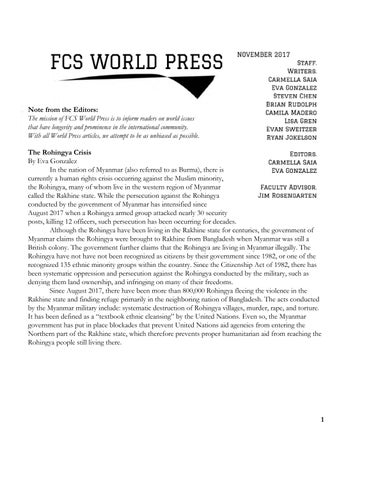


The Rohingya Crisis
By Eva Gonzalez
In the nation of Myanmar (also referred to as Burma), there is currently a human rights crisis occurring against the Muslim minority, the Rohingya, many of whom live in the western region of Myanmar called the Rakhine state. While the persecution against the Rohingya conducted by the government of Myanmar has intensified since August 2017 when a Rohingya armed group attacked nearly 30 security posts, killing 12 officers, such persecution has been occurring for decades.

Although the Rohingya have been living in the Rakhine state for centuries, the government of Myanmar claims the Rohingya were brought to Rakhine from Bangladesh when Myanmar was still a British colony. The government further claims that the Rohingya are living in Myanmar illegally. The Rohingya have not have not been recognized as citizens by their government since 1982, or one of the recognized 135 ethnic minority groups within the country. Since the Citizenship Act of 1982, there has been systematic oppression and persecution against the Rohingya conducted by the military, such as denying them land ownership, and infringing on many of their freedoms.
Since August 2017, there have been more than 800,000 Rohingya fleeing the violence in the Rakhine state and finding refuge primarily in the neighboring nation of Bangladesh. The acts conducted by the Myanmar military include: systematic destruction of Rohingya villages, murder, rape, and torture. It has been defined as a “textbook ethnic cleansing” by the United Nations. Even so, the Myanmar government has put in place blockades that prevent United Nations aid agencies from entering the Northern part of the Rakhine state, which therefore prevents proper humanitarian aid from reaching the Rohingya people still living there.
The response from Myanmar’s de-facto leader, Aung San Suu Kyi, has earned international backlash, because of the fact that she refused to directly and publicly condemn the acts of persecution by the military against the Rohingya. However, the military dictatorship that held power in Myanmar from 1962 - 2011 still controls many of the government functions today, including the military. This prevents Aung San Suu Kyi from having much power over the military. Being Aung San Suu Kyi won the Nobel Peace Prize in 1991 because of her consistent advocation for a Democratic Myanmar, this response, or lack thereof, comes as a disappointment to many human rights activists.
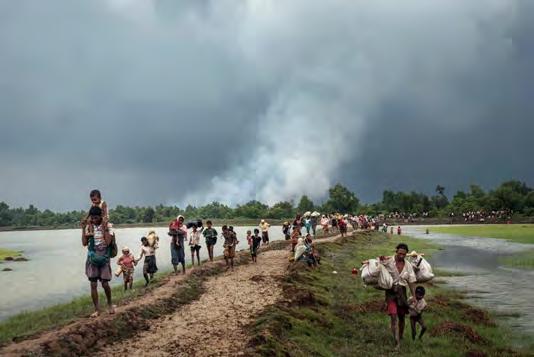
Many leaders from the international community began responding to the Rohingya crisis starting in September 2017. Vice President Pence made a statement to the United Nations Security Council, urging on President Trump’s behalf, “strong and swift” UN action to resolve the crisis. The United States also pledged $32 million in humanitarian aid to help the Rohingya refugees in Bangladesh. There have been various protests against the persecution of the Rohingya at times in Pakistan, India, Thailand, Indonesia, and Bangladesh. Bangladesh’s foreign minister, Abul Hassan Mahmood Ali, called the violence in the Rakhine state “a genocide.” Despite the responses of many foreign leaders, many governments in southeast Asia lack established legal framework to protect the rights of refugees, nor have the ten members of the Association of Southeast Asian Nations (ASEAN) coordinated a response to the Rohingya crisis, which could be crucial to helping to stop the persecution and prevent it from occurring in the future.
Sources:
1.https://news.nationalgeographic.com/2017/09/rohingya-refugee-crisis-myanmar-burma-spd/
2.http://www.cnn.com/specials/asia/rohingya
3.http://www.msf.org/en/article/myanmar-international-humanitarian-access-rakhine-state-must-urgently-be-permitte d
4.https://www.cfr.org/backgrounder/rohingya-crisis
5.https://www.usatoday.com/story/opinion/2017/09/28/textbook-example-ethnic-cleansing-myanmar-leader-doesntknow-rohingya-fleeing-daniel-sullivan-column/698405001/
6.https://www.nytimes.com/2017/10/25/learning/lesson-plans/teaching-about-the-rohingya-crisis-in-myanmar-with-t he-new-york-times.html
Catalan Independence: An Overview
By Evan Sweitzer
Catalonia is a region in the northeast of Spain, but it’s not just a “region” the way New England is a region of the United States.
2
Instead, the Spanish government recognizes it as an “autonomous community” of Spain; Catalonia has its own legislature, police force, economy, and language, but is not represented separately from Spain at the international level. As explained below, the degree of Catalonia’s autonomy has been a point of conflict among Spaniards for generations. Now, however, Catalans are pushing for full independence from Spain, and people around the globe fear that this crisis will lead to a clash.
When arguing in favor of secession, many pro-independentists point to the history of the Catalan language: it was suppressed for the bulk of a 250-year period between the early 1700s and the late 1970s. Its revival has brought on a strong sense of nationalistic pride, as many Catalans see their struggle and the resulting triumph as means to secede from Spain entirely.
Catalans made several attempts at breaking free from Spain in the early twentieth century, and even managed to become an “autonomous community” with a law passed in 1932, although this was revoked by fascist Francisco Franco when he rose to power in 1939. In 1978, three years after Franco’s death, a Spanish Constitution was written as part of the nation’s transition to democracy. The next year, Catalonia was finally granted its “autonomous community” standing, which lifted a Franco-era ban on speaking Catalan and let Catalans operate some institutions on their own, without interference by the Spanish government. Another referendum, in 2006, amended the Constitution to allow Catalonia to have a functioning, independent government, though still as an autonomous community of Spain.
The 2006 amendment did not end the talk of independence among supporters, however. Catalan nationalism is rampant, and many, though not all, Catalans are dissatisfied with being “under” Spain. Opponents of independence, many Catalans included, worry that breaking away from Spain could create conflict in a time where populist nationalism is on the rise around the world.
On September 6, 2017, the Catalan government authorized a referendum for independence. The very next day, however, the Spanish government declared the referendum illegal and suspended it, calling it a breach of the Spanish Constitution of 1978. That same day, the Spanish government ordered high-ranking Catalan officials, the Catalan media, and all of the regions of Catalonia not to participate in preparations for the referendum. Given 48 hours to respond, most regions announced their intentions to go ahead with the preparations anyway, and scheduled the vote for October 1, 2017.
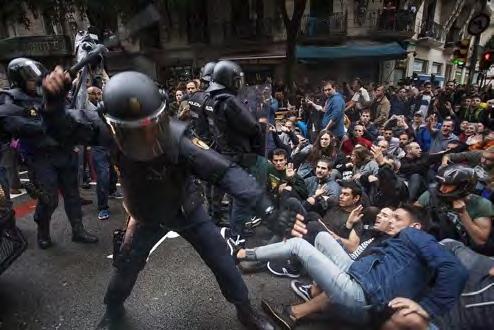
Acting on orders from the Spanish government, Spanish police did everything that they could to stop the vote from happening. They reportedly raided polling stations, seized ballots, and incapacitated voters and demonstrators. The results were as follows: about 92 percent of voters voted ‘yes’ to independence, and eight percent voted ‘no.’ These numbers can be misleading, however; only 43 percent of registered voters turned out to cast their ballots. The Catalan government argues that “up to 770,000” votes were invalidated because of police activities, which, if included, would have raised the turnout “to 55 percent.”
Anti-independentists assert that the referendum is unfair, and so no action of secession should be taken. Furthermore, they argue, the general chaos caused contamination of the voting system; in 71 Catalan municipalities, the number of “yes” votes was higher than the number of the municipality’s registered voters.
On October 27, 2017, the Catalan Parliament officially declared independence from Spain. Hours after the declaration, the Spanish Senate voted to invoke an article of the Spanish Constitution that would strip Catalonia of some of its autonomy. On October 28, the Spanish Prime Minister, Mariano Rajoy, fired the Catalan president and his entire cabinet, dissolved Catalonia’s Parliament, and scheduled new Catalan elections. The next day, an estimated 1 million people, including Catalans calling themselves “the silent majority,” marched on the streets of Barcelona to protest the independence declaration.
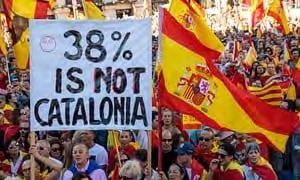
On November 2, eight members of the dissolved Catalan government were arrested and jailed on charges of inciting rebellion against the Spanish government. As of November 3, 2017, the Spanish government refuses to recognize the “Catalan Republic,” and is fighting to reclaim Catalonia as an autonomous community of Spain.
Sources:
1.https://www.pri.org/stories/2017-10-20/roots-catalonia-s-differences-rest-spain
2.http://www.cnn.com/2017/10/27/europe/catalonia-independence-spain/index.html
3.http://www.debatingeurope.eu/focus/independence-catalonia/#.Wftdu7z3ahD
4.https://www.theguardian.com/world/2017/nov/02/spanish-court-question-catalonia-separatists-except-puigdemont
5.https://www.theguardian.com/world/2017/oct/29/spain-barcelona-set-for-huge-rally-against-catalan-independencecatalonia
6.www.bbc.co.uk/news/world-europe-41461032
7.http://www.bbc.com/news/world-europe-41783289
8. http://web.gencat.cat/ca/generalitat/estatut/estatut1979/titol_primer/
Crisis in Venezuela
By Camila Madero
In 1998, the late Venezuelan President, Hugo Chavez, appealed to the Venezuelan masses with his “21st Century Social Agenda” to share the country’s oil wealth, which accounts for roughly 95 percent of total exports, in order to guarantee food security and create social programs for the poor. Yet, in 2014, this main source of income drastically plummeted following a worldwide oil glut. Oil production increased in the USA and the demand from emerging countries (e.g. China, Brazil, India, etc) declined, bringing down oil prices everywhere. In turn, Latin America’s richest country was thrown into a devastating economic crisis, leading President Nicholás Maduro, Chavez’s successor, to take a series of actions that has led to skyrocketing inflation. By decreasing imports and using the country’s limited savings to pay off its foreign debt to avoid default, while also controlling the US dollars from flowing into the country, Venezuela has been crippled by triple-digit inflation, leaving millions starving and without basic necessities. This crisis, in addition to Maduro’s recent power play, where he has established his position of authority by creating a new Assembly and rewriting the constitution, has led to widespread protests. 4
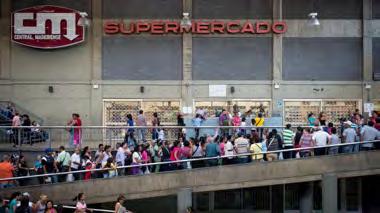
Currently, all sectors in Venezuela have been impacted by the food shortage, however the working middle class and the poor have been the hardest hit. Although food is available in private markets, the cost is far too high for people who live in working class neighborhoods. Millions of these Venezuelans spend hours in line daily at government regulated markets and go home with only enough to provide for as little as one meal or nothing at all. Last year alone, impoverished Venezuelans lost an average of 19 pounds due to the lack of food. In fact, CNN reports that “9.6 million Venezuelans eat two or fewer daily meals and more families are substituting usual foodstuffs for cheaper alternatives which leads to the percentage of malnourishment to increase.” The government has started providing monthly bags of subsidized groceries and toiletries, but many complain that the contents do not contain important items such as shampoo, diapers, and toilet paper, not to mention that its content is not enough to provide for an entire family.
Regular protests have been taking place in Venezuela since 2014. In September 2016, the largest of demonstrations took place, with over one million Venezuelans, 3% of the population, gathering to demand the resignation of President Maduro.
However, in April 19, 2017 when Supreme Tribunal of Justices dissolved the National Assembly so that Maduro’s government could have increased legislative powers, the “Mother of all Protests” took place with over 1.2 million Venezuelans marching in protest. While Maduro has stated that he supports peaceful protesting, his government has been criticized for ruthless tactics, including police use of firearms and torture of arrested protesters. Media censorship has also become a real problem.
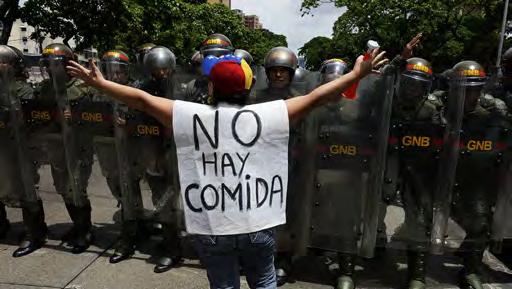
(Sign reads, “There is no food” to protest the devastating shortages in Venezuela.)
Amnesty International reported that in August 2017, two main opposition leaders were arrested in Caracas, which indicates “Maduro’s desperate attempt to silence all opposition.” Following the July 30 elections, the United States, Columbia, Peru, and Mexico stated they did not recognize the outcome of the elections, while old allies including Bolivia, Cuba, Nicaragua, and Russia stood by the election results.
As the situation in Venezuela becomes increasingly more dire, attempts at international support to assist have been refused by the Maduro government, creating a deadlock for many relief aid organizations. The US, Venezuela’s largest trade partner, has imposed sanctions against the Maduro government. Most recently, following Maduro’s elections this summer, the Trump administration did so as a way to put pressure on Maduro’s autocratic style regime. However, according to the Brookings Institute, if sanctions are to be successful, they need simultaneous effort from the international community to put pressure on Maduro’s government to accept humanitarian aid. In conclusion, there needs to be a joint response from countries around the world to demand positive changes in Venezuela as this growing crisis appears to have no limits. 5
Sources:
1.https://www.brookings.edu/blog/order-from-chaos/2017/07/25/between-a-rock-and-a-hard-place-economic-sancti ons-on-venezuela/
2.https://www.nytimes.com/interactive/2017/07/16/world/americas/venezuela-shortages.html
3.https://www.thenation.com/article/how-severe-is-venezuelas-crisis/
4.http://www.aljazeera.com/indepth/features/2017/04/venezuela-happening-170412114045595.html
5.http://www.cnn.com/2017/02/21/americas/venezuelan-food-crisis-weight-loss/index.html
6.https://www.amnesty.org/en/latest/news/2017/08/venezuela-country-at-breaking-point-as-opposition-leaders-seize d-from-homes/
Republicans Attempting to Pass Tax Reform
By Ryan Jokelson
After failing to pass a bill repealing the Affordable Care Act, Republicans in Washington DC have moved onto another policy initiative; tax reform. Republicans in the House and Senate are currently working to pass their respective bills soon, with the House expected to hold a vote as soon as November 16th. Republican leaders have repeatedly stated their goal of passing something before Thanksgiving and putting a final bill on the President’s desk before the end of the year.
The House bill, released in late October would repeal the estate tax, immediately lower the corporate tax rate from 35% to only 20%, change the income tax brackets, and dramatically change the way that tax deductions are structured. Currently there are seven tax brackets for income in the United States, but the bill would reduce that to only four. These brackets, with rates of 12%, 25%, 35%, and 39.6% respectively, generally represent large tax cuts, but for a minority of Americans could result in higher effective rates. While the standard deduction is increased significantly by the plan, several other exemptions and deductions are eliminated by the House plan. Most notably, all state and local tax deductions are eliminated, except for up to $10,000 in local property tax deductions. More recently, Senate Republicans unveiled their own, slightly different bill. This bill would wait a year to lower the corporate tax rate to 20%, and it maintains seven tax brackets, although each bracket would be slightly lower than the corresponding ones currently in place. Their bill maintains some of the smaller deductions that the House version would eliminate, but it completely eliminates all state and local tax deductions.
With Democrats and Republicans ideologically divided, tax reform is expected to be a highly partisan issue. Due to their slim Senate majority, Republicans are expected to use the Byrd rule to pass their tax bill. Normally, in order to overcome a filibuster and bring a bill to a final vote, 60 votes are needed, but the Byrd rule, an arcane Senate budgetary rule, allows a bill to be passed with only 50 votes.
Using these measures, Republicans, with their 52-48 seat majority, could pass their bill along partisan lines, without Democratic support. The easier passage however, comes at a price for Republicans, as the Byrd rule may only be used for budgetary bills that add no more than $1.5 billion dollars to the federal deficit for the first decade after passage, and add nothing to the deficit from that point onwards. This rule seems to have constrained the Republican plans as congressional leaders have struggled to keep the bills just barely under the $1.5 billion threshold.
Many Republicans in Congress and the White House see tax reform as a crucial piece of their agenda. With midterm elections coming up, Republicans would like at least one major legislative victory, especially in wake of their failed attempt at a healthcare bill.
Various interest groups seem unhappy with the bill and are lobbying for changes, complicating the process for Republican leaders. Passage of a tax reform bill seems to be an uphill battle for Republicans, who hold a fragile majority in the Senate and face united Democratic opposition to their legislative plans.
Postscript: Information in this article is current as of the date it was published. We expect these bills to continue to change and evolve over time.
1.https://www.politico.com/interactives/2017/tax-bill-senate-vs-house/
2.https://www.bloomberg.com/news/articles/2017-11-14/how-the-byrd-rule-will-shape-u-s-tax-overhaul-quicktake -q-a
3.https://www.politico.com/story/2017/11/14/house-republicans-tax-plan-vote-244880
4.http://www.cnn.com/2017/10/30/politics/tax-reform-preview-Republican-plan/index.html
5.https://www.washingtonpost.com/powerpost/Republicans-desperate-for-a-win-already-face-setbacks-as-they-pre pare-to-unveil-tax-bill-this-week/2017/10/29/eee9de82-bb1c-11e7-9e58-e6288544af98_story.html
6.https://www.nytimes.com/interactive/2017/09/27/us/politics/six-charts-to-explain-the-Republican-tax-plan.htm l
7.http://www.cnn.com/2017/10/27/politics/Republicans-tax-reform-2018-midterms/index.html
North Korea Nuclear Project
By Steven Chen
On September 6, 2016, the Democratic People's Republic of Korea known as North Korea successfully conducted its fifth nuclear test. This was the most powerful nuclear test at that time. In response, President Obama worked with the United Nations(UN) for stricter sanctions. As a result, three months later, the UN Security Council then voted unanimously and resolved for the strictest sanction: restricting North Korea’s export of coal, statues, and metals. The UN estimated it would cut off the export revenues by $800 million.
However, this sanction did not stop North Korea from further development of its nuclear weapons. On January 1st, 2017, the chairman of North Korea, Kim Jong Un, announced that North Korea was almost ready to test the intercontinental ballistic missile(ICBM), a weapon designed for nuclear weapons with a minimum delivering range of 3,400 miles. Kim also warned that North Korea would not stop increasing military self-defensive capacities unless “the US and its vassal forces stop nuclear threat and blackmail.” Secretary of Defense Ash Carter then responded that, “the U.S. would shoot down any missile aimed at it or an ally.”
Almost half of a year later, on July 4th, 2017, North Korea claimed that they succeeded in their first ICBM test, meaning that North Korea could potentially attack the U.S. mainland. However, the current Secretary of Defense Jim Mattis maintained confidence in the Trump administration and diplomacy, "I do not believe this capability in itself brings us closer to war, because the president's been very clear, the secretary of state has been very clear that we are leading with diplomatic and economic efforts." When being questioned about the effect of the Trump administration’s diplomacy which had seemed ineffective, Jim Mattis insisted that, “the diplomacy has not failed.” A month later, on Aug 5, Resolution 2371 was passed by the UN. Similarly to the one in the previous year, this sanction banned the export of metals and coal, but it was harsher: it was expected to reduce 1 billion North Korea’s revenue. But again, this did not stop North Korea from further testing.
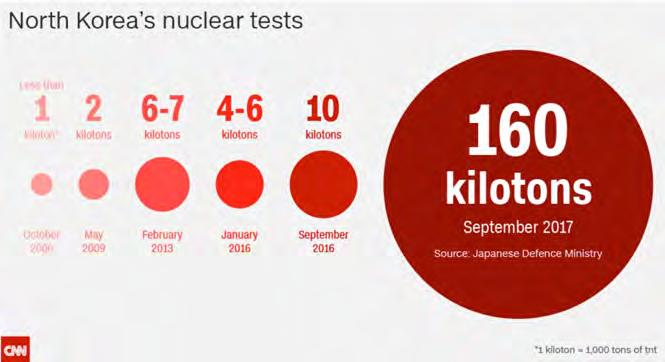
On September 3, 2017, North Korea announced they successfully conducted their 6th nuclear test: a hydrogen bomb that could be carried on a ICBM. This was estimated to be 8 times more than what Hiroshima dropped on August 6, 1945 and 10 times stronger than the one North Korea tested last September.
The seismic shock caused by this test spread to Northeastern China and South Korea. The test incited a majority of South Koreans to call for development of their own nuclear weapon. However, the president of South Korea, Moon Jae-in refused to do so because he suggested that developing nuclear weapons would lead to a nuclear arms race which would not be helpful in maintaining peace in Southeast Asia. President Trump’s frustration with North Korea was evident through one of his messages on Twitter, “The United States is considering, in addition to other options, stopping all trade with any country doing business with North Korea.” Ten days later, on September 12, the UN passed an even more extreme sanction: “the resolution will result in a 30% decrease in total oil imports by cutting off over 55% of refined petroleum products going to North Korea.” Moreover, this sanction included another large section of North Korea’s Economy - the export of textiles - which brought the regime $760 million and had never been covered by previous sanctions. In addition, some experts urge for paired sanctions on China and Russia because the sanctions on North Korea largely relied on the implementation of China and Russia, which remained uncertain and a challenge according to those experts.
Figure 1: the magnitude of all the Nuclear test in North Korea
The Ministry of Foreign Affairs of China claimed China maintained and supported the denuclearization of North Korea, but they hoped both sides should avoid overreacting. Additionally, the Chinese government would further investigate the potential nuclear pollution in the environment of Northeastern China.
Although some experts doubt that North Korea has the technology of develop a hydrogen bomb that can reach the Americas, North Korea and their recent tests are still very much an issue to be worried about.