
The Islamic State
By Kyle Tuverson
The Islamic State of Iraq and Syria (ISIS), or The Islamic State of Iraq and the Levant (ISIL), is, simply put, a radically Islamist jihadist group based in Ar-Raqqah, Syria. The group claims statehood under a caliphate government, led by the self-proclaimed Caliph “Ibrahim” Abu Bakr al-Baghdadi. A caliphate form of government is extremely religious, led by the caliph- which means the successor to Muhammad - who rules the entire Muslim world under sharia law. Sharia law is a complex moral code derived from the Quran, and is used to regulate all aspects of daily life, from personal hygiene to regulations about sex. Not following these laws could result in many different forms of punishment including stoning, beheading, and hanging, all of it public. This makes the areas controlled by the Islamic State extremely dangerous to non-Muslims, who are often forced to convert to Islam.

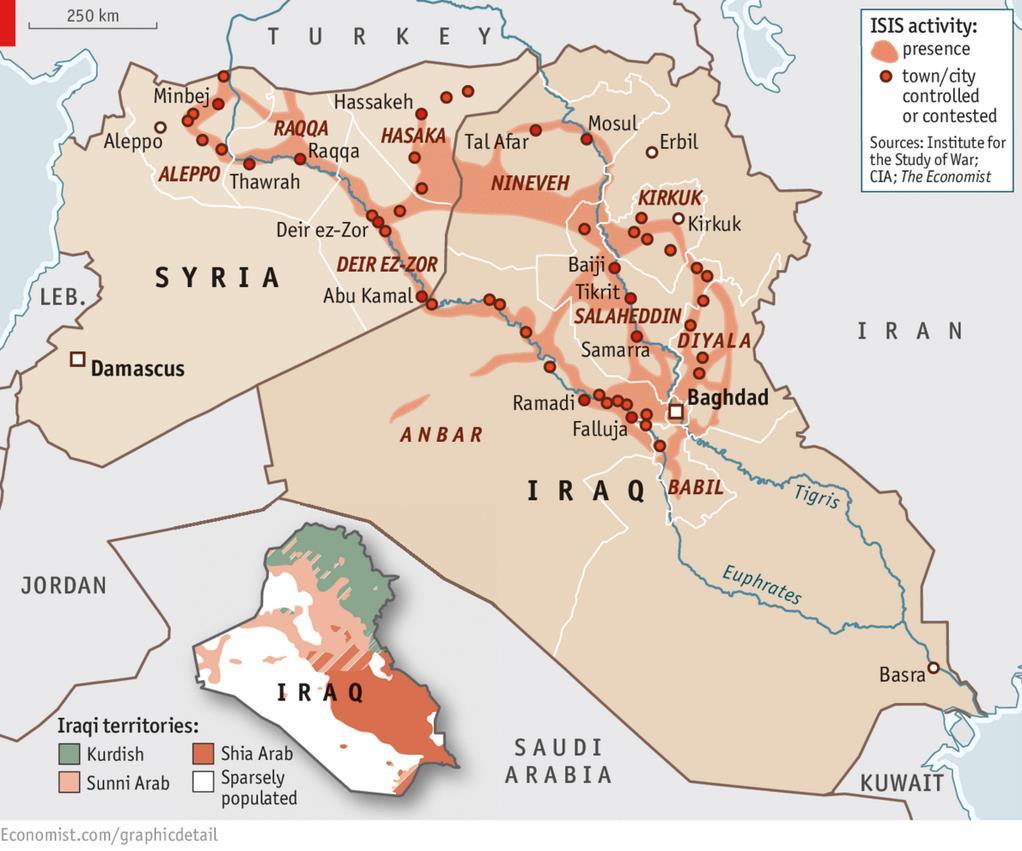
The group was started back in 1999 under the name Group of Monotheism and Jihad, or Jama'at al-Tawhid wal-Jihad, the group was located in Iraq and was a militant jihadist group, whose main goal was to destroy any of the outside attempts to help Iraq and those trying to build a new government, to remove the Shia population, and ultimately, create a truly Islamic State. They captured many foreigners and carried out a multitude of bombings killing hundreds and injuring thousands. In 2004, the group declared allegiance with al-Qaeda and Osama bin Laden, officially changing names to al-Qaeda in Iraq After helping to fight in the Iraq War (2003-11), and joining forces with other radical groups, the group became the Islamic State of Iraq, and later to the Islamic State of Iraq and the Levant The Levant refers to the area of land that encompasses parts of Iraq, Jordan, Israel, Palestine, Lebanon, and parts of Egypt. Their goal of taking over the whole world was to start with this region.
Under the control of al-Baghdadi, the group became involved in the civil war in Syria and formally removed the “IL” from their name, making it the familiar ISIS, and declared the state a caliphate, with Baghdadi the caliph, in late June, 2014. The group has been greatly condemned by all surrounding countries and countries around the world. The widespread public outrage came on August 19, when ISIS posted a video of the beheading of US journalist James Foley on YouTube, which was followed not long after by another video depicting the beheading of US journalist Steven Sotloff, then of British aid worker David Haines. While doing the beheadings, leaders had militants film the event, spreading it around the world using social media. Doing this allowed the world to finally see inside this regime, using these videos as an advertisement to radicals on the fence about joining forces with the State. With the beheadings of these foreign workers and depictions of the widespread killings of thousands of people, (continued on next page) 1
on September 23, the US made the decision to begin airstrikes on the ISIS capital city. They did this with the hopes of wiping out the leadership enough to slow the momentum of ISIS’s front lines, which were getting closer and closer to an area of Iraq and Syria called Kurdistan.
The Islamic State has been condemned as a terrorist group by the surrounding Muslim countries and Western Countries alike and notably by the United Kingdom in June of this year when the Prime Minister David Cameron said the following, "This is going to be our struggle now. ... We must do everything we can to defeat this organization."1 After this bold statement by the Prime Minister, countries around Europe and the Middle East began to take the threat of ISIS more seriously. Countries are worried about the extent to which militants of ISIS are ready to go to make their voices heard and message received, which could be anything from suicide bombings in other countries, to possible biological warfare. It is important to note that this kind of radical behavior is not promoted by any Muslim government in the world. Even countries that are extremely religious, like Iran, condemn the actions being taken by the Islamic State.
ISIS has also been gaining foreign members, with youth and adults alike from countries such as America and the UK, who believe strongly enough in the cause to go over to Iraq and fight alongside the Iraqis as suicide bombers. Sources in the CIA have said that ISIS has “more than 15,000 foreign fighters, including 2,000 Westerners, [who] have gone to Syria.”2 “Westerners” includes citizens of countries all across Europe, ranging from the United Kingdom to Switzerland, as well as from the United States. Members will usually fly to Turkey and cross the border into Syria from there. There has been an effort here in the US to try and identify people going to join before their departure, where federal officials stop potential members who are awaiting their flight in the airports. What makes ISIS stand apart from the rest of the jihad competition is their ability to use social media as a recruitment and PR tool. There is a group of women living in the Islamic State who post online and tweet about their happiness in living in such a devout state, which is used as a recruitment tool. This is a terrorist organization of the 21st century, which makes it uniquely dangerous. No other organization has put up the fight that the Islamic State has over the past few months, making its developments all the more interesting to watch.
http://www.huffingtonpost.com/2014/10/04/david-cameron-isis_n_5931808.html
NFL Suspensions: Too Little, Too Late?
By Anthony Candelori-Moraglia
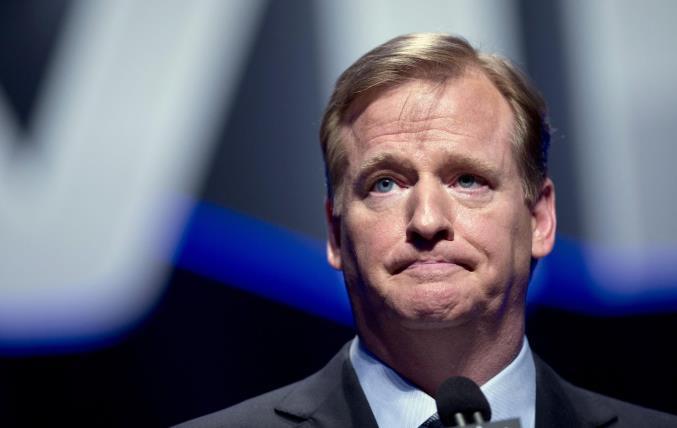
The first several weeks of the 2014 NFL season have been the most controversial the NFL has seen in its 94 year history. Between the investigations and the suspensions of Ray Rice and Adrian Peterson, much criticism has been placed on commissioner, Roger Goodell. Critics harp on what they consider to be Goodell’s lack of drive to put an end to abusive behavior, (particularly with Ray Rice) even when evidence of the abuse has been available to Goodell for months. On February 15, 2014, Baltimore Ravens’ running back Ray Rice beat his then fiance, now wife, Janay Palmer to the point of unconsciousness. Video footage was found four days later, and was given to the NFL headquarters from the tabloid TMZ in early April, 2014.1 (continued on next page)
` 2
Roger Goodell waited until July 24 to take a course of action with the scandal, and the punishment was a 2 game suspension. The general public thought the punishment was too lenient for the crime, even before the whole video of the assault was released. Fast forward to September 8, when the full video of the assault was made public on the internet. The general public was furious at Goodell because not only did the video demonstrate Rice’s extreme violent behavior; but it also demonstrated how Goodell had knowledge of how horrible and violent the beating was for months, yet didn't punish Rice in any major way. The Ravens themselves released Rice altogether before Goodell even suspended Rice any further. On September 8, the NFL finally suspended Rice indefinitely, although Rice is currently trying to appeal the suspension.
Goodell’s debatable leniency towards suspending criminally violent players became even more evident when the Adrian Peterson scandal went public. On September 12th, just four days after Rice’s suspension, Minnesota Vikings running back, Adrian Peterson, was indicted on child abuse of his four-year-old son (Peterson beat his son with a tree branch to the point of bleeding on his back, legs, and genitals).2 Before Goodell acted, the Vikings themselves responded: the team originally suspended Peterson for just one week, but later decided to suspend Peterson until after his court case was resolved.
The largest criticism of Goodell stems from the feeling that he did not take enough action in suspending the abusers, to the point where the teams themselves had to take action into their own hands by suspending their superstar players. Some feel Goodell cares less about the victims of the abuse than the NFL’s desire to protect some of its most talented and marketable players. Goodell certainly wants to change his image on these abuse scandals, as he is implementing a new domestic abuse prevention program. With this program, he expects to “explore meaningful ways to incorporate domestic violence and sexual assault awareness and prevention into our public service work.”
Does Roger Goodell deserve the criticism that has come his way? I’ll leave that for you to decide.
1. http://www.sbnation.com/nfl/2014/5/23/5744964/ray-rice-arrest-assault-statement-apology-ravens
2. http://www.cbssports.com/nfl/eye-on-football/24706732/report-adrian-peterson-indicted-in-child-injury-case-in-texas
3. http://www.bostonglobe.com/sports/2014/08/30/roger-goodell-reacts-bad-over-ray-rice-suspension/uSLlP2lgzRMGLmfrrak9NI/story.html
The Ebola Outbreak
By Maddie Henry
Ebola is an infectious and often fatal disease found in humans and primates. The Ebola virus spreads through the blood or bodily fluids of an infected animal or person. Symptoms start within two days to two weeks. Resulting symptoms include high fever, headache, vomiting, weakness and unexplained hemorrhage (bleeding or bruising). No vaccination or medication has been proven effective. This virus has killed up to 90 percent of those infected becoming a major concern worldwide.1
The recent outbreak in West Africa is the most severe outbreak since its discovery. There have been 3974 cases reported; out of those infected, 2007 died. Most of the infected are from numerous impoverished countries such as Guinea, Liberia, Nigeria, Senegal and Sierra Leone. The longstanding poverty these developing countries face is making it difficult to treat those that are infected. Their hospitals are understaffed and under supplied. This lack of supplies has put hospital staff and aid workers at a larger risk. Without new gloves, clean sheets and other supplies these caregiver could easily come in contact with body fluids or blood. Many people exposed to the virus (continued on next page)
live in remote areas without running water. In these remote villages the infected are treated by local healers and the virus easily spreads. Even the people who are lucky enough to be diagnosed and receive treatment are not necessarily safe. One clinic in the capital of Liberia was looted of sheets, mattresses and medical devices.2 This all happened within the biggest slum in Liberia and caused panic throughout the world.
The United States’ response to Ebola has been to try to control the disease at the source. President Obama said after a meeting with top U.S. health officials, "In West Africa, Ebola is now an epidemic, the likes that we have not seen before. It's spiraling out of control; it's getting worse.” The world has started to take precaution against the spread of this virus by doing screenings in airports which require passengers from West Africa to fill out a questionnaire and get their temperature taken. The first case of Ebola was recently discovered in America. The patient, Thomas Duncan, flew in from Liberia and showed no symptoms initially. Once he became sick it was still four days before he was placed in isolation. Fear over the virus has caused a frantic search for people that came in contact with this man and are possibly infected. The patient's family was quarantined in their house until doctors could be sure they were not infected. After 21 days of isolation the family showed no symptoms. However the mishandling of Thomas Duncan's case has resulted in two nurses becoming infected with the disease. The Pentagon has just created a 30 person response team to help local hospitals in the event of an outbreak. This thirty person team is made up of critical care nurses, doctors and trainers specialized in infectious diseases there to train and help local hospitals in the treatment of Ebola.
1. http://www.cnn.com/2014/04/11/health/ebola-fast-facts
2. Ibid.,
Supreme Court Sets New Precedent on Cell Phones
By Austin Margulies
Riley v California, as do most cases brought before the Supreme Court, began with a small event, years before the case was ever brought to Washington. In August of 2009, David Riley was arrested in California at a traffic stop after police discovered loaded firearms in his car. During the arrest, officers seized Riley’s firearms as is procedure, while also taking his cell phone in for search. While investigators looked over the phone’s contents, including messages, contacts, videos and photographs, they decided to charge Riley with an unrelated shooting that occurred a few weeks prior. Riley’s lawyer fought to suppress all evidence collected from the cell phone, however both the trial court and the California Supreme Court held that the search of Riley’s phone was legal.[1] This past April, Riley and his representatives argued their case for the United States Supreme Court, with the court ruling in Riley’s favor in June.
Due to Fourth Amendment rights, it is unconstitutional for an arresting officer to carry out an unwarranted search and seizure. This means that without judicial verification, something normally obtained after the arrest, an officer is unable to search the person being arrested, search their property, or take anything from them. However, there is a common exception to the Fourth Amendment. The arresting officer is allowed to perform a minimal search and seizure in order to ensure that the person being arrested has no physical means of harming the officer, destroying evidence or allowing him or herself to escape the arrest. If the officer wishes to continue the search past basic safety measures, they must obtain permission from a judge.
Riley’s lawyer argued before the courts in California that this search of his client’s cell phone violated Riley’s Fourth Amendment Rights, as it went past the basic measures of “search-incident-to-arrest” (the legal term for the point of arrest process). As the case went forward, the goal for Riley’s case was to prove that there was no reason for the search of his cell phone that connected it to the “search-incident-to-arrest” laid out in the Fourth Amendment. After California disagreed, upholding the officer’s decision, the case was sent up one more time to the United States Supreme Court. (continued on next page) 4
In a landmark and unanimous decision, the justices ruled in Riley’s favor, declaring that the search of a cell phone’s contents violate the rights set up through the Fourth Amendment. The ground for their decision, they said, lay in the area of safety. The reason for “search-incident-to-arrest” was to ensure complete safety of the situation. In the Court Opinion, Chief Justice Roberts stated that:
Digital data stored on a cell phone cannot itself be used as a weapon to harm an arresting officer or to effectuate the arrestee's escape. Law enforcement officers remain free to examine the physical aspects of a phone to ensure that it will not be used as a weapon say, to determine whether there is a razor blade hidden between the phone and its case. Once an officer has secured a phone and eliminated any potential physical threats, however, data on the phone can endanger no one. [2]
The importance of this case sets up a new, digital-age precedent declaring the cell phone to go beyond most basic objects found on or near a person. Roberts concludes his opinion, saying that "modern cell phones are not just another technological convenience. With all they contain and all they may reveal, they hold for many Americans ‘the privacies of life.’ The fact that technology now allows an individual to carry such information in his hand does not make the information any less worthy of the protection for which the Founders fought." [3]
In recent weeks, many cases of police overreach and brutality have come to the forefront of the basic rights debate. While this case solves only a minor part of law over enforcement, it does set up workable precedent that could be used to further improve the process at the point-of-arrest. And even more, a unanimous decision of 9-0 shows that the Supreme Court is able and willing to come together on issues that seek to improve how law enforcement is carried out in our country, something that will most likely be back before the court in the spring of 2015.
1. http://www.natlawreview.com/article/landmark-supreme-court-ruling-protects-cell-phones-warrantless-searches
2. Riley v. California, 573 U. S., (slip op., at 28)
3. Ibid.
Scotland votes to maintain 300 year union with United Kingdom
By Caroline Bartholomew
On September 18th, 2014, the people of Scotland went to the polls to decide whether or not they would remain as a part of the United Kingdom or become an independent country. Scotland has been a part of the United Kingdom (which also includes England, Wales, and Northern Ireland) since 1707. Scotland is home to 5,327,700 people and makes up about 8% of the UK's population.1 Scotland has its own Parliament located in Edinburgh, which is responsible for all issues that are not specifically reserved for the UK Parliament in London, including education, police force, and economic development. The executive figure in the Scottish government is called the First Minister (currently Alex Salmond), who is nominated by members of Scotland's Parliament and then appointed by the Queen of England.
Scotland has only had its own government since 1999, when the Scotland Act was passed by the UK Parliament.2 Since 2011, the Scottish National Party (SNP) has been the largest political party in Scotland, and in January 2012, the UK Parliament agreed to let the party hold a referendum (the vote for independence). It became official with the Edinburgh Agreement, which was created in October 2012. In addition to the Edinburgh Agreement, (continued on next page)
the Scottish Parliament published the 670 page book called "Scotland's Future", explaining why they wanted independence and how they would manage as an independent country.
Originally, the idea that Scotland might actually break away from the UK seemed somewhat far-fetched, but as the date grew closer and campaigning was underway, the "yes" supporters were gaining momentum. A poll conducted by YouGov on September 7th showed that people in support of an independent Scotland were even in the lead. One of the main reasons as to why the Scots want their independence from the UK, is because UK Parliament is trying to reform laws and policies in Scotland not created by the Scots themselves.
Culturally, the Scots feel a growing sense of difference between themselves and their English neighbors.
Dauvit Broun, a professor at the University of Glasgow, says that "Scotland and England have been growing apart, since the demise of the British Empire.... The decline of the Presbyterian Church in Scotland, which provided a sense of self-government and Scottish identity, has also played a part in fueling the desire for independence.”3
Despite the push for independence, there are many in Scotland who do not want to break the 300 year union. UK politicians, in addition to many British celebrities, started a campaign called "Better Together.” One of the groups supporters, Manchester United Soccer Club manager Alex Ferguson, argues the fact that "800,000 Scots, like me, live and work in other parts of the United Kingdom. We don't live in a foreign country; we are just another part of the family in the UK.”4 Other supporters of the Better Together campaign include J.K. Rowling, Paul McCartney, David Bowie and Kate Moss.
The major implications of Scotland gaining its independence revolve around international business and the economy, in addition to defense issues. The Scottish government says that should they become independent, Scotland wants to remove all nuclear weapons that are currently placed there. They would also have to apply for re-entry into NATO, but say they will only do so if it is agreed that no nuclear weapons shall be stored in Scotland.
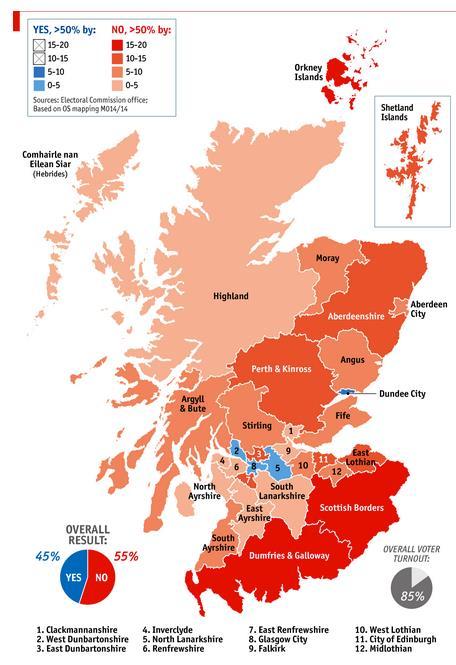
On the day of the referendum, 86% of the population came out to vote - the highest turnout for any democratic referendum or election in history. 45% (approximately 1.6 million) voted for an independent Scotland, but they were shut down by the other 55% who voted to remain part of the UK.5 The only places where the ‘ yes ’ vote was higher than the ‘ no’ was in the center of the country, which includes the major city of Glasgow. While many are happy with the outcome, there are still those who are very upset, and currently there's an online petition with 90,000 names demanding a recounting of the votes. Although the actual vote is over, the argument over Scotland's independence certainly is not.
1 http://www.cnn.com/2014/09/09/world/europe/scottish-referendum-explainer/
2 http://www.scotland.gov.uk/About/Factfile/18060/11550
3 http://www.cnn.com/2014/09/09/world/europe/scottish-referendum-explainer/
4 Ibid.
5 https://www.scotreferendum.com/2014/09/first-minister-on-referendum-outcome/ 6
Burwell V. Hobby Lobby
By Stefan Sultan
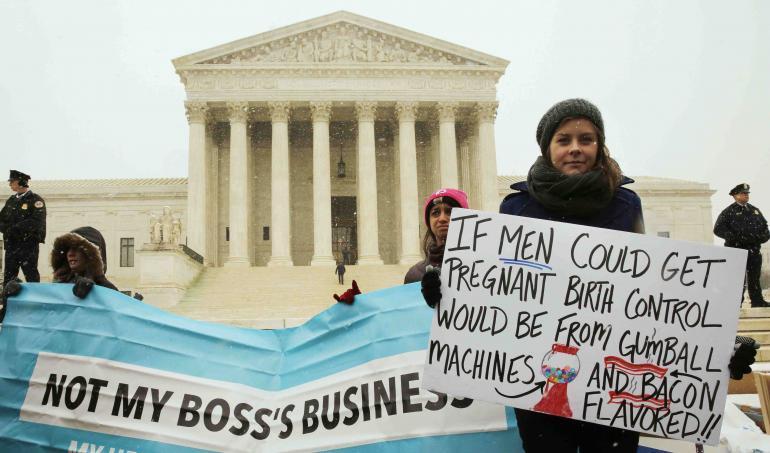
This summer many of you may have heard about the controversial Supreme Court case, Burwell V. Hobby Lobby, in which the Supreme Court ruled that Hobby Lobby, a for-profit corporation, does not have to cover women's contraception in their employee healthcare plan, on the basis of the Religious Freedom Restoration Act (RFRA). The RFRA prohibits the "Government [from] substantially burden[ing] a person’s exercise of religion even if the burden results from a rule of general applicability” unless the Government “demonstrates that application of the burden to the person (1) is in furtherance of a compelling governmental interest; and (2) is the least restrictive means of furthering that compelling governmental interest."1 This means that the federal government may not do anything that would hinder a person from exercising their religion, unless it interferes with a government interest. Justice Alito wrote in the court's opinion, that the provision in the Patient Protection and Affordable Care Act (ACA) which mandated that employee's health plans preventive care must include birth control violated this clause in the RFRA because:
The owners of the businesses have religious objections to abortion, and according to their religious beliefs the four contraceptive methods at issue are abortifacients. If the owners comply with the HHS mandate, they believe they will be facilitating abortions, and if they do not comply, they will pay a very heavy price as much as $1.3 million per day, or about $475 million per year, in the case of one of the companies. If these consequences do not amount to a substantial burden, it is hard to see what would.2 Essentially, what Alito asserts is that because the owners of these corporations religiously object to abortion, and they believe that some of these contraceptives cause abortion, this mandate is in violation of RFRA because a refusal to comply would result in a large fine, which the court views as a substantial burden. However, in her very critical dissent (which was joined by Justices Sotomayor, Breyer, and Kagan) Justice Ginsburg suggested that the purpose of RFRA was solely to overturn the Supreme Court case Employment Division, Department of Human Resources of Oregon v. Smith, and was not intended to apply to other areas.
Ginsberg at one point quoted Planned Parenthood of Southeastern Pa. v. Casey, writing "the ability of women to participate equally in the economic and social life of the Nation has been facilitated by their ability to control their reproductive lives," and that in the passing of this law Congress had acted upon this understanding. She further pointed out that the Supreme Court had held that "commercial enterprises, including corporations...can opt out of any law (saving only tax laws) they judge incompatible with their sincerely held religious beliefs." What Justice Ginsburg is saying here is that, due to this decision, corporations are able to disregard nearly any law that goes against their religious beliefs. This, in itself, has been a large part of the controversy surrounding the case.
Many critics of this case claim that with this ruling companies owned by Christian Scientists will be able to deny healthcare to their employees because it goes against their faith, or that corporations owned by Jehovah's Witnesses won't have to cover blood transfusions in their employee's health plans, and even that Christian companies can legally fire or refuse to hire an employee simply because they are gay. However, others are a little more skeptical, like Justice Kennedy, who stated agreement that, "the Court’s opinion does not have the breadth and sweep ascribed to it by the respectful and powerful dissent."3 In other words, according to Justice Kennedy, the repercussions of this decision won't be as pervasive as Justice Ginsburg describes. To find out what the future repercussions of this decision will be, we must wait to see.
Sources:
1. http://www.supremecourt.gov/opinions/13pdf/13-354_olp1.pdf
2. Ibid
3. Ibid.
Gendercide
by Marni Folkman
“It’s a girl.” Three of the deadliest words in countries like India and China. In both of these countries there is a strong cultural preference for boys. In fact, more female infants are killed in India and China than the number of females born in the United States each year.1 There are many reasons why ‘gendercide’ - the systematic killing of members of a specific sex - happens. Society values the birth of a son over that of a daughter because daughters are seen as a burden and a liability. There’s a saying in China, “the birth of a boy is welcomed with shouts of joy and firecrackers, but when a girl is born, the neighbors say nothing.”2 A son grows up to become the head of the family, being the main source of a family's income; whereas a daughter costs her family huge amounts of money when a dowry needs to be paid in order for her to get married. Because of this, women are subjugated to the male. In India, a woman who fails to give birth to a boy is often beaten, raped, or killed. Despite sex selective abortion being illegal in India, it is estimated that around 700,000 female babies are aborted each year. If the pregnancy is not terminated, a midwife can be paid $2.50 to kill a newborn girl.3 There are varied methods of killing the newborns. Some babies are strangled, buried alive, drowned, or poisoned. Because so many females are being deprived of the basic right of existence, there is a mass chasm in the number of females to males. According to a 2011 Census in India, there were 37 million more men than women. 4 In China, the one child only policy has exacerbated the number of sex selective abortions because families, already feeling limited, insist on only having a boy. Families are willing to sacrifice the lives of their unborn daughters in their pursuit of sons. Occasionally, families sell their female babies in order to make room for a son. Due to the dwindling number of females in China, there is an increasing demand for women by single males searching for a wife. Women are scarce, and so are their sexual services. This demand has led to an increase in prostitution and sex trafficking. In addition, the number of pregnant women who commit suicide after being pressured by their families to abort their daughters is alarmingly high.
To conclude, the struggle for a girl begins the day her existence becomes known in her mother's womb. If she is allowed to live, her life is not an easy one. She is forced to face challenges every step of the way. She is susceptible to rape, molestation, domestic abuse, and exploitation. She will be undervalued, unappreciated, and discriminated against solely because of her gender. Though some legislation has changed over the years, ‘gendercide’ is still a growing issue. Until economic and cultural structures change, a woman's value and ability to contribute to the world will continue to be overlooked.
1. http://www.domesticviolenceservices.com/female-infanticide.html
2. http://www.eastwestcenter.org/news-center/east-west-wire/battling-a-preference-for-boys
3. http://southasiainvestor.blogspot.com/2010_05_01_archive.html
4. http://en.wikipedia.org/wiki/Gendercide