The Legalities of Gay Marriage in the U.S. (cont.)
That being said, let’s take a look at America today in regards to its status on same sex marriage (The map shown to the right was created in February of 2015 and is accurate as of May 2015, though it may change in the coming months.)
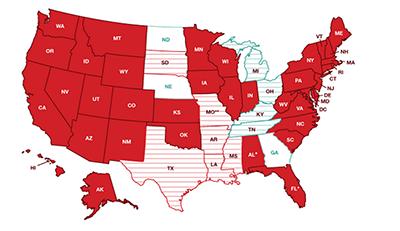
The 37 states (and Washington DC) are shaded fully in red to signify where same-sex marriage is fully legal. Many of these states have legalized same sex marriage recently, as 23 of these states have determined same-sex marriage legal in the past 2 years. The 37 states that have legalized gay marriage are not concentrated to any one region, as all of America’s regions are represented with at least several pro-gay marriage states. Additionally, some of these states are considered to be firmly politically conservative, which some consider to be surprising considering the traditional conservative values relating to gay marriage. In fact, it was not until 2013 that a state which elected Mitt Romney in the 2012 Presidential Election had legalized same sex marriage. A main reason there are so many new states allowing gay couples the right to marry is because of a growing acceptance of gay marriage in the public’s opinion, even in conservative states like Utah and West Virginia. Furthermore, only 35% of Americans oppose same sex marriage; and the other 65% either believe that same sex marriage is fair, or that although they do not personally believe in gay marriage, they consider their belief to be personal and should not interfere with the state’s decision. As time moves on, we can expect these approval ratings to increase even more. The more states approve gay marriage, the more other states will follow suit to coincide with mainstream American beliefs.
As for the other 13 states, we can expect to see more of the same in terms of individual states creating marriage equality via the legalization of gay marriage. All of the remaining 13 states are currently somewhere in the process of attempting to legalize gay marriage, as there are cases in these states that are attempting to overrule the state’s laws against marriage equality via the Supreme Court. However, some states are closer than others on hearing back from the Supreme Court. The four states in the green stripes (Tennessee, Kentucky, Ohio, and Michigan) are currently under review of their marriage rights laws by the Supreme Court, as they are the states in the Sixth Circuit of the US court system. These states are the closest to achieving legal same sex marriage, or at least a more definitive ruling in the next few months. This is because these four states are more or less the states ‘At the front of the line’ for hearing the Supreme Court’s ruling on the anti-gay marriage appeals. Conversely, the three states with no stripes (Georgia, Nebraska, and North Dakota) are the furthest away from achieving same sex legality. This is because these states still have the anti-gay marriage appeals pending to be challenged within the Supreme Court. These three states still need approval from their state’s government before going to the Supreme Court. Lastly, the remaining six states in the red stripes are in the ‘middle of the line’ for their fight for marriage equality. The six states are in different circuits of court system then the aforementioned green striped states, meaning that the six will have to wait for the court's ruling on the green states before the court decides on these six. Although these states will have to wait longer for the Court’s ruling on the appeals, they should have their ruling in the relatively near future. (continued on p. 3)
Finally, there is some debate on whether or not the Supreme Court should create a ruling on same sex marriage for all 50 states, overriding the individual laws of the states. Supporters of this logic feel that it is important for all of America to have a definitive say on the legality of gay marriage, as it unites America as a whole. Conversely, critics of this logic say that a ruling like this would break the Constitution’s 10th amendment; that individual states have the right to create laws that were never delegated under the Constitution in what ever way they see fit without interference from the federal government.
We should expect to see the map evolving soon as more states will likely allow gay marriage soon. Additionally, we can predict that the map will be all colored in red at some point in our lifetimes. This is because for better or worse, the remaining 13 will feel enough pressure from both their own citizens and the majority of pro-gay marriage states that the holdouts will virtually have to approve of marriage equality.
http://www.freedomtomarry.org/blog/entry/finishing-the-job-how-marriage-is-moving-forward-in-the-final-13-states http://www.huffingtonpost.com/2013/05/09/gay-marriage-usa-progress-_n_3248415.html
http://www.theatlantic.com/politics/archive/2015/03/why-more-americans-accept-gay-marriage-than-ever/386707/ http://www.theatlantic.com/politics/archive/2015/04/america-is-ready-for-gay-marriage/391643/
http://www.freedomtomarry.org/blog/entry/finishing-the-job-how-marriage-is-moving-forward-in-the-final-13-states
http://www.usnews.com/debate-club/should-same-sex-marriage-be-left-to-the-states/marriage-should-not-be-regulated-by-the-federal-government
Greece in the Eurozone
By Ethan Hurwitz
Greece presently stands between a rock and a hard place, and, in turn, so does Europe. Since the 1990s, Greece has had a budget deficit that saw them slowly accumulate an increasingly insurmountable debt, ultimately leading them to where they find themselves today: arguably the meridian of their economic plight. As a member of the Eurozone, and as such a user of the Euro, Greece is now, in light of its most recent crisis, inextricably intertwined with the eighteen other countries and their currencies which make up the Eurozone. Thus, a catastrophe with Greece's economy afflicts the other members of the Eurozone in similar measure. Given the adversity Greece has faced and currently faces, the entire Eurozone stands at a crossroads, with challenges lying in all directions.
Beginning in the decade leading up to the economic crisis of 2008, increasingly leftist fiscal policy was adopted that was geared toward the creation of high wages and social benefits in the public sector. When the financial crisis hit in 2008, these policies served to exacerbate an already meager economic climate by draining the budget of usable capital and creating an environment that led to rising unemployment; this led to lower amounts of money being collected for taxes.
Throughout the financial crisis, Greece borrowed money from the major creditors of the European Union (EU) and private lenders throughout Europe in an attempt to service their public debt in the short term, while taking on what they intended to be a manageable debt in the long term. Greece, however, already being in a state of rapid economic decline, only continued on a downward (continued on p. 4) 3
trajectory, and found themselves unable to make inroads into what they owed. This resulted in several new deals made with creditors that extended the time over which the loaned money was to be paid back, and saw the adoption of a policy of strict financial cutbacks, called "austerity."
This policy of austerity included the elimination of public sector pensions and jobs, the lowering of wages, and the raising of taxes within Greece. During the period of austerity, however, these severe fiscal practices choked economic growth and saw unemployment soar into the stratosphere. The stagnant, even declining, economy severely reduced the efficacy of taxation policy as there were fewer salaries to tax. This was the austerity measures' chief source of revenue. It soon became clear that under the rule of austerity, not only could the Greek economy not grow to a sustainable and self sufficient level, but the abundance of outstanding debts could not be paid.
A Greek economic downfall could spell disaster for Europe. Were the Greeks to default on their debt - meaning that they stopped paying them off - they would depreciate the value of the Euro tremendously, sending economies across the continent into decline. It is for precisely that reason that the major European creditors, namely Germany and France from the European Commission, alongside the European Central Bank, have made a bid to aid Greece financially by loaning as much as $146 billion in debt relief. These loans, however, come at a price to Greece: austerity. Under the rule of the economic cutbacks stipulated as a condition of the bailout loans, the meager state of the Greek economy has become more than simply a financial issue, but a humanitarian concern.
Nearly a quarter of the country is unemployed, suicide rates and instances of homelessness have increased, and underfunded and undersupplied hospitals struggle to provide adequate care. While defaulting on debt payments is certainly an undesirable course of action, recent conditions in Greece have garnered support for the notion that the alternative is, perhaps, no more desirable.
Additionally, the strength of the anti-austerity sentiment is bolstered by the fact that, despite the colossal loans granted to Greece, the country stands, once again, at the precipice of default. While the very fact of their proximity to missed debt payments suggests that austerity and massive loans were not the final solution to Greece's problem, the only conceivable way Greece can avoid this forthcoming default is to accept the foreign aid that may perpetuate suffering and indebtedness for years to come; the entire situation is nothing short of a conundrum, a puzzling puzzle. That said, in spite of everything that has occurred, a potential return to the disastrous fiscal policies of the prior two decades looms large on the horizon.
During this year's Greek parliamentary elections, the Syriza party, a left-wing group headed by Alexis Tsipras, now the prime minister of Greece, claimed victory and took (cont. on p. 5)
power. Syriza ran on the platform of opposing the austerity measures demanded by Germany in 2010, and found no shortage of support for such a sentiment among the Greek voters. Being that it was Greece's extremely generous entitlements, implemented by a leftist government similar to Syriza, that put the country in such boiling hot water at the arrival of the financial crisis, it may seem that the installation of a party that has promised to cease the as yet most effective measure of reducing the national debt is counterintuitive. As is apparent, however, Greece's situation is not a simple one. On one side, there are choking austerity measures that have, thus far, proven only a temporary solution to the economic issues Greece faces; on the other side there is a leftist party who promises to continue to oppose austerity measures, despite lenders' refusal to renew desperately needed payments to Greece without austerity; and of course, in the middle, between a rock and a very hard place, stands Greece. http://www.wsj.com/articles/syriza-win-in-greek-election-sets-up-new-europe-clash-1422168982 http://www.greekcrisis.net/ http://en.wikipedia.org/wiki/Eurozone http://www.tradingeconomics.com/greece/government-budget http://data.worldbank.org/indicator/SL.UEM.TOTL.ZS http://fas.org/sgp/crs/row/R41167.pdf file:///C:/Users/Louise/Downloads/364-371-Economic%20Trends-ohne%20Index.pdf http://www.bloomberg.com/news/articles/2015-05-17/greece-remains-defiant-as-it-seeks-deal-with-creditors-this-week http://www.tradingeconomics.com/united-kingdom/gdp http://static.guim.co.uk/sys-images/Guardian/Pix/pictures/2013/3/20/1363800264587/Budget-spending-and-tax-r-001.jpg https://books.google.com/books?id=0XllKAoOES8C&pg=PA51&lpg=PA51&dq=Euro+depreciation+20072008&source=bl&ots=9gzknhNMYk&sig=yyx6_5RnTPTmIgJccNji4I2YH90&hl=en&sa=X&ei=DGheVdypKsOmgwTSpoDQDg&ved=0C CgQ6AEwAg#v=onepage&q=Euro%20depreciation%202007-2008&f=false http://www.oanda.com/currency/historical-rates/ The New York Times Magazine, May 24, 2015, "Continental Divide," by Suzy Hansen.
Past and Future of the Pearl (Continued)
As mentioned above, the economy of Hong Kong is heavily dependent on international trade, which is unapproachable for most of the public, as the trades are open to public are subjected to drastic competition due to the sheer size of Hong Kong’s population. The current generation of youth, who have just graduated from universities, is facing a society with meager opportunity and great stress. Young people have a future with little hope. The Central Government’s control over the 2017 election deteriorated the youth expectation for the future, as the young people wanted to make sure that they were controlling their own future. The governmental overreach became the last straw and ignited the dynamite of indignation in Hong Kong, which became known as “Occupy Central.” The economy and social wealth distribution of Hong Kong is growing increasingly wider. The youth are concerned about their future ability to thrive and to control their fate. All of these factors made them want to be sure that they had a fair say in who would be running the government.
Learning about Hong Kong’s history will generate a better idea about the current event. In 1840s, soon after the British government defeated “Qing” China, the British requested Hong Kong as war compensation and used it as its main transport port in Asia. (continued on p. 6)
Hong Kong turned into a British colony since then. Although Hong Kong enjoyed this Western economic and political system, Hong Kong only had a limited amount of freedom. The government in Hong Kong was merely an extension of London which executed orders as directed, and, at that time “locals fill[ed] less than half of the senior posts in the Legal Department and only fifty-one percent of the judiciary.” According to Dong Jianhua, the first chief executive after Hong Kong joined China in 1997, he faced a difficult time making decisions without orders from the British government. Although Hong Kong had the right of protesting during the colonial ruling, it did not actually have much control over its own destiny. After the power switch in 1997, Hong Kong turned into a colony of China. Hong Kong has existed as a colony in one form or another for the last two centuries; from this perspective, it is as if Hong Kong is a bird without wings, and “Occupy Central” is merely going to be an infertile protest.
The future seems to be bleak in the following ten years. Hong Kong only has limited land resources, and developing any form of industry is impractical. Since 1970, industrial production started to decrease while its neighbors were developing in a fast pace.
Nevertheless, Hong Kong has very great potential in the long run, which is measured by the scale of 50 years. Hong Kong rose to its position today by playing as an intermediary; in order to keep to the pace of the world, Hong Kong needs to increase its cooperation with China, or it will be exceeded by cities such as Shanghai in terms of international prominence. China’s alienation of Hong Kong will eventually hinder trade for the major city. However, in the long run, when Hong Kong’s cooperation with China is further developed, combined with its advantage of having a Western legal and market system, Hong Kong will definitely be the center of international trades in Asia. From the perspective of the people, an open market with China will enlarge the market for employment and the stressful competition would somehow be relieved.
The “Umbrella Revolution” reflects a desire for freedom and a want to fulfill the people’s rights. However their intention is simple and productive: to build a better world for the people’s tomorrow. Different people will have different understandings about the way to create a good future. It is dictatorial to force everyone to agree with an idea, but it does not mean that we should stop struggling for a better future. Our world can reach its height today because we, as human beings, will always be looking for a better future. Over the history of feudal ages, democratic society was regarded to be ridiculous, but after thousands of years, it is realized and practiced. Rome wasn’t built in one day. When we look back in history, we find that behind every revolutionary movement, there lies the ground works which accumulated over a long period of time, until the point at which everything changed. Just like other endless movements in history, the “Umbrella Revolution” is not an end, nor a start. It is the continuation of human pursuit for progress.
Ming K. Chan, Imperfect Legacy: Defects in the British Legal System in Colonial Hong Kong, 18 J. Int'l L. 133 (2014).