See inside: Page 6 & 7
same fight different era
Civil rights today Fremont High School
the
PHOENIX
Vol. 3 Issue No. 4 FEB. 3, 2015
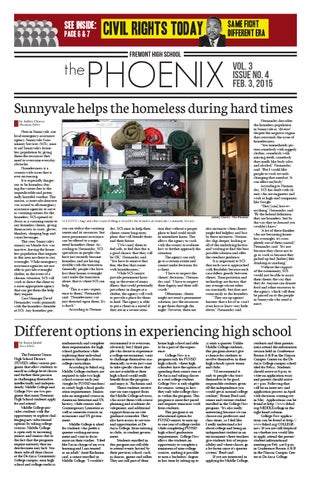
Sunnyvale helps the homeless during hard times by Ashley Chavez Managing Editor
Here in Sunnyvale, our local emergency assistance agency, Sunnyvale Community Services (SCS), aims to aid Sunnyvale’s homeless population by giving them the resources they need to overcome everyday obstacles. Homelessness is a countrywide issue that is ever-increasing. It is especially dangerous to be homeless during the winter due to the unpredictable and potentially harmful weather. This season, a statewide directive was issued to all emergency assistance agencies to serve as warming centers for the homeless. SCS opened its doors as a warming center to any homeless clients, giving them access to coats, gloves, blankets, sleeping bags and warm beverages. This year, Sunnyvale’s armory on Maude Ave. was inactive, leaving the homeless population that migrate to this area nowhere to stay overnight. While emergency assistance agencies are not able to provide overnight shelter, in the event of a chronic situation, SCS will work to direct the client to a more appropriate agency that can get them the help they require. Case Manager David Hernandez works primarily with the homeless clientele at SCS. Any homeless per-
Ashley Chavez | The Phoenix
SLEEPING bags and other warm clothing is stored for the homeless at Sunnyvale Community Services.
son can utilize the warming center and its resources, but more permanent assistance can be offered to a registered homeless client. According to Hernandez, SCS specializes in people who have just recently become homeless and are having trouble with the transition. Generally, people who have lost their homes overnight can’t make the transition alone; that is where SCS can help. “This is a new experience to them,” Hernandez said. “Homelessness was just thrusted upon them. It’s a shock.” According to Hernan-
dez, SCS aims to help their clients create long-term plans that will benefit them and their future. “[We want] them to feel safe, to feel that this is a good choice, that they will be OK,” Hernandez said. “You have to remove that fear, the fear that comes with homelessness.” While SCS cannot provide permanent housing, in the event of major illness that could potentially put others in danger at a shelter, the agency will work to provide a place for them to heal. The agency is able to put a client in a motel if they are in a severe situa-
tion that without a proper place to heal could result in immediate harm. This allows the agency to work with the county to evaluate how to further approach the situation. The agency can only go to a certain extent and cannot make decisions for a client. “I have to respect the clients’ decisions,” Hernandez said. “I have to respect their dignity and their selfworth.” Oftentimes, clients might not need a permanent solution, just the resources to get them through the night. However, there are
also instances when clients might feel helpless and lost. In these instances, Hernandez digs deeper, looking at all of the underlying factors and working to find the best possible solution and offer the steadiest guidance. It is important to SCS that each case is approached with flexibility because each case differs greatly between clients. Transportation and technology are factors that any average citizen relies on constantly, but does not come easily to the homeless. “They are up against barriers that a lot of us won’t even face or know very little about,” Hernandez said.
Hernandez describes the homeless population in Sunnyvale as “diverse” despite the negative stigma that surrounds the issue of homelessness. “You immediately picture somebody with raggedy clothes, somebody with missing teeth, somebody that smells like body odor and alcohol,” Hernandez said. “But I would like people to work towards changing that mindset. It can affect anybody.” According to Hernandez, SCS has dealt with clients who are engineers and work at high-end companies like Google. “They [can] lose everything,” Hernandez said. “By the federal definition they are homeless, but by the way they’re dressed you wouldn’t know.” “A lot of these families who are becoming homeless overnight, it’s completely out of their control,” Hernandez said. “It’s not because they chose not to go to work or because they picked up bad [habits] like drinking or smoking.” Without the support of the community, SCS would not be able to assist their clients the way that they do. Anyone can donate food and other resources to the agency, which will then be passed on to the people in Sunnyvale who need it most.
Different options in experiencing high school by Sonya Jindal News Editor
The Fremont Union High School District (FUHSD) offers various programs that allow students to enroll in college level classes and further their passion in challenging themselves intellectually and independently. Middle College and College Now are two programs that many Fremont High School students apply for and attend. Middle College provides students with the opportunity to explore challenging new educational options by taking college courses. Middle College is open only to incoming juniors and seniors due to the fact that the programs require maturity that underclassmen may lack. Students take all their classes at the De Anza Community College campus, earn high school and college credit si-
multaneously and complete their requirements for high school graduation while exploring their individual interests through a diverse college curriculum. According to fuhsd.org, Middle College students are required to take two high school courses each year (taught by FUHSD teachers) to satisfy high school graduation requirements. Juniors take an integrated course in American literature and US history, while seniors take Contemporary Literature as well as semester courses in economics and US government. Middle College is ideal for students who prefer a quieter working environment and want to focus more on their studies. “I feel like I’m in charge of my own learning and I am treated as an adult,” Amit Rachman said, a senior enrolled in Middle College. “I wouldn’t
recommend it to everyone, obviously, but I think people who desire to experience a college environment, want to challenge themselves academically, or even just want to take specific classes that are not available at their high school would really benefit from the program and enjoy it,” Rachman said. These students receive one-on-one support from the Middle College advisors, who assist them with course planning and academic development, and additional support from an on-site guidance counselor. They also have access to services and opportunities at De Anza College, from tutoring to clubs, to student government. Students enrolled in this program are still able to attend events hosted by their previous school, such as dances, games and rallies. They are still part of their
home high school and able to be a part of the experience. College Now is a program only for FUHSD high schools, where high schoolers have the option of spending their senior year at De Anza and taking classes as a real college student. College Now is only eligible for seniors, seeing as how they only take college classes within the program. This program is more fast paced and requires tenacious work from students. This program is an educational option for FUHSD seniors to earn up to one year of college credits while completing FUHSD high school graduation requirements. College Now allows the students an opportunity to complete a minimum of nine college courses, making it possible to earn a bachelors’ degree in less time by taking up to
21 units a quarter. Unlike Middle College students, this program doesn’t give a chance for students to involve themselves in their high schools sports teams and clubs. “I’d recommend it only to people who trust themselves to be good, responsible students given all the independence you would get as normal college student,” Ronen Burd said, senior and current student enrolled in the College Now program. “It’s also really interesting because we can choose our professors and class times, so I feel like I really understand a lot about college and being an independent student in an environment where teachers give students lots of responsibility and where classes go a lot faster since it’s quarter system,” Burd said If you are interested in applying for Middle College,
students and their parents must attend the information session held in Conference Rooms A & B in the Hinson Campus Center on the De Anza College campus scheduled for Feb 12. Students should arrive at 6 p.m. to write an application essay and parents should arrive at 7 p.m. Following that will be an interview and application process in April with decisions coming out in May. Applications can be found at http://www.fuhsd. org/MIDDLEcollege in the right hand column. College Now applications can be found at http:// www.fuhsd.org/COLLEGEnow. If you are still skeptical on whether you would like to apply, attend the parent/ student informational meeting on Feb. 5 at 6 p.m. in Conference Rooms A & B in the Hinson Campus Center at De Anza College.
News
feb. 3, 2015
2
Teacher Milestones by Essam Rao Staff Writer
Minimum wage: the pros and cons by Hannah Butay Staff Writer
Lisa Freitas
10 years
Freitas has been teaching for 10 years now. This year, she is the freshman class Guidance Counselor. She used to be a preschool teacher and event planner, but wanted to do something that made a difference. in people’s lives. Outside of school, she enjoys reading and spending time with her kids.
Jason Barbeau
10 years
Barbeau has been at Fremont for 10 years. He is the lead resource specialist and also teaches geometry. Barbeau played college football, coached football at Fremont and was the head wrestling and track coach at Cupertino High School. Outside of school he enjoys fishing and spending time with friends and family.
As of Jan. 2015, the minimum wage has increased in multiple states across America. According to the New York Times, this will affect about 3.1 million people, which is around 60 percent of workers in America. Nine states are adjusting their minimum wage to fit the cost of living in the area, along with other economic factors. The increase in payment will give workers a collective $1.6 billion extra in a year. The number of states raising their minimum wage is the most in American history. It is also the first time a majority of states will have a higher minimum wage than the current federal rate, which is $7.25, according to The Boston Globe. Some cities, such as San Francisco and Seattle, have also approved city bills that will raise their minimum wage to $15 per hour. Additionally, a major businesses such as Ikea and Walmart have agreed to raise the pay of their lowestpaid workers. According to the National Conference of State Legislatures, more rises in
state minimum wages are set to occur within the next three years. Hawaii will have the largest increase, which will go up to $10.10 on Jan. 1, 2018, a $2.35 gain from the current minimum wage of $7.75. Mass. will have the highest state minimum wage in 2017 at $11. In Calif., minimum wage will be increased by $1 from its current $9 per hour on Jan. 1, 2016. Minimum wage is a highly controversial topic. Some believe that the increase will allow for a better economy and more jobs to arise, while others argue the exact opposite. In a poll conducted by CNN, 71 percent of the 1,003 participants wanted an increase in the federal minimum wage. Also, 90 percent of Democrats and 54 percent of Republicans agree that the minimum wage should be changed. “I have 17 million reasons for wanting to increase the minimum wage,” Senator Elizabeth Warren said to ABC News. “Yes, 17 million—the number of children whose lives would be a little more secure if their moms and dads earned at least $10.10 an hour.” The increase in minimum wage would help families the most, War-
ren continued. In the past, a single, full-time parent working could keep a two-person family out of poverty. Now, however, that is not the case.
The number of states raising their minimum wage is the most in American history. Increasing the federal minimum wage would give families more money to spend. This allows for more money to be put into the gradually-diminishing economy, as families with extra money tend to spend more. The increase also means that less people will require government assistance to support their families. “A higher wage means people can provide more for themselves,” Warren said. Another reason people believe that minimum wage should be increased is because of inflation, according to USA Today. Since the last time the federal minimum wage was raised in 2007, prices have skyrocketed. For example, groceries cost 20 percent more than
they did seven years ago. Had minimum wage kept up with living costs throughout the years, the minimum wage would be somewhere near $10.70, which is more than the $10.10 President Barack Obama proposed. Those that oppose increasing minimum wage say that it will weaken business and the economy alike. According to Ira Stoll of reason.com, the raise would eliminate jobs. The more employees there are, the more a company has to spend. In order to afford paying employees minimum wage, businesses would have to lay off some workers or replace them with robots. According to William Dunkelberg of Forbes, raising the minimum wage does nothing to help those who are officially poor. Out of the people in poverty, 60 percent are unemployed, and increasing the minimum wage would only make it harder for them to find jobs. Since the wage is higher, companies will be stricter in their requirements for employees. “Raising the minimum wage raises the hurdle a worker must cross to justify being hired,” Dunkelberg wrote. “The money for a higher minimum wage does not come from thin air.”
Band members bring honor to Fremont by Priya Lee
Lead Photographer
Aaron Eeg
15 years
Eeg has been teaching for 15 years at Fremont. He teaches four business classes and one yearbook class. In his past, he worked in marketing for a computer company and has been a golf instructor. Outside of school, he coaches two golf teams and has been a mobile disk-jockey for 16 years now.
Michelle Wagner
15 years
Wagner has taught at Fremont for 15 years. She teaches regular and sheltered biology, and AVID. She attended Stanford University to earn her teaching credentials and Master’s in education. Growing up, both her parents were teachers. Outside of school, she enjoys spending time with her family.
Elisha Davis
15 years
Davis has taught at Fremont for 15 years. This year, she teaches algebra I and II. She taught at Abbott Middle School for 10 years and then at Los Altos High School. Outside of school, she enjoys hula dancing and playing piano.
On Jan. 20, a record breaking seven Fremont High School students performed in the Santa Clara County Honor Band. Junior Sarah Jin (flute), freshman Sami Jin (flute), sophomore Elliot Ong (clarinet), junior Hector Mendoza (tuba), junior Douglas Yang (euphonium), senior Derek Ancheta (trumpet) and senior Steven Newman (trumpet) are the Fremont students that earned a seat onto the nearly one hundred person honor band. The students had to audition live for a spot in the county honor band and out of the 13 Fremont students that auditioned, these seven advanced students were able to obtain a spot in this prestigious band. “They have to prepare a really difficult solo from an actual solo literature and they have to site read something they’ve never seen before,” music director Joseph Kelly said. “I think the hardest thing is the solo literature; the piece is really advanced, something that college players would play, so only the top high school players can really do it well.” According to Kelly, more than 10 Fremont students had not auditioned at a time for an honor band in the past, so 13 people auditioning was a lot for Fremont. “More and more kids are seeing their friends
Priya Lee | The Phoenix
HONOR band entertains crowd at Evergreen Valley High School on Jan. 20.
[audition] and they’re like ‘Hey I want to try that,’” Kelly said. “The older kids are saying ‘Oh I’m actually a pretty good player.’” According to Kelly, Ancheta is a good example of one of these students. Kelly said that he is a great player that always has been good, but he realized this year that he is good enough to audition and make it onto the honor band. Even though Fremont has many students that are new to the honor band, Newman was one of the three students in the whole county honor band that was on the band for all four years of his high school career. This is a great achievement and Newman was even able to make the first chair of the trumpet section and was featured in
the performance. “I feel awesome,” Newman said. “I feel like all my hard work in practicing my instrument paid off. I look forward to playing alongside many other talented musicians and making beautiful music.” Before the students even audition, they need to practice on their instrument. Some practice hours a day and months in advance for preparation. “To make the honor band means they’ve put in a lot of time on their own, not just in class here, to be really good players,” Kelly said. “For them to be acknowledged as one of the top players in the county is just a really big deal.” The band program encourages students to do things like the county honor
band as a way for them to explore music. One of their goals is to expose the young musicians to different opportunities so they aren’t just doing the same things over and over again. “I’m looking forward to meeting with new conductors and learning new types of music,” Jin said. “I get to explore more.” Jin and Newman are given a bigger opportunity to explore because they made it into the all-state honor band as well. They auditioned with 2,000 other students all over the state and were two of the four hundred students that made it onto the band. They will be playing with students all over Calif. in Feb. of this year.
News 3
feb. 3, 2015
Robots invade Fremont, again by Cindy Zhang Staff Writer
With the start of the 2015 FIRST (For Inspiration and Recognition of Science and Technology) Robotics season is in kickoff day, Jan. 3, all Robotics members on Team 3501 have started racking their brains for ideas on how to design the Firebot this year so it could proudly be displayed on the competition field. The team participates every year in FIRST robotics competitions to provide a hands-on experience for students in science and engineering, thus prompting many students to pursue careers in science, technology and engineering. The Fremont Robotics team, also known as the Firebots by other competing schools on the competition field, are organized into multiple divisions. Mechanical engineering, electrical engineering and software engineering, the three main divisions of the team, work on designing, building and programming the robot throughout the six weeks of the season. Business, marketing and public relations work on fundraising and organizing community outreach events. The 2015 FIRST Robotics Competition (FRC) is
called Recycle Rush. School teams must build a robot that would be able to score points by either one, picking up plastic totes (rectangular bins) and recycling containers and stacking them as high as they can on a twoinch high scoring platform, or two, manipulating pool noodles that represent litter and sticking them in the recycling containers. After 20 hours spent on kickoff weekend, Jan. 3 and Jan. 4, the Robotics team finalized their strategy for the game: to prioritize stacking totes and containers, but essentially disregard manipulation of litter. More than two weeks into the season now, the mechanical, electrical and software teams have each made quite a bit of progress. “So far, we’ve been working with CAD, or Computer Aided Design,” Rishab Kedia, mechanical VP of the robotics team said. “We’re making a detailed design of our robot in Solidworks so that when build time comes around we can construct it more easily and with a direction.” The mechanical team divided its members into three subgroups, one CADing the mechanism that lifts up the arm, one CAD-ing a claw that could grasp both a tote and a recycling bin and
one CAD-ing the drive base of the robot. “We’ve had a decent amount of progress,” Kedia said. “We have a better idea of what the robot will look like from detailed CAD of the different mechanisms that will go on the robot.” The CAD model of the drivetrain has been nearly finished and the claw and the arm mechanism are closely approaching completion. While both the claw and the arm have neither been refined as well as they need to be, both subteams have merged their models and started working out the details of the robot as a whole. “Compared to last year, our team this year is much more organized,” Annam Quraishi, Safety VP of the Robotics team said. “We have everything in a timeline and we’re actually following that timeline, unlike last year, when we didn’t really have a set date to complete things by. Also, everyone on the team is involved in some way or another, so I think this year is going a lot better.” The electrical team has completed multiple electrical boards, touched base with software on multiple aspects of the functions of the robot and has finished most of their CAD for their
PHOENIX
1279 Sunnyvale Saratoga Rd. Room 84 Sunnyvale, CA 94087 (408)522-2400 fremonthighphoenix@gmail.com fhsphoenix.com Managing Editors Ashley Chavez Kayla Layaoen Photo courtesy of Robotics team
electrical boards. They have also worked out with the mechanical team the details of how they will fit the electrical board onto the robot. The software team has been working on visiondetecting programs since the start of the season, specifically ones that can recognize the yellow outline of a tote so that the robot can locate its target while running on code. The vision-detecting program has been improving steadily and, recently, software members have been able to modify the code so that a yellow parallelogram shows on screen. Software members will continue to improve the program so it can locate the actual rectangular outline of the tote.
Foreign threats pose for American fear by Julie Wi Staff Writer
On Dec. 17 of last year, a highly anticipated comedy based on the assassination of North Korean leader Kim Jong-Un was pulled from theaters due to terrorist threats from the North Korean government, sparking some discussion. The Interview is directed by Evan Goldberg and Seth Rogen. It stars James Franco as TV journalist Dave Skylark and Seth Rogen himself as Skylark’s producer. The two go to North Korea to interview North Korean leader Kim Jong-Un, however are ordered by the CIA to assassinate the leader. It’s no surprise that the North Korean government was upset with the film based on the fictional assassination of their current sitting leader. According to BBC, a North Korean foreign ministry spokesman stated that The Interview’s release would be an “act of war” and a “blatant act of terrorism”. He then said that a “merciless countermeasure” would be taken if the US administration continues to support the movie’s release. Weeks before the movie’s expected premiere on Christmas Day, Sony became the victim of a vicious cyberattack. The hackers, claiming to belong to a group called Guardians of Peace, stole countless of Sony’s confidential files, emails and documents.
the
News Editors Jasmine Salik Sonya Jindal Sports Editor Chau Nguyen Arts & Entertainment Editors Sarah Arkoh Juan Martinez Opinion Editors Melissa Parlan Tatiana Castillo Lead Photographer Priya Lee Staff Writers Sravya Bathula Margaret Bernauer Hannah Marie Butay Ariana Honavar Hiro Sarah Kacmarsky James Kanuch Kristina Lechuga Dana Nissan Rachel Pena Nazmiye Ornelas Rodriguez Essam Rao Snigdha Rayala Nicole Stibbard Julie Wi Emily Wright Cindy Zhang Kelly Zhong Adviser Stacey Stebbins
Photo courtesy of Tech Crunch
According to CNN, the hackers threatened to disclose several of the company’s top secret files unless Sony gave in to their demands: to cancel The Interview and all online access to the movie. Terrorist threats advising to stay away from movie theaters playing the film have been reported to have been made, but the solid evidence of these threats is still unclear. Regardless of the authenticity of the terrorist threat, rumors about the issue contributed to a growing public concern for not only Sony but for anyone supporting the movie in theaters. The FBI links North Korea to the attack, according to NBC, speculating that the state had some kind of affiliation with the hacker group. Others doubt the North Korean government had anything to do with the attack.
President Barack Obama spoke about the possible concern to ABC News. “The cyber attack is very serious,” Obama said to the news channel. However, about the potential threats to moviegoers, he added that the national security “will be vigilant”, but simply recommended “that people go to the movies”. The dilemma of whether to premiere the movie gained national attention, especially from Hollywood figures. Actor George Clooney revealed that he had created a petition in support of Sony not to give in to the hackers’ demands. “This is not just an attack on Sony,” the petition said, according to CNN. “It involves every studio, every network, every business and every country.” It concluded by saying “we will not stand in fear.”
With hackers threatening to release Sony’s private files to the public and North Korea expressing outrage at The Interview, the film was eventually pulled from theaters. Sony let theaters decide whether to screen the movie and subsequently all except for some small independent theaters opted out. The controversy and political issues surrounding the film were not intended by co-director Rogen. “We’re not the first people to shed light on how crazy North Korea is, the myths that exist there and the oddities of the regime,” Rogen said to the New York Times. Following the movie’s cancellation, it became available to buy and rent online, grossing $40 million in online sales alone, with an additional $6 million made in select independent theaters.
The Phoenix, protected under the California Education code, is a public forum for the students of Fremont High School. The Phoenix staff will publish features, editorials, news, and sports in an unbiased and professional manner. Editorials are the official opinion of The Phoenix. Opinions and letters are the personal viewpoints of the writers and do not necessarily reflect the opinion of The Phoenix. All content decisions are made by the student editors, and in no way reflect the official policy of Fremont High School, nor the opinions of the administration, faculty, or the adviser. Business advertisements are accepted in The Phoenix. However, The Phoenix reserves the right to deny any ad. Those interested in running advertisements can call the Business Manager at (408)522-2400, or email fremonthighphoenix@gmail.com Lettters to the editor and questions for the advice column, may be submitted online at www.FHSphoenix.com, to room 84, Ms. Stebbins’ mailbox, or emailed to fremonthighphoenix@gmail. com. Identities of those who submit questions will remain anonymous. The staff reserves the right to edit letters to conform to styles and policy. Letters to the editor will be published at the discretion of the staff. The Phoenix is the official student newspaper, and is distributed free of cost to the students. The Phoenix publishes eight issues throughout the school year.
News
feb. 3, 2015
4
Teacher Milestones by Essam Rao Staff Writer
Air Asia plane crash by Nazmiye Ornelas Staff Writer
Ji Young Kim
10 years
Kim has been at Fremont for 10 years. This year she teaches art. She taught at private schools in the Korean Republic for six years. She believes that students don’t fully understand what they are capable of, and she enjoys watching them figure it out.
Photo courtesy of NBC News
Chuck Herrera
10 years
Herrera has been working at Fremont for 10 years, and is a Fremont alumni. He is the Student Conduct Specialist. Outside of school he enjoys working out and traveling, but his favorite hobby is motorcycle racing and has also won some trophies.
Carlos Ramos
15 years
Ramos has been at Fremont for 15 years now. He has been the Facility Manager for seven years. Before working at Fremont, he worked as an engineer technician at Celery Tech.
Tap Bui
20 years
Bui has been working at Fremont for 20 years now. He is the Network Support Specialist. Before, Bui worked at Mobile Oil Research and Development, and at Hexcel Advanced Composite Testing, which is a company that tests materials for airplanes. He enjoys playing tennis and biking outside of school.
Miguel Castillo
20 years
Castillo has taught at Fremont for 20 years now. He teaches Spanish and coaches girls varsity basketball. His own teachers inspired and urged him to become a teacher. Outside of school, he enjoys basketball and spending time with his family.
As the search for the people on the missing Air Asia flight continues, theories of the cause of the crash are rapidly spreading. Most theories revolve over the idea of harsh weather conditions being the main cause of the crash. Air Asia flight QZ8501 crashed into the Java Sea on Dec. 28. The plane was 40 minutes into a two hour flight from Surabaya, Indonesia to Singapore. Although the cause of the crash is still unknown, according to BBC News, it was believed that the incident could have been a terrorist attack. However this theory was quickly dismissed after the black box and cockpit voice
recorder were found. On Jan. 6, the plane’s “black box” and cockpit voice recorder were found. This box can show what was the cause of the crash, the altitude the plane was flying, the engine condition, pilots actions, and whether the plane stalled before the crash. The cockpit voice recorder, according to CNN. com, retains all sounds on the plane’s flight deck. From the limited information officials have received of the “black box”, they have been able to tell that the crash was not a terrorist attack, and that the weather could have led to the crash. Also, the fact that the plane was last seen during a storm provides more evidence towards this
theory. According to BBC News.com, Ignasius Jonan, the Indonesian Transport Minister claimed that the plane had climbed at a high speed before stalling. Shortly after, the air traffic controllers lost contact with the plane. Although one of the main concerns is to figure out what caused the plane to crash, another big concern is to search for the 162 people that were on board the plane. So far, they’ve only been able to find 53 people, all deceased, whom have been mostly located at the tail of the plane. The remaining 109 people are believed to be on the fuselage of the plane. The fuselage is the body of
the plane to which the tail and the wings are attached to. After two attempts in lifting the fuselage out of the Java Sea, the harsh weather conditions have again made it difficult to continue the search. According to CNN, the first attempt failed due to debris slicing through the rope. The second attempt failed once because the fuselage reached the surface of the water, the rope snapped. The search for the remaining people has been very difficult and a very slow process due to the strong sea currents, high waves and the filthy water of the Java Sea.
Teenage parents in high school by Tatiana Castillo Opinion Editor
Although not extremely common, there are some students at Fremont who are faced with the task of being a parent as well as a student. But what are the procedures that are taken to help these students remain in school? “There really is not a set list of things that we do for every student,” Dean of Students Noe Ochoa said. “We handle each situation in its own way so that we can figure out what works best for the student.” According to the California Women’s Law Center, schools cannot exclude pregnant students in any way from any educational programs. With this being said, it is evident that there are no rules or regulations that restrict or isolate pregnant students from the rights that all students have. The decision of what to do is ultimately left up to the student. However, there is an option of attending the “Youth Parenting Program,” also known as YPP, which is lead by Laura Gonzales who is now on her second year as the YPP Administrator. “The overall goal of this program is to give students the opportunity to reach their goals,” Gonzales said. “It might take longer, but they’re still getting a lot
done and it really is a lot of work.”
The overall goal of this program is to give students the opportunity to reach their goals. No student is ever denied acceptance into YPP, but there is a process that needs to take place before a student can transfer into the program. First, a guidance counselor or administrator provides recommendation to Gonzales and then a meeting with the student and a parent or guardian is scheduled. The meeting discusses the student’s current academic standing and also reviews what level of the A-G classes the student will need and whether or not they will be needing child care. “We never deny anyone, but we encourage them to stay at their school if they are not in need of our childcare services,” Gonzales said. “We encourage them to do this so that they can get as many credits as possible.” A student can transfer to the Youth Parenting Program whenever they feel ready or in need of assis-
tance, but usually it is not until their second or third trimester in their pregnancy. “Once a student reaches their second or third trimester, the walks to and from classes on such a large campus and the length of the school day can become really tiring or stressful,” Gonzales said. “Around this time is when they come to us.” The amount of time a student spends at the Youth Parenting Program depends on two factors. The first factor is what year the student is in high school, and the second factor is whether or not the student is caught up with credits or will need credit recovery. On average, a student only spends about two years at YPP, either because they are caught up with credits or are in their later years of high school. Many mothers decide to attend school at the Youth Parenting Program with intentions of receiving their high school diploma while their children are being taken care of, free of cost, by a certified child care provider and a few volunteers. The YPP program schedule is about the same as a week at Fremont. YPP has an A and B schedule, however the classes are shorter. YPP is in session from 8:45 a.m. to 1:45 p.m. “I’m moving to the back
next month,” junior Judy Villegas said. “It’ll give me more time to work and it’ll help me with my baby.” Although this program does help students earn credits through their A-G courses, YPP also gives students parenting classes as well as food and nutrition classes. “We offer them life skill classes so that they are able to take care of and nurture their babies,” Gonzales said. During brunch and lunch, mothers are required to be in the daycare with their babies. “They might not like it as much, but I’m jealous,” Gonzales said. “If I could spend time with my daughter during my break, if I were to have time for one, I’d love to be able to read her a story or watch her play.” The Youth Parenting Program has had a high success rate in previous years, and last year’s results proved effective. “Out of the seven seniors we had last year, five of them graduated,” Gonzales said. After graduating, YPP alumni are connected with resources through the government as well as through the county that will assist them with food, housing and childcare if they need.
Opinion 5
feb. 3, 2015
Preventabe teen suicide
The battle on privilege: Using it to help others
by Ariana Honavar-Hiro Staff Writer
by Melissa Parlan Opinion Editor
Photo courtesy of nobullying.com
Teen suicide is a serious problem in the U.S. today. Everyday teens are left feeling alone and helpless and decide to take their lives. If these teens have gotten some support from friends or family they would have been able to resolve this situation. In Dec. of 2014 a teen, Leelah Alcorn committed suicide by throwing herself in front of a truck. Leelah Alcorn born Josh Alcorn, had struggled with her parents because they did not accept the fact that she was transgender. After not being accepted by her parents she decided to take her own life. Her parents were conservative and they did not want Leelah to get the surgery she wanted to make the transition to becoming a girl. Leelah’s parents took her out if school and took away her social media. Separated from all her friends she was extremely lonely and became depressed. Eventually she thought her life would never get better and she took her life. I think that things could have been different if her parents been much more understanding, regardless of whether you agree with the decisions your child makes it is important to love them unconditionally. When I read this article I was appalled at the fact that the parents decided to bury her in a suit, when the very reason Leelah was unhappy was because her parents did not like that she was transgender. Things would have been really different had her parents just showed that they loved her. Leelah’s suicide note was posted on Tumblr before she died and social media was roaring with anger over this. Leelah’s death got so much attention that a Golden Globe award was dedicated to
her. I think that all the attention her story is getting is great, it is important to she her struggle and learn from it. Hopefully people that are less understanding learn from this and see that everyone is human in the end. On Oct. 10th 2012, a young girl Amanda Todd committed suicide. Some of you may remember seeing her name on social media or the news when her video explaining her story on YouTube using flashcards. This video went viral after her death. The worst part is the fact that people only notice what is wrong after someone dies is sad. She needed to take her own life before her plea for help received some attention. Todd was blackmailed and bullied and eventually she could no longer take the constant bullying and pain so she decided to end her life. What we say and how we behave really affect others and it is important to consider what you are doing to others. After reading these two stories I was upset that no one tried to help these people. In Amanda Todd’s case she was forced to move schools a few times and everywhere she went she felt like people were bullying her and treating her badly. If someone were to give these teens some support and understanding they would not have lost hope and would still be here. Luckily we live in a more accepting time where people are learning to be more understanding and caring. This is a serious issue and we should be more aware of how people are treated. We should care about how other people feel. It’s not too hard to give someone support in thiertime of need.
It’s true, and if you disagree with it, you are totally oblivious. If you have the slightest sense of the world and society we have today, you’d know that some people in this world have it better than others. Being on the better side of this spectrum, is to be privileged. Privilege: an immunity or benefit enjoyed by a person beyond the advantages of most (dictionary.com). Given that definition, we can see privilege everywhere. On a larger scale, we see Americans being more privileged than other countries. On the news, we constantly see stories of people living under suppressive governments, and people suffering in poor, third world countries. Compared to most of the world, I would say America is a very privileged country. However, privilege within America can be a debatable topic. We’ve been taught to understand that America is a free country,
giving equal opportunity to everyone trying to obtain their own personal goals. There isn’t real, tangible proof as to whether America is based off of a privilege system. However, if you take a look at the gender, social and racial divides in our country, it’s easier to see.
Use your advantages to better your own life, all while advocating for those less fortunate than you.
America’s motivation to work is based off of the famous “American Dream”concept: to gain wealth from hard work. American culture tells its citizens that anyone can make it in this society. That may be true: anything can be done with a hard work ethic. However, it can be easier or harder for certain people due to their background. This is where privilege comes from. For example, not everyone is born wealthy. If you were born into a richer family, the chances of yourself becoming wealthy are fairly high. The environmental
aspect when being wealthier includes living in better looking and safe areas, and going to highly accredited schools. Another controversial privilege worth mentioning is white privilege. Of course, nobody wants to say that they’re racist or prejudice. But if people really take a look at how we, as a society, treat certain groups of people differently. However, privilege like this it not necessarily a thing we can completely reverse. Just like racism, judgment and stereotypes, we as a society have gotten too far into privilege to change it. It’s ingrained into our country, our society and in our mentality. But privilege can be something we can see better. Don’t act like you don’t know you have special advantages from your neighbor, and most certainly don’t pretend to not know you are being mistreated. Confront the problems in our privilege system and recognize it for what it is. Instead, we should acknowledge our privilege, and act positively upon it. Use your advantages to better your own life, all while advocating for those less fortunate than you. In our society today, people have a voice more than ever. So use it. The only thing we have is each other.
Struggling with OCD: what it’s really like Learning to accept your flaws for a better self image by Chau Nguyen Sports Editor
I was a bed-making connoisseur by eighth grade. I precisely folded blankets and knew all the crooks and crannies of folding. But as the school year continued, I became anxious. I started to get repetitive. Not like a nagging helicopter mom, or the automated voices near crosswalks. Until I repeated some actions, I felt like a misplaced Russian nesting doll, either too tight or too loose in my own skin. Aligning my textbooks, meticulously organizing worksheets and enunciating all of the syllables in
words were my rituals. At first, I didn’t view these as symptoms of a disorder; they were a religion. It was a vicious cycle that was annoying. All of these rituals ate time. Before these urges, reading one chapter of my history textbook took fifteen minutes, now it took 120 minutes. It took five minutes to shower, now I showered until my skin was red. I didn’t want to repeat actions, I knew they wasted time, but only the repetition made me feel in tip top shape, mentally and physically. I repeated them until I got the “right feeling”. The “right feeling” is hard to describe. It’s like I had to stretch out a rubber band until its sides were perfectly straight and feeling like I had to swim with perfect strokes in the deep side of the swimming pool, which I still don’t know how to swim in. This feeling took forever to get. It was the
beginning of sleep deprivation, and a terrible simile.
The ‘right feeling’ is hard to describe. It’s like I had to stretch out a rubber band until its sides were perfectly straight and feeling like had to swim with perfect strokes in the deep side of the swimming pool. I was diagnosed with obsessive-compulsive disorder. OCD is an anxiety disorder that causes individuals to have repetitive behaviors in order to relieve themselves from anxiety. I was imprisoned by my own mental state. I spent days mulling over future missed opportunities. There were countless
issues lurking in my head, like how often I’d be late for school, how long it’d take me to complete assignments, how long it’d take me to break down in public and how much impact this disorder would have on my future, and ability to function as a normal person in school and society. But there was another issue, a gaping, destructive one that could ruin my future. How long would it take me to write the date? Being imprisoned by your own mind is mindboggling. If my OCD originated from an outside force, I wouldn’t feel ashamed, or hopeless about the future because it wasn’t my “fault”. But it always felt like I was the one, not somebody else, who threw away the keys to a lot of doors. For a year and one month, I was disgusted with myself. The mirror in my bathroom helped, but also my intense loathing for the confinement of my abilities
because of a disorder that compelled me to repeat the same things for no logical purpose. There was still anxiety entering high school. I distanced myself from thinking about OCD and I recalled my experiences and felt frustrated before the first day of school. I tried to keep something away for so long, yet it still came back. As I struggled with OCD, I was desperate to get rid of my disorder. That desire eclipsed everything else in my life. But disappointment in myself, lashes at my own insecurities and resentment against my own incapabilities of showering a million times, allowed me to gain enough clarity to reflect on myself and ultimately accept who I was. Accepting my disorder in the long run was healthier than yearning for a chance to say, “It’s gone.” I had to work with what I was dealt. Like poemist Charles Bukowski wrote, “The less I
wanted, the better I felt.” I still struggled with obsessive-compulsive disorder freshman year, although it wasn’t severe. As the year passed though, I came to accept it. I don’t remember the exact day, but I simply stopped caring about “the right feeling.” I stopped caring about a lot of things: my appearance, material possessions and jokes from people who are probably unknowledgeable about OCD. This acceptance of my disorder wasn’t only a liberation from OCD, but from expectations people had of me. But, acceptance doesn’t apply to everyone because it is not easy. Some people are still in stages of denial, desperation or grief to get rid of their disorder. The only advice I can give is try to accept your disorder and work around it. You’re going to live in your body for a long time, hating it seems pointless.
Special Feature
Feb. 3, 2015
6
!"#$"%&'$(%)*#)& +&!),"%$",$(*
!"#$%&'$()*&+,*& -%$(&."%/)%*&01*& !%&$&43)$%(*$/'--"*$+,$ 23-'."$:3#$23&&"&&'3($3:$ %$)3,$91($3($%$2-%,< 9#31(*7$
!%&$)%./-"*$%(*$21)$'($ %$+%(("*$.43/"43-*$+,$ DQ RII GXW\ RI͆FHU UHVXOW< '(9$'($*"%)4$+,$%&24,='< %)'3($*"&2')"$.3(&)%()$ 2-"%*'(9$)4%)$4"$.31-*$ (3)$+#"%)4"7
-./01&23/4/51617& !(#$ %) !"#$"%&'
Incarceration rates by ethnicity in 2010 (# of p 100,000 people in that group).
:?9M>!C)F$55!#%7!%!#*(&)'A!)8! 2$+&%5!*55+$((> N#A!*(!*&6!&#%&!F#$+! "#$%&$'!(#))&*+,!(-(. 4)52$(!2%((!2-'7$'$7!9:! /$0&!1%2$(!3%,$+!4)52$(6! /$)/5$6!#$!F%(!%55)F$7!&)! %00-($7!)8!2%((!2-'7$'*+,! -+7$',)!$@&$+(*;$!$@%2*+%. 9:!/$)/5$!%&!%!2);*$!&#$%&$'! &*)+6!F#*5$!C)F$55!F%(!(#)&! *+!<-')'%6!=)5)>!*+!:?9:6!*(! 7$%7!8)'!+)&#*+,!B-&!#%;*+,! (&*55!-+7$',)*+,!$@&$+(*;$! /)(($((*)+!)8!%!F$%/)+O! $@%2*+%&*)+!*+!/'$/%'%&*)+! "#$!%+(F$'!*(!)+!&#$!(-'. 8)'!&#$!&'*%5>!4$!#%(!/5$%7$7! 8%0$P!&#$!(G*+!0)5)'>!4)52$(! +)&!,-*5&A!BA!'$%()+!)8! *(!=%-0%(*%+!%+7!C)F$55! *+(%+*&A>!<!&'*%5!*(!(0#$7-5$7! F%(!<8'*0%+!<2$'*0%+>! &#*(!A$%'!&)!7$&$'2*+$!#*2! "#*(6!5%7*$(!%+7!,$+&5$2$+6! ,-*5&A!)'!*++)0$+&>! *(!0%55$7!F#*&$!/'*;*5$,$6!%! C)5*0$!(#))&*+,!;*0&*2! ()0*%5!(&'-0&-'$!*+!F#*0#!%+! D%E*$2$!C)F$55!F%(!(#)&! %7;%+&%,$!)'!*22-+*&A!*(! „› ƒ ’‘Ž‹…‡ ‘Ƽ…‡” ˆ‘” ’‘•. ,'%+&$7!&)!F#*&$!/$)/5$!);$'! ($((*)+!)8!%!G+*8$!*+!&#$*'! %55!)&#$'!'%0$(>! /'$($+0$>!"#$!/)5*0$!F$'$! N#*&$!/'*;*5$,$!,*;$(! %8&$'!C)F$55!8)'!%55$,$75A! F#*&$!/$)/5$!%7;%+&%,$(! (&$%5*+,!7'*+G(!%+7!7)+-&(! &#%&!2*+)'*&*$(!7)!+)&!#%;$>! 8')2!%!+$%'BA!0)+;$+*$+0$! "#$($!%7;%+&%,$(!%'$!()0*%56! (&)'$>!<8&$'!&#$A!#%7!0%-,#&! /)5*&*0%5!%+7!$0)+)2*0%5>! -/!&)!#*26!&#$A!05%*2$7!#$! Q+!R*0#)5%(!D'*(&)8S(!%'&*05$6! F%(!F*&#*+!&#'$$!)'!8)-'! TN#$+!N#*&$(!1-(&!U)+S&! 8$$&!8')2!&#$2!F*&#!%!G+*8$! V$&!Q&W6!#$!/'$($+&$7!2%+A! *+!%+!);$'#%+7!,'*/>!H-&! (&%&*(&*0(!'$5%&*+,!&)!&#$! 0$55!/#)+$!8))&%,$!/');$7! *+$X-%5*&*$(!B$&F$$+!B5%0G(! )&#$'F*($6!F#*0#!(#)F$7! %+7!F#*&$(>!<00)'7*+,!&)! C)F$55!F*&#!#*(!%'2(!%&!#*(! :?99!0$+(-(!7%&%6!&#$!+$&! (*7$(!F*&#!&#$!G+*8$6!%+7!+)! F)'&#!)8!&#$!%;$'%,$!B5%0G! 2)'$!&#%+!F*&#*+!9I!($0)+7(! #)-($#)57!*+!&#$!Y+*&$7! )8!%''*;*+,!&#%&!&#$!/)5*0$! Z&%&$(!*(![\69]M6!0)2/%'$7! ‘Ƽ…‡” ‰—Â?Â?‡† Š‹Â? †‘™Â?Ǥ F*&#(\^_]3(4,'(1*0-/'(5"%�-&6( #!#-2.&(/-B-0("-!,&.(1"*&'.&> '".(#2$(1'*10'(*)(/*0*"(-2(
:;<=>/$/72%(0"7#,* &,'(*&,'"("#/'.Y(?,#&(#5*%&(( :.-#2.7(0-8'(&,'(N#1#2'.'( :.(1'*10'(.&#"&(&*(#!'7( 1'*10'(9,*(9'"'()*"/'$(-2&*( &,'6("'#0-R'(1"'&&6(C%-/806( -2&'"2+'2&(/#+1.(-2(??GG7( *"(&,'(b,-2'.'(1'*10'(9,*( &,#&(&,'(9*"0$(-.2E&(50#/8( 5%-0&(dD("#-0"*#$.(#2$(9'"'( #2$(9,-&'3(D*(9,6($*'.(-&( .''+(&,#&(9#6(.*+'&-+'.( ,#"$06(1#-$(#&(#00Y(?,#&( #5*%&(&,'(O'A-/#2(1'*10'( 9,'2(-&(/*+'.(&*("#/'Y 9,*(,#$(4'A#.(.&*0'2()"*+( 4,'"'(#"'(1"*&'.&.7( &,'+7(*"(&,'(;#&-B'(:+'"-> .&#&-.&-/.7(/0#..'.7(5**8.7( /#2.(9,*(,#$(&,'(9,*0'( .&%$-'.P&,'(0-.&(-.('2$> 0'..P*2(&,'(&*1-/(*)("#/'3( /*%2&"6('2()"*+(&,'+(*2( O#-2067(&,'6()*/%.(*2(&9*c( &*1(*)(!'2*/-$'Y(4,'(,-.&*"6( &,'"'(-.(%!06(&**3( 50#/8(#2$(9,-&'3(?,-/,( :2$(*)(/*%".'7(&,#&E.( -.()#-"7(/'"&#-206P-&E.(&"%'( 'A#/&06(9,#&(-&(-.P,-.&*"6P( &,#&(.0#B'"6(,#.(/"'#&'$(#( 5%&(&,#&($*'.2E&(+'#2(-&(,#.( "#/-.&(-2.&-&%&-*2(#!#-2.&( 50#/8(1'*10'7(#2$(&,#&(&,'( 2*(5'#"-2!(*2(&,'(1"'.'2&3( J-.1#2-/.(#"'(&,'(Z2$(+*.&( ,-.&*"6(5'&9''2(&,'(&9*( "#/'.(-2(&,'(d2-&'$(D&#&'.( $-./"-+-2#&'$>#!#-2.&("#/-#0( !"*%1(-2(&,'(dD7(#//*"$-2!( -.(#2(%!06(*2'3( &*(Q'9(V'.'#"/,3(Q'*10'( I%&(9,#&(#5*%&(#00( !"#$%"&%#'%"%()* 5IVIOQVO -LQ\WZ
!'2'"#0(-.(.&-00(,#11'2-2!( &*$#67(#2$(-&E.(5''2(+#8> -2!(9#B'.("'/'2&063(Q"*&'.&.( #00(*B'"(&,'(/*%2&"6(,#B'( '"%1&'$(*B'"(&,'(8-00-2!.(*)( S"-/(M#"2'"7(4"#6B*2(O#"> &-27(4#+-"(V-/'(#2$(O-8'( I"*927(&*(2#+'(#()'93( ?,'&,'"(&,'-"(/"-+'( 9#.(&,'(/*0*"(*)(&,'-"(.8-2( *"(&,'-"(#00'!'$(0#.&(#/&-*2.( 9-00(#09#6.(5'($-.1%&'$7(5%&( &,'()#/&("'+#-2.(&,#&(&,'.'( 1"*&'.&.(#2$(&,'-"(/#%.'.( 0**8('A#/&06(&,'(.#+'(&*$#6( #.(&,'6($-$(-2(&,'(_[.3( D%"'7(+#65'(2*9(9'( ,#B'(,#.,&#!.(#2$(0-B'( &9''&.(#2$(9'(/#2(!'&(-2> )*"+#&-*2()"*+(/-B-0-#2.(*2( .-&'(-2.&'#$(*)(H%.&()"*+(&,'( +'$-#P5%&(#.-$'()"*+(&,#&7( 9,#&(,#.("'#006(/,#2!'$Y( I0#/8(1'*10'(#"'(.&-00(
B'"6(+%/,(+*"'(0-8'06(&*(5'( -+1"-.*2'$(9,'2(&,'6E"'( 1%&(*2(&"-#0(&,#2(9,-&'( 1'*10'(#"'7(0'..(0-8'06(&*(!*( &*(/*00'!'7(#2$(*206(*92(\`( *)(K*"5'.(a[[(b*+1#2-'.3( 4,'67(#0*2!(9-&,(*&,'"( 1'*10'(*)(/*0*"7(#"'(.&-00( +*"'(.%5H'/&(&*(B-*0'2/'(#2$( $-./"-+-2#&-*2(-2(./,**0.( #2$(#&(9*"83( G(/#2E&(,'01(5%&()''0(0-8'( F"3(<-2!E.(9*"8(9#.(#0+*.&( )%&-0'3(?,#&(9*%0$(,'(.#67(-)( ,'(9'"'(.&-00(#"*%2$(&*$#6Y( G(/#2E&(-+#!-2'(,'(9*%0$( 5'(,#116P*%&"#!'$(+-!,&( 'B'2(5'(#(5'&&'"(9*"$P5%&( -2(&,'(!"#2$(./,'+'(*)( &,-2!.7(_[(6'#".(-.2E&(&,#&( +%/,(&-+'3(?'(.&-00(,#B'( #(0*2!(9#6(&*(!*3(T'&E.(2*&( '(&**(+%/,(0*2!'"(&*(!'&( &,'"'3
Do you think the Verdict of the Zimmerman trial, regarding the death of Trayvon Martin, was right or wrong? (July 2013)
)"*+(G2$-#(#2$(&,'(O-$$0'(S#.&( ,#B'(&*($'#0(9-&,(="#2$*+@(.'> /%"-&6(/,'/8.(#&(#-"1*"&.(#00(&,'( &-+'7(2*&(&*(+'2&-*2(G.0#+#> 1,*5-#("'!#"$0'..(*)(9,'&,'"( &,'6(#"'('B'2(O%.0-+(*"(2*&3( :2$($*2E&('B'2(!'&(+'( .&#"&'$(*2(0#2!%#!'(5#""-> '".3(O#26(1'*10'()"*+(&,'.'( *)&>-!2*"'$(+-2*"-&6(!"*%1.( -2(&,'(dD(#"'(-++-!"#2&.(*"( &,'(/,-0$"'2(*"(!"#2$/,-0> Do you think that the American justice system is biased $"'2(*)(-++-!"#2&.7(9,-/,(((((((((((((( against African-American people? (2013) *206(9*".'2.(#26("#/-.+(&,'6( +#6()#/'(-2(&,'-"($#6>&*>$#6( 0-B'.3(I%&(&,'(1"*&'.&.(#2$(*%&> "#!'(9'(.''(#"'(+#-206()*"(&,'( 50#/8(/*++%2-&63(F*2E&(!'&(+'( 9"*2!7(&,'6(,#B'(-&(5#$P(5%&( 9,6($*2E&(e5"*920-B'.+#&&'"( &**Y(
D&#&-.&-/.(/*%"&'.6(*)(!#00%13/*+
Opinion
feb. 3, 2015
8
Goal setting like a pro
Have a question? Ask Esteban.
by Emily Wright
Can you give me tips on reducing weight in my backpack?
Staff Writer
Essam Rao | The Phoenix
As New Years comes and goes, so does a wellknown annual tradition: New Year’s resolutions. Many people set goals, however, it is common for people not to achieve what they set out to do. Instead of letting failure weigh you down, don’t wait until next year to make your next goal and start planning right now. Be specific with your goal; don’t give yourself a vague objective. If you don’t know what exactly you’re trying to achieve, then you don’t know when you’ve finally finished your goal. For example, tell yourself that instead of going to the gym more often, you want to go to the gym three times a week. Be realistic as well; if you give yourself an impossible goal, like losing 40 pounds in a week, then you’ll be setting yourself up for failure. Think about your goal before you start trying to attain your objective. Some goals require more effort than others, so make sure you have time to plan. Break a huge goal into smaller, more manageable chunks. Make sure you spread out the harder parts; don’t leave the difficult parts all for the end. For goals with a time limit, plan deadlines for the chunks. I myself recently completed an arduous goal of mine: to write a 50,000-
Have questions for Esteban? You can submit them in a box in the FHS library, or on our site, www.fhsphoenix.com.
Kristina Lechuga | The Phoenix
word novel in 30 days. I never would’ve achieved this if I hadn’t thought about what it was going to be about and set myself a daily goal of 2,000 words. Many people don’t understand the importance of planning; focus on the actual time spent working on your goal. This is the wrong way to go about it. Planning can make or break your goal before you’ve even started. Honestly, your goal can be made so much easier if you have a game plan. Keep going, and don’t stop. Everyone has a moment when they may feel they can’t continue, or that what they’re trying to achieve is impossible to reach. However, you need to push past this. It may not be easy, but maybe the way you’re doing your goal isn’t working. It’s fine to change up your plan mid-way. If needed, take a break. Working day after day can be exhausting, and you shouldn’t break yourself trying to succeed. Get rid of distractions.
This might be the hardest part, but it can also be very simple: don’t leave things around to tempt you, this way, you spend your willpower on actually achieving your goal, not tearing yourself away from a book, game, or movie. Give yourself motivation to continue; set positive rewards. If the thought of completing your goal isn’t enough to keep you going, have a small treat for every part of the goal you complete, and a large reward when you’ve finished. Tell others that you’re planning on achieving a goal of yours. It will let them be aware of what you’re doing, so they can support you in your endeavors. For some people, the fact that other people know about their plans gives them motivation. The most important part is to think positively. If you don’t think you can complete a goal, then you obviously won’t. Even the most daunting goal can be achieved if you invest time and effort into it. So go ahead, make a goal and
Sometimes I feel that ASB is corrupt. ASB does 3-4 rallies per year and I don’t even know the name of our president. Is it fair of me to judge ASB like this? I don’t know why. I just feel angry and jealous when I see how much more HHS or MVHS ASB does compared to ours. First of all, everybody is entitled to their own opinion, as long as you know the facts of a certain situation. Corrupt is a really strong word for a high school associated student body. It’s no secret that FHS is very judgemental towards our ASB class. Maybe you, and many others, feel this way because you don’t know about everything ASB does. ASB actually plans and organizes lots of events for the school. If you really feel that ASB isn’t performing how it should, you should try talking to the ASB advisor or an actual ASB student. If you really want to see a change, join the class yourself and make the changes you want to see. When you’re flirting, how do you know whether you’re coming across as fun and playful vs making
your crush feel uncomfortable? Crushes are meant to be thrilling, cute and playful. However, unwelcomed flirting that oversteps the other person’s personal boundaries can result in disastrous awkwardness. To know whether you’re heading in that direction, you’re best bet would be to read the other person. If you can tell the other person is responding uncomfortably, you’ll want to take a step down on your flirting game and back off a bit. For instance, if you are more of a touchy feely person, and your crush doesn’t respond as welcoming to that, he or she probably isn’t into it. If your crush doesn’t respond to your series of texts when you know they’re not busy, thats probably a sign for you to do less. The most likely case is that your crush needs some space. Just remember that crushes are meant to be light and playful, so you shouldn’t do anything that suggests you want more from your flirtationship.
Being in high school, we are expected to manage several different classes and activities, carrying around different materials for each. To reduce the weight of your backpack, take advantage of your locker. We are given lockers for a reason; use them. Don’t feel the need to carry around binders for a different class. Passing period is more than enough time to walk to your locker to get your things and arrive to your class on time. If you don’t have a locker, leave your materials at home for classes you don’t have that day. If you’re a student athlete, carrying around your duffle bag may make you look “cool”, but that can strain your back and shoulders. Try finding a teacher who ends their day at the same time as you, and kindly ask them if you can keep your bag in their room. One place that duffel bags are always welcomed, are in the main office by April Perez’s office. The weight of binders contribute greatly to the weight and clutter in a backpack, so try to have less of them. Try storing more class subjects in large binders. Invest in large durable binders; they’ll be enough space to store at least two classes worth of papers and last you all year. Also, try carrying more things in your arms, rather than cramming everything into your backpack. Your back is only so strong, so workout those arms.
Fremont’s reputation changes for better by Tatiana Castillo Opinion Editor
As an incoming freshman (in 2011) coming from a small private school where the 8th grade class was only 26 people, enrolling at Fremont High School was something I was trying to avoid. My teachers and principal at St. Martin had persuaded me to believe that in order to be successful, I needed to continue my education at a private high school, followed by a private university, and my dream school was Archbishop Mitty High School. Unfortunately, attending a private school is extremely expensive, and the cost only increases as you reach
different levels of schooling. My parents and I agreed that I would give Fremont a try at least for my freshman year, and if I really didn’t like it, I’d transfer to Mitty. Deep inside, I was curious as to what it would be like to go back to public schooling after attending sixth through eighth grade in a private school. The first couple weeks of school were somewhat intimidating. There were so many fights that seemed to happen over nothing. Some of the bathrooms were filled with smoke upon entering. Students would be smoking and drinking like it’s a normal thing to do across the street in front of what was once Da Kine restaurant. Kids would talk down on their teachers in front of the whole class, and others would just walk out of class in the middle of a lecture, complaining that they’re “bored” or would rather go “burn one.” It was all very eye opening. I couldn’t leave my backpack on a bench to
go get some water without having to worry about having it stolen right in front of my eyes.
Over the last couple years I have watched Fremont change in the most positive of ways.
When some of my friends from middle school, who did continue on the path of private schooling, would ask me how my school is, in all honesty I was embarrassed. Do I tell them I saw a rumble take place on campus? Should I tell them about my classmate who got her wallet and cell phone snatched right out of her hand? Oh of course not. “It’s fine” was always my reply.
After a while I realized that this is high school. I had been sheltered for 3 years, but I finally got what I wanted in the first place: independence. It was up to me to go to class, to be on time and to make the best out of the next couple years to come. Over the last couple years I have watched Fremont change in the most positive ways; a “metamorphosis,” as Dean of Students Jay Lin said. Many new district wide policies have been able to reduce the amount of trouble that occurs either on or around campus during designated school hours. Regulations such as Off Campus Policy (O.C.P.) and Saturday detention school also support the school on its mission to be a safe and friendly environment. In comparison of first semester for the 20132014 school year and first semester of this 2014-2015 school year, the amount of suspensions alone have been cut in half. During the
first semester last year, 32 students were suspended for fights and 41 students were suspended for drugs. During the first semester this school year, the amount of students suspended for fights dropped from 32 to 18. The amount of drug suspensions also decreased from 41 to only six. Still comparing those two semesters, the amount of tardies as a school in total has also decreased by about 3,000. The average amount of tardies per student in the first semester last year was 9.9, however it is slightly lower at 8.9 this year. Students aren’t smoking in plain sight anymore and it’s rare to talk back to a teacher now. What’s even less common are fights. I haven’t seen a fight on campus since the beginning of my junior year. Now, that is not to say that these fights don’t still happen- I could have just missed them. However, that is to say that word about a fight doesn’t circulate as rapidly as it used
to. The school feels more calm, and I love it. A lot of the negativity that used to roam through camps aimlessly has died down. I do believe that part of the reason Fremont has matured so much is because students are finally beginning to understand the motives behind consequences and repercussions that are given when something wrong is done. “We don’t want to get students in trouble,” Lin said. “We want to help them.” Some may find it hard to believe that school staff and teachers actually do care about the students on campus, but I have had my fair share of genuinely caring teachers throughout my time here as a student. I’ve watched Fremont change so quickly, both physically and atmospherically in such positive ways. I’m glad to be a Firebird and I’ll be looking forward to hearing about even greater changes that could occur.
Arts & Entertainment 9
FEb. 3, 2015
With her directing career, Angelina Jolie isUnbroken by Sarah Kacmarsky Staff Writer
On Dec. 25, 2014, the film Unbroken opened in theaters throughout the United States. Directed by Angelina Jolie, this World-War-II-era based story allows the audience to see inside the life of Louis Zamperini, played by Jack O’Connell. Zamperini was born on January 26, 1917 in New York to an Italian immigrant family. As a kid, he seemed to always be in trouble, whether it was fighting with neighborhood kids or painting bottles white to hide alcohol. His family scolded him for such behavior. Zamperini’s brother, Pete, ran for his school’s track team and decided to get Zamperi-
ni to join the track team, giving him an incentive to keep him in line. Zamperini became an incredibly successful runner, breaking record mile times for high school students and ending up at the 1936 Olympics. Zamperini enlisted in the United States Army Air Force in 1941 and was deployed to the Pacific island of Funafuti as a bombardier. During a rescue mission, the airplane his crew was flying crashed, leaving only three survivors: Zamperini, pilot “Phil” Phillips and “Mac” McNamara. They live on life rafts for 47 days and survive only on rainwater and seafood. On day 47, Zamperini and Phillips are pulled in by a Japanese ship and taken as prisoners. Zamperini immediately irritates the head of the prisoner camp by looking him in the eyes, which is taken as a sign of disrespect.
Throughout Zamperini’s time at the prison camp, inmates received no food and little hospitality causing all the prisoners’ bodies to be pushed to the breaking point. As a member of the audience, I was locked in from beginning to end. There are no low moments in the plot, so make sure to go to the bathroom prior to the start of the movie because you won’t want to miss a second of it. When the three soldiers are stranded, you see them endure incredibly dangerous physical transformations. One of my first thoughts was, “How did the actors make that look so real?” The film also displayed Zamperini’s adamant character with complete precision as you see the similarities between Zamperini and the officer of the prison
ACTOR Jack O’Connell playing Louis Zamperini finishes a race in the movie.
camp, Watanabe. Both of them are strong people who tend to contradict each other while conscious of the
Stephen King’s new novel is electrifying by James Kanuch
potential friendship. Unbroken is a heart-warming story that will take you on a roller coaster ride of emotions. I
Photo courtesy of collider.com
highly recommend you see this movie in theaters for the full experience.
Band is a sport by Jessica Lum
Staff Writer
Guest Writer
This piece below was written by FHS sophomore Jessica Lum for the Phoenix Writing Contest. Congratulations on your win, Jessica! After reading Stephen King’s new book, Revival, I was thoroughly impressed with King’s writing. Despite the book being a mixed bag in its storytelling, King does a better job in making his characters and setting feel organic to the reader, which almost matches his previous works. The story is told in the perspective of Jaime Morton who narrates the account of how he meets Charles Jacobs, the new priest for the fictional town in Harlow, Maine. After the two develop a strong bond, Morton soon learns that the new priest is fascinated with electricity. Jacobs is scorned by the townspeople, after mocking all of their religious beliefs months later. Blaming religion for the tragedy that befell his family, he leaves and is never seen again. Eventually, Morton and Jacob’s paths intertwine in a span of 50 years as Jacob’s fascination with electricity grows into a dark obsession. For the most part, Revival’s beginning is a strong one, keeping the reader engaged from the start. However, the story is slow and only starts to pick up the pace towards the end. There were too many subplots that were hard to remember and keep track of. Also, the ending might catch readers off guard for a moment when it brings up last-minute plot points. The main highlight of Revival’s story however, is the characters that are well written and fully fleshed out. It’s amazing how King
Photo courtesy of Scribner
is able to instill such life into these characters and actually make the reader care about them. But while Revival does have some pretty interesting characters, there were too many unnecessary background details about them that slowed down the story and made it boring to read at times.
However, there were a few things that made Revival worthwhile. The settings that the book took place in helped make both the story and the characters vibrant and believable. The dialogue between characters was great and full of interesting depth. It’s very interesting to also see the dynamic chemistry King
has between his characters. After reading Revival, I can say that it’s a good story with a few kinks, such as too many subplots and background details to keep track of and slow story pacing. But I recommend reading Revival because of its gripping characters and sharp writing.
This year, musicians were promised P.E. credits for doing marching band. Depending who you are, this might sound ludicrous. P.E. credit for marching band? How ridiculous. I would like to point out, as a sidenote, that golf is a sport. As such, golf can also count toward P.E. credit. This, to me, sounds even crazier. According to Fremont High School Band Boosters, marchers spent a total of 395 hours at band. Then, after the marching season was over—and not until it was over, mind—the district announced that no, marchers would not be receiving P.E. credits. If we are going to be spending nearly four hundred hours at an activity for fun, we need to know that from the beginning. The district maintains that Fremont was rule-bending by giving credits to marchers. None of the other schools operate the same way. The district should be allowed to reprimand the school for bending rules. But the change for P.E. credits should take place next year without affecting past seasons of marching band. Changing future rules allows everyone to handle changes more effectively. However, changing the rules for past events also creates more problems than it solves. An alternate course of action is to classify marching band as a team sport. The downside of this proposal is that students with a full schedule will, in the future, still need to take a P.E. class to earn their physical education credit because the school has a credit cap of seventy credits. The people who are in six or fewer classes will still receive credit for their time in the band. Marching band needs to be reclassified as a team sport. Contrary to popular belief, marching band is not composed of individual dorks walking around on a football field at halftime. Like baseball, spectators might not see a lot of the physical grunt that goes into getting good; push-ups, running, ballet, maintenance of perfect posture. We learn determination and focus. We learn discipline. We are one. We are a team. We run and jump and dance and memorize music and learn how to play instruments. After all the training and strengthening, marching band is mental. We learn how to control our movements. We learn to control our breath. We learn what it takes to lead. We spend so much time with each other that we cry together at our last practice, the last show. Marching band is more than just a band. It is family. It is home. Bottom line: When over one hundred students work side by side for four hundred hours, braving sun and cold, that hard work deserves recognition. To the district: Please reclassify marching band as a team sport to recognize the hard work marchers put into their field show.
Arts & Entertainment
feb. 3, 2015
10
You have options after high school by Melissa Parlan Opinion Editor
Community College Community colleges serve as a cheaper alternative to college courses. Unlike universities, community college applications are always open, taking in students prior to a semester. Standardized tests aren’t required for admittance into community colleges, so anyone can take classes there. Attending community colleges are very common amongst high school graduates. The Bay Area has many credible community colleges, including De Anza, Foothill and San Jose City.
Most people think graduating high school means going straight to college to get a degree. Little do they know, there are a variety of paths one can take to get that degree, start a career and ultimately, succeed in life.
Trade School Another way to obtain a career is going to a vocational, or trade, school. These schools are either private or government owned, and teach the skills needed to thrive in a particular (usually blue collared) job. These schools are intended to quickly teach students (up to two years) the skills needed for a particular job. Vocational schools usually require a high school diploma for admittance, but some schools offer programs where high school students can get the credits needed to finish high school, then start trade school. These types of schools can also be taught at community colleges. For example, San Francisco Community College offers credible, successful vocational classes on their campus.
Four Year University Those seniors who know they want to attend a fouryear college have already gone through the application process. Admission for college freshmen usually begins during the first semester of senior year. However, those who have missed the deadline can still apply for next school year’s spring semester. Applicants must reach certain qualifications for the particular schools they want to apply to. This usually consists of taking the Scholastic Aptitude Test (SAT) and American College Test (ACT). California State Universities (CSUs) use the website: csumentor.edu., University of California schools (UCs) use admissions.universityofcalifornia.edu, while other schools often use commonapp. org for admittance.
Transfer Community college also serves as a great stepping stone for high school graduates who want to graduate from a four-year university, but don’t exactly think they’re financially or academically prepared for it. One thing many high school graduates do is attend community college for two years to get their General Education at a cheaper price per class, then transfer as incoming juniors into four-year universities to study their intended major. Class credits will be transferable. Not only will this result in saving money on classes, but also helps high school students ease into the rigorous academic environment of college. Most community colleges have transfer programs to aid students with the application process of community to four-year colleges. De Anza College has the best transfer rate in the area.
Throwing back the paper by Maggie Bernauer Staff Writer
The desire to know everything will always be an aspect of a high school. Since Oct. 15, 1943, Fremont News, The Chief and eventually The Phoenix have been sharing news with the Fremont community. The first issue of Fremont News had six people on the staff, one of them being Tino Rodriquez, a cherished alumni. Fremont News was produced weekly, and the paper included all of the standard sections The Phoenix has today, like news and opinion. Fremont News had additional features as well, like “Couple of the Week” and “Muscular Maids.” These six students were very dedicated to the paper and made it possible for a newspaper program to begin at Fremont. They set a great example for the students who would later work on staff for The Chief. By the 1950’s, the paper’s name was changed to The Chief. Journalism was a class people could take for Literature credit, but before people could work on the paper, it was mandatory to take Writing for Publication. This class broke down how to write a news article and prepared people to work on the paper. At the end of the year, these students produced a Cub Edition of the newspaper; this was a project for them to show what they had learned in the class throughout the
Sound Off! “If you were in jail and had to call one teacher to bail you out, who would you call?”
Photo courtesy of 1944 Fremont High School Yearbook
“I would call Mr. Kakes because he’s the homie.” -Anna Goryachikova
THE first journalism class at Fremont High School.
year.
The Chief produced a paper every three weeks or so. Tom Clark was the advisor for the paper for nine years. The managing editor rotated at the end of a semester and students could also have a column if they were not the managing editor or an editor for a section. There was one column for each section. One of Fremont’s alumni and current staff member, Jason Townsend, wrote for the paper from 1987-1990. In ‘87, he was in the Writing for Publication class, but by his senior year he had his own column in the sports section. It was called “Hoop After Scoop.” This column was sports based and covered a variety of stories, from news about
the 1990 boys basketball team to the meaning of team. “I always enjoyed writing and I loved reading the paper so I thought it would be a neat experience to be a part of The Chief, ” Townsend said. The newspaper was up and running for 70 years. It made transitions and slight changes but in 2010 the paper was cancelled. It got cancelled for many reasons, one of them being budget and another, participation. Up until the mid 90’s, Writing for Publication would get students English credit. Once it could only be elective credit, it became a class people got put into because they had no space anywhere else, making the class somewhat forced. In addition,
there was no money to print or have supplies and the students were not passionate enough so Fremont decided to get rid of it. Two years later, the paper was revived. In 2012, there was a new advisor, a new group of students and finally, The Phoenix was back. Fremont Principal Bryan Emmert has supported this group from the start. He helped fund for the paper and fully supported starting the paper again. Also, the motivation from the students played a big role. In Oct. 2012 the first issue after a two year break was produced. Now, The Phoenix is up and running and hopefully will be that way for many years to come.
“Ms. Uy because she would lecture me first. But, her guilt would cause her to bail me out.” -Elizabeth Luotto
“I would call Ms. Caldwell because she knows I’d never do anything wrong.” -Bryan Villa “Mrs. Kumar because she is the sweetest lady and so giving of herself. I feel like she wouldn’t judge me.” -Abby Duerr
sports
11
feb. 3, 2015
Sports gambling Underclassman competing at the top by Kayla Layaoen
by Juan Martinez
Arts and Entertainment Editor
Luck is the essence of gambling. Taking that into account, even luck cannot help when gambling in sports. Some people might think gambling is just a simple wager that is made between friends on opposing teams. No, it is much more complicated than that. Not only will the wager be worth more than usual, but the way some people go about gambling might be unconventional and more organized than saying “I bet you 20 dollars they lose this game.” Aside from the different kinds of bets, like score-based bets or betting on a certain outcomes or actions during the game, one has to know when and where they may place a legal wager for sports betting. People can bet on almost any athletic event. Of course, only in the states that allows any kind of sports betting. The states where sports gambling is legal are Nevada, Delaware and New Jersey. But Delaware and New Jersey still have limits on where and what sports one may bet on in these states.
Photo courtesy of BOFA Merrill Lynch
According to Statista.com, the sports betting industry can be valued between 700-1000 billion dollars. Illegal sports betting is valued around 500 billion alone. Online sports gambling is about 13 percent of the online gambling industry, according to statista.com. Asia has the biggest gambling market and ironically, China originally was opposed to gambling and now they’re recognized for the many forms of legal gambling available in the country. In comparison, the U.S. also has its problems with gambling. According to ncpgambling.org, sports gambling is second to poker in popularity with college students. Not only that but 80 percent of Americans have gambled at least once in their life. The reason that this could be important is because of how much the Internet has made sports betting easier for people to gamble. The consequences of online gambling are far greater than if one were to gamble in the real world. According to techaddiction.ca, Internet gambling is more addicting than real life gambling. One, online sports gambling makes people increasingly addicted, either by creating fake competition by creating“poker bots” so people believe they are playing against real people or making free to play editions to lure people in. Second, people are hardly ever aware of the value of their virtual wallet and keep betting even beyond what should have been a stopping point. It is easy to lose track of money especially when you can just connect your online game to your bank account. Third, a regular gambler can just avoid a casino but can an online gambler avoid the Internet at all times? The action of gambling online can make it easier for people to forget their virutal money, is real money. Unfortunately this has made gambling harder to regulate and maintain legal restrictions on sports betting. Could this be the opportunity for those in favor of looser gambling laws to lay the foundation for legalization of sports betting? If places like Las Vegas allow this, then is it necessary to question the ethics of gambling? What kind of change will come to the U.S.? Theses answers are unknown, but after NBA commissioner Adam Silver admitted that he was in favor of sports betting in a New York Times article, Silver brought more light to the online sports betting community. He stated that gambling in sports should be legalized because it is already a thriving undergrounding business and bringing it to light may allow sports and people to profit. There’s plenty of money to be made from gambling online, but it also poses risks because of how easy it is to be lured on websites and gambling robots, so maybe Silver had a point.
Managing Editor
His name may be Spanish for “Angel,” but on the wrestling mat, Angelo Reyes is a beast. Though he is still a sophomore, Reyes is ranked third in the Central Coast Section. Just this past summer, he competed in the National Championships in Fargo, N.D. with the California team against top wrestlers from all over the US. In the freestyle tournament, his score was 2-2, and in the Greco-Roman style tournament, which has more rules than a freestyle tournament, it was 1-2. He considers wrestling not only a sport but a learning experience. “[Wrestling] definitely teaches me a lot of hard work, and that through hard times, I can accomplish anything,” Reyes said. “It really taught me to grow up and be disciplined.” He didn’t start off as one of the best wrestlers immediately, though. At the beginning of his
Melissa Parlan | The Phoenix
SOPHOMORE Angelo Reyes on the left wrestling junior Joshua Aceves on the right during practice.
wrestling career in the eighth grade, he did not qualify for the county competition. “I only competed in eighth grade, and I didn’t make it to county,” Reyes said. “So that motivated me to do better. I didn’t win too many [matches] in middle school.” He credits his coaches in taking him from that stage to becoming one of the state’s top wrestlers. “[Wrestling coaches Daniel McCune, Bobby Soto and Eric Duus are]
great coaches and we’re very fortunate to have them,” he said. “They guided me through the way.” He also wrestles with the Sunnyvale Wrestling Club, a private team that meets in Fremont’s wrestling room and estimates that he wrestles for 10-12 hours per week with both his club and school team. Reyes’s family, especially older brother and fellow Fremont wrestler Christian Reyes, played a large role in getting him to where he is now.
“I’ve helped him by teaching him the basics or fundamentals of wrestling,” Christian Reyes said. “I also helped him by showing my support and being a good example. I was able to show him the importance of coming to practice everyday. I’ve seen growth in him because I see improvements in his technique and discipline. He has come a long way as a wrestler and a person, on and off the mat.”
Experienced players lead the way by Sarah Arkoh
Arts and Entertainment Editor
Sarah Arkoh | The Phoenix
Sarah Arkoh | The Phoenix
Visit us online at
www.FHSPhoenix.com Sarah Arkoh | The Phoenix
Fremont High School’s boys varsity basketball team is on their way to Central Coast Sections. As of Jan. 29, the team is 13-4 and their league record is 5-1. The players are Amari Mouton, Gaurav Gupta, Eric Siegel, Mckyfer Torres, Mohammed Abdulrasul, Ofir Bekker, Jake Burriss and Omar Shorab. They practice every day and this contributes towards their record. In addition to their daily practices, many players on the team have been playing for several years. Bekker has also been playing basketball for several years. Currently, he plays forward. Bekker first began playing basketball when he was only six years old. His original reason for joining the sport was because a local kid’s league was offering free sports bags with each signup. Bekker grew to love basketball and played throughout elementary and middle school. In addition to playing for Fremont, Bekker plays for Above and Beyond (A and B), a Bay Area based basketball league that is dedicated to training student athletes. Guard and forward Burriss also plays for A and B. Many players on the team are also returning from last season such as Burris, Gupta and Abdulrasul. Some players are new to varsity like Shorab who is a sophomore. Dedicated players are only one aspect of the team. Head Coach Jason Townsend and assistants David Ulate and Tony Kikuta help bring the team to their best. Townsend has been coaching for near 16 years. Ulate has been coaching for 15 years and Kikuta, eight years. This is Kakuta’s first year at Fremont. “I think we are doing very well overall,” Townsend said. “The record is nice but we’ve had some improvement since the beginning of the year and I think that’s the most important thing.” These experienced coaches have helped the team thrive and so have the parents. Parents of the players support the team by making sure the athletes have proper athletic wear and access to medical attention when they need it. This year’s team cannot be compared to previous years, according to Townsend. “Every team is different in terms of personality,” Townsend said. “This team is a little more well rounded in terms of contributions from everybody. Mo Abdulrasul is a big scorer, averaging 20 points a game. All the players play very well on the court.” Their goals for the rest of the season include winning the league title and continuing to improve.
sports Between the posts: a goalie’s mentality
feb. 3, 2015
12
by Essam Rao Staff Writer
The opposing striker kicks the ball and it approaches the goal with great speed. Anxious and prepared, he plunges toward the corner, barely blocking the ball with his glove. This is just another save from James Hsu. A junior, he is one of three goalies for varsity boys soccer. Hsu been playing soccer since six years old. According to him, soccer is like a “figurative old friend.” “Realistically, it’s one of the very few things I know,” Hsu said. “So it’s something I hold very close to me.” Being a goalie influences Hsu’s mentality because his way of thinking is cool and collected, almost mimicking his persona off the field. “Most people who play will tell you it’s the most pressure on the field,” Hsu said. “You have to kind of accept it. Goalkeeping during a game is a lot of mental work. You’re out tested for 60 minutes and all of a sudden, you’re expected to make a big save. It’s a mentally straining position.” Goalkeeping for Hsu is challenging physically and mentally. He can train to improve his reflexes, but his mental preparation is different. “A huge part of it is the mental preparation,”
Hsu said. “It’s especially important if you’re the goal keeper. You just visualize yourself doing different things and helping yourself mentally prepare for it.” Hsu tries to keep a focused and determined thought process. He sometimes makes decisions in milliseconds, like whether or not to come out to claim a cross or adjusting his position to block a shot. “I don’t think I’m thinking about anything in particular,” Hsu said. “I just try to keep clear in my mind. It’s almost similar to working like a computer— you’re just analyzing things with your eyes and processing whether to make a decision or not.” The nail biting moments are ones where he needs to focus the most. When a striker breaks off and sprints towards Hsu or moments before a penalty kick are when things slow down. “When you get into situations like that, you have to be very quick on your feet mentally,” Hsu said. “You need to pick up different visual and physical cues and you have to react very quickly. So you've got to stay sharp in those different situations.” Pressure on Hsu changes at times as the intensity of goalkeeping varies throughout the game. Most players might relax when they are winning, but Hsu stays neutral.
“It doesn’t change what I’m thinking about,” Hsu said. “Winning or losing, you still have a job to do there on the field. I’ll be focused on doing my job because I know that there are ten other guys counting on me.” After making a mistake, Hsu finds it difficult to bounce back mentally. To him, confidence can be a tricky thing: hard to build, yet quick to fall. “I’ve come to learn from different coaches and players that if you’re playing not to make a mistake, then that’s when the mistakes are going to happen,” Hsu said. “It’s about mental preparation—ready yourself and just go out there and play your game.” “He can be a little too hard on himself when he makes a mistake,” Coach Daniel Hughes said. According to Hsu, a striker can make a mistake and the worst that will happen is he misses the shot and the other team gets the ball, but the goalie feels different. “You are not allowed to mess up,” Hsu said. “If you do, you are left to pick the ball out of your net. As a goalkeeper, you are expected to be perfect.” Hsu sets expectations for himself every time he plays. He has high standards and does not believe in selling himself
short. His role as a goalie influences his way of thinking outside of soccer as well. “I really do have two different personalities, one on the field and one off the field,” Hsu said. “On the field, I can be pretty rash and loud sometimes, but otherwise I just try to relax and not say too much.” Hsu also has things aside from his role in soccer to worry about and his approach towards them is similar to the way he deals with them as a goalie. “I worry about a lot of things and I guess that could be because I am a goalkeeper,” Hsu said. “As a person, I like for things to be within my control. And when I sit down to think about things, like the future and things are not necessarily going your way or are in your control, there can be some anxiety and paranoia.” Aside from the enjoyment of the sport, Hsu feels soccer teaches him lessons that he can apply to his life. “I guess it sounds a bit cliché, but I think the biggest thing that soccer has taught me is to enjoy the little things in life,” Hsu said. “Because for soccer, every time you step on the field, it’s one less game you’re going to play. It sounds a little morbid, but it really is not. You've got to just take it in and enjoy what you can.” Essam Rao | The Phoenix
Strenuous practices places team in second by Dana Nissan Staff Writer
The Fremont High School wrestling team has been placing top at dual meets and tournaments due to rigorous practices. During the Webber Lawson, Bianchini and John Irving Duals Tournaments, the team placed first and also placed second out of over 60 teams at the California Coast Classic. Fremont faced their first loss of the year against Monta Vista at a score of 39-38 on Jan. 22. However, the team beat Santa Clara, Wilcox, Everett Alvarez and Serra High School in dual meets. The team defeated Wilcox in a rematch 42-23 on Jan. 27. And as of Jan. 28, Fremont is ranked second in the Central Coast Section. “It’s like AP wrestling,” Coach Erik Duus said. “We made a wrestling club for them to practice. Also they practice all year, fall, spring and winter, while having competitions all the time, which gains experience and knowledge.” In the team, there are
four coaches: Duus, Bobby Soto, Daniel McCune and Athena Herrera. “There is growth in all the wrestlers,” Duus said. “There is improvement in the lineup since the last season. Each guy is different, some have been in wrestling for four years and some are just beginners.” “Getting second in CCS last year shows how through hard work, anything can be achieved later on in their life,” Duus said. His expectations for the team is for them to win leagues and team championship. “My goal for the team is to develop young men that are strong physically and mentally,” he said. The members of the team share their experiences and how it feels to be successful. As of Jan. 28, senior Dominick Huerta is ranked second in the Central Coast Section in the 160 pound division. He placed second in the Webber Lawson and first at the Bianchini tournament. Also, he placed eighth in the Coast Classic.
“We practice really, really hard,” Huerta said. “It’s two and a half hours of conditioning and they push us until we can’t move. The team is really competitive, we attack the guys against us. We are just relentless.” Getting first and placing high in tournaments for Huerta feels good, but he believes the team can excel more. Angelo Reyes, a sophomore is ranked third in CCS in the 106 pound division as of Jan. 28. He placed first in the Webber Lawson and Bianchini tournaments. His technique placing high in tournaments is that he tries to relax himself and take one step and player at a time. “It is great to get first place, but it is not my overall goal,” Reyes said. “What matters is state championship. I try to move on after I win so I can get even better.” Even though he and his brother both wrestle, Reyes says the hardest moments are not being able to spend time with the family since wrestling takes a lot of his time.
Dana Nissan | The Phoenix SENIOR Ezra Clark faces a Wilcox High School Charger wrestler in the FHS small gym on Jan. 27.
“It’s honestly about being the best I can be,” Christian Reyes said. “If I know I get better that’s all that matters to me.” Sophomore Maria Vans is one of the two girls on wrestling. She placed
second in the Overfelt Lady Royals Tournament. “Sometimes it is really hard, but you can win,” Vans said. “It’s all in your mind. It feels good, I feel strong that I can do anything I want.” Duus hopes his wres-
tlers will continue pinning and practice intensely in college, but not all of the wrestlers are exactly set to continue in college because some are doing it for fun, while others are sure they will.