Originals you should be watching see page 9
The Effects of Alcohol and Drugs on Teens see pages 6 & 7
Fremont High School
the
PHOENIX
Vol. 4 Issue No. 3 DEC. 15, 2015
Photo courtesy of Jen Sluga
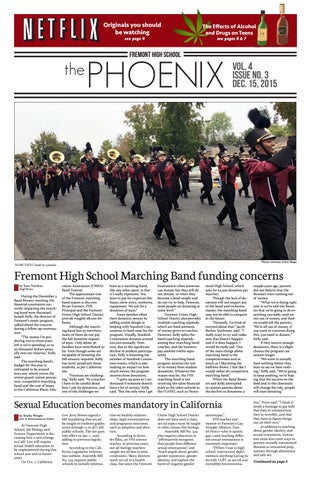
MARCHING band in a parade.
Fremont High School Marching Band funding concerns by Sam Tumkur Staff Writer
During the December 3 Band Booster meeting, the financial constraints currently impacting the marching band were discussed. Joseph Kelly, the director of Fremont’s music program, talked about the concern during a follow up conversation. “The reason I’m predicting two to three years left is we’re spending 20 to 30 thousand dollars annually into our reserves,” Kelly said. The marching band’s budget for this year is estimated to be around $100,000, which covers the winter guard, winter percussion, competitive marching band and the cost of buses to the California Music Edu-
cation Association (CMEA) Band Festival. The approximate cost of the Fremont marching band season is $60,000. Bryan Emmert, FHS Principal and the Fremont Union High School District provide roughly $8,000 for buses. Although the marching band has 93 marchers, many of them do not pay the full donation request of $500. Only about 36 families have contributed so far. Even though some are incapable of donating the full amount required, Kelly has never penalized those students, as per California law. “Finances are challenging,” Kelly said. “As a teacher I have to be careful about how I ask for donations, and one of the challenges we
have as a marching band, like any other sport, is that it’s really expensive. You have to pay for expenses like buses, show entry, uniforms, equipment. We ask for a donation of $500.” Some families offset their donation money by selling cookie dough or helping with Stanford Concessions to fund raise for the program. Usually, Stanford Concessions donates around $20,000 annually. However, due to the significant decline in student participation, Kelly is lessening the number of Stanford Concession events, which is also making an impact on how much money the program receives from donations. “I grew up poor so I understand if someone doesn’t have a lot of money,” Kelly said. “But the only time I get
frustrated is when someone can donate but they still do not donate, or when they become a dead weight and do not try to help. However, most people are donating at some level.” Fremont Union High School District also provides multiple coaching stipends, which are fixed amounts of money given to coaches. However, Kelly splits the band coaching stipends among four marching band coaches, and the boosters pay another twelve separately. The marching band program receives the rest of its money from student donations. Whatever the reason may be, the FHS marching band is not receiving the same financial push as the other schools in the FUHSD, such as Home-
stead High School, which asks for $2,500 donation per marcher. Though the lack of donations will not impact any of the band and orchestra classes, the marching band may not be able to compete in the future. “Honestly, I’m kind of worried about that,” Jacob Becker, freshman, said. “I really want to try and make sure that doesn’t happen and if it does happen, I would be really sad. One of the main things about marching band is the competitiveness and as much as I like doing the halftime shows, I feel like I would rather do competitive marching band.” When the Band Boosters and Kelly attempted to caution parents about the decline in donations a
Sexual Education becomes mandatory in California by Emily Wright
Arts & Entertainment Editor
At Fremont High School, the Biology and Science Department is discussing how a new change to Calif. Law will require sexual health education to be implemented during this school year and in future years. On Oct. 1, California
Gov. Jerry Brown signed a bill mandating that sex ed be taught to students grades seven through 12 in all Calif. public schools. The law goes into effect on Jan. 1, 2016, adding to previous legislation. According to the California Legislative Information website, Assembly Bill No. 329 requires public schools to include informa-
tion on healthy relationships, legal contraceptives and pregnancy outcomes, such as adoption and abortion. According to Jennifer Rilea, an FHS science teacher, in previous years, not all biology teachers taught sex ed due to time constraints. Many districts teach sex ed in a health class, but since the Fremont
Union High School District does not have such a class, sex ed topics must be taught in other classes like biology. Assembly Bill No. 329 also requires educators to “affirmatively recognize that people have different sexual orientations” and “teach pupils about gender, gender expression, gender identity, and explore the harm of negative gender
stereotypes.” FHS teacher and mentor to Fremont’s Gay Straight Alliance, Daniel Perez—who is openly gay—said teaching different sexual orientations is extremely important. “[When I was in high school, instructors] didn’t mention anything having to do with LGBT, so sex ed was incredibly heteronorma-
couple years ago, parents did not believe that the Boosters were running out of money. “What we’re doing right now is we’ve told the Boosters that we’re going to do everything normally until we run out of money, and then we would tell the parents, ‘We’re all out of money, if you want to continue doing this, you need to donate,’” Kelly said. If they receive enough donations, there is a slight chance the program can sustain longer. “We want to actually have nothing before they hear us say we have nothing,” Kelly said. “We’re going to keep pushing, we’re hoping that the success on the field and in the classroom will change the tide, people will start donating.” tive,” Perez said. “I think it sends a message to gay kids that they’re unimportant, they’re invisible, and that they have to figure things out on their own.” In addition to teaching about gender identity and sexual orientation, instructors must also cover ways to prevent sexually transmitted diseases or unwanted pregnancies through abstinence and safe sex. Continued on page 2
News 2
CA Sex Ed Continued from front page
Dec. 15, 2015
CAASPP scores at FUHSD by Manavi Chandra
Students in grades seven through 12 are required to be taught sex ed at least once in middle school and once in high school, but they can opt-out of the program with a parent’s written request. Parents also have a right to review materials that will be used to teach sex ed, according to Assembly Bill No. 329. Rilea admits that some students may be misinformed on the topic of sexual education. “When I’ve taught [sex ed] before, I’ve given my students a pretest, I’m looking more for the biology,” Rilea said. “You’d be surprised, as many teenagers claim they know everything, [but] when they take this pre-test, a good majority of the students fail.” According to Ben Lowell, an FHS science teacher, there is also a district-wide conversation regarding how to implement the new requirements. “There’s been not a lot of consistency about how much sex ed is taught and who teaches them, so that’s a conversation we’re having both at the site level and at the district level,” Lowell said. “The science department at Homestead [High School] is looking at bringing in a training organization that trains teachers on how to teach sex ed well and having that training happen for teachers across the district.” However, Perez, Rilea and Lowell all agree having sex ed is important. “I think there are important ways of thinking about student’s personal choices and relationships [because] a really important part of being a human is sex and sexuality,” Lowell said. “I think that [having sex ed] is one of the most life-altering choices you can make.”
Staff Writer
The Fremont Union High School District had the highest test scores for the California Assessment of Student Performance and Progress in all of California in the 2014-2015 school year; however, Fremont High School had the lowest scores in the district. The CAASPP is the new common-core correlated test that tests students based on their abilities to ensure they are ready for college by graduation. According to FUHSD, 11 percent of students enrolled in Calif. exceeded standards in mathematics while 23 percent of students exceeded standards for English Language-Arts. Compared to state averages, 63 percent of the students enrolled in FUHSD met or exceeded standards in ELA and close to 62 percent of students
also exceeded standards in math, making it the strongest district out of 80 to 100 high school districts in Calif. “I think the reason students scored high on the CAASPP in our district is because we have students whom always worked very hard,” Sue Larson, FUHSD Communications Coordinator, said. “It’s exciting to know we are the best in California because of this.” For both ELA and math, over 90 percent of Monta Vista High School and Lynbrook High School students, and over 70 percent of Cupertino High School and Homestead High School students met or exceeded standards. However, other statistics from the FUHSD show that only 62 percent of participants at Fremont met or exceeded standards for ELA and 42 percent of participants met or exceeded standards for math.
Fremont did not score as high for a number of reasons. According to certain staff regarding the test, some students in honors and Advanced Placement classes decided to opt out and focus on their classes. Two hundred twenty nine out of 363 Fremont students tested received a total of 63 percent for ELA and 52.3 percent for math. In contrast, over 95 percent of students at other FUHSD schools took both tests. “I think it would be tempting to opt out as a student,” Larson said. “I think it would be very tempting to sleep in or do homework or catch up with friends. If a test is optional, and you feel like it does not maybe affect you as much, then you will be tempted to opt out.” However, Principal Bryan Emmert said the AP and honors students who opted out impacted Fre-
mont’s overall performance. Both Emmert and Larson believe if all students took the test, Fremont’s test scores would accurately reflect the academic aptitude of the entire school. “I want our community to know how fabulous Fremont High School is, and one of the ways is by test results,” Larson said. “When Fremont’s test results are lower than what they otherwise would’ve been, then our community has hard evidence to say that Fremont isn’t a good school.”
Wealth Gap by Caroline He Staff Writer
Silicon Valley, as the unofficial capital of high tech, is a very wealthy cluster of cities. However, wealth is notorious for being spread inequally. The Valley has an exceedingly prominent divide between low wage laborers and their much more affluent counterparts. Steps to change this have only just begun. In the meantime, many are feeling the effects, including some students at Fremont High School. According to the 2015 Silicon Valley Index, high earners, like computer scientists and venture capitalists, received 4.4 times more money than low earners, such as shuttle drivers and janitors. High wages in Silicon Valley were $118,65, while low wages were $26,847. Approximately 30 percent of the population cannot afford bare necessities without public assistance. In other words, the wages of low income workers are not sufficient for supplying a decent lifestyle in Silicon Valley. However, there is still a perception of affluence in the area. Since more people move to Silicon Valley, more businesses spring up. This creates more jobs, leading to even more people moving to the area. In cases such as housing, the demand presented by this surge in population outpaces the housing supply, meaning the price for housing rises. According to the Classical Theory of Inflation, as supplied by The Classical Theory of Inflation and Its Uses Today by Peter Ireland of Boston College, prices increase when demand for
goods and services overtake their supply, creating a certain amount of scarcity. Problems arise when local inflation rises at a rate in which wages cannot match, as seen with the heightened inaccessibility of housing. One reason for this inaccessibility is the cost of rent. In 2014, San Jose had the second most drastic rent increase in the United States, as indicated by the real estate database Zillow. The demand for housing outpaces its supply, resulting in single family homes costing upwards of $1 million and one bedroom apartments regularly renting at over $2,000 a month. Rental costs are considered burdensome if over 1/3 of income must be reserved to pay for it, meaning that one person must earn over $6,000 a month ($72,000 annually) to afford the most basic necessities in Silicon Valley. That cost increases significantly when a family is concerned because there are more people to support. According to the 2015 Silicon Valley Index, less than half of first time home buyers can afford a home in Silicon Valley and about 40 percent of renters are burdened by housing prices. Those who cannot pay rent are evicted from their home. The 2014 Annual Homeless Assessment Report (AHAR) to Congress found that California currently has a homeless population of approximately 113,952 people, 20 percent of the entire nation. Of those 113,952 people, 71,437 were unsheltered. San Jose actually had the highest rate of unsheltered homeless individuals in the entirety of the United
Photo courtesy of Wolf Street
HOUSING prices in San Francisco almost doubled from 2012 to 2015.
States. “We have a fair amount of homeless students on campus,” Jesus Ramirez, the Family and Community Liaison in Fremont, said. “That’s strictly connected to how expensive it is to have an apartment around here. And the families don’t want to leave the area, or they don’t know where they can go.” This wealth inequality affects many people locally. Fremont High School students are all affected in some way, whether it be high or low impact. The troubles magnified by wealth inequality are many and countless, some are tragic in their simplicity. “Many don’t know where their family’s going to meet, because imagine if you don’t have a cell phone, because you don’t have money,” Ramirez said. “Your mom may have a job, maybe doesn’t. You’re in high school, your brother
or sister might be at an elementary school. How are you guys going to connect, where are you guys going to meet up at?” Students in this particular situation lack the luxuries many take for granted. “Imagine having to show up to school with the same clothes for four or five days because you don’t have somewhere to shower,” Ramirez said. “Imagine not knowing if you have somewhere to shower, not knowing if you’ll have food.” In an effort to help, teachers offer assistance to those students. “I give out lots of food to hungry kids,”Celia Krippene, the Foods teacher, said. “I sell the soups at lunch, and that helps subsidize the free food I give away.” However, instead of simply being given food, students in this situation want to earn their keep.
“I have a couple of boys that come in a couple of times a week and they do some cleanup, wash the towels for me, and they get to make themselves some eggs and toast,” Krippene said. “I have another kid that comes at lunchtime and helps sell the soups for a little bit and he gets a free soup.” The government has also taken note of this issue and introduced some legislation in an attempt to rectify the situation. According to the San Jose Mercury News, individual cities within the Valley are working to raise the minimum wage. The most promising plan so far has been to increase the minimum wage to $15 by 2018 from the current $10.30. Cities such as Sunnyvale and San Jose are debating whether to adopt and enact this plan in their respective areas.
Mountain View, according to it’s city website, has already put this plan in motion. By 2018, the minimum wage there will be $15. Along with this, according to the newly enacted San Jose Apartment Rent Ordinance, a landlord cannot raise the rent above 21 percent of the cost of rent two years previous. The ordinance also outlaws a rent increase above 8 percent at one time. This is in an effort to decrease the amount of evictions taking place, in turn decreasing the homeless population. Silicon Valley is experiencing massive economic growth throughout, but with the all the good comes, inevitably, the bad. There will have to be a lot of changes to minimize the undesired aspects of rapid economic expansion.
News 3
DEC. 15, 2015
Fremont welcomes new teacher by Jessica Lara Staff Writer
Coming into the 20152016 school year, Fremont High School students could not help but notice a few new faces on campus. Among the many newly hired teachers is Geoff Wen, who started making his mark on FHS early this year. Wen quickly became well known when he became a Homecoming judge and pedicab driver during the Homecoming ceremony, the Interact advisor, Water Polo team assistant and Badminton coach. Wen began his career in the Bay Area. After graduating from Lynbrook High School in 2006, Wen began his schooling at University of California, Santa Cruz (UCSC) hoping to pursue marketing in the field of fashion. “My last year at UCSC I had no direction,” Wen said. “I realized that industry is really cut throat and doesn’t really mesh with my personality. There are quite a few teachers in my family, one of them being Eric Wong, who used to be the dean and a history teacher here at Fremont. So I got to come observe his class, as well as Mr. Lin’s class when he was a very young teacher. I realized that being a teacher seemed like a good fit for me.” After finding an appropriate career by observing Wong, Wen says the path became clear. Using his bachelor’s degree in Psychology after graduating
from UCSC in 2010, Wen was able to work at Delta Charter High School in Santa Cruz and then at East Palo Alto Academy. “At East Palo Alto Academy I was working with kids who were different from the kids I grew up with,” Wen said. “I worked with juniors and seniors who were going to be the first in their family to graduate high school, the first in their family to go to college and I found it important and gratifying.” FHS has a strong AVID program designed to attain academic success, but also designed to aid these first generation graduates or college goers. Wen said a goal of his is to become an AVID teacher and mentor for the same reasons he enjoyed working with upperclassmen at East Palo Alto Academy. “I really enjoyed it, and they really enjoyed me,” Wen said. “They asked me to return the following quarter to do some work, and I got paid to do something I love, which is great. I really enjoyed working with high schoolers. The age is so unique, because they are balancing almost being an adult but still having a strong sense of wonder.” After his third year working, Wen says his mind was made up. Searching for teaching experience, Wen applied for the second time to the Japanese Exchange & Teaching program, otherwise known as JET. He was accepted and taught English for three years in Japan.
the
1279 Sunnyvale Saratoga Rd. Room 145 Sunnyvale, CA 94087 (408)-522-2200 fremonthighphoenix@gmail.com fhsphoenix.com Editor in Chief Chau Nguyen
Photo courtesy of Geoff Wen
Returning home, Wen quickly started school to gain teaching credentials. During that year at Santa Clara University he student taught at Lynbrook High School until he graduated with a Credential and Masters in Teaching in 2015. Once in search for a job, he applied to the Fremont Union High School District. “I’m still young and energetic, and I like to be able to bring that to the classroom,” Wen said. “At Lynbrook I was able to do that, but I can’t say I related to all the struggles my students faced and the pressure they felt, because that was not my high school experience.” Wen was not the expected straight A student and was not heavily involved in AP courses; he was an average student. “All schools have their stereotypes that everyone
is aware of,” Wen said. “Growing up, I never fit the mold of a typical Lynbrook student.” With students at FHS who vary in backgrounds and interests, Wen says he is able to find ways to bond with them more easily. “I know how to motivate them because I was there too, and that’s what’s so special working here at Fremont,” Wen said. “I want to teach my students to make better decisions so they can be happy, and to be well rounded contributors to society. That’s why I am more than excited to be somewhere where I feel comfortable.” Viking to Firebird, the variation between two FUHSD schools is what attracted Wen to the FHS student body and explains his popularity on campus.
Student representative of FUHSD by Michael Wang Staff Writer
Cyrus Miremadi isn’t just a senior at Homestead High School—he also represents the voice of all the students in the Fremont Union High School District as the Student Board Representative. “I vote on different issues that the board brings up and bring a student perspective to different issues in our community,” Miremadi said. “I compile, [a] report of all five schools’ concerns and events and everything, and I get an allotted amount of time at every board meeting to bring [these] up to the trustees.” Every other week, each school’s Intra-District Counsel (IDC) Representative sends Miremadi a form. According to Miremadi, there are six components to the form submitted: issues, events, student activities, staff and department updates, future and upcoming events and recognitions. Quotes and pictures from different students and events are also included in the forms. Miremadi uses the submitted forms to compile his report. In addition to compiling and presenting the
reports, Miremadi also actively participates in events at all five schools and takes pictures of them to better represent the student body of the FUHSD. “The board just wants to get an idea of what’s going on in our district,” Miremadi said. “They need a student-adult connection. So I like to think of me as a ‘middle-man’.” Miremadi’s job is to spread awareness of issues that concern students in order to benefit them. After the fatal bike accident near Monta Vista High School last year, Miremadi began working on a bike safety video to spread awareness about bike and driver safety to students, which is going to be released early next year. Miremadi applied for the position because, as a freshman, he was inspired by the Student Representative’s dedication at the time. He also felt that his first three years in Homestead Leadership were not as thrilling because his range of influence was not large. “All of my events stayed on campus,” Miremadi said. “It was nothing collaborative with other schools in the district. As an ASB social
PHOENIX
manager, I was in charge of Homecoming and our canned-food drive, and I did that two years in a row. As much as I loved giving back to the community, I wanted to try something new. When this position presented itself, that was my opportunity to broaden my perspective and expand upon my horizons.” With his responsibilities increasing, Miremadi has felt a shift in where he focuses his work. “[As a] freshman, sophomore and junior I definitely was busier with more events [such as] Homecoming and Battle of the Classes,” Miremadi said. “But right now I’m busier with more communication skills within our district.” With his position, Miremadi likes that he can be more involved in activities in other schools because he wants to improve the representation and communication between FUHSD students. “This year you could probably find me at a Monta Vista football game or you could find me at a Fremont Theater Show,” Miremadi said. “But I wouldn’t have the same motivation [a] couple years ago when I
was just doing leadership through Homestead. Just being more involved within other schools’ leadership programs and their spirited communities is definitely a great part of the position.” However, Miremadi realizes that being the face of a high school district requires him to be more serious. He also feels he has lost touch with some HHS events that he used to be heavily involved in due to his new commitments. Despite these drawbacks, Miremadi urges others to run for the Student Board Representative position. “This has been a fantastic opportunity that I highly recommend to anybody who wishes to broaden their leadership experience and learn something new and be involved in our district,” Miremadi said. “I know a lot of schools offer leadership positions, but this is one of the only positions, if not the only position in the district, where students are given the opportunity to represent and be involved in the lives of four different schools besides the one they attend.”
Managing Editors Sarah Arkoh Jasmine Salik
News Editor Kelly Zhong
Sports Editors
Maggie Bernauer Essam Rao
Arts & Entertainment Editor Emily Wright
Opinion Editor Julie Wi
Online Editor Hannah Butay
Copy Editor Nicole Stibbard
Staff Writers
Michael Alva Nadia Anees Manavi Chandra Mira Dhingra Caroline He Sami Jin Jessica Lara Momina Nadeem Jenny Nguyen Dana Nissan Susannah Schulze Sam Tumkur Ambika Vaidya Michael Wang Allyson Wilbur
Adviser Stacey Stebbins The Phoenix, protected under the California Education code, is a public forum for the students of Fremont High School. The Phoenix staff will publish features, editorials, news and sports in an unbiased and professional manner. Editorials are the official opinion of The Phoenix. Opinions and letters are the personal viewpoints of the writers and do not necessarily reflect the opinion of The Phoenix. All content decisions are made by the student editors and in no way reflect the official policy of Fremont High School, nor the opinions of the administration, faculty, or the adviser. Business advertisements are accepted in The Phoenix. However, The Phoenix reserves the right to deny any ad. Those interested in running advertisements can call the school at (408)-522-2200, or email fremonthighphoenix@gmail.com. An online version of The Phoenix is available at fhsphoenix.com. Letters to the editor and questions for the advice column, may be submitted online at www.FHSphoenix. com, to room 145, Ms. Stebbins’ mailbox, or emailed to fremonthighphoenix@gmail.com. Identities of those who submit questions will remain anonymous. The staff reserves the right to edit letters to conform to styles and policy. Letters to the editor will be published at the discretion of the staff. The Phoenix is the official student newspaper and is distributed free of cost to the students. The Phoenix publishes eight issues throughout the school year.
Opinion Hollywood’s excessive usage of sequels
Dec. 15, 2015
4
by Hannah Butay Online Editor
Hollywood is the historic home of America’s movies, to the point that the United States’ film industry is collectively referred to as “Hollywood.” From “Gentlemen Prefer Blondes” to “RoboCop”, Hollywood has given the world some of the most iconic and beloved movies of all time. Lately, however, it feels like American cinema hasn’t been living up to its acclaimed reputation. It seems that every recent movie is an adaptation of a book, a remake or a sequel to another movie I’ve already seen. Of the last 10 movies I’ve seen in theaters, five were either a sequel or a remake. Either way, the feeling is the same—Hollywood has lost its creativity. “Cinderella” is a prime example. While most of us may look on the classic fairy tale fondly with some nostalgia, we probably aren’t as fond of its sequels. Some might not even be aware there is one.
After rewatching all three “Cinderella” movies in succession plus the 2015 remake, I’ve come to the conclusion that “Cinderella’s” two sequels were, to put it lightly, very bad. While it may be because I’m older than the intended audience, even as a kid, I thought they were both horrible. The movies felt like they were 15 minute plots stretched out to last an hour and a half. The same feeling came when I watched “Cars” and “Cars 2.” A movie I thought was well done was followed by something nowhere near as interesting or entertaining. It’s reasonable that American cinema would try to create new sequels and remakes. Audiences love seeing their favorite characters in new situations and settings. Sequels allow film companies to earn more money by building on something previously successful. Sequels are also easier to make as there is less hassle in hiring new actors and creating new characters. In theory, the idea sounds great and beneficial, but the actual product doesn’t typically live up to its predecessors. “Jaws”, one of the most famous and critically acclaimed movies, currently
Illustration courtesy of Panthea Farhoomand
has a 97 percent rating on Rotten Tomatoes. However, its two sequels have ratings of 53 percent and 11 percent respectively. As the series went on, each movie declined in quality. The plots became less engaging and the acting was less polished. Even one of the greatest movies of all time couldn’t escape the fatigue of sequels. I understand that it’s difficult to create a unique and engaging plot audiences would find interesting enough to go out and pay money to watch. In order
to combat this, the film industry has the tendency to simply recycle plot lines known to be successful. Since Hollywood has been so adored for such a long time, there may be a standard the film industry has to live up to that isn’t easy to reach. But, there should still be some creativity in creating new movies. There are so many ways to redo a movie and still make it up to par. Instead of trying to redo the same tale of forbidden lovers or the poor fighting against the rich,
the film industry could add a modern spin by changing the character’s race or gender. For example, the 2014 film revival of the musical “Annie” cast the black Quvenzhané Wallis as the titular character, a spin on the classically depicted Caucasian Annie. A sequel or remake doesn’t have to be completely redone to be good. The “Toy Story” franchise is one of the best movie franchises out there. Each movie has gorgeous animation and plots that still fit the overall theme of grow-
ing up. To this day, I still don’t feel like any of the movies were better than the other in this franchise. Audiences seemed to have the same feeling; all three “Toy Story” movies currently have a 99 percent rating or higher on Rotten Tomatoes. Hollywood rose to its prominence for its ability to create timeless movies. While new, interesting ideas are hard to come by and it becomes harder to reach the film industry’s high expectations, American cinema still has the capability to create stunning sequels and remakes. The film industry has to break out of the box to get to the top of the box office charts critically and commercially. A continuation or remake of a story doesn’t have to be a completely new tale with gender-flipped characters set 500 years into the future—it should simply have more thought put into it.
The expectations versus the reality of Fremont High School
by Susannah Schulze Staff Writer
As an eighth grader from Cupertino Middle School, I didn’t know what to expect when coming to Fremont High School. I was reluctant, mostly because several of my close friends were going to Homestead High School. In their eyes it was the better school, making it superior in my eyes as well. Not being invested in the FHS community myself, my judgements were based on what I heard instead of my own experiences. This is how FHS can be commonly perceived as a lower school compared to other schools in the district. Without accurate knowledge, parents hope to send their children to other schools in the district that are advertised to be more academically challenging than FHS. Incoming freshmen
hear rumors of FHS being “ghetto”. According to Laurie Turner, a science teacher who has taught at FHS for over 25 years, part of this reputation stems from the late 90s. Back then, some of the student population displayed a lack of interest in learning, which caught more attention in the community than high-performing students. “The kids that aren’t interested are the ones that you notice,” Turner said. “They’re the ones that are maybe getting into a fight, causing trouble and that’s what people saw.” This reputation materialized long ago. FHS has changed a lot since then, but people’s perceptions have not. FHS is different from other schools in the district and sometimes what’s different is scary, so it is easier to make false judgements rather than investigate the truth. Our school has more diversity when compared to other schools in the district. The student population is a mix containing 43 percent Hispanic or Latino students, 21 percent white, 20 percent Asian, 11 percent Filipino or Pacific Islander and 2 percent African American, according to the
FHS school profile. Monta Vista High School and Lynbrook High School are both comprised of more than 80 percent Asian students. These schools have one predominant ethnicity, while our school has several. The overlap of different cultures exposes students to new customs. FHS also has a larger number of kids who need to learn English, need special education support or lack financial resources in comparison to students at other schools. When people look at our campus, the differences we have within our student population can overpower the ways we are similar to other schools. People tend to look more toward our differences than our similarities. Our reputation as a school boils down to people’s perceptions. People will believe what they want to believe, influenced more by lurking rumors than actual research. “For a lot of people who had maybe some negative opinions of Fremont they weren’t the people coming on campus and seeing what was going on a day-to-day basis,” Principal Bryan Emmert said. To combat these perceptions, FHS has been
trying to spread awareness of all the activities that take place on campus. While highlighting clubs and activities unique to our school, more emphasis has been placed on community outreach. FHS offers three shadow days a year for eighth grade students to come on campus and experience FHS for themselves. Shadow day is designed to get eighth graders on campus and show them what FHS is really like, helping them to understand that not all of what they hear about FHS is true. Shadowing here as an eighth grader gave me an experience that changed my perception of FHS into a positive one. My view was based on my experiences rather than what I heard from other people. In eighth grade, there was a big rivalry between the kids going to FHS and those going to Homestead High School. Kids going to HHS saw us as inferior, and commonly told the kids going to FHS that they would get pregnant or be stabbed or not get into college. Shadowing showed me that this wasn’t true, and FHS was the same as any other school. The students here are actually really wel-
coming and friendly. Having students who show so much commitment to their community really makes a difference in how people see FHS. Our National Honor Society encourages students to be positive role models and leaders by volunteering at local elementary and middle schools. Some of our female student athletes volunteer through Bay Area Women’s Sports Initiative at San Miguel Elementary. When FHS students give up their time to support activities at local schools, they become role models to younger kids, which gives the community another perspective of FHS students. By bringing more people into the FHS community, community outreach has lent itself to improve our reputation. FHS offers the same Advanced Placement classes as HHS and Monta Vista High School, contradicting the misconception that FHS is not an academically challenging school. AP Environmental Science and AP Art Studio Art were added two years ago, giving students more selection. As students experience FHS for themselves, many negative perceptions
are broken down. Students realize the diversity and academic success FHS has. As these negative views are replaced with positive ones, our school gradually leaves past labels behind and moves onto a reputation acknowledging FHS for its differences from other schools in the district. Making assumptions can be dangerous because they limit your view to speculation, rather than grasping a firm understanding of all components to make an educated judgement. FHS may have had a bad reputation years ago, but it’s different now. The reason why the bad reputation still persists today is because people listen and accept what they hear from others as the truth. Through educating people and bringing them into the FHS community, we have begun to change how others view our school, changing our reputation for the better.
Opinion
DEC. 15, 2015
Adjusting to the American lifestyle
by Dana Nissan Staff Writer
Everything was so big. All the people were friendly. Everything was magical. The world was still simple at age eight when I arrived in the United States. However, coming to the U.S. was still the hardest experience of my life. I had to leave my best friend, my family, and my home. I no longer had a simple and easy life. My life started to be hard and different. I came from a place where people push, yell and express their feelings all the time, but when I came to the U.S., all of a sudden everything became quiet. I never actually fit in Israel, but it was always home to me. And now, I was known
as a non-native speaker. My family were the only ones there. They were always around the corner, whether I needed them or not. I didn’t have my best friend by my side, only my family. I figured out what it meant to have best friends, and my family were mine. I always thought that I was alone in the experience, the only one struggling but, I was never alone. My family was going through the same hardship with the language, culture, people and the quietness. We were in a whole new culture and world that we couldn’t understand. Israel was always loud, there were celebrations all the time and people were impolite. But the U.S. was the opposite of that. The teachers weren’t called by their first name and you couldn’t just yell out the answer in class because you were thought to be polite. On the first day of school, I walked in con-
fused. I didn’t know a word of English, and I didn’t have anyone. I was placed in a English Learning Development class with people who had different levels of experience in the language. I wasn’t alone in the class, but it felt like I was. No one tried to support me throughout the lectures and the obstacles. They would just stare, amused with disbelief. It felt like we were special, but we weren’t close to that. We were just the kids who didn’t know English. We were nobodies. It always felt like I was being compared to everyone around me. So I always tried to be smarter, industrious and courageous. I was afraid of not being enough. I needed to work harder to succeed because I didn’t know the language like everyone around me. As the years go by, I
still find myself struggling with grammar and writing. It didn’t come naturally like speaking. I had to work on my writing, revise it a million times and would still get marked down for it. Even today, my mom is still facing the same problems. She has been taking English classes for five years at Foothill Community College
Julie Wi | The Phoenix
and San Jose State University to get a degree in Linguistics. My mom was taught by a San Jose State University professor and non-native, Sharmin Khan. Khan thinks that stan-
dardized tests are particularly difficult for non-native speakers. According to Khan, a non-native has less of an understanding of the language skills to do well and the questions are often culturally loaded and thus difficult for them. Even though it was difficult, the ELD program always pushed me to learn more. They found ways to support my first language so I wouldn’t lose my parental language and culture. Theyalso ensured that the non-native speakers had every opportunity to engage with the material and learn in the classrooms. The teachers focused on learning everyday words and having the ability to have a conversation. Khan says an English as a second language student may be able to talk in English better than they can write papers, do research, summarize, analyze, etc. They teach a non-native the
5
basics of English but don’t prepare them for the daily conducts they will face as they grow up. After a few years, they shut down the program in elementary schools. Those who don’t know English are still placed with those who speak it fluently. This change is supposed to help the students learn faster because they have more people around them who know the language. But how can they learn if they don’t know a word in English and don’t have anyone to help them? You can’t participate and work on classwork if you don’t know what the teacher is expecting from you and the instructions given to the class. After being in the U.S. for a while, I learned that the experience was different in a good way. Moving to the U.S. has changed me. I learned to deal with new surprises, like the culture and language. The experience has made me stronger.
Commercialization of winter holidays
by Nadia Anees Staff Writer
The Christmas TV commercials have arrived. American Broadcasting Company’s (ABC) 25 Days of Christmas has started and the festive Santa Claus hats are coming out. That one special neighbor of yours is having a crazy light show in their front yard. Your seven year-old cousin is begging you for a Hoverboard. All the stores have begun their Christmas sales and your family is slowly yet surely becoming frantic about Christmas shopping. As people prepare for the heavily desired holiday, Americans are spending much more money on Christmas now than ever before. According to a poll by Gallup, the average
American will be spending around $830 on Christmas gifts this year. That number has changed drastically from 2002 when the American family would on average spend around $695 on Christmas presents. It is understandable that a family would try to get the best gifts to satisfy each other. However, spending such high amounts of money can make people look forward to receiving gifts rather than enjoying all of the holiday traditions. Christmas used to be celebrated by families but now companies are taking advantage of the holiday by using Christmas to attract millions of customers to buy their overpriced products. “What I’ve noticed [has] changed the most about Christmas is when we start preparing for it. Before, we would start preparing for it the day after Thanksgiving. Now, people start talking about Christmas almost as soon as we get back to school,” Lisa Freitas, Guidance Counselor said. Companies and stores start making holiday products and sales months before Christmas time. According to Time, Kmart aired their Christmas
commercials in September and Walmart began their holiday layaway program in the middle of October. People become so excited for Christmas shopping that they forget about Thanksgiving, a holiday that is all about being grateful for what you have and giving thanks. By creating so many sales and discounts on items, companies are encouraging people to overspend and buy all sorts of items. It also turns what should be a warm, happy holiday, into simply a way to earn lots of money. Many tend to forget the
true meaning of the holiday when it comes to shopping for gifts, especially on popular days such as Black Friday or Cyber Monday. On Black Friday, people risk going insane and waiting several hours, or even days, to buy discounted items. When Christmas comes around, whether I’m talking to people or looking through social media, I always see or hear about how people receive the most expensive gifts they were hoping for. I’m glad for those who were able to get what they wanted, but I feel that these people need to look beyond the presents
and enjoy the other, more meaningful parts of Christmas. I also think about those who have nothing to do, nowhere to go, nothing to eat nor receive anything for Christmas and that they need gifts too. Christmas is a festive holiday that is meant for families to reunite and to spend time with loved ones. It is meant for giving back to the people who have taken care of you and to those who are in need or who cannot afford to buy their family presents. Those who go overboard on Christmas shopping should consider giving or donating to those
who have no money to support themselves or their families. Christmas is a holiday full of love, family, joy and spirit. Now that it has become very commercialized, people are focusing too much on receiving and not as much on giving. This Christmas, try to prevent yourself and your family from going crazy over Christmas shopping and remind yourself about what Christmas is truly about: spending time with those you love and spreading Christmas spirit.
Happy Holidays Julie Wi | The Phoenix
Special Feature
DEC. 15, 2015
6
Alcohol, Dru
Medical Marijuana Facts What is medical marijuana? The term medical marijuana refers to the use of tetrahydrocannabinol (THC), the main chemical in cannabis, for various medical reasons.
How Drugs Impact You
What does medical marijuana help treat?
by Kelly Zhong News Editor
It is used to treat patients suffering from chronic illness, muscle spasms, chemotherapy and more.
In what forms is medical marijuana available? Methods of consumptions include: • Smoking marijuana • Medical marijuana edibles - foods infused with THC • Tinctures and tonics - concentrated THC chemical con sumed directly or added to foods • Medical marijuana topicals - Cannabis oil in the form of of balms, salves, lotions, sprays and ointments that is applied directly to the skin • Medical marijuana tea & sodas • Hash & wax - Made from the resin of cannabis flowers and compressed into wax - Can be eaten, smoked or added to teas
Where is medical marijuana legal? Medical marijuana is legal in 23 states in the United States including Arizona, Nevada, California, Hawaii and New York and additionally worldwide in some countries including Bangladesh, Uruguay and North Korea.
Where can medical marijuana be obtained legally? Medical marijuana has to be prescribed by a doctor and patients can obtain it from dispensaries that sell marijuana in many different forms. Information from United Patients Group, ProCon.org and Healthline.com
Recreational Marijuana Facts
What are the origins of recreational marijuana use?
While hemp has been grown in the United States since its founding, recreational marijuana did not become a widely used drug until soon after the Mexican Revolution of 1910. As the number of Mexican immigrants entering the U.S grew so did the prevalence of marijuana. According to PBS, “The drug became associated with the immigrants, and the fear and prejudice about the Spanish-speaking newcomers became associated with marijuana.”
When did recreational marijuana become illegal?
Recreational marijuana first became illegal in 1937 when the Marijuana Tax Act was passed. The act was later ruled unconstitutional and replaced with the Boggs Act of 1952 and the Narcotics Act of 1952. Both acts required minimum jail time for possession of marijuana.
Where is recreational marijuana legal? Washington, Oregon, Colorado and Alaska have all legalized recreational marijuana. In all four states, users must be 21 or older. Information from Governing Magazine and United Nations Office on Drugs and Crime
Drugs can have a variety of impacts on humans, depending on how they are used. As a positive example, marijuana can be used medically to relax people or increase the appetite of people who have gone through chemotherapy in order to prevent unhealthy weight loss, according to Fremont High School science teacher Laurie Turner. However, Deborah Kumar, another Fremont High School science teacher, says some of the other short-term effects of smoking marijuana include spacing out and reality distortion. These effects could be other reasons why people smoke marijuana, or do drugs in general according to Turner. “It’s a total stress reliever but, you’re not dealing with the issue that causes stress,” Turner said. “It’s not a positive stress reliever, but at the same time it’s what a lot of people do. [The cause of stress] is usually worse [after] because you put off dealing with it.” However, the long-term effects of marijuana can truly be devastating on a teen’s brain. “It’s particularly bad if someone is smoking marijuana before their brain is fully developed, say under 25,” Turner said. “If you’re doing it regularly, it essentially freezes brain development at approximately that age.” Turner elaborates that smoking marijuana regularly can also give young people the sense that they are satisfied with their current situations, therefore inhibiting their ambitions to move up in life. On an anatomical level, marijuana takes the place of dopamine, the neurotransmitter that helps people feel euphoric. According to the National Institute of Drug Abuse,
many drugs release about two to 10 times more dopamine than natural activities like eating. The stronger euphoric feeling also lasts much longer than that of natural rewards, as a result, people are strongly motivated to continue taking drugs. However, over time, the brain also produces less dopamine to accommodate the overwhelming surges of dopamine from drugs, according to the National Institute of Drug Abuse. Therefore, to get the same euphoric feeling as before, the person must keep taking drugs. Other drugs, such as alcohol, directly interfere with neurotransmitters instead of merely imitating them. According to Kumar, alcohol first impacts the cerebrum, the part of the brain that regulates thoughts and processing. If you ingest more alcohol, it will travel to the cerebellum, the part that oversees your motor functions. When people pass out, alcohol has already travelled to the brain stem and can be fatal. “In some cases it will flood the neuron,” Turner said. “Alcohol, instead of just going in and acting like the neurotransmitter, it goes in such amounts that it kills off the neurons that it’s interfering with. It’s like you want to plug in your phone which naturally needs this much charge, but if you plugged it in and tripled the charge, you’d fry it. That’s what the chemicals of alcohol do to your brain.” Turner thinks that increased awareness would help several abstain from drug use and addiction. “A lot of people think [marijuana] is not a big deal,” Turner said. “They’ll say it’s better than tobacco or it’s not addictive, so it’s okay to smoke it. I think there is a lot of misunderstandings around marijuana that makes some people try it, who otherwise may not have, because they don’t know.”
Fremont Seniors Sound Off “There are people I know that do drink and based on their experiences, I feel like drinking is not the best idea.” “As long as you really care about school and know how to monitor yourself, smoking and drinking have almost no effects on your academics.” “The first time I smoked was the summer after freshman year. I had a bunch of friends who were doing it. They offered for me to come along and I said sure.”
“I don’t drink or smoke because I don’t want it to become a problem later down the road.”
“I started smoking out of curiosity. Being high is a feeling you want. You don’t feel like yourself. It’s a stress reliever and you become carefree.”
“It’s against my morals to smoke or drink at such a young age. It’s also illegal.”
Special Feature
DEC. 15, 2015
7
gs and Teens Drinking ages around the world Canada Minimum Drinking Age of 18
FACTS ABOUT
UNDERAGE DRINKING The following information is from the U.S. Department of Health and Human Services. * Alcohol is the most widely used substance of abuse among America’s youth. Portugal Minimum Drinking Age of 16 France Minimum Drinking Age of 18
United States Minimum Drinking Age of 21
Morocco No Minimum Drinking Age
Mexico Minimum Drinking Age of 18
Chile Minimum Drinking Age of 18
* An estimated 10.8 million youth, ages 1220 are underage drinkers. * By age 18, more than 70 percent of teens have had at least one drink. * Underage alcohol use is s a major cause of death from injuries among young people. * Approximately 40 percent of individuals who drink before age 15 report having symptoms at some point in their lives that fit a diagnosis of alcohol dependence.
South Africa Minimum Drinking Age of 18 Brazil Minimum Drinking Age of 18 Information from the International Center for Alcohol Policies Graphics courtesy of Julie Wi
Cultural Views and how they affect perspectives by Maggie Bernauer Sports Editor
Fremont High School represents many countries and cultures. In any high school the topic of alcohol is bound to come up and, due to our diverse community, it is more common for under age drinking to occur. Culture is very important to understand and acknowledge. I spent five weeks living with a host family in Argentina this summer and the life of a teenager in Argentina is so astronomically different than the lifestyle
in our community. Teens in Argentina are not spending their nights hanging out at In-N-Out; the nightlife there is a very big scene and encouraged by parents. A typical Saturday night starts at two a.m. where kids, ages ranging from 12 to 18 go to clubs and dance, drink and smoke until six in the morning. There is no ID checking to enter the club or purchase alcohol. And the legal drinking age is 18. Culture tends to affect whether teenagers participate in underage drinking or not.
“As people come into the United States from other countries, they bring with them who they are and I think that influences the people they hang out with,” a Fremont student said. According to ProCon.org, only 11 other countries have a Minimum Legal Drinking Age at 21. Any person from the other 185 countries will be more prone to drinking before the MLDA due to cultural views. Boston University Today states how the history of the MLDA in the United
States has had many changes. Until 1933, the 18th amendment was still in place, which prohibited alcohol. From there on out, the legal age changed frequently for when you could purchase beer and when you could sit at a bar. During the time period of the Vietnam War, 18 was the magic age to purchase a beer. In 1984, the Mothers of Drunk Driving persuaded the 50 states to make the MLDA 21 years old. “The age matters,” a Fremont student said. “Even though there is noth-
ing that stops them from doing it, people are sixteen and they still drink. In my opinion, it is good that they have an age limit of twentyone and older, but it doesn’t really make a difference. Even though you are not supposed to do it, people still find their ways.” Parents raise their kids based on their beliefs. With a diverse community, it is commonly seen that parents are okay with teenagers drinking because the rules are different in their culture. Underage drink-
ing is very hard to control. Government can only control underage drinking in public, including what age people can purchase alcohol at stores and restaurants. “Although people may not be able to get alcohol in stores, minors still have parents, friends and other factors where they can still get alcohol,” a Fremont student said. Culture affects the “other factors” and how underage drinking is viewed.
Arts & Entertainment 8
Teacher Milestones by Sam Tumkur Staff Writer
Dec. 15, 2015
Mockingjay a thrilling hit by Ambika Vaidya Staff Writer
Adrienne Philippe
10 years
Adrienne Philippe is an Algebra 1 and Algebra 1 Workshop teacher at Fremont. This is her 10th year teaching. She did her undergraduate at the University of Virginia and graduate work at Stanford University. In her spare time she enjoys spending time with her two sons, husband, her two dogs, Mascot and Bing Bong.
Amy Gibson
10 years
Amy Gibson teaches English Exposition, Reading/ Writing, Assisted Student Body and one period of Academic Foundations. Before she attended San Jose State University, she graduated from Fremont in 1991. In her spare time she takes care of her children and she enjoys running half marathons.
The Girl on Fire is back in this final and thrilling installment of the Hunger Games film series, Mockingjay Part 2. Jennifer Lawrence reprises her role as Katniss Everdeen, the girl from District 12 who has now become a role-model for most of the citizens of Panem. Her defiance for the Capitol has become a motivation for the citizens of most districts to continue the Rebellion and oppose President Snow, played by David Sutherland. The Hunger Games series revolves around 16-year old Katniss Everdeen. After surviving the 74th and the 75th Hunger Games along with Peeta Mellark, she now lives in District 13. As the series progress, we see Katniss become stronger and bolder. She is no longer a girl from the poor District 12, but a Mockingjay—the symbol of the Rebellion. Mockingjay Part 2 puts Alma Coin’s, the president of District 13, plan of infiltrating the Capitol to capture Snow into action. Katniss herself volunteers to become a soldier in District 13’s crew, which now also includes a recovering Peeta (who was tortured by the Capitol during his capture in the previous film). As Katniss survives Hunger-
Photo courtesy of ComingSoon.net
Games-like creatures and traps, being bombed and the pain of watching teammates die, she gets closer and closer to her wish of assassinating Snow, until one particular action changes everything. Starring Jennifer Lawrence, Josh Hutcherson, Liam Hemsworth and David Sutherland, Mockingjay Part 2 is an epic finale to the Hunger Games series. Throughout the movie, the acting is truly expressive. During chaotic scenes, the audience believes the characters are truly living through the violence, and a mistake could cost them their lives. It is clear that all the actors are devoted to making the movie a huge success, from their expressive acting in scenes such as scenes where their characters are planning to overtake the Capitol. Law-
rence knows that she plays the main role of the film and she dominates it—by not just acting as, but being Katniss Everdeen. The way Lawrence portrays emotions, both heartbreak and joy, during the film makes the audience believe that she is truly Katniss. Certain scenes of the movie are moving, like the moments portraying happiness in the midst of the all of the movie’s violence, such as a wedding in the midst of all the war. The movie is bold and emotionally charged. The plot is similar to that of the book, with a few changes and a more dramatic twist. The storyline is easy to grasp and after a few minutes, the film captivates its audience and immediately pulls them into the action. The camera work, lighting and special effects
add to the dark tone of the movie. The computeranimated creatures appear to be real-life weird animal mutations. The soundtrack of the film is incredible. Composer James Newton Howard creates musical score which helps enhance the film’s emotionally-charged scenes. When the music speeds up or gets louder, the audience knows danger could be lurking around the corner, like when the District 13 crew infiltrate the Capitol, keeping viewers on the edge of their seats. The music adds to the movie and helps make it a success. Extremely intense and powerful, Mockingjay Part 2 is one that all adventure loving teens and adults will enjoy.
YouTube subscription review by Momina Nadeem Staff Writer
Sonia Dass
15 years
Sonia Dass teaches Read 180 and Junior American Literature. She received her Bachelor’s at University of California, Davis and did her graduate work at Santa Clara University. What she likes most about Fremont is how far Fremont has come in terms of classes and what FHS offers to its student such as intervention classes to ensure student success. She also appreciates the increased number of Advanced Placement classes so students are challenged and prepared for college and the workplace. When she’s not teaching she likes to read, write and spend time with her family.
Laine Sazon
15 years
Laine Sazon has been the Registrar at Fremont for six years and she has been at the Fremont Union High School District for fifteen years. She majored in psychology and graduated from a college in the Philippines. She started working as a Front Desk Clerk back in 2001 and she worked at Lynbrook for five years before that. When she’s not working at Fremont, Sazon loves to read and travel different places and dreams of visiting Israel someday. Sam Tumkur | The Phoenix
On Oct. 28, YouTube released a subscription service called YouTube Red for $9.99 a month, which gives users an ad-free experience across all platforms, along with other features. Some other features offered include the ability to download videos to watch offline, as well as the ability to play videos in the background while using other apps or while your phone is locked, features that were not available prior to YouTube Red. The desktop version of YouTube Red looks and feels the exact same when you log into YouTube. As YouTube claims, all pre-roll, banner and sidebar advertisements have been removed from all videos on all platforms, which is nice but can be achieved for free by using an ad blocker. However, the ability to download videos is only available on mobile and downloading may be time consuming, depending on the length of the video. A positive feature is background play, which allows videos to continue playing when the user exits out of the app or locks their phone. This is nice, especially for those who enjoy listening to music on YouTube.
Not getting a YouTube Red subscription won’t make a significant difference in your YouTube experience, because YouTube won’t include additional advertisements to influence your decision to pay. YouTube is offering a one month free trial so that users can try out the new features before they commit to paying, but a credit card number is still required before you can receive the trial. Buying a YouTube Red subscription as an in-app purchase on an iOS device costs $12.99 a month, rather than the $9.99 price on other platforms. This is because Apple takes a 30 percent cut of all subscription revenue on its platform, according to Ars Technica. Google wants to give its content creators their equal share of revenue instead of 30 percent of the $10 going to Apple, so the cost has risen 30 percent more on iOS. However, the features will work on all platforms no matter where you buy the subscription. If you subscribe for a YouTube Red member-
ship, a Google Play Music subscription is included for free. Those who already have a Google Play Music subscription get YouTube Red at no additional cost. The Google Play Music membership allows full access to Google Play Music without advertisements between songs, which allows for unlimited, interrup-
Photo courtesy of YouTube
tion-free music streaming. The service is better than more of the popular ones, such as Pandora or Spotify. In the long run, getting a YouTube Red or Google Play Music subscription may be cheaper and offer more features than similar music services. Beginning early 2016, YouTube announced that it is making exclusive TV shows that will only be
available to YouTube Red members, so it may be worth checking back early next year to see what kinds of shows are available as YouTube Red exclusives. YouTube has already announced on their official blog that YouTubers such as PewDiePie, IISuperwomanII and Joey Graceffa, as well as many others will have shows exclusive to the service. The new YouTube terms and conditions state that creators need to allow their videos to be available on the paid subscription service. As a result, YouTube has started to take down the videos of those creators who have not agreed to those terms, according to TechCrunch. All of ESPN’s videos as well as some K-Pop videos have already been taken down as a result of this change of terms. So the question remains, is it worth paying $10 a month for YouTube Red? As of right now, it would probably be better to wait until the beginning of 2016 so you can have access to the exclusive TV shows immediately because the current features are limited.
Arts & Entertainment 9
Dec. 15, 2015
Shows you should be watching by Essam Rao Sports Editor
Who doesn’t love binge watching five seasons of The Walking Dead over just a few days? With winter break coming up, you can do just that without having to worry about school. In addition to its huge selection of great movies and TV shows, Netflix has begun producing their own shows that are exclusive to their site only. So if you’re not too busy “chilling”, be sure to check out these top Netflix Original Series.
House of Cards may be about politics, but don’t let that fool you into thinking this is a boring show—it’s the complete opposite. House of Cards is about Frank Underwood, a ruthless and pragmatic congressman who was robbed of a position he was promised. Frank is the last person you should double-cross, and he makes that very apparent in the show. He is a man who will climb to the top victorious regardless of any casualties. The first season tracks him as he extracts revenge from all the people in Congress that screwed him over. Along with his equally sadistic wife Carrie Underwood (portrayed by Robin Wright), audiences are given a front row seat to all the scandals and backstabbing that happens in politics. This show is suspenseful, dark, shocking and above all entertaining. There is captivating camera work, a great story with a few plot-twists and Kevin Spacey gives an exceptional performance as Frank.
Follow the adventures of Matt Murdock, a blind lawyer with heightened senses and abilities who spends his nights as a masked vigilante making his city a better place. This refreshing take on the superhero genre has extremely realistic action sequences and camera work, which complements its dark and gritty tone. Daredevil also gives us extremely lovable characters, with a very convincing portrayal of the superhero by Charlie Cox.
One of the latest editions to the ever growing list of Netflix Originals is Aziz Ansari’s fresh and original comedy Master of None. This show depicts the personal and professional life of a struggling 30-year old actor trying to make his way in the big city. Not only is Master of None surprisingly clever and witty, but it also gets very thoughtful and heart-warming. Plus, it has a hilarious and convincing cast.
In this critically acclaimed hit, Piper Chapman is sentenced 15 months to a minimum security women’s prison where she has to deal with herself and all the convicted crooks and felons that are only an arms lengths away. Become completely engrossed in this highly entertaining drama which includes dark and witty humor, along with a great set of characters that you will become increasingly attached with, even the crazy ones.
Arrested Development is said to be one of the most critically acclaimed comedies in all of TV, and the show definitely lives up to its hype. The show centers around Michael Bluth as he tries to run his backwards, highly dysfunctional family from turning things into complete chaos. This show has some of the most clever and brilliant comedy known to TV, alongside the hilarious running jokes and goofs.
This show revolves around the lives of three petty felons that continue to cause ruckus in their trailer park filled with other ridiculous, zany characters. Watch as Ricky, Julian and Bubbles spend their days getting arrested and coming up with get-rich-quick schemes like opening up a local strip club or robbing local supermarkets. TPB’s crude humor and screwball comedy surprisingly makes for a highly entertaining show.
This upbeat, fun sitcom is about Kimmy Schmidt, a woman who is trapped in an underground bunker for 15 years that finally surfaces back into the real world. Watch as she hilariously struggles to restart her life and cope with the norms of the 21st century. Ellie Kemper does a great job playing Kimmy, and the show’s creator Tina Fey manages to create premise that is new and refreshing. Photos courtesy of Netflix
sports
DeC. 15, 2015
10
Cross country races their way to sixth place by Mira Dhingra Staff Writer
The cross country team progressed and achieved many accomplishments this season, ending their season strong with the varsity girls team ranking sixth in Central Coast Section. “As a team, I think the girls did put their best efforts forward,” JJ Escalera, Captain, said. “There was a lot of pressure to do well and that got to some of the girls, but the team bond that happened after the race where everyone supported each other was really great.” The team members credit their coach, Mark Shields, for always pushing and encouraging them to do their best. “I think that one of the things that helps us succeed is having a really good coach,” Mackenzie Cox, Captain, said. “He can tell when stuff is going on. He cares about you as a student and as an athlete, and I feel like anyone can go to him with their problems.” Sophomore Brenda Blanco on the varsity girls team also credits Shields’ new and improved method of training.
“Coach has changed the training so we don’t burn out, meaning that we don’t get tired and then can compete well in every meet,” Blanco said. Shields stated that his favorite part about coaching the team is seeing the students achieve. “You’re proud of each kid individually because they’re not all even,” Shields said. “There are some years where none of them will get to CCS but, you could be the most proud of that team member because they’ve done so much more than they thought they could do.” Many people assume cross country is a very solitary sport, with every member running alone in their own race. However, many of the members said the main reason for their success is teamwork. “I really like the support from coaches, the boys team and the girls team,” Escalera said. “Whenever someone’s having a bad day, I’m really proud of how much people pitch in by clapping or cheering for each other if they see people struggling.” Members also feel like they are part of a tight-knit
family rather than a sports team, which brings them together and helps them succeed as a whole team. According to Escalera, the inside jokes and words of encouragement her teammates cheer while she is running keeps her calm and motivated to cross the finish line. In addition, Blanco stated that the people who watch her and understand the kind of pain she endures are what motivates her the most during meets. In addition to strengthening their bodies and improving their endurance, cross country shapes how members view the world and who they are as a person. “Personally, I think cross country really helped me,” Blanco said. “It changed my character. Once I started running, everything got so much better. Life was just better overall. It made me realize that you have to go through some pain to get to where you want to be.” Other members also agree with Blanco that running is just as beneficial mentally as it is physically. “Running has helped
GIRLS varisty cross country takes off for their race at Crystal Springs
me in the classroom and at home to push myself to become a better person and to work harder in grades,” Escalera said. “The determination I have to have in running has helped me in everything else.” According to Shields, the success of FHS’s cross
country team in future seasons is hard to predict. “You don’t know who’s going to come out [for the team]” Shields said. “So, I just hope to be surprised each year.” However, despite the success of this season, the team’s ambition is to prog-
Fremont High School| The Phoenix
ress even more. “Although we are losing our top two girls this year, I believe that the varsity girls team will come back even stronger,” Blanco said. “A lot of us are getting stronger, and with more training and heart, we can eventually conquer anything.”
Inside the mind of drum major Hector Mendoza by Sami Jin Staff Writer
Ben-ten-hut! The attention call echoes across the field at Fremont High School during marching band practice, as Hector Mendoza leads the Firebird marching band. Mendoza is the drum major of the FHS marching band. His role is to lead and conduct the marching band on the field. Mendoza began playing the tuba in seventh grade and since then he has been a part of numerous music programs that have helped him succeed in the marching band at FHS. He has played the tuba for six years, marched with the Vanguard Cadets for two and has also played in the Santa Clara Honor Band and San Jose Youth Philharmonic Orchestra. Mendoza was inspired by two people to pursue his hobby of marching band. One role model for conducting was his middle school band director from Columbia Middle School, Charles Ancheta. “Seeing him conduct was amazing,” Mendoza said. “I was in band all
three years in middle school, and every class we had, he looked like he was so into it. He enjoyed music and was very passionate about teaching it. Under his influence, I knew what I wanted to do with my life. I wanted to make changes in lives and become a music teacher like him.” Another inspiration for Mendoza was his brother Manuel Mendoza. Manuel, a FHS alumnus, also played the tuba in the FHS band and marching band. Hector states that his brother became an excellent role model for him. Mendoza auditioned for drum major every year. To get to the position he has now, Mendoza had to define his goals and put in a lot of effort to improve each time. “I wanted to become a drum major because I wanted to
“You have to be focused on the goals and rewards to know where you’re going, but in that process you also have to enjoy marching band to not lose interest in what you do and not forget what you want to accomplish at the end,” Mendoza said. According to Mendoza, marching band can get time consuming, stressful and physically straining. Band members need to put in a significant amount of practice throughout the year. In fact, they dedicate more than 14 hours every week for the entire season. When he is out on the field, Mendoza makes an effort to take charge and make sure every marcher stays focused. Sometimes in order for the band to succeed, he needs to step forward by giving critiques and discipline to marchers. Stress and discipline are a part of marching band, but Mendoza enjoys working with all of his peers. He states
push the band,” Mendoza said. “I wanted to make the band into the next level of what I wanted it to be seen. I was practicing my ass off to make drum major. By myself, I looked at the mirror at home and practiced conducting. I looked up videos of drum majors in drumcore and I looked at how they did and compared myself to them to improve and fix.”
We’re all working towards the same goal. You just have to watch each others’ back. It is nice having a second family who can just talk to you. HECTOR MENDOZA Mendoza stated that one of the reasons he wanted to pursue his role as not only a musician, but also a leader was because he wanted to teach other people what he learned throughout his life. “I want to give back
what my middle school teacher gave me,” Mendoza said. “Instead of teaching just music, I want to teach them what you get from music. You just don’t learn music out of life. From music, you learn about life. You get more confident, and learn to have trust in yourself. It helps you become a better person. I want the kids to know that. I want to start helping them realize the importance of music from as early as they can.” Out on the field, there are a number of things Mendoza has to focus on, like keeping all of his members engaged. However, Mendoza tries to focus on the final product. “My goal by the end of the season is to get everyone to where they want to be,” Mendoza said. “I just want us to be proud of ourselves and have no regrets in what we did this season.” Mendoza states that in order to complete his tasks as drum major, he needs to have the right mindset. There has to be a balance between being objective and having fun.
the FHS marching band is like his second family. “In a band, you can trust everyone,” Mendoza said. “We’re all working towards the same goal. You just have to watch each others’ back. It is nice having a second family who can just talk to you.” The marching band shaped him into a more confident, awake person who is now ready to turn to the next chapter of his life after high school.
Photo courtesy of Manuel Mendoza
sports
11
dec. 15, 2015
Coach Dan Callanta improves FHS cheer team by Julie Wi
Opinion Editor
In just the short time he has been here, Dan Callanta, head cheer coach, has accomplished great things for the Fremont High School cheer team, and does not plan on stopping. Growing up in the Bay Area, Callanta spent his high school years at Fremont. During high school, he was involved in various extracurricular activities like the newspaper, ASB, speech and debate, Distributive Education Clubs of America (DECA) and of course the cheer team. Among the many different clubs and groups around school he was involved in, cheer was one that stood out for him. His team did not end up going to the national cheer competition, but Callanta was able to win nationals as an individual, one of the big achievements that shaped who he is today. His achievements in cheer landed him a scholarship at San Diego State University, where he became president of his fraternity and continued to be involved around his campus, still being social and still cheering. He graduated from San Jose State where he majored in Business Marketing. Later on Callanta was coaching cheer at Gunn High School, where he remained for a few years. Hearing there was an open position at his home school Fremont, he entered FHS with an assistant coach position until he became head coach last August. Having been in many different leadership roles since his school years, Cal-
lanta has learned to take lessons from those. His Business Marketing degree taught him how branding can apply to cheer and how each member’s actions can affect the whole group. “For me, branding is huge,” Callanta said. “Any time you’re with an organization regardless of whether you’re wearing a uniform or not, people will know you’re associated with those clubs, groups, organizations. So you have a social responsibility to be a good representative at all times.” He is currently trying to help cheerleaders by teaching them how to be leaders and have a positive influence on their communities. “[As a leader] You want to make sure you’re a positive influence, you’re a positive role model and you motivate people,” Callanta said. “That’s huge.” Having participated in cheer for a large part of his life, he strongly believes in the basic principles of positivity and motivation that cheer stands for. According to Callanta, the role of a cheerleader is a lot more than people think. “For cheer, you’re not just a person in uniform but you’re all those things— you’re athletic, you’re a motivator, you’re a great member of your peers,” Callanta said. Callanta understands that cheer is not the only important aspect of his athletes’ lives. He values not only having cheerleaders performing well, but also doing well in other areas of school. By trying a variety of extracurricular activities, he hopes for them to grow as people.
“I’m constantly encouraging them to try other things,” Callanta said. “I mean, that’s what I did in high school. Speech and debate, the newspaper, you know, all those things, I look back and I’m glad. I go, ‘Wow, I actually took something out of each one to make me the
man I am today.’” Assistant Coach Jane Halverson has been with the cheer team since before Callanta arrived, says that Callanta has been a largely positive influence on the cheerleaders. “He’s a firm coach, he has some structure, he’s easy to talk to, he
Photos by Julie Wi | The Phoenix
understands the dynamics of what the kids go through in terms of balancing cheer and school, and trying to teach the captains leadership skills,” Halverson said. Halverson says that Callanta has helped the team a lot since he took his position. “His experience has really helped, his organization skills have helped, his willingness to put time and energy into it,” Halverson said. Callanta has worked in various fields: as a businessman, personal trainer and coach. Through his various experiences and personal achievements, he hopes to pass on the knowledge he has obtained to his athletes. “What coaching to me is, you’re using your own personal experience and you’re giving it to others and hopefully they’ll take it and make it better,” Callanta said. “The biggest rewards you see are in the people you coach. Did they win? Did they hit their goal? Did they become a better person because of you?” Teamwork is essential in any team sport, cheer included. That is why it is so important for a coach to work with each individual to keep the team together. One of the difficulties with working with a team is differences in each athlete’s character. “You’re going to have different personalities,” Callanta said. “But your goal is to find that common ground and thread everyone together so that it becomes a united force.” He has not been in this position, but Callanta has already made progress with the team. According to Halverson, the cheer team
has been doing more to promote sports around campus and become a positive influence around school. One of the main things Callanta was able to do was get the cheer team involved with the Athletic Boosters, a program that helps fund school sports teams. “Dan has had that experience before, working with high schools, so he understands the dynamics of the relationship with the advisors and the boosters and the athletics department,” Halverson said. Although he has a lot of plans for the team, he is taking things one step at a time, trying to build up the team by expanding the junior varsity cheer team and perhaps working with middle schools to recruit new members. After their first attempt at competition cheer last year, the team is trying again this year with a more focused mindset and vigorous preparation. Their goal is to score high enough to go to nationals. “I don’t expect a national championship on the first year,” Callanta said. “But you know, if you set high goals, you never know.” Of course, no one said it would be easy—goals need time, energy, and perseverance to be accomplished. Callanta, however, still keeps a positive mindset. “There’s always going to be obstacles, you just gotta roll with the punches, be proactive” he said. “Also be passionate about what you do. Because then it’s more heartfelt and people around you feel it.”
High hopes for the season ends in devastating record by Sarah Arkoh Managing Editor
Fremont High School’s varsity football team ended the 2015-16 season with a record of 2-8, a drastic change from the 2014-15’s 9-2 record. A smaller team, movement to the higher and tougher De Anza League and a lack of unity contributed to the devastating season. In their first home game against Gunderson High School, the Firebirds dominated, winning 54-19. The momentum and spirit from that game carried the team over to game two,
where they won another home game against Oakland High School. The score was 44-7. Fremont seemed to be on their way to a repeat of the 2014-15 season. Then came the first away game against Pacific Grove High School. Fremont lost 59-28 and that was the start of a downhill trend. “Only winning two games, those were our biggest triumphs,” Michael Alva, one of the team’s four captains, said. “We thought we were going to carry on that momentum and have another successful year. Ev-
erything changed when we played Pacific Grove. That was the start of our losing streak. The week after that, when we played Woodside, that had to be the nail in the coffin. Ever since that, we played terribly.” “Terribly” meaning the team lost the remaining six games of the season. Moving up into the De Anza league, Fremont faced better athletes, sports programs with more funding and bigger teams. Many players also felt they were missing the most important element: unity. “Last year, we were
really tight with each other,” Jordan Hendy, one of four captains, said. “We went over to each other’s houses a lot. This year, there’s a whole bunch of separate groups.” The divisions among the team were not purposeful but instead, they came naturally. Several of the team members have known each other for a while, making it easy to become comfortable with each other. There were also divisions between the juniors and seniors. “I think that the junior class could have taken us seniors more seriously,” Bruce
Fua, another of the four captains, said. “Last year, we didn’t take the seniors lightly. They were our older brothers. Whatever they did, we did it too. That’s why we had a successful season. Everyone was just one team, one goal.” While the team members did get along on a social level, the lack of true unity showed on the field. One thing that the Firebirds did not lack, however, was support from the Fremont community. With full bleachers at every game, students, staff members and parents regularly came
out to support. The games were advertised throughout the hallways and on social media platforms. The love shown for the team is what kept many players’ hearts in the game. As for the future of Fremont Football, the players are optimistic. “This football program will get better and better,” Fua said. “You have to go through a lot to be successful. People can’t reach the top without failing. Fremont’s football program is going to be good. That’s what I firmly believe.”
sports
dec. 15, 2015
12
Winter sports preview by Allyson Wilbur
Boys Soccer
Staff Writer
Demba Diallo has been coaching for over nine years, but it is his first year at Fremont High School. He has high expectations for his team and hopes to make it to at least the playoffs. It is a new environment for him, and he does not know exactly what he is working with, but Diallo is confident in his players. “If everything goes accordingly and nothing happens, I really have a strong belief that we’re going to have a strong season,” Diallo said. They will have a game on Dec. 9 against Los Altos. “This season I feel much better. I feel like we have a team that can take us to CCS. The coach is pretty good and I feel like we’ll make it to CCS,” Mitchel Arteaga, forward, said.
Allyson Wilbur | The Phoenix KAYLENE PATTI makes an attempt to steal the ball from a Branham soccer player.
Girls Soccer Payam Hajjarian, varsity girls soccer coach, feels he has a good team due to the team chemistry, and is looking forward to the upcoming season. He is going to focus on qualifying for Central Coast Section and making sure the girls work hard, stay in shape and have a good time. The team has nine returning seniors and experienced players from junior varsity, “I think we can just build on what we did last year—just keep working hard and have fun out there,” Hajjarian said. The soccer team will be competing in their first league game on Jan. 6 against Monta Vista High School. “I’m super excited and I think we have a really good chance of getting into CCS and we’ll have a great season.” Nicole Henry, center-mid, said. YONG SONG attempting a single leg take down.
Michael Alva |The Phoenix
Wrestling Erik Duus, wrestling coach, wants to qualify many wrestlers for the state championships. The wrestling team has several wrestlers in the top five of CCS and are returning state and CCS champions. Duus believes their success is due to their rigorous training. With tough practices people often cut themselves out, leaving those who are more passionate about wrestling left. “We’re really passionate about the sport and what it can do for kids and we really believe in letting everybody have the opportunity to do it,” Duus said. They have a wrestling tournament on Dec. 12.
JOSH ACEVES pulls a double leg take down.
Michael Alva | The Phoenix
Boys Basketball Jason Townsend, varsity boys basketball coach, states his main goal this season is to get better as a team. Last year, the team was one of the two public teams to make it to CCS open division and he hopes to do the same this year. Townsend is not worried about this season, but he does want the returning players to help the new players improve, considering how high the expectations are for them. Their first league game will be on Jan. 6 against Gunn High School. “Before a game I usually try to go over scenarios in my head of what the game’s going to be like and who we’re playing because usually we know what the team’s going to be like. We just have to reinforce some stuff.” Jake Burriss, guard and forward, said.
Upcoming Games Boys Basketball: Fremont Varsity Tournament Dec. 18-21 Girls Basketball: Jan. 5 @ Homestead Boys Soccer: Jan. 6 @ Homestead Wrestling: Jan. 7 vs. Los Gatos Boys & Girls Basketball Quad: Jan. 8 vs. Milpitas Girls Soccer: Jan. 13 vs. Los Altos
Maggie Bernauer | The Phoenix THE varsity boys basketball team huddles during a time out to discuss a new play.
Girls Basketball Miguel Castillo, varsity girls basketball coach, says his main goals for his team are to keep improving and to focus on getting better. Since they have several returning players, he is confident they will be better than last season. He is not worried about anything. “It’s supposed to be fun, not worrisome,” Castillo said. The team has their first quad game on Jan. 8 against Milpitas. “I feel way more confident than I did last year because you just improve as a team, as a whole,” Genessa Banzon, shooting guard, said.