FUHSD Crab Feast Fundraiser See page 2
WOMEN Can change the world See pages 6 & 7
Interested?
There’s still time to figure out your future See page 4
See page 9
Fremont High School
the
PHOENIX
Vol. 5 Issue No. 6 april 5, 2017
by Momina Nadeem
Autism Awareness
Online Editor
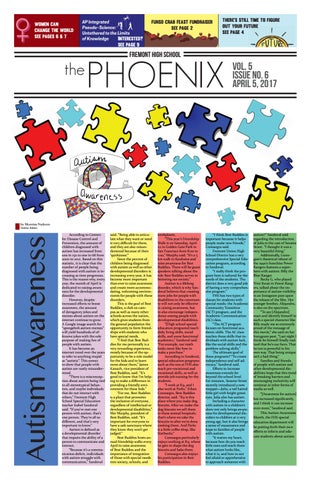
According to Centers for Disease Control and Prevention, the amount of children diagnosed with autism has increased from one in 150 to one in 68 from 2000 to 2012. Based on this statistic, it is clear that the number of people being diagnosed with autism is increasing as time progresses. This is the reason why, every year, the month of April is dedicated to raising awareness for the developmental disorder. However, despite increased efforts to boost awareness, the amount of derogatory jokes and memes about autism on the internet continue to grow. A Google image search for “spongebob autism memes” will yield hundreds of offensive jokes with the sole purpose of making fun of people with autism. It has become an internet trend over the years to refer to anything stupid as “autistic”. This comes to show that people with autism are vastly misunderstood. “There is a misconception about autism being tied to all stereotypical behaviors, and maybe individuals that do not interact with others,” Fremont High School Special Education teacher Isabel Sandoval said. “If you’ve met one person with autism, that’s one person. They’re all so different, and that’s very important to know.” Autism is defined as a developmental disorder that impairs the ability of a person to communicate and interact. “Because it’s a communication deficit, individuals with autism struggle with communication,” Sandoval
said. “Being able to articulate what they want or need is very difficult for them, and they are also misunderstood because of their ‘quirkiness’.” Since the percent of children being diagnosed with autism as well as other developmental disorders is increasing every year, it has become more important than ever to raise awareness and create more accommodating, welcoming environments for people with these disorders. This is the goal of Best Buddies, a club on campus as well as many other schools across the nation, which gives students from the general population the opportunity to form friendships with students who have special needs. “I find that Best Buddies for me personally is a very rewarding experience, mostly because of the opportunity to be a role model for the kids and to learn more about them,” James Kanuch, vice president of Best Buddies, said. “It’s good to know that I’m helping to make a difference in providing a friendly environment for these kids.” “For me, Best Buddies is a place that promotes the inclusion of everyone, regardless of intellectual or developmental disabilities,” Mei Murphy, president of Best Buddies, said. “It’s important for everyone to have a safe sanctuary where they know they won’t get judged.” Best Buddies hosts annual friendship walks every April to raise awareness of Best Buddies and the importance of integration of those with special needs into society, schools, and
workplaces. “This year’s Friendship Walk is on Saturday, April 22 in Golden Gate Park in San Francisco from 8:00 to 1:00,” Murphy said. “It’s a 5 km walk to fundraise and raise awareness for Best Buddies. There will be guest speakers talking about the role Best Buddies serves in bettering our society.” Autism is a lifelong disorder, which is why Sandoval believes that creating more jobs for people with disabilities in the community will not only be effective in raising awareness, but to also encourage independence among people with developmental disabilities. “[High school special education programs] teach daily living skills, social skills, and some functional academics,” Sandoval said. “For example, our math looks more like how to make a purchase.” According to Sandoval, special education programs such as the one at FHS also teach pre-vocational and vocational skills, as well as provide job training for the students. “I work at K9, and I also work at Perks,” Ethan Consuegra, Best Buddies director, said. “K9 is this place where you make dog biscuits. After we make the dog biscuits we sell them to these animal hospitals; that’s where we take the biscuits to after we’re done cooking them. And Perks is a little coffee shop, like Starbucks.” Consuegra particularly enjoys working at K9, where he gets to shape the dog biscuits and bake them. Consuegra also enjoys his participation in Best Buddies.
“I think Best Buddies is important because it helps people make new friends,” Consuegra said. Fremont Union High School District has a very comprehensive Special Education program, according to Sandoval. “I really think the program here is tailored for the needs of the students. The district does a very good job of having a very comprehensive program.” FHS has two types of classes for students with special needs: the Academic Community Transition (ACT) program, and the Academic Communication (AC) class. “The ACT program focuses on functional academic skills. The AC class teaches those skills that individuals with autism lack, like the social skills and the problem solving skills.” The ultimate goal of these programs? “To create independence and self advocacy,” Sandoval said. Efforts to increase awareness extends far beyond the school level. For instance, Sesame Street recently introduced a new muppet—Julia, a red haired little girl with bright green eyes. Julia also has autism. Including a character with autism in a children’s show not only brings awareness for developmental disorders to children at a very young age, but it also brings a sense of reassurance and hope to families of people with autism. “It warms my heart, because how do you reach little ones and teach them what autism looks like, what it is, and how to not feel afraid or apprehensive to approach someone with
autism?” Sandoval said regarding the introduction of Julia to the cast of Sesame Street. “I thought it was a very beautiful thing.” Additionally, Lionsgate’s theatrical reboot of the 1990’s franchise Power Rangers features a superhero with autism: Billy the Blue Ranger. Becky G, who played Trini Kwan in Power Rangers, talked about the importance of autism visibility in an Instagram post upon the release of the film. Her younger brother, Alejandro, is also on the spectrum. “To see [Alejandro] react and identify himself in such a special character like Billy made me so extremely proud of the message of this movie,” she said on her Instagram post. “Last night I think he himself finally realized that he’s our hero. That he too is powerful in his own way. That being unique isn’t a bad thing.” Families and friends of people with autism and other developmental disabilities hope that this trend of breaking barriers and encouraging inclusivity will continue in other forms of media as well. “[Awareness for autism] has increased significantly, and I think it can increase even more,” Sandoval said. This Autism Awareness Month, the FHS special education department will be putting forth their own efforts to inform and educate students about autism.
News
April 5, 2017
2
FHS Auto Tech race team is building a rail dragster by Andrea Lanfranconi Lead Photographer
Mysterious things are happening behind the door of the Fremont High School Auto Shop. Under the approval of Teacher T. Vorghin, a select group of students in the Fremont High School Automotive Technology program is constructing a rail dragster. A dragster is a specific type of race car meant to accelerate to high speeds in a short amount of time and travel in a straight line. Specifically, the team’s creation is based on a 1950’s rail dragster. The gasoline fueled V8 engine will be mounted in front of the driver following the traditional rail dragster model. The idea for the rail dragster came from FHAT student Jacob Helms. Currently, he is a senior at Cupertino High School. Through the district exchange program, he was able to take the Automotive Technology class at Fremont. Jacob is the leader of this project and manages everything from production to sourcing out parts from retailers and auto shops around the Bay Area. There is strong reason to believe that the Fremont
Union High School District wants to remove the auto shop program from the Fremont curriculum due to increasing costs and low demand for the class. Jacob and his team want to show that students are still very much active in the program and wish to continue to support it. The rail dragster is meant to show off the diverse portfolio of skills that the auto shop students have. Some examples seen on the project are: vehicle inspection and safety standards, frame design, welding and engine block deconstruction and reconstruction. Although the rail dragster is meant to be a capstone project for seniors, most FHAT students are very enthusiastic about the project. It is a great way to involve students and have them apply all of their knowledge. The group is thriving under the close supervision of Vorghin. He is in charge of balancing the budget, motor rebuild and mentoring. Vorghin has helped the students realize that teamwork will help them team finish on time. This philosophy reflects across the whole team. According to Helms,
“If somebody is not doing anything on their car, they help me out,” Helms said. “Whoever can, helps the team so that we can finish on time for May.” Senior Davide Lanfran-
Staff Writer
As the end of the year arrives, it is no surprise that the school planning for the construction that will occur over the summer. Two years ago, it was the cafeteria that went under construction to become the better building it is now. Beginning this summer, Fremont will undergo construction to remodel some of its buildings for a new design and more classrooms, as Fremont is expected to grow in student population. According to Fremont’s principal Bryan Emmert, “[The construction] will increase the number classrooms on campus [...] the 120s and the 140s will be coming down this summer. So, it’s going to be a new two-story building that’s going to go right there. It’s going to have classrooms, two regular science labs, two special education science labs, an ASB room, a journalism room.” Such changes could be beneficial
when they are finished since the new rooms will add classrooms.. The added classrooms will also allow for a more balanced student to teacher ratio. The new buildings are expected to be more appealing and practical than the ones at Fremont now, but this construction is also expected to take a while. “If they build it the way they design it, there’s going to be a walkway between the upstairs of the B-building and the upstairs of the new building,” Emmert said. “The expectation is that it will take a year and a half.” Although the buildings are expected to be interesting with a unique design, the time frame of the construction will be problematic for some time. Construction—although beginning this summer—will continue through-
Drawings by Anubha Gupta
ideas. We are rebuilding engines around the shop and selling miscellaneous parts to create our dream.” It is not easy to build the whole vehicle from scratch. Students that
Andrea Lanfranconi | The Phoenix
FHS construction by Emmanuel Ramirez
coni explained the how the students are financing the project. “Money is tight,” Lanfranconi said. “But since we really want to build this, we had to come up with some
out the next school year and so forth. Since the construction will cut into the school year, classes affected will have to move into other classrooms, making rooms more packed until the construction is finished. Emmert noted, “Construction’s always hard, so next year’s going to be a little difficult cause classes are going to be tighter [...] more classes during seventh so we can maximize our room usage.” Essentially, the “tighter” classes will result in more seventh block classes for students. Of course, some students might find it disappointing at their high chance for a seventh block next year, but it is all in the struggle to help Fremont grow and expand. As the changes will essentially begin next year, the real outcome will not come for another year and a half. However, the outcome will be something to look forward to as Fremont progresses to innovate its campus.
are constructing the rail dragster have several goals for their project. The first is to complete it together in a safe and efficient way. The students have learned from past mistakes and other drag racers that safety is the biggest priority. The second goal is to be able to create a historically accurate rail dragster. The inspiration for the dragster came from old photos that Helms found. The reasoning behind the 1950’s styling is to create a vehicle that not only races and performs at a high level, but also looks pleasing to the eye. The vehicle is being constructed from scratch with parts from all sorts of sources. Generous auto body shops and auto dealerships have sponsored the project. Whether it be bending steel tubes for the roll cage or fabricating body panels, it is very much a team effort. The third goal for the rail dragster is to race it. The upcoming race is the Eagle Field Runway Drag Race on Saturday May 20 2017. The students plan to travel and stay for the weekend to race and learn from other groups, teams and enthusiasts about drag racing.
FUHSD crab feed by Thomas Poplowski Staff Writer
The Crab Feed is a yearly fundraiser run by the Fremont Union High School District to help support all five schools of the district: Homestead, Monta Vista, Cupertino, Lynbrook, and Fremont High School. This year, the event occurred on March 31 at De Anza College. Tickets to get into the event and dine had cost around 55 dollars and the proceeds from this event will be used to support FUHSD schools. The fundraiser is run by a variety of people across the district who volunteer their time to help the district and schools. “Volunteers from places across the district, current parents, alumni, and district office staff that sit on the board of the foundation and organize the event,” said Brian Emmert, principal of Fremont High School. The Crab Feed event raises money by selling tickets and hosting auctions for jewelry and other items. The money earned by the Crab Feed fundraiser goes to electives and extracurriculars like athletics, the business department, drama and printing newspapers for journalism. Funds raised also go to student resources such as School Loop
and Naviance as well as miscellaneous things like the student planners given out every year and new computers. The event also goes into funding clubs at the schools, like Future Business Leaders of America and Robotics. Fundraising during this event goes a long way in helping the district pay for things that enrich the student experience. The event itself was also a fun time, being a tradition for upwards of two decades. “The food’s usually pretty good, it’s not super expensive, and it really does mean a lot in terms of the foundation’s efforts to support all the schools,” said Emmert.
News
April 5, 2017
3
Teacher Milestones
the
by Caroline He & Miranda Kushner
PHOENIX
News Editor & Staff Writer
Joseph Howard is a music teacher at FHS. He went to Lynbrook High School and later San Jose State University to pursue his degree in music, where he met his wife. Howard initially planned on going into ministry because his religion is very important to him, but later decided to teach because he saw that it was more meaningful, even advising the Brothers and Sisters in Christ club at FHS for 25 years. The most important lesson he wants to pass onto students is that it’s more important to be a good person than a talented person. In his free time, Howard spends time with his family and plays the piano
Editor-in-Chief Maggie Bernauer
Managing Editor Emily Wright
News
Caroline He
Arts & Entertainment Manavi Chandra
John Magee is a Biology teacher. He went to the University of Hull in England. His favorite things about Fremont are his salary and the atmosphere. He chose to become a teacher because he did not have a very good school experience and wanted to do better for the next generation. He hopes that his students find things that hold meaning for them through the lessons they take away. In his free time, he likes to ride his bike and read science fiction.
Sports
Michael Wang
Opinion
Dana Nissan Hannah Butay Center Spread Mira Dhingra Nadia Anees
Ann Marie Trione is celebrating her 25th year at Fremont as a Physics teacher. She got her two year degree in Electronics from Foothill Junior College and later attended Universities such as Stanford, Notre Dame and San Jose State. Trione initially planned on pursuing her PhD in Physics, but later decided to become a teacher after remembering her own hysics teacher in high school. She recounts that the teacher was less-than-stellar and that motivated Trione to become a teacher to show students how exciting Physics can be. In fact, the biggest lesson she wants to pass down to her students is that Physics and learning can be fun. Trione most enjoys the diversity in FHS and interacting with students. She hikes and reads in her free time. Photos courtesy of Freepiks and Miranda Kushner & Caroline He | The Phoenix
Current Events by Sophia Agha Staff Writer
World News
-According to The New York Times, an attacker wielding a knife staged an attack outside of the British Parliament. At least 5 people were killed, along with 40 more injured during the situation.
U.S. News
-According to BBC, President Trump has signed an executive order that will undo rules concerning climate change put in by Obama.
Fremont High School News
-The Fremont Winter Percussion won the Fremont Show that took place on March 25 with a score of 83.85.
California News
-According to The New York Times, Los Angles mayor Eric Garcetti is defying President Trump’s signing of an executive order taking away federal funds from sanctuary cities, Los Angeles being one of them.
New finals schedule for Fremont High School by Chirag Bhatia Staff Writer
In an attempt to help counter the stress that students have during finals week, FHS has made a few changes in the schedule for the second semester finals in 2017. The most significant change in the new schedule is the later start time. As opposed to the 8:10 A.M. start time that was in effect for first semester
finals, the start time has now been changed to 9:00. This is in the hope that students will be able to get more sleep. A common problem during finals is that students will do last minute cramming and stay up late to study, but then wake up very early to taking their finals. This lack of sleep can take a serious toll on students’ mental health and test scores.
Later start times allow students to sleep in so they can take their final exams with an adequate amount of rest, which can improve test scores. The new finals times will be from 9 AM to 1:45 PM, with a 20 minute brunch and a 40 minute lunch in between. The other change in the schedule is that instead of finals week starting on Tuesday of Memorial week, it will start on the Friday
before, May 26th. This removes the pressure of some students having 3 finals in one day, as seen before in the previous finals schedule. The finals schedule change makes it so that students have more time to sleep, study and rest. This extra time may help students score better on their finals.
Lead Photographer Andrea Lanfranconi Online Momina Nadeem
Staff Writers
Sofia Agha Karla Alejandro Jessalynn Landor Chirag Bhatia Suryan Bhatia Roei Burstein Natalia Etter Cassandra Gines Lexi Kleinberg Miranda Kushner George Luna Claire Lyon Priscilla Martinez Karen Newmark Jenny Nguyen Thomas Poplawski Sophia Pulido Emaan Rao Patrick Ramos Emmanuel Ramirez Vivien Su Sam Tumkur Ambika Vaidya Fremont High School 1279 Sunnyvale Saratoga Rd, Sunnyvale, CA 94087 (408)-522-2400 | fremonthighphoenix@gmail.com Advisor | Emer Martin Mission Statement:
The Phoenix, protected under the California Education code, is a public forum for the students of Fremont High School. The Phoenix staff will publish features, editorials, news and sports in an unbiased and professional manner. The Phoenix is the official student newspaper and is distributed free of cost to the students. The Phoenix publishes eight issues throughout the school year.
Editorial Policy Editorials are the official opinion of The Phoenix. Opinions and letters are the personal viewpoints of the writers and do not necessarily reflect the opinion of The Phoenix. All content decisions are made by the student editors and do not reflect the official policy of Fremont High School, nor the opinions of the administration, faculty, or adviser. Advertise with The Phoenix Contact us for more details at fremonthighphoenix@gmail.com or call at (408)-522-2200. Want to be part of The Phoenix? Letters to the editor and questions for Ask Esteban may be submitted online through our website, room 145, Ms. Martin’s mailbox, or emailed to us. Identities of those who submit questions will remain anonymous. The staff reserves the right to edit letters to conform to styles and policy. Photo courtesy of Fremont High School
Opinion
April 5, 2017
4
Cancellation of biotechnology too rushed
by Caroline He News Editor
The Career Technical Education (CTE) elective Biotechnology is no longer offered at Fremont High School for the 2017-18 academic year. If you were like me, this move by FHS administration might have been disappointing. I wanted to know the reason why administration decided to cancel this class, so I decided to ask. For anyone else interested, this story might help. Biotechnology is a class that provides students an opportunity to apply and learn laboratory skills and more real-world science, like genetics testing and cell division. Biotech is a growing field with many opportunities for students, so why is it being cancelled? Talking to Principal Bryan Emmert and Assistant Principal Jeff Rosado, a big reason Biotech was cancelled seems to be because it is not part of a CTE pathway. A CTE pathway is a series of classes that feed into each other, like Auto Tech, Art 1, Art 2 and Art 3, or Java and AP Computer Science. The problem with Biotech, according to Principal Bryan Emmert, is that it is a single class and does not have a pathway, so it can’t access CTE funds. “We’ve tried in the past few years to see if there was a way to build a pathway, but because of budgeting
and scheduling problems, we haven’t been able to make it into a sequence,” Emmert said. So that sounds logical—no money, no materials, no class. Right? But talking to the Biotech teacher Jennifer Rilea, it’s a lot less simple. “We have not developed a pathway yet here,” Rilea said. “Why they haven’t done anything to develop a pathway? I don’t know. I’ve met with people at the district about developing a pathway, but they’ve always said we need someone in administration to really spearhead the effort.” A big reason these pathways haven’t been implemented seems to be budgetary limitations and scheduling con-
flicts. However, according to Rilea, the Biotech class can be run with little cost to the school, as long as she is more proactive in looking for grants. “I’ve run this class in another school without a lot of money,” Rilea said. “It’s doable.’” To be fair to administration, a specific proposal to how Biotech could potentially be funded has not been created and if it was, would take a lot of effort. Biotech has always been a small class, so it is logical for them to prioritize other things.
From what I understand, creating a CTE pathway for Biotech is feasible, although hard and requiring a lot of time, but for some reason the pathway has just never been carved out. The administration did try to create a pathway, but it didn’t pan out. And now, seeing the declining student interest in that class, they may not want to invest effort in creating a pathway. Another reason Biotech was cancelled may also be because it took up sections that could have been utilized elsewhere, specifically with Java classes. The reasoning goes that
in the past, more students signed up for computer science classes than seats available, so a lot of students didn’t get the class. Biotechnology, in comparison according to Emmert, is not in high demand so they want to replace Biotech with new Java classes. “We look at what kids are signing up for,” Principal Brian Emmert said. “And we can use those two [Biotech] sections for Java, because we know there are kids every year who sign up for that class who can’t get it. This allows us the capacity to do it.” However, Biotech was cancelled this year before student course selection started, so administration had no opportunity of actually measuring student interest for the Biotech class. The decision was based on
past trends. And looking at the general grumbling from students, it seems like many were planning on taking Biotech next year, certainly enough for one class. Freshman Eric Bostrom even started a petition to bring back Biotech for the 20182019 school year, according to Rilea. “I haven’t exactly figured out what I want to do as a career choice, but I know it’s going to be something like Bioengineering,” Bostrom said. “And I just
program, online courses on Khan Academy or Youtube—sophomore Aneesh Goel even started his own nonprofit that teaches coding to high school students. We can learn how to code outside of school, and many do. In comparison, it is much harder to practice gene
Dana Nissan | The Phoenix
thought it was a really cool class, especially since it’s an all lab class.” According to Bostrom, at least 40 people from Fremont have signed his petition to bring back the Biotech class. That is no guarantee that all those 40-some people would have signed up for the class, but it does mean that there is an interest for the course. On top of this, the class that’s replacing Biotech is Java, learning how to code and program. It makes sense for administration to choose to expand this class since they have the capacity to only give half the students who sign up a spot. We are in Silicon Valley after all. But being in Silicon Valley means that we, as students, have a bunch of other choices in how to learn coding. There’s the free Math and Coding
splicing or tissue culturing in the confines of your room. On top of that, losing the Biotech class also means students lose internship opportunities, specifically something called Bridge to Employment internships. As a student, this loss of opportunity is what I’m worried about. Biotechnology, for the students so inclined, is an invaluable experience for their future career choices. Biotech is a unique course. Fremont is—was—the only school in our district to offer this class. But talking to Rilea, this isn’t even what she’s most bothered by. She claims the decision did not come from the science department. “I was in no part of the decision making,” Rilea said. “The science department was in no part of the decision making. It was a decision made by administration. There’s no discussion. This was it: an administrative decision
with no input.” That seems to be the major point of contention. “A lot of people were upset,” Rilea said. “Some of the teachers were upset and I honestly think if parents knew about this, if this class was just cancelled, with no other discussion, they would be upset too.” This move, to me at least, feels a little rushed. Computer Science is the big thing right now, especially in the Silicon Valley, but to cancel an entire course without consulting the teacher before the decision or asking students is they were interested in the class is rash. It could be that there really is no interest for Biotechnology, and those two sections would be better utilized with computer science. There are many students who do want to learn how to code at school. However, because students were not given the chance to express their interest in the class this year, that is left an open question. This seems like an oversight. I’ll frame everything by saying that I don’t want to bash the administration on this. They have hard jobs, make tough but necessary decisions and are doing good overall. While administration always puts the students’ interests first, I still find it important to let them be aware of students’ concerns so that in the future they may be willing to reconsider their decision. Biotech may not be a class next year, but it is still, hopefully, a possibility for future years.
You don’t need to decide on your future yet
by Nadia Anees
Centerspread Editor
Teachers and parents tell us we need to have a good idea of what we want to be in the future now. If we aren’t certain about everything right down to the last detail, we fear we will end up with no direction and no future. All of this causes us stress that we don’t need. In order to avoid this, we must allow ourselves to explore and take our time. Life is not about always having everything figured out. We must experiment, try, fail, succeed and experience as much as we can so that we can get closer to
doing what we want and are meant to do. By experiencing before deciding, we will be able to fully decide and know what we want. Too many times do I come across students in high school or even college stressing over the fact that they must have a perfect idea decision of what they want to do in their upcoming years. This constant stress and concern that we are and will stay undecided even as we enter college is unnecessary and only does harm to our minds. We often neglect to realize that we are still extremely young with a long future ahead of us. School is meant to do more than educate us; it is meant to expand our knowledge but also to gain experience and insight on what topics or activities we enjoy or dislike. Even if you are a senior in high school and do not know what you want to do or become, that is completely okay. You are allowed to give yourself options. Let
yourself try as many things as you can so that you can better understand what you like more. As my history teacher, Jeff Kakes, always tells me, “As long as you’re not underestimating your capabilities, you’re going to be just fine.” In order to make for your future self happy and successful, you must go after what you want to do, not what others expect from you. Major in something you’re passionate about and interested in, not what you think will make you the most money or what your parents want. In the end, the only one experiencing everything you do from here on out is yourself, so make choices at your benefit. Of course, it’s not always easy to find what makes you truly happy. Making decisions that can drive your future in any direction is incredibly complex and difficult. That’s why you need experience as much as you can before you make your final choice. This
Sam Tumkur | The Phoenix
way, you’ve learned enough to know you enjoy what you’ve decided upon and will be content in the future Along the way, you will struggle. You will fail. Maybe you’ll have your heart set on something, only to
realize that it isn’t really what you want. Or maybe you’ll work your hardest to be the best and end up in last place. Being confused, unsure and afraid is normal. It’s okay to switch around until
you really know what you want. As long as you are putting in effort to try and see what works best for you, you’re doing the right thing.
Opinion Accepting everyone’s different beliefs 5
April 5, 2017
by Karla Alejandro Staff Writer
Have you ever been afraid to share your opinion with someone you knew didn’t think the same as you? In today’s generation people need to be very cautious in what they believe and say. Many people today cannot share their beliefs due to the fear of judgement and disapproval among society. Topics like gay marriage, abortion or even the presidential election have brought division among people. The fear is that the tension and disagreement among people will lead to
treating others poorly and even violence. In recent interviews, Fremont students of different beliefs said themselves how they are affected and treated for their individual beliefs or different moral standards. Our high school students are full of diverse minds and different beliefs, like our former Fremont Senior Ana Vazquez. She says that she has been harassed verbally and physically for what she has stood up for. Vazquez supports the LGBTQ+ community and abortion rights. “I’m always told I am too political, even though I know that I still have much to learn about politics,” Vazquez said. “They don’t understand that being political or not is not an option when you are a person of color or a female or LGBTQ+ or of low income.” Other Fremont students, who did not want
their names to be revealed, commented on not supporting LGBTQ+ rights or abortion rights. “I have been judged for what I believe in, so now I just don’t comment on my opinion in fear of being judged and put down by other peers,” said one student. They say that not supporting what everyone else supports makes them feel different, but it’s what they believe. People should have the liberty of believing what they believe. They should not discriminate against other’s beliefs, but respect them. Both sides agreed that everyone does not need to agree with them. Ana says “Diversity of opinion allows us to learn to be empathetic,” Vazquez said. “It is not only important for us to tolerate the ideals of others, but also to genuinely honor the differences. In the United States, we have 1st amendment
rights: We are entitled to freedom of religion, as well as freedom from religion; We are allowed to speak our minds; If someone speaks his/her mind and if I disagree, I still commend him/ her for exercising the first amendment.” On the other side of the spectrum, the other student still agrees with the fact that there does not need to be complete agreement. “Absolutely not, people do not need to agree with me,” another student said. “But opinions should be respected we shouldn’t feel scared to share what we believe.” Many issues divide our generation sensitive, for example, the Black Lives Matter movement or Colin Kaepernick’s decision to kneel during the national
anthem which have been controversial topics dividing our nation. Ideally, both sides do have friends who disagree with their beliefs but maintain a friendship because everyone believes different things and that’s completely okay. People will not always believe what you believe,
and that’s alright. Accepting others opinions will allow people to put aside their differences and embrace a world where everyone is different.
Karla Alejandro | The Phoenix
Rap or rape: what is your money supporting?
by Lexi Kleinberg Staff Writer
It’s safe to say we all know what happened between hip-hop artist Chris Brown and pop superstar Rihanna... If you have no recollection of this I’ll sum it up for you: In early spring of 2009, Brown was arrested and charged with two felonies after brutally assaulting Rihanna, who was his girlfriend at the time. With a current net worth of $30 million, according to BankRate, it seems that Brown’s violent attack on Rihanna has had very few lasting consequences on his career. Since 2009, Brown has gone on to produce five albums, sell out shows and have multiple singles on the Billboard top 200 chart. This begs the very important question: why do we as consumers continue to endorse artists who have history with sexual abuse and domestic violence? While there are many rappers making positive strides in the music community, there are also artists who abuse their platform and privilege to escape their own actions. Sexual assault and domestic violence has become an issue in the rap community that can no longer be ignored. What many listeners tend to forget is that we are the consumers who continue to fuel
these often problematic rap careers. It’s our money that buys new singles, debut albums, concert tickets, merchandise. With the power ultimately in the listener’s hand, the importance of rape and violence against women is also in our control. Never has there been a more important time to take into consideration an artist’s moral actions over their music popularity. To understand how much consumers are in control of emerging music careers it’s important to grasp just how much money spent pur-
usually priced around $9.99. While that amount may seem relatively small, think about how many albums are sold. That number can reach the millions. Ask any teenager in the Bay Area and they will probably know who Kodak Black is. In October 2015,
that Kodak has been charged with sexual assault, which not many of his fans find important enough to discuss. Facing the sexual assault suit, the rapper posed a $100,000 bond and was released. Despite the rape accusations however, in February 2017, Kodak Black was able to release the song “Tunnel Vision”. The
The Florida native is only nineteen years old but has gained popularity amongst young adults and the rap community. His biggest song, “Look at me” peaked at #70 on the Billboard Hot 100 after being re-released in early 2017. According to Genius, the rapper was arrested in July of 2016 on charges of aggravated battery of a pregnant woman. Even if the rapper has a violent history, why is his music more important than his moral character? When purchasing artist’s songs, why don’t we think about
Karla Alejandro | The Phoenix
chasing music actually affects an artist. In 2010, data journalist and information designer David McCandless published an infographic showing how much musicians earned from online sales. On iTunes only, a signed artist will make approximately $2.30 off a single album purchase
Canadian rapper Drake posted a video of himself dancing to one of Kodak Black’s songs, “Skrt”, which helped him gain popularity. According to Billboard, shortly after Drake’s video, Kodak Black signed a deal with Atlantic Records. More important than his music however, is the fact
song debuted at number 27 and peaked at number 6 on US Billboard Hot 100. The money used to bail Kodak out didn’t fall from trees; it probably came from the thousands of people downloading his songs and buying his concert tickets. Another new rapper to emerge is XXXTentacion.
the women that have been assaulted? Put yourself in their shoes, if you were assaulted or violated, would you want to see and hear your attackers songs being played while unsympathetic listeners sing along? Many people might say “it’s not about the person it’s about the music” While I do
agree that there is probably very little thought that goes into buying a song or tickets for a show, when the consumer spends their own money on an artist, they are paying for an artist’s lifestyle. Rapper’s diamond chains and fancy cars are paid for with your $1.29. This extreme wealth only adds to the entitled feeling that grows with unrestricted privilege and luxury. In reality, if they weren’t famous, rappers would face serious consequences. Instead, they get a quick slap on the wrist so they can return to more pressing matters: recording forgettable rap songs and selling concert tickets. We glorify these new rappers because they are a product of a growing rap culture. The success, money, luxuries, and fame only add to the constant praise. But underneath the glorification, they are people just like you and me, trying to make a living. Instead of working in an office, they chose music, a career path that relies on the listeners’ money to succeed. As the consumers of the products of the rich and famous, we need to take responsibility of the people we endorse and the careers we enable. Instead of blindly purchasing music, take into consideration the artist’s background and what they stand for. Kodak and XXXTentacion many be in jail, but their careers are not over. The success of abusive rappers trivializes violence agaist women. Remember that even though their success will grow and thrive, the rape, violence, and assault is still there, underground and overshadowed but still there.
Special Feature
APRIL 5, 2017
6
WOMEN’S HI
THE POWER IN EDUCATING WOMEN by Sophia Pulido Staff Writer
In developing countries such as Cambodia, Pakistan and Nepal, education is not provided for women. In many cases, a young woman is married off to a man who is more than twice her age and spends the rest of her life fulfilling her husband’s needs. It’s hard to swallow the concept that some women get killed for expressing a desire as seemingly innocent as getting an education. From elementary school through college, many books students read are written by and about men. Women were not part of the culture, not only due to exclusion, but also due to their fear of never being good enough. At best, women have been traditionally viewed as support for men. At worst, women are seen as feeble, unintelligent, uncreative, or not strong enough. A mindset like this can be detrimental to the advancement of equal education for women. Instead, women are forced to dedicate their lives to pleasing a man who does not see the true worth of a woman. Education gives you something profound, namely, confidence. I feel
that it is very important for women—that they can hold their own and that it gives them the assurance to do things in life. The message that women are not good enough has settled insidiously into the minds of our growing generation. At FHS, there are opportunities for strong women everywhere, but it seems as if the women who have the potential don’t see it because they often devalue themselves due to cultural pressures. We cannot afford to cripple our chances of survival by refusing to empower half of our species.
We need them, we need their stories and we can’t get those stories unless they’re empowered through an education to identify their voice... and share their voice around the world Anastasia Zamkinos
edies of our world’s history has inspired women to become powerful enough to ensure those tragedies don’t happen again. At FHS, Anastasia Zamkinos, a World Literature and Story and Style teacher described her belief that giving everyone proper, equitable education around the world is the best way to make the world a better place. “There are a lot of very phenomenal thinkers out there that I am very relieved we have, like Malala Yousafzai or Marjane Satrapi,” Zamkinos says. “We need them, we need their stories and we cannot get those stories unless they are empowered through an education to identify their voice, express their voice and share their voice around the world.” Providing education that values the contribution of women would allow our society to evolve from the damaging patriarchal system that favors men in order to help us, as women, reach our full potential.
Women have always had the trait of being passionate, and the passion first starts in the classroom. Learning about the trag-
CELEBRA
WOMEN CAN CHANGE THE WORLD
THE FACES OF WOMEN WHO HAVE IMPACTED THE WORLD
Photos courtesy of The New York Times, The Freeman Institute, Genius, Venngage, History Hole, Super Soul Sunday, Find A Grave, Notable Biographies, Eco18
1848 Seneca Falls Convention: Women’s rights convention led by elizabeth cady stanton and susan b anthony that established the declaration of sentiments
1869 Creation of the National Woman Suffrage Association by Stanton & Anthony as well as the American Women Suffrage Association by Lucy Stone & Henry Blackwell
1890 The two aforementioned organizations combine to form the National American Woman Suffrage Association (NAWSA)
1903 National Women’s Trade Union League advocates for improved wages and working conditions for women
1916 Margaret Sanger opens first U.S. birth-control clinic in N.Y. Although the clinic is shut down 10 days later and Sanger is arrested, she wins support through the courts and opens another clinic in 1923
1919 The Federal Women’s Suffrage Amendment, written by Susan B. Anthony in 1878 is passed by House of Representatives and Senate
Special Feature
april 5, 2017
7
ISTORY MONTH:
ATING WOMEN
POP-CULTURE: DEGRADATION OF WOMEN by Vivien Su Staff Writer
“Ugly,” “inferior,” “animal,” “insecure”—scars that burn for a lifetime. The media’s outlook on women has not been an easy journey, to say the least, but the real question is if actual progress has been made. Have women really received the change that they deserve? Different is not dangerous— but women are constantly beaten down because of their uniqueness. Unfortunately, what many do not realize is that gender equality has still not been achieved—such an issue is driven heavily by the present media and pop culture. Many today are unaware of the undermining messages that lie hidden within current songs. Often times, the beat and the music itself distract listeners from the true meaning. In fact, most popular songs are filled with demeaning lyrics that many fail to recognize Take Robin Thicke’s 2013 pop hit, what many consider to be his one-hitwonder, “Blurred Lines.”One
of the verses reads, “Okay, now he was close/Tried to domesticate ya/But you’re an animal/Baby, it’s in your nature.” These lyrics imply that women have an animalistic nature and are domesticated by “men.” Being described as an animal has negative connotations. Furthermore, it is expressed that women belong to men because they have “control” over women, when in reality every individual is owned by themselves and degrading their worth is immoral. Of course, the catchy tune conceals that, as well as the fact that many listeners do not process what they listen to. Jason Derulo’s “Talk Dirty to Me” is another example. In the chorus he sings, “Been around the world, don’t speak the language/But your booty don’t need explaining/All I really need to understand is/When you talk dirty to me.” His words indicate that a woman’s body is the only thing valuable about her. Nothing else matters, but in reality women have so many gifts that are often overlooked. But
this undermining does not stop in songs; in fact, it is on every TV screen. The beauty standards for women have dictated their actions to deadly extremes, like skipping meals to get a thin waist. That’s why disorders like anorexia exist, as they come from a place of low self-esteem. What is concerning is the everyday instances that corrupt many women’s self images. The common perception is that if a woman applies an excessive amount of makeup, she is insecure, but not using enough makes her ugly. How these beauty standards come to life are hidden “behind the scenes.” Photoshop, and editing software, serve as a great modifier. What most women are unaware of is the plasticity that surrounds them. The average woman looking at these images witness extremely impossible physical features like thin necks, thin waists, and much more. Therefore, they subject themselves to standards that are not humanly possible or healthy for them.
By neglecting this, women undergo severe extremes that subject themselves to unforeseen danger. While modeling is a legitimate profession, the media should further caution their impact on their audience. It is saddening that the kind of environment that surrounds women today is so judgemental—enough is never enough. Nowadays it seems impossible to eliminate judgement. Imagine a world where a woman could be who she wanted to be without fitting other’s expectations. If the media had a healthier effect on women, women could all feel comfortable in their own skin. To every woman out there: Outsiders will prevail to judge, without knowing the bigger picture, and it is a matter of response that resonates strongly. Society has to change but women can’t count on that. So do not let the media crush your confidence. Beauty exists in character so why change the perfection that already lies within?
on politics, serving as Britain’s first woman Prime Minister for 11 years, during which time she earned the nickname “The Iron Lady,” a connotation of a strongwilled, determined woman. In 1954, a bold, determined African-American woman named Rosa Parks refused to get up from the a “Whites Only” bus seat. According to History.com, her unjust arrest triggered a revolution which became known as the Civil Rights Movement. From a teacher being the only suitable occupation for a woman to have, women’s roles have come up a long way since Blackwell’s time. As more women appear in the media and their stories and actions are
shared around the globe, the world is being shown just how capable and powerful a woman really is. Today, women can be seen as lawyers, doctors, lawyers, journalists, athletic directors, and even soldiers. Women are no longer portrayed as doting housewives throughout much of the world. In today’s world, a woman has the opportunity to fulfill any role she wants, without being discouraged or scoffed by society; all thanks to the Suffragette Movement, born as a small convention in Seneca Falls, New York.
Sam Tumkur | The Phoenix
SUCCESSFUL WOMEN THROUGHOUT HISTORY by Ambika Vaidya Staff Writer
A young girl in the late 1800’s or early 1900’s was most likely to have a day filled with housework, chores, maybe a few hours or so of basic schooling, leisure time of needlework and then, a night’s rest. However, as a girl got older, the amount of learning decreased and family responsibilities increased. An independent, unmarried woman could teach for an occupation, but courting and family responsibilities held the highest rank. As soon as a woman was married and started a family of her own, she had a new occupation: being a caring wife and mother. Centuries before wom-
1920 the 19th Amendment was Signed into constitution and gave women the right to vote
en gained their right to vote, a young Italian noblewoman named Elena Cornaro Loredan Piscopia became the first woman to graduate from a university. According to Biographies of Women Mathematicians, she also earned a PhD, in 1678. However, just because decades passed did not mean that women’s roles in the world changed. Most women still assumed the role of the loyal daughter, wife and mother. A British woman named Elizabeth Blackwell broke tradition by becoming the world’s first female doctor. According to Biography.com graduated from Hobart College in 1849 with a degree in medicine and worked her way to shape her life. Along
1936 Information regarding contraceptives is now uncensored in the mail and birth control information is no longer inappropriate.
with Clara Barton, Blackwell treated wounded soldiers during the Civil War. A strong, independent woman, Blackwell never married and thought that courting “games” were foolish. A mere 22 years after Blackwell had made history, a young American named Arabella Mansfield was admitted to the Iowa bar and became the world’s first female lawyer in 1869. As stated by Biography.com, Mansfield was also a suffragette, a woman who fought for women’s rights, and was a colleague of Susan B. Anthony. Unlike Blackwell, Mansfield was a married woman; her husband supported her quest to study law. The world’s first female
1942 American Birth Control League evolves into the Planned Parenthood Federation of America, which funds abortion and helps pregnant women obtain abortion
head of government was, for a change, not white. According to Biography. com, in 1960, Sirimavo Bandaranaike became the first female Prime Minister of Ceylon, now a part of Sri Lanka. She served as Prime Minister for three terms, her last term ending in 2000, shortly before her death two months later. The role of the Western world’s first female Prime Minister was taken by Baroness Margaret Thatcher in 1979. According to British Broadcasting Corporation, Thatcher came from a poor family as her parents were grocers. However, with education and hard work, Thatcher graduated from Oxford with a degree in chemistry. She later focused
1960 The Food and Drug Administration approves birth control pills
1973
1992
Roe vs. Wade: Supreme Court case that gave women the right to abortion
Planned Parenthood v. Casey: Supreme Court reaffirms validity of a woman’s right to abortion under Roe v. Wade.
Timeline compiled by Mira Dhingra and Michael Wang
Arts & Entertainment 8
FHS TATTOOS by George Luna
Staff Writer
“I think being out here has made me more confident in my choices to have them [tattoos], and I was so much more apprehensive when I lived there. I think being in this environment has made me more confident, so I would wear them more confidently.” Patti Dalton, English Teacher
Moris Clark, social science
teacher and athletic director
Clark had always wanted a tattoo since he was young, but did not get one until he was much older because he felt the tattoos should have extreme importance, which he got from his family. The tattoo on his back is one of a scale, indicating his zodiac sign, Libra. On one arm of the scale is the number 53 and on the other is 24, the hockey numbers of his twin brother and of himself. Clark’s number, 24, is slightly heavier than his brother’s in order to symbolize that he will always be there to support his brother. The tattoos on each of his arms are anchors. One anchor symbolizes compassion and the other symbolizes forgiveness. This connects with his belief of “shadow self” and “golden self,” an idea originating from writer Carl Jung. a Swiss man known for his work in psychology.
by Manavi Chandra
Graffiti is the act of spraying paint and illicit content in a public setting without permission. But graffiti art serves as the voice of street art; while it may be illegal and often destructive, graffiti brings art to the streets and many get pleasure from seeing it done well. Graffiti art is most commonly associated with vandalism, which is deliberate damage done to a public property. It is one that has much trouble with legality, yet showcases a kind of artistic expression that would remain silent if not sprayed on the walls. Since much of graffiti art is word-based and graffiti artists are self-taught, there is an honesty in rawness to it that is often not seen in gallery art. But to formally cite
Tattoos are an art form that allows people to permanently express who they are on their bodies. There are countless tattoos that one can get; it is up to the receiver on what they want. Of course, there are inappropriate tattoos that should be avoided at all cost.
Here are some teachers on campus who have shared their takes on tattoo expression:
“The interesting idea about tattoos is that there is no stigma about getting one. I read somewhere that the largest percentage of people who are ‘first-time tattooed’ is my demographic, so there really isn’t anything. If you want to have a tattoo, have a tattoo. The professionalism is what you do.”
Arts & Entertainment Editor
april 5, 2017
the differences between street art and graffiti art, street art is where professional street artists have peaceful intentions behind their act want to connect and showcase their art to the public, whereas graffiti artists solely do what they do for themselves and only themselves. Street art and graffiti flourished during the 1970’s, which marked the rise of urban and hip-hop culture. The artistic phenomenon started out as writing tags on public walls. A tag is the signing of one’s artwork that is more than just a simple signature. Tagging emerged from these two different mediums. In order to make a showcased artwork, graffiti writers often make illustrations called throw-ups, where it is much more elaborate than a tag and it usually done swiftly with two to three colors. Often street artists leave masterpieces on public walls, with great intricacy
“[A semi-colon] also the single form of punctuation that is most equitable in its philosophy because it merges two things that could stand on their own, but instead puts them on an equal parallel plane. I liked that as a symbol of education so this is my commitment to being an educator.” Anastasia Zamkinos, English
teacher
Zamkinos’ first tattoo was the one on her back, which is an imperfect circle. She purposefully made it imperfect because she believed that a perfect circle philosophically implied that she had no ability to impact change on others or was not able to make something different than what it was destined to be. Zamkinos also wanted some blank space in the tattoo so that she could write or draw in it, representing some sort of vessel of creativity on her body. Her favorite tattoo is her “blade of wheat with a blue tint” tattoo. This is a homage and a final farewell to her hometown in Walla Walla, Washington. Before she left, she wanted something to commemorate all the time she spent there, so she and her friends all went to get tattooed. The blade of wheat symbolizes her hometown because it is the main crop. The blue tint symbolizes the Blue Mountains, a beautiful mountain range near Walla Walla. The final tattoo is a green semi-colon on her wrist. While attending Stanford, many of Zamkinos’ favorite authors used the semi-colon a lot. This to her was a perfect representation for her tribute to literature and writing. It is green because the color represents growth, which is a great tie-in with her commitment to being a teacher.
and a wide range of colors. There are many genres of street art, including mosaic tiling, murals, stencil art, LED art and woodblocking. Graffiti and street art are uncommon art mediums that, because of issues with the law, often become suppressed and hidden. The two mediums complement each other; if there is graffiti art, there is street art, and one cannot exist without the other. There will always be fearless people who produce graffiti art, regardless of the legality, because they feel like they need to express themselves without censorship.
Photos courtesy of Texturify, Smashing Hub and Karla Alejandro | The Phoenix
On her back, Dalton has a silhouette of a tree with the North Star above it. The tree symbolizes nature, which plays a very important part of her life. The North Star, a prominent star used in many art forms, is symbolically supposed to guide you home because it shines so brightly that anyone can tell which way is north. Therefore, the tattoo is Dalton’s way of finding her path through nature and making sure it is always with her. Also, on her forearm is a quote from Hamlet saying, “To thine own self be true.” This means to be true to yourself, which has a deeper meaning in Dalton’s life because she was always concerned with what other people would say about her. The quote is a way to remind her that staying true to yourself should be the priority. On her other forearm is a picture of a lily. A lily is very symbolic of rising above your circumstances or environment because this beautiful flower blooms out of the murk and mud. When Dalton started interviewing for jobs, she had already gotten one tattoo on her arm. Really wanting the job and being very nervous about landing one, she decided to cover up her tattoos. Once she acquired a job position, she asked if could show her tattoos at school. Fortunately, they responded “yes” because it was not a distasteful tattoo. Manavi Chandra and Andrea Lanfraconi | The Phoenix
Arts & Entertainment Books hitting a Fremont shelf near you 9
April 5, 2017
by Miranda Kushner
Staff Writer
Alire Sáenz is well-known for his young adult debut, Aristotle and Dante Discover the Secrets of the Universe, and his new novel is just as captivating. The main characters are Salvador and Samantha, two kids who have been best friends their whole lives. When things in Sal’s life take unexpected turns, he begins to question who he really is as a caucasian boy raised by a Mexican family. Just like in the author’s previous works, this one is exquisitely written while telling a believable and moving story about love and family.
Forge and Ashes are the final two installations to the Seeds of America trilogy. They continue to follow protagonists Isabel and Curzon, who are both runaway slaves during the American Revolution. They try to tie up loose ends from their lives in order to truly be free from their pasts; all while America’s war for freedom rages around them.
This is the sequel to the well-received novel Illuminae. It picks up shortly after the first book ends. It follows the same stylistic format as the first installment of the series, telling the exciting science fiction story through various documents. This book features new main characters, but characters from the first book make prominent appearances to help achieve their common goal of overthrowing a corrupt society.
Told through alternating points of view, this book follows the main character, Lily, who has just recently begun her transition from living as a boy to being seen as a girl. She meets Dunkin, a boy with bipolar disorder, who just recently moved from New Jersey. These two kids have to navigate eighth grade, while also dealing with personal problems and changing relationships between friends and family.
Photos courtesy of Goodreads and Vitiello Communications Group
A joke, but not a hoax: APIPS astounds by Suryan Bhatia, Andrea Lanfranconi & L’Angelo Mysterioso Collaboration
Advanced Placement Integrated Pseudoscience (APIPS) is a new class that will be offered next year. Though pseudoscience is classified as a science, it is not shackled to reality and other such nonsensical factors in the same way as, say, Biology. APIPS will benefit students in many ways. “[APIPS] improves your ability to make arguments based on your beliefs; you don’t have to stick to more traditional rules of argumentation,” David Heinke, Bradley Scholten and IHeng McComb, math teachers, said. This class would allow
students to speak their mind and argue whatever they believe, regardless of the facts. Heinke, Scholten and McComb pointed out that students would be allowed to yell. The louder one yells, the more they are believed, and therefore are more correct. APIPS also opens many career opportunities. “[APIPS] opens careers in politics, advertising, marketing and anything to do with Facebook,” Heinke, Scholten and McComb said. Furthermore, students can use the skills they have achieved in APIPS to research more into pseudoscience, uncover the many lies the government has planted and other underserved pseudo-topics. There will be a wide
range of topics discussed in the class. The first semester will feature topics such as: documented scientific advances that came from aliens, scientific hoaxes and astrology. The second semester will feature the science of Star Wars versus the science of Star Trek, the paranormal, super powers and lava. All students are allowed and encouraged to take this class. Heinke, Scholten, McComb and Lorena Villagomez, the College and Career Center counselor, believe that 90 to 100 students are expected to sign-up. Jeff Rosado of the FHS Guidance Department made several comments on the subject of pseudoscience. Regarding the mystery of Heinke’s teaching methods,
Photo courtesy of Gerardo Guerrero
he explained, “There are a lot of questions out there. Is he human, is he not human, you know.” APIPS is the only AP class that is endorsed by the Internet. Surprisingly, the CollegeBoard and the UC system have not currently approved it. Because facts
are misleading, a broader definition of “evidence” will be explored and encouraged. As of March 24, 55 teachers would like to teach APIPS. The omnidirectional vastness of the content is appealing to many, if not all teachers. In fact, the
only teachers who have not put their name in the hat either have a strong shellfish allergy or their pacemaker would have problems with the Vintage Microwave Lab. APIPS is a course that many are enthusiastic to join. You should too.
sports The madness of college basketball in March
April 5, 2017
10
by Patrick Ramos Staff Writer
One of the biggest college sporting events that is not football, is March Madness. It showcases the best college teams in the National College Athletic Association league and the best college players’ talents. The NCAA March Madness was created in 1939 when the University of Ohio defeated Oregon. Throughout its lifespan, the tournament has gained popularity through the increase in many making tournament brackets, according to college sport madness. 68 teams from the highest college level of athletics or Division one teams participate in March Madness. According to the NCAA website, University of California, Los Angeles, or UCLA, currently holds 11 championship titles, the most of any college team even though the team has not won a title since 1995. University of Kentucky has eight, followed by Duke University and Indiana University who both have five titles. Unlike the National
Photo courtesy of Christopher Miranda
Basketball Association playoffs, each team is in a win or go home situation regardless of the round, and there are two halves in college basketball instead of four quarters like in the NBA. The final 16 teams are referred to as the Sweet Sixteen and the last four teams are called the Final Four. The NCAA March Madness tournament started some of the most fantastic rivalries. One of the first
rivalries that was sparked was when Michigan State University guard Earvin “Magic” Johnson and the Sycamores forward Larry Bird faced each other in the 1979 tournament. Michigan State won the final game by 11 points to get its first title. This game would consolidate the rivalry between them as they would face in the NBA finals a numerous amount of times between the Boston Celtics and Los
Angeles Lakers. Another rivalry was formed in the 1982 tournament. In the final match, Michael Jordan playing for the University of North Carolina shot the buzzer beater to give North Carolina the title against Georgetown University. One of the Georgetown players, Patrick Ewing, and Jordan would become rivals later on in their professional careers. The NCAA also brought
attention to some of the most well-known professional basketball players of the modern era. From Stephen Curry of Davidson College who would score 30 to 40 points during the years he played in the tournament, to Carmelo Anthony who won the NCAA tournament for Syracuse in 2003 before entering the NBA draft. Kevin Durant played in March Madness tournament as a Texas Longhorn before his team being eliminated by current Los Angeles Lakers player Nick Young and the University of Southern California. After players attended college they would enter into the NBA draft where the best college players would be picked by the worst NBA teams to revive the team. Players like Kobe Bryant and Lebron James however did not attend college. The NBA in 2006 forced new draft players to be 19 and one year out of high school. So now almost every good high school player will attend college due to this new rule allowing viewers to witness player highlights on a larger scale of college as
opposed to high school. One of the most exciting games in recent years was the 2016 NCAA title game between Villanova University and University of North Carolina. North Carolina was down by three with 13.5 seconds to go, but Marcus Paige scored a three with less than five seconds left tying the game. However, Villanova responded when Kris Jenkins scored a three of their own at the buzzer. This was probably one of the most memorable games in basketball history as both teams played outstandingly in the finishing seconds. As seen throughout its history, the NCAA March Madness tournament allows people to see potential future talents of the NBA like UCLA’s Lonzo Ball and Washington’s Markelle Fultz. Once these players hit the professional league and eventually make it to the NBA playoffs fans are allowed the satisfaction of watching their favorite player’s path to success.
Springing into a new athletic season by Jessalynn Landor Staff Writer
Boys Tennis This year, the Tennis team includes many new members. “This team compared to last year is a lot younger. Last year it was mainly Juniors and Seniors, this year we only have 5 Seniors and a lot more Freshman and Sophomores coming in.” Sophomore Austin Tao, Varsity Boys Tennis Captain, said. Having a larger variety of players within your team can bring a lot of great advantages that can lead to success.
Baseball Having strong dedication to a sport is key to being successful. This is exactly what the Baseball team is focusing on this season. “We’re aiming for a better record than the previous years. There’s more people on the team that have more dedication towards the sport, so it’s more likely that we’re better as a whole in a way” Senior Nick Tognoli said.
Softball
Badminton Setting goals of winning a game is something every athlete keeps in mind when performing his or her sport. The Badminton team has improved significantly from last season, but that does not mean the players’ confidence gets in the way of their working together as a team. “We’ve won a lot more games than we did last season already. Last season we only won one game and so far we’ve won three so that’s a good start.” Senior Mani Movva, Badminton Captain, said.
Compared to last season, the Softball team is making an effort to focus more on team bonding. “Last season, our team wasn’t very close with one another and we didn’t really have established captains, but this year it’s a little bit more organized” says Junior Alyssa Guzman, Softball Captain, said. They are also working toward their goal of making it into CCS this season.
Track & Field With many new athletes, as well as captains, the Track and Field team is putting forth their best effort into making it a great season despite losing a few seniors who made the team feel like a family. “The seniors from last year made us feel welcome and they were really close to everyone in the team, Senior Kate Everhardt, Track and Field Captain said, “so it was really sad to see them go and it definitely feels a lot more empty without them, but we also have a lot of new people and our team is really big this year which is really cool.”
Swimming The swim team this year is a lot more focused on being organized when it comes to communicating and working together. Having good communication is required if one wants to not only build strong relationships with his or her peers, but also be successful as a reliable teammate and leader. “Persevering, being a good leader, working well with other people such as my teammates and communicating with my coaches well are all things that makes me better as a person” Junior Chrissy Steinmeier, Swimming Captain, said. Photos courtesy of FHS Yearbook
sports Event scheduling overlap on March 25th
11
April 5, 2017
by Jenny Nguyen Staff Writer
On Saturday, March 25, Fremont High School hosted two very large events on its campus: the annual Firebird Relay and the California Color Guard Circuit competition. These two events are “facility-heavy”, meaning they take up a large amount of facilities available on campus. While they took place in two separate areas on campus, there was not a doubt that the two events caused an increased sense of hectic-ness on the school grounds. Originally, these events were not supposed to overlap onto the same day. “I just started as athletic director this year, so I’m still learning,” Moris Clark, FHS teacher, said. “A lot of these events didn’t overlap last year but that’s because our seasons have changed so no one knew about the overlap. The leads for both sides scheduled their events but because the seasons were different, last year, it was never an issue back then, but now it is because our seasons moved up a week so everything is affected this year [conflicts are] even more apparent. However, Clark has the confidence that this issue
will not be as noticeable in following years. “From a facilities point of view, you have band which is under a different area of focus and you have athletics which is another area of focus, so that’s one of the things we have to look at for next year. When we look at the large calendar knowing what occurred this year, we can fit things in better. Having that big picture with the two different groups together on that calendar will relieve some of these facility issues and hopefully make things less hectic.”
THE gym entrance is crowded as Winter Perussion groups exit and spectators try to enter the gym
Photos courtesy of Edrian Munoz
PERCUSSION groups walk toward the perfomer entrance, going alongside the track meet.
TURF is filled with Track and Field competitors as they prepare for their events
The second annual Hall of Fame rally by Andrea Lanfranconi Staff Writer
PHIL Kelly, John Dunning and Shauna Harrison (picture left to right) stand side-by-side, waiting to inducted at the second annual Hall of Fame rally Information provided by Jeff Rosado
SHAUNA Harrison, class of 1996, speaks about her experiences as cheer coach at Fremont and pumps up the rally with the “Fremont You Know!” cheer.
Last Friday March 24, 2017 was a memorable day for Fremont High School. Graduates Shauna Harrison, Phil Kelly, and John Dunning came back home to Fremont to be inducted into the FHS Hall of Fame. The first inductee was Shauna Harrison (Class of 1996). Shauna participated in many different activities while here at Fremont. She was Captain of the Varsity cheerleading team and took part in many different clubs. After Fremont, in her freshman year of college, she began to teach Public Health classes. This in turn sparked her interest in helping members of her community. She went on to get her Masters of Art at UCLA in Latin American Studies as well as a Masters in Public Health. Ultimately, she earned her PhD in Public Health at
John Hopkins University. As well as being a super knowledgeable and passionate advocate for personal fitness, she has expertise in the academics of Public Health issues. Harrison is also a small business owner and the creator of SWEATADAY™ and Muscle & Flow. The next inductee was John Dunning (Class of 1968). Dunning is most known for being the Stanford University Women’s Volleyball team coach from 2001 to 2016. While at Fremont, he played basketball for Phil Kelly. He was also a member of the first Central Coast Section basketball championship team in 1968. Dunning came back as a teacher and taught math and became colleagues with his ex-coach Phil Kelly. John Dunning began coaching boys basketball for Fremont
JOHN Dunning. class of 1968, speaks about his contributions to the Fremont Basketball team, both as a player on the team when Phil Kelly was still coaching, and later on as the boys basketball coach.
soon after. In the late 1970s, Dunning moved over to the girls volleyball team and built a powerhouse. His teams won CCS from 1978 to 1983. He was recognized at the university level and then given the opportunity to go coach at University of the Pacific in Stockton. His team won 2 championships in his first 2 years. Soon after, he went to coach at Stanford University in 2001. There, with his team, he won 3 championships and coached future Olympians. He has the second most wins of all time as a college volleyball coach. The last inductee was Phil Kelly (Class of 1957). Kelly was part of the first undefeated basketball team at Fremont High School. He went on to play college basketball at Stanford and immediately came back to
start teaching here. He became a PE teacher. By 1966, he was boys Varsity basketball coach and stayed there until 1990. He coached the first ever Fremont CCS basketball champions in 1968 and all the while continued teaching until the late 90s. Kelly has given back over 30 years to the Fremont community. He contributed in many ways. His team had a great run in 1983 and in 1990 winning CCS, Nor-Cal, and playing in the state finals. He was a legendary coach and people wanted to come to FHS to play basketball for Kelly. It has been 2 weeks after the Hall of Fame rally and the excitement is still in the air. The inductees made a huge impact on Fremont and definitely inspired students today to follow their goals and succeed.
PHIL Kelly. class of 1957, talks about his unparalleled coaching from 1966 to 1990, leading the Fremont Basketball to victory at the first CCS Championship in 1968 and state finals in 1990. Priscilla Martinez | The Phoenix
sports
April 5, 2017
12
Variety of sports outside Fremont High School by Roei Burstein Staff Writer
Sophomores Ellen and Irene Ulitsky are competitive rowers. They were inspired to pursue the sport because their cousin got a scholarship to Havard for rowing, and their older sister Yana rows as well. They say the sport is very physically demanding and one has to be extremely dedicated to succeed in rowing. They wake up at four in the morning to get ready for rowing practice at five every day, for three hours on average. Rowing has made them both physically stronger and more disciplined. “Rowing gives us the mentality where if we can wake up at four in the morning, put in the hard work, and still study well for school, we can do anything,” Ellen Ulitsky said.
Senior Jason Tinajero does boxing outside of school. He started doing it because his uncle is a boxer and got him into the sport. It is a big time commitment for Tinajero, but he believes it is rewarding because it makes him stronger and more confident. “My motivation to continue is trying to beat the boxers that are better than me,” Tinajero said. Boxing helps him relieve stress and anger he has accumulated from the rest of the day. He also enjoys staying active and doing what he loves.
Junior Alys Chang does club swimming outside of school. She has been swimming since she was only six years old. Chang currently does swimming six times a week year round. Swimming has made her a better team player and leader, while also giving her a more competitive attitude. She enjoys the individuality aspect of the sport and how she has to rely on only herself to win her races. “Because swimming is an individual sport, you have to rely on yourself and have to push yourself in order to succeed,” Chang said.
Senior Molly Wilson is a third degree black belt martial artist. She did not really have any interest with sports offered by the school, and convinced her mom to let her take martial arts classes. She now practices four days a week and is almost at her fourth degree out of ten. Martial arts has made her stronger both mentally and physically, and enjoys the challenge that comes with practicing martial arts because it pushes her to give it her all. “It’s [martial arts] that has given me so much more than just physical fitness and fighting and self defense abilities,” Wilson said. “It’s given me perseverance, self confidence, time management skills, and a strong commitment.” Andrea Lanfranconi | The Phoenix
Marcelo Castro dives into role as swim coach by Sam Tumkur Staff Writer
Due to the experiences and drastic changes the Fremont High School swim team went through last year, many swimmers were hesitant about how the 2017 swim season would turn out. In 2016, both head coaches resigned in the middle of the season for unstated reasons, causing the swim team to be in turmoil, halting the season temporarily. However, this season is starting to look better with two entirely new coaches, Head Coach Marcelo Castro and Anna Lee. Head Coach Castro has over 18 years of coaching experience, from the head coach of high school water polo and swim teams to club swimming. Castro has
coached for Saratoga High School and Notre Dame High School and swim clubs like PASA and DACA. Castro became a swim coach after swimming competitively to use his extensive knowledge of swimming to give helpful advice to other swimmers. This is because he believes that a lot of coaches do not have enough experience in swimming to give good advice. “I was competing for a long time and then came a period of time where I thought I could share some of my knowledge with other people” Castro said. “And at one point I saw that too many people ‘coached’ when they didn’t have any experience and only coached because they competed in a couple of races and call themselves coaches. I feel that I could bring
more things to the athletes through my personal experience and my knowledge.”
once you put your face in the water, it’s just you and the element. You get better if you practice and you don’t get better if you don’t, Marcelo Castro Castro’s main goal while coaching his swimmers is for them to not only get good times, but also for the swimmers to like what they do. One of the ways he does this is by encouraging swimmers to get to know each other and compete together as one team rather than many different indi-
viduals. “I like to be approachable, practical and ideally want the swimmers to enjoy the sport. When that happens, the results will follow,” Castro said. “Assigning sets is just a tool to become faster but it’s not the whole picture. Even with competition, I want the swimmers to learn things about themselves that usually can be learned through sports.” Castro believes that there is a certain set of life skills that are obtained by being a swimmer, some of which include self-discipline, perseverance
and resilience. “I want the swimmers to get active and help them find themselves and not only improve on their strokes but improve as people because I think that everything we do in practice are life skills,” Castro said. “I want them to find those things they didn’t think they were capable of before. Sometimes they can’t relate to swimming so having those teachable moments, I think that’s the best part of coaching.” Although coaching athletes has it’s bright moments, it has it’s downsides as well. According to Castro, he believes that students have too
many other commitments to really dedicate themselves to sports. However for those who really commit, swimming can help them push their limits and help swimmers grow as people. “Especially in swimming, once you put your face in the water, it’s just you and the element.” Castro said. “It’s not like a team sport where you may have an un-parred performance and people tend to blame it on someone else on the team. You get better if you practice and you don’t get better if you don’t, it’s simple as that.” With an experienced and dedicated swim coach like Castro, swimmers can rest assured have an enjoyable season, while also getting faster and growing as people.
Andrea Lanfranconi | The Phoenix