+1 866 280 0494
info@freightoscope.com
HOME
ABO U T
FE ATU RE S
P RO DU CTS
NE W S
CO NTACT U S
FREE TRIAL
LOG IN
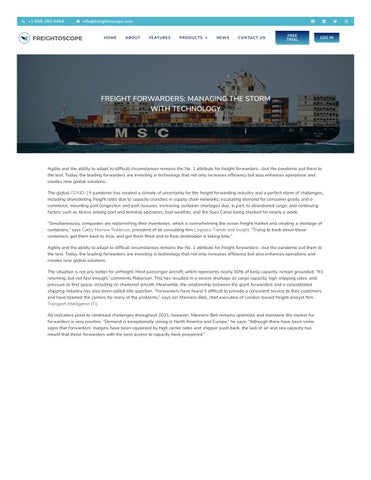
FREIGHT FORWARDERS: MANAGING THE STORM WITH TECHNOLOGY
Agility and the ability to adapt to difficult circumstances remains the No. 1 attribute for freight forwarders—but the pandemic put them to the test. Today, the leading forwarders are investing in technology that not only increases efficiency but also enhances operations and creates new global solutions. The global COVID-19 pandemic has created a climate of uncertainly for the freight forwarding industry and a perfect storm of challenges, including skyrocketing freight rates due to capacity crunches in supply chain networks; escalating demand for consumer goods and ecommerce; mounting port congestion and port closures; increasing container shortages due, in part, to abandoned cargo; and continuing factors such as illness among port and terminal operators, bad weather, and the Suez Canal being blocked for nearly a week. “Simultaneously, companies are replenishing their inventories, which is overwhelming the ocean freight market and creating a shortage of containers,” says Cathy Morrow Roberson, president of he consulting firm Logistics Trends and Insight. “Trying to track down those containers, get them back to Asia, and get them filled and to final destination is taking time.” Agility and the ability to adapt to difficult circumstances remains the No. 1 attribute for freight forwarders—but the pandemic put them to the test. Today, the leading forwarders are investing in technology that not only increases efficiency but also enhances operations and creates new global solutions. The situation is not any better for airfreight. Most passenger aircraft, which represents nearly 50% of belly capacity, remain grounded. “It’s returning, but not fast enough,” comments Roberson. This has resulted in a severe shortage air cargo capacity, high shipping rates, and pressure to find space, including on chartered aircraft. Meanwhile, the relationship between the giant forwarders and a consolidated shipping industry has also been called into question. “Forwarders have found it difficult to provide a consistent service to their customers and have blamed the carriers for many of the problems,” says Jon Manners-Bell, chief executive of London-based freight analyst firm Transport Intelligence (Ti). All indicators point to continued challenges throughout 2021; however, Manners-Bell remains optimistic and maintains the market for forwarders is very positive. “Demand is exceptionally strong in North America and Europe,” he says. “Although there have been some signs that forwarders’ margins have been squeezed by high carrier rates and shipper push back, the lack of air and sea capacity has meant that those forwarders with the best access to capacity have prospered.”