Frankston City Council (‘Council’) acknowledges the Bunurong people of the Kulin Nation as the Traditional Custodians of the lands and waters in and around Frankston City and value and recognise local Aboriginal and Torres Strait Islander cultures, heritage and connection to land as a proud part of a shared identity for Frankston City.
Council pays respect to Elders past and present and recognises their importance in maintaining knowledge, traditions and culture in our community.
Council also respectfully acknowledges the Bunurong Land Council as the Registered Aboriginal Party responsible for managing the Aboriginal cultural heritage of the land and waters where Frankston City Council is situated.
VICKI THOMAS
Born in Hobart, Tasmania Palawa woman 2 children, 8 grandchildren
Resident of Langwarrin for 30 years
Member of 2020 Frankston City Council Community Panel
ABOUT THE PAINTING
The Gathering Place. Where all mobs can gather to yarn, dance, eat, laugh. A safe place, a restful place.
Purpose of the Community Engagement Framework
The purpose of Council’s Community Engagement Framework (‘Framework’) is to explain:
• What community engagement is and is not
• Council’s commitments to community engagement
• How Council complies with our Community Engagement Principles
• When, where and how we engage with the community
• The roles of staff, Councillors, stakeholders, and the community
The Framework applies to the projects and decisions published on Council’s Engage Frankston website and is guided by Council’s Community Engagement Policy, Sections 55 and 56 of the Local Government Act 2020 (‘the Act’), and International Association of Public Participation (‘IAP2’) as the peak body for the community and stakeholder engagement sector.
Frankston City Community Vision 2040
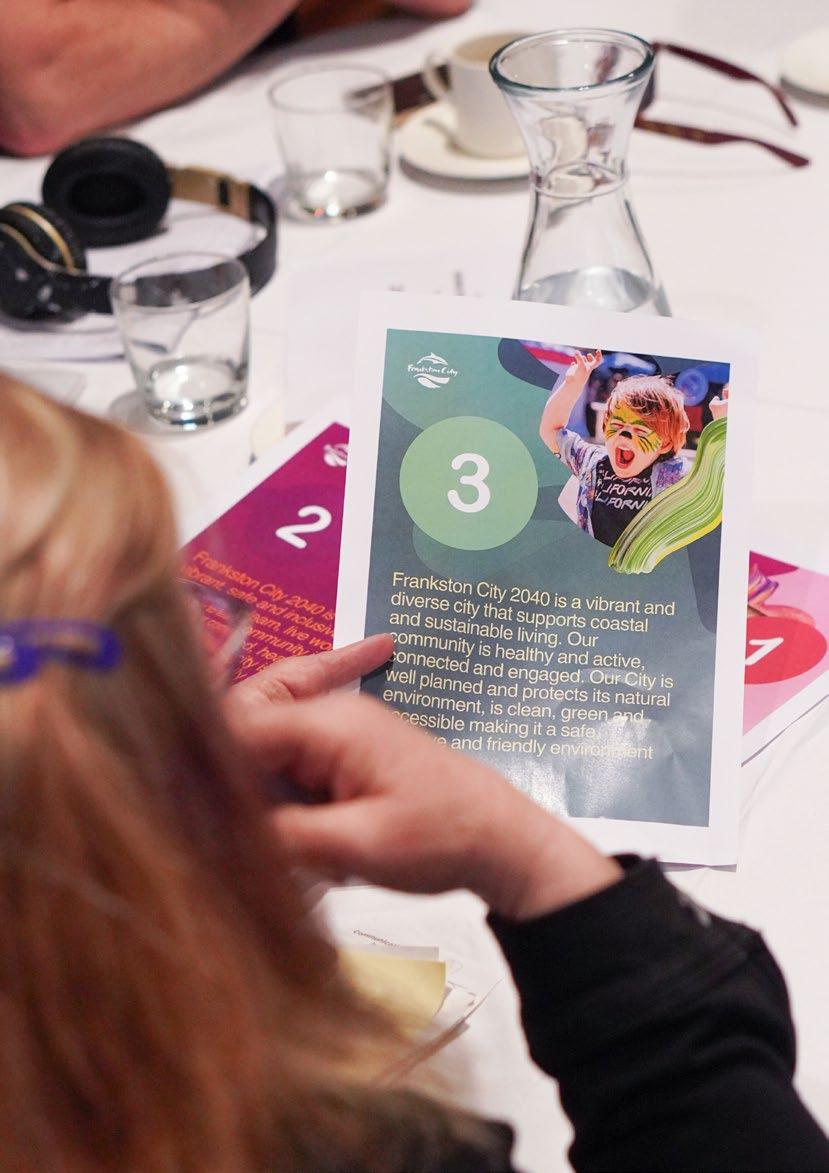
The Community’s vision for Frankston City has been developed by the community for the community and will guide Council’s strategic outlook until 2040. Community engagement plays a critical role in the development, implementation and review of our Community’s vision.
Our Community Vision
“Frankston City is a safe, inclusive and caring community in which to live, work and play. Our vibrant coastal City is clean, leafy, environmentally responsible, well planned, accessible and innovative for a changing future. We are proud, engaged and connected.”
Definitions
Community
Means people who live, work or visit Frankston City who engage with Council as an individual representing their own interests.
Community engagement
Means involving the community in decisions that interest and/or impact them. It includes processes that involve the community in problem solving and/or uses community input to inform decisions.
Community Engagement Policy
Council’s Policy is a formal expression of Council’s commitment to engaging and collaborating with our diverse local community, understanding and incorporating their different views, experiences and expertise.
Council
Refers to Frankston City Council.
Deliberative engagement
Means the deliberative engagement practices capable of being applied to the development of the Community Vision, Council and Wellbeing Plan, Financial Plan and Asset Plan.
The key characteristics of deliberative engagement are considered to be:
• Authentic engagement with the community
• Good representation of the community in engagement activities
• Clear demonstration of how all views have been considered
• Accessible and relevant information available to the community to ensure the decisionmaking process and the community’s level of influence is clear in each instance and that participants are fully informed
• Transparency is key to an effective process
Stakeholder
Means any organisation, political entity, committee, advisory group, individual or group of community members that has a particular interest or stake in the outcome of a decision, and who engages with Council to represent the needs of their organisation, entity, committee or group.
The Act
Means the Local Government Act 2020
Our commitment to community engagement
Council commits to having a planned, visible and inclusive process for how we provide our community with opportunities to influence Council decisions that affect their lives. This commitment applies to all Council community engagement projects, as defined in this Framework.
The commitment includes:
Undertaking early and thorough evidence-based engagement planning, including analysing pre-existing data, gender impact assessments and other demographic insights
Tailoring the level of engagement to suit the needs of each project, from smaller neighbourhood-based to larger municipal-wide projects
Clearly explaining what is in scope for each engagement project and the level of influence available to the community
Using a variety of engagement and promotional methods, tailored to the needs of each project to increase visibility and participation
Engaging in accessible ways that help us understand and include diverse views, experiences and expertise
Genuinely listening and considering community feedback to ensure it can influence Council’s decisions and project outcomes
Evaluating and reviewing engagement projects to ensure continuous improvement and innovation
What IS community engagement?
Community engagement is based on the principle that people have a right to be involved in the decisions that affect their lives1. To Council, this means we give every community member the opportunity to have a say in Council’s decisions.
As a local government organisation, everything Council does affects the people that live, work, and play in Frankston City. From big-picture planning to delivering programs and services, Council’s work is done on behalf of the community.
The Act requires councils to adopt and maintain a Community Engagement Policy, which is developed in consultation with the community, and gives effect to the Community Engagement Principles.
While the Act does not define the type of community engagement that councils must use, it does require councils to use deliberative engagement practices in developing certain documents and processes, including strategic and financial plans. At its core, the Act has the aim of ensuring all Victorians have the opportunity to engage with their council on local priorities and the future of their community.
At its broadest level, community engagement provides Council with the opportunity to:
• Help identify and respond to community needs and priorities
• Develop options for how projects and plans are developed and implemented
• Build community interest and support collective action
• Build understanding between Council and community members
• Enhance the quality of Council’s decision-making and to test thinking
• Support communities who are already engaging with each other
What ISN’T community engagement?
Community engagement means different things to different people. We explain what we exclude from our community engagement requirements under this Framework below.
Communications and education are complementary, but different, to community engagement
Community engagement is a two-way exchange of ideas that gives people a voice and influence. In contrast, Council communications and education are about sharing one-way information to community.
Stakeholder engagement is different from community engagement
Community engagement focuses on seeking input from individuals who live, work or visit Frankston City, each sharing their own views and experiences. Stakeholders are defined in our Community Engagement Policy as organisations, political bodies, committees or groups with a specific interest in a decision. Council engages with stakeholders through separate processes, such as formal submissions and targeted discussions, alongside broader community engagement.
Service evaluation feedback and complaints are managed separately from community engagement Council receives complaints and regularly seeks feedback from community about how we have delivered a service. While these are important components of Council’s Customer Service Charter, feedback and complaints are managed separately to community engagement.
Consultation and notifications required under other legislation
Some Council services are governed by legislation — such as the Victorian Planning and Environment Act 1987 — which sets out specific processes, timelines and systems for how the community should provide feedback on proposals and projects. To meet these legal obligations, Council runs these processes separately from our broader community engagement activities. This means our usual Community Engagement Principles do not apply in these cases.
Engagement is not about everyone agreeing to a decision or course of action, but about having a visible, inclusive and fair process
Our community is made up of diverse people, with many different experiences and opinions, and engagement cannot guarantee everyone will agree with the final decision or outcome.
Engagement is not about trying to convince people that a pre-determined decision made by Council is correct Council will not ask for your input if there is no influence (we will communicate or educate community instead).
Engagement is not about promoting conflict or accepting abusive or antisocial behaviour
Being able to disagree and share opinions respectfully is an essential foundation of democracy and an active and involved community. Councillors, staff, and the community each have a responsibility and a right to ensure they are not put in situations where they are feeling personally attacked or vilified.
‘Empower’ level engagement is managed separately from the processes under this Framework ‘Empower’ level engagement (as defined in Table 1) is rare in Victorian local government, where the Act and structure of councils involves elected Councillors making decisions. While Council is committed to delivering the Act’s deliberative engagement requirements (which can involve moderate to high levels of influence), the Empower level, where decision making power is delegated to the public, is typically reserved for very specific circumstances that will be delivered under Council’s Community Strengthening services.
Our Community Engagement Principles
Council’s Community Engagement Policy sets the commitments, values and Community Engagement Principles that define Council’s approach to community engagement and which are consistent with the Act.
Council commits to complying with each of the principles in every community engagement project. If this is not possible, Council will instead opt to communicate or educate the community or undertake stakeholder engagement instead of community engagement.
We have simplified the principles in this Framework to improve understanding and accessibility. The principles that guide how we deliver community engagement are:
Purpose
We will clearly explain why we are asking for the community’s input and what is in and out of scope
Influence
We will explain clearly how community input will be shared with Councillors to influence their decision; we will not ask for your input if there is no opportunity for influence (we will communicate or educate community instead)
Representative
We will make our projects visible and accessible so that we receive the diverse input that Council needs to make decisions in the interest of our community
Supported and informed
We will give you enough information and time for you to access and understand what you’re providing input on
Report
We will keep you updated during our project stages, and explain what we heard from the community and how it was used by Council in making their decision
Why does ‘influence’ matter?
In community engagement, the term influence is key — it reflects how community input helps shape Council decisions, but it doesn’t mean the community makes the final call.
Engagement can take many forms. From Council simply sharing information to getting local people directly involved in making Council decisions, it’s about helping the community to influence decisions that affect Council services, strategies and plans.
When our community are engaged, they should see how their contributions make a difference to a decision and to long term outcomes in their local neighbourhoods and wider municipality.
Council uses the IAP2 Spectrum of Public Participation2 to outline five difference levels of influence, and how Council will apply these levels to each project and at various project stages. These levels range from having no influence (Council informs/ communicates), to community input being shared with Council to inform their decision (consult/ask, involve/discuss and collaborate /work together), to empowering the community to make the decision (empower).
Council’s application of the IAP2 Spectrum is presented in the following tables, in a detailed (Table 1) and summarised (Table 2) format. Both tables outline a goal and a promise to the public for each level of influence.
from Lewis Michaelson, Martha Rozelle, and Doug Sarno.
Table 1
Frankston City Council application of IAP2 Spectrum of engagement levels
We commit to
We will communicate Council decisions that the community cannot influence.
We invite community to listen to our information and ask questions.
We will ask for community input to help Council understand community sentiment before making decisions. We invite community to access our information and respond to questions.
We deliver information in one or more of the following ways:
• Website updates
• Media releases
You will see this when
• Newspapers
• Newsletters
• Social media updates
• Signage
• Letters
We promote an engagement project in one or more of the following ways:
• Engage Frankston
• Social media
• Signage and flyers
• Newsletters
We will involve community in conversations early to shape projects, and share ideas, needs and interests with Council to inform decisions.
We invite community to participate in conversations and share ideas and needs.
We promote engagement projects in several of the following ways:
• Engage Frankston
• In-person engagement
• Social media
• Signage and flyers
• Frankston City News
• Newsletters
• Stakeholder emails
We will work together with community to develop projects and to provide Council with community advice and recommendations to inform decisions.
We invite community to share and understand knowledge, experiences and needs.
We promote engagement projects in several of the following ways:
• Engage Frankston
• Panels and workshops
• In-person engagement
• Social media
• Signage and flyers
• Frankston City News
• Newsletters
• Stakeholder emails
• Project-specific channels
We will empower community to develop and deliver a project that meets community needs and interests. We invite community to lead the project without Council making decisions.
Community groups are invited to develop and deliver a project.
• Infrastructure projects
• State/Federal governmentfunded projects
• Emergency management
• Delivery of projects already engaged on
• Policies
• Plans
• Budget submissions
• Feedback on draft documents
• Second stage engagement
• Neighbourhood projects
• Strategies
• Frameworks
• Master Plans
• Traffic Management Plans
• Municipal-wide projects
Projects requiring deliberative engagement:
• Community Vision
• Council and Wellbeing Plan
• Asset Plan
• Financial Plan
• Social Inclusion Action Group projects
• Youth Council projects
Table 2
Summary of how Council applies the IAP2 Spectrum to community engagement projects
Ask
We will ask for community input before making decisions Promotion in one or more of the following ways:
• Engage Frankston
• Social media
• Signage and flyers
• Newsletters
Discuss
We will involve community in conversations early to shape projects Promotion using several of the following:
• Engage Frankston
• In-person engagement
• Social media
• Signage and flyers
• Frankston City News
• Newsletters
• Stakeholder emails
Work together
We will work together with community to develop projects Promotion using several of the following:
• Engage Frankston
• Panels and workshops
• In-person engagement
• Social media
• Signage and flyers
• Frankston City News
• Newsletters
• Stakeholder emails
• Project-specific channels
• Policies
• Plans
• Budget submissions
• Feedback on draft documents
• Second stage engagement
• Neighbourhood projects
• Strategies
• Frameworks
• Master Plans
• Traffic Management Plans
• Municipal-wide projects
Projects requiring deliberative engagement:
• Community Vision
• Council and Wellbeing Plan
• Asset Plan
• Financial Plan
When we will engage with our community
Council will assess the need to engage and level of engagement by looking at the following three factors.
Who will be IMPACTED by the project?
This includes consideration of whether the project could:
• Reduce or change how Council deliver services or allocates funding
• Impact more than one neighbourhood or group of residents
• Impact people differently based on age, socio-economic status, cultural background, disability or whether they identify as LGBTIQA+, Aboriginal and/or Torres Strait Islander
• Affect people differently based on gender
Who will be INTERESTED in the project?
This includes consideration of whether the project could:
• Attract interest, support or opposition from the affected community
• Attract interest or input from specific groups with relevant knowledge, experience or expertise
• Attract political, environmental or reputational interest or risk
How much INFLUENCE can the community have?
This includes consideration of whether:
• The community’s needs, concerns, ideas, visions or principles can inform the development of a new strategy, plan, policy and/or design following community engagement
• Community feedback could change an already drafted strategy, plan, policy and/or design
• Council can agree to deliver community’s preferred or prioritised options or actions first
Council uses the outcomes of its interest, impact and influence assessment to determine the level of community engagement to use at each project stage.
The following matrix indicates how the levels of engagement are applied following the interest, impact and influence assessment.
1: Community impact, interest and influence matrix
Figure
How we will engage with our community
The ways we engage with our community can affect who can participate and how Council receives community input. Council is committed to providing a variety of engagement methods for each project, scaled to the level of engagement required at each stage of a project.
This ensures we can comply with our ‘Representative’ principle, requiring Council to make our projects visible and accessible so that we receive the diverse input that Council needs for each project, to make decisions in the interest of our community.
For example:
• When a project is assessed as ‘low’ in the Community impact, interest and influence matrix, less engagement and promotional methods will be used, but these will be more targeted to those interested in and impacted by the location or subject-matter of the project
• When a project is assessed as ‘medium’, multiple engagement and promotional methods will be used to achieve greater participation from our diverse community
• When a project is assessed as ‘high’, multiple engagement and promotional methods will be used to achieve greater participation and to work together with our diverse community. Deliberative engagement methods, such as community panels and workshops will also be used to enable in-depth discussions between community and Council
Council will:
• Tailor engagement activities to the needs of each project and level of engagement required
• Ensure people are provided with information and support to meaningfully contribute
• Ensure our activities are visible, accessible and inclusive
Examples of the types of engagement activities Council uses for different levels of engagement are shown in Table 1.
Where we will engage with our community
Online
Every community engagement project that Council delivers will be published on Council’s Engage Frankston website to enable online input. Community members are encouraged to ‘join’ Engage Frankston as a member to receive notifications about projects that interest them and to receive engagement updates. We are committed to increasing the visibility and accessibility of our engagement projects and will use a diverse range of promotional methods, targeted to the level of engagement required and Communications team advice to maximise reach.
In-person
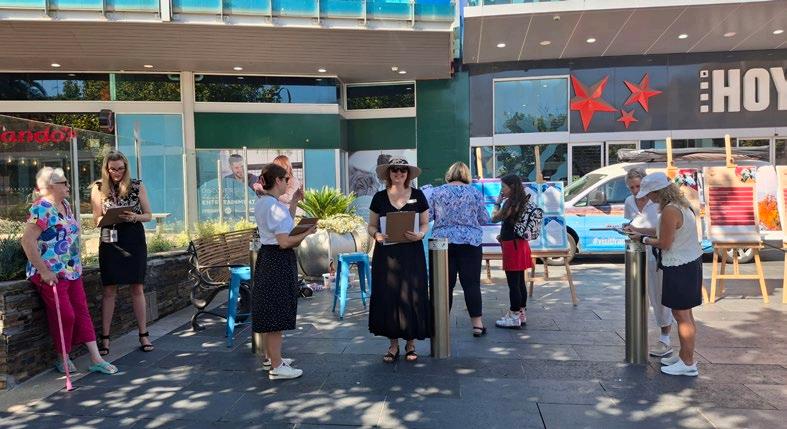
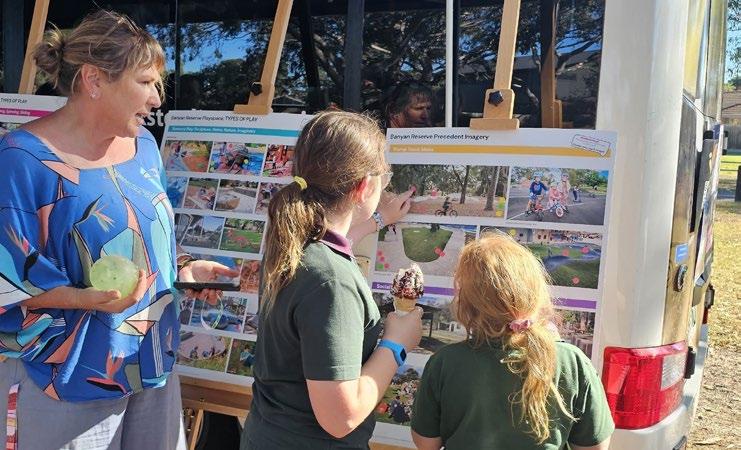
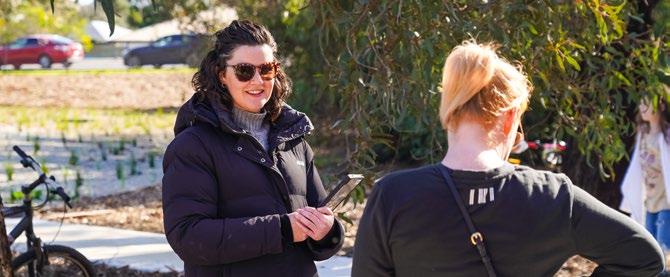
Council will also engage in-person for ‘discuss’ and ‘work together’ level projects, to reach a wider range of diverse participants and enable one-on-one conversations to share ideas and needs.
In-person engagement locations and timing will be determined on a projectby-project basis, to reach diverse communities interested and impacted by the project’s location and subject matter. We are committed to engaging at community events, services and centres and with community organisations to ensure we reach diverse audiences in areas and on topics they are already gathering and connecting.
In-person engagement opportunities will be advertised on Engage Frankston and in other promotional channels to increase visibility, accessibility and participation.
Panels and workshops
For ‘work together’ level projects, Council will set up workshops or community panels to enable deliberative engagement. This includes in-depth discussions and Council working together with community to develop projects and make decisions that reflect community advice and recommendations.
Timing of engagement
Council will apply the following timing guidelines to each community engagement project:
We will engage for a minimum of 30 days on all projects
We will engage our community as early as possible, preferably at the earliest design and concept stages of a project to provide the highest level of influence
We will consider the timing of significant social and cultural dates to maximise the community’s availability to participate. For example:
• We will not seek to engage with our community between mid-December and mid-January
• We will extend our engagement timelines if we are engaging over other periods where community may be less available to participate (such as school holidays)
We will have regard and sensitivity for current social issues, trends and significant matters when engaging the community
We will comply with other timing and statutory requirements, such as not engaging during election and caretaker periods
Roles in community engagement
Engagement is one way that Council maintains transparency and positive relationships and improves the quality of decision making. As with all relationships, different parties take different roles.
Within Frankston City, staff, Councillors, community members and stakeholders all have important roles to play to maintain positive relationships and improve the quality of decision making.
The role of Council staff
Maintaining engagement toolkit
Ensuring staff have the templates, guidance and materials needed to plan, deliver, report on and review each engagement project in a way that complies with Community Engagement Principles.
Plan
Applying adequate time and resources to plan engagement projects, and ensure projects are informed by the technical, social, environmental, and economic factors.
Deliver
Ensuring adequate resources are available to deliver online, in-person and other engagement methods in a way that is visible, inclusive and provides community with the intended level of influence.
Report
Ensuring engagement results, outcomes, updates and next steps are communicated in a timely and transparent way to the community.
Review
Ensuring projects are evaluated and engagement practices are continuously improved.
The role of Councillors
Uphold Community Engagement
Principles
Ensuring adequate resourcing for community engagement to comply with the Act.
Informed decision making
Considering engagement outcomes in good faith and using them to guide Council decisions as much as possible.
Communicating outcomes
Clearly explaining the reasons for a decision and if and how community engagement influenced the decision.
The role of community
Participation
Actively participating, to the best of their ability in engagement opportunities to ensure a diverse range of views and voices are heard.
Inclusion
Ensuring the tone and manner of behaviour during engagement activities is respectful and inclusive so that all parties can safely and positively contribute throughout the process.
The role of stakeholders
Understand that stakeholder engagement is managed separately to community engagement Council considers submissions representing the needs of stakeholders separately to the input of the broader community.
Awareness raising
Encouraging community to participate in engagement activities and initiatives.
Leadership
Balancing the tension between the short-term and long-term impacts of decision making.
Perspective
Staying open-minded and considerate of different views throughout the engagement process.
Collective
Respecting and understanding that sometimes what we want may be at odds with the wants and needs of others.
Follow Council’s submission process Council manages a submission process on its website, where stakeholders can request to speak at public Council meetings. Stakeholders are also invited to make email submissions to nominated project teams during community engagement projects.
Further information
Thank you
We are grateful to our community who have engaged with us in the development of our Community Engagement Policy and Community Engagement Framework.
We would also like to thank the many government agencies and councils whose community engagement documents provided insights for the content of our policy and framework.
Your privacy
We are committed to protecting your privacy when you engage with us. You will always have a choice about your level of involvement and can unsubscribe from mailing lists at any time.
For most engagement projects, you can share your views and ideas anonymously. We will only ask for your name and contact details where necessary, and you can always opt out. For formal submissions, Council may be required to publicly report on the full submission, including the submitters name.
Generally, public reports on community engagement will include de-identified summary information. They may include your comments, and we will remind you to avoid including any identifying information.
We regularly ask for demographic information to help us understand who is engaging with us and if we have any participation gaps. You can always choose not to answer these questions.
Your personal and sensitive information will only be used and disclosed as authorised by law, including the Privacy and Data Protection Act 2014, the Local Government Act 1989 and the Local Government Act 2020
Ways to get involved
Visit Engage Frankston (engage.frankston.vic.gov.au) to participate in Council’s engagement projects
Join Engage Frankston (engage.frankston.vic.gov.au/register) to receive email notifications on projects that interest you and subscribe to our e-newsletter
Attend public Council meetings or watch them live online
Encourage other members of the community to participate in projects that are important to them
Subscribe to Council’s social media channels and sign up for other Council newsletters (frankston.vic.gov.au/Council/News-and-media)
Contact us
Visit Engage Frankston to find out more about the Council’s community engagement opportunities.