




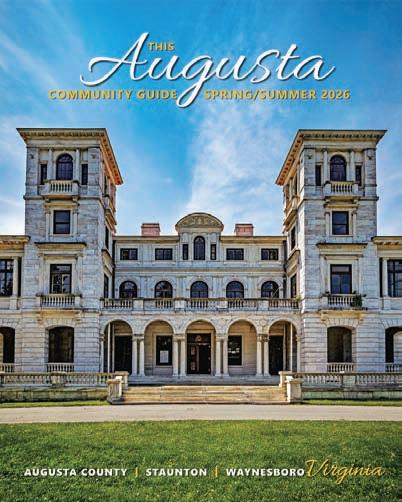
Welcome to the Spring/Summer 2026 edition of This Augusta Community Guide, your starting point for exploring, connecting, and making the most of the months ahead. As warmer weather returns, our region shifts into a season defined by movement, energy, and possibility.
This time of year invites us beyond our routines and into the places that bring our community together.
Trails, rivers, parks, patios, markets, and main streets all become gathering spaces where neighbors meet, families explore, and visitors quickly feel at home. From early morning farmers markets to evenings filled with festivals and live music, spring and summer offer countless ways to experience the Shenandoah Valley at its best.
You’ll also find a community of businesses doing what they do best: showing up, innovating, and helping our region thrive. From long-time favorites to new ventures putting down roots, our local businesses are shaping our community’s future each and every day. Supporting them means supporting the people, ideas, and energy that keep our community strong — exactly the work your Chamber of Commerce is here to champion.
Whether you’re discovering Augusta County, Staunton, and Waynesboro for the first time or rediscovering it with fresh eyes, this guide is designed to be a practical resource and a source of inspiration. Use it to plan your days, find trusted services, and connect with the people and places that shape our community.
We’re proud of the collaboration and community spirit that define Augusta County, Staunton, and Waynesboro. We’re grateful to be part of a place that continues to grow with intention and heart.
Here’s to a season full of fresh air, local flavor, and great connections.
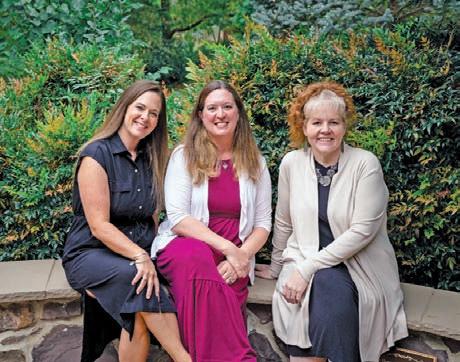
Your Chamber Team, Courtney, Kim, and Shasta



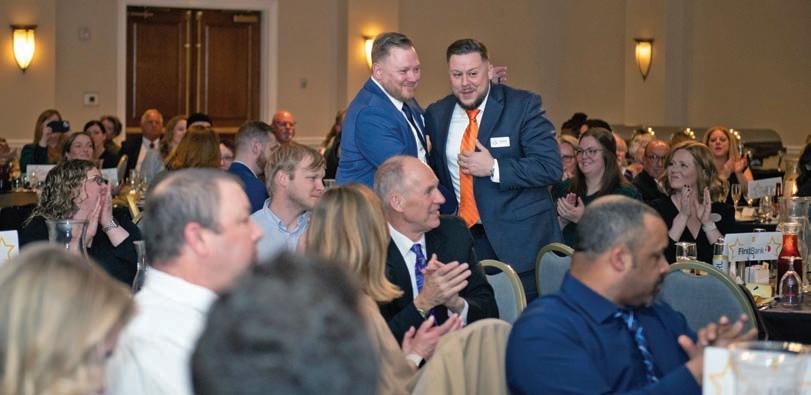
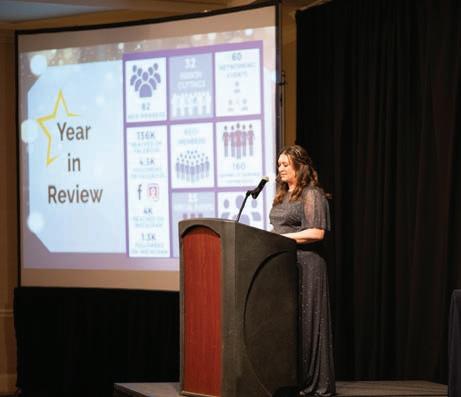
Each year, the Greater Augusta Regional Chamber of Commerce hosts the Business Excellence Awards, a signature event celebrating the innovation, dedication, and impact of local member businesses and business leaders. Beyond recognizing outstanding achievements, this event reflects on the past year, highlighting the success, growth, and community contributions of the Chamber of Commerce and its members.
The awards honor businesses across a variety of categories- Small Business of the Year, Large Business of the Year, Woman-Owned Business of the Year, New Business of the Year, Nonprofit of the Year, Emerging Leader, Senior Care Industry Professional, and Leadership Excellence. From established companies to community leaders, nominees represent the diversity and strength of Augusta County, Staunton, and Waynesboro’s business community.
For Chamber members, the event provides visibility, networking opportunities, and a moment to pause and appreciate the hard work and achievements of the past year. For the community, it shines a spotlight on businesses that contribute not just to the economy, but also to the social and civic vitality of the region.
The Business Excellence Awards are more than accolades - they are a celebration of resilience, creativity, and the shared accomplishments that define our business community. WIth this event each year, the Chamber reaffirms its mission to connect, support, and champion local businesses, ensuring the Greater Augusta region continues to be a dynamic place to live, work, and grow.
Learn more about the Business Excellence Awards at www.augustava.com or follow the Chamber on social media!<


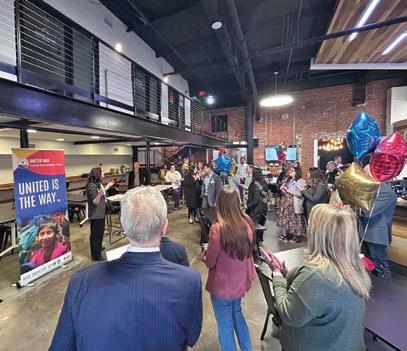
n the 1920s, a group of businessmen in downtown Staunton came together to form the Staunton-Augusta County Chamber of Commerce. In the 1950s, with Waynesboro becoming a nationally known hub for manufacturing, several plant managers decided to create the Waynesboro-East Augusta Chamber of Commerce. In 1999, a group of forwardthinking business leaders representing Augusta County, Staunton and Waynesboro presented the idea of joining forces and establishing one Chamber to serve the whole area. Thus, the Greater Augusta Regional Chamber of Commerce was born and opened its doors in centrally located Fishersville.
The Greater Augusta Regional Chamber of Commerce exists to help promote a healthy and thriving business community. By helping local businesses and community leaders network and make great connections, providing important resources, and working with state and local governments to advocate for business-friendly practices, we strive to constantly improve the quality of life in our community.
There’s never been a better time to be part of the Chamber! Whether your business is seeking customers, or you need access to resources or leadership training, or being a good corporate partner is part of your DNA, the Greater Augusta Regional Chamber of Commerce is the place to be. “Support local” isn’t just a slogan for us- it’s a way of life and a way of doing business. Count on the Chamber to help you make those connections that really matter. <
Paula Moore-McClure Chair Individual Member
Kristina Arbogast
Immediate Past Chair Hotel 24 South
Jason Boron Leading Strong LLC
Velma Bryant Blue Ridge Community College
Kevin Gabel Lantz Construction Company
Piper Groves Shenandoah Valley Art Center
Wayne Huffman McKee Foods
Jacqueline Kurtz - Chair Elect First Bank & Trust
Bruce Blair Secretary Compass Behavioral Health Executive Committee
Quentin Johnson Visiting Angels
Dan Joyce iHeart Media
Garth Knight LD&B Insurance Services
Dr. Jay Langston, PhD. Shenandoah Valley Partnership
Todd Livick Individual Member
Suzie Dull Treasurer Mary Baldwin University
Chris Auville At Large Harmony Harvest Farm
Joe Meador Augusta Health
Ellen Shaver-Shank Augusta County Fair
Jodi Tibbs Valley Trust Insurance
Michelle White DuPont Community Credit Union


Source: US Census Bureau



Clark & Bradshaw is one of only two law firms in all of Virginia to have two Certified Elder Law Attorneys. Do you have a Will? Who will make your medical and inancial decisions if you can’t? Do you need help applying for Medicaid for a loved one? Or handling the estate of a lost loved one? Set your mind at ease, we are here to help.











Augusta County 18 Government Center Ln. Verona, VA 24482 (540) 245-5600
co.augusta.va.us
City of Staunton 116 West Beverley St. Staunton, VA 24401 (540) 332-3800
ci.staunton.va.us
City of Waynesboro
503 West Main St. Waynesboro, VA 22980 (540) 942-6600
waynesboro.va.us
Public water and sewer is available in the Cities of Staunton and Waynesboro and areas of Augusta County.
Augusta County Service Authority (Augusta Co. with the exception of Craigsville.) (540) 245-5681
www.augustawater.com
Town of Craigsville (540) 997-5935 www.craigsville.us/water-and-sewer
City of Staunton (540) 332-3860
www.ci.staunton.va.us/departments/public-works/ utilities
City of Waynesboro (540) 942-6643
waynesboro.va.us/300/utility-billing
City of Staunton (540) 332-3892
www.ci.staunton.va.us/departments/public-works/ trash-recycling-collection
City of Waynesboro (540) 942-6764
waynesboro.va.us/309/Refuse
Augusta County Disposal (540) 949-0160 augustacountydisposal.com
Republic Waste Services (434) 295-4177 republicservices.com
Waste Management of Virginia www.wm.com/us/en/location/va/charlottesville
Waste Movers (540) 972-3456 wastemoversva.com
Happy Little Dumpsters, LLC (434) 608-8261
happylittledumpster.com/service-area/ staunton-waynesboro-va/
Republic Waste Services (434) 295-4177 republicservices.com
Waste Management of Virginia www.wm.com/us/en/location/va/charlottesville
Waste Movers (540) 972-3456 wastemoversva.com
Augusta County www.co.augusta.va.us/residents/water-wastewatertrash-recycling/solid-waste-recycling-locations
City of Staunton
www.ci.staunton.va.us/departments/public-works/ trash-recycling-collection/recycling
City of Waynesboro www.waynesboro.va.us/292/Recycling
Dominion Energy (866) 366-4357 dom.com
Shenandoah Valley Electric Cooperative (800) 234-7832 svec.coop
Columbia Gas of Virginia (800) 543-8911 columbiagasva.com
Amerigas (540) 885-6168 amerigas.com
Holtzman Oil and Propane (540) 490-4928 holtzmancorp.com/locations/propane-verona-va/ Quarles Petroleum (877) 444-3835 quarlesinc.com
Southern States Cooperative-Augusta Petroleum (540) 886-2501 southernstates.com
Suburban Propane (434) 263-6162
www.suburbanpropane.com/locations/weyers-caveva/?zip code=23836
Lumos Networks 855-GO-LUMOS lumosfiber.com
Verizon (800) 255-5499 verizon.com
AT&T (800) 331-0500 att.com
Boost Mobile (540) 466-5239 boostmobile.com
Cricket Wireless (540) 707-0341 cricketwireless.com
T-Mobile (540) 609-2879 t-mobile.com
Verizon (800) 255-5499 verizon.com
AND INTERNET PROVIDERS
Xfinity Xfinity.com
Lumos Networks (844) 675-1338 lumosfiber.com
GloFiber (833) 926-8456 glofiber.com
Lingo Networks (540) 712-0300 lingo-networks.com
Augusta County Main Library 1759 Jefferson Highway Fishersville, VA 22939 (540) 885-3961 or (540) 949-6354 augustacountylibrary.org
Augusta Co. Library - Churchville 3714 Churchville Ave. Churchville, VA 24421 (540) 245-5287
Augusta Co. Library – Craigsville 18 Hidy St. Craigsville, VA 24430 (540) 997-0280
Augusta Co. Library – Deerfield 59 Marble Valley Rd. Deerfield, VA 24432 (540) 939-4123
Augusta Co. Library – Middlebrook 3698 Middlebrook Rd. Middlebrook, VA 24459 (540) 885-1008
Augusta Co. Library – Stuarts Draft Broadmoor Plaza, Suite #107 Stuarts Draft, VA 24477 (540) 569-2683
City of Staunton
1 Churchville Ave. Staunton, VA 24401 (540) 332-3902 stauntonlibrary.org
City of Waynesboro
600 S. Wayne Ave. Waynesboro, VA 22980 (540) 942-6746 waynesboro.va.us/354/library
TRANSPORTATION SERVICES
LOCAL BUS
BRITE Transit (540) 943-9302 britebus.org
COMMERCIAL AIR SERVICE
Shenandoah Valley Regional Airport (SHD) (540) 234-8304 flySHD.com
FLIGHT SCHOOLS
Blue Ridge Aviation (540) 246-9407 www.blueridgeaviation.org
GENERAL AVIATION SERVICES
Eagles Nest Airport (540) 943-4447 eaglesnest.aero
PASSENGER RAIL SERVICE
Amtrak (800) 872-7245 amtrak.com
VEHICLE REGISTRATION
Virginia Department of Motor Vehicles 17 1st St., Staunton, Va 24401 998 Hopeman Pkwy., Waynesboro, VA 22980 (866) 368-5463 dmv.virginia.gov
VOTER REGISTRATION
AUGUSTA COUNTY
Voter Registration
18 Government Center Ln. Verona, VA 24482 (540) 245-5656
co.augusta.va.us/government/departments-andoffices/voter-registration
CITY OF STAUNTON
City Hall
116 W. Beverley St. Staunton, VA 24401 (540) 332-3800 www.ci.staunton.va.us/departments/registrar
CITY OF WAYNESBORO
Office of Voter Registrar
605 Market Street
Lower Level of the Waynesboro Library Waynesboro, VA 22980 (540) 942-6620 waynesboro.va.us/126/Voter-Registration
By Chris Lassiter
Robin Miller loves restoring old things as much as he loves architecture pre-dating 1940.
Owner of Miller & Associates, he and his team have used state and federal historic tax credits to restore some of Staunton’s most iconic buildings such as The Beverly Hotel, the old Staunton downtown YMCA, Staunton Steam Laundry and parts of the old Western State, giving them a fresh look and a new purpose.
With projects like the Bindery, Arcadia Building Flats, The Blackburn Inn and the Lofts at the Villages, the Miller & Associates team have taken buildings in disrepair and restored and enhanced their architectural glory. The city is more aesthetically beautiful because of their efforts.
For Miller, historic buildings are worth saving. “I’ve always loved old buildings,” he said. “You don’t see it in architecture nowadays. From the Civil War to the 1940s, there is magnificent architecture.”
engineers you hire, you don’t really know what’s going to be there until you’ve bought it and are partway done,” Miller said. “The tax credits mitigate some of that risk, and mitigate some of that cost.”
In exchange for the tax credits, builders must follow restrictions on how properties get restored.
“For historic buildings, you have very little flexibility,” Miller said. “We realized what Staunton needed was dwelling units. We would take a historic building, and try to figure what’s the best way to chop it up, and design it much like a jigsaw puzzle.”
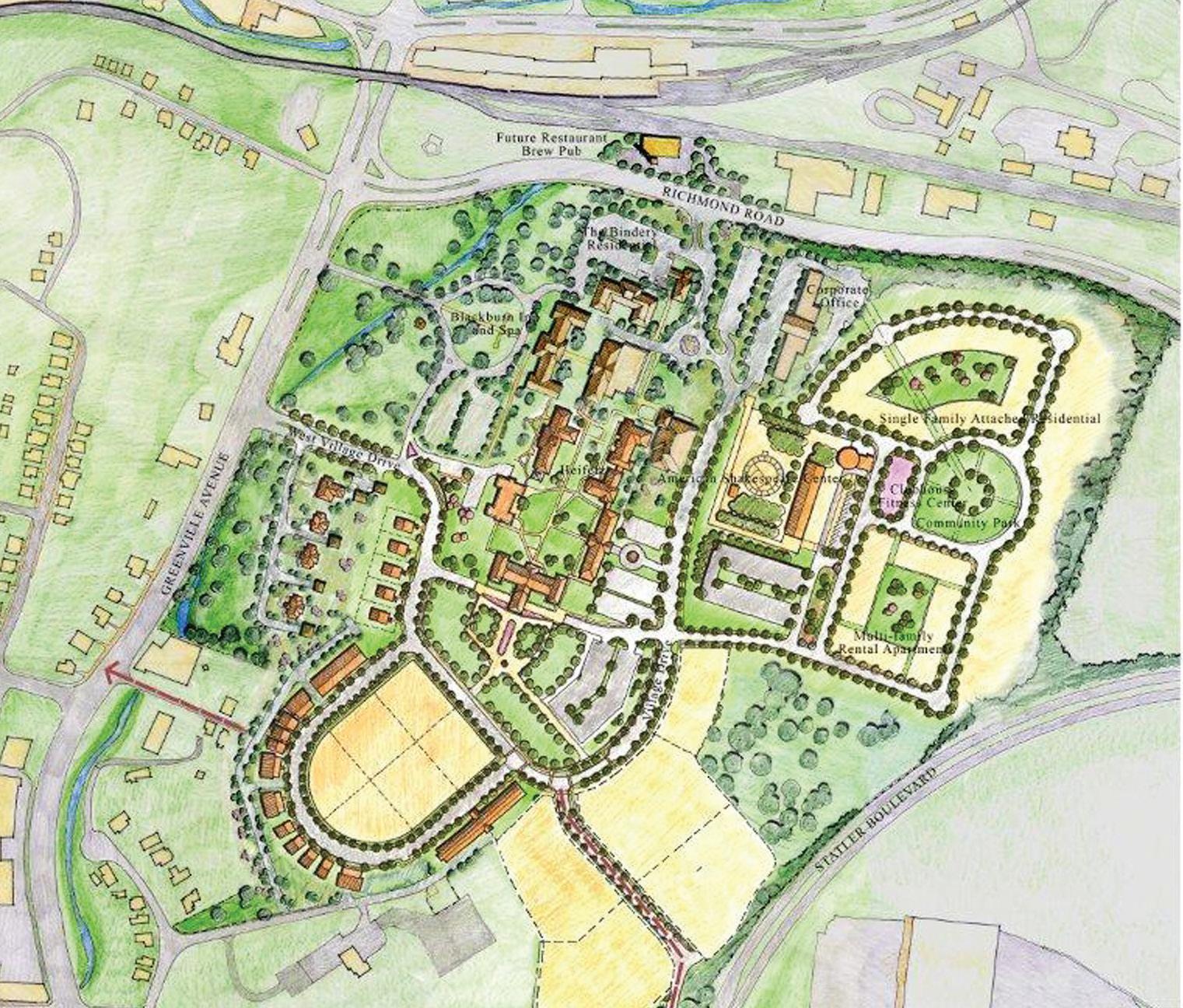
Top: An architectural rendering of the multi-phase planned redevelopment of the former Western State property.
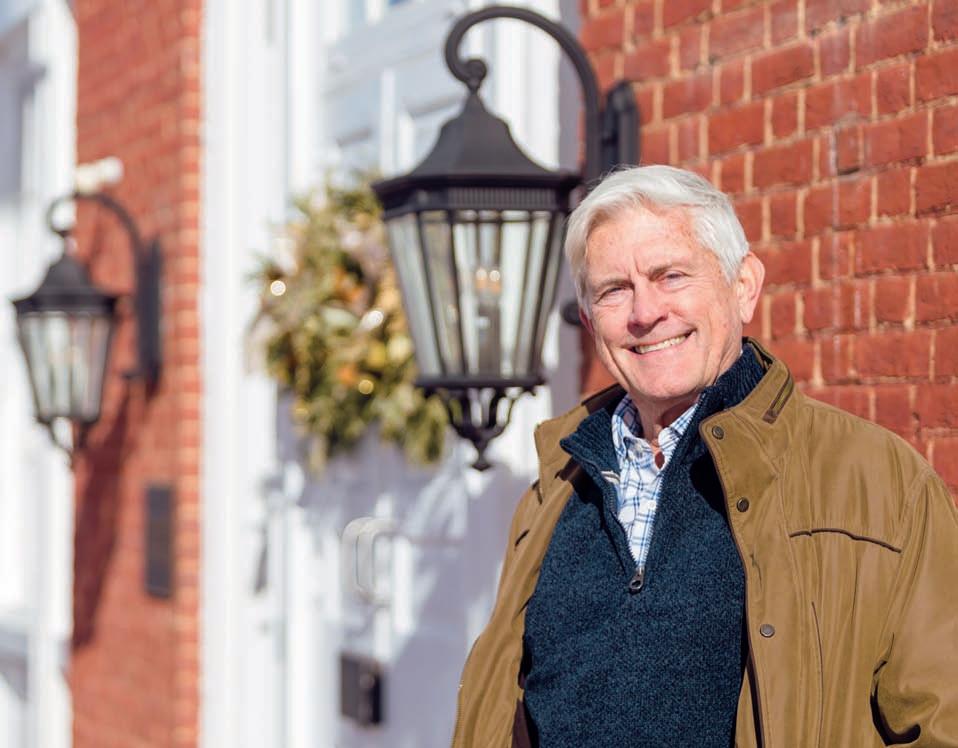
Inset: Robin Miller.
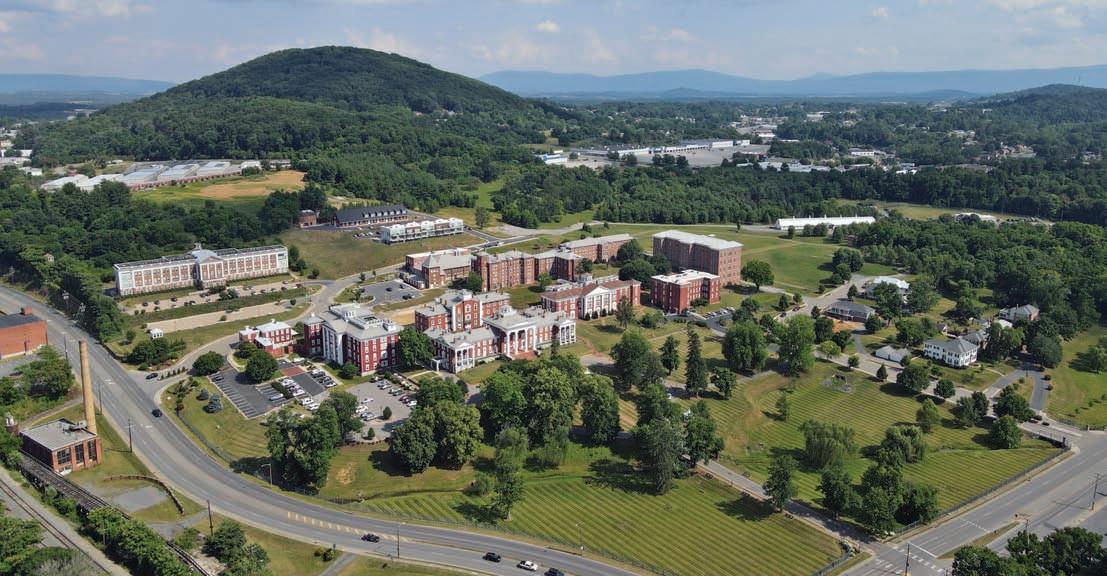
It’s in the best interest of everyone that old historic buildings not sit in a state of disrepair. “Think of all the dollars you save and the green effect (environmentally) of not having to tear down a building, haul all the debris off, and put it in a dump,” Miller said. “It’s the most effective recycling I can think of. You’re recycling a building to give it new life.”
The Beverley Hotel Apartments are a good example. While Miller & Associates won the city’s bid to transform the old prison, Miller’s first project in Staunton actually turned out to be the old downtown YMCA. Miller placed the winning bid at an auction for that property.
Shortly thereafter, several people had approached him about the desperate state of the Beverly Hotel. What became the Beverly Hotel Apartments is a good example recycling an old building, also known as adaptive use.
“It was quite a challenge,” MIller said. “I am a professional engineer. We knew there were a lot of problems, but it was probably three times as bad as I thought. There were a lot of issues we hadn’t anticipated. That being said, we took them one at a time and solved them. It took longer than we thought. It costs more than we thought, and it turned out fantastic.”
The effort saved an important part of downtown Staunton’s imagery.
“We didn’t expect it to be a homerun,” Miller said. “We didn’t even expect it to be a double. We thought, ‘Maybe we can make this a single.’ Dan Gecker and I were committed to making it happen. Can you imagine what Staunton would look like if you drove into Staunton and that building was gone? It’d be like if your front tooth got knocked out.”
A native of Kingsport, TN, Miller would work on a master’s degree in public policy at Harvard while in the Army. He loved the architecture so much that Miller and a friend purchased a historic building in Cambridge, and converted from apartments to condominiums.
Although Miller spent his first 15 years in development on new builds, he transitioned into historic buildings when he moved to Richmond. Miller would always pass by Staunton on his way back home to Tennessee, but never entered the city until he got an invite from former Staunton mayor John Avoli.
While serving as mayor, Avoli was at a presentation in Winchester where Miller was speaking on historic tax credits.
“He came up to me after the presentation and, ‘Have you ever been to Staunton?’” Miller said. “I was like, ‘Yeah, I drive through Staunton on my way to Tennessee every week.’ He was like, ‘No, no. Have you been to downtown Staunton?’ He invited me down. I came down a couple weeks later.”
Miller was captured by the beauty of the city.
“I drove down Beverley street, and through the neighborhoods, and Virginia School for the Deaf and The Blind, and it was love at first sight,” MIller said. “I had finished up my deals in Tennessee. I had just finished a couple of projects in Richmond. I was looking for another project.”
Not only is Staunton an architect’s dream, but MIller loved the city so much that he now splits time between Staunton and Richmond.
“In my opinion, it’s the coolest small city in Virginia,” Miller said. “It’s very safe. It’s well run. The city government is very effective. The cost of living and real estate taxes are reasonable. There’s a fantastic food scene. The architecture is stunning. The cultural attractions - American Shakespeare, Heifetz, Woodrow Wilson (Presidential Library), Staunton Music Festival - all super events, way more than you’d expect for a small city like Staunton.” <
by Heather S. Cole
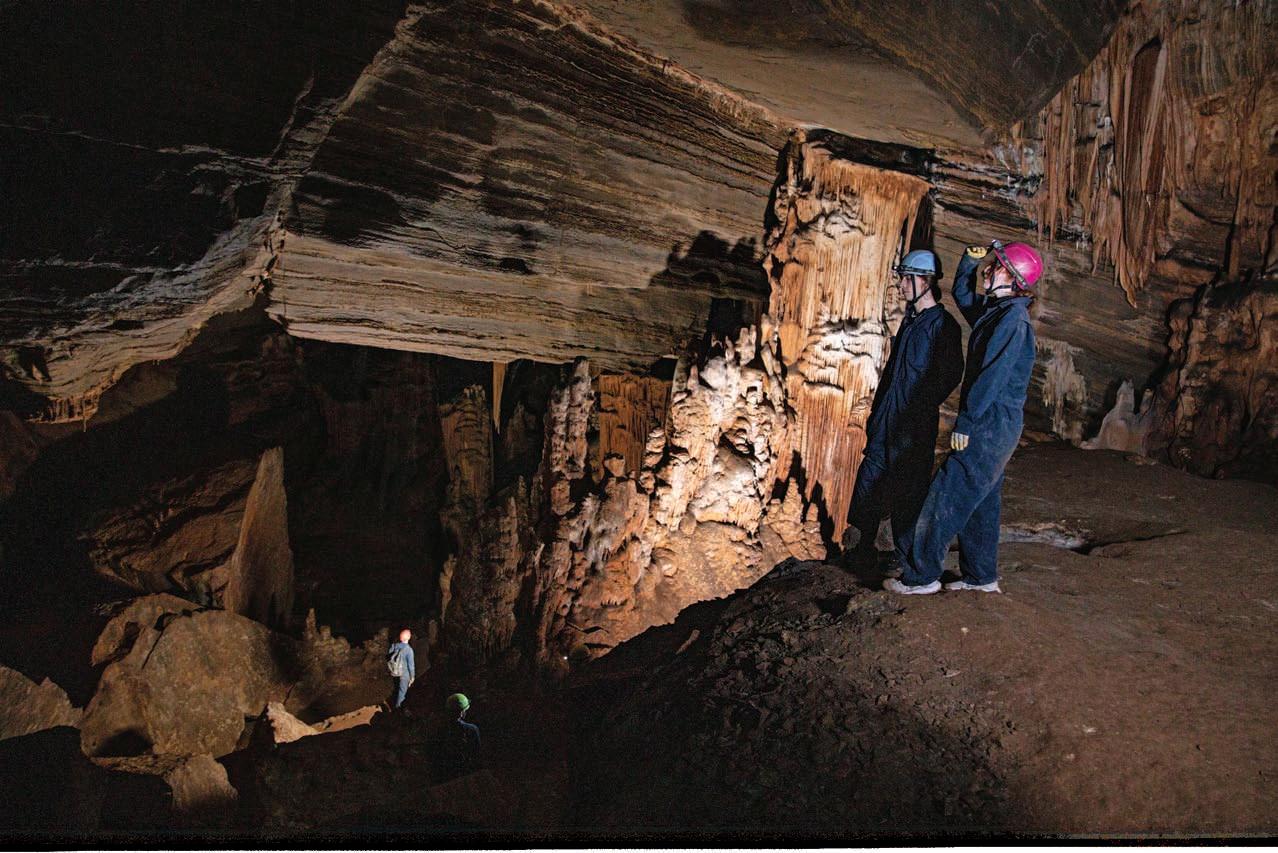
In 1804 a local teenager named Bernard Weyer was checking on some animal traps he had set out near the South River, when he stumbled upon an opening in the nearby mountain. Two years later, Weyers Cave — now known as Grand Caverns — opened for tours, making this underground wonder in Grottoes the oldest continually operating show cave in the country.
Early visitors to Grand Caverns would have been wowed by the same geological formations that awe visitors today. As surface water drips through the limestone caverns over millions of years, it leaves behind minerals that create formations such as stalactites (hanging “tight” to the ceiling), stalagmites (that “might” grow tall enough to reach the ceiling), and columns (created when the two join). The cave boasts formations with descriptive names like flowstone and cave bacon, and a particularly large ghostly stalagmite named after — and bearing a vague resemblance to — our first president. But Grand Caverns is best known for having more than 500 shields — huge dinner plate-shaped formations hanging vertically from the ceiling, and that are so unusual that geologists still don’t know exactly how they are formed.

While 19th century visitors to Grand Caverns would have worn headlamps to light their way and likely needed to rinse the mud from their clothes afterwords, today’s visitors follow a park ranger along well-lit gravel paths with metal handrails and stairs. Today’s standard guided tour last about 70 minutes and leads visitors on a mile-long walk through several distinct rooms. They include Cathedral Hall, more than 30 feet high and lined with what look like curtains of ribbon candy, a Grand Ballroom that once hosted formal dances, and the Persian Palace where couples can hold small weddings.
Kayla Borchert is one of the Grand Cavern park rangers. A junior at nearby Bridgewater College who grew up in Grottoes, Borchert has been leading cave tours for the past two years.
“I took a geology class and just fell in love with geology,” she said. On a recent Saturday morning she expertly led a group through the caverns, sprinkling jokes about ghosts and bears amongst the details about cave formations and history.
can see on the cave tour are signatures from Civil War-era visitors. (Damaging a cave by writing or removing a formation is now very illegal.) More than 200 signatures have been found. There is also a story that Stonewall Jackson visited Grand Caverns but wouldn’t go inside, saying, “I fear I shall be underground soon enough, and I have no desire to speed the process.”
Although originally privately owned, Grand Caverns is currently owned and operated by the Town of Grottoes. Tracey Collins is assistant director of parks and tourism, the town department that manages the cave. When asked what sets Grand Caverns apart from the other show caves in the Shenandoah Valley, Collins was quick to credit the park rangers.
“At Grand Caverns you get a personal experience because you have a guided tour,” she said. “It amazes me the amount of information we give the rangers to learn and retain. But most of them find such a passion for the caverns that they learn even more on their own.”
Collins added that all the Grand Cavern tour park rangers are in the process of attaining a Certificate in Interpretive Guiding awarded by the National Association of Interpretation, a process that will require additional training in education and interpretation techniques.
“Our goal is to entertain, educate and provide memories for people,” Collins said.
Staff are also always working to learn more about the cave and advocate for its protection. Around the 200th anniversary of the cave’s discovery, Grand Caverns embarked on a project to update the maps of the caverns. One of the expert cavers brought in on the project was a dog named Rosie. She detected a difference in air pressure in one corner of the cave and pointed the human cavers to a whole new unexplored portion of the cave. This portion of Grand Caverns is not open to the public, largely because it requires a 45-minute belly crawl to access.
Elisa Egedel, a college student from Massachusetts, went on an adventure tour with her mom and some family friends while visiting the area. She said she didn’t really know what to expect, but that it was a lot of fun.
“The guides made the whole experience great,” she said. “There were places where you had the option to go the hard way or the easy way, and the guides were really encouraging and reassuring that we could do it.”
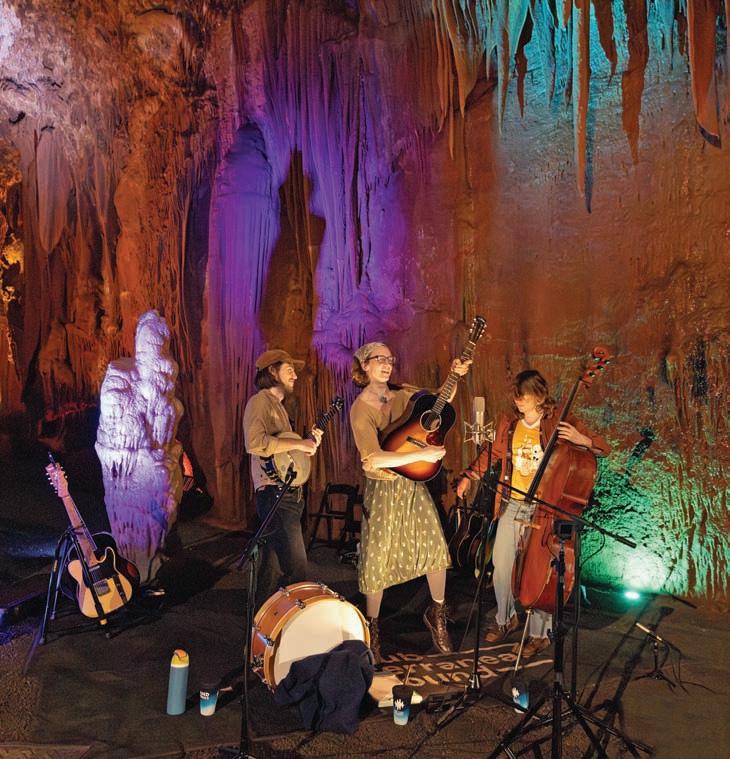
Adventure tours are offered several times a week and require participants to reserve in advance. Grand Caverns also offers tours focusing on the history and the geology of the cave and runs special events throughout the year. Beginning on May 31, Grand Caverns will host a week-long Caving and Karst Week with free activities designed to get adults and children excited about caves and conservation. Other seasonal activities include music and movies in the cave. At a steady 54 degrees Fahrenheit year-round, a cave tour is a great way to escape hot, cold or rainy weather any time of year.
For those for whom a belly crawl sounds like fun, Grand Caverns also offers three levels of adventure cave tours. These tours have participants squeezing though crevices and crawling on their hands and knees through the mud in either Grand Caverns or the neighboring Fountain Cave. These tours require close-toed shoes, long pants and long sleeves. Participants are provided with a helmet, headlamp and kneepads, and should expect to get muddy.
Grand Caverns is located at 5 Grand Caverns Drive in Grottoes and is open daily. In addition to the cave, Grand Caverns park includes an outdoor pool (open seasonally), mini golf, three miles of trails and picnic shelters. Tickets for tours and events can be purchased in advance at GrandCaverns.com. <
Top: Grand Caverns even hosts concerts, unplugged and underground. The 2026 season featured 12 concerts over a nine-week period.
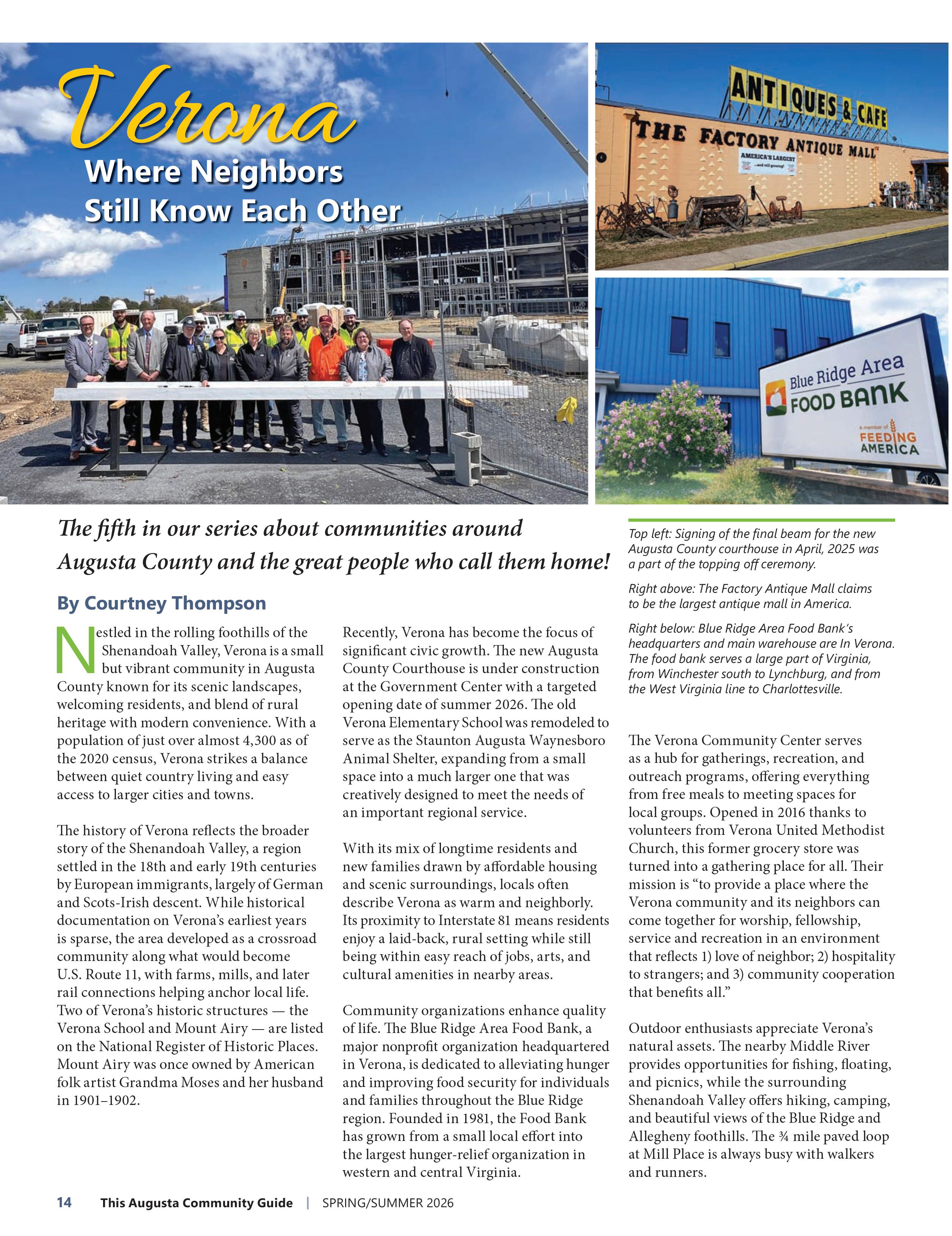
Verona’s business landscape reflects its blend of rural charm and regional significance. One of its most remarkable attractions is The Factory Antique Mall, the largest antique mall in America, with more than 150,000 square feet of vintage and collectible goods under one roof. Dealers and shoppers from across the country travel to Verona to browse furniture, art, memorabilia, and curiosities in this sprawling emporium, making it both a local economic engine and a regional draw for antiquing enthusiasts.
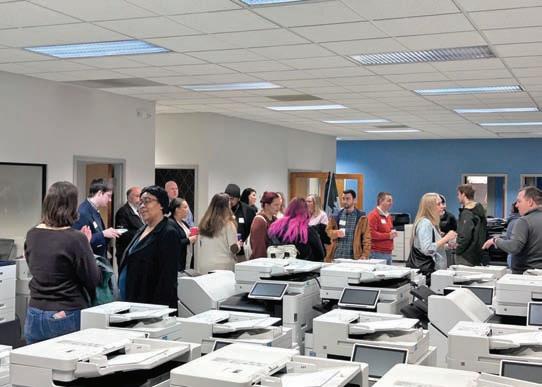
Shenandoah Valley Office Equipment (SVOE) recently celebrated its 90th anniversary. When current owner Tim Hebb purchased the business in 1990, he relocated it to Verona, where its corporate headquarters has been ever since. SVOE’s team of technicians stays on the cutting edge of technology and serves clients all over Virginia, and their entire team delivers excellent customer service.
Lineage Architects has been located in Verona since 2002. Owners Jon and Pennie Garber relocated to Verona in 1999 from Northern Virginia in search of a safe, friendly place to raise their kids. “Jon’s family has called the Shenandoah Valley home for 10 generations, and we immediately felt that warmth when we moved here,” says Pennie. “There are so many good things about Verona. It may not look fancy on the drive through town, but there are lots of gems worth stopping for.”
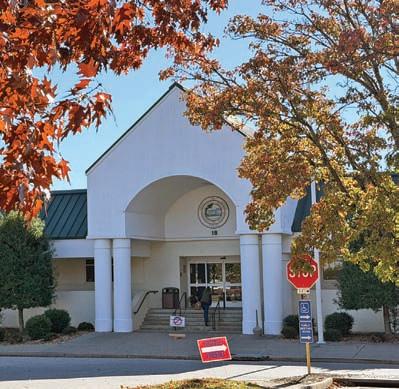
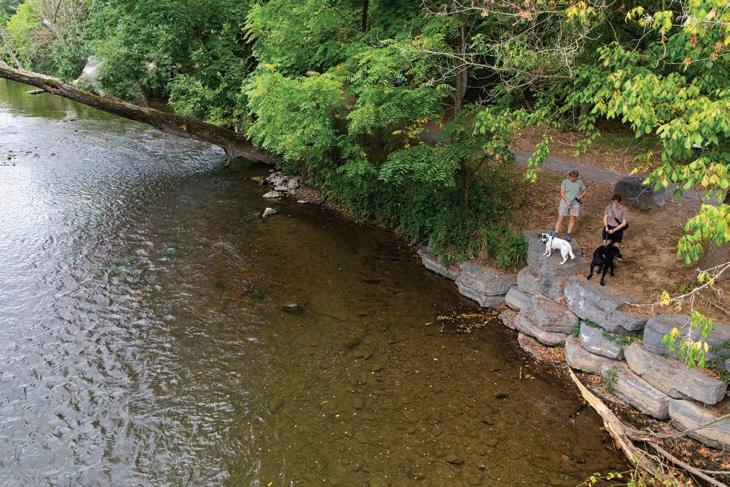
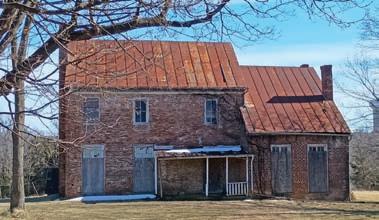
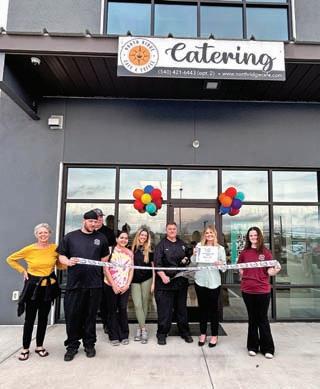
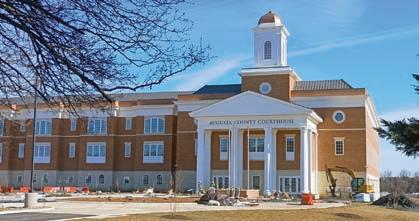
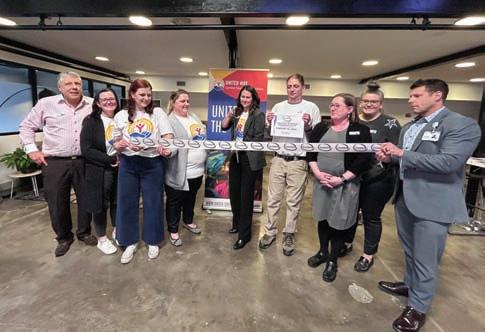
Clockwise from top left: Chamber members enjoy a recent Business After Hours at Shenandoah Valley Office Equipment. Ribbon-cutting for North Ridge Café and Coffee. The Augusta County Government Center. The new courthouse nears completion. Mount Airy, once the home of noted American painter Grandma Moses.
Some of those gems include several very popular locally owned restaurants where diners can enjoy everything from country comfort food to pizza to ribs and more! Pennie says it’s impossible to visit any of these local places without seeing a familiar face. There are also several fast food restaurants near the interstate that are very convenient for both travelers and residents alike.
One of those restaurants that stays busy is North Ridge Cafe & Coffee, which serves coffee, breakfast, and lunch, and has a bustling catering business. Owner Kent Lam has been in the food service industry for more than 25 years and opened North Ridge Cafe in 2021. Although North Ridge Cafe draws customers from all over, they enjoy being located in Verona. Catering manager Shea Ostrander says, “Our experience in Verona has been nothing short of wonderful. The community has always given great support to the cafe and catering side of our business. We appreciate our customers’ continued loyalty and hope to continue to serve you all whether it’s lunch and a coffee from our cafe or a catering event for you and your loved ones! Thank you from everyone here at North Ridge Cafe & Coffee!”
Verona is also home to several financial institutions. City National Bank has been located in Verona since 2002, originally as Community Bank. Serving both personal and business customers, branch manager Shelly Parker and her team love being part of the community. Shelly has lived and worked in Verona for 30 years and has witnessed many changes to the area. “From the expansion of Route 11 to the soon to open Augusta County Court House, Verona continues to grow and thrive not only in new businesses, but also in people who discover the Shenandoah Valley and make it their home,” she says. “City National Bank continues to be a successful partner in the community helping folks realize their dreams of starting a business or owning their first home. It’s exciting to be a small part of it.”
Today, Verona attracts those seeking a life where community matters and where the pace of daily life feels genuine and grounded. Its blend of agriculture, scenic beauty, historic appeal, and growing civic importance gives Verona a distinctive identity. Whether you’re exploring antiques, looking for a great lunch spot, or simply enjoying the mountain views, Verona offers a slice of Shenandoah Valley living that embodies small-town warmth with a welcoming spirit. <
By Chris Lassiter
They are where you go for picnics, pickleball, parades and performances.
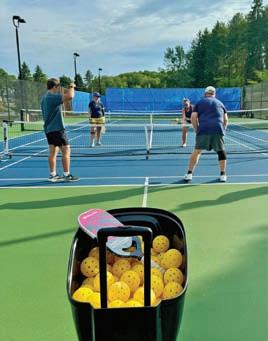
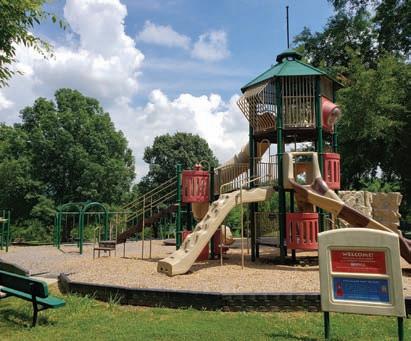
Located within a one-mile radius of one another, Staunton’s Gypsy Hill Park and Montgomery Hall Park have enriched the quality of life of local residents for decades.
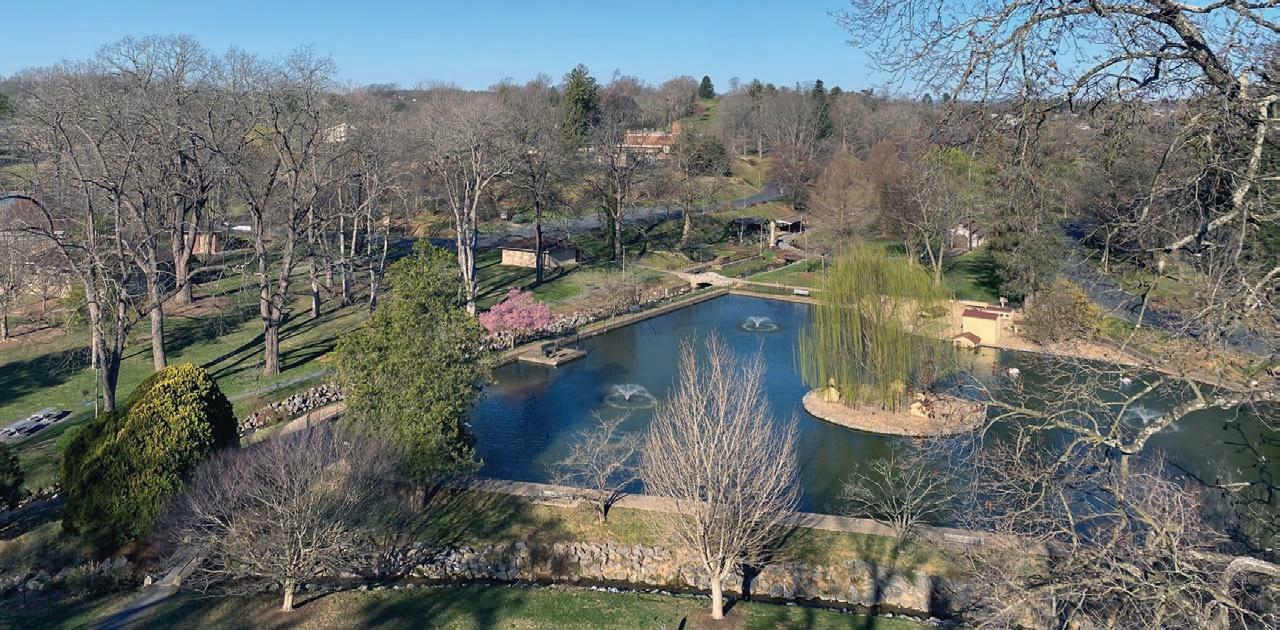
Each park has its own unique history and attractions. People flock to Montgomery Hall Park for the soccer complex, hiking trails, the natural playground and the disc golf course. Community members flood Gypsy Hill Park for the golf course, musical performances, the duck pond, the dog park, the skate park, the 1.3-mile walking and jogging loop and the city’s big cultural events.
To Chris Tuttle, director of the City of Staunton Parks and Recreation, it’s the best of both worlds. “It’s unheard of,” Tuttle said. “For a city the size and population of Staunton to have two large parks, it all fits in a nice way.”
In 1876, the City of Staunton purchased 30 acres of land around the community’s water supply. It officially became known as Gypsy Hill Park, which now spans 214 acres.
“The founder of the park is (William) Purviance Tams,” Tuttle said. “It got its name, Gypsy Hill, at least from what I understand, is that’s where gypsies at that time camped. And the reason gypsies would camp there is because of the water source; the spring.”
Prior to the racial integration during the Civil Rights era, AfricanAmerican residents were only allowed in Gypsy Hill Park one day out of the year. Montgomery Hall, the 148-acre park, opened as one of two parks in the state accessible to Black people.
In the 1820s, a Princeton University-educated lawyer, John Howe Payton, built a mansion and named it after his second wife, Ann Lewis Montgomery. In 1946, the city purchased 150 acres of that property from Alexander Thomas for $42,500.
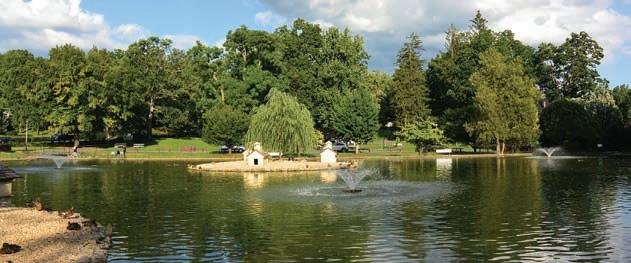
Top: The duck pond at Gypsy Hill Park.
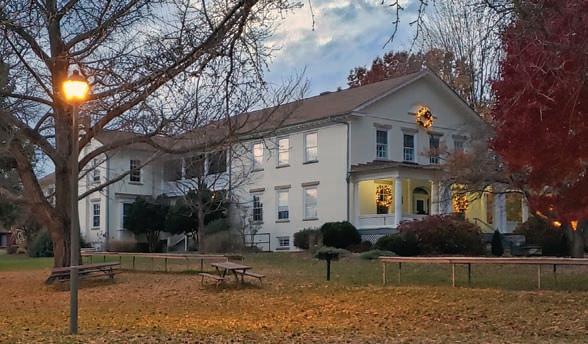
Above, left to right: Montgomery Hall, the 1820’s vintage mansion that is the centerpiece of Montgomery Hall Park, and headquarters for Staunton’s Parks and Recreation Department. Playing pickleball on one of Montgomery Hall Park’s courts. Montgomery Hall Park playground.
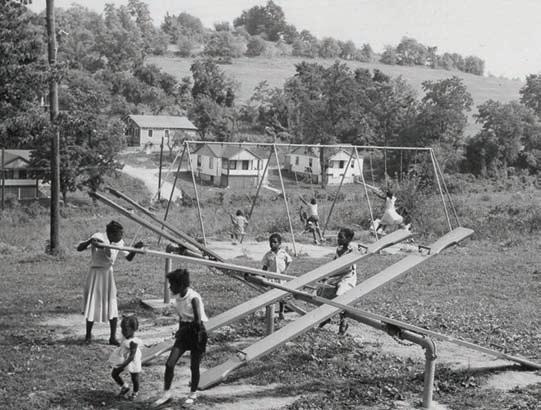
Montgomery Hall Park’s history was recently highlighted with a series of historical markers provided by the Staunton-Augusta African-American Research Society. The markers circle the perimeter of the house, which now serves at the office space for the City of Staunton Parks and Recreation.
“At one time, this property was the biggest farm in Augusta County,” Tuttle said of Montgomery Hall Park. “At one point, this was all Augusta County. It went from owner to owner, and it became in disrepair. Black leaders approached the city council, and the community formed a committee of Black leaders, a Montgomery Hall Committee, and they began to renovate.”
With over three decades worth of experience, Tuttle has learned that some things in the parks are just untouchable. “I’ve told every city manager I’ve worked with, ‘Be very careful what you recommend for Montgomery Hall or Gypsy Hill Park,’” Tuttle said. “I learned that lesson a long time ago.”
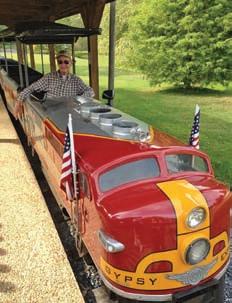
Inside of the Gypsy Hill’s 1.3-mile loop, there’s the crowd favorite duck pond, which is just a stone’s throw from the train that Tuttle and countless others rode as kids.
“I remember as a kid, going through that tunnel terrified me,” Tuttle said, laughing. “The train was put in by the Bartlett family. At one time, there were three of those trains left. There was one here, one in Mill Mountain Zoo in Roanoke, there was one out in Missouri somewhere. The Bartlett family ran the train until they really couldn’t do it anymore. Then they gave it to the city.”
In
the
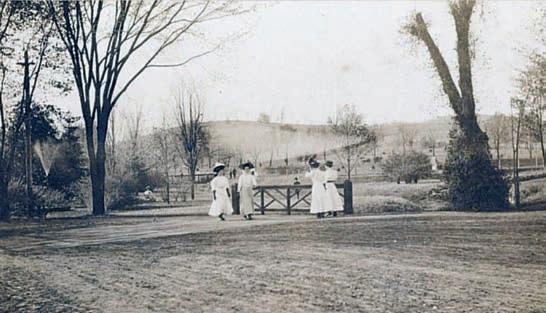
Left: In the early 1940s, a group of African-American residents petitioned the City of Staunton to allow them to use Gypsy Hill Park.
With the future of the train uncertain, Tuttle learned first- hand how the community responded about things in the park that kindled a sense of nostalgia. Fortunately for the city, some train enthusiasts formed the Gypsy Express to give the train the care and expertise it needed to remain active in the park.
Through that lesson and others like it early in his career, Tuttle learned to deeply value the iconic landmarks within the parks.
Still, he’s found a way to innovate in both spaces. At Montgomery Hall Park, the tennis courts have been adapted to also welcome in the city’s thriving pickleball community. Additionally, the disc golf course offers a fun outdoor competition option, utilizing the park’s scenic trails.
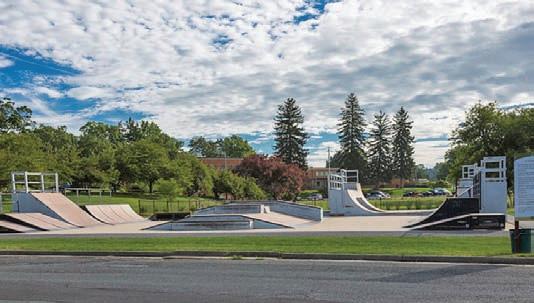
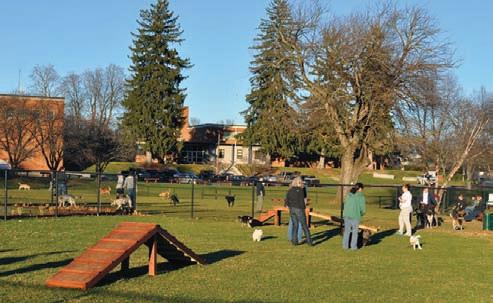
At Gypsy Hill Park, much of the innovation has taken place outside of the loop, closer to Tams Lake. The dog park and skateboard park have both been huge hits, highly used and embraced by the community.
“Most people associate Gypsy Hill Park (only) with that loop,” Tuttle said. “We built a gymnasium, put in a skate park, put in a dog park, put in Lancaster (outdoor) basketball courts and all that. I think it’s an easier sell when it’s over there. It’s hard to juggle the history of the park with new. The dog park was citizen driven. We never got any kickback at all. For the skate park, we never got any kickback at all.”
Parks continued on page 18
Below left to right: Gypsy Hill Park contains a variety of recreational and entertainment features: left – the skate park; center – the Gypsy Hill Park train; right – the dog park.
Parks continued from page 17
The City of Staunton Parks and Recreation department mails out seasonal guides with a full list of activities, including youth and adult classes and activities. However, Tuttle believes more people access the park for free use as compared to coordinated activities. That fact helps him prioritize his work.
“The public likes to come to the parks,” Tuttle said. “The big thing for me in my career is maintenance; how the parks look. Are they groomed? Are they mowed? Are they weed-eated? Are facilities kept up to standards? We’re seeing now some of the facilities in the park are aging themselves out. We’re building a new poolhouse (at Gypsy Hill Park). All the bathrooms in both parks, I hope, will be renovated within the next two years.”
It’s a challenge to keep the parks in pristine condition considering the high usage rates. “If you come in the parks in the afternoon, this (Montgomery Hall Park) especially, you can’t find a place to park, because of all the activities,” Tuttle said. “You have all the activities. You have all the people. You have to have nice facilities.”
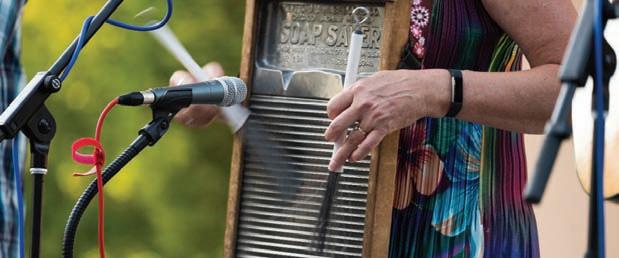
Tuttle’s time with the parks and recreation department spans back to the days of Statler Brothers. He remembers the wall-to-wall traffic for their Fourth of July event throughout the city.
Now, Gypsy Hill Park plays host to an entirely new musical line-up in the summers. The Stonewall Brigade Band plays on Mondays. Praise in the Park occurs each Tuesday night.. There’s a special bluegrass concert each Wednesday night, and Thursday night is Jazz in the Park.
“There’s nowhere else that I know of that does basically four nights a week in the summer of free music,” Tuttle said. “On Fridays, not every Friday, we do movie night. It’s all free. A lot of the people I think that come to the park those nights are probably not coming to the park (otherwise). Bluegrass, for example, it’s a regional draw. We get a lot of people that we don’t see in the park during the day.”
While the Statler Brothers held an unprecedented level of drawing power, a new nonprofit group, Happy Birthday America, which includes Statler sons Wil and Langdon Reid, has breathed new life into Fourth Of July Celebration in the parks.
“The Statlers were huge,” Tuttle said. “Now Wil and Langdon are starting it, and you’re starting to see that craziness. It’s all civic-minded, and it’s free. That’s crazy. You’re not going anywhere else for free.” <


By Chris Lassiter
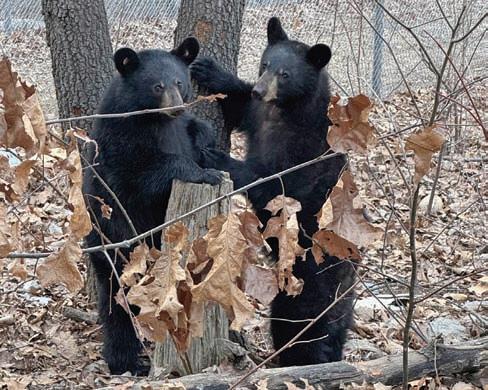
Connor Gillespie and his team believe in second chances. In fact, giving animals another chance is why the Wildlife Center of Virginia exists.
Whether it’s a bear cub, box turtle, or bobcat needing medical attention, there’s a location in Waynesboro for those animals to get treatment. Hopefully, it all leads to a healthy return to the wild.
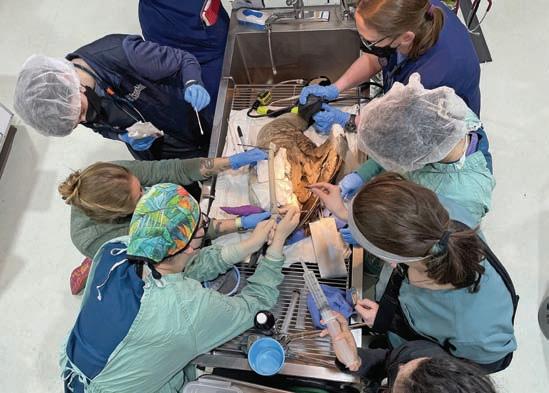
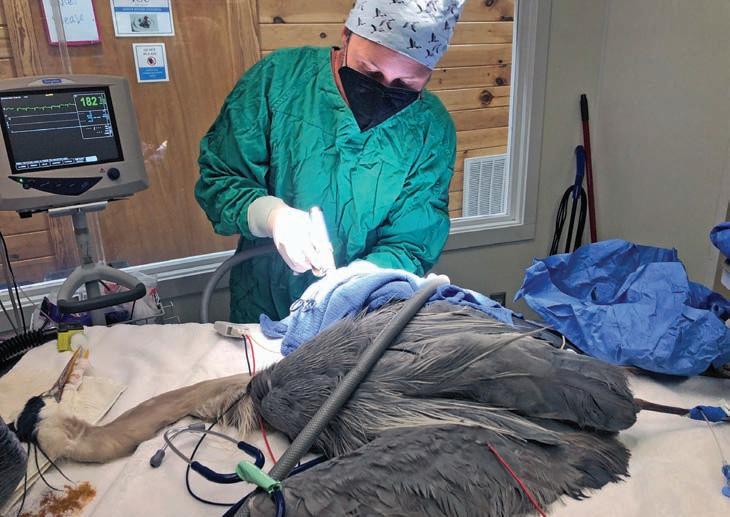
“Our mission statement is teaching the world to care about, and care for, wildlife and the environment,” Gillespie said. “We’re a state of the art wildlife hospital, fully equipped with everything you’d expect to find in a private veterinary practice or even a human hospital. We have the tools and resources for surgeries and treatment for a wide variety of species — no matter the situation, our hospital can handle it.”
Recently, the Wildlife Center’s veterinary team removed part of a French drain that was stuck around a fox’s neck. However, the removal only happened after a community of concerned citizens took initiative to get the fox to the facility.
Accounts like the fox story were the reason the founders created the organization.
“It started in Weyers Cave,” Gillespie said. “Back then, it wasn’t even called The Wildlife Center. Our founders realized at the time that if someone found an injured wild animal, there was really no place to bring them for help. So they made one.”

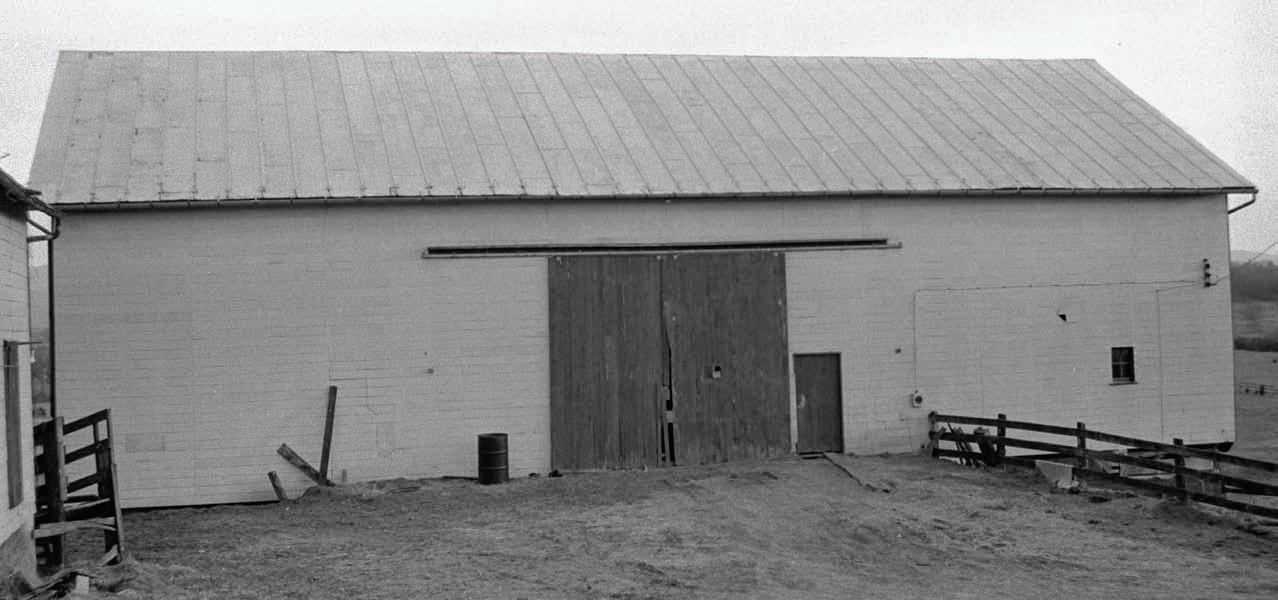
Co-founded by Ed Clark, Jr. in 1982, he and others transformed a horse barn in Weyers Cave to start the work. Clark, widely recognized for his work in conservation and environmental education, retired as president of the Wildlife Center in 2024. Clark received the Chamber’s Leadership Excellence Award last year, shortly after his retirement.
“I don’t have exact numbers,” Gillespie said, “but I think the first year was something around 125 patients. Since then, we’ve treated over 100,000 patients from 1982 to now.”
Having outgrown the Weyers Cave makeshift facility, the Wildlife Center of Virginia moved to Waynesboro on South Delphine Avenue. The organization has treated over 4,000 patients in 2025, which has the Waynesboro facility close to capacity again.
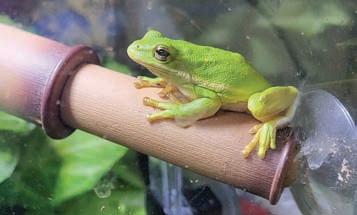
“The building we’re operating out of was built with 1,500 patients a year in mind,” Gillespie said. “Now that we’re at 4,000-plus a year, we’ve gotten creative in how we use the space, and we’ve built additional enclosures, but there’s only so much we can do before we need to expand. We’re seeing cases go up, and our goal is to never turn those animals away.”
The hope for every animal that comes through Wildlife Center of Virginia is a return to the wild.
“That’s where they belong,” Gillespie said. “The animals that come to us were wild to begin with, and they deserve a chance to go back to the wild. Most of them wouldn’t even be able to adapt to human care. It would be too stressful for them. The right thing is to get them back out there.”
To make sure the animals don’t become too accustomed to people, the staff take some pretty extreme precautions. For instance, to interact with certain animals, the staff may wear a mask that blocks their face. They also avoid talking around the animals.
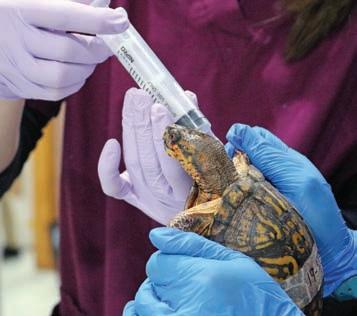
“I’d say the most exciting part is calling that person who rescued an animal and saying, ‘Hey, do you remember that animal you brought to us a couple of weeks ago? It’s ready to go. You can come pick it up for release,” Gillespie said. “They’re usually thrilled that they get to be a part of that.”
Periodically, an animal can recover, but not to the point that they could ever return to the wild. About once a year, the Wildlife Center staff will permanently adopt a patient as an education animal.
“It’s not common,” Gillespie said. “We have to ask ourselves questions like, can that animal become comfortable in human care? Do we have the space to house it? Do we have the staff to care for it long term? If all those things come together, then that animal can become an ambassador animal at the Center.
The best case scenario, however, is that the Wildlife Center staff can call the community members who brought the animal in to assist with the release.
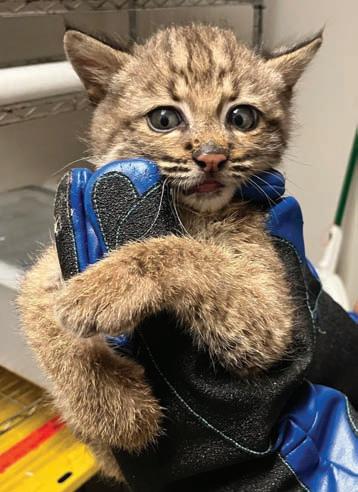
The Wildlife Center isn’t just a place where people bring wild animals to get better, it’s also a training facility for aspiring professionals planning to make a career out of caring for animals.
“Something that’s unique about the Wildlife Center is that we’re a teaching hospital,” Gillespie said. “We regularly have students come through to learn and work alongside our team. And these students aren’t just from Virginia. They come from around the country, and from other countries as well. We’ve had students from countries in Europe, Africa, Asia, and South Americ.
“The reason they come is that most veterinary schools teach you how to care for domestic animals like dogs and cat, or livestock like horses and cattle. They’ll even teach you how to care for some exotic animals, but there are very few places that teach students how to practice wildlife medicine. We bridge that gap.”
The work of Wildlife Center or Virginia includes research, too.
“Big picture, when we have an animal is coming in, there’s a lot happening,” Gillespie said. “Say a box turtle comes in. Not only are we trying to treat that turtle to get it back to the wild, but we also have a student that’s learning how to care for it, and we’re taking research samples that help us learn more about the species. It’s a big picture thing, how that one patient has a big impact.” <
by Heather S. Cole
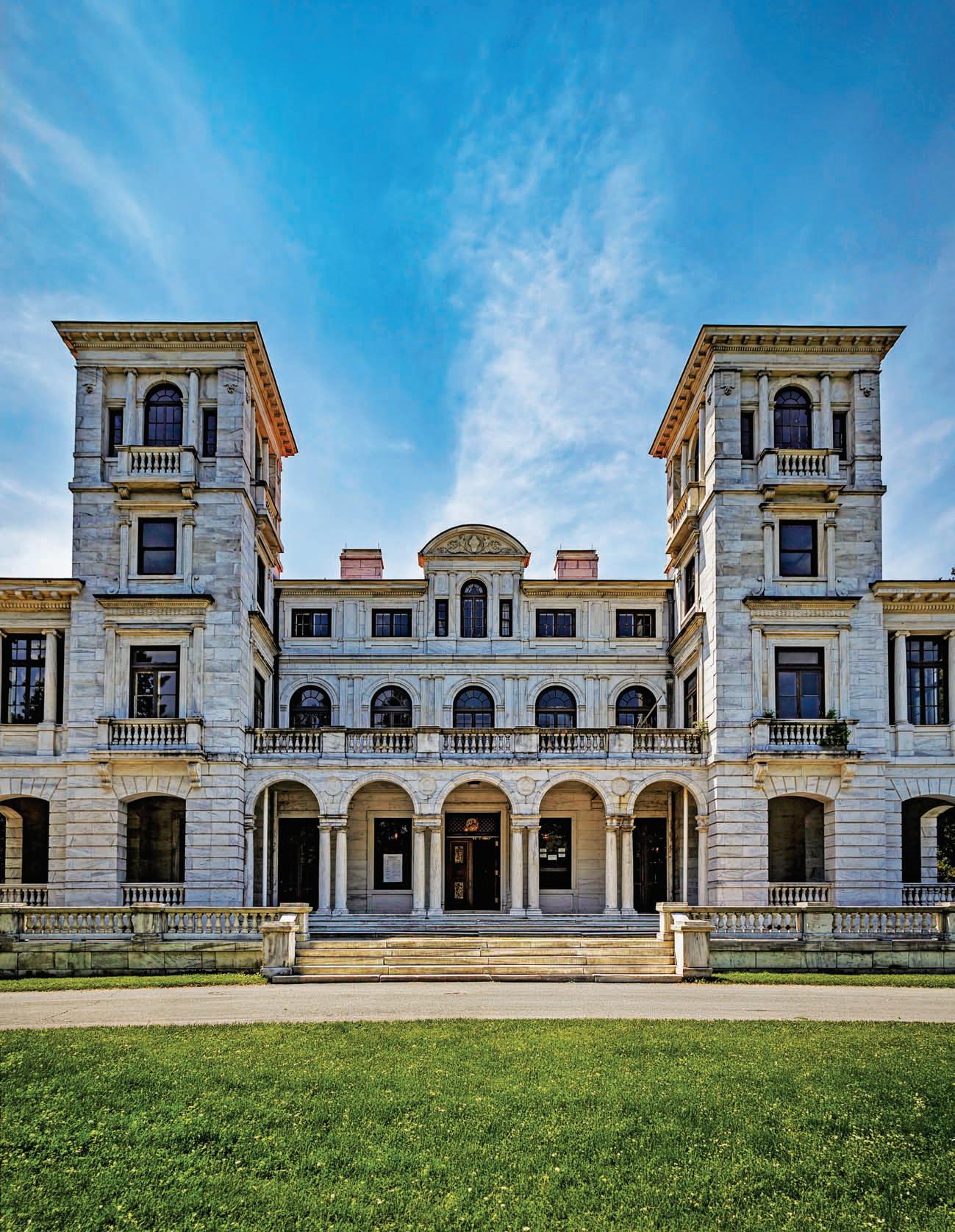
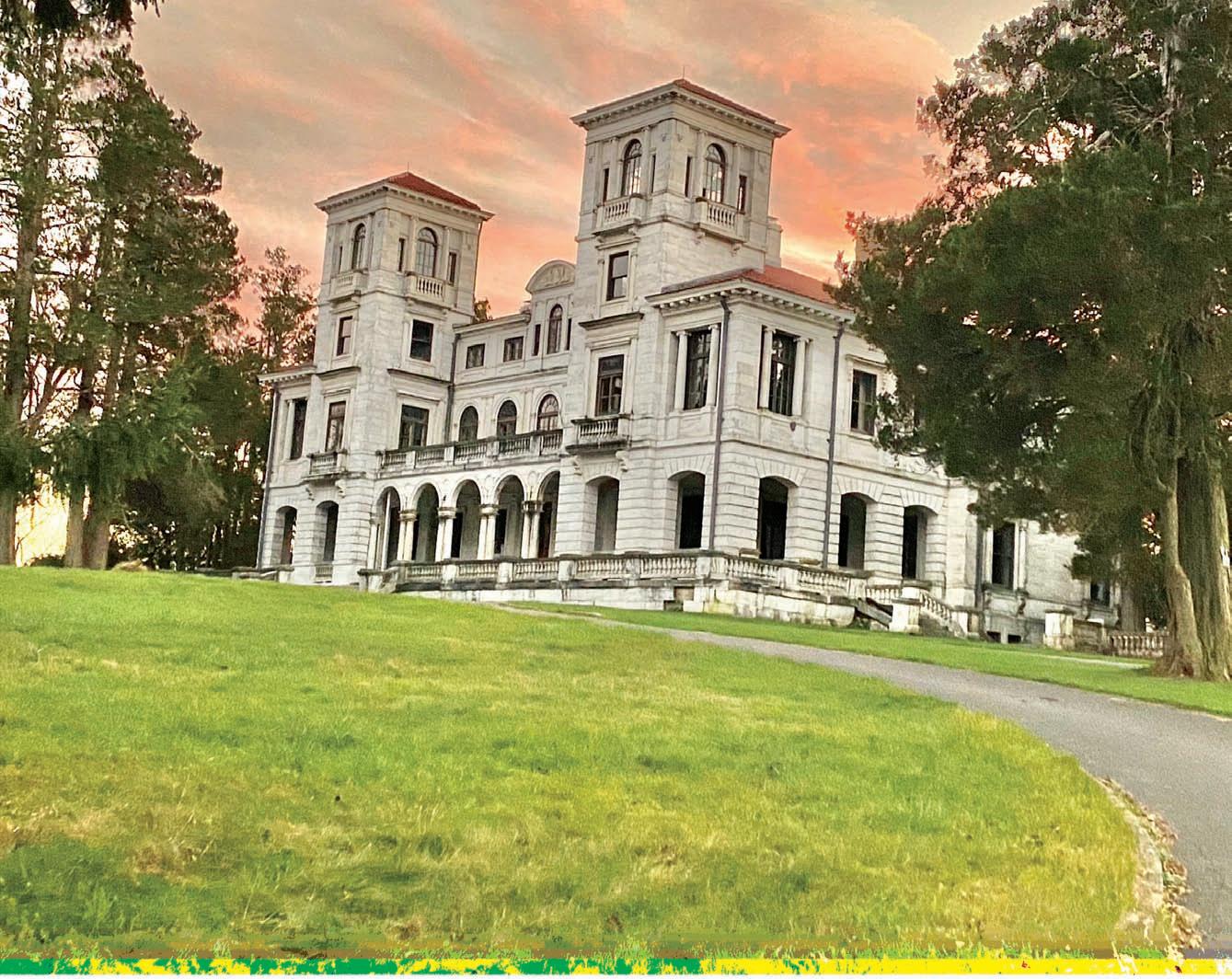
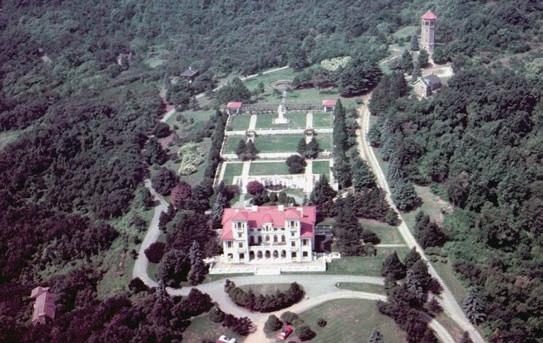
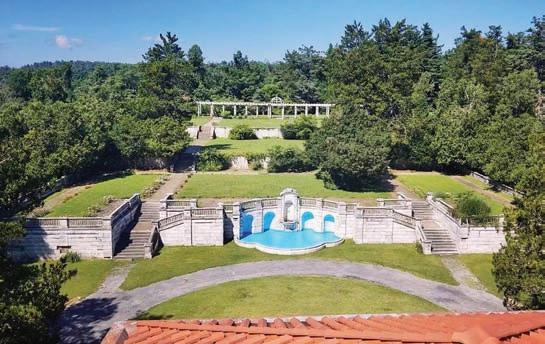
When James H. Dooley purchased 100 acres of land on the top of Afton Mountain in 1911, he envisioned creating a summer retreat for himself and his bride to escape the oppressive heat of their Richmond estate. Many of his fellow Gilded Age industrialists built mansions near the water (Newport, Long Island, Boston’s North Shore), but Dooley chose the Blue Ridge mountains, likely because his wife, Sallie May Dooley, had grown up in nearby Staunton.
Money was no object for the Civil War veteran and Georgetowneducated lawyer who had made his fortune investing in real estate, insurance, banking and, most of all, the railroads that were still expanding throughout the southern and western United States. Dooley hired the Richmond architectural firm Nolan and Baskerville and spent an estimated $300,000 (equivalent to nearly $10 million today) to carry out his vision. Swannanoa, his mountaintop mansion, was completed in 1913.
Adrianne Boyer is director of marketing and events for Swannanoa, a seasonal job that sees her running events, leading tours and sometimes pulling weeds. She moved to the area with her family in 2017 and said she fell in love with the house.
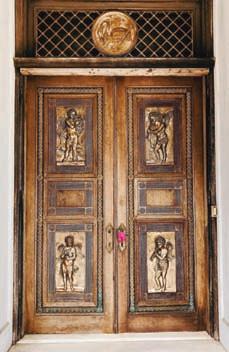
The four-story mansion, clad in white marble and styled like an Italian villa, came to have 36 rooms and seven bathrooms, including a basement-level kitchen and servant quarters. The dining room, with a coffered ceiling and oak parquet floors, has walls covered in hand-tooled leather. The gold-toned music room features an Italian marble fireplace, built-in cabinets and carvings depicting musical instruments. The smoking room, to which the gentlemen would retire after dinner, is decorated in a “Persian” style, with teak carvings, a tiled fireplace and an intricate bronze chandelier.
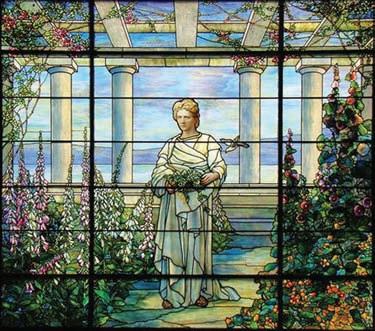
But the centerpiece of the mansion is a larger-than-life Tiffany stained-glass window depicting Sallie May Dooley surrounded by a garden of her favorite flowers. The window, which sits on the landing of the center hall’s marble double staircase, is believed to be the largest Tiffany window in a private home.
“This window was James Dooley’s love letter to his wife,” Boyer said.
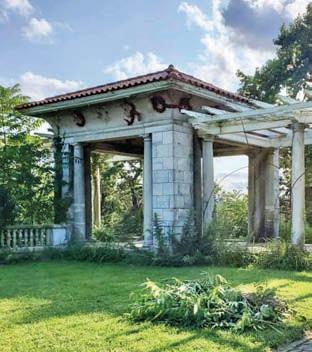
And that is just the inside. The mansion is surrounded by terraced gardens, outbuildings and what, at the time, would have been an expansive view of the surrounding area.
Today that view is largely blocked by overgrown pines, which speaks to the neglect that Swannanoa endured for many years and which the current owner is working to remedy. It has been a multi-year project that has been particularly challenging in a world where a million dollars just doesn’t go as far as it used to.
“We all want to see Swannanoa fully restored,” Boyer said. “It is taking time, but we tackle projects as we can afford them. Our overall goal is to keep the property maintained and secure.”
Swannanoa continued on page 24
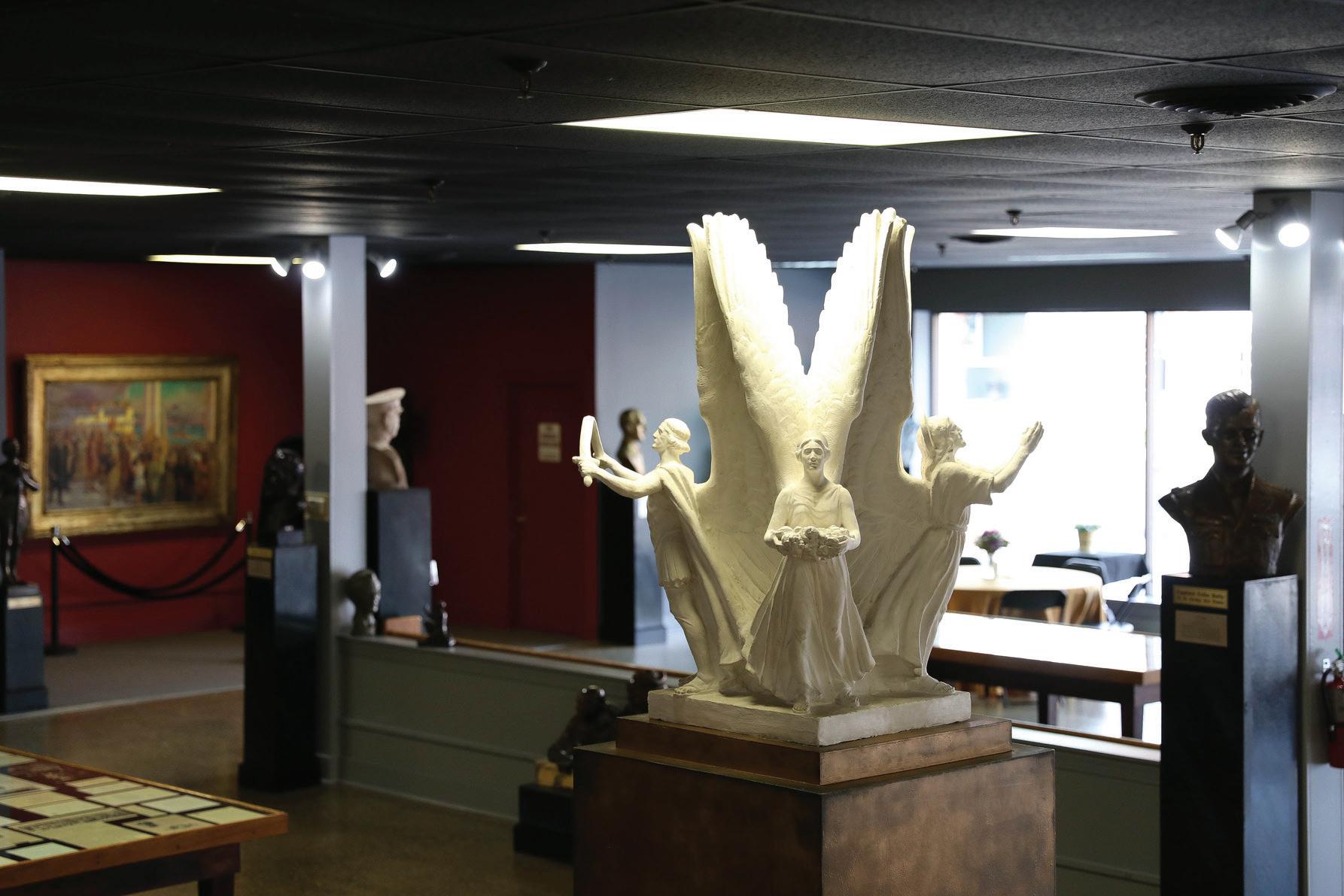










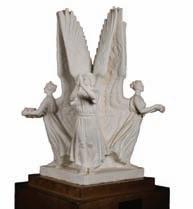

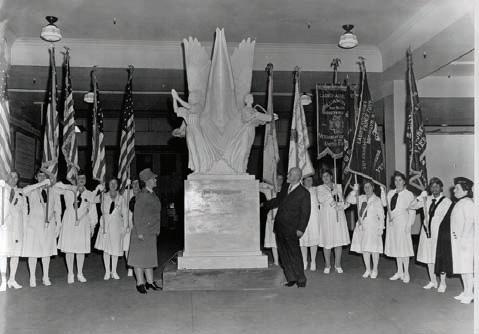
The Four Freedoms Monument, sculpted by Walter Russell, gives enduring form to the ideals that define the American spirit: Freedom of Speech, Freedom of Worship, Freedom from Want, and Freedom from Fear. These universal principles affirm the dignity of every human being and the promise of liberty for all. The monument’s four angelic figures embody these freedoms in sculpted form, offering a timeless vision of strength, compassion, provision, and peace.
The sculpture was commissioned following President Franklin D. Roosevelt’s 1941 State of the Union Address, in which he articulated these “Four Freedoms” as the foundation of a just and peaceful world. Russell transformed those historic words into a powerful visual statement — reminding us that freedom is both a right and a responsibility.
As the United States approaches its 250th Anniversary, the Four Freedoms remain as vital today as when they were first proclaimed. They call us to protect free expression, defend faith and conscience, secure a healthy and sufficient life for all, and strive for peace.
The Four Freedoms Monument is proudly on display at The Russell Museum, where visitors are invited to experience this historic work of art and reflect upon the principles that continue to shape our nation and inspire the world.

Swannanoa continued from page 22
The Dooleys lived at Swannanoa until their deaths in 1922 and 1925. The house was then sold to a corporation that opened the Swannanoa Country Club and Golf Course, which operated until it went bankrupt during the Great Depression. The mansion is believed to have been used as a convent for a time but otherwise sat empty and abandoned for more than a decade.
In 1945 the property was purchased by A.T. Dulaney, who formed Skyline Swannanoa, Inc. to develop the lower portion of the mountain into hotels and restaurants. From 1948 until 1988, the house was leased to Walter and Lao Russell, who restored the building and operated an educational nonprofit from their home there. Their organization, The University of Science and Philosophy, continued the lease for another decade, but the house endured damage from the weather and from vandals.
In 1999 Phil Dulaney, the grandson of A.T. Dulaney, and his wife, Sandi Dulaney, began the monumental task of trying to restore Swannanoa to its former grandeur. They hired the original roofing company to replace the terracotta roof and repointed much of the marble. They tried living in the house, but it was just too expensive to heat and maintain.
Boyer says that the Dulaneys have spent more than $3 million in restoration work so far, and there is still plenty of work to do.
“As we continue our restoration work, we’re trying to educate people that the house is not haunted or abandoned,” Boyer said. “The easiest way to show that there is life here is to have life here.”
Swannanoa is currently closed for tours while essential renovations are underway. Boyer said, “We anticipate completion and a reopening for guided tours and special events by June; however, that timeframe is projected and not guaranteed. June is the tentative date we are planning around as we look ahead to our 2026 seasonal schedule. Check the website at skyline-swannanoa-inc.square.site for details.”
Swannanoa traditionally operates on a seasonal calendar, with tours and events held May through November, and is generally closed December through April.
On a Saturday afternoon last fall, more than 40 people came for a 90-minute tour of the mansion, led by Boyer. Although the group skewed towards retiree-age, there were also a few families and a group of 20-somethings.
Terri Edwards and her husband, Randall Edwards, came from Richmond for the tour. They had previously been to Maymont, the Dooley’s estate in Richmond, but it was mention of Swannanoa in Steven K. Smith’s middle grade mystery book, Midnight at the Mansion, set at Maymont, that prompted their visit.
Chris Thompson grew up in the area, but this was her first time touring the museum. “We always knew this place existed,” she said, adding that she remembers her brother telling stories of roller skating inside the mansion as a teenager, although she never joined him.
As the tour wrapped up, the group peeked at a bride and groom who posed for photos on the marble steps. In addition to tours and special events, the mansion and grounds are also available for rentals and what Boyer calls “microweddings.” Every little bit of income from events and tours helps and is used towards ongoing efforts to preserve the estate.
Information on guided tours and events is available on the Swannanoa website: skyline-swannanoa-inc.square.site <
Thank you to the staff and volunteers of the Waynesboro Historical Commission and Waynesboro Heritage Foundation, Inc. for their research on the history of Swannanoa. Their pamphlet, “Swannanoa: A Gilded Crown on the Blue Ridge,” is available at the Waynesboro Heritage Museum, 402 W. Main Street in Waynesboro.
























By Heather S. Cole
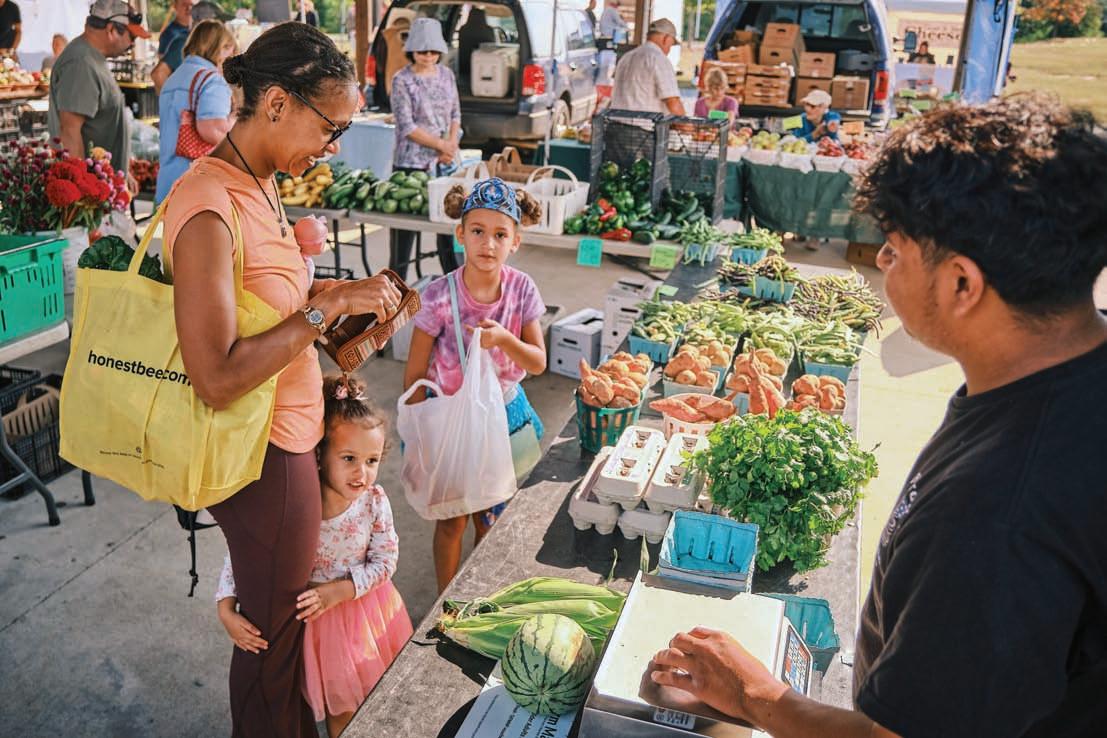
It is a crisp autumn morning, and the pavement is still damp from an overnight rain. The smell of fresh-brewed coffee and sizzling sausage wafts along a gentle breeze that also carries the sound of lively conversation and the twang of a banjo. It is Saturday morning, and the Staunton Farmers Market is bustling with locals and tourists shopping, eating, chatting and enjoying music from a live band.
It is just before 10 a.m., but the vendors have been here since before dawn, setting up their tents and tables in the Wharf Parking Lot on Johnson Street in downtown Staunton. They include local farmers with an assortment of produce and meats, as well as specialized vendors like Ballerino Creamery, Dickie Bros. Orchard and Tantivy Lavender Farm. For several of the vendors, this has been a Saturday morning routine for decades.
Rachel Ulmer of Ulmer’s Mountain View Farm near Mt. Solon has been selling her farm fresh produce at the market for 25 years. Ulmer, who was born and raised in Augusta County, says the customers who buy her cucumbers, beans and carrots each week have become like family, as many return week after week for years.
One of those customers is Wendy Meyer, a landscape architect from Staunton, who says she regularly shops at Ulmer’s stand. Today she is purchasing a tomato and a bag of kale, which she tucks into her reusable bag. Meyer says she often plans her weekend meals based on what is fresh and available at the market.
“I used to live in Germany where I had just a small refrigerator and would have to go shopping for fresh produce often. I got into the habit of shopping like that and it’s nice to be able to do that here,” Meyer says.
It is not just locals who shop at the Staunton Farmers Market, however. A growing number of customers are visitors and tourists, who take advantage of the vendors who offer prepared food and drink. Some of the market vendors also have brick-and-mortar locations: Bijou in Staunton sells pints of their hearty soups; Happ Coffee Roasters of Waynesboro offers a selection of caffeinated beverages; Magdalena Pasteleria brings a food truck full of baked goods.
Today Karen Scott and her mother, Pat Dystra, are visiting the market from Nashville, Tenn. The duo came to visit Scott’s daughter, Megan Scott, who is a first-year student at Mary Baldwin University’s Murphy Deming College of Health Sciences in Fishersville. This is their first time visiting the Staunton Farmers Market and they are grabbing breakfast at the market: egg sandwiches from Wild Altar Farmstead and chai from Chai Dhaba. They plan to tour the Woodrow Wilson Presidential Museum, but want to explore the market for a bit longer.


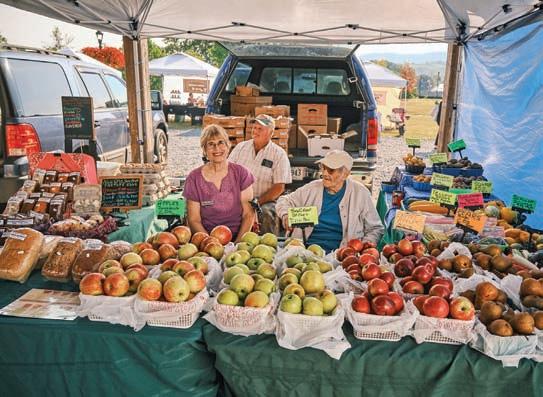
“Who knows what else we might find,” Dystra says.
Behind them in line at the Chai Dhaba stand is Tim Wilkins and his white husky-mix, Luna. Wilkins says he lives just a few blocks away and tries to come to the market as often as possible to catch up with neighbors. Today he is ordering an iced chai as Luna waits patiently to visit with her doggie friends.
Chai Dhaba’s Bharat Shah says that chai is, by far, the most popular item on their menu, which includes an assortment of Indian street foods and snacks. He says they have sold about 18 gallons of the sweet, spicy tea each Saturday since they joined the market in 2019.
In addition to fresh and prepared food and drink, the market also has live music by local bands most Saturdays. This morning singer-songwriter Corrie Lynn Green and her band perform a blend of folk and Americana music for the shoppers and vendors. On select weekends the market also hosts local community organizations such as the Staunton Public Library.
The Staunton Farmers Market got its start in 1993 with just six vendors. Susan and Jim Randall of Elk Run Farm have been at just about every market since that first year. Each week the couple brings boxes of produce, cartons of eggs and coolers of pork and chicken from their Fort Defiance farm to the market. But Susan says that it is the community that keep them coming back year after year.
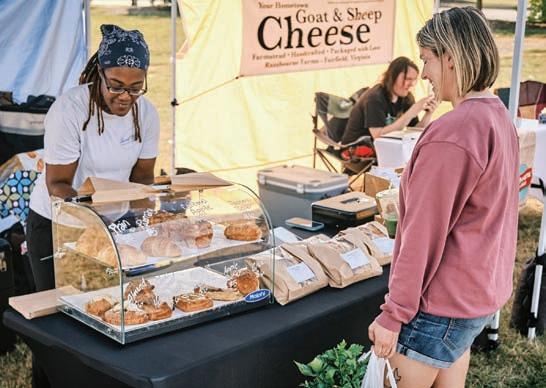

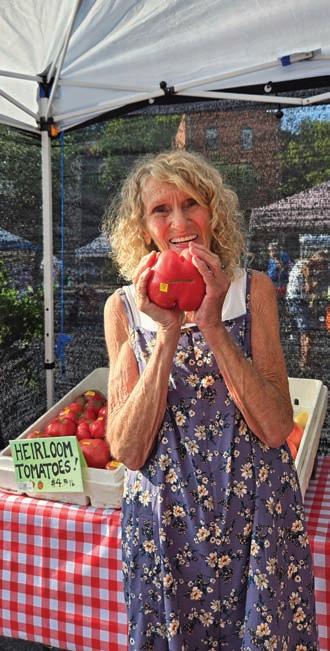
“We’ve known some of our customer and their families for 25 years,” she says. “We see some of the same people week after week.”
Since the early years the market has expanded to include more than two dozen vendors and a Winter Holiday Market that runs through December. Randall says she has noticed that there are more younger people at the market than there used to be and that it has become more of a social scene for the entire community. The market also now accepts SNAP/EBT benefits, making fresh produce available to more people.
While the market has diversified to include prepared food and specialized vendors, market manager Rachel Wine notes all vendors are still required to grow or produce their items within 75 miles of Staunton.
“We work hard to have something for everyone, while still honoring our mission of supporting local farmers,” Wine says. The Staunton Farmers Market (stauntonfarmersmarket.org) is held in the Wharf Parking Lot on Johnson Street in Staunton on Saturdays from 8 a.m.-noon from April until the Saturday before Thanksgiving.
Project Grows, a nonprofit educational farm in Verona, also runs a farmers market in Constitution Park in Waynesboro on Saturdays from 9 a.m.-1 p.m. from May through October. Project Grows also hosts a variety of popup markets that are listed on their website: projectgrows.org/market-schedule.
For a map of markets, farm stands and other local food sources (including food pantries) in the Shenandoah Valley and beyond, visit the Food Map of the Valley (www.tinyurl.com/VAFoodMap), developed by Augusta County resident Olivia Hathaway earlier this year. <

By Chris Lassiter
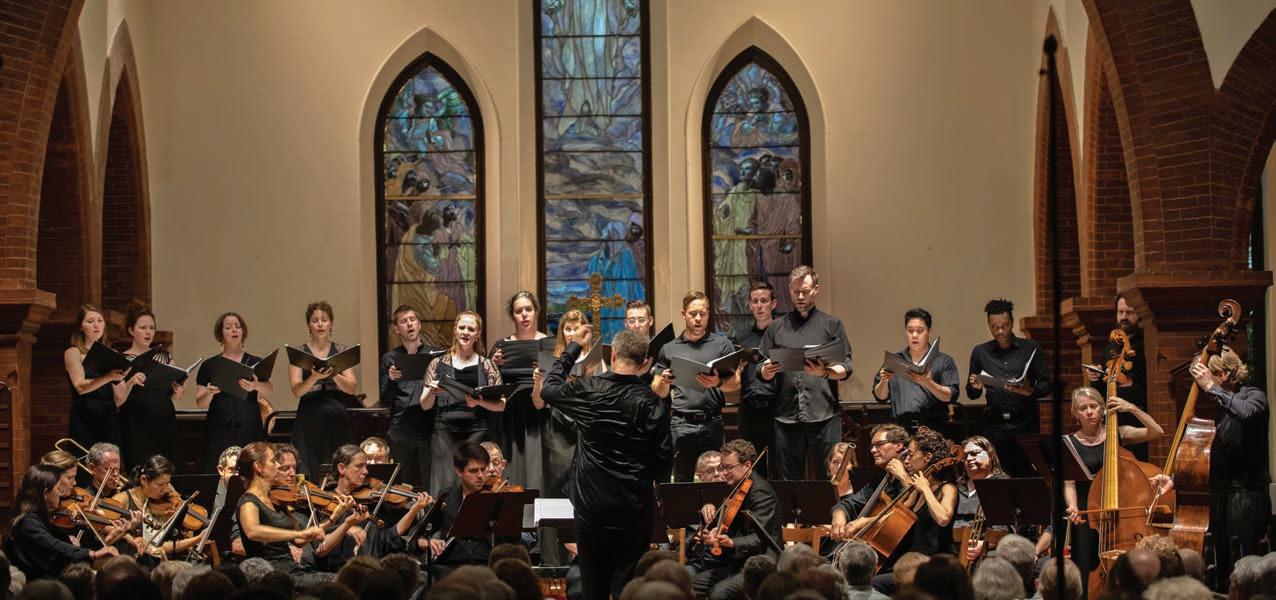
Since its inception in 1998, Staunton Music Festival (SMF) has grown each year, both in size and popularity. The unique twist on the classical music experience, paired with Staunton’s love for culture and art, has made for the perfect marriage.
“The majority of what we do is put on a classical music festival in August,” said Jason Stell, executive director of SMF. “It goes on for 10 days, and we pack in about 30 concerts. Ninety musicians arrive from across the US, Europe and South America. Apart from the summer festival, we do one-off concerts in the spring and fall, and we recently introduced a Baroque mini-festival in April.”
When Carsten Schmidt came to teach at Mary Baldwin College (now University) in 1998, he brought his love for music performance with him.
“Carsten and some friends did a couple concerts that first year,” Stell said. “He liked the town. They played a concert outside at the Woodrow Wilson Birthplace and one at Trinity (Episcopal) Church. About 50 people came to each one. They had a good time, but no one really expected it would become something that would stay.”
In 2026 Staunton Music Festival celebrates its 28th year of concerts.
Although Schmidt soon took a teaching job in New York City, he kept his Staunton home. “Carsten kept doing this small summer festival for the next few years,” Stell said, continuing with the story. “When Blackfriars Playhouse opened, they did concerts there. Gradually, momentum got behind it. Soon it was five or 10 players expanding out to do five or six concerts.
“It just kind of grew from there. Each year, it was a question whether there’d be enough income to pay the players and have a little bit left for a party afterward! Structure was almost nonexistent; some key volunteers really made all the difference in its survival. When I moved to town in 2006, it was still very small. I think we did eight concerts that August and had maybe 25 musicians.”
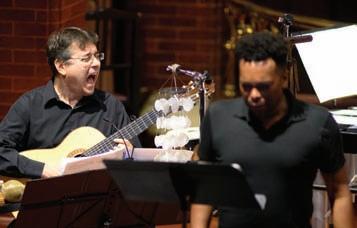
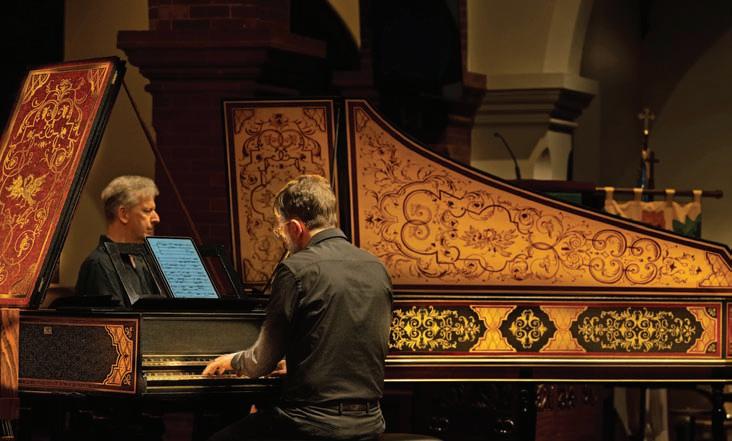
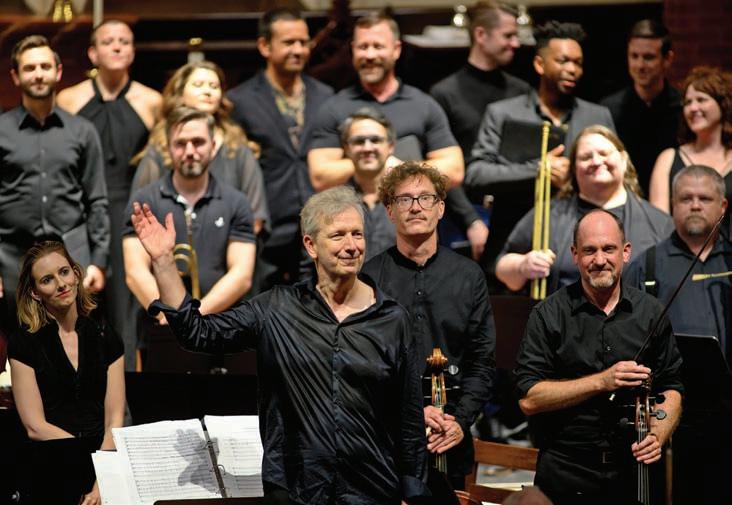
Top: The grand finale to a recent Mozart concert. Left: Festival harpsichords. Both photos by Leslie Kipp.
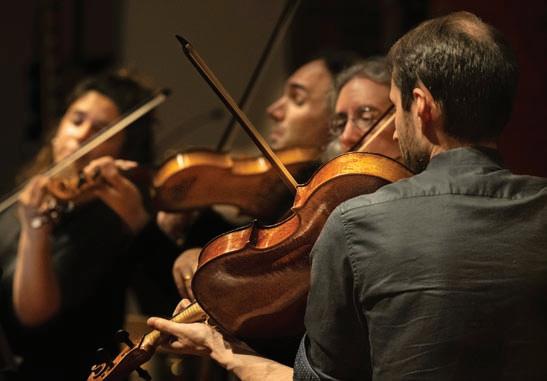
A traditional classical music experience might involve an orchestra, composed of musicians with a long history of performing together. One unique twist about SMF is that each musician is recruited individually and then paired with other players upon arrival.
“That’s always been Carsten’s plan,” Stell said. “I’m not sure if he knew this model would be so distinctive. A few other festivals work this way, but it’s very different from a lot of the big places you hear about. They are almost always a ‘presenting festival’ that bring in pre-formed ensembles.
“Carsten still wants to put together a fantastic orchestra, and we do. But it’s made up of all these incredible soloists. He has this brilliant ability to bring together friends and colleagues from around the world, scramble them up, and play the programs he wants to do.”
SMF’s programming is also unique.
“It’s very original, very eclectic, something you just don’t hear in other places,” Stell said. “We take a lot of pride in that. The feedback we get from the audience — the thing that keeps them coming back — is, one, the high level of the performers, but also the programs. People come up to me as they’re leaving and they’re like, ‘How did you come up with these pieces?’” And I’m like, ‘It’s not me. That’s all Carsten.’ The good and the crazy weird stuff! (Stell laughs.) I literally do not know anyone else who knows that much music.”
While fresh ideas are always being incorporated, the venues mostly remain the same.
That’s intentional.
Stell and the event organizers love being in downtown Staunton. “You can go from Trinity Church on one end to Blackfriars on the other, and that’s pretty much our footprint,” Stell said. “It’s all happening in those four blocks. For most audience members, that’s completely walkable.
The feeling we seek is like a European-style music festival. You’re walking everywhere. You can catch a free concert at First Presbyterian Church, then walk one block to a wine bar for lunch. After lunch you stop in for a Pop-Up concert three doors down, shop a bit, and then grab dinner, finishing with the big evening concert at Trinity Church — all on the same street.”
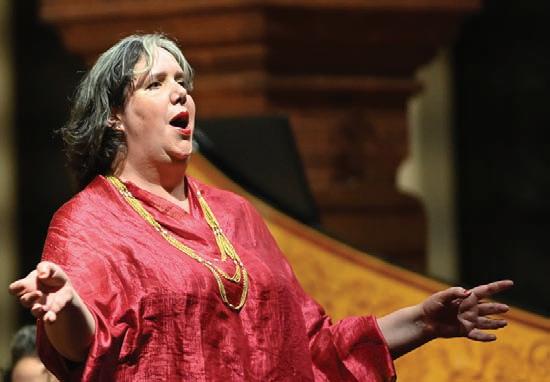
It’s wildly popular, both locally and as a tourism draw. If 500 people represent a full house for SMF, about half will come from further than 50 miles away. Stell has even met several audience members who moved to Staunton in recent years largely due to the music festival.
“We’ve been able to grow every year we’ve been in existence,” Stell said. “The retention we have from audience members is really high. We’re not losing people who are disappointed in what they find. People go back home and share their experiences. They get enthusiastic about what they see being done, about the energy that the concerts have. I think they are surprised, honestly, that in a small city in Virginia’s Shenandoah Valley, dozens of top-notch players from around the world are here playing these incredible programs.” <
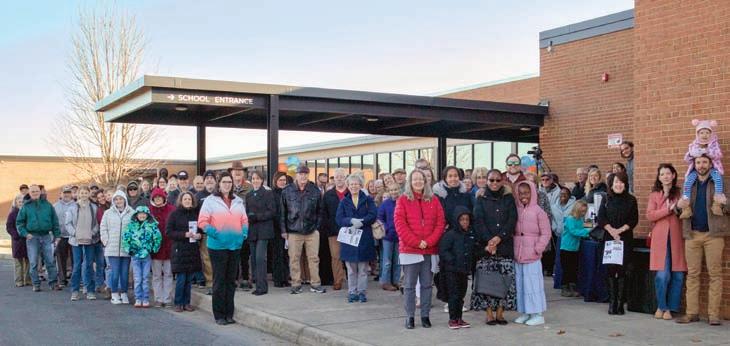
On a cold Wednesday in January, a large crowd gathered to witness and participate in a ribbon-cutting that represented the culmination of many dreams stretching back as far as 1980. That vision of the founders of Grace Christian School 46 years ago was, as their mission statement says in part, “to assist Christian parents by providing a sound academic education in a Christ-centered environment.” That vision included providing K-12 education in a single state-of-the-art educational facility. That dream is close to being achieved.
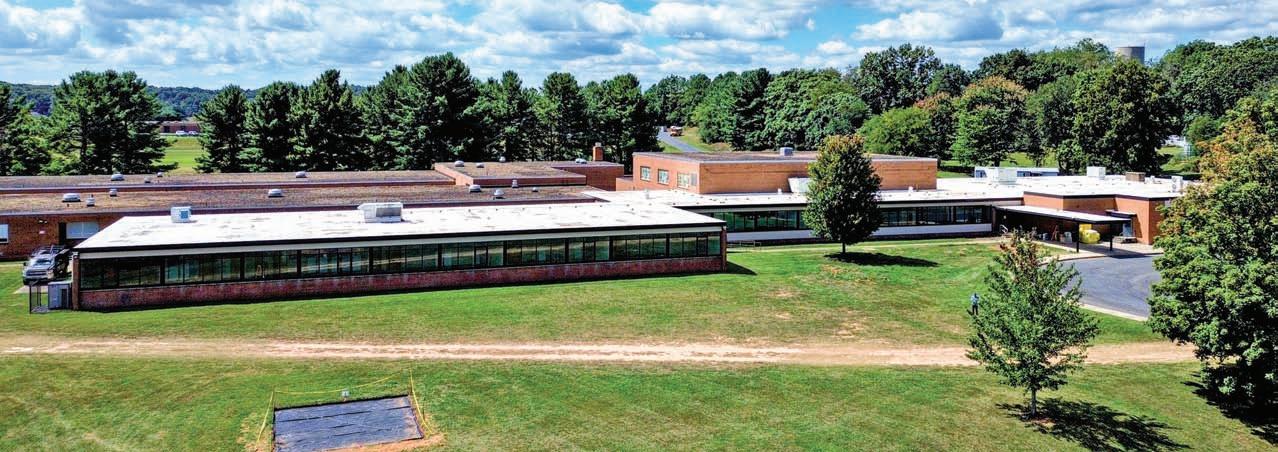
That ribbon-cutting marked the completion of Phase I of the school’s renovation of the former Beverley Manor Elementary School on Cedar Green Road in Staunton. Following a $6.5 million purchase and renovation of the former Beverley Manor Elementary School, the GCS high school and administrative offices moved into the building in December, and classes began at the new location for high school students on January 7, 2026.
Top: An aerial view of the renovated and remodeled Grace Christian School, formerly Beverly Manor Elementary School.
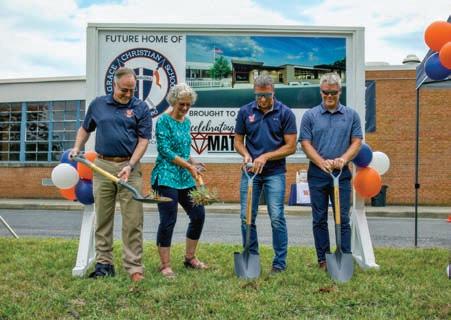
Above: (l. to r.) Groundbreaking for the renovation project was held in August, 2024. Construction has proceeded, with Phase II due to be completed later in 2026. A ribbon-cutting marking completion of Phase I occurred in January of this year.


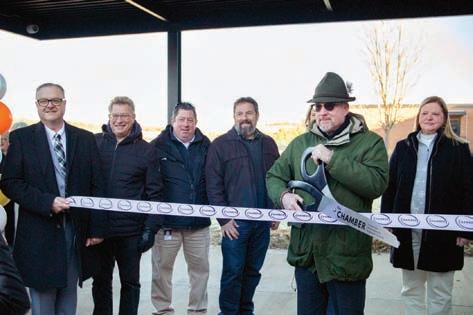
Many GCS faculty and staff members, as well as community members and graduates of schools formerly housed at the Cedar Green Road location gathered to celebrate the occasion. Don Larson, CGS Head of School spoke first, providing context for the gathering and a vision for the path forward. He said, “This event began as a strategic initiative in 2018; we were dreaming big.” He concluded with, “We hope that Preschool through 12th grade will start the 2026-27 school year in this building. One school on one campus. An answer to a big dream and a lot of prayer.”
Following Larson’s remarks, Courtney Thompson, president and CEO of the Greater Augusta Regional Chamber of Commerce, organized the ceremonial ribbon cutting.
Augusta County Administrator Tim Fitzgerald also spoke at the ribbon-cutting ceremony. He is the parent of a current GCS high school student and a GCS graduate, and has served GCS as a coach in recent years. Fitzgerald offered the following, “Augusta County was pleased to help facilitate this project through the sale of the property. We are proud to see this building restored and once again serving as a shining light for education for years to come.”
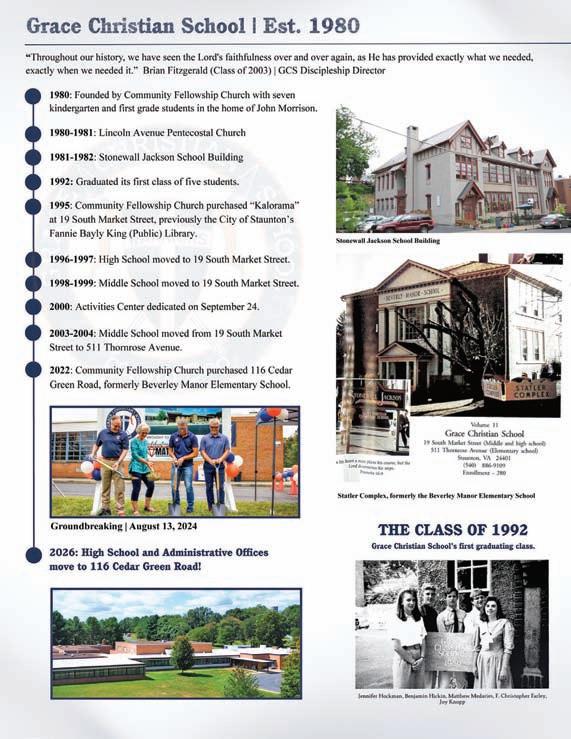
Community Fellowship Church founded Grace Christian School in 1980 in the home of John Morrison, with seven kindergarten and first-grade students. The first class of five graduated from the high school in 1992. Over the last 46 years, Grace has continued to grow, occupying several different buildings in Staunton to accommodate more students.
GCS moved into the Lincoln Avenue Pentecostal Church for one year, prior to moving into the Stonewall Jackson Grammar School on West Beverley Street. This building served as Grace’s home for 20 years, from 1981 until 2001, when the elementary school moved to 511 Thornrose Avenue, into what for many years was known as the Statler Complex after the then-Beverley Manor Elementary School moved from the city to the county.
In 1995, Community Fellowship Church purchased 19 South Market Street, previously the City of Staunton’s Fannie Bayly King (Public) Library. After renovations, the high school moved there for the 1996-97 school year. The middle school also moved to Market Street for a few years, prior to joining the elementary school at the Statler Complex for the 2003-04 school year.
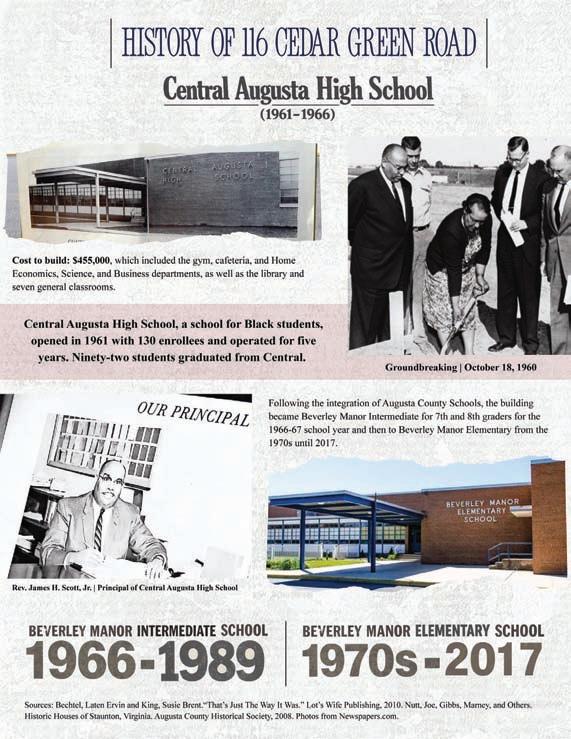
It has always been a dream of the leaders of Grace Christian School to have grade levels “under one roof,” and in 2022, Grace inched closer to that goal when Community Fellowship Church purchased 116 Cedar Green Road.
The Cedar Green building itself dates back to the time of segregation, when in 1961, Central Augusta High School opened to serve the Black population. Ninety-two students graduated from Central Augusta High School until the school closed following desegregation in 1966. With integration, the facility became Beverley Manor Intermediate School for the 1966-67 school year and then Beverley Manor Elementary School in the 1970s, until it closed its doors in 2017.
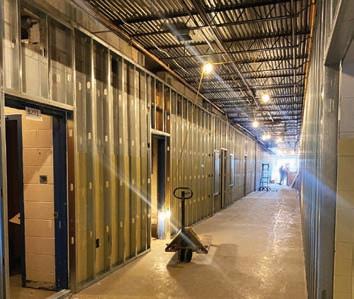
Phase II of the Cedar Green building’s renovations are scheduled to be finished in time for the elementary and middle schools students to move from the Statler complex on Thornrose Avenue into the newly consolidated Grace Christian School this coming fall.
Grace Christian School is fully accredited by the Association of Christian Schools International (ACSI) and AdvancED/ Southern Association of Colleges and Schools (SACS). Accreditation through these two organizations is in conjunction with the Virginia Council for Private Education (VCPE). <
Grace Christian School aims to see successive generations of Grace Christian School students living their lives in Christ for the glory of God. With a growing student body of over 300, GCS is the only accredited Christian school in Augusta County. Learn more at www.gcswarriors.org.
Top left: A history of the building, tracing from its origins as Central Augusta High School.
Top right: Timeline showing the multiple locations for Grace Christian School since 1980.
Above: A large crowd assembled for the Phase I ribbon-cutting in January.

By Heather S. Cole
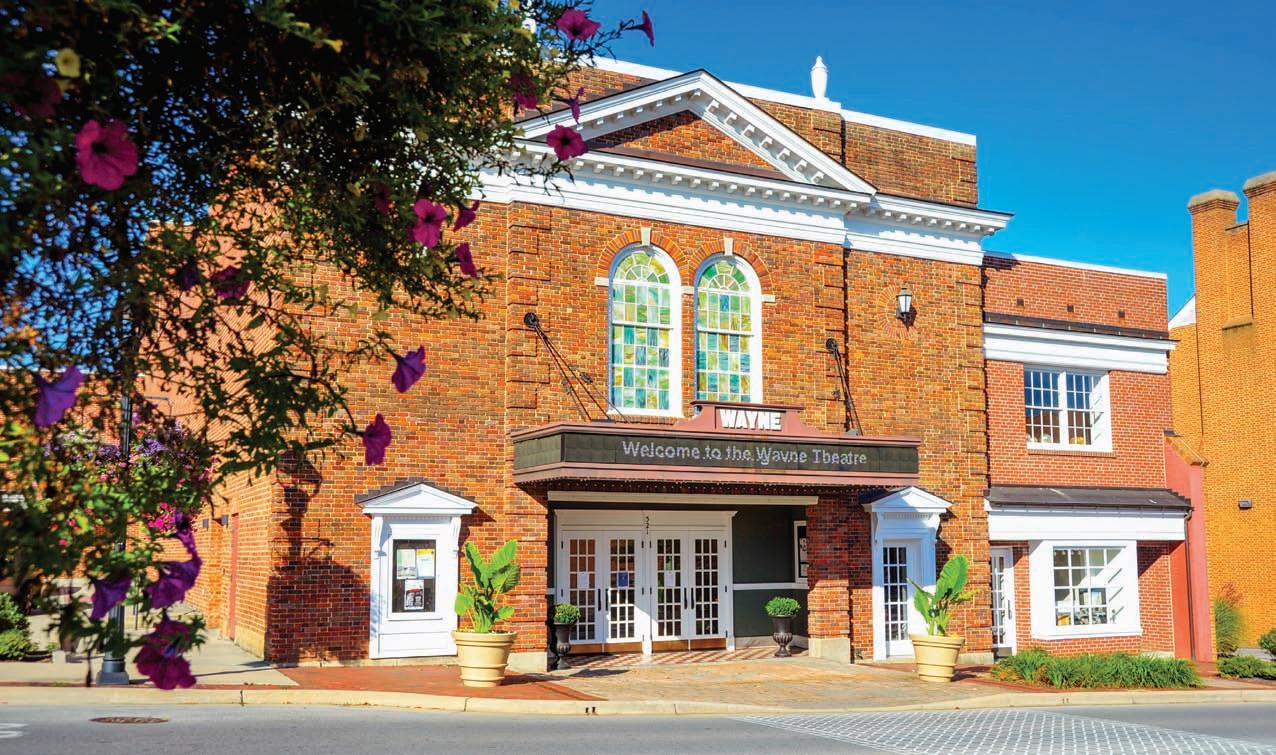
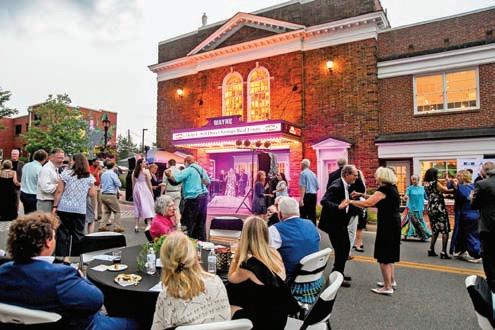
This year the Wayne Theatre in Waynesboro celebrates the 100th anniversary of its construction and the tenth anniversary of its reopening with a variety of programs to, in the words of executive director Tracy Straight, “bring back some of the magic of the early days.”
The season kicked off in January with a reunion performance of the River City Radio Hour, a live variety show that originally ran in the 2010s as a fundraiser for the restoration of the theater, which had closed in the 1990s and fallen into disrepair. Shows throughout this spring and summer will include those that nod to the Wayne Theatre’s early days hosting vaudeville shows: an illusionist, a circus trio and a live performance of “Singin’ in the Rain.” There will also be lots of classic films — perhaps even the very first film shown at the theater more than a century ago.
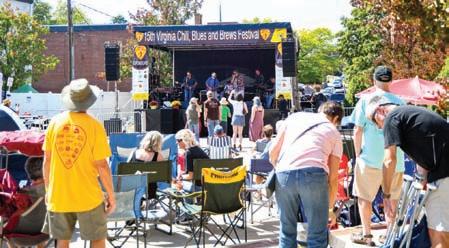
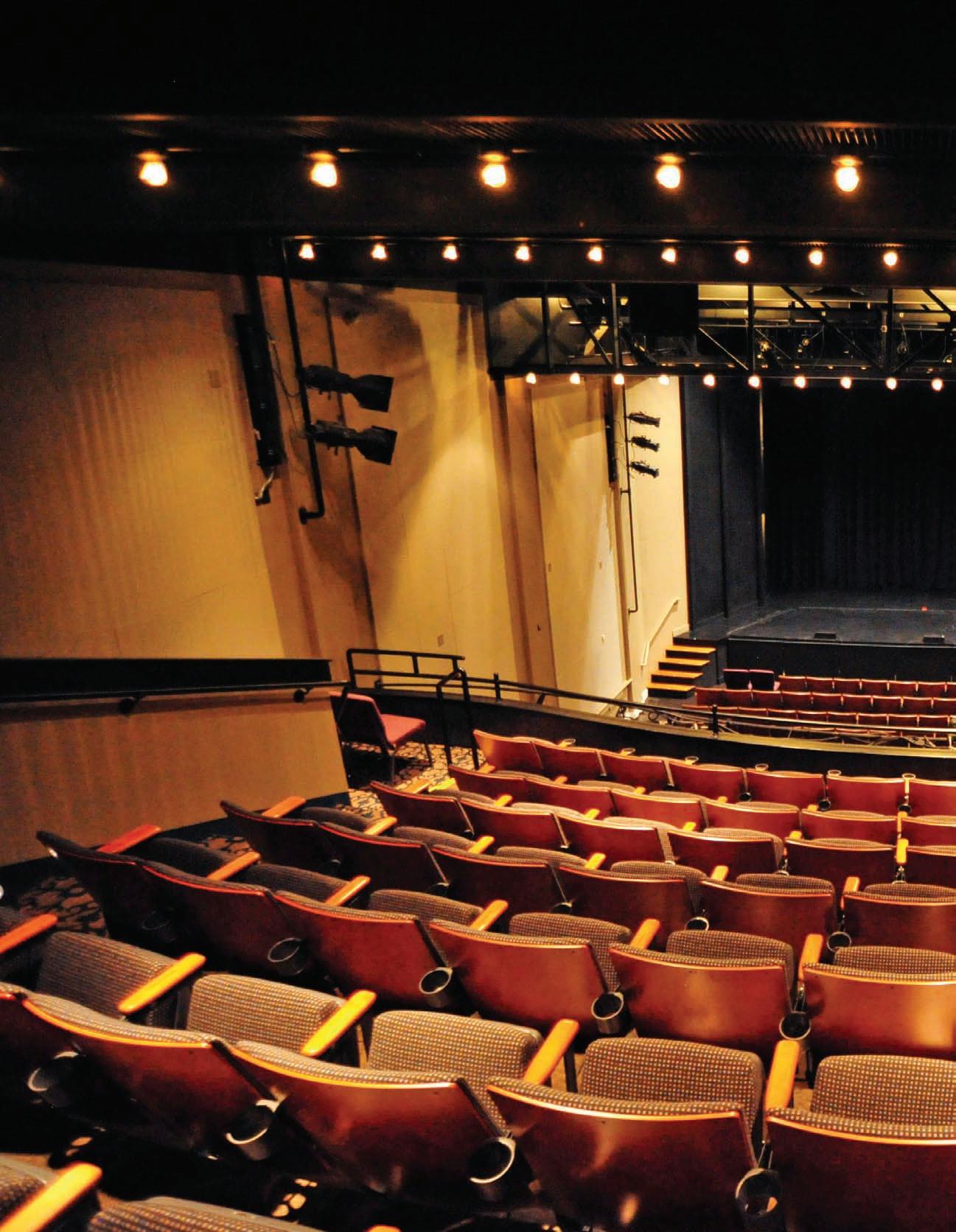
When the Wayne Theatre first opened on January 18, 1926, more than 1,000 people paid 35 cents each to watch “Charley’s Aunt,” a silent comedy starring Syd Chaplin, elder half-brother to actor Charlie Chaplin, as a cross-dressing college student. At the time, the theater sat 650 people, so many waited an hour-and-a-half for the second showing. The film was accompanied by music performed by a visiting musician on a custom-built pipe organ from the Arthur Jordan Piano Company of Washington, D.C., described in advertisements as “the largest and most expensive organ in this section of the state.”
Three years after its opening, the Wayne Theatre installed equipment to allow the showing of motion pictures with sound.
The “talkies” soon overtook the live shows in popularity, although the theater continued to host musical and theatrical performances. According to locals, both the Three Stooges and a trickster horse named Pocahontas took the stage at the Wayne — although not at the same time.
“Since the beginning, the Wayne Theatre has been a cornerstone of the community,” Straight says. “It gives people a reason to come downtown.”
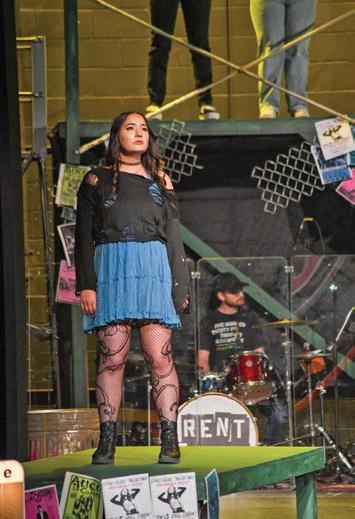
The Wayne Theatre was designed by the Richmond-based architectural firm of Lee, Smith and Vandervoort, which also designed a theater in Fredericksburg. Early advertisements boasted that the theater had modern heating, lighting and cooling, and seats “cushioned with nine springs.” This was apparently an improvement over the nearby Star Theatre, which had folding wooden chairs as seating.
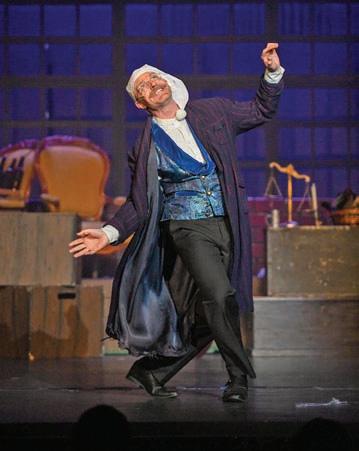
According to a description in The NewsVirginian shortly after the theater opened, “the side walls are paneled in shaded tones with a decorative plaster border in a color scheme of ivory, old rose and blue.” When it opened, the theater was segregated, with a separate entrance for Black moviegoers on the side of the theater and a section of the balcony partitioned off for their use.
The Wayne Theatre was founded and managed by a trio of young Waynesboro men: Francis R. Loth, Carl C. Loth and Max Patterson. Patterson was a graduate of the Virginia Military Institute, served in World War I and was commandant of cadets at Fishburn Military School. The Loth brothers were sons of the founder of the Waynesboro Stove Company; Carl had served in World War I and Francis had also attended the Virginia Military Institute. Before founding the Wayne, they ran the Star Theatre, located at 544 West Main Street, from its opening in 1922 until it closed around 1926. The three men would later open the Cavalier Theatre at 216 Main Street in 1930.
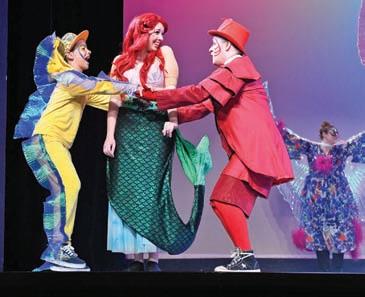
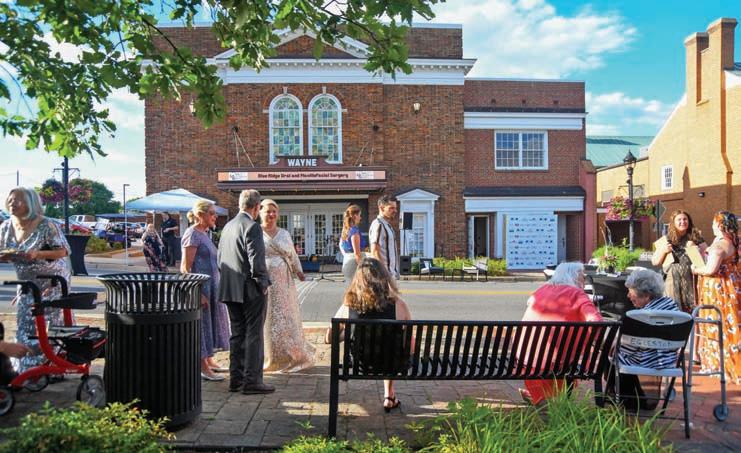
Fishersville resident Bill Loth grew up going to the Waynesboro movies in the 1940s and 1950s, although he confesses to having preferred the westerns that were shown at the Cavalier to the fancier movies at the Wayne. He remembers that his father, Francis R. Loth, had a workshop behind the Wayne Theatre where he spent many long hours fixing things that had broken in either of the two theaters.
“My father could make anything out of wood,” Loth recalls. Once his father crafted a miniature Conestoga wagon to advertise a Roy Rogers and Gene Autry western at the theater. “He had me and a friend driving all over town in that wagon to advertise the show.”
Loth also remembers riding his bike to the Wayne Theatre from his family’s home on Pine Street and stopping at the theater snack bar to grab a treat before a movie. He recalls that you could get a Coke and a popcorn for 15 cents, or a double dip of chocolate ice cream for a dime at what was known as Number Nine. (It was called Number Nine because that was the phone number of the snack bar, in an era when there were very few telephones in Waynesboro.)
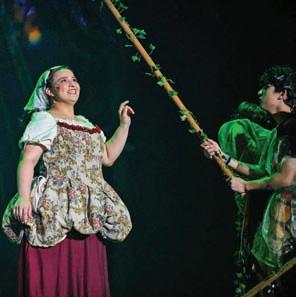
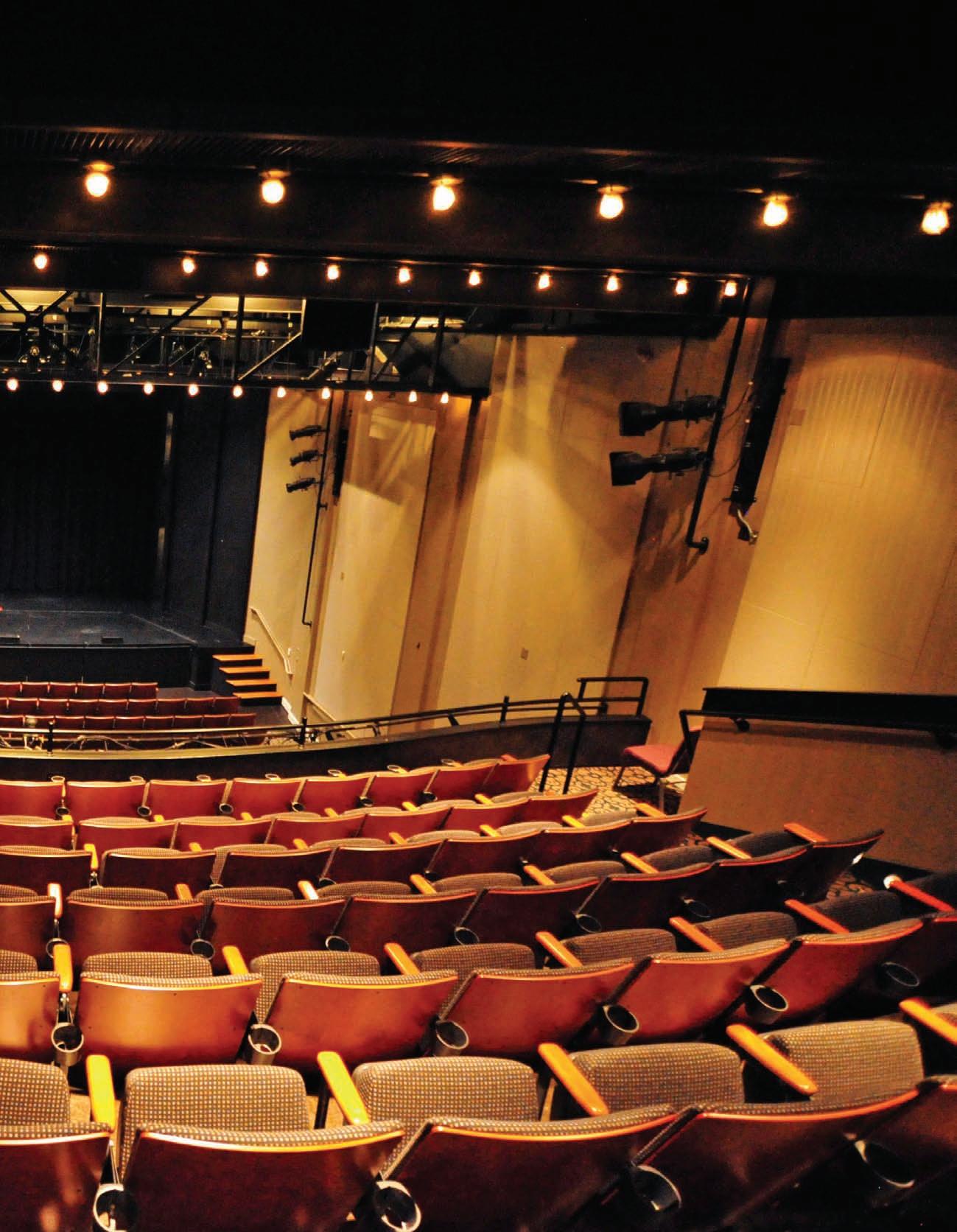
In 1964, the Wayne Theatre was sold out of the Loth family. A fire gutted the theater in 1980, and it reopened with two movie screens. After struggling to compete with other entertainment, the theater closed in 1999, and the property was deeded to the City of Waynesboro. The following year, a group of volunteers created a nonprofit organization and embarked on a years-long process to restore the theater and bring live entertainment back to downtown Waynesboro. The Wayne Theatre reopened to the public in March 2016. It now offers a variety of live theater, entertainment, movies and educational programming throughout the year.
The Waynesboro Heritage Museum, located at 420 West Main Street in Waynesboro, is gathering stories, photos and memorabilia for an is exhibit about the history of the Wayne Theatre, to open this summer. Visit their website at waynesboroheritagefoundation.com for details.
The Wayne Theatre is located at 521 West Main Street in Waynesboro. A full schedule of events is available on their website at waynetheatre.org. <


By Chris Lassiter
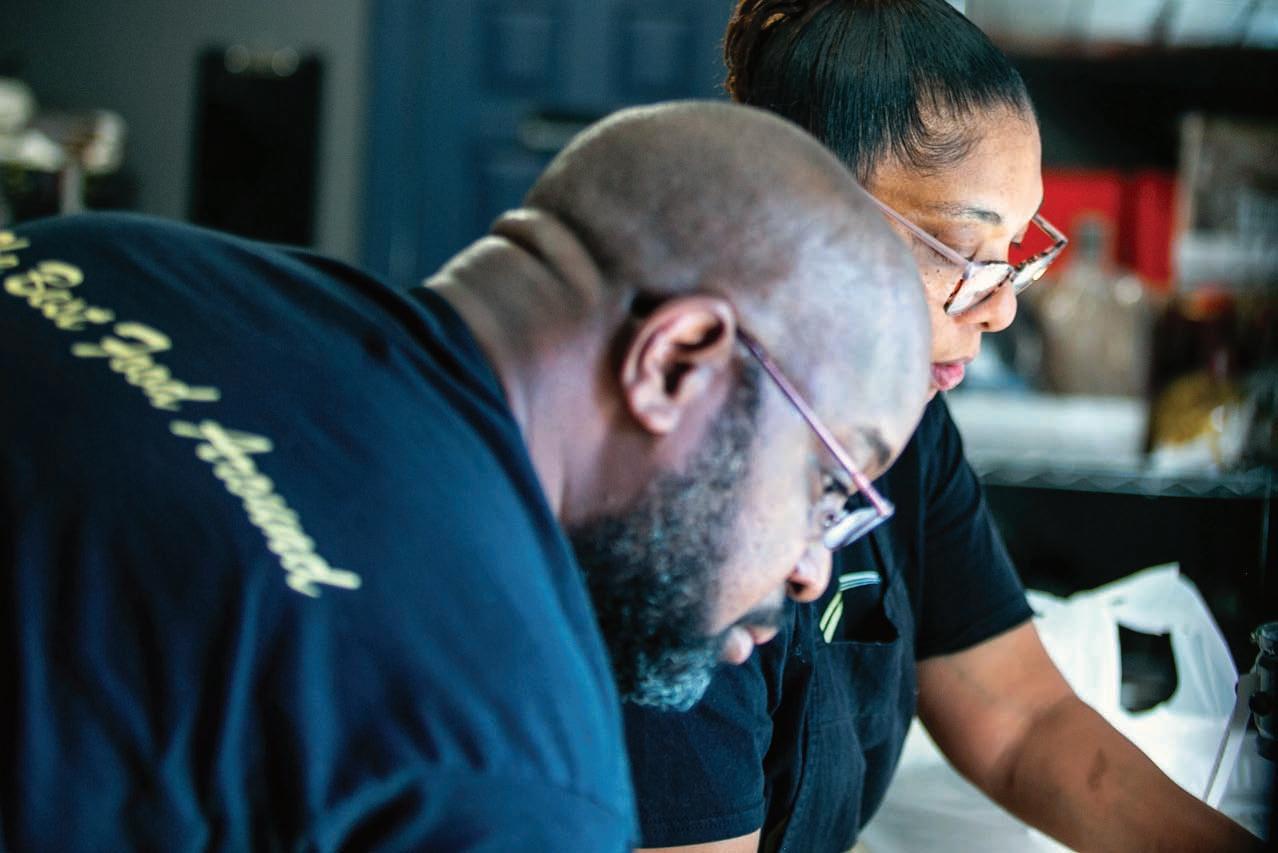


Charlotte and Ray Goodman have found the recipe for success.

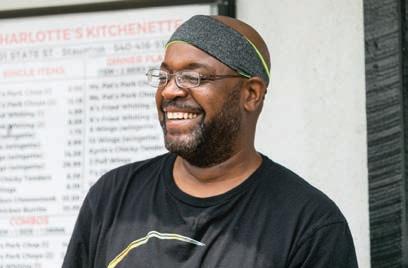
The Goodmans are th`e co-founders of Charlotte’s Kitchenette, a popular Staunton-based soul food takeout spot.
It’s not just the fried whiting, pork chops and collard greens — along with special items like the soul food burrito — that make the eatery in demand. The community has embraced the husband-and-wife team making the food as much as they have embraced Charlotte’s signature macaroni and cheese.
“Charlotte’s Kitchenette is a community-based restaurant where people can come and feel like they have a friend in us,” Charlotte said, “and actually eat food for the soul.”
Ray has a background in retail management. From his earliest days in Portsmouth, Ray, his brother and his friend would cut lawns to make extra money. “I’ve had that entrepreneurial spirit since I was a kid,” he said, “just that mindset of, ‘how can I make this one dollar into two dollars?’”
To teach his 8-year-old daughter about entrepreneurship, Ray recommended that she think of her own business. Charlotte brought everything their daughter needed for a strawberry lemonade stand.

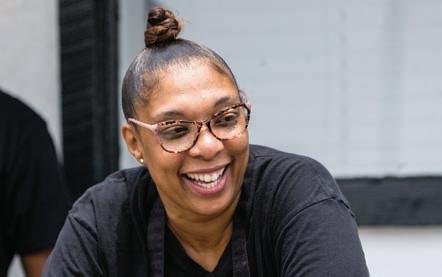
While Ray has always had the entrepreneurial vision, Charlotte has always had the passion for cooking. The following summer, Charlotte sold plates at the lemonade booth. “When people eat it (my cooking) and say, ‘Oh my gosh! This is so good!’ It’s like an adrenaline rush to me,” Charlotte said. “What I put into the food, I get back from everybody. That’s what I love about it.”
Some days, it would be too hot to stand out and sell plates or lemonade. Community members, however, wouldn’t take no for an answer. “People would actually knock on the door,” Ray said, laughing. “My daughter didn’t want to do the lemonade anymore, and it just turned into plates. She (Charlotte) had regulars in the front yard. If she wasn’t out there, they’d actually come and ring the doorbell and just stand there and wait.
At that point, I knew she really had something. I didn’t believe in it at this level at first. When they started knocking on the door consistently, I was like, ‘Yeah, you really have something here.’”
It didn’t take long for the Goodmans to outgrow the front yard. Together, the husband-and-wife team got a customized rig and prepared to take the food on the road. It took them a while to master cooking on the new set-up.
“Once the rig came, we practiced with family,” Ray said. “We didn’t know what we were doing. We were burning up stainless steel pans and everything.”
As a retail manager, Ray was used to profit-loss statements. He points to another huge mistake the couple made early — defying basic business principles - that turned out to be a huge blessing in the end.
“When we started that food trailer, we didn’t run it like a food truck,” he said. “A food truck has a limited amount of items, because it’s more cost effective. We had a full restaurant menu on a food trailer every day. She’d still be up at 6 or 7 in the morning cooking all this food.” Not great for the profit-loss statement initially, but perfect for marketing.


“I think that mistake, if you want to call it that, is what propelled us,” Ray said. “Once we got to the next level, we were prepared. It’s the best mistake we’ve made so far.”
Charlotte agrees. “Once word got out,” she said, “people wanted to eat this food that was nowhere else around.”
After two temporary locations on Churchville Ave, the Goodmans moved Charlotte’s Kitchenette to its current State Street location, near the huge watering can at the overpass. As community members got to know the Goodmans,, they would come for comforting words as much as they would come for comfort food.
It’s common for Charlotte’s Kitchenette to be one of the first stops people make after receiving bad news.
“It’s not just a soul food carryout restaurant,” Ray said. “It’s the place you go when you’ve having a bad day. Just coming and talking to us about what’s going on, people come in when they don’t have anyone else to talk to, or you just don’t want to talk to the people that are available to talk to, they leave and feel better.
“It’s community, but it’s community in a greater sense. The college kids come in when they miss their parents or they miss homecooked meals. They come see Uncle Ray or Aunty C. They just want to talk for 15 minutes to improve their day. They just want a shoulder to cry on, and they come here to do that.”
The Goodmans have listened as people have shared about a cancer diagnosis or a possible eviction. Caring for people comes as natural to the couple.
“We’ve been doing it our whole lives,” Charlotte said. “I’ve always been the person to make people laugh, and make people feel better. I’ve always been a people person. It’s a calling. And by me having that calling my entire life, it doesn’t stop with this. This helps me embrace my calling.” <


16 4 pm & 7: pm, Candlelight Celtic, Wayne Theatre.
19 7 pm, Chris Funk, The Wonderist, Wayne Theatre.
8-9 Fishersville Antiques Expo, Augusta Expo.
8-10 Singin’ In The Rain (Live theatrical performances), Wayne Theatre
8 8 am-2 pm, Leadership Greater Augusta Graduation, GARCC.
8 9-10 am, Aging In Place, River Edge Rehab and Nursing.
20 8:30 am, Coffee and Connections, Patrick Blevins State Farm, GARCC.
21 7 pm, Studio Wayne’s Guys and Dolls, Jr., Wayne Theatre.
22 2 pm, Studio Wayne’s Guys and Dolls, Jr., Wayne Theatre.
24 8:30 am, Marketing Tips and Tricks, GARCC.
26 7 pm, Bindlestiff Family Cirkus Trio, Wayne Theatre.
28 9 am-1 pm, Hometown Expo, Augusta Expo, GARCC.
1 7 pm, Ball In The House, Wayne Theatre.
2 5 pm, Business After Hours, Dovetail Design & Cabinetry. (Chamber member event)
8 9 am-noon, National Civics Bee, Blue Ridge Community College.
9 8 am-4 pm, Leadership Greater Augusta, Locations Vary, GARCC.
10 7 pm, Forjoury (Foreigner and Journey Tribute), Wayne Theatre.
10-12 MADCON, Music, Art, Design Convention, Downtown Staunton, (www.stauntondowntown.org/madcon)
10 9-10 am, Aging In Place, Brookdale Senior Living. 10-12 BaroqueFest: La Bella Italia, (Info stauntonmusicfestival.org/baroquefest).
14 8:30 am, National Civics Bee®, American Shakespeare Center.
16 6 pm, Puppy Pals Live, Wayne Theatre.
17 8:30 am, Coffee and Connections, First Bank, 1 W. Frederick St., Staunton. GARCC.
18 Historic Garden Week Tour, Staunton, (Info www.gcvirginia.org/historic-garden-week/tours/staunton/#tour).
18 6 pm, Wayne Gala, Hazy Mountain Vineyard and Brewery.
18 6:30 pm, Shakespeare Uncorked at the American Shakespeare Center. – pair it with Twelfth Night.
25 6:30, Shakespeare Uncorked at the American Shakespeare Center. – pair it with The Hound of the Baskervilles
25 7:30 pm, Celebrating America, Waynesboro Symphony Orchestra, First Presbyterian Church Staunton.
26 7:30 pm, Celebrating America, Waynesboro Symphony Orchestra, First Presbyterian Church Waynesboro.
28 8:30 am, Marketing Tips and Tricks, GARCC.
30 11:30 am, Women in Business Luncheon, GARCC.
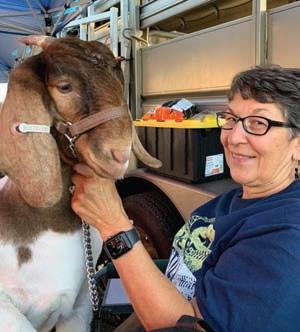
30-5/2 24-H and FFA Market Animal Show and Sale, Augusta Expo
1-3 Staunton Jams, Downtown Staunton, (Info stauntonjams.com).
2 8:30 am, Coffee and Connections, Horizons Therapy, GARCC.
3 10am-5 pm, Riverfest 2025, Constitution Park, Waynesboro.
4 Augusta County Railroad Museum Train Show, Augusta Expo.
6 8:30 am, Business Appreciation Breakfast, CARCC and Augusta County, Staunton, Waynesboro Economic Development.
7 5 pm, Business After Hours, PCB, (Chamber member event)
11 8 am, Chamber Golf Tournament, Ironwood Country Club.
14 8 am, Leadership Greater Augusta, GARCC.
15 8:30 am, Coffee & Connections, Learning Rx, 1600 N. Coalter St., Staunton. GARCC.
15-17 Singin’ In The Rain (Live theatrical performances), Wayne Theatre
4 5 pm, Business After Hours, Michael Bailey Agency and Nico’s SMB, (Chamber member event.)
9 8:30 am, Voice of Business, GARCC.
12 9 am, Aging in Place, The Regency.
18 5 pm, Business After Hours with the Harrisonburg Rockingham Chamber of Commerce, Shenandoah Valley Airport. (Chamber member event.)
23 8:30 am, Hot Topics Series, Location TBD, GARCC Red Wing Roots Music Festival, Mt. Solon (Info redwingroots.com).
25 5 pm, Trivia Night, Location TBD, GARCC.
27 6:30 pm, Shakespeare Uncorked at the American Shakespeare Center. – pair it with Our Town.
2 5 pm, Business After Hours, Vector Industries. (Chamber member event.)
3-4 Happy Birthday America, Gypsy Hill Park, Staunton.
10 9 am, Aging In Place, Stuarts Draft Retirement Community.
14 8:30 am, Voice of Business, GARCC.
17 8:30 am, Coffee & Connections, D.R. Horton, GARCC.
21-25 Augusta County Fair, Augusta Expo, (Info www.augustacountyfair.com).
25 6:30 pm, Shakespeare Uncorked at the American Shakespeare Center. – pair it with As You Like It.
28 8:30 am, Hot Topics Series, Location TBD, GARCC.
30 5 pm, Ladies Night Out, The Blackburn Inn, Staunton, GARCC.
6 5 pm, Business After Hours, Edward Jones – Leah Pugh & Sarah Conner. (Chamber member event.)
11 8:30 am, Voice of Business, GARCC.
14 9am, Aging In Place, Valley Program for Aging Services, Waynesboro.
14-23 Staunton Music Festival, (Info stauntonmusicfestival.org/summer).
21 8:30 am, Coffee & Connections, Bookkeeper.com, GARCC.
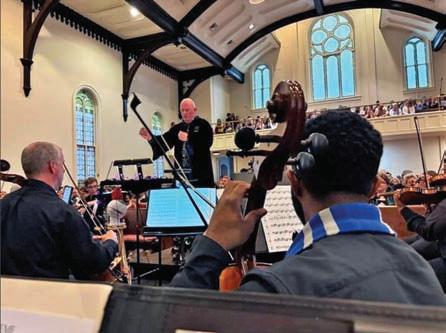
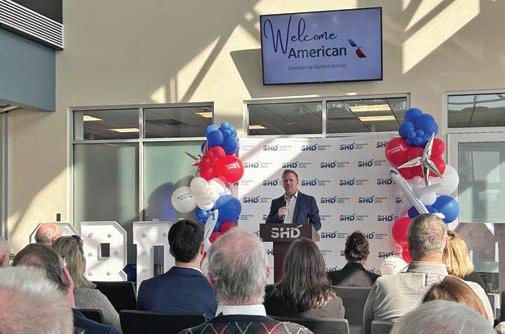
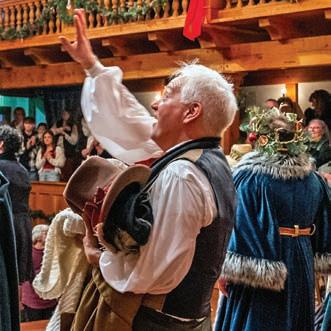
3 5 pm, Business After Hours, Cardinal Home Center. (Chamber member event.)
11 9 am, Aging In Place, Salute of Virginia.
11 12 noon, Leadership Greater Augusta Opening Retreat, GARCC.
13 Noon-9 pm, Virginia Chili, Blues and Brews Festival, Downtown Waynesboro.
18 8:30 am, Coffee & Connections, English Meadows Fishersville, GARCC.
22 8:30 am, Marketing Tips and Tricks, GARCC
25-27 Queen City Mischief and Magic, Downtown Staunton, (info facebook.com/queencitymagic).
30 8 am, Level Up Leadership Conference, Best Western Plus, Waynesboro, GARCC.
American Shakespeare Center’s Blackfriars Playhouse
Feb. 19-May 3 Twelfth Night or What You Will Feb. 26-May 7 The Hound of the Baskervilles
April 9-May 2 A Bold Stroke For A Husband
May 28-Aug. 8 As You Like It
June 25-Aug. 9 Our Town 2026
Go to AmericanShakespeareCenter.com for specific dates and to order tickets.
Playhouse tours are generally available Wednesday-Fridays at 2 pm, and Fridays and Saturdays at 10 am. (PLEASE NOTE: dates and times may vary based on student matinees and the overall Playhouse schedule.) Tours last about 45 minutes. (Fee) Information at americanshakespearecenter.com/events/playhouse-tours.
Wayne Theatre
For films and events not scheduled at press time, go to waynetheatre.org.
The Foundry
Live Music, see www.thefoundrysound.com/shows.
Staunton Farmer’s Market
Saturdays, 7 am – Noon, April-September; 8 am – Noon Oct. – Nov. 22.
Winter Market, Dec. 6, 13 & 20, 9 am-1 pm. Wharf Parking Lot.
Waynesboro Farmer’s Market
Saturdays, 9 am – 1 pm, May – October. Constitution Park Pavilion
1 5 pm, Business After Hours, F&M Bank, Stuarts Draft. (Chamber member event.)
9-10 Fishersville Antiques Expo, Augusta Expo.
11 4 pm, Bach, Britten and Beyond, Staunton Music Festival, Augusta Stone Presbyterian Church.
Preschool Story Time: Wednesdays 10-11am.
Ages 3-5 and caregivers.
Play & Learn: Tuesdays 10:00-noon. Ages 0-4 and caregivers. Baby & Toddler Story Time: Fridays 10-11am. Ages 0-3 and caregivers.
Yarns of Love at the Library: Mondays 4-6 pm, All ages. Chess Club: Tuesdays 5-7 pm. Teens, Adults.
Scrabble Club: First & third Saturdays, 11am-1 pm. Teens, Adults. For more events, see www.waynesboro.va.us/1199/Library
Staunton Public Library
Memory Café: third Thursday monthly, 2 pm.
Geri-Fit: Exercise for older adults, Wednesdays 11 am.
Great Books Club: second Friday monthly, 2 pm.
True Crime Discussion Club: first Thursdays monthly, 7 pm.
Mother Goose Time: Mondays and Wednesdays, 10:30 am. For more events, see www.ci.staunton.va.us/departments/library.
Augusta Public Library
Baby and Toddler Storytime: Mondays 10:30 am, Fishersville. Fridays With Friends: Fridays 10:30 am, Fishersville.
Redbeard Book Club: Third Sundays 3 pm. Adults 21+
(In partnership with Staunton Public Library, WCLS Brown Bag Book Club: Second Wednesdays, Noon, Weyers Cave Library Station. Adults age 19+
For more events, see www.augustacountylibrary.org.
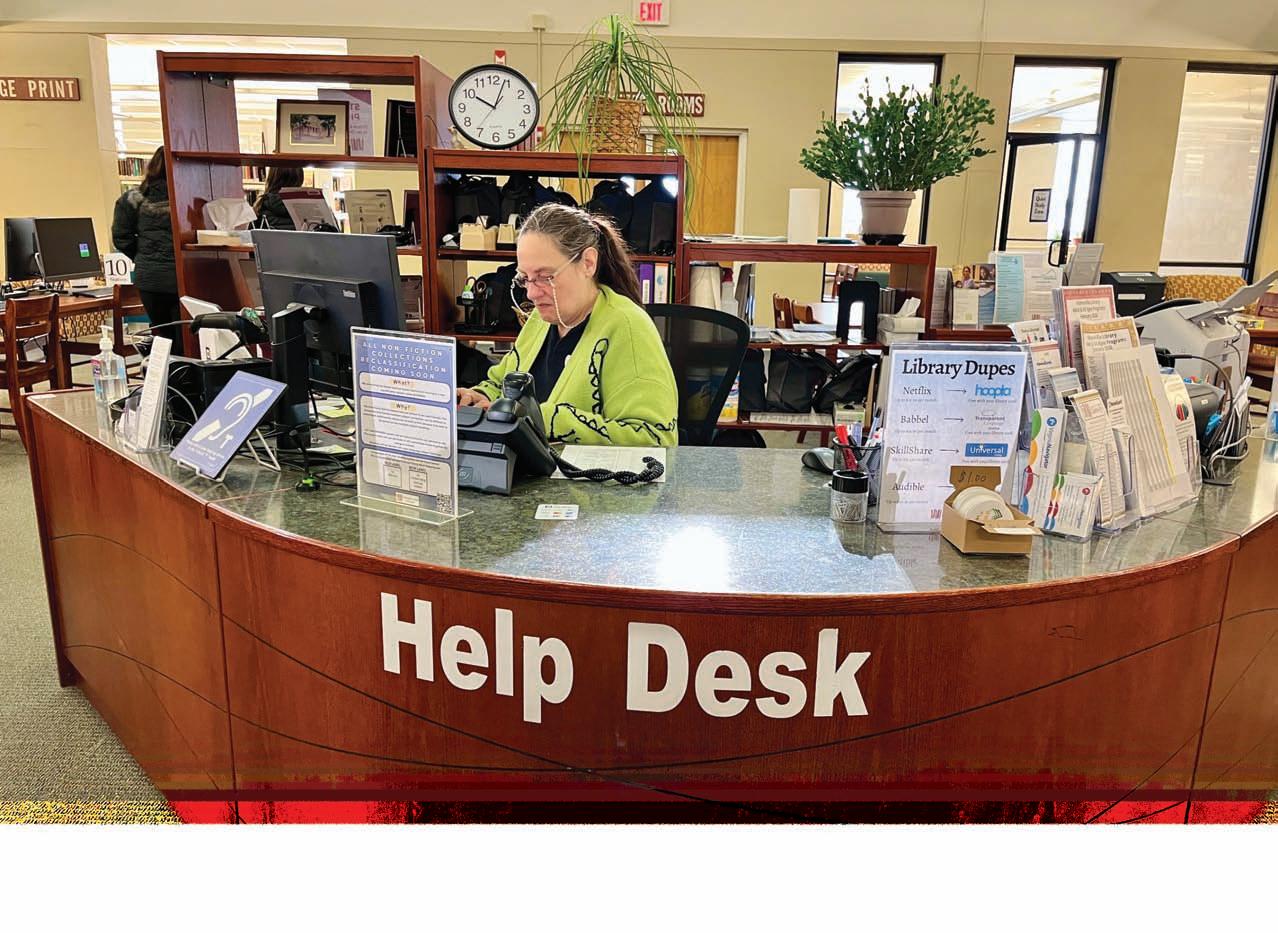
By Courtney Thompson
Ihave always been a reader. My mother, an educator for more than 40 years, has always been a reader and started reading to my sister and me when we were just babies. I can remember snuggling up in her big bed and listening to her read “The Five Little Peppers and How They Grew.” My first grade teacher, Mrs. Hamilton, also an avid reader, gave me my first chapter book — “Charlotte’s Web.”
Our small town had a wonderful library. We spent hours there, choosing books to take home and participating in summer reading programs. I can still picture the children’s section and remember how excited I was to move into the young adult section with its spinning book racks full of paperbacks. The elementary school where my mom taught had an amazing library right in the middle of the building, where the sweet librarian let us hang out after school as we waited on our mom to finish up for the day.
Fast forward to now and I am still a reader. I love books and I love the library. These days, I’m mostly using the “holds” feature on the very handy myLIBRO app and heading straight to the holds shelf to get the books waiting for me. I often joke with the librarian at the desk to not let me stray to the “New Books” section, because my To Be Read list is always way too long. (They always laugh and say they’re never going to keep people from checking out books. #Enablers.)
The Augusta County Library system is one of the greatest assets in our community. Besides the main library location in Fishersville, the system also includes six branches and through the Valley Libraries Connection, also allows its patrons to use the Staunton and Waynesboro Libraries. With all of these great options, area residents are never more than a few minutes away from a library branch and all of the programs and services it offers.
A good library is often the heartbeat of the community it’s located in, and the Augusta County Library system is no exception. Serving more than 86,000 patrons annually at just the main Fishersville location, the Library serves as much more than a place to check out books. It’s a community destination for discovery, learning, connection, and free access to resources for people of all ages. On any given day, you’ll find toddlers enjoying storytime, children looking for biographies for a school project, jobseekers using the computers to send resumes, travel enthusiasts discussing their best trips, someone researching ancestry in the special collections, or an avid reader browsing the fiction section looking for their next great read.
Top: Terry Bane, Circulation Supervisor, assists patrons with a variety of needs.

The Augusta County Library regularly hosts programs for all ages, including storytimes, book clubs, STEM activities, and special workshops on topics like finance, home maintenance, and digital skills. Recent offerings included financial literacy sessions and “money health” workshops aimed at practical education. Dozens of workshops and programs are held each week at the various locations, so check the Library’s Calendar of Events often!
Keith Bell, Programs and Engagement
Librarian at the Fishersville main branch, says the Library is a special space where people can learn, engage, and be in community. “We enjoy spotlighting local businesses and organizations and working with them to bring their resources to the community,“ Bell says. He adds a big goal is for “the Library to be a safe space where people may feel more comfortable seeking out needed resources.”
The Augusta County Library System makes it easy to explore both digital and in-person resources. Patrons can download e-books, audiobooks, and digital magazines for free using the library’s apps, while public computers, Wi-Fi, printing, and scanning make working or studying at the library a breeze. The library even loans mobile hotspots for use at home or on the go. And if you ever need a little extra help, “Book-a-Librarian” sessions give you one-on-one guidance with technology, research, or navigating the many resources the library has to offer.
The Augusta County Library System goes far beyond traditional books, offering a variety of unique items that make learning and everyday life more fun. Patrons can borrow cake pans for baking projects, mobile hotspots to bring high-speed internet home, and passes to state parks or local museums like the Frontier Culture Museum. For families and book clubs, the library provides themed learning backpacks, book club kits, and memory or “learn and play” kits designed to encourage early learning and hands-on activities. These resources show that the library is not just a place to read- it’s a place for creativity, exploration, and community engagement.
Beyond borrowing books or media, libraries are places to meet neighbors, learn new skills, attend events, and even discover local history through genealogy collections and resources. Many people don’t realize how much a library can help them personally and professionally.
Whether you’re a student needing study space, a parent seeking homeschool resources, an entrepreneur researching trends, or a retiree looking for community events, the Augusta County Library System has something for you. With branches conveniently located throughout the county, extensive borrowing options, and a focus on outreach and innovation, ACL continues to evolve as an indispensable community partner.
ACL’s new Director, Natalie Hutchinson, who started in mid-December, is impressed with the Library’s range of offerings and its staff. “Our staff really goes above and beyond to help our patrons.” She says there are many examples of this, from a librarian and a patron discussing a common interest, to a librarian helping a senior with phone issues, to a librarian looking over a patron’s resume. The majority of ACL’s staff has been with the system for many years and many of them grew up in the area. They are all incredibly kind and helpful!
“Librarians are professionals at what we do in each of our departments,” Bell adds. “We each have different areas of expertise, knowledge, and specialization.”
If you haven’t yet explored what your local library has to offer, now’s a great time to dive in — you may be surprised by just how much is at your fingertips. I’ll meet you in the stacks!<
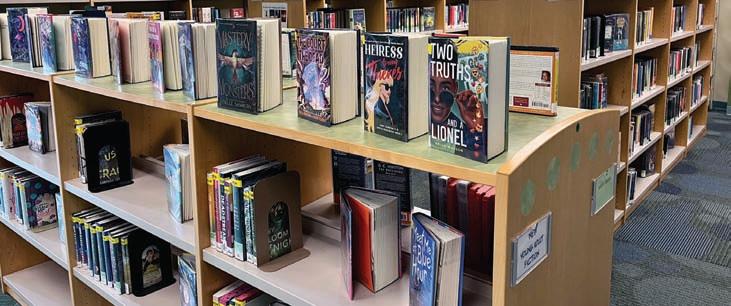
Whether you’re a lifelong reader or a casual visitor, here are some smart tips to make the most of ACL’s resources:
< Library cards are free and available for all Virginia residents at any ACL branch or through an online application.
< Through a regional partnership called the Valley Libraries Connection, an ACL card can also be used at Staunton Public Library and Waynesboro Public Library, greatly expanding your access to books, DVDs, audiobooks, and more.
< You can place holds on items anywhere in the shared catalog and have them delivered to whichever branch is most convenient.
< If an item you want is checked out, place a hold online (or ask staff to do it for you). Holds can bring books, DVDs, and more from anywhere in the Valley Libraries Connection to your preferred branch.
< Even if your schedule never lets you visit a branch, you can access thousands of digital books and audiobooks from your phone or tablet. It’s perfect for commuting, travel, or cozy evenings at home.
< Borrowing passes to local attractions and parks can make family outings more affordable a nd fun- ACL has passes to the American Frontier Culture Museum, the American Shakespeare Center, and state parks.
< If you’re intimidated by tech- whether downloading ebooks, using Zoom, or navigating social media- book a session with a librarian for personalized help.
Libraries continued on page 40
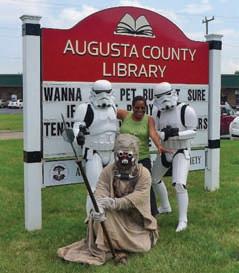
The Augusta County Library Foundation, the Staunton Public Library, and the Waynesboro Public Library each have a “Friends of the Library” program. These volunteer groups are dedicated to supporting and advocating for the libraries they serve. Libraries typically don’t receive funding for the programs they offer, so all of the support for those comes from Friends of the Library fundraising. Members support the library by volunteering and assisting with fundraising activities. Check the website of your local library for more information on becoming a friend to your library!<
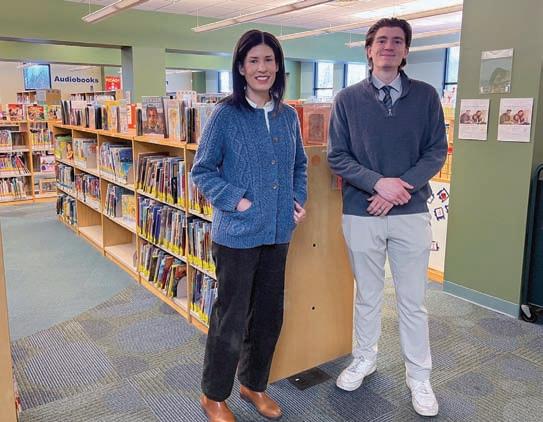
AUGUSTA COUNTY LIBRARY LOCATIONS:
Fishersville Library (Main)
1759 Jefferson Highway, Fishersville
Churchville Branch Library
3714 Churchville Avenue, Churchville
Craigsville Library Station
18 Hidy Street, Craigsville
Deerfield Library Station
59 Marble Valley Road, Deerfield
Middlebrook Library Station
3698 Middlebrook Road, Middlebrook
Stuarts Draft Library Station
Broadmoor Plaza, Suite #107, Stuarts Draft
Weyers Cave Library Station
51 Franklin Street, Weyers Cave
Staunton Public Library
116 W Beverley Street, Staunton
Waynesboro Public Library
600 S Wayne Avenue, Waynesboro
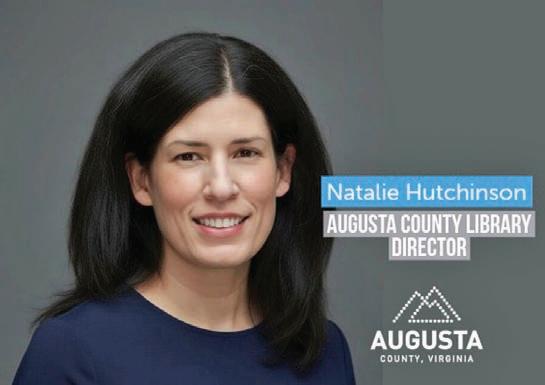
AUGUSTA COUNTY LIBRARY NAMES NEW LIBRARY DIRECTOR
Augusta County Library is pleased to announce the appointment of Natalie Hutchinson as its new Library Director. Ms. Hutchinson began her role on December 16, 2025.
Ms. Hutchinson brings a people-centered, innovation-driven approach to library leadership, supported by a decade of experience in public libraries. Her career reflects a strong focus on aligning strategic vision with practical outcomes that enhance services, strengthen staff capacity, and deepen community engagement. Her professional background includes branch management, system-level program development, grant leadership, and crossdepartment collaboration, with a consistent emphasis on expanding access and equity for both staff and patrons.
“The Library Board is excited to welcome Natalie Hutchinson as our new director,” said Susan Thacker, Chair of the Augusta County Library Board. “Her experience, collaborative leadership style, and future-forward perspective position her well to guide the library’s continued growth and service to the community.”
Prior to joining Augusta County Library, Ms. Hutchinson served as Branch Manager at Central Library with Prince William Public Libraries. In that role, she revitalized Makerspace services, launched a Digital Preservation Lab, advanced bilingual teen technology partnerships, and led a range of community-centered initiatives designed to expand participation and create more welcoming and accessible library spaces. She also developed innovative tools and workflows — including custom staffing applications and a substitute tracking site — that improved operational efficiency and supported sustainable service delivery.
“I am honored to join Augusta County Library and work alongside such a dedicated staff and engaged community,” said Hutchinson. “Libraries play a vital role in connecting people to information, opportunity, and one another, and I look forward to collaborating with staff and residents to continue building services that are welcoming and responsive to the community’s needs.” <
For more information about Augusta County Library services and programs, visit www.AugustaCountyLibrary.org.



Purposeful partnerships for a greater Augusta
Build with Trust
Access 184 years of innovation in education.
Connect with top-tier, careerready diverse candidates.
Invest in your current employees’ professional growth with a 15% tuition discount for MBU partners.