


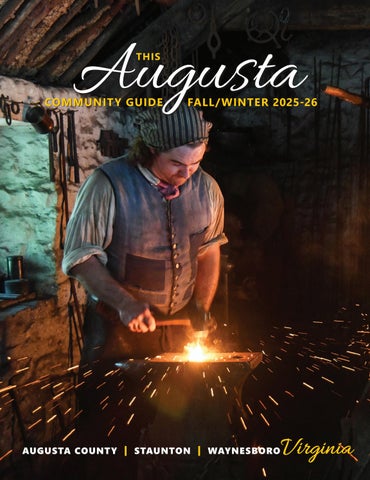
Welcome to the Fall/Winter 2025 edition of This Augusta Community Guide!
As the leaves turn and the air becomes crisp, this season is a time to slow down, reflect, and reconnect- with one another and with all the experiences that make the Shenandoah Valley such a special place to call home. (Did you know one of the most frequent calls we get at the Chamber office in September and October is people asking when “peak” weekend is? )
From stunning scenic drives along the Blue Ridge Parkway to cozy gatherings at local wineries, markets, and holiday events, there’s something magical about fall and winter here. Whether you’re savoring fresh cider, exploring local artisan fairs, or bundling up for festive parades and tree lightings, our area offers an abundance of traditions and moments to enjoy.
The holiday season also brings the perfect opportunity to support our local businesses. From handcrafted gifts and seasonal treats to one-of-a-kind services and experiences, shopping local is a meaningful way to give back to the community and find something truly special for everyone on your list. When you support small businesses, you’re helping neighbors, friends, and families thrive and strengthening the heart of our local economy. We encourage you to shop local, dine local, and support local all year round!
Whether you’re new to the area, just visiting, or a long-time resident, we hope This Augusta Community Guide helps you find everything from community events and services to ways to stay engaged and inspired during the season.
As always, we’re grateful for the partnerships, progress, and people that make our community strong. Thank you for being part of what makes Augusta County, Staunton, and Waynesboro vibrant places to live, work, and thrive.
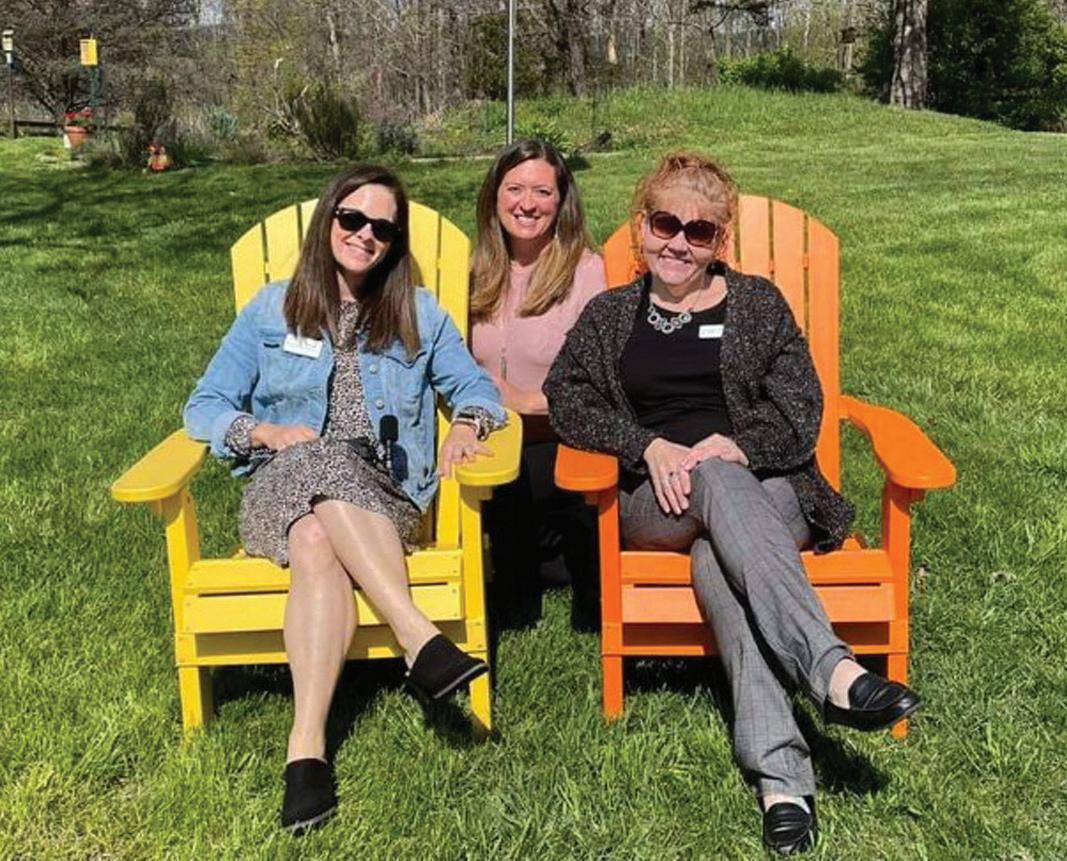
Here’s to a season of celebration and connection from your Chamber team, Courtney, Kim, and Shasta
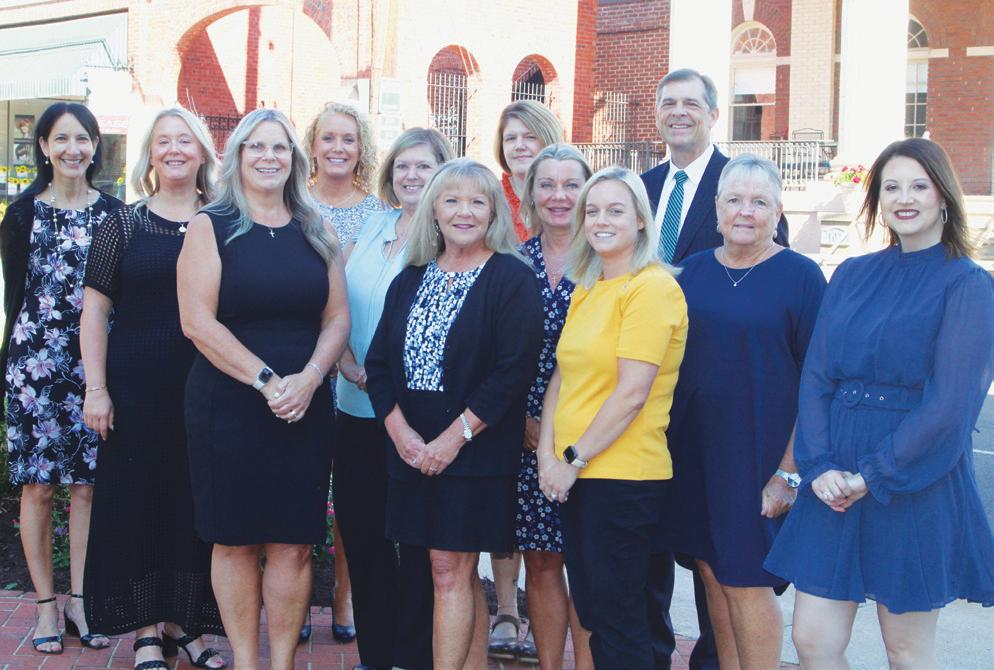
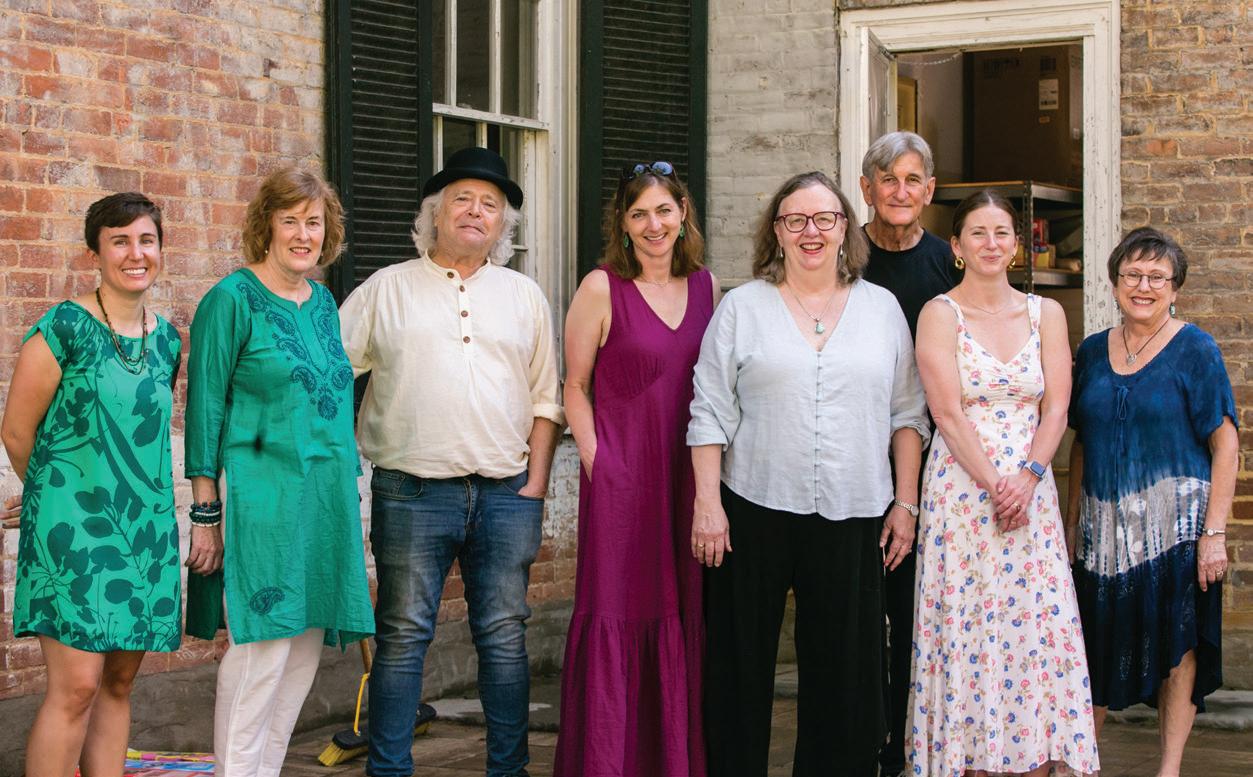
Chamber staff, left to right, Kim Wilbur, Director of Marketing and Communications; Courtney Thompson, President and CEO; and Shasta Weeks, Director of Operations.
Our goal is to present significant topics during our meetings to benefit our members
Collaborate with community groups to foster togetherness through events and activities
Join forces with like-minded individuals to build and reinforce your business network Remember, we are always stronger when we work together

We offer several benefits to help our businesses save money Learn more about WiseChoice Healthcare Alliance.

Not only are you recognized as a community builder, but potential customers are also more likely to do business with you
By participating in chamber activities, you'll receive plenty of exposure that will help raise your profile in the community and beyond
Our goal is to foster growth and prosperity within the community Let's work together to achieve this and help each other thrive.
The chamber provides excellent opportunities for individuals to network with legislators, government officials, and city representatives
n the 1920s, a group of businessmen in downtown Staunton came together to form the Staunton-Augusta County Chamber of Commerce. In the 1950s, with Waynesboro becoming a nationally known hub for manufacturing, several plant managers decided to create the Waynesboro-East Augusta Chamber of Commerce. In 1999, a group of forward-thinking business leaders representing Augusta County, Staunton and Waynesboro presented the idea of joining forces and establishing one Chamber to serve the whole area. Thus, the Greater Augusta Regional Chamber of Commerce was born and opened its doors in centrally located Fishersville.
The Greater Augusta Regional Chamber of Commerce exists to help promote a healthy and thriving business community. By helping local businesses and community leaders network and make great connections, providing important resources, and working with state and local governments to advocate for business-friendly practices, we strive to constantly improve the quality of life in our community.
There's never been a better time to be part of the Chamber! Whether your business is seeking customers, or you need access to resources or leadership training, or being a good corporate partner is part of your DNA, the Greater Augusta Regional Chamber of Commerce is the place to be. "Support local" isn't just a slogan for us- it's a way of life and a way of doing business. Count on the Chamber to help you make those connections that really matter. <
Kristina Arbogast Chair
Hotel 24 South
Vacant
Immediate Past Chair
Chris Auville
Harmony Harvest Farm
Velma Bryant
Blue Ridge Community College
Kevin Gabel Lantz Construction
Piper Groves
Shenandoah Valley Art Center
Wayne Huffman McKee Foods
Paula Moore-McClure Chair-Elect
Individual Member
Bruce Blair
Secretary Compass Behavioral Health
Quentin Johnson Visiting Angels
Garth Knight LD&B Insurance & Financial Services
Jackie Kurtz First Bank & Trust Company
Jay Langston Shenandoah Valley Partnership
Todd Livick
Individual Member
Suzie Dull Treasurer
Mary Baldwin University
Ellen Shaver-Shank At-Large Augusta County Fair
Kaystyle Madden
Shenandoah Valley Workforce Development Board
Joe Meador
Augusta Health
Jodi Tibbs Valley Trust Insurance
Michelle White DuPont Community Credit Union
Nate Wilson English Meadows


Source: US Census Bureau

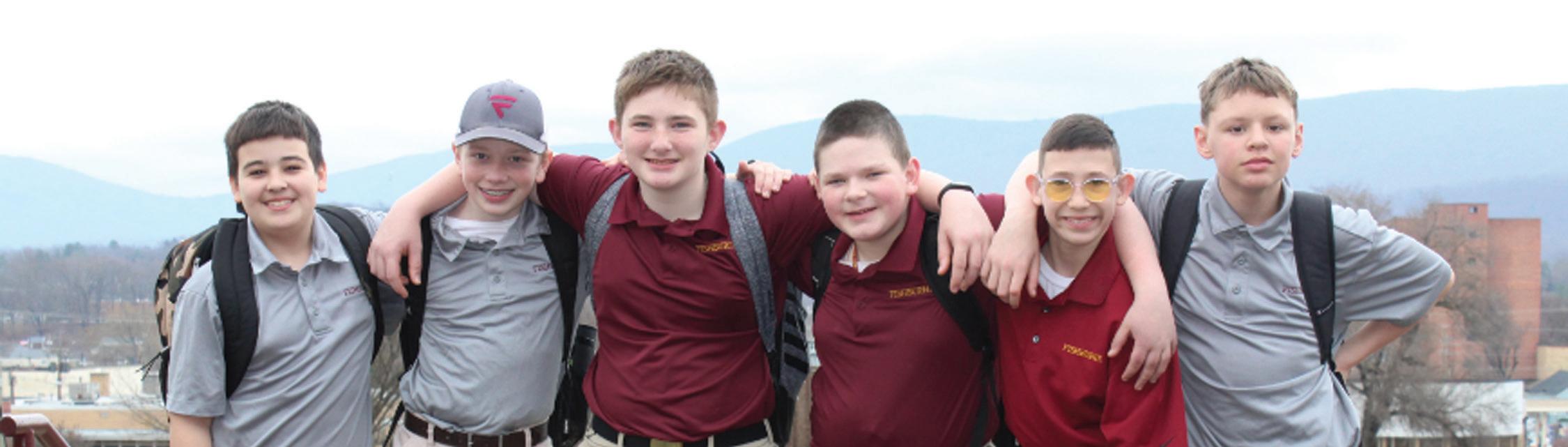
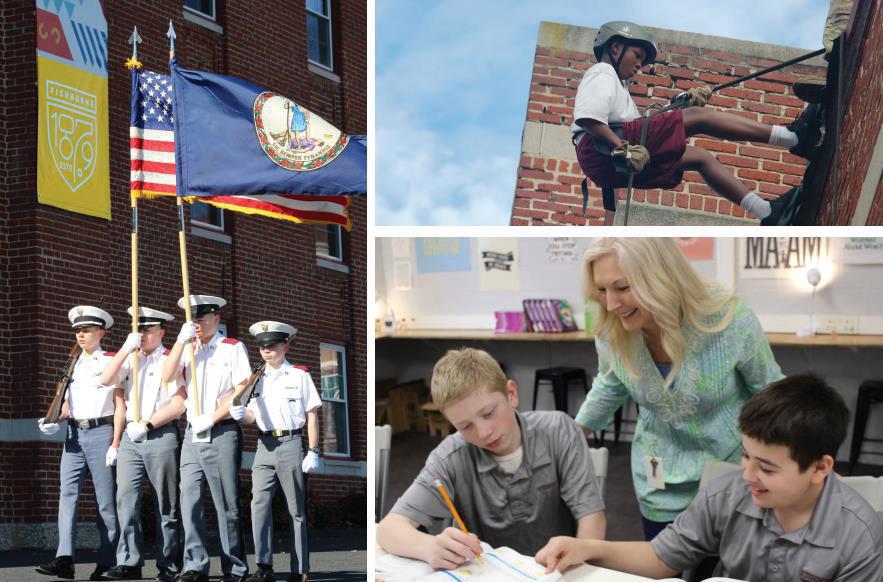
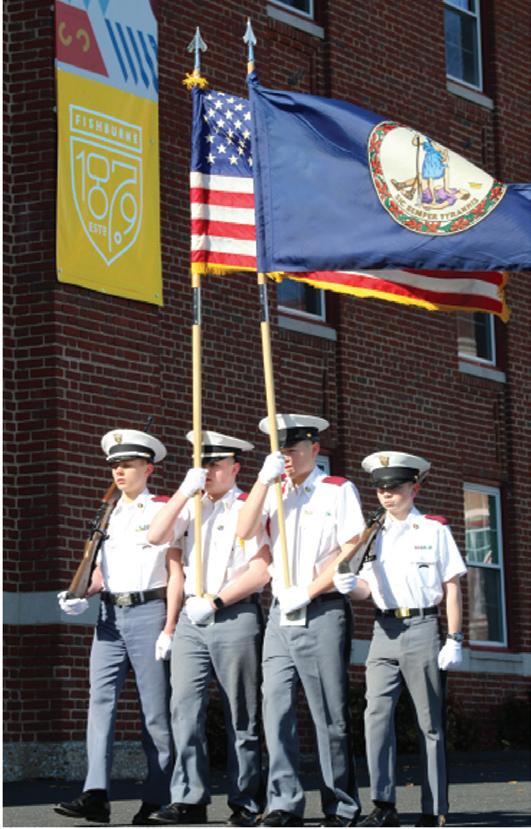
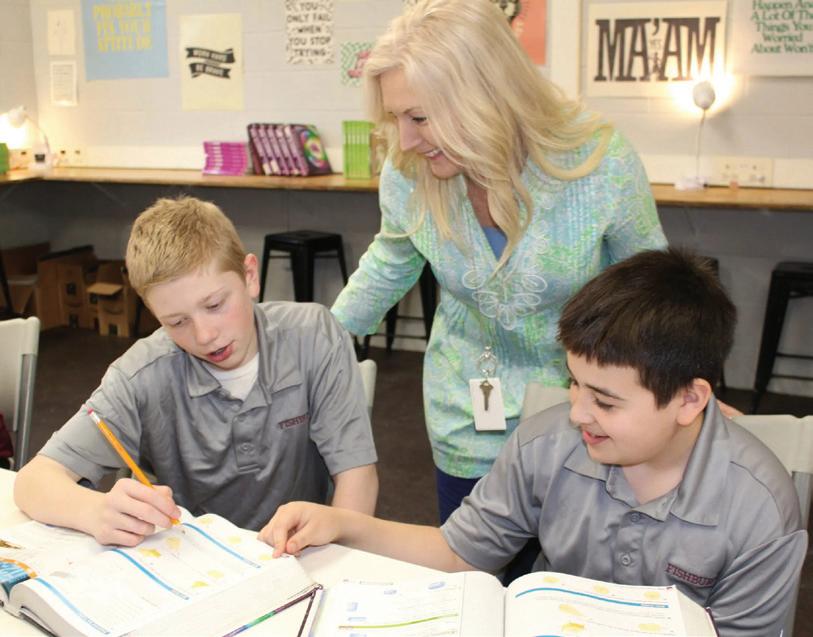
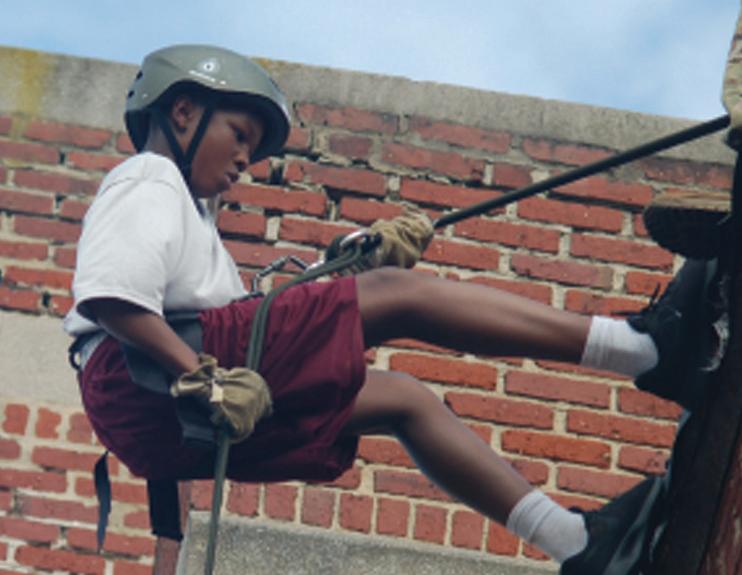
We focus on the whole boy— not just his GPA. Our small class sizes give each boy the individualized attention he deserves. He will learn how to solve problems, and become a leader amongst his peers. Our classical curriculum focuses on accountability, positive teambuilding, and physical fitness. Every boy should have the opportunity to be seen— and at Fishburne Middle School, we see what’s great in him.

Grades 6 through 8 | Day Students






Augusta County 18 Government Center Ln. Verona, VA 24482 (540) 245-5600
co.augusta.va.us
City of Staunton 116 West Beverley St. Staunton, VA 24401 (540) 332-3800
ci.staunton.va.us
City of Waynesboro
503 West Main St. Waynesboro, VA 22980 (540) 942-6600 waynesboro.va.us
Public water and sewer is available in the Cities of Staunton and Waynesboro and areas of Augusta County.
Augusta County Service Authority (Augusta Co. with the exception of Craigsville.) (540) 245-5681 www.augustawater.com
Town of Craigsville (540) 997-5935 www.craigsville.us/water-and-sewer
City of Staunton (540) 332-3860
www.ci.staunton.va.us/departments/public-works/ utilities
City of Waynesboro (540) 942-6643 waynesboro.va.us/300/utility-billing
City of Staunton (540) 332-3892
www.ci.staunton.va.us/departments/public-works/ trash-recycling-collection
City of Waynesboro (540) 942-6764
waynesboro.va.us/309/Refuse
Augusta County Disposal (540) 949-0160 augustacountydisposal.com
Republic Waste Services (434) 295-4177 republicservices.com
Waste Management of Virginia www.wm.com/us/en/location/va/charlottesville
Waste Movers (540) 972-3456 wastemoversva.com
Happy Little Dumpsters, LLC (434) 608-8261
happylittledumpster.com/service-area/stauntonwaynesboro-va/
Republic Waste Services (434) 295-4177 republicservices.com
Waste Management of Virginia www.wm.com/us/en/location/va/charlottesville
Waste Movers (540) 972-3456 wastemoversva.com
Augusta County www.co.augusta.va.us/residents/water-wastewatertrash-recycling/solid-waste-recycling-locations
City of Staunton www.ci.staunton.va.us/departments/public-works/ trash-recycling-collection/recycling
City of Waynesboro www.waynesboro.va.us/292/Recycling
Dominion Energy (866) 366-4357 dom.com
Shenandoah Valley Electric Cooperative (800) 234-7832 svec.coop
Columbia Gas of Virginia (800) 543-8911 columbiagasva.com
Amerigas (540) 885-6168 amerigas.com
Quarles Petroleum (877) 444-3835 quarlesinc.com
Southern States Cooperative-Augusta Petroleum (540) 886-2501 southernstates.com
(LANDLINE )
Lumos Networks 855-GO-LUMOS lumosfiber.com
Verizon (800) 255-5499 verizon.com
AT&T (800) 331-0500 att.com
Boost Mobile (540) 466-5239 boostmobile.com
Cricket Wireless (540) 707-0341 cricketwireless.com
T-Mobile (540) 609-2879 t-mobile.com
Verizon (800) 255-5499 verizon.com
CABLE AND INTERNET PROVIDERS
Xfinity Xfinity.com
Lumos Networks (844) 675-1338 lumosfiber.com
GloFiber (833) 926-8456 glofiber.com
Lingo Networks (540) 712-0300 lingo-networks.com
Augusta County Main Library 1759 Jefferson Highway Fishersville, VA 22939 (540) 885-3961 or (540) 949-6354 augustacountylibrary.org
Augusta Co. Library - Churchville 3714 Churchville Ave. Churchville, VA 24421 (540) 245-5287
Augusta Co. Library – Craigsville 18 Hidy St. Craigsville, VA 24430 (540) 997-0280
Augusta Co. Library – Deerfield 59 Marble Valley Rd. Deerfield, VA 24432 (540) 939-4123
Augusta Co. Library – Middlebrook 3698 Middlebrook Rd. Middlebrook, VA 24459 (540) 885-1008
Augusta Co. Library – Stuarts Draft Broadmoor Plaza, Suite #107 Stuarts Draft, VA 24477 (540) 569-2683
City of Staunton
1 Churchville Ave. Staunton, VA 24401 (540) 332-3902 stauntonlibrary.org
City of Waynesboro
600 S. Wayne Ave. Waynesboro, VA 22980 (540) 942-6746 waynesboro.va.us/354/library
Local Bus BRITE Transit (540) 943-9302 britebus.org
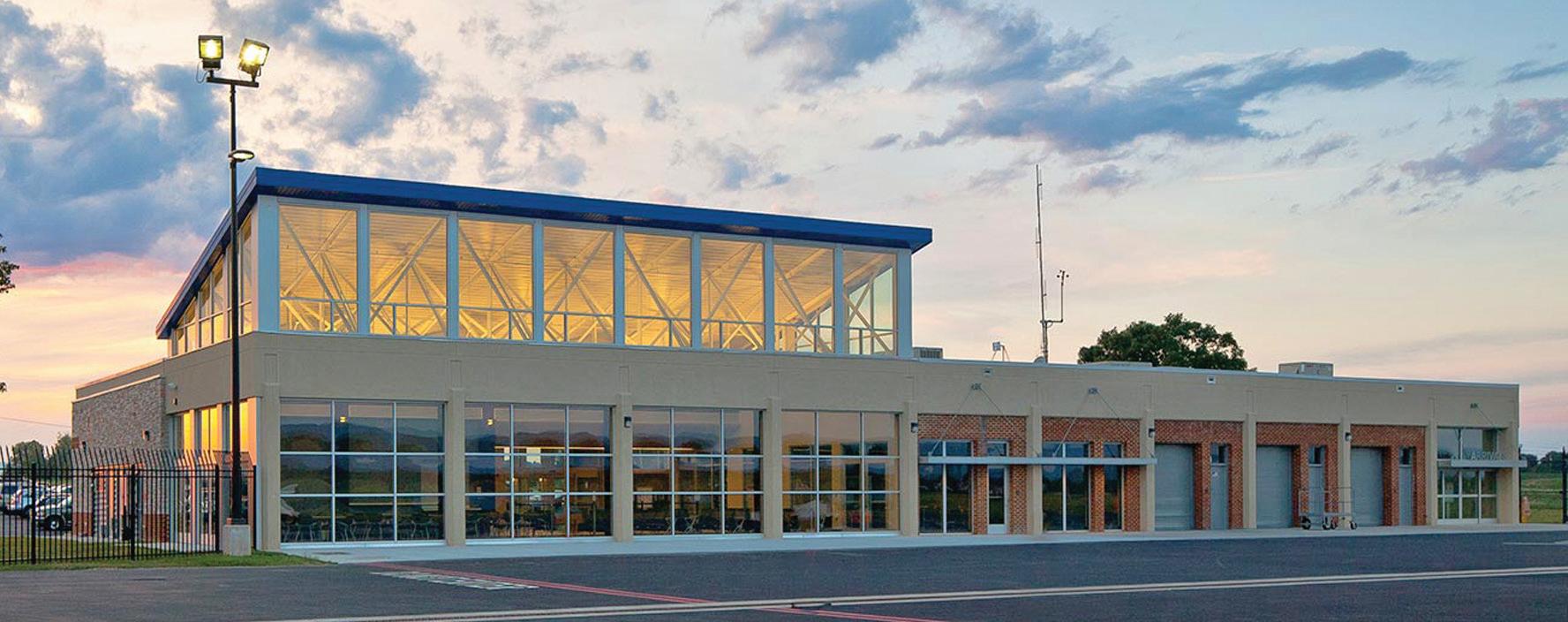
Commercial Air Service Shenandoah Valley Regional Airport (SHD) (540) 234-8304 flySHD.com
Flight Schools
Blue Ridge Aviation (540) 246-9407 www.blueridgeaviation.org
General Aviation Services
Eagles Nest Airport (540) 943-4447 eaglesnest.aero
Passenger Rail Service
Amtrak (800) 872-7245 amtrak.com
Virginia Department of Motor Vehicles (866) 368-5463 dmv.virginia.gov 17 1st St., Staunton, Va 24401 998 Hopeman Pkwy., Waynesboro, VA 22980
Augusta County Voter Registration 18 Government Center Ln. Verona, VA 24482 (540) 245-5656 co.augusta.va.us/government/departments-andoffices/voter-registration
City of Staunton City Hall
116 W. Beverley St. Staunton, VA 24401 (540) 332-3800 www.ci.staunton.va.us/departments/registrar
City of Waynesboro
Office of Voter Registrar
605 Market Street
Lower Level of the Waynesboro Library Waynesboro, VA 22980 (540) 942-6620 waynesboro.va.us/126/Voter-Registration
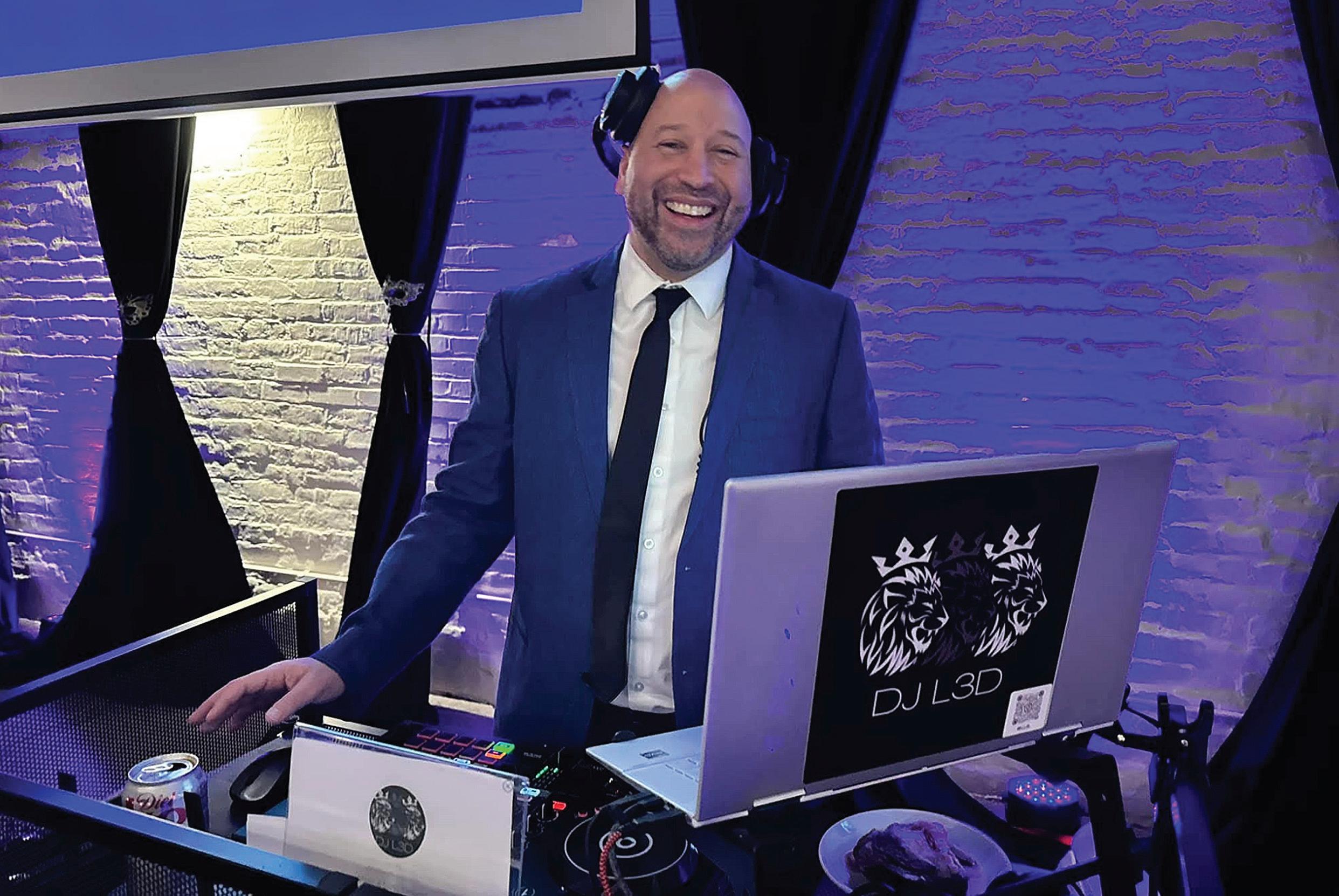
By Chris Lassiter
Tony Davenport turned a vibe into a venture.
During the global pandemic, the Staunton native decided to scale back on watching episodes of The Last Dance and Tiger King in order to teach himself a new skill. He purchased a turntable, and started emulating popular DJs he enjoyed watching on the internet.
“It was a time when DJs couldn’t do their shows, so they went online,” he said. “A lot of times I was sitting at home, and the DJs were coming online on YouTube and Twitch. Not only did they have the cameras pointed at them, but they also had the cameras pointed toward the turntables. I was able to sit there and watch them, and see them mixing and doing things.”
“I said, ‘That sounds like fun. I want to try it.’ I would sit there and try to mimic what they were doing, which is really, really hard. Being a DJ is difficult. You really have to practice at it.”
So practice he did. The novice DJ spent hours upon hours challenging himself to make the most of self-growth opportunities during the shelter-in-place mandate.
Going by the stage name of DJ L3D — a reference to the fact that he, his dad and twin brother all have the first name Lionel — Davenport has grown into a popular local DJ. What was once a hobby is now a hustle. What started as an idea is now income generating.
“Tony Davenport is one of the most creative people I have the pleasure of knowing,” said Ben Leonard, executive director of the nonprofit local radio station WQSV. “It’s been so rewarding seeing that creative spark flourish through his DJing.”

Davenport grew up in a home filled with music.
The Saturday deep-cleaning family chore times were always accompanied with Soul Train or the radio as a soundtrack.
“I remember vividly as a kid my dad brought home one of those triple decker stereos in the glass case,” Davenport said. “We drove to Charlottesville to a record store. I bought RUN-D.M.C., UTFO, and I brought Doug E. Fresh. I bought those three albums, put them in my stereo, and I was hooked.”
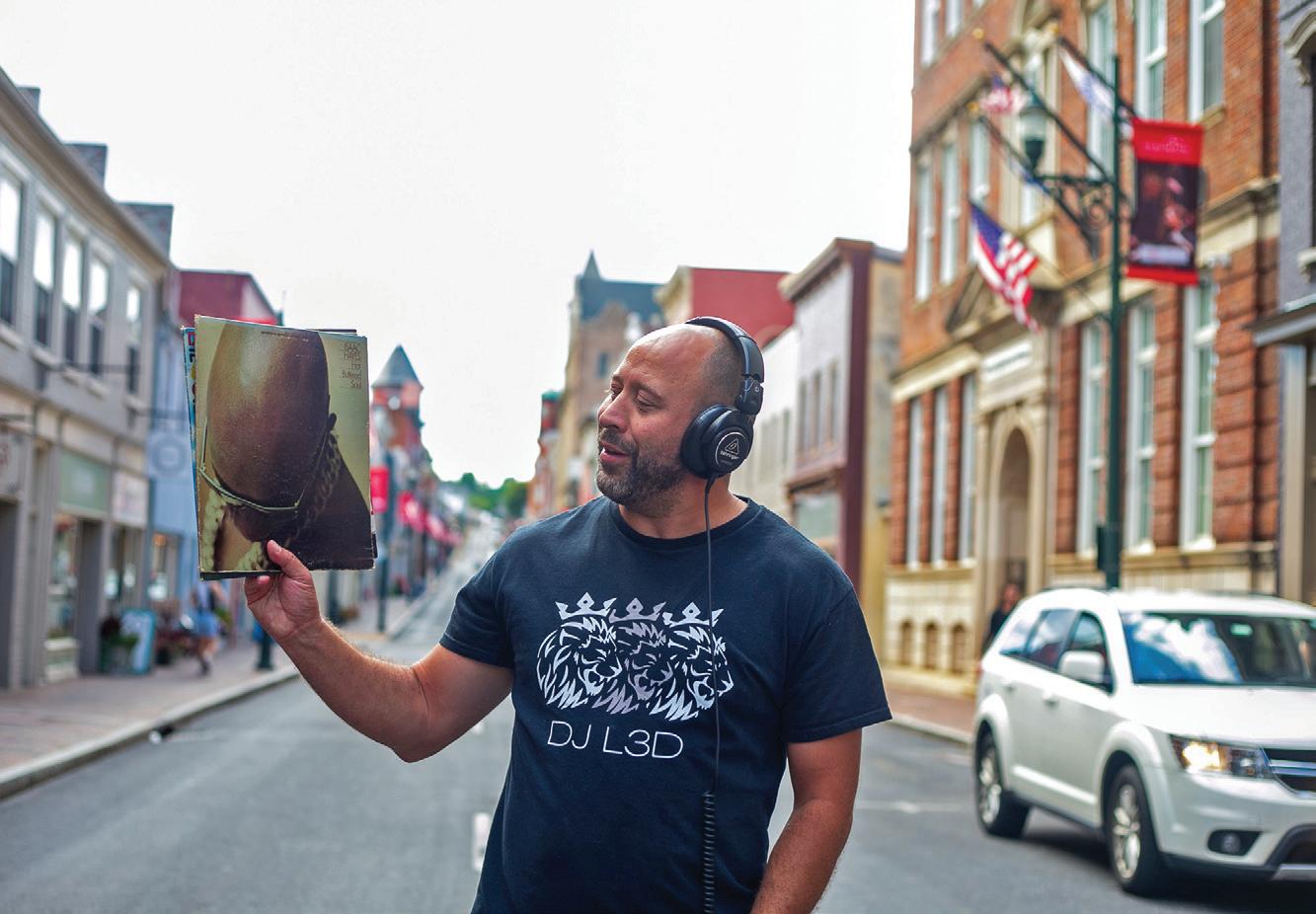
As much as he loved the sound coming through his stereo, he’s always been equally passionate about the live concert experience. He’s seen Earth, Wind & Fire, Teena Marie, Rick James, Whodini, Janet Jackson, Jay-Z, George Clinton and a countless list of others in person.
“I try to see all of my favorites, just concert after concert,” Davenport said. “Everybody’s there to hear the music. It’s this communal thing where everyone’s signing and dancing and having a good time. I’m the type of person that when the music comes on — and I’m at the concert — I get goosebumps and get emotional. I love the music that much.”
In the same way that DJ L3D is known for music, Davenport himself is known for public service, whether through his fulltime work or through his involvement with multiple nonprofits in the community.
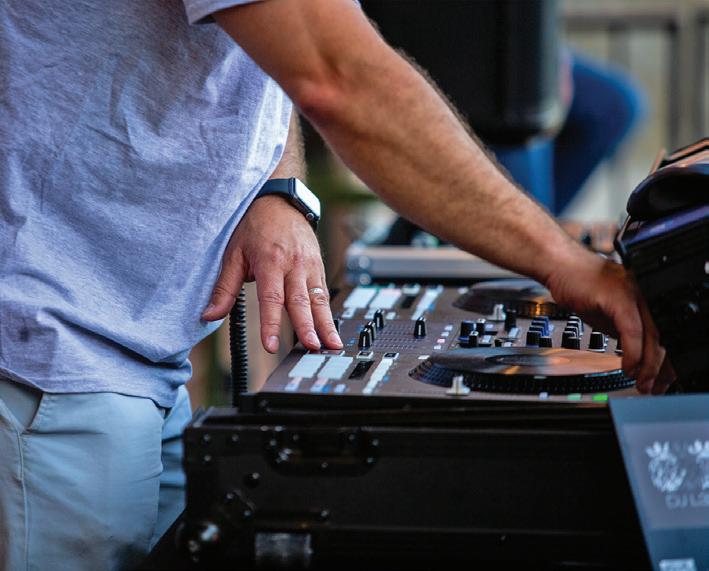

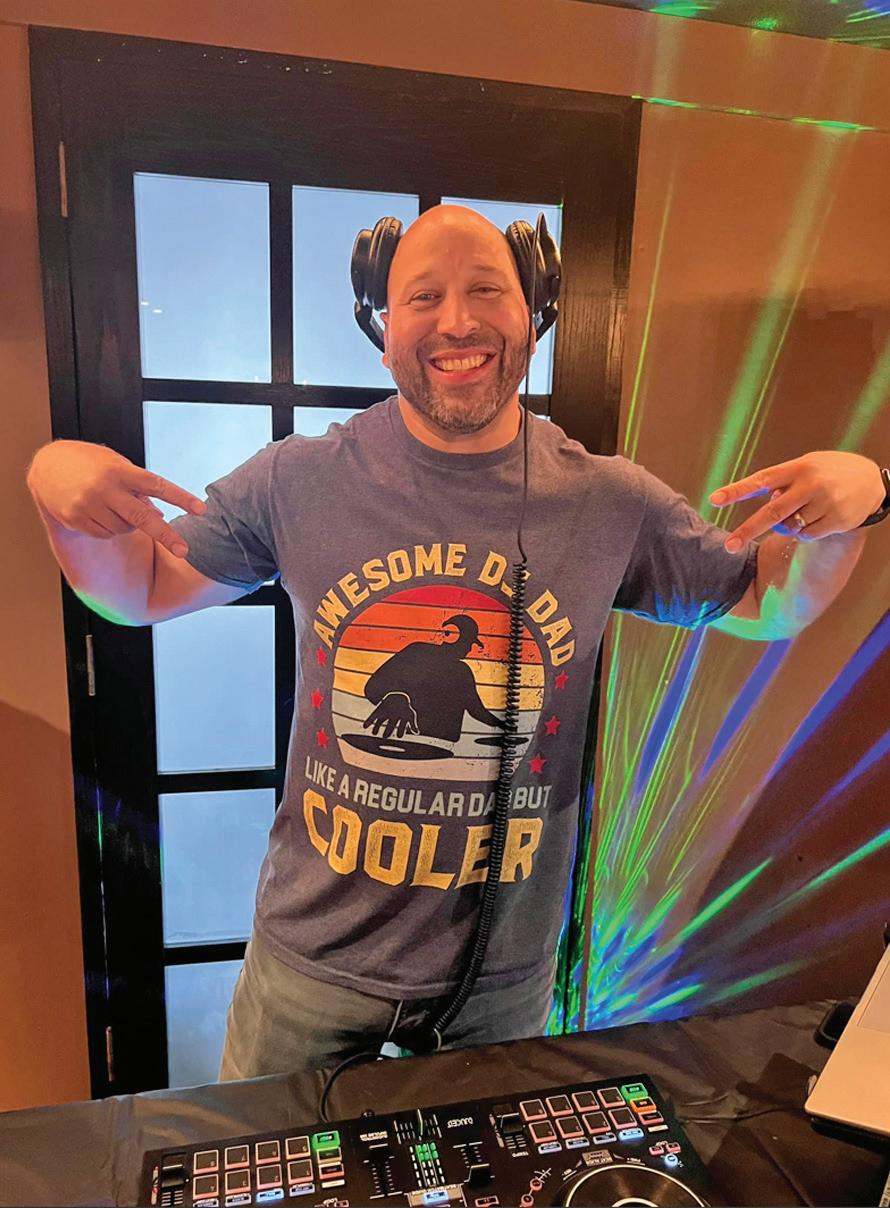
Helping a friend is actually how his hidden DJing talent became known.
“One of my friends had an event coming up, and the DJ canceled on them,” Davenport said. “She was worried. She said, ‘I have to have a DJ. It’s part of my job.’ I looked over at (my wife) Amy, and I was like, ‘I could try to help her. Why don’t I just give it a try?’ The night before, I didn’t sleep. I was scared to death.”
Soon, however, the DJ was getting more comfortable performing publicly. “People started asking me to do events, and I was like, ‘OK, yeah, I’ll try it,’” he said. “And then, all of a sudden, someone said, ‘And I’ll pay you.’ And that’s when it all changed.”
DJ L3D has been booked for festivals like Staunton Jams, as well as galas, weddings, fundraisers, golf tournaments, tailgating parties and many other events. Davenport has performed sets of classical music, rhythm & blues, country, hip-hop, classic rock and an eclectic mix of genres.
“You have to do a lot of music exploration,” Davenport said. “If someone wants a country, you can’t go in there playing Led Zeppelin all night.”
He still practices religiously to improve his craft — including participation in a DJing cohort — and he’s has also worked hard to do the business side with the same amount of precision as his musical blends.
He’s not just working in his business. The DJ is working on his business.
“A lot of books, a lot of YouTube videos, a lot of podcasts,” he said. “You can spend a lot of time on this side of the business. Sometimes I spend more time on this side than I do on practice.”
Finding community in music has always been important to Davenport, and one way he finds that now is relationships with the area’s other local DJs. “In any industry, there’s good and bad, and there’s competition,” Davenport said. “In the music scene in Staunton — and dealing with local DJs — I didn’t realize how much camaraderie was there. We support each other. It’s a hard industry, and it’s a hard thing to do.” <
By Heather Cole
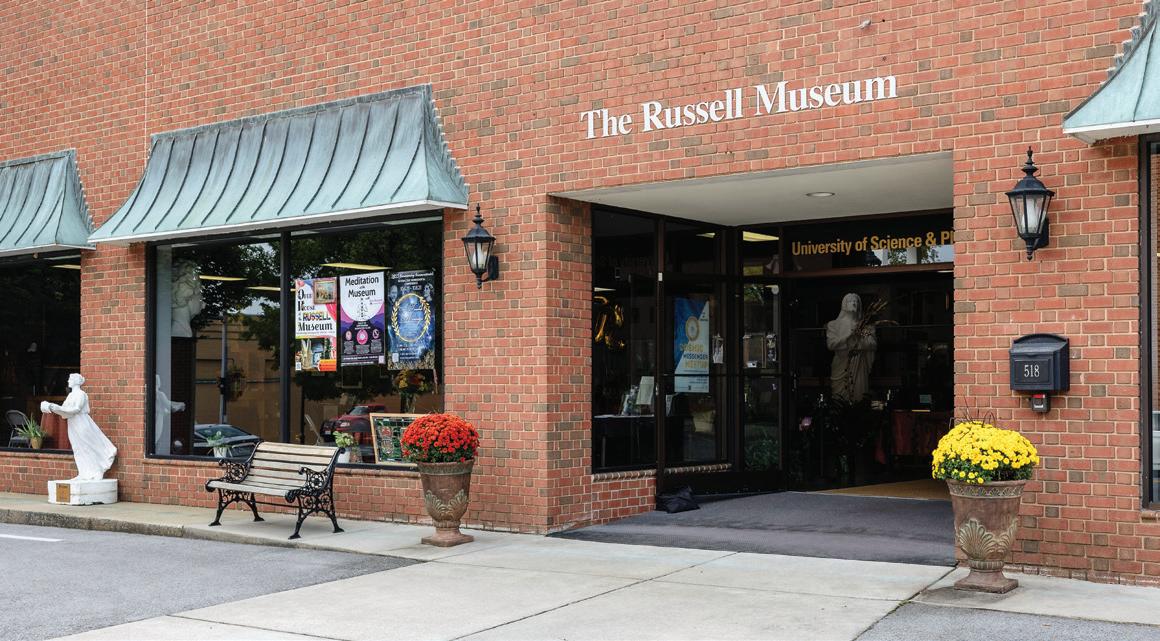
In a storefront building in downtown Waynesboro, Virginia, is a museum honoring the life work of an early-twentieth-century artist, author and philosopher who developed a theory about the fundamental nature of the universe that continues to influence and inspire people nearly a century later.
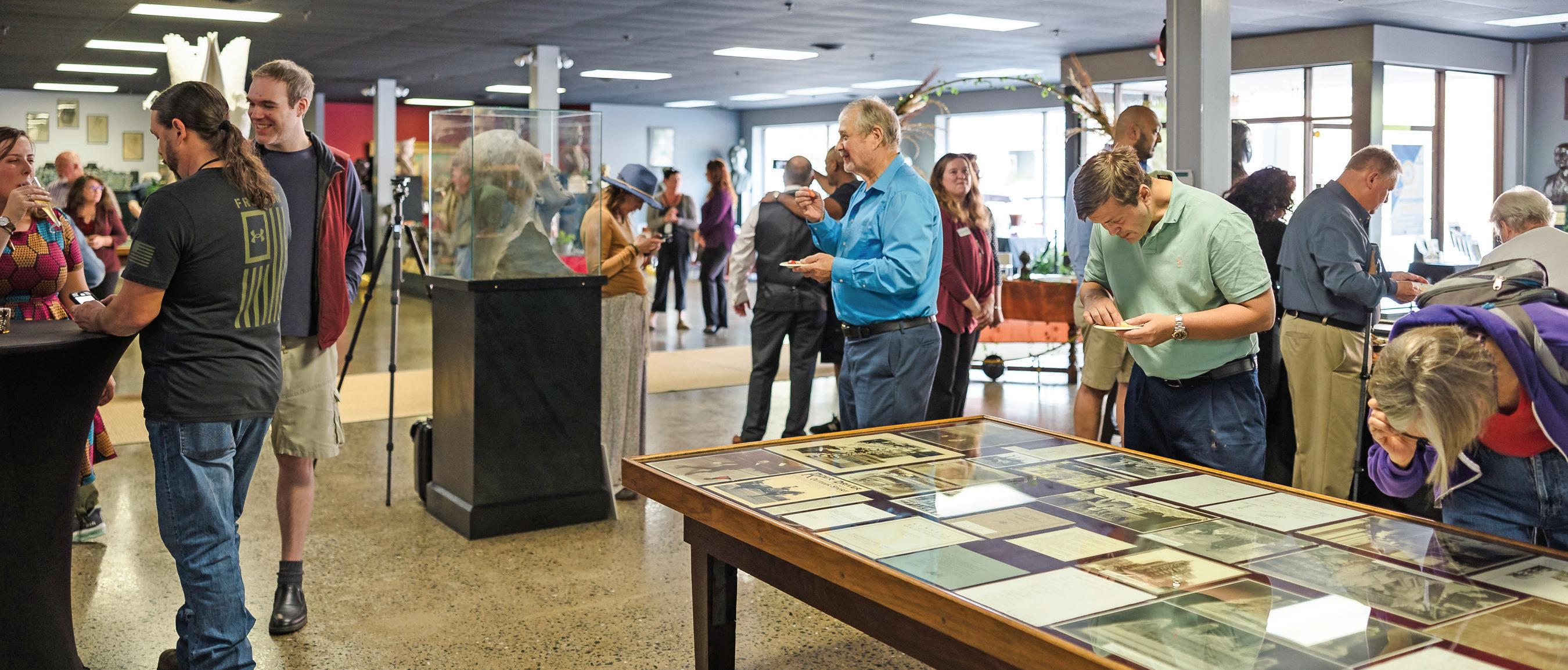
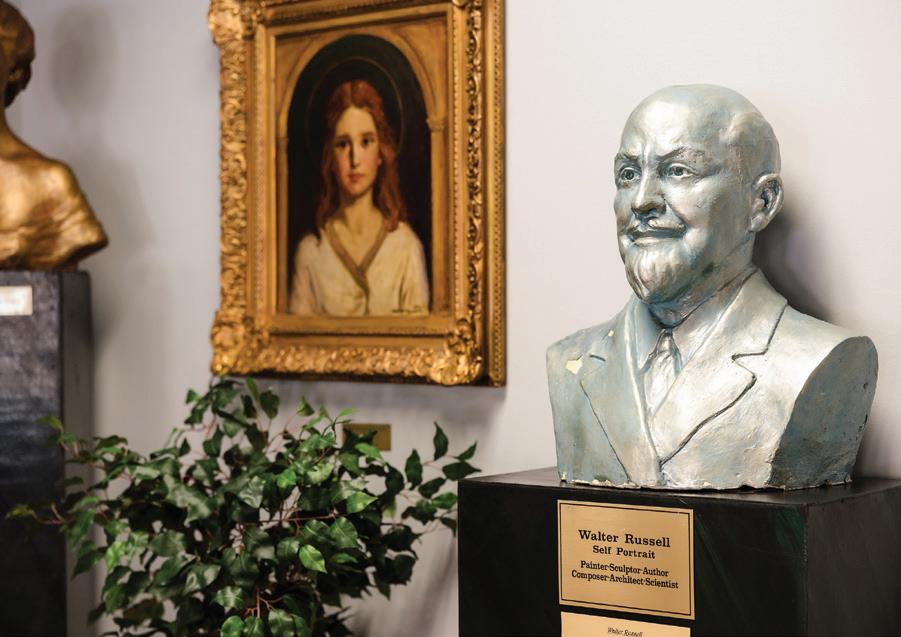
The Russell Museum, located at 518 West Main Street, exhibits two floors of drawings, paintings and sculpture created by Walter Bowman Russell (1871-1963). The museum is operated by the non-profit University of Science and Philosophy, an organization founded in 1948 to share what Russell called his “Science of Spiritual Man and the Cosmos.” A man of many talents, Russell’s storied life found him associating with luminaries such as Thomas Edison, Mark Twain and Franklin D. Roosevelt, and creating art of many of them.
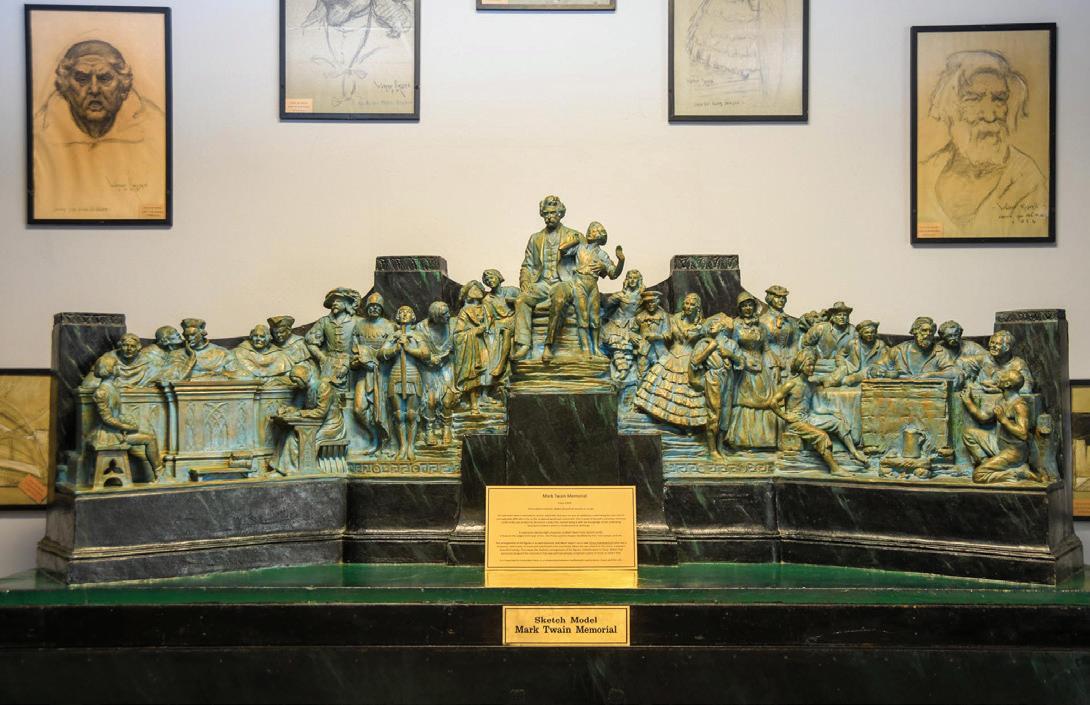
As a visitor enters the museum, they are greeted by originals and casts of Russell’s sculptures. They include a model of a piece that was commissioned as a memorial to Mark Twain in 1935 and includes depictions of 28 characters from his books, and a sculpture entitled Four Freedoms that was commissioned by Roosevelt and inspired by his 1941 State of the Union address. The Four Freedoms monument depicts four angels representing freedom of speech and expression, freedom of worship, freedom from want and freedom from fear. The original sculpture was dedicated in 1943 and resides in a park in Madison, Florida.
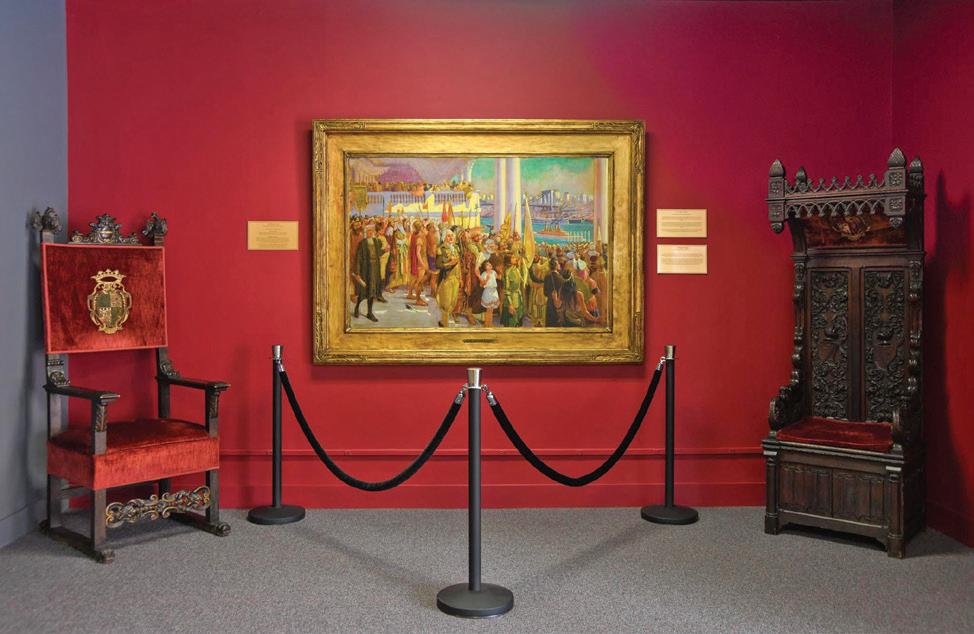
Russell was born in Boston and educated at what is now the Massachusetts College of Art and Design and in Paris. He settled with his first wife and two children in New York City where he combined work as a residential developer with his passion for art. One of Russell’s best-known works was one of his first: The Might of Ages (1900) is a large oil painting that depicts individuals from throughout history gazing upon the Manhattan skyline. According to museum staff, the piece was shown at an international exhibition in Turin, Italy, in 1902. It is now on exhibit on the first floor of the Russell Museum.
Early in his career, Russell was also an author and illustrator of novels for children. The Sea Children (1901), The Bending of the Twig (1903) and The Age of Innocence (1904), were richly illustrated with detailed pen and ink drawings of children, plants and sea life. The originals of these drawings—and original editions of the books — are on exhibit on the mezzanine level of the museum.
On his 49th birthday, Russell had what he described as a transformational experience during which he came to believe that there existed one fundamental force that governed the universe and that was not fully understood by either religion or science. He wrote about what he called his “grand illumination” in a series of books — The Universal One (1926), The Secret of Life (1947) and A New Concept of the Universe (1953) — and later established the University of Science and Philosophy to spread word of his holistic views of religion and science.
Museum executive director Michaela Presti described Russell as a “New Ager” before the New Age movement came into popularity in the 1970s and 1980s.
“Walter Russell wanted to give people the secret of working knowingly with their creator,” Presti explained during a tour of the museum. “His scientific contributions are only being recognized now.”
After his transformational experience, Russell’s art became both more scientific and more abstract. Among the art he created during this period is a spiral periodic table in which he predicted the discovery of several theretofore unknown elements and brightlycolored swirls that represent Russell’s spiritual insights.
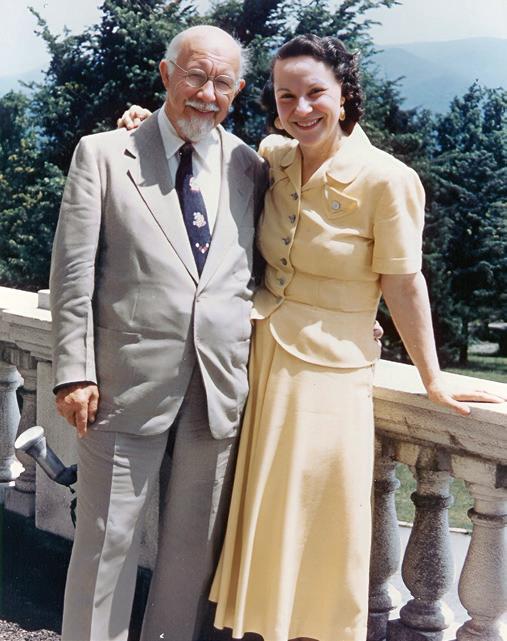
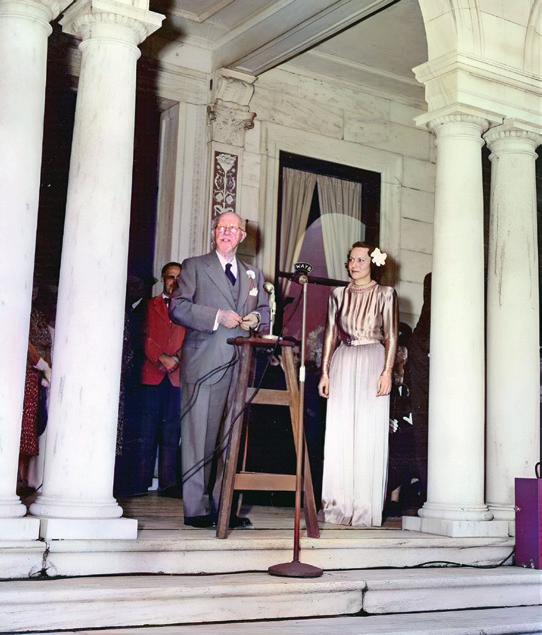
In 1948 Russell married his second wife, Lao, and the two of them went on a cross-country road trip that ended on Afton Mountain where they discovered an abandoned mansion that had formerly belonged to a railroad magnate. The couple moved into Swannanoa and lived there for the rest of their lives, writing, speaking, restoring the mansion and hosting visitors from around the world. After their deaths, the University of Science and Philosophy remained headquartered at Swannanoa until 1998.
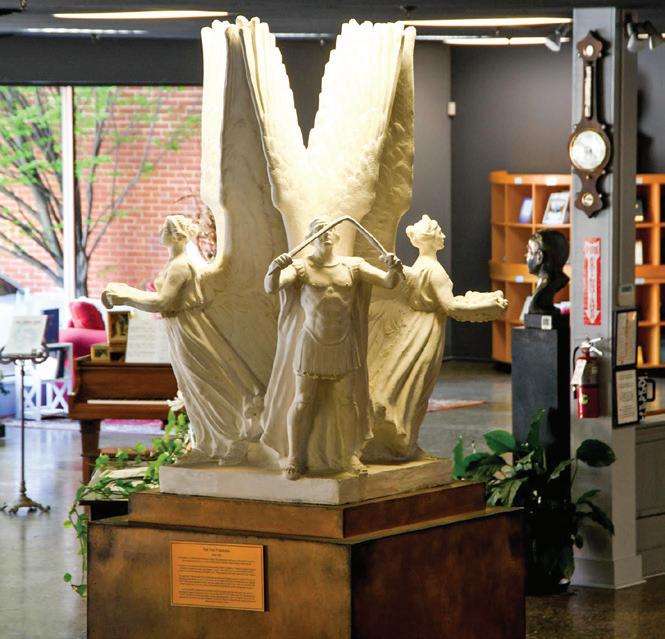
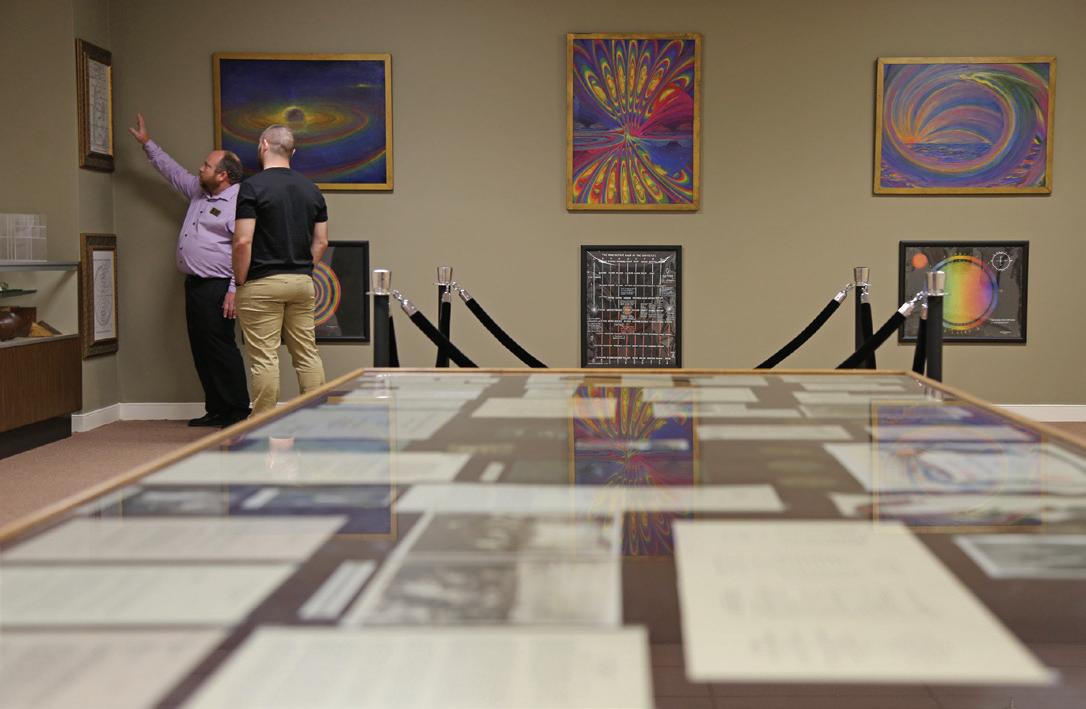
After the organization left Swannanoa, the Russell’s collections and writings remained in storage for more than two decades. Thanks to a donation from a University of Science and Philosophy board member — and with herculean efforts from a team of volunteers who moved all the objects from a storage unit to the museum — the Russell Museum opened to the public in 2019. In addition to the Walter Russell artwork, the museum also hosts a gallery with work by local artists and a function space that is available for rentals.
On a recent spring Saturday, one visitor to the Russell Museum was Frank Vretos of Waynesboro. He was familiar with Walter Russell and his work. In fact, Vretos’s mother and sister had visited the Russells at Swannanoa in the late 1950s. This was his first visit to the museum, and Vretos said he was quite moved by the experience.
“I’m a bit overwhelmed, but very happy to be here,” he said.
Presti said that, unlike Vretos, many of the visitors who come to the Russell Museum have never heard of Walter Russell. Although the goal of the University of Science and Philosophy is to spread the word about Russell and his philosophy, the museum exists primarily to share his art with the world.
“We are an art museum first and foremost,” Presti said. “But we are here if anyone wants to talk about spirituality.” <
The Russell Museum is located at 518 West Main Street in Waynesboro, Va. It is open for free self-guided tours from Thursdays to Saturdays from 11 a.m. to 4 p.m.
Top left: A sketch model for the Mark Twain Memorial sculpture that Russell completed in 1935. Bottom row, left to right: A model of Russell’s Four Freedoms sculpture. Walter and Lao Russell. Russell’s “The Might Of Ages, “ painted in 1900. It won an number of awards in Europe.
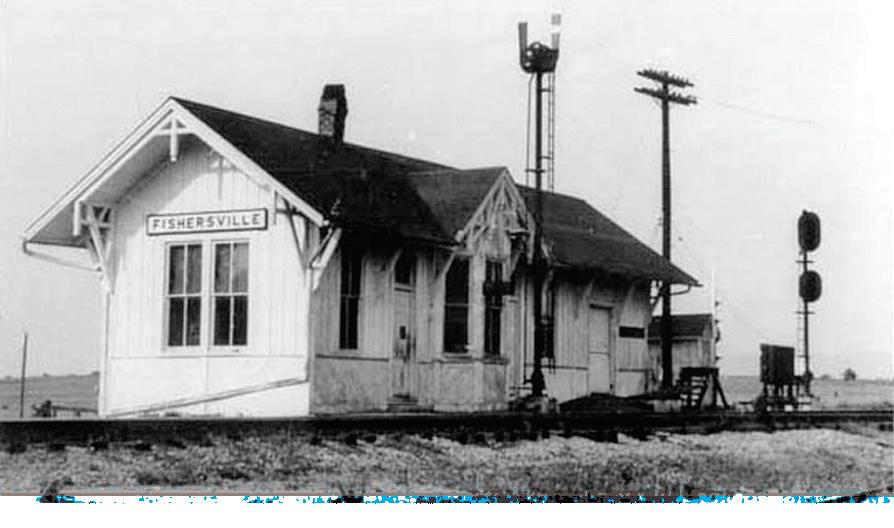
The fourth in our series about communities around Augusta County and the great people who call them home!
By Courtney Thompson
Nestled in the heart of Augusta County just off Interstate 64 is Fishersville, a community rich in history and character. With a population of just under 10,000 residents, this community offers a unique blend of historical significance, demographic diversity, and local attractions.
Fishersville is almost as old as Augusta County itself, with its location appearing on maps as early as 1738. The name “Fishersville” was given to it in the late 1780s after Daniel and Nancy Fisher who owned a large tract of land in the area. Many current residents can trace their ancestry to the Fishers and their 17 children. The region, originally known as Long Meadows, was prized for its fertile agricultural land. In the 19th century, the area also saw a rise in iron mining and lime production.
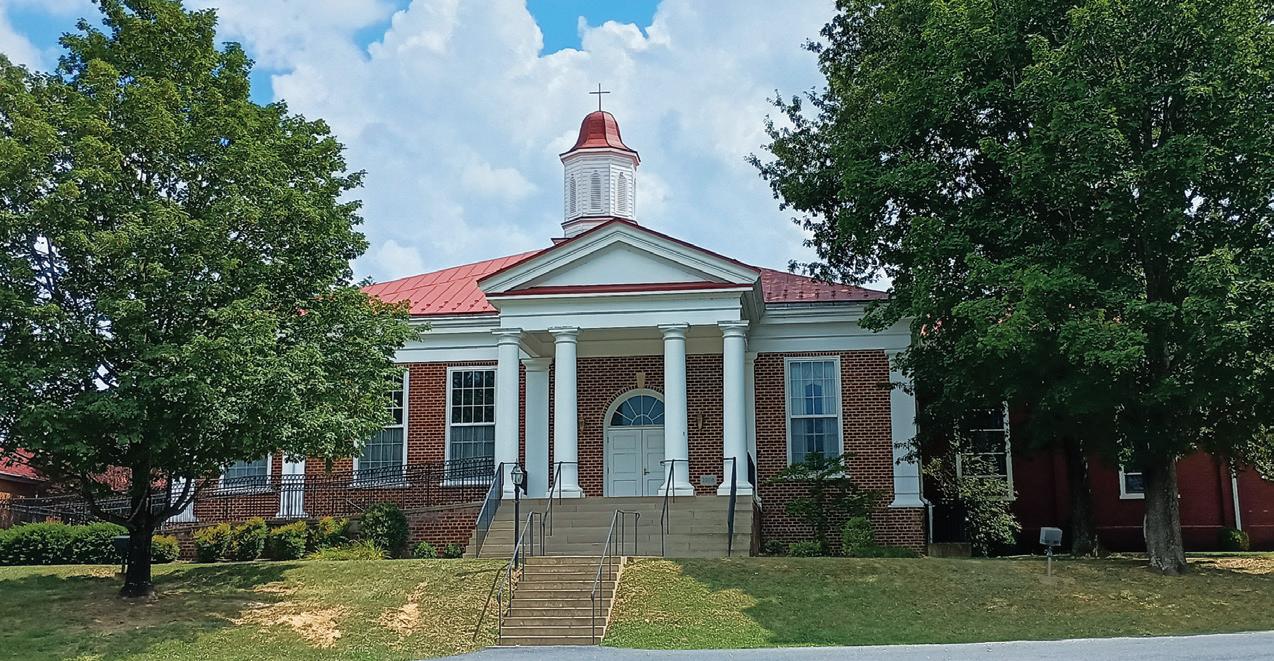
Most of the early settlers to this area were Scotch-Irish pioneers from northern Ireland, many of whom were Presbyterian. They built the Tinkling Spring Presbyterian Church in the 1740s, which is the oldest Presbyterian congregation in the Shenandoah Valley. The historic brick building that stands behind Sheetz is the former Tinkling Spring manse, which dates to the early 1800s.
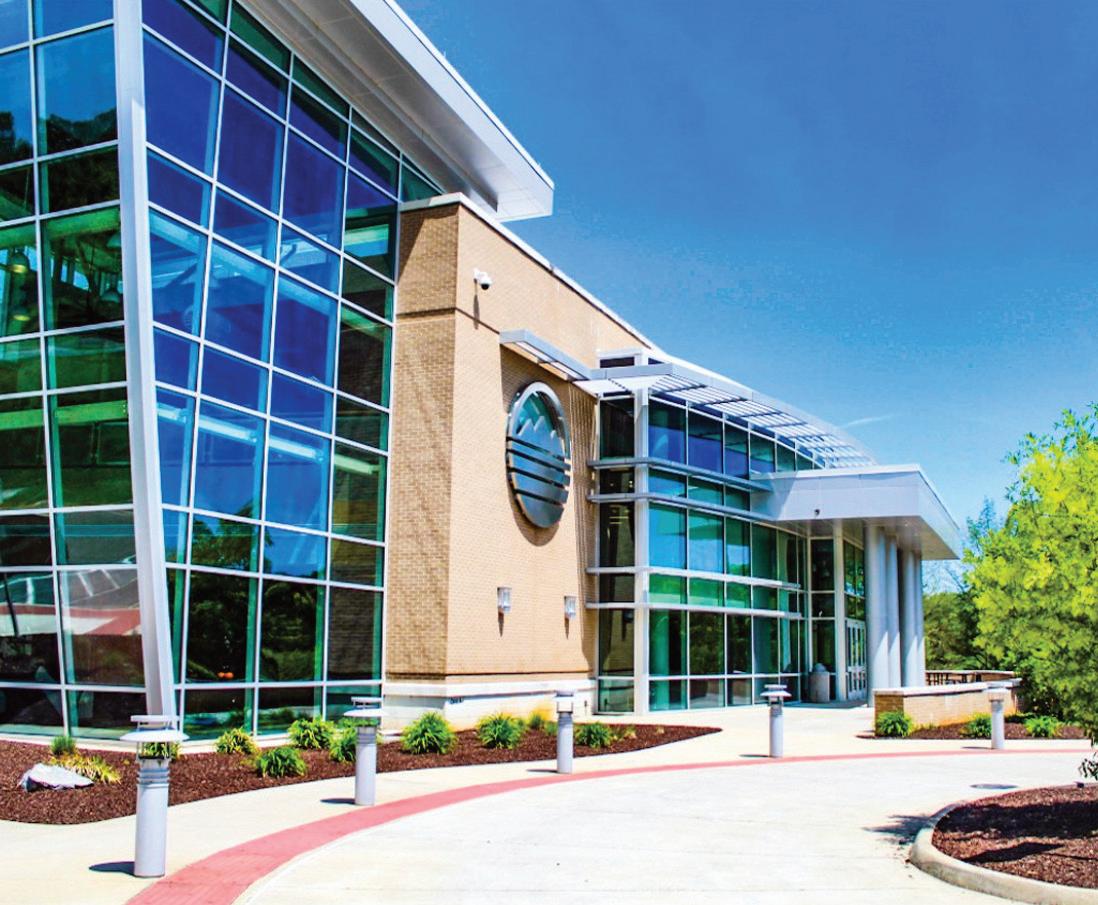
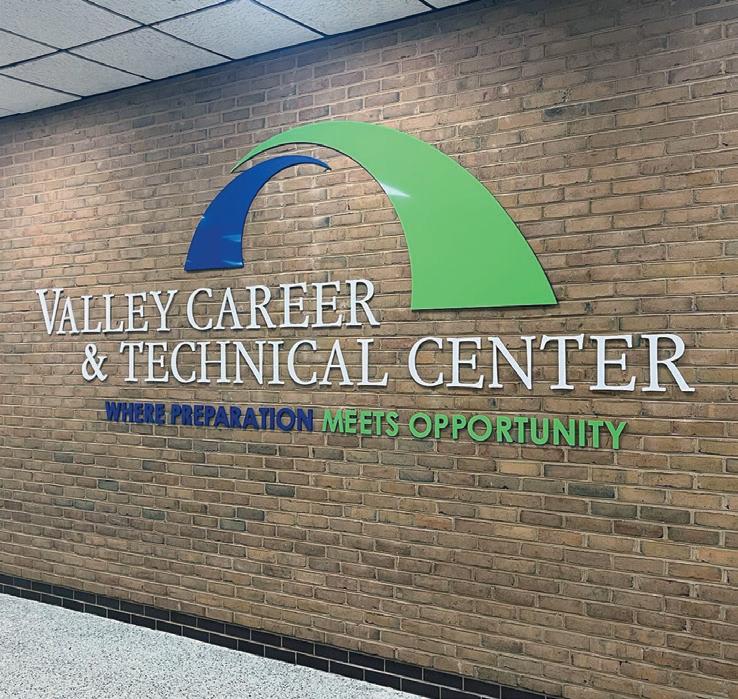
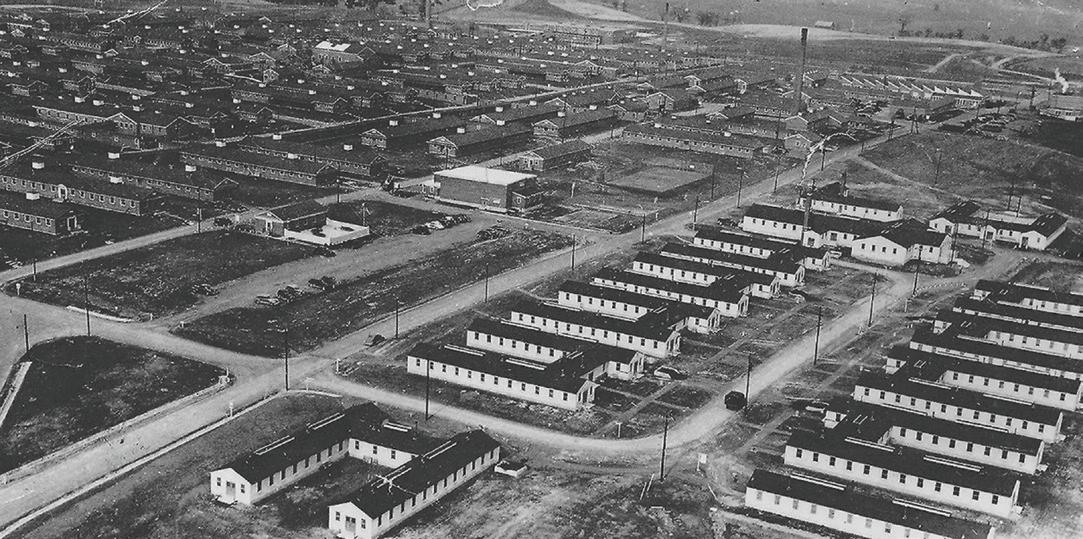
Due to Fishersville’s convenient location between Staunton and Waynesboro, with easy proximity to health care, shopping, restaurants, recreation and more, it has experienced an increase in new homes and residents. Although this is a benefit to the area, it does cause some concern over increased traffic and more students for the Wilson school complex off Route 250, which contains an elementary school, a middle school, a high school, Shenandoah Valley Governor’s School, Valley Career and Technical Center, and the Wilson Workforce and Rehabilitation Center.
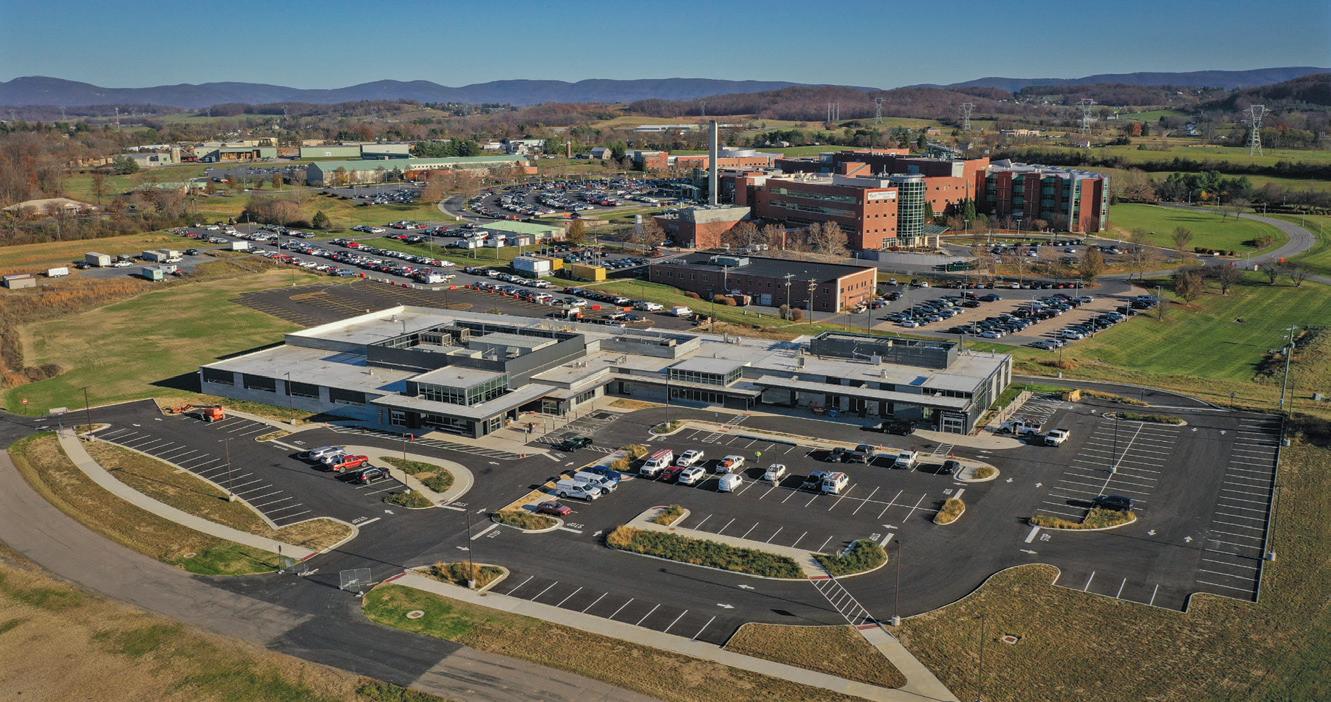
Also located in Fishersville is Augusta Health, which was established in 1994 through the merger of two long-standing community hospitals: King’s Daughters Hospital in Staunton and Waynesboro Community Hospital in Waynesboro.
In June 2009, it rebranded from Augusta Medical Center to Augusta Health to reflect its expanded services beyond acute care. The campus now includes advanced facilities in surgery, cardiology, and cancer treatment, and features an Outpatient Pavilion dedicated to imaging, breast care, and outpatient surgical services.
Augusta Health operates with over 250 beds and employs over 2,500 staff members, making it the largest private employer in the area. Augusta Health’s commitment to excellence reflects its successful model of community-driven healthcare innovation and collaboration.
There are also a number of senior living facilities and communities in Fishersville, thanks to the proximity to Augusta Health. Some are full-service with memory care, and others offer independent living and 55+ apartments.
Many other businesses are located in Fishersville, from cafes and restaurants to mid-sized manufacturers to retail shops. Home goods and decor store Kimco For the Home has been in Fishersville since 1982. Located at 1818 Jefferson Highway, Kimco is known for its selection of home furnishings, seasonal decorations, and unique gifts. The main branch of the Augusta County Library is located nearby, with programs and services for patrons of all ages.
Blue Ridge Lumber Company, a family-owned hardwood sawmill established in 1981, specializes in the production and global distribution of high-quality Appalachian hardwoods, including red and white oak, poplar, ash, hard and soft maple, hickory, cherry, and walnut. Their operations encompass sawmilling, kiln drying, and custom millwork, serving clients in the United Kingdom, Italy, China, Japan, Taiwan, Canada, Mexico, and across the United States.
A number of businesses are located on busy Expo Road, including locally owned Glass Innovations, which works with homeowners and contractors to build and install custom frameless shower enclosures, glass railings, all-glass office entrances, and partition walls. Virginia Frame Builders & Supply has provided top quality building supplies and professional post frame and conventional construction in the Shenandoah Valley since 1975.
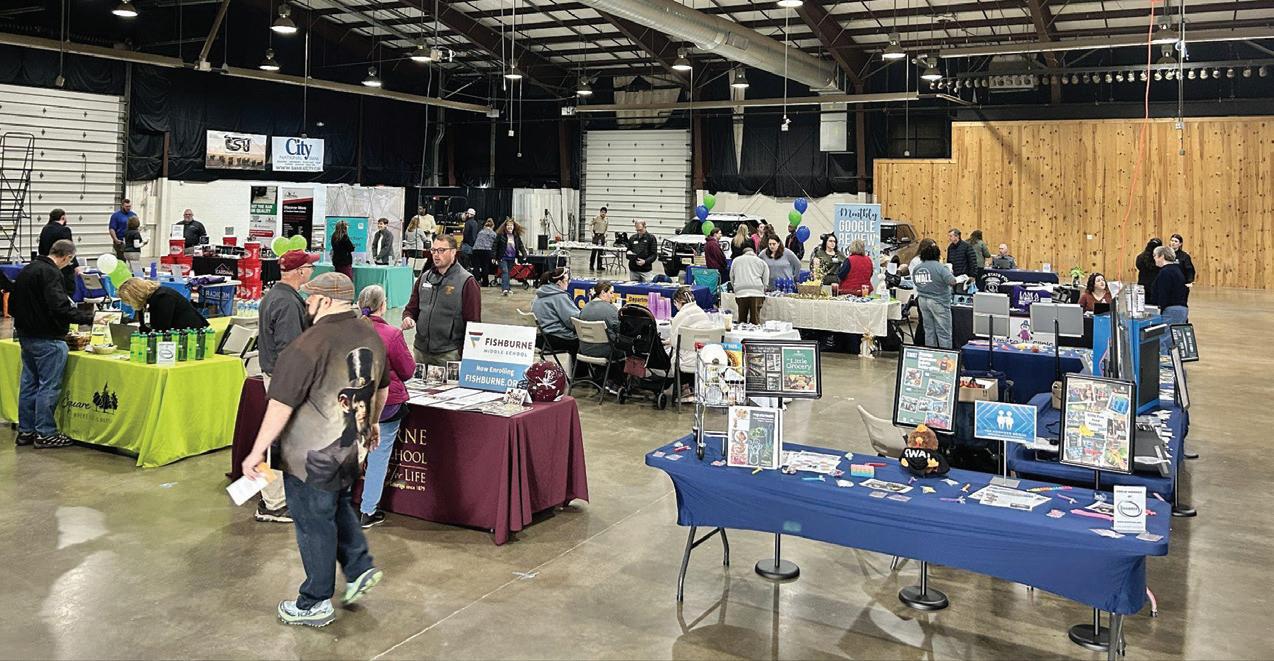
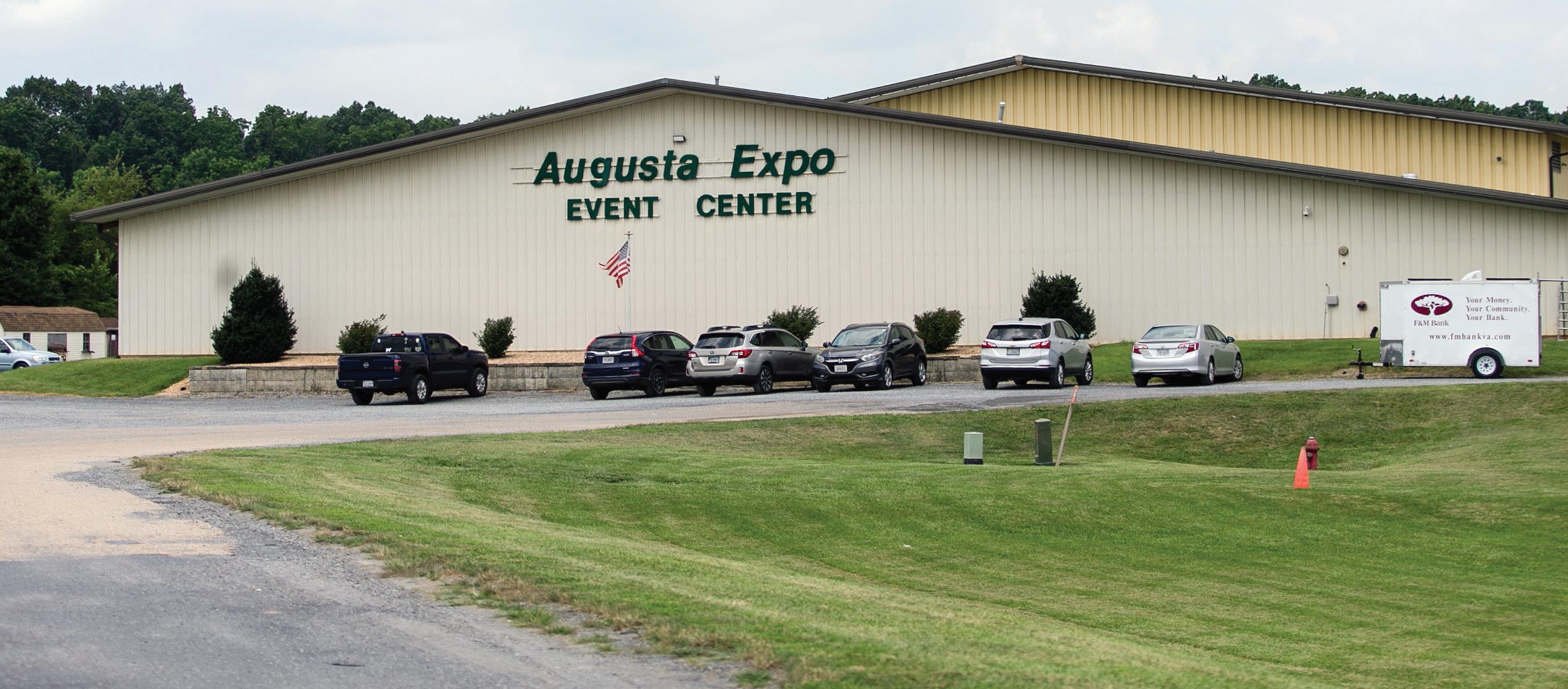
Augusta Expo Event Center, located at the end of Expo Road, is a nonprofit event center that began in the late 1960s. There is always something happening at Augusta Expo, from the Augusta County Fair (held every July) to the Chamber’s spring Hometown Expo to arts and craft shows to concerts and more!
At the core of Fishersville’s business community is the Greater Augusta Regional Chamber of Commerce, located just off Tinkling Spring Road on Ladd Road. This business organization serves as a resource for businesses in Augusta County, Staunton, and Waynesboro through advocacy, networking opportunities, and community events.
Fishersville is a place where community truly comes first. Neighbors look out for one another, local businesses are supported with pride, and there’s a strong sense of belonging in everything from school events to gatherings at the Expo. Rooted in history and surrounded by the natural beauty of the Shenandoah Valley, Fishersville is also growing- welcoming new families, expanding neighborhoods, and offering top-quality healthcare and services through anchors like Augusta Health. It’s a community that offers something for everyone!<
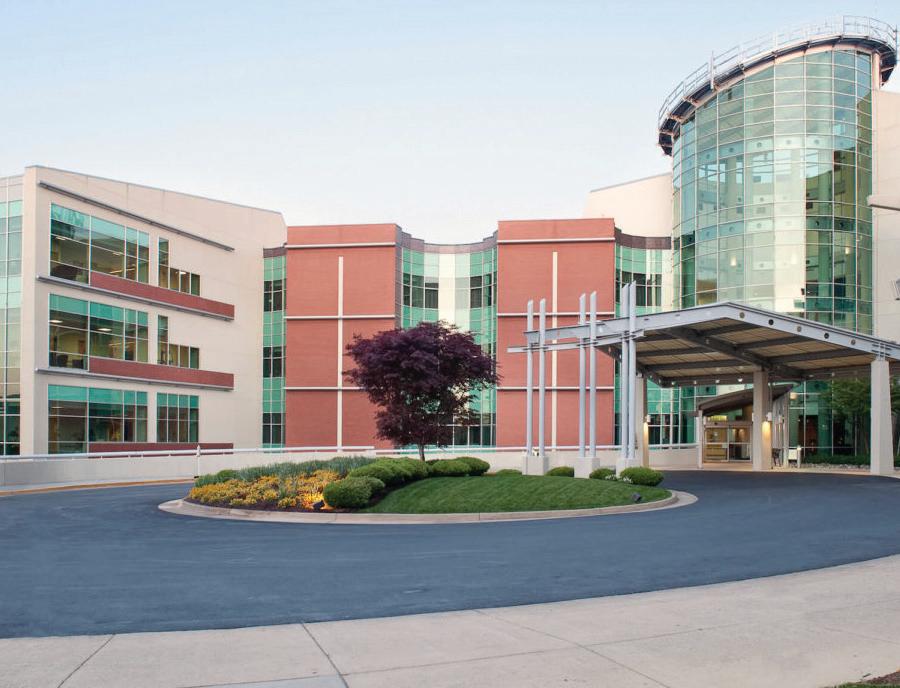
Top left: Augusta Health campus. (Courtesy of Augusta Health)
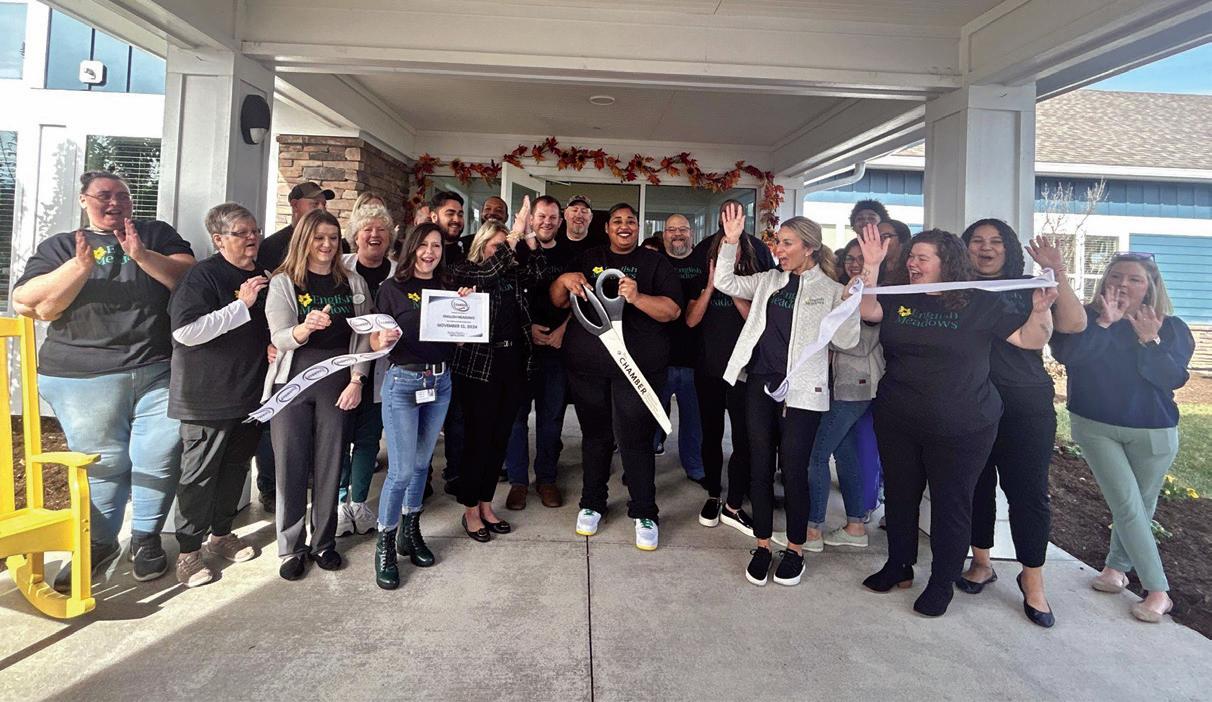
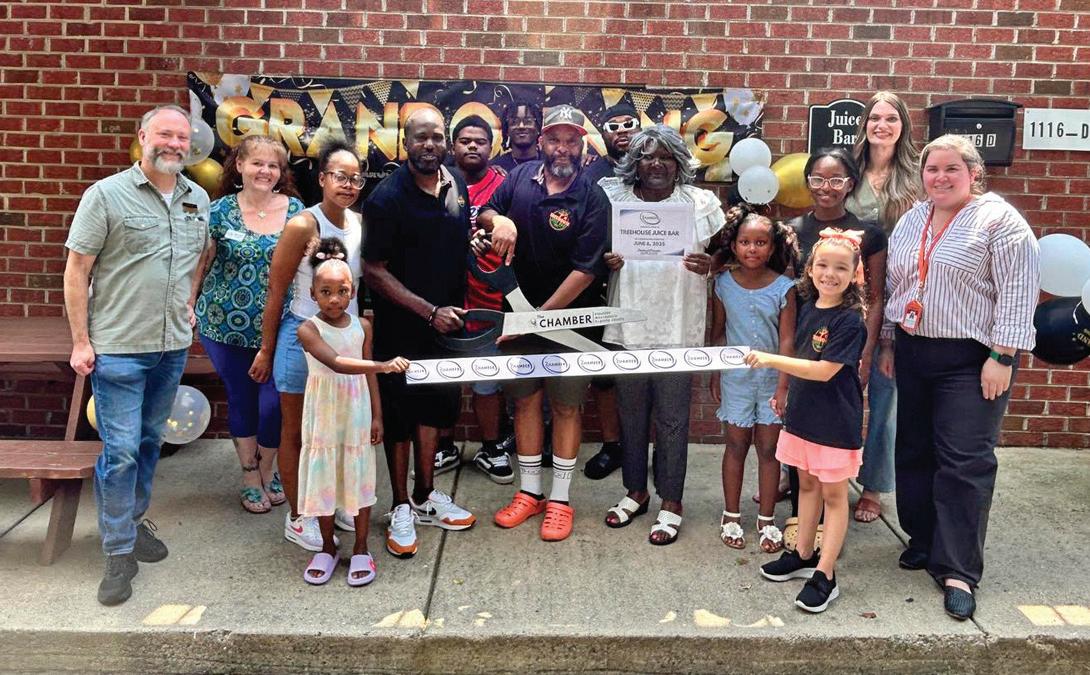
Top right: Ribbon cutting celebration at English Meadows- Fishersville, November 2024.
Bottom left: Bottom Left: Tinkling Springs Presbyterian Church dates back to the 1740. The oldest part of the current church was built in 1850.
Bottom right: The Chamber’s Annual Hometown Expo at Augusta Expo, March 2025.
Local Entrepreneur Has Grown Her Company Organically
By Chris Lassiter
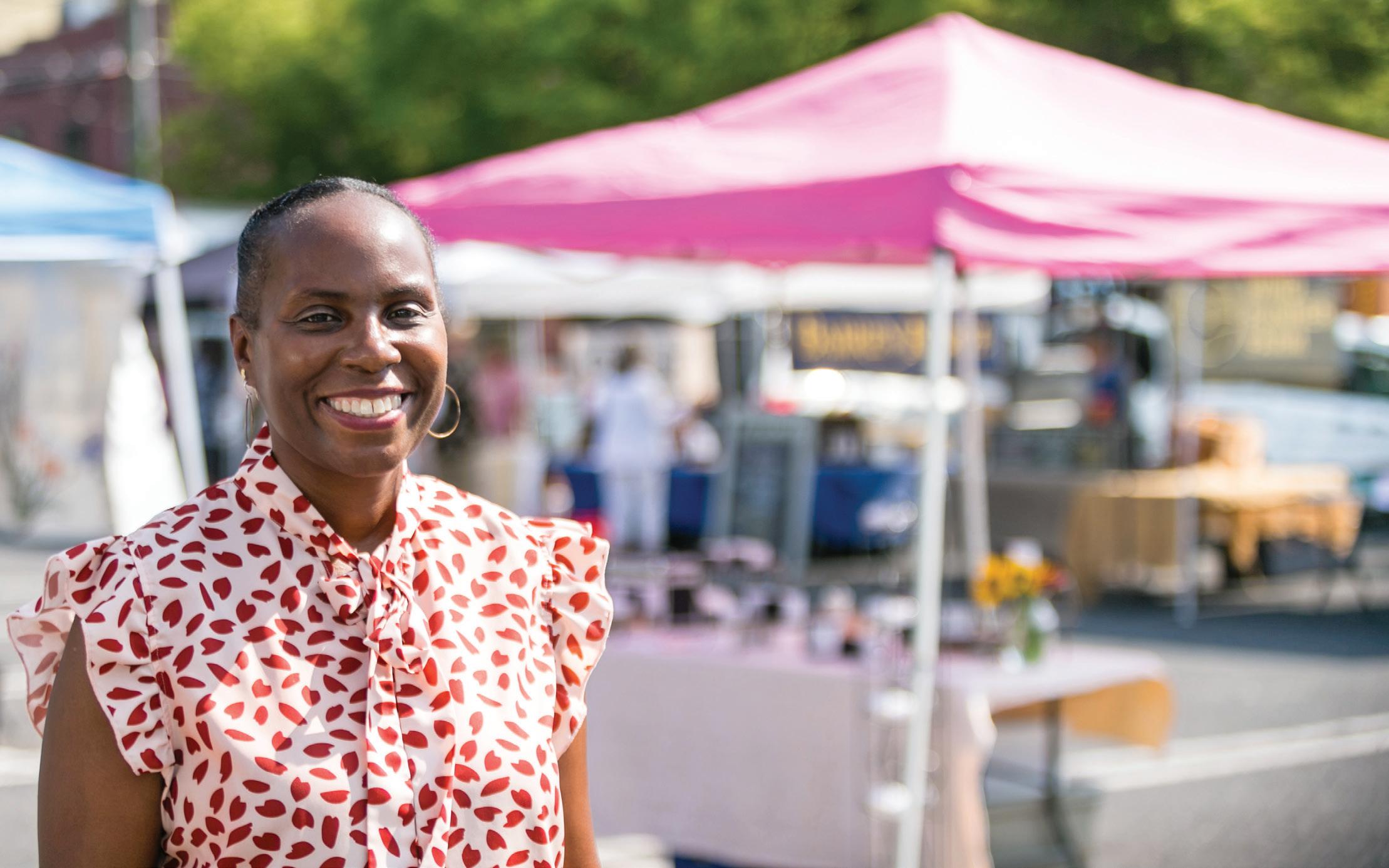
When Simone McKelvey first started her soap-making research, her idea wasn’t to start a business. The idea just sort of washed over her.
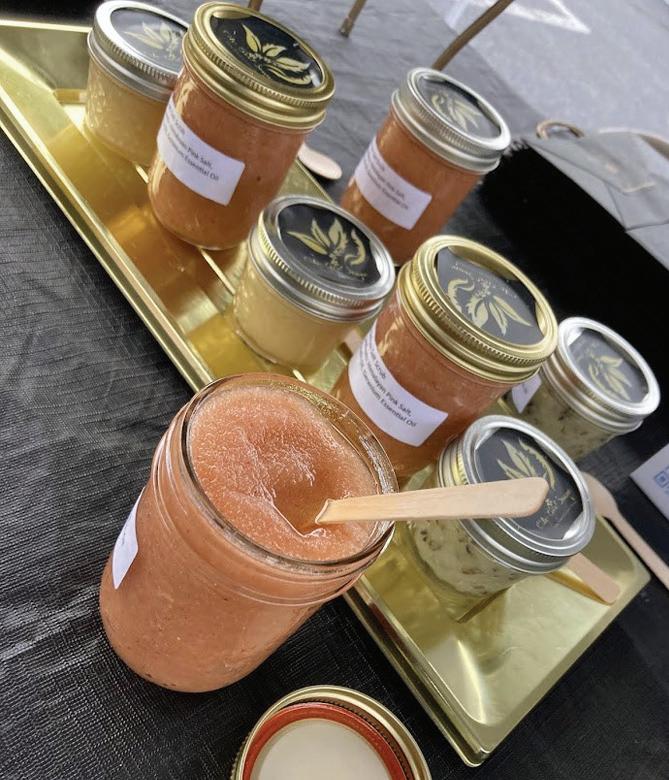
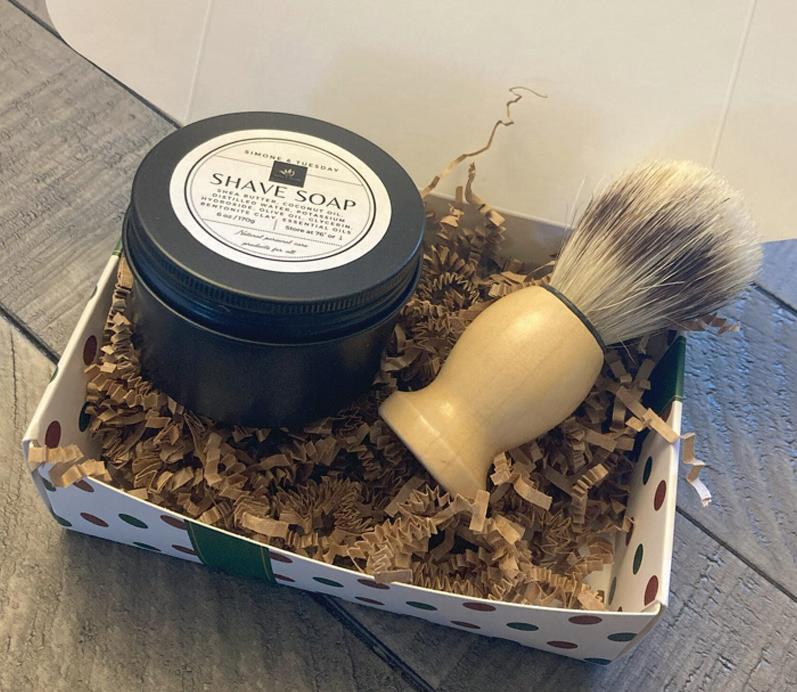
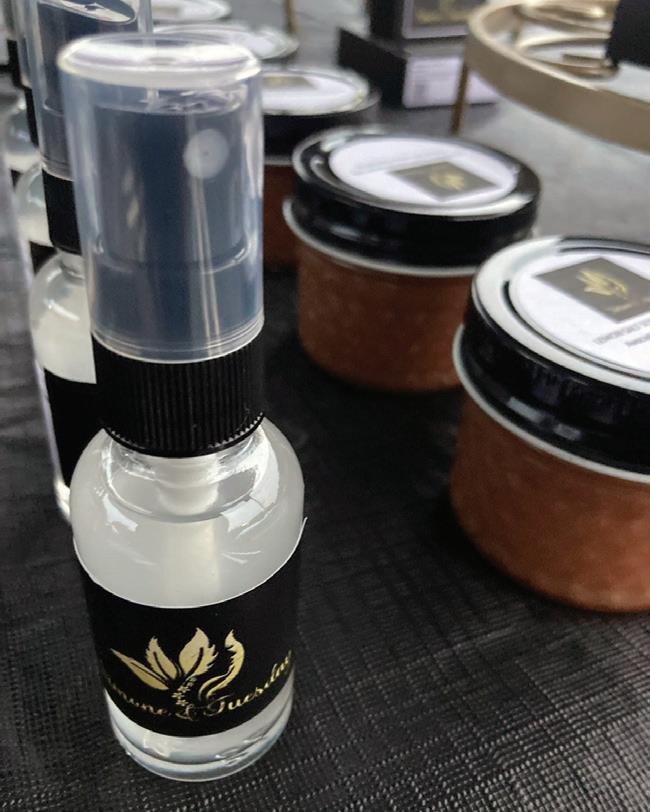
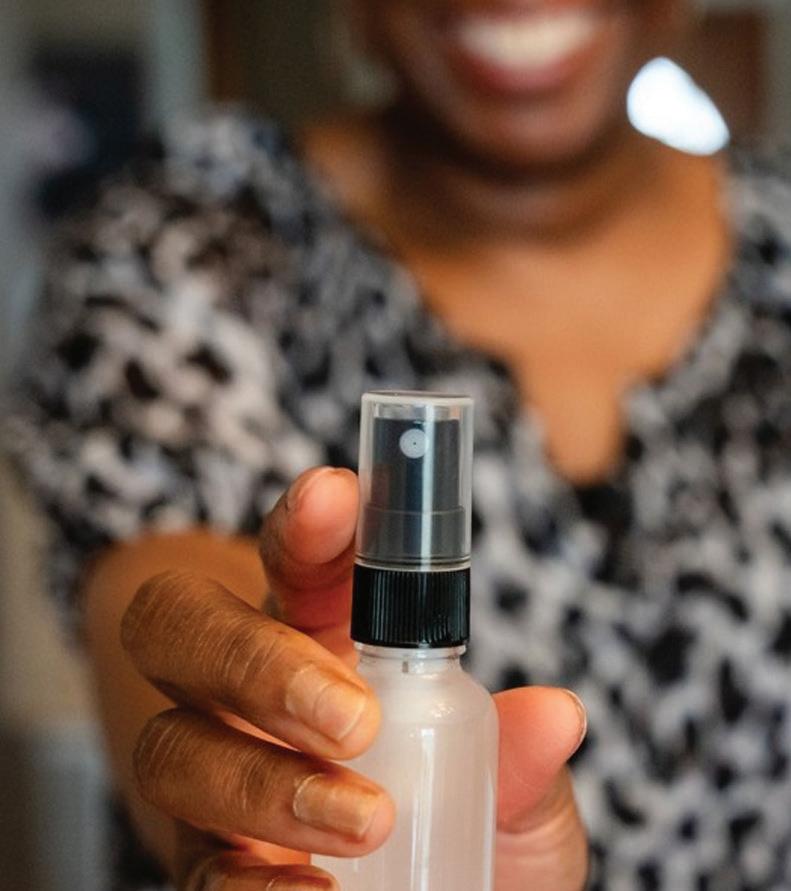
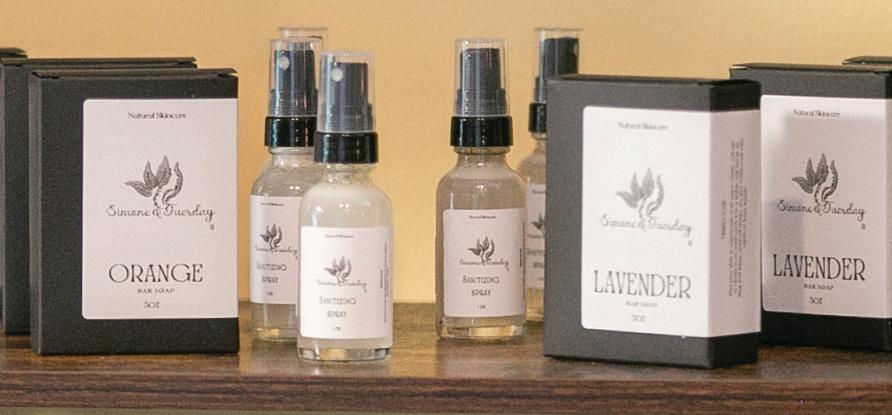
McKelvey’s love for learning, penchant for problem solving and desire to use all-natural skincare products would eventually lead her to founding Simone & Tuesday LLC. Her all-natural skincare line includes soaps, scrubs, bath bombs and body butter. McKelvey has rebranded and expanded since her company’s initial days in 2013, but the mission remains the same.
“Our skin is our largest organ, and we do not always take care of it the way that we need to,” McKelvey said. “My products are just a basic way. It’s not just a little luxury. It matters what we put on ourselves.”
McKelvey’s story of skincare entrepreneurship started when she gave the man she was dating at the time a high-end bar of soap as a gift.
He loved the product.


“When I was a kid, I loved baking,” she said. “I loved being able to make things from scratch.” As an adult, she put that same ambition into seeing what she could do with soap.
However, when her former companion went to re-up, he did not love the price tag associated with the soap. “I told him where I got it from,” McKelvey recounted. “When he found out what I had paid for it, he thought that was too much to pay for a bar of soap.”
McKelvey has always been both a maker and an entrepreneur. As a kid growing up in New York City, McKelvey would collect Women’s Day magazines to try her hand at the recipes provided.
“What caused me to start making products was that scenario,” she said. “I started researching soap making to give to him, so that he could still have the really good outcome he had experienced, but just not the same price tag.” Within a month’s time, McKelvey knew she’d be in the skincare routine business.
“I tend to jump in with both feet with anything that I do,” McKelvey said. “It was very soon after I made my first batch that I decided that I so enjoyed the process — making and figuring out what ingredients might help certain things — that I decided I would make this a business. Soaps is where I started, but there are lots more than soaps now.”

Education has always been important to McKelvey. Her family was fine with her leaving the Big Apple for college, as long as she had family in the state that she chose to attend.
The chance to study at the University of Virginia first brought her to the Commonwealth. Earning a master’s degree at Longwood University extended her stay in Virginia. McKelvey spent 12 years in the classroom before pursuing different roles in higher education.
After working at several different higher education positions at multiple colleges, her role as the director of student services at Mary Baldwin University’s Murphy Deming College of Health Sciences brought her to the Shenandoah Valley. McKelvey’s passion for education even shows up in her business, as there’s a charitable arm of Simone & Tuesday LLC that provides children with access to books.
Learning best business practices has also been an educational process. Her business education also meant taking the Shenandoah Community Capital Fund’s Business Boot Camp and Capacitor Incubator Program.
It was continuing education that eventually led to McKelvey rebranding her business. She officially changed the name City Girl Soaps to Simone & Tuesday LLC.
“Some friends of mine and I do an annual girls’ trip, and this particular girls’ trip was to Portugal,” McKelvey said. “It was a great time, lots of great conversation. One of them in particular has an entrepreneurial mind. We were talking about businessrelated things, and she said, ‘Simone, you need to trademark your company.’”
McKelvey had already been through the LLC process in the early business stages, but wanted the extra federal protection that a trademark would provide. However, her trademark application was denied. The name, according to the feedback she received, was too close to another business name.
Coupled with the fact that she had grown beyond selling just soaps — and her audience had grown from primarily women to everyone desiring healthy skin — McKelvey decided on the official name change to Simone & Tuesday.
The name has a special meaning.
“My parents gave my older siblings the choice of my name either being Simone or Tuesday,” McKelvey said. “When it came time to change my company name, I thought, ‘Simone is who I am. Tuesday is who I could have been. Now with my business, I get to be both.”
A Dream continued on page 18


A Dream, continued from page 17
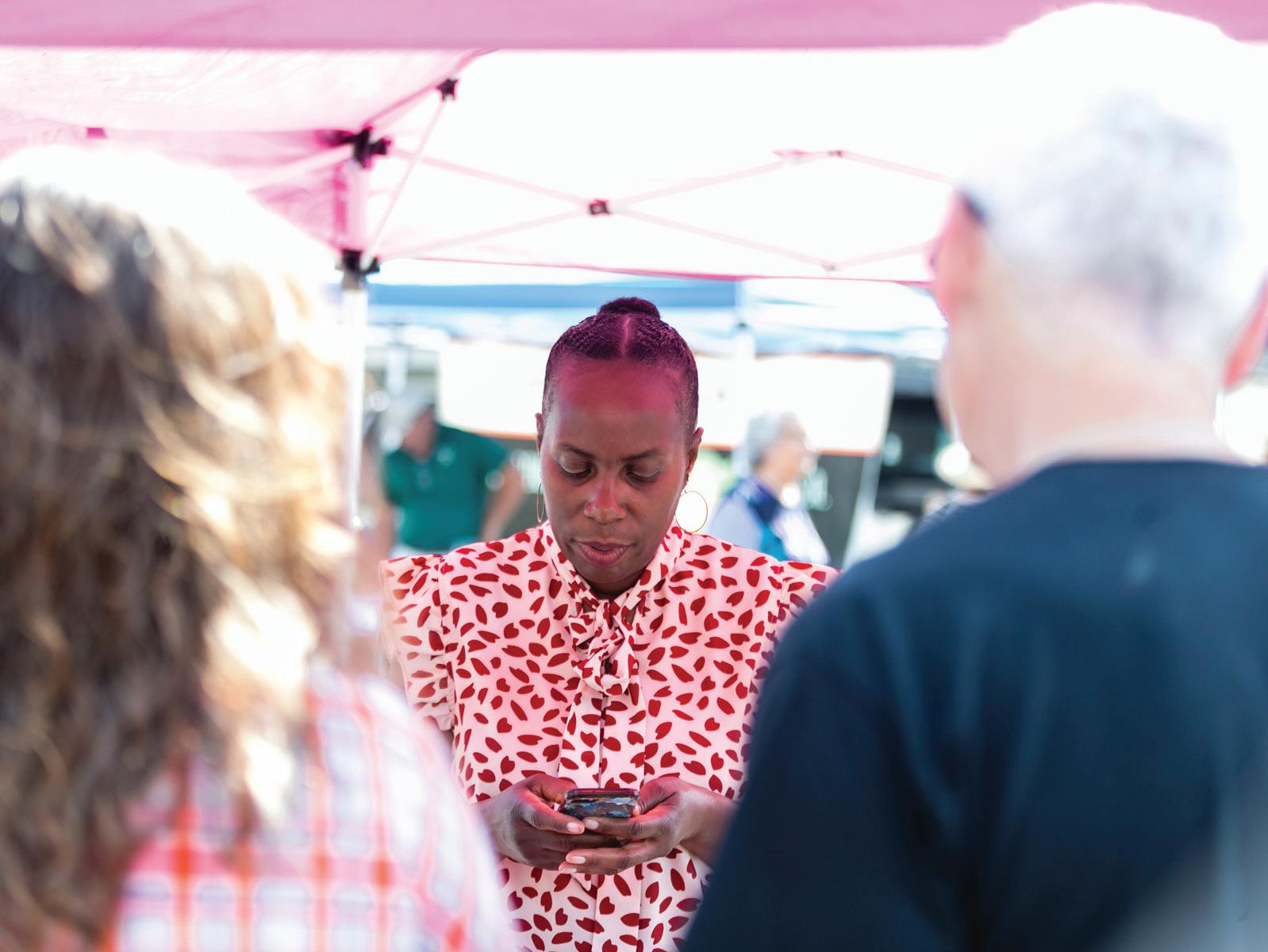
Simone & Tuesday is in two local shops, The Art Hive and Queen City Games & Gifts. She sells her skincare product line at the Staunton Farmers’ Market, and her online sales have nearly tripled in the last fiscal year. McKelvey recently unveiled a subscription service, and it’s off to a promising start.
Two inns are currently using her products, and McKelvey is working on setting up a way for schools and nonprofit organizations to use Simone & Tuesday products as a fundraiser.
Keisha Nicholson of the Staunton Black Business Collective loves how gentle McKelvey’s orange soap feels on her skin, as well as the soft feel and amazing smell of Simone & Tuesday body butter.
Nicholson, who also is a founder of the Love Forward nonprofit organization, loves McKelvey’s story as much as the products. “She’s building with intention, serving results and doing it her way,” Nicholson said. “That’s the type of excellence I love to see.”
To this point, McKelvey has self-funded every aspect of Simone & Tuesday, but she has dreams of scaling the company. “Future looking is throughout the Shenandoah Valley. Simone & Tuesday is known for being a natural product brand that people feel comfortable using, and are excited to use and to share,” McKelvey said. “The dream and the goal are to be self-sustained, which I’m not achieving as a hobby business. The dream is that it becomes a large business that I can pass on to family who come after me.” <


By Chris Lassiter
After Finding Lucy, they have set their sights on fixing the Dixie.
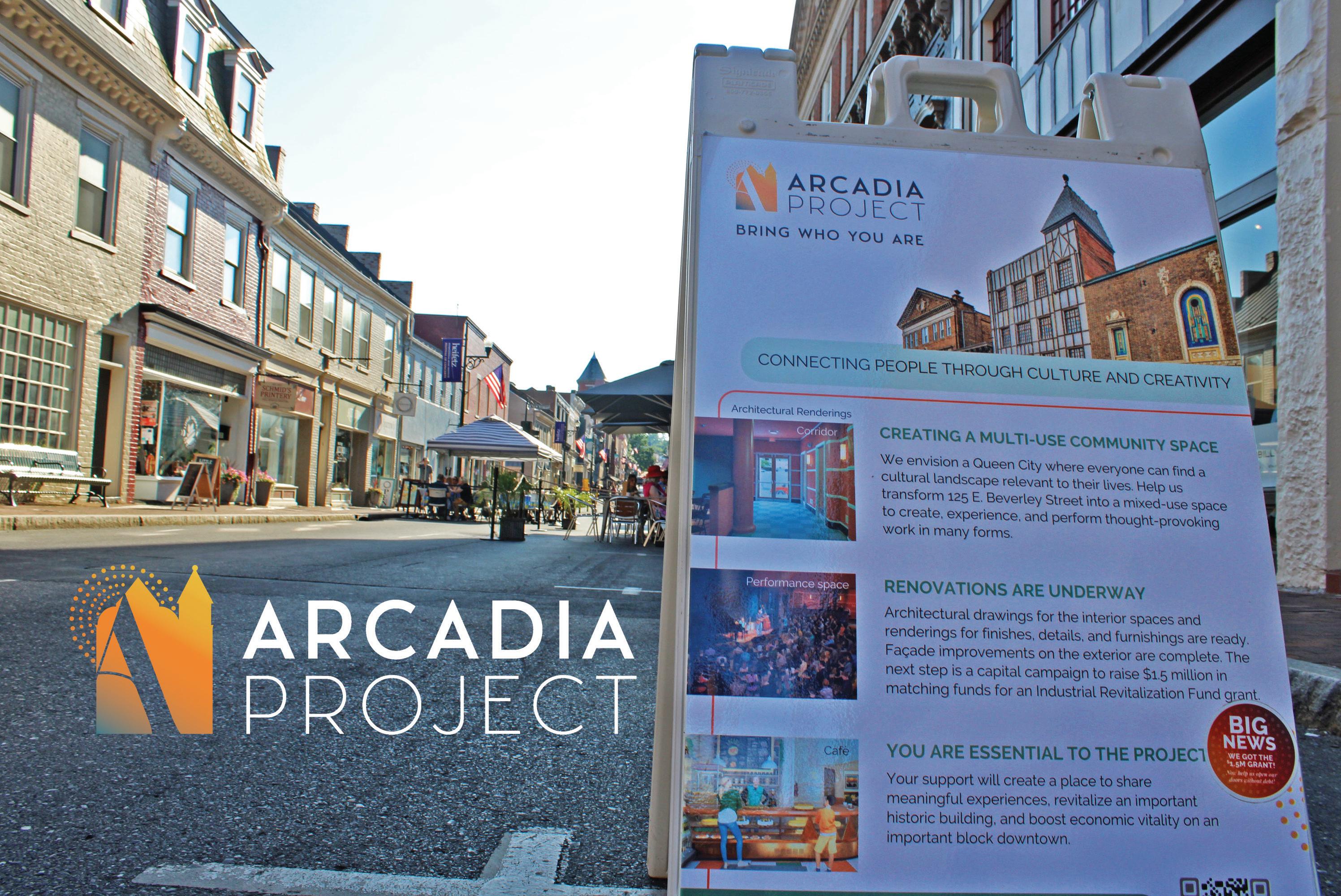
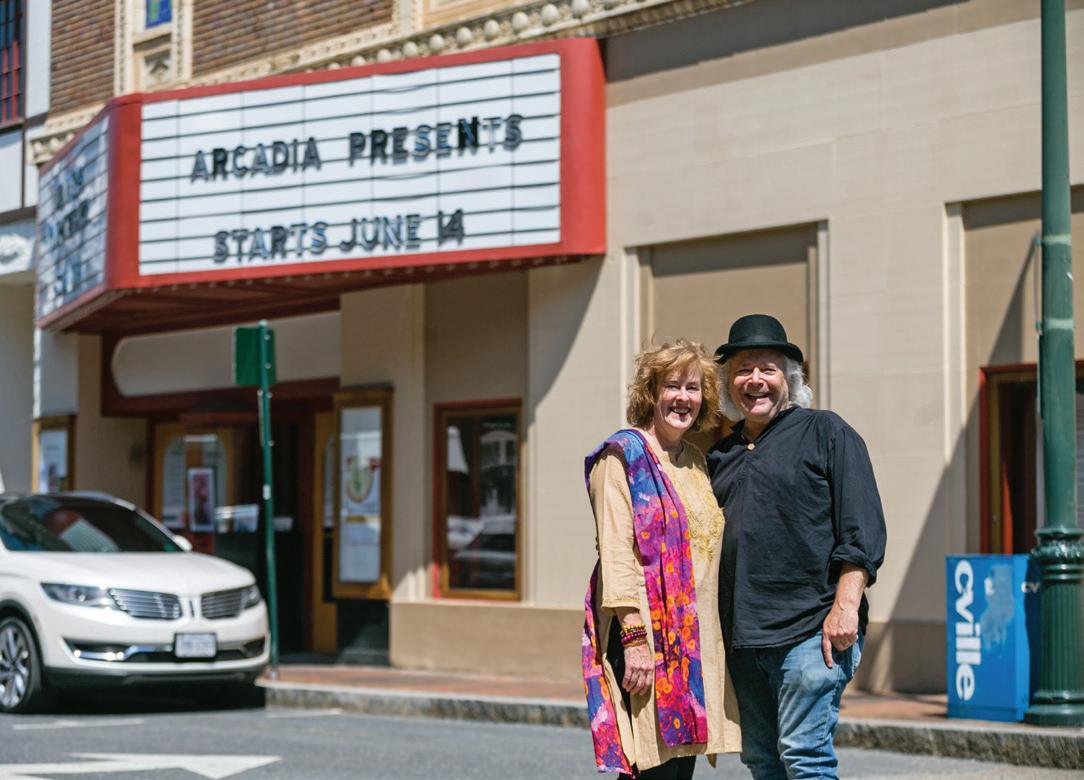
Husband-and-wife filmmaking team Thom Wagner and Pamela Mason Wagner, who received a coveted Emmy award for their 2000 documentary on Lucille Ball, are the co-founders of the Arcadia Project.
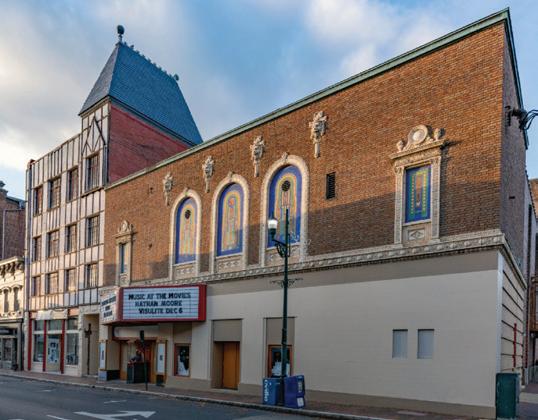
The nonprofit organization hopes to breathe life into Staunton’s old Dixie Theater.Built in 1913, as the New Theatre, the renamed Dixie has been empty for over a decade.
“The mission is to create community through culture and creativity,” said Pamela, co-founder and executive director of the Arcadia Project. “Our goal with the building is to connect audiences and performers to demystify the creative process, and bring the audience closer to the performer, so they understand that it’s not magic. Everyone has creativity inside.”
The performing arts first brought Thom to Staunton in 1978. Thom fell in love with the Queen City of the Shenandoah Valley.
“I’m a 27-year-old young composer working at a theater in Washington, D.C., and we have a connection to a theater down here in Staunton,” Thom said. “I came down here for a summer to write music for a play about Walt Whitman. I spent a whole summer here.
“ A lot of things that were built in the meantime weren’t here, but what we did have is a group of theater artists committed to making art, music and theater happen here in Staunton.”
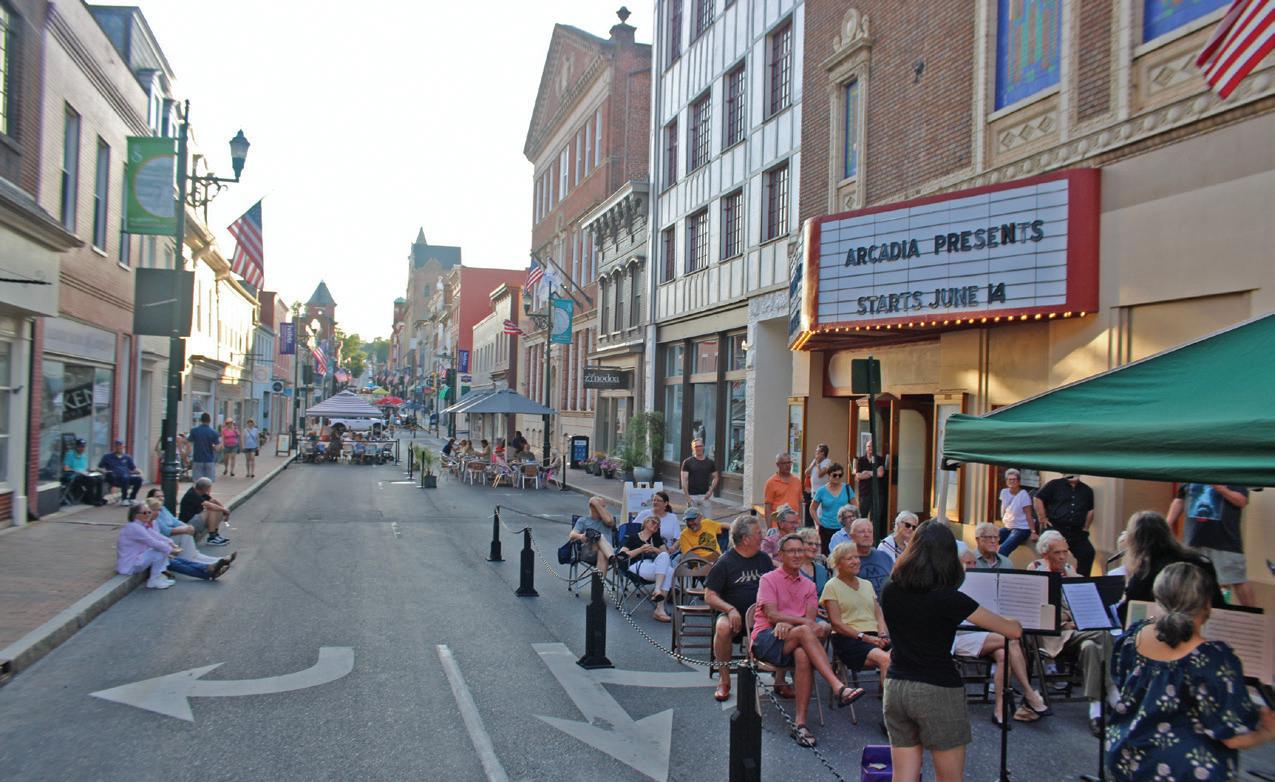
Even though the renovations to the building are not complete, it’s already hosting outdoor concerts in front of the theater.
When the Wagners were planning their exodus from New York City, Pamela suggested to Thom that they visit Staunton.
“We met in New York in the 80s, and he would always talk about this place he loved called Staunton,” Pamela said. “He was ready to retire, and we were looking for a place to live after New York. I actually said, ‘Why don’t we go look at Staunton?’”
The city made quite the impression on Pamela, too. “We came here for a weekend, and within 12 hours I knew I could live here,” she said. “We met Julia and Nick Sabin, and they gave us a list of other filmmakers in this community. We met Marnie Gibbs, who took us on a tour of the historic theater, and we were hooked. It was Marnie that asked, ‘What would you do with this theater?’”
With the community’s input and the Arcadia board’s business savvy and passion for the arts, the Wagners set about to answer exactly what they would do with the theater.
“We have a wonderful building in the heart of Staunton that has sat vacant since 2014,” said Elizabeth Respess, president of the Arcadia Project board of directors. “It literally is a block or so from the Shakespeare Center. It’s on an important block in the city. For something that architecturally interesting to sit vacant, it’s not good for anyone. To take it and bring it back to some form of community building is very important.”
In addition to expanding arts in the community, the Arcadia Project’s leadership has thought strategically about how to position the organization as a tourism draw.
The movies shown at the theater will not be in competition with the Visulite. One of the two auditoriums will be turned into an event space, which community members can rent out. Inspired by the city’s tourism department, they will present a tour bus lunch program.
“It’s just one example of how we feel the building can serve our community,” Pamela said. “The director of tourism noticed that buses were stopping at Woodrow Wilson (Presidential Library), and never coming into our downtown. They just get back on the bus, go up or down I-81, and spend their money elsewhere.”
The tour bus lunch program could change that.
“One thought about that was there was nowhere downtown that could host 55 people — in and out within an hour — that’s wheelchair and handicap accessible,” Pamela said. “We have exactly that space with a dedicated bus parking spot located outside our door on Market Street. It’s our hope that we can work with Woodrow Wilson and Shakespeare and bring those buses downtown and extend the visit. The goal is trying to grow that stop-over.”
The community is buying into the vision. In June, Staunton’s city council voted unanimously to award the Arcadia Project a $30,000 economic development grant.
“Arcadia’s track record, vision and leadership give me every confidence in their success,” Staunton mayor Michele Edwards said. “This project represents a meaningful opportunity for Staunton.”
The Arcadia Project’s movie marquee is one of the most welcoming and picturesque parts of downtown Staunton. The interior of the building needs work to match the beauty of the building’s exterior. “People look at the front and look up at the lit-up marquee and think we’re done,” Thom said. “I want to get the message to the community that we still have one more fundraising mountain to climb.”
The Arcadia Project’s capital campaign has been incredibly successful up to this point, having raised more than 80 percent of the funds necessary to see the renovation to completion. Even without a fully renovated building, the Arcadia brings art to the community with events such as the ARCADIA PRESENTS series on Saturday evenings.
If the campaign remains on schedule, the organization is hoping for a soft opening in December of 2026 and an official opening in January of 2027.
“We’re most of the way there, and we’re going to make it to the finish line,” Pamela said. “The last money donated is the least risky money.” <
By Darryl Woodson
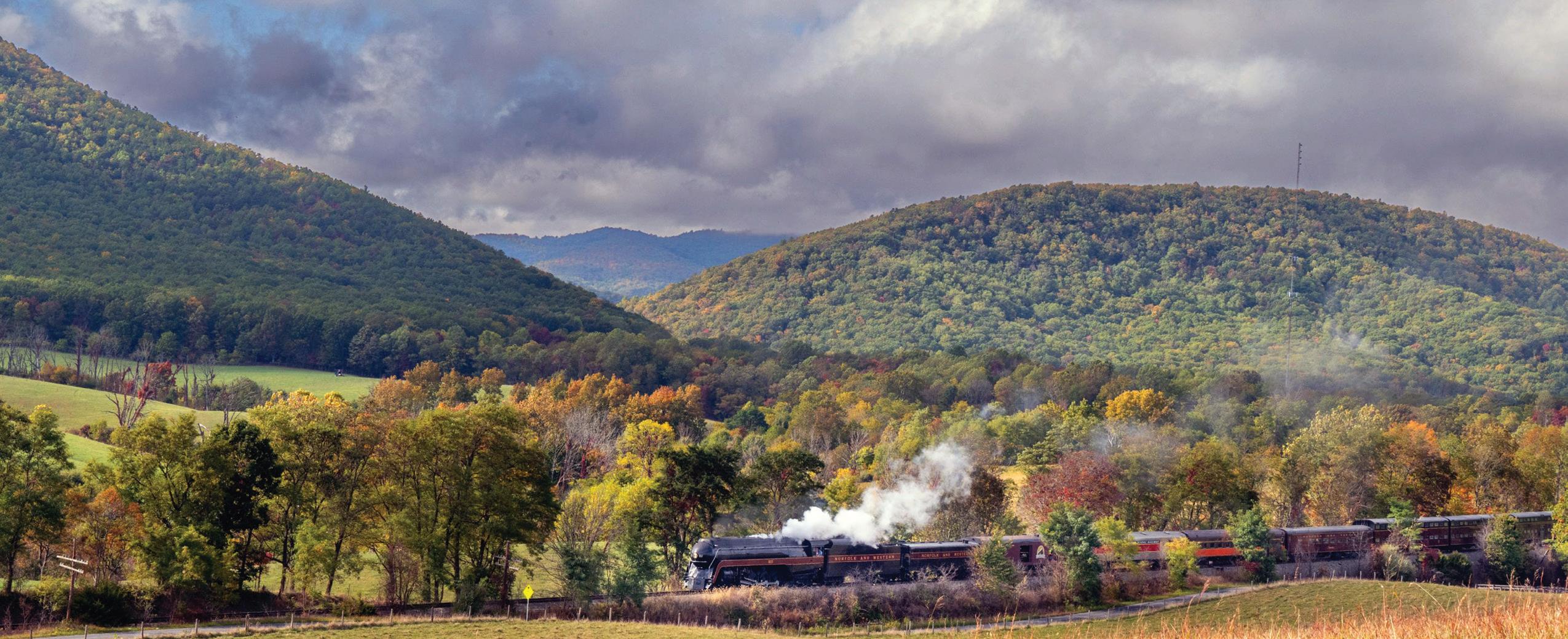
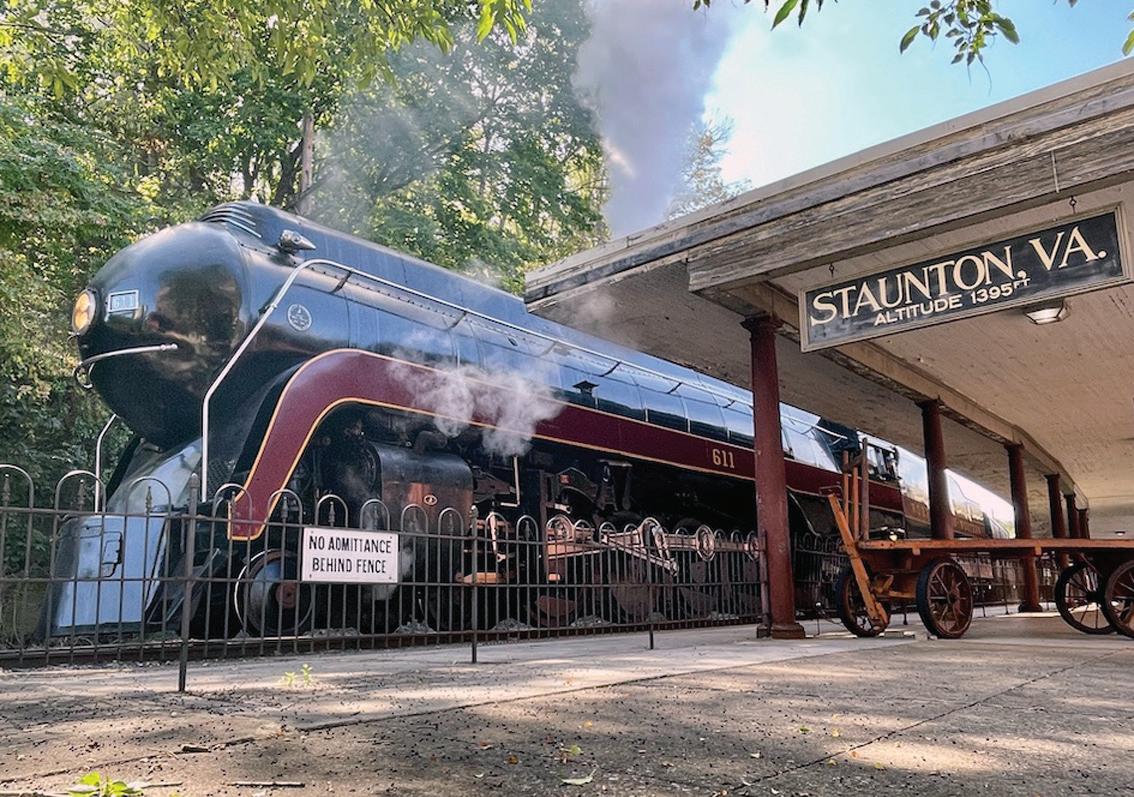
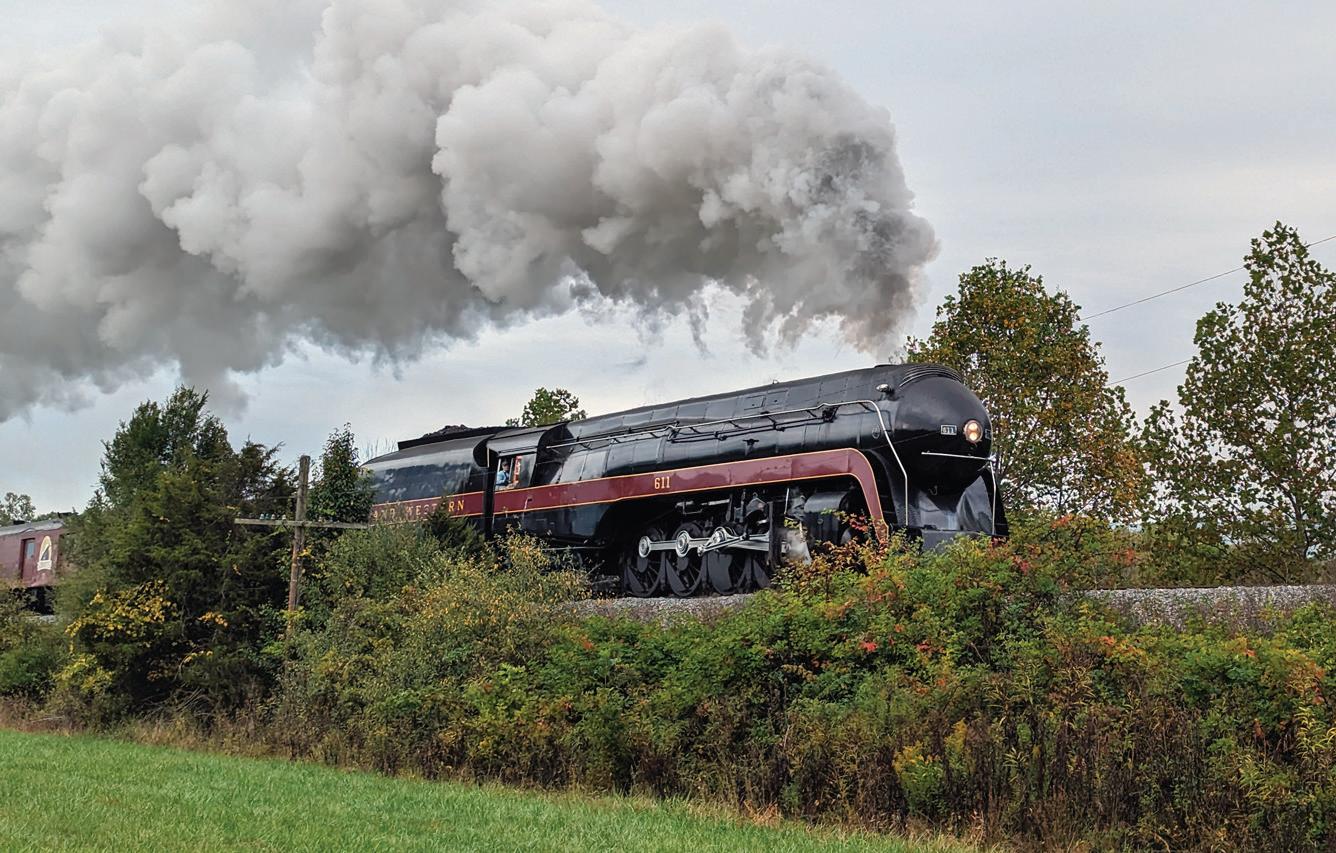
The 611 is coming back to Staunton. The Virginia Scenic Railway announced last week that a joint venture between the Virginia Scenic Railway, the Virginia Museum of Transportation, the Steam Railroading Institute, and the Virginia Mechanical Preservation Society will bring the famed Norfolk & Western Class J No. 611 steam locomotive back into service for a limited series of passenger excursions this fall, based once again in Goshen, VA.
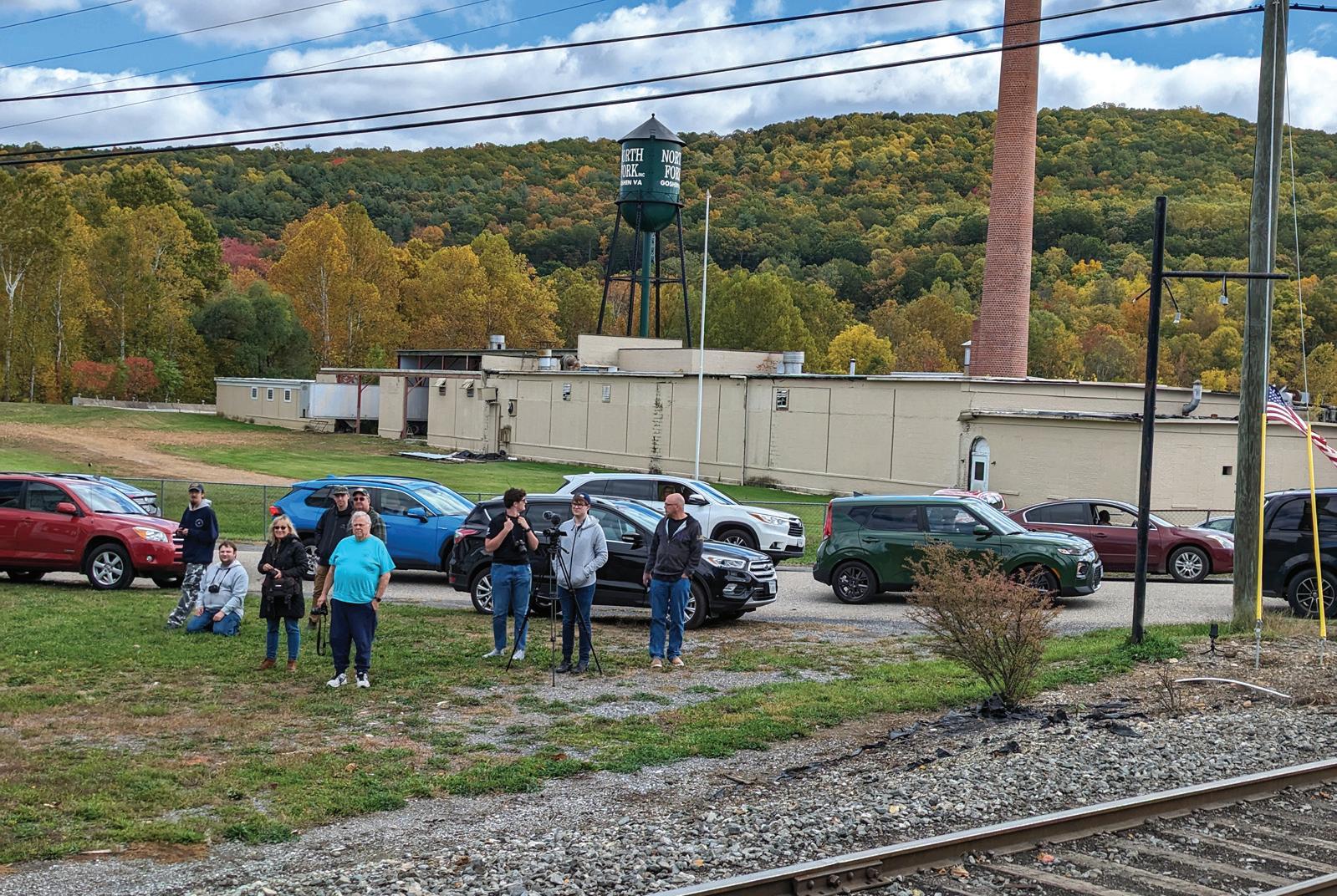
Starting on Sept. 26, the Virginia Scenic Railway will operate the steam-led passenger excursion as the Shenandoah Valley Limited for five consecutive weekends. The excursions will once again run from Goshen to Staunton and back. Tickets went on sale in midAugust, and any that are available may be purchased through the Virginia Scenic Railway’s website. (www.virginiascenicrailway.com)
The 611 excursions first came to Goshen in the fall of 2023 as a joint venture of the Virginia Scenic Railway and the Virginia Museum of Transportation, which owns and operates the 611. The effort was spearheaded by Will Harris of Rockbridge County, then the president of VMT.
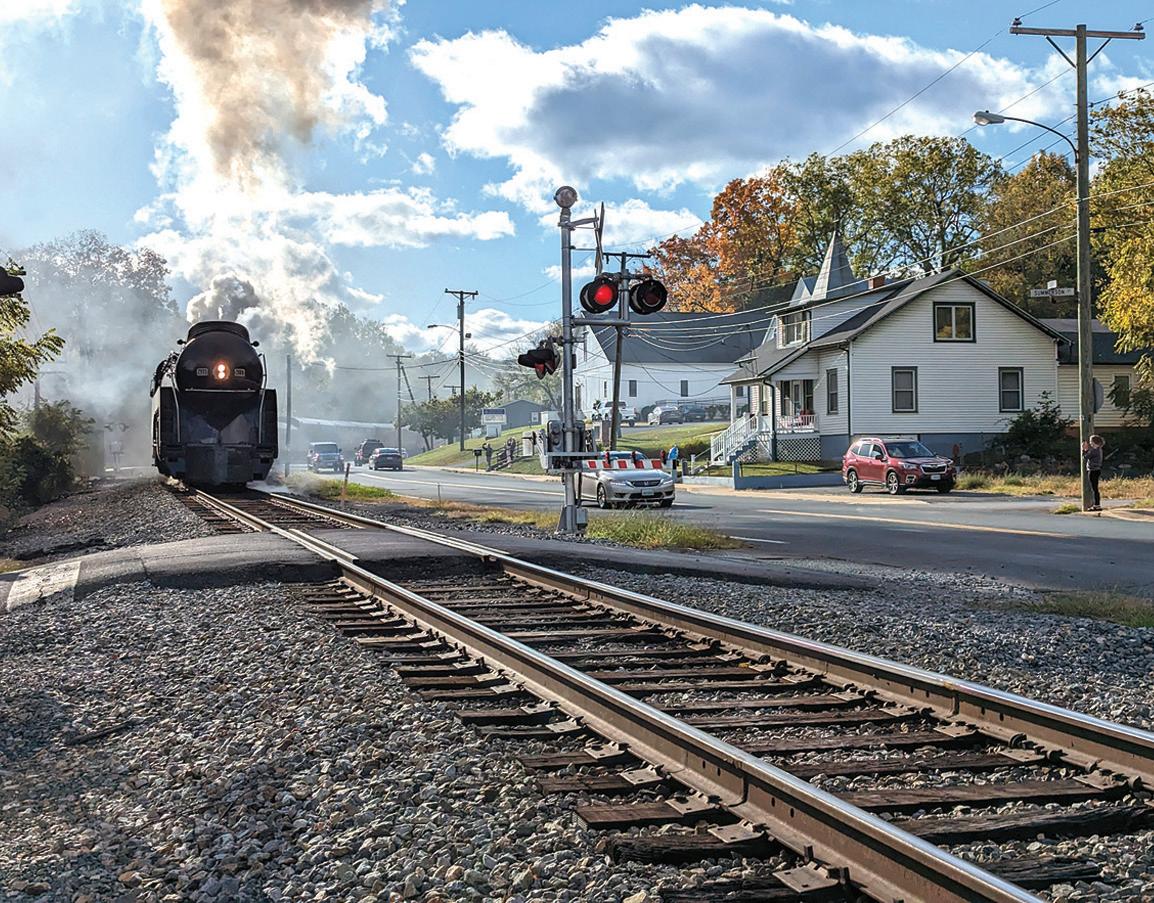
Harris supervised the creation of Victoria Station on land he owns just south of Goshen, which included a new siding and a huge gravel parking lot. Large tents were set up for the “station” where tickets and souvenirs were sold. Harris, his family and other volunteers also refurbished some of the historic passenger cars used for the excursions.
The passenger coaches that will be used in this fall’s excursions will be provided by both the Virginia Scenic Railway and the Steam Railroading Institute in Owosso, Michigan. Besides the fleet of passenger coaches and dining cars it is bringing to Virginia this fall, the institute also owns and operates Pere Marquette 1225, the locomotive animated in “The Polar Express” movie.
Harris and his family remain involved through the nonprofit Virginia Mechanical Preservation Society in Goshen, which is dedicated to preserving and promoting the commonwealth’s mechanical and steam history. They will not only be providing the site for the excursions but they will also organize food and other vendors.
Train Excursions, continued from page 22
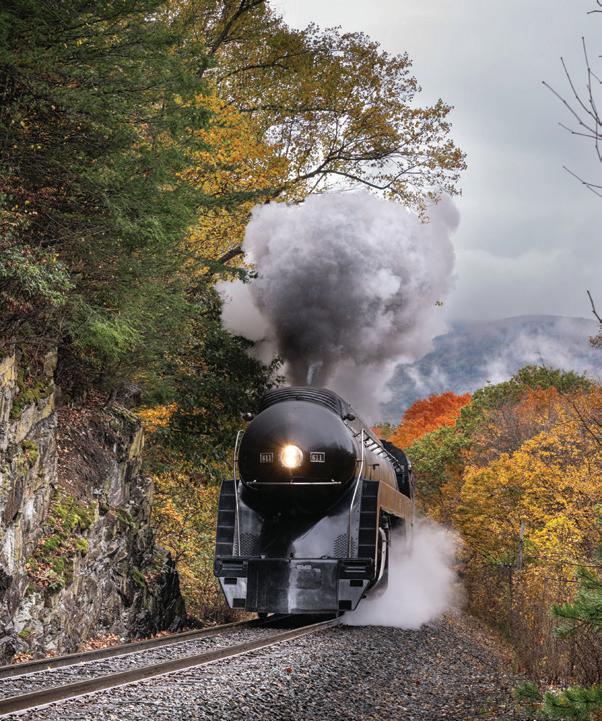
“We are excited to partner with new and old friends to bring back the thrill of mainline steam excursions through the Shenandoah Valley of Virginia. The return of the N&W 611 is sure to bring joy to all who see and ride it,” said Steve Powell, president of the Buckingham Branch Railroad, which operates the Virginia Scenic Railway.
While the announcement of the excursions was just made in July, preparations were already well underway to get the 611 ready for the new excursions.
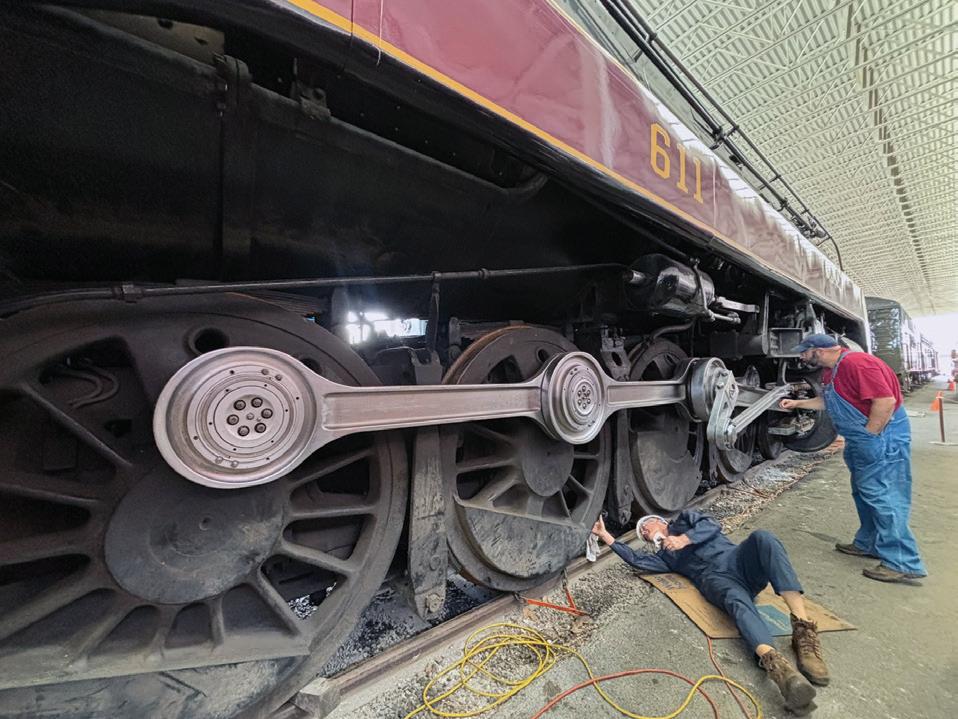
“Over the past month, the team at the Virginia Museum of Transportation has been working around the clock to prepare the iconic Norfolk & Western Class J 611 steam locomotive for its return to mainline excursion service,” said Zac McGinnis, steam operations manager for the Virginia Museum of Transportation in July. “This includes routine inspections and maintenance to ensure the engine is in top running condition.”
He said that in addition to the museum staff, there are three full-time people, three to five professional contractors and around 30 active volunteers working on the engine this summer. Those volunteers include a Virginia Military Institute cadet and his brother, who will be matriculating at the school this fall.
“Everyone at the museum and on the locomotive crew is incredibly excited for the opportunity to share the 611 with the public — under steam and doing exactly what she was built to do,” he continued.
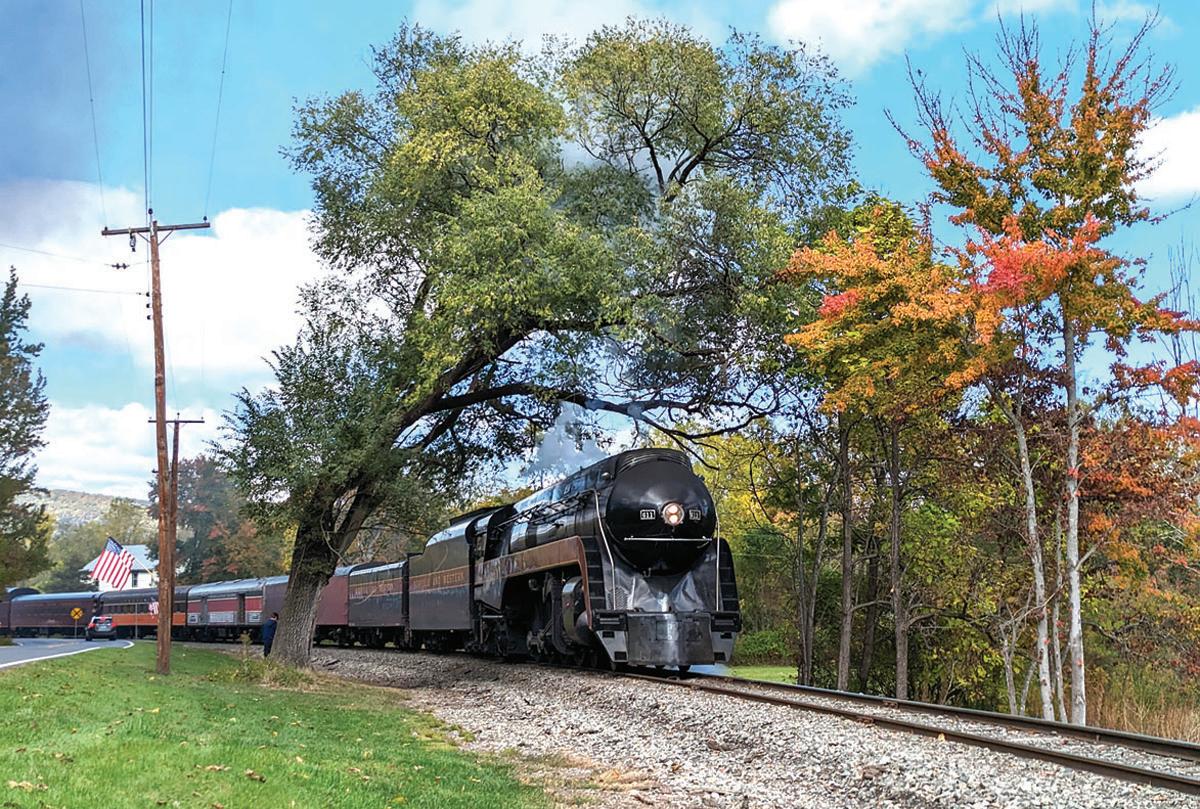
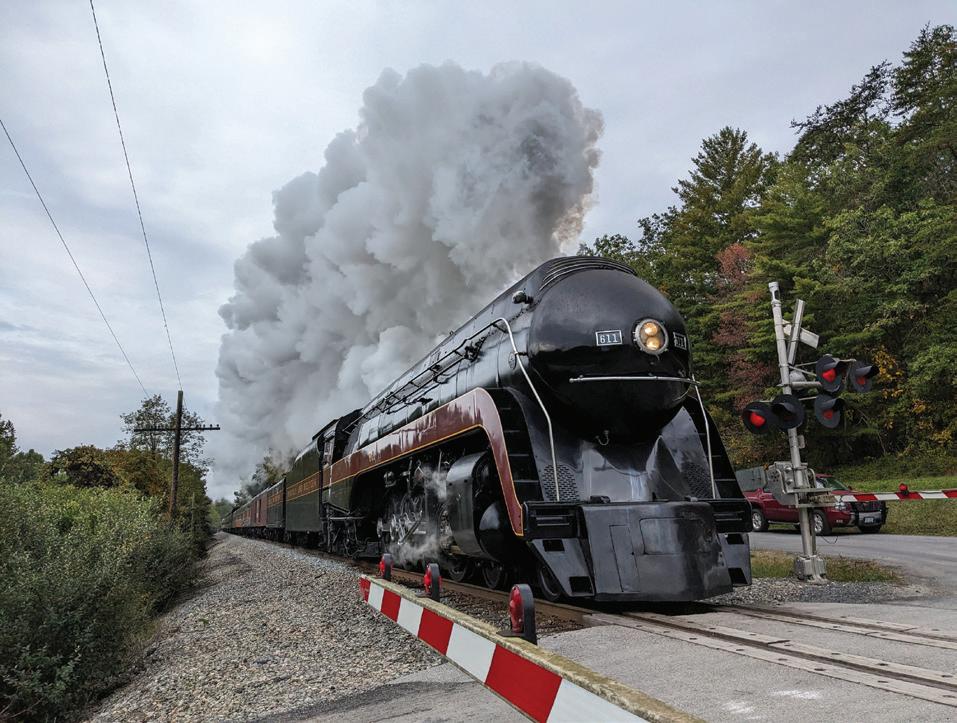
In addition to restoration efforts, VMT recently hosted a 75th anniversary celebration for the 611, drawing in visitors from across the region. The museum is now offering behind-the-scenes tours of the locomotive on weekends, giving fans a rare look at the inner workings of this “engineering marvel,” said McGinnis.
“To support ongoing operations, we’ve also launched several fundraising initiatives, including the sale of retired, out-of-service components from the 611 - giving supporters a chance to own a small piece of railroading history,” he said.
The Virginia Scenic Railway began service in 2022 and offers the state’s only regularly scheduled sightseeing excursion service. VSR is owned and operated by the Buckingham Branch Railroad, the largest short-line railroad in Virginia with four divisions and 280 miles of track.
For more information about the 611 excursions, those interested are encouraged to subscribe to the e-newsletter on the Virginia Scenic Railway website. The website is VirginiaScenicRailway.com. <



By Matt Paxton
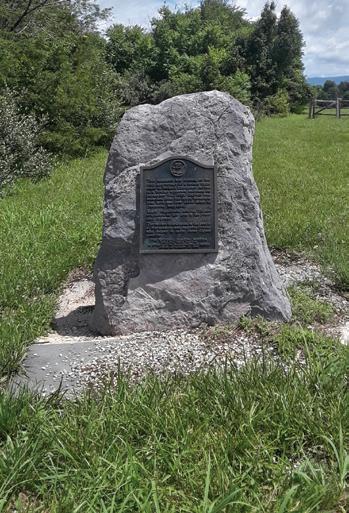
If you happen to stop at the scenic overlook near milepost 100 eastbound on I-64, near the top of Afton Mountain, you will see a Virginia Historical Marker that reads, “Near this site on September 21, 1933, Richard C. duPont was launched from Afton Mountain in his Bowlus sailplane, Albatross. Four hours and fifty minutes later he landed at Frederick, Maryland, establishing a United States distance record for sail planing of 121.6 miles, almost double the previous U.S. Record of 66 miles.”
What was this all about and why did this happen right here in the Blue Ridge area?
Gliding and soaring grew rapidly in post-World War I Germany, where most civil aviation was banned by the Versailles Treaty. Gliding was not prohibited, and air-minded people began seriously exploring motorless flying in the early 1920s. The Wasserkuppe, a mountain in the Rhon range in central Germany, became the center of gliding and soaring. Distance, altitude and duration records were set, and often broken, within days.
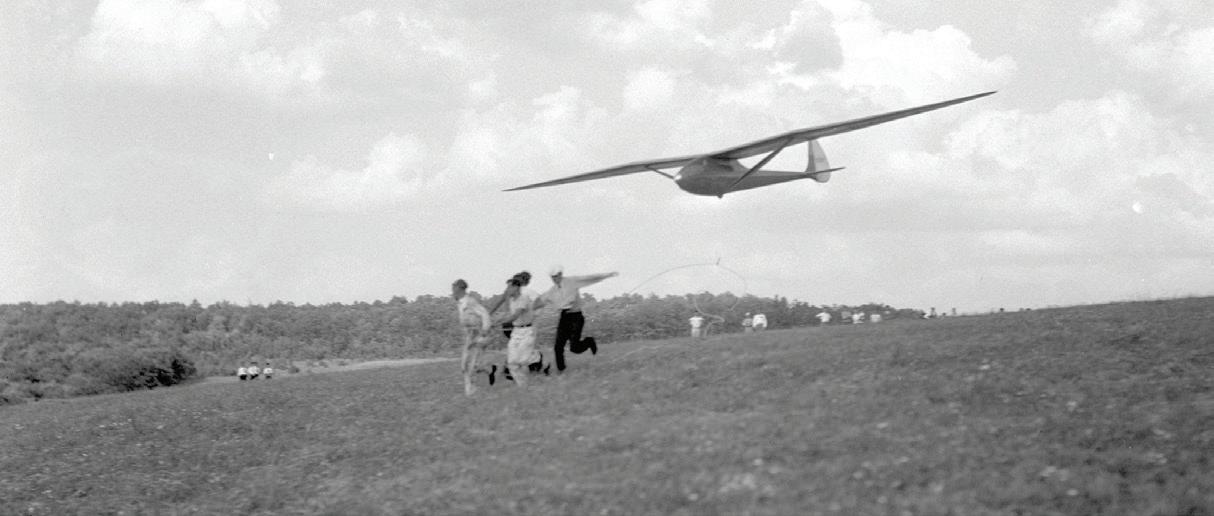
In the 1920s, gliding and soaring came to the United States. Harris Hill, near Elmira, NY, was an early center for gliding flight. Most flights began with a bungee launch. A rubber shock cord was laid out with the glider hooked in the center of the cord, and 5 or 6 people on either end. The people would first walk to take out the slack, then run to stretch the cord. When the tail was released, the glider would accelerate into the air. Launching from a hill or mountain gave the pilot time to find rising air currents or land in the valley below.
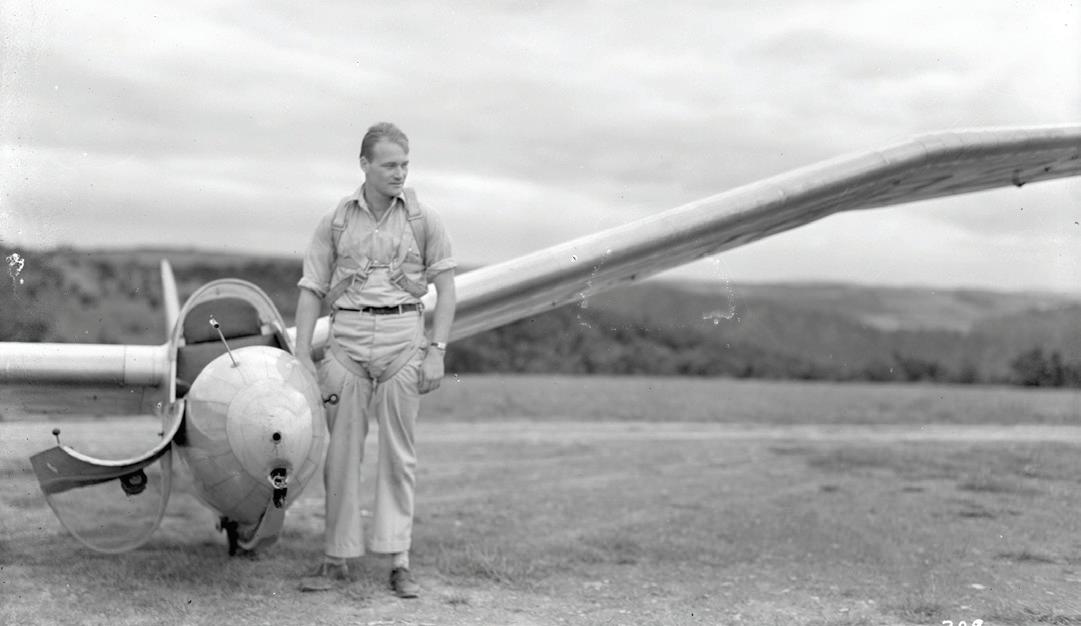
Richard C. “Dick” du Pont was a member of the prominent Delaware du Pont family. His father was vice president of E. I DuPont de Nemours & Co. Dick du Pont developed an interest in aviation, and particularly gliding and soaring. His first glider flight was in 1929. As a student at the University of Virginia, he started a campus soaring club.
In 1933, du Pont partnered with Hawley Bowlus to build high performance sailplanes, starting with the Senior Albatross, of which four were built. Du Pont owned the first and second gliders built, the two-place Dragonfly and the Albatross 1. He crashed the Dragonfly with his father as a passenger, but neither were injured. The Dragonfly was totaled.
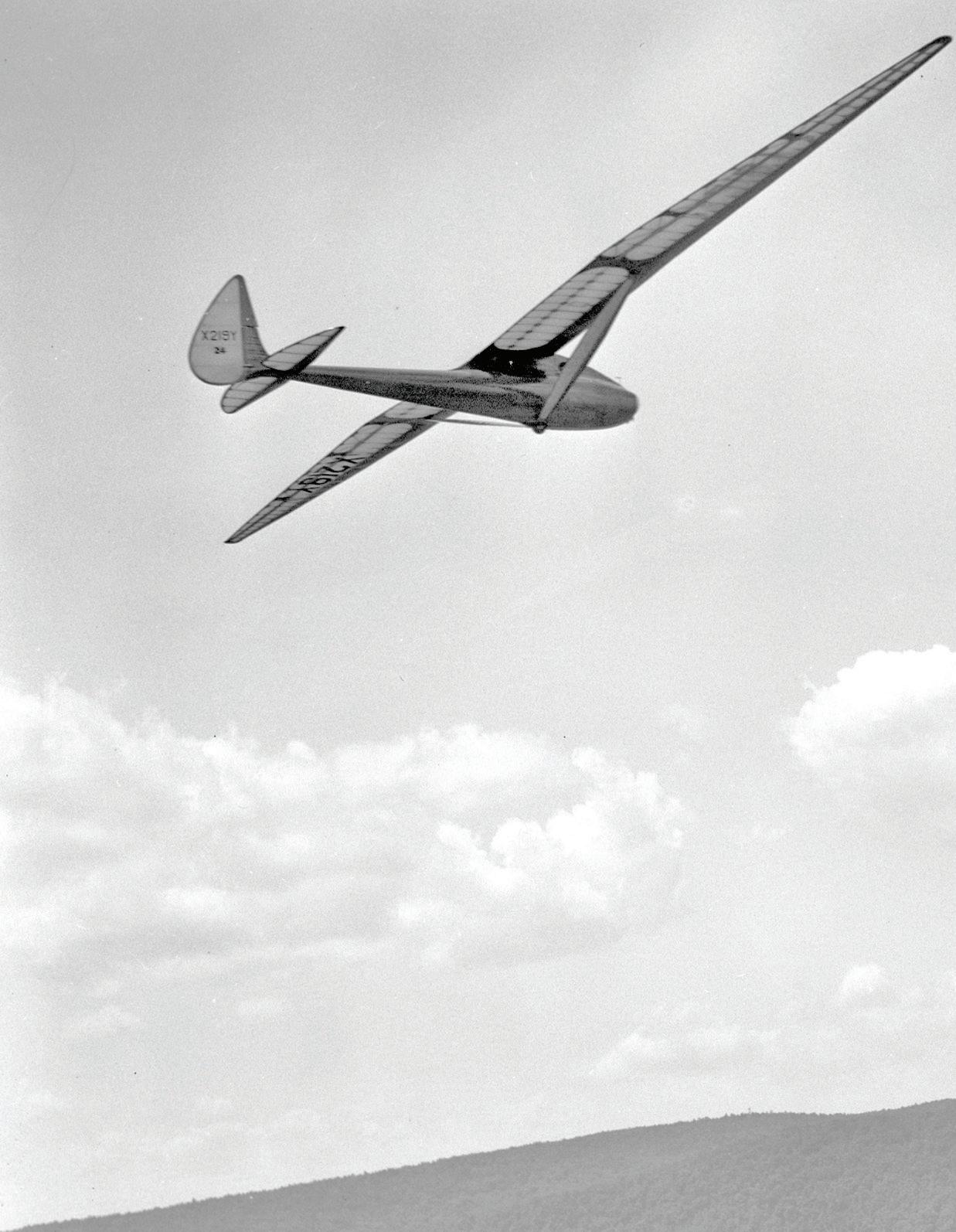
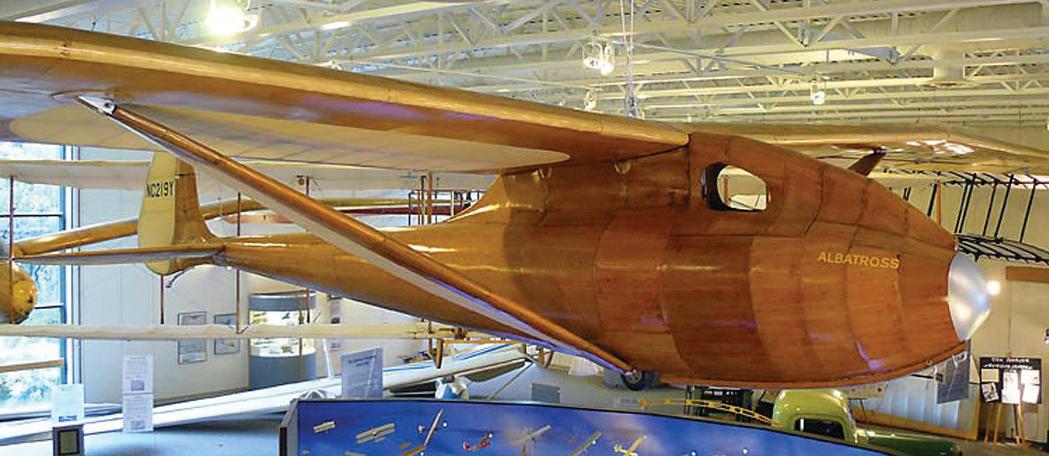
The Senior Albatross has a 62-foot gull wing, The structure is spruce, with spruce plywood skin on the fuselage and wing and tail leading edges, and fabric covering aft of the wing and tailplane spars. Best glide of 23:1 was had at 40 mph, with a maximum speed of 150 mph. du Pont paid $2500 each for the Dragonfly and Albatross 1.

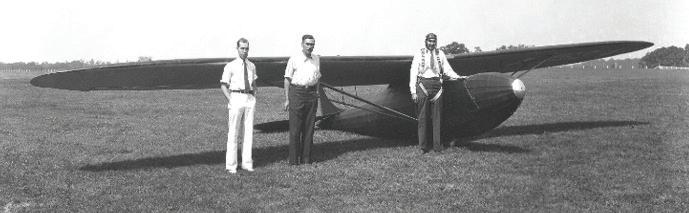
In July of 1933, he took the Albatross to Elmira, NY for the Soaring Society of America’s Nationals. During the meet, du Pont soared the Albatross to an altitude of 4,334 ft., a meet record. But he was frustrated that during the two-week event, there were only four days in which winds were favorable for soaring. He had been studying maps and he was certain the Shenandoah Valley of Virginia offered an ideal soaring site. The Blue Ridge Mountains, he believed, were sure to catch the prevailing winds and turn them upward into precisely the sort of air currents that keep sailplanes aloft for hours.
Wanting to explore other possible soaring sites, he invited some of the best soaring pilots at the July meet to come to Virginia to try soaring in the Blue Ridge in the fall of 1933. Flights began in late September, and into October, launching from the Swannanoa Country Club at the top of Afton Mountain above Waynesboro.
After feeling their way up down the ridge for a couple of days, the pilots went out for records. Emerson Mehlhose, in a Hawk, took off from Rockfish Gap in a wind that nearly tore his wings off, soared up the Shenandoah Valley 71 miles for a new U. S. distance record. Dick du Pont set out next day to go Mehlhose one better.
On September 21, du Pont launched from the Swannanoa site in good soaring conditions. Maintaining an average cruising altitude of 3,000 feet, he passed Mehlhose’s landing site. At no time was lower than 1,200 feet above the mountain range. His maximum altitude was 5,000 ft.. After crossing the Potomac River into Maryland and heading toward Pennsylvania, he was forced back and landed at Frederick, MD, a new US record distance of 122 miles, just 14 miles short of the then-current world record. “I would have continued the flight,” said du Pont, “except for a fog over Catoctin Mountain.”
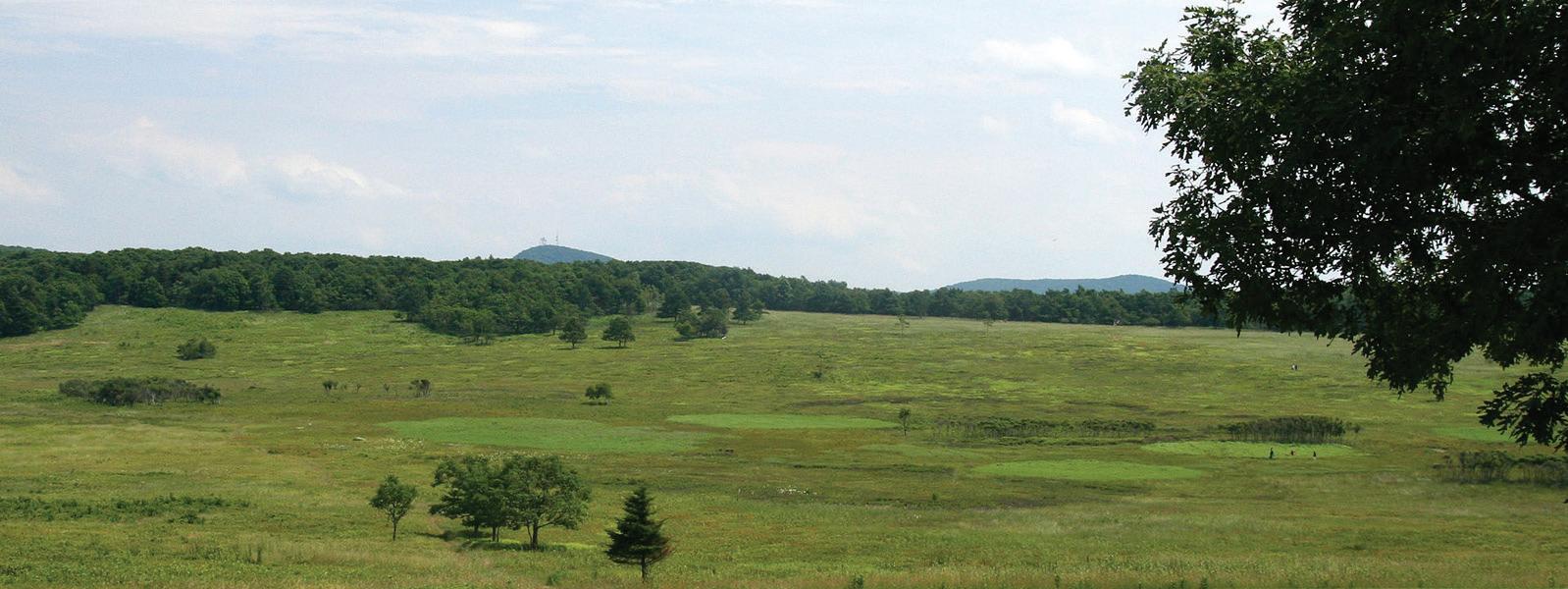
Du Pont and other glider pilots also flew from Big Meadows, VA, in Shenandoah National Park, which was designated a National Soaring Site in 1933. The Civilian Conservation Corps constructed a runway and temporary hanger for gliders at the site. Competitions were held at Big Meadows in 1937 and ’38, but World War II ended soaring there.
During World War II, Dick du Pont was special assistant to General Henry H. “Hap” Arnold and placed in charge of the glider program after the death of director Lewin B. Barringer. During a demonstration flight on September 11, 1943 at March Air Field in California, du Pont and other passengers were killed in the XCG-16 experimental military cargo glider.
Today, soaring pilots have three sites in the Shenandoah Valley area to fly – Skyline Soaring Club at Front Royal Airport, Blue Ridge Soaring at New Castle, and Shenandoah Valley Soaring at Rockfish, just a few miles from where Dick du Pont launched his Albatross on his record flight. <
Top, left to right: The Senior Albatross “Falcon” at the Udvar-Hazy Center of the National Air and Space Museum. The Senior Albatross II is in the National Soaring Museum in Elmira, NY. Dick du Pont with a sailplane, 1935. (Courtesy of Fred T. Loomis Collection, National Soaring Museum)
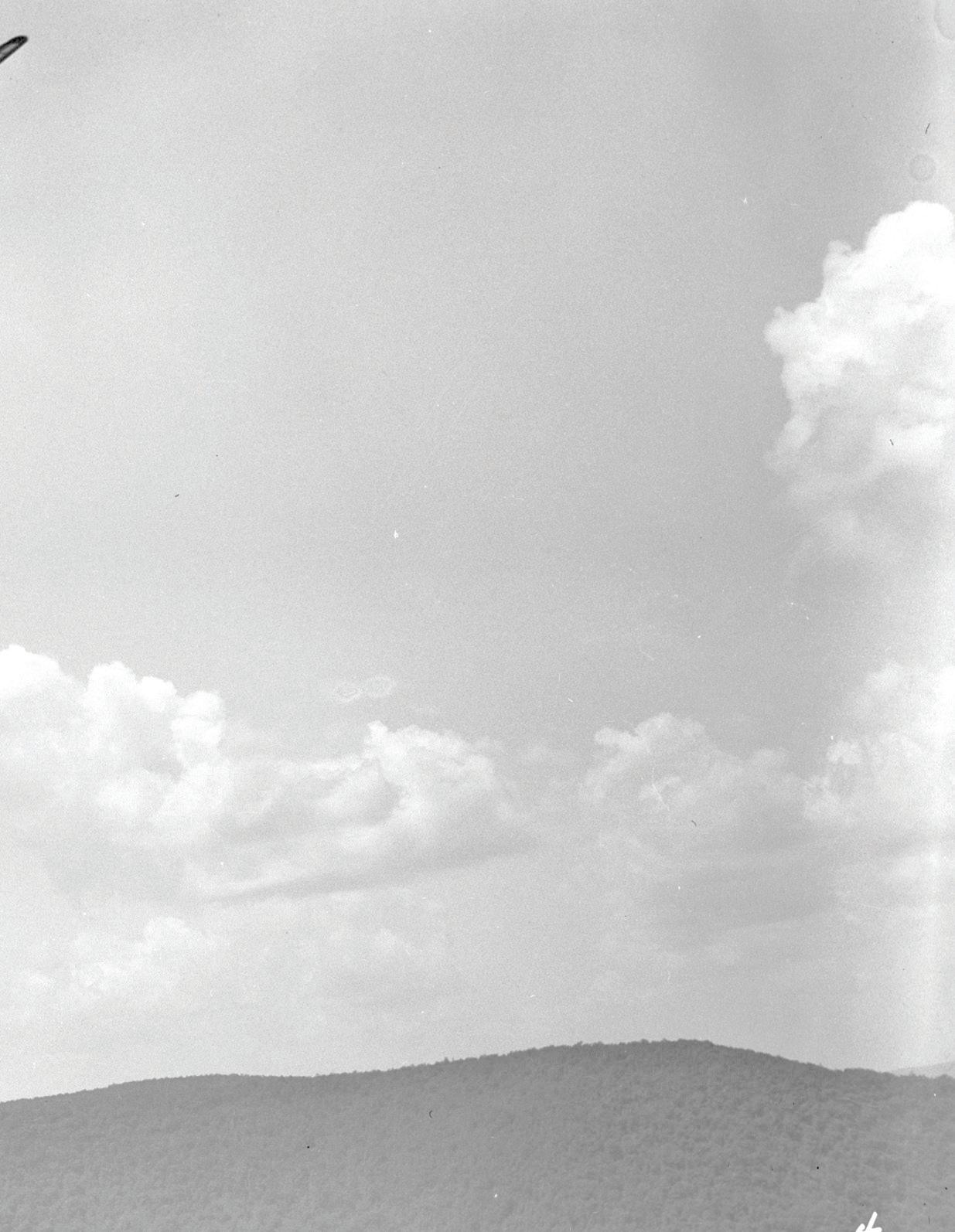
Bottom, left to right: Big Meadows, VA, once designated at a National Soaring Site. Marker at Waynesboro’s Eagles Nest Airport commemorating Dick du Pont’s flight. Du Pont being launched in the Senior Albatross I at the National Championships at Elmira in 1933. (Courtesy of Fred T. Loomis Collection, National Soaring Museum)

By Courtney Thompson
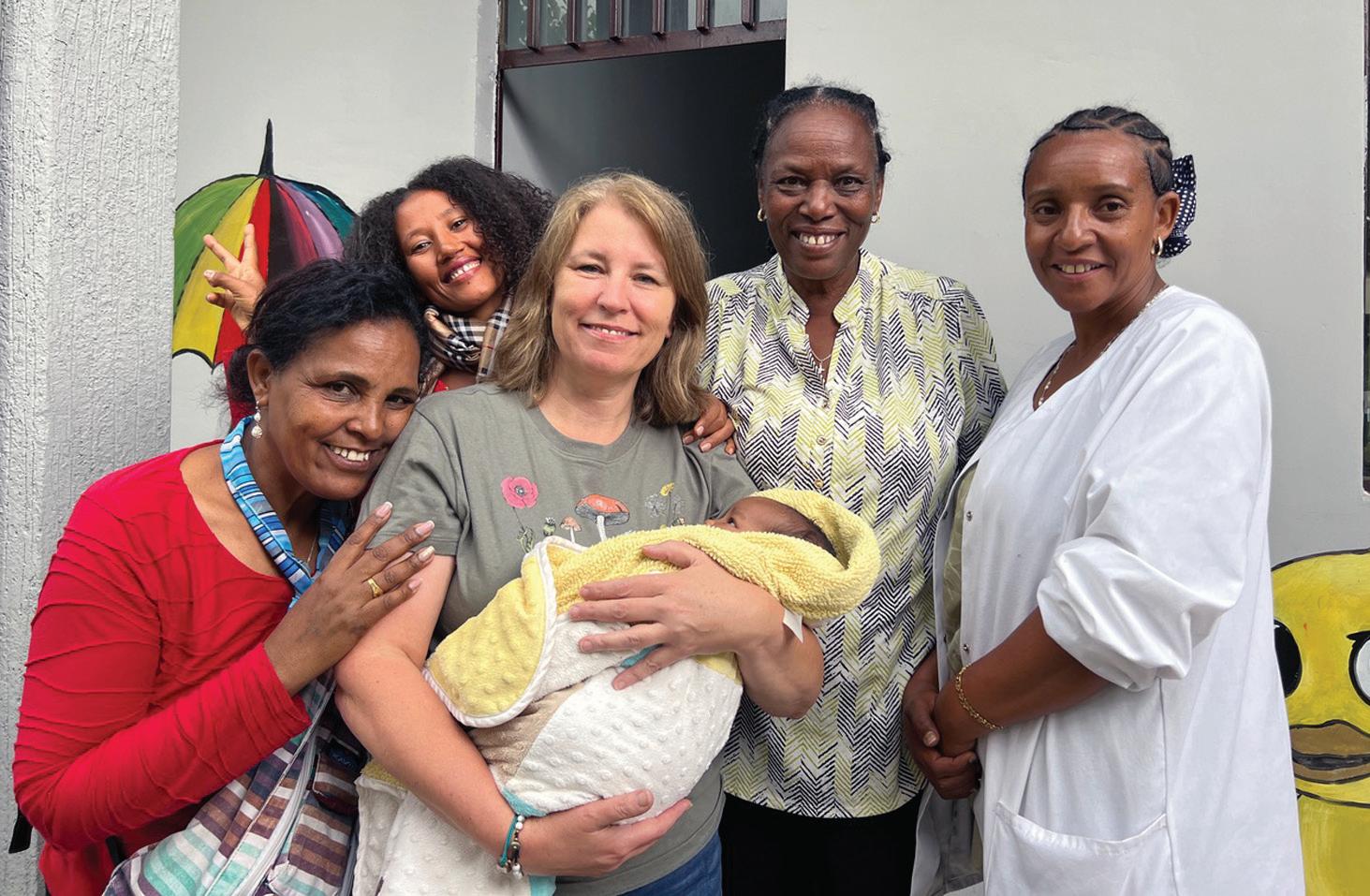
In 2008, Greg and Charisa Knight traveled to Ethiopia to adopt a son. They found themselves falling in love with the country and its people. After they got home with their new son, they continued to see needs in Ethiopia and felt called to help anyway they could. Shortly after the Knights adopted a second child in 2011, the Ethiopian government began to slow down international adoptions and ultimately cease, which took a significant toll on the country’s orphanages, such as the one in Hawassa where the second son had been cared for.
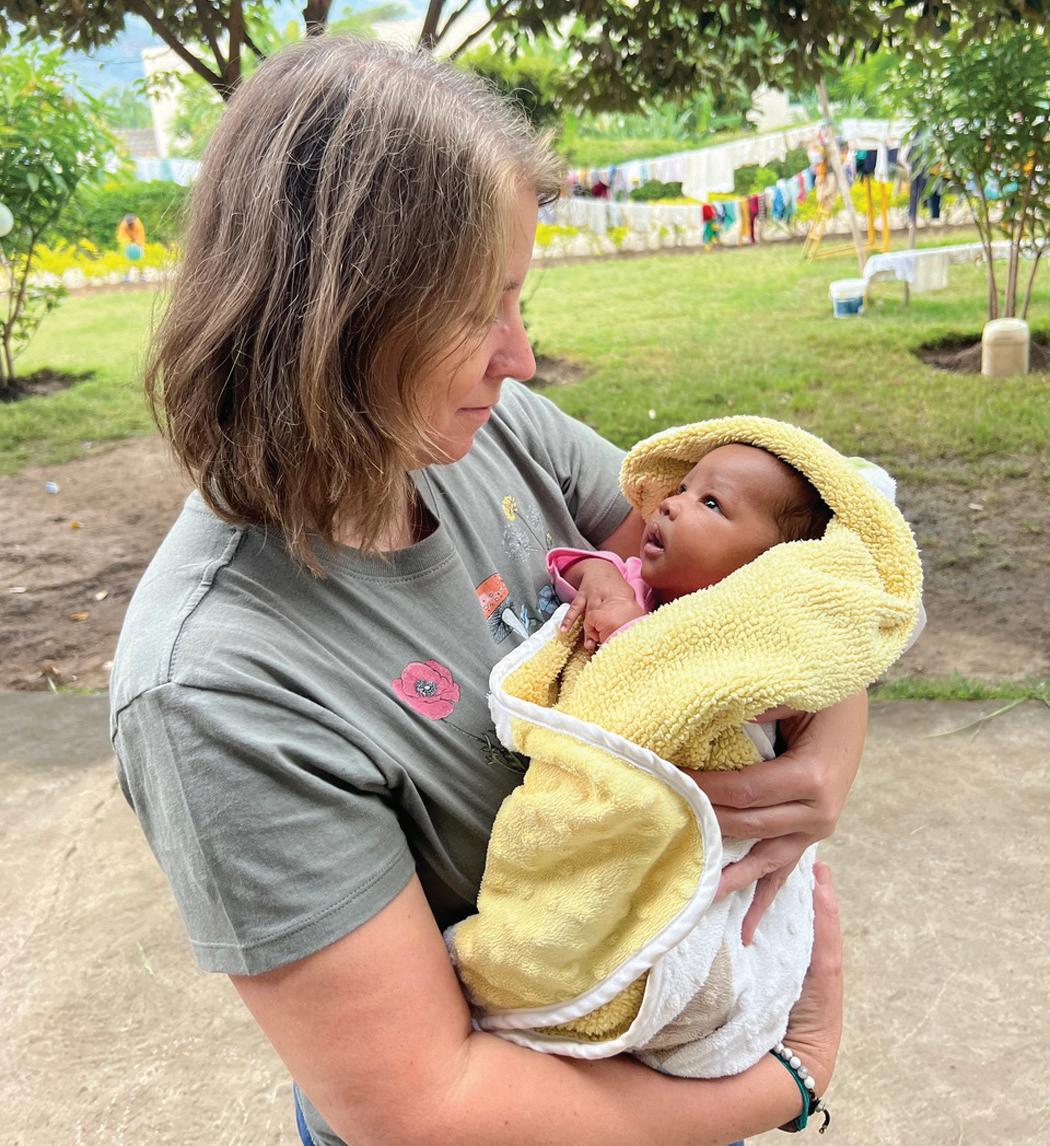
The Knights flew back the next year to Hawassa to see if they could help and found that the staff loved and cared for the children well but had a serious lack of funding. They shared the situation with friends, family, church members, community members, and were relieved when a small group of individuals raised enough money for the children’s home to buy baby formula and other supplies.
However, this was just a temporary solution. They learned the bigger issue was that families couldn’t afford to take care of their children, so they sent them to children’s homes. The Knights and their network of caring friends partnered with Ajuuja Children’s Home to create a community sponsorship program in 2012 under another nonprofit. Their program continued to grow and expand and in 2016 they formed their own nonprofit, Hawassa Hope.

Hawassa Hope continued from page 28
Since then, Hawassa Hope has worked with the community and residents to begin multiple initiatives in Hawassa and the surrounding areas in the Sidama region of Ethiopia:
< Community Sponsorships: Provide families with essentials like food, education,and healthcare to prevent separation and support long-term stability.
< Ajuuja Children’s Home: Cares for vulnerable children with the goal of family reunification or local adoption whenever possible.
< Elsabet Initiative: Offers maternal care including prenatal support, medical aid, and education for expectant mothers.
< Women’s Empowerment: Supports small business grants and cooperatives to help women achieve financial independence. These grants start at just $150!
< Clean Water & Health Projects: Includes clean water access, malaria prevention, mossy foot treatment, and HIV education and care.
< Tesfa Community School: Opened in 2023, provides early childhood education to underserved communities.
< Building Hope: Constructs safe, stable housing for families living in inadequate or unsafe conditions.
There are many ways to help advance the mission of Hawassa Hope — one-time donations and monthly support are always welcome! There are currently over 40 children awaiting a sponsor in the Community Sponsorship program. For only $35 per month, this program ensures that a child’s basic needs are met. Assistance is tailored to the specific needs of each child and in many cases the needs of their family depending upon where and how a family lives. Over 400 children are enrolled in the program, making a difference in all of their family’s lives.
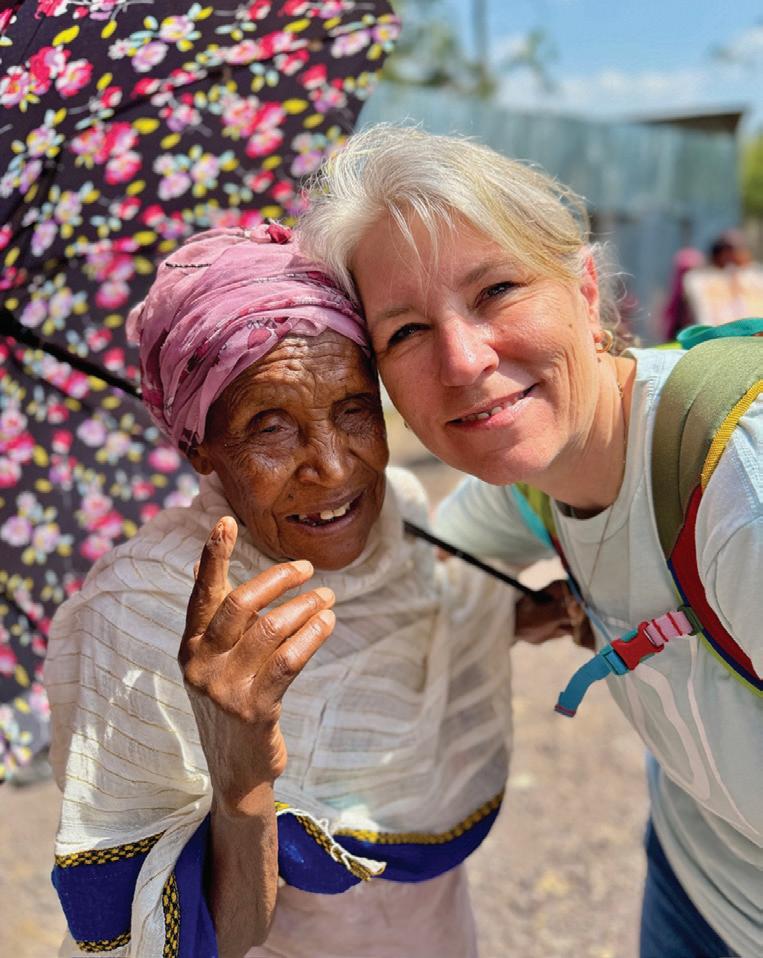
They also have “Five on Friday” which highlights different needs and encourages people to give just $5 toward the cause. Trips to Ethiopia are offered four times per year and allow a small group the opportunity to learn more about Ethiopia, see Hawassa Hope in action, and meet the children at the Ajuuja Children’s Home and Tesfa Community School.
Co-founder Charisa Knight calls Hawassa Hope an “accidental nonprofit.” “We saw a need and listened to the community to see how we could help. We didn’t set out to start a nonprofit, but we were willing to do what we could.”
Learn more about this amazing nonprofit organization and get involved at www.hawassahope.org. <
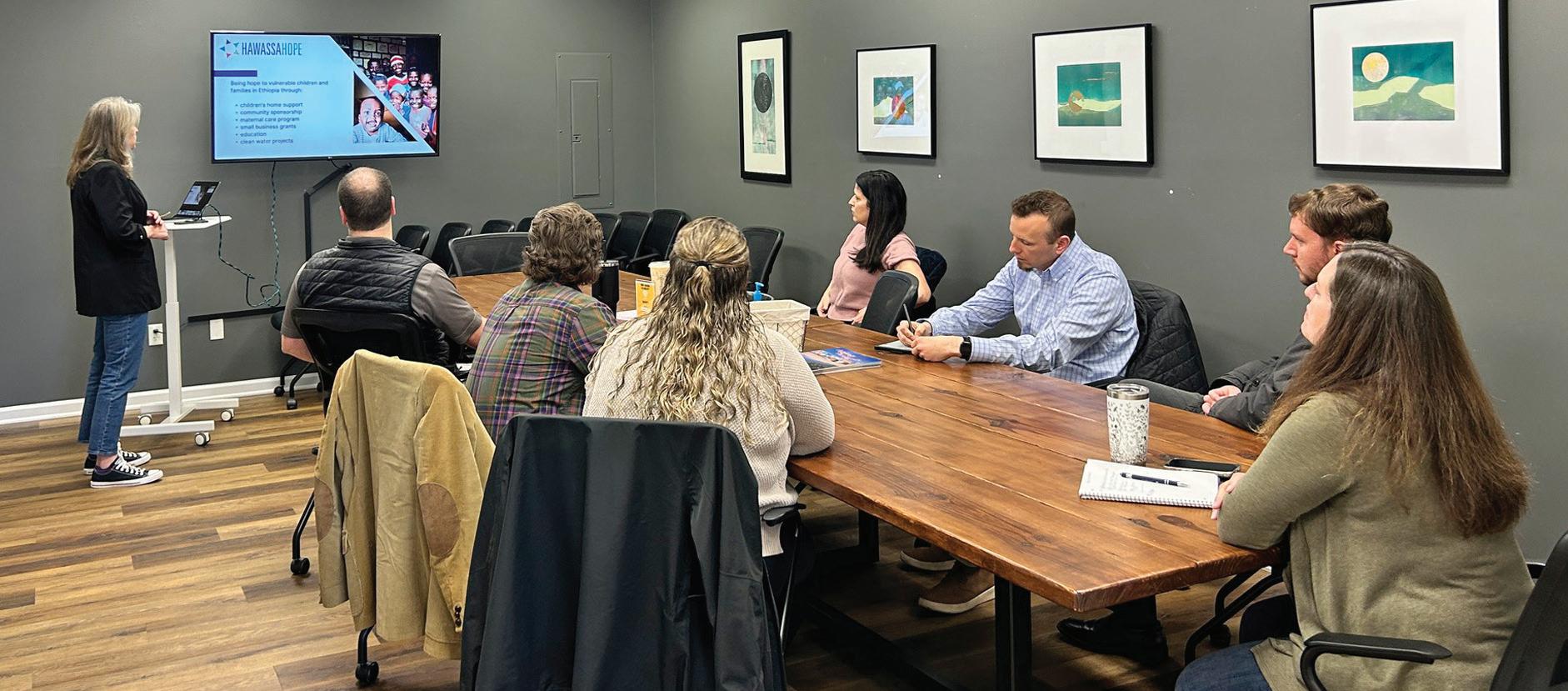
Charisa Knight visited with the Chamber’s SAW Young Professionals group in April 2025 and had these impactful “Lessons Learned” to share:
< Start where you are.
< Lead with care and empathy, not ego.
< Show up with humility to learn.
< Listen to peoples’ stories and learn from them.
< Have a ministry of presencesometimes you’re just there to bear witness.
< Don’t wait until you’re ready to start.
< Build your community, not just your career.
< Be willing to say you don’t know and ask questions.
< Keep your “why” at the forefront.

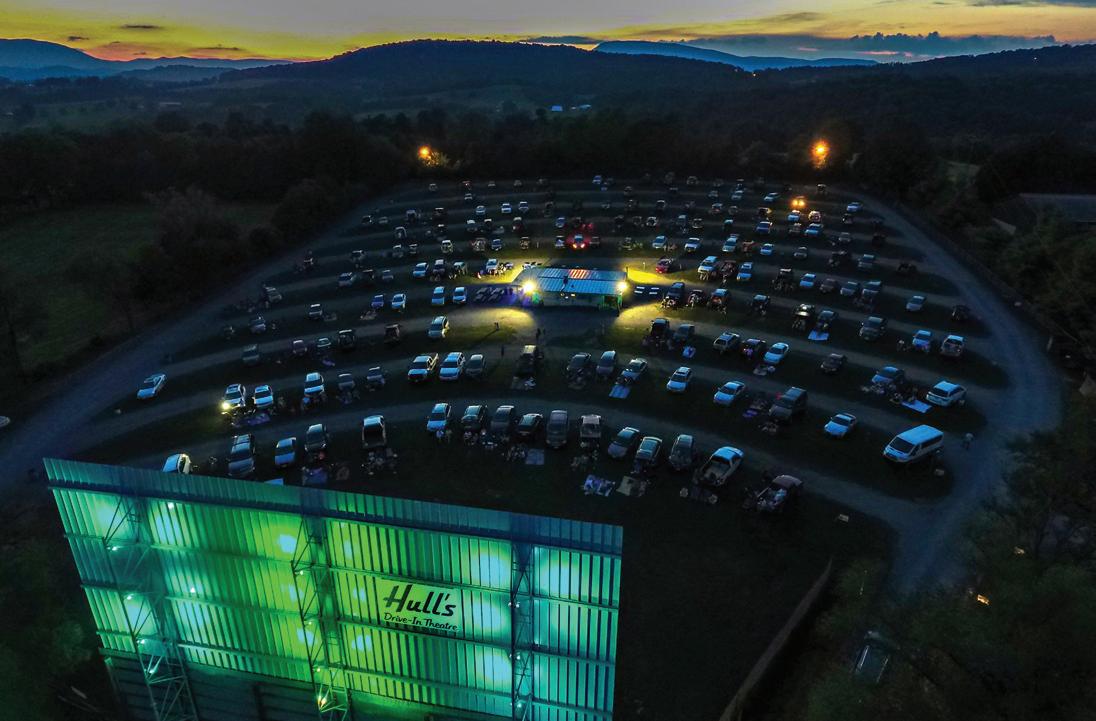














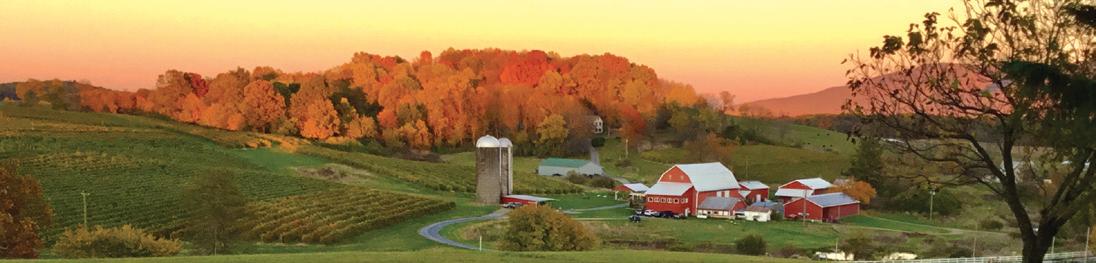


By Courtney Thompson
There is nothing like the charm and comfort of a bed and breakfast when you’re looking for a special getaway. Many travelers choose to stay in bed and breakfasts for the personalized hospitality, cozy atmosphere, and unique local charm they offer. B&Bs provide individually decorated rooms, homemade breakfasts often made with local ingredients, and thoughtful touches that make guests feel at home. They’re typically located in peaceful, scenic settings and hosted by locals who share insider tips about the area. Whether for a romantic getaway or a relaxing retreat, B&Bs offer an intimate and memorable travel experience.
Currently, approximately 17,000 B&Bs operate across the United States, with most being small, independently owned properties with six rooms or less, with the U.S. bed and breakfast industry projected to reach a market size of $37.13 billion by the end of 2025. There are several wonderful B&Bs in Augusta County, Staunton, and Waynesboro. Here are a few to check out (that also happen to be Chamber of Commerce members!):
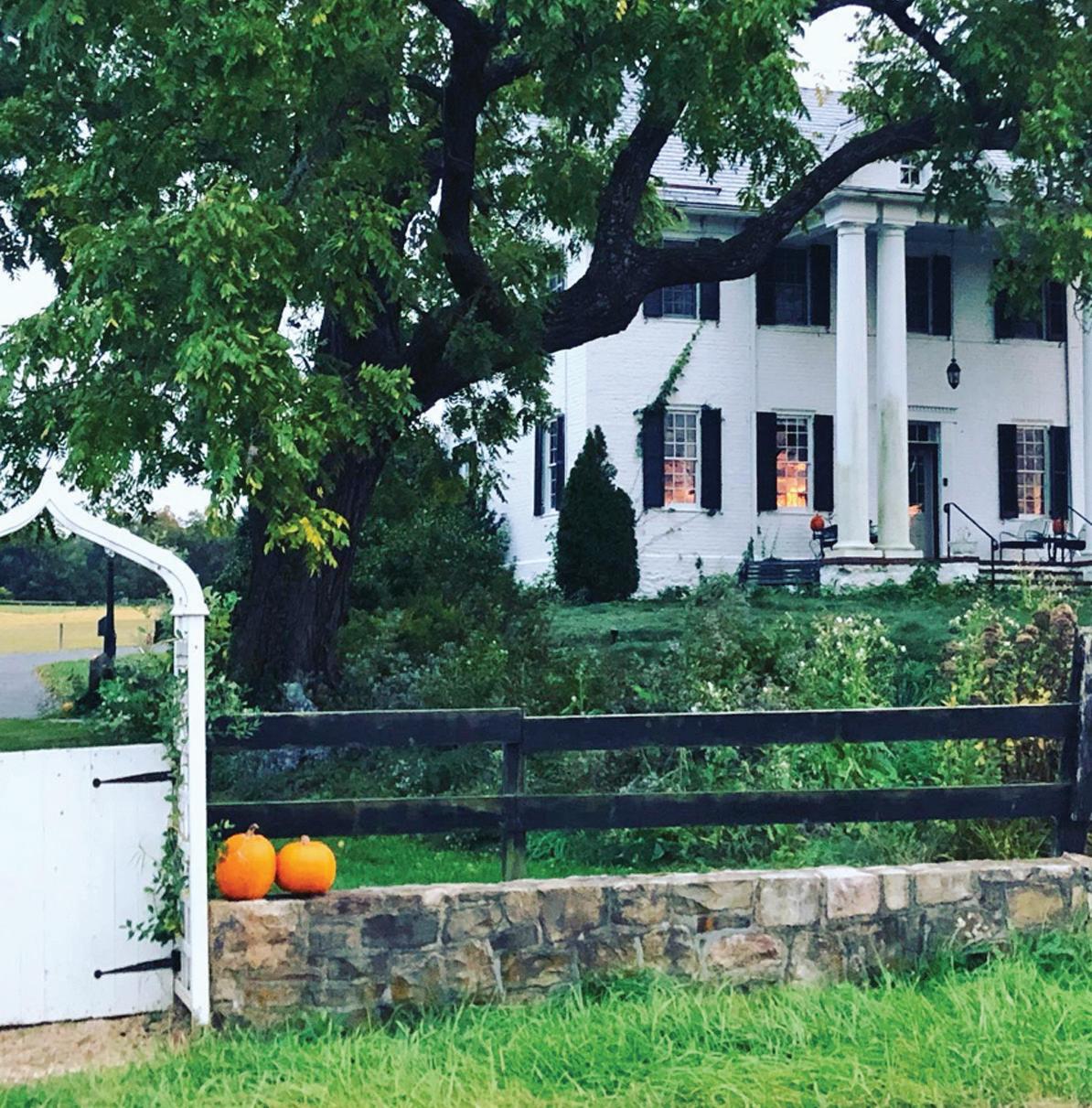

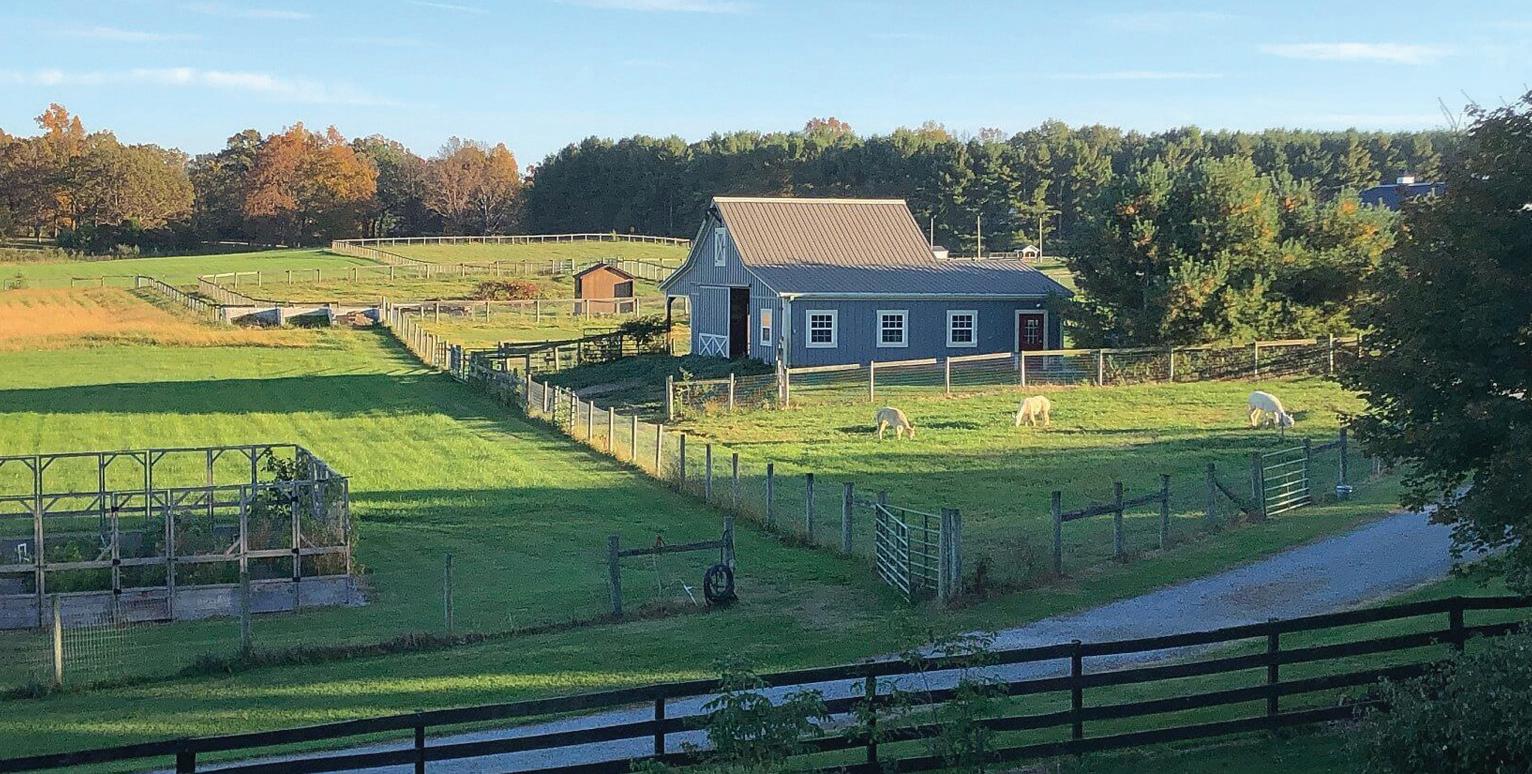
Situated on a beautiful 20-acre farm in Waynesboro, Cider House Bed and Breakfast combines historic charm with sustainable living. The 1790s farmhouse with its four luxurious guest rooms retains its original woodwork and hardwood floors, complemented by antique furnishings and modern amenities.
Guests can enjoy activities like walking through the orchard meadow, interacting with resident alpacas and donkeys, or relaxing by the fire pit. Breakfasts are a gourmet affair, featuring locally sourced meats, fruits, and homemade pastries. The farm’s evolving organic orchard aims to produce heritage apple ciders, adding a unique touch to the guest experience.
Proprietor Melinda Kendall describes herself as a “gentlewoman farmer” and is living out her dream of owning a B&B. “I think what really makes Cider House Bed and Breakfast special is that it is on a farm. Even if you don’t want to visit the sheep, cows, donkeys, and, yes, alpacas (though most do!), the setting is truly rural and bucolic, despite being just outside Waynesboro. Others love the history of the house, which was built in 1790, when the Shenandoah Valley was first settled.”
Melinda recently broke ground on the next part of her dream — a cidery, featuring apples grown right on her land. Stone Ledge Cidery is expected to open in spring 2026.
Learn more at www.ciderhousebedandbreakfast.com

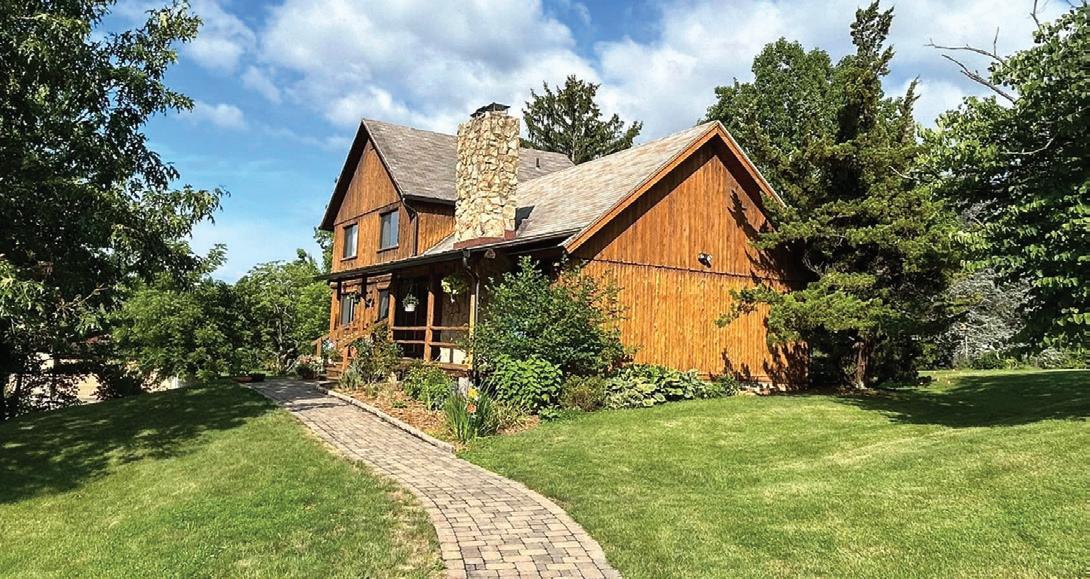
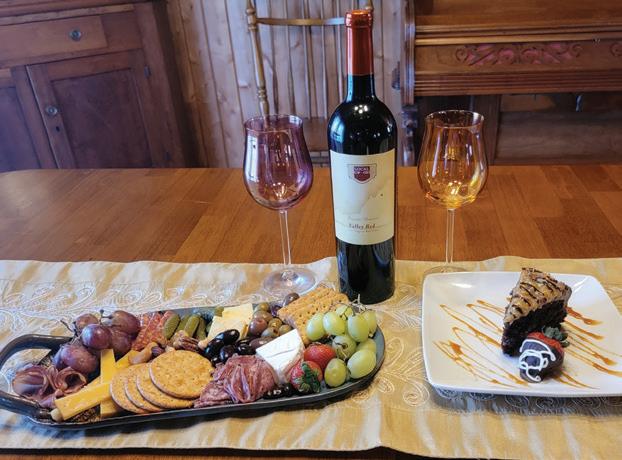
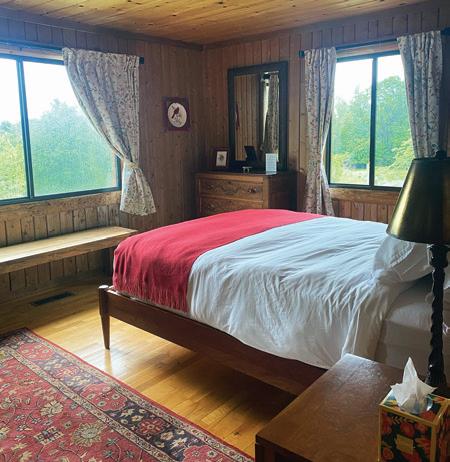
Located in beautiful Mount Solon, Meadowlark Ridge Bed & Breakfast is a tranquil haven set amidst 16 acres of meadows and forests. This log home features three thoughtfully appointed guest rooms- Cardinal, Bluebird, and Goldfinch- each with queen-sized beds, private baths, and views of the surrounding nature. Guests can unwind in the cozy timber-beamed Great Room with its stone fireplace or enjoy the library/game room upstairs. Mornings begin with a delicious multi-course breakfast highlighting local ingredients like farm-fresh eggs and garden herbs. Dinners and special packages featuring local wine are also available upon request.
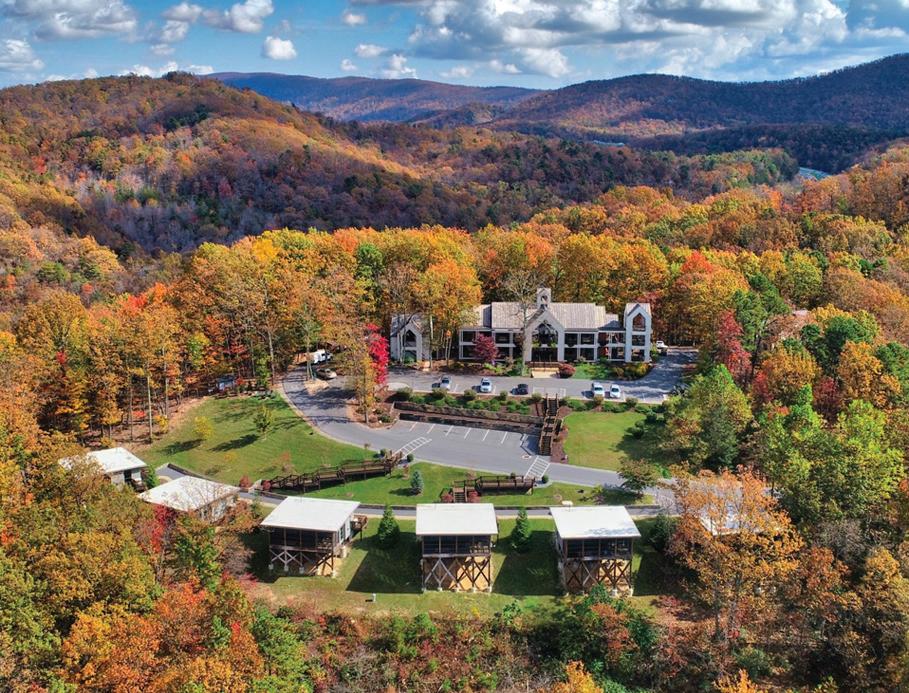
Located just outside of Waynesboro on Chinquapin Drive, the Iris Inn in Waynesboro offers breathtaking views of the Shenandoah Valley. Established in 1991, this award-winning inn spans 19 acres and is designed to maximize scenic views from every room.
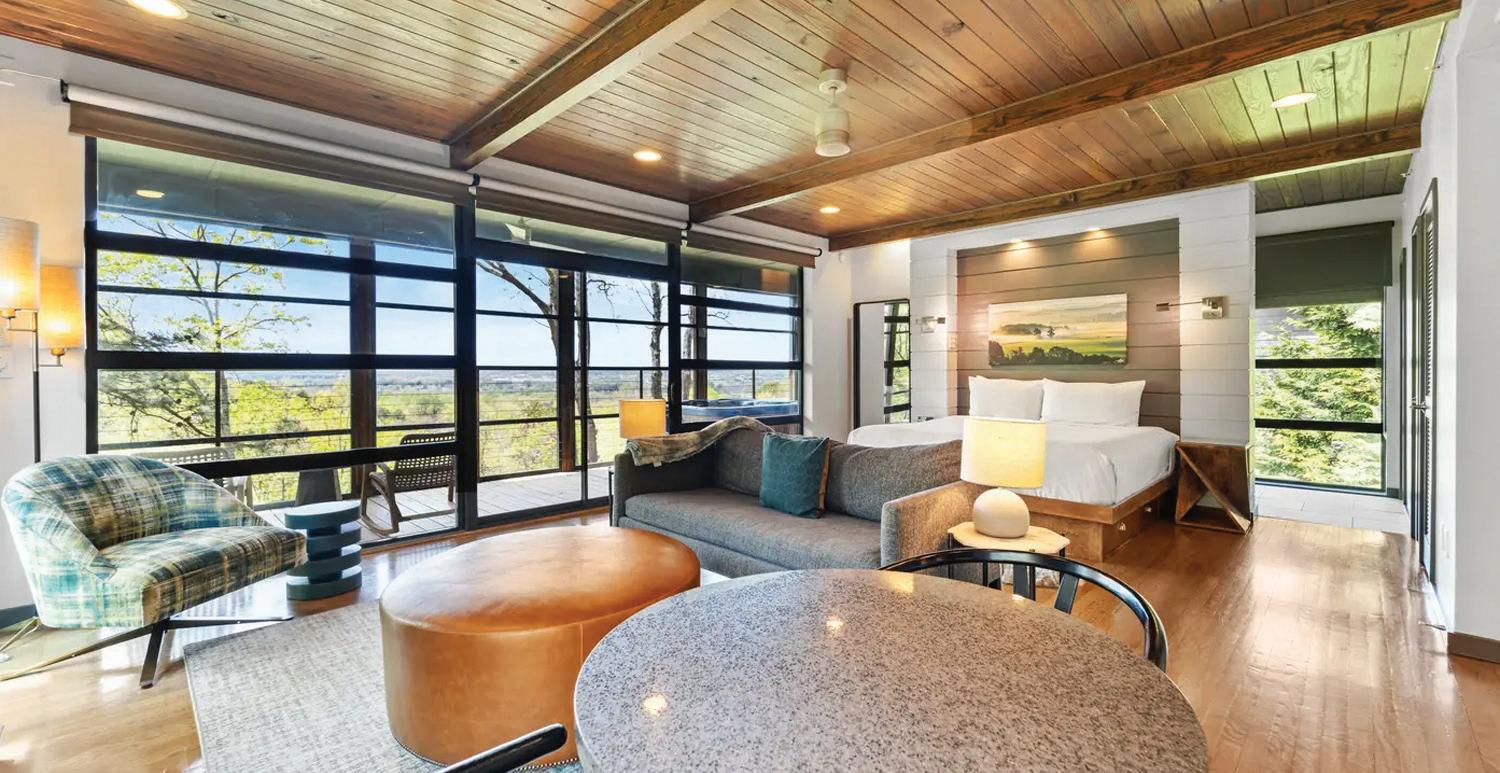
Guests can choose from luxurious rooms in the main lodge or opt for private cottages and glass-front cabins, each featuring amenities like hot tubs, fireplaces, and full kitchens. The inn’s Great Room, featuring a majestic stone fireplace and cathedral ceilings, serves as the backdrop for gourmet breakfasts and chef-prepared dinners. Its proximity to the Skyline Drive, the Blue Ridge Parkway, the Blue Ridge Tunnel, and numerous wineries makes it a perfect base for exploring the region. The Iris Inn has won numerous awards and has consistently positive ratings from visitors.
Innkeeper and general manager Jeremy Gassen says, “What sets Iris Inn apart is our unique lodging options. From lodge-style rooms to romantic cabins to two-story family cottages, there’s something for every traveler. Add that to world class amenities like our Day Spa, room service, and our Chef’s private dining menu and our guests have an experience like no other.”
Learn more at www.irisinn.com
Meadowlark Ridge’s location, while rural, offers easy access to outdoor activities such as hiking, fishing, and exploring nearby historic towns. It is a wonderful place for visitors who want to rest and relax.
Innkeeper Cindy Lawrence quickly fell in love with the beauty of Meadowlark Ridge. She shares, “One of my favorite moments as an innkeeper at Meadowlark Ridge is watching guests’ delight when they walk through the front door. You see levels of relaxation happening as they discover their connection to nature through the beauty of the cabin and its natural setting. In addition, I love being able to offer such a variety of activities close by whether it’s hiking, biking, or fishing within a few miles from here or exploring surrounding towns that offer an eclectic mix of history and culture!”
Meadowlark Ridge’s many positive guest reviews certainly reflect this!
Learn more at www.meadowlarkridge.com <
Whether you’re seeking luxurious amenities or rustic serenity, the hospitality of Augusta County’s bed and breakfasts provide a unique window into the region’s natural beauty and ensure a memorable stay in Virginia’s Shenandoah Valley.
There are dozens of lodging options in Augusta County,Staunton, and Waynesboro from the aforementioned B&Bs (plus others!), AirBNBs, historic hotels, extended stay suites, campgrounds, and more. Travelers are sure to find just what they’re looking for!
Find more travel and lodging information at:
< Chamber of Commerce: www.augustava.com
< Augusta County Tourism: www.visitaugustacounty.com
< City of Staunton Tourism: www.visitstaunton.com
< City of Waynesboro Tourism: www.visitwaynesboro.com
< Shenandoah Valley Partnership: www.shenandoahvalleyliving.com
By Chris Lassiter
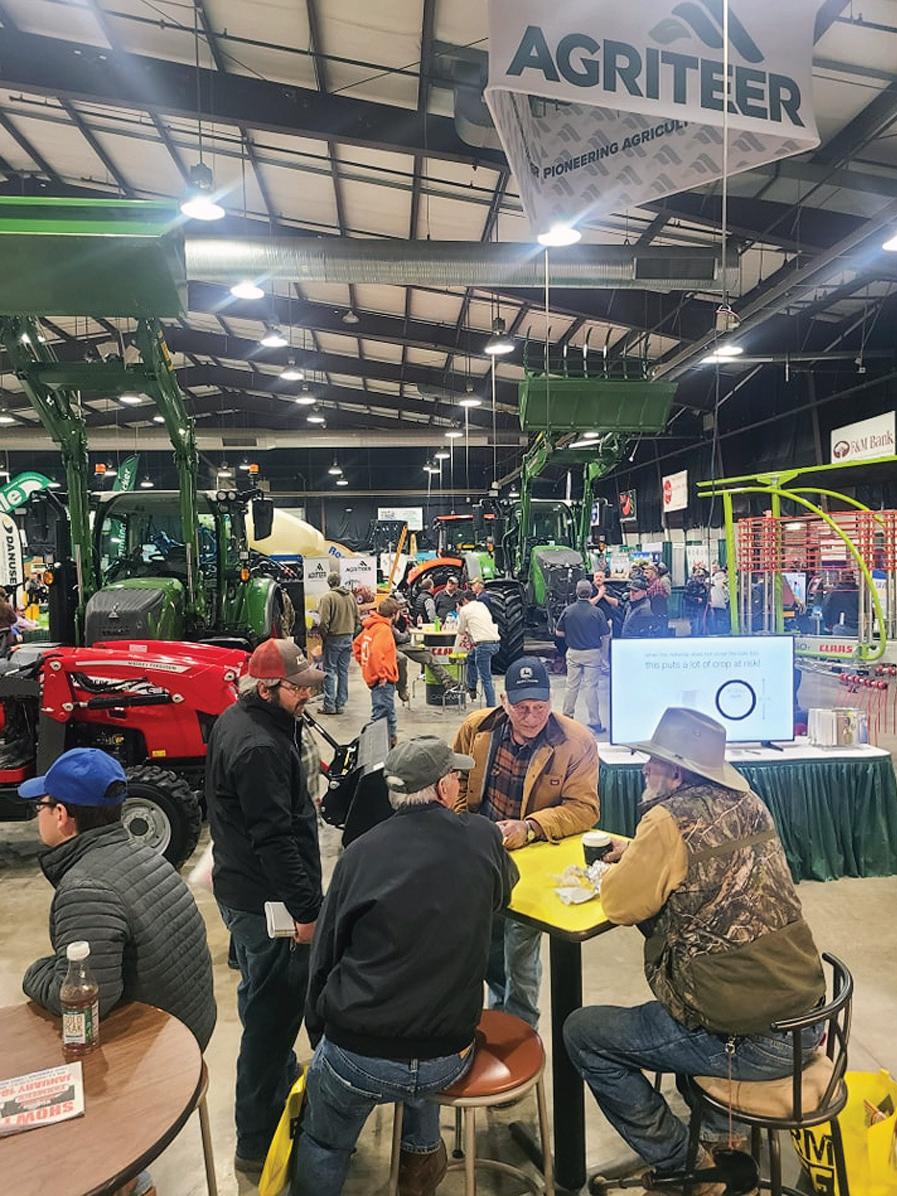
It could be crafts, cotton candy, collectibles, chameleons, cocker spaniels or the county fair.
There’s always something for everyone at Augusta Expo.
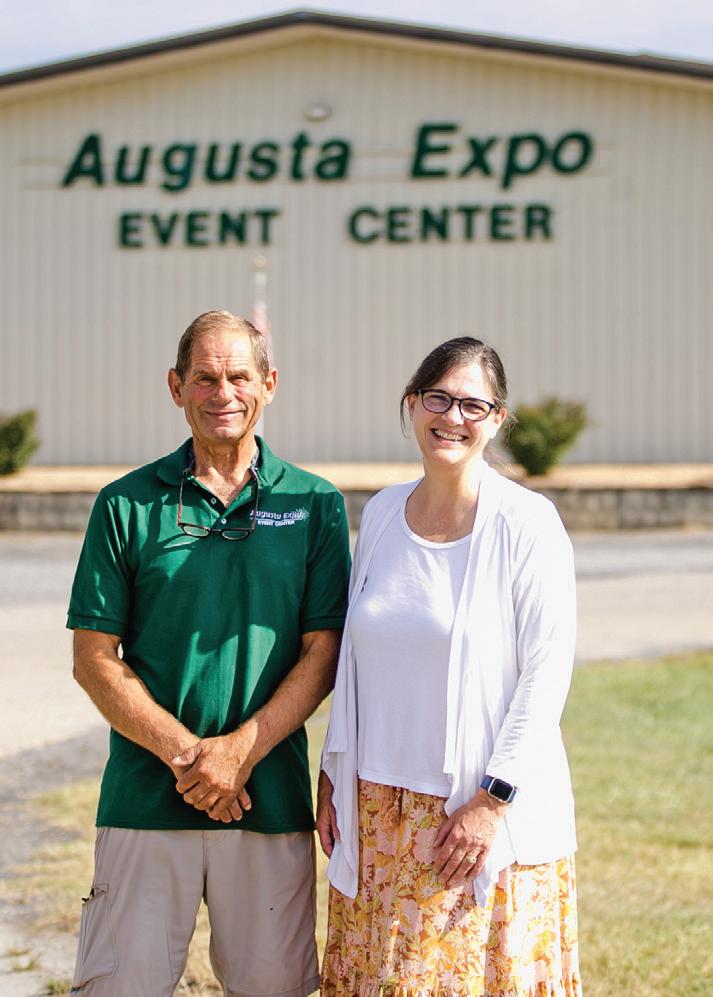
Based in Fishersville — just off of exit 91 on I-64 — the nonprofit event center prides itself offering a plethora of events to a superabundance of people. “We want this facility up and running every single weekend,” said Dave Moore, general manager at Augusta Expo, “with several different types of events for the community.”
Augusta Expo exists today because of the visionary leadership of a group of farmers, businessmen and Ruritan Club members more than 50 years ago. The Augusta Agricultural-Industrial Exposition, as it was originally called, officially incorporated on July 22, 1969. The founders purchased over 200 acres of the Yost Miller farm. In the early 1970s, the volunteer board of directors began working on building the necessary structures to hold events.
“It was started back then as an agricultural fair,” Moore said. “It kept growing and growing over the years.” In addition to the hard work and vision of the Augusta Expo founders is the fact that the event center is located in an ideal location. It’s minutes away from where two major interstates connect.
Musicians like Conway Twitty, Anita Bryant and Charlie Daniels have performed at Expo, in addition to Staunton’s own Wilson Fairchild. Famed Christian evangelist Billy Graham once held a tent revival meeting there, and politicians like former U.S. president Ronald Reagan and 2012 presidential hopeful Mitt Romney have also campaigned at the Fishersville event center.
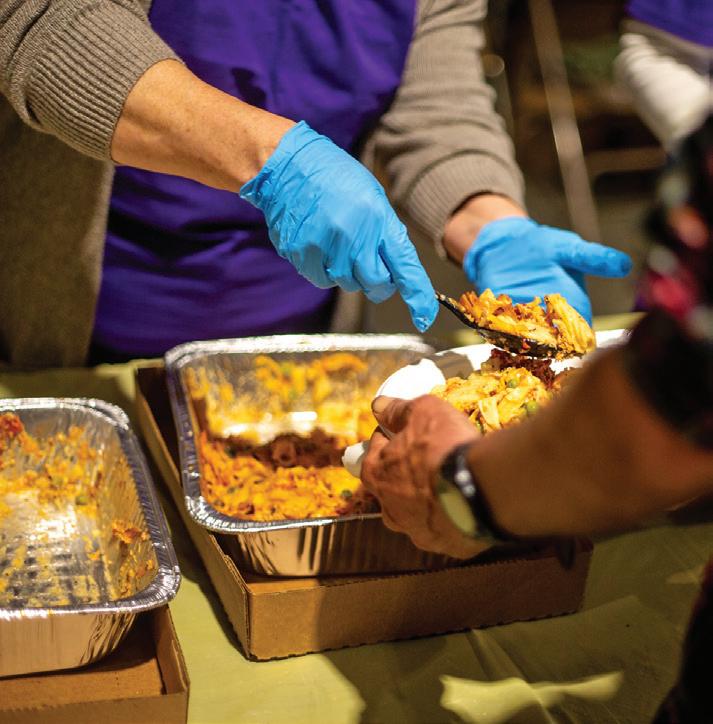
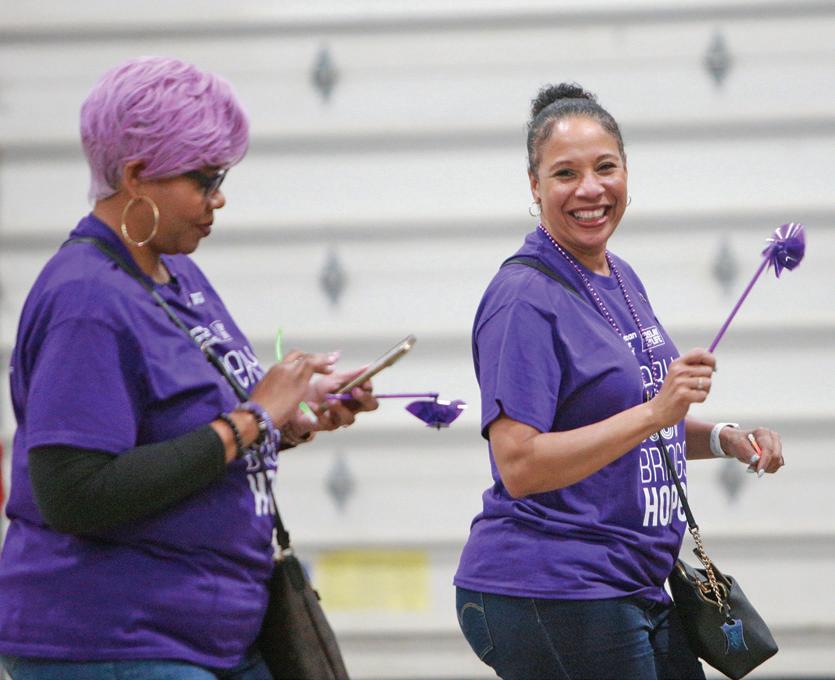
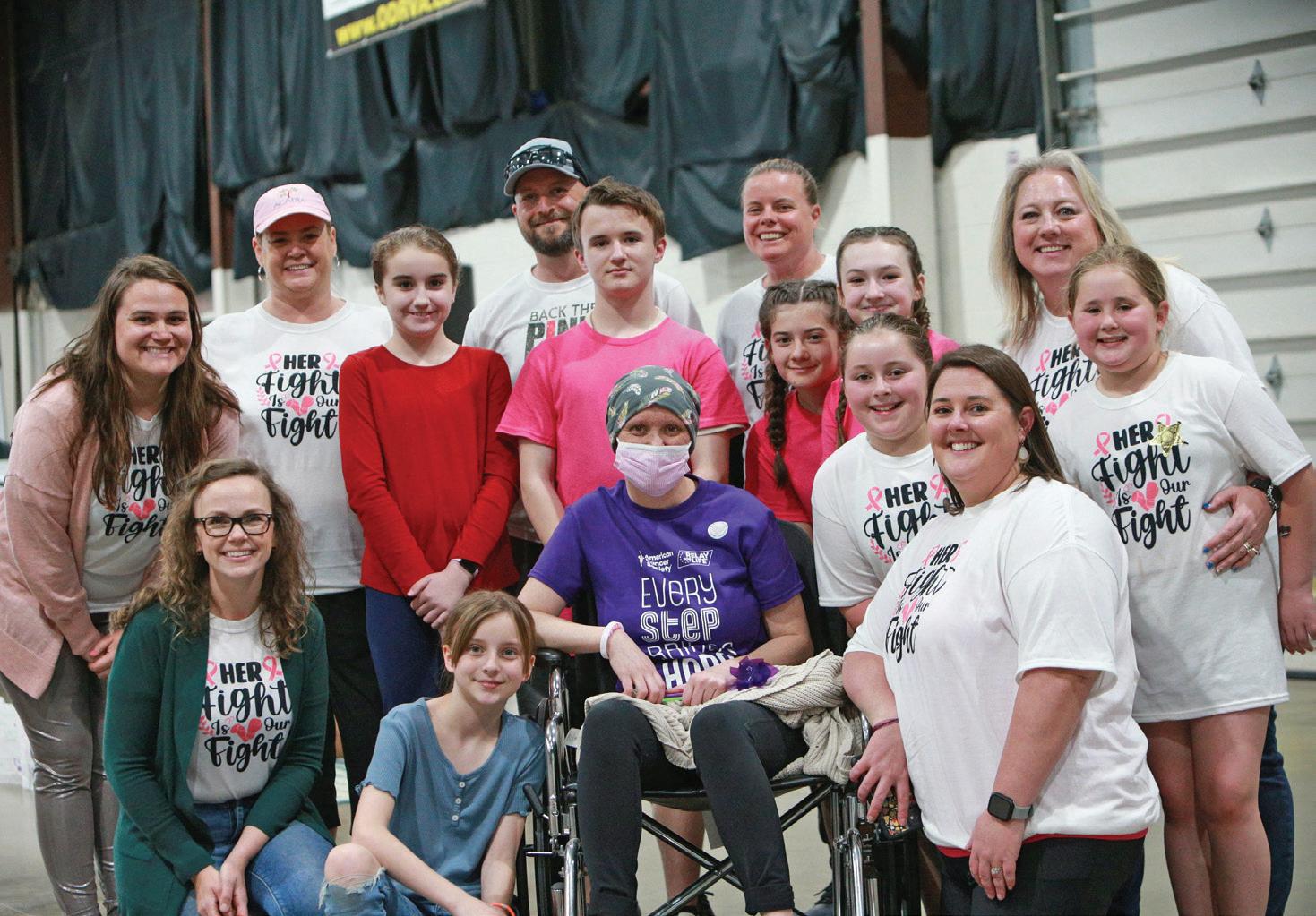
In addition to bringing in all types of entertainment options — like the beloved Augusta County Fair that draws in thousands of people — Augusta Expo also plays a crucial role as a site for Red Cross blood drives, the Relay for Life March, Remote Area Medical and as a temporary cold weather shelter for WARM, the Waynesboro Area Refuge Ministry. It’s also a designated disaster site for Augusta Health and the Augusta County SPCA.
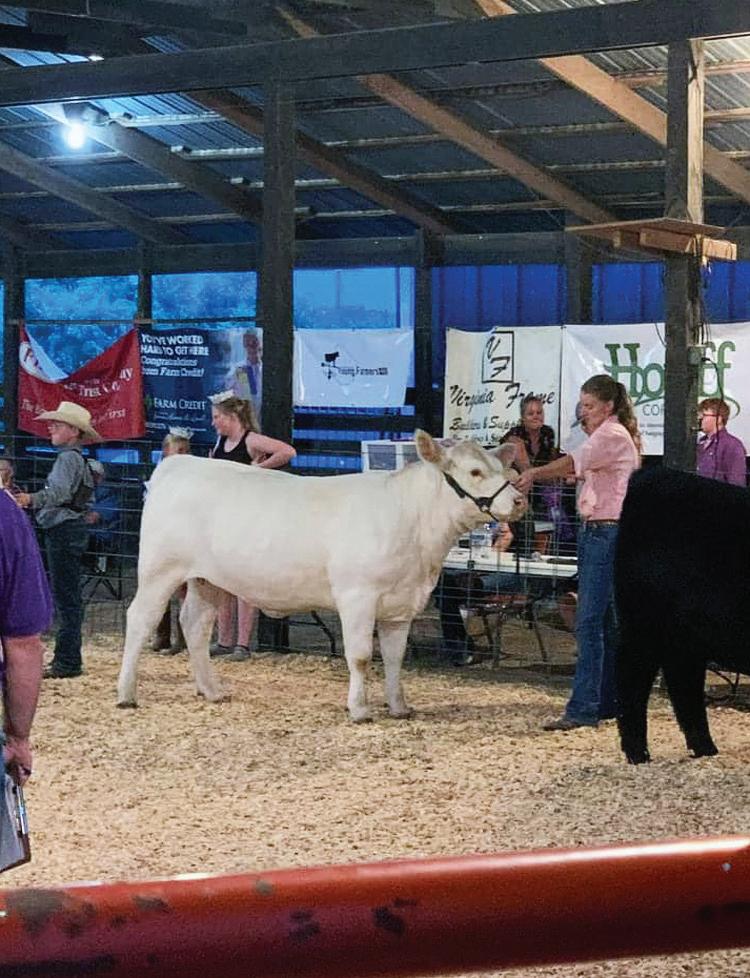
“We do an awful lot for the community,” Moore said. “We do a lot for kids, with 4-H, market animal shows and schools.”
Moore and Augusta Expo assistant manager Annie Collins try to keep the event center buzzing with activity. However, in almost every instance, Augusta Expo may host an event, but the organization is not the event organizer. Moore and Collins work with promoters looking for venues.
Two times a year, however, Augusta Expo will host and facilitate its own event — a fall and a spring craft show.
“I think it gives an opportunity not just for local crafters, but we’re also starting to bring in folks from an expanded area outside just our local area,” Collins said. “It does provide the opportunity for our local crafters to come to our event. It brings them all together, and folks that come to shop have one place to do that.”
Although similar, the two shows have a different feel. “In the fall, a lot of crafters focus on the holidays,” Collins said. “In the spring, it’s a little bit of a smaller event. In the spring show, we also bring in some direct sales folks to have some business. I think it’s really nice to give that opportunity.”
Prior to taking over the general manager role at Augusta Expo, Moore was in a sales role that required extensive traveling. He was at a trade show in his coverage area almost every weekend of the year.
“I saw the good at locations, and I saw the bad at locations,” Moore said. “From experience in running events as a vendor, I know the ins and outs. I know what a vendor wants.”

Vendors are paying money. Moore believes doing good business means making sure vendors get a good return on their investment. “When you’re running an event — no matter what type of event - and you have vendors paying you for that spot, you want to keep them happy,” Moore said. “That’s who is making your money.”
Augusta Expo is an economic driver in the community. Hotels, restaurants and local tourist locations benefit from the traffic that comes to the event center. “Some people are very interested in the area, and talk about coming back to visit Staunton or Waynesboro,” Collins said. “The events that come here to impact the businesses around us.”
In 2025, Augusta Expo has also been collecting feedback from the community. Moore and Collins are working hard to position Augusta Expo as an excellent community partner.
Additionally, the event center staff are preparing for the fall calendar of events. There’s a gun show that happens quarterly at Augusta Expo, and a rapidly growing Mineral & Gem show in September. “They started with 15 to 20 vendors,” Moore said. “From that point on, coming this year, they will have about 250 vendors, taking up all three buildings taking up our main hall.” There’s a reptile show in October. There’s also an antique show in addition to the fall craft show.
“There’s something here for everybody,” Moore said. “Between Annie and me, we try to get something here for everybody.” <
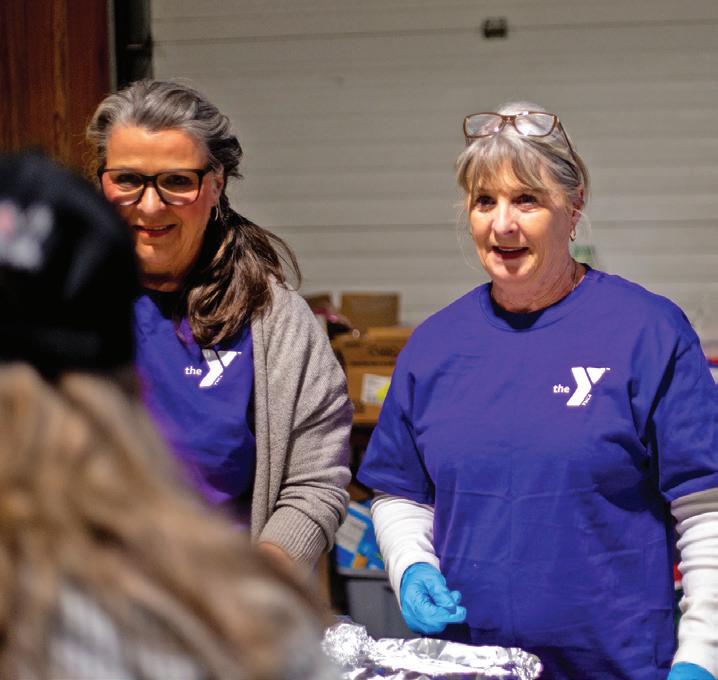
Top, left to right: Expo hosts the annual Relay For Life. Custom jewelry at the spring and fall craft is popular. Augusta Expo hosts the Augusta County Fair. Expo acts as a temporary cold weather shelter for the YMCA/Waynesboro Area Refuge Ministry program.
by Heather S. Cole
Sarah Farthing, age 14, takes a handmade broom to the worn wooden floor and, with a flourish, sends a cloud of dust out the front door of the 1850s House at the Frontier Culture Museum in Staunton, Va.
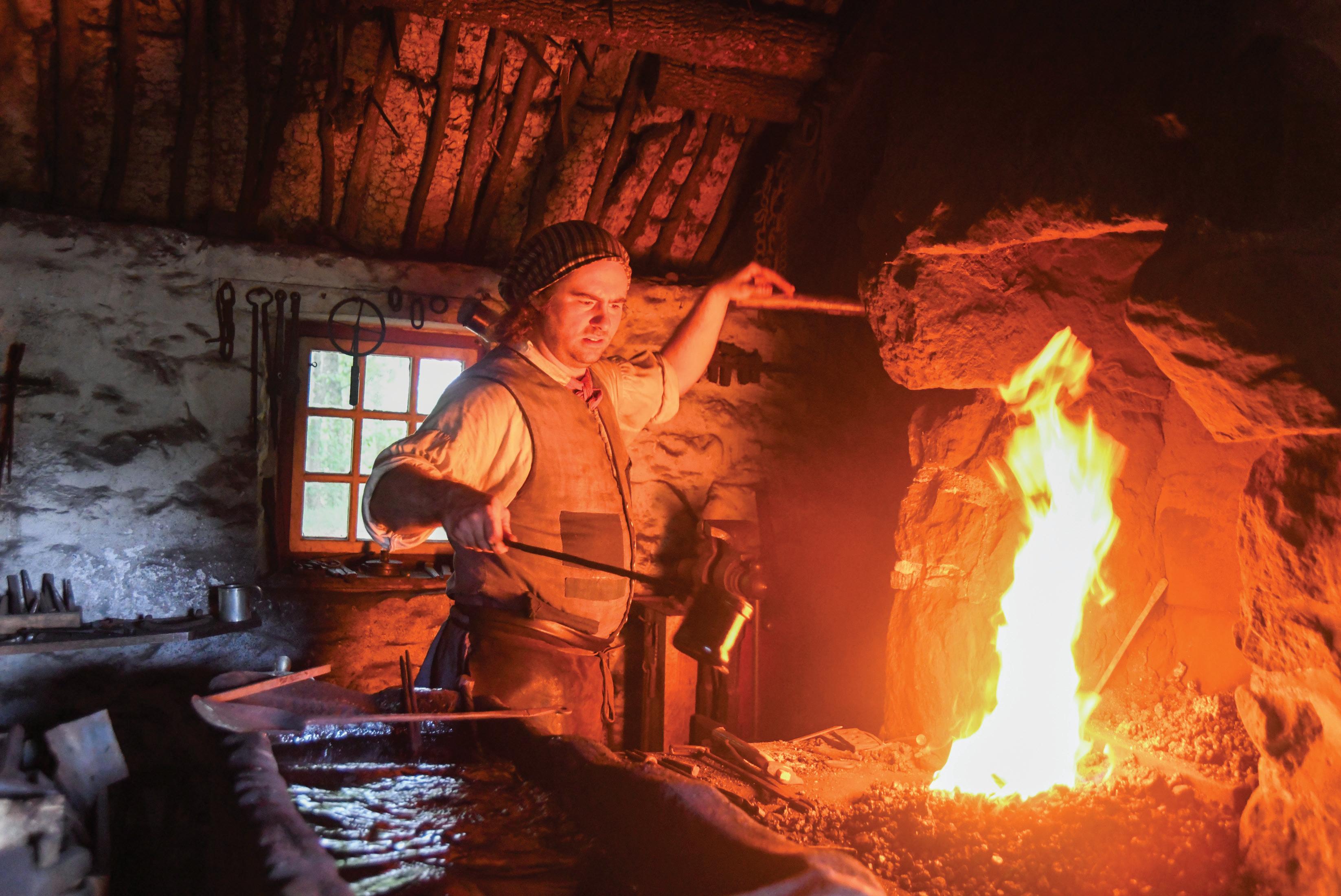
The museum, located on 200 acres of land just off I-81, is an outdoor living history museum that tells the story of migration to the Shenandoah Valley during the colonial period of American history. The museum consists of “old world” farms representing the homelands of the people who settled the area — England, Germany, Ireland and West Africa — and “new world” farms representing the homesteads of families who settled here from the 17th through 19th centuries. One of the homesteads, a two-story cabin interpreted to the mid-19th century, is where Farthing is at work.
“I really like sweeping,” Farthing says with a smile as she gives the broom another swing. “It is very meditational.”
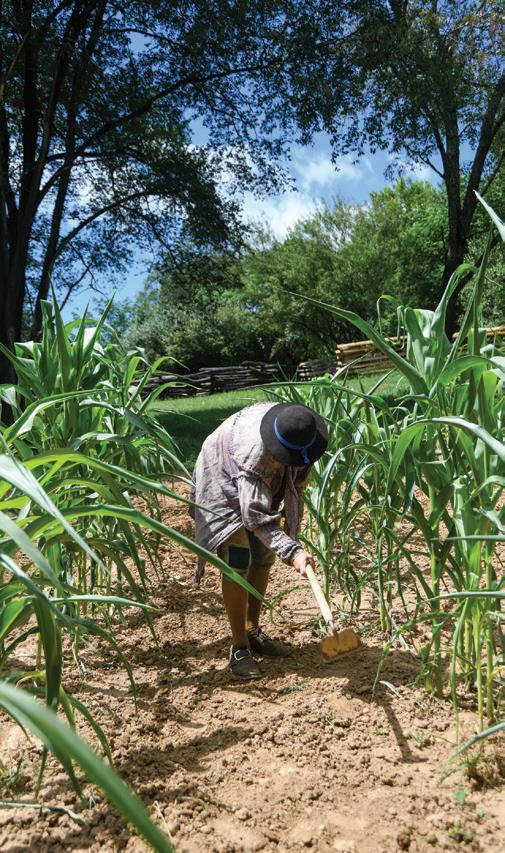
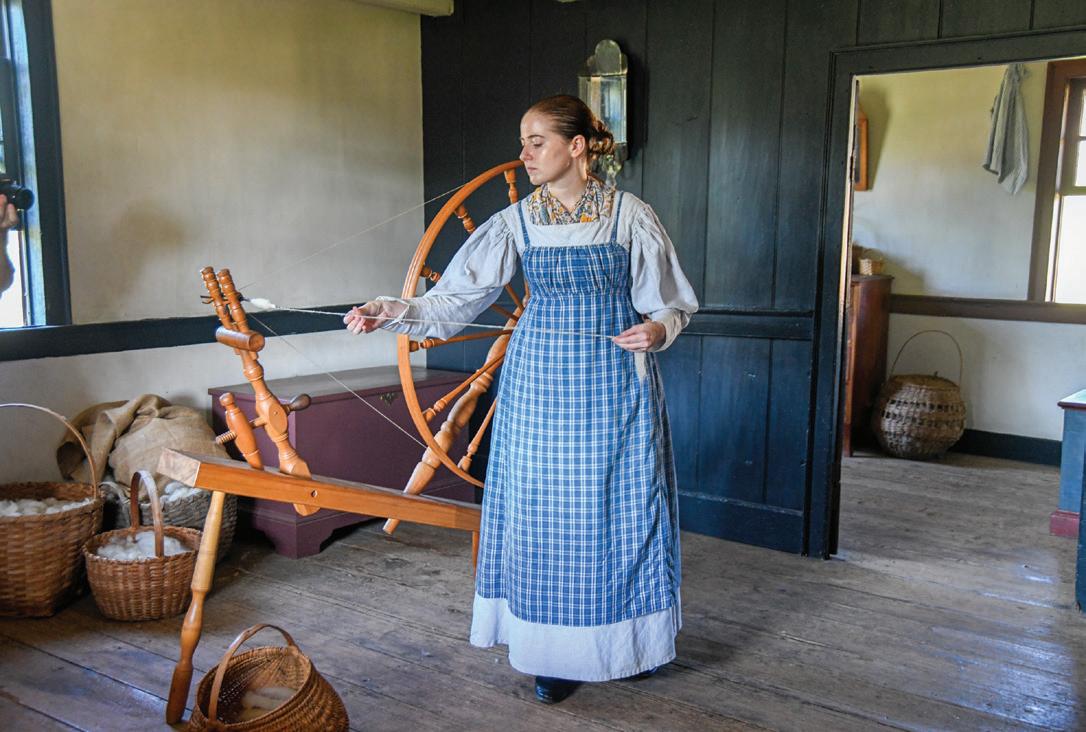
Farthing, a resident of Staunton, is one of 14 local teenagers serving as junior interpreters at the living history museum as part of the John Lewis Society. Named for one of the founders of the City of Staunton, the volunteer program gives participants an opportunity to learn more about the museum, historical interpretation and careers for people who love history. Teens are paired with a professional interpreter to serve as a mentor and participate in activities of daily life in each of the historic farms — everything from cooking to cleaning to quilting. And the work is usually done in historic costumes.
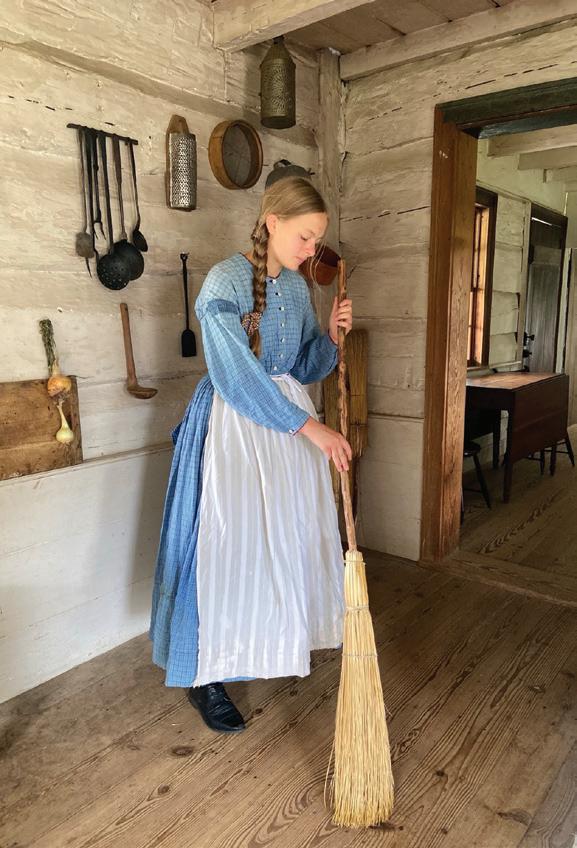
On this bright June morning, with a temperature already in the 80s, Farthing is wearing a blue cotton day dress over two petticoats, knee-high stockings and black leather shoes, with a white cotton apron on top. If she is outside, Farthing also wears a bonnet over her long blond braids. In another year or so, to be historicallyaccurate, she would be required to wear at least another layer of petticoats and a corset. But Farthing says she doesn’t mind all the layers of clothing.
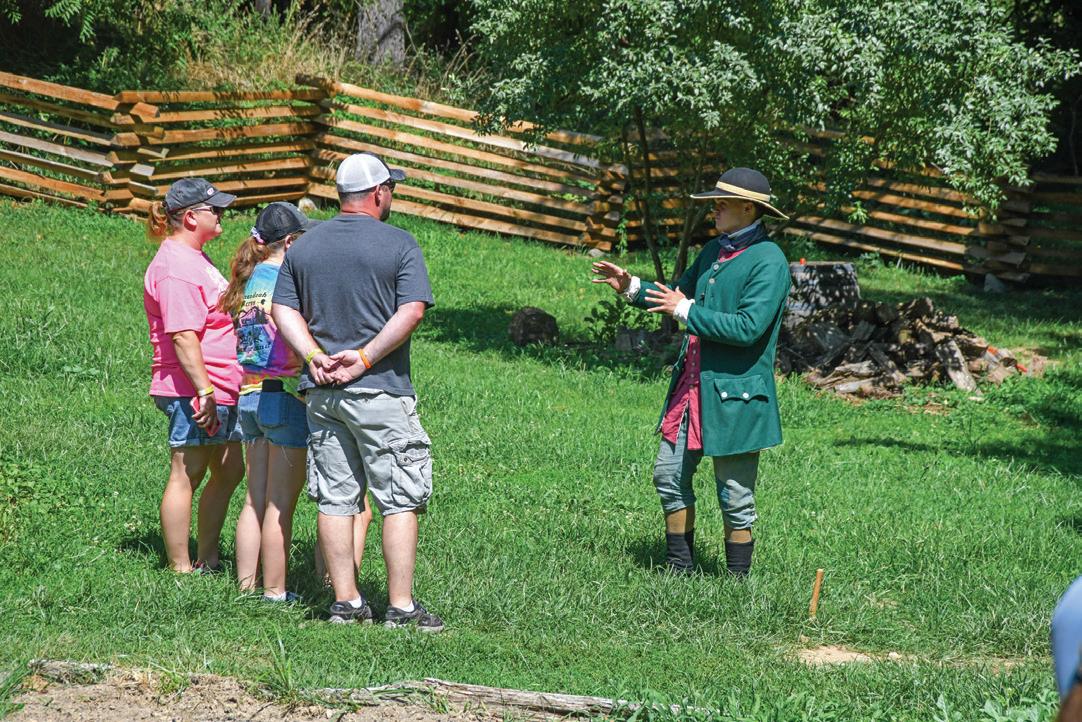
“People are wrong when they talk about how hot it is,” Farthing says. “The clothes do a good job of keeping the sun off of you.”
The JLS program has been a staple of interpretation at the Frontier Culture Museum for more than two decades. Sally Landes, an historical interpreter and JLS mentor, says the program is “a winwin-win” for the museum, the teens and the visitors.
“It is a win for the museum interpreters because we get help from the volunteers,” Landes says, gesturing to a large garden behind her where another JLS participant is preparing to do some weeding. “It is a win for the museum visitors because they get to see what it was like for multiple generations to work on the historic farms. And it is a win for the students because they get hands-on experience in learning history.”
Although many of the teen participants are history buffs and participated in the museum’s camps for younger students, Landes says that the JLS program gives participants valuable experience even if they don’t continue onto careers in public history.
“They learn flexibility — a skill that is great to learn. They get the experience of talking to a wide variety of people. We really see them grow their confidence,” Landes says.
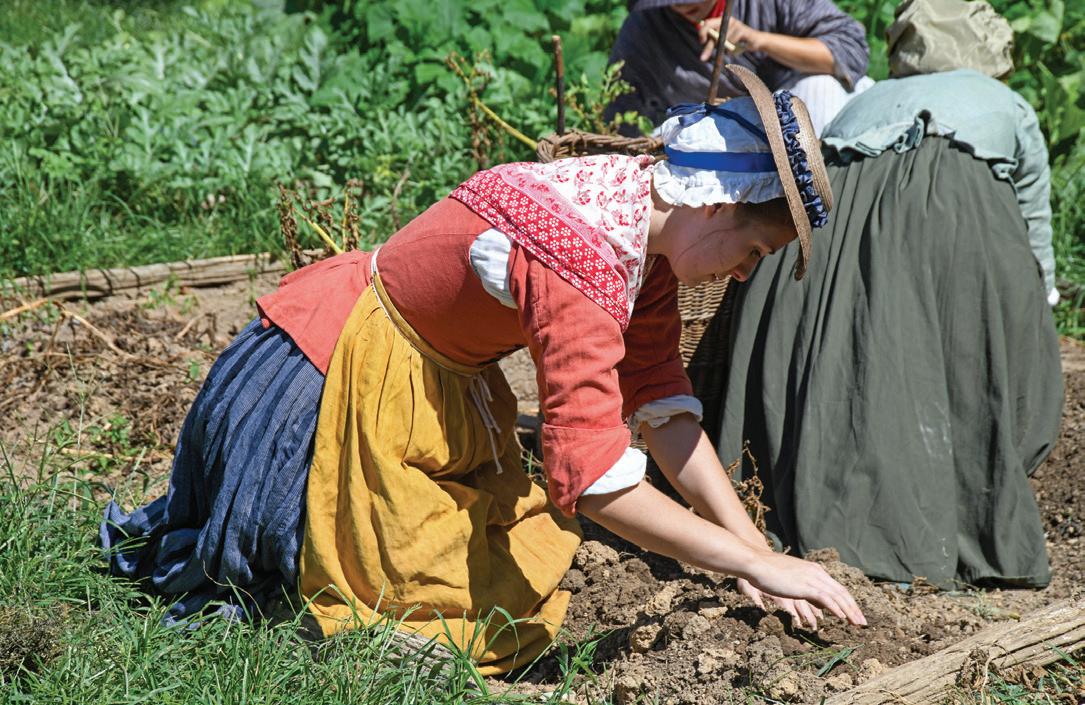
Farthing says she loves volunteering because of the variety of activities that take place at the museum. On any day the costumed interpreters might be planting and weeding gardens, caring for livestock, preparing meals, repairing fences and engaging in a variety of handicrafts. Museum visitors of all ages can observe, ask questions and try their hands at some of the activities.
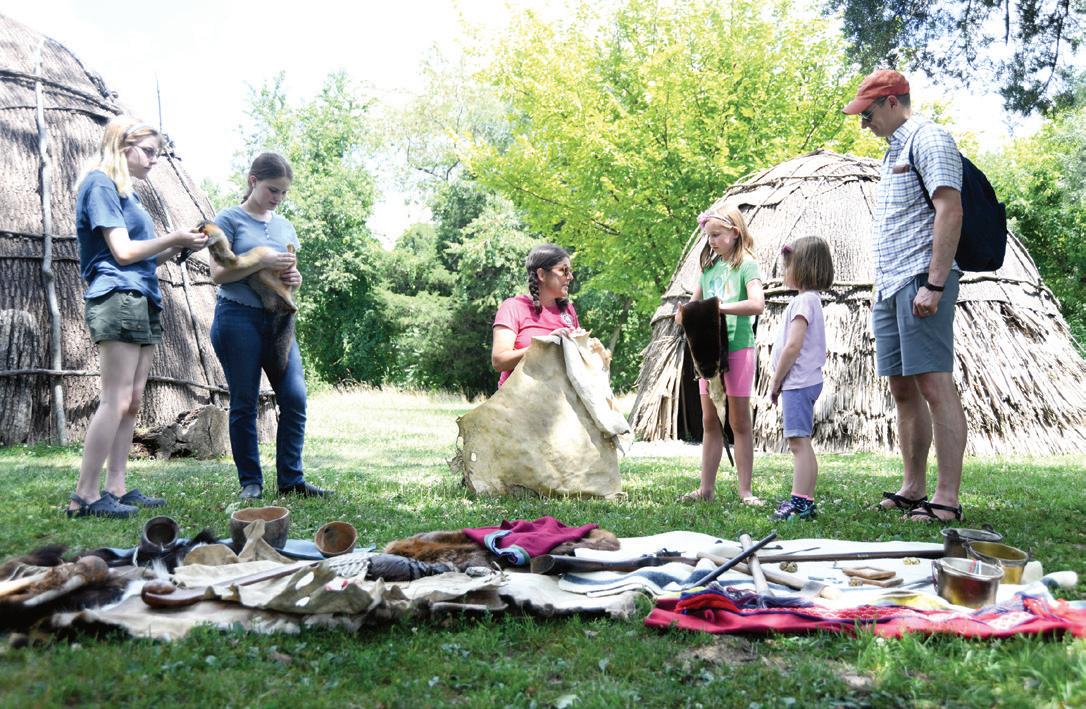
Besides explaining daily life on the frontier for European settlers, the museum also offers insights into Native American culture of the time period.
For the next two years, visitors will also be able to observe some very modern construction taking place on the grounds of the museum. Thanks to $70 million in funding from the Virginia Department of Education, the museum is embarking on the construction of a 40,000 square foot indoor museum. Scheduled to open in fall 2027, the indoor museum will include a welcome center, exhibit gallery and research library. The main permanent exhibition will tell the story of the role Virginia played in the founding of the United States and serve as an introduction to the living history portion of the museum.
Construction for the project, which will include the removal of several buildings, the expansion of the parking lot and the relocation of the West African farm, has already begun. Staff say that it will be conducted in such a way as to minimize disruption to the experience of visitors to the museum.
Museum CEO Butch Smiley says that he expects the new indoor facility to be “a game changer” for the museum. Currently the museum has fewer visitors when the weather is bad; with the new indoor museum they hope to be able to double their visitor numbers, he says.
“The new space will allow the museum to tell our story to more people,” Smiley says.
In addition to camps, the JLS program and daily visitors, the museum also hosts public lectures, school field trips and a schedule of special events throughout the year.
The Frontier Culture Museum is open daily from 9 a.m. to 5 p.m. Information on visiting the museum or attending educational programs, including the John Lewis Society, is available on their website: www.frontiermuseum.org. <
18 5:30 pm , Business After Hours, The Blackburn Inn, Chamber Member Event.
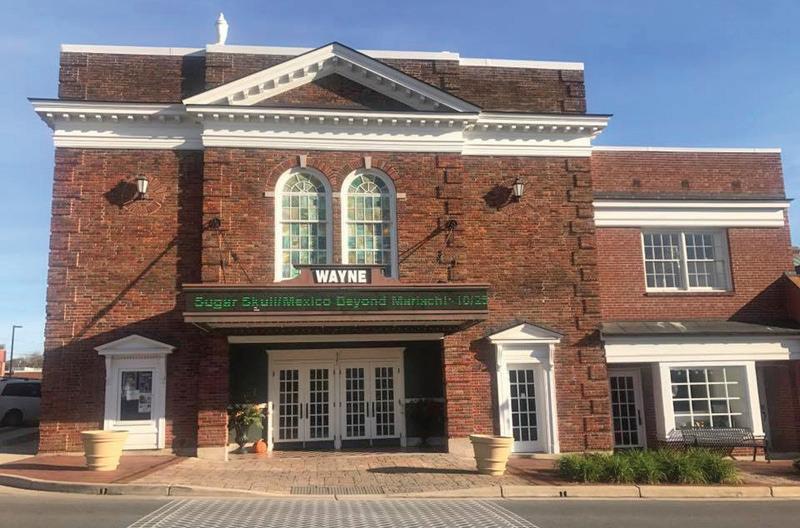
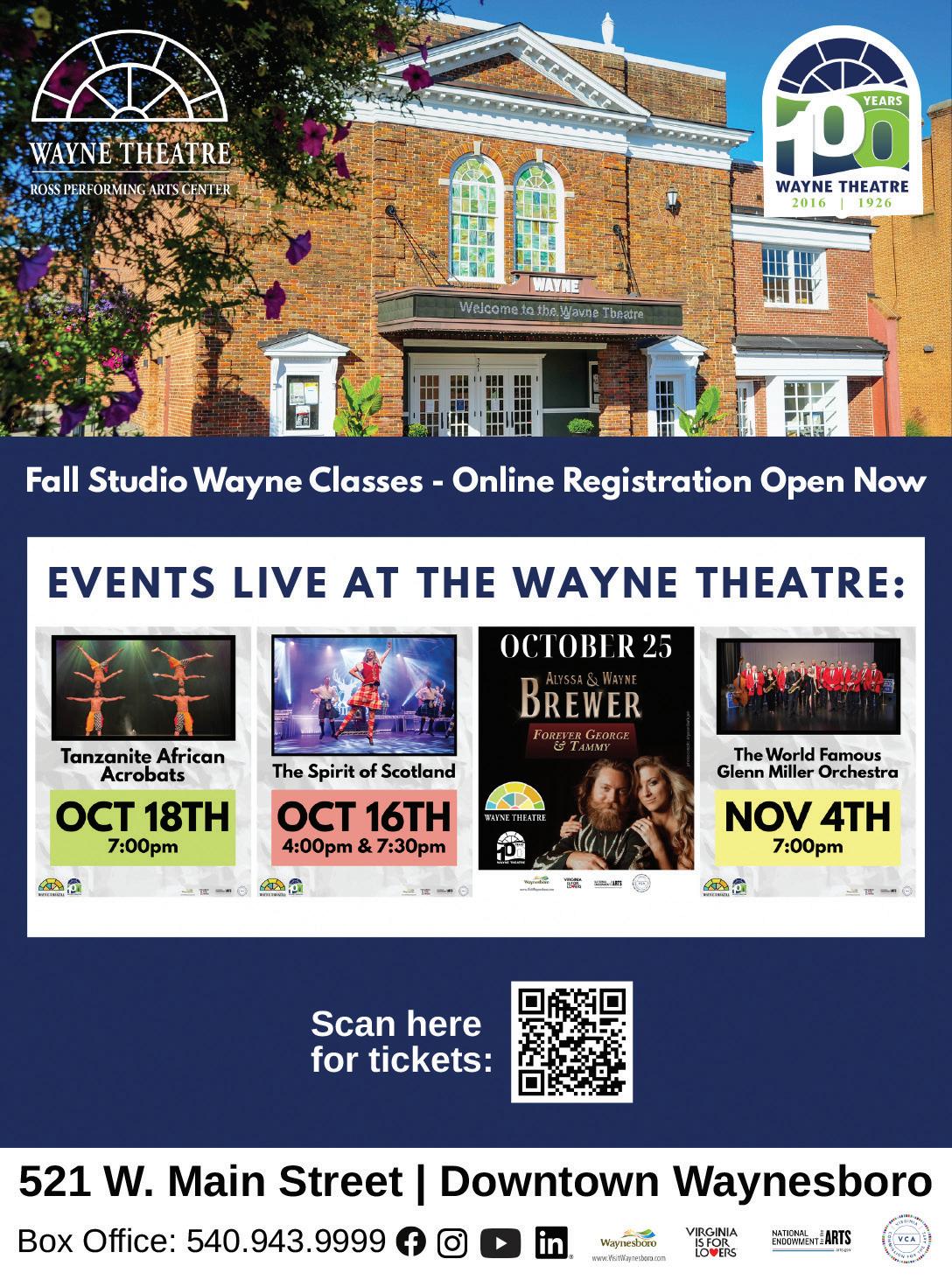
19 7 pm, Dailey & Vincent, Wayne Theatre.
26-28 Queen City Mischief and Magic, Downtown Staunton, info at Facebook.com/queencitymagic
27 12-4 pm, PRISM Pride Festival, Downtown Waynesboro.
27 5pm, The Wondrous World of Wizards, Waynesboro Symphony Orchestra, First Presbyterian Church of Staunton.
3 8:30 am, Coffee and Connections, Converge, Greater Augusta Regional Chamber of Commerce
3 5 pm, Lights On Blackfriars, American Shakespeare Center. For info, americanshakespearecenter.com/events/lights-on-blackfriars/
3 7:30 pm, The Kingston Trio, Wayne Theatre.
4 6:30 pm, Shakespeare Uncorked, Ciders from Mars — pair with Romeo and Juliet, American Shakespeare Center.
8 8:30 am, SAW Young Professionals, Greater Augusta Regional Chamber of Commerce.
10 9 am, Aging In Place, See The Chamber’s website for details, www.augustava.com
10-11 Fishersville Antiques Expo, Augusta Expo.
11 7:30 pm, Reveling in Ravel, Waynesboro Symphony Orchestra, First Presbyterian Church of Staunton.
11-12 Sat. 10 am-5:30 pm; Sun. 10 am-5 pm, Fall Foliage Art Festival, Downtown Waynesboro.
12 3 pm, , Reveling in Ravel, Waynesboro Symphony Orchestra, First Presbyterian Church Waynesboro.
16 4 pm & 7:30 pm, The Spirit of Scotland, Wayne Theatre.
16 5:30 pm, Business After Hours, City National Bank, Chamber Member Event.
18 9 am, International Archaeology Day, Frontier Culture Museum.
18 7 pm, Tanzanite African Acrobats, Wayne Theatre.
24 5 pm, Lights On Blackfriars, American Shakespeare Center. For info, americanshakespearecenter.com/events/lights-on-blackfriars/ 25-26 9 am-5 pm, Homefront at War: A Revolutionary Weekend, Frontier Culture Museum.
25 7 pm, Forever George and Tammy featuring Alyssa and Wayne Brewer, Wayne Theatre.
25 7 pm, The Neighbor Bridge Halloween Bash, Augusta Expo.
31 7:30 pm, Pops at the Paramount 2025, Waynesboro Symphony Orchestra, Paramount Theater, Charlottesville.
4 7 pm, The World Famous Glen Miller Orchestra, Wayne Theatre
6 7 pm, VAN the Band – The Definitive Van Morrison Experience, Wayne Theatre.
7 8:30 am, Coffee and Connections, Cabinet Works, Greater Augusta Regional Chamber of Commerce.
7 5 pm, Lights On Blackfriars, American Shakespeare Center. For info, americanshakespearecenter.com/events/lights-on-blackfriars/ 8-9 2025 Fall Arts and Crafts Show, Augusta Expo.
8 6:30 pm, Shakespeare Uncorked, Blue Mountain Brewery — pair with The Pirate Ballad of Bonny and Read, American Shakespeare Center.
12 8:30 am, SAW Young Professionals, Greater Augusta Regional Chamber of Commerce.
14 9 am, Aging In Place, See The Chamber’s website for details, www.augustava.com
15 7:30 pm, Chamber Music Fall Concert, Waynesboro Symphony Orchestra, First Presbyterian Church of Staunton.
16 3 pm, . Chamber Music Fall Concert, Waynesboro Symphony Orchestra, First Presbyterian Church Waynesboro.
20 5:30 pm, Business After Hours, The Russell Museum, Chamber Member Event.
29 Winterfest/Small Business Saturday, Downtown Waynesboro.
1 7 pm, Staunton Christmas Parade, Downtown Staunton.
5 8:30 am, Coffee and Connections, Mary Baldwin University, See The Chamber’s website for details, www.augustava.com
5 7 pm, Holiday Pops Concert, Waynesboro Symphony Orchestra, First Presbyterian Church Waynesboro.
6 3 pm, Holiday Pops Concert, Waynesboro Symphony Orchestra, First Presbyterian Church Waynesboro.
6 6 pm, Waynesboro Christmas Parade, Downtown Waynesboro.
9 8:30 am, Legislative Breakfast, Hotel 24 South, Greater Augusta Regional Chamber of Commerce. See The Chamber’s website for details, www.augustava.com
10 8:30 am, SAW Young Professionals, Greater Augusta Regional Chamber of Commerce.
12 9 am, Aging In Place, See The Chamber’s website for details, www.augustava.com
18 5:30 pm, Business After Hours, Paul Obaugh Ford, Chamber Member Event.
6 8:30 am, Coffee and Connections. See The Chamber’s website for details, www.augustava.com
13 9 am, Aging In Place. See The Chamber’s website for details, www.augustava.com
15 5:30 pm, Business After Hours, Chamber member event. See The Chamber’s website for details, www.augustava.com
6 8:30 am, Coffee and Connections. See The Chamber’s website for details, www.augustava.com
13 9 am, Aging In Place. See The Chamber’s website for details, www.augustava.com
19 5:30, Business After Hours. See The Chamber’s website for details, www.augustava.com
21 7:30 pm, Romeo and Juliet, A Symphonic Evolution, Waynesboro Symphony Orchestra, First Presbyterian Church of Staunton.
22 3 pm, , Romeo and Juliet, A Symphonic Evolution, Waynesboro Symphony Orchestra, First Presbyterian Church Waynesboro.
26 Business Excellence Awards. See The Chamber’s website for details, www.augustava.com
6 8:30 am, Coffee and Connections. See The Chamber’s website for details, www.augustava.com.
7 9 am-4 pm, Spring Arts and Crafts Show, Augusta Expo.
7 7:30 pm, Chamber Music Spring Concert, Waynesboro Symphony Orchestra, First Presbyterian Church of Staunton.
8 3 pm, Chamber Music Spring Concert, Waynesboro Symphony Orchestra, First Presbyterian Church Waynesboro.
13 9 am, Aging In Place. See The Chamber’s website for details, www.augustava.com.
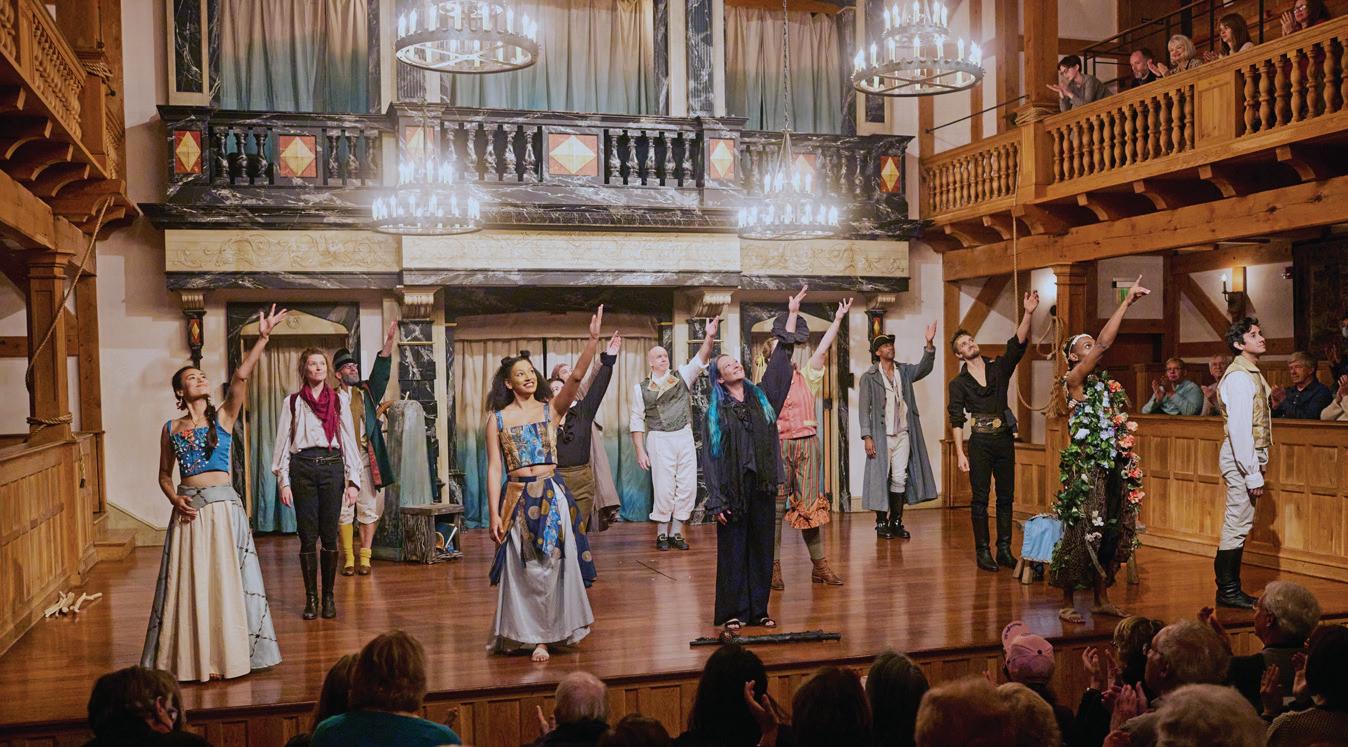
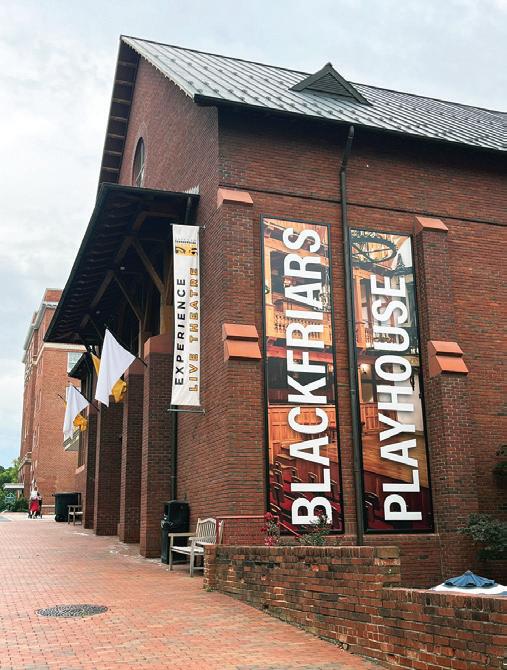
American Shakespeare Center’s Blackfriars Playhouse
Aug. 28-Nov. 15 Romeo and Juliet
Sept. 11-Nov. 15 Two Gentlemen of Verona
Oct. 16-Nov. 16 The Pirate Ballad of Bonny and Read Dec. 4-Dec. 27 A Christmas Carol 2025
(Go to AmericanShakespeareCenter.com for specific dates and to order tickets.) Playhouse tours are generally available Wednesday-Fridays at 2 pm, and Fridays and Saturdays at 10 am. (PLEASE NOTE: dates and times may vary based on student matinees and the overall Playhouse schedule.) Tours last about 45 minutes. (Fee) Information at: www.americanshakespearecenter.com/events/playhouse-tours
Wayne Theatre
For films and events not scheduled at press time, information at: www.waynetheatre.org
The Foundry
Live Music: Information at: www.thefoundrysound.com/shows
Staunton Farmer’s Market
Saturdays, 7 am – Noon, April-September Saturdays, 8 am – Noon Oct. – Nov. 22 Winter Market, Dec. 6, 13 & 20, 9 am-1 pm Wharf Parking Lot
Waynesboro Farmer’s Market
Saturdays, 9 am – 1 pm, May – October Constitution Park Pavilion
19 5:30 pm, Business After Hours. See The Chamber’s website for details, www.augustava.com.
28 Hometown Expo, Augusta Expo. See The Chamber’s website for details, www.augustava.com.

Waynesboro Public Library
Preschool Story Time
Wednesdays 10-11am. Ages 3-5 and caregivers.
Play & Learn Tuesdays 10:00-noon. Ages 0-4 and caregivers. Baby & Toddler Story Time Fridays 10-11am. Ages 0-3 and caregivers.
Yarns of Love at the Library
Mondays 4-6 pm, All ages.
For more events, see www.waynesboro.va.us/1199/Library
Staunton Public Library
Memory Café
Third Thursday monthly, 2 pm. Geri-Fit
Exercise for older adults, Wednesdays 11 am.
Great Books Club
Second Friday monthly, 2 pm.
True Crime Discussion Club
First Thursdays monthly, 7 pm.
For more events, see www.ci.staunton.va.us/departments/library
Augusta Public Library
Fridays With Friends Fridays 10:30 am, Fishersville Redbeard Book Club
Third Sundays 3 pm. Adults 21+ (In partnership with Staunton Public Library)
WCLS Brown Bag Book Club
Second Wednesdays, Noon, Weyers Cave Library Station. Adults age 19+
For more events, see www.augustacountylibrary.org

Purposeful partnerships for a greater Augusta
Build with Trust Access 184 years of innovation in education.
Connect with top-tier, careerready diverse candidates.
Invest in your current employees’ professional growth with a 15% tuition discount for MBU partners.