The Advocate Sound
A Champion for All Gaited Horses
Volume 9, Issue 1, 2026
A Champion for All Gaited Horses
Volume 9, Issue 1, 2026
Friends of Sound Horses, Inc. 6614 Clayton Rd. #105 St. Louis, MO 63117 info@fosh.info * www.fosh.info
Board of Directors
President - Teresa Bippen Missouri Tbippen1957@yahoo.com
Secretary/Treasurer-Gina Vehige Director at Large-Bill Coon VP IJA Program-Dianne Little Missouri Utah Alberta, Canada gvehige115@gmail.com wbotis@gmail.com ddlittle@telus.net
VP Programs/Gaited Sport Horse Director at Large-Anita Dunham VP HIO/DQP-Lisa Harris Dianne Little Missouri Tennessee Alberta, Canada dunhamanita@gmail.com ddlittle@telus.net
Executive Advisory Committee
Keith Dane Patti Potts Pauline Stotsenberg Hawaii Missouri California pottspa@gmail.com ps@yesteryearfarms.net
Editor Stephanie J. Ruff Florida editor@fosh.info
FOSH Mission Statement
To promote all “sound,” naturally gaited horses, with a specific emphasis on Tennessee Walking Horses. (In this context, sound means not “sored”.)
Importance is placed on education in regards to the humane care for the emotional, mental and physical wellbeing, training, and treatment of all gaited horses.
FOSH will only support flat shod or barefoot horses and will never endorse any event that uses stacks and/or chains as action devices, or any mechanical, chemical, or artificial means to modify the natural gaits of the horse.
To these ends, FOSH focuses on three areas for gaited horses:
1) educating people about sound horse training principles; 2) supporting sound shows, events and activities; 3) working to end soring.
FOSH is a 501(c) (3) non-profit organization. All donations are tax deductible to the extent permitted by law. Your donation to support the FOSH mission is needed to advance the goals set forth by FOSH in conjunction with its formal mission statement.
The Sound Advocate is a digital magazine published quarterly by Friends of Sound Horses, Inc. Reproduction of any article is prohibited without the express written permission of FOSH.
FOSH accepts unsolicited submissions, but reserves the right to edit any and all submissions for content, style and space constraints. FOSH further reserves the right to refuse advertising for any reason.
At no time shall the publisher’s liability exceed the total cost of the revenue from advertising in the issue involved in any dispute.
All show suspensions and show results are printed as they are received from the reporting agencies. FOSH does not guarantee their accuracy.
FOSH does not endorse the content of any advertisement in this publication, nor does it warrant the accuracy of any advertisement.
Readers are urged and cautioned to use due diligence and to thoroughly research, including asking for references, before following through with any transaction.
FOSH does not endorse any trainer, educator, clinician, style of natural training, tack, or horse equipment to the exclusion or preference of any other. Each horse is an individual and may respond differently to particular methods.
Articles published by FOSH reflect the views and opinions of the writers and do not reflect, necessarily, those of FOSH.
Subscribers: The Sound Advocate is a benefit of membership. To ensure that you receive your issues, be sure that your e-mail address is current. To change an e-mail address, contact gvehige115@ gmail.com.
Submission of Articles, Calendar Dates, News and Photos: Send to tbippen1957@yahoo.com. Photos may not be embedded in text and must be submitted as jpeg format, minimum of 300 dpi. The deadline for each issue is the 15th of the preceding month when the issue is to be released. Submissions will not be accepted after the deadline, but may be carried over to another issue. Submissions will not be returned to the submitter.
Member’s Advertising Rates
Back Cover $300
Inside Front Cover $275
Inside Back Cover $275
Full page $125
Half page $75
Quarter page $60
Business Card $25
Directory $25
Discounts for Multiple Issues
2 issues - 10% off total fee
4 issues - 20% off total fee
6 issues - 30% off total fee
Ads will be accepted in pdf, tif or jpeg formats. Text and photos must be e-mailed separately by the 10th of the month when the issue is released. Photos must be 300 dpi. Camera-ready ads are emailed at 300 dpi. Materials should be emailed to editor@ fosh.info.
All advertisements must be paid in advance by check, money order, or credit card. Payments should be made out to FOSH and mailed to:
6614 Clayton Rd. #105 St. Louis, MO 63117
More FOSH information can be found online. Find us at www.fosh.info.
Like us on Facebook.

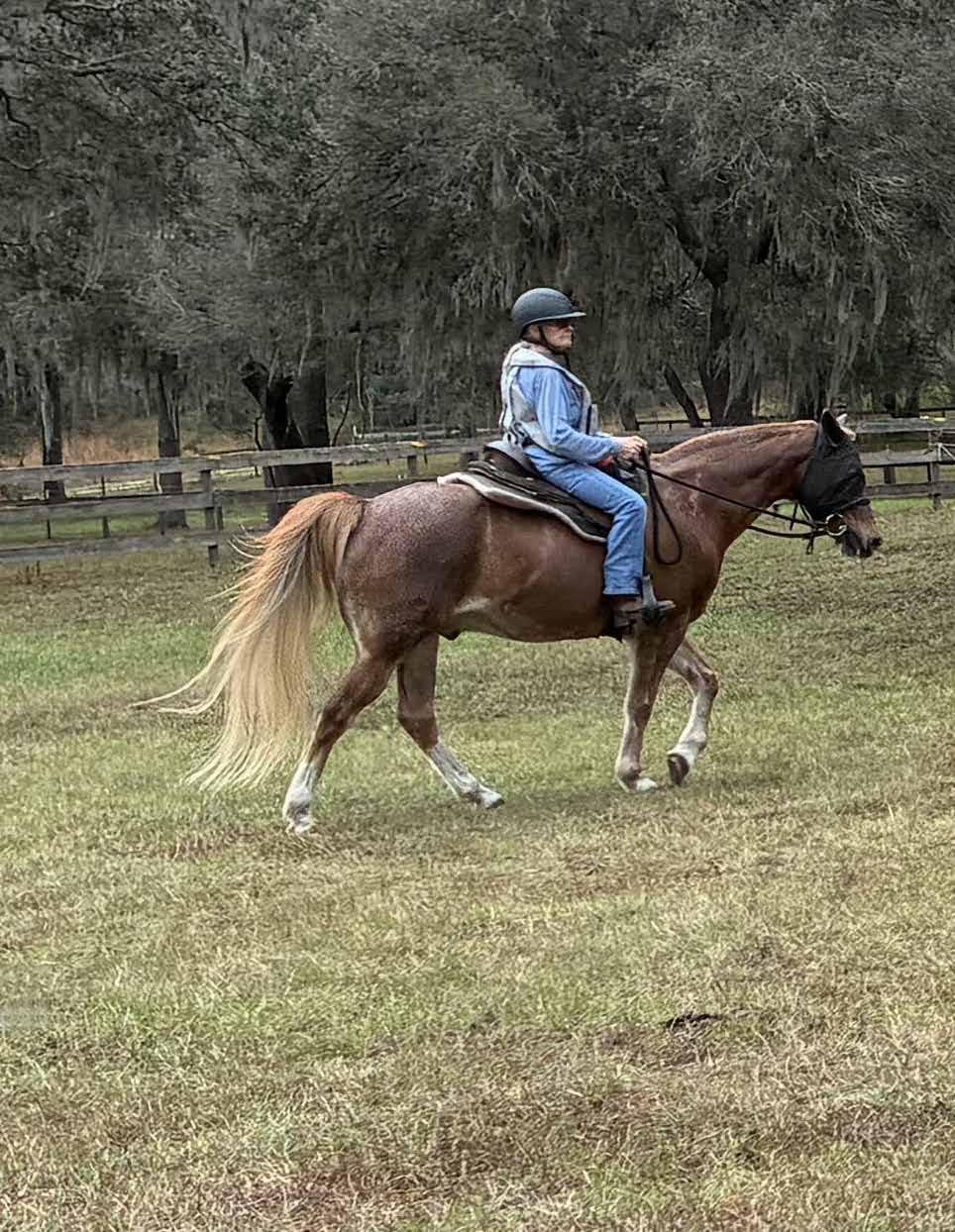
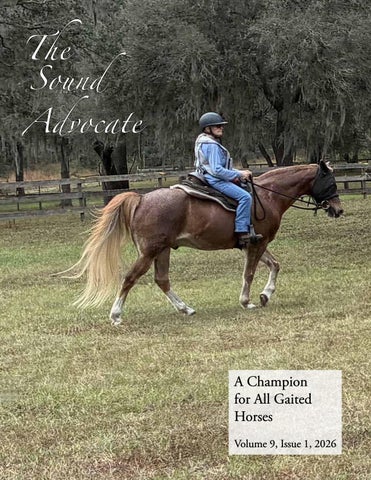
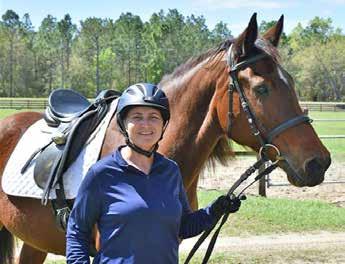
On the cover: Debbie Shaw of Lady Lake, Florida and Orrington, Maine and her Missouri Fox Trotter at a Carl Bledsoe clinic at Spotted Dance Rance in Brooksville, Florida. Photo credit Kym Rouse Holzwart.
With this first issue of 2026, I want to thank you for your ongoing support of Friends of Sound Horses (FOSH) and share how your generosity supported our efforts. In 2024 and 2025, your support enabled us to provide grants for eighteen sound horse endeavors across North America. This includes clinics on sound horse training, sound horse shows and classes, and working equitation clinics and events as well as related awards programs.
In addition to these efforts, we continue to publish The Sound Advocate several times each year, and we are moving access to this important publication to our Facebook page as well to increase our outreach. Through our attendance in the USDA training for DQPs, we are educated on inspection advances and sadly, on the latest
tools and illegal substances used by the horse soring crowd. We also have continued our advocacy work on behalf of passage of the PAST Act with members of Congress and support the USDA’s attempt to provide oversight of horse shows and events to prevent soring. We continue to maintain the Independent Judges Association judging program and rulebook as well.
All of this would not be possible without generous donors such as you. Because we have not solicited for ongoing membership dues, we would ask that you consider financially supporting us with whatever amount you can spare so we can continue this important work on behalf of the welfare of gaited horses. Please consider donating today, either through our PayPal link found at:
https://www.paypal.com/donate/?hosted_button_id=3XU3RYHJ2HBUU
via
Remember, we are a 501(c)3 organization (not-for-profit), so your donations MAY be tax deductible. Please consult your tax preparer.
Thank you for your support.
Hello FOSH Friends.
Since I no longer own a farm, all of my horse stuff has taken up space in my garage. I own one 20-year-old semi-retired horse and will not be buying another horse when she’s gone. My years of horse ownership are coming to a close, and that’s hard to face.
I’m at the point where I look around at the boxes of items and understand that it’s time.
Not because the memories are fading. Quite the opposite. Every bridle carries a story. That worn lead rope was the one I grabbed when a young horse first learned to load. The old saddle pad with the faded piping? It was my first horse’s show pad.
But I haven’t used these items
in many years, and I’ve come to understand that I’ll never use them again. Horse life, even when stepping away from it, deserves to keep moving. So I started sorting.
Some items have gone to friends with horses that can’t afford to buy everything new. Some went to local riders who were thrilled to find a perfectly good halter or grooming tote for a few dollars.
A pile went to a therapeutic riding program that can always use serviceable equipment. And I still have a lot of items so I need to do more giving.
I’m trying to tell myself that letting go of tack isn’t really about getting rid of things. It’s about sending them back into the world where they belong—on horses, in trailers, along dusty trails.
The memories stay.
The gear, thankfully, gets another ride.
Stephanie Stephanie J. Ruff Editor, editor@fosh.info


Do you have a passion for supporting sound gaited horses? Friends of Sound Horses (FOSH) needs you! In 2027, the FOSH board will have three openings. The nominating committee is reaching out to FOSH members to see who may be interested in filling the role of President and the role of Secretary/Treasurer. The role of Secretary/Treasurer may be combined or separated at the discretion of the board.
The nominating committee consists of Lucy Rangel, Anita Dunham, and Gina Vehige.
Duties of the President
• The President schedules and presides at meetings of the Board and consults with Board members on meeting agendas.
• The President votes in the case of a tie vote by the Board.
• The President represents the Board in conducting the day-to-day management of FOSH business and performs other duties delegated by the Board.
• The outgoing President serves as a nonvoting advisory member of the Board for one year after the term ends (unless elected to serve a new term as a Board member).
• The President serves as the chief spokesperson for FOSH.
• Takes minutes at all meetings and distributes them to Board members.
• Performs duties customary to the office and other duties assigned by the Board.
Duties of the Treasurer
• The Treasurer maintains all financial records of FOSH.
• Accounts for all funds and keeps financial records.
• Issues monthly financial statements.
• Performs other duties customary to the office and as assigned by the Board.
The board will vote on filling these key officer positions at the November/December meeting. Board positions are strictly volunteer (unpaid). The current president and secretary/treasurer will assist with the transition to newly appointed officers.
Meetings are generally monthly when there is business to conduct and are held via teleconference. Per the bylaws, no individual employed as a trainer or the spouse of a trainer may serve as a member of the FOSH Board.
Duties of the Secretary
• The Secretary maintains the business records of FOSH.
Friends of Sound Horses and the sound horse community lost a true champion for the Tennessee Walking Horse with the passing of Cherie Beatty in the fall of 2025.
Cherie founded FOSH in 1999 –one of her many achievements and contributions in the fight to protect gaited horses from the abuse of soring, and in the promotion of the sound, natural horse.
FOSH was formed to create the first national championship and horse show circuit exclusively for flat shod, non-sored gaited horses. Cherie created the North American Pleasure Gaited Horse
Championship show, first held in Denver in 1999 – at the time, the largest all pleasure gaited horse show in the U.S., attracting exhibitors from all around the country.
In order to provide a level playing field for exhibitors, Cherie created the Independent Judges Association judge licensing and training system and rule book – now a program of FOSH. She developed FOSH’s USDA-certified DQP inspection program, the FOSH HIO (Horse Industry Organization).
Prior to starting FOSH, Cherie worked for a brief stint at Walking Horse Report, where she began to learn where the “bones are buried” in the big lick faction of the Walking Horse industry.
She was later the editor of the Steppin’ Out print magazine, which kept sound horse owners and advocates apprised of news and information in the industry. She later wrote The Tipping Point e-newsletter which covered much of the same topics. She was the first editor of this publication, The Sound Advocate.
Cherie was a consultant for several years for the Humane Society of the
By Keith Dane
United States (now Humane World for Animals) in its anti-soring campaign – providing sage advice, information and research from someone who had seen it all in her decades working within the industry.
Given her proximity to Shelbyville, she was able to provide valuable intel on happenings in the Walking Horse industry, including the Tennessee Walking Horse National Celebration.
A student of classical dressage, Cherie hosted many dressage riding clinics with Karl Mikolka, former Chief Rider of the Spanish Riding School in Vienna, at her Snug Harbor farm in Unionville, Tennessee. At that farm, she provided lifetime care, sanctuary and rehabilitation for dozens of formerly abused big lick Walking Horses.
To say that Cherie’s passing was the end of an era and a true loss to the sound horse movement would be an understatement. She was passionate about horse protection, had a dry sense of humor and was humble about the contributions she made. To those that knew her and called her friend, she will be sorely missed.
Keith Dane received the EQUUS Foundation Humanitarian Award at the Pegasus Awards Dinner on January 15, 2026, during the US Equestrian Federation (USEF) Annual Meeting in Louisville, Kentucky.
The EQUUS Foundation and USEF established the Humanitarian Award in 2009 to honor a member of the equestrian world who has devoted considerable personal time to making the quality of life of our equine partners paramount.
For nearly two decades, Dane was the senior director of equine protection at Humane World for Animals (formerly known as the Humane Society of the United States). In this role, he led his team in developing a wide range of resources, programs, and campaigns designed to educate horse owners, promote responsible ownership, and raise awareness of threats to the welfare of domestic equines.
Among his accomplishments, Dane led numerous initiatives aimed at protecting horses, including developing programs to reduce the number of horses sent to slaughter, launching a national campaign to end horse soring, and creating campaigns to protect racehorses.
Widely regarded as a mentor, teacher, and sounding board, Dane has devoted his life to the protection and promotion of equines, with a particular focus on the Tennessee Walking Horse.
Over the years, he has worn many hats within the equine community, including owner, breeder, amateur trainer, exhibitor, and judge in gaited breeds. He is a licensed official with USEF, the Paso Fino Horse Association, and the Independent Judges Association.
Prior to his joining Humane World for Animals, he was instrumental in the formation of the International Plantation Walking Horse Association, which protects natural flatshod Tennessee Walking Horses, and the Friends of Sound Horses, which supports welfare standards for gaited horses, sanctions shows, and provides a judging program.
Dane also served as the Maryland State Director of Tennessee Walking Horses Breeders and Exhibitors Association, working to end horse soring and promote sound, naturally gaited horses.
Dane has also actively engaged with the broader equestrian community by presenting at major equestrian events, including the annual meetings of the American Association

of Equine Practitioners (AAEP), the American Horse Council, American Horse Publications, and the US Equestrian Federation.
A respected horseman, Dane has consistently provided thoughtful insight into the equine industry and
played a critical role in identifying and addressing cases where horses were in need of protection.
In presenting the award to Dane, EQUUS Foundation President, Lynn Coakley. said, “Dane has consistently demonstrated his commitment
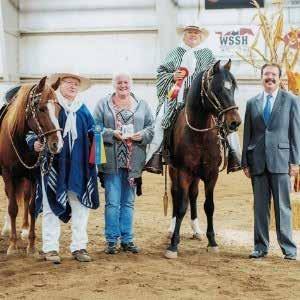
to collaboration, education, and the advancement of horse welfare. We are honored to award a $5,000 grant in Keith’s name to the Kentucky Equine Adoption Center based in Lexington, Kentucky.”
In accepting the award, Dane said, “I am extremely grateful and honored to receive this prestigious award recognizing my contributions to the improvement of horse welfare in the U.S. The progress and achievements in which I have been involved could not have been possi-
ble without the support and collaboration of my colleagues at Humane World for Animals, fellow organizations in the animal protection movement and the many individual equine advocates in the fight to end horse soring, slaughter and to increase protections for race horses.”
Dane continued, “Since I was a young teen I’ve experienced the joy of riding - on the trail and in the show ring. I’ve had the joy of breeding and raising foals and readying them for competition. I’ve loved
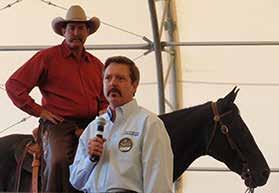
judging and rewarding thousands of naturally talented horses in the gaited horse world.”
“But perhaps my greatest joy with horses has been in seeing the
changing attitudes about our roles and responsibilities with horses and the progress that is being made in stamping out the issues that detract from our sport’s reputation as a wholesome and humane partnership with our equine athletes. I urge us all to always put the horse first, everywhere - not just in raising, training and competition but in after care and end of life decisions.”
Currently, Dane resides in Hawaii and serves as a consultant for Humane World for Animals to focus on ending horse soring.
Registering purebred Walking Horses worldwide since 1982.
More than a Registry!
Come see us at CRTWH.ca or visit on facebook.com/crtwh Contact secretary@crtwh.ca

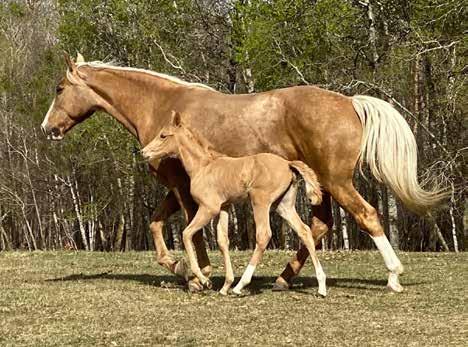
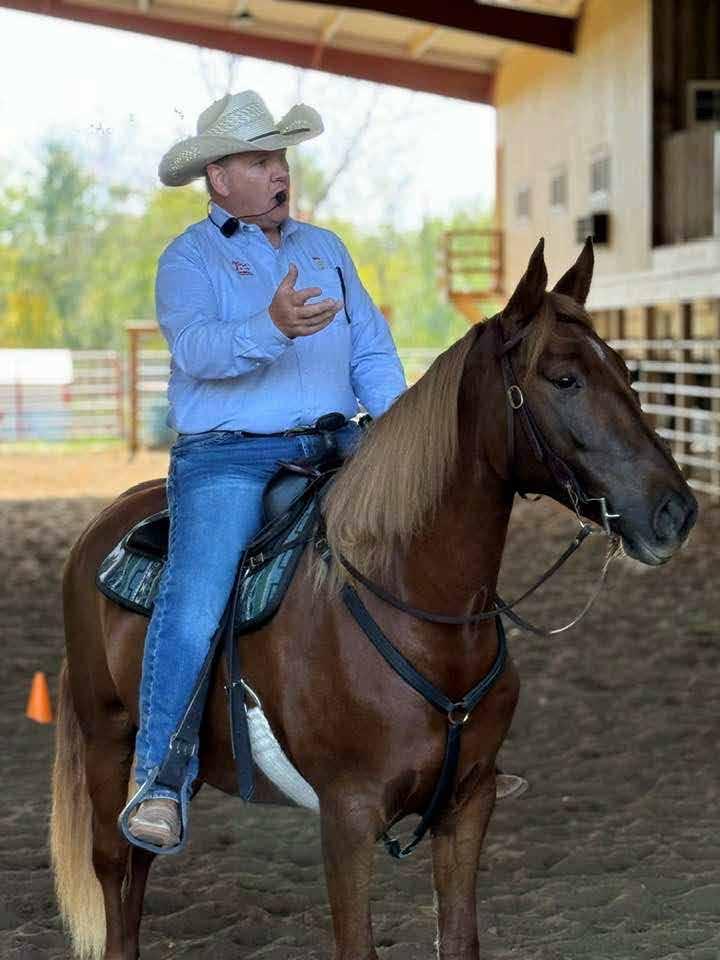
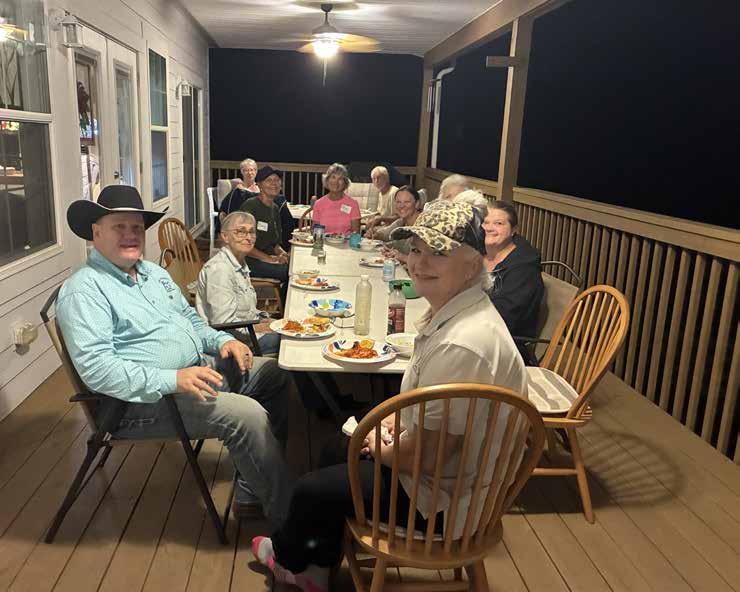
To date, we have hosted seven Carl Bledsoe Horsemanship Clinics at our ranch, Spotted Dance Ranch, in Brooksville, Florida. We greatly appreciate FOSH for sponsoring the March and December 2025 clinics; the funding has been used to improve the clinic experience for all participants, as well as to cover the extra costs associated with hosting a clinic.
It has been such a privilege and an honor to host these special clinics! The hard work involved with hosting the clinics has been offset by many benefits, some not expected. In addition to getting the opportunity to learn from and get to know Carl and Tammy Bledsoe, both truly special people who put horses first, some of the women who keep coming back clinic after clinic have become special friends. In fact, there is now a close-knit Spotted Dance Ranch Bledsoe Clinic family that has formed over the years and continues to grow larger each year.
At each clinic, a large amount of information is presented, and the human brain can only absorb so much (mine included!). The advantage of being a “Bledsoe Clinic regular” at Spotted Dance Ranch, or any other location where Carl Bledsoe Horsemanship Clinics are regularly held,
is to come away from each clinic with a few more new things in your horsemanship toolbox. In addition, no clinic is the same; new topics and exercises are presented at every clinic, or information presented previously may be packaged in a different way, as Carl and Tammy are constantly learning new information, as well as coming up with different ways to present information to increase its understanding.
It has been so amazing to watch the improvements of some of the participants who have attended multiple clinics with their horses. The changes made by these horse and rider teams are nothing short of spectacular. They have worked hard to learn the skills presented at each clinic and used the knowledge gained to do their homework in between clinics.
I would like to briefly share the stories of three Bledsoe Clinic regulars.
Debbie Shaw of Lady Lake, Florida and Orrington, Maine came to the fist clinic held at the ranch in December 2022 and has participated in five clinics to date, the last three with her Missouri Fox Trotter gelding, Jasper. Bany Cranmer started attending clinics at the ranch in December 2024 and has traveled from Jupiter, Florida to attend every clinic
since; she and her Spotted Saddle Horse gelding, Willy, have now participated in four clinics. Terrie Bass, from Callahan, Florida, is relatively new to the “family;” she and her Tennessee Walking Horse gelding, Goose, have attended the last three clinics beginning in March 2025.
Debbie has been wintering in Florida for the past five years. She is thrilled to have found like-minded
people and be part of the important community that we have been building. With each clinic, she has seen a huge difference in Jasper and how he moves and carries himself. She says it has been a challenge for him to go from being ridden by those not familiar with gaited horses to someone who actually wants him to gait properly and build up his body to be able to do so.
At the December 2025 clinic, Debbie says that Tammy commented that Jasper looked the best they have ever seen him, and she attributes that to trying to do everything that Carl has instructed. Debbie tries to remember everything that Carl tells her during every clinic, but it is not possible. She does the best she can and tries to remember the highlights. Each clinic she focuses hard on one skill, tries to perfect it, then the next clinic, focuses on something else.
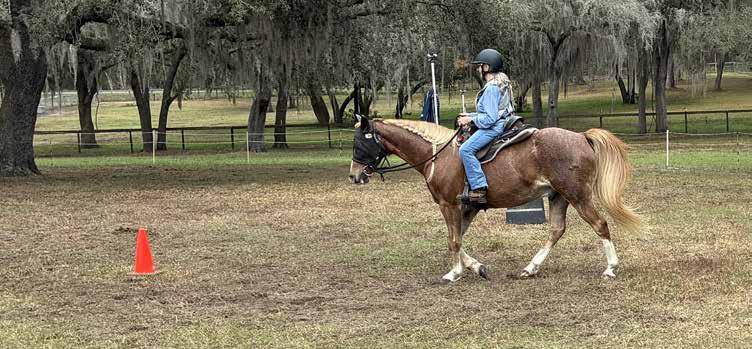
Bany and Willy have improved dramatically since their first clinic during the winter of 2024. Willy has gone from being a nervous, bracey, and pacey horse to being relaxed and calm; he has developed
self-carriage and has figured out how to use his hindquarters. One example of Willy’s improvement was during a recent trail ride with some non-gaited horses who were moving along at a slow walk. Willy typically prefers to follow; however, on this particular trail ride, he passed the other horses and power walked for about 15 minutes, causing the rest of the group to trot to catch up. Bany was grinning ear to ear!!
Bany’s hard work during and in between clinics is paying off; Willy is not the same horse!
When Terrie first got Goose, he was chaotic, in pain from misusing his body for so many years, underweight, and super pushy on the ground. He was trying to communicate, and Terrie didn’t understand what he was saying. Over the three clinics that Terrie has attended so far, and by consistently applying what she learned at home in between clinics, the transformation has been immeasurable. Goose is now kind, willing, and soft on the ground and under saddle; he knows Terrie is trying to give him a voice. He’s using his hind end, he’s listening to Terrie, building a topline, and learning how to use his body in a way that keeps him comfortable instead of in pain.
The change has not been just physical for this team; it has been emotional since Carl taught Terrie how to listen. The clinics have helped Terrie tune out the noise, such as the internet opinions, outside chat-
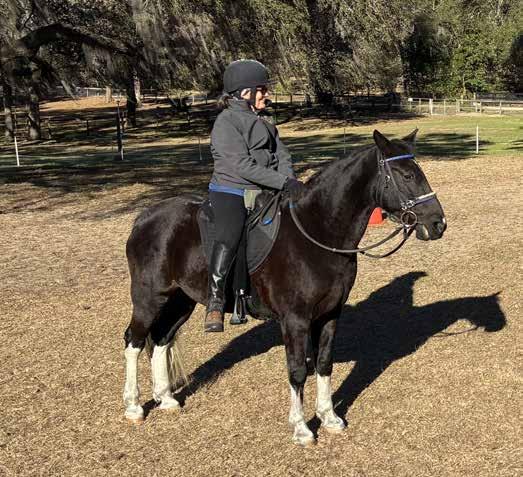
Debbie Shaw of Lady Lake, Florida and Orrington, Maine has participated in five clinics; the last three with her Missouri Fox Trotter gelding, Jasper. They have made great improvements as a team.
ter, and outdated advice. Terrie greatly values the truth and honesty that Carl and Tammy bring to the clinics; she realizes she was part of the problem and needed to learn, too. Terrie says that the Bledsoes are truly about the horse; they are willing to set the rider’s agenda aside to get to the root of the issue and build from there, the right way.
When Terry was younger, she was taught “old-style” methods that she would never use today. Carl’s past and the way he walked away from it is what first attracted Terrie to attending a Carl Bledsoe Horsemanship Clinic. Growth means doing better when you know better, and Terrie is committed to always putting her animals first. Terrie is truly a lifelong client and will continue coming back to learn more, for her and for her horses. Terrie is so pleased with Goose’s progress! She gets constant compliments from people who see him now and saw
him when she first got him; they can’t believe he is the same horse!
The dramatic improvements seen in these three horse and rider teams who have attended multiple Carl Bledsoe Horsemanship Clinics are typical of the transformations that occur during every clinic. You are really missing out on something special.
If you have not yet attended a Carl Bledsoe Horsemanship Clinic! We can’t wait to host the eighth Carl Bledsoe Horsemanship Clinic at our ranch December 4-6.
Contact Tammy Bledsoe to sign up for the clinic (carlbledsoehorsemanship@gmail.com, 770-403-4635).
Call or email Kym Rouse Holzwart at Spotted Dance Ranch (kymrouse@ att.net, 813-482-4028) for accommodations during the clinic for you and your horse.
Traveling from Jupiter, Florida, Bany Cranmer started attending clinics at the ranch in December 2024. She and her Spotted Saddle Horse gelding, Willy, have now participated in four clinics and have made amazing improvements!
Terrie Bass, from Callahan, Florida, and her Tennessee Walking Horse gelding, Goose, have attended the last three clinics beginning in March 2025. The improvements this team has made have been nothing short of spectacular!
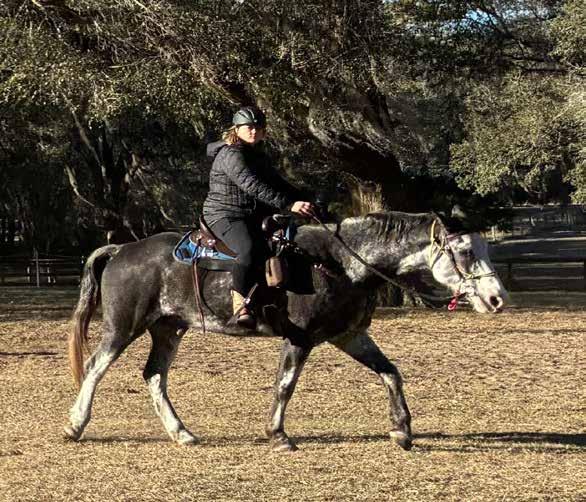

After a long winter of hay feeding, spring grass can feel like a gift for both horses and horse owners. Pastures green up, horses eagerly graze, and turnout becomes easier and more enjoyable. But spring pasture also brings nutritional changes that can create health risks if horses are turned out too quickly.
Understanding how spring grass behaves and how horses should transition to it can help prevent problems.
Young, rapidly growing grass contains high levels of non-structural carbohydrates (NSCs), often referred to as sugars and starches. These carbohydrates provide energy for plant growth, but they can also increase the risk of digestive upset and metabolic issues in horses.
The sugar content of grass is not constant. It changes throughout the day and depends on the weather.
In general, pasture sugars tend to be highest in the late afternoon and early evening, especially on sunny days when plants are actively producing sugars through photosynthesis. Levels are typically lowest in the early morning, because plants use stored sugars overnight for growth. Weather also matters. Cool, sunny
days followed by cold nights often produce high sugar levels because the plant continues to make sugars during the day but cannot use them efficiently for growth overnight.
These conditions commonly occur in early spring, making pasture management especially important for horses prone to metabolic disorders or laminitis.
If horses have been off pasture all winter, suddenly turning them out on lush spring grass can overwhelm the digestive system. The microbial population in the hindgut adapts to the horse’s diet, and sudden dietary changes can disrupt this balance.
A gradual transition allows the horse’s gut microbes to adjust.
Begin with short turnout periods, increasing time slowly. For example:
Days 1–3: 15–20 minutes of grazing
Days 4–7: 30 minutes
Week 2: 45–60 minutes
Week 3: 1–2 hours
Each situation is different, but the key is slow, steady increases rather than sudden exposure.
Providing hay before turnout can also help. A horse not overly hungry will usually graze less aggressively.
by Stephanie J. Ruff
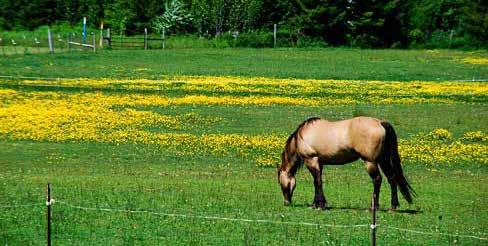
Some horses require stricter pasture management during spring flush, including:
• Easy keepers
• Horses with insulin resistance (IR) or equine metabolic syndrome (EMS)
• Horses with a history of laminitis
• Certain pony breeds and gaited breeds that gain weight easily
For these animals, tools such as grazing muzzles, limited turnout, or dry lots may be necessary during high-risk periods.
Pasture sugar levels fluctuate daily. Paying attention to weather patterns help guide turnout decisions. Pas-
ture sugars tend to be higher when:
• Days are bright and sunny
• Nights are cold (below 40°F/4°C)
• Grass is short or stressed When nights remain warm and grass is growing rapidly, plants tend to use more of the sugars they produce, which can reduce overall levels.
Spring grass is one of the pleasures of horse ownership, but it is also a seasonal change that deserves respect. By introducing pasture gradually and paying attention to conditions that influence grass sugars, horse owners can help their horses enjoy the spring flush safely.
A careful transition now can help prevent metabolic problems later.
Does your horse have a tense jaw? Is it hard to get him to go forward? Is he unwilling to stretch forward and down? Does he chomp on the bit, pull his tongue back or otherwise fuss with his mouth? The answer may not be where you think! Horses often mirror the rider’s behavior and movements. If you are having a problem getting your horse to softly accept the bit it is time to examine what you are doing with your jaw and mouth.
Next time you ride notice your jaw. Do you clench your teeth? Do you hold one side tighter than the other? Do you pull your jaw back and up in order to “sit up straight”? Do you tuck your chin or brace it forward especially when asking for transitions?
What happens with the jaw is intimately connected with the ability for the horse to go forward. If the jaw is not able to move forward and down the horse will be tight in the back and not working properly through the topline. To feel how this works do the following exercise:
By Wendy Murdoch
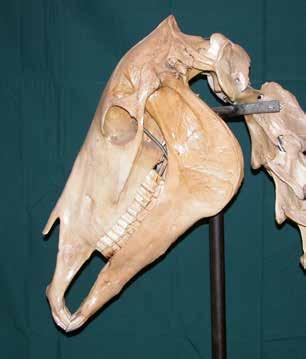
Lift your chin to the ceiling. Feel how your lower jaw slides back toward your throat. Now clench your teeth firmly enough that the jaw stays back. Lower your chin and feel what happens in your neck and lower back. What part of your spine is most involved when you lower your chin? Notice that your lower back tightens and you lower your head from your neck but the rest of your back remains stiff.
With your head lowered let your jaw move forward and down. What changes in your back? How much easier is it to round your spine? What parts of your back become available when you chin goes forward? Keep the jaw forward and raise your chin to the ceiling. What happens in your neck and chest? Feel how your sternum stays down instead of rising as you look up. Let the jaw drop back. How does this influence your ability to look up?
The jaw needs to be able to move forward and back as you look down and up in order distribute the movement throughout your spine. When we ride we want the horse to move forward allowing the push from his hind legs to travel through his back to his head. If the jaw is retracted back and up he will not be able to move forward into the contact correctly. The jaw and chin needs to move forward/down in all neck positions. In a stretchy circle on a long rein the neck is lowered and nose moves out and down. On contact in a more collected frame the jaw still needs to move forward/down, which opens the space between the jaw and the first cervical vertebra.
To find out if you horse can open this angle cradle your horse’s chin in your hand while standing in front and slightly to the side (so that he doesn’t accidently hit you with his head). Draw his chin forward slightly. Does he pull his jaw back and up when you do this? If so make a smaller and slower movement. See
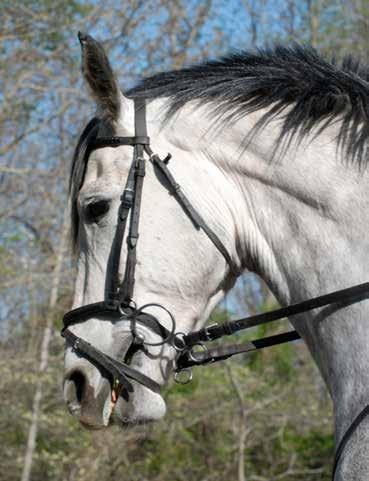
if you can “invite” him to let the jaw move forward as you lower his head down. If this is difficult it could explain why you have difficulty getting him to take the contact, move freely forward and stretch down to the bit. This may also indicate teeth problems. Make sure you have his teeth checked by an equine dentist regularly.
Observe what you do with your jaw when you drive your car, work at the computer or sit on your horse. Find out how often you tense your jaw or pull it back. Put a sticky note on your computer to remind you to let your jaw soften. Practice sliding the lower jaw softly forward and
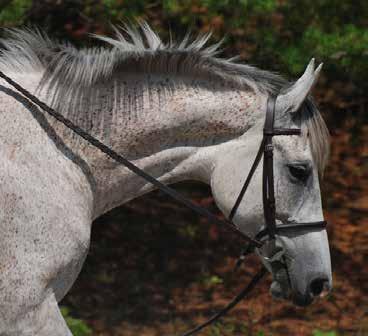
The horse is seeking the contact and taking the bit to the ground. Observe the space between the jaw and the throat and how the nose is going forward down.
back with your teeth slightly parted and your lips together. Slide the jaw side to side. Which way is easier? Think of making flat circles (parallel to the ground) with your lower jaw as if it was a plate sliding around below your upper jaw. Feel how this softens the mouth. As you ride notice what happens to your horse’s jaw.
Use this Murdoch Minute to soften your jaw as you ride and allow your horse to go forward. Allow your jaw to move slightly forward to invite your horse to stretch forward/down and always remember to enjoy the ride!
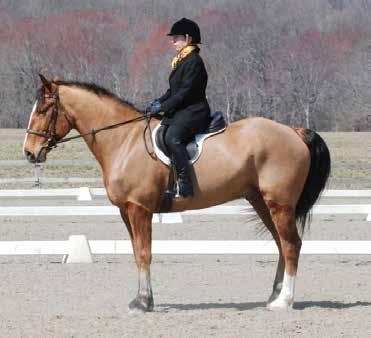
On contact with shorter rein in a training level frame the horse’s jaw angle is still open and the nose is in front of the vertical.
Edited press release
Your horse’s vaccination plan shouldn’t be built on what you did last year. Risk isn’t static and neither is your horse’s life.
New horses arrive at barns. Old ones move on. Show schedules change. Boarding arrangements shift. Even climate patterns influence disease risk. Vaccination decisions made in isolation, or out of habit, can quickly become outdated.
A thoughtful vaccination program recognizes that risk evolves and staying current means regular reassessment.
Learn how to build a vaccination plan that adapts to your horse’s lifestyle during Equine Guelph’s March Vaccination Education Month with the FREE Vaccination Equi-planner (TheHorsePortal.ca/VaccinationTool), and sign up for Equine Guelph’s on-demand Sickness Prevention in Horses online course—both kindly sponsored by Zoetis.
This innovative tool provides a starting point to discuss a comprehensive vaccination schedule with your veterinarian that will be tailored to each horse’s unique needs, aiming for optimal health and performance.
Vaccination Protects More than One Horse
Vaccination is both an individual and a community decision.
While vaccines help protect your horse from serious disease, they also reduce the spread of infectious agents within barns, lessons programs, boarding facilities, and show grounds. One under-vaccinated horse can unknowingly raise risk for many others—especially youngsters, seniors, or immune-compromised horses.
Vaccinating isn’t just about compliance; it’s about collective responsibility within the equine community. Vaccinations can let owners rest easy that their horses are safe while providing social interaction with other horses.
Discover how informed vaccination choices can support herd health using Equine Guelph’s Vaccination Equi-planner.
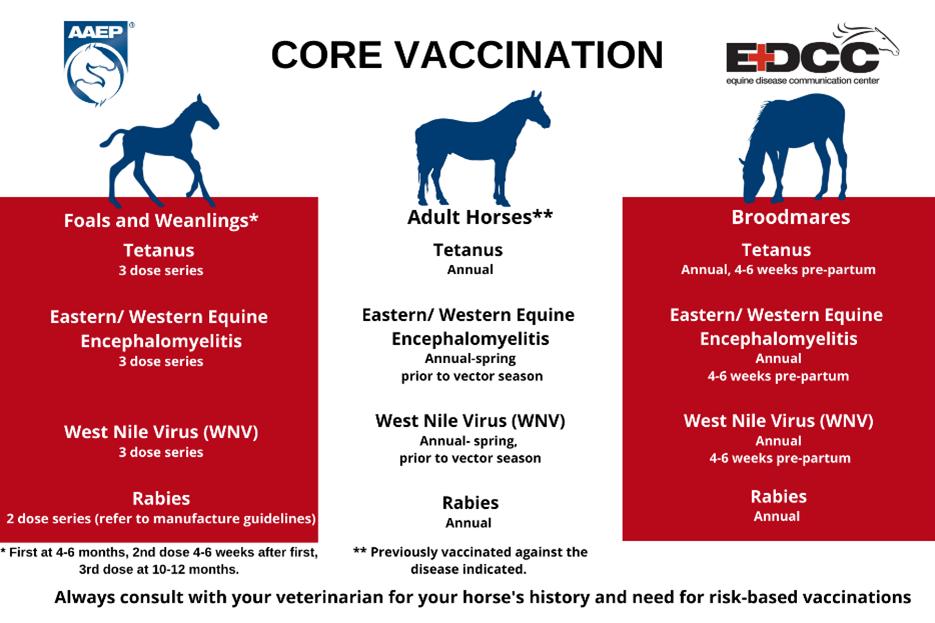
Core vaccines are essential, but they’re only the starting point.
Geography, travel, discipline, frequency of horse-to-horse contact, and local disease trends all influence which additional vaccines may be appropriate. Two horses living in the same province might still need very different vaccination strategies.
The question isn’t “What does everyone else do?” It’s: “What does your horse need, right now?”
Lifestyle-based planning can guide smarter vaccination conversations with your veterinarian.
Informed Owners Make Better Healthcare Decisions
Vaccination shouldn’t feel confusing or like something you blindly check off once a year.
When owners understand why certain vaccines are recommended, when boosters are needed, and how
lifestyle affects risk, they’re better equipped to have meaningful conversations with their vet and to advocate for their horse’s health.
Good vaccination decisions start with good education.
“Understanding the risks your horses face is essential to making informed decisions,” says Tamara Quaschnick, DVM, Veterinary Services Manager, Zoetis. “When one considers the serious implications of preventable viral diseases like West Nile, sleeping sickness, and rabies, deciding to vaccinate your horse against them is one of the easiest
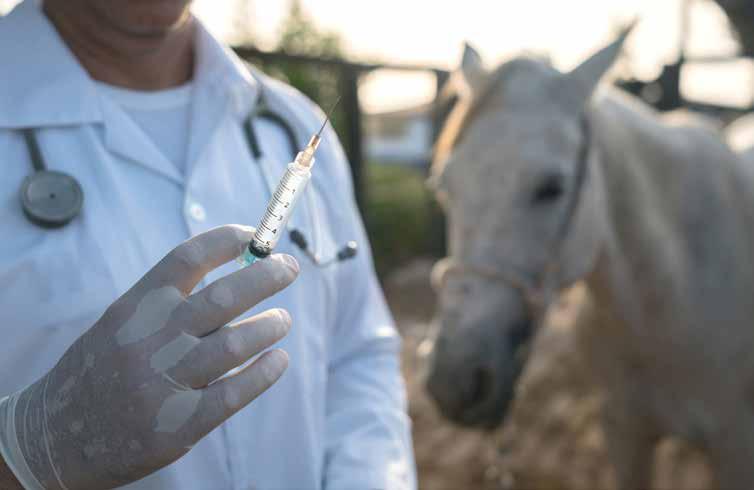
decisions you can make as a horse owner! Vaccination against core diseases can not only save your horse’s life, but it can save them from suffering through horrible disease complexes, and save you from the burden of intensive medical care costs. Working with your veterinary care team to incorporate coverage against core and risk-based diseases is a critical part of maintaining your horse’s wellness.”
Vaccinations should not be thought of as a luxury, or cost-cutting measure. Instead, they should be considered a baseline/non-negotiable
when thinking about the welfare of the horse that can save thousands of dollars, reduce down time and protect good health.
Explore Equine Guelph’s Vaccination Equi-Planner—developed to support informed, evidence-based decision-making.
Then, make sure you are doing everything to optimize your infection control strategies, sign up for the on demand, Sickness Prevention in Horses online course on TheHorsePortal.ca
FOSH Lifetime Members
Jo Anne Behling, Wauwatosa, WI
Esther L. Bell, TN
Pamela Brand, Carlisle, PA
Sarah Bushong-Weeks, Denver. CO
Julie Church, Pagosa Springs, CO
Mary & William Church, Pagosa Springs, CO
Luella DeBono, Eden Prairie, MN
Beverly Foster, St. Augustine, FL
Nancy Gillespie, Pullman, WA
Cristine Holt, Dubuque, IA
Jane Howlett, Pocatello, ID
Marjorie Lacy & Walking Horse News, Edson, Alberta
Sue De Laurentis, Dripping Springs, TX
Bobbie Jo Lieberman, Chicago, IL
Dianne Little, Calgary, Alberta
Debbie Locke, Mack, CO
Ann Loveless, Ashtabula, OH
Patricia Mayer, East Aurora, NY
Janelle T. McCoy, Prague, OK
Frank Neal, Nashville, TN
Lori Northrup, Ellicottville, NY
Anne Northrup, Ellicottville, NY
Shellie Pacovsky, Bainville, MT
Denise Parsons
Anita Rau, Catlett, VA
Debbie Rash, Chino, CA
Southern Comfort Gaited Horse Club, ID
Bucky & Nancy Sparks, Cortez, CO
Marcy Wadington, Canon City, CO
Leslie Weiler, Pagosa Springs, CO
Laura Wyant, Chesire, OR
An Anonymous Donor
Yankee Walkers of New England
“Without the chains, there would be no need for a scar rule.”
“Without the chains, there would be no need for a scar rule.”
– humane acTivisT,
may 2011.
– humane acTivisT, may, 2011.
ho W t o d ete ct
ho W t o d ete ct
d a ta s h eet
• Palpation
• Palpation
“That
W h at i s s oring ?
W h at i s s oring ?
Soring is deliberately inducing pain to exaggerate a gaited horse’s movement for the show ring. A variety of devious and cruel methods have been devised over the years. Soring violations also include many methods used to avoid detection. Soring is against Federal law and is subject to fines and penalties if detected at a public show or sale.
Soring is deliberately inducing pain to exaggerate a gaited horse’s movement for the show ring. A variety of devious and cruel methods have been devised over the years. Soring violations also include many methods used to avoid detection. Soring is against Federal law and is subject to fines and penalties if detected at a public show or sale.
Chemical soring is the application of painful, caustic liquids to tenderize the horse’s pastern area (ankle), so the repeated strike of a chain is painful and causes the horse to snatch his foot higher with each step. The chain, a crucial part of this show horse style, is termed an “action device,” and the exaggerated gaits cannot be created without this chain.
ho W i t ’ s d one
ho W i t ’ s d one
Observations:
Observations:
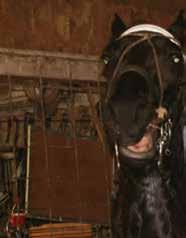
• Horse lies down in stall and groans in pain.
• Horse lies down in stall and groans in pain.
• Horse is crampy and unwilling to move.
• Horse is crampy and unwilling to move.
“That just looks wrong.”
Chemical soring is the application of painful, caustic liquids to tenderize the horse’s pastern area (ankle), so the repeated strike of a chain is painful and causes the horse to snatch his foot higher with each step. The chain, a crucial part of this show horse style, is termed an “action device,” and the exaggerated gaits cannot be created without this chain.
• Gas chromotography or “sniffer”
• Gas chromotography or “sniffer”
• Thermography
• Thermography
10-year-olD boy while waTching viDeo of a “big lick” horse shown in sTacks anD chains, June 10, 2011.
• Blood or saliva tests
just looks wrong.” 10-year-olD boy while waTching viDeo of a “big lick” horse shown in sTacks anD chains June 10, 2011.
• Blood or saliva tests
• Drug-detection trained dog
• Drug-detection trained dog
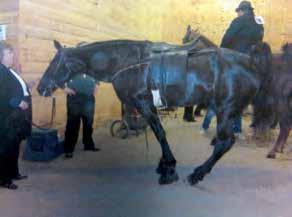
• Horse warms up into motion with a “praying mantis stance,” with abnormal weight thrown on his hind quarters to avoid front end pain.
• Horse warms up into motion with a “praying mantis stance,” with abnormal weight thrown on his hind quarters to avoid front end pain.
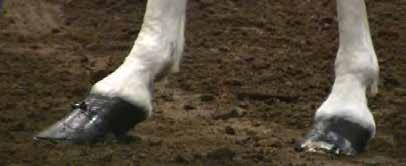
• Horse stands in classic “standing in a bucket” pose to alleviate pain in front legs (photo above).
• Horse stands in classic “standing in a bucket” pose to alleviate pain in front legs (photo above).
• kerosene
• kerosene
• diesel
• diesel
• croton oil
• croton oil
• GoJo hand cleaner
• GoJo hand cleaner
• WD40 oil
• WD40 oil
• mustard oil
• mustard oil
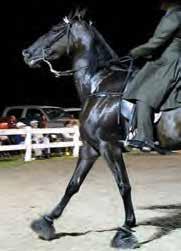
Soring includes the abuse of chains, foreign substances and chemicals, illegal shoeing to change the natural hoof angles, length of toe, weighted shoes, pressure shoeing, as well as the insertion of blocks and other devices between the hoof and the shoe stack to place pressure on the frog and sole of the foot to create pain in the front end of the horse. These methods all cause the horse to attempt to avoid the pain by picking up his front feet faster and higher, and shifting his weight back onto his hocks. Slang for an obviously sore-going horse is “going too deep.”
Soring includes the abuse of chains, foreign substances and chemicals, illegal shoeing to change the natural hoof angles, length of toe, weighted shoes, pressure shoeing, as well as the insertion of blocks and other devices between the hoof and the shoe stack to place pressure on the frog and sole of the foot to create pain in the front end of the horse. These methods all cause the horse to attempt to avoid the pain by picking up his front feet faster and higher, and shifting his weight back onto his hocks. Slang for an obviously sore-going horse is “going too deep.”
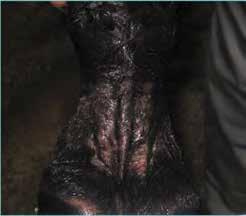
With the increased scrutiny of soring-related scars, another cruel practice is used to remove the telltale scarring. The horse’s legs are covered in a chemical stripping agent, which burns off old scar tissue through a very painful process.
Wh Y is t h is a b use d o ne?
• Visual inspections for:
Wh Y is t h is a b use d o ne?
• Visual inspections for:
Soring is practiced to get gaited horses to artificially enhance their step to win in shows. A winning image is rewarded with ribbons, cash, recognition, future breedings and training fees.
Soring is practiced to get gaited horses to artificially enhance their step to win in shows. A winning image is rewarded with ribbons, cash, recognition, future breedings and training fees.
en F o
– scarring and inflammation, signs of soring insults.
– scarring and inflammation, signs of soring insults.
– wavy, rippled, curly hair on the front legs, an indicator of repeated chemical soring with leg wraps.
– wavy, rippled, curly hair on the front legs, an indicator of repeated chemical soring with leg wraps.
en F o rcement
t o e nd s oring
t o e nd s oring
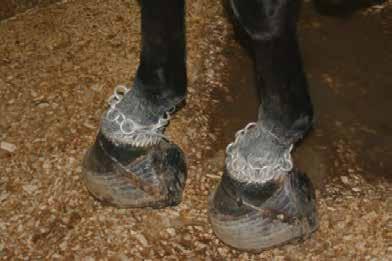
Chemicals are applied to the horse’s lower legs, then the leg is wrapped in plastic for days. This causes the chemicals to “cook” into the flesh. This creates highly sensitized front pasterns that are painful when the chain strikes with every step. Examples of soring chemicals used:
Chemicals are applied to the horse’s lower legs, then the leg is wrapped in plastic for days. This causes the chemicals to “cook” into the flesh. This creates highly sensitized front pasterns that are painful when the chain strikes with every step. Examples of soring chemicals used:
There is a federal law called the Horse Protection Act, which prohibits soring at shows and sales, enforced by the USDA. However, most inspections are selfregulated by HIOs (horse industry organizations licensed by the USDA.)
With the increased scrutiny of soring-related scars, another cruel practice is used to remove the telltale scarring. The horse’s legs are covered in a chemical stripping agent, which burns off old scar tissue through a very painful process.
There is a federal law called the Horse Protection Act, which prohibits soring at shows and sales, enforced by the USDA. However, most inspections are selfregulated by HIOs (horse industry organizations licensed by the USDA.) d a
“The
– cording, a type of scarring caused by the plastic wrap sliding down and tightly bunching around the pasterns.
– cording, a type of scarring caused by the plastic wrap sliding down and tightly bunching around the pasterns.
– checking for application of foreign substances, by walking the barns and trailers at a show.
– checking for application of foreign substances, by walking the barns and trailers at a show.
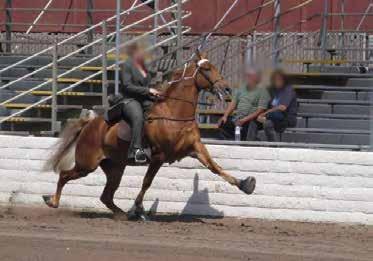
Pressure soring causes pain in a horse’s front feet, so when each front hoof hits the ground, the horse will “snatch” the foot off the ground, resulting in an unnatural, high, dramatic step.
Pressure soring causes pain in a horse’s front feet, so when each front hoof hits the ground, the horse will “snatch” the foot off the ground, resulting in an unnatural, high, dramatic step.
ho W i t ’ s d one
ho W i t ’ s d one
• Grinding the hoof sole down so thin “beads of blood show” and the sole gets spongy and super-sensitive.
• Grinding the hoof sole down so thin “beads of blood show” and the sole gets spongy and super-sensitive.
• Taking the hoof wall down slightly shorter than the sole, so it provides no supporting protection, called “rolling the sole.”
• Taking the hoof wall down slightly shorter than the sole, so it provides no supporting protection, called “rolling the sole.”
• Inser ting hard objects between the shoe or pad and the tender sole, such as bolts (removable for inspections), half a golf ball, hardened epoxy, or a dried piece of hoof.
• Inser ting hard objects between the shoe or pad and the tender sole, such as bolts (removable for inspections), half a golf ball, hardened epoxy, or a dried piece of hoof.
• Response to hoof testers (ideal if shoes are pulled first).
• Response to hoof testers (ideal if shoes are pulled first).
• Digital radiography (x-ray will show extreme thinness of sole, any foreign objects, or excessive coffin bone rotation).
• Digital radiography (x-ray will show extreme thinness of sole, any foreign objects, or excessive coffin bone rotation).
• Thermography to detect hot spots from pain.
• Thermography to detect hot spots from pain.
• numbing agents that wear off between inspection and show time (such as injected anesthetic, “the shot,” or surface application of Lidocaine).
• numbing agents that wear off between inspection and show time (such as injected anesthetic, “the shot,” or surface application of Lidocaine).
• “stewarding”: teaching the horse at practice inspections that flinching or reacting will cause worse pain, such as a beating or using a “hot stick” or electric prod.
• “stewarding”: teaching the horse at practice inspections that flinching or reacting will cause worse pain, such as a beating or using a “hot stick” or electric prod.
topical samples from Tennessee Walking Horses had the highest incidences of positives (of illegal substances from gas chromatography samplings)
that I’ve ever seen in my life.”
“The topical samples from Tennessee Walking Horses had the highest incidences of positives (of illegal substances from gas chromatography samplings) that I’ve ever seen in my life.”
— Dr Tomas Tobin leaDing veTerinarian in Drug conTrol anD Toxicology in compeTiTion horses, november 5, 2010 www.thomastobin.com
— Dr. Tomas Tobin, leaDing veTerinarian in Drug conTrol anD Toxicology in compeTiTion horses november 5, 2010 www.thomastobin.com
Fixing … Touching … “putting them in a bucket” … Soap ‘em … Fly spray (a term owners use so they can avoid admitting knowing that an illegal substance has been used on their horse) … getting them right … brushing them … square ‘em up … head shake in a bottle … dropping them … Mojo (commonly used by people referring to GoJo hand cleaner) …
Fixing … Touching … “putting them in a bucket” … Soap ‘em … Fly spray (a term owners use so they can avoid admitting knowing that an illegal substance has been used on their horse) … getting them right … brushing them … square ‘em up … head shake in a bottle … dropping them … Mojo (commonly used by people referring to GoJo hand cleaner) …
• “Blocking,” which is standing the horse for hours on wedges duct-taped to the hoof.
• “Blocking,” which is standing the horse for hours on wedges duct-taped to the hoof.
• Purposely foundering a young horse (called “the natural fix” and “nature’s way of soring”).
• Purposely foundering a young horse (called “the natural fix” and “nature’s way of soring”).
• “Road foundering” the horse by riding fast on a hard surface such as a paved road.
• “Road foundering” the horse by riding fast on a hard surface such as a paved road.
• Extreme tightening of metal hoof bands to cause pain from excessive pressure on the hoof.
• Extreme tightening of metal hoof bands to cause pain from excessive pressure on the hoof.
• distraction devices: a nerve gum cord, bit burr under the saddle, hand twitch, alligator clips on sensitive genital tissue, or surgical staples under the mane, applied just before an inspection to cause distracting pain elsewhere during the inspection.
• distraction devices: a nerve gum cord, bit burr under the saddle, hand twitch, alligator clips on sensitive genital tissue, or surgical staples under the mane, applied just before an inspection to cause distracting pain elsewhere during the inspection.
• horse switching: providing a substitute horse for inspection under false paperwork, and then switching and putting the sored horse into the show ring.
• horse switching: providing a substitute horse for inspection under false paperwork, and then switching and putting the sored horse into the show ring.
fixing … pressure soring … “putting the fever in the foot” … pressure shoeing … “pinching the toes” … bolting … blocking … “under pressure” … “in a bind” … quicked … hot nailed … “tightened up” (for bands) … cranking …
“fixing below the pastern” … going too deep … concussion foundering … “peak point” describes the maximum pain point in the weekly soring process …
fixing … pressure soring … “putting the fever in the foot” … pressure shoeing … “pinching the toes” … bolting … blocking … “under pressure” … “in a bind” … quicked … hot nailed … “tightened up” (for bands) … cranking … “fixing below the pastern” … going too deep … concussion foundering … “peak point” describes the maximum pain point in the weekly soring process …
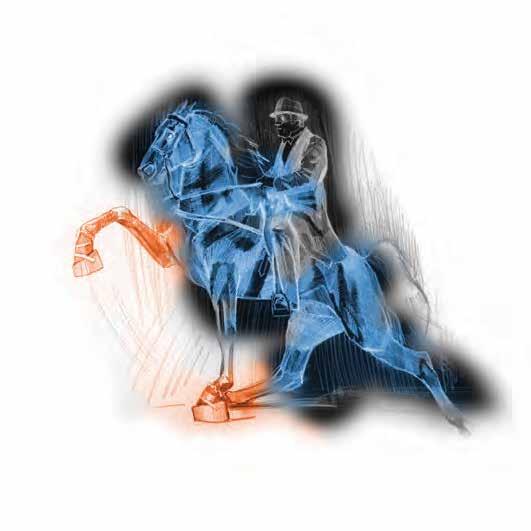
Chemical soring is the application of painful, caustic liquids to tenderize the horse’s pastern area (ankle), so the repeated strike of a chain is painful and causes the horse to snatch his foot higher with each step. The chain, a crucial part of this show horse style, is termed an “action device,” and the exaggerated gaits cannot be created without this chain.
ho W i t ’ s d one
Chemicals are applied to the horse’s lower legs, then the leg is wrapped in plastic for days. This causes the chemicals to “cook” into the flesh. This creates highly sensitized front pasterns that are painful when the chain strikes with every step. Examples of soring chemicals used:
• kerosene
• diesel
• croton oil
• GoJo hand cleaner
• WD40 oil
• mustard oil
With the increased scrutiny of soring-related scars, another cruel practice is used to remove the telltale scarring. The horse’s legs are covered in a chemical stripping agent, which burns off old scar tissue through a very painful process.
“Without the chains, there would be no need for a
–
scar rule.”
humane acTivisT, may 2011.
ho W t o d ete ct
• Palpation
• Gas chromotography or “sniffer”
• Thermography
• Blood or saliva tests
• Drug-detection trained dog
• Visual inspections for:
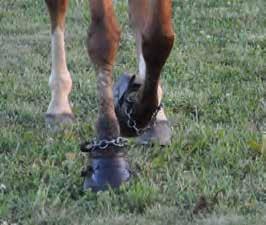
– scarring and inflammation, signs of soring insults.
– wavy, rippled, curly hair on the front legs, an indicator of repeated chemical soring with leg wraps.
– cording, a type of scarring caused by the plastic wrap sliding down and tightly bunching around the pasterns.
– checking for application of foreign substances, by walking the barns and trailers at a show.
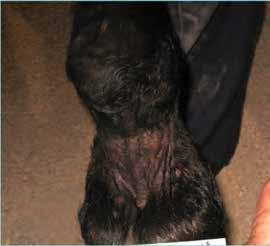
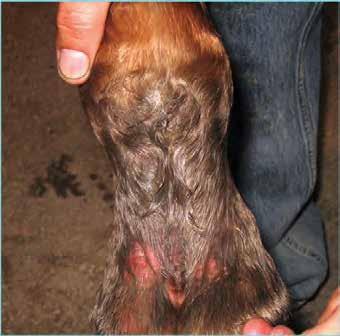
Fixing … Touching … “putting them in a bucket” … Soap ‘em … Fly spray (a term owners use so they can avoid admitting knowing that an illegal substance has been used on their horse) … getting them right … brushing them … square ‘em up … head shake in a bottle … dropping them … Mojo (commonly used by people referring to GoJo hand cleaner) …
Observations:
• Horse lies down in stall and groans in pain.
What W o uld have the biggest impact on eliminating soring?
What W o uld have the biggest impact on eliminating soring?
Pressure soring causes pain in a horse’s front feet, so when each front hoof hits the ground, the horse will “snatch” the foot off the ground, resulting in an unnatural, high, dramatic step.
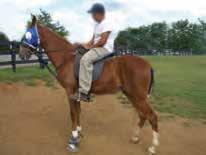
positions who has had soring violations within recent years.
• Horse is crampy and unwilling to move.
• Join FOSH or the HSUS.
positions who has had soring violations within recent years.
• Horse warms up into motion with a “praying mantis stance,” with abnormal weight thrown on his hind quarters to avoid front end pain.
• Volunteer for FOSH projects to end soring.
• Join FOSH or the HSUS.
• Volunteer for FOSH projects to end soring.
Voice Your Concerns
• Horse stands in classic “standing in a bucket” pose to alleviate pain in front legs (photo above).
3q More money allocated to the USDA’s enforcement. At present, USDA’s inspectors attend only 7% of the shows, due to budget constraints. Relying on “self-policing” with industry inspectors has not been effective over the past decades.
3q More money allocated to the USDA’s enforcement. At present, USDA’s inspectors attend only 7% of the shows, due to budget constraints. Relying on “self-policing” with industry inspectors has not been effective over the past decades.
ho W i t ’ s d one
• Tell your Congressmen that you demand full enforcement of the law and adequate HPA funding.
• Tell your Congressmen that you demand full enforcement of the law and adequate HPA funding.
• Response to hoof testers (ideal if shoes are pulled first).
• Inform traditional show venues and their sponsors that you will not suppor t them because these shows encourage soring.
• Inform traditional show venues and their sponsors that you will not suppor t them because these shows encourage soring.
• Digital radiography (x-ray will show extreme thinness of sole, any foreign objects, or excessive coffin bone rotation).
3q Severe penalties for those guilty of soring. Substantial fines and mandatory, serious suspension periods for trainers and owners, including lifetime bans and prison time, would deter soring.
• Grinding the hoof sole down so thin “beads of blood show” and the sole gets spongy and super-sensitive.
3q Severe penalties for those guilty of soring. Substantial fines and mandatory, serious suspension periods for trainers and owners, including lifetime bans and prison time, would deter soring.
• Demand t hat the USDA and the industry inspectors enforce the law effectively.
• Demand t hat the USDA and the industry inspectors enforce the law effectively.
• Thermography to detect hot spots from pain.
Report Soring to the USDA, HSUS, and FOSH:
• Document soring incidences observed at barns or shows with photos or video and submit personally or anonymously.
Report Soring to the USDA, HSUS, and FOSH:
3q Federal ban on “pads and action devices,” commonly termed “stacks and chains.”
3q Federal ban on “pads and action devices,” commonly termed “stacks and chains.”
W h at c an Y o u d o t o h elp e nd s oring ?
• Taking the hoof wall down slightly shorter than the sole, so it provides no supporting protection, called “rolling the sole.”
Learn More
W h at c an Y o u d o t o h elp e nd s oring ?
Learn More
• Inser ting hard objects between the shoe or pad and the tender sole, such as bolts (removable for inspections), half a golf ball, hardened epoxy, or a dried piece of hoof.
• Document soring incidences observed at barns or shows with photos or video and submit personally or anonymously.
• Report barns and trainers engaging in soring practices.
• Report scheduled “outlaw shows” organized without licensed HIO inspections.
• Report barns and trainers engaging in soring practices.
• numbing agents that wear off between inspection and show time (such as injected anesthetic, “the shot,” or surface application of Lidocaine).
• www.StopSoring.com for latest news and facts on soring
• www.SoundHorseConference.com for presentation lectures on soring
• www.StopSoring.com for latest news and facts on soring
• www.SoundHorseConference.com for presentation lectures on soring
• United States Department of Agriculture (USDA) on Horse Protection www.aphis.usda.gov/animal_welfare/hp
• “Blocking,” which is standing the horse for hours on wedges duct-taped to the hoof.
Friends of Sound Horses, Inc. (FOSH)
• Report scheduled “outlaw shows” organized without licensed HIO inspections.
Lori Northrup, President 6614 Clayton Road #105, St. Louis, MO 63117 716-474-7580 • Lori@Northrup.com
Friends of Sound Horses, Inc. (FOSH) Lori Northrup, President 6614 Clayton Road #105, St. Louis, MO 63117 716-474-7580 • Lori@Northrup.com
• “stewarding”: teaching the horse at practice inspections that flinching or reacting will cause worse pain, such as a beating or using a “hot stick” or electric prod.
The Humane Society of the United States (HSUS)
The Humane Society of the United States (HSUS)
• United States Department of Agriculture (USDA) on Horse Protection www.aphis.usda.gov/animal_welfare/hp
• Purposely foundering a young horse (called “the natural fix” and “nature’s way of soring”).
• Humane Society of the United States (HSUS) http://www.humanesociety.org/issues/tenn_ walking_horses
Get
• Humane Society of the United States (HSUS) http://www.humanesociety.org/issues/tenn_ walking_horses
• “Road foundering” the horse by riding fast on a hard surface such as a paved road.
Get Involved
• Extreme tightening of metal hoof bands to cause pain from excessive pressure on the hoof.
• distraction devices: a nerve gum cord, bit burr under the saddle, hand twitch, alligator clips on sensitive genital tissue, or surgical staples under the mane, applied just before an inspection to cause distracting pain elsewhere during the inspection.
• Run for a Board of Directors’ position with the Tennessee Walking Horse Breeders & Exhibitors Association (TWHBEA) and effect change from within.
• Run for a Board of Directors’ position with the Tennessee Walking Horse Breeders & Exhibitors Association (TWHBEA) and effect change from within.
Keith Dane, Director of Equine Protection 700 Professional Drive, Gaithersburg, MD 20879 301-258-3076 • kdane@hsus.org
Keith Dane, Director of Equine Protection 700 Professional Drive, Gaithersburg, MD 20879 301-258-3076 • kdane@hsus.org
United States Department of Agriculture, APHIS (USDA)
Dr. Rachel Cezar, Horse Protection Coordinator Dr. Chester Gipson, Deputy Administrator 4700 River Road, Suite 6D03, Riverdale, MD 20737 301-734-5784 • Rachel.Cezar@aphis.usda.gov
United States Department of Agriculture, APHIS (USDA)
• horse switching: providing a substitute horse for inspection under false paperwork, and then switching and putting the sored horse into the show ring.
• Propose changes to the TWHBEA bylaws that preclude anyone from holding leadership
• Propose changes to the TWHBEA bylaws that preclude anyone from holding leadership
Dr. Rachel Cezar, Horse Protection Coordinator
Dr. Chester Gipson, Deputy Administrator 4700 River Road, Suite 6D03, Riverdale, MD 20737 301-734-5784 • Rachel.Cezar@aphis.usda.gov
“Call it what it is. This is torture.” — inTernaTionally-renown clinician february 2011
fixing … pressure soring … “putting the fever in the foot” … pressure shoeing … “pinching the toes” … bolting … blocking … “under pressure” … “in a bind” … quicked … hot nailed … “tightened up” (for bands) … cranking … “fixing below the pastern” … going too deep … concussion foundering … “peak point” describes the maximum pain point in the weekly soring process …
Principle #1
All FOSH events adhere to the requirements of the Horse Protection Act.
Principle #2
Horses are to be treated with dignity, respect, and compassion.
Principle #3
Horses must be presented as sound in both body and mind.
Principle #4
The preferred way of going is natural, correct, and without exaggeration.
Principle #5
Shoeing is intended only for the protection of the foot and its structure. Where practical, barefoot horses are both welcomed and encouraged.
Principle #6
Handlers and riders are expected to use training techniques and equipment that conform to the highest humane standards as recognized by the general equestrian community.
Principle #7
Exhibitors have a duty to conduct themselves in an orderly, responsible, and sportsmanlike manner.
FOSH is a national leader in the promotion of natural, sound gaited horses and in the fight against abuse and soring of Tennessee Walking Horses. For more information about FOSH or to become a member, please visit www. fosh.info.
FOSH Directory
Southern Comfort Gaited Horse Club
Southern Comfort promotes activities highlighting the smooth ride and versatility of all gaited breeds. Pursuits include trail riding, competitions, shows, exhibitions, clinics and many other equine activities. The club promotes horse safety and friendship for all that are interested in horses. Owning a horse is not a requirement. SCGHC is based in southwestern Idaho and is a flat shod exclusive club with members contributing and supporting various interests using sound, natural horses. www.gaitedhorseclub.com
Chesapeake Plantation Walking Horse Club
The Chesapeake Club is celebrating over 25 years of promoting the versatile, naturally gaited, horse. As a member of the Maryland Horse Council, we have been the voice of the gaited community and through demonstrations, clinics and guest speakers, a resource for other disciplines to learn about the gaited breeds in our region. Members enjoy monthly trail rides, newsletters, parades, clinics, social gatherings, and friendly help. We welcome all breeds, riding styles, and experience levels from beginners to professionals. Cpwhclub. wordpress.com or jacquiecowan@comcast.net
Summerwind Marchadors and Future Foal Breeders
Plan for your next lifetime partner! Come breed with us! Offering frozen semen (12 stallions in 2020) or reservations for Future Foals “do Summerwind” The Marchador is Brazil’s national horse, harking from Iberia, but bred there for 200 years. Expect to be impressed! http:// futurefoal.net or call Lynn @ 602-999-3915
Missouri Morgans
Easy gaited in color. Rare gaited Morgans located in the Heart of America near beautiful Lake of the Ozarks; for photos, videos and available horses. Talk to Jim or Vali Suddarth at 417-286-4720 or gaitedmorgans@missourimorgans.com
Please print or type information below
Name of Event:
Event Description: ______________ ____________ (show, clinic, expo, etc.)
Breeds Included: ____________________________________________________
Date(s) of Event:
Location of Event: ____________________________________________ (street)
__________________ (city) __________ (postal code) _____(state or province)
___________ (country)
Principal Contact Person: ______________________________(name)
Principal Contact Person Email: __________________________________
Principal Contact Person Phone: ______________________________
Name of Organization to RECEIVE Support Check: (check will be made out to…)
ADDRESS to where support check should be sent: ___ (street)
__________________ (city) ____________ (postal code) (state or province)
___________ (country)
If your event is approved, you should receive your support check within 30 days.
Please EMAIL this completed form to: president@fosh.info (faster) or mail to:
FOSH 6614 Clayton Rd., #105 St. Louis, MO 63117 For FOSH use only… Amount provided: _______________
Please print or type information below
Student Applying: _________________________________(name) Age: ____ (yrs)
Student Email:
Student Phone: _____________________________________________________
Student Address: ______________________________________________ (street)
____________________ (city) __________ (postal code) _____(state or province)
___________ (country)
School Name:
Major: _ ____________
Date of Last FOSH show participation *:
Attach copy of acceptance letter and note date on letter here:
School Address: ____________________________________ (street) _____ (city) __________ (postal code) _____(state or province)
___________ (country)
Note: Checks will be made out to [Institution Name] for the benefit of [Student Name] and will be sent to the attention of the Financial Aid department. If you are chosen to receive a scholarship, you will be notified within 90 days of applying
Please EMAIL this completed form to: president@fosh.info (faster) or mail to:
FOSH 6614 Clayton Rd., #105 St. Louis, MO 63117
For FOSH use only… Amount provided: _____________ Date sent: ____________
Scholarship Guidelines are on the following page (and do not need to be submitted with this form).
Please consider adding FOSH to your list of worthy causes in making a taxfree charitable deduction or help us to promote legislation, education, and training that protects and helps gaited horses, simply by renewing your own membership or giving a gift membership to a kindred spirit.
We know you have many choices when it comes to giving. Thank you for considering FOSH.
All annual memberships include a digital, bi-monthly issue of the Sound Advocate & educational packets. Mail to: FOSH 6614 Clayton Rd. #105, St. Louis, MO 63117
Type of Membership (check one)
Annual: Single ___$30 Annual Family ___$50 Annual Youth <18 ___$20 Lifetime__$600 Organization Membership (for your gaited horse club or association) ___ $50
Please print neatly.
Name: _______________________________________________________________________
Enclosed: $____________________
How did you hear about FOSH?