
Sound
A Champion for All Gaited Horses
Volume 6, Issue 4, 2023
Sound Advocate
Friends of Sound Horses, Inc.
6614 Clayton Rd. #105 St. Louis, MO 63117 info@fosh.info * www.fosh.info
Board of Directors
President - Teresa Bippen Missouri Tbippen1957@yahoo.com
Secretary/Treasurer-Gina Vehige Director at Large-Bill Coon VP IJA Program-Dianne Little Missouri Utah Alberta, Canada gvehige115@gmail.com wbotis@gmail.com ddlittle@telus.net
VP Programs/Gaited Sport Horse Director at Large-Anita Dunham VP HIO/DQP-Lisa Harris Dianne Little Missouri Tennessee Alberta, Canada dunhamanita@gmail.com ddlittle@telus.net
Executive Advisory Committee
Keith Dane Maggie MacAllister Hawaii Virginia breezewood@mgwnet.com
Patti Potts
Pauline Stotsenberg Missouri California pottspa@gmail.com ps@yesteryearfarms.net
Editor
Stephanie J. Ruff Florida editor@fosh.info
FOSH Mission Statement
To promote all “sound,” naturally gaited horses, with a specific emphasis on Tennessee Walking Horses. (In this context, sound means not “sored”.)
Importance is placed on education in regards to the humane care for the emotional, mental and physical wellbeing, training, and treatment of all gaited horses.
FOSH will only support flat shod or barefoot horses and will never endorse any event that uses stacks and/or chains as action devices, or any mechanical, chemical, or artificial means to modify the natural gaits of the horse.
To these ends, FOSH focuses on three areas for gaited horses:
1) educating people about sound horse training principles; 2) supporting sound shows, events and activities; 3) working to end soring.
FOSH is a 501(c) (3) non-profit organization. All donations are tax deductible to the extent permitted by law. Your donation to support the FOSH mission is needed to advance the goals set forth by FOSH in conjunction with its formal mission statement.
Publication Guidelines
The Sound Advocate is a digital magazine published quarterly by Friends of Sound Horses, Inc. Reproduction of any article is prohibited without the express written permission of FOSH.
FOSH accepts unsolicited submissions, but reserves the right to edit any and all submissions for content, style and space constraints. FOSH further reserves the right to refuse advertising for any reason.
At no time shall the publisher’s liability exceed the total cost of the revenue from advertising in the issue involved in any dispute.
All show suspensions and show results are printed as they are received from the reporting agencies. FOSH does not guarantee their accuracy.
FOSH does not endorse the content of any advertisement in this publication, nor does it warrant the accuracy of any advertisement.
Readers are urged and cautioned to use due diligence and to thoroughly research, including asking for references, before following through with any transaction.
FOSH does not endorse any trainer, educator, clinician, style of natural training, tack, or horse equipment to the exclusion or preference of any other. Each horse is an individual and may respond differently to particular methods.
Articles published by FOSH reflect the views and opinions of the writers and do not reflect, necessarily, those of FOSH.
Publication Information
Subscribers: The Sound Advocate is a benefit of membership. To ensure that you receive your issues, be sure that your e-mail address is current. To change an e-mail address, contact gvehige115@ gmail.com.
Submission of Articles, Calendar Dates, News and Photos: Send to tbippen1957@yahoo.com. Photos may not be embedded in text and must be submitted as jpeg format, minimum of 300 dpi. The deadline for each issue is the 15th of the preceding month when the issue is to be released. Submissions will not be accepted after the deadline, but may be carried over to another issue. Submissions will not be returned to the submitter.
Member’s Advertising Rates
Back Cover $300
Inside Front Cover $275
Inside Back Cover $275
Full page $125
Half page $75
Quarter page $60
Business Card $25
Directory $25
Discounts for Multiple Issues
2 issues - 10% off total fee
4 issues - 20% off total fee
6 issues - 30% off total fee
Ads will be accepted in pdf, tif or jpeg formats. Text and photos must be e-mailed separately by the 10th of the month when the issue is released. Photos must be 300 dpi. Camera-ready ads are emailed at 300 dpi. Materials should be emailed to editor@ fosh.info.
All advertisements must be paid in advance by check, money order, or credit card. Payments should be made out to FOSH and mailed to:
6614 Clayton Rd. #105 St. Louis, MO 63117
More FOSH information can be found online. Find us at www.fosh.info.
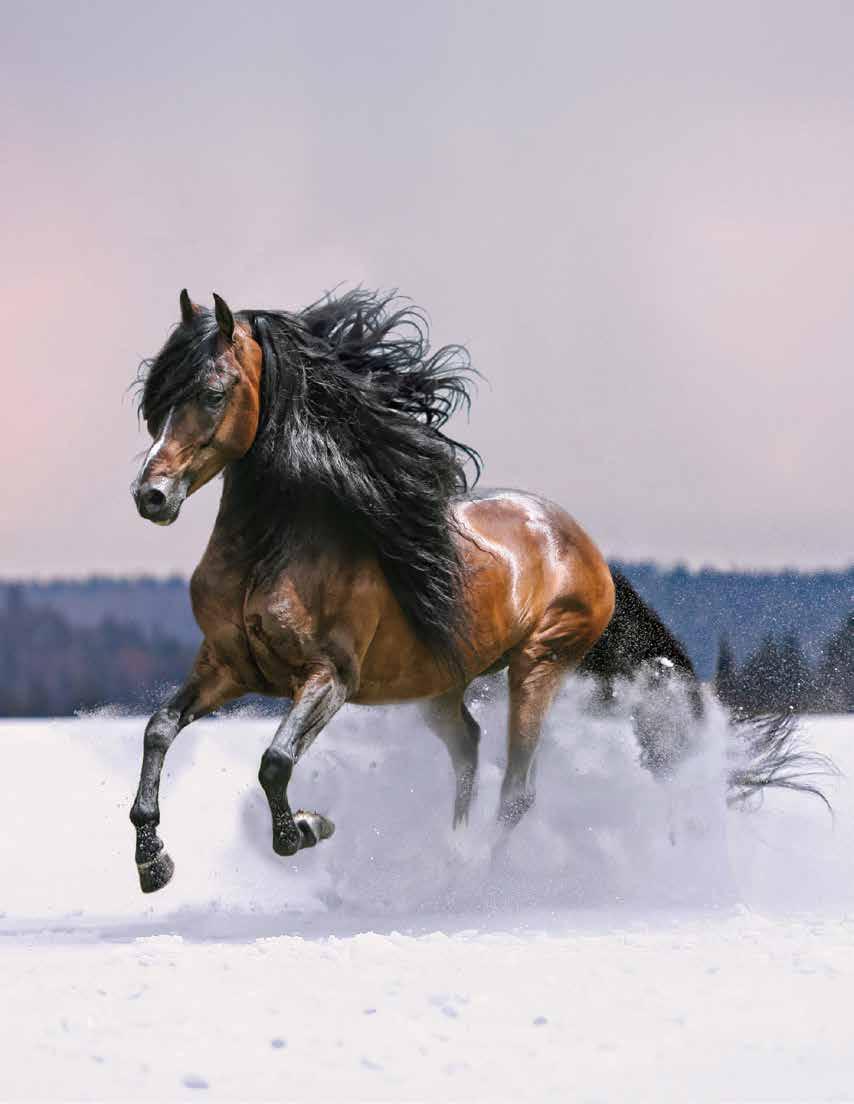
Like us on Facebook. On the cover: The Colombian Trocha Stallion, Principe de la Macarena. Photo credit: Cheri Prill

From the President...
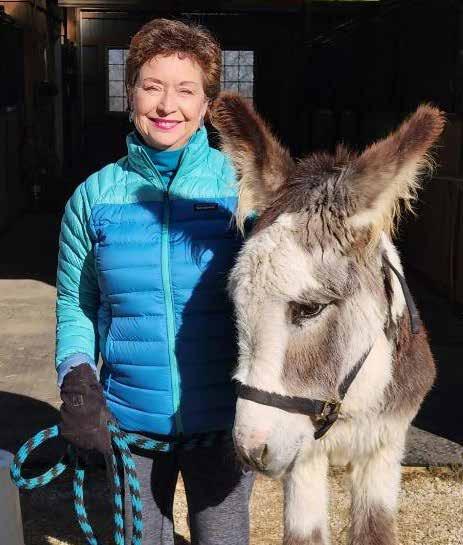
Hello FOSH Friends!
Thank you for your continued support to end soring and support sound horses in 2023. We’re especially pleased to share that over 105,000 individual people commented on the proposed USDA regulations. We’ve not had any word yet on when the final regs will be ready or what they will entail. Over 100 members of Congress are writing the USDA to encourage them to address this situation which demonstrates the continued interest horse soring receives from politicians who are concerned about animal welfare.
We learned of several much-loved horses who recently passed and were lifetime companions to several of our members: I met Flash and
his owner, Jana Babuszczak, twenty years ago at the FOSH National Championships at Lake St. Louis. My husband and I were instantly befriended by Jana and her parents, Judy and Henry. I knew Jana rescued Flash from the big lick, and I thoroughly enjoyed watching his smooth, polished performance in the ring which was awarded with many ribbons.
We were also saddened to hear that Board Member, Gina Vehige, had a sudden passing of her TWH, Chance. As Gina lives in Missouri, I saw her and Chance at all our Missouri shows, including the Missouri State Fair and regional shows. As Gina and I purchased our horses about the same time and were connected by the same trainer, Vicci Eaton, we tended to have much in common regarding our journey with our horses. It is so sad to lose a member of our four legged family, and I know Gina and Darryl will greatly miss him.
Before I close, what about that beautiful horse on our cover! The Colombian Trocha. I’m looking forward to reading the article and expanding my knowledge on a cold January afternoon with a cup of tea.
Happy New Year!
Teresa Teresa Bippen FOSH President Tbippen1957@yahoo.com
From the Editor...
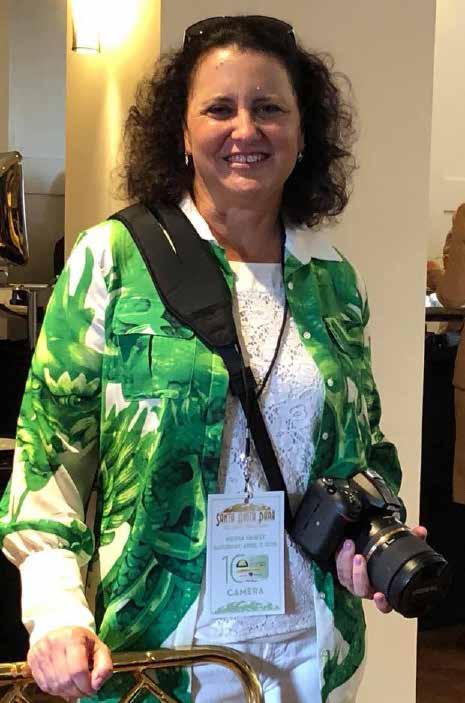
Hello FOSH Friends.
It’s been a year, hasn’t it? When it seems like there is no good news in the world, horse people often turn to their 4-legged friends for stress relief, a break from the daily grind and a welcome diversion from whatever is causing us to have a bad day. I know I’m one of those people. A trip to the barn makes me forget everything else, even if it is only for an hour or so. And I always feel better when I leave. With all of the difficulties in the world right now, we need horses in our lives more than ever.
I absolutely love this issue’s cover photo taken by Cheri Prill. It’s just stunning! It’s a photo of the Columbian Trocha stallion, Principe de la Macarena. In this issue is an in depth look at the Columbian Trocha and what makes them so unique. It’s your “long read” of this issue.
We also take note of those we’ve lost recently. It’s difficult to lose those we love - family and friends - 2-legged and 4-legged.
And congratulations to FOSH’s own Dianne Little who reached the Canadian Registry of the Tennessee Walking Horse’s Century Partnership where the horse and person’s combined age is at least 100. It is goal worthy of pursuing!
This issue also features trail riding etiquette and safety tips, riding tips and an overview of equine osteopathy.
Take some time during the holiday break a give The Sound Advocate a good read. Then go see your horses. You’ll be glad you did.
Best wishes for the new year. We’ll see you in 2024.
Stephanie Stephanie J. Ruff Editor editor@fosh.info
H.R.3090 - PAST Act of 2023
A reader requested a list of PAST Act supporters. This is what was on the government website as of the middle of September.
Latest Action: House - 05/12/2023
Referred to the Subcommittee on Innovation, Data, and Commerce.
Sponsor: Rep. Fitzpatrick, Brian K. [R-PA-1] | Cosponsor statistics: 213 current - includes 184 original
Cosponsor
Rep. Cohen, Steve [D-TN-9]*
Rep. Buchanan, Vern [R-FL-16]*
Rep. Schakowsky, Janice D. [D-IL9]*
Rep. Beyer, Donald S., Jr. [D-VA-8]*
Rep. Schiff, Adam B. [D-CA-30]*
Rep. Connolly, Gerald E. [D-VA-11]*
Rep. Sherman, Brad [D-CA-32]*
Rep. Matsui, Doris O. [D-CA-7]*
Rep. Evans, Dwight [D-PA-3]*
Rep. Davids, Sharice [D-KS-3]*
Rep. Peters, Scott H. [D-CA-50]*
Rep. Wilson, Frederica S. [D-FL-24]*
Rep. Lynch, Stephen F. [D-MA-8]*
Rep. Huffman, Jared [D-CA-2]*
Rep. Gomez, Jimmy [D-CA-34]*
Rep. Napolitano, Grace F. [D-CA31]*
Rep. Tonko, Paul [D-NY-20]*
Rep. Wasserman Schultz, Debbie [DFL-25]*
Rep. Cárdenas, Tony [D-CA-29]*
Rep. Ruppersberger, C. A. Dutch [DMD-2]*
Rep. Quigley, Mike [D-IL-5]*
Rep. Torres, Norma J. [D-CA-35]*
Rep. Boyle, Brendan F. [D-PA-2]*
Rep. Foster, Bill [D-IL-11]*
Rep. Brownley, Julia [D-CA-26]*
Rep. Scott, David [D-GA-13]*
Rep. Stanton, Greg [D-AZ-4]*
Rep. Pocan, Mark [D-WI-2]*
Rep. Garcia, Sylvia R. [D-TX-29]*
Rep. Houlahan, Chrissy [D-PA-6]*
Rep. Meng, Grace [D-NY-6]*
Del. Sablan, Gregorio Kilili Camacho [D-MP-At Large]*
Rep. Bishop, Sanford D., Jr. [D-GA2]*
Rep. Castro, Joaquin [D-TX-20]*
Rep. Kelly, Robin L. [D-IL-2]*
Rep. Allred, Colin Z. [D-TX-32]*
Rep. Carbajal, Salud O. [D-CA-24]*
Rep. Khanna, Ro [D-CA-17]*
Rep. Panetta, Jimmy [D-CA-19]*
Rep. Escobar, Veronica [D-TX-16]*
Rep. Jacobs, Sara [D-CA-51]*
Rep. McBath, Lucy [D-GA-7]*
Rep. Sánchez, Linda T. [D-CA-38]*
Rep. Morelle, Joseph D. [D-NY-25]*
Rep. Moore, Gwen [D-WI-4]*
Rep. Stevens, Haley M. [D-MI-11]*
Rep. Nadler, Jerrold [D-NY-12]*
Rep. Casten, Sean [D-IL-6]*
Rep. Chu, Judy [D-CA-28]*
Rep. Blunt Rochester, Lisa [D-DE-At Large]*
Rep. Swalwell, Eric [D-CA-14]*
Rep. Schneider, Bradley Scott [D-IL10]*
Rep. Gallego, Ruben [D-AZ-3]*
Rep. Garcia, Jesus G. “Chuy” [D-IL4]*
Rep. Cartwright, Matt [D-PA-8]*
Rep. Moulton, Seth [D-MA-6]*
Rep. Veasey, Marc A. [D-TX-33]*
Rep. Porter, Katie [D-CA-47]*
Rep. Raskin, Jamie [D-MD-8]*
Rep. Grijalva, Raúl M. [D-AZ-7]*
Rep. Johnson, Henry C. “Hank,” Jr. [D-GA-4]*
Rep. Doggett, Lloyd [D-TX-37]*
Rep. Mace, Nancy [R-SC-1]*
Rep. Krishnamoorthi, Raja [D-IL-8]*
Rep. Higgins, Brian [D-NY-26]*
Rep. Kilmer, Derek [D-WA-6]*
Rep. Castor, Kathy [D-FL-14]*
Rep. Trone, David J. [D-MD-6]*
Rep. McHenry, Patrick T. [R-NC-10]*
Rep. Pingree, Chellie [D-ME-1]*
Rep. Lee, Barbara [D-CA-12]*
Rep. Kildee, Daniel T. [D-MI-8]*
Rep. Reschenthaler, Guy [R-PA-14]*
Rep. Smucker, Lloyd [R-PA-11]*
Rep. Meuser, Daniel [R-PA-9]*
Rep. McCollum, Betty [D-MN-4]*
Rep. Smith, Christopher H. [R-NJ-4]*
Rep. Ross, Deborah K. [D-NC-2]*
Rep. Himes, James A. [D-CT-4]*
Rep. Auchincloss, Jake [D-MA-4]*
Rep. Mfume, Kweisi [D-MD-7]*
Rep. Trahan, Lori [D-MA-3]*
Rep. Espaillat, Adriano [D-NY-13]*
Rep. Payne, Donald M., Jr. [D-NJ10]*
Rep. Smith, Adam [D-WA-9]*
Rep. Crow, Jason [D-CO-6]*
Rep. Pappas, Chris [D-NH-1]*
Rep. DeLauro, Rosa L. [D-CT-3]*
Rep. Takano, Mark [D-CA-39]*
Rep. Scholten, Hillary J. [D-MI-3]*
Rep. Strickland, Marilyn [D-WA-10]*
Rep. Neguse, Joe [D-CO-2]*
Rep. Sherrill, Mikie [D-NJ-11]*
Rep. Sarbanes, John P. [D-MD-3]*
Rep. Meeks, Gregory W. [D-NY-5]*
Rep. Cicilline, David N. [D-RI-1]*
Rep. Blumenauer, Earl [D-OR-3]*
Rep. Williams, Nikema [D-GA-5]*
Rep. Craig, Angie [D-MN-2]*
Rep. Barragan, Nanette Diaz [D-CA44]*
Rep. Kaptur, Marcy [D-OH-9]*
Rep. Soto, Darren [D-FL-9]*
Rep. Slotkin, Elissa [D-MI-7]*
Rep. Courtney, Joe [D-CT-2]*
Rep. Tokuda, Jill N. [D-HI-2]*
Rep. Vargas, Juan [D-CA-52]*
Rep. DeSaulnier, Mark [D-CA-10]*
Rep. Thompson, Mike [D-CA-4]*
Rep. Waltz, Michael [R-FL-6]*
Rep. Velazquez, Nydia M. [D-NY-7]*
Rep. Titus, Dina [D-NV-1]*
Rep. Watson Coleman, Bonnie [D-NJ12]*
Rep. McGarvey, Morgan [D-KY-3]*
Rep. McGovern, James P. [D-MA-2]*
Rep. Kim, Andy [D-NJ-3]*
Rep. Pressley, Ayanna [D-MA-7]*
Rep. Dean, Madeleine [D-PA-4]*
Rep. Norcross, Donald [D-NJ-1]*
Del. Norton, Eleanor Holmes [D-DCAt Large]*
Rep. Beatty, Joyce [D-OH-3]*
Rep. Posey, Bill [R-FL-8]*
Rep. Underwood, Lauren [D-IL-14]*
Rep. Davis, Danny K. [D-IL-7]*
Rep. Salazar, Maria Elvira [R-FL-27]*
Rep. Carey, Mike [R-OH-15]*
Rep. Frankel, Lois [D-FL-22]*
Rep. Wild, Susan [D-PA-7]*
Rep. Mullin, Kevin [D-CA-15]*
Rep. Lee, Susie [D-NV-3]*
Rep. Torres, Ritchie [D-NY-15]*
Rep. Hudson, Richard [R-NC-9]*
Rep. Bera, Ami [D-CA-6]*
Rep. Keating, William R. [D-MA-9]*
Rep. Jackson Lee, Sheila [D-TX-18]*
Rep. Larson, John B. [D-CT-1]*
Rep. Gottheimer, Josh [D-NJ-5]*
Rep. Wittman, Robert J. [R-VA-1]*
Rep. Fletcher, Lizzie [D-TX-7]*
Rep. Magaziner, Seth [D-RI-2]*
Rep. Neal, Richard E. [D-MA-1]*
Rep. Deluzio, Christopher R. [D-PA17]*
Rep. Carter, Troy [D-LA-2]*
Rep. Kim, Young [R-CA-40]*
Rep. Malliotakis, Nicole [R-NY-11]*
Rep. Jayapal, Pramila [D-WA-7]*
Rep. Gooden, Lance [R-TX-5]*
Rep. Fulcher, Russ [R-ID-1]*
Rep. Van Drew, Jefferson [R-NJ-2]*
Rep. Landsman, Greg [D-OH-1]*
Rep. Carson, Andre [D-IN-7]*
Rep. Lee, Laurel M. [R-FL-15]*
Rep. Brown, Shontel M. [D-OH-11]*
Rep. Ruiz, Raul [D-CA-25]*
Rep. Kelly, Mike [R-PA-16]*
Rep. Larsen, Rick [D-WA-2]*
Rep. Tenney, Claudia [R-NY-24]*
Del. Plaskett, Stacey E. [D-VI-At Large]*
Rep. Schweikert, David [R-AZ-1]*
Rep. Scott, Robert C. “Bobby” [D-VA3]*
Rep. Aguilar, Pete [D-CA-33]*
Rep. Lieu, Ted [D-CA-36]*
Rep. Tlaib, Rashida [D-MI-12]*
Rep. Pascrell, Bill, Jr. [D-NJ-9]*
Rep. Buck, Ken [R-CO-4]*
Rep. Thanedar, Shri [D-MI-13]*
Rep. McClain, Lisa C. [R-MI-9]*
Rep. Thompson, Bennie G. [D-MS2]*
Rep. Sorensen, Eric [D-IL-17]*
Rep. Dingell, Debbie [D-MI-6]*
Rep. Kuster, Ann M. [D-NH-2]*
Rep. Joyce, David P. [R-OH-14]*
Rep. Lawler, Michael [R-NY-17]*
Rep. Eshoo, Anna G. [D-CA-16]*
Rep. Cuellar, Henry [D-TX-28]*
Rep. Crockett, Jasmine [D-TX-30]*
Rep. Moskowitz, Jared [D-FL-23]*
Rep. Foushee, Valerie P. [D-NC-4]*
Rep. Garcia, Robert [D-CA-42]*
Rep. Ciscomani, Juan [R-AZ-6]*
Rep. Calvert, Ken [R-CA-41]*
Rep. Case, Ed [D-HI-1]*
Rep. DelBene, Suzan K. [D-WA-1]*
Rep. Bonamici, Suzanne [D-OR-1]*
Rep. Scanlon, Mary Gay [D-PA-5]*
Rep. Perez, Marie Gluesenkamp [DWA-3]
Rep. Jackson, Jeff [D-NC-14]
Rep. Balint, Becca [D-VT-At Large]
Rep. Levin, Mike [D-CA-49]
Rep. Hoyle, Val T. [D-OR-4]
Rep. DeGette, Diana [D-CO-1]
Rep. Pettersen, Brittany [D-CO-7]
Rep. Correa, J. Luis [D-CA-46]
Rep. Goldman, Daniel S. [D-NY-10]
Rep. Harder, Josh [D-CA-9]
Rep. Gimenez, Carlos A. [R-FL-28]
Rep. Clarke, Yvette D. [D-NY-9]
Rep. Adams, Alma S. [D-NC-12]
Rep. Omar, Ilhan [D-MN-5]
Rep. Lofgren, Zoe [D-CA-18]
Rep. Turner, Michael R. [R-OH-10]
Rep. D’Esposito, Anthony [R-NY-4]
Rep. Schrier, Kim [D-WA-8]
Rep. Hayes, Jahana [D-CT-5]
Rep. Sykes, Emilia Strong [D-OH-13]
Rep. Bacon, Don [R-NE-2]
Rep. Vasquez, Gabe [D-NM-2]
Rep. Stansbury, Melanie Ann [D-NM1]
Rep. Manning, Kathy E. [D-NC-6]
Rep. Pallone, Frank, Jr. [D-NJ-6]
Rep. Mrvan, Frank J. [D-IN-1]
Rep. Caraveo, Yadira [D-CO-8]
Rep. Horsford, Steven [D-NV-4]
Rep. LaLota, Nick [R-NY-1]
*Original co-sponsor
In Memoriam
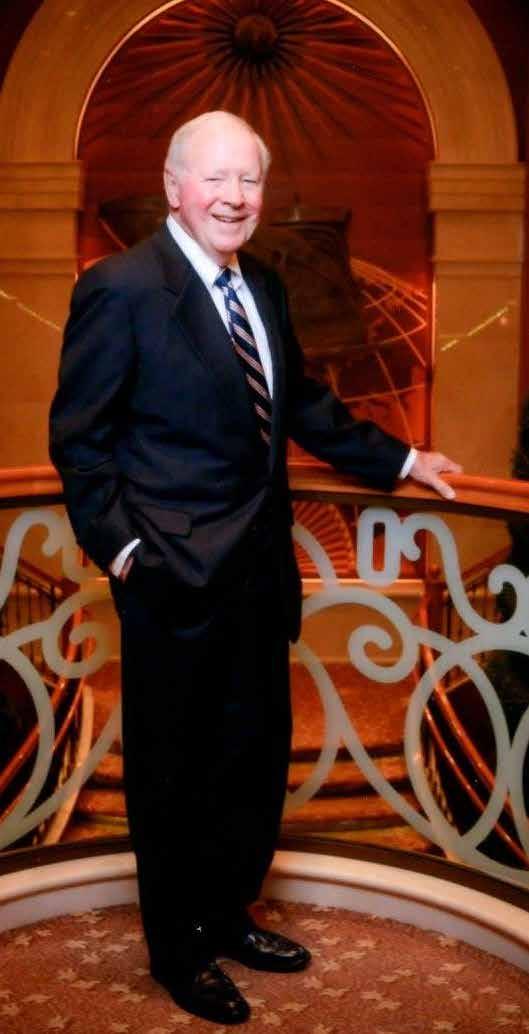
Arthur Fields Richardson, 80, passed away on September 23, 2023, in the company of family in McKinney, Texas. Fields was born on November 5, 1942, to Herbert and
Dorothy Richardson in Lebanon, Virginia. In 1963 Fields married Jacqueline Gates Richardson. They had two sons, Bill and Andrew, and shared over 40 years of marriage.
After graduating from the University of Richmond in 1966, he began a thirty-year career as a naval aviator and attained the rank of captain. During the course of his career, he flew 53 missions over Vietnam, took part in the bombing of Libyan dictator Moammar Gadhafi’s Tripoli compound in 1986, and served on the staff of General Norman Schwarzkopf, commander of the Coalition Forces during the First Gulf War in 1991. While serving aboard the USS Forrestal in 1989, he gave a tour to former president George H.W. Bush.
He was the Commanding Officer of the Naval Strike Warfare Center for the final three years of his career. Fields flew the iconic A7 Corsair, the F-14 Tomcat, and F/A-18 Hornet and racked up 1,553 carrier takeoffs and landings, which is the most operations flights by any pilot in history.
After retiring from the Navy, Fields worked as a cargo pilot, flying a DC10 aircraft to destinations all over the world. Later, he moved to Decatur, Texas, and in 2008, he married Frances Richardson. Together, they
traveled to Italy, Belgium, Arizona, Virginia, and Alaska, among other locations.
They cherished their dogs and showered them with love and attention. They both stayed active by regularly attending the Silver Sneakers fitness group with friends. Fields and Frances were devoted to serving God and found a fellowship of like-minded Christians at Victory Church in Decatur where they both served as greeters.
In 2012, Fields served as the commander of the Wise County Veterans Group. In his spare time, he enjoyed caring for horses and reading about history. He also served as a FOSH DQP. He is survived by his sons, Bill Richardson, Andrew Richardson, and Ryan Bell; his daughter, Devan Bell; his son-in-law Joseph Classe; and his dogs Nelson and Mr. Wiggles.
Godspeed, ye Good Brown Horse
Geena Booher recently lost her beloved horse Highlander’s Paddy. She posted the following on Facebook after his passing.
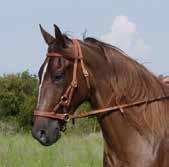
“You are loved by many, but by none more than by me ... We called PadMan the Rain God on many occasions. Family and friends knew. If I had plans or thoughts of riding PadMan later, it would rain. Chuck suggested I could make a fortune taking him to drought stricken areas and thinking about riding him. This morning, well, it has not rained in more than two weeks. It might never rain again! Then I realized.... I can still think about riding PadMan. All is not lost.”
Highlander’s Paddy 3/17/2004 - 10/26/2023
The Roan Flash
March 9, 1988 - September 5, 2023
By Jana Babuszczak
In September of 1991, my mom pulled me out of school early to go look at a horse. I had lost my first walking horse, Copper, a year earlier and wasn’t necessarily in the market for a new one, yet. Enter threeyear-old The Roan Flash, a bit wild. It took several people to hold him just for me to get in the saddle.
The gentleman I purchased him from had only had him a short time when Mom came across him on a random trip at a barn near us. Flash was supposed to have been for his wife but was “up for sale”. He was a LOT rank, which was the main reason he was being sold.
I rode him four times and was encouraged to show him at a local show before I finally decided to take the plunge. It wasn’t that I couldn’t ride him, I just wasn’t sure. Losing Copper was a big blow. But after that show, (where we ended up taking the juvenile champion title) I decided to take mom’s advice and take the plunge.
It took a lot to get that boy to trust us. He didn’t have the greatest of starts and had been badly abused. We had a lot to overcome; bad train-
ing and abuse had given him a suspicious attitude. Lots of time was spent building his trust and totally reprogramming him. He had the ability, he just had to trust.
Soon we were back in the ring and doing well. We were winning and not just lite shod classes. Then we decided to have fun—the decision was made to introduce him to versatility things to change things up a bit as he was burned out from just going around in circles. First it was Sidesaddle, then trail, then this weird running (he didn’t even canter when we bought him) thing that involved these barrel or pole things. He LOVED all of it.
At an open show we were dared to enter the jumping class, because those weird, gaited horses “can’t” do that. I had had some jumping training but other than an cross fence for trail Flash had no idea about being in a jumping class but since it was just cross fences and rail work, I said sure. Instead, the class turned into a 3ft fence class as the judge kept raising fences to challenge the horses. And guess what -- we won it out of six horses. Needless to say, that shut them up about what gaited horses could do.
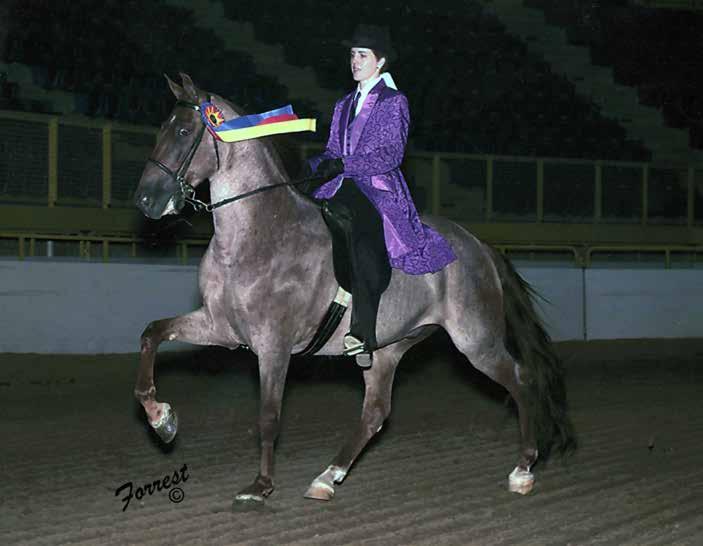
Enter Friends of the Sound Horse, the original name for FOSH. We were there in 1999 at the meeting in Houston, and it was with a phenomenal group of people who had come from all over the country bringing the right mindset and the vision to bring the sound horse to the forefront of our industry. It was a great day for the sound horse. And I could finally show again. We had quit showing at TWHBEA shows after a few run-ins with exhibitors that were mad that we beat them.
Flash was in his teens by then but still going strong.
The inaugural FOSH nationals was in
Denver and was there for two years. We had a great show, winning all the Park Amateur classes and placing strongly in the open. We won several of our versatility classes as well, but that first show we had to limit our entries as Flash had been hurt three weeks prior to the show.
Our broodmare had kicked him and broken his hind splint bone in half. He had been taken to TAMU, and at that time Dr William McMullan was head of the equine hospital. You may remember that name, he showed walking horses and was also at the Denver Nationals with us.
Flash was heavily examined by the
head of orthopaedics and Dr McMul
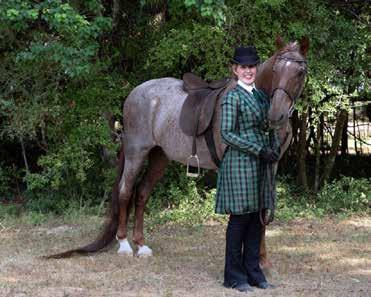
lan and OK’d to show, but Doc would keep an eye on him and do surgery when we got back. That first show was great. The show and horses were phenomenal.
The next year, we hauled again from Texas to Denver and had an amazing show, this time winning not only the Park Pleasure Amateur classes but the Open as well with an “aged” gelding.
If you ever saw Flash move, you would understand. He would put his all into every ride. No gimmicks, no crap and sometimes no shoes. The next two years were in Lake St Charles, MO, where he continued to dominate the Park Pleasure classes. We made one more in Columbia, MO, I believe, but by then he was in his 20s and mostly there as a babysitter for our other horse. Flash made his mark on the FOSH shows.
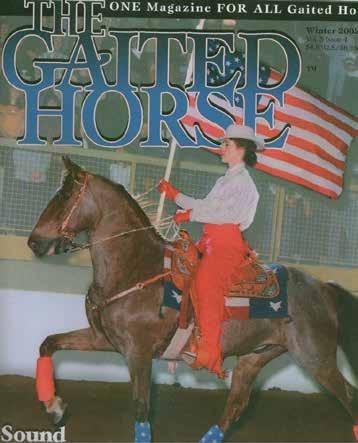
In between the shows, we were invited to the opening of the Sam Houston Race Park to be part of their parade of breeds. We even made the news. We traveled to Equifest of Kansas many, many times. We were invited to be the flag horse for the Evening of Dancing Horses in Denver in 2001 riding with Michael Martin Murphy and riding to the Pueblo Symphony Orchestra as well as opening the USEF Grand Prix Jumping and Reining competition and closing their Wild West Show while there.
We were invited to be part of a local fund raiser where we had to walk into a ball room during the evening as part of the entertainment with Clay Walker. We did the Evening of Dancing Horses in San Angelo, Texas with the San Angelo Symphony Orchestra. We opened the Pin Oak Charity Horse Show for multiple years. We traveled to Ponca City, Oklahoma to be part of the 100 years city celebration. We did a lot for which a gaited horse was previously not considered, and we did it
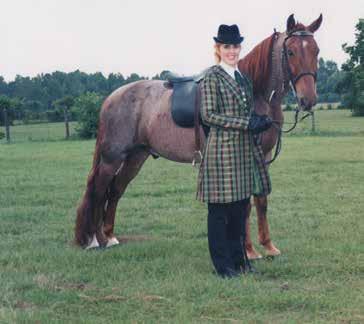
Then and Now - The top photo was a HOF photo taken almost years ago. The bottom photo was taken in 2022.
to applause.
I still rode Flash on and off in his late 20s, but he was mostly retired. We had accomplished everything we had set out to do and more. We had a Supreme Versatility Championship. We had 14 National/National Grand Championships. We had achieved my main goal ever of an Equitation National Championship (we won 4) but most of all we showed people that a horse could do it sound, that performance could be achieved with talent and training, no crap required. USDA even used Flash at a show for training the DQPS and in their words, demonstrating “what a true sound and correct horse should look like.”
Flash and I were a team, and I admit that you don’t find a match like that in a horse very often. We were one. We grew up and just grew together. We had basically a lifetime together and along with the ups, there were some downs.
He had three surgeries at TAMU. One resulted in a 4 am phone call with a “when can you get here as he has two fourth year students in the hay feeder, and he won’t let them down.” Flash had a bit of a reputation for being difficult; thanks to his early start, he always felt that if you hurt him, you were evil--even if you were trying to help him—but this was a major emergency surgery that if we didn’t do, he might die. His second surgery, they sent him home early because they knew I could treat him, and they couldn’t. His third surgery they had to keep him and while he
did take a liking to his technician, there were a few times they had to leave him alone and come back later to do treatments because he just wasn’t having it. Whatever he did, he did, his way.
He was there for me when Daddy (Henry) died in 2007; he was there for me through my divorce; he was there for me through my cancer diagnosis in 2020, and he was there for me when Mom (Judy) passed away just this past December. I had Flash longer than I had my Dad. Thirty-three years together is almost unheard of.
He graced this earth for thirty-five years, and I was blessed to have been a part of his life and his legacy. He is running free now with Mom and Dad to take care of him. For me, he’ll live forever. I love you Flash.
Chance’s Magical Dust Gina Vehige’s Heart Horse
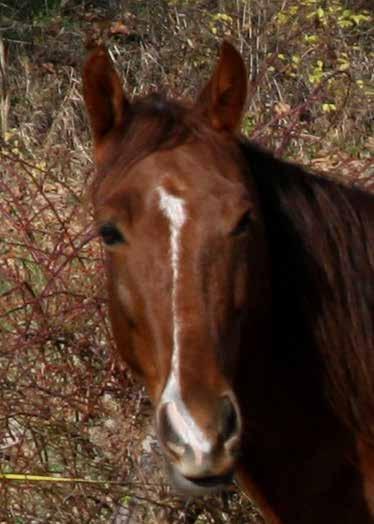
Chance’s Magical Dust, aka, “Chance” passed away on May 31, 2023. A Tennessee Walking Horse, Chance was born in October of 2000. He was owned and loved by Gina Vehige. Chance was purchased in 2002 from Tamara Sissom.
He was a large chestnut colt that Gina fell in love with at first sight. When she saw him that raw, cold day in March, he was playing around in a corral and managed to fall. As he lay there, he figured out he was close to some tasty grass, so he started eating and didn’t bother to get up for quite some time. Before she could climb the fence to investigate, he was back on his feet.
A gangly fellow, he grew to be 16.3 hands and was often referred to as ‘baby giraffe’ after his tendency to chew the tops out of young trees despite having access to unlimited hay and pasture.
Gina began his groundwork at age two and sent him off to Vicci Eaton to begin his under-saddle training after his third birthday. Chance was a quick study, albeit with a tendency to pace, but he was smooth in all his movements and proved to be a solid horse with no tendency to hesitate at any obstacle.
His unflappability on both the trail and the rail was his trademark. Chance was the reserve champion Open Gaited Breed horse at the Missouri State Fair in 2019, after which he was retired (temporarily) from the show ring.
That same year he was spotted in the barn feeding hay to one of the fine mares from the Hughes Stables string through the mesh that separated them at the fairground stables. He’d take a bite and then pass a mouthful to the mare.
He had other remarkable gifts in addition to his generosity. In particular, Gina remembers a time when he had lost a shoe in the pasture. The farrier was on his way and asked her if she could possibly find the shoe. She went to the pasture to begin what was sure to be a frustrating search and while she was there, she told Chance he could just pitch in any time and help. Next thing she knew, he was standing quite a distance from his pasture mates near a small ditch and looking up at her and then back to the ground repeatedly. Sure enough, he was pointing to the lost shoe in the ditch.
In 2023, Chance was pressed back into service as a “show” horse for
a 10-year-old girl in the neighborhood. Just days before his second children’s show of the season, he collapsed in the round pen just before turn-out time with his buddies. He was coaxed back to his feet but was very unsteady. The vet was summoned, and it was determined that he suffered a stroke and was humanely euthanized. He was buried on the farm he loved and called home.
Having mourned for the gentle nature of her beloved Chance, Gina contacted Anita Dunham and Vonnie Hughes of Hughes Stables and acquired Chance’s niece, Mac’s Material Girl (aka, Mattie) in November. Mattie is the daughter of Generator’s Mac Attack and Vigor’s Vanity Fair. True to the nature of that bloodline, she is an unflappable little chestnut mare who is busy patching the hole in Gina’s heart.
CENTURY PARTNERS
Dianne Little and Uphill Penny By Chance
This article originally appeared in the October, 2023 issue of Walking Horse News.
Jack Gurnett, a former Canadian Registry of the Tennessee Walking Horse (CRTWH) President, was participating in a demo at the Horse Expoin Red Deer. After the demo his daughter Susan Banks, mentioned that the combined age of Jack and his horse, Northfork Sundancer, was 104 years. Volunteers in attendance included some CRTWH Board members who realized the significance of this combination and the CRTWH Century Partners program was born. To be eligible for membership as a CRTWH Century Partner, the combined years of experience of horse and owner must be at least 100 years.
I never expected to join this distinguished group. However, Uphill Penny By Chance (2326) and I now find ourselves eligible for membership. Penny joins her dam, Uphill Dusty Gold (1071) and owner Natalie Speckmaier as Century Partners. I believe Trigger and Penny are the only mother and daughter members.
Each horse we have the privilege of having in our life provides an opportunity to expand not only our enjoyment of a partnership, but also an
opportunity for both of us to expand our knowledge and experience. Penny has given me an opportunity to appreciate and strengthen my connection with her through body work.
I enjoy a body massage, and I have learned that Penny appreciates human touch as much as I do. To learn what is important to Penny, I have discovered the ability to breathe slowly, to touch lightly, to relax and to take the time it takes. Most importantly, Penny has taught me patience.
There is no pattern that works best for us. Each session is different. Sometimes Penny shows me where to begin and sometimes she challenges me to discover what would be best for the day. We work together or we do not click. The reason could be Penny or me or both of us. My attitude and approach are integral to the experience and so is Penny’s. Every session with her is unique.
I learn something about her and about myself - sometimes it is when to stop, sometimes where on her body she’d like me to start. We have a common goal – share time together in a situation that benefits us both.
I never intended to breed Penny but an unique situation was presented in 2014. For many years I boarded at Westridge Farms, owned by Helen and Ron Williamson. Helen was a founding member of CRTWH and its first president. She was a breeder and stood two stallions – Go Shadow Go and Shaker’s Royal Heir. I think it was around 1983 that semen was collected from both stallions.
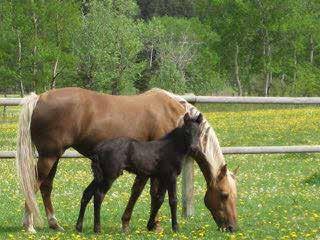
Approximately 30 years after that, in 2014, I was offered frozen semen from Go Shadow Go. There was no guarantee the semen was viable, but I chose to give it a chance and breed Penny. The breeding was successful, and in May of 2015 a black colt was born. His registered name is Go Shadow Go Again (Buddy), registration number 3893.
Penny continues to give me a special gift – partnership and acceptance of strengths and weaknesses. I continue to discover what is important for Penny and for me and to deepen the relationship.
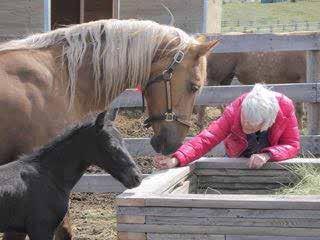
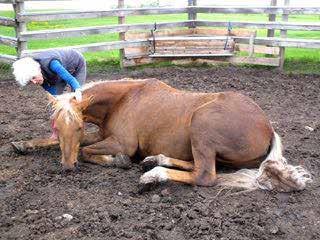
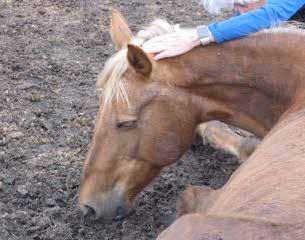
“Ohhh that feels so good.” Penny relaxes as Dianne massages her neck and poll.
Dianne’s horses Penny and her foal Go Shadow Go Again, aka Buddy.
Colombian Creole Horse Breeds
This article appeared on the Spanish Horse Tack website.
The Colombian Trote y Galope, Colombian Trocha, and Colombian Trocha y Galope horses are modern-day gaited horses still in development genetically. According to Fedequinas, the Colombian federation of horse associations, the umbrella organization in Colombia, S.A. for all equines, they comprise three of the four lineages of the Colombian Paso Fino horse, based on their gait. In Colombia, South America, they are hugely popular, but remain relatively rare in the United States and outside of their native Colombia. However, they are growing in popularity.
When discussing the Colombian Trote y Galope, Colombian Trocha, and the Colombian Trocha y Galope horses, one must understand a bit of the history and development of the horse in the Americas (North, central, and South America, and the Caribbean). Horses in North and South America became extinct around 10,000 years ago.
Horses were re-introduced to the Americas in 1493 when Christopher Colombus made his second trip to the New World, to the island of present-day Hispaniola (the Dominican
By Rebecca Vail Anderson
Republic and Haiti). The origins of these horses and the ones subsequently shipped to the New World were Iberian horses mostly from the southern Iberian Peninsula. The Iberian Peninsula includes the present day countries of Spain, Portugal, and Andorra, plus part of France and the British territory of Gibraltar.
According to the article “Colombian Creole horse breeds: Same origin but different diversity”, by Ligia Mercedes Jiminez, et al., Genetics and Molecular Biology, 35, 4, xxx-xxx(2012): “Horses from the Iberian Peninsula entered Colombia through two main routes. One route was established by the expeditions of Alonso de Ojeda and Diego de Nicuesia in 1509 (Diaz, 1988) and went through Panama via the Gulf of Uraba to Nueva Granada (New Granada is present day Colombia and Panama). The second route was established by Spanish expeditions through Coro (present day Venezuela) to the Eastern Plains region known as “Llanos Orientales” in Nueva Granada, in the current departments [states] of Arauca, Casanare, and Meta (Montoya B, 1988, undergraduate final work, Universidad de Los Llanos, Villavicencio, Colombia).”
The two main horse populations in
Colombia are the Colombian Paso Fino and the Colombian Creole cattle horse. The Colombian Paso Fino is believed to have arrived via the first route, through Panama. The Colombian Creole cattle horse, also known as the Criollo de Vaqueria, is believed to have arrived via the second route.
The Colombian Paso Fino was valued predominately for its utility as a riding horse whereas the Colombian Creole cattle horse was used mostly for agricultural work. Since the Colombian Paso Fino became a riding horse when traveling on horseback was the principle mode of transportation, selective breeding practices were used in order to promote those qualities that made the horse comfortable to ride. As a result, four lineages or lines of Colombian Paso Fino developed based on the natural gaits of the horses. These are: Colombian Paso Fino, Colombian Trote y Galope (Trot-Gallop), Colombian Trocha [Trocha Pura], and Colombian Trocha y Galope (Trocha-Gallop) (Fedequinas 2006).
Colombian Trote y Galope
Colombian Trote y Galope: The Trote
y Galope horse is one of the 4 lineages of the Colombian Paso Fino horse. It performs the trote gait and the galope (canter) gait as well as a walk and gallop. Some are able to perform the trocha gait, too. The Trote y Galope horse is larger and taller than the Colombian Paso Fino and Colombian Trocha horses. The Trote y Galope lineage of the Colombian Paso Fino horse developed over time from the mixing of the Lusitano, Andalusian, and other Ibe-
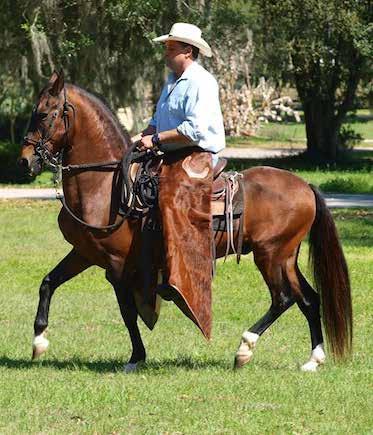
A beautiful Trote y Galope Horse ridden by David A. Palacio.
rian Peninsula trotting horse breeds with gaiting Iberian Peninsula horse breeds in Colombia and modern day Panama.
The trote gait is a 2 beat trot with very little to no suspension between the alternating diagonal pairs of footfalls. It is for this reason the rider is able to sit the trot comfortably with very little jarring and does not need to post. It can best be described as a marching gait where 2 diagonal pair of legs hit the ground at virtually the same moment followed by a brief moment where all 4 feet are in contact with the ground as the horse transfers its weight to the opposite pair of diagonal legs (“On Gait: What’s in a name? Manberg, S., Paso Fino Horse World Magazine, June, 1988, pg 4). The sound of the gait when the horse is ridden on a hard surface or in the show ring over a “sounding board” can be described as “tas-tas-tas” (pronounced tosstoss-toss).
The galope gait has the same sequence of footfalls as a canter or lope. For example, on a left lead, the right hind leg hits the ground followed by the right front and left hind leg hitting together at approximately equal times followed by the left front in a 3 beat pattern (Manberg, S.). Because of the compact size and conformation of the Trote y Galope horse, there is less of a sweeping sensation when riding the galope or canter. It is a shorter, quicker motion in the saddle for the rider. The sound of the gait on a hard surface
can be described as “catorce-catorce-catorce” (pronounced kuh-tore-say, kuh-tore-say, kuh-tore-say).
The Trote y Galope horse is a well built, solid, muscular, compact horse of small to moderate height. The head is carried elegantly on an upright, beautifully arched neck. They can be found in all colors however pinto, spotted, and appaloosa colored horses cannot be registered. The Trote y Galope is considered a hot-blooded horse. They are agile, brave, and very athletic horses. They are highly sensitive and intelligent. They require an equally sensitive and intelligent trainer and owner. They will suffer emotionally from harsh, cruel, and abusive training practices.
Trote y Galope horses are highly versatile and adaptable. They thrive when given a job to do that they enjoy. They are extremely willing partners and strive to please at all times. They can be trained to do dressage, speed events, jumping, cross country, trail obstacles, trail riding, cattle and ranch work, and the newest equine discipline of Working Equitation, as well as traditional showing.
The horses began to be exhibited formally at Ferias, or horse shows, in Colombia in the 1940’s. The first equine association and registry in Colombia was formed in 1946 and was called ASDEPASO. In 1952, in Dallas, Texas, USA, the horses debuted as the “Caballo de Paso Colombiano” or the “Colombian Paso horse” (El Caballo de Paso Colombiano. Mejia Escobar, J., Saavedra, C.
J., Lita Camargo Ltda, 1986). The Paso Fino Horse Association, which registers only Paso Fino horses was formed in the USA in 1972. The American Trote and Trocha Association formed in the USA in 2001. It limits its registry to Trote y Galope, Trocha, and Trocha y Galope horses. The only registry in the USA which registers all 4 of the lineages, Paso Fino, Trote y Galope, Trocha, and Trocha y Galope, is the Puerto Rican Association of Breeders of Paso Horses of America (Los Abiertos) formed in 1973. The international organization representing the four lineages is the Confederation of Paso Horse breeders, Confepaso, which was created in 1990.
Colombian Trocha Horses
Colombian Trocha: The Trocha horse is one of the 4 lineages of the Colombian Paso Fino horse. It performs the trocha gait, as well as a walk, trot, canter, and gallop. Some Trocha horses are able to perform the paso fino gait, too. The Colombian Trocha horse is smaller in height than the Colombian Trote y Galope and Colombian Trocha y Galope horses. They are similar in size and build to the Colombian Paso Fino horse. The Colombian Trocha horse developed along similar lines as the Colombian Paso Fino horse and was influenced by the trotting breeds from the Iberian Peninsula.
The trocha gait is an extremely smooth and exhilarating gait to ride. The Spanish word trocha is roughly translated to mean “a narrow path
through the brush” or “a trail”. Thus, one could say the Colombian Trocha horse was developed and used as a trail horse. A horse that could carry its rider comfortably, reliably, and safely on journeys through treacherous terrain such as jungles, mountains, valleys, and desert was vitally important, valuable, and useful to its owner. Today, in Colombia, the Trocha horse is a highly regarded and highly valued and much sought after show horse. They remain rare in the United States and outside of their native Colombia.
The trocha gait is a 4 beat unevenly spaced, or non-isochronal, gait. The footfalls follow the same sequence as the walk (Manberg, S.). For example, the left hind foot (beat 1) followed by the left front foot (beat 2) immediately followed by the right hind foot (beat 3) and then the right front foot (beat 4) (“El Caballo De Paso: Estudio Ilustrado De Sus Aires”. R. Colon Nebot, Amerriqua Ltda., 1st ed, October 2008). The order of footfalls is so rapid it cannot be seen with the naked eye and must be captured on film and slowed down frame by frame to view the precise order. The beats or footfalls are not spaced evenly apart. The interval between beat 2 and beat 3, the left front and the right hind is very short, as is the interval between beat 4 and beat 1, the right front and left hind foot.
The sound of the trocha gait when the horse is ridden on a hard surface or in the show ring over a “sounding
board” can be described as “trastras-tras” (pronounced t-rawce, t-rawce, t-rawce).
The Colombian Trocha horse is an exquisitely refined and elegant horse, with a muscular but at the same time, delicate and compact appearance. The head is carried proudly and elegantly on an upright and arched neck. The manes and tails are full, thick, and abundant adding to their striking “super model” appearance. They are considered a small horse but are capable of carrying a good deal of weight. They possess a great amount of endurance and are sure footed on uneven terrain. They can be found in all colors however pinto, spotted, and appaloosa colored horses cannot be registered.
Colombian Trocha horses are considered hot-blooded horses and are highly sensitive and intelligent. They require an equally sensitive and intelligent trainer and owner. They will suffer emotionally from harsh, cruel, and abusive training practices. They are extremely willing partners and strive to please at all times. They can be trained to do dressage, speed events, jumping, cross country, trail obstacles, trail riding, cattle and ranch work, and the newest equine discipline of Working Equitation, as well as traditional showing.
The horses began to be exhibited formally at Ferias, or horse shows, in Colombia in the 1940’s. The first equine association and registry in
Colombia was formed in 1946 and was called ASDEPASO. In 1952, in Dallas, Texas, USA, the horses debuted as the “Caballo de Paso Colombiano” or the “Colombian Paso horse” (Jaime Mejia Escobar). The Paso Fino Horse Association, formed in the USA in 1972 does not currently register Colombian Trocha horses. The American Trote and Trocha Association formed in 2001 registers Trocha, Trote y Galope, and Trocha y Galope horses but not Paso Fino horses. The only registry in the USA which registers all 4 of the lineages, Paso Fino, Trote y Galope, Trocha, and Trocha y Galope, is the Puerto Rican Association of Breeders of Paso Horses of America (Los Abiertos) formed in 1973. The international organization representing the four lineages is the Confederation of Paso Horse breeders, Confepaso, which was created in 1990.
Colombian Trocha y Galope
Colombian Trocha y Galope: The Trocha y Galope horse is one of the 4 lineages of the Colombian Paso Fino horse. It performs the trocha gait and the galope (canter) gait as well as the walk, trot, and gallop. The Colombian Trocha y Galope horse is similar in size to the Colombian Trote y Galope horse. It is larger and taller than the Colombian Trocha and Colombian Paso Fino horses. The Colombian Trocha y Galope horse developed along similar lines as the Colombian Trocha and Colombian Trote y Galope horses with influences from the gaited and trotting Iberian Peninusula horse breeds found in Co-
This excerpt is from the article “Defining Colombian Paso Fino Gaits” by Christa Lesté-Lasserre, MA published on theHorse.com.
Colombian Paso Finos have a unique gait most other Paso Finos don’t: the trocha. And recent study results suggest that gait isn’t genetically similar to lateral gaits in other ambling breeds like Icelandics, Tennessee Walking Horses, and pacers.
The Paso Fino horse is known for its smooth gaits and rapid leg action. The Colombian Paso Fino—a “sub-breed”—has a unique celebrated gait most other Paso Finos don’t: the trocha. This four-beat gait features a lateral step sequence, similar to an amble or a Missouri Foxtrotter’s token foxtrot.
However, a new study suggests the trocha isn’t all that genetically similar to lateral gaits in other ambling breeds like Icelandics, Tennessee Walking Horses, and pacers. While the gaitkeeper gene (DMRT3) appears to have some influence, the trocha appears to be coded by additional genes as well, said Miguel Novoa-Bravo, PhD of the National University of Colombia Department of Biology, in Bogotá.
Read the full article by clicking here.
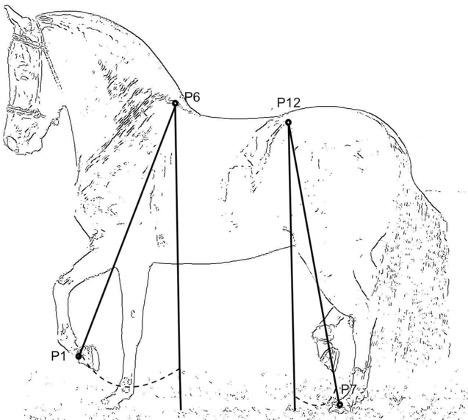
Protraction and retraction limbs angle measurements in a sample of the Colombian paso horse. P1: Coronary band front; P6: Scapula (top of the withers), P7: Coronary band hind, P12: Sacro-iliac joint (Tuber coxae). The dashed points show the angles measured when the horses were trotting without a rider. Protraction was the maximum angle between P1-P6 and the vertical plane when the forelimb was extended forward. Retraction was the maximum angle between P7-P12 and the vertical plane when the hind limb was extended backwards. | Image: 2018 Novoa-Bravo et al., Selection on the Colombian paso horse’s gaits has produced kinematic differences partly explained by the DMRT3 gene/Creative Commons
lombia and modern day Panama.
The trocha gait exhibited by the Colombain Trocha y Galope horse is the same footfall sequence as the Colombian Trocha horse. It is a 4 beat non-isochronal or non-evenly spaced gait. The footfalls follow the same sequence as the walk (Manberg, S.). For example, the left hind foot (beat 1) followed by the left front foot (beat 2) immediately followed by the right hind foot (beat 3) and then the right front foot (beat 4) (R. Colon Nebot).
The order of footfalls is so rapid it cannot be seen with the naked eye and must be captured on film and slowed down frame by frame to view the precise order. The beats or footfalls are not spaced evenly apart. The interval between beat 2 and beat 3, the left front and the right hind is very short, as is the interval between beat 4 and beat 1, the right front and left hind foot. The sound of the trocha gait when the horse is ridden on a hard surface or in the show ring over a “sounding board”
can be described as “tras-trastras” (pronounced t-rawce, t-rawce, t-rawce).
The expression of the trocha gait in the Trocha y Galope horse is different than the expression of the gait executed by the Colombian Trocha horse. Because the Trocha y Galope horse is a larger and taller horse with a different conformation than the Trocha horse, the way the horse performs the gait looks different. Whereas the Trocha horse has a more “fino” or fine (refined) quality to the gait expression, the Trocha y Galope horse has a more bold or robust appearance to the gait expression. These differences are most likely due to the larger size, height, and weight of the horse as well as to a difference in the shoulder, leg, and hip angles of the horses.
The galope gait of the Trocha y Galope horse is similar to the expression of the galope gait in the Trote y Galope horse. The galope gait has the same sequence of footfalls as a canter or lope. For example, on a left lead, the right hind leg hits the

Shop at smile.amazon.com and enter Friends of Sound Horses as your charity. You get the same products, prices and service as shopping on Amazon, but Amazon will donate 0.5% of eligible purchases to FOSH. There are no fees and no extra cost to you.
ground followed by the right front and left hind leg hitting together at approximately equal times followed by the left front in a 3 beat pattern.
Because of the compact size and conformation of the Trocha y Galope horse, there is less of a sweeping sensation when riding the galope or canter. It is a shorter, quicker motion in the saddle for the rider. The sound of the gait on a hard surface can be described as “catorce-catorce-catorce” (pronounced kuh-tore-say, kuh-tore-say, kuh-tore-say).
The Trocha y Galope horse is a well built, solid, muscular, compact horse of small to moderate height. The manes and tails are full, thick, and abundant and the head is carried upright on a beautifully arched neck.
They possess a great deal of endurance and are sure footed on uneven terrain. They can be found in all colors however, pinto, spotted, and appaloosa colored horses cannot be registered.
Colombian Trocha y Galope horses are considered hot-blooded horses and are highly sensitive and intelligent. They require an equally sensitive and intelligent trainer and owner. They will suffer emotionally from harsh, cruel, and abusive training practices. They are extremely willing partners and strive to please at all times. They can be trained to do dressage, speed events, jumping, cross country, trail obstacles, trail riding, cattle and ranch work,
and the newest equine discipline of Working Equitation, as well as traditional showing.
The horses began to be exhibited formally at Ferias, or horse shows, in Colombia in the 1940’s. The first equine association and registry in Colombia was formed in 1946 and was called ASDEPASO. In 1952, in Dallas, Texas, USA, the horses debuted as the “Caballo de Paso Colombiano” or the “Colombian Paso horse” (Jaime Mejia Escobar). The Paso Fino Horse Association, formed in the USA in 1972 does not currently register Colombian Trocha y Galope horses. The American Trote and Trocha Association formed in 2001 registers Trocha, Trote y Galope, and Trocha y Galope horses but not Paso Fino horses. The only registry in the USA which registers all 4 of the lineages, Paso Fino, Trote y Galope, Trocha, and Trocha y Galope, is the Puerto Rican Association of Breeders of Paso Horses of America (Los Abiertos) formed in 1973. The international organization representing the four lineages is the Confederation of Paso Horse breeders, Confepaso, which was created in 1990.
~Rebecca Vail Anderson, author, copyright 2014. https://spanishhorsetack.com/spanish-horsebreeds/colombian-creole-horses/
Trail Riding Etiquette: Navigating the Great Outdoors
Trail riding is not just a leisurely activity. It’s a harmonious dance between rider, horse and nature. Whether you’re a seasoned equestrian or a novice adventurer, following proper trail riding etiquette is essential for a safe and enjoyable experience. In this article, we’ll explore the dos and don’ts of trail riding, with a special emphasis on safety.
The Basics
1. Know the Trail Rules
Before hitting the trail, familiarize yourself with the specific rules and regulations of the area where you’re riding. Different parks and trails may have unique guidelines, so it’s crucial to stay informed. Respect any posted signs and be aware of any seasonal trail closures.
2. Be Prepared
Just like a good scout, always be prepared. Pack essentials like water, a first aid kit, a map of the trail and any necessary permits. A well-prepared rider is a safe rider.
3. Leave No Trace
Mother Nature is our riding companion, and we must treat her with kindness. Avoid littering, stay on designated trails and respect the natural
environment. Leave no trace of your presence, so others can enjoy the trail as much as you did.
Safety First
1. Gear Up
Ensure that both you and your horse are geared up appropriately. Helmets for riders are highly suggested, and horses should be fitted with proper tack and well-maintained equipment. If appropriate, regularly check your horse’s shoes and overall health to prevent any issues on the trail.
2. Maintain Control
Trail riding is not a race. It’s a journey. Always ride at a pace that allows you to maintain control of your horse. If riding in a group, do not go any faster than what the other riders are comfortable with. Be aware of your surroundings and adjust your speed accordingly. If you need to pick up the pace, make sure the trail allows for it and inform others around you.
3. Respect Other Trail Users
Trails are often shared spaces used by hikers, bikers and fellow equestrians. Slow down or stop when approaching others or passing. Also, announce your presence with a
Outdoors with Grace and Safety
friendly greeting. A little courtesy goes a long way in creating a positive trail experience for everyone.
4. Communicate Clearly
Clear communication is key on the trail. Use audible signals when approaching others, such as saying
“Hello” or “Passing on your left.” This not only prevents surprises but also ensures a calm and collected atmosphere for both horses and riders.
Trail Encounters
1. Meeting Wildlife Nature is full of surprises, and en-
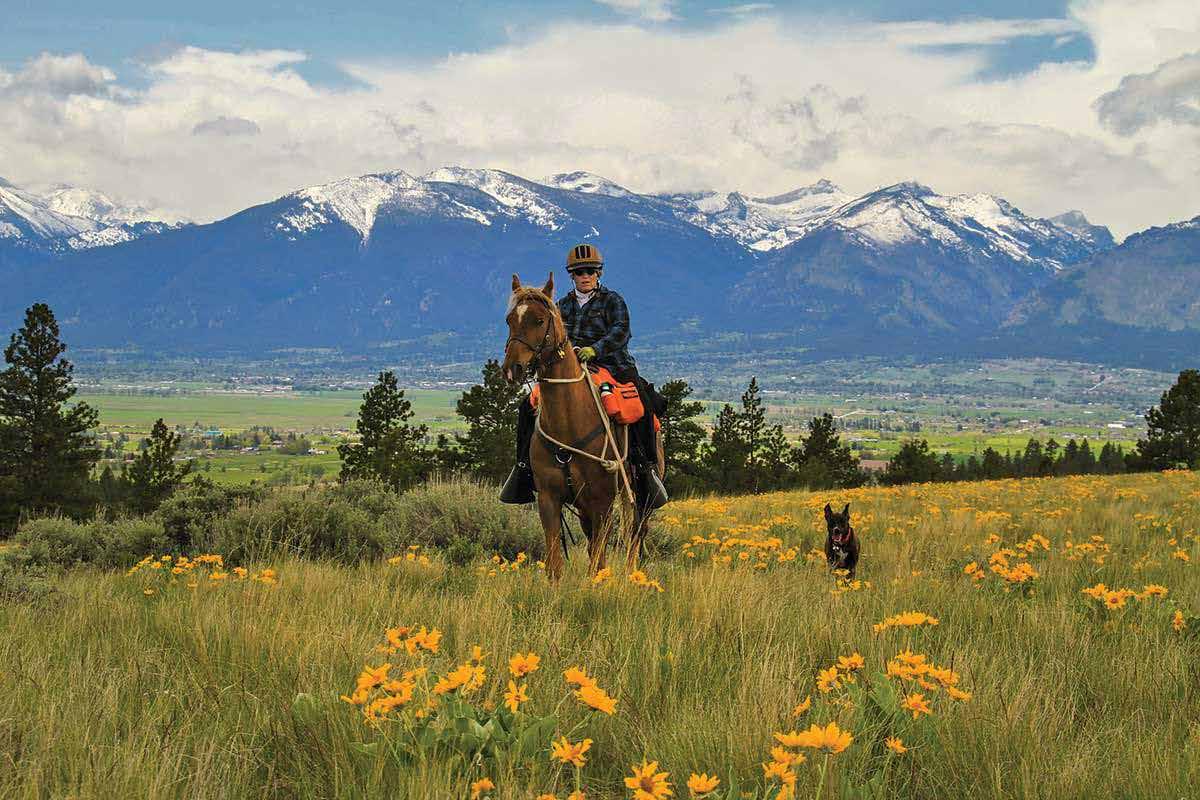
You can ride a Tennessee Walker at Montana’s Dunrovin Guest Ranch.
counters with wildlife are common on the trail. If you come across animals, give them plenty of space. Slow down, remain calm and avoid sudden movements. This not only protects you and your horse but also respects the natural inhabitants of the area.
2. Group Dynamics
Riding in a group? Keep a safe distance between horses to prevent kicking incidents. Communicate with your fellow riders, especially in challenging terrain. If someone needs assistance, be ready to lend a hand. Check to make sure no one is left behind, and if you are having trouble with your horse, let others know to stop and wait.
3. Gate Etiquette
It might seem like a small detail, but proper gate etiquette matters. Close any gates you open to help maintain the integrity of the trail system and ensures the safety of both riders and livestock.
Emergencies and Courtesy
1. Emergency Preparedness
Accidents happen, but being prepared can make all the difference. Carry a fully charged phone on your person (not attached to your horse), know the location of the nearest emergency exit or help point and inform someone about your trail riding plans. It’s alway better to be safe than sorry.
2. Be Mindful of Noise
While the trail is a social space, be mindful of noise levels. Keep conver-
sations at a reasonable volume.
3. Clean Up After Your Horse
Your horse is part of the trail experience, but that doesn’t necessarily mean leaving a mess behind. Depending on the trail system, if your horse does its business on the trail, you may need to dismount if necessary and move it to the side. This simple act of courtesy goes a long way in maintaining a clean and enjoyable trail for all.
Trail riding is a wonderful way to connect with nature, unwind and enjoy the beauty of the great outdoors. By following proper trail etiquette, with a primary focus on safety, we can ensure that this shared space remains enjoyable for everyone. So, saddle up, be courteous, and let the trail adventures begin!










Murdoch Minute
Does your horse pull you out of the saddle? Do you fall forward or back when jumping over the fence? Does your horse travel with his head in the air? Regardless of whether you ride western, English or soft-gaited horses here’s a quick tip to help improve your riding.
Next time you ride take you reins in one hand. Place your other hand on your lower back. Feel your back. Is it hollow (arched), round or flat? If you are unsure, looking at photos or video can help. A hollow back will pitch you forward, while a rounded position can cause your to fall back or brace against the stirrups. A flat back will give you the strength and stability you need for good riding.
The lower back is the lumbar portion of your spine. It is comprised of 5 lumbar vertebrae. Most people have a forward curve (lordosis) in this part of the spine, which is necessary for standing and walking. Usually when sitting the amount lumbar curve decreases.
You can increase or decrease the amount of lumbar curve by arching or rounding your back. When you
arch (extend) your back, the extensor muscles (the muscles you feel on each side of your spine) increasingly contract. When you round (flex) your back the muscles on the inside of your spine (flexors) contract. You cannot feel the flexor muscles because they lie on the inside of the spine behind your internal organs.
In a cow, the flexor muscles (psoas major and minor) are what we enjoy as filet mignon. When your back feels flat the lumbar spine is stabilized using both flexor and extensor muscles.
The lumbar portion of the horse’s spine is the area behind your saddle between the last rib and the croup. Most horses have 6 lumbar vertebrae, although some Arabs only have 5. The horse’s lumbar spine is slightly rounded and has the ability to flex (round) and extend (hollow) using the same flexor and extensor muscles.
The horse needs to be able to round his lower back in order to engage his hindquarters. Pressure on the lumbar area will cause the horse to hollow or drop his lower back. This may be
caused by many things most commonly a poor fitting saddle, a poorly placed saddle, a rider sitting in a hollow position and/or a rider sitting too far back in the saddle.
To find a solid flat lower back position while sitting on or off your horse, gently arch and round your back. If mounted, you may need to sit in the middle of your saddle before you begin. Make very small, slow, movements so that you can sense and feel the changes. Do your back and abdominal muscles change shape, texture and tone as you move? Be careful. A little movement can feel good but you could make yourself sore if you do too much.
When you use your psoas muscles to align the pelvis you can support your position without excessively tightening your back or abdomen. Find the place where your back feels flat and solid without tensing your abdominal muscles. Notice how this affects the freedom of your hips.
Use this Murdoch Minute as a ‘body position self-check’. A solid back is especially important when jumping. While working over ground poles you can place your hand on your back (on a quiet, safe horse) to feel if your back is flat. Regardless of your discipline hopefully you will find with a flat back that you are more secure with less effort. In another Minute you see how to use your new back position to stop pulling back on the reins. And remember – enjoy the ride!
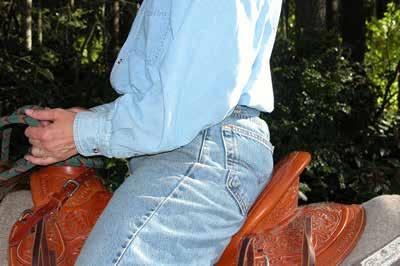
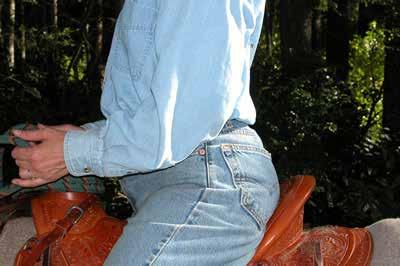
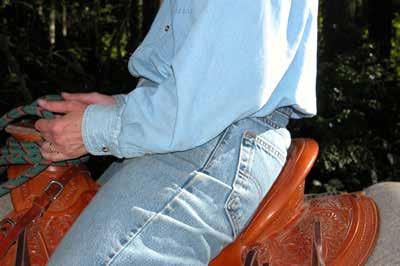
Top: Rider with a solid flat back. The rider is secure in the saddle and will not need to pull on the reins.
Middle: The rider’s back is hollow or arched. She is forward on her crotch and will be unable to stop the horse from pulling her out of the saddle.
Bottom: The rider’s back is rounded. She has pulled back on the reins (notice hands in relation to the horn of the saddle) and will brace against the stirrups to try to stabilize her position.
Unveiling the Magic of Equine Osteopathy:
Horses, majestic creatures that they are, have always held a special place in the hearts of equestrians and animal enthusiasts alike. Beyond their graceful presence, these animals require meticulous care to ensure their well-being, especially when it comes to their musculoskeletal system. Enter equine osteopathy, a holistic approach to horse health that combines science, art and intuition to address a myriad of issues, from stiffness and lameness to behavioral problems.
Understanding Equine Osteopathy
Osteopathy, as a concept, has been around for centuries, originating in the human healthcare field. It involves a hands-on, manual therapy approach aimed at improving the body’s overall function by treating and strengthening the musculoskeletal framework. Equine osteopathy, an extension of this practice, tailors these principles to the unique anatomy and physiology of horses.
At its core, equine osteopathy operates on the belief that the body is an interconnected system where all parts work together to maintain balance. Practitioners, known as osteopaths, focus on the musculoskeletal system, which includes bones, muscles, ligaments and joints, to identify and address any imbalances or restrictions. By applying gentle, precise techniques, osteopaths aim to restore harmony within the horse’s body, promoting optimal function and well-being.
Principles of Equine Osteopathy
Equine osteopathy is founded on several key principles, each contributing to the overall philosophy of this holistic approach:
The Body as a Unit: Osteopathy views the body as an integrated unit, where all systems work together. An issue in one area
can manifest as problems elsewhere, emphasizing the importance of a comprehensive approach to health.
Structure and Function are Interrelated: The structure of the body influences its function, and vice versa. Equine osteopaths assess the musculoskeletal system to identify areas of tension, restriction or misalignment that may be affecting the horse’s performance or well-being.
Self-healing Mechanisms: The body possesses innate mechanisms for self-healing. Equine osteopathy aims to enhance and support these natural processes by removing obstacles to optimal functioning.
The Rule of Artery: Osteopathy places significant importance on the circulatory system, recognizing the vital role of blood flow in maintaining health. Adequate blood supply ensures that tissues receive the necessary nutrients and oxygen for optimal function.
Benefits of Equine Osteopathy
Equine osteopathy offers a range of benefits, making it a popular choice among horse owners and trainers seeking a holistic approach to address various issues:
Improved Range of Motion: Osteopathic techniques can enhance a horse’s flexibility and range of motion by addressing restrictions and imbalances in the musculoskeletal system. This is particularly beneficial for performance horses.
Pain Relief: Osteopathy can provide effective pain relief by addressing the root cause of discomfort, whether it stems from an injury, chronic condition or muscular tension. This not only improves the horse’s well-being but also contributes to a more positive behavioral outlook.
Osteopathy: A Holistic Approach to Horse Health
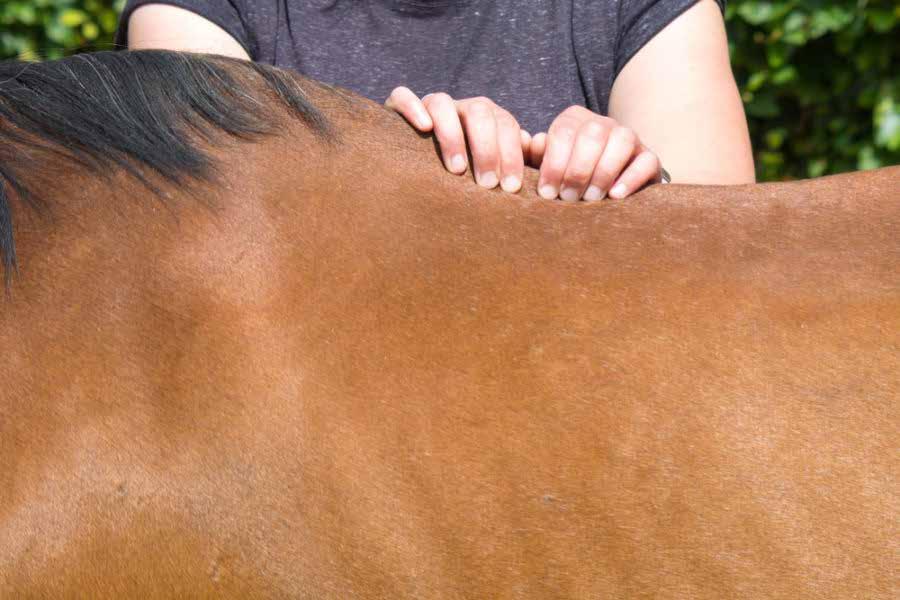
Enhanced Performance: Many equestrians turn to equine osteopathy to optimize their horse’s performance. By ensuring the musculoskeletal system functions at its best, horses can move more freely and efficiently, leading to improved performance in various disciplines.
Behavioral Changes: Horses often exhibit behavioral issues in response to physical discomfort or pain. Equine osteopathy aims to identify and address these underlying issues, potentially resolving behavioral problems and promoting a more content and cooperative demeanor.
Preventative Care: Beyond addressing existing issues, equine osteopathy can also be employed as a preventative measure. Regular sessions can help identify and correct minor imbalances before they escalate into more significant problems, promoting long-term health and longevity.
Professionalism in Equine Osteopathy
While equine osteopathy may sound like a mystical art, it is grounded in science and requires a high level of professionalism. Qualified equine osteopaths undergo rigorous training, often completing specialized courses that focus on the anatomy, physiology and biomechanics of horses. This ensures they have a deep understanding of equine anatomy and are equipped with the skills needed to apply precise, effective techniques.
Additionally, professional equine osteopaths work collaboratively with veterinarians, recognizing that osteopathy is a complementary therapy rather than a replacement for traditional veterinary care. They conduct thorough assessments, communicate with horse owners, and develop treatment plans tailored to the specific needs of each individual horse.










FOSH Scholarship Guidelines
1. Students must submit an essay (minimum 500 words) with the application. The essay should describe how they have supported the FOSH vision/ mission statement and how they have personally supported horses emotionally, mentally, and physically. Essays MAY be published in the Sound Advocate and remain the property of The Friends of Sound Horses.
2. Students with a declared major in an Agriculture, Equine, Veterinary (or pre-veterinary) Medicine, or Journalism related field will be granted preference over students with majors in other programs.
3. Student must be between the ages of 16 and 24 to apply.
4. Only one scholarship per student will be awarded.
5. Scholarship requests must be made at least 90 days prior to the start of the academic semester for which the request is being made. This can be prior to any semester in the program.
6. Scholarships are for Baccalaureate programs only.
7. Schools must be accredited by or members of one of the following:
a. Middle States Association of Colleges and Schools
b. New England Association of Schools and Colleges
c. New York State Board of Regents
d. North Central Association of Colleges and Schools
e. Northwest Commission on Colleges and Universities
f. Southern Association of Colleges and Schools
g. Western Association of Schools and Colleges
h. Membership in Universities Canada
8. Scholarship money available and the number of scholarships available each year may vary at the discretion of the board.
9. Scholarship awards are payable in U.S. Dollars by check to the school for the benefit of [student name] and not directly to the student / parent / guardian.
10. All decisions of the FOSH Board are final and cannot be appealed.
*Participation may be as a rider, worker, or volunteer and is not a scholarship requirement
FOSH Sound Principles
Principle #1
All FOSH events adhere to the requirements of the Horse Protection Act.
Principle #2
Horses are to be treated with dignity, respect, and compassion.
Principle #3
Horses must be presented as sound in both body and mind.
Principle #4
The preferred way of going is natural, correct, and without exaggeration.
Principle #5
Shoeing is intended only for the protection of the foot and its structure. Where practical, barefoot horses are both welcomed and encouraged.
Principle #6
Handlers and riders are expected to use training techniques and equipment that conform to the highest humane standards as recognized by the general equestrian community.
Principle #7
Exhibitors have a duty to conduct themselves in an orderly, responsible, and sportsmanlike manner.
FOSH is a national leader in the promotion of natural, sound gaited horses and in the fight against abuse and soring of Tennessee Walking Horses. For more information about FOSH or to become a member, please visit www. fosh.info.
FOSH Directory
Gaited Clubs
Southern Comfort Gaited Horse Club
Southern Comfort promotes activities highlighting the smooth ride and versatility of all gaited breeds. Pursuits include trail riding, competitions, shows, exhibitions, clinics and many other equine activities. The club promotes horse safety and friendship for all that are interested in horses. Owning a horse is not a requirement. SCGHC is based in southwestern Idaho and is a flat shod exclusive club with members contributing and supporting various interests using sound, natural horses. www.gaitedhorseclub.com
Chesapeake Plantation Walking Horse Club
The Chesapeake Club is celebrating over 25 years of promoting the versatile, naturally gaited, horse. As a member of the Maryland Horse Council, we have been the voice of the gaited community and through demonstrations, clinics and guest speakers, a resource for other disciplines to learn about the gaited breeds in our region. Members enjoy monthly trail rides, newsletters, parades, clinics, social gatherings, and friendly help. We welcome all breeds, riding styles, and experience levels from beginners to professionals. Cpwhclub. wordpress.com or jacquiecowan@comcast.net
Breeders
Summerwind Marchadors and Future Foal Breeders
Plan for your next lifetime partner! Come breed with us! Offering frozen semen (12 stallions in 2020) or reservations for Future Foals “do Summerwind” The Marchador is Brazil’s national horse, harking from Iberia, but bred there for 200 years. Expect to be impressed! http:// futurefoal.net or call Lynn @ 602-999-3915
Missouri Morgans
Easy gaited in color. Rare gaited Morgans located in the Heart of America near beautiful Lake of the Ozarks; for photos, videos and available horses. Talk to Jim or Vali Suddarth at 417-286-4720 or gaitedmorgans@missourimorgans.com

OUR FOREVER FRIENDS
FOSH Lifetime Members
Jo Anne Behling, Wauwatosa, WI
Esther L. Bell, TN
Pamela Brand, Carlisle, PA
Sarah Bushong-Weeks, Denver. CO
Julie Church, Pagosa Springs, CO
Mary & William Church, Pagosa
Springs, CO
Luella DeBono, Eden Prairie, MN
Beverly Foster, St. Augustine, FL
Nancy Gillespie, Pullman, WA
Cristine Holt, Dubuque, IA
Jane Howlett, Pocatello, ID
Marjorie Lacy & Walking Horse News, Edson, Alberta
Sue De Laurentis, Dripping Springs, TX
Bobbie Jo Lieberman
Dianne Little, Calgary, Alberta
Debbie Locke, Mack, CO
Ann Loveless, Ashtabula, OH
Patricia Mayer, East Aurora, NY
Maggie MacAllister, Staunton, VA
Janelle T. McCoy, Prague, OK
Frank Neal, Nashville, TN
Lori Northrup, Ellicottville, NY
Anne Northrup, Ellicottville, NY
Shellie Pacovsky, Bainville, MT
Denise Parsons
Anita Rau, Catlett, VA
Debbie Rash, Chino, CA
Southern Comfort Gaited Horse Club, ID
Bucky & Nancy Sparks, Cortez, CO
Marcy Wadington, Canon City, CO
Leslie Weiler, Pagosa Springs, CO
Laura Wyant, Chesire, OR
An Anonymous Donor
Yankee Walkers of New England
Please consider adding FOSH to your list of worthy causes in making a taxfree charitable deduction or help us to promote legislation, education, and training that protects and helps gaited horses, simply by renewing your own membership or giving a gift membership to a kindred spirit.
We know you have many choices when it comes to giving. Thank you for considering FOSH.
FOSH Membership Application and Order Form
All annual memberships include a digital, bi-monthly issue of the Sound Advocate & educational packets. Mail to: FOSH 6614 Clayton Rd. #105, St. Louis, MO 63117
Type of Membership (check one)
Annual: Single ___$30 Annual Family ___$50 Annual Youth <18 ___$20 Lifetime__$600 Organization Membership (for your gaited horse club or association) ___ $50
Please print neatly.
Name: _______________________________________________________________________
Enclosed: $____________________
How did you hear about FOSH?