9 ART AS A TOOL FOR HEALING, RESISTANCE, & FREEDOM
by Brittany Cheatham and Damola Akintunde
12
COMMUNITY SPOTLIGHT:
Set it Off, the movement for Black women, girls, trans and femmes - Dr. Ashley Marshall in Conversation with Brittany Cheatham
RESTORING DEMOCRACY:
The Case for a Restored Voting Right Act by Kathleen Roblez
A Love Letter to Our Shared Visions and Dreams
by Attica Scott
DIRECTOR
OF SPECIAL PROJECTS FORWARD JUSTICE ACTION NETWORK
Dearly Beloveds:
In the words of Prince, when we gather, we gather, “…to get through this thing called ‘life’.”
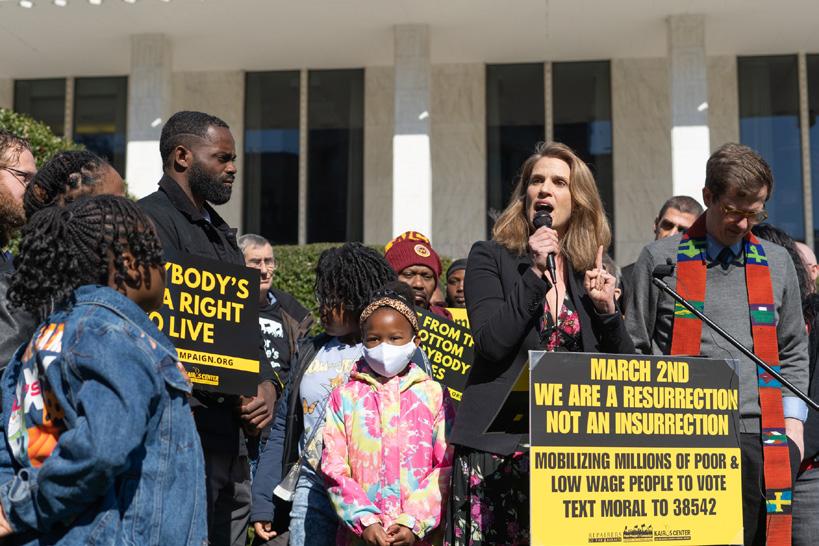
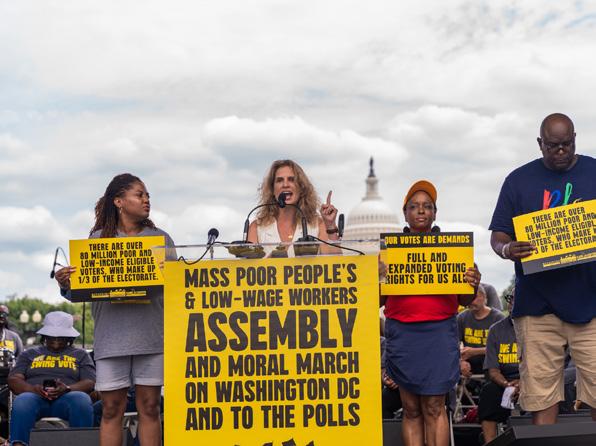
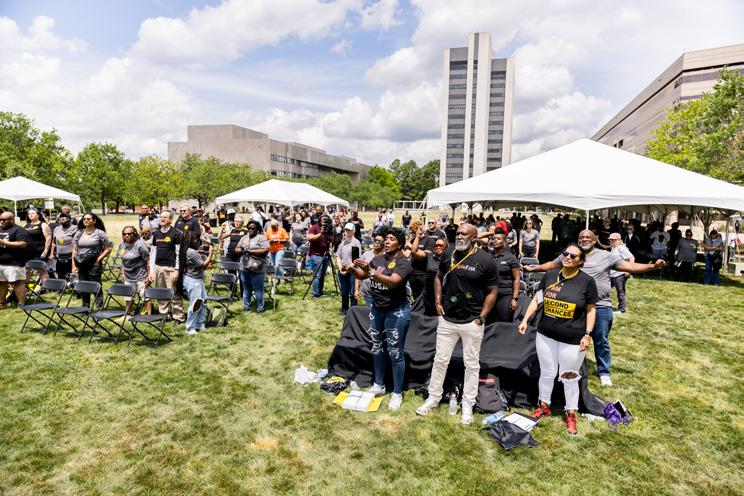
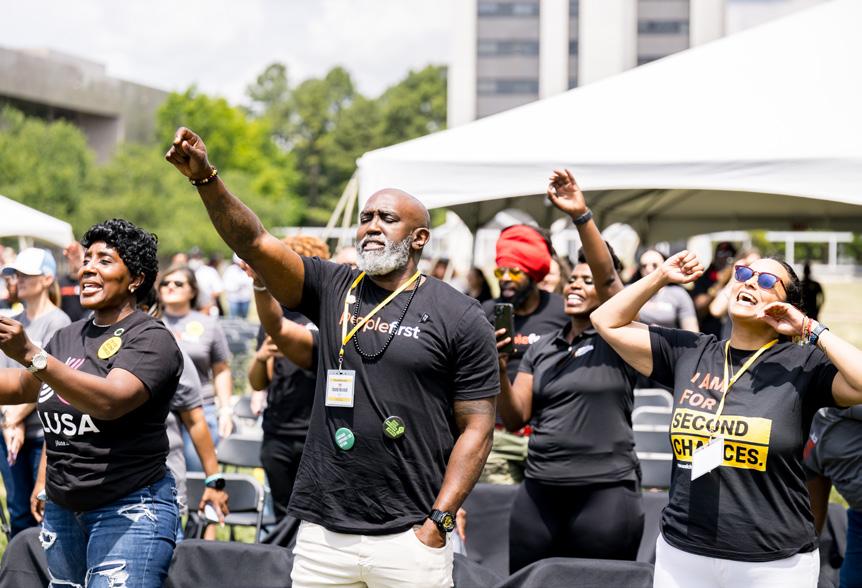
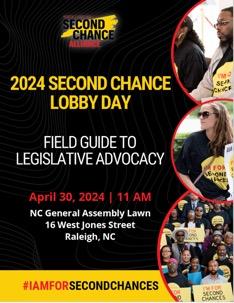
We have gathered this year in Jackson, MS to fight for clean water, because water is life. We have gathered this year in Raleigh, NC to lobby for second chances, because everyone deserves the opportunity to thrive. We have gathered this year in Washington, DC to rally with low-wage workers and people living in poverty, because poverty is a policy choice and we won’t be silenced anymore.
We are called in this time to radically redefine freedom. What does freedom mean to you? What does it mean for our Black, Brown, Asian, Pacific Islander, and Indigenous siblings across the U.S. South who are demanding to be heard and seen?
We are at a moral crossroads that has been shaped by capitalism and white supremacy from its inception. Our freedoms are constantly under attack – attacking critical race theory, banning books and drag shows, attacking trans youth, failing to end the proliferation of weapons of mass destruction, and weaponizing the Supreme Court in so many ways including criminalizing houseless – and those attacks are designed to manipulate and silence our movements.
It is in this moment that we call on our movements to move forward together and not one step back. Our freedoms demand defending. Our values are intertwined, and our vision is clear: we are fighting for a path forward that is multiracial, multigenerational, and that honors the dreams of our people, and centers human needs over corporate and political greed.
We can have healthcare for everybody and protect women’s rights. We can have humane immigration policies. We must take big money out of politics and fully expand voting rights. We can end poverty and pay people a living wage. We must respect workers’ right to organize and bargain collectively. We can end the proliferation of weapons of mass destruction. We can have environmental justice and we can end environmental racism. We must address Rev. Dr. Martin Luther King Jr.’s “…giant triplets of racism, extreme materialism, and militarism,” as we seek global peace and an end to genocide. We must move with love, not hate; deliberateness, not division; and collectivism, not extremism.
We must ground the South in radical love and revolutionary kindness. We must nourish and nurture our movements with abundant care and joy. We are a force to be reckoned with in these times of resistance. And in these times, may we look to the leaders among us who know that another world is possible.
My dear friend, Dr. Gabriela Alcalde, says “when communities are unwell, they silence those who speak for justice, love, and collective dignity.”
May the communities that we are building be well. May your voices be heard. May we radically redefine freedom.
- Attica Scott DIRECTOR OF SPECIAL PROJECTS FORWARD JUSTICE ACTION NETWORK Attica Scott
The Impact of Criminal Court Fines and Fees
by Whitley Carpenter
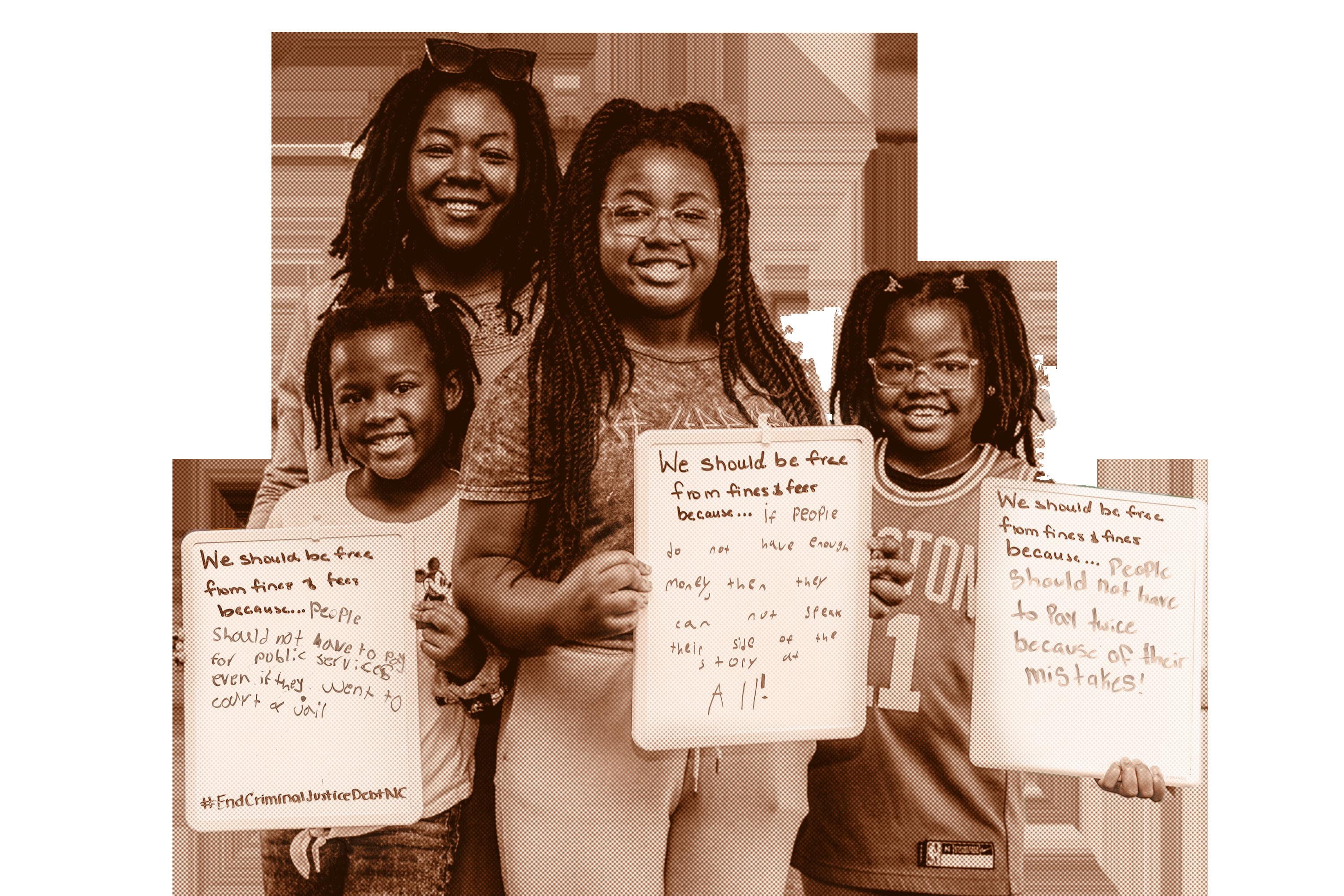
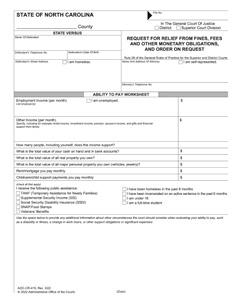
Since 1999, the number of criminal court fees has increased from 4 to 45 and the base cost for use of court has increased from $61 to $176. Many of these fees are unaffordable for many North Carolinians and lead to financial hardship as well as Driver’s License suspension, extended community supervision, and sometimes incarceration.
Despite clear constitutional and state law requirements, courts throughout North Carolina routinely impose these financial penalties without inquiring into a person’s ability to pay. Often these penalties are costly, reaching into the hundreds, thousands, and even tens of thousands of dollars depending on the charges. Instead of providing relief, courts often inflict additional harsh punishments, again without affording the individual an opportunity to demonstrate their inability to meet the obligations. When the criminal court fees
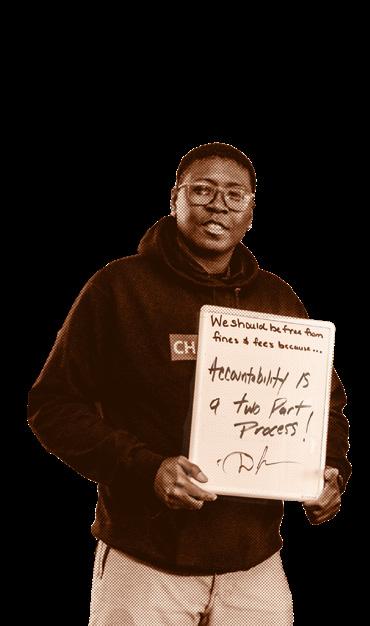
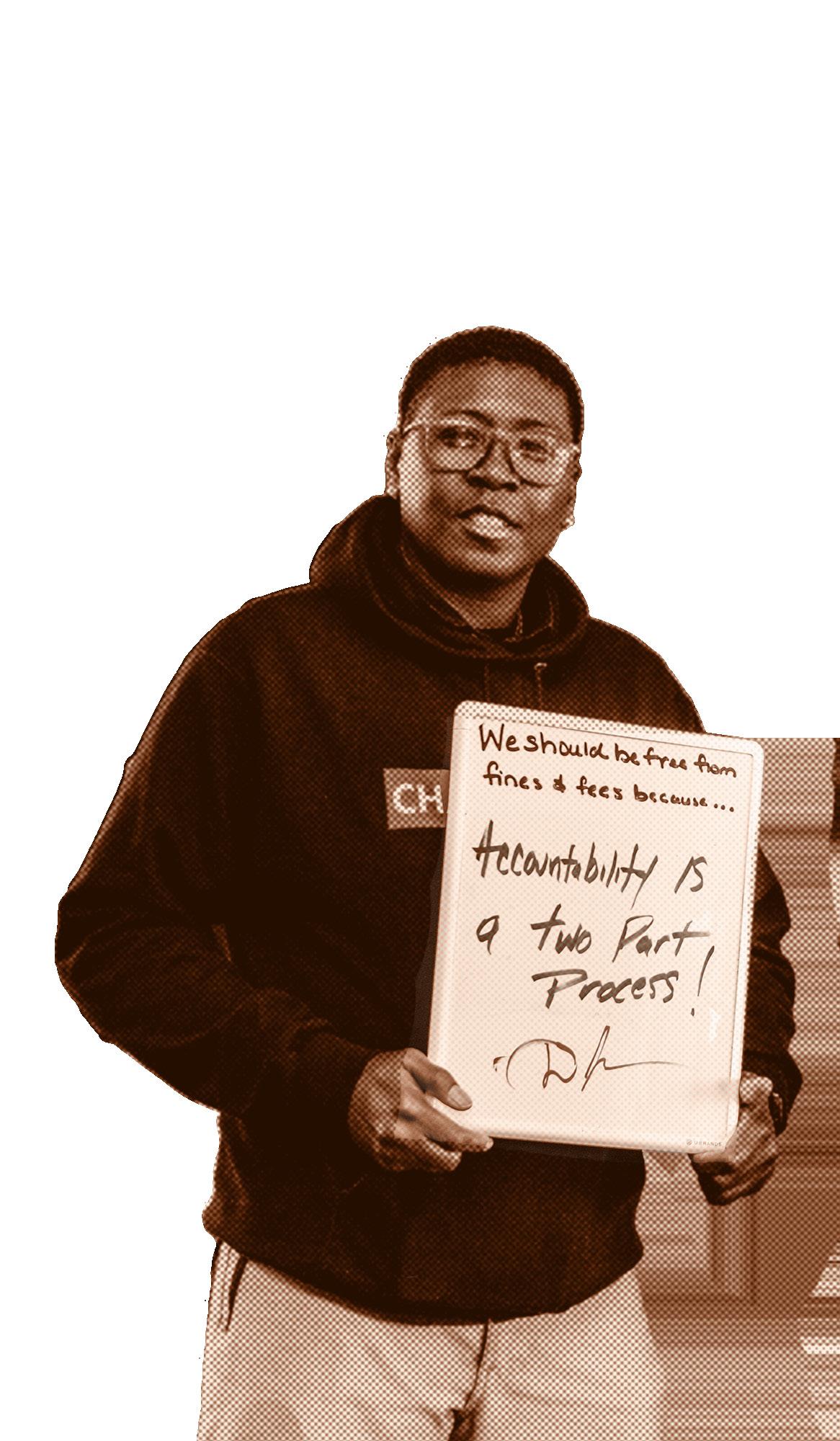
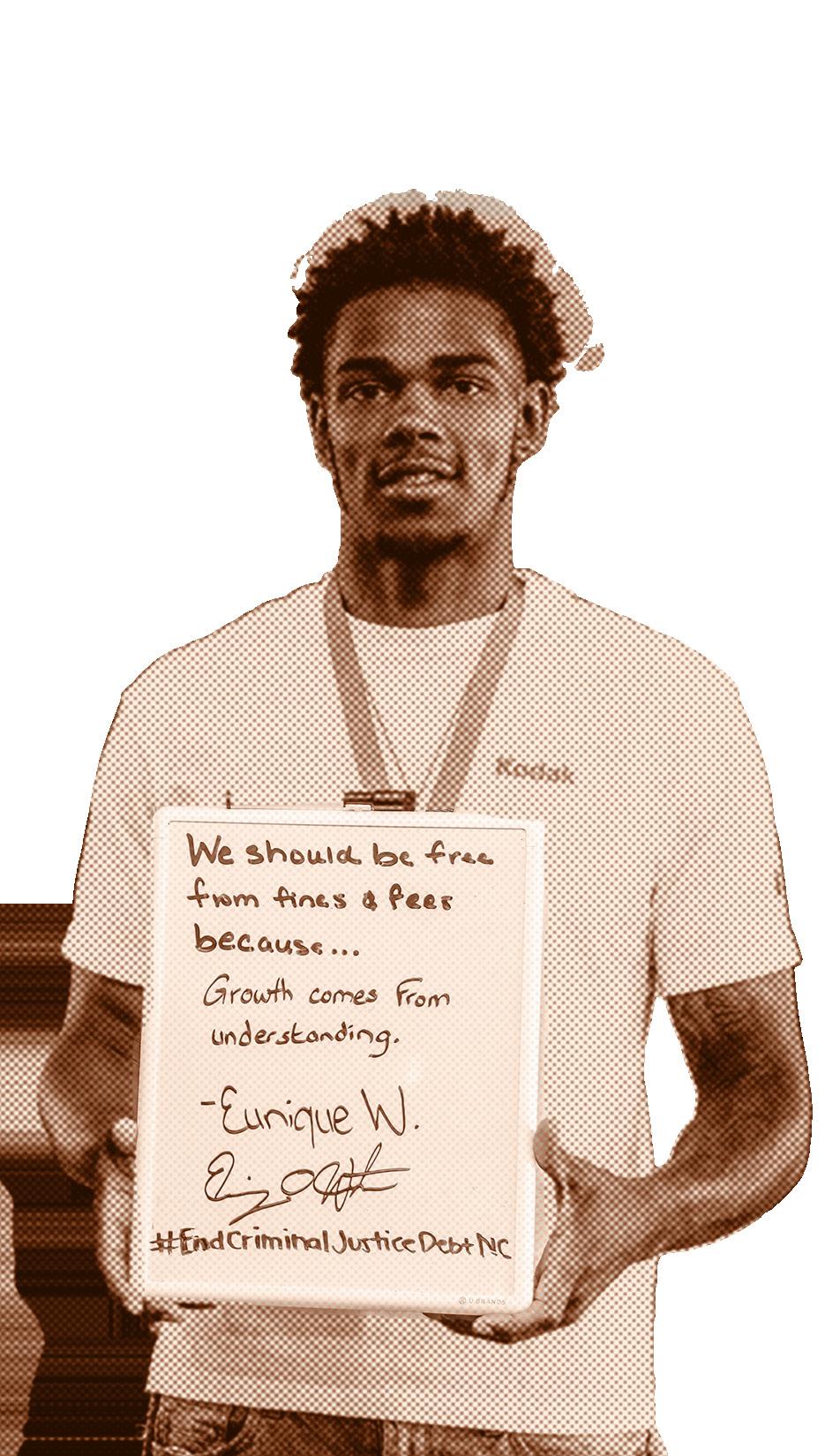
We should be free from fines & fees because...
#EndCriminalJusticeDebtNC
are converted into a civil judgment or when a person also faces the unauthorized substances tax, they then are faced with interest rates exponentially increasing the amount of money that they owe the state.
These practices have devastating real world consequences for people who are forced to make critical decisions about their finances in a time of soaring inflation and stagnant wages. These decisions take on a different weight when a person’s freedom is quite literally attached to them. Many North Carolinians have had to choose between buying food for their families and paying court debt so they are not incarcerated or have their licenses revoked, further jeopardizing their ability to get to work to make a living and provide for their families. Our criminal legal system should not be funded on the backs of those least able to pay.
The Voices of those Directly Impacted
““When I was younger I didn’t make enough money and had a lot of tickets for driving with my license revoked. I had tickets for driving with no insurance. I had tickets for failure to pay the fine, which caused my license to be revoked. So that was my initial entrance into it, and then I had a criminal charge that further thrust me into the system. It probably was about $300, which is what I needed to pay. Once it went into suspension, there was another fee on top of that, so that cost more. I would say just to get my driver’s license straight probably paid close to $1000. We really have to consider something else because when you have to go to work, when you’re already below the poverty level, you are working for $7.50...$8.50, you have to go to work. It’s not an option, you wouldn’t work for $8.50. And I think that we’re putting people in bad positions. I know people who haven’t gotten their needed medications to pay a fine, because they were scared to go to jail, not scared of their health. I just think that it’s time to have that conversation and I think that more people need to share their stories of their struggles of what’s happened. Because I think that we have legislators who have not been poor in a very long time, if they’ve ever been poor and don’t understand that cycle of what can happen to people.”
-Dreama Caldwell
Questions for thought:
What would you do with the money the court system receives from fines and fees to help your family, friends, or community?
How is money used as a tool by the system to both grant and deny freedom?
the system really working when the state is unable to collect money that people simply do not have, yet punish them by imposing more fees that they cannot pay?
Art as a Tool for Healing, Resistance, & Freedom
by Damola Akintunde and Brittany Cheatham
The artist plays a unique role in the movement, sharing space with the healer, communicator, and freedom fighter. We can see the impact of the work of writers, photographers, visual artists, etc. throughout history as they shed light on society’s ills while uplifting the humanity of those living on the margins. While art can be self-expressive and individualistic, it demands the audience to invest in the lived experience of its creator. Through this investment, it can reach stakeholders who otherwise would not listen to the demands of the people. Black folks especially lean on the power of art as a form of activism, which has been long documented in American history. This art based activism has led to tangible policy change, created safe spaces, and fueled movements that have improved the material conditions of our communities.
In the 1800s, music and oral storytelling documented the widespread terror formerly enslaved Black people experienced after emancipation.
Influential autobiographies like Twelve Years a Slave, The Autobiography of Fredrick Douglas, The Interesting Narrative of the Life of Olaudah Equiano, and others were instrumental in the abolition of slavery by bringing our stories, plight and voices into the mainstream. In addition to truth telling, these mediums provided opportunities for community building and strengthening connections. This practice of remembrance led to the origins of Blues music, which evolved from spirituals and work songs sung in the field. In the late 19th and early
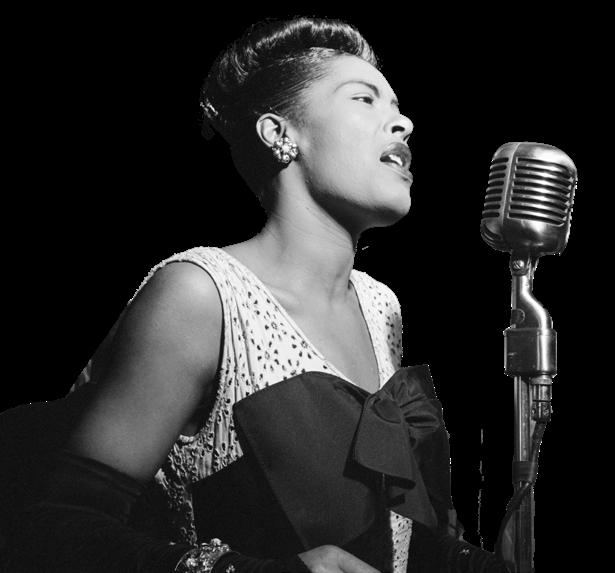
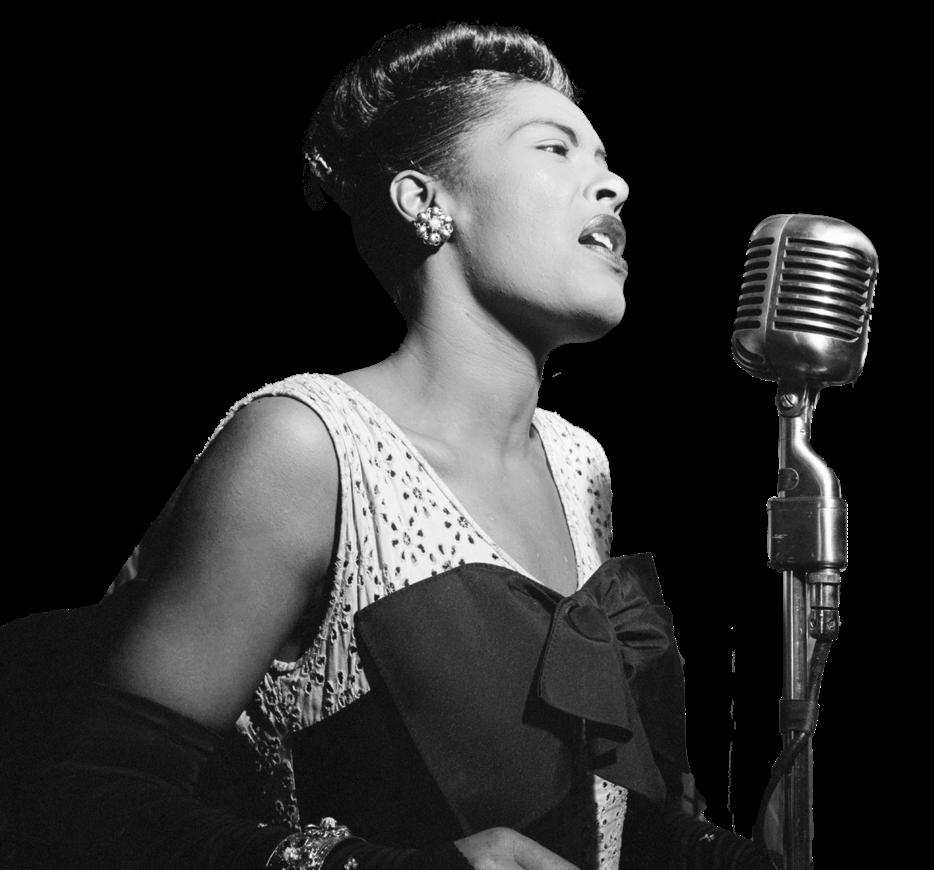
20th centuries, Blues musicians like Billie Holiday used their songs to shed light on racial violence. Holiday’s ‘Strange Fruit’ served as a form of protest, and continues to be referenced by contemporary artists highlighting the ongoing fight for racial equality. While music spoke to the grief many felt around racism, it also carried symbolism of Black power and resilience.
and sexuality, bringing together the masses to make the call for justice.
Black art has served Black people in many ways from a way to be resilient to a way to resist, but more importantly, it shines a light on a truth that our country often shies away from
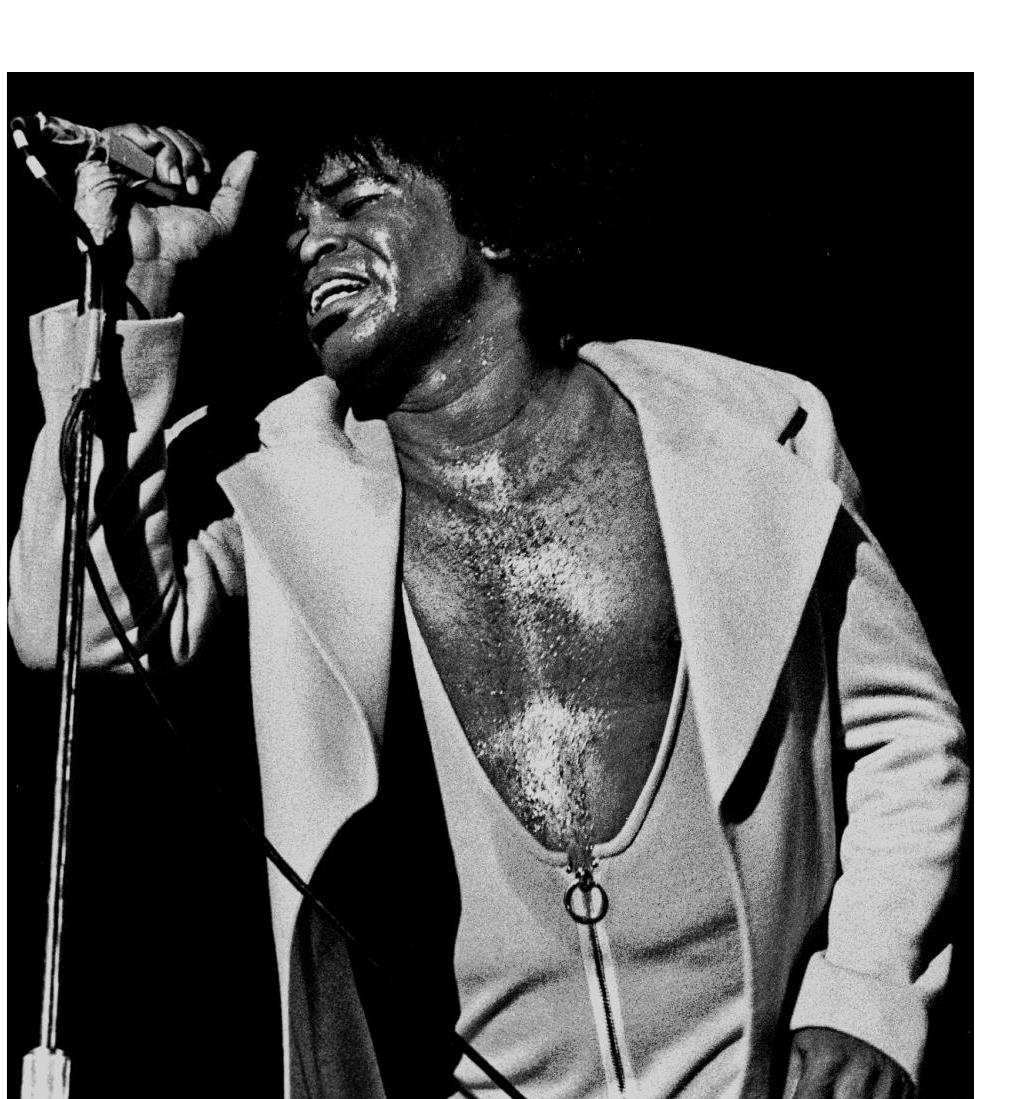
During the civil rights movement, crowds of people sang along to James Brown’s ‘Say it Loud, I’m Black and I’m Proud’, which according to Howard Law professor Randall Kennedy, was a reclamation of Blackness in a time of rampant colorism.1 Current social movements like the Poor People’s Campaign carry on musical traditions through theomusicology, which “employs the principles of moral fusion movement to teach the theory and practice of using diverse genres of music past and present as an organizing, empowering, and community building tool.”2 They understand that music transcends gender, race, class,
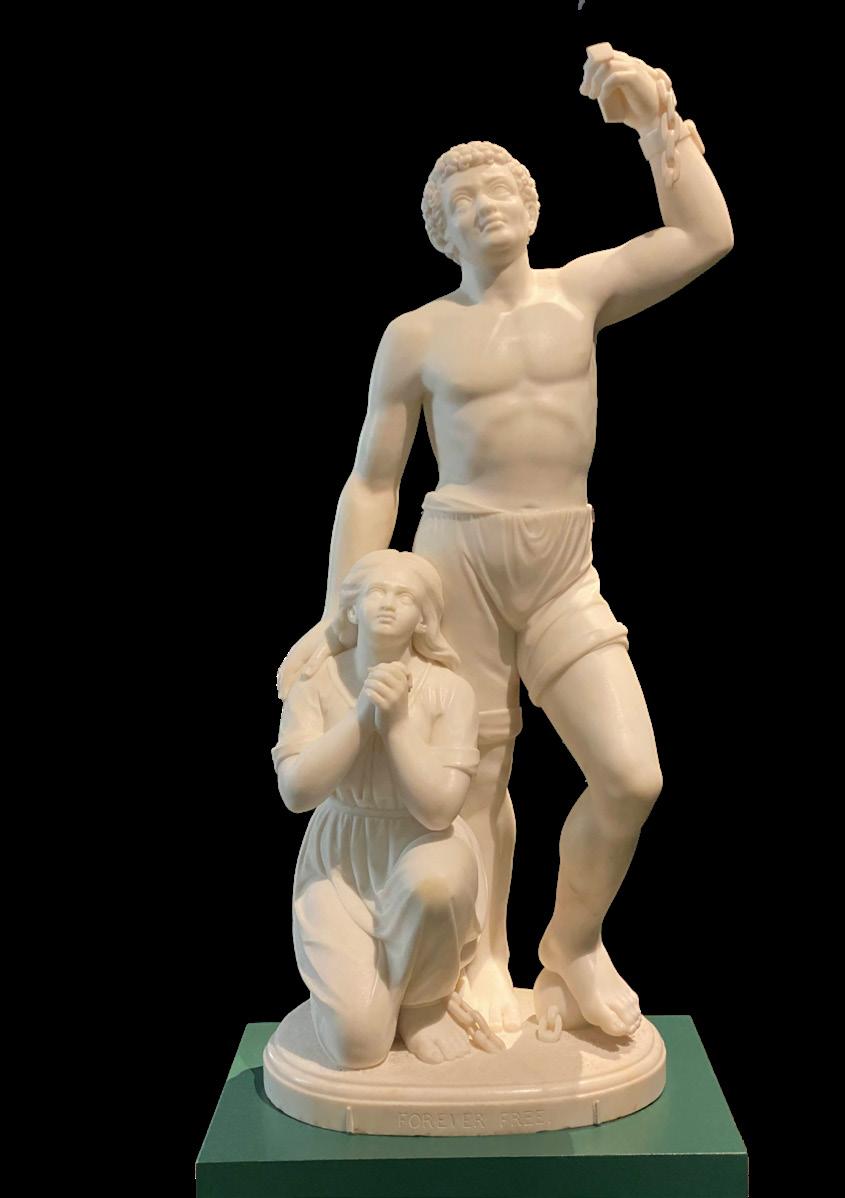
Visual communication also serves as a cornerstone for movements, sometimes through fine art and photojournalism, but also graphic design in posters and flyers. In the First Reconstruction, Sculptor Edmonia Lewis created “Forever Free”, a marble sculpture that celebrated emancipation by depicting a kneeling Black woman and a Black man standing with his fist held high. This imagery of free Black folks contrasted other visuals of Black folks at the time, invoking a sense of hope3
Later in history, the Harlem Renaissance serves as a cultural shift, with the literary contributions of Langston Hughes and Zora Neale Hurston exploring themes of Black identity and societal changes in the 1920s. In the 1960s, image makers like Gordon Parks photographed the daily lives of the Black community, documenting the effect of systemic racism through photo essays featured in Life Magazine. Those who hold the camera control the narrative, and the
Forever Free
James Brown
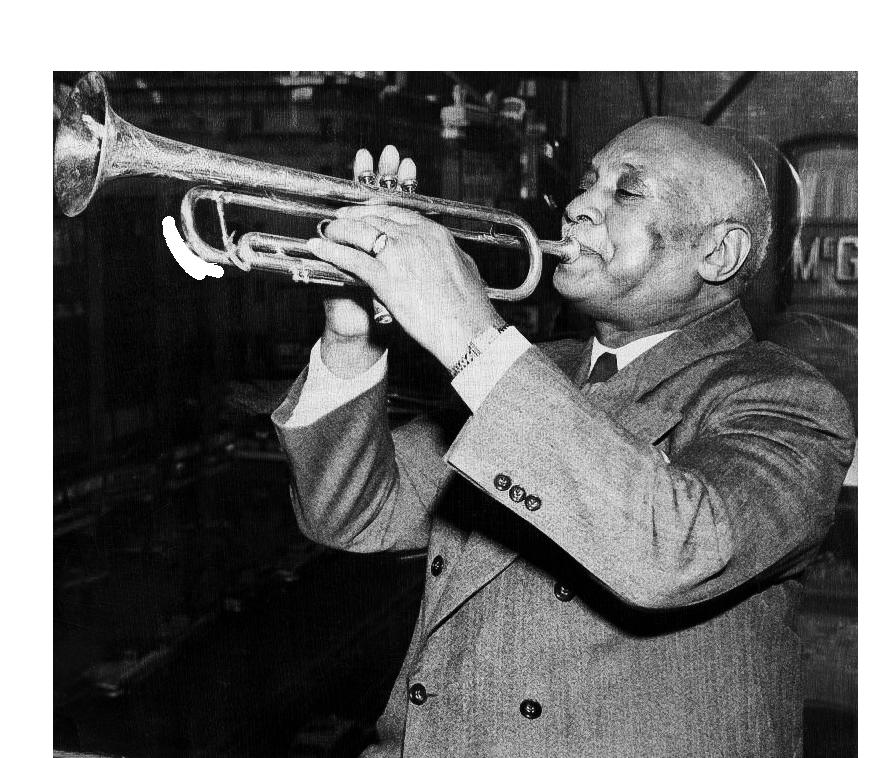
Billy Holiday
importance of documentation still rings true today. Art collectives like Diversify Photo and Black Women Photographers carry this legacy forward by ensuring those on the margins are also behind the lens to ethically share the stories of those most impacted by issues of injustice.
Decades later, the Black Arts Repertory Theatre/ School (BARTS) would be founded and rooted in the same landscape of the Harlem Renaissance.
Founded by the famed poet Amiri Baraka (LeRoi Jones) in Harlem in 1965, the BART school served as a community hub for artists and became a cornerstone of the Black Arts movement. The theater was used to showcase the realities of the Black community, with emphasis on their struggle against white oppression. BARTs is credited with inspiring the opening of many other black theaters and schools across the country, including in Chicago, Detroit, and San Francisco. Several modern artists and writers, such as Toni Morrison and Alice Walker, have cited BARTS as an inspiration for their work.
“An artist’s duty, as far as I’m concerned, is to reflect the times.”
NINA SIMONE
And in the new age of social media, graphic design shapes the visual identity of movements.
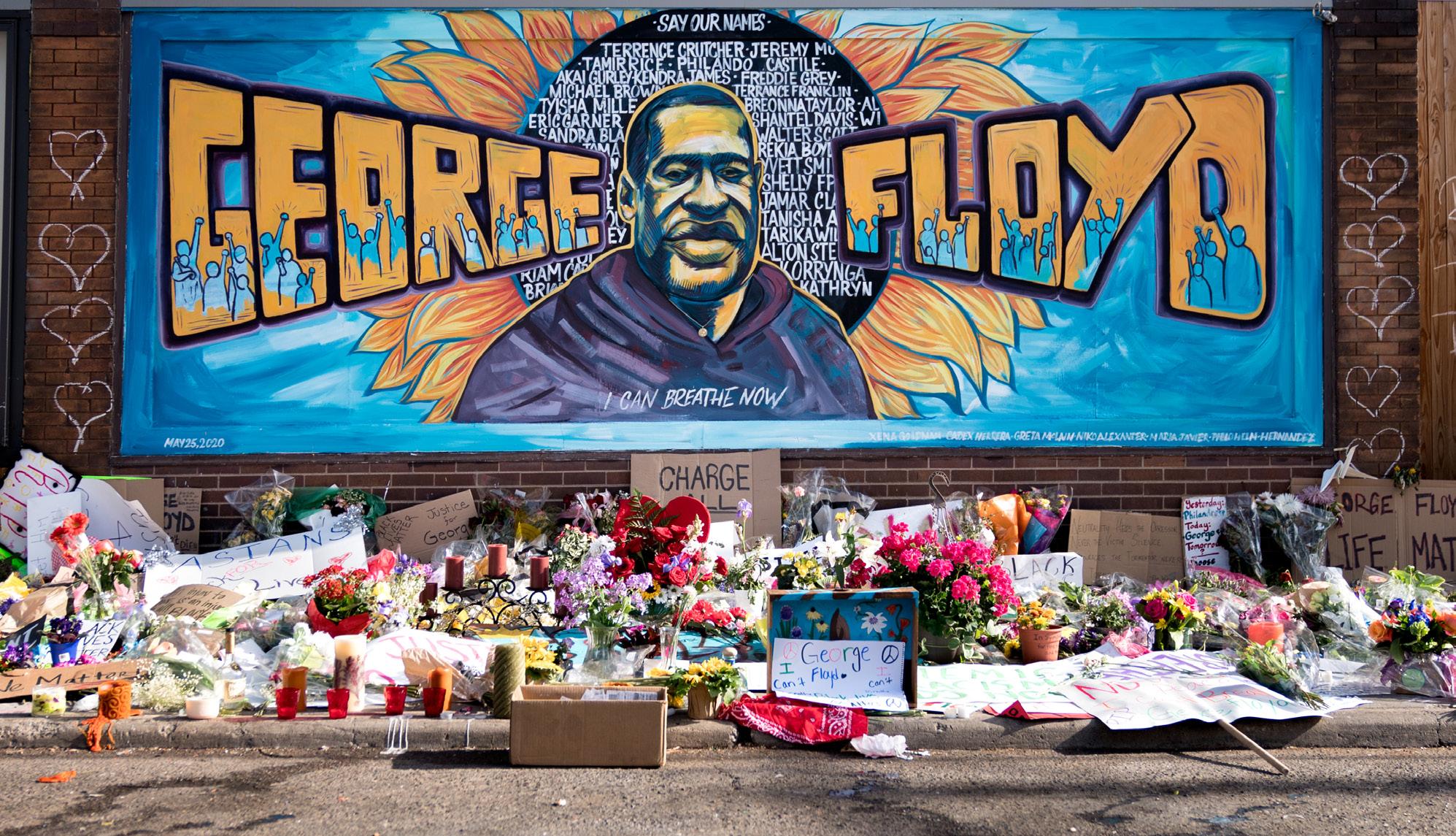
The pandemic showed the power of an infographic and how it can touch various corners of the internet if done strategically. Organizers built political power by incorporating symbols of resistance and change into their materials, leading to mass protests for issues across the globe. During the protests following George Floyd’s murder, posters of his image accompanied by the hashtag “I Can’t Breathe” added energy to the already growing Black Lives Matter movement. Artists shared their pain, resistance, and hope through painting murals, releasing new songs, and even dancing in the streets. The BLM movement, and its calls for police accountability, resulted in actual policy change in different places across the US around police budgets, use of force, regulatory stops, and more.
Art as a concept is ever-changing which provides changemakers the opportunity to work across mediums to communicate our ultimate goal, freedom for all. Wielding a pen, a camera, or a paintbrush in service of narrative change can impact future generations. In the words of Nina Simone, “An artist’s duty, as far as I’m concerned, is to reflect the times.”
George Floyd Mural located on the corner of 38th Street and Chicago Avenue South in Minneapolis, is the work of artists Xena Goldman, Cadex Herrera, and Greta McLain. The group started working on the mural on Thursday morning and finished it within 12 hours with the help of artists Niko Alexander and Pablo Hernandez.)
COMMUNITY SPOTLIGHT:
Set it Off, The movement for Black women, girls, trans and femmes
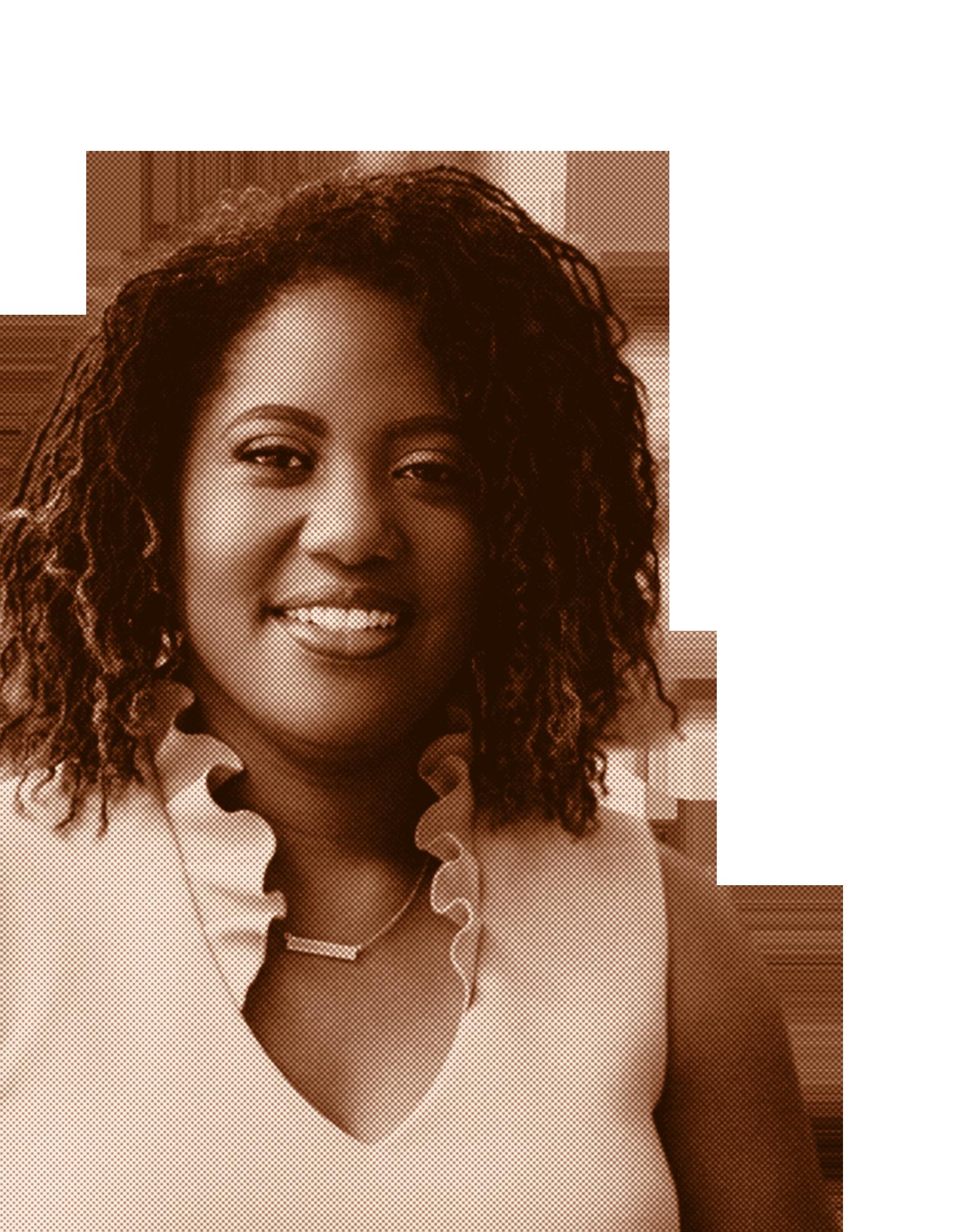
Dr. Ashley Marshall in Conversation with Brittany Cheatham
Introduction:
I am grateful Rev. Erica Williams the Founder of SIOM, invited me to co-vision the breathe of what SIOM could be. The Set It Off Movement (SIOM) is a long-term initiative dedicated to the healing, well-being, and building power for the liberation of poor Black women and girls in the United States. 56% of Black women are poor or low-income, living in dangerous proximity to financial ruin. (Source: We Will Be Free report.) Through the intersections of spirituality, research, and social justice organizing- this initiative will challenge perceptions about systemic injustice, and build grassroots leadership to drive change on the local, state, and national levels. We sat down to speak with Forward Justice Co-Director and SIOM co-chair Dr. Ashley Marshall about the power of this movement.
Full Interview
Brittany:
Tell us a little bit about yourself and the Black women who have played an important role in your life
Dr. Marshall:
I am a first generation college student, I’m the middle child, I have two other siblings and I’m originally from Columbia South Carolina. I identify as being from the country, being raised in a country area on a farm. I also identified as being raised in poverty, like we were very poor. My siblings and I were mostly raised by a single mom and I watched her work two jobs and struggle to make ends meet with the three of us. When my mother was working, my grandmother (her mother) would also take care of us.
found sales she found her niche, because she loved connecting and working with people and found her love for interior design as well.
As a Black woman, your first role models are the women that you see everyday- so it’s your mother, it’s your grandmother, your aunties, great grandmother’s, older cousins right- and so you look at them, you look at their lives, what they carry the work that they do and start to understand their role in the family and their role and supporting and taking care of you. So for me, my mother and my grandmother and great-grandmother, who transitioned last June, were some of the strongest women role models that I knew growing up.
Brittany:
My grandmother worked many jobs. As I grew older I came to understand that she worked at a chicken factory, cleaning hospitals for many years, and she also worked as a domestic worker in houses taking care of white families, which was pretty common for Black women in the South. My mother had experience working many jobs as well. Our family owned a trucking business and she would provide administrative support to our families trucking businesses. That’s one of the first earliest jobs I remember my mother having. Then she got involved in sales and became a sales associate selling furniture. She did that for many years holding various roles from salesperson to manager. She still sells furniture now, so when she
Where does the Name Set it Off come from?
Dr. Marshall:
The title and theme for this initiative is inspired by the 1996 film Set It Off, which follows four young Black poor women in Los Angeles, California, who plan to execute a bank robbery—each doing so for different reasons—to achieve better for themselves and their families.
Brittany:
What about their and your own stories and experiences made you and Rev. Erica Williams found the Set it Off Movement?
Dr. Marshall:
Truly for me, I think a core part of the reason why I Set it Off is such a powerful vision and speaks to me is because of my own little girl. I have a daughter and she will grow up in this world to be a Black woman and subject to all of the experiences and conditions that we face as Black women in the United States’ capitalistic Western Society. And because I’ve
Questions for thought for readers:
What do you think radical freedom and true equality would look like for Black women in this country?
How has what we believe and think about Black women and their role(s) in society been shaped positively or negatively by the media and dominant culture?
What are some ways you can actively challenge or shift the way Black women are treated and portrayed?
SIOM VALUES:
FULL INCLUSION of queer, trans, and gender non-conforming Black Women
CENTERING the voices of poor and marginalized Black Women
ABOLISHING poverty
HEALING situational and systemic trauma
SPIRITUALITY as a path to real-world liberation
POLITICAL EDUCATION AND ORGANIZING to build power for poor Black Women
NO COMPROMISING on the changes that are needed to liberate poor Black Women
seen it, live through it, I’ve seen it from my mother, grandmother and my own experiences as a black woman navigating spaces of capitalism patriarchy of classism racism and sexism, I unfortunately know what these experiences can do to the self-conscious of a black woman. And what these aggressions tells us what black women’s place is in society; it is these experience that work to dehumanize us and separate our spirits in our bodies to be used as tools to maintain institutions/structures in Empires. I do not believe that is our calling on this earth. I do not believe black women should be subject to such manmade conditions and that we are forced to live with and figure out how to survive. So for me it is clear that I am not only do this work for myself for my mother, grandmother and my sister but I also do it for my daughter and her children. I want to work to create a world that is safer for her to be her full self and not have to shrink or cower or question what her place is in this world. She should be able to move and live a full life with the highest confidence, self-esteem, resources, creativity and capacity with every other black girl.
Brittany: How do you all see this movement transforming the conditions of Black women, trans, girls and femmes across the country?
Dr. Marshall:
We want this movement to create radical freedom and true equality. Our goal is to establish a safe and sacred world for Poor Black Women, Femmes, and Girls to thrive and to live out their full humanity and dignity, while driving attention to the triple jeopardy of racism, classism, and sexism that perpetuates the dehumanization, destruction, and death-dealing aimed at poor Black women and girls in America.
Brittany: What else would you like folks to know?
Dr. Marshall:
For more information and to learn about upcoming tour dates: follow us on social media @SetItOffMovement, join our email list at https://bit.ly/setitoffmovement202, or visit setitoffmovement.org
Restoring Democracy: The Case for a Restored Voting Right Act
BY KATHLEEN ROBLEZ SENIOR VOTING RIGHTS COUNSEL & LITIGATION MANAGER - FORWARD JUSTICE
The struggle for voting rights in this country has been persistently marred by efforts from groups with entrenched power to disenfranchise the oppressed. Initially, the right to vote was limited to only white, male landowners, as the Constitution left it up to individual states to determine voter qualifications. And even after the Fifteenth Amendment was passed in 1870, granting Black men the right to vote, states continued to erect barriers such as poll taxes and literacy tests to suppress their vote. Each expansion of the franchise has triggered a white backlash, and this is particularly pronounced in the South and in our home state of North Carolina.
LANDMARK FEDERAL LEGISLATION PASSED that prohibits racial discrimination, protecting our constitutional right to vote.
In response to these persistent discriminatory practices, Congress passed the Voting Rights Act of 1965 (VRA), a landmark legislation aimed at dismantling barriers to voting and protecting our sacred, constitutional right. Section 5 of the VRA introduced a pre-clearance process, requiring jurisdictions with shameful histories of voter discrimination to obtain federal approval before altering their electoral laws or district maps. This safeguarded against new discriminatory measures being passed in areas where systemic racism was deeply entrenched, including 40 of North Carolina’s 100 counties.
When the U.S. Supreme Court decided Shelby v. Holder in 2013, the Court struck down the Section 5 coverage formula in effect at that time, meaning that the previously “covered jurisdictions” no longer needed to seek preclearance
THE SCOTUS DECISION that stripped Section V voting rights protections.
2013
IMMEDIATELY AFTER THE SHELBY DECISION, NC’s legislature passed H.B. 589 aka the “monster voter suppression bill.”
from the federal government to pass new election laws. This has effectively gutted the Voting Rights Act, and has left voters who are discriminated against without protections or remedies outside of filing lawsuits. Litigation takes years, and in the meantime, laws that unconstitutionally limit access to the voting booth could be in effect for several election cycles. Congress could restore the full power of the law by coming up with a new preclearance formula, but in the last 10 years, our elected officials have made no progress on this front.
North Carolina provides a stark example of the repercussions of the Shelby decision. We have seen countless attacks on voting rights since 2013, all of which disproportionately impact Black and brown voters.
Immediately after the Shelby decision, the North Carolina legislature greatly expanded its proposed photo voter ID bill and passed H.B. 589, also known as the “monster voter suppression bill.” The bill not only included a restrictive photo voter ID requirement, but also greatly restricted access to early voting, ended pre-registration by teenagers, eliminated same-day
registration and eliminated out-of-precinct voting. This targeted attack aimed to ensure that the tools most likely to be used by Black, brown and poor voters were stripped away.
The North Carolina State Conference of the NAACP and others brought a legal challenge to the bill, and it was ultimately struck down by the Fourth Circuit in 2016, who held that the bill targeted AfricanAmerican voters “with almost surgical precision” (NAACP v. McCrory). Despite legal victories like this, the absence of Section 5 preclearance in federal law has allowed an avalanche of voter suppression measures to persist in North Carolina.
Politically and racially motivated gerrymandering has distorted electoral districts, paving the way for an illegally gerrymandered legislature to enshrine voter ID requirements into the state Constitution. Forward Justice is representing the NC NAACP in legal challenges to both laws. H.B. 1092 is being challenged in state court through NAACP V. Moore and S.B. 824, is being challenged in federal court through NAACP V. Hirsch.
2016
IN NAACP V. MCCRORY, the Court held that H.B. 589 targeted Black voters “with almost surgical precision.”
2019
LAWSUIT FILED SEEKING TO REINSTATE VOTING RIGHTS for over 56,000 North Carolinians impacted by an unconstitutional, racially discriminatory, felony disenfranchisement law.
MARCH 28TH, 2022
AT THE TRIAL LEVEL, THE COURT RULED IN OUR FAVOR - securing the largest expansion of voting rights in the state since 1965.
FEBRUARY 1, 2023
NEWLY ELECTED AND HIGHLY POLARIZED, PARTISAN NC SUPREME COURT unprecedentedly reheard our right’s restoration case (CSI v. Moore), resulting in the previous ruling being overturned.
2023-24
DELUGE OF VOTER SUPPRESSION BILLS FILED DURING THIS LEGISLATIVE SESSION.
SB 747
omnibus legislation that makes voting in North Carolina more difficult, targeting Black, Brown, rural, and low income voters.
S.B. 749
legislation that takes authority away from the governor, and gives legislators additional authority over the partisan makeup of the State board of Elections and Count Boards of Election.
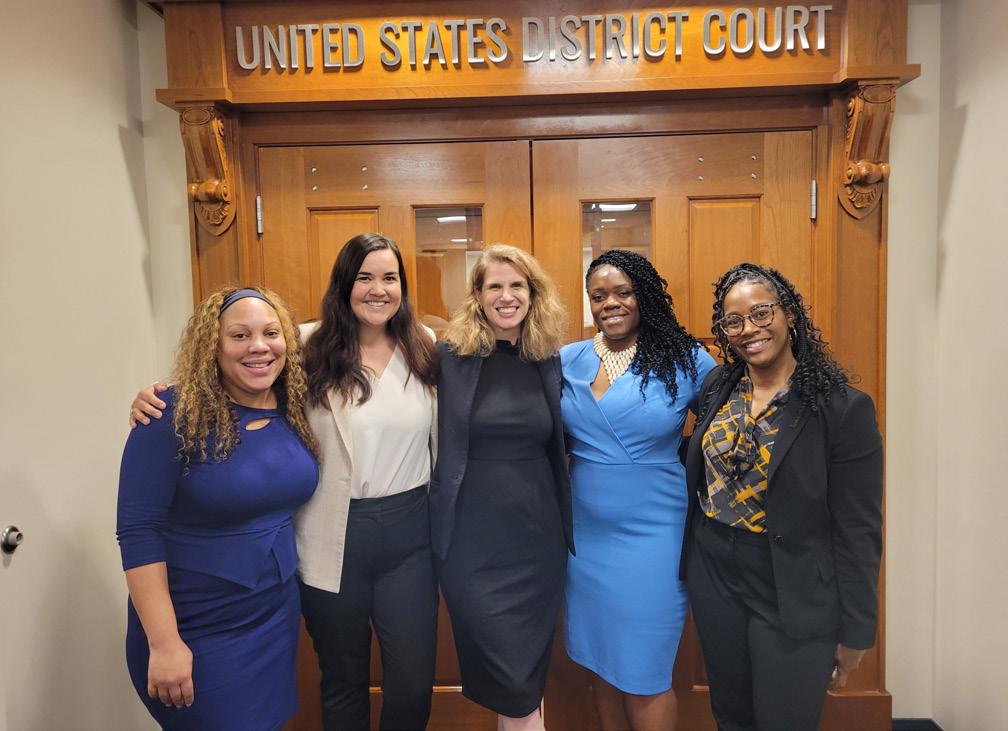
In 2019, Forward Justice filed a lawsuit on behalf of organizational and individual plaintiffs in Wake County Superior Court, seeking to reinstate voting rights for over 56,000 North Carolinians who live in our communities but had not been restored the right to vote due to an unconstitutional, racially discriminatory felony disenfranchisement law. We won at trial court, securing the largest expansion of voting rights in the state since 1965, but republican lawmakers appealed in efforts to overturn our victory and continue to disenfranchise voters. On February 1, 2023, our legal team argued in front of a newly elected, highly polarized, and partisan NC Supreme Court to defend our victory. Unfortunately, the new court overturned our previous ruling, stripping voting rights away from thousands.
In the 2023-2024 legislative session, the Legislative majority used their supermajority to push through a deluge of voter suppression billsover the vetos of the Governor and protests by voting rights advocates. This included SB 747, which reduces the deadline for receipt
of absentee ballots by 3 days and effectively discards thousands of otherwise eligible ballots, and increases the powers of poll observers to intimidate voters; and S.B. 749, which re-constitutes the partisan makeup of both the State Board of Elections and the County Boards of Election. Parts of S.B. 747, and the entirety of S.B. 749, have been challenged by voting rights advocates and temporarily enjoined by the courts.
The burden shouldn’t be on voters and advocates to challenge these discriminatory laws and policies in court as a last remaining defense to the onslaught of voter suppression tactics being levied consistently by North Carolina legislators. Our legislators should be working to ensure the people and communities they are sworn to serve have the resources needed to thrive, not relentlessly trying to further entrench their own power by restricting access to the ballot. While wages continue to lag far behind soaring housing costs and inflation, our lawmakers are prioritizing passing discriminatory laws to further
disenfranchise the constituents who need to make their voices heard at the polls the most.
Voters in North Carolina currently face a discriminatory photo voter ID requirement, a felony disenfranchisement law which operates as a poll tax, constant voter challenges and purges, polling place closures, the strictest requirements for absentee voting in this countryincluding witness requirements, tightened absentee receipt deadlines, and a signature verification program that is currently being piloted. These measures disproportionately burden marginalized communities who often lack the resources and time to navigate bureaucratic hurdles imposed by such laws. Many Black and Brown citizens, poor citizens, and those who are directly impacted by the criminal justice system lack the resources to pay the costs of voting, including the resources to obtain the now required ID, particularly as these costs rise with each legislative cycle.
These measures are designed to stop young Black and brown voters from ever beginning the habit of voting, and to break the habit of voting in those who have already overcome so much to be able to cast a ballot in this state. Legislators are attempting to kill access to our democracy through death by a thousand cuts. For more than a decade they have been relentlessly crafting policies and legislation to make it harder to vote and thereby hold them accountable to the needs and demands of the people.
AS RELENTLESS AS THEY ARE IN THEIR ASSAULT, WE MUST BE EQUALLY AS RELENTLESS IN OUR ADVOCACY, ORGANIZING, AND VOTING.
To truly realize an inclusive democracy where “we the people” encompasses all citizens, Congress must urgently restore the full powers of the Voting Rights Act. In recent years, advocates have proposed legislative solutions such as the John R. Lewis Voting Rights Advancement Act, and the Freedom to Vote Act, which both aimed to strengthen the VRA, most notably by reinstating Section 5 preclearance requirements. Despite passing in the House of Representatives, both bills faced significant challenges in the Senate, where they failed to garner the necessary support to overcome a filibuster in both the 2021 and 2022 legislative sessions.
Moving forward, it is imperative for Congress to enact comprehensive voting rights legislation that not only restores but also strengthens protections against voter suppression. This includes implementing a new pre-clearance formula that reflects contemporary challenges to voting rights, ensuring that all citizens have equal access to the ballot box. We must also continue to mobilize through grassroots efforts, voter education initiatives, and persistent pressure on lawmakers to prioritize democracy and equity, for “power concedes nothing without a demand.”
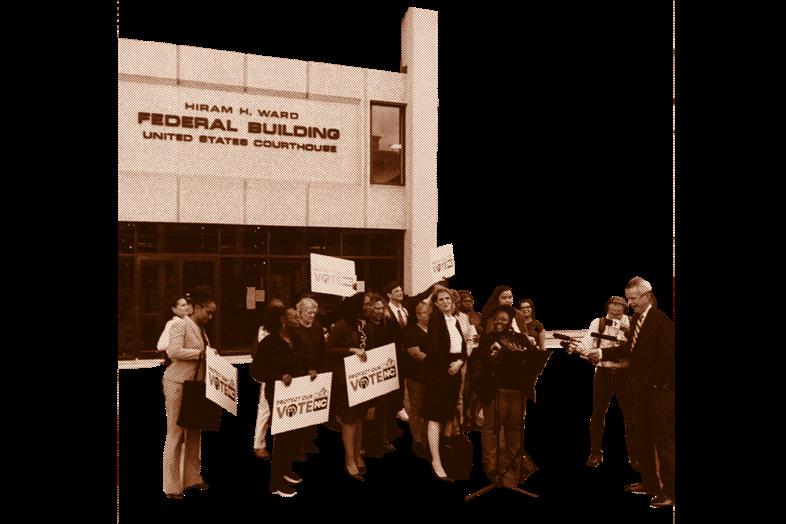
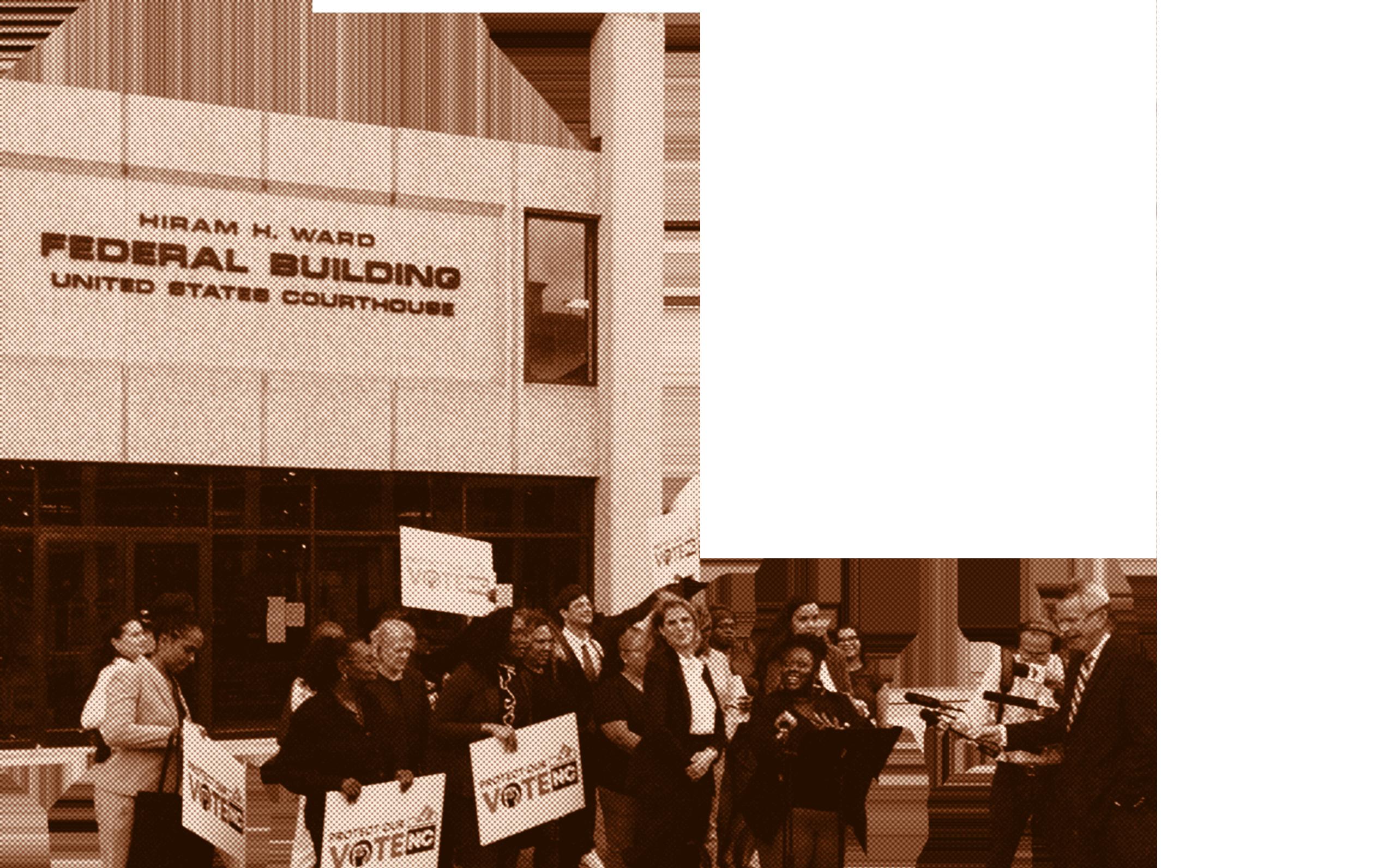
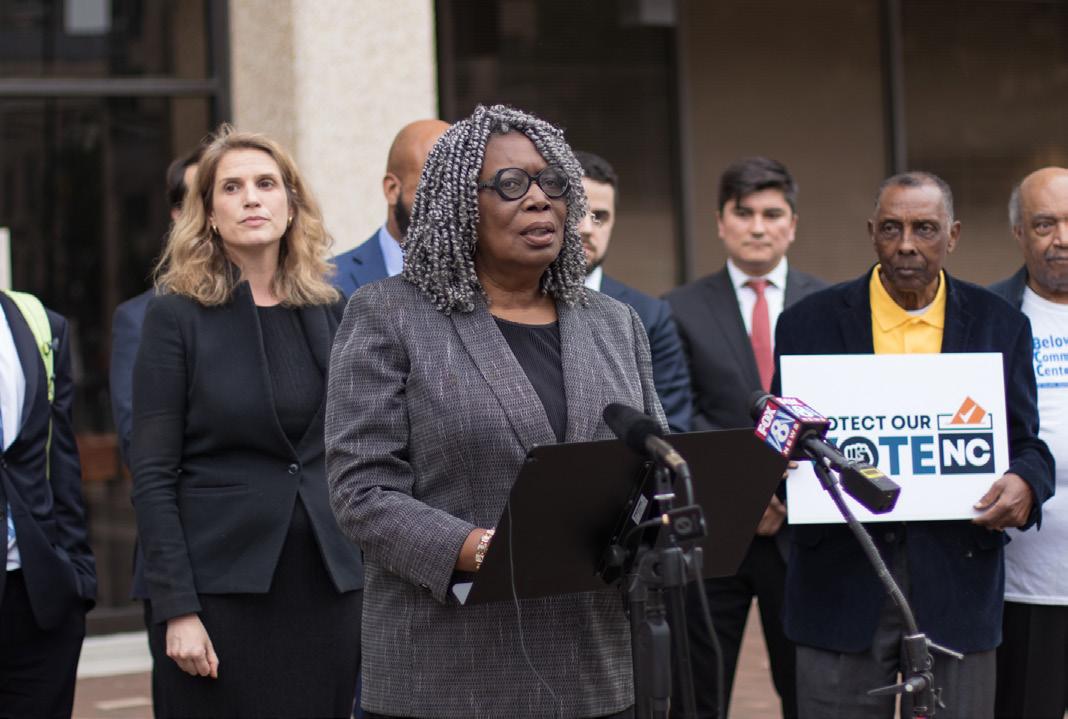
PROTECT
OUR VOTE NC CAMPAIGN PAGE
Recent Events in the Community
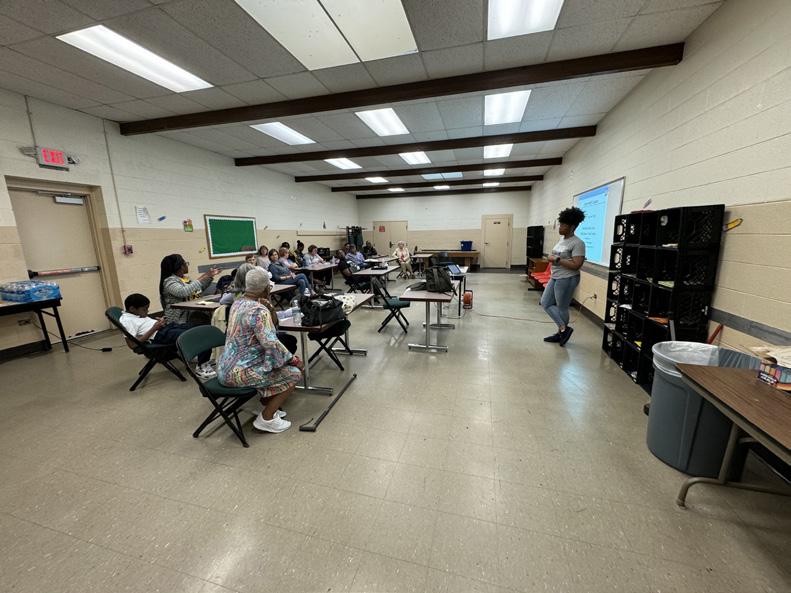
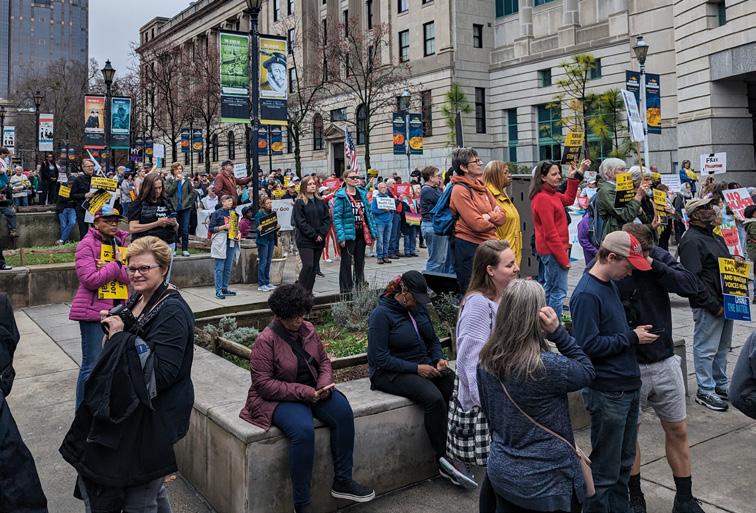
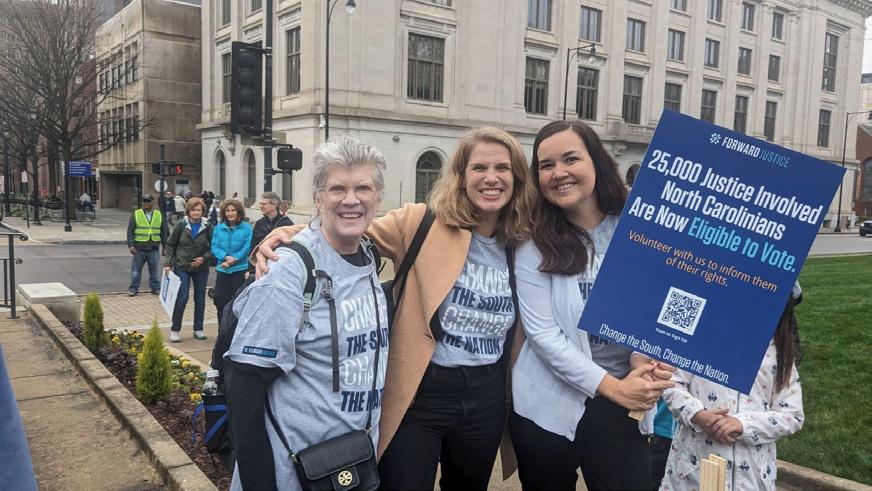
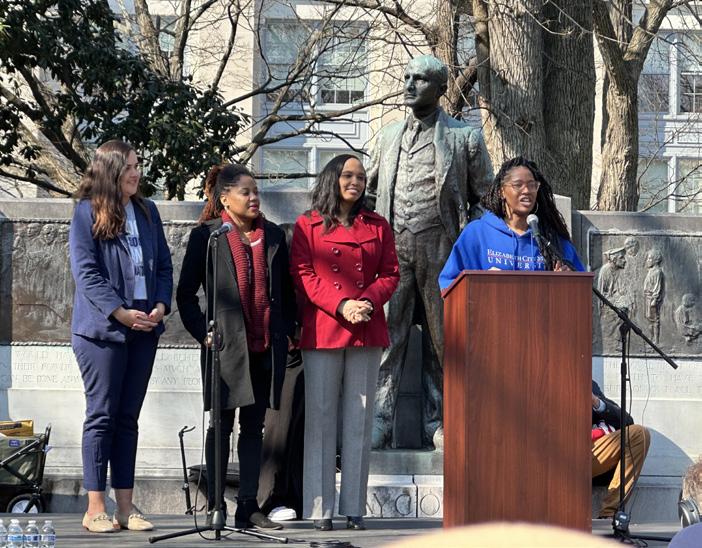
March on Raleigh
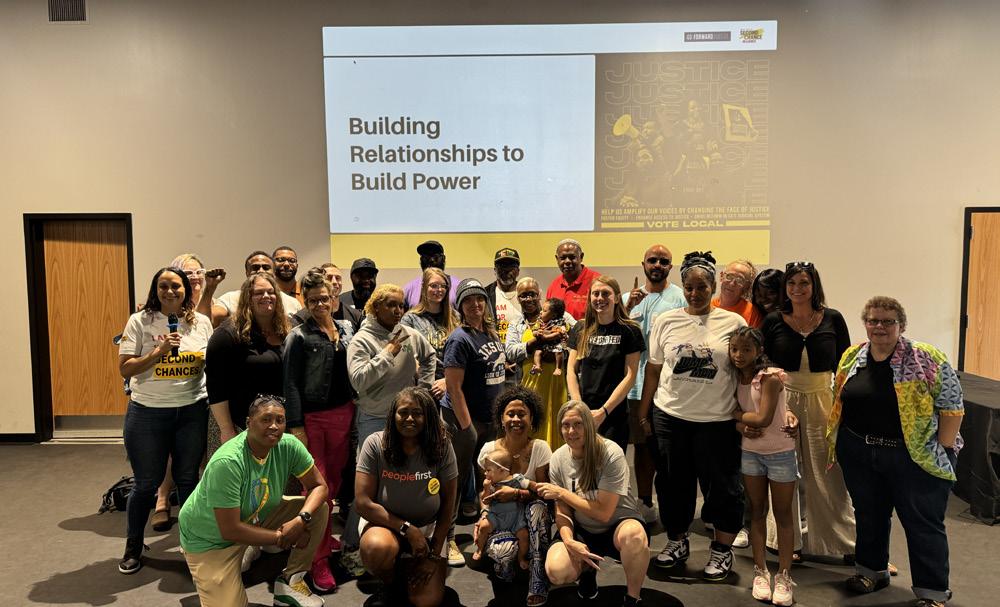
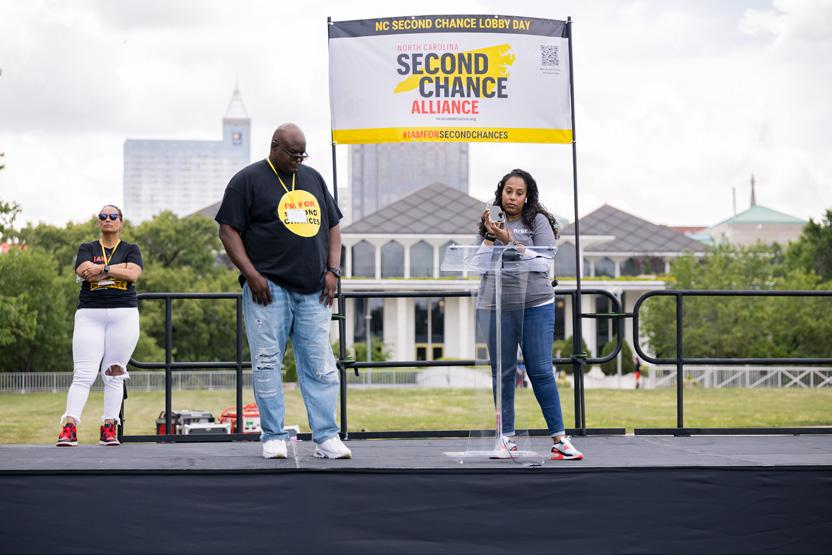
Second Chance Lobby Day
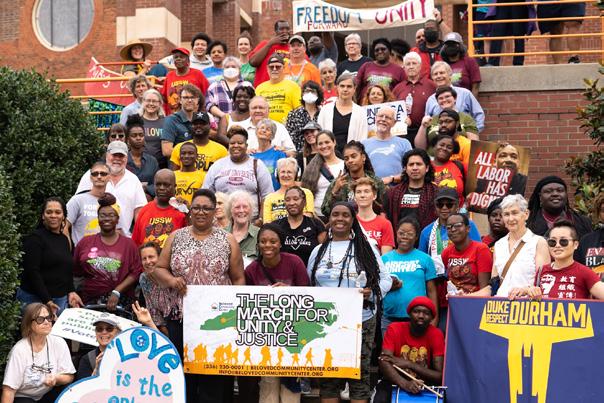
Long March for Unity and Justice
Culture Comment Reflection Corner
Thank you for reading this edition of the Forward Star Journal. We encourage you to use this space to reflect on the themes we’ve discussed here of freedom, resistance, and the third reconstruction. What do these things mean or look like to you?
Share your thoughts with the editorial team on our social media!
EDITORIAL TEAM
DAMOLA AKINTUNDE
BRITTANY CHEATHAM
KIMAYA DAVIS
ASHANTI SCOTT
IMAGE AND TEXT CONTRIBUTORS
DAMOLA AKINTUNDE
BRITTANY CHEATHAM
DR. ASHLEY MARSHALL
ATTICA SCOTT
WHITLEY CARPENTER
KATHLEENROBLEZ
GRAPHIC DESIGN
WINNIE OKWAKOL
Resources from The Movement
VOTER HOTLINES
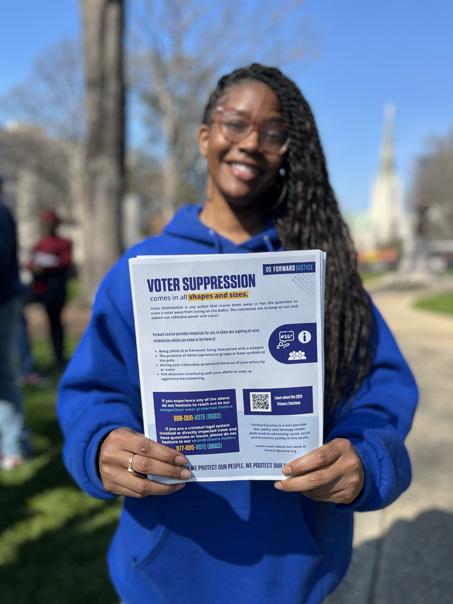
If you have questions about your voter registration status, voting by mail or in person, or photo voter ID requirements, you can contact the non-partisan North Carolina Election Protection Hotline at 1-888-OUR-VOTE (8683).
You should also contact this hotline if you experience any form of voter intimidation, which includes: being yelled at or harassed; being threatened with a weapon; the presence of white supremacist groups or hate symbols at the polls; having your citizenship questioned because of your ethnicity or name; poll observers interfering with
BAD FAITH on Amazon Prime
your ability to vote; or aggressive electioneering.
In North Carolina, individuals with prior criminal convictions are eligible to vote unless they have been convicted of a felony and have not yet completed their sentence (including probation, post-release supervision or parole).
If you are directly impacted by the criminal justice system and you have questions about your eligibility to vote in North Carolina, or want to report an instance of voter intimidation, please contact us at 1-877-880-VOTE (8683).
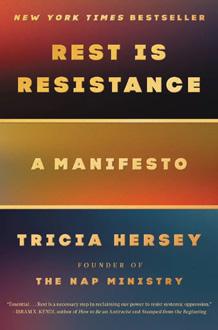
REST IS RESISTANCE: A Manifesto By: Tricia Hersey
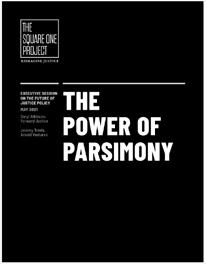
THE POWER OF PARSIMONY: THE FUTURE OF JUSTICE POLICY By: Daryl Atkinson, Forward Justice Jeremy Travis, Arnold Ventures