

This magazine contains a collection of work that the Alpbach Media Academy did on economy and finance topics 10. - 31.08.2013

PUBLICATION: European Forum Alpbach, Alpbach Media Academy, A-6236 Alpbach in Tirol, Tel. 05336/600-702, mediaacademy@alpbach.org
EDITORS: Michael Fleischhacker, Georg Renner
EDITORIAL: Habib Msallem, Katrin Nussmayr, Tatiana Tilly, Sarah Schmidt, Peter Techèt, Conor McMahon, Matteo Colombo, Katerina Vaskovka, Miloš Tomic, Christian Jensen, Florian Peschl, Jennifer McDonald, Levin Wotke, Eleanor Ward, Maialen Torres
LAYOUT, GRAPHICS AND CONCEPT: Willem van der Vlugt, Lukas Wagner
PHOTO: Philipp Naderer, Luiza Puiu
PRODUCTION: Christian Steinbrecher
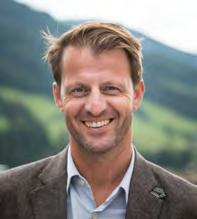
Michael Fleischhacker Head of the Alpbach Media Academy
One could hardly imagine an issue that would reflect better the ambivalent relation between experiences and values than the developments we have seen during the past years in the field of economy and finance. The growing gap between real economy and the financial sector reflects the degree, to what values we would have considered to be somewhat like the fundamental of modern democratic societies, were abandoned. Should the rethinking and reshaping of the economic frameworks build on those „old“ values or should we rather establish a new set of values that would meet the needs of our „post-democratic“ societies better then the old ones? What does „sustainability“ mean in times that are changing so rapidly? Some of the best known economists of our days like Jeffrey Sachs, who became famous for the „shock therapy“ he applied to many of the post-soviet economies in the early nineties or the young Czech rising star Tomas Sedlacek, who surprised the community of economists with his book „the economics of good and evil“, provided the Alpbach-crowd with lots of food for thought. And a group of young leaders from all over the world tried to figure out new ways of organising economies and societies in the „Alpbach In Motion“-project.
is our worst
What we need to do is rethink the very notion behind growth itself says Tomáš Sedláček, author of the book The Economics of Good and Evil. We have to think of economics in the context of society:
“Japan, for example is an economy that hasn’t grown for a while. They have hit a golden ceiling of sorts, everyone has two mobile phones and two cars. So what else would you want, a third car would be ridiculous. Therefore the economy doesn’t grow and we read that as a problem.
But that is a Hallelujah moment, we have everything we want, we don’t need to grow more. So that is why I don’t call this a crisis of capitalism persée, but one of growth capitalism. The problem we see with capitalism now is the same we have always seen, a complete focus on the bottom line.”
It is important to realize that we create our own problem by being greedy and consistently trying to reach new heights without any proper understanding of why:
“Now a bit of a warning, it is not evil that is the opposite of good. It is not really evil that tortures us. It is
instead the idea of “better.” We have this fantasy that society would be in peace and harmony if only it wouldn’t be for, well whatever someone’s preferred problem is. If you are racist then it’s the immigrants for example.
Now take business people, at the New Year’s party they always use the same motivational speeches: “You have done well, but what is the biggest enemy of perfect is good. So don’t get stuck, keep whipping yourself and go above the good.”
Let us take the “greed is good” quote from the film Wall Street. A lot of people take this as an ironic attack on the economy, but isn’t it exactly the opposite, what everyone is saying now is that there isn’t enough of it. Growth is stagnating because people aren’t working hard enough, they aren’t greedy enough; we need more.
This makes the idea of better the cruelest concept in the world. This is what tortures us. Even Adam and Eve in Paradise looked around and said, is this it? There must be something we can improve.”
Instead we must realize that companies are connected with the culture around it. As Sedláček explains,
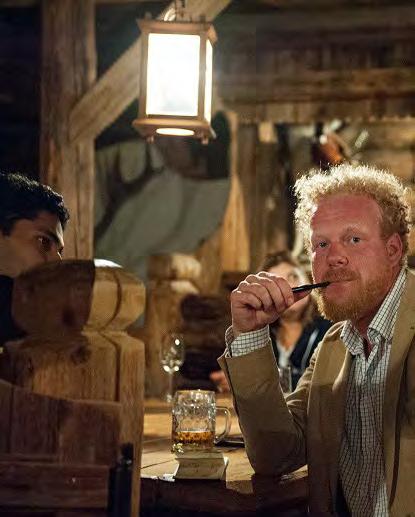
Tomáš Sedlácek , Chief Macroeconomic Strategist of the Czech bank CSOB, helped the Alpbach in Motion-team fine tune their ideas of future economic models and appeared on the panel: New Growth in Europe.
there would be no market for beer if there was not someone creating a beer culture in that society.
Likewise as a company grows, it touches more and more of its surroundings. In the beginning it might just be you and your partners that you care about, but without caring about your customers you would disappear. No person is an island after all. As Sedláček explains it is all about where the egotism stops. This again comes down to understanding economy as part of society.
And this is what Sedláček tries to do and will dig further into in his upcoming book “The Fetish of Economy” where he will compare economics and theology. Economy is this invisible force that we hear about all the time and which dominates our lives, but very few people have a concrete idea what is going, simply having blind faith that it works out somehow:
“A question I often ask my audience when the talk comes round to GDP. Nobody understands it but let’s make it a bit more personal. So has your personal GDP grown or decreased in the last fiscal year? And I want to hear a specific amount.
I have been asking this to thousands of people;
accountants, business people and nobody knows. On the personal level, we don’t know and we don’t care. It is easy to find out, just call your accountant and he will tell you in a second, but we don’t care.
We live our lives perfectly happily without knowing the past GDP development and definitely not the future; and definitely not exactly.
You have not been trained to care about GDP; it is not part of the ideology. But, the religion or ideology is making it of Meta importance, even though in your personal life it has no significance to know the exact figure.”
Something that Sedláček is quite happy about is the idea that we are generally moving from an older “mafia” style economy to a more integrated Europe:
“If the Greek bankruptcy had happened two generations ago the only thing we would be debating is how to attack it. This is how we dealt with countries that needed help. And we hated our neighbors. If three generations ago a neighboring country was in trouble that would be a reason to pop open champagne and celebrate in the street. Now that would be laughable to us. We wish Greece to do well.”
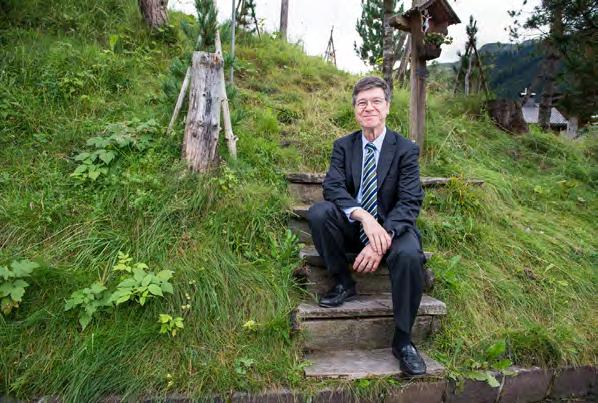
Acclaimed American economist Jeffrey Sachs has said that the global community needs to be “realistic about the natural environment” when dealing with a rapidly growing economy.
“Mr Sachs is a complicated guy,” writes the leftist review, Left Business Observer. The wonderkid of economics graduated from Harvard and became the youngest full-time professor of the prestigious university at the age of 28. In the 1990s he was known for his “shock therapies” offered in Latin-American and East-European countries. Several leftist economists still concern him as too Neo-liberal. He was an advisor in Bolivia, Russia, Poland, Slovenia and Estonia. He suceeded to decrease inflation and steered these countries toward more privatisation and increased employment, but falling real wages resulted in aimless cycles of political discontent. Since 2000, he has turned his attention to major crises engulfing the planet, from AIDS in Africa to climate change. He has given up his orthodox Neo-liberalism –but he hasn´t become leftist. He wants economic growth to continue, but he also wants to avert disastrous ecological changes deriving from economical activity. “Today’s emerging economies want to grow fast and deserve to grow fast” but will “use a lot of resources” he told Alpbach News.
“We need a different direction,” he said. “We need to reorient our technologies. Our energy system needs to depend on wind and solar power not on oil, gas and coal. But how can we make that transition sufficiently fast to keep our living standards and to be realistic about the natural environment?”
Mr Sachs said many leading scientists are worried about an “ecological bubble” that will drain the climate as well as capital.
“We need a different direction”
Jeffrey Sachs
“We are depleting natural capital so hard and so fast,” he complained, and these abrupt changes could be “tremendously imperilling”.
“It takes time to reorient our economies,” Mr Sachs said, “and if we don’t make the effort hard and significant and rapidly right now, by the time 2040 or 2050 comes along, our economies are going to look a lot like what they look like today in terms of their energy mix. That means the shocks that we are feeling now could be amplified and much more pervasive in the future.”
In the 1990s, he forced shock therapies upon several countries – now it is Mr Sacks who wants to avoid what will be shocking in the future. (cmm,mai,cj,tcht)
500
400
300

The Dot-Com bubble was a speculative bubble between 1997 and 2000. The climax was on March 10 2000, when the stock markets in industrial ized nations saw their equity value rise rapidly due to the growth in the internet sector and other related fields. This period was marked by the founding and often the failure of a
The scale is expressed in billion dollars, at current price. The estimations shows different features which characterise the size of financial bubbles. It is impossible to assess the exact amount of money lost during the crisis because of the complexity and differentiation of the phenomena and the side effects that this provoke.

The first financial bubble of the world started when tulips were introduced in Europe from the Middle East. The ownership of this flower became a status symbol in many wealthy Dutch families and thus the prices of tulips started increase. In the following years, a virus affected some of the flowers, causing a further increase of prices so much so that in 1633 a house in Amsterdam was sold for three bulbs.
In economics they call them “bubbles”. They happen when people invest massively on the future value of goods, thinking they will constantly appreciate in price. When the market grows so big that it just suddenly explodes, the crisis happens. Economic bubbles have been a feature of the world economy since the creation of finance, when people understood it would be possible to make money out of money. This is a short history of some of these crises.
group of new internet-based companies often referred to America’s371publiclytraded Internetcompanieshavegrown tothepointthattheyarecollectively valued at $1.3 trillion, which amounts to about 8% oftheentireUSstockmarket”.
In just one month they lost 34%oftheirvalue,442billion dollars.
started to virus causing much Amsterdam created a
The financial crisis of 1929 was caused by the unprecedented growth of some key industries in the USA, especially the car sector. This led to an increasing number of invest ments, caused by a widespread expectation that this growth would continue indifferently. A significant number of Americans started to borrow money for buying more stocks. When the data on the harvest of wheat and crop showed that there was
future market, where contracts to buy bulbs at the end of the blooming season were bought and sold. This was taking place in a tavern where sellers and buyers met. The collapse began in Harleem, where some buyers refused to show up for the meeting for trading this flower. The prices thus decreased dramatically. Researchingthetulipmaniaisdifficult becausethereislimiteddatafromthat time,butthetestimoniesofthisperiod speaks about a crisis that lasted for many years in the Netherlands.

In the first part of the 2000s the valuations of real property increased until it hit an unsustainable level in the USA. The low rate of interests and the tax policy (exemption of housing from capital gains) and the optimism on the economic situation were the main reasons which lead many Americans to buy homes that they could pay on purchasing, thinking they could afford the increase later of interests thanks to the improvement of their personal financial situation. Many investors started to speculate
an overproduction and the prices of the good decreased, the panic started. In two days the stock market lost 23%.This event caused the great depression between the 1929 and the 1932. During this period there was an increase in unemployment of 607% in
Overthefourdaysofthestock marketcrash,theDowJones dropped25%,losing$30billion inmarketvalue.(Todaythat’s worth $396 billion). 2007
Railway Mania was a period of speculative frenzy in Britain in the 1840s. The price of railway shares increased and more and money was invested by specula tors, until an inevitable collapse in the mid 1840s. In 1846 272 Acts of Parliament were passed, setting up new railway companies and the proposed routes reached 15,300km of new railway lines. However, approximately one third of these authorised new lines were never built. The company either, collapsed due to poor financial planning, or
on the prices of houses, buying and selling contacts in a short time period. The crisis started when a large number of mortgage owners were not able to pay the interests, determining a liquidity crisis in the banks.
It is estimated that the ultimate losses suffered by financial institutions related thesub-primemortgageBonds Crisiscouldbebetween$220bn and $450bn in the 2007, as $1 trillion of sub-prime mortgage bonds is revalued.
the company was bought out by a larger competitor before it could build the new lines or perhaps, it was a fraudulent enterprise to use investor’s money on other
Itisimpossibletoassessthe size of the Railway Mania bubbles,buttheinvestments intheconstructionoftherailway was £44 million in the 1847, which correspond roughly to 180 billion dollars nowadays.
What is the price for a mouse’s life? €5.10. At least this is the finding of an experiment two German economists conducted. Armin Falk and Nora Szech wanted to find out if markets kill the moral. So they compared individual behaviour with the behaviour in a market setting – in both situations the life of a group of laboratory mice was on stake. First it was just one man, one mouse, as well as 10 Euro (or of course one woman, one mouse). The participants of the experiment could decide to save the mouse from certain death, spending the money. Or they could keep it – having to answer for the murder of a mouse. 46 % of the people choose the money.
In the market setting a certain number of sellers and buyers had the possibility to trade. The buyers had 20 Euros, as soon as a price with one of the sellers was agreed on – a mouse was killed, the money was split to seller and buyer. If no deal took place, one of the mice was saved. The result of the market setting: more than
70% of the mice were sent to death for some Euros. The overall average price level for a mouse was just a little more than five Euros.
This is an impressive demonstration that markets tend to lower ethical concerns. “In the experiment, subjects were fully aware of the consequences of their decisions in that they could save the life of a mouse if they refused to accept a monetary amount. Our findings therefore suggest that appealing to morality has only a limited potential for alleviating negative market externalities”, the researchers conclude from their results. Therefore the experiment can also help to explain why most people refuse child labour but buy discounted clothes, or why people are against factory farming but pack the cheapest meat into their supermarket trolley.
“But what can be done to reestablish moral values within the markets?” wondered Michael Kirchler from the financial
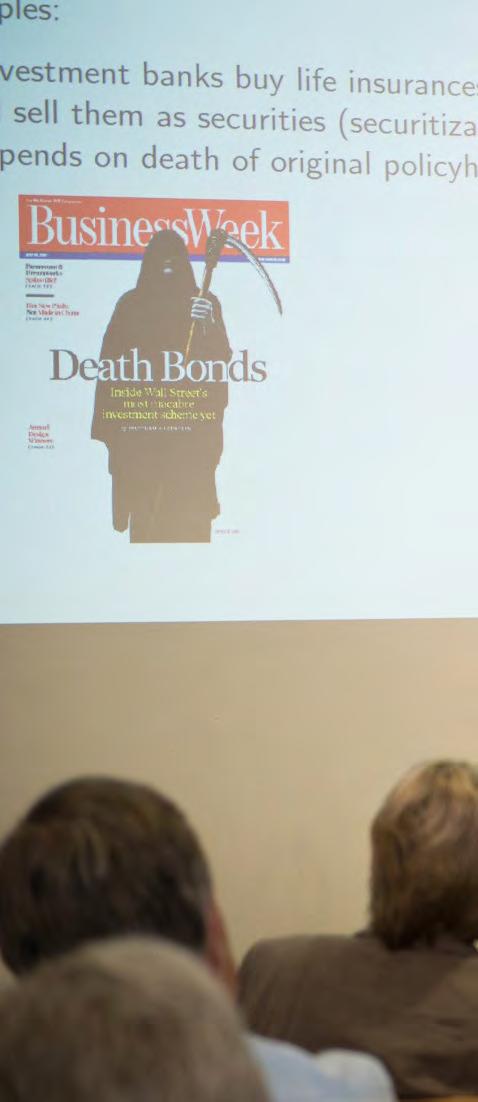
department at University Innsbruck. Is it just the market context, where you can get rid of direct responsibility? Are the consequences too far away, since you will neither be present while a mouse is killed nor while a 10-year-old is sewing your jeans? Is it about anonymity, or perhaps just about the money? Together with some colleagues Kirchler set up a similar experiment with added interventional elements to test their hypotheses.
“Instead of a research laboratory we started a cooperation with Unicef,” Kirchler explains. The
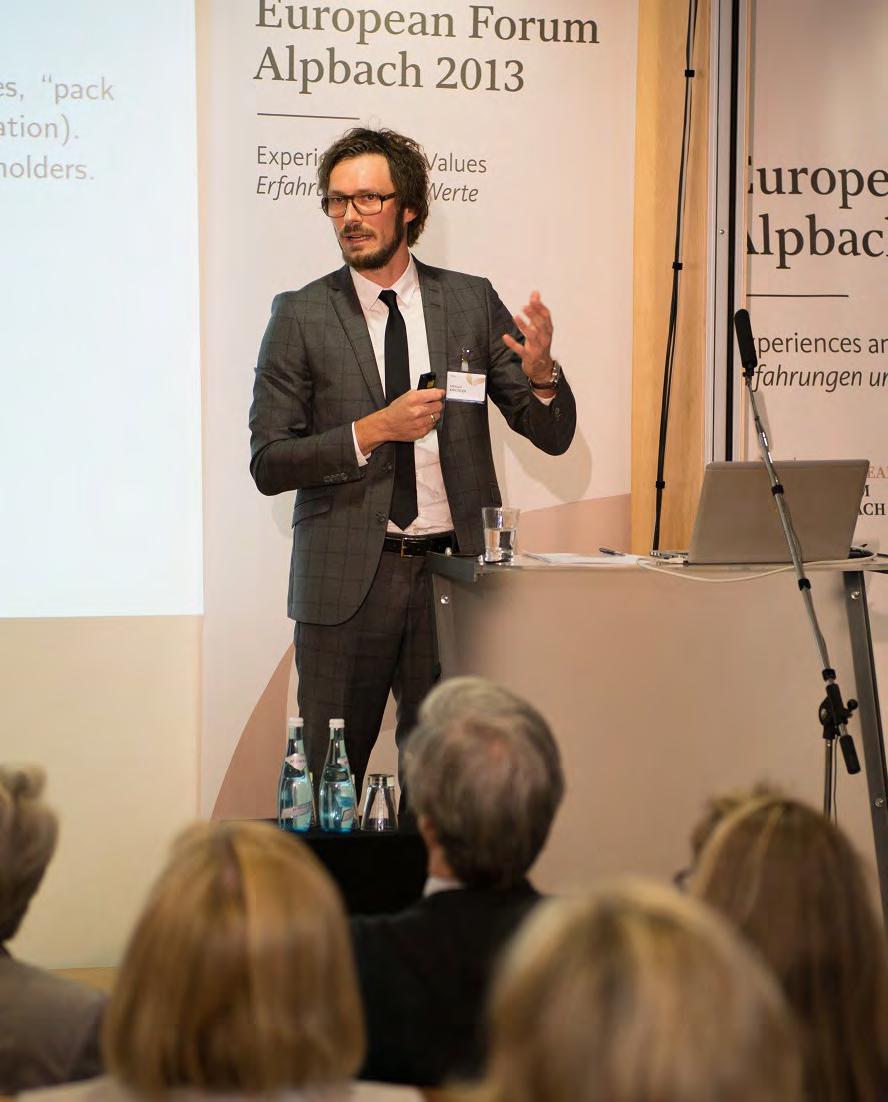
participants could trade with 100 doses of a maser vaccine. Price: €21.40 – either for the health of Third World’s children or the own pocket. The team around Kirchler established several control groups.
In the first one the participants had to confirm a pop up window on their screens before conducting a transaction. It said: “If you go on now, there will be no donation of vaccines made.” “This was meant to appeal to the sense of responsibility of the people,” Kirchler explains. The second group got a ten-minute lecture
from a member of Doctors without Borders, who explained the dangers of maser and the positive impact of the vaccination. For the third group, anonymity of the market was cancelled. “In the other settings the deals were made anonymous by digital communication – now it was made public who just sold the health risk of 100 children.”
In a further variation two additional persons were included who could take some money
from those who finished a deal. “This was meant to imitate a monetary punishment,” says Kirchler. Finally there was a fifth setting with a different shaping of the market – in this condition the number of sellers and buyers was equal. A result of this should be a little less competition in the marketplace.
So what were the results? Could the different measures help to remind the participants of their moral values? In the basic treatment without any further influence 84 % took the money and thereby refused to donate to Third World – so this was the number the effects had to be compared with. “Then we have been really surprised,” Kirchler says. “Pop-up-windows, the medical input, even the publicity of the deals – none of them could, remarkably, change the quote,” he summarises the results. “Only the financial punishment as well as the shift in the market variables had a significant impact.” They reduced the rate of those selling the donation to nearly 70 per cent – “still a high rate in my point of view,” says Kirchler.
So what does this mean in real life? It definitely puts into question many campaigns promoting better working conditions. Most fair trade labels probably have very little effect. “The challenge we are facing now is, how we can establish more effective measures into market system,” Kirchler summarizes. “And we should rethink carefully if we should launch markets without the option of regulation.”
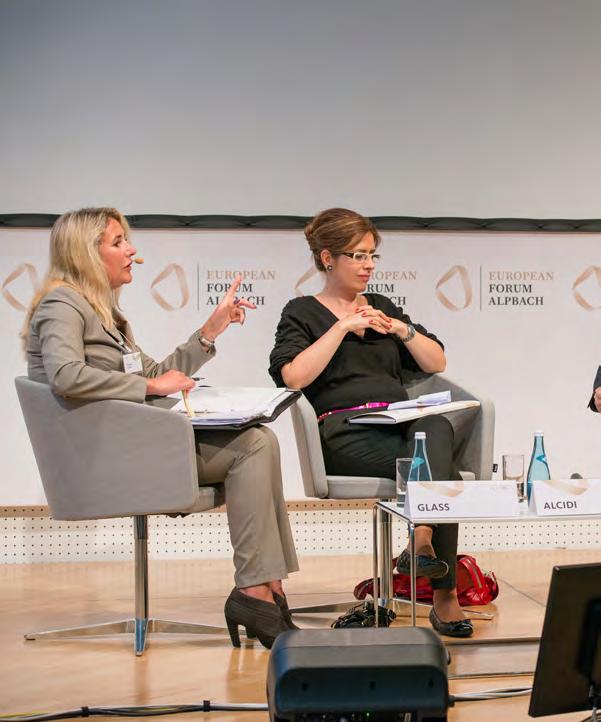
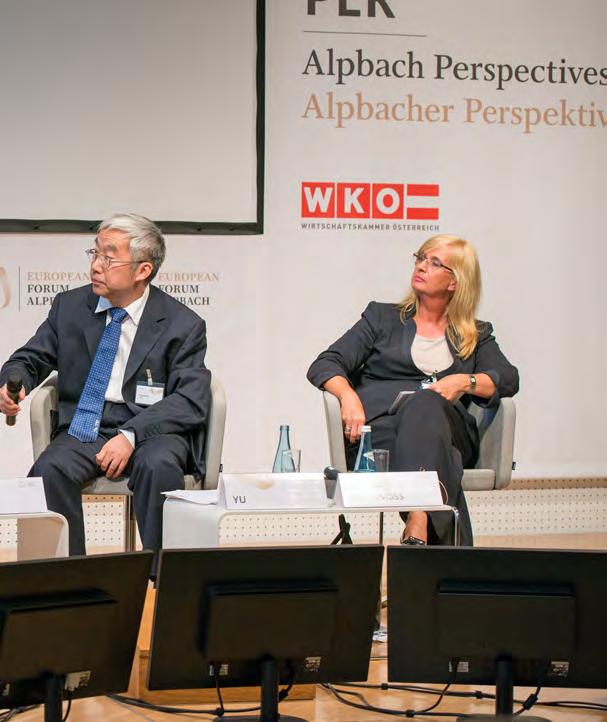
Panel members from China, Germany and Italy respectively, were assembled to discuss the role of the European Union in a future global economy. The overriding response to the theme of the discussion was that Europe’s position of power is changing and the EU will therefore have to adapt to a different role in a global economy.
Professor Cinzia Alcidi, Head of Economic Policy Unit at The Centre for European Policy Studies, thinks the biggest challenge for EU policy-makers is to decide what can be done about the continent’s inevitable decline on the economic stage.
She said: “Are we ready to accept, in a passive way, that other countries are overtaking us and we are losing our leadership?”
Answering her own problem, she added: “Despite Europe producing less in terms of goods it can remain a leader in terms of technology and eco -
nomic progress. Quality instead of quantity.”
If the world needed more reminding that the BRICs are the precocious economic talents, Claudia Dörr-Voss, Director-General for European Policy, supplied various stats – including how 50% of global growth has stemmed from emerging countries since 2000. She agreed with Ms Alcidi that technology has to be Europe’s future.
Ms Dörr-Voss said values of the European Union’s
founding fathers are some of the continent’s strongest assets, affirming the importance of a Europe involved in the future global economy.
Both agreed that exerting influence and exporting values is a lot harder without economic strength. As a union of democracy and strong standards in regards to working conditions and human rights, Europe could be a model that new democracies and emerging economies can learn from.
“When you are successful, it’s rather easy to export your values,” Ms Alcidi said. However, she continued that this becomes complicated when expressing environmental ethics. The BRIC countries are notorious for the their blasé attitude towards the environment.
Ms Alcidi said: “It’s hard to rebuke when they say: ‘You Europeans had your time, in the 60s you polluted a lot, and now you want to tell us not to?’ Our awareness of climate change has changed over time. In this case Europe should lead as an example rather than imposing certain rules.”
Yu Yongding sidestepped, albeit very charmingly so, questions over China’s victory in the European Commission’s investigation into solar-panel imports. The former President of the China Society of World Economics said Europe should be flattered that Chinese companies want to imitate such innovations.
GROUP DISCUSSION ABOUT LEVERAGES FOR A BETTER SOCIETY
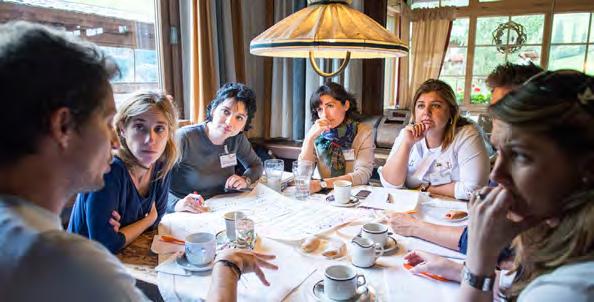
For the last couple of days Alpbach has been the headquarter of 40 emerging leaders tasked with rethinking our current economic model.
On the first day the group started out by comparing four of the big current economic systems; the EU, the US, China and Africa on categories such as state intervention, freedom of markets, personal freedom and social security.
Named Alpbach In Motion for a reason the group went on several hikes through the mountains discussing all the way.
After the first dinner on day one the team was tasked with proposing new economic models for year 2040 based on a balance of high/low state regulation and an individual/societal focus as illustrated below. Their discussions were overseen and then analysed by Tomas Sedlacek, writer of The Economics of Good and Evil.
After finalising their proposals on the second day they were treated to a talk from Jeffrey Sachs, Director of the Earth Institute at Columbia University.
With their fictional ideas in mind they finalised seven major questions which must be answered before our society can move forward:
1. Howcanwefosterinteractionbetween startups and corporations? We need to move to a true economic symbiosis.
2. How can Alpbach in Motion organise for impact after the forum? A yearly slot at the forum and turn it into a brand.
3. Economyforcommongood–companiessignupforinvestinginwellbeingand not profit.
4. What is the nextstepintheintegration ofEurope,whatcompetenceswillanEU nation have?
5. Selforganisinginsocietyforbettersolu-
tions, we have to use our education and media to make ethical more sexy.
6. Doweneedevolutionorrevolution?There is no room for a physical revolution, but wealreadyhaverevolutionaryideas.Their implementationmustberealisticthough.
7. What environment will stimulate entre preneurship,acomparisonofBulgariaand Sweden?
While answering these questions and enjoying a concert with Miha Pogacnik, the famous Concert Violinist, they summed up 13 factors which determine a “good” society.”
1. Effective decision making
2. Reasonable Tax
3. Accountability
4. Eu-Integration
5. Direct democracy
6. New RPI
7. Cost internal/external
8. Transparency
9. Magna Carta of values
10. Common defense
11. Education
12. Start-ups
13. Good governance





After a talk by Larry Leifer, Director of Hasso Plattner Design Thinking Research Program, the program rounded off with the members proposing ideas on continuing the entrepreneurial energy from everything from an online work group to writing a book on their discussions.
If you are interested in their ideas some of the members will present answers and work with the public in the Economic Symposium breakout session “Rethinking Capitalism.”
Cyber-democracy, power of markets, the increasing possibility for state to control our lives. Will we live in a contemporary version of the Plato Republic or will we be experiencing a golden era characterised by spontaneous collaboration between individuals? Will the state disappear because it is not necessary anymore or will the Government provide all the services
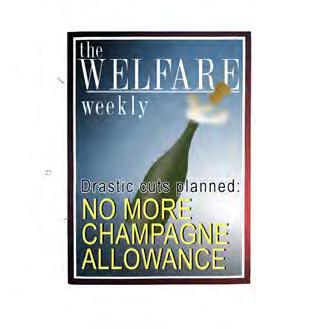
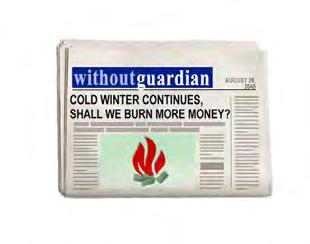
The “nordic” model on a global scale, where citizens are fulfilled. State solves all the problem,

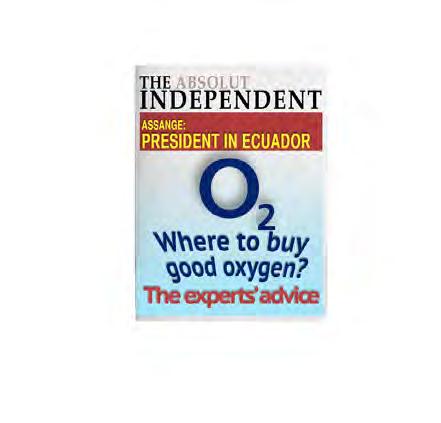
In a world where everyone is free to do whatever new high. The State doesn’t interfere and
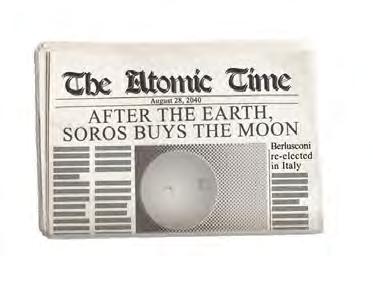










that we need? Political philosophers try to answer these questions, imagining models for organising our future societies. These visions of the future are very complex but they can be summarised in four models, which can be distinguished according to the scale of the state intervention and the involvement of society in the public discourse. We decided to
“NEW-WELFARE” STATE
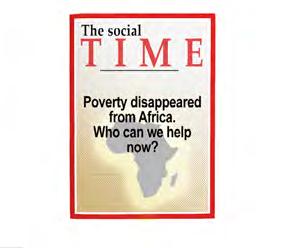
where taxes are sky high but all the needs of the problem, without people having to think about it.
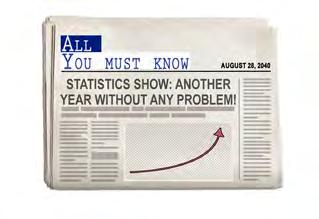
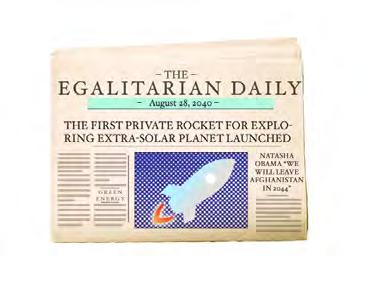
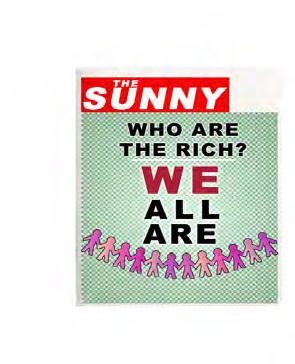
make an ironic and paradoxical press review of how a day like today can be reported in different social and political environments.
It is your task to decide if you would prefer to live in the “Atomic community”, where you can be an unscrupulous buisnessmen who is allowed to do whatever he likes for maximizing his profits, or in
the “The neo-welfare state”, where you must pay 99% of the taxes but the states provide you every service. You can also choose for the “Communitarian state”, where rich are blamed if they do not help the poor, or “The new totalitarian state”, where everyone is happy to serve a group of experts and technocrats who design the best for their lives.
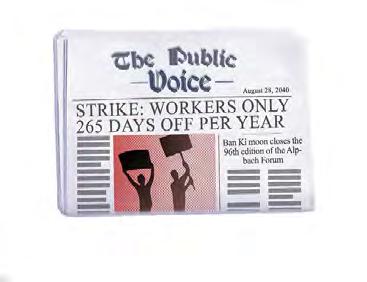
THE “NEW-TOTALITARIAN” STATE
The Orwellian nightmare never came true. People welcomed a State made of experts and thinkers. It is commonly accepted and proven that State knows and does best.
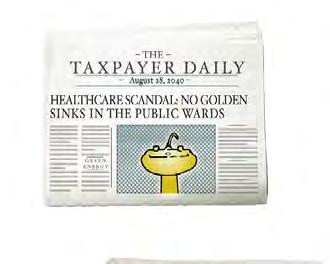
THE “COMMUNITARIAN” STATE

whatever they want, individualism has grown to a business control all and nothing hold you back.
Society made up of individuals, equal, working together, using each of the skills for helping each others in creating a better society, who needs the state?

The economic market is a playground on which you can make specific profit if you are faster than the others. This was the starting point of the plenary session “Financial Markets and the Real Economy – Friends or Foes”. Franz Schellhorn, economist and director of the Agenda Austria think tank and Stephan Schulmeister, economist and university lecturer in Vienna discussed the topic.
Schulmeister explained how we need to distinguish the “boring banks”, which have a very traditional approach to business (such as holding deposits or lending money in the most efficient way) and those banks which use more modern methods within the banking sector. He continued saying the boring banks are facing the loss of trust and confidence which rises as a consequence of the real situation: the more money they make, the more money they lose. The financial problem is not in the fundamentals of the bank, it is in the monetary policy, pointed out Schelllhorn. He confirmed this attitude saying the European Central Bank reported that the main problem comes from the budgetary policies in different EU member states.
MISUNDERSTOOD EURO”
The European Central Bank announced in 2001 that no EU countries will go bankrupt, but people even then started doubting. According to Schulmeister, before the crisis Greece had its economic balance, but there was too much consumption, more than they could produce. Afterwards, Greece faced problems with investors. Predictions in 2004 said if Greece continued with the overconsumption, it will go bankrupt in ten years. Those predictions were wrong, obviously. The bankruptcy happened six years later. Schulmesiter expressed that Greece is a bad example for the crisis. “Greece misunderstood the Euro. It went bankrupt already in advance.”
Schellhorn agreed saying the problem is not Greece; it is about the industrial countries debts which are increasing, and entrepreneurs who are using less loans.
According to Schulmeister, every forward looking transaction is a speculation. “Speculations concentrate on a real economy. The only innovation that brought
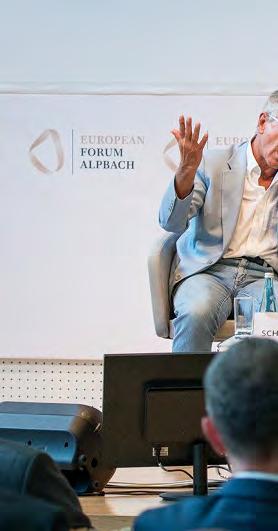
something to the financial system is the cash machine.” During the period from 1950’s to 1970’s, the financial markets in Europe were not able to create, change and share their prices by their free will, because of the welfare state structures. Nowadays it is different, but the markets are still facing the challenges. Schulmeister compared the European situation with others, mentioning China: “Foreign capitalists, you are free to come to that country, but in return you will need to invest and be ready for governmental control”. Schellhorn explained how nowadays there is no budgetary discipline, nor will for the reforms or to meet the problems.
“Government is a perpetrator, not
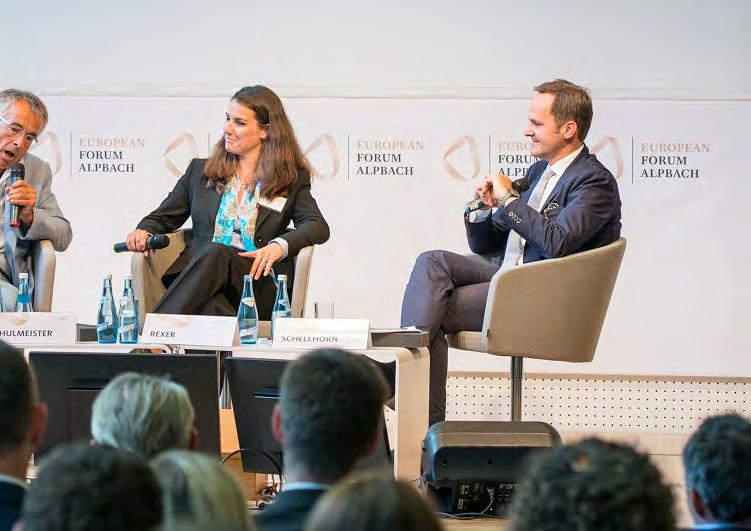
the victim,” said Schulmeister explaining if politicians say to the public they will cut the money or the public funds, they will lose the elections. Schulmeister put a critique on debates and discussions regarding the economic crisis and new ways of growth in Europe, saying that nobody is talking about the entrepreneurs. At the moment, they are facing so many obstacles here in Austria and it is hard to enter the market, he clearly pointed out. “You can get cheap loans, but once you get it, you have to pay taxes of up to 50 per cent. How can we promote entrepreneurship?” asks Schulmeister. In the same direction Schellhorn appealed for promoting entrepreneurship. He was clear saying the government can overcome the crisis only if it promotes aspiring entrepreneurs to stimulate companies to invest.
Thinking that more money is not the best solution, he paraphrased Milton Friedman explaining if a helicopter distributes money from the sky, we will face the inflation. But, instead of suggesting the solution, Schellorn expressed his pessimistic view in the situation: “One day there will be a moment when one bank will be bankrupt and the whole system then will collapse. That is game over.”
Asked if the banking regulations are working, Schulmeister answered positively: “Requirements changed dramatically. Will it be easier in five years when governments’ debts will be higher?” Schellhorn put the accent on the capital and its “powerful personality” saying during the past few years in media it has been mystified: “Market is presented like someone who changes
his mood: sometimes it is good, sometimes it is bad. But, no; market has no personality.” During the debate, the system itself was not analyzed. The blame was put on some players; first the governments, and afterwards on the lazy Southeast European people. If the market is not able to set the rules, to set, change and arrange the prices, countries should do it in the point of the public interest – this was Schellhorn point of view at the end of the discussion. “Look at the history experiences as a solution. There are no ideal solutions, but there are some systems which are better than other systems,” said Schellhorn. Putting the discussion back to “Greek lesson”, Schulmeister stressed that Greece is a good example of sloppiness and he hopes that is not a future pathway to follow.
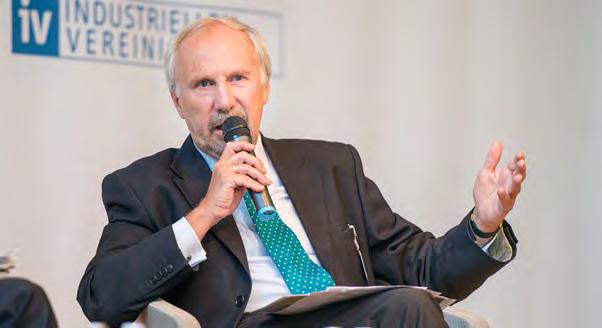
ECB is lacking independence – that was one of the very clear statements from German economist Manfred J. M. Neumann during a debate on ”The New Role of the Central Banks in Crisis-Management” at Alpbach today.
His opponent was Ewald Nowotny, Governor of Oesterreichische Nationalbank. Moderated by Peter A. Fischer, Economics Editor-in-Chief at Neue Zürcher Zeitung, they discussed the approach of the ECB and other central banks during the financial and economical crisis.
One of the first questions for Mr. Nowotny was whether he believed that bankers should be technocrats or policy makers. ”I prefer boring tecnocrats, and under normal circumstances, Neumann and I wouldn’t have very differing views. But these aren’t normal times, this has been one of the most difficult times”, Nowotny said.
And , sure enough. there was disagreement present at the stage in Alpbach. Especially concerning the question of whether ECB in fact is acting as an independent part, when it has stated that it was willing to buy bonds from certain European countries that are specially weakened.
“The ECB is making fiscal policy by other means, as they’re doing things they actually have no right to, instead of focusing on monetary policy”, Neu-
mann said.
On the other hand, Nowotny replied, that ECB in fact is one of the most independent banks and that ECB has acted cautious and responsible by keeping the interest rating low and preventing the Euro zone from a breakdown.
“You can compare the situation to having a disease: You have the option to take medicine against it, but there might be side effects to that medicine, so you have to consider whether it is worth it”, Nowotny said, referring to the critique of the banking sectors’ crisis-management.
At the moment, ECB is facing a constitutional court hearing in Germany on the bond buying programme known as Outright Monetary Transactions (OMT). After receiving 37,000 complaints from the Left Party, the movement ‘More Democracy’ and several eurosceptic professors, the court has stepped in. They claim that ECB has overstepped its mandate through its monetary policy, which they argue is striding against the German constitution.
In particular, it’s the fact that ECB has stated that they were ready to buy bonds from bankrupt states in order to prevent a breakdown of the eurozone. Because of the large amount of complaints, the case can take several months before a judgement will fall.
“We face the burst of an ecological bubble”
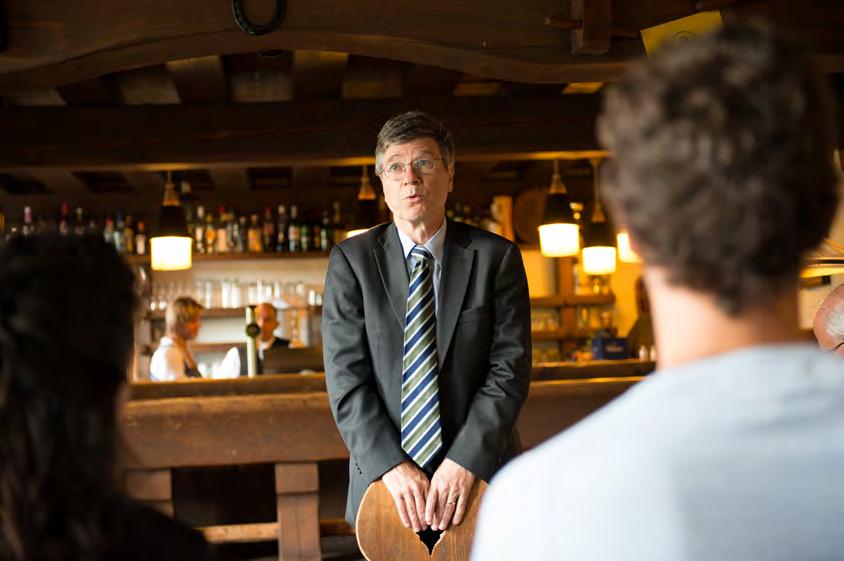
Jeffrey Sachs, Director of the Earth Institute at Columbia University, New York talked with the 40 emerging leaders of tomorrow who made up the Alpbach in Motion team. Sachs, whose work spans from ecology to hunger in Africa, gave a talk at the forum called Green Growth: A new concept for sustainable development and
will debate social entrepreneurship in the closing session New ideas for a fair globalization: What should entrepreneurs do.
One of the core tasks of the Alpbach team was to devise a new European economic model for the year 2040, a time in which Sachs fears our lack of focus on climate change will

still be unsolved. Despite consistent warnings from himself and others such as his fellow panelist Rajendra Pachauri–both of whom will debate the topic “New ideas for a fair globalization” on Saturday–governments have yet to realise that we are facing an ecological bubble which will not only affect our economy but our very own planet itself.