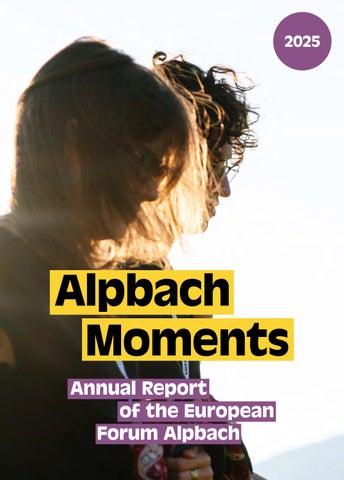

Our Purpose & the Annual Theme
The EFA25 highlighted ways in which Europe’s potential can be renewed under the annual theme „Recharge Europe“.

Dear friends and partners of the European Forum Alpbach,
Recharge Europe – EFAs annual theme for its 80th anniversary in 2025 –captured a sense of urgency that resonates deeply with the origins of the European Forum Alpbach. When the Forum was founded in 1945, it was created with a dream: a democratic and peaceful Europe that would never again succumb to totalitarianism or war. Its founders, united in their opposition to Nazism and Communism, shared a belief that freedom, science and education were the foundations of a better future. They came together in Alpbach each year to discuss, challenge and refine this vision – and to turn shared ideas into shared action.
Out of these early gatherings grew a unique European platform where students, intellectuals, scientists, and practitioners shaped debates that would influence the continent for decades. Left or right was not the criterion; the decisive question was whether an idea was pro-European – whether it strengthened liberal democracy, freedom, dialogue, and responsibility.
Over time, the vision of Alpbach became intertwined with the project of European integration. From the creation of the European Economic Communities in 1958 to the formation of the Economic and Monetary Union and the enlargement to 28 Member States, Europe achieved more than its post-war founders could have imagined. Its strength came not from military power but from economic performance, scientific progress and a shared commitment to democracy, rule of law and a social market economy.
Eighty years after the end of the Second World War, this achievement cannot be taken for granted. The crises of recent years have revealed the limits of Europe’s political and social resilience. Rapid technological change, geopolitical competition and the accelerating climate crisis are testing the Union’s cohesion and capacity to act. For the first time, Europe has lost a member; economic strength is fading, political influence is shrinking, and divisions in our societies are deepening.
That is why the call to Recharge Europe at EFA25 was more than a slogan – it stays an ongoing necessity. Europe must rediscover the ambition and unity that once drove its reconstruction. The task is not merely to defend past
accomplishments, but to renew Europe’s purpose: to build a continent capable of safeguarding its values while adapting to a transformed world.
In this new context, the European Forum Alpbach remains what it was in 1945 – a space for open exchange, reflection and renewal. It brings together voices across generations and disciplines to rethink Europe’s role in a time of profound transition. If we as Europeans fail to act with courage and clarity, we risk stagnation and decline. But if we succeed in recharging the potential of Europe, our union can lead with confidence – preserving its democratic heritage while shaping a better, more resilient future for all. The European Forum Alpbach 2025 was not a resume of this endeavour - it was the start!

Othmar Karas, EFA President


Othmar Karas EFA President

Sabine Herlitschka Vice President

Marie Ringler Vice President

Peter Oberlechner Treasurer, Board Member Association

Klaus Welle Board Member Foundation

Jenni Zeller
Board Member Association (FAN-Representative)*

Celina Moser
Board Member Association (FAN-Representative)**

Harald Stankov-Schöny
Board Member Association (FAN-Representative)**

Christian Kern Vice President
Antonella Mei-Pochtler Vice President
Caroline Hornstein-Tomić Board Member Foundation

Klaudie Mrkusová
Board Member Association (FAN-Representative)*

Nikola Donig
Secretary General & Managing Director****
Winfried Kneip Board Member Foundation

Feri Thierry
Secretary General & Managing Director***

Barbara Zimmermann Managing Director****
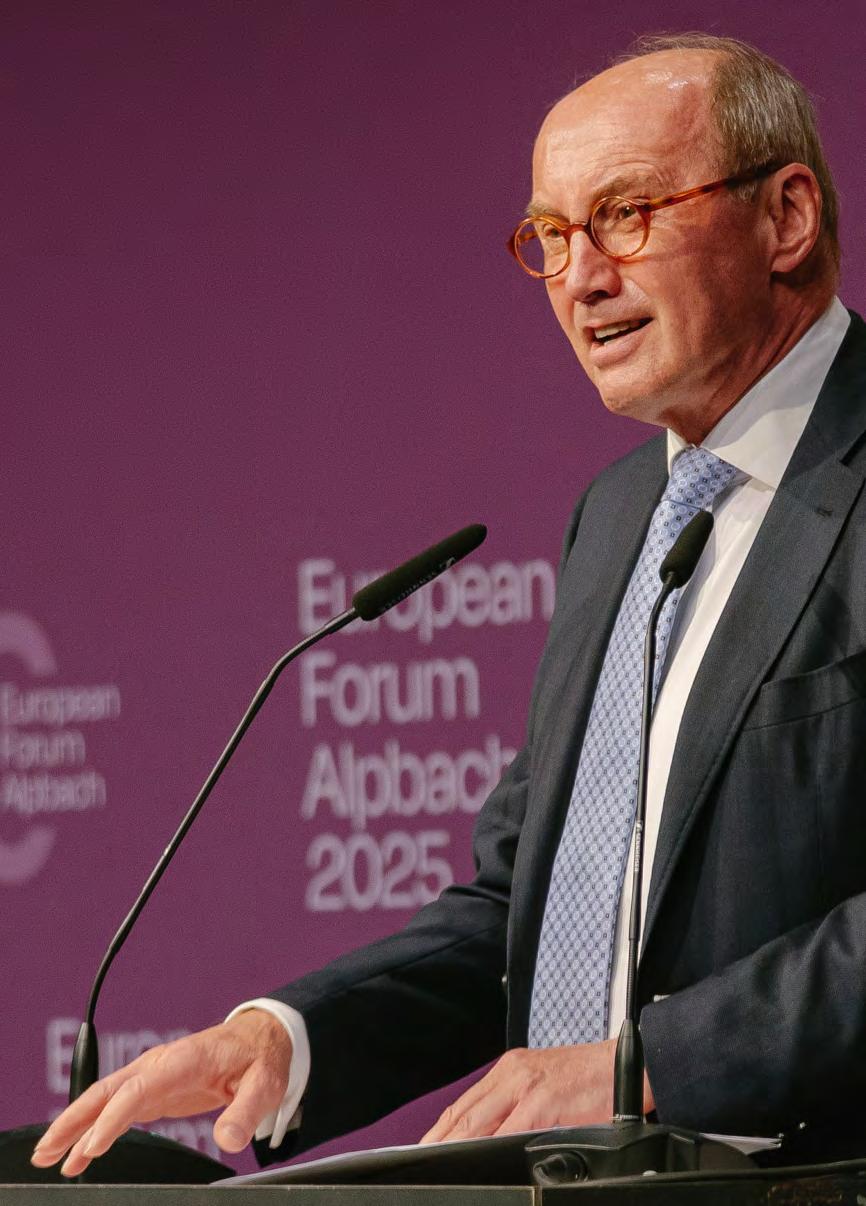
Othmar Karas at the opening speech of the Europe in the World Days
Opening EFA25
Othmar Karas, President of the EFA, opened the Europe in the World Days on 23 August 2025 with a call for European unity in times of global crisis. In his speech, he highlighted the power of shared values, the responsibility to uphold democracy and the rule of law, and the need for Europe’s voice to be heard clearly and decisively on the world stage.
Ladies and Gentlemen, distinguished guests, excellencies, dear friends of Alpbach, and especially:
Honourable Foreign Ministers of Austria, Romania, and the Czech Republic,
I am grateful that you are with us today. Your presence is a reminder that Europe’s strength is cooperation in practice.
This is my first opening of the Europe in the World Days as President of the European Forum Alpbach.
I feel the honour – and I feel the duty.
We meet at a time when many certainties are no longer certain: a brutal war against Ukraine, conflict in the Middle East, and rising geopolitical and economic tensions.
People feel that history has become heavier again –and they ask, with reason: where is Europe in all this?
I want to start with a simple fact: Europe is not small.
Our Union is home to more than 450 million citizens. Our market is one of the largest in the world. Our science, our culture, our industry, our values – they matter.
Yet too often, the world does not hear our voice with the strength it deserves. Too often, we do not hear it ourselves.
That is what I want to give you as today’s “take away”: we will be taken seriously when we take ourselves seriously. When we act as a Union, not as a collection of hesitations. When we match our size with our will, and our words with results.
In recent years we learned, sometimes the hard way, that there is no way back to yesterday. War, pandemic, price pressures, and climate urgency
have changed the world around us.
People feel it. They are less patient with speeches and more demanding of delivery. They want leaders who are calm in crisis, honest about trade-offs, and clear about direction.
They want Europe to be present when decisions are made –not only informed afterwards.
Only days ago, the world watched the summit between President Trump and President Putin about Ukraine. The European Union was not at the table; Europe was briefed afterwards.
That cannot be our role. We must be part of the decisions that shape our continent.
If we expect to be heard, we must stand behind our European representatives and stop whispering in 27 different directions.
Europe is not ignored because it is weak by nature. Europe is often ignored when it chooses to be small – when we fragment our market, delay what we decided together, or let vetoes win over common sense.
The gap is not in our potential; the gap is between agreement and action. To close that gap, we must do a few things – not new things, but necessary things.
We learned this with vaccines, with energy, with sanctions, with support to Ukraine.
Every time we moved together, we mattered. Every time we moved apart, we paid for it.
We must protect what makes us credible: our democracy, the rule of law, human dignity, the dignity of facts, respect for minorities, and free media.
These are not accessories. They are security assets. Partners trust us because of them. Our own citizens trust us because of them.
Some will say that the world will move on without us anyway –that others will cut deals over other people’s heads, that force will speak louder than law, that the age of rules is over. I do not accept that.
Law without power is naïve. Power without law is dangerous.
Europe’s mission is to unite the two.
This brings me to Alpbach.
Alpbach is different. It is not a stage for shouting.
It is a place for listening, for thinking, for speaking with respect. And for bringing people, disciplines, and interests together. Here, we take time for the questions that do not fit into a news cycle.
That may be against the current zeitgeist of hurry and outrage.
But leadership, real leadership, means making time for what truly matters.
So, in these Europe in the World Days, I ask that we use the European Forum Alpbach for what it does best: to ask the difficult questions – and to ask them together.
Are we ready to speak with one voice when it counts, not only when it is easy? Are we ready to turn common decisions into common delivery? Are we ready to explain to our citizens not only what we want, but what it takes – the choices, costs, and benefits?
As Jean-Claude Juncker once put it:
“We all know what to do; we just don’t know how to get re-elected after we’ve done it.”
Honesty demands we learn how –because not doing the right thing is no longer an option.
If our answer to these questions is yes, Europe will be heard. If our answer is yes, our partners will see Europe not as a commentator, but as a reliable partner at the table. And our young people will look to Europe not as a promise delayed, but as a future they can build.
Let me say again what I hope you will take from this opening: Europe will be taken seriously when it takes itself seriously –in its words, in its will, and in its work.
Ladies and Gentlemen, we will not solve everything in these days. But we can do something more important:
we can set a direction and commit to it.
We can bring honesty to our debates and courage to our choices. We can make Europe’s size visible again – not only in numbers, but in purpose.
Thank you for your trust.
Thank you for your commitment for a strong and united Europe.
And thank you for giving us, what the world rarely gives us: your time – time to think deeply, to decide wisely, and to act together.
Let’s start here in Alpbach.
Thank you very much.
Othmar Karas, EFA President, Alpbach, 23 August 2025
The EFA modules
Five modules were directed towards a broad range of participants: people of the EUREGIO region, international scholarship holders, experts’ communities as well as European and Austrian politics, businesses and civil society.
SAT 16 SUN 17 MON 18
TUE 19
WED 20
THU 21 FRI 22 SAT 23
SUN 24 MON 25
TUE 26
WED 27 THU 28 FRI 29
EUREGIO DAYS
ALPBACH SEMINARS
LAB DAYS
EUROPE IN THE WORLD DAYS
AUSTRIA IN EUROPE DAYS
RECHARGE EUROPE
The EFA25 programme addressed the following four tracks:
• CLIMATE
• FINANCE AND ECONOMY
• SECURITY
• DEMOCRACY AND THE RULE OF LAW
Thematic Tracks
At EFA, we take a multidisciplinary approach to developing innovative solutions together. Four thematic tracks set the direction for our work.
Facts & Figures
The EFA25 brought together participants from across Europe and beyond, representing all generations. Building on last year’s success, gender balance remained strong, and the EFA app continued to enhance networking and exchange.
Participants
4,697
Sessions in total
Content Sessions
Sessions where thinkers and practitioners spark curiosity by debating, sharing ideas, and engaging participants with compelling questions and topics.
Network Sessions
Informal gatherings – often over drinks and snacks – where fellows connect, exchange insights from the day, and discuss core EFA themes.
Rituals
Moments designed to refresh mind and body, such as light physical activity or shared silence, helping participants reset and refocus.
Other Sessions
Beyond the three main formats, EFA25 also offered other sessions such as Executive Talks, Brown Bag Lunches, Fireside Chats, and an alternative partner programme.
Formats
Alpbach is not an ordinary conference, and its formats are just as distinctive. At EFA25, participants engaged in a programme designed to foster collaboration, exchange, and creativity across generations.
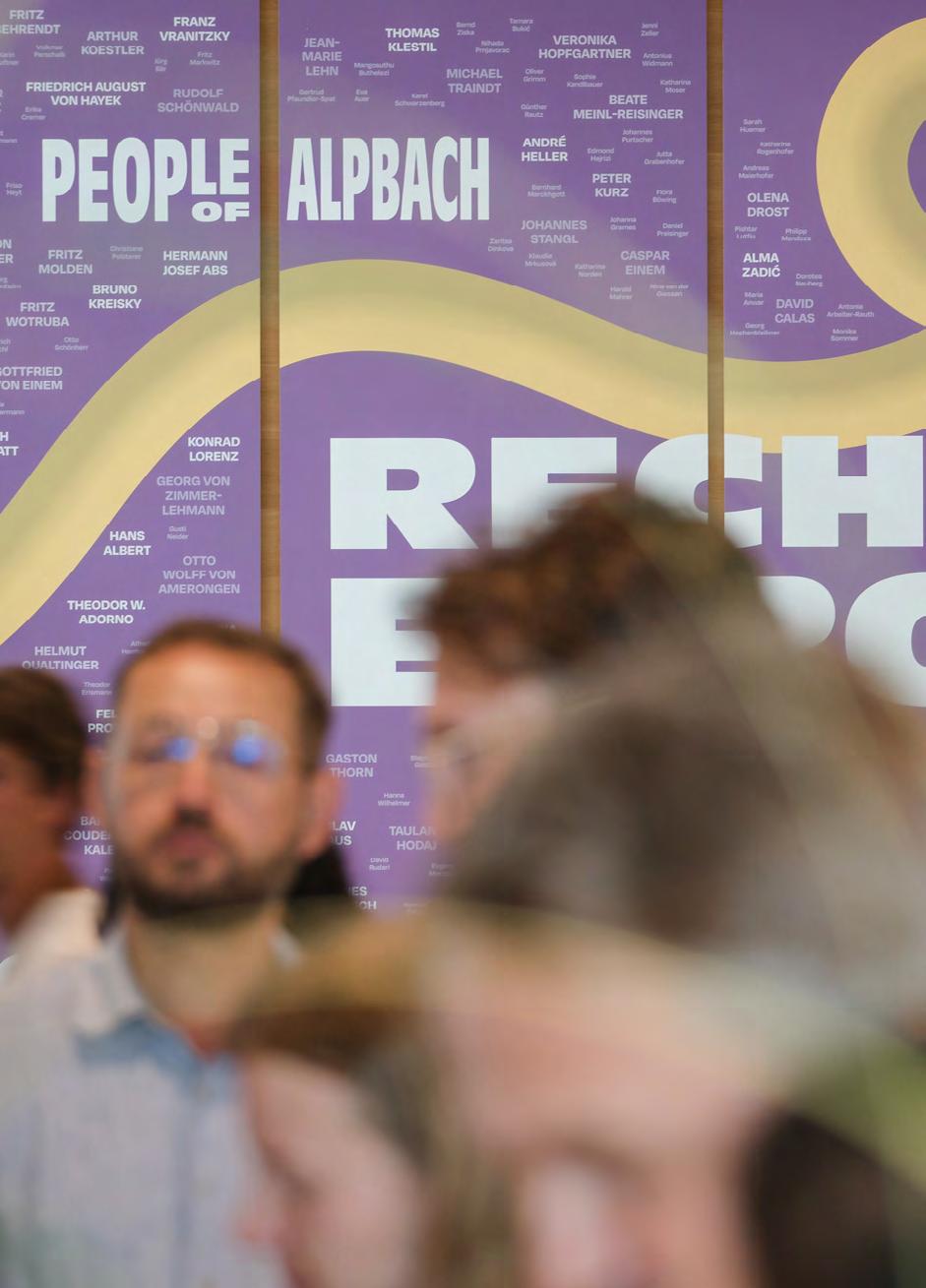
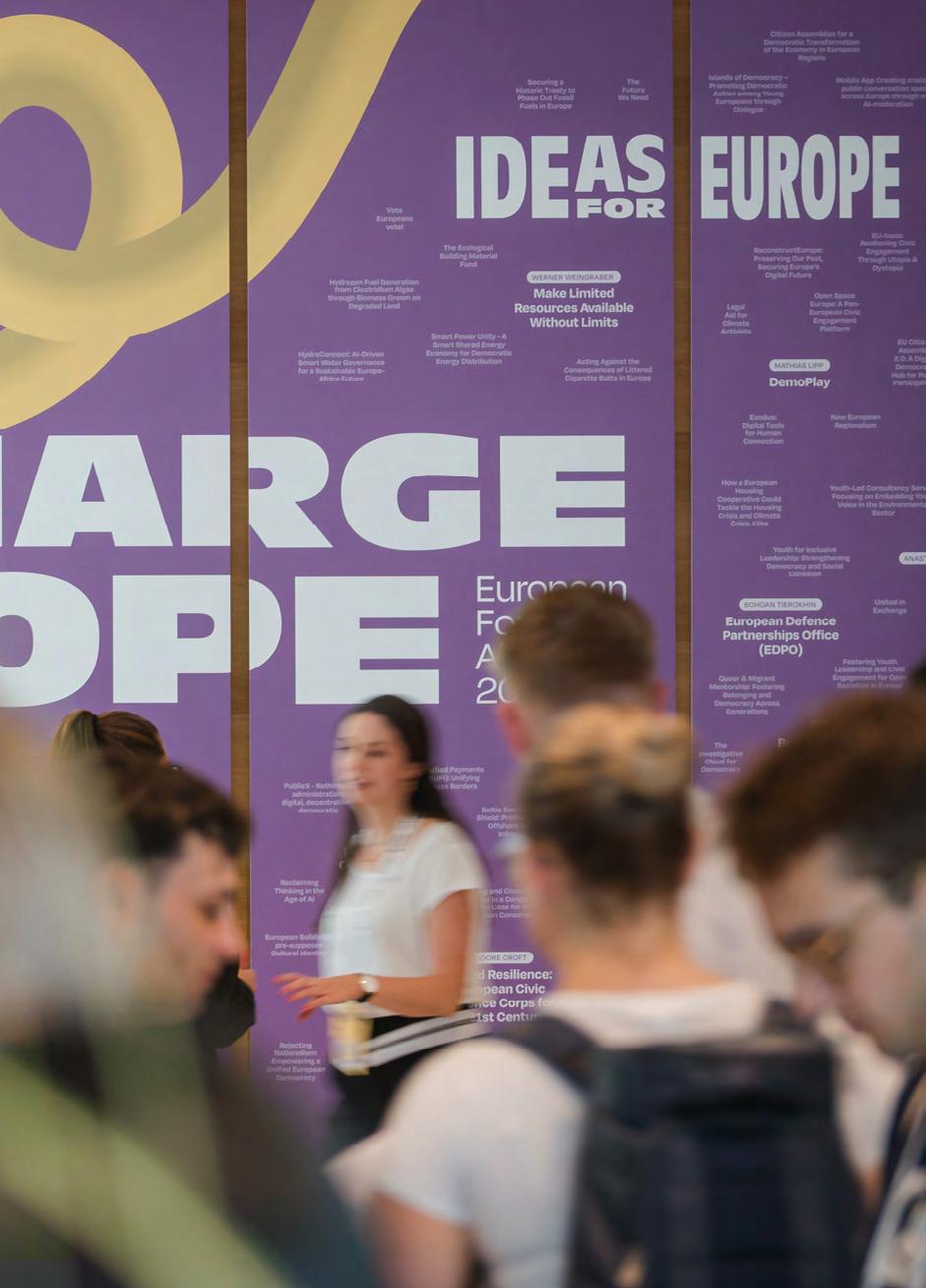
As part of the 80 Years of EFA celebrations, the names of individuals who have shaped the European Forum Alpbach, along with 80 ideas submitted to help shape Europe’s future, were showcased at the Forum.
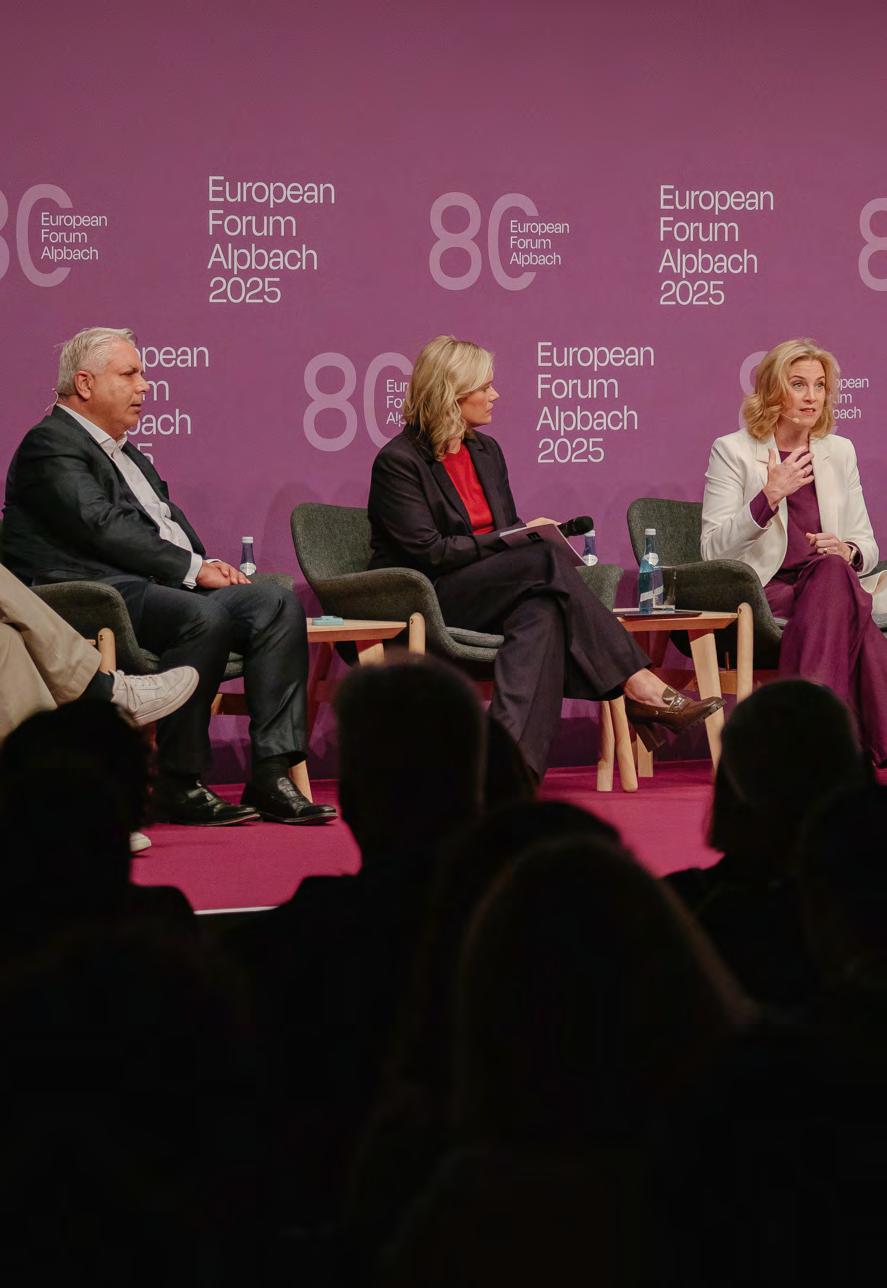
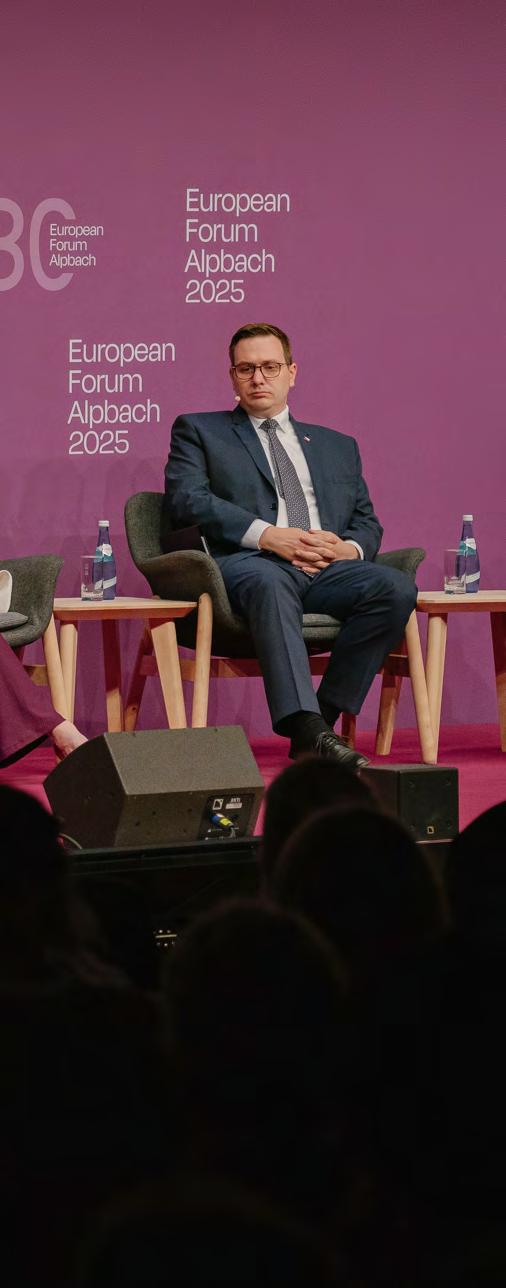
A high-level Opening of the Europe in the World Days, featuring: Wolfgang Ischinger (President of the Foundation Council of the Munich Security Conference Foundation), Peter Bosek (CEO of Erste Group), moderated by Corinna Milborn (Director of Information at ProSiebenSat.1 PULS 4), Beate Meinl-Reisinger (Federal Minister for European and International Affairs of Austria), Jan Lipavský (Minister of Foreign Affairs of the Czech Republic) and Oana Țoiu (Minister of Foreign Affairs of Romania and European Young Leader)
Security
Geopolitical turbulence continued to reshape the global order in 2025. The Security Track examined Europe’s capacity to act strategically as the rulesbased international order deteriorates in times of rising power rivalry.
Track Highlights
During the Europe in the World Days, debates reflected a shared sense of urgency and responsibility as Europe faces its most complex security landscape in decades. The Security Track examined Europe’s role in a shifting global order, exploring how geopolitical realignment and the crisis of global governance challenge the EU’s foreign and security policy. Participants discussed UN reform efforts and prospects for renewed multilateral cooperation in an increasingly fragmented world. A key session, Navigating a Multi-Ordered World, deepened the debate on how Europe can adapt its strategic posture to a reality shaped by competing power centres.
The Track distinguished between Europe’s external role under the Common Foreign and Security Policy (CFSP) and its internal responsibilities under the Common Security and Defence Policy (CSDP). While the former guided the Europe in the World Days, the latter defined the Austria in Europe Days under the topic Towards a European Defence Union – Goals, Roles and Responsibilities. Discussions focused on balancing ambition with unity, aligning political and financial tools, and closing capability gaps to strengthen European sovereignty. They also addressed collective defence, institutional security, and the roles of neutral EU Member States. The workshop The Price of Security: Defence, Democracy, and Societal Trade-offs highlighted the implications linked to the prioritisation of security policy.
Labs
The Lab on European Sovereignty in Security and Defence stressed crosssector collaboration to turn strategic ambition into tangible capabilities. It gathered policymakers, military leaders, industry representatives, analysts, and financial experts. Building on previous EFA365 engagements on the European Defence Union, it continued a year-round dialogue on financing, youth perspectives, and institutional frameworks for Europe’s security.
By analysing this year’s debates, our Reporting Partners distilled the most significant findings to ensure the conversations continue throughout the year. Read the Security Track reports – and all other reports – here:
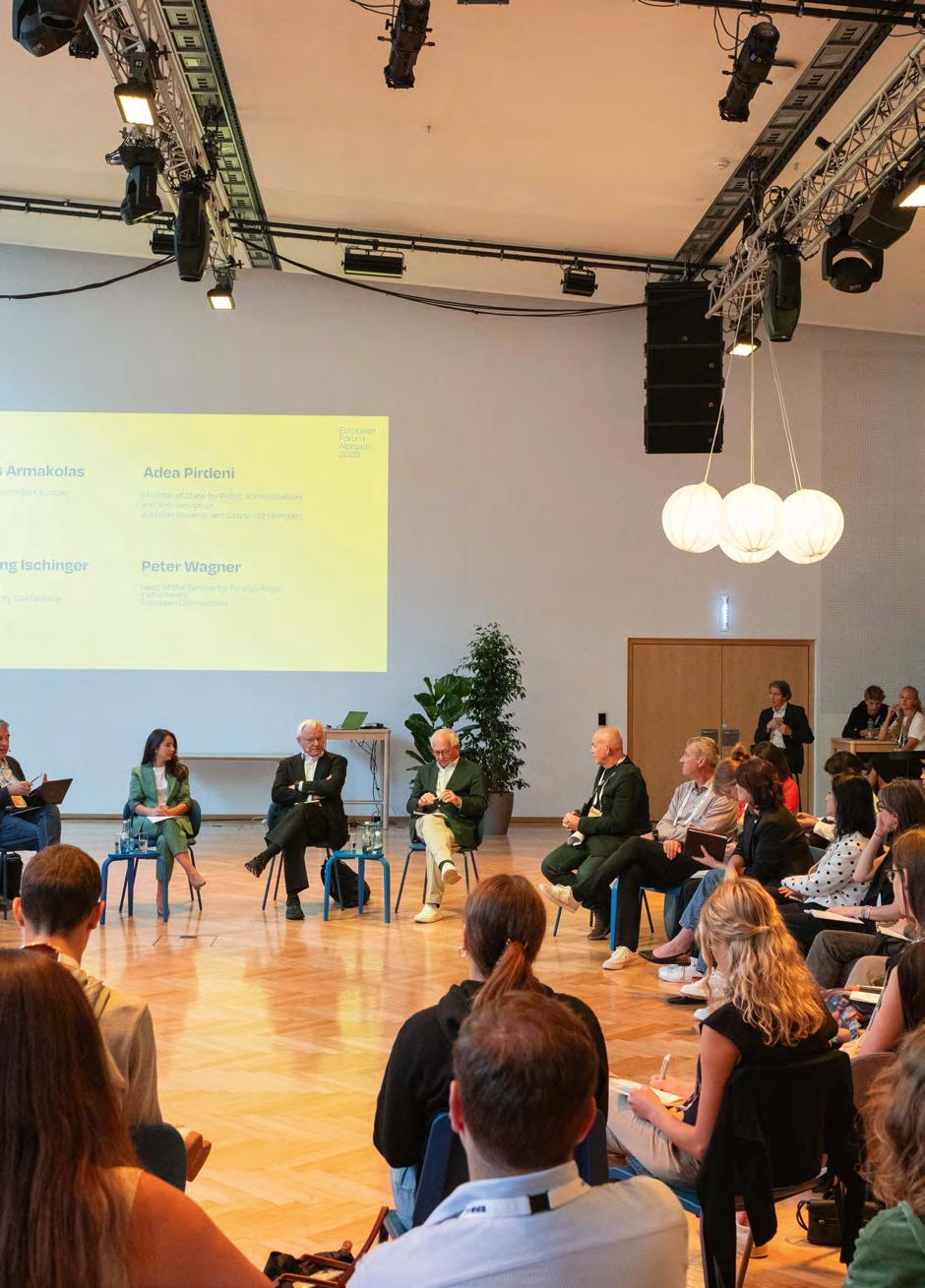
In a chat supported by the Open Society Foundation – Western Balkans, participants discussed how the war in Ukraine was testing EU cohesion and how renewed integration could strengthen Europe’s democratic foundations.
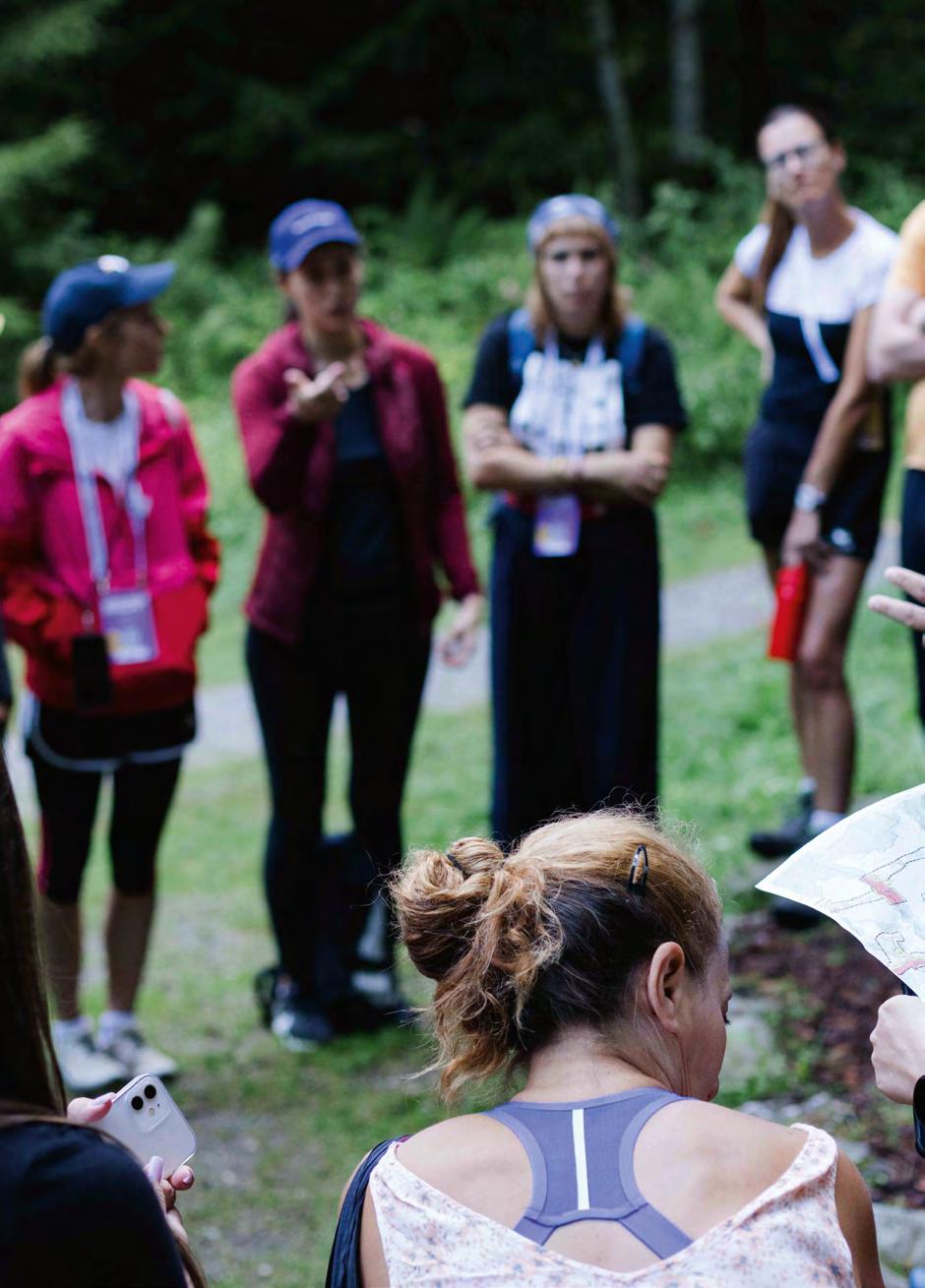
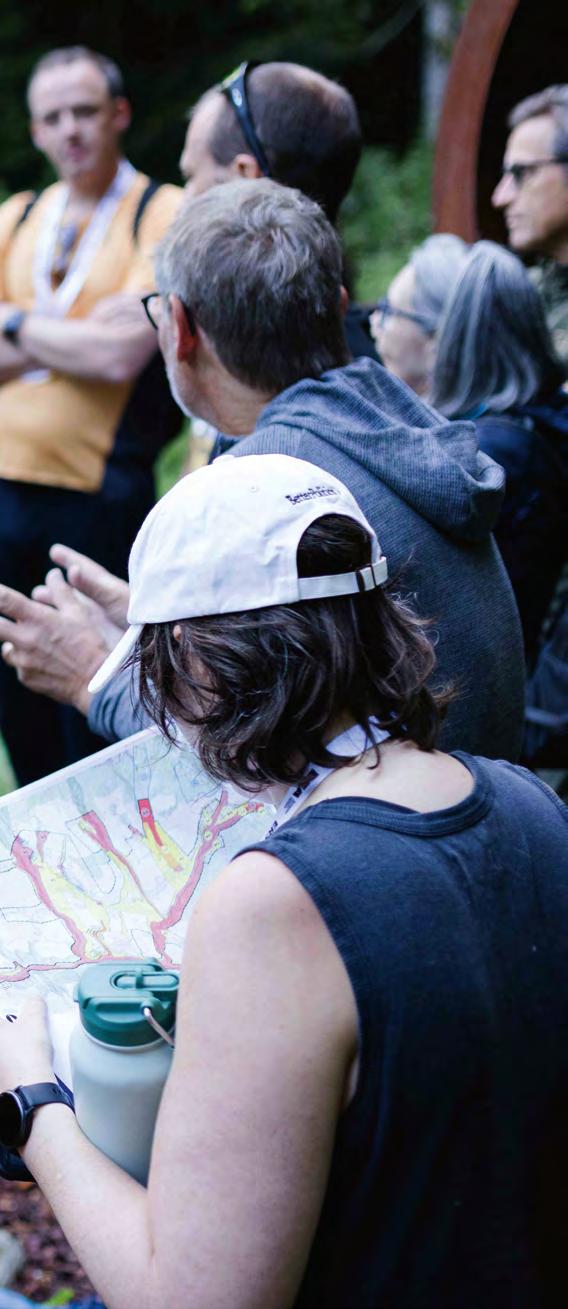
A hike offered a closer look at the Alps’ ecological and social vulnerability — and the strategies needed to strengthen resilience and sustainable development across the EUREGIO region.
Climate
Amid shifting political priorities, the Climate Track explored how Europe can turn the transition into a unifying project for innovation, resilience, and shared prosperity.
Track Highlights
This year’s Climate Track addressed one of Europe’s defining challenges: making the green transition both real and shared. Across diverse sessions, participants explored how to unlock political deadlocks, renew Europe’s industrial base, and build a climate-resilient future that strengthens competitiveness, cohesion, and trust. Under “Collaborate to Compete: Making the Climate Transformation Real”, discussions focused on how systemic cooperation across borders and sectors can drive progress. “United in Emergency: Towards a Stronger Climate and Energy Union” highlighted the governance, courage, and vision needed to secure Europe’s long-term resilience.
Sessions also looked at prosperity models beyond extraction, integrated food-water-nature systems, and intergenerational alliances to make the transition fair and inclusive. Participants discussed how openness in science can turn Europe’s values into a genuine competitive edge. Across the Track, a common message emerged: Europe’s climate transformation must be driven by agency, solidarity, and creativity – moving from fear to shared purpose and from ambition to action.
Labs
In its fourth iteration, the 10x100 Converter Lab launched a new cohort of practitioners to build a learning community shaping the next generation of large-scale organising. Over two days, seven project groups emerged – each defining a shared purpose to pursue through ten 100-day sprints driving systemic transformation.
The second Climate Lab brought together city leaders, industry, and finance experts to align Europe’s urban transformation with industrial and investment pathways. Participants explored how to translate urban demand into actionable opportunities and mobilise capital through innovative financial models, positioning cities as key drivers of Europe’s clean industrial transition.
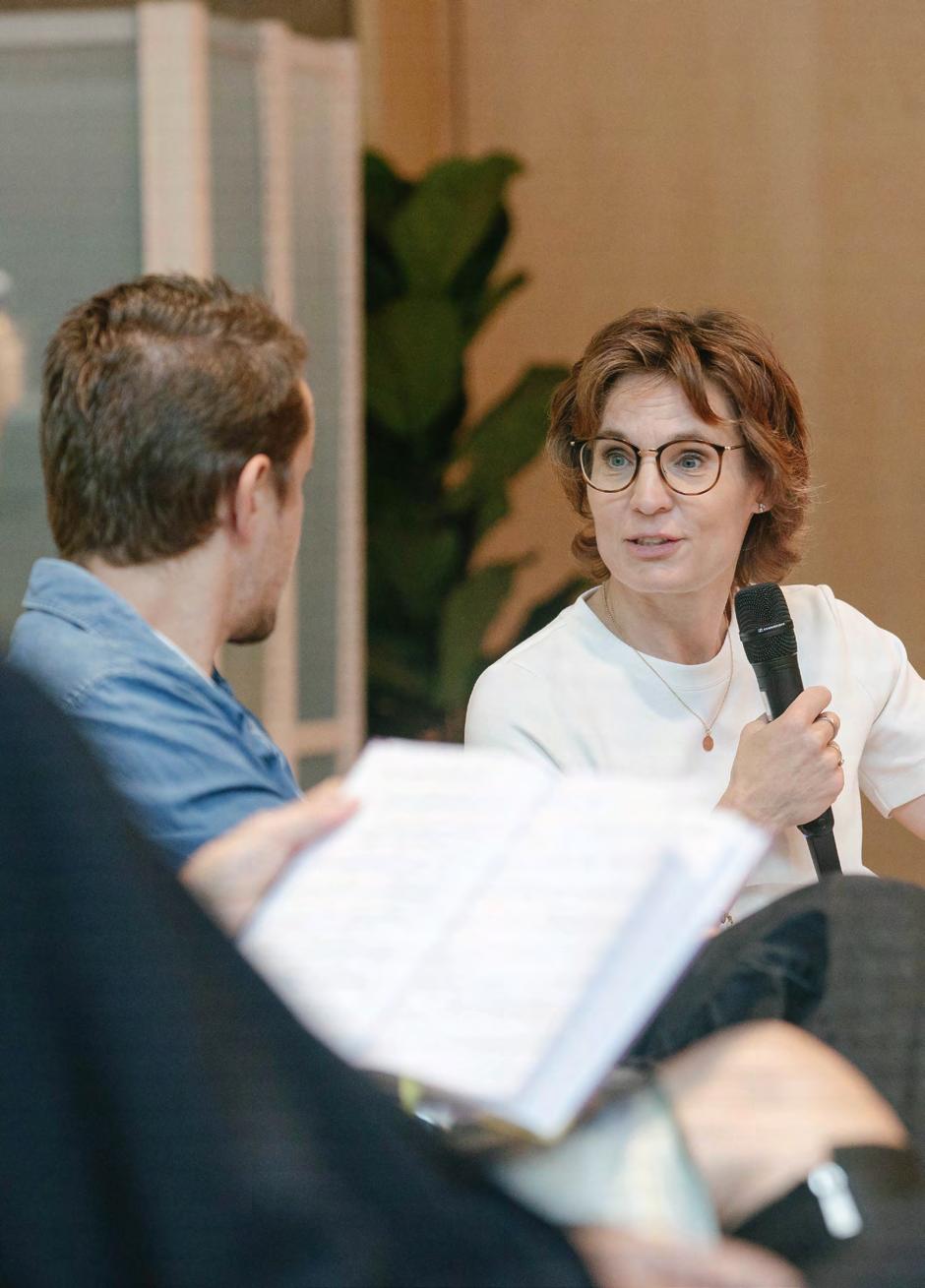
This session explored how integrating agriculture, water management, and nature restoration could strengthen Europe’s food systems and biodiversity, with contributions from European Commissioner Jessika Roswall.
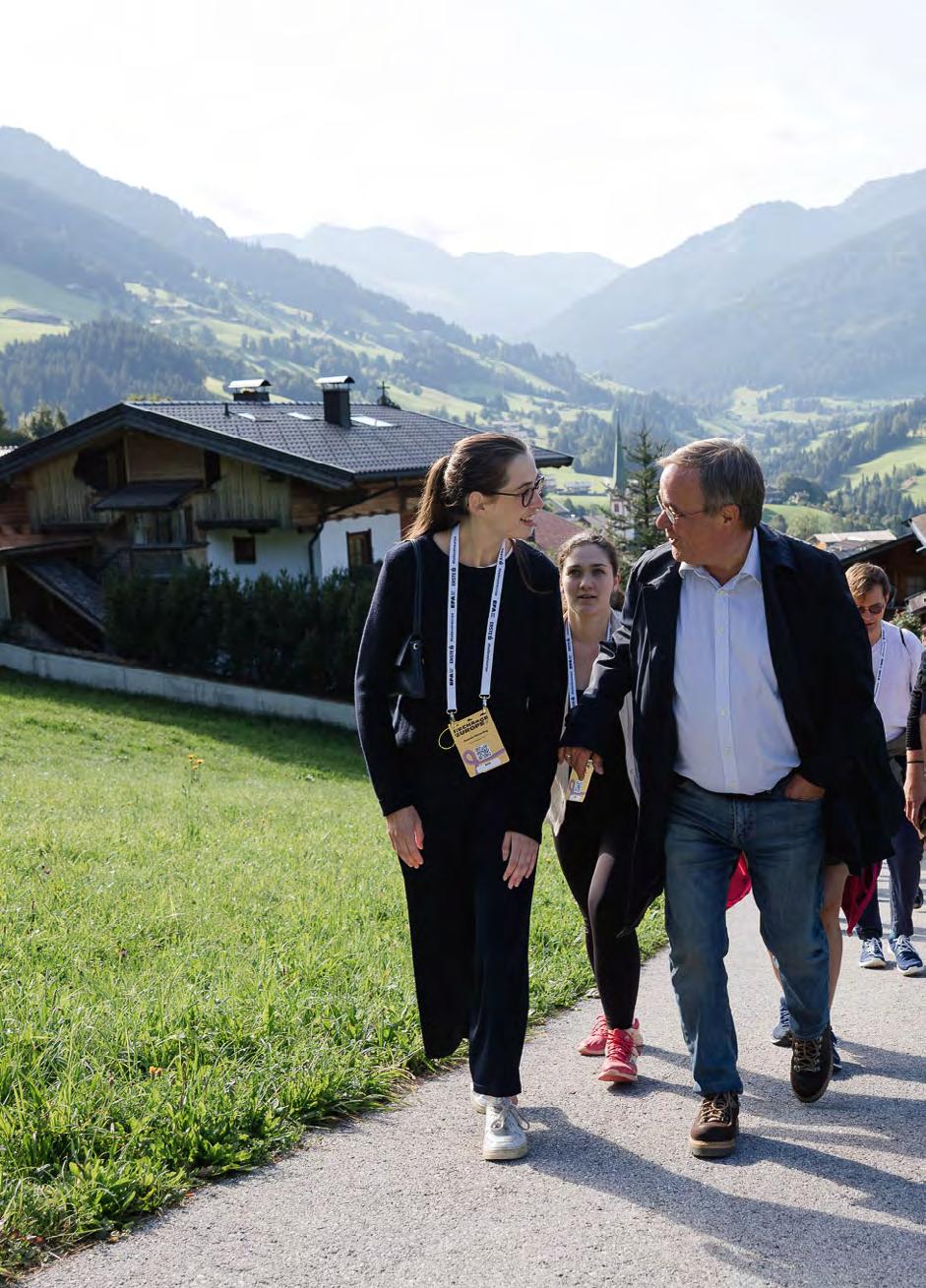
This session examined how extremist ideas are filtering into mainstream politics and what safeguards democracies need to uphold their core principles, with Armin Laschet, among others, contributing to the discussion.
Democracy and the Rule of Law
Within the Democracy and the Rule of Law Track, strategies to strengthen democratic institutions and processes suited to today’s information and technology context were explored.
Track Highlights
This year we tackled two profound challenges facing our democracies. On the one hand, under “People and Power: Strengthening Truth and Trust”, we attempted to understand how untruths, distrust, and power imbalances threaten the foundations of democratic societies worldwide and how institutions and politicians, communities, and individuals can work together to rebuild trust in the democratic system and public discourse. On the other hand, within “Democracy and Rule of Law in the Digital Age: AI, Disinformation and Media”, we reflected on how advances in AI, proliferation of disinformation, and evolving media landscape are reshaping the framework of democracy and the rule of law and how to tackle the profound implications of these technological and social transformations for our democracies.
In a wide range of sessions and formats we discussed countering extremism, resisting autocratisation, proving democratic competence, and reclaiming the rule of law. We also examined new forms of disinformation, effects of social media on society, pathways to European digital sovereignty, and deception in the digital space. Vibrant debates took place on hot topics such as European unity and free speech. The breadth of the discussion leant itself to amplifying defining voices in their field from democracy experts, such as Yascha Mounk, to digital experts, such as Rumman Chowdhury.
Labs
Participants of “Democracy Strikes Back: Understanding and Countering Authoritarian Plays” worked together to understand the increasingly sophisticated and transnational strategies used by authoritarian forces and co-created bold, offensive responses to them. Meanwhile, in the second iteration of “Responsible Leadership – Business, Civil Society & Politics: Partners in Changing Times” we deepened the conversation around corporate responsibility and identified avenues for companies and corporate leaders to proactively embrace their role as civic actors.
Based on their close observation of the Forum’s sessions, our Reporting Partners summarised the discussions and translated them into forwardlooking reflections. Read the Democracy & the Rule of Law Track – and all other reports – here:
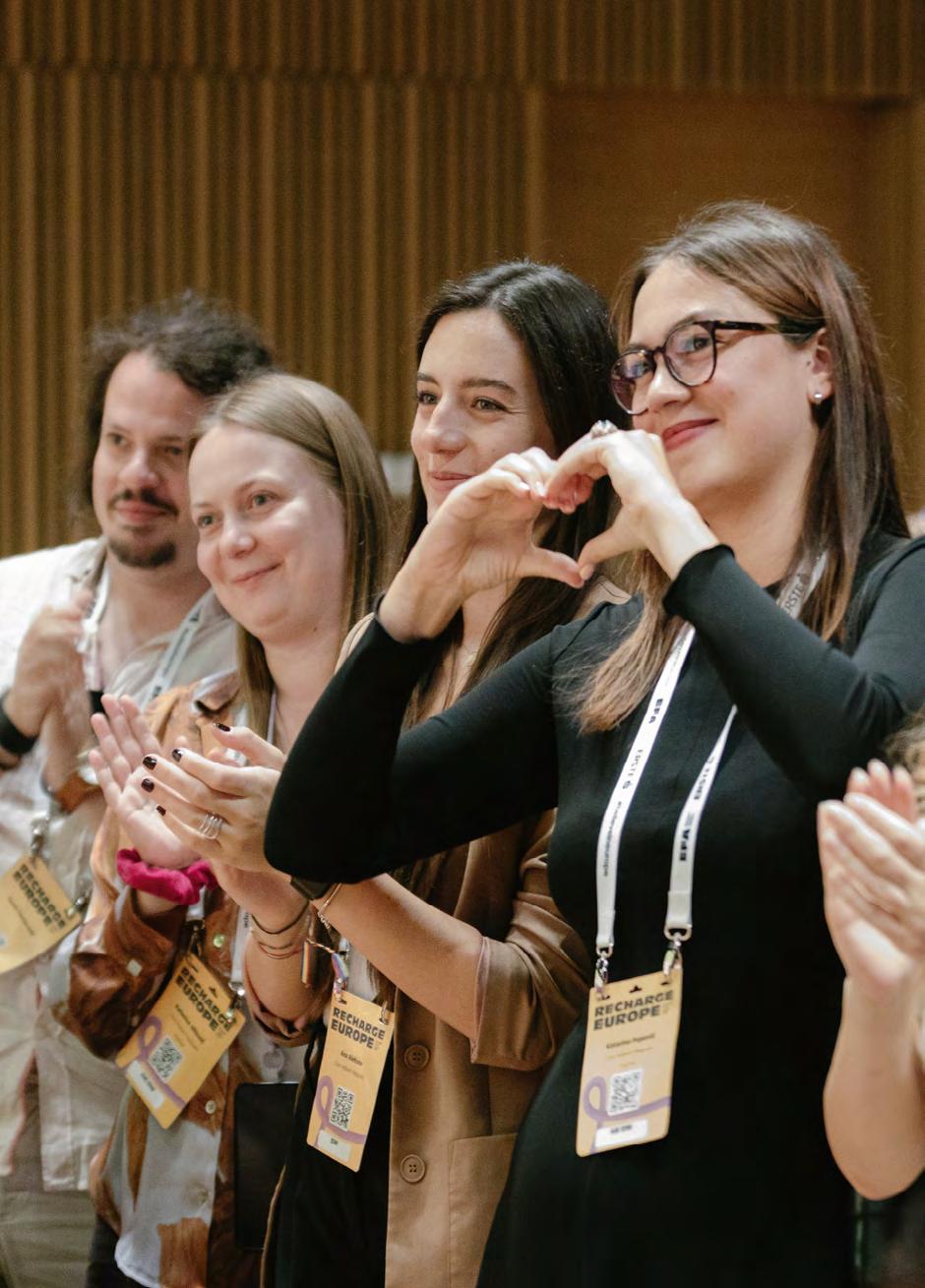
This year, the Democracy and the Rule of Law Track focused on strengthening trust and countering disinformation, as participants discussed how to safeguard resilient democratic systems.
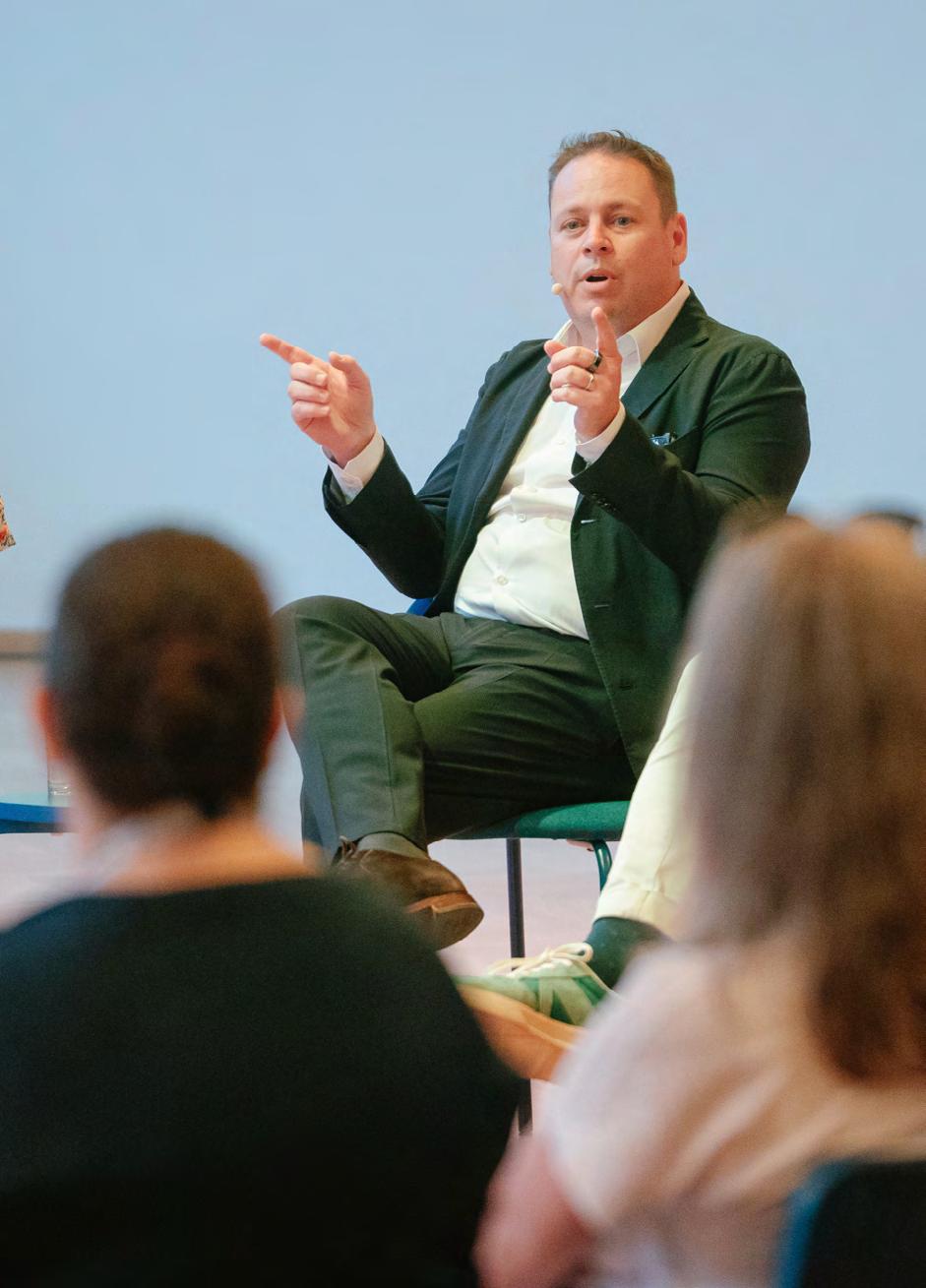
A content session that brought experts and audience together to unpack the essentials of financial health, exploring how greater financial literacy can support stability and resilience in uncertain times
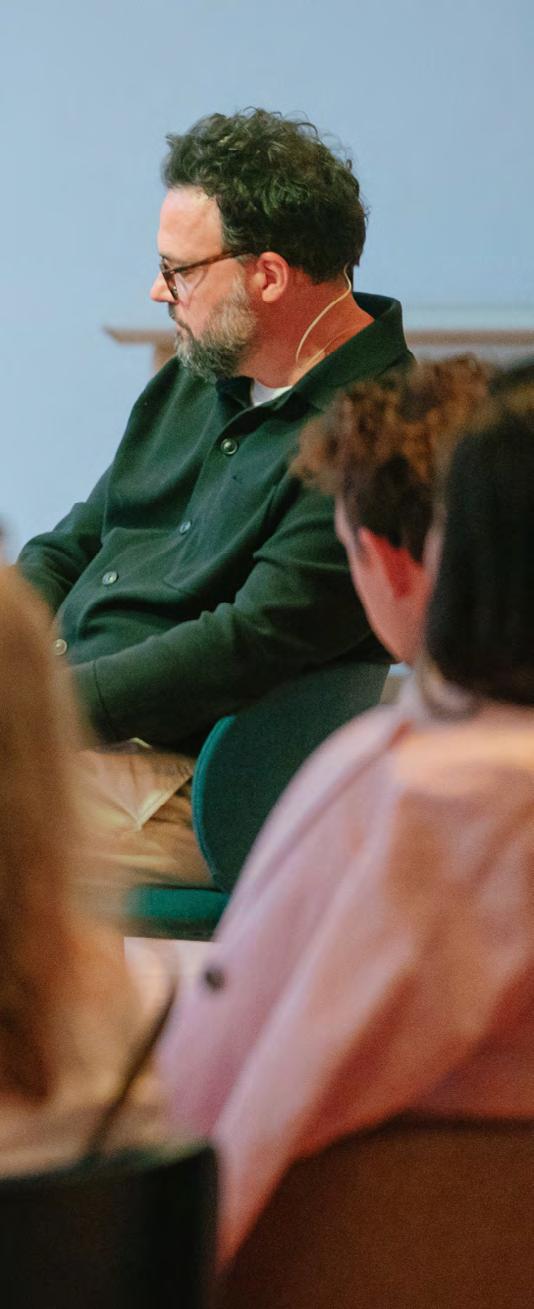
Finance and Economy
The Finance and Economy Track focused on ways to mobilise capital for sustainable innovation and addressed the causes and solutions of growing economic and social inequality.
Track Highlights
The Finance and Economy Track explored solutions to the multifaceted challenges threatening Europe’s global position in an era of geopolitical uncertainty and rapid technological transformation. Key issues included stagnating productivity, rising unemployment, and demographic pressures. The sessions focused on how Europe can regain its competitiveness, strengthen its venture capital ecosystem, and ensure the financing and scaling of innovation across the continent.
A notable highlight was a panel discussion bringing together representatives from academia, policy, and industry. The debate examined what it would take to create a truly integrated European innovation ecosystem – one that overcomes fragmented markets and addresses Europe’s risk-averse culture, which often hinders entrepreneurial spirit and the scaling of innovative ideas. Another thought-provoking session featured EU policymakers and privatesector leaders discussing whether current budget frameworks are fit to meet the scale of Europe’s challenges. The exchange underscored the complexity of determining how funds should be raised and spent and how to balance national interests with Europe’s collective priorities.
These discussions culminated in a broader reflection on Europe’s future amid geoeconomic disruption, trade tensions, and shifting global alliances. Panelists offered both European and transcontinental perspectives on how Europe can position itself more strategically, emphasising the need to forge new partnerships and move from vision to bold, coordinated action.

Labs
In addition to the main discussions, the Track conducted two in-depth Labs designed to foster practical collaboration and innovation.
The first Lab convened senior policymakers, economists, and institutional leaders from across the CEE region to critically assess three decades of pension reforms. Participants examined long-term impacts, shared national experiences, and co-developed strategies to enhance both financial sustainability and social security in the context of demographic and economic change.
The second Lab provided an interactive setting for national and international initiatives aimed at strengthening economic and financial literacy. Participants collaborated intensively with experts from finance, economics, education, entrepreneurship, and scaling to refine their projects and develop innovative solutions. The Lab concluded with the presentation of awards for two outstanding initiatives.
Drawing on the discussions at the Forum, our Reporting Partners captured essential insights and reflected on their broader relevance. Read the Finance & Economy Track reports – and all other reports – here:

At EFA25, high-level speakers came together on stage to explore how Europe can turn climate ambition into real transformation, working towards collaborative solutions for a more resilient, competitive and sustainable future.
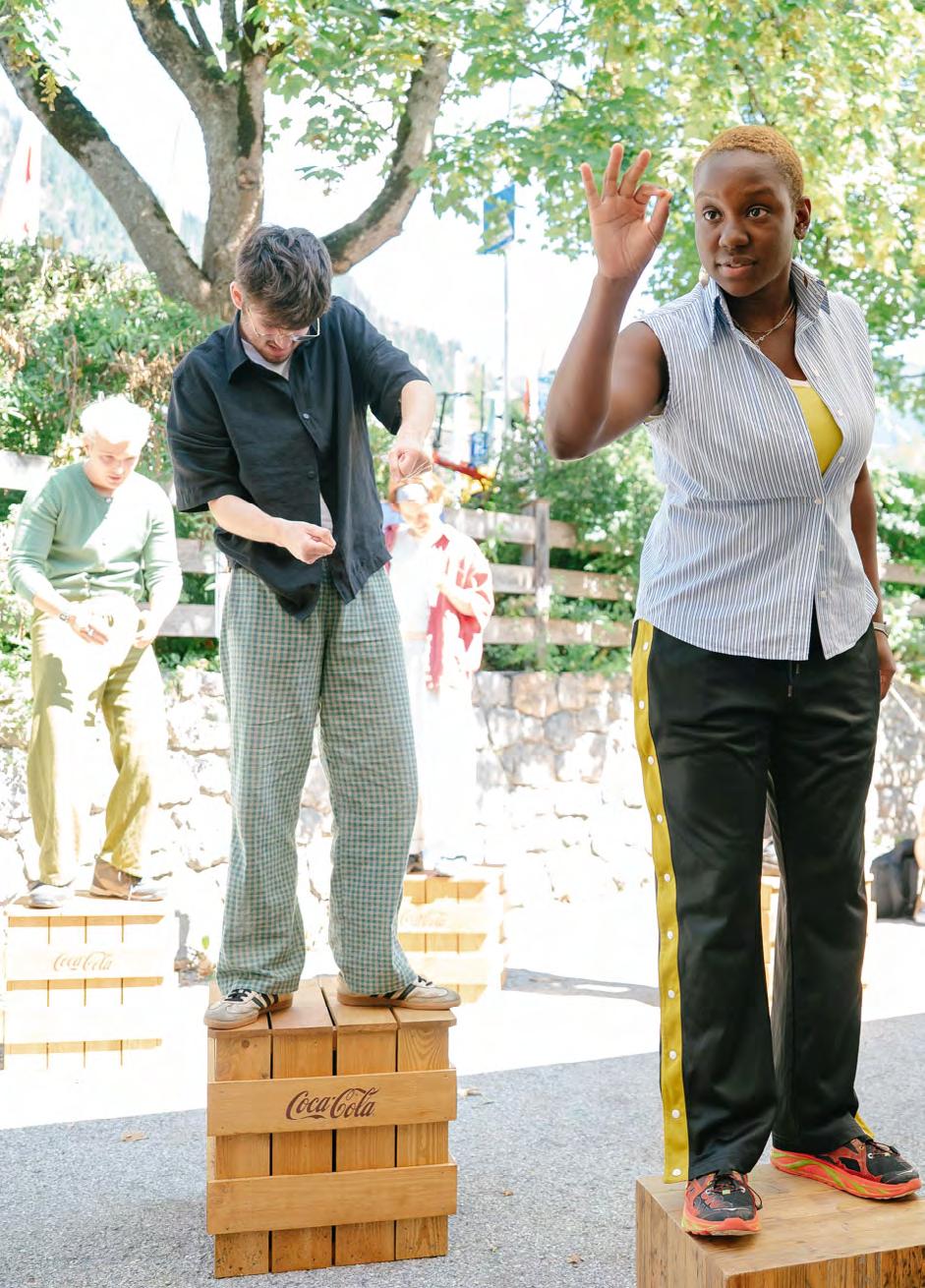
A series of performances in which the Royal Academy of Dramatic Art London (RADA) brought five sketches to the stage, inviting the audience to reflect on AI’s promises, risks and unanswered questions.
Arts and Culture
Participants were invited to use artistic methods to reclaim their power of imagination and form new alliances.
The Arts and Culture programme invited participants to engage in cultural, societal, and political participation, offering fresh perspectives on identity, activism, AI, security, and other key issues.
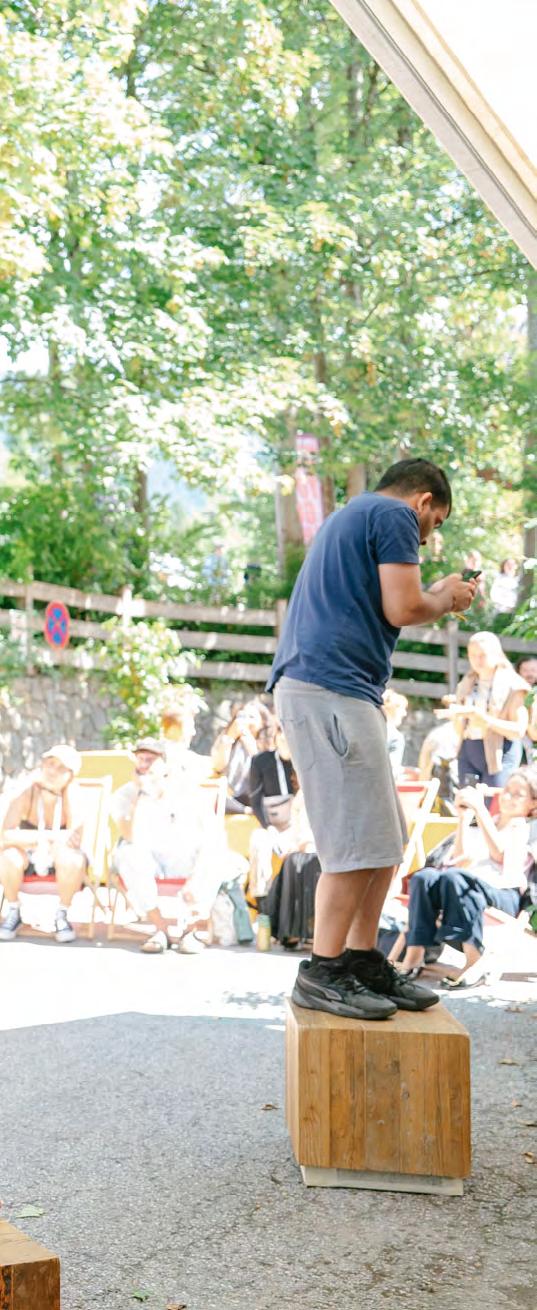
Radikale Töchter, a leading initiative for political participation among young Europeans, staged a flashmob in collaboration with participants of their seminar. In direct encounters with EFA participants, they raised questions often avoided yet crucial to upholding European values.
Four workshops, each developed by two artists and a subject-matter expert, created innovative intersections between music, architecture, literature and game design and the topics of the four tracks at EFA – Democracy and the Rule of Law, Finance and Economy, Climate, and Security. These sessions encouraged participants to think creatively, explore new approaches to pressing issues, and collaborate across diverse backgrounds.
The Royal Academy of Dramatic Arts (RADA) presented a play on AI, exploring its risks and benefits with wit and poignancy. The Sound of Entanglement combined music and quantum physics, making complex science visually and sonically immersive. The play Kcħψånt brought Alpbach’s fascinating history to the stage, highlighting remarkable figures like Erwin Schrödinger and Vivienne Westwood.
Several concerts provided spaces for reflection, relaxation, and informal encounters, musically bridging tradition and innovation. Ernst Molden and Aliosha Biz performed modern Viennese songs, the Estonian Duo Ruut reimagined traditional music, Lukas Oscar transformed a parking lot into a buzzing dance floor, and Anna Buchegger energised audiences with a sophisticated blend of Austrian folk and pop. The project Ësenaim made the experiences of Doctors Without Borders in conflict zones accessible through sound and poetry.
Within the framework of this year’s theme Recharge Europe, the Arts and Culture programme offered alternative, unexpected, and inspiring experiences.
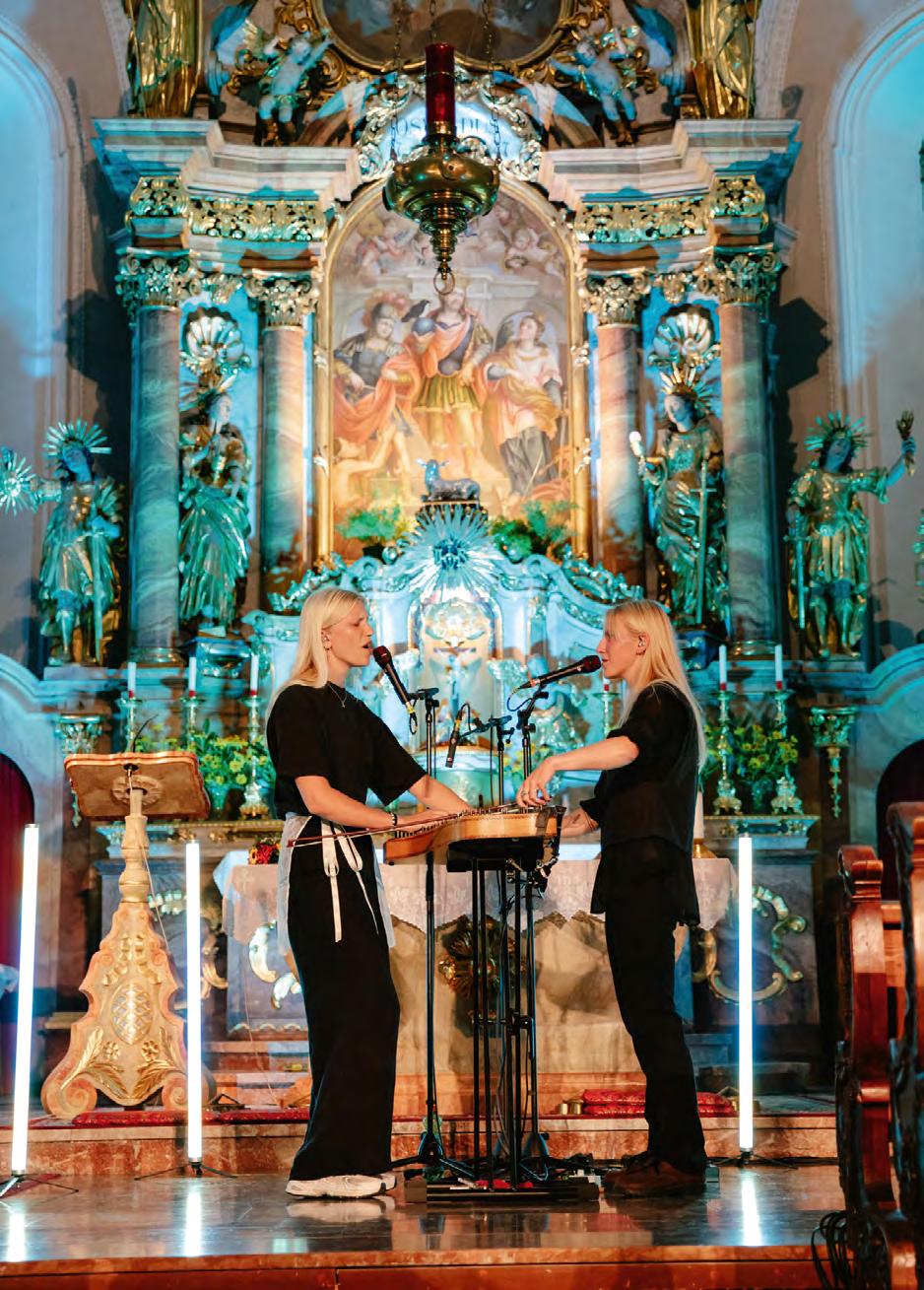
Duo Ruut filled the parish church with their distinctive blend of vocals and kantele, turning the space into an evocative shared musical moment.
How was your experience?
Which statement describes the Forum best? (Multiple answers allowed, shown here: Top 3 answers)
A social networking event or platform
A learning and knowledge exchange platform
A space and place that brings together young people from Europe and from all over the world with the most innovative minds from politics, business, civil society, culture, and science
Looking back on your experience in Alpbach – What was the most particular added value of the Forum for you? (Multiple answers allowed, shown here: Top 5 answers)
To meet amazing people and learn from them
I listened to extraordinary speakers
I learned something new
I got a better understanding of other people’s perspective
I was able to develop ideas together with others
How do you rate the quality of speakers?
Evaluation EFA 2025 - Peter Hajek Public Opinion Strategies
Participants Survey
The feedback surveys present participant’s overall satisfaction with the 2025 event programme.

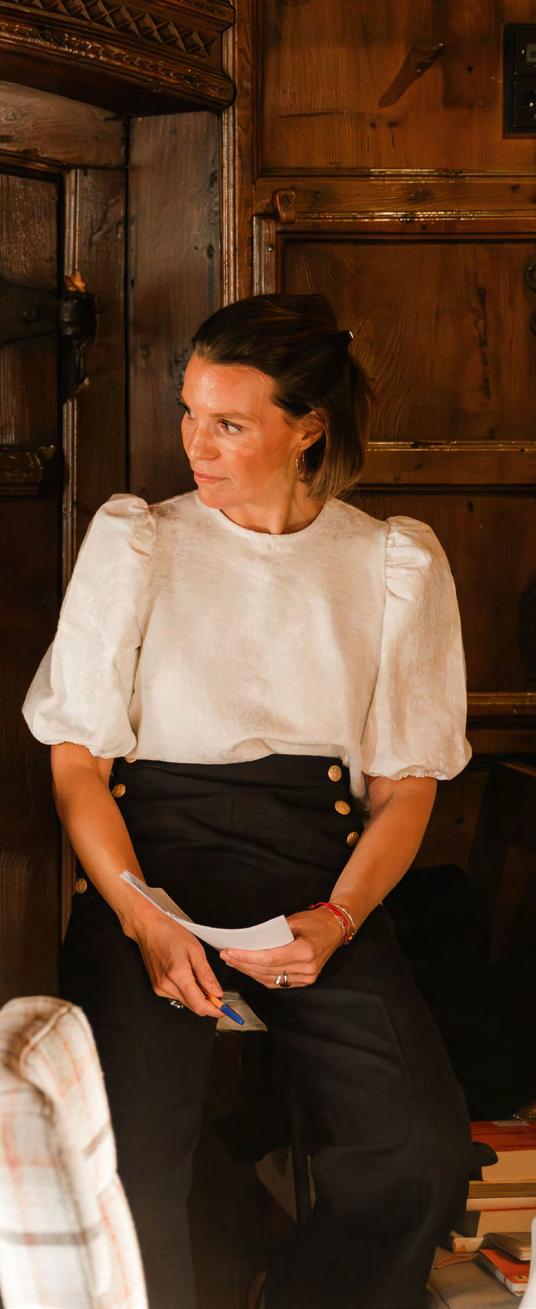
The Network Session “Peace, Women and Money” brought together leading voices, including Meredith Whittaker, President of Signal, and Beate Meinl-Reisinger, Austrian Minister for European and International Affairs, to reflect on how women’s growing financial influence could shape Europe’s future.
World of Women*
The European Forum Alpbach values diverse voices. A healthy democracy must reflect all perspectives, which is why EFA actively encourages non-male contributors in both its programming and participation.
Shaping a More Inclusive Future
Women* remain underrepresented in many areas of public life, and no society can thrive when half its population is excluded. Feminism has long highlighted this imbalance, and it’s up to us to act. While the European Forum Alpbach has a rich history of dialogue, feminist perspectives were largely absent until 1986.
From 2023 to 2025, our World of Women (WoW*) initiative aimed to amplify women’s* visibility at EFA. We believe tackling today’s major crises – climate change, threats to democracy, economic sustainability, and global security – requires contributions from all genders. Spearheaded by women* from the EFA Board, Council, Network, and partner organisations, the initiative strives for gender parity across all sessions and encourages women* to speak up and lead.
Sessions at EFA25
WoW* Connect Sessions (six times)
Each day, from the Europe in the World Days to the Austria in Europe Days, one and a half hours were hosted by women* engaged in EFA’s broader network, offering opportunities to connect, reflect, and act.
Executive Talk | Hosted by Zukunft.Frauen Alumnae Club
Permanent crises, pressure, and digital transformation are redefining leadership. How can leaders remain strong, foster innovation, and steer their organisations toward the future? Insights from a survey of 400 top executives revealed which skills matter today – and where true energy and new ideas really come from.
Peace, Women & Money | Hosted by Female Founders
This session brought together leading voices from policy, finance, and entrepreneurship to explore how Europe’s future could change when women control more capital – a key to democratic resilience and inclusive innovation.
Recharge Austria
The Women Economic Summit 2025 focused on Austria’s innovative strength and resilience, exploring how Austria and Europe can turn global challenges into opportunities. Top female managers discussed new perspectives, potential, and positioning for Austria.
Women in STEM and Leadership
The gender gap in Science, Technology, Engineering, and Mathematics (STEM) remains a major challenge across Europe. At the European Forum Alpbach, we’re working on closing that gap by actively inviting emerging female* talents to join the conversation and shape the future.
Since 2024, we have launched the Women in STEM focus group for scholarship holders, welcoming young female* talents under 30 with a background in STEM to take part in the annual Forum. For those aged 30 to 40, the Alpbach in Motion (AIM) leadership lab provides a space to connect, innovate, and grow as leaders, with women* especially encouraged to apply.
Transparency and Gender Parity
To ensure transparency and accountability, we track and publish gender data related to participation at EFA. The 2025 numbers show that EFA’s commitment to gender parity is close to being achieved:
These figures reflect our commitment to gender parity and our belief that diversity drives better outcomes. Considering that women* remain underrepresented in leadership – with only 14 % of executives and 13 % of board members in Austria being female* –, these are encouraging results. Yet, we remain committed to achieving full parity.
• 55 % of scholarship holders were female*
• 45 % of all AIM participants were female*
• 46 % of contributors (e. g., speakers, moderators) were female*
• 43 % of all other participants identified as female*
WoW* Beyond Alpbach
Additionally, we organise WoW* events year-round as part of our EFA365 initiative, such as “AI Forward: Shaping the Future” in cooperation with our partner Zukunft.Frauen Alumnae Club. Further activities with Female Founders are planned for 2026.
The Code of Conduct and on-site support
To achieve EFA’s goal of fostering open and respectful exchange, the Code of Conduct was introduced in 2017, fostering inclusion, equity, intercultural understanding, fairness, and integrity. During EFA25 the Ombudsteam, consisting of two professionals with background in law and psychology, was present throughout the entire Forum – providing confidential support, mediating in case of conflicts, taking appropriate action when needed, and promoting the Code of Conduct. Additionally, in collaboration with the FAN network, the Awareness Initiative further strengthened a culture of care, reaching out to participants as Aware Friends, spreading the importance of safe, inclusive spaces throughout the Forum.
Inclusive Recharge Space
As part of EFA’s ongoing commitment to creating a safer and more inclusive space, barriers to participation were further reduced during EFA25 through the introduction of the Recharge Space. The lounge inside the container by Niederstätter offered a space for rest and reflection amidst the intensity of the Forum. Designed as an inclusive environment, also suitable for neurodivergent persons, it provided room for up to five users at a time. The Recharge Space was frequently visited throughout its opening hours –especially by young fellows without private retreat spaces – offering a place to relax and recharge during the two Forum weeks.
Auditory accessibility
To further enhance accessibility and reduce language barriers, the Congress Centrum Alpbach was fully covered by Wordly during EFA25. This live translation tool enabled real-time multilingual participation. Over the course of the Forum, the app was used by 597 users, who accessed translations in 36 languages. The highest demand was for German (273 uses), followed by English (199) and Italian (24). During the Europe in the World Opening Session alone, 66 participants used the service in 13 different languages, highlighting EFA’s commitment to fostering inclusive dialogue and exchange for an increasingly diverse community.
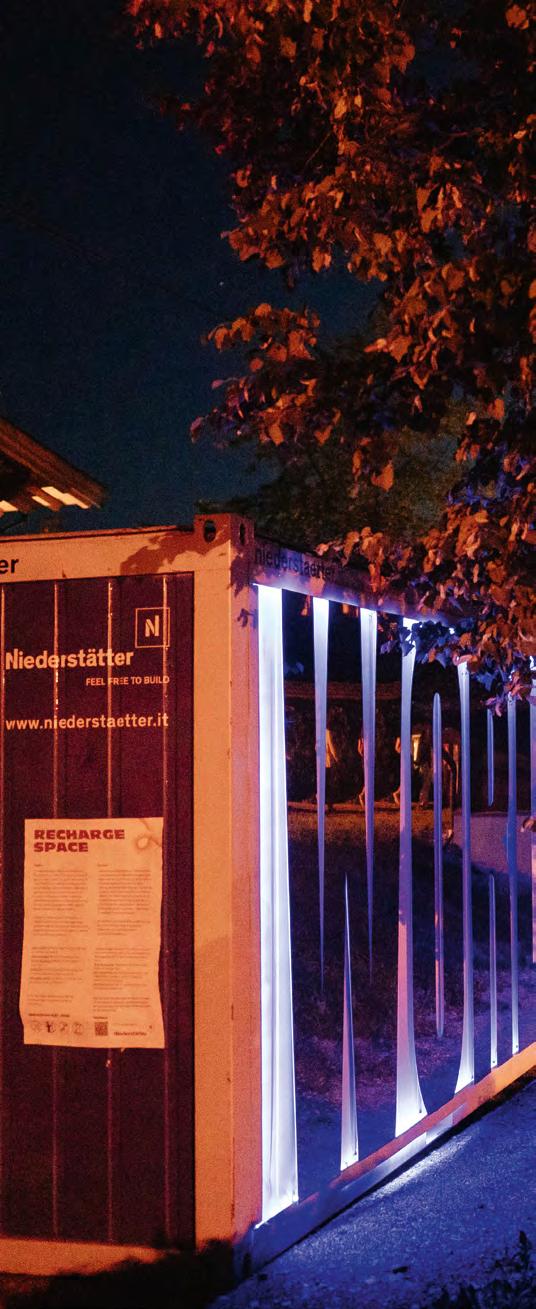
A quiet Recharge Space offered a calm and inclusive space to rest and reset during the intensity of EFA25, designed to reduce barriers to participation and support the needs of a diverse community.
A more inclusive and safer space
EFA25’s commitment to safety and inclusion was reflected in its initiatives, creating a safer space for all participants.
While the scholarship programme is aimed at young changemakers between the ages of 18 and 30, Alpbach in Motion (AIM) serves as a platform for up to 40 exceptional managers and founders aged 30 to 40 who are committed to shaping and transforming Europe.
This year, 38 participants came together during the Europe in the World Days (August 23 – 26) for an engaging peer-to-peer learning experience, focused on innovative, out-of-the-box solutions. The programme encouraged young professionals to drive change within their industries, ecosystems, and broader social environments.
Participants came from 13 different countries and had an average age of 34 years. This year’s lab was facilitated by Xenia Wickett, an International Affairs advisor and executive coach, and Pamela von Sabljar, an expert in leadership, personal development, and behavioural science.
Together with the cohort, they explored the four key leadership quests: the quest of self-regulation, the quest of receptivity, the quest of collaboration, and the quest of sense-making. As suggested by the programme’s name, discussions were largely held “in motion” during reflective, decelerating hikes.

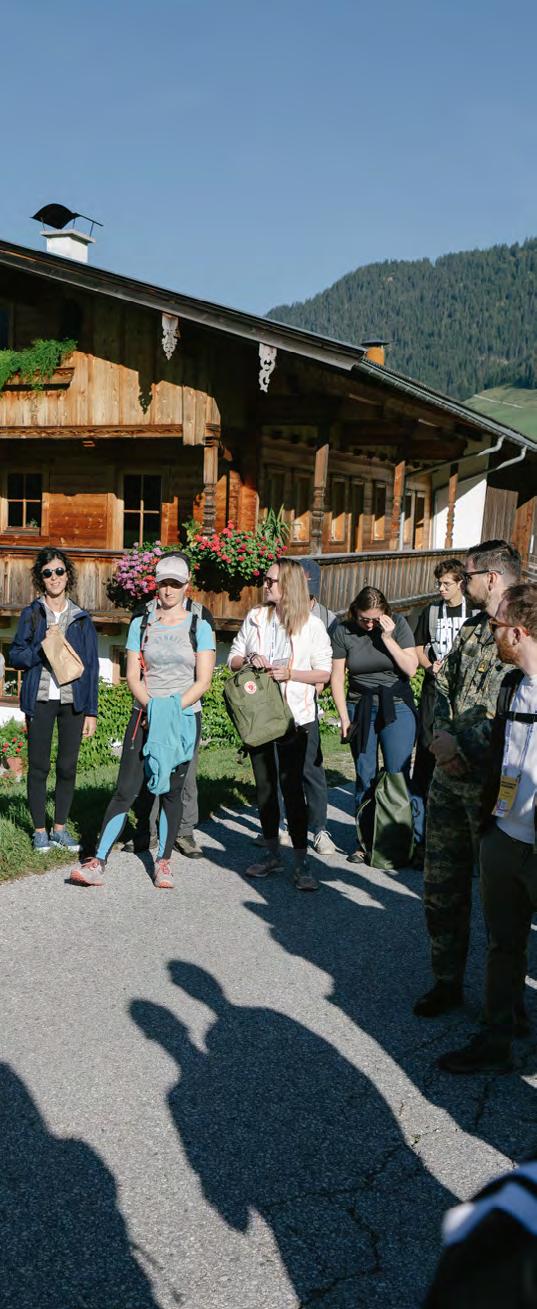
At the AIM hike, the cohort continued their leadership discussions outdoors as part of the programme’s peer-to-peer learning approach.
Alpbach in Motion
Outstanding young professionals gathered for a one-of-a-kind leadership experience.
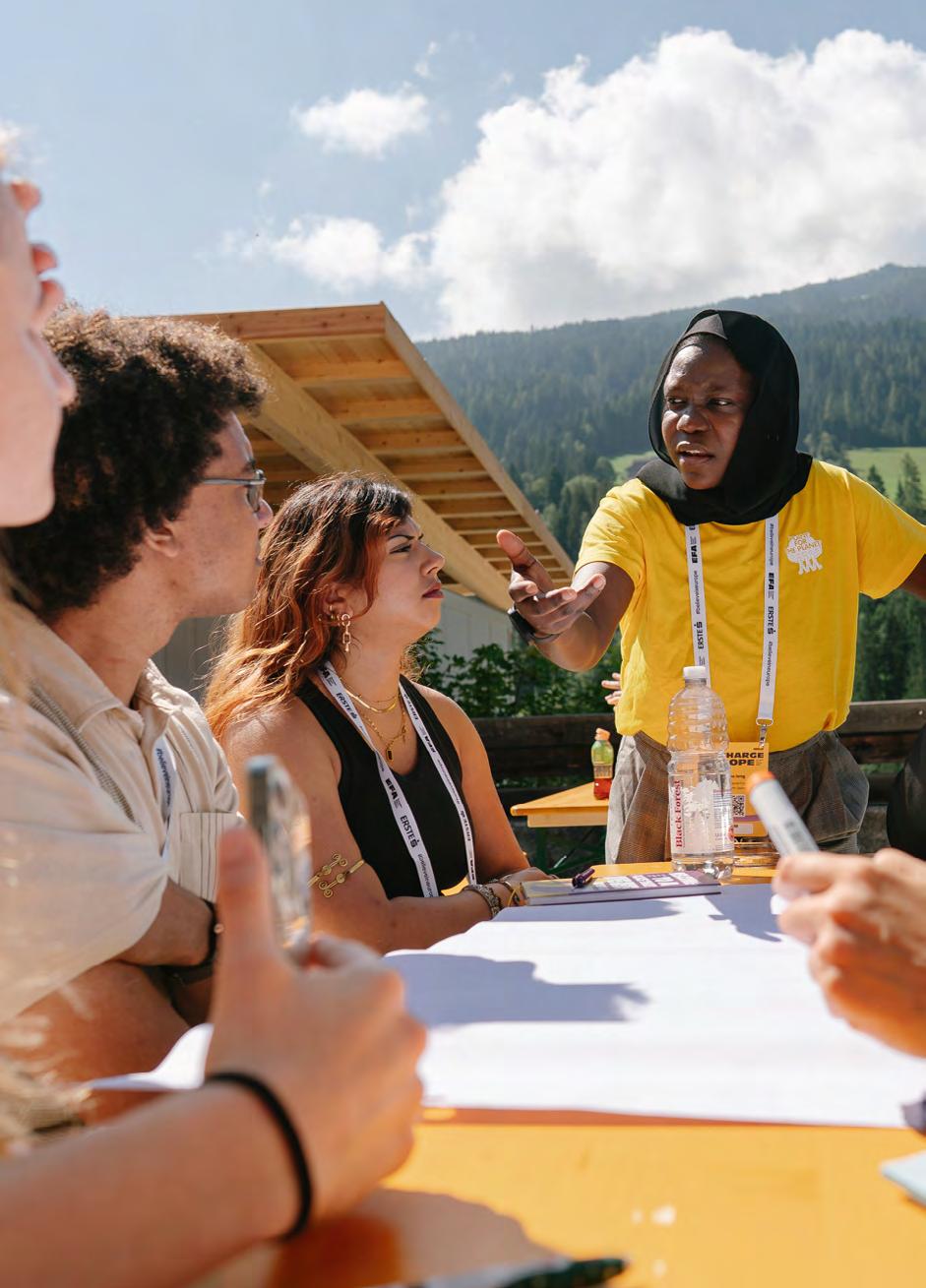
The seminar “Global Politics and Influence” examined how intensifying global power competition and rising climate risks affect the continent, and how African actors could defend their interests and shape global climate justice commitments.

The Scholarship Programme
Approximately 500 young talents from all over the world were awarded with a scholarship for the EFA25 event.
The European Forum Alpbach Scholarship Programme offers an incredible opportunity for students, young professionals, changemakers, and curious minds in general to attend the prestigious EFA event in August. Scholarship holders gain access to the full programme, including five days of scientific and skills-based seminars, where they can engage in insightful discussions, experience unique session formats, and create meaningful and lasting connections.
At the beginning of this year, we reached out to talented and impact-oriented individuals aged 18 to 30/35, inviting them to apply for a scholarship for the European Forum Alpbach 2025.
To ensure we reached a diverse pool of candidates, we shared the call for applications widely through the EFA network, leveraging newsletters, social media, and targeted emails to communities and organisations that could help us identify promising applicants. Applications opened on March 3. By the end of the month, we had received around 6,000 applications from 163 countries through our online application tool, along with an additional 1,000 applications submitted via the Forum Alpbach Network’s clubs.
After a thorough selection process, we awarded over 500 scholarships to individuals representing approximately 70 different nationalities. Among them were about 330 scholarship holders who attended the Forum for the first time.
The scholarship holders attended the entire Forum, from August 16 to 29, starting with the Welcome Ceremony in Herz-Kremenak Saal at the Congress Centrum Alpbach on the evening of August 17. The ceremony – featuring opening remarks by Jean-Claude Juncker, former President of the European Commission, Othmar Karas, contributions from the FAN, local Alpbach representatives, the Ombudsteam, and an artistic performance by two students from the Music and Arts University of Vienna – offered an overview of the programme, social events, and helpful advice for making the most of the two weeks.
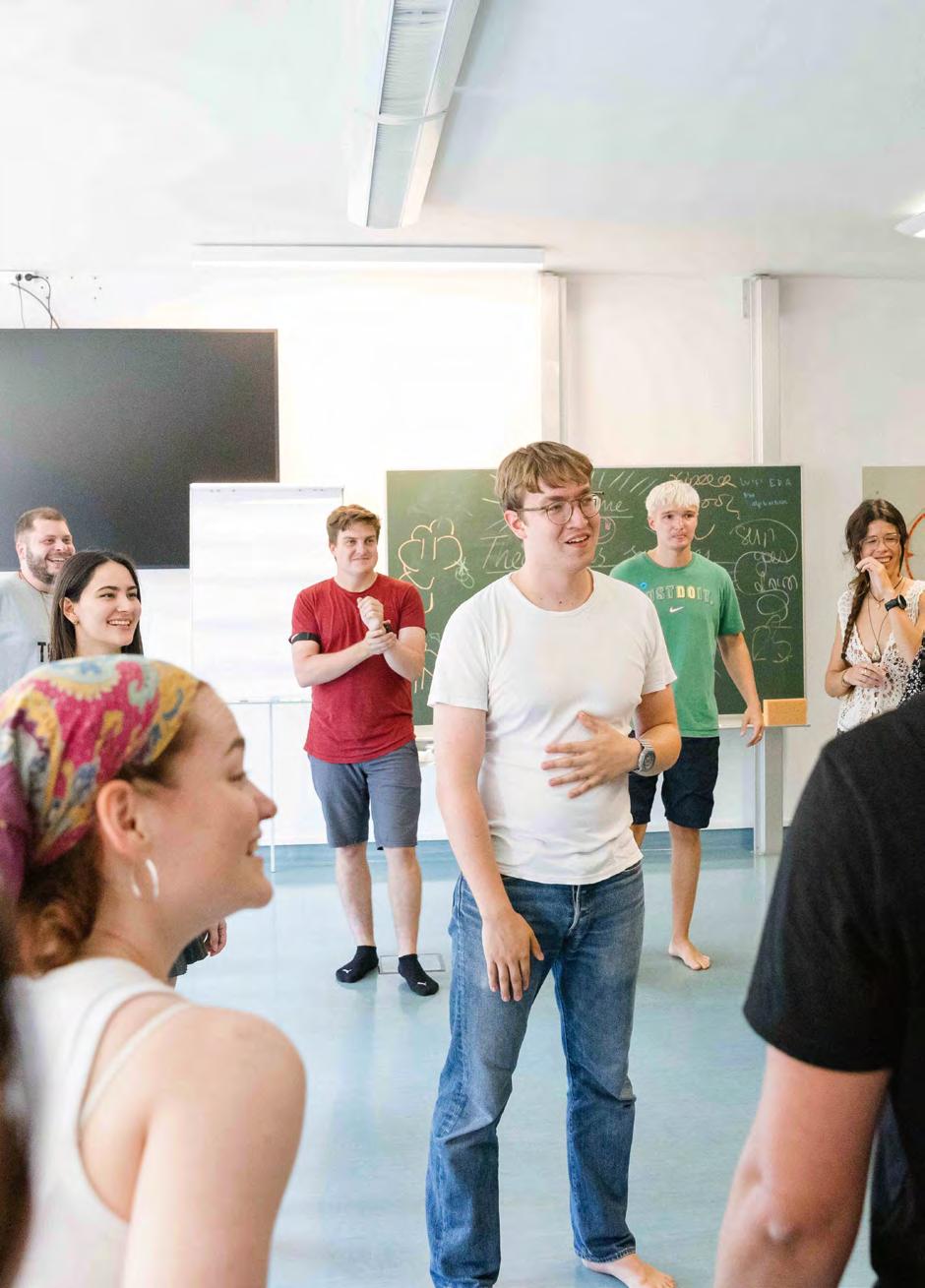
“Theatre as a Sanctuary” was one of many Seminars the Scholarship Holders could choose from, each designed to broaden perspectives and strengthen skills.
Selection process
After an initial screening to ensure formal criteria were met (age, English proficiency, first-time application), a selection committee of 97 members reviewed the applications.
They evaluated candidates based on their educational and professional background, extracurricular activities, and their essays. This year’s scholarship applicants were asked to explain which historical decision they would rewrite, share what they hope to take away from the Forum, and outline their vision for Europe. To ensure fairness, all applications were anonymised and reviewed by two selection committee members. In cases where the scores differed by six points, a third member was brought in to review the application.
This year, during the initial screening stage, the EFA introduced the use of an AI detection tool. The aim of implementing this tool was to make the application process more efficient and objective, thereby enhancing the overall quality of the scholarship cohort.
Once the applications were assessed, the EFA jury, consisting of Mubashara Akhtar, Almina Bešić, Martin Kainz, and Klaus Poier, made the final selection of scholarship holders. The goal at this stage was to ensure a fair balance of focus groups and regional, academic, and gender representation, while strictly adhering to the set criteria. To foster diversity among EFA participants, special consideration was also given to applicants from disadvantaged socio-economic backgrounds, ethnic or religious minorities, members of the LGBTQIA+ community, individuals with disabilities, and refugees or displaced persons. The EFA is particularly proud of the diversity within its scholarship cohort, which includes participants from six continents and 66 different countries.
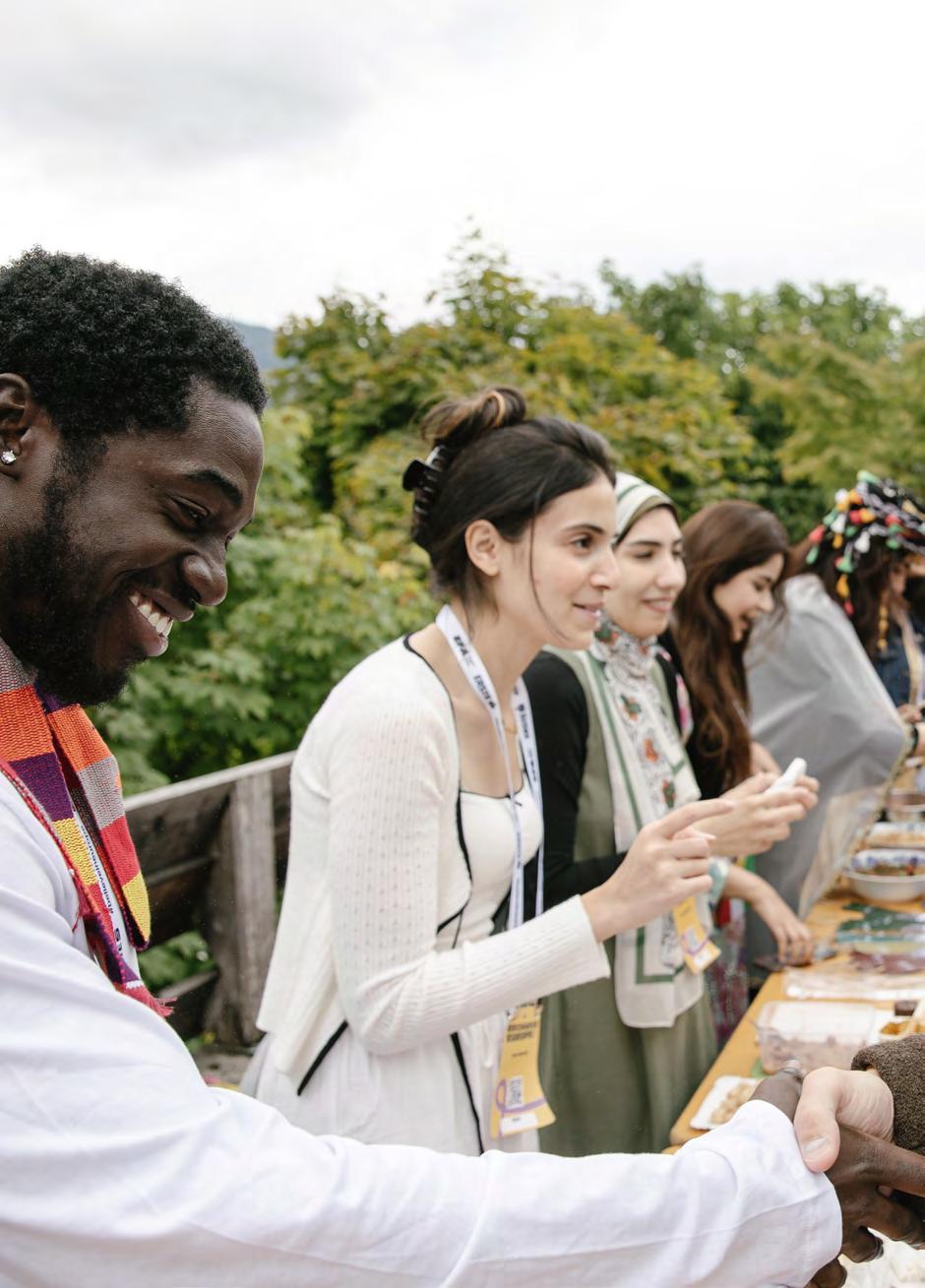
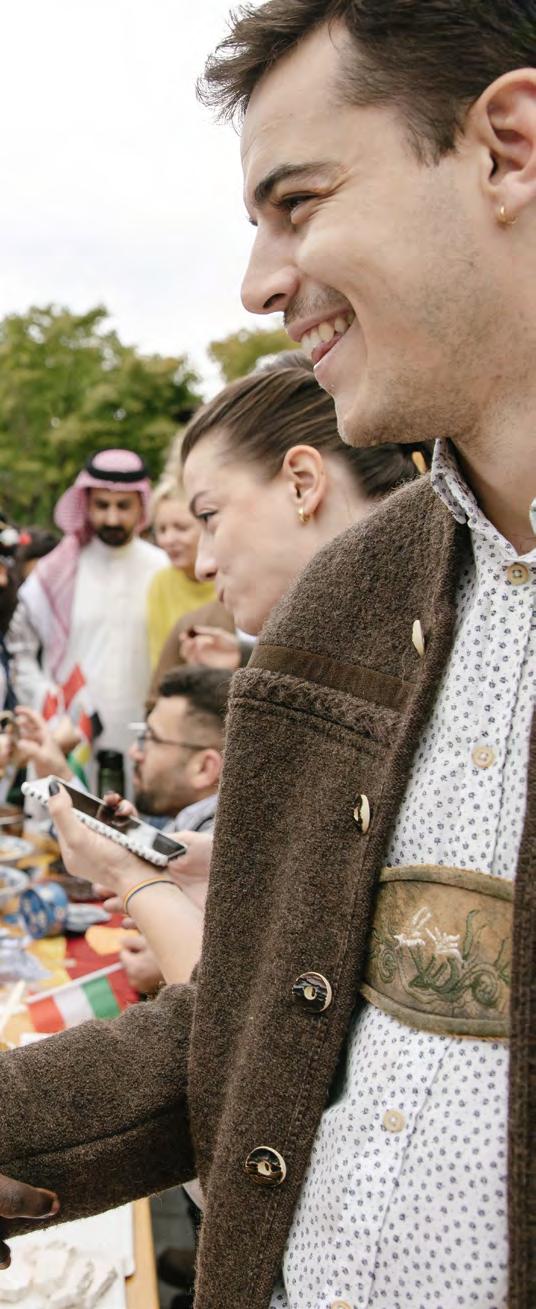
At the International Bazar, scholarship holders represented their homelands through food, music and traditions, creating a vibrant snapshot of Alpbach’s global community.
Alpbach Seminars
The Alpbach Seminars at the EFA25 brought together scholarship holders, leading researchers, and practitioners from around the world for inspirational and thought-provoking sessions, expanding horizons and fostering learning.
The Seminar Week formed the intellectual starting point of the EFA25 and took place over five consecutive days. It provided scholarship holders with a diverse learning environment that combined academic debate, practical skill development, and creative exploration. Each scholarship holder attended one morning and one afternoon seminar which allowed for an individual pathway through the week.
The scientific seminars addressed key questions linked to the Forum’s thematic tracks. Within the field of Security, discussions addressed Europe’s position in an increasingly multipolar world, the strategic use of geoeconomic influence, and emerging challenges such as cybercrime. The Democracy & Rule of Law seminars explored power structures in the age of artificial intelligence, forms of political activism, and decision-making under conditions of uncertainty. Climate-focused sessions examined the scientific basis of climate change, energy transition, and the questions of global climate justice, including perspectives from the African continent. Economy and Finance seminars brought attention to the future of work, income and wealth distribution in Europe, and the implications of cryptocurrencies and generative AI for entrepreneurship and innovation.
Afternoon seminars offered a complementary practical and creative dimension. Artistic and skill-based formats created space for exploring identity, memory, and communication through movement, voice, performance, storytelling, and nature-based reflection. Contributors included Bath Spa University, the Royal Academy of Dramatic Art in London, the Museum of Migration, as well as the political performance collective Radikale Töchter. Throughout the lunch breaks the “Food for Thought” format enabled informal yet meaningful interaction time to continue conversations sparked in the morning sessions and build networks among participants. The Seminar Book project further encouraged participants to reflect and document experiences, impressions, and personal perspectives of the EFA for a wider audience.
Taken together, the Alpbach Seminars combined intellectual rigor with experiential methods and creative expression and nurtured global peer exchange. The seminars motivated participants to connect perspectives across disciplines and cultures, to think outside the box – and to consider how they might contribute to shaping Europe’s future.
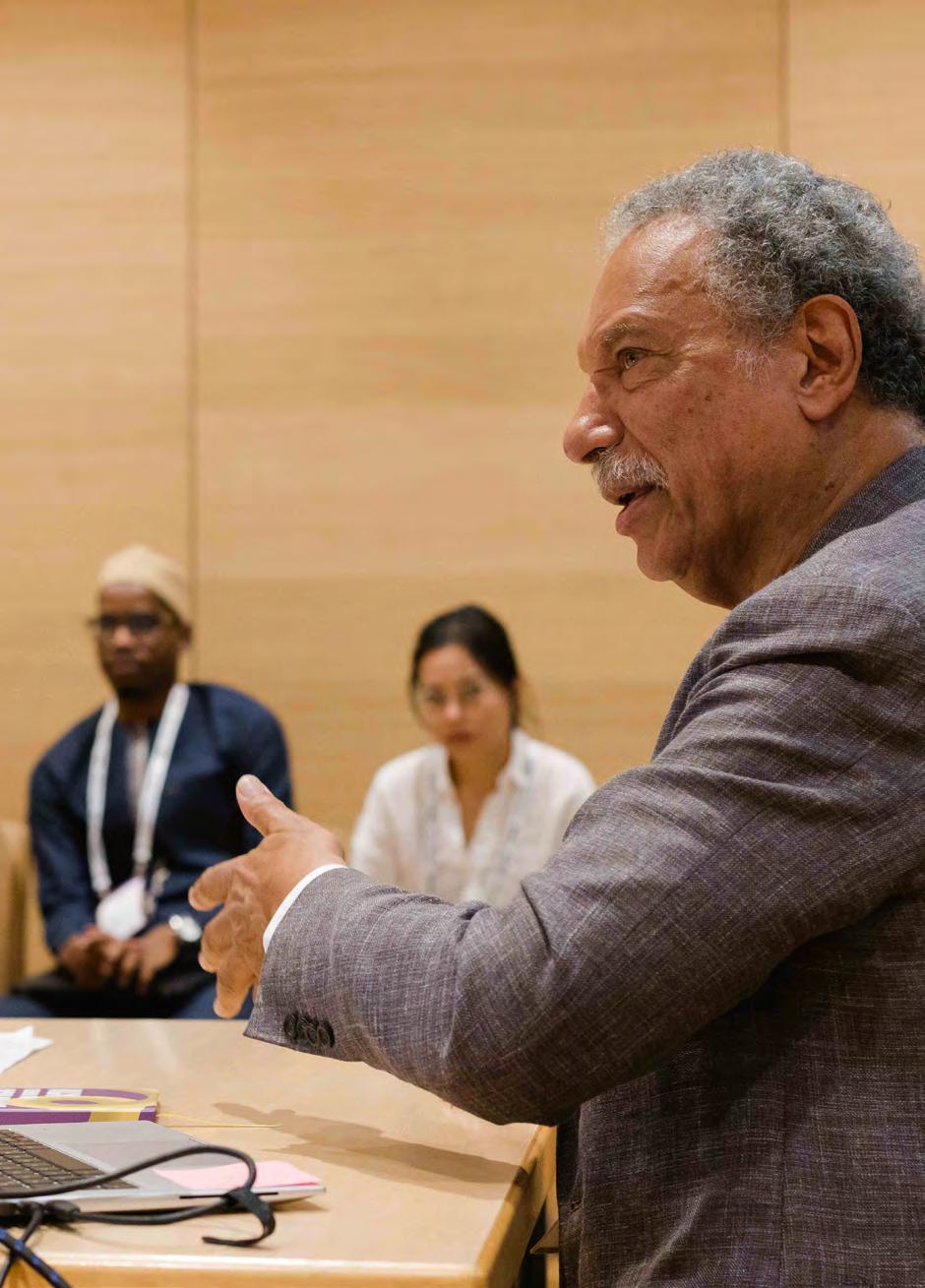
In the Seminar Valuing the
shared his expertise on marine overuse, the impacts of industrial fishing, and strategies to better govern and protect ocean ecosystems.
Oceans, Daniel Pauly (Sea Around Us, University of British Columbia)
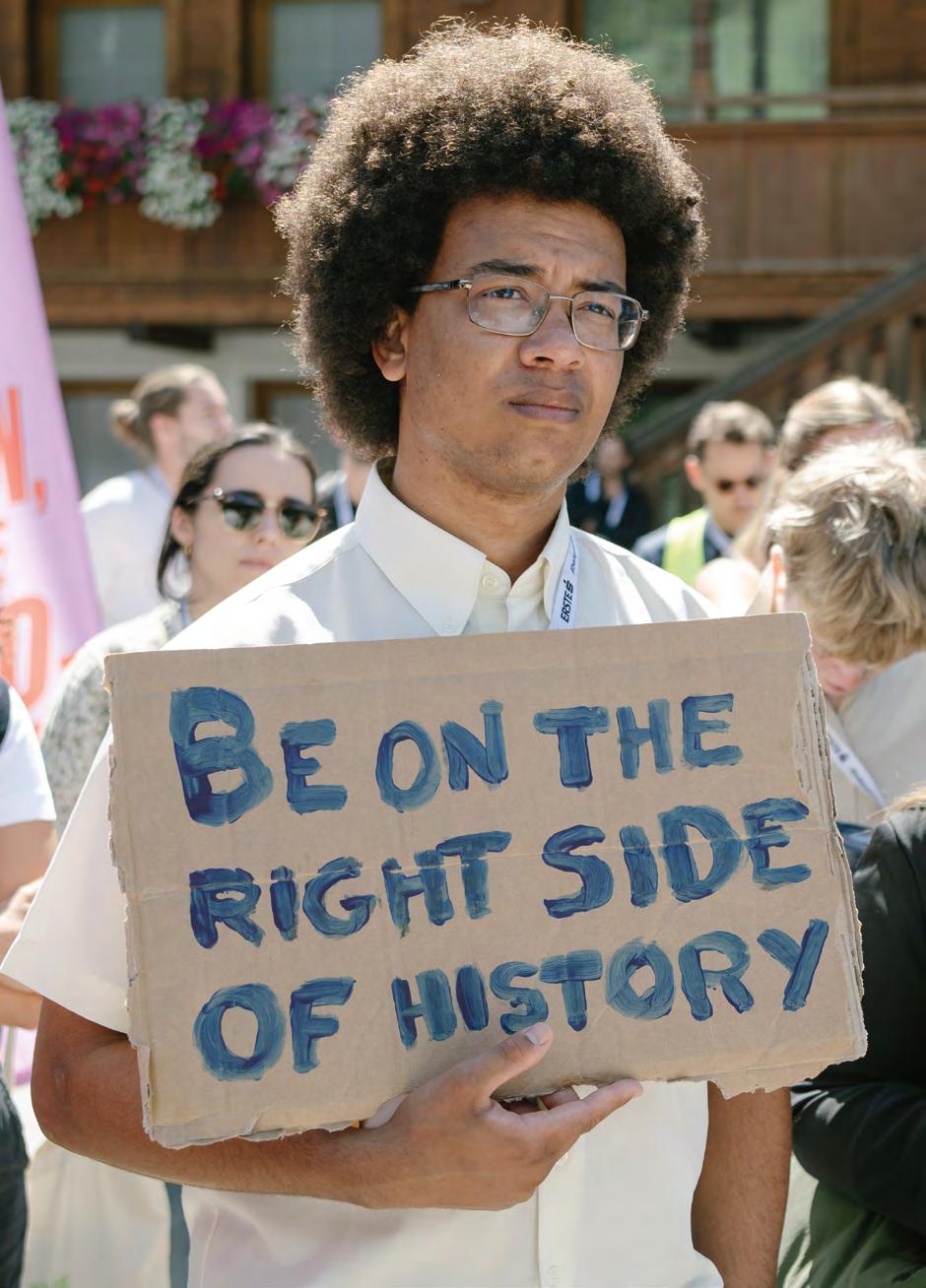
The Forum Alpbach Network (FAN) Programme offered community-driven events and activities, including discussions, gatherings and protests, strengthening exchange and connection across the international network.
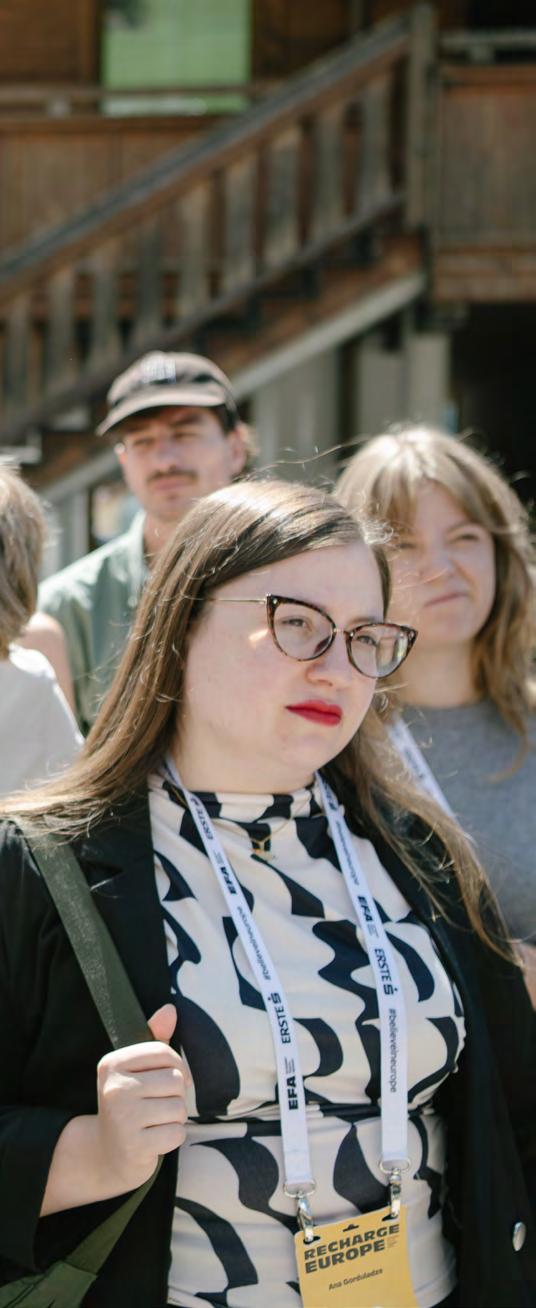
FAN Programme at the EFA25
A variety of official sessions at the EFA25 were organised by the Forum Alpbach Network (FAN), its Clubs Alpbach (CA) and the Initiative Groups (IG).
International Evening
Forum Alpbach Network Committee – 21 August 2025
The International Evening showcased the cultural diversity of EFA participants through interactive elements and engaging activities, creating an immersive experience that celebrated global unity and fostered cross-cultural connections.
International Bazar
Forum Alpbach Network Committee – 23 August 2025
No place captures the idea of a global village like Alpbach during the EFA. The International Bazar brought together cultures through national booths featuring food, music, and art, inviting visitors on a journey around the globe without leaving Alpbach.
Foreign Agent in My Own Country: How Laws Silence Media, Limit Rights, and Impact Lives
Club Alpbach Belgrade / Georgia / Hungary / Tyrol – 24 August 2025
From Georgia and Hungary’s adopted laws to Serbia’s proposed bill, “foreign agent” legislation shrinks civic space and endangers press freedom. This panel unpacked the political fallout, featuring first-hand insights from those affected and their fight for democratic resilience.
Navigating the Currents: Europe’s Ocean Leadership After Nice
Club Alpbach France – 24 August 2025
With the EU set to ratify the High Seas Treaty and launch its Ocean Pact, 2025 marked a key moment for European ocean governance. Leaders from policy, science, and diplomacy discussed how to turn ambition into action, protecting biodiversity beyond national borders and ensuring coordinated implementation.
Echoes of Tomorrow: The 19th Annual Speakers Night
Club Alpbach Styria – 24 August 2025
Speakers Night is the popular public speaking contest, offering scholarship holders the chance to showcase their ideas and rhetorical skills in front of a large audience and a distinguished jury.
The Weimar Triangle: A Pillar of European Security?
Club Alpbach France / Germany / Poland – 25 August 2025
In the face of Russia’s war in Ukraine and global instability, this discussion examined whether the Weimar Triangle can evolve from informal coordination into a true pillar of European security.
Geopolitics by Other Means: Ukraine’s Role in the Economic Future of the Democratic World
Club Alpbach Germany / Salzburg & Kyiv Initiative Group
Alpbach – 25 August 2025
Ukraine is more than a battlefield – it stands at the centre of global competition for resources and influence. The session explored how its energy, agriculture, and raw materials sectors shape the democratic world’s economy and whether the EU can leverage this potential to stay competitive.
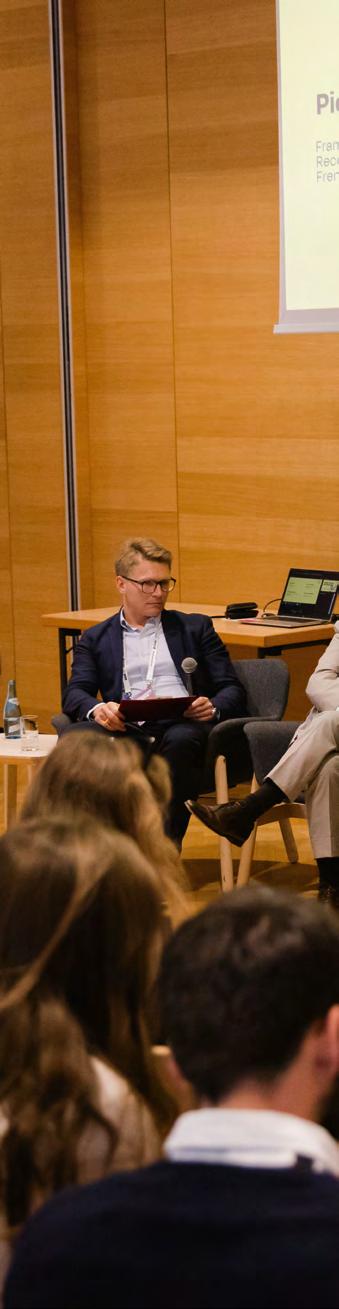
The FAN Clubs make a strong contribution to the overall EFA programme through their sessions, as shown by this discussion hosted by the FAN Clubs from Poland, France and Germany.
Democratising the Energy Transition through Cross-Border Collaboration
Club Alpbach Czechia & Slovakia / Lower Austria – 27 August 2025
Taking on a challenge from their partner Enery, the Clubs Alpbach Lower Austria and Czechia & Slovakia organised the Cross-Border Dialogue conference. Together, they explored how collaboration can foster community engagement and democratic participation in renewable energy across borders.
Europe in a Competition of Great Powers. A Manifesto.
Club Alpbach Liechtenstein / Salzburg / Upper Austria – 27 August 2025
Amid war and rising authoritarianism, Europe must redefine its global role. Experts and the audience discussed the manifesto “Europe in a Competition of Great Powers”, developed with Herfried Münkler and young Europeans, before its submission to the EU Commission.
Can (Regional) Inequality be Overcome?
Club Alpbach Netherlands – 28 August 2025
Despite convergence in living standards, the EU periphery still faces ageing and brain drain. The session explored whether regional inequality can be overcome or will deepen with further integration and enlargement.
Hydrogen as a Controversial Solution to the Energy Crisis
Club Alpbach Croatia / Upper Austria – 28 August 2025
This session explored hydrogen’s contested role in Europe’s energy transition. Experts addressed misconceptions, economic challenges, and practical solutions, showing why hydrogen remains vital for decarbonisation by 2050.
The Non-Negotiables in Health: What to Invest in for a Future-Ready System
FAN Health Initiative – 28 August 2025
With limited resources and rising demands, Austria’s healthcare system must prioritise essentials. Experts discussed key investments, from primary care to digital infrastructure and prevention – to ensure a resilient and equitable system by 2035.
Bringing together Young Changemakers with Current Stakeholders
Throughout the Forum, we encouraged scholarship holders to participate in small fireside chats with high-level speakers. These informal chats are often facilitated by FAN members. For instance, fireside chats with personalities such as Alexander Van der Bellen, Vjosa Osmani-Sadriu, Anya Schiffrin, Joseph Stieglitz, Peter Thomson, Axel Van Trotsenburg, and many more were organised at the EFA25.
Activism at the Forum
The Climate Strike and the Alpbach Pride have become an integral part of the annual event and are organised by the FAN. FAN members worked closely with the EFA team to make the Forum a more inclusive and safer place for all participants.
Social Programme for Scholarship Holders
Furthermore, the Forum Alpbach Network Committee also hosted a rich social programme for scholarship holders, including a pub quiz, a debate night, and various socials that fostered exchange and community building.
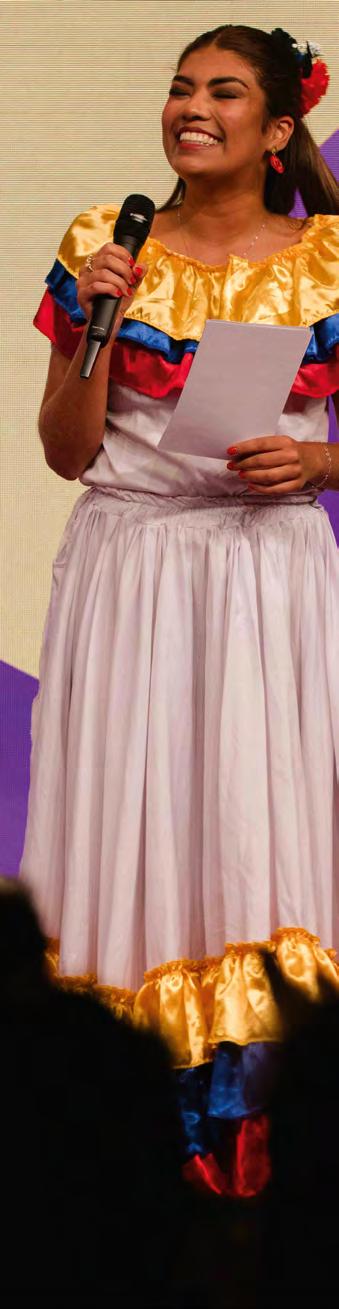
The International Evening celebrated the cultural diversity of EFA25, bringing scholarship holders together through interactive activities and shared traditions organised by the Forum Alpbach Network Committee.
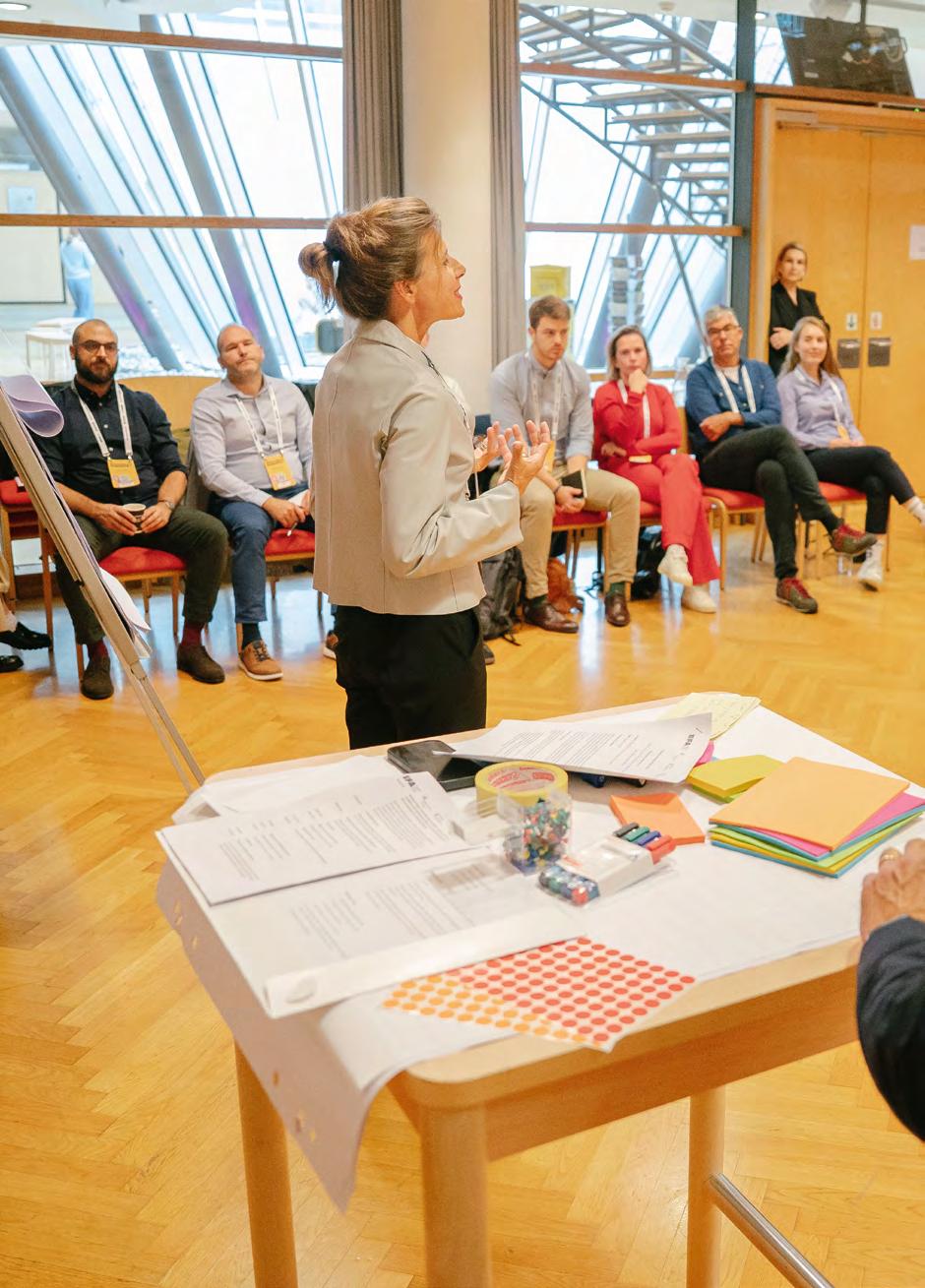
The Lab “Responsible Leadership – Business, Civil Society & Politics: Partners in Challenging Times” was supported by Robert Bosch Stiftung.
Invited by the
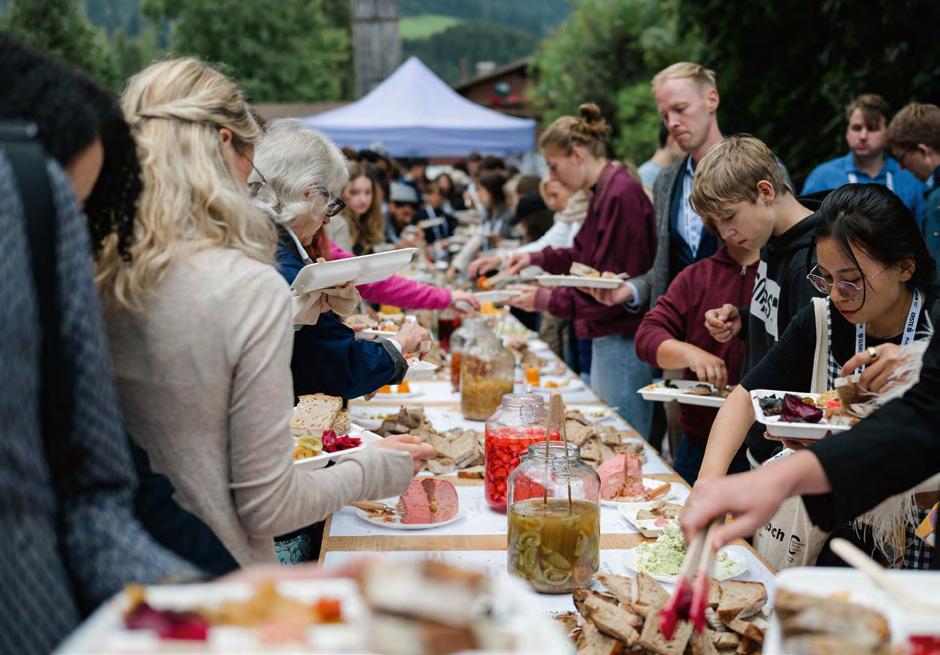
ERSTE Foundation, participants joined a vibrant gathering around the 15-metre table in the heart of Alpbach – filled with bread, butter and creations by chefs – to exchange ideas.
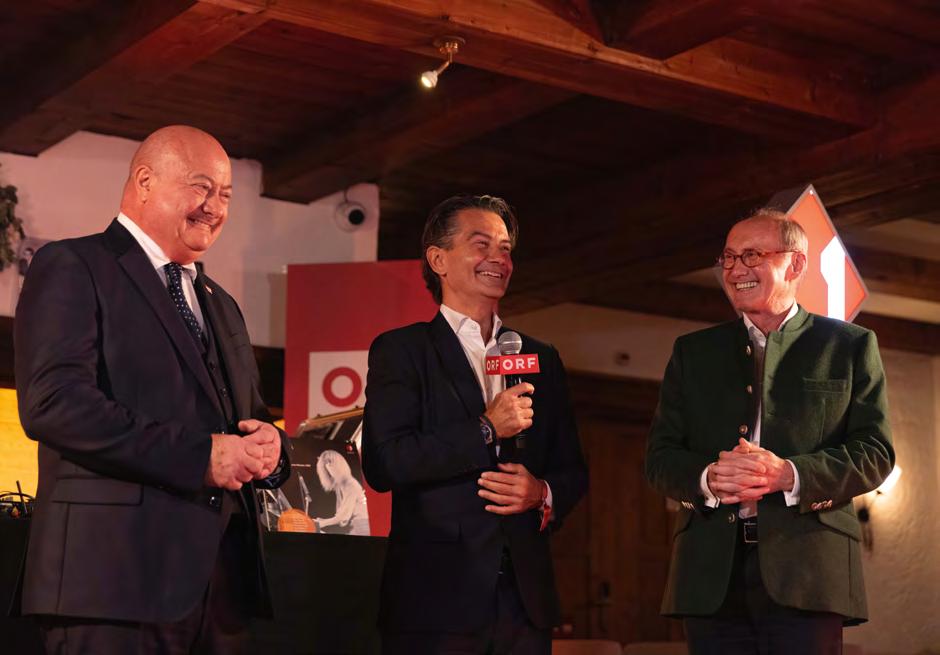
Federal Chancellor Christian Stocker, ORF Director-General Roland Weißmann and President of the European Forum Alpbach Othmar Karas warmly welcomed guests to the ORF cocktail reception.
The Forum Alpbach Network (FAN) consists of 34 Clubs Alpbach (CA) and Initiative Groups (IG) that operate on a voluntary, non-profit basis all around the year across Europe, the Caucasus, the Middle East, and Africa. Amongst others, their activities span running and funding their own scholarship programmes, organising events in the spirit of EFA365, and cooperating on international initiatives. The newly elected FAN Board consists of Harald Stankov-Schöny (Chair), Celina Moser (Vice Chair), Prosper Mageza, Nino Panjakidze, Thomas Garnier, and Melanie Maria Kuhrn.
Fostering a vibrant international community: Alpbach is where we are!
The FAN representatives convene for monthly online meetings and two inperson conferences to exchange knowledge, prepare the next Forum, initiate joint projects, and strengthen the network. In the last year, the network was gathered in Bad Ischl (Austria) and Brno (the Czech Republic) by CA Upper Austria and CA Czechia & Slovakia.
FAN Projects
Since 2024, Club Alpbach France’s Alpbach IDEA has led efforts to curb marine pollution from cigarette butts. Launched as an international coalition during the 3rd UN Ocean Conference, FilterTheFuture.eu leverages the revision of the EU Tobacco Products Directive to introduce ecotoxicity warnings on packs (akin to health ones) – uniting scientists, elected officials, NGOs, youth, and cities. In Alpbach, the French Club extended the Nice Conference for Europe by curating a two-week continuum of water governance events for EFA25.
The FAN also created business cards with artwork and micro-feminist calls to action inspired by UN Women’s “Orange the World”. Handed out at receptions and networking events, they sparked surprise moments and constructive discussions on feminism amid a global rollback of women’s rights.
FAN events
Over the past year, the FAN hosted over 100 events on diverse topics. Club Alpbach Croatia focused on marine preservation, IG Armenia addressed the Artsakh crisis, and IG Vienna, CA Tyrol and CA Macedonia explored feminism and gender equality. CA Montenegro, Salzburg, Brussels, and Styria held discussions on regional and European politics, while IG Kosovo tackled energy transition and CA Trentino explored science communication. The Africa Alpbach Network discussed diaspora experiences, Club Alpbach South Tyrol showcased an exhibit on women refugees’ rights, and Club Alpbach Czechia & Slovakia and Liechtenstein reflected on their shared history.
Alpbach is wherever the FAN is!
The Forum’s network of former scholarship holders carries insights and inspiration from Alpbach to the world.
The AIM Alumni Club, with more than 220 members, serves as a vibrant community of former participants of the Alpbach in Motion Leadership Lab, fostering transformative leadership, personnel growth, and peer exchange.
In 2025, the Club continued to thrive through impactful activities and events in Vienna, including a Fireside Chat with Othmar Karas, the new President of the Forum, after-work and lunch talks with experts form the community, and the General Assembly in October, where members gathered for strategic discussions and updates. A one-and-a-half-day event held in the run-up to EFA 2025, under the motto “Recharge Europe: Warm-Up Workshop” and organised by dedicated community members, stood out as one of the true highlights of this year’s club season. At the heart of the Club’s activities was the AIM Alumni Community Lab as an official part of the EFA 2025 programme, which united 20 alumni under the theme “Leadership in Crisis”. This initiative provided a dynamic platform to share experiences, strategies, and tools for transformative leadership. Through collaborative events with the current AIM cohort, the Lab created a space for peer-learning, reflective discussions, and interactive formats such as nature hikes, openspace sessions, and intimate conversations. In a trusted environment, participants addressed pressing challenges from the field, gained new perspectives, and co-created innovative solutions.
By fostering networking and collective learning and supporting both personal and professional development, the AIM Alumni Club not only strengthens its engaged community, but also empowers its members to act as dedicated ambassadors of the Forum, extending its spirit and impact.
AIM Alumni Club Executive Board and Financial Auditors
Mariebeth Aquino, Kelsey Beltz, Jordan Georgiev, Emanuel Kaspar, Janet Kutschert, Kuba Macheta, Christoph Wenna. Alexander Mitter and Julia Spitzbart as the financial auditors.
AIM Alumni Club
With over 220 members out of 500+ former participants, the AIM Alumni Club is an independent association that organises events and social gatherings to foster continuous peer-to-peer exchange within its community and actively serves as an engaged ambassador of the European Forum Alpbach.
AIM Alumni Club
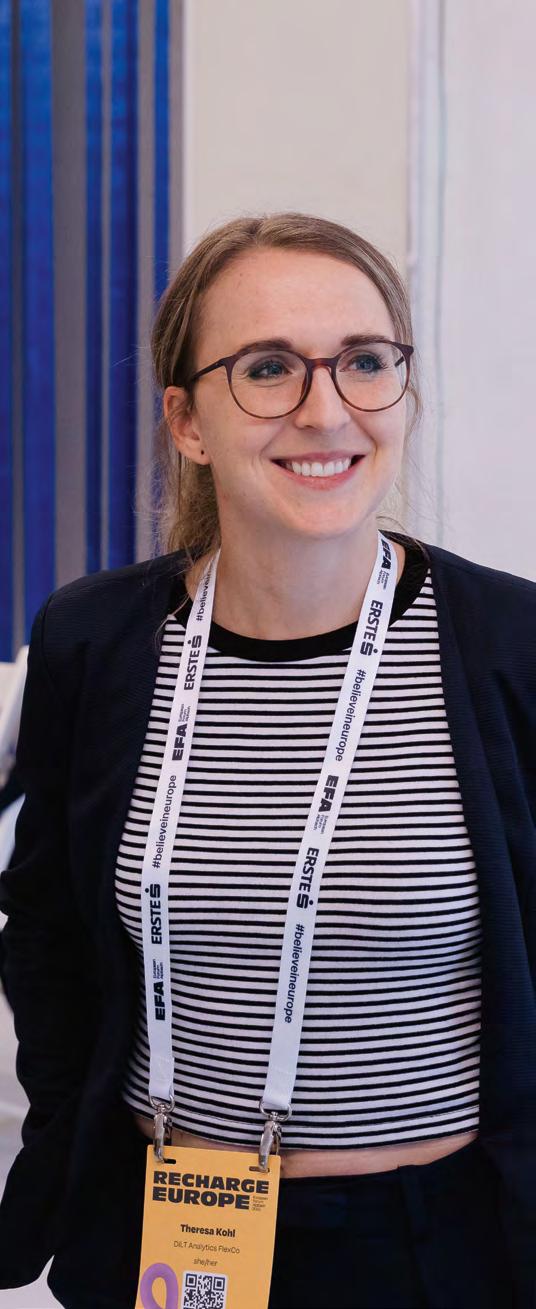
Former Alpbach in Motion (AIM) participants organise events for changemakers in different professional fields and support their community throughout the year.
The AIM Alumni Club united its community at EFA25 through different activities, fostering shared learning and exchange on leadership in times of crisis.
Alpbach IDEAS encourages participants to continue working on ideas that emerge at the Forum and translate them into tangible action. The programme provides space, tools, and support for turning reflection into experimentation. Together with our valued facilitation partner Pioneers Innovation, the IDEAS journey guides teams from early ideation to real-world testing, refinement, and long-term development.
The cohort that completed its IDEAS journey at EFA25 spent the year refining and testing their concepts before presenting their results at the Forum.
• Lawgic provides an AI-supported tool to help startups navigate legal and regulatory complexity with clarity and confidence.
• UNIDA focuses on strengthening democratic participation and social belonging through community-based approaches to well-being.
• Matchy aims to connect NGOs and startups with funding partners by facilitating meaningful, strategic introductions.
• Filter the Future advocates for environmental warnings on cigarette packaging to reduce cigarette butt pollution and raise public awareness.
During their IDEAS journey, the teams translated their concepts into concrete action. Lawgic refined its legal support tool for startups and went on to win the Red Bull Basement Challenge in Poland. Unida strengthened its communityfocused approach to democratic participation by organising a series of public gatherings in Vienna. Matchy tested and iterated its strategic matchmaking model by engaging directly with NGOs and early-stage initiatives navigating funding challenges. Filter the Future advanced its campaign for environmental warnings on cigarette waste and was represented at the UN Ocean Conference.
Following the completion of this cohort at EFA25, a new group of teams has already begun the IDEAS journey, starting with onboarding, mentoring, and the first online bootcamps. They will continue to prototype and test solutions throughout the year and return to Alpbach at EFA26 to present their findings.
Alpbach IDEAS thus forms a continuous cycle of innovation – one cohort completing their journey as the next one begins.
experimentation.
Alpbach IDEAS
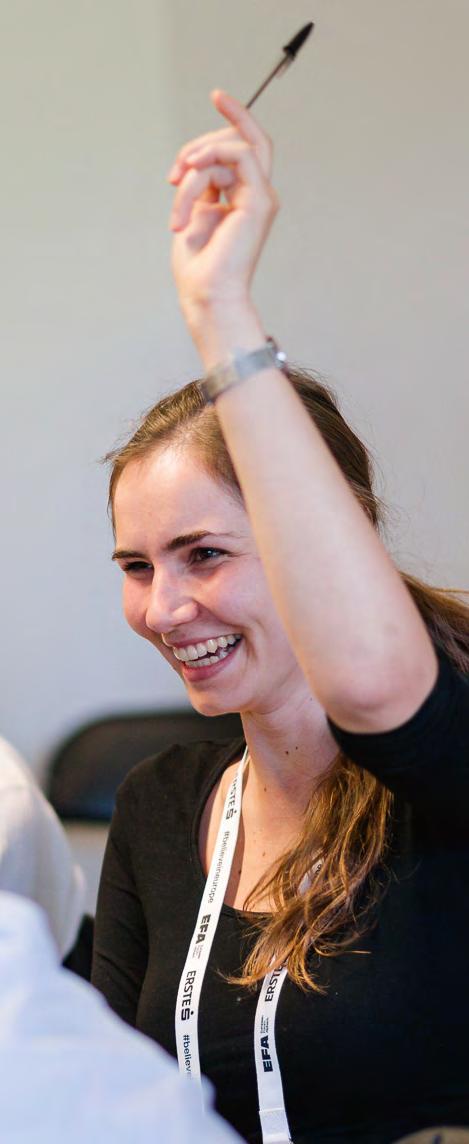
Alpbach IDEAS empowers participants to transform insights from the EFA into impactful, real-world projects through collaborative innovation, experimentation, and long-term support.
The Alpbach IDEAS programme supported teams in developing ideas into concrete projects, fostering year-round innovation and
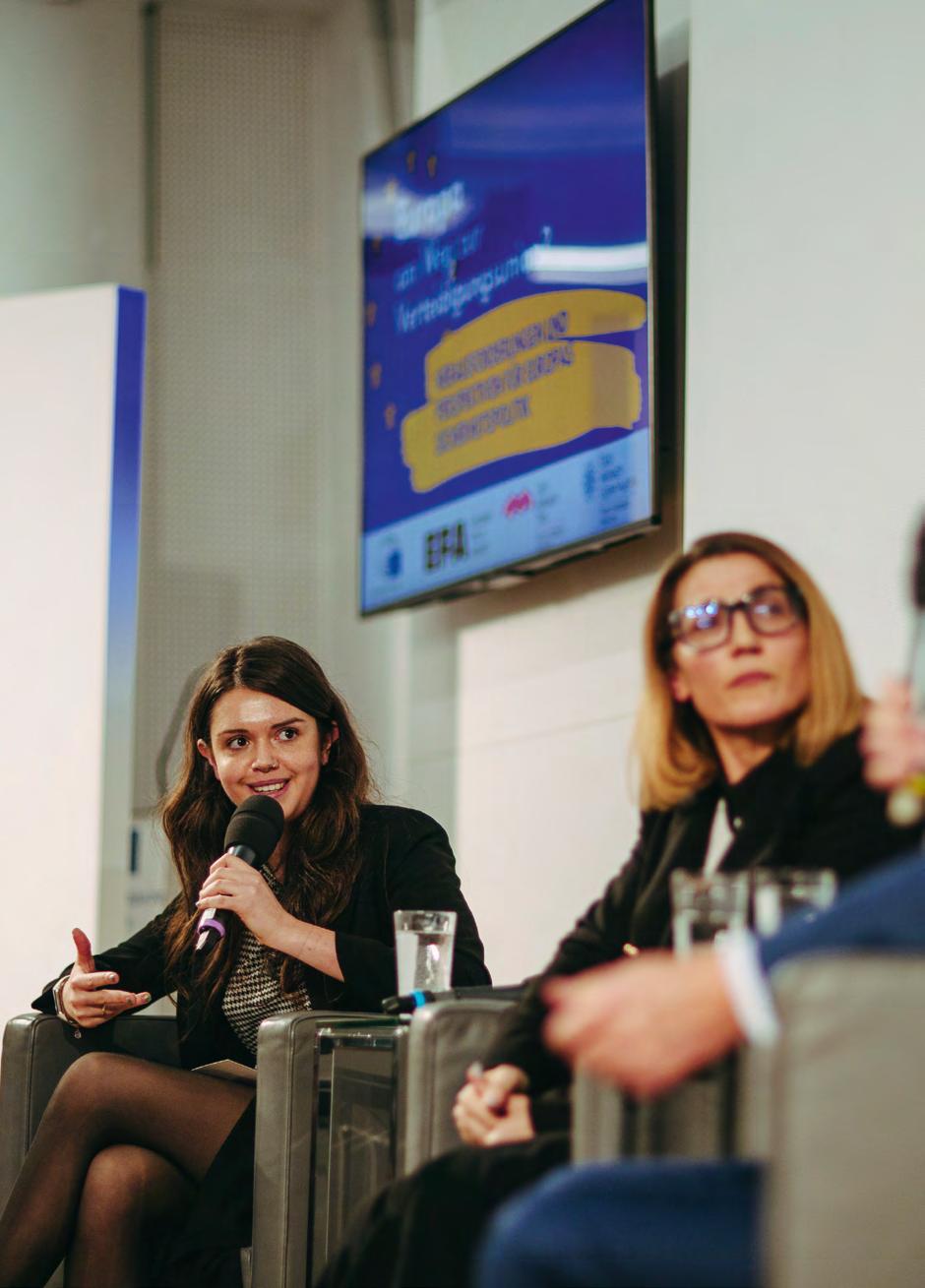
Insights of our panel discussion „Europe on the Path to a Defence Union? Challenges and Perspectives for European Security Policy“ as part of EFA365
EFA365 Activities
Through various initiatives and events, the EFA community approaches pressing challenges not only at the annual event, but during the course of an entire year.
EFA365 – A Year-Round Platform for European Dialogue
In 2025, EFA365 translated the Forum’s mission of fostering dialogue for a strong and democratic Europe into a year-round programme of activities across the continent, extending the impact of the annual event. EFA365 has evolved into a decentralised European platform for policy exchange, alumni engagement, and collaborative learning.
From January to November 2025, more than 30 events were held in Vienna, Brussels, Berlin, Paris, and other European cities as well as online. Each of the Forum’s thematic tracks – Democracy & the Rule of Law, Finance & Economy, Climate, and Security – was mirrored in dedicated follow-up sessions. These included the 10×100 Innovation Labs on climate transformation, the Capital Markets Lab Series on financing European scale-ups, and a Pension Reform Working Group exploring sustainable social systems. Through these formats, experts and alumni further developed the outcomes of EFA2024 into concrete recommendations and pilot projects, demonstrating the Forum’s ability to connect ideas with implementation. The Partnership Kick-Off Series brought together corporate, public, and philanthropic partners to prepare joint formats for the Forum 2025. In parallel, the Alpbach Ideas Bootcamps offered mentoring to emerging innovators from across Europe. The Climate Circle Meetings in Vienna, the EFA Community Talks in Brussels and Berlin, and collaborations with the European Parliament Liaison Office strengthened the Forum’s presence as a trusted convening space for European discourse.
Beyond thematic continuation, 2025 also marked a deepening of EFA365’s community dimension. Alumni of the scholarship and leadership programmes increasingly acted as co-organisers of local events, turning EFA365 into a distributed network of activity that carries the spirit of Alpbach throughout the year. This model of collaboration not only expanded the geographical reach of the Forum but also diversified its audiences and partnerships.
Through these initiatives, EFA365 consolidated its role as a key pillar of the Forum’s impact architecture. In 2025 alone, its activities engaged several thousand participants and partners across Europe, reaffirming Alpbach’s standing as a catalyst for ideas and collective action in the pursuit of a democratic and sustainable future for the continent.
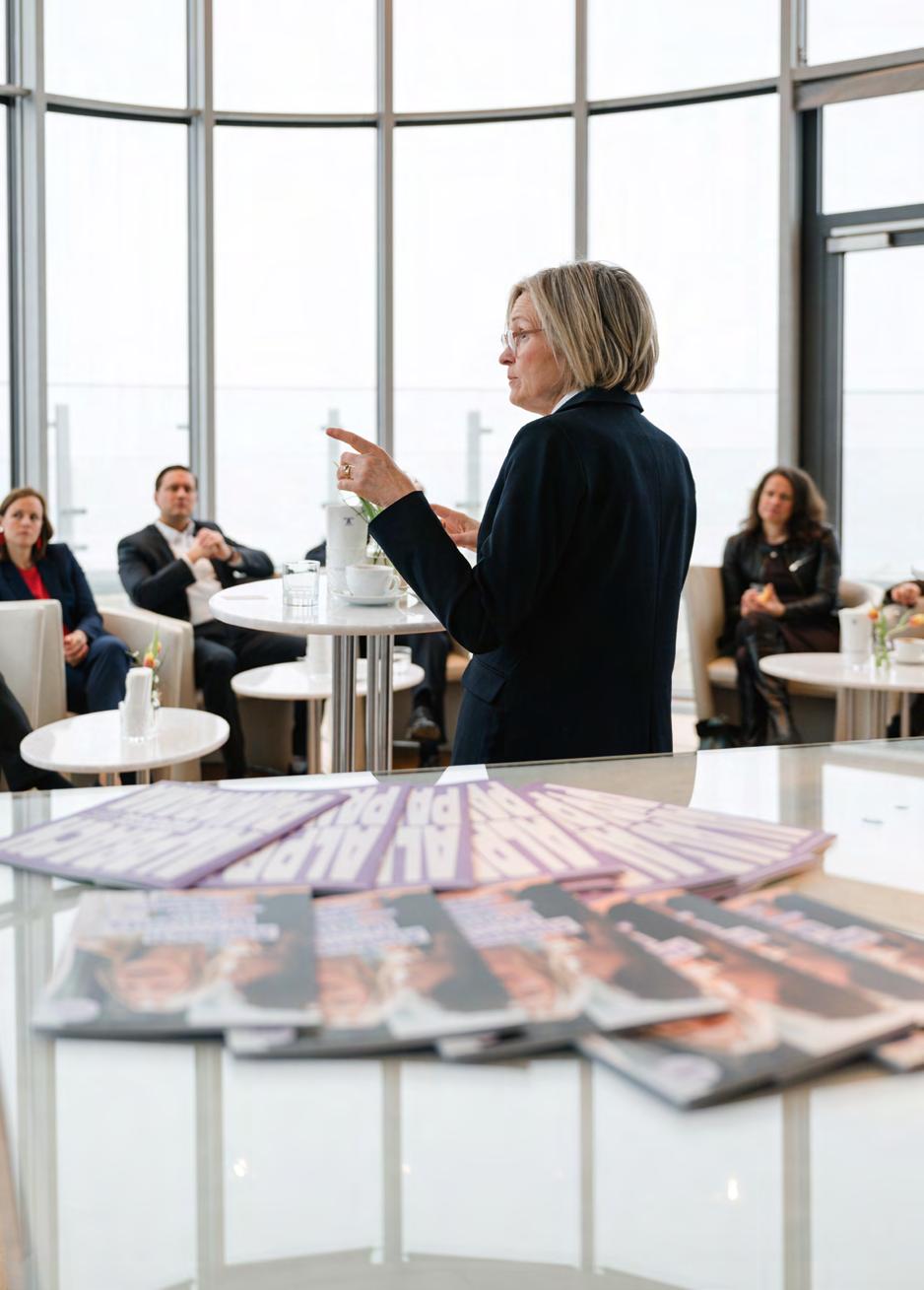
Mairead McGuinness, former EU Commissioner for Financial Stability and Co-Chair of EFA’s Strategic Advisory Council, at an Alpbach Circle Breakfast as part of the EFA365 year-round dialogue activities
Your support makes it possible
Various types of financing enable the organisation to continuously pursue its mission of strengthening the European continent.
Budget sources*
Public Sponsoring
and Donations
* Consolidated EFA budget, as of November 2025
Public Institutions and Grants
Scholarships and Tickets of Clubs
Others
Membership Fees
Sponsorships, funding foundations, ticket sales, public subsidies, donations, talent development, membership fees and scholarships from the Clubs ensure the work of the organisational team throughout the year and enable us to work independently.
Budget and expenses
How are the projects and the annual event of the European Forum Alpbach financed?
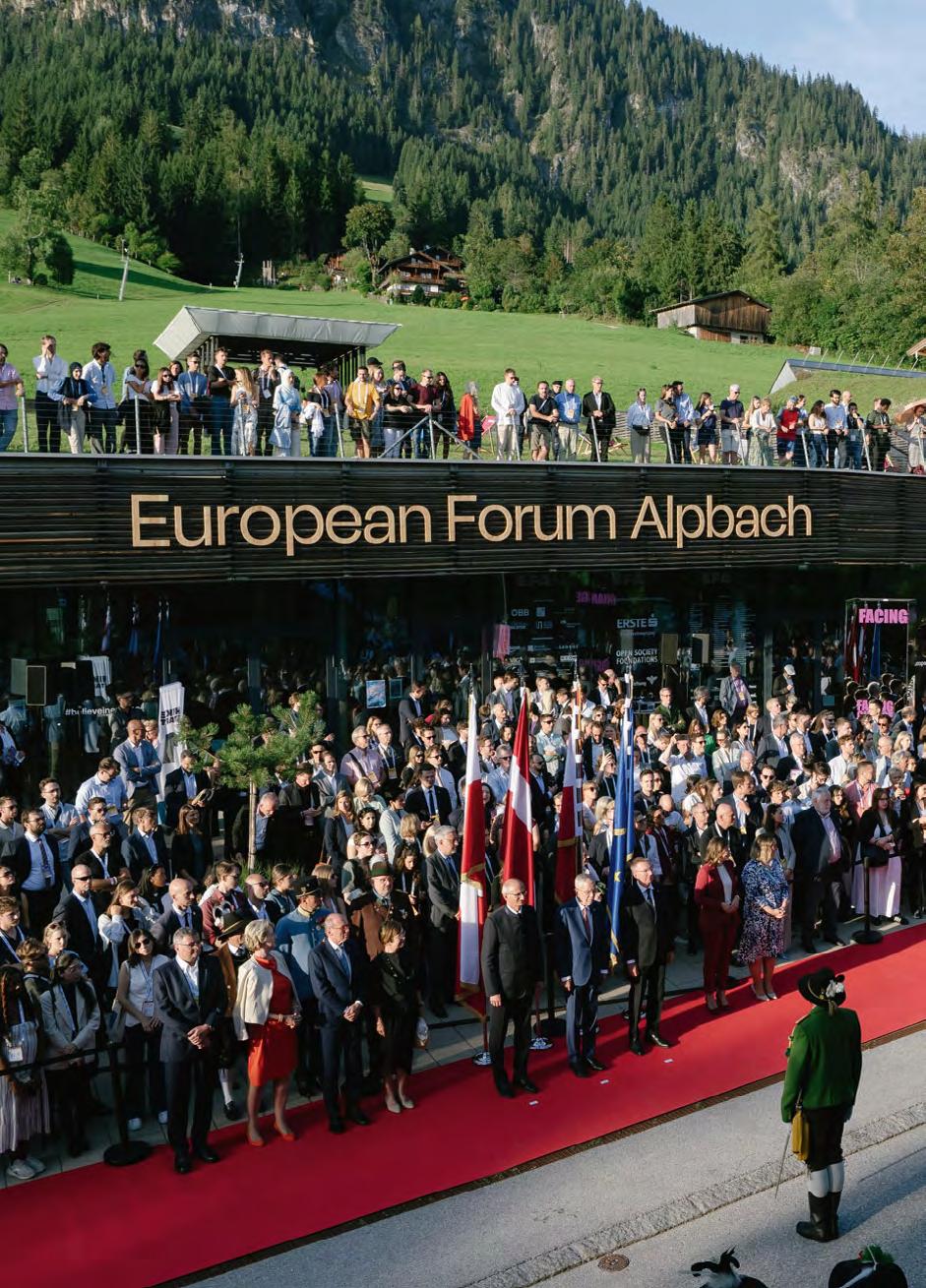
Participants of the European Forum Alpbach gathered for the traditional state reception with the Alpbach Rifle Company and the Alpbach Federal Music Band in front of the Congress Centrum Alpbach.
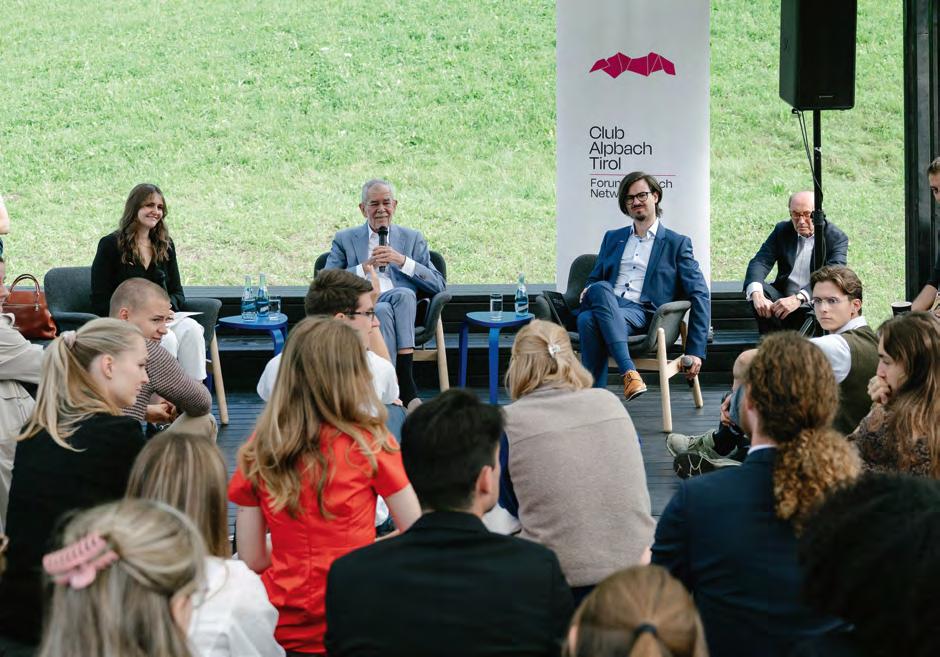
Federal President of Austria Alexander Van der Bellen shared his insights during a fireside chat hosted by Club Alpbach Tyrol.
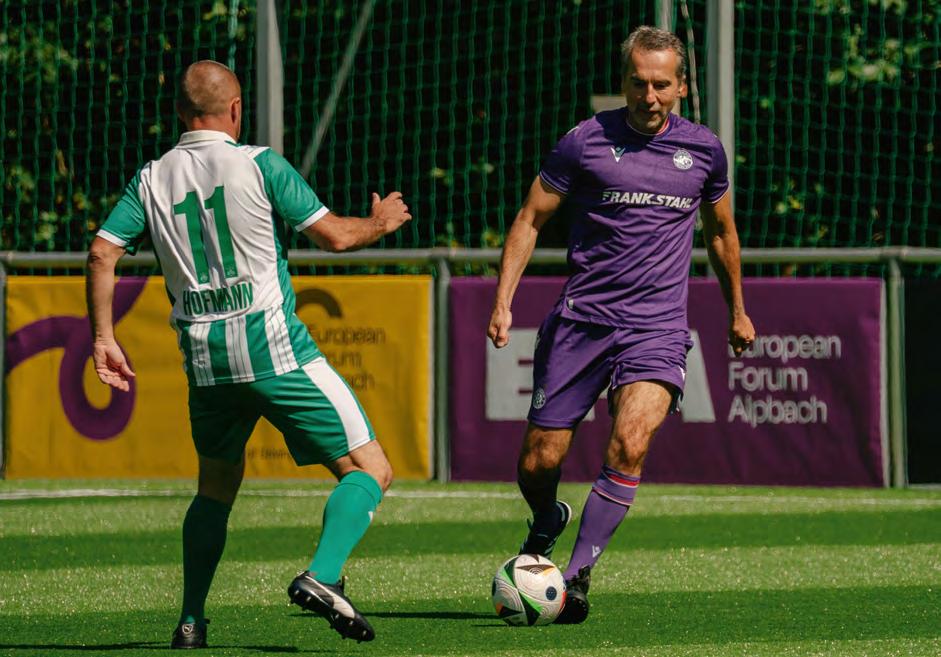
The legendary Vienna derby between Austria Vienna and Rapid Vienna took place on the football pitch in Alpbach – featuring, among others, Rapid legend Steffen Hofmann and former Austrian Chancellor Christian Kern.
Executive Board
The Boards of the European Forum Alpbach Association and the European Forum Alpbach Foundation consist of dedicated people with one goal: to positively contribute to the future of Europe. The Association and the Foundation are chaired by Othmar Karas, who has been elected President/ Chairman since October 2024. Together with a team of international experts, he is responsible for the orientation and strategy of the European Forum Alpbach.
President Association and Chairman Foundation
Othmar Karas
Vice Presidents Association
Sabine Herlitschka, Christian Kern, Antonella Mei-Pochtler, Marie Ringler
Other Members Executive Board Association
Peter Oberlechner (Treasurer), Harald StankovSchöny (FAN)*, Celina Moser (FAN)*, Klaudie
Members of the Forum Alpbach Network (FAN) Board
Harald Schöny (Chair)**, Celina Moser (Vice Chair)**, Thomas Garnier**, Melanie Kuhrn**, Prosper Mageza**, Nino Panjakidze**
Jennifer Zeller (Chair)*, Klaudie Mrkusová (Vice Chair)*, Florian Boschek*, Andreas Maierhofer*, Philipp Mendoza*, Dorotea Neuberg*
Honorary Presidents of the EFA
Franz Fischler, Andreas Treichl
Jury of the EFA Foundation
Mubashara Akhtar, Almina Bešić, Martin Kainz, Klaus Poier
Arbitration Board

Katharina Scherke, Matthias Strolz, Franz Zöchbauer; Substitute Member: Michael Neider
Auditors
Günther Schrems, Karl Sevelda
until September 2025 ** from September 2025
Strategic Advisory Council (SAC)
The Strategic Advisory Council advises and supports the organisation in all its activities. Its members ensure that the continuity in the connection to the historical roots and values of the European Forum Alpbach as well as the pluralistic anchoring in democratic society are preserved or strived for. The SAC consists of up to 40 members and the members of the Executive Board, the Chairpersons of the Scientific Advisory Board (SAB) and the International Advisory Board (IAB), three representatives of the FAN, the Honorary Presidents, and the auditors.
Co-Chairs of the SAC
Armin Laschet, Mairead McGuinness
Markus Bischofer (co-opted), Brigitte Brenner, Cathryn
Clüver Ashbrook, Verena Ehold, Lisa-Marie Fassl, Irene Giner-Reichl, Wolfgang Habermayer, Valerie Hengl, Michael Hirschbrich, Bruno Hofbauer, Herwig Hösele, Michael Ikrath, Thomas Kahn (co-opted), Georg Kopetz, Elisabeth Krainer-Senger-Weiss, Larissa Krainer, Kathryn List, Hans Mahr, Bernhard Marckhgott, Josef Margreiter, Sophie Martinetz, Clemens Mayr-Harting, Beate Meinl-Reisinger, Dieter Natlacen, Bernhard Niesner, Leonard Novy, Wolfgang Petritsch, Klaus Poier, Sophie Pornschlegel, Filip Radunovic, Andrä Rupprechter, Rupert Sausgruber, Martin Schulz, Agnes Streissler-Führer, Matthias Strolz, Stefan Wallner, Martin Weiss, Christoph Wenna, Werner Wutscher
Board Members: Sabine Herlitschka, Christian Kern, Antonella Mei-Pochtler, Marie Ringler, Peter Oberlechner; FAN: Florian Boschek, Andreas Maierhofer, Jenni Zeller; Honorary Presidents: Franz Fischler, Andreas Treichl; SAB: Michaela Fritz; IAB: Thomas Mayr-Harting; Auditors: Günther Schrems, Karl Sevelda
A dedicated group of individuals supports the EFA, making the annual event come to live. The majority contributes on a voluntary basis, apart from the fulltime organisational team.
Scientific Advisory Board (SAB)
The Scientific Advisory Board supports the Executive Board and other bodies of the Association with academic guidance. It advises on programme design, the selection of speakers, moderators and seminar leaders, and the formats of the event. It consists of up to 40 recognised academics and people from public and cultural life as well as the Chairperson of the IAB and three representatives of the FAN.
Co-Chairs of the SAB
Gabriel Felbermayr, Michaela Fritz
Nadia Al-Bagdadi, Andreas Altmann, Brigitte Bach, Christoph Badelt, Felix Creutzig, Maria Demertzis, Anna Durnova, Tamara Ehs, Heinz Fassmann, Franz-
Stefan Gady, Katharina Gassner, Philipp Gerbert, Misha Glenny, Ian Goldin, Bernhard Haslhofer, Markus Hengstschläger, Sabine Junginger, Monika
Köppl-Turyna, Mark Leonard, Dominik Markl, Katja Mayer, Josef Mitterer, Manfred Nowak, Barbara Prainsack, Michael Reiterer, Keywan Riahi, Diemut Schilling, Veronika Sexl, Nona Shepphard, Leena Srivastava*, Georg Steinhauser, Katrin Suder, Kavita Surana, Ulrike Tanzer, Velina Tchakarova, Nathalie Tocci, Renata Uitz
FAN: Jennifer Zeller*, Florian Boschek*, Dorotea Neuberg*, Thomas Garnier**, Melanie Maria Kuhrn**, Prosper Mageza**; IAB: Thomas Mayr-Harting
International Advisory Board (IAB)
The International Advisory Board consists of up to 40 internationally recognised personalities from politics, business, science, and society. It advises the Executive Board on programme development and speaker selection and supports the association in its networking activities.
Co-Chairs of the IAB
Thomas Mayr-Harting, Arancha Gonzáles Laya
Catherine Ashton, Carl Bildt, Anna Maria Corazza Bildt, Florence Gaub*, Katja Gentinetta, Eamon Gilmore, Hermann Hauser, Jean-Claude Hollerich, Wolfgang Ischinger, Ivan Krastev, Miroslav Lajčák, Pascal Lamy, Philippe Narval, Katarzyna Pisarska, Geneviève Pons, Daniel Sachs, Anya Schiffrin, Martin Selmayr, Bruno Stagno-Ugarte, Joseph Stiglitz, Cédric Villani, Alois von Liechtenstein; Honorary Presidents: Franz Fischler, Andreas Treichl
Committees
Security
Robert Brieger (Chair), Cathryn Clüver Ashbrook, Jan Farfal*, Franz-Stefan Gady, Elisabeth Kornfeind, Thomas Mayr-Harting, Antonella Mei-Pochtler, Jennifer Zeller**
Democracy and the Rule of Law
* until September 2025 ** from September 2025
Irmgard Griss (Chair), Alberto Alemanno, Caroline Hornstein-Tomić, Martin Kreutner, Peter Neumann, Sophie Pornschlegel, Barbara Prainsack, Mariella Rieder*, Giorgi Beroshvili**, Klaus Welle

Climate
Kirsten Dunlop (Chair), Felix Ambros*, Ivanna Papushenko**, Christiane Brunner, Irene Giner-Reichl, Marie Ringler, Gernot Wagner
Finance and Economy
Burkhard Balz (Chair), Gabriel Felbermayr, Sabine Herlitschka, Prosper Mageza*, Guntars Upisnther**, Mairead McGuinness, Andreas Treichl, Thomas Wieser, Werner Wutscher
Arts & Culture
Christoph Thun-Hohenstein (Chair), Jakob Dunkl, Andrea Grill, Marie-Therese Harnoncourt-Fuchs, Winfried Kneip, Claudia Larcher, Cornelius Obonya, Sabine Reiter, Eva-Maria Schitter*, Lukas Schumacher**, Georg Schnitzer, Elisabeth Schweeger
Seminars
Michaela Fritz (Chair), Caroline Hornstein-Tomić, Winfried Kneip, Katja Mayer, Dorotea Neuberg*, Thomas Garnier**, Howard Williamson
Funding
Peter Oberlechner (Chair), Philipp Berkessy, Birgit Berthold-Kremsner, Andreas Bierwirth, Hubert Cottogni, Oliver Suchocki, Othmar Karas, Winfried
Organisational Team
The team of the European Forum Alpbach is located in Vienna and manages the overall organisation of the main conference and the further events during the year. It ensures proper financing, professional coordination and media coverage and oversees the annual scholarship programme.
Secretary General & Managing Director
Nikola Donig (Secretary General and Managing Director, from November 2025) & Barbara Zimmermann (Managing Director, from November 2025), Feri Thierry (until October 2025)
Eldin Bajrić, Melina Sophie Bayer, Nadine Beisteiner, Andreas Berger, Elisabeth Bodner, Veronika Boussetta, Theodora Danek, Sophia Dornfeld, Vanessa Edlinger, Sara Eltigani, Anna-Maria Fister, Robert Galambos, Christoph Girbinger, Markus Hafner-Auinger, Lukas Hiegelsberger, Paul-Jakob Hofer, Marie-Louise Hofmann, Péter Hunya, Clara Jungnickel, Ivar Juvhaugen-Dehn, Anna Köhler, Elke Lerch, Mara Mehnert, Vinzenz Müller, Bettina Nahajowski, Sven Nelander, Melissa Német, Lavinia Noormandipour-Hart, Lea Novak,

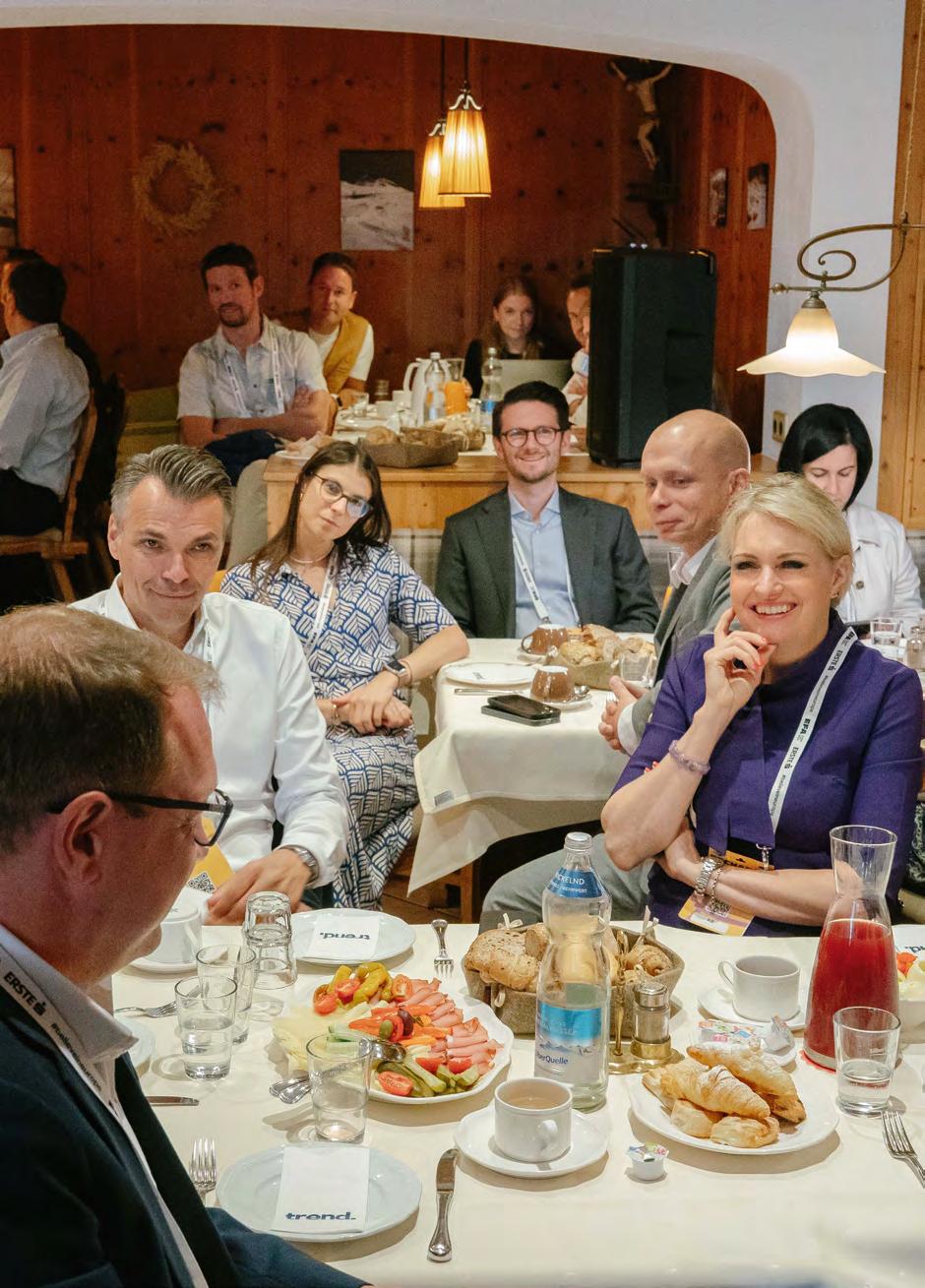
At the trend CEO Breakfast, trend Editor-in-Chief Bernhard Ecker and Gerda Holzinger-Burgstaller, CEO of Erste Bank Austria, discussed who will shape the banks of the future – bankers, AI or politics.
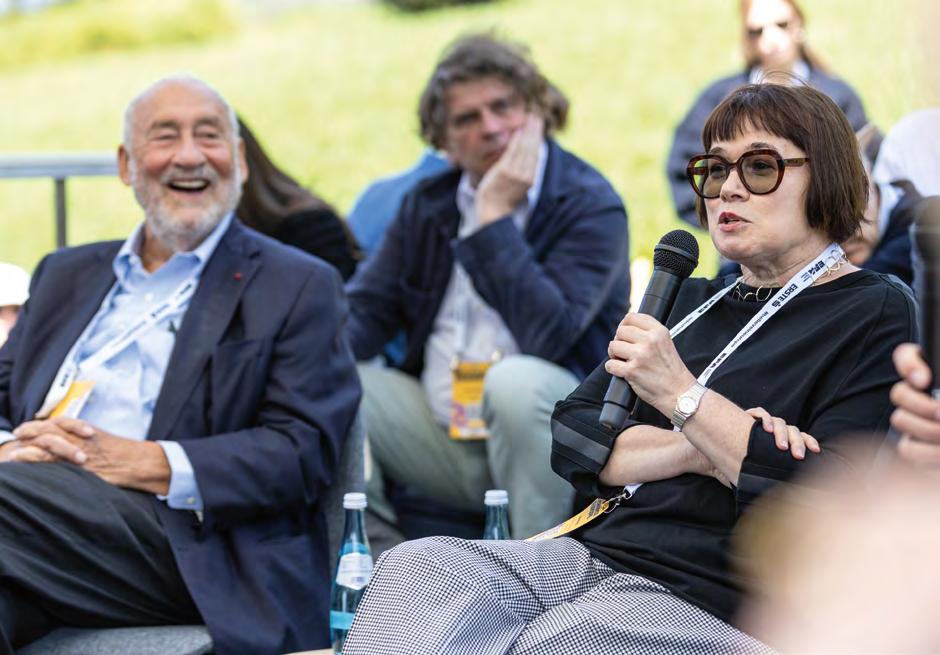
Sabine Weyand, Director-General for Trade and Economic Security at the European Commission, discussed how Europe is repositioning itself in a shifting global landscape with Nobel laureate Joseph Stiglitz during a Brown Bag Lunch.
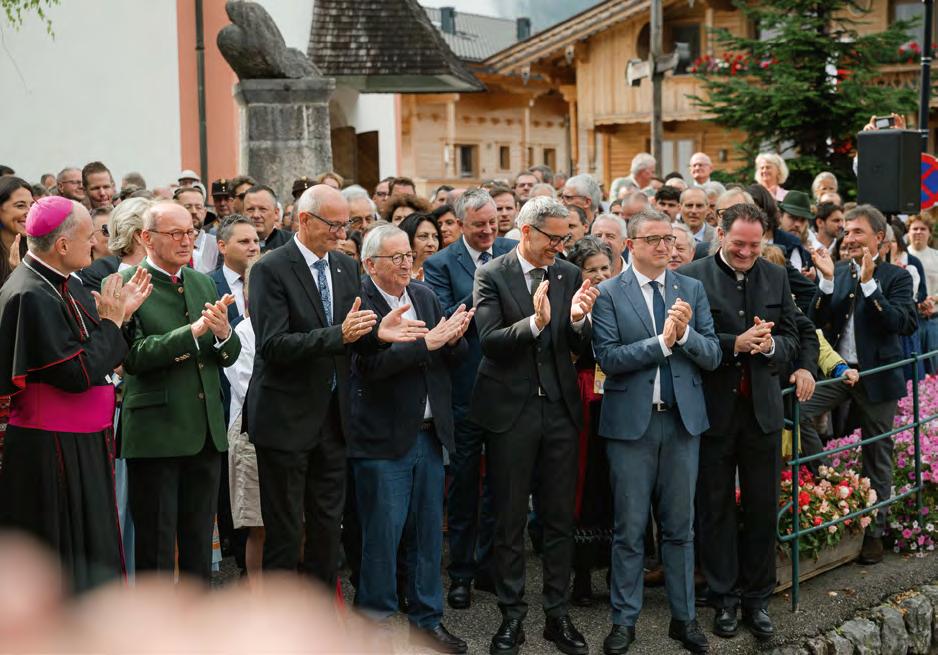
Bishop Ivo Muser, President of the European Forum Alpbach Othmar Karas, Tyrolean Governor Anton Mattle, former President of the European Commission Jean-Claude Juncker, as well as the Governors of South Tyrol and Trentino, Arno Kompatscher and Maurizio Fugatti, and Austria’s Federal Minister for Agriculture, Environment and Climate Norbert Totschnig attended the ceremonial welcome during the Euregio Days.
What our partners say
Our recent survey on partner satisfaction reveals encouraging insights, highlighting the value we bring to our partners.
Partner Satisfaction
Support
69 % answered “strongly agree” (40) or “agree” (29) to whether they were sufficiently supported by the organisers.
Content
65 % of the respondents feel that they had sufficient possibilities to include their ideas and formats in the programme.
Partners rated their overall experience at EFA25 with 8.5 out of 10 points (compared to 7.4 out of 10 in 2024).
Media Presence
The media resonance analysis highlights meaningful coverage, demonstrating the significance and reach of the EFA.
Number of Clippings
Number of Media
0 Total reach
Partner Evaluation & Media Presence
The insights from our partners and media showcase the impact and value of our efforts.
Partners, thank you!
Our partners are essential for the success of the European Forum Alpbach. They are private donors eager to support EFA’s purpose, philanthropic funders sharing the goals we set in our four tracks, corporate sponsors from all sectors, as well as public institutions from the local, national, and European level. Together we will continue to build on the very fundaments of democracy, European unity, solidarity and dialogue. The European Forum Alpbach is not just a conference: Alpbach is wherever you are and wherever you act in the name of a united Europe and global solidarity.
The Alpbach Circle unites an exclusive group of committed Europeans and supporters of EFA’s purpose. It was founded under the leadership of Karl Sevelda, with the goal of ensuring the long-term existence of the Forum and securing its future and ability to foster meaningful change. The donations support the Talent Development Programme and help strengthen EFA’s independence.

Alpbach Circle

Everything we do is possible through the financial support of our partners. They help connecting key actors and building a network of change.
AFRY Management
Consulting Austria
BABEG
BERGERecotrail
BLIK
Burgenland Energie energate
Enery
EY
Future-Law
Great Place to Work
HARF Management
Humanocare
Impact Hub Vienna
next level consulting oekostrom
Palfinger polisphere
PressReader
Privatquelle Gruber
Raiffeisenbankengruppe
Burgenland
Roland Berger
Salzburg AG
Schachinger Logistik
Škoda Group Austria
Sprenger Gerstbauer
Consulting
Startup House
The European Correspondent
Uniqa Insurance Group Verbund
White Panther
Zeppelin Konzern
Arbeiterkammer
Steiermark
Arbeiterkammer Wien
Arbeiterkammer Tirol
Berndorf Privatstiftung
Camera di Commercio di Bolzano
Camera di Commercio di Trento
Central European University
Česká Spořitelna
Climate KIC
Club Alpbach Steiermark
ClubDA
Complexity Science Hub
D-HUB
de‘ge‘pol German Society for Policy Advice
Erste Financial Life Park
Europe Jacques Delors European Capital of Democracy
European Parliament Liaison Office in Austria
Friends of Europe
Gemeinde Alpbach Gemeinnützige
Privatstiftung
Anas Schakfeh
Gesellschaft Österreich Ungarn
Industriellenvereinigung Niederösterreich
Industriellenvereinigung
Steiermark
Kärtner Wirtschaftsförderungs Fonds
King Baudouin Foundation
Land Kärnten
Land Salzburg
Land Vorarlberg
LGT Venture Philanthropy
Love Politics
MCI Innsbruck
Österreichische Gesundheitskasse
Politics for Tomorrow
Radikale Töchter
Salzburg University of Applied Sciences
Schwarzman Scholars
Stadt Wien
Standortagentur Tirol
Teach For Austria
THE CIVICS Innovation Hub
The Female Factor
Three Coins
Treehouse Giving
United Europe
University for Continuing Education Krems
University of Applied Sciences Kufstein Tirol
University of Innsbruck
Wirtschaftskammer
Steiermark
Wirtschaftskammer Tirol
Georg Kopetz
Bernhard Niesner
Franz Rauch
Alois Steinbichler