EDITOR Caroline Wood E editor@forestandbird.org.nz
Biodiversity
26 Te Mana o Te Taiao
28 New cave wētā species on Denniston Plateau
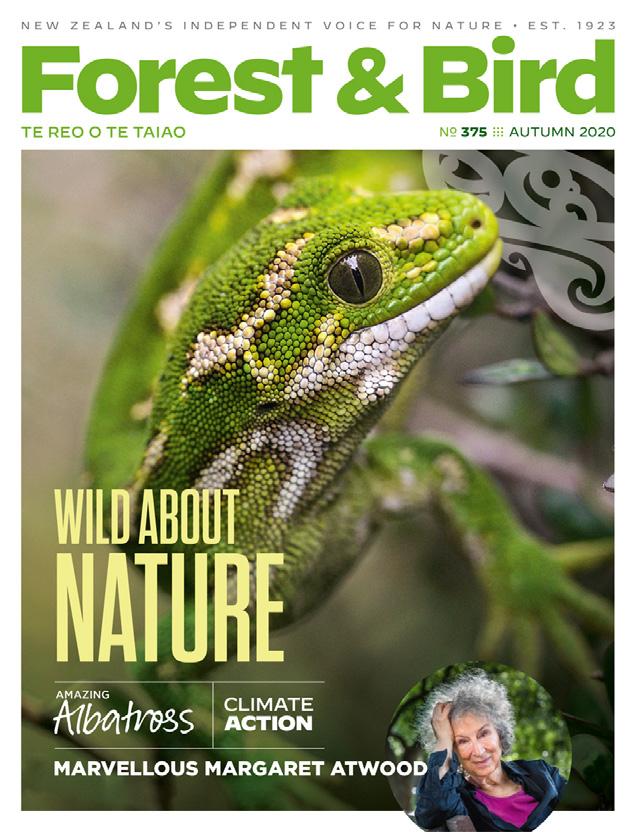
Cover
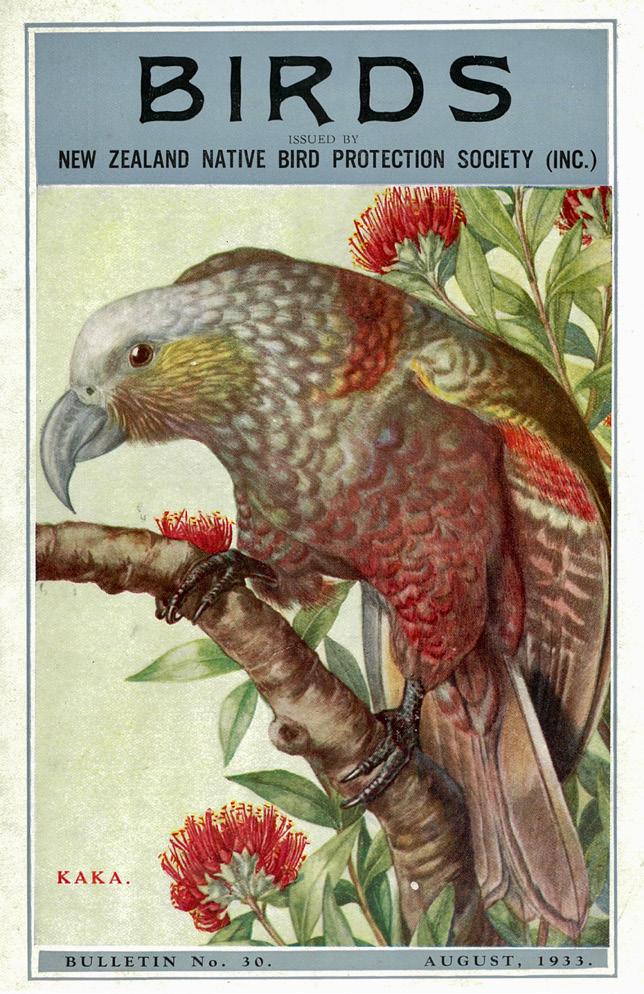
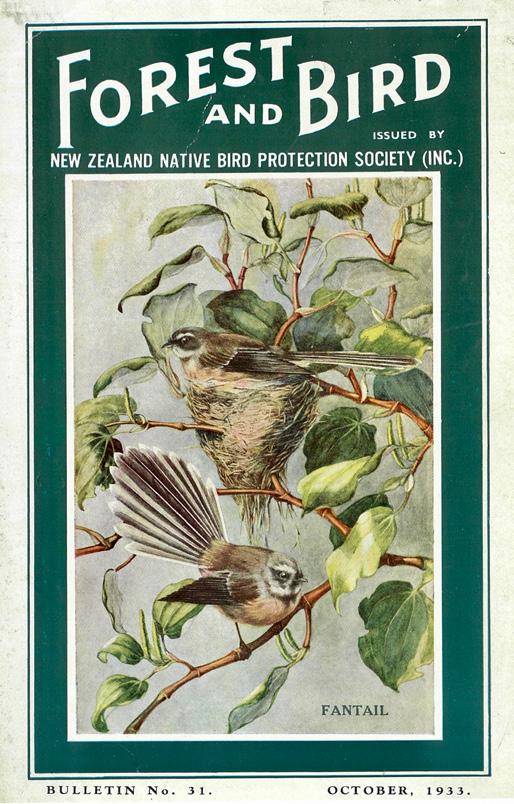
30 Celebrating 100 years of Forest & Bird magazine
Citizen science
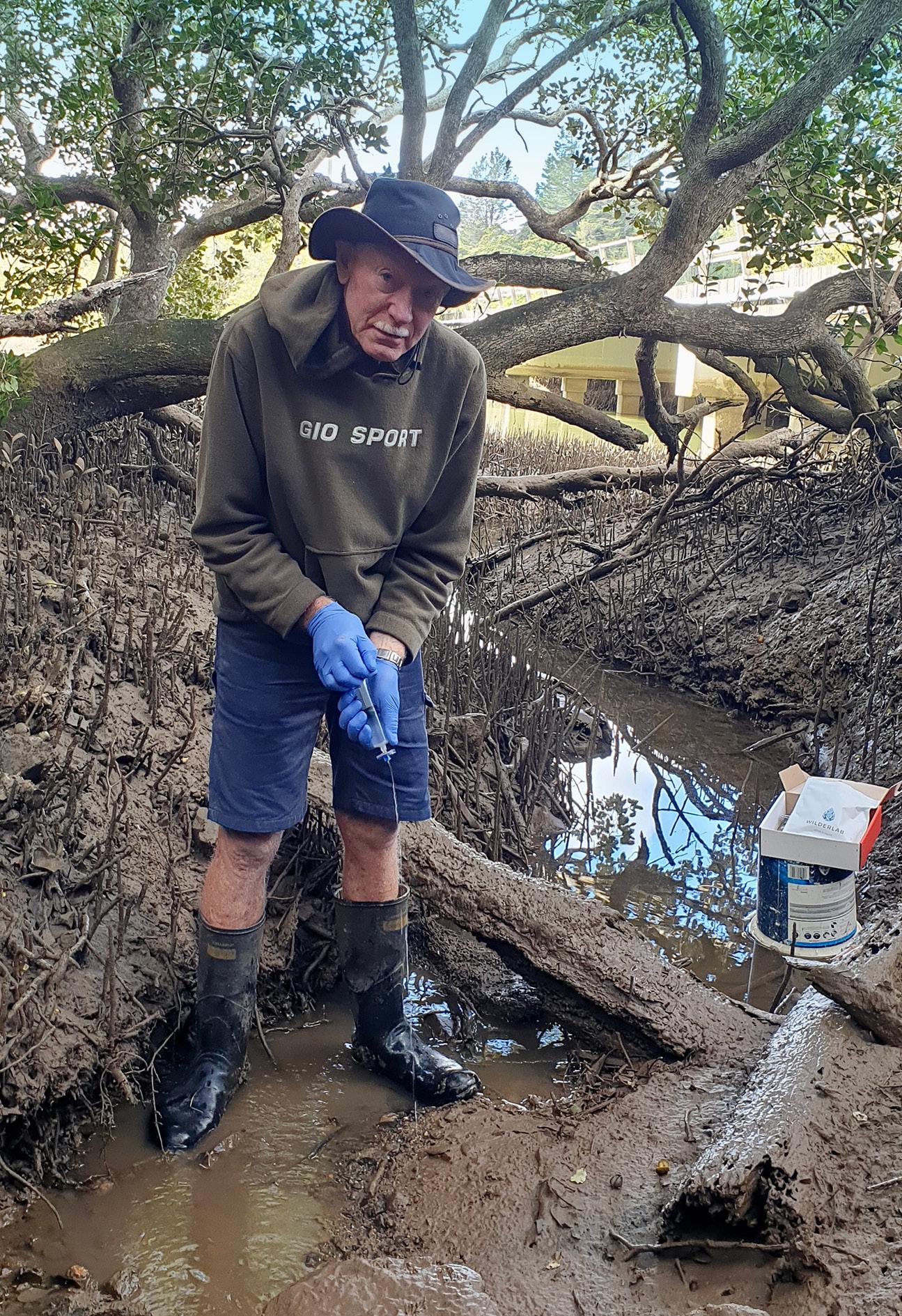
34 Invasive fish find
ART DIRECTOR/DESIGNER Rob Di Leva, Dileva Design E rob@dileva.co.nz
PRINTING Webstar webstar.co.nz
PROOFREADER David Cauchi
ADVERTISING ENQUIRIES Karen Condon T 0275 420 338 E karen.condon@xtra.co.nz
MEMBERSHIP & CIRCULATION T 0800 200 064 E membership@forestandbird.org.nz
Forest & Bird is published quarterly by the Royal Forest and Bird Protection Society of New Zealand Inc. Registered at PO Headquarters, Wellington, as a magazine. ISSN 0015-7384 (Print), ISSN 2624-1307 (Online). Copyright: All rights reserved. Opinions expressed by contributors in the magazine are not necessarily those of Forest & Bird.
Thank you for supporting us! Forest & Bird is New Zealand’s largest and oldest independent conservation charity.
Join today at forestandbird.org.nz/joinus or email membership@forestandbird.org.nz or call 0800 200 064
Every member receives four copies of Forest & Bird magazine a year.
Our people
38 Forest & Bird’s new president Kate Graeme
52 Old Blue winners
54 Youth and Branch award winners
56 Tī Kouka winners
Marine
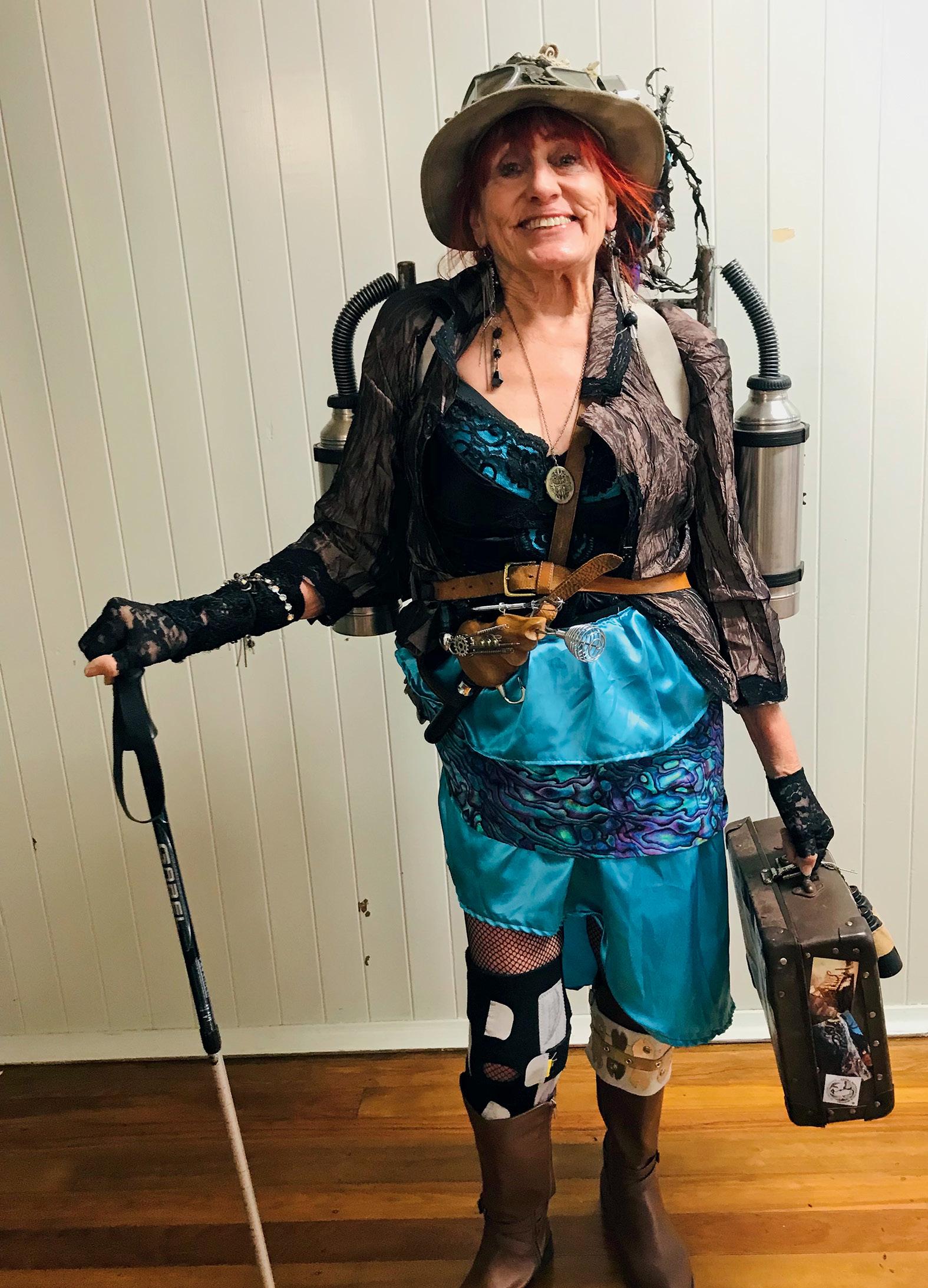
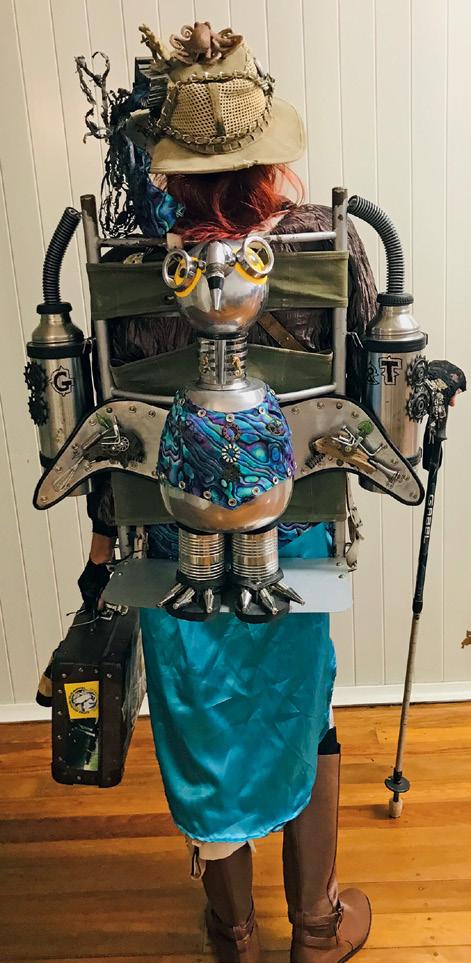
41 Steampunk penguin
50 Rare whale find
Forest & Bird Youth
42 Taranaki treasures
Big Read
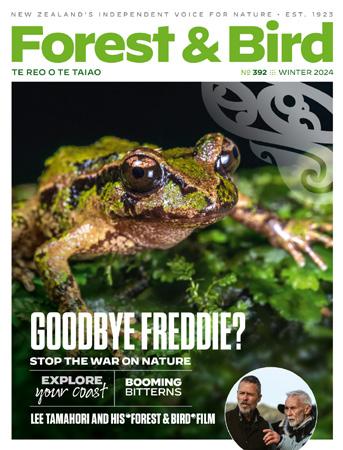
44 Goodbye Freddy: What next for the RMA?
In the field
48 Fighting back
Predator-free New Zealand
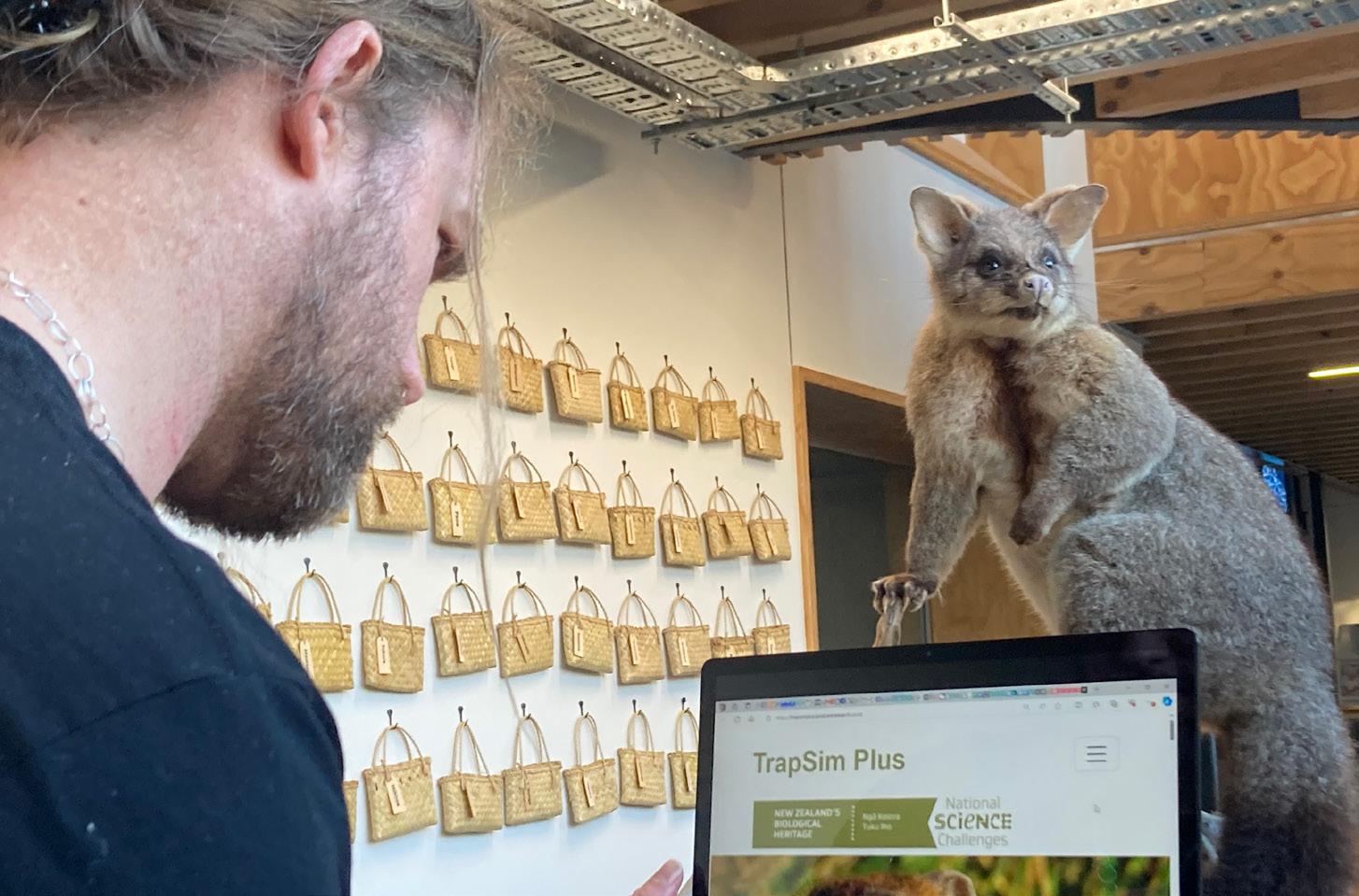
51 Free tech tool for trappers Going places
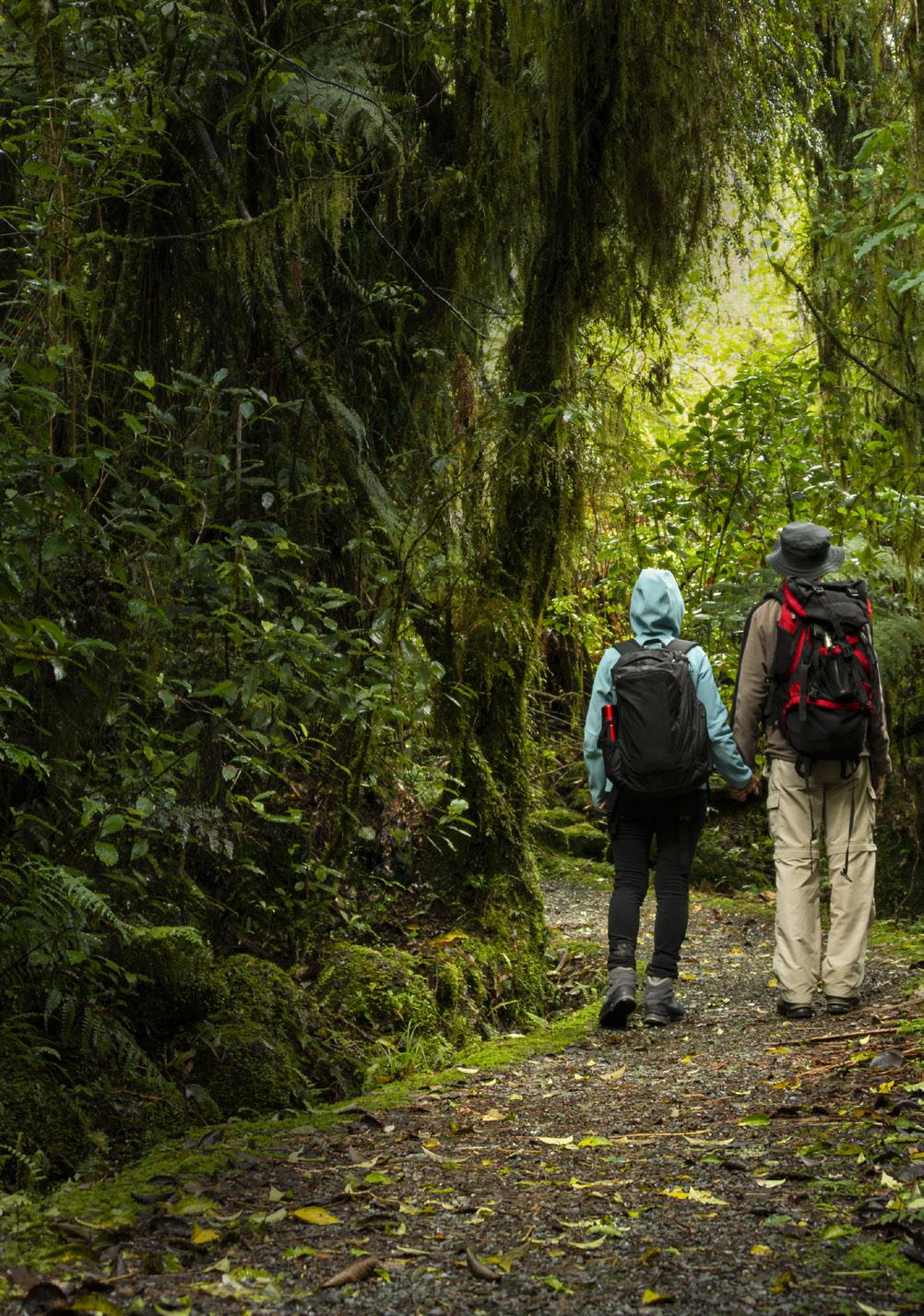
58 Forest bathing in Wellington
Books
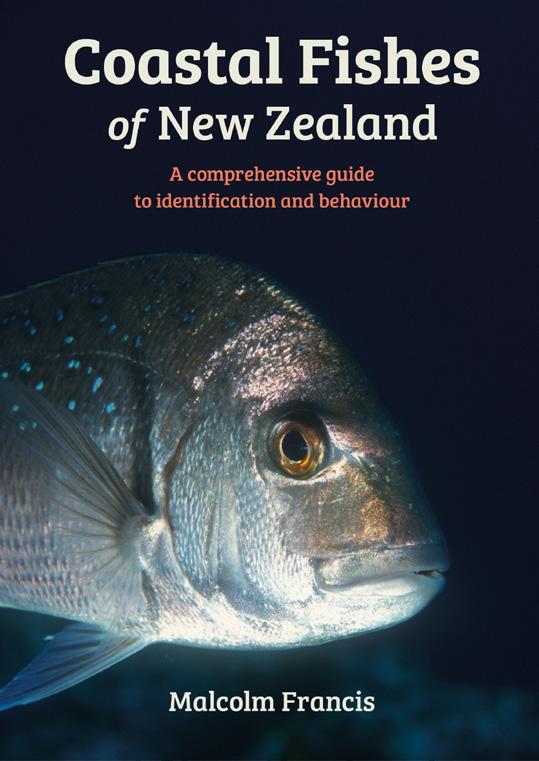
60 Ferns and coastal fishes illustrated guides
CONTACT NATIONAL OFFICE
Forest & Bird National Office Ground Floor, 205 Victoria Street Wellington 6011 PO Box 631, Wellington 6140
T 0800 200 064 or 04 385 7374
E office@forestandbird.org.nz W forestandbird.org.nz
Obituary
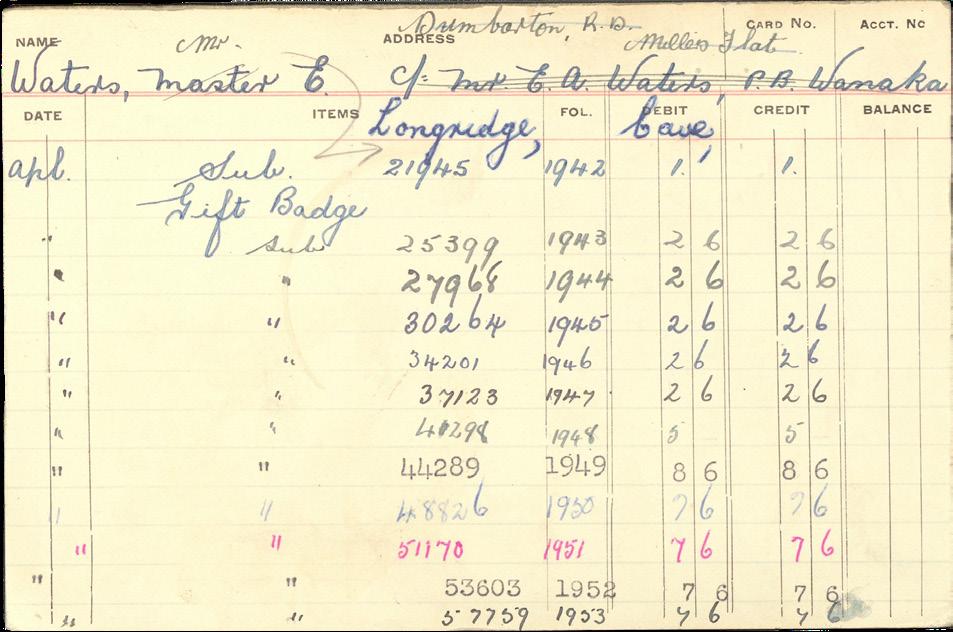
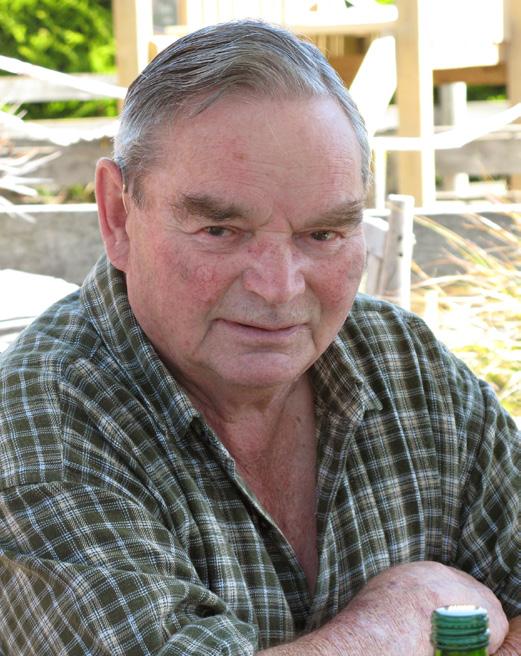
61 Evan Waters
Market place
62 Classifieds
Last word
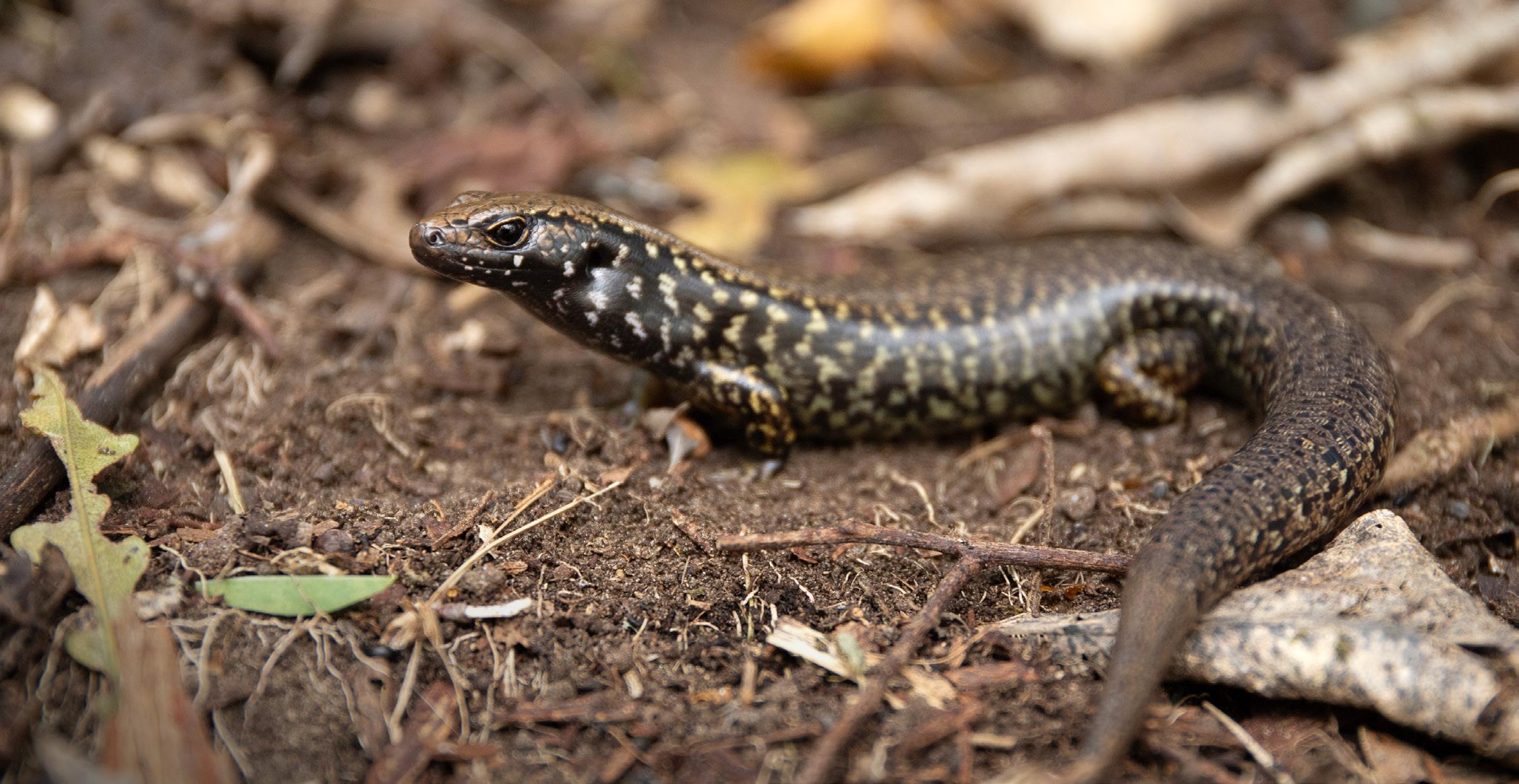
64 Rewilding Whitaker’s skink
Parting shot
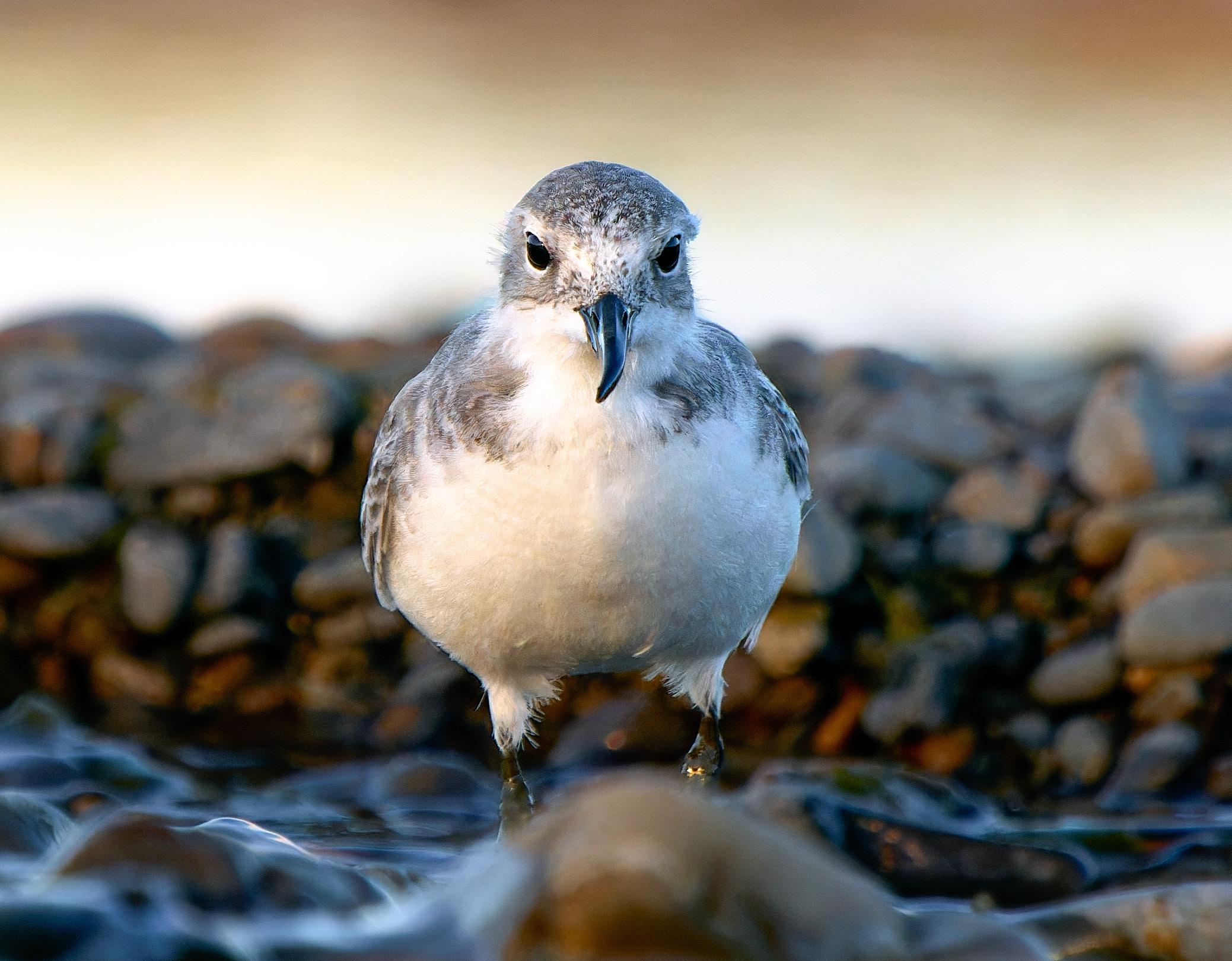
IBC Ngutu parore wrybill
CONTACT A BRANCH See forestandbird.org.nz/branches for a full list of our 45 Forest & Bird branches.
Royal Forest and Bird Protection Society of New Zealand Inc. Forest & Bird is a registered charitable entity under the Charities Act 2005. Registration No CC26943.
PATRON Her Excellency The Rt Honourable Dame Cindy Kiro, GNZM, QSO Governor-General of New Zealand
CHIEF EXECUTIVE Nicola Toki PRESIDENT Kate Graeme DEPUTY PRESIDENT Mark Hanger TREASURER Nigel Thomson BOARD MEMBERS Chris Barker, Bruce Clarkson, Romilly Cumming, Ben Kepes, Kate Littin, James Mackenzie, Eugenie Sage
CONSERVATION AMBASSADORS Sir Alan Mark, Gerry McSweeney, Craig Potton DISTINGUISHED LIFE MEMBERS Graham Bellamy, Linda Conning, Ann and Basil Graeme, Philip Hart, Joan Leckie, Hon. Sandra Lee-Vercoe, Carole Long, Peter Maddison, Sir Alan Mark, Gerry McSweeney, Craig Potton, Fraser Ross, Eugenie Sage, Guy Salmon
OUR NATURAL ADVANTAGE
I’m delighted to be your new President and carry on the conservation mahi of the 19 conservationists who held this role before me and were all strong voices for nature.
Forest & Bird’s philosophy of putting nature first has seen the Society grow over a century of political cycles and changing governments, including 26 Prime Ministers.
Today, nature needs us more than ever before, as we face a government blithely walking back decades of hard-fought environmental protections while making deep cuts to conservation and science funding. This is happening despite nature being in the worst state it has ever been.
We lead the world as the country with the most species facing extinction. We also have one of the highest per capita CO2 emissions on the planet, and 90% percent of our wetlands have been cleared despite their proven climate benefits.
The disconnect between nature’s downtrodden state and the government’s reversal of environment protections is stark.
New Zealanders are proud of our natural heritage. It’s part of who we are. We cherish nature for it’s own sake. Our wellbeing, economic prosperity, and standard of living also rely on having healthy natural systems and biodiversity.
Humans have only lived on Aotearoa for a short time compared
to the rest of the world, and in comparison our natural environment is relatively intact.
This is our “natural advantage”, and we must not squander it.
Nature is under pressure from many quarters, including habitat loss, introduced pests, resource extraction industries, and climate change.
We cannot continue on our current path without destroying our natural capital and our economy’s sustainability. We are using up more than nature can provide.
Aotearoa New Zealand’s unique biodiversity and natural systems are finite and in trouble. We read about “irreversible ecological damage” and assume it will happen in the future, but it is happening right now in our own backyard.
Look at our soils. Our young soils have supported fast-growing forestry and grass-fed livestock, but they are exceptionally vulnerable to erosion.
About 182 million tonnes of eroded soil entered our rivers in 2022. In Tairāwhiti East Cape, for example, poor land use practice has seen giant land slips so big and deep we cannot heal them.
Successive governments have grappled with developing sustainable and enduring management systems for land, fresh water, biodiversity, and climate emissions. They consulted the public and made regulations to
safeguard these natural assets for future generations.
Why then is this National-led coalition government proposing to roll back these policies? This will benefit some commercial interests in the short term but will cost the rest of us dearly in the long term.
Instead of squandering our natural advantage, we should be restoring our environment to protect biodiversity and the climate. Decisions should be based on evidence and science, not ideology.
Conservation is not a “cost”. It is an investment in the natural capital that underpins our wellbeing and ensures the survival of future generations.
It is time our politicians understood this and aspired to use nature-based solutions to create a sustainable Aotearoa New Zealand, a country we can all take pride in, that supports our long-term health and prosperity.
Noho ora mai,
Kate Graeme Perehitini, Te Reo o te Taiao President, Forest & Bird
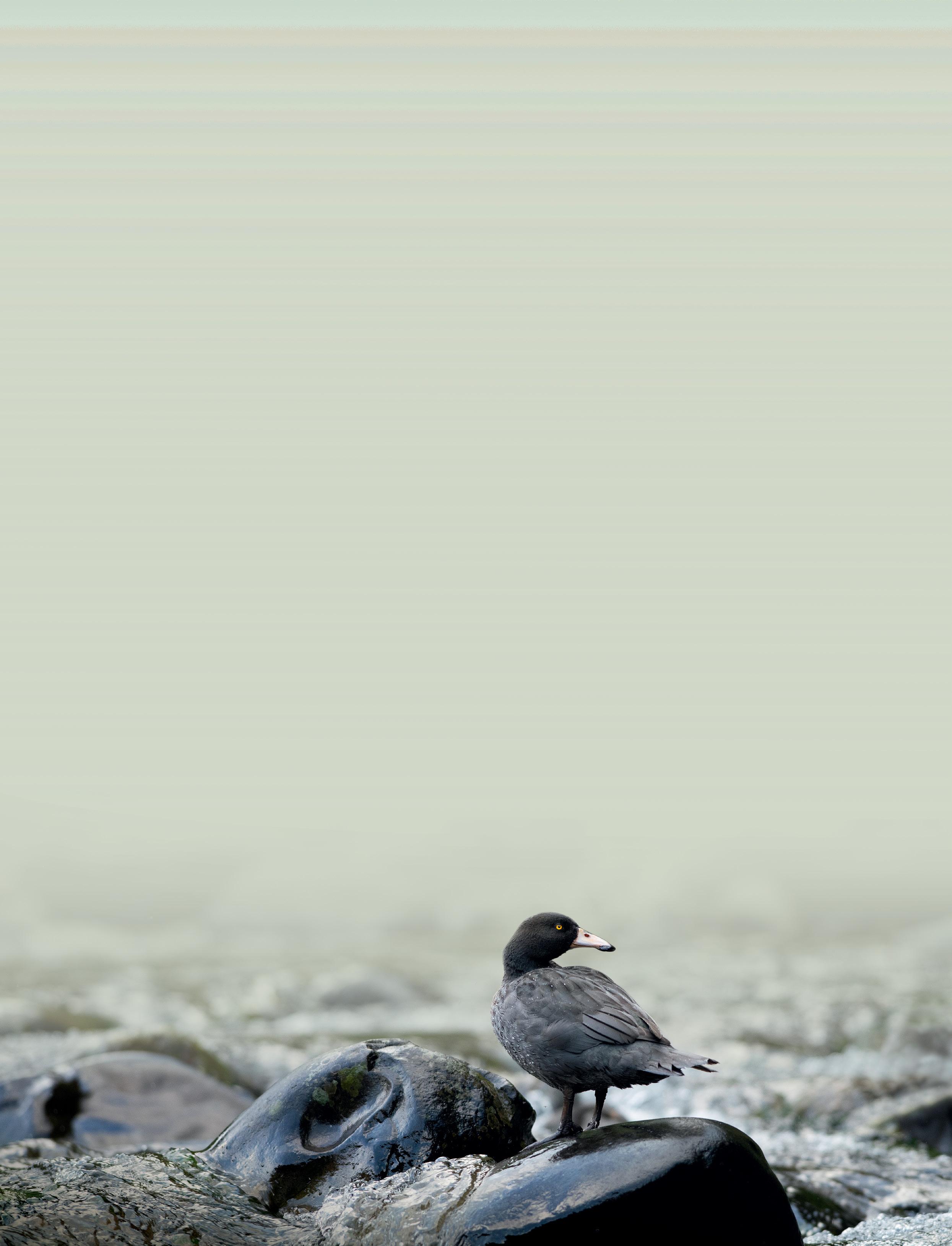
Whio. Neil Foster
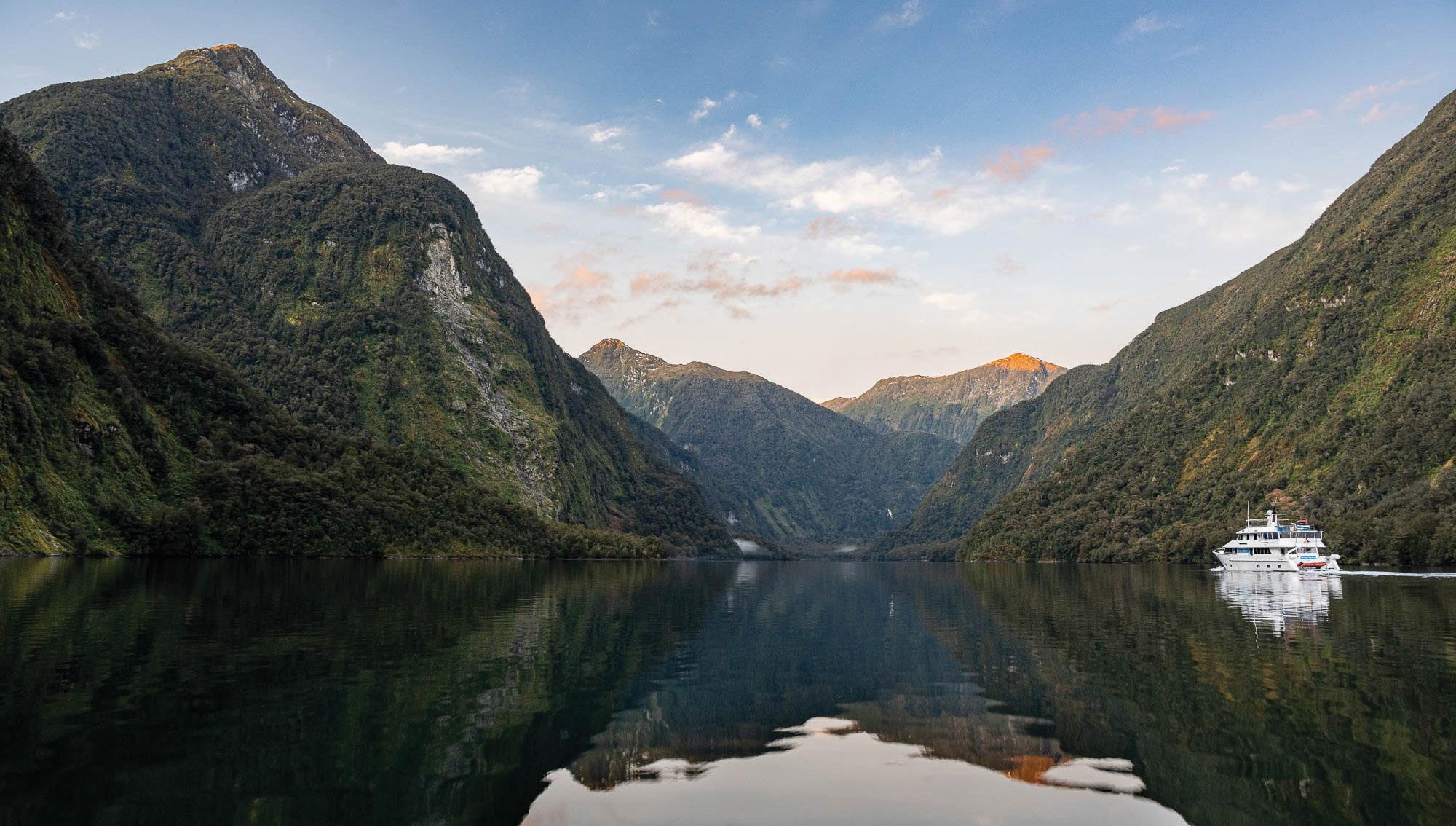
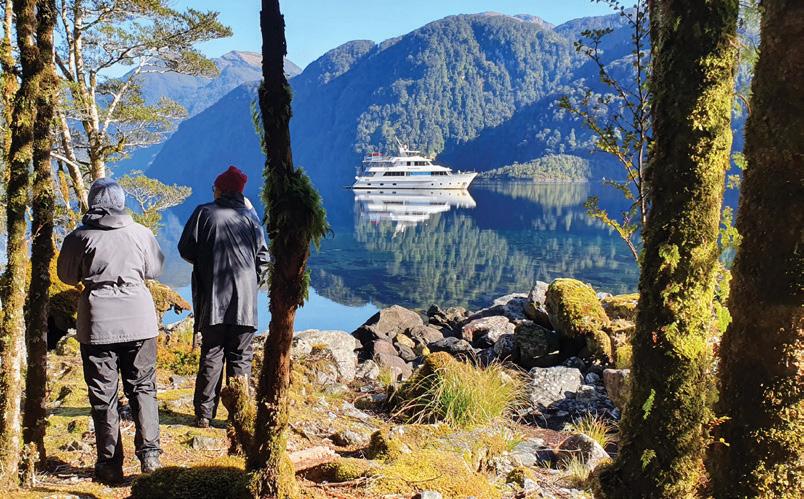
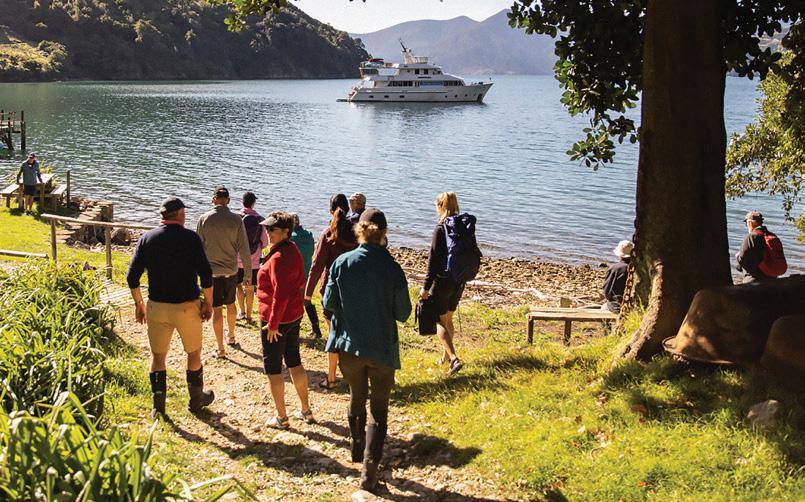
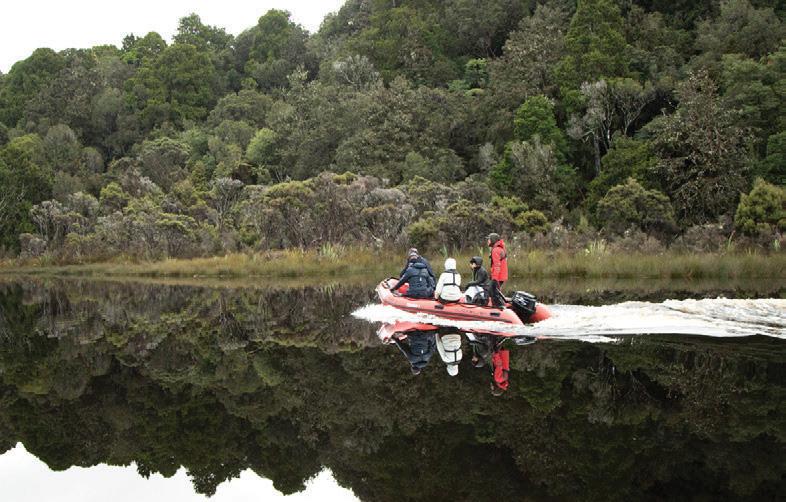
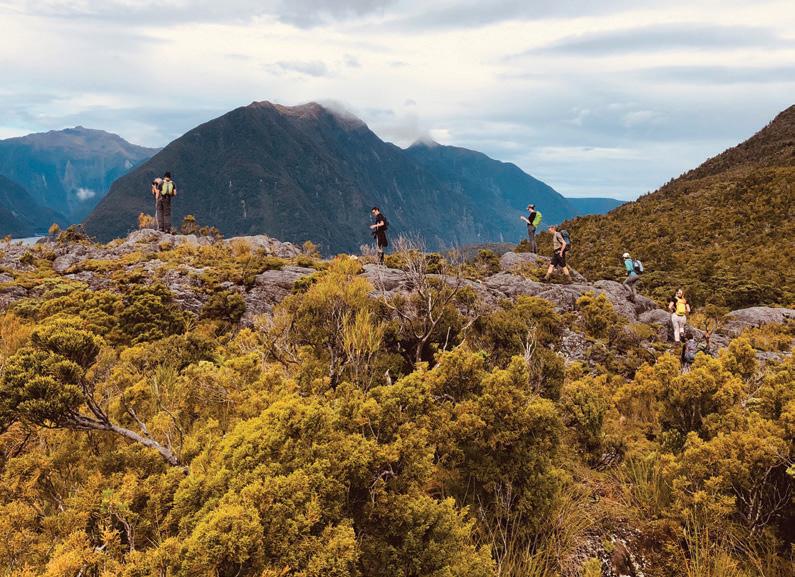
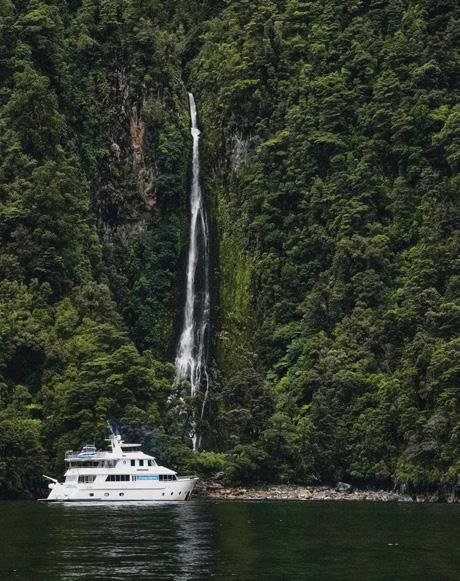
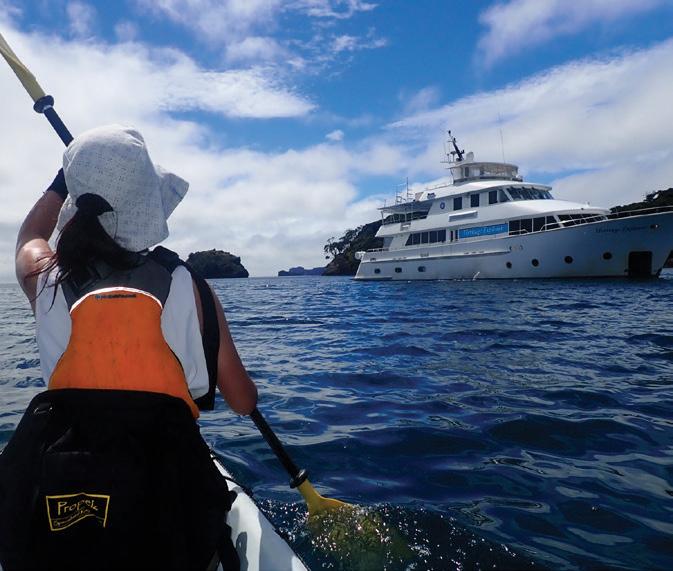
Heritage Expeditions have been sharing the wilds of New Zealand with like-minded guests for more than 40 years and invite you on the voyage of a lifetime. Explore Fiordland’s world famous Acheron Passage and Breaksea, Dusky and Doubtful Sounds; the tranquil waterways of historic Queen Charlotte and Pelorus Sounds, French Pass and d’Urville Island; and Stewart and Ulva Islands, Paterson Inlet, Kaipipi Bay, Port Pegasus and Lords River – all only accessible by sea. Join us for an unforgettable, intimate exploration of some of Aotearoa’s most remote, and iconic, locations aboard our 18-guest expedition yacht and by Zodiac, kayak and on foot with New Zealand’s own expedition cruise pioneers.
LETTERS
YOUR FEEDBACK
Forest & Bird welcomes your thoughts on conservation topics. Please email letters up to 200 words, with your name, home address, and phone number, to editor@ forestandbird.org.nz, or by post to the Editor, Forest & Bird magazine, 205 Victoria Street, Wellington 6011, by 1 November 2024. We don’t always have space to publish all letters or use them in full. Opinions expressed on the Letters page are not necessarily those of Forest & Bird.
WORKING FOR NATURE
WRITE AND WIN
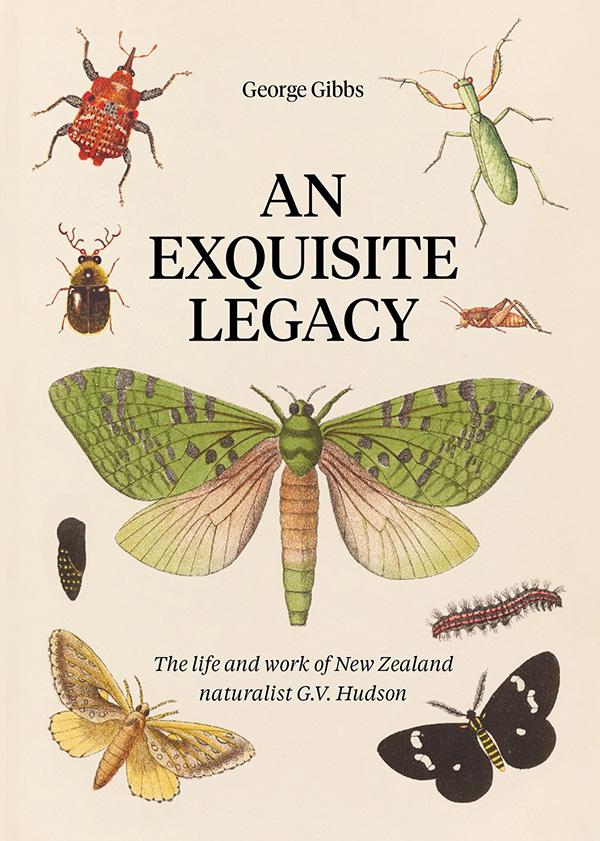
The best contribution will receive a copy of An Exquisite Legacy: the life and work of New Zealand naturalist GV Hudson by George Gibbs (Potton & Burton, RRP $59.99). This illustrated biography celebrates one of New Zealand’s greatest naturalists and insect artists.
botanists doing browse surveys. Although the meat gets sold, the cull still costs $100,000 a year. The funds for the cull (and the predator control) come from hunters paying to go hunting during the Roar. If the agreement between the Department of Conservation and Fiordland Wapiti Foundation were to cease, DOC would not have the funds to maintain the culling nor the predator control. I sincerely hope Forest & Bird, Fiordland Wapiti Foundation, and DOC come to a legally sound agreement so we can all work together and not waste a load of conservation dollars on legal fees.
Liz Scott, Te Anau
BEST LETTER WINNER
As a relative newcomer to Aotearoa New Zealand, I quickly found out about Forest & Bird and became a member. I have also signed up my grandson to KCC. Without Forest & Bird, I dread to think what might have happened to the unique biodiversity in this country. Reading about the latest successful wins for nature in the Winter 2024 edition, I think everyone should be grateful there are members who have been able to address the environmental concerns of certain industrial initiatives and have succeeded in preventing them from going ahead due to their deleterious impact on wildlife and ecology. We can now only hope that the Fast-track Approvals Bill will be withdrawn, or at the very least modified, so that democracy will prevail. Around the world, it is NGOs like Forest & Bird which are leading the way in environmental protection and serving as advocates, ensuring decisions are made with due consideration of the possible negative consequences to nature. As an individual, it is my privilege (and responsibility) to support those voices that campaign on our behalf to protect our precious heritage. Thank you for all you do on our and our environment’s behalf!
Lynette Thomas, Auckland
WAPITI WORRIES
I am a long term Forest & Bird supporter and also belong to the Fiordland Wapiti Foundation. I’m not a hunter but help with the predator control – 500 traps checked eight times a year. Firstly, I totally agree that deer need to be controlled to preserve our precious environment. I’ve been really impressed with Fiordland Wapiti Foundation’s commitment to caring for the area. It culls not only red and hybrid deer but also female wapiti (to keep the population down). Over the last year, they culled 1250 deer from the 175,000ha “Wapiti” area, three times as many per hectare compared to the rest of Fiordland. This number is determined by DOC
EDITOR’S NOTE: Please see the Winter 2024 issue for a Q&A that sets out Forest & Bird’s position on wapiti. It is also available at forestandbird.org.nz/resources/wapitilatest-and-qa
CAT & BIRD LOVER
I’m writing as both a cat-and bird-lover residing in our biggest city with a garden fringed with mainly native trees. Unfortunately, my young cat started bringing in male goldfinches from a flock on the driveway. I tried double bells to no avail. Luckily, I found a fantastic cottage industry online called Little Lions NZ, based in Christchurch, supplying “cat scrunchies” around a detachable collar. These are brightly coloured cotton collar accessories with reflective and hologram tape designed to warn birds of a stalking cat. I’m pleased to report no further issues, and the backyard birds are again co-existing with my cat. As a responsible cat owner, I support compulsory registration, microchipping, and desexing of cats and outright bans in sensitive areas unless kept in a cat-proof outside Catio area.
Name supplied, Auckland
GENETIC ENGINEERING
Responding to “Can genomics save hoiho” (Winter 2023), my farming family are 100% committed to sound conservation and biosecurity outcomes. Our organic farm creates safe habitat for native species through planting local eco-sourced native trees and maintaining our possum and rat traps. We would love to see all possums and mustelids eradicated from New Zealand, but those who hold out the promise of a “magic silver bullet” using controversial and risky outdoor GE/GMO experiments, or use of dangerous sterility technique gene drive, are misguided. While we strongly support robust protection of native flora and fauna, and the need to address climate change, experimentation with such risky new genetic technologies on our public conservation lands (or elsewhere) would be counterproductive and potentially create far more serious problems than desired solutions. Adverse impacts of GE/GMOs are likely to be irreversible. We suggest everyone read the Parliamentary Commissioner for the Environment’s March 2001 excellent report “Key lessons from the history of science and technology: Knowns and unknowns, breakthroughs and cautions”. Among the lessons identified in the paper is the recognition that early optimism in a new advance is often followed by surprises and failures.
Linda Grammer, Westport
BOOK GIVEAWAY
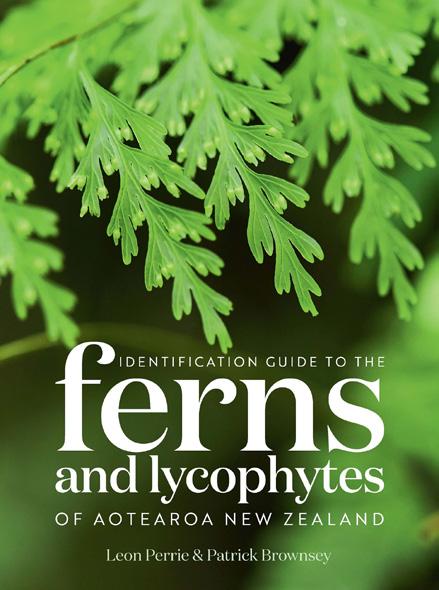
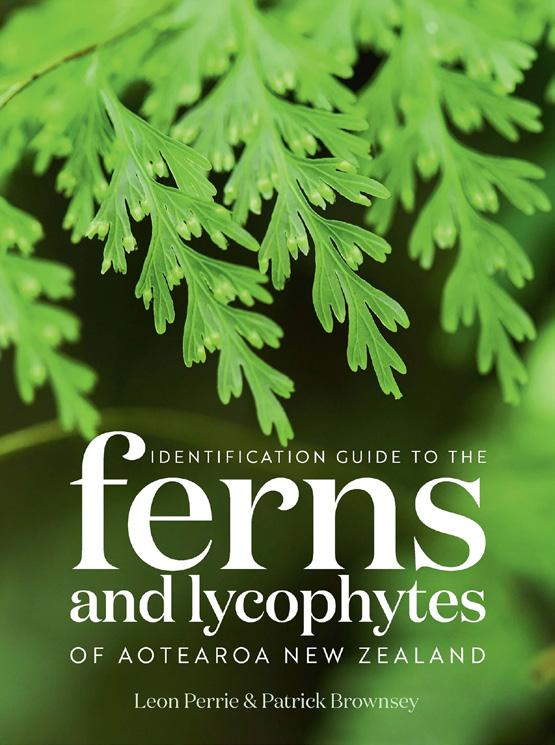
We have two copies of Ferns and Lycophytes of Aotearoa New Zealand by Leon Perry & Pat Brownsey (Te Papa Press, RRP $50) to give away. Compiled by Te Papa’s foremost fern experts, this beautifully illustrated guide is for anyone wanting to understand, identify, and distinguish the most commonly encountered fern and lycophyte species in Aotearoa.
To enter, email your entry to draw@forestandbird. org.nz, put FERNS in the subject line, and include your name and address in the email. Or write your name and address on the back of an envelope and post to FERNS draw, Forest & Bird, PO Box 631, Wellington 6140. Entries close 1 November 2024
The winters of Environmental Defenders by Raewyn Peart were Trevor Scheele, of Whangārei, and David Whiteford, of Tākaka.
Forest & Bird
Forest & Bird
NATURE NEWS
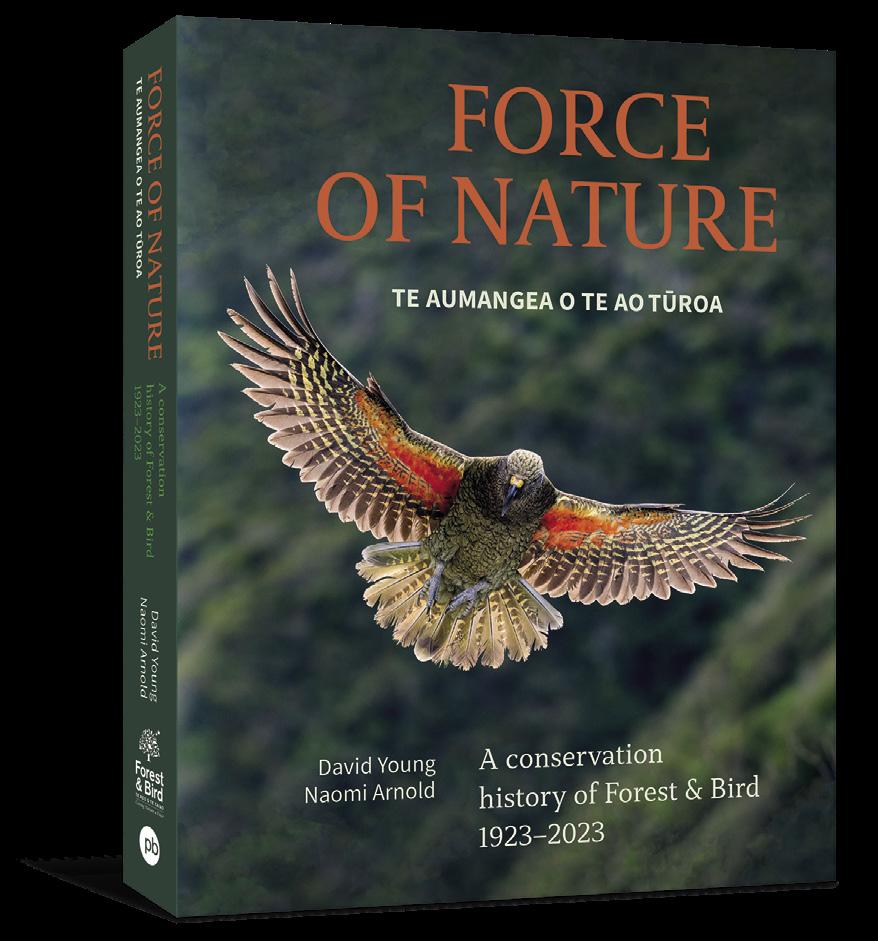
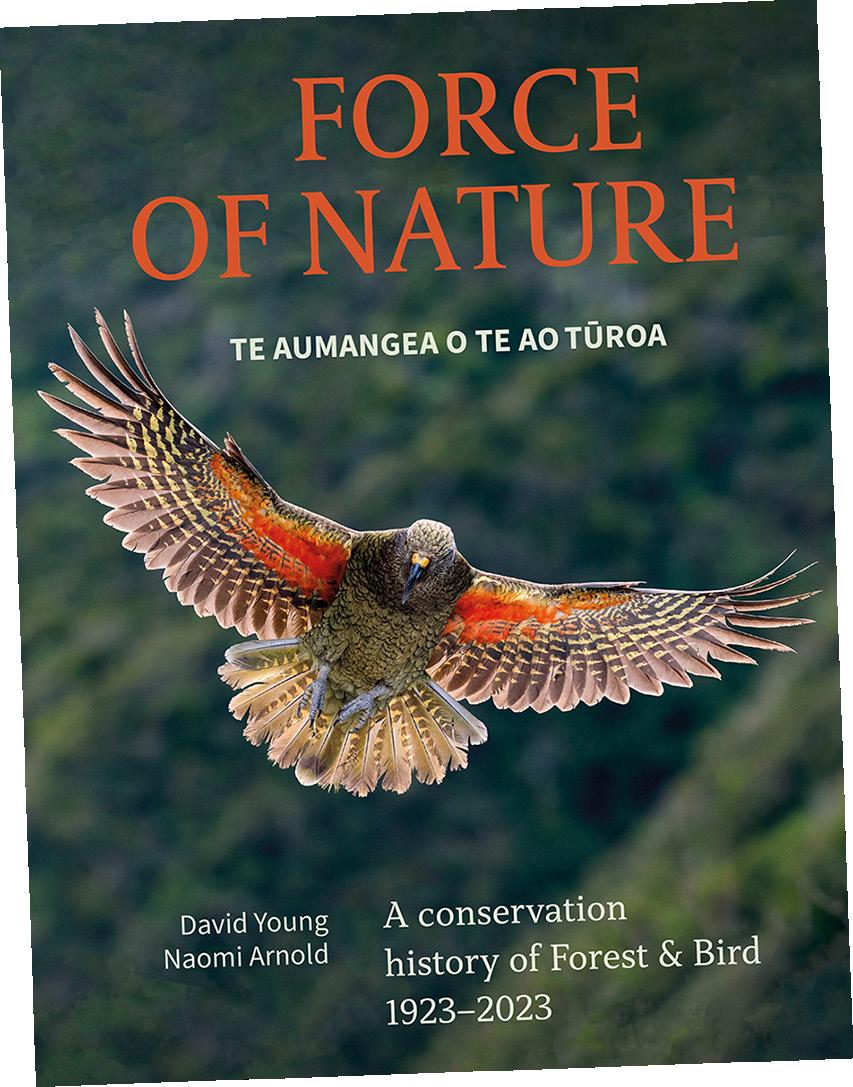
FORCE OF NATURE
Read about the people who stood up for New Zealand nature over the past 100 years. You may well know some of them! Caroline Wood
Forest & Bird’s stunning centennial history has been published and will be on sale in bookshops in October. We are taking pre-orders now, so get in quick to secure your copy.
Publisher Robbie Burton is calling Force of Nature a landmark book about conservation that is a celebration of all things nature.
“It’s been an enormous privilege to be able to work with what I think is one of the most important conservation stories ever told in this country,” he said.
“Forest & Bird has been involved in every significant conservation or environmental campaign over the last 100 years.
“Force of Nature is a remarkable and inspiring book with a
fascinating cast of characters. It’s highly readable and beautifully illustrated.”
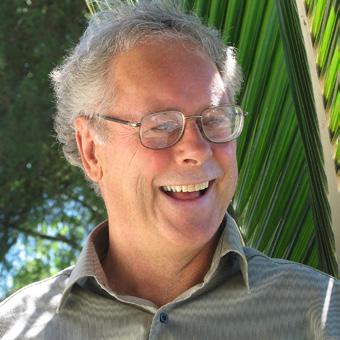
For the first time, the book’s writers David Young and Naomi Arnold tell the inside story of Forest & Bird from its foundation in 1923 to the present day.
They depict many of the colourful personalities in the Society’s history, the conservation campaigns they waged, and the precious landscapes, plants, and animals they helped save.
The book features more than 110 interviews with, and in-depth profiles of, members, staff, and supporters who were there at tipping points in history. What motivated them to stand up for nature in a world that didn’t care?
We learn about their courageous campaigns to save vanishing birdlife in the 1920s, establish “national parks for the people” in the 1950s, secure a department of conservation in the 1980s, and create the predator-free Aotearoa concept in the 2000s.
“These stories, some of which haven’t been told before, are compelling and a really important part of our history,” says Forest & Bird’s chief executive Nicola Toki.
“I found them to be inspiring and motivating for the nature protection work still to be done. We can all learn from the courage and actions of those who have gone before us.”
Each chapter is richly illustrated with archival images and striking landscape, ocean, and wildlife photos from some of New Zealand’s leading nature photographers.
In a rapidly vanishing natural world, further challenged by climate change, the stories of hope and perseverance in Force of Nature are a clarion call to action for nature lovers throughout Aotearoa New Zealand.
Buy your copy of Force of Nature from the Forest & Bird shop (shop.forestandbird. org.nz) and help support our conservation mahi. All profits go directly to nature protection. We are offering a special launch price of $72 (20% off RRP) plus P&P – see forestandbird.org.nz/ forceofnature
BE IN TO WIN
Forest & Bird is giving away two copies of Force of Nature Te Aumangea o te ao Tūroa: A Conservation History of Forest & Bird (1923–2023) to two lucky readers. This landmark history celebrates 100 years of inspiring conservation mahi. Published by Potton & Burton (RRP $89.99). To enter, email your entry to draw@forestandbird.org.nz, put FORCE OF NATURE in the subject line, and include your name and address in the email. Or write your name and address on the back of an envelope and post to FORCE OF NATURE draw, Forest & Bird, PO Box 631, Wellington 6140. Entries close 1 November 2024.
David Young
Naomi Arnold
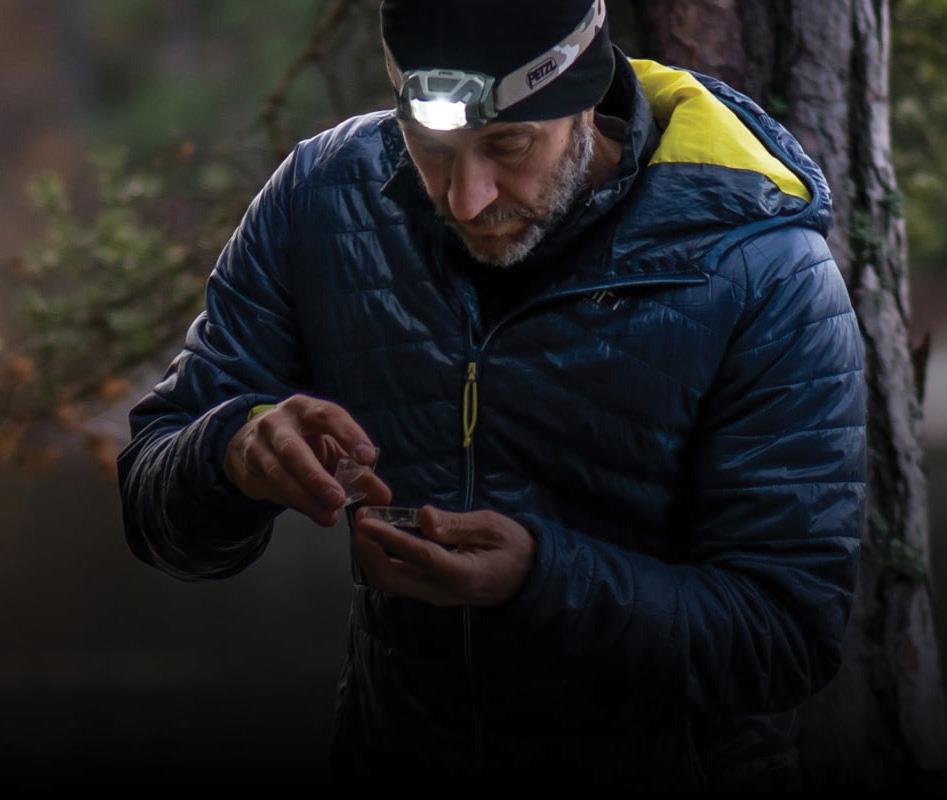
ARIA ® 2 RGB
Waterproof, robust, and powerful headlamp, ideal for exploring nature at night. 450 lumens
• White, red, green, or blue lighting to preserve night vision and help identify animal tracks.
• Rechargeable battery reduces environmental impact, also compatible with 3 AAA batteries
• Easy to use with a single button
• Lightweight and compact at 106 grams
NATURE NEWS
MARCH FOR NATURE
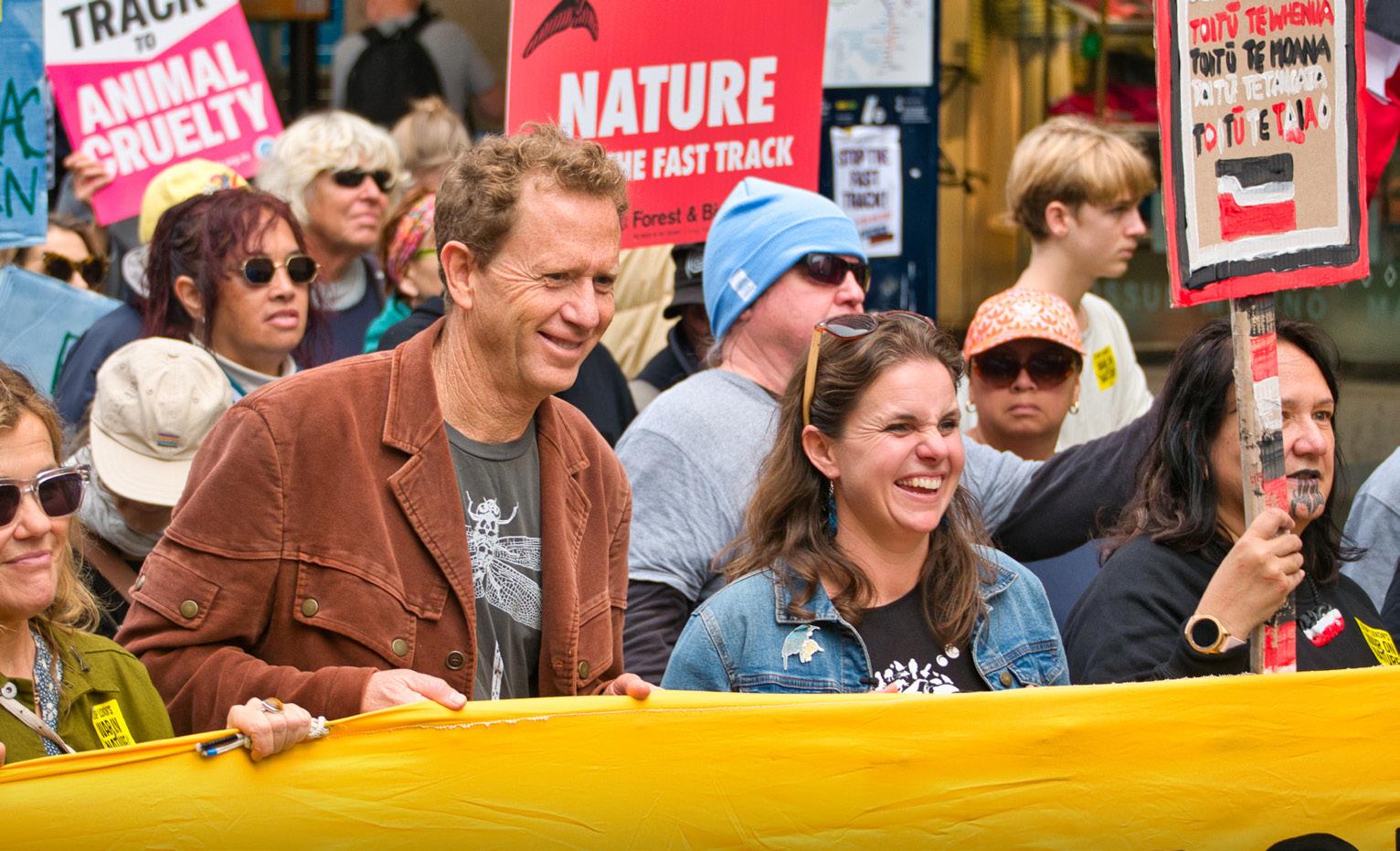
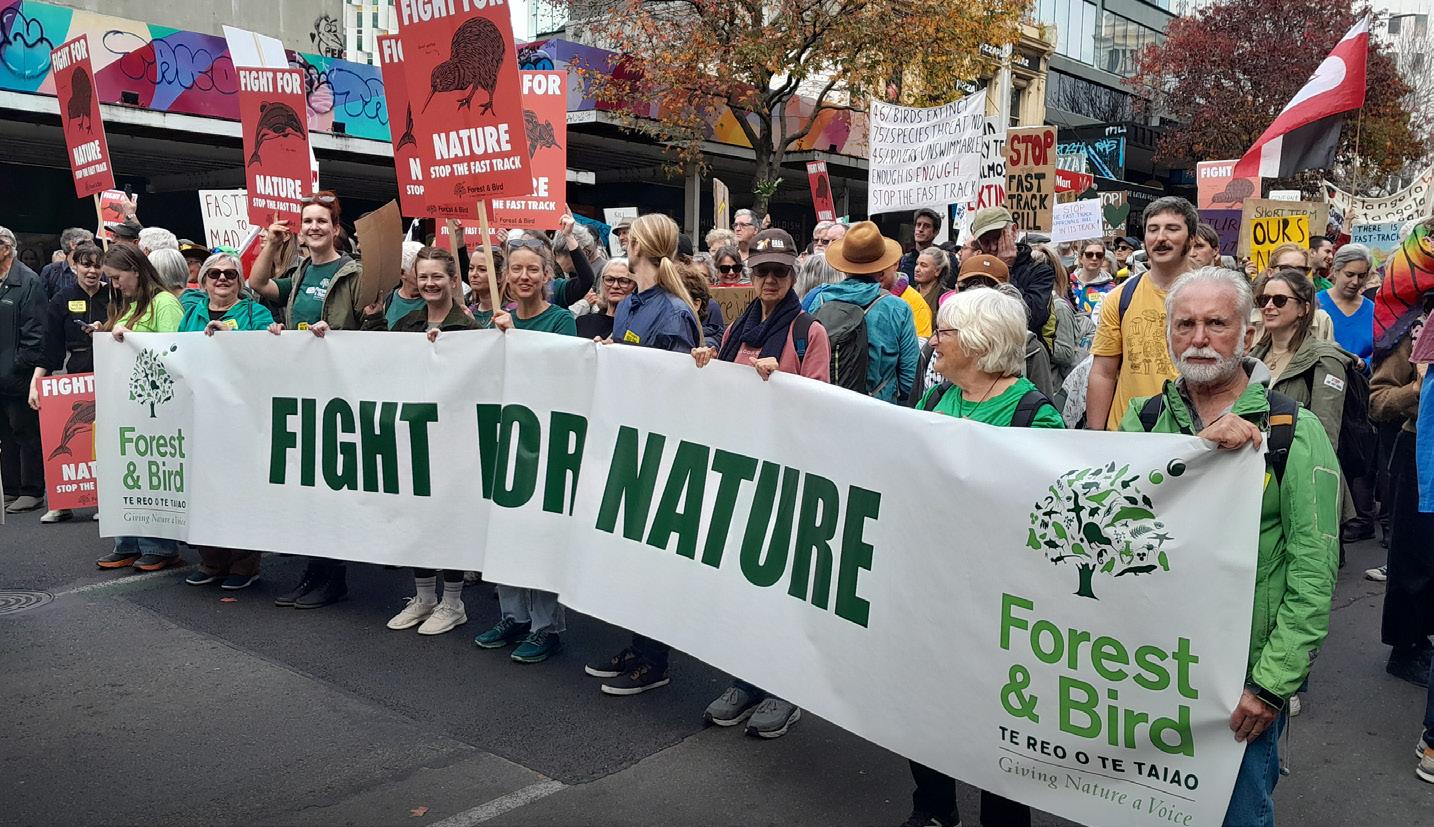
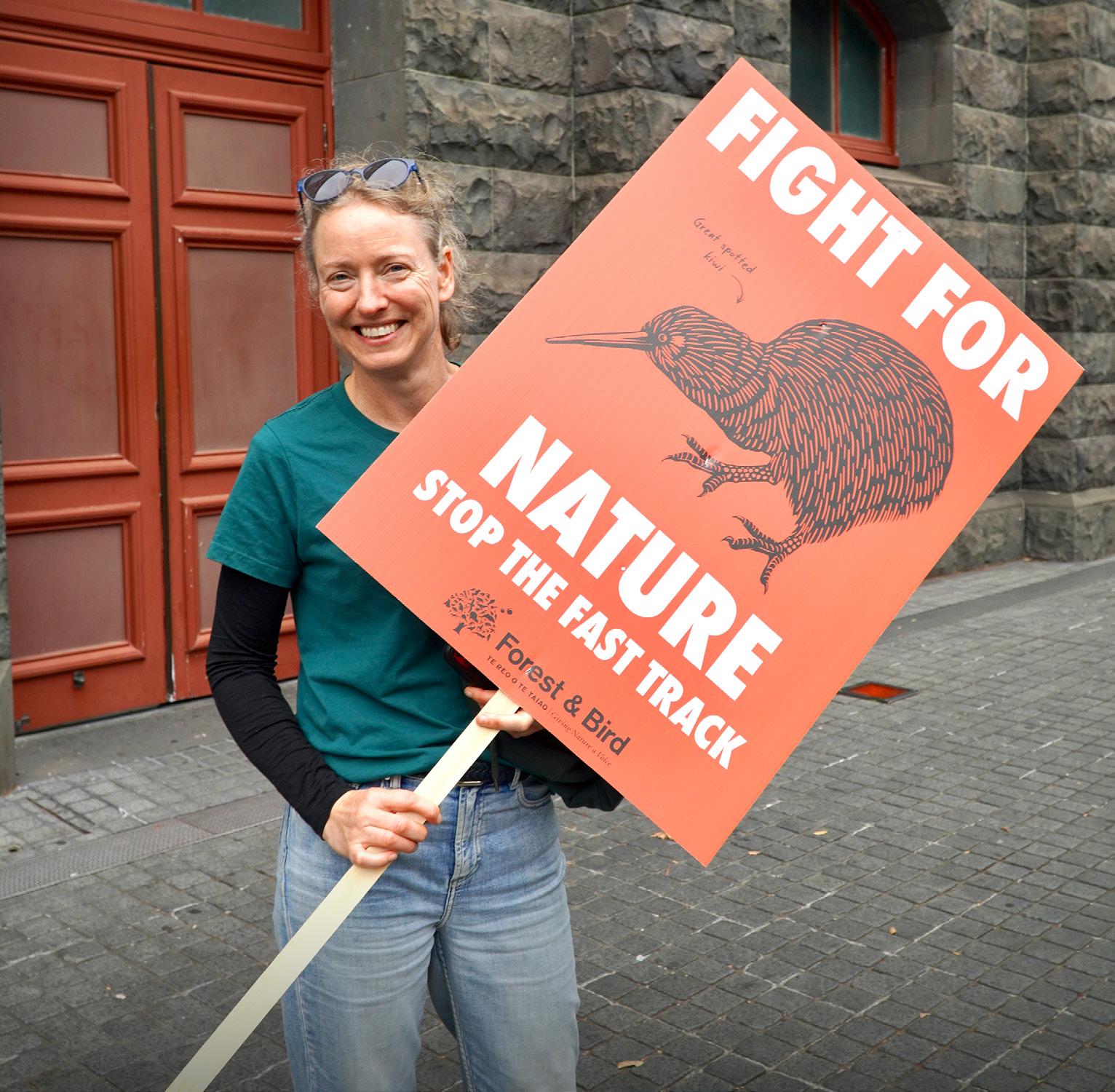
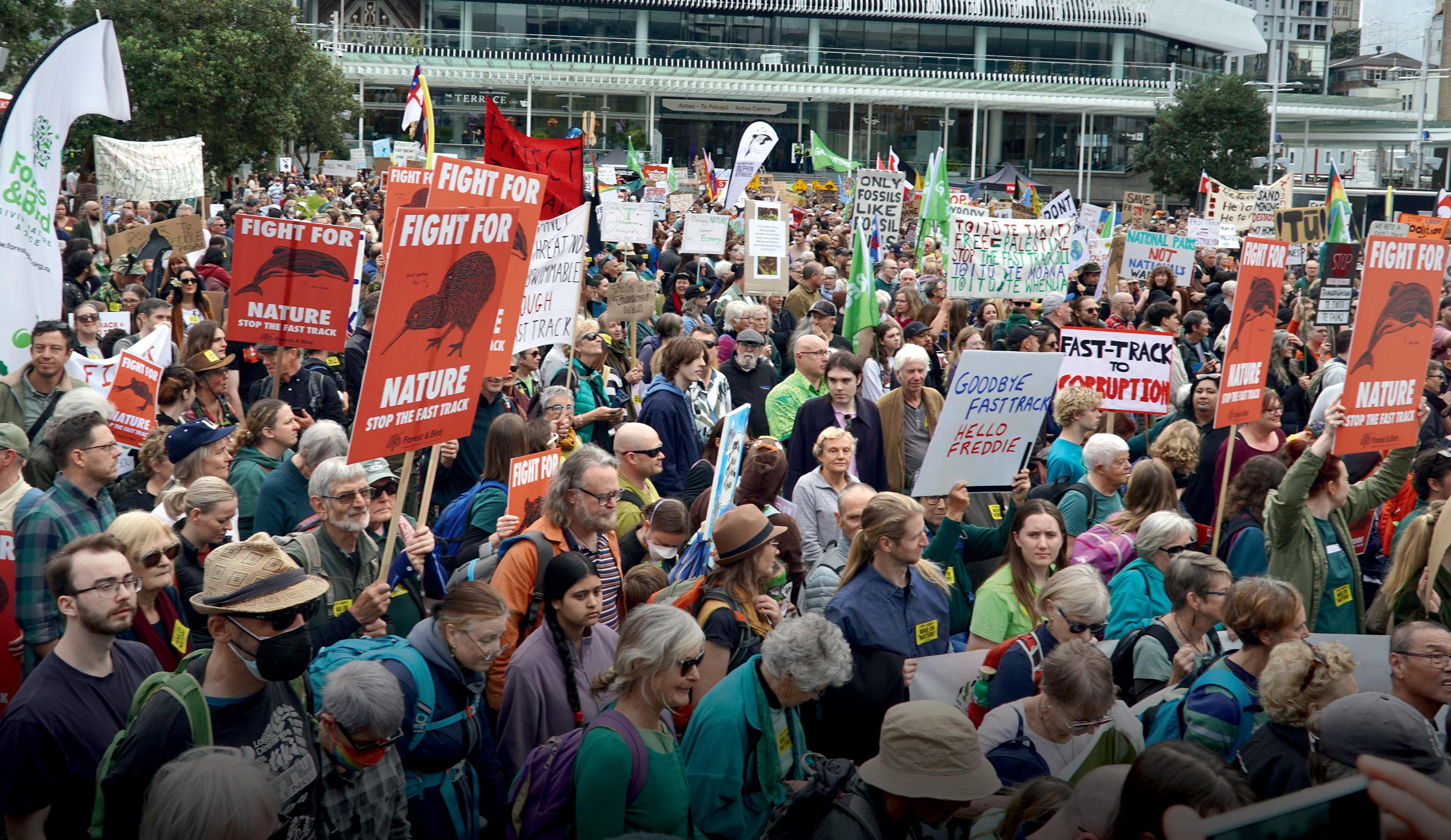
Thank you for standing up for nature and helping us protest the Luxon government’s Fast-track Approvals Bill. More than 20,000 people took part in the historic March for Nature in Tāmaki Makaurau Auckland on 8 June. They came by the busload to protest against the coalition government’s war on nature.
Forest & Bird chief executive Nicola Toki addressed the march saying: “Today, people from all walks of life across Aotearoa New Zealand have come together and have collectively given nature a voice.
“They have made it clear that they will not tolerate precious and endangered wildlife being condemned to extinction. They won’t watch native forests be destroyed, or let rivers, lakes, and oceans be polluted. They will fight for what we share as New Zealanders because it’s in our nature. They will fight for what we love.
“We have fought for te taiao nature before and won. We care deeply because we know that nature is the foundation for everything. Nature is what makes us Kiwis. We can see a different future – one where our environment’s health protects us and lets us thrive
in a climate-changed world, where flourishing nature is our nation’s strength.”
The march was organised by Forest & Bird, Greenpeace, Communities Against Fast Track, Coromandel Watchdog, WWF-New Zealand, and Kiwis Against Seabed Mining.
“Aotearoa has a long history of peaceful protest,” Greenpeace Aotearoa executive director Russel Norman told the crowd. “From Whina Cooper’s Land March and the Springbok Tour to the hīkoi against deep sea oil and the March Against Mining, time after time, we have marched – shoulder to shoulder – and changed the course of history.
“Today, we have done that again. Christopher Luxon must now take heed of the wishes of an overwhelming majority of New Zealanders and throw the Fasttrack Bill in the bin. Here on Queen Street, we see thousands of people speaking up with a single voice, but it’s just the tip of the iceberg. To ignore that would put this government forever on the wrong side of history.”
Watch the March for Nature highlights at youtube.com/ watch?v=H7U8yhac-Bw&t=52s.
“SHOW
US YOUR LIST” PETITION
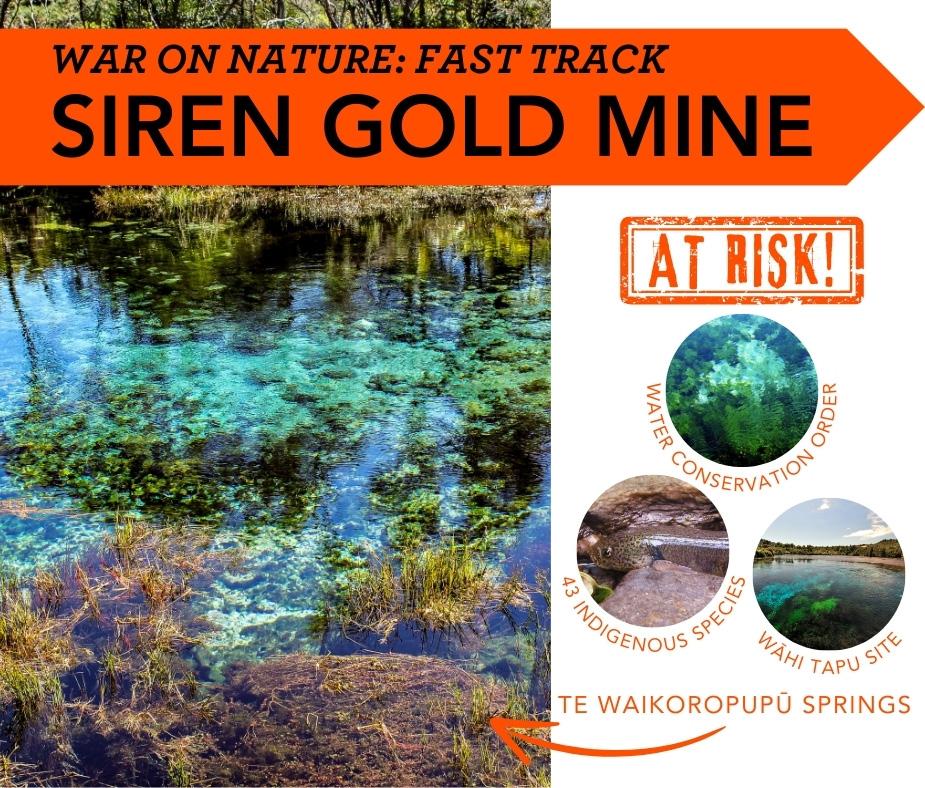
Thank you to everyone who signed our fast-track petition, which Forest & Bird delivered to Parliament’s Petitions Committee at the end of June. It called on the government to postpone progressing its Fasttrack Approvals Bill until MPs and the public have been told which projects would be fast-tracked. Forest & Bird fears the list will include developments the Society has spent years successfully opposing in court, such as the proposed Te Kuha open-cast coal mine on the West Coast, the Ruataniwha dam in Hawke’s Bay, and Trans-Tasman Resources’ proposal for seabed mining off the Taranaki coast.
At the time of writing, the government hadn’t revealed the list of applications that will be automatically fast-tracked without public consultation or environmental safeguards. Instead,
Russel Norman and Nicola Toki. Kirk Serpes
it says Cabinet will consider which of the projects will be listed in the Bill “in the coming months”.
Forest & Bird is urging Ministers to send the final list of projects to the Environment Committee of Parliament for public scrutiny before MPs vote on the Bill.
In August, Minister of Infrastructure and RMA Reform Chris Bishop revealed 384 projects had applied to be listed in Schedule 2 of the Fast-track Approvals Bill. He said 40% are housing and urban development projects, 24% infrastructure, 18% renewable energy, 8% primary industry, 5% quarrying, and 5% mining projects.
But there was no information on individual projects or their locations, rendering the information largely meaningless to local communities, says Forest & Bird’s chief executive Nicola Toki.
“It’s still deeply concerning that the government does not intend to release the list of projects until after the select committee has reported back,” she said. “If these projects stack up, what is there to hide?
“Winning an election isn’t the only part of a democratic process, and people are rightfully concerned about the lack of public participation and local input into proposed projects in places they live.”
After the Bill is enacted, projects listed in Part A of Schedule 2 will be able to apply directly to an expert panel for a final decision, as well as the application of any conditions, says the government.
GOVERNMENT U-TURN
The government has listened to the tens of thousands of New Zealanders who raised significant concerns about the proposed Fast-track Approvals Bill. In a major backdown announced in late August, three Ministers will no longer have the final say on which fast-track developments are approved.
Potential fast-track projects will be referred to an expert panel by the Minister for Infrastructure Chris Bishop alone, and he will be required to consult the Minister for the Environment and other relevant portfolio Ministers as part of that referral process.
Final decisions on a project will not sit with Ministers but with the expert panel. This is the same as the previous Labour government’s fasttrack process.
Expert panels will include expertise in environmental matters, the government said. It will include an iwi authority representative only when required by Treaty settlements.
Applicants will be required to include information on previous decisions by approving authorities, including previous court decisions, in their applications for the referring Minister to consider.
The government says timeframes for comment at the referral and panel stages will be extended in order to give parties, including those impacted by a proposed project, more time to provide comments.
Announcing the changes, Regional Development Minister Shane Jones said: “The positive feedback on our one-stop shop
Fast-track Bill has confirmed what we’ve been hearing for a long time: Kiwis want to see progress in their towns and cities and are sick of waiting years for it.
“However, we have listened to the concerns of many submitters, some of whom have identified areas where the Bill can be changed to deliver a more robust and inclusive process.”
Forest & Bird welcomed the changes but says the Fast-Track Approvals Bill remains fundamentally flawed.
Importantly, it still prioritises economic development over environmental protection. This means projects with an unacceptable environmental impact will likely still be approved.
“The announcement that final decisions on projects will not sit with just three Ministers but with an expert panel is good news and reflects the strength of public opposition, not to mention some strong feedback from experts such as the Parliamentary Commissioner for the Environment,” said Forest & Bird chief executive Nicola Toki.
“However, we must remain vigilant. We can’t afford to take our eyes off the ball, or we will lose more of our unique natural heritage.”
Thank you for supporting our War on Nature fundraising appeal. Together, we can make a differerence – see forestandbird. org.nz/stop-fasttrack
Forest & Bird at Auckland’s March for Nature. Lynn Freeman
Chris Bishop
HAURAKI HOPE
After more than a decade of campaigning by Forest & Bird, iwi, and marine advocacy groups, things are looking up for ocean life in Tīkapa Moana, the Hauraki Gulf. The Environment Committee looking at the Hauraki Gulf Bill gave a consensus recommendation in June that it should be adopted in its entirety.
While Forest & Bird hasn’t secured all the measures it sought, the Bill represents important progress in protecting the Gulf. If Parliament votes for the Bill, 19 new protection areas will be created in Tīkapa Moana Hauraki Gulf Marine Park.
“This is a significant step forward towards preserving and revitalising the mauri of the Gulf,” says Forest & Bird’s Hauraki Gulf lead coordinator, Bianca Ranson. “Once passed, it will set in place 6% ‘high’ protection and 12% seafloor protection.
“We thank everyone who supported our Arohatia Tīkapa Moana Love the Gulf campaign. You helped to make this possible.”
If the Bill passes, DOC anticipates the new legislation and protection could be in place by late 2024. Forest & Bird will continue to campaign for other protections –including an end to damaging bottom trawling fishing in the Gulf.
DOME VALLEY APPEAL
Forest & Bird’s legal team was in the High Court in late July challenging an interim Environment Court decision that conditionally approved a 60ha landfill at Dome Valley, north of Auckland.
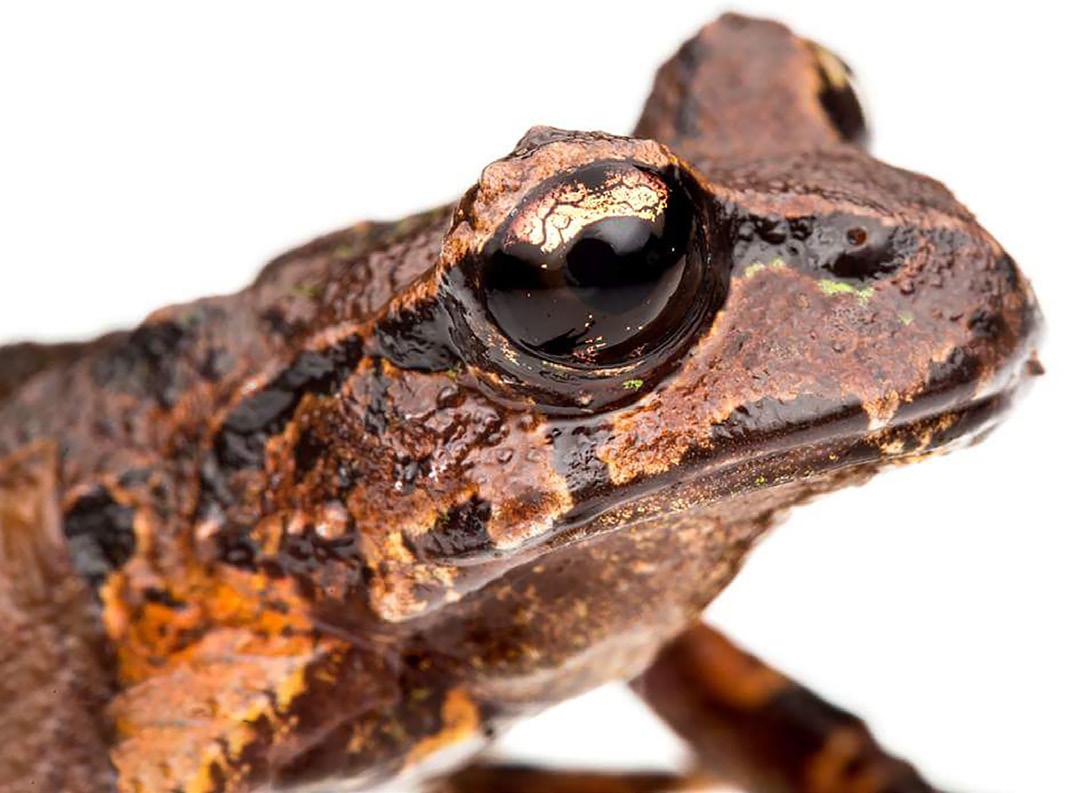
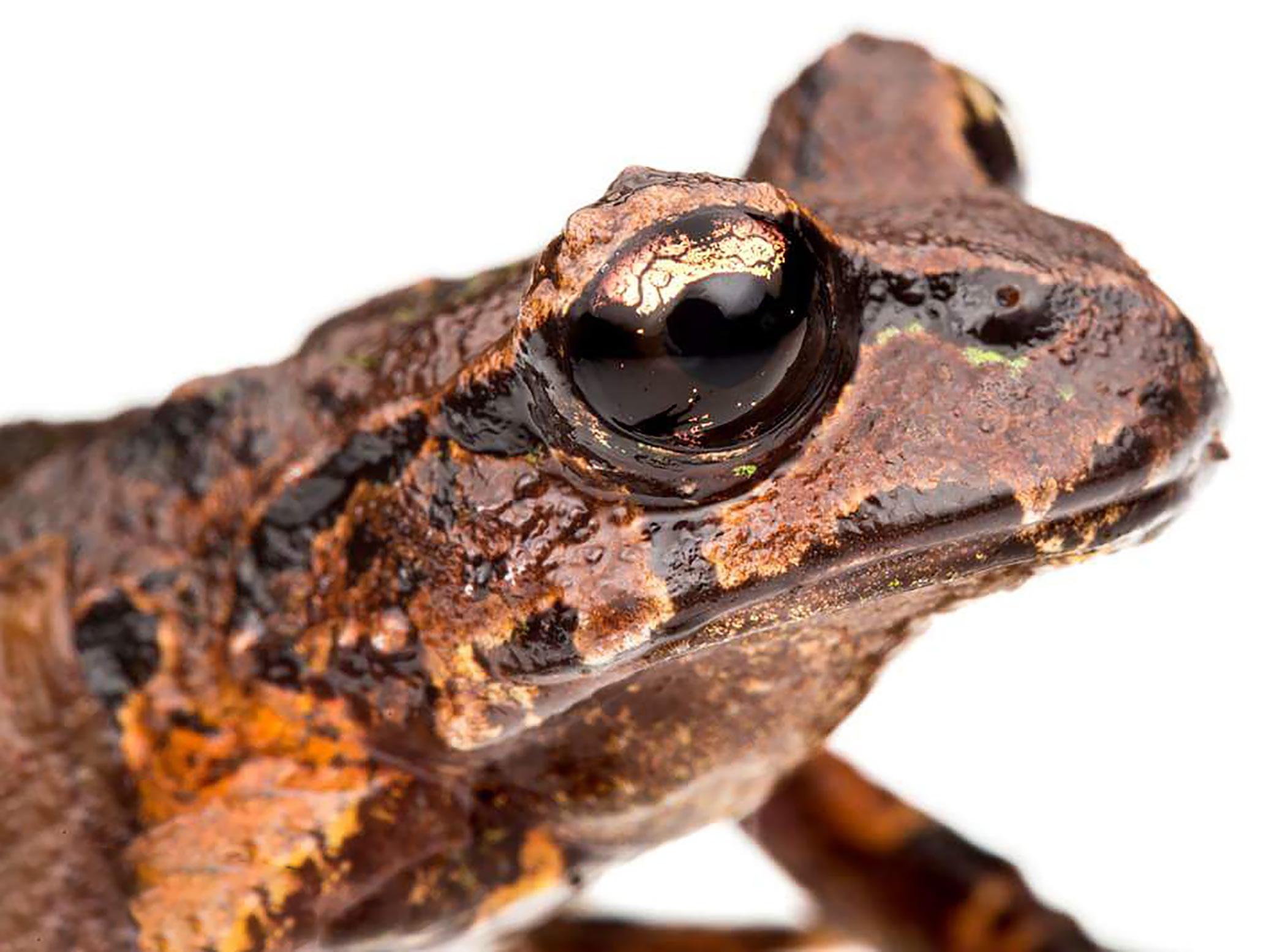
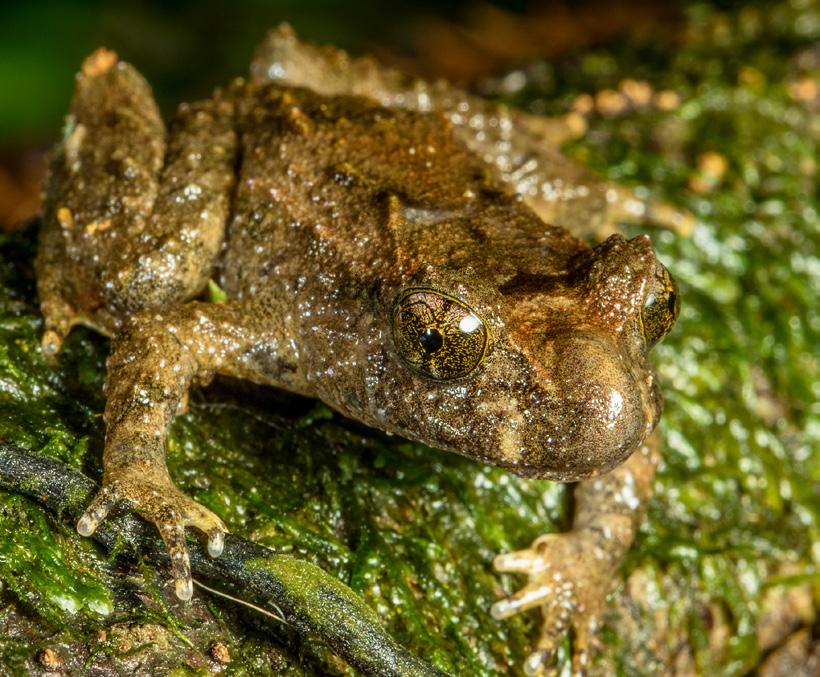
Should the proposed landfill go ahead, it would permanently remove about 12km of streams and result in the loss of numerous endangered species, including many rare pepeketua Hochstetter’s frogs. The landfill would also impact the nationally critical pekapeka long-tailed bats, indigenous freshwater species, and five lizard species.
Forest & Bird’s appeal challenged the Environment Court’s interpretation of environmental bottom lines contained in the National Policy Statement for Freshwater Management and the Auckland Unitary Plan, and the approach it took to assessing the landfill’s environmental effects.
The decision has also been appealed by Te Rūnanga o Ngāti Whātua. Both appeals have been supported by Fight the Tip, Te Uri o Hau, and Ngāti Whātua Ōrākei.
Meanwhile former in-house lawyer Sally Gepp was made a King’s Counsel in June. Sally worked for Forest & Bird for nine years before leaving to start her own legal practice in 2019. The rank of King’s Counsel is awarded to barristers who have demonstrated excellence in their careers.
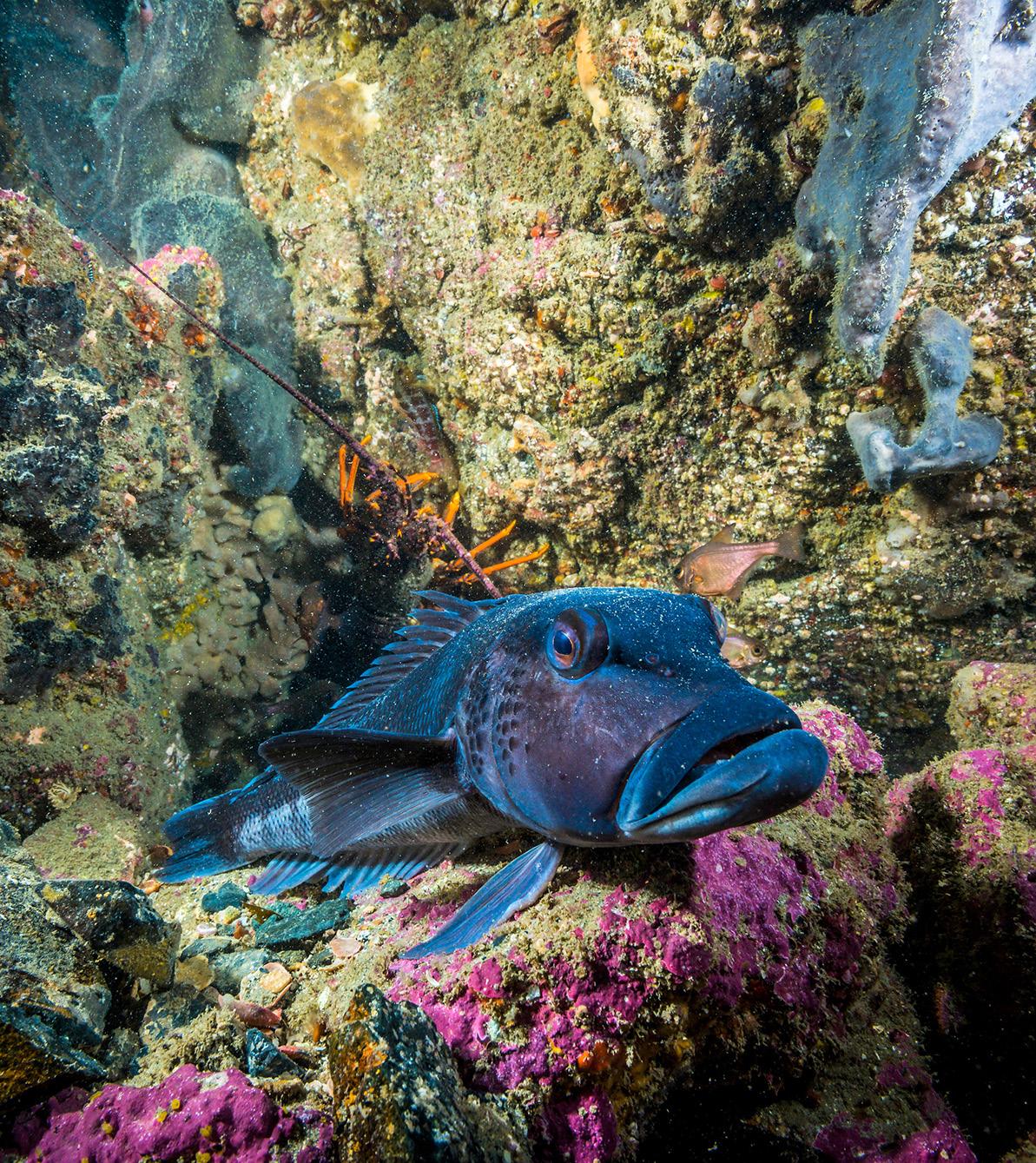
Blue cod, Tawharanui Marine Reserve, Hauraki Gulf Darryl Torckler
Forest & Bird lawyers May Downing and Peter Anderson at the High Court. Forest & Bird
PLANTING FOR PEKAPEKA
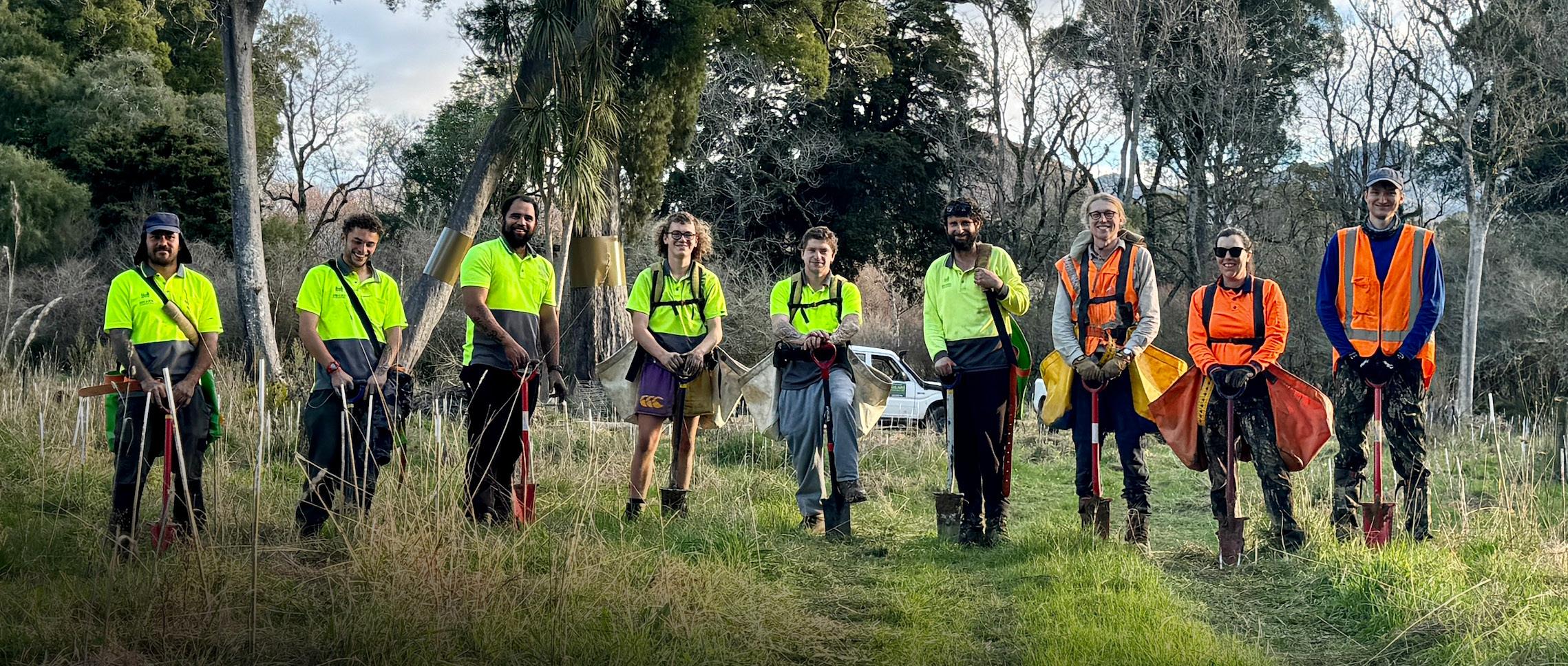
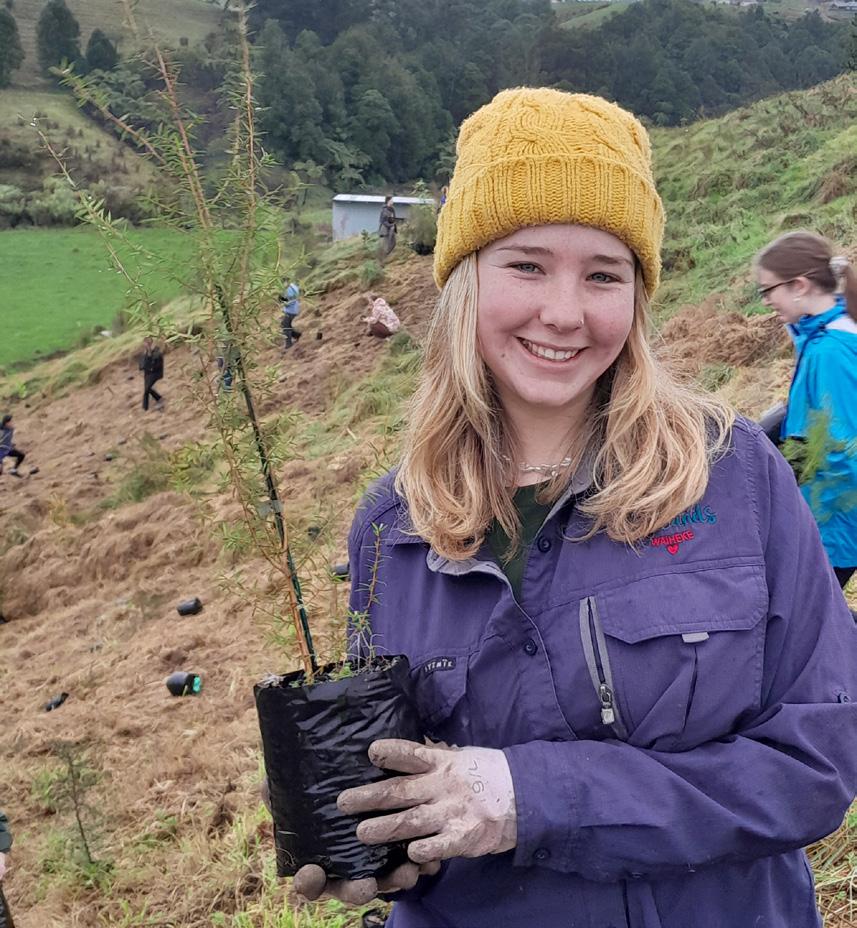
Forest & Bird and our Te Hoiere Bat Recovery Project partners have been working hard this winter planting more than 20,000 native plants at Ronga Recreational Reserve, in the Rai Valley near Pelorus Bridge, to restore pekapeka long-tailed bat habitat.
Kānuka, South Island kōwhai, lowland tōtara, tī kouka, pittosporum, and tarata were heeled in, joining the thousands of natives that had already been planted by Forest & Bird branch volunteers in the Ronga Reserve over the past decade.
Forest & Bird’s eco team spent more than a year removing weeds from the site in preparation for the
winter planting programme, which was achieved with the help of J&S Mears Contracting. Marlborough District Council will care for the new plantings through their vulnerable establishment phase.
Since 2011, Forest & Bird’s Te Hoiere Bat Recovery Project has been leading efforts to protect pekepeka colonies at the Pelorus Bridge Scenic Reserve. By partnering with Te Hoiere Project and Jobs for Nature, the team has also been been able to extend its bat protection predator control to neighbouring Rai Valley, where bats have been found to roost in other DOC reserves, including 18ha Ronga.
FORCE OF NATURE
Special launch offer – 20% discount
Force of Nature is the landmark history of Forest & Bird, celebrating 100 years of groundbreaking effort. This magnificent publication is one of the most important books about conservation in Aotearoa to have been written in decades. It is guaranteed to make you proud to be a supporter of Forest & Bird. For more information – see forestandbird.org.nz/forceofnature.
time price $72.00 + P&P
Planting team at Ronga Reserve Forest & Bird
Looking after
OUR LAKES
Wouldn’t it be wonderful if the current government worked with local communities to restore our polluted lakes rather than waging war on them? Tom Kay
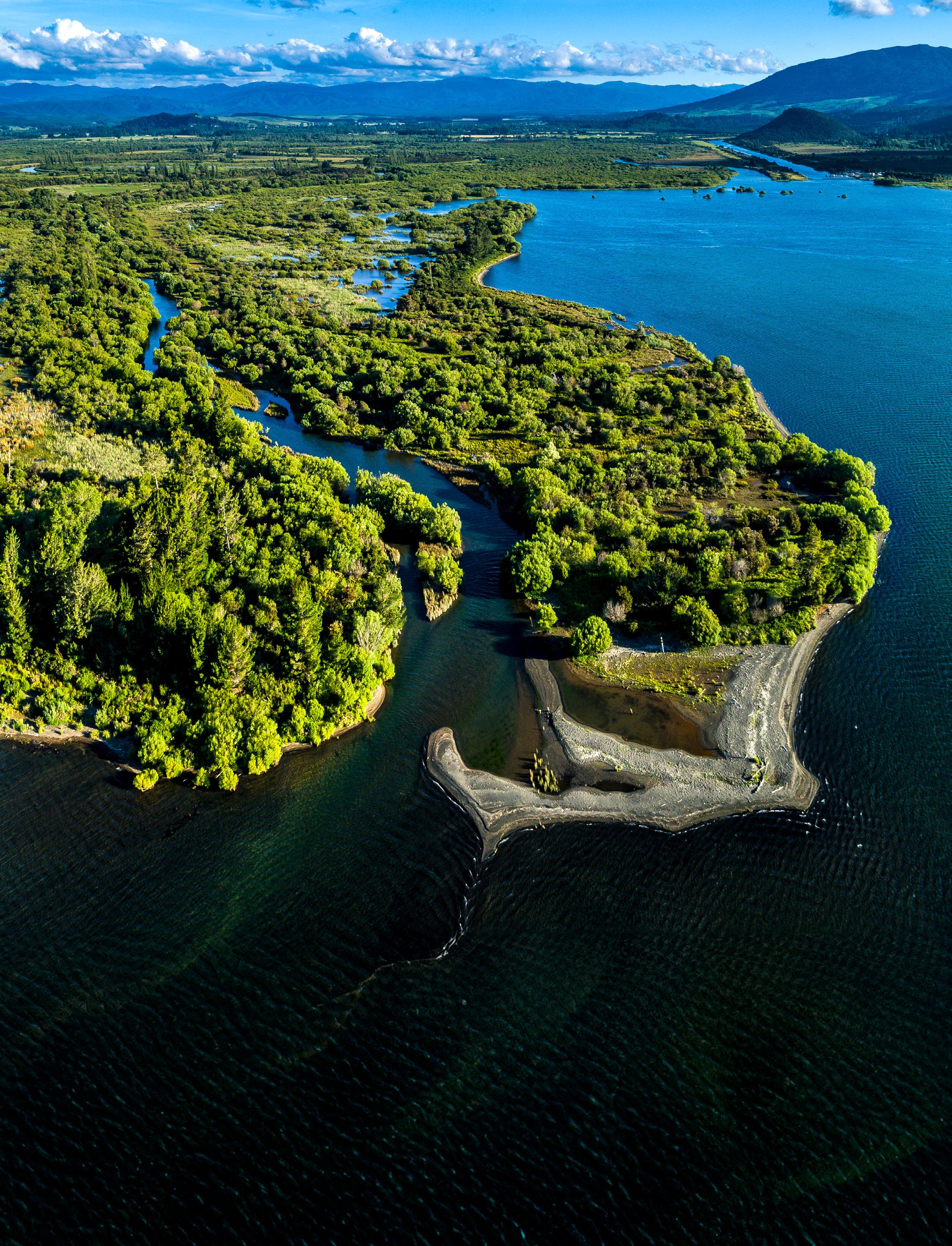
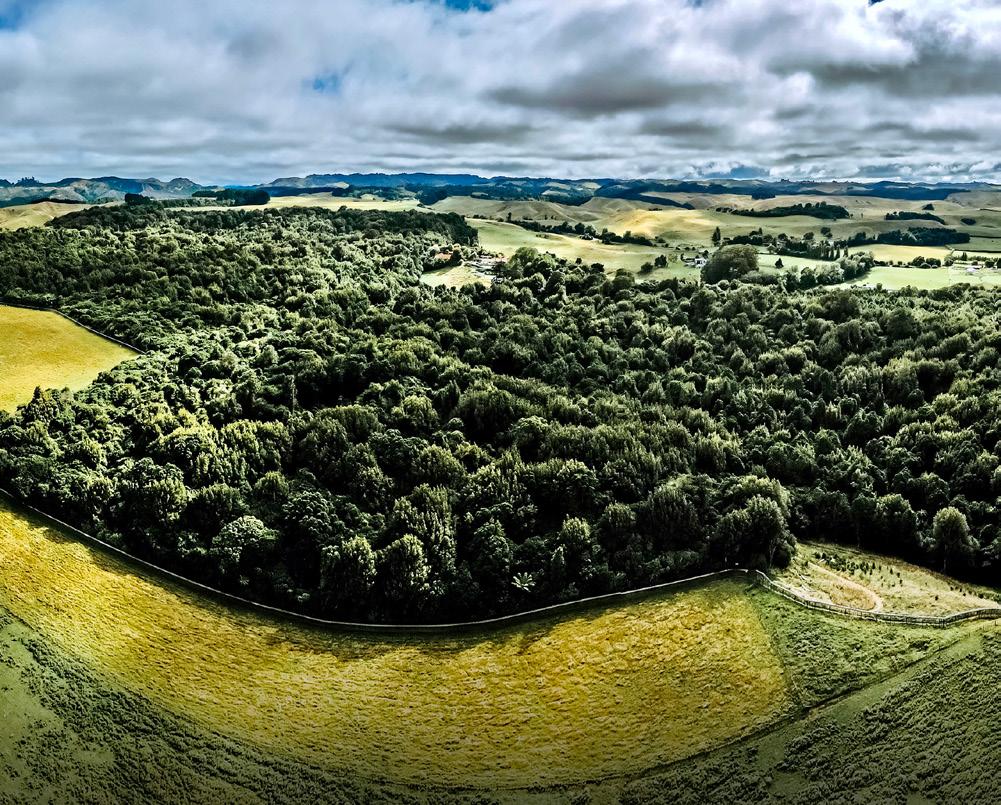
Aerial view of the southern end of Lake Taupō. Rob Suisted
Tom Kay |
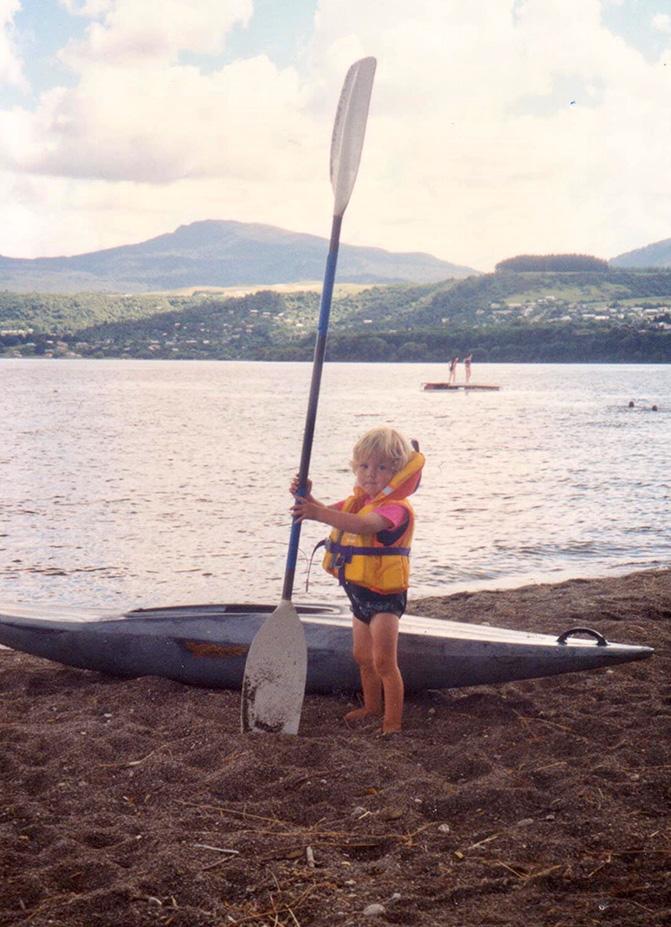
One of my favourite family photos was taken when I was almost three years old. I’m standing on the shores of Lake Taupō in front of the kayak my dad used to teach outdoor education, holding a paddle twice my size.
It captured the most joyous and special moments of my childhood, swimming in the clear and cold waters of Taupō Moana and marked the start of a life of adventure on lakes and rivers around Aotearoa New Zealand.
I didn’t know it then, but, when the photo was taken in 1997, water quality in Lake Taupō had begun to degrade. Activities on surrounding land, especially dairy farming, were leaching nutrients to the lake at a rate that threatened its health.
Thankfully, long-term damage was averted by Waikato Regional Council, which moved to introduce new rules to limit nitrogen loads into the lake – and land users had to comply with them.
Central, regional, and local government also invested more than $80m to reduce nitrate leaching and encourage alternative less damaging land uses, such as forestry, and sheep and beef farming, in the catchment. These activities were still productive and economically beneficial but leached less nitrate.
Lake Taupō was preserved in a near-pristine state and became a world-leading example of freshwater public policy success. The lake was saved by decision-makers, iwi, farmers, and landowners who chose to prioritise freshwater health for people and the planet.
Sadly, the huge effort it took to save Lake Taupō is an exception in Aotearoa. Since I first picked up my paddle 27 years ago, communities throughout the country have experienced a severe decline in the health of their local lakes, rivers, streams, wetlands, and estuaries.
A boom in intensive dairy farming saw the number of milking
cows in New Zealand almost double to 6.3m from 1990 to 2019. Nitrogen fertiliser use increased by 629% from 62,000 to 452,000 tonnes over a similar period.
Cow urine is full of nitrogen, and this pollutant leaches into waterways. Nitrate levels in groundwater, including in some drinking water sources, are dangerously high in parts of the country and continue to increase. Phosphorus and pathogens from farming continue to pollute our water too.
The area of artificially irrigated land has also doubled since the 90s to provide pasture for the intensively farmed dairy cows. This significantly reduced the flow in some rivers, further degrading the health of water and contributing to the development of algal blooms.
Today, most lakes and rivers are in big trouble. Some of our largest and best-known lakes are the sickest, such as Te Waihora Lake Ellesmere, in Canterbury, Lake Horowhenua, near Levin, and Lake Waikare, in the Waikato.
The water quality of all three is categorised as “exceedingly poor”, according to the Lakes 380 map, which assesses the water quality of Aotearoa’s precious lakes.
This category means they have exceptionally high levels of pollution, have algal blooms in summer, and are not usually suitable for swimming. You can check the quality of your local lake at lakes380.upshift.co.nz.
Our pollution problems are exacerbated by rain flushing contaminants from urban and rural land into waterways, raising the risk of swimmers becoming ill. We saw this happen in the River Seine during the Paris Olympics in July. Several triathletes got sick from pathogens associated with E. coli.
Here in New Zealand, many of our favourite childhood swimming spots exceed water quality limits for E. coli and toxic algae. Numerous swimming spots carry
warning signs every summer. Families must check the “Can I Swim Here?” section of the Land, Air, Water Aotearoa website (lawa. org.nz) to see whether it’s safe to swim in their local lake, river, estuary, or beach.
Sick rivers are bad for wildlife too. Nutrient pollution drives algal growth, which sucks oxygen out of the water and suffocates our fish. Today, 76% of native fish, including whitebait species and tuna longfin eel, are threatened with, or at risk of, extinction.
When it comes to freshwater, 100% Pure New Zealand is a myth.
Over the past decade, following campaigns by Forest & Bird, Choose Clean Water, Greenpeace, and many others, public concern about the state of our waterways has grown and politicians have started to take notice.
The previous Labour government introduced an Essential Freshwater policy package in 2020. This included an updated National Policy Statement for Freshwater Management – a promising move forward after 10 years of incremental change had not reversed the downward trend in freshwater health.
The new approach embedded a fundamental concept called Te Mana o te Wai. Essentially this recognised that without healthy freshwater we cannot have healthy people or communities.
Tom Kay, aged two, testing out his paddling ability, Lake Taupō, 1997. Supplied
It included a “hierarchy of obligations”, prioritising the health of freshwater bodies and ecosystems first, then the health needs of people, and, finally, the ability of people and communities to provide for their social, economic, and cultural wellbeing.
Saving Lake Taupō in the 2000s is a good example of Te Mana o te Wai in action. We need to prioritise the health of freshwater in decision-making. Yet the current coalition government is determined to go backwards.
Lakes, rivers, and streams are the next target in its War on Nature.
As I write this, legislation is going through Parliament that will allow the hierarchy of obligations set out in Te Mana o te Wai to be bypassed by decision-makers.
Soon, the government plans to “review and replace” the National Policy Statement for Freshwater Management 2020. Ministers claim to want the policy to “better reflect the interests of all water users” and allow “more flexibility” in how environmental limits are met.
What they really mean is they want to go back in time and allow private commercial interests
to profit from freshwater while polluting it with impunity.
Right now, New Zealand is in a unique position. We have worldleading environmental policies that recognise the fundamental importance of freshwater to our collective health. As human beings, we cannot survive without healthy lakes, rivers, streams, estuaries, and wetlands.
Two decades of consultation with communities, tangata whenua, and businesses, as well as evidence-based debate with industry, went into the Essential Freshwater policy package in 2020. It exists as a compromise between groups in response to collective public concern.
While it is not perfect, it has the potential to restore freshwater health across Aotearoa.
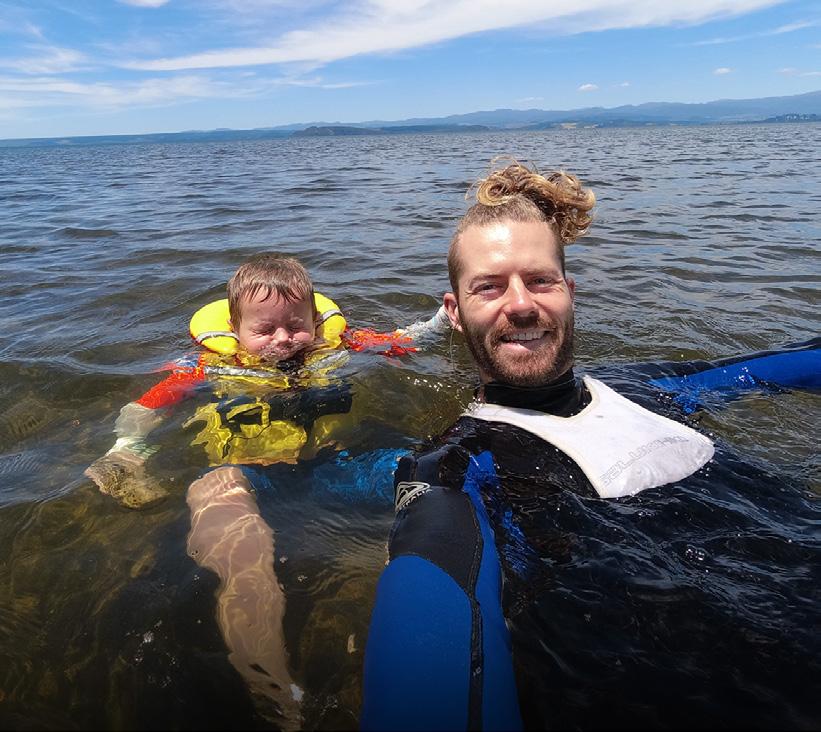
I have another favourite family photo. It was taken last summer, swimming in Lake Taupō with my two-year-old nephew Riley. Sharing the clear and cold waters with him nearly three decades after my parents introduced them to me brings me an indescribable sense of joy and purpose. It is even more special knowing the lake was saved by the generation before me for exactly this reason.
If we hold on to the National Policy Statement for Freshwater Management 2020 and the Te Mana o te Wai hierarchy of obligations, we can replicate the success of Lake Taupō throughout the country. It will not happen overnight, nor will it make every river or lake pristine. But over time it will make them, and us, healthy.
Our families, and our children and our grandchildren, will have access to clean drinking water and swimmable rivers. And our communities will thrive.
We cannot let the government take that future away from us.
Tom Kay is Forest & Bird’s freshwater advocate and is leading Forest & Bird’s fight for freshwater campaign.
WHAT IS FOREST & BIRD DOING?
In July, Forest & Bird lodged a submission against the Resource Management (Freshwater and Other Matters) Amendment Bill, explaining how it weakens freshwater protections.
Our freshwater advocate Tom Kay also made an oral submission to the Primary Production committee, which can be viewed at https://bit.ly/3SPHBXT. We are expecting the select committee’s report in September.
Earlier in the year, Forest & Bird also drafted a submission on the Local Government (Water Services Preliminary Arrangements) Bill, which included changes undermining the Te Mana o te Wai hierarchy of obligations.
We will continue our fight for freshwater when the coalition government starts its review and public consultation on the National Policy Statement for Freshwater Management 2020, including the Te Mana o te Wai hierarchy of obligations, later this year or early 2025.
FIGHT FOR FRESHWATER
No going back! Our lakes, rivers, streams, wetlands, and freshwater species need your help. A gift will help ensure New Zealand’s world-leading freshwater protections are not watered down. We need to raise our voices and stop this precious natural resource degrading further. You can help make sure our drinking water is safe, rivers are swimmable, and our freshwater habitats are healthy so our birds, fish, lizards, and insects can flourish. Find out more and make a gift at forestandbird. org.nz/fightforfreshwater
Forest & Bird’s freshwater advocate, Tom Kay, swimming with his nephew Riley, Lake Taupō, 2023. Supplied
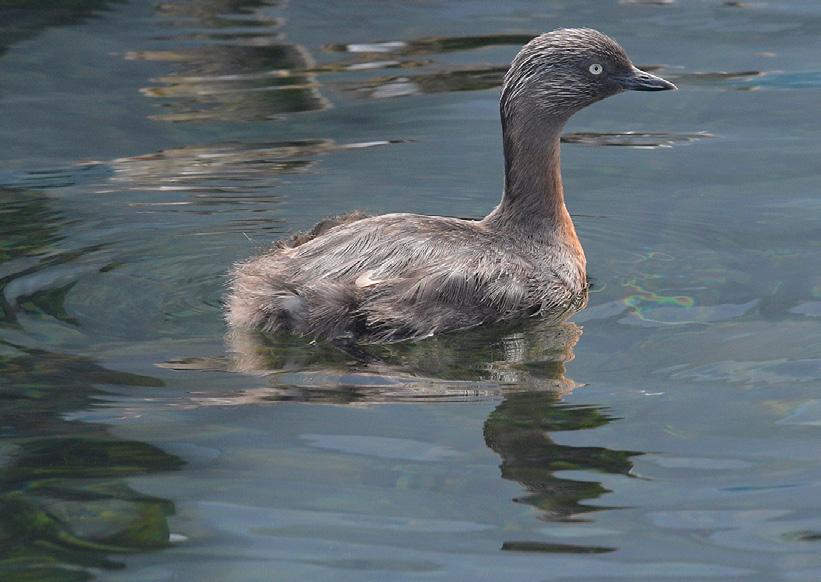
Lake Taupō is home to at least 31 species of aquatic birds, including rare weweia dabchick. John Nelson
ODE TO
Flowers
Writer
and conservationist Gail Ingram celebrates native alpine plants in her latest poetry collection Caroline Wood
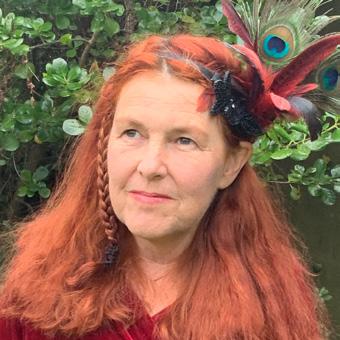
Four years ago, award-winning Christchurch writer and Forest & Bird member Gail Ingram was walking with friends in Arthur’s Pass National Park when she spied a dainty New Zealand foxglove in flower next to a mossy creek.
“I was so delighted I spent ages trying to get a really great photo. I remember saying to my friends, ‘You know what, this is going to be my next collection – I’m going to write about these little understated mountain beauties.’
“And that was it! For the rest of that day, I kept finding flowers and taking photos. I went home and began a blog – a poem on a flower a day for a month. It then took another four years to get it published.”
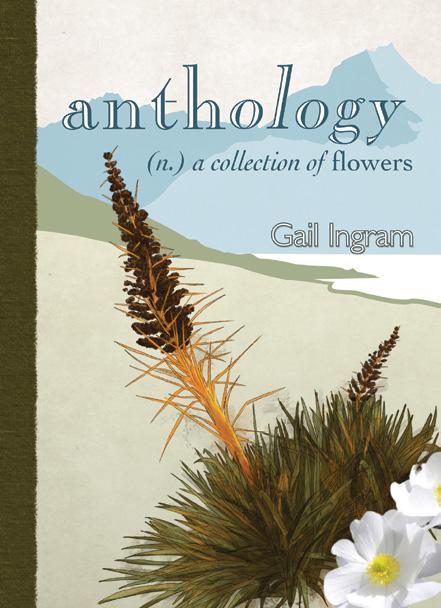
Part illustrated field guide, part travelogue, anthology (n.) a collection of flowers takes readers on a spiritual journey through the mountains of (mainly) Te Waipounamu the South Island.
The native alpine flowers Gail encountered on her walks were the inspiration for each poem, which are shared and layered with personal memories, thoughts, and a sprinkling of humour.
The book is organised into sections: Roots, Breathing light, Flowering, Going to seed, and Regeneration. Each page contains a native plant species, a photograph, brief field notes, and a poem.
Gail says some of the plants in the anthology were photographed in Forest & Bird’s Calder Green Reserve, a place close to Gail and her husband Mick Ingram’s hearts as they have been involved in helping looking after it for many years as North Canterbury Branch volunteers.
“The book’s themes marry with conservation as well as natural, cultural, and personal history,” Gail added. “I’ve always delighted in our native flowers – they’re so surprisingly small and wonderful – a bit like poems.”
anthology (n.) a collection of flowers, Pūkeko Publications, RRP $30.
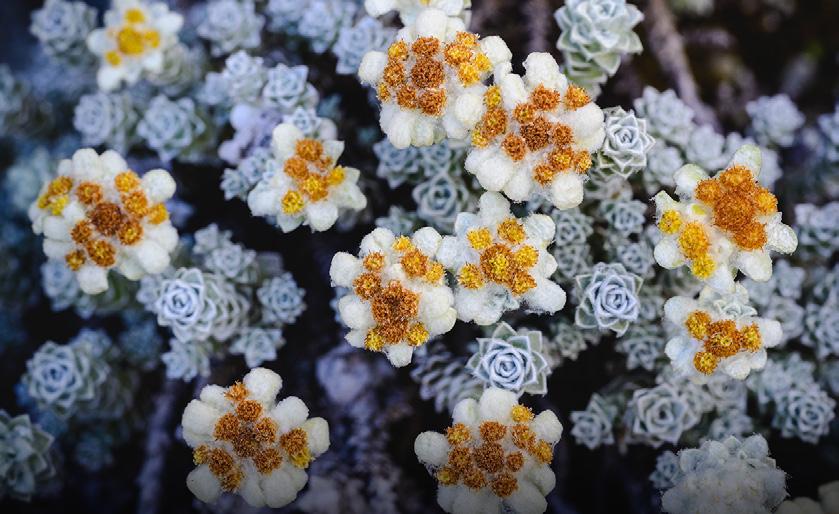
Growing above the bushline (as high as 1900m), South Island edelweiss (Leucogenes grandiceps) is endemic to New Zealand.
What would you like to drink, Edelweiss, some droplets of icy mist, formed high in the stratum of mountain, would that be okay? We can add a drop of ozone, the honey scent of beech and clematis, it’s so nice to be here with you today, sipping from my flask, Edelweiss, the view is outstanding, the Hooker is cracking through the roar, a funnelled zephyr, and all of this become of you, and I am truly engaged with your high-ness, your woolly lion paws against the cool grey on grey, the lichen throw on your stony throne, and your yellow-brown eyes, held up by your noble delicate faces. Is this a good time, Edelweiss? should I tell you I already regret I cannot stay here, rapt forever in your perfect elevation?
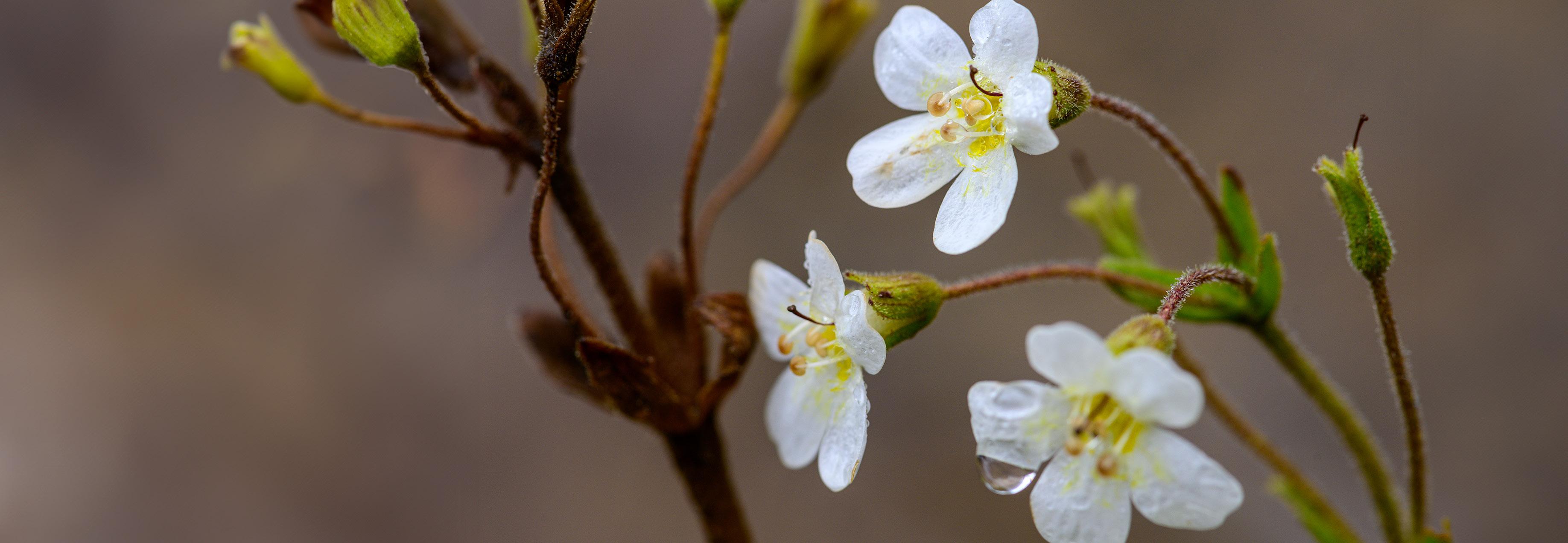
Mountain foxglove (Ourisia macrophylla), Tongariro National Park. Jake Osborne
FIELD NOTES:
High Tea by Gail Ingram
Gail Ingram
South Island edelweiss Jake Osborne
SAVING MOHUA
Conservationists had to move fast to protect Makarora mohua from being wiped out in a recent beech mast rat plague – and their efforts paid off. Jo Tilson
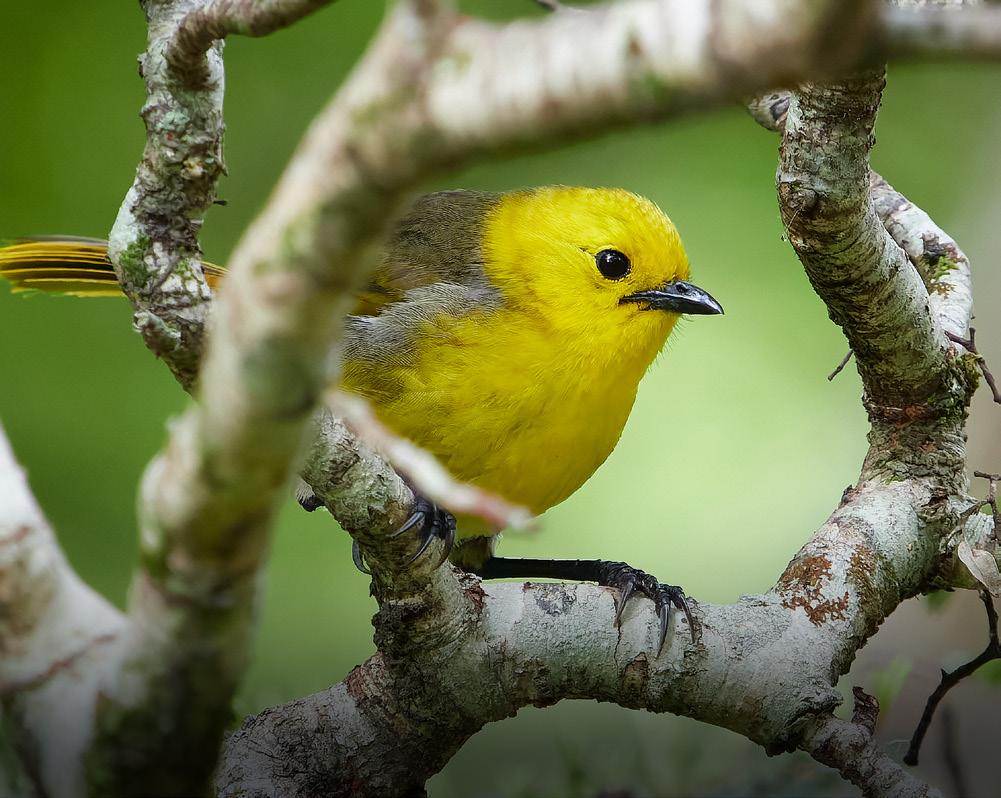
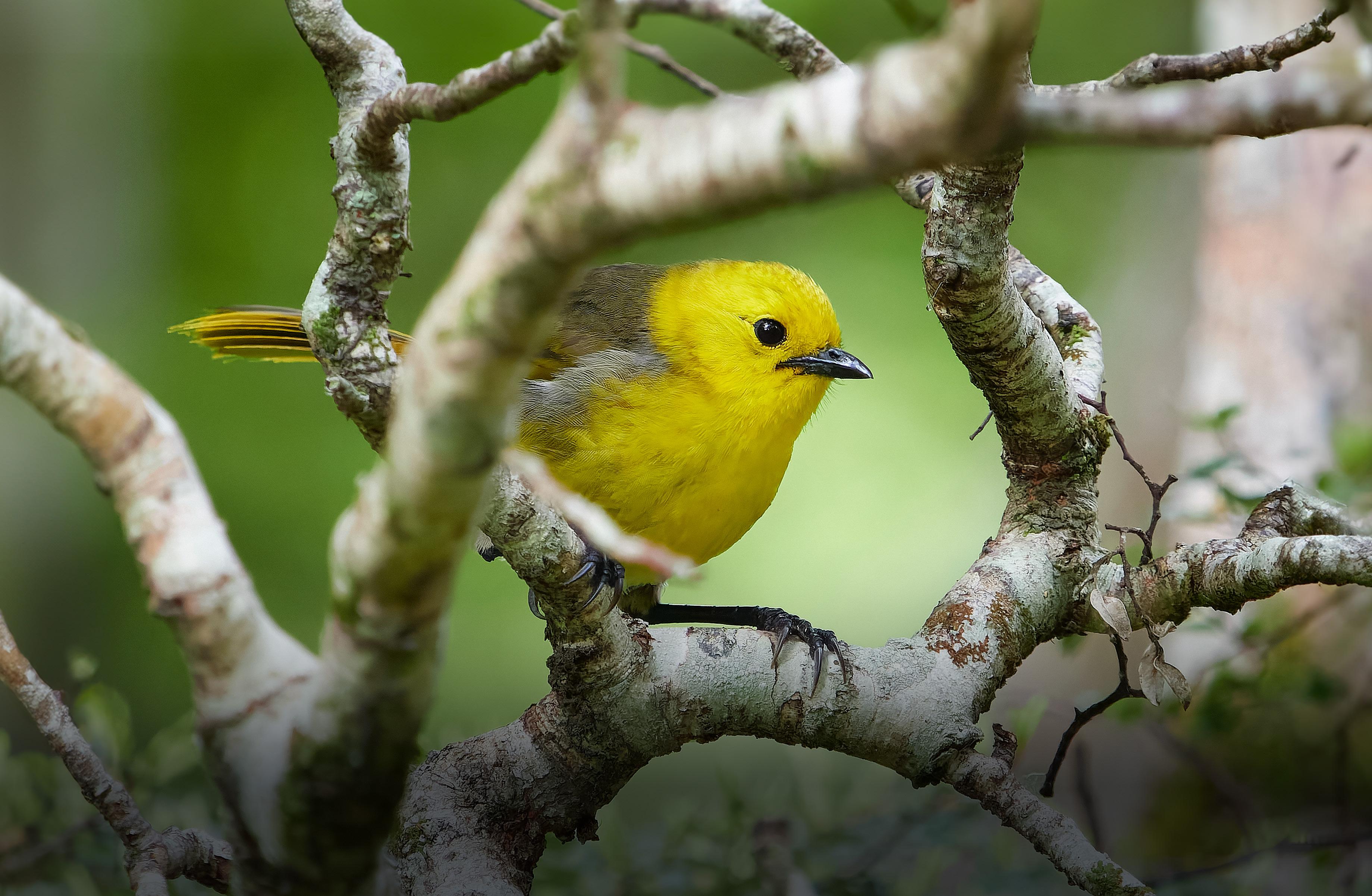
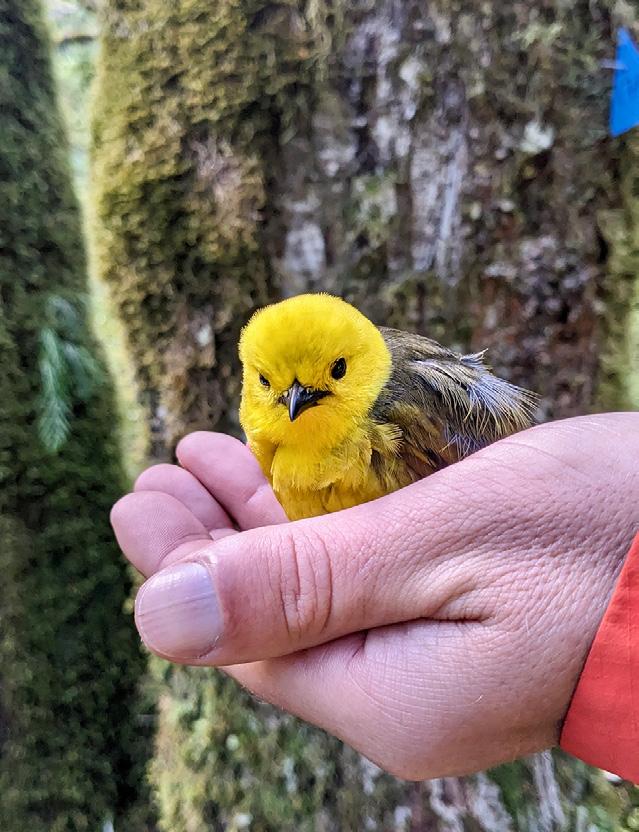
In the majestic Makarora Valley, north of Lake Wānaka, a tiny bird with a bright yellow head fights for survival. Mohua (Mohoua ochrocephala) have persisted here against ever-increasing odds.
These small insectivorous hole-nesting passerines belong to an endemic genus that includes pōpokotea whitehead (M. albicilla) and pīpipi brown creeper (M. novaezelandiae).
Only mohua are endemic to the South Island of New Zealand. Known as the bush canary by the early settlers due to their melodious calls and vibrant colour, they are special enough to grace our most highly valued denomination, the $100 note.
But for 200 years these birds have been victims of a relentless onslaught of adversity, from habitat destruction to constant and ever-
present predation by rats and stoats.
As a result, they have now disappeared from 85% of their former range and are often sadly referred to as New Zealand’s “climate change canary” because of their warming habitat (see p 19).
A beacon of beauty and resilience amid the beech forest, the small Makarora mohua population has been valiantly hanging on, helped in part through the commitment of volunteers from Forest & Bird’s Central Otago Lakes Branch. They have become guardians of this forest, where they have been trapping predators for more than 25 years.
In 1998, the branch leaders became concerned about the declining numbers of mohua in the beech forests surrounding the Makarora River, north of Lake
Wānaka. Together with DOC, they established some trap lines and started to look after mohua in the area.
For the past three years, the branch has been a consortium partner in the Southern Lakes
Mōhua yellowhead. Jeremy Sanson
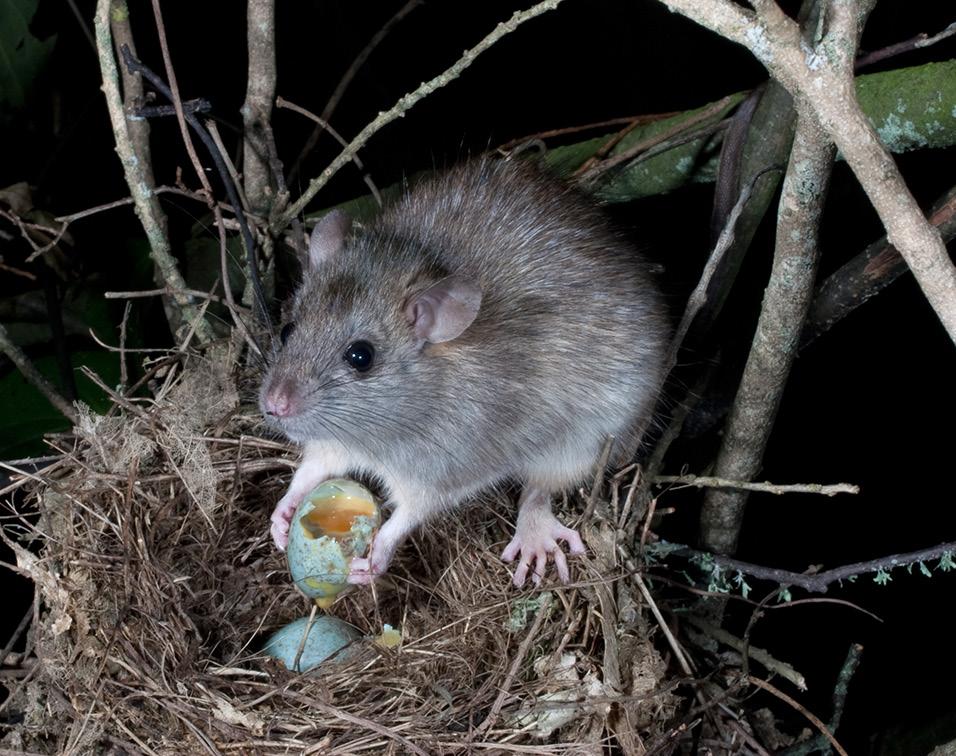
Ship’s rats like this one climb trees to eat mohua chicks, eggs, and adult females Ngā Manu Images
Sanctuary, a landscape-scale community initiative carrying out essential biodiversity protection work across 660,000ha of the Southern Lakes region.
This partnership has enabled far more predator control and monitoring mahi to be undertaken at Makarora. There are now 1440 traps on 18 traplines totalling about 100km in Makarora.
About 500 of these traps protect 500ha of prime silver beech forest habitat, where mohua have been monitored intensively over the past three years.
But last year, 2023, was a year to match few others. A significant beech mast event led to a massive rat plague that threatened to wipe out the fragile mohua population.
efforts along all existing trap lines from July 2023 through to December 2023, and the installation of 710 bait stations across 360ha in a core management area.
In doing this, we enabled 95% of banded mohua to survive in the areas of intensive predator control, despite this being one of the biggest rat plagues in Makarora since monitoring began in 2011.
A banding programme, which included carefully capturing and tagging 30 mohua between October and December 2023, played a crucial role in monitoring their progress. It was carried out in collaboration with Atarau Sanctuary for a long-term mohua survival study.
These fledglings are the embodiment of hope, tiny symbols of what can be achieved through human compassion and intervention.
And it wasn’t just mohua that benefited at Makarora, thanks to the extra mahi by the Central Otago Lakes Branch–Southern Lakes Sanctuary alliance.
In late October and November last year, the whole forest was literally abuzz with chick noises.
One day, I saw a precariously balanced miromiro nest, positively overflowing with chicks, and tītīpounamu were everywhere.
The only tool that could counter this threat would have been an aerial 1080 application carried out before spring to reduce rodent numbers before birds are nesting and most vulnerable.
Since this wasn’t an option, the Central Otago Lakes Branch–Southern Lakes Sanctuary alliance bandied together in a Herculean effort to try and prevent complete annihilation of the Makarora mohua.
This saw a doubling of trapping
Each bird was given a unique colour combination for easy identification. This came in handy as a way to monitor survival rates following the rat plague. The banding is for a long-term mohua territory occupancy and survival study in collaboration with Atarau Sanctuary.
Not only did the majority of territorial adults survive in the core area but six out of nine monitored pairs successfully hatched chicks.
Miraculously and against the odds, 18 fledglings took their first tentative flights from their nests. Their parents, vigilant and tireless, had managed to raise them despite the ever-present predators.
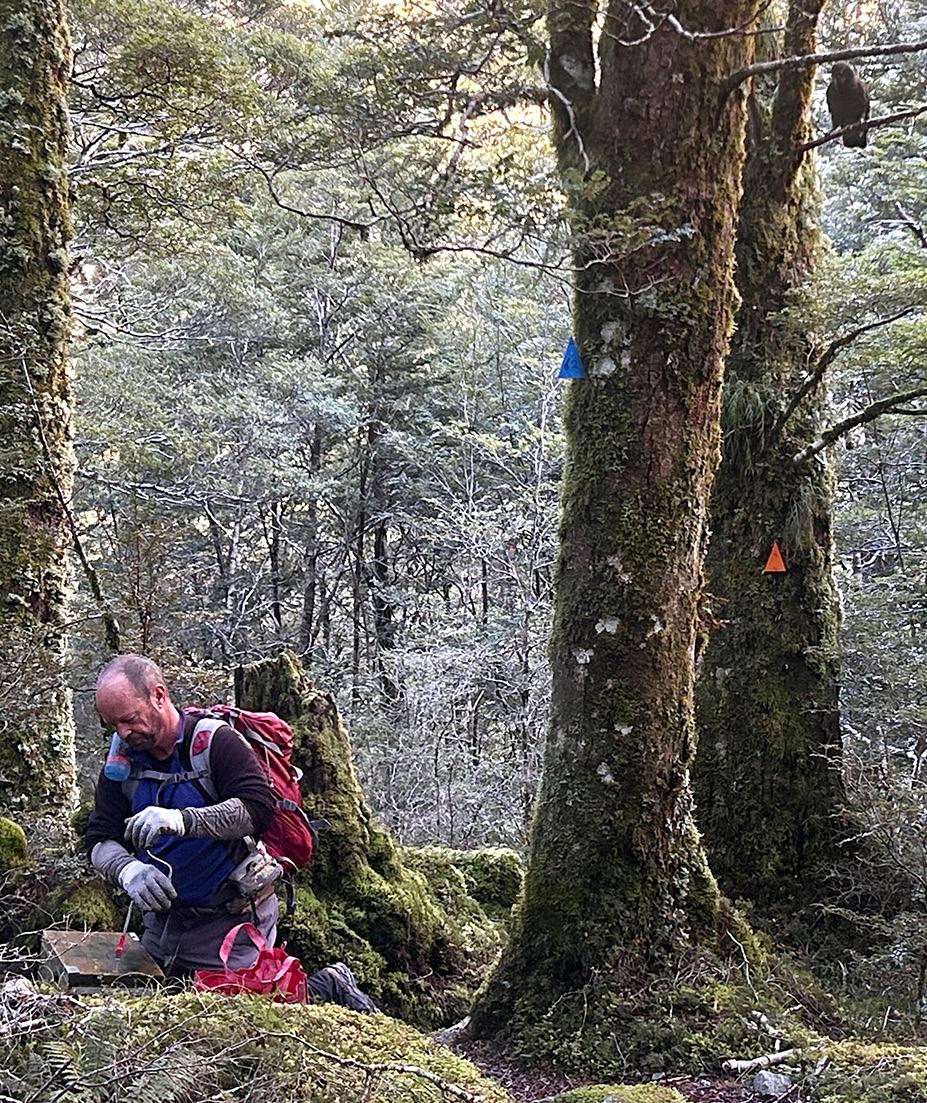
A kea observes volunteer Phil Watson setting traps at Makarora. Catherine Watson
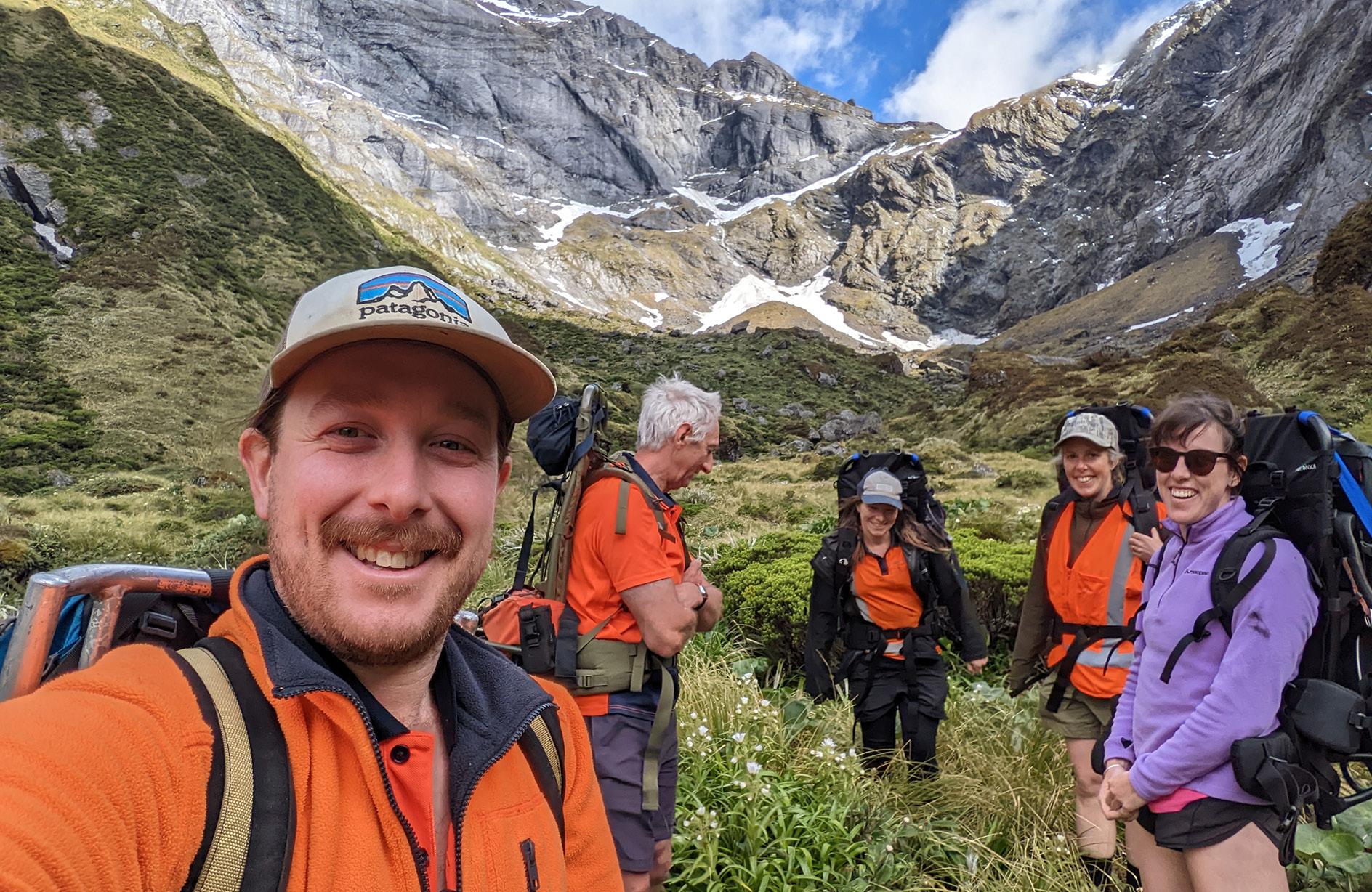
Southern Lakes Sanctuary team members. From left to right, Tom Reeves, Paul Millis, Jenn Noakes, Sarah Forder, and Adie Lawrence.
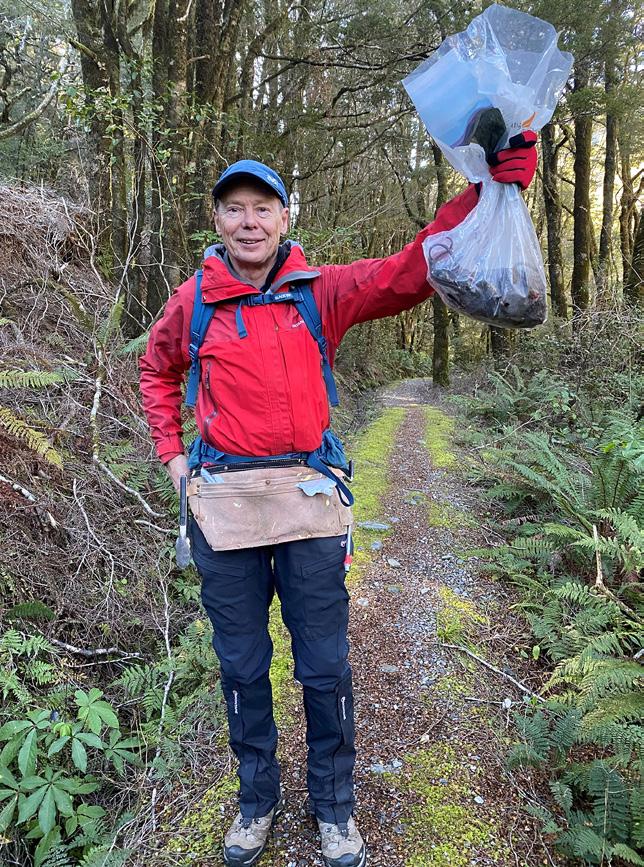
Central Otago Lakes Branch volunteer Pete Trethewey with a bag of dead rats. Di Trethewey
Pīwakawaka fantail families flittered about while pīpipi chattered in the treetops. It was truly a pleasure to hear and behold.
But beyond this tentative haven, the story is not so rosy.
A mohua nest south of the Blue River was less well protected, and one of its chicks was found dead just days after first seen, a tragic testament to the relentless pressure from predators.
Outside the core managed site, mohua numbers appear to have plummeted, with entire groups vanishing from peripheral areas.
Populations that were once
considered strongholds are now male dominated as nesting females are more vulnerable to ship’s rats. This is a stark reminder of the battle still raging.
As the year turned and the breeding season came to a close, an aerial 1080 operation was finally conducted in April 2024, thanks to lobbying from the the Southern Lakes Sanctuary-led alliance.
This was a a last-resort measure to curb the out-of-control rat population. It will have come too late for many mohua, but for the survivors it has offered a glimmer of hope.
MAKARORA MOHUA: WHAT DOES THE FUTURE HOLD?
For the Central Otago Lakes Branch–Southern Lakes Sanctuary partnership, our effort has been rewarded by the successful survival of mohua within the core management area. We look forward to trapping in 2024/25 with renewed vigour.
Continued monitoring, activation of bait stations when needed, and expansion into other areas will also be crucial. Into the future, frequent and timely 1080 applications will be required.
Translocations from other sites may also be necessary to infuse new genetic diversity into the dwindling population.
Getting the Department of Conservation to recognise Makarora as a core mohua site when planning the distribution of future 1080 resources is also critical in maintaining these precious taonga.
Where mohua persist, their melodious calls have been captured by acoustic monitoring devices. These devices form part of a collaborative project between the Southern Lakes Sanctuary and Atarau Sanctuary.
The project will help monitor
the birds without disturbing their natural behavior, helping the team to learn about their breeding habits, nesting success, survival, and group composition.
Raising our voice and our profile to ensure that retaining mohua in Makarora is an absolute priority, we are determined our project will not become another “Goodbye Freddie” story for Minister Jones.
For the Central Otago Lakes Branch–Southern Lakes Sanctuary alliance, each trap cleared, each bait station filled, and every rat removed is a testament to our unwavering dedication to these tiny songbirds.
The branch’s original project area near the Blue Pools, where trapping and poisoning efforts were concentrated, became a sanctuary for mohua in 2023. Our mission is to maintain this sanctuary and expand it so that it is more robust in future.
The story of the mohua in Makarora is one of fragile triumphs amid overwhelming challenges. It’s a story that calls on us to recognise the delicate balance of nature and the profound impact we can have through our actions.
Each mohua fledgling that survives is a victory, a small but significant step towards preserving the vibrant chorus of life in New Zealand’s forests.
In the face of adversity, the question remains — will the mohua’s song continue to grace the valleys, or will it become a distant memory, a victim of nature’s harsh realities and human interference and neglect?
The answer lies in our hands, in the dedication of those who refuse to let these beautiful creatures fade into silence.
Through continued efforts, both on the ground and in the air, the mohua’s story may yet have a happy ending, echoing through the Makarora Valley for generations to come.
Jo Tilson is a committee member for the Central Otago Lakes Branch of Forest and Bird and a staff member for the Southern Lakes Sanctuary, based in Wanaka.
Jo Tilson
Mohua needed a helping hand to survive the recent beech mast rat plague. Jo Tilson
WORTHY WINNERS
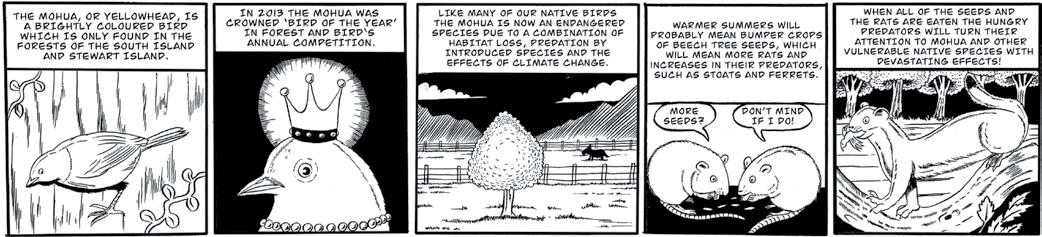
Mohua was crowned Bird of the Year in Forest & Bird’s ninth annual poll in 2013. It garnered nearly 20% of the total votes cast, with the runner-up being ruru morepork.
Using the tagline “vote mohua, not monorail’’, Green Party co-leader and mohua advocate Metiria Turei led the campaign for the little-known species that now mainly lives in Fiordland, Southland, and Otago. Mohua was once one of the most abundant forest birds in the South Island and Rakiura Stewart Island, said Forest & Bird’s advocacy manager Kevin Hackwell at the time.
“The mohua is a climate change canary,’’ he said. “Populations have suffered recently because a series of warm summers have caused beech trees to mast (produce large volumes of seeds) more frequently.
“In mast years, you see a spike in rat numbers, which eat the beech seed. This in turn causes a spike in stoat numbers, which eat the rats. Once the rats are eaten, the stoats go looking for alternative food, such as mohua and other native birds.”
Mohua are vulnerable to ship’s rats because they nest in tree holes. The female lays three to four eggs into a cup-shaped nest and sits on the hatched chicks to keep them warm. The male feeds the female while she incubates the eggs and helps feed the chicks.
Young mohua born the previous year often help parent mohua raise their young by bringing food to the nests for 22 days until the chicks are ready to fledge.
In 2024, there were estimated to be fewer than 5000 mohua spread over about 30 different populations.
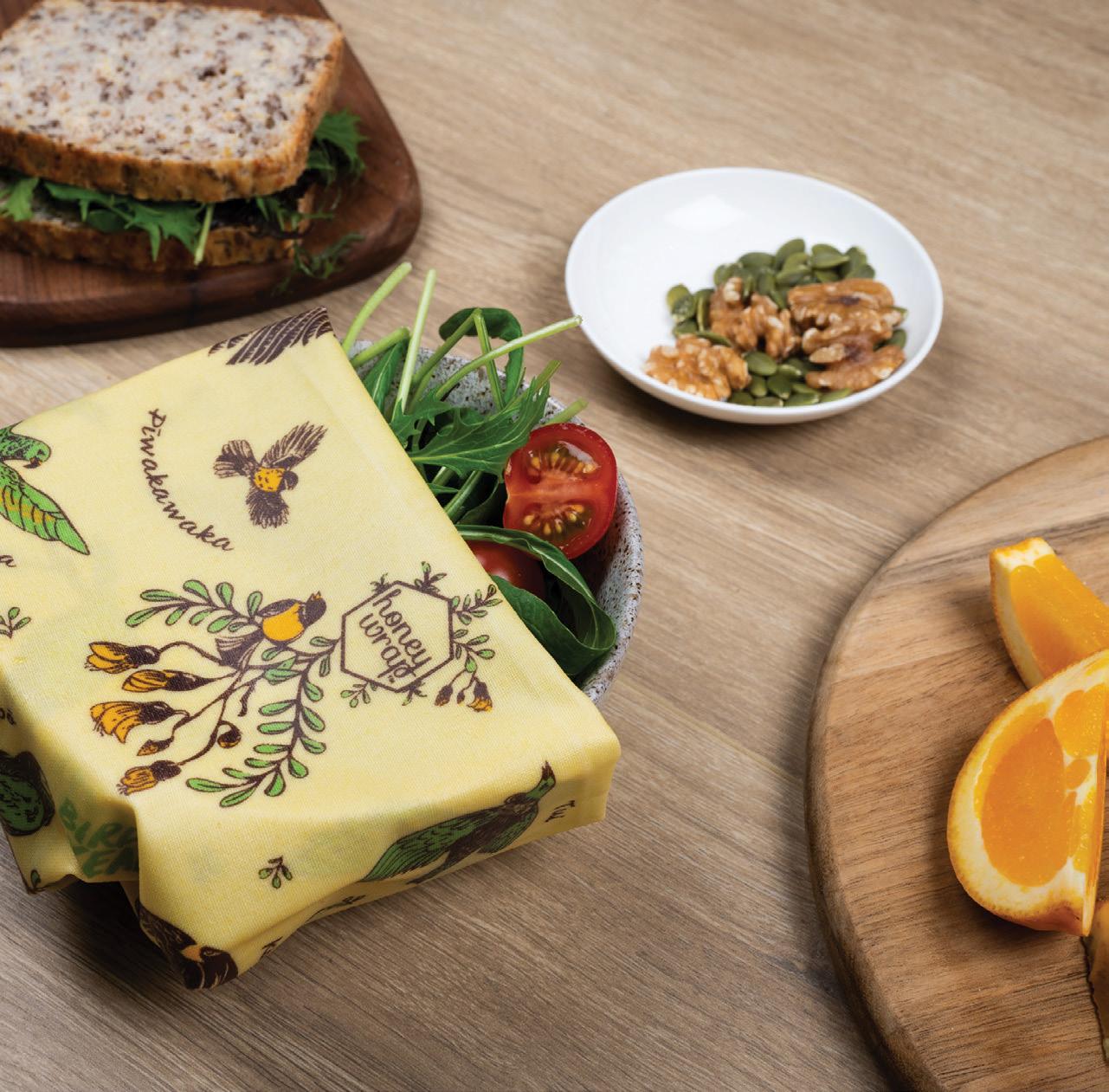
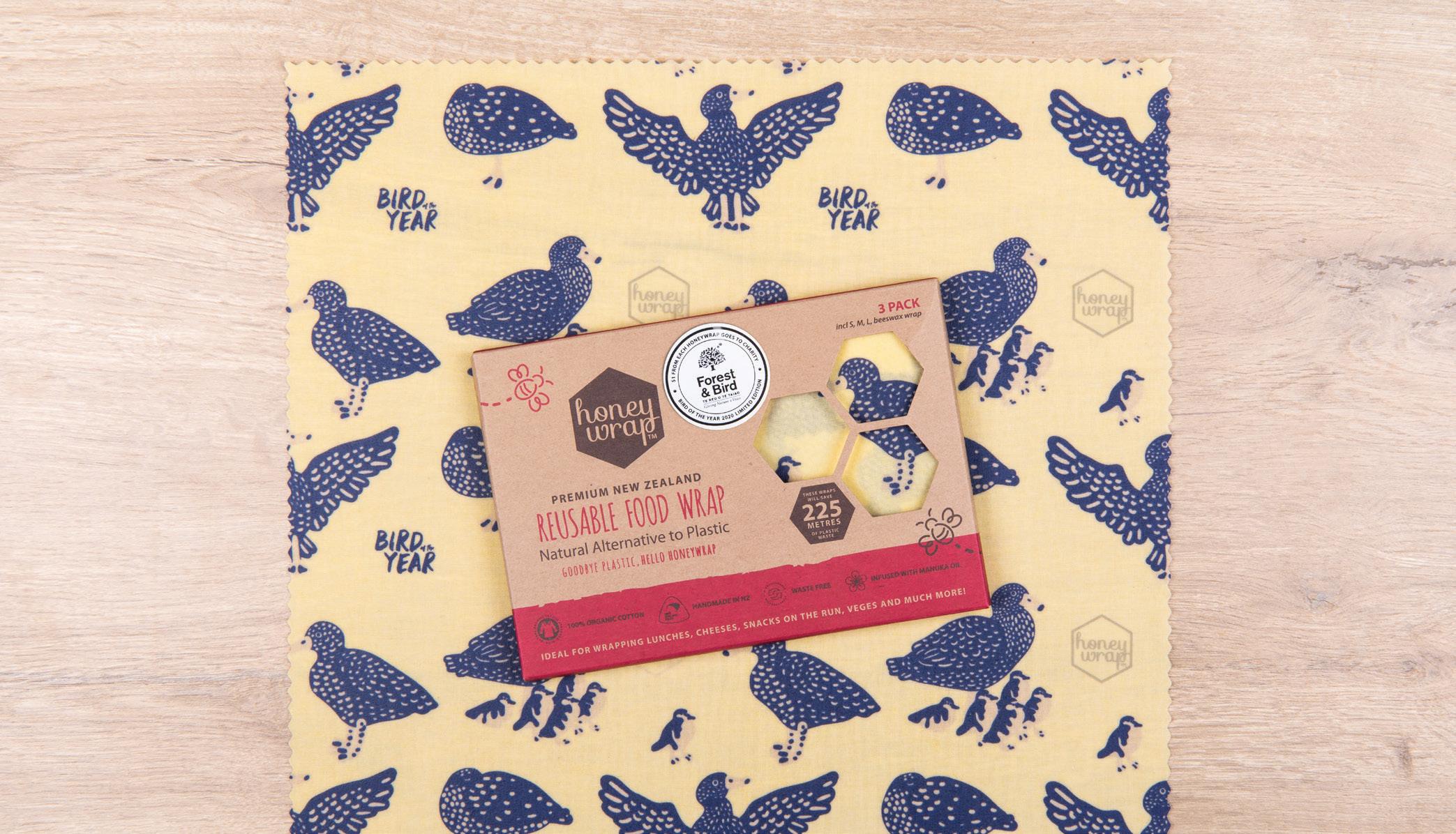
from every Bird of the Century and Bird of the Year wrap sold will go to Forest & Bird to help protect NZ’s wildlife.
FOREST & BIRD
Cartoon courtesy of Bruce Mahalski/mahalski.com
MAKING A DIFFERENCE
Dr Jane Goodall on why she is still travelling the world in her 90s and her hope for the future. Lynn Freeman
You cannot get through a single day without having an impact on the world around you. What you do makes a difference, and you have to decide what kind of difference you want to make.”
Words to live by from primatologist, activist, and author Dr Jane Goodall.
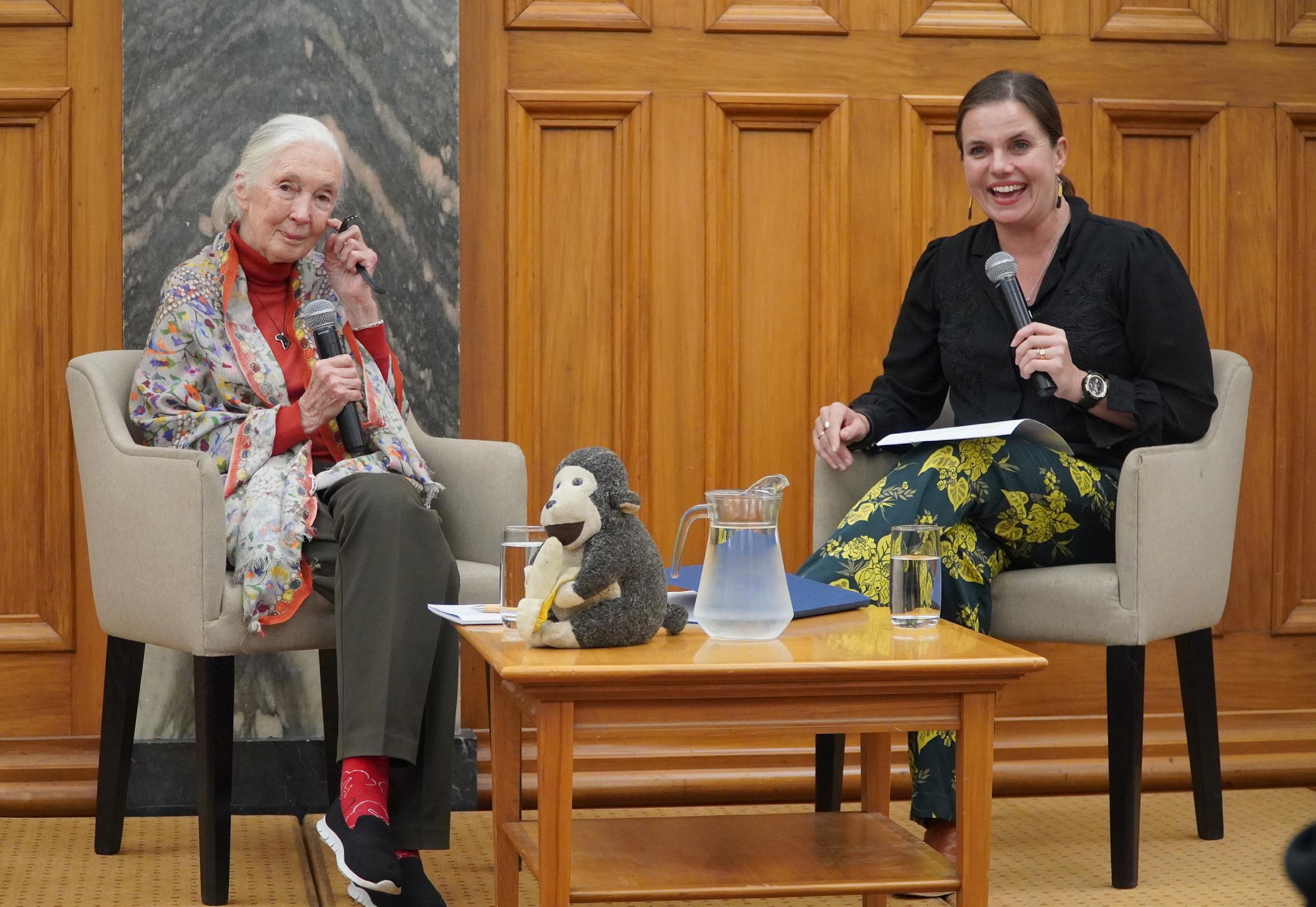
Jane visited Aotearoa New Zealand on her international Reasons For Hope tour in June. The day after her public event in Wellington, she was in conversation with Forest & Bird chief executive Nicola Toki at a much smaller gathering.
This was hosted by the Governor-General, the Rt Hon Dame Cindy Kiro, at Parliament’s Grand Hall, at the invitation of the Minister of Conservation Tama Potaka.
There was a feeling of heartfelt respect and reverence across the generations for the 90-year-old founder of the Jane Goodall Institute and United Nations Messenger of Peace.
Jane and Nicola both understand what it is to walk the tightrope between hope and the reality of nature facing an increasing number of threats. It was a theme they often returned to during their time together on stage.
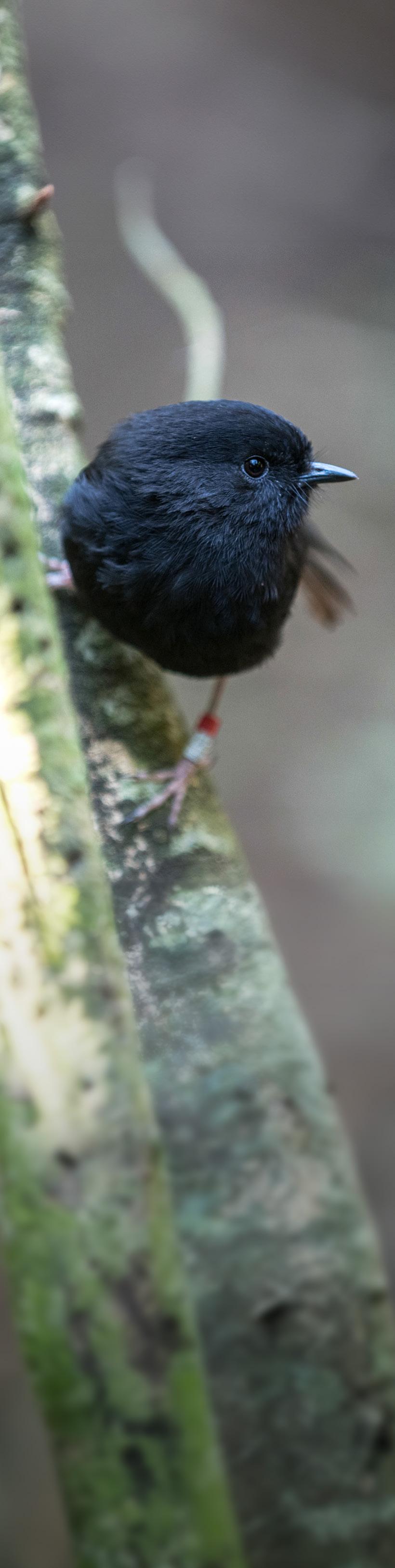
They began by reflecting on a conservation story that means a lot to both of them. Jane has spoken often about the hope she takes from Chatham Island black robins Old Blue and Old Yellow, also known as karure in Moriori and kakaruia in te reo. Nicola showed Jane the silver black robin she wears around her neck as a talisman.
This pair of black robins saved their species after its population plummeted to single figures in the 1970s, with Old Blue the only surviving female. It was a miracle made possible by Don Merton and the other members of the Wildlife Service team, who intervened to maximise the chances of every precious egg producing a healthy chick.
Today, there are more than 250 adult birds and their habitat has been restored, thanks in part of Forest & Bird’s fundraising appeal in 1975, which raised enough money from generous New Zealanders to pay for 120,000 akeake trees to be planted on Mangere Island. DOC says the fostering programme has since been used as a case model on how to save endangered birds around the world.
“That one’s particularly extreme, but there are so
many stories and there are so many areas, like all the forests in Gombe [Nigeria], coming back,” Jane told the audience.
“The wildlife corridors that are growing in different parts of the world enabling species that have been fragmented to link up again … there’s so much hope out there.”
Jane and Nicola discussed the power of storytelling and the need to find ways to help people understand the mysteries of the natural world.
“It’s storytelling that reaches people’s hearts,” Jane said.
“When I first went to Cambridge University, I was bound by the National Geographic that was supporting me to write a book,” she reflected.
“So, I wrote a book, and I was quite excited when it came out. It was called, I think, My Friends The Wild Chimpanzees. I was very nearly sent down from Cambridge because scientists did not write popular books.
“If you care about conservation, you care about the world. You care about people.
“You’ve got to share what you what you’ve learned … how can you inspire other people to conserve the world if you spend a lot of time on a new study and you have a great success, but it only goes out in musty old scientific journals.”
Jane gave another example.
“I was talking to a whole lot of CEOs … and afterwards one of them actually called me up and he said, ‘Jane, I just want to assure you, for the last 10 years, I’ve really been fighting to get my company as ethical as can be in the country where we source our products.’
“He said there were three reasons. First, he saw the writing on the wall and realised that we’re running out of natural resources in some places faster than nature can replenish them if they’re replenishable. Secondly,
consumer pressure. People are beginning to ask those questions, and so businesses are having to change if they want to keep going.
“But he said what tipped the balance for me was my little girl. She was 10 years old. She came back from school one day, and she said, ‘Daddy, they told me that what you’re doing is hurting the planet. That’s not true, is it, Daddy? Because it’s my planet.”
Nicola asked Jane about how she navigates between hope for the future and the reality of biodiversity loss.
“That hope isn’t just wishing. It’s leaning into it and actually doing something about it. It’s having a vision and then stubbornly going after it,” Jane said.
Nicola asked Jane what New Zealanders of her generation can do to support the young people who are inheriting a shambles of a world.
“It makes me really angry when children are told it’s their responsibility. Of course it’s not. It’s ours,” Jane responded. “It’s our responsibility, and we need to help them, but we also we need to empower them to take action, and we need to encourage them to choose the kind of action they want to take, because it’s different for different children, and it’s different at different ages.”
Watch Forest & Bird’s Chief Executive Nicola Toki in conversation with Dr Jane Goodall here https://bit.ly/janeandnicola
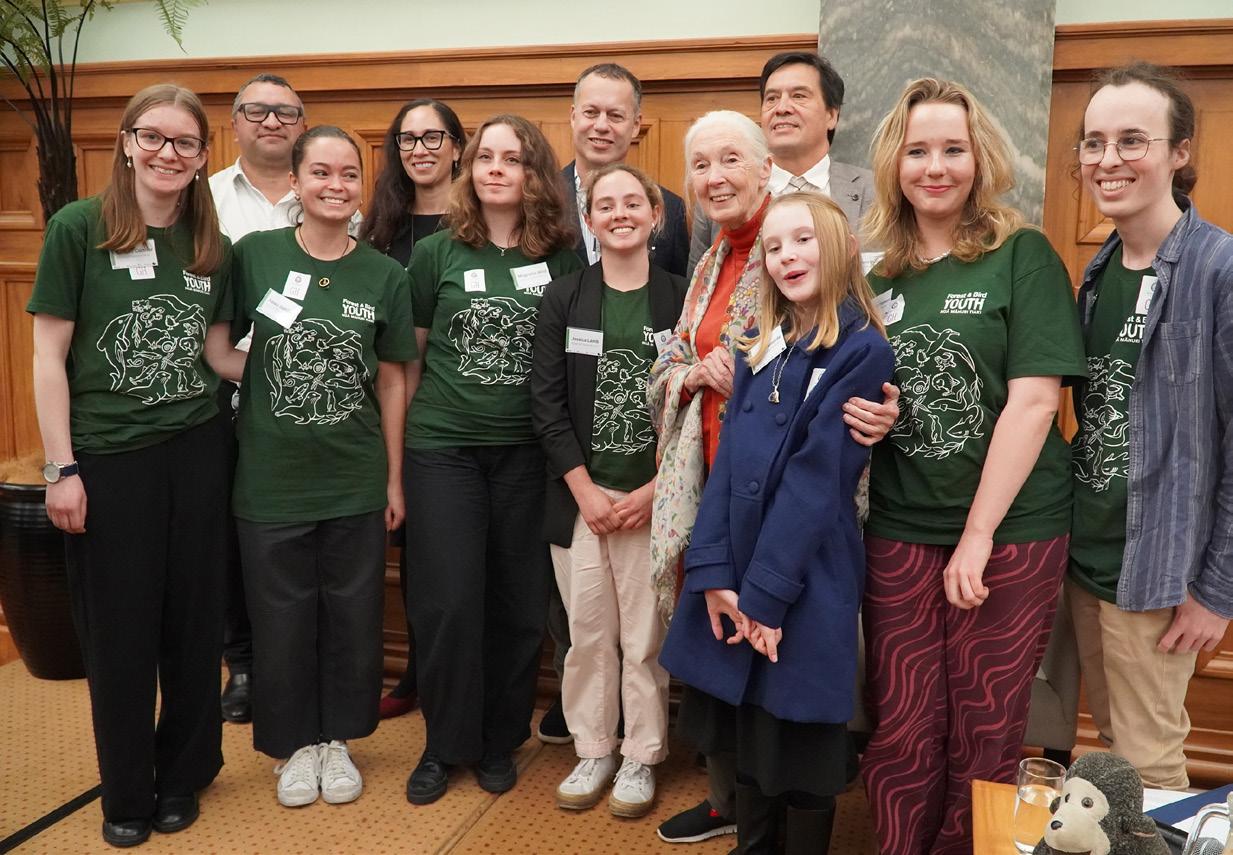
Forest & Bird Youth were excited to meet Jane. Lynn Freeman
ROOTS & SHOOTS
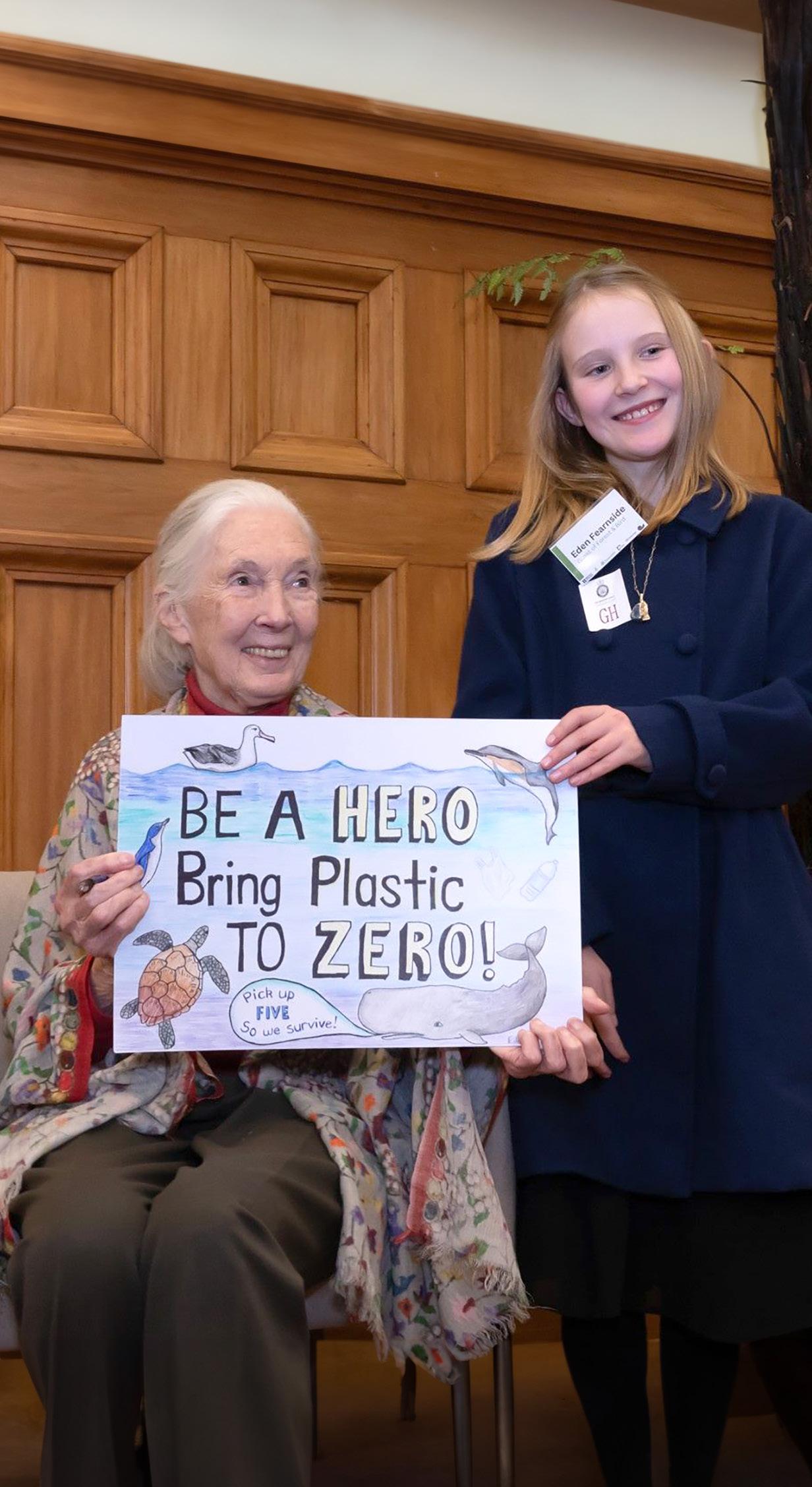
The day nine-year-old Eden Fearnside met her biggest conservation hero, 90-year-old Jane Goodall. Lynn Freeman
Jane Goodall spoke passionately about why it’s so important for children to have time in wild places, a subject very dear to her heart as the founder of the international Roots & Shoots youth education programme.
“It’s actually been proved that time in nature is beneficial for the very young child in their proper psychological development,” she said.
“So many young children today have no opportunity of going into nature. So many humans are in the inner city, and so we have to work really hard to bring nature
into the inner city. It’s beginning to happen, you know, greening the city, which is incredibly important.”
Then came Jane’s reality check for the audience.
“Our societies are so fractured, and the gap between haves and have-nots grows wider and wider,” she said. “Think of Ukraine, think of Gaza. Fifteen wars –conflicts – across Africa, and what are we going to do about it? We can’t just think giving children nature is there to cure everything. We’ve got to take action. We’ve got to get together.
“We are in very, very tough times. That’s why at age 90 I’m travelling around the world and particularly talking to young people.
“I’ve talked to schools in Australia and here in New Zealand, and the energy, commitment, and dedication of children, once they understand the problems and we empower them to take action, it’s incredibly uplifting,” she said.
“I think it’s what keeps me going. They are the politicians and businesspeople of the future.”
This resonated with the eight Forest & Bird KCC and Youth members who were in the audience, including nine-year-old anti-plastics campaigner and Goodall devotee Eden Fearnside.
She’d travelled from Tāmaki Makaurau Auckland with her mother Julia for the event and was the first to put her hand up to ask a question of her conservation hero.
“What can children do for the environment to really make a difference and create change?” she asked.
Jane replied by inviting Eden to join the Roots & Shoots programme, which brings children together to discuss problems that most concern them, then to come up with action plans that will also inspire others.
KCC member Eden Fearnside with Jane Goodall. Lynn Freeman
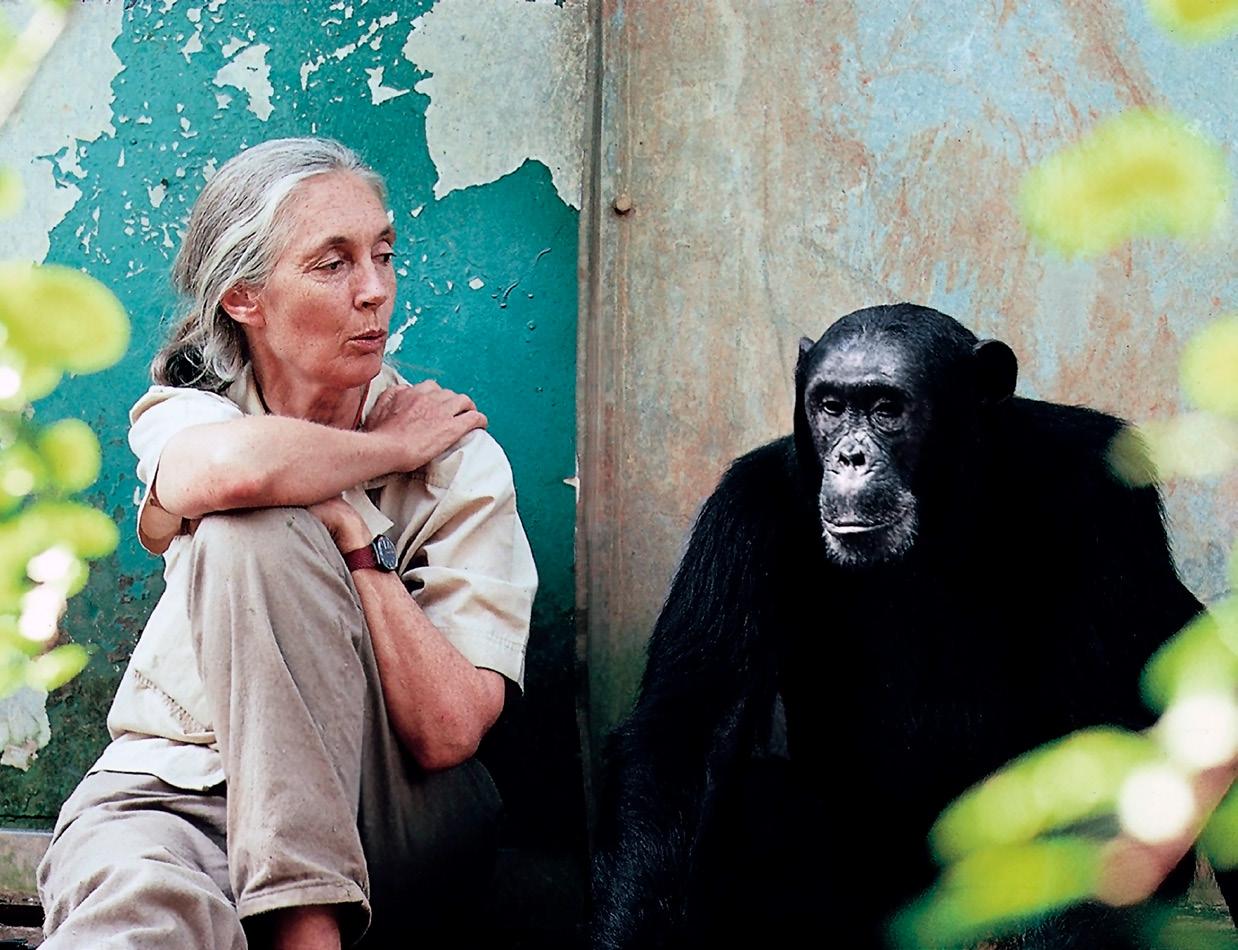
Jane Goodall with a chimpanzee Michael Neugebauer/UCLA
“When you do that, you will particularly have an impact on your parents,” Jane told Eden.
“I know many, many parents who say, well of course I recycle. My kids make me! And I know other parents who say, well, I used to just go into a shop and buy what I need to, but now I have to say, ‘How was it made?’ ‘Did it harm the environment?’ ‘Is it cheap because it was cruel to animals?’ You young people have a huge influence on your parents.
“So, thank you for that question, because we’re counting on you. But we want to help, help, help. You’re not alone,” Jane said.
“We hope that businesses, and companies, and politicians will also help you to do what you need to do for the future of your children, my great-grandchildren.”
This moment had a profound effect on Eden.
“Meeting Jane Goodall was the most amazing experience of my life and something I will never forget,” she said.
“It meant so much to me, as she is one of the most important conservationists. She has done so many incredible things and has inspired people even when they have no hope left.
“Her work as a conservationist has motivated millions of people, including myself, to love and cherish the environment and to always have hope. She inspires and motivates young people, like myself, to make a difference and create change,” Eden said.
“I, too, want to help the world in some way, just like she did.”
Jane Goodall’s special talk at the Grand Hall was supported by the British Council New Zealand and the Pacific, British New Zealand Business Association, Forest & Bird, Royal Society Te Apārangi, Tonkin + Taylor, and DLA Piper.
If you’d like to talk in confidence about investing in nature in your lifetime or including a gift in your will, please reach out to our friendly team at legacy@forestandbird.org.nz A gift to Forest & Bird can make your wishes come
Rooted in community: The Roots & Shoots Youth Council 2024. Jane Goodall Institute
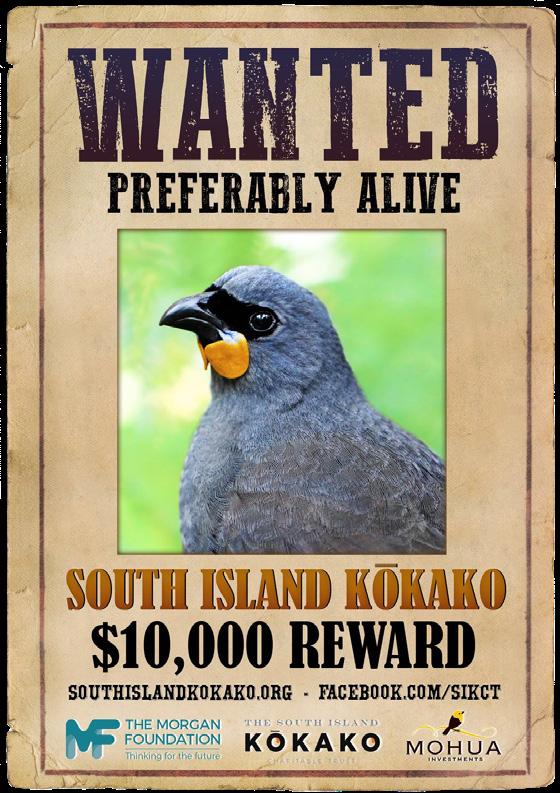
WANTED ALIVE
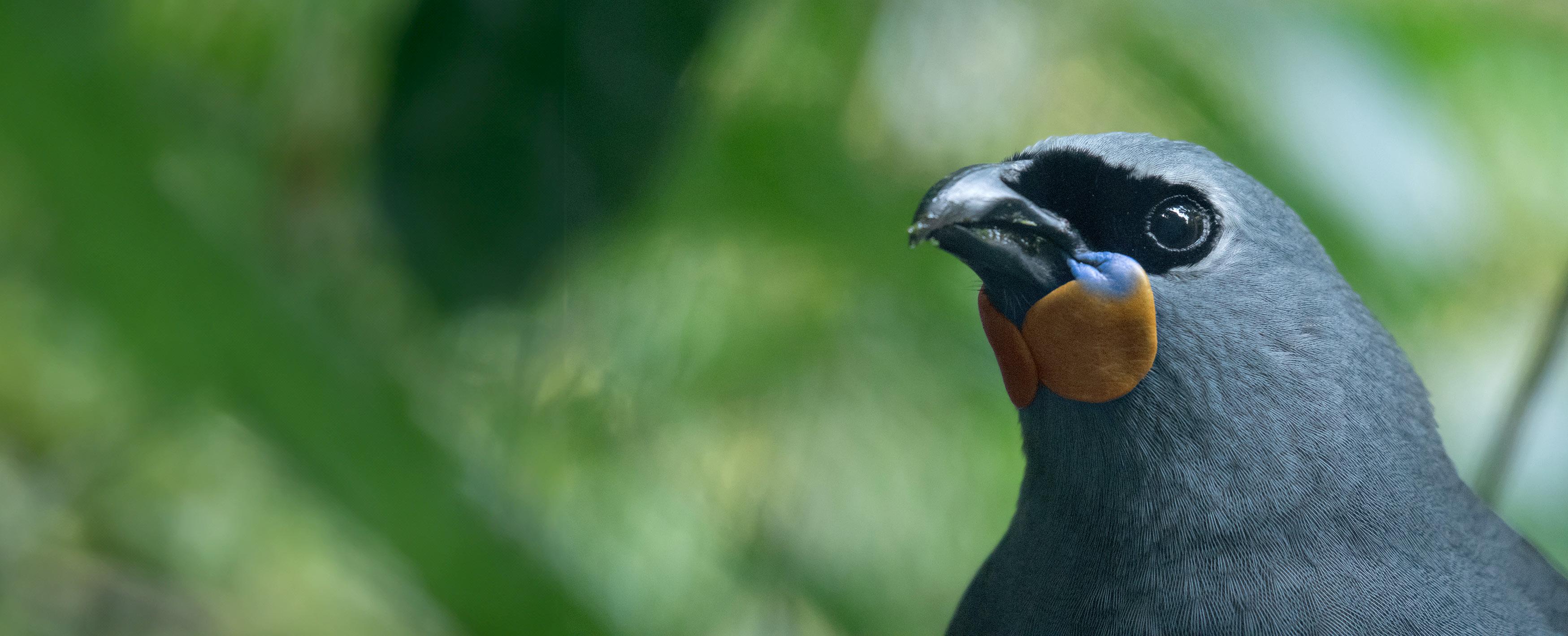
One of the 23 recent reports of “possible” encounters with South Island kōkako came from Forest & Bird’s Lenz Reserve in the Catlins.
Conservationists have been searching the back country for the South Island kōkako for more than 40 years in the hope it is still surviving in a remote forest somewhere.
After offering a $5000 reward in early 2017, doubled by the Morgan Foundation a few months later, more people joined the effort, and the South Island Kōkako Trust keeps meticulous records of all sightings, ranking them by probability.
In its last newsletter in July, the Trust reported 23 encounter reports since February, including a “possible” sighting near the
Fleming River at Forest & Bird’s Lenz Reserve, near Papatowai.
“With an interesting encounter report back in the 1990s from the loop track from Tautuku following Fleming River in Southland already on our map, a new one from that track is one of the three recent reports to have been rated as ‘Possible’,” the newsletter said.
The person who had the possible encounter on 5 May was Jarrod Smith, who has been a keen South Island kōkako searcher for a couple of years, mainly on the West Coast but more recently in Southland.
He reported: “Sighting – grey pūkeko-size bird, two-second encounter, bird hopped away over log, uphill. Walking long loop track, near the log bridge – about halfway – when a large grey bird ran off over a log up the ridge. Approx size of pūkeko, could only see its back, but definitely not common black bird.”
Veteran South Island kōkako chaser of 40+ years Rhys Buckingham knows the Lenz Reserve, which Forest & Bird has owned and managed since 1964:
“This is the area I searched with the widest kōka-hunting eyes ever, as the place was teeming with birds,” he said.
“If kōkako are still there, that’s
Caroline
Wood
the place we should be searching, as there is so much low vegetation offering richly diverse habitat, food source, and a chance of seeing the bird.”
The earlier encounter, also near the Fleming River, took place on 21 April 1990 and was logged by Dr R John Wilson.
He reported a “kōkako-like call of three notes, last two in descending scale, large bird clumsy flight – 20m”. The location was recorded as being “2km inland from Forest and Bird’s Tautuku
How a South Island kōkako might look. Terence Davidson
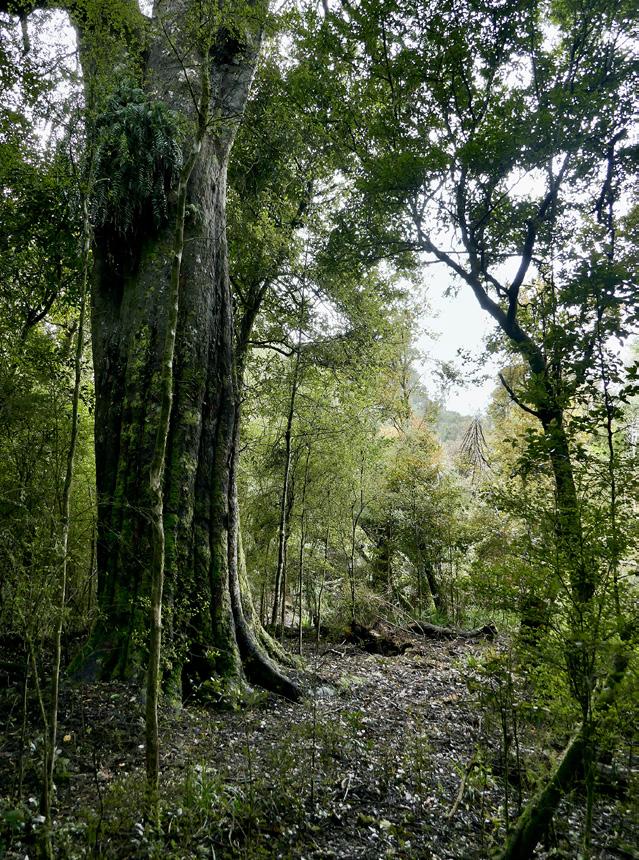
Could this be kōkako country? Forest & Bird volunteers Jim Young (front) and Roy Johnstone in old growth forest, Long Track, Lenz Reserve. Fergus Sutherland
Large kahikatea, Lenz Reserve. Fergus Sutherland
Lodge, podocarp forest on the edge of scrub/swampland”.
The Trust is asking people walking the Fleming River loop track to keep an eye out and have their camera ready to record any possible sights and sounds.
“Whether it was or wasn’t the
South Island kōkako, we’d love people to be keeping ears and eyes peeled there,” said Inger Perkins, manager of the South Island Kōkako Charitable Trust.
“It would be brilliant to confirm what it was – even if it helps exclude this from our enquiries.”
SEARCH CONTINUES
South Island kōkako, an ancient wattlebird species, was once widespread in southern New Zealand forests. It was listed as extinct from 2007 until 2013, when its status was reclassified as “data deficient” by the Department of Conservation.
This reclassification provided renewed hope and energy that South Island kōkako are still out there and alive, said Inger Perkins, manager of the South Island Kōkako Charitable Trust, which is still offering the $10,000 reward for a confirmed sighting.
“The search is urgent. If South Island kōkako still exist, there will be very few left and they need to be found and protected.”
With the help of volunteers, the Trust organises systematic searches in sites it ranks as most likely to result in an encounter. It also maps every report and recently updated its ranking system to add a new “Encouraging” rating.
The rankings are now: Exclude, Uncertain, Possible, Encouraging, and Likely (probable or presumed). Followup surveys using cameras and recorders are recommended for the last two rankings.
The other rankings are: “Confirmed” (the ranking everyone is hoping for!) and “Historic” (possible to likely, but some time ago, older than 20–25 years).
Two “Encouraging” encounters were reported recently: one in Abel Tasman National Park (based on observations by Rowan Nicholson, Daniel Davis, Rhys Buckingham, and others), in the Falls River catchment. Another was by Peter Shaw and Bruce Reid near Aorere Shelter on the Heaphy Track.
Trust volunteers have also had very compelling encounters along the Heaphy Track between Aorere Shelter and Perry Saddle, and they are using trail cameras and acoustic recorders to try to obtain evidence.
The Trust is asking trampers to know what to look and listen for (information is provided on their website), then to keep eyes and ears peeled and camera ready – from Brown Hut to Gouland Downs Hut in particular.
If you are heading into the backcountry to search for South Island kōkako, make sure you are suitably equipped, have checked the weather forecast, and have told someone of your intentions.
For more information and to support the Trust’s mahi, go to southislandkokako.org.
TAUTUKU TAONGA
Franny Cunninghame, project manager for Forest & Bird’s landscape-scale Tautuku restoration project, which includes the Lenz Reserve, said she would love to see a South Island kōkako swooping through the forest one day.
“We are of course hopeful these wonderful birds are still out there, but our team hasn’t seen any sight, sound, or disappearing tail feather to indicate the ‘grey ghost’ in our project area.
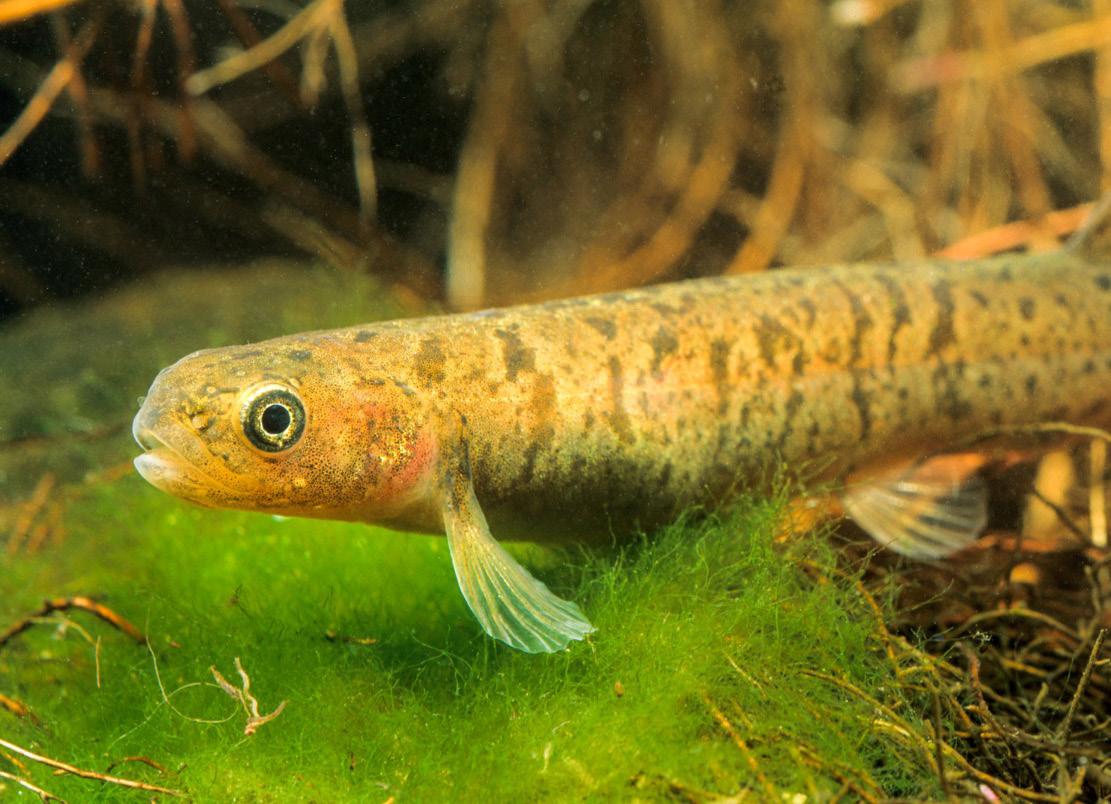
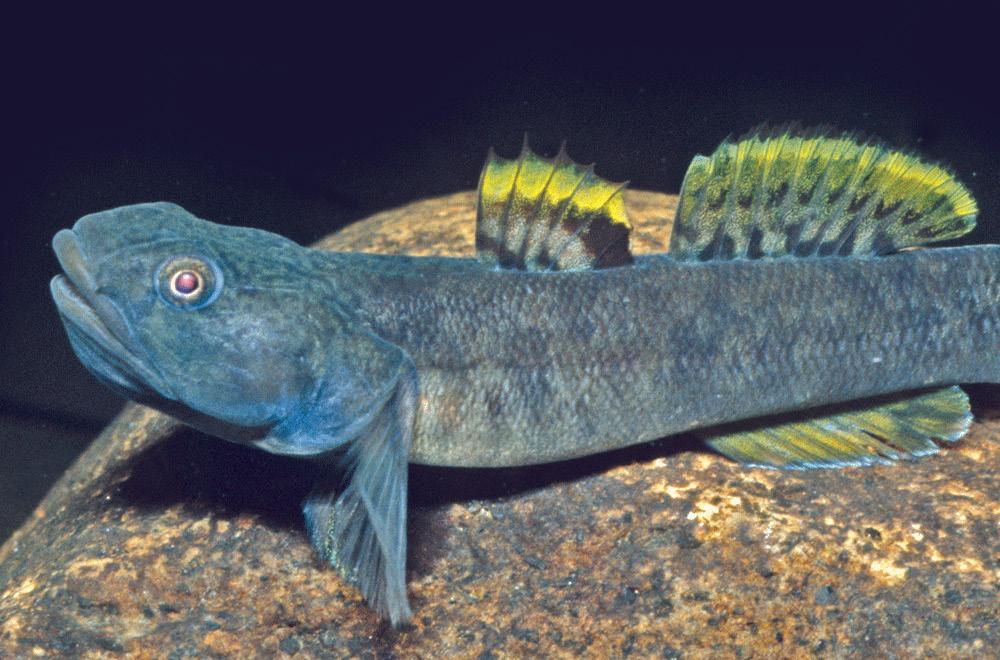
“But we’d never say never. We have made some exciting discoveries in Tautuku, including a population of threatened Gollum galaxias fish in the upper reaches of the Fleming River and a critically rare New Zealand foxglove.
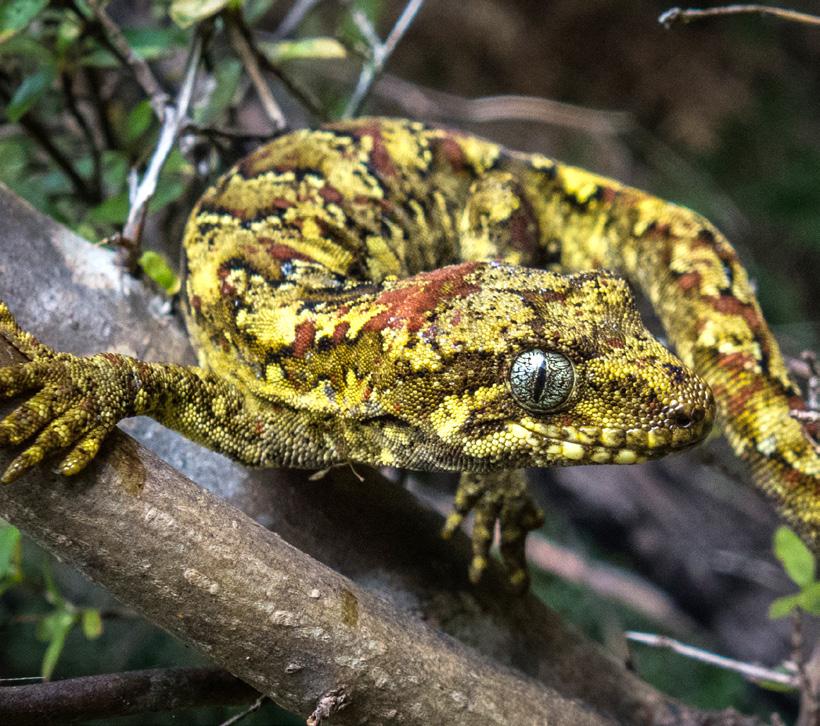
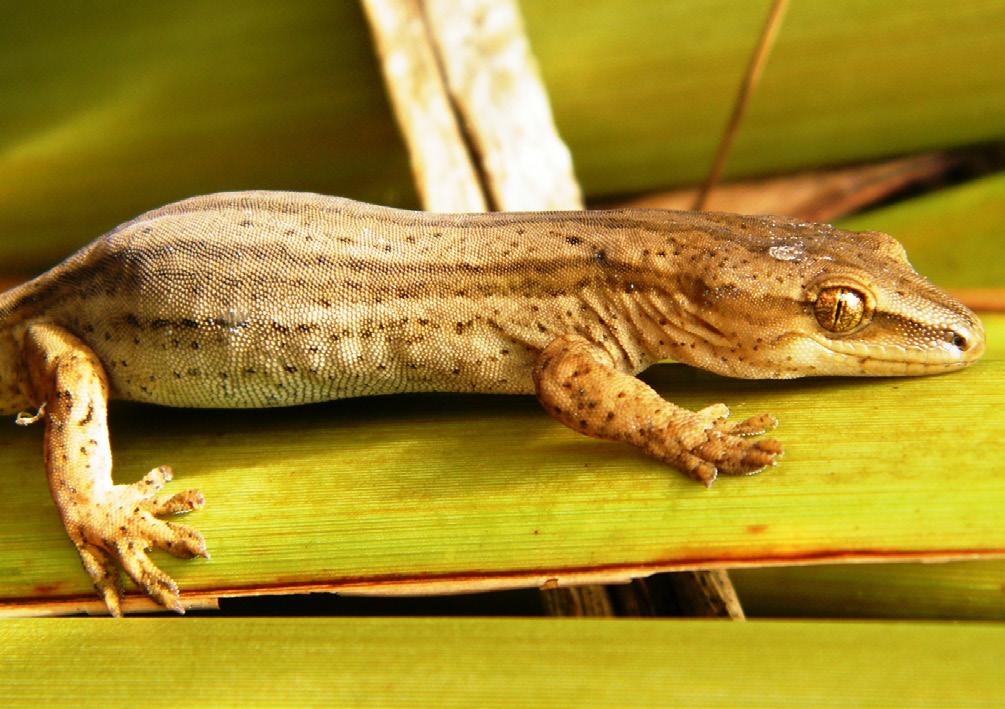
“Gavin White, one of our pest control officers, stumbled across a giant 700-year-old southern rātā on a distant ridgeline. He also discovered a blue-eyed Tautuku gecko population in the forest.”
Visitors can experience the region’s remarkable birdlife by visiting the Lenz Reserve and staying in our very reasonably priced Tautuku forest cabins.
For more information, see forestandbird.org.nz/ourcommunity/lodges/tautukuforest-cabins.
Inger Perkins
Tautuku gecko. Carey Knox
Gollum galaxias. Rod Morris
30 X 30
New Zealand’s progress towards securing 30% of its terrestrial and aquatic habitats in protected areas by 2030 will be under the spotlight at this year’s UN Biodiversity Conference. Chantal Pagel
The variety of plant and animal life in the world is fundamental to our everyday lives. Biological diversity within and between species and ecosystems has a profound effect on our physical and economic wellbeing.
A healthy environment provides us with natural resources and protection from extreme weather events, with the latter becoming more important in the wake of climate change. If we look after nature, nature will look after us.
Unfortunately, we humans aren’t doing enough to protect nature’s diversity, and our environment is suffering. Nature is vanishing in Aotearoa and around the globe through direct exploitation, habitat loss, climate change, pollution, and the introduction of alien species into ecosystems they don’t belong.
About 25% of species in assessed animal and plant groups on Earth are threatened, suggesting that around one million species already face extinction, many within our lifetimes, unless action is taken.
Two decades ago, world leaders recognised the need to develop integrated approaches to biodiversity protection that consider environmental, social, cultural, and economic values.
The 1992 Earth Summit in Rio de Janeiro agreed a comprehensive strategy for “sustainable development” while ensuring a healthy and viable world for future generations. The United Nations Convention on Biological Diversity was born.
New Zealand signed up to the convention along with 195 other nations. It has three main goals: the
conservation of biological diversity, the sustainable use of its wealth, and the fair and equitable sharing of the benefits from the use of such resources.
The development and implementation of a national biodiversity strategy and action plan was a requirement for Aotearoa New Zealand to meet its obligations under the Convention.
Forest & Bird was a foundation member of the governmental stakeholder group that worked for 18 months to develop recommendations for a strategy, working alongside the Iwi Chairs Forum, Environmental Defence Society, the Forest Owners Association, Federated Farmers, Fisheries Inshore New Zealand, scientists, and others.
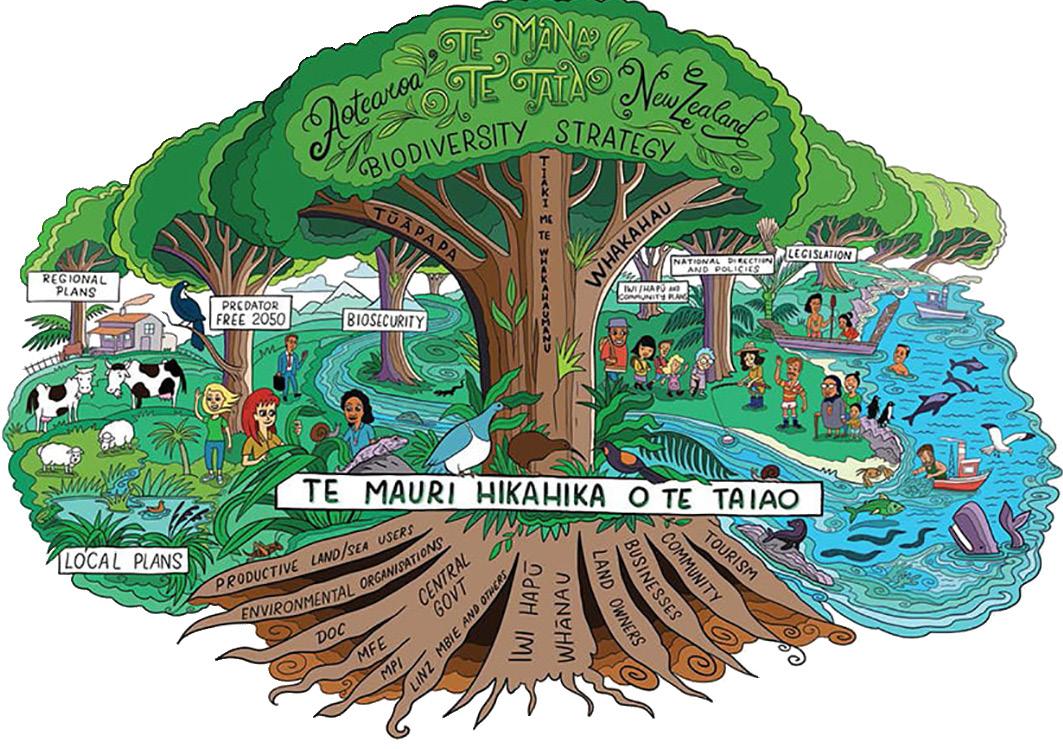
Te Mana o te Taiao – Aotearoa New Zealand
Biodiversity Strategy was finally launched in 2020 and provided a “greenprint” for nature protection and restoration. Upholding the principles of Te Tiriti o Waitangi is an essential part of Te Mana o Te Taiao.
The strategy’s implementation plan will be used over the next 30 years to set out a pathway for achieving the strategy, to ensure:
n ecosystems and species from mountain tops to ocean depths are thriving
n people’s lives are enriched through their connection with nature
n Treaty partners, whānau, hapū, and iwi are exercising their full role as rangatira and kaitiaki
n prosperity is intrinsically linked with a thriving biodiversity.
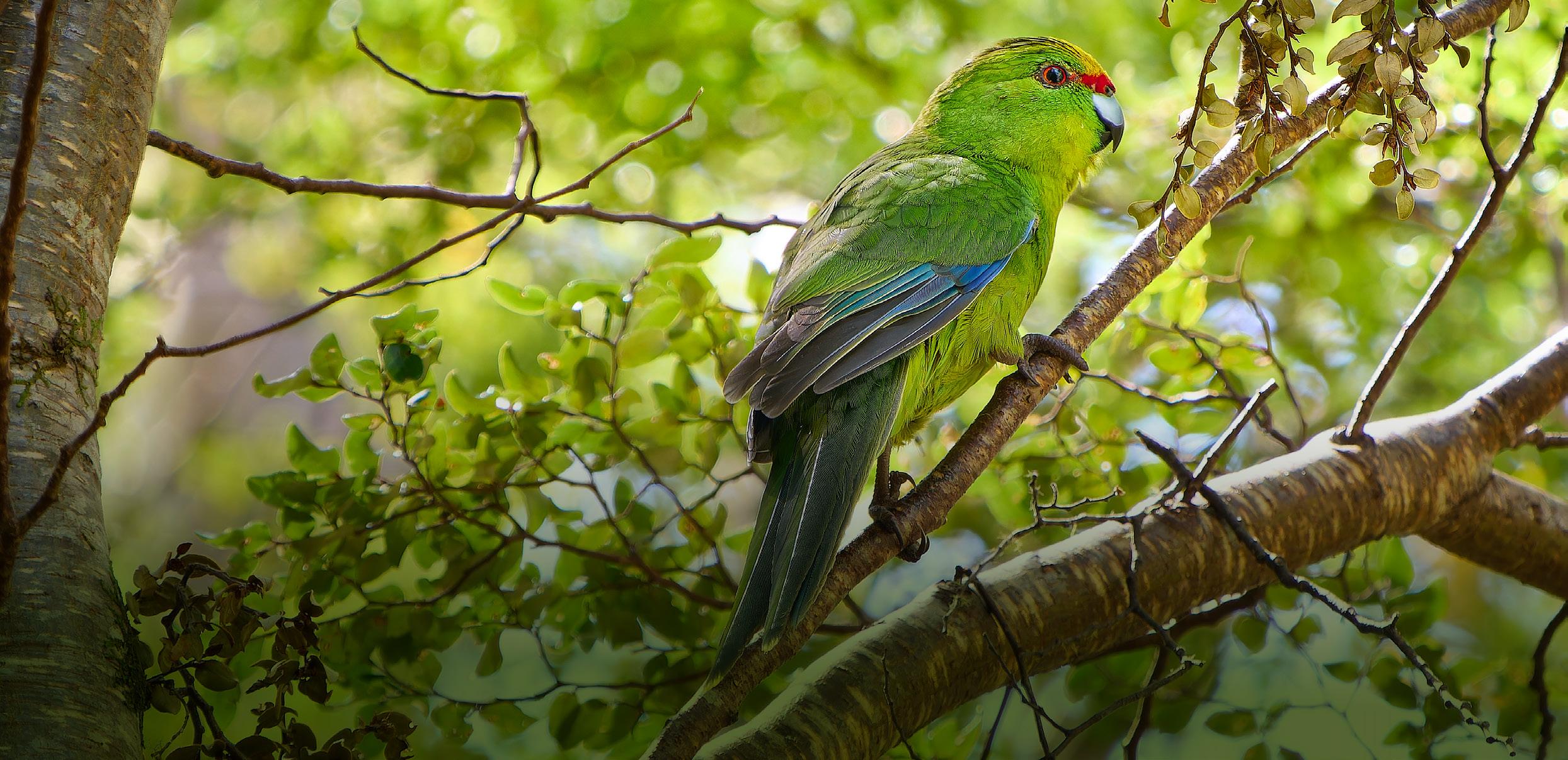
Kākāriki, Arthur’s Pass. Jeremy Sanson
In 2022, the New Zealand government signed up to a new global deal for nature, the “30 by 30” initiative which emerged from the COP15 UN Convention on Biological Diversity in Montreal.
Participating nations must designate 30% of the planet’s terrestrial and aquatic habitats as protected areas by 2030. It also means countries must stop subsidising activities that destroy valuable ecosystems, such as mining and industrial fishing.
“We have made global biodiversity commitments before,” said Conservation Minister Poto Williams, in December 2022, when she announced New Zealand had become a signatory.
“This deal recognises we need to do better. The new targets are stronger, smarter, and address the underlying causes of biodiversity loss.”
New Zealand’s progress towards goals and outcomes to protect biodiversity will come under scrutiny at the UN Biodiversity Conference (COP16) taking place in Colombia from 21 October to 1 November 2024. It’s likely we will make global headlines for all the wrong reasons.
While there are biodiversity-enhancing programmes in place that can help us meet our international biodiversity obligations, such as Predator Free 2050, other important initiatives have been axed by the National-led government. These include He Waka Eke Noa – the Primary Sector Climate Action Partnership and the Jobs for Nature programme.
The introduction of the recent Resource Management (Freshwater and Other Matters) Amendment Bill will also reduce biodiversity protection. The soonto-be scrapped Resource Management Act contains obligations to provide for the protection of significant indigenous habitat.
On top of proposed DOC cuts, Ministers have also signalled important protections in the National Policy Statement for Indigenous Biodiversity will be watered down or rolled back.
Many international tourists love travelling to New Zealand. They come here to experience our stunning natural heritage and a country with an incredibly rich diversity of plants and animals, many of which are only found here.
Recognising that nature is at the heart of our economy and the way we do business is essential. Acknowledging the role of mana whenua as kaitiaki of our whenua and taonga species, and adopting tikanga and mātauranga Māori into the management of indigenous biodiversity, are also crucial.
Our nation needs to do better at protecting and restoring our country’s unique natural heritage before it’s too late.
In April, for example, after an urgent assessment by an independent expert panel, the Canterbury spotted skink was reclassified from Nationally Vulnerable to
Nationally Critical – the last step before extinction. There are fewer than 1000 mature adults left on Earth. This large skink lives in Canterbury’s wild places, mostly on private and council-managed land. This makes the species especially vulnerable to the current government’s anti-nature policy agenda. Nature cannot be restocked. Once a species is gone, it is gone for good, which may have detrimental impacts on other organisms, including us. And this, undoubtedly, will cost us dearly.
Chantal Pagel is Forest & Bird’s regional conservation manager for the Bay of Plenty, Gisborne, and Hawke’s Bay.
WHAT IS FOREST & BIRD DOING?
Forest & Bird is campaigning to stop a wider rollback of environmental protections that would undermine Te Mana o te Taiao, including the proposed Fast-Track Approvals Bill, and changes that would reverse recent progress in protecting and restoring freshwater.
The Department of Conservation is leading the development of the next Te Mana o Te Taiao implementation plan. Forest & Bird will contribute to the upcoming discussion document to support positive outcomes for indigenous biodiversity in Aotearoa New Zealand.
Our conservation and advocacy staff will continue to press the government to acknowledge the importance of indigenous biodiversity for climate change resilience and economic wellbeing. They do this by making detailed policy submissions on national and regional environmental policies, plans, and strategies.
Dr Chantal Pagel
DISCOVERIES
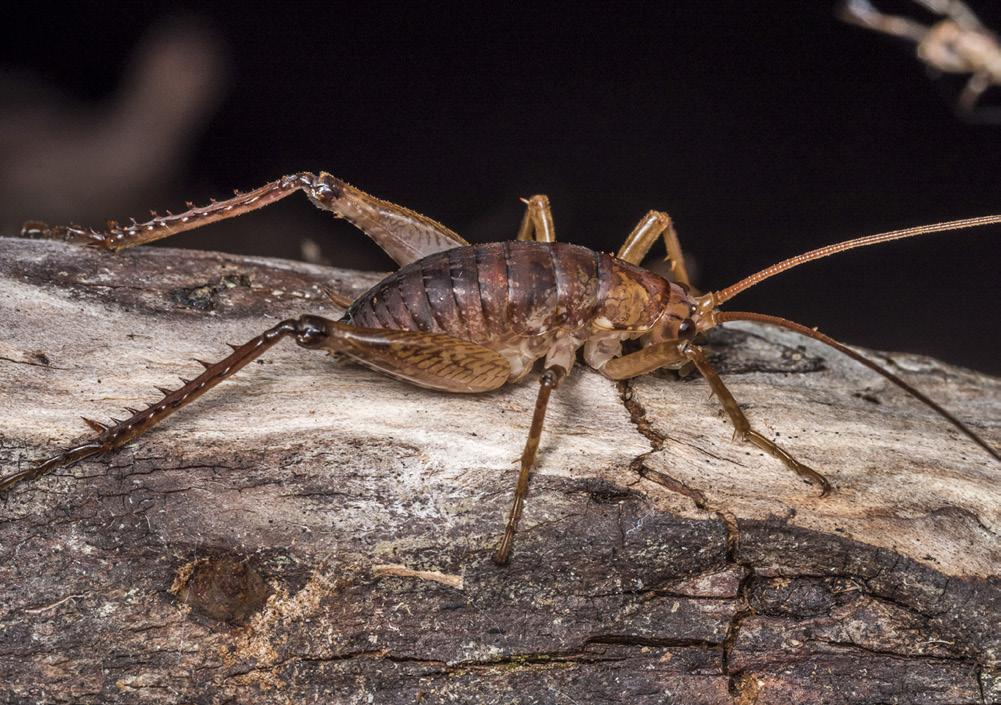
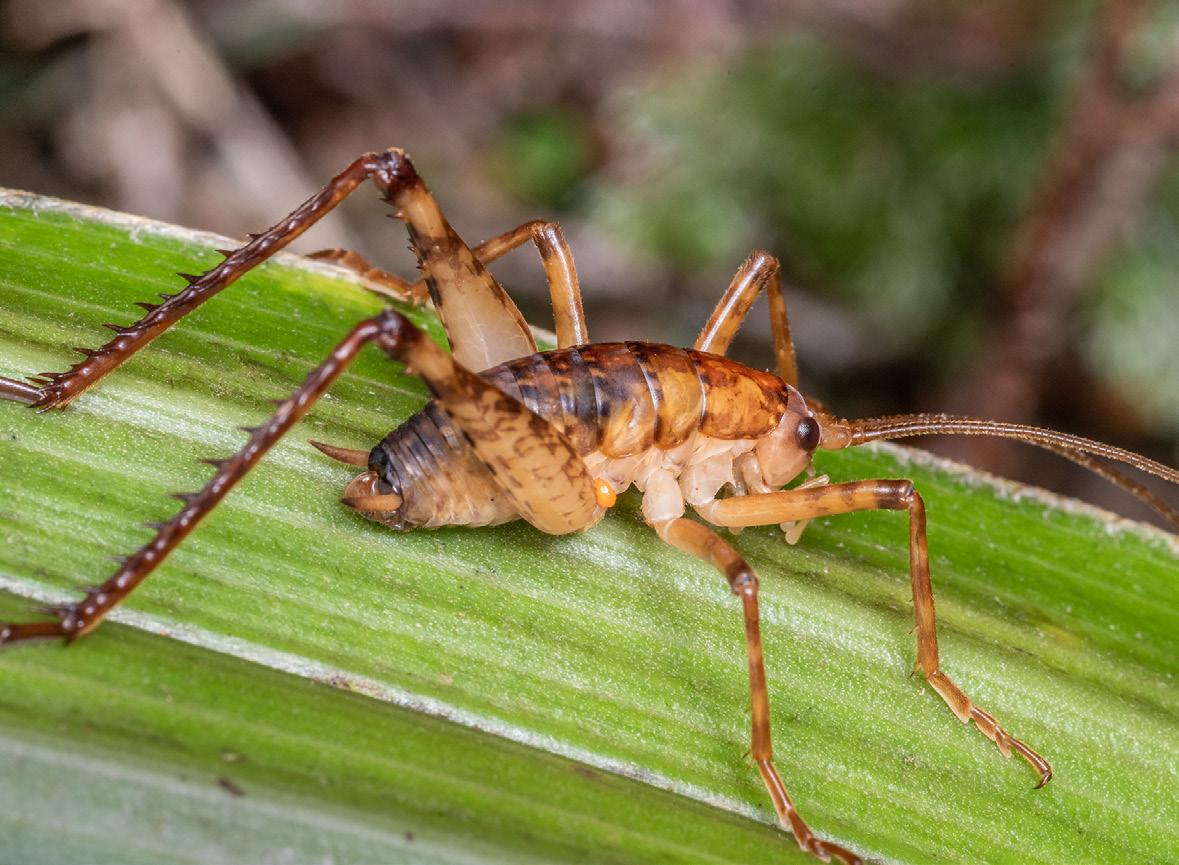
A stellar find during a Forest & Bird bioblitz on the Denniston Plateau turned out to be a new genus of tokoriro cave wētā. Caroline Wood.
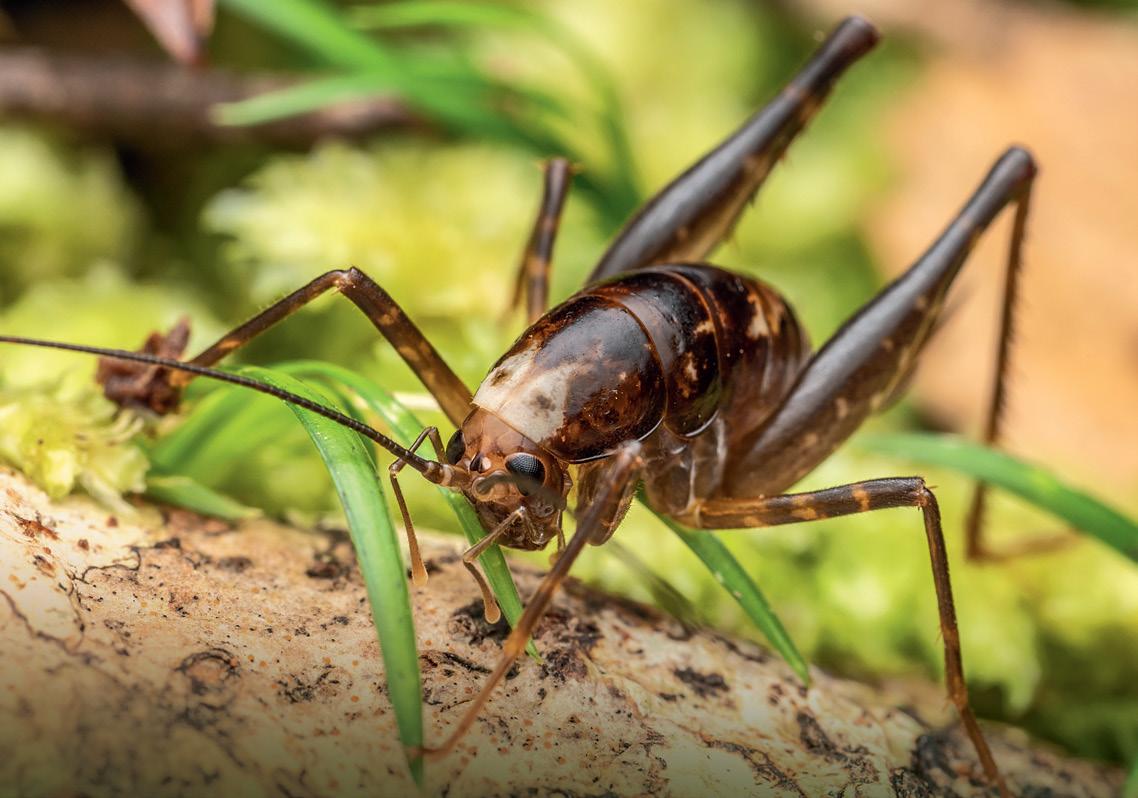
With their wingless bodies and spiny, long legs, wētā are among our more easily recognised insects, but being active after dark they commonly go unnoticed.
Scientists recently described two new genera and three new species of tokoriro cave wētā. Genera are the taxonomic grouping above a species. They say it’s extraordinary in 2024 to be discovering new species and diversity among large and relatively well-known critters like these.
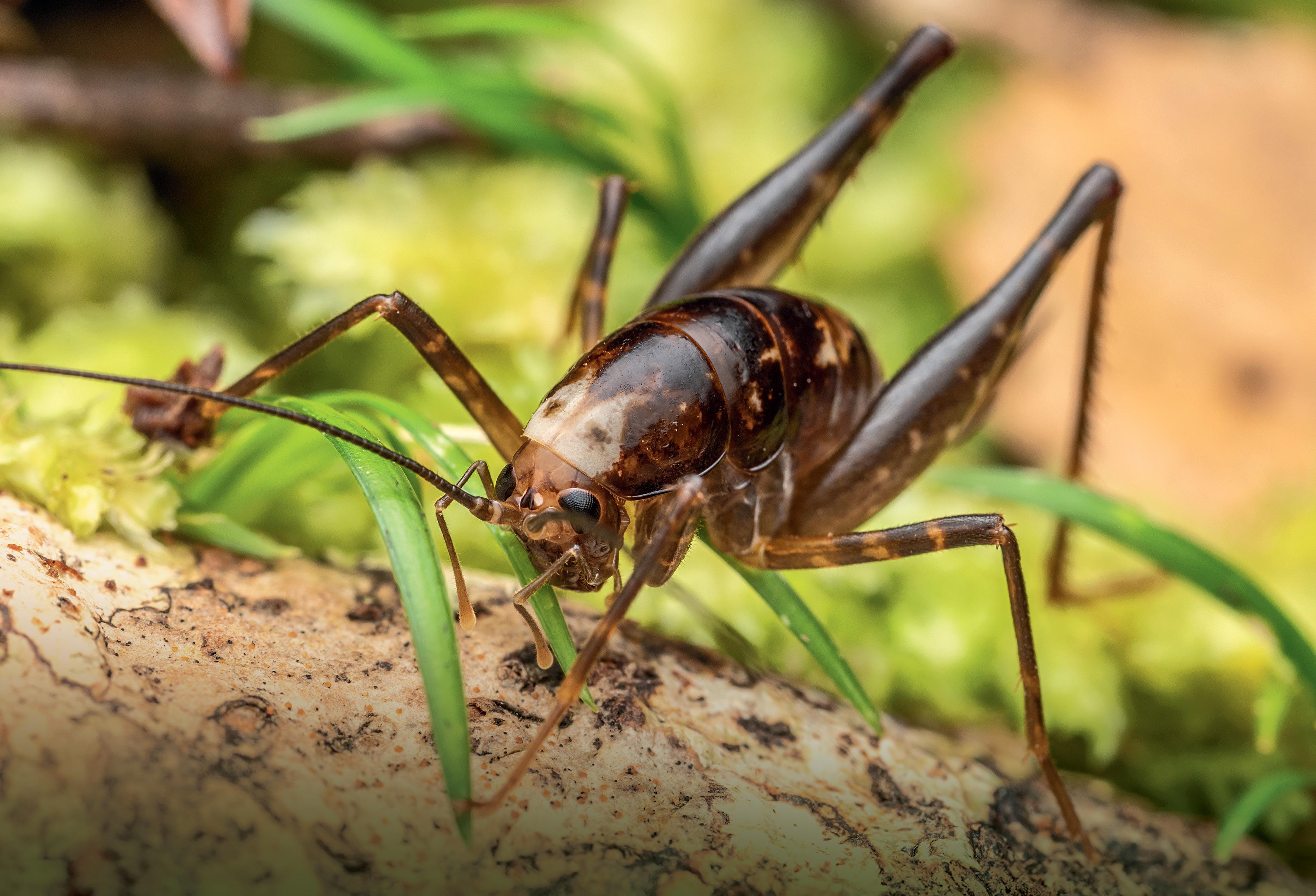
One new genus Occultastella, meaning hidden star, includes the new species Occultastella morgana, which only lives in the north-west of Te Wai Pounamu the South Island, and was first discovered on the Denniston Plateau.
The second genus, Crux, includes two new species: Crux boudica, which is found in Rakiura Stewart Island and south-west South Island, and Crux heggi from north-west of the South Island.
Wētā expert Steve Trewick, Massey University professor of evolutionary ecology, detailed the latest discoveries in a newly published paper: “Two new genera of tokoriro (Orthoptera: Rhaphidophoridae:
Macropathinae) from Aotearoa New Zealand.”
Steve first spotted Occultastella morgana during a 2012 bioblitz on the Denniston Plateau, on the West Coast. It was subsequently sighted in other parts of the north-west of the South Island too.
Forest & Bird organised the bioblitz, an intensive biodiversity survey, which was supported by scientific experts and volunteers. They headed up to the remote plateau over several days to document as many birds, critters, and rare plants as possible.
It was part of the Society’s campaign to stop coalmining destroying the area and its huge diversity of plants and animals that have evolved to live on the Denniston Plateau.
“The first find of Occultastella was from coal seam soils in remnant native scrub just down from the Denniston Plateau. It was probably also up on the top,” said Steve.
“Subsequently, we found other specimens in the Kahurangi and near Lake Rotoiti, St Arnaud. This animal has been seen so rarely that we cannot be sure about range but almost certainly just the north-west corner of the South Island.”
It was immediately apparent that the wētā discovered at Denniston were a new discovery.
“It’s little, very dark, and it has these extraordinary white flame markings on its head,” Steve added.
“Given the area’s mining history, it was quite unexpected to find a new species and extraordinary to discover a whole new genus up there. It just goes to show how important it is to look.”
The species was named Occultastella morgana in honour of Massey biologist and orthopterist Mary Morgan-Richards.
Crux was named after the Southern Cross star constellation. Crux boudica was named for Boudica, the Celtic warrior queen known for having spikes on her war chariot.
“Adult Crux boudica females have a set of prongs and spikes sticking out from their bellies. We think it must have something to do with them controlling the reproductive activity with males of that species,” Steve explained.
The third newly discovered cave wētā species, Crux heggi, was named after orthopterist Danilo Hegg, of Dunedin, who has made significant contributions to the study of New Zealand’s flightless crickets.
Most people are familiar with tree wētā and giant wētā, which are in the family Anostostomatidae. The tokoriro is in the family Rhaphidophoridae and commonly known as cave wētā.
Steve says this is a misnomer because most of them don’t live in caves. They are found in soil, rotting logs, and the canopy of native forests, and among rocks of the alpine zones.
“There are more than 100 species of wētā in Aotearoa, and most of the diversity is in the tokoriro or ‘cave wētā’,” said Steve.
“This cricket family is found worldwide, but New Zealand has a rich endemic fauna of these flightless crickets inhabiting forests, alpine zones, and caves.”
Despite their ecological and biodiversity
significance, their taxonomy remains incomplete, with many species yet to be described, with ongoing revisions at the genus level.
Steve says the latest discoveries highlight the continuing need for taxonomic research.
“The challenge in discovering the full extent of wētā diversity lies more in the availability of taxonomists than in the existence of undiscovered taxa,” he said.
“Dedicated survey efforts are crucial for species discovery and to deepen our understanding of New Zealand’s ecology.”
Feed tūī, bellbird, hihi, kākā, silvereye & more
● Cat proof! 360 degrees of visibilty while birds feed
● Provides sugar water, fruit & energy truffles
● Feeder can go anywhere, it’s on a waratah
● Stainless steel nozzle ensures safe, hygienic feeding & easy cleaning to prevent the spread of avian pox.
Buy a feeder at PFNZ shop.predatorfreenz.org
For more info go to our website pekapekabirdfeeders.nz
Crux boudica, Port Pegasus, Rakiura. Danilo Hegg
Crux heggi, Ces Clarke Hut, Paparoa. Danilo Hegg
Steve Trewick Wikimedia
The first issue, published in September 1924, was called Birds and featured a small brown kiwi on its cover, the only illustration in the 10-page digestsized magazine. It was edited by the Society’s founder, Captain Val Sanderson, who had previously circulated five typewritten conservation “bulletins” to his members.
Printed by the Evening Post in Wellington, copies were put into envelopes, addressed by hand, and
NATURE’S STORYTELLERS 1924–2024
Forest & Bird turns 100 this month, making it one of New Zealand’s oldest magazines. Caroline Wood Research by
Michael Pringle
posted to every member of the newly established NZ Native Bird Protection Society, later Forest & Bird.
From the outset, Sanderson and his fellow editors took a broad view that native plants and animals were part of the wider environment, and we can see this in the first issue of Birds. The lead story was about the “dangers of acclimatisation”, written by the British entomologist and botanist John Myers.
He dubbed the practice of introducing plants such as colourful heather to “brighten up” Waimarino’s tussock plains “insidious vandalism” and decried the introduction of rabbits and deer. In the same issue, Sanderson wrote about the impact of introduced weasels on native birds. By 1926, the magazine had grown to 20 pages, and 3000 copies were being printed. Sanderson included photographs of birds, people, and landscapes to highlight conservation issues, such as the impact of introduced pests, the dangers of pollution, and the need to protect vanishing birds such as the kiwi.
He also saw his magazine as a way to drum up new members. It worked. Birds was very popular in schools, and many children joined the Society as junior members and
went on to become members in adulthood. Magazines were also sent to universities throughout the country.
Today, Forest & Bird is the oldest conservation magazine in Aotearoa, having been continuously published through the Great Depression, the Second World War, and many financial and political crises. It is still much loved by members, many of whom have been reading it for decades. While it looks very different today, the magazine’s 14 editors have always sought to share stories about the wonders of New Zealand’s natural world and report on the Society’s latest campaigns and wins. This storytelling has inspired a century of conservation action, helped garner tens of millions of dollars in donations from members of the public, and connected readers to a wider whānau of likeminded nature lovers.
The first colour cover of Birds, August 1933.
Val Sanderson edited the journal for more than 20, years until his death in 1945.
Leo Fanning
OUR 100TH BIRTHDAY COVER
For our Forest & Bird 100th anniversary cover, we took inspiration from Sanderson’s simple kiwi illustration on the front of his first issue, published in September 1924. We chose a gorgeous rowi, the rarest of New Zealand’s kiwi species, to be our covershot.
The image was taken at the West Coast Wildife Centre, Franz Josef, by National Geographic photographer Joel Sartore. It is part of the Photo Ark, which uses the power of photography to inspire people to help protect endangered species before it’s too late.
Led by Joel, this multi-year National Geographic project aims to document every species living in
Producing a magazine is a labour of love for any editor, and it’s clear Sanderson put his heart and soul into the storytelling and accompanying illustrations.
He wrote many editorials and articles, and was inspired by conservation efforts and scientific breakthroughs in other countries, especially the US. Sanderson was determined the articles would be well researched, serious, and scientific. He made great efforts to fact-check them to make sure they were accurate.
the world’s zoos and wildlife sanctuaries, prompt action through education, and support on-theground conservation efforts.
The only wild rowi population is found at Ōkarito kiwi sanctuary, near Franz Josef, on the West Coast.
All rowi are under active management by the Department of Conservation. The West Coast Wildlife Centre incubates and hatches kiwi eggs taken from nests in the wild. The chicks are then returned to the Ōkarito sanctuary.
When Joel visited the centre in 2016, there were fewer than 400 rowi left on the planet. Today, Save the Kiwi estimates the current population to be 500 birds.
Sanderson also took charge of the magazine’s distribution, taking a room at the Paekākāriki Hotel, near his home, to organise the mailing.
Then they were taken by wheelbarrow to the local post office. It must have been quite a mission, as the print run had risen to 4000 copies by 1930 and the magazine was being published three times a year. By 1935, it had become a quarterly publication, which it remains today.
The magazine’s name changed to Forest and Bird in October 1933, with the new-look cover featuring a pair of nesting pīwakawaka (left).
The Society changed its legal name the following year, reflecting its wider mission. The cover featured the artwork of Lily Daff, whom Sanderson had commissioned to create 52 paintings of New Zealand birds. He made sure she captured each species and their habitat in a realistic and accurate way.
From 1934, Sanderson enlisted the help of Leo Fanning, a wellknown professional journalist, who wrote articles for the magazine and acted as assistant editor, for which he was paid £3 an issue. Fanning was already writing a column called “Nature and man” that was published in 15 daily newspapers
around New Zealand, and was paid by the Society to do this. He remained a strong supporter for the rest of his life.
Sanderson also had help from Arthur Wickens, a technical writer for the Forest Service who went on to edit Forest & Bird as its first paid editor from 1960 to 1965. Ernest Hall, a sympathetic leader writer from the Evening Post, was also a contributor.
The well-known writer-journalist and Māori history enthusiast James Cowan helped Sanderson with the magazine and advised him on how to use Māori names correctly.
From the 1940s, Forest and Bird’s covers featured red or green panels enclosing a B&W photo, which Sanderson sourced from the government’s National Publicity Studios, part of the Department
James Cowan in 1929, by Stanley Andrew. Wikimedia
of Internal Affairs. Forest & Bird used its photographs until the 1980s to help highlight the country’s scenic wonders. “New Zealand’s natural scenery. Is it worth saving?”, it asked in its November 1939 issue, next to a photograph of an unnamed waterfall (pictured above).
Sanderson edited more than 70 issues of the Society’s magazine, which grew in size, circulation, and impact over the decades. When he died in 1945, just a few days after penning his last magazine editorial, Forest & Bird’s president Bernard Aston took over as editor.
POST TO STALAG 344
During the Second World War, the Society received an unusual request by airgraph from London. It was from a Miss MC Raymond, asking for her Forest and Bird magazines to be sent to a prisoner of war. His name was Corporal Albert Edward Dowthwaite, of Karori, Wellington, and he was interned at Stalag 344, Lamsdorf, in German-occupied Poland.
Auckland Museum war records revealed Albert had been captured in Crete and remained at the camp for the remainder of the war. We can’t be sure the magazine got through to him, but POWs wrote and received letters, and received Red Cross food parcels, so we like to think it did. Imagine him reading Forest and Bird amid the horrors of the camp. How did he feel looking at the images of the wild landscapes of New Zealand, a world away from his life in Stalag 344? There were 1500 New Zealanders in his camp –perhaps some of them got to read Albert’s magazines too.
Maureen Raymond, a life member of Forest & Bird, was working in London as a translator. We don’t know how she knew Albert. After discovering the airgraph in Forest & Bird’s archives, Michael Pringle found Albert’s granddaughter, Patricia Dowthwaite, who told us he survived the war and returned to his wife and life in Wellington, where he was a grader driver for Wellington City Council.
In March 1973, colour returned to the cover for one issue only to mark Forest & Bird’s 50th birthday. At this time, the Society was starting to see a huge growth in membership following its successful Save Manapōuri campaign. Colour covers returned consistently from the November 1977 issue, perhaps reflecting an improvement in the Society’s finances.
During the 1980s, young Native Forest Action Council supporters became members and joined the staff, bringing fresh ideas and energy. New President
and NFAC-er Dr Alan Edmonds was determined to develop the magazine as the Society’s flagship. In due course, editor David Collingwood, who was also national conservation manager, relaunched Forest & Bird as an A4 full-colour magazine with 50 pages of content and photographs.
Published in February 1984, it focused on the Society’s save the forests campaigns, and its cover showed two people dwarfed by a huge rātā. President Tony Ellis introduced the new-look magazine, saying the redesign was aimed at improving the presentation of both
The first A4-sized magazine, February 1984, edited by David Collingwood.
Albert Dowthwaite. Supplied
Miss Raymond’s airgraph to Forest & Bird, 1944. Alexander Turnbull Library
pictorial and printed content “It is an expensive matter, but it is very important indeed that the journal is appreciated and read.”
In 1984, journalist Gerard Hutching took over as the magazine’s first full-time professional editor. By now, thanks to its huge membership and donations, the Society was enjoying a new era of influence and had friends in high places. During the 1980s, it chalked up many significant wins for nature on land and in the oceans, including helping establish the Department of Conservation, fulfilling Sanderson’s 1923 dream of a single government department managing all wildlife.
It’s heartening when readers such as Henricus (see below) get in touch to tell us how they are using and sharing the magazine. People have made artworks from its pages, researched their genealogy, been inspired to write books, or taken action to protect the landscapes they love. That is the power of storytelling.
SHARING AND CARING
Former president (1990–1994) and book publisher Gordon Ell became sole editor from 1998 to 2005. Gordon wrote a detailed history of Forest & Bird in 2001 for its 300th issue. He pointed out that despite the qualitative changes to the look and feel of the magazine, the issues it covered were still highly recognisable –stories about saving forests, freshwater, native species, and oceans appear again and again, joined from the 1990s onwards with articles about climate change and its impact on nature.
“The fact that some issues have been on Forest and Bird’s agenda for nearly a century is not necessarily bad or discouraging,” he wrote. “Conservation has moved into the mainstream of New Zealand life over the past two decades.” He pointed to the progress made over the Society’s lifetime, including the establishment of DOC, the Ministry for the Environment, and the RMA, and the fact that newspapers and mass media were now frequently reporting on national conservation problems and Forest & Bird’s local initiatives.
In March 2020, the magazine was given another design refresh by graphic designer Rob Di Leva, who has been art directing Forest & Bird since February 2010. The newlook cover included the Society’s Māori name Te Reo o te Taiao the voice of nature for the first time.
As a quarterly, Forest & Bird cannot compete with modern media or social media. Instead, it presents information that highlights the value of what is at risk and hopefully inspires readers to act in their defence through volunteering, donating, or being a strong voice for nature. To quote Gordon Ell, the magazine should also “help people who like nature enjoy it more, drawing attention to the fascinating as well as the endangered”.
Over 100 years, Forest & Bird’s magazines have also become a valuable social history of Aotearoa New Zealand and its people, landscapes, and wildlife. The first 50 years of the magazine (1923–1975) have been digitised, and we are working with the National Library of New Zealand to make the rest of the Forest & Bird magazine archive available free to the public by the middle of next year. You can access the online archive at paperspast.natlib.govt.nz/ periodicals/forest-and-bird
Kindergarten children in Shanghai, China, have been inspired by the work and publications of Forest & Bird. Here, a student contemplates a Maud Island frog and learns about its life and habitat using Forest & Bird magazine. As a stimulus for an art lesson on dinosaurs, a Kiwi Conservation Club Wild Things magazine provides great observations. As a former teacher and now an editor, Christchurch-born Henricus Peters, who has been a member since the 1980s, firmly believes that you are never too young nor too old to learn about nature and the world around us.
Caroline Wood is the editor of Forest & Bird magazine.
Michael Pringle is the researcher and archivist for Forest & Bird’s history project. Kindergarten child, Shanghai, reading a Forest & Bird magazine in 2019. Henricus Peters.
Gordon Ell. Forest & Bird Archives
The 2020 refresh issue. Forest & Bird Archives
DETECTIVES DNA
Our Northern Branch recently used eDNA sampling to confirm arrival of an invasive Australian fish in a local saltmarsh. Caroline Wood
Forest & Bird’s national office offered 14 free eDNA kits to branches last year so they could sample local waterways and better understand the diversity of species in their project areas.
Our Northern Branch jumped at the chance to check a saltmarsh at Ngunguru, near Tutukaka, an area of high biodiversity. They also wanted to look for the presence of an invasive fish.
The east Australian flatback mangrove goby (Mugilogobius platynotus) had been discovered for the first time in New Zealand in March 2021. Would sampling confirm it was still there?
In May, branch committee member Judi Gilbert headed into the marsh at Old Mill Lane, along with the landowner Hilton Ward, and Te Papa’s retired curator of fishes Dr Clive Roberts.
“The three of us set out at low tide to a small tidal inlet in the shade of native bush and mangroves to try to find the continued presence of the invasive goby,” said Judi.
“We took samples from clear water flowing from the saltmarsh into a tributary of the Ngunguru River. At high tide, the river water is at least a metre above where we sampled, and as we finished the tide had begun lapping around our bucket.
“The sampling took one and a half hours, and our recorder, Clive Roberts, made a tally of the six samples taken, each needing at least 20 pumps through a filter.
“Results of the sampling also showed us what other creatures are in this water catchment. The invasive flatback mangrove goby was confirmed in the same sub-tropical mangrove habitat.”
Clive Roberts says New Zealand has one known endemic goby species, the black goby Gobiopsis atrata, which is widely distributed from Northland to Rakiura Stewart Island.
There are six invasive alien goby species, with five found in Aotearoa from 1968 to 2012. The sixth was discovered during a primary school field trip to the Ngunguru wetland in 2021.
“Further investigations at Te Papa confirmed the goby to be different from all other species previously reported from New Zealand,” said Clive.
“Most gobies have become established in Aotearoa after hitching a ride across the Tasman Sea from Australia in the ballast water of cargo vessels.
“Although small (<60mm long), Mugilogobius gobies are voracious predators of the eggs, larvae, and juveniles of native fishes and invertebrates.”
Clive says it’s highly likely there will be further incursions of the flatback goby and perhaps its sister species, Mugilogobius stigmaticus, also native to east Australia living in the same mangrove habitat.
“This highlights the need to survey northern tidal channels of mangroves and collection of specimens for accurate identification. This will establish the extent and potential ecological impact of invasive species in New Zealand,” added Clive.
Male Australian flatback mangrove goby Rudie Kuiter/Fishes of Australia website
The eDNA sampling also showed tuna shortfin eel, tīpokopoko giant bully, common and estuarine triplefin, toitoi common bully, paraki common smelt, and kātaha yelloweye mullet were living in the wetland.
Birds included moho pererū buff-banded rail, pūweto spotless crake, and pāteke brown or grey teal.
The testing also picked up snails, anenomes, crustaceans, and lots of native and introduced plant species, plus invasive species such as mosquitofish and Norway rat. Unfortunately, there was no trace of longtailed bats, which Judi had been hoping to find.
Hilton Ward, who owns the wetland, said he was surprised at the number of species discovered, 456 in total, including the number of bacteria, diatoms, ciliates, and protists. As for plants, fish, and birds, there were no surprises.
“Overall, it’s wonderful to know who or what lives with us, and it inspires us to look further. I treasure the wheel of life the test provided.”
“I think the test is well worth doing with other groups. I would like to do it up another stream on our property above the influence of the salt from the tide.”
WHAT IS eDNA SAMPLING?
eDNA sampling involves taking a small amount of water from somewhere like a stream, river, or wetland and running it through a filter. This gets sent to a lab for analysis. The sampling has the potential to identify DNA in the water that has come from nearby or upstream in the catchment. This helps conservation managers identify endemic and invasive species that may be present.
For more information, see wilderlab.co.nz.
RECHARGE IN THE WILD
Escape the hustle of modern life and sail into the serene on a remote, bespoke adventure into Fiordland. The Breaksea Girl your home in the wild, has all the creature comforts, a small family of expert guides and hosts a collection of multi-day adventures customised to get you closer than ever before.
Matariki
PLANTING
Volunteers spent the winter planting 4000 native trees at Forest & Bird’s Tarapuruhi Bushy Park, adding to the conservation mahi of previous generations.
More than 50 people attended a public planting day to celebrate Matariki at Tarapuruhi Bushy Park, helping plant 750 site-grown native trees and shrubs.
The day began with a tribute to those who have cared for Tarapuruhi in the past, with special mention going to Forest & Bird stalwart Jim Howard, who had died a few weeks earlier.
Jim was the longest serving member of the Rangitīkei branch and heavily involved with the branch for the last 62 years. He contributed to an oral history
of the Society’s five Rangitīkei reserves and received an Old Blue in 1994.
“Jim was involved with Bushy Park over many decades,” said Forest & Bird’s sanctuary manager Mandy Brooke. “In that moment of silence, the birds sang loud with tīeke, hihi, and bellbird calls in the forest alongside us. It was a special moment to remember Jim.”
The first of the winter plantings began on 11 June, with some of the project’s regular volunteers working with representatives of Ngaa Rauru Kiitahi to plant some special trees that will eventually grow into forest giants.
This was followed by a well-attended public planting day on 30 June to celebrate Matariki, with the timing aligned with maramataka, the Māori lunar calendar.
“This was a unique opportunity to contribute to the ecological restoration of the area and expand the natural habitat within this incredible place,” said Tarapuruhi Bushy Park’s educator Michaella Luxton.
“With support from Horizons Regional Council, we have established an extensive plant nursery where we have been growing these plants from seed. Volunteers have played a crucial role in building and maintaining the nursery, as well as growing, potting on, weeding, and nurturing the plants until they are ready to be planted.”
A volunteer plants native trees, Tarapuruhi Bushy Park, June 2024 Forest & Bird
Jim Howard receiving his Old Blue award from President Keith Chapple in 1994. Forest & Bird archives
Volunteers have now planted more than 4000 specially grown plants into former paddocks within the predator fence. A further major planting effort is planned next year to complete the project.
“The shapes of these plantings are now showing what will become several new public tracks, with some wonderful views,” added Mandy.
“A flock of 30–40 kererū regularly flies over this area at this time of year, adding to the beauty and special character of this newly imagined space.”
The ecological restoration project at Forest & Bird’s Tarapuruhi Bushy Park has been ongoing since 2018.
The planting will increase habitat and food sources for rare native species, such as hihi and goldstripe gecko, and contribute to the Sanctuary’s carbon sequestration.
Forest & Bird’s staff and volunteers manage dozens of ecological restoration projects around Aotearoa New Zealand. You can support their work by making a donation today at forestandbird.org.nz/donate
Regenerating forest, wetland, and predator-free fence at Tarapuruhi Bushy Park. Joe Potter
Goldstripe gecko. Carey Knox
STRONGER TOGETHER
Kate Graeme is Forest & Bird’s 20th president and the first woman to hold the role. Lynn Freeman
It’s been three decades years since Kate Graeme first joined Forest & Bird, but the Society has been a central part of her life since she was 10.
Her parents Basil and Ann Graeme are conservation activists from the Bay of Plenty with a long association with Forest & Bird, first as staff members in the 80s then working for nature as volunteers through their local Tauranga Branch.
Kate recalls how Ann and Basil, along with the wider community, fought for the forests after the government announced plans to log 23,000ha of the Kaimai Mamaku forest. In a powerful example of “people power”, the government relented, and the land became a conservation park, protected in perpetuity.
“Now the forest protects all that is downstream of it, including the Tauranga Harbour, and acts as a water reservoir for the Katikati
community and farmers needing irrigation,” said Kate.
“Without it, Katikati and our precious harbour would be just as vulnerable to forestry slash wreaking havoc as the East Cape during Cyclone Gabrielle.”
Together with her siblings, both of whom have gone on to work in science and policy, Kate, who is now 51, was steeped in nature from birth.
“My sisters and I grew up with two science teachers as parents, and they were always hugely curious and interested in the natural world,” Kate said.
“I think the key thing they instilled in us was a love for New Zealand’s unique nature and a real sense of responsibility to make sure that it was looked after.”
Basil and Ann Graeme are Kiwi battlers and so is Kate. She needs to be, taking over the role at such a critical time for te taiao New Zealand’s natural world.
Since last year’s general election, the Society has been fighting to prevent the coalition government reversing a raft of conservation gains made since the 1980s.
Kate is the Society’s 20th president and the first woman to hold the role since 1923.
She was elected in June after serving as deputy president for eight years. She’s swapping roles with former president Mark Hanger, who has headed up the Board for eight years.
“I feel very privileged to be taking on the role of president,” Kate said. “Forest & Bird has always stood up for nature in Aotearoa, and I feel incredibly proud to be part of it.
“There is no other environmental organisation in Aotearoa that has the clout and resonance that Forest & Bird has had over the past century.
“It is unique in having a local and national presence, and its mix of volunteers and professional staff throughout the country.”
Kate believes the Society has a vital role in bringing together different voices to help inform New Zealanders about what the threats to nature are and what they can do to address them.
She also points out you can take action with Forest & Bird and achieve things for nature that you might struggle to do alone.
“This can be in whatever form you choose, whether it be through sharing conservation messages, giving financial support, doing a restoration project or through advocacy.
“Our local branches are a vital part of this. There is a small committee on the Tauranga Branch, but collectively the branch oversees small restoration projects, makes submissions on local issues, and offers a fun KCC programme for families.
“The branch is the eyes and ears
Kate Graeme at Auckland’s March for Nature in June. Lynn Freeman
its shallow bays that means people can no longer swim there. It’s heartbreaking.
“We have to be proactive to keep the things we love about Aotearoa and its unique native species and habitats.
“Loss can happen incrementally over time and escape notice – much like the Lake Rotoiti pōhutukawa –until suddenly it’s too late, and they are gone.”
Other regional projects
As well as instilling a love of te taiao in her children, Ann Graeme led Forest & Bird’s Kiwi Conservation Club for more than 20 years, including editing its magazine.
Spending time boating on the lake, she started noticing that some of the grand old pōhutukawa that are such a feature of this iconic landscape were dying.
“These trees are in a scenic reserve, but that doesn’t change the fact that, night by night, possums are browsing them to death,” she says.
Kate’s involved with are the co-governance Manaaki Kaimai Mamaku Trust and the Aongatete Forest Project, and she’s also on the national Save the Kiwi Trust.
→ on the ground and works alongside our regional conservation manager, who tackles the more difficult and technical issues with us.”
Kate was at university when Ann took on the role, but she shares her mother’s belief that it’s important to support the next generations of conservationists.
“Mum and Dad knew the more you know about the natural environment, the more you love it and the more you want to look after it,” she said.
“Young nature lovers are our future conservationists, and it fills me with hope seeing so many KCC members and Forest & Bird Youth taking a stand for nature.”
When she’s not speaking on behalf of Forest & Bird in her capacity as president, Kate is closely involved with several conservation projects in Tauranga and the wider Bay of Plenty region.
This includes a project that she instigated after witnessing the deterioration of giant pōhutukawa at Lake Rotoiti Scenic Reserve.
It’s a Forest & Bird project that works closely with local iwi to address the main threat to the iconic trees — a substantial possum population.
“There are other threats to Lake Rotoiti, including algal bloom in
One of the things that gives her the most hope for the future is the proliferation of iwi- and community-based conservation projects around the motu.
“The upswelling of public understanding and valuing of nature over the last 20 years is really encouraging,” Kate said.
“It’s amazing to see the spread of
Kate Graeme with members of Lake Rotoiti Scenic Reserves Board: Keith Waaka, Ted Taiatini, Tawhiri Morehu, and Joe Tahana. Laura Smith
the predator-free movement, which Forest & Bird has been involved with from the start.
“Backyard trapping is now the norm, and New Zealanders realise that they have a responsibility to look after species that are found nowhere else in the world.”
There is a “but”.
“On the flip side is the risk of Kiwis thinking that, because they have a trap in their backyard, nature is safe,” she said.
“Te taiao is not safe here in Aotoaroa. We have polluted freshwater and declining wetlands, we have species under threat and on the brink of extinction, and out of control pests and browsers.
“Deer, goats, and pigs are damaging conservation land to the point where we are losing understorey in forests and bringing them to the point of collapse.
“If we don’t take action soon, we will see irreversible loss.”
Kate has taken on the presidency at a critical juncture for the conservation movement in Aotearoa New Zealand.
The mounting list of threats to our wildlife and wild places include the Fast-track Approvals Bill, cuts to the Department of Conservation’s funding and staffing, the reversing of the previous Labour government’s ban on offshore oil and gas exploration, rollbacks on freshwater protections, and developers eying stewardship land for new mines.
“On top of Forest & Bird’s agenda is fighting the proposed rollback of biodiversity and freshwater protections,” said Kate.
“The projects being contemplated under fast track could overturn court decisions that have found them too damaging to the environment.
“Some of these are lengthy cases that have involved a huge investment for Forest & Bird in time, money, and resources to get outcomes that have safeguarded nature.
“But we will continue to fight for nature, as we have done for 100 years and counting. For example, you’ve seen Forest & Bird in action, galvanising public concern and opposition to the Fast-track Approvals Bill.”
Kate was at the front of the substantial Forest & Bird contingent at the March for Nature in Tāmaki Makaurau Auckland on 8 June, joining more than 20,000 other concerned Kiwis.
She is proud the Society encouraged around 14,000 people to submit against the Bill. She made her own submission to the Environment Committee on the proposed legislation.
“It is vital for New Zealand’s natural world that Forest & Bird continues its work and grows its voice for nature. Conservation can be daunting and sometimes lonely, and the wins thin on the ground,” she said.
“This is why the community that is Forest & Bird is so important –we are stronger together and able to achieve so much more as an organisation than as individuals.
“Maintaining that community across all of Forest & Bird’s different and scattered parts can be challenging. I’m looking forward to helping grow that collaboration and cohesion, and strengthening our voice for nature.”
FOREST & BIRD PRESIDENTS 1923–2024
Sir Thomas Mackenzie 1923–1930
Dr Leonard Cockayne 1930–1932
Sir Robert Anderson 1932–1933
Capt Val Sanderson 1933–1945
Bernard Aston 1946–1948
Arthur Harper 1948–1955
Roy Nelson 1955–1974
John Jerram 1974–1976
Tony Ellis 1976–1984
Dr Alan Edmonds 1984–1987
Prof Alan Mark 1987–1990
Gordon Ell 1990–1994
Jon Jackson 1994–1996
Keith Chapple 1996–2001
Gerry McSweeney 2001–2005
Peter Maddison 2005–2009
Barry Wards 2009–2011
Andrew Cutler 2011–2014
Mark Hanger 2014–2024
Kate Graeme 2024–
Sir Thomas Mackenzie (centre) was the first president of Forest & Bird. Pictured here circa 1910 with James Cragie and Thomas Buxton. Alexander Turnbull Library
Checking bait lines at Aongatete, Bay of Plenty. Supplied
STEAMPUNK PENGUIN
Forest & Bird member Linda MacIntyre promoted the plight of hoiho during Oamaru’s steampunk festival.
Longtime Forest & Bird North Canterbury Branch member Linda MacIntyre loves hoiho yellow-eyed penguins and steampunk, and decided to combine her two passions.
She became an intrepid penguin fossil adventuress, accompanied by her faithful companion Priscilla, Queen of the Coastline, the world’s rarest penguin: “unflappable but capable of fighting back”.
It was possibly the first time a recycled back-pack hoiho has graced the catwalk at Oamaru’s steampunk fashion show. Priscilla went down a storm with onlookers amid a weekend of creativity and fun.
“I entered the fashion show to raise awareness of our yellow-eyed penguins,” said Linda. “I wanted everyone
VALDER AWARDS
Applications are open for this year’s Valder awards administered by our Waikato Branch. Grants of $1000–$10,000 are available for conservation projects throughout Aotearoa New Zealand. Previous Valder awards have supported both research and practical conservation work. For an application form, email waikato.branch@forestandbird.org.nz. Applications close on 30 September 2024.
to understand the significance of our endangered hoiho attempting to survive along local southern coastlines.”
“I gave a happy spiel from the stage about Oamaru’s own little penguins and the discovery of the Waitaki giant penguin, a fossil of the largest penguin ever known, in South Canterbury.
“People showed so much interest, and I handed out my hoiho leaflets to lots of young people. They didn’t realise the strife hoiho are in and how they need human help to survive.”
The theme of this year’s festival was “botanical mechanical”, and Linda and her husband Kevin spent many months creating Priscilla out of eco-recycled materials in their Christchurch garage.
Steampunk is a quirky and fun genre of science fiction that features 19th century steam-powered technology and fantastical creations.
“We had a lot of fun with Priscilla. I hope saving hoiho, our unique endangered penguin, will not remain a fantasy,” added Linda.
Independently-researched portfolios
2022 & 2023 Mindful Money
Ethical Financial Adviser
Expert advice
09 337 0997
talk to one of our advisers or find out more at
TARANAKI TREASURES
Forest & Bird Youth headed to Taranaki for their annual hui to learn about the wildlife and natural landscapes of this stunning region. Jasmine Starr
Forest & Bird Youth leaders from across the motu gathered with Rapid Reforestation, Saxton Gully, in July for a weekend of connection and learning. Along the way, we learned about te ao Māori and conservation, fangirled over local plants and critters, and discovered how we can all become political changemakers.
Kicking off this year’s annual Forest & Bird Youth hui, our 17 youth leaders got their hands dirty and planted some trees. We volunteered alongside Ngāmotu New Plymouth’s Rapid Reforestation group, replanting native bush as part of a marginal land replanting project.
We managed to plant more than 500 native trees, including mānuka and tī kouka. It was an excellent beginning, getting to know each other while shovelling dirt and struggling to get plants out of their pots. We finished with a newfound sense of camaraderie, accomplishment, and some very muddy clothes.
Next, we headed to a local marae
for a kōrero with Alana Kane of Climate Justice Taranaki and Project Reef’s Karen Pratt, who told us about the extensive yet littleknown rock reef off Pātea. They also explained about the potentially devastating effects of ironsand mining on this precious coastal ecosystem.
A few years ago, Forest & Bird joined local iwi and community groups to fight a legal battle against a decision to allow Trans-Tasman Resources to mine up to 50m tonnes of sand a year from the seabed in
the South Taranaki Bight to extract iron, titanium, and vanadium.
In a unanimous decision released in 2021, the Supreme Court upheld previous High Court and Court of Appeal decisions quashing the company’s consents. Forest & Bird and local groups now fear Trans-Tasman Resources will come back and have another go at gaining consents under the government’s proposed Fast-track Approvals Bill.
Bad weather meant we couldn’t explore the reef, but photos on the
Forest & Bird Youth leaders with local marine activists at the marine frame, Ōhawe Beach, Taranaki. Forest & Bird
Planting 550 native trees with Rapid Reforestation, Saxton Gully. Forest & Bird
wall of the marae showed the rich and colourful marine life — from giant blue whales to tiny clown nudibranchs.
Our kōrero with Alana and Karen showed us how much work still needs to be done to preserve these diverse and glorious Taranaki rock reefs. They told us anyone can participate in political activism to save an ecosystem and how our MPs are there to represent the people – they are legally obligated to listen to us.
The following day, we visited Parihaka, guided by Māori rights activist and environmentalist Tuhi-Ao Bailey. We could feel the heavy history of the western Taranaki pacifist settlement and all the violence that happened on its soil when it was invaded by colonial troops in 1879.
Parihaka still carries its terrible past, but they are also moving forward to a safe, green future. We were taken on a tour through its beautiful community-maintained gardens and peppered our guide with gardening questions and learned about bird behaviour and predicting weather patterns.
Our next stop was Sandy Bay Reserve, near Ōpunake, where we met with environmental educationalist and iNaturalist enthusiast Dr Emily Roberts. We wandered along the beach and learned about tūturiwhatu New Zealand dotterel nesting habits and
spotted for treasures, including tōrea pango oystercatcher, taranui caspian tern, and a mostly intact sea urchin shell.
We also learned about seabirds, the effects of global temperature rise on ocean-based ecosystems, footprint identification, and most notably the critical importance of predator trapping. Invasive mammals, particularly feral cats, are a real danger for the nesting dotterels and other shorebirds, and a major reason for their decline.
This year’s Youth hui ended with a stunning walk at Mount Taranaki on moss-covered tracks surrounding Dawson Falls, guided by Tāne Houston of the Taranaki Mounga Project. Entering the forest, we were struck by the richness and diversity of plant life and unfamiliar types of lichen.
Taranaki Mounga is a haven for native species, including New Zealand’s only fully parasitic flowering plant Dactylanthus (Dactylanthus taylorii), a priority threatened species for the Department of Conservation.
The hui helped us understand the natural world around us and showcased what we are fighting hard to preserve. It allowed us to compare notes with others and brainstorm exciting new Youth projects. Each of us has the power to make a real difference in the world. The talent, intelligence, and passion I saw on this hui gives me hope for the new generation of environmental activists and the future of our native taonga.
Jasmine Starr is a Forest & Bird Youth leader from Wellington.
JOIN FOREST & BIRD YOUTH!
There are active Youth Hubs in Auckland, Hawke’s Bay, Taranaki, Wellington, Christchurch, and Dunedin. Each hub has different goals depending on the interests of its members, but most focus on hands-on conservation and ecological restoration, local advocacy, and outreach with local communities. There are also two virtual Youth Hubs – Communications and Campaigns – that draw members from around the country. They meet online to progress specific projects. Budding conservation leaders can also join Forest & Bird’s Youth National Committee, which represents all our regional Youth Hubs at a national level. Youth leaders enjoy conservation training and development opportunities, networking with other rangatahi, and working closely with National Office on environmental campaigns.
Forest & Bird Youth is open to conservation volunteers aged 14–25 years. Find out more at forestandbird.org.nz/ our-community/forest-birdyouth or email youthsupport@ forestandbird.org.nz.
These two words set a dangerous precedent in Aotearoa New Zealand, where there is no biodiversity to spare. Dr Manu Davison
Sometimes an utterance from a politician becomes embedded in the lexicon of Aotearoa New Zealand. Surely a classic will be the strident claim by a government Minister “if there is a mining opportunity and it’s impeded by a blind frog, goodbye, Freddy.”
The huge amount of work carried over the past four decades to conserve our natural resources and protect biodiversity can be undermined and potentially dismantled with such a comment.
The frog named as Freddy is pepeketua Archey’s frog Leiopelma archeyi – an ancient species, endemic to Aotearoa, and threatened with extinction.
In disassembling Minister Shane Jones’s “Goodbye Freddy” comment, the basis of its intention, or warning, is that the survival of Aotearoa’s smallest native frog, or some other insignificant species, is usurped by the priority to extract a natural resource for the benefit of the economy.
Unfortunately, making a flippant comment about a threatened species, considered an irritant to economic
progress, disregards the underlying importance of sustaining and conserving all native biota for the benefit of both humans and biodiversity.
As far as providing ecosystems services, all species are an important element within the network of ecosystems – no matter how small or inconspicuous they are.
Many important statutory tools that ensure the protection, diversity, and sustainability of wildlife and natural resources are under review as part of proposed fast-track restructuring of the way we consent major economic developments, such as roads, dams, and mines.
The government’s main target is the Resource Management Act 1991 (RMA). It was enacted after extensive review of a convoluted array of local government and territorial authority laws, including numerous Town and Country Planning Acts.
The RMA integrated the management of all natural resources – freshwater, air, marine, minerals, flora, and fauna – into one statute.
Archey’s frog. Bryce McQuillan
Dr Manu Davison
of the North Island. It inhabits coastal dunes but has seen a “precipitous decline” over the past 150 years, according to DOC, following the loss of native dune vegetation and introduced predators Euan Brook
This provided territorial authorities and consenting agencies a statutory mechanism to ensure there was a consistent approach to setting policies, objectives, and rules as to how these natural resources and wildlife were managed, protected, maintained, and – where appropriate – exploited.
This means our terrestrial, freshwater, and marine environments are generally regulated and managed with just two statutes, the Resource Management Act and the Building Act.
There are other laws that regulate the use of specific assets, such as fisheries, but the RMA has an overarching role in ensuring the sustainable use of natural resources and the maintenance of our biodiversity (flora and fauna).
There have been amendments to the RMA, and additional National Policy Statements, but the Act has remained the main process for regulating economic development for more than 30 years.
Owing to the resilience of the RMA, and its wellconceived statutory structure, it has withstood many attempts to replace it. The most ambitious was under the previous government, which proposed replacement with three new Acts: the Spatial Planning Act, the Natural and Built Environment Act, and the Climate Adaptation Act.
The coalition government has scrapped the intention to introduce these three Acts, which leaves the RMA intact at this stage.
WHERE NEXT FOR THE RMA?
There will be an inevitable drawn-out process the current government will go through to repeal the RMA.
It knows there will be a significant cost to doing this and is on record as saying, “the RMA is broken, but any reform of the RMA must actually improve things and be worth the considerable cost of change”.
The cost of change is one reason the RMA has survived so many attempts at reform. Another reason may be that the essence annd workability of the RMA is robust.
While the replacement legislation is in progress, the RMA continues to be in place, and my concern is about how it is being applied today.
There has been an erosion of the protective requirements contained in the hierarchy of actions the Act demands when a resource consent is given to use or impact a natural resource.
“Every person has a duty to avoid, remedy, or mitigate any adverse effect on the environment arising from an activity carried on by or on behalf of the person…,” according to section 17 of the RMA.
Section 17 provides a clear hierarchy of how any activity will directly and potentially impact/effect a natural feature (resource) or biodiversity – avoid first, then remedy, and finally mitigate.
The requirement is for any activity, such as an application for resource consent, to assess effects by starting at the beginning of the hierarchy, and, if the assessment concludes the activity will cause significant environmental effects, it should be avoided.
FORGOTTEN SPECIES: The red admiral butterfly was once common in Tāmaki Makaurau, but today it is rarer than ruru. There are other red admirals in the world, but New Zealand’s endemic species, known as kahukura or red cloak, is said to be the most beautiful. Angela Moon
RANGE RESTRICTED: The robust grasshopper Brachaspis robustus is only found on the edges of braided rivers in the Mackenzie Basin. With 250–1000 mature adults, our largest endemic lowland grasshopper is nationally endangered. Its threats include habitat loss, a warming climate, and predation Danilo Hegg
NATIONALLY CRITICAL: The amber snail, Succinea archeyi, is endemic to the north-east
The most referenced legal case to support this requirement is “King Salmon”, a decision of the Supreme Court in 2014. The case had been brought by the Environmental Defence Society Inc against the New Zealand King Salmon Company Limited after it sought resource applications for fish farming at various sites throughout the Marlborough Sounds.
The Court found the higher the ecological value of the resource being protected, the more likely a development will be inappropriate because of the clear negative effects. In other words, “avoid” means not allow or prevent the occurrence.
This sent a clear message that the hierarchy should be followed. It also provided a warning to prospective applicants seeking resource consent to fully assess obvious and potential adverse effects of a proposed activity. If it is clear that an activity should be avoided, it would not be sensible to progress to the next levels of the hierarchy, which are remedy or mitigate.
But the RMA hierarchy “avoid, remedy, or mitigate” has progressively been expanded over the years to include biodiversity offsetting and even further to include compensation. These additions have been highly contentious as they can be considered non-statutory in the sense of duty under section 17 of the RMA.
Changes to the RMA hierarchy are being implemented by stealth rather than by a transparent and statutory process.
DANGEROUS PRECEDENT
Biodiversity offsetting is a relatively new tool being used where it is inevitable that wildlife will be impacted by an activity after the effectiveness of all three of the RMA-mandated management options (avoid, remedy, or mitigate) have been exhausted.
Offsetting is used where there will be a residual negative effect, such as loss of habitat where native vegetation has to be removed. In this case, a like-forlike receiver site is found that is the same as, or similar to, a site being unavoidably damaged.
An example of this might be when some land as close as possible to an impacted mine site may be revegetated or habitat established for displaced species, such as an endemic land snail. Other recent examples in Aotearoa include the Albany to Puhoi motorway and Transmission Gully, north of Wellington, where wetlands were destroyed and new ones created along the road.
ECOLOGICAL ENGINEERS: Beetles and other macroinvertebrates are critical for the health of our ecosystems. Stag beetles like this one recycle and break down dead wood and return nutrients to the soil.
New Zealand reticulated stag beetle. Bryce McQuillan
Biodiversity offsetting has a caveat that it should only be considered after actions to avoid, remedy, or mitigate a natural feature or wildlife (both flora and fauna) are assessed.
Furthermore, offsets are only to apply to “residual” biodiversity impacts. Residual means the absolute minimum damage at the end of a consented activity. It is not a starting point for applying the hierarchy of the RMA.
Unfortunately, adding offsetting to the hierarchy has provided planning tools that can potentially result in biodiversity being seen as residual from the start of the application.
For some activities, right from the beginning, it is obvious there are going to be negative impacts. Therefore, an applicant could argue such negative impacts cannot be avoided for a proposed activity that is part of critical infrastructure, and an offset approach should be the first step.
There have been examples where habitat for species has been destroyed in the coastal marine area, such as marina development, where developers have been allowed to build in areas inhabited by little penguins, forcing them to find new places to live and breed.
Allowing a precedent of applying offsets at the
Moho pereru banded rail. Neil Foster
CLIMATE HEROES: Providing vital habitat and nurseries for coastal wildlife, saltmarshes also protect coastal communities from severe storm impacts and rising sea levels. Pictured: Forest & Bird’s Pāuatahanui Reserve, near Porirua. Caroline Wood
Pictured:
| Forest & Bird Te Reo o te Taiao
beginning of an activity has negative consequences for biodiversity and disregards the importance of applying statutory controls and environmental oversight. Precedents have the insidious tendency to quickly become approved practice.
In 2014, the Department of Conservation provided a disclaimer about biodiversity offsetting that says: “In preparing the Guidance it is recognised that the use of biodiversity offsetting as a policy and consenting tool is new and evolving; particularly under the Resource Management Act 1991, and that it is not possible to predict the challenges and lessons that each new offsetting proposal will bring.”
Reviews of biodiversity offsets show they have not been fully developed and are not embedded in the statutes that protect biodiversity. There is a risk poorly developed and implemented approaches and use of biodiversity offsetting will contribute further degradation of ecological values and the decline in threatened species.
In conclusion, current legislation and precedent, including RMA directives and the King Salmon case, would suggest no native species falls under the category of “Goodbye Freddy”.
Although Minister Jones’s comment was flippant and made within the political maelstrom of Parliament, it requires public, scientific, and political scrutiny. He is a powerful figure, in charge of important environmental portfolios, including Minister for Oceans and Fisheries, Minister for Regional Development, Minister for Resources, Associate Minister of Finance, and Associate Minister for Energy. Do his comments mean the government believes any native species, no matter how threatened, are dispensable when Ministers decide an activity critical to economic growth takes precedent?
Furthermore, in July, the Attorney-General, Judith Collins, warned the government against rushed law-making. She directed the government to follow
proper policy-making and legislative processes as it progresses fast-track changes to the RMA and other statutory legislation.
“The time needed to deliver good legislation is often underestimated,” she said. “This results in time pressure and can have a critical impact in multiple areas, including clear identification of the policy objective, good policy development, and the processes to test and quality assure legislation to minimise the risk of errors and unintended consequences….”
These are many wise words in this directive, with the most pertinent being “minimise the risk of errors and unintended consequences”.
There is no biodiversity to spare in Aotearoa New Zealand. Appealing robust and well-established legislation via a fast-track approach will inevitably result in negative impacts on biodiversity and the environment.
With the government indicating the RMA is broken, and a rapid process required to install policies that will allow fast-tracking of applications and resource consents, a government Minister saying, “Goodbye Freddy”, establishes a dangerous precedent.
Dr Manu Davison is a conservation ecologist, animal behaviourist, and resource management consultant who is passionate about wildlife and enjoys photographing birds and invertebrates.
KILLS FOES NOT FRIENDS
PINDONE PELLETS are a cost-effective way to control possums and rats, approved for use in sensitive environments. Very low risk of primary or secondary poisoning to domestic pets and native wildlife. For more information, go to keyindustries.co.nz
FANTASTIC FUNGI: Another taxa that goes under the radar, New Zealand’s diversity of fungi provide many important ecoystem services, including decomposition leading to recycling of nutrients. And they come in cool colours too. Bryce McQuillan
FIGHTING BACK
Veteran conservation activist Ann Graeme reflects on a lifetime of environmental activism and progress.
There are few things more galvanising than a good protest, an action of defiance against a perceived wrong, with a touch of danger and a heap of camaraderie.
Oh, the happy days of the 1970s and 1980s when we fought to protect the destruction of our precious ngahere, the forests on Crown land.
We blocked roads, climbed trees, and infiltrated the offices of the mighty forestry companies to unfurl banners, strong in the knowledge that our cause was just, and the public were – mostly – behind us.
Forest & Bird led the way in establishing national parks such as Pureora and Whirinaki, protecting forests on private lands through the Forest Accord and helping create the Department of Conservation.
The euphoria was fleeting. It became clear that “saving” a forest from felling was not enough when its heart was being eaten out by pests.
The necessary but unhappy war on pests ramped up, leading to the vision and work of Predator Free 2050, although not yet addressing the threat from browsing pests, an issue Forest & Bird has been raising since the 1920s.
It also became clear that nature was still vulnerable as wetlands carried on being drained, rivers were being polluted, new dams threatened wild rivers, over-fishing imperiled fish stocks, and housing invaded fragile dunelands.
The simple strategy of protest was no longer suited to the myriad assaults on nature. Forest and Bird pioneered a new tactic.
The Resource Management Act of 1991 was of huge importance. It created a foundation that could be used to protect native habitat from development, euphemistically called “progress”.
Then, in the 2000s, Forest and Bird employed first one lawyer, then a team of lawyers, to defend nature through the courts. Over
the years, they have won many important environmental legal battles that set precedents and case law to defend nature in the future.
Working with other conservation groups, legal defences were built to protect and conserve nature and to prevent ill-considered, destructive, and exploitative projects, such as flooding publicly owned forest to create the Ruataniwha dam, mining in protected native forests, sand mining, and mangrove destruction.
But those defences, built on evidence and reason, are being watered down by the present government and are being put in jeopardy by the Fast-track Approvals Bill presently before Parliament.
Its first iteration would have given unrivalled power to three Ministers, Shane Jones, Simeon Brown, and Chris Bishop. They could have authorised projects by ignoring the approval processes under the RMA and nine other sets of laws and regulations, including the Wildlife,
Forest & Bird’s red signs amid the huge crowd at Auckland’s March for Nature. Forest & Bird
ONE-OF-A KIND FROGS
New Zealand endemic frogs or pepeketua were here in dinosaur times, 70 million years ago, and they are little changed today. There are three species, Archey’s frog, Hamilton’s frog, and Hochstetter’s frog. Unlike all the other frogs in the world, they don’t croak and they don’t have tadpoles. Their eggs hatch into little froglets, which initially hitch-hike on the father’s back. Pepeketua populations are already tiny, reduced by shrinking forests, introduced predators, and disease, and no, Shane Jones, we won’t let you imperil them further with a fast-track bulldozer!
Conservation, Reserves, Fishery, and Heritage Acts.
They could have consented projects unfettered by any of the laws and regulations so painstakingly created to protect nature.
No-one, including advocacy groups like Forest & Bird, would have been able to make submissions on individual projects, even involving conservation land or the sea, areas considered as public “commons”.
Zombie projects that have been thoroughly considered and killed
by court rulings – such as a new open-cast mine at Te Kuha and the Ruataniwha dam and irrigation scheme – could be resurrected.
This was a bitter blow to all of us who have worked so long and so hard to protect the natural world through the law.
The Fast-track Bill is not only an assault on nature it is an assault on democracy of a scale never before seen in Aotearoa.
So we marched in our thousands down Queen Street in June as the only avenue to make our opposition known. Many older Forest & Bird members were there, veterans of past campaigns.
The government listened to our concerns and announced a major backdown just as this magazine went to print. The three Ministers will no longer green-light fast-track projects. An expert panel with environmental expertise will make the final decision.
It is shameful that we should have needed to march. It is even more shameful that “fast track” expediency should be used as an excuse for an assault on democracy.
We allowed that sort of executive power to defend citizens from the Covid pandemic. We will not allow it for a war on nature.
Should the feared onslaught on nature come to pass, we shall march again for our beloved and beleaguered wild places and wildlife, and for our democracy.
Civil disobedience will become obligatory. It will be time to get our boots on.
Forest & Bird will keep up the pressure on the government about its flawed Fast-track Approvals Bill. Thank you to everyone who raised their voices to make a submission, signed our petition, wrote to their MP, or attended the Auckland March for Nature in June.
Our wildlife can’t speak for themselves and neither can what’s left of our natural world. The Bill in its revised form still prioritises economic development over environmental protection.
Help us stop it being made into law by making donation today at www.forestandbird.org.nz/stopfast-track.
Distinguished life members Ann and Basil Graeme at the March for Nature. Forest & Bird
Hochstetter’s frog Shaun Lee
Exciting
WHALE FIND
Scientists hope tests will confirm a tohorā washed ashore on an Otago beach is a spade-toothed whale – a species so rare next to nothing is known about them
Department of Conservation staff were notified on 4 July that a type of beaked whale around 5m long had washed ashore near Taieri Mouth, south of Dunedin.
They headed out to check out the report and consulted DOC and Te Papa’s marine mammal experts, who said it appeared the creature was a male spade-toothed whale.
This species is so rare that only six specimens worldwide have been known to science, so the find could be of international significance.
DOC’s Coastal Otago Operations Manager Gabe Davies says, if confirmed, this will be a very significant scientific find.
“Spade-toothed whales are one of the most poorly known large mammalian species of modern times,” he said.
“Since the 1800s, only six samples have ever been documented worldwide, and all but one of these was from New Zealand. From a scientific and conservation point of view, this is huge.”
DOC worked in partnership with Te Rūnanga ō Ōtākou on next steps to make a plan for the tohorā whale’s remains. A specimen this fresh offered the first opportunity
ever for a spade-toothed whale to be dissected.
“The rarity of the whale means conversations around what to do next will take more time because it is a conversation of international importance,” added Gabe.
Te Rūnanga ō Ōtakou chair Nadia Wesley-Smith says the rūnaka partnered with DOC for decision-making from the outset.
“It is important to ensure appropriate respect for this taoka is shown through the shared journey of learning, applying mātauraka Māori as we discover more about this rare species.”
Genetic samples have been sent to the University of Auckland as curators of the New Zealand Cetacean Tissue Archive.
It may take some time for the DNA to be processed and a final species ID to be confirmed.
The species was first described in 1874 from just a lower jaw and two teeth collected from Pitt Island, Rēkohu Chatham Islands.
That sample, along
with skeletal remains of two other specimens found on Whakāri White Island and Robinson Crusoe Island, Chile, enabled scientists to confirm a new species.
Two more recent findings, in Bay of Plenty and north of Gisborne, helped describe the colour pattern of the species for the first time.
The first intact specimen was from a mother/calf stranding in Bay of Plenty in 2010. A further stranding in 2017 in Gisborne added one more specimen to the collection.
The Otago whale was carefully removed from the beach by local contractor Trevor King Earthmoving, and local rūnaka members along with Otago Museum were also on site to support and document.
Because so few specimens have been found, and no live sightings have ever been recorded, little is known about the spade-toothed whale. It is classified as data deficient in the New Zealand Threat Classification System.
DOC ranger Jim Fyfe and mana whenua ranger Tūmai Cassidy with the whale as it’s being moved by Trevor King Earthmoving. DOC
NEW TECH FOR TRAPPERS
TrapSim Plus is a free online tool that helps community groups plan their predator-trapping network.
The newly launched simulation tool TrapSim Plus will help New Zealand land managers and communities compare scenarios in planning and designing ground-based predator control.
The development of the userfriendly computer model, funded by BioHeritage National Science Challenge, is the culmination of four years of collaboration between wildlife and social scientists at Manaaki Whenua Landcare Research and the University of Canterbury.
TrapSim Plus is free, and it can be used by landowners and land managers, trapping groups, community predator-control groups, mainland sanctuaries, forest regeneration projects, conservation organisations, and schools.
With the ambitious quest to rid New Zealand of seven mammalian predators by 2050, the new tool can be used to plan predator-control initiatives as well as fine-tune operations aimed at reducing possums, rats, stoats, ferrets, and weasels.
By simulating real-world situations to show the likely outcomes from different control methods, users can work out the cost and benefits of each approach, said project leader Dr Chris Jones, a wildlife biologist at Manaaki Whenua.
“We know that all predatorcontrol initiatives nationwide, with limited resources, face the challenge of choosing which control methods and how much effort to use.
“One of the advantages of TrapSim Plus is that users can compare different regimes, such as combinations of devices, taking into account factors such as the type of predator targeted, the level of previous control, and the duration of the programme.
“The model adds scientific rigour to any decision about how to best invest resources to maximise the effectiveness of predator control.”
Another advantage is that, while science underpins the model, users don’t need to be scientists or know about wildlife modelling to use TrapSim Plus, added Chris.
“The online practical tool is easy to use, and it can be used by non-experts for local community projects as well as larger-scale operations to compare the relative costs and effectiveness of different predator-control programmes.”
TrapSim Plus can also be used by predator-control projects or funders to estimate what is realistically achievable given the level of funding available.
The model can rank each option, show how much effort is required to control target species, and show the feasibility and costeffectiveness of each option.
“The tool isn’t designed to predict the exact number of individual predators remaining after a control programme,” said Chris. “But it does help understand a system and gives insight when comparing the relative effectiveness of approaches, which ultimately helps guide managers and communities in their decisionmaking.”
The TrapSim Plus website is free and easy to use. Check it out at trapsimplus.landcareresearch. co.nz.
GIVE A TRAP TODAY!
Help make New Zealand predator-free by 2050. You can donate traps or rat-tracking cards to your local Forest & Bird branch, project, or a local community trapping group via our new Give a Trap website. Help our volunteers bring back native birds, lizards, invertebrates, and native plants from the comfort of your own home. It’s quick and easy, and the traps will be delivered straight to your chosen group. Make a difference today by going to Forest & Bird’s giveatrap.org.nz website.
ally Richardson, of Warkworth, has been awarded an Old Blue for her outstanding contribution to conservation over more than two decades.
Sally was chair of Warkworth Branch for more than eight years until 2023 and is a long-time committee member.
She also played important roles in other conservation projects, including the Tāwharanui Open Sanctuary Society, which she has chaired since 2023, and many education projects throughout the Auckland region.
Former Warkworth Branch secretary Raewyn Morrison said Sally has been a powerful advocate for nature in the Auckland region. “Sally personifies Forest & Bird’s values and is a force for nature,” she added.
Sally said she was honoured to receive the award but added the key to her achievements was the people around her.
OLD BLUES
The Old Blue is awarded to people who have made an outstanding contribution to Forest & Bird or the organisation’s conservation goals.
“It’s been so important to me to have people around me who are workers. Our teamwork means we have had some impressive achievements around this area,” she said.
Sally retired from teaching last year after a half century career, which helped develop her formidable organisation skills.
She would often take children out to islands such as Tiritiri Matangi, in the Hauraki Gulf, and also led adult groups to islands, including Hauturu Little Barrier Island and Whakaari White Island.
“I think it’s important to give people the chance to see what’s around them and what they can do to protect it. People only care about the things they know about,” she said.
As part of her advocacy role, Sally has organised winter talks and summer walks for the branch and works closely with communities, schools, agencies, iwi, media, and businesses in her region.
She played a leading organising and hands-on role in Pest Free Warkworth and in restoring Kōwhai Park, among her other local conservation projects.
At the Tāwharanui Open Sanctuary, near Warkworth, she has been involved in the nursery, which propagates up to 20,000 plants each year. She has also helped with kiwi call monitoring and, for 10 years, the monitoring and feeding of takahē.
Sally also helps council rangers in the park and has been involved in species relocations, including kīwī, wētāpunga, and lizards. In 2006, Sally won a Royal Society Fellowship and spent the year promoting New Zealand reptiles.
Twice a year, she also takes a group of volunteers to Rēkohu Chatham Islands to carry out conservation and gardening work.
Sally said her main legacy is the education of students – opening their eyes to nature and trying to remedy some of the unfortunate environmental mistakes our forebears made.
LIFELONG NATURE LOVER
Richard Hursthouse, of Auckland’s North Shore, has received Forest & Bird’s prestigious Old Blue award for three decades leading and initiating conservation projects locally and nationally.
Richard has had a major impact on conservation on the North Shore and more widely in Auckland. Nationally, his work included four years serving on Forest & Bird’s Board from 2019.
He helped establish Forest & Bird Youth, working with Connor Wallace to start the first youth hub on the North Shore in 2016.
Richard also led the establishment of EcoNet, a charitable trust set up to develop technology to help conservation groups throughout Aotearoa achieve better results and make administration easier.
Former North Shore Branch chair Claire Stevens said Richard often worked behind the scenes, initiating projects, connecting people, and championing new and better ways of doing things.
“He definitely deserves an Old Blue for all his hard mahi in conservation and advancing Forest & Bird’s local, regional, and national objectives over decades,” Claire said.
Richard described himself as being very results focused. “I don’t like injustice, and I don’t like it when the environment is going backwards because people don’t know or don’t care.
“A big driver of these conservation networks I’ve been working on is to get people to understand what’s going on out there, with the environment, pest plants, water, and predators, and so on,” he said.
“My involvement with the establishment of Forest & Bird Youth is the one thing I am most proud of achieving.”
A lifelong lover of nature, Richard first became actively involved in restoration with the Campbells Bay School Community Forest on the North Shore in the mid-1990s. He took over as chair of the Centennial Park Bush Society in 2003, a position he still holds.
In 2007, he joined Forest & Bird’s North Shore Branch committee, which he later chaired for eight years. Soon after joining the committee, he proposed and led the expansion of the branch’s Millennium Forest restoration project at Tuff Crater, Northcote, to restore the entire crater reserve, removing pest plants and animals, and planting native species.
“It’s a massive transformation. If you look at what it was 15 years ago, parts of it were 90% pest plants. Now they’re less than 5%,” he said.
The number of new projects and networks he has initiated or played a key role in has since blossomed. These include establishing meetings of Forest & Bird’s Auckland regional chairs, and setting up EcoNet, Restore Hibiscus & Bays, and Pest Free Kaipātiki.
He also played a role in setting up other local board restoration groups throughout Tāmaki Makaurau Auckland.
“Establishing these networks means we now have five networks across the North Shore, which collectively have between 20 and 30 staff and dozens, if not hundreds, of volunteers,” he added.
A big driver of these conservation networks I’ve been working on is to get people to understand what’s going on out there, with the environment, pest plants, water, and predators, and so on
FOREST & BIRD AWARDS
2024
BRANCH AWARD
SOUTH CANTERBURY BRANCH
Forest & Bird’s South Canterbury Branch’s commitment to conservation and nature in its region over many years has been honoured with a Forest & Bird Branch Award.
The branch, which celebrated its 65th birthday in 2023, has advocated for Aotearoa’s native animals, plants, and ecosystems in South Canterbury through its work with councils and other organisations, as well as hands-on habitat restoration at reserves and on other land.
“Their long-term commitment to biodiversity in their district is really outstanding,” said Nicky Snoyink, Forest & Bird’s Regional Manager for Canterbury and the West Coast.
“They have earned a lot of respect at the Tīmaru District Council, Environment Canterbury, and other groups they work with.”
The branch’s recent crowning achievement was purchasing Arowhenua, a rare bush block near Temuka. It is believed to be the last remaining lower plains forest left in Canterbury, except for Riccarton Bush in Christchurch.
Branch member Fraser Ross first started protecting and restoring the Arowhenua bush after it was badly damaged in a storm in 1975.
Over the years, other Forest & Bird members and locals helped
with the work, removing pest plants and propagating and protecting eco-sourced native seedlings. A trap line to remove pest animals has also been put in place.
The land was part of the privately owned Arowhenua Station but, in 2023, Forest & Bird was able to buy the land, thanks largely to several major local donors, including Fraser.
The bush block will be permanently protected through a Queen Elizabeth II National Trust covenant, and work will continue to expand the bush into more open ground.
Branch committee member Ines Stäger and secretary Joy Sagar said the branch has worked with the Tīmaru District Council to identify significant natural areas in the region and encouraged private landowners to protect high-value areas, such as wetlands, with QEII covenants.
The branch also has regular working days to protect and restore its Conway’s Bush reserve at Woodbury, near Geraldine, and members also regularly work at Kakahu Bush, also near Geraldine.
Advocacy is also a key part of the branch’s work. “There’s a lot of advocacy. A lot of energy goes into writing, making contact with people, and networking,” said Ines.
Ines has had a long involvement with her partner Peter in protecting and advocating for pekapeka long-tailed bats, which inhabit the Talbot Forest and the Geraldine Downs.
Ines has guided many groups to see the bats, including a group of the branch’s Kiwi Conservation Club (KCC) members this year.
Ines and Joy say this is an important way of inspiring a new generation of conservationists. One of the branch’s KCC members, Guy McDonald, later became Forest & Bird’s first Te Kaiārahi Rangatahi o te Taiao Youth Award winner and is now a programme manager for DOC, protecting the threatened southern New Zealand dotterel tūturiwhatu on Rakiura Stewart Island.
Joy and her husband Paul carry out bird counts each month at Waitarakao Washdyke Lagoon and other branch members are involved in protecting kororā little penguins at Caroline Bay.
South Canterbury Branch with their award. Back row from left: Margaret McPherson, Ines Stäger, Andy Williams, Jan McLauchlan, Win Parkes, Paul Sagar. Front row from left: Robin Fuller, Joy Sagar, Fraser Ross, and Marion Begg, a former committee member who attended the branch’s first meeting 65 years ago. Eugenie Sage
FOREST & BIRD
AWARDS 2024 YOUTH AWARD
NATE WILBOURNE
Nate Wilbourne, 16, of Brightwater, has received Te Kaiārahi Rangatahi o te Taiao, Forest & Bird’s Youth Award.
Nate has already chalked up an impressive resume as a conservationist. He says his love of nature was sparked when he spent a day tree planting at school as an eight year old. He’s been hooked ever since, joining Forest & Bird Youth when he was 13.
“I tell this story to everyone, but that inspired me. Learning more about our local environment and ecosystems, we were doing something to leave our environment better than we found it,” said Nate.
After discovering his region did not have a Forest & Bird Youth Hub, Nate started one, rapidly recruiting 40 young nature enthusiasts from across the Top of the South to plant trees and protect nature.
“There were no opportunities for young people to get involved in conservation in our area. I wanted to meet like-minded people and make a difference,” he said.
He now puts hours in to help the national Forest & Bird Youth team, leading their communications hub.
Nate also volunteers for Health Post Nature Trust and spends weekends working to help create a nature sanctuary in Wharariki Farewell Spit, Golden Bay, for
seabirds to breed again along the cliffs and dunes, and other native species to flourish in the area’s forests and wetlands.
In 2023 and 2024, Nate helped with translocation of 198 pakahā fluttering shearwater chicks to the Wharariki Ecosanctuary. He also volunteers to help boost the number of kororā little penguins and tītī sooty shearwaters.
Nate says he wants to leave the world a better place than he found it.
“We’ve got the most incredible biodiversity in Aotearoa, but that is under threat. I want to do my bit to help nature. We need to look after what we’ve got.”
Nate was recently awarded a Sustainability Champion scholarship to attend UWC Robert Bosch College in Germany.
“Forest & Bird’s Youth Award is designed to recognise exceptional young conservationists who show leadership, show initiative, and are making a difference for nature,” said chief executive Nicola Toki.
“Nate’s leadership and passion have helped drive conservation efforts both in Nelson and nationally. He has inspired other young people to join our Forest & Bird Youth whānau and hopefully set them up for a lifelong love of nature.”
Forest & Bird’s Youth Award is designed to recognise exceptional young conservationists who show leadership, show initiative, and are making a difference for nature
FOREST & BIRD AWARDS
2024
TĪ KOUKA AWARD
OUTSTANDING VOLUNTEERS
Forest & Bird has honoured five long-serving members with Tī Kouka awards for their exceptional service over a long period to conservation in their local and regional areas.
Neil Baxter, of Taupō, chaired the branch for 10 years from 2012 to 2022 and led the restoration project at Opepe, east of Taupō, a remnant area of old growth podocarps.
Since 2017, Forest & Bird has been working with Predator Free Taupō and the Department of Conservation, setting and checking traps at Opepe Bush Historic Reserve.
After stepping down as chair, he continued to coordinate trapping volunteers at Opepe and worked closely with the Department of Conservation and predator-control contractors.
“Neil has been a strong advocate for conservation work in the area and particularly has led the main local Forest and Bird project looking after the Opepe Restoration Project,” said Taupō Branch secretary Michael Richardson.
Neil receives his Tī Kouka award for his his exceptional service to Forest & Bird’s Taupō Branch and to conservation in the area.
Mike and Sandra Goodwin, of Lake Ōkāreka, near Rotorua, have been involved in conservation issues in the Western Bay of Plenty and South Waikato for many years. Both were long-serving Rotorua Branch committee members.
Mike has been active in various branch and other conservation projects, including a leading role with the Tikitapu Forest & Bird Care Group, the Violet Bonnington Reserve, and the Landcare Ōkāreka projects.
Sandra was also closely involved with Landcare Ōkāreka and was a member of the Rotorua Lakes Community Board for a term. In earlier years, she was a member of the South Waikato District Council and served six years on the Waikato Conservation Board.
“Mike and Sandra Goodwin have always worked as a team, each supporting each other in their activities,” said Judy Gardner of the Rotorua Branch.
Sharyn Gunn, of the Kāpiti-Mana Branch, has been involved with the Kiwi Conservation Club, Forest & Bird’s nature group for children, for two decades, and for much of that time as coordinator for the branch KCC group.
Her enthusiasm ensured her love of nature has been passed on to large numbers of children. She organised a huge number of outings for her KCC branch and members from the wider region.
“Sharyn is very worthy of recognition for the way she has grown understanding of the taonga that is te taiao and the joy of many tamariki and rangatahi in connecting with it,” said Pene Burton Bell, chair of the Kāpiti-Mana Branch.
Sharyn’s award acknowledges her exceptional service to the Kapiti-Mana Branch and its KCC branch for children.
Lynne McLellan, of Upper Hutt, is a long-time member of the branch and has been a member of the branch committee since 2009.
Lynne has played important roles in many of the branch’s activities, including producing the newsletter, advocacy, and planning.
She played a vital role in organising and recruiting volunteers for the branch nursery, which grows native plants for the branch’s habitat restoration work.
“Lynne has been a passionate voice for nature in Upper Hutt,” said Barry Wards, chair of Upper Hutt Branch.
“She is an exceptional organiser, motivator, hands-on worker, and a vital member of the branch.
Lynn received the Tī Kouka award for her exceptional service to Forest & Bird’s Upper Hutt Branch and to conservation in the region.
FOREST BATHING
Jazmine
Ropner
discovers the benefits of being mindful in nature at Wellington’s Percy Scenic Reserve.
Have you ever gone for a walk in a forest and tuned in to your senses to hear the noises of the birds, notice the soft breeze through the leaves, and feel the soft, comforting Earth beneath you? Then you have experienced forest bathing, and it turns out that experiences like these have short- and long-term health benefits.
For many people, escaping to nature is an intuitive way to deal with stress and anxiety. But not many people realise that being mindful in nature has scientifically proven benefits for physical and mental health. Forest bathing utilises mindfulness in combination with naturally released chemicals, phytoncides, in forests to provide a meditative experience that reduces stress and improves mental wellbeing.
Forest bathing gained mainstream traction in Japan, where it is called shinrin-yoku. The concepts are heavily rooted on ancient Shinto beliefs, a religion that
focuses on harmony with nature. The practice reflects a holistic approach of mental health, one where physical wellbeing and connection to nature play important roles. After studies showed that practicing shinrin-yoku has health benefits, it was implemented into Japan’s national health programme in the 1990s.
In Aotearoa, Māori have strong spiritual connection with te taiao nature, which is the basis for their entire worldview. Spiritual and physical methods of healing are deeply rooted with holistic integration of the importance of our environment’s mauri or lifeforce. All Māori concepts have the underlying understanding that humans are explicitly connected to the living world.
For my New Zealand forest bathing experience, I travelled to Lower Hutt, in Wellington, to meet with Linda Carson from Wellspring Nature Therapy. Before we started, Linda read us a short poem called Rain, which was fitting for the weather, a light but consistent drizzle through the tree canopy. Linda’s warm, welcoming smile and demeanor made me feel at ease, and I could feel her connection to the whenua. She explained how she came to start offering guided forest bathing experiences.
“I was recovering from burnout in 2020 and was looking for a sense of purpose. I was ready to prioritise my wellbeing and wondered if there was a way to combine my passion for the outdoors and nature with something creative,” Linda said. “I began Wellspring Nature Therapy because I was motivated to help others with burnout find ways to slow down and live healthier lives.”
In the Percy Scenic Reserve, next to State Highway 1 north of Wellington, Linda explained the history of the area and acknowledged the people who had used the land. Next she guided us to a clearing where she explained a series of “invitations” that we were to interpret in our own way to experience forest bathing.
Jazmine Ropner
Linda Carson
Jazmine Ropner
The first invitation was a grounding meditation that had us visualise being physically rooted into the Earth. The serenity I experienced crouching on the ground, placing my hands on the wet soil, was extremely calming and nourishing. After each invitation, the group has an option to share with the other participants about their experience.
“I discovered during my training that this is a practice that offers different things to different people depending on what nature chooses to offer on the day. I have had participants report that forest bathing inspired creative ideas or projects,” Linda said.
“Participants said they feel more connected with the world around them; they are often surprised by how little they usually notice about their surroundings and feel like they are experiencing nature differently.”
Another invitation was to notice patterns in nature – we were free to explore but advised to walk as slowly as possible. Linda’s imitation of a ruru morepork call would let us know when the time had elapsed. I noticed patterns in the raindrops on leaves, the diversity of different plants and their forms; the more time I spent searching for these patterns, the more connected I felt to the environment around me.
“My groups often mention that they feel calmer, more relaxed. Forest bathing really helps me to feel present in my body and is one of the tools I use if I am experiencing anxiety or feeling disconnected. I was intrigued to discover that a growing number of research studies provide credibility to these practices,” Linda said.
Recent research from around the world has shown the benefits of forest bathing, with patients recorded to have lowered cortisol, adrenaline, heart rate, and blood pressure after the experience. They also had reduced prefrontal cerebral activity, the area of the brain associated with mental stress.
Forest bathing stabilised autonomic nervous activity in some of the subjects. They also reported having better sleep, less fatigue, and improved vigour. Forest bathing even has a positive impact on patients with severe psychiatric illnesses. The United Kingdom has included immersion in nature in their guidelines for treating depression. Forest bathing has also been recently shown to have long-term effects of reducing
the likelihood of cancer, strokes, and gastric ulcers.
Mindfulness on its own has been shown to have positive effects on one’s mental wellbeing, but does being in a forest provide an advantage? The key to the medicinal properties of trees are phytoncides, essential oils that serve as a defense mechanism for plants. The oils are aromatherapeutic and naturally reduce cortisol.
Introducing people to nature through forest bathing can also increase the likelihood that people will care more about conservation and want to protect areas that make them feel good. Getting people into forests and experiencing our environment firsthand instils compassion for nature. It reminds them “this is why people care about forests”.
“There has been some research that indicates that spending time in nature fosters empathy and compassion, and makes people more likely to engage in pro-social or altruistic behaviours,” Linda said. “Forest therapy allows people to be curious about nature and their connection to nature, which could lead to greater appreciation and care for nature, possibly even a feeling of kinship.”
In an era where humans will have to learn to survive with increasing climate issues and health pandemics, creating coping strategies to keep our mental wellbeing intact is paramount. The next time you feel overwhelmed, trying going for a walk in your local bush. Let your senses guide you, and see if you can’t see some sunshine through the rain.
Linda Carson is offering Forest & Bird readers a 10% discount off her tours – see wellspringnaturetherapy.co.nz and use the code FOREST10.
For more on forests, human health, and wellbeing, check out Forest & Bird’s webinar youtube.com/ watch?v=QqrRD4BH7LQ.
Jazmine Ropner
Jazmine Ropner
Linda Carson. Supplied
Books
Identification Guide to the Ferns and Lycophytes of Aotearoa New Zealand
By Leon Perry & Pat Brownsey, Te Papa Press, RRP $50
Ferns are among the most distinctive inhabitants of our forest and are also found in urban, coastal, and alpine environments.
Compiled and written by Te Papa’s foremost fern experts, this beautifully illustrated guide is for anyone wanting to understand, identify, and distinguish 201 of the most encountered fern and lycophyte species in Aotearoa.
Just under half of the indigenous species in New Zealand are endemic, found only here, and this high proportion is what stands Aotearoa apart from its Pacific Island neighbours.
Co-author Leon Perry hopes that this book teaches readers to see the different “faces” of our many ferns.
“When I began learning about different plants, a forested hillside looked like a green blur. With the same vista, I now see the various characters (ie species) that make up that community, as well as understanding the role of each species within that community.
“I think that being able to recognise the species around us strengthens our connection with them and with nature in general, and that can only be good.”
The book’s manageable size and accessible layout makes it easy to use, enabling readers to quickly recognise species and understand their distinguishing characteristics, habitats, and distribution.
It was co-authored by Pat Brownsey, who passed away at the end of 2023 and made a hugely significant contribution to New Zealand botany, natural history, and Te Papa.
Coastal Fishes of New Zealand
By Malcolm Francis, Potton & Burton, RRP $49.99
If you were to have one book on the abundant fish life found around our coasts, this comprehensive yet readable guide is the one to own.
Coastal Fishes of New Zealand provides an informative and up-to-date identification guide to the fishes likely to be encountered in the waters of Aotearoa.
Illustrated with 340 superb colour photographs of live fish in their natural habitats, this book includes all of New Zealand’s common reef fish and also many of those that live in other habitats.
Using the latest research, veteran marine scientist Malcolm Francis provides a wealth of information about identifying features, geographical distribution, habitat, and size for 267 species of fish. Other interesting biological features, such as feeding, growth, spawning, and behaviour are also discussed.
Dr Malcolm Francis has spent more than 50 years scuba diving and exploring the seas around New Zealand and the South Pacific Ocean. He was principal scientist for inshore and pelagic fisheries at the National Institute of Water and Atmospheric Research until his retirement in 2020.
Malcolm has authored four previous editions of Coastal Fishes of New Zealand, co-authored Sharks and Rays of New Zealand, and was the co-editor of the Montana Book Awards finalist The Living Reef: The Ecology of New Zealand’s Rocky Reefs.
Leon Perry
Malcolm Francis
QUIET NATURE LOVER
Evan Waters joined Forest & Bird as a boy during the Second World War and remained a member for an astonishing 82 years. Michael Pringle
Evan Waters was born in Cromwell, West Otago, in 1932. His parents farmed Branch Creek Station, in the Cardrona Valley, where several generations of his family had lived.
He was a poorly child, not expected to reach five years old, but overcame his doctor’s gloomy prognosis to live an hearty outdoor life as a farmer–conservationist until his death in June, aged 92.
As a young boy, Evan found his life’s calling among the mountains and in nature. At the outbreak of the Second World War, he was sent to live with an aunt on the Otago Peninsula. It was there, while attending the Sandymount Primary School, that he met Otago conservationist Lance Richdale.
Richdale told the children about his efforts to protect the toroa northern royal albatross, who were nesting at nearby Taiaroa Head. Evan also learned about the tītī sooty shearwaters, hoiho, and little
blue penguins who lived on the peninsula and at Sandymount.
The children heard about the difficulties the birds were having with stoats, rats, and other predators taking their eggs. This is how Evan learned the necessity of keeping predators and pests away from wildlife.
Back home at Branch Creek Station, Evan was making good pocket money from selling rabbit skins. In April 1942, when he was 10 years old, he spotted a poster advertising Forest & Bird and paid one shilling to become a junior member. He also bought a book about New Zealand birds, which he kept all his life.
“Dad was always off up a mountain or hiking through bush somewhere, usually on his own,” said daughter Trish Shirley, who is a North Otago Forest & Bird member from Oamaru.
“He had amazingly good eyesight and was an excellent shot, spending hundreds of hours annually controlling pest populations such as rabbits and deer and, later, wallabies.”
Around 14, Evan was “volunteered” by his father to leave school to learn mustering at Benger Station. Two years later, he moved to South Canterbury to help his father farm Longridge Station, which he later inherited.
The station is near Matata Scenic Reserve, and Evan restored patches of native bush, fenced off
a wetland area, and established ponds.
“He was proud of his environmental work. A pair of bitterns made one of the ponds their home, and spoonbills were occasional visitors. Frog life and ducks were abundant,” said Trish.
When Evan was in his mid-20s, he purchased a life membership in 1958 for five pounds. “This was the best investment I ever made,” he was later to claim.
Trish says Evan put his quiet love of nature into action throughout his life. After 45 years at Longridge, the family sold the farm and Evan retired to live in Tīmaru.
“Between reading books, personal observation, and learning from his friends, Dad really knew a lot about native plants and animals,” said Trish.
“Dad was very proud of his membership in Forest & Bird. Although he was a shy man and not a very active member of Forest & Bird, it meant a lot to him.”
Evan died in June, having been a Forest & Bird member for 82 years – just two years shy of the record held by Graham Petterson, who died last year, aged 99.
With thanks to Win Parkes, of our South Canterbury Branch, who interviewed Evan Waters in 2021 and provided some of the background material for this article.
Lance Richdale weighing an albatross, Otago Peninsula, 1938. Hocken Library
Evan’s membership card shows him joining as a boy in 1942. Forest & Bird Archives
• Heaphy Track
• Abel Tasman
• Old Ghost Road
• Cobb Valley
‘Carry less, enjoy more’ Come explore with us!
Okarito Boat EcoTours
Rich in biodiversity, the landscape stretches from the Tasman Sea to the glaciers – one of the West Coast’s truly special places. Please join us as we share predator control efforts for our birds, regenerative planting programs for our waterways – all while being present to the sights and sounds of this beautiful wetland.
Encounter long-tailed bats, experience a colony of luminescent glow worms and explore the night time bush.
M 027 385 3182 W www.earthlore.co.nz E earthlore3@gmail.com
FOREST & BIRD’S WILDLIFE LODGES
Arethusa Lodge
Near Pukenui, Northland
Sleeps 6 herbit@xtra.co.nz 03 219 1337
Ruapehu Lodge
Whakapapa Village, Tongariro National Park Sleeps 32 office@forestandbird.org.nz 04 385 7374
Mangarākau Swamp Lodge
North-west Nelson Sleeps 10 mangarakauswamp@gmail.com 03 524 8266 www.mangarakauswamp.com
Forest & Bird members can book all of these lodges at reasonable rates. Join today and feel good knowing you are making a difference for New Zealand’s nature. See forestandbird.org.nz/joinus
Tai Haruru Lodge Piha, West Auckland Sleeps 5+4 hop0018@slingshot.co.nz 09 812 8064
Nestled in Sandspit, just a short walk to estuary, is self-sufficient living set amongst bird life in restored bush on 1.6089ha of land. Four comfortable 1-room buildings, blending with nature.
dedicated breeding programme at Te Nukuao Wellington Zoo is helping prevent the extinction of one of our rarest lizards.
Whitaker’s skink (Oligosoma whitakeri) are only found in Aotearoa New Zealand and used to live in widespread populations throughout the North Island, but their numbers steadily declined in the face of habitat loss and introduced mammalian predators.
Today, they live in only three known locations: Pukerua Bay, north of Wellington, and two small predator-free islands off the Coromandel Peninsula.
The mainland Pukerua Bay population was studied for several years, but the skinks were found to be vulnerable and declining. To protect them, grazing animals at Pukerua Bay were removed, but there was an unforeseen result – the grass grew, and its seeds attracted mice.
Mice pose a great danger to lizards, and their arrival hastened the decline of Whitaker’s skinks in Pukerua Bay. The Department of Conservation decided to start a breeding population so the skinks could be safeguarded and eventually restored in the wild.
Te Nukuao Wellington Zoo has embarked on a crucial conservation programme dedicated to breeding
Whitaker’s skinks for release. It currently holds one-sixth of the Wellington population.
The rest live in a private conservation reserve and with a private holder in the Wellington region. As the breeding programme continues, the zoo will take on more individuals from these two locations.
“The Whitaker’s Skink Recovery Programme is a key example of how a progressive zoo can be the best place for conservation projects to thrive, especially in a circumstance where breeding in human care is our best chance to save the population and eventually restore the animals to the wild,” said Dr Ox Lennon, conservation manager at Te Nukuao Wellington Zoo.
“We have the expertise and resources to help make this conservation programme a success. This work to protect Aotearoa’s taonga is only made possible through collaboration with the Department of Conservation, a private holder, iwi groups, and a private conservation organisation.”
The skinks are being cared for in Te Piringa Iti, a state-of-the-art reptile facility, where the zoo’s ectotherms and birds team look
Ruby Strawbridge
after the juvenile skinks.
They are cared for in climatecontrolled habitats where they will be given all they need to grow quickly and healthily, increasing their chances of living a long life and eventually breeding.
“While these skinks are in our care, we’re collecting data on their diet, activity patterns, and environmental preferences,” says team leader Joel Knight. “This monitoring will provide invaluable insights into how we can help these populations to thrive once they’re ready to be restored to their wild habitats.”
Whitaker’s skink are nocturnal and live in coastal forest and scrub. They are classified as “Threatened – Nationally Endangered” by the New Zealand Threat Classification System.
“The zoo will bring a scientific approach to the programme and increase our understanding of this species,” said Brent Tandy, DOC senior ranger biodiversity. “It’s very exciting.”
Ruby Strawbridge is a communications advisor for Te Nukuao Tūroa o Te Whanganuia-Tara Wellington Zoo Trust.
Whitaker's skink. Wellington Zoo
Parting shot
I photographed this ngutu parore wrybill early in the morning at Rakahuri Ashley River. I was lying down, and the wrybill was quite happy to feed near me and it got closer and closer. This photo was taken when it was about 8m away. The wrybill is the only bird in the world with a laterally curved bill (always curved to the right).
WILD ABOUT NATURE | PHOTO COMPETITION
How to enter: Share your images of native birds, trees, flowers, insects, lizards, marine animals, or natural landscapes, and be in to win.
Send your high-res digital file and brief details about your photo to Caroline Wood at editor@forestandbird.org.nz
The best entry will be published in the next issue of Forest & Bird magazine.
The prize: The winner will receive this pack of four nature books worth $140 courtesy of John Beaufoy Publishing.
Jeremy Sanson
we ARE climbing
For over thirty years Bivouac Outdoor has been proudly 100% New Zealand owned and committed to providing you with the best outdoor clothing and equipment available in the world. It is the same gear we literally stake our lives on, because we are committed to adventure and we ARE climbing.