
USG Seeks Reform of Fordham’s Contraceptive Policy

By MICHELLE WILSON News Editor
Fordham Rose Hill’s United Student Government (USGRH) proposed an amendment to the Fordham student handbook that would lift the ban on distributing contraceptives on campus, which has been a contested subject at Fordham for over 60 years.
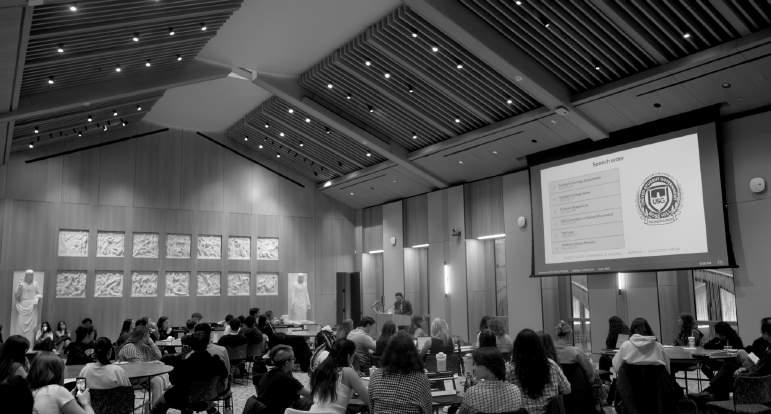
Around 100 students, club leaders and administrators gathered in the McShane Student Center on March 20 for a “State of the Students” town hall to learn about and discuss the proposal, which saw near-unanimous agreement from the students and clubs who spoke.
Fordham’s current policy on contraceptives states that,
By LAINEY COLLIER
Asst. Arts & Culture Editor
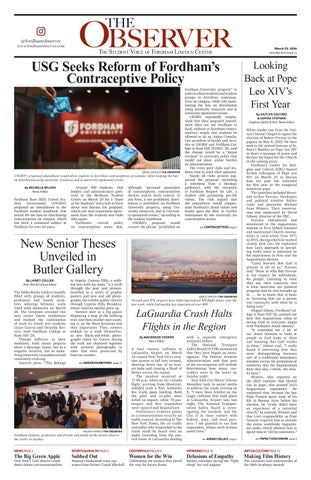
The Ildiko Butler Gallery steadily filled with groups of students, professors and family members weaving between walls lined with memories on March 20. The reception revealed two new senior thesis exhibitions and marked the culmination of work by visual arts students Grace Guerra and Daniella Herrera, both Fordham College at Rose Hill ’26.
Though different in their mediums, both thesis projects share a message: home, not as a singular location, but as something inherited, remembered and constantly evolving.
Guerra’s piece, “This Belongs
to Angela: Cypress Hills, a walking tour with my mom,” is a stroll through the past and present. Installed as a series of graphic posters and new and old photographs, the exhibit guides viewers through Cypress Hills, Brooklyn, where Guerra’s mother grew up.
Viewers start at a big poster displaying a map of the walking tour, and then smaller ones zooming in on the three locations and their importance. Then, viewers embark on a walk themselves, as new black-and-white photographs taken by Guerra during the walk are clustered together with archival photographs in color that were preserved by Guerra’s mother.
although “personal possession of contraceptives, contraceptives devices and/or birth control, in any form, is not prohibited, distribution is prohibited on Fordham University property, using University resources, and at University-sponsored events,” according to the student handbook.
USGRH’s proposal would remove the phrase “prohibited on
Fordham University property” in order to allow students and student groups to distribute contraceptives on campus, while still maintaining the ban on distribution using university resources and at university-sponsored events.
USGRH repeatedly emphasized that their proposed amendment does not ask Fordham to fund, endorse or distribute contraceptives, simply that students be allowed to do so. Aidan Costella, vice president of health and security at USGRH and Fordham College at Rose Hill (FCRH) ’26, said the change would be a “minor revision” to university policy that would not place undue burden on administration.
The event gave clubs and students time to voice their opinions.
Nearly all clubs present supported the proposal (including a statement from a theology professor), with the exception of Fordham Respect for Life, a student club promoting pro-life values. The club argued that the amendment would compromise Fordham’s Jesuit values and would open the door to further concessions by the university for contraceptive access.

By MACKENZIE COOPER News Editor
A fatal runway collision at LaGuardia Airport on March 22 caused New York City’s aviation system to fall into turmoil, shutting down one of its busiest hubs and causing a flood of delays across the region.
The incident occurred at 11:40 p.m. when an Air Canada flight, arriving from Montreal, collided with a Port Authority fire truck upon landing. Both the pilot and co-pilot were killed on impact, while 72 passengers and first responders were injured and hospitalized.
Preliminary evidence points to a communication error by air traffic control. According to The New York Times, the air traffic controller who responded to the crash could be heard over an audio recording from the control tower at LaGuardia dealing
with a separate emergency moments before.
The National Transport Safety Board (NTSB) announced that they have begun an investigation. The Federal Aviation Administration said that part of the investigation will include determining how many controllers were in the tower on Sunday night.
New York City Mayor Zohran Mamdani took to social media to address the crash, writing on X, “I have been briefed on the tragic collision that took place at LaGuardia Airport late last night. The National Transportation Safety Board is investigating the incident, and the City is in close contact with federal, state, and local partners. I am grateful to our first responders, whose swift actions saved lives.”
By KAITLYN SQUYRES & SOPHIA STEPHAN
Graphics Editor & Asst. News Editor
White smoke rose from the Vatican’s Sistine Chapel to signal the election of Robert Prevost to the papacy on May 8, 2025. He later took to the central balcony of St. Peter’s Basilica as Pope Leo XIV to share a message of peace and declare his hopes for the Church in the coming years.
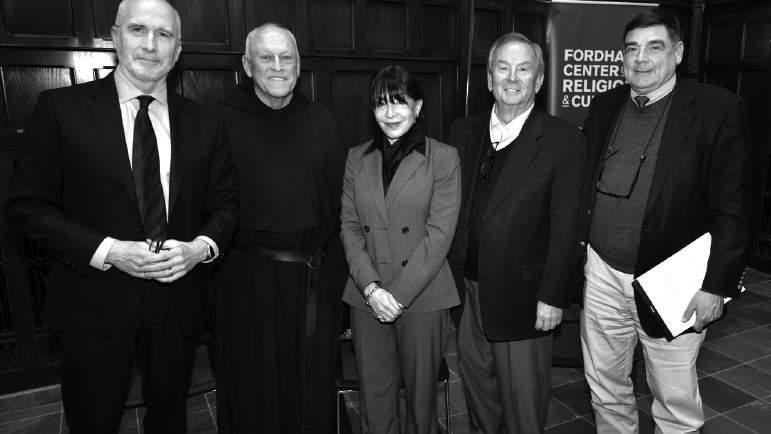
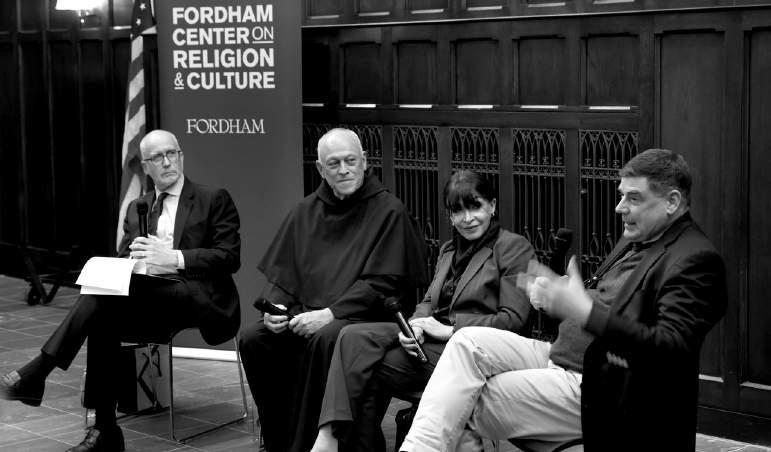
Fordham’s Center for Religion and Culture (CRC) hosted former colleagues of Pope Leo XIV on March 19 to discuss how his past has informed his first year as the inaugural American pope. The panelists included Reverend Arthur Purcaro, theologian and political scientist Emilce Cuda and journalist Michael Sean Winters. Their conversation was moderated by David Gibson, director of the CRC. Purcaro volunteered and ministered in the Augustinian mission in Peru (which founded and maintained Church communities in rural areas) from 1971 to 2015, during which he worked closely with Leo. He explained how Leo’s approach to spreading God’s word is informed by his experiences in Peru and the Augustinian identity.
“(Leo) learned that God is present in all of us,” Purcaro said. “Basic to who Bob Prevost is (is) respect for individuals, for people. Listening to what they say, their concerns, this is what motivates our pastoral program that he was brought up in. … So to know that is basic to (knowing him as) a person (in) continuity with what he is doing now.”
Abigail Adams, Fordham College at Rose Hill ’26, pointed out how this Augustinian value of seeing God in everyone aligns with Fordham’s Jesuit identity.
“It reminded me a lot of our Jesuit (mission to look) at people as God looks at them and knowing that God resides in them,” Adams said. “I really found it interesting how they were distinguishing between sort of a traditional missionary mindset versus the promotion of solidarity that the Augustinians have that also, I think, the Jesuits have.”
Winters, who reported on the 2025 conclave that elected Leo as pope, also praised Leo’s Augustinian experience. He explained that, because the late Pope Francis spent most of his life in Buenos Aires before his election, he “really didn’t have an experience of a universal church.” In contrast, Winters said that Leo’s responsibility as Prior General required him to oversee the entire worldwide Augustinian order, which allowed him to spend time in “all the continents.”
HELENA FRANCO/THE OBSERVER Fordham students, professors and friends and family of the artists observe the works on display.
Going Green: NY-12 Candidates on Environmentalism
Three leading candidates discussed public transportation, gerrymandering, public housing and more
By MICHELLE WILSON News Editor
Three leading candidates in the coming election for New York’s 12th congressional district (NY12) found common ground at an environmentalist forum on March 17: East Side assemblymember Alex Bores, West Side assemblymember Micah Lasher and political commentator Jack Schlossberg.
NY-12 represents central Manhattan, including Fordham’s Lincoln Center campus.
TRANSPORTATION
All the candidates agreed on the success of congestion pricing, and advocated for solar and wind energy over nuclear power (while not ruling out the latter as an alternative). They also supported expansions to public transportation, such as the Second Avenue subway project.
The Second Avenue subway is an ongoing Manhattan transit expansion. Phase one extended the Q line up to 96th Street, costing $4.45 billion. Phase two would cost an estimated $7.7 billion, $3.4 billion provided by a federal government grant. In August 2025, the project’s tunneling contract was approved to extend the line up to a new station at Lexington Ave and 125th Street, adding stations at 106th Street and 116th Street.
The Metropolitan Transportation Authority (MTA) sued the federal government on March 17, alleging that it is wrongfully withholding $58.6 million in funding for the project. The MTA announced plans to move forward with the project despite the ongoing lawsuit. When asked what reforms candidates would support to get transportation projects built effectively and within a reasonable budget, Lasher said he would advocate for design-build (a method in which design and construction are contracted to a single company) and increasing in-house MTA staff on engineering design and construction. Bores concurred and said that the MTA has historically spent more money on outside consultants than engineers on several projects. He also declared his desire to join the House Committee on Transportation and Infrastructure should he be elected.
GERRYMANDERING AND FEDERAL POLICIES
The candidates were later asked if they thought the Democratic party’s recent push to ban gerrymandering was a “tactical mistake.” While none of the three said it was, they did offer slightly different perspectives on the issue. Schlossberg took a hard stance against gerrymandering. Bores and Lasher argued that, given the ongoing political redistricting in many Republican states, they must “fight fire with fire” now and only implement a national ban on gerrymandering after the midterm elections are over. Both Bores and Lasher said the stakes are particularly high given the razor-thin Republican majority in the House now and what they deemed to be aggressive political tactics encouraged by the Trump administration.
Another major point regarding the federal government, which emerged unanimously, was the challenges posed by the Trump administration’s environmental policy decisions. President Donald Trump’s second term has seen rollbacks on government regulations of fossil fuels and pollution, as well as increased focus on oil and gas over clean energy. Government funding for environmentalist projects in New York City will be difficult to obtain, the candidates said.
THE SPEED ACT
The SPEED Act, which was passed by the House in December 2025, aims to streamline environmental reviews of infrastructure projects. It limits the scope and scale of such reviews by the National Environmental Policy Act (NEPA), introduces litigation caps and regulates what projects must undergo full NEPA review.
Bores and Lasher both said they would have voted no on the SPEED Act if they had been in office. While both are supporters of permitting reform, neither saw the SPEED Act as the right strategy. Several environmentalist groups have spoken out against the bill, saying it expedites the approval process for fossil fuel infrastructure projects, a concern shared by the candidates.
Schlossberg also opposed the bill and held a slightly more ardent stance for stringent environmental reviews than his counterparts.
While answering a question about the SPEED Act, Bores harkened back to a point Schlossberg made earlier in the forum: The future of environmentalism is in new, large-scale infrastructure and developments as opposed to an older model focused on conservation and stopping harmful developments. Bores agreed and said that permitting reform must distinguish between different types of infrastructure projects to streamline reviews for clean energy initiatives, while not allowing oil and gas companies to take advantage of deregulation.
PUBLIC HOUSING
The candidates’ public housing discussion centered around the New York City Housing Authority’s plan to tear down and replace the Fulton and Elliot-Chelsea houses. The decision came after decades of neglect, which caused deep structural issues to the buildings and was quite controversial, sparking protests and lawsuits from some tenants. An appeals court temporarily halted the demolition in February in response to one suit.
Schlossberg said that after attending tenant meetings, he can no longer fully support the plan, but agreed on the importance of building new housing and emphasized the complexity of the issue. Lasher disagreed and said “there is no viable nearterm alternative plan” to solve the problems in the buildings, as they would require incredibly costly, difficult renovations.
PERSONAL OIL AND GAS INVESTMENTS
Another point of contention emerged during the lightning round when candidates were asked if they own stocks in oil and gas. All initially answered no. However, after being prompted by Dan Rivoli, a moderator and political reporter with NY1, about his financial disclosure documents, Schlossberg revealed he inherited investment in an oil well in Oklahoma, although he said he cannot sell it. Schlossberg is the grandson of John F. Kennedy and inherited the investment from that side of his family.
When Rivoli asked him about his investments in Exxon and Hess, two major oil companies, Schlossberg said he no longer owns them. He justified his decision by saying he does not think it is a “bad thing for someone to understand how private markets work in (the) energy (industry).”
“I think the most important question that you should want to know is not whether or not I used to own stock because I knew that the war in Ukraine would send oil prices up and I’m very interested in energy, I think it’s what money is funding my campaign,” Schlossberg said.

Schlossberg emphasized that his campaign financing is composed of small donor contributions and that he does not accept money from corporate political action committees (PACs), super PACs or billionaires.
Bores said he avoids investing in index funds due to potential exposure to oil and gas companies and has taken extra steps to divest from them. Lasher said he has some target-date index funds through his 401(k).
Also in the lightning round, Schlossberg said he supports the Williams Companies pipeline, or the Northeast Supply Enhancement Project, which would expand the existing natural gas pipeline. Bores and Lasher said they do not support the project.
HUDSON AND EAST RIVER CLEAN UP
Despite some disagreements, the forum had a congenial atmosphere and several lighthearted moments, such as when Schlossberg discussed his hobby of paddleboarding in the Hudson River during a question on clean-up projects in the Hudson and East rivers. All the candidates supported greater investment in such programs.
Lasher cited combined sewer overflow as the biggest challenge to such a project and acknowledged the necessity for state and federal involvement, as New York City is downstream of the rivers’ flows. Nonetheless, the candidates expressed optimism for the possibility of clean up, with Lasher citing the PlusPool project — a series of netted, swimmable pools in the Hudson in the early 20th century — as an ideal goal for what the Hudson could one day become.
STUDENT CIVIC PARTICIPATION
In an interview with The Observer after the forum, Bores reflected on how solving environmental problems requires long-term solutions, which young people (including Fordham students) will feel the effects of for many years to come.
Lasher shared a somewhat similar hope that Fordham students “see themselves as full participants in this election” and exercise their voting rights.
“You’re going to have to live with the decisions on the environment far longer than most, and so we need people who are thinking, who are forward-looking in terms of not just what the budget will look like in one year or two years, but how we can solve this problem over the long term,” Bores said.
Bores reflected on his participation in an artificial intelligence summit at Fordham University School of Law and said he has been “so thrilled by Fordham students’ ability to bring both data and policy with a deep values alignment that isn’t always shared at every campus, and so I guess the one thing I would say is please get involved.” Lasher shared a somewhat similar hope that Fordham students “see themselves as full participants in this election” and exercise their voting rights.
LOOKING FORWARD
The democratic primary will take place on June 23, with early voting opening between June 13 and 21, ahead of the general election on Nov. 3.
The NY-12 seat is being vacated by retiring Representative Jerry Nadler, who endorsed Lasher, his former longtime aide, in February. Lasher was also endorsed by former mayor Michael Bloomberg.
Bores has received endorsements from former NY-12 congresswoman Carolyn Maloney and other New York state assemblymembers, while Schlossberg was endorsed by Representative and former Speaker of the House Nancy Pelosi.
The primary is a crowded field so far, with over a dozen candidates including George Conway, former Republican attorney and now Trump critic. Conway was not invited to the forum but attended a reception afterward.
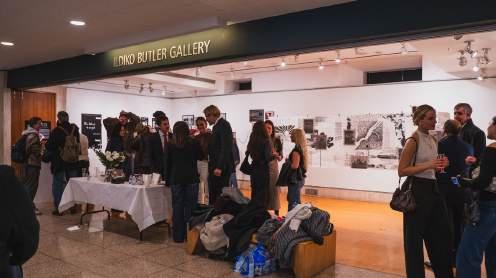
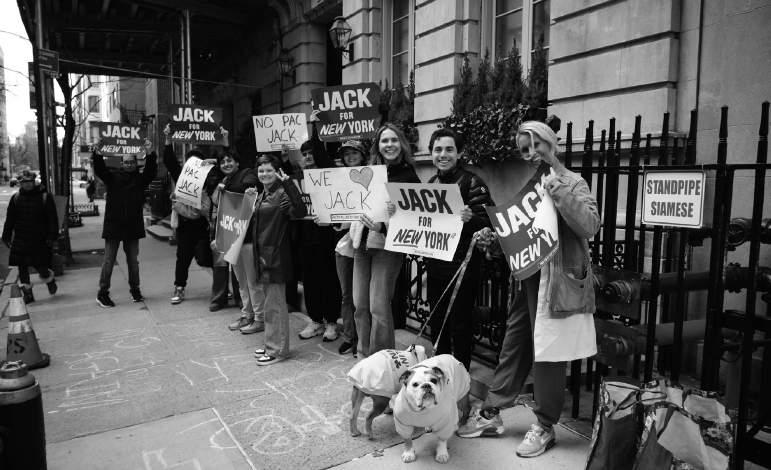
Laura Dunn, a candidate and attorney, passed out campaign fliers in front of Roosevelt House before the forum began. Around the same time, Schlossberg arrived at the venue, stopping to hug a small group of supporters carrying signs that read “Jack for New York” and “No PAC Jack.” According to organizers, candidates either had to have raised at least $250,000 as of the last filing or be an elected official to be invited.
The event, held at Roosevelt House, was co-hosted by Hunter College and the New York League of Conservation Voters Education Fund, a nonprofit dedicated to educating New Yorkers about environmental issues and advocating for civic reform.
PHOTOS COURTESY OF MATT CAPOWSKI
The forum was held at Roosevelt House, the former home of Franklin and Eleanor Roosevelt, both of which supported environmentalist efforts through the New Deal and Eleanor’s conservation advocacy.
Dan Rivoli, a political reporter for Spectrum News NY1, moderated the event.
Long-Contested Contraceptive Policy Faces Renewed Pushback from Student Leaders
The club has proposed an amendment that would lift the ban on contraceptive distribution on campus
Most, however, held the opposite view and maintained that cura personalis compels universities to support every part of students’ lives, including their reproductive health.
USGRH cited three primary reasons for the proposal. One, that the ban promotes a “culture of judgement, silence and internalized shame.” Two, that it discourages students from seeking sexual and reproductive care, does not result in abstinence and increases risk of sexually transmitted infections and rates of unintended pregnancy. And three, that there is a disproportionate impact on low-income and LGBTQ students, as well as those who have not received comprehensive sexual education.
USGRH added that they are not seeking to reinterpret or challenge Catholic doctrine from the Vatican regarding contraceptives — which espouses the “intrinsic evil of contraception” — but rather to redefine Fordham’s relationship with said doctrine. USGRH’s argument is that, as personal possession is allowed, the university has already diverted from the doctrine.
Domenick Fedele, USGRH’s first-year senator and FCRH ’29, spoke on behalf of USGRH and emphasized the importance of individual choice. Fedele said that the university should not create barriers to those choices, nor need it take a rigid stance of prohibition or endorsement.
“(The current policy) conflates the lack of an explicit prohibition with endorsement, which is absolutely not true. However, this represents an ambiguity that
falls hardest on students who are most in need of these critical resources,” Fedele said.
Cristina Traina, a theology professor at Fordham whose specialties include Catholic ethics and sexuality, wrote a letter supporting USGRH’s proposal and suggesting that the university remove language about contraception from the student handbook altogether. The statement was read on her behalf at the town hall by a student, as she was unable to attend.
Traina emphasized that the issue is a question of freedom of religion and conscience. She argued that, among many contemporary Catholics, “the moral primacy of institutional purity has given way to the moral primacy of the common good, which
Shabbat
is in line with Catholic principles of social justice. … Access to contraception is consistent with this theology.”
Traina, members of USGRH and attendees also spoke to what they view as a stricter contraceptive policy at Fordham than most Jesuit universities.
Some have similar bans on contraceptives, though few are as comprehensive as Fordham’s, and 20 out of 27 Jesuit schools do not police contraceptive distribution at all, Henry Carstens, USGRH firstyear senator and FCRH ’29, said during USGRH’s presentation. Prior to the event, USGRH sent out a survey assessing students’ access to contraceptives. Of the 170 students that responded by the event’s start time, 36% said they had “considered not using
contraceptives because of cost, lack of availability on campus, or other barriers.” 58.7% said it is “extremely important” that contraceptives be distributed on university campuses, with another 32.2% saying it is “very important.” 63.6% said access to contraceptives at Fordham is poor or very poor.
USGRH also cited a 2019 survey of 315 students by The Observer, which found that 26.7% of respondents felt financial barriers impeded their access to contraceptives, and 98% believed the university should provide contraceptives. USGRH said this demonstrates “clear and overwhelming student support across campuses for this change,” which is a “necessary evolution for a safer Fordham.”
This issue has been raised at Fordham long before 2019. In 1967, The Fordham Ram published an article detailing a student petition at Thomas More College (Fordham’s women’s college, which existed until its merging with Fordham Rose Hill in 1974) asking the university to provide information about contraceptives and direct students to off-campus resources. The petition received 175 signatures and, according to a 1967 article by The New York Times, the university agreed to start a sex education lecture series.
The issue of education and distribution of contraceptives has continued to be raised at Fordham since then. In 2014, the Students for Sex and Gender Equity and Safety Coalition (SAGES) was formed as an unofficial student club that distributed contraceptives to students via a hotline colloquially known as the “SAGES condom fairy.” They also organized petitions and demonstrations regarding Fordham’s contraceptive policy.
Since 2024, Fordham’s chapter of the Young Democratic Socialists of America (an unofficial student club) has held several contraceptive distributions just off campus, despite administrative pushback.
Leading up to the March 20 event, USGRH had previously attempted to plan a town hall in December, which was postponed due to an issue booking the room.
USGRH will vote on the proposed amendment this week before bringing it to the university administration, though they do not yet have a timeline for what this review process might look like.
Dinner at Rabbi Katja’s House
Students gathered for an evening filled with ritual, food and comfort in a shared Shabbat tradition
By Roop Somal Asst. Layout Editor
Rabbi Katja Vehlow, director of Jewish Life, welcomed students and friends into her home on March 20 for an intimate Shabbat dinner. Undergraduate and graduate students gathered from both campuses to enjoy the food over a series of rituals and reflective conversations.
Shabbat is a weekly day of rest observed in Judaism, commemorating the creation of the world and centering on community and faith. It is observed from just before sundown on Friday to nightfall on Saturday, during which some follow strict religious prohibitions while others use the time to pray, relax and share a meal.
“ We get together, we have a meal, we say blessings and we connect to ourselves and to others ”
Rabbi Katja Vehlow, director of Jewish Life
The dinner began with the lighting of candles, signifying the transition from the work week to Shabbat and bringing a sense of peace and tranquility into the home.
Introductions followed, giving students a chance to share their

experiences of the week, an element of Shabbat that encourages introspection and connection.
“We get together, we have a meal, we say blessings and we connect to ourselves and to others,” Vehlow said.
Vehlow and her husband then led the singing of “Shalom Aleichem,” a traditional song which invites angels to bless the home.
The singing was followed by the blessing of children, Vehlow’s own and those who joined in her home, as words of protection and hope were offered. They then recited the Kiddush, a blessing over wine. Students chanted a collective “amen” as Vehlow filled the Kiddush cup and
poured grape juice for those gathered around the table.
Before eating, students performed Netilat Yadayim, a ritual washing of the hands which is required before eating bread. The practice upholds spiritual purity, with students raising their hands and reciting a blessing.
Dinner began as everyone returned to their seats to break bread. The table was filled with a variety of dishes and two loaves of challah placed at the center to be blessed with Hamotzi.
Brett Dalis, Fordham College at Lincoln Center ’26, recited the prayer alongside Vehlow before going around the table to offer each person a piece of challah.
The loaves were made by Vehlow and family — one prepared traditionally with simple seasoning and the other topped with sprinkles. This detail did not go unnoticed by students, who enjoyed the homemade bread.
“The challah was my favorite part. I think that Rabbi Katja and her husband make incredible challah,” Dalis said.
Students chose from a selection of food throughout the night while engaging in lively discussions with their peers. However, many described the evening as more than a social gathering, also acting as a space for Jewish students to find solace in community and shared faith.
Dalis said he appreciates these events for helping him grow in his faith, not only at school but in connection to his family.
“I always try to take these opportunities to get close to my faith and try to do as much so I can connect to my family more in these kinds of ways,” Dalis said.
Sam Kravitz, Fordham College at Rose Hill ’28, showed appreciation for intentional spaces like Shabbat dinners that give students an opportunity to decompress and socialize in a relaxed setting.
“It’s cool to just get everyone together and hang out, recap the week and unpack,” Kravitz said.
Kravitz also highlighted how such events can help Jewish students feel represented on campus.
“It brings together a community that is very tight-knit but is also not overly present at a school like Fordham,” Kravitz said.
These experiences allow for students to grow both communally and personally, as they are welcomed into a space where they can explore identity, belief and a sense of belonging.
“Rabbi Katja is really good at trying to include people and making this kind of stuff feel less daunting, because it was not something that was super accessible to me when I was younger,” Dalis said.
To conclude the dinner, Vehlow served an assortment of desserts and, alongside her husband, recited Psalm 126 and an abbreviated version of Birkat Hamazon, both Hebrew blessings traditionally recited after a meal.
MICHELLE WILSON/THE OBSERVER
The “State of the Students” town hall, held in the McShane Student Center, gave clubs and individual students to express their opinions on USGRH’s proposed policy amendment.
ROOP SOMAL/THE OBSERVER Attendees at Rabbi Katja Vehlow’s Shabbat dinner connected through food and prayer.
Panelists Discuss Pope Leo XIV’s First Year
Panelists discuss themes from the American pope’s first year including synodality, liberation theology and Catholic social teaching
PAPACY DISCUSSION from page 1
“Leo, because of his time as the head of the Augustinians, had been around the world and had a different experience (than Francis). So while we may not have known him, he got to know us throughout the world in a profound way,” Winters said.
An audience member then asked the panel how Leo approaches different religious traditions around the world, given the competitive atmosphere that often surrounds religion.
In response, Winters pointed out that Leo is a “child of Vatican II” which worked to “fundamentally reorient the church’s relationship with other religions.” Based on this, he suggested that Leo would reject the notion of competing religions.
The Second Vatican Council, known as Vatican II, was held from 1962–65 with the intention of updating the Church’s methods to align with the changing conditions of the modern world. Vatican II produced 16 documents to outline reforms such as encouraging more active participation of lay people and interreligious dialogue.
“ He’s trying to see the world from the stable of Bethlehem. He’s trying to see the world from the cross, naked, ashamed.”
Vatican II paved the way for Francis’ revival of synodality, which promotes a listening Church where all have a voice and role in shaping Church life, and encourages the Church to accompany and serve the whole world, not just its members. Synodality is not a new concept, but it was brought back to the Church’s attention by Francis in the 2023–24 Synod on Synodality. Building on Vatican II’s work in expanding the role of non-clergy members in Church life and administration, Francis included lay people as participants in the recent synod.
Panelists connected Leo’s attention to synodality with Francis’ initiatives and attitudes.
“(Synodality) was the key reform that Francis brought with him from the Latin American Church that Leo was familiar with from his time in Peru, which is, we have to get together and listen to each other,” Winters said.
Winters remarked on the tensions in the Church surrounding
synodality and reinterpreting Church teachings. He explained that the left and right wings of the Church both misunderstood Francis’ policy.
Winters said that the liberal side of the Church mistakenly believed that Francis was “going to overturn certain traditional moral teachings.”
“I think what Francis was trying to say is moral teachings have a place and they’re the stars to guide you by, but we need to apply teachings in the real life circumstances of our people — the pastoral has to have some priority over the dogmatic,” Winters said.
Presenting the opposing perspective, Winters said that the conservative side viewed this shift in Church tradition as “bad weather,” and most likely planned on “(rejecting) Francis and (hiring) a new pope who was going to dial everything back.”
With Leo setting similarly liberal precedents for his papacy, Winters said: “The right really have to decide: Are they going to get with the program?”
Both Francis and Leo entered the papacy with outlooks informed by their pastoral experiences in Latin America, which panelists remarked make them distinct from previous European popes.
Panelists discussed Latin American liberation theology, a method of theology that studies God through the everyday experience of marginalized peoples. It aims to promote solidarity and social justice by emphasizing the wisdom of the oppressed in the ongoing struggle to build a better world free from the evil of poverty. Purcaro explained how this impacts Leo’s prioritization of the marginalized today through his faith and theological work.
“He’s trying to see the world from the stable of Bethlehem. He’s trying to see the world from the cross, naked, ashamed,” Purcaro said.
Cuda explained that Latin American liberation theology, in prioritizing lived reality over abstraction, represents a different approach than what is common in the U.S.
“It’s starting from a different point of view. … Theology in Europe, theology in the U.S., starts from absolute truths, and you apply (those). That’s not where (Latin American) liberation theology starts. Liberation theology starts with the reality of the majority of the population,” Cuda said.
Panelists analyzed how this alternative approach to theology informs Leo’s focus on the values of Catholic Social Teaching, which is founded on the Church’s belief that human dignity is the
foundation of moral society. The doctrine espouses the inherent dignity and rights of the human being and the resulting responsibility for collective action and solidarity this compels.
Purcaro remarked that Leo’s chosen papal name shows his attention to Catholic Social Teaching in its connection to Pope Leo XIII, who wrote a document foundational to the concept, and Leo XIV’s first exhortation, Delixi Te, on love for the poor.
In response to an audience question about how Catholics in the U.S. can live out the faith, the panelists emphasized relearning Catholic Social Teaching, which they think has been lost in the U.S. Cuda explained that people have lost sight of the fullness of Catholic Social Teaching and
“people confuse charity with social teaching in the Church,” a reductive view. Charity is an individual practice of giving to those in need, while Catholic Social Teaching concerns “laws, institutions, political rights, social rights, civil rights” and reorganizing these structures to prevent injustices.
Purcaro shared a personal story about the now pope sheltering his brother from the rain with his own umbrella as a testament to the pope’s humility and selfless character, and stated, “He’s not going to lose it being Leo the XIV.”
Adams expressed a takeaway for Fordham students to approach service work as relational and perpetual, rather than being isolated to individual actions. Instead of approaching such work as being able to “check off” a community service box, she suggested seeing it as an opportunity to learn about and reflect on the systems that create injustices.
“Of course you have so many opportunities to do different work with the communities in the Bronx, but I still think they can be sometimes framed as, ‘I’m going to check off my 30 minute box per week to go be kind to people,’” Adams said. “I think (it is) so
important for Fordham students to constantly reflect on how we integrate these values we’re learning in the classroom into our ordinary everyday experiences.”
Despite their critiques of the U.S. Church, panelists expressed faith in the pope’s American background to enable him to guide the global Church. They shared that the pope brings both strong administrative and pastoral qualities.
Winters believes that Leo’s experiences in the U.S. give him the skills to realize Francis’ vision for a synodal Church that promotes justice, saying that “Americans are lousy at a lot of stuff, but (they are) really good at management, (their) language is linear, (and they) bring things to completion.”
In a similar spirit, Purcaro remarked that Leo is “decisive” while still being able to admit his wrongs, which he described as different from previous popes.
Purcaro shared a personal story about the now pope sheltering his brother from the rain with his own umbrella as a testament to the pope’s humility and selfless character, and stated, “He’s not going to lose it being Leo the XIV.”
Cuda, who worked under Leo before he became pope, expressed hope for Leo’s ability to connect diverse populations and described him as “a bridge between North America and South America.”
Fordham’s CRC will continue the conversation on Leo’s first year through another panel event with the authors of the new book “The Election of Pope Leo XIV: The
of
Last Surprise
Pope Francis” on March 25 at 6 p.m. at Fordham Lincoln Center.
Reverend Arthur Purcaro, Panelist
PHOTOS COURTESY OF LEO SOREL/FORDHAM UNIVERSITY
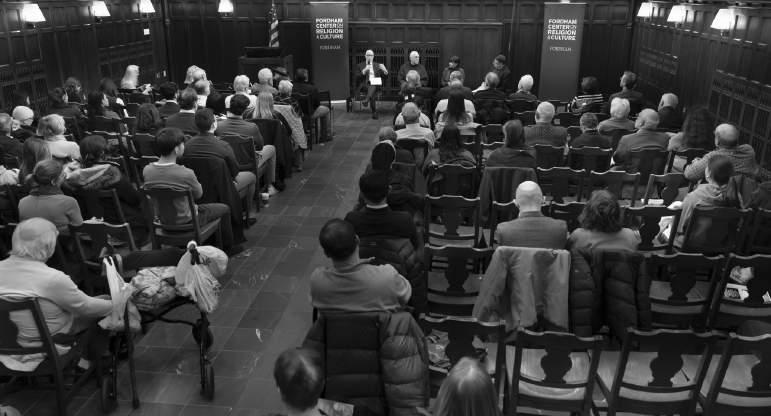
Fordham’s Center for Religion and Culture hosted an event on March 19 with panelists Reverend Arthur Purcaro, Emilce Cuda and Michael Sean Winters.
Robert Prevost was elected as pope on May 8, 2025, becoming the first American-born pope in the church’s 2,000year history.
Robert Prevost chose the name Leo after Pope Leo XIII, a nod at the former Leo’s legacy to promote the Church’s renewed focus on Catholic social teaching.
Airport Delays Worsen Amid LaGuardia Crash and Government Shutdown
Flights at LaGuardia were suspended after a runway collision, resulting in delays and cancellations spreading to JFK and Newark
The Port Authorities of New York and New Jersey, who operate LaGuardia Airport, said that they would be conducting their internal review alongside federal investigations. Kathryn Garcia, executive director of the Port Authorities, said the fire truck involved in the collision was responding to a different incident regarding another aircraft at the time, though exact details have not yet been released.
Air Canada said in a statement that it is fully cooperating with investigators and is working towards supporting the victims of the crash and their families. Two days after the crash, the airline released information about the crew members aboard, specifically the two pilots who lost their lives: Captain Antoine Forest and First Officer Mackenzie Gunther.
Numerous local Canadian media outlets were first to break the news of the two pilots’ deaths. Forest, a 30-year-old from Quebec, and Gunther, a 2023 graduate of Seneca Polytechnic, were identified on Tuesday.
The day after the crash, LaGuardia was shut down for several hours on Monday, with authorities halting all flights in and out of the airport. More than 500 flights were cancelled, leaving thousands of people stranded.
The incident comes as the United States experiences shortages of air traffic controllers and Transportation Security Administration (TSA) workers. Due to

a partial government shutdown that began last month, halting TSA workers’ pay, there have been delays, long lines and heightened security concerns across the country. The disruptions have quickly spread beyond LaGuardia, affecting the two other major airports in the region, John F. Kennedy Airport (JFK) and Newark Liberty International Airport. JFK has experienced significant delays due to increased air congestion from diverted flights. Newark experienced a brief ground stop on March 23 due to a reported burning smell in the air traffic control tower, leading to a temporary evacuation of the building.
Kirsten Mueller, Fordham College at Lincoln Center ’26, said that she experienced a series of delays and cancellations with her flights while trying to come back to school after spring break.
“I was supposed to fly out of Austin, Texas, on March 16, right after spring break, but my flight was canceled so I had to stay an extra day,” Mueller said. “There were no other options that weren’t under $1000 or that weren’t over $1000 or that didn’t have so many layovers that it would end up getting me in at the end of the week.”
Mueller also shared her unease about flying during the upcoming Easter break after the recent events.
“I’m flying out of Newark this time, but still nervous, because there’s no signs of the TSA situation getting any better. I can only hope that the government starts paying TSA and also air traffic control is accounted for too,” Mueller said.
As of March 23, Immigration and Customs Enforcement (ICE) agents have been deployed to airports around the country to help TSA workers amid the staffing shortages. Due to the government shutdown, it has now been five weeks since TSA workers have been paid. Fifty thousand employees have gone without pay and over 400 have quit.
CNN reported that 13 U.S.
airports will see ICE agents in the coming weeks, including Pittsburgh International Airport, Cleveland Hopkins International Airport and Luis Muñoz Marín International Airport in Puerto Rico.
Border Czar Tom Homan spoke to CNN on March 22, defending the decision to deploy ICE to national airports.
“ICE agents receive a high level of training and ICE agents are assigned at many airports across the country already,” Homan said. “They do a lot of investigation — criminal investigation — on smuggling at airports. Certainly, a highly trained ICE law enforcement officer can cover an exit and make sure people don’t go through those exits, entering the airport through the exits.”
Homan also said that ICE’s presence will help mitigate the effects of understaffing.
Former TSA Administrator John Pistole offered a different assessment when speaking to NBC News on March 23, stating that ICE personnel are not trained to conduct screening operations and check-in.
“They’re not of any help in terms of the actual checkpoint operations,” Pistole said. “I see it more as, again, a visible deterrent, but doesn’t speed things up in terms of trying to get these lines down. That’s a political issue.”
At the time of publication of this article, NTSB’s investigations are still ongoing.
IPED Hosts Lecture on International Nonprofit Work
IPED hosted Tara Everton to discuss her career journey and fundamentals of working in the industry
By ABBIE WONG Staff Writer
Tara Everton, a communications manager at the United Nations Sustainable Development Solutions Network (SDSN), discussed her career in the international nonprofit sector and the current state of the industry on March 19 in Dealy Hall.
Everton was hosted by Fordham’s International Political Economy and Development (IPED) program as part of their continuing lecture series.
She has had a lengthy career in international aid. While in college, she interned for the International Rescue Committee — a nonprofit dedicated to helping refugee families — and Human Rights First, a nonprofit that works to defend human rights and the rule of law in America. After graduating from the University of California, Berkeley, she began a full-time position with the Human Rights Foundation (HRF) where she worked for three and a half years before transitioning to her current position with SDSN.
Everton began the lecture by detailing her road to the nonprofit sector. As an undergraduate, she was convinced she would go into politics, but became “disillusioned with American politics” after working on Capitol Hill for a semester.
“I think I grew up in a household that very much prioritized volunteerism and making an impact in your community. And I wasn’t quite convinced that politics would be the right route for me to see that through. So, I decided to take a stab at working within the nonprofit space,” Everton said.
Everton went on to detail the specifics of her work with HRF
and SDSN. Her areas of focus include marketing, external communications and policy research and development.
“(At SDSN) I also have done a lot of work managing our partnerships and managing the state of our external relations, (which) can take the form of partnering and collaborating with a likeminded organization on an initiative or a launch,” Everton said.
“(And in) both organizations that I’ve worked with, I’ve produced a lot of reports, a lot of issues and policy briefs.”
Everton’s lecture not only tackled her own experience, but also addressed problems facing the entire nonprofit sector.
Providing insight into trends she’s observed in the industry, Everton shared how the current administration’s 2025 cuts to federal funding affected the nonprofit sector at large.
In January 2025, the Trump administration sent a memo to U.S. federal agencies ordering a temporary freeze in federal funding for many government programs. After a series of legal battles including a court-ordered pause, many federal grants were cut, frozen or discontinued.
The U.S. Agency for International Development (USAID) was shut down in July 2025 after many of its programs had already been dismantled by the Department of Government Efficiency. Further cuts followed in August.
Various organizations that relied on federal funding, including nonprofits, felt the impact of these cuts.
“Even organizations that were not necessarily hit directly saw those ripples. A lot of major donors and a lot of foundations decided to reassess where they were
putting their money as a result.” Everton said.
In response to a question about how funding cuts affected SDSN (where she currently works), Everton shared that the organization was impacted even though it did not suffer federal funding cuts itself.
“We’re not relying on federal funding. However, the funding landscape has changed a lot,” Everton said. “We’re a little tight. Not so much that we have to close our doors or anything like that, but we were definitely impacted.”
Obstacles like tight budgets can make nonprofit work challenging. Everton shared that her job often requires adaptability.
“ We’re not relying on federal funding. However, the funding landscape has changed a lot.”
Tara Everton, communications manager at SDSN
“In my time with both HRF and SDSN, and my various internships, I’ve worn a lot of hats,” Everton said. “People joke that you wear a lot of hats when you work for a nonprofit, and that is very true.”
Everton provided an example from when she first started working with the Human Rights Foundation, where she was tasked with working on media and public relations, despite having little previous experience in that side of nonprofit work. She shared that being in the position allowed her to display
her skills and fill gaps where she was needed.
When asked what skills a person seeking nonprofit work should develop, Everton shared that proficiency in research and project management is very useful.
“I’d say general research skills are definitely applicable across the board, whether you’re researching policy updates or general research,” Everton said. “Project management, people management, is huge across the board in every role, in every function.”
Jet Pacapac, an IPED graduate assistant who helped organize the lecture series, said that the best part of the series is hearing different perspectives from speakers and receiving concrete insights into the field.
“This is a chance for us to see concrete, real-life examples of the things we’re studying in class, which you don’t get in class,” Pacapac said.
Attendees received the kinds of honest insights Pacapac valued as Everton concluded the lecture
with a few takeaways on how difficult the work can sometimes feel.
“Working in nonprofits can be quite draining. We’re working with some often very emotionally charged and heavy content,” Everton said. “So I think it’s really important to attend to your own mental health and your mental well-being, especially within the nonprofit space because you will work many hours and pour a lot of emotion into your work on a dayto-day basis.”
Despite the difficulties, Everton encouraged anyone interested in working in nonprofits to pursue a career in the field.
“There’s a lot of powers at play that are threatening general freedoms, threatening our planet and causing conflicts constantly, so we need people in the nonprofit space who are motivated and passionate about their work. So if you are interested, I encourage you to enter that space,” Everton said.
The next iteration of the IPED lecture series will occur on March 26.
GRACE SANTOLI/THE OBSERVER
Immigration and Customs Enforcement agents are now present in 13 major airports across the nation.
LUCIEN FISCHER/THE OBSERVER
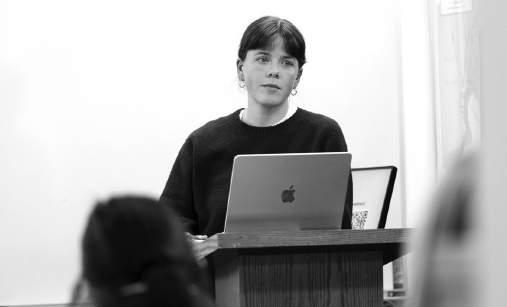
Tara Everton has worked at various nonprofits and is now a communications manager at the United Nations Sustainable Development Solutions Network.
Sports & Health
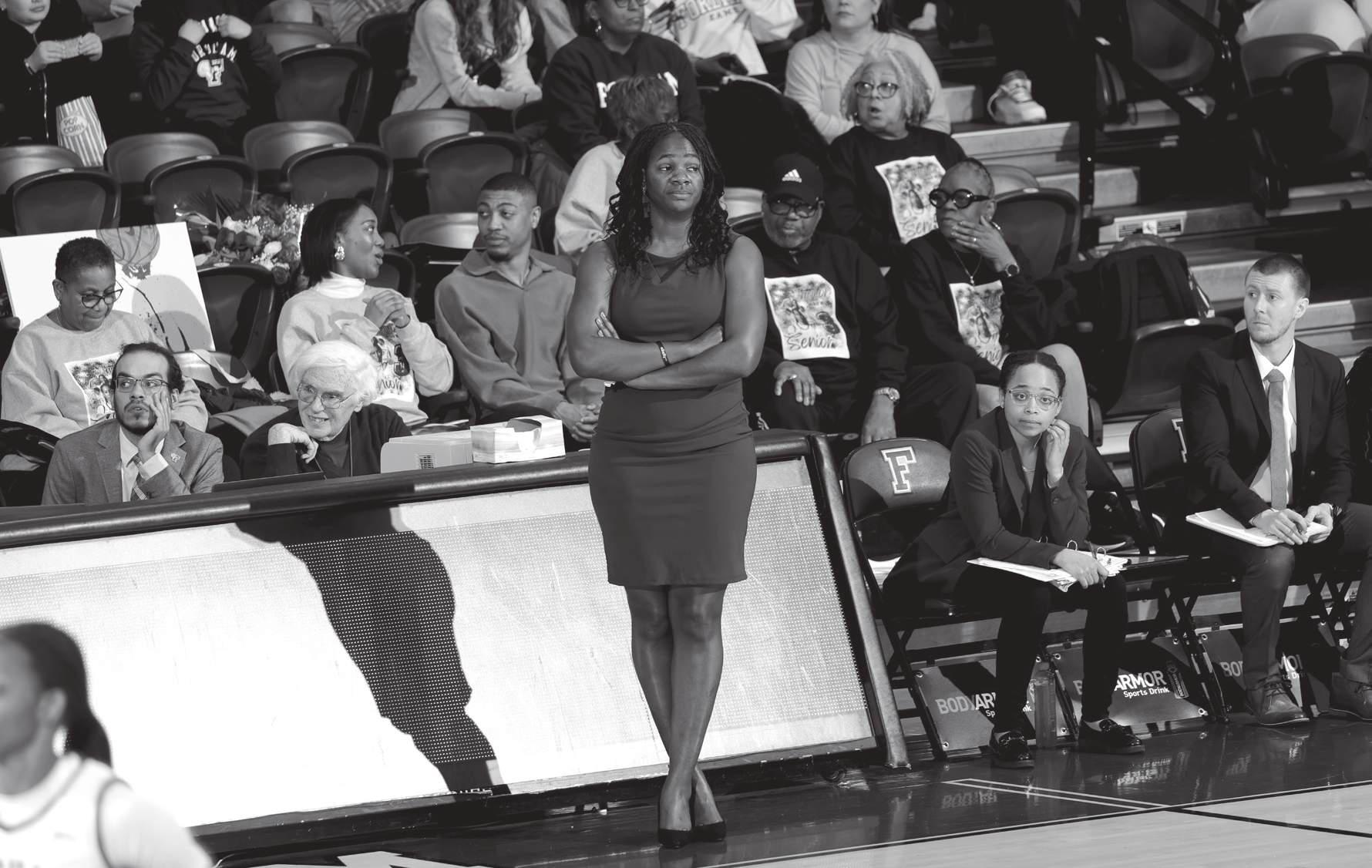
Women’s Basketball Coach Departs From Team
Fordham Athletics is parting ways with former Head Coach Bridgette Mitchell after three seasons
By CORA COST Sports & Health Editor
Charles Guthrie, Fordham University’s director of intercollegiate athletics, announced on March 16 that the women’s basketball program will be parting ways with former Head Coach Bridgette Mitchell. Guthrie shared that Fordham will “move in a new direction” and has commenced a national search for its next head coach.
Mitchell leaves Fordham after the conclusion of her third season with the Rams, which ended with a close loss to St. Louis University in the first round of the Atlantic 10 Conference (A10) Championship tournament. The Rams finished this season with a 10-20 record, with only two wins out of the eighteen games played within the A10.
In Mitchell’s second season, the Rams led the A10, sitting 15th in the nation in offensive rebounds, averaging 15.1 per game while also contending with the national leaders in total rebounds, turnovers forced per game and steals per game.
Over the course of her tenure at Fordham, Mitchell brought in several recruits, including the addition of Irene Murua, Graduate School of Arts and Sciences ’25, and Taylor Donaldson, Gabelli Graduate School of Business ’25, who led the A10 in scoring with 483 points in her first season with the Rams, proving key to Mitchell’s offensive strategy.
In Mitchell’s second season, the Rams led the A10, sitting 15th in the nation in offensive rebounds, averaging 15.1 per
game while also contending with the national leaders in total rebounds, turnovers forced per game and steals per game.
Mitchell was hired to replace longtime Head Coach Stephanie Gaitley, who stepped away from the women’s program after 11 years. Mitchell came to Fordham with extensive experience, with several successful coaching stints as well as a notable collegiate career with Duke University’s women’s basketball team.
Before joining the Blue Devils, Mitchell was a McDonald’s All-American during high school in New Jersey. Mitchell found continued success at Duke, appearing in the NCAA tournament each year of her collegiate career, including two Sweet 16 showings and an Elite Eight, with the stretch from 2006–10 rounding out a 109-22 team record.
After graduating from Duke, with a bachelor’s degree in sociology and a minor in African American Studies, Mitchell played professionally overseas in France and Poland, where she earned a bronze medal in the European Championships.
The success Mitchell found on the court was quickly transferred to the sideline, with the start of
her coaching career as an assistant coach at Wagner College from 2013–14. From Wagner College, Mitchell moved to Sienna College, where she was an assistant from 2014–16, before truly hitting her stride with her threeyear-long stretch at James Madison University.
During her time as assistant coach, James Madison won two consecutive Coastal Athletic Association (CAA) regular-season titles in 2018 and 2019. Mitchell’s final stint as a collegiate assistant coach was at the University of Pittsburgh from 2019–21.
Mitchell’s move to the University of Northeastern came with a promotion as she was named the head coach for the Huskies’ program in 2021. During her time in Boston, Mitchell led the Huskies to their first-ever CAA regular-season title, after being picked to finish eighth in the preseason poll that year. For her efforts, she was recognized as the CAA Coach of the Year and secured a top-three seed in the CAA Tournament for the first time since 2006.
The decision to change leadership in the women’s program follows Guthrie’s decision to part ways with former men’s Head Coach Keith Urgo, who left Fordham at the conclusion of last year’s season after a year of struggles both on and off the court, including a 12-21 record and NCAA investigation into improper recruiting procedure.
Along with Mitchell’s departure, the women’s squad has three seniors and two graduate students who will graduate in May. This leaves Fordham Athletics and Guthrie the difficult task of finding a replacement for the head coaching position — a replacement who will have about five months to recruit before the start of the women’s basketball season in September.
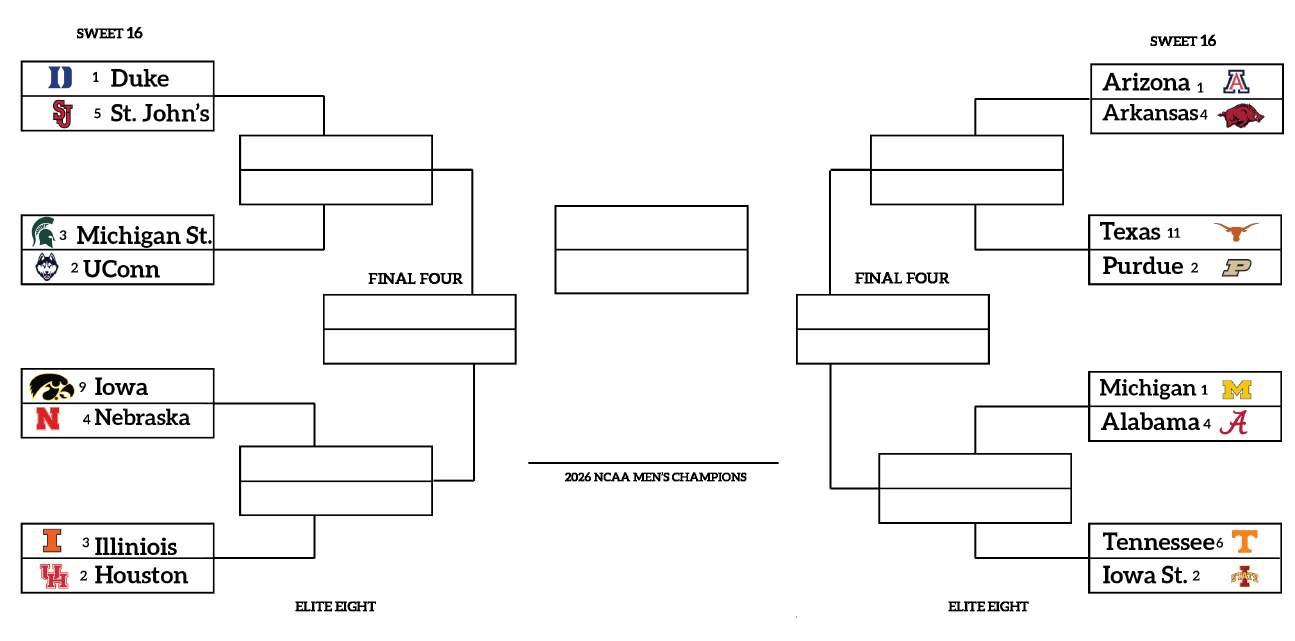
The Observer’s Editorial PickNCAA Women’s Championship
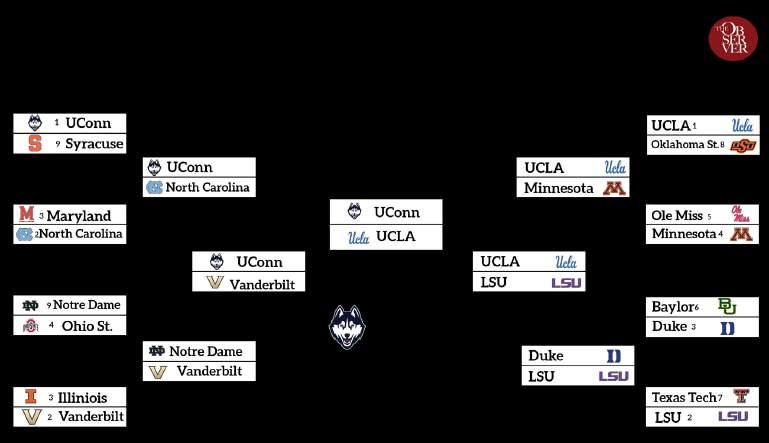
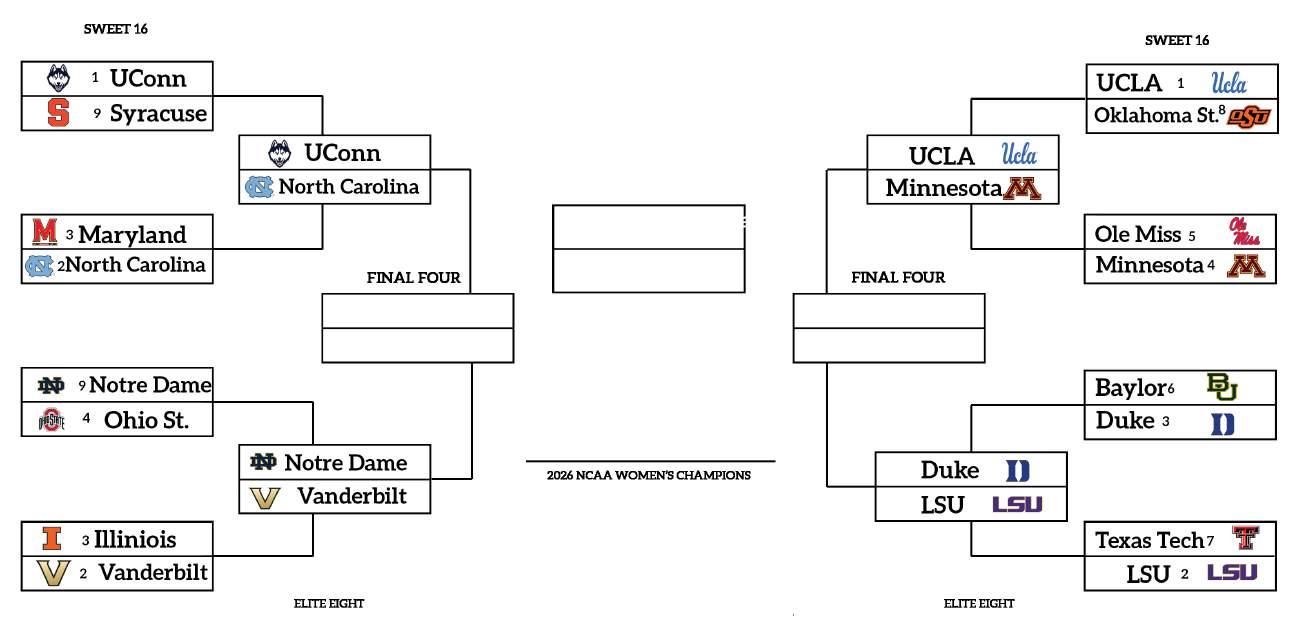
PHOTO COURTESY OF FORDHAM ATHLETICS
Bridgette Mitchell on the sideline coaching one of the women’s basketball games in the Rose Hill Gymnasium.
By CAITLIN LAMBROS Multimedia Editor
Sláinte Students Jig at Irish Night
Fordham’s Irish step dancing team hosted their annual Irish Night showcase
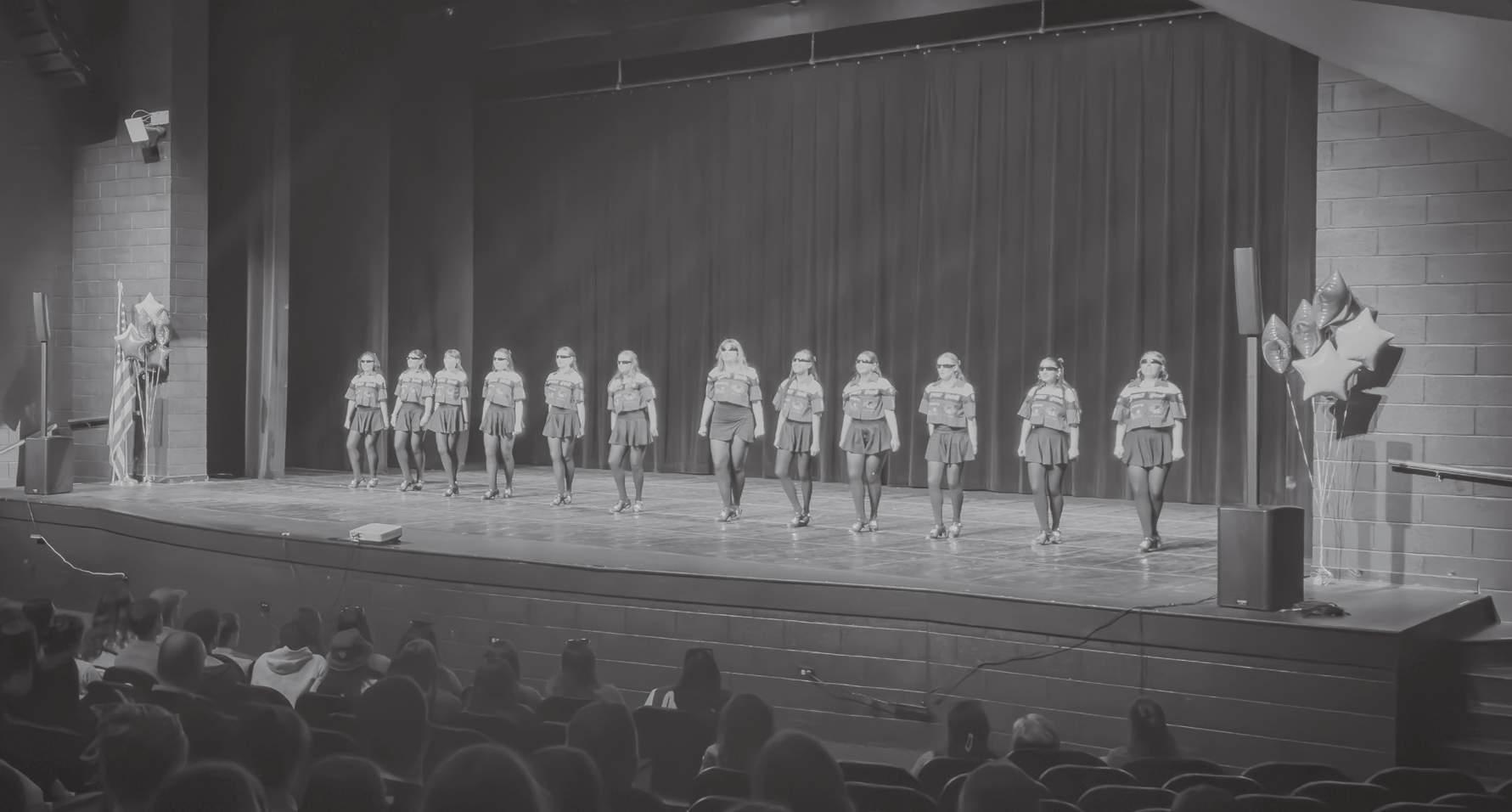
Fordham’s Irish step dancing group, Sláinte, hosted its 11th annual Irish Night on March 21, performing to a sea of green at Fordham Preparatory School.
Sláinte (meaning cheers in Gaelic) is Fordham’s only Irish dance group. Every year, around St. Patrick’s Day, they host their annual Irish Night. The event is full of traditional dances, routines to contemporary songs and interludes from Fordham’s a cappella groups.
This year, the show featured tracks like “Where Is My Husband!” by Raye, “Rocky Road to Dublin” from “Sinners,” and a boy band melody featuring artists such as BTS, One Direction and the Backstreet Boys, all alongside performances from a cappella groups Hot Notes, Satin Dolls, B-Sides and The Ramblers.
Irish stepdance is a traditional style of Irish dance consisting of hard and soft shoe dances performed in groups or solos. The dances feature moves like the reel and light jig that focus on the movement of the feet while keeping the upper body as stiff as possible.
Sláinte consists of about 20 dancers across all grades that perform competitively while also teaching beginner classes at Fordham, with their season culminating in their end-of-year celebration, Irish Night.
THE
Sláinte performed to modern songs like “Where Is My Husband!” and “Sally, When the Wine Runs Out.”
The event is organized by Sláinte’s co-presidents, Meghan Naughton, Fordham College at Rose Hill (FCRH) ’26, and Julia Morales, FCRH ’26, who both began dancing with the team during their first year at Fordham.
“Sláinte is the most humbling club I have ever been in (during) my entire time here (at Fordham),” Morales said. “I look so fondly back on Sláinte just because everyone is so incredibly talented.”
Irish Night is a specific source of pride for Morales. As a
completely student-run organization, the two co-presidents are in charge of coordinating with the venue, the Office of Student Involvement, creating marketing materials and all the other logistics that go into the completely free show.
“We just want to celebrate Irish culture and celebrate these cool dances we’ve been working on all year,” Morales said.
The night began and ended with two traditional Irish dances, the Riverdance and Lord of the Dance. From there, the group heel clicked, high kicked
The Observer’s Editorial PickNCAA Men’s Championship

and jigged to popular music, all choreographed by members of the team.
One of the contemporary moments of the night came from Ryan Coogler’s Oscar-winning film “Sinners,” which features a rendition of “Rocky Road to Dublin.” Though it is not originally from the film and actually dates back to 19th-century Ireland, the song’s appearance in “Sinners” and its accompanying dance number inspired Sláinte secretary Julia LaGrange, Fordham College at Lincoln Center ’26.
“I felt like I could hear the steps and see the choreography before I even sat down to write the piece,” LaGrange said.
LaGrange immediately got to work and choreographed the dance for Irish Night, reinventing the film’s dance while keeping the vampire storyline of the film “Sinners” alive through their costuming and acting.
“The show could not have gone better, and it was almost magical to perform on stage with my teammates, something that was once only an idea in my mind,” LaGrange said.
Additionally, the group performed their competition piece to Rihanna’s “Shut Up and Drive.” Sláinte participates in the annual Collegiate Irish Dance Association (CIDA) at Villanova University, where last fall, their 8-hand routine placed 9th and their 4-hand routine placed 23rd.
In between dances and during their many costume changes, Sláinte invited Fordham’s a cappella groups to perform. The groups all sang at least one Irish song, or a song by an Irish artist, and a song of their choice. From “Come on Eileen” by Dexys Midnight Runners to “Man I Need” by Olivia Dean, each group added their own flair alongside classic Irish songs.
The Ramblers, Fordham’s only all-male a capella group, hosted the last break, delivering a rendition of the traditional Irish ballad “Red Is the Rose.”
“Sláinte is one of the events we look forward to every year,” Ramblers member Josh Rodriguez, FCRH ’27, said. “It’s fun to see all the acapella groups in one place.”
The collaboration with other performing arts groups is important to Morales to include more Irish songs in the show’s lineup, with the a cappella groups bringing their own style to the show.
“The a capella groups are always so incredibly enthusiastic. They love performing at Irish night,” Morales said.
Irish Night is not only the culmination of Sláinte’s semester, but is also a way to celebrate Irish culture on campus.
Fordham has long studied Irish culture. In 1927, the first Irish studies program in the U.S. was created at Fordham by Joseph Campbell. From there, the program has grown into the Institute for Irish Studies, offering a minor in Irish studies and research projects including the Bronx Irish History Project, focused on interviewing Irish Americans across the Bronx.
“I feel like sometimes people are fans of Sláinte for any way of connecting to us, which could just be like, ‘Oh, I’m 50% Irish,’” Morales said. “And as silly as it sounds, we want to connect everyone and we want to be that Irish presence that may not be there for somebody.”
The extremely enthusiastic crowd at this year’s show demonstrated this connection. With friends, family and alumni — who performed an impromptu dance — piling into Leonard Auditorium, the passion for every dancer loudly filled the room. Sláinte will return in the fall of 2026 as they prepare for the 2026 CIDA competition at Villanova University.
CAITLIN LAMBROS/
OBSERVER
Honoring the Women of Fordham Sports Women’s
History Month occasions a reflection on the history of women athletes at Fordham
BY CORA COST Sports & Health Editor
March is officially recognized as Women’s History Month in the United States — a month to honor women’s contributions to American history that continue to shape every aspect of American life, including what many would consider a cornerstone of American society: sports.
The Women’s National Basketball Association (WNBA) reached a monumental collective bargaining agreement (CBA) with their players’ association (WNBAPA) on March 23. One of the main points during the bargaining process was increasing the WNBA salary cap, a demand the WNBAPA believed was proportional to the growth the league has seen in recent years.
“The moment is the result of years of work and a shared belief that as the league rises, so must the players,” Nneka Ogwumike, president of the WNBAPA said in a statement.
Years of work and advocacy for visibility that is not exclusive to the WNBA, but indicative of women’s athletics as a whole, and especially women’s collegiate athletics.
In 1970, Fordham University introduced its first women’s varsity athletic program with the addition of the women’s basketball team. Women’s swimming and diving, tennis and volleyball teams were added
soon after in 1971, 1973 and 1974, respectively. The following two decades rounded out the women’s athletic teams at Fordham that have competed in the Atlantic 10 Conference (A10) league of the National Athletic Collegiate Association (NCAA), with cross country, track and field, and softball in the ’80s and rowing and soccer in the ’90s. Dance and cheerleading are the final two of the 11 current Division I women’s athletic teams at Fordham, which comprise over 250 female student-athletes according to Scott Kwiatkowski, associate sports information director.
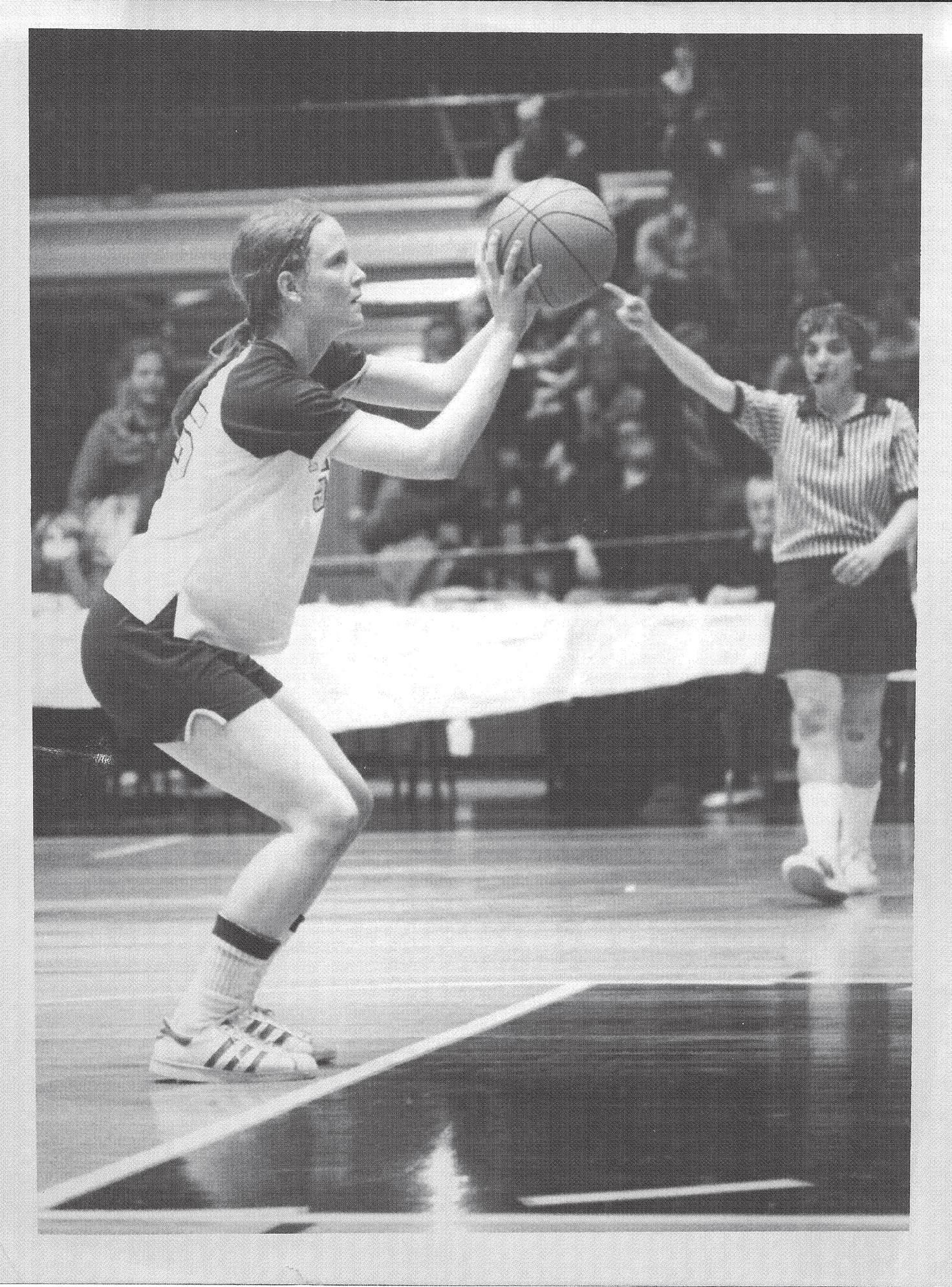
Although 1970 marks the official start of women’s varsity sports at Fordham, women’s athletics had an established presence on campus at Fordham Rose Hill before the turn of the decade. In 1964, Fordham opened up the all-women’s Thomas More College (TMC). One of the members of the first graduating class, Barbara Hall, TMC ’68, etched her name in Fordham’s athletic history by co-founding the women’s basketball club.
“It was great; it was fun. There were a number of women who played basketball and there were really no sports for women at the time, so we went to talk to the athletic director about getting a women’s basketball team, and they were surprisingly open to it,” Hall said in a 2018 oral project Fordham conducted with the members of TMC students’s first graduating class. “A lot of the guys from ’68 say, ‘I remember
you, I remember seeing you play basketball.’ And that shocks me. It really does.”
The 1970s proved to be a monumental decade — not just for Fordham but for collegiate athletics across the country. Title IX of the Education Amendments of 1972, widely known simply as “Title IX,” was passed by Congress and signed into law by former President Richard Nixon. The legislation states the following: “No person in the United States shall, on the basis of sex, be excluded from participation in, be denied the benefits of, or be subjected to discrimination under any education
program or activity receiving Federal financial assistance.”
Title IX has been fundamental to the expansion and the fiscal support of women’s collegiate athletics programs in the U.S.
The NCAA divides the application of Title IX in collegiate athletics into three sections: participation, which requires equitable opportunities to participate in sports across women’s and men’s programs; scholarships, which requires that athletic scholarships are received by female and male student-athletes proportionate to their participation; and a general consensus that athletic

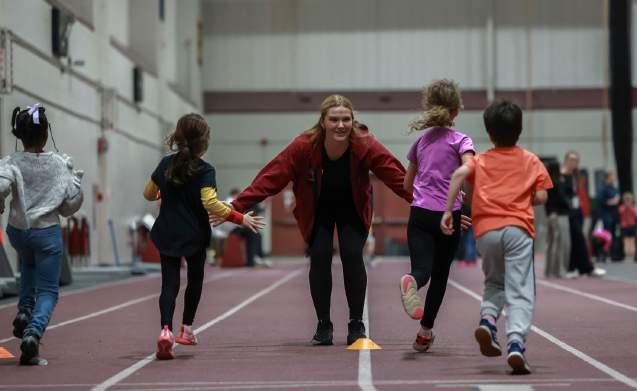
COURTESY OF CRISTINA STEFANIZZI
Strength and conditioning Coach Brittany VanderGroef is pictured at the National Girls and Women in Sports Day Clinic this year.
programs will treat female and male programs equally in regards to equipment, scheduling, facilities and other provisions.
Over half a century since Title IX was officially passed, women’s collegiate sports in the U.S. have seen a 14% increase in participation in the NCAA women’s championship and emerging sports over the last decade. This trend of national growth has not gone unnoticed by members of the women’s Fordham Athletic community, including Hope Nolan, Fordham College at Rose Hill (FCRH) ’26, co-captain of the swimming and diving team and president of the Student-Athlete Advisory Council.
“ Being a female athlete means redefining strength as a characteristic usually reserved for men. To me, being a female athlete means being strong and confident and being a leader within your community.”
“I’m loving to see how it’s growing. I’m loving how much more recognition women’s sports is getting now and how people are kind of realizing how much less what female athletes were getting before, and especially with women’s basketball and the (WNBA’s) CBA getting passed and all this stuff, just looking out for female athletes and giving them the attention they deserve, because everyone watches women’s sports,” Nolan said.
For Anne Gregory-O’Connell, FCRH ’80, a lot has changed in women’s collegiate sports since her time with the women’s basketball program.
“When I turn the TV on and I see the crowds at the women’s college games, that’s fantastic. They get so much more
support from fellow students, from alumni, from everybody. They packed the arenas, which I think is a wonderful thing,” Gregory-O’Connell said.
The platform for women’s sports has evolved since 1974, when Gregory-O’Connell first took the court in the Rose Hill Gym. Gregory-O’Connell was the first female athlete inducted into the Fordham Hall of Fame and holds the records for all-time leading scorer for the women’s basketball program with 2,548 points, as well as the leading rebounder with 1,999. Her career with the Rams is illustrative of the talent and dedication that have always existed within women’s collegiate sports.
“We played around the time when things were just getting off the ground … right from the get-go, we were trying to make it an important sport,” Gregory-O’Connell said. “We had such a good time, but at the same time, it wasn’t all fun and games. We worked really hard and we were very dedicated, but it was an amazing experience for me. It was the best I could ever ask for.”
Gregory-O’Connell is not alone in her athletic excellence; the Fordham Athletics Hall of Fame and record book is full of incredible female athletes. Some of these incredible women include, but are not limited to: Fordham softball’s Jen Mineau, FCRH ’12, who set 16 records during her time with the program, including career marks for wins at 101 and 1,390 strikeouts; track and field’s Lauren Gubicza-Brennan, FCRH ’93, who qualified for the NCAAs and the U.S. Olympic trials in 1992; and Brienne Ryan, FCRH ’13, who also made it to the Olympic trials and in 2012 became the first female Fordham swimmer to compete at both the NCAA Championship and U.S. Olympic trials. Recently, former women’s rower, Fiona Murtagh, FCRH ’16, won gold medal in women’s single sculls at the World Rowing competition representing the Irish National team.
Fordham University currently has 13 A10 Championship wins by women’s teams:
women’s basketball in 2014 and 2019; softball with 9 in 2022, 2019, 2018, 2017, 2016, 2015, 2014, 2013 and 2011; swimming and diving in 2010; and tennis in 2023.
Over the last 56 years, student-athletes at Fordham have been a cornerstone of Fordham’s athletic success. This stardom goes beyond the athletes; from administrative roles, to the Sports Medicine and Strength and Conditioning Departments, to Fordham’s coaches, there are women in every corner of the Athletics department.
Fordham currently has three female head coaches within the Athletics department: Kayla Armfield, for cheerleading, Jenna Stamps for dance and Melissa Inouye for the women’s softball program, who just won her 300th game with the program.
Before Shannon Lulley, FCRH ’16, was the senior associate athletic director for Strategic Initiatives at Fordham, she was a member of the Rams’ swimming and diving program. One of the projects Lulley worked on for the Athletics department is Fordham’s National Girls and Women in Sports Day (NGWSD), an annual youth clinic for young girls within the New York City community hosted by student athletes across the department. NGWSD gives their female student athletes to be role models for a younger generation of female athletes.
“Being a female athlete means redefining strength as a characteristic usually reserved for men. To me, being a female athlete means being strong and confident and being a leader within your community,” Lulley said.
Through Lulley’s transition from student-athlete to administrator within the Fordham Athletics department, Lulley has found a new way to create opportunities for women in sports.
“Graduating as a student-athlete from Fordham to now working as an administrator has allowed me to see the inner workings of an athletic department and experience firsthand how we are creating opportunities and spaces for women within our department,” Lulley said. “I love being able to share my experience with current student-athletes and help guide them through their journey at Fordham.”.
Creating space for female athletes to grow and improve is on the forefront of Assistant Strength and Conditioning Coach Brittany VanderGroef’s mind. VanderGroef has been part of Fordham’s strength and conditioning team for five years and works with both the men’s and women’s athletic teams at Fordham.
“There’s also a different kind of motivation that comes from training alongside other women. It can feel less intimidating and more encouraging, especially in spaces that have traditionally been male-dominated,” VanderGroef said. “You learn to challenge stereotypes about what female athletes ‘should’ or ‘shouldn’t’ do in the weight room. That shared mindset of proving strength, resilience and capability creates a strong bond.”
Working with female athletes in strength and conditioning, for Vandergroef, is about growth, accountability and mutual empowerment.
“You’re not just getting stronger individually. You’re helping build a culture where strength, in every sense, is supported and celebrated,” VanderGroef said.
Women’s collegiate athletics has seen a lot of changes over the course of the last 50-plus years and the women within the Athletic Department at Fordham have not only empowered these changes but have highlighted their necessity.
“The biggest change I’ve seen is this: Women’s sports have gone from fighting just to exist, to now competing for equal respect, investment and visibility. At Fordham, that looks like steady institutional progress with room to grow,” VanderGroef said.

COURTESY OF FORDHAM ATHLETICS
Anne Gregory-O’Connell, FCRH ’80, holds Fordham
women’s basketball’s all-time scoring and rebounding records.
Shannon Lulley, FCRH ’16
Opinions
Bury Your Empathy Grief is terrifying, but we need not be afraid

We’re all chasing happiness — that abstract, ephemeral thing we hope will somehow turn perennial. We can recall moments when we’ve felt it, but we are still ready to banish sadness from our lives entirely and turn a new, happy leaf. Our aspiration is sincere and quaint and seemingly feasible, should we play our cards right. After all, good things happen to good people. Don’t they?
Without realizing it, we assign morals to sensations. Surely, that which feels good must be good! But, if this is true, then it must mean that all that feels bad must also be wicked. Like a plague, it ought to be eradicated.
We act as if suffering has no purpose other than to incite misery. It is our mortal enemy, crossing its steely arms in front of those elusive golden gates. As soon as we feel it, we want to shake it off, because the only thing worth feeling is happiness. But what if we’ve got it all wrong? What if trauma and hardship are not just things to be done away with?
When happiness becomes an ambition rather than a feeling, we trudge through sorrow with our eyes shut. But what happens when we experience something so tragic that it cannot be wished away? Naturally, it feels safer, surer to insist upon our autonomy. We have been blessed with free will; we can work through this.
In some sense, this is true. We ought not wallow, at least not for long. Friendship is magic, and clinical psychology has come a long way since Freud’s infamous couch. Even in a cruel world, saving graces exist. Nonetheless, grief must run its course.
This distinction is of the utmost importance because we have the most to learn from that which is most horrific. Grief stands alone in that it is uniquely permanent. It is a mysterious force that bonds itself to our soul when life gets worse than you ever thought it could be. There is no choice in it, and I envy those who presume there to be.
The pain of others is terrifying because we are almost entirely helpless to it, and yet, for some reason, we feel responsible to remedy it.
Of course, all that we experience, even that which we forget, shapes our perceptions, experiences and personality in ways that are not always obvious. Like the crack in your windshield, we change ever so slightly until one day we realize: Woah, I am big now!
But grief is nothing like this. Certainly, it is the antithesis of imperceptible. In the blink of an eye, the snap of a finger, or whatever adage floats your nice little lifeboat, you are born anew. In some ways, it is strange to see a single event alter the course of your life so drastically, so immediately. It is terrifying, senseless, insurmountable. We all balk at the horror, and no one seems to know what to say.
All we know is that it is terrible and that we want it gone. But seeing a shard of someone’s grief is nothing like carrying it yourself. The pain of others is terrifying because we are almost entirely helpless to it, and yet, for some reason, we feel responsible to remedy it. But when we think ourselves capable of curing the suffering of another, an obligation to do so arises. What was once compassion mutates into some sort of duty, and with it comes protocol.
We see grief, and we become robotic in our attempts to abolish it. It stops


being `about the very real person who most certainly has it the worst, and instead becomes an obsession with saying the right thing. It’s like we lose our humanity the second tragedy strikes. Suddenly, we are cowering in fear as we posture friendship.
I’m here when you need me, when you’re ready to talk, for whatever you need, et cetera, et cetera, et cetera ad infini. But what exactly does it mean to “be there” for someone? We’ve said it so many times that it’s become entirely separate from a sentiment long forgotten. We say it not because it means something, but because we are supposed to. It is obligation masquerading as empathy, and I am largely uninspired.
Plagiarized from Hallmark, these stock phrases are brittle in the face of grief. They bend to its will like grass in the wind. Everything is inconsequential, and your shoddy sympathies simply won’t do. We think ourselves liable for the pain of our loved ones and yet, more often than not, we have not an inkling of what it is to meaningfully console them. We are lost in delusions of empathy, and when all is said and done, we are more relieved to have not done the wrong thing than we are concerned about bearing witness to the pain of those we love.
The myth of empathy may be what started this whole apathy business. We fancy ourselves omniscient thinking we can understand the suffering of others when really all we can do is imagine it. It feels easy, natural even, to accept these visions of suffering as truth. We all like to think that we can understand the people we love most, but we have never been them, and we will never be them. We can only know what they tell us, filtered through our own experience. To really be there for someone, you must forget yourself — abandon your fear to acknowledge their suffering. Do not let your imagination get the best of you; instead, accept that which you cannot understand.
Grief is terrifying to its host because it is entirely upending and ostensibly unending. But it is terrifying to its audience because it reminds them they are alone in a crowd. One’s grief is rather unconcerned with their friends and family, who can sense this impenetrability, even if unconsciously.
Sadly, we cannot crawl beneath the skin of our beloved, nor can we accompany them in moonlit dreams. There are simply some things that must be carried alone, and to see it in live action is to be reminded that someday it will be us on the podium. So we assure ourselves that even though what so-and-so is going through is so so bad, things will get better; in fact, they already are! In doing so, we succeed only in consoling ourselves.
Life goes on with little rhyme or reason. There is no exposition and rising action, no neat conclusion. It’s terrifying just how vulnerable we are to it all, isn’t it? And yet, no matter how scared we are, no matter how thoroughly we try to prepare for it, we can never be ready for it when it does come.
Still, grief is not the enemy, and it cannot be torn out of us because it became inseparable from our essence as soon as it arrived. It is horrifying and agonizing — and meaningful. Do not forget it. Do not wake up one day and not know who you are because you have abandoned the pain that accompanied you there. Hold yourself tight and don’t let go, and when it finds those you love, do the same for them. Do not throw vague condolences and silver linings their way to abdicate yourself of responsibility. Instead, laugh at their jokes, even when they are morbid. Do not shy away from the magnitude of a pain that is not yours to bear. Understand grief as a constant, even when weeks and months pass. Above all, know that it will change them, and promise to love whoever they become in its wake.
Observer the
PHOTOS BY GRACE SANTOLI/THE OBSERVER
In our time of need, formulaic consolation just won’t cut it.
VEE VENNING Opinions Editor
In the face of grief, sometimes all we can do is listen.

Iusually say that there’s no such thing as a bad photo, and then I get up on a soapbox about what I think photography is. I find it important that people understand that people reexamine the way they think about photography — so much so that I am abandoning my way of visual communication and coming to the dark side of words.
As head photo editor for The Observer, I see a lot of photography on a daily basis. Often, when someone shows me a picture they took, they preface it with how bad they think it is. I always disagree. Bad photos exist, but not in the way people might imagine. A bad photo is only bad insofar as it fails to do what the photographer set out to do. A “bad” photo is not a reason to make fewer pictures. Instead, it’s a reason to make more.
It seems to me that people are intimidated by the idea of a “real photographer,” however, whether we realize it or not, everyone is attracted to images. Noticing and seeing is a fundamental part of photography, and we all practice that every day. But what does that say about your relationship to that subject, or better yet, your relationship to how you perceive things, show up in the world and embellish your unique perspective? When we make pictures, it’s a direct connection and reflection of the way we are existing.
As we evaluate the pictures we take, we tend to say that they are

What do you do when you see a beautiful sunset?
Or when you see your first spring flower in bloom?
What about a horrendous outfit choice on the subway, or a friend momentarily making a funny face? Chances are, your instinct is to take a picture. That reaction is understandable, given the easy access we have to photography. But why should we all feel pressure to be photographers? Sometimes, it’s better to let a moment go by without capturing its image.
Pulling out a camera diverts the process of image assimilation to a machine, not your mind.
The social media panopticon and the constant presence of the phone camera in our back pocket have primed us to take pictures as a first response to any interesting stimulus. We must capture any sight before it’s gone; we must have proof of any extraordinary occurrence in our lives. The more we succumb to this impulse, the more it becomes routine — sure enough, our entire lives play out in our camera rolls. Taking pictures on an everyday basis is largely unnecessary; committing an interesting image to memory takes a much shorter amount of time. Pulling out a camera diverts the process of image assimilation to a machine,
Make More Pictures
Your pictures aren’t good or bad, but they are interesting
either good or bad. This is not an objective rule of photography, but rather an exemplification of how we think we have met our goals. The perpetual question “What makes a good photo?” is trivialized by the much more interesting question: Why do we reject the way we’ve seen something? That reflection makes us more interesting people, and thus, photographers.
Just as we have goals in our lives, we also have goals in our photography. Award-winning photos, ones we see in magazines or at the height of the industry, are taken by photographers who have mastered the literacy of their vision and how they go about executing it. That said, status and awards don’t make our pictures notable; what makes a picture notable is what is interesting to us.
We are all doing what is central to the practice of photography: seeing, attempting to understand, reflecting and doing the whole thing over and over again. Photography is not just a means of reflection of our surroundings, but also a reflection of ourselves. Every picture reveals the photographer in a certain way. What makes a picture interesting is that it is something you found captivating, alluring, seductive, attractive.
So when I’m asked to delineate the quality of an image and I say I can tell a “good” picture from a “bad” one, I don’t mean I’m assigning value in some absolute sense. I’m asking a different question: What was this image trying to execute, and
was it successful? And in my experiences in photojournalism, the goal is to convey the truth as accurately as possible and provide context for readers. However, this varies depending on the context of the picture. Pictures, more often than not, are literal fractions of a second captured in light. All a picture is is light value and light data. It’s a medium that is most true to life with minimal obstacles between the capturer’s experience and the capturee. Don’t get hung up on whether your photos are “good” or “bad.” Even if some photos might not be what you want them to be, every picture you make is worth it. The answer to “bad” photography is to photograph more; it is to become
literate in yourself and your own intended vision.
It would be naive to place all photos and photographers on the same level. Some people have a more refined idea of what their goals are. These people are what we would consider professional photographers. So, while many professional photographers have top-of-the-line equipment, lenses and bodies, this doesn’t necessarily mean that you need this to make interesting and valuable pictures because different types of photography exist.
Now that we have established that you are a photographer, you should ask yourself: How can I better understand the way my gear, or what is accessible to me, can facilitate the achieving of
my visual goal? For instance, if you have an old camera with a cracked lens or a light leak, you can use it to make images that are direct and unique reflections of you and your experience.
Just like anything else, photography may or may not be for you. But to decide that, you still have to understand what that is. So, if you reject the idea that anyone, even you, could be a photographer, you’re closing yourself off to the possibilities of photography as a medium. Instead, open yourself up to these possibilities by reflecting on what calls to you aesthetically and accept that your vision is valuable.
So set goals, pursue fulfillment and make pictures accordingly.

Pictures transcend language.
Put the Camera Down
We don’t all have to be photographers all the time
not your mind. Delaying interpretation by relying on a photo lens means that we do not directly contemplate what is in front of us until it’s gone. We can only reflect on images on our screens.
The snapshot has become our form of contemplation, leaving all reflection in the camera roll, in photos that are likely forgotten about until it’s time to clear up your phone’s storage.
One morning, I was walking to a bagel shop near my house after a long night out. I didn’t feel my greatest; I was wearing a haphazardly coordinated outfit paired with unbrushed hair. I was laser-focused on the bacon, egg and cheese ahead of me so I wasn’t paying much attention to my surroundings — that is, until I saw a flash out of the corner of my eye and heard a shutter closing. Some man walking past me had taken my picture — I caught his eyes and the lens just as he walked past.
I was annoyed that the photographer had taken a picture of me without my consent. I know he legally didn’t need it — I was walking on the sidewalk, public property — but it still would have been nice to have a say in the matter, as I would have said no. The imposition of one’s camera lens — and the ability to
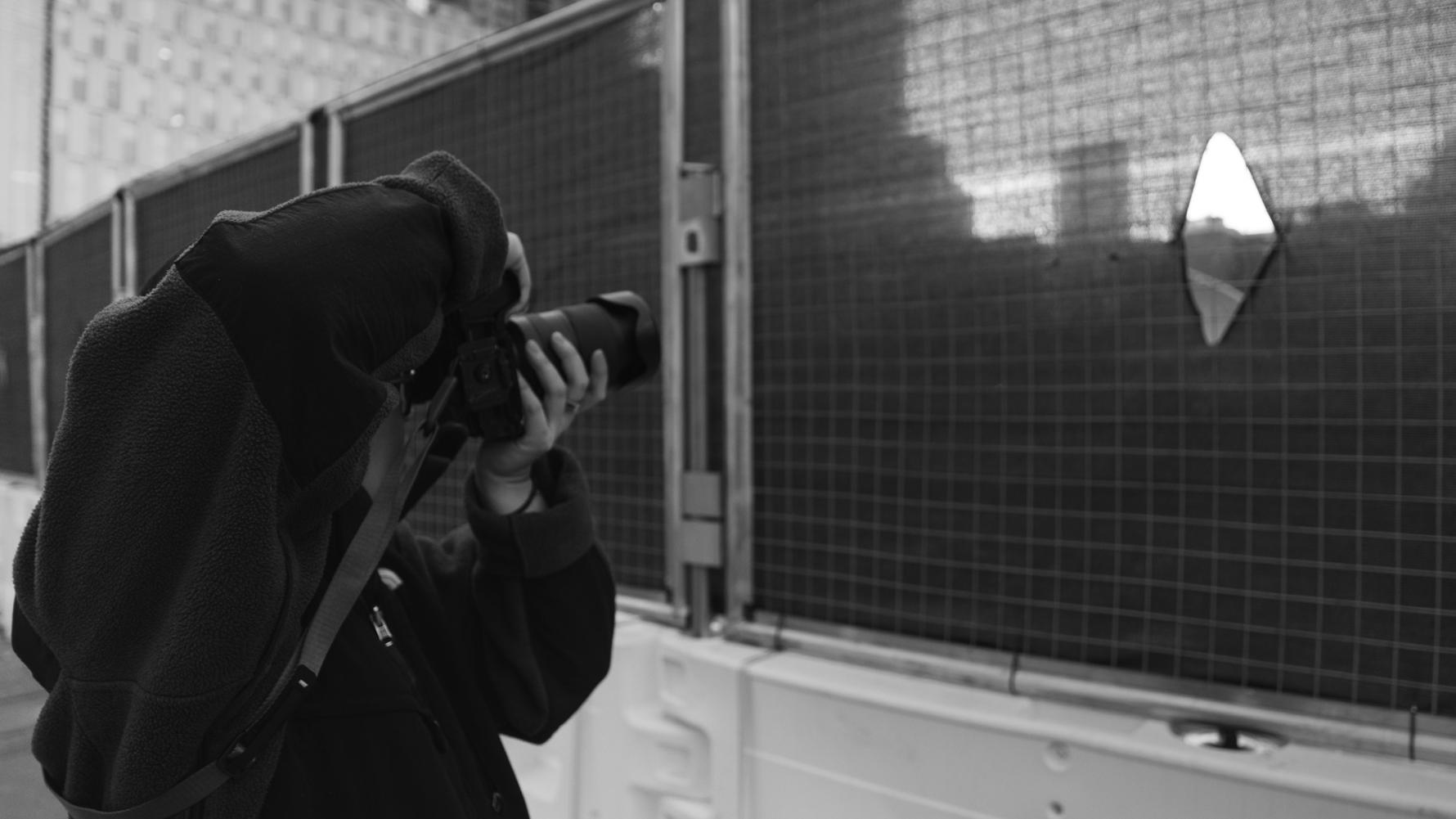
permanently publish another’s image — is obviously a nuisance to those who might not want their image to extend beyond where they are currently present. Street photography being legal doesn’t change the fact that it can be annoying.
After eating my bagel sandwich, I found myself thinking about what the photo of me looked like. Why did I attract the photographer’s attention? Was he really interested in me as a subject, or was the snapshot an instinctual reaction to seeing someone disheveled and out of place?
This brings me to my second complaint about photography: It turns us into people who see first, think later. When I think about the photo of myself, I think about the photographer returning home,
culling through pictures, finding my snapshot and promptly deleting it. There’s no way it was a good picture. The lack of thoughtfulness in the moment, though, is what bothers me the most. This robotic reaction can also be seen in the omnipresence of phone screens at concerts, as attendees stand on their tiptoes to record the performance going on right in front of them. Or like when I went to see “Guernica,” Picasso’s über famous mural painting about the bombing of the eponymous Basque town during the Spanish Civil War, and I had to wait for tourists with their phone cameras to get out of the way before I could contemplate the painting up close for myself. Never mind the fact that the Museo Reina Sofia has an entire online resource dedicated to
the painting, allowing viewers to choose normal, ultraviolet or x-ray scans of the painting. The snapshot has become our form of contemplation, leaving all reflection in the camera roll, in photos that are likely forgotten about until it’s time to clear up your phone’s storage.
I’m not saying we should never take any photos again — I respect the art of photography and enjoy looking at a good picture. However, I think we should all think about leaving camerawork to professional photographers who are dedicated to their craft rather than leveraging photography as a method of commemorating every waking moment of our lives. Let’s all put down our cameras and be comfortable with our eyes, ears and minds — it’s fine to let an interesting sight go uncaptured.
GRACE SANTOLI/THE OBSERVER
ANA WINSTON/THE OBSERVER
Constantly taking pictures turns photography into a robotic reaction that prevents contemplation.
GRACE SANTOLI Photo Editor
ANA WINSTON Managing Editor
Joe Mazzulla, MF Doom and Childlike Wonder
What hip-hop artists and sports professionals alike can teach us about satisfying a lost spirit of play

MJACK BRUDECKI Online Editor
ore often than not, I can be seen wearing a hat repping my NBA team of choice — the Boston Celtics. Besides following in the footsteps of my father’s fandom and admiring the brilliant intensity of players like Jaylen Brown and Kevin Garnett, I am captured by the wonderfully wacky human being that is Joe Mazzulla.
For those who are unfamiliar, Mazzulla has been the head coach of the Celtics since 2022 and is perhaps best known outside of basketball activities for the intensity with which he carries himself. After being asked how far he thinks he’d run in a marathon, Mazzulla answered matter-of-factly, “I would just go until I die.”
“The biggest thing that we rob people of, from an entertainment standpoint, is you can’t fight anymore,” Mazzulla said, advocating for the allowance of bench-clearing brawls in the NBA. “I wish you could bring back fighting.”
I think there is plenty to learn from Mazzulla’s all-too-serious approach to adulthood.
One of my personal favorite Mazzulla-isms is a response to questions surrounding the

Wpotential pressure of defending the NBA championship title. Shunning the notion of pressure as a disruption, Mazzulla declared he hoped for the bid at a second straight championship to be “10 times harder” than the initial climbing-of-the-mountain.
“People are going to say the target is on our back, but I hope it’s right on our forehead in between our eyes. I hope I can see the red dot,” Mazzulla said.
Thinking past the almost comical machismo of his mannerisms, I think there is plenty to learn from Mazzulla’s all-too-serious approach to adulthood. We are often tempted to consider our experiences as banal and unworthy of appreciation; however, I believe a rekindling of the stakes of child’s play can allow us to seize the reins of our own meaning-making.
To illustrate what I mean by bringing back the stakes of play, I’d like to turn to the works of MF DOOM (DOOM) and De La Soul. Through their hip-hop explorations of imagination and narrativizing lived experience, one can glean insights into how to make one’s own life feel worthwhile.
At the core of DOOM’s artistic philosophy is an awareness of the merits of performance. Aside from his music, DOOM is best known for his enigmatic personality exemplified by his omnipresent silver mask. The choice in accessory correlates with the frequent fixation in his music of cartoons and supervillain narratives. DOOM used texts from childhood to fashion himself a public-facing identity — mixing the juvenile connotation of cartoon narratives
with the serious nature of his music and artistic identity.
I believe this (comically) inflated seriousness and attention to craft is something to be envied, not berated.
De La Soul’s whimsical soundscapes are stuffed to the gills with nearly more sound effects and thematic story-crafting than can be counted. The group’s eclectic use of sampling pairs beautifully with the inclusion of framed narratives within their albums — especially 1989’s “3 Feet High and Rising” and 1991’s “De La Soul is Dead.” Notably, their use of referential elements proved a commercial challenge at the dawn of the streaming age, as it took decades to get samples cleared for the group’s consequential early work to be uploaded to streaming platforms.
The motivation for my inclusion of De La Soul stems from their delicate balance between the hardcore hip-hop of the 90s and the sharp awareness of the music’s potential to vitalize the lived experience of the ordinary. I direct the reader to the “Intro” from “De La Soul is Dead.” The schoolyard talk — quips like “now I’ve got the new De La Soul tape!” and insults like “buttcrust” — harkens back to a paradoxical time where, though the responsibilities of mortgages and pension funds laid unapproached, it felt as
though times were just as, if not more, serious than adulthood. Similarly, I am transported back to many a strip from Bill Waterson’s brilliant “Calvin and Hobbes.” Waterson examines the happenings of school-aged Calvin and his stuffed tiger Hobbes — along with a lovely palette of other characters and personas — while above all displaying a sincere reverence for the playfully delicate vision of his eponymous characters. In my view, Calvin and Hobbes are placed on an equal plane and rapport with the author, rather than relegation to a state of dollhood to Waterson’s puppeteering.
The thread I see connecting each of these examples together is a shared recognition of the power of novelty and wonder in establishing a sense of belonging. I think one could easily critique Mazzulla’s over-the-top intensity as childlike; but, I believe this (comically) inflated seriousness and attention to craft is something to be envied, not berated. Like Calvin, DOOM, De La Soul and others, we must hope to be as invested and in love with our particular processes to give way to a fantasy of daily life.

Don’t Mind Me, I’m Having a Great Time by Myself
How we can and should make New York City a great place to go out all on your lonesome
SUGAE Creative Director
hich is really worse: sitting at home alone or going out and drinking alone? There is a stigma around going out by yourself that makes it seem inherently sad, with a lingering sensation of discomfort when sitting alone at a table for two in a restaurant full of people. If you ever see someone in that situation, you likely assume that they are just waiting for someone. But why do we think that way? There should be nothing wrong with wanting to dine out alone or even enjoy a drink alone.
I realized the inherent bias and pressure to eat with others that exists here in New York City when I was home in Japan. I was in Kyoto for a day and decided to go to a bar in the evening. It turned out that the bar had gone viral on social media, and the place was full of tourists — one of which was a woman from the East Village, embarking on her first solo trip. We got to talking about the unease of going out alone in New York City, so we made a commitment to both go out alone more often when we were back in town.
But since being back in the city, I have rarely gone out by myself. It made me wonder, why is it so discouraged or demoralizing to do something as simple as go out alone? I believe that the infrastructure of the restaurants and bars of the city facilitates this atmosphere. Every restaurant contains almost only tables, with expectations that people go out to eat in groups. The booths
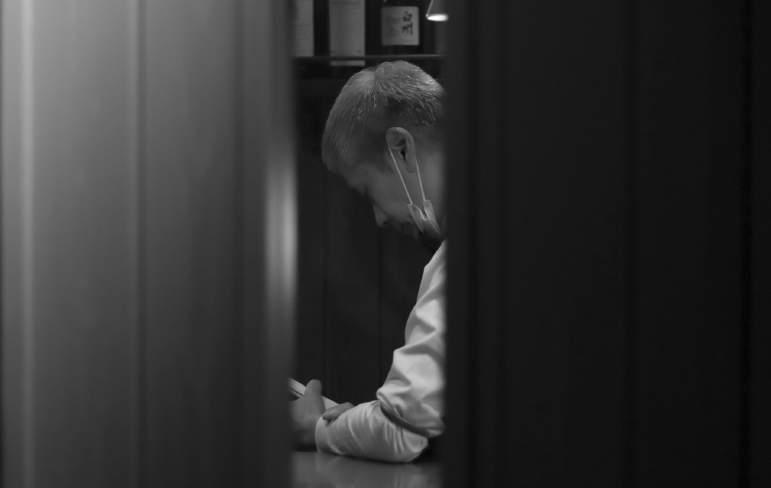
that exist in bars, on the other hand, are typically smaller, existing as a space for pairs of people to spend time together rather than individuals to drink alone. Compared to this, eating alone feels very natural in Japanese culture. The infrastructure of the restaurants themselves are more accommodating. Many restaurants have counter seating available or provide counter seating only. Within the culture, there is a sense of solitude and individual space that is very visible even in public spaces like trains, where even talking on the phone is frowned upon. Counter seating has the added bonus of demonstrating respect towards
the craft of the culinary arts common in Japan, as diners can look out into the kitchen that serves them.
What the counter seats allow for is the comfort of eating alone. Take, for example, Ichiran, a prolific Japanese ramen chain with popular locations in New York City. They are known for their signature counter seats that are separated by walls to create individual one-person booths. From the perspective that dining is typically a group activity, this is a very unique style of seating for a restaurant, but it creates an environment where you can go with many friends or, more importantly, by yourself.
Counter seating like Ichiran’s, however, is a rarity in New York City. The conventions that exist are extremely restrictive. We are allowing the infrastructure of restaurants to dictate our ability to go out and enjoy the city. If we have a night alone, we should be able to do so with ease and find a restaurant that has seating that makes eating alone or drinking alone a fun experience. Of course, the infrastructure of restaurants and bars is not solely the responsibility of the owners of the establishments. They’re responding to what is currently in demand: social spaces for people to eat or drink
with others. If people went out alone more often, restaurants might respond accordingly. After all, what economically conscious restaurant would want to fill up all of their two-person tables with one person? If establishments notice a shift toward solo dining, they’d likely adapt in order to maximize their profits. But that is only if we stop viewing eating or drinking alone as a sad or demoralizing experience.
It is the potential to find a new friend, a new experience and a new favorite restaurant while perhaps changing the environment of the city’s dining culture for the better.
I would argue that the act of eating or drinking alone is a solitary experience when you are the only one doing so at an establishment. When multiple people are partaking in a solo outing at the same place, it allows for the space to talk to a stranger and meet new people. And like the woman I met in that bar in Kyoto, a conversation can happen where you may meet someone you may have otherwise never met. It is the potential to find a new friend, a new experience and a new favorite restaurant while perhaps changing the environment of the city’s dining culture for the better.
COMIC
KAIITLYN SQUYRES/THE OBSERVER
KEI
Arts & Culture
2026 Whitney Biennial Leaves Critics Divided (As Usual)
With work by 56 artists, the Whitney’s 2026 multimedia presentation is as buzzworthy and controversial as ever
By MADELEINE SIGNORE
Asst. Arts & Culture Editor
Every other March, work by America’s best and brightest artists is agglomerated at the Whitney Museum of American Art. Luddites ought to know that the Whitney Biennial is, as Alex Greenberger of ArtNews wrote in 2024, “the most important art exhibition in the US,” and that it unfailingly generates a tremendous amount of controversy.
Its parameters are somewhat straightforward: two — or, infrequently, three — curators, one of whom is ordinarily a member of the Whitney curatorial staff, join forces to select a survey of work by various artists which speaks in some way to the tenor of the nation’s current cultural and sociopolitical moments. Contemporary iterations of the Biennial involve three related components: an exhibition (which general audiences might be most familiar with), film programming and performances.
Rarely does the general public agree unanimously on the answer to queries about what it means to be an American or how to best express the complexities latent in bearing that descriptor — not this year, not any year — hence the controversy.
The precursor to the Biennial, the Whitney Annual, was established in 1932, and its aims were similar to those of the modern version: finding the nation’s top artists and presenting their most exciting and timely work in a collective dialogue. Today, most of its participating artists live and practice in the United States, though recently the Whitney has embraced a flexible policy which permits the involvement of artists who perhaps formerly lived in the United States, whose work explores their tenuous relationship to the U.S., or whose work makes reference to the “broad reach of U.S. power,” to borrow the Museum’s phrasing. While the Biennial is famed for putting emerging artists on the map, some of whom are now household names like Georgia O’Keefe and Jeff Koons, it welcomes established artists, artist
collectives and even deceased artists into the fold. Similarly, the exhibition does not discriminate on the basis of material; the Biennial has a reputation for serving as the locus of technical experimentation. Both the 2024 and 2026 iterations, with their heavy digital art, artificial intelligence and time-based media bents, evidence that fact.
In the Biennial galleries, one finds oscillations between joy and despair, conservation and erosion, fragmentation and collectivity.
So why does the Biennial matter? And why is it so unfailingly controversial? For one, summing up the state of things in America is a tall order, and such is especially true when many consider the world to be falling apart in real time. Curators are tasked with the challenge of creating context for a vast body of work, while also respecting the complexity and dynamism of the current moment. They must frame, not flatten. These curatorial teams are dualistic in nature; their individual visions and proclivities must find middle ground in the final exhibition. Rarely does the general public agree unanimously on the answer to queries about what it means to be an American or how to best express the complexities latent in bearing that descriptor — not this year, not any year — hence the controversy.
With this background in mind, attention may now be turned to the Whitney Biennial 2026. Judging by reviews, it has delighted, disappointed and perturbed critics in equal parts. Hakim Bishara, of Hyperallergic, described its target audience as “fainthearted,” leveling an acerbic critique: “I got the sense that this biennial is hiding from the world today instead of reflecting on it.”
Still, William Van Meter of major arts publication ArtNet was “holding back tears” before a number of the works. Ben Davis, also of ArtNet, published a second set of conclusions following his initial review, acknowledging that the show is “a slow burn, in some ways trying not to be easily definable,” and that its truths and undercurrents revealed themselves to him only over time. What emerges, when we consider these reviews as a collective, is the fact that this Biennial swaps spectacle
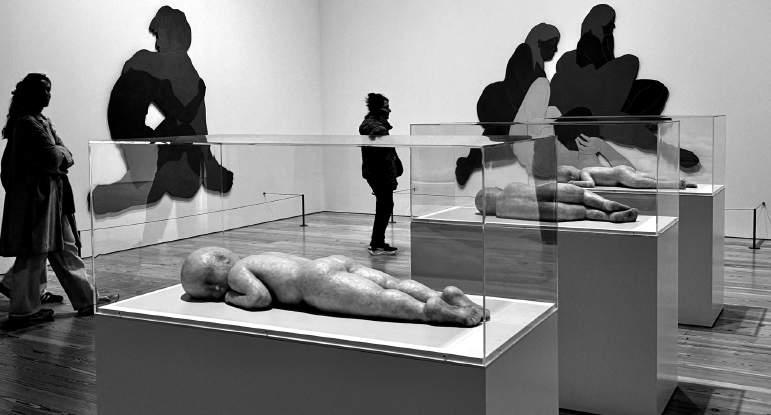

for intimacy. It largely speaks at the personal level, and the extent to which this approach resonates with critics evidently varies on a case-by-case basis.
The Biennial is broad in scope, to be sure, but when is it not? This year, one might locate in the exhibition a commitment to emulating the fragmentation, dissonance and incoherence which characterize the temperature of contemporary life. In the Biennial galleries, one finds oscillations between joy and despair, conservation and erosion, fragmentation and collectivity. Emotional and sensorial experiences are privileged.
(See Emilie Louise Gossiaux’s intimate drawings, depicting the artist themself flanked by their late guide-dog, or Nour Barak’s “Recto Verso,” the making of which involved the artist’s casting of her own pregnant body in resin.) Sculpture butts up against painting, sound bleeds into niches
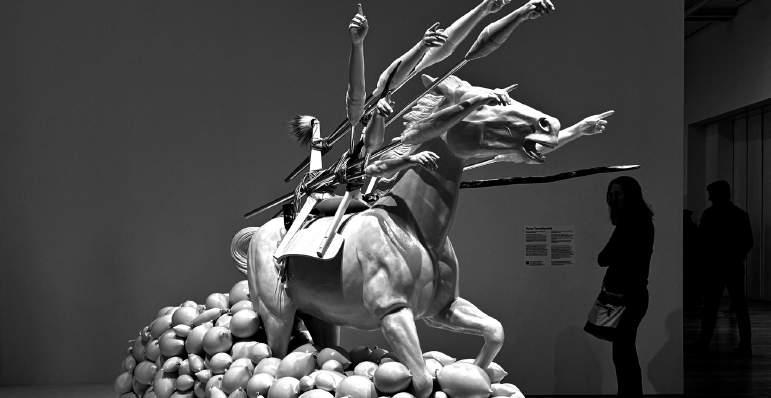
containing small-format textile works and media which escape easy categorization — like coding or digital art — attract crowds.
Sure, one might take issue with this Biennial’s throughline — a rejection of a throughline — or otherwise critique its tepidness, its unwillingness to touch the violence of the moment. But one of the Biennial’s chief merits is the way in which it can thrust great artwork into the spotlight.
Taken individually, most pieces resonated, and the potentialities of the digital and video mediums were markedly visible. Visitors flocked to Michelle Lopez’s “Pandemonium” (2025), an installation featuring animated imagery of human-made disasters and real footage of newspaper clippings swirling as if in a tornado. It played on a circular, overhead screen that emulated the planetarium where it was originally shown. Aside from the obvious allusion to the generally disastrous nature of our times, “Pandemonium” speaks to the misinformation, media overload and environmental collapse with which we reckon today.
Other installations took a more humorous tack: “20-minute
workout video [WIP]” (2023–25), a satirical workout video filmed on the Kealakekua Bay in Hawaii, functions as political and social commentary while sporting the aesthetics of early 2000s kitsch. “Camoflux Incendio Igapó,” by Leo Castañeda, took the shape of an immersive video game, whose fantastical landscapes were created in collaboration with the artist’s grandmother, the painter Maria Thereza Negreiros. Even better, it is a work which places at its center technology’s capacities to resolve environmental challenges.
Sure, one might take issue with this Biennial’s throughline — a rejection of a throughline — or otherwise critique its tepidness, its unwillingness to touch the violence of the moment. But one of the Biennial’s chief merits is the way in which it can thrust great artwork into the spotlight. One such example, “Until we became fire and fire became us” (2023), an evocative video and sound installation by the artist duo Basel Abbas and Ruanne Abou-Rahme, which engages with both the fragmentation of Palestinian communities and the love and cooperative effort through which they persist, heal and regenerate.
Drawing on contemporary video footage, harmonic arrangements of spoken word and images of plants characterized by their tremendous resilience, this work is nothing less than a treat to encounter. The seas of public opinion and critical reception are turbulent, particularly with respect to the Whitney Biennial. If one is willing to weather them, they might find some exemplary art within the tumult.
The Whitney Biennial 2026 is on view until Aug. 23.
PHOTOS BY MADELEINE SIGNORE/THE OBSERVER
A series by Andrea Fraser is presented alongside works by her mother, the painter and scholar Carmen de Monteflores.
Pat Oleszka’s “Blowhard” (1995) was originally commissioned for the World Trade Center Plaza. Here, it is compressed awkwardly in an interior context.
“SHE MUST BE A MATRIARCH” (2023) by Anna Tsouhlarakis subverts normative sculptural approaches with a humorous take on the equestrian archetype.
Displays of Inherited Nostalgia
The Ildiko Butler Gallery now displays two exhibitions on family history and identity in New York City
Guerra is a double-major in visual arts and new media and digital design, with a minor in peace and justice studies — but her favorite medium is graphic design. She used these skills to highlight the most significant places in the tour. As Guerra said, “Brooklyn is big,” and people tend to stay near the same block they grew up on.
“I wanted to be able to make my own map,” Guerra said. “Not a basic map you see across New York City, but one that’s really personal to me and the walk that I went on.”
That idea of personalization is central in Guerra’s piece. Rather than wide-ranging documentation, Guerra narrows the focus down to three sites her mother frequented growing up: her old high school, the parish where she was baptized and married and the home she grew up in. The result leaves viewers with an intimate feeling of these places.
“The streets in which she was raised were ones she chose to protect me from and spaces she longed to revisit,” her artist’s statement reads.
Guerra wants viewers to leave her exhibition with the desire to truly discover New York City.
“I hope that people who are new to the city take time to know about the culture and history that’s been here for generations,” Guerra said. “That’s super important in general.”
Her thesis advisor, Fordham Clinical Professor Abby Goldstein, was a big help in Guerra’s creative process, which started all the way back in March 2025 when she

first applied for the senior seminar. What began as mixed-media collages turned into a graphic display, slowly molded through mentorship and experimentation. Goldstein said she was proud of Guerra’s work, and lauded her ability to get inside of the narrative to tell a story.
Across the gallery, Herrera’s “Traces of Permanent Ink; An exhibition on ink, home, & infrastructure” approaches similar ideas, but from a different perspective rooted in architecture, drawing and inherited archives. Herrera is a double major in urban studies and visual arts with a concentration in architecture.
She created this project from a collection of photographs taken by her father in 1988 for an introduction to photography course he took during his time at Fordham Lincoln Center. The images, rediscovered decades later, became the foundation for large-scale ink drawings that layer spatial elements with personal history.
“I dug through hundreds,” Herrera said, recalling the moment her father handed her a long-abandoned bin of photographs. From that archive, she selected around 20 to center her exhibition around.
The resulting compositions are like a maze — topographic lines overlapping the layered drawings
of personal structures, like her childhood home, a map of the town in Colombia that her family comes from and the New York City skyline.
“It was a little bit of a story about how space shapes identity and narratives,” Herrera said. “It was about generational identity.”
Where Guerra’s work moves linearly, as a guided walk, Herrera’s averts a single path. Instead, it makes viewers navigate the layers and consider how different environments can imprint themselves across generations.
Despite these differences, the pairing feels intentional. When Guerra and Herrera realized the
shared message in their pieces, they knew they needed to be exhibited together.
Both artists engage with New York City not as a simple backdrop, but as a character that engages with family, memory and a personal narrative. As Goldstein noted, the works “bounce off each other,” connected by their focus on home and shared space.
There’s also an underlying dialogue between their chosen mediums. Guerra’s structured, graphics-driven layout contrasts with Herrera’s wide, handdrawn compositions, yet both rely on archival photographs that were preserved, rediscovered and reinterpreted.
Emotionally, Herrera’s goal is to spark curiosity or recognition in those new and old to the city.
“Hopefully, for the older crowd, it’s a little nostalgic,” she said. “We talked about some places that have been here a while and have changed over time, so hopefully it rings a bell with a few people.”
Guerra, on the other hand, hopes for reflection; she hopes for people to pause and consider the histories embedded in these everyday spaces.
Both artists described the experience of exhibiting in the Ildiko Butler Gallery as surreal and rewarding.
“It’s awesome,” Herrera said. “I feel like we took so long to get here.”
That sense of time and effort is clear in their works. The pieces are not just final projects, but accumulations of family histories lived out in this city.
The exhibition will be on display until March 31.
Scottish Folk Music and Dance at NYPL
Mary Adbill leads an engaging sight-reading and dance session showcasing traditional Scottish fiddle music
By BENI CWIAKALA Contributing Writer
Nestled in midtown Manhattan amid the Bryant Park crowds, one can find a pocket of rich Scottish heritage: “Let’s Play Scottish Tunes,” a recurring New York Public Library event led by Mary Abdill. Wearing her historic family tartan, Abdill takes participants on a journey through traditional Scottish music and dance, using her decades of teaching experience to expose New Yorkers to a culture that, according to her, deserves more attention.
Abdill wants to give her culture the same platform as many of her country’s neighbors. Many events showcasing music and dance from the United Kingdom often exclude Scotland.
“I would like to have more Scottish dancing. I would like to have more Scottish music. … I mean, as it is now, I can find Irish sessions every night of the week,” she said.
Abdill shares her culture with the city in a way that is not only engaging and fun, but also accessible.
“Let’s Play Scottish Tunes” is one of the many free events offered at the Stavros Niarchos Foundation Library (SNFL) on the corner of 40th Street and Fifth Avenue. Every two months, people can sign up, bring their instruments (or just themselves) and experience a night of sightreading traditional music from all the way across the Atlantic.
On March 16, Abdill chose a repertoire with enticing titles such as “Miss Rowan Davies” (in 3/4 time and G major) and “The Boy’s Lament for His Dragon” (in 4/4 time and D major).
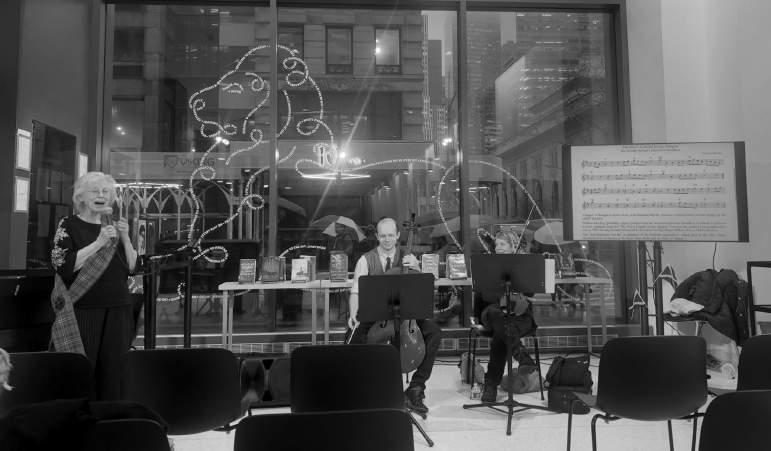
In her two-hour event, Abdill made sure to include bits of history in between songs. For example, she demonstrated a type of graceful Scottish dance known as the strathspey, which originated in the early 1700s. This dance contains a movement where the dancer surges forward, steps together, and then goes back. To give this elegant dance a bit of a kick, it also contains a unique element known as the Scottish snap.
“The snap, especially if it happens at the beginning of the bar, gives (the dancer) a little bit extra emphasis to go,” Abdill said.
While many might find the concept of sightreading music and practicing Scottish dance in front of strangers intimidating, Abdill uses her many years of teaching to create a warm and welcoming
environment where one can enjoy being exposed to new music and dance with ease. As she played the piano to accompany the string instruments, she encouraged onlookers to practice the traditional steps that go along with each song.
Her favorite thing about “Let’s Play Scottish Tunes,” Abdill said, is “sharing and playing.”
Abdill is motivated to shine a light on Scottish culture due to not being exposed to the extent of her Scottish roots until later in her life, when she went to New York City for college.
“I did not know about my Scottish heritage other than by name,” she said.
After years of only dabbling in the world of international folk dance, Abdill began exploring her
heritage, which introduced her to an entire network of Scottish dance lovers.
“(They) would bring in people from all over, and we would see different musicians, and I would begin to meet musicians,” Abdill said.
Through this network, Abdill also found companionship. Together, she and her husband — who she met through a Scottish dance night in the city — took exams to become official Scottish country dance teachers. Through their teaching, they became dance partners for life.
“We continued doing Scottish dancing until both of us could really not move much anymore,” she said.
While it is not required to wear tartan or plaid, it is certainly
encouraged. Abdill likes to share the history of the Scottish tartan sashes, as they are one of the key reasons Scottish culture is so tight-knit.
“After the Battle of Culloden, a lot of the Scottish tartans were lost,” she said.
This battle, which took place in the Scottish Highlands in 1746, was fought between the Jacobite army of Scotland and a British government force. It ended with the Jacobite army being forced to surrender after fighting to restore the Stuart monarchy to Scotland (named after exiled Stuart King James VII). The aftermath of the battle consisted of Jacobite supporters being stripped of their possessions, which were sold to further trade and agriculture in Scotland.
Abdill played her piano wearing a wool tartan sash (decorated with her favorite pins) that once belonged to the Earl of Morrison’s wife, found almost 100 years after the Battle of Culloden. Through this event, Abdill brought together groups of people who were strangers just hours before. And while it is free to sign up, it is also free to just watch. After each piece, more and more library visitors would sit down to watch Abdill and her musicians play. And as the last note played, a heartwarming applause was heard throughout the library.
The next “Let’s Play Scottish Tunes” is set for May 11, which is just a (Scottish) snap away. Abdill is excited to see new and old faces, with instruments and without, stopping in to experience a night of fun musical eighth-note runs and surging dance steps. And while it might not be a historical family heirloom, she hopes everyone will show up in
plaid.
BENI CWIAKALA/THE OBSERVER
Abdill gave a brief history lesson to accompany the evening’s music.
HELENA FRANCO/THE OBSERVER
Grace Guerra and Daniella Herrera are the newest students to exhibit their work in the Ildiko Butler Gallery.
The 98th Oscars Brought Groundbreaking Wins
Ryan Coogler’s “Sinners” made Oscars history with a record breaking 16 nominations
By MARGO CRAVEN Arts & Culture Editor
There was no shortage of rare and historic moments at the 98th Oscars, which took place at the Dolby Theater in Los Angeles on March 15.
“KPop Demon Hunters” made dual history as the first Korean-produced animated film to win best animated feature, and best original song for its breakout hit “Golden” — the first K-pop song to win an Oscar.
“For those of you who look like me, I am so sorry that it took us so long to see us in a movie like this,” co-director Maggie Kang said in her acceptance speech. “But it is here, and that means that the next generations don’t have to go longing. This is for Korea and for Koreans everywhere.”
Producer and casting director Cassandra Kulukundis took home the first-ever achievement in casting award for her work on Paul Thomas Anderson’s “One Battle After Another.” Approved by the Academy of Motion Picture Arts and Sciences in 2024, it is the first new category to be introduced since best animated feature in 2002.
“I have to obviously thank the Academy for even adding this category, and for the casting directors that fought tirelessly to make it happen despite everything in their way. I dedicate this to you and to the casting directors who never got a chance to get up here,” Kulukundis said.
As one of the few female-dominated entertainment professions, the fight for a casting category has been a decades-long struggle,

with casting directors’ work being perpetually undervalued and ignored.
Often categorized as an “old boys’ club” environment, the white- and male-dominated Academy has long faced criticism, protests and boycotting due to a pervasive lack of diversity. The backlash reached a boiling point in 2015 when activist and media strategist April Reign started the #OscarsSoWhite social media movement, calling out that all 20 acting nominations for the 87th Oscars had gone to white actors.
Despite pushing the Academy to take real action to improve diversity — doubling its number of female members and tripling members of color — women and people of color continue to fight for adequate recognition within entertainment, evidenced by this
award season’s many groundbreaking wins.
Director Ryan Coogler became the second Black screenwriter to win best original screenplay for his film “Sinners,” which received a record-breaking 16 award nominations and won in three additional categories — score, cinematography and best actor.
In another historic “Sinners” win, Autumn Durald Arkapaw became the first woman to win the Oscar for best cinematography. Durald Arkapaw, who is Black and Filipino, was also the first woman of color to ever be nominated in the category.
Arkapaw honored fellow female creatives during her acceptance speech, asking all of the women in the room to stand up.
“I feel like I (wouldn’t be) here without you guys,” Arkapaw said.
In one of the final and most anticipated categories of the night, Michael B. Jordan won best actor for his dual “Sinners” role as twin brothers Smoke and Stack Moore.
Jordan’s win marked his second recognition in the leading role in the 2026 awards season, after he was awarded outstanding performance by a male actor in a leading role at the 32nd Annual Actor Awards (formerly known as the SAG Awards) on March 1.
Leading up to the Actor Awards, Timothéee Chalamet, nominated alongside Jordan, found himself at the center of a particularly ill-timed social media controversy. During a CNN & Variety Town Hall Event with actor Matthew McConaughey on Feb. 21, Chalamet quipped that
“no one cares” about ballet or opera anymore.
The comments ignited an instant and fervent internet backlash, prompting several prominent members of the ballet and opera worlds to respond.
While Chalamet’s comments certainly landed him in hot water — and were repeatedly acknowledged during the ceremony — the implication that they cost him the Oscar win is demonstrably false, and inadvertently minimizes Jordan’s success.
In a thread post uploaded to Bluesky, entertainment writer Mark Harris wrote: “Chalamet lost for the same reason Hawke and Moura and DiCaprio did — because Michael B. Jordan won. Academy votes are not like internet posts: Most people vote affirmatively, because a performance thrilled or moved or delighted them. They almost never vote primarily to block someone.”
Jordan’s win made him the sixth Black man in the Academy Awards’ 98-year history to be awarded best actor, and he honored the five actors that came before him in his speech — also acknowledging Halle Berry, the only Black woman to win best actress.
“I stand here because of the people who came before me: Sidney Poitier, Denzel Washington, Halle Berry, Jamie Foxx, Forest Whitaker, Will Smith,” Jordan said.
Jordan’s closing remarks were dedicated to everyone who had a part in his success.
“Everyone at home who supported ‘Sinners’ … thank you. You guys made this movie what it is,” he said.
Concert Dance Thrives at Footprint Dance Festival
A bright future awaits contemporary concert dance at the new Amanda Selwyn Dance Studio
By INDIRA BUSH Asst. Arts & Culture Editor
Amid looming threats of technological dominance, funding cuts and unsavory comments from certain celebrities, it is easy to fall for the narrative that the arts are in peril. At the Footprints Dance Festival, held at the newly opened Amanda Selwyn Dance Studios from March 12 to 14, a full audience and artistic excellence were a welcome reminder that the narrative is far from the truth.
Festival curator Amanda Selwyn originated the event while running arts programming at the West Side YMCA. This year, her company, the Amanda Selwyn Dance Company, opened a long-awaited studio space in downtown Manhattan, and the festival moved into the new space for its fifth season.
According to Selwyn, this year she had a record amount of choreographic work to choose from. With about 130 applications, she whittled it down to 13 works split into two separate programs. One program also included an excerpt from Selwyn’s upcoming work “Exposed,” which will be previewed during her season in May,and officially debut in April 2027 at New York Live Arts.
While at times there was a notable variety in technical experience, that range was overshadowed by the overall excitement that arose from a night of dance where audiences could truly see new choreographic perspectives — a rare occurrence in a rapidly expanding contemporary dance world that can often feel oversaturated with an uptick in digital content.
At the 8:30 p.m. performance on March 14, standout
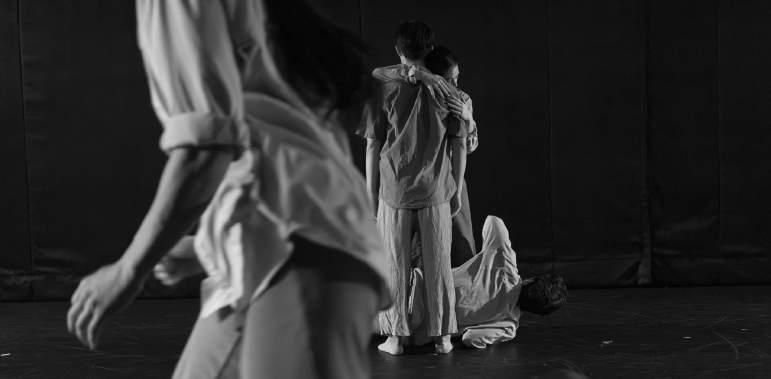
performances included “Opportunity,” a serene yet heart-wrenching work from Obremeski/Works and choreographed by company director Jesse Obremeski (also a dancer with The Alvin Ailey American Dance Theater) and “Iliocostal,” a stunningly intimate yet often times grotesque duet choreographed by Jack Randel. Obremeski/Works, possibly the most well-known name on that night’s program, is a contemporary dance company composed of dancers from the Asian American and Pacific Islander community with a large focus on equity and what they call “why-driven performance art.” “Opportunity” centered on the theme of connection, as dancers moved in and out of tender moments: holding each other, then tragically sliding away. The work offered a fluidity in its movement that many strive for, yet few reach.
“Iliocostal,” from freelance choreographer Randel, was possibly the most exciting piece of the night. Dancers Kevin Avila and Alisha Khatwani displayed both technical mastery and a rare level of chemistry. In his choreographic choices, Randel presented something excitingly unfamiliar, most notable in his innovative floor work and partnering. The dancers intertwined in a way that both resonated with human experience and had an almost otherworldly beauty.
For a large part, Selwyn’s method of curation was the reason for the refreshing novelty present at the festival. She aimed for cohesive nights of dance that would still keep audiences engaged. Applications were open to all dance styles; however, all the work selected ended up falling into the contemporary/modern style, which was a
welcome throughline in her goal for cohesion.
In selecting the pieces, she looked at the dancers’ submitted work before reading any resumes, meaning previous experience or accolades were not a factor in participant selection. This allowed many new voices in the dance world a valuable opportunity to show their work.
“Whether or not they were super experienced or not, I let the work speak for itself,” Selwyn said.
Once selected, dancers did not have to pay a fee to participate. They were given space to rehearse, lighting, stage management and professional photo and video at no cost. For freelance or smaller artists and companies, that kind of opportunity can be hard to come by and provides major relief in a world where production costs are only rising.
“I think it’s important to provide these opportunities. … Part of our mission is to expand audiences for dance and expand access to dance,” Selwyn said.
Alongside funding challenges, choreographers and dancers today battle the growing argument that concert dance is losing its audience. Dance and dance creation is a tireless career, with not much promise for great financial gain. Selwyn said this concern is not new; she herself received a similar message as a young person entering the arts world. Nevertheless, Selwyn is adamant that dancers should and will keep showing up.
“You are an artist, and you need to do this work … it’s not something one would take into casually, because there’s no committing to a career in dance casually,” Selwyn said.
The Footprints Dance Festival was proof that that passion is reciprocal — audiences will keep showing up too. At the performance, audience members milled in and out of a studio space that Selwyn had turned into a sort of lobby for the event. There is nothing like excited chatter and a full house to prove that the arts are far from dying.
“The fact that people are showing up, whether it’s to a studio showing, a festival or to a performance at the Joyce, people want to see art, and people are going to see live performances in New York,” Selwyn said. “As long as that’s happening, it’s not going anywhere.”
Audiences can attend the Amanda Selwyn’s Dance Company’s upcoming season featuring the studio preview of “Exposed” from May 1 to 2 at her all-new studio space.
PHOTO COURTESY OF ETIENNE LAURENT / THE ACADEMY
Michael B. Jordan accepted the best actor award for his dual role in Ryan Coogler’s “Sinners” (2025).
PHOTO COURTESY OF WHITNEY BROWNE
In “Opportunity” from Obremeski/Works, dancers provided a breathtaking portrayal of the intricacies of human connection.

un & ames

Crossword: Starting Notes

35. Influence: Have __ ____ (2 Wds.)
36. Toothpaste flavor
37. Sweetie (Abbr.)
38. Neighbor of Wisc.
39. Make a lasting impression?
40. Actress Tara of “Sharknado”
41. What a millennial might call their pet pooch
42. *The first in a refrain that repeats with the starts of the shaded clues (3 Wds.)
44. Trimmed, as a hedge
45. Expansive
46. Second-in-command in the kitchen: ____ chef
47. End of a Fordham student’s email address (2 Wds.)
50. Unit of matter
51. Alternative to EWR (Abbr.)
54. Easy Bake ____
55. *Musical sequence demonstrated by the starts of the shaded clues
58. Shang-Chi actor Liu

1. Drink on credit: Run up __ ____ (2 Wds.)
2. “I call dibs!”
3. Hors d’oeuvres spread
4. Sea urchin, on a sushi menu
5. Congregation leaders
6. Speak out against
7. Chief Norse god
8. Celebrity chef Garten
9. Brewskis (2 Wds.)
10. Like an international superstar (2 Wds.)
11. Solo for a diva
12. “Keep it ____”
13. The Big Easy, slangily (Abbr.)
18. Taylor Swift track on “Speak Now”: “____”
23. Comedian Wong
24. Amsterdam, below 59th Street (2 Wds.)
25. “The ____ of Music”
26. Well-known
1. Energize, as a concert crowd (2 Wds.)

6. “___ ___ for the bit” (2 Wds.)
10. Ring the alarm
14. “The Princess and the Frog” princess
15. Mode with a bob in “The Incredibles”
17. Reclusive 19. Omani money 20. Busy insect 21. Chance to play 22. “I can’t hear you!” (3 Wds.)
24. British Conservative 25. Cry from an auctioneer 26. Volume-control sliders
29. Pine, fir and spruce, for three
33. Actors Alda and Rickman, for two

BY JASMINE
Instructions:
34. “The Boys” actress Elisabeth
59. Paper alternative?
60. Deejay’s partner in many early hip-hop duos
61. Together, in a musical score (2 Wds.)
62. Goofy, in millennial slang

27. Samuel on the Supreme Court
28. Move to music
29. Singing group
30. Digitally endorse
31. Singer’s span


1. A cryptogram is a puzzle with a hidden message where each letter of the alphabet has been changed to another. These changes are consistent throughout the puzzle. For example, A is always changed to B and B is always changed to C.
2. Use the table to help keep track of the letter changes as you decode the message.
3. When you’re done, check the answer key in the bottom right corner!
32. Church council
34. Word before “rock” or “music”
40. Unpaused
41. Percussionist’s kit
43. Stay-at-home ____
44. Below average
46. Percussion-based theater troupe
47. South Asian staple often served with sambar
Ramses Starts A Band!
BY JASMINE WHITE
48. “Metamorphoses” poet
49. Shein competitor
50. Slightly open
51. Lowest-ranking face card
52. Make a run for it
53. Peachy ____
56. Lumberjack’s tool
57. Nashville awards org. (Abbr.)



Ramses is starting a band on campus with his friends Ramona, Rambo and Rama, and they’re so excited to be playing at their first open mic night in ____________ _________________!
They decided to name their band ____________ _________________ _________________, and they’re playing a mix of ______________________ covers and original _________________ _________________ songs at the open mic. Ramses plays the _________________ and is also in charge of marketing for the band. He’s been busy putting up _________________ posters all over _________________ and asking his favorite professor, __________________________, to tell their classes about the event. Best of all, his friend _______________________ promised they would come and bring all __________ of their friends too! It’s going to be a/an _________________ night for
WHITE