

2024 - 2025

About Foothills Academy
Foothills Academy’s mission is to facilitate learning in persons, primarily youth and children, identified as having a Learning Disability by providing quality educational programs and a supportive environment for families and staff. We also recognize that we are partners within a universal system of research, public education, in-service and advocacy through our Community Services.
We will be recognized for our expertise in working with individuals identified as having Learning Disabilities locally, provincially, nationally and internationally. Striving to enhance the lives of individuals with Learning Disabilities, we:
FIND UNDERSTANDING, BUILD CONFIDENCE, MAXIMIZE POTENTIAL.
As a Designated Special Education Private School focusing on supporting students and families living with Learning Disabilities, we provide the most effective and intensive support to meet the needs of our students; academically, socially and emotionally.
Profile
Foothills Academy is a Designated Special Education Private School (DSEPS), serving students with diagnosed Learning Disabilities (including Dyslexia) from grades 3 to 12. Foothills Academy Society also operates Estelle Siebens Community Services, to support individuals, families and professionals, living with, or working in the field of Learning Disabilities in the wider community; locally, provincially, nationally and internationally. The school program is supported by Community Services, making Foothills Academy unique in the level of outstanding wraparound support.
Designated Special Education Private (Independent) Schools such as Foothills Academy are required to provided specialized education with the sole purpose to serve students with a mild, moderate or severe disability, where each of the students enrolled in the school is diagnosed with a disability (Private Schools Regulation, 14(1) (b&c), p.10). With an increasingly complex student population in schools throughout the province, the Ministry of Education recognizes the importance of special education. DSEPS receive additional funding to meet the needs of students with diagnosed disabilities, and this funding can not be taken for granted, as it serves solely to support vulnerable, special education students who require more support. We value and respect special education funding and our DSEPS status and continue to provide exceptional and targeted services for all our students and families.
Alberta Education continues to provide support for choice in education and recognizes the importance of Designated Special Education Private Schools. It is essential that families can choose the type of school where their children will have the best support and greatest potential for academic, social & emotional success
Foothills Academy’s rigorous school program meets the needs of over 310 students with Learning Disabilities in grades 3 to 12. The staff to student ratio is typically 1:6, with a specialized teacher and educational assistant. We focus upon a wide range of evidence-based programs, strategies and supports, to help students find individual success to reach their potential. Through our foundational model of Self-Determination, our goal is for students to go on to successful post-secondary education, or meaningful sectors of the workforce.
The mandate of Foothills Academy Society’s Estelle Siebens Community Services is to assist children, youth, and young adults who are experiencing difficulties in their school, work, and/or home environments because of Learning Disabilities and/or ADHD, and related social/emotional challenges. We offer assistance to these individuals as well as parents and relevant professionals through the provision of psychoeducational assessments, recreational and psychosocial programming for children and adolescents; counselling services; community education; professional development workshops; and intensive remediation instruction for reading and writing.
The professional services delivered through Community Services overlap into the school program, with support provided by: Psychological Services for counselling and assessment; Read/Write & Math for intensive skills intervention; and Professional Development & Community Education as well as Amicus Camps & Recreation for staff training, development and support. Community Services’ departments are integral to the success of the specialized nature of Foothills Academy’s school program.
“ FoothillsAcademyisanamazingschoolthat providesthesupportthatkidsneedsothatthey canthriveandbehighlysuccessfulinlife”
(Foothills Parent 2024/25)
With thanks to:
● Our students, who arrive every day ready to tackle the next challenge in their learning and development; and to those alumni who continue to support our work to this day and maintain a strong connection with Foothills. Your continued involvement with us strengthens our culture and community.
● Our classroom staff, who are expertly equipped to support students and families, and whose commitment to and empathy for each student makes an enormous impact on those students’ lives.
● School Administration for continued guidance and expertise to support the entire school program daily
● Our leadership teams across Foothills Academy Society support staff, professionals, office & custodial staff; without your dedication to work, and your drive to make a difference, Foothills’ success would not be possible.
● Our parents and Foothills Academy Parents’ Association, for collectively supporting our school, staff and students; your many collaborations on a variety of platforms ensure that Foothills maintains a strong culture and provides many opportunities to continue refining the success of the school program.
● Our volunteers and donors, whose generosity of time and financial commitment makes it possible for us to achieve all that we do.
● Our Board of Governors, whose ongoing commitment of time, knowledge, expertise and oversight ensures that Foothills Academy Society continues to operate in a manner that maximizes our own potential to provide high quality programming to all our students, families and clients.
● All stakeholders including the Association of Independent Schools & Colleges of Alberta, the Ministry of Education, the LD/ADHD Network for Calgary & Area, and the Learning Disabilities Associations of Alberta & Canada
Trends and Topics
Foothills Academy continues to embrace the foundational premise of our success through SelfDetermination Theory, which posits that motivation an is fulfilled by satisfying the psychological needs of autonomy, competence and relatedness. Coupled with well informed and purposefully considered evidence-based programs and strategies to support children with Learning Disabilities (LDs) and associated disorders, Foothills Academy remains at the very forefront of education in the LD field.
The strong school community is enriched by all staff, students and families, and is supported by the board of governors, which is fundamental to the overall governance of Foothills Academy Society; and has oversight of the Annual Education Results Report, and the Education Plan. Parental involvement is crucial to student and school success, and Foothills Academy’s Parents’ Association (FAPA) provides support to the parents and the school, meets monthly with school administration, and is represented on the board of governors.
Stakeholder Engagement
Stakeholder Engagement
• Staff meetings, departmental meetings and agency-wide meetings
Staff
Parents
Board Members
Students
• Feedback solicited via local surveys and end of year feedback meetings.
• Professional Growth Plan meetings and professional development sessions.
• General Meetings at the start and end of the school year.
• Feedback solicited via local surveys.
• Monthly Parents’ Association meetings with administration present.
• Weekly newsletters and social media.
• Parent teacher conferences and IPP meetings.
• Communications from, and meetings with administration.
• Scheduled board meetings.
• Committee meetings.
• General and agency-wide meetings.
• Newsletters and social media.
• Formal Foothills events.
• Informal engagement with students during homeroom and with administration.
• Leadership initiatives.
• Focus on the development of a specific student council for feedback.
Foothills Academy is committed to continuous learning and improvement, and a leader in the field of Learning Disabilities. We continue to be recognized in the wider community, and staff sit on additional associated boards such as the Learning Disabilities Association of Alberta, the Learning Disabilities Association of Canada, the Centre for ADHD Awareness Canada, and the LD/ADHD Network of Calgary and Area. Foothills Academy was voted as the favorite private school in Calgary for 2024/25; the sixth year in a row that we have been recognized for this award

The Annual Education Results Report
The measures reported come from Foothills Academy’s Education Plan and Alberta Education’s Assurance Measures The assurance measures reflect a range of Ministry sourced data including Provincial Achievement Tests and Diplomas, as well as survey responses from parents, teachers and students. The report is part of Alberta Education’s Assurance Framework and assumes education partners accept responsibility for building capacity of the education system. Alberta Education recognizes the need for a collective approach to embrace the diversity within schools in the province, and the need to rely on evidence to make decisions that are responsive to the needs of students in the local context of the school.
The Assurance Framework outlines five Assurance Domains:
• Student Growth and Achievement
• Teaching and Leading
• Learning Supports
• Governance
• Local and Societal Context
These domains fall under Foothills Academy’s foundational principles of self-determination:
Foothills Academy’s Required Alberta Education and Childcare Assurance Measures
Summary
Summary of Required Assurance Measures
Foothills Academy targets the individualized learning needs of each student’s diagnosed Learning Disability. This happens asynchronously with curriculum instruction, and directly as targeted intervention during specialized Skills periods. Additionally, the social & emotional needs of students with LDs, as well as executive functioning needs, are met by our specialized teachers, Education Assistants, support staff and other professionals and practitioners. It is apparent that students recognize the impact of these interventions and supports, as their reporting on student learning engagement is very high as is that of parents and teachers. The acceptable standard of citizenship is addressed in detail in this report. The scores are reduced due to more
Teaching and Leading Education Quality Excellent
Welcoming, Caring, Respectful and Safe Learning Environments (WCRSLE) Issue
Learning Supports
Access to Supports and Services
Governance Parental Involvement
students reporting that they do not know the answers to the survey questions.
Our continued level of excellence for High-School Completion is further testament to the support received by students, and the students’ willingness to engage and embrace the hard work for success.
Provincial Achievement Tests and Diploma results are discussed in the report to provide context regarding students with LDs taking standardized tests.
It is evident that parents, students and teachers recognize the excellence of the school program when reporting on Education Quality. Parents report higher than 10% above the provincial scores and recognize the specialized supports students to be successful in achieving the curriculum outcomes in each grade.
The WCRSLE scores for the year remain higher than the provincial scores. However, it is an area that is focused upon in the Education Plan and is something that Foothills Academy strives to excel in. Current scores appear to have declined not due to negative reporting, but from students responding ‘do not know’ to specific survey questions.
Foothills Academy is unique in its ability to provide a wide range of outstanding supports and services beyond the classroom, which makes the DSEPS program incredibly effective. The overall score of excellent reflects this, as the academic, social and emotional needs of students are addressed quickly to ensure students are supported and will continue to grow and develop in a positive school environment.
Parents are integral to the success of Foothills Academy. They play a crucial role in their child’s education and are essential collaborators with classroom staff. Additionally, many parents volunteer in numerous ways to support the school and our success. Foothills Academy Parents’ Association is a key element of the school, working with administration and is represented on the board of governors. The overall score of excellent reflects the essential role of Foothills parents in school life.
Education
Key Insights from the Rolling Education Plan 2025-2028
Plan Priority
#1: Enhancing Opportunities to Engage in Active Citizenship
● Elementary students will increase their participation as active citizens in the school community
● Elementary students will be empowered to advocate and contribute to the positive, welcoming, caring, respectful and safe learning environment at Foothills.
Measure
● Elementary students will show higher levels of reporting in the AEAMs for characteristics of active citizenship
● Elementary students will report 5% higher on WCRSLE
● Elementary students will be able to express the difference between emotional feeling being safe vs, being uncomfortable
With regards to elementary students’ reporting on the AEAMs surveys:
● 89% agree that they are encouraged to try their best
● 56% agree that most students help each other (30% reported that they do not know)
● 49% agree that students respect each other (45% do not know, only 6% said no)
● 71% reported that they feel like they belong at school (23% reported they don’t know)
● 90% feel safe at school
● 92% feel welcome at school
● 88% feel that their teachers care about them (11% did not know)
Local data:
Over 60 elementary students were engaged over the course of the year in specific programs to support anxiety, executive functioning and social interactions. These evidence-based programs, delivered in collaboration with classroom staff by psychologists, included:
• Coping Cat
• Unstuck
• Friendship Group
Insights to address in the future Education Plan:
As an ongoing priority, the Education Plan will focus on the citizenship and welcoming, caring, respectful, and safe learning environments. Elementary will be the primary area of focus, although the data suggests that students are engaged in active citizenship and clearly feel safe and welcomed at school; the discrepancy in the data may come from students ‘not knowing’ the answer to the survey questions, rather than disagreeing with the assertions in the questions.
Elementary programs will continue to develop and support the programs for anxiety, executive functioning and social interactions.
#2: Targeting Literacy and Numeracy Interventions to
Despite the vast majority of Learning Disabilities being language based, causing literacy, reading and writing to be more
Enhance Success in Elementary and Junior High
● Students will enter Junior and Senior High School with improved literacy and numeracy skills
● Grade 6 science PATS will increase with more students scoring at the acceptable standard and standard of excellence range
demanding and challenging to students, 72% of the Junior High students understand how the Language Arts they are learning is important to them.
66% of the Junior High students understand the math they’re learning is useful to them.
In High School, 89% of the students recognized that English Language Arts is useful to them, with 72% finding it interesting. Given that this ELA is typically demanding for most individuals with LDs, the motivation and self-determination of High School students is evident.
75% of High School students recognize the usefulness of the Math they are learning; possibly because of whether they will or will not require it for admission into a post-secondary institution.
Insights to address in the future Education Plan:
Skills classes are essential to Foothills Academy’s success, and we will continue to target CBM results from Skills. Tracking value added growth for each student in Skills will continue so that we can continually review and refine student outcomes and successes. This will enable us to ensure we are monitoring our own best practices for student success.
#3: High school students will maximize their potential upon graduation and beyond
● Students will transition successfully to adulthood and into post-secondary or the workplace
● Grade 12 students will see value added growth in their individual Diploma results, compared to their grade 9 PAT results.
● Every student will be successful in earning a high school graduation
48.4% of Foothills students transitioned to a post-secondary institution in Alberta within 4 years; and 75.6% transitioned withing 6 years of graduating.
This is 15% higher than the provincial score and is significantly higher than the typical statistics for individuals with Learning Disabilities moving on to post-secondary education. Additionally, a cohort of Foothills students regularly enroll at and attend post-secondary institutions in other provinces
83.8% of parents and teachers agree that students are taught attitudes and behaviours that will make them successful at work when they finish school, which is scored as High Achievement overall.
Our 3-year High School completion rate is ranked as Excellent at 100%. This is 15% above the provincial score.
Our 5-year High School completion rate is ranked as Excellent at 100%. This is 15% above the provincial score.
Local data:
All grade 10 students have completed the first year of the
diploma Footpaths portfolio
All students have access to the Transition Portfolio Program
Insights to address in the future Education Plan:
Successful completion of High School and transition to post-secondary or the workplace are staple goals for Foothills Academy. Considering the challenges our students have experienced in prior school settings, we are exceedingly proud of our students for responding positively to the outstanding support delivered by staff that truly makes a difference in each student’s life. Future priorities in the Education Plan will continue to examine:
● Skills classes throughout High School
● Participation in the Transition Portfolio Program
● Foothills Footpaths Program
● Student Internships
● Focusing upon the continued growth from grade 9PAT results and CBMs when compared to Diploma outcomes
● Continued school wide growth in activities focus on FNMI and support of implements T&R commission recommendations
● The Indigenous Education and Reconciliation committee will create further opportunities for FNMI activities and programs in the school and professional development to incorporate FNMI teachings into school life.
• Foothills Academy’s Indigenous Education and Reconciliation committee ensures that school-wide events (Remembrance Day ceremony, Literacy & Numeracy weeks, etc.) include Indigenous contributions, culture and knowledge.
• Lennon First Rider taught all classes Powwow & Fancy Dance, and shared stories & experiences.
• Team specific activities relating to Truth and Reconciliation for homeroom, STEM, Humanities, Health and Learning Strategies; including traditions or teaching such as one of the calls to action, the medicine wheel, and Metis flags, as well as events such as Calgary Orange shirt day and the Indigenous showcase & market.
• School-wide demonstrations and knowledge sharing by Elders of activities such as brain tanning of animal hide.
• An array of additional resources are shared with all staff to incorporate Indigenous Ways of Knowing with Alberta Education outcomes.
• School-wide learning and participation in the Ani to Pisi (human spider web) creation story with an Elder.
Learning Supports
Current Results and Trends1 Find Understanding
Welcoming, Caring, Respectful and Safe Learning Environments (WCRSLE)
Welcoming, Caring, Respectful and Safe Learning Environments (WCRSLE)
Foothills Academy’s 3-year average is 5% higher than the provincial average at 89.2%, and it is evident that we continue to provide a welcoming, caring, respectful and safe learning environment. Parent and teacher ratings are at levels higher than provincial scores, although student scores have declined. This is something that we will rigorously address in the Education Plan, as one of our foundational strengths is an inclusive and supportive environment.
Upon further analysis of the student reporting, it is apparent that despite the lower score this year, students do still feel cared for at Foothills Academy.
Grade Level
Students reporting that their teachers care about them
(11% did not know)
(10% did not know)
(6% did not know)
The high rates of reporting show that students do feel supported, and the reduced scores this year could be accounted for, partly by the increased number of students reporting that the ‘do not know’, rather than ‘yes’ or ‘no’.
Grade Level
Students reporting that they feel safe at school
(8% did not know)
1 There are no AEAM results for students who require and receive English as an Additional language supports, and no students are coded 301/303).
There are no AEAM results for students self-identified as First Nations, Metis and Inuit, as there are fewer than 6 students in each category; therefore no data is available. Further FNMI information is on page 15 under First Nations, Metis and Inuit Student Success.
Grade Level
Elementary
Junior High
High School
Students reporting that they feel welcome at school
92% (5% did not know)
79% (10% did not know)
79% (11% did not know)
The decline in student reporting for the Welcoming, Caring, Respectful and Safe Learning Environments (WCRSLE), means that we will continue to focus upon this as a key element of the Education Plan. There are obvious strengths in our WCRSLE data, but we have opportunities to bolster the all-round perception for students in every grade.
Most students with diagnosed Learning Disabilities have associated diagnoses too, such as, but not limited to, attention deficit hyperactivity disorder (ADHD) and Generalized Anxiety Disorder. These diagnoses bring additional complexities to learning, executive functioning and social interactions; all of which may compound students’ responses to the WCRSLE questionnaire. For instance, 34% of elementary students did not know if most students cared about each other and 45% of elementary students did not know if students respected each other.
Over 60 elementary students have been engaged in new programs in elementary school such as Coping Cat, Unstuck and the Friendship Group.
For the upcoming Education Plan, we will continue to develop opportunities in Junior High and High School for culture building, including electives and a high school European trip. The Education Plan will examine the potential to increase the role of assessment psychologists conducting class observations, to support school administration’s data to find ways to build up the sense of a safe learning environment for all. The behavior protocol for student support will be an additional piece to review in the Education Plan considering this data.
Find Understanding
Access to Supports and Services
The access to support and services at Foothills Academy elevates us as an exceptional Designated Special Education Private (Independent) School, and a leader in the field for students with Learning Disabilities. In addition to the experienced and expert teachers, educational assistants and support staff including Occupational Therapists and Speech Language professionals, Foothills Academy’s Community Services provides essential targeted support for literacy & numeracy intervention, and psychological support with student counselling and mental health support. Psychological support is also provided by assessment psychologists who can conduct consultations with classroom staff and administration, as well as meeting with students to help prepare them for post-secondary education.
It is no surprise that our measure for Access to Supports and Services is excellent with an overall score of 91.2% (over 10% above the provincial score). Both parents and teachers report 15% higher than the provincial scores.
Grade Level
Parent Question
Students reporting that teachers are available to help them with schoolwork if they need it
Parent Response Rate
Parents agree that there are appropriate support and services available to their child to help with their learning 97%
Parents agree that teachers are available when their child needs them 94%
Parents agree that they get support from the school to help their child be successful in their learning 94%
Foothills Academy Community Services Supports Number of students served
Intensive 1:1 literacy and numeracy intervention ≈20
Intensive small group literacy and numeracy intervention ≈30
Ongoing individual and family therapy ≈75
Immediate short-term psychological counselling support ≈30
Assessment psychological support programs (including Coping Cat, Unstuck and the Friendship Group) ≈60
First Nations Metis and Inuit Student Success
Due to the number of FNMI respondents in the survey being fewer than 6, there are no data values for FNMI student success. Foothills Academy continues to be committed to support the implementation of Truth and Reconciliation Commission recommendations, including:
• Foothills Academy’s Indigenous Education and Reconciliation committee ensures that school-wide events (Remembrance Day ceremony, Literacy & Numeracy weeks, etc…) include Indigenous contributions, culture and knowledge.
• An Elder taught all classes Powwow & Fancy Dance, and shared stories & experiences.
• Team specific activities relating to Truth and Reconciliation for homeroom, STEM, Humanities, Health and Learning Strategies; including traditions or teaching such as one of the calls to action, the medicine wheel, and Metis flags, as well as events such as Calgary Orange shirt day and the Indigenous showcase & market.
• School-wide demonstrations and knowledge sharing by Elders of activities such as brain tanning of animal hide.
• An array of additional resources is shared with all staff to incorporate Indigenous Ways of Knowing with Alberta Education outcomes.
• School-wide learning and participation in the Ani to Pisi (human spider web) creation story with an Elder.
FNMI funding for the 2024/25 school year totaled $15,419.71. This covered a range of FNMI activities, programs and resources including:
• 2 days of Fancy Dance, Powwow and knowledge sharing for all grades
• Ani to Psi (School-wide spider web event, with Elders, drummers, orange shirts and various supplies)
• Brain hide tanning demonstration and knowledge sharing
• Annual craft and art supplies
• Blackfoot Crossing field trip (grades 11 and 12)
Find Understanding
Student Learning and Engagement
For students with Learning Disabilities, school poses many additional challenges. The demands of literacy and numeracy skills throughout the curriculum are more taxing for students with LDs and typically take a greater, more exhausting toll on their cognitive load. Without appropriate and meaningful support and programs to support these students, their cognitive energies will be depleted more frequently, leading to a greater impact upon their engagement and learning. Therefore, it is important to note that students at Foothills Academy maintain strong scores for learning and engagement, and our overall measure is excellent
Parents report at an excellent level of 97.9%, over 10% higher than the provincial measure. Similarly, teachers report at 96.7%. The questions posed were items such as:
● The literacy skills your child is learning at school are useful
● Numeracy skills your child is learning at school are useful
● Students are learning what they need to know
It is evident that the LD needs of students at Foothills Academy are being met. Student reporting was relatively consistent with previous years. It is important to remember that the students entering Foothills Academy have challenges with their diagnosed Learning Disabilities, which are typically language based. Therefore, English Language Art is expected to be a demanding subject for all students with language-based LDs. Also, many individuals with math LDs such as dyscalculia, face challenges in classes involving numeracy.
Despite this:
● 59% of elementary students reported to like learning language arts, and 25% did not know.
● 63% of elementary students like learning math, and 14% did not know.
● 72% of junior high students understand how the language arts they are learning is important to them.
● 66% of junior high students understand how the math they are learning is useful to them.
● 81% of junior high students understand how the science they are learning is useful to them.
● 84% of junior high students understand how the social studies they are learning is useful to them.
It is evident that by the time students get to high school, they are more reflective about the importance of their core courses. Although students are challenged and provided support to succeed, academic rigor is demanding and yet Foothills students prove time and again of how capable they are. Their self-determination continues to develop through high school, and their motivation to succeed can be partly attributed to the ongoing knowledge and confidence they build at Foothills. They are all on track to truly maximize their potential.
Grade 6 Provincial Achievement Test Results
There was no overall data provided in the AEAMs summary for grade 6 Provincial Achievement Tests, although we conducted an internal analysis of the specific PATs that were administered. It is important with grade 6 PATs to consider every student has a diagnosed Learning Disability. Many elementary students have only been in the school program for one or two years, and the gaps between their abilities and achievement are most prominent upon entry to the school. These gaps close over time with our intensive programming but can remain noticeable throughout elementary and junior high.
It is a testament to the commitment of the students, and to the exceptional work of the staff, that 73% of the grade 6 students achieved at the Acceptable Standard in English Language Arts.
Typically, the cut-off mark for Acceptable Standard in PATs is 50%. However, in this year’s Provincial Achievement Test for grade 6 Math, the cut-off was lowered down to 38%. This indicates that the test was incredibly challenging for all students throughout the province. Although 35% of the Foothills students were above the Acceptable Standard, the average score of those below the cut-off was 34.2%, which is within 4% of the average Acceptable Standard for the province. Many individuals with Learning Disabilities have numeracy specific diagnoses such as dyscalculia, and this can often be accompanied by chronic math anxiety and underdeveloped test taking skills. Additionally, math tests are not devoid of the need for strong reading and comprehension skills, which is an additional challenge to many individuals with diagnosed Learning Disabilities.
Early Years Literacy and Numeracy Assessments
Foothills’ literacy framework is built upon best practices and evidence-based instruction for students with Learning Disabilities. Our instructional practices and interventions are guided by a ‘Structured Literacy’ approach. This focuses upon the explicit and systematic instruction of foundational skills such as decoding and spelling, and higher-level skills such as reading comprehension and written expression (International Dyslexia Association, 2023). We adopted the Wilson Reading System, a Structured Literacy program based upon the Orton-Gillingham approach, as the foundational program for literacy instruction and intervention. Our Numeracy framework is supported by best practices and is based upon a three-tired MTSS model. This includes intervention instructors for tier 2 and 3 students, and evidence-based structures of Concrete-Representational-Abstract (CRA), the Gradual Release of Responsibility strategy, and additional programs for tier 1 support.
The Alberta Education approved screening assessments we used were Castles and Coltheart (CC3) and the Provincial Grade 3 Numeracy Screening Assessment.
LITERACY Alberta Education approved screening assessment
Total number of students assessed at the beginning of the year
Grade 3 Castles & Coltheart 3 (CC3) 12
NUMERACY Alberta Education approved screening assessment
Total number of students assessed at the beginning of the school year
Total number of students identified as requiring additional support on initial assessment.
Total number of students identified as requiring additional support on final assessment (end of year)
Total number of students identified as requiring additional support on initial assessment
Total number of students identified as requiring additional support on final assessment (end of year) Grade 3
Some of the support strategies for students at risk in grade 3 were:
• Small group instruction for both literacy and numeracy
• 1:1 instruction for both literacy and numeracy
• Phonics instruction
• Decoding and spelling explicit instruction
• Wilson Foundations Lessons (whole group and small group)
• Wilson Reading Systems lessons (small group)
• All grade 3 students receive tier 2 support
• Intensive 1:1 evidence-based literacy intervention for over 75% of our grade 3 students
Given the context of Foothills Academy’s focus on supporting students with Learning Disabilities, we strive to ensure that all of the data collected from the literacy and numeracy assessments is meaningful. Under the direction of a full-time, qualified Literacy & Numeracy strategist, we target each student’s area of need in literacy and numeracy, and do not use ‘above or below grade level’ as a measure. We focus on the sub scores of the assessments to inform us where students should be placed in remediation and skills classes.
In conjunction with CC3 and Wilson Reading System assessments, we use Curriculum Based Measures for reading comprehension and oral reading fluency. We supplement the Numeracy Screening Assessment with the Star Math Assessment, to further evaluate numeracy, patterns & relationships, shape & space, and statistics & probability.
Local Measures for Literacy & Numeracy
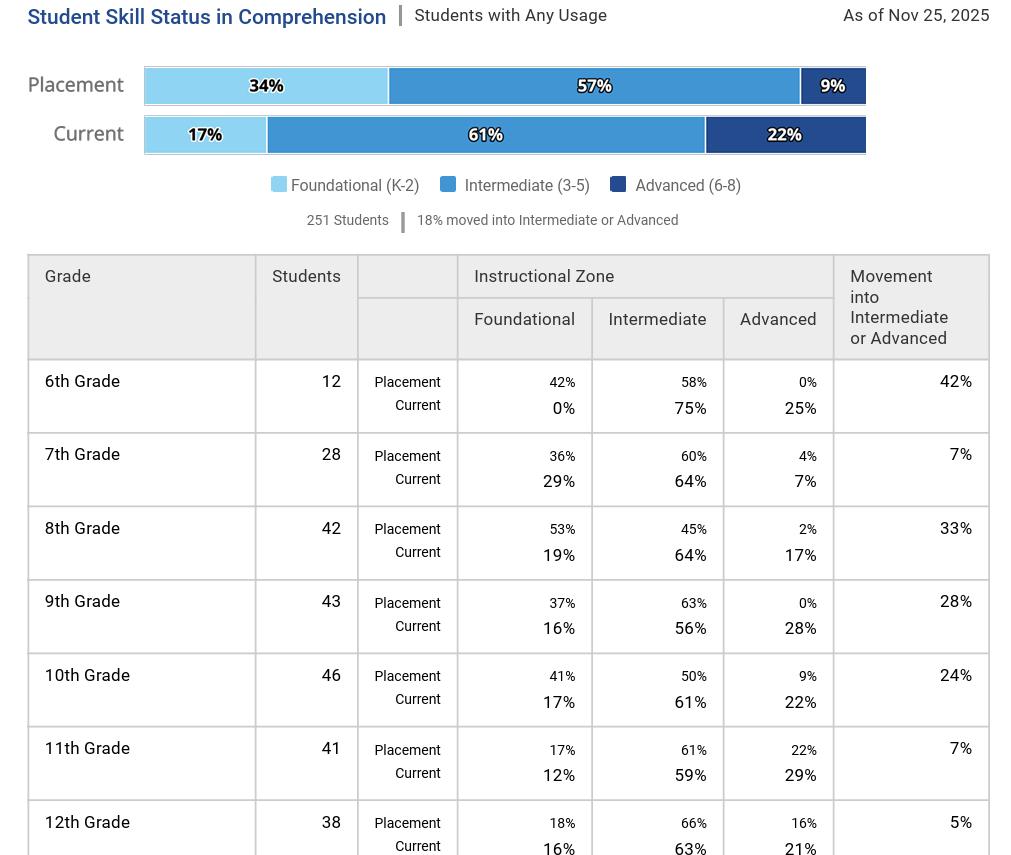
Lexia data collected at the local level through our Skills classes shows a range of growth. Comprehension is one example where growth of intermediate and advanced levels is evident. The development of students in all grades is positive, and especially significant in grades 6, 8, 9, and 10.
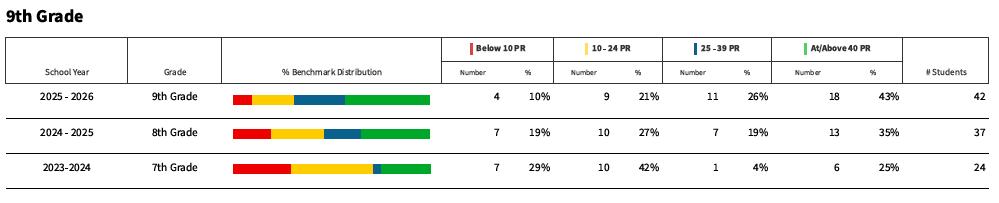
Additional data is gathered through local standardized tests for math and reading via Star Math and Star Reading. The examples provided show the increase in the students at or above benchmark levels (green), and the decrease in students at the urgent intervention (red) and intervention (yellow) levels. This is further testament to the importance of Skills classes and intensive intervention instruction provided in the school program.

Build Confidence
The teacher ratings for the citizenship measure are excellent, and the parent responses are on par with the provincial measures, but student results have declined and will therefore remain an important part of the upcoming Education Plan.
The decline in student responses could be partly due to several elementary students neither agreeing or disagreeing but reporting that they ‘do not know’ the answer to the citizenship questions. Only 51% of elementary students agreed that students follow the rules, but 34% reported that they do not know. Subsequently, 49% of elementary students agreed that most students respect each other, but 45% stated that they ‘did not know’. Therefore, although these scores have declined, there is not a clear indicator that a greater problem has emerged. The data suggests that we should also focus upon students’ understanding and clarity of the questions, as well as awareness of the school and classroom culture.
Junior high students reported lower on the citizenship questions and will be a focus of the Education Plan. 62% of junior high students feel that they are encouraged to help people in their community, but 13% did not know. It is important to focus up junior high citizenship in the Education Plan with regards to student responses. The implementation of the new behaviour plan could have impacted reporting, as all junior high teachers agreed, or strongly agreed, that students follow the rules and respect each other.
Junior High Teachers
Parental Involvement
Collaboration between the school and families is critical, and the percentage of parents satisfied with parental involvement in their child’s education is very high with an overall measure of excellent
From our local survey to parents, over 97% of parents reported being between somewhat to extremely happy with their overall satisfaction of their child’s experience at Foothills Academy; with a 4.1/5 average star rating
Some of the themes from the parent survey about high points of the year included:
● Improved academic performance and progress
● Strong teacher and staff relationships with students and families
● Reading development
● Developing social skills and connections
● Effective learning support and accommodations
● Student recognition
● Good access to extracurricular activities
● Supportive transitions into the school and between grades
Build Confidence
Grade 9 Provincial Achievement Test Results
In grade 9 we remained close to provincial average for acceptable standard, and the standard of excellence continues to fluctuate annually. The challenges facing individuals with Learning Disabilities vary in complexity, and different cohorts may experience vastly different challenges. Significant variations in overall results can occur between different cohorts.
Despite this, the 3-year rolling average for meeting the acceptable standard is increasing:
● 2021-23: 48.8%
● 2022-24: 58%
● 2023-25: 58.8%
Considering all students have a diagnosed Learning Disability, the majority of which are language based, 70.3% of the students meet the acceptable standard. These results typically fluctuate year over year, and although this is a lower score than the previous year, it is 16% higher than the year prior to that. Ultimately, the 3-year rolling average is only 6% below the provincial average, which is a testament to the growth experienced by our students as they reach the end of grade 9.
Grade 9 science PATs are higher than provincial scores in the acceptable range, as 84.6% of Foothills students meet the acceptable standard, compared to 80.4% in the province.
Additionally, in the Student Learning Engagement detail of the AEAMs, 84% of the junior high students reported that they agree or strongly agree that the science they are learning at school is interesting to them. The importance of student engagement is great, and we strive to create a sense of relatedness for students to the curriculum to support their motivation and success. The 3-yeaer average is continuing to improve, and is currently 74.5%, up 12% from the 2012-23 school year.
Grade 9 social studies PATs remain steady at 67.6%, close to the provincial average of 71%. There is continued growth in the 3-year rolling average:
● 2021-23: 47.5%
● 2022-24: 57.5%
● 2023-25: 60.9%
The upcoming Education Plan will focus upon the development of students’ numeracy skills and required supports and interventions in elementary and junior high math, via:
• Intensive intervention and remediation instruction during skills classes.
• Continued growth of team-teaching in math.
• Ongoing professional development in math specific areas.
• Further development of Foothills Academy’s Numeracy Strategy.
Diploma Exam Results
The overall acceptable standards are 80.6%, which is close to the provincial average. Although all students at Foothills Academy have a diagnosed Learning Disability, current diploma scores for the language-based core subjects (ELA and Social Studies) are significantly higher than the provincial results; other than the -1 ELA results, which were within 1% of the provincial result.
In Social Studies, diploma results for the -1 and -2 courses are significantly above the provincial average. This is further testament to the cumulative growth and development students experience through the structured school program, as classroom staff target each student’s specific needs with the developmentally appropriate amount of rigour and time. Furthermore, the relationships teachers forge with students enhances motivation and engagement, and many students begin to see the importance of their subjects in the older grades. When students also see a relatedness of school subjects to their future lives, they experience an “urgency of reality” which supplements their motivation to maximize their potential. This was evident in the student reporting in student learning engagement, as 89% of the high school students stated that they understand how the social studies they are learning at school is useful to them. Equally important, 94% saw the importance of high school science, and 89% recognized the importance of English Language Arts to their future lives.
The overall 3-year rolling average for diplomas is trending upwards:
● 2021-2023: 70.4%
● 2022-2024: 72.3%
● 2023-2025: 75.1%
In both math 30-1 and 30-2, 66.7% of the students were of an acceptable standard. This will be an area which has more focus in the Education Plan, and we will concentrate on test taking strategies. Additionally, it is important to note that the 3-year rolling average for acceptable level outcomes in diploma math results is continuing to increase, from 45.5%, to 54%, to 58.2%.
Foothills Academy has an academic focus in high school science, with biology, chemistry and physics. Students achieving results at an acceptable level in biology are increasing, and have risen by over 8% over the past two years. However, the school awarded mark is higher than the diploma awarded mark, and therefore test taking strategies will be a focus of the Education Plan, to help our students be more successful and reflect their true capabilities in the highstakes, stressful, standardized tests that are diploma exams.
3
4
Chemistry results were not reported due to a cohort of only 5 students. Physics results increased 20% from the previous year, with 71.4% being at the acceptable level.
The future Education Plan will continue to strive towards closing the gap between Foothills Academy’s overall 3-year rolling average and the province’s 3-year rolling average. If we close the gap by 4% in the next two years, we will be on parity with the overall provincial results . As with Provincial Achievement Tests, we will focus upon continued growth in math supports and strategies at the diploma level.
Maximize Potential
High School Completion Rates
This is another year where 100% of Foothills Acdaemy’s grade 12 students graduate high school. This is a great testament to the hard work and dedication of the students and the support of the school program, as statistics suggest that the drop-out rate of students with Learning Disabilities is nearly twice as high as for students without disabilities The cohort calculation over 4 years resulted in a decline in the 4-year completion rate, but it remains high and acceptable. We have very high achievement and overall excellent results with 3 and 5year high school completion rates.