14
May-June 2007
Sacramento Shot Glasses By Steve Abbott Slugging whiskey down the hatch straight out of the bottle was uncouth even at the turn of the 19th Century. Except for emergencies (i.e. no corkscrew was available or the patient needed a drink pronto), it was extremely not de rigueur to smash the top of a whiskey bottle against a granite outcropping and begin to gulp from the jagged neck of the bottle, especially if one had not wiped his lips on his shirt sleeve. No, our Victorian ancestors had developed a sensibility for the finer points of etiquette, particularly table manners, and had developed tableware and barware to suit that refined sensibility: for example, the asparagus fork, the celery dish, the salt cellar, the butter pat, the cocktail stirrer and shakers, and, yes, the shot glass. No longer would table etiquette consist of (1) Do not wear your hat, or (2) Do not whistle, (3) Do not eat your peas with a knife. The introduction of the shot glass made it possible to pour just enough hooch down the hatch (about an ounce and a half, in most cases) without causing the sputtering and gagging attendant on the long draws with the bottle tilted upwards about ninety degrees. And the introduction of the shot glass did not go unnoticed by the burgeoning advertising industry, which had linked up with the increasingly sophisticated and automated manufacturing sector, a connection which made mass produced items available at a nominal cost to the spirits’ distillers and distributor clients of the advertising companies. So it was inevitable that the advertising shot glass was born of this unholy alliance, and the war for consumer brand allegiance was on. As a result, the distillers and distributors could keep their brand names about four inches from the eyes of the guzzling masses, whether they were at home or at their favorite watering holes. These advertising shot glasses, while often graphically artistic, were cheaply made (about 1 mm thick) and extremely vulnerable to breakage, especially if smashed against the forehead of fellow saloon patron. The glasses usually took the form of a single shot glass, though double shot glasses are known, and the high ball glass, which for
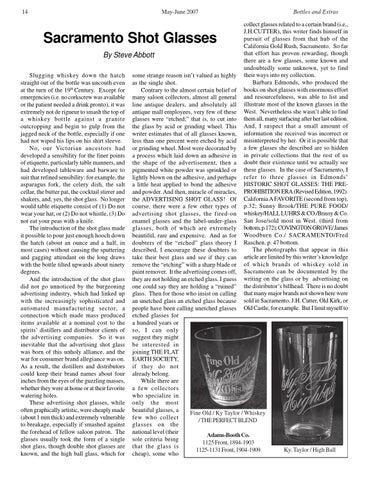
Bottles and Extras collect glasses related to a certain brand (i.e., J.H.CUTTER), this writer finds himself in pursuit of glasses from that hub of the California Gold Rush, Sacramento. So far that effort has proven rewarding, though there are a few glasses, some known and undoubtedly some unknown, yet to find their ways into my collection. Barbara Edmonds, who produced the books on shot glasses with enormous effort and resourcefulness, was able to list and illustrate most of the known glasses in the West. Nevertheless she wasn’t able to find them all, many surfacing after her last edition. And, I suspect that a small amount of information she received was incorrect or misinterpreted by her. Or it is possible that a few glasses she described are so hidden in private collections that the rest of us doubt their existence until we actually see these glasses. In the case of Sacramento, I refer to three glasses in Edmonds’ HISTORIC SHOT GLASSES: THE PREPROHIBITION ERA (Revised Edition, 1992). California A FAVORITE (second from top), p.32; Sunny Brook/THE PURE FOOD/ whiskey/HALL LUHRS & CO./Brassy & Co. San Jose/sold most in West. (third from bottom, p.172); COVINGTON GROVE/ James Woodburn Co./ SACRAMENTO/Fred Raschen. p. 47 bottom. The photographs that appear in this article are limited by this writer’s knowledge of which brands of whiskey sold in Sacramento can be documented by the writing on the glass or by advertising on the distributor’s billhead. There is no doubt that many major brands not shown here were sold in Sacramento, J.H. Cutter, Old Kirk, or Old Castle, for example. But I limit myself to
some strange reason isn’t valued as highly as the single shot. Contrary to the almost certain belief of many saloon collectors, almost all general line antique dealers, and absolutely all antique mall employees, very few of these glasses were “etched;” that is, to cut into the glass by acid or grinding wheel. This writer estimates that of all glasses known, less than one percent were etched by acid or grinding wheel. Most were decorated by a process which laid down an adhesive in the shape of the advertisement, then a pigmented white powder was sprinkled or lightly blown on the adhesive, and perhaps a little heat applied to bond the adhesive and powder. And then, miracle of miracles, the ADVERTISING SHOT GLASS! Of course, there were a few other types of advertising shot glasses, the fired-on enamel glasses and the label-under-glass glasses, both of which are extremely beautiful, rare and expensive. And as for doubters of the “etched” glass theory I described, I encourage these doubters to take their best glass and see if they can remove the “etching” with a sharp blade or paint remover. It the advertising comes off, they are not holding an etched glass. I guess one could say they are holding a “ruined” glass. Then for those who insist on calling an unetched glass an etched glass because people have been calling unetched glasses etched glasses for a hundred years or so, I can only suggest they might be interested in joining THE FLAT EARTH SOCIETY, if they do not already belong. While there are a few collectors who specialize in only the most beautiful glasses, a Fine Old / Ky Taylor / Whiskey few who collect / THE PERFECT BLEND glasses on the national level (their Adams-Booth Co. sole criteria being 1125 Front, 1894-1903 that the glass is 1125-1131 Front, 1904-1909 cheap), some who
Ky. Taylor / High Ball