Things to Know About Offshore Supply Vessels
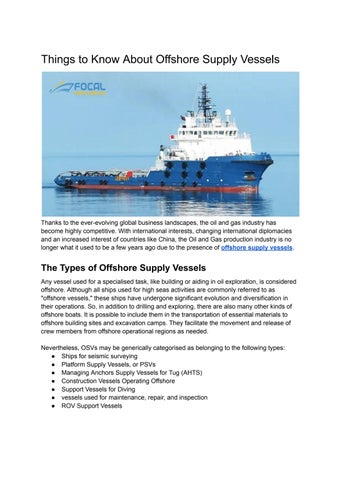
Thanks to the ever-evolving global business landscapes, the oil and gas industry has become highly competitive. With international interests, changing international diplomacies and an increased interest of countries like China, the Oil and Gas production industry is no longer what it used to be a few years ago due to the presence of offshore supply vessels.
The Types of Offshore Supply Vessels Any vessel used for a specialised task, like building or aiding in oil exploration, is considered offshore. Although all ships used for high seas activities are commonly referred to as "offshore vessels," these ships have undergone significant evolution and diversification in their operations. So, in addition to drilling and exploring, there are also many other kinds of offshore boats. It is possible to include them in the transportation of essential materials to offshore building sites and excavation camps. They facilitate the movement and release of crew members from offshore operational regions as needed. Nevertheless, OSVs may be generically categorised as belonging to the following types: ● Ships for seismic surveying ● Platform Supply Vessels, or PSVs ● Managing Anchors Supply Vessels for Tug (AHTS) ● Construction Vessels Operating Offshore ● Support Vessels for Diving ● vessels used for maintenance, repair, and inspection ● ROV Support Vessels
A Closer Look at Some OSV Types and How They Work Offshore supply boats are among the most prevalent types of OSVs. They move cargo, personnel, and other essential supplies between the shore and the ships and rigs. An offshore vessel type known as a Platform Supply Vessel (PSV) is frequently used in offshore drilling. These vessels are deployed to carry a variety of goods, including food, supplies, equipment, spare parts, and anything else that an offshore rig would require for routine operations. At shore, a PSV loads up before embarking on its voyage. While dry cargo is kept in special pneumatic pressure tanks, liquid cargo is kept in double-bottomed tanks. Drill pipes and other large pieces of equipment are set out on the deck. When cargo in the form of liquid and powder is placed onto rigs using pumps, a rig crane assists in transporting deck freight. The loading and unloading process takes about half of a normal cruise. Heavy machinery must be operated in hazardous sea conditions, making PSV work not only difficult but dangerous as well. Towing rigs, anchors, mooring chains, and supply platforms may all be handled by drilling rigs with the help of Anchor Handling Tug Supply Vessels, or AHTS. The offshore supply vessel hull design, power needs, and propeller size are appropriately represented in the demand for high bollard pull, which is a necessary feature for this type of job. Stability is critical for this sort of offshore support vessel. Additionally, they need to have enough room to store chains and equipment. A stern roller is used to carry wires and anchors over the stern to facilitate operations. Large, open deck spaces and roomy cabins are characteristic features of offshore construction ships. They are designed to work on substantial projects and can stay on location for long stretches of time. The ships can accommodate both surface and submerged installations since they are outfitted with powerful lift cranes. These can also be used for IRM (inspection, repair, and maintenance) projects; they are often referred to as Construction Support Vessels (CSV). Since these OSV offshore supply vessels are frequently controlled remotely for supply operations, well-stimulation and maintenance are essential duties of an IRM. Among the several types of offshore support vessels, the Diving Support Vessel (DSV) is utilised for underwater maintenance tasks as well as pipeline, well, and platform inspection. Inside the boats, there are one or more openings called moon pools that allow divers, equipment, and ROVs to descend into the sea. Staying still is essential necessary for DSVs, while CSVs must maintain their position to allow appropriate structures. A dynamic positioning system that keeps the boats in place under all circumstances and throughout operations is installed on them. As an escort vessel during an emergency, an offshore support vessel can also be utilised to help crippled ships. Oil spill cleanup from the water is another use for them. A smaller, quicker version of the original OSV, the Fast Supply Intervention Vessel (FSIV) is another variant that may be utilised for emergency response services or for making last-minute deliveries. Additionally, Seismic Survey Vessels are designed expressly to carry out seismic surveys in oceanic environments. With the least amount of disruption to marine life, these special containers assist in determining the optimal locations for oil drilling. By firing seismic waves and timing the gap between their return, they can assess if a location is suitable for drilling. Compared to any typical OSV or ship, their unique design frequently
gives them an unusual appearance. Sensitive technology is provided on board for studying ocean geology, including rocks, trenches, and other underwater features, including seismic vessels.
A Peek into the Offshore Support Vehicle Market Because OSV or offshore supply vessels are so diverse, they are becoming more and more important in the marine sector, in addition to playing a crucial role. At a compound annual growth rate (CAGR) of around 4.5% between 2022 and 2027, the offshore support vessel market, valued at approximately $19.4 billion in 2020, is projected to reach $28 billion by 2027. Nonetheless, there are occasional downturns in the offshore support vessel industry. The COVID-19 epidemic caused slowdowns in the OSV market, as it did in almost every other industry on the earth, resulting in the reduction or cancellation of offshore drilling contracts. However, as deep-water gas and oil drilling projects become more feasible, the demand for them is projected to pick up speed and boost expansion in the offshore support vessel market.
Final Words The rising desire to explore and utilise the possibilities of the high seas has led to a surge in demand for different kinds of offshore supply vessels like Focal Shipping. When you combine it with the benefits of technology research and other related advancements, the current global fleet of offshore supply boats begins to reflect the enormous advancements that have been accomplished recently in the marine industry.